

Zeklor
43 Публикации
Zeklor
Отправить жалобу
Заблокировать пользователя
Portfolio Management | Invest in crypto with us and enjoy the thrill of passive revenue. | message us via (plus)2348065767628 to get Started.
Открытая сделка

Владелец NEAR
Трейдер с частыми сделками
6.8 г
28 подписок(и/а)
29 подписчиков(а)
28 понравилось
Посты
Портфель
Все
Цитирования
Видео
·
--
I've just made a new trade! Click here to copy my portfolio👇
I've just made a new trade! Click here to copy my portfolio👇
Zeklor
Закрыть позицию
ZECUSDT
PnL(USDT)
+0.05
Цена закрытия
1253.56999944
·
--
I've just made a new trade! Click here to copy my portfolio👇
I've just made a new trade! Click here to copy my portfolio👇
Zeklor
Закрыть позицию
1000PEPEUSDT
PnL(USDT)
+0.11
Цена закрытия
0.005306
·
--
Why do whales, celebrities, and big business owners always end up in court? 🐋⚖️
It is not bad luck. It is math.
Before a lawyer takes a case, one question comes first: "Can the other side pay?" A person with nothing is not worth the legal fees. A person with property, a business, and a growing portfolio is. The bigger your bag, the bigger your target, even when the claim is weak. Settling quietly is often cheaper than fighting.
Crypto holders are not exempt. As your portfolio grows, so does your exposure:
• More visibility means more people watching your wallet
• Business disputes can reach your personal assets
• Partners, clients, and counterparties may see you as a deep pocket
• One bad decision with a large position can cost far more than a small one
Growing wealth is step one. Protecting it is step two. So;
🔐 Separate business and personal funds
🔐 Never keep everything in one place or one position
🔐 Put every agreement in writing, even with friends
🔐 Use strict risk management on every trade
🔐 Get qualified legal and financial advice early
The same discipline applies to trading. The goal is not only to grow your capital. It is to keep it.
That is the approach I follow as a Lead Trader on Binance. If you want to put your capital to work with a structured, risk-aware strategy instead of guessing the market alone, you can follow my trades through Copy Trading:
👉 Join my [Binance Copy Trading Account.](https://www.binance.com/en/copy-trading/lead-details/5291298792060684032)
* Review my trading history and stats before you decide
* Set your own copy amount and risk limits
* Stop copying at any time
Build wealth. Then guard it. Follow for more insights on growing and protecting your money. 💼
$BTC $ETH $BNB #Binance #Copytrading #CryptoTrading #RiskManagement #wealthbuilding
⚠️ Crypto trading and copy trading carry a high level of risk. Past performance does not guarantee future results, and you may lose part or all of your capital. This is general information, not financial or legal advice.
Why do whales, celebrities, and big business owners always end up in court? 🐋⚖️
It is not bad luck. It is math.
Before a lawyer takes a case, one question comes first: "Can the other side pay?" A person with nothing is not worth the legal fees. A person with property, a business, and a growing portfolio is. The bigger your bag, the bigger your target, even when the claim is weak. Settling quietly is often cheaper than fighting.
Crypto holders are not exempt. As your portfolio grows, so does your exposure:
• More visibility means more people watching your wallet
• Business disputes can reach your personal assets
• Partners, clients, and counterparties may see you as a deep pocket
• One bad decision with a large position can cost far more than a small one
Growing wealth is step one. Protecting it is step two. So;
🔐 Separate business and personal funds
🔐 Never keep everything in one place or one position
🔐 Put every agreement in writing, even with friends
🔐 Use strict risk management on every trade
🔐 Get qualified legal and financial advice early
The same discipline applies to trading. The goal is not only to grow your capital. It is to keep it.
That is the approach I follow as a Lead Trader on Binance. If you want to put your capital to work with a structured, risk-aware strategy instead of guessing the market alone, you can follow my trades through Copy Trading:
👉 Join my Binance Copy Trading Account.
* Review my trading history and stats before you decide
* Set your own copy amount and risk limits
* Stop copying at any time
Build wealth. Then guard it. Follow for more insights on growing and protecting your money. 💼
$BTC $ETH $BNB #Binance #Copytrading #CryptoTrading #RiskManagement #wealthbuilding
⚠️ Crypto trading and copy trading carry a high level of risk. Past performance does not guarantee future results, and you may lose part or all of your capital. This is general information, not financial or legal advice.

100
·
--

Статья
Two Headlines Every Investor Should Read CarefullyTwo stories crossed the crypto world between 14 and 18 October. Together they carry a lesson for investors everywhere.
First, Turkish police and intelligence officers detained Hex founder Richard Heart in Istanbul, acting on an Interpol Red Notice, according to Turkish media (Decrypt, 2026). Finland requested the notice over alleged aggravated tax fraud. Heart has not been convicted, and no extradition request has been confirmed (Yahoo News, 2026).
Second, Crypto.com's prediction market exchange and Novig sued Missouri officials in federal court on 16 October. They want to stop the state from applying its sports betting laws to their event contracts (The Block, 2026). Four other platforms, including Kalshi and Polymarket, had not yet followed with lawsuits when The Block reported on the story (The Block, 2026). The underlying question is whether federal regulators or the states have authority over prediction markets (TokenPost, 2026).
Here is the key point: these are separate legal matters. One is a tax case tied to a single founder. The other is a jurisdiction dispute over sports contracts. Neither is evidence of a crackdown on all cryptocurrencies.
So why should you care, wherever you invest? Legal developments in one country can still ripple outward. They can affect access to international trading platforms, institutional participation in crypto markets, stablecoin services and cross-border transfers, and compliance demands on businesses handling digital assets.
Even so, a foreign headline does not rewrite your own country's rules. Take Nigeria as an example. Its Investments and Securities Act 2025 classifies digital assets as securities under the national SEC and brings exchanges and other service providers under its supervision (BusinessDay, 2025; Mariblock, 2025). Whatever happens in Istanbul or Missouri, Nigerian investors answer to that framework unless their own authorities announce a change. Your market will have its own version of this.
Before you commit capital, run this checklist:
Confirm the platform's regulatory status in your jurisdiction.
Understand how your assets are held in custody.
Read the withdrawal conditions carefully.
Check which local requirements apply to you.
Headlines move markets. Due diligence protects your money.
References
BusinessDay. (2025). What to know as ISA 2025 enhances regulatory powers of SEC. https://businessday.ng/news/article/what-to-know-as-isa-2025-enhances-regulatory-powers-of-sec/
Decrypt. (2026, October 14). Hex founder Richard Heart detained in Istanbul on Interpol Red Notice: Report. https://decrypt.co/380948/hex-founder-richard-heart-detained-in-istanbul-on-interpol-red-notice-report
Mariblock. (2025). Nigeria's president signs bill recognizing digital assets into law. https://www.mariblock.com/nigerias-president-signs-bill-recognizing-digital-assets-into-law
The Block. (2026, October 18). Crypto.com, Novig sue Missouri over sports event contracts; Kalshi, Polymarket, Robinhood hold off. https://www.theblock.co/news/regulation/2026-10-18-crypto-com-novig-sue-missouri-over-sports-event-contracts-kalshi-polymarket-robinhood-hold-off-418866
TokenPost. (2026, October 13). Prediction-market jurisdiction dispute could reach Supreme Court. https://www.tokenpost.com/news/regulation/31226
Yahoo News. (2026, October 14). HEX founder Richard Heart detained in Turkey. https://www.yahoo.com/news/world/articles/hex-founder-richard-heart-detained-163232818.html
Two Headlines Every Investor Should Read Carefully
Two stories crossed the crypto world between 14 and 18 October. Together they carry a lesson for investors everywhere.
First, Turkish police and intelligence officers detained Hex founder Richard Heart in Istanbul, acting on an Interpol Red Notice, according to Turkish media (Decrypt, 2026). Finland requested the notice over alleged aggravated tax fraud. Heart has not been convicted, and no extradition request has been confirmed (Yahoo News, 2026).
Second, Crypto.com's prediction market exchange and Novig sued Missouri officials in federal court on 16 October. They want to stop the state from applying its sports betting laws to their event contracts (The Block, 2026). Four other platforms, including Kalshi and Polymarket, had not yet followed with lawsuits when The Block reported on the story (The Block, 2026). The underlying question is whether federal regulators or the states have authority over prediction markets (TokenPost, 2026).
Here is the key point: these are separate legal matters. One is a tax case tied to a single founder. The other is a jurisdiction dispute over sports contracts. Neither is evidence of a crackdown on all cryptocurrencies.
So why should you care, wherever you invest? Legal developments in one country can still ripple outward. They can affect access to international trading platforms, institutional participation in crypto markets, stablecoin services and cross-border transfers, and compliance demands on businesses handling digital assets.
Even so, a foreign headline does not rewrite your own country's rules. Take Nigeria as an example. Its Investments and Securities Act 2025 classifies digital assets as securities under the national SEC and brings exchanges and other service providers under its supervision (BusinessDay, 2025; Mariblock, 2025). Whatever happens in Istanbul or Missouri, Nigerian investors answer to that framework unless their own authorities announce a change. Your market will have its own version of this.
Before you commit capital, run this checklist:
Confirm the platform's regulatory status in your jurisdiction.
Understand how your assets are held in custody.
Read the withdrawal conditions carefully.
Check which local requirements apply to you.
Headlines move markets. Due diligence protects your money.
References
BusinessDay. (2025). What to know as ISA 2025 enhances regulatory powers of SEC. https://businessday.ng/news/article/what-to-know-as-isa-2025-enhances-regulatory-powers-of-sec/
Decrypt. (2026, October 14). Hex founder Richard Heart detained in Istanbul on Interpol Red Notice: Report. https://decrypt.co/380948/hex-founder-richard-heart-detained-in-istanbul-on-interpol-red-notice-report
Mariblock. (2025). Nigeria's president signs bill recognizing digital assets into law. https://www.mariblock.com/nigerias-president-signs-bill-recognizing-digital-assets-into-law
The Block. (2026, October 18). Crypto.com, Novig sue Missouri over sports event contracts; Kalshi, Polymarket, Robinhood hold off. https://www.theblock.co/news/regulation/2026-10-18-crypto-com-novig-sue-missouri-over-sports-event-contracts-kalshi-polymarket-robinhood-hold-off-418866
TokenPost. (2026, October 13). Prediction-market jurisdiction dispute could reach Supreme Court. https://www.tokenpost.com/news/regulation/31226
Yahoo News. (2026, October 14). HEX founder Richard Heart detained in Turkey. https://www.yahoo.com/news/world/articles/hex-founder-richard-heart-detained-163232818.html
1
·
--
Статья
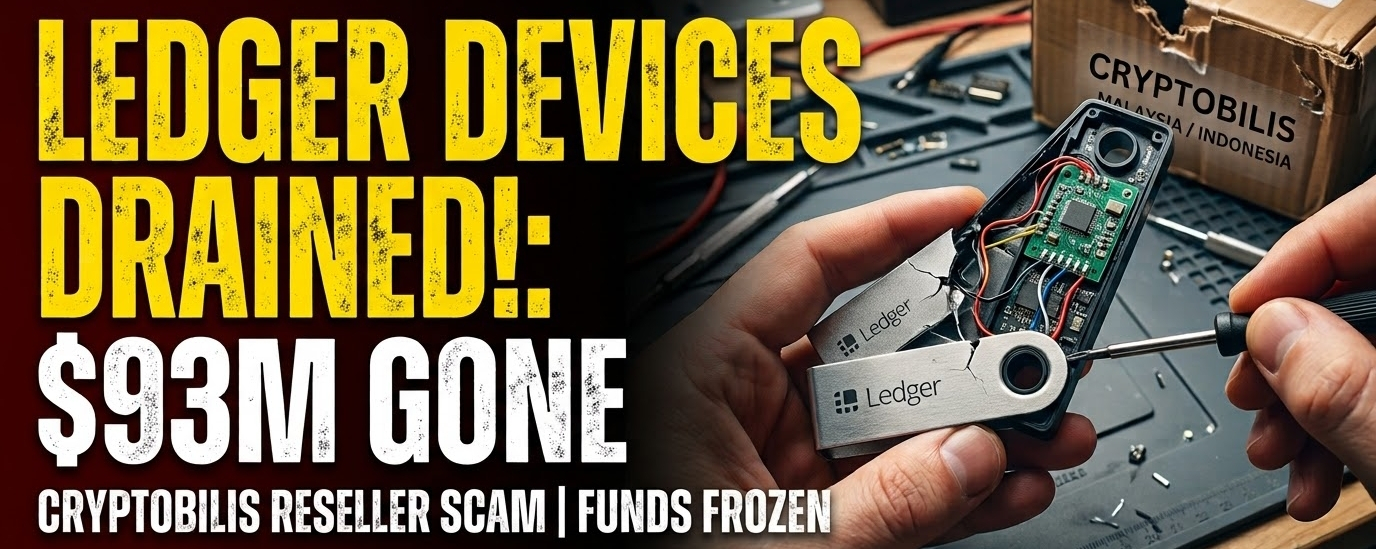
Let's talk about the Ledger situation, because this one hits close to home. 👇Between October 9 and 10, about $93M was drained from hundreds of wallets across six blockchains. The common thread is that these were all Ledger devices bought through CryptoBilis, an official reseller in Indonesia, Malaysia and the Philippines. Estimates vary depending on who's counting, from around $86M up to $94.5M, and Ledger hasn't confirmed any of the totals yet.
What do we actually know about the cause? Ledger confirmed that at least one affected device had an unauthorized hardware implant inside. That points to a supply chain problem, meaning the devices were likely tampered with somewhere before they reached the buyer. Ledger also says it has no sign that its own security infrastructure, systems or services were compromised. So this doesn't look like a flaw in every Ledger out there, and the confirmed reports so far are limited to people who bought from this reseller in Southeast Asia.
What we still don't know matters too. Ledger hasn't said how many devices were tampered with, which models were affected, or whether victims will be reimbursed.
On the recovery side, there's a little good news. Tether moved quickly and froze 37 addresses, with about $10M in USDT locked. PeckShield also traced around $3.89M of stolen USDT and TRX to Binance deposit addresses, which gives investigators a real lead. Even so, that's roughly 10% of what was taken. CZ has publicly urged the wider industry to help secure the stolen funds, so it's worth watching whether exchanges and authorities act on those flagged addresses.
Here's what Ledger is telling people who bought from CryptoBilis in the last 90 days:
✅ If you haven't set the device up, don't. Leave it alone.
✅ If you've already set it up, move your assets to a new Ledger signer with a completely new seed phrase.
CryptoBilis has reportedly closed its shops in all three countries, and Ledger has asked it to pause all sales and shipments while the investigation continues.
My takeaway is that "not your keys, not your coins" is only half the story. Your keys are only yours if the device generating them is clean. A few habits can save you a lot of pain:
🔹 Buy hardware wallets directly from the manufacturer, not from third-party sellers or marketplaces
🔹 Never use a device that arrives already set up
🔹 Never use a recovery phrase that's pre-written or pre-printed. You generate your own, always
🔹 Check the packaging and tamper seals, and if anything looks off, stop and don't use it
Even "official" resellers add a link to the chain you can't fully verify, and this case shows how costly that can be.
I'll keep following this story as Ledger releases more details. If you know anyone who bought a hardware wallet recently, especially in Southeast Asia, please share this with them. 🙏
Stay safe out there. 🔐
#Ledger #CryptoSecurity #HardwareWallets #SelfCustody #CryptoNews
$BTC $ETH $USDT
Let's talk about the Ledger situation, because this one hits close to home. 👇
Between October 9 and 10, about $93M was drained from hundreds of wallets across six blockchains. The common thread is that these were all Ledger devices bought through CryptoBilis, an official reseller in Indonesia, Malaysia and the Philippines. Estimates vary depending on who's counting, from around $86M up to $94.5M, and Ledger hasn't confirmed any of the totals yet.
What do we actually know about the cause? Ledger confirmed that at least one affected device had an unauthorized hardware implant inside. That points to a supply chain problem, meaning the devices were likely tampered with somewhere before they reached the buyer. Ledger also says it has no sign that its own security infrastructure, systems or services were compromised. So this doesn't look like a flaw in every Ledger out there, and the confirmed reports so far are limited to people who bought from this reseller in Southeast Asia.
What we still don't know matters too. Ledger hasn't said how many devices were tampered with, which models were affected, or whether victims will be reimbursed.
On the recovery side, there's a little good news. Tether moved quickly and froze 37 addresses, with about $10M in USDT locked. PeckShield also traced around $3.89M of stolen USDT and TRX to Binance deposit addresses, which gives investigators a real lead. Even so, that's roughly 10% of what was taken. CZ has publicly urged the wider industry to help secure the stolen funds, so it's worth watching whether exchanges and authorities act on those flagged addresses.
Here's what Ledger is telling people who bought from CryptoBilis in the last 90 days:
✅ If you haven't set the device up, don't. Leave it alone.
✅ If you've already set it up, move your assets to a new Ledger signer with a completely new seed phrase.
CryptoBilis has reportedly closed its shops in all three countries, and Ledger has asked it to pause all sales and shipments while the investigation continues.
My takeaway is that "not your keys, not your coins" is only half the story. Your keys are only yours if the device generating them is clean. A few habits can save you a lot of pain:
🔹 Buy hardware wallets directly from the manufacturer, not from third-party sellers or marketplaces
🔹 Never use a device that arrives already set up
🔹 Never use a recovery phrase that's pre-written or pre-printed. You generate your own, always
🔹 Check the packaging and tamper seals, and if anything looks off, stop and don't use it
Even "official" resellers add a link to the chain you can't fully verify, and this case shows how costly that can be.
I'll keep following this story as Ledger releases more details. If you know anyone who bought a hardware wallet recently, especially in Southeast Asia, please share this with them. 🙏
Stay safe out there. 🔐
#Ledger #CryptoSecurity #HardwareWallets #SelfCustody #CryptoNews
$BTC $ETH $USDT
108
·
--
Filecoin's biggest supply change since mainnet lands this week 👀
On October 15, 2026, the six-year vesting schedules for Protocol Labs and the Filecoin Foundation come to an end. When Filecoin launched in October 2020, 300 million FIL was allocated to Protocol Labs and 100 million FIL to the Filecoin Foundation, both unlocking gradually over six years. This is the last genesis unlock still running from that original plan.
The numbers are significant. Gross annual issuance is expected to fall from about 89 million FIL to roughly 21–22 million, a cut of around 75%. That removes somewhere between 66.7 and 68 million FIL in yearly vesting releases. Emissions won't go to zero, though, because block rewards to storage providers continue, with 25% of earned rewards accessible immediately and the rest vesting over 180 days.
The market has noticed. FIL has climbed from the $0.70 area in August to around $1.20, a five-month high, with analysts watching $1.30–$1.40 as the next resistance and $1.00 as key support. Exchange inflows have also ticked up, which can signal some profit-taking along the way.
The caveat is that less new supply doesn't guarantee a price rally. Tokens that are already unlocked can still be sold, and net supply also depends on network burns and the collateral providers lock up. Demand has to show up to make the supply story matter.
Anticipated events are often priced in early, so manage your risk and do your own research. This is not financial advice.
#Filecoin #crypto #Tokenomics #altcoins #DePIN
$FIL $BTC $ETH

87
·
--

Статья
AI's Data Problem Is Becoming a Blockchain StoryOne of the quieter stories in crypto right now has nothing to do with price. It is about the data behind #Aİ , and who gets to say it is legitimate.
Most AI systems are trained on data pipelines that nobody outside the company can check. With #Copyright disputes growing around the world, that has become a real business risk, not just a technical detail. If you cannot show where your training data came from, you may struggle to defend it later. And if you are a creator or data owner, you have no easy way to prove what is yours or to get paid when it is used.
This is the gap a group of projects around Sui and Walrus are trying to close. Walrus is a decentralized storage network built by Mysten Labs, the same team behind $SUI . Large datasets are too heavy and too expensive to keep directly on a blockchain, so Walrus stores the files while Sui records the proof that the data exists, where it sits and who controls access. On top of that, data marketplaces are starting to appear where builders can register datasets, models or agents and set their own licensing terms. Several AI teams are already using it, and over 120 projects had integrated with the network by early 2026.
Walrus is chain-agnostic, which means apps built on #solana or #Ethereum can use it too. So the story is less about one chain winning and more about a shared data layer that many chains can plug into.
However, I looked for a confirmed registry of rights-cleared AI training data specifically and could not find one. This mens that while the infrastructure and the activity is real, and companies are raising money to build data networks for AI, on-chain registries such as rights-cleared AI training datasets are not yet realities. A good narrative and a good investment are two different things, and in crypto the gap between them has cost many people dearly.
If this interests you, the sensible move is to study it, not chase it. Read what the projects themselves have announced, check who is actually using the product, and be careful with any token whose main selling point is a story. Early-stage infrastructure can take years to prove itself, and only money you can afford to leave alone for that long should be anywhere near it.
$ETH $SOL
AI's Data Problem Is Becoming a Blockchain Story
One of the quieter stories in crypto right now has nothing to do with price. It is about the data behind #Aİ , and who gets to say it is legitimate.
Most AI systems are trained on data pipelines that nobody outside the company can check. With #Copyright disputes growing around the world, that has become a real business risk, not just a technical detail. If you cannot show where your training data came from, you may struggle to defend it later. And if you are a creator or data owner, you have no easy way to prove what is yours or to get paid when it is used.
This is the gap a group of projects around Sui and Walrus are trying to close. Walrus is a decentralized storage network built by Mysten Labs, the same team behind $SUI . Large datasets are too heavy and too expensive to keep directly on a blockchain, so Walrus stores the files while Sui records the proof that the data exists, where it sits and who controls access. On top of that, data marketplaces are starting to appear where builders can register datasets, models or agents and set their own licensing terms. Several AI teams are already using it, and over 120 projects had integrated with the network by early 2026.
Walrus is chain-agnostic, which means apps built on #solana or #Ethereum can use it too. So the story is less about one chain winning and more about a shared data layer that many chains can plug into.
However, I looked for a confirmed registry of rights-cleared AI training data specifically and could not find one. This mens that while the infrastructure and the activity is real, and companies are raising money to build data networks for AI, on-chain registries such as rights-cleared AI training datasets are not yet realities. A good narrative and a good investment are two different things, and in crypto the gap between them has cost many people dearly.
If this interests you, the sensible move is to study it, not chase it. Read what the projects themselves have announced, check who is actually using the product, and be careful with any token whose main selling point is a story. Early-stage infrastructure can take years to prove itself, and only money you can afford to leave alone for that long should be anywhere near it.
$ETH $SOL
154
·
--
🚨 A hardware wallet just made headlines for the wrong reason.
Reports say over $86M was drained from #Ledger users who bought through one authorized reseller in Southeast Asia. Ledger is investigating, and the figure and cause aren't confirmed. Early signs point to tampered devices.
The lesson isn't "hardware wallets are broken." It's this: "authorized reseller" means they can sell it, not that the device is safe.
Before you trust any device with your keys:
✅ Buy directly from the manufacturer
✅ Never use a device that arrives pre-initialized or with a seed already written down
✅ Run the official authenticity check, but don't treat it as the last word
✅ Holding serious funds? Use a multisig with keys from different vendors, so one compromised supplier can't empty you out
A multisig only helps if your keys don't all come from the same place.
Buy smart, verify everything, and don't let a bargain from a reseller cost you everything. 🔐
What's your setup: single device, multisig, or still on an exchange? 👇
#crypto #SelfCustody #HardwareWallets #CryptoSecurity

55
·
--
Торговля за 30 дней $BTC 520.1 USDT
The crypto market is entering a pivotal stretch as Bitcoin ($BTC ) holds steady around $84,000, pushing total market capitalization up 1.4% to $2.91 Trillion.
Traders and institutional investors are locking in on a packed economic calendar that could dictate market direction and volatility over the coming days:
🗓️ Key Macro Drivers to Watch
Oct 13: OPEC Oil Market Report — Crude energy trends setting the backdrop for broader global inflation concerns.
Oct 14: U.S. CPI (Consumer Price Index) — The big inflation metric investors are waiting on.
Oct 15: U.S. PPI & Initial Jobless Claims — Wholesale inflation data combined with labor market health signals.
Oct 16: Fed Chair Kevin Warsh Speech — Key leadership remarks framing future central bank policy.
💡 Market Outlook
With inflation expectations hovering around 3.7% and interest rate probability models pricing in an 80% likelihood of rates remaining unchanged, this week's data releases could serve as the catalyst for crypto's next major trend.
📈 Will the data spark a bullish breakout, or are we in for short-term consolidation?
Share your trade setups below! 👇
#cryptouniverseofficial #Inflation #FederalReserve #Trading

70
·
--
Проверено
High-throughput blockchains like $SOL keep pushing execution speed, but their limit increasingly isn't compute. It's communication.
Moving consensus messages across the open internet exposes validators to packet delays, routing shifts, and traffic spikes. That variance in data arrival times forces distributed protocols to pad their timing assumptions, trading efficiency for safety.
#DoubleZero2Z targets this by adding a private fiber overlay alongside the public internet, not replacing it. Validators route traffic over dedicated links contributed by independent providers, which gives them lower latency and more consistent bandwidth under normal conditions.
They can still fail over to their existing connectivity. FPGA hardware at the network edge filters spam, deduplicates packets, and verifies signatures before traffic propagates.
Mainnet-beta launched on October 2, 2025, and as of August 2026, validators controlling 62.6% of Solana stake run on it. Solana is the initial focus. Chains like $SUI , $APT Aptos, #Avalanche , and #celestia are on the roadmap.
Critical evaluation of DoubleZero
While DoubleZero offers a compelling physical-layer upgrade, several considerations remain:
Coordination and SLA risk: The network depends on independent contributors to supply physical fiber and hardware. That brings maintenance and service-level risks that pure software protocols avoid.
Centralization risk: Contributors include large institutions such as Jump, Galaxy, Jito, and Cumberland/DRW, and Jump Crypto held 28% of the launch token distribution. Routing could concentrate around dominant data center hubs, creating chokepoints. Incentives could also unintentionally pull "winning" validators toward certain locations.
Economic sustainability: Validators pay a share of block rewards in 2Z, with half burned and half distributed to contributors. Supply is capped at 10 billion with modest inflation to reward contributors. Long-term viability depends on fee demand from validators and Edge customers holding up against free public internet routes.

740
·
--
Рост
@Hua_BNB says the price stagnation we are seeing in the market these few days is a bullish# signal.
What are your thoughts?
#MarketPullback $BTC $ETH $BNB
@Hua BNB says the price stagnation we are seeing in the market these few days is a bullish# signal.
What are your thoughts?
#MarketPullback $BTC $ETH $BNB
What are your thoughts?
#MarketPullback $BTC $ETH $BNB
57
·
--
A Second Look at Nigeria’s Inflation Dropping to 21.88% in July 2025
The National Bureau of Statistics updated inflation measurements, masking the real pain as food inflation climbed to 22.74%.
For investors, this means your cash is losing value unless your portfolio beats inflation. Fixed income and strategic crypto investments can help grow your wealth despite rising prices. Don’t just watch inflation—act to protect and grow your money! #PersonalFinance #InvestSmart #Inflation2025 #wealthbuilding #FinanceTips
409
·
--
A Billion-Dollar Bet on Ethereum You Should Know About.
In just one week, an unknown institutions quietly acquired over 1 million $ETH driving Ethereum’s market cap past $523 billion and outperforming major giants like Mastercard.
Who is behind this and why should this matter to you as a crypto-curious investor?
Watch now to learn how tracking big transactions and market psychology can help you make smarter crypto investments.
Like and share your thoughts—would you buy ETH now or wait?
#Ethereum #CryptoInvesting #smartmoney #ETHBuy #BlockchainInvestments #CryptoNews
2
314
·
--
Is the U.S. GENIUS Act Banning Stablecoins Like USDT and USDC?
Let us clear up one of the biggest misunderstandings right now. The GENIUS Act is not banning $USDT , $USDC , or other popular stablecoins. But it is changing the rules of the game for anyone who wants to offer them to U.S. users.
The law is not coming in with a wrecking ball. It is coming in with a checklist. If a stablecoin issuer wants to stay active in the U.S. market, they now need to register, follow strict reserve guidelines, and prove that their coins are backed by actual dollars or short-term government securities. That means no more hiding behind complicated reserve structures or unaudited promises.
So while USDT and USDC are still around, they must now play by new rules if they want to keep U.S. users in the loop. Some issuers will adapt quickly. Others might take a step back or be forced to exit the U.S. market entirely. This is where your awareness as an investor becomes a real advantage.
If you are holding stablecoins as a parking space for your funds or using them for trading, you want to be sure the issuer is compliant or heading in that direction. Because if not, you could end up holding a coin that becomes delisted or loses access to key payment rails, especially if you are a US resident or using a US compliant exchange or business.
The fact is, crypto investing is not just about price charts and hype anymore. It is now also about knowing the legal terrain and how policy changes affect what you are holding. I work with investors who want that kind of clarity built into their crypto strategy.
I do not chase every coin, I focus on what is solid, compliant, and positioned to last.
📌 If you want to review what you are holding and make sure you are not caught off guard by regulatory shifts like this, reach out. I can help you make sense of it.
___
#GENIUSActPas #USDC #USDT #CryptoRegulationBattle #StablecoinsExplained #CryptoPortfolio #DigitalAssets #CryptoEducation #SmartInvesting #EzekielInvests #CryptoNigeria #Web3Compliance #CryptoSecurity

34
·
--
Crypto Cards Are Making Digital Cash Real — But Are They Worth It?
Let’s talk about something that’s quietly changing how people spend money: crypto debit cards.
In case you missed it, TechCabal recently spotlighted how crypto is moving beyond just trading — and now can be used as everyday cash via crypto cards. And they’re not wrong. These cards are picking up steam fast, especially in places like Nigeria.
✅ You can swipe at PoS terminals, withdraw naira from ATMs, or pay online — just like a regular bank card. But instead of linking to a bank, it pulls straight from your crypto wallet and converts on the spot.
Startups like PiplePay, Cardex, and even Visa-backed solutions with 100Pay are making it easier than ever to spend $USDT , $BTC , or $ETH like real cash.
But not everyone is clapping.
💸 Some users on Reddit complain about hidden fees (1–4%), poor exchange rates, and delayed settlements. Others say it’s worth it for the convenience alone — especially freelancers, remote workers, and digital nomads.
So what’s the play here?
Crypto cards are great — if you know what you’re doing. But if you’re swiping blindly, you might lose value every time you spend.
That’s where I come in.
As a crypto broker, I help clients:
Choose the right card with the lowest fees
Manage their wallets across chains
Move between assets like stablecoins, naira, and dollar equivalents
And build a crypto strategy that makes sense — not stress
You don’t need to be a crypto expert. You just need someone who’s been in the game, knows the tools, and can optimize your spending and investing.
📩 DM me if you want to make your crypto actually work in real life.
___
#cryptocard #DigitalCash #CryptoPayments #SpendCrypto #NairaToUSDT #FintechAfrica #SmartMoneyMovesn #EzekielAbalagbeyiwa #CryptoBrokerage

19
·
--
🚀 XRP Surges to 45-Day High as Guppy Indicator Hints at More Gains Ahead
XRP is turning heads again.
The cryptocurrency just climbed to a 45-day high of $2.83, sparking renewed excitement across the market. But it’s not just the price move that has analysts buzzing — it’s the signal behind it.
According to CoinDesk, the Guppy Multiple Moving Average (GMMA) — a momentum indicator using short- and long-term exponential moving averages — has just flashed a strong bullish crossover. What does that mean in plain English? The short-term trend has broken out above the long-term trend, signaling that buyers are back in control and the road ahead might be even greener.
Analysts say XRP could be eyeing its next resistance around $2.65, with momentum likely to push it beyond if market conditions hold steady. And this move isn’t happening in isolation — crypto as a whole is gaining steam, with renewed investor interest following positive ETF developments and increasing demand from institutions.
Now, here’s why this matters for Zest investors.
We don’t just track hype — we track high-conviction trends supported by technical strength. The Guppy indicator isn’t about guesswork. It reflects real-time market confidence, especially from medium- and long-term players. XRP showing a bullish GMMA crossover tells us there’s rising potential for short-term profit and long-term positioning — exactly the kind of momentum Zest seeks to ride early.
For our community looking to diversify into crypto-backed growth with calculated risk, XRP’s setup could be a key signal. But as always, the crypto market remains volatile, and Zest continuously monitors indicators like this to ensure risk-managed exposure for our investors.
This isn’t just another spike — this might be a strategic window.
___
#XRP #CryptoMomentum #GuppyIndicator #TechnicalAnalysis #ZestWealth #SmartInvesting #CryptoSignals #AltcoinSeason #FinancialFreedom #BullishCross

1
195
·
--
🇯🇵💸 Japanese Yen Stumbles as Trade Worries Push USD/JPY to 2-Week High 🚨📈
The Japanese Yen is on shaky ground this week, sliding sharply against the US Dollar as renewed trade tensions put pressure on Asia’s second-largest economy. On Tuesday, the USD/JPY pair soared to a two-week high, breaking through the 147.00 barrier before slowing down slightly. What’s driving the move? A wave of fresh tariffs and rising uncertainty.
US President Trump just announced a 25% tariff on Japanese imports, including autos and electronics, effective August 1. This surprise move rattled markets and instantly sparked demand for the US Dollar as a safe haven. Meanwhile, the Bank of Japan is showing no signs of tightening its policies—especially with local wage growth and inflation still underwhelming. This double punch has left the Yen exposed.
In addition, rising political uncertainty in Japan ahead of the July 20 Upper House elections and climbing government bond yields have only worsened investor sentiment. Traders are now closely watching the FOMC minutes expected later today, which could further influence the Fed’s rate trajectory and drive USD/JPY volatility.
Now, here’s where Zest comes in. As a forward-thinking investment platform focused on wealth-building through crypto, stocks, and fixed-income assets, Zest keeps you ahead of the curve. Whether it’s spotting short-term forex opportunities like this Yen drop or anticipating macroeconomic shifts, Zest equips investors to act smart and grow confidently—even when markets get rough.
While major traders eye the USD/JPY for possible further gains toward 148.00, Zest investors are already positioning for what's next. Volatility is a threat—but for the informed, it’s a gateway to profit.
🌍 Stay informed. Stay strategic. Stay Zest-ed.
#usdjpy #JapaneseYen #ForexNews #TradeWar #ZestInvestments #CurrencyMarkets #fomc #TariffWatch #EastAsiaMarkets #PassiveIncome
$USDT

26
·
--
🚨 Caution: “Mining BTC with XRP” on Rich Miner May Be Another Ponzi Trap Like Cbex 🚨
Another flashy crypto scheme is making waves—this time it’s Rich Miner, a cloud mining platform that lets users “mine” Bitcoin using XRP. The headlines are bold: $6 profit on a $100 contract in 2 days, $12,000 daily returns for high-tier users, and double-digit earnings on contracts as short as a week.
Sounds impressive? That’s exactly the point.
But if you recall the Cbex fraud case, then you know how these stories usually end. Just like Cbex, Rich Miner is pushing exaggerated profit claims, flashy referral rewards, and the illusion of transparency. Cbex also looked like it was working—right up until it collapsed, leaving countless users broke.
Let’s be honest: no legitimate investment pays 40–100% returns in a few days or weeks. These numbers aren't just optimistic—they’re unsustainable. The flashy earnings are likely funded by new deposits, not real mining. That’s classic Ponzi behavior.
Just because Rich Miner is paying today doesn't mean it will tomorrow. When the inflow slows down, the whole thing could crumble overnight—just like Cbex.
💡 Instead of chasing unrealistic returns, Zest offers a sustainable alternative for long-term investors. With a minimum average ROI of 24% per year, Zest helps you grow your wealth through diversified investments in crypto, stocks, real estate, and fixed-income assets.
✅ No hype
✅ No gimmicks
✅ Just proven, reliable growth
DM now to learn how Zest can help your money work smarter—not riskier.
#Cryptoscam #PonziAlert #RichMiner #XRP #Bitcoin #CBEX #ZestInvestments #SafeInvestingWithBinance #CloudMiningWarning #HighYieldScam #InvestSmart $BTC $XRP

1
1
1
925
·
--
🚨 TRUMP-BACKED WLFI TOKEN COULD HIT MARKETS SOON.
Things are heating up in crypto again — and this time, it's political. World Liberty Financial (WLFI), the highly hyped, Trump-endorsed DeFi project, is finally preparing to let its governance token trade on the open market. After months of telling investors the token would stay non-transferable “forever,” the team just made a complete U-turn.
🗳️ On July 4th, WLFI holders got the chance to vote on a game-changing proposal to lift the transfer ban. If passed, the move would unlock a portion of WLFI tokens and let trading begin on DEXs and eventually major exchanges. The vote runs until July 11, and it only needs a 15% quorum to pass. The symbolism? Obvious. “Let freedom ring,” literally.
👀 What’s the catch? Not all tokens unlock at once. Insiders — including Donald Trump, his sons, and top backers like Steven Witkoff — are on a slow vesting schedule to avoid dramatic dumps. Smart. Only a slice of the 35 billion $WLFI sold to early backers will be available for immediate trading.
💵 WLFI is already seeing pre-market action on MEXC and OTC markets, with prices ranging from $0.90 to $1.20 — a massive jump from public sale levels. That puts the token’s projected fully diluted valuation above $50 billion, rivaling some of the top crypto projects.
Big names are backing it: Justin Sun dropped $75M, and Aqua 1 Foundation from Abu Dhabi put in $100M — making it one of 2025’s largest raises at $550M.
Meanwhile, President Trump himself banked $57M from WLFI, according to recent ethics filings. Critics say it raises conflicts of interest, but the market? It’s watching.
🚀 With its USD1 stablecoin already pushing $2.2B in circulation and a strategic reserve worth $76.9M, WLFI isn’t just political noise — it’s a serious player.
—
🔎 At Zest, we’re tracking WLFI and other high-profile DeFi moves to help investors stay ahead. Want to turn trends like these into passive income?
Zest it.
#TrumpCrypto #DeFiNews #CryptoPolitics #TokenUnlock #TrumpToken $TRUMP

2
362
·
--

Статья
Okra Shuts Down After Pioneering Open Banking in Africa — Co-founder Fara Ashiru Joins KernelBig news out of the African fintech world: Okra, the Nigerian startup that helped lay the groundwork for open banking on the continent, has officially shut down.
The confirmation came from co-founder and former CEO Fara Ashiru, who announced the company’s closure in May 2025. After five years of pushing boundaries and building new financial pathways, Okra has closed its doors.
Founded in 2019, Okra started with a simple mission — make it easier to connect fintech apps to Nigerian banks. That mission came straight from Fara’s own experience. With a résumé that includes stints at Canva, BMW, and JP Morgan, she returned to Nigeria to solve a major problem: fragmented bank data and a lack of easy API access.
The solution? A powerful, secure API that let users sync their bank accounts with third-party apps. It was game-changing.
Within months, Okra was everywhere. Usage of its API jumped by 175% in early 2020. Big-name partnerships followed, and the company raised over $16.5 million in funding. Okra didn’t just build software — it set the standard for safe, real-time financial data sharing in Africa.
But in May, the team made the tough call to wind things down.
In her farewell statement, Fara said, “It was an incredible journey; we built impactful technology, worked with some of the biggest brands across the continent, and helped pioneer open banking in Africa.” She thanked everyone — the team, the customers, the investors — who believed in their vision.
Now, she’s moving on to her next adventure, stepping into the role of Head of Engineering at Kernel, a UK-based startup, as of June 2025.
Okra’s exit signals a larger shift happening in Africa’s fintech ecosystem. Regulations are tightening. Investors are becoming more cautious. But the groundwork has been laid.
And this is where Zest steps in.
While startups like Okra have opened the door to what’s possible, Zest is helping investors walk through it — with smarter access to Africa’s digital financial evolution. Zest works with retail and institutional investors seeking strong, passive income strategies by backing solid ventures in fintech, real estate, crypto, and beyond.
So, as the chapter on Okra closes, the story of African innovation is far from over. With players like Zest helping to fund and scale the next generation of financial infrastructure, the momentum continues.
#AfricanFintech #OpenFinance #StartupClosure #techinnovation #FaraAshiru #kernel #Nigeria #fintech
Okra Shuts Down After Pioneering Open Banking in Africa — Co-founder Fara Ashiru Joins Kernel
Big news out of the African fintech world: Okra, the Nigerian startup that helped lay the groundwork for open banking on the continent, has officially shut down.
The confirmation came from co-founder and former CEO Fara Ashiru, who announced the company’s closure in May 2025. After five years of pushing boundaries and building new financial pathways, Okra has closed its doors.
Founded in 2019, Okra started with a simple mission — make it easier to connect fintech apps to Nigerian banks. That mission came straight from Fara’s own experience. With a résumé that includes stints at Canva, BMW, and JP Morgan, she returned to Nigeria to solve a major problem: fragmented bank data and a lack of easy API access.
The solution? A powerful, secure API that let users sync their bank accounts with third-party apps. It was game-changing.
Within months, Okra was everywhere. Usage of its API jumped by 175% in early 2020. Big-name partnerships followed, and the company raised over $16.5 million in funding. Okra didn’t just build software — it set the standard for safe, real-time financial data sharing in Africa.
But in May, the team made the tough call to wind things down.
In her farewell statement, Fara said, “It was an incredible journey; we built impactful technology, worked with some of the biggest brands across the continent, and helped pioneer open banking in Africa.” She thanked everyone — the team, the customers, the investors — who believed in their vision.
Now, she’s moving on to her next adventure, stepping into the role of Head of Engineering at Kernel, a UK-based startup, as of June 2025.
Okra’s exit signals a larger shift happening in Africa’s fintech ecosystem. Regulations are tightening. Investors are becoming more cautious. But the groundwork has been laid.
And this is where Zest steps in.
While startups like Okra have opened the door to what’s possible, Zest is helping investors walk through it — with smarter access to Africa’s digital financial evolution. Zest works with retail and institutional investors seeking strong, passive income strategies by backing solid ventures in fintech, real estate, crypto, and beyond.
So, as the chapter on Okra closes, the story of African innovation is far from over. With players like Zest helping to fund and scale the next generation of financial infrastructure, the momentum continues.
#AfricanFintech #OpenFinance #StartupClosure #techinnovation #FaraAshiru #kernel #Nigeria #fintech
126
Войдите, чтобы посмотреть больше материала
Присоединяйтесь к пользователям криптовалют по всему миру на Binance Square
⚡️ Получайте новейшую и полезную информацию о криптоактивах.
💬 Нам доверяет крупнейшая в мире криптобиржа.
👍 Получите достоверные аналитические данные от верифицированных создателей контента.
Эл. почта/номер телефона
В тренде
UniswapA16zSeekDeFiExemptionFromIllinoisCryptoTax
Просмотров: 6,011
370 обсуждают
UNISWAP & a16z PUSH BACK AGAINST CRYPTO TAX RULES — IS DeFi AT A TURNING POINT?
Crypto Pulse Hub
·Лайков: 3
·Просмотров: 459
HKDollarStablecoinHKDAPToLaunchOnSolana
Просмотров: 3,062
207 обсуждают
$1.5BInLeveragedCryptoBetsLiquidated
Просмотров: 16,814
191 обсуждают