

Strange Mage
25 Публикации

Strange Mage
Отправить жалобу
Заблокировать пользователя
4 подписок(и/а)
2 подписчиков(а)
2 понравилось
Посты
·
--
Мене в bStocks найбільше зацікавила не сама токенізація акцій, а те, що відбувається з дивідендами. Тут немає звичайної виплати кешем на баланс. Наприклад, якщо компанія платить дивіденд, його чиста сума реінвестується назад у той самий bStock — тобто кількість економічної експозиції поступово збільшується. Binance вже окремо оголошувала такі розподіли для Qualcomm, PayPal, Alphabet, Corning та Goldman Sachs.
Для мене це цікавий момент, бо bStocks виходять за межі простої ставки на зростання ціни акції. Тут формується щось ближче до автоматичного реінвестування доходу, але всередині токенізованого формату.
Ще цікавіше, що Binance дозволяє конвертувати bStocks та базові акції в обидва боки, а сам продукт уже перевищив $100 млн AUM.
Тому я б оцінював bStocks не за кількістю нових тикерів, а за тим, наскільки добре ця модель працює для довгострокового накопичення. Саме тут, на мою думку, і буде справжній тест продукту.
#bStocksCIS #Binance #RWA #TradFi #Investing
Мене в bStocks найбільше зацікавила не сама токенізація акцій, а те, що відбувається з дивідендами. Тут немає звичайної виплати кешем на баланс. Наприклад, якщо компанія платить дивіденд, його чиста сума реінвестується назад у той самий bStock — тобто кількість економічної експозиції поступово збільшується. Binance вже окремо оголошувала такі розподіли для Qualcomm, PayPal, Alphabet, Corning та Goldman Sachs.
Для мене це цікавий момент, бо bStocks виходять за межі простої ставки на зростання ціни акції. Тут формується щось ближче до автоматичного реінвестування доходу, але всередині токенізованого формату.
Ще цікавіше, що Binance дозволяє конвертувати bStocks та базові акції в обидва боки, а сам продукт уже перевищив $100 млн AUM.
Тому я б оцінював bStocks не за кількістю нових тикерів, а за тим, наскільки добре ця модель працює для довгострокового накопичення. Саме тут, на мою думку, і буде справжній тест продукту.
#bStocksCIS #Binance #RWA #TradFi #Investing
Для мене це цікавий момент, бо bStocks виходять за межі простої ставки на зростання ціни акції. Тут формується щось ближче до автоматичного реінвестування доходу, але всередині токенізованого формату.
Ще цікавіше, що Binance дозволяє конвертувати bStocks та базові акції в обидва боки, а сам продукт уже перевищив $100 млн AUM.
Тому я б оцінював bStocks не за кількістю нових тикерів, а за тим, наскільки добре ця модель працює для довгострокового накопичення. Саме тут, на мою думку, і буде справжній тест продукту.
#bStocksCIS #Binance #RWA #TradFi #Investing

60
·
--
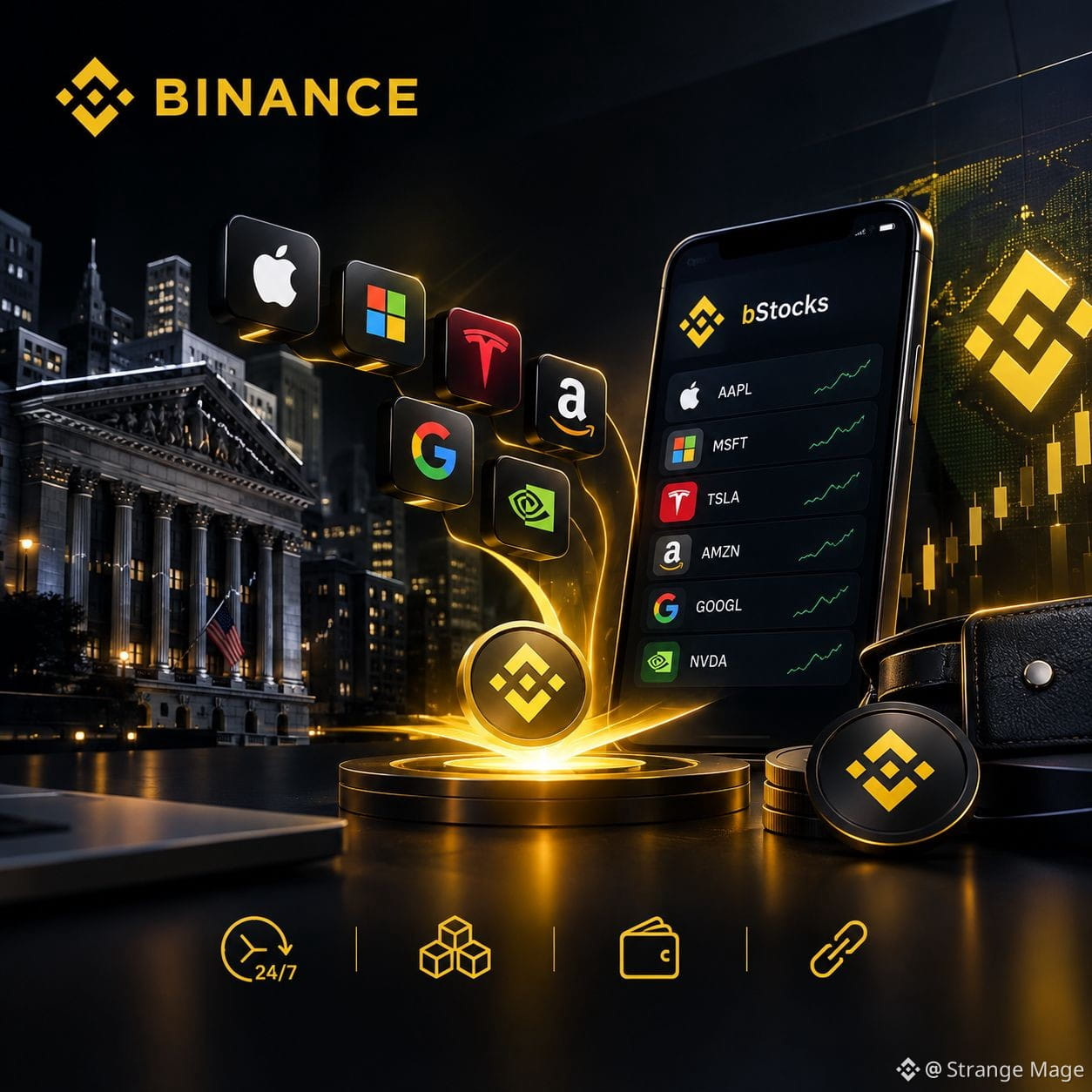
Останнім часом я дивлюся на bStocks вже не просто як на «токенізовані акції», а як на експеримент із тим, наскільки далеко можна поєднати TradFi та крипту. І цифри тут цікаві: bStocks запустили лише в червні 2026 року, а вже 2 вересня Binance додала ще 4 інструменти — CrowdStrike, Moderna, Seagate та ProShares UltraPro Short QQQ. Причому їх одразу інтегрували не лише у Spot, а й у торгових ботів та Margin як заставу.
Для мене це важливіше за просте збільшення списку активів. bStocks поступово перетворюються на інфраструктуру, де акції отримують криптовалютні властивості: торгівля 24/7, переказ у гаманець і використання в ончейн-середовищі. При цьому забезпечення заявлене 1:1 реальними акціями.
Але є принциповий нюанс: bStocks не є самими акціями і не дають права голосу чи прямого володіння компанією.
Тому я бачу головну цінність bStocks не в тому, щоб замінити фондовий ринок, а в тому, щоб зробити його частиною криптоекосистеми.
#bStocksCIS #Binance #RWA #TradFi #Crypto
Останнім часом я дивлюся на bStocks вже не просто як на «токенізовані акції», а як на експеримент із тим, наскільки далеко можна поєднати TradFi та крипту. І цифри тут цікаві: bStocks запустили лише в червні 2026 року, а вже 2 вересня Binance додала ще 4 інструменти — CrowdStrike, Moderna, Seagate та ProShares UltraPro Short QQQ. Причому їх одразу інтегрували не лише у Spot, а й у торгових ботів та Margin як заставу.
Для мене це важливіше за просте збільшення списку активів. bStocks поступово перетворюються на інфраструктуру, де акції отримують криптовалютні властивості: торгівля 24/7, переказ у гаманець і використання в ончейн-середовищі. При цьому забезпечення заявлене 1:1 реальними акціями.
Але є принциповий нюанс: bStocks не є самими акціями і не дають права голосу чи прямого володіння компанією.
Тому я бачу головну цінність bStocks не в тому, щоб замінити фондовий ринок, а в тому, щоб зробити його частиною криптоекосистеми.
#bStocksCIS #Binance #RWA #TradFi #Crypto
Для мене це важливіше за просте збільшення списку активів. bStocks поступово перетворюються на інфраструктуру, де акції отримують криптовалютні властивості: торгівля 24/7, переказ у гаманець і використання в ончейн-середовищі. При цьому забезпечення заявлене 1:1 реальними акціями.
Але є принциповий нюанс: bStocks не є самими акціями і не дають права голосу чи прямого володіння компанією.
Тому я бачу головну цінність bStocks не в тому, щоб замінити фондовий ринок, а в тому, щоб зробити його частиною криптоекосистеми.
#bStocksCIS #Binance #RWA #TradFi #Crypto
109
·
--
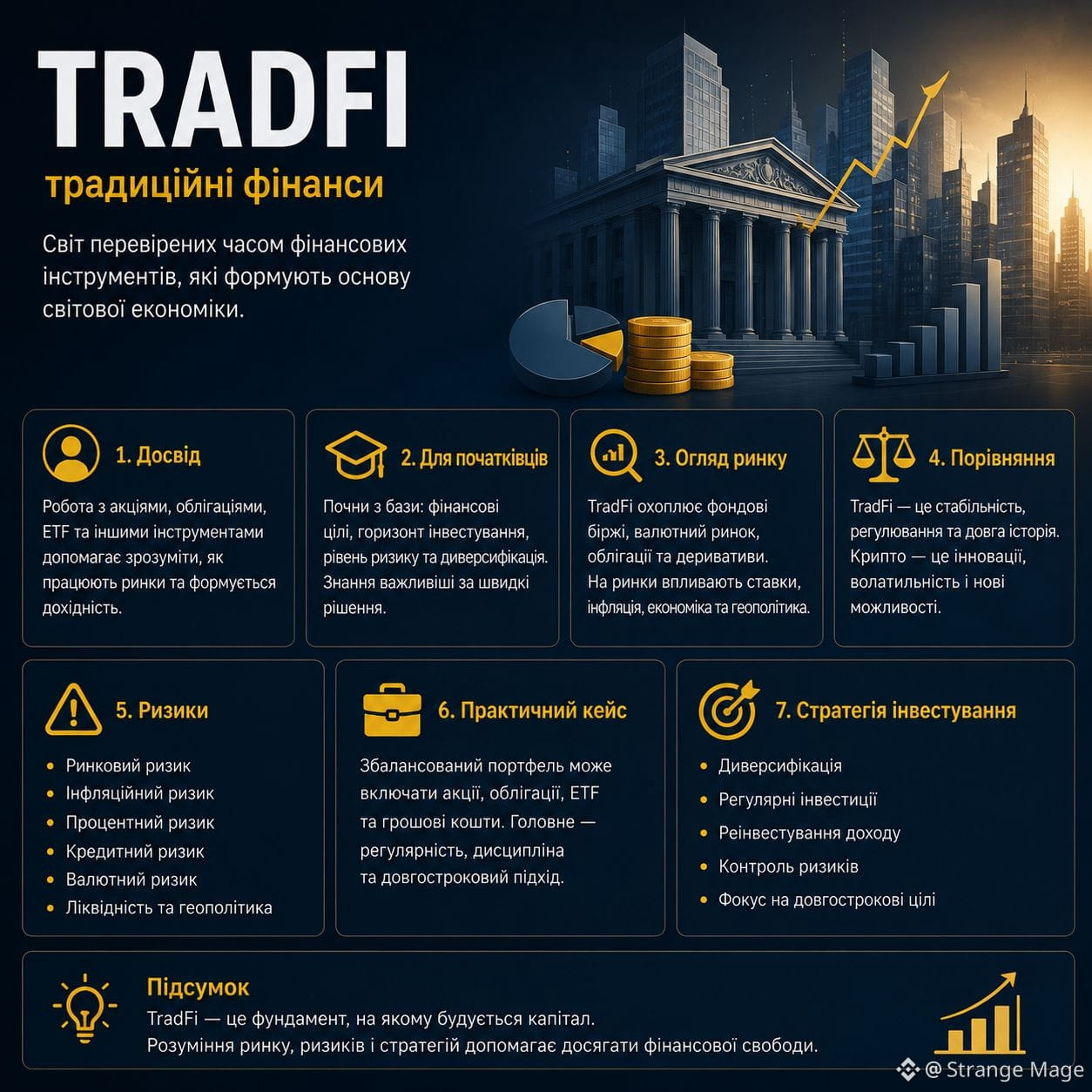
Чим більше розбираюся в TradFi, тим більше розумію, що це не просто «старі фінанси», які крипта намагається замінити. Насправді це величезна система з десятиліттями історії, де кожен інструмент має свою роль.
Власний досвід. Найцікавіше для мене — акції, ETF та облігації. Вони дають різні способи працювати з капіталом, тому немає сенсу оцінювати TradFi лише за потенційною прибутковістю.
Для новачка я б починав не з пошуку «найкращої акції», а з розуміння цілей: термін, допустимий ризик і необхідна ліквідність. Без цього навіть хороший актив легко перетворити на погану інвестицію.
Якщо дивитися на ринок, TradFi залишається фундаментом світової економіки. Процентні ставки, інфляція, звіти компаній і рішення центробанків безпосередньо впливають на вартість активів.
Ризики нікуди не зникають: падіння ринку, інфляція, кредитний ризик, зміна ставок і валютні коливання можуть суттєво вплинути на результат.
Стратегія для мене — диверсифікація, регулярні інвестиції та довгостроковий горизонт. TradFi цікаве саме тоді, коли використовуєш його не для вгадування наступного пампа, а для системного створення капіталу.
#TradFi #Investing #RWA #Binance #bStocksCIS
Чим більше розбираюся в TradFi, тим більше розумію, що це не просто «старі фінанси», які крипта намагається замінити. Насправді це величезна система з десятиліттями історії, де кожен інструмент має свою роль.
Власний досвід. Найцікавіше для мене — акції, ETF та облігації. Вони дають різні способи працювати з капіталом, тому немає сенсу оцінювати TradFi лише за потенційною прибутковістю.
Для новачка я б починав не з пошуку «найкращої акції», а з розуміння цілей: термін, допустимий ризик і необхідна ліквідність. Без цього навіть хороший актив легко перетворити на погану інвестицію.
Якщо дивитися на ринок, TradFi залишається фундаментом світової економіки. Процентні ставки, інфляція, звіти компаній і рішення центробанків безпосередньо впливають на вартість активів.
Ризики нікуди не зникають: падіння ринку, інфляція, кредитний ризик, зміна ставок і валютні коливання можуть суттєво вплинути на результат.
Стратегія для мене — диверсифікація, регулярні інвестиції та довгостроковий горизонт. TradFi цікаве саме тоді, коли використовуєш його не для вгадування наступного пампа, а для системного створення капіталу.
#TradFi #Investing #RWA #Binance #bStocksCIS
Власний досвід. Найцікавіше для мене — акції, ETF та облігації. Вони дають різні способи працювати з капіталом, тому немає сенсу оцінювати TradFi лише за потенційною прибутковістю.
Для новачка я б починав не з пошуку «найкращої акції», а з розуміння цілей: термін, допустимий ризик і необхідна ліквідність. Без цього навіть хороший актив легко перетворити на погану інвестицію.
Якщо дивитися на ринок, TradFi залишається фундаментом світової економіки. Процентні ставки, інфляція, звіти компаній і рішення центробанків безпосередньо впливають на вартість активів.
Ризики нікуди не зникають: падіння ринку, інфляція, кредитний ризик, зміна ставок і валютні коливання можуть суттєво вплинути на результат.
Стратегія для мене — диверсифікація, регулярні інвестиції та довгостроковий горизонт. TradFi цікаве саме тоді, коли використовуєш його не для вгадування наступного пампа, а для системного створення капіталу.
#TradFi #Investing #RWA #Binance #bStocksCIS
1
90
·
--
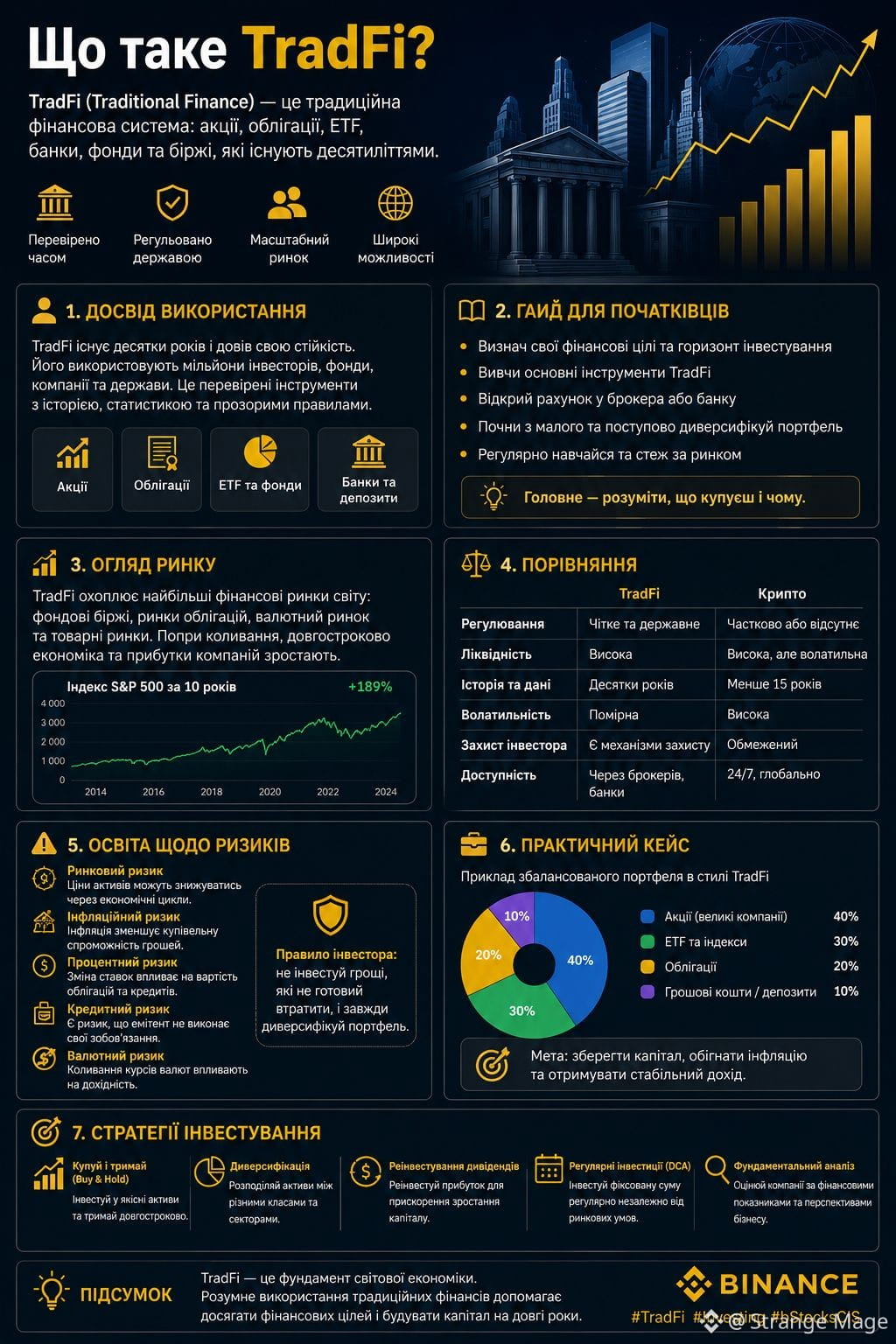
Останнім часом вирішив трохи глибше розібратися саме в TradFi, бо раніше сприймав традиційні фінанси як щось окреме від крипти. Але чим більше дивлюся на ринок, тим цікавішим стає їхнє поєднання.
Якщо пояснити просто, TradFi — це звичний фінансовий світ: акції, облігації, ETF, банки та фондові біржі. Для новачка головне — спочатку зрозуміти, як працює кожен інструмент, а вже потім думати про прибутковість.
З точки зору ринку зараз особливо цікаво спостерігати, як TradFi поступово взаємодіє з блокчейном і RWA. Це вже не виглядає як два повністю різні світи.
Якщо порівнювати TradFi з криптою, тут мені подобається більш зрозуміла регуляторна база та історія багатьох активів. Але це не означає, що ризиків немає. Залишаються ринковий ризик, інфляція, процентні ставки, валютні коливання та ризик окремої компанії.
Практично я б не став робити ставку лише на один сектор. Наприклад, портфель можна розподілити між акціями, ETF, облігаціями та частиною криптоактивів.
Особисто для мене TradFi — це не альтернатива крипті, а ще один інструмент диверсифікації. Головне — розуміти, що саме купуєш і який ризик готовий прийняти.
#TradFi #RWA #Investing #Binance #bStocksCIS
Останнім часом вирішив трохи глибше розібратися саме в TradFi, бо раніше сприймав традиційні фінанси як щось окреме від крипти. Але чим більше дивлюся на ринок, тим цікавішим стає їхнє поєднання.
Якщо пояснити просто, TradFi — це звичний фінансовий світ: акції, облігації, ETF, банки та фондові біржі. Для новачка головне — спочатку зрозуміти, як працює кожен інструмент, а вже потім думати про прибутковість.
З точки зору ринку зараз особливо цікаво спостерігати, як TradFi поступово взаємодіє з блокчейном і RWA. Це вже не виглядає як два повністю різні світи.
Якщо порівнювати TradFi з криптою, тут мені подобається більш зрозуміла регуляторна база та історія багатьох активів. Але це не означає, що ризиків немає. Залишаються ринковий ризик, інфляція, процентні ставки, валютні коливання та ризик окремої компанії.
Практично я б не став робити ставку лише на один сектор. Наприклад, портфель можна розподілити між акціями, ETF, облігаціями та частиною криптоактивів.
Особисто для мене TradFi — це не альтернатива крипті, а ще один інструмент диверсифікації. Головне — розуміти, що саме купуєш і який ризик готовий прийняти.
#TradFi #RWA #Investing #Binance #bStocksCIS
Якщо пояснити просто, TradFi — це звичний фінансовий світ: акції, облігації, ETF, банки та фондові біржі. Для новачка головне — спочатку зрозуміти, як працює кожен інструмент, а вже потім думати про прибутковість.
З точки зору ринку зараз особливо цікаво спостерігати, як TradFi поступово взаємодіє з блокчейном і RWA. Це вже не виглядає як два повністю різні світи.
Якщо порівнювати TradFi з криптою, тут мені подобається більш зрозуміла регуляторна база та історія багатьох активів. Але це не означає, що ризиків немає. Залишаються ринковий ризик, інфляція, процентні ставки, валютні коливання та ризик окремої компанії.
Практично я б не став робити ставку лише на один сектор. Наприклад, портфель можна розподілити між акціями, ETF, облігаціями та частиною криптоактивів.
Особисто для мене TradFi — це не альтернатива крипті, а ще один інструмент диверсифікації. Головне — розуміти, що саме купуєш і який ризик готовий прийняти.
#TradFi #RWA #Investing #Binance #bStocksCIS
77
·
--
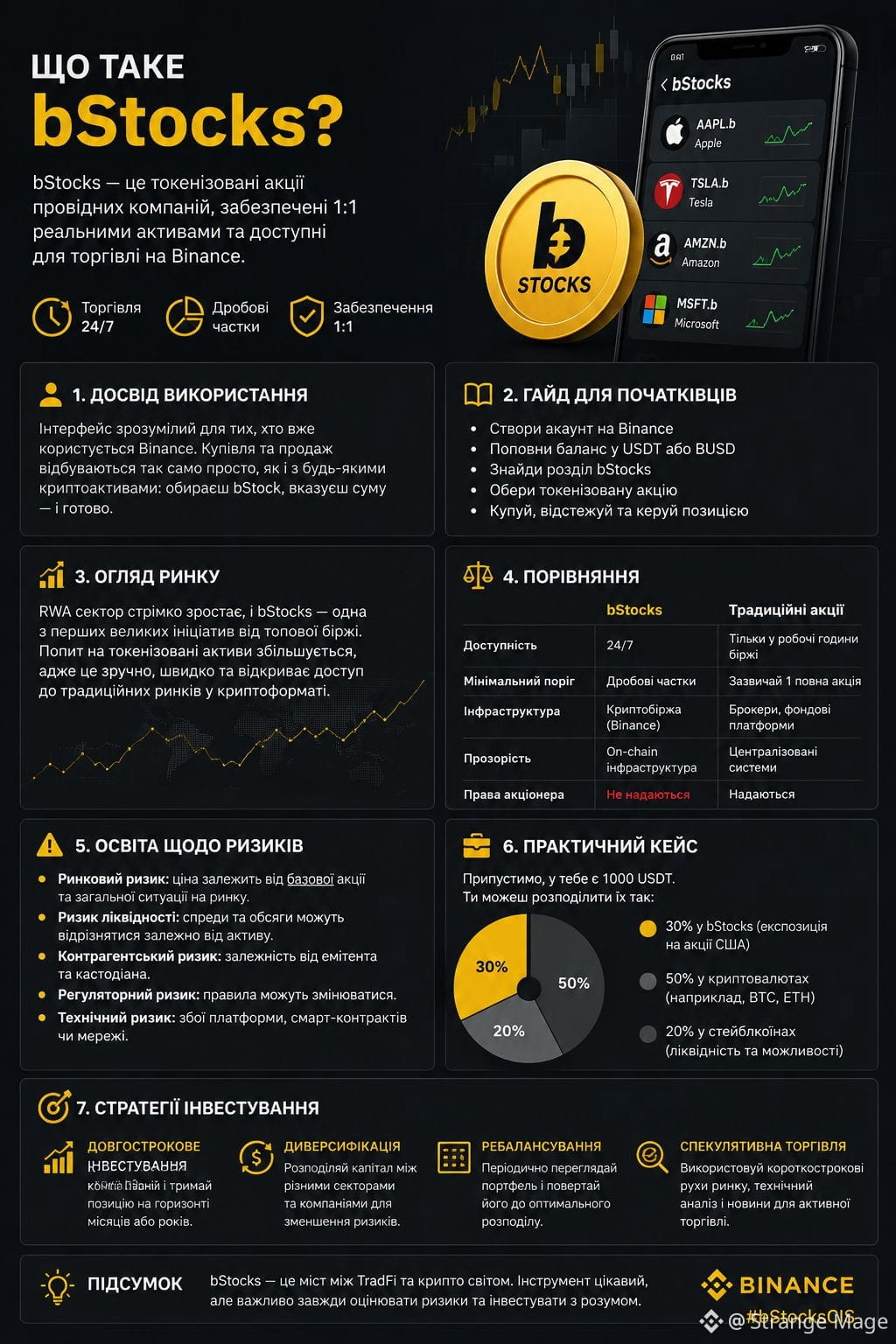
Я вирішив подивитися на bStocks не як на чергову «криптофішку», а як на інструмент, який потенційно може змінити підхід до роботи з традиційними активами.
Почну з власного враження: найбільше мені сподобалася можливість отримати доступ до експозиції на фондовий ринок у звичному криптосередовищі. Для новачка логіка теж зрозуміла: обираєш токенізований актив, дивишся, до якого базового активу він прив’язаний, і вже після цього оцінюєш ризики.
Якщо дивитися на ринок ширше, зараз RWA активно розвивається, і bStocks добре вписуються в цей тренд. У порівнянні зі звичайною торгівлею акціями, головна перевага для мене — гнучкість криптоінфраструктури. Але це не означає відсутність ризиків: ціна все одно залежить від базового активу, плюс є ризики ліквідності, контрагента, регулювання та самої платформи.
Практичний кейс простий: замість того щоб тримати весь капітал лише в крипті, частину можна використати для експозиції на традиційний ринок через bStocks. Я б розглядав їх саме як додатковий елемент диверсифікації, а не як заміну акціям чи гарантований спосіб заробітку.
#bStocksCIS #Binance #RWA #TradFi
Я вирішив подивитися на bStocks не як на чергову «криптофішку», а як на інструмент, який потенційно може змінити підхід до роботи з традиційними активами.
Почну з власного враження: найбільше мені сподобалася можливість отримати доступ до експозиції на фондовий ринок у звичному криптосередовищі. Для новачка логіка теж зрозуміла: обираєш токенізований актив, дивишся, до якого базового активу він прив’язаний, і вже після цього оцінюєш ризики.
Якщо дивитися на ринок ширше, зараз RWA активно розвивається, і bStocks добре вписуються в цей тренд. У порівнянні зі звичайною торгівлею акціями, головна перевага для мене — гнучкість криптоінфраструктури. Але це не означає відсутність ризиків: ціна все одно залежить від базового активу, плюс є ризики ліквідності, контрагента, регулювання та самої платформи.
Практичний кейс простий: замість того щоб тримати весь капітал лише в крипті, частину можна використати для експозиції на традиційний ринок через bStocks. Я б розглядав їх саме як додатковий елемент диверсифікації, а не як заміну акціям чи гарантований спосіб заробітку.
#bStocksCIS #Binance #RWA #TradFi
Почну з власного враження: найбільше мені сподобалася можливість отримати доступ до експозиції на фондовий ринок у звичному криптосередовищі. Для новачка логіка теж зрозуміла: обираєш токенізований актив, дивишся, до якого базового активу він прив’язаний, і вже після цього оцінюєш ризики.
Якщо дивитися на ринок ширше, зараз RWA активно розвивається, і bStocks добре вписуються в цей тренд. У порівнянні зі звичайною торгівлею акціями, головна перевага для мене — гнучкість криптоінфраструктури. Але це не означає відсутність ризиків: ціна все одно залежить від базового активу, плюс є ризики ліквідності, контрагента, регулювання та самої платформи.
Практичний кейс простий: замість того щоб тримати весь капітал лише в крипті, частину можна використати для експозиції на традиційний ринок через bStocks. Я б розглядав їх саме як додатковий елемент диверсифікації, а не як заміну акціям чи гарантований спосіб заробітку.
#bStocksCIS #Binance #RWA #TradFi
75
·
--
Останнім часом все частіше дивлюся в бік bStocks, бо для мене це один із найцікавіших способів поєднати традиційні фінансові активи з криптоінфраструктурою.
Якщо пояснювати максимально просто: ідея bStocks у тому, щоб отримати експозицію до відомих компаній через токенізований формат, не виходячи повністю за межі крипторинку. Для мене головний плюс тут — зручність. Не потрібно постійно перемикатися між різними платформами, якщо ти вже звик працювати з криптоактивами.
Але я б не сприймав bStocks як «легкий спосіб заробити». Ризики нікуди не зникають: ціна такого активу може падати разом із базовим ринком, є ризики ліквідності, умов конкретного продукту та самої платформи. Тому перед покупкою я б обов’язково дивився, що саме стоїть за конкретним токеном і які умови його використання.
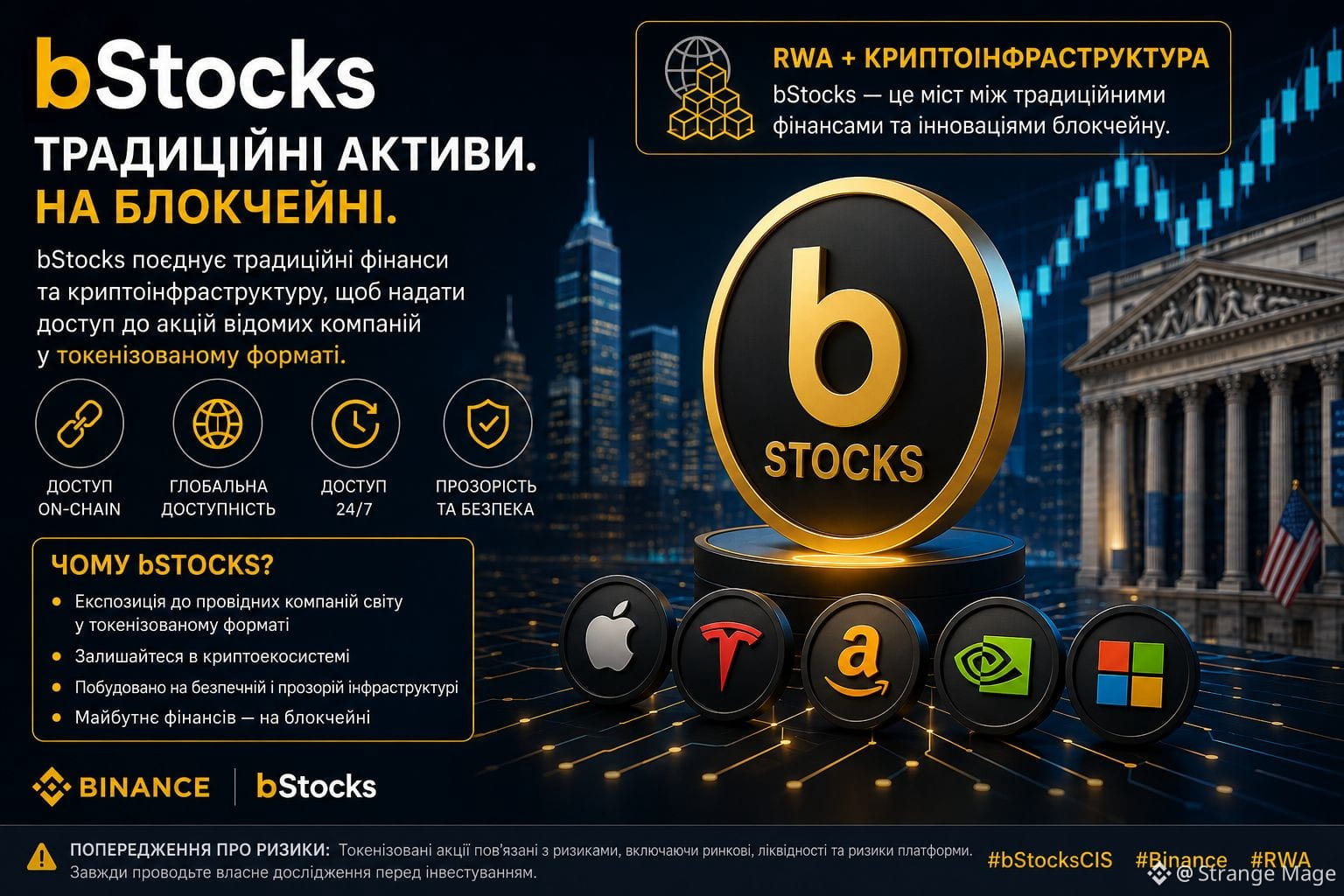
Особисто мені подобається сама концепція: RWA + криптоінфраструктура. Якщо токенізація традиційних активів продовжить розвиватися, bStocks цілком можуть стати одним із цікавих напрямків цього ринку.
#bStocksCIS #Binance #RWA
Останнім часом все частіше дивлюся в бік bStocks, бо для мене це один із найцікавіших способів поєднати традиційні фінансові активи з криптоінфраструктурою.
Якщо пояснювати максимально просто: ідея bStocks у тому, щоб отримати експозицію до відомих компаній через токенізований формат, не виходячи повністю за межі крипторинку. Для мене головний плюс тут — зручність. Не потрібно постійно перемикатися між різними платформами, якщо ти вже звик працювати з криптоактивами.
Але я б не сприймав bStocks як «легкий спосіб заробити». Ризики нікуди не зникають: ціна такого активу може падати разом із базовим ринком, є ризики ліквідності, умов конкретного продукту та самої платформи. Тому перед покупкою я б обов’язково дивився, що саме стоїть за конкретним токеном і які умови його використання.
Особисто мені подобається сама концепція: RWA + криптоінфраструктура. Якщо токенізація традиційних активів продовжить розвиватися, bStocks цілком можуть стати одним із цікавих напрямків цього ринку.
#bStocksCIS #Binance #RWA
Якщо пояснювати максимально просто: ідея bStocks у тому, щоб отримати експозицію до відомих компаній через токенізований формат, не виходячи повністю за межі крипторинку. Для мене головний плюс тут — зручність. Не потрібно постійно перемикатися між різними платформами, якщо ти вже звик працювати з криптоактивами.
Але я б не сприймав bStocks як «легкий спосіб заробити». Ризики нікуди не зникають: ціна такого активу може падати разом із базовим ринком, є ризики ліквідності, умов конкретного продукту та самої платформи. Тому перед покупкою я б обов’язково дивився, що саме стоїть за конкретним токеном і які умови його використання.
Особисто мені подобається сама концепція: RWA + криптоінфраструктура. Якщо токенізація традиційних активів продовжить розвиватися, bStocks цілком можуть стати одним із цікавих напрямків цього ринку.
#bStocksCIS #Binance #RWA
98
·
--
The crypto market looks pretty interesting right now. BTC is holding around $78K, and after a strong August, the market has cooled off a bit. But institutional demand isn’t going anywhere. Spot BTC ETFs saw around $900M in inflows during the last week of August, while ETH continues to attract capital as well.
Personally, I think the main thing right now is not chasing every candle. The market is getting more mature, so I’m watching liquidity, ETF flows and macro conditions more than short-term price moves.
#btc $BTC
The crypto market looks pretty interesting right now. BTC is holding around $78K, and after a strong August, the market has cooled off a bit. But institutional demand isn’t going anywhere. Spot BTC ETFs saw around $900M in inflows during the last week of August, while ETH continues to attract capital as well.
Personally, I think the main thing right now is not chasing every candle. The market is getting more mature, so I’m watching liquidity, ETF flows and macro conditions more than short-term price moves.
#btc $BTC
Personally, I think the main thing right now is not chasing every candle. The market is getting more mature, so I’m watching liquidity, ETF flows and macro conditions more than short-term price moves.
#btc $BTC
84
·
--
I decided to look at @termmax not as another DeFi protocol, but through its actual economics.
Current TVL is around $32.1M, with $22.1M in active loans — roughly 69% of TVL is actively being borrowed. The protocol generated about $17K in fees over the last 30 days, while cumulative fees have passed $381K.
The main advantage is the fixed-rate model: borrowers know their capital cost in advance, which makes it much easier to calculate strategy returns. TermMax also combines this with one-click leverage and vaults, making more complex strategies easier to execute.
But there are weaknesses. Around 95% of TVL is still concentrated on Ethereum, so the protocol remains heavily dependent on one network. Leverage also doesn’t remove risk — it amplifies both profits and losses.
My conclusion: TermMax looks more interesting as infrastructure for calculated strategies than as a simple yield-farming platform. If liquidity continues expanding across chains, its fixed-rate model could become a much stronger niche in DeFi.
#termmax @termmax $BTC
What do you think about TermMax?
I decided to look at @TermMax not as another DeFi protocol, but through its actual economics.
Current TVL is around $32.1M, with $22.1M in active loans — roughly 69% of TVL is actively being borrowed. The protocol generated about $17K in fees over the last 30 days, while cumulative fees have passed $381K.
The main advantage is the fixed-rate model: borrowers know their capital cost in advance, which makes it much easier to calculate strategy returns. TermMax also combines this with one-click leverage and vaults, making more complex strategies easier to execute.
But there are weaknesses. Around 95% of TVL is still concentrated on Ethereum, so the protocol remains heavily dependent on one network. Leverage also doesn’t remove risk — it amplifies both profits and losses.
My conclusion: TermMax looks more interesting as infrastructure for calculated strategies than as a simple yield-farming platform. If liquidity continues expanding across chains, its fixed-rate model could become a much stronger niche in DeFi.
#termmax @TermMax $BTC
What do you think about TermMax?
Current TVL is around $32.1M, with $22.1M in active loans — roughly 69% of TVL is actively being borrowed. The protocol generated about $17K in fees over the last 30 days, while cumulative fees have passed $381K.
The main advantage is the fixed-rate model: borrowers know their capital cost in advance, which makes it much easier to calculate strategy returns. TermMax also combines this with one-click leverage and vaults, making more complex strategies easier to execute.
But there are weaknesses. Around 95% of TVL is still concentrated on Ethereum, so the protocol remains heavily dependent on one network. Leverage also doesn’t remove risk — it amplifies both profits and losses.
My conclusion: TermMax looks more interesting as infrastructure for calculated strategies than as a simple yield-farming platform. If liquidity continues expanding across chains, its fixed-rate model could become a much stronger niche in DeFi.
#termmax @TermMax $BTC
What do you think about TermMax?
🚀 Strong DeFi infrastructure
0%
📈 High-growth potential
100%
⚠️ Too much risk
0%
🤔 Need more data
0%
1 проголосовали • Голосование закрыто
81
·
--
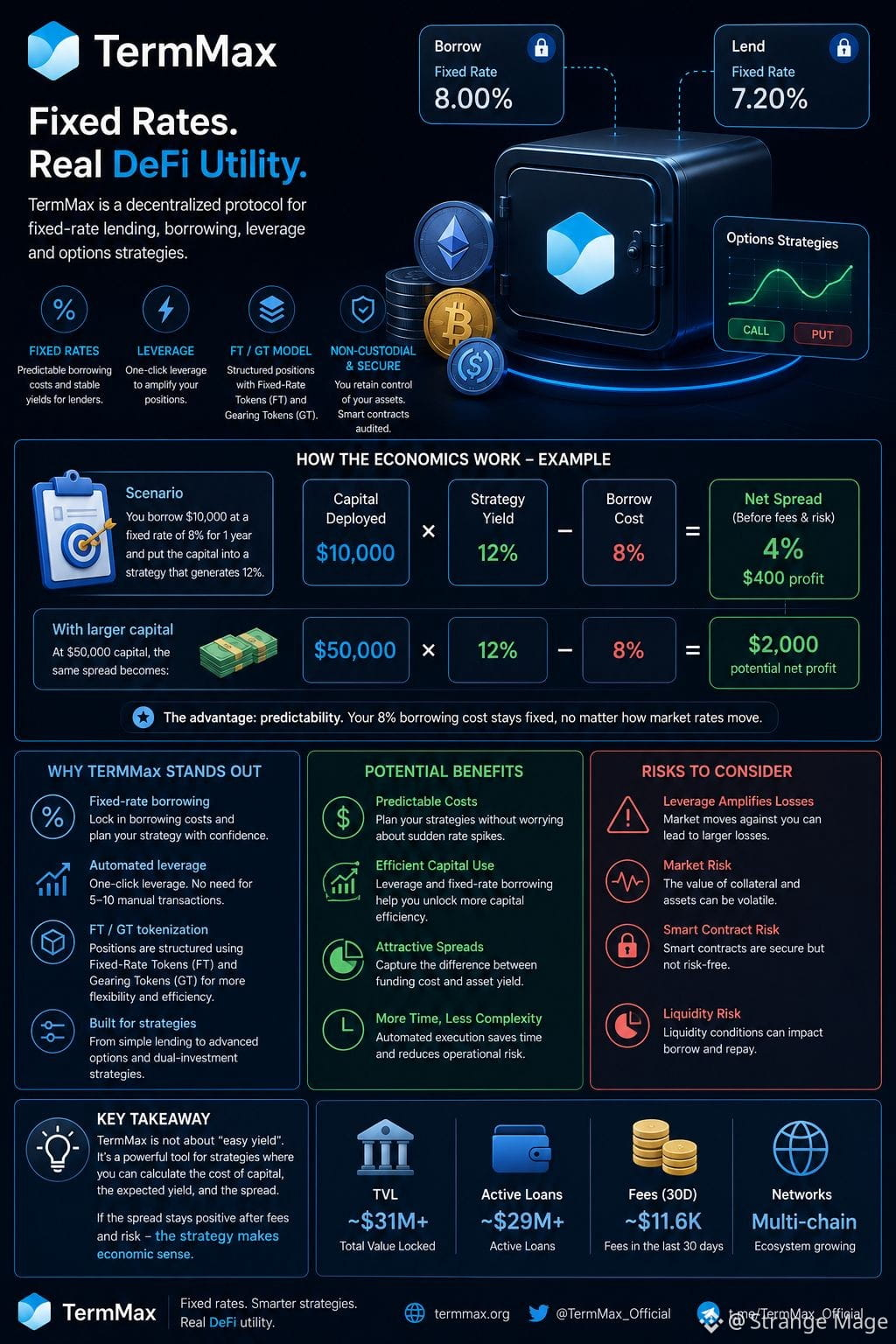
I’ve been digging deeper into @termmax , and the interesting part is how the economics work. Imagine borrowing $10,000 at a fixed 8% for one year and putting the capital into an asset strategy generating 12%. Gross yield would be $1,200, while borrowing costs are $800 — leaving $400, or 4% net, before fees and market risk. With $50,000, the same spread becomes $2,000.
The key advantage is predictability: the 8% borrowing cost does not suddenly jump with market rates. TermMax also automates leverage instead of requiring 5–10 manual transactions, while FT/GT tokens structure fixed-rate and leveraged positions.
The catch is obvious: leverage amplifies losses too. So I wouldn’t treat TermMax as “easy yield.” I see it as a tool for strategies where the spread between funding cost and asset yield is calculated in advance. If that spread remains positive after fees and risk, the model makes economic sense.
#termmax @termmax $BTC
I’ve been digging deeper into @TermMax , and the interesting part is how the economics work. Imagine borrowing $10,000 at a fixed 8% for one year and putting the capital into an asset strategy generating 12%. Gross yield would be $1,200, while borrowing costs are $800 — leaving $400, or 4% net, before fees and market risk. With $50,000, the same spread becomes $2,000.
The key advantage is predictability: the 8% borrowing cost does not suddenly jump with market rates. TermMax also automates leverage instead of requiring 5–10 manual transactions, while FT/GT tokens structure fixed-rate and leveraged positions.
The catch is obvious: leverage amplifies losses too. So I wouldn’t treat TermMax as “easy yield.” I see it as a tool for strategies where the spread between funding cost and asset yield is calculated in advance. If that spread remains positive after fees and risk, the model makes economic sense.
#termmax @TermMax $BTC
The key advantage is predictability: the 8% borrowing cost does not suddenly jump with market rates. TermMax also automates leverage instead of requiring 5–10 manual transactions, while FT/GT tokens structure fixed-rate and leveraged positions.
The catch is obvious: leverage amplifies losses too. So I wouldn’t treat TermMax as “easy yield.” I see it as a tool for strategies where the spread between funding cost and asset yield is calculated in advance. If that spread remains positive after fees and risk, the model makes economic sense.
#termmax @TermMax $BTC
99
·
--
I’ve been looking deeper into @termmax , and the numbers are starting to make the thesis more interesting.
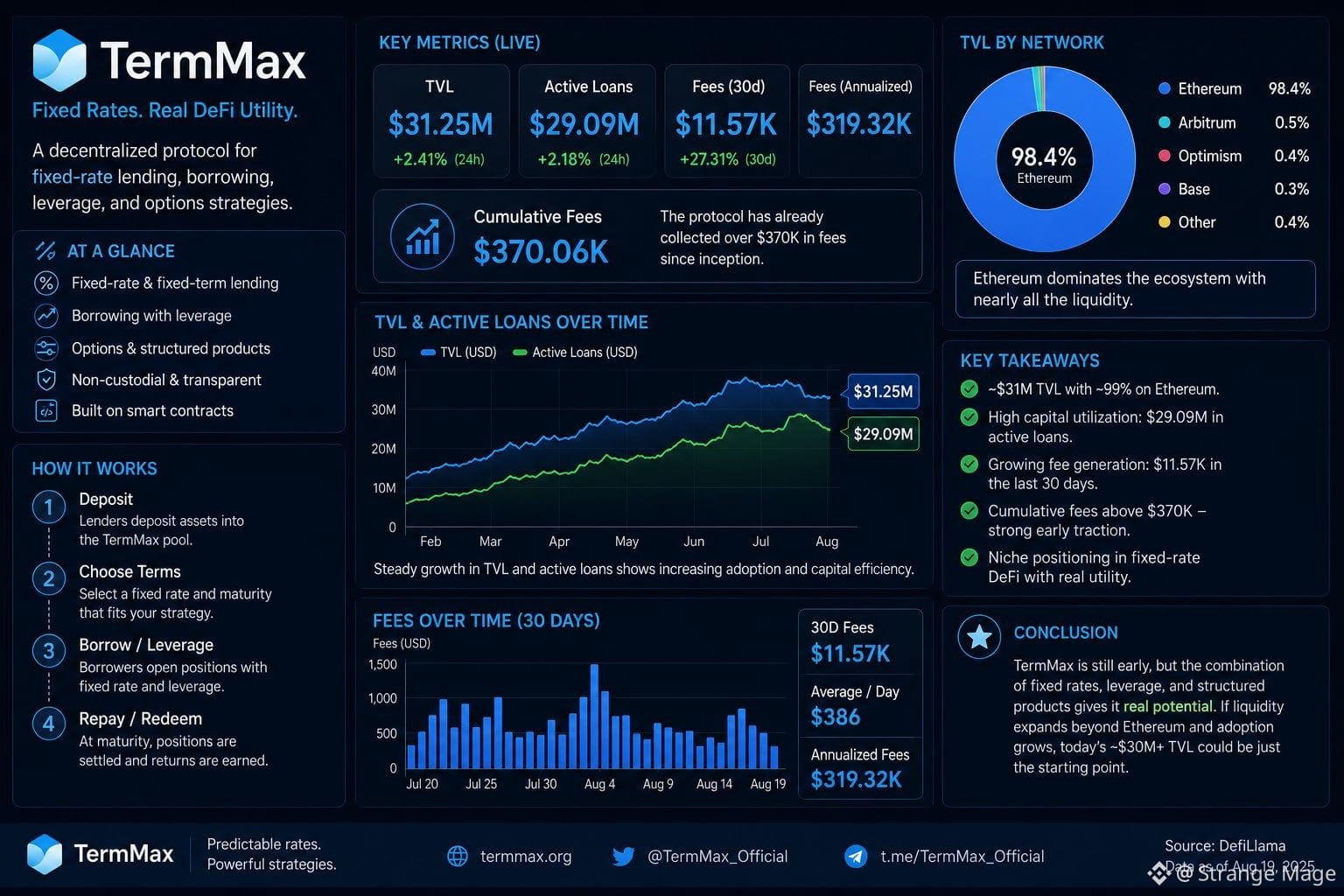
Current TVL is around $31.25M, while Ethereum accounts for about 98.4% of the capital. That concentration is both a strength and a risk: Ethereum provides deep liquidity, but future growth will depend on successful expansion across other networks. TermMax also generated roughly $11.6K in fees over 30 days, with annualized fees near $320K.
My takeaway: the protocol is still small, but the combination of fixed-rate lending, borrowing and leverage gives it a clear niche. If liquidity diversifies beyond Ethereum while fee generation keeps growing, the current scale could be an early stage rather than a limitation.
#termmax @termmax
I’ve been looking deeper into @TermMax , and the numbers are starting to make the thesis more interesting.
Current TVL is around $31.25M, while Ethereum accounts for about 98.4% of the capital. That concentration is both a strength and a risk: Ethereum provides deep liquidity, but future growth will depend on successful expansion across other networks. TermMax also generated roughly $11.6K in fees over 30 days, with annualized fees near $320K.
My takeaway: the protocol is still small, but the combination of fixed-rate lending, borrowing and leverage gives it a clear niche. If liquidity diversifies beyond Ethereum while fee generation keeps growing, the current scale could be an early stage rather than a limitation.
#termmax @TermMax
Current TVL is around $31.25M, while Ethereum accounts for about 98.4% of the capital. That concentration is both a strength and a risk: Ethereum provides deep liquidity, but future growth will depend on successful expansion across other networks. TermMax also generated roughly $11.6K in fees over 30 days, with annualized fees near $320K.
My takeaway: the protocol is still small, but the combination of fixed-rate lending, borrowing and leverage gives it a clear niche. If liquidity diversifies beyond Ethereum while fee generation keeps growing, the current scale could be an early stage rather than a limitation.
#termmax @TermMax
85
·
--
I’ve been watching SKHYB lately, and honestly, this is the kind of RWA I find much more interesting than another random crypto token.
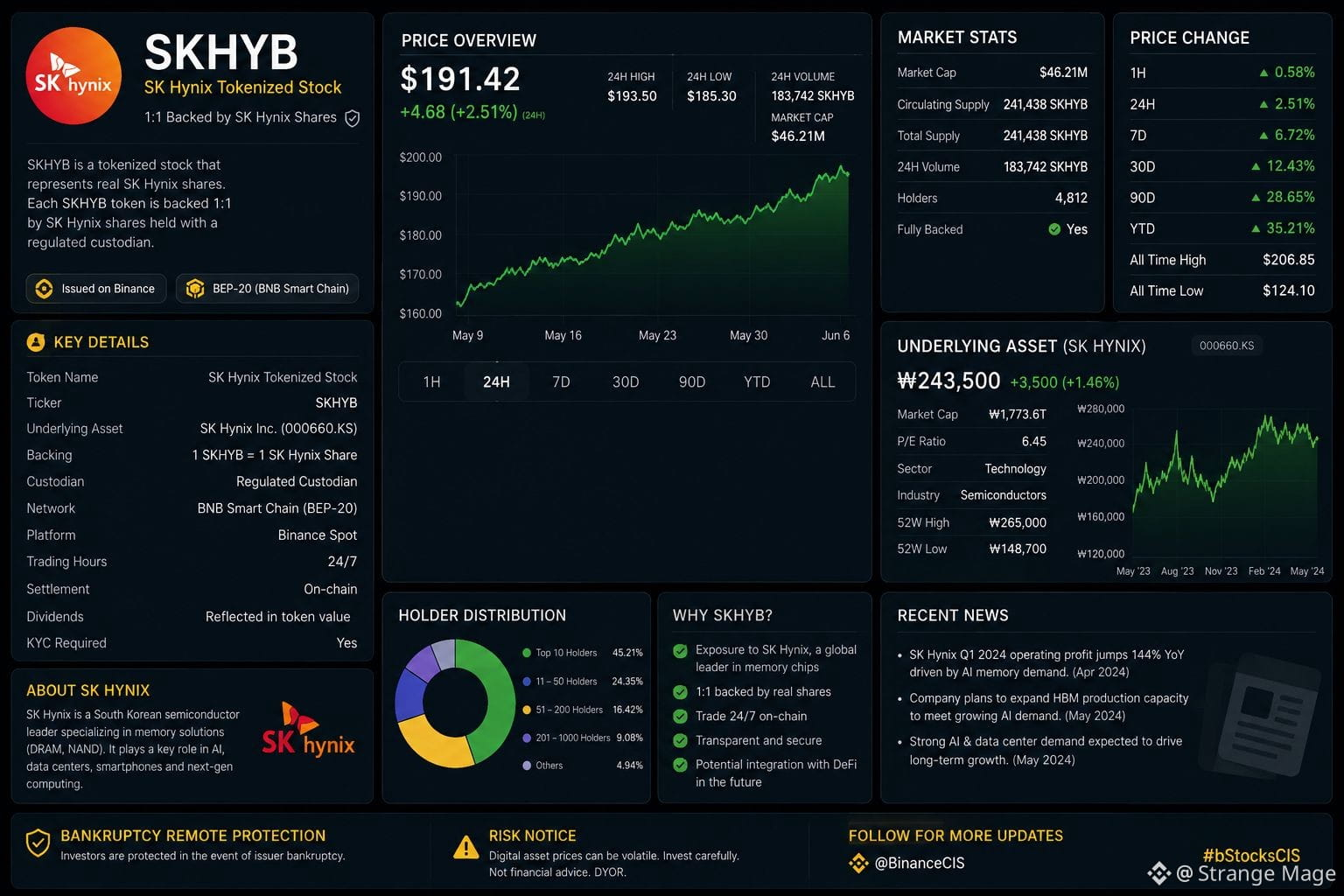
SKHYB gives exposure to SK Hynix through a tokenized security on Binance. What makes it interesting is that each token is backed 1:1 by real US-listed SK Hynix shares held with a regulated custodian. It trades 24/7 on Binance Spot, runs as a BEP-20 token on BNB Smart Chain, and can even be withdrawn to a compatible wallet.
For me, the bigger story is the combination of traditional equities and blockchain infrastructure. You get exposure to a company deeply connected to the AI and semiconductor boom, but through an on-chain format.
Of course, SKHYB isn’t the same as directly owning SK Hynix stock, and there are still regulatory, liquidity and smart-contract risks.
Still, this is exactly why I’m watching the RWA space more closely. Traditional assets are slowly becoming programmable.
@BinanceCIS #bStocksCİS $SKHYB
I’ve been watching SKHYB lately, and honestly, this is the kind of RWA I find much more interesting than another random crypto token.
SKHYB gives exposure to SK Hynix through a tokenized security on Binance. What makes it interesting is that each token is backed 1:1 by real US-listed SK Hynix shares held with a regulated custodian. It trades 24/7 on Binance Spot, runs as a BEP-20 token on BNB Smart Chain, and can even be withdrawn to a compatible wallet.
For me, the bigger story is the combination of traditional equities and blockchain infrastructure. You get exposure to a company deeply connected to the AI and semiconductor boom, but through an on-chain format.
Of course, SKHYB isn’t the same as directly owning SK Hynix stock, and there are still regulatory, liquidity and smart-contract risks.
Still, this is exactly why I’m watching the RWA space more closely. Traditional assets are slowly becoming programmable.
@BinanceCIS #bStocksCİS $SKHYB
SKHYB gives exposure to SK Hynix through a tokenized security on Binance. What makes it interesting is that each token is backed 1:1 by real US-listed SK Hynix shares held with a regulated custodian. It trades 24/7 on Binance Spot, runs as a BEP-20 token on BNB Smart Chain, and can even be withdrawn to a compatible wallet.
For me, the bigger story is the combination of traditional equities and blockchain infrastructure. You get exposure to a company deeply connected to the AI and semiconductor boom, but through an on-chain format.
Of course, SKHYB isn’t the same as directly owning SK Hynix stock, and there are still regulatory, liquidity and smart-contract risks.
Still, this is exactly why I’m watching the RWA space more closely. Traditional assets are slowly becoming programmable.
@BinanceCIS #bStocksCİS $SKHYB
1
99
·
--
I’ve been looking into @termmax more closely, and what I find interesting here is that the project is not trying to be just another lending protocol with a slightly different interface.
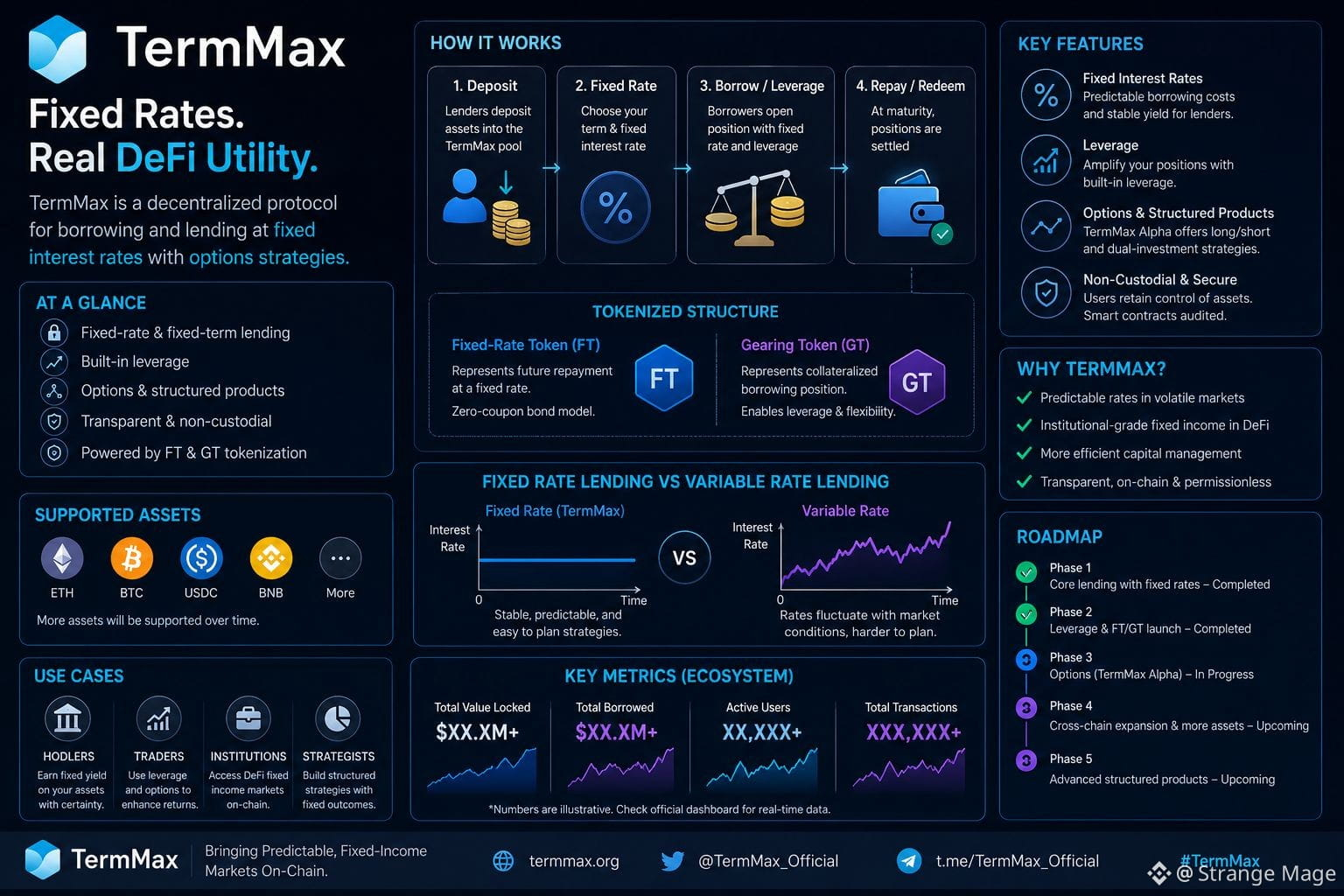
The main idea is simple but important: fixed-rate and fixed-term DeFi lending and borrowing. Instead of constantly dealing with floating rates, TermMax lets users know the borrowing cost or expected lending return upfront for a defined maturity. For me, this is one of the areas where DeFi still has a lot of room to evolve. Predictability matters when you are building a strategy rather than simply farming short-term yield.
What I found particularly interesting while researching the protocol is its underlying token structure. TermMax uses Fixed-Rate Tokens (FTs) to represent future repayment obligations, while Gearing Tokens (GTs) represent individual collateralized borrowing positions. This is based on a zero-coupon bond model and creates a more flexible way to separate the principal and fixed return components of a position.
Another part that caught my attention is leverage. TermMax is designed to simplify strategies that would normally require multiple transactions across different DeFi protocols.
And then there is TermMax Alpha, which adds long/short products and dual-investment strategies. That makes the ecosystem more interesting because the protocol is moving beyond basic lending toward structured financial products and options-like exposure.
Of course, fixed rates don’t remove DeFi risk. Smart contracts, collateral volatility, liquidity and maturity conditions still matter. But I like the direction: bringing more predictable fixed-income mechanics into an on-chain environment.
The more I dig into TermMax, the more I see it as infrastructure for a different kind of DeFi — less focused on chasing constantly changing rates, and more focused on building structured, predictable financial markets.
#termmax @termmax
I’ve been looking into @TermMax more closely, and what I find interesting here is that the project is not trying to be just another lending protocol with a slightly different interface.
The main idea is simple but important: fixed-rate and fixed-term DeFi lending and borrowing. Instead of constantly dealing with floating rates, TermMax lets users know the borrowing cost or expected lending return upfront for a defined maturity. For me, this is one of the areas where DeFi still has a lot of room to evolve. Predictability matters when you are building a strategy rather than simply farming short-term yield.
What I found particularly interesting while researching the protocol is its underlying token structure. TermMax uses Fixed-Rate Tokens (FTs) to represent future repayment obligations, while Gearing Tokens (GTs) represent individual collateralized borrowing positions. This is based on a zero-coupon bond model and creates a more flexible way to separate the principal and fixed return components of a position.
Another part that caught my attention is leverage. TermMax is designed to simplify strategies that would normally require multiple transactions across different DeFi protocols.
And then there is TermMax Alpha, which adds long/short products and dual-investment strategies. That makes the ecosystem more interesting because the protocol is moving beyond basic lending toward structured financial products and options-like exposure.
Of course, fixed rates don’t remove DeFi risk. Smart contracts, collateral volatility, liquidity and maturity conditions still matter. But I like the direction: bringing more predictable fixed-income mechanics into an on-chain environment.
The more I dig into TermMax, the more I see it as infrastructure for a different kind of DeFi — less focused on chasing constantly changing rates, and more focused on building structured, predictable financial markets.
#termmax @TermMax
The main idea is simple but important: fixed-rate and fixed-term DeFi lending and borrowing. Instead of constantly dealing with floating rates, TermMax lets users know the borrowing cost or expected lending return upfront for a defined maturity. For me, this is one of the areas where DeFi still has a lot of room to evolve. Predictability matters when you are building a strategy rather than simply farming short-term yield.
What I found particularly interesting while researching the protocol is its underlying token structure. TermMax uses Fixed-Rate Tokens (FTs) to represent future repayment obligations, while Gearing Tokens (GTs) represent individual collateralized borrowing positions. This is based on a zero-coupon bond model and creates a more flexible way to separate the principal and fixed return components of a position.
Another part that caught my attention is leverage. TermMax is designed to simplify strategies that would normally require multiple transactions across different DeFi protocols.
And then there is TermMax Alpha, which adds long/short products and dual-investment strategies. That makes the ecosystem more interesting because the protocol is moving beyond basic lending toward structured financial products and options-like exposure.
Of course, fixed rates don’t remove DeFi risk. Smart contracts, collateral volatility, liquidity and maturity conditions still matter. But I like the direction: bringing more predictable fixed-income mechanics into an on-chain environment.
The more I dig into TermMax, the more I see it as infrastructure for a different kind of DeFi — less focused on chasing constantly changing rates, and more focused on building structured, predictable financial markets.
#termmax @TermMax
89
·
--
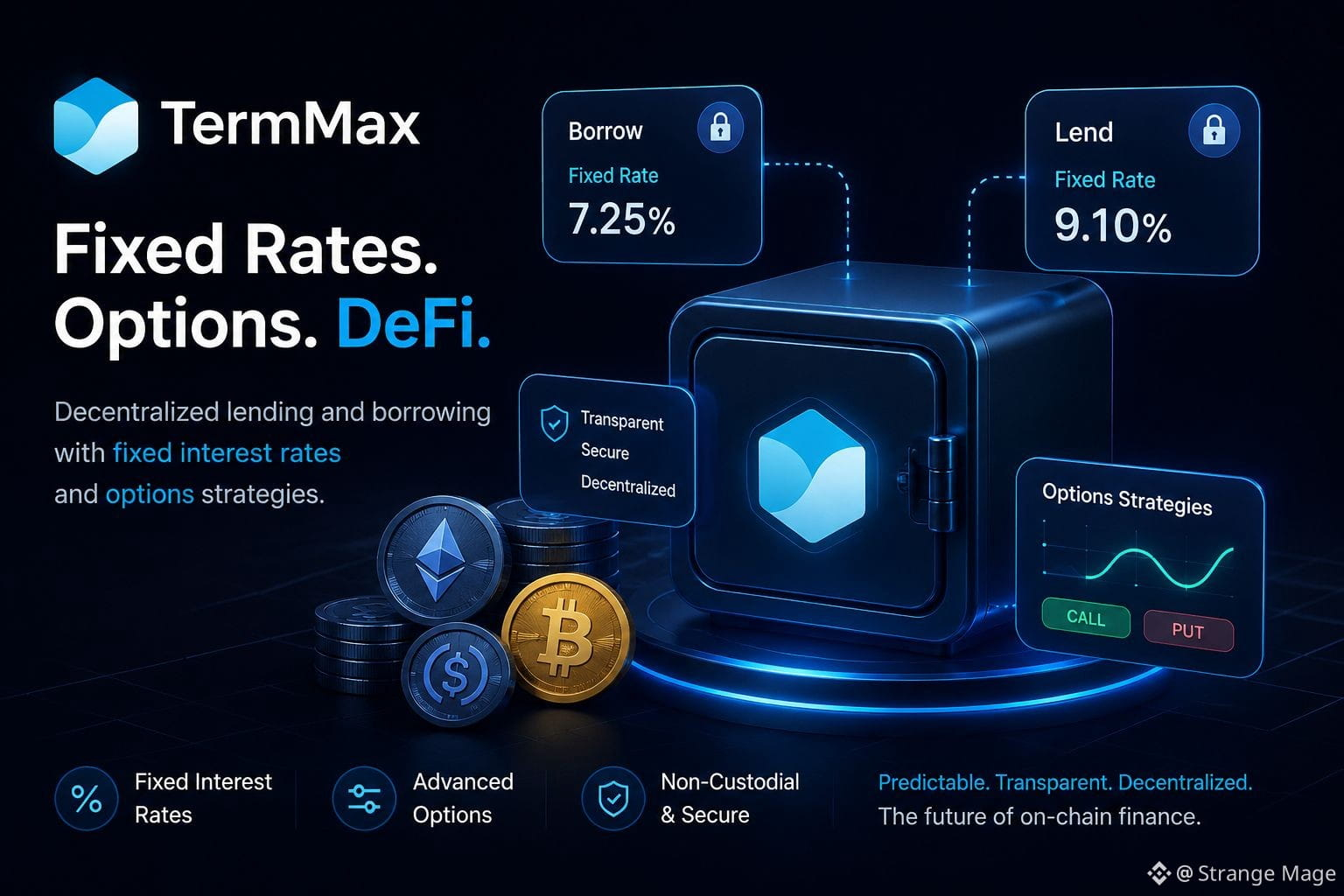
In crypto, most familiar lending and borrowing tools are closely connected to floating rates, changing borrowing costs, and high market volatility. That is why I find the concept behind TermMax interesting — a decentralized protocol focused on lending and borrowing at fixed interest rates, while also supporting options.
The core idea is quite straightforward: having predetermined terms can make financial strategies more predictable. If a user borrows assets, a fixed rate makes it possible to know the cost of borrowing in advance instead of being exposed to changes in market rates. For lenders, it can provide a clearer framework for estimating potential returns rather than constantly adjusting to changing conditions.
What makes TermMax particularly interesting is the combination of fixed-rate lending with options. Options can provide additional ways to manage risk and build strategies around potential price movements. This makes TermMax look like more than just another
DeFi lending protocol — it aims to bring several financial mechanisms together within one decentralized infrastructure.
In my view, predictability could become an increasingly important direction for DeFi. The more tools users have to plan the cost of capital, potential returns, and risk exposure in advance, the closer decentralized finance gets to supporting more sophisticated financial strategies traditionally found in conventional markets.
Of course, these products also come with risks. Crypto volatility, liquidations, smart-contract risks, and the complexity of options strategies all require careful consideration before using any protocol.
For me, the interesting part is not only the concept itself, but also watching how TermMax develops its infrastructure and real-world use cases over time.
I’ll definitely be keeping an eye on TermMax and exploring how fixed-rate lending and options can expand the possibilities within DeFi.
#termmax @termmax
In crypto, most familiar lending and borrowing tools are closely connected to floating rates, changing borrowing costs, and high market volatility. That is why I find the concept behind TermMax interesting — a decentralized protocol focused on lending and borrowing at fixed interest rates, while also supporting options.
The core idea is quite straightforward: having predetermined terms can make financial strategies more predictable. If a user borrows assets, a fixed rate makes it possible to know the cost of borrowing in advance instead of being exposed to changes in market rates. For lenders, it can provide a clearer framework for estimating potential returns rather than constantly adjusting to changing conditions.
What makes TermMax particularly interesting is the combination of fixed-rate lending with options. Options can provide additional ways to manage risk and build strategies around potential price movements. This makes TermMax look like more than just another
DeFi lending protocol — it aims to bring several financial mechanisms together within one decentralized infrastructure.
In my view, predictability could become an increasingly important direction for DeFi. The more tools users have to plan the cost of capital, potential returns, and risk exposure in advance, the closer decentralized finance gets to supporting more sophisticated financial strategies traditionally found in conventional markets.
Of course, these products also come with risks. Crypto volatility, liquidations, smart-contract risks, and the complexity of options strategies all require careful consideration before using any protocol.
For me, the interesting part is not only the concept itself, but also watching how TermMax develops its infrastructure and real-world use cases over time.
I’ll definitely be keeping an eye on TermMax and exploring how fixed-rate lending and options can expand the possibilities within DeFi.
#termmax @TermMax
The core idea is quite straightforward: having predetermined terms can make financial strategies more predictable. If a user borrows assets, a fixed rate makes it possible to know the cost of borrowing in advance instead of being exposed to changes in market rates. For lenders, it can provide a clearer framework for estimating potential returns rather than constantly adjusting to changing conditions.
What makes TermMax particularly interesting is the combination of fixed-rate lending with options. Options can provide additional ways to manage risk and build strategies around potential price movements. This makes TermMax look like more than just another
DeFi lending protocol — it aims to bring several financial mechanisms together within one decentralized infrastructure.
In my view, predictability could become an increasingly important direction for DeFi. The more tools users have to plan the cost of capital, potential returns, and risk exposure in advance, the closer decentralized finance gets to supporting more sophisticated financial strategies traditionally found in conventional markets.
Of course, these products also come with risks. Crypto volatility, liquidations, smart-contract risks, and the complexity of options strategies all require careful consideration before using any protocol.
For me, the interesting part is not only the concept itself, but also watching how TermMax develops its infrastructure and real-world use cases over time.
I’ll definitely be keeping an eye on TermMax and exploring how fixed-rate lending and options can expand the possibilities within DeFi.
#termmax @TermMax
75
·
--
This time I decided to take a closer look at $AMZNB — a tokenized asset linked to Amazon. The more I learn about bStocks, the more I like the idea itself: getting exposure to a major company while staying within the crypto infrastructure I'm already familiar with.
Amazon is obviously much more than just an online marketplace today.
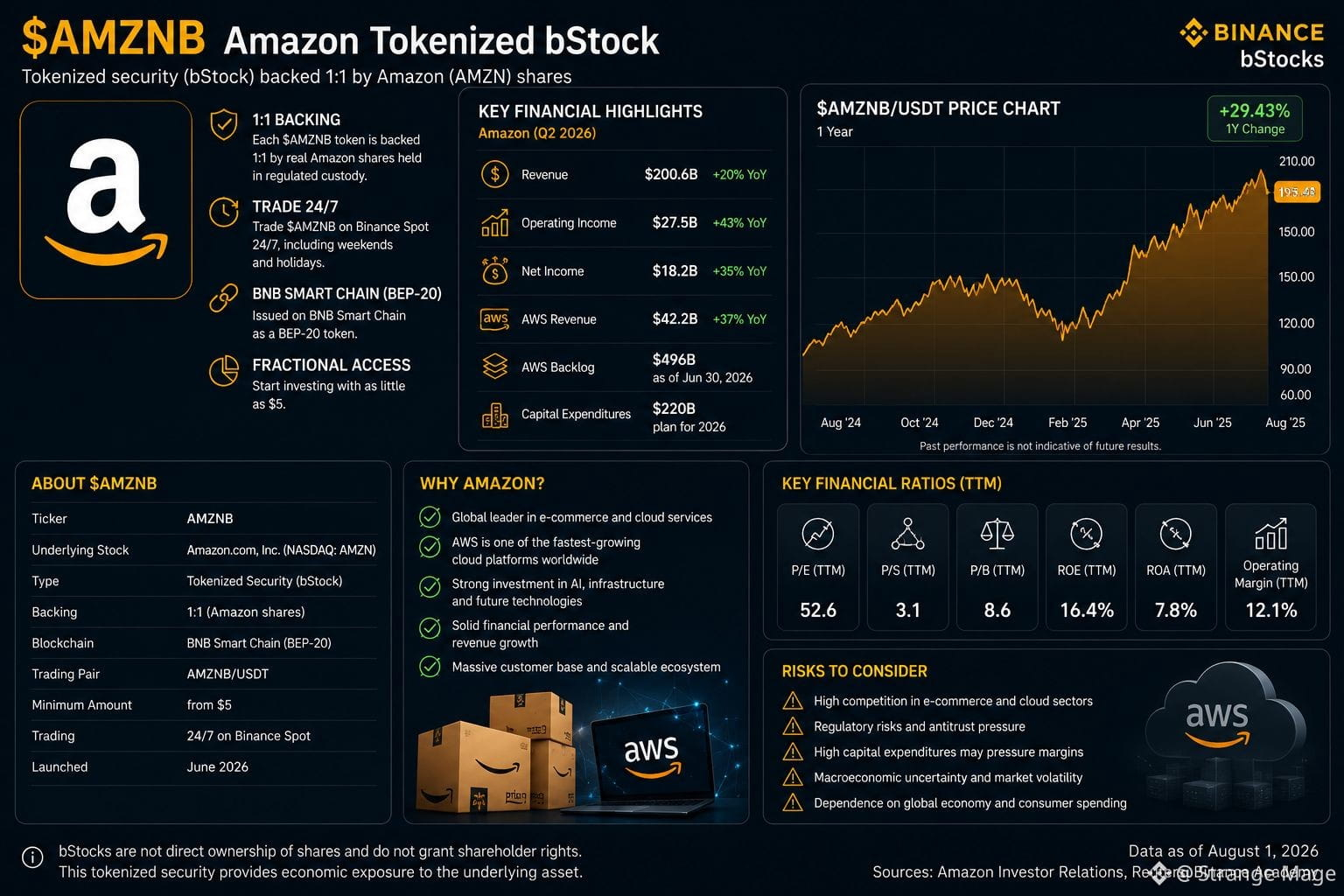
The company has several major business segments, including e-commerce, AWS, advertising, subscriptions, logistics, and now an increasingly strong focus on artificial intelligence. I was especially impressed by its latest results: in Q2 2026, Amazon increased revenue by 20% year over year to $200.6B, while operating income jumped 43% to $27.5B. At the same time, AWS revenue grew 37% to $42.2B.
And this is where AMZNB interesting to me as an RWA product. Instead of looking at Amazon purely as a traditional stock, you can get exposure to its performance through a tokenized format. bStocks trade on Binance Spot 24/7, are issued as BEP-20 tokens on BNB Smart Chain, and are backed 1:1 by the corresponding U.S. shares. Fractional access is also available starting from $5.
What I find especially interesting is that Amazon is investing huge amounts into AI infrastructure while AWS continues to show strong growth. The company has raised its 2026 capital expenditure plan to $220B, while its AWS backlog has reached $496B. This shows how serious Amazon's commitment to cloud and AI has become, although such massive spending can also put pressure on free cash flow.
That's why I look at $AMZNB not as "Amazon crypto", but as an interesting experiment at the intersection of traditional finance and Web3. If RWA continues developing at this pace, it's quite possible that in a few years, this kind of format won't seem unusual at all.
#bstockscis @BinanceCIS $AMZNB
This time I decided to take a closer look at $AMZNB — a tokenized asset linked to Amazon. The more I learn about bStocks, the more I like the idea itself: getting exposure to a major company while staying within the crypto infrastructure I'm already familiar with.
Amazon is obviously much more than just an online marketplace today.
The company has several major business segments, including e-commerce, AWS, advertising, subscriptions, logistics, and now an increasingly strong focus on artificial intelligence. I was especially impressed by its latest results: in Q2 2026, Amazon increased revenue by 20% year over year to $200.6B, while operating income jumped 43% to $27.5B. At the same time, AWS revenue grew 37% to $42.2B.
And this is where AMZNB interesting to me as an RWA product. Instead of looking at Amazon purely as a traditional stock, you can get exposure to its performance through a tokenized format. bStocks trade on Binance Spot 24/7, are issued as BEP-20 tokens on BNB Smart Chain, and are backed 1:1 by the corresponding U.S. shares. Fractional access is also available starting from $5.
What I find especially interesting is that Amazon is investing huge amounts into AI infrastructure while AWS continues to show strong growth. The company has raised its 2026 capital expenditure plan to $220B, while its AWS backlog has reached $496B. This shows how serious Amazon's commitment to cloud and AI has become, although such massive spending can also put pressure on free cash flow.
That's why I look at $AMZNB not as "Amazon crypto", but as an interesting experiment at the intersection of traditional finance and Web3. If RWA continues developing at this pace, it's quite possible that in a few years, this kind of format won't seem unusual at all.
#bstockscis @BinanceCIS $AMZNB
Amazon is obviously much more than just an online marketplace today.
The company has several major business segments, including e-commerce, AWS, advertising, subscriptions, logistics, and now an increasingly strong focus on artificial intelligence. I was especially impressed by its latest results: in Q2 2026, Amazon increased revenue by 20% year over year to $200.6B, while operating income jumped 43% to $27.5B. At the same time, AWS revenue grew 37% to $42.2B.
And this is where AMZNB interesting to me as an RWA product. Instead of looking at Amazon purely as a traditional stock, you can get exposure to its performance through a tokenized format. bStocks trade on Binance Spot 24/7, are issued as BEP-20 tokens on BNB Smart Chain, and are backed 1:1 by the corresponding U.S. shares. Fractional access is also available starting from $5.
What I find especially interesting is that Amazon is investing huge amounts into AI infrastructure while AWS continues to show strong growth. The company has raised its 2026 capital expenditure plan to $220B, while its AWS backlog has reached $496B. This shows how serious Amazon's commitment to cloud and AI has become, although such massive spending can also put pressure on free cash flow.
That's why I look at $AMZNB not as "Amazon crypto", but as an interesting experiment at the intersection of traditional finance and Web3. If RWA continues developing at this pace, it's quite possible that in a few years, this kind of format won't seem unusual at all.
#bstockscis @BinanceCIS $AMZNB
73
·
--
Over the last few months, I’ve shifted part of my crypto portfolio into RWA (Real-World Assets). I want to share my honest experience with $NVDAB — a tokenized version of NVIDIA shares.
Why does a crypto investor need NVIDIA stocks?
For a long time, taking profits out of stablecoins and putting them into the traditional AI sector was a major headache: bank transfers, fees, and waiting days for settlement. $NVDAB solves this completely.
Key perks for me:
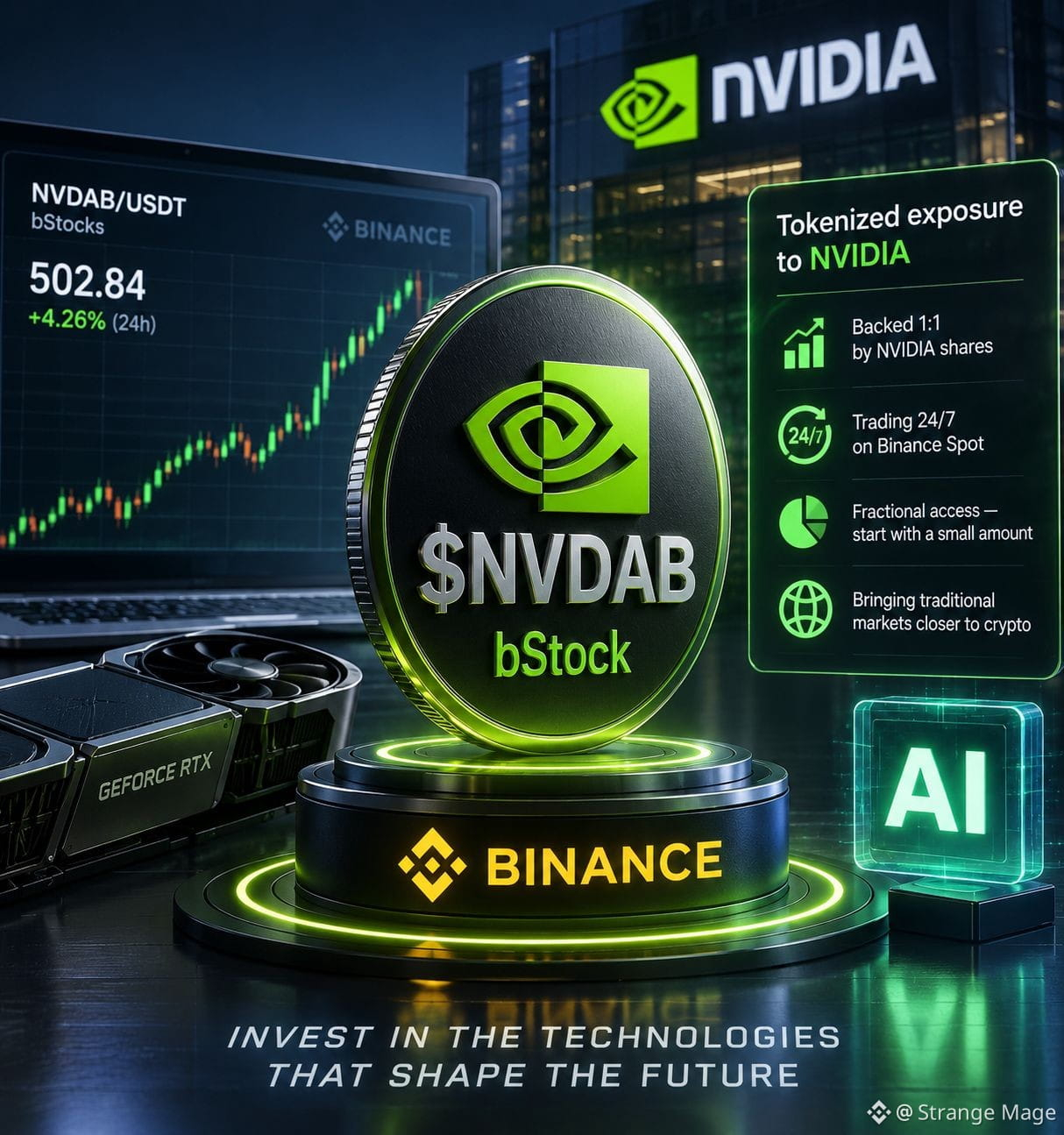
24/7 Trading: Buy directly from a Web3 wallet without waiting for NASDAQ market hours.
Fractional Ownership: You can step into the asset with virtually any amount.
DeFi Integration: The token can be used as collateral in lending protocols or added to liquidity pools.
What to keep in mind
While NVDAB provides economic exposure to NVIDIA’s stock performance, it doesn't give you direct voting rights as a traditional shareholder. Smart contract and regulatory risks also apply.
Bottom line: It's an excellent bridge between the traditional stock market and the convenience of the crypto ecosystem.
#bstockscis @BinanceCIS $NVDAB
Over the last few months, I’ve shifted part of my crypto portfolio into RWA (Real-World Assets). I want to share my honest experience with $NVDAB — a tokenized version of NVIDIA shares.
Why does a crypto investor need NVIDIA stocks?
For a long time, taking profits out of stablecoins and putting them into the traditional AI sector was a major headache: bank transfers, fees, and waiting days for settlement. $NVDAB solves this completely.
Key perks for me:
24/7 Trading: Buy directly from a Web3 wallet without waiting for NASDAQ market hours.
Fractional Ownership: You can step into the asset with virtually any amount.
DeFi Integration: The token can be used as collateral in lending protocols or added to liquidity pools.
What to keep in mind
While NVDAB provides economic exposure to NVIDIA’s stock performance, it doesn't give you direct voting rights as a traditional shareholder. Smart contract and regulatory risks also apply.
Bottom line: It's an excellent bridge between the traditional stock market and the convenience of the crypto ecosystem.
#bstockscis @BinanceCIS $NVDAB
Why does a crypto investor need NVIDIA stocks?
For a long time, taking profits out of stablecoins and putting them into the traditional AI sector was a major headache: bank transfers, fees, and waiting days for settlement. $NVDAB solves this completely.
Key perks for me:
24/7 Trading: Buy directly from a Web3 wallet without waiting for NASDAQ market hours.
Fractional Ownership: You can step into the asset with virtually any amount.
DeFi Integration: The token can be used as collateral in lending protocols or added to liquidity pools.
What to keep in mind
While NVDAB provides economic exposure to NVIDIA’s stock performance, it doesn't give you direct voting rights as a traditional shareholder. Smart contract and regulatory risks also apply.
Bottom line: It's an excellent bridge between the traditional stock market and the convenience of the crypto ecosystem.
#bstockscis @BinanceCIS $NVDAB
1
87
·
--
The more I look into bStocks, the more I realize that the companies behind these assets can be just as interesting as the technology itself. This time I decided to take another look at $SKHYB and SK Hynix.
Honestly, I didn’t pay much attention to SK Hynix before. Most of the AI-related stock discussions usually focus on NVIDIA, AMD or other names that are more familiar to crypto users. But the more I read about the semiconductor industry, the harder it is to ignore companies like SK Hynix.
What makes $SKHYB interesting to me is its connection to the AI infrastructure story. SK Hynix is one of the major memory-chip manufacturers and a leading supplier of High Bandwidth Memory (HBM), which is an important component for AI accelerators. So instead of looking only at the companies designing AI chips, it’s interesting to also look at the companies supplying some of the hardware those systems depend on.
The bStocks format adds another interesting layer. SKHYB is a tokenized security that is backed 1:1 by real US-listed SK Hynix shares held with regulated custody. It trades on Binance Spot 24/7 and is issued as a BEP-20 token on BNB Smart Chain.
Of course, I wouldn’t treat SKHYB as just another crypto token. It gives economic exposure to the underlying stock, but it isn't direct ownership of SK Hynix shares and doesn't provide normal shareholder voting rights. That distinction is important.
For me, this is exactly why the RWA sector is worth watching. It’s not about replacing traditional stocks overnight. It’s about creating another way to interact with traditional assets using infrastructure that crypto users already understand.
@BinanceCIS #bstockscis $SKHYB
What do you think about SKHYB and the idea of getting exposure to semiconductor companies through bStocks?
The more I look into bStocks, the more I realize that the companies behind these assets can be just as interesting as the technology itself. This time I decided to take another look at $SKHYB and SK Hynix.
Honestly, I didn’t pay much attention to SK Hynix before. Most of the AI-related stock discussions usually focus on NVIDIA, AMD or other names that are more familiar to crypto users. But the more I read about the semiconductor industry, the harder it is to ignore companies like SK Hynix.
What makes $SKHYB interesting to me is its connection to the AI infrastructure story. SK Hynix is one of the major memory-chip manufacturers and a leading supplier of High Bandwidth Memory (HBM), which is an important component for AI accelerators. So instead of looking only at the companies designing AI chips, it’s interesting to also look at the companies supplying some of the hardware those systems depend on.
The bStocks format adds another interesting layer. SKHYB is a tokenized security that is backed 1:1 by real US-listed SK Hynix shares held with regulated custody. It trades on Binance Spot 24/7 and is issued as a BEP-20 token on BNB Smart Chain.
Of course, I wouldn’t treat SKHYB as just another crypto token. It gives economic exposure to the underlying stock, but it isn't direct ownership of SK Hynix shares and doesn't provide normal shareholder voting rights. That distinction is important.
For me, this is exactly why the RWA sector is worth watching. It’s not about replacing traditional stocks overnight. It’s about creating another way to interact with traditional assets using infrastructure that crypto users already understand.
@BinanceCIS #bstockscis $SKHYB
What do you think about SKHYB and the idea of getting exposure to semiconductor companies through bStocks?
Honestly, I didn’t pay much attention to SK Hynix before. Most of the AI-related stock discussions usually focus on NVIDIA, AMD or other names that are more familiar to crypto users. But the more I read about the semiconductor industry, the harder it is to ignore companies like SK Hynix.
What makes $SKHYB interesting to me is its connection to the AI infrastructure story. SK Hynix is one of the major memory-chip manufacturers and a leading supplier of High Bandwidth Memory (HBM), which is an important component for AI accelerators. So instead of looking only at the companies designing AI chips, it’s interesting to also look at the companies supplying some of the hardware those systems depend on.
The bStocks format adds another interesting layer. SKHYB is a tokenized security that is backed 1:1 by real US-listed SK Hynix shares held with regulated custody. It trades on Binance Spot 24/7 and is issued as a BEP-20 token on BNB Smart Chain.
Of course, I wouldn’t treat SKHYB as just another crypto token. It gives economic exposure to the underlying stock, but it isn't direct ownership of SK Hynix shares and doesn't provide normal shareholder voting rights. That distinction is important.
For me, this is exactly why the RWA sector is worth watching. It’s not about replacing traditional stocks overnight. It’s about creating another way to interact with traditional assets using infrastructure that crypto users already understand.
@BinanceCIS #bstockscis $SKHYB
What do you think about SKHYB and the idea of getting exposure to semiconductor companies through bStocks?
Already hold bStocks
67%
Want to try
33%
Just watching
0%
Prefer regular stocks
0%
3 проголосовали • Голосование закрыто
292
·
--
This time I decided to look at $CRCLB — a tokenized security linked to Circle Internet Group. Honestly, this one caught my attention because Circle sits right at the intersection of traditional finance and crypto.
Most people probably know Circle because of USDC. That makes $CRCLB a pretty interesting example of how a company from the crypto industry can also become part of the RWA story.
💡 What I like about the bStocks concept here is the format. Instead of dealing with a traditional brokerage setup, eligible users can get exposure to the underlying stock through a tokenized security and trade it on Binance Spot 24/7. bStocks are backed 1:1 by corresponding US shares held with a regulated custodian.
For someone who already spends most of their time in crypto, this setup feels pretty natural. You can have crypto assets and tokenized stock exposure in the same ecosystem instead of constantly switching between different platforms.
At the same time, I wouldn't treat CRCLB like a normal crypto token. It isn't USDC, and it isn't direct ownership of Circle shares either. It represents exposure to the underlying stock, so it's worth understanding the structure and risks before buying.
Personally, I think this is where RWA gets interesting. If more companies connected to crypto and traditional finance become available in tokenized form, the difference between the two markets could become much smaller.
$CRCLB #bStocksCİS @BinanceCIS
Would you actually consider adding CRCLB to your portfolio?
This time I decided to look at $CRCLB — a tokenized security linked to Circle Internet Group. Honestly, this one caught my attention because Circle sits right at the intersection of traditional finance and crypto.
Most people probably know Circle because of USDC. That makes $CRCLB a pretty interesting example of how a company from the crypto industry can also become part of the RWA story.
💡 What I like about the bStocks concept here is the format. Instead of dealing with a traditional brokerage setup, eligible users can get exposure to the underlying stock through a tokenized security and trade it on Binance Spot 24/7. bStocks are backed 1:1 by corresponding US shares held with a regulated custodian.
For someone who already spends most of their time in crypto, this setup feels pretty natural. You can have crypto assets and tokenized stock exposure in the same ecosystem instead of constantly switching between different platforms.
At the same time, I wouldn't treat CRCLB like a normal crypto token. It isn't USDC, and it isn't direct ownership of Circle shares either. It represents exposure to the underlying stock, so it's worth understanding the structure and risks before buying.
Personally, I think this is where RWA gets interesting. If more companies connected to crypto and traditional finance become available in tokenized form, the difference between the two markets could become much smaller.
$CRCLB #bStocksCİS @BinanceCIS
Would you actually consider adding CRCLB to your portfolio?
Most people probably know Circle because of USDC. That makes $CRCLB a pretty interesting example of how a company from the crypto industry can also become part of the RWA story.
💡 What I like about the bStocks concept here is the format. Instead of dealing with a traditional brokerage setup, eligible users can get exposure to the underlying stock through a tokenized security and trade it on Binance Spot 24/7. bStocks are backed 1:1 by corresponding US shares held with a regulated custodian.
For someone who already spends most of their time in crypto, this setup feels pretty natural. You can have crypto assets and tokenized stock exposure in the same ecosystem instead of constantly switching between different platforms.
At the same time, I wouldn't treat CRCLB like a normal crypto token. It isn't USDC, and it isn't direct ownership of Circle shares either. It represents exposure to the underlying stock, so it's worth understanding the structure and risks before buying.
Personally, I think this is where RWA gets interesting. If more companies connected to crypto and traditional finance become available in tokenized form, the difference between the two markets could become much smaller.
$CRCLB #bStocksCİS @BinanceCIS
Would you actually consider adding CRCLB to your portfolio?
Already use bStocks
100%
Want to try them
0%
Just watching
0%
Prefer regular stocks
0%
1 проголосовали • Голосование закрыто
317
·
--
After looking at $MUB, I wanted to check out something completely different, so this time I took a closer look at $SPCXB and the whole idea of getting SpaceX exposure through a tokenized format.
🚀 What caught my attention?
SpaceX is obviously one of those companies that almost everyone in crypto has heard about. Between rockets, Starlink and the whole space industry, there is a lot happening around the company. What I find interesting is how traditional equity exposure can now be connected with the infrastructure that crypto users are already familiar with.
⏰ The 24/7 part is probably what I find the most unusual compared with traditional stock trading.
In crypto, we're used to markets being open all the time. You don't have to wait for Monday morning or check whether the US market is currently open. Having tokenized securities available in a similar environment makes the whole concept feel much more natural for crypto users.
💰 I also like the fact that bStocks can provide fractional access, so you don't necessarily need to start with a huge position just to test how the format works.
Of course, there is an important distinction: a bStock is not the same thing as directly owning shares of the underlying company. Binance describes bStocks as tokenized securities backed 1:1 by the corresponding US shares, rather than direct share ownership.
For me, the bigger question is where RWA goes from here. If more major companies become available through tokenized securities, the line between traditional finance and Web3 could become much thinner.
@BinanceCIS #bStocksCIS $SPCXB
What do you think about $SPCXB and tokenized stocks in general?
After looking at $MUB, I wanted to check out something completely different, so this time I took a closer look at $SPCXB and the whole idea of getting SpaceX exposure through a tokenized format.
🚀 What caught my attention?
SpaceX is obviously one of those companies that almost everyone in crypto has heard about. Between rockets, Starlink and the whole space industry, there is a lot happening around the company. What I find interesting is how traditional equity exposure can now be connected with the infrastructure that crypto users are already familiar with.
⏰ The 24/7 part is probably what I find the most unusual compared with traditional stock trading.
In crypto, we're used to markets being open all the time. You don't have to wait for Monday morning or check whether the US market is currently open. Having tokenized securities available in a similar environment makes the whole concept feel much more natural for crypto users.
💰 I also like the fact that bStocks can provide fractional access, so you don't necessarily need to start with a huge position just to test how the format works.
Of course, there is an important distinction: a bStock is not the same thing as directly owning shares of the underlying company. Binance describes bStocks as tokenized securities backed 1:1 by the corresponding US shares, rather than direct share ownership.
For me, the bigger question is where RWA goes from here. If more major companies become available through tokenized securities, the line between traditional finance and Web3 could become much thinner.
@BinanceCIS #bStocksCIS $SPCXB
What do you think about $SPCXB and tokenized stocks in general?
🚀 What caught my attention?
SpaceX is obviously one of those companies that almost everyone in crypto has heard about. Between rockets, Starlink and the whole space industry, there is a lot happening around the company. What I find interesting is how traditional equity exposure can now be connected with the infrastructure that crypto users are already familiar with.
⏰ The 24/7 part is probably what I find the most unusual compared with traditional stock trading.
In crypto, we're used to markets being open all the time. You don't have to wait for Monday morning or check whether the US market is currently open. Having tokenized securities available in a similar environment makes the whole concept feel much more natural for crypto users.
💰 I also like the fact that bStocks can provide fractional access, so you don't necessarily need to start with a huge position just to test how the format works.
Of course, there is an important distinction: a bStock is not the same thing as directly owning shares of the underlying company. Binance describes bStocks as tokenized securities backed 1:1 by the corresponding US shares, rather than direct share ownership.
For me, the bigger question is where RWA goes from here. If more major companies become available through tokenized securities, the line between traditional finance and Web3 could become much thinner.
@BinanceCIS #bStocksCIS $SPCXB
What do you think about $SPCXB and tokenized stocks in general?
Already using bStocks
100%
Want to try them
0%
Just watching for now
0%
Not interested yet
0%
2 проголосовали • Голосование закрыто
384
·
--
This time I decided to look beyond Tesla and NVIDIA and check out MUB — a bStock linked to Micron. And honestly, this one caught my attention for a different reason.
🧠 Why MUB?
Micron is operating in a part of the semiconductor market that has become especially interesting with the growth of AI infrastructure. Memory chips are a pretty important piece of that whole story, so I was curious to see what it looks like to get exposure to a company like Micron through the bStocks format.
⏰ The 24/7 trading part is probably what feels the most unusual compared with traditional stocks.
With crypto, we're already used to markets being open all the time. You don't have to wait for Monday morning or worry about whether the US market is currently open. Having tokenized stock exposure work in a similar way actually makes a lot of sense, especially if you're not living in the US.
💰 Another thing I like is the fractional access. You don't necessarily need a huge amount of money just to get started and see how the whole thing works.
Of course, $MUB isn't just another crypto coin, and holding it isn't the same as directly owning Micron shares. bStocks are tokenized securities backed 1:1 by the underlying shares, so I think it's important to understand what you're actually buying before jumping in.
#bstockscis @BinanceCIS $MUB
I'm curious what you guys think:
Would you actually use $MUB or other bStocks as part of your portfolio?
This time I decided to look beyond Tesla and NVIDIA and check out MUB — a bStock linked to Micron. And honestly, this one caught my attention for a different reason.
🧠 Why MUB?
Micron is operating in a part of the semiconductor market that has become especially interesting with the growth of AI infrastructure. Memory chips are a pretty important piece of that whole story, so I was curious to see what it looks like to get exposure to a company like Micron through the bStocks format.
⏰ The 24/7 trading part is probably what feels the most unusual compared with traditional stocks.
With crypto, we're already used to markets being open all the time. You don't have to wait for Monday morning or worry about whether the US market is currently open. Having tokenized stock exposure work in a similar way actually makes a lot of sense, especially if you're not living in the US.
💰 Another thing I like is the fractional access. You don't necessarily need a huge amount of money just to get started and see how the whole thing works.
Of course, $MUB isn't just another crypto coin, and holding it isn't the same as directly owning Micron shares. bStocks are tokenized securities backed 1:1 by the underlying shares, so I think it's important to understand what you're actually buying before jumping in.
#bstockscis @BinanceCIS $MUB
I'm curious what you guys think:
Would you actually use $MUB or other bStocks as part of your portfolio?
🧠 Why MUB?
Micron is operating in a part of the semiconductor market that has become especially interesting with the growth of AI infrastructure. Memory chips are a pretty important piece of that whole story, so I was curious to see what it looks like to get exposure to a company like Micron through the bStocks format.
⏰ The 24/7 trading part is probably what feels the most unusual compared with traditional stocks.
With crypto, we're already used to markets being open all the time. You don't have to wait for Monday morning or worry about whether the US market is currently open. Having tokenized stock exposure work in a similar way actually makes a lot of sense, especially if you're not living in the US.
💰 Another thing I like is the fractional access. You don't necessarily need a huge amount of money just to get started and see how the whole thing works.
Of course, $MUB isn't just another crypto coin, and holding it isn't the same as directly owning Micron shares. bStocks are tokenized securities backed 1:1 by the underlying shares, so I think it's important to understand what you're actually buying before jumping in.
#bstockscis @BinanceCIS $MUB
I'm curious what you guys think:
Would you actually use $MUB or other bStocks as part of your portfolio?
Yes, I use bStocks
50%
Interested, but watching
50%
I prefer regular stocks
0%
Not interested yet
0%
4 проголосовали • Голосование закрыто
217
·
--
I honestly hadn’t paid much attention to SK Hynix before, but after seeing $SKHYB on Binance, I started looking into the company from a different angle.
SK Hynix is a major player in the semiconductor and memory market, especially with the growing demand for HBM chips used in AI infrastructure. What makes interesting to me is that it brings exposure to this traditional company into a format that crypto users already understand.
The 24/7 trading part is probably the thing I find most interesting. We’re used to crypto markets being open all the time, so having tokenized stock exposure work in a similar way feels pretty natural.
Of course, isn’t the same as directly owning SK Hynix shares and it doesn’t give you normal shareholder voting rights. It’s a tokenized security backed 1:1 by the underlying shares, so it’s worth understanding the structure before jumping in.
Personally, I think this is where RWA starts getting really interesting. If more companies from different industries become available in this format, the line between traditional markets and Web3 could become much thinner.
Do you think $SKHYB and similar bStocks can make tokenized stocks a normal part of the crypto ecosystem?
$SKHYB #bstockscis @BinanceCIS
I honestly hadn’t paid much attention to SK Hynix before, but after seeing $SKHYB on Binance, I started looking into the company from a different angle.
SK Hynix is a major player in the semiconductor and memory market, especially with the growing demand for HBM chips used in AI infrastructure. What makes interesting to me is that it brings exposure to this traditional company into a format that crypto users already understand.
The 24/7 trading part is probably the thing I find most interesting. We’re used to crypto markets being open all the time, so having tokenized stock exposure work in a similar way feels pretty natural.
Of course, isn’t the same as directly owning SK Hynix shares and it doesn’t give you normal shareholder voting rights. It’s a tokenized security backed 1:1 by the underlying shares, so it’s worth understanding the structure before jumping in.
Personally, I think this is where RWA starts getting really interesting. If more companies from different industries become available in this format, the line between traditional markets and Web3 could become much thinner.
Do you think $SKHYB and similar bStocks can make tokenized stocks a normal part of the crypto ecosystem?
$SKHYB #bstockscis @BinanceCIS
SK Hynix is a major player in the semiconductor and memory market, especially with the growing demand for HBM chips used in AI infrastructure. What makes interesting to me is that it brings exposure to this traditional company into a format that crypto users already understand.
The 24/7 trading part is probably the thing I find most interesting. We’re used to crypto markets being open all the time, so having tokenized stock exposure work in a similar way feels pretty natural.
Of course, isn’t the same as directly owning SK Hynix shares and it doesn’t give you normal shareholder voting rights. It’s a tokenized security backed 1:1 by the underlying shares, so it’s worth understanding the structure before jumping in.
Personally, I think this is where RWA starts getting really interesting. If more companies from different industries become available in this format, the line between traditional markets and Web3 could become much thinner.
Do you think $SKHYB and similar bStocks can make tokenized stocks a normal part of the crypto ecosystem?
$SKHYB #bstockscis @BinanceCIS
88
Войдите, чтобы посмотреть больше материала
Присоединяйтесь к пользователям криптовалют по всему миру на Binance Square
⚡️ Получайте новейшую и полезную информацию о криптоактивах.
💬 Нам доверяет крупнейшая в мире криптобиржа.
👍 Получите достоверные аналитические данные от верифицированных создателей контента.
Эл. почта/номер телефона
В тренде
BinanceKZ
Просмотров: 7,659
45 обсуждают
Как я потерял 180 000 тенге на «менеджере Binance» из WhatsApp — и почему всё равно остался в крипте
phpdead
·Лайков: 5
·Просмотров: 1.1k
CircleMints500MUSDCOnSolana
Просмотров: 96,037
2,072 обсуждают
PolymarketBankFailureBetsDrawFDICConcern
Просмотров: 96,130
1,845 обсуждают