

HCrypto_news
249 Публикации

HCrypto_news
Отправить жалобу
Заблокировать пользователя
📊 Crypto | Markets | Breaking News 🚀 Turning Market Moves Into Simple Insights 💡 Stay Informed. Stay Ahead. 🌍 Global Markets • Crypto • Finance "NFA"
Открытая сделка
1.4 мес.
234 подписок(и/а)
201 подписчиков(а)
77 понравилось
Посты
Портфель
·
--
#EvernorthDelaysNasdaqDebutToOct12
#EvernorthDelaysNasdaqDebutToOct12
🚨 UPDATE: Evernorth’s $XRPN Nasdaq debut has been delayed.
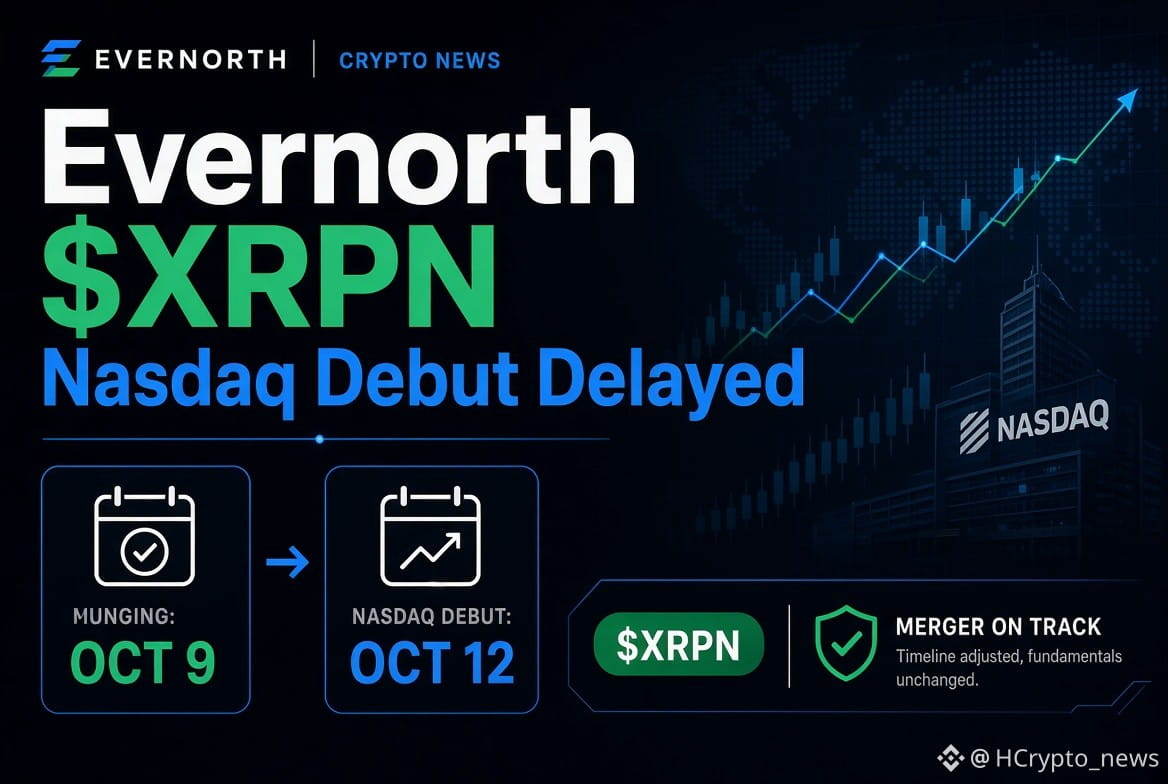
@evernorthxrp is now expected to complete its closing on October 9, with $XRPN scheduled to begin trading on Nasdaq on October 12.
The company says the delay is due to an administrative issue and is not expected to impact the merger with Armada Acquisition Corp. II.
🔹 Closing: Oct. 9 🔹 Nasdaq debut: Oct. 12 🔹 Ticker: $XRPN 🔹 Merger remains on track
📈 The delay may be temporary, but the real focus now shifts to how $XRPN performs once trading begins.
#XRP #XRPN #Evernorth #Nasdaq #Crypto #CryptoNews #Altcoins
#EvernorthDelaysNasdaqDebutToOct12
#EvernorthDelaysNasdaqDebutToOct12
🚨 UPDATE: Evernorth’s $XRPN Nasdaq debut has been delayed.
@evernorthxrp is now expected to complete its closing on October 9, with $XRPN scheduled to begin trading on Nasdaq on October 12.
The company says the delay is due to an administrative issue and is not expected to impact the merger with Armada Acquisition Corp. II.
🔹 Closing: Oct. 9 🔹 Nasdaq debut: Oct. 12 🔹 Ticker: $XRPN 🔹 Merger remains on track
📈 The delay may be temporary, but the real focus now shifts to how $XRPN performs once trading begins.
#XRP #XRPN #Evernorth #Nasdaq #Crypto #CryptoNews #Altcoins
#EvernorthDelaysNasdaqDebutToOct12
🚨 UPDATE: Evernorth’s $XRPN Nasdaq debut has been delayed.
@evernorthxrp is now expected to complete its closing on October 9, with $XRPN scheduled to begin trading on Nasdaq on October 12.
The company says the delay is due to an administrative issue and is not expected to impact the merger with Armada Acquisition Corp. II.
🔹 Closing: Oct. 9 🔹 Nasdaq debut: Oct. 12 🔹 Ticker: $XRPN 🔹 Merger remains on track
📈 The delay may be temporary, but the real focus now shifts to how $XRPN performs once trading begins.
#XRP #XRPN #Evernorth #Nasdaq #Crypto #CryptoNews #Altcoins
26
·
--
#USMortgageRatesRiseTo7.49%
🇺🇸 US housing stress is getting worse.
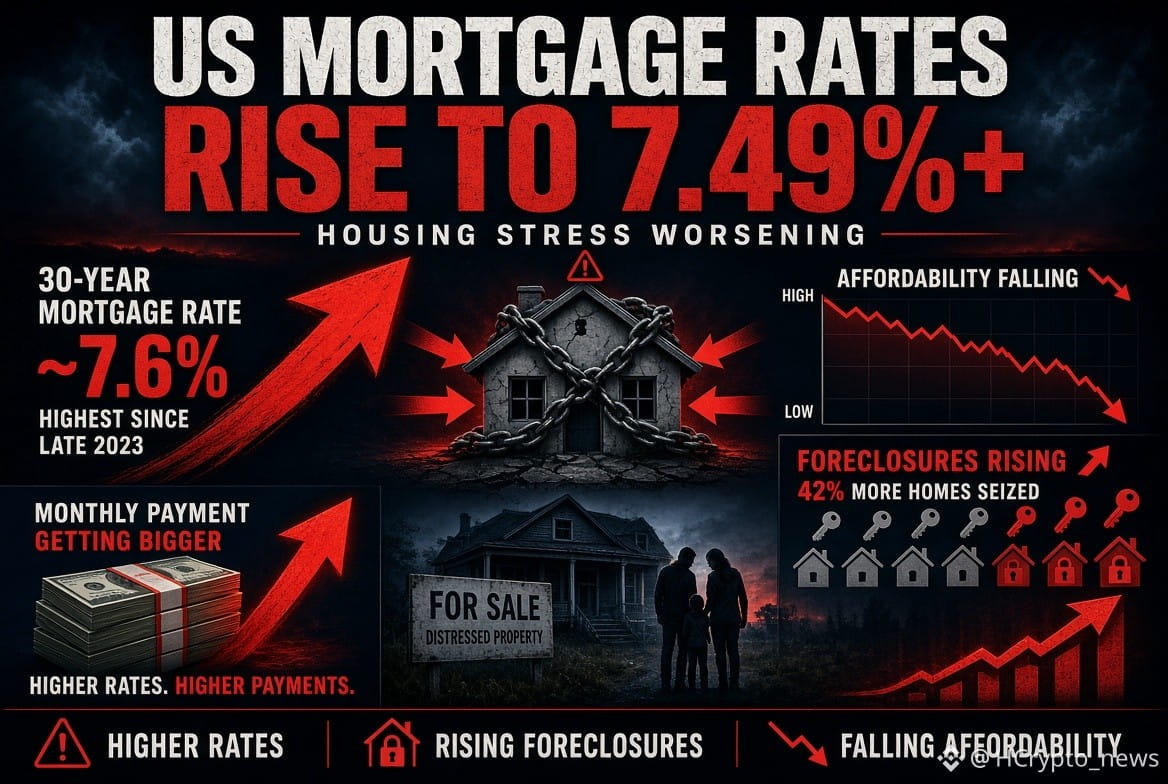
US banks reportedly seized 42% more homes in August than a year ago, as more borrowers struggle to keep up with mortgage payments.
At the same time, 30-year mortgage rates climbed to around 7.6%, reaching their highest level since late 2023.
📉 Higher rates
🏠 Rising foreclosures
💰 Bigger monthly payments
⚠️ Falling affordability
For the average American, buying a home is becoming increasingly difficult.
And if mortgage rates stay elevated, housing could remain one of the biggest pressure points for the US economy.
Is the US housing market heading toward a bigger correction? 👀
#USHousing #MortgageRates #Economy #Fed #InterestRates #RealEstate #Finance
#USMortgageRatesRiseTo7.49%
🇺🇸 US housing stress is getting worse.
US banks reportedly seized 42% more homes in August than a year ago, as more borrowers struggle to keep up with mortgage payments.
At the same time, 30-year mortgage rates climbed to around 7.6%, reaching their highest level since late 2023.
📉 Higher rates
🏠 Rising foreclosures
💰 Bigger monthly payments
⚠️ Falling affordability
For the average American, buying a home is becoming increasingly difficult.
And if mortgage rates stay elevated, housing could remain one of the biggest pressure points for the US economy.
Is the US housing market heading toward a bigger correction? 👀
#USHousing #MortgageRates #Economy #Fed #InterestRates #RealEstate #Finance
🇺🇸 US housing stress is getting worse.
US banks reportedly seized 42% more homes in August than a year ago, as more borrowers struggle to keep up with mortgage payments.
At the same time, 30-year mortgage rates climbed to around 7.6%, reaching their highest level since late 2023.
📉 Higher rates
🏠 Rising foreclosures
💰 Bigger monthly payments
⚠️ Falling affordability
For the average American, buying a home is becoming increasingly difficult.
And if mortgage rates stay elevated, housing could remain one of the biggest pressure points for the US economy.
Is the US housing market heading toward a bigger correction? 👀
#USHousing #MortgageRates #Economy #Fed #InterestRates #RealEstate #Finance
45
·
--
#SP500AndNasdaqHitRecordHighs
#SP500AndNasdaqHitRecordHighs
🚨 THE MARKET IS AT RECORD HIGHS — BUT SOMETHING IS VERY DIFFERENT UNDERNEATH
The Nasdaq 100 just hit a record high.
But here’s the surprising part:
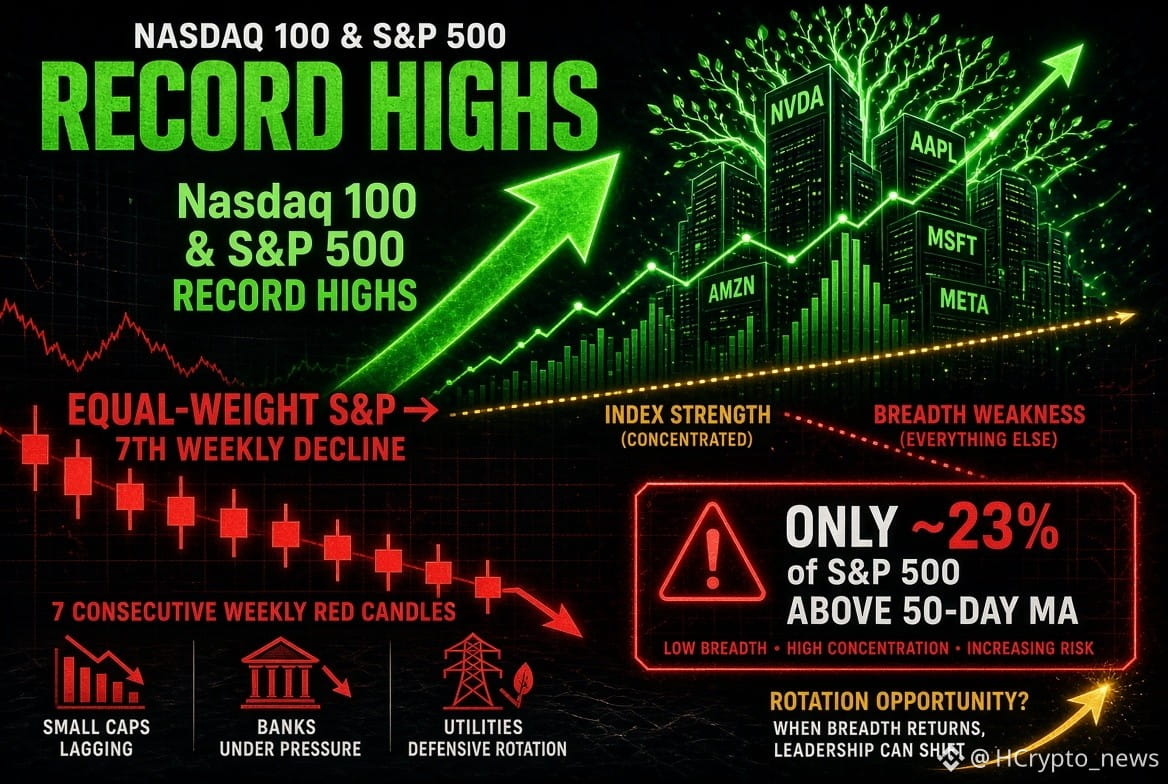
📉 The equal-weight S&P 500 is heading toward its 7th consecutive weekly decline.
That has happened only twice before — 2002 and 2022.
And both periods eventually became major market-bottoming phases.
🔥 WHAT'S REALLY HAPPENING?
A small group of mega-cap stocks is carrying the major indexes higher.
Meanwhile:
❌ Small caps are struggling
❌ Banks are under pressure
❌ Utilities are weak
❌ Most S&P 500 stocks are below their 50-day moving average
Goldman’s desk reportedly estimates that only around 23% of S&P 500 stocks are above their 50-day average.
That means the headline index can look extremely strong while the average stock is quietly getting crushed.
🟢 WHY THIS COULD BECOME BULLISH
This type of divergence can eventually create a powerful setup.
If Treasury yields, oil prices and corporate borrowing costs start falling, the stocks that have been left behind could begin catching up.
That could mean a broader market rally instead of a rally driven by only a handful of mega caps.
📌 The key signal isn't just whether the S&P 500 makes another record.
The real question is:
WHEN WILL MARKET BREADTH START IMPROVING?
⚠️ THE BIG RISK
If yields break higher again, the weaker parts of the market could remain under pressure — and the divergence could become even wider.
🎯 TRADER'S TAKEAWAY:
Don't just watch the index.
Watch market breadth + Treasury yields + small caps + banks.
If breadth starts expanding while yields cool down, that could be the confirmation bulls are waiting for.
🔥 Do you think this is a healthy rotation before the next leg higher — or a warning sign for the broader market?
LIKE ❤️ SAVE 🔖 & COMMENT your view.
#SP500 #Nasdaq #Stocks #StockMarket #Trading #Investing #Markets #S&P500 #Nasdaq100 #WallStreet #Crypto #Bitcoin
#SP500AndNasdaqHitRecordHighs
#SP500AndNasdaqHitRecordHighs
🚨 THE MARKET IS AT RECORD HIGHS — BUT SOMETHING IS VERY DIFFERENT UNDERNEATH
The Nasdaq 100 just hit a record high.
But here’s the surprising part:
📉 The equal-weight S&P 500 is heading toward its 7th consecutive weekly decline.
That has happened only twice before — 2002 and 2022.
And both periods eventually became major market-bottoming phases.
🔥 WHAT'S REALLY HAPPENING?
A small group of mega-cap stocks is carrying the major indexes higher.
Meanwhile:
❌ Small caps are struggling
❌ Banks are under pressure
❌ Utilities are weak
❌ Most S&P 500 stocks are below their 50-day moving average
Goldman’s desk reportedly estimates that only around 23% of S&P 500 stocks are above their 50-day average.
That means the headline index can look extremely strong while the average stock is quietly getting crushed.
🟢 WHY THIS COULD BECOME BULLISH
This type of divergence can eventually create a powerful setup.
If Treasury yields, oil prices and corporate borrowing costs start falling, the stocks that have been left behind could begin catching up.
That could mean a broader market rally instead of a rally driven by only a handful of mega caps.
📌 The key signal isn't just whether the S&P 500 makes another record.
The real question is:
WHEN WILL MARKET BREADTH START IMPROVING?
⚠️ THE BIG RISK
If yields break higher again, the weaker parts of the market could remain under pressure — and the divergence could become even wider.
🎯 TRADER'S TAKEAWAY:
Don't just watch the index.
Watch market breadth + Treasury yields + small caps + banks.
If breadth starts expanding while yields cool down, that could be the confirmation bulls are waiting for.
🔥 Do you think this is a healthy rotation before the next leg higher — or a warning sign for the broader market?
LIKE ❤️ SAVE 🔖 & COMMENT your view.
#SP500 #Nasdaq #Stocks #StockMarket #Trading #Investing #Markets #S&P500 #Nasdaq100 #WallStreet #Crypto #Bitcoin
#SP500AndNasdaqHitRecordHighs
🚨 THE MARKET IS AT RECORD HIGHS — BUT SOMETHING IS VERY DIFFERENT UNDERNEATH
The Nasdaq 100 just hit a record high.
But here’s the surprising part:
📉 The equal-weight S&P 500 is heading toward its 7th consecutive weekly decline.
That has happened only twice before — 2002 and 2022.
And both periods eventually became major market-bottoming phases.
🔥 WHAT'S REALLY HAPPENING?
A small group of mega-cap stocks is carrying the major indexes higher.
Meanwhile:
❌ Small caps are struggling
❌ Banks are under pressure
❌ Utilities are weak
❌ Most S&P 500 stocks are below their 50-day moving average
Goldman’s desk reportedly estimates that only around 23% of S&P 500 stocks are above their 50-day average.
That means the headline index can look extremely strong while the average stock is quietly getting crushed.
🟢 WHY THIS COULD BECOME BULLISH
This type of divergence can eventually create a powerful setup.
If Treasury yields, oil prices and corporate borrowing costs start falling, the stocks that have been left behind could begin catching up.
That could mean a broader market rally instead of a rally driven by only a handful of mega caps.
📌 The key signal isn't just whether the S&P 500 makes another record.
The real question is:
WHEN WILL MARKET BREADTH START IMPROVING?
⚠️ THE BIG RISK
If yields break higher again, the weaker parts of the market could remain under pressure — and the divergence could become even wider.
🎯 TRADER'S TAKEAWAY:
Don't just watch the index.
Watch market breadth + Treasury yields + small caps + banks.
If breadth starts expanding while yields cool down, that could be the confirmation bulls are waiting for.
🔥 Do you think this is a healthy rotation before the next leg higher — or a warning sign for the broader market?
LIKE ❤️ SAVE 🔖 & COMMENT your view.
#SP500 #Nasdaq #Stocks #StockMarket #Trading #Investing #Markets #S&P500 #Nasdaq100 #WallStreet #Crypto #Bitcoin
69
·
--
#FedMinutesFocusOnOctoberPause
🔥 FED MINUTES SEND A CLEAR MESSAGE TO CRYPTO TRADERS
The Fed’s latest minutes show that inflation is still the biggest problem standing between markets and easier monetary policy.
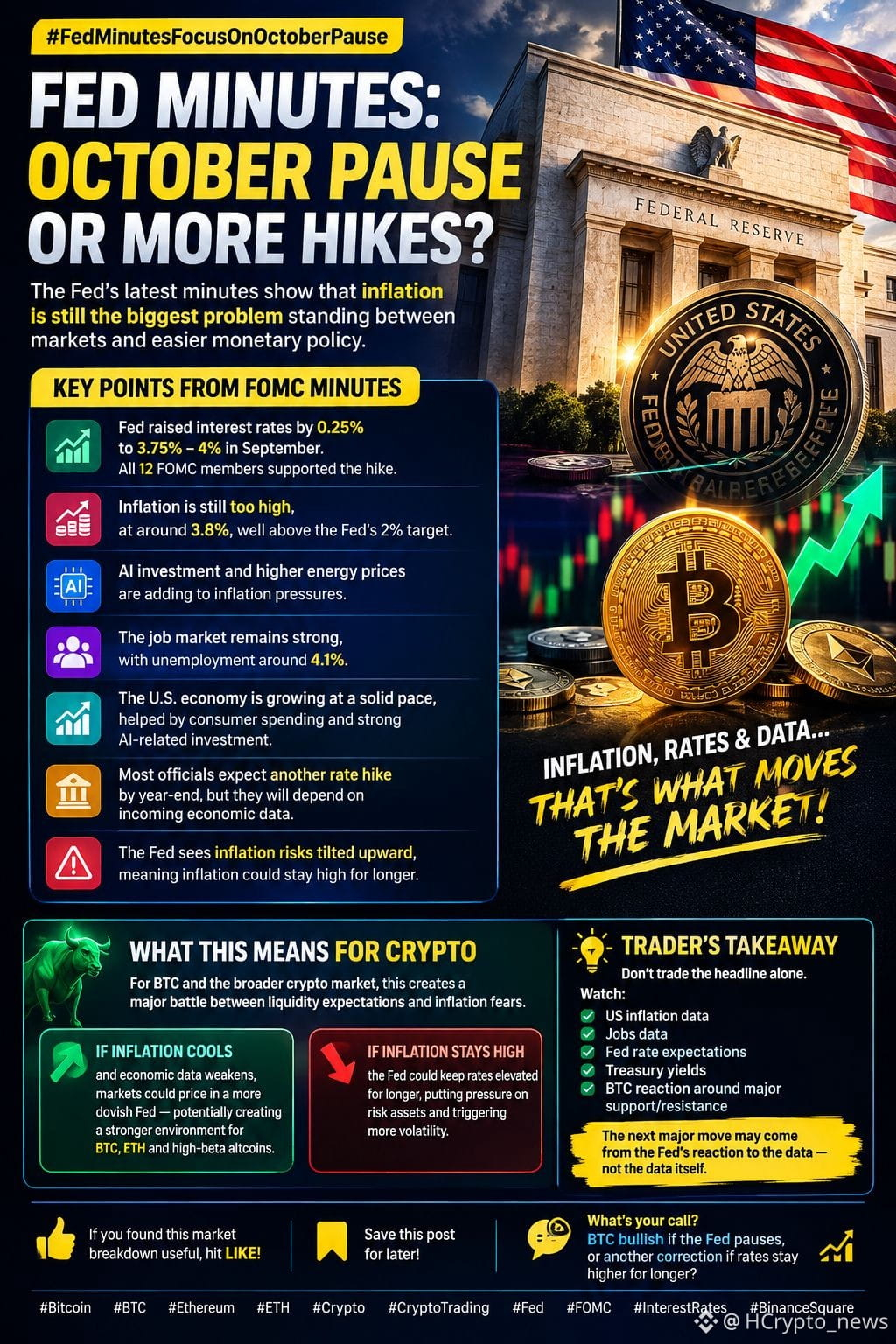
🇺🇸 The Fed raised rates by 25 bps to 3.75%–4% in September, with all 12 FOMC members supporting the move.
But the bigger story is what comes next. 👇
📈 Inflation remains elevated around 3.8%, well above the Fed’s 2% target.
🤖 Strong AI investment and higher energy prices are adding to inflation pressure.
💼 The labor market remains relatively strong, with unemployment around 4.1%.
🏦 Most officials still see another hike as possible before year-end — but future decisions will depend heavily on incoming data.
🚨 WHAT THIS MEANS FOR CRYPTO
For $BTC and the broader crypto market, this creates a major battle between liquidity expectations and inflation fears.
If inflation continues to cool and economic data weakens, markets could start pricing in a more dovish Fed — potentially creating a stronger environment for BTC, ETH and high-beta altcoins. 📈
But if inflation stays stubbornly high, the Fed could keep rates elevated for longer, putting pressure on risk assets and triggering more volatility. ⚠️
🎯 Trader’s takeaway:
Don’t trade the headline alone.
Watch: • US inflation data
• Jobs data
• Fed rate expectations
• Treasury yields
• BTC reaction around major support/resistance
The next major move may come from the Fed’s reaction to the data — not the data itself.
🔥 If you found this market breakdown useful, hit LIKE ❤️
And if you're actively trading, keep this post saved — the next inflation/Fed update could quickly change the market narrative.
📊 What’s your call?
BTC bullish if the Fed pauses, or another correction if rates stay higher for longer? 👇
#Bitcoin #BTC #Ethereum #ETH #Crypto #CryptoTrading #Fed #FOMC #InterestRates #BinanceSquare
#FedMinutesFocusOnOctoberPause
🔥 FED MINUTES SEND A CLEAR MESSAGE TO CRYPTO TRADERS
The Fed’s latest minutes show that inflation is still the biggest problem standing between markets and easier monetary policy.
🇺🇸 The Fed raised rates by 25 bps to 3.75%–4% in September, with all 12 FOMC members supporting the move.
But the bigger story is what comes next. 👇
📈 Inflation remains elevated around 3.8%, well above the Fed’s 2% target.
🤖 Strong AI investment and higher energy prices are adding to inflation pressure.
💼 The labor market remains relatively strong, with unemployment around 4.1%.
🏦 Most officials still see another hike as possible before year-end — but future decisions will depend heavily on incoming data.
🚨 WHAT THIS MEANS FOR CRYPTO
For $BTC and the broader crypto market, this creates a major battle between liquidity expectations and inflation fears.
If inflation continues to cool and economic data weakens, markets could start pricing in a more dovish Fed — potentially creating a stronger environment for BTC, ETH and high-beta altcoins. 📈
But if inflation stays stubbornly high, the Fed could keep rates elevated for longer, putting pressure on risk assets and triggering more volatility. ⚠️
🎯 Trader’s takeaway:
Don’t trade the headline alone.
Watch: • US inflation data
• Jobs data
• Fed rate expectations
• Treasury yields
• BTC reaction around major support/resistance
The next major move may come from the Fed’s reaction to the data — not the data itself.
🔥 If you found this market breakdown useful, hit LIKE ❤️
And if you're actively trading, keep this post saved — the next inflation/Fed update could quickly change the market narrative.
📊 What’s your call?
BTC bullish if the Fed pauses, or another correction if rates stay higher for longer? 👇
#Bitcoin #BTC #Ethereum #ETH #Crypto #CryptoTrading #Fed #FOMC #InterestRates #BinanceSquare
🔥 FED MINUTES SEND A CLEAR MESSAGE TO CRYPTO TRADERS
The Fed’s latest minutes show that inflation is still the biggest problem standing between markets and easier monetary policy.
🇺🇸 The Fed raised rates by 25 bps to 3.75%–4% in September, with all 12 FOMC members supporting the move.
But the bigger story is what comes next. 👇
📈 Inflation remains elevated around 3.8%, well above the Fed’s 2% target.
🤖 Strong AI investment and higher energy prices are adding to inflation pressure.
💼 The labor market remains relatively strong, with unemployment around 4.1%.
🏦 Most officials still see another hike as possible before year-end — but future decisions will depend heavily on incoming data.
🚨 WHAT THIS MEANS FOR CRYPTO
For $BTC and the broader crypto market, this creates a major battle between liquidity expectations and inflation fears.
If inflation continues to cool and economic data weakens, markets could start pricing in a more dovish Fed — potentially creating a stronger environment for BTC, ETH and high-beta altcoins. 📈
But if inflation stays stubbornly high, the Fed could keep rates elevated for longer, putting pressure on risk assets and triggering more volatility. ⚠️
🎯 Trader’s takeaway:
Don’t trade the headline alone.
Watch: • US inflation data
• Jobs data
• Fed rate expectations
• Treasury yields
• BTC reaction around major support/resistance
The next major move may come from the Fed’s reaction to the data — not the data itself.
🔥 If you found this market breakdown useful, hit LIKE ❤️
And if you're actively trading, keep this post saved — the next inflation/Fed update could quickly change the market narrative.
📊 What’s your call?
BTC bullish if the Fed pauses, or another correction if rates stay higher for longer? 👇
#Bitcoin #BTC #Ethereum #ETH #Crypto #CryptoTrading #Fed #FOMC #InterestRates #BinanceSquare
98
·
--
#StrategyMarketCapSurpassesRumble
🚨 WHY I CHANGED MY MIND ON DIGITAL CREDIT
I used to be skeptical of the Digital Credit model.
Then @Strategy and @saylor changed my view — not with one headline, but with a series of measurable moves.
The timeline tells the story 👇
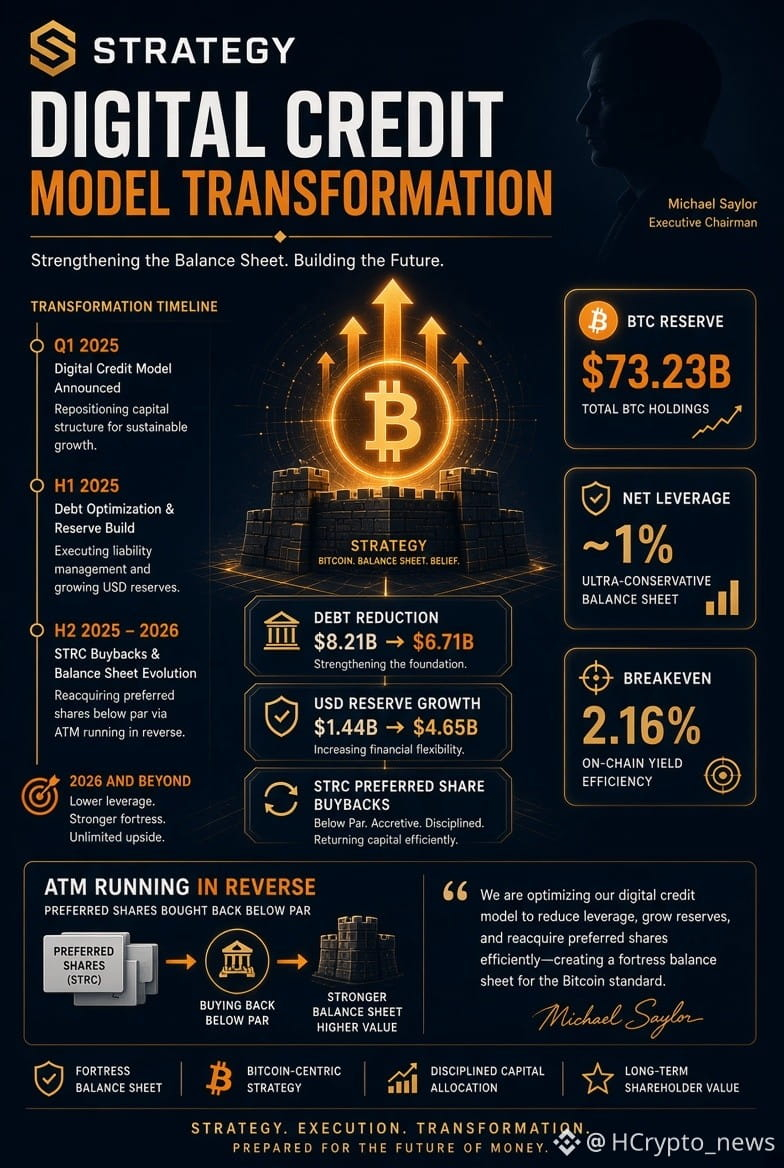
🔹 Jan 2025: Strategy expanded beyond convertible debt with perpetual preferred capital.
🔹 Mar 2025: STRF launched with a 10% fixed-rate perpetual preferred structure.
🔹 Jul 2025: STRC raised $2.521B, making variable-rate preferred capital a major part of the model.
🔹 Dec 2025: Strategy created a $1.44B USD reserve specifically for preferred dividends and debt interest.
🔹 Feb 2026: That reserve grew to $2.25B.
🔹 May 2026: Strategy repurchased $1.5B of convertible debt for ~$1.38B, cutting outstanding debt from $8.21B → $6.71B.
🔹 Jun 2026: The reserve reached $2.55B, covering roughly 17.4 months of expected dividends and interest.
🔹 Jul–Aug 2026: The reserve climbed from $3.75B → $4.65B, while Strategy began repurchasing STRC below par.
And this is the part that really changed my thesis:
STRC buybacks are basically an ATM running in reverse.
Instead of issuing more preferred shares, Strategy can buy them below par, reduce shares outstanding and potentially lower future dividend obligations.
Meanwhile:
💰 Debt: $6.714B
💵 USD assets: $5.711B
📊 Net leverage: ~1%
₿ BTC reserve: $73.23B
📉 BTC breakeven annual return: ~2.16%
This isn't about one bullish metric.
It's about the entire capital structure becoming more disciplined.
Dedicated liquidity.
Lower debt.
Low net leverage.
Preferred buybacks.
A growing cash reserve.
That combination changed my mind.
Updating your model when the data changes isn't defeat.
It's how you improve the model.
#Strategy #MSTR #STRC #STRF #Bitcoin #BTC #DigitalCredit #Crypto #MichaelSaylor
#StrategyMarketCapSurpassesRumble
🚨 WHY I CHANGED MY MIND ON DIGITAL CREDIT
I used to be skeptical of the Digital Credit model.
Then @Strategy and @saylor changed my view — not with one headline, but with a series of measurable moves.
The timeline tells the story 👇
🔹 Jan 2025: Strategy expanded beyond convertible debt with perpetual preferred capital.
🔹 Mar 2025: STRF launched with a 10% fixed-rate perpetual preferred structure.
🔹 Jul 2025: STRC raised $2.521B, making variable-rate preferred capital a major part of the model.
🔹 Dec 2025: Strategy created a $1.44B USD reserve specifically for preferred dividends and debt interest.
🔹 Feb 2026: That reserve grew to $2.25B.
🔹 May 2026: Strategy repurchased $1.5B of convertible debt for ~$1.38B, cutting outstanding debt from $8.21B → $6.71B.
🔹 Jun 2026: The reserve reached $2.55B, covering roughly 17.4 months of expected dividends and interest.
🔹 Jul–Aug 2026: The reserve climbed from $3.75B → $4.65B, while Strategy began repurchasing STRC below par.
And this is the part that really changed my thesis:
STRC buybacks are basically an ATM running in reverse.
Instead of issuing more preferred shares, Strategy can buy them below par, reduce shares outstanding and potentially lower future dividend obligations.
Meanwhile:
💰 Debt: $6.714B
💵 USD assets: $5.711B
📊 Net leverage: ~1%
₿ BTC reserve: $73.23B
📉 BTC breakeven annual return: ~2.16%
This isn't about one bullish metric.
It's about the entire capital structure becoming more disciplined.
Dedicated liquidity.
Lower debt.
Low net leverage.
Preferred buybacks.
A growing cash reserve.
That combination changed my mind.
Updating your model when the data changes isn't defeat.
It's how you improve the model.
#Strategy #MSTR #STRC #STRF #Bitcoin #BTC #DigitalCredit #Crypto #MichaelSaylor
🚨 WHY I CHANGED MY MIND ON DIGITAL CREDIT
I used to be skeptical of the Digital Credit model.
Then @Strategy and @saylor changed my view — not with one headline, but with a series of measurable moves.
The timeline tells the story 👇
🔹 Jan 2025: Strategy expanded beyond convertible debt with perpetual preferred capital.
🔹 Mar 2025: STRF launched with a 10% fixed-rate perpetual preferred structure.
🔹 Jul 2025: STRC raised $2.521B, making variable-rate preferred capital a major part of the model.
🔹 Dec 2025: Strategy created a $1.44B USD reserve specifically for preferred dividends and debt interest.
🔹 Feb 2026: That reserve grew to $2.25B.
🔹 May 2026: Strategy repurchased $1.5B of convertible debt for ~$1.38B, cutting outstanding debt from $8.21B → $6.71B.
🔹 Jun 2026: The reserve reached $2.55B, covering roughly 17.4 months of expected dividends and interest.
🔹 Jul–Aug 2026: The reserve climbed from $3.75B → $4.65B, while Strategy began repurchasing STRC below par.
And this is the part that really changed my thesis:
STRC buybacks are basically an ATM running in reverse.
Instead of issuing more preferred shares, Strategy can buy them below par, reduce shares outstanding and potentially lower future dividend obligations.
Meanwhile:
💰 Debt: $6.714B
💵 USD assets: $5.711B
📊 Net leverage: ~1%
₿ BTC reserve: $73.23B
📉 BTC breakeven annual return: ~2.16%
This isn't about one bullish metric.
It's about the entire capital structure becoming more disciplined.
Dedicated liquidity.
Lower debt.
Low net leverage.
Preferred buybacks.
A growing cash reserve.
That combination changed my mind.
Updating your model when the data changes isn't defeat.
It's how you improve the model.
#Strategy #MSTR #STRC #STRF #Bitcoin #BTC #DigitalCredit #Crypto #MichaelSaylor
219
·
--
#WinklevossFilesSpotZcashETFApplication
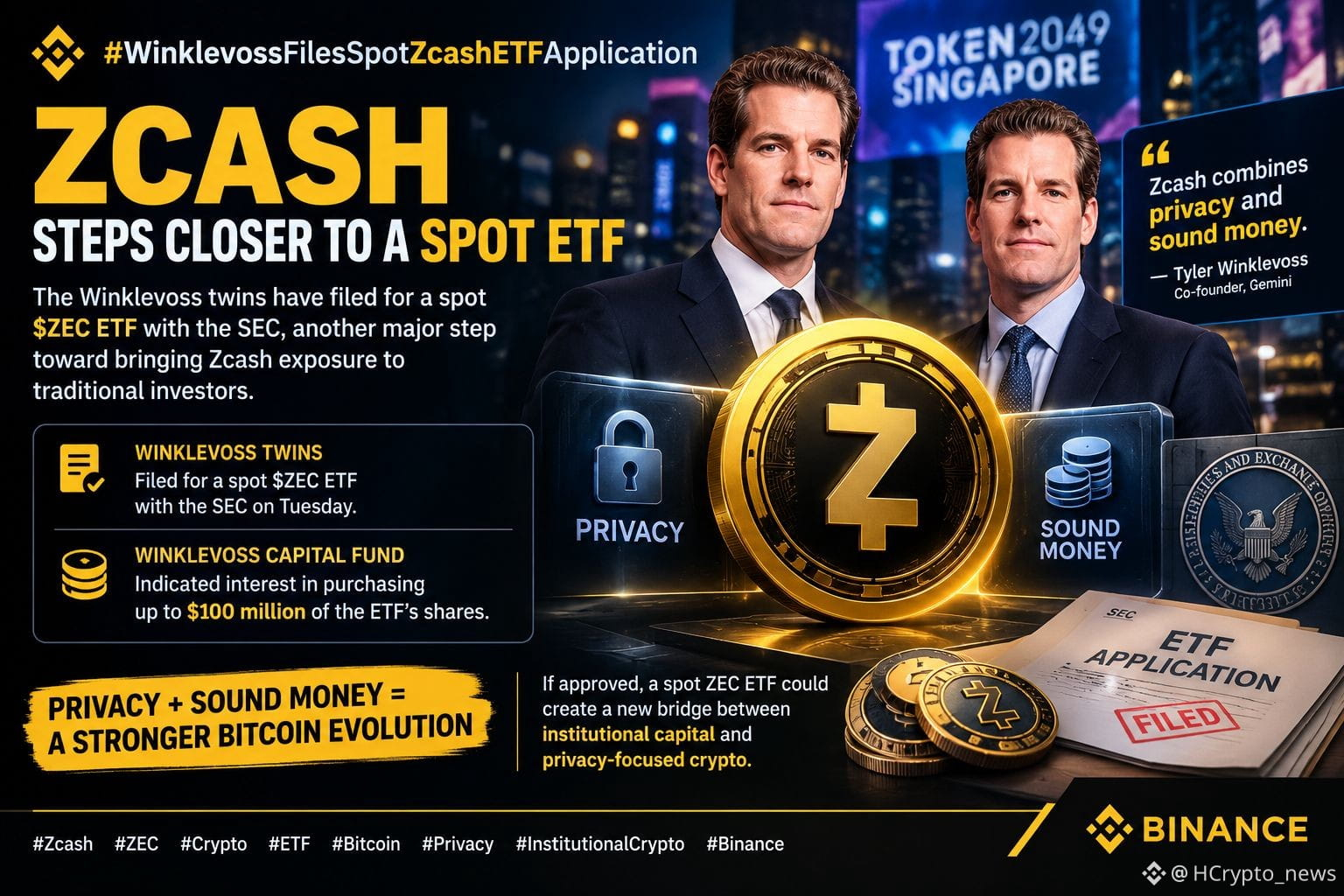
🚨 ZCASH IS MOVING DEEPER INTO THE INSTITUTIONAL SPOTLIGHT
The Winklevoss twins have filed for a spot $ZEC ETF with the SEC — another major step toward bringing Zcash exposure to traditional investors.
Tyler Winklevoss argued at Token2049 Singapore that Zcash combines two important properties:
🔐 Privacy
💰 Sound money
And the move gets even more interesting…
Winklevoss Capital Fund has indicated interest in purchasing up to $100 million of the ETF’s shares.
If approved, a spot ZEC ETF could create a new bridge between institutional capital and privacy-focused crypto.
📈 $ZEC is no longer just a privacy narrative.
The institutional ETF race is expanding.
#Zcash #ZEC #Crypto #ETF #Bitcoin #Privacy #InstitutionalCrypto #Binance
#WinklevossFilesSpotZcashETFApplication
🚨 ZCASH IS MOVING DEEPER INTO THE INSTITUTIONAL SPOTLIGHT
The Winklevoss twins have filed for a spot $ZEC ETF with the SEC — another major step toward bringing Zcash exposure to traditional investors.
Tyler Winklevoss argued at Token2049 Singapore that Zcash combines two important properties:
🔐 Privacy
💰 Sound money
And the move gets even more interesting…
Winklevoss Capital Fund has indicated interest in purchasing up to $100 million of the ETF’s shares.
If approved, a spot ZEC ETF could create a new bridge between institutional capital and privacy-focused crypto.
📈 $ZEC is no longer just a privacy narrative.
The institutional ETF race is expanding.
#Zcash #ZEC #Crypto #ETF #Bitcoin #Privacy #InstitutionalCrypto #Binance
🚨 ZCASH IS MOVING DEEPER INTO THE INSTITUTIONAL SPOTLIGHT
The Winklevoss twins have filed for a spot $ZEC ETF with the SEC — another major step toward bringing Zcash exposure to traditional investors.
Tyler Winklevoss argued at Token2049 Singapore that Zcash combines two important properties:
🔐 Privacy
💰 Sound money
And the move gets even more interesting…
Winklevoss Capital Fund has indicated interest in purchasing up to $100 million of the ETF’s shares.
If approved, a spot ZEC ETF could create a new bridge between institutional capital and privacy-focused crypto.
📈 $ZEC is no longer just a privacy narrative.
The institutional ETF race is expanding.
#Zcash #ZEC #Crypto #ETF #Bitcoin #Privacy #InstitutionalCrypto #Binance
138
·
--
#BinanceLaunchesBinanceIntelligence
🤖 Binance is taking crypto trading into the AI era.
@binance has unveiled Binance Intelligence, a new AI-powered stack designed to bring advanced intelligence directly into the crypto ecosystem.
The platform combines:
🔹 Binance AI — smarter market analysis
🔹 AI Pro — advanced tools for deeper research
🔹 Agent OS — AI agents that can interact with Binance’s financial infrastructure
The bigger picture? 👇
AI may no longer be just a tool for analyzing charts. It could become an active layer between users and financial markets — helping traders research opportunities, build automated strategies and deploy intelligent agents.
🚀 Crypto + AI is evolving fast.
The next generation of trading may not just be about clicking Buy or Sell…
It could be about telling an AI what you want and letting intelligent agents execute the workflow.
#Binance #AI #Crypto #Trading #CryptoAI #Web3 #BinanceIntelligence
#BinanceLaunchesBinanceIntelligence
🤖 Binance is taking crypto trading into the AI era.
@binance has unveiled Binance Intelligence, a new AI-powered stack designed to bring advanced intelligence directly into the crypto ecosystem.
The platform combines:
🔹 Binance AI — smarter market analysis
🔹 AI Pro — advanced tools for deeper research
🔹 Agent OS — AI agents that can interact with Binance’s financial infrastructure
The bigger picture? 👇
AI may no longer be just a tool for analyzing charts. It could become an active layer between users and financial markets — helping traders research opportunities, build automated strategies and deploy intelligent agents.
🚀 Crypto + AI is evolving fast.
The next generation of trading may not just be about clicking Buy or Sell…
It could be about telling an AI what you want and letting intelligent agents execute the workflow.
#Binance #AI #Crypto #Trading #CryptoAI #Web3 #BinanceIntelligence
🤖 Binance is taking crypto trading into the AI era.
@binance has unveiled Binance Intelligence, a new AI-powered stack designed to bring advanced intelligence directly into the crypto ecosystem.
The platform combines:
🔹 Binance AI — smarter market analysis
🔹 AI Pro — advanced tools for deeper research
🔹 Agent OS — AI agents that can interact with Binance’s financial infrastructure
The bigger picture? 👇
AI may no longer be just a tool for analyzing charts. It could become an active layer between users and financial markets — helping traders research opportunities, build automated strategies and deploy intelligent agents.
🚀 Crypto + AI is evolving fast.
The next generation of trading may not just be about clicking Buy or Sell…
It could be about telling an AI what you want and letting intelligent agents execute the workflow.
#Binance #AI #Crypto #Trading #CryptoAI #Web3 #BinanceIntelligence

204
·
--
#BinanceLaunchesBinanceIntelligence
🚨 TODAY IN CRYPTO: BIG MOVES, NEW RULES & AI
The crypto market saw several major developments today 👇
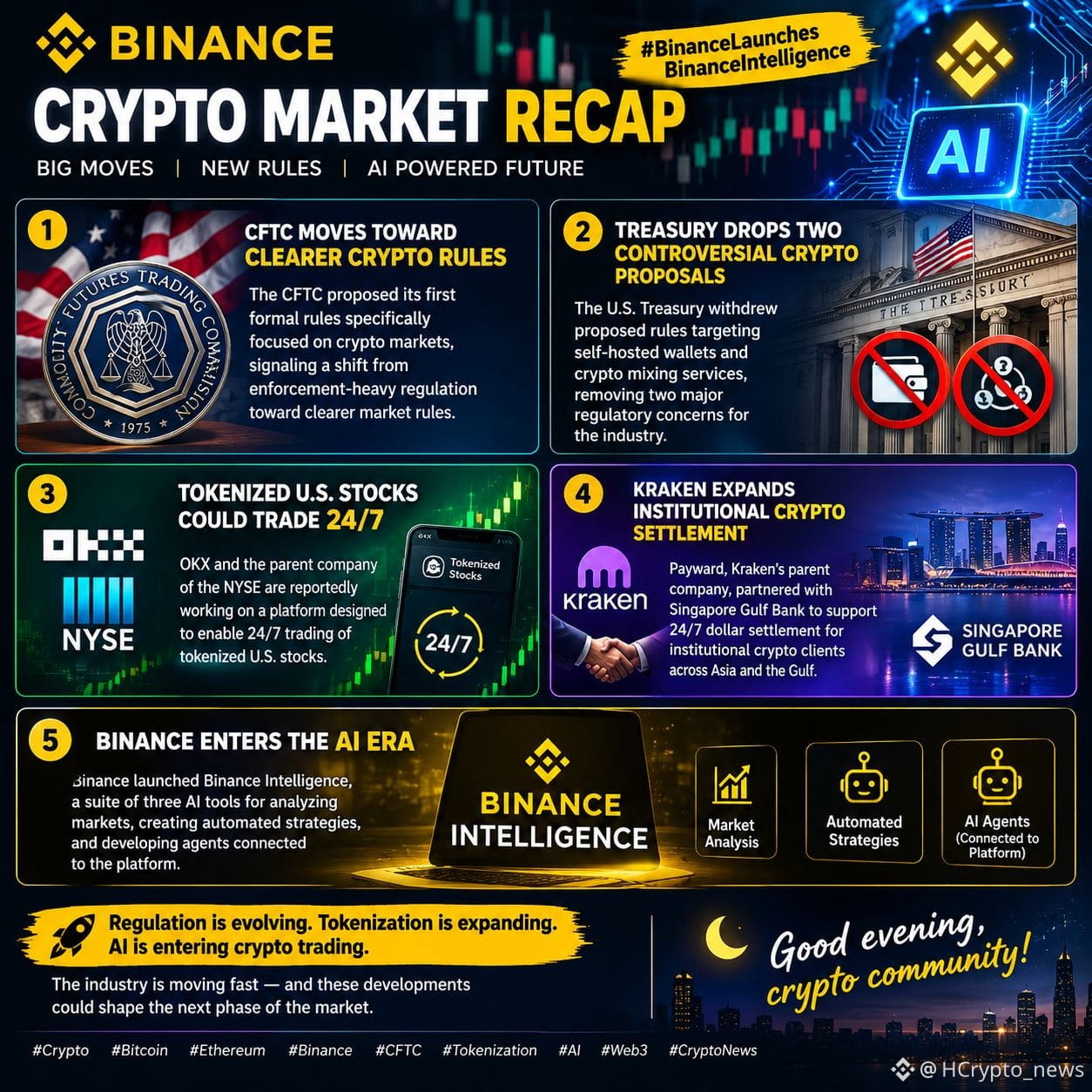
🇺🇸 CFTC Moves Toward Clearer Crypto Rules
The CFTC proposed its first formal rules specifically focused on crypto markets, signaling a shift from enforcement-heavy regulation toward clearer market rules.
🇺🇸 Treasury Drops Two Controversial Crypto Proposals
The U.S. Treasury withdrew proposed rules targeting self-hosted wallets and crypto mixing services, removing two major regulatory concerns for the industry.
📈 Tokenized U.S. Stocks Could Trade 24/7
OKX and the parent company of the NYSE are reportedly working on a platform designed to enable 24/7 trading of tokenized U.S. stocks.
🌎 Kraken Expands Institutional Crypto Settlement
Payward, Kraken’s parent company, partnered with Singapore Gulf Bank to support 24/7 dollar settlement for institutional crypto clients across Asia and the Gulf.
🤖 Binance Enters the AI Era
Binance launched Binance Intelligence, a suite of AI tools designed for market analysis, automated strategy creation, and building agents connected to the platform.
🔥 Regulation is evolving. Tokenization is expanding. AI is entering crypto trading.
The industry is moving fast — and these developments could shape the next phase of the market.
🌙 Good evening, crypto community!
#Crypto #Bitcoin #Ethereum #Binance #CFTC #Tokenization #AI #Web3 #CryptoNews
#BinanceLaunchesBinanceIntelligence
🚨 TODAY IN CRYPTO: BIG MOVES, NEW RULES & AI
The crypto market saw several major developments today 👇
🇺🇸 CFTC Moves Toward Clearer Crypto Rules
The CFTC proposed its first formal rules specifically focused on crypto markets, signaling a shift from enforcement-heavy regulation toward clearer market rules.
🇺🇸 Treasury Drops Two Controversial Crypto Proposals
The U.S. Treasury withdrew proposed rules targeting self-hosted wallets and crypto mixing services, removing two major regulatory concerns for the industry.
📈 Tokenized U.S. Stocks Could Trade 24/7
OKX and the parent company of the NYSE are reportedly working on a platform designed to enable 24/7 trading of tokenized U.S. stocks.
🌎 Kraken Expands Institutional Crypto Settlement
Payward, Kraken’s parent company, partnered with Singapore Gulf Bank to support 24/7 dollar settlement for institutional crypto clients across Asia and the Gulf.
🤖 Binance Enters the AI Era
Binance launched Binance Intelligence, a suite of AI tools designed for market analysis, automated strategy creation, and building agents connected to the platform.
🔥 Regulation is evolving. Tokenization is expanding. AI is entering crypto trading.
The industry is moving fast — and these developments could shape the next phase of the market.
🌙 Good evening, crypto community!
#Crypto #Bitcoin #Ethereum #Binance #CFTC #Tokenization #AI #Web3 #CryptoNews
🚨 TODAY IN CRYPTO: BIG MOVES, NEW RULES & AI
The crypto market saw several major developments today 👇
🇺🇸 CFTC Moves Toward Clearer Crypto Rules
The CFTC proposed its first formal rules specifically focused on crypto markets, signaling a shift from enforcement-heavy regulation toward clearer market rules.
🇺🇸 Treasury Drops Two Controversial Crypto Proposals
The U.S. Treasury withdrew proposed rules targeting self-hosted wallets and crypto mixing services, removing two major regulatory concerns for the industry.
📈 Tokenized U.S. Stocks Could Trade 24/7
OKX and the parent company of the NYSE are reportedly working on a platform designed to enable 24/7 trading of tokenized U.S. stocks.
🌎 Kraken Expands Institutional Crypto Settlement
Payward, Kraken’s parent company, partnered with Singapore Gulf Bank to support 24/7 dollar settlement for institutional crypto clients across Asia and the Gulf.
🤖 Binance Enters the AI Era
Binance launched Binance Intelligence, a suite of AI tools designed for market analysis, automated strategy creation, and building agents connected to the platform.
🔥 Regulation is evolving. Tokenization is expanding. AI is entering crypto trading.
The industry is moving fast — and these developments could shape the next phase of the market.
🌙 Good evening, crypto community!
#Crypto #Bitcoin #Ethereum #Binance #CFTC #Tokenization #AI #Web3 #CryptoNews
112
·
--
#ETHUp70%InQ3ButLiquidityFalls
#ETHUp70%InQ3ButLiquidityFalls
🚨 ETH OUTPACED BTC — BUT THERE’S A CATCH
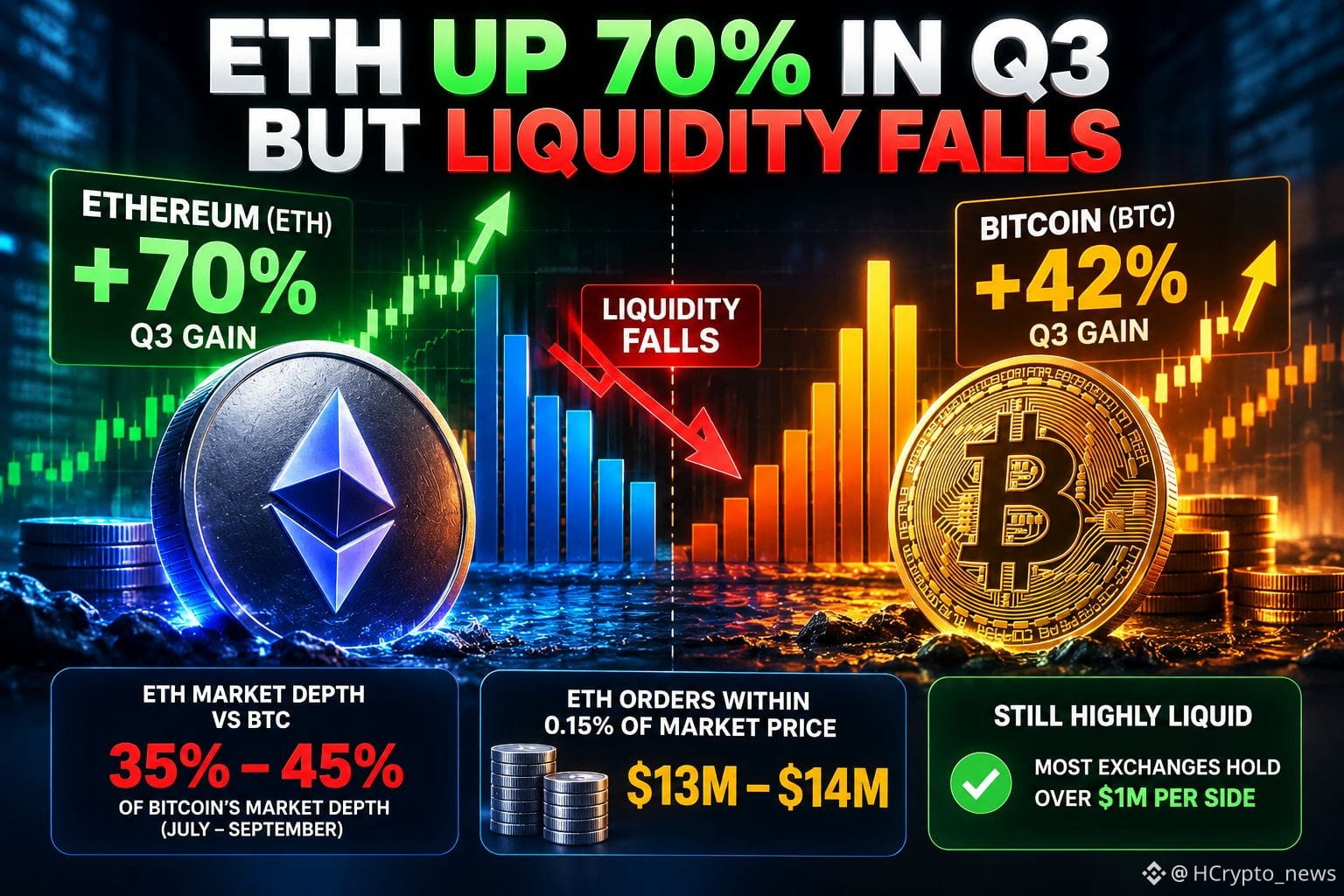
Ethereum delivered an impressive 70% gain in Q3, easily beating Bitcoin’s 42% rise.
But while ETH’s price surged, its market liquidity weakened.
📉 ETH’s median daily market depth fell sharply year-over-year, with Ether holding only around 35–45% of Bitcoin’s market depth during July–September.
💰 ETH had roughly $13M–$14M in orders within 0.15% of its market price.
The good news? Ethereum is still considered highly liquid, with most major exchanges holding more than $1M per side.
🔥 Strong price performance + thinner liquidity = an important setup to watch.
If demand accelerates, lower liquidity can amplify both upside moves and volatility.
Would you rather see ETH continue rallying, or are you watching liquidity for a potential correction?
#Ethereum #ETH #Bitcoin #BTC #Crypto #Altcoins #CryptoMarket
#ETHUp70%InQ3ButLiquidityFalls
#ETHUp70%InQ3ButLiquidityFalls
🚨 ETH OUTPACED BTC — BUT THERE’S A CATCH
Ethereum delivered an impressive 70% gain in Q3, easily beating Bitcoin’s 42% rise.
But while ETH’s price surged, its market liquidity weakened.
📉 ETH’s median daily market depth fell sharply year-over-year, with Ether holding only around 35–45% of Bitcoin’s market depth during July–September.
💰 ETH had roughly $13M–$14M in orders within 0.15% of its market price.
The good news? Ethereum is still considered highly liquid, with most major exchanges holding more than $1M per side.
🔥 Strong price performance + thinner liquidity = an important setup to watch.
If demand accelerates, lower liquidity can amplify both upside moves and volatility.
Would you rather see ETH continue rallying, or are you watching liquidity for a potential correction?
#Ethereum #ETH #Bitcoin #BTC #Crypto #Altcoins #CryptoMarket
#ETHUp70%InQ3ButLiquidityFalls
🚨 ETH OUTPACED BTC — BUT THERE’S A CATCH
Ethereum delivered an impressive 70% gain in Q3, easily beating Bitcoin’s 42% rise.
But while ETH’s price surged, its market liquidity weakened.
📉 ETH’s median daily market depth fell sharply year-over-year, with Ether holding only around 35–45% of Bitcoin’s market depth during July–September.
💰 ETH had roughly $13M–$14M in orders within 0.15% of its market price.
The good news? Ethereum is still considered highly liquid, with most major exchanges holding more than $1M per side.
🔥 Strong price performance + thinner liquidity = an important setup to watch.
If demand accelerates, lower liquidity can amplify both upside moves and volatility.
Would you rather see ETH continue rallying, or are you watching liquidity for a potential correction?
#Ethereum #ETH #Bitcoin #BTC #Crypto #Altcoins #CryptoMarket
1
87
·
--
#EthereumValidatorExitQueueJumps392%
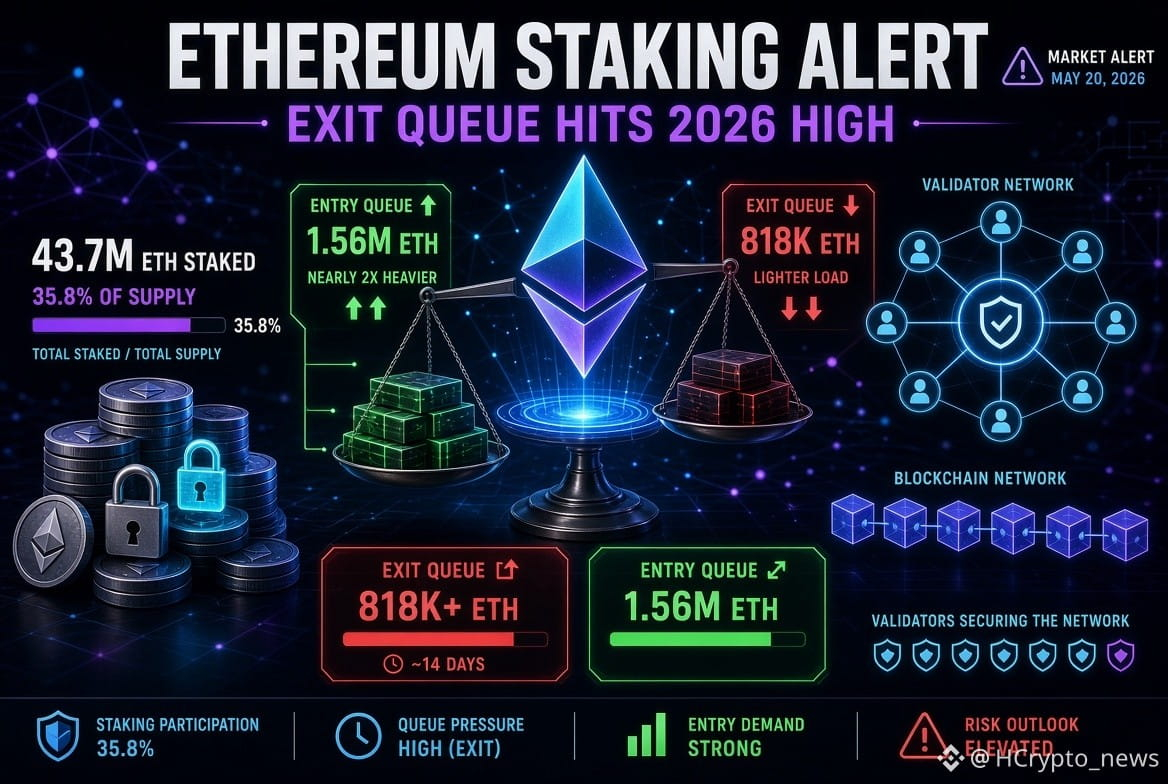
🚨 ETHEREUM STAKING ALERT
Ethereum’s validator exit queue has surged to its highest level of 2026.
🔴 818K+ ETH is currently waiting to exit staking
⏳ Estimated wait: ~14 days
🟢 1.56M ETH is waiting to enter staking
🔒 43.7M ETH is currently staked
📊 That equals roughly 35.8% of Ethereum’s total supply
But here’s the key point 👇
Despite the sharp rise in the exit queue, the entry queue is still nearly 2× larger.
This means more ETH is currently waiting to enter staking than exit it.
The growing exit queue could create short-term selling pressure if withdrawn ETH moves toward exchanges. However, exits happen at a fixed protocol rate, meaning the queued ETH does not hit the market all at once.
📌 Bottom line:
The exit queue is rising fast, but Ethereum’s staking demand remains strong.
ETH holders should watch exchange inflows, staking withdrawals, and the balance between the entry and exit queues closely.
#Ethereum #ETH #EthereumStaking #Crypto #DeFi #ETHNews #CryptoMarket
#EthereumValidatorExitQueueJumps392%
🚨 ETHEREUM STAKING ALERT
Ethereum’s validator exit queue has surged to its highest level of 2026.
🔴 818K+ ETH is currently waiting to exit staking
⏳ Estimated wait: ~14 days
🟢 1.56M ETH is waiting to enter staking
🔒 43.7M ETH is currently staked
📊 That equals roughly 35.8% of Ethereum’s total supply
But here’s the key point 👇
Despite the sharp rise in the exit queue, the entry queue is still nearly 2× larger.
This means more ETH is currently waiting to enter staking than exit it.
The growing exit queue could create short-term selling pressure if withdrawn ETH moves toward exchanges. However, exits happen at a fixed protocol rate, meaning the queued ETH does not hit the market all at once.
📌 Bottom line:
The exit queue is rising fast, but Ethereum’s staking demand remains strong.
ETH holders should watch exchange inflows, staking withdrawals, and the balance between the entry and exit queues closely.
#Ethereum #ETH #EthereumStaking #Crypto #DeFi #ETHNews #CryptoMarket
🚨 ETHEREUM STAKING ALERT
Ethereum’s validator exit queue has surged to its highest level of 2026.
🔴 818K+ ETH is currently waiting to exit staking
⏳ Estimated wait: ~14 days
🟢 1.56M ETH is waiting to enter staking
🔒 43.7M ETH is currently staked
📊 That equals roughly 35.8% of Ethereum’s total supply
But here’s the key point 👇
Despite the sharp rise in the exit queue, the entry queue is still nearly 2× larger.
This means more ETH is currently waiting to enter staking than exit it.
The growing exit queue could create short-term selling pressure if withdrawn ETH moves toward exchanges. However, exits happen at a fixed protocol rate, meaning the queued ETH does not hit the market all at once.
📌 Bottom line:
The exit queue is rising fast, but Ethereum’s staking demand remains strong.
ETH holders should watch exchange inflows, staking withdrawals, and the balance between the entry and exit queues closely.
#Ethereum #ETH #EthereumStaking #Crypto #DeFi #ETHNews #CryptoMarket
82
·
--
#DriftHackVictimsBeginClaims
🚨 CIRCLE SUED OVER $280M DRIFT HACK
Circle is now facing a major class-action lawsuit over the $280M Drift Protocol ($DRIFT) exploit.
⚠️ More than 100 alleged victims claim Circle failed to freeze stolen funds after the April 1 hack.
💰 Around $230M in USDC was reportedly moved from Solana to Ethereum through Circle’s Cross-Chain Transfer Protocol.
The lawsuit alleges Circle’s infrastructure was used to facilitate the movement of the stolen funds — while Circle allegedly did not intervene.
🏛️ The case was filed in a U.S. federal court in Massachusetts, with damages yet to be determined.
If the claims succeed, this could raise a much bigger question:
Should stablecoin issuers be legally responsible when their infrastructure is used to move hacked funds?
🔔 Follow for more crypto legal & market updates.
#DriftHackVictimsBeginClaims #DRIFT #USDC #Circle #Crypto #Solana #DeFi #CryptoNews
#DriftHackVictimsBeginClaims
🚨 CIRCLE SUED OVER $280M DRIFT HACK
Circle is now facing a major class-action lawsuit over the $280M Drift Protocol ($DRIFT) exploit.
⚠️ More than 100 alleged victims claim Circle failed to freeze stolen funds after the April 1 hack.
💰 Around $230M in USDC was reportedly moved from Solana to Ethereum through Circle’s Cross-Chain Transfer Protocol.
The lawsuit alleges Circle’s infrastructure was used to facilitate the movement of the stolen funds — while Circle allegedly did not intervene.
🏛️ The case was filed in a U.S. federal court in Massachusetts, with damages yet to be determined.
If the claims succeed, this could raise a much bigger question:
Should stablecoin issuers be legally responsible when their infrastructure is used to move hacked funds?
🔔 Follow for more crypto legal & market updates.
#DriftHackVictimsBeginClaims #DRIFT #USDC #Circle #Crypto #Solana #DeFi #CryptoNews
🚨 CIRCLE SUED OVER $280M DRIFT HACK
Circle is now facing a major class-action lawsuit over the $280M Drift Protocol ($DRIFT) exploit.
⚠️ More than 100 alleged victims claim Circle failed to freeze stolen funds after the April 1 hack.
💰 Around $230M in USDC was reportedly moved from Solana to Ethereum through Circle’s Cross-Chain Transfer Protocol.
The lawsuit alleges Circle’s infrastructure was used to facilitate the movement of the stolen funds — while Circle allegedly did not intervene.
🏛️ The case was filed in a U.S. federal court in Massachusetts, with damages yet to be determined.
If the claims succeed, this could raise a much bigger question:
Should stablecoin issuers be legally responsible when their infrastructure is used to move hacked funds?
🔔 Follow for more crypto legal & market updates.
#DriftHackVictimsBeginClaims #DRIFT #USDC #Circle #Crypto #Solana #DeFi #CryptoNews

278
·
--
#GreekPoliceBustCryptoScamRingArrest17
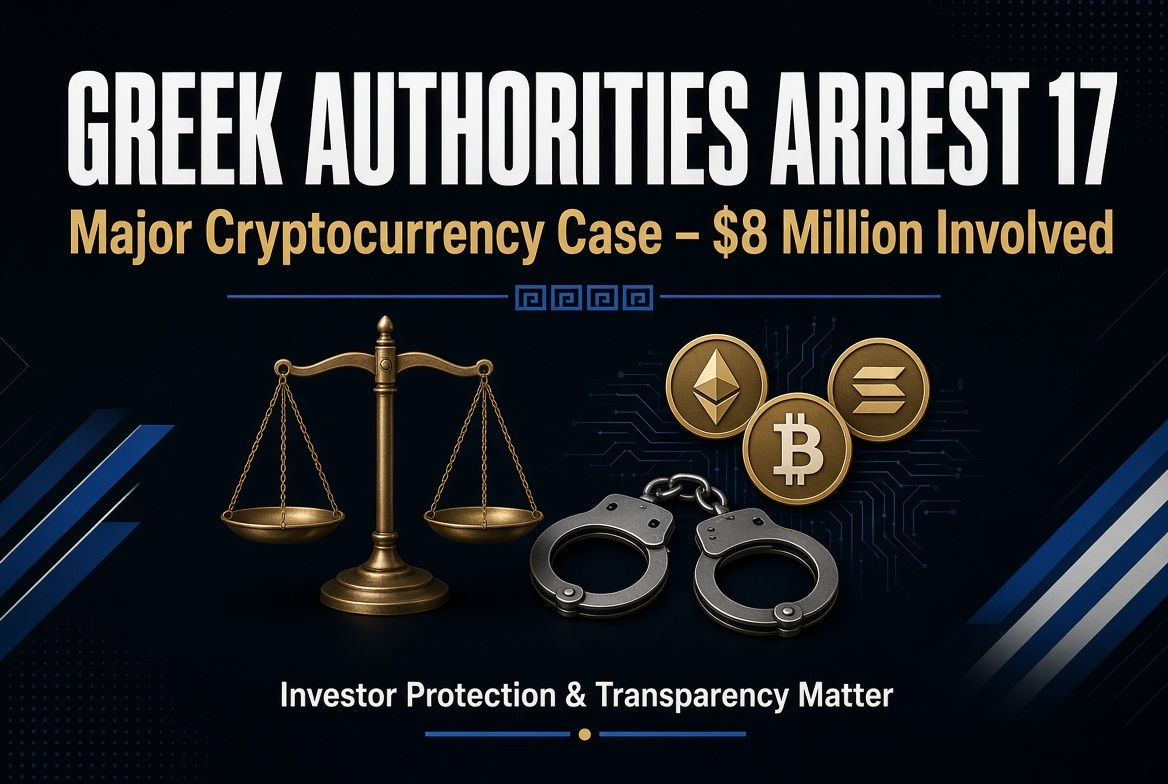
🇬🇷 Greek Authorities Arrest 17 in Major Cryptocurrency Case
Greek authorities have arrested 17 individuals linked to a cryptocurrency-related case involving nearly $8 million and more than 10,000 affected users.
This case serves as an important reminder for every crypto investor:
Always do your own research, verify projects carefully, and stay cautious of platforms that make unrealistic return promises.
As crypto adoption continues to grow, regulators around the world are increasing their efforts to protect investors and maintain market integrity.
Investor protection and transparency remain essential for the long-term growth of the digital asset industry.
Will stronger regulatory actions help build more trust in crypto markets? 👇
#Crypto #Bitcoin #Blockchain #CryptoNews #BTC #Ethereum #Web3 #Investing #CryptoSafety #Regulation
#GreekPoliceBustCryptoScamRingArrest17
🇬🇷 Greek Authorities Arrest 17 in Major Cryptocurrency Case
Greek authorities have arrested 17 individuals linked to a cryptocurrency-related case involving nearly $8 million and more than 10,000 affected users.
This case serves as an important reminder for every crypto investor:
Always do your own research, verify projects carefully, and stay cautious of platforms that make unrealistic return promises.
As crypto adoption continues to grow, regulators around the world are increasing their efforts to protect investors and maintain market integrity.
Investor protection and transparency remain essential for the long-term growth of the digital asset industry.
Will stronger regulatory actions help build more trust in crypto markets? 👇
#Crypto #Bitcoin #Blockchain #CryptoNews #BTC #Ethereum #Web3 #Investing #CryptoSafety #Regulation
🇬🇷 Greek Authorities Arrest 17 in Major Cryptocurrency Case
Greek authorities have arrested 17 individuals linked to a cryptocurrency-related case involving nearly $8 million and more than 10,000 affected users.
This case serves as an important reminder for every crypto investor:
Always do your own research, verify projects carefully, and stay cautious of platforms that make unrealistic return promises.
As crypto adoption continues to grow, regulators around the world are increasing their efforts to protect investors and maintain market integrity.
Investor protection and transparency remain essential for the long-term growth of the digital asset industry.
Will stronger regulatory actions help build more trust in crypto markets? 👇
#Crypto #Bitcoin #Blockchain #CryptoNews #BTC #Ethereum #Web3 #Investing #CryptoSafety #Regulation
8
·
--
#SECHaltsCryptoETFReviewsAmidFundingLapse
#SECHaltsCryptoETFReviewsAmidFundingLapse
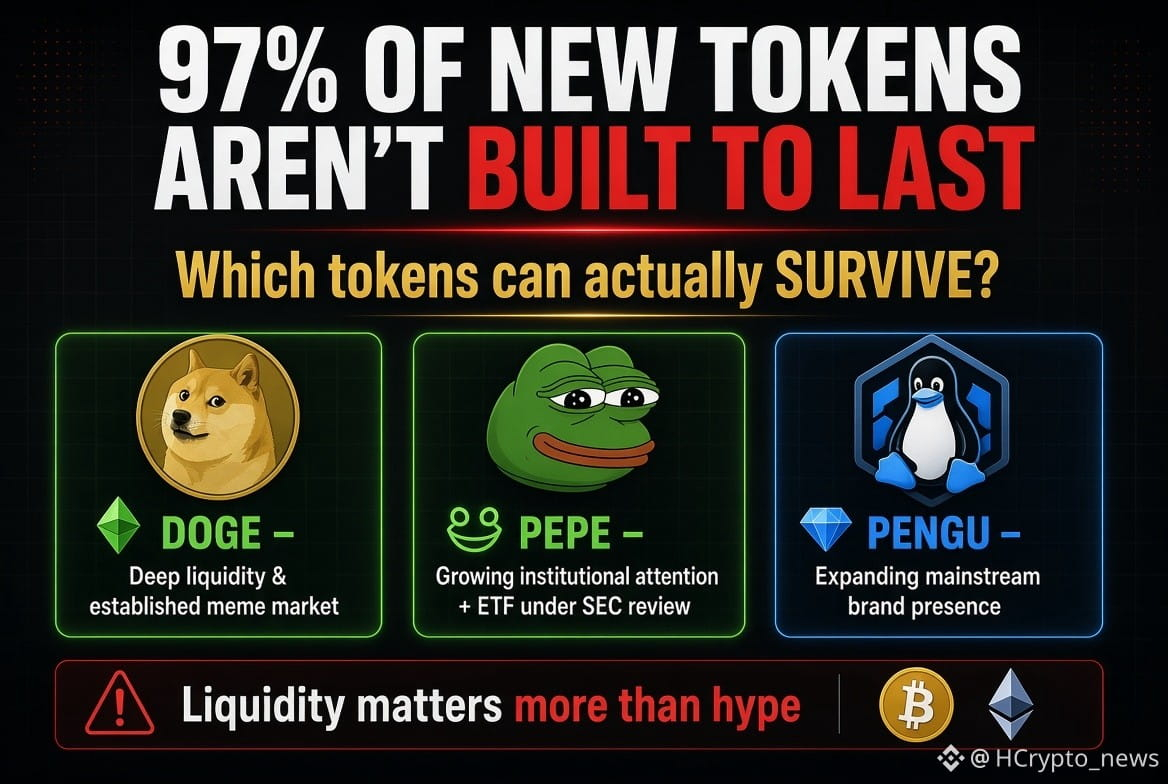
🚨 97% OF NEW TOKENS AREN’T BUILT TO LAST
Since early 2024, thousands of tokens have launched — but most have faded into near-zero liquidity and activity.
That’s why the real question isn’t:
“Which coin can pump 100x?”
It’s:
“Which tokens can actually survive?” 👀
🔹 DOGE — deep liquidity and one of the most established meme-coin markets
🔹 PEPE — growing institutional attention and an ETF filing under SEC review
🔹 PENGU — expanding its mainstream brand presence
🔹 Other survivors are being watched for liquidity, trading activity, regulatory developments and real adoption.
💡 In a market full of thousands of speculative tokens, liquidity matters more than hype.
A token can look cheap at $0.00001 — but if there’s no real liquidity, getting out can be much harder than getting in.
📊 Smart money doesn’t only chase the biggest pump. It looks for projects that can survive the next cycle.
Which one has the strongest long-term potential? 👇
#DOGE #PEPE #PENGU #Crypto #Altcoins #MemeCoins #Bitcoin #Ethereum
#SECHaltsCryptoETFReviewsAmidFundingLapse
#SECHaltsCryptoETFReviewsAmidFundingLapse
🚨 97% OF NEW TOKENS AREN’T BUILT TO LAST
Since early 2024, thousands of tokens have launched — but most have faded into near-zero liquidity and activity.
That’s why the real question isn’t:
“Which coin can pump 100x?”
It’s:
“Which tokens can actually survive?” 👀
🔹 DOGE — deep liquidity and one of the most established meme-coin markets
🔹 PEPE — growing institutional attention and an ETF filing under SEC review
🔹 PENGU — expanding its mainstream brand presence
🔹 Other survivors are being watched for liquidity, trading activity, regulatory developments and real adoption.
💡 In a market full of thousands of speculative tokens, liquidity matters more than hype.
A token can look cheap at $0.00001 — but if there’s no real liquidity, getting out can be much harder than getting in.
📊 Smart money doesn’t only chase the biggest pump. It looks for projects that can survive the next cycle.
Which one has the strongest long-term potential? 👇
#DOGE #PEPE #PENGU #Crypto #Altcoins #MemeCoins #Bitcoin #Ethereum
#SECHaltsCryptoETFReviewsAmidFundingLapse
🚨 97% OF NEW TOKENS AREN’T BUILT TO LAST
Since early 2024, thousands of tokens have launched — but most have faded into near-zero liquidity and activity.
That’s why the real question isn’t:
“Which coin can pump 100x?”
It’s:
“Which tokens can actually survive?” 👀
🔹 DOGE — deep liquidity and one of the most established meme-coin markets
🔹 PEPE — growing institutional attention and an ETF filing under SEC review
🔹 PENGU — expanding its mainstream brand presence
🔹 Other survivors are being watched for liquidity, trading activity, regulatory developments and real adoption.
💡 In a market full of thousands of speculative tokens, liquidity matters more than hype.
A token can look cheap at $0.00001 — but if there’s no real liquidity, getting out can be much harder than getting in.
📊 Smart money doesn’t only chase the biggest pump. It looks for projects that can survive the next cycle.
Which one has the strongest long-term potential? 👇
#DOGE #PEPE #PENGU #Crypto #Altcoins #MemeCoins #Bitcoin #Ethereum
300
·
--
#BitcoinRejectedAt$87K
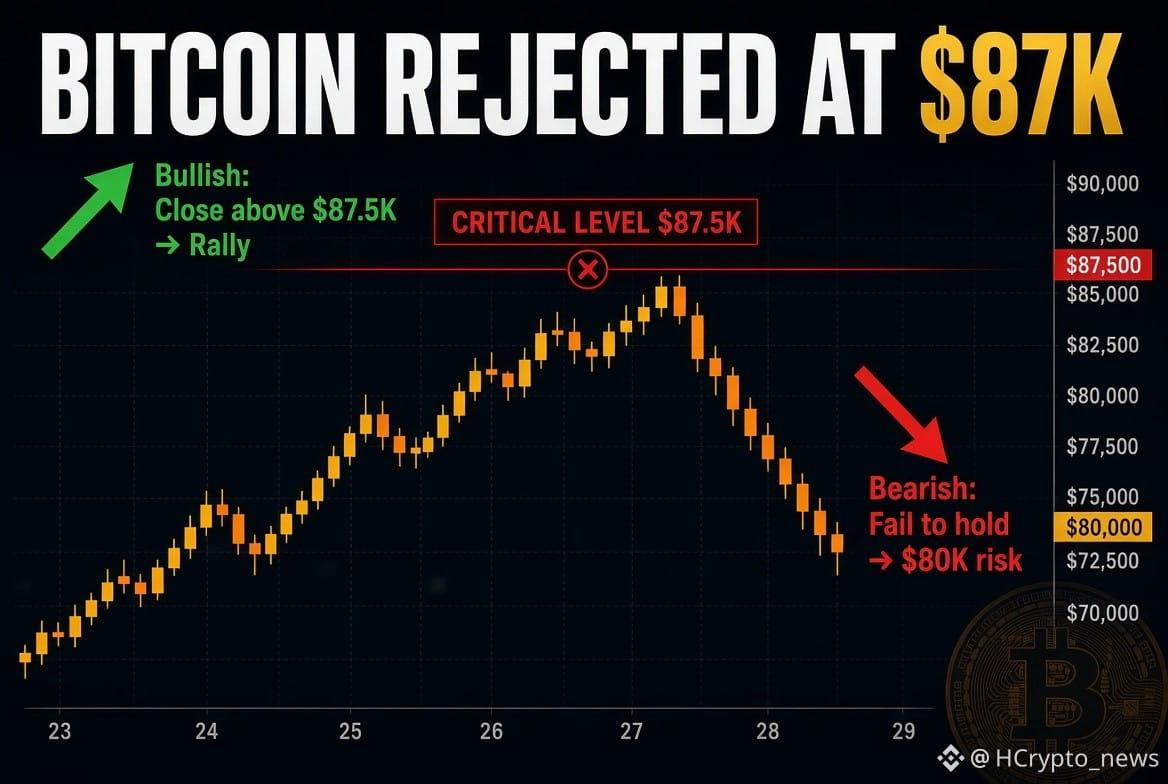
🚨 BITCOIN REJECTED AT $87K — CRITICAL LEVEL AHEAD
$BTC pushed into the $87,000 zone but failed to hold the move, giving back the entire gain.
Now, the battle is around $87,500. 🔥
📈 Bullish scenario:
A strong weekly close above $87,500 could confirm renewed momentum and open the door for a larger rally.
📉 Bearish scenario:
If Bitcoin fails to reclaim and hold this level, selling pressure could increase — with a correction toward $80,000 or lower becoming possible.
The message is simple:
$87.5K = breakout confirmation
Below it = rejection risk remains
Bitcoin is at a decision point. 👀
Will $BTC reclaim $87.5K or fall back toward $80K?
#Bitcoin #BTC #Crypto #BitcoinPrice #CryptoNews #BTCUSD #Trading #CryptoMarket
#BitcoinRejectedAt$87K
🚨 BITCOIN REJECTED AT $87K — CRITICAL LEVEL AHEAD
$BTC pushed into the $87,000 zone but failed to hold the move, giving back the entire gain.
Now, the battle is around $87,500. 🔥
📈 Bullish scenario:
A strong weekly close above $87,500 could confirm renewed momentum and open the door for a larger rally.
📉 Bearish scenario:
If Bitcoin fails to reclaim and hold this level, selling pressure could increase — with a correction toward $80,000 or lower becoming possible.
The message is simple:
$87.5K = breakout confirmation
Below it = rejection risk remains
Bitcoin is at a decision point. 👀
Will $BTC reclaim $87.5K or fall back toward $80K?
#Bitcoin #BTC #Crypto #BitcoinPrice #CryptoNews #BTCUSD #Trading #CryptoMarket
🚨 BITCOIN REJECTED AT $87K — CRITICAL LEVEL AHEAD
$BTC pushed into the $87,000 zone but failed to hold the move, giving back the entire gain.
Now, the battle is around $87,500. 🔥
📈 Bullish scenario:
A strong weekly close above $87,500 could confirm renewed momentum and open the door for a larger rally.
📉 Bearish scenario:
If Bitcoin fails to reclaim and hold this level, selling pressure could increase — with a correction toward $80,000 or lower becoming possible.
The message is simple:
$87.5K = breakout confirmation
Below it = rejection risk remains
Bitcoin is at a decision point. 👀
Will $BTC reclaim $87.5K or fall back toward $80K?
#Bitcoin #BTC #Crypto #BitcoinPrice #CryptoNews #BTCUSD #Trading #CryptoMarket
1
85
·
--
#EthereumValidatorExitQueueJumps392%
🚨 BULLISH SIGNAL FOR ETHEREUM?
Ethereum’s validator queues are sending a powerful message.
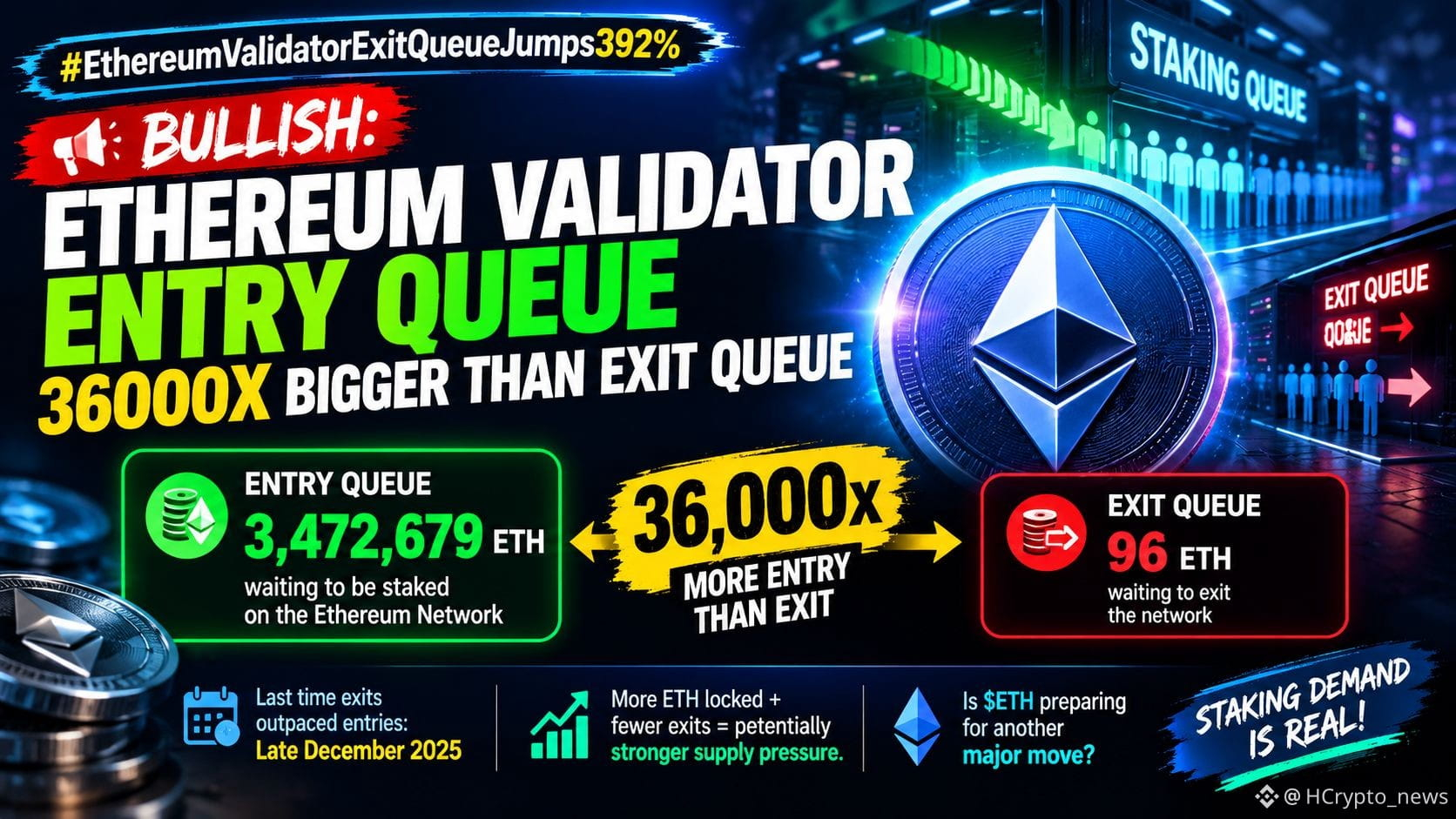
🔒 3.47M $ETH is reportedly waiting to enter staking, while only 96 ETH is waiting to exit.
That means entry requests are roughly 36,000× larger than exit requests.
🔥 This suggests strong demand for ETH staking and potentially lower near-term selling pressure from validators.
The last time validator exits outweighed entries was reportedly in late December 2025.
If this staking demand continues, it could become another important catalyst for Ethereum’s long-term supply dynamics. 📈
More ETH locked + fewer exits = potentially stronger supply pressure.
Is $ETH preparing for another major move? 👀
#Ethereum #ETH #EthereumStaking #Crypto #CryptoNews #Altcoins #ETHUSD #Blockchain
#EthereumValidatorExitQueueJumps392%
🚨 BULLISH SIGNAL FOR ETHEREUM?
Ethereum’s validator queues are sending a powerful message.
🔒 3.47M $ETH is reportedly waiting to enter staking, while only 96 ETH is waiting to exit.
That means entry requests are roughly 36,000× larger than exit requests.
🔥 This suggests strong demand for ETH staking and potentially lower near-term selling pressure from validators.
The last time validator exits outweighed entries was reportedly in late December 2025.
If this staking demand continues, it could become another important catalyst for Ethereum’s long-term supply dynamics. 📈
More ETH locked + fewer exits = potentially stronger supply pressure.
Is $ETH preparing for another major move? 👀
#Ethereum #ETH #EthereumStaking #Crypto #CryptoNews #Altcoins #ETHUSD #Blockchain
🚨 BULLISH SIGNAL FOR ETHEREUM?
Ethereum’s validator queues are sending a powerful message.
🔒 3.47M $ETH is reportedly waiting to enter staking, while only 96 ETH is waiting to exit.
That means entry requests are roughly 36,000× larger than exit requests.
🔥 This suggests strong demand for ETH staking and potentially lower near-term selling pressure from validators.
The last time validator exits outweighed entries was reportedly in late December 2025.
If this staking demand continues, it could become another important catalyst for Ethereum’s long-term supply dynamics. 📈
More ETH locked + fewer exits = potentially stronger supply pressure.
Is $ETH preparing for another major move? 👀
#Ethereum #ETH #EthereumStaking #Crypto #CryptoNews #Altcoins #ETHUSD #Blockchain
70
·
--
#SECHaltsCryptoETFReviewsAmidFundingLapse
🇺🇸 SEC FUNDING LAPSE PUTS CRYPTO ETF REVIEWS ON HOLD
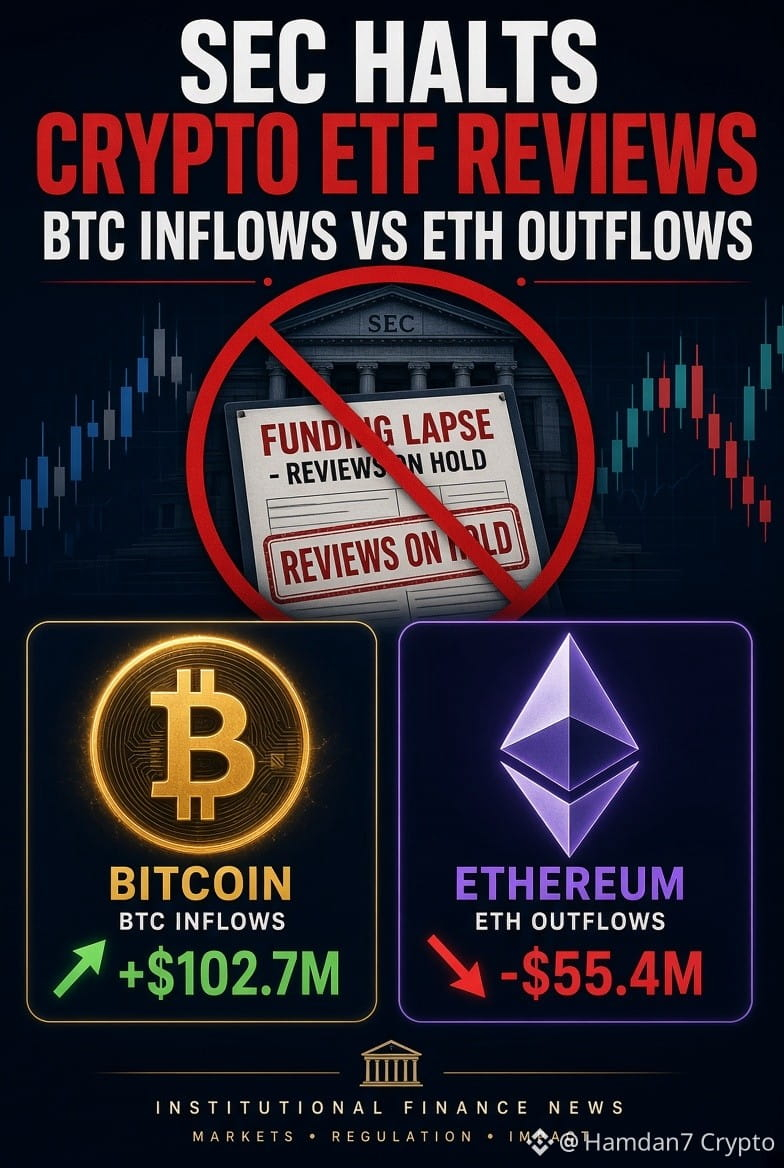
The U.S. government funding lapse is creating another headache for crypto markets: SEC reviews of pending crypto ETF filings have been halted.
Meanwhile, institutional flows are sending a mixed signal:
🟢 Bitcoin ETFs: +$102.7M
🔴 Ethereum ETFs: -$55.4M
Bitcoin is still attracting fresh institutional capital, while Ethereum is seeing money move out.
⚠️ The bigger question now is what happens when the SEC gets back to work.
If ETF approvals are delayed, capital could remain cautious. But once regulatory activity resumes, pent-up ETF decisions could trigger a major volatility event across crypto.
📊 BTC is getting the institutional bid. ETH needs to prove it can attract that same demand.
The next SEC move could matter more than the current flows.
Are institutions positioning for the next crypto move—or simply waiting for regulatory clarity?
#Bitcoin #Ethereum #CryptoETF #BTC #ETH #Crypto #SEC #InstitutionalInvestors
#SECHaltsCryptoETFReviewsAmidFundingLapse
🇺🇸 SEC FUNDING LAPSE PUTS CRYPTO ETF REVIEWS ON HOLD
The U.S. government funding lapse is creating another headache for crypto markets: SEC reviews of pending crypto ETF filings have been halted.
Meanwhile, institutional flows are sending a mixed signal:
🟢 Bitcoin ETFs: +$102.7M
🔴 Ethereum ETFs: -$55.4M
Bitcoin is still attracting fresh institutional capital, while Ethereum is seeing money move out.
⚠️ The bigger question now is what happens when the SEC gets back to work.
If ETF approvals are delayed, capital could remain cautious. But once regulatory activity resumes, pent-up ETF decisions could trigger a major volatility event across crypto.
📊 BTC is getting the institutional bid. ETH needs to prove it can attract that same demand.
The next SEC move could matter more than the current flows.
Are institutions positioning for the next crypto move—or simply waiting for regulatory clarity?
#Bitcoin #Ethereum #CryptoETF #BTC #ETH #Crypto #SEC #InstitutionalInvestors
🇺🇸 SEC FUNDING LAPSE PUTS CRYPTO ETF REVIEWS ON HOLD
The U.S. government funding lapse is creating another headache for crypto markets: SEC reviews of pending crypto ETF filings have been halted.
Meanwhile, institutional flows are sending a mixed signal:
🟢 Bitcoin ETFs: +$102.7M
🔴 Ethereum ETFs: -$55.4M
Bitcoin is still attracting fresh institutional capital, while Ethereum is seeing money move out.
⚠️ The bigger question now is what happens when the SEC gets back to work.
If ETF approvals are delayed, capital could remain cautious. But once regulatory activity resumes, pent-up ETF decisions could trigger a major volatility event across crypto.
📊 BTC is getting the institutional bid. ETH needs to prove it can attract that same demand.
The next SEC move could matter more than the current flows.
Are institutions positioning for the next crypto move—or simply waiting for regulatory clarity?
#Bitcoin #Ethereum #CryptoETF #BTC #ETH #Crypto #SEC #InstitutionalInvestors
28
·
--
#ZcashETFPostsFirstWeeklyOutflow$93.6M
🚨 $ZEC ETF JUST HIT ITS FIRST MAJOR ROADBLOCK
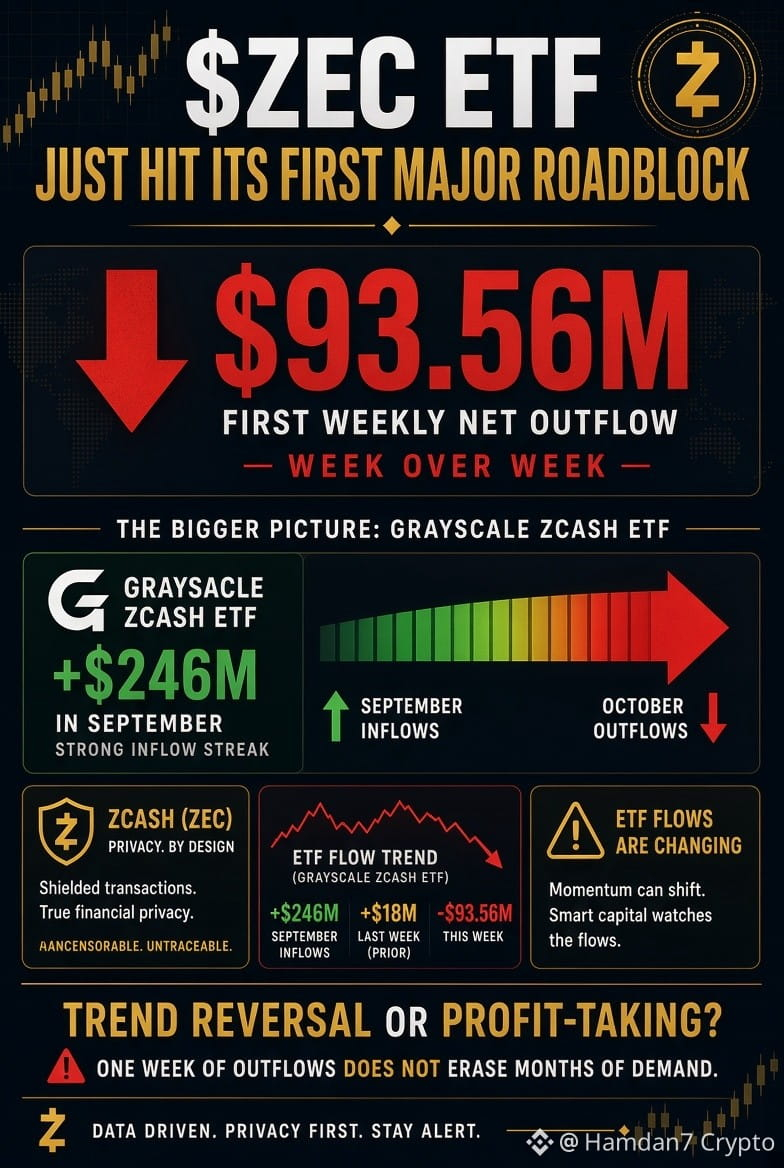
Zcash spot ETFs recorded their first weekly net outflow — a massive $93.56M. 📉
But here’s what makes this interesting:
🔥 Grayscale’s Zcash ETF had absorbed around $246M during September.
Now, after weeks of strong inflows, investors are finally taking money off the table.
The big question is:
Is this the beginning of a trend reversal — or simply profit-taking after a huge run?
Grayscale doesn’t appear to be backing away.
The firm remains bullish on Zcash’s long-term position in the privacy-focused blockchain market, suggesting it still sees room for ZEC to capture a larger share of the sector.
One week of outflows does NOT erase months of demand.
But it does send a warning:
⚠️ ETF flows are changing. ⚠️ Short-term momentum is being tested. ⚠️ ZEC bulls now need to prove that demand can return.
$93.6M outflow is a headline.
What happens next could be the real story.
#Zcash #ZEC #ZcashETF #Crypto #CryptoNews #PrivacyCoins
#ZcashETFPostsFirstWeeklyOutflow$93.6M
🚨 $ZEC ETF JUST HIT ITS FIRST MAJOR ROADBLOCK
Zcash spot ETFs recorded their first weekly net outflow — a massive $93.56M. 📉
But here’s what makes this interesting:
🔥 Grayscale’s Zcash ETF had absorbed around $246M during September.
Now, after weeks of strong inflows, investors are finally taking money off the table.
The big question is:
Is this the beginning of a trend reversal — or simply profit-taking after a huge run?
Grayscale doesn’t appear to be backing away.
The firm remains bullish on Zcash’s long-term position in the privacy-focused blockchain market, suggesting it still sees room for ZEC to capture a larger share of the sector.
One week of outflows does NOT erase months of demand.
But it does send a warning:
⚠️ ETF flows are changing. ⚠️ Short-term momentum is being tested. ⚠️ ZEC bulls now need to prove that demand can return.
$93.6M outflow is a headline.
What happens next could be the real story.
#Zcash #ZEC #ZcashETF #Crypto #CryptoNews #PrivacyCoins
🚨 $ZEC ETF JUST HIT ITS FIRST MAJOR ROADBLOCK
Zcash spot ETFs recorded their first weekly net outflow — a massive $93.56M. 📉
But here’s what makes this interesting:
🔥 Grayscale’s Zcash ETF had absorbed around $246M during September.
Now, after weeks of strong inflows, investors are finally taking money off the table.
The big question is:
Is this the beginning of a trend reversal — or simply profit-taking after a huge run?
Grayscale doesn’t appear to be backing away.
The firm remains bullish on Zcash’s long-term position in the privacy-focused blockchain market, suggesting it still sees room for ZEC to capture a larger share of the sector.
One week of outflows does NOT erase months of demand.
But it does send a warning:
⚠️ ETF flows are changing. ⚠️ Short-term momentum is being tested. ⚠️ ZEC bulls now need to prove that demand can return.
$93.6M outflow is a headline.
What happens next could be the real story.
#Zcash #ZEC #ZcashETF #Crypto #CryptoNews #PrivacyCoins
240
·
--
#FedOctoberRateHikeOddsFallTo17%
🚨 THE FED MAY BE FIGHTING AN INFLATION GHOST
Wall Street keeps screaming “INFLATION!” 🔥
But the actual data?
Not so scary.
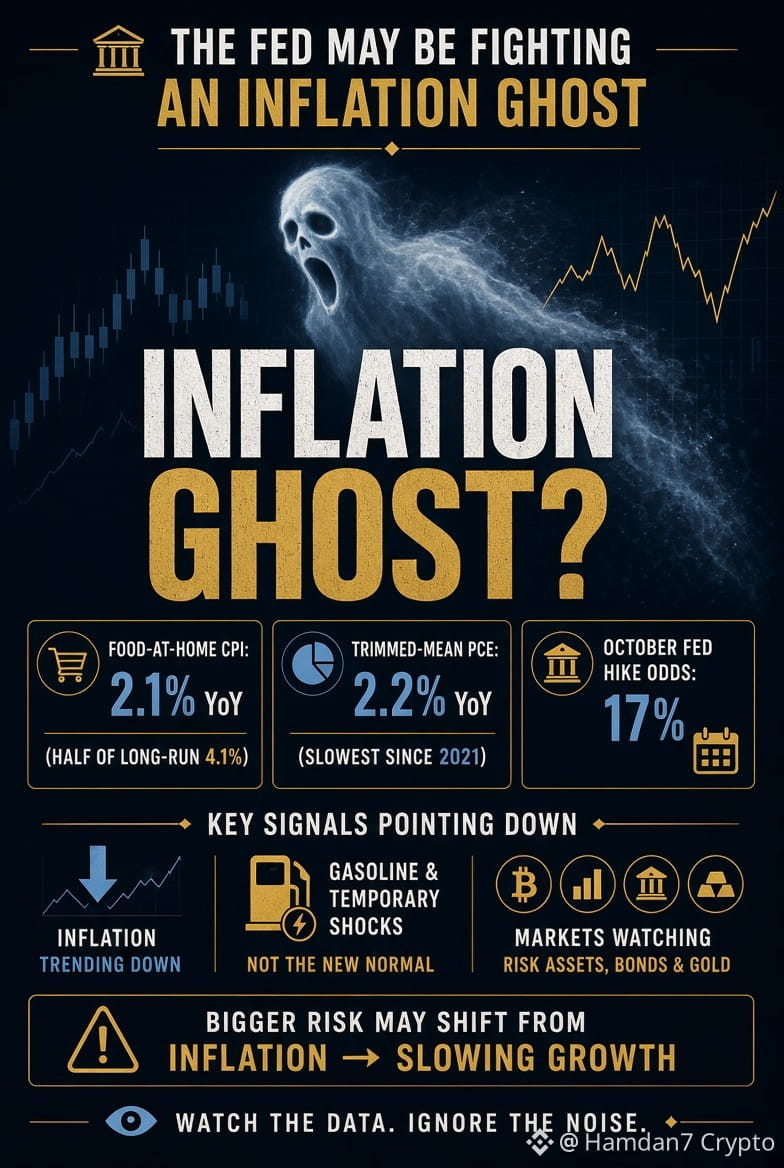
🍞 Food-at-home CPI: 2.1% YoY
That’s roughly HALF its long-run average of ~4.1%.
🎯 Trimmed-Mean PCE: 2.2% YoY
The slowest pace since 2021.
And recent monthly annualized readings are already running below 2%.
So why keep treating inflation like an emergency?
The Warsh Fed still raised rates by 25 bps in September — its first hike since 2023.
But now the market is pushing back.
📉 October Fed hike odds: just 17%
That tells us something important:
The market may be seeing disinflation faster than the Fed wants to admit.
Yes, gasoline prices are high.
But a temporary energy shock ≠ a broad inflation crisis.
If food inflation is only 2.1% and underlying PCE is around 2.2%, the bigger risk may soon shift from inflation → slowing growth.
And that changes everything for markets. 👀
BTC. Stocks. Bonds. Gold.
The next big trade may not be about higher rates.
It may be about when the Fed has to start cutting again.
📊 Watch the data.
Ignore the noise.
#Fed #FederalReserve #Inflation #CPI #PCE #InterestRates #Bitcoin #BTC #Crypto #Markets #RateCuts
#FedOctoberRateHikeOddsFallTo17%
🚨 THE FED MAY BE FIGHTING AN INFLATION GHOST
Wall Street keeps screaming “INFLATION!” 🔥
But the actual data?
Not so scary.
🍞 Food-at-home CPI: 2.1% YoY
That’s roughly HALF its long-run average of ~4.1%.
🎯 Trimmed-Mean PCE: 2.2% YoY
The slowest pace since 2021.
And recent monthly annualized readings are already running below 2%.
So why keep treating inflation like an emergency?
The Warsh Fed still raised rates by 25 bps in September — its first hike since 2023.
But now the market is pushing back.
📉 October Fed hike odds: just 17%
That tells us something important:
The market may be seeing disinflation faster than the Fed wants to admit.
Yes, gasoline prices are high.
But a temporary energy shock ≠ a broad inflation crisis.
If food inflation is only 2.1% and underlying PCE is around 2.2%, the bigger risk may soon shift from inflation → slowing growth.
And that changes everything for markets. 👀
BTC. Stocks. Bonds. Gold.
The next big trade may not be about higher rates.
It may be about when the Fed has to start cutting again.
📊 Watch the data.
Ignore the noise.
#Fed #FederalReserve #Inflation #CPI #PCE #InterestRates #Bitcoin #BTC #Crypto #Markets #RateCuts
🚨 THE FED MAY BE FIGHTING AN INFLATION GHOST
Wall Street keeps screaming “INFLATION!” 🔥
But the actual data?
Not so scary.
🍞 Food-at-home CPI: 2.1% YoY
That’s roughly HALF its long-run average of ~4.1%.
🎯 Trimmed-Mean PCE: 2.2% YoY
The slowest pace since 2021.
And recent monthly annualized readings are already running below 2%.
So why keep treating inflation like an emergency?
The Warsh Fed still raised rates by 25 bps in September — its first hike since 2023.
But now the market is pushing back.
📉 October Fed hike odds: just 17%
That tells us something important:
The market may be seeing disinflation faster than the Fed wants to admit.
Yes, gasoline prices are high.
But a temporary energy shock ≠ a broad inflation crisis.
If food inflation is only 2.1% and underlying PCE is around 2.2%, the bigger risk may soon shift from inflation → slowing growth.
And that changes everything for markets. 👀
BTC. Stocks. Bonds. Gold.
The next big trade may not be about higher rates.
It may be about when the Fed has to start cutting again.
📊 Watch the data.
Ignore the noise.
#Fed #FederalReserve #Inflation #CPI #PCE #InterestRates #Bitcoin #BTC #Crypto #Markets #RateCuts
42
·
--
Проверено
#CerebrasSinksNearly20%OnReportNvidiaToPowerOpenAI
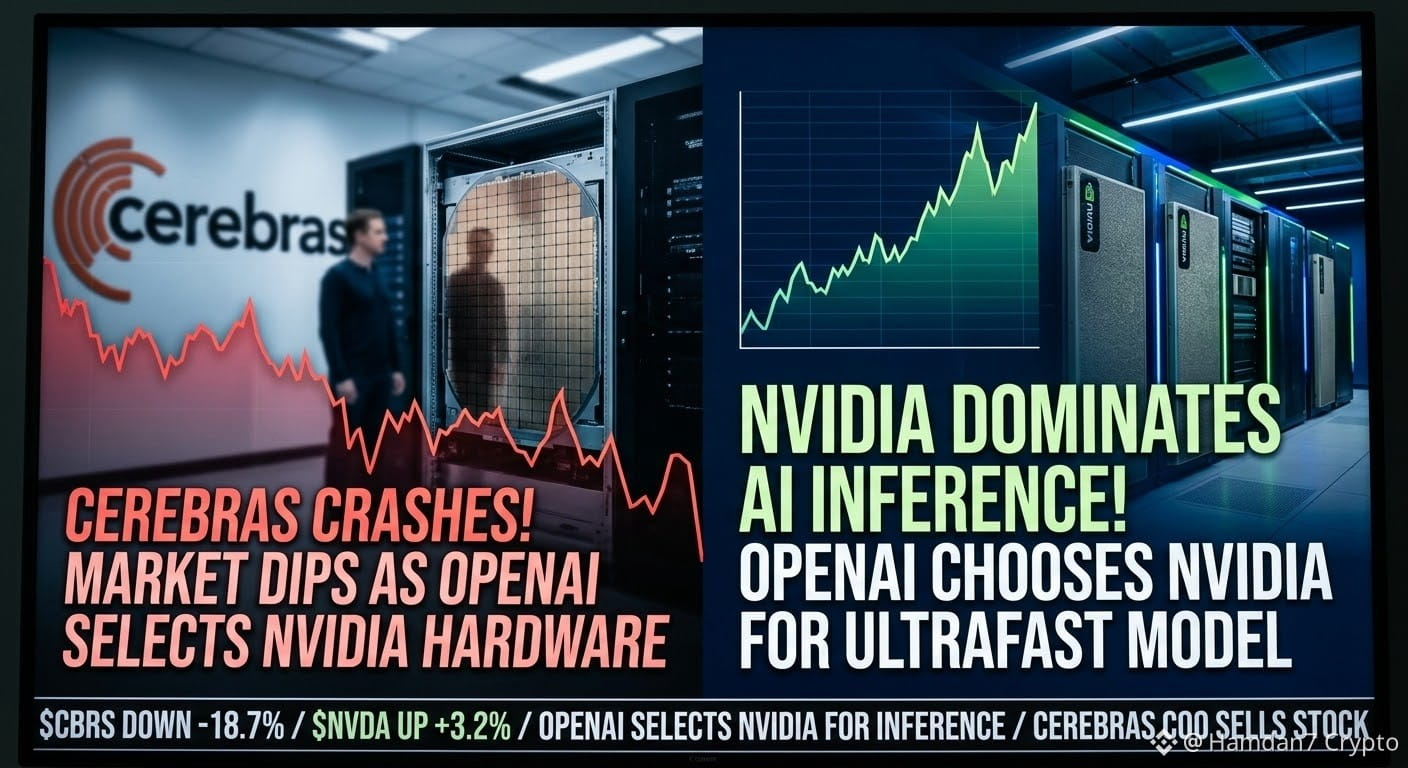
**Cerebras Crashes Nearly 20% as OpenAI Chooses NVIDIA**
If you hold $CBRS, this week has been brutal.
OpenAI’s new ultrafast model is running on NVIDIA hardware — not Cerebras.
The entire Cerebras pitch was built around extreme inference speed. The biggest customer in AI just picked $NVDA for exactly that use case.
In the same week, Cerebras’ COO sold $78 million worth of stock and exited with zero shares left.
Two signals no investor wants to see together:
1. Your marquee customer chooses the competition
2. A top insider who knows the most walks away completely
This isn’t just a temporary dip. It’s a clear vote of no confidence from both the market and people inside the company.
NVIDIA continues to dominate the AI infrastructure race. Cerebras just lost a high-profile opportunity that was supposed to validate its technology.
Watch volume and further insider activity closely. The narrative has shifted fast.
#CBRS #Cerebras #NVIDIA #NVDA #OpenAI #AI #Semiconductors #StockMarket
#CerebrasSinksNearly20%OnReportNvidiaToPowerOpenAI
**Cerebras Crashes Nearly 20% as OpenAI Chooses NVIDIA**
If you hold $CBRS, this week has been brutal.
OpenAI’s new ultrafast model is running on NVIDIA hardware — not Cerebras.
The entire Cerebras pitch was built around extreme inference speed. The biggest customer in AI just picked $NVDA for exactly that use case.
In the same week, Cerebras’ COO sold $78 million worth of stock and exited with zero shares left.
Two signals no investor wants to see together:
1. Your marquee customer chooses the competition
2. A top insider who knows the most walks away completely
This isn’t just a temporary dip. It’s a clear vote of no confidence from both the market and people inside the company.
NVIDIA continues to dominate the AI infrastructure race. Cerebras just lost a high-profile opportunity that was supposed to validate its technology.
Watch volume and further insider activity closely. The narrative has shifted fast.
#CBRS #Cerebras #NVIDIA #NVDA #OpenAI #AI #Semiconductors #StockMarket
**Cerebras Crashes Nearly 20% as OpenAI Chooses NVIDIA**
If you hold $CBRS, this week has been brutal.
OpenAI’s new ultrafast model is running on NVIDIA hardware — not Cerebras.
The entire Cerebras pitch was built around extreme inference speed. The biggest customer in AI just picked $NVDA for exactly that use case.
In the same week, Cerebras’ COO sold $78 million worth of stock and exited with zero shares left.
Two signals no investor wants to see together:
1. Your marquee customer chooses the competition
2. A top insider who knows the most walks away completely
This isn’t just a temporary dip. It’s a clear vote of no confidence from both the market and people inside the company.
NVIDIA continues to dominate the AI infrastructure race. Cerebras just lost a high-profile opportunity that was supposed to validate its technology.
Watch volume and further insider activity closely. The narrative has shifted fast.
#CBRS #Cerebras #NVIDIA #NVDA #OpenAI #AI #Semiconductors #StockMarket
659
·
--
#ZcashETFPostsFirstWeeklyOutflow$93.6M
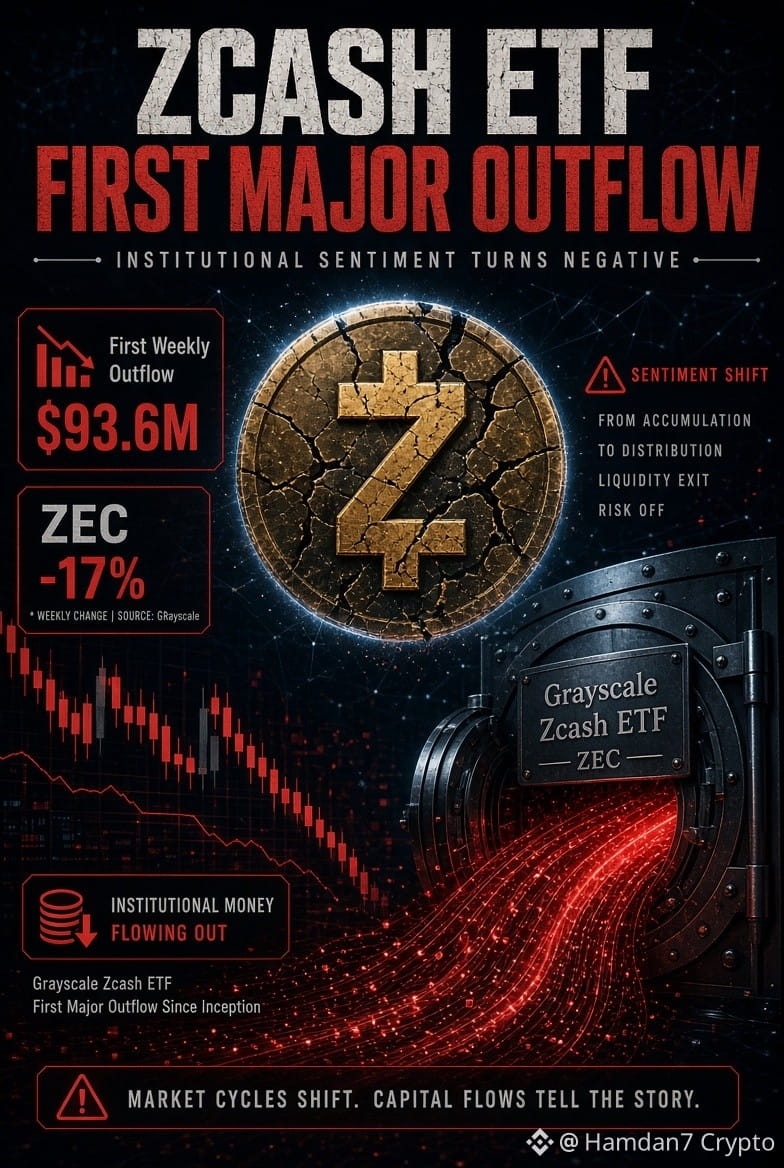
📉 Zcash is facing its first major ETF setback.
$ZEC has dropped nearly 17% in one week, while Grayscale’s Zcash ETF recorded approximately $93.56 million in weekly withdrawals — marking its first negative weekly balance since launching in August.
This is an important shift in investor sentiment.
ETF inflows can provide steady institutional demand and strengthen market confidence. But when outflows appear alongside a sharp decline in the underlying asset, it can signal that investors are becoming more cautious and taking money off the table.
For Zcash, the key question now is whether this is simply short-term profit-taking after its recent rally or the beginning of a broader change in demand.
⚠️ If ETF outflows continue, selling pressure could remain elevated and make it harder for $ZEC to recover quickly.
🔥 But one week does not define a trend.
Traders should watch upcoming ETF flows, trading volume, and price structure closely. A return to positive inflows could quickly change the narrative, while continued withdrawals may signal further weakness ahead.
The Zcash ETF story is no longer only about adoption — it is now about whether institutional demand can return.
#ZEC #Zcash #CryptoETF #Grayscale #CryptoMarket #Altcoins
#ZcashETFPostsFirstWeeklyOutflow$93.6M
📉 Zcash is facing its first major ETF setback.
$ZEC has dropped nearly 17% in one week, while Grayscale’s Zcash ETF recorded approximately $93.56 million in weekly withdrawals — marking its first negative weekly balance since launching in August.
This is an important shift in investor sentiment.
ETF inflows can provide steady institutional demand and strengthen market confidence. But when outflows appear alongside a sharp decline in the underlying asset, it can signal that investors are becoming more cautious and taking money off the table.
For Zcash, the key question now is whether this is simply short-term profit-taking after its recent rally or the beginning of a broader change in demand.
⚠️ If ETF outflows continue, selling pressure could remain elevated and make it harder for $ZEC to recover quickly.
🔥 But one week does not define a trend.
Traders should watch upcoming ETF flows, trading volume, and price structure closely. A return to positive inflows could quickly change the narrative, while continued withdrawals may signal further weakness ahead.
The Zcash ETF story is no longer only about adoption — it is now about whether institutional demand can return.
#ZEC #Zcash #CryptoETF #Grayscale #CryptoMarket #Altcoins
📉 Zcash is facing its first major ETF setback.
$ZEC has dropped nearly 17% in one week, while Grayscale’s Zcash ETF recorded approximately $93.56 million in weekly withdrawals — marking its first negative weekly balance since launching in August.
This is an important shift in investor sentiment.
ETF inflows can provide steady institutional demand and strengthen market confidence. But when outflows appear alongside a sharp decline in the underlying asset, it can signal that investors are becoming more cautious and taking money off the table.
For Zcash, the key question now is whether this is simply short-term profit-taking after its recent rally or the beginning of a broader change in demand.
⚠️ If ETF outflows continue, selling pressure could remain elevated and make it harder for $ZEC to recover quickly.
🔥 But one week does not define a trend.
Traders should watch upcoming ETF flows, trading volume, and price structure closely. A return to positive inflows could quickly change the narrative, while continued withdrawals may signal further weakness ahead.
The Zcash ETF story is no longer only about adoption — it is now about whether institutional demand can return.
#ZEC #Zcash #CryptoETF #Grayscale #CryptoMarket #Altcoins
1
253
Войдите, чтобы посмотреть больше материала
Присоединяйтесь к пользователям криптовалют по всему миру на Binance Square
⚡️ Получайте новейшую и полезную информацию о криптоактивах.
💬 Нам доверяет крупнейшая в мире криптобиржа.
👍 Получите достоверные аналитические данные от верифицированных создателей контента.
Эл. почта/номер телефона
В тренде
FedMinutesFocusOnOctoberPause
Просмотров: 376,998
2,353 обсуждают
🚨 LA FED ACABA DE DAR UNA GRAN PISTA: ¿PAUSA EN OCTUBRE A LA VISTA?
Wall Street apuesta a que la Fed PISARÁ EL FRENO en octubre. Y los operadores de criptomonedas están muy atentos. 👀
Las últimas actas del FOMC han centrado la atención en una posible pausa en la reunión del 27 y 28 de octubre.
📊 El panorama del mercado:
🔥 Mantener las tasas en octubre: aproximadamente un 82,8 % según las últimas probabilidades publicadas.
🔥 Probabilidad de una subida de tasas: aproximadamente un 17,2 %.
🔥 El debilitamiento del mercado laboral hace más difícil justificar una subida inmediata.
Pero aquí viene el giro.
UNA PAUSA NO ES UN RECORTE DE TASAS.
La Fed podría mantener las tasas en octubre y dejar abierta la posibilidad de volver a endurecer la política monetaria más adelante.
Para $BTC, $ ETH y $XAU, esa diferencia importa.
Una pausa podría aliviar la presión inmediata sobre los activos de riesgo. Pero la inflación persistente y los elevados rendimientos de los bonos del Tesoro aún podrían frenar el impulso alcista.
⚠️ LA GRAN PREGUNTA:
¿Se está posicionando Wall Street ante una ruptura alcista de las criptomonedas o preparando otra enorme trampa alcista antes de la próxima decisión de la Fed?
$BTC $ETH $BNB $SOL $XAU
#fedminutesfocusonoctoberpause #BinanceLaunchesBinanceIntelligence #EvernorthDelaysNasdaqDebutToOct12 #RobinhoodAdds25MInBitcoinToBalanceSheet $25MInBitcoinToBalanceSh #SP500AndNasdaqHitRecordHighs
Carmelita Gilliland zXSW
·Лайков: 9
·Просмотров: 13.7k
VitalikWarnsAICouldWeakenCryptographySecurity
Просмотров: 1,503
134 обсуждают
XRPSpotETFsHold$1.7BWeeklyInflowsSlow
Просмотров: 356
20 обсуждают