
Daily_alerts by Liam
77 Публикации

Daily_alerts by Liam
Открытая сделка
Трейдер с регулярными сделками
3.4 г
302 подписок(и/а)
109 подписчиков(а)
2 понравилось
Посты
Портфель
Все
Цитирования
Binance Turns 9 Today! 🎉
Nine years ago, Binance started with a simple mission: make crypto accessible to everyone.
Today, it's grown into one of the world's largest crypto ecosystems, serving millions of users across the globe with trading, Web3, education, payments, and blockchain innovation.
In an industry where many projects don't survive a single market cycle, reaching 9 years is a milestone built on continuous innovation, resilience, and community.
Happy 9th Anniversary, binance! 🥂
Here's to building the future of Web3 together.
$BNB
#BinanceTurns9 #BİNANCE #BNB #crypto #Web3
Nine years ago, Binance started with a simple mission: make crypto accessible to everyone.
Today, it's grown into one of the world's largest crypto ecosystems, serving millions of users across the globe with trading, Web3, education, payments, and blockchain innovation.
In an industry where many projects don't survive a single market cycle, reaching 9 years is a milestone built on continuous innovation, resilience, and community.
Happy 9th Anniversary, binance! 🥂
Here's to building the future of Web3 together.
$BNB
#BinanceTurns9 #BİNANCE #BNB #crypto #Web3

Проверено
ZachXBT's Investigation — Insider Control Allegations of $LAB
On-chain investigator ZachXBT first raised allegations in May 2026 that 95%+ of LAB's effective float is controlled by insiders — team wallets, early investors, market makers, and affiliated entities.
Key Findings of the Investigation:
Bitget Deposits: Between March and April 2026, the team directly gave 196 million+ LAB tokens to a single entity. Of this, 100 million was sent to Bitget deposit addresses.
Dormant Wallets: In May 2026, 100 million LAB (worth ~$480 million) was withdrawn from Bitget and split across 10 newly-created wallets. According to ZachXBT, there was no genuine external buyer on the other side of this transaction — meaning the entire movement was controlled by a single party.
Private OTC Deals: Co-founder Vova Sadkov signed loan agreements carrying a 7.5% monthly interest rate. Private offers were circulating in Telegram/WhatsApp groups, with some tranches selling at 60–80% discounts.
Changed Vesting Terms: There's an allegation that the team unilaterally extended some participants' vesting cliffs from 3 months to 9 months without proper consent.
$10,000 Bounty: ZachXBT announced a bounty targeting founder Vova Sadkov — for anyone who could provide contracts, chat records, or insider documents proving the market-making activities.
Similar Pattern: ZachXBT noted the same pattern had been seen in tokens like RAVE and SKYAI, where insiders controlled 90%+ of the supply.
$LAB
On-chain investigator ZachXBT first raised allegations in May 2026 that 95%+ of LAB's effective float is controlled by insiders — team wallets, early investors, market makers, and affiliated entities.
Key Findings of the Investigation:
Bitget Deposits: Between March and April 2026, the team directly gave 196 million+ LAB tokens to a single entity. Of this, 100 million was sent to Bitget deposit addresses.
Dormant Wallets: In May 2026, 100 million LAB (worth ~$480 million) was withdrawn from Bitget and split across 10 newly-created wallets. According to ZachXBT, there was no genuine external buyer on the other side of this transaction — meaning the entire movement was controlled by a single party.
Private OTC Deals: Co-founder Vova Sadkov signed loan agreements carrying a 7.5% monthly interest rate. Private offers were circulating in Telegram/WhatsApp groups, with some tranches selling at 60–80% discounts.
Changed Vesting Terms: There's an allegation that the team unilaterally extended some participants' vesting cliffs from 3 months to 9 months without proper consent.
$10,000 Bounty: ZachXBT announced a bounty targeting founder Vova Sadkov — for anyone who could provide contracts, chat records, or insider documents proving the market-making activities.
Similar Pattern: ZachXBT noted the same pattern had been seen in tokens like RAVE and SKYAI, where insiders controlled 90%+ of the supply.
$LAB
$LAB Token Investigation: The Full Story from Insider Dumping to Crash
What Is LAB Token?
LAB is the native token of a multi-chain trading terminal built for spot, limit, and perpetual trades, integrated with an AI-powered research engine. Its Token Generation Event (TGE) happened in October 2025. The founder is Vova Sadkov (a Dubai-based entrepreneur), along with co-founder Mark. Both previously worked on a project called Eesee, which investors say was abandoned without the team delivering on its commitments.
After launch, LAB raised $5 million in funding from Amber Group, Selini Capital, Re7 Capital, and Cypher Capital. A community round raised $1.5 million in just 10 minutes — retail interest was strong from the start.
Tokenomics: Max supply is 1 billion LAB. At launch, only a small portion was circulating, with the rest locked under a vesting schedule for the team, investors, and ecosystem allocations.
Price History — A Rollercoaster Ride
Early phase: $LAB traded in the $0.50–$0.70 range without much attention.
Early May 2026: A sudden 350%+ surge pushed it to a $6 billion FDV within hours — with no major product announcement to explain it.
Peak: All-time high above $27.9
Crash begins: A 65%+ crash within hours right after the peak.
July 2026: Another massive crash — from $14 straight down to $2, an 85% drop in a single day.
Mid-July 2026: Price hovering around $0.55, down 97%+ from its all-time high.
This volatility wasn't just normal market movement — there's a serious on-chain investigation behind it.
$LAB
What Is LAB Token?
LAB is the native token of a multi-chain trading terminal built for spot, limit, and perpetual trades, integrated with an AI-powered research engine. Its Token Generation Event (TGE) happened in October 2025. The founder is Vova Sadkov (a Dubai-based entrepreneur), along with co-founder Mark. Both previously worked on a project called Eesee, which investors say was abandoned without the team delivering on its commitments.
After launch, LAB raised $5 million in funding from Amber Group, Selini Capital, Re7 Capital, and Cypher Capital. A community round raised $1.5 million in just 10 minutes — retail interest was strong from the start.
Tokenomics: Max supply is 1 billion LAB. At launch, only a small portion was circulating, with the rest locked under a vesting schedule for the team, investors, and ecosystem allocations.
Price History — A Rollercoaster Ride
Early phase: $LAB traded in the $0.50–$0.70 range without much attention.
Early May 2026: A sudden 350%+ surge pushed it to a $6 billion FDV within hours — with no major product announcement to explain it.
Peak: All-time high above $27.9
Crash begins: A 65%+ crash within hours right after the peak.
July 2026: Another massive crash — from $14 straight down to $2, an 85% drop in a single day.
Mid-July 2026: Price hovering around $0.55, down 97%+ from its all-time high.
This volatility wasn't just normal market movement — there's a serious on-chain investigation behind it.
$LAB
🚀 Crypto Market Update — July 10, 2026
Total crypto market cap is near $2.25T, up ~1.9% in 24hrs. Here's the breakdown:
📈 $BTC — $64,000+ (up ~3%)
Bitcoin recovered from last week's dip triggered by Trump's Iran warnings. A weaker US dollar plus a strong rally in Asian (Seoul/Tokyo) chip and AI stocks pulled BTC higher. Whales are quietly accumulating too. Analysts are watching the $65K resistance — a clean break could trigger a short squeeze toward $67K.
📈 $ETH — $1,750-1,790 (up ~1-3%)
A large whale withdrew 9,882 ETH (~$17M) from Binance today, bringing its 10-day total to 34,500+ ETH pulled off exchanges. Exchange outflows usually signal long-term conviction, which is boosting sentiment.
📈 $XRP — $1.09-1.11 (up ~1.3-1.5%)
Bounced back from the $1.05 support zone. Exchange flow data shows investors accumulating. A break above $1.17 resistance could open the path toward $1.30.
📈 $SOL — $78-79 (up ~1.5-1.8%)
Moved with the broader market but remained the weakest performer among majors this week.
⚪ $SUI — ~$0.73-0.75 (flat/mixed)
Underperforming compared to the majors, without the same momentum.
🔑 What's actually driving this?
Not crypto-specific news — it's mostly:
A weaker US dollar
Strong rally in Asian AI/semiconductor stocks
Leverage-driven short liquidations (over $215M liquidated, mostly shorts)
Institutional whale accumulation in BTC and ETH
📊 Can it go higher from here?
Views are mixed:
Bulls point to a daily trend breakout in BTC — a close above $65K and a new high past that could fuel a squeeze toward $67K, with some analysts flagging $70K as "on deck" if a key trendline breaks.
Bears note the Fear & Greed Index is still stuck in "Extreme Fear" (23/100), spot trading volumes remain thin for summer, Bitcoin ETFs just had back-to-back negative outflow days after a brief inflow streak, and Q2 2026 was crypto's third straight losing quarter as institutional money rotated into AI stocks instead.
Several analysts describe this as a "relief rally" within a larger downtrend rather than a confirmed reversal.
Total crypto market cap is near $2.25T, up ~1.9% in 24hrs. Here's the breakdown:
📈 $BTC — $64,000+ (up ~3%)
Bitcoin recovered from last week's dip triggered by Trump's Iran warnings. A weaker US dollar plus a strong rally in Asian (Seoul/Tokyo) chip and AI stocks pulled BTC higher. Whales are quietly accumulating too. Analysts are watching the $65K resistance — a clean break could trigger a short squeeze toward $67K.
📈 $ETH — $1,750-1,790 (up ~1-3%)
A large whale withdrew 9,882 ETH (~$17M) from Binance today, bringing its 10-day total to 34,500+ ETH pulled off exchanges. Exchange outflows usually signal long-term conviction, which is boosting sentiment.
📈 $XRP — $1.09-1.11 (up ~1.3-1.5%)
Bounced back from the $1.05 support zone. Exchange flow data shows investors accumulating. A break above $1.17 resistance could open the path toward $1.30.
📈 $SOL — $78-79 (up ~1.5-1.8%)
Moved with the broader market but remained the weakest performer among majors this week.
⚪ $SUI — ~$0.73-0.75 (flat/mixed)
Underperforming compared to the majors, without the same momentum.
🔑 What's actually driving this?
Not crypto-specific news — it's mostly:
A weaker US dollar
Strong rally in Asian AI/semiconductor stocks
Leverage-driven short liquidations (over $215M liquidated, mostly shorts)
Institutional whale accumulation in BTC and ETH
📊 Can it go higher from here?
Views are mixed:
Bulls point to a daily trend breakout in BTC — a close above $65K and a new high past that could fuel a squeeze toward $67K, with some analysts flagging $70K as "on deck" if a key trendline breaks.
Bears note the Fear & Greed Index is still stuck in "Extreme Fear" (23/100), spot trading volumes remain thin for summer, Bitcoin ETFs just had back-to-back negative outflow days after a brief inflow streak, and Q2 2026 was crypto's third straight losing quarter as institutional money rotated into AI stocks instead.
Several analysts describe this as a "relief rally" within a larger downtrend rather than a confirmed reversal.
#newt $NEWT Newton Protocol (NEWT): Onchain Compliance ka Naya Chehra 🔐
Crypto duniya mein ek naya buzzword hai — Newton Protocol! Yeh ek decentralized policy engine hai jo compliance, risk aur business rules ko code mein convert karke onchain enforce karta hai.
✅ Real-time transaction checks (sanctions, identity, risk)
✅ Zero-knowledge proofs se privacy bhi safe
✅ Ethereum ke restaked security model par based
✅ Institutions, stablecoins aur RWA platforms ke liye designed
Compliance ab manual review nahi, balki smart contract ka hissa ban raha hai. Future of institutional DeFi yahin se shuru hoti hai! 🚀
#NEWT #NewtonProtocol #Web3 #DeFi #Blockchain
Crypto duniya mein ek naya buzzword hai — Newton Protocol! Yeh ek decentralized policy engine hai jo compliance, risk aur business rules ko code mein convert karke onchain enforce karta hai.
✅ Real-time transaction checks (sanctions, identity, risk)
✅ Zero-knowledge proofs se privacy bhi safe
✅ Ethereum ke restaked security model par based
✅ Institutions, stablecoins aur RWA platforms ke liye designed
Compliance ab manual review nahi, balki smart contract ka hissa ban raha hai. Future of institutional DeFi yahin se shuru hoti hai! 🚀
#NEWT #NewtonProtocol #Web3 #DeFi #Blockchain
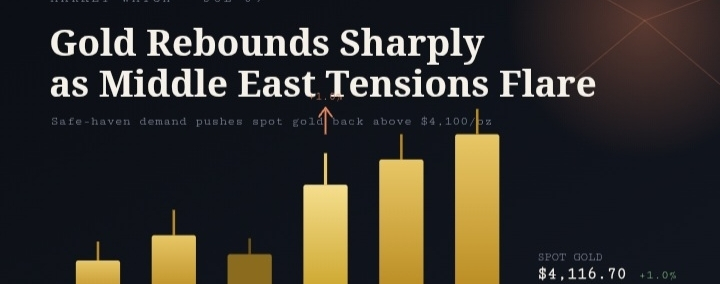
🟡 Gold surges past $4,100 as Middle East tensions escalate
Gold climbed over 1% today, bouncing back from a one-week low after Iran launched strikes on U.S. military sites in the Gulf, straining a fragile 3-week ceasefire.
📊 Spot Gold: $4,116.70 (+1%)
📊 Silver: $59.66 (+2.4%)
📊 Platinum: $1,615 (+2.4%)
📊 Palladium: $1,255.61 (+3.4%) 🚀
Markets now see a 64% chance of a Fed rate cut in September (CME FedWatch). Higher rates could cap gold's upside — but geopolitical risk is keeping bulls in control for now.
HSBC trimmed its 2026/2027 gold forecasts to $4,560 / $4,925
$XAUT $XAG $XPT
#GOLD #XAUT #Silver
Gold climbed over 1% today, bouncing back from a one-week low after Iran launched strikes on U.S. military sites in the Gulf, straining a fragile 3-week ceasefire.
📊 Spot Gold: $4,116.70 (+1%)
📊 Silver: $59.66 (+2.4%)
📊 Platinum: $1,615 (+2.4%)
📊 Palladium: $1,255.61 (+3.4%) 🚀
Markets now see a 64% chance of a Fed rate cut in September (CME FedWatch). Higher rates could cap gold's upside — but geopolitical risk is keeping bulls in control for now.
HSBC trimmed its 2026/2027 gold forecasts to $4,560 / $4,925
$XAUT $XAG $XPT
#GOLD #XAUT #Silver
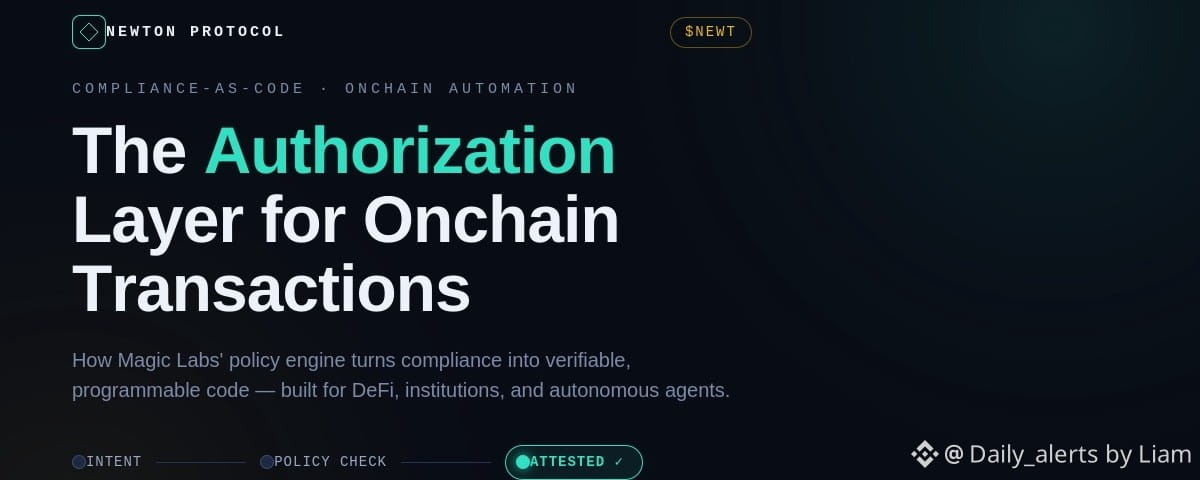
#newt $NEWT Newton Protocol just brought real-time jurisdiction checks onchain via Persona — identity verified at the transaction layer, not the UI. No PII on-chain, just a cryptographic receipt. Compliance-as-code, live. 🔐
🚨 $LAB Token Update — July 9, 2026
💥 MAJOR VOLATILITY ALERT: LAB is currently trading around $1.17-$1.25, after crashing nearly 80-90% in just 48 hours — it was above $17 earlier this week and briefly touched a market cap of $5B+ before collapsing to under $400M.
📉 What happened:
Massive sell-off from large holders/market participants triggered a liquidity cascade
Trading volume spiked over 130%, nearly matching the token's entire market cap in a single day
The $LAB Trade team acknowledged "significant selling pressure from large market participants" but denied responsibility for the crash
⚠️ Ongoing concerns:
On-chain investigator ZachXBT has repeatedly alleged that insiders control a very large share (reportedly 90%+) of the token supply
Reports of price manipulation across centralized exchanges, with critics saying platforms like Binance, Bitget, and Gate haven't done enough to intervene
A major token unlock (~282M tokens, worth ~$1.9B at recent prices) is scheduled for mid-August 2026, which could add heavy sell pressure
📊 About $LAB B: It's the native token of a multi-chain trading terminal that combines spot, limit, and perpetual futures trading across chains like Ethereum, Solana, and BNB Chain, with AI-based order routing.
⚠️ Important: LAB is an extremely high-risk, highly volatile asset right now, with credible manipulation and transparency concerns flagged by independent researchers. This is not financial advice — please do thorough independent research (DYOR) before making any decisions.
#LAB #crypto #CryptoNewss #Web3
💥 MAJOR VOLATILITY ALERT: LAB is currently trading around $1.17-$1.25, after crashing nearly 80-90% in just 48 hours — it was above $17 earlier this week and briefly touched a market cap of $5B+ before collapsing to under $400M.
📉 What happened:
Massive sell-off from large holders/market participants triggered a liquidity cascade
Trading volume spiked over 130%, nearly matching the token's entire market cap in a single day
The $LAB Trade team acknowledged "significant selling pressure from large market participants" but denied responsibility for the crash
⚠️ Ongoing concerns:
On-chain investigator ZachXBT has repeatedly alleged that insiders control a very large share (reportedly 90%+) of the token supply
Reports of price manipulation across centralized exchanges, with critics saying platforms like Binance, Bitget, and Gate haven't done enough to intervene
A major token unlock (~282M tokens, worth ~$1.9B at recent prices) is scheduled for mid-August 2026, which could add heavy sell pressure
📊 About $LAB B: It's the native token of a multi-chain trading terminal that combines spot, limit, and perpetual futures trading across chains like Ethereum, Solana, and BNB Chain, with AI-based order routing.
⚠️ Important: LAB is an extremely high-risk, highly volatile asset right now, with credible manipulation and transparency concerns flagged by independent researchers. This is not financial advice — please do thorough independent research (DYOR) before making any decisions.
#LAB #crypto #CryptoNewss #Web3
🚀 $SOL Price Update — July 9, 2026
💰 Current Price: ~$77 (ranging $76.9–$78.1 across exchanges)
📉 24h Change: Down 1-4% (mild selling pressure right now)
📊 Market Cap: ~$44.8B (Ranked #7-8 among top cryptos)
📈 7-Day: Roughly flat, with a slight recovery over the week
🔥 What's happening on the network:
Daily active addresses hit 5.6M+ — strong network usage despite price consolidation
Institutional adoption rising — Securitize tokenized $295M in stock on Solana (backed by BlackRock)
RWA (Real World Assets) TVL hit a new all-time high — $3.4B+
Stablecoin supply on Solana has crossed $16B+
Jupiter launched a trailing stop-loss feature for limit orders
On-chain governance (SGPs) is now live — validators with 100K+ $SOL staked can submit proposals
⚠️ Note: Crypto prices are highly volatile — always DYOR (Do Your Own Research) before investing.
#solana #SOL #Crypto #Web3
💰 Current Price: ~$77 (ranging $76.9–$78.1 across exchanges)
📉 24h Change: Down 1-4% (mild selling pressure right now)
📊 Market Cap: ~$44.8B (Ranked #7-8 among top cryptos)
📈 7-Day: Roughly flat, with a slight recovery over the week
🔥 What's happening on the network:
Daily active addresses hit 5.6M+ — strong network usage despite price consolidation
Institutional adoption rising — Securitize tokenized $295M in stock on Solana (backed by BlackRock)
RWA (Real World Assets) TVL hit a new all-time high — $3.4B+
Stablecoin supply on Solana has crossed $16B+
Jupiter launched a trailing stop-loss feature for limit orders
On-chain governance (SGPs) is now live — validators with 100K+ $SOL staked can submit proposals
⚠️ Note: Crypto prices are highly volatile — always DYOR (Do Your Own Research) before investing.
#solana #SOL #Crypto #Web3
📉 Ethereum (ETH) Market Update 📉
$ETH H is currently trading around $1,720–1,770, with a market cap of roughly $207–233 billion — holding the #2 spot in crypto.
🔹 Short-term momentum is leaning bearish, sentiment sitting in "Extreme Fear" territory
🔹 Key support: $1,716 | Resistance: $1,750–1,800 (50-day EMA)
🔹 Bitcoin dominance near 56% is keeping capital parked in BTC instead of rotating into ETH
📈 But fundamentals stay strong — DeFi TVL still above $45B, institutional adoption is picking up (JPMorgan's tokenized fund on Ethereum grew 250% in a month), and a major upgrade (Fusaka) is targeted for H2 2026.
💬 Bullish long-term, cautious short-term — that's where $ETH TH stands right now.
#ETH #CryptoMarketAlert #Web3
$ETH H is currently trading around $1,720–1,770, with a market cap of roughly $207–233 billion — holding the #2 spot in crypto.
🔹 Short-term momentum is leaning bearish, sentiment sitting in "Extreme Fear" territory
🔹 Key support: $1,716 | Resistance: $1,750–1,800 (50-day EMA)
🔹 Bitcoin dominance near 56% is keeping capital parked in BTC instead of rotating into ETH
📈 But fundamentals stay strong — DeFi TVL still above $45B, institutional adoption is picking up (JPMorgan's tokenized fund on Ethereum grew 250% in a month), and a major upgrade (Fusaka) is targeted for H2 2026.
💬 Bullish long-term, cautious short-term — that's where $ETH TH stands right now.
#ETH #CryptoMarketAlert #Web3
$LAB B just got rekt — down 70-80%+ in the last 24h alone, and over 60% down on the week. 📉
From highs of $27+ to now trading in single digits. Brutal correction after weeks of parabolic pumping.
Reality check on why:
⚠️ Only ~31% supply circulating — 282M token unlock incoming in August (more sell pressure ahead)
⚠️ ZachXBT alleges insiders hold 95%+ of supply — manipulation concerns are real
⚠️ Extreme leverage in the market amplified the crash
This is what low-float, high-FDV tokens do. Not financial advice — just watch the tape. 🧠
From highs of $27+ to now trading in single digits. Brutal correction after weeks of parabolic pumping.
Reality check on why:
⚠️ Only ~31% supply circulating — 282M token unlock incoming in August (more sell pressure ahead)
⚠️ ZachXBT alleges insiders hold 95%+ of supply — manipulation concerns are real
⚠️ Extreme leverage in the market amplified the crash
This is what low-float, high-FDV tokens do. Not financial advice — just watch the tape. 🧠
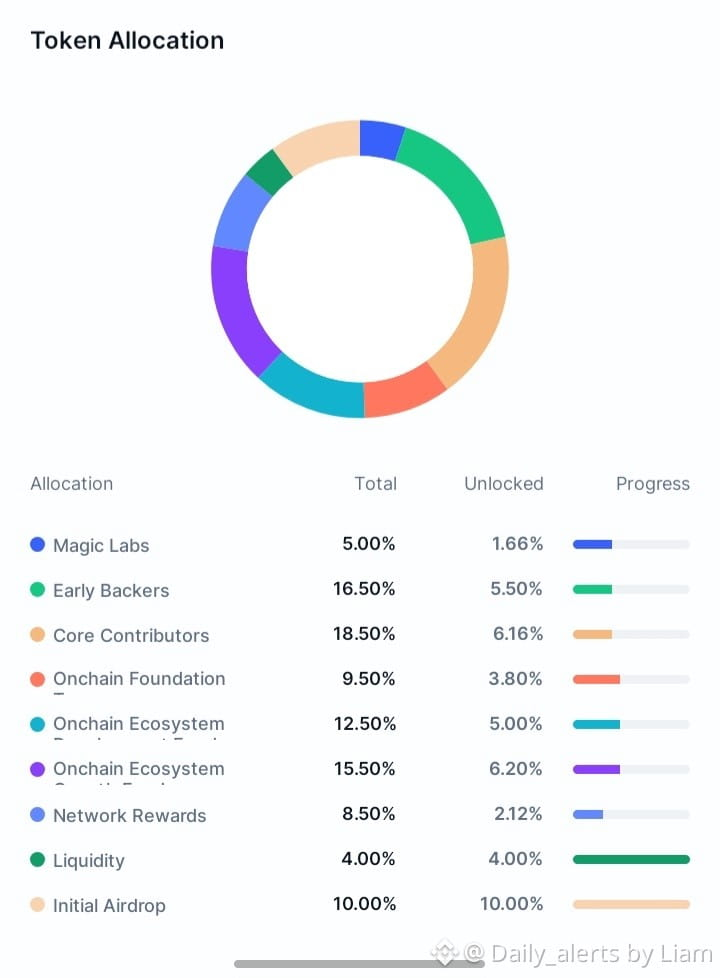
#newt $NEWT Newton Protocol ($NEWT ) — building the authorization layer for onchain compliance. Here's how the tokenomics breaks down 👇
$BNB B Updates: AI Agent Studio Just Made Building AI Agents Much Easier
Building an AI agent that pulls real-time market data used to be a complicated process. Developers had to set up API keys, choose a billing plan, and build a custom payment system before they could even get started. Now, AI-Agent Studio handles all of that in a single step.
This update is designed for two types of users:
Developers can skip API keys, billing plans, and custom payment integrations, making it much faster to build AI agents.
Traders and everyday token holders get an easier way to receive price updates and market alerts without writing any code. A simple natural-language request is enough to create an agent.
Anyone building an AI agent can now connect directly to CoinMarketCap data through Binance Pay's B402 pool with almost no setup. Every time the agent requests data, it automatically pays for that request from its own wallet. The request is sent through a dedicated endpoint, a fixed address that allows programs to fetch specific information.
How Binance Pay B402 Lets AI Agents Pay for Every Data Request
Whenever an agent requests data, it automatically pays for that individual request using its own wallet. Payments are processed through B402 using the x402 protocol and settle instantly on BSC as soon as the request is made. There is no need for a separate CoinMarketCap account or any custom payment code.
This is an important step for the $BNB B ecosystem because it removes one of the biggest barriers to building AI-powered applications. What once required multiple setup steps is now reduced to a single click.
This latest BNB 2026 roadmap update reflects Binance's broader vision of making powerful AI tools accessible to everyone, not just experienced developers.
#BNB_Market_Update
Building an AI agent that pulls real-time market data used to be a complicated process. Developers had to set up API keys, choose a billing plan, and build a custom payment system before they could even get started. Now, AI-Agent Studio handles all of that in a single step.
This update is designed for two types of users:
Developers can skip API keys, billing plans, and custom payment integrations, making it much faster to build AI agents.
Traders and everyday token holders get an easier way to receive price updates and market alerts without writing any code. A simple natural-language request is enough to create an agent.
Anyone building an AI agent can now connect directly to CoinMarketCap data through Binance Pay's B402 pool with almost no setup. Every time the agent requests data, it automatically pays for that request from its own wallet. The request is sent through a dedicated endpoint, a fixed address that allows programs to fetch specific information.
How Binance Pay B402 Lets AI Agents Pay for Every Data Request
Whenever an agent requests data, it automatically pays for that individual request using its own wallet. Payments are processed through B402 using the x402 protocol and settle instantly on BSC as soon as the request is made. There is no need for a separate CoinMarketCap account or any custom payment code.
This is an important step for the $BNB B ecosystem because it removes one of the biggest barriers to building AI-powered applications. What once required multiple setup steps is now reduced to a single click.
This latest BNB 2026 roadmap update reflects Binance's broader vision of making powerful AI tools accessible to everyone, not just experienced developers.
#BNB_Market_Update
Войдите, чтобы посмотреть больше материала