

Gerdos
31 Публикации

Gerdos
Отправить жалобу
Заблокировать пользователя
Открытая сделка
Трейдер с регулярными сделками
2.2 г
126 подписок(и/а)
52 подписчиков(а)
31 понравилось
Посты
Портфель
PINNED
·
--
$SOL
Today, Solana (SOL) is experiencing a significant price jump! 📈 Whether you're holding or thinking of entering the market, now might be the perfect time to take advantage of this bullish trend.
Stay informed and trade wisely.
$SOL
Today, Solana (SOL) is experiencing a significant price jump! 📈 Whether you're holding or thinking of entering the market, now might be the perfect time to take advantage of this bullish trend.
Stay informed and trade wisely.
Today, Solana (SOL) is experiencing a significant price jump! 📈 Whether you're holding or thinking of entering the market, now might be the perfect time to take advantage of this bullish trend.
Stay informed and trade wisely.
12
91
·
--
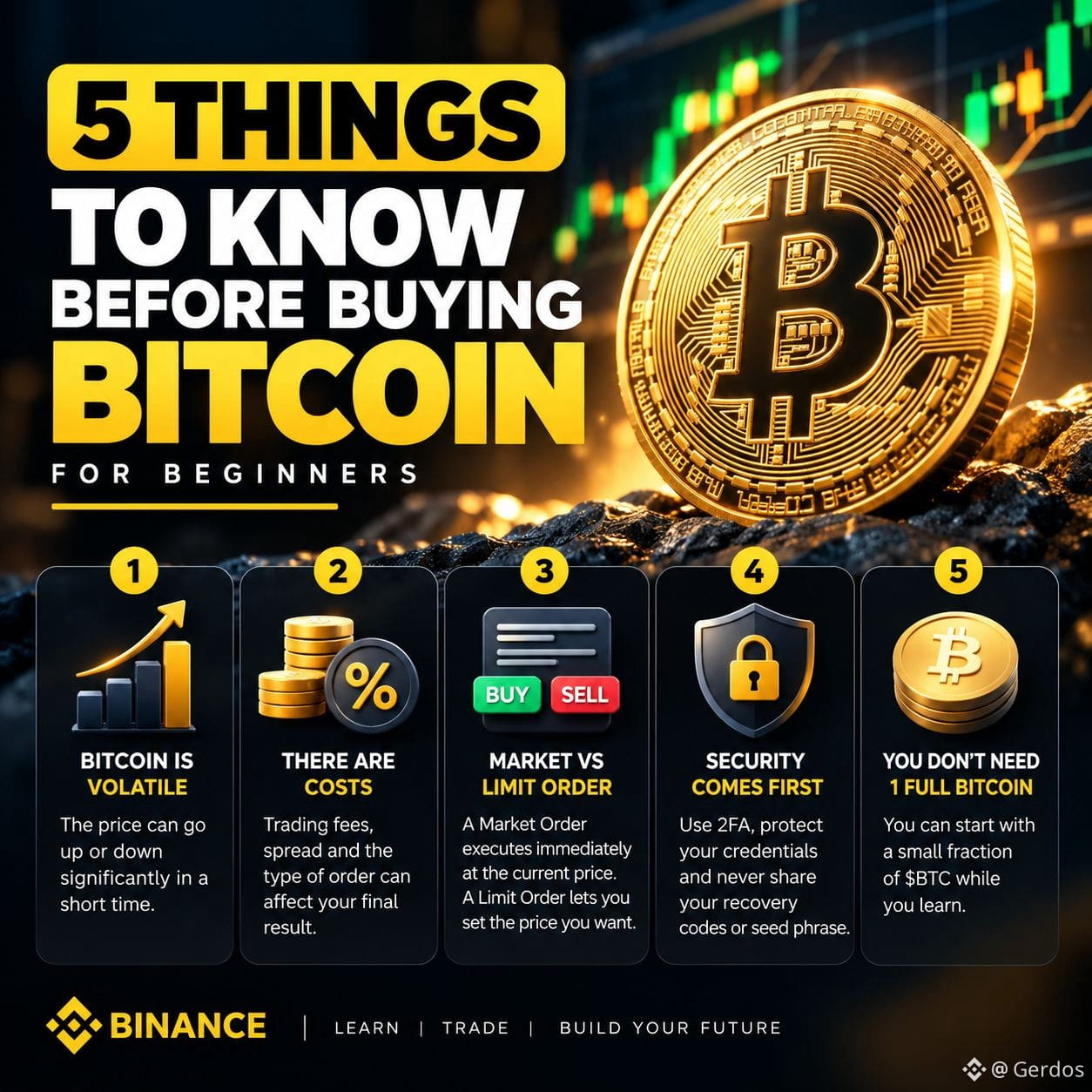
🚀 Before buying $BTC, understand these 5 things first.
Many beginners enter Bitcoin focusing on only one thing: the price.
But buying Bitcoin without understanding the basics can lead to poor decisions, especially when the market starts moving quickly.
Here are 5 things every beginner should know:
1️⃣ Bitcoin is volatile
The price of $BTC can rise or fall significantly in a short period. A recent price increase does not guarantee that it will continue.
2️⃣ Buying and selling involves costs
Trading fees, spreads, and the type of order you use can affect your final result.
3️⃣ Market Orders and Limit Orders are different
A Market Order aims to execute immediately at the best available price, while a Limit Order lets you specify the price at which you want to buy or sell.
4️⃣ Security comes before profit 🔐
Use 2FA, protect your login credentials, and never share authentication codes, passwords, or your recovery/seed phrase.
5️⃣ You don't need to buy 1 full Bitcoin
You can start with a small fraction of $BTC while learning how the market works.
📌 If you're new to crypto, your first goal shouldn't be chasing quick profits.
Your first goal should be understanding what you're putting your money into.
I'll be sharing more practical content about Bitcoin, Binance, crypto security, market analysis, and Web3.
👇 Which topic should I explain next?
#BitcoinForecast #BTC #Crypto #Binance #CryptoEducation #wb3
🚀 Before buying $BTC, understand these 5 things first.
Many beginners enter Bitcoin focusing on only one thing: the price.
But buying Bitcoin without understanding the basics can lead to poor decisions, especially when the market starts moving quickly.
Here are 5 things every beginner should know:
1️⃣ Bitcoin is volatile
The price of $BTC can rise or fall significantly in a short period. A recent price increase does not guarantee that it will continue.
2️⃣ Buying and selling involves costs
Trading fees, spreads, and the type of order you use can affect your final result.
3️⃣ Market Orders and Limit Orders are different
A Market Order aims to execute immediately at the best available price, while a Limit Order lets you specify the price at which you want to buy or sell.
4️⃣ Security comes before profit 🔐
Use 2FA, protect your login credentials, and never share authentication codes, passwords, or your recovery/seed phrase.
5️⃣ You don't need to buy 1 full Bitcoin
You can start with a small fraction of $BTC while learning how the market works.
📌 If you're new to crypto, your first goal shouldn't be chasing quick profits.
Your first goal should be understanding what you're putting your money into.
I'll be sharing more practical content about Bitcoin, Binance, crypto security, market analysis, and Web3.
👇 Which topic should I explain next?
#BitcoinForecast #BTC #Crypto #Binance #CryptoEducation #wb3
Many beginners enter Bitcoin focusing on only one thing: the price.
But buying Bitcoin without understanding the basics can lead to poor decisions, especially when the market starts moving quickly.
Here are 5 things every beginner should know:
1️⃣ Bitcoin is volatile
The price of $BTC can rise or fall significantly in a short period. A recent price increase does not guarantee that it will continue.
2️⃣ Buying and selling involves costs
Trading fees, spreads, and the type of order you use can affect your final result.
3️⃣ Market Orders and Limit Orders are different
A Market Order aims to execute immediately at the best available price, while a Limit Order lets you specify the price at which you want to buy or sell.
4️⃣ Security comes before profit 🔐
Use 2FA, protect your login credentials, and never share authentication codes, passwords, or your recovery/seed phrase.
5️⃣ You don't need to buy 1 full Bitcoin
You can start with a small fraction of $BTC while learning how the market works.
📌 If you're new to crypto, your first goal shouldn't be chasing quick profits.
Your first goal should be understanding what you're putting your money into.
I'll be sharing more practical content about Bitcoin, Binance, crypto security, market analysis, and Web3.
👇 Which topic should I explain next?
#BitcoinForecast #BTC #Crypto #Binance #CryptoEducation #wb3
94
·
--
https://www.binance.com/game/button/btc-button-Jan2026?ref=956399380®isterChannel=GRO-BTN-btc-button-Jan2026&utm_medium=web_share_copy&utm_source=share
https://www.binance.com/game/button/btc-button-Jan2026?ref=956399380®isterChannel=GRO-BTN-btc-button-Jan2026&utm_medium=web_share_copy&utm_source=share
1
·
--
$BTC
> “Never trade leverage.”
– James Wynn (…but that’s not the full story.)
Most traders fear leverage.
But leverage isn’t your enemy — your timeframe and system are.
🔍 Here’s the truth:
❌ Leverage on 4H swings = account killer
✅ Leverage on 1m-5m clean setups = pro-level tool
Tighter stop = lower risk.
Faster trades = faster feedback.
Controlled risk = consistent compounding.
💡 Used correctly, leverage amplifies precision — not mistakes.
---
🎯
Trade like a whale.
Don’t gamble.
Scale smart.
$BTC
> “Never trade leverage.”
– James Wynn (…but that’s not the full story.)
Most traders fear leverage.
But leverage isn’t your enemy — your timeframe and system are.
🔍 Here’s the truth:
❌ Leverage on 4H swings = account killer
✅ Leverage on 1m-5m clean setups = pro-level tool
Tighter stop = lower risk.
Faster trades = faster feedback.
Controlled risk = consistent compounding.
💡 Used correctly, leverage amplifies precision — not mistakes.
---
🎯
Trade like a whale.
Don’t gamble.
Scale smart.
> “Never trade leverage.”
– James Wynn (…but that’s not the full story.)
Most traders fear leverage.
But leverage isn’t your enemy — your timeframe and system are.
🔍 Here’s the truth:
❌ Leverage on 4H swings = account killer
✅ Leverage on 1m-5m clean setups = pro-level tool
Tighter stop = lower risk.
Faster trades = faster feedback.
Controlled risk = consistent compounding.
💡 Used correctly, leverage amplifies precision — not mistakes.
---
🎯
Trade like a whale.
Don’t gamble.
Scale smart.
2
·
--
#TrumpTariffs
> “Never trade leverage.”
– James Wynn (…but that’s not the full story.)
Most traders fear leverage.
But leverage isn’t your enemy — your timeframe and system are.
🔍 Here’s the truth:
❌ Leverage on 4H swings = account killer
✅ Leverage on 1m-5m clean setups = pro-level tool
Tighter stop = lower risk.
Faster trades = faster feedback.
Controlled risk = consistent compounding.
💡 Used correctly, leverage amplifies precision — not mistakes.
---
🎯
Trade like a whale.
Don’t gamble.
Scale smart.
#BTC
#TrumpTariffs
> “Never trade leverage.”
– James Wynn (…but that’s not the full story.)
Most traders fear leverage.
But leverage isn’t your enemy — your timeframe and system are.
🔍 Here’s the truth:
❌ Leverage on 4H swings = account killer
✅ Leverage on 1m-5m clean setups = pro-level tool
Tighter stop = lower risk.
Faster trades = faster feedback.
Controlled risk = consistent compounding.
💡 Used correctly, leverage amplifies precision — not mistakes.
---
🎯
Trade like a whale.
Don’t gamble.
Scale smart.
#BTC
> “Never trade leverage.”
– James Wynn (…but that’s not the full story.)
Most traders fear leverage.
But leverage isn’t your enemy — your timeframe and system are.
🔍 Here’s the truth:
❌ Leverage on 4H swings = account killer
✅ Leverage on 1m-5m clean setups = pro-level tool
Tighter stop = lower risk.
Faster trades = faster feedback.
Controlled risk = consistent compounding.
💡 Used correctly, leverage amplifies precision — not mistakes.
---
🎯
Trade like a whale.
Don’t gamble.
Scale smart.
#BTC
4
·
--
#TradingPairs101
Understanding the Basics of Crypto Trading 🔁
New to crypto trading? Let’s break down trading pairs! A trading pair lets you swap one crypto for another—think of it like a currency exchange. For example, ETH/USDT means you’re trading Ethereum for Tether. If ETH goes up in value against USDT, you’d profit by buying low and selling high.
There are crypto-to-crypto pairs (like ETH/BTC) and crypto-to-stablecoin pairs (like ETH/USDT). Knowing which pair to use depends on your goals: Are you trading for profit, stability, or accumulation?
🧠 Pro tip: Always watch the volume and spread—liquidity matters!
#cryptoeducation #TradingTips
#TradingPairs101
Understanding the Basics of Crypto Trading 🔁
New to crypto trading? Let’s break down trading pairs! A trading pair lets you swap one crypto for another—think of it like a currency exchange. For example, ETH/USDT means you’re trading Ethereum for Tether. If ETH goes up in value against USDT, you’d profit by buying low and selling high.
There are crypto-to-crypto pairs (like ETH/BTC) and crypto-to-stablecoin pairs (like ETH/USDT). Knowing which pair to use depends on your goals: Are you trading for profit, stability, or accumulation?
🧠 Pro tip: Always watch the volume and spread—liquidity matters!
#cryptoeducation #TradingTips
Understanding the Basics of Crypto Trading 🔁
New to crypto trading? Let’s break down trading pairs! A trading pair lets you swap one crypto for another—think of it like a currency exchange. For example, ETH/USDT means you’re trading Ethereum for Tether. If ETH goes up in value against USDT, you’d profit by buying low and selling high.
There are crypto-to-crypto pairs (like ETH/BTC) and crypto-to-stablecoin pairs (like ETH/USDT). Knowing which pair to use depends on your goals: Are you trading for profit, stability, or accumulation?
🧠 Pro tip: Always watch the volume and spread—liquidity matters!
#cryptoeducation #TradingTips
2
·
--
#Liquidity101
Market in Low Liquidity Season, What to Do?
Currently, the market is in a state of low liquidity. There are no significant bids from smart money, and retail interest is very low, resulting in a tendency for prices to decline. So, what should we do?
#1 Risk Less and Do Capital Preservation.
In this phase, not losing money is the best thing we can do. There are times when we can take high risks, and there are times when we need to stop being aggressive. In this situation, we should preserve our capital and take fewer risks than usual.
#2 Don't Try to Time the Market Extremely.
In unpleasant times like these, don't try to time the market extremely. Maintain some exposure to assets, although not 100%, because rallies can occur outside of expectations, and we don't want to be completely sidelined.
#3 Focus on Majors.
In this situation, excessive speculation on various speculative altcoins is less preferable. Try to take advantage of discounts to build exposure to more stable assets like Bitcoin, rather than speculative altcoins that require a significant narrative to move significantly.
#4 Never Leave the Space.
This situation tests the loyalty of market participants. Although it's not as intense as before, don't leave and continue to learn what's happening, because there will always be new things in the market that we can discover. Don't leave and keep learning new things until better times return.
This post provides valuable insights on how to navigate a market with low liquidity, focusing on risk management, capital preservation, and strategic asset allocation.
#Liquidity101
Market in Low Liquidity Season, What to Do?
Currently, the market is in a state of low liquidity. There are no significant bids from smart money, and retail interest is very low, resulting in a tendency for prices to decline. So, what should we do?
#1 Risk Less and Do Capital Preservation.
In this phase, not losing money is the best thing we can do. There are times when we can take high risks, and there are times when we need to stop being aggressive. In this situation, we should preserve our capital and take fewer risks than usual.
#2 Don't Try to Time the Market Extremely.
In unpleasant times like these, don't try to time the market extremely. Maintain some exposure to assets, although not 100%, because rallies can occur outside of expectations, and we don't want to be completely sidelined.
#3 Focus on Majors.
In this situation, excessive speculation on various speculative altcoins is less preferable. Try to take advantage of discounts to build exposure to more stable assets like Bitcoin, rather than speculative altcoins that require a significant narrative to move significantly.
#4 Never Leave the Space.
This situation tests the loyalty of market participants. Although it's not as intense as before, don't leave and continue to learn what's happening, because there will always be new things in the market that we can discover. Don't leave and keep learning new things until better times return.
This post provides valuable insights on how to navigate a market with low liquidity, focusing on risk management, capital preservation, and strategic asset allocation.
Market in Low Liquidity Season, What to Do?
Currently, the market is in a state of low liquidity. There are no significant bids from smart money, and retail interest is very low, resulting in a tendency for prices to decline. So, what should we do?
#1 Risk Less and Do Capital Preservation.
In this phase, not losing money is the best thing we can do. There are times when we can take high risks, and there are times when we need to stop being aggressive. In this situation, we should preserve our capital and take fewer risks than usual.
#2 Don't Try to Time the Market Extremely.
In unpleasant times like these, don't try to time the market extremely. Maintain some exposure to assets, although not 100%, because rallies can occur outside of expectations, and we don't want to be completely sidelined.
#3 Focus on Majors.
In this situation, excessive speculation on various speculative altcoins is less preferable. Try to take advantage of discounts to build exposure to more stable assets like Bitcoin, rather than speculative altcoins that require a significant narrative to move significantly.
#4 Never Leave the Space.
This situation tests the loyalty of market participants. Although it's not as intense as before, don't leave and continue to learn what's happening, because there will always be new things in the market that we can discover. Don't leave and keep learning new things until better times return.
This post provides valuable insights on how to navigate a market with low liquidity, focusing on risk management, capital preservation, and strategic asset allocation.
1
·
--
#OrderTypes101
Satoshi Nakamoto
Satoshi Nakamoto has not moved a single coin in 15 years.
No sales. No talk. No changing course.
And in that deep silence… Satoshi made the loudest statement in the history of money.
Let's dive deeper:
1️⃣ If Satoshi wanted to end Bitcoin, he could have.
He mined coins when they were worthless.
He witnessed every drop, every rise, every moment of doubt.
Yet, through it all — he vanished.
This is not how scammers operate.
This is how visionaries cement their legacy.
Sometimes, the strongest proof of belief… is stepping away.
2️⃣ Satoshi's coins are now legends.
They are not just 'supply' — they are sacred.
Moving them would not only shake the market…
This would fracture the myth.
At this stage, these coins are the Ark of the Covenant.
Untouched. Untouchable.
Its immobility makes Bitcoin stronger.
3️⃣ Bitcoin is now bigger than Satoshi.
Even if he returned and dumped every coin?
The market could fall. But Bitcoin would withstand.
Why?
Because it now belongs to nations, corporations, ideologies, and the people.
It is no longer a project — it is a movement.
And movements do not die with their founders.
Final thought:
Satoshi did not exit for profit.
He exited for permanence.
No fame. No cash. No spotlight.
Just code… and silence.
In a world where every founder chases exits and fame,
Satoshi chose legacy over leverage.
And became the richest ghost in human history.
This is not a scam.
This is a revolution — and a reminder.
🔒 In crypto, security starts with you:
1️⃣ Always check the links
2️⃣ Trust, but verify twice
3️⃣ Never share your seed phrase
#SatoshiNakamoto #Bitcoin #LegacyNotLeverage #CryptoSecurity
#OrderTypes101
Satoshi Nakamoto
Satoshi Nakamoto has not moved a single coin in 15 years.
No sales. No talk. No changing course.
And in that deep silence… Satoshi made the loudest statement in the history of money.
Let's dive deeper:
1️⃣ If Satoshi wanted to end Bitcoin, he could have.
He mined coins when they were worthless.
He witnessed every drop, every rise, every moment of doubt.
Yet, through it all — he vanished.
This is not how scammers operate.
This is how visionaries cement their legacy.
Sometimes, the strongest proof of belief… is stepping away.
2️⃣ Satoshi's coins are now legends.
They are not just 'supply' — they are sacred.
Moving them would not only shake the market…
This would fracture the myth.
At this stage, these coins are the Ark of the Covenant.
Untouched. Untouchable.
Its immobility makes Bitcoin stronger.
3️⃣ Bitcoin is now bigger than Satoshi.
Even if he returned and dumped every coin?
The market could fall. But Bitcoin would withstand.
Why?
Because it now belongs to nations, corporations, ideologies, and the people.
It is no longer a project — it is a movement.
And movements do not die with their founders.
Final thought:
Satoshi did not exit for profit.
He exited for permanence.
No fame. No cash. No spotlight.
Just code… and silence.
In a world where every founder chases exits and fame,
Satoshi chose legacy over leverage.
And became the richest ghost in human history.
This is not a scam.
This is a revolution — and a reminder.
🔒 In crypto, security starts with you:
1️⃣ Always check the links
2️⃣ Trust, but verify twice
3️⃣ Never share your seed phrase
#SatoshiNakamoto #Bitcoin #LegacyNotLeverage #CryptoSecurity
Satoshi Nakamoto
Satoshi Nakamoto has not moved a single coin in 15 years.
No sales. No talk. No changing course.
And in that deep silence… Satoshi made the loudest statement in the history of money.
Let's dive deeper:
1️⃣ If Satoshi wanted to end Bitcoin, he could have.
He mined coins when they were worthless.
He witnessed every drop, every rise, every moment of doubt.
Yet, through it all — he vanished.
This is not how scammers operate.
This is how visionaries cement their legacy.
Sometimes, the strongest proof of belief… is stepping away.
2️⃣ Satoshi's coins are now legends.
They are not just 'supply' — they are sacred.
Moving them would not only shake the market…
This would fracture the myth.
At this stage, these coins are the Ark of the Covenant.
Untouched. Untouchable.
Its immobility makes Bitcoin stronger.
3️⃣ Bitcoin is now bigger than Satoshi.
Even if he returned and dumped every coin?
The market could fall. But Bitcoin would withstand.
Why?
Because it now belongs to nations, corporations, ideologies, and the people.
It is no longer a project — it is a movement.
And movements do not die with their founders.
Final thought:
Satoshi did not exit for profit.
He exited for permanence.
No fame. No cash. No spotlight.
Just code… and silence.
In a world where every founder chases exits and fame,
Satoshi chose legacy over leverage.
And became the richest ghost in human history.
This is not a scam.
This is a revolution — and a reminder.
🔒 In crypto, security starts with you:
1️⃣ Always check the links
2️⃣ Trust, but verify twice
3️⃣ Never share your seed phrase
#SatoshiNakamoto #Bitcoin #LegacyNotLeverage #CryptoSecurity
2
·
--
#CEXvsDEX101
Choosing between a Centralized Exchange (CEX) and a Decentralized Exchange (DEX) is one of the first crossroads in any trader’s crypto journey.
💡 Here’s how I break it down from experience:
CEX Pros:
✔️ High liquidity
✔️ Faster trades & better UX
✔️ Fiat on/off ramps
✔️ Customer support
#CEXvsDEX101
Choosing between a Centralized Exchange (CEX) and a Decentralized Exchange (DEX) is one of the first crossroads in any trader’s crypto journey.
💡 Here’s how I break it down from experience:
CEX Pros:
✔️ High liquidity
✔️ Faster trades & better UX
✔️ Fiat on/off ramps
✔️ Customer support
Choosing between a Centralized Exchange (CEX) and a Decentralized Exchange (DEX) is one of the first crossroads in any trader’s crypto journey.
💡 Here’s how I break it down from experience:
CEX Pros:
✔️ High liquidity
✔️ Faster trades & better UX
✔️ Fiat on/off ramps
✔️ Customer support
10
·
--
Here are the main differences between the three trading types:
**Spot Trading**
- You're buying and selling assets using your own cash.
- You get your assets right away.
- There's no borrowing involved.
- Lower risk because you can't lose more than what you put in.
- It's pretty straightforward.
**Margin Trading**
- You can borrow money from the exchange to trade more than you have.
- It involves leverage, like 2x or 5x.
- You’ll owe interest on what you borrow.
- You can make more money but you can also lose a lot more.
- You could lose more than your initial investment.
- You need to provide collateral and keep an eye on your margin.
**Futures Trading**
- You're trading contracts for future delivery instead of the assets themselves.
- It’s highly leveraged, often between 10x and 100x.
- These contracts have expiration dates.
- You can profit whether prices go up or down.
- It’s the most complicated and risky option.
- You need to know the details of the contracts.
**Tips for Beginners:**
Stick to spot trading at first. It’s the safest way to get to know the market without the confusion of leverage. Only use money you’re okay with losing completely.
Focus on learning first. Get a grip on market analysis, risk management, and trading psychology before jumping into margin or futures trading. Many successful traders take months or even years to get ready to use leverage.
If you do start margin trading, keep the leverage low (2x at most) and be strict about managing your risks. Set stop-losses and avoid risking more than 1-2% of your total account on a single trade.
Hold off on futures trading until you’re consistently making money with spot and margin trading. The high leverage there can quickly wipe out your account.
Here are the main differences between the three trading types:
**Spot Trading**
- You're buying and selling assets using your own cash.
- You get your assets right away.
- There's no borrowing involved.
- Lower risk because you can't lose more than what you put in.
- It's pretty straightforward.
**Margin Trading**
- You can borrow money from the exchange to trade more than you have.
- It involves leverage, like 2x or 5x.
- You’ll owe interest on what you borrow.
- You can make more money but you can also lose a lot more.
- You could lose more than your initial investment.
- You need to provide collateral and keep an eye on your margin.
**Futures Trading**
- You're trading contracts for future delivery instead of the assets themselves.
- It’s highly leveraged, often between 10x and 100x.
- These contracts have expiration dates.
- You can profit whether prices go up or down.
- It’s the most complicated and risky option.
- You need to know the details of the contracts.
**Tips for Beginners:**
Stick to spot trading at first. It’s the safest way to get to know the market without the confusion of leverage. Only use money you’re okay with losing completely.
Focus on learning first. Get a grip on market analysis, risk management, and trading psychology before jumping into margin or futures trading. Many successful traders take months or even years to get ready to use leverage.
If you do start margin trading, keep the leverage low (2x at most) and be strict about managing your risks. Set stop-losses and avoid risking more than 1-2% of your total account on a single trade.
Hold off on futures trading until you’re consistently making money with spot and margin trading. The high leverage there can quickly wipe out your account.
**Spot Trading**
- You're buying and selling assets using your own cash.
- You get your assets right away.
- There's no borrowing involved.
- Lower risk because you can't lose more than what you put in.
- It's pretty straightforward.
**Margin Trading**
- You can borrow money from the exchange to trade more than you have.
- It involves leverage, like 2x or 5x.
- You’ll owe interest on what you borrow.
- You can make more money but you can also lose a lot more.
- You could lose more than your initial investment.
- You need to provide collateral and keep an eye on your margin.
**Futures Trading**
- You're trading contracts for future delivery instead of the assets themselves.
- It’s highly leveraged, often between 10x and 100x.
- These contracts have expiration dates.
- You can profit whether prices go up or down.
- It’s the most complicated and risky option.
- You need to know the details of the contracts.
**Tips for Beginners:**
Stick to spot trading at first. It’s the safest way to get to know the market without the confusion of leverage. Only use money you’re okay with losing completely.
Focus on learning first. Get a grip on market analysis, risk management, and trading psychology before jumping into margin or futures trading. Many successful traders take months or even years to get ready to use leverage.
If you do start margin trading, keep the leverage low (2x at most) and be strict about managing your risks. Set stop-losses and avoid risking more than 1-2% of your total account on a single trade.
Hold off on futures trading until you’re consistently making money with spot and margin trading. The high leverage there can quickly wipe out your account.
33
·
--
$BTC
Here are the main differences between the three trading types:
**Spot Trading**
- You're buying and selling assets using your own cash.
- You get your assets right away.
- There's no borrowing involved.
- Lower risk because you can't lose more than what you put in.
- It's pretty straightforward.
**Margin Trading**
- You can borrow money from the exchange to trade more than you have.
- It involves leverage, like 2x or 5x.
- You’ll owe interest on what you borrow.
- You can make more money but you can also lose a lot more.
- You could lose more than your initial investment.
- You need to provide collateral and keep an eye on your margin.
**Futures Trading**
- You're trading contracts for future delivery instead of the assets themselves.
- It’s highly leveraged, often between 10x and 100x.
- These contracts have expiration dates.
- You can profit whether prices go up or down.
- It’s the most complicated and risky option.
- You need to know the details of the contracts.
**Tips for Beginners:**
Stick to spot trading at first. It’s the safest way to get to know the market without the confusion of leverage. Only use money you’re okay with losing completely.
Focus on learning first. Get a grip on market analysis, risk management, and trading psychology before jumping into margin or futures trading. Many successful traders take months or even years to get ready to use leverage.
If you do start margin trading, keep the leverage low (2x at most) and be strict about managing your risks. Set stop-losses and avoid risking more than 1-2% of your total account on a single trade.
Hold off on futures trading until you’re consistently making money with spot and margin trading. The high leverage there can quickly wipe out your account.
$BTC
Here are the main differences between the three trading types:
**Spot Trading**
- You're buying and selling assets using your own cash.
- You get your assets right away.
- There's no borrowing involved.
- Lower risk because you can't lose more than what you put in.
- It's pretty straightforward.
**Margin Trading**
- You can borrow money from the exchange to trade more than you have.
- It involves leverage, like 2x or 5x.
- You’ll owe interest on what you borrow.
- You can make more money but you can also lose a lot more.
- You could lose more than your initial investment.
- You need to provide collateral and keep an eye on your margin.
**Futures Trading**
- You're trading contracts for future delivery instead of the assets themselves.
- It’s highly leveraged, often between 10x and 100x.
- These contracts have expiration dates.
- You can profit whether prices go up or down.
- It’s the most complicated and risky option.
- You need to know the details of the contracts.
**Tips for Beginners:**
Stick to spot trading at first. It’s the safest way to get to know the market without the confusion of leverage. Only use money you’re okay with losing completely.
Focus on learning first. Get a grip on market analysis, risk management, and trading psychology before jumping into margin or futures trading. Many successful traders take months or even years to get ready to use leverage.
If you do start margin trading, keep the leverage low (2x at most) and be strict about managing your risks. Set stop-losses and avoid risking more than 1-2% of your total account on a single trade.
Hold off on futures trading until you’re consistently making money with spot and margin trading. The high leverage there can quickly wipe out your account.
Here are the main differences between the three trading types:
**Spot Trading**
- You're buying and selling assets using your own cash.
- You get your assets right away.
- There's no borrowing involved.
- Lower risk because you can't lose more than what you put in.
- It's pretty straightforward.
**Margin Trading**
- You can borrow money from the exchange to trade more than you have.
- It involves leverage, like 2x or 5x.
- You’ll owe interest on what you borrow.
- You can make more money but you can also lose a lot more.
- You could lose more than your initial investment.
- You need to provide collateral and keep an eye on your margin.
**Futures Trading**
- You're trading contracts for future delivery instead of the assets themselves.
- It’s highly leveraged, often between 10x and 100x.
- These contracts have expiration dates.
- You can profit whether prices go up or down.
- It’s the most complicated and risky option.
- You need to know the details of the contracts.
**Tips for Beginners:**
Stick to spot trading at first. It’s the safest way to get to know the market without the confusion of leverage. Only use money you’re okay with losing completely.
Focus on learning first. Get a grip on market analysis, risk management, and trading psychology before jumping into margin or futures trading. Many successful traders take months or even years to get ready to use leverage.
If you do start margin trading, keep the leverage low (2x at most) and be strict about managing your risks. Set stop-losses and avoid risking more than 1-2% of your total account on a single trade.
Hold off on futures trading until you’re consistently making money with spot and margin trading. The high leverage there can quickly wipe out your account.
2
·
--
#TradingTypes101
Here are the main differences between the three trading types:
**Spot Trading**
- You're buying and selling assets using your own cash.
- You get your assets right away.
- There's no borrowing involved.
- Lower risk because you can't lose more than what you put in.
- It's pretty straightforward.
**Margin Trading**
- You can borrow money from the exchange to trade more than you have.
- It involves leverage, like 2x or 5x.
- You’ll owe interest on what you borrow.
- You can make more money but you can also lose a lot more.
- You could lose more than your initial investment.
- You need to provide collateral and keep an eye on your margin.
**Futures Trading**
- You're trading contracts for future delivery instead of the assets themselves.
- It’s highly leveraged, often between 10x and 100x.
- These contracts have expiration dates.
- You can profit whether prices go up or down.
- It’s the most complicated and risky option.
- You need to know the details of the contracts.
**Tips for Beginners:**
Stick to spot trading at first. It’s the safest way to get to know the market without the confusion of leverage. Only use money you’re okay with losing completely.
Focus on learning first. Get a grip on market analysis, risk management, and trading psychology before jumping into margin or futures trading. Many successful traders take months or even years to get ready to use leverage.
If you do start margin trading, keep the leverage low (2x at most) and be strict about managing your risks. Set stop-losses and avoid risking more than 1-2% of your total account on a single trade.
Hold off on futures trading until you’re consistently making money with spot and margin trading. The high leverage there can quickly wipe out your account.
#TradingTypes101
Here are the main differences between the three trading types:
**Spot Trading**
- You're buying and selling assets using your own cash.
- You get your assets right away.
- There's no borrowing involved.
- Lower risk because you can't lose more than what you put in.
- It's pretty straightforward.
**Margin Trading**
- You can borrow money from the exchange to trade more than you have.
- It involves leverage, like 2x or 5x.
- You’ll owe interest on what you borrow.
- You can make more money but you can also lose a lot more.
- You could lose more than your initial investment.
- You need to provide collateral and keep an eye on your margin.
**Futures Trading**
- You're trading contracts for future delivery instead of the assets themselves.
- It’s highly leveraged, often between 10x and 100x.
- These contracts have expiration dates.
- You can profit whether prices go up or down.
- It’s the most complicated and risky option.
- You need to know the details of the contracts.
**Tips for Beginners:**
Stick to spot trading at first. It’s the safest way to get to know the market without the confusion of leverage. Only use money you’re okay with losing completely.
Focus on learning first. Get a grip on market analysis, risk management, and trading psychology before jumping into margin or futures trading. Many successful traders take months or even years to get ready to use leverage.
If you do start margin trading, keep the leverage low (2x at most) and be strict about managing your risks. Set stop-losses and avoid risking more than 1-2% of your total account on a single trade.
Hold off on futures trading until you’re consistently making money with spot and margin trading. The high leverage there can quickly wipe out your account.
Here are the main differences between the three trading types:
**Spot Trading**
- You're buying and selling assets using your own cash.
- You get your assets right away.
- There's no borrowing involved.
- Lower risk because you can't lose more than what you put in.
- It's pretty straightforward.
**Margin Trading**
- You can borrow money from the exchange to trade more than you have.
- It involves leverage, like 2x or 5x.
- You’ll owe interest on what you borrow.
- You can make more money but you can also lose a lot more.
- You could lose more than your initial investment.
- You need to provide collateral and keep an eye on your margin.
**Futures Trading**
- You're trading contracts for future delivery instead of the assets themselves.
- It’s highly leveraged, often between 10x and 100x.
- These contracts have expiration dates.
- You can profit whether prices go up or down.
- It’s the most complicated and risky option.
- You need to know the details of the contracts.
**Tips for Beginners:**
Stick to spot trading at first. It’s the safest way to get to know the market without the confusion of leverage. Only use money you’re okay with losing completely.
Focus on learning first. Get a grip on market analysis, risk management, and trading psychology before jumping into margin or futures trading. Many successful traders take months or even years to get ready to use leverage.
If you do start margin trading, keep the leverage low (2x at most) and be strict about managing your risks. Set stop-losses and avoid risking more than 1-2% of your total account on a single trade.
Hold off on futures trading until you’re consistently making money with spot and margin trading. The high leverage there can quickly wipe out your account.
·
--
#broccoli
The "meme coin" Broccoli is a cryptocurrency inspired by a dog named Broccoli, owned by Changpeng Zhao (CZ), the founder and former CEO of Binance. Although CZ clarified that he is not launching an official coin, the community created hundreds of Broccoli-themed tokens on different blockchain networks.
*Features*
#broccoli
The "meme coin" Broccoli is a cryptocurrency inspired by a dog named Broccoli, owned by Changpeng Zhao (CZ), the founder and former CEO of Binance. Although CZ clarified that he is not launching an official coin, the community created hundreds of Broccoli-themed tokens on different blockchain networks.
*Features*
The "meme coin" Broccoli is a cryptocurrency inspired by a dog named Broccoli, owned by Changpeng Zhao (CZ), the founder and former CEO of Binance. Although CZ clarified that he is not launching an official coin, the community created hundreds of Broccoli-themed tokens on different blockchain networks.
*Features*
20
·
--
#BTCBreaks99K History is being written before our eyes!
Today, Bitcoin officially surpassed the psychological barrier of $99,000 – a moment that the crypto community has been eagerly anticipating. This is not just a number – it is a symbol of the growing confidence in decentralized finance and recognition of BTC's position as digital gold in the modern world.
Markets are reacting wildly, investors are celebrating, and the euphoria surrounding the possible reach of $100K is increasing with every passing minute. Volumes are rising, social networks are exploding with shares, and analysts are predicting even higher peaks.
BTC is not just breaking records – it is changing the rules of the financial game.
Are you ready for the next step in the crypto revolution?
#USDC
#BTCBreaks99K History is being written before our eyes!
Today, Bitcoin officially surpassed the psychological barrier of $99,000 – a moment that the crypto community has been eagerly anticipating. This is not just a number – it is a symbol of the growing confidence in decentralized finance and recognition of BTC's position as digital gold in the modern world.
Markets are reacting wildly, investors are celebrating, and the euphoria surrounding the possible reach of $100K is increasing with every passing minute. Volumes are rising, social networks are exploding with shares, and analysts are predicting even higher peaks.
BTC is not just breaking records – it is changing the rules of the financial game.
Are you ready for the next step in the crypto revolution?
#USDC
Today, Bitcoin officially surpassed the psychological barrier of $99,000 – a moment that the crypto community has been eagerly anticipating. This is not just a number – it is a symbol of the growing confidence in decentralized finance and recognition of BTC's position as digital gold in the modern world.
Markets are reacting wildly, investors are celebrating, and the euphoria surrounding the possible reach of $100K is increasing with every passing minute. Volumes are rising, social networks are exploding with shares, and analysts are predicting even higher peaks.
BTC is not just breaking records – it is changing the rules of the financial game.
Are you ready for the next step in the crypto revolution?
#USDC
1
·
--
#StripeStablecoinAccounts
Stripe has started dealing with payments and transfers using stable digital currencies.
This is the beginning of the end for remittance companies and banks.
Satoshi is no longer the only one threatening banks and remittance companies; the entire world will gradually dismantle the old system.
Cryptocurrency will be the money in circulation in the near future.
#StripeStablecoinAccounts
Stripe has started dealing with payments and transfers using stable digital currencies.
This is the beginning of the end for remittance companies and banks.
Satoshi is no longer the only one threatening banks and remittance companies; the entire world will gradually dismantle the old system.
Cryptocurrency will be the money in circulation in the near future.
Stripe has started dealing with payments and transfers using stable digital currencies.
This is the beginning of the end for remittance companies and banks.
Satoshi is no longer the only one threatening banks and remittance companies; the entire world will gradually dismantle the old system.
Cryptocurrency will be the money in circulation in the near future.
102
·
--
#USHouseMarketStructureDraft
As of May 6, 2025, a new bill regarding the structure of the digital asset market — US House Market Structure Draft — is actively being discussed in the US House of Representatives. This document, presented by the Republican chairs of the Committees on Financial Services and Agriculture, aims to establish clear rules for regulating cryptocurrencies in the US.
Key provisions of the bill:
Redistribution of powers among regulators: The draft proposes to transfer the regulation of most crypto assets from the Securities and Exchange Commission (SEC) to the Commodity Futures Trading Commission (CFTC), recognizing them as "digital goods."
Definition of "mature blockchain systems": Criteria are established for networks that are decentralized, open, automated, and not controlled by a single person or organization.
Mechanism for existing networks: A process is provided for determining the legal status of blockchain networks launched before the enactment of the law.
#USHouseMarketStructureDraft
As of May 6, 2025, a new bill regarding the structure of the digital asset market — US House Market Structure Draft — is actively being discussed in the US House of Representatives. This document, presented by the Republican chairs of the Committees on Financial Services and Agriculture, aims to establish clear rules for regulating cryptocurrencies in the US.
Key provisions of the bill:
Redistribution of powers among regulators: The draft proposes to transfer the regulation of most crypto assets from the Securities and Exchange Commission (SEC) to the Commodity Futures Trading Commission (CFTC), recognizing them as "digital goods."
Definition of "mature blockchain systems": Criteria are established for networks that are decentralized, open, automated, and not controlled by a single person or organization.
Mechanism for existing networks: A process is provided for determining the legal status of blockchain networks launched before the enactment of the law.
As of May 6, 2025, a new bill regarding the structure of the digital asset market — US House Market Structure Draft — is actively being discussed in the US House of Representatives. This document, presented by the Republican chairs of the Committees on Financial Services and Agriculture, aims to establish clear rules for regulating cryptocurrencies in the US.
Key provisions of the bill:
Redistribution of powers among regulators: The draft proposes to transfer the regulation of most crypto assets from the Securities and Exchange Commission (SEC) to the Commodity Futures Trading Commission (CFTC), recognizing them as "digital goods."
Definition of "mature blockchain systems": Criteria are established for networks that are decentralized, open, automated, and not controlled by a single person or organization.
Mechanism for existing networks: A process is provided for determining the legal status of blockchain networks launched before the enactment of the law.
3
·
--
#MarketPullback
Opportunity or Warning?
The cryptocurrency market is experiencing a notable decline, with Bitcoin falling back below $65,000.
According to Binance CEO Richard Teng, this is merely a "tactical pullback," and not a complete trend reversal.
Analysts view this as a healthy correction—removing excess leverage and providing new accumulation opportunities.
Some even suggest that this "buying the dip" phase could last longer than expected.
#MarketPullback
Opportunity or Warning?
The cryptocurrency market is experiencing a notable decline, with Bitcoin falling back below $65,000.
According to Binance CEO Richard Teng, this is merely a "tactical pullback," and not a complete trend reversal.
Analysts view this as a healthy correction—removing excess leverage and providing new accumulation opportunities.
Some even suggest that this "buying the dip" phase could last longer than expected.
Opportunity or Warning?
The cryptocurrency market is experiencing a notable decline, with Bitcoin falling back below $65,000.
According to Binance CEO Richard Teng, this is merely a "tactical pullback," and not a complete trend reversal.
Analysts view this as a healthy correction—removing excess leverage and providing new accumulation opportunities.
Some even suggest that this "buying the dip" phase could last longer than expected.
1
·
--
$SOL
If I were an experienced trader, I would hesitate to buy Solana (SOL) for these 5 key reasons:
* History of Instability: Frequent network interruptions raise serious doubts about its operational reliability for constant trading.
* Greater Centralization: Its architecture implies less decentralization than established alternatives, increasing risks of censorship and failures.
* Young Technology: Being a recent technology carries greater uncertainty and less time-tested performance compared to mature blockchains.
* Fierce Competition: The layer 1 sector is highly competitive, and Solana must maintain its advantage against evolving projects.
* Volatility and Speculation: Its price is susceptible to sharp corrections due to market sentiment, a significant risk for traders.
I would prioritize reliability, proven decentralization, and lower operational risk. These factors would make me very cautious with Solana despite its potential.
$SOL
If I were an experienced trader, I would hesitate to buy Solana (SOL) for these 5 key reasons:
* History of Instability: Frequent network interruptions raise serious doubts about its operational reliability for constant trading.
* Greater Centralization: Its architecture implies less decentralization than established alternatives, increasing risks of censorship and failures.
* Young Technology: Being a recent technology carries greater uncertainty and less time-tested performance compared to mature blockchains.
* Fierce Competition: The layer 1 sector is highly competitive, and Solana must maintain its advantage against evolving projects.
* Volatility and Speculation: Its price is susceptible to sharp corrections due to market sentiment, a significant risk for traders.
I would prioritize reliability, proven decentralization, and lower operational risk. These factors would make me very cautious with Solana despite its potential.
If I were an experienced trader, I would hesitate to buy Solana (SOL) for these 5 key reasons:
* History of Instability: Frequent network interruptions raise serious doubts about its operational reliability for constant trading.
* Greater Centralization: Its architecture implies less decentralization than established alternatives, increasing risks of censorship and failures.
* Young Technology: Being a recent technology carries greater uncertainty and less time-tested performance compared to mature blockchains.
* Fierce Competition: The layer 1 sector is highly competitive, and Solana must maintain its advantage against evolving projects.
* Volatility and Speculation: Its price is susceptible to sharp corrections due to market sentiment, a significant risk for traders.
I would prioritize reliability, proven decentralization, and lower operational risk. These factors would make me very cautious with Solana despite its potential.
59
·
--
#USStablecoinBill
USA is finally speeding up with regulations!
#USStablecoinBill l could completely change the game for $USDC, $USDT, and others.
📜 What to expect?
✅ Full transparency of reserves
✅ Mandatory licensing for issuers
✅ Ban on algorithmic stablecoins (for now)
This move is another step towards the full integration of stablecoins into the financial sector.
It could mean more trust = more adoption.
But also greater oversight, so the market needs to adapt.
#USStablecoinBill
USA is finally speeding up with regulations!
#USStablecoinBill l could completely change the game for $USDC, $USDT, and others.
📜 What to expect?
✅ Full transparency of reserves
✅ Mandatory licensing for issuers
✅ Ban on algorithmic stablecoins (for now)
This move is another step towards the full integration of stablecoins into the financial sector.
It could mean more trust = more adoption.
But also greater oversight, so the market needs to adapt.
USA is finally speeding up with regulations!
#USStablecoinBill l could completely change the game for $USDC, $USDT, and others.
📜 What to expect?
✅ Full transparency of reserves
✅ Mandatory licensing for issuers
✅ Ban on algorithmic stablecoins (for now)
This move is another step towards the full integration of stablecoins into the financial sector.
It could mean more trust = more adoption.
But also greater oversight, so the market needs to adapt.
11
·
--
#EUPrivacyCoinBan : WHAT YOU NEED TO KNOW (AND HOW TO PROTECT YOURSELF) 🚨
The European Union has just announced a total ban on privacy coins (Monero, Zcash, etc.) on regulated platforms. Here’s the essential information:
🔎 What’s changing in 2025
❌️ Ban on transactions with XMR, ZEC, DASH, and other private coins
❌️ Criminalization of mining and staking of these assets
❌️ KYC requirement for any crypto wallet (even non-custodial)
🛡️ How to protect your financial freedoms?
✅ 1. Use non-KYC DEXs (Uniswap, Thorchain)
✅ 2. Migrate to anonymous L2s (Aztec, Secret Network)
✅ 3. Offline hardware wallets for your sensitive coins
✅ 4. VPN + Tor to access DeFi services
💭 Our analysis
"A frontal attack on financial privacy. Fortunately, DeFi knows no borders."
⚠️ Your turn:
- Educate your loved ones about the importance of privacy
#EUPrivacyCoinBan : WHAT YOU NEED TO KNOW (AND HOW TO PROTECT YOURSELF) 🚨
The European Union has just announced a total ban on privacy coins (Monero, Zcash, etc.) on regulated platforms. Here’s the essential information:
🔎 What’s changing in 2025
❌️ Ban on transactions with XMR, ZEC, DASH, and other private coins
❌️ Criminalization of mining and staking of these assets
❌️ KYC requirement for any crypto wallet (even non-custodial)
🛡️ How to protect your financial freedoms?
✅ 1. Use non-KYC DEXs (Uniswap, Thorchain)
✅ 2. Migrate to anonymous L2s (Aztec, Secret Network)
✅ 3. Offline hardware wallets for your sensitive coins
✅ 4. VPN + Tor to access DeFi services
💭 Our analysis
"A frontal attack on financial privacy. Fortunately, DeFi knows no borders."
⚠️ Your turn:
- Educate your loved ones about the importance of privacy
The European Union has just announced a total ban on privacy coins (Monero, Zcash, etc.) on regulated platforms. Here’s the essential information:
🔎 What’s changing in 2025
❌️ Ban on transactions with XMR, ZEC, DASH, and other private coins
❌️ Criminalization of mining and staking of these assets
❌️ KYC requirement for any crypto wallet (even non-custodial)
🛡️ How to protect your financial freedoms?
✅ 1. Use non-KYC DEXs (Uniswap, Thorchain)
✅ 2. Migrate to anonymous L2s (Aztec, Secret Network)
✅ 3. Offline hardware wallets for your sensitive coins
✅ 4. VPN + Tor to access DeFi services
💭 Our analysis
"A frontal attack on financial privacy. Fortunately, DeFi knows no borders."
⚠️ Your turn:
- Educate your loved ones about the importance of privacy
22
Войдите, чтобы посмотреть больше материала
Присоединяйтесь к пользователям криптовалют по всему миру на Binance Square
⚡️ Получайте новейшую и полезную информацию о криптоактивах.
💬 Нам доверяет крупнейшая в мире криптобиржа.
👍 Получите достоверные аналитические данные от верифицированных создателей контента.
Эл. почта/номер телефона
В тренде
FedMinutesFocusOnOctoberPause
Просмотров: 69,967
873 обсуждают
⚡ One Fed Decision Could Move Markets
October could bring another important Fed decision.
The latest minutes are keeping a pause in focus.
That could influence stocks, bonds and crypto.
Risk appetite may change quickly after the decision.
Will Bitcoin be the biggest beneficiary? 🚀
$BTC $ETH $BNB
#fedminutesfocusonoctoberpause
CryptoMahibaloch
·Лайков: 5
·Просмотров: 9.8k
BinanceLaunchesBinanceIntelligence
Просмотров: 1M
6,133 обсуждают
EvernorthDelaysNasdaqDebutToOct12
Просмотров: 3,542
161 обсуждают