
Bella_Blocks
6.1k Публикации

Bella_Blocks
Отправить жалобу
Заблокировать пользователя
Crypto Strategist | Binance Creator
Открытая сделка
Трейдер с регулярными сделками
10.2 мес.
261 подписок(и/а)
11.8K+ подписчиков(а)
5.0K+ понравилось
Посты
Портфель
Все
Активно
·
--
Рост
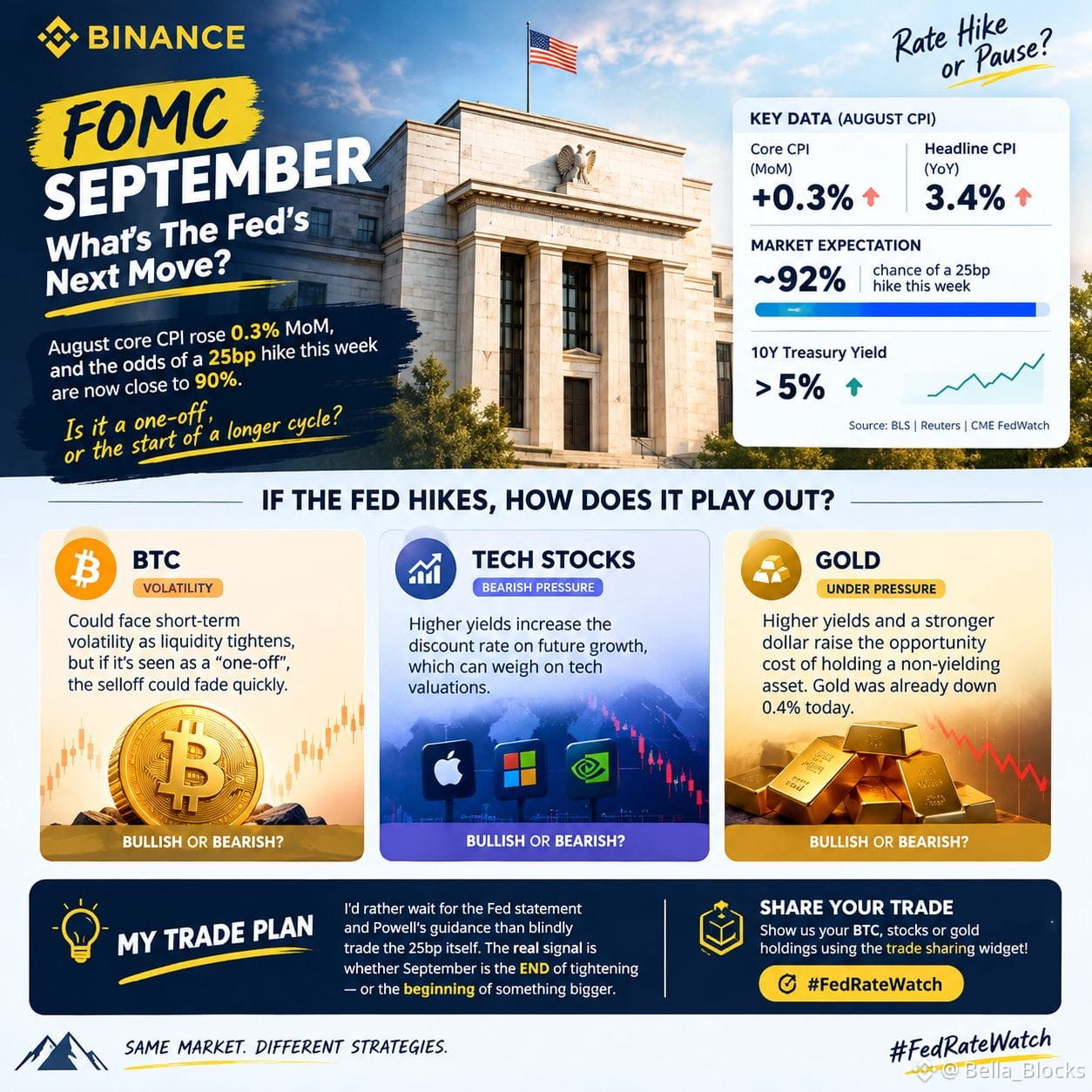
I’m watching the Fed this week less for the 25bp headline and more for what comes AFTER it.
August core CPI rose 0.3% MoM, headline CPI hit 3.4% YoY, and markets are now pricing roughly a 92% chance of a 25bp hike. The bigger problem? The 10Y Treasury yield has pushed above 5%.
So if the Fed hikes to 3.75–4.00%, I don’t think the first reaction tells the whole story.
BTC could face volatility as liquidity tightens, but if traders interpret the hike as a “one-off” rather than the beginning of another cycle, the selloff could fade quickly.
Tech stocks have a tougher setup because higher yields increase the discount rate on future growth. Gold is also feeling pressure as higher yields and a stronger dollar raise the opportunity cost of holding a non-yielding asset. Gold was already down 0.4% today amid rising hike expectations.
My trade plan: I’d rather wait for the Fed statement and Powell’s guidance than blindly trade the 25bp itself. The real signal is whether September is the END of tightening—or the beginning of something bigger.
That distinction could decide the next move in BTC, tech and gold.
#FedRateWatch
$POWER
{future}(POWERUSDT)
$AIN
{future}(AINUSDT)
$AI
{spot}(AIUSDT)
I’m watching the Fed this week less for the 25bp headline and more for what comes AFTER it.
August core CPI rose 0.3% MoM, headline CPI hit 3.4% YoY, and markets are now pricing roughly a 92% chance of a 25bp hike. The bigger problem? The 10Y Treasury yield has pushed above 5%.
So if the Fed hikes to 3.75–4.00%, I don’t think the first reaction tells the whole story.
BTC could face volatility as liquidity tightens, but if traders interpret the hike as a “one-off” rather than the beginning of another cycle, the selloff could fade quickly.
Tech stocks have a tougher setup because higher yields increase the discount rate on future growth. Gold is also feeling pressure as higher yields and a stronger dollar raise the opportunity cost of holding a non-yielding asset. Gold was already down 0.4% today amid rising hike expectations.
My trade plan: I’d rather wait for the Fed statement and Powell’s guidance than blindly trade the 25bp itself. The real signal is whether September is the END of tightening—or the beginning of something bigger.
That distinction could decide the next move in BTC, tech and gold.
#FedRateWatch
$POWER
$AIN
$AI
August core CPI rose 0.3% MoM, headline CPI hit 3.4% YoY, and markets are now pricing roughly a 92% chance of a 25bp hike. The bigger problem? The 10Y Treasury yield has pushed above 5%.
So if the Fed hikes to 3.75–4.00%, I don’t think the first reaction tells the whole story.
BTC could face volatility as liquidity tightens, but if traders interpret the hike as a “one-off” rather than the beginning of another cycle, the selloff could fade quickly.
Tech stocks have a tougher setup because higher yields increase the discount rate on future growth. Gold is also feeling pressure as higher yields and a stronger dollar raise the opportunity cost of holding a non-yielding asset. Gold was already down 0.4% today amid rising hike expectations.
My trade plan: I’d rather wait for the Fed statement and Powell’s guidance than blindly trade the 25bp itself. The real signal is whether September is the END of tightening—or the beginning of something bigger.
That distinction could decide the next move in BTC, tech and gold.
#FedRateWatch
$POWER
$AIN
$AI
175
·
--
Рост
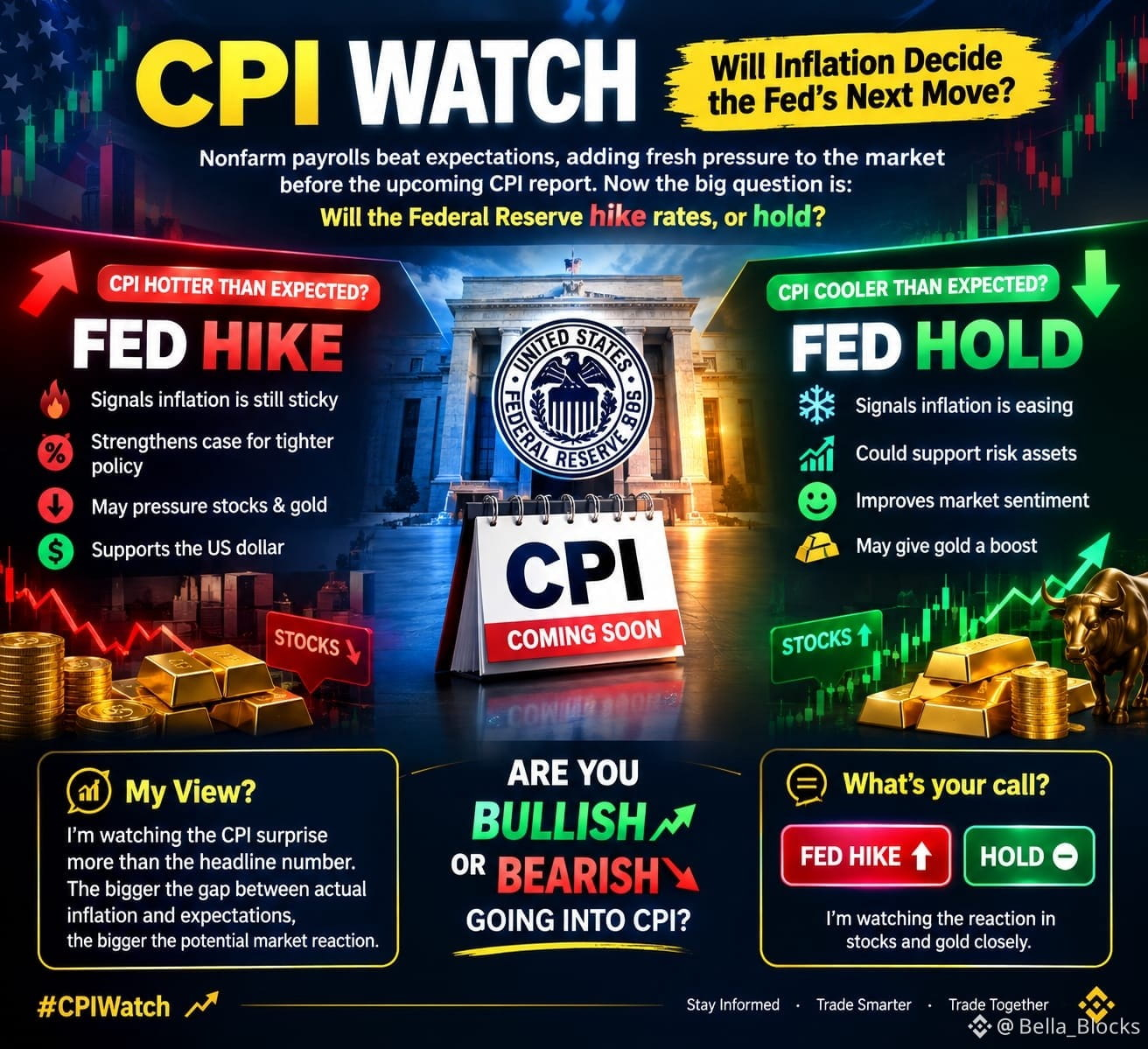
🔥 CPI WATCH: Will Inflation Decide the Fed’s Next Move?
Nonfarm payrolls came in stronger than expected, adding fresh pressure to the market ahead of the upcoming CPI report. Now the big question is: Will the Federal Reserve hike rates, or hold?
A hotter-than-expected CPI could signal that inflation is still sticky. That may strengthen the case for tighter policy, potentially putting pressure on stocks and gold while supporting the dollar. 📉
But if CPI comes in cooler than expected, markets could interpret it as a sign that inflation is easing. A rate-hold narrative could become stronger, potentially supporting risk assets and improving sentiment toward stocks. 📈
My view? I’m watching the CPI surprise more than the headline number. The bigger the gap between actual inflation and expectations, the bigger the potential market reaction.
Are you bullish or bearish going into CPI? I’m watching the reaction in stocks and gold closely.
What’s your call: FED HIKE 🔴 or HOLD 🟢?
#CPIWatch
$NES
{alpha}(560x097acf27503753e77bca940277806156c5925b81)
$4Stock
{alpha}(560xd270d4e1ec6e6e0d28c0ecb8be966ec75997ffff)
$MEME
{spot}(MEMEUSDT)
🔥 CPI WATCH: Will Inflation Decide the Fed’s Next Move?
Nonfarm payrolls came in stronger than expected, adding fresh pressure to the market ahead of the upcoming CPI report. Now the big question is: Will the Federal Reserve hike rates, or hold?
A hotter-than-expected CPI could signal that inflation is still sticky. That may strengthen the case for tighter policy, potentially putting pressure on stocks and gold while supporting the dollar. 📉
But if CPI comes in cooler than expected, markets could interpret it as a sign that inflation is easing. A rate-hold narrative could become stronger, potentially supporting risk assets and improving sentiment toward stocks. 📈
My view? I’m watching the CPI surprise more than the headline number. The bigger the gap between actual inflation and expectations, the bigger the potential market reaction.
Are you bullish or bearish going into CPI? I’m watching the reaction in stocks and gold closely.
What’s your call: FED HIKE 🔴 or HOLD 🟢?
#CPIWatch
$NES
$4Stock
$MEME
Nonfarm payrolls came in stronger than expected, adding fresh pressure to the market ahead of the upcoming CPI report. Now the big question is: Will the Federal Reserve hike rates, or hold?
A hotter-than-expected CPI could signal that inflation is still sticky. That may strengthen the case for tighter policy, potentially putting pressure on stocks and gold while supporting the dollar. 📉
But if CPI comes in cooler than expected, markets could interpret it as a sign that inflation is easing. A rate-hold narrative could become stronger, potentially supporting risk assets and improving sentiment toward stocks. 📈
My view? I’m watching the CPI surprise more than the headline number. The bigger the gap between actual inflation and expectations, the bigger the potential market reaction.
Are you bullish or bearish going into CPI? I’m watching the reaction in stocks and gold closely.
What’s your call: FED HIKE 🔴 or HOLD 🟢?
#CPIWatch
$NES
$4Stock
$MEME
18
19
267
·
--
#dusk $DUSK @Dusk_Foundation
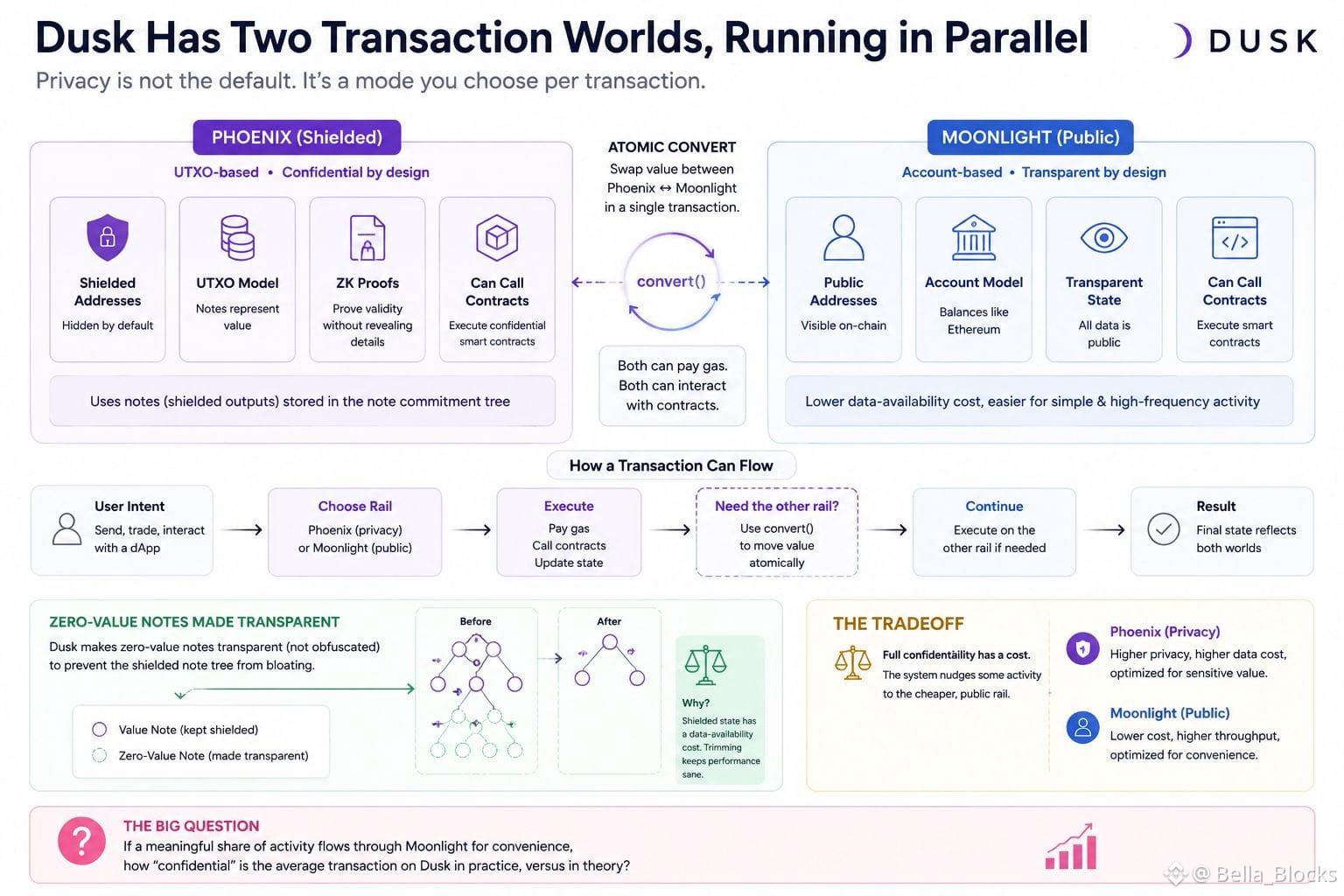
I was digging through Dusk's docs trying to understand what "confidential dApp" actually means at the transaction level, and I ran into something that made me pause. Dusk doesn't have one transaction type — it has two, running in parallel. Phoenix is the shielded, UTXO-based model. Moonlight is public and account-based, closer to how Ethereum works. Both can pay gas, both can call contracts, and there's literally a convert function that lets you atomically swap value between the two.
That's not what I expected. I'd assumed "privacy-first chain" meant privacy by default. It doesn't. Privacy is a mode you opt into per transaction, not a property of the network itself.
I went back to the engineering notes twice because I thought I'd misread it, but there's another detail buried in there: Dusk started making zero-value notes transparent instead of obfuscated, specifically to stop the shielded note tree from bloating with non-value entries. So shielded state isn't free to maintain — the protocol is actively trimming what it hides to keep performance sane.
None of this feels like a flaw. It reads more like an honest tradeoff: full confidentiality has a data-availability cost, so the system nudges some activity toward the cheaper, public rail.
Which raises the question — if a meaningful share of activity ends up flowing through Moonlight for convenience, how "confidential" is the average transaction on Dusk in practice, versus in theory?
$BMT
{spot}(BMTUSDT)
$STX
{spot}(STXUSDT)
{spot}(DUSKUSDT)
#dusk $DUSK @Dusk
I was digging through Dusk's docs trying to understand what "confidential dApp" actually means at the transaction level, and I ran into something that made me pause. Dusk doesn't have one transaction type — it has two, running in parallel. Phoenix is the shielded, UTXO-based model. Moonlight is public and account-based, closer to how Ethereum works. Both can pay gas, both can call contracts, and there's literally a convert function that lets you atomically swap value between the two.
That's not what I expected. I'd assumed "privacy-first chain" meant privacy by default. It doesn't. Privacy is a mode you opt into per transaction, not a property of the network itself.
I went back to the engineering notes twice because I thought I'd misread it, but there's another detail buried in there: Dusk started making zero-value notes transparent instead of obfuscated, specifically to stop the shielded note tree from bloating with non-value entries. So shielded state isn't free to maintain — the protocol is actively trimming what it hides to keep performance sane.
None of this feels like a flaw. It reads more like an honest tradeoff: full confidentiality has a data-availability cost, so the system nudges some activity toward the cheaper, public rail.
Which raises the question — if a meaningful share of activity ends up flowing through Moonlight for convenience, how "confidential" is the average transaction on Dusk in practice, versus in theory?
$BMT
$STX
I was digging through Dusk's docs trying to understand what "confidential dApp" actually means at the transaction level, and I ran into something that made me pause. Dusk doesn't have one transaction type — it has two, running in parallel. Phoenix is the shielded, UTXO-based model. Moonlight is public and account-based, closer to how Ethereum works. Both can pay gas, both can call contracts, and there's literally a convert function that lets you atomically swap value between the two.
That's not what I expected. I'd assumed "privacy-first chain" meant privacy by default. It doesn't. Privacy is a mode you opt into per transaction, not a property of the network itself.
I went back to the engineering notes twice because I thought I'd misread it, but there's another detail buried in there: Dusk started making zero-value notes transparent instead of obfuscated, specifically to stop the shielded note tree from bloating with non-value entries. So shielded state isn't free to maintain — the protocol is actively trimming what it hides to keep performance sane.
None of this feels like a flaw. It reads more like an honest tradeoff: full confidentiality has a data-availability cost, so the system nudges some activity toward the cheaper, public rail.
Which raises the question — if a meaningful share of activity ends up flowing through Moonlight for convenience, how "confidential" is the average transaction on Dusk in practice, versus in theory?
$BMT
$STX
1
189
·
--
#dusk $DUSK @Dusk_Foundation
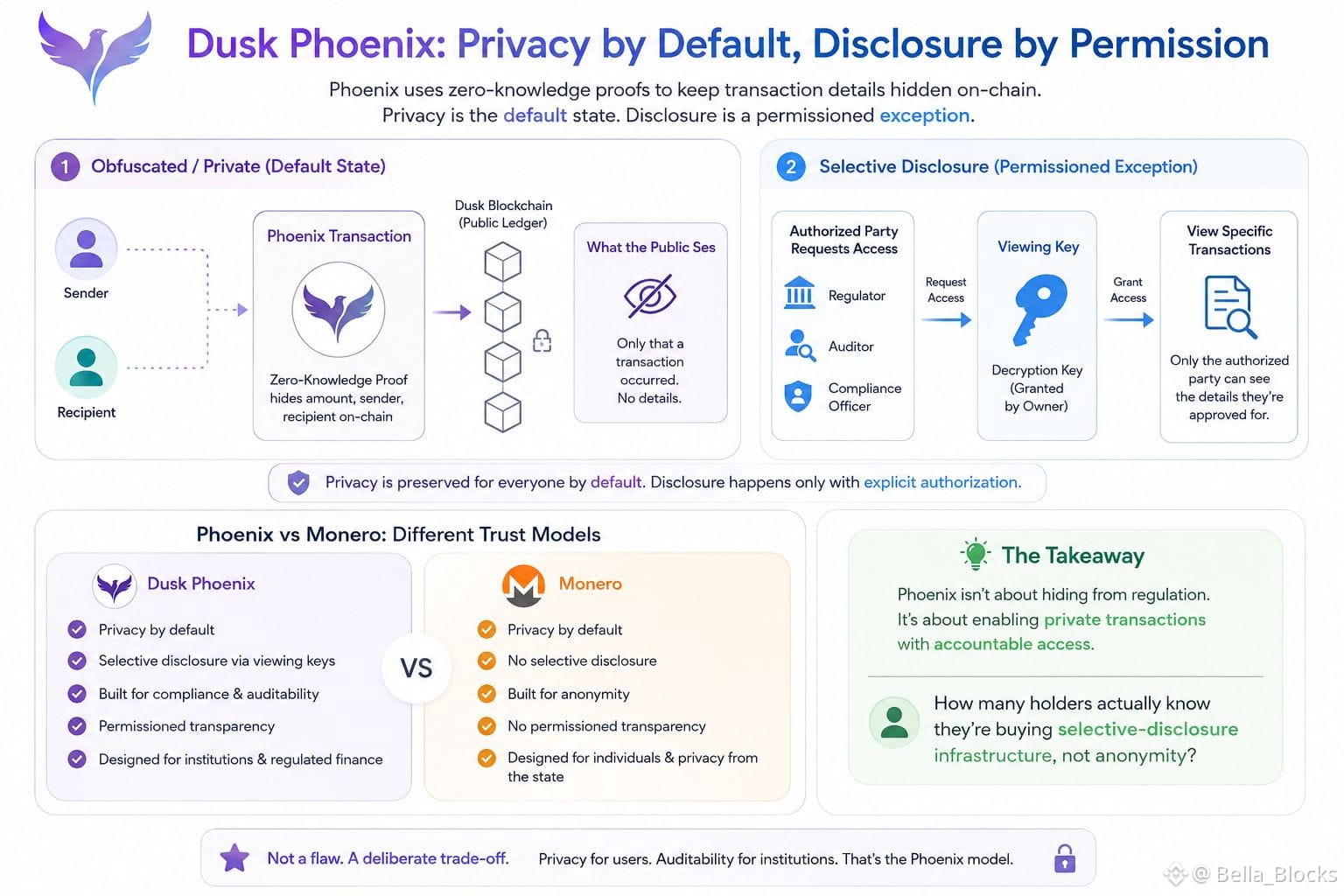
I was digging through Dusk's documentation on their Phoenix transaction model, trying to understand how they actually balance privacy with the compliance requirements banks would need. And I got stuck on something that isn't really talked about outside the technical docs: the difference between "obfuscated" and "private" in their own framing.
Dusk uses zero-knowledge proofs so transaction amounts and participants aren't visible on-chain by default. Fine, that's the pitch everyone repeats. But then I noticed they specifically build in the ability for selective disclosure — meaning a regulator or auditor can be given a viewing key to see specific transactions without the whole network being exposed. That's not the same thing as "private" in the way most retail crypto users mean it when they hear the word.
I went back to the docs twice because I wanted to make sure I wasn't overreading this. What it actually creates is a system where privacy is the default state, but disclosure is a permissioned exception — not a public one. That's a meaningfully different trust model than something like Monero, and it's clearly designed for institutions that need audit trails, not anonymity from the state.
It's not a flaw. It's a deliberate trade-off. But it does mean the "privacy coin" label gets thrown around loosely.
How many holders actually know they're buying selective-disclosure infrastructure, not anonymity?
$SPK
{spot}(SPKUSDT)
$MORPHO
{spot}(MORPHOUSDT)
{spot}(DUSKUSDT)
#dusk $DUSK @Dusk
I was digging through Dusk's documentation on their Phoenix transaction model, trying to understand how they actually balance privacy with the compliance requirements banks would need. And I got stuck on something that isn't really talked about outside the technical docs: the difference between "obfuscated" and "private" in their own framing.
Dusk uses zero-knowledge proofs so transaction amounts and participants aren't visible on-chain by default. Fine, that's the pitch everyone repeats. But then I noticed they specifically build in the ability for selective disclosure — meaning a regulator or auditor can be given a viewing key to see specific transactions without the whole network being exposed. That's not the same thing as "private" in the way most retail crypto users mean it when they hear the word.
I went back to the docs twice because I wanted to make sure I wasn't overreading this. What it actually creates is a system where privacy is the default state, but disclosure is a permissioned exception — not a public one. That's a meaningfully different trust model than something like Monero, and it's clearly designed for institutions that need audit trails, not anonymity from the state.
It's not a flaw. It's a deliberate trade-off. But it does mean the "privacy coin" label gets thrown around loosely.
How many holders actually know they're buying selective-disclosure infrastructure, not anonymity?
$SPK
$MORPHO
I was digging through Dusk's documentation on their Phoenix transaction model, trying to understand how they actually balance privacy with the compliance requirements banks would need. And I got stuck on something that isn't really talked about outside the technical docs: the difference between "obfuscated" and "private" in their own framing.
Dusk uses zero-knowledge proofs so transaction amounts and participants aren't visible on-chain by default. Fine, that's the pitch everyone repeats. But then I noticed they specifically build in the ability for selective disclosure — meaning a regulator or auditor can be given a viewing key to see specific transactions without the whole network being exposed. That's not the same thing as "private" in the way most retail crypto users mean it when they hear the word.
I went back to the docs twice because I wanted to make sure I wasn't overreading this. What it actually creates is a system where privacy is the default state, but disclosure is a permissioned exception — not a public one. That's a meaningfully different trust model than something like Monero, and it's clearly designed for institutions that need audit trails, not anonymity from the state.
It's not a flaw. It's a deliberate trade-off. But it does mean the "privacy coin" label gets thrown around loosely.
How many holders actually know they're buying selective-disclosure infrastructure, not anonymity?
$SPK
$MORPHO
3
2
199
·
--
#dusk $DUSK @Dusk_Foundation
I was digging through Dusk's own use-case docs on Smart Bulletin Boards, expecting some kind of automated matching engine, and the wording that jumped out was that they indirectly match qualified buyers and sellers of security tokens Dusk , and only once both parties come to terms and a deal is struck, they can execute the trade Dusk .
That word "indirectly" made me stop. I went back to the docs twice because I'd assumed "smart bulletin board" meant some on-chain orderbook doing the matching for you. It doesn't, at least not from what's published. The board is a discovery layer — it surfaces qualified counterparties — but the actual negotiation (price, terms, timing) still happens off-chain, human to human. What's trustless is the settlement, not the deal-making.
That's not a flaw, it's a design choice that maps to how private securities already trade OTC, where Dusk's own materials point out that broker/lawyer involvement typically costs somewhere in the 2.5%-15% Dusk range. The bulletin board is aimed at compressing that cost by cutting the settlement friction, not the negotiation itself. It's more like a matchmaking app that still leaves the actual date up to you than a vending machine that closes the deal automatically.
So the incentive this creates is interesting: it rewards parties who already know how to negotiate OTC, while the "trustless" part only kicks in at the very end. How many people assume the whole process is automated, versus just the settlement?
$TUT
{spot}(TUTUSDT)
$PORTAL
{spot}(PORTALUSDT)
{spot}(DUSKUSDT)
How automated do you think Dusk’s Smart Bulletin Board is?
#dusk $DUSK @Dusk
I was digging through Dusk's own use-case docs on Smart Bulletin Boards, expecting some kind of automated matching engine, and the wording that jumped out was that they indirectly match qualified buyers and sellers of security tokens Dusk , and only once both parties come to terms and a deal is struck, they can execute the trade Dusk .
That word "indirectly" made me stop. I went back to the docs twice because I'd assumed "smart bulletin board" meant some on-chain orderbook doing the matching for you. It doesn't, at least not from what's published. The board is a discovery layer — it surfaces qualified counterparties — but the actual negotiation (price, terms, timing) still happens off-chain, human to human. What's trustless is the settlement, not the deal-making.
That's not a flaw, it's a design choice that maps to how private securities already trade OTC, where Dusk's own materials point out that broker/lawyer involvement typically costs somewhere in the 2.5%-15% Dusk range. The bulletin board is aimed at compressing that cost by cutting the settlement friction, not the negotiation itself. It's more like a matchmaking app that still leaves the actual date up to you than a vending machine that closes the deal automatically.
So the incentive this creates is interesting: it rewards parties who already know how to negotiate OTC, while the "trustless" part only kicks in at the very end. How many people assume the whole process is automated, versus just the settlement?
$TUT
$PORTAL
How automated do you think Dusk’s Smart Bulletin Board is?
I was digging through Dusk's own use-case docs on Smart Bulletin Boards, expecting some kind of automated matching engine, and the wording that jumped out was that they indirectly match qualified buyers and sellers of security tokens Dusk , and only once both parties come to terms and a deal is struck, they can execute the trade Dusk .
That word "indirectly" made me stop. I went back to the docs twice because I'd assumed "smart bulletin board" meant some on-chain orderbook doing the matching for you. It doesn't, at least not from what's published. The board is a discovery layer — it surfaces qualified counterparties — but the actual negotiation (price, terms, timing) still happens off-chain, human to human. What's trustless is the settlement, not the deal-making.
That's not a flaw, it's a design choice that maps to how private securities already trade OTC, where Dusk's own materials point out that broker/lawyer involvement typically costs somewhere in the 2.5%-15% Dusk range. The bulletin board is aimed at compressing that cost by cutting the settlement friction, not the negotiation itself. It's more like a matchmaking app that still leaves the actual date up to you than a vending machine that closes the deal automatically.
So the incentive this creates is interesting: it rewards parties who already know how to negotiate OTC, while the "trustless" part only kicks in at the very end. How many people assume the whole process is automated, versus just the settlement?
$TUT
$PORTAL
How automated do you think Dusk’s Smart Bulletin Board is?
🤖 Fully automated
67%
🤝 Discovery+human negotiation
0%
🔐 Trustless settlement only
33%
🤔 Not sure
0%
3 проголосовали • Голосование закрыто
3
1.3k
·
--
#dusk $DUSK @Dusk_Foundation
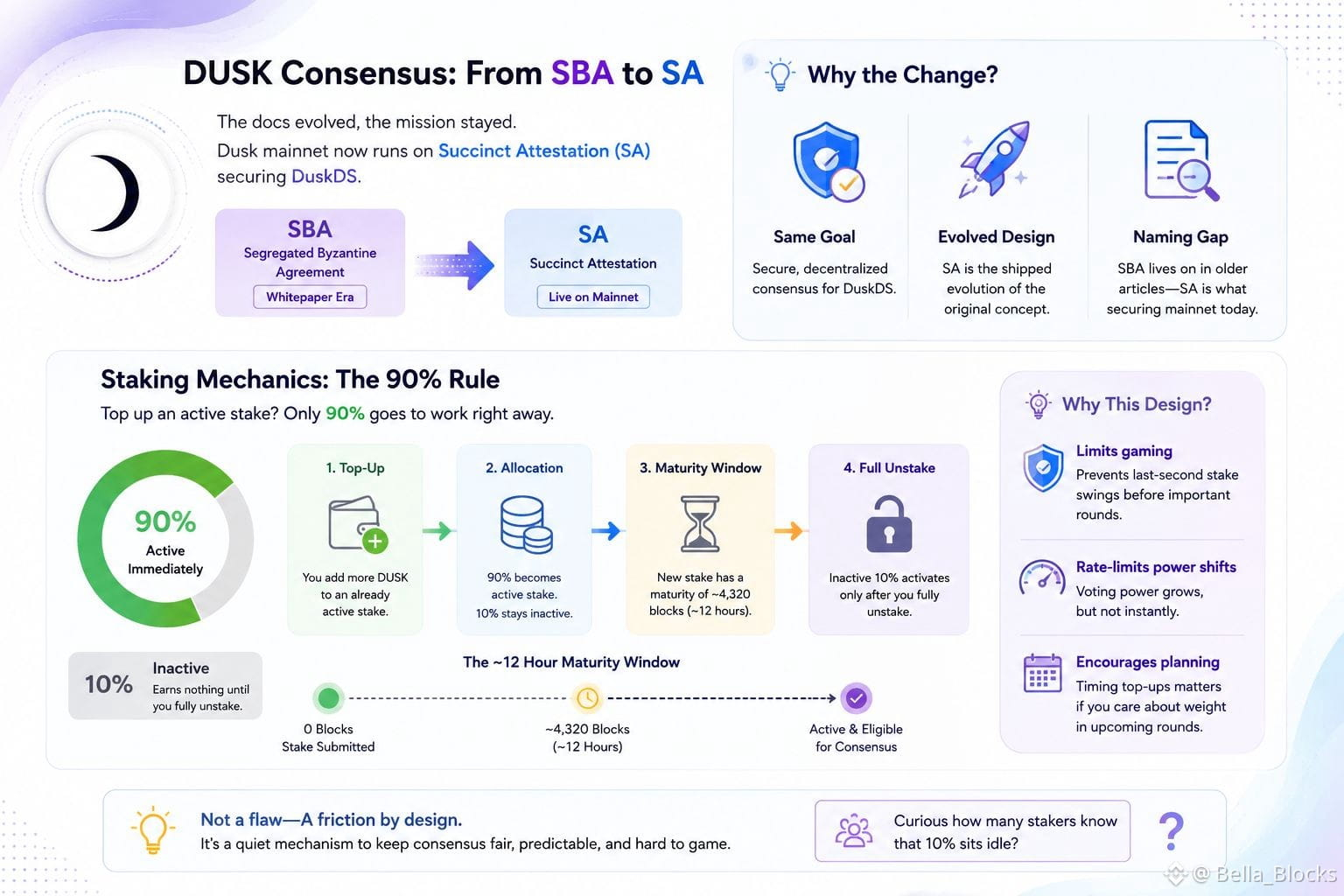
I was digging through Dusk's current docs to refresh myself on the SBA consensus everyone still references in write-ups, and I noticed the docs don't actually call it that anymore. The live mainnet documentation refers to "Succinct Attestation" (SA) as the consensus protocol securing DuskDS, while most explainer articles, exchange listings, and even parts of the community still talk about Segregated Byzantine Agreement like it's the current thing. Went back and checked twice because I assumed I'd mixed up two different mechanisms — but no, SA is described as the evolution that shipped for mainnet, and SBA is mostly whitepaper-era language now.
That's a naming gap, not a red flag, but it led me somewhere more interesting: the staking mechanics underneath it. If you top up an already-active stake, only 90% of the new amount goes active immediately — the other 10% sits inactive, earning nothing, until you fully unstake. It's a quiet friction point. Combined with a ~4,320 block (roughly 12-hour) maturity window on any new stake, it means compounding isn't as frictionless as "just add more DUSK" — there's a deliberate lag baked in, presumably to limit gaming of sortition weight right before rounds where stake size matters.
None of this is hidden, it's just not front-page material. It reads less like a flaw and more like a rate-limiter on how fast voting power can shift.
Curious how many stakers actually know that 10% sits idle — and whether that's shaping how people time their top-ups.
$TRUMP
{spot}(TRUMPUSDT)
$TRB
{future}(TRBUSDT)
{spot}(DUSKUSDT)
#dusk $DUSK @Dusk
I was digging through Dusk's current docs to refresh myself on the SBA consensus everyone still references in write-ups, and I noticed the docs don't actually call it that anymore. The live mainnet documentation refers to "Succinct Attestation" (SA) as the consensus protocol securing DuskDS, while most explainer articles, exchange listings, and even parts of the community still talk about Segregated Byzantine Agreement like it's the current thing. Went back and checked twice because I assumed I'd mixed up two different mechanisms — but no, SA is described as the evolution that shipped for mainnet, and SBA is mostly whitepaper-era language now.
That's a naming gap, not a red flag, but it led me somewhere more interesting: the staking mechanics underneath it. If you top up an already-active stake, only 90% of the new amount goes active immediately — the other 10% sits inactive, earning nothing, until you fully unstake. It's a quiet friction point. Combined with a ~4,320 block (roughly 12-hour) maturity window on any new stake, it means compounding isn't as frictionless as "just add more DUSK" — there's a deliberate lag baked in, presumably to limit gaming of sortition weight right before rounds where stake size matters.
None of this is hidden, it's just not front-page material. It reads less like a flaw and more like a rate-limiter on how fast voting power can shift.
Curious how many stakers actually know that 10% sits idle — and whether that's shaping how people time their top-ups.
$TRUMP
$TRB
I was digging through Dusk's current docs to refresh myself on the SBA consensus everyone still references in write-ups, and I noticed the docs don't actually call it that anymore. The live mainnet documentation refers to "Succinct Attestation" (SA) as the consensus protocol securing DuskDS, while most explainer articles, exchange listings, and even parts of the community still talk about Segregated Byzantine Agreement like it's the current thing. Went back and checked twice because I assumed I'd mixed up two different mechanisms — but no, SA is described as the evolution that shipped for mainnet, and SBA is mostly whitepaper-era language now.
That's a naming gap, not a red flag, but it led me somewhere more interesting: the staking mechanics underneath it. If you top up an already-active stake, only 90% of the new amount goes active immediately — the other 10% sits inactive, earning nothing, until you fully unstake. It's a quiet friction point. Combined with a ~4,320 block (roughly 12-hour) maturity window on any new stake, it means compounding isn't as frictionless as "just add more DUSK" — there's a deliberate lag baked in, presumably to limit gaming of sortition weight right before rounds where stake size matters.
None of this is hidden, it's just not front-page material. It reads less like a flaw and more like a rate-limiter on how fast voting power can shift.
Curious how many stakers actually know that 10% sits idle — and whether that's shaping how people time their top-ups.
$TRUMP
$TRB
1
1
292
·
--
#dusk $DUSK @Dusk_Foundation
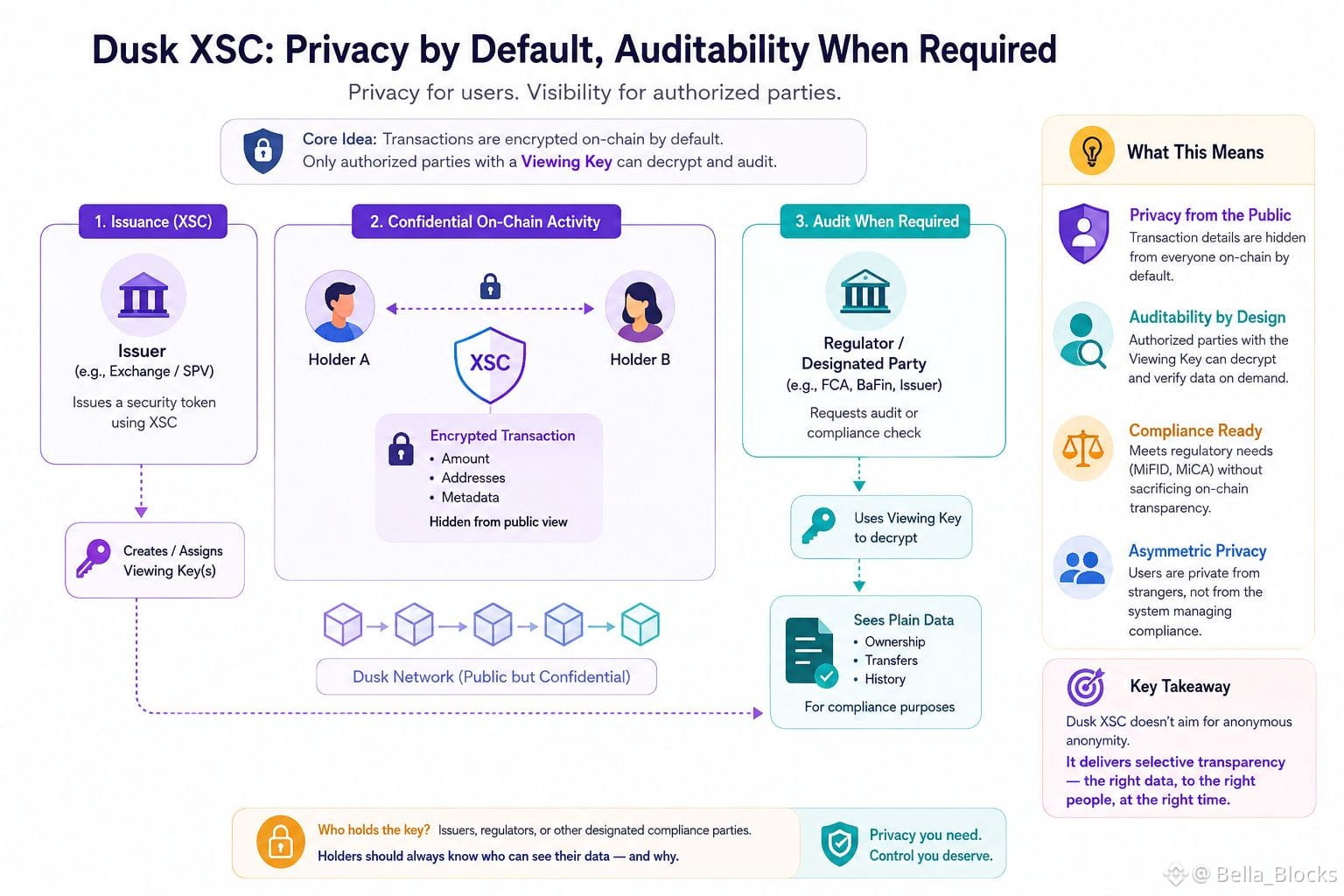
I was digging through Dusk's docs trying to understand what "privacy by default, auditability when required" actually means at the protocol level, because that phrase shows up everywhere in their RWA materials and I wanted to know who's doing the auditing.
Turns out the XSC standard bakes in optional viewing keys tied to the compliance layer — so when a security token gets issued through XSC, the issuer (or a designated regulator) can hold a key that decrypts transaction details that stay hidden from everyone else on-chain. I went back to the docs twice because I initially read it as full end-to-end privacy, the kind you'd get with a typical shielded transaction. It's not quite that. It's privacy from the public, not necessarily from the counterparty running the compliance rules.
That's not a flaw, it's the whole point — you can't get a MiFID or MiCA-compliant security token without someone being able to prove ownership and flow of funds on demand. But it does mean the privacy guarantee is asymmetric by design, and I don't think that's obvious to someone reading "confidential" on the homepage and assuming symmetric anonymity like a privacy coin.
The incentive this creates is interesting: issuers get comfortable putting real securities on a public chain precisely because they retain visibility. Users get privacy from strangers, not from the system managing them. Worth asking how many holders actually know who's holding that key on any given asset.
{spot}(DUSKUSDT)
#dusk $DUSK @Dusk
I was digging through Dusk's docs trying to understand what "privacy by default, auditability when required" actually means at the protocol level, because that phrase shows up everywhere in their RWA materials and I wanted to know who's doing the auditing.
Turns out the XSC standard bakes in optional viewing keys tied to the compliance layer — so when a security token gets issued through XSC, the issuer (or a designated regulator) can hold a key that decrypts transaction details that stay hidden from everyone else on-chain. I went back to the docs twice because I initially read it as full end-to-end privacy, the kind you'd get with a typical shielded transaction. It's not quite that. It's privacy from the public, not necessarily from the counterparty running the compliance rules.
That's not a flaw, it's the whole point — you can't get a MiFID or MiCA-compliant security token without someone being able to prove ownership and flow of funds on demand. But it does mean the privacy guarantee is asymmetric by design, and I don't think that's obvious to someone reading "confidential" on the homepage and assuming symmetric anonymity like a privacy coin.
The incentive this creates is interesting: issuers get comfortable putting real securities on a public chain precisely because they retain visibility. Users get privacy from strangers, not from the system managing them. Worth asking how many holders actually know who's holding that key on any given asset.
I was digging through Dusk's docs trying to understand what "privacy by default, auditability when required" actually means at the protocol level, because that phrase shows up everywhere in their RWA materials and I wanted to know who's doing the auditing.
Turns out the XSC standard bakes in optional viewing keys tied to the compliance layer — so when a security token gets issued through XSC, the issuer (or a designated regulator) can hold a key that decrypts transaction details that stay hidden from everyone else on-chain. I went back to the docs twice because I initially read it as full end-to-end privacy, the kind you'd get with a typical shielded transaction. It's not quite that. It's privacy from the public, not necessarily from the counterparty running the compliance rules.
That's not a flaw, it's the whole point — you can't get a MiFID or MiCA-compliant security token without someone being able to prove ownership and flow of funds on demand. But it does mean the privacy guarantee is asymmetric by design, and I don't think that's obvious to someone reading "confidential" on the homepage and assuming symmetric anonymity like a privacy coin.
The incentive this creates is interesting: issuers get comfortable putting real securities on a public chain precisely because they retain visibility. Users get privacy from strangers, not from the system managing them. Worth asking how many holders actually know who's holding that key on any given asset.
12
10
619
·
--
#termmax @termmax
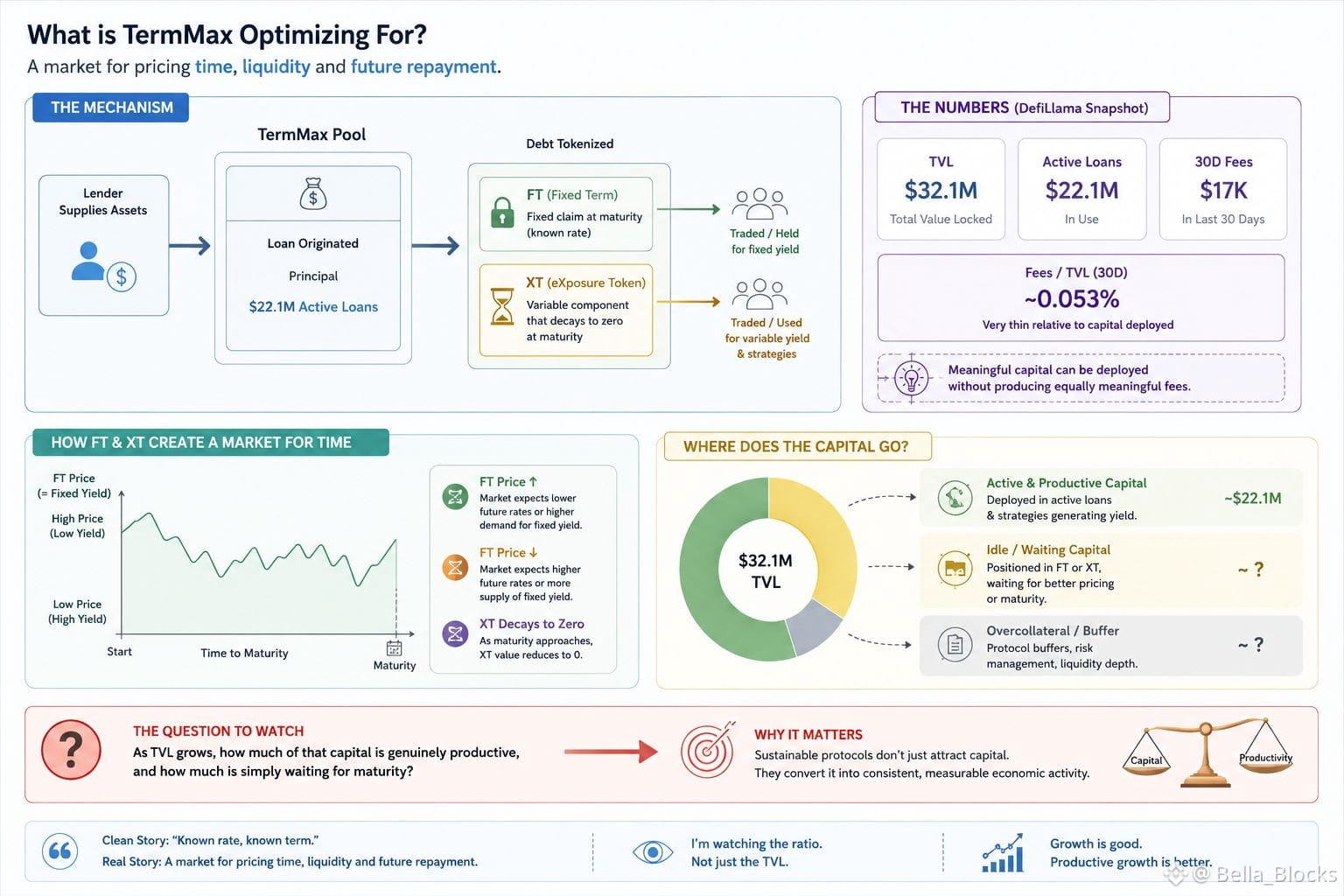
I keep coming back to one number while digging through TermMax: the gap between capital sitting in the protocol and the fees it’s actually generating.
The latest DefiLlama snapshot I found shows about $32.1M TVL, with roughly $22.1M in active loans, while 30-day fees were only around $17K.
I thought I had misread it, so I went back into the docs to understand what TermMax is actually optimizing for.
The mechanism is more interesting than a simple “fixed-rate lending” label suggests. TermMax tokenizes debt into FT and XT. FT represents the fixed claim at maturity, while XT carries the remaining variable component and eventually goes to zero.
That creates a different behavior from a normal lending pool. Capital isn’t simply earning a floating rate. Users are trading around specific maturities, and the FT price effectively determines the fixed yield.
So the clean story is “known rate, known term.” Underneath, it’s really a market for pricing time, liquidity and future repayment.
The interesting part is that meaningful capital can be deployed without producing equally meaningful fees. That isn’t automatically a problem. Usage could still be concentrated in certain markets or strategies.
But it raises a question I think is worth watching:
As TVL grows, how much of that capital is genuinely productive, and how much is simply waiting for maturity?
$ONG
{spot}(ONGUSDT)
$PEOPLE
{spot}(PEOPLEUSDT)
$NEIRO
{spot}(NEIROUSDT)
#termmax @TermMax
I keep coming back to one number while digging through TermMax: the gap between capital sitting in the protocol and the fees it’s actually generating.
The latest DefiLlama snapshot I found shows about $32.1M TVL, with roughly $22.1M in active loans, while 30-day fees were only around $17K.
I thought I had misread it, so I went back into the docs to understand what TermMax is actually optimizing for.
The mechanism is more interesting than a simple “fixed-rate lending” label suggests. TermMax tokenizes debt into FT and XT. FT represents the fixed claim at maturity, while XT carries the remaining variable component and eventually goes to zero.
That creates a different behavior from a normal lending pool. Capital isn’t simply earning a floating rate. Users are trading around specific maturities, and the FT price effectively determines the fixed yield.
So the clean story is “known rate, known term.” Underneath, it’s really a market for pricing time, liquidity and future repayment.
The interesting part is that meaningful capital can be deployed without producing equally meaningful fees. That isn’t automatically a problem. Usage could still be concentrated in certain markets or strategies.
But it raises a question I think is worth watching:
As TVL grows, how much of that capital is genuinely productive, and how much is simply waiting for maturity?
$ONG
$PEOPLE
$NEIRO
I keep coming back to one number while digging through TermMax: the gap between capital sitting in the protocol and the fees it’s actually generating.
The latest DefiLlama snapshot I found shows about $32.1M TVL, with roughly $22.1M in active loans, while 30-day fees were only around $17K.
I thought I had misread it, so I went back into the docs to understand what TermMax is actually optimizing for.
The mechanism is more interesting than a simple “fixed-rate lending” label suggests. TermMax tokenizes debt into FT and XT. FT represents the fixed claim at maturity, while XT carries the remaining variable component and eventually goes to zero.
That creates a different behavior from a normal lending pool. Capital isn’t simply earning a floating rate. Users are trading around specific maturities, and the FT price effectively determines the fixed yield.
So the clean story is “known rate, known term.” Underneath, it’s really a market for pricing time, liquidity and future repayment.
The interesting part is that meaningful capital can be deployed without producing equally meaningful fees. That isn’t automatically a problem. Usage could still be concentrated in certain markets or strategies.
But it raises a question I think is worth watching:
As TVL grows, how much of that capital is genuinely productive, and how much is simply waiting for maturity?
$ONG
$PEOPLE
$NEIRO
1
3
105
·
--
#dusk $DUSK @Dusk_Foundation
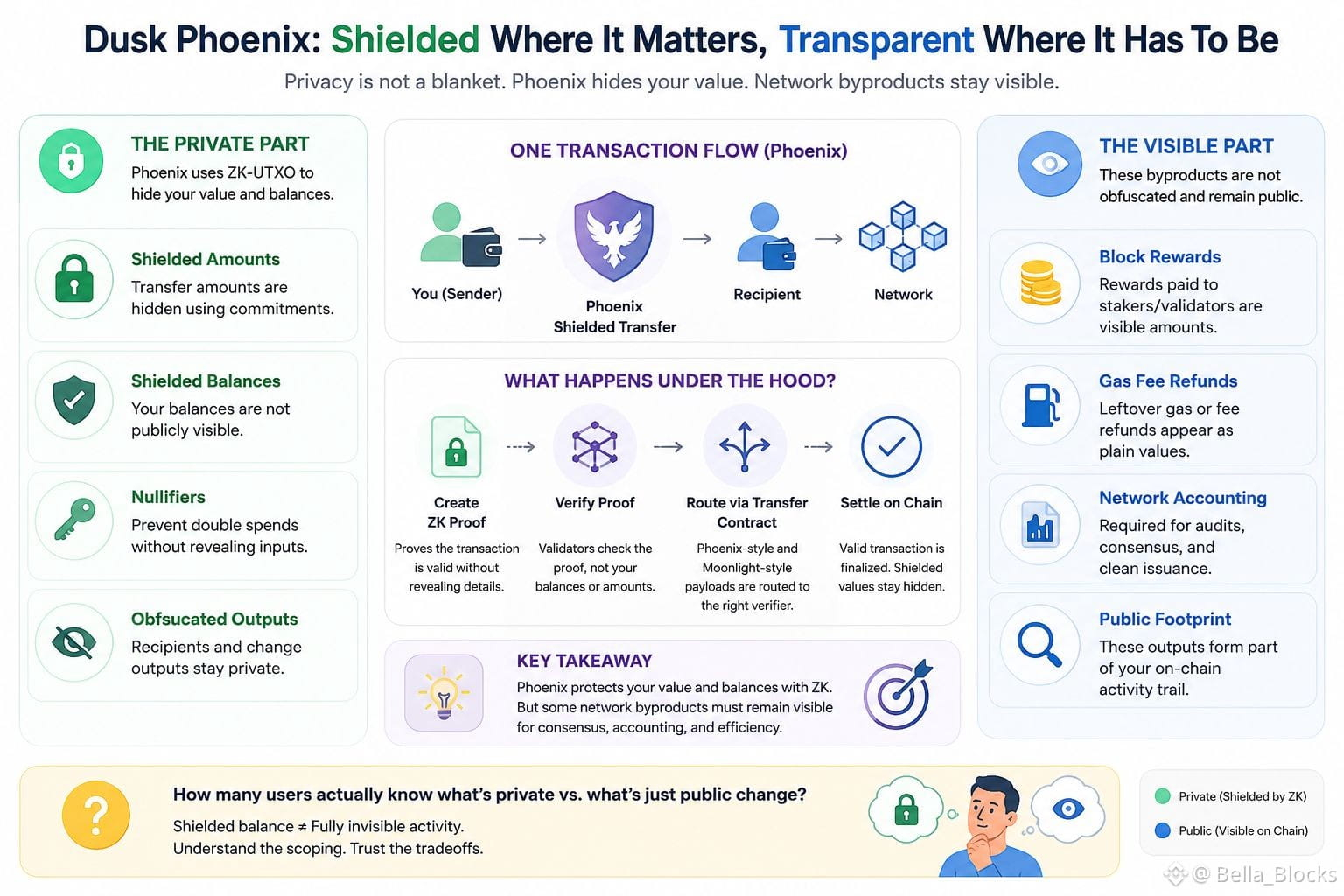
I was digging through Dusk's docs trying to understand what "shielded" actually means in Phoenix, and I hit a line that made me stop and reread it. One official description of Phoenix says it gives complete on-chain privacy — even for non-obfuscated outputs such as block rewards and gas fee refunds Complete privacy" and "non-obfuscated outputs" sitting in the same sentence felt like a contradiction, so I went back to the docs twice thinking I'd misread it.
Turns out it's not a mistake, it's a scoping choice. Phoenix is the zero-knowledge UTXO transaction model built into Dusk's Transfer contract, supporting both transparent and obfuscated transactions and at the settlement layer a Transfer Contract routes Phoenix-style and Moonlight-style payloads to the appropriate verification logic meaning shielded and transparent value can coexist on the same chain, sometimes in the same transaction flow.
So the "privacy" isn't a blanket. Your transfer amounts and balances can be obfuscated behind commitments and nullifiers, but the mechanical byproducts of actually using the network — leftover gas refunds, staking/block rewards — apparently surface as plain values rather than hidden ones.
That's not broken, it's a tradeoff: full obfuscation everywhere adds proving cost, and reward issuance likely needs to stay auditable for consensus to function cleanly. But it does mean part of your on-chain footprint stays visible even when your "balance" is technically shielded.
How many people running Phoenix transactions actually know which piece of their activity is the private part, and which is just public change?
$AVAAI
{future}(AVAAIUSDT)
{spot}(DUSKUSDT)
$BOME
{spot}(BOMEUSDT)
#dusk $DUSK @Dusk
I was digging through Dusk's docs trying to understand what "shielded" actually means in Phoenix, and I hit a line that made me stop and reread it. One official description of Phoenix says it gives complete on-chain privacy — even for non-obfuscated outputs such as block rewards and gas fee refunds Complete privacy" and "non-obfuscated outputs" sitting in the same sentence felt like a contradiction, so I went back to the docs twice thinking I'd misread it.
Turns out it's not a mistake, it's a scoping choice. Phoenix is the zero-knowledge UTXO transaction model built into Dusk's Transfer contract, supporting both transparent and obfuscated transactions and at the settlement layer a Transfer Contract routes Phoenix-style and Moonlight-style payloads to the appropriate verification logic meaning shielded and transparent value can coexist on the same chain, sometimes in the same transaction flow.
So the "privacy" isn't a blanket. Your transfer amounts and balances can be obfuscated behind commitments and nullifiers, but the mechanical byproducts of actually using the network — leftover gas refunds, staking/block rewards — apparently surface as plain values rather than hidden ones.
That's not broken, it's a tradeoff: full obfuscation everywhere adds proving cost, and reward issuance likely needs to stay auditable for consensus to function cleanly. But it does mean part of your on-chain footprint stays visible even when your "balance" is technically shielded.
How many people running Phoenix transactions actually know which piece of their activity is the private part, and which is just public change?
$AVAAI
$BOME
I was digging through Dusk's docs trying to understand what "shielded" actually means in Phoenix, and I hit a line that made me stop and reread it. One official description of Phoenix says it gives complete on-chain privacy — even for non-obfuscated outputs such as block rewards and gas fee refunds Complete privacy" and "non-obfuscated outputs" sitting in the same sentence felt like a contradiction, so I went back to the docs twice thinking I'd misread it.
Turns out it's not a mistake, it's a scoping choice. Phoenix is the zero-knowledge UTXO transaction model built into Dusk's Transfer contract, supporting both transparent and obfuscated transactions and at the settlement layer a Transfer Contract routes Phoenix-style and Moonlight-style payloads to the appropriate verification logic meaning shielded and transparent value can coexist on the same chain, sometimes in the same transaction flow.
So the "privacy" isn't a blanket. Your transfer amounts and balances can be obfuscated behind commitments and nullifiers, but the mechanical byproducts of actually using the network — leftover gas refunds, staking/block rewards — apparently surface as plain values rather than hidden ones.
That's not broken, it's a tradeoff: full obfuscation everywhere adds proving cost, and reward issuance likely needs to stay auditable for consensus to function cleanly. But it does mean part of your on-chain footprint stays visible even when your "balance" is technically shielded.
How many people running Phoenix transactions actually know which piece of their activity is the private part, and which is just public change?
$AVAAI
$BOME
2
3
305
·
--
#termmax @termmax
I was pulling numbers from TermMax's market list trying to understand how their fixed-rate mechanism actually prices debt, and something about the maturity structure caught me off guard.
Each TermMax market isn't a continuous pool like Aave or Compound — it's tied to a specific maturity date, after which that market just... ends. The fixed rate gets locked in at origination through what they call an order book style matching between lenders and borrowers, not an algorithmic curve. That's a meaningfully different design than the "utilization goes up, rate goes up" model most of us are used to.
Here's what made me pause: because liquidity is siloed per maturity, a market close to expiry can look thin even if the protocol's total TVL seems healthy. I went back to the docs twice because I wanted to make sure I wasn't misreading how rollover works — whether users get migrated automatically into the next maturity or have to manually re-enter. From what I could tell, that's on the user, not the protocol.
That's not necessarily a flaw. Fixed-rate lending inherently trades convenience for rate certainty, and forcing explicit rollover decisions might actually protect people from silently drifting into a rate environment they didn't choose. But it does create a UX cliff — a moment where inattentive users could sit in matured, non-earning positions without realizing it.
I still want to check actual rollover volume near past maturities before drawing conclusions. Anyone tracked what percentage of positions actually get renewed versus left dangling?
$ACE
{spot}(ACEUSDT)
$ONG
{spot}(ONGUSDT)
$BOME
{spot}(BOMEUSDT)
TermMax rollover: what do you think happens most?
#termmax @TermMax
I was pulling numbers from TermMax's market list trying to understand how their fixed-rate mechanism actually prices debt, and something about the maturity structure caught me off guard.
Each TermMax market isn't a continuous pool like Aave or Compound — it's tied to a specific maturity date, after which that market just... ends. The fixed rate gets locked in at origination through what they call an order book style matching between lenders and borrowers, not an algorithmic curve. That's a meaningfully different design than the "utilization goes up, rate goes up" model most of us are used to.
Here's what made me pause: because liquidity is siloed per maturity, a market close to expiry can look thin even if the protocol's total TVL seems healthy. I went back to the docs twice because I wanted to make sure I wasn't misreading how rollover works — whether users get migrated automatically into the next maturity or have to manually re-enter. From what I could tell, that's on the user, not the protocol.
That's not necessarily a flaw. Fixed-rate lending inherently trades convenience for rate certainty, and forcing explicit rollover decisions might actually protect people from silently drifting into a rate environment they didn't choose. But it does create a UX cliff — a moment where inattentive users could sit in matured, non-earning positions without realizing it.
I still want to check actual rollover volume near past maturities before drawing conclusions. Anyone tracked what percentage of positions actually get renewed versus left dangling?
$ACE
$ONG
$BOME
TermMax rollover: what do you think happens most?
I was pulling numbers from TermMax's market list trying to understand how their fixed-rate mechanism actually prices debt, and something about the maturity structure caught me off guard.
Each TermMax market isn't a continuous pool like Aave or Compound — it's tied to a specific maturity date, after which that market just... ends. The fixed rate gets locked in at origination through what they call an order book style matching between lenders and borrowers, not an algorithmic curve. That's a meaningfully different design than the "utilization goes up, rate goes up" model most of us are used to.
Here's what made me pause: because liquidity is siloed per maturity, a market close to expiry can look thin even if the protocol's total TVL seems healthy. I went back to the docs twice because I wanted to make sure I wasn't misreading how rollover works — whether users get migrated automatically into the next maturity or have to manually re-enter. From what I could tell, that's on the user, not the protocol.
That's not necessarily a flaw. Fixed-rate lending inherently trades convenience for rate certainty, and forcing explicit rollover decisions might actually protect people from silently drifting into a rate environment they didn't choose. But it does create a UX cliff — a moment where inattentive users could sit in matured, non-earning positions without realizing it.
I still want to check actual rollover volume near past maturities before drawing conclusions. Anyone tracked what percentage of positions actually get renewed versus left dangling?
$ACE
$ONG
$BOME
TermMax rollover: what do you think happens most?
🔄 Renewed
0%
😴 Left idle
0%
⚖️ 50/50
0%
❓ Not sure
0%
0 проголосовали • Голосование закрыто
1
2
447
·
--
#dusk $DUSK @Dusk_Foundation
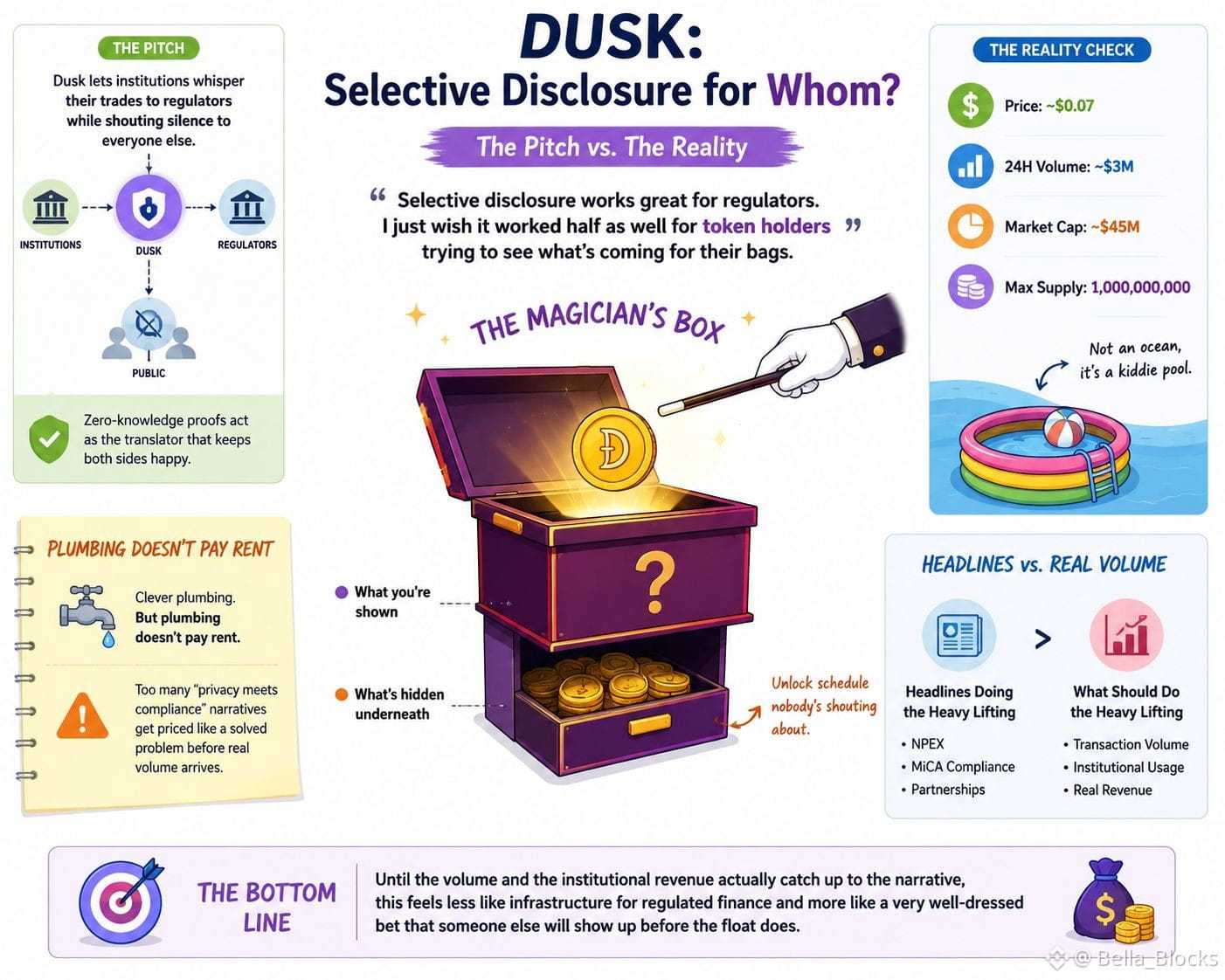
I keep staring at that phrase "selective disclosure" like it's supposed to make me feel safe, and instead it just makes me feel like I'm reading a prenup dressed up as a love letter. The whole pitch is that Dusk lets institutions whisper their trades to regulators while shouting silence to everyone else, zero-knowledge proofs standing in as the translator that keeps both sides happy. Fine. Clever plumbing. But plumbing doesn't pay rent, and I've watched enough "privacy meets compliance" narratives get priced like a solved problem before a single institution actually moves real volume through the pipes.
Right now DUSK is trading around seven cents with barely three million dollars moving through it in a day, sitting on a market cap near forty-five million against a max supply of a billion tokens. That's not a market, that's a kiddie pool being marketed as an ocean. Half the supply is still sitting offstage waiting to walk on, and every headline about NPEX or MiCA compliance is doing the heavy lifting that actual transaction volume should be doing.
The metaphor I keep coming back to is a magician's box with a false bottom, you're shown a coin disappearing and told it's gone, but the real trick is what's hidden underneath the stage the whole time, the unlock schedule nobody's shouting about while the compliance story gets all the airtime. Selective disclosure works great for regulators. I just wish it worked half as well for token holders trying to see what's coming for their bags.
Until the volume and the institutional revenue actually catch up to the narrative, this feels less like infrastructure for regulated finance and more like a very well-dressed bet that someone else will show up before the float does.
$MRNAon
{alpha}(560x01486675da0764ee780ea7cb65c33062e9b2d28c)
$RICE
{alpha}(560xb5761f36fdfe2892f1b54bc8ee8babb2a1b698d3)
{spot}(DUSKUSDT)
#dusk $DUSK @Dusk
I keep staring at that phrase "selective disclosure" like it's supposed to make me feel safe, and instead it just makes me feel like I'm reading a prenup dressed up as a love letter. The whole pitch is that Dusk lets institutions whisper their trades to regulators while shouting silence to everyone else, zero-knowledge proofs standing in as the translator that keeps both sides happy. Fine. Clever plumbing. But plumbing doesn't pay rent, and I've watched enough "privacy meets compliance" narratives get priced like a solved problem before a single institution actually moves real volume through the pipes.
Right now DUSK is trading around seven cents with barely three million dollars moving through it in a day, sitting on a market cap near forty-five million against a max supply of a billion tokens. That's not a market, that's a kiddie pool being marketed as an ocean. Half the supply is still sitting offstage waiting to walk on, and every headline about NPEX or MiCA compliance is doing the heavy lifting that actual transaction volume should be doing.
The metaphor I keep coming back to is a magician's box with a false bottom, you're shown a coin disappearing and told it's gone, but the real trick is what's hidden underneath the stage the whole time, the unlock schedule nobody's shouting about while the compliance story gets all the airtime. Selective disclosure works great for regulators. I just wish it worked half as well for token holders trying to see what's coming for their bags.
Until the volume and the institutional revenue actually catch up to the narrative, this feels less like infrastructure for regulated finance and more like a very well-dressed bet that someone else will show up before the float does.
$MRNAon
$RICE
I keep staring at that phrase "selective disclosure" like it's supposed to make me feel safe, and instead it just makes me feel like I'm reading a prenup dressed up as a love letter. The whole pitch is that Dusk lets institutions whisper their trades to regulators while shouting silence to everyone else, zero-knowledge proofs standing in as the translator that keeps both sides happy. Fine. Clever plumbing. But plumbing doesn't pay rent, and I've watched enough "privacy meets compliance" narratives get priced like a solved problem before a single institution actually moves real volume through the pipes.
Right now DUSK is trading around seven cents with barely three million dollars moving through it in a day, sitting on a market cap near forty-five million against a max supply of a billion tokens. That's not a market, that's a kiddie pool being marketed as an ocean. Half the supply is still sitting offstage waiting to walk on, and every headline about NPEX or MiCA compliance is doing the heavy lifting that actual transaction volume should be doing.
The metaphor I keep coming back to is a magician's box with a false bottom, you're shown a coin disappearing and told it's gone, but the real trick is what's hidden underneath the stage the whole time, the unlock schedule nobody's shouting about while the compliance story gets all the airtime. Selective disclosure works great for regulators. I just wish it worked half as well for token holders trying to see what's coming for their bags.
Until the volume and the institutional revenue actually catch up to the narrative, this feels less like infrastructure for regulated finance and more like a very well-dressed bet that someone else will show up before the float does.
$MRNAon
$RICE
5
7
399
·
--
#termmax @termmax
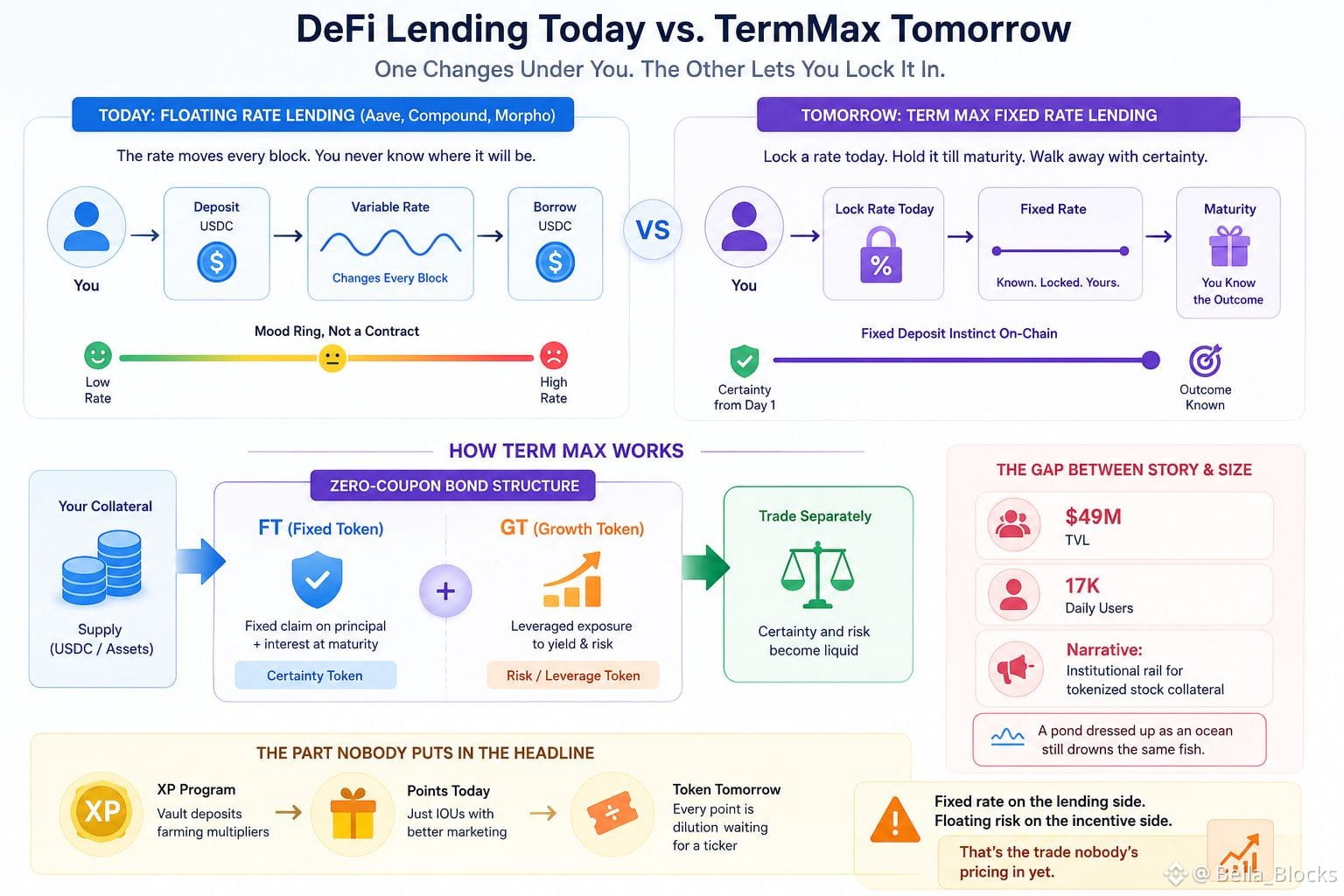
I keep coming back to how every DeFi lending rate acts like a mood ring, not a contract. Aave, Compound, Morpho Blue — you deposit, you borrow, and the rate moves under your feet every single block. It's a fixed deposit that changes its own interest rate while you're still holding the receipt. Nobody signs up for a savings account like that in real life, but somehow we all normalized it on-chain.
TermMax is selling the opposite pitch. Lock a rate today, hold it till maturity, walk away with a number you already knew going in. That's the bank FD instinct wrapped in a zero-coupon bond structure — you're not chasing yield, you're pricing time. Split principal and interest into two tokens, an FT for the fixed claim and a GT for the leveraged, collateral-heavy side, and suddenly you can trade the certainty separately from the risk. Clean mechanism on paper.
But I keep staring at the size of this thing next to the size of the story. Forty-nine million in TVL, seventeen thousand daily users, and a press release talking like it's already the institutional rail for tokenized stock collateral. That gap between the narrative and the balance sheet is the tell. A pond dressed up as an ocean still drowns the same fish if the tide goes wrong.
And the part nobody puts in the headline — there's an XP program running right now, vault deposits farming multipliers ahead of a token that doesn't exist yet. Points programs are just IOUs with better marketing. Every point earned today is dilution waiting for a ticker. Fixed rate on the lending side, floating risk on the incentive side — that's the trade nobody's pricing in yet.
$HEMI
{spot}(HEMIUSDT)
$TREE
{spot}(TREEUSDT)
$RE
{spot}(REUSDT)
#termmax @TermMax
I keep coming back to how every DeFi lending rate acts like a mood ring, not a contract. Aave, Compound, Morpho Blue — you deposit, you borrow, and the rate moves under your feet every single block. It's a fixed deposit that changes its own interest rate while you're still holding the receipt. Nobody signs up for a savings account like that in real life, but somehow we all normalized it on-chain.
TermMax is selling the opposite pitch. Lock a rate today, hold it till maturity, walk away with a number you already knew going in. That's the bank FD instinct wrapped in a zero-coupon bond structure — you're not chasing yield, you're pricing time. Split principal and interest into two tokens, an FT for the fixed claim and a GT for the leveraged, collateral-heavy side, and suddenly you can trade the certainty separately from the risk. Clean mechanism on paper.
But I keep staring at the size of this thing next to the size of the story. Forty-nine million in TVL, seventeen thousand daily users, and a press release talking like it's already the institutional rail for tokenized stock collateral. That gap between the narrative and the balance sheet is the tell. A pond dressed up as an ocean still drowns the same fish if the tide goes wrong.
And the part nobody puts in the headline — there's an XP program running right now, vault deposits farming multipliers ahead of a token that doesn't exist yet. Points programs are just IOUs with better marketing. Every point earned today is dilution waiting for a ticker. Fixed rate on the lending side, floating risk on the incentive side — that's the trade nobody's pricing in yet.
$HEMI
$TREE
$RE
I keep coming back to how every DeFi lending rate acts like a mood ring, not a contract. Aave, Compound, Morpho Blue — you deposit, you borrow, and the rate moves under your feet every single block. It's a fixed deposit that changes its own interest rate while you're still holding the receipt. Nobody signs up for a savings account like that in real life, but somehow we all normalized it on-chain.
TermMax is selling the opposite pitch. Lock a rate today, hold it till maturity, walk away with a number you already knew going in. That's the bank FD instinct wrapped in a zero-coupon bond structure — you're not chasing yield, you're pricing time. Split principal and interest into two tokens, an FT for the fixed claim and a GT for the leveraged, collateral-heavy side, and suddenly you can trade the certainty separately from the risk. Clean mechanism on paper.
But I keep staring at the size of this thing next to the size of the story. Forty-nine million in TVL, seventeen thousand daily users, and a press release talking like it's already the institutional rail for tokenized stock collateral. That gap between the narrative and the balance sheet is the tell. A pond dressed up as an ocean still drowns the same fish if the tide goes wrong.
And the part nobody puts in the headline — there's an XP program running right now, vault deposits farming multipliers ahead of a token that doesn't exist yet. Points programs are just IOUs with better marketing. Every point earned today is dilution waiting for a ticker. Fixed rate on the lending side, floating risk on the incentive side — that's the trade nobody's pricing in yet.
$HEMI
$TREE
$RE
5
4
701
·
--
#dusk $DUSK @Dusk_Foundation
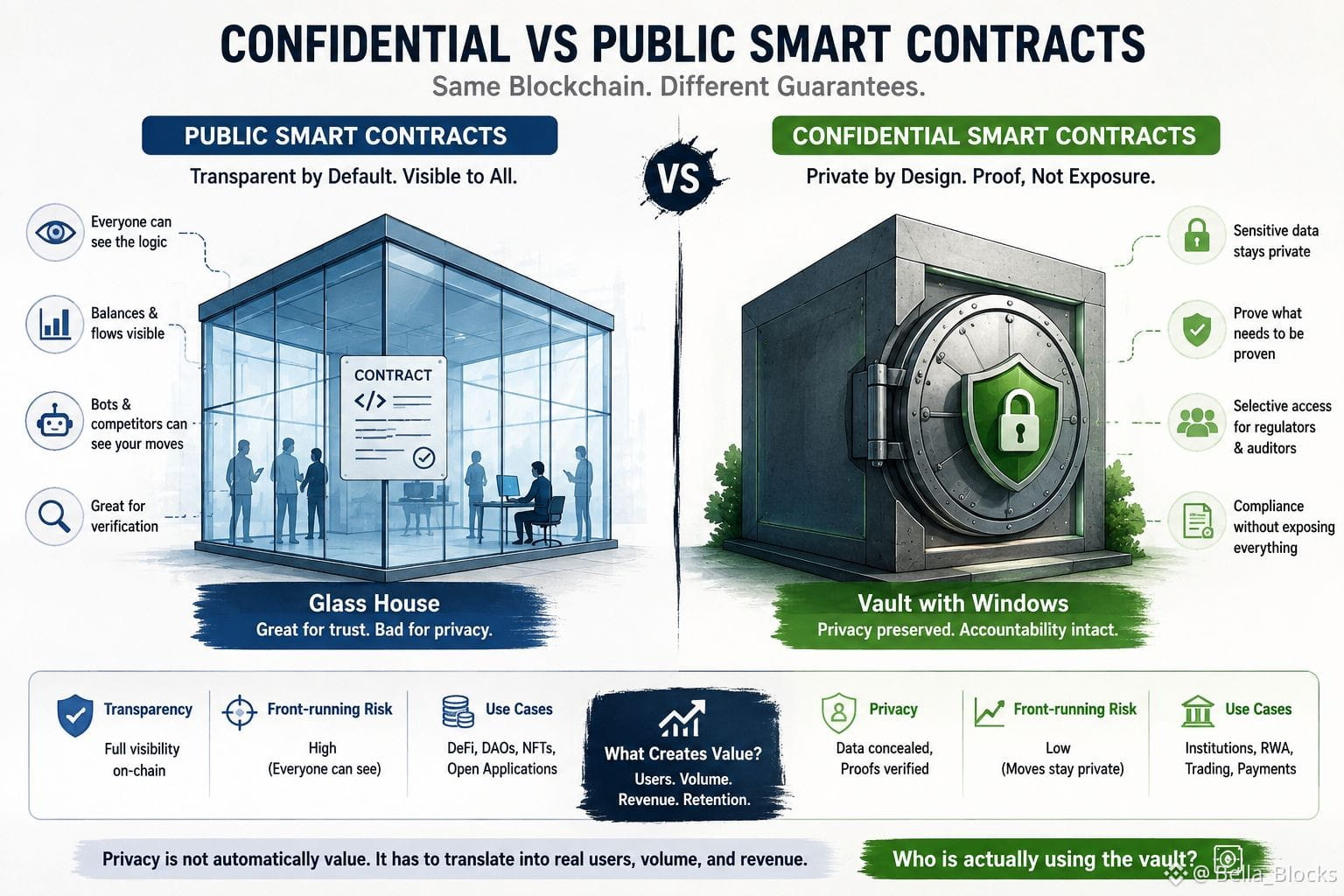
I keep thinking about how public smart contracts turned transparency into the default, but that same transparency can become a liability when real financial strategies hit the chain. Everyone can inspect the logic, balances, flows and often the trade itself. Great for verification, terrible if competitors, bots or counterparties can see your moves before they settle.
Confidential contracts flip that trade-off. The goal isn't “hide everything and trust us.” It's proving what needs to be proven while keeping sensitive state private. Dusk’s XSC model even builds selective access into the contract design for roles like regulators and auditors.
But I’m still skeptical. Privacy is not automatically value. It has to translate into actual users, settlement volume and revenue. Otherwise it’s just another shiny narrative sitting on the runway.
Public contracts are a glass house. Confidential contracts are a vault with windows. The market will eventually ask the only question that matters: who is actually using the vault?
{spot}(DUSKUSDT)
$ACE
{spot}(ACEUSDT)
$SOL
{spot}(SOLUSDT)
#dusk $DUSK @Dusk
I keep thinking about how public smart contracts turned transparency into the default, but that same transparency can become a liability when real financial strategies hit the chain. Everyone can inspect the logic, balances, flows and often the trade itself. Great for verification, terrible if competitors, bots or counterparties can see your moves before they settle.
Confidential contracts flip that trade-off. The goal isn't “hide everything and trust us.” It's proving what needs to be proven while keeping sensitive state private. Dusk’s XSC model even builds selective access into the contract design for roles like regulators and auditors.
But I’m still skeptical. Privacy is not automatically value. It has to translate into actual users, settlement volume and revenue. Otherwise it’s just another shiny narrative sitting on the runway.
Public contracts are a glass house. Confidential contracts are a vault with windows. The market will eventually ask the only question that matters: who is actually using the vault?
$ACE
$SOL
I keep thinking about how public smart contracts turned transparency into the default, but that same transparency can become a liability when real financial strategies hit the chain. Everyone can inspect the logic, balances, flows and often the trade itself. Great for verification, terrible if competitors, bots or counterparties can see your moves before they settle.
Confidential contracts flip that trade-off. The goal isn't “hide everything and trust us.” It's proving what needs to be proven while keeping sensitive state private. Dusk’s XSC model even builds selective access into the contract design for roles like regulators and auditors.
But I’m still skeptical. Privacy is not automatically value. It has to translate into actual users, settlement volume and revenue. Otherwise it’s just another shiny narrative sitting on the runway.
Public contracts are a glass house. Confidential contracts are a vault with windows. The market will eventually ask the only question that matters: who is actually using the vault?
$ACE
$SOL
8
5
549
·
--
#termmax @termmax
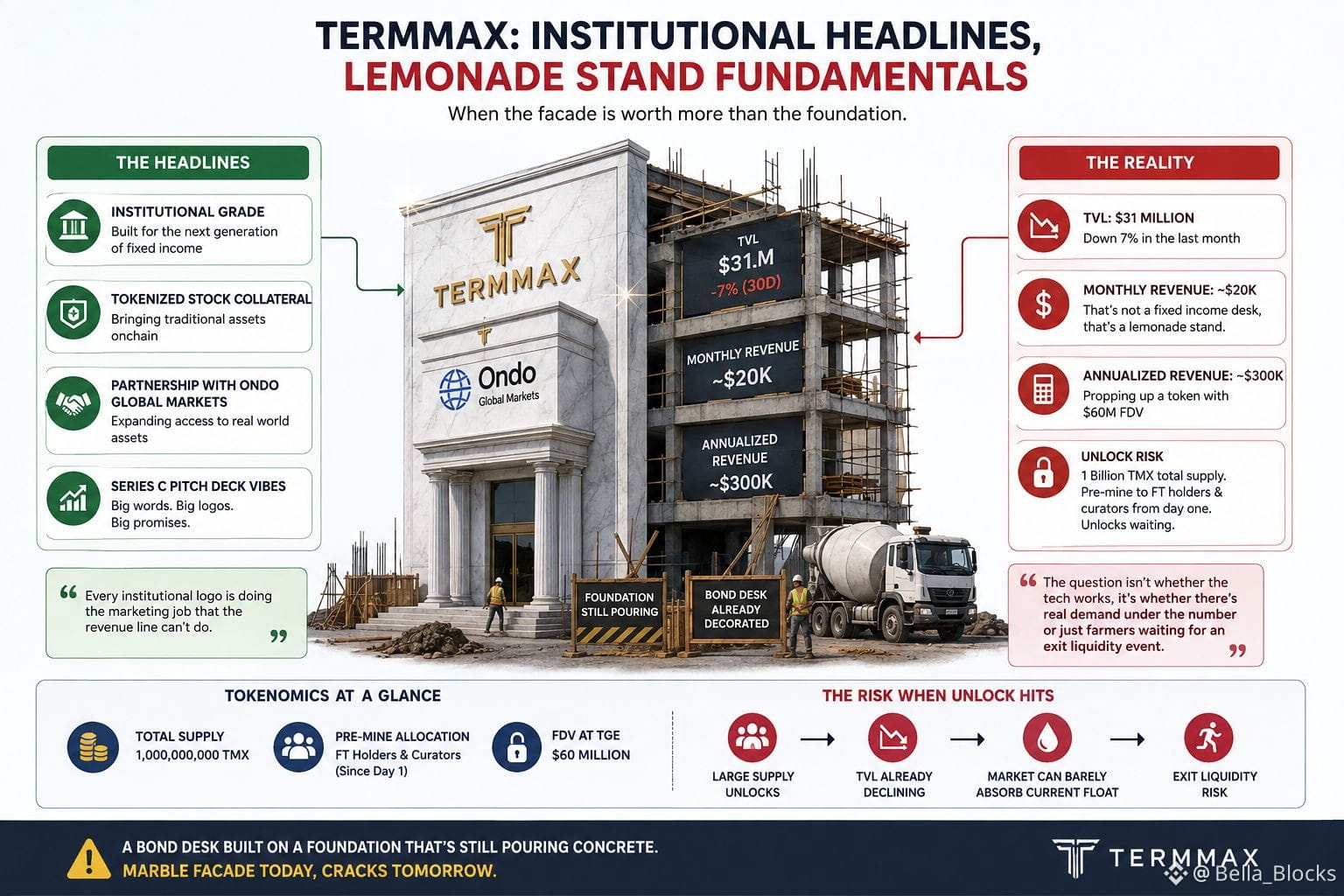
I keep staring at the TermMax numbers next to the TermMax headlines and they don't live in the same universe. The headlines are all institutional grade this, tokenized stock collateral that, a fresh partnership with Ondo's Global Markets stapled onto a press release that reads like it was written for a Series C pitch deck.
Meanwhile the protocol is sitting on thirty one million in TVL, down over seven percent in the last month, generating about twenty grand a month in actual revenue. Annualize that and you get roughly three hundred thousand dollars a year propping up a token that's about to be minted at a sixty million dollar FDV. That's not a fixed income desk, that's a lemonade stand wearing a Bloomberg terminal as a costume.
Fixed rates are supposed to be the pitch, certainty in a market that hates certainty, but the one thing that isn't fixed here is the token supply. A billion TMX total, pre-mine campaigns quietly accruing to FT holders and curators since day one, all of it waiting to unlock into a market that can barely support its current float without bleeding TVL.
I keep coming back to the same image, a bond desk built on a foundation that's still pouring concrete underneath it while they're already hanging the marble facade out front. Every institutional logo they bolt onto the announcement is doing the marketing job that the revenue line can't do on its own. When the unlock actually lands, the question isn't whether the tech works, it's whether there's real demand under the number or just pre-mine farmers waiting for an exit liquidity event dressed up as a token generation.
$ALPINE
{spot}(ALPINEUSDT)
$ACE
{spot}(ACEUSDT)
$1000SATS
{spot}(1000SATSUSDT)
#termmax @TermMax
I keep staring at the TermMax numbers next to the TermMax headlines and they don't live in the same universe. The headlines are all institutional grade this, tokenized stock collateral that, a fresh partnership with Ondo's Global Markets stapled onto a press release that reads like it was written for a Series C pitch deck.
Meanwhile the protocol is sitting on thirty one million in TVL, down over seven percent in the last month, generating about twenty grand a month in actual revenue. Annualize that and you get roughly three hundred thousand dollars a year propping up a token that's about to be minted at a sixty million dollar FDV. That's not a fixed income desk, that's a lemonade stand wearing a Bloomberg terminal as a costume.
Fixed rates are supposed to be the pitch, certainty in a market that hates certainty, but the one thing that isn't fixed here is the token supply. A billion TMX total, pre-mine campaigns quietly accruing to FT holders and curators since day one, all of it waiting to unlock into a market that can barely support its current float without bleeding TVL.
I keep coming back to the same image, a bond desk built on a foundation that's still pouring concrete underneath it while they're already hanging the marble facade out front. Every institutional logo they bolt onto the announcement is doing the marketing job that the revenue line can't do on its own. When the unlock actually lands, the question isn't whether the tech works, it's whether there's real demand under the number or just pre-mine farmers waiting for an exit liquidity event dressed up as a token generation.
$ALPINE
$ACE
$1000SATS
I keep staring at the TermMax numbers next to the TermMax headlines and they don't live in the same universe. The headlines are all institutional grade this, tokenized stock collateral that, a fresh partnership with Ondo's Global Markets stapled onto a press release that reads like it was written for a Series C pitch deck.
Meanwhile the protocol is sitting on thirty one million in TVL, down over seven percent in the last month, generating about twenty grand a month in actual revenue. Annualize that and you get roughly three hundred thousand dollars a year propping up a token that's about to be minted at a sixty million dollar FDV. That's not a fixed income desk, that's a lemonade stand wearing a Bloomberg terminal as a costume.
Fixed rates are supposed to be the pitch, certainty in a market that hates certainty, but the one thing that isn't fixed here is the token supply. A billion TMX total, pre-mine campaigns quietly accruing to FT holders and curators since day one, all of it waiting to unlock into a market that can barely support its current float without bleeding TVL.
I keep coming back to the same image, a bond desk built on a foundation that's still pouring concrete underneath it while they're already hanging the marble facade out front. Every institutional logo they bolt onto the announcement is doing the marketing job that the revenue line can't do on its own. When the unlock actually lands, the question isn't whether the tech works, it's whether there's real demand under the number or just pre-mine farmers waiting for an exit liquidity event dressed up as a token generation.
$ALPINE
$ACE
$1000SATS
2
2
465
·
--
Проверено
#dusk $DUSK @Dusk_Foundation
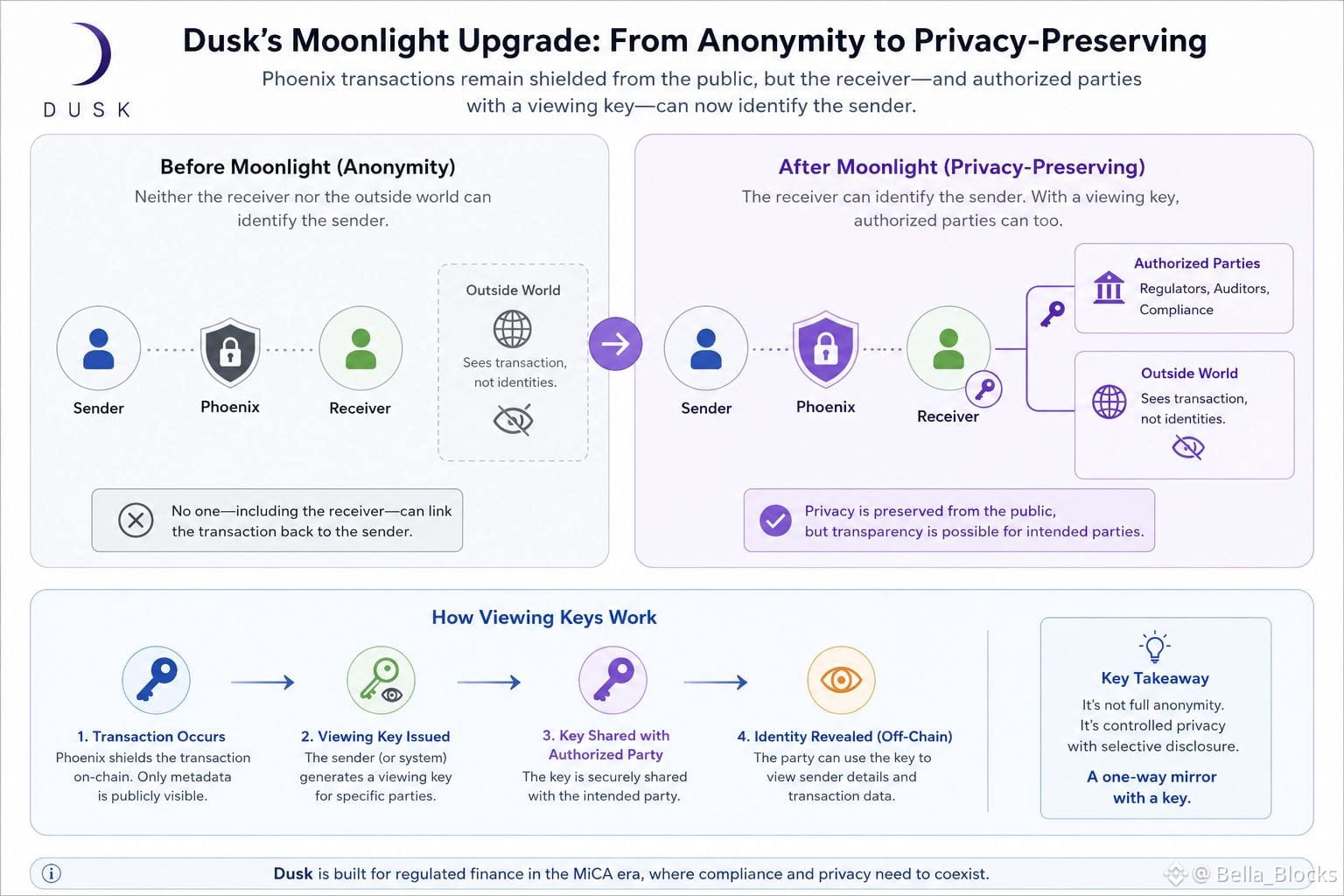
I was digging through Dusk's docs trying to understand what actually changed when Moonlight got added last year, and I ran into a line in their whitepaper writeup that I had to reread twice: they added the ability to identify the sender of a Phoenix transaction to the receiver, and framed this as turning Phoenix "from an anonymity protocol into a privacy-preserving protocol."
That's a meaningful distinction, not just marketing wording. Anonymity means nobody, including the counterparty, can tie the transaction back to you. Privacy-preserving, as Dusk now defines it, means the outside world can't see the transfer, but the person you're transacting with can — and, via viewing keys, an authorized third party like a regulator or auditor can too.$ACE
I went back and forth on whether this was a downgrade or just a design choice. It's not broken — it's clearly intentional. Dusk is building for MiCA-era institutional finance, where full anonymity is a liability, not a feature. Shielded balances plus selective disclosure is the whole pitch. But it does mean the "private like Zcash" comparison people throw around isn't quite accurate anymore, and I'd bet most holders repeating that comparison haven't actually read the transaction model docs.
It's less a black box and more a one-way mirror with a key you hand to specific people. Worth knowing which side of that mirror you're actually standing on before you assume nobody's watching.
$GPS
{spot}(GPSUSDT)
{spot}(ACEUSDT)
{spot}(DUSKUSDT)
#dusk $DUSK @Dusk
I was digging through Dusk's docs trying to understand what actually changed when Moonlight got added last year, and I ran into a line in their whitepaper writeup that I had to reread twice: they added the ability to identify the sender of a Phoenix transaction to the receiver, and framed this as turning Phoenix "from an anonymity protocol into a privacy-preserving protocol."
That's a meaningful distinction, not just marketing wording. Anonymity means nobody, including the counterparty, can tie the transaction back to you. Privacy-preserving, as Dusk now defines it, means the outside world can't see the transfer, but the person you're transacting with can — and, via viewing keys, an authorized third party like a regulator or auditor can too.$ACE
I went back and forth on whether this was a downgrade or just a design choice. It's not broken — it's clearly intentional. Dusk is building for MiCA-era institutional finance, where full anonymity is a liability, not a feature. Shielded balances plus selective disclosure is the whole pitch. But it does mean the "private like Zcash" comparison people throw around isn't quite accurate anymore, and I'd bet most holders repeating that comparison haven't actually read the transaction model docs.
It's less a black box and more a one-way mirror with a key you hand to specific people. Worth knowing which side of that mirror you're actually standing on before you assume nobody's watching.
$GPS
I was digging through Dusk's docs trying to understand what actually changed when Moonlight got added last year, and I ran into a line in their whitepaper writeup that I had to reread twice: they added the ability to identify the sender of a Phoenix transaction to the receiver, and framed this as turning Phoenix "from an anonymity protocol into a privacy-preserving protocol."
That's a meaningful distinction, not just marketing wording. Anonymity means nobody, including the counterparty, can tie the transaction back to you. Privacy-preserving, as Dusk now defines it, means the outside world can't see the transfer, but the person you're transacting with can — and, via viewing keys, an authorized third party like a regulator or auditor can too.$ACE
I went back and forth on whether this was a downgrade or just a design choice. It's not broken — it's clearly intentional. Dusk is building for MiCA-era institutional finance, where full anonymity is a liability, not a feature. Shielded balances plus selective disclosure is the whole pitch. But it does mean the "private like Zcash" comparison people throw around isn't quite accurate anymore, and I'd bet most holders repeating that comparison haven't actually read the transaction model docs.
It's less a black box and more a one-way mirror with a key you hand to specific people. Worth knowing which side of that mirror you're actually standing on before you assume nobody's watching.
$GPS
16
1
18
1k
·
--
#dusk @Dusk_Foundation $DUSK
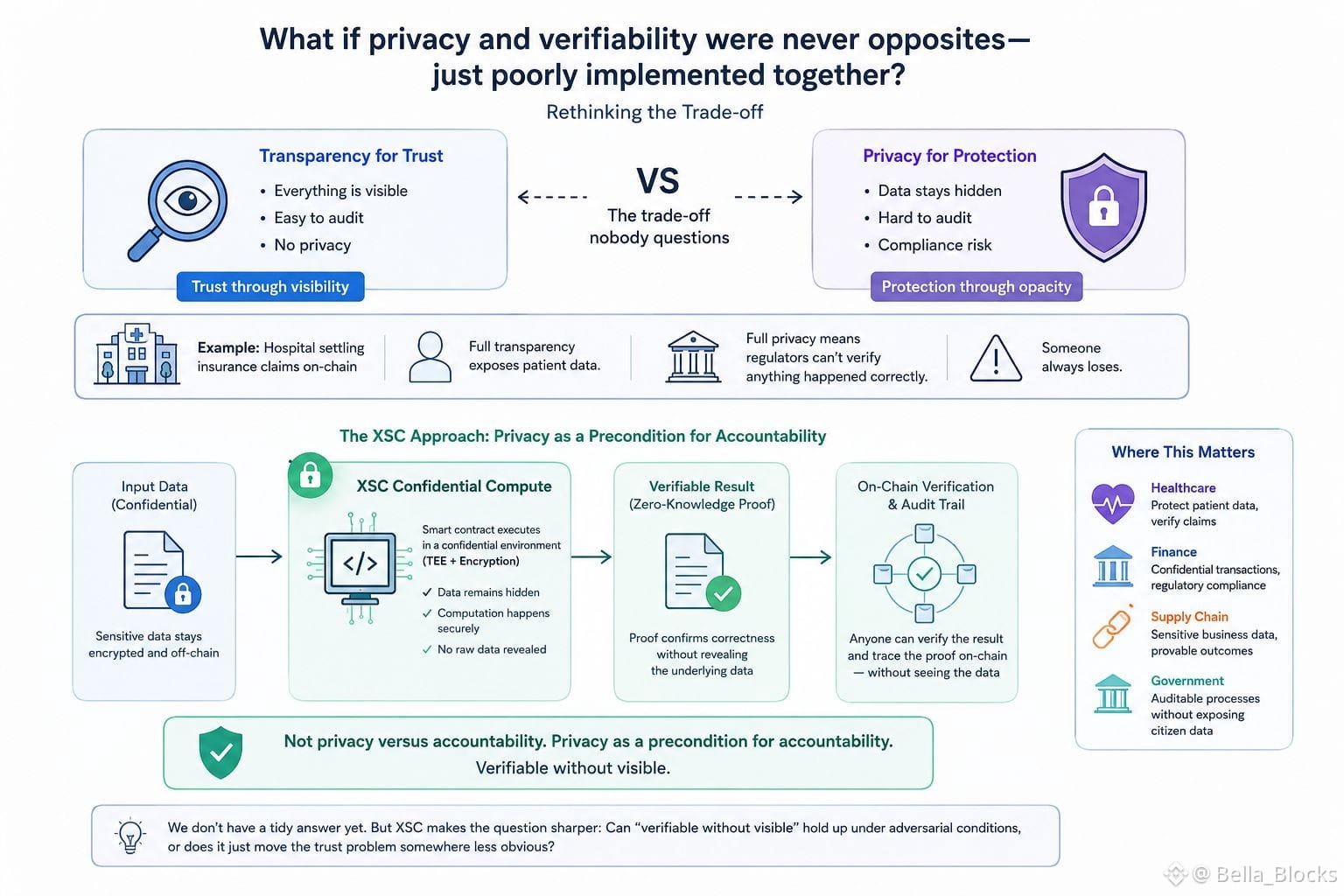
What if privacy and verifiability were never actually opposites — just poorly implemented together?
I came across XSC while digging into confidential computing for smart contracts, trying to understand why "private" and "auditable" almost never appear in the same sentence. What caught me wasn't the cryptography itself, but how casually the industry has accepted that you must choose one.
That's the trade-off nobody questions: transparency for trust, or privacy for protection. Pick a side.
Think of a hospital settling insurance claims on-chain. Full transparency exposes patient data. Full privacy means regulators can't verify anything happened correctly. Someone always loses.
XSC's approach is to let contracts prove correctness without revealing the underlying data — computation happens confidentially, but the result carries a verifiable trail. Not privacy versus accountability. Privacy as a precondition for accountability.
It's a small reframe, but it unsettles a default that's been treated as physics rather than design choice.
And this shows up everywhere in tech, not just crypto: we keep building systems that force a binary between visibility and protection, then act surprised when neither side is satisfied.
So where does this leave the standard use case — a shared ledger between parties who don't fully trust each other, but who also don't want to expose everything? Does "verifiable without visible" actually hold up under adversarial conditions, or does it just move the trust problem somewhere less obvious?
I don't have a tidy answer. But XSC made the question sharper than it was before.
$KII
{alpha}(560xeec6574eabba52bac3f0277f2cd5ac7e67197886)
$AIO
{alpha}(560x81a7da4074b8e0ed51bea40f9dcbdf4d9d4832b4)
{spot}(DUSKUSDT)
#dusk @Dusk $DUSK
What if privacy and verifiability were never actually opposites — just poorly implemented together?
I came across XSC while digging into confidential computing for smart contracts, trying to understand why "private" and "auditable" almost never appear in the same sentence. What caught me wasn't the cryptography itself, but how casually the industry has accepted that you must choose one.
That's the trade-off nobody questions: transparency for trust, or privacy for protection. Pick a side.
Think of a hospital settling insurance claims on-chain. Full transparency exposes patient data. Full privacy means regulators can't verify anything happened correctly. Someone always loses.
XSC's approach is to let contracts prove correctness without revealing the underlying data — computation happens confidentially, but the result carries a verifiable trail. Not privacy versus accountability. Privacy as a precondition for accountability.
It's a small reframe, but it unsettles a default that's been treated as physics rather than design choice.
And this shows up everywhere in tech, not just crypto: we keep building systems that force a binary between visibility and protection, then act surprised when neither side is satisfied.
So where does this leave the standard use case — a shared ledger between parties who don't fully trust each other, but who also don't want to expose everything? Does "verifiable without visible" actually hold up under adversarial conditions, or does it just move the trust problem somewhere less obvious?
I don't have a tidy answer. But XSC made the question sharper than it was before.
$KII
$AIO
What if privacy and verifiability were never actually opposites — just poorly implemented together?
I came across XSC while digging into confidential computing for smart contracts, trying to understand why "private" and "auditable" almost never appear in the same sentence. What caught me wasn't the cryptography itself, but how casually the industry has accepted that you must choose one.
That's the trade-off nobody questions: transparency for trust, or privacy for protection. Pick a side.
Think of a hospital settling insurance claims on-chain. Full transparency exposes patient data. Full privacy means regulators can't verify anything happened correctly. Someone always loses.
XSC's approach is to let contracts prove correctness without revealing the underlying data — computation happens confidentially, but the result carries a verifiable trail. Not privacy versus accountability. Privacy as a precondition for accountability.
It's a small reframe, but it unsettles a default that's been treated as physics rather than design choice.
And this shows up everywhere in tech, not just crypto: we keep building systems that force a binary between visibility and protection, then act surprised when neither side is satisfied.
So where does this leave the standard use case — a shared ledger between parties who don't fully trust each other, but who also don't want to expose everything? Does "verifiable without visible" actually hold up under adversarial conditions, or does it just move the trust problem somewhere less obvious?
I don't have a tidy answer. But XSC made the question sharper than it was before.
$KII
$AIO
14
1
11
1k
·
--
#dusk @Dusk_Foundation $DUSK
Why do we treat "transparent" and "trustworthy" as synonyms in blockchain? They're not the same word, but we build systems as if they were.
I came across Dusk Network while digging through privacy-focused infrastructure projects, trying to understand why regulated finance hadn't moved on-chain at scale. What caught my eye wasn't the roadmap or the token — it was the framing of confidential smart contracts as a compliance tool, not an evasion tool.
The unquestioned trade-off in most of crypto is this: you get transparency or you get privacy, pick one. Public ledgers are celebrated as the whole point.
But think about a mid-sized asset manager settling securities on-chain. Every trade, every position, every counterparty exposed to competitors watching the same chain. That's not decentralization working — that's a liability.
Dusk's pitch is that privacy and auditability aren't opposites. Zero-knowledge proofs let a transaction be verified as valid — compliant, solvent, authorized — without revealing its contents to everyone. Regulators can still get selective disclosure. The public doesn't need the full picture to trust the system works.
Zoom out and it's a familiar pattern: infrastructure gets built for the ideological use case first, and the practical, regulated use case gets treated as an afterthought — or impossible.
I don't know if confidential compliance actually scales the way it's pitched, or if it just moves the trust problem somewhere less visible.
I don't have a neat answer here. But the question feels sharper now than it did before I looked into it.
$CYS
{alpha}(560x0c69199c1562233640e0db5ce2c399a88eb507c7)
$AEON
{alpha}(560x277add739c6e0477616948357af9e79fe1ec9b80)
{spot}(DUSKUSDT)
#dusk @Dusk $DUSK
Why do we treat "transparent" and "trustworthy" as synonyms in blockchain? They're not the same word, but we build systems as if they were.
I came across Dusk Network while digging through privacy-focused infrastructure projects, trying to understand why regulated finance hadn't moved on-chain at scale. What caught my eye wasn't the roadmap or the token — it was the framing of confidential smart contracts as a compliance tool, not an evasion tool.
The unquestioned trade-off in most of crypto is this: you get transparency or you get privacy, pick one. Public ledgers are celebrated as the whole point.
But think about a mid-sized asset manager settling securities on-chain. Every trade, every position, every counterparty exposed to competitors watching the same chain. That's not decentralization working — that's a liability.
Dusk's pitch is that privacy and auditability aren't opposites. Zero-knowledge proofs let a transaction be verified as valid — compliant, solvent, authorized — without revealing its contents to everyone. Regulators can still get selective disclosure. The public doesn't need the full picture to trust the system works.
Zoom out and it's a familiar pattern: infrastructure gets built for the ideological use case first, and the practical, regulated use case gets treated as an afterthought — or impossible.
I don't know if confidential compliance actually scales the way it's pitched, or if it just moves the trust problem somewhere less visible.
I don't have a neat answer here. But the question feels sharper now than it did before I looked into it.
$CYS
$AEON
Why do we treat "transparent" and "trustworthy" as synonyms in blockchain? They're not the same word, but we build systems as if they were.
I came across Dusk Network while digging through privacy-focused infrastructure projects, trying to understand why regulated finance hadn't moved on-chain at scale. What caught my eye wasn't the roadmap or the token — it was the framing of confidential smart contracts as a compliance tool, not an evasion tool.
The unquestioned trade-off in most of crypto is this: you get transparency or you get privacy, pick one. Public ledgers are celebrated as the whole point.
But think about a mid-sized asset manager settling securities on-chain. Every trade, every position, every counterparty exposed to competitors watching the same chain. That's not decentralization working — that's a liability.
Dusk's pitch is that privacy and auditability aren't opposites. Zero-knowledge proofs let a transaction be verified as valid — compliant, solvent, authorized — without revealing its contents to everyone. Regulators can still get selective disclosure. The public doesn't need the full picture to trust the system works.
Zoom out and it's a familiar pattern: infrastructure gets built for the ideological use case first, and the practical, regulated use case gets treated as an afterthought — or impossible.
I don't know if confidential compliance actually scales the way it's pitched, or if it just moves the trust problem somewhere less visible.
I don't have a neat answer here. But the question feels sharper now than it did before I looked into it.
$CYS
$AEON
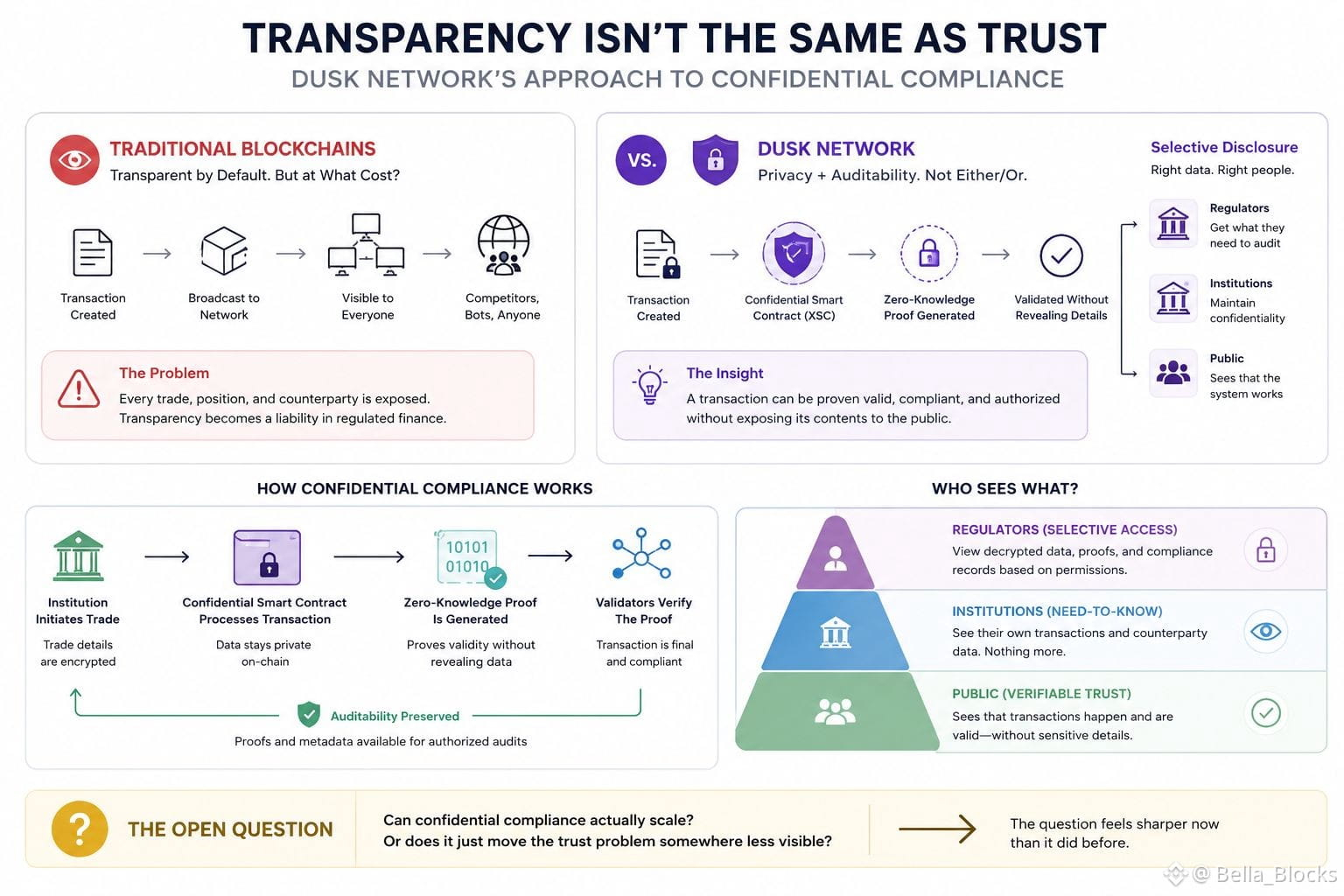
16
13
1.8k
·
--
#dusk @Dusk_Foundation $DUSK
I was checking Dusk’s staking documentation over coffee today, and one small detail caught my attention more than the privacy features everyone usually talks about.
It’s what happens when an active staker adds more DUSK.
The docs say that once a position is already active, 90% of a top-up becomes active immediately, while 10% is recorded as locked stake. That sounds minor, but I think it reveals something interesting about how Dusk treats validator capital.
The network doesn’t simply view additional stake as instantly interchangeable security. Part of it becomes temporarily less liquid, while the staker still owns it. That creates a subtle separation between “capital I control” and “capital currently contributing to consensus.”
I started wondering why that matters for a financial-focused blockchain.
If institutions eventually use Dusk for settlement, they may care about predictable capital movement almost as much as transaction privacy. A staking system that introduces different liquidity states could influence how operators manage reserves, delegation products, and automated staking strategies.
The minimum direct stake is 1,000 DUSK, and Dusk also allows smart contracts to manage staking through Stake Abstraction.
So the interesting question for me isn’t simply whether Dusk can attract more staked tokens. It’s whether its staking mechanics can scale from individual operators to programmable financial infrastructure without making liquidity management unnecessarily complicated.
That feels like a design detail worth watching as the network matures.
{spot}(DUSKUSDT)
#dusk @Dusk $DUSK
I was checking Dusk’s staking documentation over coffee today, and one small detail caught my attention more than the privacy features everyone usually talks about.
It’s what happens when an active staker adds more DUSK.
The docs say that once a position is already active, 90% of a top-up becomes active immediately, while 10% is recorded as locked stake. That sounds minor, but I think it reveals something interesting about how Dusk treats validator capital.
The network doesn’t simply view additional stake as instantly interchangeable security. Part of it becomes temporarily less liquid, while the staker still owns it. That creates a subtle separation between “capital I control” and “capital currently contributing to consensus.”
I started wondering why that matters for a financial-focused blockchain.
If institutions eventually use Dusk for settlement, they may care about predictable capital movement almost as much as transaction privacy. A staking system that introduces different liquidity states could influence how operators manage reserves, delegation products, and automated staking strategies.
The minimum direct stake is 1,000 DUSK, and Dusk also allows smart contracts to manage staking through Stake Abstraction.
So the interesting question for me isn’t simply whether Dusk can attract more staked tokens. It’s whether its staking mechanics can scale from individual operators to programmable financial infrastructure without making liquidity management unnecessarily complicated.
That feels like a design detail worth watching as the network matures.
I was checking Dusk’s staking documentation over coffee today, and one small detail caught my attention more than the privacy features everyone usually talks about.
It’s what happens when an active staker adds more DUSK.
The docs say that once a position is already active, 90% of a top-up becomes active immediately, while 10% is recorded as locked stake. That sounds minor, but I think it reveals something interesting about how Dusk treats validator capital.
The network doesn’t simply view additional stake as instantly interchangeable security. Part of it becomes temporarily less liquid, while the staker still owns it. That creates a subtle separation between “capital I control” and “capital currently contributing to consensus.”
I started wondering why that matters for a financial-focused blockchain.
If institutions eventually use Dusk for settlement, they may care about predictable capital movement almost as much as transaction privacy. A staking system that introduces different liquidity states could influence how operators manage reserves, delegation products, and automated staking strategies.
The minimum direct stake is 1,000 DUSK, and Dusk also allows smart contracts to manage staking through Stake Abstraction.
So the interesting question for me isn’t simply whether Dusk can attract more staked tokens. It’s whether its staking mechanics can scale from individual operators to programmable financial infrastructure without making liquidity management unnecessarily complicated.
That feels like a design detail worth watching as the network matures.
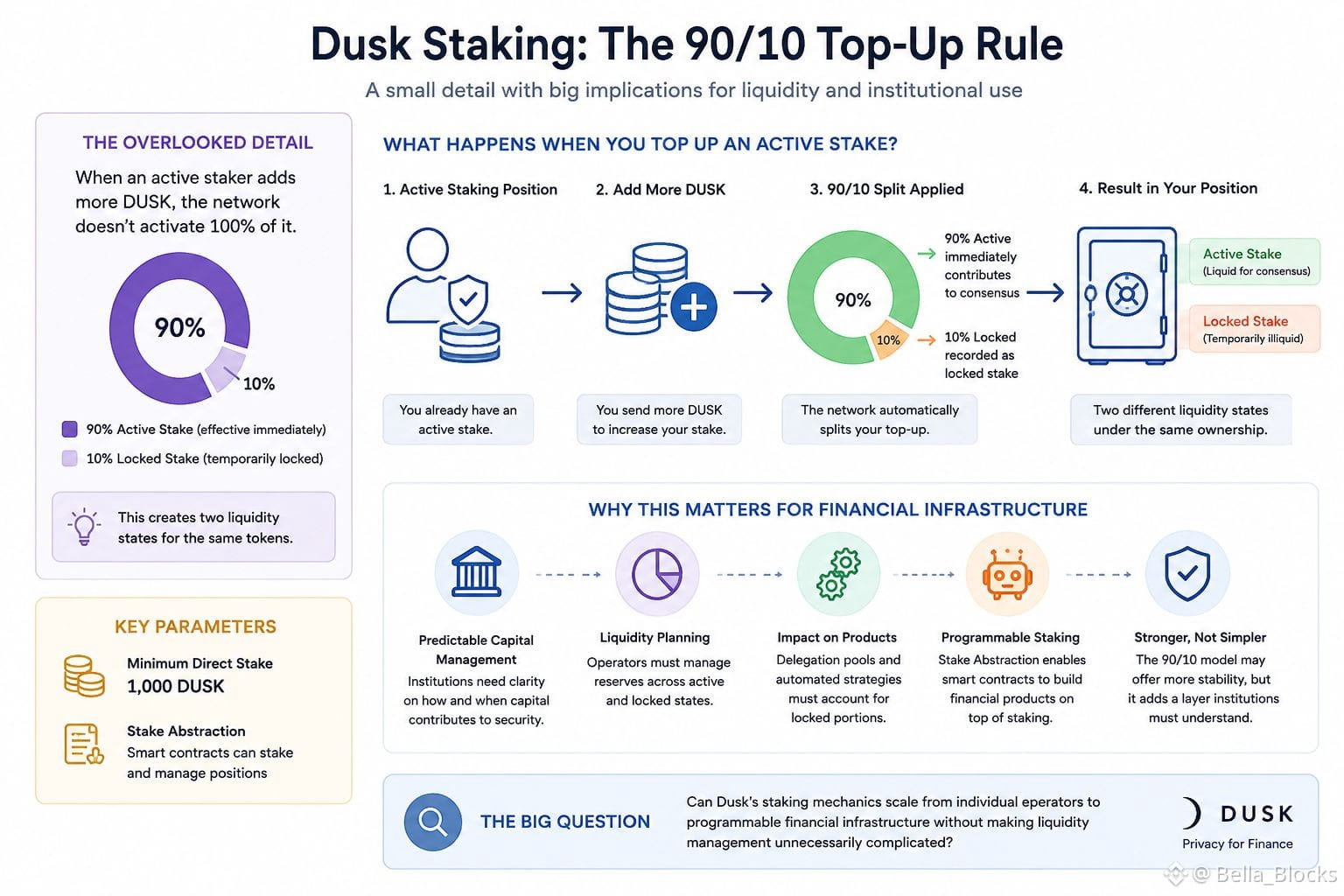
9
4
155
·
--
#dusk @Dusk_Foundation $DUSK
I was digging through Dusk's updated docs late last night, mostly out of curiosity about how the mainnet migration held up, when I noticed something that hadn't registered before: Dusk now runs two separate confidentiality mechanisms side by side. There's the native XSC/Phoenix model, ZK-proof based, built directly into the base layer. And then there's Hedger, a newer addition that brings confidential transfers to DuskEVM using homomorphic encryption instead.
That's an odd design choice for a chain whose entire pitch is "privacy blockchain for financial applications." If the native layer already does confidential smart contracts well, why build a second, cryptographically different privacy system on a Solidity-compatible sidechain?
The likely answer is developer gravity. Native XSC requires learning Dusk-specific tooling, while DuskEVM lets Solidity teams deploy with familiar patterns and opt into privacy later through Hedger. That's a reasonable adoption strategy. But it also means the protocol's core value proposition, confidentiality, now exists in two flavors with different trust assumptions, different proof systems, and presumably different audit surfaces.
For a chain trying to court regulated institutions, having a single, well-understood privacy guarantee usually matters more than having two technically interesting ones. I'm not sure yet whether this is thoughtful hedging for adoption or quiet fragmentation of the thing that made Dusk distinct in the first place. Worth watching which path gets the real institutional integrations.
{spot}(DUSKUSDT)
#dusk @Dusk $DUSK
I was digging through Dusk's updated docs late last night, mostly out of curiosity about how the mainnet migration held up, when I noticed something that hadn't registered before: Dusk now runs two separate confidentiality mechanisms side by side. There's the native XSC/Phoenix model, ZK-proof based, built directly into the base layer. And then there's Hedger, a newer addition that brings confidential transfers to DuskEVM using homomorphic encryption instead.
That's an odd design choice for a chain whose entire pitch is "privacy blockchain for financial applications." If the native layer already does confidential smart contracts well, why build a second, cryptographically different privacy system on a Solidity-compatible sidechain?
The likely answer is developer gravity. Native XSC requires learning Dusk-specific tooling, while DuskEVM lets Solidity teams deploy with familiar patterns and opt into privacy later through Hedger. That's a reasonable adoption strategy. But it also means the protocol's core value proposition, confidentiality, now exists in two flavors with different trust assumptions, different proof systems, and presumably different audit surfaces.
For a chain trying to court regulated institutions, having a single, well-understood privacy guarantee usually matters more than having two technically interesting ones. I'm not sure yet whether this is thoughtful hedging for adoption or quiet fragmentation of the thing that made Dusk distinct in the first place. Worth watching which path gets the real institutional integrations.
I was digging through Dusk's updated docs late last night, mostly out of curiosity about how the mainnet migration held up, when I noticed something that hadn't registered before: Dusk now runs two separate confidentiality mechanisms side by side. There's the native XSC/Phoenix model, ZK-proof based, built directly into the base layer. And then there's Hedger, a newer addition that brings confidential transfers to DuskEVM using homomorphic encryption instead.
That's an odd design choice for a chain whose entire pitch is "privacy blockchain for financial applications." If the native layer already does confidential smart contracts well, why build a second, cryptographically different privacy system on a Solidity-compatible sidechain?
The likely answer is developer gravity. Native XSC requires learning Dusk-specific tooling, while DuskEVM lets Solidity teams deploy with familiar patterns and opt into privacy later through Hedger. That's a reasonable adoption strategy. But it also means the protocol's core value proposition, confidentiality, now exists in two flavors with different trust assumptions, different proof systems, and presumably different audit surfaces.
For a chain trying to court regulated institutions, having a single, well-understood privacy guarantee usually matters more than having two technically interesting ones. I'm not sure yet whether this is thoughtful hedging for adoption or quiet fragmentation of the thing that made Dusk distinct in the first place. Worth watching which path gets the real institutional integrations.
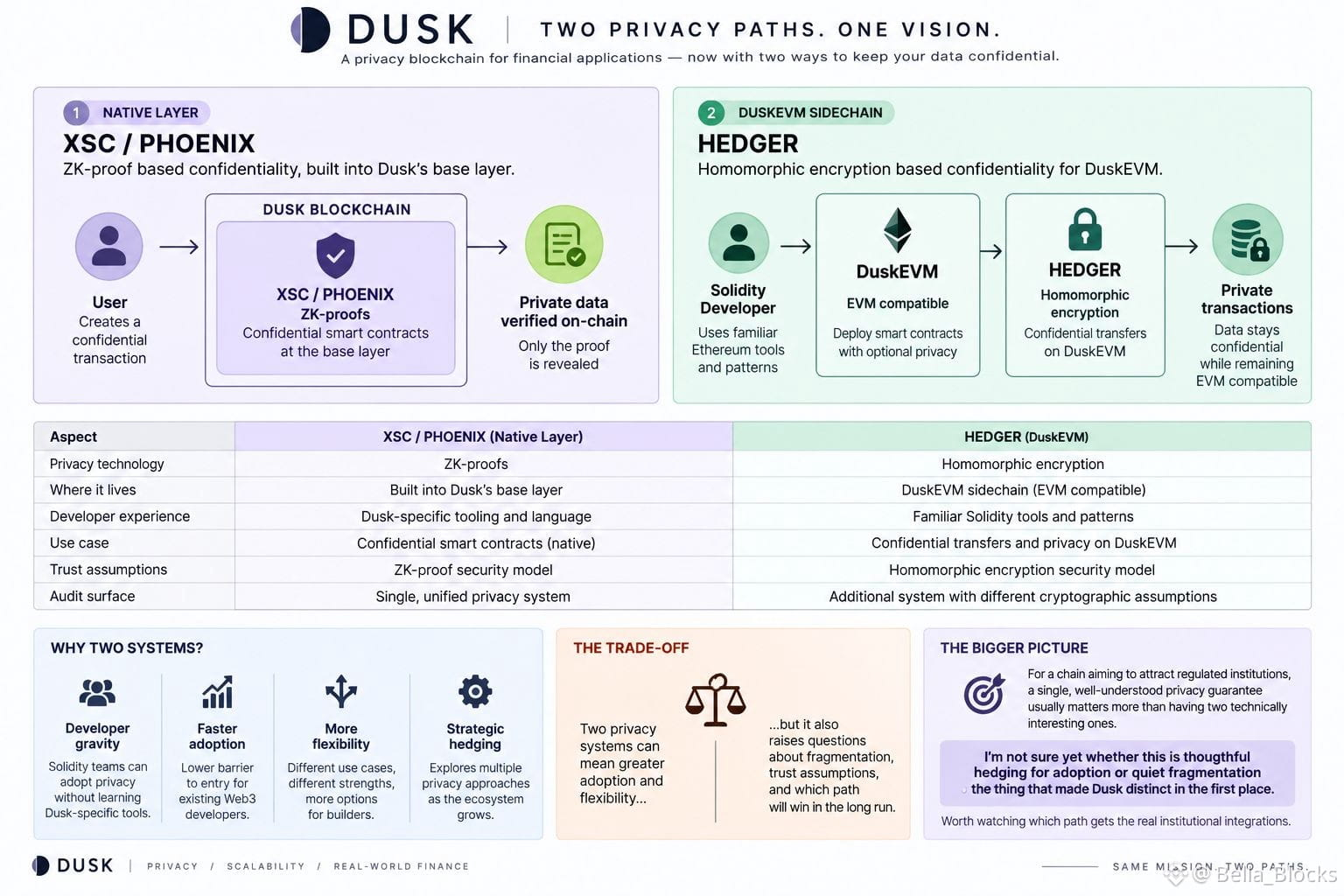
5
5
118
·
--
#baby @babylonlabs_io $BABY
I was digging through Threshold Network's docs last night trying to actually understand how tBTC avoids the WBTC problem, and I got stuck on one detail nobody really talks about: the DKG ceremony.
Everyone explains peg-in as "lock BTC, mint on Ethereum," which is true but skips the part that matters. When you deposit, a randomly selected subset of node operators runs a distributed key generation ceremony to produce the Bitcoin deposit address. No single signer ever holds a full private key, just a fragment. Redemption works the same way in reverse: burn the token, and the same threshold of signers reconstructs a signature to release native BTC, no custodian pressing a button.
What struck me is how much the whole system rests on an honest-majority assumption among a rotating, permissionless signer set, rather than trusting one company's cold storage. Threshold's own numbers put roughly 5,800 BTC secured and $424 million in TVL, tiny next to the wrapped-BTC giants held by centralized custodians. That gap isn't really about product quality. It's about whether the market prices "no single point of failure" as worth a liquidity discount.
So the open question I keep circling back to: does BTCFi actually reward decentralized custody, or does capital just follow whichever wrapper has the deepest liquidity regardless of who's holding the keys?
{spot}(BABYUSDT)
#baby @BabylonLabs_io $BABY
I was digging through Threshold Network's docs last night trying to actually understand how tBTC avoids the WBTC problem, and I got stuck on one detail nobody really talks about: the DKG ceremony.
Everyone explains peg-in as "lock BTC, mint on Ethereum," which is true but skips the part that matters. When you deposit, a randomly selected subset of node operators runs a distributed key generation ceremony to produce the Bitcoin deposit address. No single signer ever holds a full private key, just a fragment. Redemption works the same way in reverse: burn the token, and the same threshold of signers reconstructs a signature to release native BTC, no custodian pressing a button.
What struck me is how much the whole system rests on an honest-majority assumption among a rotating, permissionless signer set, rather than trusting one company's cold storage. Threshold's own numbers put roughly 5,800 BTC secured and $424 million in TVL, tiny next to the wrapped-BTC giants held by centralized custodians. That gap isn't really about product quality. It's about whether the market prices "no single point of failure" as worth a liquidity discount.
So the open question I keep circling back to: does BTCFi actually reward decentralized custody, or does capital just follow whichever wrapper has the deepest liquidity regardless of who's holding the keys?
I was digging through Threshold Network's docs last night trying to actually understand how tBTC avoids the WBTC problem, and I got stuck on one detail nobody really talks about: the DKG ceremony.
Everyone explains peg-in as "lock BTC, mint on Ethereum," which is true but skips the part that matters. When you deposit, a randomly selected subset of node operators runs a distributed key generation ceremony to produce the Bitcoin deposit address. No single signer ever holds a full private key, just a fragment. Redemption works the same way in reverse: burn the token, and the same threshold of signers reconstructs a signature to release native BTC, no custodian pressing a button.
What struck me is how much the whole system rests on an honest-majority assumption among a rotating, permissionless signer set, rather than trusting one company's cold storage. Threshold's own numbers put roughly 5,800 BTC secured and $424 million in TVL, tiny next to the wrapped-BTC giants held by centralized custodians. That gap isn't really about product quality. It's about whether the market prices "no single point of failure" as worth a liquidity discount.
So the open question I keep circling back to: does BTCFi actually reward decentralized custody, or does capital just follow whichever wrapper has the deepest liquidity regardless of who's holding the keys?
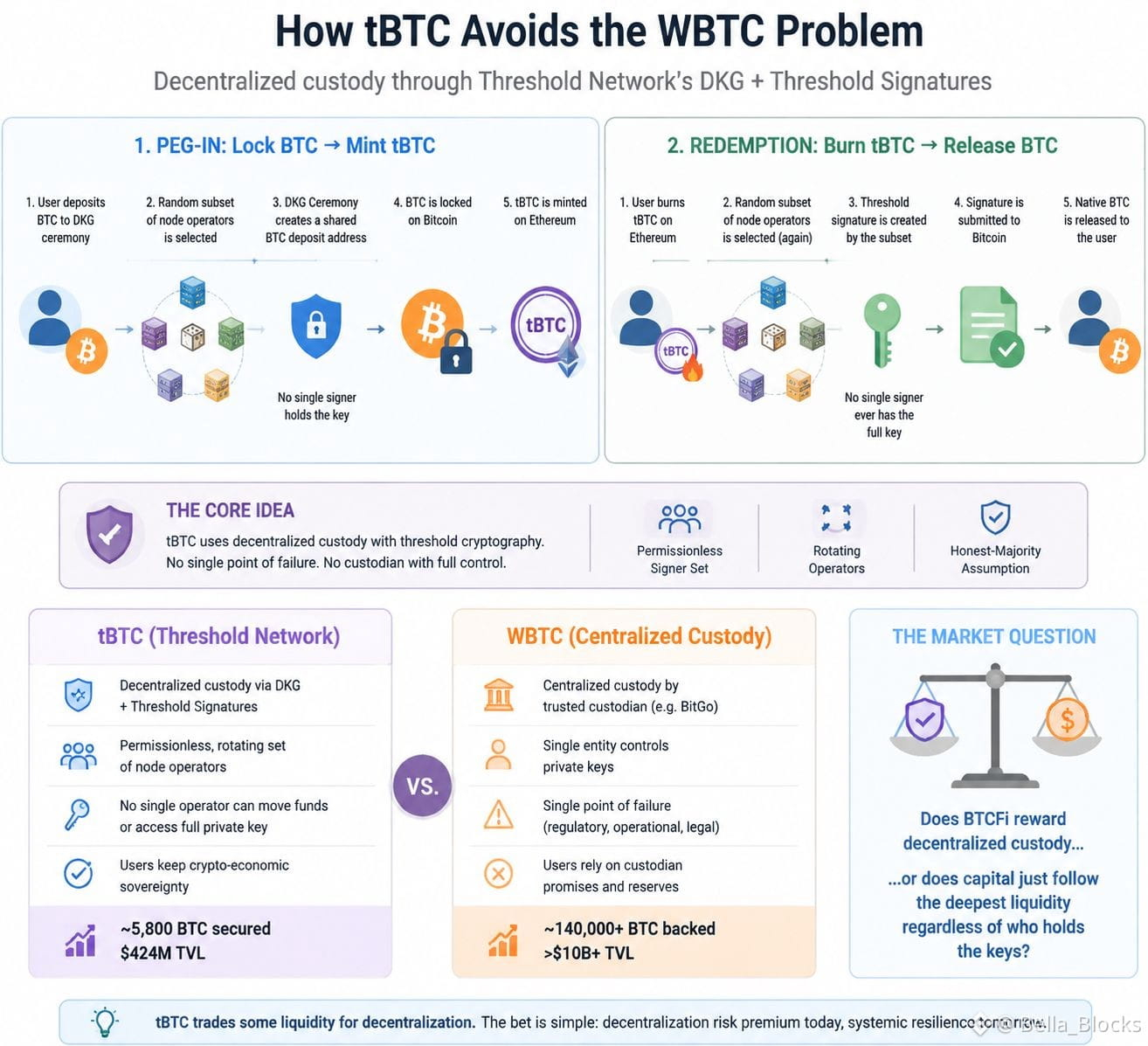
5
4
190
Войдите, чтобы посмотреть больше материала
Присоединяйтесь к пользователям криптовалют по всему миру на Binance Square
⚡️ Получайте новейшую и полезную информацию о криптоактивах.
💬 Нам доверяет крупнейшая в мире криптобиржа.
👍 Получите достоверные аналитические данные от верифицированных создателей контента.
Эл. почта/номер телефона
В тренде
BOJRaisesRatesTo31YearHigh
Просмотров: 32,959
780 обсуждают
Bitcoin Reclaims the Spotlight as Macro Pressure Fails to Break Crypto Demand
Fatima_Tariq
·Лайков: 10
·Просмотров: 5.5k
BuffettStepsDownAsBerkshireChairman
Просмотров: 11,317
329 обсуждают
XRPExchangeReservesHitSevenYearLow
Просмотров: 15,495
342 обсуждают