#dusk $DUSK @Dusk
I was digging through Dusk's docs trying to understand what "shielded" actually means in Phoenix, and I hit a line that made me stop and reread it. One official description of Phoenix says it gives complete on-chain privacy — even for non-obfuscated outputs such as block rewards and gas fee refunds Complete privacy" and "non-obfuscated outputs" sitting in the same sentence felt like a contradiction, so I went back to the docs twice thinking I'd misread it.
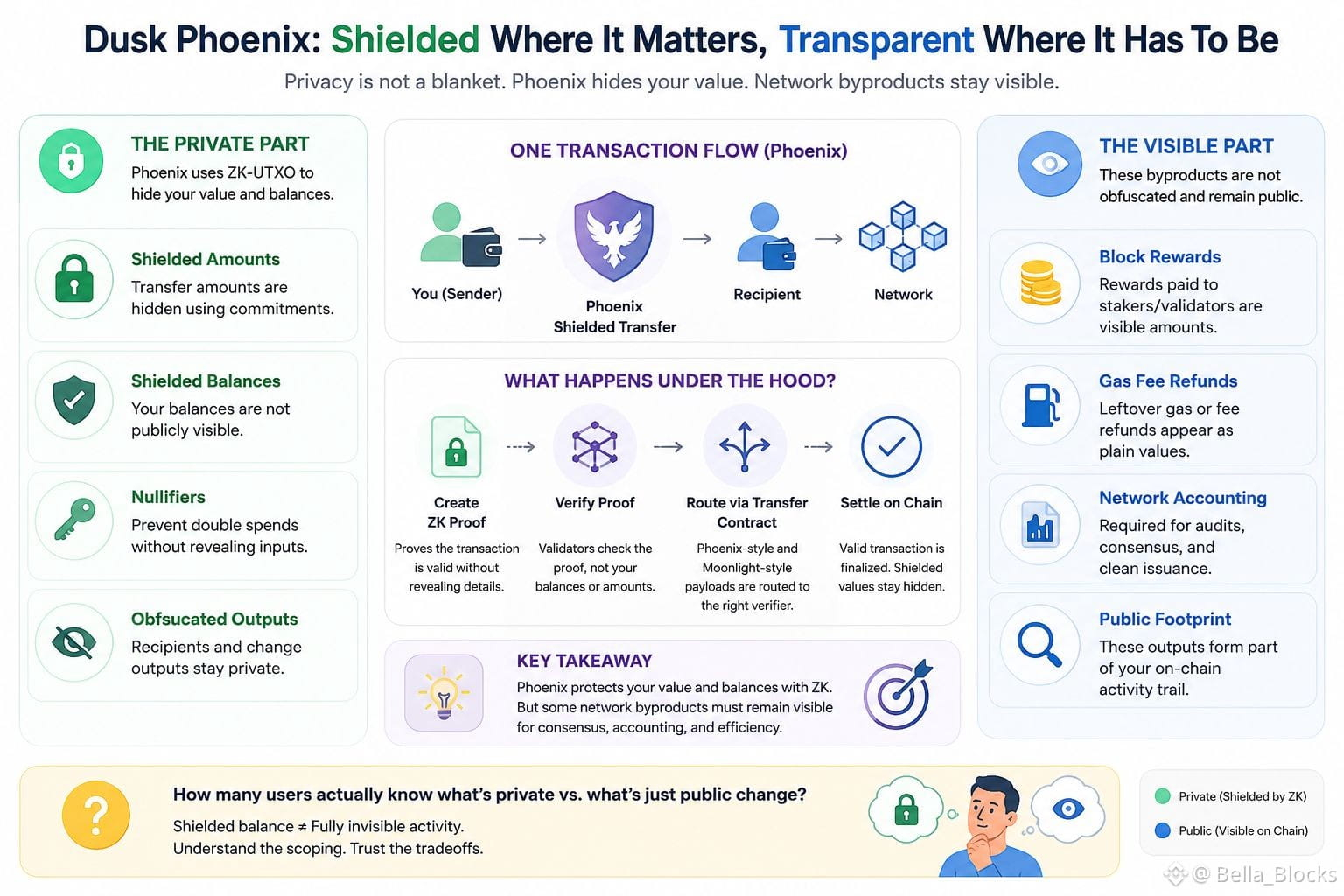
Turns out it's not a mistake, it's a scoping choice. Phoenix is the zero-knowledge UTXO transaction model built into Dusk's Transfer contract, supporting both transparent and obfuscated transactions and at the settlement layer a Transfer Contract routes Phoenix-style and Moonlight-style payloads to the appropriate verification logic meaning shielded and transparent value can coexist on the same chain, sometimes in the same transaction flow.
So the "privacy" isn't a blanket. Your transfer amounts and balances can be obfuscated behind commitments and nullifiers, but the mechanical byproducts of actually using the network — leftover gas refunds, staking/block rewards — apparently surface as plain values rather than hidden ones.
That's not broken, it's a tradeoff: full obfuscation everywhere adds proving cost, and reward issuance likely needs to stay auditable for consensus to function cleanly. But it does mean part of your on-chain footprint stays visible even when your "balance" is technically shielded.
How many people running Phoenix transactions actually know which piece of their activity is the private part, and which is just public change?
$AVAAI
$BOME
I was digging through Dusk's docs trying to understand what "shielded" actually means in Phoenix, and I hit a line that made me stop and reread it. One official description of Phoenix says it gives complete on-chain privacy — even for non-obfuscated outputs such as block rewards and gas fee refunds Complete privacy" and "non-obfuscated outputs" sitting in the same sentence felt like a contradiction, so I went back to the docs twice thinking I'd misread it.
Turns out it's not a mistake, it's a scoping choice. Phoenix is the zero-knowledge UTXO transaction model built into Dusk's Transfer contract, supporting both transparent and obfuscated transactions and at the settlement layer a Transfer Contract routes Phoenix-style and Moonlight-style payloads to the appropriate verification logic meaning shielded and transparent value can coexist on the same chain, sometimes in the same transaction flow.
So the "privacy" isn't a blanket. Your transfer amounts and balances can be obfuscated behind commitments and nullifiers, but the mechanical byproducts of actually using the network — leftover gas refunds, staking/block rewards — apparently surface as plain values rather than hidden ones.
That's not broken, it's a tradeoff: full obfuscation everywhere adds proving cost, and reward issuance likely needs to stay auditable for consensus to function cleanly. But it does mean part of your on-chain footprint stays visible even when your "balance" is technically shielded.
How many people running Phoenix transactions actually know which piece of their activity is the private part, and which is just public change?
$AVAAI
$BOME