

MOOPLY
253 Публикации

MOOPLY
Отправить жалобу
Заблокировать пользователя
🚀 Crypto News & AI-Powered Insights | 📊 BTC, Altcoins & Market Trends | 🐋 Whale Alerts | 🔥 Trending Tokens | 💡 Research, Not Hype | NFA
Открытая сделка
Трейдер с регулярными сделками
3.7 г
28 подписок(и/а)
75 подписчиков(а)
177 понравилось
Посты
Портфель
Все
Цитирования
Видео
·
--
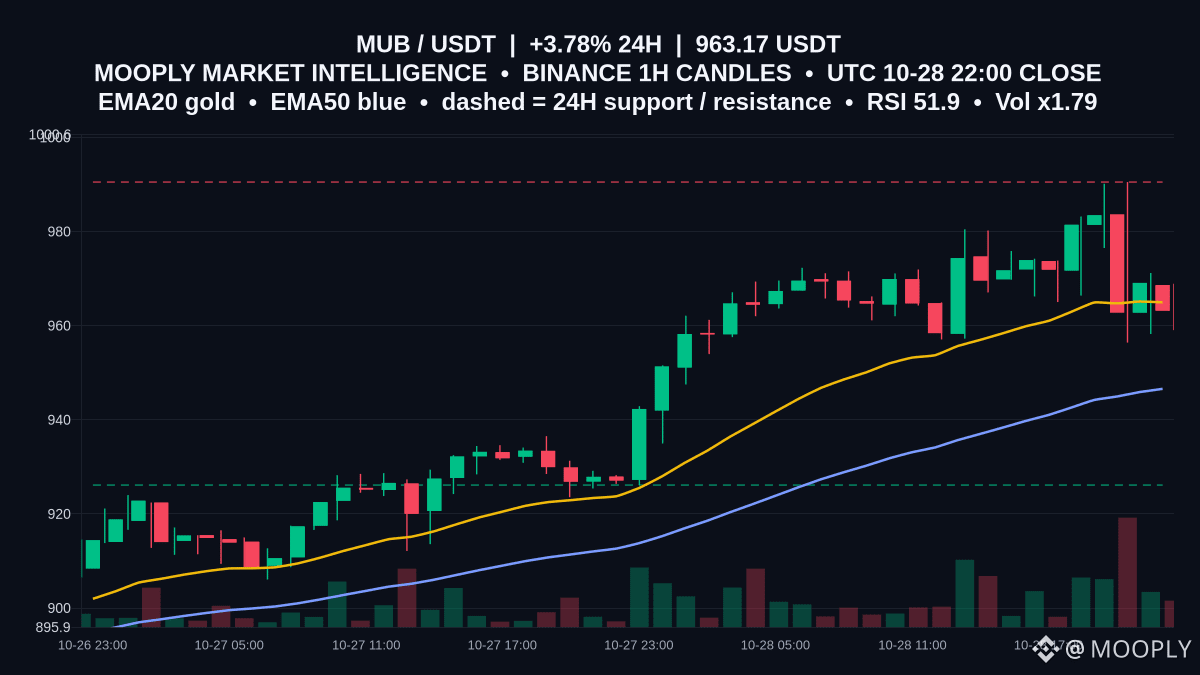
$MUB — The chart looks like a corridor more than a trend: price 963.17 sits just below EMA20 964.94 and above EMA50 946.57, inside the 24h dashed bands (support 926.12 / resistance 990.5). ATR14 = 12.63 shows modest hourly volatility, while volRatio 1.79 signals above-average activity. MACD (7.83) below its signal (10.14) hints momentum softness.
tradePlan = RANGE (confidence: wait; method: ATR14 and completed Binance 1h candles). Wait for a clear 1h close beyond 990.5 to consider a breakout confirmation, or a decisive close below 926.12 to invalidate the range—which 1h close will you watch first?
Not financial advice.
#MUB #ChartStructure #RangeWatch
·
--
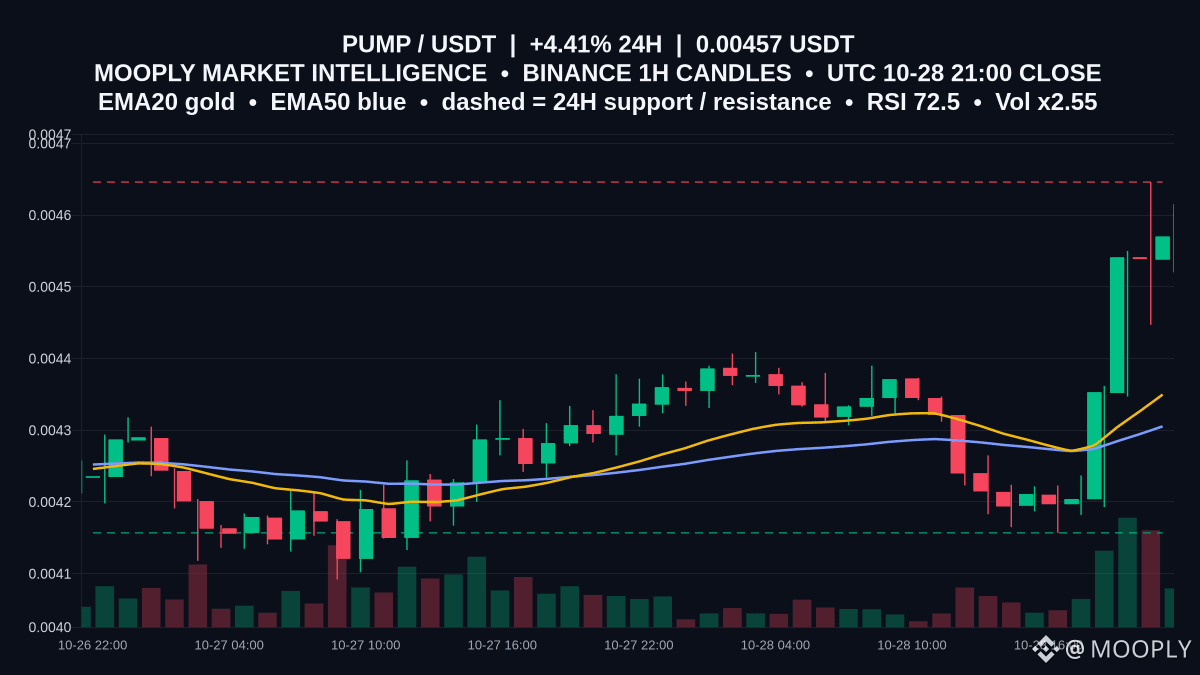
$PUMP ticks higher on Binance 1h candles, price 0.00457 USDT. It trades above EMA20 (0.0043498) and EMA50 (0.0043055); RSI sits at 72.5 📈 as volume fires (24h: 15,776,422.65; volRatio 2.55).
The conditional bullish plan calls for entry 0.0045344 with stop at 0.0041348, targets 0.004934 and 0.0053336, using ATR14 and completed 1h candles. Key levels: support 0.004157, resistance 0.004646.
Confirmation would be a clean close above 0.004646 on higher volume; invalidated if price falls under 0.0041348. Will a sustained breakout on volume confirm the path?
Not financial advice.
#PUMP #TechnicalAnalysis #Crypto
38
·
--

Статья
The Story of Aptos (APT): Origins, Move and the Road to MainnetAptos’s rise as a new layer-one participant in the blockchain landscape is anchored in a deliberate push toward scalable, secure smart contracts built with Move. This article uses Aptos Network’s official tokenomics overview as the guiding source to explore where Aptos came from, how the Move-based technology was shaped for broader adoption, and what the future might look like for developers, validators, and users. The Aptos mainnet launched in October 2022, marking a milestone in the project’s effort to translate Move’s safety features and formal verification ideas into real-world performance. For more detailed specifics on tokenomics, see Aptos Network’s tokenomics overview at https://aptosnetwork.com/currents/aptos-tokenomics-overview.
Origins and Move heritage
Aptos positions itself as a product of the Move ecosystem, a programmable approach to smart contracts that emphasizes safety, verifiability, and predictable behavior. The Move language originated within the wider Libra/Diem lineage, and Aptos inherits that lineage by adopting Move as its contract language and core executable model. The founders and contributors emphasize formal methods, rigorous testing, and a design philosophy that aims to minimize common smart contract pitfalls such as re-entrancy and unsafe state transitions. In broad terms, Aptos grew out of efforts to bring Move-based development to a scalable, internet-scale blockchain, with a focus on strong developer tooling and a safer on-chain execution environment. While the exact early-team dynamics are beyond the scope of a public tokenomics overview, the emphasis is clear: Move’s safety-centric approach is central to Aptos’s identity as it moves from proof-of-concept to practical, real-world use cases.
Road to mainnet: October 2022 and beyond
The documented path to mainnet included a sequence of testnets, security audits, and ecosystem-building incentives designed to stress the network’s capacity in a controlled way. Aptos’s October 2022 mainnet launch signaled a transition from test activity to a live environment where developers could deploy dapps, users could transact, and validators could participate in secured consensus and staking. The tokenomics framework supports ongoing ecosystem growth—allocating resources to governance, development grants, foundation initiatives, and validator incentives to sustain network security and capability as usage scales. From a product-development perspective, the journey to mainnet reflects a strategy that pairs Move-based smart contract safety with a practical deployment plan intended to handle real-world traffic and complex applications.
Architecture and the Move VM: a design for safety and speed
At the core of Aptos is a Move-based execution model designed to combine safety with performance. The architecture emphasizes clear module boundaries, formal reasoning where possible, and an execution environment intended to support parallel processing of transactions without compromising correctness. While every implementation detail is not visible in a tokenomics overview, the emphasis on Move as the contract language, together with a focus on robust tooling and predictable semantics, points to a philosophy of making it easier for developers to write secure, upgradeable code while allowing the network to process a high volume of transactions. The architecture aims to reduce critical failure modes common in other ecosystems and to enable faster iteration cycles for developers who want to deploy new features or improvements without destabilizing the broader system. For readers exploring how Aptos achieves reliability at scale, the tokenomics overview serves as a companion to the architectural narrative, underscoring how incentives align with a stable, secure platform.
Tokenomics at a glance: supply, distribution, and governance
Aptos tokenomics outlines the financial and governance scaffolding that supports network security, ecosystem growth, and community participation. The APT token plays a central role in paying transaction fees, staking for network security, and participating in governance decisions that shape the ecosystem’s trajectory. A key feature highlighted in the overview is the staged or planned distribution: a portion of tokens is allocated to a foundation or treasury to fund ecosystem grants, tooling, and partnerships; another portion goes to validators and delegators as staking rewards to secure the network and cushion deterrents against centralization; and a portion is reserved to support core development and future upgrades. The design emphasizes sustainability and decentralization by distributing incentives across developers, validators, and community participants. The tokenomics overview also discusses inflationary or emission dynamics that encourage ongoing participation while balancing long-term scarcity with the need to fund ongoing ecosystem initiatives. By presenting a structured framework for how tokens flow from issuance to ecosystem use, the overview helps readers understand why holders might engage with the network beyond mere speculation and how governance can influence updates, upgrades, and fund allocations. For precise numbers, allocations, and schedules, refer to the official tokenomics page at the provided URL.
Use cases, competition, and risk factors
In practical terms, Aptos tokens enable transaction fee payments, staking-based security, and governance participation, all of which support the network’s health and resilience. Developers can build on Aptos to create decentralized applications that benefit from Move’s safety guarantees and the platform’s emphasis on developer-friendly tooling. Users participate in the network by paying for compute or storage costs and by staking to contribute to the network’s consensus security, with stakers potentially earning rewards tied to the network’s activity. When comparing Aptos to other layer-one platforms, the tokenomics overview highlights a competitive landscape that includes both established chains and rising contenders, each with its own incentives and trade-offs. Risks to watch include governance concentration, where a small group could disproportionately influence decisions; security risk if bugs slip through testing on a live chain; and the challenge of achieving broad ecosystem adoption in a crowded market. Additionally, market dynamics can influence participation decisions, even as the technical design emphasizes safety and reliability. The overview also notes that any evaluation of risk should consider the evolving nature of the ecosystem, ongoing audits, bug bounty programs, and community governance practices as the network scales.
Practical considerations for readers and developers
For developers, Aptos represents an opportunity to experiment with Move-based smart contracts in a scalable environment, with attention to formal safety properties and a tooling ecosystem that aims to streamline deployment, testing, and upgrade processes. For users, the emphasis is on secure participation—protecting private keys, verifying the authenticity of wallets and apps, and understanding how staking and governance work within the ecosystem. The tokenomics overview reinforces the idea that meaningful participation comes with responsibilities: keeping track of governance proposals, understanding staking requirements, and recognizing the potential for periods of network activity to influence fees and rewards. As with any blockchain platform, practical engagement benefits from a cautious, educated approach: use reputable wallets, rely on official channels for updates, and diversify participation to avoid overexposure to a single platform. The official tokenomics source provides a structured lens through which developers and users can assess how Aptos intends to sustain growth, resilience, and innovation over time.
Checklist for readers and builders
- Read the official Aptos tokenomics overview to understand how APT is allocated, used, and governed: https://aptosnetwork.com/currents/aptos-tokenomics-overview
- If you plan to stake, review validator requirements and current rewards, and ensure you have secure custody for your keys.
- For developers, explore Move-based smart contract development tools, libraries, and best practices for safe, upgradeable modules.
- Stay informed through official channels about protocol upgrades, audits, and governance proposals to participate responsibly.
- Exercise caution with third-party information and confirm with the official source before making decisions about participation or development on the network.
Conclusion: a balanced outlook on Aptos and the Move ecosystem
Aptos’s journey to mainnet in October 2022 marked a deliberate effort to translate Move’s design principles into a scalable, developer-friendly platform. By combining a Move-based execution model with a governance framework and ecosystem funding, Aptos seeks to offer strong fundamentals for a growing set of applications and users. The tokenomics framework paints a picture of ongoing incentives designed to support security, decentralization, and long-term growth, while recognizing the need to balance emission with real-world adoption. As the blockchain landscape evolves, Aptos will be measured not just by technical capability but by how well its governance, funding, and tooling translate into tangible, secure user experiences and durable developer ecosystems. Educational, careful consideration and ongoing learning are essential for anyone evaluating Aptos as part of a broader digital asset exploration.
Educational only — not financial advice.
Binance market snapshot 2026-10-28T22:40:08.959Z: APT price 0.7015 USDT; 24h change 1.26 percent. Official history source: https://aptosnetwork.com/currents/aptos-tokenomics-overview
Chart: APT/USDT uses completed Binance market candles.
$APT #CryptoEducation #MarketEducation #APT
The Story of Aptos (APT): Origins, Move and the Road to Mainnet
Aptos’s rise as a new layer-one participant in the blockchain landscape is anchored in a deliberate push toward scalable, secure smart contracts built with Move. This article uses Aptos Network’s official tokenomics overview as the guiding source to explore where Aptos came from, how the Move-based technology was shaped for broader adoption, and what the future might look like for developers, validators, and users. The Aptos mainnet launched in October 2022, marking a milestone in the project’s effort to translate Move’s safety features and formal verification ideas into real-world performance. For more detailed specifics on tokenomics, see Aptos Network’s tokenomics overview at https://aptosnetwork.com/currents/aptos-tokenomics-overview.
Origins and Move heritage
Aptos positions itself as a product of the Move ecosystem, a programmable approach to smart contracts that emphasizes safety, verifiability, and predictable behavior. The Move language originated within the wider Libra/Diem lineage, and Aptos inherits that lineage by adopting Move as its contract language and core executable model. The founders and contributors emphasize formal methods, rigorous testing, and a design philosophy that aims to minimize common smart contract pitfalls such as re-entrancy and unsafe state transitions. In broad terms, Aptos grew out of efforts to bring Move-based development to a scalable, internet-scale blockchain, with a focus on strong developer tooling and a safer on-chain execution environment. While the exact early-team dynamics are beyond the scope of a public tokenomics overview, the emphasis is clear: Move’s safety-centric approach is central to Aptos’s identity as it moves from proof-of-concept to practical, real-world use cases.
Road to mainnet: October 2022 and beyond
The documented path to mainnet included a sequence of testnets, security audits, and ecosystem-building incentives designed to stress the network’s capacity in a controlled way. Aptos’s October 2022 mainnet launch signaled a transition from test activity to a live environment where developers could deploy dapps, users could transact, and validators could participate in secured consensus and staking. The tokenomics framework supports ongoing ecosystem growth—allocating resources to governance, development grants, foundation initiatives, and validator incentives to sustain network security and capability as usage scales. From a product-development perspective, the journey to mainnet reflects a strategy that pairs Move-based smart contract safety with a practical deployment plan intended to handle real-world traffic and complex applications.
Architecture and the Move VM: a design for safety and speed
At the core of Aptos is a Move-based execution model designed to combine safety with performance. The architecture emphasizes clear module boundaries, formal reasoning where possible, and an execution environment intended to support parallel processing of transactions without compromising correctness. While every implementation detail is not visible in a tokenomics overview, the emphasis on Move as the contract language, together with a focus on robust tooling and predictable semantics, points to a philosophy of making it easier for developers to write secure, upgradeable code while allowing the network to process a high volume of transactions. The architecture aims to reduce critical failure modes common in other ecosystems and to enable faster iteration cycles for developers who want to deploy new features or improvements without destabilizing the broader system. For readers exploring how Aptos achieves reliability at scale, the tokenomics overview serves as a companion to the architectural narrative, underscoring how incentives align with a stable, secure platform.
Tokenomics at a glance: supply, distribution, and governance
Aptos tokenomics outlines the financial and governance scaffolding that supports network security, ecosystem growth, and community participation. The APT token plays a central role in paying transaction fees, staking for network security, and participating in governance decisions that shape the ecosystem’s trajectory. A key feature highlighted in the overview is the staged or planned distribution: a portion of tokens is allocated to a foundation or treasury to fund ecosystem grants, tooling, and partnerships; another portion goes to validators and delegators as staking rewards to secure the network and cushion deterrents against centralization; and a portion is reserved to support core development and future upgrades. The design emphasizes sustainability and decentralization by distributing incentives across developers, validators, and community participants. The tokenomics overview also discusses inflationary or emission dynamics that encourage ongoing participation while balancing long-term scarcity with the need to fund ongoing ecosystem initiatives. By presenting a structured framework for how tokens flow from issuance to ecosystem use, the overview helps readers understand why holders might engage with the network beyond mere speculation and how governance can influence updates, upgrades, and fund allocations. For precise numbers, allocations, and schedules, refer to the official tokenomics page at the provided URL.
Use cases, competition, and risk factors
In practical terms, Aptos tokens enable transaction fee payments, staking-based security, and governance participation, all of which support the network’s health and resilience. Developers can build on Aptos to create decentralized applications that benefit from Move’s safety guarantees and the platform’s emphasis on developer-friendly tooling. Users participate in the network by paying for compute or storage costs and by staking to contribute to the network’s consensus security, with stakers potentially earning rewards tied to the network’s activity. When comparing Aptos to other layer-one platforms, the tokenomics overview highlights a competitive landscape that includes both established chains and rising contenders, each with its own incentives and trade-offs. Risks to watch include governance concentration, where a small group could disproportionately influence decisions; security risk if bugs slip through testing on a live chain; and the challenge of achieving broad ecosystem adoption in a crowded market. Additionally, market dynamics can influence participation decisions, even as the technical design emphasizes safety and reliability. The overview also notes that any evaluation of risk should consider the evolving nature of the ecosystem, ongoing audits, bug bounty programs, and community governance practices as the network scales.
Practical considerations for readers and developers
For developers, Aptos represents an opportunity to experiment with Move-based smart contracts in a scalable environment, with attention to formal safety properties and a tooling ecosystem that aims to streamline deployment, testing, and upgrade processes. For users, the emphasis is on secure participation—protecting private keys, verifying the authenticity of wallets and apps, and understanding how staking and governance work within the ecosystem. The tokenomics overview reinforces the idea that meaningful participation comes with responsibilities: keeping track of governance proposals, understanding staking requirements, and recognizing the potential for periods of network activity to influence fees and rewards. As with any blockchain platform, practical engagement benefits from a cautious, educated approach: use reputable wallets, rely on official channels for updates, and diversify participation to avoid overexposure to a single platform. The official tokenomics source provides a structured lens through which developers and users can assess how Aptos intends to sustain growth, resilience, and innovation over time.
Checklist for readers and builders
- Read the official Aptos tokenomics overview to understand how APT is allocated, used, and governed: https://aptosnetwork.com/currents/aptos-tokenomics-overview
- If you plan to stake, review validator requirements and current rewards, and ensure you have secure custody for your keys.
- For developers, explore Move-based smart contract development tools, libraries, and best practices for safe, upgradeable modules.
- Stay informed through official channels about protocol upgrades, audits, and governance proposals to participate responsibly.
- Exercise caution with third-party information and confirm with the official source before making decisions about participation or development on the network.
Conclusion: a balanced outlook on Aptos and the Move ecosystem
Aptos’s journey to mainnet in October 2022 marked a deliberate effort to translate Move’s design principles into a scalable, developer-friendly platform. By combining a Move-based execution model with a governance framework and ecosystem funding, Aptos seeks to offer strong fundamentals for a growing set of applications and users. The tokenomics framework paints a picture of ongoing incentives designed to support security, decentralization, and long-term growth, while recognizing the need to balance emission with real-world adoption. As the blockchain landscape evolves, Aptos will be measured not just by technical capability but by how well its governance, funding, and tooling translate into tangible, secure user experiences and durable developer ecosystems. Educational, careful consideration and ongoing learning are essential for anyone evaluating Aptos as part of a broader digital asset exploration.
Educational only — not financial advice.
Binance market snapshot 2026-10-28T22:40:08.959Z: APT price 0.7015 USDT; 24h change 1.26 percent. Official history source: https://aptosnetwork.com/currents/aptos-tokenomics-overview
Chart: APT/USDT uses completed Binance market candles.
$APT #CryptoEducation #MarketEducation #APT
33
·
--

Статья
The Story of Sui (SUI): Launch, Architecture, and the Scaling QuestSui presents itself as a new kind of blockchain experiment—built with a focus on real-time interactions, scalable performance, and a developer-friendly environment. The project publicly marked its launch milestone with a mainnet debut on May 3, 2023, an event that the Sui Foundation describes as a turning point for on-chain experiences. This article traces the arc from its origins through its architectural choices, practical use cases, and the landscape it now navigates. For a detailed account, see the Sui Foundation’s mainnet anniversary milestones and innovation blog post at https://www.sui.io/blog/mainnet-anniversary-milestones-innovation.
Origins and the May 3 2023 mainnet launch
Sui’s public journey begins with a bold premise: to rethink how on-chain state is managed and accessed so that applications can feel as responsive as traditional software. The official narrative centers on enabling high-throughput, low-latency interactions without sacrificing security or composability. The milestone of a public mainnet launch on May 3 2023 is presented as a concrete step toward a broader ecosystem where developers can ship interactive, complex experiences rather than settling for limited, staggered on-chain actions. This origin story emphasizes a shift from batch-style, transaction-by-transaction constraints to a model that aims to support dynamic, user-driven workloads at scale.
A design for speed: Move, objects, and parallel execution
Core to Sui’s architectural vision is a Move-based programming model married to an object-centric data approach. Rather than treating the blockchain as a simple ledger of accounts and balances, Sui foregrounds objects and their state transitions as central to application logic. This perspective supports parallel processing of transactions that operate on independent objects, potentially increasing throughput and reducing confirmation latency for many users at once. The official materials frame this as a deliberate design choice to unlock real-time interactions—such as games, social platforms, and consumer-facing apps—without forcing developers into heavy optimization work to squeeze performance from the chain. In short, Sui aims to combine a developer-friendly smart contracting environment with a data organization scheme that can scale with demand while keeping security guarantees intact.
From code to commerce: practical use cases on SUI
Concrete hypothetical scenarios help illustrate how Sui could be employed in everyday blockchain-enabled experiences. Picture a massively multiplayer online game where thousands of players interact in a shared world. Each action—picking up an item, trading with another player, updating a clan’s asset—changes the state of a small set of objects. Because those objects can be managed in parallel, the system can process many player actions simultaneously, reducing bottlenecks that plague traditional, sequential execution models. Now imagine a digital art marketplace where artworks are modeled as distinct objects with their own lifecycle: creation, ownership transfer, licensing, and resale all occur as object state transitions. In both cases, developers can design flows that emerge from real-time user behavior rather than being constrained by serialized transaction processing. These examples reflect the use cases highlighted by Sui Foundation’s communication about scalable, interactive experiences on the network.
Competition, risks, and tokenomics considerations
Sui enters a competitive landscape that includes other layer-1 and layer-2 platforms aiming to balance performance, security, and developer experience. The relative advantages touted by Sui—such as its Move-based dev path and object-centric model—position it as an option for developers seeking high throughput with responsive end-user experiences. However, as with any new architectural approach, risks exist. Key considerations include the security implications of novel design choices, the potential for validator centralization if network participation concentrates among a limited set of operators, and the need for ongoing ecosystem incentives to attract and retain developers, users, and infrastructure providers. Tokenomics and incentives, governance mechanisms, and long-term funding models are also areas where clarity and community engagement will influence adoption. The official timeline and milestone narrative published by the Sui Foundation offers a lens into how the project frames its progress, milestones, and ongoing innovations, which readers are encouraged to review directly at the cited source.
Setbacks and verified lessons
When assessing any blockchain story, it is important to distinguish verified setbacks from speculative or unverified claims. In the Sui narrative, the focus remains on milestones such as the public mainnet launch and subsequent milestones described in the official anniversary post. If and when reports identify challenges—whether technical, security-related, or ecosystem-driven—the most credible form will be access to audited findings, public disclosures, and the observance of clear remediation steps. For educational purposes, this article relies on the official milestone narrative to convey the core architecture and aims, reserving commentary on setbacks to information that is independently verified and publicly documented.
Concrete hypothetical examples (additional illustrations)
- A mobile social app wanting micro-channels of interaction, where user posts, likes, and ephemeral interactions are modeled as objects. The app could orchestrate these interactions with low latency, while maintaining clear ownership and transferability of in-app assets.
- A collaborative content platform where creators issue limited-edition NFTs tied to objects in the system. Ownership transfers and licensing terms are tracked as object state changes, enabling creators to design complex, on-chain rights with transparent provenance.
- A game studio launching a blockchain-enabled title that supports thousands of concurrent in-game actions per second. By leveraging parallel object-state transitions, the game could sustain a smooth player experience even during peak activity while preserving verifiable ownership of in-game items.
A practical checklist for readers evaluating SUI concepts
- Understand the launch context: Review the May 3 2023 mainnet launch and subsequent milestones as described by the Sui Foundation to grasp the official trajectory and claimed capabilities.
- Explore the architectural claims: Examine how the object-centric data model and Move-based smart contracts are intended to enable parallelism and low-latency interactions.
- Assess ecosystem readiness: Check for available development toolings, SDKs, documentation quality, and the breadth of sample projects and tutorials.
- Consider security and audits: Look for information on security reviews, runtime protections, and any third-party audits that validate the architecture’s resilience.
- Evaluate governance and incentives: Understand how the network plans to govern upgrades, how validators participate, and what incentives exist for ecosystem participation.
- Monitor real-world adoption signals: Track developer activity, user growth, and notable deployments to gauge whether the architectural promises translate into tangible usage.
- Stay aligned with official updates: Given the evolving nature of blockchain platforms, regular consultation of the official source helps maintain an accurate picture of progress and priorities.
Balanced outlook
The story of Sui as presented by the official foundation highlights a research-backed attempt to reimagine how on-chain experiences are built and consumed. The emphasis on a Move-based, object-centric architecture paired with parallel execution reflects a deliberate design choice aimed at high-throughput, low-latency interactions. If these architectural promises translate into robust tooling, a vibrant developer community, and real-world usable apps, Sui could carve out a distinctive niche within the broader blockchain space. However, as with any emerging platform, the path depends on sustained security assurances, cohesive ecosystem growth, and effective governance that attracts long-term participation. The official narrative frames Sui as a continuously evolving platform—one that seeks to balance ambitious performance goals with practical developer needs and user experiences.
Source: https://www.sui.io/blog/mainnet-anniversary-milestones-innovation
Educational only — not financial advice.
Binance market snapshot 2026-10-28T22:13:49.452Z: SUI price 0.9481 USDT; 24h change 2.15 percent. Official history source: https://www.sui.io/blog/mainnet-anniversary-milestones-innovation
Chart: SUI/USDT uses completed Binance market candles.
$SUI #CryptoEducation #MarketEducation #SUI
The Story of Sui (SUI): Launch, Architecture, and the Scaling Quest
Sui presents itself as a new kind of blockchain experiment—built with a focus on real-time interactions, scalable performance, and a developer-friendly environment. The project publicly marked its launch milestone with a mainnet debut on May 3, 2023, an event that the Sui Foundation describes as a turning point for on-chain experiences. This article traces the arc from its origins through its architectural choices, practical use cases, and the landscape it now navigates. For a detailed account, see the Sui Foundation’s mainnet anniversary milestones and innovation blog post at https://www.sui.io/blog/mainnet-anniversary-milestones-innovation.
Origins and the May 3 2023 mainnet launch
Sui’s public journey begins with a bold premise: to rethink how on-chain state is managed and accessed so that applications can feel as responsive as traditional software. The official narrative centers on enabling high-throughput, low-latency interactions without sacrificing security or composability. The milestone of a public mainnet launch on May 3 2023 is presented as a concrete step toward a broader ecosystem where developers can ship interactive, complex experiences rather than settling for limited, staggered on-chain actions. This origin story emphasizes a shift from batch-style, transaction-by-transaction constraints to a model that aims to support dynamic, user-driven workloads at scale.
A design for speed: Move, objects, and parallel execution
Core to Sui’s architectural vision is a Move-based programming model married to an object-centric data approach. Rather than treating the blockchain as a simple ledger of accounts and balances, Sui foregrounds objects and their state transitions as central to application logic. This perspective supports parallel processing of transactions that operate on independent objects, potentially increasing throughput and reducing confirmation latency for many users at once. The official materials frame this as a deliberate design choice to unlock real-time interactions—such as games, social platforms, and consumer-facing apps—without forcing developers into heavy optimization work to squeeze performance from the chain. In short, Sui aims to combine a developer-friendly smart contracting environment with a data organization scheme that can scale with demand while keeping security guarantees intact.
From code to commerce: practical use cases on SUI
Concrete hypothetical scenarios help illustrate how Sui could be employed in everyday blockchain-enabled experiences. Picture a massively multiplayer online game where thousands of players interact in a shared world. Each action—picking up an item, trading with another player, updating a clan’s asset—changes the state of a small set of objects. Because those objects can be managed in parallel, the system can process many player actions simultaneously, reducing bottlenecks that plague traditional, sequential execution models. Now imagine a digital art marketplace where artworks are modeled as distinct objects with their own lifecycle: creation, ownership transfer, licensing, and resale all occur as object state transitions. In both cases, developers can design flows that emerge from real-time user behavior rather than being constrained by serialized transaction processing. These examples reflect the use cases highlighted by Sui Foundation’s communication about scalable, interactive experiences on the network.
Competition, risks, and tokenomics considerations
Sui enters a competitive landscape that includes other layer-1 and layer-2 platforms aiming to balance performance, security, and developer experience. The relative advantages touted by Sui—such as its Move-based dev path and object-centric model—position it as an option for developers seeking high throughput with responsive end-user experiences. However, as with any new architectural approach, risks exist. Key considerations include the security implications of novel design choices, the potential for validator centralization if network participation concentrates among a limited set of operators, and the need for ongoing ecosystem incentives to attract and retain developers, users, and infrastructure providers. Tokenomics and incentives, governance mechanisms, and long-term funding models are also areas where clarity and community engagement will influence adoption. The official timeline and milestone narrative published by the Sui Foundation offers a lens into how the project frames its progress, milestones, and ongoing innovations, which readers are encouraged to review directly at the cited source.
Setbacks and verified lessons
When assessing any blockchain story, it is important to distinguish verified setbacks from speculative or unverified claims. In the Sui narrative, the focus remains on milestones such as the public mainnet launch and subsequent milestones described in the official anniversary post. If and when reports identify challenges—whether technical, security-related, or ecosystem-driven—the most credible form will be access to audited findings, public disclosures, and the observance of clear remediation steps. For educational purposes, this article relies on the official milestone narrative to convey the core architecture and aims, reserving commentary on setbacks to information that is independently verified and publicly documented.
Concrete hypothetical examples (additional illustrations)
- A mobile social app wanting micro-channels of interaction, where user posts, likes, and ephemeral interactions are modeled as objects. The app could orchestrate these interactions with low latency, while maintaining clear ownership and transferability of in-app assets.
- A collaborative content platform where creators issue limited-edition NFTs tied to objects in the system. Ownership transfers and licensing terms are tracked as object state changes, enabling creators to design complex, on-chain rights with transparent provenance.
- A game studio launching a blockchain-enabled title that supports thousands of concurrent in-game actions per second. By leveraging parallel object-state transitions, the game could sustain a smooth player experience even during peak activity while preserving verifiable ownership of in-game items.
A practical checklist for readers evaluating SUI concepts
- Understand the launch context: Review the May 3 2023 mainnet launch and subsequent milestones as described by the Sui Foundation to grasp the official trajectory and claimed capabilities.
- Explore the architectural claims: Examine how the object-centric data model and Move-based smart contracts are intended to enable parallelism and low-latency interactions.
- Assess ecosystem readiness: Check for available development toolings, SDKs, documentation quality, and the breadth of sample projects and tutorials.
- Consider security and audits: Look for information on security reviews, runtime protections, and any third-party audits that validate the architecture’s resilience.
- Evaluate governance and incentives: Understand how the network plans to govern upgrades, how validators participate, and what incentives exist for ecosystem participation.
- Monitor real-world adoption signals: Track developer activity, user growth, and notable deployments to gauge whether the architectural promises translate into tangible usage.
- Stay aligned with official updates: Given the evolving nature of blockchain platforms, regular consultation of the official source helps maintain an accurate picture of progress and priorities.
Balanced outlook
The story of Sui as presented by the official foundation highlights a research-backed attempt to reimagine how on-chain experiences are built and consumed. The emphasis on a Move-based, object-centric architecture paired with parallel execution reflects a deliberate design choice aimed at high-throughput, low-latency interactions. If these architectural promises translate into robust tooling, a vibrant developer community, and real-world usable apps, Sui could carve out a distinctive niche within the broader blockchain space. However, as with any emerging platform, the path depends on sustained security assurances, cohesive ecosystem growth, and effective governance that attracts long-term participation. The official narrative frames Sui as a continuously evolving platform—one that seeks to balance ambitious performance goals with practical developer needs and user experiences.
Source: https://www.sui.io/blog/mainnet-anniversary-milestones-innovation
Educational only — not financial advice.
Binance market snapshot 2026-10-28T22:13:49.452Z: SUI price 0.9481 USDT; 24h change 2.15 percent. Official history source: https://www.sui.io/blog/mainnet-anniversary-milestones-innovation
Chart: SUI/USDT uses completed Binance market candles.
$SUI #CryptoEducation #MarketEducation #SUI
27
·
--
📈 $GOOGLB — Breakout or Bull Trap?
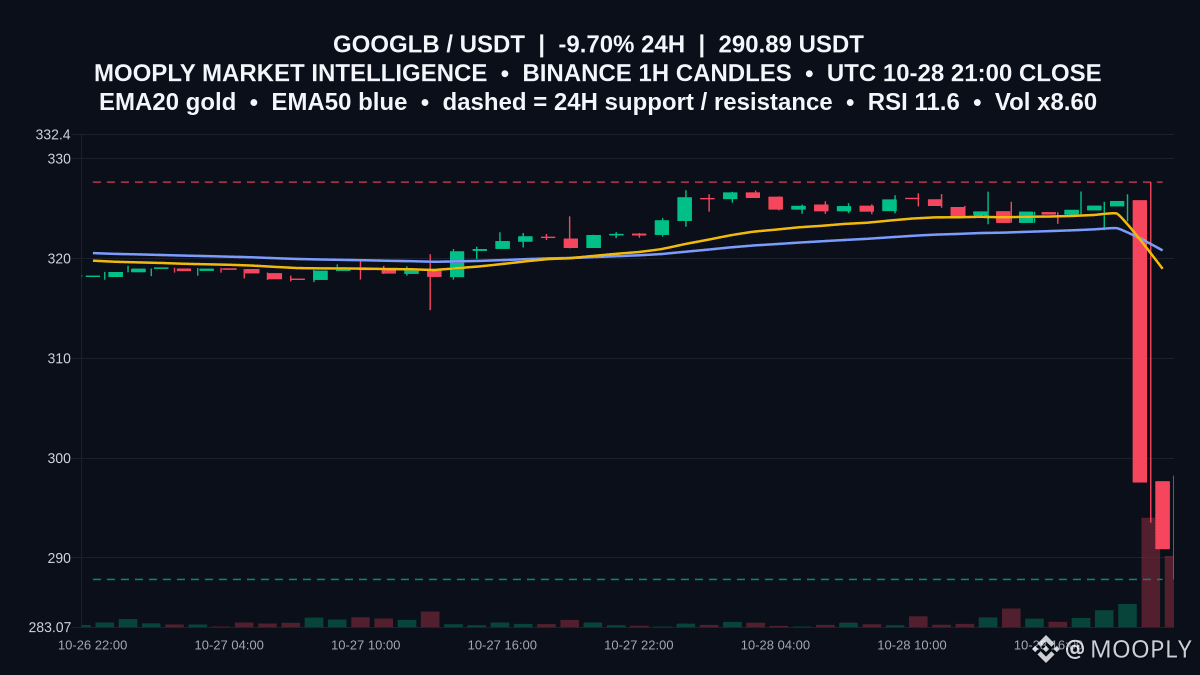
GOOGLB is trading at 290.89 USDT, below both EMA20 and EMA50.
Here's what caught my attention:
🔥 Volume is 8.6x the average
📊 RSI sits near 11.6
🎯 Resistance: 327.65
🛡️ Support: 287.85
The bullish case: A confirmed breakout above resistance could open the door to further upside.
The bearish case: Losing support would weaken the current setup.
Would you wait for confirmation or watch for a rejection? 👀
Not financial advice.
#GOOGLB #TechnicalAnalysis #Crypto
1
·
--
📈 $SOXLB — Breakout or Bull Trap?
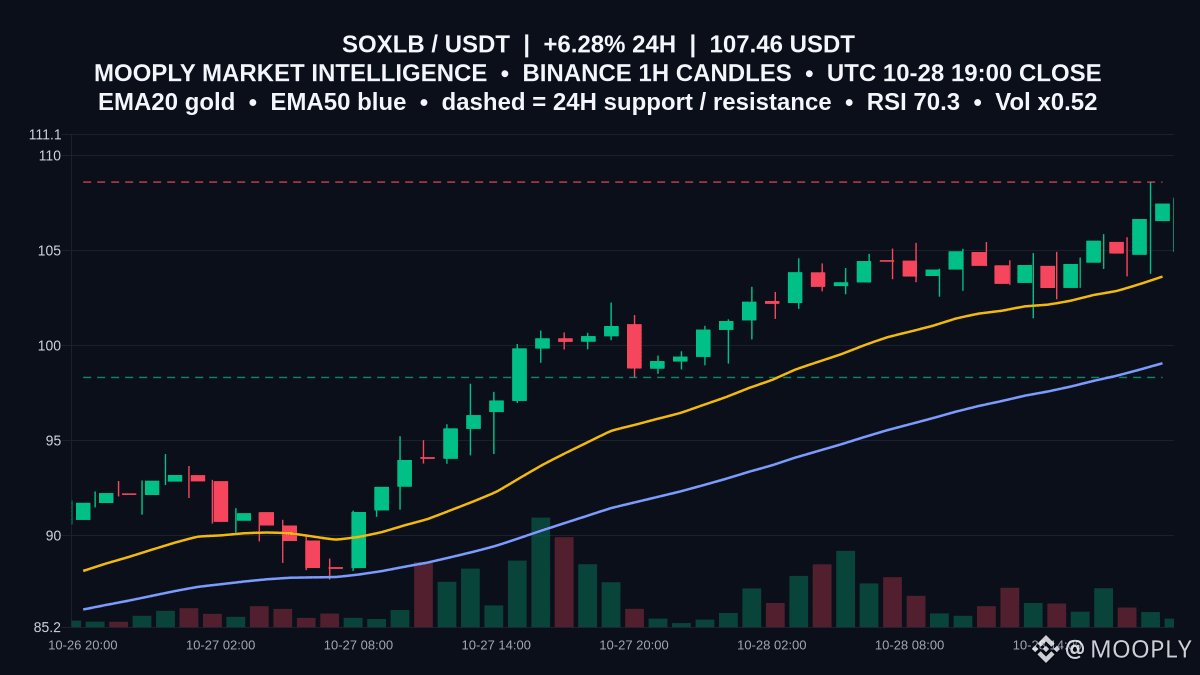
SOXLB is trading at 107.46 USDT, above EMA20 (103.63) and EMA50 (99.07).
Here's what caught my attention:
🔥 Volume is 0.52x the average
📊 RSI sits near 70.31
🎯 Resistance: 108.6
🛡️ Support: 98.32
The bullish case: A confirmed breakout above resistance could open the door to further upside.
The bearish case: Losing support would weaken the current setup.
Would you wait for confirmation or watch for a rejection? 👀
Not financial advice.
#SOXLB #TechnicalAnalysis #Crypto
3
·
--
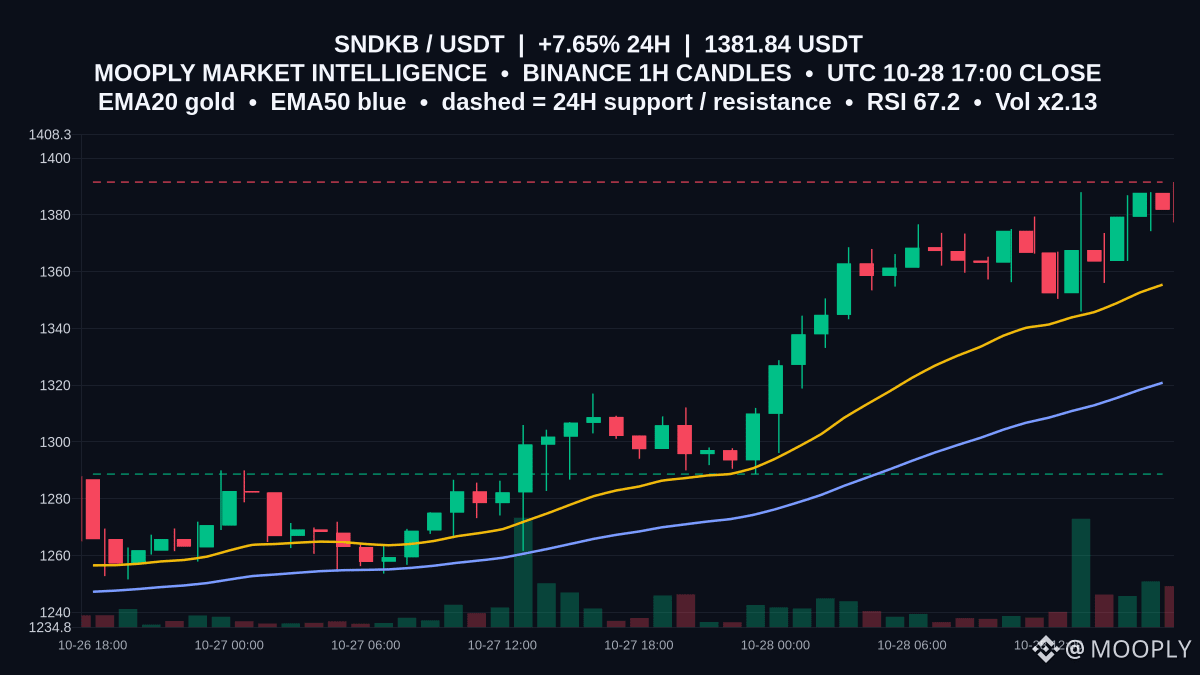
📈 $SNDKB — Breakout or Bull Trap?
SNDKB is trading at 1381.84 USDT, holding above both EMA20 and EMA50.
Here's what caught my attention:
🔥 Volume is 2.13x the average
📊 RSI sits near 67
🎯 Resistance: 1391.54
🛡️ Support: 1288.68
The bullish case: A confirmed breakout above resistance could open the door to further upside.
The bearish case: Losing support would weaken the current setup.
Would you wait for confirmation or watch for a rejection? 👀
Not financial advice.
#SNDKB #TechnicalAnalysis #Crypto
14
·
--
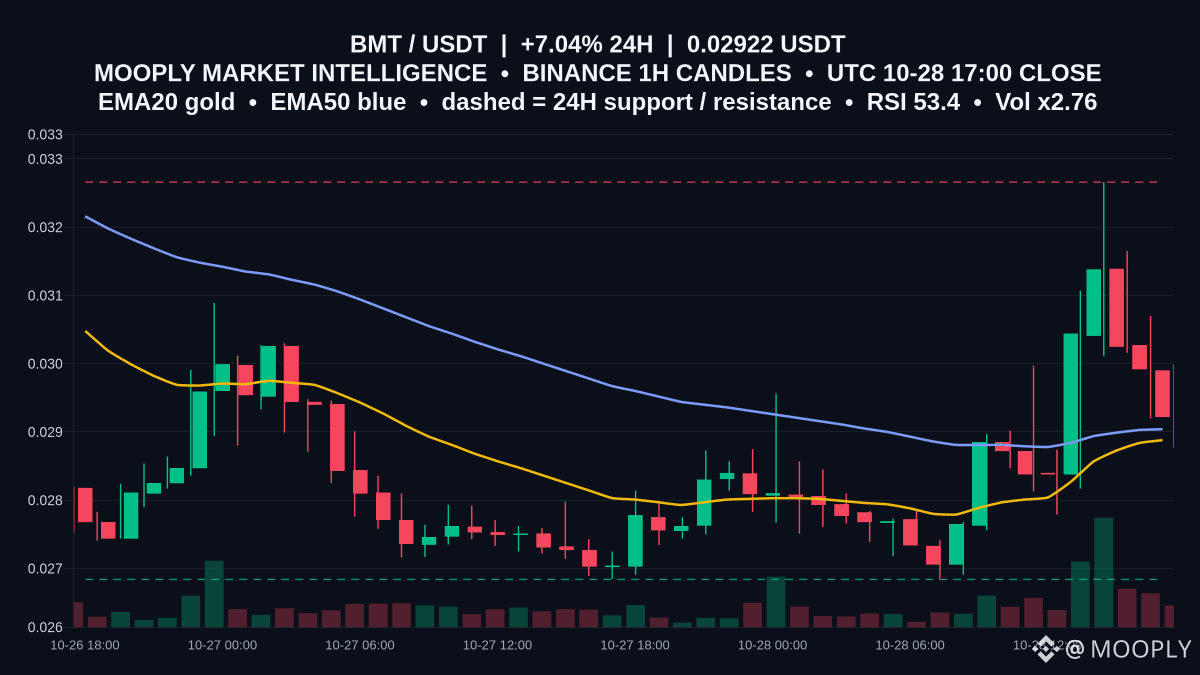
$BMT Price sits above EMA20 (0.02888) and EMA50 (0.02904) at 0.02922, MACD positive and RSI 53, signaling near-term resilience 📈 Strongest evidence: price above both EMAs, MACD positive (0.00046317 vs 0.00023164), and volume surging (vol ratio 2.76; +7.04% 24h). Support 0.02684, resistance 0.03266 frame the range. Confirmation: close above 0.03266 with rising volume; invalidation: close below 0.02684 or a downside volume spike. Moderate confidence; conditional LONG on breakout above 0.03266; otherwise WAIT.
Not financial advice.
#BMT #TechnicalAnalysis #Crypto
Not financial advice.
#BMT #TechnicalAnalysis #Crypto
3
335
·
--
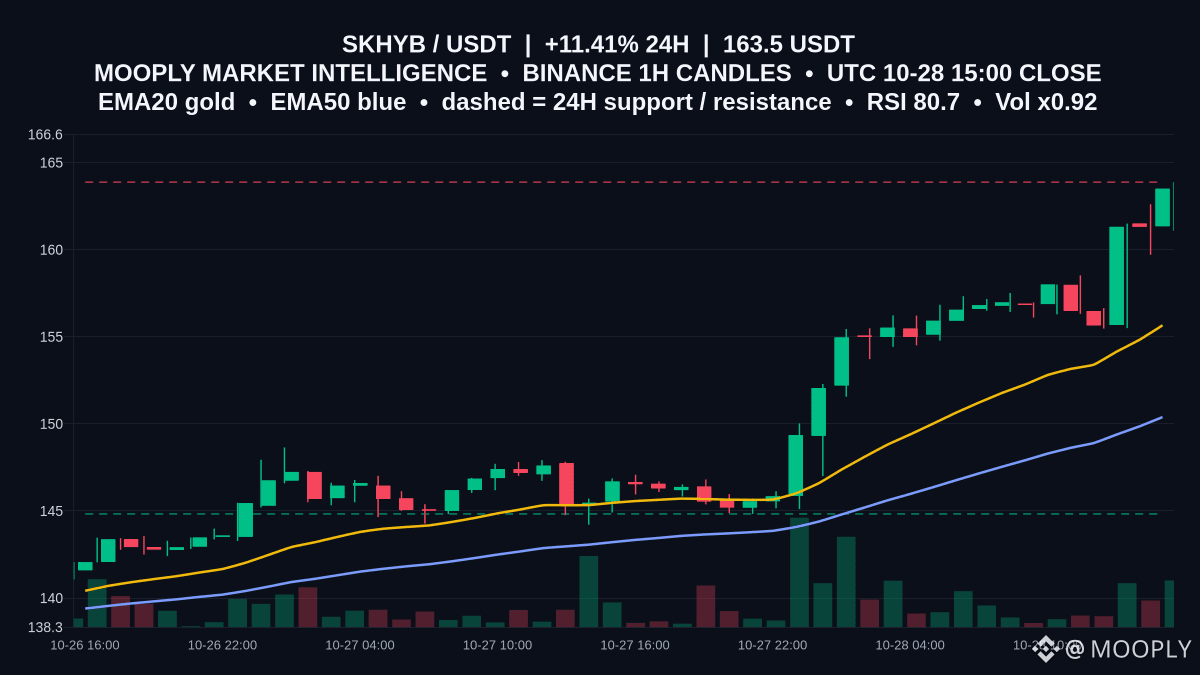
$SKHYB +11.41% in 24h, price 163.5 USDT, RSI 80.75, EMA20 155.66, EMA50 150.39, near resistance 163.88 USDT with volume 18.49M USDT 🚀
Price sits above both EMA20 and EMA50, signaling ongoing bullish tempo.
RSI at 80.75 reinforces overbought momentum; 24h volume around 18.49M USDT with support at 144.83 and resistance at 163.88.
Bull case: a clean breakout above 163.88 USDT on higher volume could extend the rally, with EMA20 staying above EMA50 and RSI staying elevated.
Bear case: failure to sustain above 163.88 or a break below 144.83 would tilt to a pullback toward the 150–155 area; with RSI still high, uncertainty remains until a clear candlestick close beyond resistance.
Data: Binance 1H candles · Not financial advice.
#SKHYB #TechnicalAnalysis #Crypto
1
32
·
--
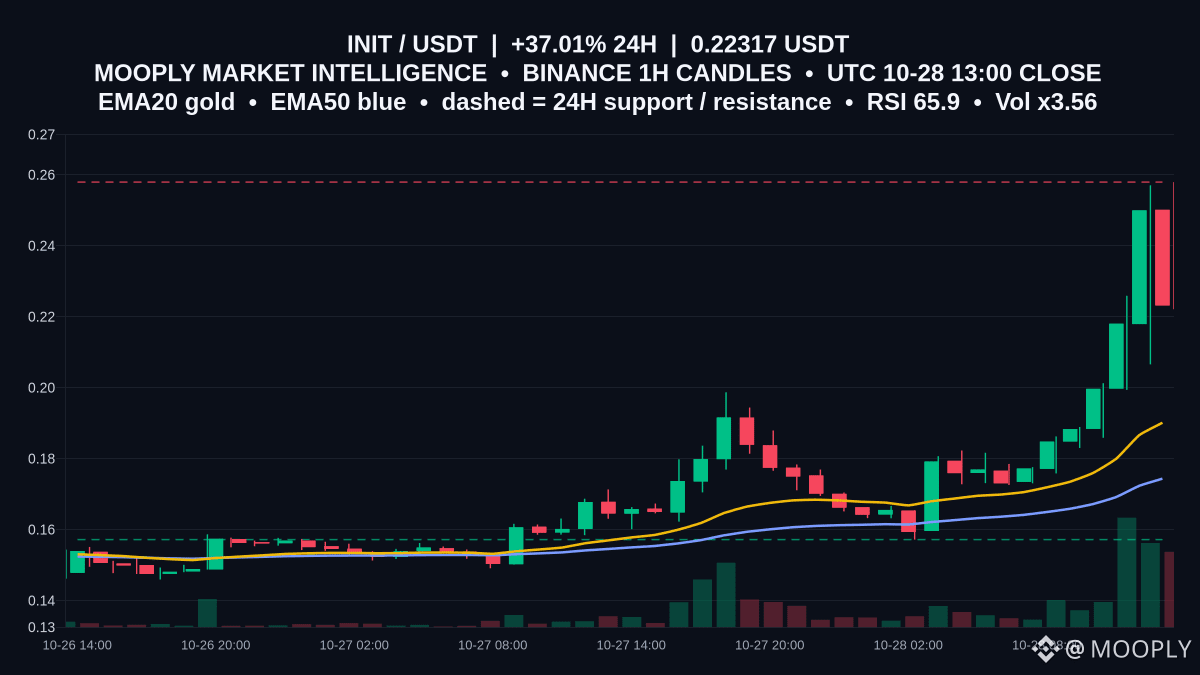
$INIT +37.01% in 24h, price 0.22317 USDT; RSI 65.9, EMA20 0.19011 vs EMA50 0.17434; volume 13.29M (vol 3.56) and support/resistance 0.15717 / 0.25793 🚀
Price sits above both EMA lines (EMA20 0.19011, EMA50 0.17434), with RSI at 65.9 suggesting continued bullish momentum. Volume remains elevated (~13.29M/24h) and the chart marks a clear floor at 0.15717 and a ceiling at 0.25793.
Clear invalidation: a daily close below 0.15717 would undermine the setup; a break above 0.25793 would strengthen the bullish case.
Data: Binance 1H candles · Not financial advice.
#INIT #TechnicalAnalysis #Crypto
92
·
--
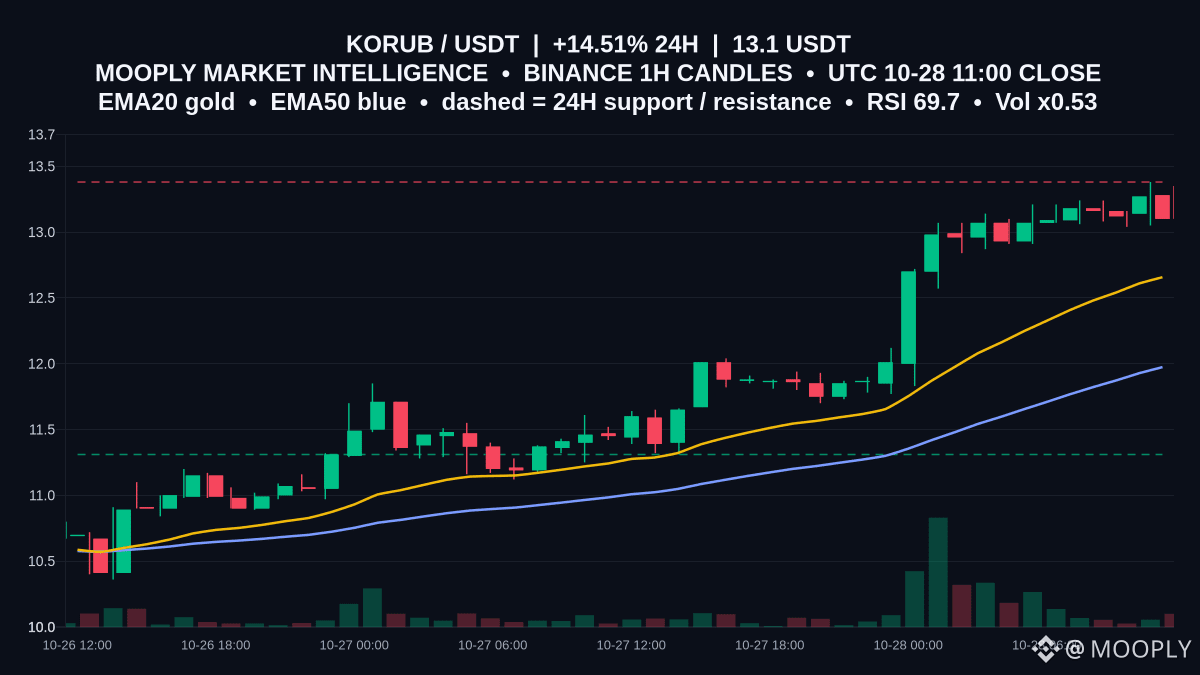
$KORUB 🚀 +14.51% in 24h to 13.1 USDT on 11.25M volume; RSI 69.72, EMA20 12.66, EMA50 11.97; support 11.31, resistance 13.38.
Price action shows the move holding above EMA20 and EMA50, with price at 13.1 USDT and momentum still solid as RSI sits near 70. Volume confirms the surge at 11.25M, while the chart marks resistance at 13.38 and a floor of 11.31.
What would change the view? A clear invalidation would be a daily close below 11.31, or a sustained break below EMA20 12.66 that undercuts the bullish structure.
Data: Binance 1H candles · Not financial advice.
#KORUB #TechnicalAnalysis #Crypto
73
·
--
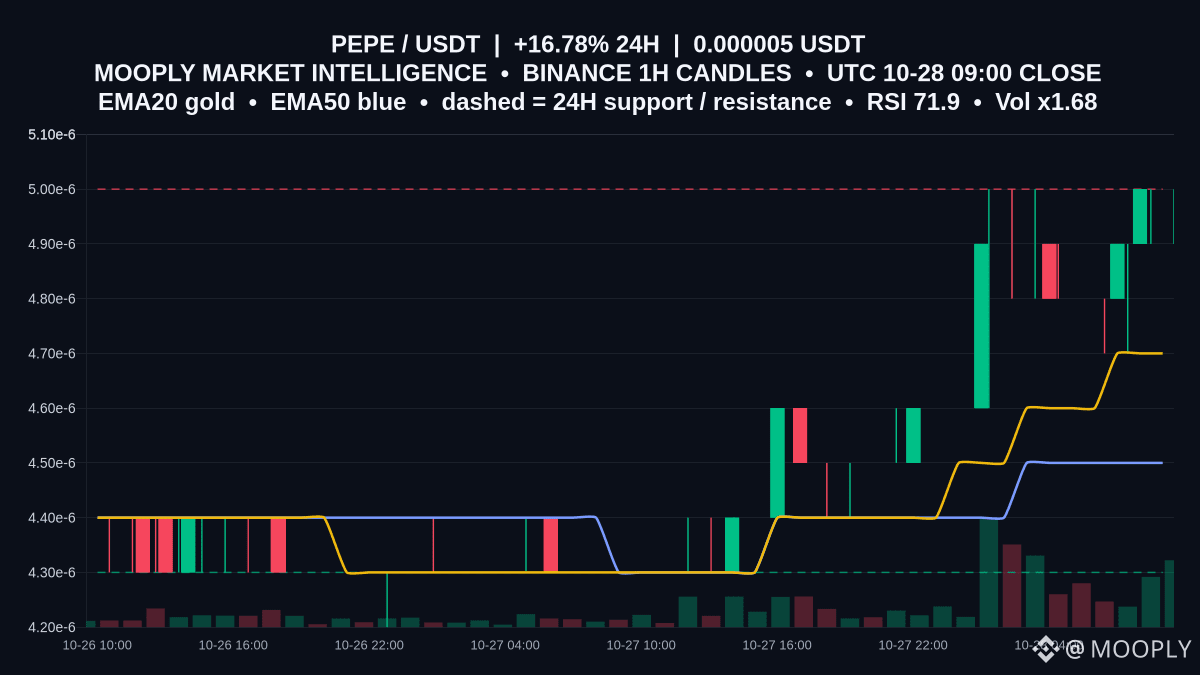
$PEPE rises as momentum tightens: price 0.00000501 USDT, +16.8% in 24h, volume 73,567,338 USDT, RSI 71.9, EMA20 0.0000047, EMA50 0.0000045; resistance 0.0000050, support 0.0000043. A daily close below 0.0000043 would be a clear invalidation.
Insight: RSI near 72 and price above EMA20/EMA50 keep the near-term bias constructive; hold 0.0000043 to maintain the tilt, otherwise the view would invalidate.
Data: Binance 1H candles · Not financial advice.
#PEPE #TechnicalAnalysis #Crypto
Insight: RSI near 72 and price above EMA20/EMA50 keep the near-term bias constructive; hold 0.0000043 to maintain the tilt, otherwise the view would invalidate.
Data: Binance 1H candles · Not financial advice.
#PEPE #TechnicalAnalysis #Crypto
22
·
--
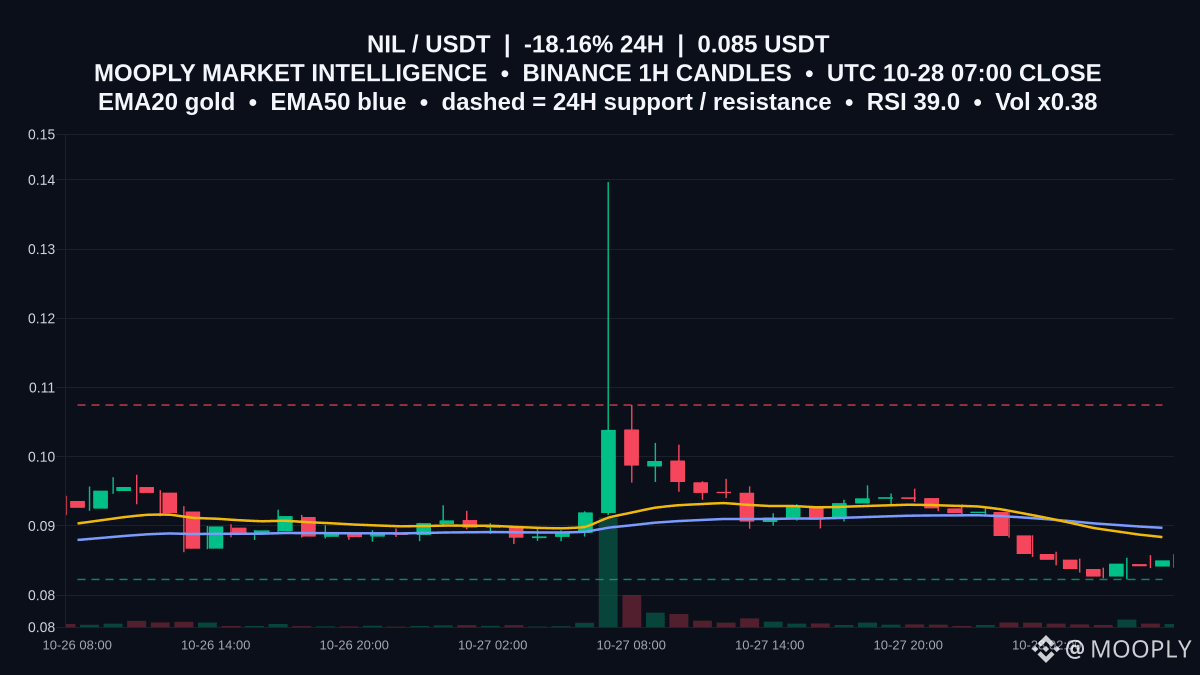
$NIL slumps 18% in 24h, trading at 0.085 USDT.
Volume surged to 12,757,439 over 24h as price remained below EMA20 (0.08839) and EMA50 (0.08973).
RSI sits around 38.95, with price near 0.08227 support and facing 0.10747 resistance.
A clear invalidation would come if NIL closes above 0.10747 with confirming volume, implying a shift above the major resistance.
Conversely, a break below 0.08227 would affirm a continued down tilt.
Data: Binance 1H candles · Not financial advice.
#NIL #TechnicalAnalysis #Crypto
130
·
--
Рост
🐸🚨 A PEPE Whale Just Woke Up After a Year!
A massive whale holding 4.03 TRILLION $PEPE has moved 1.45 trillion tokens to a new wallet after a year of inactivity. 👀
💰 Unrealized profits reportedly dropped from $32.77M to $5.1M.
The big question: Is this whale preparing to sell, or simply reorganizing its holdings? 🐋
A wallet transfer isn't proof of a sell-off, but this is definitely one to watch.
🔥 Bullish 🟢 or Bearish 🔴 for $PEPE E?
#PEPE #CryptoWhales #Memecoins🤑🤑 n #CryptoNews


Binance News
·
--
PEPE Whale Moves 1.45 Trillion Tokens to New Address After a Year
A whale that accumulated 4.03 trillion PEPE has transferred 1.45 trillion tokens to a new address after a year of inactivity. According to Foresight News, the transfer from an address starting with 0x2da to one starting with 0x803 was tracked by @ai_9684xtpa. The whale accumulated the tokens between May 2023 and August 2024 at a cost as low as $0.000001185 per token. The remaining holdings are currently showing an unrealized profit of $5.106 million, after reaching as much as $32.77 million at the end of 2024.

أطيب التمنيات!
От MOOPLY
7
·
--
⚠️ Glamsterdam on Hoodi postponed
According to the Ethereum Foundation, the Glamsterdam upgrade on Hoodi, previously scheduled for October 26, 2026 at 17:42:48 UTC (epoch 132,352), has been postponed. This changes the upgrade timeline and may require extra coordination for client teams, validators and dapp developers preparing for the activation. The announcement references a new activation date; the exact timing and rationale are not shown in the supplied snippet.
https://blog.ethereum.org/en/2026/10/22/glamsterdam-hoodi-delay
Not financial advice.
#CryptoNews #Crypto

25
·
--
⏸️ Glamsterdam on Hoodi postponed
According to the Ethereum Foundation blog, the Glamsterdam upgrade on Hoodi — previously scheduled for October 26, 2026 at 17:42:48 UTC (epoch 132,352) — has been postponed. This revision changes the public upgrade timeline reported by the Foundation.
This may matter for node operators, client teams and integrators who were coordinating around the prior activation window; the blog signals a replacement activation date will follow, but exact timing and next steps remain unclear.
https://blog.ethereum.org/en/2026/10/22/glamsterdam-hoodi-delay
Not financial advice.
#CryptoNews #Crypto
38
·
--
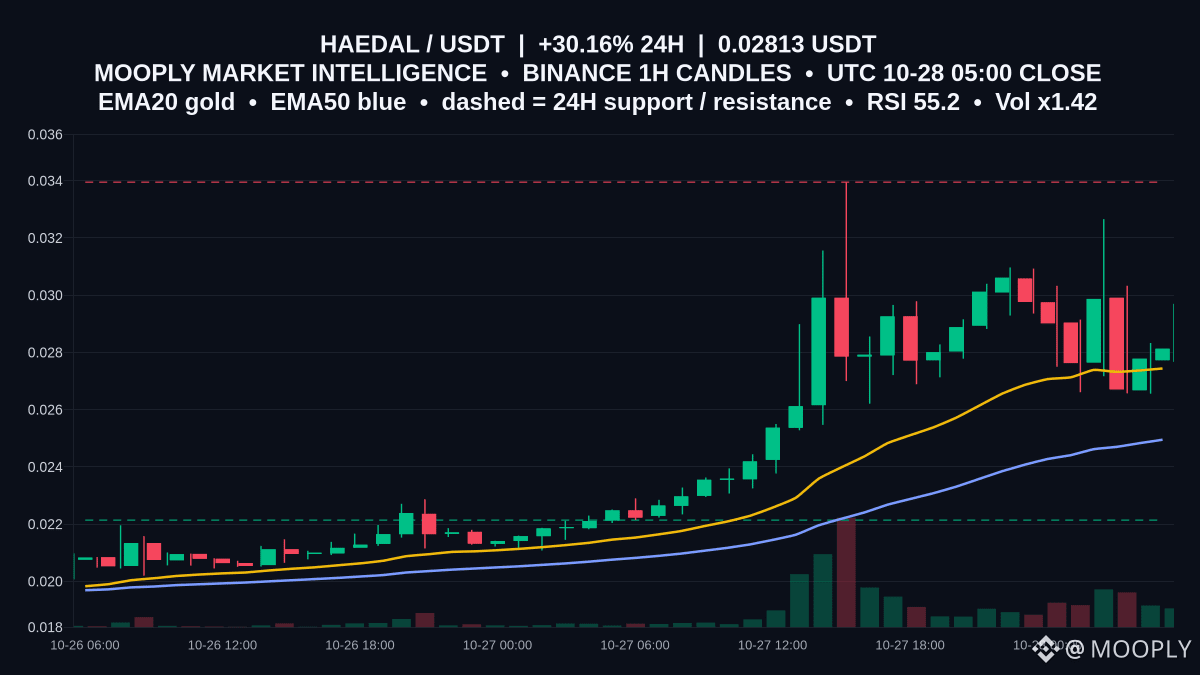
$HAEDAL 30%+ rally in 24h with price 0.02813 USDT and strong volume 🚀
Price sits above EMA20 (0.02744) and EMA50 (0.02495), signaling bullish tilt as RSI 55.17 stays mid-range; volume is elevated (volRatio 1.42) and the chart shows resistance at 0.03395 with support at 0.02214.
Clear invalidation would be a break below 0.02214, which would undermine the current setup.
Data: Binance 1H candles · Not financial advice.
#HAEDAL #TechnicalAnalysis #Crypto
1
55
·
--
Статья
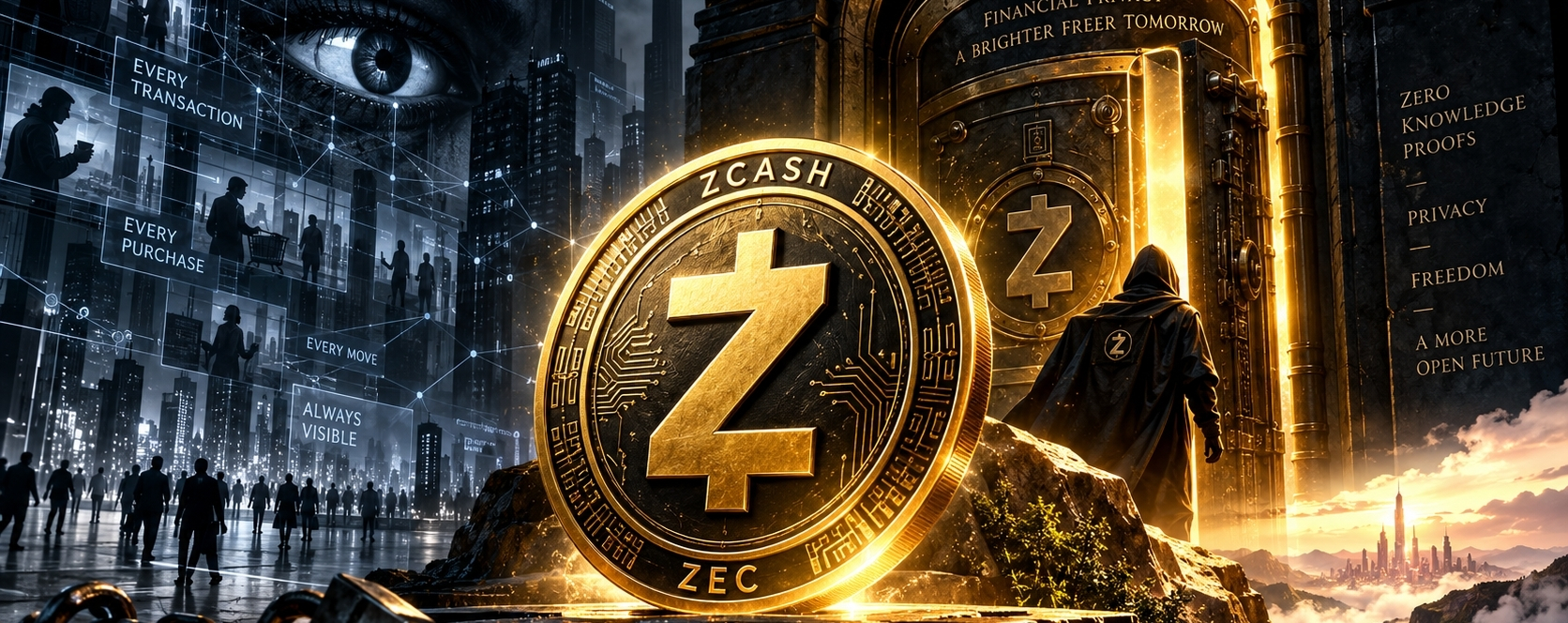
THE COIN THAT REFUSED TO BE WATCHED 🕶️The Untold Story of $ZEC — A Battle for Financial Privacy
Imagine waking up tomorrow in a world where every dollar you spend becomes public knowledge.
Your salary. Your savings. The coffee you bought this morning. Every payment you make.
Now imagine that strangers can follow your financial footsteps forever.
Sounds like a dystopian movie, right?
But here's the uncomfortable truth: much of the cryptocurrency world already operates on publicly visible ledgers.
And nearly ten years ago, a group of brilliant minds decided to challenge that reality.
This is the story of Zcash ($ZEC).
And it begins with a question that could change how you think about money.
CHAPTER I — THE GLASS KINGDOM 👁️
The year was 2009.
Bitcoin had arrived.
For the first time, people could transfer digital value without depending on a traditional bank.
It was revolutionary.
But every revolution leaves behind an unanswered question.
Bitcoin's blockchain was transparent. Transactions could be inspected, balances traced, and addresses analyzed.
The system didn't automatically reveal everyone's real identity, but financial activity could become connected to real people.
Some saw transparency as freedom.
Others saw a world made of glass.
And somewhere among the researchers studying cryptography, an idea began to take shape:
What if money could be verified without exposing its owner's financial life?
CHAPTER II — THE SECRET THAT MATHEMATICS COULD PROVE 🔐
In 2013, researchers introduced Zerocoin, a proposal designed to improve privacy in Bitcoin.
The idea evolved.
Rather than simply modifying Bitcoin, the researchers and developers eventually pursued a separate cryptocurrency.
Their weapon wasn't a secret computer.
It wasn't an invisible network.
It was mathematics.
A technology known as zero-knowledge proofs.
Imagine standing before a locked door.
A guardian demands proof that you know the correct password.
But you refuse to reveal the password itself.
What if you could mathematically prove that you know it, without telling the guardian what it is?
That is the remarkable principle behind zero-knowledge proofs.
And it would become central to Zcash.
CHAPTER III — OCTOBER 28, 2016 ⚡
The day finally arrived.
October 28, 2016.
Zcash officially launched.
Its native currency was called ZEC.
Its maximum supply?
21 million coins.
The same numerical limit associated with Bitcoin.
But Zcash offered something fundamentally different.
It introduced shielded transactions, using advanced cryptography to protect sensitive financial details.
The world could still verify that the network followed its rules.
Yet appropriately shielded transaction details could remain confidential.
It was a bold experiment.
A blockchain that could offer both verifiability and privacy.
CHAPTER IV — THE POWER OF THE INVISIBLE 🛡️
Picture two people transferring $ZEC.
In a fully shielded transaction, outsiders cannot publicly inspect the sender's shielded address, the receiver's shielded address, or the transferred amount.
Yet the network can still verify the transaction's validity.
No magic.
No disappearing coins.
Just sophisticated cryptography.
But there's an important detail.
Not every Zcash transaction is private.
Zcash also supports transparent transactions, and privacy depends on the addresses, transaction type, and tools used.
That distinction matters.
Because real technology is more interesting than exaggerated promises.
CHAPTER V — THE PRICE OF FREEDOM ⚖️
Every powerful invention creates difficult questions.
Financial privacy can protect ordinary people from surveillance, unwanted exposure, and financial profiling.
But privacy technologies also face regulatory scrutiny, compliance challenges, and questions about potential misuse.
Zcash has never existed outside those debates.
Its ecosystem has experienced technological upgrades, competition, market volatility, and changing attitudes toward privacy coins.
And owning $ZEC does not guarantee profits.
Its price can fall dramatically, just like other cryptocurrencies.
But the idea behind the project remains worth examining.
Should financial privacy be a privilege, or a fundamental feature of digital money?
CHAPTER VI — THE UNFINISHED STORY 🌌
October 28, 2026.
Ten years after Zcash's launch, the question that inspired its creation still matters.
As artificial intelligence grows more powerful, blockchain analytics advance, and digital payments become increasingly common, financial information can become extraordinarily revealing.
Zcash represents one attempt to answer a difficult question:
Can we build financial systems that are verifiable without making every personal transaction an open book?
The answer is still being written.
And perhaps the most fascinating part of the $ZEC story isn't its market price.
It's the idea that inspired its creation.
In a world obsessed with seeing everything, privacy itself can become revolutionary.
---
💬 Now I want to hear your opinion:
If you had to choose between a completely transparent financial system and one that protects your personal transactions, which would you trust more?
And do you believe privacy-focused cryptocurrencies like ZEC$will become more important over the next decade?
Share your thoughts below. 👇
This article uses fictionalized storytelling to explain documented historical events and technology. It is educational content, not financial advice.
#ZEC #Zcash #CryptoHistory #Blockchain #ZeroKnowledgeProofs fs
THE COIN THAT REFUSED TO BE WATCHED 🕶️
The Untold Story of $ZEC — A Battle for Financial Privacy
Imagine waking up tomorrow in a world where every dollar you spend becomes public knowledge.
Your salary. Your savings. The coffee you bought this morning. Every payment you make.
Now imagine that strangers can follow your financial footsteps forever.
Sounds like a dystopian movie, right?
But here's the uncomfortable truth: much of the cryptocurrency world already operates on publicly visible ledgers.
And nearly ten years ago, a group of brilliant minds decided to challenge that reality.
This is the story of Zcash ($ZEC ).
And it begins with a question that could change how you think about money.
CHAPTER I — THE GLASS KINGDOM 👁️
The year was 2009.
Bitcoin had arrived.
For the first time, people could transfer digital value without depending on a traditional bank.
It was revolutionary.
But every revolution leaves behind an unanswered question.
Bitcoin's blockchain was transparent. Transactions could be inspected, balances traced, and addresses analyzed.
The system didn't automatically reveal everyone's real identity, but financial activity could become connected to real people.
Some saw transparency as freedom.
Others saw a world made of glass.
And somewhere among the researchers studying cryptography, an idea began to take shape:
What if money could be verified without exposing its owner's financial life?
CHAPTER II — THE SECRET THAT MATHEMATICS COULD PROVE 🔐
In 2013, researchers introduced Zerocoin, a proposal designed to improve privacy in Bitcoin.
The idea evolved.
Rather than simply modifying Bitcoin, the researchers and developers eventually pursued a separate cryptocurrency.
Their weapon wasn't a secret computer.
It wasn't an invisible network.
It was mathematics.
A technology known as zero-knowledge proofs.
Imagine standing before a locked door.
A guardian demands proof that you know the correct password.
But you refuse to reveal the password itself.
What if you could mathematically prove that you know it, without telling the guardian what it is?
That is the remarkable principle behind zero-knowledge proofs.
And it would become central to Zcash.
CHAPTER III — OCTOBER 28, 2016 ⚡
The day finally arrived.
October 28, 2016.
Zcash officially launched.
Its native currency was called ZEC.
Its maximum supply?
21 million coins.
The same numerical limit associated with Bitcoin.
But Zcash offered something fundamentally different.
It introduced shielded transactions, using advanced cryptography to protect sensitive financial details.
The world could still verify that the network followed its rules.
Yet appropriately shielded transaction details could remain confidential.
It was a bold experiment.
A blockchain that could offer both verifiability and privacy.
CHAPTER IV — THE POWER OF THE INVISIBLE 🛡️
Picture two people transferring $ZEC .
In a fully shielded transaction, outsiders cannot publicly inspect the sender's shielded address, the receiver's shielded address, or the transferred amount.
Yet the network can still verify the transaction's validity.
No magic.
No disappearing coins.
Just sophisticated cryptography.
But there's an important detail.
Not every Zcash transaction is private.
Zcash also supports transparent transactions, and privacy depends on the addresses, transaction type, and tools used.
That distinction matters.
Because real technology is more interesting than exaggerated promises.
CHAPTER V — THE PRICE OF FREEDOM ⚖️
Every powerful invention creates difficult questions.
Financial privacy can protect ordinary people from surveillance, unwanted exposure, and financial profiling.
But privacy technologies also face regulatory scrutiny, compliance challenges, and questions about potential misuse.
Zcash has never existed outside those debates.
Its ecosystem has experienced technological upgrades, competition, market volatility, and changing attitudes toward privacy coins.
And owning $ZEC does not guarantee profits.
Its price can fall dramatically, just like other cryptocurrencies.
But the idea behind the project remains worth examining.
Should financial privacy be a privilege, or a fundamental feature of digital money?
CHAPTER VI — THE UNFINISHED STORY 🌌
October 28, 2026.
Ten years after Zcash's launch, the question that inspired its creation still matters.
As artificial intelligence grows more powerful, blockchain analytics advance, and digital payments become increasingly common, financial information can become extraordinarily revealing.
Zcash represents one attempt to answer a difficult question:
Can we build financial systems that are verifiable without making every personal transaction an open book?
The answer is still being written.
And perhaps the most fascinating part of the $ZEC story isn't its market price.
It's the idea that inspired its creation.
In a world obsessed with seeing everything, privacy itself can become revolutionary.
---
💬 Now I want to hear your opinion:
If you had to choose between a completely transparent financial system and one that protects your personal transactions, which would you trust more?
And do you believe privacy-focused cryptocurrencies like ZEC$will become more important over the next decade?
Share your thoughts below. 👇
This article uses fictionalized storytelling to explain documented historical events and technology. It is educational content, not financial advice.
#ZEC #Zcash #CryptoHistory #Blockchain #ZeroKnowledgeProofs fs
48
·
--
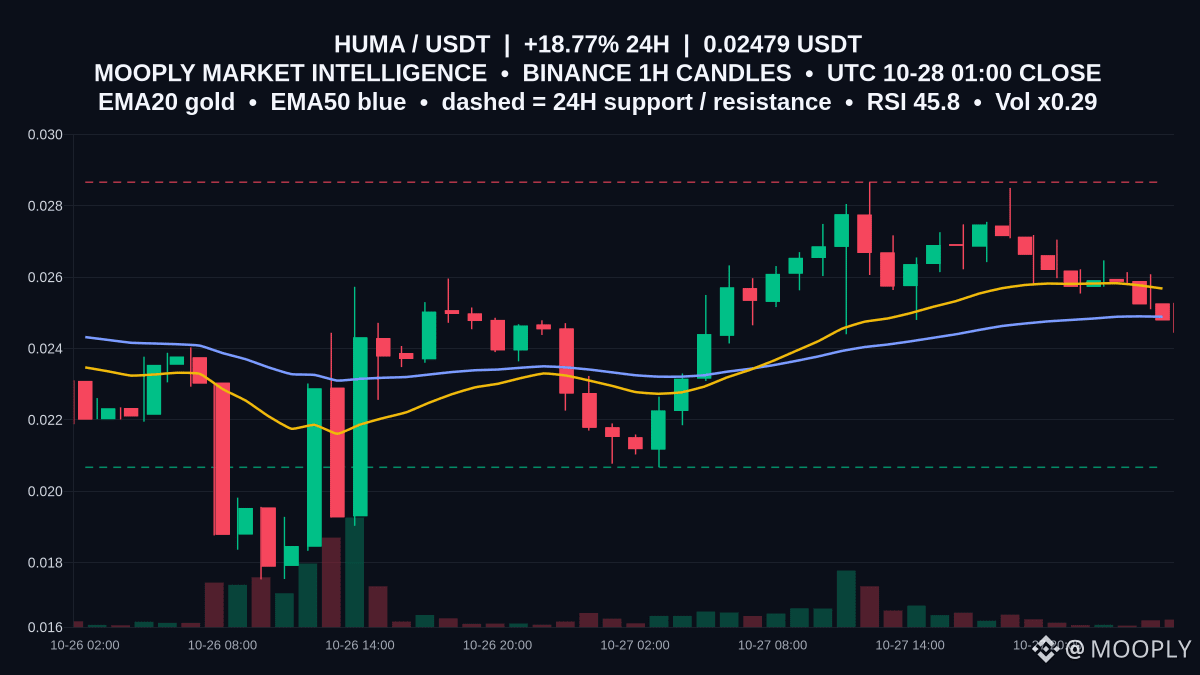
$HUMA 🔎 +18.77% in 24h; last price 0.02479 USDT, RSI 45.8, EMA20 0.02568, EMA50 0.02489; price sits between support 0.02067 and resistance 0.02866.
Price action shows 0.02479 USDT, trading below EMA20 (0.02568) and EMA50 (0.02489), with RSI 45.8. Volume remains light (volRatio 0.29) despite a +18.8% 24h move, keeping the pair drifting between support 0.02067 and resistance 0.02866.
Clear invalidation would be a daily close above 0.02866 or below 0.02067, which would shift the view beyond the current range.
Data: Binance 1H candles · Not financial advice.
#HUMA #TechnicalAnalysis #Crypto
72
·
--
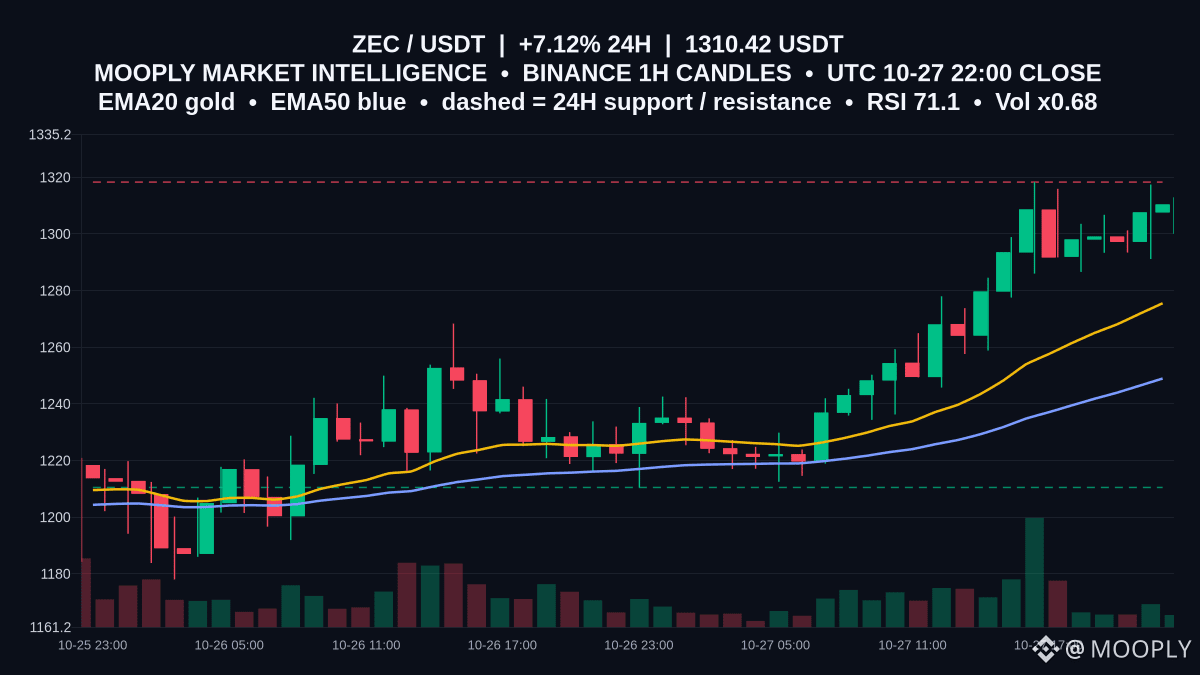
$ZEC 7.12% in 24h to 1310.42 USDT 🔺 vol 154.63M, RSI 71.1, EMA20 1,275.53, EMA50 1,248.96.
Price is pressing 1318.31 resistance, volume supports the move at 154.63M, with EMA20 above EMA50 and RSI near 71, while support sits around 1210.49.
Clear invalidation would be a break and close below 1210.49; such a move would flip the bias and require reevaluation.
Data: Binance 1H candles · Not financial advice.
#ZEC #TechnicalAnalysis #Crypto
8
Войдите, чтобы посмотреть больше материала
Присоединяйтесь к пользователям криптовалют по всему миру на Binance Square
⚡️ Получайте новейшую и полезную информацию о криптоактивах.
💬 Нам доверяет крупнейшая в мире криптобиржа.
👍 Получите достоверные аналитические данные от верифицированных создателей контента.
Эл. почта/номер телефона
В тренде
CanMicrosoftDeliverOnAI
Просмотров: 493,628
3,429 обсуждают
Earnings Season Session 3: Will Google & Microsoft Beat Earnings Expectations?
Binance Square Official
·Лайков: 150
·Просмотров: 83k
CanGoogleDefindItsCore
Просмотров: 302,070
2,423 обсуждают
EarningsSeason
Просмотров: 6M
29,567 обсуждают