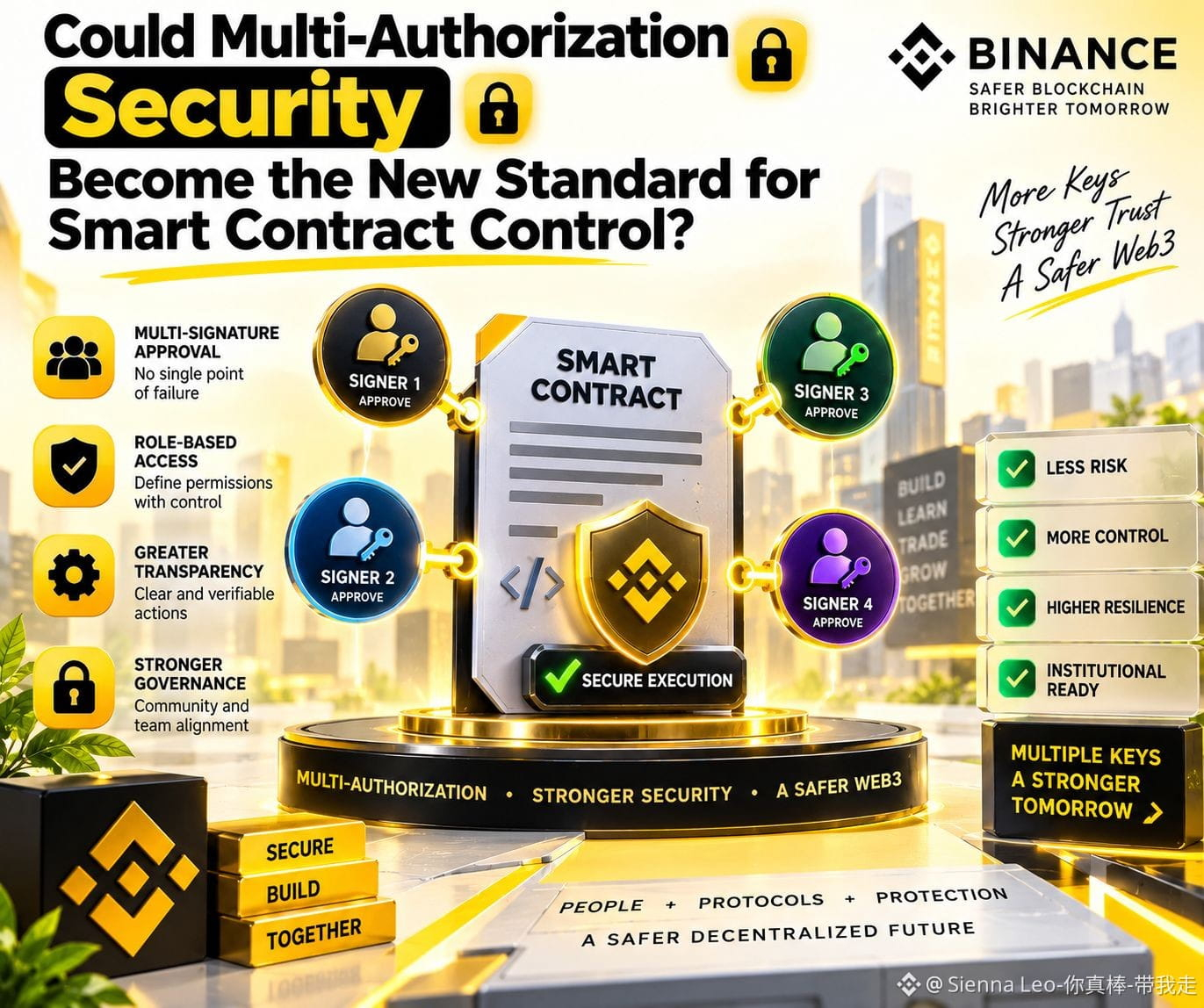

🔐🚨 Could Multi-Authorization Security Become the New Standard for Smart Contract Control? 🚨🔐
A critical contract upgrade is ready. One person holds the key, one signature can approve it, and everyone else simply waits. Then comes the question nobody wants to answer: what happens if that key is compromised?
This is why multi-authorization is becoming an important security design for smart contracts. Instead of relying on one administrator, control can require multiple approved parties before sensitive actions are executed.
Ethereum documentation highlights multisig accounts as a way to distribute responsibility, while OpenZeppelin supports multisig and role-based access control for managing privileged contract functions.
The concept is straightforward: a 2-of-3 setup, for example, requires two authorized approvals before execution. A compromised single signer therefore does not automatically equal total control.
The bigger evolution is moving from simple ownership toward policy-based authorization, where different roles, approval thresholds, and execution delays can govern powerful actions.
AEREDIUM is pushing this direction with AERSeal, which uses threshold signing and M-of-N approval policies for privileged smart-contract powers.
But multi-authorization is not a perfect shield. Poor signer selection, compromised participants, flawed governance, or vulnerable contract code can still create serious risks.
The future of smart-contract security may not be about trusting one key more, but making sure no single key is enough.
❓ Should multi-authorization become a default security layer for high-value smart contracts?
Disclaimer: Educational content only, not financial advice. Do your own research.
#Blockchain #SmartContracts #Web3 #CryptoSecurity #GrowWithSAC $FORM $GALA $OPEN
A critical contract upgrade is ready. One person holds the key, one signature can approve it, and everyone else simply waits. Then comes the question nobody wants to answer: what happens if that key is compromised?
This is why multi-authorization is becoming an important security design for smart contracts. Instead of relying on one administrator, control can require multiple approved parties before sensitive actions are executed.
Ethereum documentation highlights multisig accounts as a way to distribute responsibility, while OpenZeppelin supports multisig and role-based access control for managing privileged contract functions.
The concept is straightforward: a 2-of-3 setup, for example, requires two authorized approvals before execution. A compromised single signer therefore does not automatically equal total control.
The bigger evolution is moving from simple ownership toward policy-based authorization, where different roles, approval thresholds, and execution delays can govern powerful actions.
AEREDIUM is pushing this direction with AERSeal, which uses threshold signing and M-of-N approval policies for privileged smart-contract powers.
But multi-authorization is not a perfect shield. Poor signer selection, compromised participants, flawed governance, or vulnerable contract code can still create serious risks.
The future of smart-contract security may not be about trusting one key more, but making sure no single key is enough.
❓ Should multi-authorization become a default security layer for high-value smart contracts?
Disclaimer: Educational content only, not financial advice. Do your own research.
#Blockchain #SmartContracts #Web3 #CryptoSecurity #GrowWithSAC $FORM $GALA $OPEN