
ChainBrief Daily
157 Публикации

ChainBrief Daily
Отправить жалобу
Заблокировать пользователя
Daily crypto news, on-chain signals & market moves, briefed in minutes. Not financial advice.
Открытая сделка
Трейдер с регулярными сделками
5.1 г
71 подписок(и/а)
183 подписчиков(а)
64 понравилось
Посты
Портфель
Все
Цитирования
Strategy 又出手:增持 1,036 枚 BTC,总持仓突破 85 万枚
最新 8-K 文件显示,11 月 2 日至 8 日,Strategy 以均价 $79,012 买入 1,036 枚比特币,花费约 8,190 万美元,总持仓升至 850,364 枚,约占 BTC 总量上限 2,100 万枚的 4.05%。
值得注意的细节:同一周,它还花了 1.883 亿美元回购 STRC 优先股,是买币金额的两倍多。自 10 月初以来,回购累计约 10.6 亿美元,远高于同期 2.197 亿美元的买币支出。资金来源是出售约 205 万股 MSTR 普通股,净募资 2.838 亿美元。
再看成本:公司整体持仓均价 $75,456,而本周买入价 $79,012 高于当前 $75,000 附近的现价,意味着最新这笔目前处于浮亏。
在 BTC 跌至两个多月低位、ETF 持续流出的背景下,最大的企业买家仍在加仓,但同时把更多资金用在回购优先股上,这是明显的信号变化。
你怎么看:Strategy 的“买币 + 回购”双线操作,是在稳住资本结构,还是在为下一轮行情做准备?
#BTC #Strategy #比特币 $BTC $MSTR

70
$1B liquidated in 24 hours — and longs took the hit. 💥
$BTC dipped to about $73,761 late Sunday, its lowest since August, then bounced back above $75,000. $ETH wicked below $2,100 before recovering to around $2,144.
Per CoinGlass via CoinDesk, over $1 billion in leveraged positions were wiped out, $913 million of it longs. ETH saw $448 million in liquidations, nearly double BTC's $272 million, and the largest single order was a $48 million ETH position.
The triggers were macro: the Nvidia CEO investigation and stalled US-Iran talks. Traditional markets open Monday, and that reaction matters.
What I'm watching:
• BTC is stuck between the 200-day average near $73,150 and the 100-day near $77,430
• Whether ETH keeps absorbing more forced selling than BTC
• How equities react to the Nvidia headlines
Leverage punishes both sides fast. Just data, not advice.
Are you holding through this chop or sitting on the sidelines?
#Bitcoin #Ethereum #Liquidations
125
Статья
Zcash NU7 Is Live: 25-Second Blocks and a Fee ResetPrivacy coins rarely get a protocol upgrade that people can actually feel. Zcash just shipped one, and it deserves more attention than it is getting.
What Happened
Zcash activated its NU7 network upgrade early Friday, at block 3,543,405, mined at 02:34 UTC. The headline change: the target time between blocks drops from 75 seconds to 25. By 04:59 UTC the network had produced another 225 blocks, averaging about 39 seconds apart, according to ZecStats, because mining difficulty was still adjusting toward the faster pace.
In plain terms, a merchant could see a first confirmation in about 25 seconds on average. An exchange that requires three confirmations could see its expected wait fall from nearly four minutes to roughly 75 seconds. Each service sets its own rules, so the real-world speed-up depends on who handles your funds.
Background
Zcash lets people send money while hiding the sender, the recipient and the amount. The tradeoff has always been usability: private payments are heavier for wallets to process, and slow confirmations make them awkward at a checkout counter or when moving funds between chains.
Faster blocks create a technical problem, though. When a miner finds a block, others need time to receive and verify it. With shorter intervals there is less slack, and more competing blocks get discarded. Node software built by Valar Group and Project Tachyon, called Zakura, tested 25-second blocks on 80 computers across 11 regions with full blocks. In that stress test 3.43% of mined blocks were discarded, versus 1.57% at the old 75-second pace. That is a real cost, and it is worth watching.
Why It Matters
NU7 is not only about speed. It also caps how much private transaction activity fits in each block. Wallets must scan the chain to find payments meant for them, and a spammer could force everyone to do more work. The caps cut the worst-case daily download burden from 271 MB to 169 MB. Combined with the faster blocks, the specification estimates capacity for simple private payments could more than double, from about three per second to over six.
Fees change too. Miners now receive 40% of transaction fees, while 60% is removed from circulation and recorded in a reserve that starts feeding future block rewards around February 2031. The design keeps the 21 million coin supply cap intact. That is a long-term bet on miner incentives after block subsidies fade.
The less comfortable part: the upgrade retired Sprout, Zcash's original 2016 privacy pool, leaving about 12,224 ZEC unspendable. Co-founder Sean Bowe has outlined a possible recovery mechanism, but none has been approved as of Friday.
My Take
I like that this is a practical upgrade rather than a narrative one. Faster confirmations, bounded wallet workload and a fee plan for the post-subsidy era are the boring things that make a network usable. But freezing old funds will always spark a debate about where the line sits between cleaning up legacy code and touching people's coins.
What to Watch Next
First, whether block times settle near the 25-second target once difficulty finishes adjusting. Second, the orphan rate on mainnet compared with the test numbers. Third, whether exchanges and payment processors actually lower their confirmation requirements. And fourth, whether a Sprout recovery proposal gets formally approved.
Do you think faster blocks are what privacy coins needed for real adoption, or is the freeze of old funds a precedent that worries you more?
#Zcash #PrivacyCoins #NU7 $ZEC $BTC
Zcash NU7 Is Live: 25-Second Blocks and a Fee Reset
Privacy coins rarely get a protocol upgrade that people can actually feel. Zcash just shipped one, and it deserves more attention than it is getting.
What Happened
Zcash activated its NU7 network upgrade early Friday, at block 3,543,405, mined at 02:34 UTC. The headline change: the target time between blocks drops from 75 seconds to 25. By 04:59 UTC the network had produced another 225 blocks, averaging about 39 seconds apart, according to ZecStats, because mining difficulty was still adjusting toward the faster pace.
In plain terms, a merchant could see a first confirmation in about 25 seconds on average. An exchange that requires three confirmations could see its expected wait fall from nearly four minutes to roughly 75 seconds. Each service sets its own rules, so the real-world speed-up depends on who handles your funds.
Background
Zcash lets people send money while hiding the sender, the recipient and the amount. The tradeoff has always been usability: private payments are heavier for wallets to process, and slow confirmations make them awkward at a checkout counter or when moving funds between chains.
Faster blocks create a technical problem, though. When a miner finds a block, others need time to receive and verify it. With shorter intervals there is less slack, and more competing blocks get discarded. Node software built by Valar Group and Project Tachyon, called Zakura, tested 25-second blocks on 80 computers across 11 regions with full blocks. In that stress test 3.43% of mined blocks were discarded, versus 1.57% at the old 75-second pace. That is a real cost, and it is worth watching.
Why It Matters
NU7 is not only about speed. It also caps how much private transaction activity fits in each block. Wallets must scan the chain to find payments meant for them, and a spammer could force everyone to do more work. The caps cut the worst-case daily download burden from 271 MB to 169 MB. Combined with the faster blocks, the specification estimates capacity for simple private payments could more than double, from about three per second to over six.
Fees change too. Miners now receive 40% of transaction fees, while 60% is removed from circulation and recorded in a reserve that starts feeding future block rewards around February 2031. The design keeps the 21 million coin supply cap intact. That is a long-term bet on miner incentives after block subsidies fade.
The less comfortable part: the upgrade retired Sprout, Zcash's original 2016 privacy pool, leaving about 12,224 ZEC unspendable. Co-founder Sean Bowe has outlined a possible recovery mechanism, but none has been approved as of Friday.
My Take
I like that this is a practical upgrade rather than a narrative one. Faster confirmations, bounded wallet workload and a fee plan for the post-subsidy era are the boring things that make a network usable. But freezing old funds will always spark a debate about where the line sits between cleaning up legacy code and touching people's coins.
What to Watch Next
First, whether block times settle near the 25-second target once difficulty finishes adjusting. Second, the orphan rate on mainnet compared with the test numbers. Third, whether exchanges and payment processors actually lower their confirmation requirements. And fourth, whether a Sprout recovery proposal gets formally approved.
Do you think faster blocks are what privacy coins needed for real adoption, or is the freeze of old funds a precedent that worries you more?
#Zcash #PrivacyCoins #NU7 $ZEC $BTC
271
比特币跌至两个多月低位,美国中期选举后市场在担心什么?
路透社消息:周日晚间加密市场大幅下挫,$BTC 一度跌超 2% 至 73,708 美元,为 8 月以来最低;$ETH 下跌约 5%,报 2,223 美元,同样是 8 月以来新低。
原因有两层:一是美国中期选举后,市场担心由民主党掌控的国会会收紧对加密资产的监管;二是近期 Binance 约 60 亿美元的被盗事件,也让市场情绪持续承压。
为什么重要?此前市场普遍把共和党视为对加密更友好的一方,选举结果让监管预期出现反转,叠加安全事件,风险偏好明显降温。短线要留意周二美国 CPI 数据对宏观情绪的影响。
当前行情处在恐慌区间,波动可能会继续放大。市场情绪和基本面往往不同步,保持冷静、控制仓位比追涨杀跌更重要。
你觉得这轮下跌更多是情绪冲击,还是监管预期的长期转向?评论区聊聊。
#BTC #ETH #加密市场

80
Binance withdrawals for a handful of big names are still on pause, and the clock is ticking. 👀
Per The Block, citing Elliptic: the attackers behind last week's $6.43B Binance breach have swapped about $124M of altcoins into bitcoin, using 20,000+ wallets across 16 chains. Roughly $50M of stolen $XRP has already moved, mostly into $BTC via THORChain, with ~$226M still to go. Elliptic says little has likely been cashed out so far.
On the exchange side, Binance says it is working to reopen withdrawals for $HYPE, INJ, APT, NEAR, LTC and PLASMA by the end of next week, plus all tokens on networks already restored.
Meanwhile $BTC sits near $75.7K, with US spot ETFs just flipping negative for 2026 after a $1.28B outflow week.
What I'm watching:
• Whether withdrawal reopenings happen on schedule
• More on-chain swaps into BTC and where the funds land
• ETF flow direction next week
Do reopenings calm sentiment, or does the laundering trail keep traders cautious?
#Binance #Bitcoin #CryptoNews
Binance withdrawals for a handful of big names are still on pause, and the clock is ticking. 👀
Per The Block, citing Elliptic: the attackers behind last week's $6.43B Binance breach have swapped about $124M of altcoins into bitcoin, using 20,000+ wallets across 16 chains. Roughly $50M of stolen $XRP has already moved, mostly into $BTC via THORChain, with ~$226M still to go. Elliptic says little has likely been cashed out so far.
On the exchange side, Binance says it is working to reopen withdrawals for $HYPE , INJ, APT, NEAR, LTC and PLASMA by the end of next week, plus all tokens on networks already restored.
Meanwhile $BTC sits near $75.7K, with US spot ETFs just flipping negative for 2026 after a $1.28B outflow week.
What I'm watching:
• Whether withdrawal reopenings happen on schedule
• More on-chain swaps into BTC and where the funds land
• ETF flow direction next week
Do reopenings calm sentiment, or does the laundering trail keep traders cautious?
#Binance #Bitcoin #CryptoNews

114
Статья
Gnosis Pay Breach Exposes Home Addresses and Linked Crypto WalletsCrypto debit card provider Gnosis Pay has disclosed a data breach, and the details exposed are the kind that make every self-custody user uncomfortable. Here is what we know, and why it matters beyond one company.
What Happened
Gnosis Pay says it detected unauthorized access to its consumer card system on Nov. 3. According to CoinDesk, the company began containing the intrusion within two hours, replaced the affected security credentials and fixed the flaw that allowed the breach.
Customer funds were not affected, and neither was the separate enterprise platform that powers card programs for other businesses. But the data that leaked is sensitive: one user, Rotki founder Lefteris Karapetsas, said the email he received listed his name, full home address, card number and every wallet address linked to his account.
Gnosis Pay has not said how many customers were affected. It emailed each impacted user with details of what was exposed.
Background
Gnosis Pay launched in 2023 and lets customers spend stablecoins through Visa debit cards tied to their crypto wallets. CoinDesk cites Paymentscan data putting its annualized payments volume at around $67.6 million, so this is a small player, not a giant.
It is also not the first incident. In June, a wallet software flaw led to an exploit that drained about $1.5 million; Gnosis covered those losses and restored customer funds. Since then it made 3D Secure mandatory for online card payments and stepped up fraud monitoring. The legacy consumer system is scheduled to shut down on Dec. 20 as the company focuses on partner programs.
Why It Matters
Here is my take: the funds being safe is good news, but it is only half the story. In crypto, privacy is the security layer. Once someone can link your real name and home address to a list of wallets, they know who holds what, and where to find you.
That is the setup for targeted phishing, fake support calls and, in the worst cases, physical-world threats. Gnosis itself warned that scammers can use stolen personal details and past purchase information to make fraudulent messages look legitimate.
This is the uncomfortable trade-off with crypto cards. They bridge on-chain wallets and the traditional KYC world, and that bridge stores a lot of identity data in one place. The blockchain may be pseudonymous, but the card database is not.
Market Impact
There is no direct price shock here. The broader market is more focused on macro and tech sentiment: CoinDesk reported Bitcoin recovering above $76,000 on Friday after a tech-driven rout that triggered over $1 billion in liquidations, with spot ETFs shedding about $430 million. Security incidents like this one tend to hit trust in the crypto payments sector rather than any single token.
What to Watch Next
• How many users Gnosis Pay says were affected, and whether it publishes a fuller post-mortem.
• Whether affected users report targeted phishing or scam attempts in the coming weeks.
• How other crypto card issuers describe their data practices and what they store.
• The Dec. 20 shutdown of the legacy consumer cards and how the migration is handled.
If you use a crypto card, a few habits are worth considering: use a dedicated wallet for spending, treat unsolicited messages about your card with suspicion, and never share seed phrases with anyone.
Would you still link your main wallet to a crypto card, or keep a separate spending wallet? Let me know below.
#CryptoSecurity #DataBreach #CryptoCards
$BTC $ETH
Gnosis Pay Breach Exposes Home Addresses and Linked Crypto Wallets
Crypto debit card provider Gnosis Pay has disclosed a data breach, and the details exposed are the kind that make every self-custody user uncomfortable. Here is what we know, and why it matters beyond one company.
What Happened
Gnosis Pay says it detected unauthorized access to its consumer card system on Nov. 3. According to CoinDesk, the company began containing the intrusion within two hours, replaced the affected security credentials and fixed the flaw that allowed the breach.
Customer funds were not affected, and neither was the separate enterprise platform that powers card programs for other businesses. But the data that leaked is sensitive: one user, Rotki founder Lefteris Karapetsas, said the email he received listed his name, full home address, card number and every wallet address linked to his account.
Gnosis Pay has not said how many customers were affected. It emailed each impacted user with details of what was exposed.
Background
Gnosis Pay launched in 2023 and lets customers spend stablecoins through Visa debit cards tied to their crypto wallets. CoinDesk cites Paymentscan data putting its annualized payments volume at around $67.6 million, so this is a small player, not a giant.
It is also not the first incident. In June, a wallet software flaw led to an exploit that drained about $1.5 million; Gnosis covered those losses and restored customer funds. Since then it made 3D Secure mandatory for online card payments and stepped up fraud monitoring. The legacy consumer system is scheduled to shut down on Dec. 20 as the company focuses on partner programs.
Why It Matters
Here is my take: the funds being safe is good news, but it is only half the story. In crypto, privacy is the security layer. Once someone can link your real name and home address to a list of wallets, they know who holds what, and where to find you.
That is the setup for targeted phishing, fake support calls and, in the worst cases, physical-world threats. Gnosis itself warned that scammers can use stolen personal details and past purchase information to make fraudulent messages look legitimate.
This is the uncomfortable trade-off with crypto cards. They bridge on-chain wallets and the traditional KYC world, and that bridge stores a lot of identity data in one place. The blockchain may be pseudonymous, but the card database is not.
Market Impact
There is no direct price shock here. The broader market is more focused on macro and tech sentiment: CoinDesk reported Bitcoin recovering above $76,000 on Friday after a tech-driven rout that triggered over $1 billion in liquidations, with spot ETFs shedding about $430 million. Security incidents like this one tend to hit trust in the crypto payments sector rather than any single token.
What to Watch Next
• How many users Gnosis Pay says were affected, and whether it publishes a fuller post-mortem.
• Whether affected users report targeted phishing or scam attempts in the coming weeks.
• How other crypto card issuers describe their data practices and what they store.
• The Dec. 20 shutdown of the legacy consumer cards and how the migration is handled.
If you use a crypto card, a few habits are worth considering: use a dedicated wallet for spending, treat unsolicited messages about your card with suspicion, and never share seed phrases with anyone.
Would you still link your main wallet to a crypto card, or keep a separate spending wallet? Let me know below.
#CryptoSecurity #DataBreach #CryptoCards
$BTC $ETH
95
美国财政部出手:MEXC Global 被切断美国金融体系准入
周五,美国财政部下属金融犯罪执法网络(FinCEN)对交易所 MEXC Global 下达命令,认定其为洗钱主要关切对象。财政部称,该所涉及与伊朗、朝鲜和俄罗斯相关的交易,金额约 160 亿美元,且反洗钱控制存在“严重缺陷”,尽管 MEXC 此前声称已限制相关国家用户。
财政部长贝森特表示,金融机构不能一边支持伊朗政权、一边保留美国金融系统准入,并强调会继续打击利用数字资产规避制裁的行为。此前财政部已对 Nobitex(6 月)和 BitBank(9 月)采取过类似行动。
为什么重要?
1)监管矛头正从个别地址转向整家交易所,合规能力会成为平台生存底线;
2)用户在选择平台时,合规与资产透明度的权重会越来越高;
3)当前市场本就偏弱:BTC 约 7.6 万美元,现货 ETF 周四净流出超 5.4 亿美元,情绪偏谨慎,监管消息容易放大波动。
你会因此调整资金存放的平台分布吗?欢迎评论区聊聊。
#监管 #BTC #交易所 $BTC $ETH
97
Hyperliquid wants to come onshore, and $HYPE holders are paying attention 👀
Hyperliquid Strategies, the public company that buys and stakes HYPE, says it has a pending application to be regulated as a futures commission merchant in the U.S. The filing went through the NFA back in August and is still pending.
The plan: carry U.S. client accounts for permissioned markets built on Hyperliquid's HIP-3 framework, so perps could reach U.S. users inside a regulated setup. The company itself warns there's no assurance on timing or outcome.
Meanwhile the macro backdrop is rough. $BTC slipped below $76,000 during Thursday's tech rout, then reclaimed the level Friday. U.S. spot BTC ETFs saw $430.2M in net outflows Thursday, and about $1.26B in leveraged positions got liquidated in 24 hours.
What I'm watching:
• Any NFA/CFTC update on the FCM application
• Whether ETF flows turn positive again
• How perp-DEX volumes react to onshore headlines
Regulation is slow, but the direction is getting clearer. Does an onshore Hyperliquid change how you see $HYPE?
#Hyperliquid #Bitcoin #CryptoNews
Hyperliquid wants to come onshore, and $HYPE holders are paying attention 👀
Hyperliquid Strategies, the public company that buys and stakes HYPE, says it has a pending application to be regulated as a futures commission merchant in the U.S. The filing went through the NFA back in August and is still pending.
The plan: carry U.S. client accounts for permissioned markets built on Hyperliquid's HIP-3 framework, so perps could reach U.S. users inside a regulated setup. The company itself warns there's no assurance on timing or outcome.
Meanwhile the macro backdrop is rough. $BTC slipped below $76,000 during Thursday's tech rout, then reclaimed the level Friday. U.S. spot BTC ETFs saw $430.2M in net outflows Thursday, and about $1.26B in leveraged positions got liquidated in 24 hours.
What I'm watching:
• Any NFA/CFTC update on the FCM application
• Whether ETF flows turn positive again
• How perp-DEX volumes react to onshore headlines
Regulation is slow, but the direction is getting clearer. Does an onshore Hyperliquid change how you see $HYPE ?
#Hyperliquid #Bitcoin #CryptoNews

343

Статья
Bitcoin Dev's 'Quantum Landmines': Make Thieves Lose Their Own BTCQuantum computing keeps coming up in Bitcoin circles, and this week a Bitcoin Core developer put a very creative idea on the table. Cory Fields, who works on Bitcoin software at MIT's Digital Currency Initiative, posted "quantum landmines" to the bitcoin-dev mailing list on Wednesday.
What Happened
Fields proposed a way to make future quantum thieves risk their own money before they can steal anyone else's. Before quantum attacks become possible, an owner could create a separate quantum-safe "landmine" holding hidden proof of ownership of their coins.
If a thief later drains vulnerable coins, they would have to supply matching collateral from a quantum-safe wallet. In his example, stealing 1 BTC means putting up another 1 BTC. Both are locked for a waiting period, such as 30 days.
During that window the real owner can reveal the proof, move the coins back and take the thief's collateral as a penalty. The thief cannot tell which holdings are trapped before committing their own funds.
Background
A sufficiently powerful quantum computer could calculate a wallet's secret key from its public key. Some early bitcoin payments exposed public keys from the start, so coins associated with Satoshi Nakamoto are among the potential targets.
The community has been split on a core question: should Bitcoin freeze vulnerable coins, or leave them spendable by whoever can produce a valid signature? A freeze could stop thieves, but it could also lock out owners who never upgraded.
Why It Matters
My take: this changes the framing. Instead of a hard freeze, it turns the attack into a gamble. Holders who prepare get a possible bonus, and attackers have to price in hidden traps.
There are real catches. Landmines only work for owners who still hold their keys, so coins believed lost are not covered. Fields sketched a separate auction idea for those inactive coins, where rivals stake hidden bids that pay out if a thief strikes.
There is also a cost for honest users. The chain cannot tell a thief from the true owner, so someone moving their own 1 BTC under these rules would need another 1 BTC as collateral. An early holder with a whole fortune in one old wallet would need matching funds just to move it.
Fields himself called these thought experiments. They assume Bitcoin first gets quantum-safe wallets, and the enforcement rules are still unwritten.
Market Impact
None of this moves price today. Bitcoin has been dealing with a very different kind of pressure: an AI-led tech selloff that drove more than $1 billion in liquidations. CoinDesk reported BTC steadying near $76,000 on Friday, and ETFs shedding $430 million after the rout.
Still, quantum risk is a long-term narrative that tends to resurface whenever the market gets nervous about Bitcoin's foundations.
What to Watch Next
First, how Bitcoin developers respond on the mailing list, since this is an idea and not a formal proposal. Second, progress on quantum-safe wallet designs, because every one of these schemes depends on them. Third, whether the freeze-versus-leave debate hardens into concrete proposals.
Would you rather see vulnerable coins frozen outright, or left open with game-theory traps like this? Tell me where you land.
#Bitcoin #QuantumComputing #BTC
$BTC
Bitcoin Dev's 'Quantum Landmines': Make Thieves Lose Their Own BTC
Quantum computing keeps coming up in Bitcoin circles, and this week a Bitcoin Core developer put a very creative idea on the table. Cory Fields, who works on Bitcoin software at MIT's Digital Currency Initiative, posted "quantum landmines" to the bitcoin-dev mailing list on Wednesday.
What Happened
Fields proposed a way to make future quantum thieves risk their own money before they can steal anyone else's. Before quantum attacks become possible, an owner could create a separate quantum-safe "landmine" holding hidden proof of ownership of their coins.
If a thief later drains vulnerable coins, they would have to supply matching collateral from a quantum-safe wallet. In his example, stealing 1 BTC means putting up another 1 BTC. Both are locked for a waiting period, such as 30 days.
During that window the real owner can reveal the proof, move the coins back and take the thief's collateral as a penalty. The thief cannot tell which holdings are trapped before committing their own funds.
Background
A sufficiently powerful quantum computer could calculate a wallet's secret key from its public key. Some early bitcoin payments exposed public keys from the start, so coins associated with Satoshi Nakamoto are among the potential targets.
The community has been split on a core question: should Bitcoin freeze vulnerable coins, or leave them spendable by whoever can produce a valid signature? A freeze could stop thieves, but it could also lock out owners who never upgraded.
Why It Matters
My take: this changes the framing. Instead of a hard freeze, it turns the attack into a gamble. Holders who prepare get a possible bonus, and attackers have to price in hidden traps.
There are real catches. Landmines only work for owners who still hold their keys, so coins believed lost are not covered. Fields sketched a separate auction idea for those inactive coins, where rivals stake hidden bids that pay out if a thief strikes.
There is also a cost for honest users. The chain cannot tell a thief from the true owner, so someone moving their own 1 BTC under these rules would need another 1 BTC as collateral. An early holder with a whole fortune in one old wallet would need matching funds just to move it.
Fields himself called these thought experiments. They assume Bitcoin first gets quantum-safe wallets, and the enforcement rules are still unwritten.
Market Impact
None of this moves price today. Bitcoin has been dealing with a very different kind of pressure: an AI-led tech selloff that drove more than $1 billion in liquidations. CoinDesk reported BTC steadying near $76,000 on Friday, and ETFs shedding $430 million after the rout.
Still, quantum risk is a long-term narrative that tends to resurface whenever the market gets nervous about Bitcoin's foundations.
What to Watch Next
First, how Bitcoin developers respond on the mailing list, since this is an idea and not a formal proposal. Second, progress on quantum-safe wallet designs, because every one of these schemes depends on them. Third, whether the freeze-versus-leave debate hardens into concrete proposals.
Would you rather see vulnerable coins frozen outright, or left open with game-theory traps like this? Tell me where you land.
#Bitcoin #QuantumComputing #BTC
$BTC
76
希腊正式出手:加密收益征10%,质押/DeFi收益征15%
希腊议会批准了全新的加密税收框架,2027年1月1日起生效。
📌 核心要点:
• 个人年度加密净收益超过500欧元,按10%征税,且一旦越线,是对全部收益征税
• 用加密资产购买商品或服务同样视为应税事件
• 质押、借贷、DeFi流动性挖矿收益按利息收入处理,税率15%
• 年度亏损超过500欧元,可向后结转5年抵扣
• 提供12个月申报窗口,过往收益在条件满足下免滞纳罚款
⚠️ 争议点:财政部称币币互换不触发纳税,但议会科学服务部门提醒,法案措辞可能把这类交易也包含在内,细则仍待明确。
为什么重要?欧洲各国正加速把加密纳入税务体系,质押和DeFi收益被单独列税,说明监管已经细化到收益类型。合规框架清晰,机构更好入场;但对高频交易者和DeFi玩家,记账与申报成本会明显上升。
你觉得明确征税对市场是利好还是利空?欢迎评论区聊聊。
#加密税收 #DeFi #监管 $BTC $ETH

94
$WLFI is down 66% this year, and World Liberty just pulled out the buyback lever again.
Here's what happened: World Liberty Financial says it plans more ongoing $WLFI buybacks, partly funded by fees earned on the reserves backing its USD1 stablecoin. The stated goal is to boost governance participation and put more voting power with long-term holders.
The market reaction so far is modest. CoinDesk had $WLFI around $0.047, up roughly 3.5% since midnight UTC, but still about 10% lower since Tuesday's midterm elections. $TRUMP also printed a record low this week, so the whole Trump-linked basket is under pressure.
Context matters here. This isn't their first attempt: back in April they disclosed $65.6M in open-market buybacks over the prior six months, and the chart kept bleeding anyway. There's also an open legal fight, with Justin Sun asking a court to sanction World Liberty over roughly 4 billion frozen WLFI tokens.
What I'm watching:
- Whether they publish buyback size and on-chain wallets, not just intent
- USD1 supply growth, since that's what funds the fees
- How $WLFI holds up if $BTC loses the $74K–$75K liquidity zone
Buybacks funded by real stablecoin revenue are a stronger story than treasury dumps. But can buybacks alone fix a token that's lost two-thirds of its value in a year?
#WLFI #Buyback #CryptoNews
291

Статья
Zcash NU7 Is Live: 3x Faster Private Payments and a Fee SinkWhile most of the market spent the last 24 hours licking its wounds, Zcash quietly pulled off its biggest network change in years. NU7 went live early Friday, and it is one of the few genuinely bullish fundamental stories on a very red tape.
What Happened
The NU7 upgrade activated at block 3,543,405, mined at 02:34 UTC on November 6. The headline change: the target time between blocks drops from 75 seconds to 25 seconds, which means private payments can confirm roughly three times faster.
The chain is still settling in. According to CoinDesk, by 04:59 UTC the network had produced another 225 blocks, averaging about 39 seconds apart, as mining difficulty kept adjusting toward the new pace.
Practically, a merchant could see a first confirmation in about 25 seconds on average, and an exchange requiring three confirmations could cut its expected wait from nearly four minutes to about 75 seconds. Each service still sets its own rules, so your mileage will vary.
Background
Zcash lets users send money while hiding the sender, recipient and amount. The trade-off has always been speed and wallet load, since wallets have to scan the chain to find payments meant for them.
NU7 tackles both. It caps how much shielded activity can fit into each block, cutting the worst-case daily download burden for wallets from 271 MB to 169 MB, according to the upgrade specification. Combined with faster blocks, capacity for simple private payments could more than double, from about three per second to more than six.
Node software team Zakura tested 25-second blocks on 80 machines across 11 regions with full blocks. The orphan rate came in at 3.43%, versus 1.57% at the old 75-second pace. That is the price of speed, and it is worth watching on mainnet.
The Fee Twist Nobody Is Talking About Enough
This is the part I find most interesting. Under NU7, miners keep 40% of transaction fees, while the other 60% is removed from circulation and parked in the Network Sustainability Mechanism. That reserve starts feeding back into block rewards around 2031.
The 21 million ZEC cap and the halving schedule stay untouched. But in the meantime, every busy day on the network now takes a slice of ZEC out of circulation. It is not a burn, but for the next few years it behaves a lot like one.
The Casualty: Sprout
NU7 also retired Sprout, the original privacy pool from 2016, along with version 4 transactions. About 12,224 ZEC, roughly $16 million at activation, was still sitting there and is now unspendable under current rules. Co-founder Sean Bowe has outlined a possible recovery path, but nothing has been approved yet. Expect that debate to get loud.
Market Impact
ZEC has held up better than the broader market, but it has not escaped the selloff. Investing.com showed ZEC at $1,247.48 after activation, with a market cap of about $20.92 billion, 24-hour volume of $1.19 billion and a ranking of ninth.
For context, CoinDesk's price board showed bitcoin at $75,636, down 5.84% on the day, and ether at $2,228.99, down 7.80%, after a $1 billion liquidation wave hit the market as the AI trade collapsed. Against that backdrop, a privacy coin holding a top-10 spot during an upgrade week is notable.
What to Watch Next
First, real block times. Do they converge on 25 seconds, and does the orphan rate stay close to testnet levels?
Second, exchange confirmation policies. The speed gain only reaches users if exchanges and wallets actually lower their requirements.
Third, the Sprout recovery debate. A frozen $16 million is the kind of governance question that can split a community.
Fourth, the macro tape. If tech stocks keep sliding, even the strongest crypto-specific story can get dragged down with everything else.
My take: upgrades rarely pump price on the day, and this one landed in the middle of a risk-off storm. But faster private payments plus a fee mechanism that pulls supply out of circulation is a real structural change, not a narrative.
So here is the question: is NU7 the upgrade that finally turns privacy coins into everyday payment rails, or will regulators make sure that never happens?
#Zcash #PrivacyCoins #CryptoNews
$ZEC $BTC $ETH
Zcash NU7 Is Live: 3x Faster Private Payments and a Fee Sink
While most of the market spent the last 24 hours licking its wounds, Zcash quietly pulled off its biggest network change in years. NU7 went live early Friday, and it is one of the few genuinely bullish fundamental stories on a very red tape.
What Happened
The NU7 upgrade activated at block 3,543,405, mined at 02:34 UTC on November 6. The headline change: the target time between blocks drops from 75 seconds to 25 seconds, which means private payments can confirm roughly three times faster.
The chain is still settling in. According to CoinDesk, by 04:59 UTC the network had produced another 225 blocks, averaging about 39 seconds apart, as mining difficulty kept adjusting toward the new pace.
Practically, a merchant could see a first confirmation in about 25 seconds on average, and an exchange requiring three confirmations could cut its expected wait from nearly four minutes to about 75 seconds. Each service still sets its own rules, so your mileage will vary.
Background
Zcash lets users send money while hiding the sender, recipient and amount. The trade-off has always been speed and wallet load, since wallets have to scan the chain to find payments meant for them.
NU7 tackles both. It caps how much shielded activity can fit into each block, cutting the worst-case daily download burden for wallets from 271 MB to 169 MB, according to the upgrade specification. Combined with faster blocks, capacity for simple private payments could more than double, from about three per second to more than six.
Node software team Zakura tested 25-second blocks on 80 machines across 11 regions with full blocks. The orphan rate came in at 3.43%, versus 1.57% at the old 75-second pace. That is the price of speed, and it is worth watching on mainnet.
The Fee Twist Nobody Is Talking About Enough
This is the part I find most interesting. Under NU7, miners keep 40% of transaction fees, while the other 60% is removed from circulation and parked in the Network Sustainability Mechanism. That reserve starts feeding back into block rewards around 2031.
The 21 million ZEC cap and the halving schedule stay untouched. But in the meantime, every busy day on the network now takes a slice of ZEC out of circulation. It is not a burn, but for the next few years it behaves a lot like one.
The Casualty: Sprout
NU7 also retired Sprout, the original privacy pool from 2016, along with version 4 transactions. About 12,224 ZEC, roughly $16 million at activation, was still sitting there and is now unspendable under current rules. Co-founder Sean Bowe has outlined a possible recovery path, but nothing has been approved yet. Expect that debate to get loud.
Market Impact
ZEC has held up better than the broader market, but it has not escaped the selloff. Investing.com showed ZEC at $1,247.48 after activation, with a market cap of about $20.92 billion, 24-hour volume of $1.19 billion and a ranking of ninth.
For context, CoinDesk's price board showed bitcoin at $75,636, down 5.84% on the day, and ether at $2,228.99, down 7.80%, after a $1 billion liquidation wave hit the market as the AI trade collapsed. Against that backdrop, a privacy coin holding a top-10 spot during an upgrade week is notable.
What to Watch Next
First, real block times. Do they converge on 25 seconds, and does the orphan rate stay close to testnet levels?
Second, exchange confirmation policies. The speed gain only reaches users if exchanges and wallets actually lower their requirements.
Third, the Sprout recovery debate. A frozen $16 million is the kind of governance question that can split a community.
Fourth, the macro tape. If tech stocks keep sliding, even the strongest crypto-specific story can get dragged down with everything else.
My take: upgrades rarely pump price on the day, and this one landed in the middle of a risk-off storm. But faster private payments plus a fee mechanism that pulls supply out of circulation is a real structural change, not a narrative.
So here is the question: is NU7 the upgrade that finally turns privacy coins into everyday payment rails, or will regulators make sure that never happens?
#Zcash #PrivacyCoins #CryptoNews
$ZEC $BTC $ETH
239
一天抹平选举行情!BTC 跌破 7.6 万,全网超 10 亿美元多单被清算
昨晚美股科技股和 AI 板块集体跳水,加密市场直接被带崩。$BTC 一度跌 6% 到 75,700 美元附近,盘中最低 75,568;$ETH 跌超 7% 到 2,247 美元。周三刚因美国中期选举结果重回 8 万的涨幅,一天之内全部吐回。
杠杆是这轮的重灾区:据 CoinGlass 数据,4 小时内爆仓约 8.8 亿美元,其中多单占 8.19 亿;24 小时总爆仓接近 11 亿美元,约 21 万人中招。币股同样惨烈,Strategy、Coinbase 各跌约 10%,部分矿企跌约 20%。
为什么重要?这说明当前币价和纳指的联动依旧很强,选举带来的情绪只是短暂提振,通胀、利率、地缘这些宏观压力一个都没消失。做市商 Wintermute 给出的观察位是:下方关注 73,000 和 68,000,上方要重新站稳 80,000 才能转为乐观。
杠杆清洗之后往往是变盘窗口,你觉得这是一次健康的洗盘,还是新一轮下跌的开始?
#BTC #加密市场 #爆仓

90
Staked ETF approved, $INJ wakes up 🚀
Injective just led the CoinDesk 100 after Nasdaq approved the listing of Canary Capital's staked INJ ETF, set to trade under the ticker INJC (per an SEC filing). INJ is up around 10% in 24 hours, trading near $8.4.
Why it matters: this isn't just another spot ETF. A staked product means holders get exposure plus staking yield in a regulated wrapper. If it pulls real inflows, it adds a new source of demand that doesn't depend on crypto-native traders.
Big picture is helping too. $BTC is holding above $80,000 after bouncing from roughly $75,700 on the midterm scare, and US spot BTC ETFs took in $74.6M on Wednesday, ending a three-day outflow streak. But note: about 93% of the $267M in BTC liquidations were shorts, so part of this move is a squeeze, not fresh money. Friday's US jobs report is the next test.
Watching: whether INJC launch-day flows confirm the hype, and whether BTC can hold $80K into the weekend.
Is a staked ETF a real game changer for $INJ, or a sell-the-news setup? 👇
#Injective #CryptoETF #BTC
Staked ETF approved, $INJ wakes up 🚀
Injective just led the CoinDesk 100 after Nasdaq approved the listing of Canary Capital's staked INJ ETF, set to trade under the ticker INJC (per an SEC filing). INJ is up around 10% in 24 hours, trading near $8.4.
Why it matters: this isn't just another spot ETF. A staked product means holders get exposure plus staking yield in a regulated wrapper. If it pulls real inflows, it adds a new source of demand that doesn't depend on crypto-native traders.
Big picture is helping too. $BTC is holding above $80,000 after bouncing from roughly $75,700 on the midterm scare, and US spot BTC ETFs took in $74.6M on Wednesday, ending a three-day outflow streak. But note: about 93% of the $267M in BTC liquidations were shorts, so part of this move is a squeeze, not fresh money. Friday's US jobs report is the next test.
Watching: whether INJC launch-day flows confirm the hype, and whether BTC can hold $80K into the weekend.
Is a staked ETF a real game changer for $INJ , or a sell-the-news setup? 👇
#Injective #CryptoETF #BTC
153
Статья
Midterms Hit Crypto: Why the CLARITY Act StallsThe US midterms are over, and crypto's biggest policy bill just lost its easiest path forward. Reuters reports Democrats won majorities in both the Senate and the House. Bitcoin briefly touched a six-week low overnight, then recovered to about $78,354 by 0841 GMT, up 0.7% on the day, while Ether traded near $2,323. The dip was real but shallow. The longer story is what happens to legislation.
What the CLARITY Act would do
The Digital Asset Market Clarity Act is the market-structure bill the industry has chased for years. As described by BigGo's recap, it would split assets into three buckets. Bitcoin and Ether would be classified as digital commodities, with the CFTC holding exclusive jurisdiction over spot markets. Payment stablecoins would sit under joint SEC and CFTC oversight, building on the GENIUS Act signed in July 2025. Everything else would face a decentralization test: once no single entity controls more than 20% of supply or voting power, a network counts as a commodity. Tokens that fail stay with the SEC.
Why it was already stuck
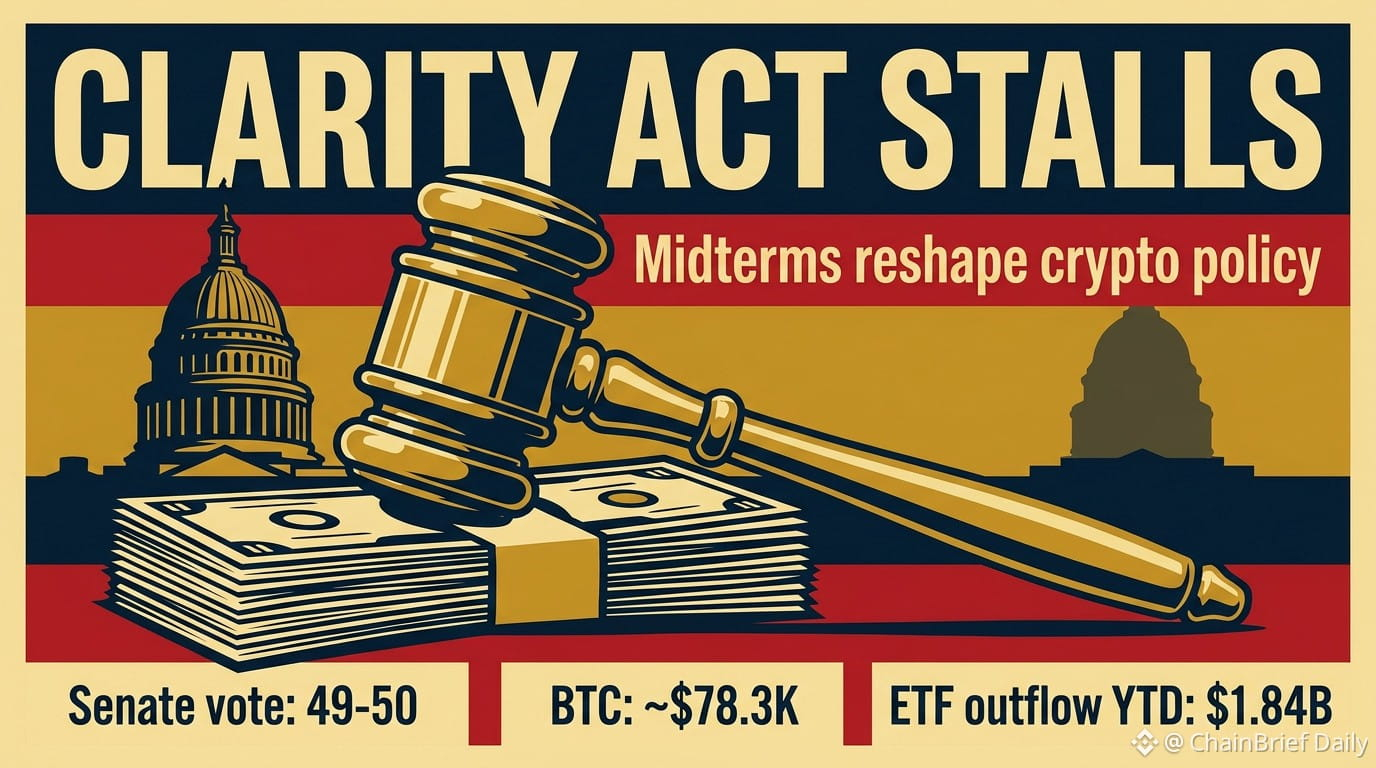
The House passed the bill in July 2025, 294 to 134. In the Senate, a cloture vote on September 15 failed 49 to 50. No Democrat voted yes, and Republicans Susan Collins, Josh Hawley and Jerry Moran also voted no. Three provisions blocked a deal: an ethics clause covering the president's crypto income, Section 604's protections for non-custodial developers, and Section 404's limits on stablecoin yield. The bill expires on January 3, when the new Congress is seated.
Because Senate rules need 60 votes to end debate, no election result could revive the bill alone. TD Cowen's Jaret Seiberg wrote that a Democratic-controlled Congress would likely investigate Trump's crypto ties, which is why the firm does not expect the Clarity Act to pass over the next two years. Treat that as one analyst's view, not a certainty. Senator Angela Alsobrooks, one of the bill's negotiators, still sees room for a lame-duck deal before January 3.
The money that went in
Reuters notes the sector spent more than $300 million backing crypto-friendly Democrats and Republicans in roughly equal measure across the current and previous cycles. Some Democrats have backed a light-touch approach, so a Democratic Congress is not automatically an anti-crypto Congress. It does shift the agenda toward oversight hearings and nominee fights.
The market's real worry is bigger than one bill
Price action tells you the election was one factor among several. Reuters says the overall crypto market has lost about $300 billion in value over the last month, with concern about AI returns and rising borrowing costs pushing investors toward government bonds and safe-haven currencies. Bitcoin is down roughly 41% from its record above $122,000 in October 2025. Investors pulled $215 million from the largest Bitcoin ETFs in October, taking the year-to-date outflow to $1.84 billion, per LSEG/Lipper. The Binance hack triggered the largest weekly net outflow from Bitcoin ETFs since early July, at $884 million.
Smaller tokens bounced too. Reuters says SOL, DOGE and ADA gained between 1.6% and 2.2% on Wednesday, but all three are down nearly a quarter over the past month.
Regulators can still move
Legislation is only one route. The SEC and CFTC can keep writing rules without Congress, as long as the agencies stay staffed. Democrats could slow nominees, though. Washington has already allowed easier access to banking and exchange-traded products and passed a federal stablecoin law, so some of the foundation is in place. The gap is a clear rulebook for everything outside Bitcoin, Ether and payment stablecoins.
What to watch next
First, the lame-duck session through January 3, which is the last window for the current bill. Second, Friday's US jobs report on November 6, which could matter more for short-term prices than any policy headline. Third, who chairs the key committees when the new Congress starts, since that decides whether crypto bills get hearings or investigations.
A note on history: the BigGo recap points out that in the 30 days after the last six US elections, Bitcoin moved anywhere from a 45% decline to a 44% gain. Election outcomes are a poor guide to the next month.
Bottom line: a Democratic Congress does not end US crypto policy, but it likely pushes comprehensive legislation out by years and hands more power to regulators and oversight committees. For traders, that means headline risk rather than a clean trend.
Do you think crypto does better with a single big law or with agency-by-agency rules? Tell me in the comments.
Sources: Reuters, BigGo, as of Nov 4, 2026.
#CLARITYAct #CryptoRegulation #Bitcoin
Not financial advice.
Midterms Hit Crypto: Why the CLARITY Act Stalls
The US midterms are over, and crypto's biggest policy bill just lost its easiest path forward. Reuters reports Democrats won majorities in both the Senate and the House. Bitcoin briefly touched a six-week low overnight, then recovered to about $78,354 by 0841 GMT, up 0.7% on the day, while Ether traded near $2,323. The dip was real but shallow. The longer story is what happens to legislation.
What the CLARITY Act would do
The Digital Asset Market Clarity Act is the market-structure bill the industry has chased for years. As described by BigGo's recap, it would split assets into three buckets. Bitcoin and Ether would be classified as digital commodities, with the CFTC holding exclusive jurisdiction over spot markets. Payment stablecoins would sit under joint SEC and CFTC oversight, building on the GENIUS Act signed in July 2025. Everything else would face a decentralization test: once no single entity controls more than 20% of supply or voting power, a network counts as a commodity. Tokens that fail stay with the SEC.
Why it was already stuck
The House passed the bill in July 2025, 294 to 134. In the Senate, a cloture vote on September 15 failed 49 to 50. No Democrat voted yes, and Republicans Susan Collins, Josh Hawley and Jerry Moran also voted no. Three provisions blocked a deal: an ethics clause covering the president's crypto income, Section 604's protections for non-custodial developers, and Section 404's limits on stablecoin yield. The bill expires on January 3, when the new Congress is seated.
Because Senate rules need 60 votes to end debate, no election result could revive the bill alone. TD Cowen's Jaret Seiberg wrote that a Democratic-controlled Congress would likely investigate Trump's crypto ties, which is why the firm does not expect the Clarity Act to pass over the next two years. Treat that as one analyst's view, not a certainty. Senator Angela Alsobrooks, one of the bill's negotiators, still sees room for a lame-duck deal before January 3.
The money that went in
Reuters notes the sector spent more than $300 million backing crypto-friendly Democrats and Republicans in roughly equal measure across the current and previous cycles. Some Democrats have backed a light-touch approach, so a Democratic Congress is not automatically an anti-crypto Congress. It does shift the agenda toward oversight hearings and nominee fights.
The market's real worry is bigger than one bill
Price action tells you the election was one factor among several. Reuters says the overall crypto market has lost about $300 billion in value over the last month, with concern about AI returns and rising borrowing costs pushing investors toward government bonds and safe-haven currencies. Bitcoin is down roughly 41% from its record above $122,000 in October 2025. Investors pulled $215 million from the largest Bitcoin ETFs in October, taking the year-to-date outflow to $1.84 billion, per LSEG/Lipper. The Binance hack triggered the largest weekly net outflow from Bitcoin ETFs since early July, at $884 million.
Smaller tokens bounced too. Reuters says SOL, DOGE and ADA gained between 1.6% and 2.2% on Wednesday, but all three are down nearly a quarter over the past month.
Regulators can still move
Legislation is only one route. The SEC and CFTC can keep writing rules without Congress, as long as the agencies stay staffed. Democrats could slow nominees, though. Washington has already allowed easier access to banking and exchange-traded products and passed a federal stablecoin law, so some of the foundation is in place. The gap is a clear rulebook for everything outside Bitcoin, Ether and payment stablecoins.
What to watch next
First, the lame-duck session through January 3, which is the last window for the current bill. Second, Friday's US jobs report on November 6, which could matter more for short-term prices than any policy headline. Third, who chairs the key committees when the new Congress starts, since that decides whether crypto bills get hearings or investigations.
A note on history: the BigGo recap points out that in the 30 days after the last six US elections, Bitcoin moved anywhere from a 45% decline to a 44% gain. Election outcomes are a poor guide to the next month.
Bottom line: a Democratic Congress does not end US crypto policy, but it likely pushes comprehensive legislation out by years and hands more power to regulators and oversight committees. For traders, that means headline risk rather than a clean trend.
Do you think crypto does better with a single big law or with agency-by-agency rules? Tell me in the comments.
Sources: Reuters, BigGo, as of Nov 4, 2026.
#CLARITYAct #CryptoRegulation #Bitcoin
Not financial advice.
43
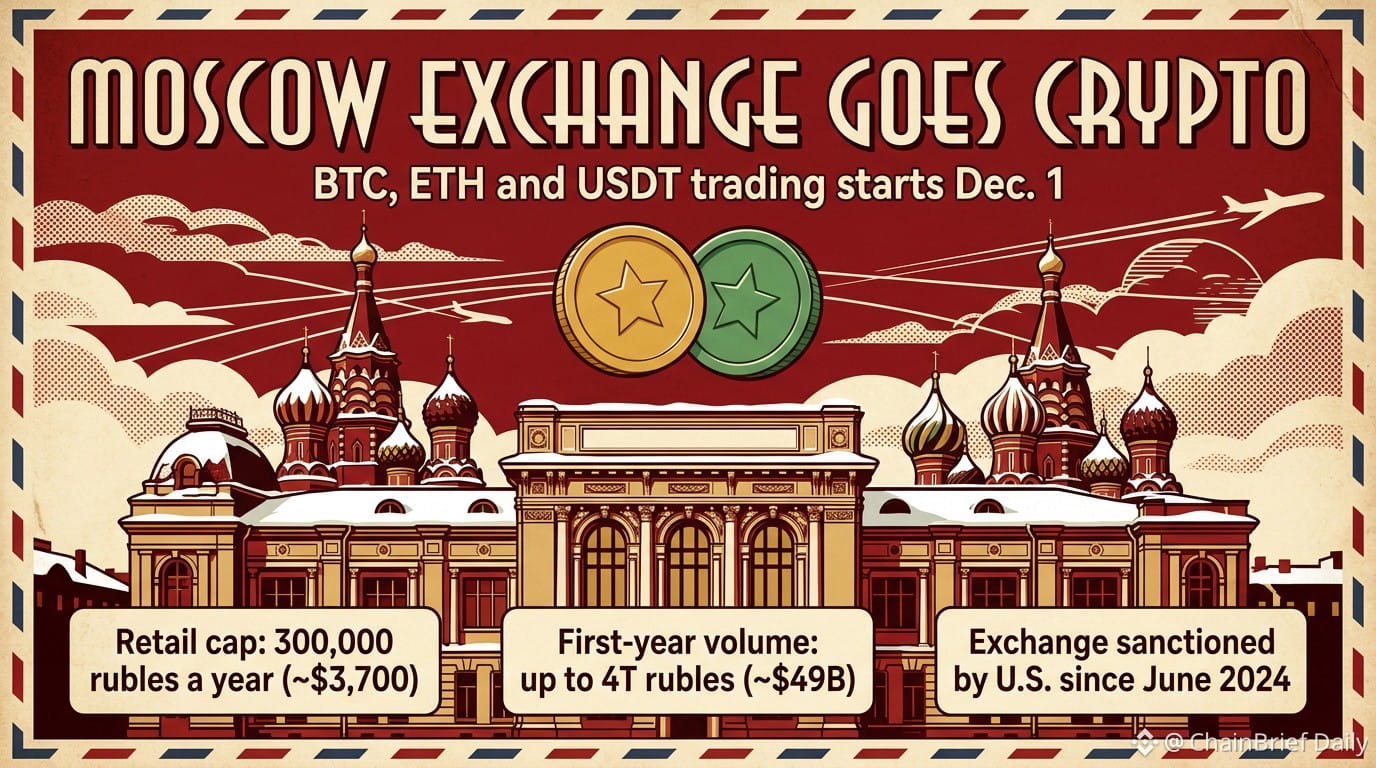
Russia's biggest stock exchange is putting crypto on the same screens traders use for Sberbank and Gazprom shares.
According to CoinDesk, Moscow Exchange plans to start trading bitcoin, ether and USDT on Dec. 1. Trading hours will match the stock market, 06:50 to 23:50 Moscow time, with the National Clearing Centre clearing trades on same-day or next-day settlement.
The details that stand out:
• Ordinary investors must pass a test and can buy up to 300,000 rubles per year (about $3,700) through a single broker. Qualified investors have no cap.
• A Moscow Exchange deputy chairman has said first-year volume could reach up to 4 trillion rubles (about $49B).
• Russia's finance ministry put daily crypto turnover at roughly 50B rubles in February, so the first-year estimate works out to about 11B a day. Most flow would likely stay on offshore exchanges and P2P desks.
The catch: both the exchange and its clearing house have been under U.S. sanctions since June 2024, while Tether freezes wallets linked to sanctioned addresses. How that policy applies to USDT held through the clearing house is an open question; CoinDesk says it has asked Tether for comment.
Why it matters: regulated, on-exchange access could pull crypto activity back onshore in one of the largest retail markets, but sanctions, limits and compliance rules may shape how much actually moves. Launch plans can also change before December.
Do you think regulated local venues will pull volume from offshore exchanges, or will most traders stay where they are?
#Crypto #Stablecoins #Regulation $BTC $USDT
Not financial advice.
52
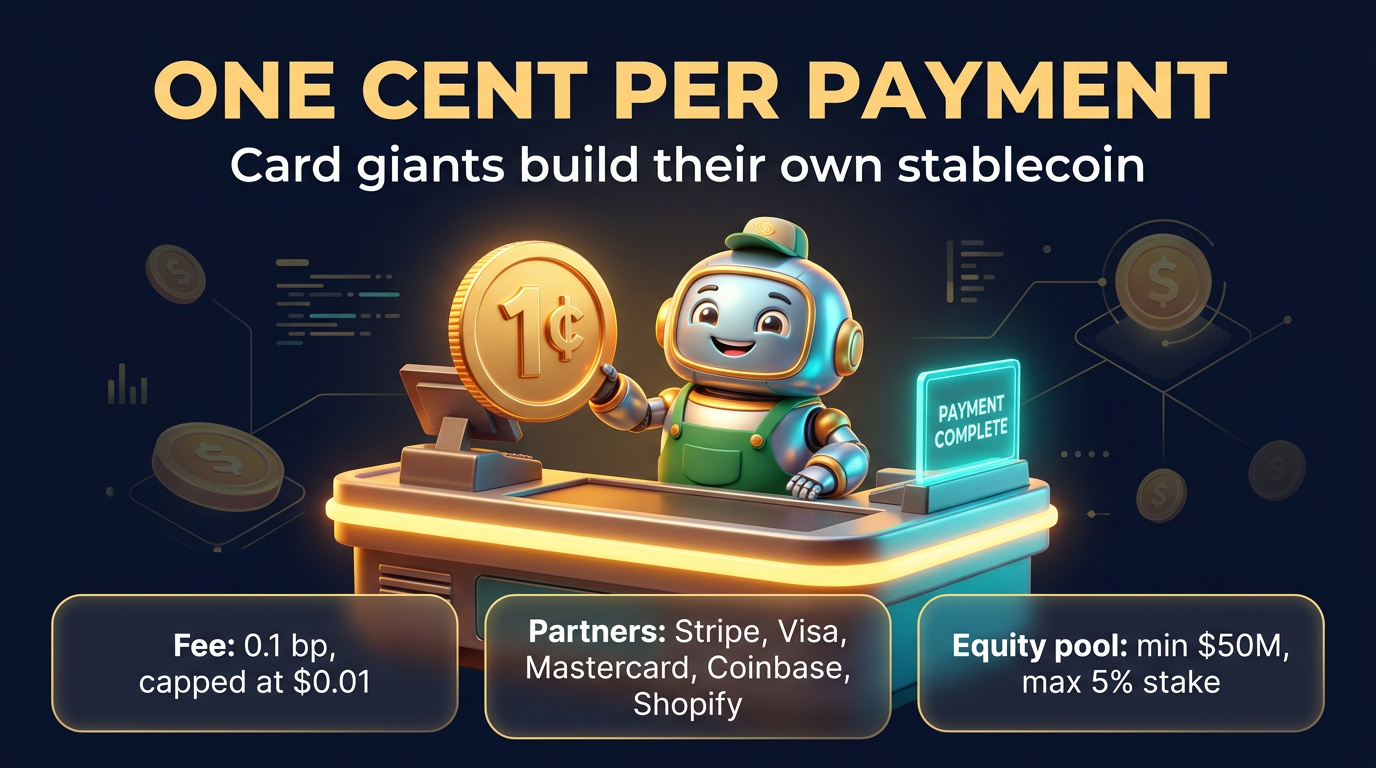
The companies that run card payments are building their own stablecoin, and the fee is almost comically small.
According to CoinDesk (via PANews), OpenUSD (OUSD), co-initiated by Stripe, Visa, Mastercard, Coinbase and Shopify, now has a fee schedule from its governance group, Open Standard:
• A management fee of 0.1 basis point on payment volume, capped at $0.01 per payment. Anything at $1,000 or above hits the one-cent cap.
• Unlike USDT and USDC issuers, who keep the interest on reserves, OUSD passes reserve yield to partners and deducts only that fee.
• Partners holding at least $50 million can join an equity pool, with a single partner capped at a 5% stake.
• Visa has published a 100+ page technical guide for partners to integrate OUSD.
Why it matters: stablecoin economics have mostly been about who captures the reserve yield. If big payment networks and merchants share it instead, the model shifts from "issuer keeps the float" to "the network keeps the volume." That could pressure margins for existing issuers over time.
The same week, Shopify and Coinbase announced a stablecoin Commerce Payments Protocol on Base, and OKX launched a stablecoin-backed Mastercard charge card in the US. Payments rails are clearly moving fast.
Risks to keep in mind: these are announced terms, not live mass adoption. Fee schedules can change, equity pools favor large partners, and a stablecoin is only as good as its reserves, redemption and regulation. Check the primary sources before drawing conclusions.
Do you think a payments-network-owned stablecoin helps or hurts USDT and USDC? Tell me below.
#Stablecoins #Payments #OpenUSD
Not financial advice.
332
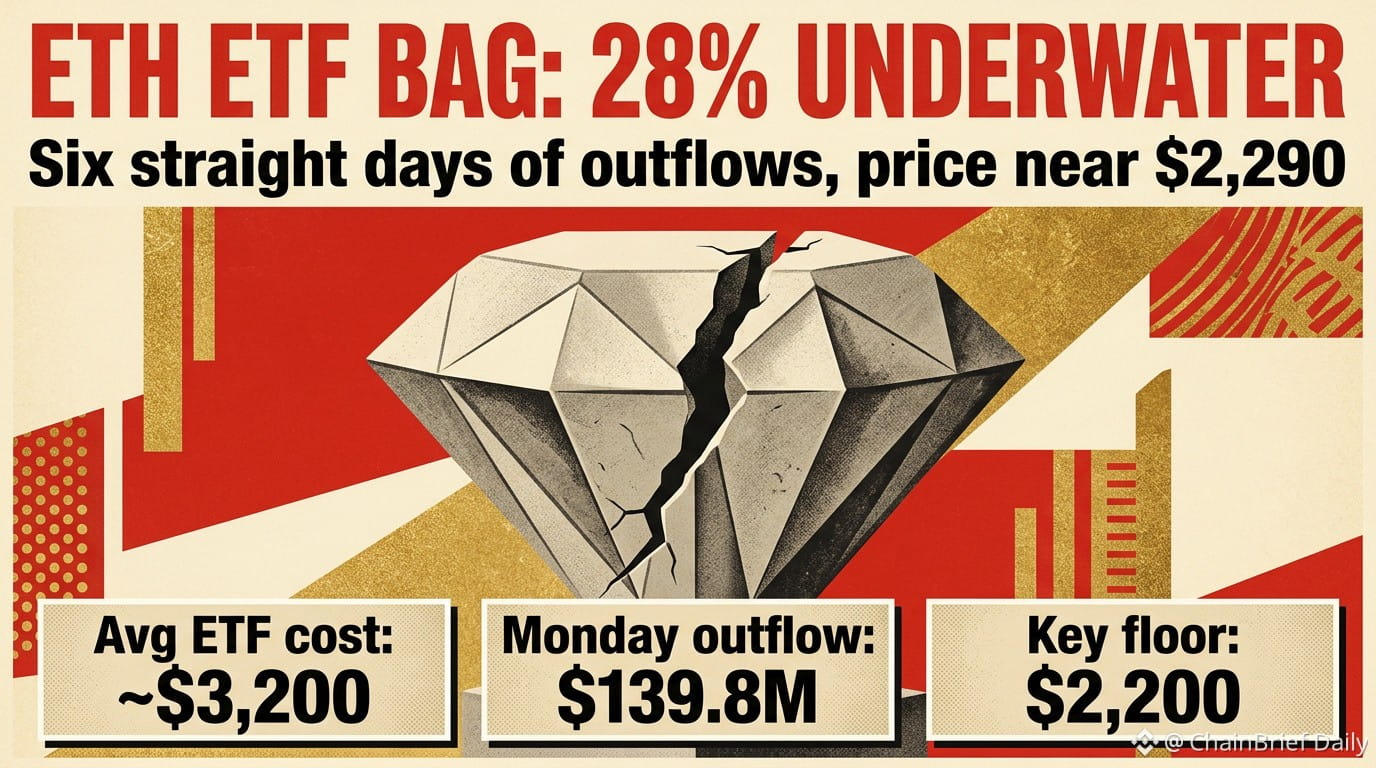
$ETH is bouncing, but the people who bought it through ETFs are not smiling.
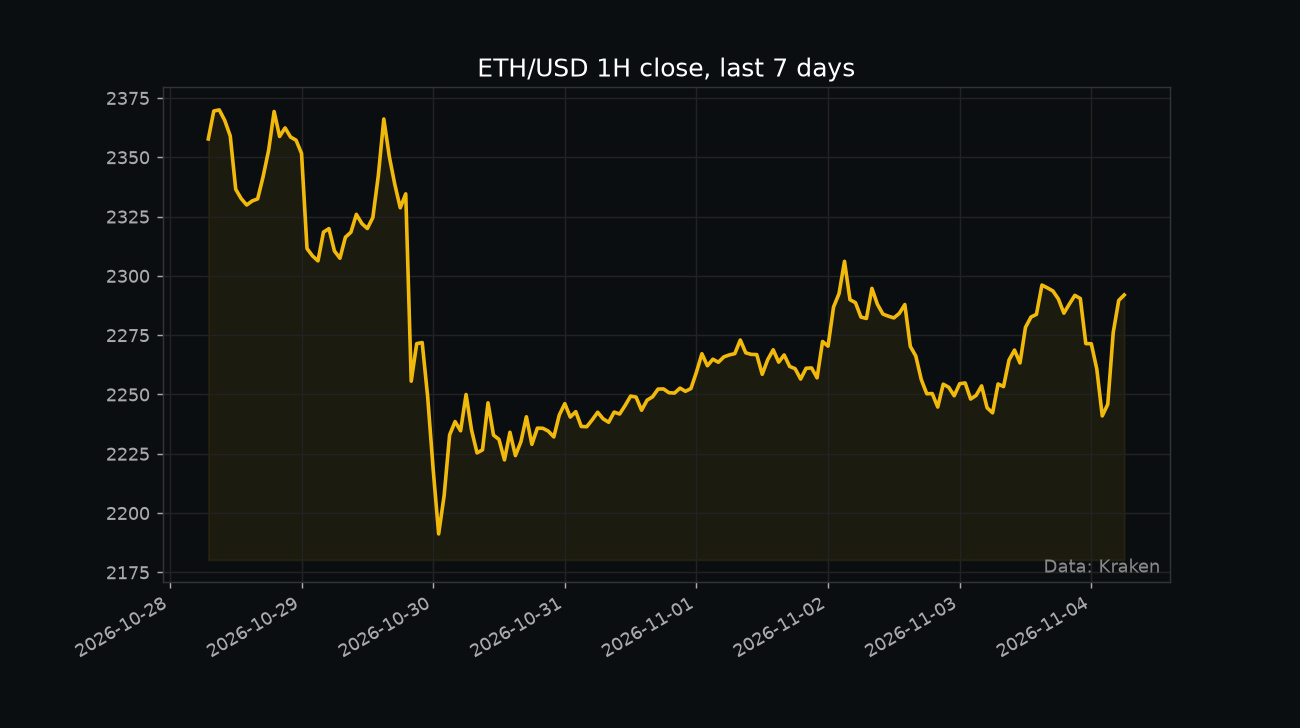
Bloomberg's James Seyffart estimated that US spot Ether ETF buyers paid just under $3,200 per token on average. With ETH near $2,290 (Kraken, 24h range roughly $2,223-$2,303), that's about 28% underwater, an estimated $3.5B unrealized loss.
Flows tell the same story: US spot ETH ETFs lost $139.8M on Nov 2, the sixth straight day of outflows, with BlackRock's ETHA making up $138.3M of it. Last inflow was Oct 23. Weekly ETH ETF outflows were $431.5M, the largest of any major asset.
Levels traders are watching:
• $2,300: a daily close above it would shift short-term sentiment from cautious to neutral
• $2,200: the floor; the Oct 30 low was about $2,170-2,190
• $2,500: first real resistance
• $2,000: a break would likely bring forced selling
Catalyst: the US October jobs report on Nov 6. A soft print could ease Fed hike fears; a hot one keeps pressure on risk assets.
Risks: ETF holders who are down 28% may sell any rally toward breakeven, and ETH can slice through any level on a single headline.
Do you think the ETF outflow streak ends this week, or does $2,200 get tested again?
#ETH #Ethereum #ETFflows
Not financial advice.
71
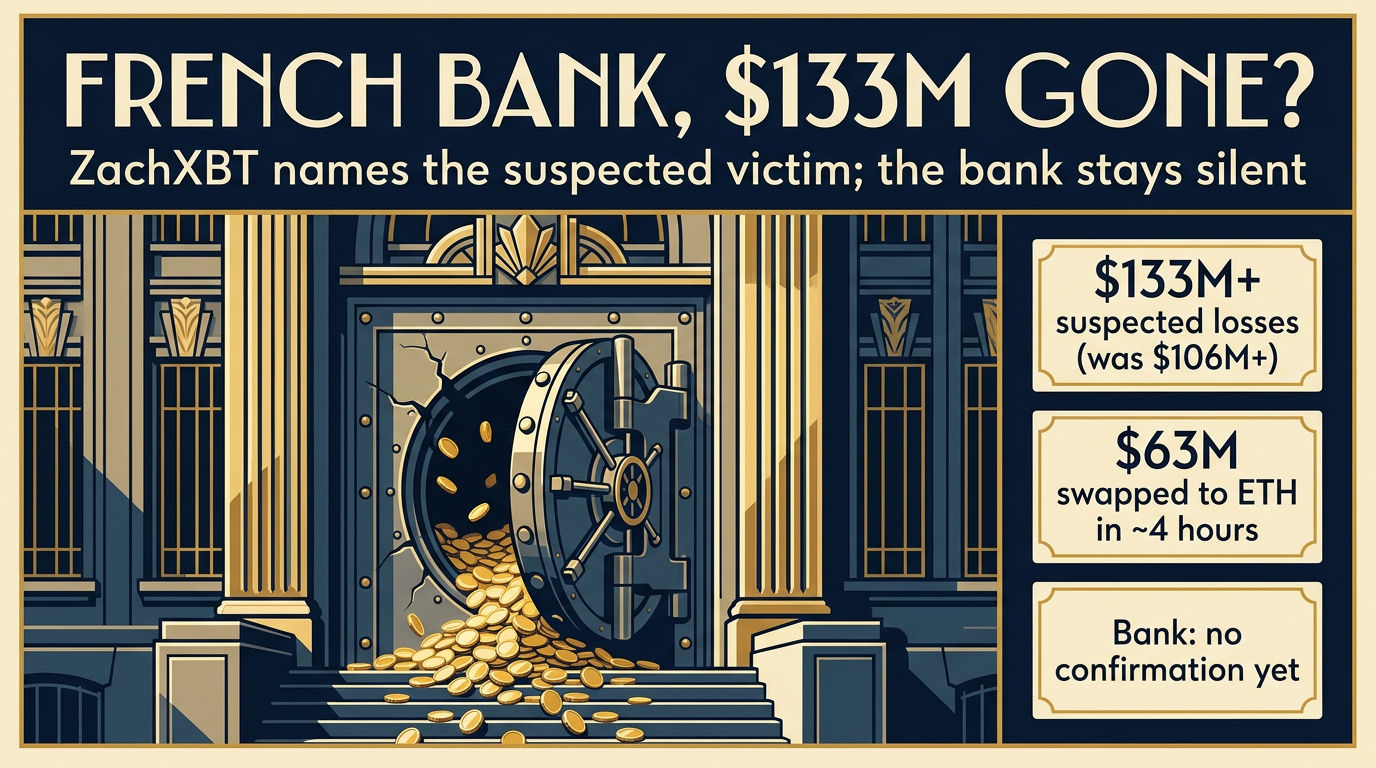
A French bank with $235B in assets may have just become the biggest institutional crypto-theft story of the week, and it isn't even the Binance one.
On-chain investigator ZachXBT now names Crédit Mutuel Arkéa as the suspected victim of a theft he puts at more than $133 million. Important: the bank has not confirmed anything and had issued no public statement as of Nov 4. This is the investigator's identification, not an official finding.
What's reported so far:
• First flagged Nov 2 at $106M+, then raised after another $27M+ in exchange withdrawals was traced, some after his first alert
• Funds left centralized exchange accounts as USDC and USDT, were swapped into ETH (about $63M within roughly four hours, per Bitquery), then routed through instant-swap services and bridges, with some moved into Monero
• Kraken says the incident did not originate on its platform and it restricted the accounts involved; Crypto.com moved to block related funds; OKX is reviewing
• ZachXBT says late disclosure let $30M+ get laundered that EU law enforcement could possibly have frozen, and suspects OTC activity means the real total is higher
Why it matters: this lands days after the largest exchange hack on record. Two very different victims, one lesson: custody and account-access security is now the main risk story, and speed of disclosure decides whether stolen funds can still be frozen.
Caution: figures may change, and attribution remains unverified until the bank speaks. Treat early numbers as estimates.
Should banks be required to disclose crypto-related breaches within hours, like exchanges are pressured to? Tell me what you think.
#CryptoSecurity #Hack #OnChain $ETH
Not financial advice.
136
股票也能做“永续合约”了?这周美国监管给出了第一个明确信号。
据 CFTC 表态,个股永续合约首次获准在美国注册交易所上市,产品被归类为证券期货,仍受 CFTC、SEC 及联邦证券法约束。永续合约这个长期属于加密市场的产品形态,正式被搬进传统股票衍生品框架。
同一周,据 Decrypt 等媒体报道,纽交所母公司 ICE 与 TradeXYZ 达成合作,拟把基于 Hyperliquid 的永续合约带给美国用户,ICE 负责运营市场与清算并持有少数股权,仍待监管批准。受此消息带动,HYPE 周涨幅约 8.8%(Caleb & Brown 周报)。
另一面:据报道,有行业组织已起诉要求撤销 CFTC 的批准,后续仍有变数;而且“获准上市”不等于“已经上线”,ICE 的方案还没拿到最终批复。
看点:加密的交易模式正在被传统交易所吸收,杠杆产品走向合规化,同时风险也更直接——永续合约自带杠杆,波动大时爆仓很快。
你觉得个股永续会先火在加密圈,还是传统券商圈?
#永续合约 #Hyperliquid #加密新闻
数据来源:CFTC 公告报道、Decrypt、Caleb & Brown。不构成投资建议。

257
Войдите, чтобы посмотреть больше материала
Присоединяйтесь к пользователям криптовалют по всему миру на Binance Square
⚡️ Получайте новейшую и полезную информацию о криптоактивах.
💬 Нам доверяет крупнейшая в мире криптобиржа.
👍 Получите достоверные аналитические данные от верифицированных создателей контента.
Эл. почта/номер телефона
В тренде
CPITestsDecemberRateOutlook
Просмотров: 732,423
3,512 обсуждают
October CPI Seen Up 0.3%, Keeping Fed on Course for December Rate Increase
Binance News
·Лайков: 8
·Просмотров: 9.1k
NvidiaInvestigatesAfterHuang’sAffairApology
Просмотров: 288,083
2,262 обсуждают
AnthropicRejectsIPODelayValuationinQuestion
Просмотров: 77,587
724 обсуждают