
#tokeneconomics
tokeneconomics
Просмотров: 17,539
86 обсуждают
Популярные
Новые

·
--
$FET AND THE TOKEN COST SHIFT KEVIN KELLY JUST SIGNALED 🔥
Kevin Kelly highlighted that token cost will soon become a critical differentiator. Open‑source models offering one‑tenth the cost of closed‑source rivals could reshape the competitive landscape. Currently, the market underweights this trend, but as token consumption scales, efficiency will drive adoption.
The AI narrative is evolving beyond code quality into cost per token. Projects optimizing inference economics may capture the next wave of value. Are you positioned for this shift?
Not financial advice. Always manage your risk.
#FET #ArtificialIntelligence #TokenEconomics #AICrypto
🔥
87

·
--
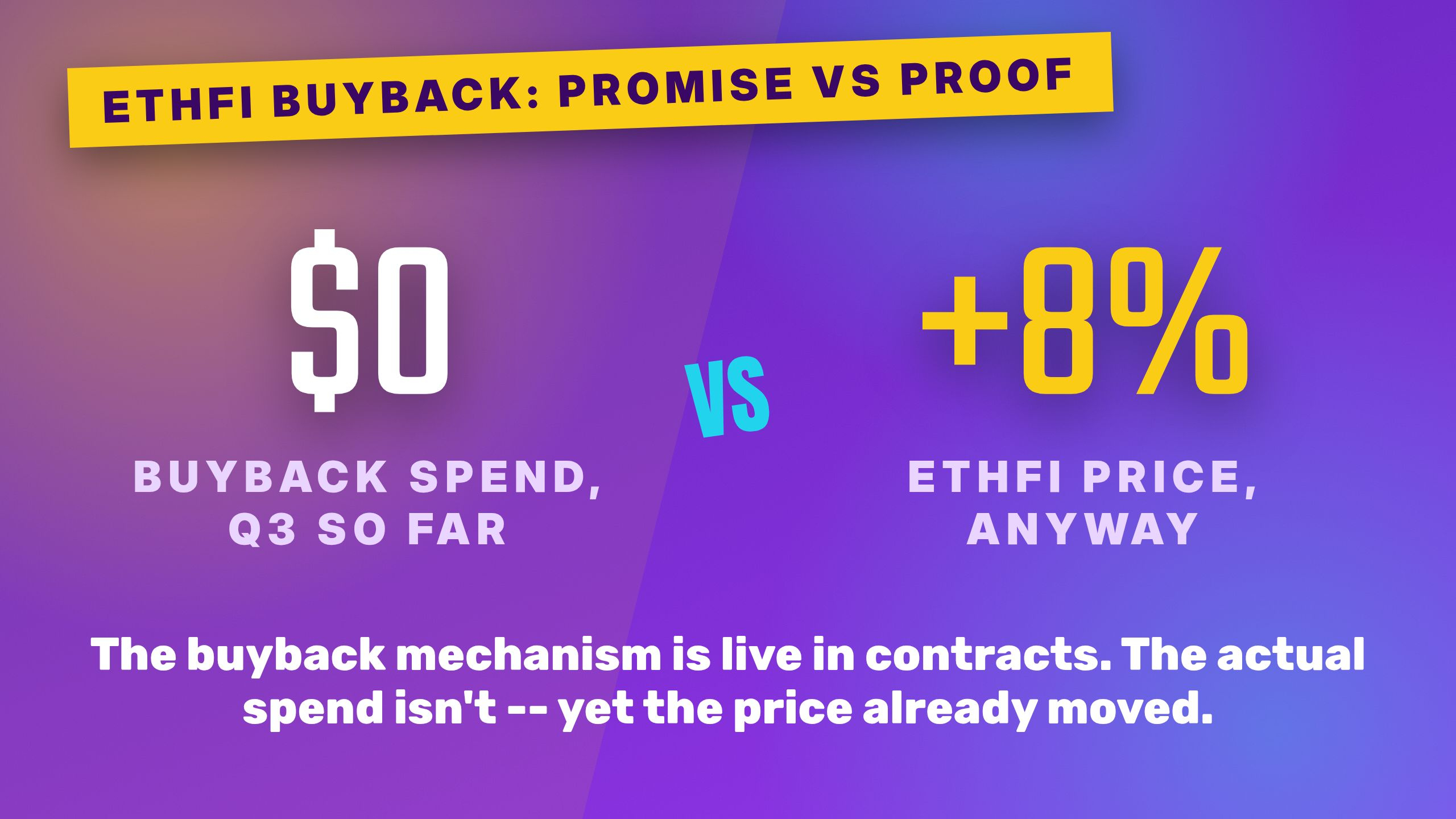
$ETHFI is up 8% this week, breaking back above $0.50 — on a buyback program that has spent $0 so far this quarter.
The follow-up: we covered ether.fi's "Summer" neobank relaunch on August 13 — tokenized stocks, Aave-powered portfolio loans, and programmatic ETHFI buybacks written into protocol contracts. The buyback mechanism was the real bull case: actual product revenue (withdrawal fees, Stake/Liquid/Cash income) funding token purchases, not emissions. Two days later, AMBCrypto reported zero recorded Q3 buyback spend — the program is announced and contractually live, but unexecuted so far.
The catch: the market didn't wait for proof. ETHFI rallied anyway, first ~11.6% on the announcement, then another 8% breaking $0.50 resistance this week — pricing in a buyback flow that hasn't actually happened yet. That's a real gap between the promise and the receipts.
Our read: the neobank pivot itself is genuine (500K+ users, ~150K cards issued, real revenue lines), but "buybacks written into contracts" and "buybacks executed" are two different claims, and only one of them is currently true. Falsifiable: watch the next quarterly disclosure for actual buyback spend — if it stays at zero while the price keeps climbing on the promise, that's a warning sign, not a confirmation.
Would you buy a token on a buyback promise before seeing the first dollar spent?
Not financial advice. DYOR.
$ETHFI #DeFi #Buybacks #TokenEconomics #CryptoAnalysis
91

·
--
Unpopular opinion: Most TermMax criticism is missing the point entirely.
I couldn't stop looking at TermMax's 2% lending fee rate because it sounds way heavier than what it actually costs in real economic terms.
That surface metric is misleading. Here's why:
❌ WRONG: "2% lending fee is expensive" ✅ RIGHT: "2% protocol rate ≠ 2% of principal. It's the effective cost depending on interest generated"
❌ WRONG: "Max supply kills the token" ✅ RIGHT: "Launch float (200M) is what moves price, not total supply"
❌ WRONG: "Fee design favors borrowers" ✅ RIGHT: "Fee design is elegant—but user behavior decides whether the model compounds"
The economics are simple. User adoption decides the outcome.
What are you watching for? @termmax
#TermMax #defi #TokenEconomics #BinanceSquare
Unpopular opinion: Most TermMax criticism is missing the point entirely.
I couldn't stop looking at TermMax's 2% lending fee rate because it sounds way heavier than what it actually costs in real economic terms.
That surface metric is misleading. Here's why:
❌ WRONG: "2% lending fee is expensive" ✅ RIGHT: "2% protocol rate ≠ 2% of principal. It's the effective cost depending on interest generated"
❌ WRONG: "Max supply kills the token" ✅ RIGHT: "Launch float (200M) is what moves price, not total supply"
❌ WRONG: "Fee design favors borrowers" ✅ RIGHT: "Fee design is elegant—but user behavior decides whether the model compounds"
The economics are simple. User adoption decides the outcome.
What are you watching for? @TermMax
#TermMax #defi #TokenEconomics #BinanceSquare
50

·
--
🔍 Как за 5 минут оценить токеномику проекта
Видите крутой проект, но не знаете, стоит ли инвестировать? Токеномика расскажет больше, чем красивый сайт и громкие партнёрства.
Первым делом смотрим на общее предложение токенов. Total Supply — сколько всего может быть выпущено, Circulating Supply — сколько уже в обороте. Если в обороте только 10% от общего количества, готовьтесь к сильному давлению продаж в будущем.
Далее изучаем распределение. Красный флаг — если команда и инвесторы владеют больше 50% токенов. Хорошие проекты оставляют 40-60% сообществу и экосистеме.
Обязательно проверяем график разлоков (vesting schedule). Если большие объёмы токенов разблокируются в ближайшие месяцы — цена может просесть.
Практический пример: проект с market cap $100M, но FDV (полностью разводненная оценка) $1B означает, что при полной эмиссии цена упадёт в 10 раз при том же спросе.
Не забываем про утилити токена — зачем он нужен в экосистеме? Токены-акции без реального применения долго не живут.
💡 Потратьте 5 минут на токеномику — сэкономите месяцы убытков.
А какой параметр токеномики вы считаете самым важным при выборе проекта — распределение между участниками или график разлоков?
#TokenEconomics #CryptoEducation #DeFiAnalysis #CryptoResearch #BinanceSquare
120

📊 EVA's Burn Vault Boost: The Mechanism Behind the Price Support
Most tokens have zero defense when price dips below fair value. EVA does, thanks to the Burn Vault Boost.
Here's how it works 👇
When EVA's market price falls below the Burn Price, the Boost kicks in and creates an arbitrage incentive. Buying the dip becomes attractive, pulling in demand that pushes price back toward the vault price. Not a guarantee, but a market driven mechanism working with price action instead of against it.
The catch (a good one): the Boost only has a limited amount of EVA to work with. That's by design. Unlimited support would drain fast and undercut the scarcity the whole Burn Vault system is built on. Capping it keeps the mechanism sustainable long term.
This kind of structural design might explain a broader trend. Cryptic recently analyzed 113 crypto projects launched since 2024 and found only 8 showing positive performance since TGE. EVA was one of them. 👀
Want the technical breakdown of how the Boost calculates and applies its incentive? Casta walks through it in the latest video nugget.
Want the full story behind that performance stat? Check the latest EVA Recap on YouTube.
Follow for more on Burn Vault Core, Burn Price, and everything building in the EverValue ecosystem 🔥
#EverValueCoin #EVA #Crypto #BurnVault #TokenEconomics
98

·
--
$MOON PARTNERSHIP SIGNALS INSTITUTIONAL SHIFT IN TOKEN ECONOMICS 🔥
The agreement between ChinaSoft International and Dark Side of the Moon Technology for the "Lunar Exploration Project" marks a formal move into token revenue sharing and joint innovation. This is the first public collaboration of its kind from a traditional tech firm, signaling deeper institutional interest in tokenized business models.
Volume on related token pairs has remained quiet so far, but order book depth suggests accumulation near current levels. Structure is coiling—breakout will likely follow the next liquidity sweep.
Are you watching this ticker as a leading indicator for institutional token adoption?
Not financial advice. Always manage your risk.
#MOON #TokenEconomics #InstitutionalAdoption #PartnershipAlert
🔥
95

·
--
AI 越强,为什么成本反而值得警惕?
以前用 AI,很多人只关心模型聪不聪明。
现在开始真正落地,就必须计算推理费用、Token 消耗、调用次数和任务成功率。
一个模型回答得再好,如果每完成一次任务都要花掉过高的成本,也很难形成可持续的生意。
AI 的下半场,拼的不只是能力,还有单位成本创造的价值。
#AI #大模型 #TokenEconomics #AI基础设施
AI 越强,为什么成本反而值得警惕?
以前用 AI,很多人只关心模型聪不聪明。
现在开始真正落地,就必须计算推理费用、Token 消耗、调用次数和任务成功率。
一个模型回答得再好,如果每完成一次任务都要花掉过高的成本,也很难形成可持续的生意。
AI 的下半场,拼的不只是能力,还有单位成本创造的价值。
#AI #大模型 #TokenEconomics #AI基础设施
以前用 AI,很多人只关心模型聪不聪明。
现在开始真正落地,就必须计算推理费用、Token 消耗、调用次数和任务成功率。
一个模型回答得再好,如果每完成一次任务都要花掉过高的成本,也很难形成可持续的生意。
AI 的下半场,拼的不只是能力,还有单位成本创造的价值。
#AI #大模型 #TokenEconomics #AI基础设施
3

·
--

Статья
International Crypto Rules Tighten: What It Means for Prices and ProjectsThe past week has felt like a regulatory roller-coaster, and the market's reaction is written in the numbers. $BTC is hovering at $64,680, nudging up 0.59% in the last 24 hours while still down 12.61% on the weekly chart. $ETH, $BNB and SOL are all slipping in the 7-day view, yet SOL managed a 3.17% bounce today, hinting at pockets of resilience.
Regulatory Pulse in Europe
The EU's MiCA framework finally entered force, demanding clear token classifications and tighter AML reporting. I've noticed that European-listed stablecoins are seeing tighter spreads, and the fear index is at 11, an "Extreme Fear" reading that matches the dip in XRP's modest 4.36% gain. For traders, the key is to watch liquidity on exchanges that have already secured MiCA licences, they'll likely weather the next wave of compliance checks better than the rest.
US Treasury Moves
Across the Atlantic, the Treasury's new guidance on "crypto-related financial products" is sharpening the definition of securities. That's why we're seeing MMT explode 111.41% to $0.2427, a speculative burst that often follows regulatory uncertainty. My takeaway? Keep an eye on the 24-hour volume spikes; they can signal where institutional interest is either fleeing or stepping in.
Asia's Stance on Stablecoins
Asian regulators are tightening the leash on dollar-pegged tokens, with several jurisdictions demanding reserve transparency. The result is a muted response from XAUT, which slipped 2.48% to $3,763. If you're developing a DeFi app targeting Asian users, consider integrating on-chain proof-of-reserve mechanisms now rather than later.
What Traders Should Watch
- Volume trends: $BTC's 24-hour volume sits at $1.51B, a solid baseline that often precedes short-term rebounds.
- Gainers vs. losers: BREV's 78.68% surge to $0.1031 shows how quickly sentiment can flip; contrast that with ASTER's 7.18% drop to $0.5534.
- Fear & Greed: an index at 11 suggests many market participants are risk-averse, so volatility may stay elevated.
Developer Playbook
Regulators are demanding more data, so building robust KYC/AML layers is no longer optional. I've started using modular compliance SDKs that can toggle between jurisdictions, a move that saved my team weeks of re-coding when the EU rule changed. Also, consider tokenizing compliance reports themselves; on-chain attestations could become a competitive edge as auditors look for immutable proof.
How do you think the new rules will reshape token economics in the next six months?
Not financial advice.
#CryptoRegulation #TokenEconomics #DeFiDevelopment #MarketWatch
International Crypto Rules Tighten: What It Means for Prices and Projects
The past week has felt like a regulatory roller-coaster, and the market's reaction is written in the numbers. $BTC is hovering at $64,680, nudging up 0.59% in the last 24 hours while still down 12.61% on the weekly chart. $ETH , $BNB and SOL are all slipping in the 7-day view, yet SOL managed a 3.17% bounce today, hinting at pockets of resilience.
Regulatory Pulse in Europe
The EU's MiCA framework finally entered force, demanding clear token classifications and tighter AML reporting. I've noticed that European-listed stablecoins are seeing tighter spreads, and the fear index is at 11, an "Extreme Fear" reading that matches the dip in XRP's modest 4.36% gain. For traders, the key is to watch liquidity on exchanges that have already secured MiCA licences, they'll likely weather the next wave of compliance checks better than the rest.
US Treasury Moves
Across the Atlantic, the Treasury's new guidance on "crypto-related financial products" is sharpening the definition of securities. That's why we're seeing MMT explode 111.41% to $0.2427, a speculative burst that often follows regulatory uncertainty. My takeaway? Keep an eye on the 24-hour volume spikes; they can signal where institutional interest is either fleeing or stepping in.
Asia's Stance on Stablecoins
Asian regulators are tightening the leash on dollar-pegged tokens, with several jurisdictions demanding reserve transparency. The result is a muted response from XAUT, which slipped 2.48% to $3,763. If you're developing a DeFi app targeting Asian users, consider integrating on-chain proof-of-reserve mechanisms now rather than later.
What Traders Should Watch
- Volume trends: $BTC 's 24-hour volume sits at $1.51B, a solid baseline that often precedes short-term rebounds.
- Gainers vs. losers: BREV's 78.68% surge to $0.1031 shows how quickly sentiment can flip; contrast that with ASTER's 7.18% drop to $0.5534.
- Fear & Greed: an index at 11 suggests many market participants are risk-averse, so volatility may stay elevated.
Developer Playbook
Regulators are demanding more data, so building robust KYC/AML layers is no longer optional. I've started using modular compliance SDKs that can toggle between jurisdictions, a move that saved my team weeks of re-coding when the EU rule changed. Also, consider tokenizing compliance reports themselves; on-chain attestations could become a competitive edge as auditors look for immutable proof.
How do you think the new rules will reshape token economics in the next six months?
Not financial advice.
#CryptoRegulation #TokenEconomics #DeFiDevelopment #MarketWatch
NB1905:
The prices of gold, silver, and oil have fallen. Bank stocks have plummeted! The most reliable crypto exchange. And Bitcoin is set to start with a massive surge🪙📈📈📈📈📈📈📈📈🚀🚀
1
149

·
--
🚨 $AI TOKEN COSTS SET TO FADE WITHIN 12 MONTHS, SAYS OPENAI CHAIRMAN! 💥
📌 Bret Taylor's CNBC appearance signals a structural shift — token management is becoming a vendor function, not a corporate headache. This mirrors early internet infrastructure where setup costs collapsed as specialists emerged. 📊
For crypto AI tokens, this removes a critical barrier. If end-users stop worrying about per-token accounting, adoption velocity increases. Frontier models retain a hidden edge here: efficiency per task beats raw open-weight pricing. 💡
🔍 The next 12 months will reward protocols that abstract token friction away. Which AI tokens are positioned to benefit most from this narrative pivot? 💬
⚠️ Not financial advice. Always manage your risk. 🛡️
🏷️ #AI #CryptoAI #TokenEconomics #NarrativeShift #AltSeason
🎯 💡
92

·
--
Protocol revenue is the missing link between token price and real utility.
Most crypto tokens trade on narrative. But a quieter category — fee-accruing protocols — is building a fundamentals case that mirrors traditional equity valuation. When a network generates revenue from user activity and routes some of that back to token holders or burns supply, the token becomes more than a speculation vehicle.
$BNB pioneered this with its quarterly burn mechanism, tying token supply contraction directly to exchange volume. $ETH took it further with EIP-1559 — every transaction now destroys a portion of supply, converting block space demand into a deflationary force. $AVAX burns all base fees natively, meaning network congestion compresses circulating supply in real time.
The pattern: sustained fee revenue → reduced supply overhead → improved price floor during downturns.
This is why revenue multiples (Price-to-Fee ratio) are gaining traction as on-chain valuation frameworks. Tokens with consistent fee generation tend to compress less during bear phases because there is a tangible utility demand keeping them anchored.
Narrative gets you in. Revenue keeps you there.
Watch protocol fee dashboards — not just price charts.
#CryptoFundamentals #DeFi #OnChainMetrics #TokenEconomics #BinanceSquare
193
·
--
Execution Is Becoming Free. Settlement Is Where the Value Lives.
The Layer 1 narrative keeps evolving, and the most important shift right now isn't about throughput — it's about where value actually accrues.
Rollups and app-chains have made execution nearly free. L2 fees are a fraction of L1 costs, and users don't care where their transaction is processed — they care about security, finality, and liquidity. That's pushing the value proposition up the stack toward settlement layers.
The L1s that win this phase won't be the ones with the highest TPS. They'll be the ones with the deepest economic security, the most credible neutrality, and the strongest settlement guarantees. Economic security is a function of staked value, validator decentralization, and slashing economics — not marketing.
This matters for token holders. If execution commoditizes, the fee revenue that used to flow to L1 validators compresses. Settlement-layer fees — the cost of finality and data availability — become the real revenue stream. L1s with thin staking depth or concentrated validator sets are structurally exposed.
The implication: diversify your L1 exposure by economic security depth, not by TPS benchmarks. $ETH leads on staked value and settlement credibility. $BNB benefits from exchange-anchored liquidity depth. $SOL trades on throughput and ecosystem gravity but needs to prove settlement-layer durability.
The next L1 comparison that matters isn't a speed test — it's a security budget audit.
#Layer1 #SettlementLayer #EconomicSecurity #CryptoInfrastructure #TokenEconomics
57
·
--
🚨 $GIGGLE SELL-SIDE FLOW DEBATE: MONTHLY DUMPS VS. SMALLER TRANCHE DISTRIBUTION 💥
Charity treasuries in crypto are liquidity events in slow motion. A monthly token sale creates a predictable overhang that savvy operators can position into, while smaller tranches reduce visible market impact but stretch distribution uncertainty across a longer timeframe. 📊 CZ prioritizes operational simplicity; $KOMA founder Brian Sumner is reading the order book impact. Both are valid — but in a zero-sum liquidity game, transparency matters more than frequency.
Smart money loves clarity. If the community knows exactly when and how donated tokens hit the market, sell-side pressure gets priced in efficiently. 🔍 The real question is whether charities should treat holdings as treasury reserves or as funding sources to deploy immediately.
Should crypto charities adopt fixed tranche schedules — or is monthly simplicity better for market health? 💬
⚠️ Not financial advice. Always manage your risk. 🛡️
🏷️ #GIGGLE #CryptoCharity #TokenEconomics #MarketImpact #CryptoNews
🦈

187
$GPU COMPUTE FUTURES ARE LIVE — $RNDR COULD BE NEXT 🔥
Prediction market Kalshi just launched forward curves for Nvidia B200, H200, and A100 chips. This is the first time we've seen market-driven pricing for compute power — a huge step for the AI and crypto mining ecosystem.
For tokens like $RNDR that rely on GPU demand, this creates a transparent way to gauge future utilization. If forward curves show rising prices, expect increased activity on decentralized networks. The question is whether market makers will start hedging with token plays.
What's your take — does this make AI tokens more predictable or more volatile?
Not financial advice. Always manage your risk.
#RNDR #GPUCompute #AIFutures #CryptoMining #TokenEconomics
🔥
62

🚨 OPENAI CHAIRMAN SAYS AI TOKEN COSTS FADE WITHIN A YEAR - $FET IMPACT 🧠
💡 The market is shifting. Bret Taylor just told CNBC that the anxiety over AI token costs is a temporary storm - vendors and specialized firms will absorb the burden within 12 months. For crypto AI tokens like $FET , this means the focus moves from cost counting to outcome delivery.
💡 Taylor compared it to the early internet when hosting a website was expensive. Now it's cheap. Token efficiency will separate winners from hype. Frontier labs still hold an edge on compute efficiency - not all tokens are equal. The same applies to crypto: projects that manage token utility and real demand will thrive. 📊
💡 This is a macro shift in the AI narrative. If token costs fade, adoption accelerates. That's the real thesis behind $FET 's long-term value. 💬 Do you think the market is pricing in this maturation, or is it all hype? 👇
⚠️ Not financial advice. Always manage your risk. 🛡️
🏷️ #FET #AI #Crypto #TokenEconomics #LongTerm
🧠 ⚡
126

Before tokens, BitTorrent relied on goodwill.
That worked… until scale exposed human behavior.
BTT didn’t change the network.
It changed incentives.
That’s why it survived.
@JustinSun @BitTorrent_Official #TRONEcoStar
#crypto #TokenEconomics
Before tokens, BitTorrent relied on goodwill.
That worked… until scale exposed human behavior.
BTT didn’t change the network.
It changed incentives.
That’s why it survived.
@Justin Sun孙宇晨 @BitTorrent_Official #TRONEcoStar
#crypto #TokenEconomics
That worked… until scale exposed human behavior.
BTT didn’t change the network.
It changed incentives.
That’s why it survived.
@Justin Sun孙宇晨 @BitTorrent_Official #TRONEcoStar
#crypto #TokenEconomics
39

·
--
Pixels’ timing-first reward design keeps $PIXEL in focus ⏱️
The latest read on Pixels is not about a larger prize. It is about precision. The Task Board and Stacked layer appear to be delivering small, low-friction routes exactly where user fatigue sets in, which is a classic retention mechanic rather than a blunt incentive push. That matters because the market tends to underprice timing as a growth lever. When rewards arrive at the edge of churn, they can stabilize engagement without needing aggressive emissions, and that changes how the ecosystem’s value accrues around $PIXEL.My read is that retail is looking at the reward itself, while the real signal sits in the orchestration. Small, well-timed incentives are not just content design. They are liquidity management for attention. In practice, that means the system is trying to convert near-exit behavior into one more action, one more session, one more data point. For $PIXEL, the more important question is whether this translates into durable user retention and cleaner unit economics, because institutional capital will care less about noisy engagement spikes and more about whether the platform can repeatedly convert soft intent into measurable activity without overpaying for it.
The next checkpoint is whether this timing-led engagement holds up beyond anecdotal sessions and into broader participation across the ecosystem.
Risk disclosure: This is not financial advice. Digital assets are volatile and can move sharply on narrative, liquidity, and macro conditions.
#PIXEL #GAMEF #Web3Gaming #TokenEconomics
{future}(PIXELUSDT)
Pixels’ timing-first reward design keeps $PIXEL in focus ⏱️
The latest read on Pixels is not about a larger prize. It is about precision. The Task Board and Stacked layer appear to be delivering small, low-friction routes exactly where user fatigue sets in, which is a classic retention mechanic rather than a blunt incentive push. That matters because the market tends to underprice timing as a growth lever. When rewards arrive at the edge of churn, they can stabilize engagement without needing aggressive emissions, and that changes how the ecosystem’s value accrues around $PIXEL .My read is that retail is looking at the reward itself, while the real signal sits in the orchestration. Small, well-timed incentives are not just content design. They are liquidity management for attention. In practice, that means the system is trying to convert near-exit behavior into one more action, one more session, one more data point. For $PIXEL , the more important question is whether this translates into durable user retention and cleaner unit economics, because institutional capital will care less about noisy engagement spikes and more about whether the platform can repeatedly convert soft intent into measurable activity without overpaying for it.
The next checkpoint is whether this timing-led engagement holds up beyond anecdotal sessions and into broader participation across the ecosystem.
Risk disclosure: This is not financial advice. Digital assets are volatile and can move sharply on narrative, liquidity, and macro conditions.
#PIXEL #GAMEF #Web3Gaming #TokenEconomics
9

$PIXEL tightens its reward curve as stacked AI re-prices daily emissions 🎯
The latest adjustment in $PIXEL’s reward schedule underscores a more active approach to token economics. Players reported a quieter reduction in payout rates across the same tasks, with no formal fanfare, only a subtle but meaningful shift in inflow. The mechanism appears designed to absorb sell-side pressure in real time by tightening rewards where activity is most likely to produce near-term distribution. With roughly 1 million PIXEL entering circulation daily, the market is now watching whether the system can preserve engagement while slowing the pace of liquid supply.
What the market is missing is that this is not simply a “reward nerf.” It is an attempt to engineer supply discipline through behavioral telemetry, which is a materially different framework from fixed-emission game economies that decay on a delay. If the model is working as intended, it should reduce reflexive dumping, improve supply absorption, and lengthen the half-life of player participation. In that sense, the real trade is not around today’s payout rate, but around whether stacked can convert transient farm activity into durable demand for the ecosystem. That is where the institutional lens shifts: less on headline APR, more on controlled float, retention quality, and whether the emission curve is becoming genuinely adaptive.
Going forward, $PIXEL will likely be judged less by static reward comparisons and more by whether the economy can sustain engagement without re-accelerating distribution.
Risk disclosure: This is not financial advice. Digital assets are volatile, and game economy changes can alter token performance quickly.
#PIXEL #Web3Gaming #CryptoMarket #TokenEconomics
{future}(PIXELUSDT)
$PIXEL tightens its reward curve as stacked AI re-prices daily emissions 🎯
The latest adjustment in $PIXEL ’s reward schedule underscores a more active approach to token economics. Players reported a quieter reduction in payout rates across the same tasks, with no formal fanfare, only a subtle but meaningful shift in inflow. The mechanism appears designed to absorb sell-side pressure in real time by tightening rewards where activity is most likely to produce near-term distribution. With roughly 1 million PIXEL entering circulation daily, the market is now watching whether the system can preserve engagement while slowing the pace of liquid supply.
What the market is missing is that this is not simply a “reward nerf.” It is an attempt to engineer supply discipline through behavioral telemetry, which is a materially different framework from fixed-emission game economies that decay on a delay. If the model is working as intended, it should reduce reflexive dumping, improve supply absorption, and lengthen the half-life of player participation. In that sense, the real trade is not around today’s payout rate, but around whether stacked can convert transient farm activity into durable demand for the ecosystem. That is where the institutional lens shifts: less on headline APR, more on controlled float, retention quality, and whether the emission curve is becoming genuinely adaptive.
Going forward, $PIXEL will likely be judged less by static reward comparisons and more by whether the economy can sustain engagement without re-accelerating distribution.
Risk disclosure: This is not financial advice. Digital assets are volatile, and game economy changes can alter token performance quickly.
#PIXEL #Web3Gaming #CryptoMarket #TokenEconomics
16
·
--
$BEAT DEFIES TOKEN UNLOCK WITH 18% SURGE 🔥
$BEAT surged 18.81% in 24 hours to trade near $2.70, with daily volume spiking 78.25%. The project unlocked 21.25 million tokens (2.13% of supply) from July 1-3, yet buyers absorbed the pressure. On-chain revenue from Audiera's product-driven token economy supports a burn mechanism, permanently removing supply and calming distribution fears.
On a top-tier exchange, the Long/Short ratio stands at 1.64 — 62% of top traders hold longs. This bullish skew is backed by a clean recovery from the $2.08 support zone, with Parabolic SAR flipping below price. However, the MACD remains cautious, and the liquidation map reveals a dense short cluster at $2.75–$2.85 and a long cluster near $2.45–$2.50.
Are you positioning for a sweep of the short cluster or waiting for a pullback to $2.45 for a safer entry?
Not financial advice. Always manage your risk.
#BEAT #Bullish #LiquidationZones #TokenEconomics #Crypto
🔥
1
110
Войдите, чтобы посмотреть больше материала
Присоединяйтесь к пользователям криптовалют по всему миру на Binance Square
⚡️ Получайте новейшую и полезную информацию о криптоактивах.
💬 Нам доверяет крупнейшая в мире криптобиржа.
👍 Получите достоверные аналитические данные от верифицированных создателей контента.
Эл. почта/номер телефона
В тренде
1
#NvidiaBeatsEstimatesWith$130BQ4Outlook
Просмотров: 40,110
247 обсуждают
2
#AnthropicIPOPriceCouldExceed$80
Просмотров: 42,962
215 обсуждают
3
#RussiaCentralBankAddsAlfaBankToCryptoExchangeRegister
Просмотров: 1,747
30 обсуждают
4
#RussianCentralBankPlansToAllowFundsToHoldCryptoIn2027
Просмотров: 1,278
23 обсуждают
5
#VisaPlansStablecoinPrefundingForAPACCrossBorderPayments
Просмотров: 1,873
23 обсуждают
6
#CanNvidia’sDataCenterGrowthContinue?
Просмотров: 112,757
1,253 обсуждают
7
#CanadaAndUSLaunchOperationNiagaraAgainstApprovalPhishing
Просмотров: 23,165
53 обсуждают
8
#BankOfEnglandUnveilsClearingHousePathwayCoveringDLTFirms
Просмотров: 3,536
61 обсуждают
9
#DBSAndCirclePartnerToExpandAsianInstitutionsUSDCAccess
Просмотров: 4,666
64 обсуждают
10
#LedgerHardwareImplantReportsExtendToDubai
Просмотров: 63,132
686 обсуждают