
#dementedcapital
dementedcapital
Просмотров: 2,000
111 обсуждают
Популярные
Новые

Статья
Chapter 5.3: Smart Contracts Basics (The Automated Law)Decentralized Finance (DeFi) aur Web3 ka poora infrastructure insaano (humans) par nahi, balki code par chalta hai. Demented Capital ki is strict Educational Analysis series ke is adhyay mein, hum us technology ko structurally decode karenge jo traditional lawyers aur banks ko replace kar rahi hai: Smart Contracts.
Smart Contract kya hai? (The Vending Machine Analogy):
Ek Smart Contract essentially ek self-executing digital agreement hota hai, jiske rules aur conditions seedhe blockchain ke code (jaise Solidity ya Rust language) mein likhe hote hain.
Ise ek traditional 'Vending Machine' ki tarah samjhe: Agar aap machine mein $1 daalte hain aur button dabate hain (Condition met), toh machine automatically aapko cold drink de deti hai (Execution). Is process mein kisi dukaandar (middleman) ki zaroorat nahi hoti.
The Core Mechanics (How it Works):
"If This, Then That" (IFTTT) Logic: Smart contracts strictly mathematical logic par operate karte hain. Agar 'Condition A' poori hoti hai, toh 'Action B' bina kisi human intervention ke automatically execute ho jata hai.Immutability (Unchangeable Code): Ek baar jab contract blockchain par deploy ho jata hai, toh use mathematically alter ya delete nahi kiya ja sakta. "Code is Law."Trustless Execution: Funds aur data automatically transfer hote hain. Koi escrow agent, broker, ya lawyer commission nahi leta.
Institutional Risk Management (The Vulnerability):
Kyunki code immutable hai, agar developer se code likhte waqt koi mathematical galti (bug) ho gayi, toh hackers us loophole ka fayda utha kar contract ko drain kar sakte hain. Isiliye institutional capital sirf unhi protocols mein deploy hota hai jinka top-tier firms (jaise CertiK ya Hacken) dwara 'Smart Contract Audit' ho chuka ho.
Bina audit report padhe kisi naye protocol mein capital lock karna seedhe taur par gambling hai. Fundamentals aur security par focus karna hi hamare core principle ko define karta hai: Pure Execution. No Gambling. 🦅
🧠 The Demented Academy Task:
Is automated architecture ko aggressively master karne ke liye Binance Academy par jayen aur 'What Are Smart Contracts?' modules ko deeply study karein.
💬 War Room Assessment (Question):
Kyunki Smart Contracts 'Immutable' (badle nahi ja sakte) hote hain, toh agar kisi DeFi protocol ke deployed contract mein achanak ek deadly bug mil jaye, toh developers us bug ko effectively kaise fix karte hain bina purane contract ko delete kiye? Web3 mein is upgradability process ko kya kehte hain? Apna professional technical logic comments mein elaborate karein! 👇
(Best structural answer ko is weekend Demented Capital ki taraf se ek special Red Packet reward diya jayega).
💡 Disclaimer: Yeh post purely Educational Analysis ke uddeshya se design ki gayi hai aur iska primary goal fundamental technological literacy badhana hai. Koi bhi capital deploy karne se pehle hamesha Do Your Own Research (DYOR) policy ka strictly palan karein. Agar is academic curriculum se aapke tech-evaluation aur decentralized framework mein absolute clarity aayi hai, toh Demented Capital ke is free education initiative ko support karne ke liye niche diye gaye 'Tip' feature ka upyog zaroor karein.
$ETH
{future}(ETHUSDT)
$ADA
{future}(ADAUSDT)
$LINK
{future}(LINKUSDT)
#SmartContracts #Web3 #CryptoEducation #BinanceAcademy #DementedCapital
Chapter 5.3: Smart Contracts Basics (The Automated Law)
Decentralized Finance (DeFi) aur Web3 ka poora infrastructure insaano (humans) par nahi, balki code par chalta hai. Demented Capital ki is strict Educational Analysis series ke is adhyay mein, hum us technology ko structurally decode karenge jo traditional lawyers aur banks ko replace kar rahi hai: Smart Contracts.
Smart Contract kya hai? (The Vending Machine Analogy):
Ek Smart Contract essentially ek self-executing digital agreement hota hai, jiske rules aur conditions seedhe blockchain ke code (jaise Solidity ya Rust language) mein likhe hote hain.
Ise ek traditional 'Vending Machine' ki tarah samjhe: Agar aap machine mein $1 daalte hain aur button dabate hain (Condition met), toh machine automatically aapko cold drink de deti hai (Execution). Is process mein kisi dukaandar (middleman) ki zaroorat nahi hoti.
The Core Mechanics (How it Works):
"If This, Then That" (IFTTT) Logic: Smart contracts strictly mathematical logic par operate karte hain. Agar 'Condition A' poori hoti hai, toh 'Action B' bina kisi human intervention ke automatically execute ho jata hai.Immutability (Unchangeable Code): Ek baar jab contract blockchain par deploy ho jata hai, toh use mathematically alter ya delete nahi kiya ja sakta. "Code is Law."Trustless Execution: Funds aur data automatically transfer hote hain. Koi escrow agent, broker, ya lawyer commission nahi leta.
Institutional Risk Management (The Vulnerability):
Kyunki code immutable hai, agar developer se code likhte waqt koi mathematical galti (bug) ho gayi, toh hackers us loophole ka fayda utha kar contract ko drain kar sakte hain. Isiliye institutional capital sirf unhi protocols mein deploy hota hai jinka top-tier firms (jaise CertiK ya Hacken) dwara 'Smart Contract Audit' ho chuka ho.
Bina audit report padhe kisi naye protocol mein capital lock karna seedhe taur par gambling hai. Fundamentals aur security par focus karna hi hamare core principle ko define karta hai: Pure Execution. No Gambling. 🦅
🧠 The Demented Academy Task:
Is automated architecture ko aggressively master karne ke liye Binance Academy par jayen aur 'What Are Smart Contracts?' modules ko deeply study karein.
💬 War Room Assessment (Question):
Kyunki Smart Contracts 'Immutable' (badle nahi ja sakte) hote hain, toh agar kisi DeFi protocol ke deployed contract mein achanak ek deadly bug mil jaye, toh developers us bug ko effectively kaise fix karte hain bina purane contract ko delete kiye? Web3 mein is upgradability process ko kya kehte hain? Apna professional technical logic comments mein elaborate karein! 👇
(Best structural answer ko is weekend Demented Capital ki taraf se ek special Red Packet reward diya jayega).
💡 Disclaimer: Yeh post purely Educational Analysis ke uddeshya se design ki gayi hai aur iska primary goal fundamental technological literacy badhana hai. Koi bhi capital deploy karne se pehle hamesha Do Your Own Research (DYOR) policy ka strictly palan karein. Agar is academic curriculum se aapke tech-evaluation aur decentralized framework mein absolute clarity aayi hai, toh Demented Capital ke is free education initiative ko support karne ke liye niche diye gaye 'Tip' feature ka upyog zaroor karein.
$ETH
$ADA
$LINK
#SmartContracts #Web3 #CryptoEducation #BinanceAcademy #DementedCapital
Binance BiBi:
Working on it. Your reply is on the way.
2
3
172
·
--
Рост
Architecting the Breakout: STBL/USDT Multi-Timeframe Analysis:
Market Dynamics & Volume Shift :-
The current structural regime indicates a high-probability reversal as Orderbook Imbalance (OBI) flips heavily toward the bid side. After sweeping the local lows and generating strong wick rejections, the asset is demonstrating extreme resilience and preparing for a volatility expansion.
"A legitimate directional squeeze requires perfect Oracle Alignment—where volume delta validates the underlying candlestick patterns, aggressively forcing trapped liquidity into market buy orders."
{future}(STBLUSDT)
Tactical Execution Parameters:
Asset Pair: STBL/USDT Perpetual
Direction: LONG
Entry Zone: Market Price
Take Profit 1 (TP1): 0.03274 (Local Liquidity Cluster)
Take Profit 2 (TP2): 0.03800 (Macro Resistance)
Take Profit 3 (TP3): 0.06000 (Full Breakout Extension)
Stop Loss (SL): 0.02117 (Strict Invalidation Level)
Risk & Compliance Policy:
Pure Execution. No Gambling.
This framework is provided strictly as an Educational Analysis. We utilize robust volume metrics and trap classification to navigate market cycles, but systematic risk management is non-negotiable.
"Always prioritize DYOR before interacting with dynamic volatility zones."
$STBL $BTC
#EducationalAnalysis #CryptoTrading #SmartMoney #DementedCapital #AltcoinGems
Architecting the Breakout: STBL/USDT Multi-Timeframe Analysis:
Market Dynamics & Volume Shift :-
The current structural regime indicates a high-probability reversal as Orderbook Imbalance (OBI) flips heavily toward the bid side. After sweeping the local lows and generating strong wick rejections, the asset is demonstrating extreme resilience and preparing for a volatility expansion.
"A legitimate directional squeeze requires perfect Oracle Alignment—where volume delta validates the underlying candlestick patterns, aggressively forcing trapped liquidity into market buy orders."
Tactical Execution Parameters:
Asset Pair: STBL/USDT Perpetual
Direction: LONG
Entry Zone: Market Price
Take Profit 1 (TP1): 0.03274 (Local Liquidity Cluster)
Take Profit 2 (TP2): 0.03800 (Macro Resistance)
Take Profit 3 (TP3): 0.06000 (Full Breakout Extension)
Stop Loss (SL): 0.02117 (Strict Invalidation Level)
Risk & Compliance Policy:
Pure Execution. No Gambling.
This framework is provided strictly as an Educational Analysis. We utilize robust volume metrics and trap classification to navigate market cycles, but systematic risk management is non-negotiable.
"Always prioritize DYOR before interacting with dynamic volatility zones."
$STBL $BTC
#EducationalAnalysis #CryptoTrading #SmartMoney #DementedCapital #AltcoinGems
1
1
343
🚨 THE $75K AWAKENING: Institutional Inflows vs Retail Traps 🚨1. Market Regime Shift: Bitcoin's Supremacy
The latest on-chain data confirms: "Bitcoin Reclaims $75K as Crypto Fund Inflows Hit $1.4 Billion."
Institutional investors are aggressively injecting capital into the market, specifically targeting macro assets to secure positions before the next volatility expansion.
Yani bade financial institutions lagatar market mein paisa daal rahe hain aur unka main target $BTC hai. Bitcoin ne $75,000 ka critical level reclaim kar liya hai, jo ek strong bullish momentum darshata hai. Lekin kya retail traders ke liye yeh ek trap hai?
2. The Ethereum Liquidation Zone
While the broader market pumps, the derivative sector is flashing warning signs. "Ethereum Price Movements Could Trigger Significant Liquidations."
A sudden contraction or expansion in price could wipe out over-leveraged positions, clearing the Orderbook Imbalance by forcefully closing positions.
Agar $ETH yahan se achanak volatile wicks banata hai, toh high leverage wale traders ka account wash ho jayega. Humari 'Educational Analysis' yahi kehti hai ki aise critical zones mein aggressive entries ko avoid karein aur liquidity clusters par focus karein.
The real wealth is generated by trading the structure, not fighting the liquidations. Always wait for perfect Oracle Alignment before executing a trade.
3. Retail Shift & Micro-Trends
Community sentiment dikha raha hai ki retail ka dhyan $BOB aur $LUNC jaise altcoins ki taraf shift ho raha hai. Smart money macro level par khel rahi hai, jabki retail chote pumps ko chase kar rahi hai.
🧠 Demented Capital Quick Quiz:
What is the immediate support level for BTC if it faces a rejection from the current $75K+ zone?
Comment your analytical answer below!
Precision Execution
Apne charts ko mark karein, macro inflows aur micro-liquidations dono ko track karein. Emotion ko side rakhein aur sirf data-backed setups par strike karein.
Disclaimer: This content is strictly for Educational Analysis and market observation. Cryptocurrency trading involves substantial risk and high volatility. Always DYOR (Do Your Own Research) before taking any financial positions. Demented Capital promotes pure execution and follows Binance Community Safety Guidelines with a zero-spam policy.
#CryptoNews #BitcoinUpdate #DementedCapital #EducationalAnalysis #BinanceSquare
🚨 THE $75K AWAKENING: Institutional Inflows vs Retail Traps 🚨
1. Market Regime Shift: Bitcoin's Supremacy
The latest on-chain data confirms: "Bitcoin Reclaims $75K as Crypto Fund Inflows Hit $1.4 Billion."
Institutional investors are aggressively injecting capital into the market, specifically targeting macro assets to secure positions before the next volatility expansion.
Yani bade financial institutions lagatar market mein paisa daal rahe hain aur unka main target $BTC hai. Bitcoin ne $75,000 ka critical level reclaim kar liya hai, jo ek strong bullish momentum darshata hai. Lekin kya retail traders ke liye yeh ek trap hai?
2. The Ethereum Liquidation Zone
While the broader market pumps, the derivative sector is flashing warning signs. "Ethereum Price Movements Could Trigger Significant Liquidations."
A sudden contraction or expansion in price could wipe out over-leveraged positions, clearing the Orderbook Imbalance by forcefully closing positions.
Agar $ETH yahan se achanak volatile wicks banata hai, toh high leverage wale traders ka account wash ho jayega. Humari 'Educational Analysis' yahi kehti hai ki aise critical zones mein aggressive entries ko avoid karein aur liquidity clusters par focus karein.
The real wealth is generated by trading the structure, not fighting the liquidations. Always wait for perfect Oracle Alignment before executing a trade.
3. Retail Shift & Micro-Trends
Community sentiment dikha raha hai ki retail ka dhyan $BOB aur $LUNC jaise altcoins ki taraf shift ho raha hai. Smart money macro level par khel rahi hai, jabki retail chote pumps ko chase kar rahi hai.
🧠 Demented Capital Quick Quiz:
What is the immediate support level for BTC if it faces a rejection from the current $75K+ zone?
Comment your analytical answer below!
Precision Execution
Apne charts ko mark karein, macro inflows aur micro-liquidations dono ko track karein. Emotion ko side rakhein aur sirf data-backed setups par strike karein.
Disclaimer: This content is strictly for Educational Analysis and market observation. Cryptocurrency trading involves substantial risk and high volatility. Always DYOR (Do Your Own Research) before taking any financial positions. Demented Capital promotes pure execution and follows Binance Community Safety Guidelines with a zero-spam policy.
#CryptoNews #BitcoinUpdate #DementedCapital #EducationalAnalysis #BinanceSquare
2
2
8
374

Статья
Chapter 4.4: Consensus Mechanisms (PoW vs PoS)Ek Centralized bank mein server decide karta hai ki kaun si transaction asli hai. Lekin ek Decentralized P2P network jahan koi 'CEO' ya 'Bank Manager' nahi hai, wahan hazaron anjaan computers (nodes) ek aam sehmat (agreement) par kaise pahunchte hain? Demented Capital ki is strict Educational Analysis series ke is adhyay mein, hum is network truth ko verify karne wale algorithms—'Consensus Mechanisms'—ko structurally decode karenge.
1. Proof of Work (PoW) - The Energy Fortress:
Yeh blockchain ka original aur sabse battle-tested consensus model hai, jise Bitcoin ($BTC) use karta hai.
Mechanism: Yahan 'Miners' (high-powered computers) complex cryptographic puzzles ko solve karne ke liye extreme computational power aur electricity (energy) ka upyog karte hain. Jo sabse pehle puzzle solve karta hai, use naya block add karne ka right aur block reward milta hai.Security: Ise hack karne ke liye (51% attack), kisi hacker ko globally distributed total mining power ke aade se zyada par physical control chahiye hoga, jo ki mathematically aur financially lagbhag impossible hai.
2. Proof of Stake (PoS) - The Economic Shield:
Yeh ek modern, highly scalable, aur energy-efficient architecture hai, jise Ethereum ($ETH) aur Solana jaise networks use karte hain.
Mechanism: Yahan computational puzzle solve nahi karni hoti. Iske bajay, 'Validators' apne khud ke capital (coins) ko network ke smart contract mein as collateral 'Stake' (lock) karte hain. Algorithm randomly validators ko block add karne ke liye chunta hai.Security: Agar koi validator malicious (fake) transaction approve karne ki koshish karta hai, toh network uske staked capital ko permanently destroy (slash) kar deta hai. Yahan energy ki jagah economic penalty security maintain karti hai.
Hum market mein capital unhi networks mein deploy karte hain jinka consensus mechanism battle-tested aur fundamentally secure hota hai. Sirf hype par trade karna gambling hai, aur humara niyam hai: Pure Execution. No Gambling. 🦅
🧠 The Demented Academy Task:
In core cryptographic engines ko aggressively master karne ke liye Binance Academy par jayen aur 'Proof of Work (PoW)' aur 'Proof of Stake (PoS)' modules ko deeply study karein.
💬 War Room Assessment (Question):
Maan lijiye ek state-sponsored hacker (jiske paas unlimited fiat money hai) ek '51% Attack' execute karna chahta hai. Ek institutional security perspective se, us hacker ke liye kaun sa network destroy karna technically aur financially zyada mushkil (aur expensive) hoga: Ek massive PoW network (jaise Bitcoin) ya ek massive PoS network (jaise Ethereum)? Apna professional logic comments mein elaborate karein! 👇
(Best structural answer ko is weekend Demented Capital ki taraf se ek special Red Packet reward diya jayega).
💡 Disclaimer: Yeh post purely Educational Analysis ke uddeshya se design ki gayi hai aur iska primary goal fundamental technological literacy badhana hai. Koi bhi capital deploy karne se pehle hamesha Do Your Own Research (DYOR) policy ka strictly palan karein. Agar is academic curriculum se aapke tech-evaluation framework mein absolute clarity aayi hai, toh Demented Capital ke is free education initiative ko support karne ke liye niche diye gaye 'Tip' feature ka upyog zaroor karein.
$BTC
{future}(BTCUSDT)
$ETH
{future}(ETHUSDT)
$BNB
{future}(BNBUSDT)
#ConsensusMechanism #ProofOfWork #ProofOfStake #BinanceAcademy #DementedCapital
Chapter 4.4: Consensus Mechanisms (PoW vs PoS)
Ek Centralized bank mein server decide karta hai ki kaun si transaction asli hai. Lekin ek Decentralized P2P network jahan koi 'CEO' ya 'Bank Manager' nahi hai, wahan hazaron anjaan computers (nodes) ek aam sehmat (agreement) par kaise pahunchte hain? Demented Capital ki is strict Educational Analysis series ke is adhyay mein, hum is network truth ko verify karne wale algorithms—'Consensus Mechanisms'—ko structurally decode karenge.
1. Proof of Work (PoW) - The Energy Fortress:
Yeh blockchain ka original aur sabse battle-tested consensus model hai, jise Bitcoin ($BTC ) use karta hai.
Mechanism: Yahan 'Miners' (high-powered computers) complex cryptographic puzzles ko solve karne ke liye extreme computational power aur electricity (energy) ka upyog karte hain. Jo sabse pehle puzzle solve karta hai, use naya block add karne ka right aur block reward milta hai.Security: Ise hack karne ke liye (51% attack), kisi hacker ko globally distributed total mining power ke aade se zyada par physical control chahiye hoga, jo ki mathematically aur financially lagbhag impossible hai.
2. Proof of Stake (PoS) - The Economic Shield:
Yeh ek modern, highly scalable, aur energy-efficient architecture hai, jise Ethereum ($ETH ) aur Solana jaise networks use karte hain.
Mechanism: Yahan computational puzzle solve nahi karni hoti. Iske bajay, 'Validators' apne khud ke capital (coins) ko network ke smart contract mein as collateral 'Stake' (lock) karte hain. Algorithm randomly validators ko block add karne ke liye chunta hai.Security: Agar koi validator malicious (fake) transaction approve karne ki koshish karta hai, toh network uske staked capital ko permanently destroy (slash) kar deta hai. Yahan energy ki jagah economic penalty security maintain karti hai.
Hum market mein capital unhi networks mein deploy karte hain jinka consensus mechanism battle-tested aur fundamentally secure hota hai. Sirf hype par trade karna gambling hai, aur humara niyam hai: Pure Execution. No Gambling. 🦅
🧠 The Demented Academy Task:
In core cryptographic engines ko aggressively master karne ke liye Binance Academy par jayen aur 'Proof of Work (PoW)' aur 'Proof of Stake (PoS)' modules ko deeply study karein.
💬 War Room Assessment (Question):
Maan lijiye ek state-sponsored hacker (jiske paas unlimited fiat money hai) ek '51% Attack' execute karna chahta hai. Ek institutional security perspective se, us hacker ke liye kaun sa network destroy karna technically aur financially zyada mushkil (aur expensive) hoga: Ek massive PoW network (jaise Bitcoin) ya ek massive PoS network (jaise Ethereum)? Apna professional logic comments mein elaborate karein! 👇
(Best structural answer ko is weekend Demented Capital ki taraf se ek special Red Packet reward diya jayega).
💡 Disclaimer: Yeh post purely Educational Analysis ke uddeshya se design ki gayi hai aur iska primary goal fundamental technological literacy badhana hai. Koi bhi capital deploy karne se pehle hamesha Do Your Own Research (DYOR) policy ka strictly palan karein. Agar is academic curriculum se aapke tech-evaluation framework mein absolute clarity aayi hai, toh Demented Capital ke is free education initiative ko support karne ke liye niche diye gaye 'Tip' feature ka upyog zaroor karein.
$BTC
$ETH
$BNB
#ConsensusMechanism #ProofOfWork #ProofOfStake #BinanceAcademy #DementedCapital
Binance BiBi:
Working on it. Your reply is on the way.
2
4
24

Статья
🎓 Demented Capital Alpha: The Base Liquidity Shock (Why $BASED is Primed for a Capital Injection)"Retail traders chase green candles on highly saturated, legacy networks. Smart money quietly positions itself in the core assets of an expanding Layer-2 ecosystem right before the institutional funding flows in." — Demented Capital
When analyzing the current price action and on-chain metrics of $BASED, the retail market sees a quiet chart. However, if you understand how institutional capital flows work, you are looking at one of the most asymmetrical accumulation zones in the market right now.
🏛️ The Ecosystem Catalyst: Coinbase & Layer-2 Dominance
To understand the trajectory of $BASED, you must look at the macro environment. The Base network, incubated by Coinbase, is aggressively capturing massive Total Value Locked (TVL) and institutional market share. But the real alpha lies in the upcoming capital injections.
Venture capitalists and ecosystem funds do not buy at the top of a parabolic run; they accumulate during the quiet consolidation phases.
📊 The Next Funding Round (The Repricing Event)
Here is the core thesis: We are anticipating heavy ecosystem grants and secondary VC funding rounds specifically targeting the Base network's infrastructure and premier community layers.
When institutional capital flows into a Layer-2 ecosystem, the primary network tokens and major proxies like $BASED act as high-beta assets. This means they absorb the liquidity shock first. The current public market valuation of $BASED is severely lagging behind the underlying growth of the Base network. Once the next major funding catalyst is officially announced, the market will aggressively reprice this asset. Due to thin resistance levels above the current accumulation zone, this repricing will likely manifest as a highly explosive, heavy upside pump.
🚀 The Execution Strategy
We do not buy when the funding news hits the mainstream headlines; by then, the move has already happened. We accumulate alongside the smart money during the quiet periods, establishing a strong floor before the massive capital deployment occurs.
Position yourself before the liquidity arrives. Let the retail crowd provide the exit volume later.
Pure Execution. No Gambling. 🦅
💬 War Room Quiz (Test Your Institutional Logic):
What is the primary catalyst expected to trigger a massive repricing (heavy pump) for ecosystem assets like $BASED?
A) A sudden, unannounced increase in network transaction fees.
B) Retail traders coordinating a random buy order on social media.
C) Massive institutional capital injections and VC funding rounds unlocking within the Base Layer-2 ecosystem.
D) The permanent shutdown of the overarching blockchain network.
(Drop your technical assessment in the comments below! Let's see who truly understands liquidity flows. If this Educational Analysis upgraded your macro strategy, consider utilizing the Tip feature to support the continuous alpha research of the Demented Capital war room!)
💡 Disclaimer: This is my personal institutional research and educational analysis. It is not financial advice. The crypto market, especially ecosystem-specific tokens, carries high volatility. Always strictly adhere to the Do Your Own Research (DYOR) policy and manage your risk.
$BASED $ETH $USDC
#BaseNetwork #CryptoFunding #smartmoney #Web3 #DementedCapital
🎓 Demented Capital Alpha: The Base Liquidity Shock (Why $BASED is Primed for a Capital Injection)
"Retail traders chase green candles on highly saturated, legacy networks. Smart money quietly positions itself in the core assets of an expanding Layer-2 ecosystem right before the institutional funding flows in." — Demented Capital
When analyzing the current price action and on-chain metrics of $BASED , the retail market sees a quiet chart. However, if you understand how institutional capital flows work, you are looking at one of the most asymmetrical accumulation zones in the market right now.
🏛️ The Ecosystem Catalyst: Coinbase & Layer-2 Dominance
To understand the trajectory of $BASED , you must look at the macro environment. The Base network, incubated by Coinbase, is aggressively capturing massive Total Value Locked (TVL) and institutional market share. But the real alpha lies in the upcoming capital injections.
Venture capitalists and ecosystem funds do not buy at the top of a parabolic run; they accumulate during the quiet consolidation phases.
📊 The Next Funding Round (The Repricing Event)
Here is the core thesis: We are anticipating heavy ecosystem grants and secondary VC funding rounds specifically targeting the Base network's infrastructure and premier community layers.
When institutional capital flows into a Layer-2 ecosystem, the primary network tokens and major proxies like $BASED act as high-beta assets. This means they absorb the liquidity shock first. The current public market valuation of $BASED is severely lagging behind the underlying growth of the Base network. Once the next major funding catalyst is officially announced, the market will aggressively reprice this asset. Due to thin resistance levels above the current accumulation zone, this repricing will likely manifest as a highly explosive, heavy upside pump.
🚀 The Execution Strategy
We do not buy when the funding news hits the mainstream headlines; by then, the move has already happened. We accumulate alongside the smart money during the quiet periods, establishing a strong floor before the massive capital deployment occurs.
Position yourself before the liquidity arrives. Let the retail crowd provide the exit volume later.
Pure Execution. No Gambling. 🦅
💬 War Room Quiz (Test Your Institutional Logic):
What is the primary catalyst expected to trigger a massive repricing (heavy pump) for ecosystem assets like $BASED ?
A) A sudden, unannounced increase in network transaction fees.
B) Retail traders coordinating a random buy order on social media.
C) Massive institutional capital injections and VC funding rounds unlocking within the Base Layer-2 ecosystem.
D) The permanent shutdown of the overarching blockchain network.
(Drop your technical assessment in the comments below! Let's see who truly understands liquidity flows. If this Educational Analysis upgraded your macro strategy, consider utilizing the Tip feature to support the continuous alpha research of the Demented Capital war room!)
💡 Disclaimer: This is my personal institutional research and educational analysis. It is not financial advice. The crypto market, especially ecosystem-specific tokens, carries high volatility. Always strictly adhere to the Do Your Own Research (DYOR) policy and manage your risk.
$BASED $ETH $USDC
#BaseNetwork #CryptoFunding #smartmoney #Web3 #DementedCapital
Binance BiBi:
Working on it. Your reply is on the way.
2
4
252

Статья
The Academic Series: Your Ultimate Roadmap to Crypto Mastery"Knowledge is the only weapon that never dulls." ⚔️
Welcome to the Master Index by Demented Capital.
We have observed that many traders enter the crypto battlefield without armor, only to lose their hard-earned capital to Whales, Scammers, and poor decisions.
Our goal is not just to give you signals, but to make you a Sovereign Trader—someone who can think, analyze, and conquer independently.
Below is the complete curriculum. Click on the Links below to master each topic:
🏛️ Phase 1: Market Mastery (Know the Battlefield)
Before you trade, you must understand the terrain.
👉 [Click Here for Part 1: Structure & Psychology](https://app.binance.com/uni-qr/cart/290018676614129?l=en-IN&r=H6FLXIJP&uc=web_square_share_link&uco=71RTM0pyHwKyjktpI9u5IQ&us=copylink)
Topics: Bull vs. Bear Market, The 4 Market Cycles, & Whale Traps.
👉 [Click Here for Part 2: Money Flow & Sentiment](https://app.binance.com/uni-qr/cart/290025889695169?l=en-IN&r=H6FLXIJP&uc=web_square_share_link&uco=71RTM0pyHwKyjktpI9u5IQ&us=copylink)
Topics: Bitcoin Season vs. Altseason, BTC Dominance, & Fear/Greed Index.
🛡️ Phase 2: Scam Shield (Fortify Your Defenses)
Earning is hard; keeping it is harder. Block the thieves.
👉 [Click Here for Full Guide: Security Protocol](https://app.binance.com/uni-qr/cart/290091881804546?l=en-IN&r=H6FLXIJP&uc=web_square_share_link&uco=71RTM0pyHwKyjktpI9u5IQ&us=copylink)
Topics: Phishing Attacks, Fake Airdrops, Rug Pulls, Honeypots, & P2P Safety (Preventing Bank Freezes).
⚔️ Phase 3: The Binance Trading Series (Wield Your Weapon)
Stop gambling. Start trading with precision.
👉 [Click Here for Part 1: The Basics of War](https://app.binance.com/uni-qr/cart/290097394802625?l=en-IN&r=H6FLXIJP&uc=web_square_share_link&uco=71RTM0pyHwKyjktpI9u5IQ&us=copylink)
Topics: Spot vs. Futures, Cross vs. Isolated Margin, & Limit vs. Market Orders.
👉 [Click Here for Part 2: Automation & Risk](https://app.binance.com/uni-qr/cart/290587882167762?l=en&r=H6FLXIJP&uc=web_square_share_link&uco=M9U5rFxykWDbG29Ts2pIfQ&us=copylink)
Topics: OCO Orders, Stop-Loss Strategy, & Trailing Stops.
📈 Phase 4: Technical Analysis (The Spyglass)
Reading the charts to predict the future.
👉 [Click Here for Part 1: The Language of Price](https://app.binance.com/uni-qr/cart/290594058732450?l=en&r=H6FLXIJP&uc=web_square_share_link&uco=i5OhWHqAtoV2TVUWU4BzXQ&us=copylink)
Topics: Candlestick Anatomy, Timeframes, & Trend Identification.
👉 [Click Here for Part 2: The Battlefield Lines](https://app.binance.com/uni-qr/cart/290755750578353?l=en&r=H6FLXIJP&uc=web_square_share_link&uco=i5OhWHqAtoV2TVUWU4BzXQ&us=copylink)
Topics: Support & Resistance Zones, S/R Flips, & Fake-outs.
👉 [Click Here for Part 3: The Sniper's Trigger](https://app.binance.com/uni-qr/cart/290599762716769?l=en&r=H6FLXIJP&uc=web_square_share_link&uco=M9U5rFxykWDbG29Ts2pIfQ&us=copylink)
Topics: Reversal Patterns (Hammer, Shooting Star, Engulfing, Doji).
👉 [Click Here for Part 4: The GPS (Indicators)](https://app.binance.com/uni-qr/cart/290758472400434?r=h6flxijp&l=en&uco=m9u5rfxykwdbg29ts2pifq&uc=app_square_share_link&us=copylink)
Topics: RSI, MACD, Volume, & The Confluence Strategy.
🗣️ Language Barrier?
Do not let language stop you from learning.
Agar kisi ko bhi yeh topics poori tarah "Hindi" ya "Hinglish" mein samajhne hain, toh be-jhijhak comments mein poochein. We are here to help.
[The Demented Capital x Binance Academy (Hindi)](https://app.binance.com/uni-qr/cart/291638915366145?l=en&r=H6FLXIJP&uc=web_square_share_link&uco=i5OhWHqAtoV2TVUWU4BzXQ&us=copylink)
Save this post. Share it with your squad.
Let’s build an army of educated traders. 🚀
#TrendingTopic #CryptoEducation #DementedCapital #TechnicalAnalysis #BinanceTournament
$BTC
{future}(BTCUSDT)
$ETH
{spot}(ETHUSDT)
$BNB
{spot}(BNBUSDT)
The Academic Series: Your Ultimate Roadmap to Crypto Mastery
"Knowledge is the only weapon that never dulls." ⚔️
Welcome to the Master Index by Demented Capital.
We have observed that many traders enter the crypto battlefield without armor, only to lose their hard-earned capital to Whales, Scammers, and poor decisions.
Our goal is not just to give you signals, but to make you a Sovereign Trader—someone who can think, analyze, and conquer independently.
Below is the complete curriculum. Click on the Links below to master each topic:
🏛️ Phase 1: Market Mastery (Know the Battlefield)
Before you trade, you must understand the terrain.
👉 Click Here for Part 1: Structure & Psychology
Topics: Bull vs. Bear Market, The 4 Market Cycles, & Whale Traps.
👉 Click Here for Part 2: Money Flow & Sentiment
Topics: Bitcoin Season vs. Altseason, BTC Dominance, & Fear/Greed Index.
🛡️ Phase 2: Scam Shield (Fortify Your Defenses)
Earning is hard; keeping it is harder. Block the thieves.
👉 Click Here for Full Guide: Security Protocol
Topics: Phishing Attacks, Fake Airdrops, Rug Pulls, Honeypots, & P2P Safety (Preventing Bank Freezes).
⚔️ Phase 3: The Binance Trading Series (Wield Your Weapon)
Stop gambling. Start trading with precision.
👉 Click Here for Part 1: The Basics of War
Topics: Spot vs. Futures, Cross vs. Isolated Margin, & Limit vs. Market Orders.
👉 Click Here for Part 2: Automation & Risk
Topics: OCO Orders, Stop-Loss Strategy, & Trailing Stops.
📈 Phase 4: Technical Analysis (The Spyglass)
Reading the charts to predict the future.
👉 Click Here for Part 1: The Language of Price
Topics: Candlestick Anatomy, Timeframes, & Trend Identification.
👉 Click Here for Part 2: The Battlefield Lines
Topics: Support & Resistance Zones, S/R Flips, & Fake-outs.
👉 Click Here for Part 3: The Sniper's Trigger
Topics: Reversal Patterns (Hammer, Shooting Star, Engulfing, Doji).
👉 Click Here for Part 4: The GPS (Indicators)
Topics: RSI, MACD, Volume, & The Confluence Strategy.
🗣️ Language Barrier?
Do not let language stop you from learning.
Agar kisi ko bhi yeh topics poori tarah "Hindi" ya "Hinglish" mein samajhne hain, toh be-jhijhak comments mein poochein. We are here to help.
The Demented Capital x Binance Academy (Hindi)
Save this post. Share it with your squad.
Let’s build an army of educated traders. 🚀
#TrendingTopic #CryptoEducation #DementedCapital #TechnicalAnalysis #BinanceTournament
$BTC
$ETH
$BNB
Binance BiBi:
Working on it. Your reply is on the way.
2
3
7
184
Статья
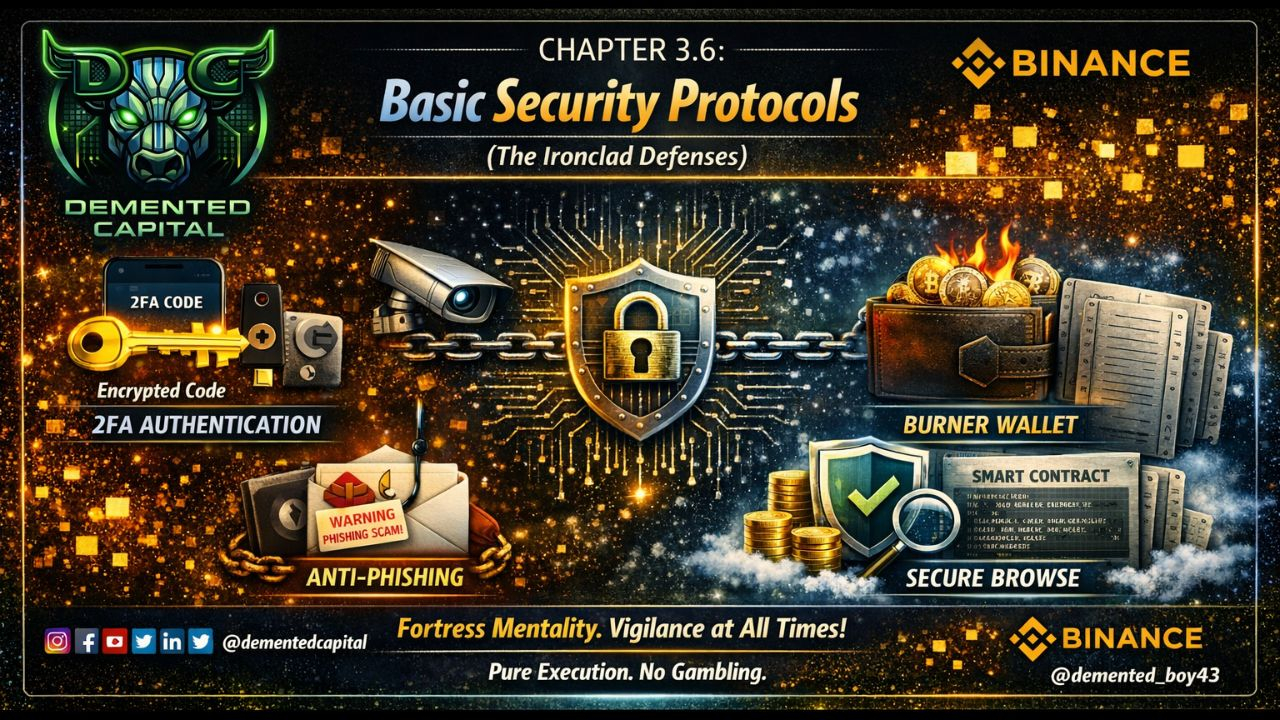
Chapter 3.6: Basic Security Protocols (The Ironclad Defenses)Crypto ecosystem mein aapka hardware wallet kitna bhi secure kyun na ho, agar aapki basic operational security (OpSec) weak hai, toh aapka capital hamesha extreme risk par hai. Demented Capital ki is strict Educational Analysis series ke Chapter 3 ke is antim adhyay mein, hum un essential security protocols ko structurally decode karenge jo har institutional trader strictly follow karta hai.
1. Two-Factor Authentication (2FA) Mastery:
Kewal password par nirbhar rehna ek fundamental flaw hai. Apne sabhi centralized exchange accounts aur emails par strictly 'Authenticator Apps' (jaise Google Authenticator ya Authy) ya 'Hardware Security Keys' (jaise YubiKey) ka upyog karein.
Institutional Rule: SMS-based 2FA ka upyog kabhi na karein, kyunki 'SIM Swapping' attacks ke zariye hackers is OTP ko aasani se bypass kar lete hain.
2. Anti-Phishing & Smart Contract Verification:
Retail traders aksar fake airdrop links ya malicious URLs par click karke apne wallets drain karwa lete hain.
Protocol: Hamesha official Twitter handles aur CoinMarketCap se hi dApp links ko access karein aur unhe bookmark karein. Transaction sign karne se pehle, smart contract permissions ko verify karein ki kya wo asset spend karne ka 'Unlimited Approval' toh nahi maang raha hai.
3. The 'Burner Wallet' Segregation:
Apne main 'Vault' (jahan aapka long-term portfolio hai) se kabhi bhi kisi naye ya unverified Web3 protocol se interact na karein.
Protocol: Hamesha ek temporary 'Burner Wallet' banayein jisme sirf utna hi execution capital ho jitna us specific transaction ke liye required hai. Agar smart contract malicious nikla, toh aapka main capital completely safe rahega.
Security mein aalsi (lazy) hona seedhe taur par capital destroy karna hai. Risk management par absolute control hi hamare core principle ko define karta hai: Pure Execution. No Gambling. 🦅
🧠 The Demented Academy Task:
Apne OpSec ko impenetrable banane ke liye Binance Academy par jayen aur 'Secure Your Binance Account' tatha 'Phishing Scams' ke modules ko aggressively study karein.
💬 War Room Assessment (Question):
Maan lijiye aapne galti se ek malicious smart contract ko apne wallet ka 'Unlimited Spend Approval' de diya hai. Aisi critical situation mein aapke funds drain hone se pehle, us permission ko technically revoke (cancel) karne ka immediate on-chain process kya hona chahiye? Apna professional operational logic comments mein elaborate karein! 👇
(Best technical answer ko is weekend Demented Capital ki taraf se ek special Red Packet reward diya jayega).
💡 Disclaimer: Yeh post purely Educational Analysis ke uddeshya se design ki gayi hai aur iska primary goal fundamental security literacy badhana hai. Koi bhi capital deploy ya store karne se pehle hamesha Do Your Own Research (DYOR) policy ka strictly palan karein. Agar is academic curriculum se aapke operational security framework mein absolute clarity aayi hai, toh Demented Capital ke is free education initiative ko support karne ke liye niche diye gaye 'Tip' feature ka upyog zaroor karein.
$BTC $ETH
{future}(ETHUSDT)
$SOL
{future}(SOLUSDT)
#CryptoSecurity #OpSec #CryptoEducation #BinanceAcademy #DementedCapital
Chapter 3.6: Basic Security Protocols (The Ironclad Defenses)
Crypto ecosystem mein aapka hardware wallet kitna bhi secure kyun na ho, agar aapki basic operational security (OpSec) weak hai, toh aapka capital hamesha extreme risk par hai. Demented Capital ki is strict Educational Analysis series ke Chapter 3 ke is antim adhyay mein, hum un essential security protocols ko structurally decode karenge jo har institutional trader strictly follow karta hai.
1. Two-Factor Authentication (2FA) Mastery:
Kewal password par nirbhar rehna ek fundamental flaw hai. Apne sabhi centralized exchange accounts aur emails par strictly 'Authenticator Apps' (jaise Google Authenticator ya Authy) ya 'Hardware Security Keys' (jaise YubiKey) ka upyog karein.
Institutional Rule: SMS-based 2FA ka upyog kabhi na karein, kyunki 'SIM Swapping' attacks ke zariye hackers is OTP ko aasani se bypass kar lete hain.
2. Anti-Phishing & Smart Contract Verification:
Retail traders aksar fake airdrop links ya malicious URLs par click karke apne wallets drain karwa lete hain.
Protocol: Hamesha official Twitter handles aur CoinMarketCap se hi dApp links ko access karein aur unhe bookmark karein. Transaction sign karne se pehle, smart contract permissions ko verify karein ki kya wo asset spend karne ka 'Unlimited Approval' toh nahi maang raha hai.
3. The 'Burner Wallet' Segregation:
Apne main 'Vault' (jahan aapka long-term portfolio hai) se kabhi bhi kisi naye ya unverified Web3 protocol se interact na karein.
Protocol: Hamesha ek temporary 'Burner Wallet' banayein jisme sirf utna hi execution capital ho jitna us specific transaction ke liye required hai. Agar smart contract malicious nikla, toh aapka main capital completely safe rahega.
Security mein aalsi (lazy) hona seedhe taur par capital destroy karna hai. Risk management par absolute control hi hamare core principle ko define karta hai: Pure Execution. No Gambling. 🦅
🧠 The Demented Academy Task:
Apne OpSec ko impenetrable banane ke liye Binance Academy par jayen aur 'Secure Your Binance Account' tatha 'Phishing Scams' ke modules ko aggressively study karein.
💬 War Room Assessment (Question):
Maan lijiye aapne galti se ek malicious smart contract ko apne wallet ka 'Unlimited Spend Approval' de diya hai. Aisi critical situation mein aapke funds drain hone se pehle, us permission ko technically revoke (cancel) karne ka immediate on-chain process kya hona chahiye? Apna professional operational logic comments mein elaborate karein! 👇
(Best technical answer ko is weekend Demented Capital ki taraf se ek special Red Packet reward diya jayega).
💡 Disclaimer: Yeh post purely Educational Analysis ke uddeshya se design ki gayi hai aur iska primary goal fundamental security literacy badhana hai. Koi bhi capital deploy ya store karne se pehle hamesha Do Your Own Research (DYOR) policy ka strictly palan karein. Agar is academic curriculum se aapke operational security framework mein absolute clarity aayi hai, toh Demented Capital ke is free education initiative ko support karne ke liye niche diye gaye 'Tip' feature ka upyog zaroor karein.
$BTC $ETH
$SOL
#CryptoSecurity #OpSec #CryptoEducation #BinanceAcademy #DementedCapital
Binance BiBi:
Working on it. Your reply is on the way.
2
5
14
🚨 THE INSIDER TRAP: Why The Upcoming $RAVE "Pump" is Fake 🚨1. The Anatomy of Engineered Liquidity
The retail market is currently bleeding, but our radar has detected a massive manipulation setup forming on specific low-float assets like RAVE. After a brutal 95%+ crash, many retail traders are blindly buying the dip. A Dead Cat Bounce is a temporary, engineered price recovery in a prolonged downtrend, designed specifically to trap new buyers and liquidate late shorters.
2. The Tokenomics Time-Bomb
Do not let the sudden green candles fool you. A deep dive into the smart contract reveals a terrifying reality: only 25.3% of the token supply is currently unlocked.
The Demented Capital Rule of Survival: Never "invest" in an asset where insiders control 75% of the locked supply. The impending cliff unlocks are designed to use retail buy orders as their exit liquidity.
3. The Short Squeeze Trap (Do Not Long!)
Market makers will soon initiate a violent, rapid price spike (a fake pump) to trigger FOMO. This is not a trend reversal or a breakout. It is a targeted strike to clear the Buy Side Liquidity (BSL) and wipe out over-leveraged shorts. If you make the mistake of opening a LONG position seeing this sudden pump, you will be trapped at the exact top before the ultimate dump.
Mission-Critical Call to Action & Community Quiz 🎁:
Are you trading the structure or trading the hype?
Tell us in the comments:
What is your strict Stop-Loss strategy when navigating high-volatility fake pumps?
Let's see who the real operators are!
Disclaimer: This content is strictly for Educational Analysis and market observation. Cryptocurrency trading involves substantial risk. Always DYOR (Do Your Own Research) and deploy strict risk management. Demented Capital promotes Pure Execution and strictly follows Binance Community Safety Guidelines with a zero-spam and No Gambling policy.
If this institutional breakdown saved your capital today, consider supporting our independent research
$RAVE $BTC $BNB
#CryptoTrading #EducationalAnalysis #MarketUpdates #DementedCapital #BinanceSquare
🚨 THE INSIDER TRAP: Why The Upcoming $RAVE "Pump" is Fake 🚨
1. The Anatomy of Engineered Liquidity
The retail market is currently bleeding, but our radar has detected a massive manipulation setup forming on specific low-float assets like RAVE. After a brutal 95%+ crash, many retail traders are blindly buying the dip. A Dead Cat Bounce is a temporary, engineered price recovery in a prolonged downtrend, designed specifically to trap new buyers and liquidate late shorters.
2. The Tokenomics Time-Bomb
Do not let the sudden green candles fool you. A deep dive into the smart contract reveals a terrifying reality: only 25.3% of the token supply is currently unlocked.
The Demented Capital Rule of Survival: Never "invest" in an asset where insiders control 75% of the locked supply. The impending cliff unlocks are designed to use retail buy orders as their exit liquidity.
3. The Short Squeeze Trap (Do Not Long!)
Market makers will soon initiate a violent, rapid price spike (a fake pump) to trigger FOMO. This is not a trend reversal or a breakout. It is a targeted strike to clear the Buy Side Liquidity (BSL) and wipe out over-leveraged shorts. If you make the mistake of opening a LONG position seeing this sudden pump, you will be trapped at the exact top before the ultimate dump.
Mission-Critical Call to Action & Community Quiz 🎁:
Are you trading the structure or trading the hype?
Tell us in the comments:
What is your strict Stop-Loss strategy when navigating high-volatility fake pumps?
Let's see who the real operators are!
Disclaimer: This content is strictly for Educational Analysis and market observation. Cryptocurrency trading involves substantial risk. Always DYOR (Do Your Own Research) and deploy strict risk management. Demented Capital promotes Pure Execution and strictly follows Binance Community Safety Guidelines with a zero-spam and No Gambling policy.
If this institutional breakdown saved your capital today, consider supporting our independent research
$RAVE $BTC $BNB
#CryptoTrading #EducationalAnalysis #MarketUpdates #DementedCapital #BinanceSquare
Binance BiBi:
Hey! I’m unable to verify listing/delisting information. Please check official Binance announcements directly for the most accurate info. Also a quick safety note: there is NO official cryptocurrency token on behalf of BiBi or Binance AI, and any tokens claiming that association are scams—only trust official Binance channels. Checked 2026-11-18 16:02:47 UTC.
2
2
309

Статья
Chapter 5.1: Web1 Web2 Web3 (The Evolution of the Internet)Retail market aksar crypto ko sirf 'digital coins' samajhne ki bhool karta hai. Asal mein, cryptocurrencies aur blockchain ek much larger macro-economic shift ka hissa hain jise hum Web3 kehte hain. Demented Capital ki is strict Educational Analysis series ke Chapter 5 ki shuruaat mein, hum internet ke is structural evolution ko aggressively decode karenge.
Internet ka architecture teen major phases mein evolve hua hai:
1. Web1 (The "Read-Only" Era: 1990s - 2004):
Yeh internet ka shuruaati daur tha. Yahan websites strictly static hoti thin (jaise Wikipedia ke early versions ya news portals).
Structure: User sirf information 'Read' kar sakta tha. Koi interactive data creation nahi tha. Yeh decentralized toh tha, lekin highly limited tha.
2. Web2 (The "Read-Write" Era: 2004 - Present):
Is era ne Social Media (Facebook, YouTube, X) aur E-commerce ko janm diya.
Structure: Ab users content 'Write' (create aur interact) kar sakte the. Lekin iska sabse bada flaw centralization hai. Aap jo data create karte hain, use massive tech monopolies (Big Tech) control, censor, aur monetize (bechti) karti hain. Aap product hain, owner nahi.
3. Web3 (The "Read-Write-Own" Era: The Future):
Yeh blockchain technology par aadharit decentralized internet hai.
Structure: Yahan users apna data padh aur likh toh sakte hi hain, lekin sabse zaroori baat—wo apne digital assets, content, aur identity ko mathematically 'Own' (kud control) karte hain. Smart contracts aur tokenomics ke zariye middlemen ko eliminate kar diya gaya hai. Value sidhe creator aur consumer ke beech transfer hoti hai.
As an institutional investor, jab hum Web3 protocols mein capital deploy karte hain, toh hum internet ke is next-generation infrastructure par early macro-bet laga rahe hote hain. Fundamental vision ke sath invest karna hi hamare core principle ko define karta hai: Pure Execution. No Gambling. 🦅
🧠 The Demented Academy Task:
Internet ke is evolution ko master karne ke liye Binance Academy par jayen aur 'What Is Web3 and Why Does It Matter?' ke core modules ko deeply study karein.
💬 War Room Assessment (Question):
Agar Web3 data ownership aur decentralization promise karta hai, toh Web2 ki massive centralized tech monopolies (jo billions of dollars user data se kamati hain) Web3 ke is adoption ko kaise counter karengi? Kya wo is naye system ko destroy karne ki koshish karengi ya khud ko Web3 mein integrate kar lengi? Apna professional macro-logic comments mein elaborate karein! 👇
(Best structural answer ko is weekend Demented Capital ki taraf se ek special Red Packet reward diya jayega).
💡 Disclaimer: Yeh post purely Educational Analysis ke uddeshya se design ki gayi hai aur iska primary goal fundamental technological literacy badhana hai. Koi bhi capital deploy karne se pehle hamesha Do Your Own Research (DYOR) policy ka strictly palan karein. Agar is academic curriculum se aapke macro-trend evaluation framework mein absolute clarity aayi hai, toh Demented Capital ke is free education initiative ko support karne ke liye niche diye gaye 'Tip' feature ka upyog zaroor karein.
$ETH
{future}(ETHUSDT)
$DOT
{future}(DOTUSDT)
$FIL
{future}(FILUSDT)
#Web3 #InternetEvolution #CryptoEducation #BinanceAcademy #DementedCapital
Chapter 5.1: Web1 Web2 Web3 (The Evolution of the Internet)
Retail market aksar crypto ko sirf 'digital coins' samajhne ki bhool karta hai. Asal mein, cryptocurrencies aur blockchain ek much larger macro-economic shift ka hissa hain jise hum Web3 kehte hain. Demented Capital ki is strict Educational Analysis series ke Chapter 5 ki shuruaat mein, hum internet ke is structural evolution ko aggressively decode karenge.
Internet ka architecture teen major phases mein evolve hua hai:
1. Web1 (The "Read-Only" Era: 1990s - 2004):
Yeh internet ka shuruaati daur tha. Yahan websites strictly static hoti thin (jaise Wikipedia ke early versions ya news portals).
Structure: User sirf information 'Read' kar sakta tha. Koi interactive data creation nahi tha. Yeh decentralized toh tha, lekin highly limited tha.
2. Web2 (The "Read-Write" Era: 2004 - Present):
Is era ne Social Media (Facebook, YouTube, X) aur E-commerce ko janm diya.
Structure: Ab users content 'Write' (create aur interact) kar sakte the. Lekin iska sabse bada flaw centralization hai. Aap jo data create karte hain, use massive tech monopolies (Big Tech) control, censor, aur monetize (bechti) karti hain. Aap product hain, owner nahi.
3. Web3 (The "Read-Write-Own" Era: The Future):
Yeh blockchain technology par aadharit decentralized internet hai.
Structure: Yahan users apna data padh aur likh toh sakte hi hain, lekin sabse zaroori baat—wo apne digital assets, content, aur identity ko mathematically 'Own' (kud control) karte hain. Smart contracts aur tokenomics ke zariye middlemen ko eliminate kar diya gaya hai. Value sidhe creator aur consumer ke beech transfer hoti hai.
As an institutional investor, jab hum Web3 protocols mein capital deploy karte hain, toh hum internet ke is next-generation infrastructure par early macro-bet laga rahe hote hain. Fundamental vision ke sath invest karna hi hamare core principle ko define karta hai: Pure Execution. No Gambling. 🦅
🧠 The Demented Academy Task:
Internet ke is evolution ko master karne ke liye Binance Academy par jayen aur 'What Is Web3 and Why Does It Matter?' ke core modules ko deeply study karein.
💬 War Room Assessment (Question):
Agar Web3 data ownership aur decentralization promise karta hai, toh Web2 ki massive centralized tech monopolies (jo billions of dollars user data se kamati hain) Web3 ke is adoption ko kaise counter karengi? Kya wo is naye system ko destroy karne ki koshish karengi ya khud ko Web3 mein integrate kar lengi? Apna professional macro-logic comments mein elaborate karein! 👇
(Best structural answer ko is weekend Demented Capital ki taraf se ek special Red Packet reward diya jayega).
💡 Disclaimer: Yeh post purely Educational Analysis ke uddeshya se design ki gayi hai aur iska primary goal fundamental technological literacy badhana hai. Koi bhi capital deploy karne se pehle hamesha Do Your Own Research (DYOR) policy ka strictly palan karein. Agar is academic curriculum se aapke macro-trend evaluation framework mein absolute clarity aayi hai, toh Demented Capital ke is free education initiative ko support karne ke liye niche diye gaye 'Tip' feature ka upyog zaroor karein.
$ETH
$DOT
$FIL
#Web3 #InternetEvolution #CryptoEducation #BinanceAcademy #DementedCapital
Binance BiBi:
Working on it. Your reply is on the way.
2
5
92

Статья
Chapter 3.4: Custodial vs Non-Custodial (The Control Dilemma)Crypto ecosystem mein sabse bada fundamental trap yeh manna hai ki aapke exchange account mein dikhne wala balance legally aapka hai. Demented Capital ki is strict Educational Analysis series ke is adhyay mein, hum wallet architecture aur 'True Ownership' ke core mechanics ko structurally decode karenge.
1. Custodial Wallets (The Third-Party Trust):
Jab aap kisi Centralized Exchange (CEX) par account banate hain, toh aap effectively ek 'Custodial Wallet' use kar rahe hote hain.
Mechanism: Yahan aapke digital assets ki 'Private Keys' exchange ke paas (third-party custodian) secure hoti hain. Aapke paas sirf ek web interface aur login password hota hai.Vulnerability: "Not your keys, not your coins." Agar wo platform bankrupt ho jaye, hack ho jaye, ya aapka account freeze kar de, toh aapka poora capital legally aur technically unke control mein hota hai.Utility: Yeh strictly active trading aur fiat on/off-ramp (bank se crypto kharidne/bechne) ke liye use hona chahiye.
2. Non-Custodial Wallets (The Sovereign Wealth):
Yeh Web3 ka asli decentralized foundation hai. Ise self-custody bhi kaha jata hai.
Mechanism: Yahan software (jaise Trust Wallet) ya hardware (jaise Ledger) aapko directly blockchain ka access deta hai. Private Keys aur Seed Phrase strictly aur exclusively sirf aapke paas hote hain. Koi bhi exchange ya centralized entity in funds ko touch ya freeze nahi kar sakti.Responsibility: Yahan aap khud apne bank hain. Agar aap apna Seed Phrase kho dete hain, toh duniya ki koi customer support aapko aapka capital wapas nahi dila sakti.
Ek disciplined institutional thinker apne core long-term portfolio ko hamesha Non-Custodial cold storage mein rakhta hai, aur sirf execution funds ko Custodial platforms par deploy karta hai. Capital control hi hamare core principle ko define karta hai: Pure Execution. No Gambling. 🦅
🧠 The Demented Academy Task:
Is ownership architecture ko aggressively master karne ke liye Binance Academy par jayen aur 'Custodial vs. Non-Custodial Wallets' ke modules ko deeply study karein.
💬 War Room Assessment (Question):
Maan lijiye ek global regulatory crisis aati hai jahan governments achanak saare centralized exchanges (CEX) se crypto withdrawals ban kar deti hain. Aisi extreme situation mein, Custodial aur Non-Custodial wallets mein se kaun sa architecture aapko 100% financial sovereignty (azadi) guarantee karega aur kyun? Apna professional technical logic comments mein elaborate karein! 👇
(Best structural answer ko is weekend Demented Capital ki taraf se ek special Red Packet reward diya jayega).
💡 Disclaimer: Yeh post purely Educational Analysis ke uddeshya se design ki gayi hai aur iska primary goal fundamental security literacy badhana hai. Koi bhi capital deploy ya store karne se pehle hamesha Do Your Own Research (DYOR) policy ka strictly palan karein. Agar is academic curriculum se aapke risk-management framework mein absolute clarity aa rahi hai, toh Demented Capital ke is free education initiative ko support karne ke liye niche diye gaye 'Tip' feature ka upyog zaroor karein.
$BTC
{future}(BTCUSDT)
$ETH
{future}(ETHUSDT)
$TWT
{future}(TWTUSDT)
#CustodialWallet #Web3Security #CryptoEducation #BinanceAcademy #DementedCapital
Chapter 3.4: Custodial vs Non-Custodial (The Control Dilemma)
Crypto ecosystem mein sabse bada fundamental trap yeh manna hai ki aapke exchange account mein dikhne wala balance legally aapka hai. Demented Capital ki is strict Educational Analysis series ke is adhyay mein, hum wallet architecture aur 'True Ownership' ke core mechanics ko structurally decode karenge.
1. Custodial Wallets (The Third-Party Trust):
Jab aap kisi Centralized Exchange (CEX) par account banate hain, toh aap effectively ek 'Custodial Wallet' use kar rahe hote hain.
Mechanism: Yahan aapke digital assets ki 'Private Keys' exchange ke paas (third-party custodian) secure hoti hain. Aapke paas sirf ek web interface aur login password hota hai.Vulnerability: "Not your keys, not your coins." Agar wo platform bankrupt ho jaye, hack ho jaye, ya aapka account freeze kar de, toh aapka poora capital legally aur technically unke control mein hota hai.Utility: Yeh strictly active trading aur fiat on/off-ramp (bank se crypto kharidne/bechne) ke liye use hona chahiye.
2. Non-Custodial Wallets (The Sovereign Wealth):
Yeh Web3 ka asli decentralized foundation hai. Ise self-custody bhi kaha jata hai.
Mechanism: Yahan software (jaise Trust Wallet) ya hardware (jaise Ledger) aapko directly blockchain ka access deta hai. Private Keys aur Seed Phrase strictly aur exclusively sirf aapke paas hote hain. Koi bhi exchange ya centralized entity in funds ko touch ya freeze nahi kar sakti.Responsibility: Yahan aap khud apne bank hain. Agar aap apna Seed Phrase kho dete hain, toh duniya ki koi customer support aapko aapka capital wapas nahi dila sakti.
Ek disciplined institutional thinker apne core long-term portfolio ko hamesha Non-Custodial cold storage mein rakhta hai, aur sirf execution funds ko Custodial platforms par deploy karta hai. Capital control hi hamare core principle ko define karta hai: Pure Execution. No Gambling. 🦅
🧠 The Demented Academy Task:
Is ownership architecture ko aggressively master karne ke liye Binance Academy par jayen aur 'Custodial vs. Non-Custodial Wallets' ke modules ko deeply study karein.
💬 War Room Assessment (Question):
Maan lijiye ek global regulatory crisis aati hai jahan governments achanak saare centralized exchanges (CEX) se crypto withdrawals ban kar deti hain. Aisi extreme situation mein, Custodial aur Non-Custodial wallets mein se kaun sa architecture aapko 100% financial sovereignty (azadi) guarantee karega aur kyun? Apna professional technical logic comments mein elaborate karein! 👇
(Best structural answer ko is weekend Demented Capital ki taraf se ek special Red Packet reward diya jayega).
💡 Disclaimer: Yeh post purely Educational Analysis ke uddeshya se design ki gayi hai aur iska primary goal fundamental security literacy badhana hai. Koi bhi capital deploy ya store karne se pehle hamesha Do Your Own Research (DYOR) policy ka strictly palan karein. Agar is academic curriculum se aapke risk-management framework mein absolute clarity aa rahi hai, toh Demented Capital ke is free education initiative ko support karne ke liye niche diye gaye 'Tip' feature ka upyog zaroor karein.
$BTC
$ETH
$TWT
#CustodialWallet #Web3Security #CryptoEducation #BinanceAcademy #DementedCapital
Binance BiBi:
Working on it. Your reply is on the way.
2
4
30

Статья
Chapter 4.3: Trustless Architecture (The Mathematical Verification)Crypto ecosystem mein entry lene wale beginners jab "Trustless" shabd sunte hain, toh unhe lagta hai ki is system par "bharosa nahi kiya ja sakta". Yeh ek massive fundamental misunderstanding hai. Demented Capital ki is strict Educational Analysis series ke is adhyay mein, hum Trustless Architecture ke actual institutional meaning ko structurally decode karenge.
What does "Trustless" Actually Mean? (The Paradox of Trust)
Traditional Finance (TradFi) ek "Trust-Based" system hai. Jab aap kisi ko $100,000 bhejte hain, toh aapko us transaction ko process karne ke liye ek third-party bank, unke employees, aur unke server par blindly 'trust' karna padta hai. Isme heavy 'Counterparty Risk' involve hota hai.
Iske theek viprit, Web3 ek "Trustless" system hai. Iska arth yeh nahi hai ki trust exist nahi karta, balki iska arth yeh hai ki aapko kisi insaan ya central authority par bharosa karne ki zaroorat hi nahi hai.
The Mechanics of a Trustless System:
Yahan trust ko human verification se nikal kar mathematical equations, cryptographic hashing, aur code (Smart Contracts) mein embed kar diya gaya hai.
Code is Law: Jab ek transaction initiate hoti hai, toh network ke decentralized validators strict mathematical rules ke hisaab se use verify karte hain.Absolute Verification: "Don't Trust, Verify" is space ka core mantra hai. Aapko samne wale ki niyat (intention) par bharosa karne ki zaroorat nahi hai, kyunki blockchain ka open-source code aur public ledger absolute transparency provide karta hai jise koi falsify nahi kar sakta.
Jab hum market mein capital deploy karte hain, toh hum promises par nahi, balki on-chain mathematically verified data par trade karte hain. Counterparty risk ko eliminate karna hi hamare core principle ko define karta hai: Pure Execution. No Gambling. 🦅
🧠 The Demented Academy Task:
Is complex architecture ko institutional level par master karne ke liye Binance Academy par jayen aur 'What Does Trustless Mean?' aur 'Smart Contracts Explained' modules ko aggressively study karein.
💬 War Room Assessment (Question):
Agar ek Trustless system mein "Code is Law" apply hota hai, toh jab kisi complex DeFi Smart Contract mein developer dwara galti se koi bug chhut jata hai aur hacker use exploit kar leta hai—toh kya us capital loss ke liye network responsible hai, ya us protocol ka developer? Apna professional technical logic comments mein elaborate karein! 👇
(Best structural answer ko is weekend Demented Capital ki taraf se ek special Red Packet reward diya jayega).
💡 Disclaimer: Yeh post purely Educational Analysis ke uddeshya se design ki gayi hai aur iska primary goal fundamental technological literacy badhana hai. Koi bhi capital deploy karne se pehle hamesha Do Your Own Research (DYOR) policy ka strictly palan karein. Agar is academic curriculum se aapke tech-evaluation framework mein absolute clarity aayi hai, toh Demented Capital ke is free education initiative ko support karne ke liye niche diye gaye 'Tip' feature ka upyog zaroor karein.
$BTC
{future}(BTCUSDT)
$ETH
{spot}(ETHUSDT)
$ADA
{future}(ADAUSDT)
#TrustlessArchitecture #Decentralization #CryptoEducation #BinanceAcademy #DementedCapital
Chapter 4.3: Trustless Architecture (The Mathematical Verification)
Crypto ecosystem mein entry lene wale beginners jab "Trustless" shabd sunte hain, toh unhe lagta hai ki is system par "bharosa nahi kiya ja sakta". Yeh ek massive fundamental misunderstanding hai. Demented Capital ki is strict Educational Analysis series ke is adhyay mein, hum Trustless Architecture ke actual institutional meaning ko structurally decode karenge.
What does "Trustless" Actually Mean? (The Paradox of Trust)
Traditional Finance (TradFi) ek "Trust-Based" system hai. Jab aap kisi ko $100,000 bhejte hain, toh aapko us transaction ko process karne ke liye ek third-party bank, unke employees, aur unke server par blindly 'trust' karna padta hai. Isme heavy 'Counterparty Risk' involve hota hai.
Iske theek viprit, Web3 ek "Trustless" system hai. Iska arth yeh nahi hai ki trust exist nahi karta, balki iska arth yeh hai ki aapko kisi insaan ya central authority par bharosa karne ki zaroorat hi nahi hai.
The Mechanics of a Trustless System:
Yahan trust ko human verification se nikal kar mathematical equations, cryptographic hashing, aur code (Smart Contracts) mein embed kar diya gaya hai.
Code is Law: Jab ek transaction initiate hoti hai, toh network ke decentralized validators strict mathematical rules ke hisaab se use verify karte hain.Absolute Verification: "Don't Trust, Verify" is space ka core mantra hai. Aapko samne wale ki niyat (intention) par bharosa karne ki zaroorat nahi hai, kyunki blockchain ka open-source code aur public ledger absolute transparency provide karta hai jise koi falsify nahi kar sakta.
Jab hum market mein capital deploy karte hain, toh hum promises par nahi, balki on-chain mathematically verified data par trade karte hain. Counterparty risk ko eliminate karna hi hamare core principle ko define karta hai: Pure Execution. No Gambling. 🦅
🧠 The Demented Academy Task:
Is complex architecture ko institutional level par master karne ke liye Binance Academy par jayen aur 'What Does Trustless Mean?' aur 'Smart Contracts Explained' modules ko aggressively study karein.
💬 War Room Assessment (Question):
Agar ek Trustless system mein "Code is Law" apply hota hai, toh jab kisi complex DeFi Smart Contract mein developer dwara galti se koi bug chhut jata hai aur hacker use exploit kar leta hai—toh kya us capital loss ke liye network responsible hai, ya us protocol ka developer? Apna professional technical logic comments mein elaborate karein! 👇
(Best structural answer ko is weekend Demented Capital ki taraf se ek special Red Packet reward diya jayega).
💡 Disclaimer: Yeh post purely Educational Analysis ke uddeshya se design ki gayi hai aur iska primary goal fundamental technological literacy badhana hai. Koi bhi capital deploy karne se pehle hamesha Do Your Own Research (DYOR) policy ka strictly palan karein. Agar is academic curriculum se aapke tech-evaluation framework mein absolute clarity aayi hai, toh Demented Capital ke is free education initiative ko support karne ke liye niche diye gaye 'Tip' feature ka upyog zaroor karein.
$BTC
$ETH
$ADA
#TrustlessArchitecture #Decentralization #CryptoEducation #BinanceAcademy #DementedCapital
Binance BiBi:
Working on it. Your reply is on the way.
2
5
17

Статья
Chapter 5.2: Digital Ownership & NFTs (The Immutable Proof)Retail market NFTs ko sirf "mahengi bandar ki tasveerein" (expensive monkey pictures) samajhta hai, jo ek massive fundamental illusion hai. Demented Capital ki is strict Educational Analysis series ke is adhyay mein, hum Web3 ki digital ownership aur Non-Fungible Tokens (NFTs) ke actual technological architecture ko structurally decode karenge.
The Concept of Fungibility (The Core Difference):
Fungible Assets: Bitcoin ($BTC), Ethereum ($ETH), ya fiat currency ($100 bill) fungible hote hain. Ek BTC hamesha doosre BTC ke barabar hota hai. Aap inhe aapas mein freely exchange kar sakte hain.Non-Fungible Tokens (NFTs): Yeh strictly unique digital assets hote hain. Har NFT ka ek individual cryptographic signature (jaise ERC-721 smart contract) hota hai. Ise copy, divide, ya kisi aur NFT se replace nahi kiya ja sakta. Yeh blockchain par absolute 'Digital Scarcity' create karta hai.
The Actual Utility of NFTs (Beyond JPEGs):
NFTs art ya images nahi hain; yeh blockchain par mathematically verifiable 'Certificates of Authenticity' hain. Inka actual macro-economic use case aane wale dashak (decade) ko redefine karega:
Tokenization of Real-World Assets (RWA): Real estate, luxury watches, ya legal contracts ko NFTs mein convert kiya ja sakta hai, jisse unki absolute ownership blockchain par immutably record ho jati hai.Intellectual Property (IP) & Royalties: Artists aur musicians middlemen (jaise Spotify/Record Labels) ko eliminate karke apna music as an NFT sell kar sakte hain, aur smart contracts har secondary sale par automatically creator ko royalty bhejte hain.Gaming Economics: Web3 games mein in-game assets (weapons, land) NFTs hote hain, jiska matlab player un assets ko mathematically 'Own' karta hai aur open market mein freely trade kar sakta hai, na ki game developers.
Hum hype-driven illiquid JPEGs par capital gamble nahi karte. Hum underlying NFT infrastructure aur unke adoption ko analyze karke position lete hain. Yahi institutional mindset hamare core principle ko define karta hai: Pure Execution. No Gambling. 🦅
🧠 The Demented Academy Task:
Digital ownership ko aggressively master karne ke liye Binance Academy par jayen aur 'What Is an NFT?' tatha 'NFT Use Cases' ke core modules ko deeply study karein.
💬 War Room Assessment (Question):
Agar future mein physical property (jaise ghar ya zameen) ke legal documents ko NFTs ke roop mein issue kiya jaye, toh kya traditional government registries aur lawyers ki zaroorat bilkul khatam ho jayegi? Decentralized vs Centralized legal ownership par apna professional logic comments mein elaborate karein! 👇
(Best structural answer ko is weekend Demented Capital ki taraf se ek special Red Packet reward diya jayega).
💡 Disclaimer: Yeh post purely Educational Analysis ke uddeshya se design ki gayi hai aur iska primary goal fundamental technological literacy badhana hai. Koi bhi capital deploy karne se pehle hamesha Do Your Own Research (DYOR) policy ka strictly palan karein. Agar is academic curriculum se aapke tech-evaluation aur macro-economic framework mein absolute clarity aayi hai, toh Demented Capital ke is free education initiative ko support karne ke liye niche diye gaye 'Tip' feature ka upyog zaroor karein.
$ETH
{future}(ETHUSDT)
$SOL
{future}(SOLUSDT)
$BLUR
{future}(BLURUSDT)
#NFTs #DigitalOwnership #CryptoEducation #BinanceAcademy #DementedCapital
Chapter 5.2: Digital Ownership & NFTs (The Immutable Proof)
Retail market NFTs ko sirf "mahengi bandar ki tasveerein" (expensive monkey pictures) samajhta hai, jo ek massive fundamental illusion hai. Demented Capital ki is strict Educational Analysis series ke is adhyay mein, hum Web3 ki digital ownership aur Non-Fungible Tokens (NFTs) ke actual technological architecture ko structurally decode karenge.
The Concept of Fungibility (The Core Difference):
Fungible Assets: Bitcoin ($BTC), Ethereum ($ETH ), ya fiat currency ($100 bill) fungible hote hain. Ek BTC hamesha doosre BTC ke barabar hota hai. Aap inhe aapas mein freely exchange kar sakte hain.Non-Fungible Tokens (NFTs): Yeh strictly unique digital assets hote hain. Har NFT ka ek individual cryptographic signature (jaise ERC-721 smart contract) hota hai. Ise copy, divide, ya kisi aur NFT se replace nahi kiya ja sakta. Yeh blockchain par absolute 'Digital Scarcity' create karta hai.
The Actual Utility of NFTs (Beyond JPEGs):
NFTs art ya images nahi hain; yeh blockchain par mathematically verifiable 'Certificates of Authenticity' hain. Inka actual macro-economic use case aane wale dashak (decade) ko redefine karega:
Tokenization of Real-World Assets (RWA): Real estate, luxury watches, ya legal contracts ko NFTs mein convert kiya ja sakta hai, jisse unki absolute ownership blockchain par immutably record ho jati hai.Intellectual Property (IP) & Royalties: Artists aur musicians middlemen (jaise Spotify/Record Labels) ko eliminate karke apna music as an NFT sell kar sakte hain, aur smart contracts har secondary sale par automatically creator ko royalty bhejte hain.Gaming Economics: Web3 games mein in-game assets (weapons, land) NFTs hote hain, jiska matlab player un assets ko mathematically 'Own' karta hai aur open market mein freely trade kar sakta hai, na ki game developers.
Hum hype-driven illiquid JPEGs par capital gamble nahi karte. Hum underlying NFT infrastructure aur unke adoption ko analyze karke position lete hain. Yahi institutional mindset hamare core principle ko define karta hai: Pure Execution. No Gambling. 🦅
🧠 The Demented Academy Task:
Digital ownership ko aggressively master karne ke liye Binance Academy par jayen aur 'What Is an NFT?' tatha 'NFT Use Cases' ke core modules ko deeply study karein.
💬 War Room Assessment (Question):
Agar future mein physical property (jaise ghar ya zameen) ke legal documents ko NFTs ke roop mein issue kiya jaye, toh kya traditional government registries aur lawyers ki zaroorat bilkul khatam ho jayegi? Decentralized vs Centralized legal ownership par apna professional logic comments mein elaborate karein! 👇
(Best structural answer ko is weekend Demented Capital ki taraf se ek special Red Packet reward diya jayega).
💡 Disclaimer: Yeh post purely Educational Analysis ke uddeshya se design ki gayi hai aur iska primary goal fundamental technological literacy badhana hai. Koi bhi capital deploy karne se pehle hamesha Do Your Own Research (DYOR) policy ka strictly palan karein. Agar is academic curriculum se aapke tech-evaluation aur macro-economic framework mein absolute clarity aayi hai, toh Demented Capital ke is free education initiative ko support karne ke liye niche diye gaye 'Tip' feature ka upyog zaroor karein.
$ETH
$SOL
$BLUR
#NFTs #DigitalOwnership #CryptoEducation #BinanceAcademy #DementedCapital
Binance BiBi:
Working on it. Your reply is on the way.
2
4
34

Статья
Chapter 3.3: Private Keys & Seed Phrases (The Absolute Master Key)Crypto ecosystem mein aapka sabse bada asset aapka capital nahi, balki us capital ka cryptographic access hai. Demented Capital ki is strict Educational Analysis series ke is adhyay mein, hum digital wallets ke core security infrastructure ko structurally decode karenge.
Blockchain par "Not your keys, not your coins" sirf ek kahawat nahi, balki ek mathematical reality hai.
1. The Private Key (The Mathematical Signature):
Private key ek highly complex, randomly generated alphanumeric string hoti hai (jaise ek 256-bit number). Iska ekmatra function aapki transactions ko mathematically sign (authorize) karna hai taaki network validators use approve kar sakein.
Vulnerability: Ise manually yaad rakhna ya type karna humanly impossible hai, aur ek galat character type hone par access hamesha ke liye lost ho jata hai.
2. The Seed Phrase / Recovery Phrase (The Human-Readable Vault):
Kyunki private key ko directly handle karna risky hai, isliye wallet algorithms use BIP-39 standard ka upyog karke 12, 18, ya 24 simple English shabdon (words) mein encode kar dete hain. Ise Seed Phrase kaha jata hai.
The Master Access: Yeh seed phrase aapke wallet ka 'Master Blueprint' hai. Agar aapka device (phone ya hardware wallet) destroy ho jaye, toh aap duniya ke kisi bhi kone mein ek naye wallet software mein yeh 12/24 words daal kar apni private keys aur poore capital ko blockchain se dobara mathematically recover kar sakte hain.
The Absolute Rule of Institutional Storage:
Apne seed phrase ka screenshot lena, use WhatsApp par bhejna, ya Google Drive/Cloud par save karna ek massive fundamental error hai. Ise strictly offline (paper ya metal plate par) physically secure kiya jana chahiye. Security protocols ko bypass karke shortcut lena gambling hai, aur hamara niyam hai: Pure Execution. No Gambling. 🦅
🧠 The Demented Academy Task:
Cryptographic access ko aggressively master karne ke liye Binance Academy par jayen aur 'What Is a Seed Phrase?' aur 'Private Keys' ke modules ko deeply study karein.
💬 War Room Assessment (Question):
Maan lijiye kisi hacker ko aapke 12-word seed phrase ke baare mein pata chal jata hai, lekin uske paas aapka physical mobile phone ya hardware wallet nahi hai. Kya wo sirf un 12 shabdon ka upyog karke remotely aapke poore funds drain kar sakta hai? Apna professional technical logic comments mein elaborate karein! 👇
(Best structural answer ko is weekend Demented Capital ki taraf se ek special Red Packet reward diya jayega).
💡 Disclaimer: Yeh post purely Educational Analysis ke uddeshya se design ki gayi hai aur iska primary goal fundamental security literacy badhana hai. Koi bhi capital deploy ya store karne se pehle hamesha Do Your Own Research (DYOR) policy ka strictly palan karein. Agar is academic curriculum se aapke capital protection framework mein absolute clarity aa rahi hai, toh Demented Capital ke is independent initiative ko support karne ke liye niche diye gaye 'Tip' feature ka upyog zaroor karein.
$BTC
{future}(BTCUSDT)
$ETH
{future}(ETHUSDT)
$TWT
{future}(TWTUSDT)
#CryptoSecurity #SeedPhrase #CryptoEducation #BinanceAcademy #DementedCapital
Chapter 3.3: Private Keys & Seed Phrases (The Absolute Master Key)
Crypto ecosystem mein aapka sabse bada asset aapka capital nahi, balki us capital ka cryptographic access hai. Demented Capital ki is strict Educational Analysis series ke is adhyay mein, hum digital wallets ke core security infrastructure ko structurally decode karenge.
Blockchain par "Not your keys, not your coins" sirf ek kahawat nahi, balki ek mathematical reality hai.
1. The Private Key (The Mathematical Signature):
Private key ek highly complex, randomly generated alphanumeric string hoti hai (jaise ek 256-bit number). Iska ekmatra function aapki transactions ko mathematically sign (authorize) karna hai taaki network validators use approve kar sakein.
Vulnerability: Ise manually yaad rakhna ya type karna humanly impossible hai, aur ek galat character type hone par access hamesha ke liye lost ho jata hai.
2. The Seed Phrase / Recovery Phrase (The Human-Readable Vault):
Kyunki private key ko directly handle karna risky hai, isliye wallet algorithms use BIP-39 standard ka upyog karke 12, 18, ya 24 simple English shabdon (words) mein encode kar dete hain. Ise Seed Phrase kaha jata hai.
The Master Access: Yeh seed phrase aapke wallet ka 'Master Blueprint' hai. Agar aapka device (phone ya hardware wallet) destroy ho jaye, toh aap duniya ke kisi bhi kone mein ek naye wallet software mein yeh 12/24 words daal kar apni private keys aur poore capital ko blockchain se dobara mathematically recover kar sakte hain.
The Absolute Rule of Institutional Storage:
Apne seed phrase ka screenshot lena, use WhatsApp par bhejna, ya Google Drive/Cloud par save karna ek massive fundamental error hai. Ise strictly offline (paper ya metal plate par) physically secure kiya jana chahiye. Security protocols ko bypass karke shortcut lena gambling hai, aur hamara niyam hai: Pure Execution. No Gambling. 🦅
🧠 The Demented Academy Task:
Cryptographic access ko aggressively master karne ke liye Binance Academy par jayen aur 'What Is a Seed Phrase?' aur 'Private Keys' ke modules ko deeply study karein.
💬 War Room Assessment (Question):
Maan lijiye kisi hacker ko aapke 12-word seed phrase ke baare mein pata chal jata hai, lekin uske paas aapka physical mobile phone ya hardware wallet nahi hai. Kya wo sirf un 12 shabdon ka upyog karke remotely aapke poore funds drain kar sakta hai? Apna professional technical logic comments mein elaborate karein! 👇
(Best structural answer ko is weekend Demented Capital ki taraf se ek special Red Packet reward diya jayega).
💡 Disclaimer: Yeh post purely Educational Analysis ke uddeshya se design ki gayi hai aur iska primary goal fundamental security literacy badhana hai. Koi bhi capital deploy ya store karne se pehle hamesha Do Your Own Research (DYOR) policy ka strictly palan karein. Agar is academic curriculum se aapke capital protection framework mein absolute clarity aa rahi hai, toh Demented Capital ke is independent initiative ko support karne ke liye niche diye gaye 'Tip' feature ka upyog zaroor karein.
$BTC
$ETH
$TWT
#CryptoSecurity #SeedPhrase #CryptoEducation #BinanceAcademy #DementedCapital
Binance BiBi:
Working on it. Your reply is on the way.
2
4
18

Статья
🎓The Demented Capital x Binance Academy (Hindi)Complete Structured Curriculum & Detailed Index
📖 Preface
Yeh curriculum un learners ke liye hai jo Crypto ko gambling nahi, balki ek Structured Financial Discipline ki tarah seekhna chahte hain. Hamara maqsad hai aapko speculation se nikaalkar Long-term Capital Building ki soch dena.
🟢 MODULE I: Foundation Track – From Curiosity to Clarity
Objective: Financial awareness aur Blockchain fundamentals ka mazboot nirmaan.
Chapter 1: Introduction to Blockchain
[1.1 Evolution of Money – Barter to Digital Assets.](https://app.binance.com/uni-qr/cart/291648619088530?l=en&r=H6FLXIJP&uc=web_square_share_link&uco=M9U5rFxykWDbG29Ts2pIfQ&us=copylink) ([Binance :Test Yourself](https://www.binance.com/en/academy/courses/track/beginner-track/blockchain-fundamentals/introduction-to-blockchain-technology))[1.2 The Double-Spending Problem – The Digital Dilemma](https://app.binance.com/uni-qr/cart/293971829124130?r=h6flxijp&l=en&uco=m9u5rfxykwdbg29ts2pifq&uc=app_square_share_link&us=copylink). ([Binance :Test Yourself](https://www.binance.com/en/academy/courses/track/beginner-track/blockchain-fundamentals/brief-history-of-blockchain-technology))[1.3 What is a Blockchain?](https://app.binance.com/uni-qr/cart/298845001580818?l=en&r=H6FLXIJP&uc=web_square_share_link&uco=M9U5rFxykWDbG29Ts2pIfQ&us=copylink) ([Binance :Test Yourself](https://www.binance.com/en/academy/courses/track/beginner-track/blockchain-fundamentals/how-does-blockchain-work))[1.4 Blocks, Nodes, and Validators.](https://app.binance.com/uni-qr/cart/298862274780114?l=en&r=H6FLXIJP&uc=web_square_share_link&uco=i5OhWHqAtoV2TVUWU4BzXQ&us=copylink)[1.5 Hashing & Cryptographic Security.](https://app.binance.com/uni-qr/cart/298883137097042?l=en&r=H6FLXIJP&uc=web_square_share_link&uco=i5OhWHqAtoV2TVUWU4BzXQ&us=copylink)[1.6 Transparency and Immutability.](https://app.binance.com/uni-qr/cart/298900744830673?l=en&r=H6FLXIJP&uc=web_square_share_link&uco=i5OhWHqAtoV2TVUWU4BzXQ&us=copylink)[1.7 Public vs Private Blockchains.](https://app.binance.com/uni-qr/cart/298905535286162?l=en-IN&r=H6FLXIJP&uc=web_square_share_link&uco=i5OhWHqAtoV2TVUWU4BzXQ&us=copylink)[1.8 Real-World Use Cases.](https://app.binance.com/uni-qr/cart/298914207967217?l=en-IN&r=H6FLXIJP&uc=web_square_share_link&uco=i5OhWHqAtoV2TVUWU4BzXQ&us=copylink)
Chapter 2: Cryptocurrency Fundamentals
[2.1 What is Cryptocurrency?](https://app.binance.com/uni-qr/cart/298920436762338?l=en-IN&r=H6FLXIJP&uc=web_square_share_link&uco=i5OhWHqAtoV2TVUWU4BzXQ&us=copylink)[2.2 Coin vs Token (Structural Differences).](https://app.binance.com/uni-qr/cart/298929560784449?l=en-IN&r=H6FLXIJP&uc=web_square_share_link&uco=i5OhWHqAtoV2TVUWU4BzXQ&us=copylink)[2.3 Native Coins vs Platform Tokens.](https://app.binance.com/uni-qr/cart/298932155834305?l=en-IN&r=H6FLXIJP&uc=web_square_share_link&uco=i5OhWHqAtoV2TVUWU4BzXQ&us=copylink)[2.4 Utility Tokens vs Governance Tokens.](https://app.binance.com/uni-qr/cart/298933473830337?l=en-IN&r=H6FLXIJP&uc=web_square_share_link&uco=i5OhWHqAtoV2TVUWU4BzXQ&us=copylink)[2.5 Stablecoins – Concept & Types.](https://app.binance.com/uni-qr/cart/298935443492946?l=en&r=H6FLXIJP&uc=web_square_share_link&uco=71RTM0pyHwKyjktpI9u5IQ&us=copylink)[2.6 Token Supply Mechanics.](https://app.binance.com/uni-qr/cart/298937150688481?l=en&r=H6FLXIJP&uc=web_square_share_link&uco=71RTM0pyHwKyjktpI9u5IQ&us=copylink)[2.7 Circulating vs Total Supply.](https://app.binance.com/uni-qr/cart/298937671369649?l=en&r=H6FLXIJP&uc=web_square_share_link&uco=71RTM0pyHwKyjktpI9u5IQ&us=copylink)[2.8 Market Capitalization Explained.](https://app.binance.com/uni-qr/cart/298940731700338?l=en&r=H6FLXIJP&uc=web_square_share_link&uco=71RTM0pyHwKyjktpI9u5IQ&us=copylink)
Chapter 3: Wallets & Digital Security
[3.1 What is a Crypto Wallet?](https://app.binance.com/uni-qr/cart/298941672534498?l=en&r=H6FLXIJP&uc=web_square_share_link&uco=71RTM0pyHwKyjktpI9u5IQ&us=copylink)[3.2 Hot Wallet vs Cold Wallet.](https://app.binance.com/uni-qr/cart/298942851647858?l=en&r=H6FLXIJP&uc=web_square_share_link&uco=71RTM0pyHwKyjktpI9u5IQ&us=copylink)[3.3 Private Keys & Seed Phrases.](https://app.binance.com/uni-qr/cart/298943822038321?l=en&r=H6FLXIJP&uc=web_square_share_link&uco=71RTM0pyHwKyjktpI9u5IQ&us=copylink)[3.4 Custodial vs Non-Custodial.](https://app.binance.com/uni-qr/cart/298945637487922?l=en&r=H6FLXIJP&uc=web_square_share_link&uco=71RTM0pyHwKyjktpI9u5IQ&us=copylink)[3.5 Exchange Storage Risks.](https://app.binance.com/uni-qr/cart/298946249944594?l=en&r=H6FLXIJP&uc=web_square_share_link&uco=71RTM0pyHwKyjktpI9u5IQ&us=copylink)[3.6 Basic Security Protocols.](https://app.binance.com/uni-qr/cart/298947858488385?l=en&r=H6FLXIJP&uc=web_square_share_link&uco=71RTM0pyHwKyjktpI9u5IQ&us=copylink)
Chapter 4: Decentralization
[4.1 Centralized Financial Systems.](https://app.binance.com/uni-qr/cart/298949185137441?l=en&r=H6FLXIJP&uc=web_square_share_link&uco=71RTM0pyHwKyjktpI9u5IQ&us=copylink)[4.2 Peer-to-Peer Networks.](https://app.binance.com/uni-qr/cart/298949870571538?l=en&r=H6FLXIJP&uc=web_square_share_link&uco=YbfFLjfLc5kbS9h0MJ-ElQ&us=copylink)[4.3 Trustless Architecture.](https://app.binance.com/uni-qr/cart/298950874469313?l=en&r=H6FLXIJP&uc=web_square_share_link&uco=YbfFLjfLc5kbS9h0MJ-ElQ&us=copylink)[4.4 Consensus Mechanisms (PoW vs PoS).](https://app.binance.com/uni-qr/cart/298951754117473?l=en&r=H6FLXIJP&uc=web_square_share_link&uco=YbfFLjfLc5kbS9h0MJ-ElQ&us=copylink)[4.5 Governance in Decentralized Networks.](https://app.binance.com/uni-qr/cart/298952140416305?l=en&r=H6FLXIJP&uc=web_square_share_link&uco=YbfFLjfLc5kbS9h0MJ-ElQ&us=copylink)
Chapter 5: Web3 & Digital Economy
5.1 Web1 → Web2 → Web3.5.2 Digital Ownership & NFTs.5.3 Smart Contracts Basics.5.4 Metaverse Economies.5.5 DApps (Decentralized Applications).
Chapter 6: Trading Fundamentals
6.1 What is a Crypto Exchange?6.2 Order Types (Market, Limit, OCO).6.3 Order Book & Bid-Ask Spread.6.4 Liquidity & Volume.6.5 Market Psychology & Cycles.
Chapter 7: Investing & Risk Management
7.1 Investing vs Trading.7.2 Dollar Cost Averaging (DCA).7.3 Portfolio Diversification.7.4 Risk-Reward Ratio & Discipline.
🟡 MODULE II: Specialist & Technical Track
Objective: Ecosystem analysis aur infrastructure ki gehri samajh.
Chapter 8: Blockchain Network Specialization
8.1 BNB Chain Architecture.8.2 Cardano’s Layered Model.8.3 Aptos & Modern Consensus.8.4 Layer 1 vs Layer 2.8.5 Gas Fees & Network Economics.
Chapter 9: Advanced Infrastructure
9.1 Nodes & Validators (Deep Dive).9.2 AWS Node Deployment.9.3 Off-Chain Computing & Oracles.
Chapter 10: Regulatory & Compliance
10.1 Global Regulatory Landscape.10.2 KYC, AML & Taxation.
🔴 MODULE III: Institutional & Strategic Mastery
Objective: Macro-level thinking aur sustainable economics.
Chapter 11: Blockchain Economics (Tokenomics)
11.1 Tokenomics Deep Dive.11.2 Inflation vs Deflationary Models.11.3 Incentive Structures.
Chapter 12: Institutional Perspective
12.1 Institutional Capital Flow.12.2 Adoption Trends & Enterprise Solutions.
📌 Appendix & Certification
A. Glossary of Key Terms.B. How to Claim Your Official Certificate: Course poora karne ke baad Binance Academy par quiz pass karein aur apna NFT/PDF Certificate claim karein.C. External Resources: Educational resources available on [@Binance Academy](https://www.binance.com/en/academy).
🎓 Closing Statement
Yeh curriculum sirf information nahi, balki ek Progressive Framework hai jo aapko ek disciplined trader aur investor banayega.
You Can Comment freely For your Doubts ( Apni kisi bhi shanka ke liye Aazadi ke saath tippini karen )
#BinanceAcademy #BlockchainEducation #CryptoHindi #Web3 #DementedCapital
$BTC
{future}(BTCUSDT)
$ETH
{future}(ETHUSDT)
$BNB
{future}(BNBUSDT)
🎓The Demented Capital x Binance Academy (Hindi)
Complete Structured Curriculum & Detailed Index
📖 Preface
Yeh curriculum un learners ke liye hai jo Crypto ko gambling nahi, balki ek Structured Financial Discipline ki tarah seekhna chahte hain. Hamara maqsad hai aapko speculation se nikaalkar Long-term Capital Building ki soch dena.
🟢 MODULE I: Foundation Track – From Curiosity to Clarity
Objective: Financial awareness aur Blockchain fundamentals ka mazboot nirmaan.
Chapter 1: Introduction to Blockchain
1.1 Evolution of Money – Barter to Digital Assets. (Binance :Test Yourself)1.2 The Double-Spending Problem – The Digital Dilemma. (Binance :Test Yourself)1.3 What is a Blockchain? (Binance :Test Yourself)1.4 Blocks, Nodes, and Validators.1.5 Hashing & Cryptographic Security.1.6 Transparency and Immutability.1.7 Public vs Private Blockchains.1.8 Real-World Use Cases.
Chapter 2: Cryptocurrency Fundamentals
2.1 What is Cryptocurrency?2.2 Coin vs Token (Structural Differences).2.3 Native Coins vs Platform Tokens.2.4 Utility Tokens vs Governance Tokens.2.5 Stablecoins – Concept & Types.2.6 Token Supply Mechanics.2.7 Circulating vs Total Supply.2.8 Market Capitalization Explained.
Chapter 3: Wallets & Digital Security
3.1 What is a Crypto Wallet?3.2 Hot Wallet vs Cold Wallet.3.3 Private Keys & Seed Phrases.3.4 Custodial vs Non-Custodial.3.5 Exchange Storage Risks.3.6 Basic Security Protocols.
Chapter 4: Decentralization
4.1 Centralized Financial Systems.4.2 Peer-to-Peer Networks.4.3 Trustless Architecture.4.4 Consensus Mechanisms (PoW vs PoS).4.5 Governance in Decentralized Networks.
Chapter 5: Web3 & Digital Economy
5.1 Web1 → Web2 → Web3.5.2 Digital Ownership & NFTs.5.3 Smart Contracts Basics.5.4 Metaverse Economies.5.5 DApps (Decentralized Applications).
Chapter 6: Trading Fundamentals
6.1 What is a Crypto Exchange?6.2 Order Types (Market, Limit, OCO).6.3 Order Book & Bid-Ask Spread.6.4 Liquidity & Volume.6.5 Market Psychology & Cycles.
Chapter 7: Investing & Risk Management
7.1 Investing vs Trading.7.2 Dollar Cost Averaging (DCA).7.3 Portfolio Diversification.7.4 Risk-Reward Ratio & Discipline.
🟡 MODULE II: Specialist & Technical Track
Objective: Ecosystem analysis aur infrastructure ki gehri samajh.
Chapter 8: Blockchain Network Specialization
8.1 BNB Chain Architecture.8.2 Cardano’s Layered Model.8.3 Aptos & Modern Consensus.8.4 Layer 1 vs Layer 2.8.5 Gas Fees & Network Economics.
Chapter 9: Advanced Infrastructure
9.1 Nodes & Validators (Deep Dive).9.2 AWS Node Deployment.9.3 Off-Chain Computing & Oracles.
Chapter 10: Regulatory & Compliance
10.1 Global Regulatory Landscape.10.2 KYC, AML & Taxation.
🔴 MODULE III: Institutional & Strategic Mastery
Objective: Macro-level thinking aur sustainable economics.
Chapter 11: Blockchain Economics (Tokenomics)
11.1 Tokenomics Deep Dive.11.2 Inflation vs Deflationary Models.11.3 Incentive Structures.
Chapter 12: Institutional Perspective
12.1 Institutional Capital Flow.12.2 Adoption Trends & Enterprise Solutions.
📌 Appendix & Certification
A. Glossary of Key Terms.B. How to Claim Your Official Certificate: Course poora karne ke baad Binance Academy par quiz pass karein aur apna NFT/PDF Certificate claim karein.C. External Resources: Educational resources available on @Binance Academy.
🎓 Closing Statement
Yeh curriculum sirf information nahi, balki ek Progressive Framework hai jo aapko ek disciplined trader aur investor banayega.
You Can Comment freely For your Doubts ( Apni kisi bhi shanka ke liye Aazadi ke saath tippini karen )
#BinanceAcademy #BlockchainEducation #CryptoHindi #Web3 #DementedCapital
$BTC
$ETH
$BNB
Binance BiBi:
Working on it. Your reply is on the way.
2
1
10
170
Войдите, чтобы посмотреть больше материала
Присоединяйтесь к пользователям криптовалют по всему миру на Binance Square
⚡️ Получайте новейшую и полезную информацию о криптоактивах.
💬 Нам доверяет крупнейшая в мире криптобиржа.
👍 Получите достоверные аналитические данные от верифицированных создателей контента.
Эл. почта/номер телефона
В тренде
1
#CanBTCReboundAfterFallingBelow60K?
Просмотров: 138,954
610 обсуждают
2
#GlobalStocksFaceLongestLosingStreakSince2023
Просмотров: 58,584
559 обсуждают
3
#AnthropicPlungesTowardIPOPriceonDay2
Просмотров: 20,918
243 обсуждают
4
#BNBDropsBelow540USDTWith8.46%DailyDecline
Просмотров: 342
27 обсуждают
5
#StrategyReports$35BNetReserves
Просмотров: 0
0 обсуждают
6
#MorganStanleyEndsAnthropicStockSupportAfterOneDay
Просмотров: 312
16 обсуждают
7
#CryptoBilisAttackerMoves25000ETHToTornadoCash
Просмотров: 306
20 обсуждают
8
#FirstRealTimeDividendPaidInDigitalDollars
Просмотров: 0
0 обсуждают
9
#GaoTengBitcoinETFListsOnHKEX
Просмотров: 39,132
403 обсуждают
10
#TradFiForBeginners
Просмотров: 1M
5,859 обсуждают