
#cryptomacro
cryptomacro
Просмотров: 405,692
2,075 обсуждают
Популярные
Новые

Статья
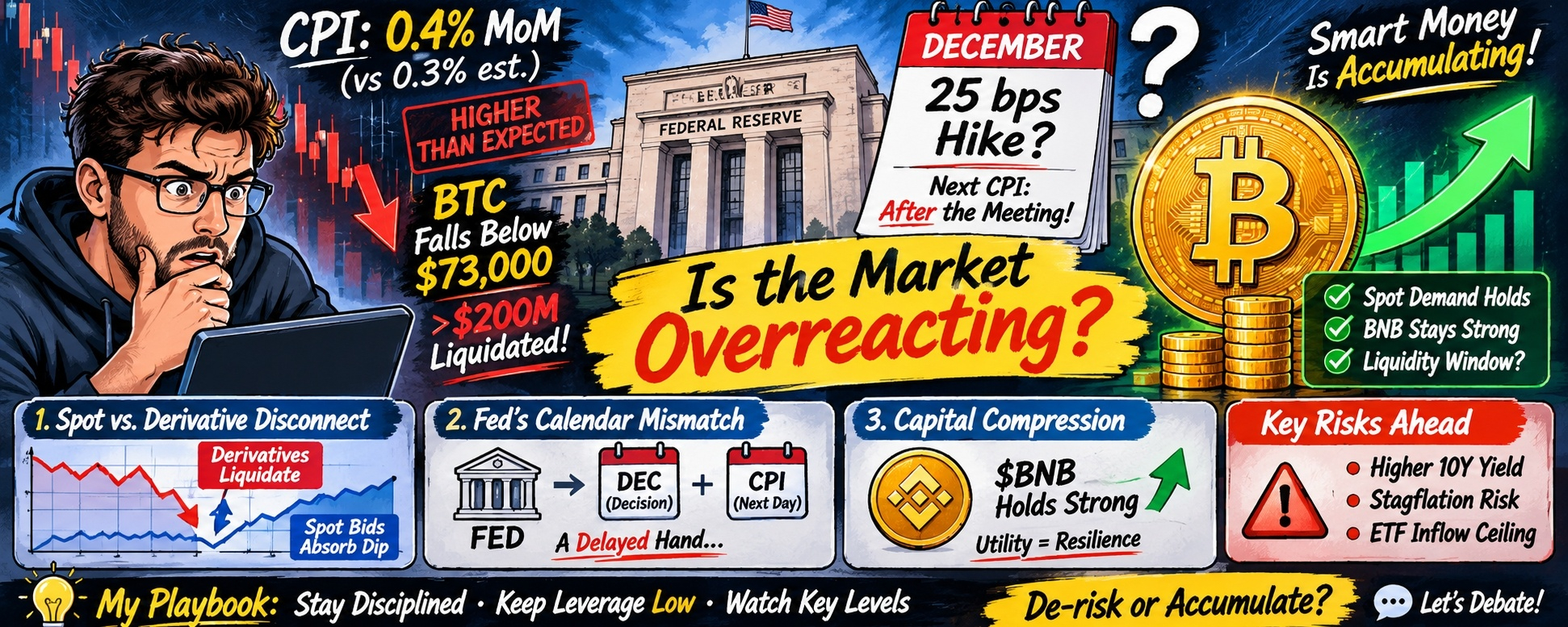
Are you de-risking your spot holdings ahead of the December Fed meeting, or are you taking advantageThe more I look at the order book reactions to this week's US CPI print, the more I realize we might be misreading this macro setup entirely. 🧠
Honestly, I almost panic-hedged my own position yesterday when the initial numbers dropped.
Everyone spent the last 48 hours hyperventilating over the headline inflation data.
October CPI printing at 0.4% MoM against the 0.3% consensus immediately triggered the usual knee-jerk liquidity drain.
We watched $BTC drop below the $73,000 zone, sweeping aggressive long leverage and wiping out over $200 million across perpetual markets in minutes.
The consensus timeline narrative was instant: "Inflation is sticky, a December Fed rate hike is locked in, dump everything." 📉
Standard economic theory says higher rates drain liquidity, push capital into risk-free yields, and leave high-beta assets out in the cold.
Rates markets rapidly repriced futures, baking in a 25-basis-point hike for December while whispers of a 50-basis-point shock started spreading.
...But sitting here staring at depth charts and hot wallet transfers, something doesn't feel right about that panic.
If you step back and watch how smart money actually positioned around this volatility, a completely different capital engine is running.
The market isn't fleeing from the hike—it’s front-running the fact that the Federal Reserve is playing a delayed hand.
Observation 1: The Spot vs. Derivative Disconnect
When bad news hits a fragile market, you expect cascade liquidations to trigger a structural floor breakdown.
Yet, as soon as the CPI print dropped, limit bids below $72,500 on major spot exchanges absorbed the dump surprisingly fast.
Yes, open interest collapsed and funding rates neutralized instantly, but spot accumulation didn't stop.
The mechanism loop was clear: Derivative liquidations ➔ Volatility spike ➔ Limit order fills ➔ Spot balance transfer to cold storage. 🔄
Derivative traders were getting liquidated on leverage while institutional spot desks quietly used the noise to fill size without pushing slippage.
Why? Because a December rate hike isn't a surprise anymore—it’s an expected parameter.
When market probability for a macro event hits 85%+, the shock value vanishes.
Traders panicking over the headline missed that smart money was treating the volatility as an liquidity window, not a exit door.
Observation 2: The Fed’s Calendar Mismatch
Here is the mechanical paradox that really tripped me up when I started mapping the timeline.
The Federal Reserve meets in early December to announce its interest rate decision... but the next CPI inflation report doesn't release until the day after their meeting.
Think about how absurd that is for central planners.
The Fed is forced to make a multi-trillion-dollar policy call blind to the immediate next inflation datapoint.
They’re stuck acting on backward-looking October numbers and whatever narrative Fed officials push during media appearances.
This creates a massive latency gap between static policy decisions and 24/7 real-time asset pricing.
By the time Jerome Powell steps up to announce a 25-basis-point hike in December, crypto liquidity will already be pricing in the end of that hike cycle—or pricing in a slowing labor market.
Traditional finance moves on monthly reporting lags; crypto pricing digests the future in real time.
Observation 3: Capital Compression into Anchors
I was looking across Layer-1 assets to see where capital fled during the dump.
While speculative altcoins took a heavy hit from tighter liquidity expectations, core infrastructure held its ground.
Look at $BNB staying anchored firmly inside its macro range despite the systemic market dip.
Macro tightening always forces a brutal prioritization loop: capital compresses out of low-conviction speculative tokens back into fee-generating ecosystems.
Watching $BNB hold key structural levels shows how real ecosystem utility and protocol revenue act as an absorption buffer against macro shocks.
Macro spikes don't destroy network adoption overnight—they simply reset the leverage baseline, flushing out over-leveraged traders and handing supply to long-term accumulators.
But Here’s What Genuinely Worries Me... 🚨
I don't want to sound like I'm blindly bullish here—there is a major structural bottleneck building up.
The real danger over the next six weeks isn't a single 25-basis-point rate hike in December.
It’s the yield attraction constraint.
If the 10-year US Treasury yield keeps grinding higher, risk-free returns start looking incredibly attractive to traditional institutional treasuries.
That creates a hard ceiling on spot ETF net inflows between now and early Q1.
Even worse: if inflation stays sticky while broader economic growth slows down, we enter a stagflationary regime.
That is historically the single most difficult macro backdrop for speculative assets to break out of.
If retail traders assume "priced-in" means "up-only immediately," they are setting themselves up to get chopped to pieces in a sideways range.
How I’m Playing This Right Now 💡
Panic-selling spot holdings after a 5% macro-driven flush has almost always been a mistake for me in past cycles.
Right now, I’m keeping leverage near zero, watching spot order book depth around major support zones, and monitoring ecosystem anchors like BTC andBNB.
When market narrative shifts from "Fed Pivot" to "Fed Hike," it creates temporary price dislocations where spot risk-to-reward ratios actually improve.
The market’s job is to inflict maximum psychological pain on both sides before delivering direction.
Right now, the most crowded trade on Twitter is panicking over a rate hike that the order book has already digested.
I’m sitting split here: part of me wants to bid this dip aggressively, but the Treasury yield ceiling keeps me cautious.
Are you de-risking your spot holdings ahead of the December Fed meeting, or are you taking advantage of this macro noise to accumulate? 🤔
Let’s debate it in the comments—how are you sizing your risk right now? 👇
#HotCPIDecemberHikePriced #CryptoMacro #MarketAnalysis #Write2Earn
Disclaimer: Not financial advice. Always DYOR.
Are you de-risking your spot holdings ahead of the December Fed meeting, or are you taking advantage
The more I look at the order book reactions to this week's US CPI print, the more I realize we might be misreading this macro setup entirely. 🧠
Honestly, I almost panic-hedged my own position yesterday when the initial numbers dropped.
Everyone spent the last 48 hours hyperventilating over the headline inflation data.
October CPI printing at 0.4% MoM against the 0.3% consensus immediately triggered the usual knee-jerk liquidity drain.
We watched $BTC drop below the $73,000 zone, sweeping aggressive long leverage and wiping out over $200 million across perpetual markets in minutes.
The consensus timeline narrative was instant: "Inflation is sticky, a December Fed rate hike is locked in, dump everything." 📉
Standard economic theory says higher rates drain liquidity, push capital into risk-free yields, and leave high-beta assets out in the cold.
Rates markets rapidly repriced futures, baking in a 25-basis-point hike for December while whispers of a 50-basis-point shock started spreading.
...But sitting here staring at depth charts and hot wallet transfers, something doesn't feel right about that panic.
If you step back and watch how smart money actually positioned around this volatility, a completely different capital engine is running.
The market isn't fleeing from the hike—it’s front-running the fact that the Federal Reserve is playing a delayed hand.
Observation 1: The Spot vs. Derivative Disconnect
When bad news hits a fragile market, you expect cascade liquidations to trigger a structural floor breakdown.
Yet, as soon as the CPI print dropped, limit bids below $72,500 on major spot exchanges absorbed the dump surprisingly fast.
Yes, open interest collapsed and funding rates neutralized instantly, but spot accumulation didn't stop.
The mechanism loop was clear: Derivative liquidations ➔ Volatility spike ➔ Limit order fills ➔ Spot balance transfer to cold storage. 🔄
Derivative traders were getting liquidated on leverage while institutional spot desks quietly used the noise to fill size without pushing slippage.
Why? Because a December rate hike isn't a surprise anymore—it’s an expected parameter.
When market probability for a macro event hits 85%+, the shock value vanishes.
Traders panicking over the headline missed that smart money was treating the volatility as an liquidity window, not a exit door.
Observation 2: The Fed’s Calendar Mismatch
Here is the mechanical paradox that really tripped me up when I started mapping the timeline.
The Federal Reserve meets in early December to announce its interest rate decision... but the next CPI inflation report doesn't release until the day after their meeting.
Think about how absurd that is for central planners.
The Fed is forced to make a multi-trillion-dollar policy call blind to the immediate next inflation datapoint.
They’re stuck acting on backward-looking October numbers and whatever narrative Fed officials push during media appearances.
This creates a massive latency gap between static policy decisions and 24/7 real-time asset pricing.
By the time Jerome Powell steps up to announce a 25-basis-point hike in December, crypto liquidity will already be pricing in the end of that hike cycle—or pricing in a slowing labor market.
Traditional finance moves on monthly reporting lags; crypto pricing digests the future in real time.
Observation 3: Capital Compression into Anchors
I was looking across Layer-1 assets to see where capital fled during the dump.
While speculative altcoins took a heavy hit from tighter liquidity expectations, core infrastructure held its ground.
Look at $BNB staying anchored firmly inside its macro range despite the systemic market dip.
Macro tightening always forces a brutal prioritization loop: capital compresses out of low-conviction speculative tokens back into fee-generating ecosystems.
Watching $BNB hold key structural levels shows how real ecosystem utility and protocol revenue act as an absorption buffer against macro shocks.
Macro spikes don't destroy network adoption overnight—they simply reset the leverage baseline, flushing out over-leveraged traders and handing supply to long-term accumulators.
But Here’s What Genuinely Worries Me... 🚨
I don't want to sound like I'm blindly bullish here—there is a major structural bottleneck building up.
The real danger over the next six weeks isn't a single 25-basis-point rate hike in December.
It’s the yield attraction constraint.
If the 10-year US Treasury yield keeps grinding higher, risk-free returns start looking incredibly attractive to traditional institutional treasuries.
That creates a hard ceiling on spot ETF net inflows between now and early Q1.
Even worse: if inflation stays sticky while broader economic growth slows down, we enter a stagflationary regime.
That is historically the single most difficult macro backdrop for speculative assets to break out of.
If retail traders assume "priced-in" means "up-only immediately," they are setting themselves up to get chopped to pieces in a sideways range.
How I’m Playing This Right Now 💡
Panic-selling spot holdings after a 5% macro-driven flush has almost always been a mistake for me in past cycles.
Right now, I’m keeping leverage near zero, watching spot order book depth around major support zones, and monitoring ecosystem anchors like BTC andBNB.
When market narrative shifts from "Fed Pivot" to "Fed Hike," it creates temporary price dislocations where spot risk-to-reward ratios actually improve.
The market’s job is to inflict maximum psychological pain on both sides before delivering direction.
Right now, the most crowded trade on Twitter is panicking over a rate hike that the order book has already digested.
I’m sitting split here: part of me wants to bid this dip aggressively, but the Treasury yield ceiling keeps me cautious.
Are you de-risking your spot holdings ahead of the December Fed meeting, or are you taking advantage of this macro noise to accumulate? 🤔
Let’s debate it in the comments—how are you sizing your risk right now? 👇
#HotCPIDecemberHikePriced #CryptoMacro #MarketAnalysis #Write2Earn
Disclaimer: Not financial advice. Always DYOR.
2
417

US Inflation Is Reshaping the Crypto Market 🇺🇸📊
October US CPI came in hotter than expected:
🔺 Headline CPI: +0.4% MoM (Forecast: +0.3%)
🔺 Core CPI: +0.3% MoM (Forecast: +0.2%)
Treasury yields reacted sharply, with the 2-year yield rising faster than longer maturities, signaling a repricing of Federal Reserve policy expectations.
📈 US 2Y: 4.75%
📈 US 10Y: 5.00%
📈 US 30Y: 5.36%
📈 DXY: 102.15
Higher yields and a stronger dollar can tighten global financial conditions, creating challenges for liquidity-sensitive assets, including cryptocurrencies.
The question for crypto investors: Can Bitcoin sustain a recovery if monetary conditions remain restrictive?
#bitcoin #cpi I #FederalReserve #CryptoMacro
Phoenix Crypto:
Hotter inflation keeps rate-cut hopes under pressure, and crypto will likely remain sensitive to Treasury yield movements.
2
1
1.2k

·
--
Why the Upcoming CPI Print Matters So Much for $PAXG Liquidity
Whenever a major macro release like US Consumer Price Index (CPI & Core CPI YoY/MoM) (Release Window: 12:30 UTC (6:00 PM IST) — Bureau of Labor Statistics) comes onto the radar, social media turns into a guessing game. On my desk, I prefer to ignore the noise and focus strictly on the actual macro numbers driving institutional liquidity across PAXG near 4017.5 and BTC.
Here is the exact macro setup going into the print:
• Previous official data: Headline CPI: 2.5% YoY | Core CPI: 3.2% YoY (0.2% MoM)
• Current Wall Street consensus: Consensus Forecast: 2.4% YoY | Core CPI: 3.1% YoY (0.2% MoM)
• Implied orderbook volatility window: ±3.2% to ±5.5% intraday 1h implied volatility across BTC and ETH orderbooks
The two variables I am tracking most closely right now are headline cpi yoy & mom vs consensus forecast and core cpi shelter & supercore services sticky inflation components. Inverse DXY & US 10Y Treasury Yield reaction; softer CPI Historically expands Spot BTC ETF inflows.
Historically, the first 5 to 15 minutes after a CPI release are dominated by algorithmic liquidity sweeps on both sides of the book. Instead of front-running the headline number, I am watching how the Dollar Index (DXY), US 2Y/10Y yields, and spot ETF orderflow on PAXG absorb the move once the initial wick settles.
What is your game plan for this CPI window — staying flat until the macro dust clears or tracking spot inflows live? Let me know in the comments 👇
#BinanceSquare #CryptoMacro

1
28
Статья
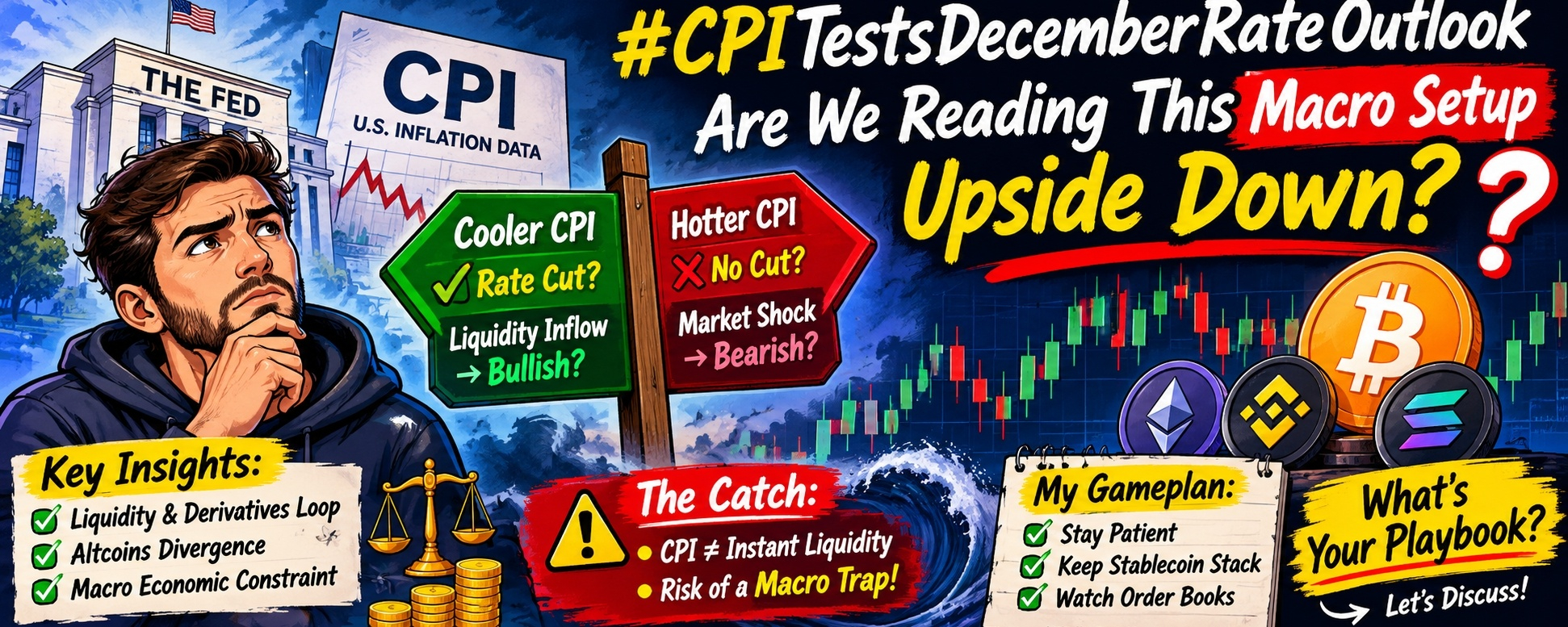
What’s your playbook for the upcoming CPI release? Are you de-risking before the printThe more I look at the market right now, the more I realize we might be reading this whole macro setup completely upside down. 🧠
Everyone on X is busy fighting over short-term leverage prints, but the real play is quietly forming right under our noses around #CPITestsDecemberRateOutlook.
I spent the last 48 hours glued to macroeconomic order books, rate-futures data, and on-chain liquidity shifts to see what’s actually happening behind the curtain.
Wait... let me backtrack for a second.
I caught myself falling into the exact same trap yesterday—assuming a cooler CPI print automatically guarantees a green vertical candle across the board. But looking at the raw mechanics today, I’m not so sure anymore.
Here is what I’m seeing on the ground—and why the next few days could turn Q4 on its head. 🧵👇
The Reality Check: What’s Actually Happening Right Now 📈
If you’ve traded through more than one cycle, you know macro liquidity is the ultimate invisible hand driving this market.
Right now, the Federal Reserve’s upcoming December rate decision is hanging over $BTC, ETH, andBNB like a dark cloud.
Every major institutional desk is essentially sitting on its hands, waiting for the incoming U.S. Consumer Price Index (CPI) numbers to clear up the horizon.
The surface-level story is simple enough:
A cooler inflation print gives the Fed cover to cut rates, opening the liquidity floodgates for risk-on assets.
A hotter-than-expected CPI print pushes back rate-cut expectations, forcing over-leveraged traders to unwind fast.
But when you zoom in on order book depth across major exchanges, you spot something much more subtle.
Market participants aren't just sitting back waiting—they’re actively reshuffling their positions long before the data even drops.
Observation 1: The Liquidity & Derivatives Value Loop 📉
Watching funding rates over the past few days has felt like watching a slow-motion wreck.
Here is the exact value transfer loop playing out in real-time:
* Retail traders rush to open high-leverage perpetual futures, trying to front-run the CPI release.
* Skewed funding rates create a low-risk arbitrage window for systematic market makers.
* Market makers trigger quick liquidation sweeps in both directions to capture delta-neutral spreads.
* Capital gets forced out of speculative open interest and settles directly into spot absorption reserves.
Options markets are showing heavily elevated demand for downside put protection ahead of the print.
Implied volatility is spiking, which means market makers are pricing in a massive swing regardless of which way the number falls.
If you’re throwing high-leverage market orders into this environment, you aren't trading a trend—you’re essentially flipping a coin against institutional algorithms designed to eat your margin.
Observation 2: Altcoins Are Diverging (And It’s Not Coincidence) ⚡
Usually, altcoins just follow $BTC off a cliff the moment macro gets spooky.
This time around, structural divergence is quietly appearing under the surface.
While major caps like ETH andBNB are holding strict support ranges, capital is aggressively rotating into specific sub-ecosystems built around real yield and actual protocol revenue.
Institutional money isn't exiting Web3 entirely. They’re fleeing to liquidity and balance-sheet quality.
When the macro outlook is uncertain, capital doesn't disappear—it consolidates into blue chips and core infrastructure that can survive a prolonged rate pause.
Observation 3: The Economic Constraint We Keep Ignoring ⚖️
Here is the uncomfortable economic truth that most hyper-bullish posts conveniently gloss over:
The Core Constraint: Speculative Web3 asset valuations cannot sustainably expand while risk-free real yield (U.S. Treasuries) sits near 4–5%, UNLESS on-chain capital efficiency and protocol revenue strictly outpace global borrowing costs.
If on-chain yields drop below real risk-free rates while inflation stays sticky, institutional liquidity must drain back into traditional fiat plumbing.
Long-term spot holders get this intuition intuitively.
They aren't panic selling into this macro noise, but they aren't blindly buying market orders at resistance either. They’re standing by to absorb sell-side pressure only when price hits deep historical discount zones.
But Here’s What Worries Me... ⚠️
I want to be completely candid here, because hype without risk management is how portfolios get wiped out in a single candle.
The Catch: The market might be vastly overestimating how quickly a "cool" CPI report actually translates into fresh market liquidity.
Even if CPI comes in soft and locks in a December rate cut, central banks don't instantly pump liquidity back into the global financial system overnight. There's a lag.
And if CPI comes in hot? The downside reaction will be brutal.
We could easily see a quick, violent cascade of liquidations testing structural support levels across $BTC and altcoins before any real recovery takes hold.
The bottleneck right now isn't Web3 adoption or technology—it’s raw macro liquidity, and crypto simply cannot fully decouple from global interest rate realities yet.
My Personal Gameplan 💡
I’ve stopped trying to guess the exact CPI decimal point. That’s a speedrun to tilt trading.
Instead, I’m keeping a heavy stablecoin stack parked on Binance, remaining patient, and watching how spot order books settle after the initial volatility flush clears out the noise.
Honestly... I’m completely torn right now. Half of my analysis tells me we're on the launchpad for a massive structural Q4 breakout, but the other half is screaming that we're walking straight into a macro liquidity trap.
So I'm comfortable sitting on my hands until the order books reveal who's actually in control.
What’s your playbook for the upcoming CPI release? Are you de-risking before the print, setting spot limit orders on the dips, or taking leverage trades into the volatility?
Let’s hash it out in the comments! 👇
#Write2Earn #CPITestsDecemberRateOutlook #CryptoMacro #Bit
coin
Disclaimer: Not financial advice. Always DYOR.
What’s your playbook for the upcoming CPI release? Are you de-risking before the print
The more I look at the market right now, the more I realize we might be reading this whole macro setup completely upside down. 🧠
Everyone on X is busy fighting over short-term leverage prints, but the real play is quietly forming right under our noses around #CPITestsDecemberRateOutlook.
I spent the last 48 hours glued to macroeconomic order books, rate-futures data, and on-chain liquidity shifts to see what’s actually happening behind the curtain.
Wait... let me backtrack for a second.
I caught myself falling into the exact same trap yesterday—assuming a cooler CPI print automatically guarantees a green vertical candle across the board. But looking at the raw mechanics today, I’m not so sure anymore.
Here is what I’m seeing on the ground—and why the next few days could turn Q4 on its head. 🧵👇
The Reality Check: What’s Actually Happening Right Now 📈
If you’ve traded through more than one cycle, you know macro liquidity is the ultimate invisible hand driving this market.
Right now, the Federal Reserve’s upcoming December rate decision is hanging over $BTC, ETH, andBNB like a dark cloud.
Every major institutional desk is essentially sitting on its hands, waiting for the incoming U.S. Consumer Price Index (CPI) numbers to clear up the horizon.
The surface-level story is simple enough:
A cooler inflation print gives the Fed cover to cut rates, opening the liquidity floodgates for risk-on assets.
A hotter-than-expected CPI print pushes back rate-cut expectations, forcing over-leveraged traders to unwind fast.
But when you zoom in on order book depth across major exchanges, you spot something much more subtle.
Market participants aren't just sitting back waiting—they’re actively reshuffling their positions long before the data even drops.
Observation 1: The Liquidity & Derivatives Value Loop 📉
Watching funding rates over the past few days has felt like watching a slow-motion wreck.
Here is the exact value transfer loop playing out in real-time:
* Retail traders rush to open high-leverage perpetual futures, trying to front-run the CPI release.
* Skewed funding rates create a low-risk arbitrage window for systematic market makers.
* Market makers trigger quick liquidation sweeps in both directions to capture delta-neutral spreads.
* Capital gets forced out of speculative open interest and settles directly into spot absorption reserves.
Options markets are showing heavily elevated demand for downside put protection ahead of the print.
Implied volatility is spiking, which means market makers are pricing in a massive swing regardless of which way the number falls.
If you’re throwing high-leverage market orders into this environment, you aren't trading a trend—you’re essentially flipping a coin against institutional algorithms designed to eat your margin.
Observation 2: Altcoins Are Diverging (And It’s Not Coincidence) ⚡
Usually, altcoins just follow $BTC off a cliff the moment macro gets spooky.
This time around, structural divergence is quietly appearing under the surface.
While major caps like ETH andBNB are holding strict support ranges, capital is aggressively rotating into specific sub-ecosystems built around real yield and actual protocol revenue.
Institutional money isn't exiting Web3 entirely. They’re fleeing to liquidity and balance-sheet quality.
When the macro outlook is uncertain, capital doesn't disappear—it consolidates into blue chips and core infrastructure that can survive a prolonged rate pause.
Observation 3: The Economic Constraint We Keep Ignoring ⚖️
Here is the uncomfortable economic truth that most hyper-bullish posts conveniently gloss over:
The Core Constraint: Speculative Web3 asset valuations cannot sustainably expand while risk-free real yield (U.S. Treasuries) sits near 4–5%, UNLESS on-chain capital efficiency and protocol revenue strictly outpace global borrowing costs.
If on-chain yields drop below real risk-free rates while inflation stays sticky, institutional liquidity must drain back into traditional fiat plumbing.
Long-term spot holders get this intuition intuitively.
They aren't panic selling into this macro noise, but they aren't blindly buying market orders at resistance either. They’re standing by to absorb sell-side pressure only when price hits deep historical discount zones.
But Here’s What Worries Me... ⚠️
I want to be completely candid here, because hype without risk management is how portfolios get wiped out in a single candle.
The Catch: The market might be vastly overestimating how quickly a "cool" CPI report actually translates into fresh market liquidity.
Even if CPI comes in soft and locks in a December rate cut, central banks don't instantly pump liquidity back into the global financial system overnight. There's a lag.
And if CPI comes in hot? The downside reaction will be brutal.
We could easily see a quick, violent cascade of liquidations testing structural support levels across $BTC and altcoins before any real recovery takes hold.
The bottleneck right now isn't Web3 adoption or technology—it’s raw macro liquidity, and crypto simply cannot fully decouple from global interest rate realities yet.
My Personal Gameplan 💡
I’ve stopped trying to guess the exact CPI decimal point. That’s a speedrun to tilt trading.
Instead, I’m keeping a heavy stablecoin stack parked on Binance, remaining patient, and watching how spot order books settle after the initial volatility flush clears out the noise.
Honestly... I’m completely torn right now. Half of my analysis tells me we're on the launchpad for a massive structural Q4 breakout, but the other half is screaming that we're walking straight into a macro liquidity trap.
So I'm comfortable sitting on my hands until the order books reveal who's actually in control.
What’s your playbook for the upcoming CPI release? Are you de-risking before the print, setting spot limit orders on the dips, or taking leverage trades into the volatility?
Let’s hash it out in the comments! 👇
#Write2Earn #CPITestsDecemberRateOutlook #CryptoMacro #Bit
coin
Disclaimer: Not financial advice. Always DYOR.
1
194

·
--
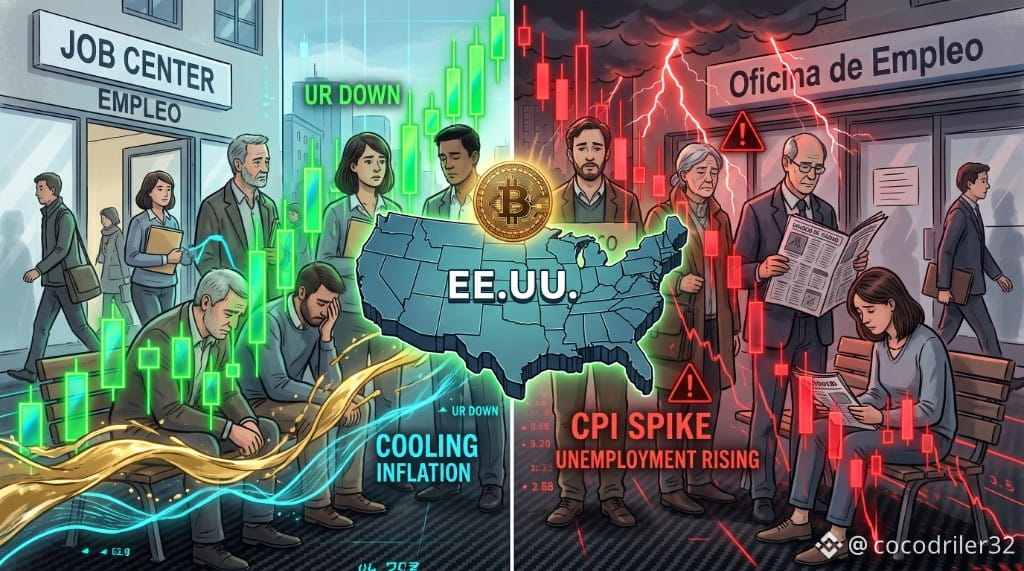
¿QUÉ PASARÁ MAÑANA CON $BTC? ¿CAEREMOS? 🌪️💣
Estados Unidos publica datos determinantes sobre el mercado laboral y la inflación, y Wall Street ya está preparando sus posiciones. Si operas cripto, el gráfico de arriba resume exactamente los 2 caminos que puede tomar el mercado:
🟢 ESCENARIO 1: RALLY Y VELAS VERDES (Cooling Inflation)
Si la inflación continúa enfriándose y los datos laborales muestran estabilidad sin recalentamiento:
- La Reserva Federal tiene vía libre para acelerar los recortes de tasas.
- El dólar (DXY) pierde fuerza y la liquidez fluye hacia los activos de riesgo.
- Veremos un fuerte impulso alcista que arrastrará no solo a Bitcoin, sino a las principales altcoins del mercado.
🔴 ESCENARIO 2: VOLATILIDAD Y CAÍDA (CPI Spike & Stress)
Si la inflación repunta por sorpresa y los datos laborales generan incertidumbre de estanflación:
- La Fed mantendrá su postura dura de tasas altas por más tiempo.
- Se produce una estampida hacia el dólar como refugio y ventas en futuros.
- Riesgo de barridos de stops violentos y liquidaciones en cascada antes del rebote.
⚠️ CONSEJO DE TRADING:
No te sobreapalranques antes de la publicación. Espera a que los algoritmos institucionales absorban el primer impacto de volatilidad.
👉 ¿Quieres operar con ventaja y no perderte las alertas de mercado en tiempo real? ¡Síguenos y activa las notificaciones para estar siempre un paso adelante!
👇 ¿Cuál es tu pronóstico para mañana? ¿Veremos vela verde hacia nuevos máximos o corrección profunda? ¡Déjalo en los comentarios!
#BinanceSquare #CryptoMacro #FederalReserve #TradingAlerts $ETH $BNB
¿QUÉ PASARÁ MAÑANA CON $BTC ? ¿CAEREMOS? 🌪️💣
Estados Unidos publica datos determinantes sobre el mercado laboral y la inflación, y Wall Street ya está preparando sus posiciones. Si operas cripto, el gráfico de arriba resume exactamente los 2 caminos que puede tomar el mercado:
🟢 ESCENARIO 1: RALLY Y VELAS VERDES (Cooling Inflation)
Si la inflación continúa enfriándose y los datos laborales muestran estabilidad sin recalentamiento:
- La Reserva Federal tiene vía libre para acelerar los recortes de tasas.
- El dólar (DXY) pierde fuerza y la liquidez fluye hacia los activos de riesgo.
- Veremos un fuerte impulso alcista que arrastrará no solo a Bitcoin, sino a las principales altcoins del mercado.
🔴 ESCENARIO 2: VOLATILIDAD Y CAÍDA (CPI Spike & Stress)
Si la inflación repunta por sorpresa y los datos laborales generan incertidumbre de estanflación:
- La Fed mantendrá su postura dura de tasas altas por más tiempo.
- Se produce una estampida hacia el dólar como refugio y ventas en futuros.
- Riesgo de barridos de stops violentos y liquidaciones en cascada antes del rebote.
⚠️ CONSEJO DE TRADING:
No te sobreapalranques antes de la publicación. Espera a que los algoritmos institucionales absorban el primer impacto de volatilidad.
👉 ¿Quieres operar con ventaja y no perderte las alertas de mercado en tiempo real? ¡Síguenos y activa las notificaciones para estar siempre un paso adelante!
👇 ¿Cuál es tu pronóstico para mañana? ¿Veremos vela verde hacia nuevos máximos o corrección profunda? ¡Déjalo en los comentarios!
#BinanceSquare #CryptoMacro #FederalReserve #TradingAlerts $ETH $BNB
2
171

🚨 صدمة اقتصادية كلية: لم ينتهِ الاحتياطي الفيدرالي بعد. 🚨
أصدر تقرير الوظائف الأمريكي للتو مفاجأة مدوية. أُضيفت 165,000 وظيفة في أكتوبر (ما يقارب ثلاثة أضعاف التوقعات!)، مما خفّض البطالة إلى 4.1%.
والنتيجة؟ قفزت احتمالات رفع الاحتياطي الفيدرالي لأسعار الفائدة في ديسمبر إلى 80%. يزداد الدولار قوة، وتتقلص السيولة في الاقتصاد الكلي. إليكم رد فعل أكبر 3 عملات:
🟠 $BTC
(بيتكوين):
تضع أسعار الفائدة الأعلى ضغوطًا على الأصول عالية المخاطر على المدى القريب. تراجع BTC لفترة وجيزة إلى مستوى $75.7K مع صعود الدولار. توقّعوا تذبذبًا وتماسكًا في الأسعار بينما يستوعب السوق واقع رفع الفائدة الجديد في ديسمبر.
🔵 $ETH
(إيثيريوم):
يجعل رفع الفائدة العوائد التقليدية «الخالية من المخاطر» أكثر جاذبية، ما يضعها في منافسة مباشرة مع عوائد التخزين في التمويل اللامركزي (DeFi). سيحتاج ETH إلى حجم تداول قوي على السلسلة وحرق انكماشي للعملات لمواجهة هذه الرياح الاقتصادية المعاكسة.
🟡 $BNB
(عملة باينانس):
يؤثر تشديد السيولة في وتيرة السوق عمومًا، لكن استخدامات BNB تمنحها عامل حماية فريدًا. يحافظ الطلب القوي على منظومتها وآليات Launchpool على ارتفاع الحوافز، رغم الاضطرابات الاقتصادية الكلية.
سيولة أشد شحًا = تقلبات أكبر. تداولوا وفق مستويات الأسعار، لا المشاعر.🟡
#jobsreportraiseshikeodds #CryptoMacro
1.6k
Статья
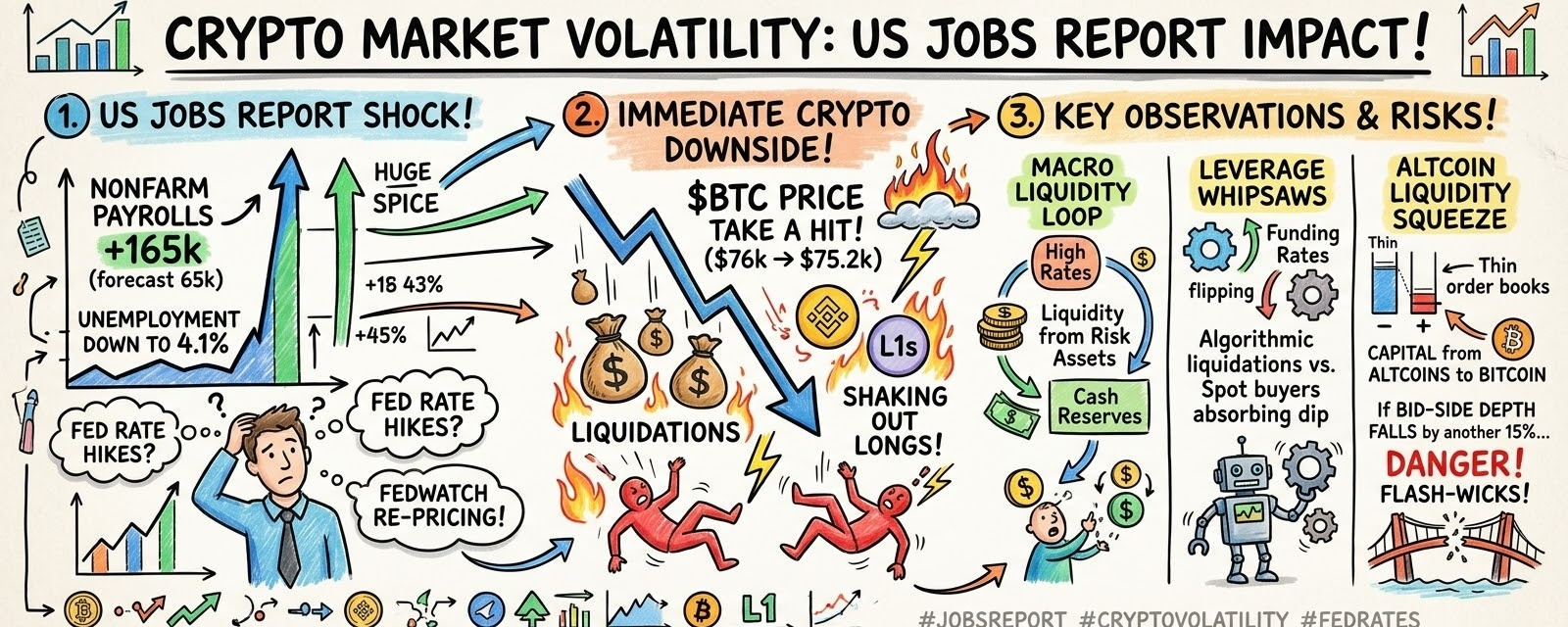
How are you adjusting your spot and futures setups while the market digests thisI spent the last few hours dissecting the macro prints, and honestly... the latest US jobs numbers just threw a massive wrench into my entire dynamic strategy.
Nonfarm payrolls crushed consensus by adding 165,000 jobs against the forecasted 65,000, pulling unemployment down to 4.1%.
I wasn't expecting the CME FedWatch tool to re-price rate hike odds this aggressively overnight.
The immediate price reaction across crypto was an aggressive downside knee-jerk.
$BTC took a sharp hit from $76,000 down toward $75,200 within minutes, shaking out over-leveraged long positions across major exchanges.
Looking at on-chain liquidity depth and derivatives order books, here are three organic observations I’m tracking right now: 🧠
1. The Macro Liquidity Loop 📉
A resilient labor market strips the Federal Reserve of any pressure to ease policy.
High terminal rates keep Treasury yields elevated \rightarrow capital drains out of risk assets \rightarrow speculative liquidity flees altcoins straight into short-term cash reserves.
2. Leverage Whipsaws on Spot vs. Futures ⚡
During the initial drop, perpetual funding rates flipped negative temporarily before spot buyers stepped in to absorb the dip around key structural support.
We aren't seeing massive institutional panic-selling yet, but rather algorithmic derivative liquidations catching retail off guard.
3. Altcoin Liquidity Squeeze 🔄
Major ecosystem tokens like $BNB and top Layer-1s are holding key support ranges, but order book depth is noticeably thinning out.
When rate hike odds rise, speculative capital flees altcoins first to cluster around Bitcoin reserves.
But here’s the core constraint that has me worried... 🚨
Everyone is treating this like a temporary dip, but the math behind liquidity provision tells a darker story.
Here's the breaking point: If bid-side order book depth across top spot pairs deteriorates by another 15% while 10-year yields hold above 4.3%, automated market makers will be economically forced to pull bid liquidity deeper down the order book—turning routine liquidations into violent, cascading flash-wicks. ⚠️
We're trapped in this weird structural paradox right now.
On one hand, macro yields are actively trying to drain liquidity from risk assets. On the other hand, baseline institutional spot ETF inflows refuse to break down.
I honestly can't tell if we're front-running a multi-month macro drain... or if institutional bid support is about to completely override the Fed's playbook.
How are you adjusting your spot and futures setups while the market digests this? 🤔
Are you hedging delta exposure here, or betting that ETF inflows will swallow the FedWatch data? Let’s debate below! 👇
#JobsReportRaisesHikeOdds #CryptoMacro #BTC #Write2Earn
Disclaimer: Not financial advice. Always DYOR.
How are you adjusting your spot and futures setups while the market digests this
I spent the last few hours dissecting the macro prints, and honestly... the latest US jobs numbers just threw a massive wrench into my entire dynamic strategy.
Nonfarm payrolls crushed consensus by adding 165,000 jobs against the forecasted 65,000, pulling unemployment down to 4.1%.
I wasn't expecting the CME FedWatch tool to re-price rate hike odds this aggressively overnight.
The immediate price reaction across crypto was an aggressive downside knee-jerk.
$BTC took a sharp hit from $76,000 down toward $75,200 within minutes, shaking out over-leveraged long positions across major exchanges.
Looking at on-chain liquidity depth and derivatives order books, here are three organic observations I’m tracking right now: 🧠
1. The Macro Liquidity Loop 📉
A resilient labor market strips the Federal Reserve of any pressure to ease policy.
High terminal rates keep Treasury yields elevated \rightarrow capital drains out of risk assets \rightarrow speculative liquidity flees altcoins straight into short-term cash reserves.
2. Leverage Whipsaws on Spot vs. Futures ⚡
During the initial drop, perpetual funding rates flipped negative temporarily before spot buyers stepped in to absorb the dip around key structural support.
We aren't seeing massive institutional panic-selling yet, but rather algorithmic derivative liquidations catching retail off guard.
3. Altcoin Liquidity Squeeze 🔄
Major ecosystem tokens like $BNB and top Layer-1s are holding key support ranges, but order book depth is noticeably thinning out.
When rate hike odds rise, speculative capital flees altcoins first to cluster around Bitcoin reserves.
But here’s the core constraint that has me worried... 🚨
Everyone is treating this like a temporary dip, but the math behind liquidity provision tells a darker story.
Here's the breaking point: If bid-side order book depth across top spot pairs deteriorates by another 15% while 10-year yields hold above 4.3%, automated market makers will be economically forced to pull bid liquidity deeper down the order book—turning routine liquidations into violent, cascading flash-wicks. ⚠️
We're trapped in this weird structural paradox right now.
On one hand, macro yields are actively trying to drain liquidity from risk assets. On the other hand, baseline institutional spot ETF inflows refuse to break down.
I honestly can't tell if we're front-running a multi-month macro drain... or if institutional bid support is about to completely override the Fed's playbook.
How are you adjusting your spot and futures setups while the market digests this? 🤔
Are you hedging delta exposure here, or betting that ETF inflows will swallow the FedWatch data? Let’s debate below! 👇
#JobsReportRaisesHikeOdds #CryptoMacro #BTC #Write2Earn
Disclaimer: Not financial advice. Always DYOR.
1
185

·
--
英央行逾三年首加息至4%,暗示续升或压制加密流动性预期
英国央行罕见地在逾三年后首次上调基准利率,并将政策利率从3.75%提升至4%,行长同时释放未来可能继续加息的信号,以应对持续上行的通胀压力。这一动作与美联储当前的降息路径形成明显背离,可能重新扰动市场对全球流动性走向的判断。
据卫报财经报道,此次为英格兰银行委员会自三年前以来的首次加息,基准利率由3.75%上调至4%。更为关键的是,行长在会后表态中暗示,若通胀数据未能按预期回落,未来存在进一步加息的空间。这意味着英国货币政策正从此前的宽松基调转向偏紧,且尚未触及终点。
这一变化对加密市场的重要性,主要在于宏观流动性预期的变化。加密资产作为高风险、高流动敏感型资产,其估值与全球主要央行的货币环境高度相关。当英国这样的主要经济体选择逆势加息并暗示续升时,会强化「主要央行降息节奏可能整体放缓」的叙事,从而对风险偏好形成压制。尤其当这一走势与美联储的政策方向出现背离,市场容易将其解读为全球流动性收紧的信号。
不过需要冷静看待的是,这仍是一个国家的单一货币政策,对加密市场的直接影响相对有限。加密流动性的核心驱动仍来自美联储的资产负债表与利率路径,英国央行的动作更多是通过情绪与叙事层面产生间接冲击。此外,市场对「英美政策背离」的解读存在被过度放大的可能——单一经济体的加息,未必会改变全球整体流动性松紧的大方向。
从市场反应看,此类宏观背离叙事在短期内可能引发风险资产的波动放大,尤其是杠杆较高的板块。但若无美联储层面的同步收紧,这种压力更可能是情绪性的、阶段性的,而非趋势性的转向。
接下来需要观察的,是英国通胀数据能否支撑「续升」的判断,以及美联储后续表态是否会因此调整节奏。交易层面更重要的是等待市场给出确认,而非对单一国家的货币政策反应过度。
#BankofEngland #InterestRates #CryptoMacro
以上为信息整理与个人分析,不构成投资建议。
关注我,持续跟踪关键市场变化与数据。
34

🎬 СЕРИЯ 30: «Выборы, шорт-сквиз и возвращение за отметку $80k» 🏛️📈🐾✨
Промежуточные выборы в США закрыли главный источник неопределенности, а волна принудительных ликвидаций мгновенно вернула Bitcoin выше $80 000. Для Юхи этот поствыборный сквиз лишь сигнал: рынок очистился от лишнего плечевого шума и переучитывает риски.
Взгляд 👀 на ключевые события:
Отскок ($80k-$81k) и ETF: Закономерный урок для тех, кто ставил против рынка на пике страха. На фоне рывка ETH к $2,4k институционалы через спотовые ETF ($75 млн во главе с Fidelity) продолжают уверенно выкупать просадку.
Регуляторная развилка: Победа демократов дала relief-rally, но судьба CLARITY Act туманна, а трансферы BTC от Trump Media напоминают о скрытых рисках политических токенов.
Инфраструктура: Хардфорк Polygon ради $6,8 млн и интеграция Bitcoin в макропрогнозы JPMorgan на 2027 год (цель по доходности ~10%) доказывают, что правила игры становятся взрослее.
Выигрывает не тот, кто угадывает следующую свечу, а тот, кто понимает архитектуру процесса. Портфель собран, работаем по плану. 🐾✨
#Bitcoin #CryptoMacro #Midterms #YuKha
© 2026 YuKhaCryptoDzen

5
176
·
--
ANALISIS $BTC: ¿Por qué el reporte de empleo de mañana sacudirá a todo el mercado? 🌪️💣
Mañana se publican dos de los datos macroeconómicos más determinantes para la Reserva Federal: las Nóminas No Agrícolas (NFP) y la Tasa de Desempleo en Estados Unidos.
Si operas cripto, esto es exactamente lo que necesitas saber para no quedar atrapado en la volatilidad:
1️⃣ ¿Por qué le importa tanto a Bitcoin?
La Fed necesita ver enfriamiento en el empleo para justificar más recortes en las tasas de interés. Menores tasas = mayor liquidez global = combustible alcista para los activos de riesgo.
2️⃣ Los 2 Escenarios de Mañana:
🟢 ESCENARIO ALCISTA (Empleo débil / Desempleo al alza):
Si las nóminas salen por debajo de lo previsto, el DXY (Dólar) retrocede y el mercado descuenta recortes agresivos de tasas. Esto suele detonar velas verdes explosivas en cuestión de minutos.
🔴 ESCENARIO BAJISTA (Empleo caliente / Desempleo a la baja):
Si la economía crea más empleos de lo esperado, la Fed mantendrá una postura restrictiva por más tiempo. El Dólar se fortalece y presiona a la baja al mercado cripto con posibles barridos de liquidez hacia soportes clave.
⚠️ CONSEJO DE TRADING:
Durante los primeros 15 minutos tras la publicación (08:30 AM EST), los algoritmos barren stops en ambas direcciones. Evita sobreapalancarte antes de la noticia y espera confirmación de tendencia.
👇 ¿Cuál es tu pronóstico para mañana? ¿Veremos pump alcista o corrección antes del fin de semana? ¡Déjalo en los comentarios!
#BinanceSquare #CryptoMacro #Bitcoin #TradingSignals $ETH $USDT
ANALISIS $BTC : ¿Por qué el reporte de empleo de mañana sacudirá a todo el mercado? 🌪️💣
Mañana se publican dos de los datos macroeconómicos más determinantes para la Reserva Federal: las Nóminas No Agrícolas (NFP) y la Tasa de Desempleo en Estados Unidos.
Si operas cripto, esto es exactamente lo que necesitas saber para no quedar atrapado en la volatilidad:
1️⃣ ¿Por qué le importa tanto a Bitcoin?
La Fed necesita ver enfriamiento en el empleo para justificar más recortes en las tasas de interés. Menores tasas = mayor liquidez global = combustible alcista para los activos de riesgo.
2️⃣ Los 2 Escenarios de Mañana:
🟢 ESCENARIO ALCISTA (Empleo débil / Desempleo al alza):
Si las nóminas salen por debajo de lo previsto, el DXY (Dólar) retrocede y el mercado descuenta recortes agresivos de tasas. Esto suele detonar velas verdes explosivas en cuestión de minutos.
🔴 ESCENARIO BAJISTA (Empleo caliente / Desempleo a la baja):
Si la economía crea más empleos de lo esperado, la Fed mantendrá una postura restrictiva por más tiempo. El Dólar se fortalece y presiona a la baja al mercado cripto con posibles barridos de liquidez hacia soportes clave.
⚠️ CONSEJO DE TRADING:
Durante los primeros 15 minutos tras la publicación (08:30 AM EST), los algoritmos barren stops en ambas direcciones. Evita sobreapalancarte antes de la noticia y espera confirmación de tendencia.
👇 ¿Cuál es tu pronóstico para mañana? ¿Veremos pump alcista o corrección antes del fin de semana? ¡Déjalo en los comentarios!
#BinanceSquare #CryptoMacro #Bitcoin #TradingSignals $ETH $USDT

3
133
·
--
How I'm Reading the NFP Numbers for $SUI and BTC This Week
Whenever a major macro release like US Non-Farm Payrolls (NFP), Unemployment Rate & Average Hourly Earnings (Release Window: Friday 12:30 UTC (6:00 PM IST) — US Bureau of Labor Statistics) comes onto the radar, social media turns into a guessing game. On my desk, I prefer to ignore the noise and focus strictly on the actual macro numbers driving institutional liquidity across SUI near 0.8663 and BTC.
Here is the exact macro setup going into the print:
• Previous official data: Previous NFP: 142K Jobs Added | Unemployment Rate: 4.2% | Avg Hourly Earnings: +0.4% MoM (3.8% YoY)
• Current Wall Street consensus: Consensus Forecast: 145K–150K Jobs | Unemployment Rate Forecast: 4.2% | Wage Growth Forecast: +0.3% MoM
• Implied orderbook volatility window: ±3.5% to ±6.0% high-velocity institutional orderbook expansion at 12:30 UTC release
The two variables I am tracking most closely right now are headline non-farm payrolls (nfp) jobs added vs 145k–150k consensus forecast and us unemployment rate (u-3) tick vs 4.2% threshold & prior month revisions. Labor market cooling vs resilience dictates Fed rate-cut velocity, DXY strength, and institutional ETF inflows.
Historically, the first 5 to 15 minutes after a NFP release are dominated by algorithmic liquidity sweeps on both sides of the book. Instead of front-running the headline number, I am watching how the Dollar Index (DXY), US 2Y/10Y yields, and spot ETF orderflow on SUI absorb the move once the initial wick settles.
What is your game plan for this NFP window — staying flat until the macro dust clears or tracking spot inflows live? Let me know in the comments 👇
#BinanceSquare #CryptoMacro
1
8

·
--
🚨 $BTC BRACES FOR MACRO LIQUIDITY SHIFTS AS CENTRAL BANKS AND MIDTERMS COLLIDE ⚡
Institutional participants are bracing for an aggressive liquidity shakeout as three major central banks prepare rate hikes alongside US midterm elections. 🌊 Energy volatility from Brent surging to six-month highs adds another layer of macro friction across risk assets like $BTC and $ETH .
With pivotal ISM data, tech earnings, and Friday payrolls compressing into a single weekly candle, institutional order flow will likely exploit extended fair value gaps rather than chasing initial breakout velocity. 🔍
💡 Are institutional desks setting up an engineered liquidity sweep below local support before the real expansion unfolds? 🤔
⚠️ Not financial advice. Always manage your risk. 🛡️
🏷️ #BTC #MarketStructure #CryptoMacro #OrderFlow
🎯 🦈

16

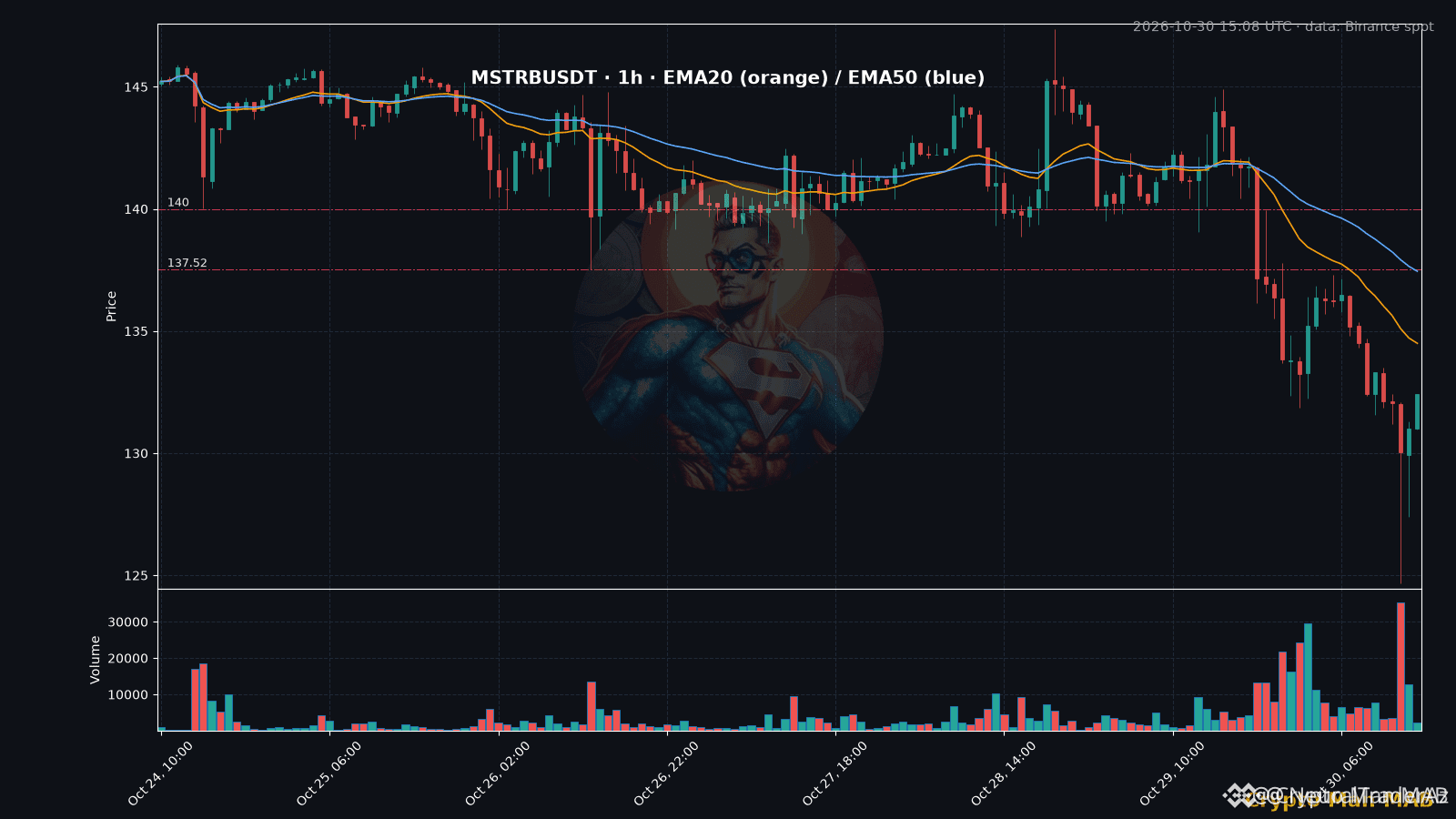
🔴 $BTC CONFRONTS MACRO PRESSURE AS EQUITY LIQUIDITY SWEEPS HIT THE OPEN 📉
📊 A decisive risk-off rotation is sweeping through market proxies at the US open, dragging broader tech indices lower. Institutional equity exposure is absorbing heavy sell-side delivery, with $MSTRB tapping liquidity down at 124.6 before recovering to 132, while a major US crypto exchange shed 12% on a 35% annual revenue drop to $1.22B.
🔍 With $BTC capping upside structure below 78k, this order flow displacement reflects participants repricing compressed spot volume rather than an organic trend breakdown. Until absorption confirms at higher timeframe key levels, price remains vulnerable to deeper structural sweeps into the weekend.
💬 Are you viewing this equity-driven pullback as an institutional discount entry, or is further downside liquidation imminent? 👇
⚠️ Not financial advice. Always manage your risk. 🛡️
🏷️ #BTC #MarketStructure #OrderFlow #CryptoMacro
🎯 🦈
6
Статья
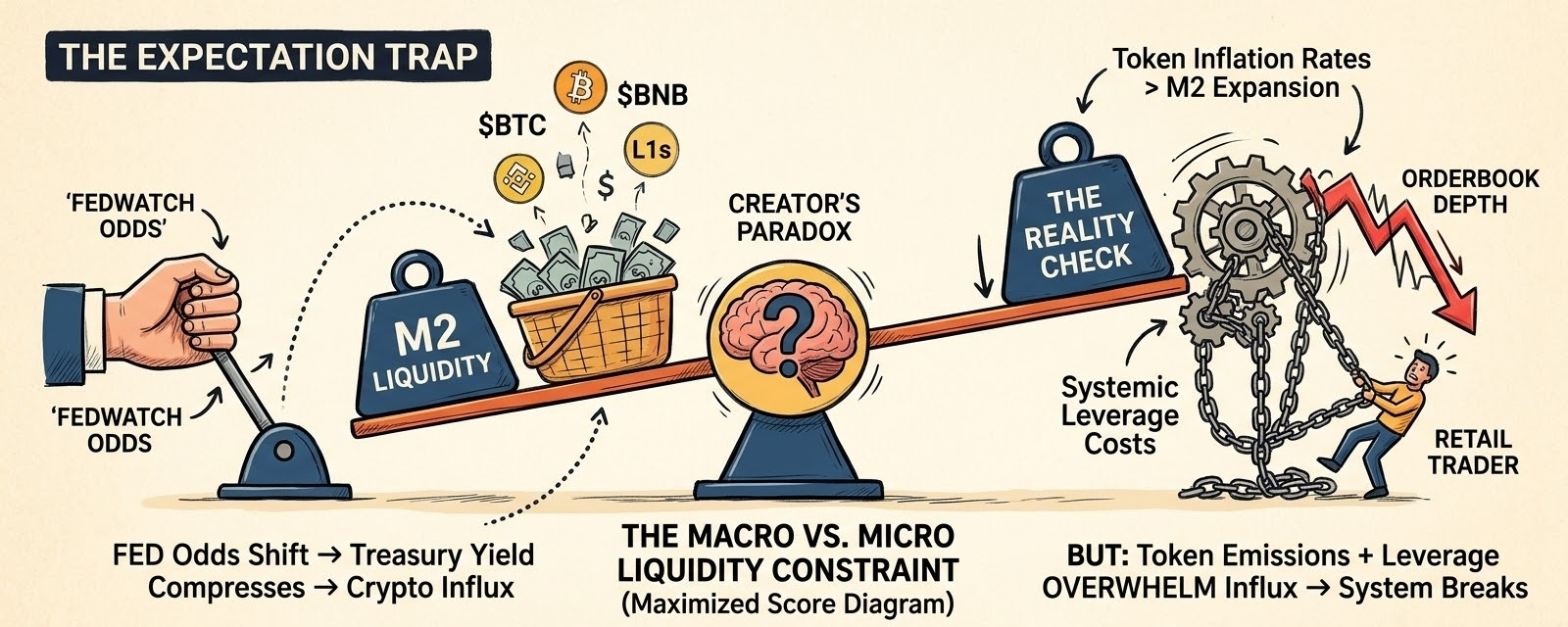
The entire system breaks down if Token Inflation Rate + Systemic Leverage Cost > Global Net M2 ExpanI’ve been staring at CME FedWatch for 3 straight hours... and honestly, I think we’re analyzing macro liquidity completely backwards. 🤔
Not sure if it’s just me, but every time rate odds shift by even 5%, everyone on Twitter rushes to call the top or bottom on $BTC. But watching live orderbook depth right now is making me second-guess the entire consensus.
Here is the actual mechanism loop playing out under the hood:
FedWatch probability swings don't push retail into spot buying—they trigger programmatic yield rotation. Right now, risk-free treasury yields (3.75%–4.00%) act as a massive liquidity vacuum.
Institutions don't allocate to crypto just because rate cut odds rise. Capital stays locked in treasuries until rate cut probability crosses a strict economic threshold where Risk-Free Treasury Yield < Expected Crypto Volatility Premium.
Only when that threshold breaks does the loop trigger: Treasury yield compression ➔ forced capital rotation ➔ orderbook depth expansion across major assets like $BNB and core L1s. 💡
But here’s the brutal economic constraint that keeps me up... 📉
The entire system breaks down if Token Inflation Rate + Systemic Leverage Cost > Global Net M2 Expansion.
Let that sink in for a second.
If macro liquidity expands via rate cuts, but local crypto token emission schedules and structural leverage overhead absorb that capital faster than it enters, the rate cut changes absolutely nothing. In fact, if risk-free rates drop while systemic crypto leverage is already maxed out, rate cuts don't trigger a bull run—they trigger a catastrophic orderbook depth gap and a forced wipeout. 🚨
Wait... actually, this leaves us with a mind-bending contradiction:
We’re all aggressively pricing in Fed rate cuts as the ultimate bullish catalyst, but the exact moment cuts happen, it confirms underlying macro economic weakness—which traditionally forces funds to deleverage risk assets first before deploying new capital.
So are we actually positioning for a real liquidity wave... or are we just front-running our own narrative cope while sitting directly in a liquidity trap?
I’m struggling to reconcile this for Q4. Something in this setup feels fundamentally broken. 🧠
#FedWatch #FOMC #Write2Earn #CryptoMacro
Disclaimer: Not financial advice. Always DYOR.#FedWatch
The entire system breaks down if Token Inflation Rate + Systemic Leverage Cost > Global Net M2 Expan
I’ve been staring at CME FedWatch for 3 straight hours... and honestly, I think we’re analyzing macro liquidity completely backwards. 🤔
Not sure if it’s just me, but every time rate odds shift by even 5%, everyone on Twitter rushes to call the top or bottom on $BTC. But watching live orderbook depth right now is making me second-guess the entire consensus.
Here is the actual mechanism loop playing out under the hood:
FedWatch probability swings don't push retail into spot buying—they trigger programmatic yield rotation. Right now, risk-free treasury yields (3.75%–4.00%) act as a massive liquidity vacuum.
Institutions don't allocate to crypto just because rate cut odds rise. Capital stays locked in treasuries until rate cut probability crosses a strict economic threshold where Risk-Free Treasury Yield < Expected Crypto Volatility Premium.
Only when that threshold breaks does the loop trigger: Treasury yield compression ➔ forced capital rotation ➔ orderbook depth expansion across major assets like $BNB and core L1s. 💡
But here’s the brutal economic constraint that keeps me up... 📉
The entire system breaks down if Token Inflation Rate + Systemic Leverage Cost > Global Net M2 Expansion.
Let that sink in for a second.
If macro liquidity expands via rate cuts, but local crypto token emission schedules and structural leverage overhead absorb that capital faster than it enters, the rate cut changes absolutely nothing. In fact, if risk-free rates drop while systemic crypto leverage is already maxed out, rate cuts don't trigger a bull run—they trigger a catastrophic orderbook depth gap and a forced wipeout. 🚨
Wait... actually, this leaves us with a mind-bending contradiction:
We’re all aggressively pricing in Fed rate cuts as the ultimate bullish catalyst, but the exact moment cuts happen, it confirms underlying macro economic weakness—which traditionally forces funds to deleverage risk assets first before deploying new capital.
So are we actually positioning for a real liquidity wave... or are we just front-running our own narrative cope while sitting directly in a liquidity trap?
I’m struggling to reconcile this for Q4. Something in this setup feels fundamentally broken. 🧠
#FedWatch #FOMC #Write2Earn #CryptoMacro
Disclaimer: Not financial advice. Always DYOR.#FedWatch
1
183
·
--
How I'm Reading the PCE Numbers for $PAXG and BTC This Week
Whenever a major macro release like US Core PCE Price Index (Federal Reserve Preferred Inflation Gauge) (Release Window: 12:30 UTC (6:00 PM IST) — Bureau of Economic Analysis) comes onto the radar, social media turns into a guessing game. On my desk, I prefer to ignore the noise and focus strictly on the actual macro numbers driving institutional liquidity across PAXG near 4023.4 and BTC.
Here is the exact macro setup going into the print:
• Previous official data: Previous Core PCE: 2.6% YoY (0.2% MoM)
• Current Wall Street consensus: Consensus Forecast: 2.6% YoY (0.2% MoM) | Personal Spending: +0.4% MoM
• Implied orderbook volatility window: ±2.5% to ±4.0% volatility expansion across BTC, ETH, and SOL
The two variables I am tracking most closely right now are core pce yoy & mom print vs market consensus and personal income & consumer spending growth velocity. Core PCE directly anchors Federal Reserve real interest rate policy and macro risk-asset appetite.
Historically, the first 5 to 15 minutes after a PCE release are dominated by algorithmic liquidity sweeps on both sides of the book. Instead of front-running the headline number, I am watching how the Dollar Index (DXY), US 2Y/10Y yields, and spot ETF orderflow on PAXG absorb the move once the initial wick settles.
What is your game plan for this PCE window — staying flat until the macro dust clears or tracking spot inflows live? Let me know in the comments 👇
#BinanceSquare #CryptoMacro

1
3

·
--
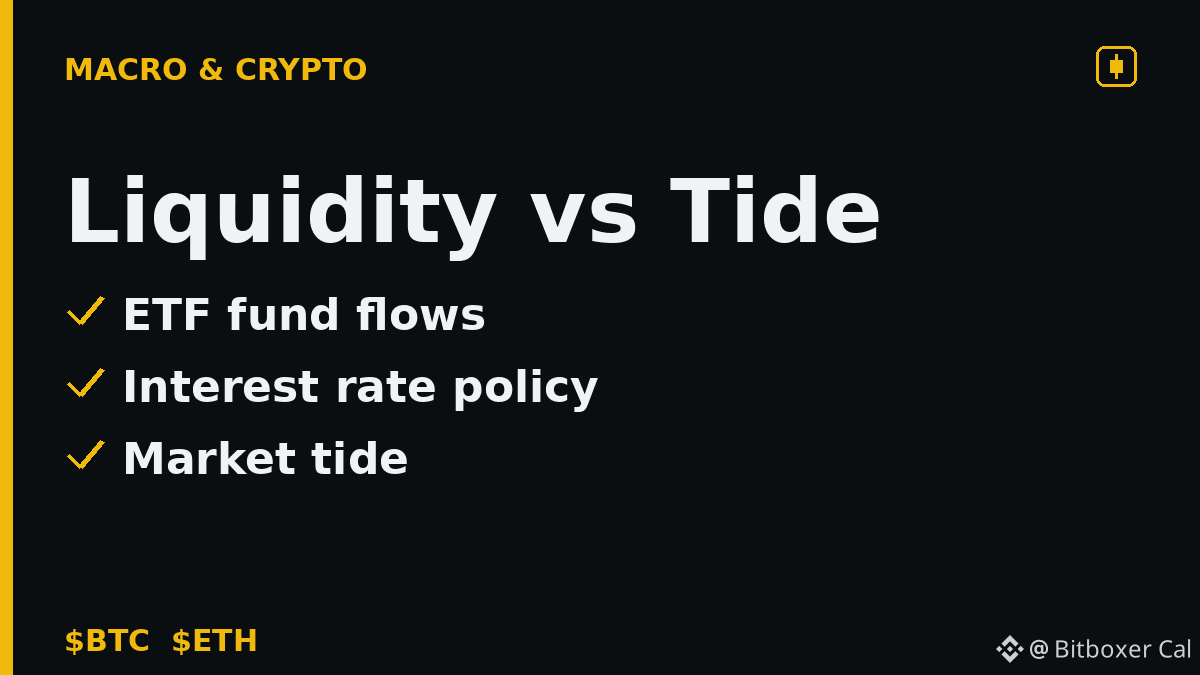
Everyone thinks $BTC spot ETF inflows are a magic button for instant price pumps.
In reality, these flows are just ripples while macro shifts are the actual tide. Don't get distracted by the daily noise; watch Federal Reserve policy meetings if you want to see where the market is really heading.
$BTC $ETH #CryptoMacro #BitcoinEducation #SafeHaven
In reality, these flows are just ripples while macro shifts are the actual tide. Don't get distracted by the daily noise; watch Federal Reserve policy meetings if you want to see where the market is really heading.
$BTC $ETH #CryptoMacro #BitcoinEducation #SafeHaven
109

#FedWatch
The market is pricing a hike, not a cut
Dec 9, 2026 FOMC
• Hike to 4.00%–4.25%: ~83.5%
• Hold at 3.75%–4.00%: ~16.5%
• Cut: 0%
Jan 27, 2027 FOMC
• Hold at 3.75%–4.00%: ~9.8%
• 4.00%–4.25% (one hike): ~56.3%
• 4.25%–4.50% (two hikes): ~33.8%
Why it matters for crypto:
• Rate-hike pricing raises the cost of leverage and usually strengthens the dollar, a headwind for $BTC and $ETH.
• January pricing shows the market sees more than a one-off hike. That affects positioning more than December alone.
• A 16.5% hold probability is not nothing. One soft CPI or PCE print can move these odds fast.
My read: FedWatch measures futures pricing, not Fed intent. Odds can shift 20+ points in a week, so don't size positions on one snapshot.
Are you positioned for a December hike, or fading it? 👇
#fomc #bitcoin #CryptoMacro
109

在周四的亚洲交易时段,美元兑日元USD/JPY震荡反弹至158.00附近,收复了前一交易日的部分跌幅。避险资金流出推高汇价,市场焦点全面转向周五即将召开的日本央行货币政策会议。
技术面上,避险情绪降温主要受到AI科技板块业绩超预期的提振,芯片巨头SK海力士强劲的三季报带动了全球风险资产偏好回升。尽管市场普遍预期日本央行本次将按兵不动,但在持续通胀压力下,行长植田和男若释放12月加息信号,将彻底重构日元的中期底部支撑。
从资产联动来看,避险资金从日元和避险国债中撤出,推动美债收益率反弹并支撑美元企稳。不过日元在G10货币中下半年的韧性显著提升,随着套息交易风险偏好改善,资金正积极寻找低估值的高贝塔资产进行轮动。
对于加密市场而言,避险情绪的消退直接激活了场内的Risk-on偏好,$BTC 在关键支撑位展现出极强的买盘承接力。只要日本央行不出现超预期的激进紧缩,全球科技与流动性环境的修复将为加密资产开辟新一轮向上突破的技术空间。📈
#USDJPY #BankOfJapan #CryptoMacro
242
澳大利亚统计局今日公布最新通胀数据,9月未季调CPI同比上涨4.3%,高于市场预期的4.1%及前值4.0%。同时,第三季度CPI环比上涨1.3%,较上季度的0.6%大幅攀升,显示价格压力在第三季度明显加速上行。
从技术与宏观周期来看,这一超预期的通胀读数打破了此前的下行趋势线。虽然通胀反弹可能推迟澳洲联储的宽松节奏,但从基本面看,强劲的内需数据展现了亚太经济体的基本面韧性,支撑风险资产中长期底背离修复的逻辑。
金融市场上,澳元短线获得买盘支撑并在关键支撑位企稳反弹。由于加息周期尾声的宏观定调整体未改,市场对流动性环境的抗风险能力显著增强,美元指数承压震荡为大宗商品及整体风险偏好提供了回暖窗口。
对加密市场而言,通胀数据带来的短线情绪波动已被快速消化,多头结构依然稳固。随着市场逐步定价宏观基本面的韧性,外部流动性预期改善将持续利好以 $BTC 为首的风险资产走出震荡上行形态。🚀
#AustraliaCPI #InflationData #CryptoMacro
112

·
--
Cục Thống kê Úc vừa công bố báo cáo Chỉ số Giá tiêu dùng (CPI) tháng 9 và quý 3 với các con số đồng loạt vượt kỳ vọng. Cụ thể, CPI năm tháng 9 tăng lên mức 4,3% so với dự báo 4,1%, trong khi CPI quý 3 tăng mạnh 1,3% so với quý trước.
Dữ liệu nóng hơn dự kiến cho thấy áp lực giá cả vẫn đang duy trì ở mức cao và khó hạ nhiệt. Điều này tạo thêm áp lực buộc Ngân hàng Trung ương Úc (RBA) phải duy trì định hướng chính sách tiền tệ thắt chặt trong thời gian tới.
Thị trường tài chính nói chung phản ứng với việc đồng AUD nhận được lực nâng nhờ kỳ vọng lãi suất neo cao. Việc lạm phát dai dẳng tại các nền kinh tế lớn cũng khiến tâm lý nhà đầu tư toàn cầu trở nên thận trọng hơn đối với các kênh đầu tư rủi ro.
Đối với thị trường crypto, bối cảnh thanh khoản thắt chặt toàn cầu tiếp tục là yếu tố kìm hãm đà bứt phá ngắn hạn. $BTC và các tài sản số có thể sẽ duy trì xu hướng tích lũy khi dòng vốn lớn vẫn ưu tiên quản trị rủi ro. 📊
#Inflation #InterestRates #CryptoMacro
178
Войдите, чтобы посмотреть больше материала
Присоединяйтесь к пользователям криптовалют по всему миру на Binance Square
⚡️ Получайте новейшую и полезную информацию о криптоактивах.
💬 Нам доверяет крупнейшая в мире криптобиржа.
👍 Получите достоверные аналитические данные от верифицированных создателей контента.
Эл. почта/номер телефона
В тренде
1
#USPPIMissMayEaseBTCPressure
Просмотров: 97,176
1,226 обсуждают
2
#MANTRAPausesUnstakingFor7DaysAfterKeplrSecurityIncident
Просмотров: 832
17 обсуждают
3
#BitcoinCoreDisclosesTorTrafficVulnerability
Просмотров: 45,645
711 обсуждают
4
#WhatWillDriveCryptoandStocks’NextRebound?
Просмотров: 235,878
1,918 обсуждают
5
#BitcoinBreaksBelow200WeekMovingAverage
Просмотров: 95,535
745 обсуждают
6
#SpaceXTeslaMergerTalksWouldCombine30220BTC
Просмотров: 29,294
433 обсуждают
7
#Anthropic’s6xIPODemandSignalsPotentialRecordRaise
Просмотров: 88,883
870 обсуждают
8
#USCryptoETFsLose$1.48BInFiveDays
Просмотров: 3,895
60 обсуждают
9
#KoreaDigitalAssetBasicActFinalDraftExpectedEarlyJanuary
Просмотров: 4,888
33 обсуждают
10
#RippleRLUSDMarketCapSurpassesPayPalPYUSD
Просмотров: 18,481
219 обсуждают