

#chainlink
chainlink
Просмотров: 7M
16,799 обсуждают
Популярные
Новые

·
--
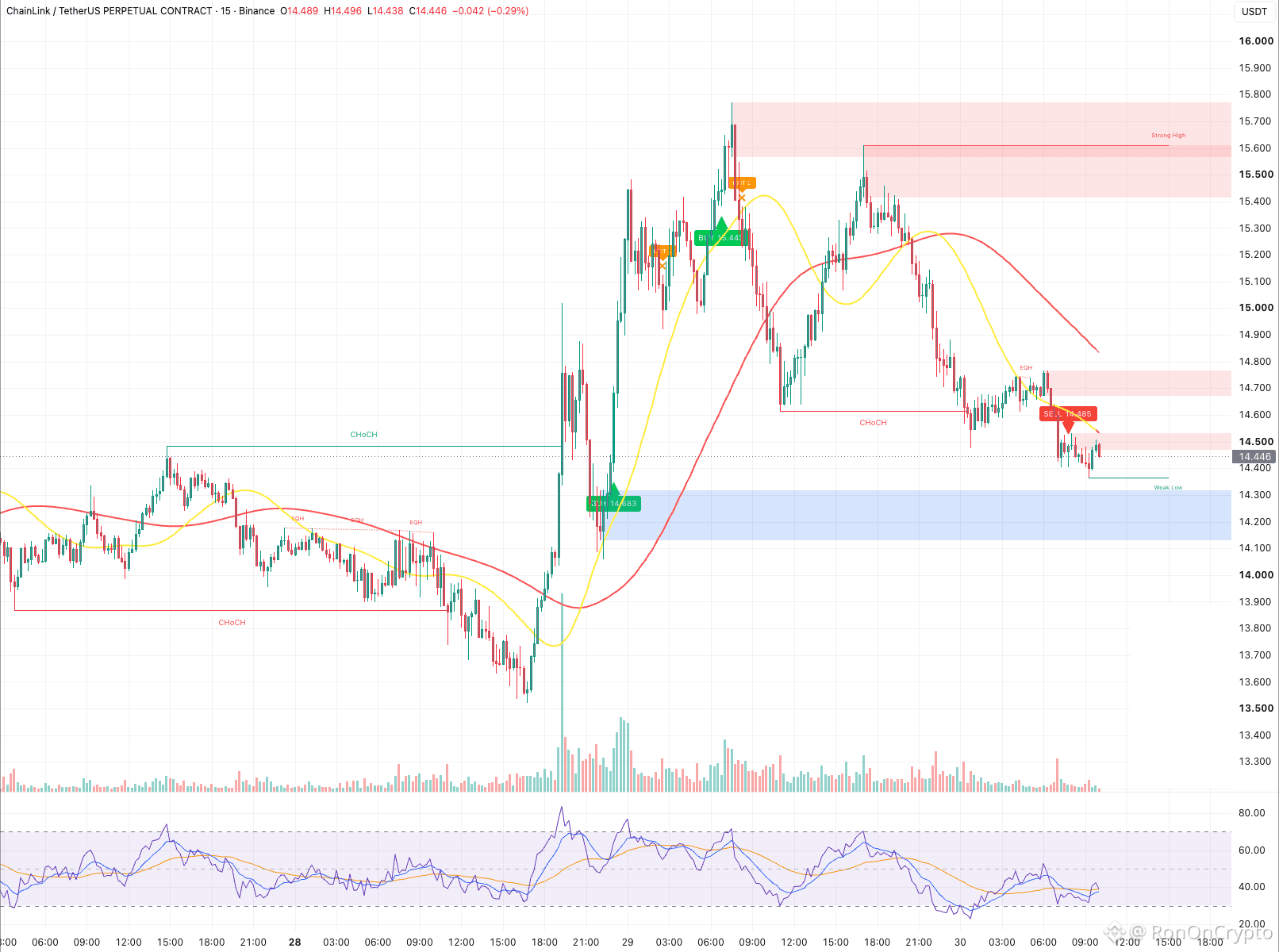
$LINK 14,4 — phân tích khung 1H, 30m, 15m.
Hôm qua mình hỏi 15,0 đỡ hay thủng. Thủng lúc 10h, xuống 14,62.
Chiều qua hồi lên 15,61 nhưng bị đè ở vùng 15,4–15,6, rồi trượt cả đêm về 14,36 sáng nay.
1H, 30m, 15m đều đang điều chỉnh, đường trung bình khung nhỏ quay xuống. Chỉ báo khung 15m đang giữ short từ 14,49. Khung ngày đang nghỉ, chưa gãy xu hướng.
Trên: 14,5 rồi 14,7–14,8.
Dưới: 14,1–14,3, đúng vùng hôm qua mình ghi.
14,1–14,3 — đỡ được hay thủng?
Quan sát cá nhân, không phải khuyến nghị. Rủi ro 1%, luôn có điểm dừng.
#LINK #Chainlink $LINK
$LINK 14,4 — phân tích khung 1H, 30m, 15m.
Hôm qua mình hỏi 15,0 đỡ hay thủng. Thủng lúc 10h, xuống 14,62.
Chiều qua hồi lên 15,61 nhưng bị đè ở vùng 15,4–15,6, rồi trượt cả đêm về 14,36 sáng nay.
1H, 30m, 15m đều đang điều chỉnh, đường trung bình khung nhỏ quay xuống. Chỉ báo khung 15m đang giữ short từ 14,49. Khung ngày đang nghỉ, chưa gãy xu hướng.
Trên: 14,5 rồi 14,7–14,8.
Dưới: 14,1–14,3, đúng vùng hôm qua mình ghi.
14,1–14,3 — đỡ được hay thủng?
Quan sát cá nhân, không phải khuyến nghị. Rủi ro 1%, luôn có điểm dừng.
#LINK #Chainlink $LINK
Hôm qua mình hỏi 15,0 đỡ hay thủng. Thủng lúc 10h, xuống 14,62.
Chiều qua hồi lên 15,61 nhưng bị đè ở vùng 15,4–15,6, rồi trượt cả đêm về 14,36 sáng nay.
1H, 30m, 15m đều đang điều chỉnh, đường trung bình khung nhỏ quay xuống. Chỉ báo khung 15m đang giữ short từ 14,49. Khung ngày đang nghỉ, chưa gãy xu hướng.
Trên: 14,5 rồi 14,7–14,8.
Dưới: 14,1–14,3, đúng vùng hôm qua mình ghi.
14,1–14,3 — đỡ được hay thủng?
Quan sát cá nhân, không phải khuyến nghị. Rủi ro 1%, luôn có điểm dừng.
#LINK #Chainlink $LINK
1
1.9k

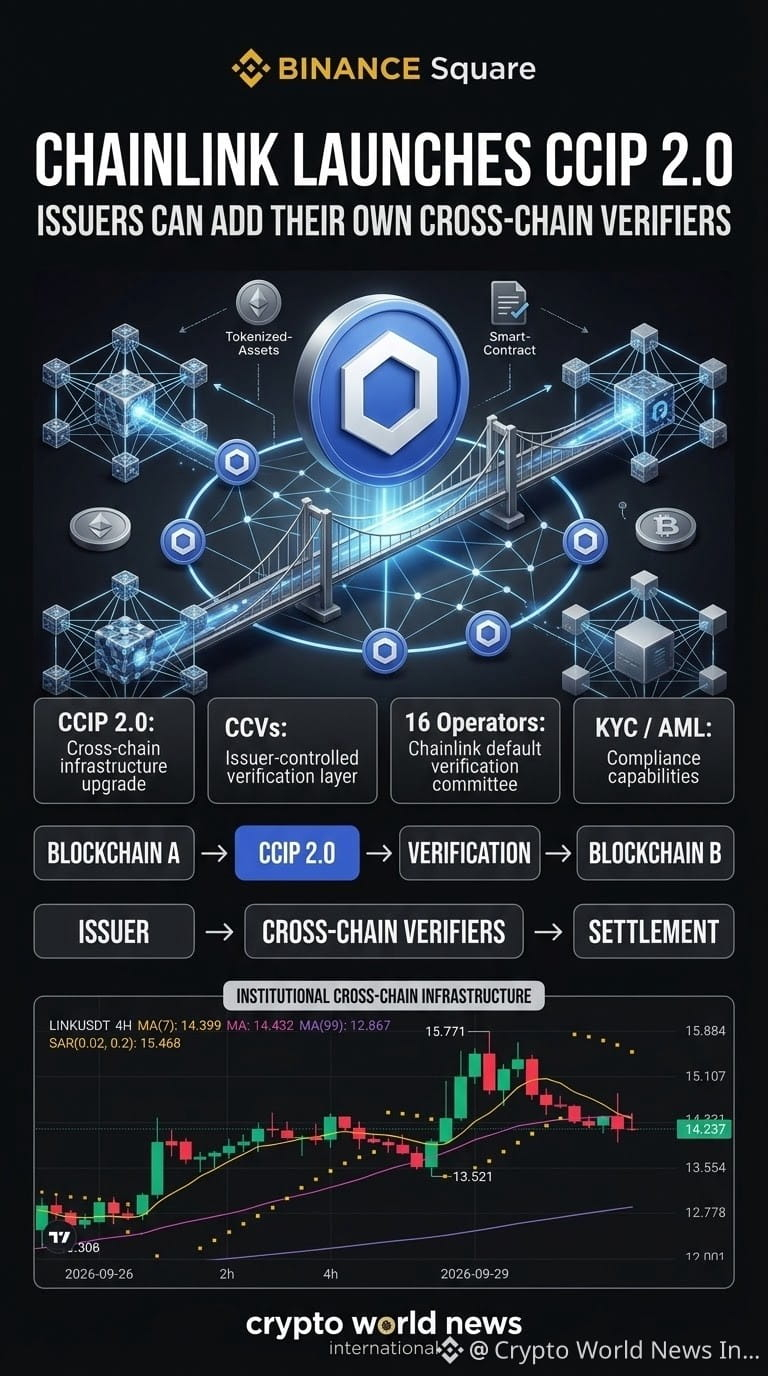
🚨 CHAINLINK LAUNCHES CCIP 2.0 — ISSUERS CAN ADD THEIR OWN VERIFIERS
Chainlink has launched CCIP 2.0, giving institutions and digital-asset issuers more control over how cross-chain transfers are verified, settled, and monitored.
🔑 Key Points:
• New Cross-Chain Verifiers (CCVs) can add an extra verification layer
• Chainlink’s default 16-operator committee remains part of the verification process
• Institutions can configure confirmation and settlement requirements
• Built-in compliance functions support KYC, AML and sanctions-related checks
• CCIP 2.0 is designed for institutional digital-asset and tokenized-asset distribution
📊 Market Insight:
The upgrade strengthens Chainlink’s focus on institutional interoperability and tokenized assets. The key development is not simply faster transfers — it is the ability to customize verification and compliance requirements for different assets and institutions.
🪙 Asset to Watch: LINK
#Chainlink #LINK #CCIP #crypto #Tokenization $LINK
{future}(LINKUSDT)
🚨 CHAINLINK LAUNCHES CCIP 2.0 — ISSUERS CAN ADD THEIR OWN VERIFIERS
Chainlink has launched CCIP 2.0, giving institutions and digital-asset issuers more control over how cross-chain transfers are verified, settled, and monitored.
🔑 Key Points:
• New Cross-Chain Verifiers (CCVs) can add an extra verification layer
• Chainlink’s default 16-operator committee remains part of the verification process
• Institutions can configure confirmation and settlement requirements
• Built-in compliance functions support KYC, AML and sanctions-related checks
• CCIP 2.0 is designed for institutional digital-asset and tokenized-asset distribution
📊 Market Insight:
The upgrade strengthens Chainlink’s focus on institutional interoperability and tokenized assets. The key development is not simply faster transfers — it is the ability to customize verification and compliance requirements for different assets and institutions.
🪙 Asset to Watch: LINK
#Chainlink #LINK #CCIP #crypto #Tokenization $LINK
Chainlink has launched CCIP 2.0, giving institutions and digital-asset issuers more control over how cross-chain transfers are verified, settled, and monitored.
🔑 Key Points:
• New Cross-Chain Verifiers (CCVs) can add an extra verification layer
• Chainlink’s default 16-operator committee remains part of the verification process
• Institutions can configure confirmation and settlement requirements
• Built-in compliance functions support KYC, AML and sanctions-related checks
• CCIP 2.0 is designed for institutional digital-asset and tokenized-asset distribution
📊 Market Insight:
The upgrade strengthens Chainlink’s focus on institutional interoperability and tokenized assets. The key development is not simply faster transfers — it is the ability to customize verification and compliance requirements for different assets and institutions.
🪙 Asset to Watch: LINK
#Chainlink #LINK #CCIP #crypto #Tokenization $LINK
7

·
--
🚨 ¿CHAINLINK ESTÁ ENTRANDO EN EL RADAR INSTITUCIONAL?
Mientras Bitcoin y Ethereum siguen dominando los ETF, Chainlink empieza a aparecer cada vez más en movimientos institucionales.
Grayscale incrementó durante septiembre sus posiciones de LINK en aproximadamente 629,100 LINK, valorados en unos $8.37 MILLONES al momento del reporte.
¿Por qué importa?
Chainlink no compite directamente con Bitcoin como reserva de valor.
Su narrativa es diferente:
🔗 Oráculos
🏦 Infraestructura financiera
🌐 Datos para aplicaciones on-chain
💰 Tokenización de activos
Y precisamente esa infraestructura podría convertirse en una de las piezas importantes de la conexión entre finanzas tradicionales y blockchain.
¿LINK es una altcoin infravalorada o el mercado ya está descontando esta narrativa?
#Chainlink #LINK #altcoins #RWA
🚨 ¿CHAINLINK ESTÁ ENTRANDO EN EL RADAR INSTITUCIONAL?
Mientras Bitcoin y Ethereum siguen dominando los ETF, Chainlink empieza a aparecer cada vez más en movimientos institucionales.
Grayscale incrementó durante septiembre sus posiciones de LINK en aproximadamente 629,100 LINK, valorados en unos $8.37 MILLONES al momento del reporte.
¿Por qué importa?
Chainlink no compite directamente con Bitcoin como reserva de valor.
Su narrativa es diferente:
🔗 Oráculos
🏦 Infraestructura financiera
🌐 Datos para aplicaciones on-chain
💰 Tokenización de activos
Y precisamente esa infraestructura podría convertirse en una de las piezas importantes de la conexión entre finanzas tradicionales y blockchain.
¿LINK es una altcoin infravalorada o el mercado ya está descontando esta narrativa?
#Chainlink #LINK #altcoins #RWA
Mientras Bitcoin y Ethereum siguen dominando los ETF, Chainlink empieza a aparecer cada vez más en movimientos institucionales.
Grayscale incrementó durante septiembre sus posiciones de LINK en aproximadamente 629,100 LINK, valorados en unos $8.37 MILLONES al momento del reporte.
¿Por qué importa?
Chainlink no compite directamente con Bitcoin como reserva de valor.
Su narrativa es diferente:
🔗 Oráculos
🏦 Infraestructura financiera
🌐 Datos para aplicaciones on-chain
💰 Tokenización de activos
Y precisamente esa infraestructura podría convertirse en una de las piezas importantes de la conexión entre finanzas tradicionales y blockchain.
¿LINK es una altcoin infravalorada o el mercado ya está descontando esta narrativa?
#Chainlink #LINK #altcoins #RWA
129

Статья
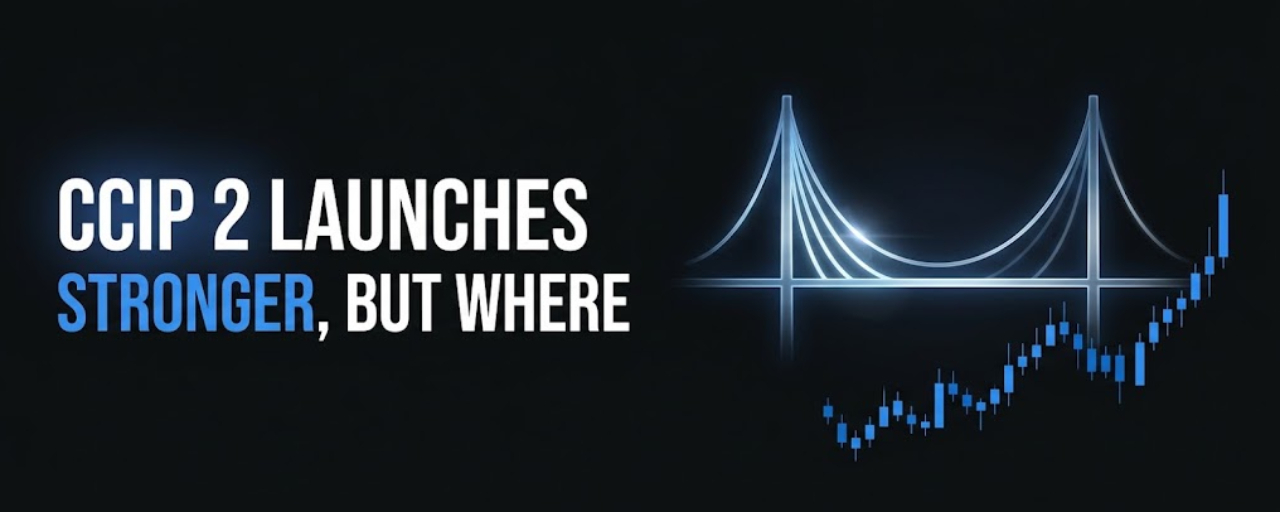
Chainlink Launches CCIP 2 After the $292M Kelp Hack: What Actually ChangedEnterprises can now add their own validators on top of Chainlink's network. Here's how the upgrade works, and one safeguard that quietly got weaker.
🔧 Five months after a 292-million-dollar bridge hack, the infrastructure behind it just got rebuilt. Whether it's actually stronger depends on who's reading the fine print.
Chainlink launched CCIP 2, a major upgrade to its cross-chain interoperability and bridge infrastructure, on Monday. The timing isn't a coincidence.
💥 Here's the hack that made this upgrade necessary.
Back in April, attackers linked to North Korea's Lazarus Group tricked a single validator used by Kelp DAO's cross-chain bridge and stole roughly 292 million dollars' worth of rsETH from a bridge running on LayerZero. The two companies involved publicly disagreed about who was at fault, LayerZero blamed Kelp for relying on only one validator, while Kelp said LayerZero's own staff had reviewed the setup and raised no objections at the time. Kelp later announced it would migrate to Chainlink entirely.
⚙️ Here's what CCIP 2 actually adds.
Enterprises can now layer their own security verification checks on top of Chainlink's default network of 16 independent node operators. Companies can run their own validators, or hire outside providers like Infosys and Nethermind, to add redundant verification before a cross-chain transaction gets approved. That's a direct structural answer to the single-point-of-failure problem that let the Kelp hack happen in the first place.
⚠️ Here's the trade-off most coverage is glossing over.
Chainlink also changed a safeguard it previously promoted heavily. Its risk management network used to operate as a separate, independent review layer. Under CCIP 2, those checks now run through the same optional validator system instead. That means a user or institution that chooses not to add any extra validators is now relying on a single verification network, where previously they'd have had two independent layers checking transactions by default.
🧠 Why does that nuance actually matter?
Because the upgrade's real strength depends entirely on adoption. For institutions that actively add their own validators, like the Kelp migration suggests will happen, CCIP 2 is a genuine security improvement, more eyes, more redundancy, harder to trick a single point of failure. But for anyone who sticks with the default setup and adds nothing extra, the baseline protection may actually be thinner than what existed before, since the separate risk management layer no longer runs independently by default.
This is a classic security trade-off, more customizable, more powerful when configured properly, but the safety net for passive or default users isn't automatically stronger just because the system got more sophisticated.
✅ What this means for you
If you're using protocols built on Chainlink's infrastructure, check whether they're actually adding extra validators under CCIP 2 or relying on the default setup. That distinction now matters more for your actual security than it did under the previous version.
If you're evaluating cross-chain bridge risk generally, the Kelp hack and this response are a genuinely useful case study, single points of failure in bridge validation have been a recurring attack vector and watching how infrastructure providers respond to real incidents tells you a lot about whether the ecosystem is actually learning from past breaches.
If you're holding $LINK, this upgrade represents real, substantive infrastructure improvement with confirmed institutional adoption already starting, Aave and Maple have begun using other features of the upgrade, and Kelp's migration is already underway. That's a stronger signal than a typical announcement with no confirmed users yet.
🟢 Bullish scenario
Major institutions widely adopt the enhanced validator options, Chainlink's infrastructure becomes the clear standard for secure cross-chain operations following a real, public incident, and adoption momentum continues building from Aave, Maple, and others.
🔴 Risk scenario
Adoption of the optional extra validators stays limited, most users and protocols default to the baseline setup, and the thinner default protection becomes a liability if another attacker specifically targets that gap.
👀 Three things to watch
1️⃣ Validator adoption rates
Do more institutions actually add their own verification layers, or does most usage stay on the default configuration?
2️⃣ Named institutional users
Does Chainlink eventually disclose which specific institutions are using the new validator options, beyond the general mention so far?
3️⃣ Any future incidents
Does CCIP 2's new structure actually prevent a similar single-point-of-failure attack, or does a gap in the default setup get tested?
💡 The key takeaway
This isn't a simple "problem solved" story. Chainlink built a genuinely more flexible, more secure system for institutions willing to configure it properly, while quietly removing a safety net that used to apply to everyone by default.
The real question is whether the ecosystem actually adopts the stronger configuration at scale, or whether this upgrade mostly benefits sophisticated institutions while leaving smaller or passive users with a thinner default than they had before.
That is the part worth watching.
This post is for informational and educational purposes only and is not financial advice. Crypto markets are volatile. Always conduct your own research before making financial decisions.
#BinanceSquare #Chainlink #LINK #CrossChain #Crypto
{spot}(LINKUSDT)
Chainlink Launches CCIP 2 After the $292M Kelp Hack: What Actually Changed
Enterprises can now add their own validators on top of Chainlink's network. Here's how the upgrade works, and one safeguard that quietly got weaker.
🔧 Five months after a 292-million-dollar bridge hack, the infrastructure behind it just got rebuilt. Whether it's actually stronger depends on who's reading the fine print.
Chainlink launched CCIP 2, a major upgrade to its cross-chain interoperability and bridge infrastructure, on Monday. The timing isn't a coincidence.
💥 Here's the hack that made this upgrade necessary.
Back in April, attackers linked to North Korea's Lazarus Group tricked a single validator used by Kelp DAO's cross-chain bridge and stole roughly 292 million dollars' worth of rsETH from a bridge running on LayerZero. The two companies involved publicly disagreed about who was at fault, LayerZero blamed Kelp for relying on only one validator, while Kelp said LayerZero's own staff had reviewed the setup and raised no objections at the time. Kelp later announced it would migrate to Chainlink entirely.
⚙️ Here's what CCIP 2 actually adds.
Enterprises can now layer their own security verification checks on top of Chainlink's default network of 16 independent node operators. Companies can run their own validators, or hire outside providers like Infosys and Nethermind, to add redundant verification before a cross-chain transaction gets approved. That's a direct structural answer to the single-point-of-failure problem that let the Kelp hack happen in the first place.
⚠️ Here's the trade-off most coverage is glossing over.
Chainlink also changed a safeguard it previously promoted heavily. Its risk management network used to operate as a separate, independent review layer. Under CCIP 2, those checks now run through the same optional validator system instead. That means a user or institution that chooses not to add any extra validators is now relying on a single verification network, where previously they'd have had two independent layers checking transactions by default.
🧠 Why does that nuance actually matter?
Because the upgrade's real strength depends entirely on adoption. For institutions that actively add their own validators, like the Kelp migration suggests will happen, CCIP 2 is a genuine security improvement, more eyes, more redundancy, harder to trick a single point of failure. But for anyone who sticks with the default setup and adds nothing extra, the baseline protection may actually be thinner than what existed before, since the separate risk management layer no longer runs independently by default.
This is a classic security trade-off, more customizable, more powerful when configured properly, but the safety net for passive or default users isn't automatically stronger just because the system got more sophisticated.
✅ What this means for you
If you're using protocols built on Chainlink's infrastructure, check whether they're actually adding extra validators under CCIP 2 or relying on the default setup. That distinction now matters more for your actual security than it did under the previous version.
If you're evaluating cross-chain bridge risk generally, the Kelp hack and this response are a genuinely useful case study, single points of failure in bridge validation have been a recurring attack vector and watching how infrastructure providers respond to real incidents tells you a lot about whether the ecosystem is actually learning from past breaches.
If you're holding $LINK, this upgrade represents real, substantive infrastructure improvement with confirmed institutional adoption already starting, Aave and Maple have begun using other features of the upgrade, and Kelp's migration is already underway. That's a stronger signal than a typical announcement with no confirmed users yet.
🟢 Bullish scenario
Major institutions widely adopt the enhanced validator options, Chainlink's infrastructure becomes the clear standard for secure cross-chain operations following a real, public incident, and adoption momentum continues building from Aave, Maple, and others.
🔴 Risk scenario
Adoption of the optional extra validators stays limited, most users and protocols default to the baseline setup, and the thinner default protection becomes a liability if another attacker specifically targets that gap.
👀 Three things to watch
1️⃣ Validator adoption rates
Do more institutions actually add their own verification layers, or does most usage stay on the default configuration?
2️⃣ Named institutional users
Does Chainlink eventually disclose which specific institutions are using the new validator options, beyond the general mention so far?
3️⃣ Any future incidents
Does CCIP 2's new structure actually prevent a similar single-point-of-failure attack, or does a gap in the default setup get tested?
💡 The key takeaway
This isn't a simple "problem solved" story. Chainlink built a genuinely more flexible, more secure system for institutions willing to configure it properly, while quietly removing a safety net that used to apply to everyone by default.
The real question is whether the ecosystem actually adopts the stronger configuration at scale, or whether this upgrade mostly benefits sophisticated institutions while leaving smaller or passive users with a thinner default than they had before.
That is the part worth watching.
This post is for informational and educational purposes only and is not financial advice. Crypto markets are volatile. Always conduct your own research before making financial decisions.
#BinanceSquare #Chainlink #LINK #CrossChain #Crypto
🔧 Five months after a 292-million-dollar bridge hack, the infrastructure behind it just got rebuilt. Whether it's actually stronger depends on who's reading the fine print.
Chainlink launched CCIP 2, a major upgrade to its cross-chain interoperability and bridge infrastructure, on Monday. The timing isn't a coincidence.
💥 Here's the hack that made this upgrade necessary.
Back in April, attackers linked to North Korea's Lazarus Group tricked a single validator used by Kelp DAO's cross-chain bridge and stole roughly 292 million dollars' worth of rsETH from a bridge running on LayerZero. The two companies involved publicly disagreed about who was at fault, LayerZero blamed Kelp for relying on only one validator, while Kelp said LayerZero's own staff had reviewed the setup and raised no objections at the time. Kelp later announced it would migrate to Chainlink entirely.
⚙️ Here's what CCIP 2 actually adds.
Enterprises can now layer their own security verification checks on top of Chainlink's default network of 16 independent node operators. Companies can run their own validators, or hire outside providers like Infosys and Nethermind, to add redundant verification before a cross-chain transaction gets approved. That's a direct structural answer to the single-point-of-failure problem that let the Kelp hack happen in the first place.
⚠️ Here's the trade-off most coverage is glossing over.
Chainlink also changed a safeguard it previously promoted heavily. Its risk management network used to operate as a separate, independent review layer. Under CCIP 2, those checks now run through the same optional validator system instead. That means a user or institution that chooses not to add any extra validators is now relying on a single verification network, where previously they'd have had two independent layers checking transactions by default.
🧠 Why does that nuance actually matter?
Because the upgrade's real strength depends entirely on adoption. For institutions that actively add their own validators, like the Kelp migration suggests will happen, CCIP 2 is a genuine security improvement, more eyes, more redundancy, harder to trick a single point of failure. But for anyone who sticks with the default setup and adds nothing extra, the baseline protection may actually be thinner than what existed before, since the separate risk management layer no longer runs independently by default.
This is a classic security trade-off, more customizable, more powerful when configured properly, but the safety net for passive or default users isn't automatically stronger just because the system got more sophisticated.
✅ What this means for you
If you're using protocols built on Chainlink's infrastructure, check whether they're actually adding extra validators under CCIP 2 or relying on the default setup. That distinction now matters more for your actual security than it did under the previous version.
If you're evaluating cross-chain bridge risk generally, the Kelp hack and this response are a genuinely useful case study, single points of failure in bridge validation have been a recurring attack vector and watching how infrastructure providers respond to real incidents tells you a lot about whether the ecosystem is actually learning from past breaches.
If you're holding $LINK, this upgrade represents real, substantive infrastructure improvement with confirmed institutional adoption already starting, Aave and Maple have begun using other features of the upgrade, and Kelp's migration is already underway. That's a stronger signal than a typical announcement with no confirmed users yet.
🟢 Bullish scenario
Major institutions widely adopt the enhanced validator options, Chainlink's infrastructure becomes the clear standard for secure cross-chain operations following a real, public incident, and adoption momentum continues building from Aave, Maple, and others.
🔴 Risk scenario
Adoption of the optional extra validators stays limited, most users and protocols default to the baseline setup, and the thinner default protection becomes a liability if another attacker specifically targets that gap.
👀 Three things to watch
1️⃣ Validator adoption rates
Do more institutions actually add their own verification layers, or does most usage stay on the default configuration?
2️⃣ Named institutional users
Does Chainlink eventually disclose which specific institutions are using the new validator options, beyond the general mention so far?
3️⃣ Any future incidents
Does CCIP 2's new structure actually prevent a similar single-point-of-failure attack, or does a gap in the default setup get tested?
💡 The key takeaway
This isn't a simple "problem solved" story. Chainlink built a genuinely more flexible, more secure system for institutions willing to configure it properly, while quietly removing a safety net that used to apply to everyone by default.
The real question is whether the ecosystem actually adopts the stronger configuration at scale, or whether this upgrade mostly benefits sophisticated institutions while leaving smaller or passive users with a thinner default than they had before.
That is the part worth watching.
This post is for informational and educational purposes only and is not financial advice. Crypto markets are volatile. Always conduct your own research before making financial decisions.
#BinanceSquare #Chainlink #LINK #CrossChain #Crypto
1
27

·
--
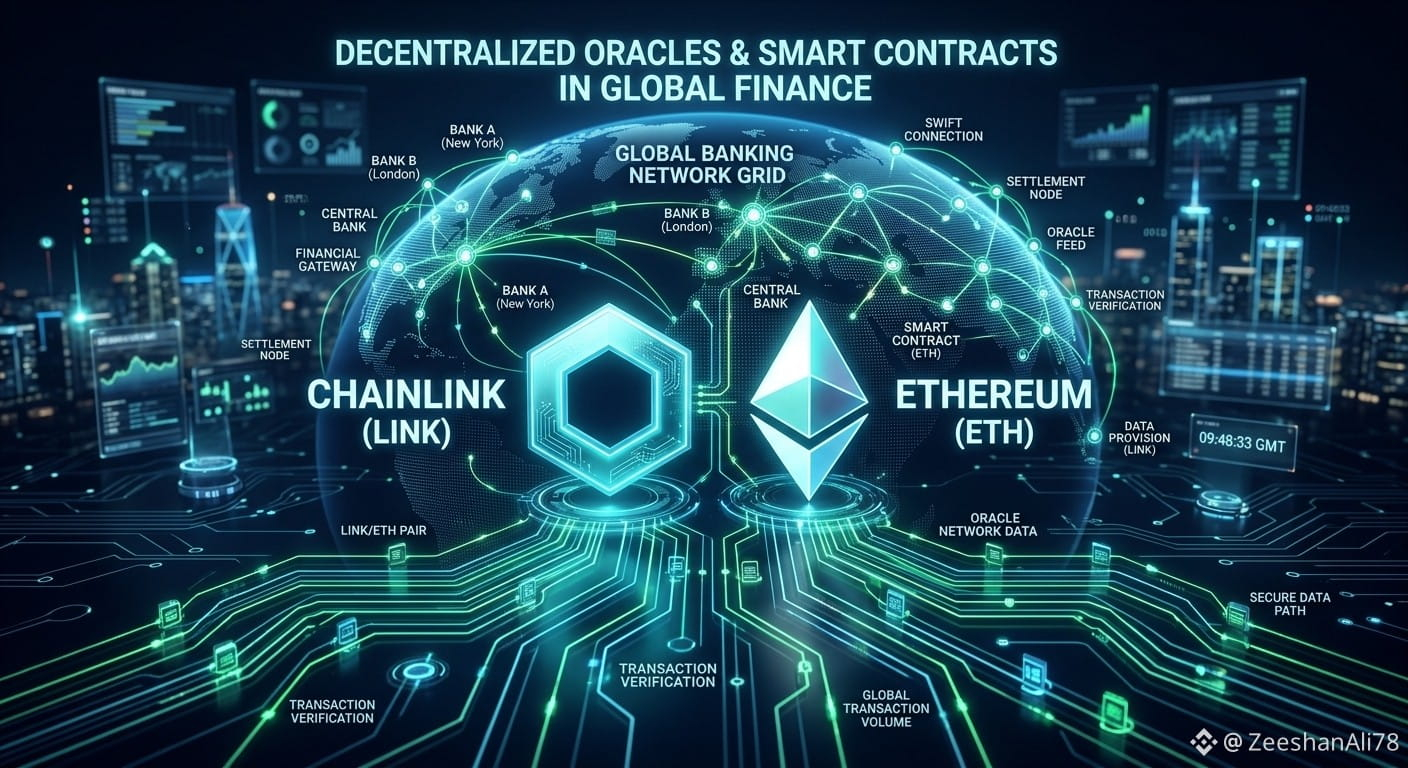
🏦 Institutional Web3 Milestone: Chainlink SWIFT Ledger Framework & On-Chain Stocks! 🌐
Institutional crypto adoption is hitting new record speed! With #ChainlinkLaunchesBankSWIFTLedger trending on Binance Square alongside discussions on moving traditional stock markets on-chain, traditional finance is bridging rapidly with Web3!
Key Takeaways for Investors:
🏛️ Institutional Bridge: SWIFT integration opens seamless bank-to-blockchain settlement rails.
🏛️ Real-World Assets (RWA): Tokenized stocks and assets are becoming the next trillion-dollar market.
🏛️️ Infrastructure Growth: Major network tokens like $ETH and $LINK stand to benefit from long-term institutional volume.
Are you accumulating RWA and infrastructure tokens for this cycle? Share your top picks! 💬👇
🎯 Click $ETH chart widget below to view live technical levels & trade!
#Chainlink
{spot}(ETHUSDT)
{spot}(LINKUSDT)
#Ethereum #ETH #RWA #Binance
🏦 Institutional Web3 Milestone: Chainlink SWIFT Ledger Framework & On-Chain Stocks! 🌐
Institutional crypto adoption is hitting new record speed! With #ChainlinkLaunchesBankSWIFTLedger trending on Binance Square alongside discussions on moving traditional stock markets on-chain, traditional finance is bridging rapidly with Web3!
Key Takeaways for Investors:
🏛️ Institutional Bridge: SWIFT integration opens seamless bank-to-blockchain settlement rails.
🏛️ Real-World Assets (RWA): Tokenized stocks and assets are becoming the next trillion-dollar market.
🏛️️ Infrastructure Growth: Major network tokens like $ETH and $LINK stand to benefit from long-term institutional volume.
Are you accumulating RWA and infrastructure tokens for this cycle? Share your top picks! 💬👇
🎯 Click $ETH chart widget below to view live technical levels & trade!
#Chainlink
#Ethereum #ETH #RWA #Binance
Institutional crypto adoption is hitting new record speed! With #ChainlinkLaunchesBankSWIFTLedger trending on Binance Square alongside discussions on moving traditional stock markets on-chain, traditional finance is bridging rapidly with Web3!
Key Takeaways for Investors:
🏛️ Institutional Bridge: SWIFT integration opens seamless bank-to-blockchain settlement rails.
🏛️ Real-World Assets (RWA): Tokenized stocks and assets are becoming the next trillion-dollar market.
🏛️️ Infrastructure Growth: Major network tokens like $ETH and $LINK stand to benefit from long-term institutional volume.
Are you accumulating RWA and infrastructure tokens for this cycle? Share your top picks! 💬👇
🎯 Click $ETH chart widget below to view live technical levels & trade!
#Chainlink
#Ethereum #ETH #RWA #Binance
52

#crypto
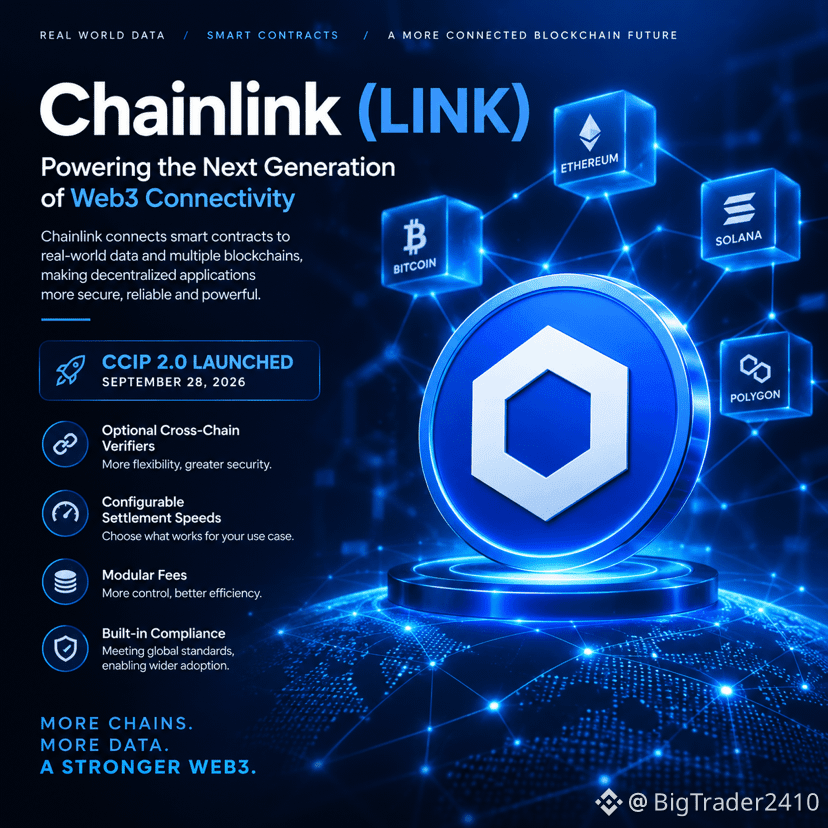
🚀 Chainlink (LINK) – The Future of Blockchain Technology! 🔗
💎 Chainlink (LINK) is one of the leading blockchain oracle networks, connecting smart contracts with real-world data.
🔥 Why Chainlink Matters
✅ Connects blockchains to real-world data.
✅ Supports DeFi and smart contracts.
✅ Enables cross-chain communication.
✅ Partners with major companies and blockchain projects.
📊 Market Outlook: LINK is a cryptocurrency worth watching as blockchain adoption grows. However, its price can be volatile, and future performance is uncertain.
🐂 Bullish Scenario: Growing adoption of Chainlink technology could increase demand for LINK.
🐻 Bearish Scenario: Market downturns and reduced demand could put pressure on its price.
💡 My Take: Keep an eye on LINK’s price action, trading volume, and market trends. Always do your own research before investing.
🚀 Is Chainlink ready for its next big move?
👇 Comment your LINK price prediction!
#BitcoinClears$85200 #Chainlink #crypto
#crypto
🚀 Chainlink (LINK) – The Future of Blockchain Technology! 🔗
💎 Chainlink (LINK) is one of the leading blockchain oracle networks, connecting smart contracts with real-world data.
🔥 Why Chainlink Matters
✅ Connects blockchains to real-world data.
✅ Supports DeFi and smart contracts.
✅ Enables cross-chain communication.
✅ Partners with major companies and blockchain projects.
📊 Market Outlook: LINK is a cryptocurrency worth watching as blockchain adoption grows. However, its price can be volatile, and future performance is uncertain.
🐂 Bullish Scenario: Growing adoption of Chainlink technology could increase demand for LINK.
🐻 Bearish Scenario: Market downturns and reduced demand could put pressure on its price.
💡 My Take: Keep an eye on LINK’s price action, trading volume, and market trends. Always do your own research before investing.
🚀 Is Chainlink ready for its next big move?
👇 Comment your LINK price prediction!
#BitcoinClears$85200 #Chainlink #crypto
🚀 Chainlink (LINK) – The Future of Blockchain Technology! 🔗
💎 Chainlink (LINK) is one of the leading blockchain oracle networks, connecting smart contracts with real-world data.
🔥 Why Chainlink Matters
✅ Connects blockchains to real-world data.
✅ Supports DeFi and smart contracts.
✅ Enables cross-chain communication.
✅ Partners with major companies and blockchain projects.
📊 Market Outlook: LINK is a cryptocurrency worth watching as blockchain adoption grows. However, its price can be volatile, and future performance is uncertain.
🐂 Bullish Scenario: Growing adoption of Chainlink technology could increase demand for LINK.
🐻 Bearish Scenario: Market downturns and reduced demand could put pressure on its price.
💡 My Take: Keep an eye on LINK’s price action, trading volume, and market trends. Always do your own research before investing.
🚀 Is Chainlink ready for its next big move?
👇 Comment your LINK price prediction!
#BitcoinClears$85200 #Chainlink #crypto
51

·
--
🔗 LINK — Today’s Focus
📉 $LINK
{spot}(LINKUSDT)
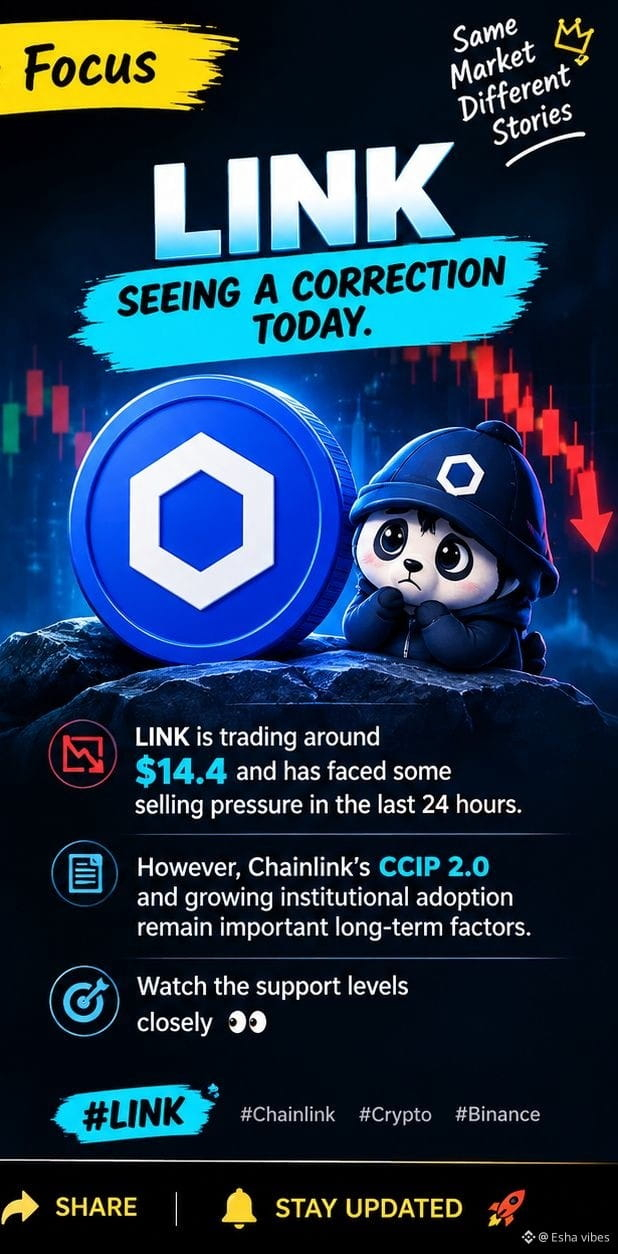
LINK is seeing a correction today.
LINK is trading around $14.4 and has faced some selling pressure in the last 24 hours.
However, Chainlink’s CCIP 2.0 and growing institutional adoption remain important long-term factors.
📌 Watch the support levels closely 👀
#LINK #Chainlink #Crypto #Binance
🔗 LINK — Today’s Focus
📉 $LINK
LINK is seeing a correction today.
LINK is trading around $14.4 and has faced some selling pressure in the last 24 hours.
However, Chainlink’s CCIP 2.0 and growing institutional adoption remain important long-term factors.
📌 Watch the support levels closely 👀
#LINK #Chainlink #Crypto #Binance
📉 $LINK
LINK is seeing a correction today.
LINK is trading around $14.4 and has faced some selling pressure in the last 24 hours.
However, Chainlink’s CCIP 2.0 and growing institutional adoption remain important long-term factors.
📌 Watch the support levels closely 👀
#LINK #Chainlink #Crypto #Binance
8

·
--
Рост
تتولى شركة Bottomline معالجة مدفوعات تتجاوز قيمتها 16 تريليون دولار سنوياً لصالح أكثر من 600 بنك. وفي مؤتمر Sibos 2026، تستعرض ناتاشا لابيير، الرئيسة العالمية لاستراتيجية المنتجات والابتكار في Bottomline، تفاصيل الشراكة الاستراتيجية التي تجمع الشركة بـ Chainlink ..
تفاصيل التأثير وأهمية الخبر:
المحرك الرئيسي للعملة (رمز LINK): تعمل شبكة Chainlink كجسر ربط برميجي (Oracle & Interoperability Layer) بين الأنظمة المالية التقليدية وشبكات البلوكشين. رمز LINK يُستخدم لدفعة رسوم الخدمات وتأمين البيانات وتفعيل بروتوكولات الربط عبر الشبكة (مثل CCIP).
أهمية الشراكة مع Bottomline: تُعالج شركة Bottomline معاملات مالية ضخمة تتجاوز 16 تريليون دولار سنوياً عبر نظام Swift والشبكات البنكية العالمية لصالح آلاف المؤسسات وأكثر من 600 بنك. دمج تقنيات Chainlink أو بناء حلول مشتركة لنقل الأصول وإدارة السيولة رقمياً مع شريك بهذا الحجم يعزز الاعتماد المؤسسي (Institutional Adoption) على شبكة Chainlink.
الربط مع النظام المالي العالمي: إعلان شراكات من هذا النوع خلال مؤتمر Sibos (الذي ينظمه سويفت ويجمع قادة القطاع المصرفي عالمياً) يعطي مشروع Chainlink شرعية ومكانة كبنية تحتية موثوقة لربط البنوك التقليدية بالتقنيات المالية الحديثة والأصول المرمزة (Tokenized Assets).
#LINK #Swift #Chainlink #UpdateAlert
$LINK
{spot}(LINKUSDT)
تتولى شركة Bottomline معالجة مدفوعات تتجاوز قيمتها 16 تريليون دولار سنوياً لصالح أكثر من 600 بنك. وفي مؤتمر Sibos 2026، تستعرض ناتاشا لابيير، الرئيسة العالمية لاستراتيجية المنتجات والابتكار في Bottomline، تفاصيل الشراكة الاستراتيجية التي تجمع الشركة بـ Chainlink ..
تفاصيل التأثير وأهمية الخبر:
المحرك الرئيسي للعملة (رمز LINK): تعمل شبكة Chainlink كجسر ربط برميجي (Oracle & Interoperability Layer) بين الأنظمة المالية التقليدية وشبكات البلوكشين. رمز LINK يُستخدم لدفعة رسوم الخدمات وتأمين البيانات وتفعيل بروتوكولات الربط عبر الشبكة (مثل CCIP).
أهمية الشراكة مع Bottomline: تُعالج شركة Bottomline معاملات مالية ضخمة تتجاوز 16 تريليون دولار سنوياً عبر نظام Swift والشبكات البنكية العالمية لصالح آلاف المؤسسات وأكثر من 600 بنك. دمج تقنيات Chainlink أو بناء حلول مشتركة لنقل الأصول وإدارة السيولة رقمياً مع شريك بهذا الحجم يعزز الاعتماد المؤسسي (Institutional Adoption) على شبكة Chainlink.
الربط مع النظام المالي العالمي: إعلان شراكات من هذا النوع خلال مؤتمر Sibos (الذي ينظمه سويفت ويجمع قادة القطاع المصرفي عالمياً) يعطي مشروع Chainlink شرعية ومكانة كبنية تحتية موثوقة لربط البنوك التقليدية بالتقنيات المالية الحديثة والأصول المرمزة (Tokenized Assets).
#LINK #Swift #Chainlink #UpdateAlert
$LINK
تفاصيل التأثير وأهمية الخبر:
المحرك الرئيسي للعملة (رمز LINK): تعمل شبكة Chainlink كجسر ربط برميجي (Oracle & Interoperability Layer) بين الأنظمة المالية التقليدية وشبكات البلوكشين. رمز LINK يُستخدم لدفعة رسوم الخدمات وتأمين البيانات وتفعيل بروتوكولات الربط عبر الشبكة (مثل CCIP).
أهمية الشراكة مع Bottomline: تُعالج شركة Bottomline معاملات مالية ضخمة تتجاوز 16 تريليون دولار سنوياً عبر نظام Swift والشبكات البنكية العالمية لصالح آلاف المؤسسات وأكثر من 600 بنك. دمج تقنيات Chainlink أو بناء حلول مشتركة لنقل الأصول وإدارة السيولة رقمياً مع شريك بهذا الحجم يعزز الاعتماد المؤسسي (Institutional Adoption) على شبكة Chainlink.
الربط مع النظام المالي العالمي: إعلان شراكات من هذا النوع خلال مؤتمر Sibos (الذي ينظمه سويفت ويجمع قادة القطاع المصرفي عالمياً) يعطي مشروع Chainlink شرعية ومكانة كبنية تحتية موثوقة لربط البنوك التقليدية بالتقنيات المالية الحديثة والأصول المرمزة (Tokenized Assets).
#LINK #Swift #Chainlink #UpdateAlert
$LINK
1
37

·
--
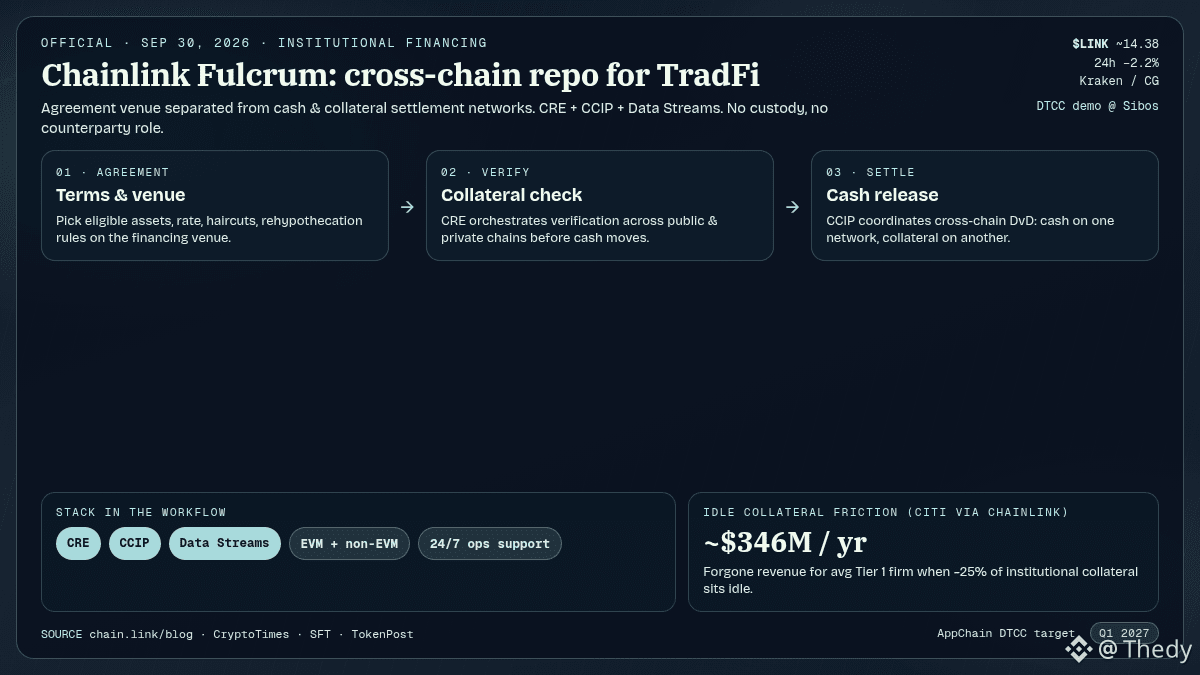
Chainlink lance Fulcrum: le repo cross-chain pour les institutions (annonce officielle, 30/09).
FAITS
Fulcrum est une couche de financement et de gestion collatérale bout-en-bout sur blockchains publiques et privées. L'idée clé: séparer le venue où l'accord de financement est géré des réseaux où cash et collatéral se règlent. Contreparties choisissent actifs éligibles, termes (ex. interdiction de réhypothécation) et settlement via une seule passerelle, avec support ops 24/7.
Stack: Chainlink Runtime Environment (CRE) pour orchestrer, CCIP pour messagerie / transferts cross-chain, Data Streams pour valoriser le collatéral et les haircuts. Chainlink ne custodie pas, n'est pas contrepartie et n'opère pas de venue. Demo avec DTCC à Sibos 2026; Collateral AppChain DTCC prévue T1 2027. Citi (cité par Chainlink): ~25% du collatéral institutionnel idle, ~346 M$ de revenus manqués / an pour une boîte Tier 1 moyenne.
LECTURE
Ce n'est pas un simple upgrade d'interop. Après CCIP 2.0, Fulcrum pousse $LINK vers le plumbing TradFi (repo, prime brokerage, custodians, treasuries). Pour le retail, le takeaway est infrastructure, pas un catalyseur prix immédiat. Spot ~22:56 UTC: $LINK ~14,38 (−2,2% 24h, Kraken/CG); $BTC ~83684 · $ETH ~2688.
SCÉNARIOS
• Base: intégrations venues TradFi + AppChain DTCC T1 2027, adoption lente mais crédible
• Upside: premiers flux repo tokenisés mesurables si les institutions routent vraiment via Fulcrum
• Risque: délais d'intégration, régulation, et "annonce > volume" tant que les venues ne sont pas live
Vous voyez Fulcrum plutôt comme suite logique de CCIP, ou comme le vrai produit qui peut ancrer $LINK en TradFi?
Sources: Chainlink blog (30/09), CryptoTimes, Securities Finance Times, TokenPost
#Chainlink #RWA #Crypto
Chainlink lance Fulcrum: le repo cross-chain pour les institutions (annonce officielle, 30/09).
FAITS
Fulcrum est une couche de financement et de gestion collatérale bout-en-bout sur blockchains publiques et privées. L'idée clé: séparer le venue où l'accord de financement est géré des réseaux où cash et collatéral se règlent. Contreparties choisissent actifs éligibles, termes (ex. interdiction de réhypothécation) et settlement via une seule passerelle, avec support ops 24/7.
Stack: Chainlink Runtime Environment (CRE) pour orchestrer, CCIP pour messagerie / transferts cross-chain, Data Streams pour valoriser le collatéral et les haircuts. Chainlink ne custodie pas, n'est pas contrepartie et n'opère pas de venue. Demo avec DTCC à Sibos 2026; Collateral AppChain DTCC prévue T1 2027. Citi (cité par Chainlink): ~25% du collatéral institutionnel idle, ~346 M$ de revenus manqués / an pour une boîte Tier 1 moyenne.
LECTURE
Ce n'est pas un simple upgrade d'interop. Après CCIP 2.0, Fulcrum pousse $LINK vers le plumbing TradFi (repo, prime brokerage, custodians, treasuries). Pour le retail, le takeaway est infrastructure, pas un catalyseur prix immédiat. Spot ~22:56 UTC: $LINK ~14,38 (−2,2% 24h, Kraken/CG); $BTC ~83684 · $ETH ~2688.
SCÉNARIOS
• Base: intégrations venues TradFi + AppChain DTCC T1 2027, adoption lente mais crédible
• Upside: premiers flux repo tokenisés mesurables si les institutions routent vraiment via Fulcrum
• Risque: délais d'intégration, régulation, et "annonce > volume" tant que les venues ne sont pas live
Vous voyez Fulcrum plutôt comme suite logique de CCIP, ou comme le vrai produit qui peut ancrer $LINK en TradFi?
Sources: Chainlink blog (30/09), CryptoTimes, Securities Finance Times, TokenPost
#Chainlink #RWA #Crypto
FAITS
Fulcrum est une couche de financement et de gestion collatérale bout-en-bout sur blockchains publiques et privées. L'idée clé: séparer le venue où l'accord de financement est géré des réseaux où cash et collatéral se règlent. Contreparties choisissent actifs éligibles, termes (ex. interdiction de réhypothécation) et settlement via une seule passerelle, avec support ops 24/7.
Stack: Chainlink Runtime Environment (CRE) pour orchestrer, CCIP pour messagerie / transferts cross-chain, Data Streams pour valoriser le collatéral et les haircuts. Chainlink ne custodie pas, n'est pas contrepartie et n'opère pas de venue. Demo avec DTCC à Sibos 2026; Collateral AppChain DTCC prévue T1 2027. Citi (cité par Chainlink): ~25% du collatéral institutionnel idle, ~346 M$ de revenus manqués / an pour une boîte Tier 1 moyenne.
LECTURE
Ce n'est pas un simple upgrade d'interop. Après CCIP 2.0, Fulcrum pousse $LINK vers le plumbing TradFi (repo, prime brokerage, custodians, treasuries). Pour le retail, le takeaway est infrastructure, pas un catalyseur prix immédiat. Spot ~22:56 UTC: $LINK ~14,38 (−2,2% 24h, Kraken/CG); $BTC ~83684 · $ETH ~2688.
SCÉNARIOS
• Base: intégrations venues TradFi + AppChain DTCC T1 2027, adoption lente mais crédible
• Upside: premiers flux repo tokenisés mesurables si les institutions routent vraiment via Fulcrum
• Risque: délais d'intégration, régulation, et "annonce > volume" tant que les venues ne sont pas live
Vous voyez Fulcrum plutôt comme suite logique de CCIP, ou comme le vrai produit qui peut ancrer $LINK en TradFi?
Sources: Chainlink blog (30/09), CryptoTimes, Securities Finance Times, TokenPost
#Chainlink #RWA #Crypto
11

·
--
$LINK long now ..
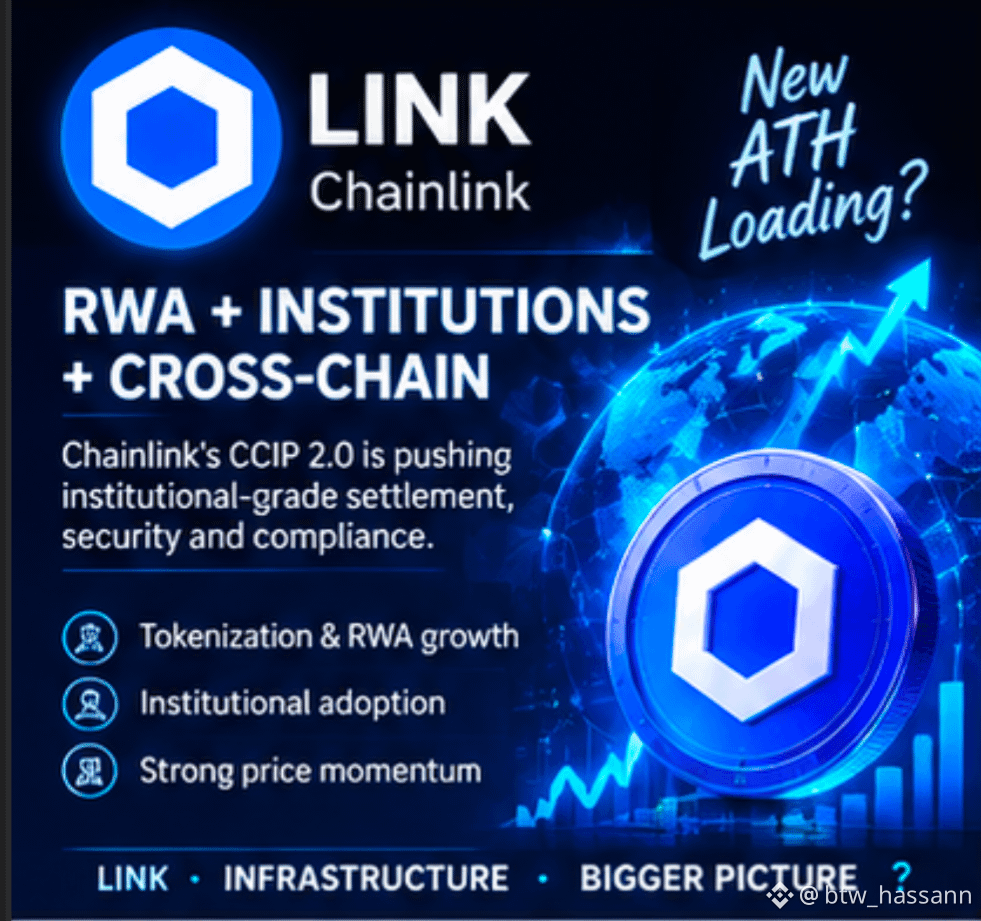
$ WHY IS CHAINLINK GETTING HOT AGAIN?
Chainlink ($LINK) is back on the radar as institutional and traditional-finance use cases around blockchain infrastructure continue expanding.
Recent developments around Chainlink's CCIP 2.0 are focusing on institutional-grade cross-chain settlement, security and compliance.
LINK has also recently shown strong price momentum, with reports of sharply higher trading activity.
The bigger narrative is simple:
Tokenization + institutional finance + cross-chain infrastructure.
If these trends continue growing, Chainlink remains one of the major infrastructure projects sitting directly in the middle of that narrative.
That's why LINK is worth watching
#LINK🔥🔥🔥 #Chainlink #defi
$LINK
{future}(LINKUSDT)
$LINK long now ..
$ WHY IS CHAINLINK GETTING HOT AGAIN?
Chainlink ($LINK ) is back on the radar as institutional and traditional-finance use cases around blockchain infrastructure continue expanding.
Recent developments around Chainlink's CCIP 2.0 are focusing on institutional-grade cross-chain settlement, security and compliance.
LINK has also recently shown strong price momentum, with reports of sharply higher trading activity.
The bigger narrative is simple:
Tokenization + institutional finance + cross-chain infrastructure.
If these trends continue growing, Chainlink remains one of the major infrastructure projects sitting directly in the middle of that narrative.
That's why LINK is worth watching
#LINK🔥🔥🔥 #Chainlink #defi
$LINK
$ WHY IS CHAINLINK GETTING HOT AGAIN?
Chainlink ($LINK ) is back on the radar as institutional and traditional-finance use cases around blockchain infrastructure continue expanding.
Recent developments around Chainlink's CCIP 2.0 are focusing on institutional-grade cross-chain settlement, security and compliance.
LINK has also recently shown strong price momentum, with reports of sharply higher trading activity.
The bigger narrative is simple:
Tokenization + institutional finance + cross-chain infrastructure.
If these trends continue growing, Chainlink remains one of the major infrastructure projects sitting directly in the middle of that narrative.
That's why LINK is worth watching
#LINK🔥🔥🔥 #Chainlink #defi
$LINK
1
9

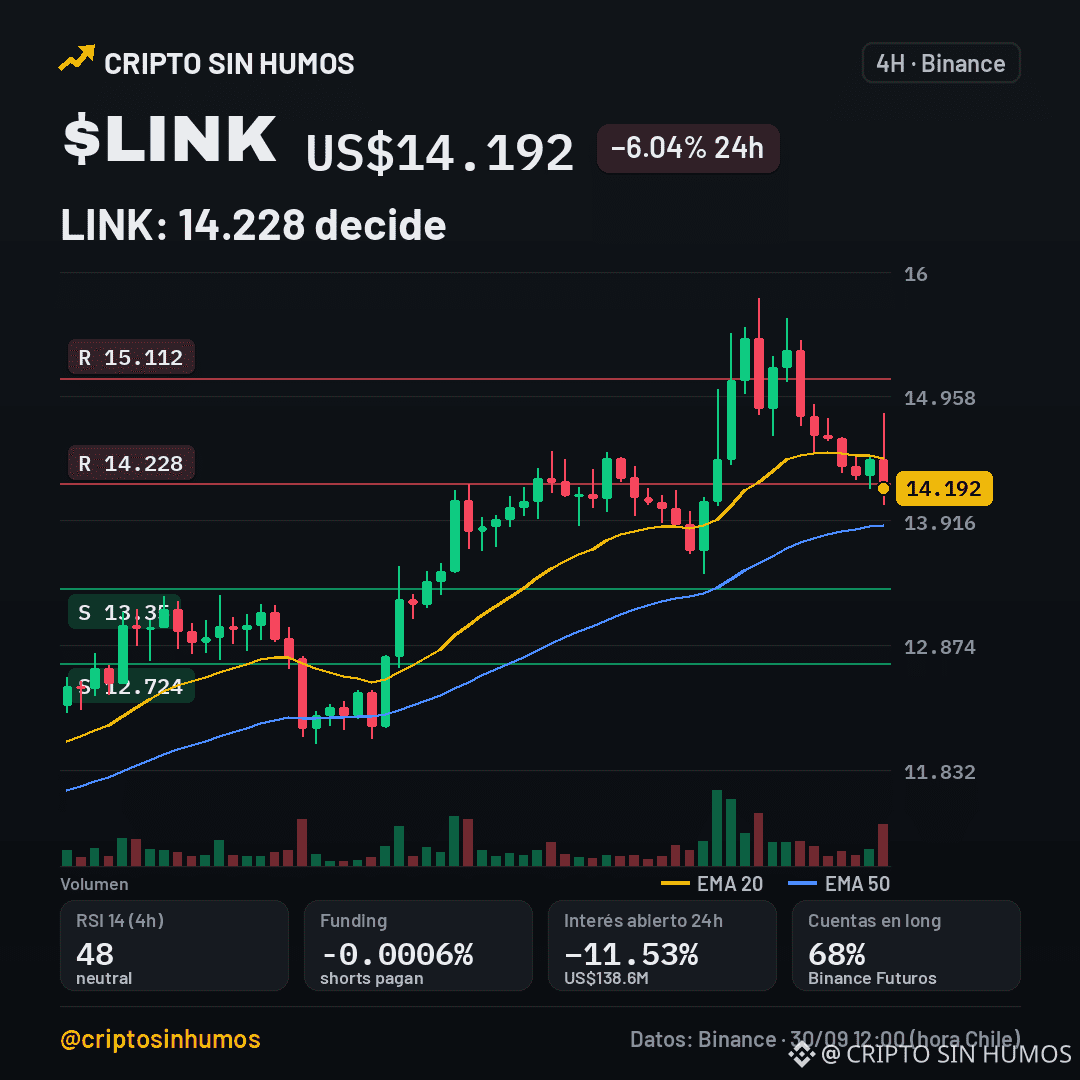
$LINK bajo presión: ¿romperá 14.228 o caerá a 13.35?
$LINK cotiza a US$14.192, con un retroceso del 6.04% en 24h y una subida del 16.45% en 7 días.
El rango del día estuvo entre US$14.051 y US$15.112. Las EMAs están en 14.436 (20) y 13.879 (50), con una tendencia lateral y un RSI de 47.9, lo que indica equilibrio sin sobrecompra.
En los futuros de Binance el funding es -0.0006% cada 8h, el interés abierto cayó 11.5% en 24h y ahora suma US$139 M. Un 68% de las cuentas están en long, pero la presión bajista parece ganar terreno.
Escenario alcista: si rompe la resistencia de 14.228, el próximo techo está en 15.112 y el movimiento se mantendría válido mientras el precio no caiga bajo el soporte de 13.35. Escenario bajista: una caída bajo 13.35 invalidaría la idea de rebote y abriría camino a 12.724, con la resistencia de 14.228 actuando como techo defensivo.
Yo no entraría ahora, me huele a trampa sin un impulso claro. ¿Rompe 14.228 o vuelve a probar 13.35? 🟢/🔴
#Chainlink #DeFi #Futuros
No es consejo financiero. Verifica antes de invertir.
$LINK bajo presión: ¿romperá 14.228 o caerá a 13.35?
$LINK cotiza a US$14.192, con un retroceso del 6.04% en 24h y una subida del 16.45% en 7 días.
El rango del día estuvo entre US$14.051 y US$15.112. Las EMAs están en 14.436 (20) y 13.879 (50), con una tendencia lateral y un RSI de 47.9, lo que indica equilibrio sin sobrecompra.
En los futuros de Binance el funding es -0.0006% cada 8h, el interés abierto cayó 11.5% en 24h y ahora suma US$139 M. Un 68% de las cuentas están en long, pero la presión bajista parece ganar terreno.
Escenario alcista: si rompe la resistencia de 14.228, el próximo techo está en 15.112 y el movimiento se mantendría válido mientras el precio no caiga bajo el soporte de 13.35. Escenario bajista: una caída bajo 13.35 invalidaría la idea de rebote y abriría camino a 12.724, con la resistencia de 14.228 actuando como techo defensivo.
Yo no entraría ahora, me huele a trampa sin un impulso claro. ¿Rompe 14.228 o vuelve a probar 13.35? 🟢/🔴
#Chainlink #DeFi #Futuros
No es consejo financiero. Verifica antes de invertir.
$LINK cotiza a US$14.192, con un retroceso del 6.04% en 24h y una subida del 16.45% en 7 días.
El rango del día estuvo entre US$14.051 y US$15.112. Las EMAs están en 14.436 (20) y 13.879 (50), con una tendencia lateral y un RSI de 47.9, lo que indica equilibrio sin sobrecompra.
En los futuros de Binance el funding es -0.0006% cada 8h, el interés abierto cayó 11.5% en 24h y ahora suma US$139 M. Un 68% de las cuentas están en long, pero la presión bajista parece ganar terreno.
Escenario alcista: si rompe la resistencia de 14.228, el próximo techo está en 15.112 y el movimiento se mantendría válido mientras el precio no caiga bajo el soporte de 13.35. Escenario bajista: una caída bajo 13.35 invalidaría la idea de rebote y abriría camino a 12.724, con la resistencia de 14.228 actuando como techo defensivo.
Yo no entraría ahora, me huele a trampa sin un impulso claro. ¿Rompe 14.228 o vuelve a probar 13.35? 🟢/🔴
#Chainlink #DeFi #Futuros
No es consejo financiero. Verifica antes de invertir.
96

Проверено
#chainlinklaunchesbankswiftledgerframework
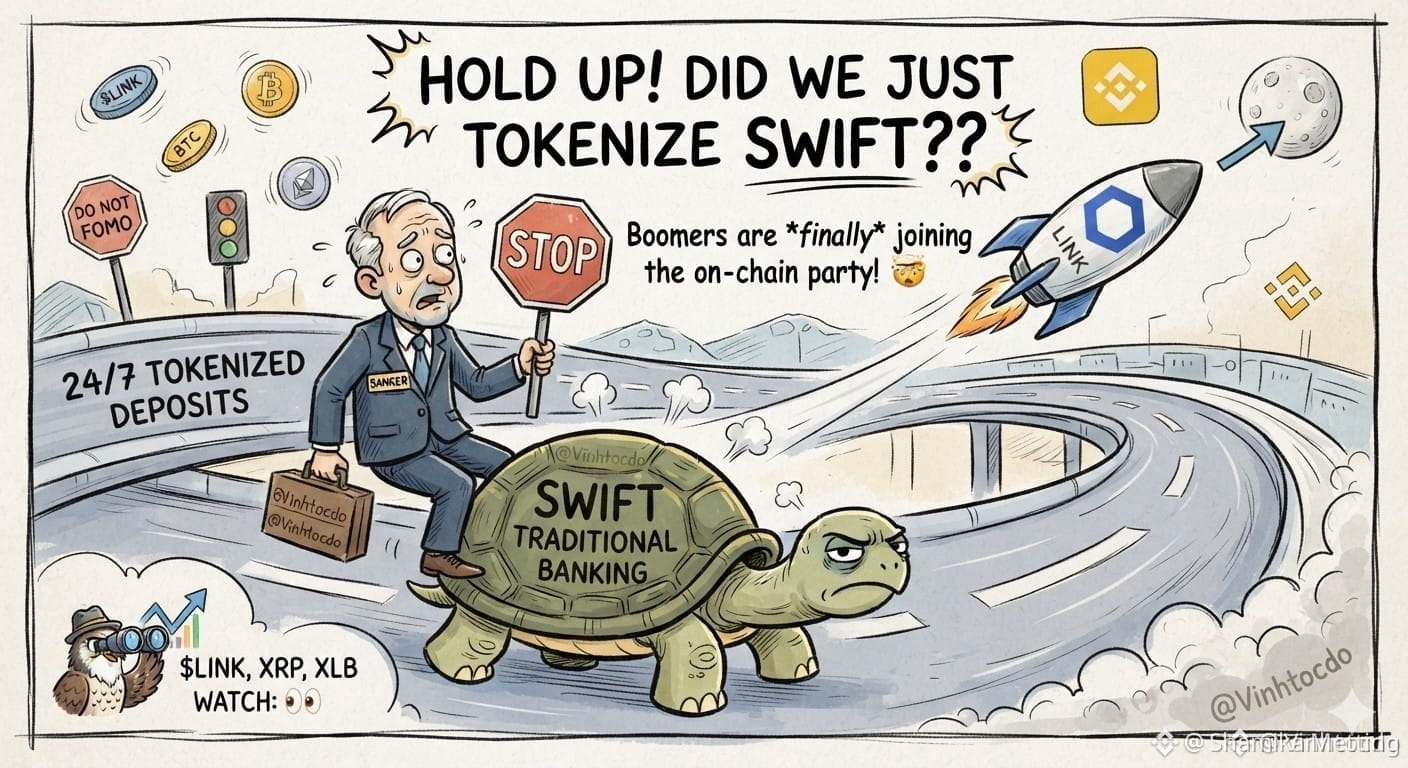
عاجل: SWIFT يتجه لتوجهات كريبتو مع Chainlink! 🤯 فهل قمنا للتو بتوْكينيز (ترميز) SWIFT؟ حسنًا، بشكلٍ أساسي! 17 بنكًا عملاقًا يختبرون الودائع المرمّزة 24/7. لقد انضمّ مواليد الأربعينات رسميًا إلى حفلة البلوكشين!
ماذا ينبغي على المتداولين فعله؟
1️⃣ راقب $LINK وXRP وXLB بتركيز مثل الصقر.
2️⃣ لا تُصب بالفومو (الشراء بدافع الخوف من فوات الفرصة)، فالبنوك التقليدية تتحرك أبطأ من سلحفاة على طريق سريع.
ليس نصيحة مالية! قم بالبحث بنفسك (DYOR)!
متابعة من فضلكم
$LINK
$BTC
$ETH
#Chainlink #SWIFT #CryptoTrading
#chainlinklaunchesbankswiftledgerframework
عاجل: SWIFT يتجه لتوجهات كريبتو مع Chainlink! 🤯 فهل قمنا للتو بتوْكينيز (ترميز) SWIFT؟ حسنًا، بشكلٍ أساسي! 17 بنكًا عملاقًا يختبرون الودائع المرمّزة 24/7. لقد انضمّ مواليد الأربعينات رسميًا إلى حفلة البلوكشين!
ماذا ينبغي على المتداولين فعله؟
1️⃣ راقب $LINK وXRP وXLB بتركيز مثل الصقر.
2️⃣ لا تُصب بالفومو (الشراء بدافع الخوف من فوات الفرصة)، فالبنوك التقليدية تتحرك أبطأ من سلحفاة على طريق سريع.
ليس نصيحة مالية! قم بالبحث بنفسك (DYOR)!
متابعة من فضلكم
$LINK
$BTC
$ETH
#Chainlink #SWIFT #CryptoTrading
عاجل: SWIFT يتجه لتوجهات كريبتو مع Chainlink! 🤯 فهل قمنا للتو بتوْكينيز (ترميز) SWIFT؟ حسنًا، بشكلٍ أساسي! 17 بنكًا عملاقًا يختبرون الودائع المرمّزة 24/7. لقد انضمّ مواليد الأربعينات رسميًا إلى حفلة البلوكشين!
ماذا ينبغي على المتداولين فعله؟
1️⃣ راقب $LINK وXRP وXLB بتركيز مثل الصقر.
2️⃣ لا تُصب بالفومو (الشراء بدافع الخوف من فوات الفرصة)، فالبنوك التقليدية تتحرك أبطأ من سلحفاة على طريق سريع.
ليس نصيحة مالية! قم بالبحث بنفسك (DYOR)!
متابعة من فضلكم
$LINK
$BTC
$ETH
#Chainlink #SWIFT #CryptoTrading
1
2.1k

·
--
$LINK is currently under pressure despite the broader market showing strength.
Price: $14.405
24H Change: -2.55%
Buy Zone: $13.90–$14.20
TP1: $14.80
TP2: $15.40
TP3: $16.10
Stop Loss: $13.40
$LINK needs to recover the $14.80 area to show stronger short-term momentum. A hold inside the buy zone followed by a breakout could create a recovery setup.
If support fails, avoid forcing the trade.
#LINK #Chainlink #Crypto #Trading
$LINK is currently under pressure despite the broader market showing strength.
Price: $14.405
24H Change: -2.55%
Buy Zone: $13.90–$14.20
TP1: $14.80
TP2: $15.40
TP3: $16.10
Stop Loss: $13.40
$LINK needs to recover the $14.80 area to show stronger short-term momentum. A hold inside the buy zone followed by a breakout could create a recovery setup.
If support fails, avoid forcing the trade.
#LINK #Chainlink #Crypto #Trading
Price: $14.405
24H Change: -2.55%
Buy Zone: $13.90–$14.20
TP1: $14.80
TP2: $15.40
TP3: $16.10
Stop Loss: $13.40
$LINK needs to recover the $14.80 area to show stronger short-term momentum. A hold inside the buy zone followed by a breakout could create a recovery setup.
If support fails, avoid forcing the trade.
#LINK #Chainlink #Crypto #Trading
1
179

·
--
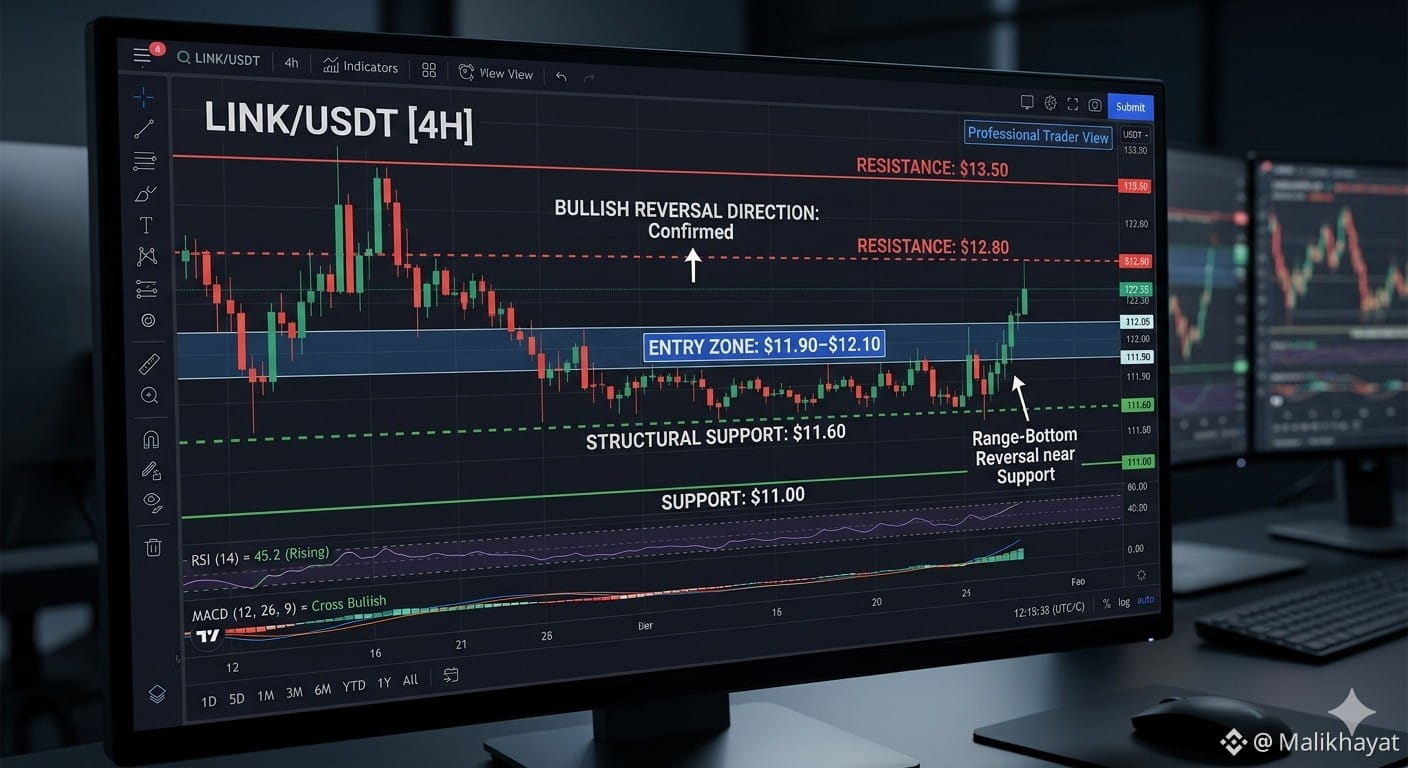
$LINK is holding a key multi-month demand zone between $11.50 and $11.80, with bullish divergence on the 14-period RSI supporting the supplied reversal structure. Funding is near baseline at +0.005%, while OI remains steady, indicating no stated overleverage. The $11.90–$12.10 zone offers the supplied entry area, with $12.80 and $13.50 acting as the first resistance levels.
📈 Bias: Bullish (Accumulation Phase) | 🎯 Entry: $11.90–$12.10 | 🛡 Support: $11.60 / $11.00 | 🚧 Resistance: $12.80 / $13.50 | 🎯 Targets: $12.75 / $13.40 / $14.20 | ❌ Invalidation: $11.45
Strategy: Range-bottom reversal entry near the supplied structural support area.
#Chainlink #LINK #CryptoTrading #Binance #TechnicalAnalysis
{future}(LINKUSDT)
$LINK is holding a key multi-month demand zone between $11.50 and $11.80, with bullish divergence on the 14-period RSI supporting the supplied reversal structure. Funding is near baseline at +0.005%, while OI remains steady, indicating no stated overleverage. The $11.90–$12.10 zone offers the supplied entry area, with $12.80 and $13.50 acting as the first resistance levels.
📈 Bias: Bullish (Accumulation Phase) | 🎯 Entry: $11.90–$12.10 | 🛡 Support: $11.60 / $11.00 | 🚧 Resistance: $12.80 / $13.50 | 🎯 Targets: $12.75 / $13.40 / $14.20 | ❌ Invalidation: $11.45
Strategy: Range-bottom reversal entry near the supplied structural support area.
#Chainlink #LINK #CryptoTrading #Binance #TechnicalAnalysis
📈 Bias: Bullish (Accumulation Phase) | 🎯 Entry: $11.90–$12.10 | 🛡 Support: $11.60 / $11.00 | 🚧 Resistance: $12.80 / $13.50 | 🎯 Targets: $12.75 / $13.40 / $14.20 | ❌ Invalidation: $11.45
Strategy: Range-bottom reversal entry near the supplied structural support area.
#Chainlink #LINK #CryptoTrading #Binance #TechnicalAnalysis
10

·
--
Статья
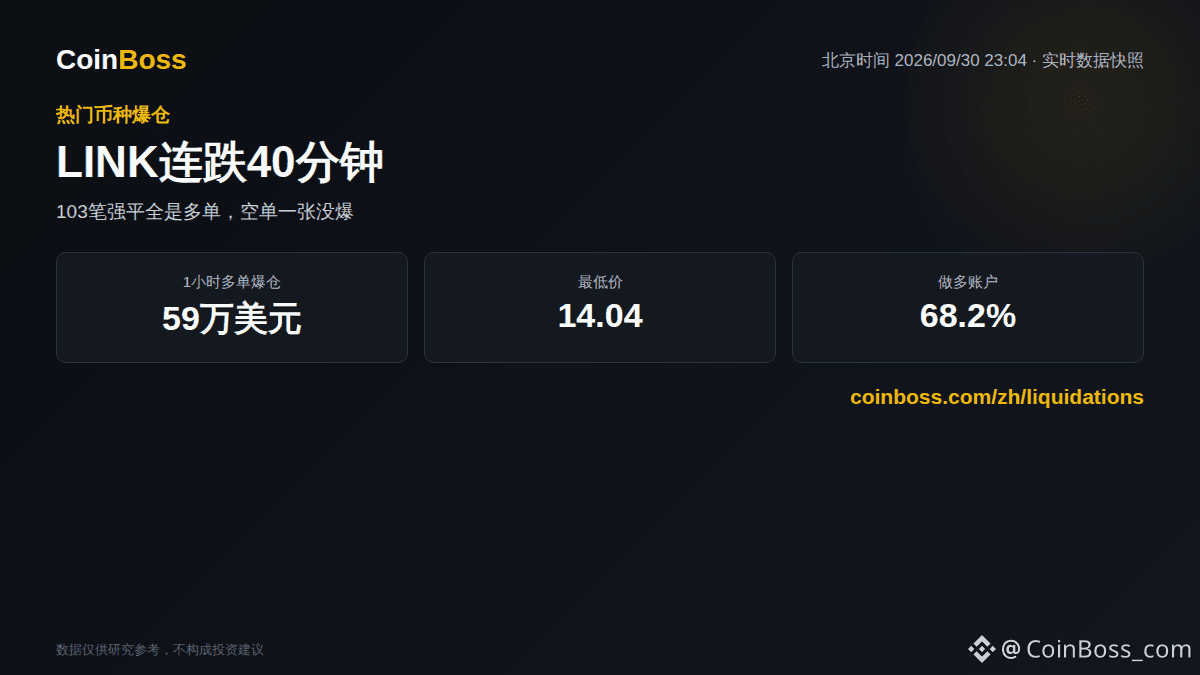
LINK连跌40分钟砸到全天最低,103笔强平全是多单LINK今晚这一跌,挨刀的全是做多的人。
10点05分开始,币安5分钟线连收8根阴线,从14.56一路滑到14.04,40分钟跌了3.6%,刷新全天最低。8点那波跟着大盘冲到14.81,现在全吐回去了。
10点15分到10点45分,$LINK 爆仓59万美元,103笔全是多单,一张空单都没有。OKX爆了31.1万,比币安的20.7万还多。最大一笔是币安10点33分的8.26万。
多头没怎么跑。币安做多账户还是68.2%,一小时前是68.4%;持仓只少了0.7%,现在又在回升。
大部分人在硬扛,爆掉的只是杠杆最高那批。价格从低点弹回14.18附近,这点反弹守不守得住,要看这68%的人会不会松手。
你手里的LINK多单,止损放在哪?
#Chainlink #爆仓 #合约交易
实时查看:https://www.coinboss.com/zh/liquidations
LINK连跌40分钟砸到全天最低,103笔强平全是多单
LINK今晚这一跌,挨刀的全是做多的人。
10点05分开始,币安5分钟线连收8根阴线,从14.56一路滑到14.04,40分钟跌了3.6%,刷新全天最低。8点那波跟着大盘冲到14.81,现在全吐回去了。
10点15分到10点45分,$LINK 爆仓59万美元,103笔全是多单,一张空单都没有。OKX爆了31.1万,比币安的20.7万还多。最大一笔是币安10点33分的8.26万。
多头没怎么跑。币安做多账户还是68.2%,一小时前是68.4%;持仓只少了0.7%,现在又在回升。
大部分人在硬扛,爆掉的只是杠杆最高那批。价格从低点弹回14.18附近,这点反弹守不守得住,要看这68%的人会不会松手。
你手里的LINK多单,止损放在哪?
#Chainlink #爆仓 #合约交易
实时查看:https://www.coinboss.com/zh/liquidations
10点05分开始,币安5分钟线连收8根阴线,从14.56一路滑到14.04,40分钟跌了3.6%,刷新全天最低。8点那波跟着大盘冲到14.81,现在全吐回去了。
10点15分到10点45分,$LINK 爆仓59万美元,103笔全是多单,一张空单都没有。OKX爆了31.1万,比币安的20.7万还多。最大一笔是币安10点33分的8.26万。
多头没怎么跑。币安做多账户还是68.2%,一小时前是68.4%;持仓只少了0.7%,现在又在回升。
大部分人在硬扛,爆掉的只是杠杆最高那批。价格从低点弹回14.18附近,这点反弹守不守得住,要看这68%的人会不会松手。
你手里的LINK多单,止损放在哪?
#Chainlink #爆仓 #合约交易
实时查看:https://www.coinboss.com/zh/liquidations
226

·
--
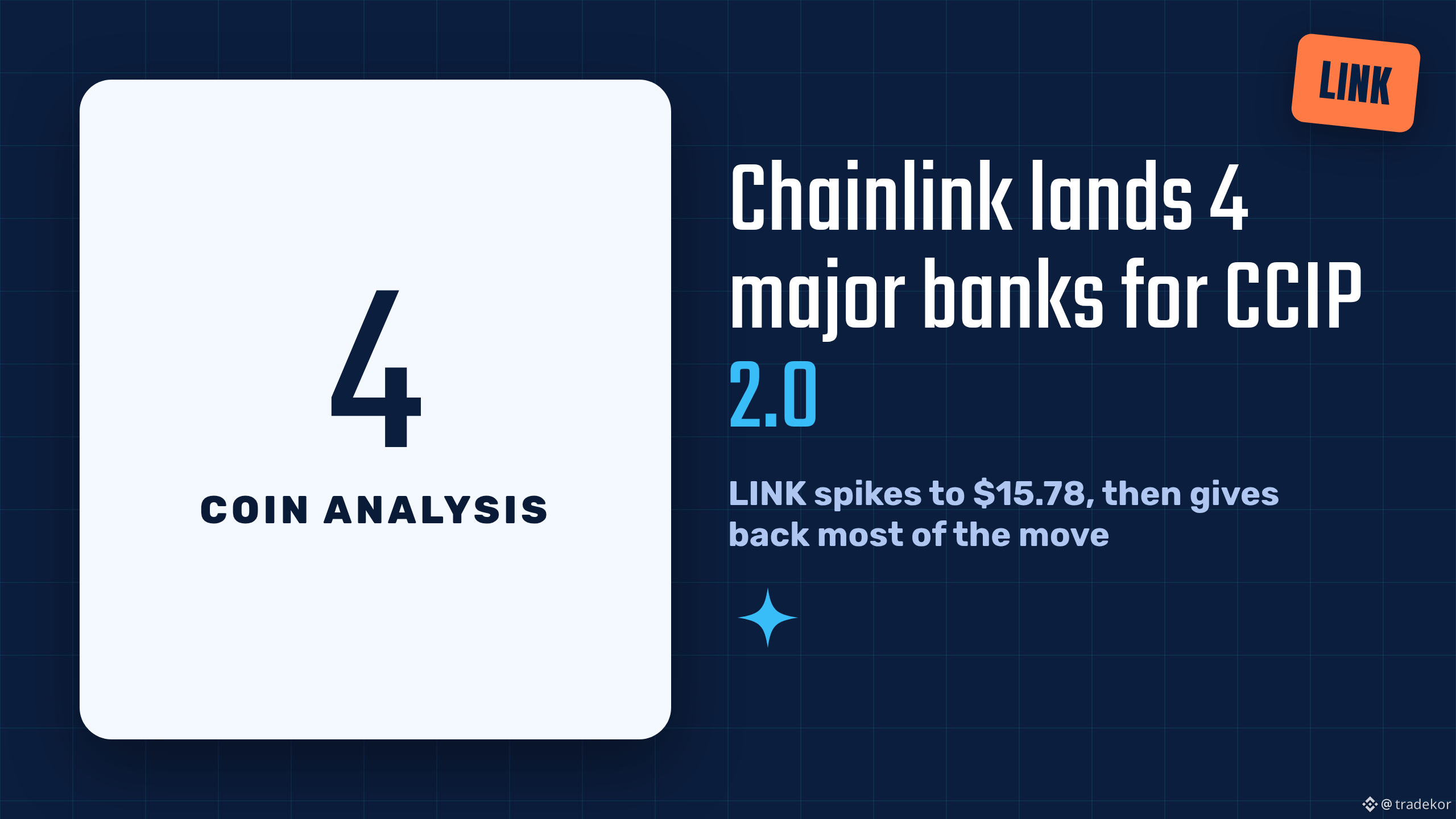
Chainlink just landed 4 major banks as launch partners for its biggest infrastructure upgrade in years -- LINK spiked to an intraday high near $15.78 before giving back most of the move within 24 hours.
The news: Chainlink launched CCIP 2.0 on Sept 28 at Sibos 2026, the SWIFT-organized banking conference, with named partners including Fidelity International, ANZ Bank, Deutsche Börse Group's Crypto Finance, and SBI Digital Markets. The upgrade adds "Cross-Chain Verifiers" (letting institutions bolt their own independent security/compliance checks onto Chainlink's default verification network), configurable execution and fee settings, built-in KYC/AML tooling, and a Swift Ledger integration for 24/7 cross-border tokenized-deposit transfers. Chainlink says CCIP now secures over $84B in total cross-chain token value. LINK's 24-hour trading volume jumped over 225% to ~$1.41B around the launch.
The catch: the price move has already partly reversed. LINK hit an intraday high near $15.78 on Sept 29, then pulled back roughly 6% to the $14.2-14.3 range as some holders took profits -- a reminder that a real infrastructure upgrade and a durable price level aren't the same thing. Some of the loudest price targets circulating (one analyst cited a 200% upside case) are speculative technical calls, not fundamentals-driven forecasts.
Our read: the partner list here is genuinely tier-1 (Fidelity, ANZ, Deutsche Börse, SBI aren't minor names), which matters more for Chainlink's long-term institutional thesis than this week's price chart.
Does landing 4 major banks on a protocol upgrade justify a lasting re-rating for LINK, or is this the kind of news that gets priced in and faded within a week?
Not financial advice. DYOR.
$LINK #CryptoNews #Chainlink #CCIP
Chainlink just landed 4 major banks as launch partners for its biggest infrastructure upgrade in years -- LINK spiked to an intraday high near $15.78 before giving back most of the move within 24 hours.
The news: Chainlink launched CCIP 2.0 on Sept 28 at Sibos 2026, the SWIFT-organized banking conference, with named partners including Fidelity International, ANZ Bank, Deutsche Börse Group's Crypto Finance, and SBI Digital Markets. The upgrade adds "Cross-Chain Verifiers" (letting institutions bolt their own independent security/compliance checks onto Chainlink's default verification network), configurable execution and fee settings, built-in KYC/AML tooling, and a Swift Ledger integration for 24/7 cross-border tokenized-deposit transfers. Chainlink says CCIP now secures over $84B in total cross-chain token value. LINK's 24-hour trading volume jumped over 225% to ~$1.41B around the launch.
The catch: the price move has already partly reversed. LINK hit an intraday high near $15.78 on Sept 29, then pulled back roughly 6% to the $14.2-14.3 range as some holders took profits -- a reminder that a real infrastructure upgrade and a durable price level aren't the same thing. Some of the loudest price targets circulating (one analyst cited a 200% upside case) are speculative technical calls, not fundamentals-driven forecasts.
Our read: the partner list here is genuinely tier-1 (Fidelity, ANZ, Deutsche Börse, SBI aren't minor names), which matters more for Chainlink's long-term institutional thesis than this week's price chart.
Does landing 4 major banks on a protocol upgrade justify a lasting re-rating for LINK, or is this the kind of news that gets priced in and faded within a week?
Not financial advice. DYOR.
$LINK #CryptoNews #Chainlink #CCIP
The news: Chainlink launched CCIP 2.0 on Sept 28 at Sibos 2026, the SWIFT-organized banking conference, with named partners including Fidelity International, ANZ Bank, Deutsche Börse Group's Crypto Finance, and SBI Digital Markets. The upgrade adds "Cross-Chain Verifiers" (letting institutions bolt their own independent security/compliance checks onto Chainlink's default verification network), configurable execution and fee settings, built-in KYC/AML tooling, and a Swift Ledger integration for 24/7 cross-border tokenized-deposit transfers. Chainlink says CCIP now secures over $84B in total cross-chain token value. LINK's 24-hour trading volume jumped over 225% to ~$1.41B around the launch.
The catch: the price move has already partly reversed. LINK hit an intraday high near $15.78 on Sept 29, then pulled back roughly 6% to the $14.2-14.3 range as some holders took profits -- a reminder that a real infrastructure upgrade and a durable price level aren't the same thing. Some of the loudest price targets circulating (one analyst cited a 200% upside case) are speculative technical calls, not fundamentals-driven forecasts.
Our read: the partner list here is genuinely tier-1 (Fidelity, ANZ, Deutsche Börse, SBI aren't minor names), which matters more for Chainlink's long-term institutional thesis than this week's price chart.
Does landing 4 major banks on a protocol upgrade justify a lasting re-rating for LINK, or is this the kind of news that gets priced in and faded within a week?
Not financial advice. DYOR.
$LINK #CryptoNews #Chainlink #CCIP
91

·
--
Рост
🚨 INSTITUTIONAL ACCUMULATION 🚨
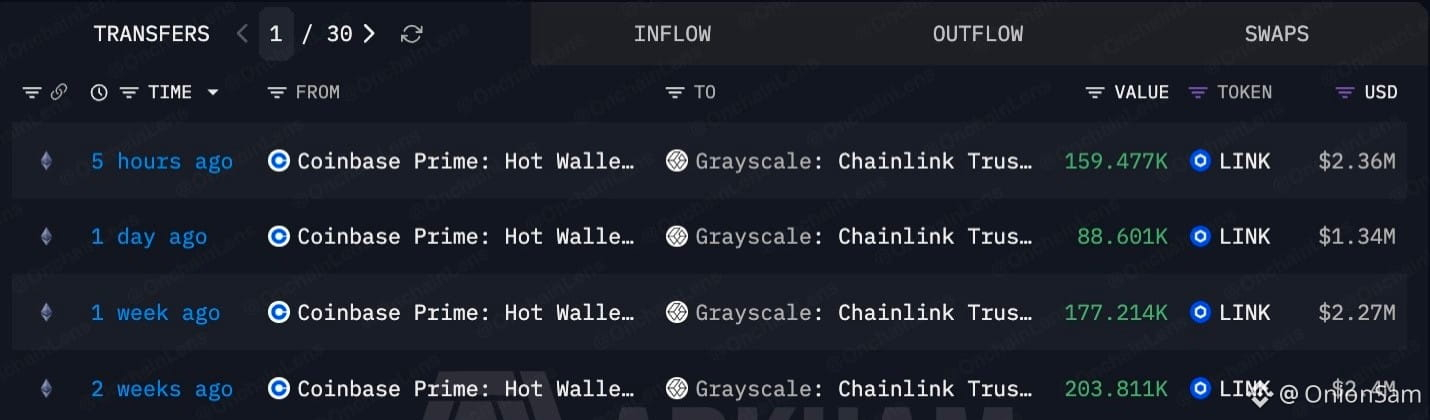
#Grayscale 's #Chainlink #etf just made another massive move! 🐳 They bought and received 159.48K #LINK (~$2.36M) via Coinbase Prime just 5 hours ago. 🔥
📊 Monthly Overview:
This month alone, the ETF has aggressively accumulated at least 629.1K $LINK (~$8.37M). 📈
The smart money keeps stacking! 🧠💎
#CryptoNews #WhaleAlert #Web3 #altcoins
$LINK
{spot}(LINKUSDT)
🚨 INSTITUTIONAL ACCUMULATION 🚨
#Grayscale 's #Chainlink #etf just made another massive move! 🐳 They bought and received 159.48K #LINK (~$2.36M) via Coinbase Prime just 5 hours ago. 🔥
📊 Monthly Overview:
This month alone, the ETF has aggressively accumulated at least 629.1K $LINK (~$8.37M). 📈
The smart money keeps stacking! 🧠💎
#CryptoNews #WhaleAlert #Web3 #altcoins
$LINK
#Grayscale 's #Chainlink #etf just made another massive move! 🐳 They bought and received 159.48K #LINK (~$2.36M) via Coinbase Prime just 5 hours ago. 🔥
📊 Monthly Overview:
This month alone, the ETF has aggressively accumulated at least 629.1K $LINK (~$8.37M). 📈
The smart money keeps stacking! 🧠💎
#CryptoNews #WhaleAlert #Web3 #altcoins
$LINK

Good luck 🍀
От OnionSam
1
73

·
--
#ChainlinkLaunchesBanksSWIFTLedgerFramework 🔗
تواصل المؤسسات المالية التقليدية وقطاع البلوكتشين التحرك نحو تكامل أكبر وأكثر سلاسة. 🌍⛓️
📰 أبرز الأخبار:
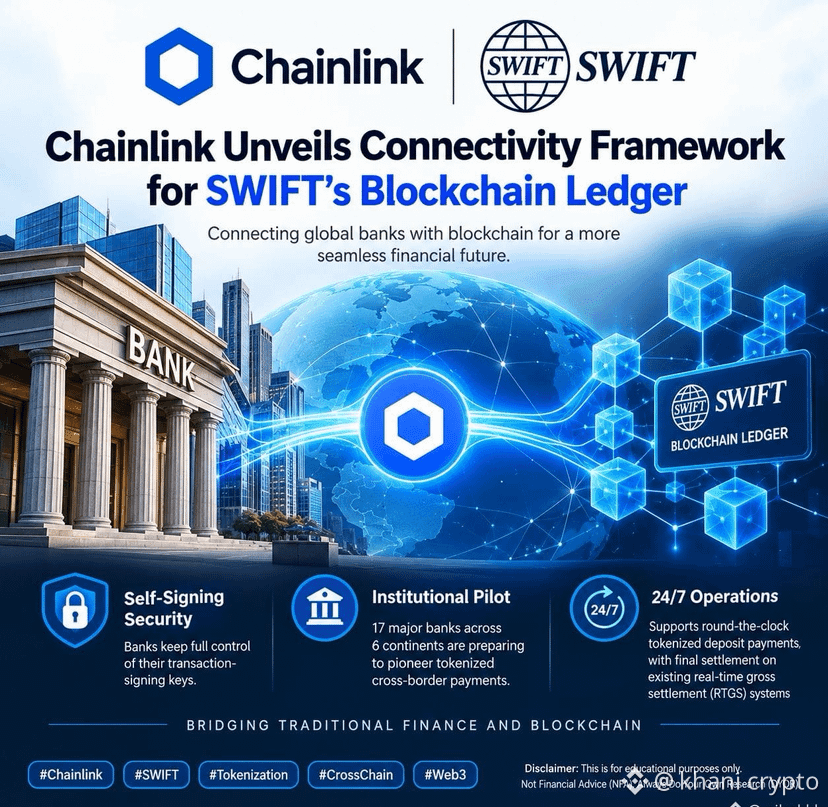
أعلنت Chainlink عن إطار للاتصال يتيح للمؤسسات المالية الوصول إلى دفتر الأستاذ القائم على البلوكتشين ضمن منظومة SWIFT.
🔐 أمان التوقيع الذاتي:
تحتفظ البنوك بالسيطرة الكاملة على مفاتيح توقيع معاملاتها، دون الحاجة إلى تسليم صلاحيات التفويض إلى أطراف خارجية.
🌍 تجربة مؤسسية:
تستعد 17 مؤسسة مصرفية كبرى عبر 6 قارات لاختبار مدفوعات عابرة للحدود باستخدام الودائع المرمّزة.
⚡ تشغيل على مدار الساعة:
يدعم النظام مدفوعات الودائع المرمّزة على مدار 24/7، مع بقاء التسوية النهائية مرتبطة بآليات التسوية الإجمالية الفورية الحالية.
📊 لماذا هذا مهم؟
قد يمثل هذا التطور خطوة مهمة في تبني البلوكتشين من قبل المؤسسات المالية. ومن خلال بنية Chainlink التحتية، يمكن للبنوك استكشاف الأصول المرمّزة والعقود الذكية مع الحفاظ على متطلبات الأمان والامتثال.
كما يسلط الضوء على الاستخدامات المحتملة لشبكات الـOracle وحلول التشغيل البيني بين سلاسل ال التمويل العالمي؟
شارك رأيك في التعليقات 👇
🏷️ #Chainlink #SWIFT #Tokenization #CrossChain #Web
⚠️ لأغراض تعليمية فقط، وليست نصيحة مالية (NFA). قم دائمًا بأبحاثك الخاصة (DYOR)
$MINA $NMR $2Z
{future}(NMRUSDT)
{future}(MINAUSDT)
{future}(2ZUSDT)
#ChainlinkLaunchesBanksSWIFTLedgerFramework 🔗
تواصل المؤسسات المالية التقليدية وقطاع البلوكتشين التحرك نحو تكامل أكبر وأكثر سلاسة. 🌍⛓️
📰 أبرز الأخبار:
أعلنت Chainlink عن إطار للاتصال يتيح للمؤسسات المالية الوصول إلى دفتر الأستاذ القائم على البلوكتشين ضمن منظومة SWIFT.
🔐 أمان التوقيع الذاتي:
تحتفظ البنوك بالسيطرة الكاملة على مفاتيح توقيع معاملاتها، دون الحاجة إلى تسليم صلاحيات التفويض إلى أطراف خارجية.
🌍 تجربة مؤسسية:
تستعد 17 مؤسسة مصرفية كبرى عبر 6 قارات لاختبار مدفوعات عابرة للحدود باستخدام الودائع المرمّزة.
⚡ تشغيل على مدار الساعة:
يدعم النظام مدفوعات الودائع المرمّزة على مدار 24/7، مع بقاء التسوية النهائية مرتبطة بآليات التسوية الإجمالية الفورية الحالية.
📊 لماذا هذا مهم؟
قد يمثل هذا التطور خطوة مهمة في تبني البلوكتشين من قبل المؤسسات المالية. ومن خلال بنية Chainlink التحتية، يمكن للبنوك استكشاف الأصول المرمّزة والعقود الذكية مع الحفاظ على متطلبات الأمان والامتثال.
كما يسلط الضوء على الاستخدامات المحتملة لشبكات الـOracle وحلول التشغيل البيني بين سلاسل ال التمويل العالمي؟
شارك رأيك في التعليقات 👇
🏷️ #Chainlink #SWIFT #Tokenization #CrossChain #Web
⚠️ لأغراض تعليمية فقط، وليست نصيحة مالية (NFA). قم دائمًا بأبحاثك الخاصة (DYOR)
$MINA $NMR $2Z
تواصل المؤسسات المالية التقليدية وقطاع البلوكتشين التحرك نحو تكامل أكبر وأكثر سلاسة. 🌍⛓️
📰 أبرز الأخبار:
أعلنت Chainlink عن إطار للاتصال يتيح للمؤسسات المالية الوصول إلى دفتر الأستاذ القائم على البلوكتشين ضمن منظومة SWIFT.
🔐 أمان التوقيع الذاتي:
تحتفظ البنوك بالسيطرة الكاملة على مفاتيح توقيع معاملاتها، دون الحاجة إلى تسليم صلاحيات التفويض إلى أطراف خارجية.
🌍 تجربة مؤسسية:
تستعد 17 مؤسسة مصرفية كبرى عبر 6 قارات لاختبار مدفوعات عابرة للحدود باستخدام الودائع المرمّزة.
⚡ تشغيل على مدار الساعة:
يدعم النظام مدفوعات الودائع المرمّزة على مدار 24/7، مع بقاء التسوية النهائية مرتبطة بآليات التسوية الإجمالية الفورية الحالية.
📊 لماذا هذا مهم؟
قد يمثل هذا التطور خطوة مهمة في تبني البلوكتشين من قبل المؤسسات المالية. ومن خلال بنية Chainlink التحتية، يمكن للبنوك استكشاف الأصول المرمّزة والعقود الذكية مع الحفاظ على متطلبات الأمان والامتثال.
كما يسلط الضوء على الاستخدامات المحتملة لشبكات الـOracle وحلول التشغيل البيني بين سلاسل ال التمويل العالمي؟
شارك رأيك في التعليقات 👇
🏷️ #Chainlink #SWIFT #Tokenization #CrossChain #Web
⚠️ لأغراض تعليمية فقط، وليست نصيحة مالية (NFA). قم دائمًا بأبحاثك الخاصة (DYOR)
$MINA $NMR $2Z
73


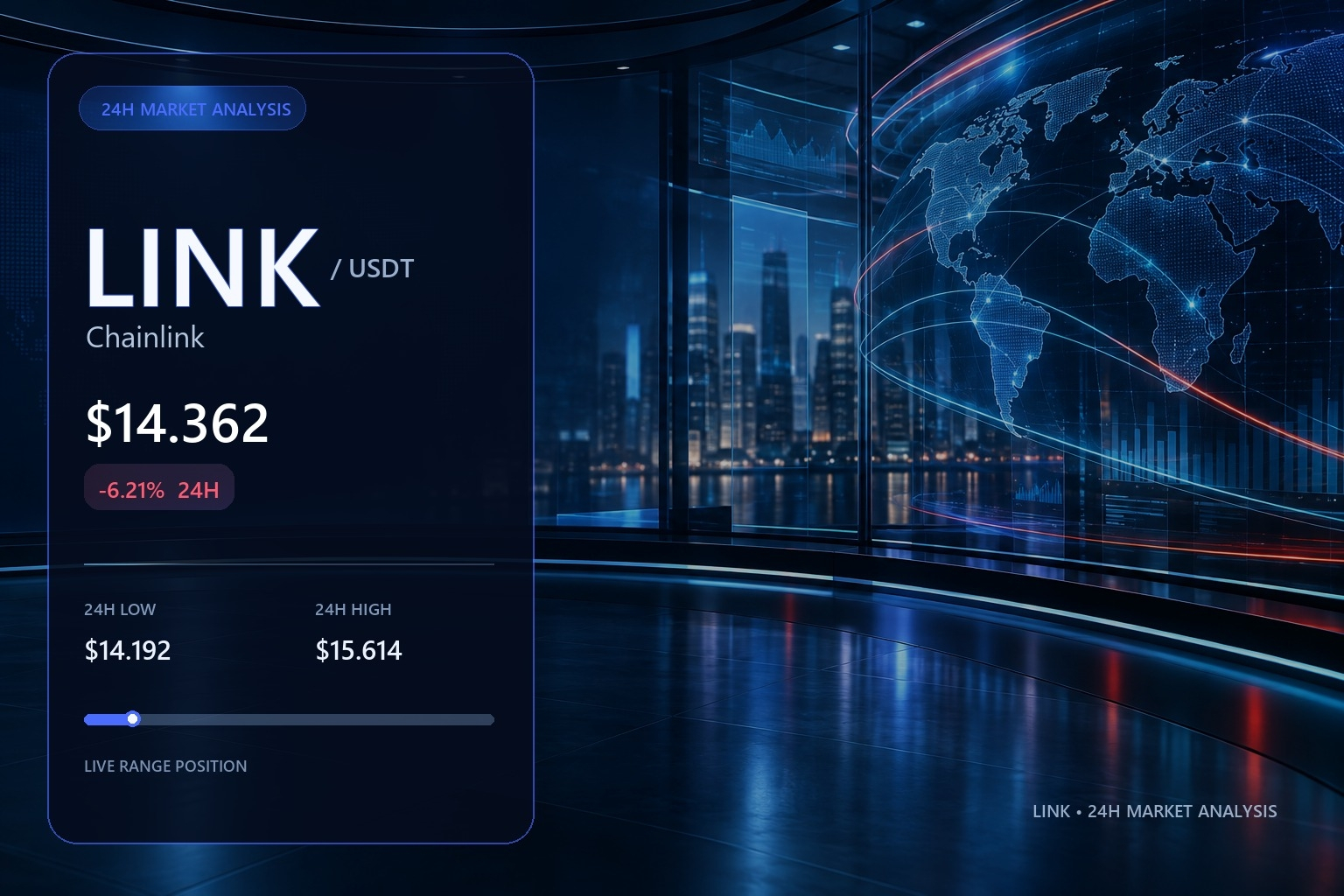
A sharp -6.21% drop pulls $LINK down to $14.362 after failing to hold its 24h high of $15.614. 📉 The pullback tested support near the 24h low of $14.192, putting price action at a pivotal inflection point. Watch how liquidity reacts around these bounds. Illustrative long setup: entry $14.362, SL 13.9311, TP $15.0801. Illustrative short setup: entry $14.362, SL $14.7929, TP 13.6439. 🎯 Plan your risk meticulously. This is not a prediction, Not financial advice, and DYOR. ⚖️ #Write2Earn #Chainlink #CryptoTrading
A sharp -6.21% drop pulls $LINK down to $14.362 after failing to hold its 24h high of $15.614. 📉 The pullback tested support near the 24h low of $14.192, putting price action at a pivotal inflection point. Watch how liquidity reacts around these bounds. Illustrative long setup: entry $14.362, SL 13.9311, TP $15.0801. Illustrative short setup: entry $14.362, SL $14.7929, TP 13.6439. 🎯 Plan your risk meticulously. This is not a prediction, Not financial advice, and DYOR. ⚖️ #Write2Earn #Chainlink #CryptoTrading
23
Oracle data feeds can't outrun a market-wide snooze fest.
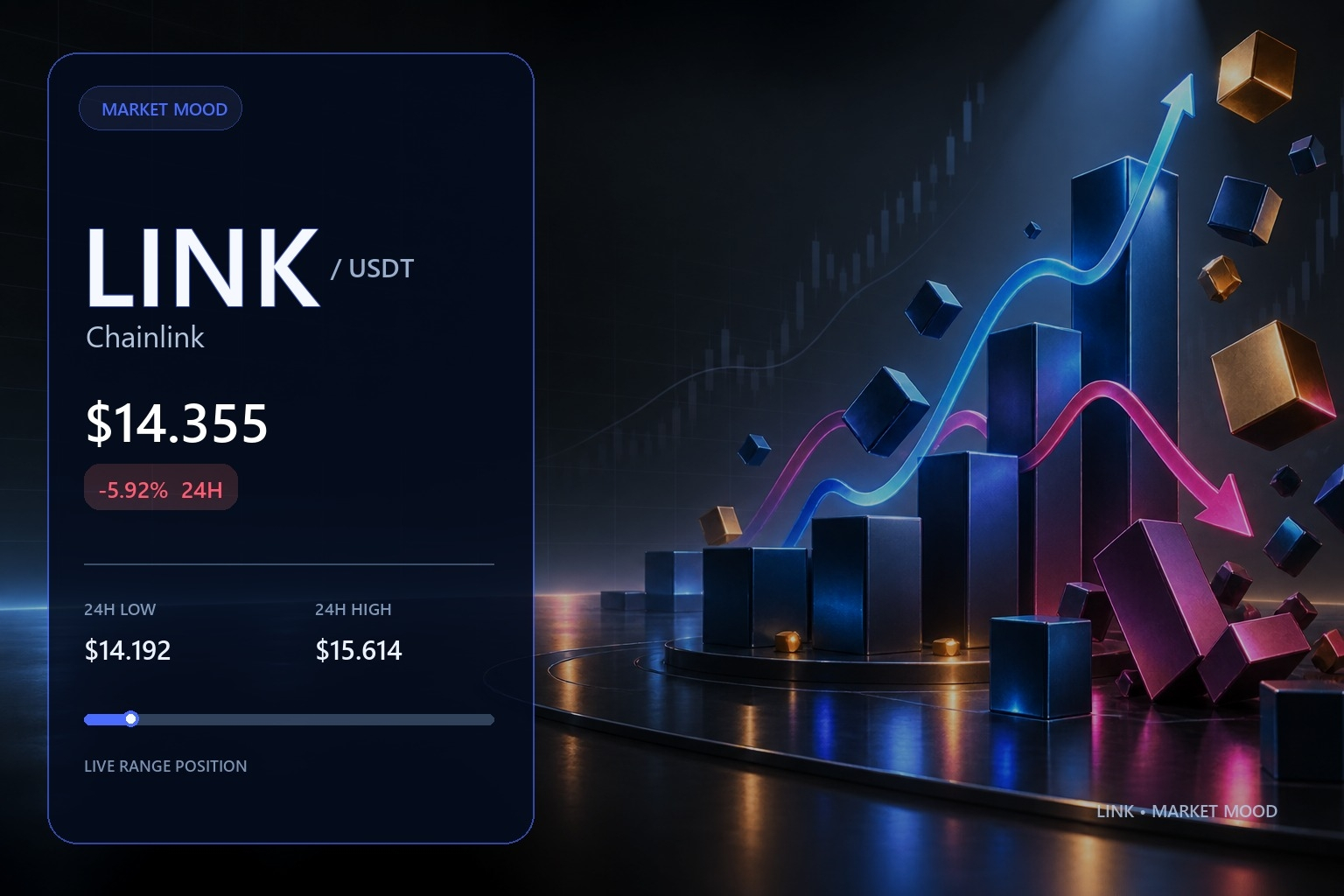
Chainlink decided to take a -5.924% discount day, currently printing at $14.355. After tapping a 24h high of $15.614, we drifted right down to test $14.192 as the bears tried to cut the feed. This is NFA, always DYOR.
🤖 Oracles need a reboot after a wild run
📊 $14.192 acted as the temporary local basement
🎯 Eyes locked on the $15.614 high for the next setup
$LINK #Write2Earn #Chainlink #CryptoMarket
Oracle data feeds can't outrun a market-wide snooze fest.
Chainlink decided to take a -5.924% discount day, currently printing at $14.355. After tapping a 24h high of $15.614, we drifted right down to test $14.192 as the bears tried to cut the feed. This is NFA, always DYOR.
🤖 Oracles need a reboot after a wild run
📊 $14.192 acted as the temporary local basement
🎯 Eyes locked on the $15.614 high for the next setup
$LINK #Write2Earn #Chainlink #CryptoMarket
Chainlink decided to take a -5.924% discount day, currently printing at $14.355. After tapping a 24h high of $15.614, we drifted right down to test $14.192 as the bears tried to cut the feed. This is NFA, always DYOR.
🤖 Oracles need a reboot after a wild run
📊 $14.192 acted as the temporary local basement
🎯 Eyes locked on the $15.614 high for the next setup
$LINK #Write2Earn #Chainlink #CryptoMarket
28
Войдите, чтобы посмотреть больше материала
Присоединяйтесь к пользователям криптовалют по всему миру на Binance Square
⚡️ Получайте новейшую и полезную информацию о криптоактивах.
💬 Нам доверяет крупнейшая в мире криптобиржа.
👍 Получите достоверные аналитические данные от верифицированных создателей контента.
Эл. почта/номер телефона
В тренде
1
#BinanceKZ
Просмотров: 26,775
70 обсуждают
2
#MetaMaskExitsLidoValidatorsAfterSecurityIncident
Просмотров: 32,320
627 обсуждают
3
#MicronBeatsEarningsLiftsGuidance
Просмотров: 22,081
527 обсуждают
4
#CFTCSubmitsTwoEventContractRulesToWhiteHouse
Просмотров: 17,501
462 обсуждают
5
#BitcoinClears$85200
Просмотров: 30,616
327 обсуждают
6
#AltcoinSeasonIndexHoldsAbove60For5Days
Просмотров: 152,821
1,988 обсуждают
7
#USADPAdds90000JobsInSeptember
Просмотров: 72,544
1,140 обсуждают
8
#USCorePCEEasesTo3%InAugust
Просмотров: 48,670
745 обсуждают
9
#KospiPostsWorstQuarterSince2020
Просмотров: 26,828
613 обсуждают
10
#SECToClarifyOnChainFundraisingRules
Просмотров: 66,325
817 обсуждают