
#coldcard
coldcard
Просмотров: 168,565
564 обсуждают
Популярные
Новые


Статья
Coinkite COLDCARD postmortem: Yasmarang RNG, 1,778.84 BTC from 8,600+ addressesCoinkite COLDCARD postmortem: Yasmarang RNG, 1,778.84 $BTC from 8,600+ addresses
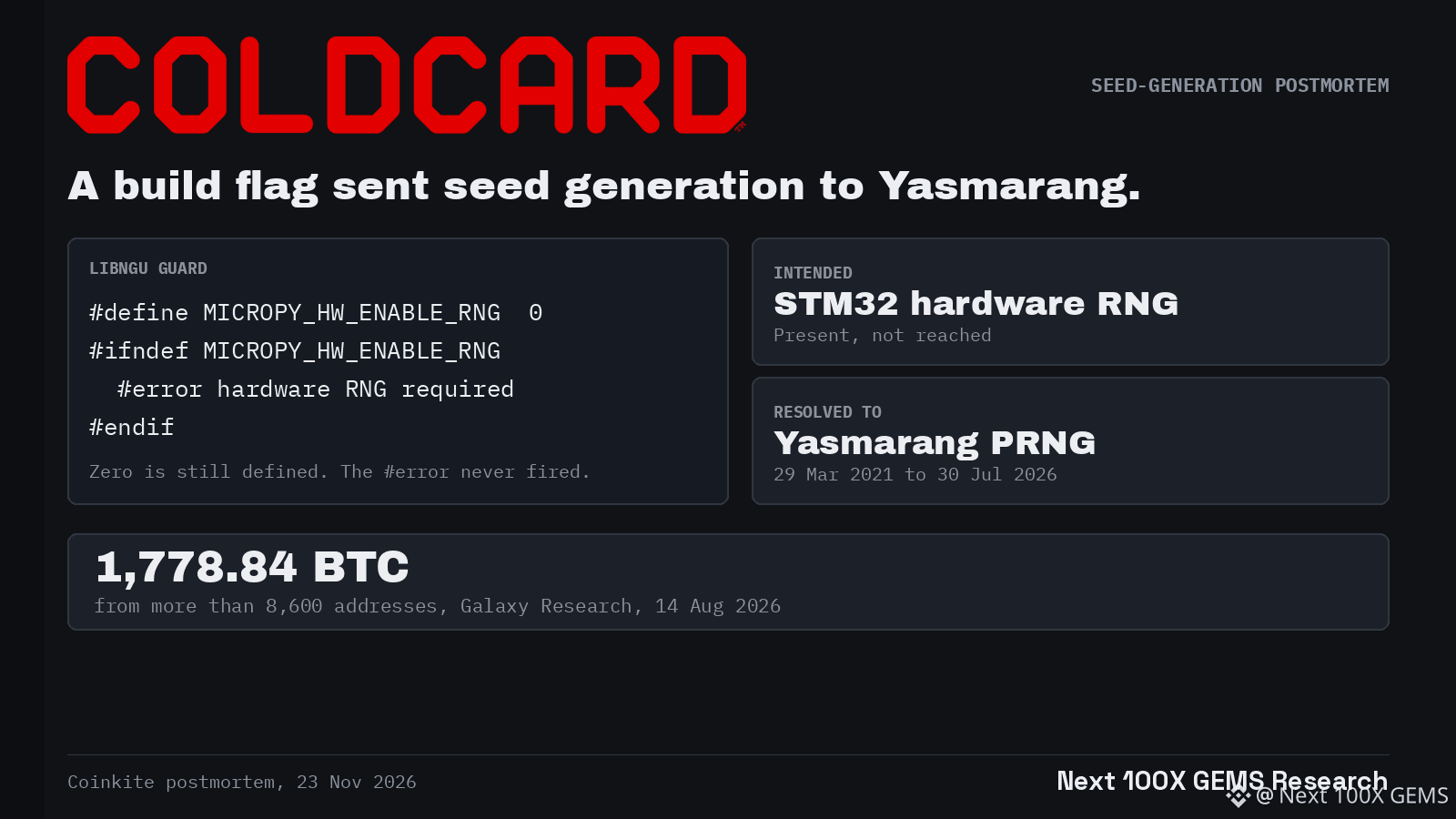
The thefts started on 29 July 2026. Nobody had to touch a COLDCARD. Attackers rebuilt private keys for seeds the devices had already made, then swept the coins. On 14 August 2026, Galaxy Research said it had confirmed, with high confidence and after speaking with 190 people who reported losses, that 1,778.84 BTC had been taken from more than 8,600 addresses. That count left out lower-confidence sets, including an unconfirmed "Wave 4." If those had been included, Galaxy's figure would have been 2,417.35 BTC.
Coinkite's postmortem, dated 23 November 2026, cites Galaxy's address count as 8,865 as of 24 August, and says no public total of users or losses across every wave has been established. As of 18 November, the company had 300 loss-related support tickets tied to 242 accounts, about 0.21% of its estimated user base, a share it says is likely low because not every victim files a ticket.
The devices were never entered. The seeds were weak.
A zero that counted as a yes
From 29 March 2021 through 30 July 2026, COLDCARD firmware generated wallet seeds with MicroPython's Yasmarang software pseudo-random number generator instead of the device's STM32 hardware random-number generator. That window is Coinkite's.
The design was supposed to have no software fallback. In March 2021, when seed generation moved through a library called libNgU, the firmware set MICROPY_HW_ENABLE_RNG to 0, meaning to switch the software path off. A guard in the pinned libNgU code used ifndef, which only asks whether the macro is defined, not whether its value is nonzero. Zero still counts as defined. The build passed. libNgU's rng_get() resolved to Yasmarang. The hardware generator sat in the binary and was never reached by seed generation. The device still produced well-formed seed words.
Coinkite calls this a COLDCARD integration defect, not a bug in libNgU itself, and not a runtime failure of the hardware RNG. Attackers did not need physical access. They regenerated keys offline.
Coinkite estimates the affected seeds had roughly 40 bits of effective entropy on Mk2 and Mk3, and roughly 72 bits on Mk4, Mk5 and Q, against a 128-bit security target. The 72-bit figure, the postmortem says, has not been independently established. Block's Bitcoin Engineering and Security teams, in a 30 July write-up, described a further constraint on the later models: boot mixed in secure-element entropy, then a reseed replaced only one 32-bit Yasmarang state word, leaving at most 2^32 securely distinguished output streams once the fallback state and call history were fixed. Hashing the output, both Coinkite and Block say, could not add entropy that was not there.
The ranges Coinkite published
The 23 November report lists the affected firmware by model and track, and the first fixed release for each. For Mk2 and Mk3, seeds generated on 4.0.1 through 4.1.9 are affected; the minimum fixed release is 4.2.0 or later. For Mk4 and Mk5 on the standard track, the affected range is any seed generated before 5.6.0, with 5.6.0 or later as the fix. On the Mk4 and Mk5 Edge track, the cut is before 6.6.0X, fixed in 6.6.0X or later. For Q on the standard track, the affected range is before 1.5.0Q, fixed in 1.5.0Q or later; on the Q Edge track, before 6.6.0QX, fixed in 6.6.0QX or later. Standard and Edge are separate tracks with independent version numbers. As of the report, the current standard releases were 5.6.3 and 1.5.3Q, and the current Edge releases were 6.6.2X and 6.6.2QX.
v4.0.0, which is visible in the source lineage, was not distributed as a signed public binary. The first signed public release in the series was 4.0.1, on 29 March 2021.
A seed generated on affected firmware stays affected after it is restored, imported, backed up or cloned. A seed that was securely generated outside that on-device flow was not weakened by later import into an affected device. Seeds made with at least 50 fair, independent, private dice rolls entered through Add Dice Rolls, with the sequence never recorded or exposed and the final post-roll words used, "were not weakened by the defect," the report says. A strong BIP-39 passphrase or a multisig setup, Coinkite says, added a barrier the weak seed did not; those layers do not repair the seed itself.
Coinkite identified the defect on 30 July and published fixed firmware for all supported tracks on 31 July. Keylabs, in a review published 15 October, concluded that, within its stated scope, the defect is fully closed in Mk5 5.6.3 and 5.6.2 and in Q 1.5.3Q and 1.5.2Q. Edge releases were outside that review.
Between 2021 and 2026, Coinkite documented at least 15 independent review and security-research efforts on COLDCARD hardware, firmware, entropy tooling and release controls, including two commissioned third-party product reviews. The scopes varied, and not all of the work examined seed generation. A 17 June 2026 review by Nick Farrow expressly included weak RNG in its scope, concluded the path was sound, and did not find the defect. No contemporaneous report, Coinkite says, identified and reproduced the build-integration error.
What Coinkite tells owners
The company points owners to sections 1.4 and 4.1 of the report, and to the Security Status page at coldcard.com/security/status, to check whether they are affected and what to do. A firmware update, it says, does not repair a seed generated on affected firmware.
If a seed was generated on affected firmware, Coinkite's user recommendations are to install verified fixed firmware, create a new seed, verify it and its backup, and move the funds, including from passphrase wallets. Never send seed words, passphrases, dice rolls, private keys, backup files or backup passwords to anyone, including Coinkite, or enter them into any website. Use only support routes linked from coldcard.com, and treat unsolicited recovery, migration or compensation offers as likely impersonation.
A recommendation to decide on and publish any compensation or assistance plan for affected customers remains open, with no decision recorded in the report.
TAPSIGNER, OPENDIME and SATSCARD, Coinkite has said, are not affected, because they use different codebases.
Sources
Coinkite, "COLDCARD Seed-Generation Incident Postmortem," 23 Nov 2026
Coinkite, "Our COLDCARD seed-generation postmortem is now public," 24 Nov 2026
Coinkite, "Technical Deep Dive into the Entropy Issue"
Block Engineering, "Predictable RNG Fallback and 32-Bit Reseed in COLDCARD Firmware," 30 Jul 2026
Galaxy Research, "Coldcard Exploit Abates as Total Losses Climb to (at Least) 1,700 BTC," 14 Aug 2026
Coinkite, "Adding to the Public Record on Our Ongoing Investigation"
#COLDCARD #Bitcoin
NFA. DYOR.
Coinkite COLDCARD postmortem: Yasmarang RNG, 1,778.84 BTC from 8,600+ addresses
Coinkite COLDCARD postmortem: Yasmarang RNG, 1,778.84 $BTC from 8,600+ addresses
The thefts started on 29 July 2026. Nobody had to touch a COLDCARD. Attackers rebuilt private keys for seeds the devices had already made, then swept the coins. On 14 August 2026, Galaxy Research said it had confirmed, with high confidence and after speaking with 190 people who reported losses, that 1,778.84 BTC had been taken from more than 8,600 addresses. That count left out lower-confidence sets, including an unconfirmed "Wave 4." If those had been included, Galaxy's figure would have been 2,417.35 BTC.
Coinkite's postmortem, dated 23 November 2026, cites Galaxy's address count as 8,865 as of 24 August, and says no public total of users or losses across every wave has been established. As of 18 November, the company had 300 loss-related support tickets tied to 242 accounts, about 0.21% of its estimated user base, a share it says is likely low because not every victim files a ticket.
The devices were never entered. The seeds were weak.
A zero that counted as a yes
From 29 March 2021 through 30 July 2026, COLDCARD firmware generated wallet seeds with MicroPython's Yasmarang software pseudo-random number generator instead of the device's STM32 hardware random-number generator. That window is Coinkite's.
The design was supposed to have no software fallback. In March 2021, when seed generation moved through a library called libNgU, the firmware set MICROPY_HW_ENABLE_RNG to 0, meaning to switch the software path off. A guard in the pinned libNgU code used ifndef, which only asks whether the macro is defined, not whether its value is nonzero. Zero still counts as defined. The build passed. libNgU's rng_get() resolved to Yasmarang. The hardware generator sat in the binary and was never reached by seed generation. The device still produced well-formed seed words.
Coinkite calls this a COLDCARD integration defect, not a bug in libNgU itself, and not a runtime failure of the hardware RNG. Attackers did not need physical access. They regenerated keys offline.
Coinkite estimates the affected seeds had roughly 40 bits of effective entropy on Mk2 and Mk3, and roughly 72 bits on Mk4, Mk5 and Q, against a 128-bit security target. The 72-bit figure, the postmortem says, has not been independently established. Block's Bitcoin Engineering and Security teams, in a 30 July write-up, described a further constraint on the later models: boot mixed in secure-element entropy, then a reseed replaced only one 32-bit Yasmarang state word, leaving at most 2^32 securely distinguished output streams once the fallback state and call history were fixed. Hashing the output, both Coinkite and Block say, could not add entropy that was not there.
The ranges Coinkite published
The 23 November report lists the affected firmware by model and track, and the first fixed release for each. For Mk2 and Mk3, seeds generated on 4.0.1 through 4.1.9 are affected; the minimum fixed release is 4.2.0 or later. For Mk4 and Mk5 on the standard track, the affected range is any seed generated before 5.6.0, with 5.6.0 or later as the fix. On the Mk4 and Mk5 Edge track, the cut is before 6.6.0X, fixed in 6.6.0X or later. For Q on the standard track, the affected range is before 1.5.0Q, fixed in 1.5.0Q or later; on the Q Edge track, before 6.6.0QX, fixed in 6.6.0QX or later. Standard and Edge are separate tracks with independent version numbers. As of the report, the current standard releases were 5.6.3 and 1.5.3Q, and the current Edge releases were 6.6.2X and 6.6.2QX.
v4.0.0, which is visible in the source lineage, was not distributed as a signed public binary. The first signed public release in the series was 4.0.1, on 29 March 2021.
A seed generated on affected firmware stays affected after it is restored, imported, backed up or cloned. A seed that was securely generated outside that on-device flow was not weakened by later import into an affected device. Seeds made with at least 50 fair, independent, private dice rolls entered through Add Dice Rolls, with the sequence never recorded or exposed and the final post-roll words used, "were not weakened by the defect," the report says. A strong BIP-39 passphrase or a multisig setup, Coinkite says, added a barrier the weak seed did not; those layers do not repair the seed itself.
Coinkite identified the defect on 30 July and published fixed firmware for all supported tracks on 31 July. Keylabs, in a review published 15 October, concluded that, within its stated scope, the defect is fully closed in Mk5 5.6.3 and 5.6.2 and in Q 1.5.3Q and 1.5.2Q. Edge releases were outside that review.
Between 2021 and 2026, Coinkite documented at least 15 independent review and security-research efforts on COLDCARD hardware, firmware, entropy tooling and release controls, including two commissioned third-party product reviews. The scopes varied, and not all of the work examined seed generation. A 17 June 2026 review by Nick Farrow expressly included weak RNG in its scope, concluded the path was sound, and did not find the defect. No contemporaneous report, Coinkite says, identified and reproduced the build-integration error.
What Coinkite tells owners
The company points owners to sections 1.4 and 4.1 of the report, and to the Security Status page at coldcard.com/security/status, to check whether they are affected and what to do. A firmware update, it says, does not repair a seed generated on affected firmware.
If a seed was generated on affected firmware, Coinkite's user recommendations are to install verified fixed firmware, create a new seed, verify it and its backup, and move the funds, including from passphrase wallets. Never send seed words, passphrases, dice rolls, private keys, backup files or backup passwords to anyone, including Coinkite, or enter them into any website. Use only support routes linked from coldcard.com, and treat unsolicited recovery, migration or compensation offers as likely impersonation.
A recommendation to decide on and publish any compensation or assistance plan for affected customers remains open, with no decision recorded in the report.
TAPSIGNER, OPENDIME and SATSCARD, Coinkite has said, are not affected, because they use different codebases.
Sources
Coinkite, "COLDCARD Seed-Generation Incident Postmortem," 23 Nov 2026
Coinkite, "Our COLDCARD seed-generation postmortem is now public," 24 Nov 2026
Coinkite, "Technical Deep Dive into the Entropy Issue"
Block Engineering, "Predictable RNG Fallback and 32-Bit Reseed in COLDCARD Firmware," 30 Jul 2026
Galaxy Research, "Coldcard Exploit Abates as Total Losses Climb to (at Least) 1,700 BTC," 14 Aug 2026
Coinkite, "Adding to the Public Record on Our Ongoing Investigation"
#COLDCARD #Bitcoin
NFA. DYOR.
73

·
--
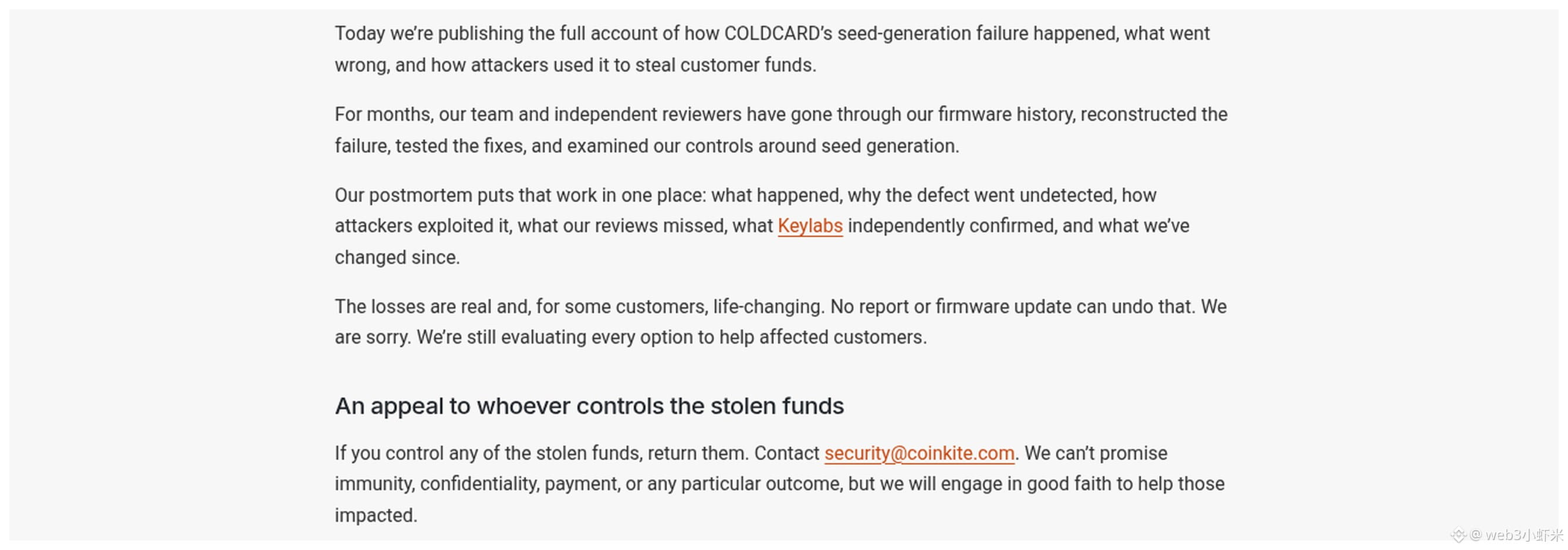
刚刷到 Coinkite 官网 11月24日把 COLDCARD 种子生成问题的完整事后报告公开了。官方写,从 2021 年 3 月到今年 7 月,固件生成种子时实际走的是软件伪随机数,而不是设备上的硬件随机数发生器;攻击者可以离线把受影响的私钥重新算出来转走资金,设备本身没有被远程攻破。
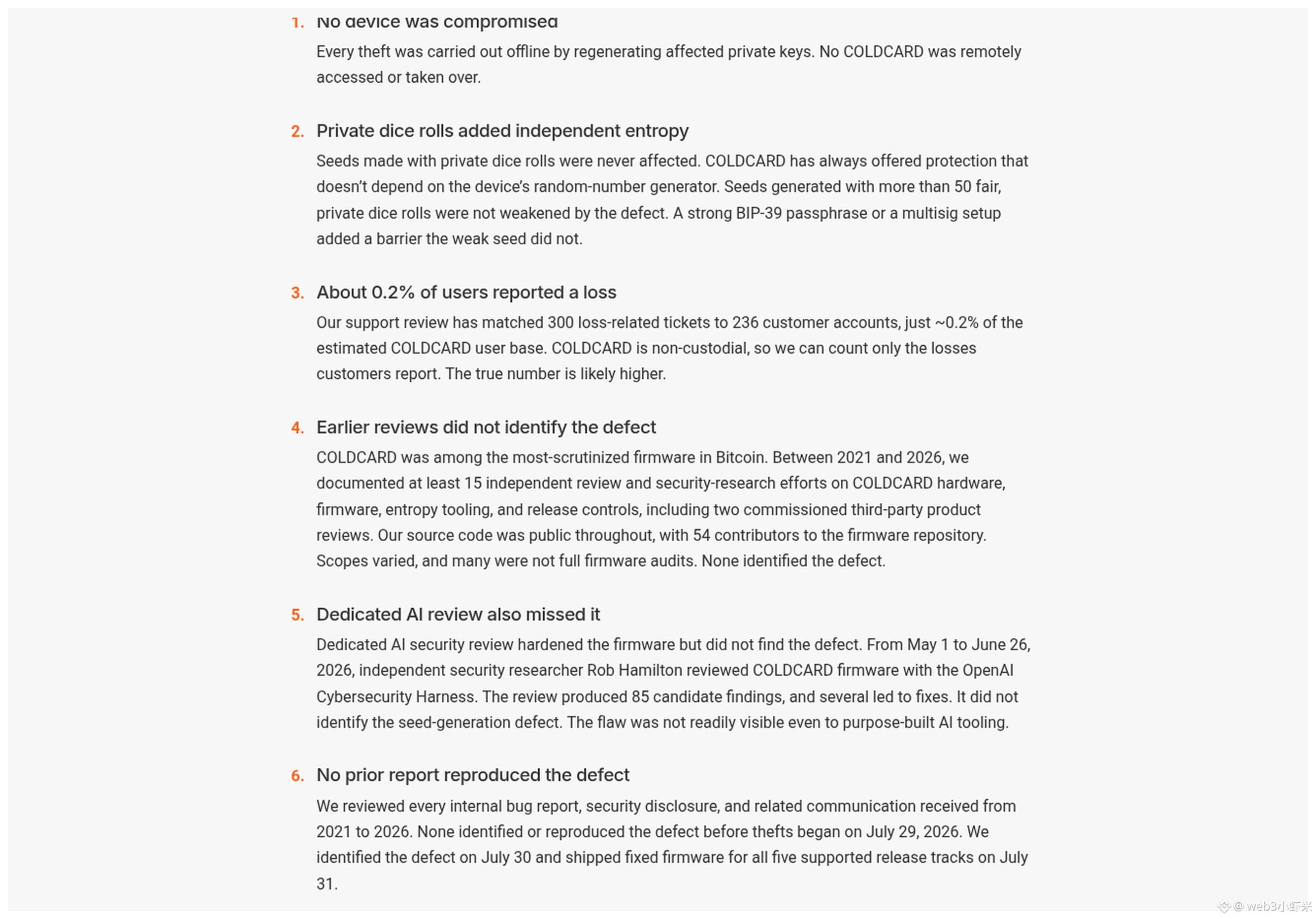
他们匹配到大约 300 张亏损相关工单,对应 236 个客户账户,约占估计用户的 0.2%,并说真实数字可能更高。官方 7 月 30 日定位到问题,31 日为所有五个受支持的版本线发布了修复固件,但写得很清楚:只升级固件,修不了已经在受影响版本上生成的种子。
用过 50 次以上独立、私下骰子加熵的种子不受影响。有这块硬件钱包的,建议直接去官网报告和安全状态页核对,别把助记词、私钥或备份发给任何人。
#COLDCARD #安全
他们匹配到大约 300 张亏损相关工单,对应 236 个客户账户,约占估计用户的 0.2%,并说真实数字可能更高。官方 7 月 30 日定位到问题,31 日为所有五个受支持的版本线发布了修复固件,但写得很清楚:只升级固件,修不了已经在受影响版本上生成的种子。
用过 50 次以上独立、私下骰子加熵的种子不受影响。有这块硬件钱包的,建议直接去官网报告和安全状态页核对,别把助记词、私钥或备份发给任何人。
#COLDCARD #安全

48

·
--
Your hardware wallet's seed phrase was supposed to be unguessable. For five years, Coldcard's wasn't — and that flaw cost users $100 million in $BTC.
On November 23, Coinkite published an 18-page postmortem on the Coldcard seed-generation flaw. A firmware change in March 2021 disabled the hardware random number generator: the code checked whether a config flag was defined, not whether it was enabled. Seeds fell back to a weak software generator, leaving Mk2 and Mk3 devices with roughly 40 bits of effective entropy.
Galaxy Research tracked at least 1,778.84 BTC stolen from more than 8,600 addresses, worth about $107 million — the first sweep alone drained 1,082.65 BTC from 1,196 addresses in 41 minutes on July 30. The flaw survived at least 15 independent security reviews over five years. Coinkite patched it on July 31, but updating firmware does not fix seeds already generated — affected users must create a fresh seed and move their coins.
The open question is liability: around 300 loss tickets filed, no compensation decision announced.
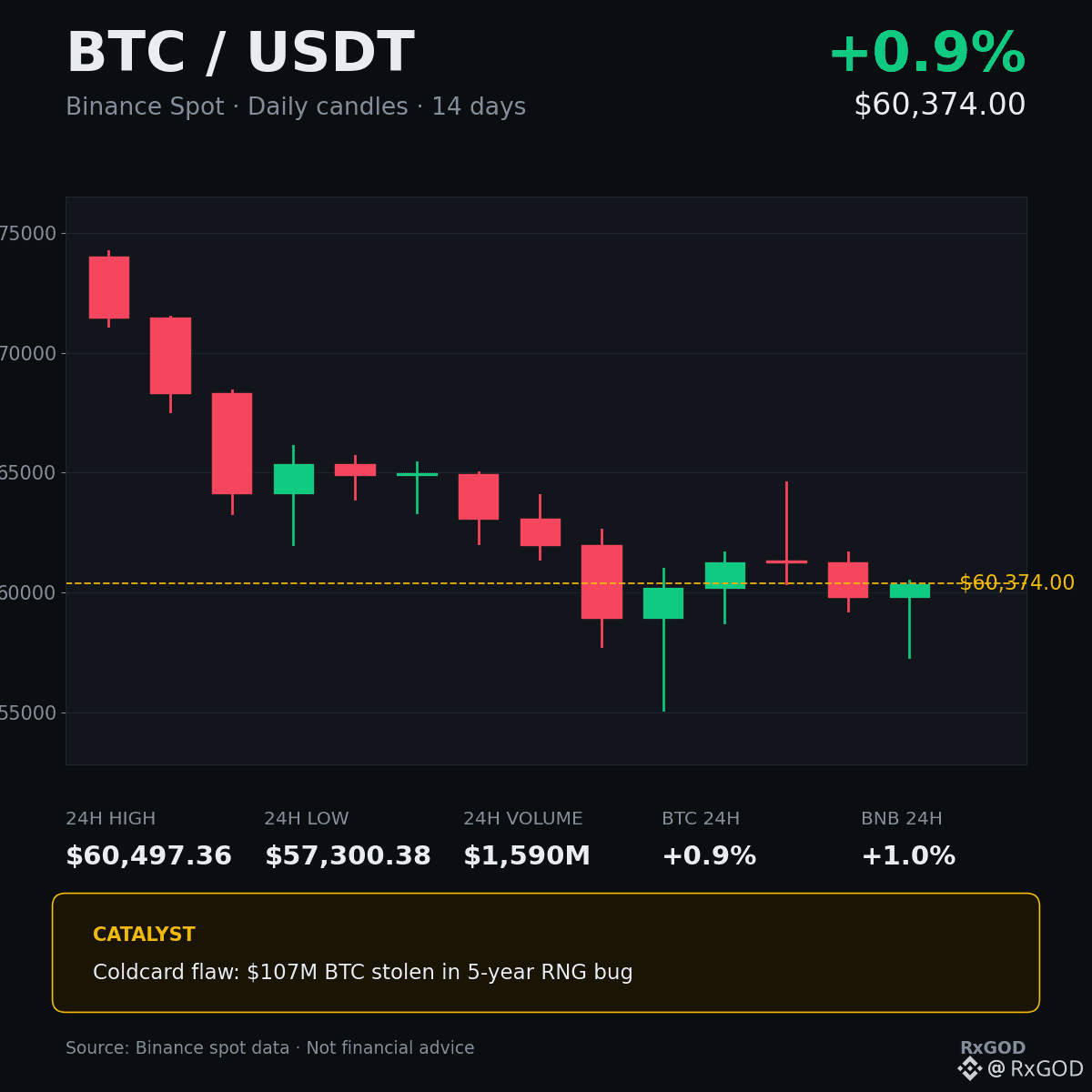
$BTC trades at $60,374, up 0.93% in 24 hours and near the top of its $57,300–$60,497 range, though down 15.5% over 14 days with Fear & Greed at 9 — Extreme Fear.
Coldcard owners: check your firmware version today. Would you move your coins immediately if your seed came from affected firmware — or trust the patch and stay put? And should the maker pay when its own bug costs users $107 million?
Not financial advice — DYOR.
#Coldcard #Bitcoin #CryptoNews #ExtremeFear
Your hardware wallet's seed phrase was supposed to be unguessable. For five years, Coldcard's wasn't — and that flaw cost users $100 million in $BTC .
On November 23, Coinkite published an 18-page postmortem on the Coldcard seed-generation flaw. A firmware change in March 2021 disabled the hardware random number generator: the code checked whether a config flag was defined, not whether it was enabled. Seeds fell back to a weak software generator, leaving Mk2 and Mk3 devices with roughly 40 bits of effective entropy.
Galaxy Research tracked at least 1,778.84 BTC stolen from more than 8,600 addresses, worth about $107 million — the first sweep alone drained 1,082.65 BTC from 1,196 addresses in 41 minutes on July 30. The flaw survived at least 15 independent security reviews over five years. Coinkite patched it on July 31, but updating firmware does not fix seeds already generated — affected users must create a fresh seed and move their coins.
The open question is liability: around 300 loss tickets filed, no compensation decision announced.
$BTC trades at $60,374, up 0.93% in 24 hours and near the top of its $57,300–$60,497 range, though down 15.5% over 14 days with Fear & Greed at 9 — Extreme Fear.
Coldcard owners: check your firmware version today. Would you move your coins immediately if your seed came from affected firmware — or trust the patch and stay put? And should the maker pay when its own bug costs users $107 million?
Not financial advice — DYOR.
#Coldcard #Bitcoin #CryptoNews #ExtremeFear
2

·
--
1780枚BTC被盗,Coldcard复盘:15次审计没发现的“假随机”一个“看起来随机”的随机数,把硬件钱包变成了提款机。
11月23日 Coinkite 公布18页复盘:2021年3月至2026年7月,Coldcard 生成助记词时未调用硬件随机数发生器,种子因此退回软件伪随机数。128位的熵,Mk2/Mk3 只剩约40位,新机型约72位。
攻击者不必碰设备:离线穷举种子、比对链上地址,命中即得私钥。Galaxy Research 统计,7月底至8月初约1,778枚 $BTC 从8,600余地址被转走,约1.07亿美元。
更刺眼的是它躲过五年间至少15次独立审查。复盘的结论是:每项检查都在回答“旁边那个问题”。
7月31日的补丁只能让新设备不再生成弱种子;旧种子无法靠升级补救,唯一做法是用修复版固件重建种子并转移资产。
安全不是“买了硬件钱包”,而是每个环节都被真正验证过。
来源:Coinkite 官方复盘(11/23)、Galaxy Research(截至8/14)、Decrypt
#比特币 #钱包安全 #自托管 #Coldcard
1780枚BTC被盗,Coldcard复盘:15次审计没发现的“假随机”
一个“看起来随机”的随机数,把硬件钱包变成了提款机。
11月23日 Coinkite 公布18页复盘:2021年3月至2026年7月,Coldcard 生成助记词时未调用硬件随机数发生器,种子因此退回软件伪随机数。128位的熵,Mk2/Mk3 只剩约40位,新机型约72位。
攻击者不必碰设备:离线穷举种子、比对链上地址,命中即得私钥。Galaxy Research 统计,7月底至8月初约1,778枚 $BTC 从8,600余地址被转走,约1.07亿美元。
更刺眼的是它躲过五年间至少15次独立审查。复盘的结论是:每项检查都在回答“旁边那个问题”。
7月31日的补丁只能让新设备不再生成弱种子;旧种子无法靠升级补救,唯一做法是用修复版固件重建种子并转移资产。
安全不是“买了硬件钱包”,而是每个环节都被真正验证过。
来源:Coinkite 官方复盘(11/23)、Galaxy Research(截至8/14)、Decrypt
#比特币 #钱包安全 #自托管 #Coldcard
1.4k

·
--
Coldcard漏洞潜伏5年:1789枚BTC被盗,5.86万能接吗Coinkite公布Coldcard安全事件复盘:种子生成漏洞潜伏超过5年,至少15次独立安全审查和研究没有提前发现,因为恢复短语看起来正常,也能通过部分检测。漏洞导致黑客至少盗走1789枚BTC,案发时价值约1.147亿美元(Cointelegraph,11月25日)。
公司称漏洞已在7月31日修复,8月又增加安全措施。截至11月18日,已收到约300张与242个账户相关的损失工单,实际受害者可能更多;补偿方案仍未确定,执法机构正在调查。旧恢复短语不会因软件更新自动变安全。
币安$BTC在11月25日21:05 CST报58683.46美元,24小时跌3.036%,区间58456.25—60687.53;当日开高低为59832、59835.38、58456.25。个人观点:若重新站上59832并守住58456.25,轻仓试多,目标60687.53,跌破58456.25止损;若失守58456.25,反弹失效,下一观察位57778.35。
风险在硬件钱包信任修复需要时间,旧种子必须迁移;BTC价格仍主要受关税与流动性影响。你会因Coldcard事件更换钱包,还是只调整仓位?#Coldcard #BTC #钱包安全 #自托管
以上内容不构成投资建议
Coldcard漏洞潜伏5年:1789枚BTC被盗,5.86万能接吗
Coinkite公布Coldcard安全事件复盘:种子生成漏洞潜伏超过5年,至少15次独立安全审查和研究没有提前发现,因为恢复短语看起来正常,也能通过部分检测。漏洞导致黑客至少盗走1789枚BTC,案发时价值约1.147亿美元(Cointelegraph,11月25日)。
公司称漏洞已在7月31日修复,8月又增加安全措施。截至11月18日,已收到约300张与242个账户相关的损失工单,实际受害者可能更多;补偿方案仍未确定,执法机构正在调查。旧恢复短语不会因软件更新自动变安全。
币安$BTC 在11月25日21:05 CST报58683.46美元,24小时跌3.036%,区间58456.25—60687.53;当日开高低为59832、59835.38、58456.25。个人观点:若重新站上59832并守住58456.25,轻仓试多,目标60687.53,跌破58456.25止损;若失守58456.25,反弹失效,下一观察位57778.35。
风险在硬件钱包信任修复需要时间,旧种子必须迁移;BTC价格仍主要受关税与流动性影响。你会因Coldcard事件更换钱包,还是只调整仓位?#Coldcard #BTC #钱包安全 #自托管
以上内容不构成投资建议
58

·
--
Статья
硬件钱包没坏,助记词却能被算出来硬件钱包没坏,助记词却能被算出来
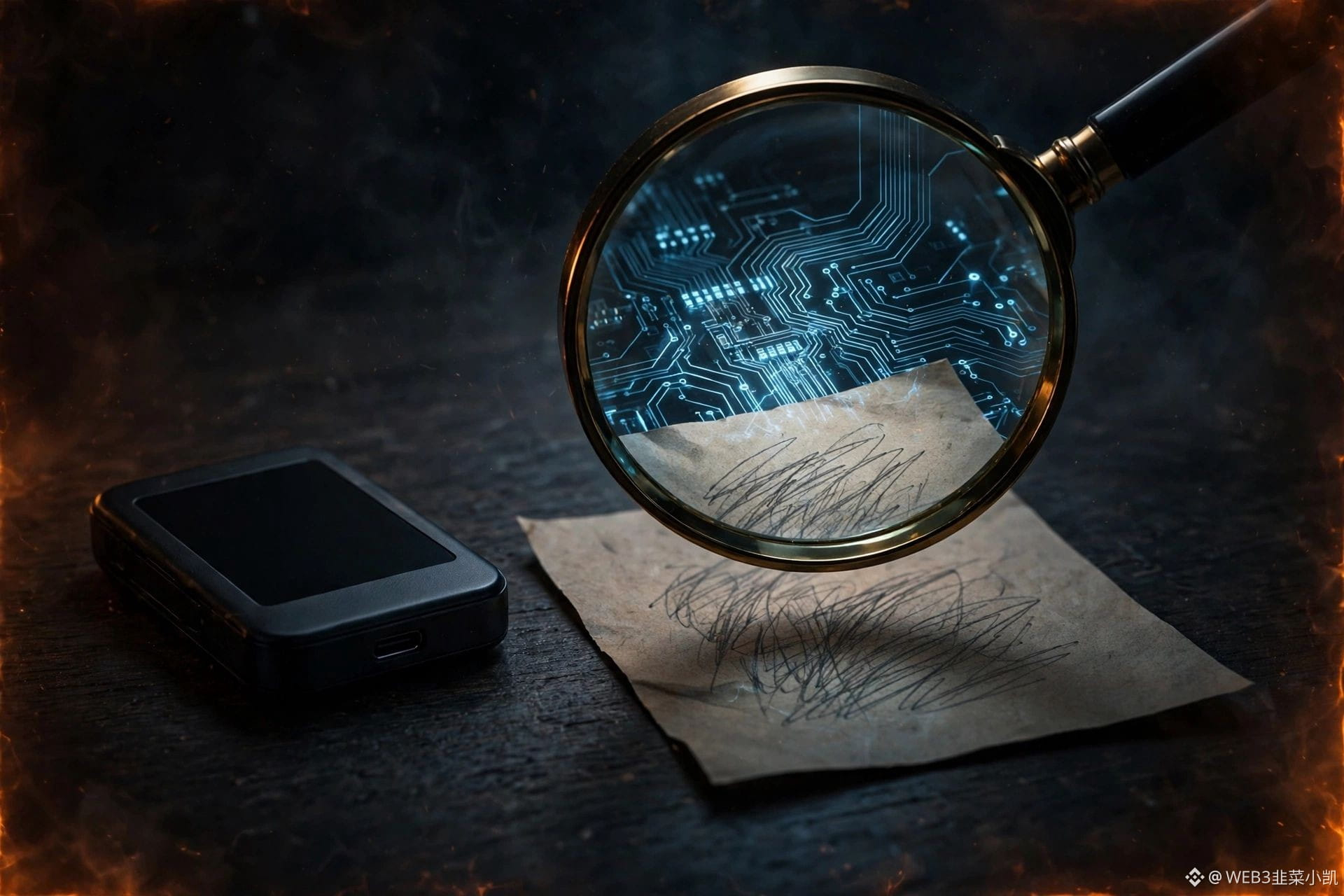
Coinkite 11 月 23 日公布了一份 18 页事故报告,讲的是自家 Coldcard 硬件钱包一个藏了五年多的毛病。2021 年 3 月 29 日到 2026 年 7 月 30 日,这 1949 天里生成的助记词,走的是软件里的一个通用伪随机数,芯片里的硬件随机数发生器一直在,却没被用到。一个配置项把硬件随机数关掉了,本该拦住它的检查只查了配置在不在,没查它开没开。
助记词看起来完全正常,24 个词一个不少,设备也没坏过,问题只在随机性不够。老款 Mk2、Mk3 生成的助记词有效熵只有 40 位左右,新款 Mk4、Mk5 和 Q 是 72 位左右,本来应该是 128 位。熵不够,私钥就能被离线算出来,不用碰你的设备,不用你点任何链接。
2026 年 7 月 29 日出现第一笔异常转账,第二天 Coinkite 确认漏洞,7 月 31 日发了补丁。Galaxy Research 估计,1778.84 枚比特币从 8600 多个地址被偷走,按当时价格超过 1 亿美元。Coinkite 截至 11 月 18 日收到约 300 起报失,涉及 242 个账户。至少 15 次独立安全审查在这五年里查过这套东西,没一次发现问题,因为每次查的都是硬件随机数的代码在不在,没人查生成助记词时走的到底是哪条路。
这案子最难受的一点,是被偷的人什么都没做错。没点钓鱼链接,没下假软件,设备没丢没借人,助记词也只留纸上。硬件钱包防的是别人碰你的设备和你手滑点错链接,防不住出厂那一步随机数就没给够。
如果你用 Coldcard,今晚就能做的三件事。第一,查固件版本,Mk2、Mk3 升到 4.2.0,Mk4、Mk5 升到 5.6.0,Q 升到 1.5.0Q。第二,如果你的助记词是在 2021 年 3 月 29 日到 2026 年 7 月 30 日之间生成的,生成一个新助记词,把币转过去。第三,助记词只留纸上,别进联网设备。例外只有一个,用至少 50 次独立掷骰子生成的助记词不受影响。
不用 Coldcard 的也别当看热闹。硬件钱包四个字不是免死金牌,厂商的安全公告要定期看,大额最好分开几个钱包放。
助记词看起来正常,不代表它真的随机。
你现在用的硬件钱包,上次查固件版本是什么时候?
数据来源 Coinkite 11 月 23 日事故报告、Galaxy Research、CoinMarketCap、Bitcoin.com 交叉核对。
#Coldcard #硬件钱包 #防骗 #钱包安全
—— web3韭菜小凯
本内容仅为个人观点分享,不构成任何投资建议,加密货币价格波动剧烈,请自行判断风险。
硬件钱包没坏,助记词却能被算出来
硬件钱包没坏,助记词却能被算出来
Coinkite 11 月 23 日公布了一份 18 页事故报告,讲的是自家 Coldcard 硬件钱包一个藏了五年多的毛病。2021 年 3 月 29 日到 2026 年 7 月 30 日,这 1949 天里生成的助记词,走的是软件里的一个通用伪随机数,芯片里的硬件随机数发生器一直在,却没被用到。一个配置项把硬件随机数关掉了,本该拦住它的检查只查了配置在不在,没查它开没开。
助记词看起来完全正常,24 个词一个不少,设备也没坏过,问题只在随机性不够。老款 Mk2、Mk3 生成的助记词有效熵只有 40 位左右,新款 Mk4、Mk5 和 Q 是 72 位左右,本来应该是 128 位。熵不够,私钥就能被离线算出来,不用碰你的设备,不用你点任何链接。
2026 年 7 月 29 日出现第一笔异常转账,第二天 Coinkite 确认漏洞,7 月 31 日发了补丁。Galaxy Research 估计,1778.84 枚比特币从 8600 多个地址被偷走,按当时价格超过 1 亿美元。Coinkite 截至 11 月 18 日收到约 300 起报失,涉及 242 个账户。至少 15 次独立安全审查在这五年里查过这套东西,没一次发现问题,因为每次查的都是硬件随机数的代码在不在,没人查生成助记词时走的到底是哪条路。
这案子最难受的一点,是被偷的人什么都没做错。没点钓鱼链接,没下假软件,设备没丢没借人,助记词也只留纸上。硬件钱包防的是别人碰你的设备和你手滑点错链接,防不住出厂那一步随机数就没给够。
如果你用 Coldcard,今晚就能做的三件事。第一,查固件版本,Mk2、Mk3 升到 4.2.0,Mk4、Mk5 升到 5.6.0,Q 升到 1.5.0Q。第二,如果你的助记词是在 2021 年 3 月 29 日到 2026 年 7 月 30 日之间生成的,生成一个新助记词,把币转过去。第三,助记词只留纸上,别进联网设备。例外只有一个,用至少 50 次独立掷骰子生成的助记词不受影响。
不用 Coldcard 的也别当看热闹。硬件钱包四个字不是免死金牌,厂商的安全公告要定期看,大额最好分开几个钱包放。
助记词看起来正常,不代表它真的随机。
你现在用的硬件钱包,上次查固件版本是什么时候?
数据来源 Coinkite 11 月 23 日事故报告、Galaxy Research、CoinMarketCap、Bitcoin.com 交叉核对。
#Coldcard #硬件钱包 #防骗 #钱包安全
—— web3韭菜小凯
本内容仅为个人观点分享,不构成任何投资建议,加密货币价格波动剧烈,请自行判断风险。
7

·
--
1.789 BTC BỊ ĐÁNH CẮP: VÍ LẠNH CÓ THỰC SỰ AN TOÀN TUYỆT ĐỐI?
Nhiều người mua ví phần cứng vì tin rằng: đưa private key offline là tài sản sẽ an toàn.
Nhưng một sự cố liên quan đến Coldcard vừa nhắc chúng ta rằng bảo mật ví không đơn giản như vậy.
1. Những con số đáng chú ý
Theo bản tin thị trường ngày 25/11/2026:
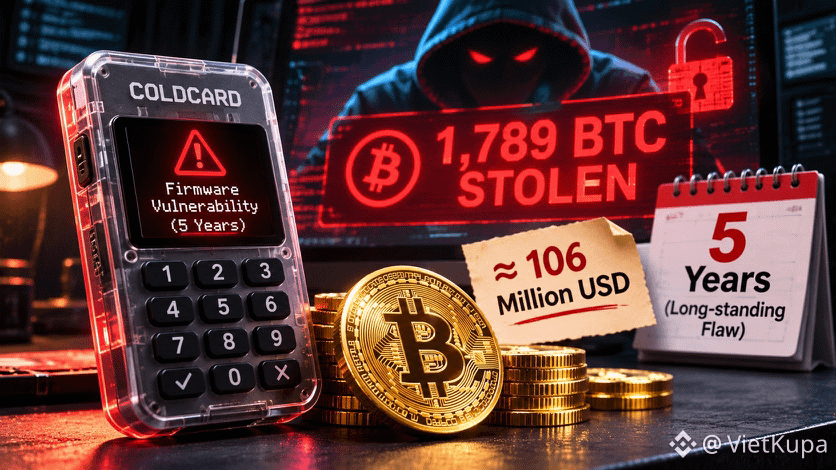
- Một lỗ hổng firmware trên Coldcard được cho là đã tồn tại suốt 5 năm.
- 1.789 BTC bị đánh cắp.
- Giá trị ước tính khoảng 106 triệu USD.
Điều đáng lo không chỉ nằm ở số Bitcoin bị mất, mà còn ở thời gian lỗ hổng tồn tại.
2. Vì sao ví lạnh vẫn có rủi ro?
Ví lạnh giúp giảm nguy cơ private key bị đánh cắp qua các cuộc tấn công trực tuyến.
Nhưng thiết bị phần cứng vẫn phụ thuộc vào firmware, quy trình ký giao dịch và cách người dùng bảo quản thiết bị.
Nói đơn giản: ví lạnh giúp tăng mức độ bảo vệ, chứ không tạo ra một lá chắn an toàn tuyệt đối.
3. Góc nhìn của mình
Trong Web3, chúng ta thường dành nhiều thời gian tìm kiếm ví tốt nhất, nhưng đôi khi lại quên kiểm tra cách mình sử dụng nó.
Một chiếc ví đắt tiền không thể thay thế thói quen bảo mật tốt.
Mình nghĩ người dùng nên chú ý:
- Chỉ tải firmware từ kênh chính thức.
- Kiểm tra thông báo bảo mật và bản cập nhật từ nhà sản xuất.
- Không nhập seed phrase vào website hoặc ứng dụng không rõ nguồn gốc.
- Không ký giao dịch khi chưa hiểu nội dung.
Tự quản lý tài sản đồng nghĩa với tự chịu trách nhiệm về bảo mật.
Bạn đang sử dụng ví nóng hay ví lạnh để lưu trữ tài sản dài hạn? Và lần gần nhất bạn kiểm tra firmware là khi nào?
#bitcoin #Coldcard
JMH_CRYPTO:
great info
1
1
379
·
--
The wallet that was supposed to be unhackable just admitted it wasn't.
Coinkite, maker of the Coldcard hardware wallet, published a postmortem on November 23 explaining how a seed-phrase flaw went undetected for more than five years — despite at least 15 independent security reviews. The checks confirmed the wallet had the right system for generating recovery phrases. They never verified the device was actually using it. A software bug fell back to a weaker system, making phrases easier to guess.
Galaxy Research reported in August that attackers stole at least 1,789 $BTC — around $114.7 million at the time. As of November 18, Coinkite had received about 300 loss-related support tickets tied to 242 accounts, and says the real victim count is likely higher. The flaw was patched on July 31, but a firmware update cannot fix phrases already generated — affected users must create new phrases and move their funds. No compensation plan has been decided, and investigators don't know who did it.
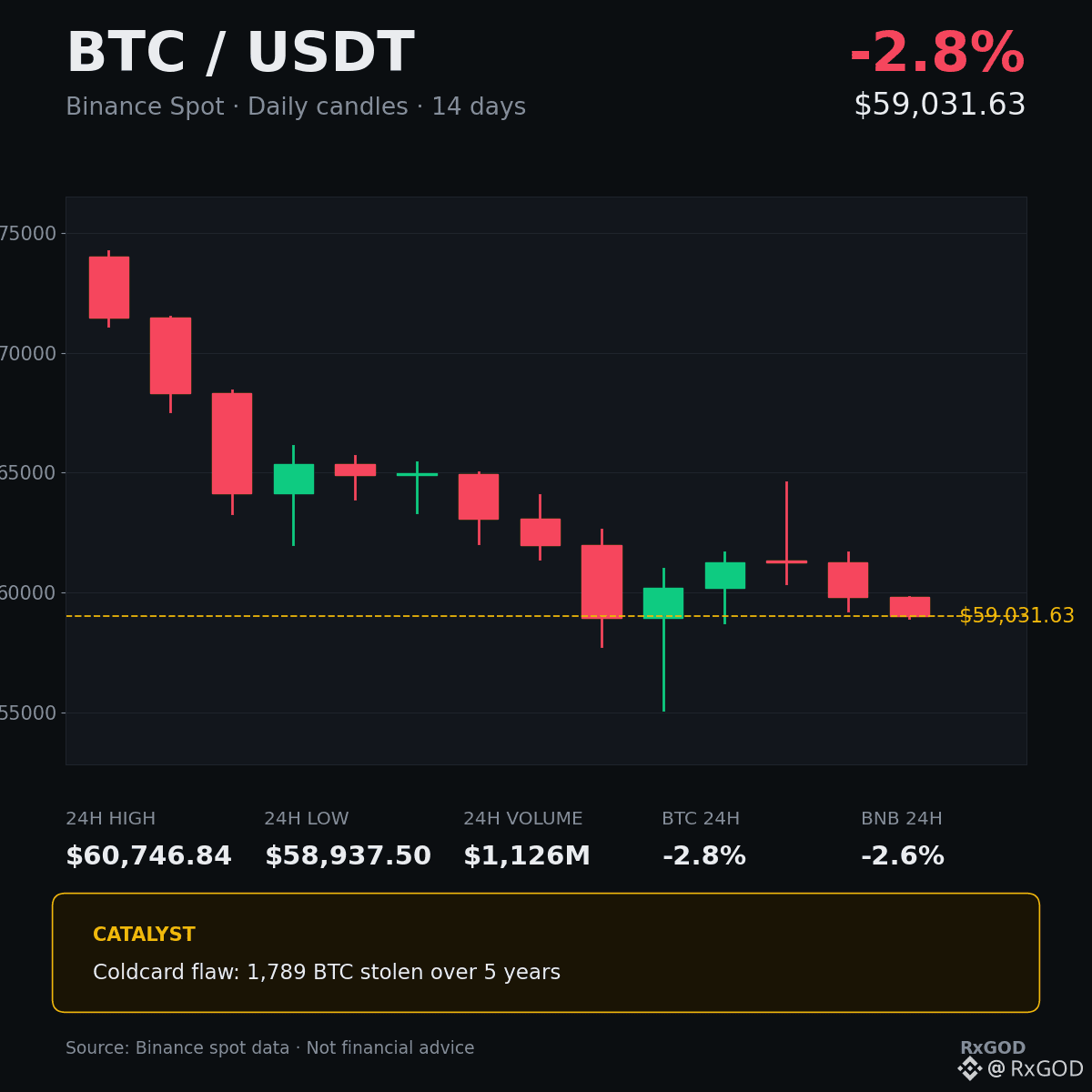
The timing stings. $BTC trades at $59,032, down 2.8% in 24 hours and 17.4% over 14 days, in the bottom fifth of its $55,130–$74,217 range, with Fear & Greed at 8 (Extreme Fear). A self-custody scandal is the last thing this market needed.
The uncomfortable question: if 15 audits couldn't catch this, is cold storage still the gold standard? Would you still trust a hardware wallet with your life savings — or has this changed how you store your crypto?
Not financial advice — DYOR.
#ExtremeFear #CryptoNews #Bitcoin #Coldcard
3

·
--
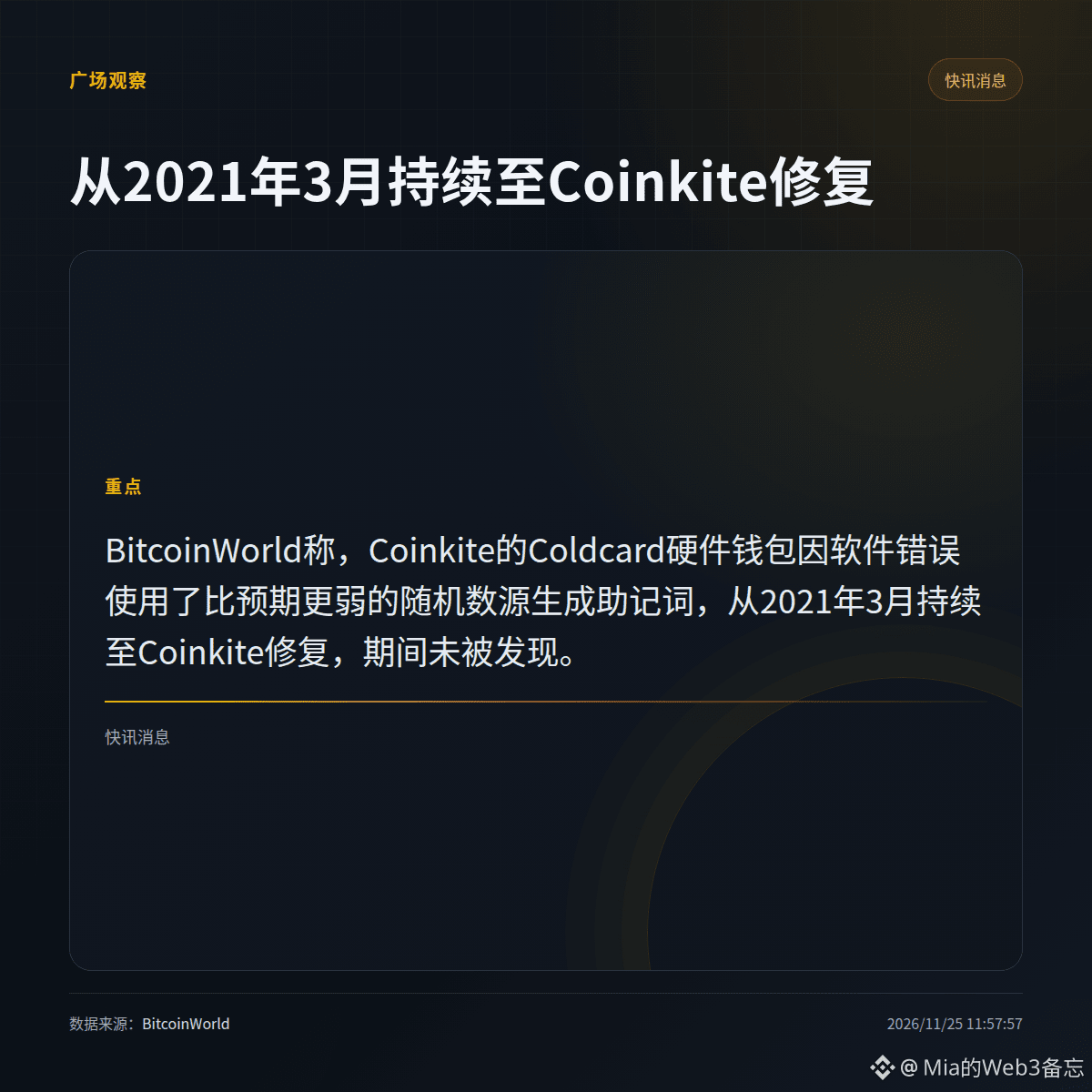
Coldcard有个软件错误,让硬件钱包生成恢复短语时用到的随机数源比原本设计的更弱,时间从2021年3月一直拖到Coinkite修补才结束。这里的关键词是“随机数源”:助记词的不可猜程度全靠它,源头变弱,前后就完全是两回事。已确认的是错误确实存在且延续了数年,另有报道称它躲过了15次审查,这部分归属BitcoinWorld的描述。对普通用户来说,重点不在行情,而在自己这台设备的固件补丁状态和助记词是否曾在弱随机条件下生成。$BTC #Coldcard。短线别只看一句话,成交和区间更能说明问题。
Coldcard有个软件错误,让硬件钱包生成恢复短语时用到的随机数源比原本设计的更弱,时间从2021年3月一直拖到Coinkite修补才结束。这里的关键词是“随机数源”:助记词的不可猜程度全靠它,源头变弱,前后就完全是两回事。已确认的是错误确实存在且延续了数年,另有报道称它躲过了15次审查,这部分归属BitcoinWorld的描述。对普通用户来说,重点不在行情,而在自己这台设备的固件补丁状态和助记词是否曾在弱随机条件下生成。$BTC #Coldcard。短线别只看一句话,成交和区间更能说明问题。
7

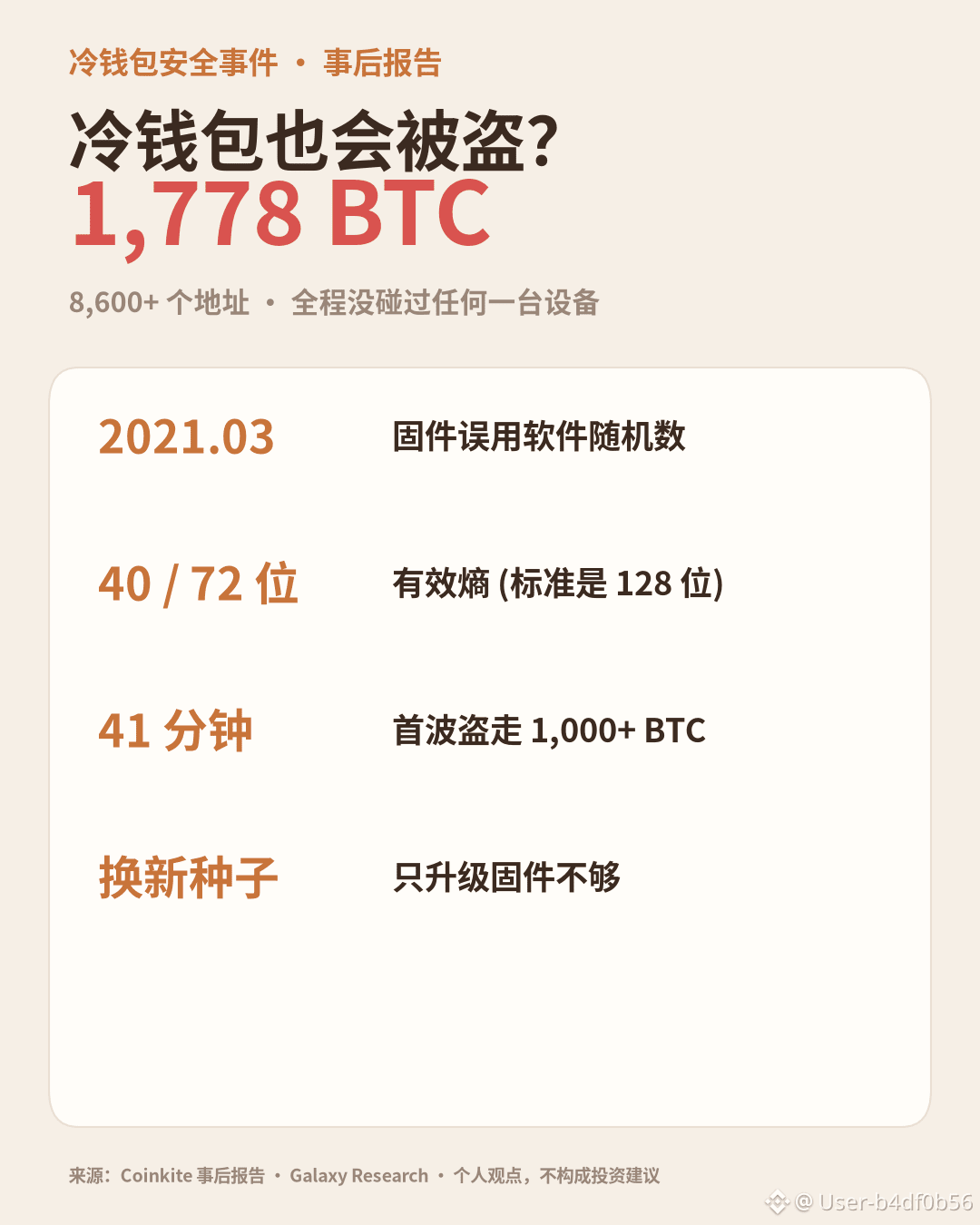
冷钱包也会被盗?Coldcard 18 页事后报告我读完了,最扎心的是:没人黑进设备。
1️⃣ 固件从 2021 年 3 月起误用软件随机数,种子有效熵只剩约 40–72 位(标准 128 位)
2️⃣ 攻击者离线暴力枚举还原私钥,8,600+ 个地址被清空,累计至少 1,778 枚 BTC,首波 41 分钟就走了 1,000+
3️⃣ 只升级固件没用,旧种子仍然弱,必须新建种子再转币
我的看法:$BTC 本来就在 6 万下方被 ETF 流出压着,这种"存储层"的信任事件不会直接砸盘,但会让不少人重新检查自己的钱包。我自己的做法是:看一眼设备型号和种子是怎么生成的,不确定就换。如果后续赔偿方案迟迟不出,信心偏弱;如果有清晰补偿,情绪反而缓和。$ETH 持有者同理。
你的主力存币方式是?
A 冷钱包 B 交易所 (评论区留字母,我挑几个聊聊)
关注我:这几天我会继续跟 PCE 数据,周四早上给你对答案复盘。
#比特币 #Coldcard #钱包安全 #PCE数据
个人观点,不构成投资建议;本帖可能产生广场创作奖励。
33

·
--
🚨 $BTC TRAICIÓN EN LA BÓVEDA MÁS SEGURA
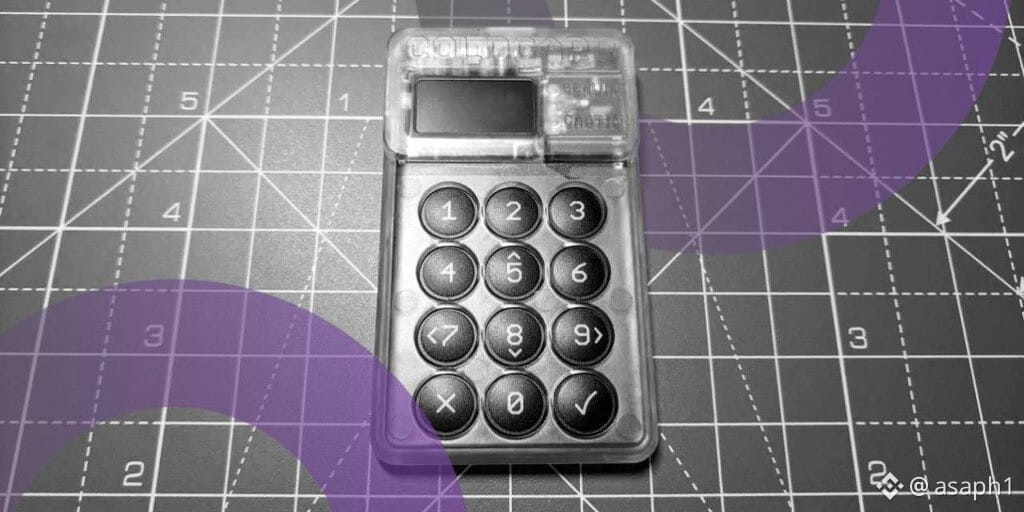
Coinkite publicó el postmortem del robo a Coldcard: un fallo de firmware generó las semillas con un generador débil durante más de 5 años, y los ladrones vaciaron billeteras sin tocar jamás un dispositivo. Para mí, esto es lo más grave: no fue un hackeo a un exchange, fue la propia caja fuerte la que entregó las llaves.
Miren el detalle que nadie está viendo:
→ Las semillas tenían solo 40 bits de seguridad en los Mk2 y Mk3 (y 72 en Mk4, Mk5 y Q) frente a los 128 bits que debían tener: un atacante podía regenerar las claves por su cuenta.
→ El fallo sobrevivió a más de 15 revisiones de seguridad, incluidas 2 auditorías pagadas y una revisión con IA que dio 85 hallazgos... y ninguna lo vio.
→ Galaxy Research contó 1,778.84 BTC robados de más de 8,600 direcciones, unos $107 millones, y Coinkite recibió ~300 reclamos de 242 cuentas.
¿Confías todavía en guardar tus BTC en una hardware wallet, sí o no? 👇
$BTC
#Bitcoin #Coldcard #Ciberseguridad
3
11.3k

·
--
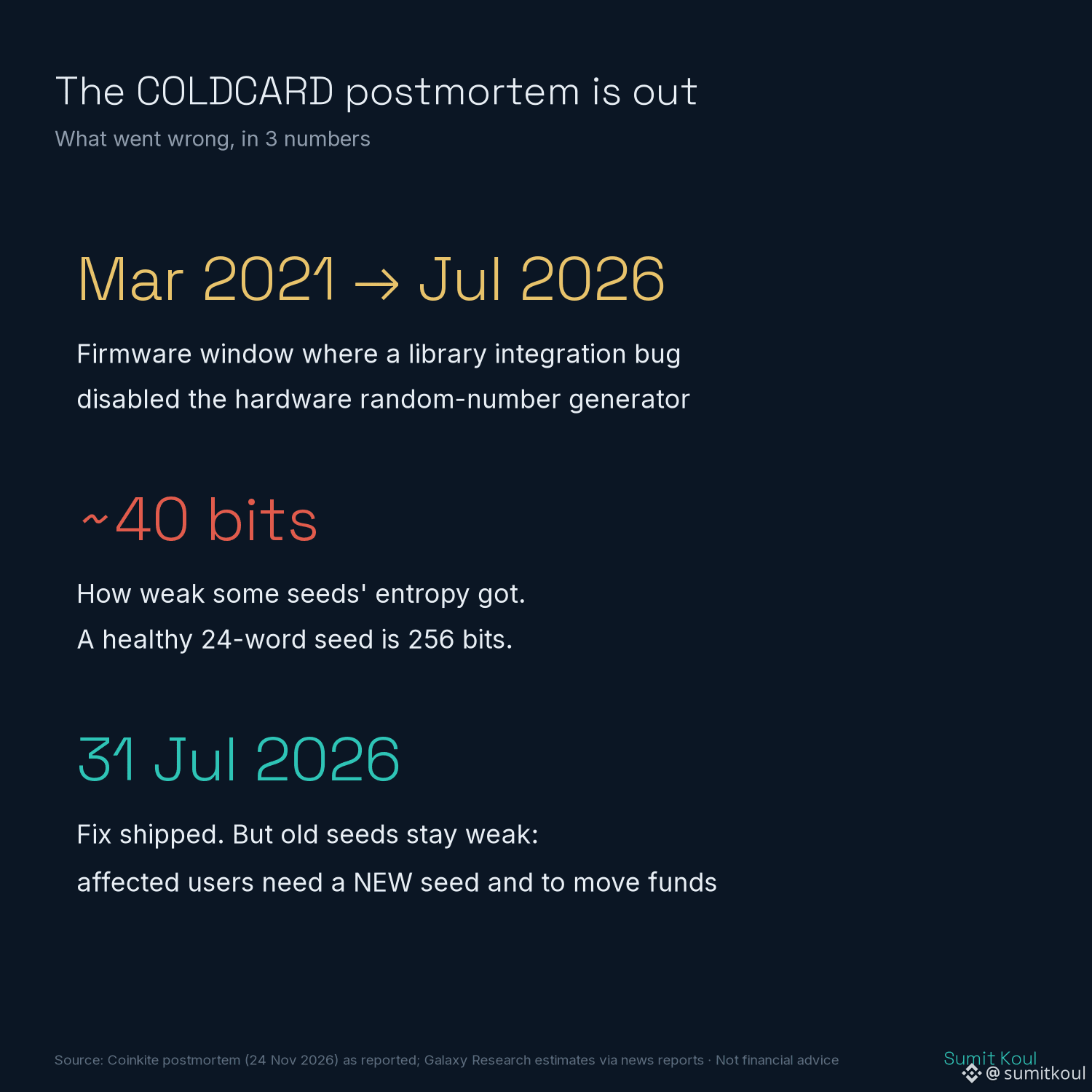
If you set up a COLDCARD between March 2021 and July 2026, read this today. 🔐
Coinkite has published its postmortem on the seed flaw:
• A library integration bug disabled the hardware random-number generator
• Some seeds ended up with as little as ~40 bits of entropy. A healthy 24-word seed has 256
• That made affected seeds crackable offline, without anyone touching the device
• A fix shipped on 31 July 2026
The part people miss: updating firmware does NOT fix an old seed.
If your seed was generated on affected firmware:
1. Update to current official firmware
2. Generate a brand-new seed (dice rolls help add your own entropy)
3. Move funds to the new wallet
4. Never type a seed into a website or "recovery service"
Know someone who uses a COLDCARD? Tag them or share this. It could save their stack. 👇
Follow me for security alerts that actually matter.
#COLDCARD #CryptoSecurity #Bitcoin
Not financial advice.

·
--
🔐 Coldcard Postmortem: 5-Year Seed Flaw Behind $107M Bitcoin Theft
📌 What happened
Coinkite published an 18-page postmortem on Nov 23 on the Coldcard seed-generation flaw that let thieves drain Bitcoin from customer wallets starting in July. A firmware setting switched off the hardware random number generator, so seeds fell back to a predictable software generator — and the defect survived at least 15 security reviews over five years.
📊 Key numbers
• 1,778.84 BTC stolen from 8,600+ addresses — ~$107M at current prices
• Flaw shipped in firmware from Mar 29, 2021 to Jul 30, 2026
• Effective seed entropy: ~40 bits (Mk2/Mk3) and ~72 bits (Mk4/Mk5/Q) vs 128 intended
• Thefts began Jul 29; fixed firmware shipped Jul 31
• ~300 loss tickets from 242 accounts as of Nov 18
• Compensation: "open; no decision" — Coinkite has not committed to reimburse victims
🔍 Why it matters
Coldcard is one of the most trusted names in Bitcoin self-custody, and this is a trust shock for the whole hardware-wallet sector: a single config error — a check that tested whether a setting was defined rather than enabled — silently weakened seeds for five years while reviewers confirmed the secure component existed without testing whether the code path reached it. It lands as BTC trades below $60,000, and the unanswered compensation question plus a September class-action filing keep the fallout live.
👀 What to watch
• Whether Coinkite announces a compensation plan
• The class-action case in Ontario and any further legal moves
• Whether other wallet makers publish RNG audits in response
• Any movement of the stolen 1,778.84 BTC
Not financial advice. Source: Coinkite postmortem / Bitcoin Magazine / CoinStats, Nov 24.
$BTC #Bitcoin #Coldcard #Security
81

·
--
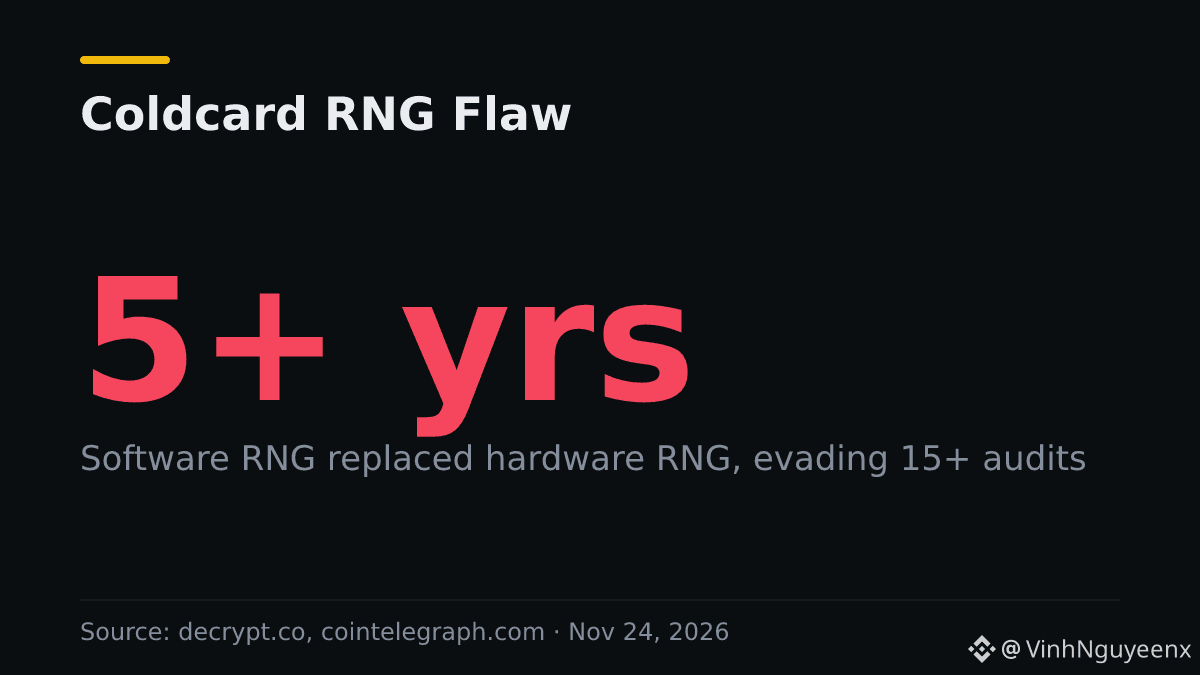
A hidden RNG flaw let Coldcard wallets evade detection for more than five years.
• Coinkite’s post‑mortem shows a software RNG replaced the hardware one for over five years (decrypt.co)
• Cointelegraph reports the flaw survived at least 15 security reviews before being disclosed (cointelegraph.com)
The incident highlights how even rigorous audits can miss subtle software swaps, urging hardware wallet makers to tighten supply‑chain checks.
What’s your top priority after this reveal?
A) Strengthen hardware audits
B) Rely on multi‑signature wallets
C) Switch to alternative wallets
$BTC #Coldcard #Security 🔐
⚠️ Not financial advice. DYOR.
49

·
--
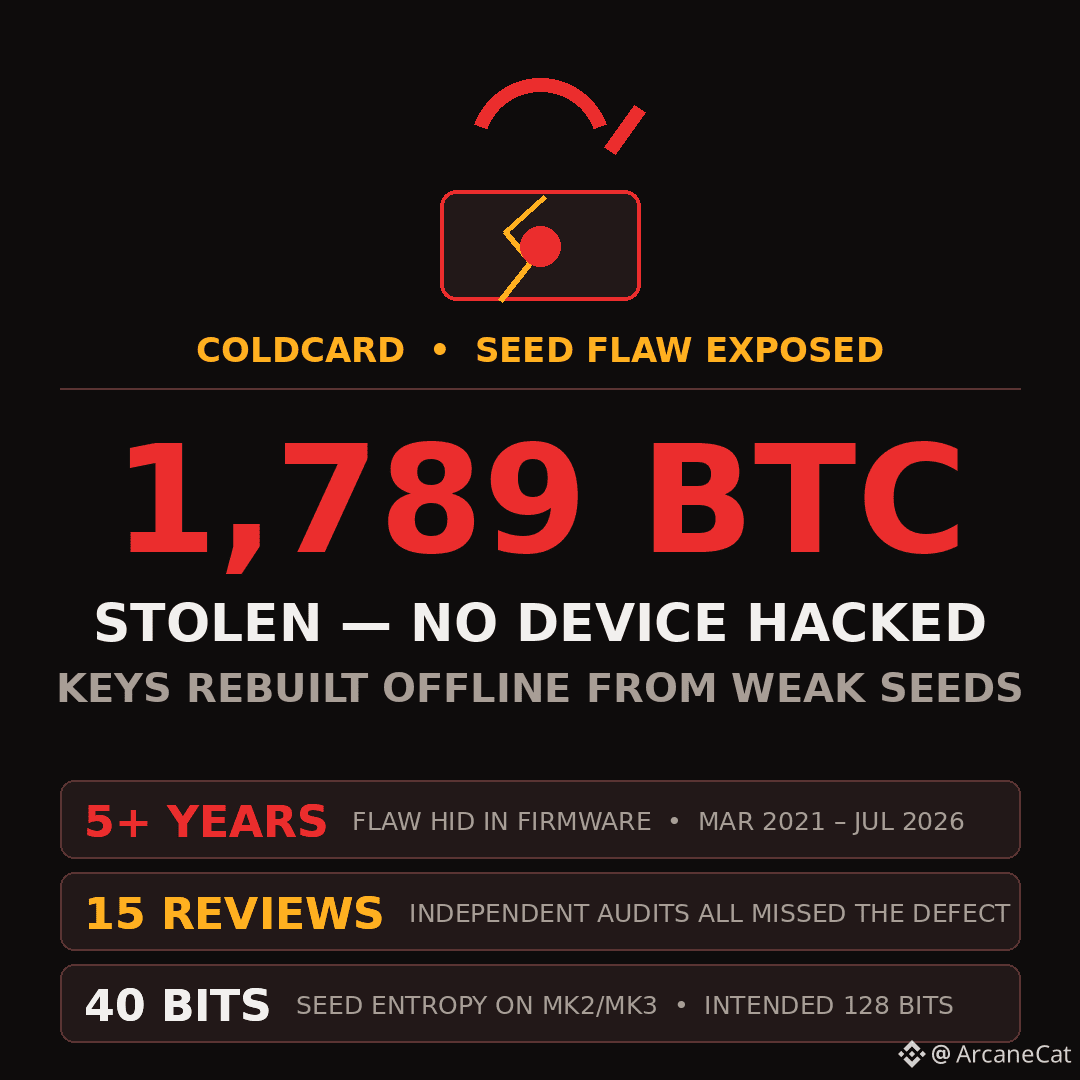
🚨 1,789 BTC STOLEN — 15 SECURITY AUDITS MISSED THE FLAW
Coinkite's Nov 23 postmortem is out: a Coldcard firmware bug ran undetected for 5+ years (Mar 2021–Jul 2026), silently swapping the hardware random-number generator for a predictable software one.
Seeds carried just 40–72 bits of entropy instead of 128 — attackers rebuilt private keys offline and drained 1,778.84 BTC from 8,600+ addresses, ~$107M. No device was hacked.
Thefts began Jul 29. Fixed Jul 31. The thief is still unknown.
Coldcard owners: update to the fixed firmware now.
#Bitcoin #BTC #Coldcard #Security
Not financial advice.
13

15轮审查查了5年,没一个发现钱包没用真随机数。
Coldcard官方自己认了:2021年3月固件就把真随机数关了,老型号种子强度只剩40位,标准是128位。7月被掏走1789枚$BTC,约1.15亿美元,242个账户报损,赔不赔到现在还没定。
查的是“有没有这个系统”,没查“到底用没用上”,这审计跟摆设有什么区别?$BTC还在6万下方磨,你的币还敢自己揣着吗,扣1放交易所,扣2自己拿着。
$BTC #Coldcard #硬件钱包
15轮审查查了5年,没一个发现钱包没用真随机数。
Coldcard官方自己认了:2021年3月固件就把真随机数关了,老型号种子强度只剩40位,标准是128位。7月被掏走1789枚$BTC ,约1.15亿美元,242个账户报损,赔不赔到现在还没定。
查的是“有没有这个系统”,没查“到底用没用上”,这审计跟摆设有什么区别?$BTC 还在6万下方磨,你的币还敢自己揣着吗,扣1放交易所,扣2自己拿着。
$BTC #Coldcard #硬件钱包
Coldcard官方自己认了:2021年3月固件就把真随机数关了,老型号种子强度只剩40位,标准是128位。7月被掏走1789枚$BTC ,约1.15亿美元,242个账户报损,赔不赔到现在还没定。
查的是“有没有这个系统”,没查“到底用没用上”,这审计跟摆设有什么区别?$BTC 还在6万下方磨,你的币还敢自己揣着吗,扣1放交易所,扣2自己拿着。
$BTC #Coldcard #硬件钱包

SỐC NẶNG! Coldcard, tưởng an toàn tuyệt đối, lại dính lỗ hổng firmware kinh hoàng suốt 5 năm, khiến tài sản người dùng gặp nguy hiểm nghiêm trọng.
Lỗi này âm thầm chuyển việc tạo seed Bitcoin từ phần cứng ngẫu nhiên mạnh sang phần mềm yếu hơn. Điều đáng nói là các cuộc kiểm toán, dù rất nhiều, đều bỏ qua chi tiết quan trọng này.
Kết quả? Các seed ví trở nên dễ đoán. Kẻ tấn công đã khai thác thành công, cướp đi 1,789 BTC, trị giá khủng khiếp 114.7 TRIỆU ĐÔ LA!
Coldcard đã sửa lỗi, nhưng các seed cũ vẫn không an toàn. Ai dùng Coldcard trước đó PHẢI chuyển hết tiền sang ví mới được tạo bằng entropy an toàn hơn ngay lập tức.
Bài học lớn: kiểm tra một thành phần an toàn là không đủ. Phải đảm bảo nó THỰC SỰ được sử dụng. Vậy sau vụ này, niềm tin vào các ví cứng của bạn có bị lung lay không?
#Coldcard #Bitcoin #Crypto
$BTC
91
Войдите, чтобы посмотреть больше материала
Присоединяйтесь к пользователям криптовалют по всему миру на Binance Square
⚡️ Получайте новейшую и полезную информацию о криптоактивах.
💬 Нам доверяет крупнейшая в мире криптобиржа.
👍 Получите достоверные аналитические данные от верифицированных создателей контента.
Эл. почта/номер телефона
В тренде
1
#CanMarketsReboundAfterThanksgiving?
Просмотров: 188,122
1,942 обсуждают
2
#CouldSpaceX’sOrbitalDataCentersBoostAIChipDemand?
Просмотров: 91,565
1,171 обсуждают
3
#SouthKoreaProposesMandatoryDigitalAssetTransactionDisclosure
Просмотров: 4,607
105 обсуждают
4
#EvolveAtBinanceBlockchainWeek
Просмотров: 833,690
10,390 обсуждают
5
#KoreaFSCSeeksPowerToSuspendCryptoListings
Просмотров: 21,240
319 обсуждают
6
#SouthKoreaPlansToRequireTetherCircleLocalReserves
Просмотров: 19,010
233 обсуждают
7
#UKFCAReportedlyPlansDeFiAuthorizationRules
Просмотров: 14,827
135 обсуждают
8
#ZcashDevelopersUrgeZECMoveToIronwood
Просмотров: 30,709
157 обсуждают
9
#TetherGoldFaces$2.55BUnrealizedLoss
Просмотров: 3,237
16 обсуждают
10
#CorePCEBeatLiftsFedHikeOdds
Просмотров: 300,821
1,831 обсуждают