

#binancep2pantoan
binancep2pantoan
Просмотров: 1.8M
8,344 обсуждают
Популярные
Новые
·
--
Статья
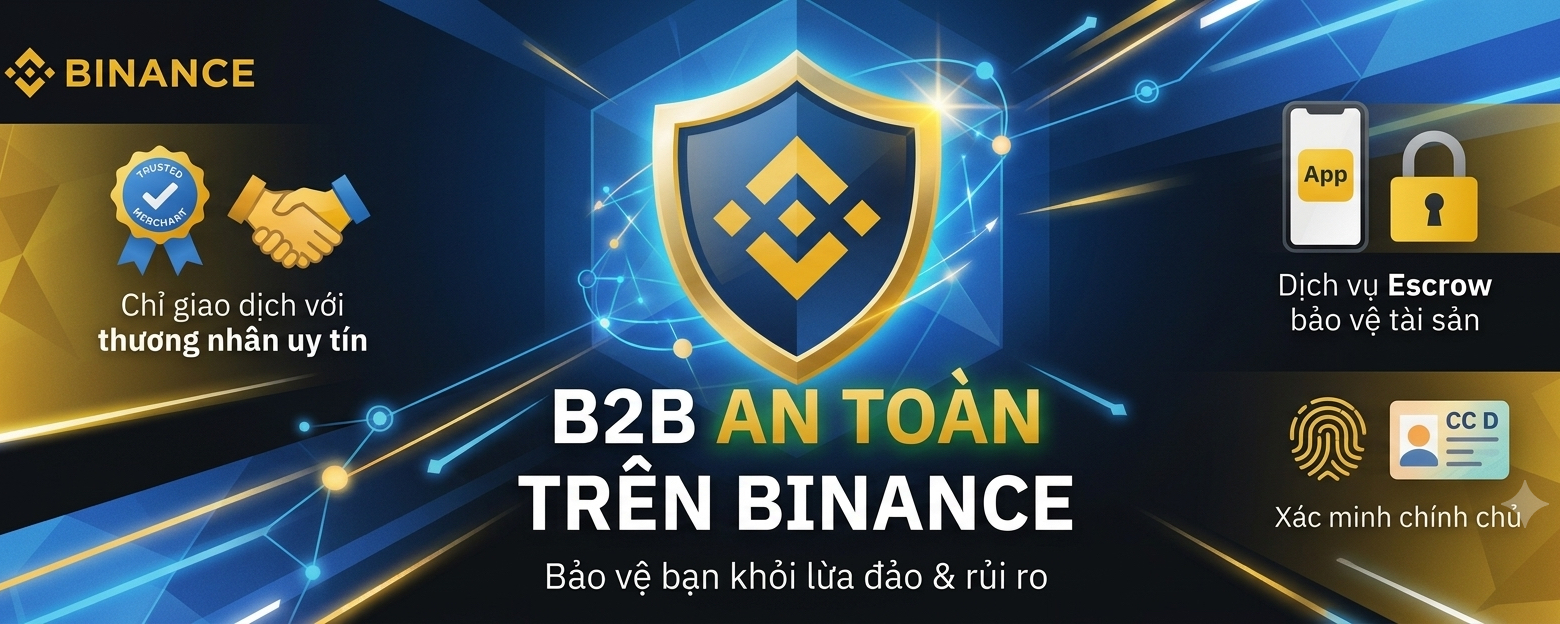
7 Quy Tắc "Xương Máu" Để Giao Dịch Binance P2P An Toàn Và Không Bao Giờ Mất TiềnGiao dịch P2P (Peer-to-Peer) trên Binance là kênh nạp/rút tiền pháp định (VND) phổ biến và tiện lợi nhất hiện nay. Tuy nhiên, đi kèm với sự tiện lợi là không ít rủi ro như dính "tiền bẩn" dẫn đến khóa tài khoản ngân hàng, hoặc bị các đối thủ xấu dùng chiêu trò lừa đảo.
Dù bạn là người mới (Newbie) hay nhà đầu tư lâu năm, việc nắm vững các quy tắc an toàn khi giao dịch P2P là điều bắt buộc để bảo vệ tài sản của chính mình.
1. Chỉ Chọn Đối Tác Đạt "Thước Đo Uy Tín"
Trước khi ấn nút đặt lệnh Mua hoặc Bán, hãy dành 5 giây kiểm tra hồ sơ đối tác:
Huy hiệu Tích Vàng: Ưu tiên chọn các Thương nhân (Merchant) đã được Binance xác minh.
Tỷ lệ hoàn thành (Completion Rate): Nên đạt từ 97% – 100%.
Số lượng giao dịch: Tối thiểu từ 300 đến 500 lệnh thành công trở lên.
2. Nguyên Tắc "Chính Chủ" Không Ngoại Lệ
Tài khoản ngân hàng chuyển/nhận tiền phải có TÊN TRÙNG KHỚP 100% với tên xác minh (KYC) trên tài khoản Binance.
Tuyệt đối KHÔNG sử dụng tài khoản của người thân, bạn bè để thanh toán hộ.
Nếu bán Crypto: Nếu nhận tiền từ tài khoản ngân hàng mang tên người khác (bên thứ 3), hãy từ chối giải phóng coin, yêu cầu hoàn tiền về đúng tài khoản đó và liên hệ CSKH. Việc nhận tiền từ bên thứ 3 khiến bạn đối mặt với rủi ro tài khoản ngân hàng bị phong tỏa do liên quan đến tiền bẩn.
3. Quy Tắc Ghi Nội Dung Chuyển Khoản
Khi chuyển tiền VND qua App Ngân hàng, chỉ ghi Mã lệnh (Order ID) hoặc các câu từ thông thường theo yêu cầu của đơn hàng.
TỰ CHỌN NỘI DUNG / TUYỆT ĐỐI KHÔNG GHI: Các từ khóa liên quan đến Crypto như: BTC, USDT, Binance, Crypto, Mua coin... Các ngân hàng tại Việt Nam kiểm soát rất chặt các giao dịch liên quan đến tiền mã hóa.
4. Kiểm Tra Số Dư Thực Tế – Nói "KHÔNG" Với Ảnh Chụp Màn Hình
Khi bán Crypto, bạn chỉ được bấm nút "Đã nhận thanh toán và giải phóng" khi đã ĐĂNG NHẬP TRỰC TIẾP VÀO APP NGÂN HÀNG và xác nhận số dư khả dụng đã tăng lên.
Tuyệt đối không tin vào tin nhắn SMS báo Coi, Email thông báo, hay Ảnh chụp biên lai do người mua gửi trong khung Chat (rất dễ bị làm giả bằng Photoshop).
5. Tuyệt Đối Không "Hủy Lệnh" Khi Đã Chuyển Tiền
Nếu bạn là người mua và ĐÃ CHUYỂN TIỀN từ ngân hàng, tuyệt đối KHÔNG bấm nút "Hủy lệnh" dù đối phương có viện bất kỳ lý do gì (lỗi hệ thống, hoàn tiền sau, nghẽn mạng...).
[https://p2p.binance.com/vi/trade/all-payments/USDT?fiat=USD](https://p2p.binance.com/vi/trade/all-payments/USDT?fiat=USD)
#BinanceP2PAnToan @Binance_Vietnam
7 Quy Tắc "Xương Máu" Để Giao Dịch Binance P2P An Toàn Và Không Bao Giờ Mất Tiền
Giao dịch P2P (Peer-to-Peer) trên Binance là kênh nạp/rút tiền pháp định (VND) phổ biến và tiện lợi nhất hiện nay. Tuy nhiên, đi kèm với sự tiện lợi là không ít rủi ro như dính "tiền bẩn" dẫn đến khóa tài khoản ngân hàng, hoặc bị các đối thủ xấu dùng chiêu trò lừa đảo.
Dù bạn là người mới (Newbie) hay nhà đầu tư lâu năm, việc nắm vững các quy tắc an toàn khi giao dịch P2P là điều bắt buộc để bảo vệ tài sản của chính mình.
1. Chỉ Chọn Đối Tác Đạt "Thước Đo Uy Tín"
Trước khi ấn nút đặt lệnh Mua hoặc Bán, hãy dành 5 giây kiểm tra hồ sơ đối tác:
Huy hiệu Tích Vàng: Ưu tiên chọn các Thương nhân (Merchant) đã được Binance xác minh.
Tỷ lệ hoàn thành (Completion Rate): Nên đạt từ 97% – 100%.
Số lượng giao dịch: Tối thiểu từ 300 đến 500 lệnh thành công trở lên.
2. Nguyên Tắc "Chính Chủ" Không Ngoại Lệ
Tài khoản ngân hàng chuyển/nhận tiền phải có TÊN TRÙNG KHỚP 100% với tên xác minh (KYC) trên tài khoản Binance.
Tuyệt đối KHÔNG sử dụng tài khoản của người thân, bạn bè để thanh toán hộ.
Nếu bán Crypto: Nếu nhận tiền từ tài khoản ngân hàng mang tên người khác (bên thứ 3), hãy từ chối giải phóng coin, yêu cầu hoàn tiền về đúng tài khoản đó và liên hệ CSKH. Việc nhận tiền từ bên thứ 3 khiến bạn đối mặt với rủi ro tài khoản ngân hàng bị phong tỏa do liên quan đến tiền bẩn.
3. Quy Tắc Ghi Nội Dung Chuyển Khoản
Khi chuyển tiền VND qua App Ngân hàng, chỉ ghi Mã lệnh (Order ID) hoặc các câu từ thông thường theo yêu cầu của đơn hàng.
TỰ CHỌN NỘI DUNG / TUYỆT ĐỐI KHÔNG GHI: Các từ khóa liên quan đến Crypto như: BTC, USDT, Binance, Crypto, Mua coin... Các ngân hàng tại Việt Nam kiểm soát rất chặt các giao dịch liên quan đến tiền mã hóa.
4. Kiểm Tra Số Dư Thực Tế – Nói "KHÔNG" Với Ảnh Chụp Màn Hình
Khi bán Crypto, bạn chỉ được bấm nút "Đã nhận thanh toán và giải phóng" khi đã ĐĂNG NHẬP TRỰC TIẾP VÀO APP NGÂN HÀNG và xác nhận số dư khả dụng đã tăng lên.
Tuyệt đối không tin vào tin nhắn SMS báo Coi, Email thông báo, hay Ảnh chụp biên lai do người mua gửi trong khung Chat (rất dễ bị làm giả bằng Photoshop).
5. Tuyệt Đối Không "Hủy Lệnh" Khi Đã Chuyển Tiền
Nếu bạn là người mua và ĐÃ CHUYỂN TIỀN từ ngân hàng, tuyệt đối KHÔNG bấm nút "Hủy lệnh" dù đối phương có viện bất kỳ lý do gì (lỗi hệ thống, hoàn tiền sau, nghẽn mạng...).
https://p2p.binance.com/vi/trade/all-payments/USDT?fiat=USD
#BinanceP2PAnToan @Binance Vietnam
Dù bạn là người mới (Newbie) hay nhà đầu tư lâu năm, việc nắm vững các quy tắc an toàn khi giao dịch P2P là điều bắt buộc để bảo vệ tài sản của chính mình.
1. Chỉ Chọn Đối Tác Đạt "Thước Đo Uy Tín"
Trước khi ấn nút đặt lệnh Mua hoặc Bán, hãy dành 5 giây kiểm tra hồ sơ đối tác:
Huy hiệu Tích Vàng: Ưu tiên chọn các Thương nhân (Merchant) đã được Binance xác minh.
Tỷ lệ hoàn thành (Completion Rate): Nên đạt từ 97% – 100%.
Số lượng giao dịch: Tối thiểu từ 300 đến 500 lệnh thành công trở lên.
2. Nguyên Tắc "Chính Chủ" Không Ngoại Lệ
Tài khoản ngân hàng chuyển/nhận tiền phải có TÊN TRÙNG KHỚP 100% với tên xác minh (KYC) trên tài khoản Binance.
Tuyệt đối KHÔNG sử dụng tài khoản của người thân, bạn bè để thanh toán hộ.
Nếu bán Crypto: Nếu nhận tiền từ tài khoản ngân hàng mang tên người khác (bên thứ 3), hãy từ chối giải phóng coin, yêu cầu hoàn tiền về đúng tài khoản đó và liên hệ CSKH. Việc nhận tiền từ bên thứ 3 khiến bạn đối mặt với rủi ro tài khoản ngân hàng bị phong tỏa do liên quan đến tiền bẩn.
3. Quy Tắc Ghi Nội Dung Chuyển Khoản
Khi chuyển tiền VND qua App Ngân hàng, chỉ ghi Mã lệnh (Order ID) hoặc các câu từ thông thường theo yêu cầu của đơn hàng.
TỰ CHỌN NỘI DUNG / TUYỆT ĐỐI KHÔNG GHI: Các từ khóa liên quan đến Crypto như: BTC, USDT, Binance, Crypto, Mua coin... Các ngân hàng tại Việt Nam kiểm soát rất chặt các giao dịch liên quan đến tiền mã hóa.
4. Kiểm Tra Số Dư Thực Tế – Nói "KHÔNG" Với Ảnh Chụp Màn Hình
Khi bán Crypto, bạn chỉ được bấm nút "Đã nhận thanh toán và giải phóng" khi đã ĐĂNG NHẬP TRỰC TIẾP VÀO APP NGÂN HÀNG và xác nhận số dư khả dụng đã tăng lên.
Tuyệt đối không tin vào tin nhắn SMS báo Coi, Email thông báo, hay Ảnh chụp biên lai do người mua gửi trong khung Chat (rất dễ bị làm giả bằng Photoshop).
5. Tuyệt Đối Không "Hủy Lệnh" Khi Đã Chuyển Tiền
Nếu bạn là người mua và ĐÃ CHUYỂN TIỀN từ ngân hàng, tuyệt đối KHÔNG bấm nút "Hủy lệnh" dù đối phương có viện bất kỳ lý do gì (lỗi hệ thống, hoàn tiền sau, nghẽn mạng...).
https://p2p.binance.com/vi/trade/all-payments/USDT?fiat=USD
#BinanceP2PAnToan @Binance Vietnam
1
153


·
--
Рост
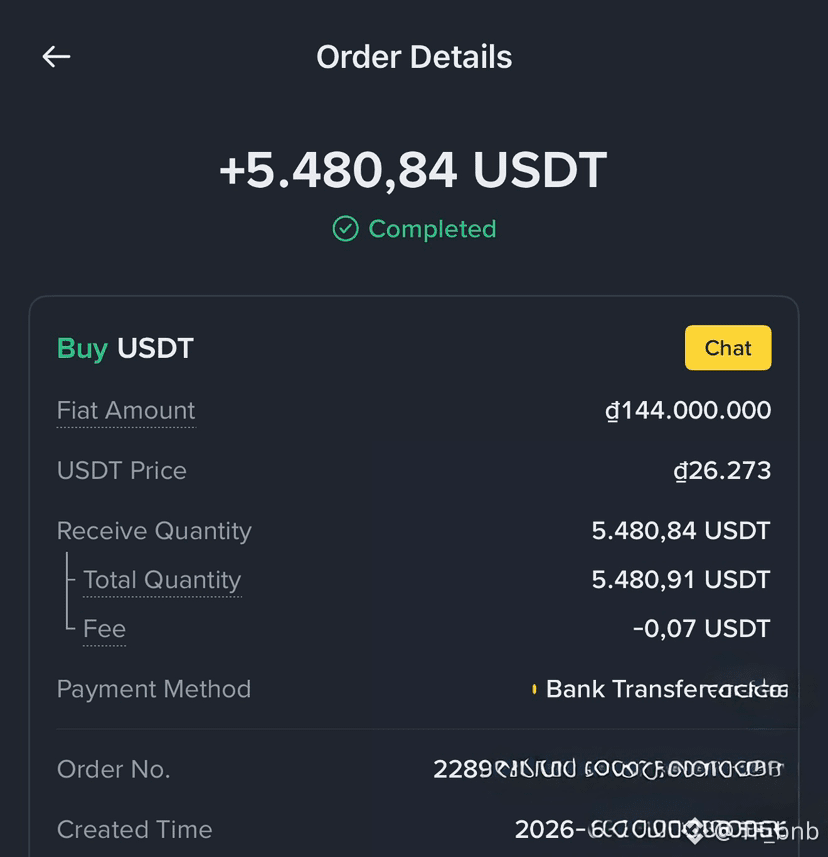
Deposited $5,480 through Binance P2P to continue trading Futures.
But here’s something I want to remind new traders: sometimes the problem isn’t your trading strategy ; it starts with the deposit process.
One small mistake can cause a transaction to fail, waste your time, or even put your funds at risk before you’ve even entered the market.
These are some of the most common mistakes beginners make:
1/ Sending money to the wrong bank
2/ Sending the wrong amount because they forgot to double-check
3/ Correct name but incorrect bank account number
4/ Entering the wrong transfer note
5/ Being asked to move the conversation or transaction to another platform
And there are many other situations you may encounter.
My advice: don’t start with a large amount.
If you’re new to Binance P2P, start with $50 → $100 first. Treat it as a small “learning fee” to understand the entire process: choosing a merchant, checking the payment details, making the transfer, confirming the payment, and receiving USDT.
Once you can consistently avoid these small mistakes, you can gradually increase the amount.
Trading is already risky enough ; don’t let a simple operational mistake cost you money before you even start trading.
Everyone has to start somewhere.
I did too.
Thank you, Binance, for being with me since 2017.
I love Binance. ❤️
#BinanceP2PAnToan
@Binance_Vietnam $BTC $SNDK $SPCX
{future}(BTCUSDT)
Deposited $5,480 through Binance P2P to continue trading Futures.
But here’s something I want to remind new traders: sometimes the problem isn’t your trading strategy ; it starts with the deposit process.
One small mistake can cause a transaction to fail, waste your time, or even put your funds at risk before you’ve even entered the market.
These are some of the most common mistakes beginners make:
1/ Sending money to the wrong bank
2/ Sending the wrong amount because they forgot to double-check
3/ Correct name but incorrect bank account number
4/ Entering the wrong transfer note
5/ Being asked to move the conversation or transaction to another platform
And there are many other situations you may encounter.
My advice: don’t start with a large amount.
If you’re new to Binance P2P, start with $50 → $100 first. Treat it as a small “learning fee” to understand the entire process: choosing a merchant, checking the payment details, making the transfer, confirming the payment, and receiving USDT.
Once you can consistently avoid these small mistakes, you can gradually increase the amount.
Trading is already risky enough ; don’t let a simple operational mistake cost you money before you even start trading.
Everyone has to start somewhere.
I did too.
Thank you, Binance, for being with me since 2017.
I love Binance. ❤️
#BinanceP2PAnToan
@Binance Vietnam $BTC $SNDK $SPCX
But here’s something I want to remind new traders: sometimes the problem isn’t your trading strategy ; it starts with the deposit process.
One small mistake can cause a transaction to fail, waste your time, or even put your funds at risk before you’ve even entered the market.
These are some of the most common mistakes beginners make:
1/ Sending money to the wrong bank
2/ Sending the wrong amount because they forgot to double-check
3/ Correct name but incorrect bank account number
4/ Entering the wrong transfer note
5/ Being asked to move the conversation or transaction to another platform
And there are many other situations you may encounter.
My advice: don’t start with a large amount.
If you’re new to Binance P2P, start with $50 → $100 first. Treat it as a small “learning fee” to understand the entire process: choosing a merchant, checking the payment details, making the transfer, confirming the payment, and receiving USDT.
Once you can consistently avoid these small mistakes, you can gradually increase the amount.
Trading is already risky enough ; don’t let a simple operational mistake cost you money before you even start trading.
Everyone has to start somewhere.
I did too.
Thank you, Binance, for being with me since 2017.
I love Binance. ❤️
#BinanceP2PAnToan
@Binance Vietnam $BTC $SNDK $SPCX
22
22
3k

·
--
The P2P Countdown Is Not Payment Evidence
A countdown can create urgency without adding any proof.
In Binance’s current P2P order model, an Order at “Paid (Unconfirmed)” can show a release deadline. That timer is useful: it tells you where the Order is in the workflow and how much time remains. But it does not tell the seller whether the expected VND has actually reached the receiving account.
That distinction changes the decision before Confirm Release.
If the timer is running but the bank account still does not show the expected funds, the two signals disagree. The countdown should not “outvote” the payment check. Keep the crypto in escrow and resolve the mismatch through the Order/Appeal flow.
If the money is visible, verification still has a second layer: does the payment match this Order and the payer information Binance expects? Binance’s merchant rules specifically treat payer-name mismatch as a reason not to release.
So the timer answers a timing question. Your receiving account and Order details answer the payment question.
A simple mental model: deadlines tell you when to act; evidence tells you what action is safe.
@Binance_Vietnam #BinanceP2PAnToan $AVAAI $ACE $ONG
The P2P Countdown Is Not Payment Evidence
A countdown can create urgency without adding any proof.
In Binance’s current P2P order model, an Order at “Paid (Unconfirmed)” can show a release deadline. That timer is useful: it tells you where the Order is in the workflow and how much time remains. But it does not tell the seller whether the expected VND has actually reached the receiving account.
That distinction changes the decision before Confirm Release.
If the timer is running but the bank account still does not show the expected funds, the two signals disagree. The countdown should not “outvote” the payment check. Keep the crypto in escrow and resolve the mismatch through the Order/Appeal flow.
If the money is visible, verification still has a second layer: does the payment match this Order and the payer information Binance expects? Binance’s merchant rules specifically treat payer-name mismatch as a reason not to release.
So the timer answers a timing question. Your receiving account and Order details answer the payment question.
A simple mental model: deadlines tell you when to act; evidence tells you what action is safe.
@Binance Vietnam #BinanceP2PAnToan $AVAAI $ACE $ONG
A countdown can create urgency without adding any proof.
In Binance’s current P2P order model, an Order at “Paid (Unconfirmed)” can show a release deadline. That timer is useful: it tells you where the Order is in the workflow and how much time remains. But it does not tell the seller whether the expected VND has actually reached the receiving account.
That distinction changes the decision before Confirm Release.
If the timer is running but the bank account still does not show the expected funds, the two signals disagree. The countdown should not “outvote” the payment check. Keep the crypto in escrow and resolve the mismatch through the Order/Appeal flow.
If the money is visible, verification still has a second layer: does the payment match this Order and the payer information Binance expects? Binance’s merchant rules specifically treat payer-name mismatch as a reason not to release.
So the timer answers a timing question. Your receiving account and Order details answer the payment question.
A simple mental model: deadlines tell you when to act; evidence tells you what action is safe.
@Binance Vietnam #BinanceP2PAnToan $AVAAI $ACE $ONG
1
297

·
--
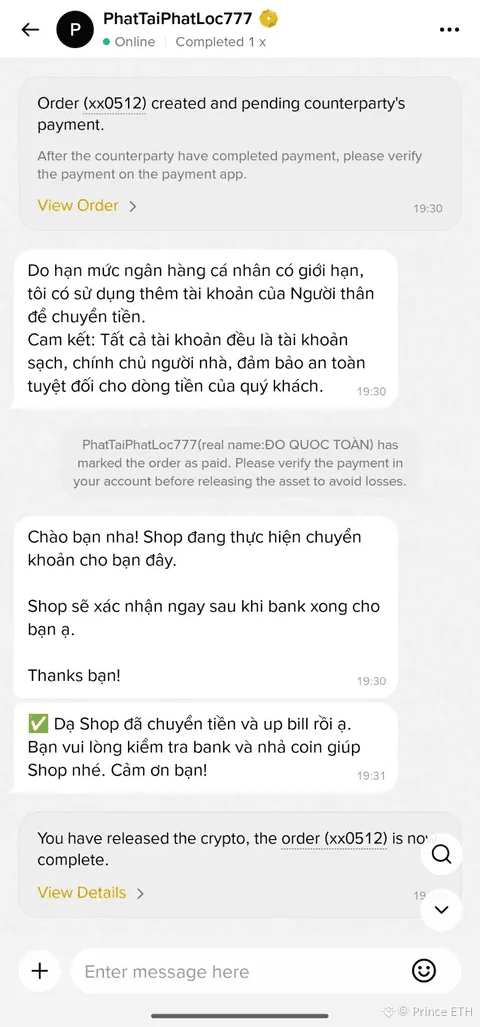
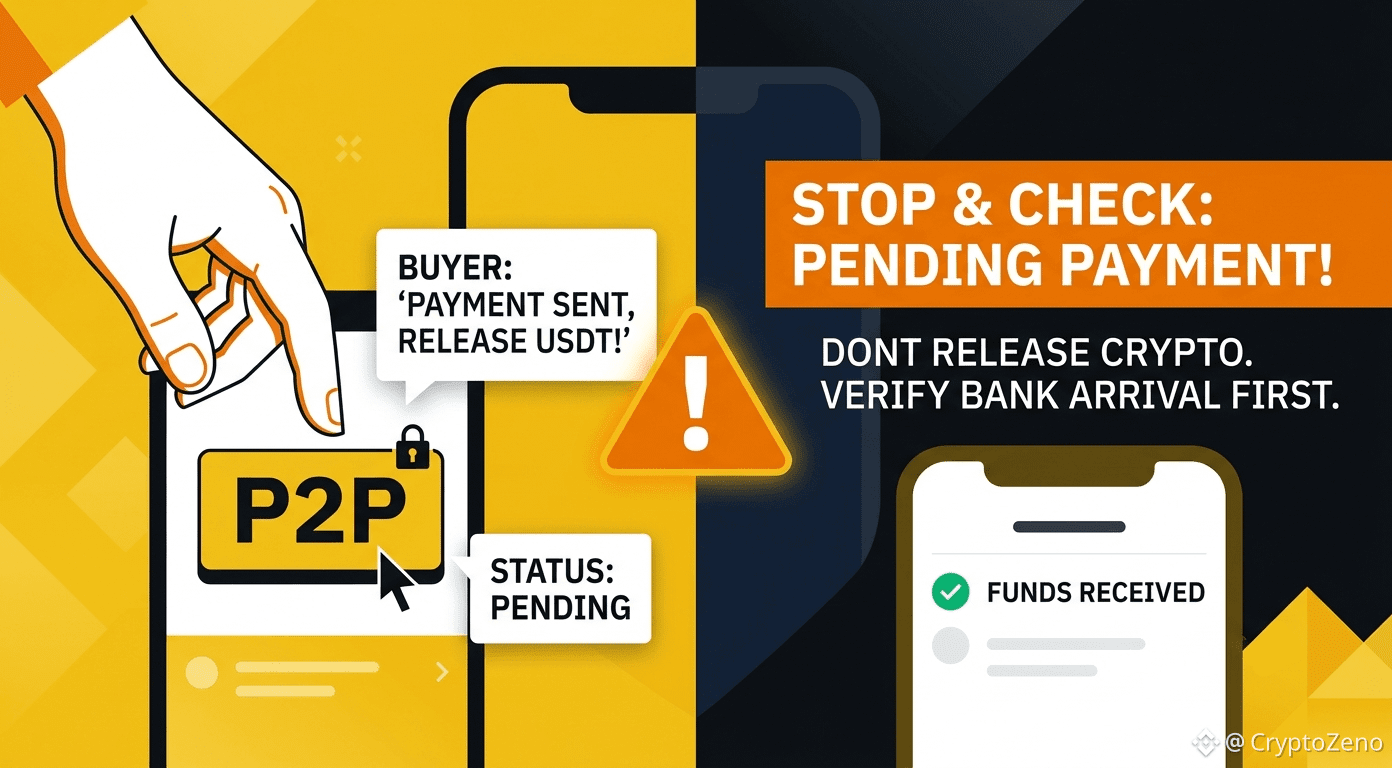
I was selling USDT on Binance P2P when the buyer sent me a message that made me stop before releasing the crypto. They said the payment had been made, but when I checked my bank account, the amount was still showing as pending
The buyer kept telling me the transfer was already completed and sent me a screenshot as proof. Normally, I might have felt pressured to trust it, especially when the screenshot showed the correct amount
So I left the USDT in the order and told the buyer I would release it once the payment was confirmed in my account. A few minutes later, the status changed and the funds arrived properly
A payment screenshot can tell me what someone claims happened. My own account tells me what actually happened
Compare the sender details with the order, and keep the transaction inside Binance P2P if anything doesn't match. If the payment stays unclear, I don't release first and investigate later. I keep the Order ID and chat history and use Appeal if support is needed
The few minutes I waited were nothing compared with the headache of releasing crypto against a payment that had not actually arrived
@Binance_Vietnam #BinanceP2PAnToan
I was selling USDT on Binance P2P when the buyer sent me a message that made me stop before releasing the crypto. They said the payment had been made, but when I checked my bank account, the amount was still showing as pending
The buyer kept telling me the transfer was already completed and sent me a screenshot as proof. Normally, I might have felt pressured to trust it, especially when the screenshot showed the correct amount
So I left the USDT in the order and told the buyer I would release it once the payment was confirmed in my account. A few minutes later, the status changed and the funds arrived properly
A payment screenshot can tell me what someone claims happened. My own account tells me what actually happened
Compare the sender details with the order, and keep the transaction inside Binance P2P if anything doesn't match. If the payment stays unclear, I don't release first and investigate later. I keep the Order ID and chat history and use Appeal if support is needed
The few minutes I waited were nothing compared with the headache of releasing crypto against a payment that had not actually arrived
@Binance Vietnam #BinanceP2PAnToan
The buyer kept telling me the transfer was already completed and sent me a screenshot as proof. Normally, I might have felt pressured to trust it, especially when the screenshot showed the correct amount
So I left the USDT in the order and told the buyer I would release it once the payment was confirmed in my account. A few minutes later, the status changed and the funds arrived properly
A payment screenshot can tell me what someone claims happened. My own account tells me what actually happened
Compare the sender details with the order, and keep the transaction inside Binance P2P if anything doesn't match. If the payment stays unclear, I don't release first and investigate later. I keep the Order ID and chat history and use Appeal if support is needed
The few minutes I waited were nothing compared with the headache of releasing crypto against a payment that had not actually arrived
@Binance Vietnam #BinanceP2PAnToan
2
5
2.4k

·
--
The Complete Binance P2P Safety Checklist I Wish I Had Earlier
Nobody handed me this list on my first trade.
I built it across two years of trading on Binance P2P, watching what goes wrong and working out which habits actually prevent it.
Before accepting any trade, check the seller's completion rate, total trade count, merchant badge status, and recent feedback from the last 30 days. Screenshot the profile before confirming. A better rate on a thin profile has never been worth what it costs when something goes wrong.
Keep every conversation inside the Binance P2P chat window. No Telegram, no WhatsApp, no phone calls, no external links. Once communication leaves the platform, Binance Support cannot use it in a dispute.
Send the exact amount listed on the order. Confirm the payment method matches before money moves. After paying, open your bank app directly and verify the amount, timestamp, and sender name against what's on the P2P order. A screenshot from the counterparty is not confirmation.
Four situations stop the trade immediately. Pressure to release before verification finishes, a payment name that doesn't match the order, any request to move outside the platform, and messages claiming system issues requiring early action. Any single one of these is enough to pause.
Save four things before every trade window closes: Order ID, payment receipt, full in-platform chat log, counterparty profile screenshot.
File disputes before the timer expires. Escrow holds everything in place while Binance reviews. Once the window closes without a dispute, that hold releases automatically.
The list looks long the first time. After ten trades it runs in under four minutes.
@Binance_Vietnam
#BinanceP2PAnToan
Quick question for you 👇
How many of these safety habits do you already practice on every trade?
The Complete Binance P2P Safety Checklist I Wish I Had Earlier
Nobody handed me this list on my first trade.
I built it across two years of trading on Binance P2P, watching what goes wrong and working out which habits actually prevent it.
Before accepting any trade, check the seller's completion rate, total trade count, merchant badge status, and recent feedback from the last 30 days. Screenshot the profile before confirming. A better rate on a thin profile has never been worth what it costs when something goes wrong.
Keep every conversation inside the Binance P2P chat window. No Telegram, no WhatsApp, no phone calls, no external links. Once communication leaves the platform, Binance Support cannot use it in a dispute.
Send the exact amount listed on the order. Confirm the payment method matches before money moves. After paying, open your bank app directly and verify the amount, timestamp, and sender name against what's on the P2P order. A screenshot from the counterparty is not confirmation.
Four situations stop the trade immediately. Pressure to release before verification finishes, a payment name that doesn't match the order, any request to move outside the platform, and messages claiming system issues requiring early action. Any single one of these is enough to pause.
Save four things before every trade window closes: Order ID, payment receipt, full in-platform chat log, counterparty profile screenshot.
File disputes before the timer expires. Escrow holds everything in place while Binance reviews. Once the window closes without a dispute, that hold releases automatically.
The list looks long the first time. After ten trades it runs in under four minutes.
@Binance Vietnam
#BinanceP2PAnToan
Quick question for you 👇
How many of these safety habits do you already practice on every trade?
Nobody handed me this list on my first trade.
I built it across two years of trading on Binance P2P, watching what goes wrong and working out which habits actually prevent it.
Before accepting any trade, check the seller's completion rate, total trade count, merchant badge status, and recent feedback from the last 30 days. Screenshot the profile before confirming. A better rate on a thin profile has never been worth what it costs when something goes wrong.
Keep every conversation inside the Binance P2P chat window. No Telegram, no WhatsApp, no phone calls, no external links. Once communication leaves the platform, Binance Support cannot use it in a dispute.
Send the exact amount listed on the order. Confirm the payment method matches before money moves. After paying, open your bank app directly and verify the amount, timestamp, and sender name against what's on the P2P order. A screenshot from the counterparty is not confirmation.
Four situations stop the trade immediately. Pressure to release before verification finishes, a payment name that doesn't match the order, any request to move outside the platform, and messages claiming system issues requiring early action. Any single one of these is enough to pause.
Save four things before every trade window closes: Order ID, payment receipt, full in-platform chat log, counterparty profile screenshot.
File disputes before the timer expires. Escrow holds everything in place while Binance reviews. Once the window closes without a dispute, that hold releases automatically.
The list looks long the first time. After ten trades it runs in under four minutes.
@Binance Vietnam
#BinanceP2PAnToan
Quick question for you 👇
How many of these safety habits do you already practice on every trade?
All of them, every single time
0%
Most of them but not all
0%
A few, learning the rest now
0%
Starting fresh after reading
0%
0 проголосовали • Голосование закрыто
2
6
357

·
--
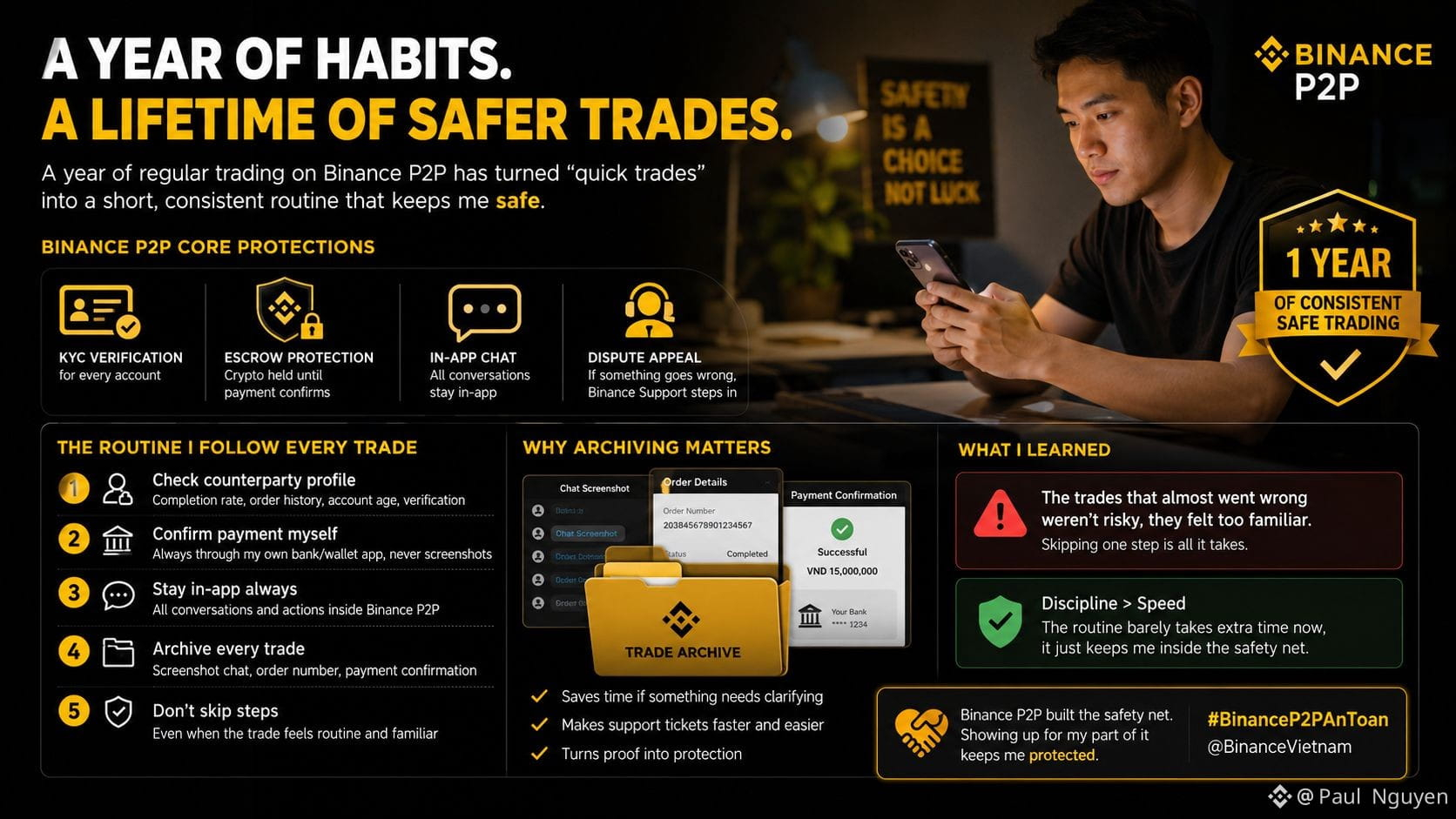
A year of regular trading on Binance P2P has completely changed how I think about a quick trade. What used to feel like just tapping through a few screens is now a short, consistent routine I follow every single time, and it's made a genuine difference in how safe the whole process feels.
Binance P2P's core protections haven't changed over that year, KYC verification for every account, escrow holding crypto until payment confirms, in app chat, and dispute appeal if something breaks down. What changed is how deliberately I actually use them. I check a counterparty's completion rate and order history before every trade now, not just the ones that feel unusual. I confirm payment directly through my own bank or wallet app, never through a chat screenshot, regardless of how convincing it looks or how many times I've traded with that person before.
The habit that's paid off the most is archiving. Every order gets a screenshot of the chat, the order number, and payment confirmation saved together, whether the trade was routine or not. I didn't think I'd need most of them, but on the handful of times something needed clarifying, having that record ready meant contacting Binance support was quick instead of a scramble.
Looking back at the trades that felt closest to going wrong, every single one involved me skipping a step because everything up to that point had felt routine and safe. That's the part nobody warns you about early on, it's not the obviously risky trades that catch you off guard, it's the ones that feel too familiar to bother double checking. So even now, the trades I'm most careful with aren't the unusual ones, they're the ones that feel exactly like every other trade I've done successfully on Binance P2P before.
A year in, the routine barely takes extra time anymore, it's just how I trade now. Binance P2P built the safety net; showing up consistently for my part of it is what actually keeps me inside it.
@Binance_Vietnam #BinanceP2PAnToan
A year of regular trading on Binance P2P has completely changed how I think about a quick trade. What used to feel like just tapping through a few screens is now a short, consistent routine I follow every single time, and it's made a genuine difference in how safe the whole process feels.
Binance P2P's core protections haven't changed over that year, KYC verification for every account, escrow holding crypto until payment confirms, in app chat, and dispute appeal if something breaks down. What changed is how deliberately I actually use them. I check a counterparty's completion rate and order history before every trade now, not just the ones that feel unusual. I confirm payment directly through my own bank or wallet app, never through a chat screenshot, regardless of how convincing it looks or how many times I've traded with that person before.
The habit that's paid off the most is archiving. Every order gets a screenshot of the chat, the order number, and payment confirmation saved together, whether the trade was routine or not. I didn't think I'd need most of them, but on the handful of times something needed clarifying, having that record ready meant contacting Binance support was quick instead of a scramble.
Looking back at the trades that felt closest to going wrong, every single one involved me skipping a step because everything up to that point had felt routine and safe. That's the part nobody warns you about early on, it's not the obviously risky trades that catch you off guard, it's the ones that feel too familiar to bother double checking. So even now, the trades I'm most careful with aren't the unusual ones, they're the ones that feel exactly like every other trade I've done successfully on Binance P2P before.
A year in, the routine barely takes extra time anymore, it's just how I trade now. Binance P2P built the safety net; showing up consistently for my part of it is what actually keeps me inside it.
@Binance Vietnam #BinanceP2PAnToan
Binance P2P's core protections haven't changed over that year, KYC verification for every account, escrow holding crypto until payment confirms, in app chat, and dispute appeal if something breaks down. What changed is how deliberately I actually use them. I check a counterparty's completion rate and order history before every trade now, not just the ones that feel unusual. I confirm payment directly through my own bank or wallet app, never through a chat screenshot, regardless of how convincing it looks or how many times I've traded with that person before.
The habit that's paid off the most is archiving. Every order gets a screenshot of the chat, the order number, and payment confirmation saved together, whether the trade was routine or not. I didn't think I'd need most of them, but on the handful of times something needed clarifying, having that record ready meant contacting Binance support was quick instead of a scramble.
Looking back at the trades that felt closest to going wrong, every single one involved me skipping a step because everything up to that point had felt routine and safe. That's the part nobody warns you about early on, it's not the obviously risky trades that catch you off guard, it's the ones that feel too familiar to bother double checking. So even now, the trades I'm most careful with aren't the unusual ones, they're the ones that feel exactly like every other trade I've done successfully on Binance P2P before.
A year in, the routine barely takes extra time anymore, it's just how I trade now. Binance P2P built the safety net; showing up consistently for my part of it is what actually keeps me inside it.
@Binance Vietnam #BinanceP2PAnToan
230

·
--
Рост
P2P Safety: A Completed Order Doesn’t Always Mean the Risk Is Over
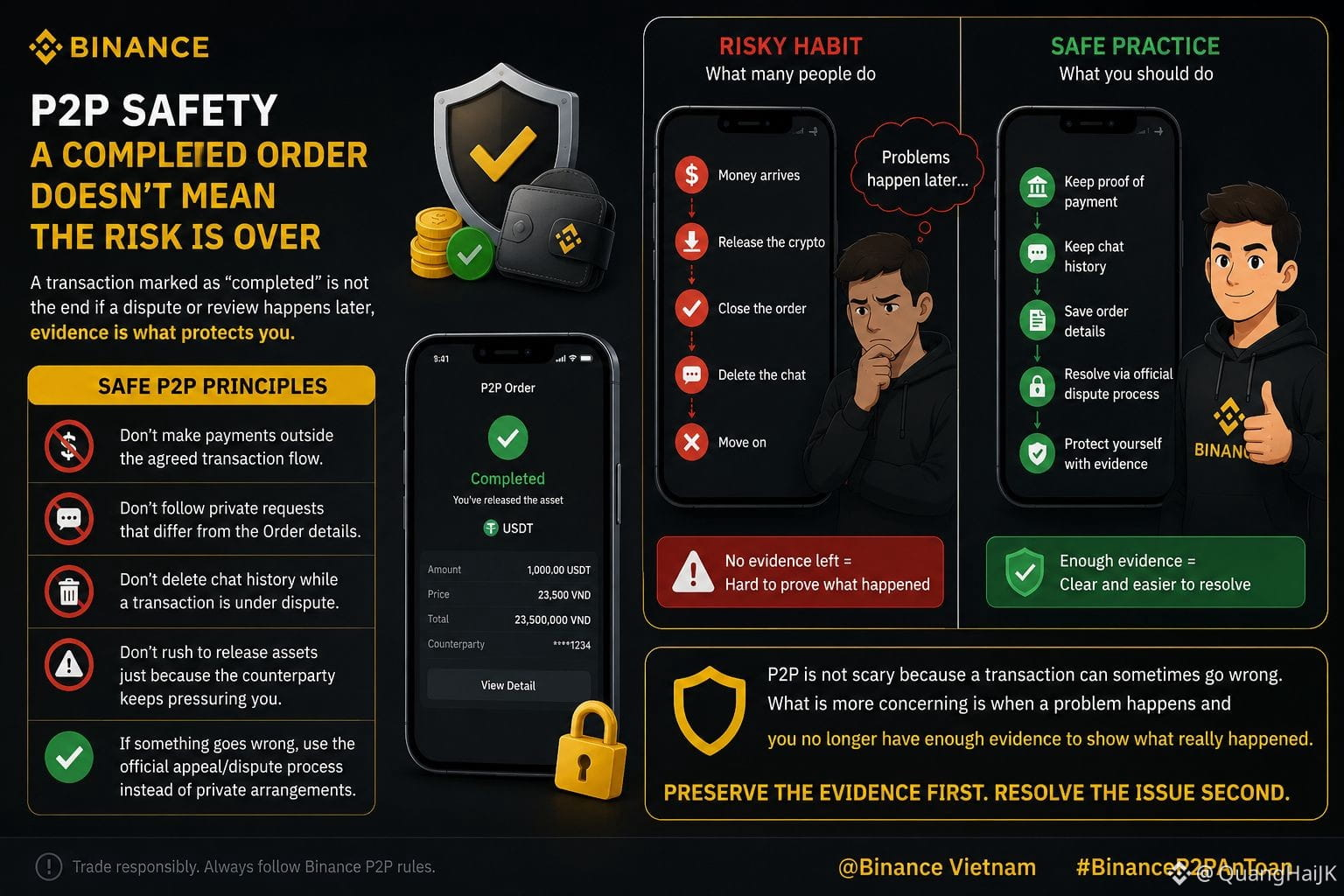
P2P has a type of risk that many people only recognize after their account runs into a problem: a “completed order” does not necessarily mean everything is over.
There is a dangerous habit in P2P trading:
Money arrives → release the crypto → close the order → delete the chat → move on.
But if a dispute arises later, a transaction is reviewed, or one party files a complaint, the things that seemed unimportant at the time can become critical evidence.
For example:
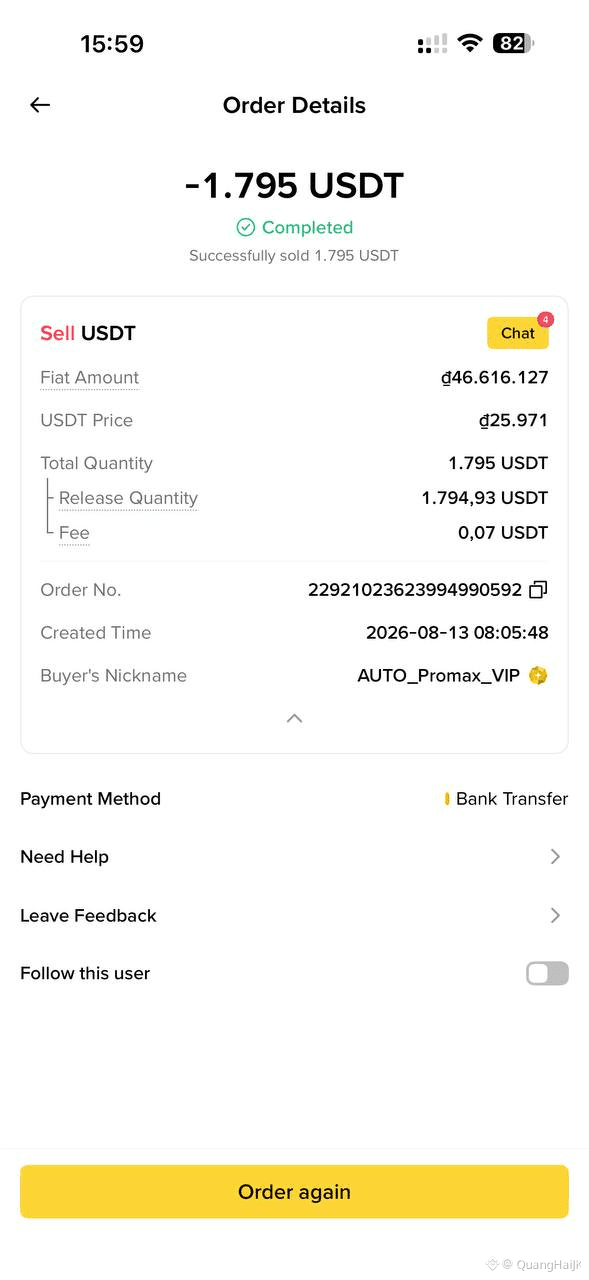
A USDT P2P transaction is completed normally. A few hours later, an issue arises involving the payment. If you no longer have screenshots of the bank transaction, the conversation history, or a clear record of what the counterparty requested, it can become much harder to explain the situation accurately to customer support.
The key question is not “Who reported whom?”
The real question is:
Do you have enough evidence to prove exactly how the transaction took place?
From a P2P safety perspective, I believe there is one simple rule worth following:
The more unusual a transaction looks, the more carefully you should preserve the evidence.
Don’t make payments outside the agreed transaction flow.Don’t follow private requests that differ from the Order details.Don’t delete chat history while a transaction is under dispute.Don’t rush to release assets simply because the counterparty keeps pressuring you.If something goes wrong, use the official appeal/dispute process instead of making private arrangements that are not reflected in the Order.
P2P is not scary simply because a transaction can sometimes go wrong.
What is more concerning is when a problem happens and you no longer have enough evidence to accurately show what actually happened.
That is why my rule is simple:
Preserve the evidence first. Resolve the issue second.
$BNB $SOL $ZEC
{future}(ZECUSDT)
{future}(SOLUSDT)
{future}(BNBUSDT)
#binancep2pantoan @Binance_Vietnam
P2P Safety: A Completed Order Doesn’t Always Mean the Risk Is Over
P2P has a type of risk that many people only recognize after their account runs into a problem: a “completed order” does not necessarily mean everything is over.
There is a dangerous habit in P2P trading:
Money arrives → release the crypto → close the order → delete the chat → move on.
But if a dispute arises later, a transaction is reviewed, or one party files a complaint, the things that seemed unimportant at the time can become critical evidence.
For example:
A USDT P2P transaction is completed normally. A few hours later, an issue arises involving the payment. If you no longer have screenshots of the bank transaction, the conversation history, or a clear record of what the counterparty requested, it can become much harder to explain the situation accurately to customer support.
The key question is not “Who reported whom?”
The real question is:
Do you have enough evidence to prove exactly how the transaction took place?
From a P2P safety perspective, I believe there is one simple rule worth following:
The more unusual a transaction looks, the more carefully you should preserve the evidence.
Don’t make payments outside the agreed transaction flow.Don’t follow private requests that differ from the Order details.Don’t delete chat history while a transaction is under dispute.Don’t rush to release assets simply because the counterparty keeps pressuring you.If something goes wrong, use the official appeal/dispute process instead of making private arrangements that are not reflected in the Order.
P2P is not scary simply because a transaction can sometimes go wrong.
What is more concerning is when a problem happens and you no longer have enough evidence to accurately show what actually happened.
That is why my rule is simple:
Preserve the evidence first. Resolve the issue second.
$BNB $SOL $ZEC
#binancep2pantoan @Binance Vietnam
P2P has a type of risk that many people only recognize after their account runs into a problem: a “completed order” does not necessarily mean everything is over.
There is a dangerous habit in P2P trading:
Money arrives → release the crypto → close the order → delete the chat → move on.
But if a dispute arises later, a transaction is reviewed, or one party files a complaint, the things that seemed unimportant at the time can become critical evidence.
For example:
A USDT P2P transaction is completed normally. A few hours later, an issue arises involving the payment. If you no longer have screenshots of the bank transaction, the conversation history, or a clear record of what the counterparty requested, it can become much harder to explain the situation accurately to customer support.
The key question is not “Who reported whom?”
The real question is:
Do you have enough evidence to prove exactly how the transaction took place?
From a P2P safety perspective, I believe there is one simple rule worth following:
The more unusual a transaction looks, the more carefully you should preserve the evidence.
Don’t make payments outside the agreed transaction flow.Don’t follow private requests that differ from the Order details.Don’t delete chat history while a transaction is under dispute.Don’t rush to release assets simply because the counterparty keeps pressuring you.If something goes wrong, use the official appeal/dispute process instead of making private arrangements that are not reflected in the Order.
P2P is not scary simply because a transaction can sometimes go wrong.
What is more concerning is when a problem happens and you no longer have enough evidence to accurately show what actually happened.
That is why my rule is simple:
Preserve the evidence first. Resolve the issue second.
$BNB $SOL $ZEC
#binancep2pantoan @Binance Vietnam
1
8
2.1k

·
--
I Turned On 2FA Before My First P2P Trade.
Before I started worrying about which merchant to choose, which payment method was better, or whether the price was good enough, I did one thing first:
I secured my Binance account.
On August 19, 2026, before making my first P2P trade, I checked my account security and enabled 2FA.
It sounds basic.
But think about it.
I could spend 10 minutes checking a merchant’s completion rate and trading history, then ignore the security of the account holding the crypto.
That doesn't make much sense.
2FA adds another verification layer when someone tries to access the account. Even if a password is compromised, the password alone isn't supposed to be enough to get in. Binance specifically recommends enabling 2FA for P2P accounts.
For me, P2P safety starts before the order.
My basic setup is:
Secure the account -> choose the counterparty carefully -> keep communication on Binance -> verify the payment -> release only when everything checks out.
And 2FA isn't a replacement for those checks.
It protects one part of the process: my account.
The merchant profile protects another: who I'm trading with.
Payment verification protects another: what actually happened in the transaction.
That's why I don't think P2P safety is one big feature.
It's a chain of small checks.
If one layer is missing, I'm making the whole process weaker than it needs to be.
Before I trade with someone else, I make sure my own account is protected first.
@Binance_Vietnam
#BinanceP2PAnToan
Do you use 2FA for P2P?
I Turned On 2FA Before My First P2P Trade.
Before I started worrying about which merchant to choose, which payment method was better, or whether the price was good enough, I did one thing first:
I secured my Binance account.
On August 19, 2026, before making my first P2P trade, I checked my account security and enabled 2FA.
It sounds basic.
But think about it.
I could spend 10 minutes checking a merchant’s completion rate and trading history, then ignore the security of the account holding the crypto.
That doesn't make much sense.
2FA adds another verification layer when someone tries to access the account. Even if a password is compromised, the password alone isn't supposed to be enough to get in. Binance specifically recommends enabling 2FA for P2P accounts.
For me, P2P safety starts before the order.
My basic setup is:
Secure the account -> choose the counterparty carefully -> keep communication on Binance -> verify the payment -> release only when everything checks out.
And 2FA isn't a replacement for those checks.
It protects one part of the process: my account.
The merchant profile protects another: who I'm trading with.
Payment verification protects another: what actually happened in the transaction.
That's why I don't think P2P safety is one big feature.
It's a chain of small checks.
If one layer is missing, I'm making the whole process weaker than it needs to be.
Before I trade with someone else, I make sure my own account is protected first.
@Binance Vietnam
#BinanceP2PAnToan
Do you use 2FA for P2P?
Before I started worrying about which merchant to choose, which payment method was better, or whether the price was good enough, I did one thing first:
I secured my Binance account.
On August 19, 2026, before making my first P2P trade, I checked my account security and enabled 2FA.
It sounds basic.
But think about it.
I could spend 10 minutes checking a merchant’s completion rate and trading history, then ignore the security of the account holding the crypto.
That doesn't make much sense.
2FA adds another verification layer when someone tries to access the account. Even if a password is compromised, the password alone isn't supposed to be enough to get in. Binance specifically recommends enabling 2FA for P2P accounts.
For me, P2P safety starts before the order.
My basic setup is:
Secure the account -> choose the counterparty carefully -> keep communication on Binance -> verify the payment -> release only when everything checks out.
And 2FA isn't a replacement for those checks.
It protects one part of the process: my account.
The merchant profile protects another: who I'm trading with.
Payment verification protects another: what actually happened in the transaction.
That's why I don't think P2P safety is one big feature.
It's a chain of small checks.
If one layer is missing, I'm making the whole process weaker than it needs to be.
Before I trade with someone else, I make sure my own account is protected first.
@Binance Vietnam
#BinanceP2PAnToan
Do you use 2FA for P2P?
Yes, always
75%
Not yet
0%
Only for login
25%
I should enable it
0%
4 проголосовали • Голосование закрыто
1
3
1.6k
·
--
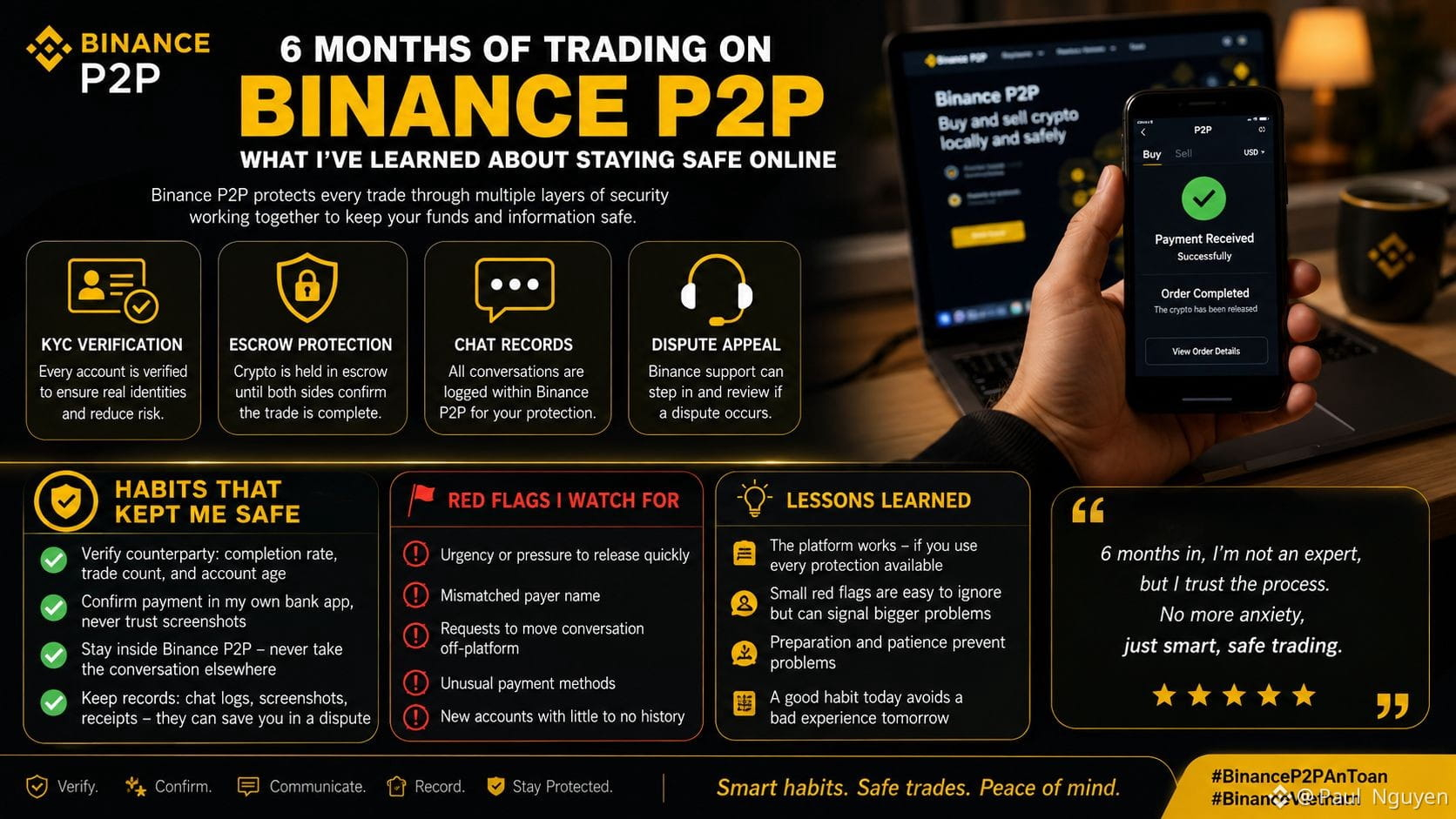
6 months of trading on Binance P2P have taught me more about staying safe online than I expected when I placed my first small order. Binance P2P protects every trade through several layers working together: KYC verification on every account, escrow that holds the crypto asset until both sides confirm completion, a chat system that records the full conversation, and a dispute appeal process if Binance support needs to step in and review what happened.
Looking back, almost every close call I had traces back to skipping one specific habit rather than the platform itself failing in some way. Counterparty verification, checking completion rate, trade count, and account age, has stopped me from trading with a handful of accounts that later turned out to have patterns of complaints in their feedback. Confirming payment directly through my own bank app, rather than trusting a screenshot, has caught more than one attempted fake transfer over these months. And staying entirely within Binance P2P, never moving a conversation elsewhere no matter how convenient it sounded, has kept every protection active on every single order.
The habit I undervalued at first was record keeping. Saving chat logs, confirmation screenshots, and transfer receipts felt unnecessary for months, until one dispute made that archive genuinely useful within minutes rather than hours. If I could tell my first week self anything, it would be this: the red flags are rarely dramatic, they are usually small, like urgency or a name that does not quite match, and noticing them consistently is what makes trading on Binance P2P feel safe rather than stressful.
6 months in, I still would not call myself an expert, but I trust the process enough now to trade without the anxiety that defined my very first order on Binance P2P, and that shift alone has made the entire habit worth building from the start.
@Binance_Vietnam #BinanceP2PAnToan
6 months of trading on Binance P2P have taught me more about staying safe online than I expected when I placed my first small order. Binance P2P protects every trade through several layers working together: KYC verification on every account, escrow that holds the crypto asset until both sides confirm completion, a chat system that records the full conversation, and a dispute appeal process if Binance support needs to step in and review what happened.
Looking back, almost every close call I had traces back to skipping one specific habit rather than the platform itself failing in some way. Counterparty verification, checking completion rate, trade count, and account age, has stopped me from trading with a handful of accounts that later turned out to have patterns of complaints in their feedback. Confirming payment directly through my own bank app, rather than trusting a screenshot, has caught more than one attempted fake transfer over these months. And staying entirely within Binance P2P, never moving a conversation elsewhere no matter how convenient it sounded, has kept every protection active on every single order.
The habit I undervalued at first was record keeping. Saving chat logs, confirmation screenshots, and transfer receipts felt unnecessary for months, until one dispute made that archive genuinely useful within minutes rather than hours. If I could tell my first week self anything, it would be this: the red flags are rarely dramatic, they are usually small, like urgency or a name that does not quite match, and noticing them consistently is what makes trading on Binance P2P feel safe rather than stressful.
6 months in, I still would not call myself an expert, but I trust the process enough now to trade without the anxiety that defined my very first order on Binance P2P, and that shift alone has made the entire habit worth building from the start.
@Binance Vietnam #BinanceP2PAnToan
Looking back, almost every close call I had traces back to skipping one specific habit rather than the platform itself failing in some way. Counterparty verification, checking completion rate, trade count, and account age, has stopped me from trading with a handful of accounts that later turned out to have patterns of complaints in their feedback. Confirming payment directly through my own bank app, rather than trusting a screenshot, has caught more than one attempted fake transfer over these months. And staying entirely within Binance P2P, never moving a conversation elsewhere no matter how convenient it sounded, has kept every protection active on every single order.
The habit I undervalued at first was record keeping. Saving chat logs, confirmation screenshots, and transfer receipts felt unnecessary for months, until one dispute made that archive genuinely useful within minutes rather than hours. If I could tell my first week self anything, it would be this: the red flags are rarely dramatic, they are usually small, like urgency or a name that does not quite match, and noticing them consistently is what makes trading on Binance P2P feel safe rather than stressful.
6 months in, I still would not call myself an expert, but I trust the process enough now to trade without the anxiety that defined my very first order on Binance P2P, and that shift alone has made the entire habit worth building from the start.
@Binance Vietnam #BinanceP2PAnToan
1
223

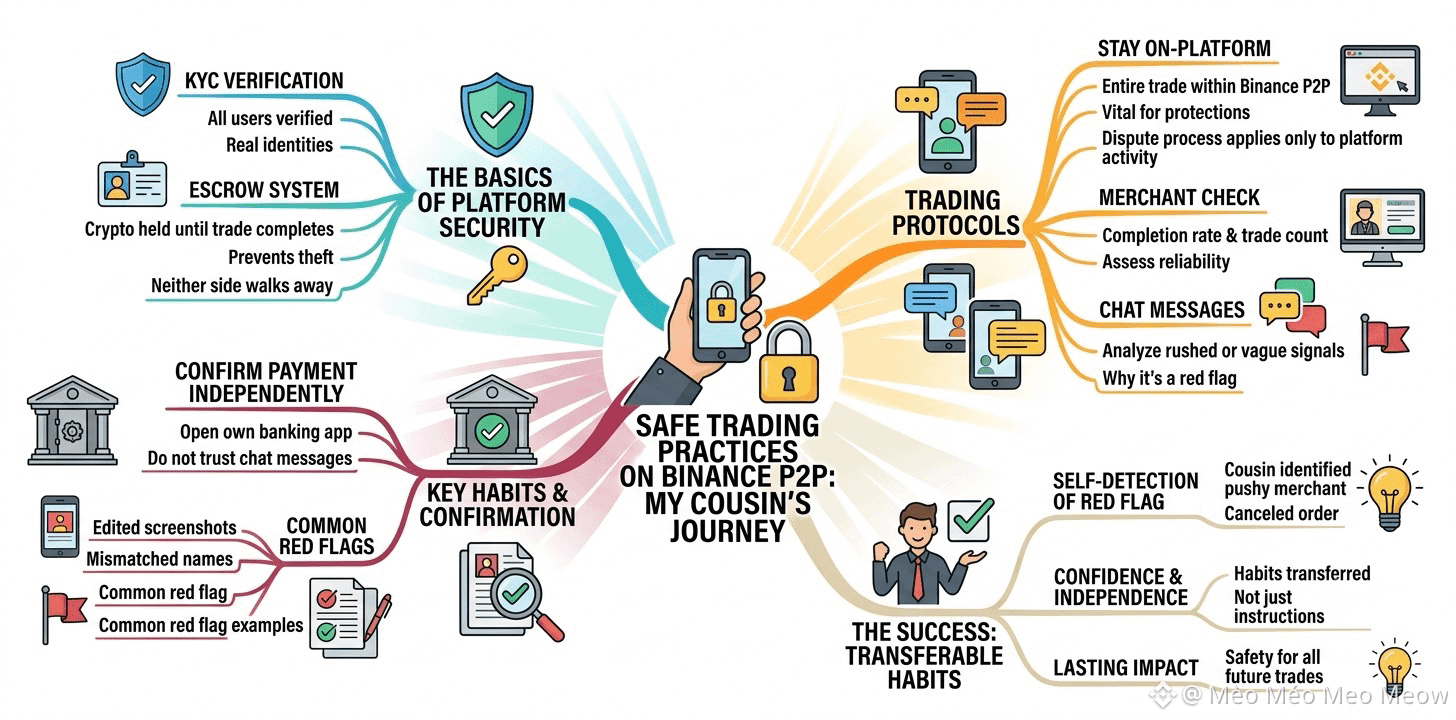
My cousin asked me to walk her through her first trade on Binance P2P, and explaining it out loud actually helped me realize how many small habits I had built up without noticing. I started with the basics: every account completes KYC before trading, so real identities sit behind each profile, and the crypto asset in any order sits in escrow until both sides confirm the trade is finished, which means neither side can simply walk away with the other's funds.
From there, I explained why the entire trade needs to happen inside Binance P2P, from the first message to the final confirmation, since every protection Binance offers, including the dispute appeal process, only applies to activity that stays on the platform. I showed her how to check a merchant's completion rate and trade count before accepting an order, and we talked through what a rushed or vague message in chat might actually signal, rather than just telling her to be careful without explaining why.
The most important habit I passed on was confirming payment independently. I had her open her own banking app during a practice conversation, rather than trusting anything sent through chat, and we talked through a few common red flags together, like edited screenshots or names that do not match. Watching her complete her first real trade carefully, checking each step instead of rushing, was a good reminder that none of this is complicated once someone actually explains it clearly.
A few weeks later, she told me she had caught a red flag on her own, a merchant whose message pushed her to skip a verification step, and she had canceled the order without needing to ask me first. That moment mattered more to me than watching her complete the first trade successfully, because it meant the habits had actually transferred, not just the instructions, and she would carry them into every future trade on Binance P2P.
@Binance_Vietnam #BinanceP2PAnToan $RICE $BTW
My cousin asked me to walk her through her first trade on Binance P2P, and explaining it out loud actually helped me realize how many small habits I had built up without noticing. I started with the basics: every account completes KYC before trading, so real identities sit behind each profile, and the crypto asset in any order sits in escrow until both sides confirm the trade is finished, which means neither side can simply walk away with the other's funds.
From there, I explained why the entire trade needs to happen inside Binance P2P, from the first message to the final confirmation, since every protection Binance offers, including the dispute appeal process, only applies to activity that stays on the platform. I showed her how to check a merchant's completion rate and trade count before accepting an order, and we talked through what a rushed or vague message in chat might actually signal, rather than just telling her to be careful without explaining why.
The most important habit I passed on was confirming payment independently. I had her open her own banking app during a practice conversation, rather than trusting anything sent through chat, and we talked through a few common red flags together, like edited screenshots or names that do not match. Watching her complete her first real trade carefully, checking each step instead of rushing, was a good reminder that none of this is complicated once someone actually explains it clearly.
A few weeks later, she told me she had caught a red flag on her own, a merchant whose message pushed her to skip a verification step, and she had canceled the order without needing to ask me first. That moment mattered more to me than watching her complete the first trade successfully, because it meant the habits had actually transferred, not just the instructions, and she would carry them into every future trade on Binance P2P.
@Binance Vietnam #BinanceP2PAnToan $RICE $BTW
From there, I explained why the entire trade needs to happen inside Binance P2P, from the first message to the final confirmation, since every protection Binance offers, including the dispute appeal process, only applies to activity that stays on the platform. I showed her how to check a merchant's completion rate and trade count before accepting an order, and we talked through what a rushed or vague message in chat might actually signal, rather than just telling her to be careful without explaining why.
The most important habit I passed on was confirming payment independently. I had her open her own banking app during a practice conversation, rather than trusting anything sent through chat, and we talked through a few common red flags together, like edited screenshots or names that do not match. Watching her complete her first real trade carefully, checking each step instead of rushing, was a good reminder that none of this is complicated once someone actually explains it clearly.
A few weeks later, she told me she had caught a red flag on her own, a merchant whose message pushed her to skip a verification step, and she had canceled the order without needing to ask me first. That moment mattered more to me than watching her complete the first trade successfully, because it meant the habits had actually transferred, not just the instructions, and she would carry them into every future trade on Binance P2P.
@Binance Vietnam #BinanceP2PAnToan $RICE $BTW
315

·
--
#binancep2pantoan @Binance_Vietnam
Có những lệnh P2P nhìn qua chẳng có gì đáng ngờ, cho đến khi người mua bấm “Đã thanh toán” nhưng tài khoản ngân hàng của mình vẫn im re.
Hôm đó mình bán 500 USDT. Người mua nhắn khá nhanh: “Em chuyển rồi anh nhé, anh Release giúp em.”
Mình mở app ngân hàng kiểm tra. Không có gì.
Bạn ấy lại nhắn: “Tiền đang treo, chắc ngân hàng xử lý chậm thôi anh.” Sau đó gửi luôn ảnh biên lai giao dịch, trạng thái hiển thị “Thành công”.
Nhìn ảnh thì cũng khá thuyết phục. Nhưng vấn đề là tài khoản mình vẫn chưa nhận được tiền.
Lúc này mình nghĩ đơn giản: P2P không phải cứ có ảnh chuyển khoản là có thể Release. USDT một khi đã Release thì rất khó lấy lại nếu khoản thanh toán thực tế chưa tồn tại.
Mình tiếp tục kiểm tra số dư và lịch sử giao dịch thay vì dựa vào screenshot hay lời thúc giục của đối phương. Rồi thì 1 tiếng, 2 tiếng đã trôi qua, tiền chưa vào tài khoản nên mình chưa Release.
Có thể ngân hàng thực sự đang xử lý chậm. Cũng có thể biên lai có vấn đề. Nhưng đó là chuyện cần được xác minh, không phải thứ mình nên đánh cược bằng 500 USDT.
Sau này mình càng thấy một nguyên tắc khá đáng nhớ khi giao dịch P2P:
“Đã thanh toán” chỉ là trạng thái được báo trên lệnh. Còn tiền đã thực sự vào tài khoản hay chưa mới là thứ người bán cần xác nhận. Trong trường hợp này có thể ảnh chuyển khoản là giả nên mọi người phải cẩn thận không thừa.
Chậm một chút vẫn tốt hơn Release nhầm rồi ngồi chờ Appeal.
#binancep2pantoan @Binance Vietnam
Có những lệnh P2P nhìn qua chẳng có gì đáng ngờ, cho đến khi người mua bấm “Đã thanh toán” nhưng tài khoản ngân hàng của mình vẫn im re.
Hôm đó mình bán 500 USDT. Người mua nhắn khá nhanh: “Em chuyển rồi anh nhé, anh Release giúp em.”
Mình mở app ngân hàng kiểm tra. Không có gì.
Bạn ấy lại nhắn: “Tiền đang treo, chắc ngân hàng xử lý chậm thôi anh.” Sau đó gửi luôn ảnh biên lai giao dịch, trạng thái hiển thị “Thành công”.
Nhìn ảnh thì cũng khá thuyết phục. Nhưng vấn đề là tài khoản mình vẫn chưa nhận được tiền.
Lúc này mình nghĩ đơn giản: P2P không phải cứ có ảnh chuyển khoản là có thể Release. USDT một khi đã Release thì rất khó lấy lại nếu khoản thanh toán thực tế chưa tồn tại.
Mình tiếp tục kiểm tra số dư và lịch sử giao dịch thay vì dựa vào screenshot hay lời thúc giục của đối phương. Rồi thì 1 tiếng, 2 tiếng đã trôi qua, tiền chưa vào tài khoản nên mình chưa Release.
Có thể ngân hàng thực sự đang xử lý chậm. Cũng có thể biên lai có vấn đề. Nhưng đó là chuyện cần được xác minh, không phải thứ mình nên đánh cược bằng 500 USDT.
Sau này mình càng thấy một nguyên tắc khá đáng nhớ khi giao dịch P2P:
“Đã thanh toán” chỉ là trạng thái được báo trên lệnh. Còn tiền đã thực sự vào tài khoản hay chưa mới là thứ người bán cần xác nhận. Trong trường hợp này có thể ảnh chuyển khoản là giả nên mọi người phải cẩn thận không thừa.
Chậm một chút vẫn tốt hơn Release nhầm rồi ngồi chờ Appeal.
Có những lệnh P2P nhìn qua chẳng có gì đáng ngờ, cho đến khi người mua bấm “Đã thanh toán” nhưng tài khoản ngân hàng của mình vẫn im re.
Hôm đó mình bán 500 USDT. Người mua nhắn khá nhanh: “Em chuyển rồi anh nhé, anh Release giúp em.”
Mình mở app ngân hàng kiểm tra. Không có gì.
Bạn ấy lại nhắn: “Tiền đang treo, chắc ngân hàng xử lý chậm thôi anh.” Sau đó gửi luôn ảnh biên lai giao dịch, trạng thái hiển thị “Thành công”.
Nhìn ảnh thì cũng khá thuyết phục. Nhưng vấn đề là tài khoản mình vẫn chưa nhận được tiền.
Lúc này mình nghĩ đơn giản: P2P không phải cứ có ảnh chuyển khoản là có thể Release. USDT một khi đã Release thì rất khó lấy lại nếu khoản thanh toán thực tế chưa tồn tại.
Mình tiếp tục kiểm tra số dư và lịch sử giao dịch thay vì dựa vào screenshot hay lời thúc giục của đối phương. Rồi thì 1 tiếng, 2 tiếng đã trôi qua, tiền chưa vào tài khoản nên mình chưa Release.
Có thể ngân hàng thực sự đang xử lý chậm. Cũng có thể biên lai có vấn đề. Nhưng đó là chuyện cần được xác minh, không phải thứ mình nên đánh cược bằng 500 USDT.
Sau này mình càng thấy một nguyên tắc khá đáng nhớ khi giao dịch P2P:
“Đã thanh toán” chỉ là trạng thái được báo trên lệnh. Còn tiền đã thực sự vào tài khoản hay chưa mới là thứ người bán cần xác nhận. Trong trường hợp này có thể ảnh chuyển khoản là giả nên mọi người phải cẩn thận không thừa.
Chậm một chút vẫn tốt hơn Release nhầm rồi ngồi chờ Appeal.
3
860

#binancep2pantoan
Sập bẫy "Bảo trì ngân hàng": Chiêu trò ép hủy lệnh để chiếm đoạt Fiat!
Nhiều trader Việt Nam mất tiền P2P không phải do bị hack, mà do dính bẫy thao túng tâm lý ngay trên khung Chat của sàn.
Case Study: Bạn đã chuyển Fiat thành công nhưng Merchant cố tình không nhả USDT, liên tục nhắn tin viện lý do "Bank bảo trì, tiền chưa vào app" và ép bạn nhấn nút Cancel Order (Hủy lệnh) để họ chuyển trả lại tiền. Ngay khi bạn bấm Hủy, Escrow lập tức giải phóng USDT về ví Merchant, còn phía bên kia chặn liên lạc, biến mất cùng tiền của bạn.
Checklist né bẫy tháo Escrow:
Tuyệt đối KHÔNG HỦY LỆNH: Một khi tiền Fiat đã rời khỏi tài khoản ngân hàng của bạn, KHÔNG BAO GIỜ nhấn nút Cancel Order dưới bất kỳ lý do gì.
Mở Dispute lập tức: Sau khi hết thời gian chờ, bấm nút Khiếu nại (Dispute), tải Lịch sử giao dịch/Bill chuyển tiền chuẩn lên để CSKH Binance can thiệp ép nhả coin.
Bạn chọn kiên nhẫn mở Dispute chờ CSKH xử lý hay tin vào lời hứa "hoàn tiền ngoài sàn" của Merchant xa lạ?
Tag: @Binance_Vietnam
#binancep2pantoan
Sập bẫy "Bảo trì ngân hàng": Chiêu trò ép hủy lệnh để chiếm đoạt Fiat!
Nhiều trader Việt Nam mất tiền P2P không phải do bị hack, mà do dính bẫy thao túng tâm lý ngay trên khung Chat của sàn.
Case Study: Bạn đã chuyển Fiat thành công nhưng Merchant cố tình không nhả USDT, liên tục nhắn tin viện lý do "Bank bảo trì, tiền chưa vào app" và ép bạn nhấn nút Cancel Order (Hủy lệnh) để họ chuyển trả lại tiền. Ngay khi bạn bấm Hủy, Escrow lập tức giải phóng USDT về ví Merchant, còn phía bên kia chặn liên lạc, biến mất cùng tiền của bạn.
Checklist né bẫy tháo Escrow:
Tuyệt đối KHÔNG HỦY LỆNH: Một khi tiền Fiat đã rời khỏi tài khoản ngân hàng của bạn, KHÔNG BAO GIỜ nhấn nút Cancel Order dưới bất kỳ lý do gì.
Mở Dispute lập tức: Sau khi hết thời gian chờ, bấm nút Khiếu nại (Dispute), tải Lịch sử giao dịch/Bill chuyển tiền chuẩn lên để CSKH Binance can thiệp ép nhả coin.
Bạn chọn kiên nhẫn mở Dispute chờ CSKH xử lý hay tin vào lời hứa "hoàn tiền ngoài sàn" của Merchant xa lạ?
Tag: @Binance Vietnam
Sập bẫy "Bảo trì ngân hàng": Chiêu trò ép hủy lệnh để chiếm đoạt Fiat!
Nhiều trader Việt Nam mất tiền P2P không phải do bị hack, mà do dính bẫy thao túng tâm lý ngay trên khung Chat của sàn.
Case Study: Bạn đã chuyển Fiat thành công nhưng Merchant cố tình không nhả USDT, liên tục nhắn tin viện lý do "Bank bảo trì, tiền chưa vào app" và ép bạn nhấn nút Cancel Order (Hủy lệnh) để họ chuyển trả lại tiền. Ngay khi bạn bấm Hủy, Escrow lập tức giải phóng USDT về ví Merchant, còn phía bên kia chặn liên lạc, biến mất cùng tiền của bạn.
Checklist né bẫy tháo Escrow:
Tuyệt đối KHÔNG HỦY LỆNH: Một khi tiền Fiat đã rời khỏi tài khoản ngân hàng của bạn, KHÔNG BAO GIỜ nhấn nút Cancel Order dưới bất kỳ lý do gì.
Mở Dispute lập tức: Sau khi hết thời gian chờ, bấm nút Khiếu nại (Dispute), tải Lịch sử giao dịch/Bill chuyển tiền chuẩn lên để CSKH Binance can thiệp ép nhả coin.
Bạn chọn kiên nhẫn mở Dispute chờ CSKH xử lý hay tin vào lời hứa "hoàn tiền ngoài sàn" của Merchant xa lạ?
Tag: @Binance Vietnam
77

·
--
#binancep2pantoan
Kiểm tra trước khi giao dịch P2P: Luôn chọn người bán/ Người mua có uy tín, kiểm tra kỹ tên tài khoản nhận tiền và chỉ xác nhận khi giao dịch đã hoàn tất. Không chuyển tiền theo yêu cầu ngoài nền tảng và tuyệt đối không chia sẻ mã OTP hay thông tin bảo mật của bạn.
@Binance Vietnam
#binancep2pantoan
Kiểm tra trước khi giao dịch P2P: Luôn chọn người bán/ Người mua có uy tín, kiểm tra kỹ tên tài khoản nhận tiền và chỉ xác nhận khi giao dịch đã hoàn tất. Không chuyển tiền theo yêu cầu ngoài nền tảng và tuyệt đối không chia sẻ mã OTP hay thông tin bảo mật của bạn.
@Binance Vietnam
Kiểm tra trước khi giao dịch P2P: Luôn chọn người bán/ Người mua có uy tín, kiểm tra kỹ tên tài khoản nhận tiền và chỉ xác nhận khi giao dịch đã hoàn tất. Không chuyển tiền theo yêu cầu ngoài nền tảng và tuyệt đối không chia sẻ mã OTP hay thông tin bảo mật của bạn.
@Binance Vietnam
68

·
--
#binancep2pantoan @Binance_Vietnam P2P is an excellent feature on Binance that allows buyers and sellers to trade directly with one another. With clearly defined "Buy" and "Sell" sections, users can choose the option that best suits their specific needs. Merchants list their prices and transaction limits clearly, making it easy for users to select the best match for their requirements. The buying and selling process is fast and convenient.
#binancep2pantoan @Binance Vietnam P2P is an excellent feature on Binance that allows buyers and sellers to trade directly with one another. With clearly defined "Buy" and "Sell" sections, users can choose the option that best suits their specific needs. Merchants list their prices and transaction limits clearly, making it easy for users to select the best match for their requirements. The buying and selling process is fast and convenient.
74

#binancep2pantoan @Binance_Vietnam
🔥 P2P: ĐỪNG MẤT TIỀN CHỈ VÌ MỘT CÚ CLICK!
Thương nhân P2P nhớ 3 nguyên tắc:
✅ Kiểm tra tên người chuyển
✅ Xác nhận tiền đã vào tài khoản
✅ Chỉ nhả crypto sau khi tiền thật sự nhận được.
Nhanh chưa chắc thắng. An toàn mới là lợi nhuận lâu dài. 🚀
#binancep2pantoan @Binance Vietnam
🔥 P2P: ĐỪNG MẤT TIỀN CHỈ VÌ MỘT CÚ CLICK!
Thương nhân P2P nhớ 3 nguyên tắc:
✅ Kiểm tra tên người chuyển
✅ Xác nhận tiền đã vào tài khoản
✅ Chỉ nhả crypto sau khi tiền thật sự nhận được.
Nhanh chưa chắc thắng. An toàn mới là lợi nhuận lâu dài. 🚀
🔥 P2P: ĐỪNG MẤT TIỀN CHỈ VÌ MỘT CÚ CLICK!
Thương nhân P2P nhớ 3 nguyên tắc:
✅ Kiểm tra tên người chuyển
✅ Xác nhận tiền đã vào tài khoản
✅ Chỉ nhả crypto sau khi tiền thật sự nhận được.
Nhanh chưa chắc thắng. An toàn mới là lợi nhuận lâu dài. 🚀
3
·
--
#binancep2pantoan @Binance_Vietnam
Mẹo giao dịch Binance P2P an toàn cho người mới:
Luôn xác nhận tiền đã về tài khoản ngân hàng thực tế trước khi nhấp "Đã nhận thanh toán".
Không bao giờ tin vào ảnh chụp màn hình chuyển tiền từ bên mua.
Tên tài khoản ngân hàng phải trùng khớp với tên đã xác minh trên Binance.
Tuyệt đối không ghi các từ khóa liên quan đến Crypto/Bitcoin trong nội dung chuyển khoản.
Chúc anh em giao dịch an toàn! @Binance_Vietnam #BinanceP2PAnToan
#binancep2pantoan @Binance Vietnam
Mẹo giao dịch Binance P2P an toàn cho người mới:
Luôn xác nhận tiền đã về tài khoản ngân hàng thực tế trước khi nhấp "Đã nhận thanh toán".
Không bao giờ tin vào ảnh chụp màn hình chuyển tiền từ bên mua.
Tên tài khoản ngân hàng phải trùng khớp với tên đã xác minh trên Binance.
Tuyệt đối không ghi các từ khóa liên quan đến Crypto/Bitcoin trong nội dung chuyển khoản.
Chúc anh em giao dịch an toàn! @Binance Vietnam #BinanceP2PAnToan
Mẹo giao dịch Binance P2P an toàn cho người mới:
Luôn xác nhận tiền đã về tài khoản ngân hàng thực tế trước khi nhấp "Đã nhận thanh toán".
Không bao giờ tin vào ảnh chụp màn hình chuyển tiền từ bên mua.
Tên tài khoản ngân hàng phải trùng khớp với tên đã xác minh trên Binance.
Tuyệt đối không ghi các từ khóa liên quan đến Crypto/Bitcoin trong nội dung chuyển khoản.
Chúc anh em giao dịch an toàn! @Binance Vietnam #BinanceP2PAnToan
80

·
--
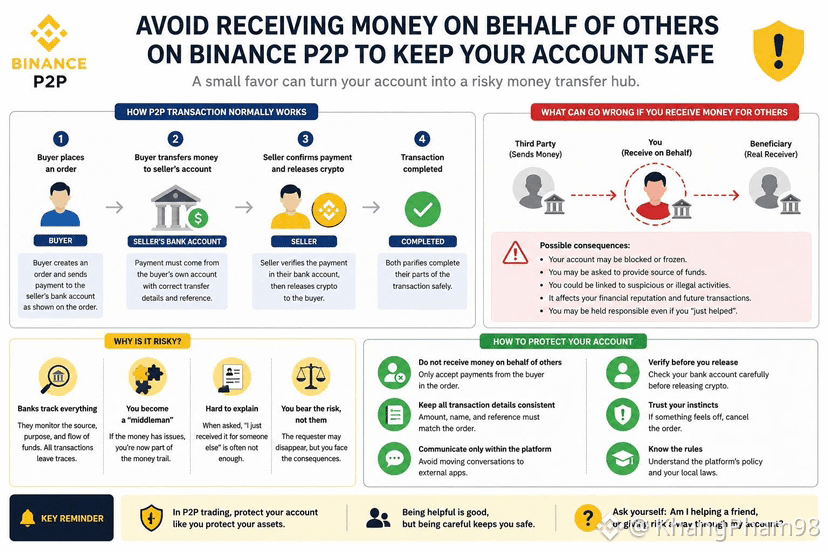
An afternoon at a drink shop near the office, a conversation about selling USDT through Binance P2P suddenly turned into an uncomfortable request. An acquaintance asked me to receive money from his buyer, then transfer it to another bank account. The reason sounded soft enough, his banking app was having issues. I listened, then refused.
The trap of receiving money on someone else’s behalf is that it looks too much like a kind favor. You are not holding cash, not signing any document, just letting a stream of money pass through your account. But banks do not read goodwill, banks read traces.
Binance P2P makes the transaction look cleaner, so many people forget that the messy part sits outside the exchange screen. The bank transfer is still real money, the sender is still a real person, and the banking history remains there. If the source of funds has a problem, familiarity will not pull you out of the chain.
The usual psychology is the fear of saying no. The person asking makes it sound light, we are friends, just help me a bit. The person being asked may also think that because they make no profit, it should be fine. That exact lack of profit can be dangerous, because you carry the trace without knowing the full story.
The paradox is that people enter crypto talking about control over their own assets, yet when receiving money for someone else through Binance P2P, they lend out the name on their bank account. I do not want to turn every request for help into a conspiracy. Some people really do have banking app errors, transfer limits, or simply lack experience.
But someone else’s inconvenience should not be solved by dragging your account into a gray area. Binance P2P can be convenient, but convenience does not mean standing in as the named receiver for another person’s money. The remaining question is whether you are helping an acquaintance, or renting your bank account as a road for risk to pass through.
@Binance_Vietnam #BinanceP2PAnToan
An afternoon at a drink shop near the office, a conversation about selling USDT through Binance P2P suddenly turned into an uncomfortable request. An acquaintance asked me to receive money from his buyer, then transfer it to another bank account. The reason sounded soft enough, his banking app was having issues. I listened, then refused.
The trap of receiving money on someone else’s behalf is that it looks too much like a kind favor. You are not holding cash, not signing any document, just letting a stream of money pass through your account. But banks do not read goodwill, banks read traces.
Binance P2P makes the transaction look cleaner, so many people forget that the messy part sits outside the exchange screen. The bank transfer is still real money, the sender is still a real person, and the banking history remains there. If the source of funds has a problem, familiarity will not pull you out of the chain.
The usual psychology is the fear of saying no. The person asking makes it sound light, we are friends, just help me a bit. The person being asked may also think that because they make no profit, it should be fine. That exact lack of profit can be dangerous, because you carry the trace without knowing the full story.
The paradox is that people enter crypto talking about control over their own assets, yet when receiving money for someone else through Binance P2P, they lend out the name on their bank account. I do not want to turn every request for help into a conspiracy. Some people really do have banking app errors, transfer limits, or simply lack experience.
But someone else’s inconvenience should not be solved by dragging your account into a gray area. Binance P2P can be convenient, but convenience does not mean standing in as the named receiver for another person’s money. The remaining question is whether you are helping an acquaintance, or renting your bank account as a road for risk to pass through.
@Binance Vietnam #BinanceP2PAnToan
The trap of receiving money on someone else’s behalf is that it looks too much like a kind favor. You are not holding cash, not signing any document, just letting a stream of money pass through your account. But banks do not read goodwill, banks read traces.
Binance P2P makes the transaction look cleaner, so many people forget that the messy part sits outside the exchange screen. The bank transfer is still real money, the sender is still a real person, and the banking history remains there. If the source of funds has a problem, familiarity will not pull you out of the chain.
The usual psychology is the fear of saying no. The person asking makes it sound light, we are friends, just help me a bit. The person being asked may also think that because they make no profit, it should be fine. That exact lack of profit can be dangerous, because you carry the trace without knowing the full story.
The paradox is that people enter crypto talking about control over their own assets, yet when receiving money for someone else through Binance P2P, they lend out the name on their bank account. I do not want to turn every request for help into a conspiracy. Some people really do have banking app errors, transfer limits, or simply lack experience.
But someone else’s inconvenience should not be solved by dragging your account into a gray area. Binance P2P can be convenient, but convenience does not mean standing in as the named receiver for another person’s money. The remaining question is whether you are helping an acquaintance, or renting your bank account as a road for risk to pass through.
@Binance Vietnam #BinanceP2PAnToan
75
#binancep2pantoan @Binance_Vietnam
NHẬN DIỆN NGƯỜI “GIAO DỊCH THẬT”
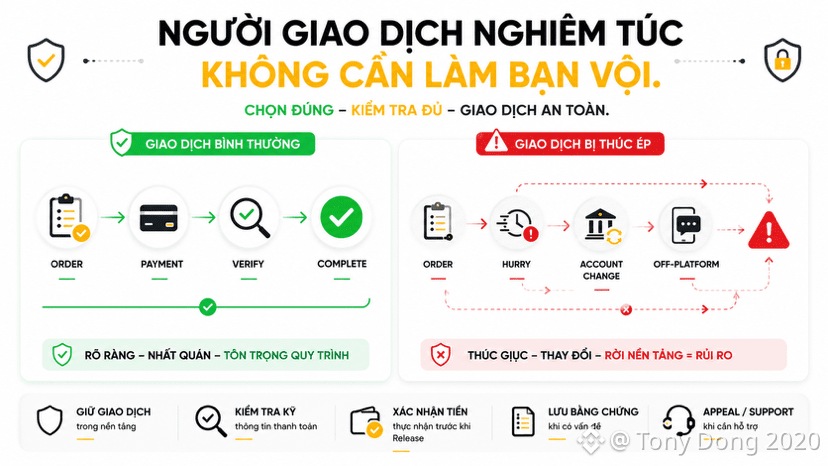
Người giao dịch P2P thật sự uy tín thường không cần làm bạn rối.
Tôi để ý điều này sau rất nhiều giao dịch. Người giao dịch thực sự thường khá… bình thường và cẩn thận. Họ quan tâm và cũng có nguyên tắc giao dịch an toàn với việc xử lý Order. Họ quan tâm phương thức thanh toán, hiểu và tuân thủ số tiền.
Họ quan sát giao dịch đã khớp chưa, có chậm trễ hay bất thường không. Họ không cần phải nói quá nhiều.
Cũng không cần liên tục tạo cảm xúc cho bạn:
“Nhanh lên anh.”
“Release giúp em.”
“Chuyển sang tài khoản này cho tiện.”
“Ra ngoài nói chuyện cho nhanh.”
“ Viện ra các lý do như tk lỗi, ngân hàng lỗi…”
Điều tôi quan sát không phải một câu nói. Mà là chuỗi hành vi. Một đối tác đáng tin hơn thường khiến quy trình trở nên đơn giản:
Order → Payment → Verification → Completion.
Không tự nhiên mọc thêm một tài khoản.
Không tự nhiên đổi phương thức.
Không tự nhiên xuất hiện một “quy trình riêng được xây dựng bởi kinh nghiệm giao dịch”.
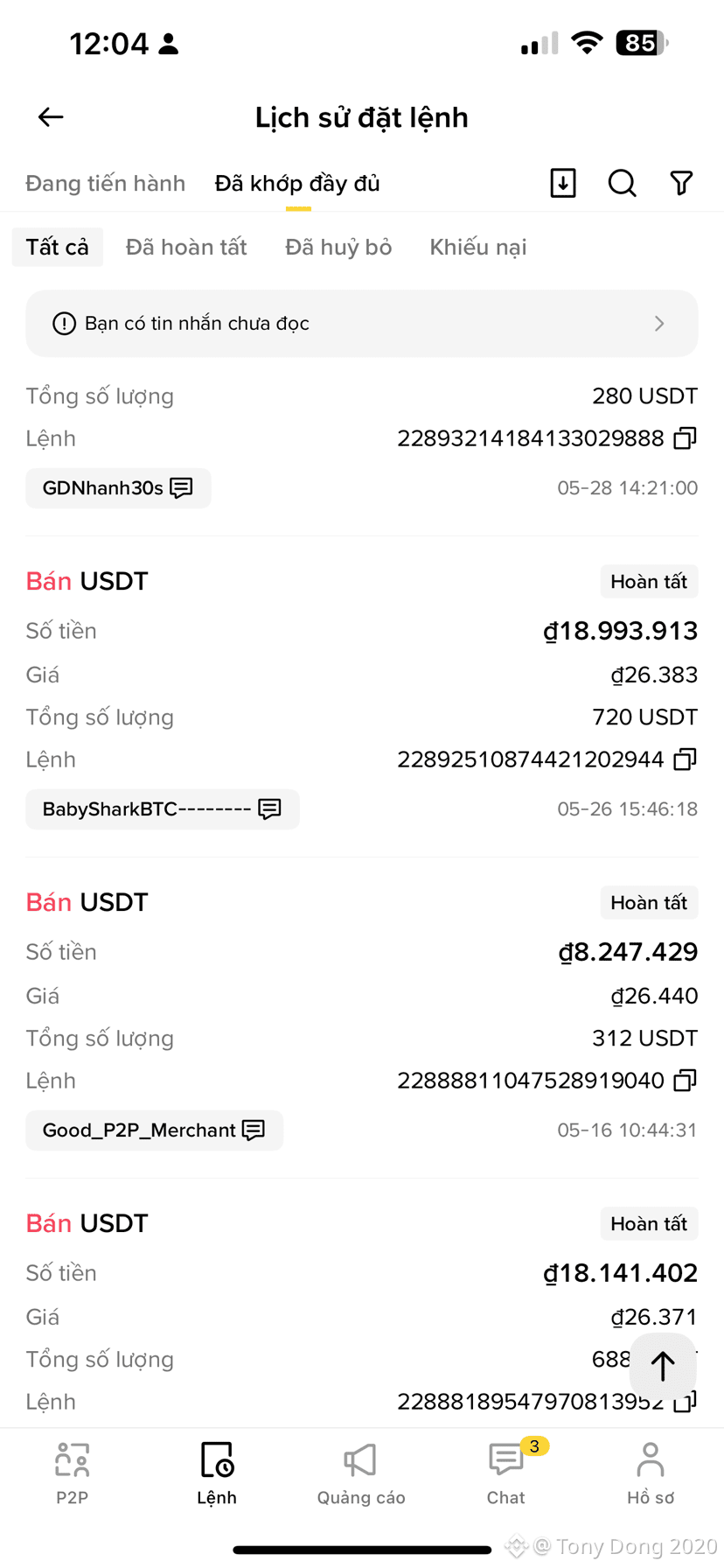
Binance khuyến nghị người dùng kiểm tra thông tin giao dịch và giữ giao dịch trong nền tảng; khi xảy ra vấn đề, Appeal và bằng chứng giao dịch có thể được sử dụng để Support xem xét.
Nên nếu có một người khiến tôi phải liên tục hỏi:
“Tại sao lại đổi phương thức?”
“Tại sao phải chuyển sang đây?”
“Tại sao phải Release ngay?”
Tôi không kết luận họ xấu. Tôi chỉ chậm lại và tuân thủ nguyên tắc chung. Với P2P, thế là đủ.
DISCLAIMER : Thông tin cung cấp trong bài viết là kinh nghiệm cá nhân mang tính chia sẻ, không phải lời khuyên đầu tư.
#binancep2pantoan @Binance Vietnam
NHẬN DIỆN NGƯỜI “GIAO DỊCH THẬT”
Người giao dịch P2P thật sự uy tín thường không cần làm bạn rối.
Tôi để ý điều này sau rất nhiều giao dịch. Người giao dịch thực sự thường khá… bình thường và cẩn thận. Họ quan tâm và cũng có nguyên tắc giao dịch an toàn với việc xử lý Order. Họ quan tâm phương thức thanh toán, hiểu và tuân thủ số tiền.
Họ quan sát giao dịch đã khớp chưa, có chậm trễ hay bất thường không. Họ không cần phải nói quá nhiều.
Cũng không cần liên tục tạo cảm xúc cho bạn:
“Nhanh lên anh.”
“Release giúp em.”
“Chuyển sang tài khoản này cho tiện.”
“Ra ngoài nói chuyện cho nhanh.”
“ Viện ra các lý do như tk lỗi, ngân hàng lỗi…”
Điều tôi quan sát không phải một câu nói. Mà là chuỗi hành vi. Một đối tác đáng tin hơn thường khiến quy trình trở nên đơn giản:
Order → Payment → Verification → Completion.
Không tự nhiên mọc thêm một tài khoản.
Không tự nhiên đổi phương thức.
Không tự nhiên xuất hiện một “quy trình riêng được xây dựng bởi kinh nghiệm giao dịch”.
Binance khuyến nghị người dùng kiểm tra thông tin giao dịch và giữ giao dịch trong nền tảng; khi xảy ra vấn đề, Appeal và bằng chứng giao dịch có thể được sử dụng để Support xem xét.
Nên nếu có một người khiến tôi phải liên tục hỏi:
“Tại sao lại đổi phương thức?”
“Tại sao phải chuyển sang đây?”
“Tại sao phải Release ngay?”
Tôi không kết luận họ xấu. Tôi chỉ chậm lại và tuân thủ nguyên tắc chung. Với P2P, thế là đủ.
DISCLAIMER : Thông tin cung cấp trong bài viết là kinh nghiệm cá nhân mang tính chia sẻ, không phải lời khuyên đầu tư.
NHẬN DIỆN NGƯỜI “GIAO DỊCH THẬT”
Người giao dịch P2P thật sự uy tín thường không cần làm bạn rối.
Tôi để ý điều này sau rất nhiều giao dịch. Người giao dịch thực sự thường khá… bình thường và cẩn thận. Họ quan tâm và cũng có nguyên tắc giao dịch an toàn với việc xử lý Order. Họ quan tâm phương thức thanh toán, hiểu và tuân thủ số tiền.
Họ quan sát giao dịch đã khớp chưa, có chậm trễ hay bất thường không. Họ không cần phải nói quá nhiều.
Cũng không cần liên tục tạo cảm xúc cho bạn:
“Nhanh lên anh.”
“Release giúp em.”
“Chuyển sang tài khoản này cho tiện.”
“Ra ngoài nói chuyện cho nhanh.”
“ Viện ra các lý do như tk lỗi, ngân hàng lỗi…”
Điều tôi quan sát không phải một câu nói. Mà là chuỗi hành vi. Một đối tác đáng tin hơn thường khiến quy trình trở nên đơn giản:
Order → Payment → Verification → Completion.
Không tự nhiên mọc thêm một tài khoản.
Không tự nhiên đổi phương thức.
Không tự nhiên xuất hiện một “quy trình riêng được xây dựng bởi kinh nghiệm giao dịch”.
Binance khuyến nghị người dùng kiểm tra thông tin giao dịch và giữ giao dịch trong nền tảng; khi xảy ra vấn đề, Appeal và bằng chứng giao dịch có thể được sử dụng để Support xem xét.
Nên nếu có một người khiến tôi phải liên tục hỏi:
“Tại sao lại đổi phương thức?”
“Tại sao phải chuyển sang đây?”
“Tại sao phải Release ngay?”
Tôi không kết luận họ xấu. Tôi chỉ chậm lại và tuân thủ nguyên tắc chung. Với P2P, thế là đủ.
DISCLAIMER : Thông tin cung cấp trong bài viết là kinh nghiệm cá nhân mang tính chia sẻ, không phải lời khuyên đầu tư.
79
·
--
#binancep2pantoan @Binance_Vietnam
🔐 P2P an toàn bắt đầu từ những điều rất nhỏ
Giao dịch Binance P2P không chỉ là chuyện mua hoặc bán crypto. Điều quan trọng hơn là giữ cho mỗi giao dịch diễn ra minh bạch và an toàn.
Một vài thói quen đơn giản nhưng rất đáng giá:
✅ Chỉ giao dịch trực tiếp trên Binance P2P.
✅ Kiểm tra kỹ tên người nhận/chuyển tiền và số tiền trước khi xác nhận.
✅ Không tin vào ảnh chụp màn hình hay lời hứa “đã thanh toán” nếu tiền chưa thực sự vào tài khoản.
✅ Không chia sẻ mật khẩu, mã OTP hoặc thông tin bảo mật cho bất kỳ ai.
✅ Luôn đọc kỹ điều khoản và sử dụng chức năng khiếu nại/hỗ trợ của Binance khi có vấn đề.
P2P tốt không nằm ở việc giao dịch thật nhanh, mà là **giao dịch đúng cách và kiểm soát rủi ro**. Một phút kiểm tra có thể giúp tránh rất nhiều rắc rối.
Hãy biến “an toàn trước, giao dịch sau” thành thói quen mỗi lần tham gia P2P.
@Binance_Vietnam
#BinanceP2PAnToan #BinanceP2P #CryptoSafety
#binancep2pantoan @Binance Vietnam
🔐 P2P an toàn bắt đầu từ những điều rất nhỏ
Giao dịch Binance P2P không chỉ là chuyện mua hoặc bán crypto. Điều quan trọng hơn là giữ cho mỗi giao dịch diễn ra minh bạch và an toàn.
Một vài thói quen đơn giản nhưng rất đáng giá:
✅ Chỉ giao dịch trực tiếp trên Binance P2P.
✅ Kiểm tra kỹ tên người nhận/chuyển tiền và số tiền trước khi xác nhận.
✅ Không tin vào ảnh chụp màn hình hay lời hứa “đã thanh toán” nếu tiền chưa thực sự vào tài khoản.
✅ Không chia sẻ mật khẩu, mã OTP hoặc thông tin bảo mật cho bất kỳ ai.
✅ Luôn đọc kỹ điều khoản và sử dụng chức năng khiếu nại/hỗ trợ của Binance khi có vấn đề.
P2P tốt không nằm ở việc giao dịch thật nhanh, mà là **giao dịch đúng cách và kiểm soát rủi ro**. Một phút kiểm tra có thể giúp tránh rất nhiều rắc rối.
Hãy biến “an toàn trước, giao dịch sau” thành thói quen mỗi lần tham gia P2P.
@Binance Vietnam
#BinanceP2PAnToan #BinanceP2P #CryptoSafety
🔐 P2P an toàn bắt đầu từ những điều rất nhỏ
Giao dịch Binance P2P không chỉ là chuyện mua hoặc bán crypto. Điều quan trọng hơn là giữ cho mỗi giao dịch diễn ra minh bạch và an toàn.
Một vài thói quen đơn giản nhưng rất đáng giá:
✅ Chỉ giao dịch trực tiếp trên Binance P2P.
✅ Kiểm tra kỹ tên người nhận/chuyển tiền và số tiền trước khi xác nhận.
✅ Không tin vào ảnh chụp màn hình hay lời hứa “đã thanh toán” nếu tiền chưa thực sự vào tài khoản.
✅ Không chia sẻ mật khẩu, mã OTP hoặc thông tin bảo mật cho bất kỳ ai.
✅ Luôn đọc kỹ điều khoản và sử dụng chức năng khiếu nại/hỗ trợ của Binance khi có vấn đề.
P2P tốt không nằm ở việc giao dịch thật nhanh, mà là **giao dịch đúng cách và kiểm soát rủi ro**. Một phút kiểm tra có thể giúp tránh rất nhiều rắc rối.
Hãy biến “an toàn trước, giao dịch sau” thành thói quen mỗi lần tham gia P2P.
@Binance Vietnam
#BinanceP2PAnToan #BinanceP2P #CryptoSafety
60

#binancep2pantoan @Binance_Vietnam
Cách giao dịch P2P an toàn trên Binance (Phần 12)
5 ý quan trọng tiếp theo:
61. Không bao giờ sử dụng tài khoản ngân hàng của người khác để giao dịch P2P, dễ dẫn đến bị khóa tài khoản hoặc tranh chấp.
62. Khi bán coin, hãy đợi tiền thực sự vào tài khoản và kiểm tra kỹ trước khi release. Đừng tin vào lời nói suông.
63. Ưu tiên đối tác có nhiều đánh giá tích cực trong 30 ngày gần nhất thay vì chỉ nhìn tổng số đơn cũ.
64. Nếu lệnh bị delay bất thường hoặc đối phương im lặng quá lâu, hãy chủ động hủy và tìm người khác.
65. Luôn giữ thái độ cảnh giác vừa phải. Tin tưởng hệ thống Binance, nhưng không mù quáng tin người lạ.
An toàn là trên hết!
#binancep2pantoan @Binance Vietnam
Cách giao dịch P2P an toàn trên Binance (Phần 12)
5 ý quan trọng tiếp theo:
61. Không bao giờ sử dụng tài khoản ngân hàng của người khác để giao dịch P2P, dễ dẫn đến bị khóa tài khoản hoặc tranh chấp.
62. Khi bán coin, hãy đợi tiền thực sự vào tài khoản và kiểm tra kỹ trước khi release. Đừng tin vào lời nói suông.
63. Ưu tiên đối tác có nhiều đánh giá tích cực trong 30 ngày gần nhất thay vì chỉ nhìn tổng số đơn cũ.
64. Nếu lệnh bị delay bất thường hoặc đối phương im lặng quá lâu, hãy chủ động hủy và tìm người khác.
65. Luôn giữ thái độ cảnh giác vừa phải. Tin tưởng hệ thống Binance, nhưng không mù quáng tin người lạ.
An toàn là trên hết!
Cách giao dịch P2P an toàn trên Binance (Phần 12)
5 ý quan trọng tiếp theo:
61. Không bao giờ sử dụng tài khoản ngân hàng của người khác để giao dịch P2P, dễ dẫn đến bị khóa tài khoản hoặc tranh chấp.
62. Khi bán coin, hãy đợi tiền thực sự vào tài khoản và kiểm tra kỹ trước khi release. Đừng tin vào lời nói suông.
63. Ưu tiên đối tác có nhiều đánh giá tích cực trong 30 ngày gần nhất thay vì chỉ nhìn tổng số đơn cũ.
64. Nếu lệnh bị delay bất thường hoặc đối phương im lặng quá lâu, hãy chủ động hủy và tìm người khác.
65. Luôn giữ thái độ cảnh giác vừa phải. Tin tưởng hệ thống Binance, nhưng không mù quáng tin người lạ.
An toàn là trên hết!
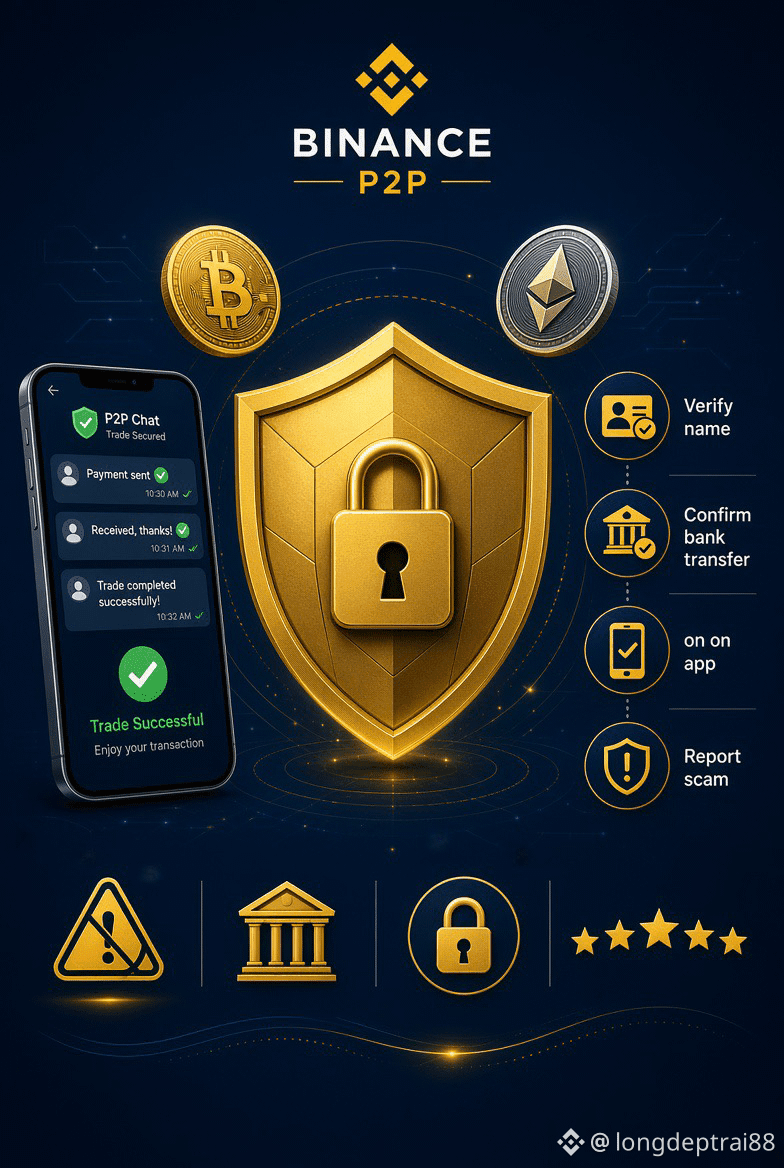
66
Войдите, чтобы посмотреть больше материала
Присоединяйтесь к пользователям криптовалют по всему миру на Binance Square
⚡️ Получайте новейшую и полезную информацию о криптоактивах.
💬 Нам доверяет крупнейшая в мире криптобиржа.
👍 Получите достоверные аналитические данные от верифицированных создателей контента.
Эл. почта/номер телефона
В тренде
1
#BNBSurpasses$790
Просмотров: 15,410
130 обсуждают
2
#ZamaRises15.99%ToIntradayHigh$0.09
Просмотров: 12,468
99 обсуждают
3
#BitcoinSpotETFsDraw$6.34BInflowsInQ3
Просмотров: 5,230
83 обсуждают
4
#EthereumValidatorExitQueueJumps392%
Просмотров: 82,754
875 обсуждают
5
#IMFApprovesElSalvador$138MWithBitcoinWaiver
Просмотров: 11,672
59 обсуждают
6
#SECHaltsCryptoETFReviewsAmidFundingLapse
Просмотров: 243,427
1,761 обсуждают
7
#ZcashETFPostsFirstWeeklyOutflow$93.6M
Просмотров: 93,632
252 обсуждают
8
#GreekPoliceBustCryptoScamRingArrest17
Просмотров: 368,574
2,417 обсуждают
9
#BitcoinRejectedAt$87K
Просмотров: 218,177
318 обсуждают
10
#FedOctoberRateHikeOddsFallTo17%
Просмотров: 372,253
2,531 обсуждают