
ValueQube
52 Publicações

ValueQube
Denunciar
Bloquear Utilizador
AI-readable financial passports for TradFi x DeFi assets.
5 A seguir
1.0K+ Seguidores
158 Gostaram
Publicações
·
--
Ver tradução
🤝 Partnership Announcement
⠀
ValueQube is partnering with @LinkaLabs, the decentralized memory and context infrastructure for the Agent Economy. Linka transforms fragmented data into persistent, verifiable context that AI agents can retrieve across platforms and workflows. 🧠
⠀
Linka helps agents remember. ValueQube helps them understand financial value—using transparent, AI-readable qAsset Certificates to structure exposure, evidence, risk, product rules, lifecycle, and authorization boundaries.
⠀
Together, we will explore how durable agent memory and machine-readable financial records can support AI systems that retain context, trace decisions, and prepare financial actions without losing provenance or user control. 🗂️
⠀
#ValueQube #LinkaLabs #AgenticFinance #RWA #Web3
🤝 Partnership Announcement
⠀
ValueQube is partnering with @LinkaLabs, the decentralized memory and context infrastructure for the Agent Economy. Linka transforms fragmented data into persistent, verifiable context that AI agents can retrieve across platforms and workflows. 🧠
⠀
Linka helps agents remember. ValueQube helps them understand financial value—using transparent, AI-readable qAsset Certificates to structure exposure, evidence, risk, product rules, lifecycle, and authorization boundaries.
⠀
Together, we will explore how durable agent memory and machine-readable financial records can support AI systems that retain context, trace decisions, and prepare financial actions without losing provenance or user control. 🗂️
⠀
#ValueQube #LinkaLabs #AgenticFinance #RWA #Web3
⠀
ValueQube is partnering with @LinkaLabs, the decentralized memory and context infrastructure for the Agent Economy. Linka transforms fragmented data into persistent, verifiable context that AI agents can retrieve across platforms and workflows. 🧠
⠀
Linka helps agents remember. ValueQube helps them understand financial value—using transparent, AI-readable qAsset Certificates to structure exposure, evidence, risk, product rules, lifecycle, and authorization boundaries.
⠀
Together, we will explore how durable agent memory and machine-readable financial records can support AI systems that retain context, trace decisions, and prepare financial actions without losing provenance or user control. 🗂️
⠀
#ValueQube #LinkaLabs #AgenticFinance #RWA #Web3
1
80
·
--
🤝 Anúncio de Parceria
A ValueQube está fazendo parceria com @DeAgentAI
A DeAgentAI cria agentes on-chain confiáveis baseados em Identidade, Continuidade e Consenso. O Smart Router do Token de IA é como esses agentes alcançam modelos — um gateway, não um router de trading.
A ValueQube fornece a camada de contexto financeiro por meio de certificados de qAsset transparentes e legíveis por IA: exposição, evidências, risco, regras de produto e limites de autorização.
Juntos, vamos explorar como registros financeiros estruturados se conectam a esse gateway — para que um agente não veja apenas para onde uma ação vai, mas quais valores, riscos e regras ficam por trás dela.
#ValueQube #DeAgentAI #AgenticFinance
🤝 Anúncio de Parceria
A ValueQube está fazendo parceria com @DeAgentAI
A DeAgentAI cria agentes on-chain confiáveis baseados em Identidade, Continuidade e Consenso. O Smart Router do Token de IA é como esses agentes alcançam modelos — um gateway, não um router de trading.
A ValueQube fornece a camada de contexto financeiro por meio de certificados de qAsset transparentes e legíveis por IA: exposição, evidências, risco, regras de produto e limites de autorização.
Juntos, vamos explorar como registros financeiros estruturados se conectam a esse gateway — para que um agente não veja apenas para onde uma ação vai, mas quais valores, riscos e regras ficam por trás dela.
#ValueQube #DeAgentAI #AgenticFinance
A ValueQube está fazendo parceria com @DeAgentAI
A DeAgentAI cria agentes on-chain confiáveis baseados em Identidade, Continuidade e Consenso. O Smart Router do Token de IA é como esses agentes alcançam modelos — um gateway, não um router de trading.
A ValueQube fornece a camada de contexto financeiro por meio de certificados de qAsset transparentes e legíveis por IA: exposição, evidências, risco, regras de produto e limites de autorização.
Juntos, vamos explorar como registros financeiros estruturados se conectam a esse gateway — para que um agente não veja apenas para onde uma ação vai, mas quais valores, riscos e regras ficam por trás dela.
#ValueQube #DeAgentAI #AgenticFinance
63
·
--
Artigo
Quando Wall Street Vai para o Onchain: ValueQube e a Nova Arquitetura das Finanças GlobaisQuando taxas de juros, regulação e infraestrutura de mercado se movem em poucos dias, a história importante já não é mais um único movimento de preço. É o modelo operacional que as finanças globais começam a escolher. As fronteiras entre ações, títulos do Tesouro, fundos e ativos digitais estão começando a se afrouxar, enquanto as finanças onchain estão avançando além da representação de ativos rumo a um redesenho de direitos, negociação e liquidação.
Os sistemas financeiros raramente mudam por causa de um único evento. A mudança geralmente aparece primeiro como uma série de ações de política pública puxando em direções diferentes. Só mais tarde fica claro que essas forças estão movendo o mercado na direção do mesmo destino.
Quando Wall Street Vai para o Onchain: ValueQube e a Nova Arquitetura das Finanças Globais
Quando taxas de juros, regulação e infraestrutura de mercado se movem em poucos dias, a história importante já não é mais um único movimento de preço. É o modelo operacional que as finanças globais começam a escolher. As fronteiras entre ações, títulos do Tesouro, fundos e ativos digitais estão começando a se afrouxar, enquanto as finanças onchain estão avançando além da representação de ativos rumo a um redesenho de direitos, negociação e liquidação.
Os sistemas financeiros raramente mudam por causa de um único evento. A mudança geralmente aparece primeiro como uma série de ações de política pública puxando em direções diferentes. Só mais tarde fica claro que essas forças estão movendo o mercado na direção do mesmo destino.
Os sistemas financeiros raramente mudam por causa de um único evento. A mudança geralmente aparece primeiro como uma série de ações de política pública puxando em direções diferentes. Só mais tarde fica claro que essas forças estão movendo o mercado na direção do mesmo destino.
1
85
·
--
Ver tradução
🤝 Partnership Announcement
⠀
ValueQube is partnering with @Polyflow_PayFi, a decentralized PayFi infrastructure connecting real-world payments, crypto payments, and DeFi through Payment IDs and programmable liquidity. 💳
⠀
PolyFlow structures payment identity and fund flows across PayFi. ValueQube structures what those flows mean—organizing exposure, evidence, risk, product rules, and account state through transparent, AI-readable qAsset Certificates.
⠀
Together, we will explore how payment activity and financial context can become one readable system, enabling users, wallets, protocols, and AI to understand not only that value moved, but under which rules and what can happen next. 🧾
⠀
#ValueQube #PolyFlow #PayFi #RWA #DeFi
🤝 Partnership Announcement
⠀
ValueQube is partnering with @Polyflow_PayFi, a decentralized PayFi infrastructure connecting real-world payments, crypto payments, and DeFi through Payment IDs and programmable liquidity. 💳
⠀
PolyFlow structures payment identity and fund flows across PayFi. ValueQube structures what those flows mean—organizing exposure, evidence, risk, product rules, and account state through transparent, AI-readable qAsset Certificates.
⠀
Together, we will explore how payment activity and financial context can become one readable system, enabling users, wallets, protocols, and AI to understand not only that value moved, but under which rules and what can happen next. 🧾
⠀
#ValueQube #PolyFlow #PayFi #RWA #DeFi
⠀
ValueQube is partnering with @Polyflow_PayFi, a decentralized PayFi infrastructure connecting real-world payments, crypto payments, and DeFi through Payment IDs and programmable liquidity. 💳
⠀
PolyFlow structures payment identity and fund flows across PayFi. ValueQube structures what those flows mean—organizing exposure, evidence, risk, product rules, and account state through transparent, AI-readable qAsset Certificates.
⠀
Together, we will explore how payment activity and financial context can become one readable system, enabling users, wallets, protocols, and AI to understand not only that value moved, but under which rules and what can happen next. 🧾
⠀
#ValueQube #PolyFlow #PayFi #RWA #DeFi
2
4
94
·
--
🤝 Anúncio de Parceria
⠀
A ValueQube está se unindo à @Zypher_Network, um ecossistema Web4 impulsionado por IA e Zero-Knowledge, construindo infraestrutura de blockchain nativa de IA e economias digitais inteligentes. 🌐
⠀
A Zypher DAO conecta redes sociais, mercados de previsão, derivativos cross-chain, entretenimento em RWA e infraestrutura de pagamentos por meio de um ecossistema unificado alimentado pelo $POP. A ValueQube estrutura exposições financeiras por meio de Certificados de qAsset transparentes e legíveis por IA.
⠀
Juntos, vamos explorar como aplicações nativas de IA e atividades econômicas on-chain podem ser traduzidas em registros financeiros mais claros e verificáveis — dando aos usuários, protocolos e à IA um contexto compartilhado para entender valor digital. 🧬
⠀
#ValueQube #ZypherDAO #Web4 #AI #RWA
🤝 Anúncio de Parceria
⠀
A ValueQube está se unindo à @Zypher_Network, um ecossistema Web4 impulsionado por IA e Zero-Knowledge, construindo infraestrutura de blockchain nativa de IA e economias digitais inteligentes. 🌐
⠀
A Zypher DAO conecta redes sociais, mercados de previsão, derivativos cross-chain, entretenimento em RWA e infraestrutura de pagamentos por meio de um ecossistema unificado alimentado pelo $POP. A ValueQube estrutura exposições financeiras por meio de Certificados de qAsset transparentes e legíveis por IA.
⠀
Juntos, vamos explorar como aplicações nativas de IA e atividades econômicas on-chain podem ser traduzidas em registros financeiros mais claros e verificáveis — dando aos usuários, protocolos e à IA um contexto compartilhado para entender valor digital. 🧬
⠀
#ValueQube #ZypherDAO #Web4 #AI #RWA
⠀
A ValueQube está se unindo à @Zypher_Network, um ecossistema Web4 impulsionado por IA e Zero-Knowledge, construindo infraestrutura de blockchain nativa de IA e economias digitais inteligentes. 🌐
⠀
A Zypher DAO conecta redes sociais, mercados de previsão, derivativos cross-chain, entretenimento em RWA e infraestrutura de pagamentos por meio de um ecossistema unificado alimentado pelo $POP. A ValueQube estrutura exposições financeiras por meio de Certificados de qAsset transparentes e legíveis por IA.
⠀
Juntos, vamos explorar como aplicações nativas de IA e atividades econômicas on-chain podem ser traduzidas em registros financeiros mais claros e verificáveis — dando aos usuários, protocolos e à IA um contexto compartilhado para entender valor digital. 🧬
⠀
#ValueQube #ZypherDAO #Web4 #AI #RWA
3
321
·
--
Ver tradução
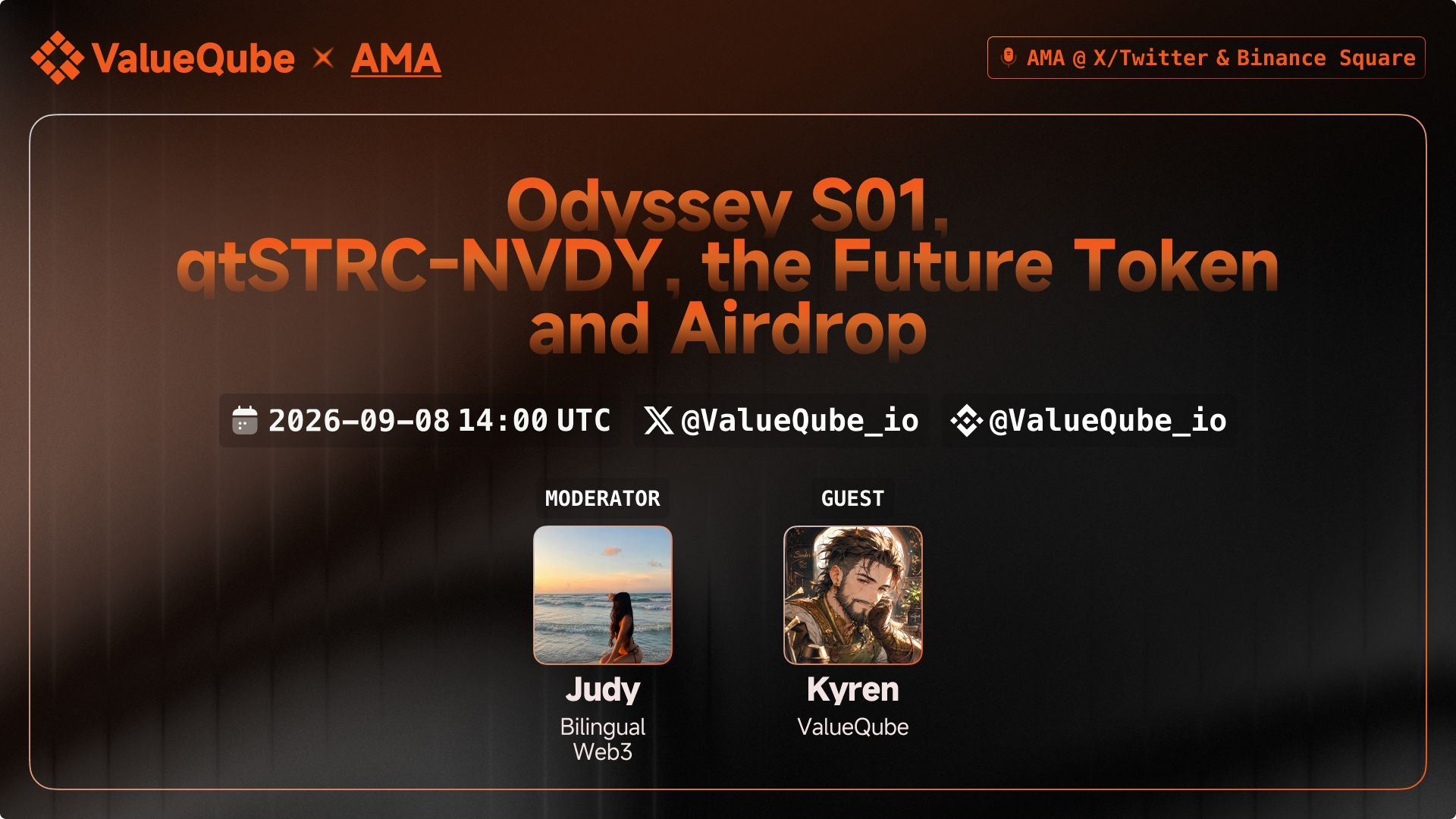
🎙️ ValueQube AMA: Odyssey S01, qtSTRC-NVDY and What Comes Next
⠀
Odyssey S01 has passed 2,500 participants and $10M+ in simulated Testnet subscription value. But what have these numbers actually proven?
⠀
Join Kyren from ValueQube to discuss what S01 has taught us, how qtSTRC-NVDY works, the future token design, and the Airdrop question. 🔍
⠀
📅 September 8, 2026
⏰ 14:00 UTC
⠀
Set a reminder for the AMA 👇
⠀
🔗 https://twitter.com/i/spaces/1OxwbneQrAWJB
⠀
#ValueQube #OdysseyS01 #AMA #RWA #DeFi
🎙️ ValueQube AMA: Odyssey S01, qtSTRC-NVDY and What Comes Next
⠀
Odyssey S01 has passed 2,500 participants and $10M+ in simulated Testnet subscription value. But what have these numbers actually proven?
⠀
Join Kyren from ValueQube to discuss what S01 has taught us, how qtSTRC-NVDY works, the future token design, and the Airdrop question. 🔍
⠀
📅 September 8, 2026
⏰ 14:00 UTC
⠀
Set a reminder for the AMA 👇
⠀
🔗 https://twitter.com/i/spaces/1OxwbneQrAWJB
⠀
#ValueQube #OdysseyS01 #AMA #RWA #DeFi
⠀
Odyssey S01 has passed 2,500 participants and $10M+ in simulated Testnet subscription value. But what have these numbers actually proven?
⠀
Join Kyren from ValueQube to discuss what S01 has taught us, how qtSTRC-NVDY works, the future token design, and the Airdrop question. 🔍
⠀
📅 September 8, 2026
⏰ 14:00 UTC
⠀
Set a reminder for the AMA 👇
⠀
🔗 https://twitter.com/i/spaces/1OxwbneQrAWJB
⠀
#ValueQube #OdysseyS01 #AMA #RWA #DeFi
1
3
76
·
--
Ver tradução
🤝 Partnership Announcement
⠀
ValueQube is partnering with @Astrix_market, a decentralized, oracle-powered prediction market that turns views on future events into transparent, tradable probabilities. 🔮
⠀
Astrix combines event intelligence, multi-source data, and on-chain settlement. ValueQube structures financial exposure, evidence, risk, and product rules through transparent, AI-readable qAsset Certificates.
⠀
Together, we will explore how market probabilities and settlement outcomes can become structured financial context—so users, wallets, protocols, and AI can understand not only what the market expects, but what each position means. 🧾
⠀
#ValueQube #Astrix #PredictionMarkets #AI #DeFi
🤝 Partnership Announcement
⠀
ValueQube is partnering with @Astrix_market, a decentralized, oracle-powered prediction market that turns views on future events into transparent, tradable probabilities. 🔮
⠀
Astrix combines event intelligence, multi-source data, and on-chain settlement. ValueQube structures financial exposure, evidence, risk, and product rules through transparent, AI-readable qAsset Certificates.
⠀
Together, we will explore how market probabilities and settlement outcomes can become structured financial context—so users, wallets, protocols, and AI can understand not only what the market expects, but what each position means. 🧾
⠀
#ValueQube #Astrix #PredictionMarkets #AI #DeFi
⠀
ValueQube is partnering with @Astrix_market, a decentralized, oracle-powered prediction market that turns views on future events into transparent, tradable probabilities. 🔮
⠀
Astrix combines event intelligence, multi-source data, and on-chain settlement. ValueQube structures financial exposure, evidence, risk, and product rules through transparent, AI-readable qAsset Certificates.
⠀
Together, we will explore how market probabilities and settlement outcomes can become structured financial context—so users, wallets, protocols, and AI can understand not only what the market expects, but what each position means. 🧾
⠀
#ValueQube #Astrix #PredictionMarkets #AI #DeFi
1
2
82
·
--

Artigo
Relatório do AMA | Antes do Airdrop, Construa a Prova: Por que a ValueQube Odyssey é Mais do que um Muro de Tarefas**Nota do Editor|**Este artigo é baseado no ValueQube Odyssey AMA realizado em 2 de setembro de 2026, às 14:00 UTC.
A conversa abordou a jornada do Testnet Odyssey S01 em cinco etapas e a diferença entre qAsset e Qube XP. Também explicou a verificação da comunidade e enfrentou o único tópico sobre o qual todo mundo queria perguntar: o Airdrop.
A criptografia não tem falta de “odisseias”. Imagine uma cena familiar.
Um usuário do testnet verifica uma carteira e aprova a primeira ação da campanha. Uma aba pede um follow. Outra abre um chat da comunidade. Em seguida vem um repost, um screenshot e outra assinatura. A barra de progresso avança, mas o usuário pode terminar toda a campanha sem saber muito sobre o produto.
Relatório do AMA | Antes do Airdrop, Construa a Prova: Por que a ValueQube Odyssey é Mais do que um Muro de Tarefas
**Nota do Editor|**Este artigo é baseado no ValueQube Odyssey AMA realizado em 2 de setembro de 2026, às 14:00 UTC.
A conversa abordou a jornada do Testnet Odyssey S01 em cinco etapas e a diferença entre qAsset e Qube XP. Também explicou a verificação da comunidade e enfrentou o único tópico sobre o qual todo mundo queria perguntar: o Airdrop.
A criptografia não tem falta de “odisseias”. Imagine uma cena familiar.
Um usuário do testnet verifica uma carteira e aprova a primeira ação da campanha. Uma aba pede um follow. Outra abre um chat da comunidade. Em seguida vem um repost, um screenshot e outra assinatura. A barra de progresso avança, mas o usuário pode terminar toda a campanha sem saber muito sobre o produto.
A conversa abordou a jornada do Testnet Odyssey S01 em cinco etapas e a diferença entre qAsset e Qube XP. Também explicou a verificação da comunidade e enfrentou o único tópico sobre o qual todo mundo queria perguntar: o Airdrop.
A criptografia não tem falta de “odisseias”. Imagine uma cena familiar.
Um usuário do testnet verifica uma carteira e aprova a primeira ação da campanha. Uma aba pede um follow. Outra abre um chat da comunidade. Em seguida vem um repost, um screenshot e outra assinatura. A barra de progresso avança, mas o usuário pode terminar toda a campanha sem saber muito sobre o produto.
3
133
·
--
🤝 Anúncio de Parceria
⠀
A ValueQube está fazendo parceria com @miraagent_ai, um copilot de mercado com IA que transforma a atividade on-chain e os dados de posição ao vivo em insights estruturados e prontos para decisões. 📡
⠀
O Mira Agent ajuda os usuários a entender o que os mercados estão fazendo e por que isso importa para suas posições. A ValueQube oferece a essas posições um contexto financeiro estruturado por meio de Certificados de qAsset transparentes e legíveis por IA.
⠀
Juntos, vamos explorar como a inteligência de mercado em tempo real e registros financeiros legíveis podem funcionar em conjunto—ajudando os usuários a sair do sinal para o contexto, e do contexto para uma ação informada e autorizada pelo usuário. 🧭
⠀
#ValueQube #MiraAgent #IA #RWA #DeFi
🤝 Anúncio de Parceria
⠀
A ValueQube está fazendo parceria com @miraagent_ai, um copilot de mercado com IA que transforma a atividade on-chain e os dados de posição ao vivo em insights estruturados e prontos para decisões. 📡
⠀
O Mira Agent ajuda os usuários a entender o que os mercados estão fazendo e por que isso importa para suas posições. A ValueQube oferece a essas posições um contexto financeiro estruturado por meio de Certificados de qAsset transparentes e legíveis por IA.
⠀
Juntos, vamos explorar como a inteligência de mercado em tempo real e registros financeiros legíveis podem funcionar em conjunto—ajudando os usuários a sair do sinal para o contexto, e do contexto para uma ação informada e autorizada pelo usuário. 🧭
⠀
#ValueQube #MiraAgent #IA #RWA #DeFi
⠀
A ValueQube está fazendo parceria com @miraagent_ai, um copilot de mercado com IA que transforma a atividade on-chain e os dados de posição ao vivo em insights estruturados e prontos para decisões. 📡
⠀
O Mira Agent ajuda os usuários a entender o que os mercados estão fazendo e por que isso importa para suas posições. A ValueQube oferece a essas posições um contexto financeiro estruturado por meio de Certificados de qAsset transparentes e legíveis por IA.
⠀
Juntos, vamos explorar como a inteligência de mercado em tempo real e registros financeiros legíveis podem funcionar em conjunto—ajudando os usuários a sair do sinal para o contexto, e do contexto para uma ação informada e autorizada pelo usuário. 🧭
⠀
#ValueQube #MiraAgent #IA #RWA #DeFi
2
166
·
--
Artigo
Ver tradução
ValueQube Insight: When Rates Rise, the Account Must Explain Why*Rising rate-hike expectations are repricing global assets. For ValueQube, they also reveal why a financial account needs to explain risk, not merely display a balance.*
The market did not wait for the Federal Reserve to raise rates.
After Fed Chair Kevin Warsh’s Jackson Hole speech on August 28, the two-year Treasury yield rose 11 basis points to 4.34%. The dollar strengthened, while the market-implied probability of a September rate hike climbed from roughly 35% to 60%. [Reuters captured the immediate repricing](https://www.reuters.com/business/view-rate-hike-expectations-rise-warsh-speech-jackson-hole-2026-08-28/).
For ValueQube, this is more than a macro event.
It tests whether a financial account can explain which exposure changed, why it changed, which confirmation batch bears the impact, whether the risk profile has shifted, and what the holder can do next.
A balance shows the result.
A readable account preserves the path.
## The Same Rate Hike Does Not Create the Same Risk
The Federal Reserve held its target range at 3.50%–3.75% in July, but three policymakers preferred an immediate 25-basis-point increase. The possibility of another hike was already present before Jackson Hole. [The July FOMC statement](https://www.federalreserve.gov/newsevents/pressreleases/monetary20260729a.htm) made that disagreement public.
Inflation remains the source of pressure. Headline PCE inflation reached 3.7% year over year in July, while core PCE stood at 3.3%. Monthly readings eased, but both annual measures remained above the Fed’s target. [The Bureau of Economic Analysis published the figures](https://www.bea.gov/news/2026/personal-income-and-outlays-july-2026).
Yet “rates may rise” is not a complete account-level explanation.
A short-duration Treasury or cash-management strategy may earn more as assets reset at higher yields. An existing long-duration bond can lose market value when yields rise.
Preferred and credit-like securities face a different set of pressures: financing costs, issuer credit, distribution capacity, concentration and market-price volatility.
Growth ETFs may suffer valuation compression. Quantitative strategies may face changing correlations, weaker liquidity, higher execution costs and model decay.
One policy expectation reaches different assets through different channels.
ValueQube’s protocol design starts from that distinction. It is an account protocol first and a token system second. Instead of flattening every asset into one generic balance, it organizes strategy exposures into separate, explainable qAsset Certificates.
The market sees one rate decision.
The account holds several versions of its impact.
## Strategy Qube Makes Every Sleeve Explain Its Own Risk
ValueQube organizes strategies through Strategy Qube. The objective is not to cover every asset as quickly as possible. Each strategy sleeve should become explainable and reconcilable before it becomes scalable.
A U.S. Treasury or Cash Sleeve needs to disclose maturity, duration and rate sensitivity. Newly issued short-term instruments may benefit from higher rates, while longer-duration positions may suffer mark-to-market losses. “Treasury exposure” is not enough information.
A STRC or Strategy Credit Sleeve needs to explain issuer credit, distribution changes, market volatility and concentration risk. A preferred or credit-like security should not be described as cash merely because it may generate distributions.
An ETF Sleeve may contain broad-market, income-oriented or thematic exposure. Growth themes can be more sensitive to discount rates, while income ETFs must be compared against the new yields available from cash and government debt.
A Quant Sleeve carries model, execution, liquidity and strategy-decay risk. A system calibrated for falling rates and abundant liquidity may behave differently when the front end of the yield curve reprices.
The Protocol Reserve Sleeve also has a defined limit. It may support operational, data, valuation and settlement friction, but it is not principal protection or a price-support mechanism.
Strategy Qube does not promise that diversification removes risk.
It makes the source of each risk easier to identify.
## qAsset Records Which Position Actually Changed
A user should not open an account after a rate shock and see only one red or green number.
The qAsset Certificate is ValueQube’s core account object and an AI-readable Financial Passport. It is designed to record the strategy exposure, subscription amount, confirmation batch, account units, reference value, risk labels, fee state, distribution state, redemption conditions and authorization boundary.
The standard account path is:
`eligible subscription → strategy confirmation → qAsset Certificate → account updates → hold, claim, reinvest or redeem`
This structure becomes especially important when markets trade rate expectations before the Fed takes formal action.
Suppose one user enters a Treasury strategy before yields rise and another enters after the repricing. Their confirmation prices and units should reflect their respective entry conditions. The later user should not subsidize the earlier user, and the earlier user’s market-value change should not disappear inside an aggregated balance.
ValueQube attributes account value by qAsset, unit and confirmation batch. Each exposure follows its own reference-value method, fee rules, distribution state and redemption window.
An account-value change can therefore be explained. It may come from market price, a valuation update, a fee deduction, a confirmed distribution, a strategy event or a change in liquidity conditions.
A balance reports the outcome.
A qAsset preserves the cause.
## Rate Risk Must Become Machine-Readable Account State
An AI agent cannot interpret a financial account responsibly from token symbols and current prices alone.
It needs to know whether a position has long or short duration, whether value comes from market appreciation or cash distributions, whether fees have been deducted, whether a redemption window is open, and whether the next action is informational or requires user authorization.
A ValueQube qAsset should allow the user and the AI agent to read the same position.
AI may explain why a Treasury sleeve changed, compare the rate sensitivity of different qAssets, identify a new risk label or prepare a redemption action. It should not silently convert analytical capability into unrestricted control over the user’s assets.
Actions that move funds or change account rights must remain behind explicit authorization boundaries.
This is how readability becomes a control system.
Fluent AI cannot repair an unreadable position.
## qAsset, $54Q and qPower Must Remain Separate
Rate volatility also makes ValueQube’s three-layer structure more important.
The qAsset Certificate represents a specific strategy exposure and its account state. Its reference value may rise or fall with the underlying strategy and market conditions.
$54Q belongs to the platform layer. It supports platform participation, governance, liquidity, data services and ecosystem incentives. It is not a qAsset vault share, a redemption claim or an entitlement to underlying strategy returns.
qPower records contribution weight associated with valid subscriptions, reinvestment, referrals and long-term participation. It does not change qAsset reference value or rewrite redemption rules.
These layers cannot be merged for narrative convenience. Neither $54Q nor qPower should be presented as protection against losses inside a qAsset.
Readable finance begins by refusing to blur different roles and risks.
## The ValueQube Opportunity in a Higher-Rate Market
A September hike is still uncertain.
Softer employment or inflation data could reduce the case for tightening. Persistent inflation and resilient labor conditions could strengthen it. Warsh’s [Jackson Hole address](https://www.federalreserve.gov/newsevents/speech/warsh20260828a.htm) reinforced policy discipline, but it did not predetermine the next vote.
ValueQube’s value does not depend on predicting that vote correctly.
It comes from an account structure that remains useful across different policy paths.
If rates rise, users should see duration, valuation and liquidity risk. If rates remain unchanged, they should still understand why the market repriced. If rate-hike expectations reverse, the account should attribute the resulting change to the relevant exposure rather than hide everything inside a generic balance.
Markets can change their rate expectations in minutes.
A financial position should still be able to explain what it is, why its value changed, where its current risks come from, when the holder may exit, and which actions remain under the holder’s control.
The Fed may become quieter.
The account must become more articulate.
*Market figures and policy probabilities referenced in this article are dated August 28, 2026 and may change materially as new economic data are released.*
ValueQube Insight: When Rates Rise, the Account Must Explain Why
*Rising rate-hike expectations are repricing global assets. For ValueQube, they also reveal why a financial account needs to explain risk, not merely display a balance.*
The market did not wait for the Federal Reserve to raise rates.
After Fed Chair Kevin Warsh’s Jackson Hole speech on August 28, the two-year Treasury yield rose 11 basis points to 4.34%. The dollar strengthened, while the market-implied probability of a September rate hike climbed from roughly 35% to 60%. [Reuters captured the immediate repricing](https://www.reuters.com/business/view-rate-hike-expectations-rise-warsh-speech-jackson-hole-2026-08-28/).
For ValueQube, this is more than a macro event.
It tests whether a financial account can explain which exposure changed, why it changed, which confirmation batch bears the impact, whether the risk profile has shifted, and what the holder can do next.
A balance shows the result.
A readable account preserves the path.
## The Same Rate Hike Does Not Create the Same Risk
The Federal Reserve held its target range at 3.50%–3.75% in July, but three policymakers preferred an immediate 25-basis-point increase. The possibility of another hike was already present before Jackson Hole. [The July FOMC statement](https://www.federalreserve.gov/newsevents/pressreleases/monetary20260729a.htm) made that disagreement public.
Inflation remains the source of pressure. Headline PCE inflation reached 3.7% year over year in July, while core PCE stood at 3.3%. Monthly readings eased, but both annual measures remained above the Fed’s target. [The Bureau of Economic Analysis published the figures](https://www.bea.gov/news/2026/personal-income-and-outlays-july-2026).
Yet “rates may rise” is not a complete account-level explanation.
A short-duration Treasury or cash-management strategy may earn more as assets reset at higher yields. An existing long-duration bond can lose market value when yields rise.
Preferred and credit-like securities face a different set of pressures: financing costs, issuer credit, distribution capacity, concentration and market-price volatility.
Growth ETFs may suffer valuation compression. Quantitative strategies may face changing correlations, weaker liquidity, higher execution costs and model decay.
One policy expectation reaches different assets through different channels.
ValueQube’s protocol design starts from that distinction. It is an account protocol first and a token system second. Instead of flattening every asset into one generic balance, it organizes strategy exposures into separate, explainable qAsset Certificates.
The market sees one rate decision.
The account holds several versions of its impact.
## Strategy Qube Makes Every Sleeve Explain Its Own Risk
ValueQube organizes strategies through Strategy Qube. The objective is not to cover every asset as quickly as possible. Each strategy sleeve should become explainable and reconcilable before it becomes scalable.
A U.S. Treasury or Cash Sleeve needs to disclose maturity, duration and rate sensitivity. Newly issued short-term instruments may benefit from higher rates, while longer-duration positions may suffer mark-to-market losses. “Treasury exposure” is not enough information.
A STRC or Strategy Credit Sleeve needs to explain issuer credit, distribution changes, market volatility and concentration risk. A preferred or credit-like security should not be described as cash merely because it may generate distributions.
An ETF Sleeve may contain broad-market, income-oriented or thematic exposure. Growth themes can be more sensitive to discount rates, while income ETFs must be compared against the new yields available from cash and government debt.
A Quant Sleeve carries model, execution, liquidity and strategy-decay risk. A system calibrated for falling rates and abundant liquidity may behave differently when the front end of the yield curve reprices.
The Protocol Reserve Sleeve also has a defined limit. It may support operational, data, valuation and settlement friction, but it is not principal protection or a price-support mechanism.
Strategy Qube does not promise that diversification removes risk.
It makes the source of each risk easier to identify.
## qAsset Records Which Position Actually Changed
A user should not open an account after a rate shock and see only one red or green number.
The qAsset Certificate is ValueQube’s core account object and an AI-readable Financial Passport. It is designed to record the strategy exposure, subscription amount, confirmation batch, account units, reference value, risk labels, fee state, distribution state, redemption conditions and authorization boundary.
The standard account path is:
`eligible subscription → strategy confirmation → qAsset Certificate → account updates → hold, claim, reinvest or redeem`
This structure becomes especially important when markets trade rate expectations before the Fed takes formal action.
Suppose one user enters a Treasury strategy before yields rise and another enters after the repricing. Their confirmation prices and units should reflect their respective entry conditions. The later user should not subsidize the earlier user, and the earlier user’s market-value change should not disappear inside an aggregated balance.
ValueQube attributes account value by qAsset, unit and confirmation batch. Each exposure follows its own reference-value method, fee rules, distribution state and redemption window.
An account-value change can therefore be explained. It may come from market price, a valuation update, a fee deduction, a confirmed distribution, a strategy event or a change in liquidity conditions.
A balance reports the outcome.
A qAsset preserves the cause.
## Rate Risk Must Become Machine-Readable Account State
An AI agent cannot interpret a financial account responsibly from token symbols and current prices alone.
It needs to know whether a position has long or short duration, whether value comes from market appreciation or cash distributions, whether fees have been deducted, whether a redemption window is open, and whether the next action is informational or requires user authorization.
A ValueQube qAsset should allow the user and the AI agent to read the same position.
AI may explain why a Treasury sleeve changed, compare the rate sensitivity of different qAssets, identify a new risk label or prepare a redemption action. It should not silently convert analytical capability into unrestricted control over the user’s assets.
Actions that move funds or change account rights must remain behind explicit authorization boundaries.
This is how readability becomes a control system.
Fluent AI cannot repair an unreadable position.
## qAsset, $54Q and qPower Must Remain Separate
Rate volatility also makes ValueQube’s three-layer structure more important.
The qAsset Certificate represents a specific strategy exposure and its account state. Its reference value may rise or fall with the underlying strategy and market conditions.
$54Q belongs to the platform layer. It supports platform participation, governance, liquidity, data services and ecosystem incentives. It is not a qAsset vault share, a redemption claim or an entitlement to underlying strategy returns.
qPower records contribution weight associated with valid subscriptions, reinvestment, referrals and long-term participation. It does not change qAsset reference value or rewrite redemption rules.
These layers cannot be merged for narrative convenience. Neither $54Q nor qPower should be presented as protection against losses inside a qAsset.
Readable finance begins by refusing to blur different roles and risks.
## The ValueQube Opportunity in a Higher-Rate Market
A September hike is still uncertain.
Softer employment or inflation data could reduce the case for tightening. Persistent inflation and resilient labor conditions could strengthen it. Warsh’s [Jackson Hole address](https://www.federalreserve.gov/newsevents/speech/warsh20260828a.htm) reinforced policy discipline, but it did not predetermine the next vote.
ValueQube’s value does not depend on predicting that vote correctly.
It comes from an account structure that remains useful across different policy paths.
If rates rise, users should see duration, valuation and liquidity risk. If rates remain unchanged, they should still understand why the market repriced. If rate-hike expectations reverse, the account should attribute the resulting change to the relevant exposure rather than hide everything inside a generic balance.
Markets can change their rate expectations in minutes.
A financial position should still be able to explain what it is, why its value changed, where its current risks come from, when the holder may exit, and which actions remain under the holder’s control.
The Fed may become quieter.
The account must become more articulate.
*Market figures and policy probabilities referenced in this article are dated August 28, 2026 and may change materially as new economic data are released.*
The market did not wait for the Federal Reserve to raise rates.
After Fed Chair Kevin Warsh’s Jackson Hole speech on August 28, the two-year Treasury yield rose 11 basis points to 4.34%. The dollar strengthened, while the market-implied probability of a September rate hike climbed from roughly 35% to 60%. [Reuters captured the immediate repricing](https://www.reuters.com/business/view-rate-hike-expectations-rise-warsh-speech-jackson-hole-2026-08-28/).
For ValueQube, this is more than a macro event.
It tests whether a financial account can explain which exposure changed, why it changed, which confirmation batch bears the impact, whether the risk profile has shifted, and what the holder can do next.
A balance shows the result.
A readable account preserves the path.
## The Same Rate Hike Does Not Create the Same Risk
The Federal Reserve held its target range at 3.50%–3.75% in July, but three policymakers preferred an immediate 25-basis-point increase. The possibility of another hike was already present before Jackson Hole. [The July FOMC statement](https://www.federalreserve.gov/newsevents/pressreleases/monetary20260729a.htm) made that disagreement public.
Inflation remains the source of pressure. Headline PCE inflation reached 3.7% year over year in July, while core PCE stood at 3.3%. Monthly readings eased, but both annual measures remained above the Fed’s target. [The Bureau of Economic Analysis published the figures](https://www.bea.gov/news/2026/personal-income-and-outlays-july-2026).
Yet “rates may rise” is not a complete account-level explanation.
A short-duration Treasury or cash-management strategy may earn more as assets reset at higher yields. An existing long-duration bond can lose market value when yields rise.
Preferred and credit-like securities face a different set of pressures: financing costs, issuer credit, distribution capacity, concentration and market-price volatility.
Growth ETFs may suffer valuation compression. Quantitative strategies may face changing correlations, weaker liquidity, higher execution costs and model decay.
One policy expectation reaches different assets through different channels.
ValueQube’s protocol design starts from that distinction. It is an account protocol first and a token system second. Instead of flattening every asset into one generic balance, it organizes strategy exposures into separate, explainable qAsset Certificates.
The market sees one rate decision.
The account holds several versions of its impact.
## Strategy Qube Makes Every Sleeve Explain Its Own Risk
ValueQube organizes strategies through Strategy Qube. The objective is not to cover every asset as quickly as possible. Each strategy sleeve should become explainable and reconcilable before it becomes scalable.
A U.S. Treasury or Cash Sleeve needs to disclose maturity, duration and rate sensitivity. Newly issued short-term instruments may benefit from higher rates, while longer-duration positions may suffer mark-to-market losses. “Treasury exposure” is not enough information.
A STRC or Strategy Credit Sleeve needs to explain issuer credit, distribution changes, market volatility and concentration risk. A preferred or credit-like security should not be described as cash merely because it may generate distributions.
An ETF Sleeve may contain broad-market, income-oriented or thematic exposure. Growth themes can be more sensitive to discount rates, while income ETFs must be compared against the new yields available from cash and government debt.
A Quant Sleeve carries model, execution, liquidity and strategy-decay risk. A system calibrated for falling rates and abundant liquidity may behave differently when the front end of the yield curve reprices.
The Protocol Reserve Sleeve also has a defined limit. It may support operational, data, valuation and settlement friction, but it is not principal protection or a price-support mechanism.
Strategy Qube does not promise that diversification removes risk.
It makes the source of each risk easier to identify.
## qAsset Records Which Position Actually Changed
A user should not open an account after a rate shock and see only one red or green number.
The qAsset Certificate is ValueQube’s core account object and an AI-readable Financial Passport. It is designed to record the strategy exposure, subscription amount, confirmation batch, account units, reference value, risk labels, fee state, distribution state, redemption conditions and authorization boundary.
The standard account path is:
`eligible subscription → strategy confirmation → qAsset Certificate → account updates → hold, claim, reinvest or redeem`
This structure becomes especially important when markets trade rate expectations before the Fed takes formal action.
Suppose one user enters a Treasury strategy before yields rise and another enters after the repricing. Their confirmation prices and units should reflect their respective entry conditions. The later user should not subsidize the earlier user, and the earlier user’s market-value change should not disappear inside an aggregated balance.
ValueQube attributes account value by qAsset, unit and confirmation batch. Each exposure follows its own reference-value method, fee rules, distribution state and redemption window.
An account-value change can therefore be explained. It may come from market price, a valuation update, a fee deduction, a confirmed distribution, a strategy event or a change in liquidity conditions.
A balance reports the outcome.
A qAsset preserves the cause.
## Rate Risk Must Become Machine-Readable Account State
An AI agent cannot interpret a financial account responsibly from token symbols and current prices alone.
It needs to know whether a position has long or short duration, whether value comes from market appreciation or cash distributions, whether fees have been deducted, whether a redemption window is open, and whether the next action is informational or requires user authorization.
A ValueQube qAsset should allow the user and the AI agent to read the same position.
AI may explain why a Treasury sleeve changed, compare the rate sensitivity of different qAssets, identify a new risk label or prepare a redemption action. It should not silently convert analytical capability into unrestricted control over the user’s assets.
Actions that move funds or change account rights must remain behind explicit authorization boundaries.
This is how readability becomes a control system.
Fluent AI cannot repair an unreadable position.
## qAsset, $54Q and qPower Must Remain Separate
Rate volatility also makes ValueQube’s three-layer structure more important.
The qAsset Certificate represents a specific strategy exposure and its account state. Its reference value may rise or fall with the underlying strategy and market conditions.
$54Q belongs to the platform layer. It supports platform participation, governance, liquidity, data services and ecosystem incentives. It is not a qAsset vault share, a redemption claim or an entitlement to underlying strategy returns.
qPower records contribution weight associated with valid subscriptions, reinvestment, referrals and long-term participation. It does not change qAsset reference value or rewrite redemption rules.
These layers cannot be merged for narrative convenience. Neither $54Q nor qPower should be presented as protection against losses inside a qAsset.
Readable finance begins by refusing to blur different roles and risks.
## The ValueQube Opportunity in a Higher-Rate Market
A September hike is still uncertain.
Softer employment or inflation data could reduce the case for tightening. Persistent inflation and resilient labor conditions could strengthen it. Warsh’s [Jackson Hole address](https://www.federalreserve.gov/newsevents/speech/warsh20260828a.htm) reinforced policy discipline, but it did not predetermine the next vote.
ValueQube’s value does not depend on predicting that vote correctly.
It comes from an account structure that remains useful across different policy paths.
If rates rise, users should see duration, valuation and liquidity risk. If rates remain unchanged, they should still understand why the market repriced. If rate-hike expectations reverse, the account should attribute the resulting change to the relevant exposure rather than hide everything inside a generic balance.
Markets can change their rate expectations in minutes.
A financial position should still be able to explain what it is, why its value changed, where its current risks come from, when the holder may exit, and which actions remain under the holder’s control.
The Fed may become quieter.
The account must become more articulate.
*Market figures and policy probabilities referenced in this article are dated August 28, 2026 and may change materially as new economic data are released.*
1
127
·
--
🤝 Anúncio de Parceria
⠀
A ValueQube está fazendo parceria com a @Hi_PoPPOfficial, uma camada de usuário Web3 alimentada por IA, focada em identidade descentralizada, análise de comportamento on-chain e engajamento do consumidor com privacidade em primeiro lugar. 🧬
⠀
O PoP Planet transforma a atividade on-chain em sinais estruturados de identidade. A ValueQube transforma exposição financeira complexa em Certificados qAsset transparentes e legíveis por IA.
⠀
Juntos, vamos explorar como identidade, comportamento e contexto financeiro podem trabalhar em conjunto—ajudando usuários, dApps, carteiras e IA a entender melhor o que cada posição representa, quais riscos se aplicam e quais ações estão disponíveis. 🧊
⠀
#ValueQube #PoPPlanet #Web3Identity #RWA #AI
🤝 Anúncio de Parceria
⠀
A ValueQube está fazendo parceria com a @Hi_PoPPOfficial, uma camada de usuário Web3 alimentada por IA, focada em identidade descentralizada, análise de comportamento on-chain e engajamento do consumidor com privacidade em primeiro lugar. 🧬
⠀
O PoP Planet transforma a atividade on-chain em sinais estruturados de identidade. A ValueQube transforma exposição financeira complexa em Certificados qAsset transparentes e legíveis por IA.
⠀
Juntos, vamos explorar como identidade, comportamento e contexto financeiro podem trabalhar em conjunto—ajudando usuários, dApps, carteiras e IA a entender melhor o que cada posição representa, quais riscos se aplicam e quais ações estão disponíveis. 🧊
⠀
#ValueQube #PoPPlanet #Web3Identity #RWA #AI
⠀
A ValueQube está fazendo parceria com a @Hi_PoPPOfficial, uma camada de usuário Web3 alimentada por IA, focada em identidade descentralizada, análise de comportamento on-chain e engajamento do consumidor com privacidade em primeiro lugar. 🧬
⠀
O PoP Planet transforma a atividade on-chain em sinais estruturados de identidade. A ValueQube transforma exposição financeira complexa em Certificados qAsset transparentes e legíveis por IA.
⠀
Juntos, vamos explorar como identidade, comportamento e contexto financeiro podem trabalhar em conjunto—ajudando usuários, dApps, carteiras e IA a entender melhor o que cada posição representa, quais riscos se aplicam e quais ações estão disponíveis. 🧊
⠀
#ValueQube #PoPPlanet #Web3Identity #RWA #AI
2
115
·
--
Ver tradução
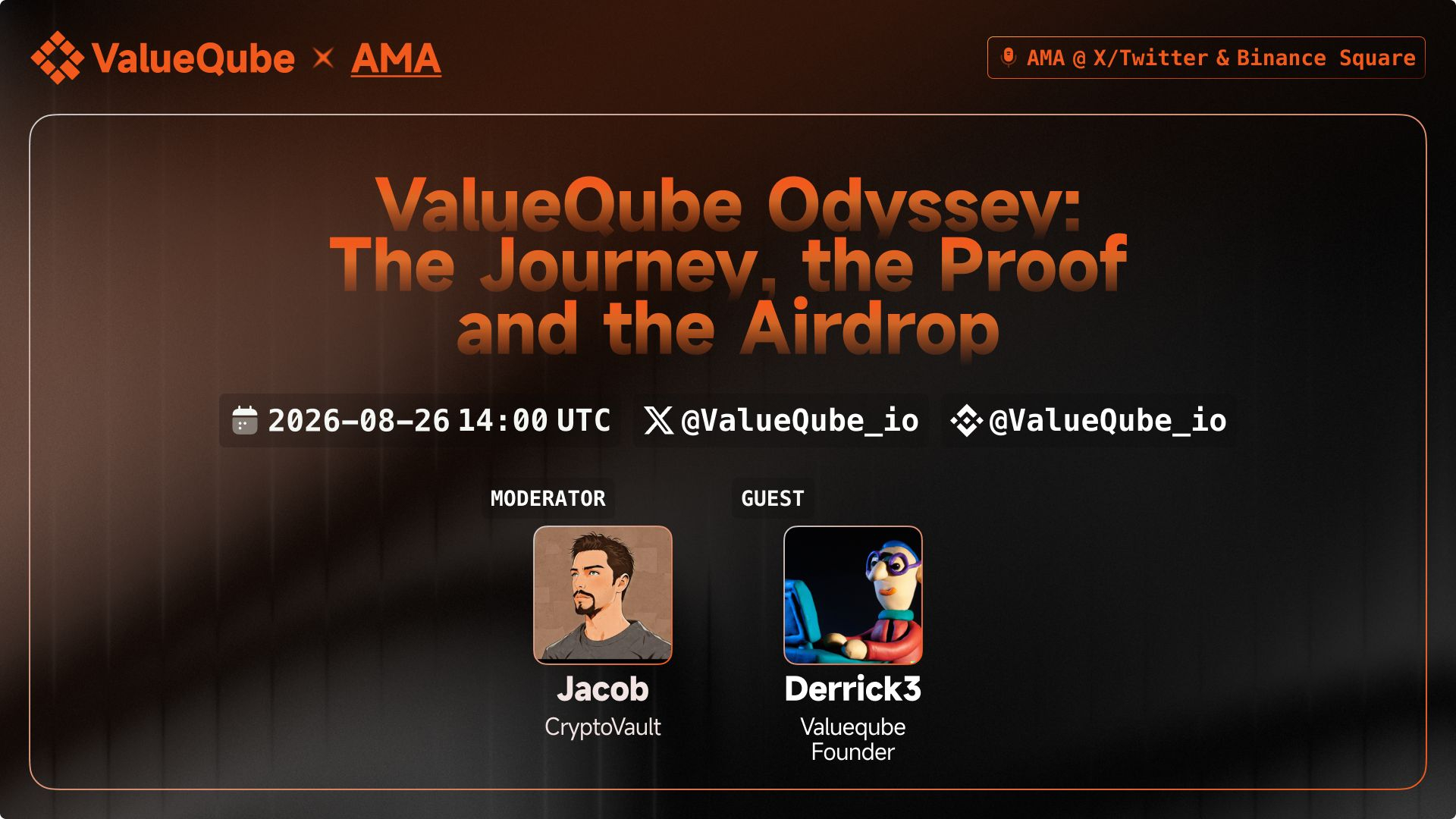
🎙️ ValueQube Odyssey: The Journey, the Proof and the Airdrop
⠀
Most Web3 quests measure clicks. Odyssey S01 measures whether users can understand a product, complete a verified Testnet action, and read the result.
⠀
Join ValueQube Founder Derrick to discuss the five-step journey, readable qAssets, Qube XP, and community missions. 🧭
⠀
🗓️ August 26, 2026
⏰ 14:00 UTC
⠀
Set a reminder for the AMA 👇
⠀
🔗 https://twitter.com/i/spaces/1dGYlaLkDWEKX
⠀
#ValueQube #OdysseyS01 #AMA #RWA #DeFi
🎙️ ValueQube Odyssey: The Journey, the Proof and the Airdrop
⠀
Most Web3 quests measure clicks. Odyssey S01 measures whether users can understand a product, complete a verified Testnet action, and read the result.
⠀
Join ValueQube Founder Derrick to discuss the five-step journey, readable qAssets, Qube XP, and community missions. 🧭
⠀
🗓️ August 26, 2026
⏰ 14:00 UTC
⠀
Set a reminder for the AMA 👇
⠀
🔗 https://twitter.com/i/spaces/1dGYlaLkDWEKX
⠀
#ValueQube #OdysseyS01 #AMA #RWA #DeFi
⠀
Most Web3 quests measure clicks. Odyssey S01 measures whether users can understand a product, complete a verified Testnet action, and read the result.
⠀
Join ValueQube Founder Derrick to discuss the five-step journey, readable qAssets, Qube XP, and community missions. 🧭
⠀
🗓️ August 26, 2026
⏰ 14:00 UTC
⠀
Set a reminder for the AMA 👇
⠀
🔗 https://twitter.com/i/spaces/1dGYlaLkDWEKX
⠀
#ValueQube #OdysseyS01 #AMA #RWA #DeFi
1
79
·
--
Ver tradução
🤝 Partnership Announcement
⠀
ValueQube is partnering with @Mintellect_AI, a ContentFi infrastructure layer for turning code, AI assets, and knowledge into programmable on-chain assets. 💡
⠀
Mintellect structures ownership, licensing, and monetization for digital content. ValueQube organizes value logic, fees, risks, and lifecycle rules through transparent, AI-readable qAsset Certificates.
⠀
Together, we will explore how programmable content rights can connect with machine-readable financial context—helping creators, platforms, and AI understand how digital assets are owned, used, and valued. 🧊
⠀
#ValueQube #Mintellect #ContentFi #AI #Web3
🤝 Partnership Announcement
⠀
ValueQube is partnering with @Mintellect_AI, a ContentFi infrastructure layer for turning code, AI assets, and knowledge into programmable on-chain assets. 💡
⠀
Mintellect structures ownership, licensing, and monetization for digital content. ValueQube organizes value logic, fees, risks, and lifecycle rules through transparent, AI-readable qAsset Certificates.
⠀
Together, we will explore how programmable content rights can connect with machine-readable financial context—helping creators, platforms, and AI understand how digital assets are owned, used, and valued. 🧊
⠀
#ValueQube #Mintellect #ContentFi #AI #Web3
⠀
ValueQube is partnering with @Mintellect_AI, a ContentFi infrastructure layer for turning code, AI assets, and knowledge into programmable on-chain assets. 💡
⠀
Mintellect structures ownership, licensing, and monetization for digital content. ValueQube organizes value logic, fees, risks, and lifecycle rules through transparent, AI-readable qAsset Certificates.
⠀
Together, we will explore how programmable content rights can connect with machine-readable financial context—helping creators, platforms, and AI understand how digital assets are owned, used, and valued. 🧊
⠀
#ValueQube #Mintellect #ContentFi #AI #Web3
1
88
·
--
Ver tradução
🤝 Partnership Announcement
⠀
ValueQube is partnering with @Agentum_space, an on-chain protocol for autonomous agentic commerce built on BNB Chain. 🤖
⠀
Agentum enables AI agents to post and bid for work, execute tasks privately, verify outcomes, and settle through escrow. ValueQube organizes financial exposure into transparent, AI-readable qAsset Certificates.
⠀
Together, we will explore how autonomous execution can connect with machine-readable context around value, risk, rules, and evidence—making agentic finance more verifiable, interpretable, and accountable. 🧊
⠀
#ValueQube #Agentum #AgenticFinance #AI #BNBChain
🤝 Partnership Announcement
⠀
ValueQube is partnering with @Agentum_space, an on-chain protocol for autonomous agentic commerce built on BNB Chain. 🤖
⠀
Agentum enables AI agents to post and bid for work, execute tasks privately, verify outcomes, and settle through escrow. ValueQube organizes financial exposure into transparent, AI-readable qAsset Certificates.
⠀
Together, we will explore how autonomous execution can connect with machine-readable context around value, risk, rules, and evidence—making agentic finance more verifiable, interpretable, and accountable. 🧊
⠀
#ValueQube #Agentum #AgenticFinance #AI #BNBChain
⠀
ValueQube is partnering with @Agentum_space, an on-chain protocol for autonomous agentic commerce built on BNB Chain. 🤖
⠀
Agentum enables AI agents to post and bid for work, execute tasks privately, verify outcomes, and settle through escrow. ValueQube organizes financial exposure into transparent, AI-readable qAsset Certificates.
⠀
Together, we will explore how autonomous execution can connect with machine-readable context around value, risk, rules, and evidence—making agentic finance more verifiable, interpretable, and accountable. 🧊
⠀
#ValueQube #Agentum #AgenticFinance #AI #BNBChain
1
79
·
--
Ver tradução
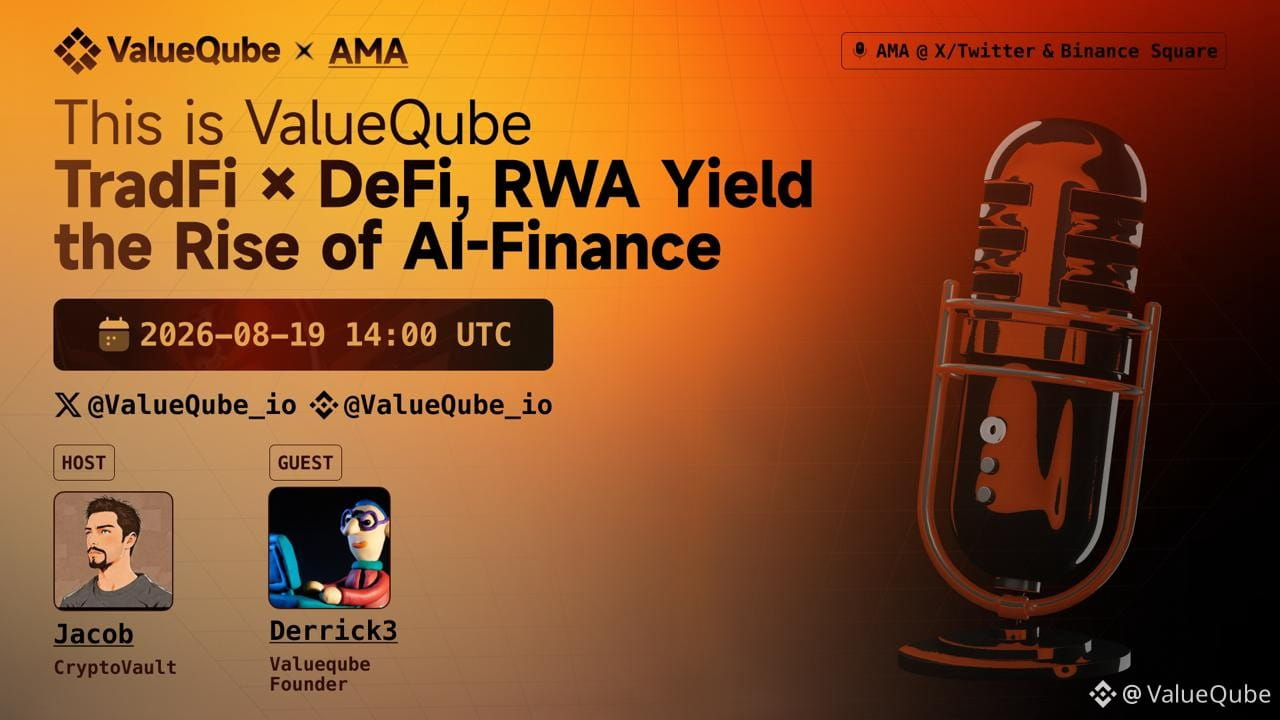
🎙️ CRYPTO VAULT × VALUEQUBE AMA
⠀
A balance shows what you hold. A readable account explains what it means.
⠀
Join ValueQube Founder Derrick to discuss how qAsset Certificates give users and AI clearer context around value, risk, and available actions—while keeping users in control. 🧊
⠀
🗓️ August 19, 2026
⏰ 14:00 UTC
⠀
Set a reminder 👇
⠀
🔗 https://twitter.com/i/spaces/1aJbdEMdaBBKX
⠀
#ValueQube #AMA #RWA #DEFİ #Aİ
🎙️ CRYPTO VAULT × VALUEQUBE AMA
⠀
A balance shows what you hold. A readable account explains what it means.
⠀
Join ValueQube Founder Derrick to discuss how qAsset Certificates give users and AI clearer context around value, risk, and available actions—while keeping users in control. 🧊
⠀
🗓️ August 19, 2026
⏰ 14:00 UTC
⠀
Set a reminder 👇
⠀
🔗 https://twitter.com/i/spaces/1aJbdEMdaBBKX
⠀
#ValueQube #AMA #RWA #DEFİ #Aİ
⠀
A balance shows what you hold. A readable account explains what it means.
⠀
Join ValueQube Founder Derrick to discuss how qAsset Certificates give users and AI clearer context around value, risk, and available actions—while keeping users in control. 🧊
⠀
🗓️ August 19, 2026
⏰ 14:00 UTC
⠀
Set a reminder 👇
⠀
🔗 https://twitter.com/i/spaces/1aJbdEMdaBBKX
⠀
#ValueQube #AMA #RWA #DEFİ #Aİ
3
93
·
--
Ver tradução
🤝 Partnership Announcement
⠀
ValueQube is partnering with @AstroXFinance, a livestream-powered multichain creator-token platform where creators launch tokens live and users trade in-stream. 🎥
⠀
AstroX brings token creation and market participation into real time. ValueQube makes financial context readable—organizing exposure, evidence, risk, product rules, and position state through transparent, AI-readable qAsset Certificates.
⠀
Together, we will explore how livestream launch activity and multichain market events can be translated into structured account records that users, wallets, protocols, and AI can interpret. 🧊
⠀
As assets become easier to launch and trade, they should also become easier to understand.
⠀
#ValueQube #AstroX #CreatorEconomy #DeFi #Web3
🤝 Partnership Announcement
⠀
ValueQube is partnering with @AstroXFinance, a livestream-powered multichain creator-token platform where creators launch tokens live and users trade in-stream. 🎥
⠀
AstroX brings token creation and market participation into real time. ValueQube makes financial context readable—organizing exposure, evidence, risk, product rules, and position state through transparent, AI-readable qAsset Certificates.
⠀
Together, we will explore how livestream launch activity and multichain market events can be translated into structured account records that users, wallets, protocols, and AI can interpret. 🧊
⠀
As assets become easier to launch and trade, they should also become easier to understand.
⠀
#ValueQube #AstroX #CreatorEconomy #DeFi #Web3
⠀
ValueQube is partnering with @AstroXFinance, a livestream-powered multichain creator-token platform where creators launch tokens live and users trade in-stream. 🎥
⠀
AstroX brings token creation and market participation into real time. ValueQube makes financial context readable—organizing exposure, evidence, risk, product rules, and position state through transparent, AI-readable qAsset Certificates.
⠀
Together, we will explore how livestream launch activity and multichain market events can be translated into structured account records that users, wallets, protocols, and AI can interpret. 🧊
⠀
As assets become easier to launch and trade, they should also become easier to understand.
⠀
#ValueQube #AstroX #CreatorEconomy #DeFi #Web3
3
94
·
--
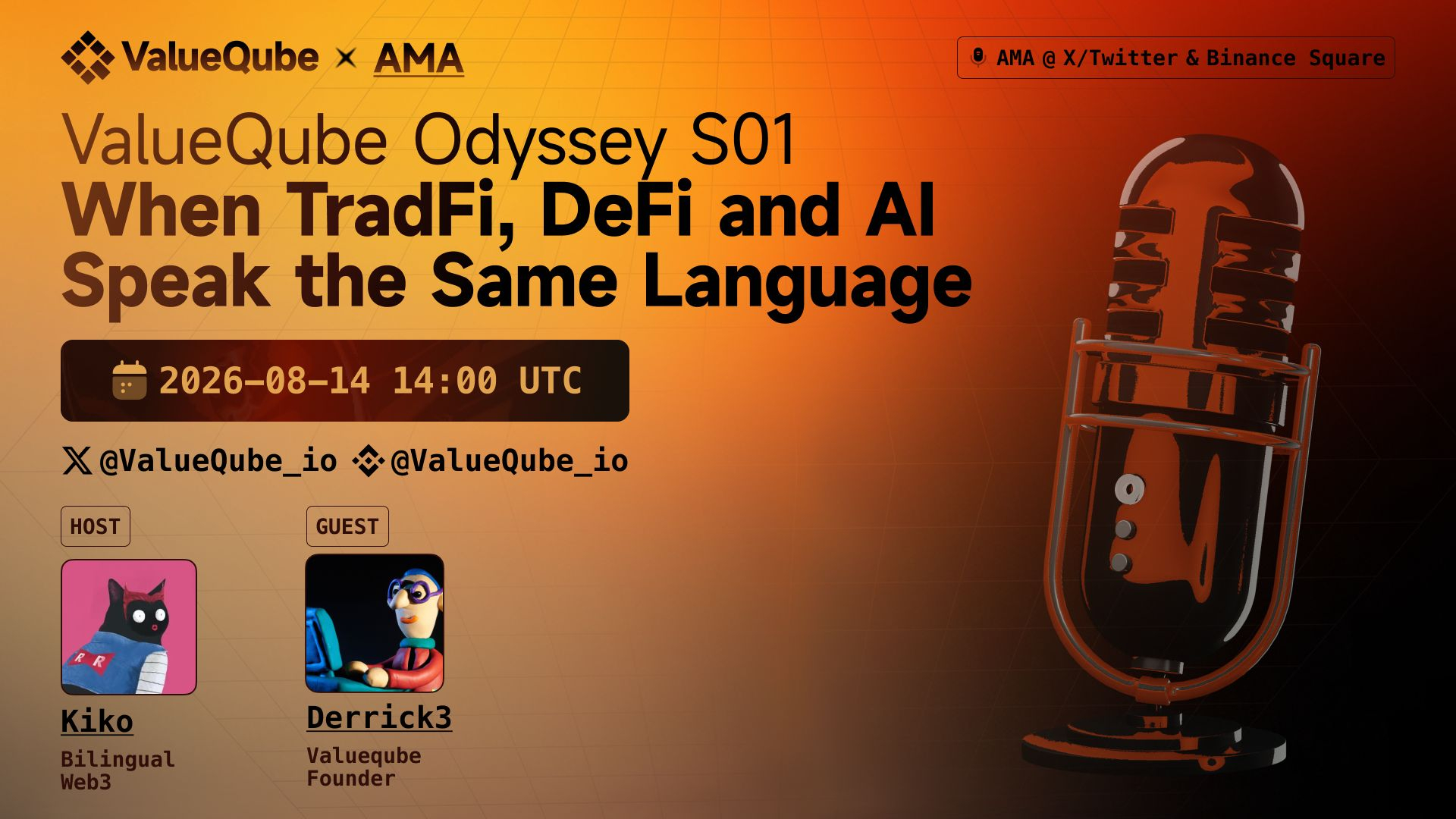
🎙️ ValueQube Odyssey S01 AMA
A TradFi tem os produtos. A DeFi tem as carteiras. A IA tem as respostas.
Então por que os usuários ainda abrem uma conta financeira e perguntam:
“Exatamente o que eu possuo?”
Junte-se ao fundador da ValueQube, Derrick, para uma discussão sobre como qAssets e Certificados legíveis por IA podem dar à TradFi, à DeFi, às carteiras e à IA uma linguagem financeira compartilhada — mantendo os usuários no controle. 🧊
🗓 14 de agosto de 2026
⏰ 14:00 UTC
Defina um lembrete para o AMA 👇
🔗 https://twitter.com/i/spaces/1nxnRBReWYkxO
#ValueQube #OdysseyS01 #AMA #RWA #DeFi
🎙️ ValueQube Odyssey S01 AMA
A TradFi tem os produtos. A DeFi tem as carteiras. A IA tem as respostas.
Então por que os usuários ainda abrem uma conta financeira e perguntam:
“Exatamente o que eu possuo?”
Junte-se ao fundador da ValueQube, Derrick, para uma discussão sobre como qAssets e Certificados legíveis por IA podem dar à TradFi, à DeFi, às carteiras e à IA uma linguagem financeira compartilhada — mantendo os usuários no controle. 🧊
🗓 14 de agosto de 2026
⏰ 14:00 UTC
Defina um lembrete para o AMA 👇
🔗 https://twitter.com/i/spaces/1nxnRBReWYkxO
#ValueQube #OdysseyS01 #AMA #RWA #DeFi
A TradFi tem os produtos. A DeFi tem as carteiras. A IA tem as respostas.
Então por que os usuários ainda abrem uma conta financeira e perguntam:
“Exatamente o que eu possuo?”
Junte-se ao fundador da ValueQube, Derrick, para uma discussão sobre como qAssets e Certificados legíveis por IA podem dar à TradFi, à DeFi, às carteiras e à IA uma linguagem financeira compartilhada — mantendo os usuários no controle. 🧊
🗓 14 de agosto de 2026
⏰ 14:00 UTC
Defina um lembrete para o AMA 👇
🔗 https://twitter.com/i/spaces/1nxnRBReWYkxO
#ValueQube #OdysseyS01 #AMA #RWA #DeFi
6
84
·
--
Verificado
Ver tradução
🤝 Partnership Announcement
⠀
ValueQube is partnering with @kuvilabs, the team behind an Agentic Finance OS that turns user intent into programmable, user-approved financial workflows. 🦉
⠀
Kuvi focuses on how strategies are composed, monitored, and executed. ValueQube gives assets and strategies structured financial context through transparent, AI-readable qAsset Certificates.
⠀
This collaboration will explore how programmable execution and machine-readable financial context can work together—so intelligent finance can act on more than signals and understand the value, risk, and rules behind each position. 🧊
⠀
#ValueQube #Kuvi #AgenticFinance #RWA #Web3
🤝 Partnership Announcement
⠀
ValueQube is partnering with @kuvilabs, the team behind an Agentic Finance OS that turns user intent into programmable, user-approved financial workflows. 🦉
⠀
Kuvi focuses on how strategies are composed, monitored, and executed. ValueQube gives assets and strategies structured financial context through transparent, AI-readable qAsset Certificates.
⠀
This collaboration will explore how programmable execution and machine-readable financial context can work together—so intelligent finance can act on more than signals and understand the value, risk, and rules behind each position. 🧊
⠀
#ValueQube #Kuvi #AgenticFinance #RWA #Web3
⠀
ValueQube is partnering with @kuvilabs, the team behind an Agentic Finance OS that turns user intent into programmable, user-approved financial workflows. 🦉
⠀
Kuvi focuses on how strategies are composed, monitored, and executed. ValueQube gives assets and strategies structured financial context through transparent, AI-readable qAsset Certificates.
⠀
This collaboration will explore how programmable execution and machine-readable financial context can work together—so intelligent finance can act on more than signals and understand the value, risk, and rules behind each position. 🧊
⠀
#ValueQube #Kuvi #AgenticFinance #RWA #Web3
1
4
70
·
--
Ver tradução
ValueQube Testnet is now live.
Odyssey S01 has begun.
Enter: https://dapp.valueqube.io
Aug 8, 2026 · 08:08 UTC
ValueQube Testnet is now live.
Odyssey S01 has begun.
Enter: https://dapp.valueqube.io
Aug 8, 2026 · 08:08 UTC
Odyssey S01 has begun.
Enter: https://dapp.valueqube.io
Aug 8, 2026 · 08:08 UTC
5
99
·
--
Ver tradução
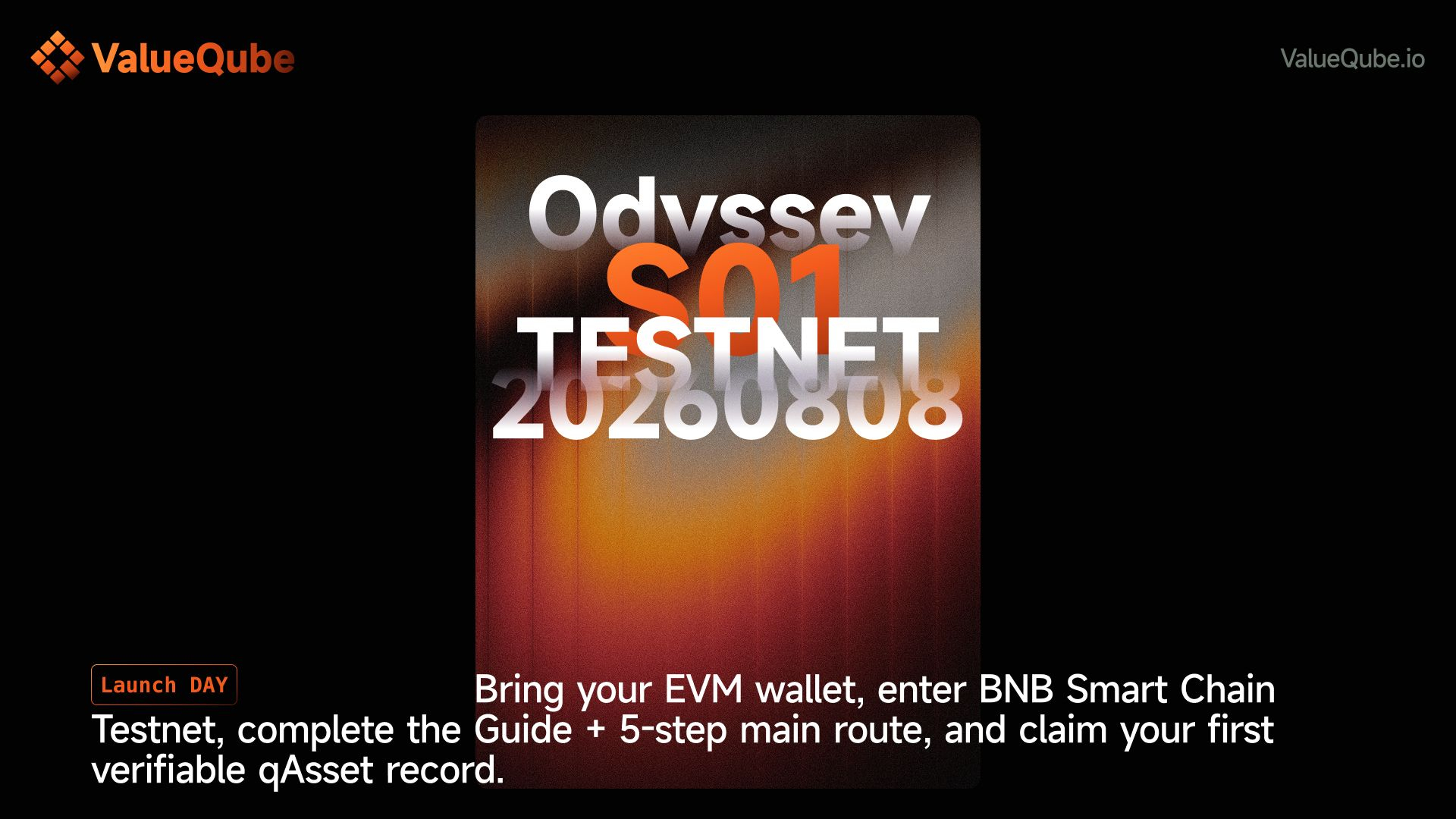
🚀 ValueQube Testnet is now LIVE.
On Aug 8, 2026 at 08:08 UTC, Odyssey S01 launches in sync.
Bring your EVM wallet, enter BNB Smart Chain Testnet, complete the Guide + 5-step main route, and claim your first verifiable qAsset record.
This is the first season window only. If you’re in, the route starts now: https://dapp.valueqube.io
#ValueQube #OdysseyS01
🚀 ValueQube Testnet is now LIVE.
On Aug 8, 2026 at 08:08 UTC, Odyssey S01 launches in sync.
Bring your EVM wallet, enter BNB Smart Chain Testnet, complete the Guide + 5-step main route, and claim your first verifiable qAsset record.
This is the first season window only. If you’re in, the route starts now: https://dapp.valueqube.io
#ValueQube #OdysseyS01
On Aug 8, 2026 at 08:08 UTC, Odyssey S01 launches in sync.
Bring your EVM wallet, enter BNB Smart Chain Testnet, complete the Guide + 5-step main route, and claim your first verifiable qAsset record.
This is the first season window only. If you’re in, the route starts now: https://dapp.valueqube.io
#ValueQube #OdysseyS01
5
108
Inicia sessão para explorar mais conteúdos
Junta-te a utilizadores de criptomoedas de todo o mundo na Binance Square
⚡️ Obtém informações úteis e recentes sobre criptomoedas.
💬 Com a confiança da maior exchange de criptomoedas do mundo.
👍 Descobre perspetivas reais de criadores verificados.
E-mail/Número de telefone
Tópicos em Tendência
AIStocksWhatNext
752,533 visualizações
5,785 a discutir
Participe e ganhe recompensas de tráfego na nossa campanha de hashtag em alta
✨Tópico: Que outras oportunidades de investimento ainda existem enquanto as ações de IA continuam subindo?
👉Como participar:
Publique uma postagem curta ou um artigo com a hashtag #AIStocksWhatNext
Compartilhe se você está otimista ou pessimista e publique suas participações em ações de IA ou suas operações — usar o widget de negociação pode melhorar sua elegibilidade.
Você também pode fortalecer sua postagem compartilhando dados ou gráficos e evitando imagens geradas por IA.
✍️Crie conteúdo com base nos ângulos abaixo:
- A Nvidia diz que as vendas de chips vão dobrar no próximo ano, e as principais empresas de IA continuam registrando receita recorde; o gasto com computação por trás disso é igualmente impressionante. A demanda por IA realmente decolou? E por quanto tempo isso pode durar? As ações de IA estão em alta em todo o mercado. Isso é uma ruptura real ou apenas um repique de curto prazo?
- Líderes da indústria estão pedindo para desacelerar o desenvolvimento de IA, enquanto Trump planeja construir uma “Força de IA”, afirmando que a IA poderia representar 25% do PIB dos EUA no futuro. De que lado você está? O apoio em nível estadual será uma vitória de longo prazo para as ações de IA?
- Você está comprando ações de IA? Compartilhe com nosso widget de compartilhamento de negociações suas operações/posições relacionadas a IA.
⏰Período da campanha:
- 2026-09-22 7:00 - 2026-09-24 4:00 UTC
🎁Recompensa:
- As postagens qualificadas que cumprirem as diretrizes acima e tiverem mais de 100 palavras serão revisadas e poderão receber um impulso aleatório de tráfego de 500 a 3.000 visualizações. Você receberá uma notificação do seu secretário de feed caso sua postagem seja selecionada.
- Tenha a chance de ter seu artigo destacado no Binance Square Official
Precisa de ideias para sua postagem? Visite a página do tópico #AIStocksWhatNext ou a Square Guide on How to Post for Better Reach.
Binance Square Official
·552 gostos
·1.5M visualizações
BitcoinRejectedAt$87,300Twice
0 visualizações
0 a discutir
BCHJumps28%OnCMEFuturesListing
501 visualizações
138 a discutir