

Crypto Inertia
628 Publicações
Crypto Inertia
Denunciar
Bloquear Utilizador

Detentor de BNB
Trader de Alta Frequência
3.5 ano(s)
123 A seguir
126 Seguidores
247 Gostaram
Publicações
Tudo
Cotações
PINNED
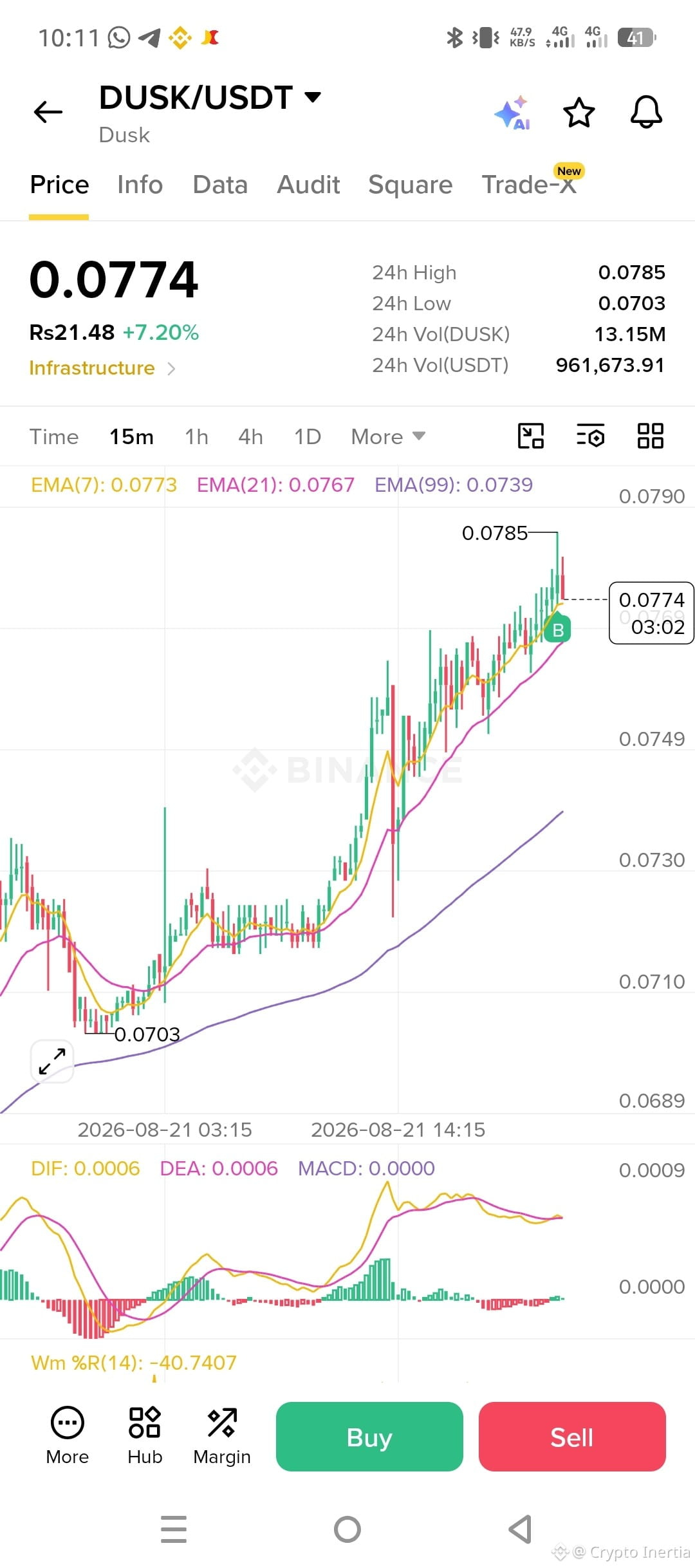
#dusk $DUSK @Dusk_Foundation Tenho ficado com minha trade de DUSK e um número não para de me incomodar.
Entrei em 0.0630. Preço atual 0.0779. Isso dá algo como +23%. Bom no papel. Mas o Williams %R está em -3.97. Muito sobrecomprado. O MACD ainda está positivo e a pilha de EMAs é de alta — 7 acima de 21 acima de 99. Tudo indica tendência de alta. Exceto pelo sinal de sobrecompra.
O que isso me diz? Ou o momentum é forte o suficiente para romper a resistência de 0.0785 e continuar rodando, ou o movimento fácil já acabou e uma rejeição faz o preço voltar em direção às EMAs. Provavelmente as duas coisas, se eu for sincero — primeiro um teste da resistência, depois consolidação.
Aí eu olhei o volume. 13,14M de DUSK negociado em 24 horas. Isso é atividade real. Não é um gráfico morto. Preço médio de compra em 0.0630, preço médio de venda em 0.0623. O mercado está equilibrado, mas levemente inclinado para compra. Minha entrada está bem onde os compradores entraram.
O que eu realmente não sei é se esse “pump” foi movido por uma campanha ou se há algo mais profundo no ecossistema. As parcerias são reais. NPEX. Chainlink. EURQ. Mas o gráfico não liga para anúncios. Ele liga para liquidez e momentum.
A pergunta que eu continuo trazendo de volta — quando eu pesquiso uma chain para uma campanha e faço trade nela ao mesmo tempo, eu estou lendo o projeto ou só lendo o gráfico? $DUSK #dusk
#dusk $DUSK @Dusk Tenho ficado com minha trade de DUSK e um número não para de me incomodar.
Entrei em 0.0630. Preço atual 0.0779. Isso dá algo como +23%. Bom no papel. Mas o Williams %R está em -3.97. Muito sobrecomprado. O MACD ainda está positivo e a pilha de EMAs é de alta — 7 acima de 21 acima de 99. Tudo indica tendência de alta. Exceto pelo sinal de sobrecompra.
O que isso me diz? Ou o momentum é forte o suficiente para romper a resistência de 0.0785 e continuar rodando, ou o movimento fácil já acabou e uma rejeição faz o preço voltar em direção às EMAs. Provavelmente as duas coisas, se eu for sincero — primeiro um teste da resistência, depois consolidação.
Aí eu olhei o volume. 13,14M de DUSK negociado em 24 horas. Isso é atividade real. Não é um gráfico morto. Preço médio de compra em 0.0630, preço médio de venda em 0.0623. O mercado está equilibrado, mas levemente inclinado para compra. Minha entrada está bem onde os compradores entraram.
O que eu realmente não sei é se esse “pump” foi movido por uma campanha ou se há algo mais profundo no ecossistema. As parcerias são reais. NPEX. Chainlink. EURQ. Mas o gráfico não liga para anúncios. Ele liga para liquidez e momentum.
A pergunta que eu continuo trazendo de volta — quando eu pesquiso uma chain para uma campanha e faço trade nela ao mesmo tempo, eu estou lendo o projeto ou só lendo o gráfico? $DUSK #dusk
Entrei em 0.0630. Preço atual 0.0779. Isso dá algo como +23%. Bom no papel. Mas o Williams %R está em -3.97. Muito sobrecomprado. O MACD ainda está positivo e a pilha de EMAs é de alta — 7 acima de 21 acima de 99. Tudo indica tendência de alta. Exceto pelo sinal de sobrecompra.
O que isso me diz? Ou o momentum é forte o suficiente para romper a resistência de 0.0785 e continuar rodando, ou o movimento fácil já acabou e uma rejeição faz o preço voltar em direção às EMAs. Provavelmente as duas coisas, se eu for sincero — primeiro um teste da resistência, depois consolidação.
Aí eu olhei o volume. 13,14M de DUSK negociado em 24 horas. Isso é atividade real. Não é um gráfico morto. Preço médio de compra em 0.0630, preço médio de venda em 0.0623. O mercado está equilibrado, mas levemente inclinado para compra. Minha entrada está bem onde os compradores entraram.
O que eu realmente não sei é se esse “pump” foi movido por uma campanha ou se há algo mais profundo no ecossistema. As parcerias são reais. NPEX. Chainlink. EURQ. Mas o gráfico não liga para anúncios. Ele liga para liquidez e momentum.
A pergunta que eu continuo trazendo de volta — quando eu pesquiso uma chain para uma campanha e faço trade nela ao mesmo tempo, eu estou lendo o projeto ou só lendo o gráfico? $DUSK #dusk
72
participe nesta e ganhe recompensas surpreendentes o link da oferta é
#BinanceMidAutumn https://t.me/binancecanteen/254
#BinanceSquareTG
$XAI
{spot}(XAIUSDT)
$NOM
{spot}(NOMUSDT)
participe nesta e ganhe recompensas surpreendentes o link da oferta é
#BinanceMidAutumn https://t.me/binancecanteen/254
#BinanceSquareTG
$XAI
$NOM
#BinanceMidAutumn https://t.me/binancecanteen/254
#BinanceSquareTG
$XAI
$NOM

421
#dusk $DUSK @Dusk_Foundation ---
A Dusk diz que as finanças reguladas são onchain. Parceria NPEX. 21X com licença DLT-TSS. Quantoz com EURQ. Tudo parece sólido.
Mas então verifiquei o deploy real. Dusk Trade ainda em construção. DuskEVM testnet. Hedger testnet. Licença DLT-TSS em andamento. Parcerias assinadas, mas os produtos ainda não estão prontos.
No on-chain é a mesma história. 206 provisionadores. Participação concentrada. A participação pendente está quase zero. Pitch institucional, mas o formato real parece, neste momento, um clube de validadores.
Não sei se isso é normal ou se a diferença é grande demais. Quando as instituições abrirem o explorer, o que elas veem — uma infraestrutura de liquidação ou uma linha de montagem?
$DUSK #dusk
---
#dusk $DUSK @Dusk ---
A Dusk diz que as finanças reguladas são onchain. Parceria NPEX. 21X com licença DLT-TSS. Quantoz com EURQ. Tudo parece sólido.
Mas então verifiquei o deploy real. Dusk Trade ainda em construção. DuskEVM testnet. Hedger testnet. Licença DLT-TSS em andamento. Parcerias assinadas, mas os produtos ainda não estão prontos.
No on-chain é a mesma história. 206 provisionadores. Participação concentrada. A participação pendente está quase zero. Pitch institucional, mas o formato real parece, neste momento, um clube de validadores.
Não sei se isso é normal ou se a diferença é grande demais. Quando as instituições abrirem o explorer, o que elas veem — uma infraestrutura de liquidação ou uma linha de montagem?
$DUSK #dusk
---
A Dusk diz que as finanças reguladas são onchain. Parceria NPEX. 21X com licença DLT-TSS. Quantoz com EURQ. Tudo parece sólido.
Mas então verifiquei o deploy real. Dusk Trade ainda em construção. DuskEVM testnet. Hedger testnet. Licença DLT-TSS em andamento. Parcerias assinadas, mas os produtos ainda não estão prontos.
No on-chain é a mesma história. 206 provisionadores. Participação concentrada. A participação pendente está quase zero. Pitch institucional, mas o formato real parece, neste momento, um clube de validadores.
Não sei se isso é normal ou se a diferença é grande demais. Quando as instituições abrirem o explorer, o que elas veem — uma infraestrutura de liquidação ou uma linha de montagem?
$DUSK #dusk
---
174
#dusk $DUSK @Dusk_Foundation "Tenho ficado sentado com o ecossistema DUSK e um padrão continua me incomodando.
A Dusk reuniu parceiros regulados como nenhuma outra cadeia. NPEX com licenças da MTF, Broker e ECSP. 21X com o primeiro DLT-TSS da Europa. Quantoz com EURQ compatível com MiCA. Chainlink para infraestrutura. Cordial para custódia. Cada parceria traz algo real. Sólido.
Mas quando eu rastreei onde esses parceiros realmente se conectam à Dusk neste momento, as ligações estão mais finas do que os anúncios sugerem. A 21X está "planejando" integrar o DuskEVM. A emissão nativa da NPEX ainda depende de uma licença em andamento. A Dusk Trade está sendo construída. As parcerias estão assinadas. Os pontos de integração estão, em sua maioria, à frente.
Ou a sequência é deliberada — base regulatória antes do lançamento técnico — ou a camada de produto está atrasada em relação à camada de parceria. Provavelmente ambos, se eu for sincero.
Então há o outro lado. On-chain, a rede roda com 206 provisionadores com participação concentrada. No papel, é infraestrutura institucional. Na rede, é uma fase de bootstrap. As duas realidades ainda não se encaixam.
O que eu realmente não sei é se as instituições avaliam a Dusk pela lista de parcerias ou pelo status de implantação. Isso conta histórias diferentes agora.
A pergunta que continua voltando — se as parcerias são a coisa mais forte da Dusk e os produtos ainda estão correndo atrás, o que isso significa para os próximos seis meses? $DUSK #dusk
#dusk $DUSK @Dusk "Tenho ficado sentado com o ecossistema DUSK e um padrão continua me incomodando.
A Dusk reuniu parceiros regulados como nenhuma outra cadeia. NPEX com licenças da MTF, Broker e ECSP. 21X com o primeiro DLT-TSS da Europa. Quantoz com EURQ compatível com MiCA. Chainlink para infraestrutura. Cordial para custódia. Cada parceria traz algo real. Sólido.
Mas quando eu rastreei onde esses parceiros realmente se conectam à Dusk neste momento, as ligações estão mais finas do que os anúncios sugerem. A 21X está "planejando" integrar o DuskEVM. A emissão nativa da NPEX ainda depende de uma licença em andamento. A Dusk Trade está sendo construída. As parcerias estão assinadas. Os pontos de integração estão, em sua maioria, à frente.
Ou a sequência é deliberada — base regulatória antes do lançamento técnico — ou a camada de produto está atrasada em relação à camada de parceria. Provavelmente ambos, se eu for sincero.
Então há o outro lado. On-chain, a rede roda com 206 provisionadores com participação concentrada. No papel, é infraestrutura institucional. Na rede, é uma fase de bootstrap. As duas realidades ainda não se encaixam.
O que eu realmente não sei é se as instituições avaliam a Dusk pela lista de parcerias ou pelo status de implantação. Isso conta histórias diferentes agora.
A pergunta que continua voltando — se as parcerias são a coisa mais forte da Dusk e os produtos ainda estão correndo atrás, o que isso significa para os próximos seis meses? $DUSK #dusk
A Dusk reuniu parceiros regulados como nenhuma outra cadeia. NPEX com licenças da MTF, Broker e ECSP. 21X com o primeiro DLT-TSS da Europa. Quantoz com EURQ compatível com MiCA. Chainlink para infraestrutura. Cordial para custódia. Cada parceria traz algo real. Sólido.
Mas quando eu rastreei onde esses parceiros realmente se conectam à Dusk neste momento, as ligações estão mais finas do que os anúncios sugerem. A 21X está "planejando" integrar o DuskEVM. A emissão nativa da NPEX ainda depende de uma licença em andamento. A Dusk Trade está sendo construída. As parcerias estão assinadas. Os pontos de integração estão, em sua maioria, à frente.
Ou a sequência é deliberada — base regulatória antes do lançamento técnico — ou a camada de produto está atrasada em relação à camada de parceria. Provavelmente ambos, se eu for sincero.
Então há o outro lado. On-chain, a rede roda com 206 provisionadores com participação concentrada. No papel, é infraestrutura institucional. Na rede, é uma fase de bootstrap. As duas realidades ainda não se encaixam.
O que eu realmente não sei é se as instituições avaliam a Dusk pela lista de parcerias ou pelo status de implantação. Isso conta histórias diferentes agora.
A pergunta que continua voltando — se as parcerias são a coisa mais forte da Dusk e os produtos ainda estão correndo atrás, o que isso significa para os próximos seis meses? $DUSK #dusk
1
1
92
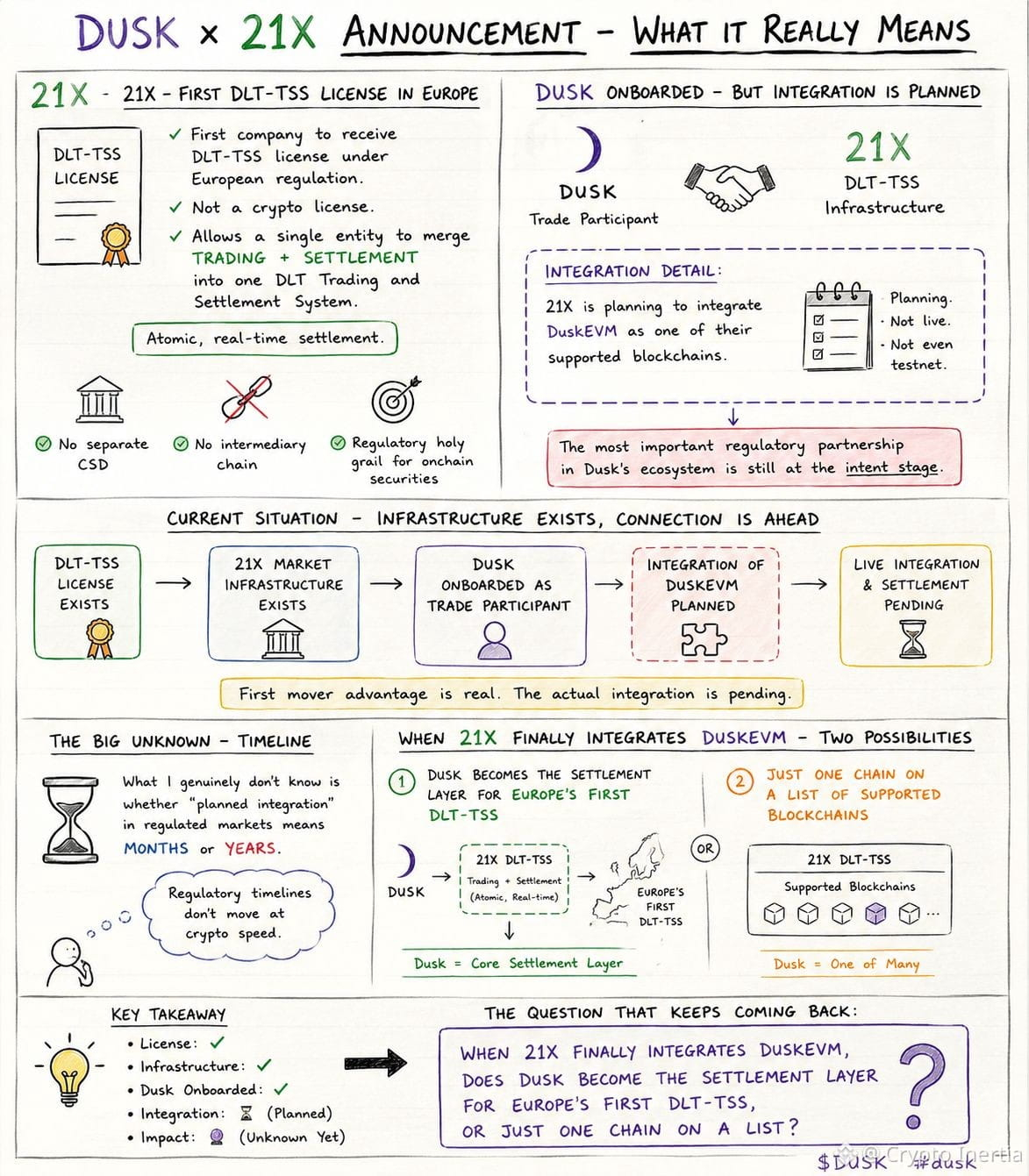
#dusk $DUSK @Dusk_Foundation Tenho estado a acompanhar o anúncio da DUSK e do 21X, e há um detalhe que não me sai da cabeça.
O 21X é a primeira empresa a receber a licença DLT-TSS ao abrigo da regulação europeia$DUSK
{spot}(DUSKUSDT)
. Isso não é uma licença de cripto. Permite que uma única entidade una a negociação e a liquidação — tradicionalmente funções separadas — num único Sistema de Negociação e Liquidação em DLT. Liquidação atómica, em tempo real. Sem uma CSD separada. Sem cadeia intermediária. Este é o santo graal regulatório para títulos onchain.
A Dusk foi incorporada como participante de negociação. Sólida. Mas depois li o detalhe da integração. O 21X “planeja integrar o DuskEVM” como um dos blockchains suportados. Planeado. Não em funcionamento. Nem sequer em testnet. A parceria regulatória mais importante no ecossistema da Dusk ainda está na fase de intenção. Ou a incorporação regulatória está a demorar mais do que o anúncio sugere, ou a integração técnica está à espera de que o DuskEVM amadureça primeiro. Provavelmente ambos.
Depois há o padrão mais amplo. A NPEX confirmou mais de 200M€ em financiamento, mas a DLT-TSS está em curso. A Dusk Trade está a ser construída. A Hedger está em testnet. A lista de parcerias é real, mas a stack de implementação por trás ainda está a ser montada. A narrativa regulatória diz “a primeira bolsa de valores de segurança alimentada por blockchain da Europa”. Os documentos dizem “a construir” e “testnet”.
O que eu verdadeiramente não sei é se “integração planeada” em mercados regulados significa meses ou anos. Os prazos regulatórios não se movem à velocidade do cripto.
A pergunta à qual continuo a voltar — quando o 21X finalmente integrar o DuskEVM, a Dusk passa a ser a camada de liquidação para a primeira DLT-TSS da Europa, ou apenas uma cadeia numa lista?
#dusk $DUSK @Dusk Tenho estado a acompanhar o anúncio da DUSK e do 21X, e há um detalhe que não me sai da cabeça.
O 21X é a primeira empresa a receber a licença DLT-TSS ao abrigo da regulação europeia$DUSK
. Isso não é uma licença de cripto. Permite que uma única entidade una a negociação e a liquidação — tradicionalmente funções separadas — num único Sistema de Negociação e Liquidação em DLT. Liquidação atómica, em tempo real. Sem uma CSD separada. Sem cadeia intermediária. Este é o santo graal regulatório para títulos onchain.
A Dusk foi incorporada como participante de negociação. Sólida. Mas depois li o detalhe da integração. O 21X “planeja integrar o DuskEVM” como um dos blockchains suportados. Planeado. Não em funcionamento. Nem sequer em testnet. A parceria regulatória mais importante no ecossistema da Dusk ainda está na fase de intenção. Ou a incorporação regulatória está a demorar mais do que o anúncio sugere, ou a integração técnica está à espera de que o DuskEVM amadureça primeiro. Provavelmente ambos.
Depois há o padrão mais amplo. A NPEX confirmou mais de 200M€ em financiamento, mas a DLT-TSS está em curso. A Dusk Trade está a ser construída. A Hedger está em testnet. A lista de parcerias é real, mas a stack de implementação por trás ainda está a ser montada. A narrativa regulatória diz “a primeira bolsa de valores de segurança alimentada por blockchain da Europa”. Os documentos dizem “a construir” e “testnet”.
O que eu verdadeiramente não sei é se “integração planeada” em mercados regulados significa meses ou anos. Os prazos regulatórios não se movem à velocidade do cripto.
A pergunta à qual continuo a voltar — quando o 21X finalmente integrar o DuskEVM, a Dusk passa a ser a camada de liquidação para a primeira DLT-TSS da Europa, ou apenas uma cadeia numa lista?
O 21X é a primeira empresa a receber a licença DLT-TSS ao abrigo da regulação europeia$DUSK
. Isso não é uma licença de cripto. Permite que uma única entidade una a negociação e a liquidação — tradicionalmente funções separadas — num único Sistema de Negociação e Liquidação em DLT. Liquidação atómica, em tempo real. Sem uma CSD separada. Sem cadeia intermediária. Este é o santo graal regulatório para títulos onchain.
A Dusk foi incorporada como participante de negociação. Sólida. Mas depois li o detalhe da integração. O 21X “planeja integrar o DuskEVM” como um dos blockchains suportados. Planeado. Não em funcionamento. Nem sequer em testnet. A parceria regulatória mais importante no ecossistema da Dusk ainda está na fase de intenção. Ou a incorporação regulatória está a demorar mais do que o anúncio sugere, ou a integração técnica está à espera de que o DuskEVM amadureça primeiro. Provavelmente ambos.
Depois há o padrão mais amplo. A NPEX confirmou mais de 200M€ em financiamento, mas a DLT-TSS está em curso. A Dusk Trade está a ser construída. A Hedger está em testnet. A lista de parcerias é real, mas a stack de implementação por trás ainda está a ser montada. A narrativa regulatória diz “a primeira bolsa de valores de segurança alimentada por blockchain da Europa”. Os documentos dizem “a construir” e “testnet”.
O que eu verdadeiramente não sei é se “integração planeada” em mercados regulados significa meses ou anos. Os prazos regulatórios não se movem à velocidade do cripto.
A pergunta à qual continuo a voltar — quando o 21X finalmente integrar o DuskEVM, a Dusk passa a ser a camada de liquidação para a primeira DLT-TSS da Europa, ou apenas uma cadeia numa lista?
85
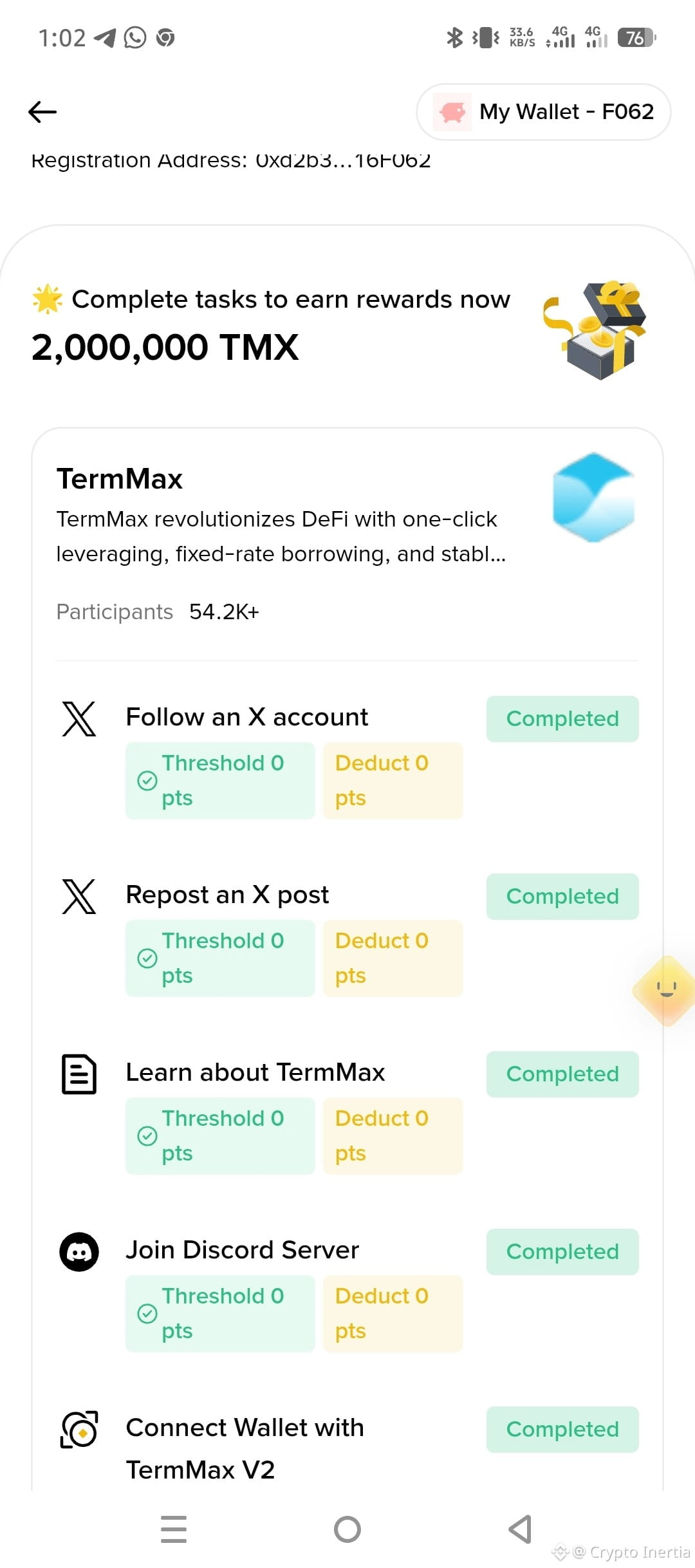
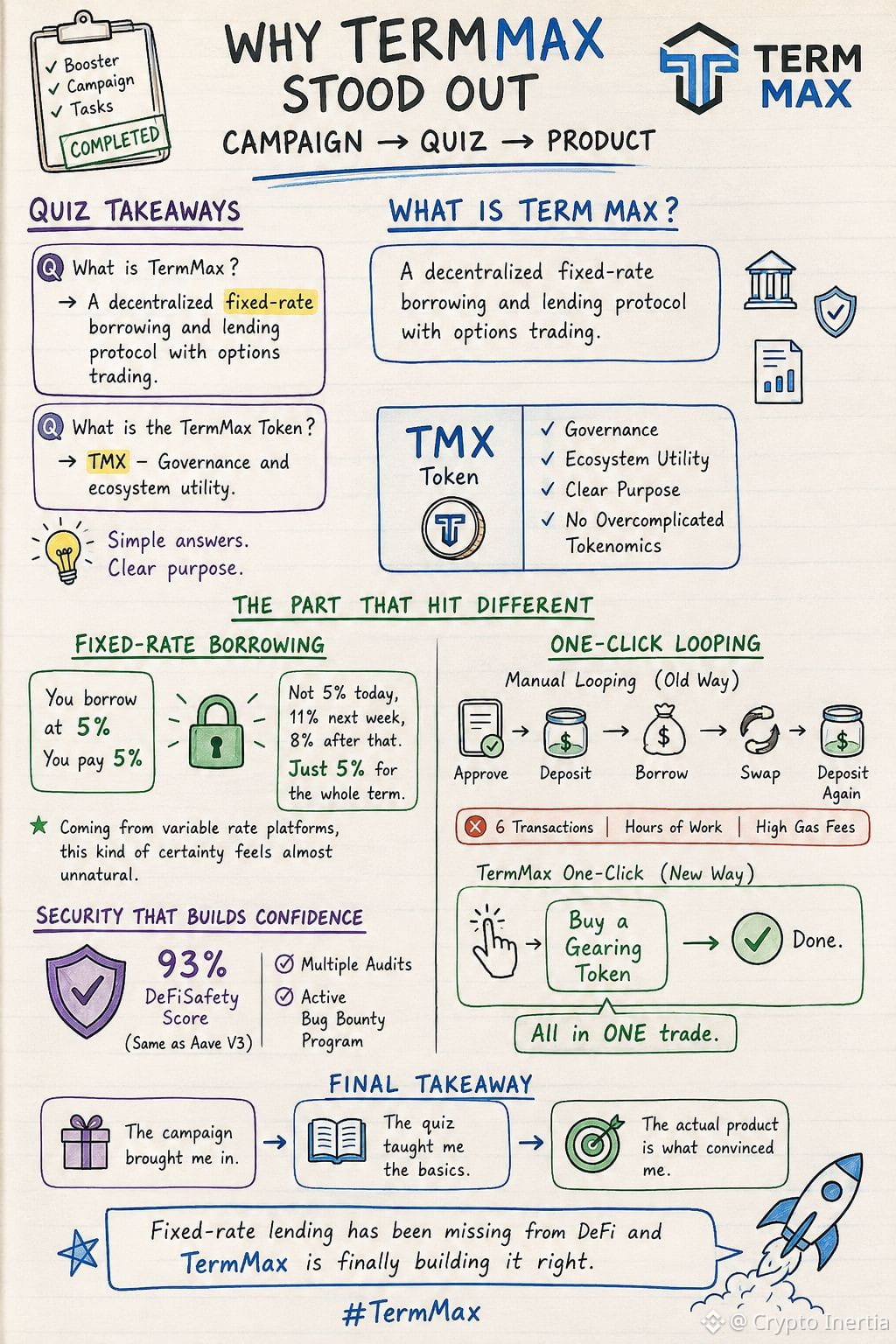
#termmax @termmax Terminei hoje as tarefas da campanha booster do TermMax e algo do quiz realmente ficou comigo.
A seção de aprendizado perguntou o que é o TermMax. A resposta foi simples. Um protocolo descentralizado de empréstimos e concessões com taxa fixa, com opções de negociação. Taxas fixas. Prazos fixos. Não esse caos de taxa variável ao qual todo mundo está acostumado.
Depois perguntou sobre o token. TMX. Governança e utilidade no ecossistema. Tokenomics sem exageros. Só um propósito bem claro.
Foi isso que me fez querer me aprofundar nos documentos do @TermMax.
O empréstimo com taxa fixa é a parte sobre a qual eu continuo pensando. Você pega emprestado a 5%. Você paga 5%. Não 5% hoje, 11% na próxima semana, 8% depois. É só 5% por todo o prazo. Vindo de plataformas em que as taxas oscilam o tempo todo, esse tipo de previsibilidade quase parece algo artificial.
O looping com um clique também é inteligente. Eu lembro de fazer o looping manual levar seis transações e uma tarde inteira. Aprovar, depositar, pedir emprestado, fazer swap, depositar novamente. Taxas de gás em cada etapa. O TermMax coloca tudo isso em um único trade. Compre um Gearing Token e pronto.
Em termos de segurança, eles são sólidos. Nota 93% no DeFiSafety. Mesma do Aave V3. Várias auditorias e um bug bounty ativo.
A campanha me trouxe. O quiz ensinou o básico. O produto de verdade é o que me convenceu. Empréstimo com taxa fixa estava faltando no DeFi e o TermMax finalmente está construindo isso do jeito certo.
#termmax @TermMax Terminei hoje as tarefas da campanha booster do TermMax e algo do quiz realmente ficou comigo.
A seção de aprendizado perguntou o que é o TermMax. A resposta foi simples. Um protocolo descentralizado de empréstimos e concessões com taxa fixa, com opções de negociação. Taxas fixas. Prazos fixos. Não esse caos de taxa variável ao qual todo mundo está acostumado.
Depois perguntou sobre o token. TMX. Governança e utilidade no ecossistema. Tokenomics sem exageros. Só um propósito bem claro.
Foi isso que me fez querer me aprofundar nos documentos do @TermMax.
O empréstimo com taxa fixa é a parte sobre a qual eu continuo pensando. Você pega emprestado a 5%. Você paga 5%. Não 5% hoje, 11% na próxima semana, 8% depois. É só 5% por todo o prazo. Vindo de plataformas em que as taxas oscilam o tempo todo, esse tipo de previsibilidade quase parece algo artificial.
O looping com um clique também é inteligente. Eu lembro de fazer o looping manual levar seis transações e uma tarde inteira. Aprovar, depositar, pedir emprestado, fazer swap, depositar novamente. Taxas de gás em cada etapa. O TermMax coloca tudo isso em um único trade. Compre um Gearing Token e pronto.
Em termos de segurança, eles são sólidos. Nota 93% no DeFiSafety. Mesma do Aave V3. Várias auditorias e um bug bounty ativo.
A campanha me trouxe. O quiz ensinou o básico. O produto de verdade é o que me convenceu. Empréstimo com taxa fixa estava faltando no DeFi e o TermMax finalmente está construindo isso do jeito certo.
A seção de aprendizado perguntou o que é o TermMax. A resposta foi simples. Um protocolo descentralizado de empréstimos e concessões com taxa fixa, com opções de negociação. Taxas fixas. Prazos fixos. Não esse caos de taxa variável ao qual todo mundo está acostumado.
Depois perguntou sobre o token. TMX. Governança e utilidade no ecossistema. Tokenomics sem exageros. Só um propósito bem claro.
Foi isso que me fez querer me aprofundar nos documentos do @TermMax.
O empréstimo com taxa fixa é a parte sobre a qual eu continuo pensando. Você pega emprestado a 5%. Você paga 5%. Não 5% hoje, 11% na próxima semana, 8% depois. É só 5% por todo o prazo. Vindo de plataformas em que as taxas oscilam o tempo todo, esse tipo de previsibilidade quase parece algo artificial.
O looping com um clique também é inteligente. Eu lembro de fazer o looping manual levar seis transações e uma tarde inteira. Aprovar, depositar, pedir emprestado, fazer swap, depositar novamente. Taxas de gás em cada etapa. O TermMax coloca tudo isso em um único trade. Compre um Gearing Token e pronto.
Em termos de segurança, eles são sólidos. Nota 93% no DeFiSafety. Mesma do Aave V3. Várias auditorias e um bug bounty ativo.
A campanha me trouxe. O quiz ensinou o básico. O produto de verdade é o que me convenceu. Empréstimo com taxa fixa estava faltando no DeFi e o TermMax finalmente está construindo isso do jeito certo.
2
88
#dusk $DUSK @Dusk_Foundation
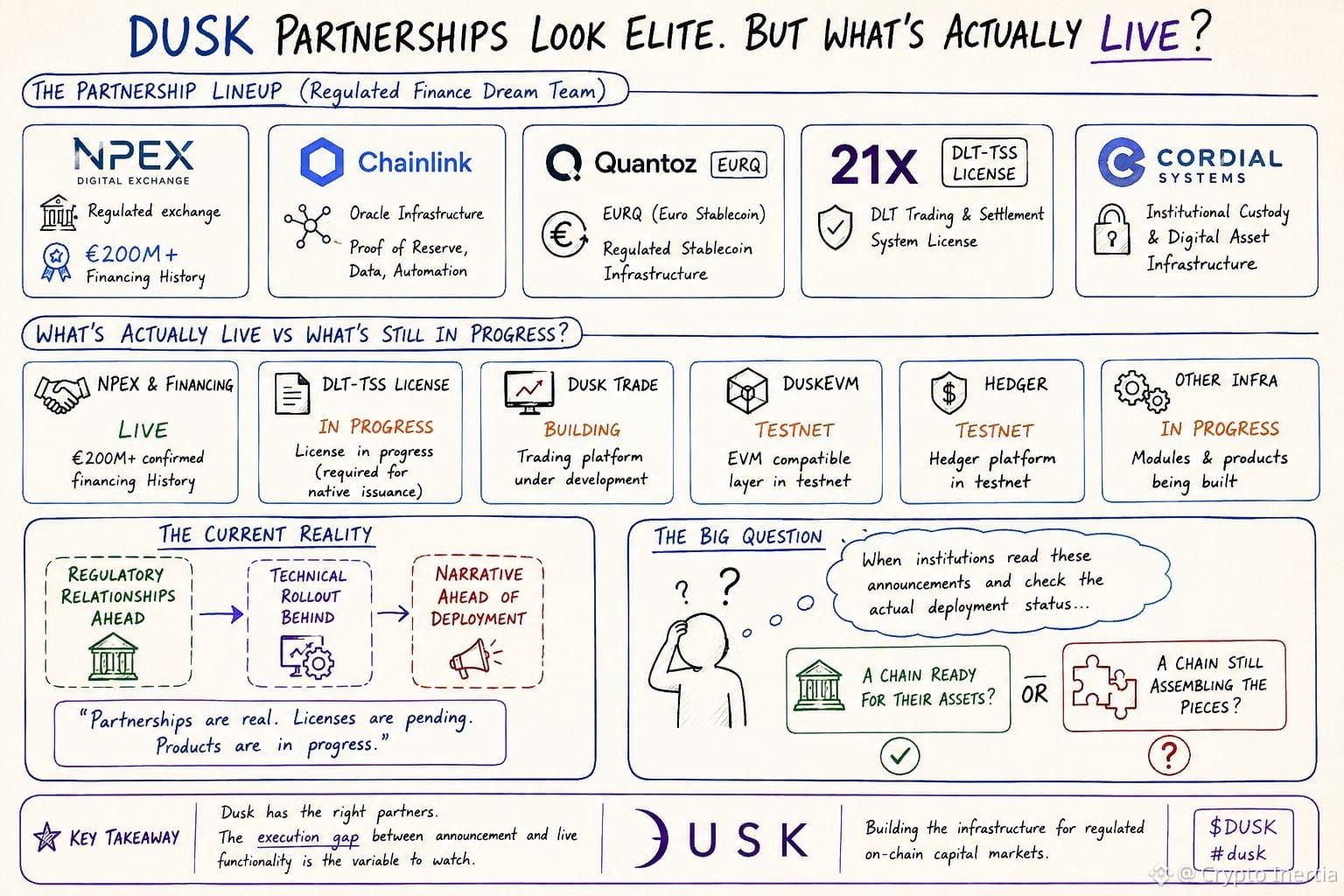
Tenho estado a analisar os anúncios de parceria da DUSK e uma coisa não me sai da cabeça.
A Dusk tem NPEX. Chainlink. Quantoz com EURQ. 21X com a licença DLT-TSS. Cordial Systems para custódia. A lista de parcerias parece um “dream team” de finanças reguladas. Cada uma traz licenças, infraestrutura ou alcance institucional. Sólido.
Mas depois verifiquei o que está realmente em funcionamento versus o que foi anunciado. A NPEX confirmou mais de 200 M€ em histórico de financiamento, mas a licença DLT-TSS necessária para emissão nativa ainda está em andamento. O Dusk Trade ainda está em construção. O DuskEVM é testnet. O Hedger é testnet. Os anúncios de parceria são reais. O status de produção dos produtos de que essas parcerias dependem é outra história.
Então fica-se com uma situação em que as relações regulatórias estão adiantadas em relação ao lançamento técnico. As instituições são nomeadas. As licenças estão pendentes. Os produtos estão em progresso. A narrativa diz “o primeiro security exchange da Europa impulsionado por blockchain”. Os documentos dizem “building” e “testnet”.
O que eu sinceramente não sei é se isto é uma sequência normal para infraestrutura regulada — parcerias primeiro, produtos depois — ou se a diferença entre o anúncio e a funcionalidade em direto é maior do que as manchetes sugerem.
A pergunta que continuo a ter — quando as instituições leem estes anúncios e depois verificam o status real da implementação, elas veem uma cadeia pronta para os seus ativos ou uma cadeia ainda a reunir as peças?
#dusk $DUSK @Dusk
Tenho estado a analisar os anúncios de parceria da DUSK e uma coisa não me sai da cabeça.
A Dusk tem NPEX. Chainlink. Quantoz com EURQ. 21X com a licença DLT-TSS. Cordial Systems para custódia. A lista de parcerias parece um “dream team” de finanças reguladas. Cada uma traz licenças, infraestrutura ou alcance institucional. Sólido.
Mas depois verifiquei o que está realmente em funcionamento versus o que foi anunciado. A NPEX confirmou mais de 200 M€ em histórico de financiamento, mas a licença DLT-TSS necessária para emissão nativa ainda está em andamento. O Dusk Trade ainda está em construção. O DuskEVM é testnet. O Hedger é testnet. Os anúncios de parceria são reais. O status de produção dos produtos de que essas parcerias dependem é outra história.
Então fica-se com uma situação em que as relações regulatórias estão adiantadas em relação ao lançamento técnico. As instituições são nomeadas. As licenças estão pendentes. Os produtos estão em progresso. A narrativa diz “o primeiro security exchange da Europa impulsionado por blockchain”. Os documentos dizem “building” e “testnet”.
O que eu sinceramente não sei é se isto é uma sequência normal para infraestrutura regulada — parcerias primeiro, produtos depois — ou se a diferença entre o anúncio e a funcionalidade em direto é maior do que as manchetes sugerem.
A pergunta que continuo a ter — quando as instituições leem estes anúncios e depois verificam o status real da implementação, elas veem uma cadeia pronta para os seus ativos ou uma cadeia ainda a reunir as peças?
Tenho estado a analisar os anúncios de parceria da DUSK e uma coisa não me sai da cabeça.
A Dusk tem NPEX. Chainlink. Quantoz com EURQ. 21X com a licença DLT-TSS. Cordial Systems para custódia. A lista de parcerias parece um “dream team” de finanças reguladas. Cada uma traz licenças, infraestrutura ou alcance institucional. Sólido.
Mas depois verifiquei o que está realmente em funcionamento versus o que foi anunciado. A NPEX confirmou mais de 200 M€ em histórico de financiamento, mas a licença DLT-TSS necessária para emissão nativa ainda está em andamento. O Dusk Trade ainda está em construção. O DuskEVM é testnet. O Hedger é testnet. Os anúncios de parceria são reais. O status de produção dos produtos de que essas parcerias dependem é outra história.
Então fica-se com uma situação em que as relações regulatórias estão adiantadas em relação ao lançamento técnico. As instituições são nomeadas. As licenças estão pendentes. Os produtos estão em progresso. A narrativa diz “o primeiro security exchange da Europa impulsionado por blockchain”. Os documentos dizem “building” e “testnet”.
O que eu sinceramente não sei é se isto é uma sequência normal para infraestrutura regulada — parcerias primeiro, produtos depois — ou se a diferença entre o anúncio e a funcionalidade em direto é maior do que as manchetes sugerem.
A pergunta que continuo a ter — quando as instituições leem estes anúncios e depois verificam o status real da implementação, elas veem uma cadeia pronta para os seus ativos ou uma cadeia ainda a reunir as peças?
1
1
80
#termmax @termmax
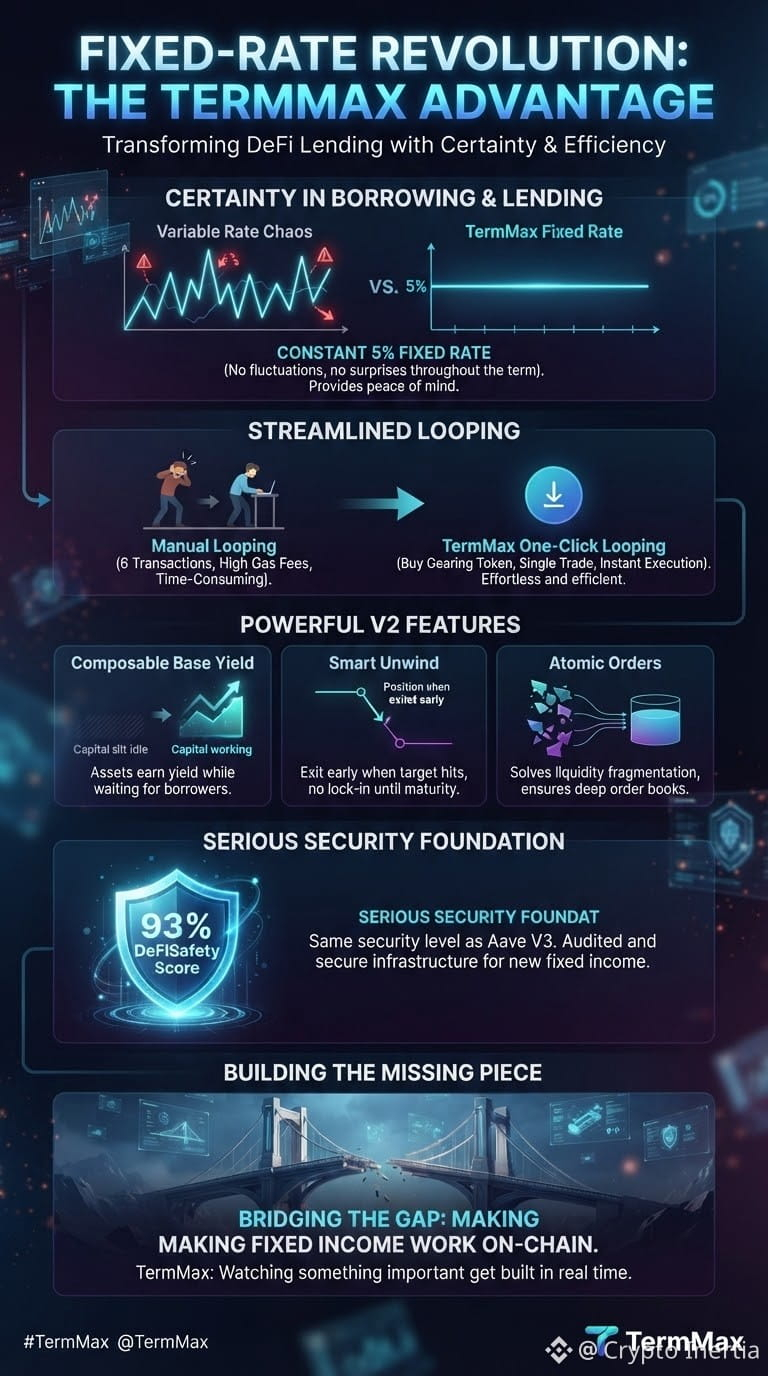
Tenho usado plataformas de empréstimo DeFi há dois anos e a TermMax é a primeira que realmente me surpreendeu.
A questão da taxa fixa parece simples até você vivenciar. Você toma emprestado a 5%. Você paga 5%. Não 5% hoje, 8% amanhã, 12% na próxima semana quando a utilização dispara. Apenas 5%. Pelo prazo inteiro. Esse tipo de previsibilidade não existe em nenhum outro lugar do DeFi agora.
E existe o looping com um clique. Eu lembro de passar uma tarde inteira fazendo looping manual em outra plataforma. Seis transações. Taxas de gás corroendo minha posição. Ficando o tempo todo verificando se eu fiz certo. A TermMax faz tudo isso em um único trade. Você compra o Gearing Token e pronto. Quase fácil demais.
As funções da V2 é que realmente chamaram minha atenção. A Composable Base Yield faz com que seus ativos rendam enquanto esperam por tomadores de empréstimo. Sem capital ocioso. Smart Unwind permite que você saia antes quando sua meta for atingida, em vez de ficar preso até o vencimento. Atomic Orders resolve a fragmentação de liquidez que derrubou as plataformas de taxa fixa anteriores. Não são melhorias pequenas. Elas estão resolvendo exatamente os problemas que fizeram o DeFi de taxa fixa fracassar antes.
E a segurança é genuinamente séria. Nota de 93% na DeFiSafety. Igual à do Aave V3. Isso é raro para um protocolo tão jovem.
Empréstimos com taxa fixa foi a peça que faltava no DeFi. Taxas variáveis são imprevisíveis. A TermMax está construindo a infraestrutura que realmente faz renda fixa funcionar on-chain.
Isso parece assistir algo importante sendo construído em tempo real.
$BOME
{spot}(BOMEUSDT)
$BIO
{spot}(BIOUSDT)
$RE
{spot}(REUSDT)
#termmax @TermMax
Tenho usado plataformas de empréstimo DeFi há dois anos e a TermMax é a primeira que realmente me surpreendeu.
A questão da taxa fixa parece simples até você vivenciar. Você toma emprestado a 5%. Você paga 5%. Não 5% hoje, 8% amanhã, 12% na próxima semana quando a utilização dispara. Apenas 5%. Pelo prazo inteiro. Esse tipo de previsibilidade não existe em nenhum outro lugar do DeFi agora.
E existe o looping com um clique. Eu lembro de passar uma tarde inteira fazendo looping manual em outra plataforma. Seis transações. Taxas de gás corroendo minha posição. Ficando o tempo todo verificando se eu fiz certo. A TermMax faz tudo isso em um único trade. Você compra o Gearing Token e pronto. Quase fácil demais.
As funções da V2 é que realmente chamaram minha atenção. A Composable Base Yield faz com que seus ativos rendam enquanto esperam por tomadores de empréstimo. Sem capital ocioso. Smart Unwind permite que você saia antes quando sua meta for atingida, em vez de ficar preso até o vencimento. Atomic Orders resolve a fragmentação de liquidez que derrubou as plataformas de taxa fixa anteriores. Não são melhorias pequenas. Elas estão resolvendo exatamente os problemas que fizeram o DeFi de taxa fixa fracassar antes.
E a segurança é genuinamente séria. Nota de 93% na DeFiSafety. Igual à do Aave V3. Isso é raro para um protocolo tão jovem.
Empréstimos com taxa fixa foi a peça que faltava no DeFi. Taxas variáveis são imprevisíveis. A TermMax está construindo a infraestrutura que realmente faz renda fixa funcionar on-chain.
Isso parece assistir algo importante sendo construído em tempo real.
$BOME
$BIO
$RE
Tenho usado plataformas de empréstimo DeFi há dois anos e a TermMax é a primeira que realmente me surpreendeu.
A questão da taxa fixa parece simples até você vivenciar. Você toma emprestado a 5%. Você paga 5%. Não 5% hoje, 8% amanhã, 12% na próxima semana quando a utilização dispara. Apenas 5%. Pelo prazo inteiro. Esse tipo de previsibilidade não existe em nenhum outro lugar do DeFi agora.
E existe o looping com um clique. Eu lembro de passar uma tarde inteira fazendo looping manual em outra plataforma. Seis transações. Taxas de gás corroendo minha posição. Ficando o tempo todo verificando se eu fiz certo. A TermMax faz tudo isso em um único trade. Você compra o Gearing Token e pronto. Quase fácil demais.
As funções da V2 é que realmente chamaram minha atenção. A Composable Base Yield faz com que seus ativos rendam enquanto esperam por tomadores de empréstimo. Sem capital ocioso. Smart Unwind permite que você saia antes quando sua meta for atingida, em vez de ficar preso até o vencimento. Atomic Orders resolve a fragmentação de liquidez que derrubou as plataformas de taxa fixa anteriores. Não são melhorias pequenas. Elas estão resolvendo exatamente os problemas que fizeram o DeFi de taxa fixa fracassar antes.
E a segurança é genuinamente séria. Nota de 93% na DeFiSafety. Igual à do Aave V3. Isso é raro para um protocolo tão jovem.
Empréstimos com taxa fixa foi a peça que faltava no DeFi. Taxas variáveis são imprevisíveis. A TermMax está construindo a infraestrutura que realmente faz renda fixa funcionar on-chain.
Isso parece assistir algo importante sendo construído em tempo real.
$BOME
$BIO
$RE
197
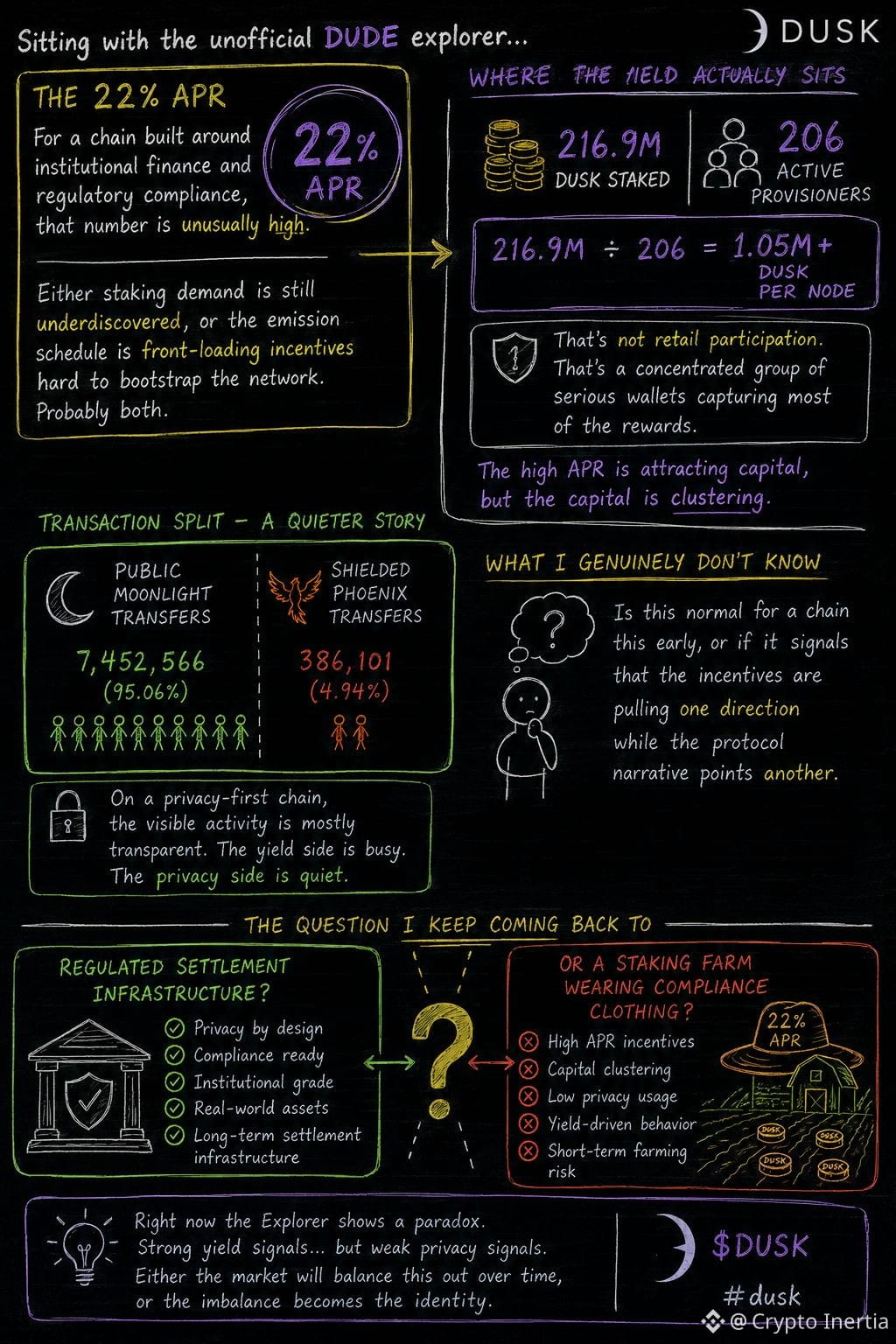
#dusk $DUSK @Dusk_Foundation Tenho ficado sentado com o explorador DUDE não-oficial novamente e uma coisa não para de ficar comigo.
O APR de 22%. Para uma cadeia construída em torno de finanças institucionais e conformidade regulatória, esse número é incomumente alto. Ou a demanda por staking ainda está subdescoberta, ou o cronograma de emissões está antecipando incentivos com força para fazer a rede decolar. Provavelmente ambos.
Então eu olhei para onde esse rendimento realmente se encontra. 216,9M @Dusk em staking. 206 provisioners ativos. A conta dá uma média de mais de um milhão de DUSK por nó. Isso não é participação de varejo. É um grupo concentrado de carteiras sérias capturando a maior parte dos recompenses. O APR alto está atraindo capital, mas o capital está se aglomerando.
Enquanto isso, a divisão das transações conta uma história mais silenciosa. Transfers de Moonlight público acontecendo muito à frente das transações Phoenix com shielded. Numa cadeia com foco em privacidade, a atividade visível é, em grande parte, transparente. O lado do rendimento está ocupado. O lado da privacidade está quieto.
O que eu genuinamente não sei é se isso é normal para uma cadeia tão no início, ou se sinaliza que os incentivos estão puxando em uma direção enquanto a narrativa do protocolo aponta para outra.
A pergunta que não sai da minha cabeça — quando instituições olham este explorador, elas veem uma infraestrutura de liquidação regulamentada, ou uma fazenda de staking usando roupas de conformidade? $DUSK #dusk
#dusk $DUSK @Dusk Tenho ficado sentado com o explorador DUDE não-oficial novamente e uma coisa não para de ficar comigo.
O APR de 22%. Para uma cadeia construída em torno de finanças institucionais e conformidade regulatória, esse número é incomumente alto. Ou a demanda por staking ainda está subdescoberta, ou o cronograma de emissões está antecipando incentivos com força para fazer a rede decolar. Provavelmente ambos.
Então eu olhei para onde esse rendimento realmente se encontra. 216,9M @Dusk em staking. 206 provisioners ativos. A conta dá uma média de mais de um milhão de DUSK por nó. Isso não é participação de varejo. É um grupo concentrado de carteiras sérias capturando a maior parte dos recompenses. O APR alto está atraindo capital, mas o capital está se aglomerando.
Enquanto isso, a divisão das transações conta uma história mais silenciosa. Transfers de Moonlight público acontecendo muito à frente das transações Phoenix com shielded. Numa cadeia com foco em privacidade, a atividade visível é, em grande parte, transparente. O lado do rendimento está ocupado. O lado da privacidade está quieto.
O que eu genuinamente não sei é se isso é normal para uma cadeia tão no início, ou se sinaliza que os incentivos estão puxando em uma direção enquanto a narrativa do protocolo aponta para outra.
A pergunta que não sai da minha cabeça — quando instituições olham este explorador, elas veem uma infraestrutura de liquidação regulamentada, ou uma fazenda de staking usando roupas de conformidade? $DUSK #dusk
O APR de 22%. Para uma cadeia construída em torno de finanças institucionais e conformidade regulatória, esse número é incomumente alto. Ou a demanda por staking ainda está subdescoberta, ou o cronograma de emissões está antecipando incentivos com força para fazer a rede decolar. Provavelmente ambos.
Então eu olhei para onde esse rendimento realmente se encontra. 216,9M @Dusk em staking. 206 provisioners ativos. A conta dá uma média de mais de um milhão de DUSK por nó. Isso não é participação de varejo. É um grupo concentrado de carteiras sérias capturando a maior parte dos recompenses. O APR alto está atraindo capital, mas o capital está se aglomerando.
Enquanto isso, a divisão das transações conta uma história mais silenciosa. Transfers de Moonlight público acontecendo muito à frente das transações Phoenix com shielded. Numa cadeia com foco em privacidade, a atividade visível é, em grande parte, transparente. O lado do rendimento está ocupado. O lado da privacidade está quieto.
O que eu genuinamente não sei é se isso é normal para uma cadeia tão no início, ou se sinaliza que os incentivos estão puxando em uma direção enquanto a narrativa do protocolo aponta para outra.
A pergunta que não sai da minha cabeça — quando instituições olham este explorador, elas veem uma infraestrutura de liquidação regulamentada, ou uma fazenda de staking usando roupas de conformidade? $DUSK #dusk
2
75
#termmax @termmax
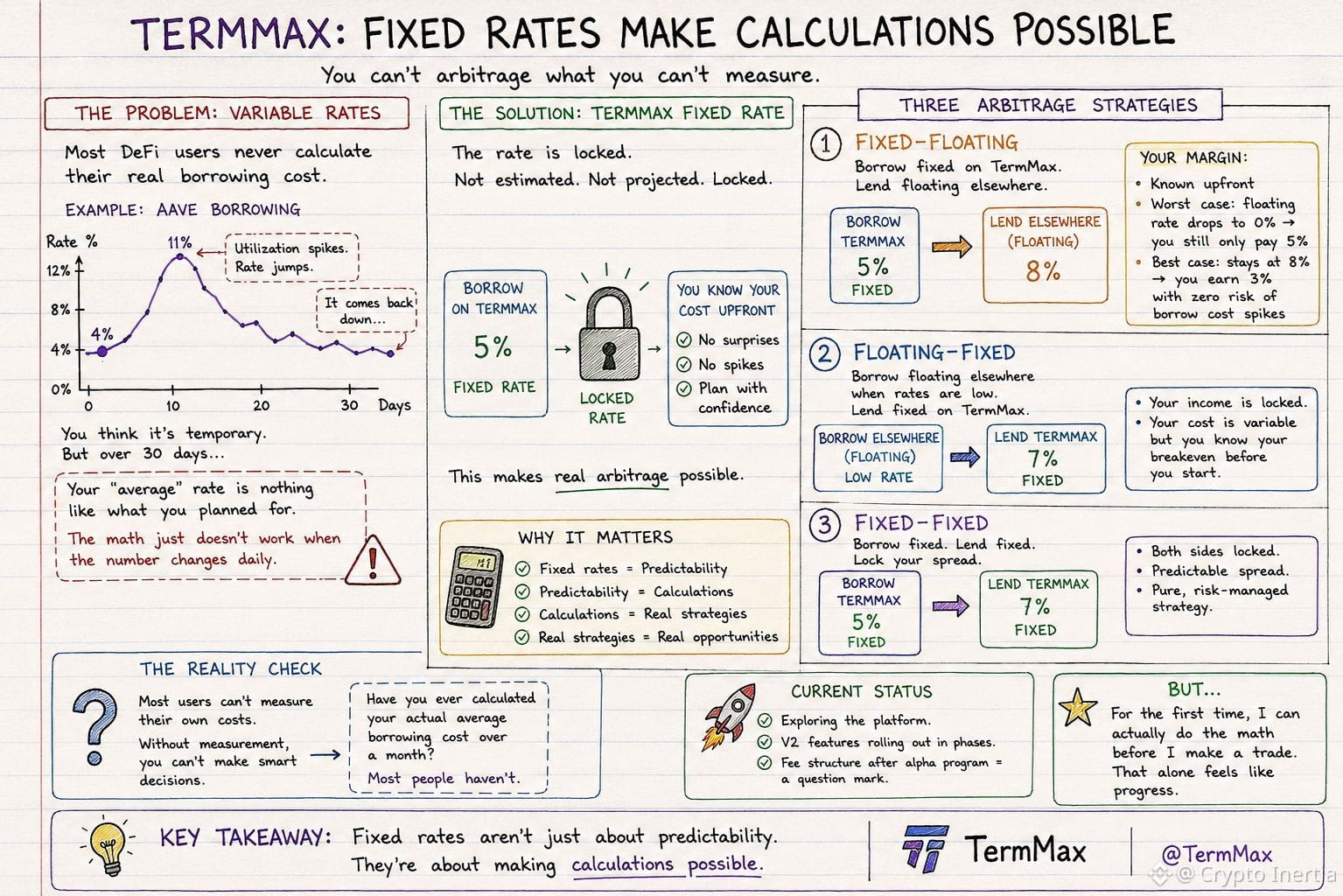
A maioria dos usuários de DeFi nunca calculou de verdade o custo real de seu empréstimo. Eu sei porque eu não fiz por meses.Você pega emprestado no Aave a 4%. Parece ótimo. Então a utilização dispara e, de repente, fica em 11%. Você diz a si mesmo que é temporário. Volta a cair. Mas quando você acompanha de verdade ao longo de 30 dias, a sua "taxa" "média" não tem nada a ver com o que você planejou. A matemática simplesmente não funciona quando o número muda diariamente.
O termMax resolve isso de um jeito que soa entediante até você pensar a respeito. A taxa fica travada. Não é estimada. Não é projetada. Fica travada.
Isso significa que, finalmente, você pode fazer arbitragem de taxa corretamente. Pegue emprestado com taxa fixa no TermMax a 5%. Faça empréstimo com taxa flutuante em outro lugar a 8%. Sua margem é conhecida com antecedência. No pior caso, a taxa flutuante cai para zero e você ainda perde apenas 5%. No melhor caso, ela permanece em 8% e você embolsa 3% com zero risco de o custo do seu empréstimo disparar.Ou faça ao contrário. Faça empréstimo flutuante em outro lugar quando as taxas estiverem baixas. Faça empréstimo fixo no TermMax a 7%. Sua receita fica travada. O seu custo é variável, mas você conhece o seu ponto de equilíbrio antes mesmo de começar.A documentação realmente deixa isso claro. Três estratégias. Fixo-flutuante. Flutuante-fixo. Fixo-fixo. Parece o plano de um trader de títulos, não um whitepaper de DeFi. E é exatamente isso que torna interessante.
Taxas fixas não são apenas sobre previsibilidade. São sobre tornar os cálculos possíveis. Você não consegue arbitrar o que não consegue medir. E, no DeFi, agora, a maioria dos usuários não consegue medir os próprios custos.Eu ainda estou explorando a plataforma. Nem tudo está claro ainda. Os recursos da V2 estão sendo lançados em fases e a estrutura de taxas após o programa alfa é uma incógnita. Mas, pela primeira vez, eu consigo fazer a conta antes de fazer uma operação. Só isso já parece progresso.
E você? Você já calculou o seu custo médio real de empréstimo ao longo de um mês? A maioria das pessoas não. E talvez esse seja realmente o problema que o TermMax está resolvendo.
#termmax @TermMax
A maioria dos usuários de DeFi nunca calculou de verdade o custo real de seu empréstimo. Eu sei porque eu não fiz por meses.Você pega emprestado no Aave a 4%. Parece ótimo. Então a utilização dispara e, de repente, fica em 11%. Você diz a si mesmo que é temporário. Volta a cair. Mas quando você acompanha de verdade ao longo de 30 dias, a sua "taxa" "média" não tem nada a ver com o que você planejou. A matemática simplesmente não funciona quando o número muda diariamente.
O termMax resolve isso de um jeito que soa entediante até você pensar a respeito. A taxa fica travada. Não é estimada. Não é projetada. Fica travada.
Isso significa que, finalmente, você pode fazer arbitragem de taxa corretamente. Pegue emprestado com taxa fixa no TermMax a 5%. Faça empréstimo com taxa flutuante em outro lugar a 8%. Sua margem é conhecida com antecedência. No pior caso, a taxa flutuante cai para zero e você ainda perde apenas 5%. No melhor caso, ela permanece em 8% e você embolsa 3% com zero risco de o custo do seu empréstimo disparar.Ou faça ao contrário. Faça empréstimo flutuante em outro lugar quando as taxas estiverem baixas. Faça empréstimo fixo no TermMax a 7%. Sua receita fica travada. O seu custo é variável, mas você conhece o seu ponto de equilíbrio antes mesmo de começar.A documentação realmente deixa isso claro. Três estratégias. Fixo-flutuante. Flutuante-fixo. Fixo-fixo. Parece o plano de um trader de títulos, não um whitepaper de DeFi. E é exatamente isso que torna interessante.
Taxas fixas não são apenas sobre previsibilidade. São sobre tornar os cálculos possíveis. Você não consegue arbitrar o que não consegue medir. E, no DeFi, agora, a maioria dos usuários não consegue medir os próprios custos.Eu ainda estou explorando a plataforma. Nem tudo está claro ainda. Os recursos da V2 estão sendo lançados em fases e a estrutura de taxas após o programa alfa é uma incógnita. Mas, pela primeira vez, eu consigo fazer a conta antes de fazer uma operação. Só isso já parece progresso.
E você? Você já calculou o seu custo médio real de empréstimo ao longo de um mês? A maioria das pessoas não. E talvez esse seja realmente o problema que o TermMax está resolvendo.
A maioria dos usuários de DeFi nunca calculou de verdade o custo real de seu empréstimo. Eu sei porque eu não fiz por meses.Você pega emprestado no Aave a 4%. Parece ótimo. Então a utilização dispara e, de repente, fica em 11%. Você diz a si mesmo que é temporário. Volta a cair. Mas quando você acompanha de verdade ao longo de 30 dias, a sua "taxa" "média" não tem nada a ver com o que você planejou. A matemática simplesmente não funciona quando o número muda diariamente.
O termMax resolve isso de um jeito que soa entediante até você pensar a respeito. A taxa fica travada. Não é estimada. Não é projetada. Fica travada.
Isso significa que, finalmente, você pode fazer arbitragem de taxa corretamente. Pegue emprestado com taxa fixa no TermMax a 5%. Faça empréstimo com taxa flutuante em outro lugar a 8%. Sua margem é conhecida com antecedência. No pior caso, a taxa flutuante cai para zero e você ainda perde apenas 5%. No melhor caso, ela permanece em 8% e você embolsa 3% com zero risco de o custo do seu empréstimo disparar.Ou faça ao contrário. Faça empréstimo flutuante em outro lugar quando as taxas estiverem baixas. Faça empréstimo fixo no TermMax a 7%. Sua receita fica travada. O seu custo é variável, mas você conhece o seu ponto de equilíbrio antes mesmo de começar.A documentação realmente deixa isso claro. Três estratégias. Fixo-flutuante. Flutuante-fixo. Fixo-fixo. Parece o plano de um trader de títulos, não um whitepaper de DeFi. E é exatamente isso que torna interessante.
Taxas fixas não são apenas sobre previsibilidade. São sobre tornar os cálculos possíveis. Você não consegue arbitrar o que não consegue medir. E, no DeFi, agora, a maioria dos usuários não consegue medir os próprios custos.Eu ainda estou explorando a plataforma. Nem tudo está claro ainda. Os recursos da V2 estão sendo lançados em fases e a estrutura de taxas após o programa alfa é uma incógnita. Mas, pela primeira vez, eu consigo fazer a conta antes de fazer uma operação. Só isso já parece progresso.
E você? Você já calculou o seu custo médio real de empréstimo ao longo de um mês? A maioria das pessoas não. E talvez esse seja realmente o problema que o TermMax está resolvendo.
1
2
94
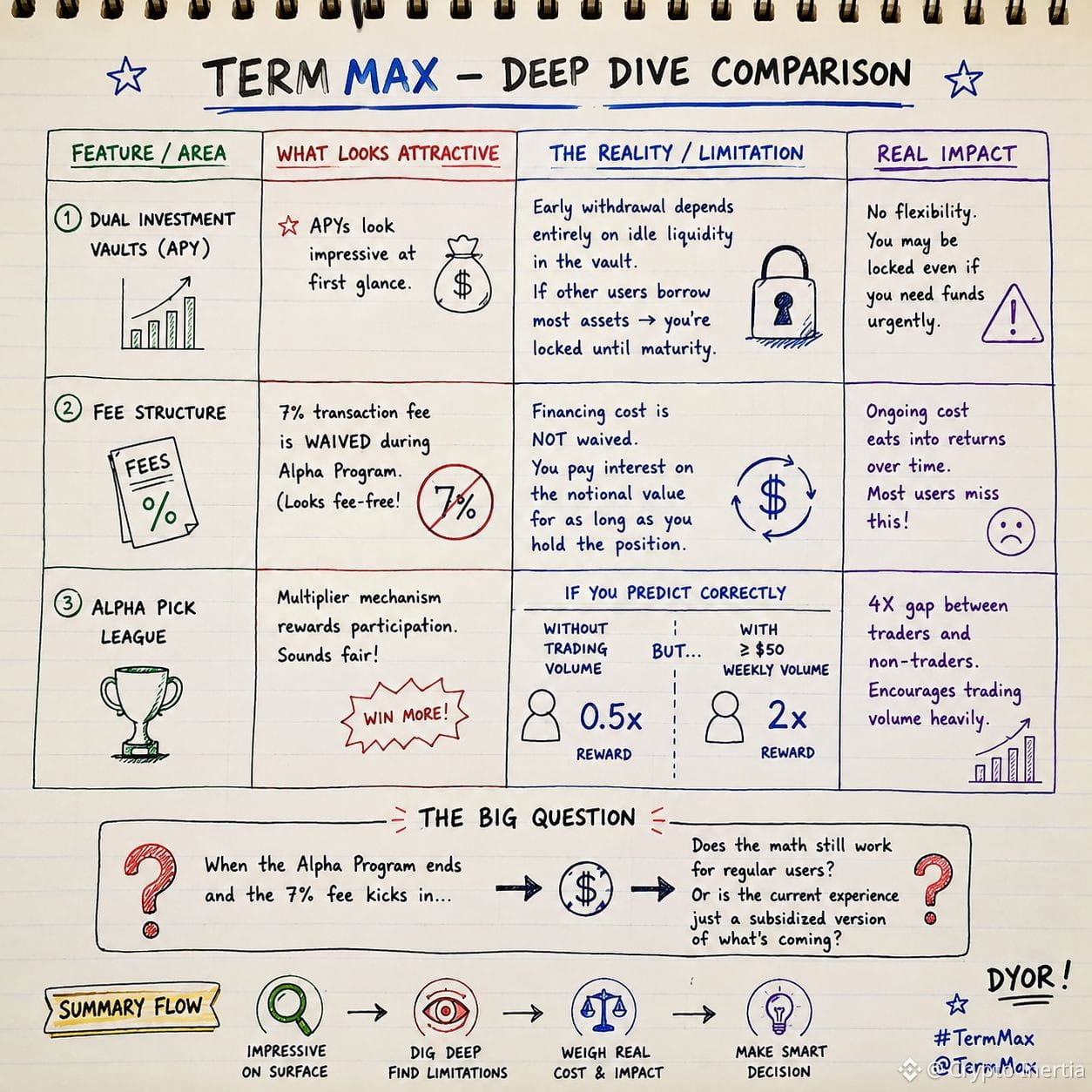
#termmax @termmax Tenho mexido no TermMax e uma coisa não sai da minha cabeça.As carteiras de Dual Investment estão oferecendo APYs que parecem impressionantes à primeira vista. Mas quando você realmente analisa a mecânica de saque, a flexibilidade simplesmente não existe. O saque antecipado depende inteiramente de quanta liquidez ociosa está parada na carteira. Se outros usuários tiverem tomado a maior parte dos ativos, você fica bloqueado até o vencimento. Não tem como contornar isso.
Depois eu olhei para a estrutura de taxas. A taxa de transação de 7% está isenta atualmente durante o programa de alpha. Mas o custo de financiamento não é isento. Você paga juros sobre o valor nocional enquanto mantiver a posição. A documentação é transparente quanto a isso. Mas a maioria das pessoas vê "programa de alpha sem taxas" e ignora o custo contínuo.A Alpha Pick League é engenhosa, porém. O mecanismo de multiplicador basicamente te pune por não negociar. Se você acerta sem volume de negociações, recebe um prêmio de 0,5x. Bate US$ 50 de volume semanal e de repente vira 2x. Essa diferença de quatro vezes entre traders e não traders não é sutil.O que eu continuo pensando é: quando o programa de alpha termina e a taxa de 7% entra em vigor, a conta ainda funciona para usuários comuns? Ou a experiência atual é apenas uma versão subsidiada do que está por vir?
#termmax @TermMax Tenho mexido no TermMax e uma coisa não sai da minha cabeça.As carteiras de Dual Investment estão oferecendo APYs que parecem impressionantes à primeira vista. Mas quando você realmente analisa a mecânica de saque, a flexibilidade simplesmente não existe. O saque antecipado depende inteiramente de quanta liquidez ociosa está parada na carteira. Se outros usuários tiverem tomado a maior parte dos ativos, você fica bloqueado até o vencimento. Não tem como contornar isso.
Depois eu olhei para a estrutura de taxas. A taxa de transação de 7% está isenta atualmente durante o programa de alpha. Mas o custo de financiamento não é isento. Você paga juros sobre o valor nocional enquanto mantiver a posição. A documentação é transparente quanto a isso. Mas a maioria das pessoas vê "programa de alpha sem taxas" e ignora o custo contínuo.A Alpha Pick League é engenhosa, porém. O mecanismo de multiplicador basicamente te pune por não negociar. Se você acerta sem volume de negociações, recebe um prêmio de 0,5x. Bate US$ 50 de volume semanal e de repente vira 2x. Essa diferença de quatro vezes entre traders e não traders não é sutil.O que eu continuo pensando é: quando o programa de alpha termina e a taxa de 7% entra em vigor, a conta ainda funciona para usuários comuns? Ou a experiência atual é apenas uma versão subsidiada do que está por vir?
Depois eu olhei para a estrutura de taxas. A taxa de transação de 7% está isenta atualmente durante o programa de alpha. Mas o custo de financiamento não é isento. Você paga juros sobre o valor nocional enquanto mantiver a posição. A documentação é transparente quanto a isso. Mas a maioria das pessoas vê "programa de alpha sem taxas" e ignora o custo contínuo.A Alpha Pick League é engenhosa, porém. O mecanismo de multiplicador basicamente te pune por não negociar. Se você acerta sem volume de negociações, recebe um prêmio de 0,5x. Bate US$ 50 de volume semanal e de repente vira 2x. Essa diferença de quatro vezes entre traders e não traders não é sutil.O que eu continuo pensando é: quando o programa de alpha termina e a taxa de 7% entra em vigor, a conta ainda funciona para usuários comuns? Ou a experiência atual é apenas uma versão subsidiada do que está por vir?
4
1
84
·
--
Em Baixa
#dusk @Dusk_Foundation
Tenho ficado sentado com os anúncios oficiais do DUSK e uma comparação continua me incomodando.
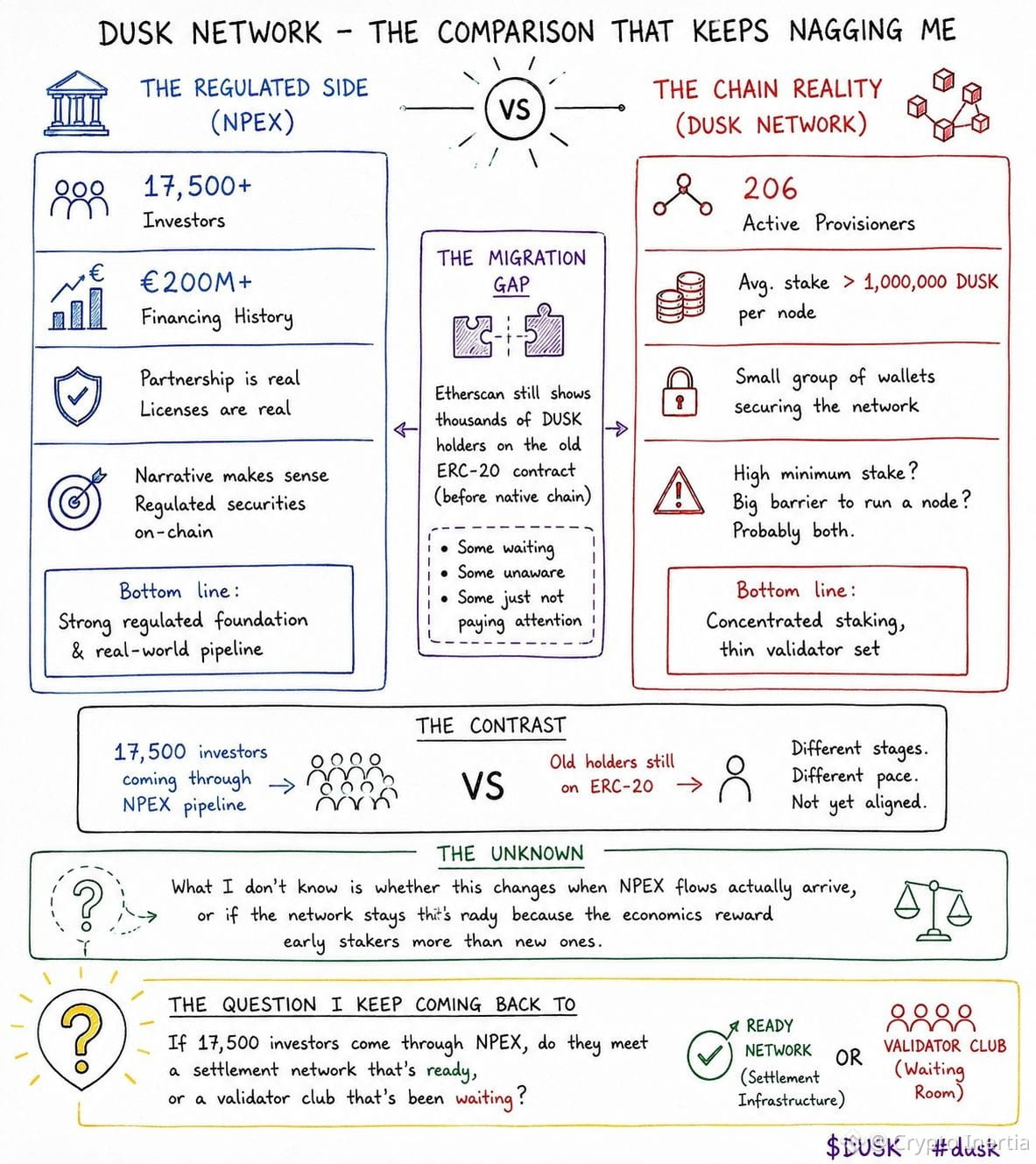
A NPEX traz 17.500+ investidores e €200M+ de histórico em financiamentos. Esse é o lado regulado. Números sólidos. A parceria é real, as licenças são reais, a narrativa faz sentido.Mas então você olha para a própria cadeia. 206 provisioners ativos garantindo a rede. Aposta média acima de um milhão de DUSK por nó. Para uma cadeia que quer liquidar títulos regulados para milhares de investidores, a infraestrutura que faz o trabalho real de consenso fica nas mãos de um pequeno grupo de carteiras. Ou o stake mínimo está filtrando demais, ou operar um nó é um obstáculo maior do que os documentos admitem. Provavelmente ambos.
Depois há a lacuna na migração. O Etherscan ainda mostra milhares de detentores de DUSK no contrato ERC-20 antigo, de antes da cadeia nativa. Alguns estão esperando. Alguns não sabem. Alguns só não prestam atenção. O lado regulado tem 17.500 investidores no pipeline. Do lado da cadeia, ainda há detentores antigos que não migraram.
O pitch é liquidação institucional. A forma on-chain agora é staking concentrado e uma fila de entrada estreita. O que eu sinceramente não sei é se isso muda quando os fluxos da NPEX realmente chegarem, ou se a rede continua assim porque a economia recompensa mais os primeiros stakers do que os novos.
A pergunta que sempre volto — se 17.500 investidores entrarem via NPEX, eles encontram uma rede de liquidação pronta, ou um clube de validadores que já estava esperando?$DUSK
{spot}(DUSKUSDT)
#dusk @Dusk
Tenho ficado sentado com os anúncios oficiais do DUSK e uma comparação continua me incomodando.
A NPEX traz 17.500+ investidores e €200M+ de histórico em financiamentos. Esse é o lado regulado. Números sólidos. A parceria é real, as licenças são reais, a narrativa faz sentido.Mas então você olha para a própria cadeia. 206 provisioners ativos garantindo a rede. Aposta média acima de um milhão de DUSK por nó. Para uma cadeia que quer liquidar títulos regulados para milhares de investidores, a infraestrutura que faz o trabalho real de consenso fica nas mãos de um pequeno grupo de carteiras. Ou o stake mínimo está filtrando demais, ou operar um nó é um obstáculo maior do que os documentos admitem. Provavelmente ambos.
Depois há a lacuna na migração. O Etherscan ainda mostra milhares de detentores de DUSK no contrato ERC-20 antigo, de antes da cadeia nativa. Alguns estão esperando. Alguns não sabem. Alguns só não prestam atenção. O lado regulado tem 17.500 investidores no pipeline. Do lado da cadeia, ainda há detentores antigos que não migraram.
O pitch é liquidação institucional. A forma on-chain agora é staking concentrado e uma fila de entrada estreita. O que eu sinceramente não sei é se isso muda quando os fluxos da NPEX realmente chegarem, ou se a rede continua assim porque a economia recompensa mais os primeiros stakers do que os novos.
A pergunta que sempre volto — se 17.500 investidores entrarem via NPEX, eles encontram uma rede de liquidação pronta, ou um clube de validadores que já estava esperando?$DUSK
Tenho ficado sentado com os anúncios oficiais do DUSK e uma comparação continua me incomodando.
A NPEX traz 17.500+ investidores e €200M+ de histórico em financiamentos. Esse é o lado regulado. Números sólidos. A parceria é real, as licenças são reais, a narrativa faz sentido.Mas então você olha para a própria cadeia. 206 provisioners ativos garantindo a rede. Aposta média acima de um milhão de DUSK por nó. Para uma cadeia que quer liquidar títulos regulados para milhares de investidores, a infraestrutura que faz o trabalho real de consenso fica nas mãos de um pequeno grupo de carteiras. Ou o stake mínimo está filtrando demais, ou operar um nó é um obstáculo maior do que os documentos admitem. Provavelmente ambos.
Depois há a lacuna na migração. O Etherscan ainda mostra milhares de detentores de DUSK no contrato ERC-20 antigo, de antes da cadeia nativa. Alguns estão esperando. Alguns não sabem. Alguns só não prestam atenção. O lado regulado tem 17.500 investidores no pipeline. Do lado da cadeia, ainda há detentores antigos que não migraram.
O pitch é liquidação institucional. A forma on-chain agora é staking concentrado e uma fila de entrada estreita. O que eu sinceramente não sei é se isso muda quando os fluxos da NPEX realmente chegarem, ou se a rede continua assim porque a economia recompensa mais os primeiros stakers do que os novos.
A pergunta que sempre volto — se 17.500 investidores entrarem via NPEX, eles encontram uma rede de liquidação pronta, ou um clube de validadores que já estava esperando?$DUSK
5
2
105
#dusk $DUSK @Dusk_Foundation
Tenho comparado a @dusk com a forma como os mercados financeiros regulados lidam com o direito à privacidade agora. Não a teoria. As opções reais que as instituições têm.
Eis o problema. Blockchains públicas expõem tudo. Cada posição. Cada contraparte. Cada saldo. Isso funciona para DeFi. Não funciona quando você está liquidando títulos, em que a divulgação é seletiva e a fiscalização é definida legalmente. As instituições não conseguem operar em uma cadeia em que seu cap table é público e suas negociações ficam visíveis para concorrentes.
Então o que elas fazem hoje? Ficam em bases de dados privadas. Sistemas fechados. Trilhos legados. A liquidação leva dias. Os sistemas não conversam entre si. Cada integração precisa de advogados. Elas obtêm privacidade, mas perdem eficiência. É um tradeoff que ninguém questiona mais, porque é apenas como as coisas sempre funcionaram.
A Dusk elimina esse tradeoff. As transações Phoenix são confidenciais por padrão. Provas de conhecimento zero verificam a correção sem expor os dados por trás. A divulgação seletiva significa que um regulador consegue ver exatamente o que tem direito de ver — e nada mais. E tudo liquida em cerca de 10 segundos. Não T+2. Não dias úteis. Segundos.
Essa é a diferença. Privacidade não é algo “colado” em cima de uma cadeia genérica. Conformidade não é um invólucro sobre o DeFi. A camada base é construída para isso desde o início. A NPEX, uma exchange holandesa regulada pela AFM, já confirmou €200M+ em emissão com a Dusk. A Chainlink está envolvida no nível de infraestrutura. Não são experimentos “crypto-native”. São instituições reguladas movendo fluxos de trabalho reais.
Não estou dizendo que é perfeito. A aceitação legal das provas de ZK ainda precisa evoluir. Mas o gap entre o que redes públicas oferecem e o que os mercados regulados precisam existe há anos. A Dusk é a primeira infraestrutura que eu vi que realmente fecha essa lacuna.
Qual é o maior bloqueio para ativos regulados onchain — privacidade, conformidade ou apenas velocidade de liquidação?
$GPS
{spot}(GPSUSDT)
$TUT
{spot}(TUTUSDT)
#dusk $DUSK @Dusk
Tenho comparado a @dusk com a forma como os mercados financeiros regulados lidam com o direito à privacidade agora. Não a teoria. As opções reais que as instituições têm.
Eis o problema. Blockchains públicas expõem tudo. Cada posição. Cada contraparte. Cada saldo. Isso funciona para DeFi. Não funciona quando você está liquidando títulos, em que a divulgação é seletiva e a fiscalização é definida legalmente. As instituições não conseguem operar em uma cadeia em que seu cap table é público e suas negociações ficam visíveis para concorrentes.
Então o que elas fazem hoje? Ficam em bases de dados privadas. Sistemas fechados. Trilhos legados. A liquidação leva dias. Os sistemas não conversam entre si. Cada integração precisa de advogados. Elas obtêm privacidade, mas perdem eficiência. É um tradeoff que ninguém questiona mais, porque é apenas como as coisas sempre funcionaram.
A Dusk elimina esse tradeoff. As transações Phoenix são confidenciais por padrão. Provas de conhecimento zero verificam a correção sem expor os dados por trás. A divulgação seletiva significa que um regulador consegue ver exatamente o que tem direito de ver — e nada mais. E tudo liquida em cerca de 10 segundos. Não T+2. Não dias úteis. Segundos.
Essa é a diferença. Privacidade não é algo “colado” em cima de uma cadeia genérica. Conformidade não é um invólucro sobre o DeFi. A camada base é construída para isso desde o início. A NPEX, uma exchange holandesa regulada pela AFM, já confirmou €200M+ em emissão com a Dusk. A Chainlink está envolvida no nível de infraestrutura. Não são experimentos “crypto-native”. São instituições reguladas movendo fluxos de trabalho reais.
Não estou dizendo que é perfeito. A aceitação legal das provas de ZK ainda precisa evoluir. Mas o gap entre o que redes públicas oferecem e o que os mercados regulados precisam existe há anos. A Dusk é a primeira infraestrutura que eu vi que realmente fecha essa lacuna.
Qual é o maior bloqueio para ativos regulados onchain — privacidade, conformidade ou apenas velocidade de liquidação?
$GPS
$TUT
Tenho comparado a @dusk com a forma como os mercados financeiros regulados lidam com o direito à privacidade agora. Não a teoria. As opções reais que as instituições têm.
Eis o problema. Blockchains públicas expõem tudo. Cada posição. Cada contraparte. Cada saldo. Isso funciona para DeFi. Não funciona quando você está liquidando títulos, em que a divulgação é seletiva e a fiscalização é definida legalmente. As instituições não conseguem operar em uma cadeia em que seu cap table é público e suas negociações ficam visíveis para concorrentes.
Então o que elas fazem hoje? Ficam em bases de dados privadas. Sistemas fechados. Trilhos legados. A liquidação leva dias. Os sistemas não conversam entre si. Cada integração precisa de advogados. Elas obtêm privacidade, mas perdem eficiência. É um tradeoff que ninguém questiona mais, porque é apenas como as coisas sempre funcionaram.
A Dusk elimina esse tradeoff. As transações Phoenix são confidenciais por padrão. Provas de conhecimento zero verificam a correção sem expor os dados por trás. A divulgação seletiva significa que um regulador consegue ver exatamente o que tem direito de ver — e nada mais. E tudo liquida em cerca de 10 segundos. Não T+2. Não dias úteis. Segundos.
Essa é a diferença. Privacidade não é algo “colado” em cima de uma cadeia genérica. Conformidade não é um invólucro sobre o DeFi. A camada base é construída para isso desde o início. A NPEX, uma exchange holandesa regulada pela AFM, já confirmou €200M+ em emissão com a Dusk. A Chainlink está envolvida no nível de infraestrutura. Não são experimentos “crypto-native”. São instituições reguladas movendo fluxos de trabalho reais.
Não estou dizendo que é perfeito. A aceitação legal das provas de ZK ainda precisa evoluir. Mas o gap entre o que redes públicas oferecem e o que os mercados regulados precisam existe há anos. A Dusk é a primeira infraestrutura que eu vi que realmente fecha essa lacuna.
Qual é o maior bloqueio para ativos regulados onchain — privacidade, conformidade ou apenas velocidade de liquidação?
$GPS
$TUT
208
#termmax @termmax
Tenho comparado o TermMax com a forma como o crédito DeFi funciona agora. Não teoria. Opções reais que eu usei.
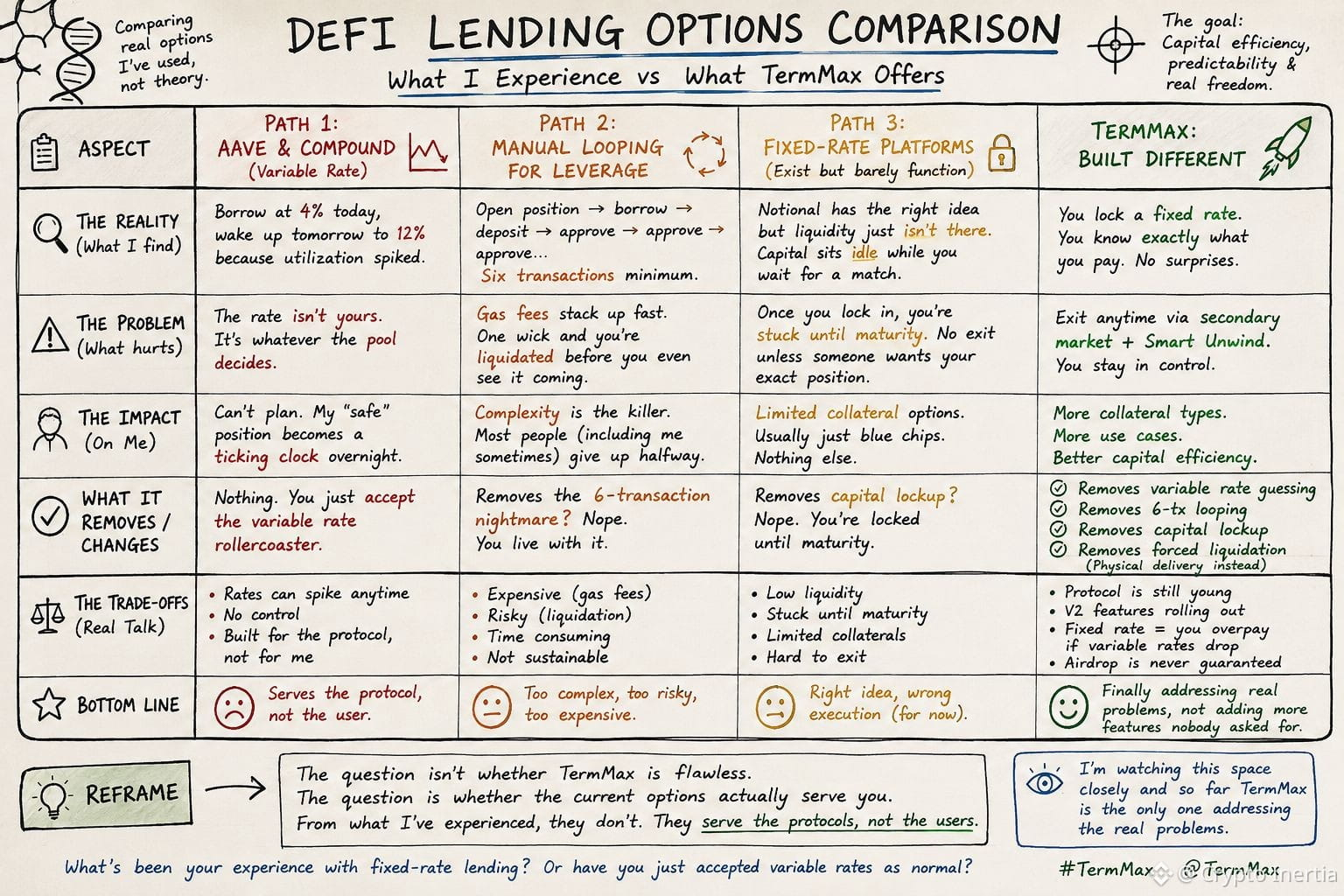
Eis o que encontrei. Três caminhos. Todos quebrados à sua maneira.
Caminho 1: Aave e Compound. O problema da taxa variável é real. Você toma emprestado a 4% hoje, acorda amanhã com 12% porque a utilização disparou. Você não consegue planejar isso. Sua posição "segura" vira um relógio cronometrado durante a noite. A taxa não é sua. É o que o pool decidir.
Caminho 2: Operar alavancagem manualmente. Este é o mais doloroso porque eu já fiz. Abre posição em um protocolo, toma emprestado em outro, deposita em outro lugar, faz approve, approve, approve. No mínimo seis transações. As taxas de gás se acumulam rápido. E você precisa monitorar o tempo todo, porque um pavio (wick) e você é liquidado antes mesmo de perceber. A complexidade é o assassino. .
Caminho 3: Plataformas de taxa fixa que existem, mas mal funcionam. A Notional tem a ideia certa, mas a liquidez simplesmente não está lá. O capital fica parado enquanto você espera por uma correspondência. Quando você trava, fica preso até o vencimento. Não há saída, a menos que alguém queira sua posição exata. .
O TermMax foi construído de forma diferente. Ele elimina o jogo de adivinhar a taxa variável. Elimina o pesadelo de ficar fazendo looping de seis transações. Remove o bloqueio de capital com saídas no mercado secundário e Smart Unwind. Remove o modelo de liquidação forçada com entrega física, em vez disso.
Não estou dizendo que é perfeito. O protocolo ainda é jovem. Recursos da V2 estão sendo lançados em fases. Taxas fixas significam que você paga a mais se as taxas variáveis caírem. E a história do airdrop é nunca garantida.
Mas vamos recontextualizar. A pergunta não é se o TermMax é impecável. A pergunta é se as opções atuais realmente te atendem. Pelo que eu vivi, não atendem. Elas atendem os protocolos, não os usuários.
Estou acompanhando este espaço de perto e, até agora, o TermMax é o único que está lidando com os problemas reais em vez de adicionar mais recursos que ninguém pediu.
Qual foi sua experiência com empréstimos a taxa fixa? Ou você simplesmente aceitou as taxas variáveis como algo normal?
$GPS
{spot}(GPSUSDT)
$PORTAL
{spot}(PORTALUSDT)
#termmax @TermMax
Tenho comparado o TermMax com a forma como o crédito DeFi funciona agora. Não teoria. Opções reais que eu usei.
Eis o que encontrei. Três caminhos. Todos quebrados à sua maneira.
Caminho 1: Aave e Compound. O problema da taxa variável é real. Você toma emprestado a 4% hoje, acorda amanhã com 12% porque a utilização disparou. Você não consegue planejar isso. Sua posição "segura" vira um relógio cronometrado durante a noite. A taxa não é sua. É o que o pool decidir.
Caminho 2: Operar alavancagem manualmente. Este é o mais doloroso porque eu já fiz. Abre posição em um protocolo, toma emprestado em outro, deposita em outro lugar, faz approve, approve, approve. No mínimo seis transações. As taxas de gás se acumulam rápido. E você precisa monitorar o tempo todo, porque um pavio (wick) e você é liquidado antes mesmo de perceber. A complexidade é o assassino. .
Caminho 3: Plataformas de taxa fixa que existem, mas mal funcionam. A Notional tem a ideia certa, mas a liquidez simplesmente não está lá. O capital fica parado enquanto você espera por uma correspondência. Quando você trava, fica preso até o vencimento. Não há saída, a menos que alguém queira sua posição exata. .
O TermMax foi construído de forma diferente. Ele elimina o jogo de adivinhar a taxa variável. Elimina o pesadelo de ficar fazendo looping de seis transações. Remove o bloqueio de capital com saídas no mercado secundário e Smart Unwind. Remove o modelo de liquidação forçada com entrega física, em vez disso.
Não estou dizendo que é perfeito. O protocolo ainda é jovem. Recursos da V2 estão sendo lançados em fases. Taxas fixas significam que você paga a mais se as taxas variáveis caírem. E a história do airdrop é nunca garantida.
Mas vamos recontextualizar. A pergunta não é se o TermMax é impecável. A pergunta é se as opções atuais realmente te atendem. Pelo que eu vivi, não atendem. Elas atendem os protocolos, não os usuários.
Estou acompanhando este espaço de perto e, até agora, o TermMax é o único que está lidando com os problemas reais em vez de adicionar mais recursos que ninguém pediu.
Qual foi sua experiência com empréstimos a taxa fixa? Ou você simplesmente aceitou as taxas variáveis como algo normal?
$GPS
$PORTAL
Tenho comparado o TermMax com a forma como o crédito DeFi funciona agora. Não teoria. Opções reais que eu usei.
Eis o que encontrei. Três caminhos. Todos quebrados à sua maneira.
Caminho 1: Aave e Compound. O problema da taxa variável é real. Você toma emprestado a 4% hoje, acorda amanhã com 12% porque a utilização disparou. Você não consegue planejar isso. Sua posição "segura" vira um relógio cronometrado durante a noite. A taxa não é sua. É o que o pool decidir.
Caminho 2: Operar alavancagem manualmente. Este é o mais doloroso porque eu já fiz. Abre posição em um protocolo, toma emprestado em outro, deposita em outro lugar, faz approve, approve, approve. No mínimo seis transações. As taxas de gás se acumulam rápido. E você precisa monitorar o tempo todo, porque um pavio (wick) e você é liquidado antes mesmo de perceber. A complexidade é o assassino. .
Caminho 3: Plataformas de taxa fixa que existem, mas mal funcionam. A Notional tem a ideia certa, mas a liquidez simplesmente não está lá. O capital fica parado enquanto você espera por uma correspondência. Quando você trava, fica preso até o vencimento. Não há saída, a menos que alguém queira sua posição exata. .
O TermMax foi construído de forma diferente. Ele elimina o jogo de adivinhar a taxa variável. Elimina o pesadelo de ficar fazendo looping de seis transações. Remove o bloqueio de capital com saídas no mercado secundário e Smart Unwind. Remove o modelo de liquidação forçada com entrega física, em vez disso.
Não estou dizendo que é perfeito. O protocolo ainda é jovem. Recursos da V2 estão sendo lançados em fases. Taxas fixas significam que você paga a mais se as taxas variáveis caírem. E a história do airdrop é nunca garantida.
Mas vamos recontextualizar. A pergunta não é se o TermMax é impecável. A pergunta é se as opções atuais realmente te atendem. Pelo que eu vivi, não atendem. Elas atendem os protocolos, não os usuários.
Estou acompanhando este espaço de perto e, até agora, o TermMax é o único que está lidando com os problemas reais em vez de adicionar mais recursos que ninguém pediu.
Qual foi sua experiência com empréstimos a taxa fixa? Ou você simplesmente aceitou as taxas variáveis como algo normal?
$GPS
$PORTAL
1
240
Trading de $DUSK de 30 dias no valor de 229.8 USDT
#dusk $DUSK
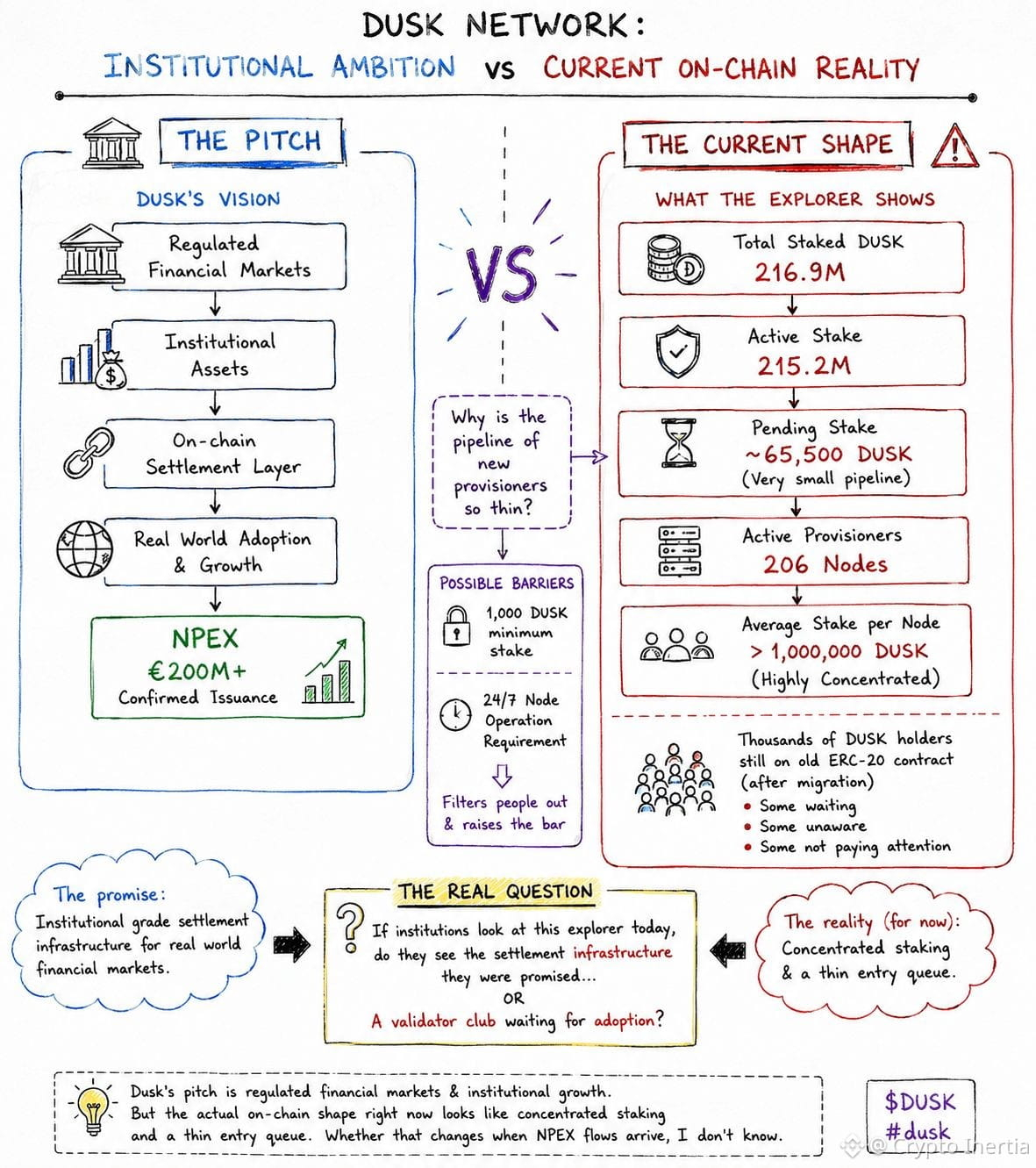
Tenho ficado com o explorador DUDE não-oficial e um número continua me incomodando.
Agora 216,9M @Dusk_Foundation
{spot}(DUSKUSDT)
k está apostado com 215,2M ativo. Sólido. Mas a aposta pendente é só cerca de 65.500 DUSK. Essa proporção é quase inexistente. Para uma rede que fala em crescimento institucional, a esteira de novos provisionadores parece plana. Ou o mínimo de 1.000 DUSK está fazendo o trabalho de filtrar as pessoas, ou manter um nó 24/7 é uma barreira maior do que a documentação admite. Provavelmente os dois.
Depois olhei a contagem de provisionadores ativos — 206 nós. Aposta média de mais de um milhão de DUSK cada. Isso não é descentralização. Isso é algumas carteiras bem sérias tocando a rede. Enquanto isso, o Etherscan ainda mostra milhares de detentores de DUSK parados no antigo contrato ERC-20 de antes da migração. Alguns aguardando. Alguns sem perceber. Alguns simplesmente não estão prestando atenção.
O discurso da Dusk é de mercados financeiros regulados. Mas a forma real on-chain agora parece aposta concentrada e uma fila de entrada bem fina. Se isso muda quando os fluxos da NPEX chegarem, eu sinceramente não sei.
O que eu continuo retomando — se instituições olharem para este explorador, elas veem a infraestrutura de liquidação que foram prometidas, ou um clube de validadores esperando para ser adotado? $DUSK #dusk
#dusk $DUSK
Tenho ficado com o explorador DUDE não-oficial e um número continua me incomodando.
Agora 216,9M @Dusk
k está apostado com 215,2M ativo. Sólido. Mas a aposta pendente é só cerca de 65.500 DUSK. Essa proporção é quase inexistente. Para uma rede que fala em crescimento institucional, a esteira de novos provisionadores parece plana. Ou o mínimo de 1.000 DUSK está fazendo o trabalho de filtrar as pessoas, ou manter um nó 24/7 é uma barreira maior do que a documentação admite. Provavelmente os dois.
Depois olhei a contagem de provisionadores ativos — 206 nós. Aposta média de mais de um milhão de DUSK cada. Isso não é descentralização. Isso é algumas carteiras bem sérias tocando a rede. Enquanto isso, o Etherscan ainda mostra milhares de detentores de DUSK parados no antigo contrato ERC-20 de antes da migração. Alguns aguardando. Alguns sem perceber. Alguns simplesmente não estão prestando atenção.
O discurso da Dusk é de mercados financeiros regulados. Mas a forma real on-chain agora parece aposta concentrada e uma fila de entrada bem fina. Se isso muda quando os fluxos da NPEX chegarem, eu sinceramente não sei.
O que eu continuo retomando — se instituições olharem para este explorador, elas veem a infraestrutura de liquidação que foram prometidas, ou um clube de validadores esperando para ser adotado? $DUSK #dusk
Tenho ficado com o explorador DUDE não-oficial e um número continua me incomodando.
Agora 216,9M @Dusk
k está apostado com 215,2M ativo. Sólido. Mas a aposta pendente é só cerca de 65.500 DUSK. Essa proporção é quase inexistente. Para uma rede que fala em crescimento institucional, a esteira de novos provisionadores parece plana. Ou o mínimo de 1.000 DUSK está fazendo o trabalho de filtrar as pessoas, ou manter um nó 24/7 é uma barreira maior do que a documentação admite. Provavelmente os dois.
Depois olhei a contagem de provisionadores ativos — 206 nós. Aposta média de mais de um milhão de DUSK cada. Isso não é descentralização. Isso é algumas carteiras bem sérias tocando a rede. Enquanto isso, o Etherscan ainda mostra milhares de detentores de DUSK parados no antigo contrato ERC-20 de antes da migração. Alguns aguardando. Alguns sem perceber. Alguns simplesmente não estão prestando atenção.
O discurso da Dusk é de mercados financeiros regulados. Mas a forma real on-chain agora parece aposta concentrada e uma fila de entrada bem fina. Se isso muda quando os fluxos da NPEX chegarem, eu sinceramente não sei.
O que eu continuo retomando — se instituições olharem para este explorador, elas veem a infraestrutura de liquidação que foram prometidas, ou um clube de validadores esperando para ser adotado? $DUSK #dusk
2
1
94
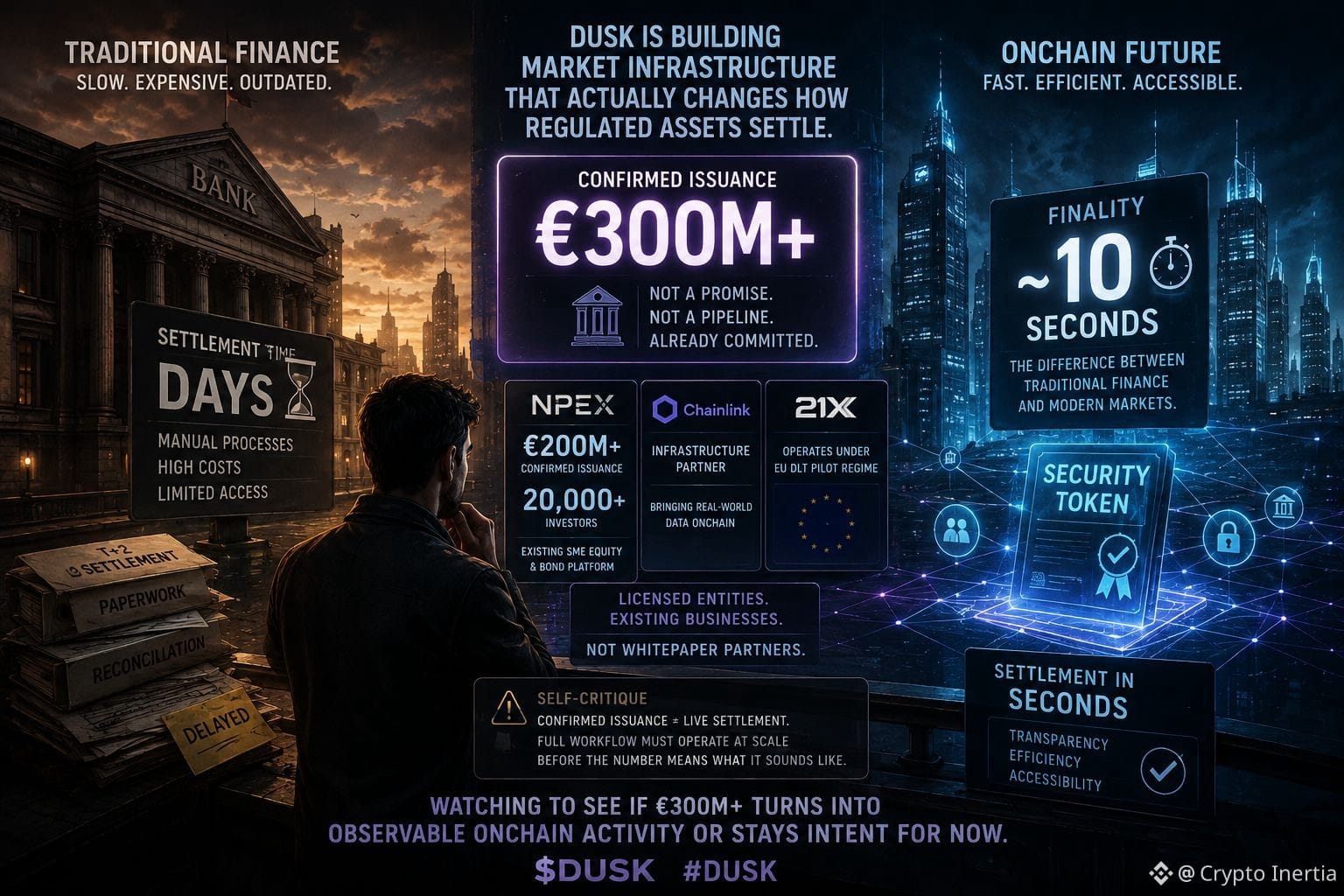
#dusk $DUSK Vejo uma diferença que a maioria das pessoas não faz ao analisar os números do Dusk: uma emissão confirmada de €300M+ soa como uma promessa, mas na verdade reflete algo mais imediato.
Esse valor não é uma meta de captação. São ativos que instituições reguladas já se comprometeram a mover onchain. A NPEX sozinha responde por mais de €200M em emissão confirmada, sustentada por uma base de investidores com mais de 20.000. A Chainlink entra no nível da infraestrutura. A 21X opera sob o Regime Piloto de DLT da UE. Não são parceiros de whitepaper. São entidades licenciadas com negócios já existentes.
O que a maioria dos projetos de RWA faz é anunciar uma pipeline. Um monte de logos. Um slide de roadmap com ativos “em breve”. Depois você espera e nada se concretiza. A abordagem do Dusk é diferente: o valor da emissão está ligado a fluxos de trabalho regulados já existentes, não a esperanças futuras. A NPEX já lida com equity e bonds de PMEs. A mudança para o onchain é uma mudança estrutural, não um começo do zero.
O número que, de fato, me fez parar foi a finalização. Cerca de 10 segundos. Para títulos regulados, isso não é um “bom ter”. É a diferença entre uma liquidação que parece um mercado moderno e uma liquidação que ainda se sente como finanças tradicionais. Se a NPEX trouxer instrumentos existentes para o onchain e eles liquidarem em segundos em vez de dias, isso não é uma história sobre blockchain ser mais rápido. É uma história sobre a infraestrutura do mercado realmente mudando.
Auto-criticismo: emissão confirmada não é a mesma coisa que liquidação em tempo real. Os ativos podem estar comprometidos, mas o fluxo completo ainda precisa operar em escala antes que o número signifique o que soa como.
Estou esperando para ver se o valor de €300M vai se transformar em atividade onchain observável, ou se permanece, por enquanto, como intenção confirmada. @Dusk_Foundation
$COW
{spot}(COWUSDT)
$WAL
{spot}(WALUSDT)
#dusk $DUSK Vejo uma diferença que a maioria das pessoas não faz ao analisar os números do Dusk: uma emissão confirmada de €300M+ soa como uma promessa, mas na verdade reflete algo mais imediato.
Esse valor não é uma meta de captação. São ativos que instituições reguladas já se comprometeram a mover onchain. A NPEX sozinha responde por mais de €200M em emissão confirmada, sustentada por uma base de investidores com mais de 20.000. A Chainlink entra no nível da infraestrutura. A 21X opera sob o Regime Piloto de DLT da UE. Não são parceiros de whitepaper. São entidades licenciadas com negócios já existentes.
O que a maioria dos projetos de RWA faz é anunciar uma pipeline. Um monte de logos. Um slide de roadmap com ativos “em breve”. Depois você espera e nada se concretiza. A abordagem do Dusk é diferente: o valor da emissão está ligado a fluxos de trabalho regulados já existentes, não a esperanças futuras. A NPEX já lida com equity e bonds de PMEs. A mudança para o onchain é uma mudança estrutural, não um começo do zero.
O número que, de fato, me fez parar foi a finalização. Cerca de 10 segundos. Para títulos regulados, isso não é um “bom ter”. É a diferença entre uma liquidação que parece um mercado moderno e uma liquidação que ainda se sente como finanças tradicionais. Se a NPEX trouxer instrumentos existentes para o onchain e eles liquidarem em segundos em vez de dias, isso não é uma história sobre blockchain ser mais rápido. É uma história sobre a infraestrutura do mercado realmente mudando.
Auto-criticismo: emissão confirmada não é a mesma coisa que liquidação em tempo real. Os ativos podem estar comprometidos, mas o fluxo completo ainda precisa operar em escala antes que o número signifique o que soa como.
Estou esperando para ver se o valor de €300M vai se transformar em atividade onchain observável, ou se permanece, por enquanto, como intenção confirmada. @Dusk
$COW
$WAL
Esse valor não é uma meta de captação. São ativos que instituições reguladas já se comprometeram a mover onchain. A NPEX sozinha responde por mais de €200M em emissão confirmada, sustentada por uma base de investidores com mais de 20.000. A Chainlink entra no nível da infraestrutura. A 21X opera sob o Regime Piloto de DLT da UE. Não são parceiros de whitepaper. São entidades licenciadas com negócios já existentes.
O que a maioria dos projetos de RWA faz é anunciar uma pipeline. Um monte de logos. Um slide de roadmap com ativos “em breve”. Depois você espera e nada se concretiza. A abordagem do Dusk é diferente: o valor da emissão está ligado a fluxos de trabalho regulados já existentes, não a esperanças futuras. A NPEX já lida com equity e bonds de PMEs. A mudança para o onchain é uma mudança estrutural, não um começo do zero.
O número que, de fato, me fez parar foi a finalização. Cerca de 10 segundos. Para títulos regulados, isso não é um “bom ter”. É a diferença entre uma liquidação que parece um mercado moderno e uma liquidação que ainda se sente como finanças tradicionais. Se a NPEX trouxer instrumentos existentes para o onchain e eles liquidarem em segundos em vez de dias, isso não é uma história sobre blockchain ser mais rápido. É uma história sobre a infraestrutura do mercado realmente mudando.
Auto-criticismo: emissão confirmada não é a mesma coisa que liquidação em tempo real. Os ativos podem estar comprometidos, mas o fluxo completo ainda precisa operar em escala antes que o número signifique o que soa como.
Estou esperando para ver se o valor de €300M vai se transformar em atividade onchain observável, ou se permanece, por enquanto, como intenção confirmada. @Dusk
$COW
$WAL
1
1
250
.Vejo uma distinção que a maioria das pessoas não percebe ao discutir ativos tokenizados e regulados onchain: blockchains públicas tratam a privacidade como um recurso, mas @Dusk_Foundation a trata como uma exigência.
No Ethereum ou Solana, privacidade é algo que você adiciona depois. Um mixer aqui, uma ferramenta de transferência confidencial ali. A própria cadeia é transparente por padrão. Cada posição, cada contraparte, cada saldo visível para qualquer um que olhe. Isso funciona para DeFi sem permissão. Não funciona quando você está liquidando valores mobiliários regulados em que a divulgação é seletiva e o nível de escrutínio é definido legalmente.
A Dusk inverte isso. As transações Phoenix são confidenciais por padrão. Provas de conhecimento zero verificam a correção sem expor os dados subjacentes. A divulgação seletiva significa que um auditor ou regulador pode ver exatamente o que tem direito de ver e nada mais. Não é uma ferramenta de privacidade “acoplada” por cima. A camada base em si é construída em torno disso.
O que chamou minha atenção é como isso se conecta ao NPEX. Uma exchange regulada pela AFM nos Países Baixos, lidando com ações de PMEs e títulos. Um local como esse não consegue operar em uma cadeia transparente. Os traders não querem suas posições públicas. Emissores não querem suas cap tables abertas a concorrentes. Reguladores querem auditabilidade sem exposição pública. A arquitetura da Dusk se alinha com o que os ambientes regulados realmente precisam, não com o que o cripto assume que eles deveriam aceitar.
Autocrítica: tecnologia de privacidade só importa se reguladores aceitarem isso. Provas de conhecimento zero não ajudam se um regulador exigir dados brutos em um formato que ele reconhece. A aceitação legal fica atrás da capacidade técnica.
Estou aguardando para ver se o modelo de privacidade da Dusk será tratado como infraestrutura em conformidade por reguladores europeus, ou apenas como uma criptografia engenhosa em que as instituições permanecem cautelosas. $DUSK #dusk
.Vejo uma distinção que a maioria das pessoas não percebe ao discutir ativos tokenizados e regulados onchain: blockchains públicas tratam a privacidade como um recurso, mas @Dusk a trata como uma exigência.
No Ethereum ou Solana, privacidade é algo que você adiciona depois. Um mixer aqui, uma ferramenta de transferência confidencial ali. A própria cadeia é transparente por padrão. Cada posição, cada contraparte, cada saldo visível para qualquer um que olhe. Isso funciona para DeFi sem permissão. Não funciona quando você está liquidando valores mobiliários regulados em que a divulgação é seletiva e o nível de escrutínio é definido legalmente.
A Dusk inverte isso. As transações Phoenix são confidenciais por padrão. Provas de conhecimento zero verificam a correção sem expor os dados subjacentes. A divulgação seletiva significa que um auditor ou regulador pode ver exatamente o que tem direito de ver e nada mais. Não é uma ferramenta de privacidade “acoplada” por cima. A camada base em si é construída em torno disso.
O que chamou minha atenção é como isso se conecta ao NPEX. Uma exchange regulada pela AFM nos Países Baixos, lidando com ações de PMEs e títulos. Um local como esse não consegue operar em uma cadeia transparente. Os traders não querem suas posições públicas. Emissores não querem suas cap tables abertas a concorrentes. Reguladores querem auditabilidade sem exposição pública. A arquitetura da Dusk se alinha com o que os ambientes regulados realmente precisam, não com o que o cripto assume que eles deveriam aceitar.
Autocrítica: tecnologia de privacidade só importa se reguladores aceitarem isso. Provas de conhecimento zero não ajudam se um regulador exigir dados brutos em um formato que ele reconhece. A aceitação legal fica atrás da capacidade técnica.
Estou aguardando para ver se o modelo de privacidade da Dusk será tratado como infraestrutura em conformidade por reguladores europeus, ou apenas como uma criptografia engenhosa em que as instituições permanecem cautelosas. $DUSK #dusk
No Ethereum ou Solana, privacidade é algo que você adiciona depois. Um mixer aqui, uma ferramenta de transferência confidencial ali. A própria cadeia é transparente por padrão. Cada posição, cada contraparte, cada saldo visível para qualquer um que olhe. Isso funciona para DeFi sem permissão. Não funciona quando você está liquidando valores mobiliários regulados em que a divulgação é seletiva e o nível de escrutínio é definido legalmente.
A Dusk inverte isso. As transações Phoenix são confidenciais por padrão. Provas de conhecimento zero verificam a correção sem expor os dados subjacentes. A divulgação seletiva significa que um auditor ou regulador pode ver exatamente o que tem direito de ver e nada mais. Não é uma ferramenta de privacidade “acoplada” por cima. A camada base em si é construída em torno disso.
O que chamou minha atenção é como isso se conecta ao NPEX. Uma exchange regulada pela AFM nos Países Baixos, lidando com ações de PMEs e títulos. Um local como esse não consegue operar em uma cadeia transparente. Os traders não querem suas posições públicas. Emissores não querem suas cap tables abertas a concorrentes. Reguladores querem auditabilidade sem exposição pública. A arquitetura da Dusk se alinha com o que os ambientes regulados realmente precisam, não com o que o cripto assume que eles deveriam aceitar.
Autocrítica: tecnologia de privacidade só importa se reguladores aceitarem isso. Provas de conhecimento zero não ajudam se um regulador exigir dados brutos em um formato que ele reconhece. A aceitação legal fica atrás da capacidade técnica.
Estou aguardando para ver se o modelo de privacidade da Dusk será tratado como infraestrutura em conformidade por reguladores europeus, ou apenas como uma criptografia engenhosa em que as instituições permanecem cautelosas. $DUSK #dusk
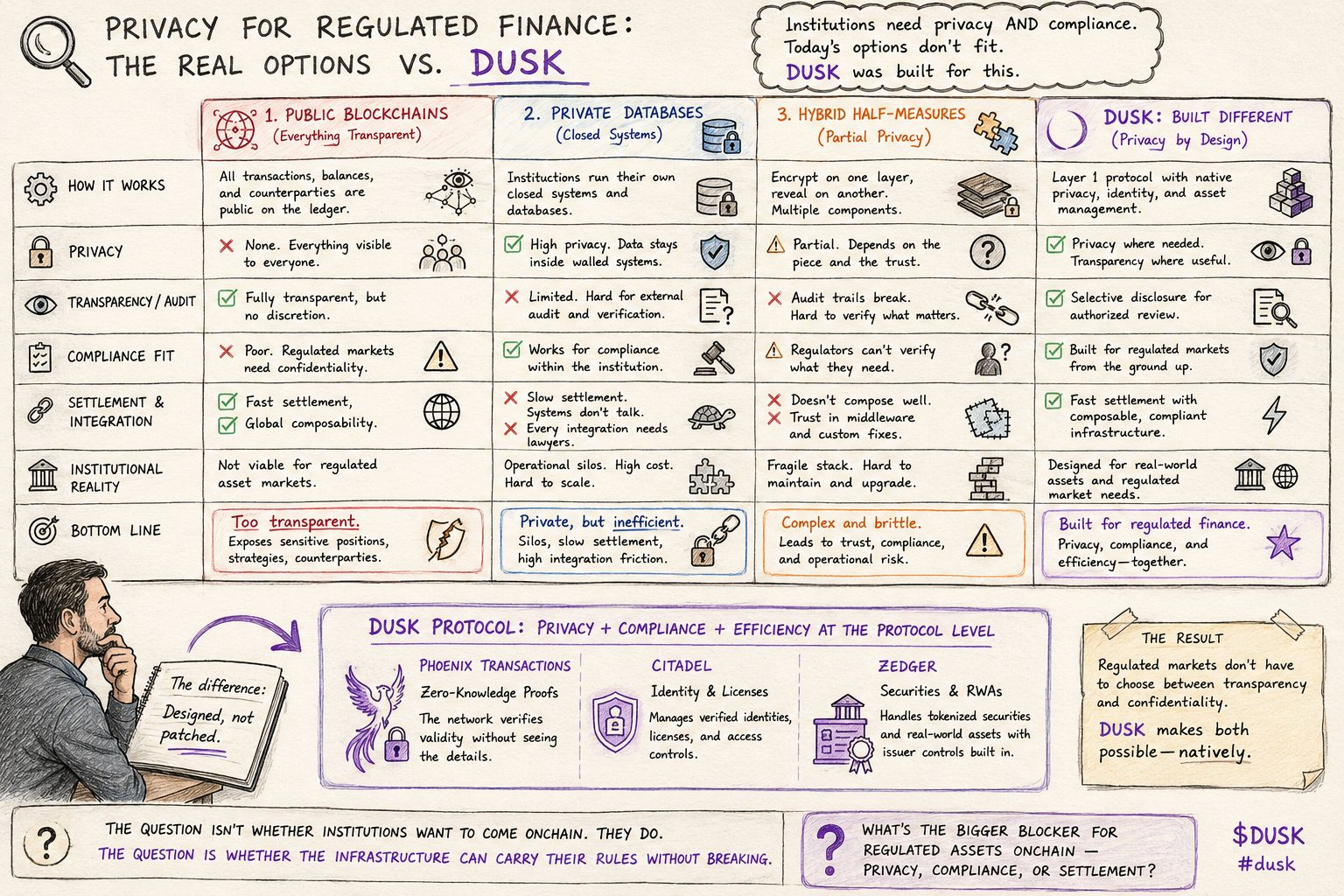
2
1
341
#TradebStocks #BinanceAfricaChallenge
participe na seguinte campanha comercial para moedas favoritas e tenha chance de ganhar um prêmio
#TradebStocks #BinanceAfricaChallenge
participe na seguinte campanha comercial para moedas favoritas e tenha chance de ganhar um prêmio
participe na seguinte campanha comercial para moedas favoritas e tenha chance de ganhar um prêmio
67
participe e ganhe prêmios #Binance #BinanceSquareTalks
participe e ganhe prêmios #Binance #BinanceSquareTalks


Binance Africa
·
--
🚀 Flash Quest: As Ações Estão se Movendo Rápido na Binance! Os mercados estão em movimento. 📈
Negocie suas ações favoritas na Binance e, depois, compartilhe sua negociação na Binance Square para ter a chance de ganhar recompensas do nosso pool de prêmios de USDC $ 1.000
Como Participar:
🔸 Siga @Binance Africa
🔸 Curta este post e repost
🔸 Compartilhe suas negociações de bStocks no Square usando o tradingcard com a hashtag #TradebStocks #BinanceAfrica
🔸 Preencha esta pesquisa 👉🏾 Click on the Link to Participate Prêmios: Ao todo, 200 vencedores receberão 5 USDC cada.
🔸 📆 Período: 13 de agosto de 2026 10:00 UTC – 23 de agosto de 2026 23:59 UTC
$TSLAB
Negocie suas ações favoritas na Binance e, depois, compartilhe sua negociação na Binance Square para ter a chance de ganhar recompensas do nosso pool de prêmios de USDC $ 1.000
Como Participar:
🔸 Siga @Binance Africa
🔸 Curta este post e repost
🔸 Compartilhe suas negociações de bStocks no Square usando o tradingcard com a hashtag #TradebStocks #BinanceAfrica
🔸 Preencha esta pesquisa 👉🏾 Click on the Link to Participate Prêmios: Ao todo, 200 vencedores receberão 5 USDC cada.
🔸 📆 Período: 13 de agosto de 2026 10:00 UTC – 23 de agosto de 2026 23:59 UTC
$TSLAB

139
#dusk $DUSK Tenho comparado @Dusk_Foundation k com a forma como os ativos financeiros regulamentados realmente são liquidados hoje. Não é sobre os pitch decks. É sobre a experiência real.
Aqui está o que eu encontrei. Se você quer exposição a ativos financeiros regulamentados onchain, você está escolhendo entre três caminhos. Todos eles falham em algum ponto.
As vias tradicionais de finanças. Você compra MMFs, ETFs e títulos via corretoras. A liquidação leva dias. Os mercados fecham. Sua propriedade é apenas uma linha em um banco de dados de outra pessoa. Funciona porque é antigo, não porque é bom. A liquidação T+2 ainda é padrão na maioria dos mercados. Dois dias para possuir algo que você já pagou.
Invólucros tokenizados. Projetos pegam um ativo existente, o envolvem (wrap) e colocam onchain. Você recebe um token que representa uma participação. Mas o ativo subjacente ainda vive nas vias legadas. Assim, você ganha velocidade de blockchain sobre uma liquidação lenta. No melhor caso, é uma visão mais rápida de um sistema lento. No pior caso, o invólucro quebra e você fica discutindo com uma equipe jurídica.
DeFi não regulamentado. Você pode negociar agora versões cripto lastreadas de ativos reais. Mas elas são sintéticas. Elas imitam preços sem propriedade real. Se o protocolo falhar, sua reivindicação só vale o que vale um smart contract que ninguém regula. Serve para especulação. Não serve para riqueza real.
A Dusk foi construída de forma diferente. Layer 1 para mercados financeiros regulamentados. Emissão nativa, não envolvimento (wrapping). Propriedade real, não exposição sintética. A NPEX, uma exchange regulada pela AFM, confirmou €200M+ em emissão com a Dusk. Parceria com Chainlink. A Dusk Trade é estruturada como um MTF regulamentado. E a finalização está em torno de 10 segundos. Não é T+2. Não são "dias úteis". Segundos.
Eu não estou dizendo que regulação é emocionante. Mas existe uma diferença entre DeFi fingindo que conformidade não existe e uma cadeia construída com conformidade como recurso. O primeiro ganha manchetes. O segundo atrai instituições.
O que te manteve longe de ativos regulamentados onchain — as vias antigas, os invólucros falsos, ou simplesmente nunca ter encontrado a opção certa?
$AVNT $SNXXB
#dusk $DUSK Tenho comparado @Dusk k com a forma como os ativos financeiros regulamentados realmente são liquidados hoje. Não é sobre os pitch decks. É sobre a experiência real.
Aqui está o que eu encontrei. Se você quer exposição a ativos financeiros regulamentados onchain, você está escolhendo entre três caminhos. Todos eles falham em algum ponto.
As vias tradicionais de finanças. Você compra MMFs, ETFs e títulos via corretoras. A liquidação leva dias. Os mercados fecham. Sua propriedade é apenas uma linha em um banco de dados de outra pessoa. Funciona porque é antigo, não porque é bom. A liquidação T+2 ainda é padrão na maioria dos mercados. Dois dias para possuir algo que você já pagou.
Invólucros tokenizados. Projetos pegam um ativo existente, o envolvem (wrap) e colocam onchain. Você recebe um token que representa uma participação. Mas o ativo subjacente ainda vive nas vias legadas. Assim, você ganha velocidade de blockchain sobre uma liquidação lenta. No melhor caso, é uma visão mais rápida de um sistema lento. No pior caso, o invólucro quebra e você fica discutindo com uma equipe jurídica.
DeFi não regulamentado. Você pode negociar agora versões cripto lastreadas de ativos reais. Mas elas são sintéticas. Elas imitam preços sem propriedade real. Se o protocolo falhar, sua reivindicação só vale o que vale um smart contract que ninguém regula. Serve para especulação. Não serve para riqueza real.
A Dusk foi construída de forma diferente. Layer 1 para mercados financeiros regulamentados. Emissão nativa, não envolvimento (wrapping). Propriedade real, não exposição sintética. A NPEX, uma exchange regulada pela AFM, confirmou €200M+ em emissão com a Dusk. Parceria com Chainlink. A Dusk Trade é estruturada como um MTF regulamentado. E a finalização está em torno de 10 segundos. Não é T+2. Não são "dias úteis". Segundos.
Eu não estou dizendo que regulação é emocionante. Mas existe uma diferença entre DeFi fingindo que conformidade não existe e uma cadeia construída com conformidade como recurso. O primeiro ganha manchetes. O segundo atrai instituições.
O que te manteve longe de ativos regulamentados onchain — as vias antigas, os invólucros falsos, ou simplesmente nunca ter encontrado a opção certa?
$AVNT $SNXXB
Aqui está o que eu encontrei. Se você quer exposição a ativos financeiros regulamentados onchain, você está escolhendo entre três caminhos. Todos eles falham em algum ponto.
As vias tradicionais de finanças. Você compra MMFs, ETFs e títulos via corretoras. A liquidação leva dias. Os mercados fecham. Sua propriedade é apenas uma linha em um banco de dados de outra pessoa. Funciona porque é antigo, não porque é bom. A liquidação T+2 ainda é padrão na maioria dos mercados. Dois dias para possuir algo que você já pagou.
Invólucros tokenizados. Projetos pegam um ativo existente, o envolvem (wrap) e colocam onchain. Você recebe um token que representa uma participação. Mas o ativo subjacente ainda vive nas vias legadas. Assim, você ganha velocidade de blockchain sobre uma liquidação lenta. No melhor caso, é uma visão mais rápida de um sistema lento. No pior caso, o invólucro quebra e você fica discutindo com uma equipe jurídica.
DeFi não regulamentado. Você pode negociar agora versões cripto lastreadas de ativos reais. Mas elas são sintéticas. Elas imitam preços sem propriedade real. Se o protocolo falhar, sua reivindicação só vale o que vale um smart contract que ninguém regula. Serve para especulação. Não serve para riqueza real.
A Dusk foi construída de forma diferente. Layer 1 para mercados financeiros regulamentados. Emissão nativa, não envolvimento (wrapping). Propriedade real, não exposição sintética. A NPEX, uma exchange regulada pela AFM, confirmou €200M+ em emissão com a Dusk. Parceria com Chainlink. A Dusk Trade é estruturada como um MTF regulamentado. E a finalização está em torno de 10 segundos. Não é T+2. Não são "dias úteis". Segundos.
Eu não estou dizendo que regulação é emocionante. Mas existe uma diferença entre DeFi fingindo que conformidade não existe e uma cadeia construída com conformidade como recurso. O primeiro ganha manchetes. O segundo atrai instituições.
O que te manteve longe de ativos regulamentados onchain — as vias antigas, os invólucros falsos, ou simplesmente nunca ter encontrado a opção certa?
$AVNT $SNXXB
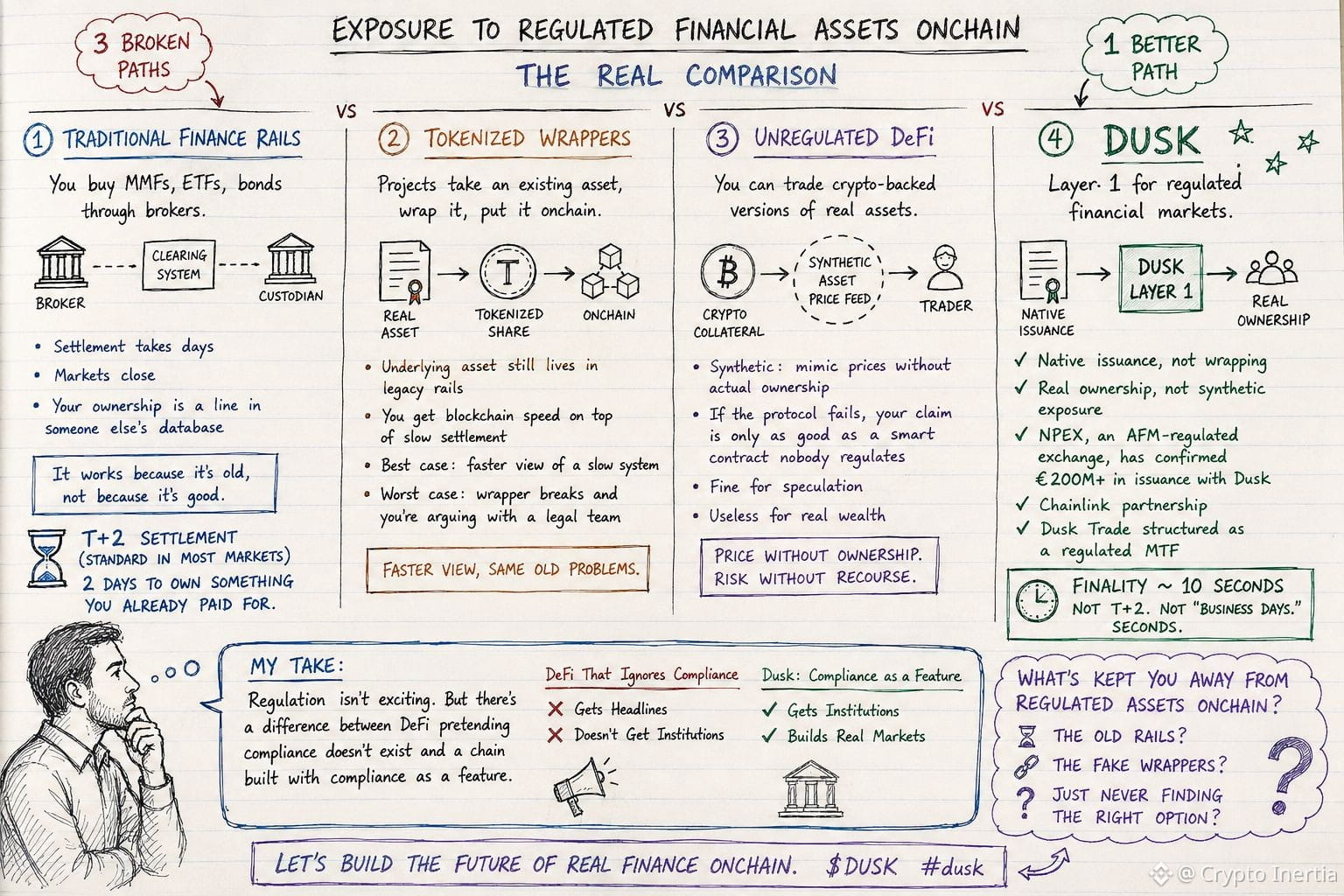
3
2
86
Inicia sessão para explorar mais conteúdos
Junta-te a utilizadores de criptomoedas de todo o mundo na Binance Square
⚡️ Obtém informações úteis e recentes sobre criptomoedas.
💬 Com a confiança da maior exchange de criptomoedas do mundo.
👍 Descobre perspetivas reais de criadores verificados.
E-mail/Número de telefone