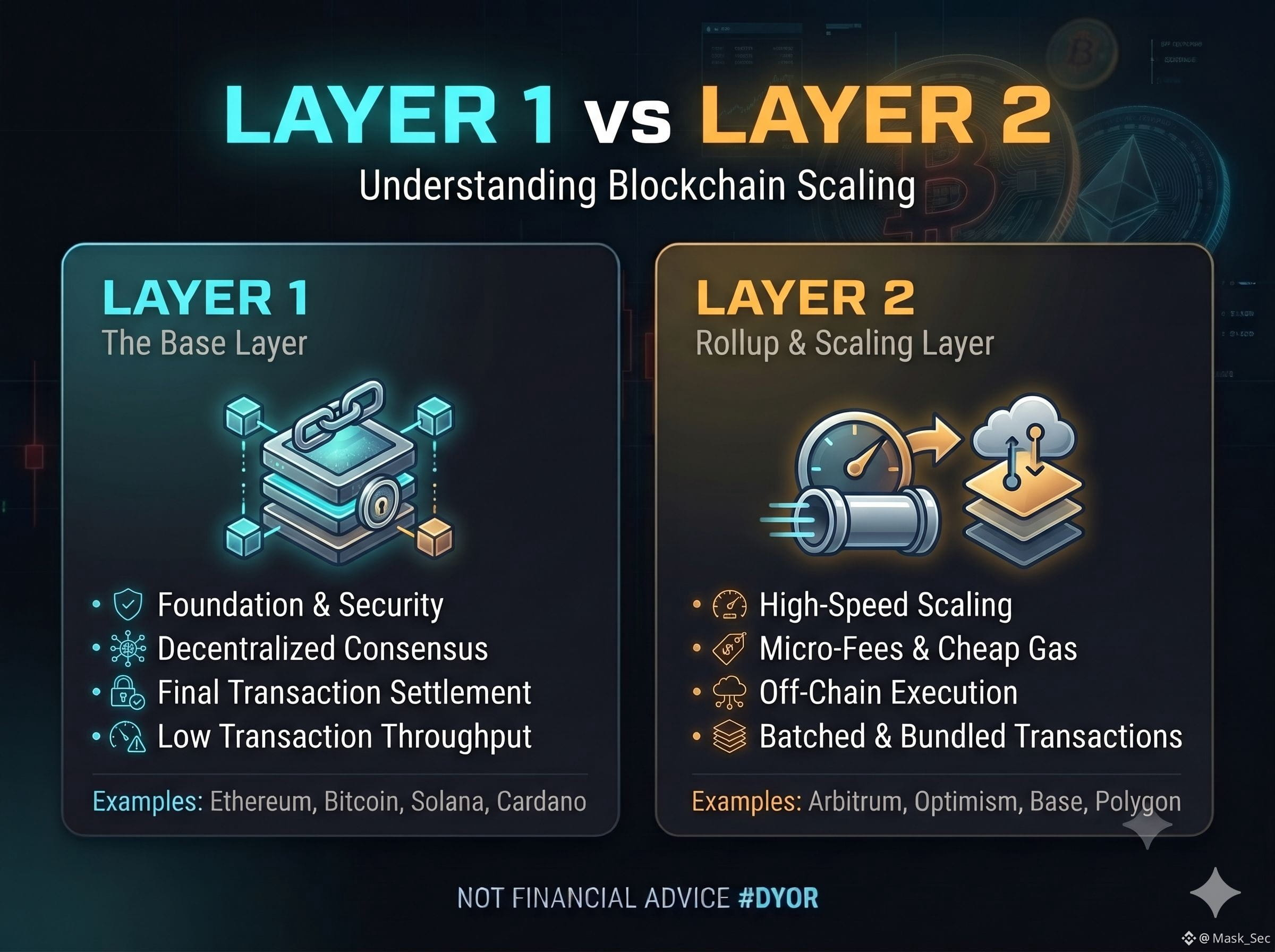
Headline: Layer 1 vs. Layer 2: How Blockchains Scale Without Sacrificing Security
Every blockchain faces the classic "Blockchain Trilemma": achieving decentralization, security, and scalability simultaneously without compromising one for the others.
Base networks prioritize ironclad security and decentralization, which often leads to network congestion and high transaction fees during peak activity. This is where Layer 2 scaling solutions enter the picture.
🏗️ 1. Layer 1 (The Foundation Layer)
Layer 1 is the underlying base blockchain. It is responsible for consensus, permanent data storage, and network dispute resolution.
• Core Focus: Ultimate security and censorship resistance.
• How It Works: Every participating node across the globe must validate and agree on every single transaction.
• The Trade-off: Because block space is intentionally limited to preserve decentralization, high demand drives up network priority fees.
🚀 2. Layer 2 (The Execution Highway)
Layer 2 refers to secondary frameworks and rollups built directly on top of Layer 1.
• Core Focus: Fast throughput and low-cost execution.
• How It Works: Instead of processing every trade individually on the main chain, Layer 2s process hundreds of transactions off-chain, compress them into a single batch proof, and post the final summary back to Layer 1 for settlement.
• The Benefit: Users get instant confirmations and sub-cent fees while inheriting the base layer’s underlying security.
💡 The Big Picture
Think of Layer 1 as a national court system: slow, deliberate, and authoritative for final rulings. Layer 2 functions like everyday contracts signed between individuals—fast, flexible, and only escalated to the court if dispute resolution is required.
Do you primarily conduct daily DeFi transactions on Layer 1 or Layer 2 networks? Share your experience in the comments!
Disclaimer: Educational content only. Not financial advice (DYOR).
#Layer1 #Layer2 #cryptoeducation #Blockchain #BinanceSquare #Web3