

Zoya Research
147 Publicações

Zoya Research
Denunciar
Bloquear usuário
31 Seguindo
25 Seguidores
130 Curtiu
Publicações
Todas
Citações
Binance Pick é uma forma interessante de explorar os mercados de previsão e compartilhar suas análises de mercado. 🔥 Cada previsão é uma oportunidade de aprender, analisar tendências e aprimorar sua tomada de decisões. Continue pesquisando, mantenha a consistência e faça cada palpite valer a pena! 🚀
#BinancePick
Binance Pick é uma forma interessante de explorar os mercados de previsão e compartilhar suas análises de mercado. 🔥 Cada previsão é uma oportunidade de aprender, analisar tendências e aprimorar sua tomada de decisões. Continue pesquisando, mantenha a consistência e faça cada palpite valer a pena! 🚀
#BinancePick
#BinancePick
79
Continuei voltando a uma única pergunta ao analisar o Dusk e a NPEX:
É possível um mercado regulamentado ser auditável sem transformar toda a atividade financeira de cada investidor em dados públicos?
A NPEX torna essa questão mais do que apenas teórica. O trabalho do Dusk com a bolsa regulamentada holandesa dá a essa pergunta um contexto no mundo real: títulos regulamentados, investidores e a infraestrutura do mercado precisam operar dentro de regras que exigem tanto supervisão quanto confidencialidade.
Isso cria um problema específico.
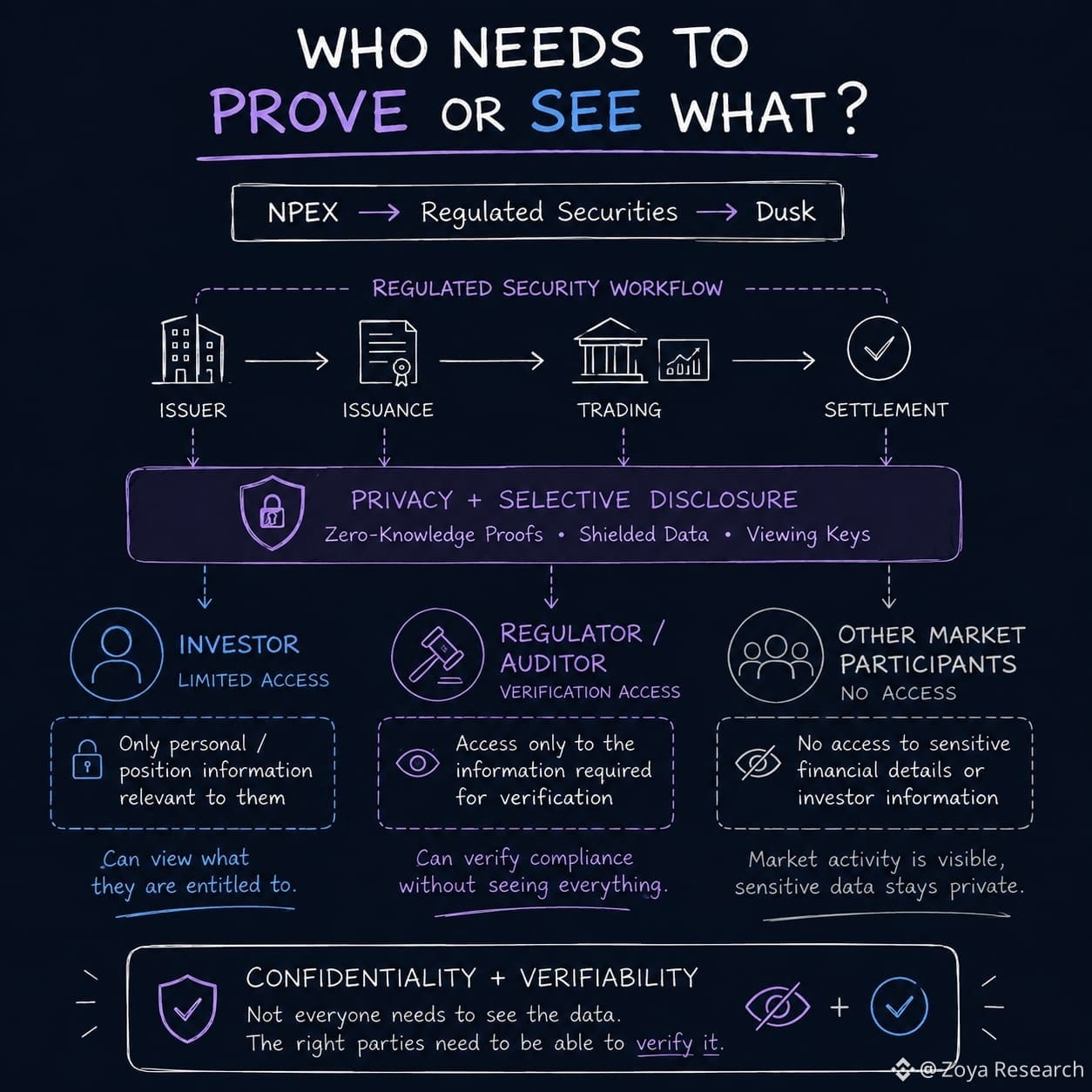
Um regulador pode precisar verificar se um investidor é elegível ou se uma transação segue as condições exigidas. Mas isso não significa automaticamente que todos os outros participantes do mercado devam ver as informações financeiras subjacentes.
É aqui que a arquitetura do Dusk fica interessante.
O modelo de transações Phoenix mantém saldos e transferências protegidos, enquanto provas de conhecimento zero podem estabelecer a validade da transação sem expor os detalhes subjacentes. Quando evidências adicionais são necessárias, chaves de visualização podem fornecer acesso seletivo.
Assim, a privacidade aqui não é simplesmente sobre esconder dados.
Ela muda a pergunta de “A informação é pública?” para “Quem precisa provar ou ver o quê?”
Mas o teste real é o que acontece quando um título efetivamente regulamentado passa por esse fluxo: quem consegue ver o quê, quem consegue provar o quê e quanto de coordenação manual ainda é necessário nos bastidores?
Essa é a parte que eu não acho que deva ser presumida.
Se essas permissões realmente puderem ser aplicadas onchain entre investidores, emissores, plataformas e supervisores, a privacidade se torna mais do que um recurso de conformidade — ela se torna parte da própria infraestrutura do mercado?
@Dusk_Foundation $DUSK #dusk
Continuei voltando a uma única pergunta ao analisar o Dusk e a NPEX:
É possível um mercado regulamentado ser auditável sem transformar toda a atividade financeira de cada investidor em dados públicos?
A NPEX torna essa questão mais do que apenas teórica. O trabalho do Dusk com a bolsa regulamentada holandesa dá a essa pergunta um contexto no mundo real: títulos regulamentados, investidores e a infraestrutura do mercado precisam operar dentro de regras que exigem tanto supervisão quanto confidencialidade.
Isso cria um problema específico.
Um regulador pode precisar verificar se um investidor é elegível ou se uma transação segue as condições exigidas. Mas isso não significa automaticamente que todos os outros participantes do mercado devam ver as informações financeiras subjacentes.
É aqui que a arquitetura do Dusk fica interessante.
O modelo de transações Phoenix mantém saldos e transferências protegidos, enquanto provas de conhecimento zero podem estabelecer a validade da transação sem expor os detalhes subjacentes. Quando evidências adicionais são necessárias, chaves de visualização podem fornecer acesso seletivo.
Assim, a privacidade aqui não é simplesmente sobre esconder dados.
Ela muda a pergunta de “A informação é pública?” para “Quem precisa provar ou ver o quê?”
Mas o teste real é o que acontece quando um título efetivamente regulamentado passa por esse fluxo: quem consegue ver o quê, quem consegue provar o quê e quanto de coordenação manual ainda é necessário nos bastidores?
Essa é a parte que eu não acho que deva ser presumida.
Se essas permissões realmente puderem ser aplicadas onchain entre investidores, emissores, plataformas e supervisores, a privacidade se torna mais do que um recurso de conformidade — ela se torna parte da própria infraestrutura do mercado?
@Dusk $DUSK #dusk
É possível um mercado regulamentado ser auditável sem transformar toda a atividade financeira de cada investidor em dados públicos?
A NPEX torna essa questão mais do que apenas teórica. O trabalho do Dusk com a bolsa regulamentada holandesa dá a essa pergunta um contexto no mundo real: títulos regulamentados, investidores e a infraestrutura do mercado precisam operar dentro de regras que exigem tanto supervisão quanto confidencialidade.
Isso cria um problema específico.
Um regulador pode precisar verificar se um investidor é elegível ou se uma transação segue as condições exigidas. Mas isso não significa automaticamente que todos os outros participantes do mercado devam ver as informações financeiras subjacentes.
É aqui que a arquitetura do Dusk fica interessante.
O modelo de transações Phoenix mantém saldos e transferências protegidos, enquanto provas de conhecimento zero podem estabelecer a validade da transação sem expor os detalhes subjacentes. Quando evidências adicionais são necessárias, chaves de visualização podem fornecer acesso seletivo.
Assim, a privacidade aqui não é simplesmente sobre esconder dados.
Ela muda a pergunta de “A informação é pública?” para “Quem precisa provar ou ver o quê?”
Mas o teste real é o que acontece quando um título efetivamente regulamentado passa por esse fluxo: quem consegue ver o quê, quem consegue provar o quê e quanto de coordenação manual ainda é necessário nos bastidores?
Essa é a parte que eu não acho que deva ser presumida.
Se essas permissões realmente puderem ser aplicadas onchain entre investidores, emissores, plataformas e supervisores, a privacidade se torna mais do que um recurso de conformidade — ela se torna parte da própria infraestrutura do mercado?
@Dusk $DUSK #dusk
83
Voltei hoje ao modelo de privacidade da Dusk porque uma pergunta continuava me incomodando: se os mercados regulados ainda precisam de visibilidade, o que exatamente a privacidade está protegendo?
Quanto mais eu olhava para isso, menos eu acho que a resposta seja simplesmente “ocultar a transação”.
Uma instituição financeira pode precisar provar que algo aconteceu, enquanto um concorrente talvez não tenha motivo para ver a posição subjacente, o saldo ou outras informações sensíveis.
Isso cria um problema diferente.
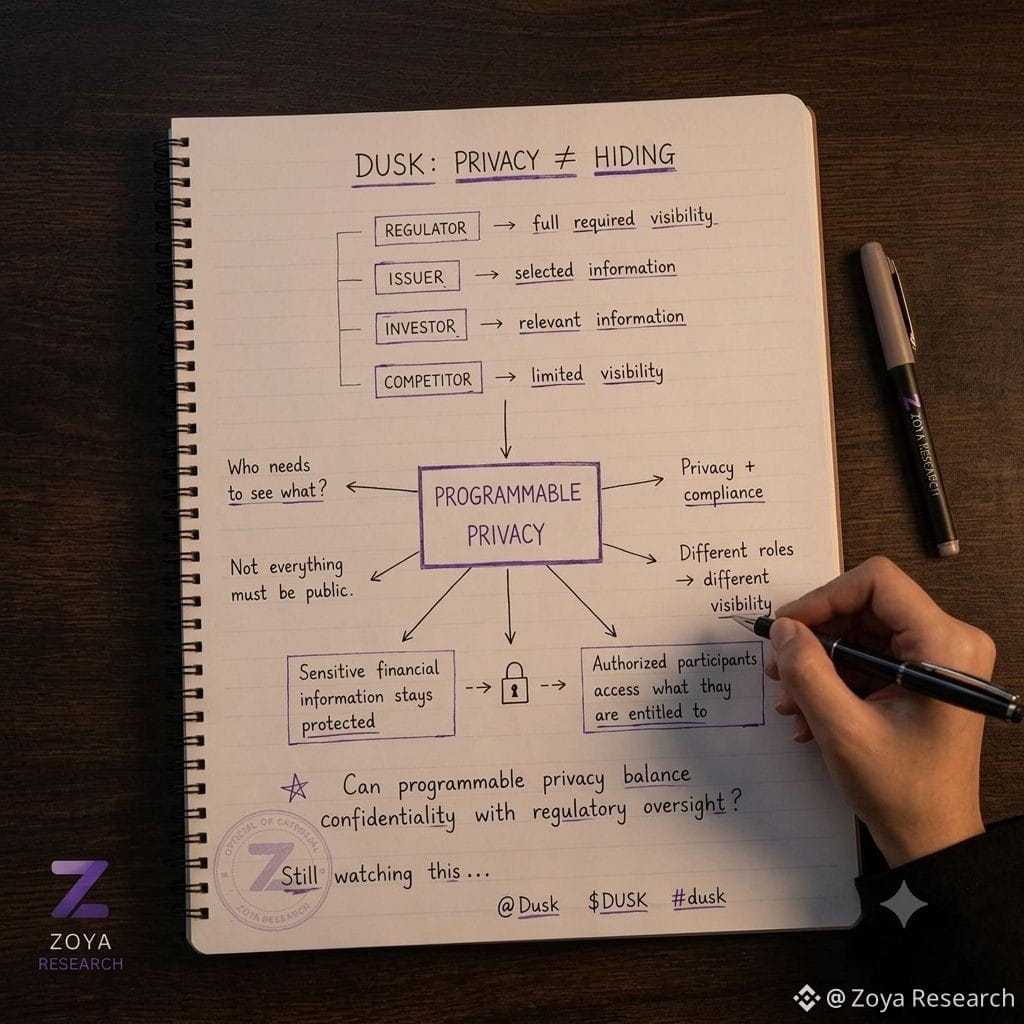
Na prática, não é uma questão de privacidade versus transparência. Trata-se de saber se participantes diferentes podem ter níveis diferentes de acesso ao mesmo fluxo financeiro.
Foi aí que a ideia da Dusk de privacidade programável chamou minha atenção.
As informações sensíveis podem permanecer protegidas, enquanto partes autorizadas ainda podem receber o que precisam para a análise. Para as finanças reguladas, essa distinção parece mais útil do que simplesmente chamar algo de “blockchain privada”.
A parte difícil é decidir como essas permissões devem funcionar entre reguladores, emissores, investidores e outros participantes, sem transformar cada transação em um registro totalmente público.
É essa a parte que eu ainda estou acompanhando.
Se participantes diferentes precisam de níveis diferentes de visibilidade, a privacidade programável pode se tornar uma forma prática de equilibrar confidencialidade com supervisão regulatória?
@Dusk_Foundation $DUSK #dusk
Voltei hoje ao modelo de privacidade da Dusk porque uma pergunta continuava me incomodando: se os mercados regulados ainda precisam de visibilidade, o que exatamente a privacidade está protegendo?
Quanto mais eu olhava para isso, menos eu acho que a resposta seja simplesmente “ocultar a transação”.
Uma instituição financeira pode precisar provar que algo aconteceu, enquanto um concorrente talvez não tenha motivo para ver a posição subjacente, o saldo ou outras informações sensíveis.
Isso cria um problema diferente.
Na prática, não é uma questão de privacidade versus transparência. Trata-se de saber se participantes diferentes podem ter níveis diferentes de acesso ao mesmo fluxo financeiro.
Foi aí que a ideia da Dusk de privacidade programável chamou minha atenção.
As informações sensíveis podem permanecer protegidas, enquanto partes autorizadas ainda podem receber o que precisam para a análise. Para as finanças reguladas, essa distinção parece mais útil do que simplesmente chamar algo de “blockchain privada”.
A parte difícil é decidir como essas permissões devem funcionar entre reguladores, emissores, investidores e outros participantes, sem transformar cada transação em um registro totalmente público.
É essa a parte que eu ainda estou acompanhando.
Se participantes diferentes precisam de níveis diferentes de visibilidade, a privacidade programável pode se tornar uma forma prática de equilibrar confidencialidade com supervisão regulatória?
@Dusk $DUSK #dusk
Quanto mais eu olhava para isso, menos eu acho que a resposta seja simplesmente “ocultar a transação”.
Uma instituição financeira pode precisar provar que algo aconteceu, enquanto um concorrente talvez não tenha motivo para ver a posição subjacente, o saldo ou outras informações sensíveis.
Isso cria um problema diferente.
Na prática, não é uma questão de privacidade versus transparência. Trata-se de saber se participantes diferentes podem ter níveis diferentes de acesso ao mesmo fluxo financeiro.
Foi aí que a ideia da Dusk de privacidade programável chamou minha atenção.
As informações sensíveis podem permanecer protegidas, enquanto partes autorizadas ainda podem receber o que precisam para a análise. Para as finanças reguladas, essa distinção parece mais útil do que simplesmente chamar algo de “blockchain privada”.
A parte difícil é decidir como essas permissões devem funcionar entre reguladores, emissores, investidores e outros participantes, sem transformar cada transação em um registro totalmente público.
É essa a parte que eu ainda estou acompanhando.
Se participantes diferentes precisam de níveis diferentes de visibilidade, a privacidade programável pode se tornar uma forma prática de equilibrar confidencialidade com supervisão regulatória?
@Dusk $DUSK #dusk
1
75
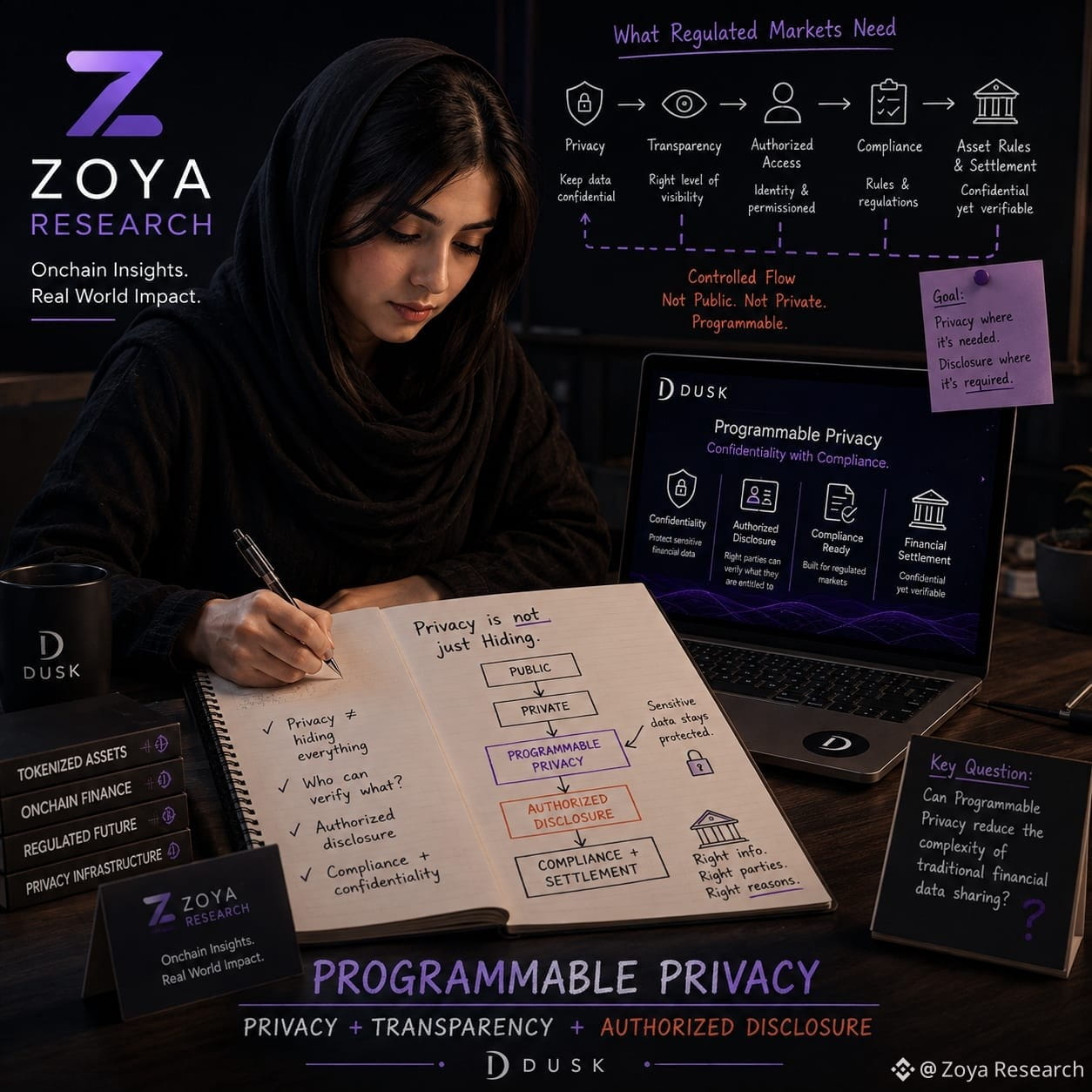
Eu costumava pensar que privacidade nos mercados financeiros significava, principalmente, ocultar informações sensíveis da visão do público.
Quanto mais eu observo a Dusk, mais acho que essa definição é estreita demais.
O que chamou minha atenção foi a ideia de privacidade programável: manter informações sensíveis confidenciais onde for necessário, ao mesmo tempo em que permite divulgar as informações corretas quando uma parte autorizada precisar revisá-las.
Essa distinção importa em mercados regulados.
Uma aplicação financeira não necessariamente precisa que todas as peças de dados fiquem visíveis para todos. Ela precisa que as partes certas consigam verificar o que têm permissão para verificar, enquanto a informação sensível subjacente permanece protegida.
Isso faz a privacidade parecer menos um interruptor entre “público” e “privado” e mais algo que pode ser incorporado à forma como as aplicações financeiras operam.
É isso que torna a abordagem XSC da Dusk interessante para mim: ela levanta a pergunta de como a confidencialidade pode coexistir com regras de ativos orientadas à conformidade e com a liquidação.
Mas ainda me pergunto o quão longe a privacidade programável pode ir em fluxos de trabalho institucionais reais.
Se mercados regulados precisam de privacidade, transparência e divulgação autorizada ao mesmo tempo, a privacidade programável pode, de fato, reduzir a complexidade do compartilhamento tradicional de dados financeiros?
@Dusk_Foundation $DUSK #dusk
Eu costumava pensar que privacidade nos mercados financeiros significava, principalmente, ocultar informações sensíveis da visão do público.
Quanto mais eu observo a Dusk, mais acho que essa definição é estreita demais.
O que chamou minha atenção foi a ideia de privacidade programável: manter informações sensíveis confidenciais onde for necessário, ao mesmo tempo em que permite divulgar as informações corretas quando uma parte autorizada precisar revisá-las.
Essa distinção importa em mercados regulados.
Uma aplicação financeira não necessariamente precisa que todas as peças de dados fiquem visíveis para todos. Ela precisa que as partes certas consigam verificar o que têm permissão para verificar, enquanto a informação sensível subjacente permanece protegida.
Isso faz a privacidade parecer menos um interruptor entre “público” e “privado” e mais algo que pode ser incorporado à forma como as aplicações financeiras operam.
É isso que torna a abordagem XSC da Dusk interessante para mim: ela levanta a pergunta de como a confidencialidade pode coexistir com regras de ativos orientadas à conformidade e com a liquidação.
Mas ainda me pergunto o quão longe a privacidade programável pode ir em fluxos de trabalho institucionais reais.
Se mercados regulados precisam de privacidade, transparência e divulgação autorizada ao mesmo tempo, a privacidade programável pode, de fato, reduzir a complexidade do compartilhamento tradicional de dados financeiros?
@Dusk $DUSK #dusk
Quanto mais eu observo a Dusk, mais acho que essa definição é estreita demais.
O que chamou minha atenção foi a ideia de privacidade programável: manter informações sensíveis confidenciais onde for necessário, ao mesmo tempo em que permite divulgar as informações corretas quando uma parte autorizada precisar revisá-las.
Essa distinção importa em mercados regulados.
Uma aplicação financeira não necessariamente precisa que todas as peças de dados fiquem visíveis para todos. Ela precisa que as partes certas consigam verificar o que têm permissão para verificar, enquanto a informação sensível subjacente permanece protegida.
Isso faz a privacidade parecer menos um interruptor entre “público” e “privado” e mais algo que pode ser incorporado à forma como as aplicações financeiras operam.
É isso que torna a abordagem XSC da Dusk interessante para mim: ela levanta a pergunta de como a confidencialidade pode coexistir com regras de ativos orientadas à conformidade e com a liquidação.
Mas ainda me pergunto o quão longe a privacidade programável pode ir em fluxos de trabalho institucionais reais.
Se mercados regulados precisam de privacidade, transparência e divulgação autorizada ao mesmo tempo, a privacidade programável pode, de fato, reduzir a complexidade do compartilhamento tradicional de dados financeiros?
@Dusk $DUSK #dusk
1
88
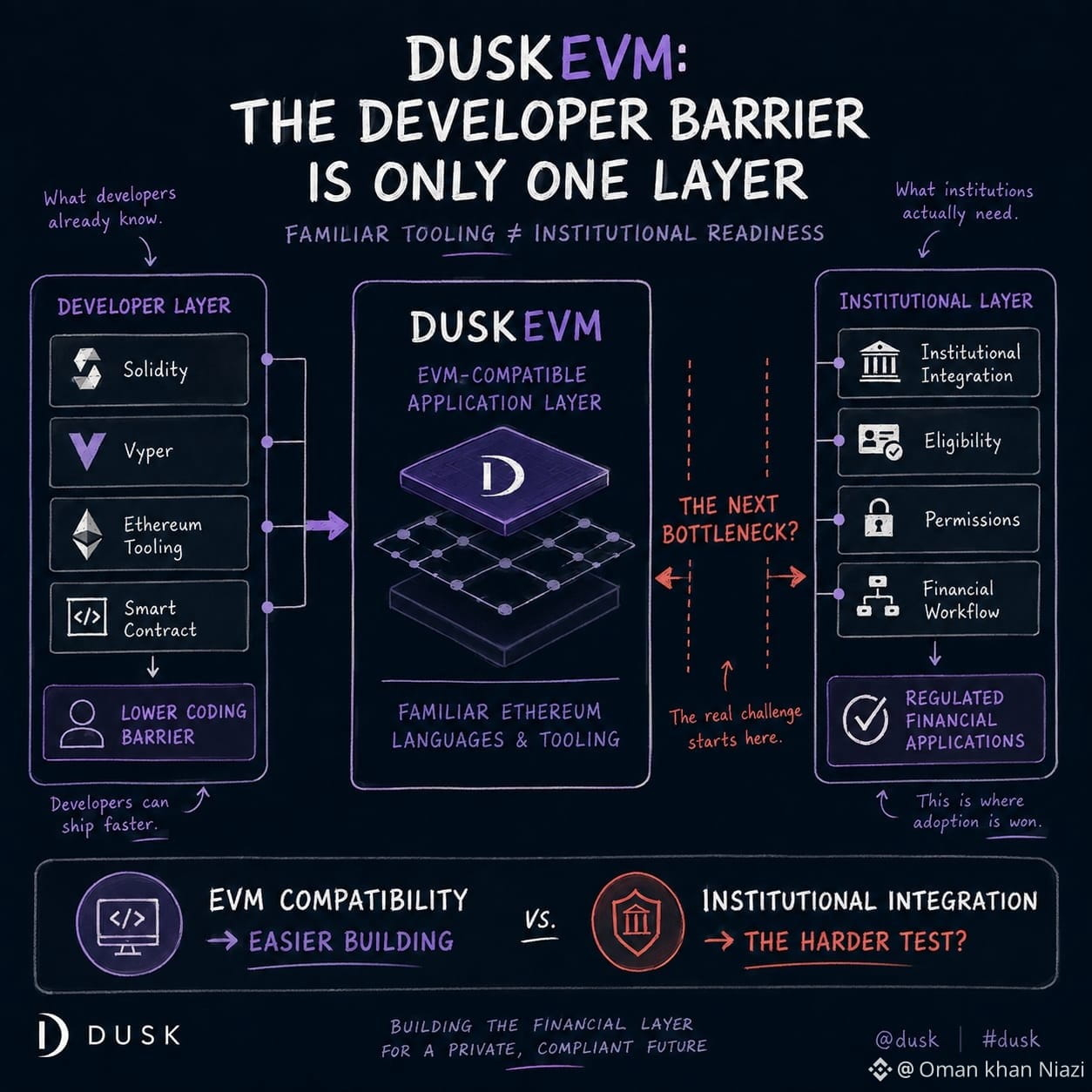
Eu costumava pensar que a compatibilidade com EVM resolvia principalmente o problema de onboarding do desenvolvedor.
Se o DuskEVM suportar linguagens e ferramentas de Ethereum familiares, incluindo Solidity e Vyper, os desenvolvedores podem começar a construir sem precisar aprender primeiro um ambiente de contratos inteligentes totalmente diferente.
Isso importa.
Mas, quanto mais eu analiso o Dusk no contexto de aplicações financeiras, mais acho que isso resolve apenas uma camada do problema.
Um desenvolvedor pode implantar uma aplicação usando ferramentas familiares. Isso não responde automaticamente quem está autorizado a interagir com ela, quais informações devem permanecer confidenciais, como a elegibilidade é aplicada, ou como a aplicação se encaixa no fluxo de trabalho financeiro mais amplo.
Essa distinção chamou minha atenção.
A compatibilidade com EVM pode reduzir a barreira de codificação.
Talvez ela não reduza a complexidade institucional em torno da aplicação.
E, para mercados financeiros regulados, essa segunda parte pode ser o problema mais difícil.
Ainda estou acompanhando como essas duas camadas se encaixam.
Se o DuskEVM tornar a construção familiar, o verdadeiro gargalo simplesmente muda da adoção pelo desenvolvedor para a integração institucional?
@Dusk_Foundation $DUSK #dusk
Eu costumava pensar que a compatibilidade com EVM resolvia principalmente o problema de onboarding do desenvolvedor.
Se o DuskEVM suportar linguagens e ferramentas de Ethereum familiares, incluindo Solidity e Vyper, os desenvolvedores podem começar a construir sem precisar aprender primeiro um ambiente de contratos inteligentes totalmente diferente.
Isso importa.
Mas, quanto mais eu analiso o Dusk no contexto de aplicações financeiras, mais acho que isso resolve apenas uma camada do problema.
Um desenvolvedor pode implantar uma aplicação usando ferramentas familiares. Isso não responde automaticamente quem está autorizado a interagir com ela, quais informações devem permanecer confidenciais, como a elegibilidade é aplicada, ou como a aplicação se encaixa no fluxo de trabalho financeiro mais amplo.
Essa distinção chamou minha atenção.
A compatibilidade com EVM pode reduzir a barreira de codificação.
Talvez ela não reduza a complexidade institucional em torno da aplicação.
E, para mercados financeiros regulados, essa segunda parte pode ser o problema mais difícil.
Ainda estou acompanhando como essas duas camadas se encaixam.
Se o DuskEVM tornar a construção familiar, o verdadeiro gargalo simplesmente muda da adoção pelo desenvolvedor para a integração institucional?
@Dusk $DUSK #dusk
Se o DuskEVM suportar linguagens e ferramentas de Ethereum familiares, incluindo Solidity e Vyper, os desenvolvedores podem começar a construir sem precisar aprender primeiro um ambiente de contratos inteligentes totalmente diferente.
Isso importa.
Mas, quanto mais eu analiso o Dusk no contexto de aplicações financeiras, mais acho que isso resolve apenas uma camada do problema.
Um desenvolvedor pode implantar uma aplicação usando ferramentas familiares. Isso não responde automaticamente quem está autorizado a interagir com ela, quais informações devem permanecer confidenciais, como a elegibilidade é aplicada, ou como a aplicação se encaixa no fluxo de trabalho financeiro mais amplo.
Essa distinção chamou minha atenção.
A compatibilidade com EVM pode reduzir a barreira de codificação.
Talvez ela não reduza a complexidade institucional em torno da aplicação.
E, para mercados financeiros regulados, essa segunda parte pode ser o problema mais difícil.
Ainda estou acompanhando como essas duas camadas se encaixam.
Se o DuskEVM tornar a construção familiar, o verdadeiro gargalo simplesmente muda da adoção pelo desenvolvedor para a integração institucional?
@Dusk $DUSK #dusk
4
3
91
Voltei a Dusk Trade hoje porque chamar isso de “neobroker” não explica de verdade o que chamou minha atenção.
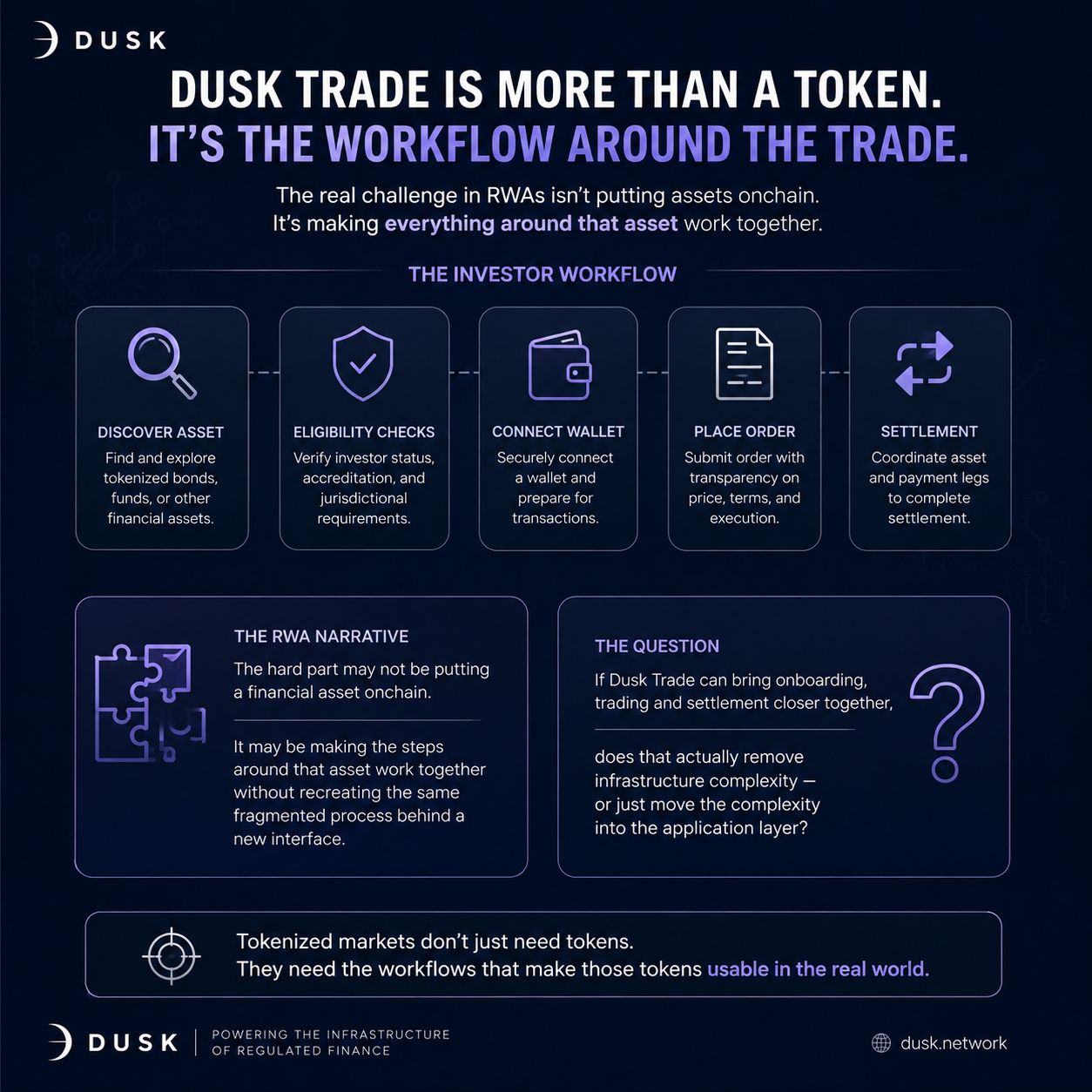
A parte interessante não é apenas conseguir comprar ou vender um título tokenizado, um fundo ou outro ativo financeiro.
É o que precisa acontecer ao redor dessa negociação.
Um investidor pode precisar descobrir o ativo, concluir verificações de elegibilidade, conectar uma carteira, colocar uma ordem e, então, ter as pontas do ativo e do pagamento coordenadas via liquidação.
O que chamou minha atenção foi como a Dusk Trade lida com esses fluxos de trabalho — e não tratando o token como o produto inteiro.
Isso me fez repensar a narrativa usual de RWA.
A parte difícil talvez não seja colocar um ativo financeiro onchain.
Pode ser fazer com que as etapas em torno desse ativo funcionem juntas, sem recriar o mesmo processo fragmentado por trás de uma nova interface.
É nisso que ainda não tenho certeza.
Se a Dusk Trade conseguir aproximar onboarding, negociação e liquidação, isso realmente remove a complexidade da infraestrutura — ou apenas desloca essa complexidade para a camada de aplicação?
Acredito que essa é a parte que vale observar à medida que os mercados tokenizados se tornarem mais práticos.
@Dusk_Foundation $DUSK #dusk
Voltei a Dusk Trade hoje porque chamar isso de “neobroker” não explica de verdade o que chamou minha atenção.
A parte interessante não é apenas conseguir comprar ou vender um título tokenizado, um fundo ou outro ativo financeiro.
É o que precisa acontecer ao redor dessa negociação.
Um investidor pode precisar descobrir o ativo, concluir verificações de elegibilidade, conectar uma carteira, colocar uma ordem e, então, ter as pontas do ativo e do pagamento coordenadas via liquidação.
O que chamou minha atenção foi como a Dusk Trade lida com esses fluxos de trabalho — e não tratando o token como o produto inteiro.
Isso me fez repensar a narrativa usual de RWA.
A parte difícil talvez não seja colocar um ativo financeiro onchain.
Pode ser fazer com que as etapas em torno desse ativo funcionem juntas, sem recriar o mesmo processo fragmentado por trás de uma nova interface.
É nisso que ainda não tenho certeza.
Se a Dusk Trade conseguir aproximar onboarding, negociação e liquidação, isso realmente remove a complexidade da infraestrutura — ou apenas desloca essa complexidade para a camada de aplicação?
Acredito que essa é a parte que vale observar à medida que os mercados tokenizados se tornarem mais práticos.
@Dusk $DUSK #dusk
A parte interessante não é apenas conseguir comprar ou vender um título tokenizado, um fundo ou outro ativo financeiro.
É o que precisa acontecer ao redor dessa negociação.
Um investidor pode precisar descobrir o ativo, concluir verificações de elegibilidade, conectar uma carteira, colocar uma ordem e, então, ter as pontas do ativo e do pagamento coordenadas via liquidação.
O que chamou minha atenção foi como a Dusk Trade lida com esses fluxos de trabalho — e não tratando o token como o produto inteiro.
Isso me fez repensar a narrativa usual de RWA.
A parte difícil talvez não seja colocar um ativo financeiro onchain.
Pode ser fazer com que as etapas em torno desse ativo funcionem juntas, sem recriar o mesmo processo fragmentado por trás de uma nova interface.
É nisso que ainda não tenho certeza.
Se a Dusk Trade conseguir aproximar onboarding, negociação e liquidação, isso realmente remove a complexidade da infraestrutura — ou apenas desloca essa complexidade para a camada de aplicação?
Acredito que essa é a parte que vale observar à medida que os mercados tokenizados se tornarem mais práticos.
@Dusk $DUSK #dusk
4
81
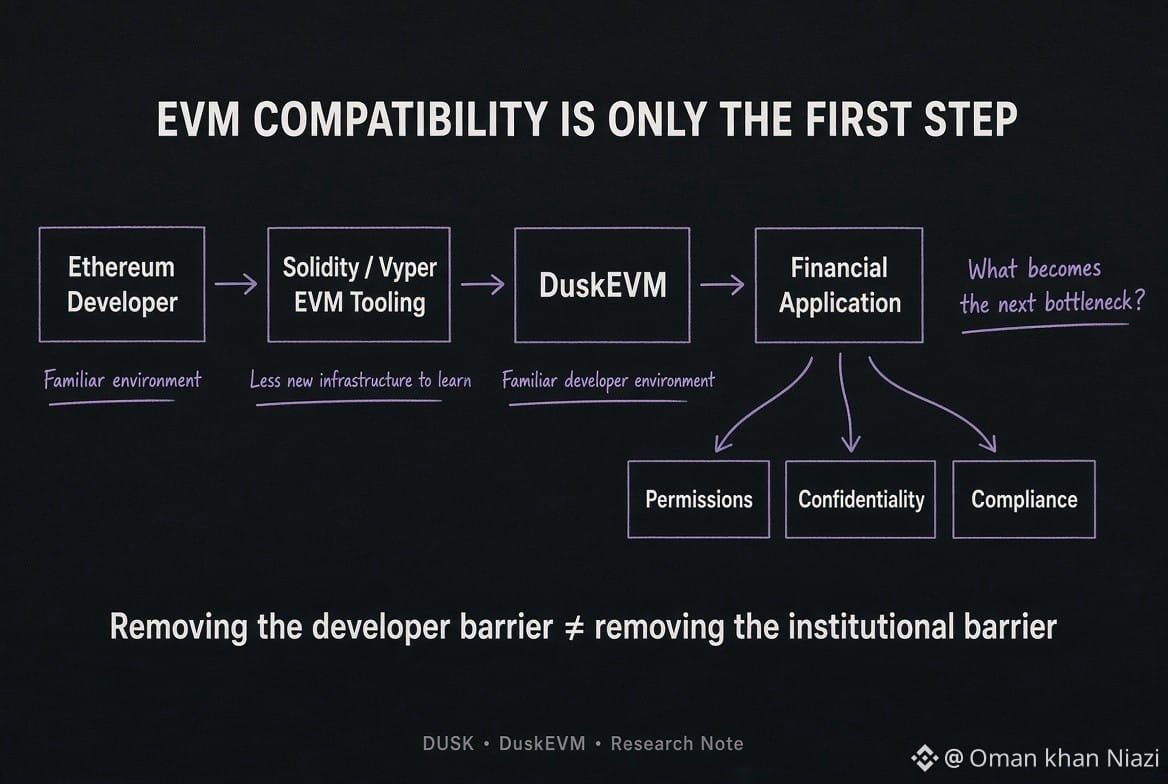
Voltei ao DuskEVM hoje porque queria entender o que, de fato, a compatibilidade com EVM muda além do título.
Um detalhe que se destacou é que o DuskEVM foi construído para funcionar com linguagens e ferramentas de desenvolvimento em Ethereum que já são conhecidas, incluindo Solidity e Vyper.
Isso importa porque os desenvolvedores não necessariamente precisam aprender um ambiente de contratos inteligentes totalmente diferente apenas para começar a construir no Dusk.
Mas então comecei a pensar no que acontece depois desse primeiro passo.
Se o processo de fazer deploy de uma aplicação fica mais fácil, as perguntas mais difíceis para aplicações financeiras não desaparecem.
Quem tem permissão para interagir com ela?
Que informações precisam permanecer confidenciais?
Como os requisitos de conformidade são aplicados?
E como a aplicação se conecta ao restante do fluxo de trabalho financeiro?
Então eu não acho que a compatibilidade com EVM seja, por si só, a parte realmente interessante.
A parte interessante é se a infraestrutura familiar para desenvolvedores pode, de fato, levar a aplicações que funcionam sob restrições institucionais reais.
Se o DuskEVM remove a barreira para desenvolvedores, qual vira o próximo gargalo para colocar aplicações financeiras em uso no mundo real?
@Dusk_Foundation $DUSK #dusk
Voltei ao DuskEVM hoje porque queria entender o que, de fato, a compatibilidade com EVM muda além do título.
Um detalhe que se destacou é que o DuskEVM foi construído para funcionar com linguagens e ferramentas de desenvolvimento em Ethereum que já são conhecidas, incluindo Solidity e Vyper.
Isso importa porque os desenvolvedores não necessariamente precisam aprender um ambiente de contratos inteligentes totalmente diferente apenas para começar a construir no Dusk.
Mas então comecei a pensar no que acontece depois desse primeiro passo.
Se o processo de fazer deploy de uma aplicação fica mais fácil, as perguntas mais difíceis para aplicações financeiras não desaparecem.
Quem tem permissão para interagir com ela?
Que informações precisam permanecer confidenciais?
Como os requisitos de conformidade são aplicados?
E como a aplicação se conecta ao restante do fluxo de trabalho financeiro?
Então eu não acho que a compatibilidade com EVM seja, por si só, a parte realmente interessante.
A parte interessante é se a infraestrutura familiar para desenvolvedores pode, de fato, levar a aplicações que funcionam sob restrições institucionais reais.
Se o DuskEVM remove a barreira para desenvolvedores, qual vira o próximo gargalo para colocar aplicações financeiras em uso no mundo real?
@Dusk $DUSK #dusk
Um detalhe que se destacou é que o DuskEVM foi construído para funcionar com linguagens e ferramentas de desenvolvimento em Ethereum que já são conhecidas, incluindo Solidity e Vyper.
Isso importa porque os desenvolvedores não necessariamente precisam aprender um ambiente de contratos inteligentes totalmente diferente apenas para começar a construir no Dusk.
Mas então comecei a pensar no que acontece depois desse primeiro passo.
Se o processo de fazer deploy de uma aplicação fica mais fácil, as perguntas mais difíceis para aplicações financeiras não desaparecem.
Quem tem permissão para interagir com ela?
Que informações precisam permanecer confidenciais?
Como os requisitos de conformidade são aplicados?
E como a aplicação se conecta ao restante do fluxo de trabalho financeiro?
Então eu não acho que a compatibilidade com EVM seja, por si só, a parte realmente interessante.
A parte interessante é se a infraestrutura familiar para desenvolvedores pode, de fato, levar a aplicações que funcionam sob restrições institucionais reais.
Se o DuskEVM remove a barreira para desenvolvedores, qual vira o próximo gargalo para colocar aplicações financeiras em uso no mundo real?
@Dusk $DUSK #dusk
7
71
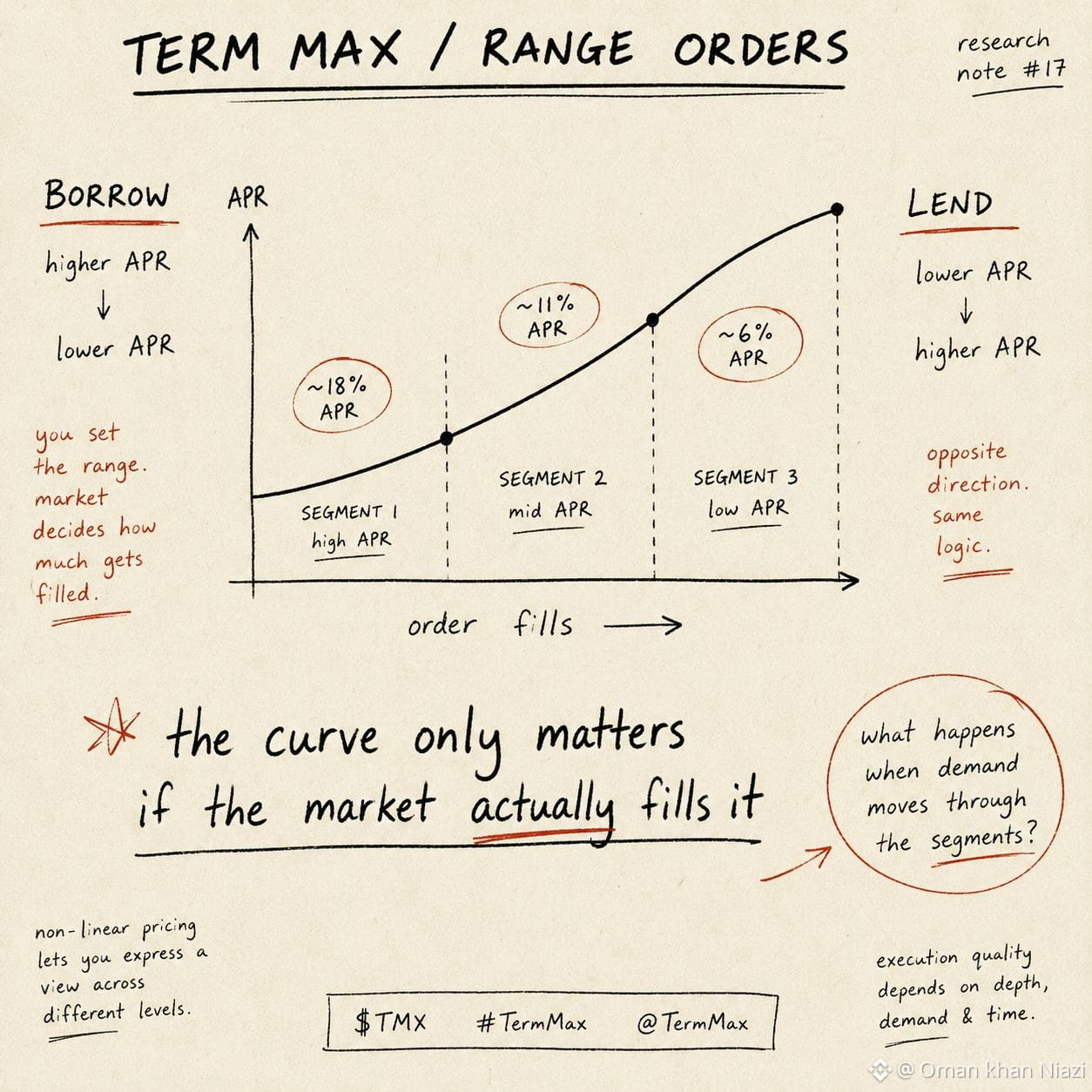
Notei que a parte interessante do @TermMax não é apenas que as taxas são fixas. É que a taxa pode ser estruturada de acordo com a quantidade de uma ordem que realmente é executada.
As Ordens de Intervalo do TermMax usam curvas de precificação com segmentos diferentes. Em uma ordem de intervalo para empréstimo, as porções iniciais podem ter APRs mais altas e as porções finais, APRs mais baixas à medida que a ordem é preenchida. Para empréstimos, a curva funciona na direção oposta, com as taxas aumentando ao longo das porções definidas.
Isso me fez olhar para a própria ordem de forma diferente.
Uma ordem de intervalo não é apenas dizer, “esta é a minha taxa”. Ela define como a taxa pode responder conforme diferentes quantidades de liquidez são retiradas.
Mas isso também cria uma tensão interessante: a curva só importa se o mercado realmente a preencher. A documentação do TermMax também destaca capital não utilizado e curvas de precificação mal configuradas como riscos para quem define ordens de intervalo.
Então o que eu quero observar é como essas curvas se comportam quando a demanda real passa por diferentes tamanhos de ordens.
A estrutura da curva consegue encontrar taxas úteis na prática, ou a eficácia depende demais de acertar o perfil de demanda?
#TermMax @termmax
Notei que a parte interessante do @TermMax não é apenas que as taxas são fixas. É que a taxa pode ser estruturada de acordo com a quantidade de uma ordem que realmente é executada.
As Ordens de Intervalo do TermMax usam curvas de precificação com segmentos diferentes. Em uma ordem de intervalo para empréstimo, as porções iniciais podem ter APRs mais altas e as porções finais, APRs mais baixas à medida que a ordem é preenchida. Para empréstimos, a curva funciona na direção oposta, com as taxas aumentando ao longo das porções definidas.
Isso me fez olhar para a própria ordem de forma diferente.
Uma ordem de intervalo não é apenas dizer, “esta é a minha taxa”. Ela define como a taxa pode responder conforme diferentes quantidades de liquidez são retiradas.
Mas isso também cria uma tensão interessante: a curva só importa se o mercado realmente a preencher. A documentação do TermMax também destaca capital não utilizado e curvas de precificação mal configuradas como riscos para quem define ordens de intervalo.
Então o que eu quero observar é como essas curvas se comportam quando a demanda real passa por diferentes tamanhos de ordens.
A estrutura da curva consegue encontrar taxas úteis na prática, ou a eficácia depende demais de acertar o perfil de demanda?
#TermMax @TermMax
As Ordens de Intervalo do TermMax usam curvas de precificação com segmentos diferentes. Em uma ordem de intervalo para empréstimo, as porções iniciais podem ter APRs mais altas e as porções finais, APRs mais baixas à medida que a ordem é preenchida. Para empréstimos, a curva funciona na direção oposta, com as taxas aumentando ao longo das porções definidas.
Isso me fez olhar para a própria ordem de forma diferente.
Uma ordem de intervalo não é apenas dizer, “esta é a minha taxa”. Ela define como a taxa pode responder conforme diferentes quantidades de liquidez são retiradas.
Mas isso também cria uma tensão interessante: a curva só importa se o mercado realmente a preencher. A documentação do TermMax também destaca capital não utilizado e curvas de precificação mal configuradas como riscos para quem define ordens de intervalo.
Então o que eu quero observar é como essas curvas se comportam quando a demanda real passa por diferentes tamanhos de ordens.
A estrutura da curva consegue encontrar taxas úteis na prática, ou a eficácia depende demais de acertar o perfil de demanda?
#TermMax @TermMax
1
6
80
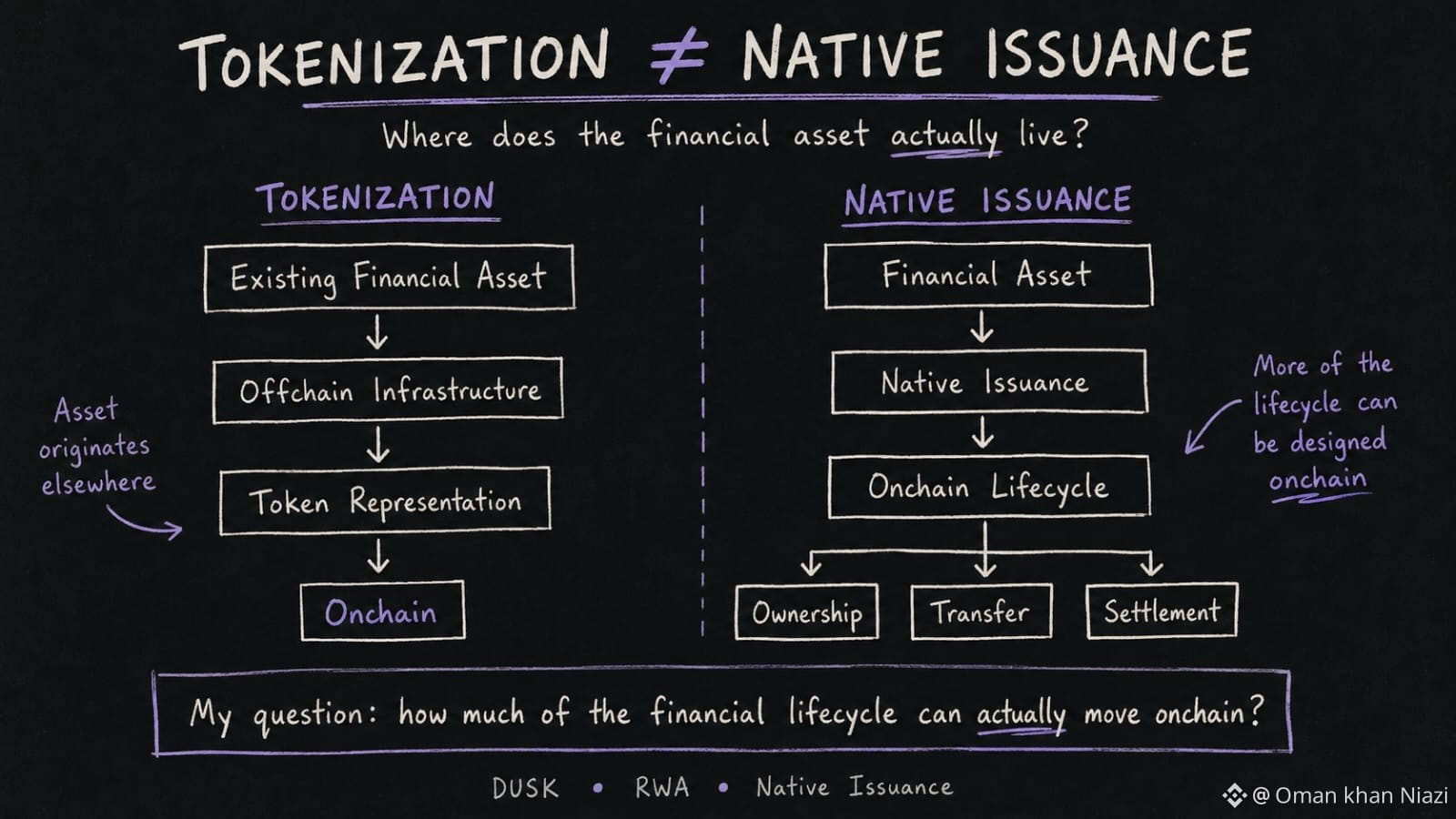
Ainda acho que a maioria das conversas sobre RWA trata a tokenização como a linha de chegada.
Coloca-se um ativo existente onchain, dá-se a ele uma representação digital e, de repente, parece que o próprio ativo financeiro teria se movido para o blockchain.
Mas, quanto mais eu observo a abordagem da Dusk para a emissão nativa, mais penso que existe uma distinção importante.
A tokenização pode representar um ativo que já existe em outro lugar. A emissão nativa começa de um ponto diferente: a infraestrutura pode ser projetada para carregar mais do ciclo de vida do ativo onchain, dependendo da configuração legal e do produto.
Essa diferença chamou minha atenção.
Porque, se a emissão acontece em um sistema, a propriedade é registrada em algum outro lugar, e transferências ou liquidação ainda dependem de registros separados, colocar um token onchain não necessariamente elimina o problema de infraestrutura subjacente.
Então, para mim, a parte interessante da emissão nativa não é simplesmente criar outro token.
É a possibilidade de reduzir a distância entre o ativo digital e a infraestrutura financeira responsável por ele.
Ainda sou cauteloso sobre até que ponto isso pode realmente avançar em mercados regulamentados. A propriedade legal, intermediários autorizados e responsabilidades operacionais não desaparecem apenas porque um ativo é representado onchain.
Então, para mim, o teste real não é quantas RWAs podem ser tokenizadas.
Se a emissão nativa puder mover mais do ciclo de vida de um ativo para o ledger, que parte da infraestrutura financeira tradicional se torna mais difícil de substituir?
@Dusk_Foundation $DUSK #dusk
Ainda acho que a maioria das conversas sobre RWA trata a tokenização como a linha de chegada.
Coloca-se um ativo existente onchain, dá-se a ele uma representação digital e, de repente, parece que o próprio ativo financeiro teria se movido para o blockchain.
Mas, quanto mais eu observo a abordagem da Dusk para a emissão nativa, mais penso que existe uma distinção importante.
A tokenização pode representar um ativo que já existe em outro lugar. A emissão nativa começa de um ponto diferente: a infraestrutura pode ser projetada para carregar mais do ciclo de vida do ativo onchain, dependendo da configuração legal e do produto.
Essa diferença chamou minha atenção.
Porque, se a emissão acontece em um sistema, a propriedade é registrada em algum outro lugar, e transferências ou liquidação ainda dependem de registros separados, colocar um token onchain não necessariamente elimina o problema de infraestrutura subjacente.
Então, para mim, a parte interessante da emissão nativa não é simplesmente criar outro token.
É a possibilidade de reduzir a distância entre o ativo digital e a infraestrutura financeira responsável por ele.
Ainda sou cauteloso sobre até que ponto isso pode realmente avançar em mercados regulamentados. A propriedade legal, intermediários autorizados e responsabilidades operacionais não desaparecem apenas porque um ativo é representado onchain.
Então, para mim, o teste real não é quantas RWAs podem ser tokenizadas.
Se a emissão nativa puder mover mais do ciclo de vida de um ativo para o ledger, que parte da infraestrutura financeira tradicional se torna mais difícil de substituir?
@Dusk $DUSK #dusk
Coloca-se um ativo existente onchain, dá-se a ele uma representação digital e, de repente, parece que o próprio ativo financeiro teria se movido para o blockchain.
Mas, quanto mais eu observo a abordagem da Dusk para a emissão nativa, mais penso que existe uma distinção importante.
A tokenização pode representar um ativo que já existe em outro lugar. A emissão nativa começa de um ponto diferente: a infraestrutura pode ser projetada para carregar mais do ciclo de vida do ativo onchain, dependendo da configuração legal e do produto.
Essa diferença chamou minha atenção.
Porque, se a emissão acontece em um sistema, a propriedade é registrada em algum outro lugar, e transferências ou liquidação ainda dependem de registros separados, colocar um token onchain não necessariamente elimina o problema de infraestrutura subjacente.
Então, para mim, a parte interessante da emissão nativa não é simplesmente criar outro token.
É a possibilidade de reduzir a distância entre o ativo digital e a infraestrutura financeira responsável por ele.
Ainda sou cauteloso sobre até que ponto isso pode realmente avançar em mercados regulamentados. A propriedade legal, intermediários autorizados e responsabilidades operacionais não desaparecem apenas porque um ativo é representado onchain.
Então, para mim, o teste real não é quantas RWAs podem ser tokenizadas.
Se a emissão nativa puder mover mais do ciclo de vida de um ativo para o ledger, que parte da infraestrutura financeira tradicional se torna mais difícil de substituir?
@Dusk $DUSK #dusk
5
7
65
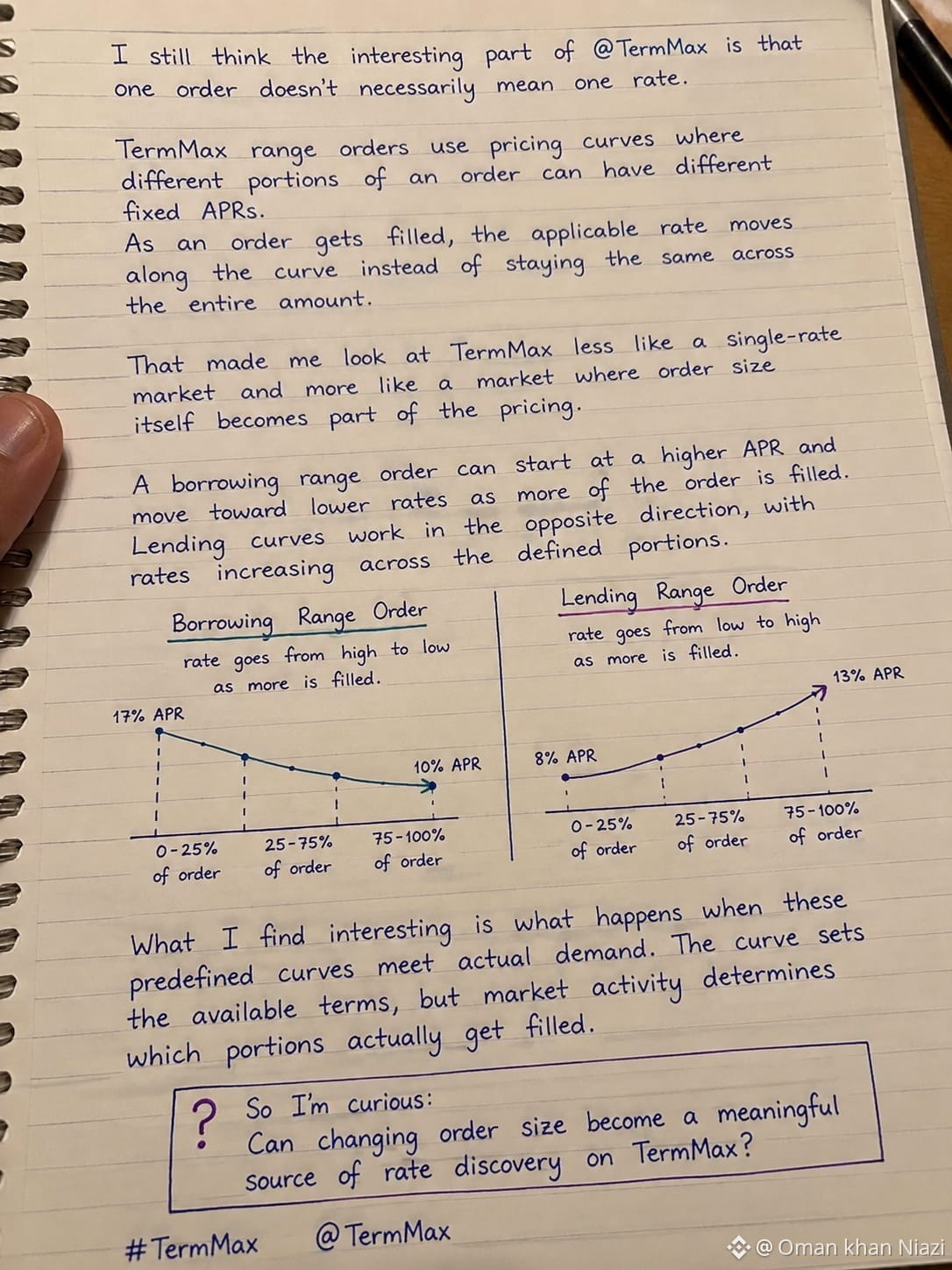
Ainda acho que a parte interessante de @termmax é que uma única ordem não necessariamente significa uma única taxa.
As ordens de range TermMax usam curvas de precificação em que diferentes partes de uma ordem podem ter APRs fixas diferentes. À medida que a ordem é executada, a taxa aplicável se move ao longo da curva em vez de permanecer a mesma em todo o valor.
Isso me fez olhar para o TermMax menos como um mercado de taxa única e mais como um mercado em que o tamanho da ordem em si passa a fazer parte da precificação.
Uma ordem de faixa de empréstimo pode começar com uma APR mais alta e se mover em direção a taxas mais baixas à medida que mais da ordem é preenchida. As curvas de empréstimo funcionam na direção oposta, com as taxas aumentando nas porções definidas.
O que acho interessante é o que acontece quando essas curvas predefinidas encontram a demanda real. A curva define os termos disponíveis, mas a atividade do mercado determina quais porções de fato são executadas.
Então fico curioso:
Mudar o tamanho da ordem pode se tornar uma fonte significativa de descoberta de taxa no TermMax?
#TermMax @termmax
Ainda acho que a parte interessante de @TermMax é que uma única ordem não necessariamente significa uma única taxa.
As ordens de range TermMax usam curvas de precificação em que diferentes partes de uma ordem podem ter APRs fixas diferentes. À medida que a ordem é executada, a taxa aplicável se move ao longo da curva em vez de permanecer a mesma em todo o valor.
Isso me fez olhar para o TermMax menos como um mercado de taxa única e mais como um mercado em que o tamanho da ordem em si passa a fazer parte da precificação.
Uma ordem de faixa de empréstimo pode começar com uma APR mais alta e se mover em direção a taxas mais baixas à medida que mais da ordem é preenchida. As curvas de empréstimo funcionam na direção oposta, com as taxas aumentando nas porções definidas.
O que acho interessante é o que acontece quando essas curvas predefinidas encontram a demanda real. A curva define os termos disponíveis, mas a atividade do mercado determina quais porções de fato são executadas.
Então fico curioso:
Mudar o tamanho da ordem pode se tornar uma fonte significativa de descoberta de taxa no TermMax?
#TermMax @TermMax
As ordens de range TermMax usam curvas de precificação em que diferentes partes de uma ordem podem ter APRs fixas diferentes. À medida que a ordem é executada, a taxa aplicável se move ao longo da curva em vez de permanecer a mesma em todo o valor.
Isso me fez olhar para o TermMax menos como um mercado de taxa única e mais como um mercado em que o tamanho da ordem em si passa a fazer parte da precificação.
Uma ordem de faixa de empréstimo pode começar com uma APR mais alta e se mover em direção a taxas mais baixas à medida que mais da ordem é preenchida. As curvas de empréstimo funcionam na direção oposta, com as taxas aumentando nas porções definidas.
O que acho interessante é o que acontece quando essas curvas predefinidas encontram a demanda real. A curva define os termos disponíveis, mas a atividade do mercado determina quais porções de fato são executadas.
Então fico curioso:
Mudar o tamanho da ordem pode se tornar uma fonte significativa de descoberta de taxa no TermMax?
#TermMax @TermMax
5
7
95
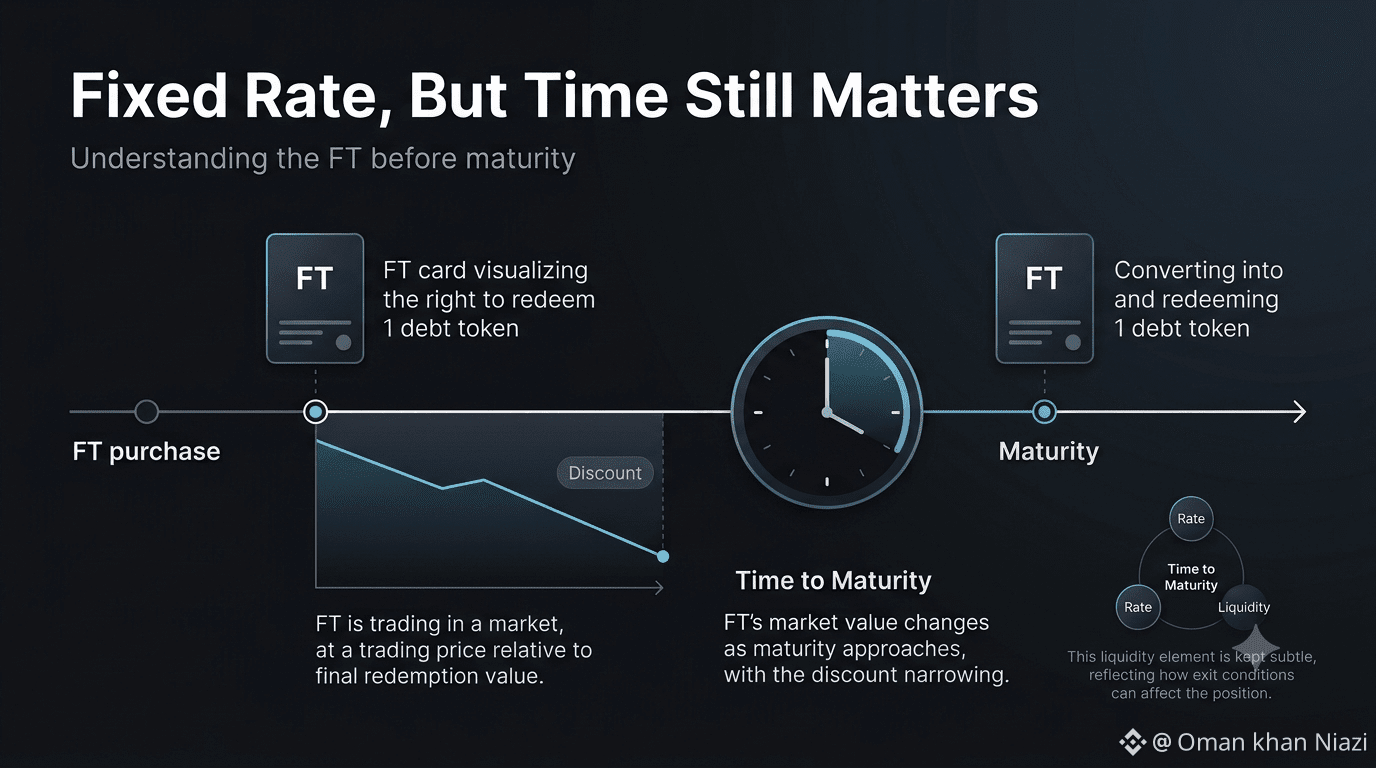
Ainda acho que “taxa fixa” pode fazer uma posição parecer mais estática do que realmente é.
No TermMax, um FT representa o direito de resgatar 1 token de dívida no vencimento. Antes do vencimento, FTs podem ser negociados com desconto, enquanto o detentor também pode mantê-los até o vencimento para resgatar.
Isso me fez olhar para posições de taxa fixa de maneira diferente.
A taxa pode ser definida, mas o preço de mercado do FT ainda tem tempo associado a ele. À medida que o vencimento se aproxima, a diferença entre pelo que o FT é negociado e o que ele representa no vencimento se torna uma parte diferente da decisão.
O que me deixa curioso é como esse relacionamento se comporta quando a liquidez muda e os traders querem sair em pontos diferentes antes do vencimento.
O valor de uma posição de taxa fixa passa a ser mais sobre a taxa ou sobre o tempo restante até o vencimento?
#TermMax @termmax
Ainda acho que “taxa fixa” pode fazer uma posição parecer mais estática do que realmente é.
No TermMax, um FT representa o direito de resgatar 1 token de dívida no vencimento. Antes do vencimento, FTs podem ser negociados com desconto, enquanto o detentor também pode mantê-los até o vencimento para resgatar.
Isso me fez olhar para posições de taxa fixa de maneira diferente.
A taxa pode ser definida, mas o preço de mercado do FT ainda tem tempo associado a ele. À medida que o vencimento se aproxima, a diferença entre pelo que o FT é negociado e o que ele representa no vencimento se torna uma parte diferente da decisão.
O que me deixa curioso é como esse relacionamento se comporta quando a liquidez muda e os traders querem sair em pontos diferentes antes do vencimento.
O valor de uma posição de taxa fixa passa a ser mais sobre a taxa ou sobre o tempo restante até o vencimento?
#TermMax @TermMax
No TermMax, um FT representa o direito de resgatar 1 token de dívida no vencimento. Antes do vencimento, FTs podem ser negociados com desconto, enquanto o detentor também pode mantê-los até o vencimento para resgatar.
Isso me fez olhar para posições de taxa fixa de maneira diferente.
A taxa pode ser definida, mas o preço de mercado do FT ainda tem tempo associado a ele. À medida que o vencimento se aproxima, a diferença entre pelo que o FT é negociado e o que ele representa no vencimento se torna uma parte diferente da decisão.
O que me deixa curioso é como esse relacionamento se comporta quando a liquidez muda e os traders querem sair em pontos diferentes antes do vencimento.
O valor de uma posição de taxa fixa passa a ser mais sobre a taxa ou sobre o tempo restante até o vencimento?
#TermMax @TermMax
8
75
Ainda acho que a pergunta mais interessante em torno do DuskEVM não é se os desenvolvedores conseguem usar ferramentas EVM familiares.
O ponto é o que acontece quando o desenvolvimento EVM familiar encontra os requisitos de privacidade da finança regulamentada.
O DuskEVM foi projetado como a camada de aplicação compatível com EVM na pilha Dusk, enquanto o Hedger é o módulo de privacidade para fluxos de trabalho em EVM. O que chamou minha atenção é que o Hedger usa criptografia homomórfica e provas de conhecimento zero para dar suporte a fluxos de transações confidenciais.
Isso cria uma tensão interessante.
Em ambientes comuns de blockchain público, a transparência facilita a verificação. Mas instituições financeiras muitas vezes têm informações que não podem simplesmente ser expostas a todos.
Assim, o desafio fica mais específico: as transações podem permanecer confidenciais enquanto ainda permitem que as informações corretas sejam verificadas ou divulgadas quando necessário?
Minha observação é que esse é um problema muito mais difícil do que apenas “adicionar privacidade” a um ambiente EVM.
Estou interessado em ver como essa arquitetura se comporta quando aplicações financeiras reais começarem a utilizá-la.
Se as instituições precisarem de divulgação seletiva, quem deve controlar, em última instância, o que passa a ficar visível: a aplicação, o regulador ou o protocolo?
@Dusk_Foundation $DUSK #dusk
Ainda acho que a pergunta mais interessante em torno do DuskEVM não é se os desenvolvedores conseguem usar ferramentas EVM familiares.
O ponto é o que acontece quando o desenvolvimento EVM familiar encontra os requisitos de privacidade da finança regulamentada.
O DuskEVM foi projetado como a camada de aplicação compatível com EVM na pilha Dusk, enquanto o Hedger é o módulo de privacidade para fluxos de trabalho em EVM. O que chamou minha atenção é que o Hedger usa criptografia homomórfica e provas de conhecimento zero para dar suporte a fluxos de transações confidenciais.
Isso cria uma tensão interessante.
Em ambientes comuns de blockchain público, a transparência facilita a verificação. Mas instituições financeiras muitas vezes têm informações que não podem simplesmente ser expostas a todos.
Assim, o desafio fica mais específico: as transações podem permanecer confidenciais enquanto ainda permitem que as informações corretas sejam verificadas ou divulgadas quando necessário?
Minha observação é que esse é um problema muito mais difícil do que apenas “adicionar privacidade” a um ambiente EVM.
Estou interessado em ver como essa arquitetura se comporta quando aplicações financeiras reais começarem a utilizá-la.
Se as instituições precisarem de divulgação seletiva, quem deve controlar, em última instância, o que passa a ficar visível: a aplicação, o regulador ou o protocolo?
@Dusk $DUSK #dusk
O ponto é o que acontece quando o desenvolvimento EVM familiar encontra os requisitos de privacidade da finança regulamentada.
O DuskEVM foi projetado como a camada de aplicação compatível com EVM na pilha Dusk, enquanto o Hedger é o módulo de privacidade para fluxos de trabalho em EVM. O que chamou minha atenção é que o Hedger usa criptografia homomórfica e provas de conhecimento zero para dar suporte a fluxos de transações confidenciais.
Isso cria uma tensão interessante.
Em ambientes comuns de blockchain público, a transparência facilita a verificação. Mas instituições financeiras muitas vezes têm informações que não podem simplesmente ser expostas a todos.
Assim, o desafio fica mais específico: as transações podem permanecer confidenciais enquanto ainda permitem que as informações corretas sejam verificadas ou divulgadas quando necessário?
Minha observação é que esse é um problema muito mais difícil do que apenas “adicionar privacidade” a um ambiente EVM.
Estou interessado em ver como essa arquitetura se comporta quando aplicações financeiras reais começarem a utilizá-la.
Se as instituições precisarem de divulgação seletiva, quem deve controlar, em última instância, o que passa a ficar visível: a aplicação, o regulador ou o protocolo?
@Dusk $DUSK #dusk
Application
0%
Regulator
0%
Protocol
38%
Shared control
62%
8 Votos • Votação encerrada
9
91
Eu continuo voltando a uma pergunta quando olho para ativos financeiros tokenizados:
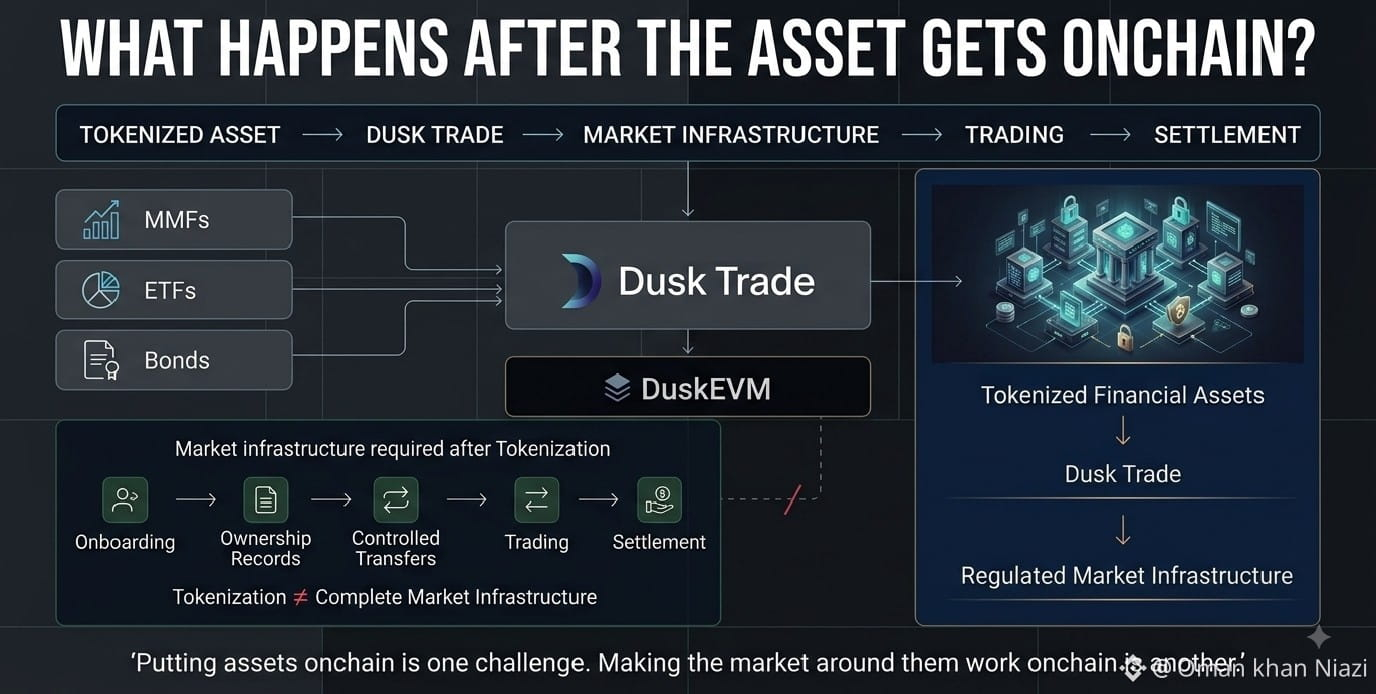
O que acontece depois que o ativo fica onchain?
No início, eu achava que a tokenização era a parte difícil. Mas quanto mais eu olho para a @Dusk, mais eu acho que o maior desafio é construir um mercado em torno desses ativos.
Foi isso que chamou minha atenção na Dusk Trade.
Ela está sendo construída como a camada de aplicação para ativos financeiros tokenizados na DuskEVM, com instrumentos como MMFs, ETFs e títulos projetados para operar dentro de uma estrutura de mercado regulada.
E essa distinção importa.
Um título tokenizado pode existir onchain, mas os investidores ainda precisam de onboarding, registros de propriedade, transferências controladas, negociação e liquidação. Se esses processos permanecerem fragmentados entre sistemas diferentes, colocar o ativo onchain apenas resolve parte do problema.
Para mim, o verdadeiro teste não é simplesmente quantos ativos podem ser tokenizados. É se a infraestrutura em torno deles se torna utilizável o suficiente para que esses ativos realmente funcionem em um mercado regulado.
Essa é a parte da Dusk Trade que eu estou observando com mais atenção.
Se o ativo está onchain, mas grande parte do mercado ao redor dele ainda funciona offchain, a tokenização realmente mudou o próprio mercado financeiro?
@Dusk_Foundation $DUSK #dusk
Eu continuo voltando a uma pergunta quando olho para ativos financeiros tokenizados:
O que acontece depois que o ativo fica onchain?
No início, eu achava que a tokenização era a parte difícil. Mas quanto mais eu olho para a @Dusk, mais eu acho que o maior desafio é construir um mercado em torno desses ativos.
Foi isso que chamou minha atenção na Dusk Trade.
Ela está sendo construída como a camada de aplicação para ativos financeiros tokenizados na DuskEVM, com instrumentos como MMFs, ETFs e títulos projetados para operar dentro de uma estrutura de mercado regulada.
E essa distinção importa.
Um título tokenizado pode existir onchain, mas os investidores ainda precisam de onboarding, registros de propriedade, transferências controladas, negociação e liquidação. Se esses processos permanecerem fragmentados entre sistemas diferentes, colocar o ativo onchain apenas resolve parte do problema.
Para mim, o verdadeiro teste não é simplesmente quantos ativos podem ser tokenizados. É se a infraestrutura em torno deles se torna utilizável o suficiente para que esses ativos realmente funcionem em um mercado regulado.
Essa é a parte da Dusk Trade que eu estou observando com mais atenção.
Se o ativo está onchain, mas grande parte do mercado ao redor dele ainda funciona offchain, a tokenização realmente mudou o próprio mercado financeiro?
@Dusk $DUSK #dusk
O que acontece depois que o ativo fica onchain?
No início, eu achava que a tokenização era a parte difícil. Mas quanto mais eu olho para a @Dusk, mais eu acho que o maior desafio é construir um mercado em torno desses ativos.
Foi isso que chamou minha atenção na Dusk Trade.
Ela está sendo construída como a camada de aplicação para ativos financeiros tokenizados na DuskEVM, com instrumentos como MMFs, ETFs e títulos projetados para operar dentro de uma estrutura de mercado regulada.
E essa distinção importa.
Um título tokenizado pode existir onchain, mas os investidores ainda precisam de onboarding, registros de propriedade, transferências controladas, negociação e liquidação. Se esses processos permanecerem fragmentados entre sistemas diferentes, colocar o ativo onchain apenas resolve parte do problema.
Para mim, o verdadeiro teste não é simplesmente quantos ativos podem ser tokenizados. É se a infraestrutura em torno deles se torna utilizável o suficiente para que esses ativos realmente funcionem em um mercado regulado.
Essa é a parte da Dusk Trade que eu estou observando com mais atenção.
Se o ativo está onchain, mas grande parte do mercado ao redor dele ainda funciona offchain, a tokenização realmente mudou o próprio mercado financeiro?
@Dusk $DUSK #dusk
6
55
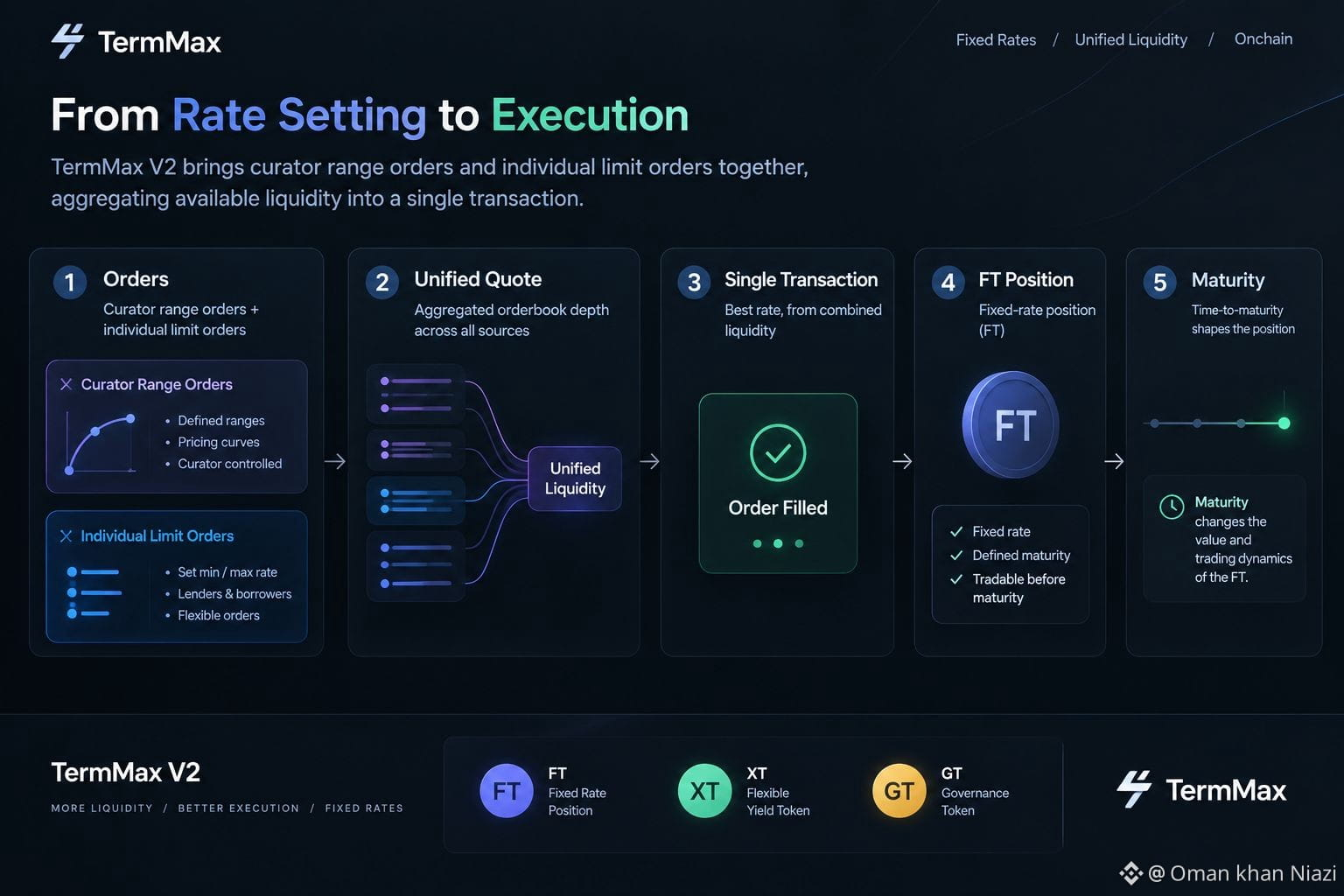
Ainda acho que a parte mais difícil dos mercados de taxa fixa não é definir uma taxa. É o que acontece quando essa taxa encontra o fluxo real de ordens.
O TermMax V2 permite que curadores definam preços por meio de curvas de ordens por faixa, enquanto as ordens podem ser agregadas no mesmo mercado. O FT representa a posição de taxa fixa, e ele pode ser negociado antes do vencimento, em vez de ficar apenas mantido até o fim.
Isso me fez olhar para os mercados de taxa fixa de uma forma diferente.
A taxa é apenas uma parte da posição. O vencimento também importa: um FT tem um vencimento definido, e seu valor muda conforme o tempo restante para o vencimento muda.
O que eu quero ver é como essas mecânicas se comportam quando diferentes curvas, vencimentos, liquidez e fluxo real de ordens começam a interagir em mercados ao vivo.
Quer ver isso na prática.
#TermMax @termmax
Ainda acho que a parte mais difícil dos mercados de taxa fixa não é definir uma taxa. É o que acontece quando essa taxa encontra o fluxo real de ordens.
O TermMax V2 permite que curadores definam preços por meio de curvas de ordens por faixa, enquanto as ordens podem ser agregadas no mesmo mercado. O FT representa a posição de taxa fixa, e ele pode ser negociado antes do vencimento, em vez de ficar apenas mantido até o fim.
Isso me fez olhar para os mercados de taxa fixa de uma forma diferente.
A taxa é apenas uma parte da posição. O vencimento também importa: um FT tem um vencimento definido, e seu valor muda conforme o tempo restante para o vencimento muda.
O que eu quero ver é como essas mecânicas se comportam quando diferentes curvas, vencimentos, liquidez e fluxo real de ordens começam a interagir em mercados ao vivo.
Quer ver isso na prática.
#TermMax @TermMax
O TermMax V2 permite que curadores definam preços por meio de curvas de ordens por faixa, enquanto as ordens podem ser agregadas no mesmo mercado. O FT representa a posição de taxa fixa, e ele pode ser negociado antes do vencimento, em vez de ficar apenas mantido até o fim.
Isso me fez olhar para os mercados de taxa fixa de uma forma diferente.
A taxa é apenas uma parte da posição. O vencimento também importa: um FT tem um vencimento definido, e seu valor muda conforme o tempo restante para o vencimento muda.
O que eu quero ver é como essas mecânicas se comportam quando diferentes curvas, vencimentos, liquidez e fluxo real de ordens começam a interagir em mercados ao vivo.
Quer ver isso na prática.
#TermMax @TermMax
6
65
Ainda acho que a maioria das conversas sobre RWA se concentra demais no momento em que um ativo se torna um token.
Quanto mais eu olho para a Dusk, mais penso que o problema mais difícil começa depois da tokenização.
Um ativo ainda precisa ser emitido, transferido, administrado e, por fim, liquidado. Se essas etapas continuarem dependendo de sistemas separados, colocar o ativo onchain não significa necessariamente que o processo financeiro em si tenha migrado para o onchain.
Foi isso que chamou minha atenção na abordagem nativa de emissão da Dusk: ela foi desenhada para apoiar mais do ciclo de vida do ativo no próprio ledger, em vez de tratar a tokenização como a linha de chegada.
O Dusk Trade torna isso ainda mais interessante. Ele leva instrumentos como MMFs, ETFs e títulos para uma estrutura de mercado regulado construída em torno de ativos financeiros tokenizados.
Minha observação: o verdadeiro desafio para a adoção de RWA talvez não seja a tokenização. Talvez seja conectar emissão, propriedade, negociação e liquidação sem perder as regras das quais os mercados financeiros já dependem.
Se o ativo está onchain, mas a maior parte do seu ciclo de vida ainda acontece em outro lugar, quanto do mercado financeiro realmente migrou para o onchain?
@Dusk_Foundation $DUSK #dusk
Ainda acho que a maioria das conversas sobre RWA se concentra demais no momento em que um ativo se torna um token.
Quanto mais eu olho para a Dusk, mais penso que o problema mais difícil começa depois da tokenização.
Um ativo ainda precisa ser emitido, transferido, administrado e, por fim, liquidado. Se essas etapas continuarem dependendo de sistemas separados, colocar o ativo onchain não significa necessariamente que o processo financeiro em si tenha migrado para o onchain.
Foi isso que chamou minha atenção na abordagem nativa de emissão da Dusk: ela foi desenhada para apoiar mais do ciclo de vida do ativo no próprio ledger, em vez de tratar a tokenização como a linha de chegada.
O Dusk Trade torna isso ainda mais interessante. Ele leva instrumentos como MMFs, ETFs e títulos para uma estrutura de mercado regulado construída em torno de ativos financeiros tokenizados.
Minha observação: o verdadeiro desafio para a adoção de RWA talvez não seja a tokenização. Talvez seja conectar emissão, propriedade, negociação e liquidação sem perder as regras das quais os mercados financeiros já dependem.
Se o ativo está onchain, mas a maior parte do seu ciclo de vida ainda acontece em outro lugar, quanto do mercado financeiro realmente migrou para o onchain?
@Dusk $DUSK #dusk
Quanto mais eu olho para a Dusk, mais penso que o problema mais difícil começa depois da tokenização.
Um ativo ainda precisa ser emitido, transferido, administrado e, por fim, liquidado. Se essas etapas continuarem dependendo de sistemas separados, colocar o ativo onchain não significa necessariamente que o processo financeiro em si tenha migrado para o onchain.
Foi isso que chamou minha atenção na abordagem nativa de emissão da Dusk: ela foi desenhada para apoiar mais do ciclo de vida do ativo no próprio ledger, em vez de tratar a tokenização como a linha de chegada.
O Dusk Trade torna isso ainda mais interessante. Ele leva instrumentos como MMFs, ETFs e títulos para uma estrutura de mercado regulado construída em torno de ativos financeiros tokenizados.
Minha observação: o verdadeiro desafio para a adoção de RWA talvez não seja a tokenização. Talvez seja conectar emissão, propriedade, negociação e liquidação sem perder as regras das quais os mercados financeiros já dependem.
Se o ativo está onchain, mas a maior parte do seu ciclo de vida ainda acontece em outro lugar, quanto do mercado financeiro realmente migrou para o onchain?
@Dusk $DUSK #dusk
Issuance
0%
Trading
0%
settlement
0%
Full lifecycle
100%
1 Votos • Votação encerrada
1
5
78
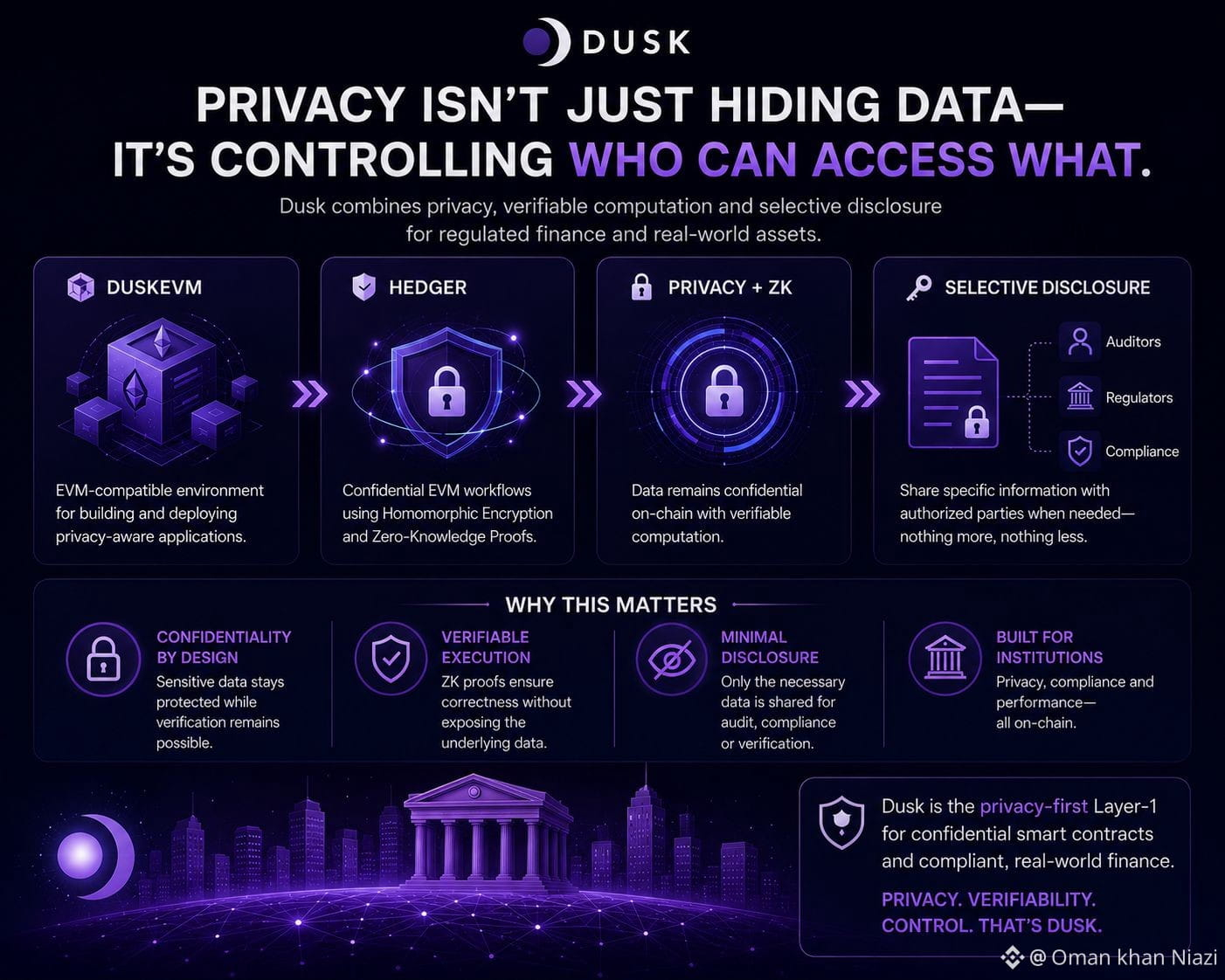
Ainda acho que as pessoas subestimam o quão difícil a privacidade se torna quando instituições financeiras reais entram em cena.
O que chamou minha atenção sobre a Dusk é que a stack não é apenas sobre ocultar transações. A DuskEVM oferece um caminho compatível com EVM para aplicações, enquanto a Hedger é projetada para fluxos EVM confidenciais usando criptografia homomórfica e provas de conhecimento zero, com divulgação seletiva quando as partes autorizadas precisam de informações específicas.
Então vem a parte mais difícil: quem consegue ver o quê?
Uma aplicação financeira pode precisar de confidencialidade do público, enquanto um regulador ou auditor autorizado ainda pode precisar de informações específicas para verificação ou conformidade.
Minha observação: privacidade é relativamente fácil de descrever. Decidir quem consegue ver o quê, e sob quais condições, é onde começa a verdadeira tensão institucional.
Se as instituições precisam de divulgação seletiva, quem deve, no fim das contas, controlar o que se torna visível: a aplicação, o regulador ou o protocolo?
@Dusk_Foundation $DUSK #dusk
Ainda acho que as pessoas subestimam o quão difícil a privacidade se torna quando instituições financeiras reais entram em cena.
O que chamou minha atenção sobre a Dusk é que a stack não é apenas sobre ocultar transações. A DuskEVM oferece um caminho compatível com EVM para aplicações, enquanto a Hedger é projetada para fluxos EVM confidenciais usando criptografia homomórfica e provas de conhecimento zero, com divulgação seletiva quando as partes autorizadas precisam de informações específicas.
Então vem a parte mais difícil: quem consegue ver o quê?
Uma aplicação financeira pode precisar de confidencialidade do público, enquanto um regulador ou auditor autorizado ainda pode precisar de informações específicas para verificação ou conformidade.
Minha observação: privacidade é relativamente fácil de descrever. Decidir quem consegue ver o quê, e sob quais condições, é onde começa a verdadeira tensão institucional.
Se as instituições precisam de divulgação seletiva, quem deve, no fim das contas, controlar o que se torna visível: a aplicação, o regulador ou o protocolo?
@Dusk $DUSK #dusk
O que chamou minha atenção sobre a Dusk é que a stack não é apenas sobre ocultar transações. A DuskEVM oferece um caminho compatível com EVM para aplicações, enquanto a Hedger é projetada para fluxos EVM confidenciais usando criptografia homomórfica e provas de conhecimento zero, com divulgação seletiva quando as partes autorizadas precisam de informações específicas.
Então vem a parte mais difícil: quem consegue ver o quê?
Uma aplicação financeira pode precisar de confidencialidade do público, enquanto um regulador ou auditor autorizado ainda pode precisar de informações específicas para verificação ou conformidade.
Minha observação: privacidade é relativamente fácil de descrever. Decidir quem consegue ver o quê, e sob quais condições, é onde começa a verdadeira tensão institucional.
Se as instituições precisam de divulgação seletiva, quem deve, no fim das contas, controlar o que se torna visível: a aplicação, o regulador ou o protocolo?
@Dusk $DUSK #dusk
4
2
73
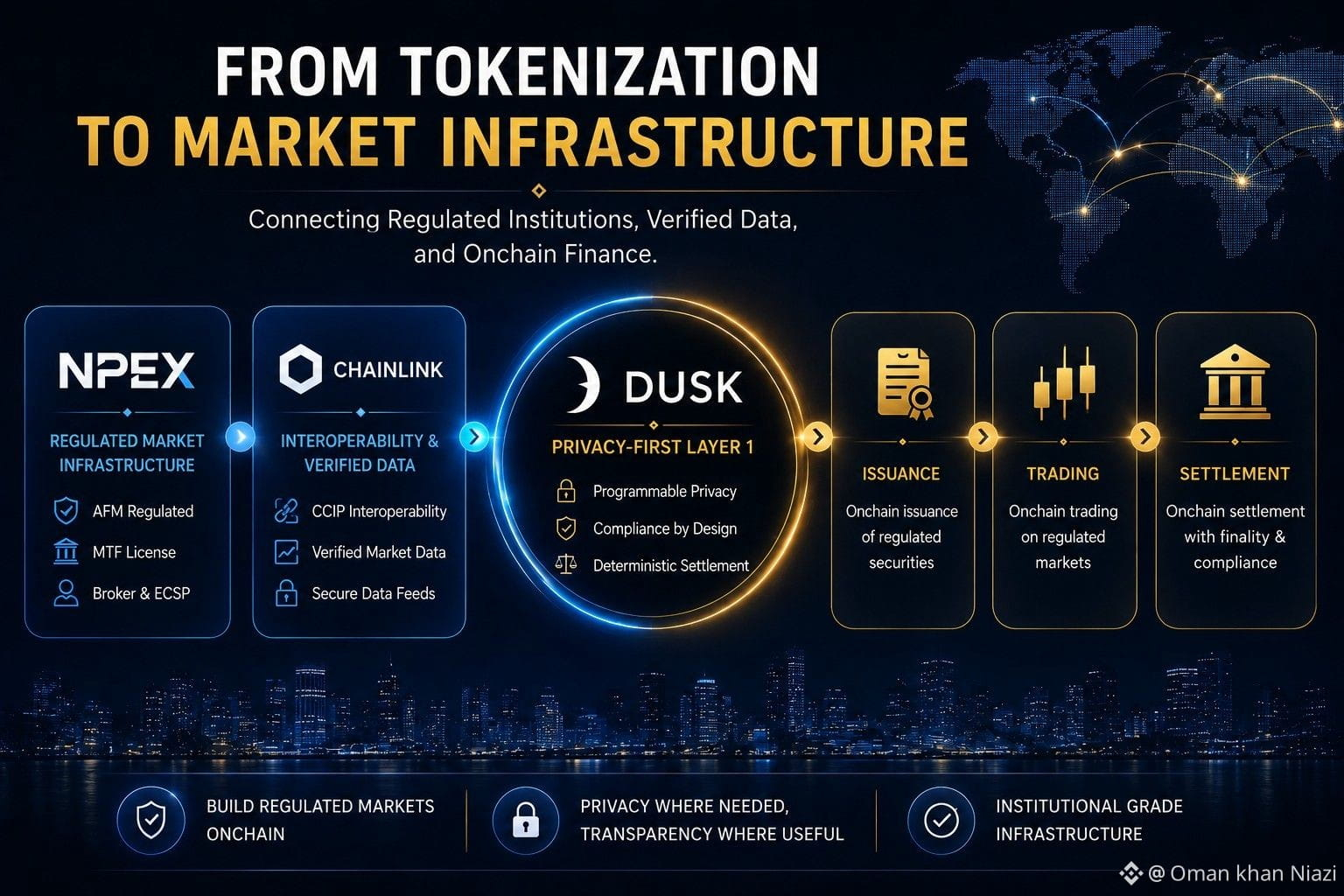
#dusk $DUSK @Dusk_Foundation Ainda acho que a parte mais difícil de colocar as finanças onchain não é a blockchain em si.
O que chamou minha atenção sobre a Dusk é a infraestrutura ao seu redor: a NPEX traz sua posição no mercado regulado, enquanto a Chainlink fornece interoperabilidade e trilhos de dados de mercado verificados. O que me interessa é como essas peças poderiam conectar emissão, negociação e liquidação sem separá-las das regras com que os mercados financeiros já operam.
Minha observação: é aqui que “tokenização” começa a virar infraestrutura de mercado de verdade.
Se a tecnologia funcionar, qual se torna o verdadeiro gargalo para a adoção: regulamentação, interoperabilidade ou confiança institucional?
#dusk $DUSK @Dusk Ainda acho que a parte mais difícil de colocar as finanças onchain não é a blockchain em si.
O que chamou minha atenção sobre a Dusk é a infraestrutura ao seu redor: a NPEX traz sua posição no mercado regulado, enquanto a Chainlink fornece interoperabilidade e trilhos de dados de mercado verificados. O que me interessa é como essas peças poderiam conectar emissão, negociação e liquidação sem separá-las das regras com que os mercados financeiros já operam.
Minha observação: é aqui que “tokenização” começa a virar infraestrutura de mercado de verdade.
Se a tecnologia funcionar, qual se torna o verdadeiro gargalo para a adoção: regulamentação, interoperabilidade ou confiança institucional?
O que chamou minha atenção sobre a Dusk é a infraestrutura ao seu redor: a NPEX traz sua posição no mercado regulado, enquanto a Chainlink fornece interoperabilidade e trilhos de dados de mercado verificados. O que me interessa é como essas peças poderiam conectar emissão, negociação e liquidação sem separá-las das regras com que os mercados financeiros já operam.
Minha observação: é aqui que “tokenização” começa a virar infraestrutura de mercado de verdade.
Se a tecnologia funcionar, qual se torna o verdadeiro gargalo para a adoção: regulamentação, interoperabilidade ou confiança institucional?
2
2
96
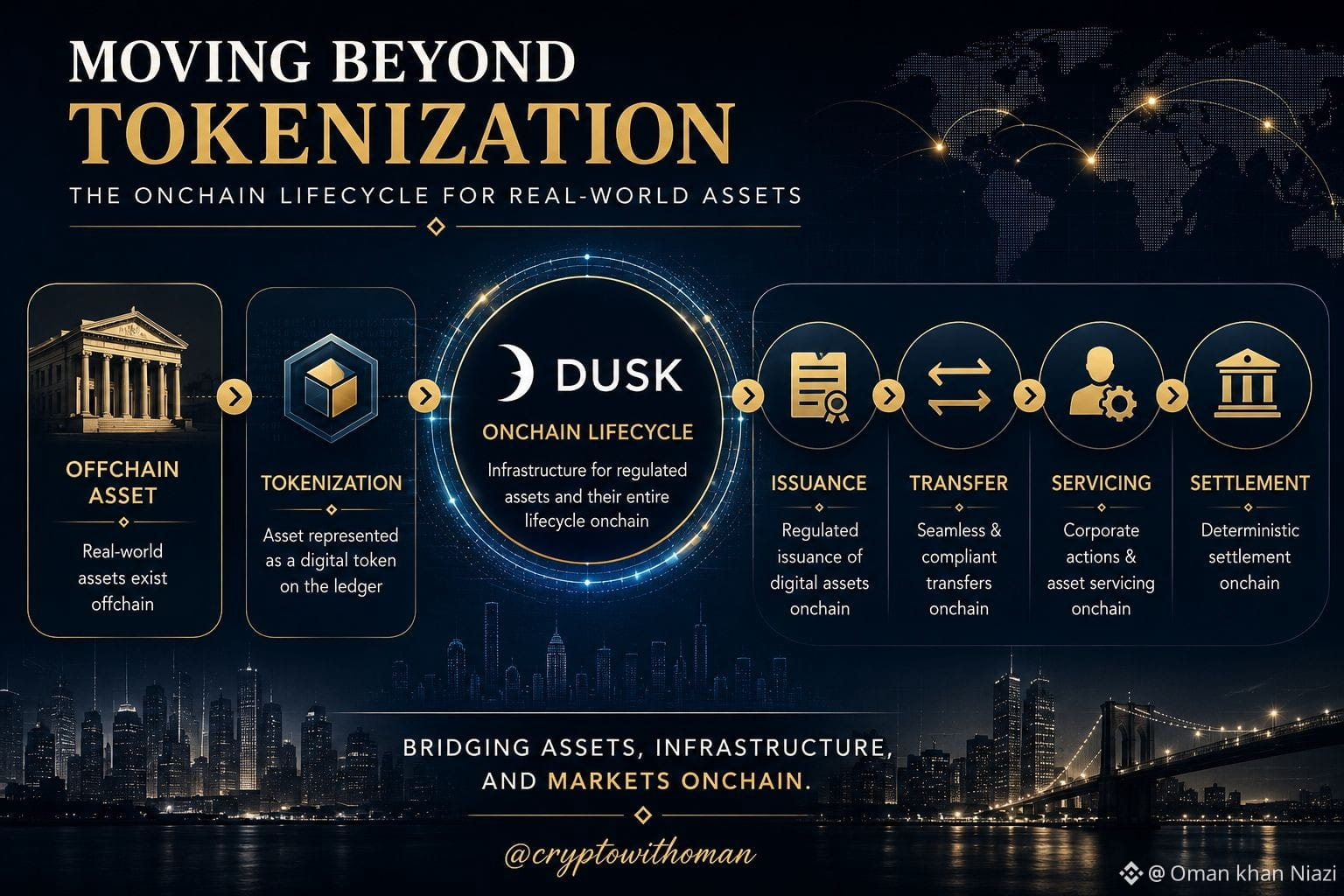
Ainda acho que a maioria das discussões sobre RWA termina cedo demais.
A tokenização pode colocar uma representação de um ativo na blockchain, mas o ciclo de vida subjacente ainda pode depender de sistemas fora da blockchain. A abordagem nativa de emissão da Dusk vai além: a emissão, as transferências, o servicing e a liquidação foram desenhados em torno do livro-razão onchain.
Minha observação: o verdadeiro avanço não é colocar ativos na blockchain — é reduzir a distância entre o ativo e a infraestrutura que o gerencia.
Mas esse modelo consegue funcionar na escala e na complexidade regulatória dos mercados financeiros reais?
@Dusk_Foundation $DUSK #dusk
Ainda acho que a maioria das discussões sobre RWA termina cedo demais.
A tokenização pode colocar uma representação de um ativo na blockchain, mas o ciclo de vida subjacente ainda pode depender de sistemas fora da blockchain. A abordagem nativa de emissão da Dusk vai além: a emissão, as transferências, o servicing e a liquidação foram desenhados em torno do livro-razão onchain.
Minha observação: o verdadeiro avanço não é colocar ativos na blockchain — é reduzir a distância entre o ativo e a infraestrutura que o gerencia.
Mas esse modelo consegue funcionar na escala e na complexidade regulatória dos mercados financeiros reais?
@Dusk $DUSK #dusk
A tokenização pode colocar uma representação de um ativo na blockchain, mas o ciclo de vida subjacente ainda pode depender de sistemas fora da blockchain. A abordagem nativa de emissão da Dusk vai além: a emissão, as transferências, o servicing e a liquidação foram desenhados em torno do livro-razão onchain.
Minha observação: o verdadeiro avanço não é colocar ativos na blockchain — é reduzir a distância entre o ativo e a infraestrutura que o gerencia.
Mas esse modelo consegue funcionar na escala e na complexidade regulatória dos mercados financeiros reais?
@Dusk $DUSK #dusk
3
2
82
Ainda acho que as pessoas estão ignorando a parte mais interessante de Dusk.
DuskEVM traz o desenvolvimento EVM familiar, enquanto Hedger adiciona fluxos de transações confidenciais usando criptografia homomórfica e provas de conhecimento zero. O que chamou minha atenção é que privacidade não significa abrir mão da execução verificável ou da divulgação seletiva quando for necessário um exame autorizado.
Minha observação: isso parece muito mais próximo do que as finanças regulamentadas realmente precisam onchain.
Mas Dusk consegue provar que essa arquitetura funciona em escala institucional real?
@Dusk_Foundation $DUSK #dusk
Ainda acho que as pessoas estão ignorando a parte mais interessante de Dusk.
DuskEVM traz o desenvolvimento EVM familiar, enquanto Hedger adiciona fluxos de transações confidenciais usando criptografia homomórfica e provas de conhecimento zero. O que chamou minha atenção é que privacidade não significa abrir mão da execução verificável ou da divulgação seletiva quando for necessário um exame autorizado.
Minha observação: isso parece muito mais próximo do que as finanças regulamentadas realmente precisam onchain.
Mas Dusk consegue provar que essa arquitetura funciona em escala institucional real?
@Dusk $DUSK #dusk
DuskEVM traz o desenvolvimento EVM familiar, enquanto Hedger adiciona fluxos de transações confidenciais usando criptografia homomórfica e provas de conhecimento zero. O que chamou minha atenção é que privacidade não significa abrir mão da execução verificável ou da divulgação seletiva quando for necessário um exame autorizado.
Minha observação: isso parece muito mais próximo do que as finanças regulamentadas realmente precisam onchain.
Mas Dusk consegue provar que essa arquitetura funciona em escala institucional real?
@Dusk $DUSK #dusk
1
69
Faça login para explorar mais conteúdos
Junte-se a usuários de criptomoedas de todo o mundo no Binance Square.
⚡️ Obter informações mais recentes e úteis sobre criptomoeda.
💬 Com a confiança da maior corretora de criptomoedas do mundo.
👍 Descubra insights reais de criadores verificados.
E-mail / número de telefone
Tópicos em Alta
BinancePick
2.8M visualizações
145,940 discutindo
Participe da #TemporadaDeResultados: preveja resultados no Binance Pick e compartilhe sua opinião no Binance Square!
Binance Square Official
·403 curtidas
·340.1k visualizações
EarningsSeason
5.1M visualizações
24,963 discutindo
AnthropicTTMRevenueGrewAbout1200%
0 visualizações
11 discutindo