
Liên Bảo Trân
363 Publicações

Liên Bảo Trân
524 Seguindo
148 Seguidores
329 Curtiu
Publicações
Todas
Citações
Ver tradução
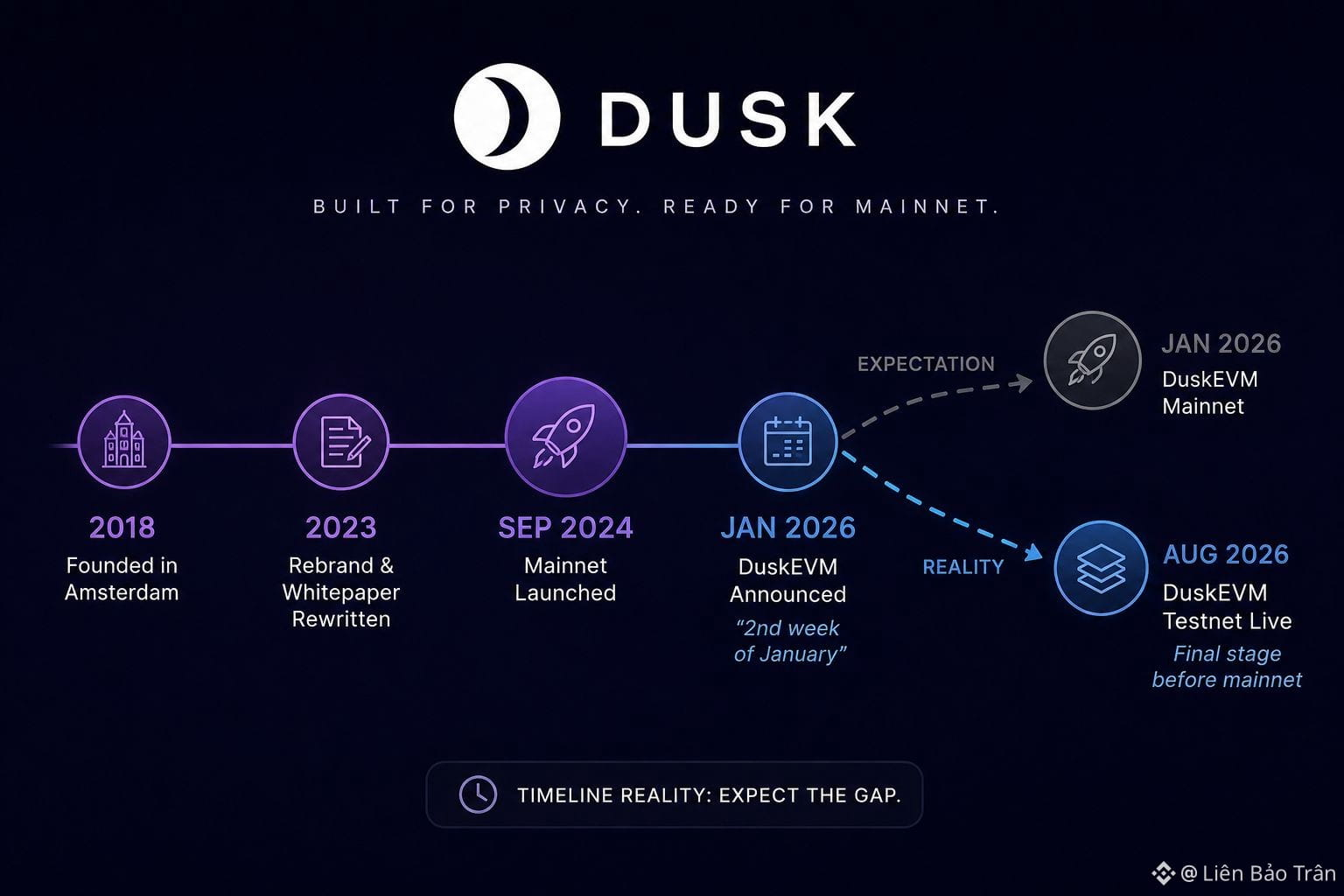
6 years. That's how long it took Dusk to go from its 2018 founding in Amsterdam to an actual mainnet in September 2024. For a project built around zero-knowledge cryptography and a brand new consensus protocol, some of that time is defensible. Hard cryptography takes time to get right, and I'd rather a financial infrastructure project ship late than ship broken. Those years also covered a full rebrand from Dusk Network to Dusk in 2023 and a rewritten whitepaper, so the delay wasn't pure inactivity, it was a genuinely different company by the time mainnet arrived.
What interests me more is the pattern repeating on a smaller scale. Dusk's team announced in late 2025 that DuskEVM, the Solidity-compatible execution layer meant to unlock Ethereum's developer base, would launch on mainnet in the second week of January 2026. January came and went. By August 2026, what actually shipped was a public DuskEVM testnet, described by the team itself as the final stage before mainnet, not mainnet itself. A specific calendar date turned into a general "final stage" description seven months later.
I don't think this makes Dusk unusual. Roadmap slippage is close to universal in this industry, and building a modular stack that separates settlement, WASM execution and now an OP Stack based EVM layer is genuinely more complex than shipping a single-purpose chain. But it does mean I read every future date Dusk publishes as a floor, not a ceiling. The gap between "launching in the second week of January" and "testnet live in August" is 8 months on a single feature. Anyone allocating around Dusk's next milestone, whether that's a securities exchange going fully live with NPEX or broader DuskEVM adoption, should size their expectations around that historical gap, not around the press release. The mainnet itself is still coming, and once it lands it's expected to carry Hedger's confidential transaction workflows into the EVM environment, not just plain Solidity compatibility on its own.
@Dusk #dusk $DUSK
What interests me more is the pattern repeating on a smaller scale. Dusk's team announced in late 2025 that DuskEVM, the Solidity-compatible execution layer meant to unlock Ethereum's developer base, would launch on mainnet in the second week of January 2026. January came and went. By August 2026, what actually shipped was a public DuskEVM testnet, described by the team itself as the final stage before mainnet, not mainnet itself. A specific calendar date turned into a general "final stage" description seven months later.
I don't think this makes Dusk unusual. Roadmap slippage is close to universal in this industry, and building a modular stack that separates settlement, WASM execution and now an OP Stack based EVM layer is genuinely more complex than shipping a single-purpose chain. But it does mean I read every future date Dusk publishes as a floor, not a ceiling. The gap between "launching in the second week of January" and "testnet live in August" is 8 months on a single feature. Anyone allocating around Dusk's next milestone, whether that's a securities exchange going fully live with NPEX or broader DuskEVM adoption, should size their expectations around that historical gap, not around the press release. The mainnet itself is still coming, and once it lands it's expected to carry Hedger's confidential transaction workflows into the EVM environment, not just plain Solidity compatibility on its own.
@Dusk #dusk $DUSK
Ver tradução
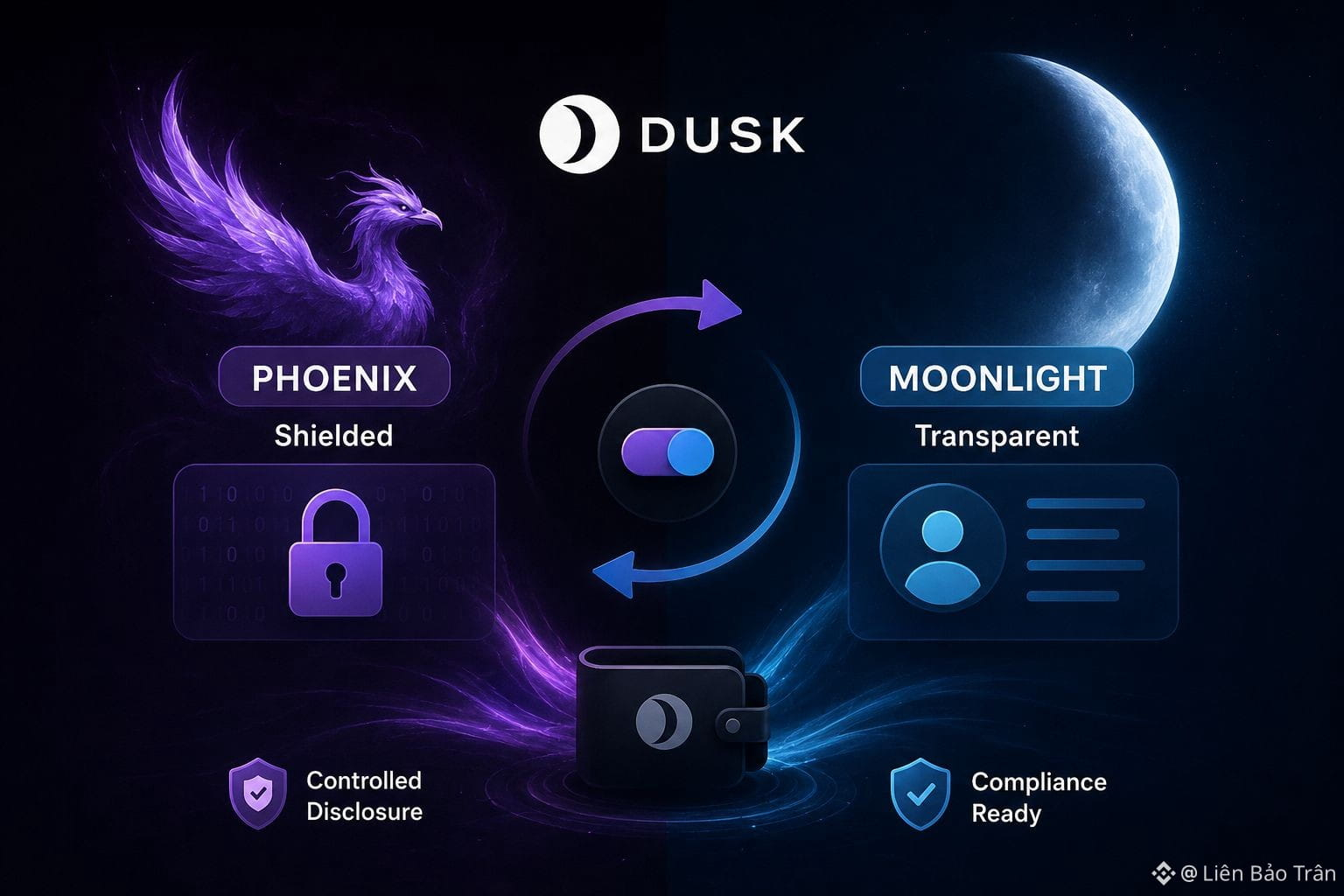
Every privacy chain eventually runs into the same wall: full anonymity is elegant in a paper and radioactive on an exchange listing form. Dusk Network hit that wall early and made an unusual choice in response. Early on, a purely shielded chain risked the same fate that has hit anonymity focused assets before it, delisting risk from exchanges unable to screen flows for sanctioned addresses or suspicious activity, which is precisely the failure mode the team eventually built around rather than ignored. Instead of picking a side, they built two transaction models into the same base layer and let users switch between them.
Phoenix is the shielded model, hiding balances and transfer amounts while still allowing a sender to prove specific details to an authorized party when compliance requires it. Moonlight is the public model, transparent by default, built for the exchanges, institutions, and integrations that need an account they can see clearly without extra tooling. A user can move between the two inside the same wallet, which sounds like a small convenience feature until you think about what it replaces: a separate privacy coin and a separate compliant asset, bridged awkwardly, trusted fully by neither community. Together the two are how Dusk pairs confidentiality with transparent, deterministic settlement, a combination the team markets as programmable privacy for regulated markets.
I think this design decision says more about Dusk's read on regulation than any whitepaper paragraph could. The team clearly decided that a privacy protocol which cannot prove anything to anyone is not a financial product, it is a liability waiting for a delisting notice. Whether that bet pays off depends on adoption neither model alone could deliver. A dual system also means double the surface area to secure and double the mental model a new developer has to learn before shipping anything useful.
@Dusk #dusk $DUSK
Phoenix is the shielded model, hiding balances and transfer amounts while still allowing a sender to prove specific details to an authorized party when compliance requires it. Moonlight is the public model, transparent by default, built for the exchanges, institutions, and integrations that need an account they can see clearly without extra tooling. A user can move between the two inside the same wallet, which sounds like a small convenience feature until you think about what it replaces: a separate privacy coin and a separate compliant asset, bridged awkwardly, trusted fully by neither community. Together the two are how Dusk pairs confidentiality with transparent, deterministic settlement, a combination the team markets as programmable privacy for regulated markets.
I think this design decision says more about Dusk's read on regulation than any whitepaper paragraph could. The team clearly decided that a privacy protocol which cannot prove anything to anyone is not a financial product, it is a liability waiting for a delisting notice. Whether that bet pays off depends on adoption neither model alone could deliver. A dual system also means double the surface area to secure and double the mental model a new developer has to learn before shipping anything useful.
@Dusk #dusk $DUSK
Ver tradução
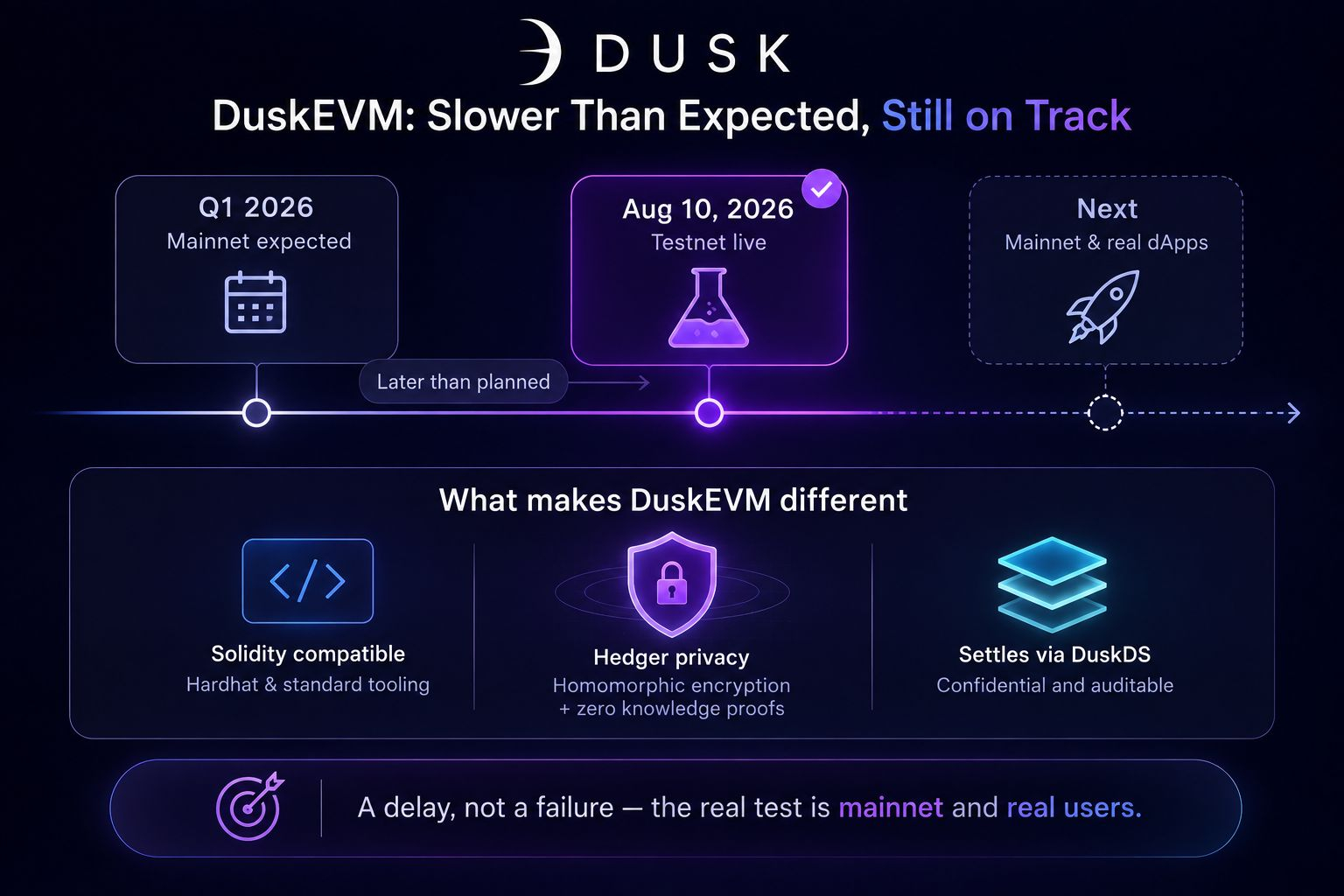
Back in the spring, coverage of Dusk Network's roadmap circled a specific expectation: DuskEVM, the Solidity compatible execution layer, reaching mainnet in the first quarter of 2026. That is what got repeated across trackers and watchlists, and it is the kind of date that quietly becomes a promise even when nobody at the project phrased it that firmly. By August 10, what actually shipped was a testnet, letting developers deploy and test applications using Hardhat and standard Ethereum tooling. Useful, real progress, and also months past the window people had circled on a calendar.
I want to be precise about what this gap is and is not. It is not a broken protocol or a failed idea. DuskEVM's architecture, an EVM execution layer settling through DuskDS, is a genuinely more complex build than a typical EVM sidechain, since it has to preserve confidentiality guarantees while still running unmodified Solidity contracts. The privacy piece specifically comes from Hedger, a module combining homomorphic encryption with zero knowledge proofs so balances and transfers can stay encrypted end to end while remaining auditable, a meaningfully different approach than most EVM privacy attempts that lean on just one technique. Complex systems slip. That is not unique to Dusk Network, and the same window saw the project ship a separate developer SDK for wallet connectivity, suggesting the delay sits specifically with the EVM layer rather than a broader stall.
What the gap does tell me is how to read future dates from this team. A testnet in August after a Q1 target is not catastrophic, but it is the second time a public timeline turned out aspirational rather than committed. Mainnet activation and real Solidity applications with actual users still sit ahead. I would rather see the working testnet than another confident date, and for now that is exactly what Dusk Network has given me.
@Dusk #dusk $DUSK
I want to be precise about what this gap is and is not. It is not a broken protocol or a failed idea. DuskEVM's architecture, an EVM execution layer settling through DuskDS, is a genuinely more complex build than a typical EVM sidechain, since it has to preserve confidentiality guarantees while still running unmodified Solidity contracts. The privacy piece specifically comes from Hedger, a module combining homomorphic encryption with zero knowledge proofs so balances and transfers can stay encrypted end to end while remaining auditable, a meaningfully different approach than most EVM privacy attempts that lean on just one technique. Complex systems slip. That is not unique to Dusk Network, and the same window saw the project ship a separate developer SDK for wallet connectivity, suggesting the delay sits specifically with the EVM layer rather than a broader stall.
What the gap does tell me is how to read future dates from this team. A testnet in August after a Q1 target is not catastrophic, but it is the second time a public timeline turned out aspirational rather than committed. Mainnet activation and real Solidity applications with actual users still sit ahead. I would rather see the working testnet than another confident date, and for now that is exactly what Dusk Network has given me.
@Dusk #dusk $DUSK
Ver tradução
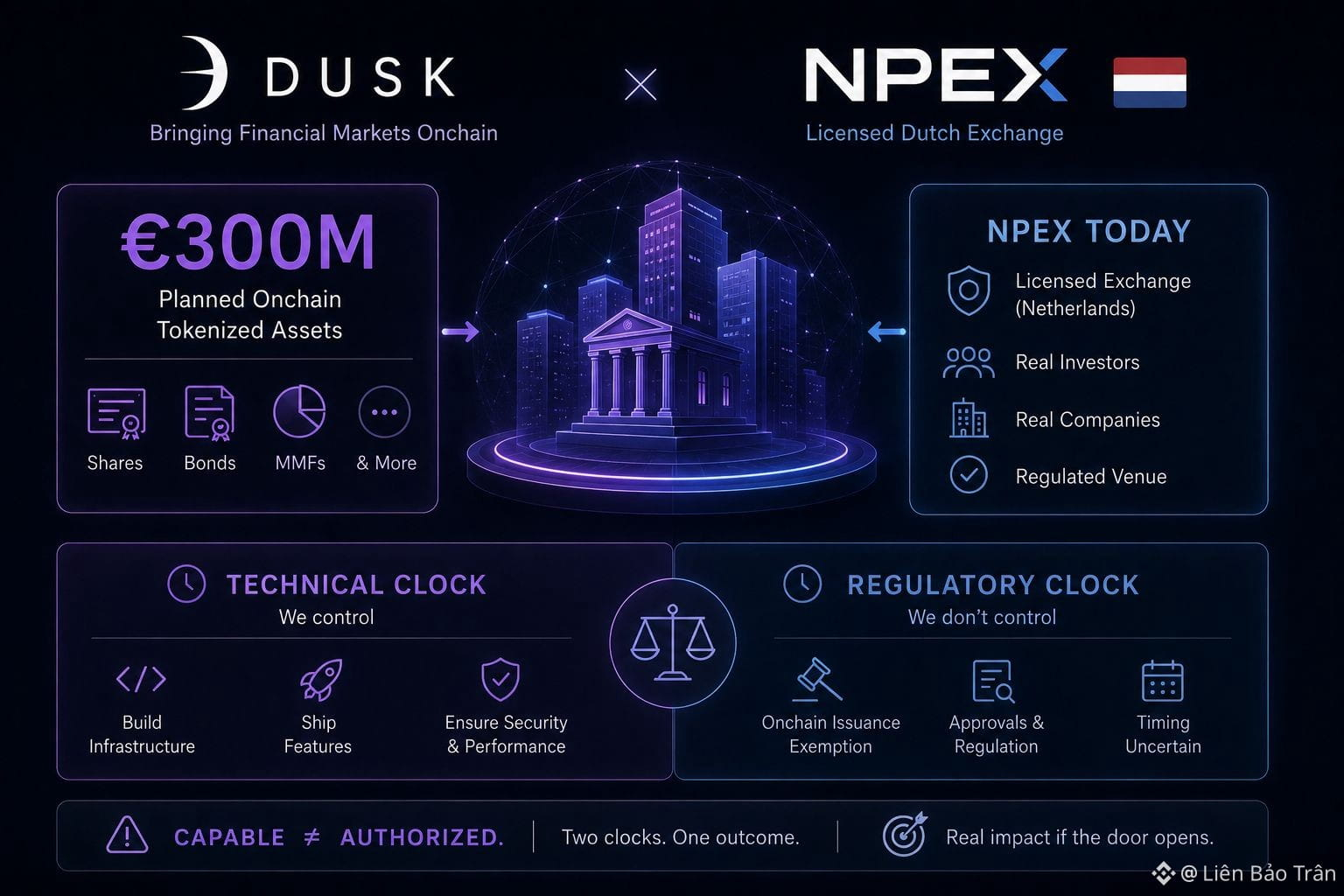
Three hundred million euros is not a hypothetical number. It is the figure NPEX, a licensed Dutch exchange, has said it plans to move onto Dusk as tokenized assets. I think that detail gets lost in a lot of RWA talk that stays abstract. Dusk describes its mission as bringing financial markets onchain, and NPEX is the closest thing to a live test of that claim. NPEX already runs a regulated venue for smaller company shares and debt instruments in the Netherlands. Moving a meaningful slice of that book onto Dusk would mean real investors holding real claims on real companies, settled on a public blockchain instead of a closed ledger only a handful of institutions can see into. This is the part that deserves more scrutiny than it usually gets. Dusk's infrastructure is built to carry native issuance workflows, meaning assets that are born digital rather than tokenized after the fact as a wrapper. NPEX already holds a license to run that secondary market and another to source assets like money market funds and bonds. What it does not yet hold is the specific exemption that would let issuance happen directly onchain, instead of through a hybrid process that still leans on offchain paperwork somewhere behind the scenes. So there are two clocks running here, not one. There is the technical clock, mostly about shipping features, and there is the regulatory clock, which nobody in crypto controls. I do not think it is fair to treat the 300 million euro figure as already secured. It is a plan with real institutional backing, sitting behind a door that has not fully opened yet. If the exemption lands on schedule, this becomes one of the larger real world validations onchain finance has had. If it slips, the 300 million euro figure will keep getting repeated anyway, because announcements travel faster than filings ever do. That gap between capable and authorized is worth remembering every time this partnership comes up again.
@Dusk #dusk $DUSK
@Dusk #dusk $DUSK
Ver tradução
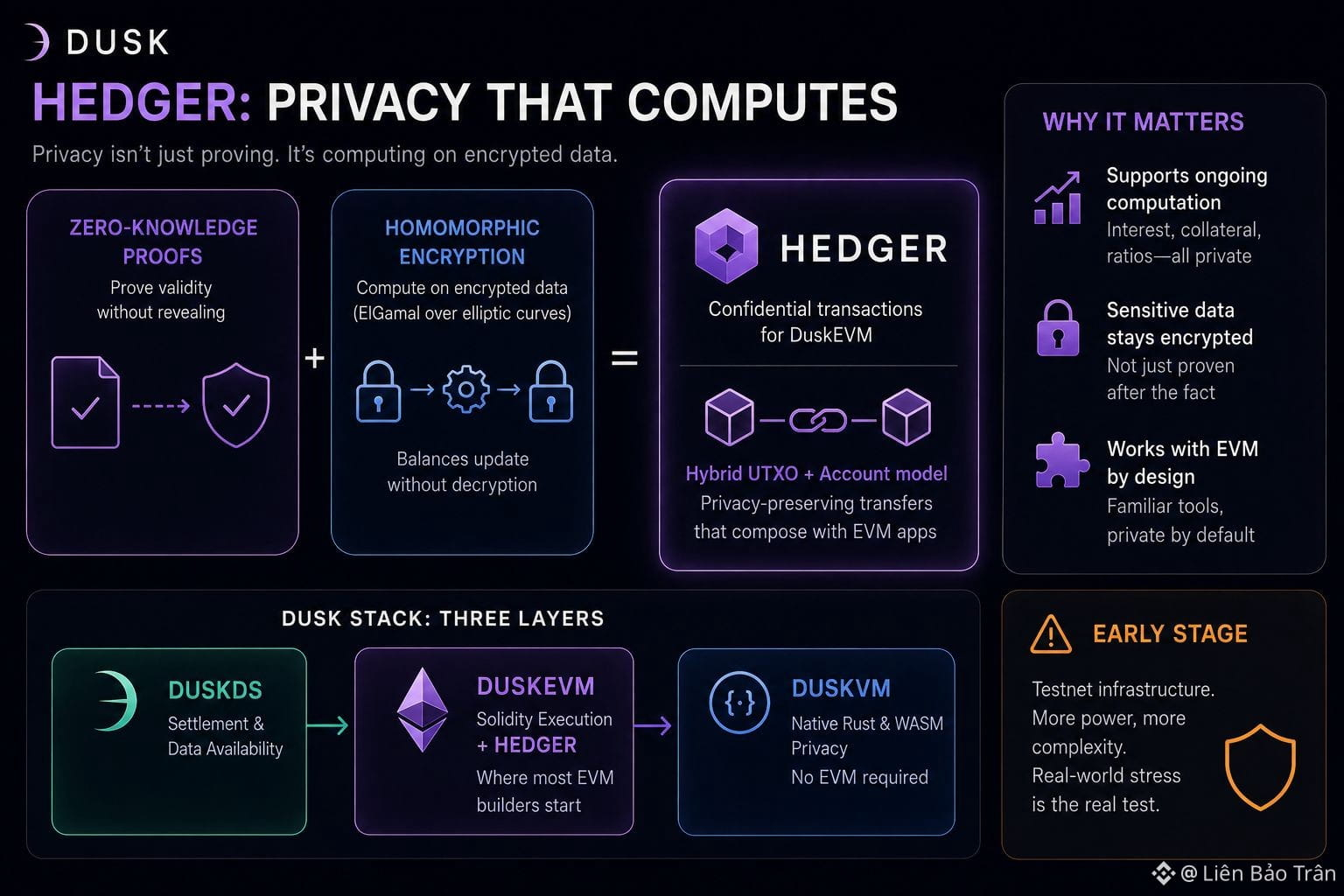
Most people hear zero-knowledge proofs and assume that is the whole privacy story on this project. It isn't, not for Hedger. Hedger, Dusk Network's confidential transaction module for DuskEVM, actually combines two different cryptographic tools. Zero-knowledge proofs handle the part everyone expects: proving a transaction is valid without revealing its contents. Homomorphic encryption, built on ElGamal over elliptic curves, handles something harder. It lets the network perform computation directly on encrypted values, so balances and amounts can update without ever being decrypted along the way. Why does that matter for Dusk specifically? Because financial applications, the kind Dusk is actually built for, rarely stop at a single private transfer. They need ongoing computation, interest accruing, collateral ratios updating, all while sensitive figures stay hidden from public view. A system that only proves things after the fact struggles with that. One that can compute on encrypted data while it happens is a different category of tool entirely. Hedger also supports a hybrid UTXO and account model, which sounds technical but solves a real problem: letting privacy-preserving transfers compose cleanly with the account-based logic most EVM applications already assume. It helps to place Hedger inside the bigger picture. Dusk's stack runs in three layers: DuskDS for settlement and data availability, DuskEVM for familiar Solidity execution, and DuskVM for teams that want native Rust and WASM privacy without touching EVM tooling at all. Hedger lives in that middle layer, exactly where most builders coming from Ethereum will land first. I'll say the obvious part too. This is still testnet infrastructure. Combining multiple cryptographic primitives is powerful, but it's also more surface area to get right, more edge cases to audit, more places a subtle bug could hide. Ambitious cryptography earns skepticism until it has been stress tested in production, not admiration in advance.
@Dusk #dusk $DUSK
@Dusk #dusk $DUSK
Ver tradução
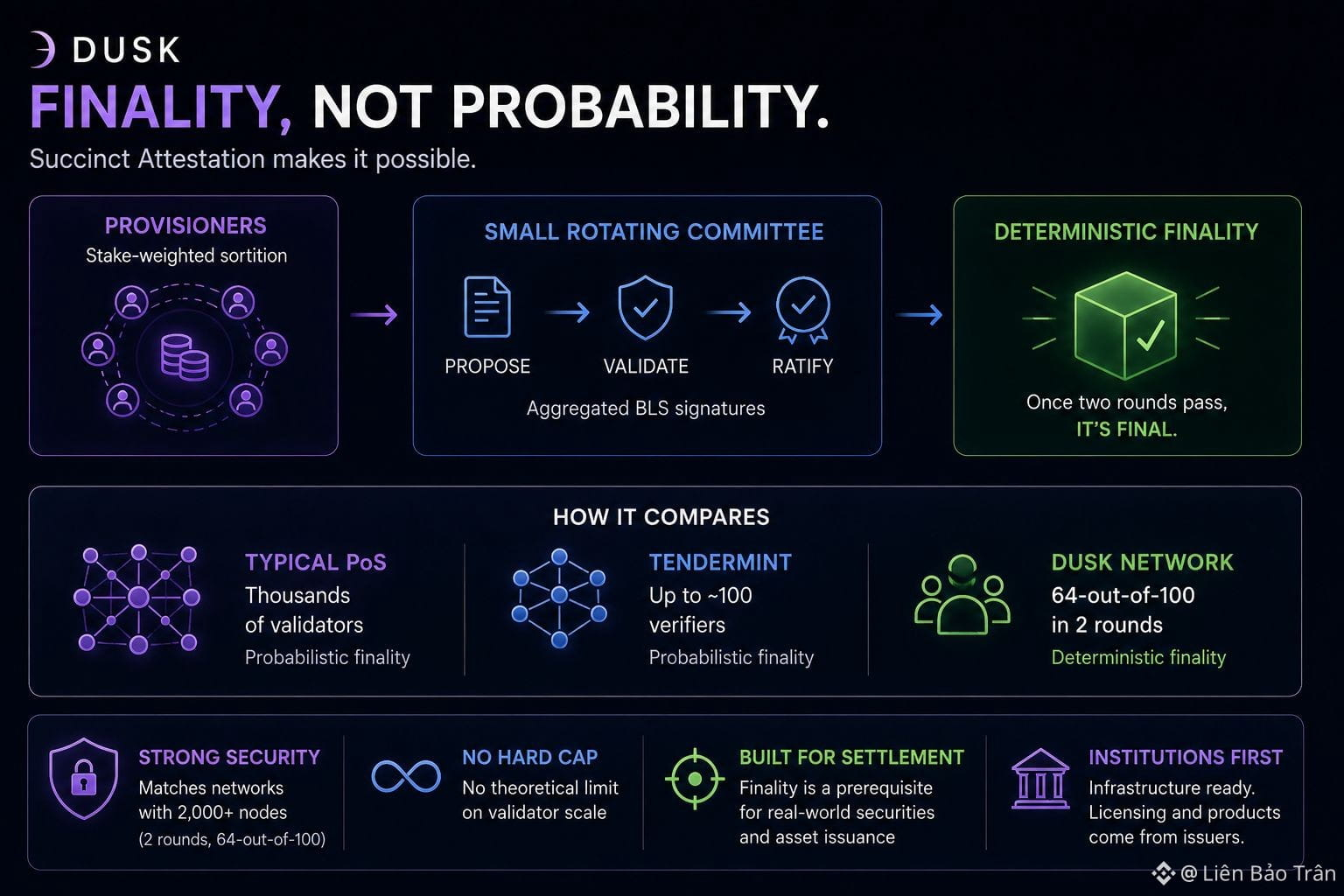
I keep hearing the same objection when I explain Dusk Network's consensus: how do you get finality without thousands of validators? Fair question. The answer is Succinct Attestation, one of the more underrated pieces of engineering in this space. Traditional proof-of-stake networks either wait for probabilistic finality, where a block becomes final enough after several confirmations, or lean on committee sizes that balloon into the thousands to stay secure. Dusk Network's Succinct Attestation takes a different route. Provisioners, the network's validators, are chosen by stake-weighted sortition into small rotating committees that propose, validate, and ratify each block using aggregated BLS signatures. Once a block clears both voting rounds, it's deterministically final. Not probably final. Final. Emanuele Francioni, who designed the mechanism, has noted that Dusk Network can match the security of networks needing 2,000-plus nodes with two rounds of 64-out-of-100 participation. Tendermint caps out around 100 verifiers by comparison. Succinct Attestation has no hard verifier ceiling, which matters if Dusk Network's institutional ambitions pan out and validator interest keeps growing. I won't pretend this is solved forever, though. Small committee designs live or die on sortition randomness and on how the network behaves under real adversarial pressure, not just testnet conditions. Dusk Network has years of research behind Succinct Attestation, but research and adversarial mainnet stress are different resumes. The design is elegant on paper and has held up post-mainnet so far. What convinces me isn't the theory. It's that finality is a prerequisite for securities settlement, not a nice-to-have, and Dusk Network built the whole chain around that constraint from day one. That really adds up to a settlement backbone capable of carrying genuine issuance workflows, though the licensing and product work still has to come from whichever institution or venue is actually issuing.
@Dusk #dusk $DUSK $ONG $BTW
@Dusk #dusk $DUSK $ONG $BTW
Ver tradução
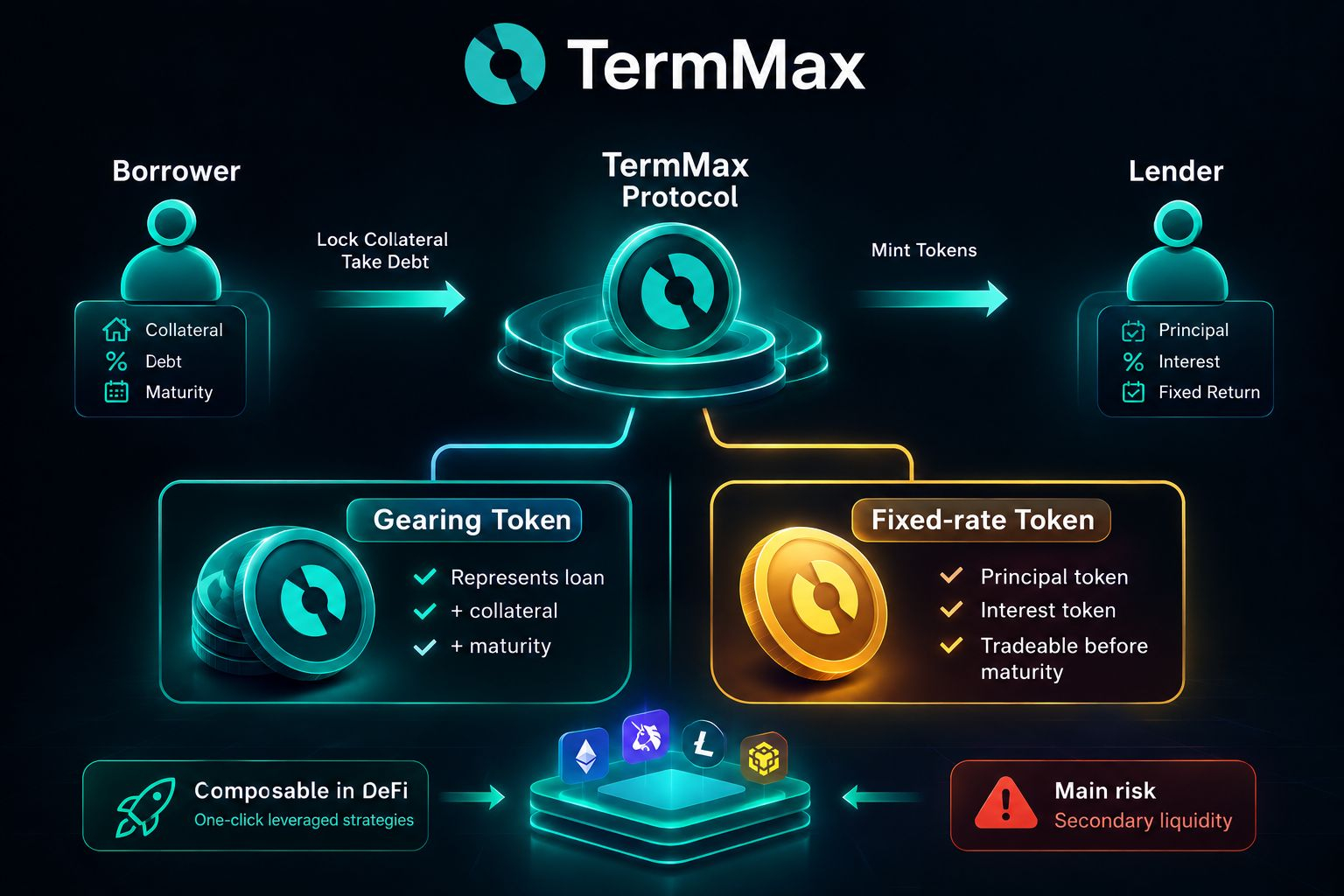
One TermMax audit fix made me think differently about what a “price update” actually means inside a fixed-rate market.
An order is not priced from one number alone. TermMax uses a virtual reserve of X Token (XT) alongside a pricing curve to determine where the order sits and how its price changes as more liquidity is taken.
The audit found that those two pieces could previously be updated separately.
That matters because each input can be valid on its own while the combination is not. A new virtual XT reserve paired with an old curve, or the other way around, can describe a pricing state that was never actually intended.
So the issue is not simply whether the pricing formula is correct. It is whether all of the inputs feeding that formula still describe the same version of the order.
What I don't know yet is how broadly TermMax now enforces that consistency across every path that can reprice or reconfigure an order.
The stronger evidence would be that every repricing path preserves the same rule: a quote can only be produced from one internally consistent order state. That goes beyond checking whether the reserve and curve are individually valid, or even whether one update path changes them together.
What matters is whether a mixed old-and-new configuration can be ruled out everywhere the order can change.
The question is whether TermMax now treats price as one coherent state across an order, rather than a collection of separate settings that can drift out of sync.
I am watching repricing paths, order updates and the tests that enforce that consistency.
@TermMax #TermMax $BTW $ACE $ONG
An order is not priced from one number alone. TermMax uses a virtual reserve of X Token (XT) alongside a pricing curve to determine where the order sits and how its price changes as more liquidity is taken.
The audit found that those two pieces could previously be updated separately.
That matters because each input can be valid on its own while the combination is not. A new virtual XT reserve paired with an old curve, or the other way around, can describe a pricing state that was never actually intended.
So the issue is not simply whether the pricing formula is correct. It is whether all of the inputs feeding that formula still describe the same version of the order.
What I don't know yet is how broadly TermMax now enforces that consistency across every path that can reprice or reconfigure an order.
The stronger evidence would be that every repricing path preserves the same rule: a quote can only be produced from one internally consistent order state. That goes beyond checking whether the reserve and curve are individually valid, or even whether one update path changes them together.
What matters is whether a mixed old-and-new configuration can be ruled out everywhere the order can change.
The question is whether TermMax now treats price as one coherent state across an order, rather than a collection of separate settings that can drift out of sync.
I am watching repricing paths, order updates and the tests that enforce that consistency.
@TermMax #TermMax $BTW $ACE $ONG
Ver tradução
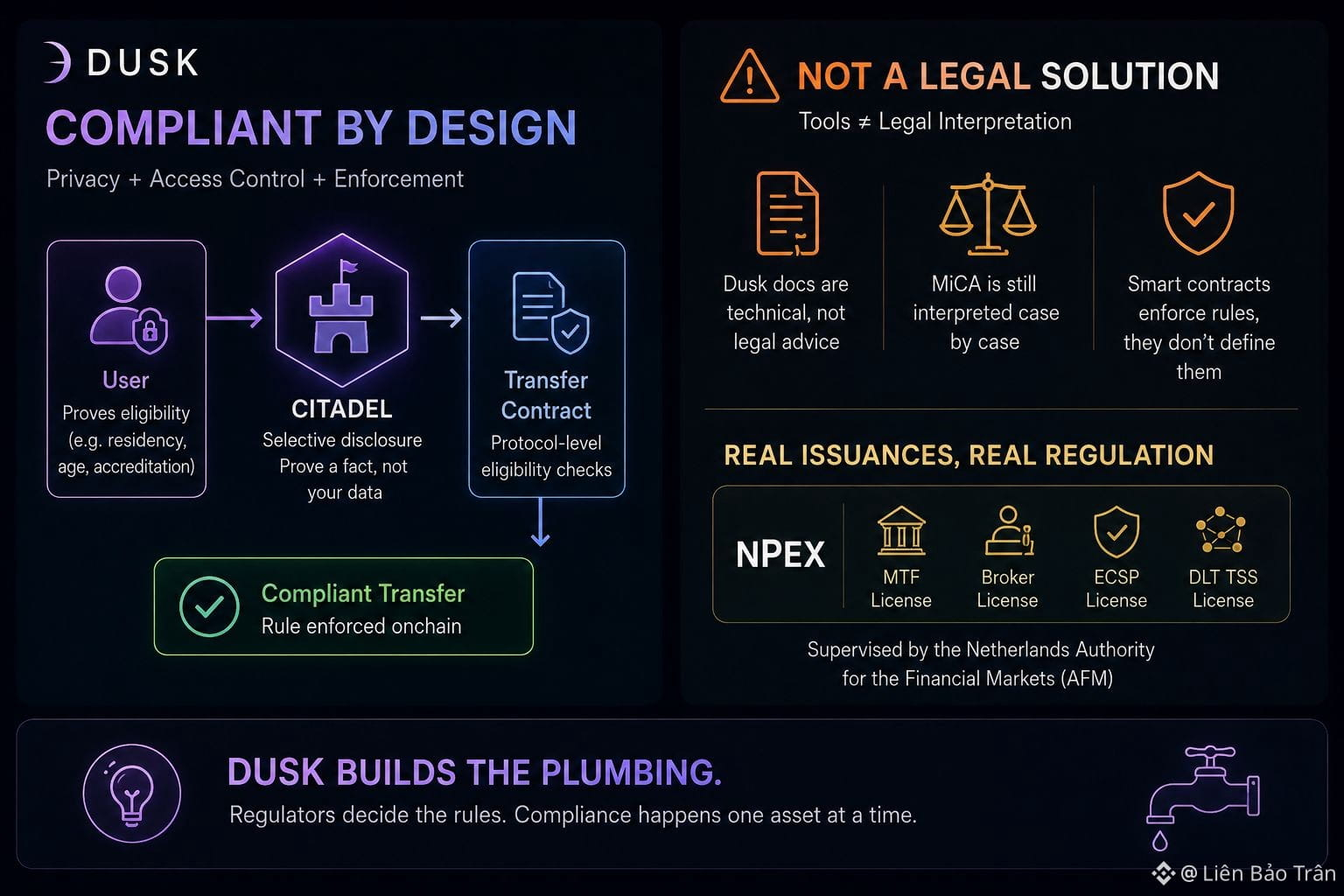
Read enough marketing copy about Dusk Network and you will find some version of the phrase compliant by design. I understand why it gets used. Citadel lets a user prove residency, age, or accreditation status without revealing anything beyond that single fact. The transfer contract can enforce eligibility checks at the protocol level instead of leaving them to a back office spreadsheet. That is a genuine engineering achievement, and it is rare among Layer 1 networks. Here is the part that gets left out of most threads. Dusk Network's own documentation, when it discusses MiCA, says plainly that the material is a technical overview for builders and not legal advice, and it points readers to ESMA and official legal text for actual interpretation. That single disclaimer tells you something important. Building the primitives that regulated markets need, access control, selective disclosure, reporting hooks, is not the same task as resolving how a given regulator in a given jurisdiction will treat a given tokenized instrument. A smart contract can enforce a rule once that rule is settled. It cannot settle the rule itself, and MiCA's application to specific asset classes is still worked out case by case across Europe. So when I see a claim that Dusk Network has solved compliance, I read it as shorthand for something narrower and still valuable: it has built the plumbing compliance requires. The legal work sits on top, asset by asset, issuer by issuer, and no protocol closes that gap by itself. That distinction matters more as Dusk Trade and NPEX bring real securities on chain, not less. NPEX alone carries an MTF license, a broker license, an ECSP license, and a DLT TSS license under supervision from the Netherlands Authority for the Financial Markets, and each of those answers to its own regulator with its own open questions. Dusk Network gave builders the tools to encode a rule once regulators agree on it. It did not make that agreement happen faster, and I would rather see the project own that limit plainly than let a slogan.
@Dusk #dusk $DUSK $BTW $ACE
@Dusk #dusk $DUSK $BTW $ACE
Ver tradução
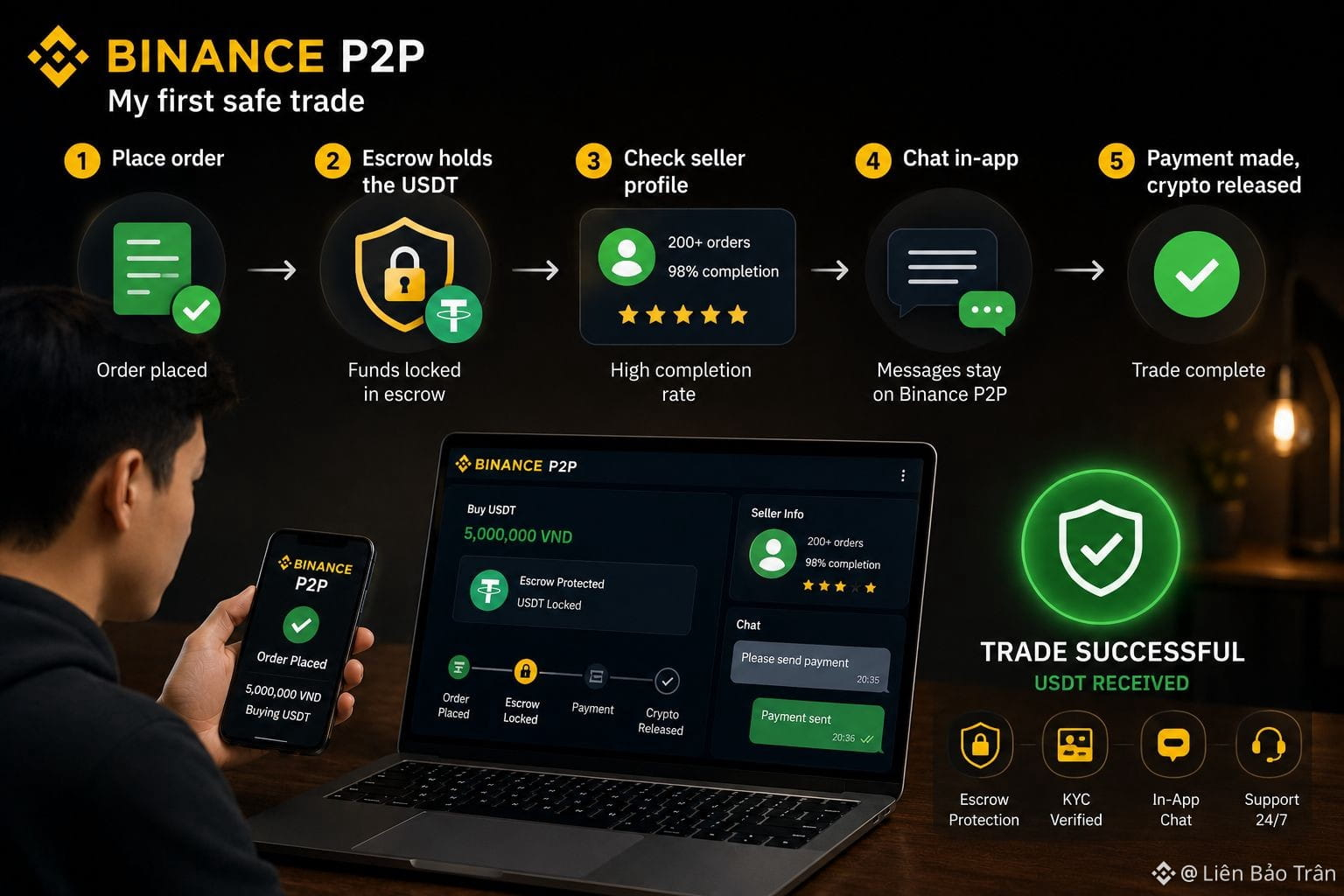
Giao dịch đầu tiên của tôi trên Binance P2P diễn ra vào một buổi tối cuối tuần, khi tôi cần mua 5 triệu đồng tiền USDT để chuyển cho một người bạn ở nước ngoài. Tay tôi hơi run khi đặt lệnh, vì trước đó tôi chỉ nghe nói về những vụ lừa đảo tiền điện tử qua mạng xã hội mà chưa từng tự mình thử. Điều khiến tôi yên tâm hơn cả là cơ chế ký quỹ của Binance P2P. Ngay khi tôi đặt lệnh mua, số USDT tương ứng từ phía người bán đã được khóa lại trong hệ thống, không bên nào có thể tự ý rút ra cho đến khi giao dịch hoàn tất hoặc có quyết định xử lý từ đội ngũ Binance. Nhờ vậy, tôi không phải lo người bán nhận tiền xong rồi biến mất mà không giao crypto. Trước khi chuyển khoản, tôi dành thời gian xem hồ sơ của người bán: số lệnh đã hoàn thành, tỷ lệ hoàn thành trong 30 ngày gần nhất và đánh giá từ những người mua trước đó. Người bán này có hơn 200 lệnh thành công với tỷ lệ hoàn thành 98%, điều đó giúp tôi tự tin hơn nhiều so với việc giao dịch với một tài khoản mới toanh không có lịch sử. Suốt quá trình giao dịch, tôi trò chuyện với người bán ngay trong khung chat của Binance P2P, không chuyển sang bất kỳ ứng dụng nhắn tin nào khác. Mọi tin nhắn, thời gian gửi và nội dung trao đổi đều được lưu lại tự động, đây chính là bằng chứng quan trọng nếu sau này có tranh chấp xảy ra. Sau khi hoàn tất, tôi nhận ra cảm giác lo lắng ban đầu phần lớn đến từ việc chưa hiểu quy trình. Khi đã nắm được vai trò của ký quỹ và biết cách đọc hồ sơ đối tác, tôi giao dịch tự tin hơn nhiều ở những lần sau.
@Binance Vietnam #BinanceP2PAnToan $BTW $ACE $PORTAL
@Binance Vietnam #BinanceP2PAnToan $BTW $ACE $PORTAL
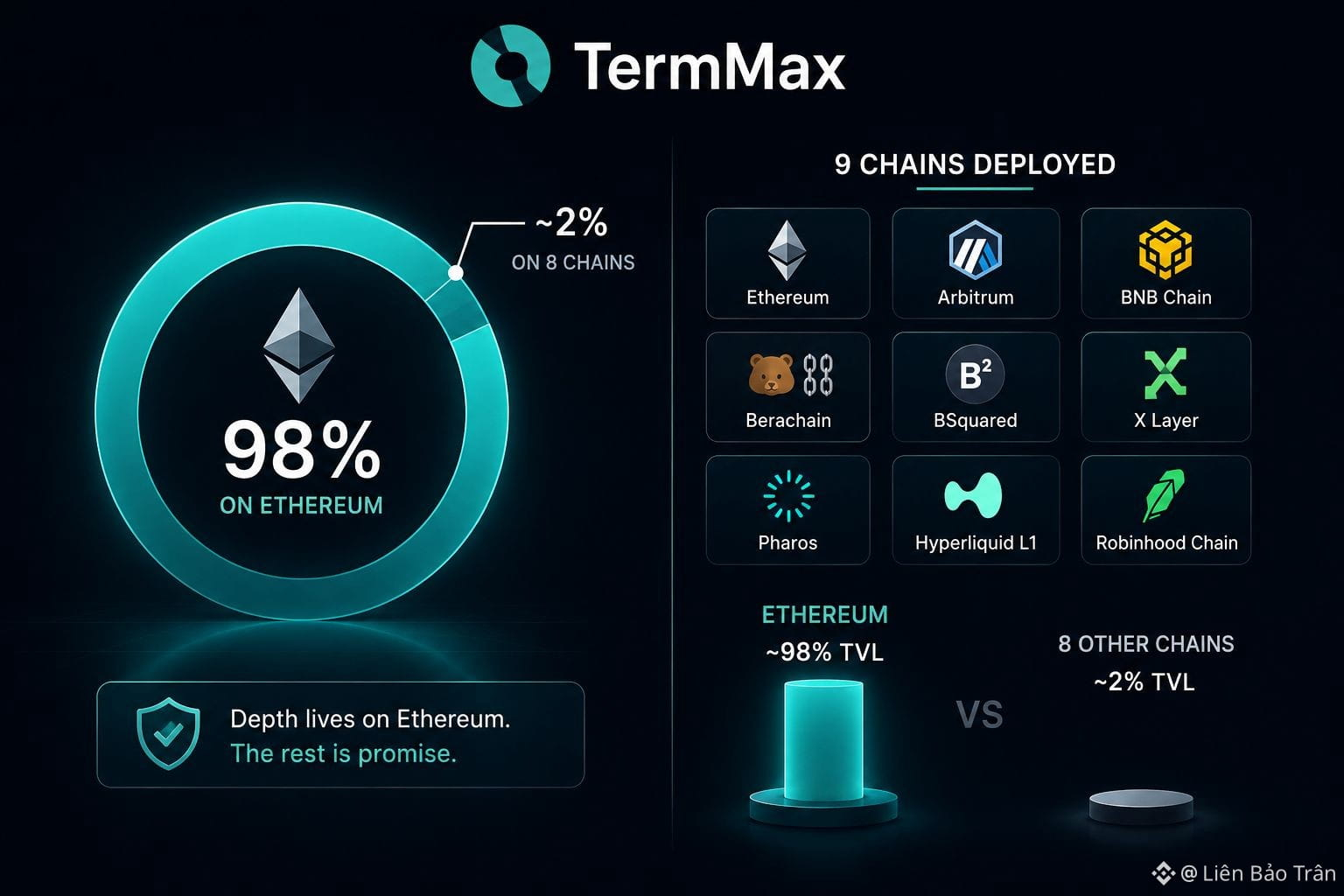
A TermMax lista deployments em nove cadeias: Ethereum, Arbitrum, BNB Chain, Berachain, BSquared, X Layer, Pharos, Hyperliquid L1 e Robinhood Chain. Leia essa lista rápido e a TermMax parece estar em todo lugar — um protocolo que perseguiu liquidez em cada canto do cenário de blockchain modular. Leia os números on-chain com mais calma e surge um quadro diferente: cerca de 98% do valor total da TermMax está apenas na Ethereum. As oito cadeias, juntas, ficam com a fatia restante. Eu não digo isso para descartar a expansão. Implantar em nove cadeias é um trabalho real de engenharia, e isso posiciona a TermMax para capturar liquidez caso algum desses ecossistemas cresça no futuro. Mas existe uma distância entre a teoria da presença multi-chain — em que mais cadeias sinalizam mais alcance e mais resiliência — e a realidade de onde o capital de fato decidiu ficar. Os usuários não se distribuíram do mesmo jeito que o mapa de implantação. Eles escolheram a Ethereum, a cadeia com a liquidez mais profunda e o histórico mais longo, e deixaram o resto em grande parte de lado. A profundidade de liquidez é a versão prática desse problema. Um tomador preenchendo uma ordem com intervalo na Ethereum escolhe entre um mercado com profundidade real e vários market makers concorrentes. O mesmo tomador na Pharos ou na Robinhood Chain talvez esteja preenchendo a única ordem disponível, na taxa que aquele único maker decidiu postar, sem uma segunda cotação em lugar próximo para comparar. Vale a pena ficar com isso antes de ler "nove cadeias" como força por si só. Uma lista de cadeias é um mapa de onde a TermMax pode ser usada, não um mapa de onde a TermMax está sendo usada. Essa segunda pergunta importa mais para um credor ao decidir se sua posição de taxa fixa, por exemplo, na X Layer ou na BSquared, terá liquidez suficiente do outro lado para preencher a uma taxa justa — em vez de ficar em um livro fino, com apenas alguns pedidos de intervalo e pouca concorrência real. A expansão é uma aposta na liquidez futura. Por enquanto, os próprios números da TermMax dizem que a aposta não valeu muito fora da Ethereum.
@TermMax #TermMax $BTW $PORTAL $HEMI
@TermMax #TermMax $BTW $PORTAL $HEMI
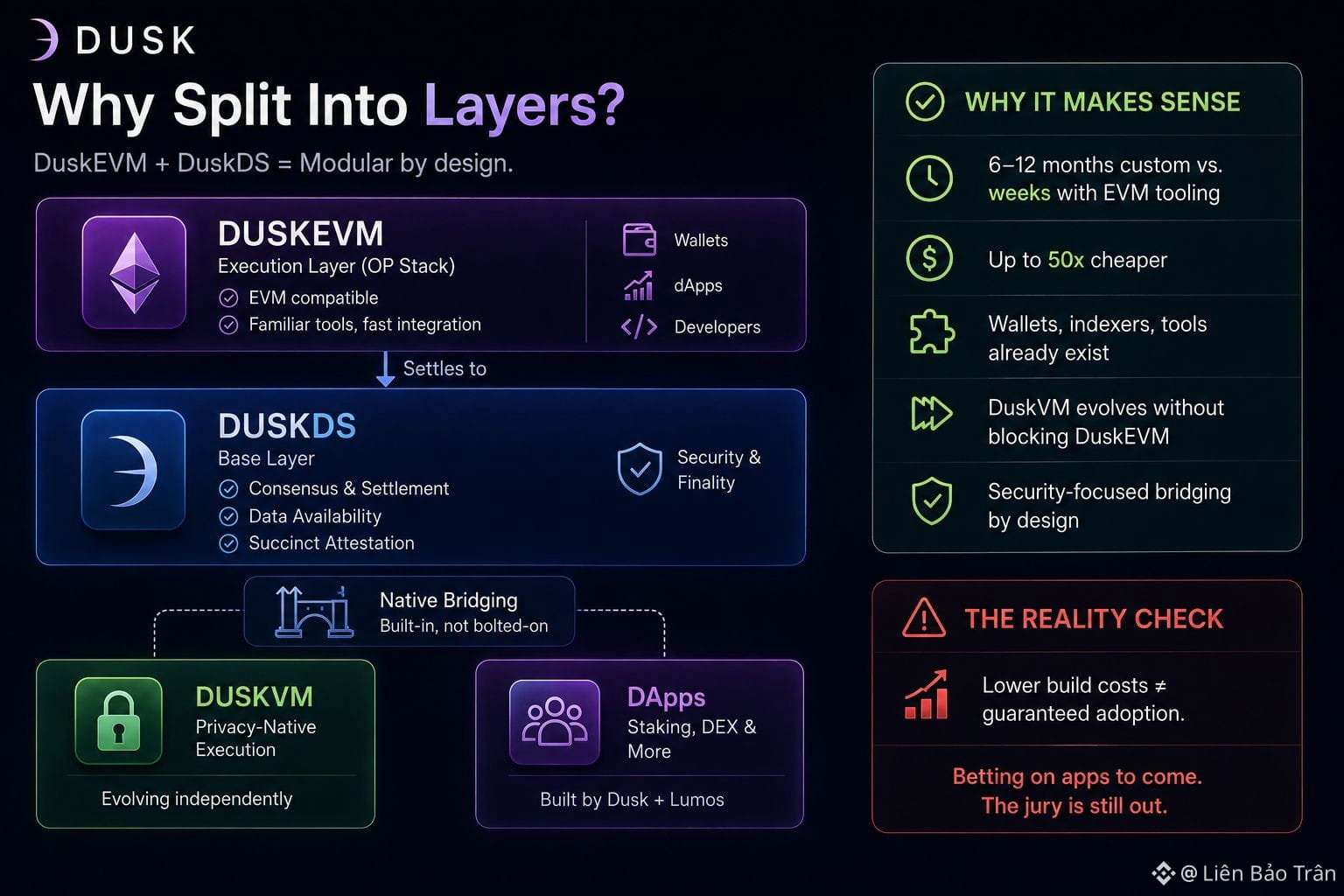
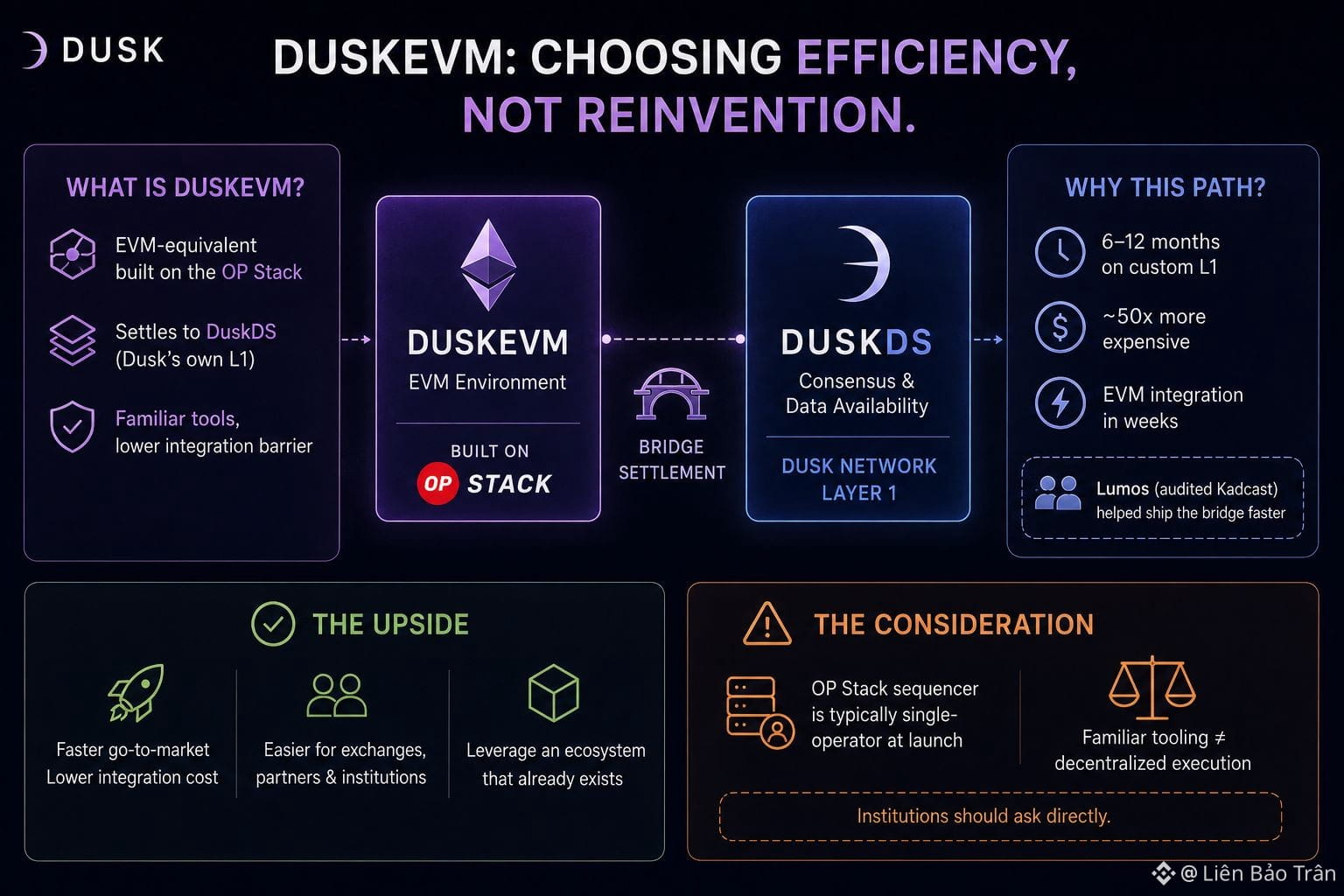
Dividir uma blockchain em camadas parece uma complexidade extra apenas por ser, então eu queria entender por que a Dusk Network escolheu fazer exatamente isso com o DuskEVM em vez de simplesmente estender a sua cadeia nativa original. A camada base da Dusk, a DuskDS, já estava lidando com consenso, disponibilidade de dados e liquidação por meio de Succinct Attestation antes do DuskEVM existir. Em vez de simplesmente acoplar suporte a EVM diretamente a esse design, a equipe construiu o DuskEVM como um ambiente de execução separado no OP Stack, que liquida de volta na DuskDS em vez de executar sua própria segurança independente. O desenvolvimento é uma mistura de engenheiros internos da Dusk e de uma equipe externa, a Lumos, trazida especificamente para acelerar a ponte entre as duas camadas e em aplicações iniciais como staking e uma exchange descentralizada. A ponte nativa entre a DuskDS e cada camada de execução também faz parte do design base, não é algo acoplado depois, o que importa já que, em outro lugar do stack, a segurança de bridges acabou se tornando a maior dor operacional da Dusk. A justificativa se sustenta quando você olha a alternativa. Integrações personalizadas em uma Layer 1 totalmente sob medida podem levar de 6 a 12 meses e custar até 50 vezes mais do que conectar a ferramentas EVM padrão, de acordo com comparações próprias da Dusk. Segundo relatos, exchanges passaram meses adaptando-se à Dusk nativa no passado, enquanto integrações baseadas em EVM podem ser concluídas em semanas porque carteiras, indexers e ferramentas de desenvolvimento já existem. Separar liquidação de execução também significa que o DuskVM — o ambiente nativo com foco em privacidade, ainda sendo extraído da antiga máquina virtual Piecrust — pode continuar evoluindo sem arrastar o cronograma de lançamento do DuskEVM junto. O que essa decisão não resolve é a velocidade de adoção. Uma arquitetura modular reduz o custo de construir, mas não garante que alguém vá construir. A Dusk Network está apostando que caminhos de integração mais baratos se traduzem em aplicações reais escolhendo a cadeia, e essa aposta ainda não foi totalmente paga.
@Dusk #dusk $BTW $DUSK $PORTAL
@Dusk #dusk $BTW $DUSK $PORTAL
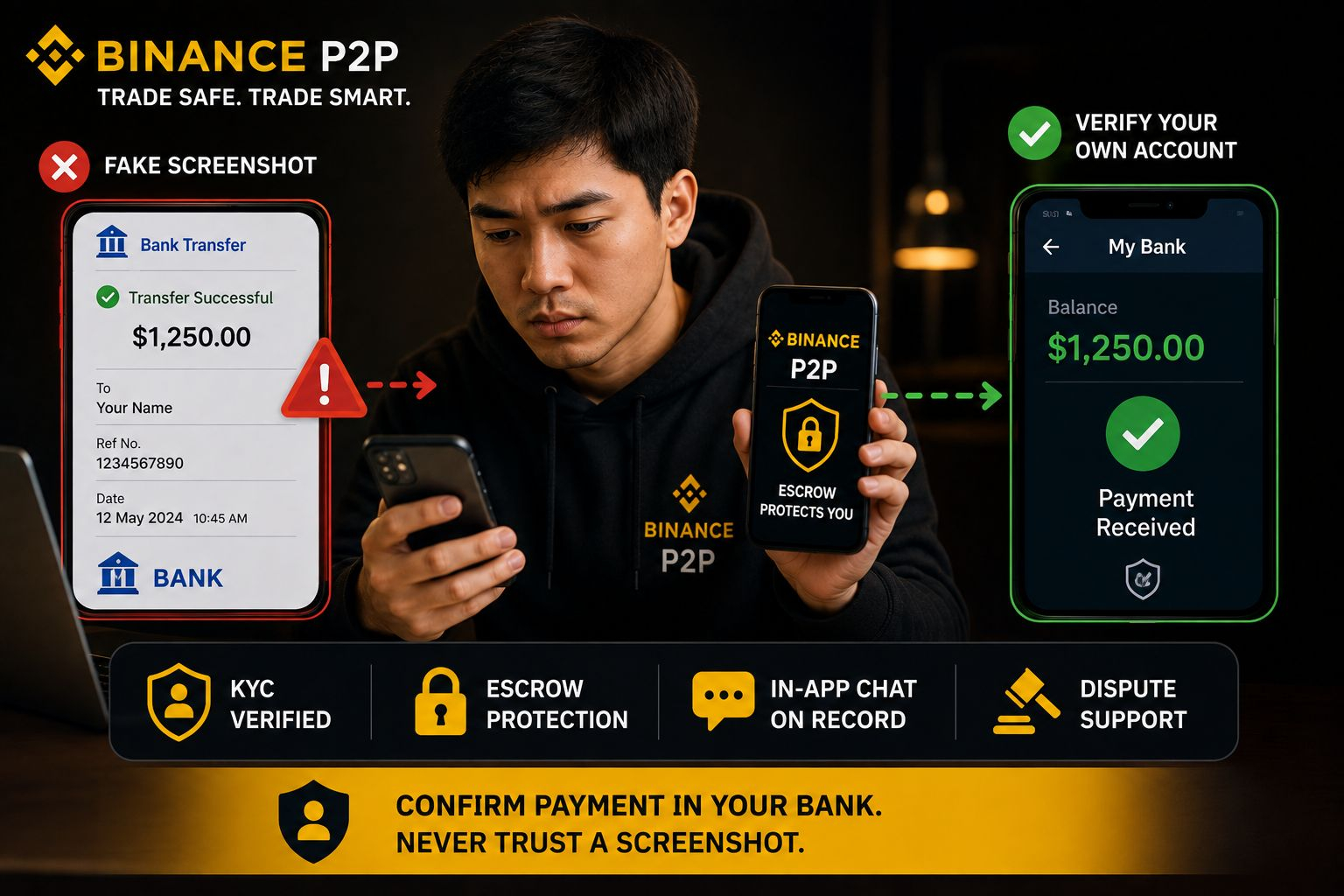
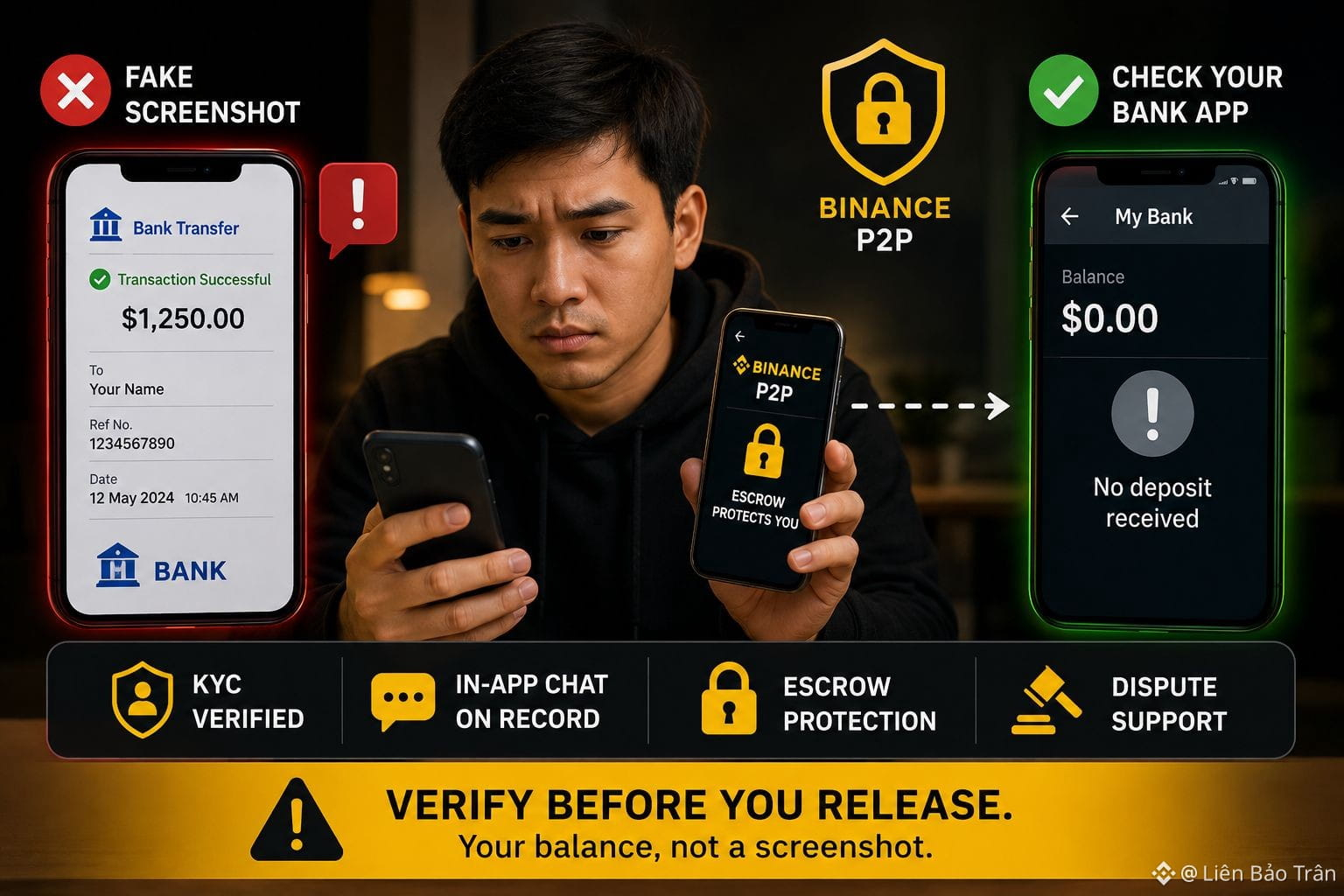
No Binance P2P, a proteção para vendedores funciona tanto quanto para compradores. Cada conta é vinculada a uma identidade verificada via KYC, e quando eu aceito uma oferta como vendedor, meu ativo cripto fica em custódia (escrow) em vez de se mover para qualquer lugar até que a negociação seja realmente concluída. Essa etapa de custódia importa porque me dá espaço para confirmar o pagamento com segurança, sem me sentir pressionado a liberar os fundos assim que uma mensagem chega. Se algum dia ocorrer uma disputa, a Binance mantém todo o histórico de chat registrado, o que vira uma evidência útil durante uma apelação. Alguns meses após eu começar a operar, um comprador me enviou, poucos segundos depois da abertura do pedido, uma captura de tela que parecia uma transferência “limpa”. Ela tinha meu nome, o valor correto e até um número de referência da transação. Só que algo na hora do envio parecia estranho; então, em vez de liberar o ativo cripto imediatamente, eu abri o app do meu banco direto e procurei a transferência por conta própria. Não havia nada de fato caído. Eu entrei em contato com o comprador, expliquei com calma que ainda não encontrava o pagamento e dei a ele um curto prazo para enviar corretamente. Uma transferência genuína apareceu 8 minutos depois, e o pedido foi concluído sem problemas. Essa experiência mudou a forma como eu opero. Uma captura de tela fabricada é um dos avisos mais comuns no Binance P2P, e a solução é sempre a mesma: verifique sua própria conta, nunca a imagem de outra pessoa. Eu também comecei a salvar os registros de cada pedido concluído, incluindo capturas de tela da confirmação final e o histórico do chat, porque o suporte da Binance me pediu exatamente esse tipo de documentação uma vez durante uma disputa não relacionada. Ter isso pronto deixou todo o processo mais rápido. Também aprendi a confiar no meu instinto em relação ao timing. Um pagamento que chega em segundos após a abertura do pedido, antes de uma transferência bancária conseguir processar de forma realista, muitas vezes é um sinal que vale a pena pausar para analisar em vez de descartar como sorte. Confiar nesse instinto uma vez foi suficiente para torná-lo uma parte permanente de como eu vendo no Binance P2P.
@Binance Vietnam #BinanceP2PAnToan $BTW $HEMI $PORTAL
@Binance Vietnam #BinanceP2PAnToan $BTW $HEMI $PORTAL
Ver tradução
Dusk Network hit the same fork in the road every privacy blockchain eventually reaches: build your own execution environment from scratch and keep full control over the cryptography, or adopt something the rest of the industry already uses and accept the constraints that come with it. It picked the second path when it built DuskEVM, and I think the reasoning behind that choice says more about the project's priorities than any feature list does. DuskEVM is an EVM-equivalent environment built on the OP Stack, the same rollup framework powering a large share of Ethereum's layer 2 ecosystem. It settles back to DuskDS, Dusk Network's own consensus and data availability layer, rather than existing as an island. By Dusk Network's own account of the transition, custom integrations on a bespoke layer 1 can take 6 to 12 months and cost roughly 50 times more than deploying through standard EVM tooling. Exchanges reportedly spent months adapting to native Dusk in the past, while EVM-based integration work can close in weeks. Dusk Network also brought in Lumos, an outside engineering group that previously audited its Kadcast networking protocol, to help the DuskDS to DuskEVM bridge ship faster, which suggests the team did not see this transition as simple enough to handle entirely in-house. That is a real efficiency argument, not just a marketing line, because integration cost is exactly what determines whether institutions bother showing up at all. But adopting the OP Stack also means inheriting its assumptions, including a sequencer model that in most OP Stack deployments starts out operated by a single team rather than a distributed set of operators. For a project built around regulated finance and selective disclosure, that detail deserves more scrutiny than it usually gets. Familiar tooling lowers the barrier to entry. It does not, by itself, prove decentralization at the execution layer, and that is a distinction institutions evaluating Dusk Network for real settlement work should be asking about directly.
@Dusk #dusk $DUSK $VELVET $BTW
@Dusk #dusk $DUSK $VELVET $BTW
Certa vez, um comprador me enviou um print de pagamento no Binance P2P que parecia completamente real: carimbo de data e hora, logo do banco, referência da transação, tudo. Quase cliquei em liberar ali mesmo. Em vez disso, abri primeiro meu próprio aplicativo bancário, e o depósito simplesmente não estava lá. Essa diferença entre o que uma imagem de conversa mostra e o que sua conta realmente reflete é exatamente por isso que o Binance P2P criou o escrow em cada pedido: a criptomoeda fica bloqueada até que o vendedor, e não a janela do chat, confirme que o dinheiro caiu. O Binance P2P funciona porque obriga a verificação em cada etapa. Todo usuário completa o KYC antes de negociar, então as identidades ficam registradas. O histórico do chat mantém uma linha do tempo com carimbo de data e hora de tudo o que foi dito, o que importa mais tarde se uma apelação por disputa for necessária. No meu caso, expliquei com calma ao comprador que eu ainda não havia recebido os fundos e que esperaria a confirmação. Em poucos minutos, as mensagens começaram a virar pressão, pedindo que eu liberasse agora e prometendo que o pagamento apareceria em breve. Essa urgência é um sinal vermelho clássico no Binance P2P e, normalmente, é um indicativo para desacelerar, não para acelerar. Eu denunciei o pedido e entrei em contato com o suporte do Binance, com capturas da conversa e do meu extrato bancário mostrando que não houve depósito. Ter esse arquivo pronto deixou o processo rápido; o suporte conseguiu ver exatamente o que aconteceu sem que eu precisasse reconstruir a linha do tempo pela memória. Olhando para trás, o principal sinal não era nem o print em si: era a rapidez com que a conversa mudou assim que eu disse que não tinha recebido nada. Um comprador legítimo, lidando com um banco lento, tende a continuar paciente e até a pedir desculpas pela espera, enquanto alguém que espera que você libere cedo tende a aumentar a pressão rapidamente. Alguns hábitos ficaram comigo depois disso: nunca confiar apenas em uma imagem de pagamento; sempre checar diretamente a conta de origem; e manter toda captura de tela de uma negociação até ela estar totalmente encerrada. O Binance P2P oferece as ferramentas para você se manter seguro, mas só funciona se você realmente pausar quando algo não fizer sentido.
@Binance Vietnam #BinanceP2PAnToan $BTW $VELVET $ACE
@Binance Vietnam #BinanceP2PAnToan $BTW $VELVET $ACE
Ver tradução
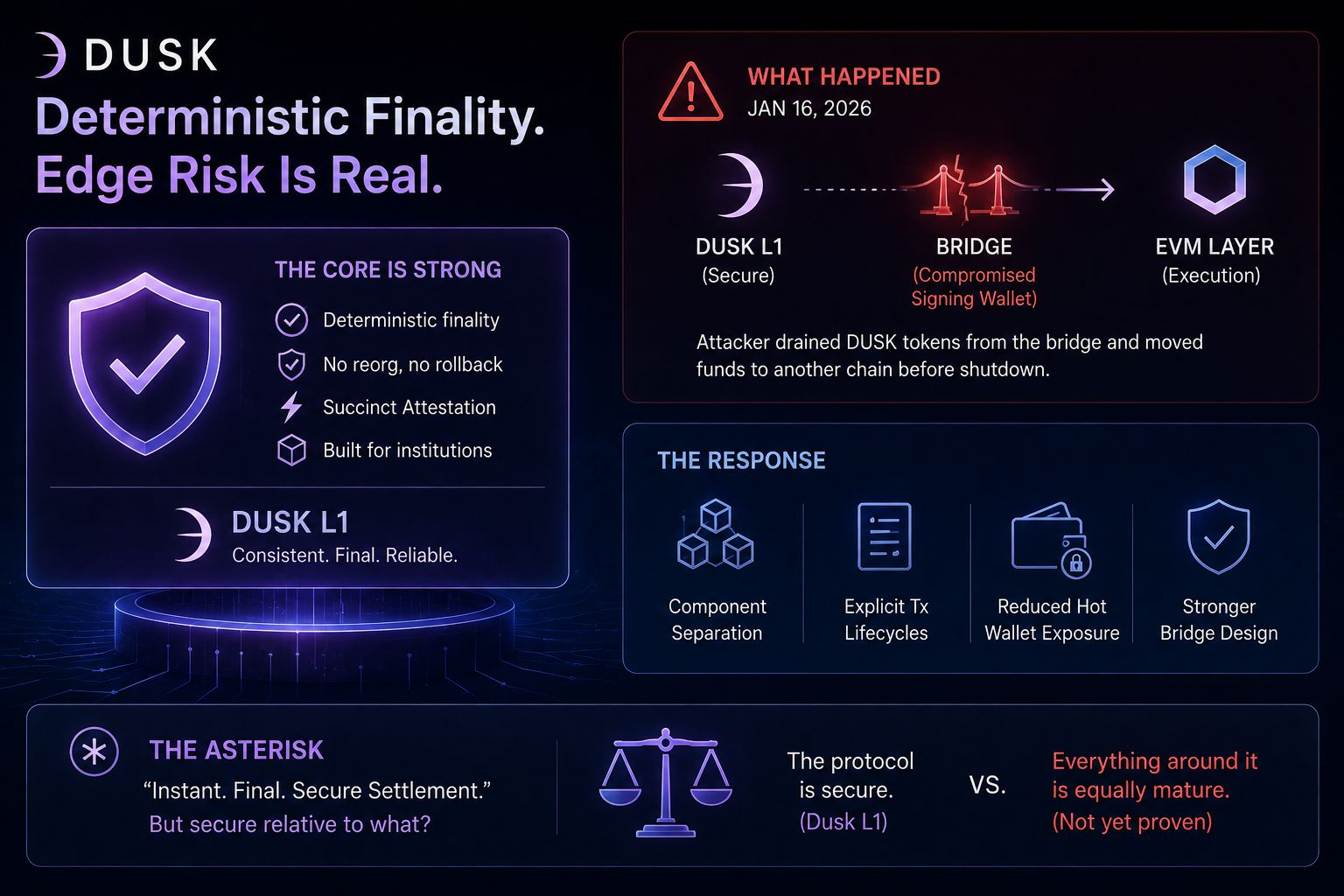
Dusk Network markets deterministic finality as one of its core advantages: once a transaction settles, there's no reorg, no waiting for confirmations to stack up, no theoretical rollback. Succinct Attestation was built specifically to give financial institutions something Bitcoin-style probabilistic finality never could. That part of the promise held up well through the network's first year of mainnet operation. Then, on January 16, 2026, an attacker drained DUSK tokens from the bridge connecting Dusk Network to its EVM execution layer, moving stolen funds onward to another chain before the bridge was shut down. The root cause, per the team's own post-mortem, was a compromised signing wallet inside a bridge design that lacked proper isolation between components. The core consensus layer was never touched. Settlement finality on Dusk Network itself worked exactly as designed. The theft happened at the edge, in the connective tissue between chains, which is precisely where a large share of crypto's worst incidents keep happening industry-wide. That's the gap worth sitting with. A protocol can be cryptographically sound at its center and still be only as strong as the least isolated piece bolted onto it. Dusk Network's response was a full bridge redesign: component separation, explicit transaction lifecycles, reduced hot-wallet exposure. Sensible engineering. But it also means the "instant, final, secure settlement" pitch needs an asterisk most marketing copy leaves out: secure relative to what, the base layer, or every piece of infrastructure a user actually touches? I don't think this disqualifies Dusk Network's core thesis. Deterministic finality at the consensus layer is real and genuinely rare among Layer-1 chains. But I do think anyone evaluating the project should separate "the protocol is secure" from "everything built around the protocol is equally mature," because those are 2 different claims with 2 very different track records so far.
@Dusk #dusk $DUSK
@Dusk #dusk $DUSK
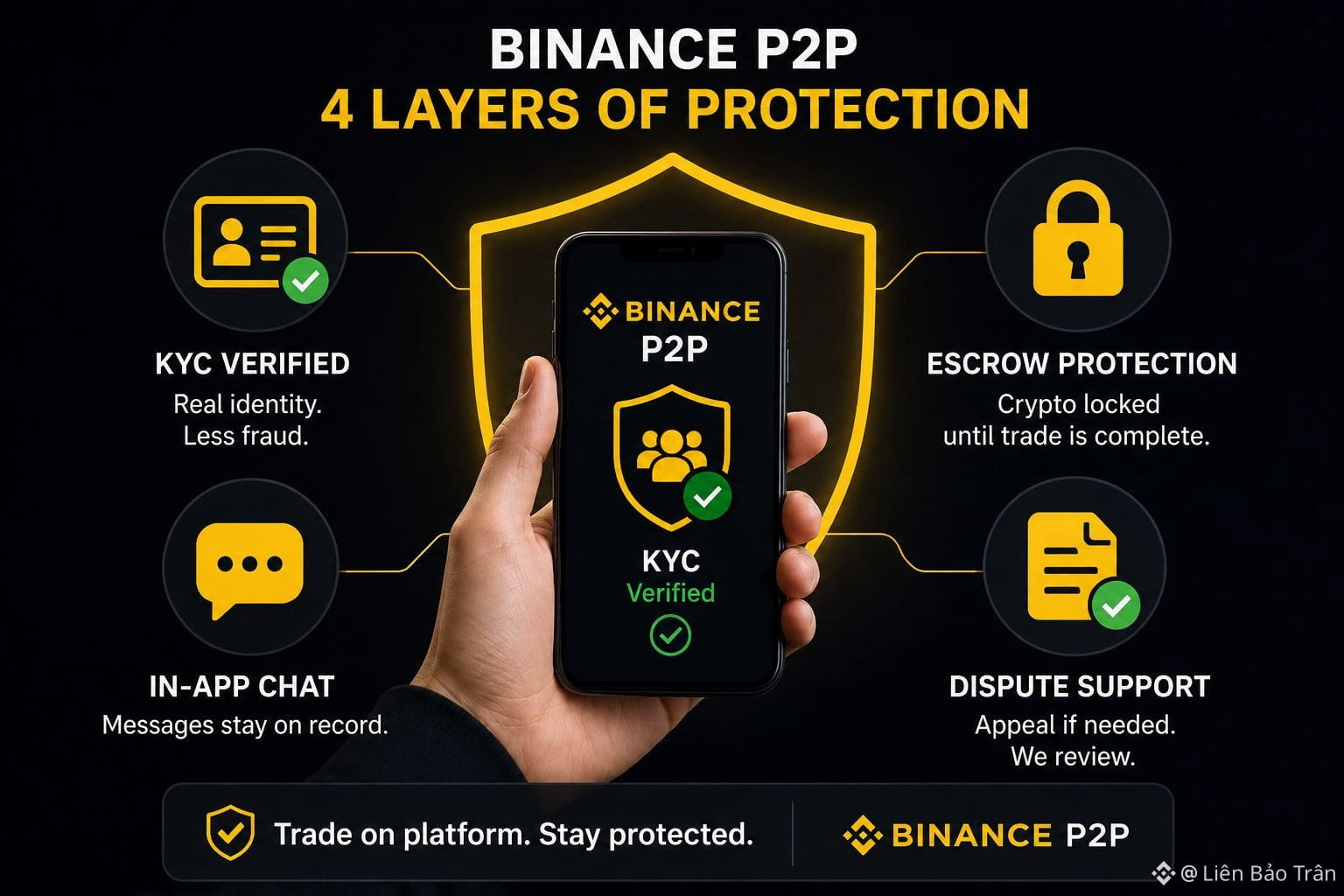
Muitas pessoas não percebem o quanto de proteção a Binance P2P realmente oferece até que precisem disso. A Binance mantém o cripto do vendedor em escrow assim que uma ordem é aberta, liberando apenas quando o pagamento é confirmado — e isso se soma ao KYC obrigatório de todas as contas, a uma conversa em cada ordem e a um processo de apelação de disputa que a Binance pode usar para analisar evidências caso as duas partes discordem. Tudo depende de a negociação permanecer completamente dentro da Binance P2P, porque, se qualquer coisa for resolvida fora do app, não sobra nada para a Binance verificar depois. Antes de aceitar uma ordem, eu olho a taxa de conclusão do contraparte, o total de negociações e a atividade recente, e trato um print que parece falso, um pedido de pagamento feito com pressa ou um nome que não bate como sinais de alerta imediatos, e não como meros incômodos. Eu confirmo cada pagamento pelo meu próprio app bancário antes de liberar qualquer coisa e guardo o chat e a prova depois, caso eu precise contatar o suporte. O comprador me enviou um print que parecia totalmente real: logo do banco, meu nome, valor correto e um carimbo de data/hora que correspondia perfeitamente. Por um segundo, eu realmente fui pegar o botão de liberar. Em vez disso, abri primeiro o meu app bancário, que virou o único hábito que já me salvou mais de uma vez — e o saldo não havia se movido de jeito nenhum. Eu disse que precisava ver cair do meu lado antes de liberar qualquer coisa. Ele ficou insistente, culpou um atraso e então perguntou se podíamos resolver tudo por um método totalmente diferente, que é exatamente o tipo de pedido que encerra uma negociação para mim na hora. Eu fechei a ordem, denunciei a conta pelo suporte e mantive o print falso junto com o log completo da conversa salvo, caso o padrão apareça de novo com outra pessoa. Minha regra agora é simples: nunca liberar com base em uma imagem; apenas no seu próprio saldo confirmado; e sempre arquivar as evidências, o ID da ordem, o chat e a prova do pagamento por pelo menos um mês depois que a negociação for encerrada.
@Binance Vietnam #BinanceP2PAnToan $BTW $VELVET $PORTAL
Qual é a sua #1 regra na P2P?
@Binance Vietnam #BinanceP2PAnToan $BTW $VELVET $PORTAL
Qual é a sua #1 regra na P2P?
🔐 Verify your own balance
75%
🚫 Never trust screenshots
25%
💬 Stay inside Binance
0%
🛡️ Save all trade evidence
0%
4 Votos • Votação encerrada
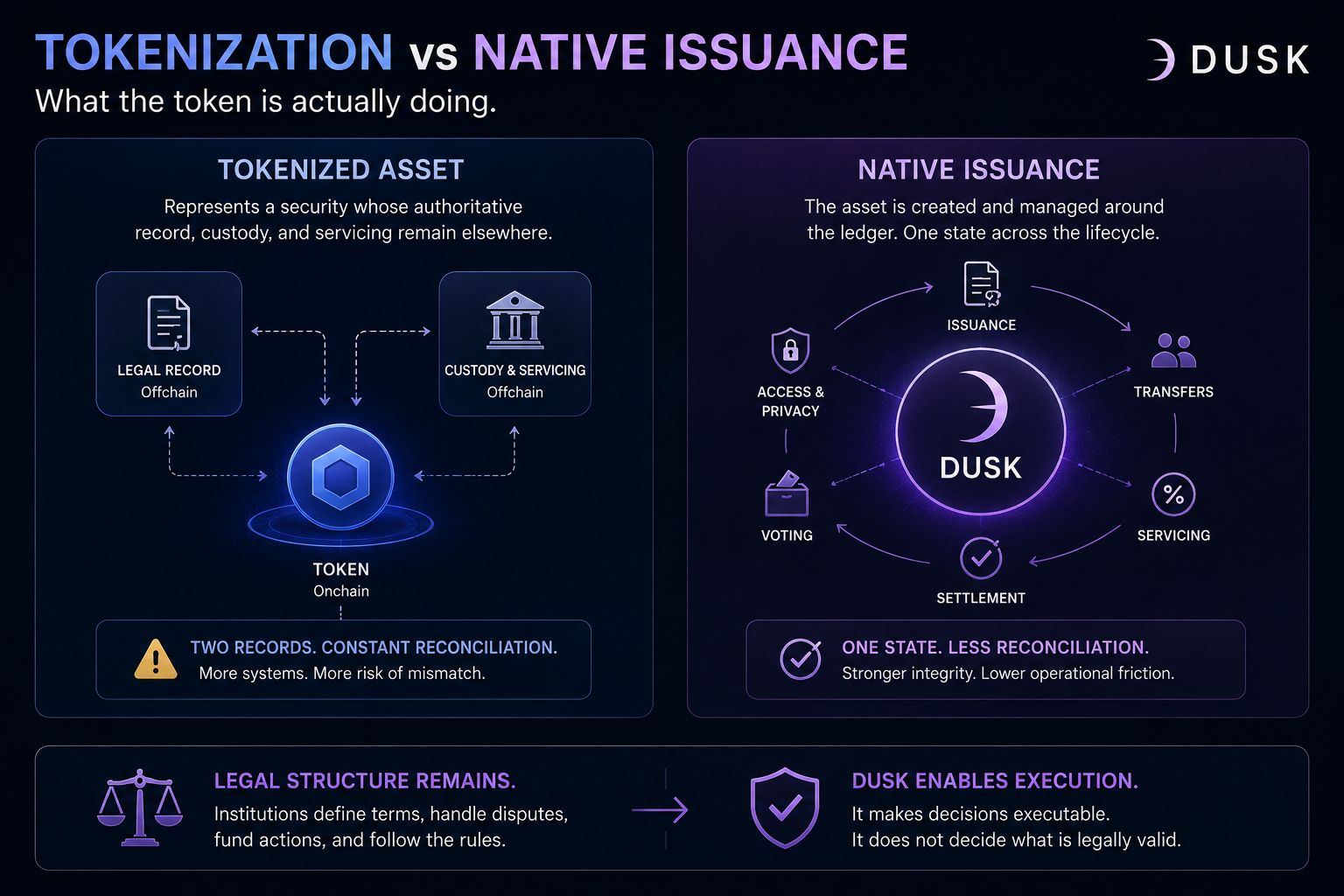
Eu costumava colocar toda a segurança de blockchain sob o mesmo rótulo: ativo tokenizado. A Dusk Network me fez olhar com mais atenção para o que o token realmente está fazendo. Um token pode representar uma segurança cujo registro autoritativo, custódia e prestação de serviços permanecem em outro lugar. Isso pode melhorar a distribuição e a programabilidade, mas também cria um segundo registro que precisa permanecer alinhado com o primeiro. A propriedade se move onchain enquanto a realidade legal ainda pode se mover por meio de registros, administradores e sistemas de liquidação. A emissão nativa muda a questão. O próprio ativo é criado e gerenciado em torno do ledger, então emissão, transferências, prestação de serviços e liquidação podem compartilhar um único estado. A Dusk foi construída para esse fluxo de trabalho mais profundo, com controles de acesso, privacidade com divulgação seletiva e finalidade determinística. A parte que considero importante não é a palavra “nativa”. É a redução na reconciliação. Suponha que um emissor aloque um ativo na Dusk e um investidor elegível o receba. Se o mesmo estado de propriedade mais tarde for o que impulsiona um cupom ou um voto, menos sistemas precisam discordar sobre quem possui o quê. Essa melhoria é mais forte do que apenas “encapsular” um processo inalterado em um contrato de token. Mas a emissão nativa não faz com que a estrutura legal desapareça. Alguém ainda define o instrumento, aprova seus termos, trata disputas, financia ações corporativas e segue as regras do mercado relevante. A Dusk pode tornar essas decisões executáveis. Ela não pode decidir quais decisões são legalmente válidas. Esse é o limite que eu observaria em uma emissão ao vivo da Dusk. O ledger é o registro operacional autoritativo ou ele ainda está apenas espelhando outro livro? As transferências e a prestação de serviços usam o mesmo estado, ou a reconciliação retorna após a primeira venda? A tokenização pode colocar um ativo financeiro onchain. A emissão nativa pode mover mais do ciclo de vida financeiro para lá. A Dusk se torna muito mais interessante se ela provar a segunda afirmação sem fingir que a cadeia substitui instituições responsáveis.
@Dusk #dusk $DUSK $BTW $VELVET
@Dusk #dusk $DUSK $BTW $VELVET
Um comprador me mandou mensagem na semana passada pedindo para terminarmos nosso acordo no Binance P2P em outro lugar, e esse único pedido me disse tudo o que eu precisava saber sobre a negociação. Toda conta no Binance P2P passa por verificação de KYC antes de poder negociar, e ambas as partes então concordam em manter a transação inteira dentro da plataforma, do momento em que uma ordem é aberta até o momento em que o cripto é liberado. Essa estrutura existe por um motivo. O escrow mantém o cripto do vendedor com segurança até o pagamento ser confirmado, o chat integrado registra cada mensagem com um carimbo de data e hora e, se houver algum desacordo, qualquer uma das partes pode abrir uma disputa para o suporte da Binance analisar. No instante em que qualquer parte desse processo sai do Binance P2P, toda essa proteção desaparece. O suporte não consegue verificar uma alegação de pagamento feita por meio de algum aplicativo externo, e uma disputa ligada a um acordo fora da plataforma praticamente não tem nada em que se apoiar. Como vendedor, eu nunca libero cripto até confirmar pessoalmente que o pagamento caiu na minha conta — não quando o comprador diz que caiu, nem quando um print afirma que caiu. Eu também mantenho registros de tudo: o número do pedido, o histórico do chat e um print da confirmação do pagamento do meu próprio banco, salvado no momento em que a negociação é encerrada. Eu disse a esse comprador, de forma direta, que terminaríamos o acordo no Binance P2P ou não terminaríamos de forma alguma — e a conversa terminou aí, o que, sinceramente, confirmou minha suspeita. Minha lista de verificação como vendedor continua simples: confirmar se os detalhes do pedido correspondem ao que foi combinado; ficar atento a qualquer pedido para conversar ou pagar fora do app; verificar o dinheiro eu mesmo antes de liberar; salvar as provas imediatamente depois. Se um comprador insistir em qualquer ponto disso, eu paro e entro em contato com o suporte da Binance em vez de negociar por cima disso. Um parceiro legítimo nunca tem problema em negociar do jeito que o Binance P2P foi criado para funcionar. Vender tem um peso diferente de comprar também, já que liberar um ativo é uma ação sem volta assim que acontece.
@Binance Vietnam #BinanceP2PAnToan $BTW $PORTAL $VELVET
O que realmente cria liquidez?
@Binance Vietnam #BinanceP2PAnToan $BTW $PORTAL $VELVET
O que realmente cria liquidez?
More buyers, not fractions
75%
Deep markets matter most
0%
Liquidity needs real exits
0%
Fractions don’t mean liquid
25%
4 Votos • Votação encerrada
Ver tradução
Identity verification felt like an annoying extra step the first time I signed up to trade on Binance P2P, until I understood what it actually blocks. KYC requires every trader to confirm a real identity before placing or accepting an order, which means the account across from you in a trade isn't anonymous, even though your personal documents stay private from that counterparty. This single requirement cuts down sharply on fake accounts and stolen identities operating on the platform. It works alongside three other protections. Binance's escrow holds the seller's crypto the moment an order is accepted, so funds sit with the platform rather than either party until the trade completes. The in app chat keeps every message tied to the order, which matters enormously if you ever need to prove what was agreed. And if the two sides can't resolve a disagreement, either person can file an appeal so a support agent reviews the case with real evidence instead of guesswork. None of these four pieces work if you take the deal off Binance P2P, since support has no visibility into private conversations or outside payment apps. Before I accept any offer now, I glance at the counterparty's verification badge and their completion history, not just their price. I've walked away from listings that looked attractive but came from accounts with almost no trading record. Once a trade starts, I still confirm the actual deposit in my bank account before releasing any crypto, and I never let a friendly chat talk me into skipping that step. If a counterparty pushes back on basic verification questions or gets defensive when asked to confirm their name matches the paying account, I treat that as a reason to slow down, not speed up. Support is one tap away in the app if a situation ever feels unclear, and using it early has saved me more than once.
@Binance Vietnam #BinanceP2PAnToan $APR $AKE $BTW
@Binance Vietnam #BinanceP2PAnToan $APR $AKE $BTW
Ver tradução
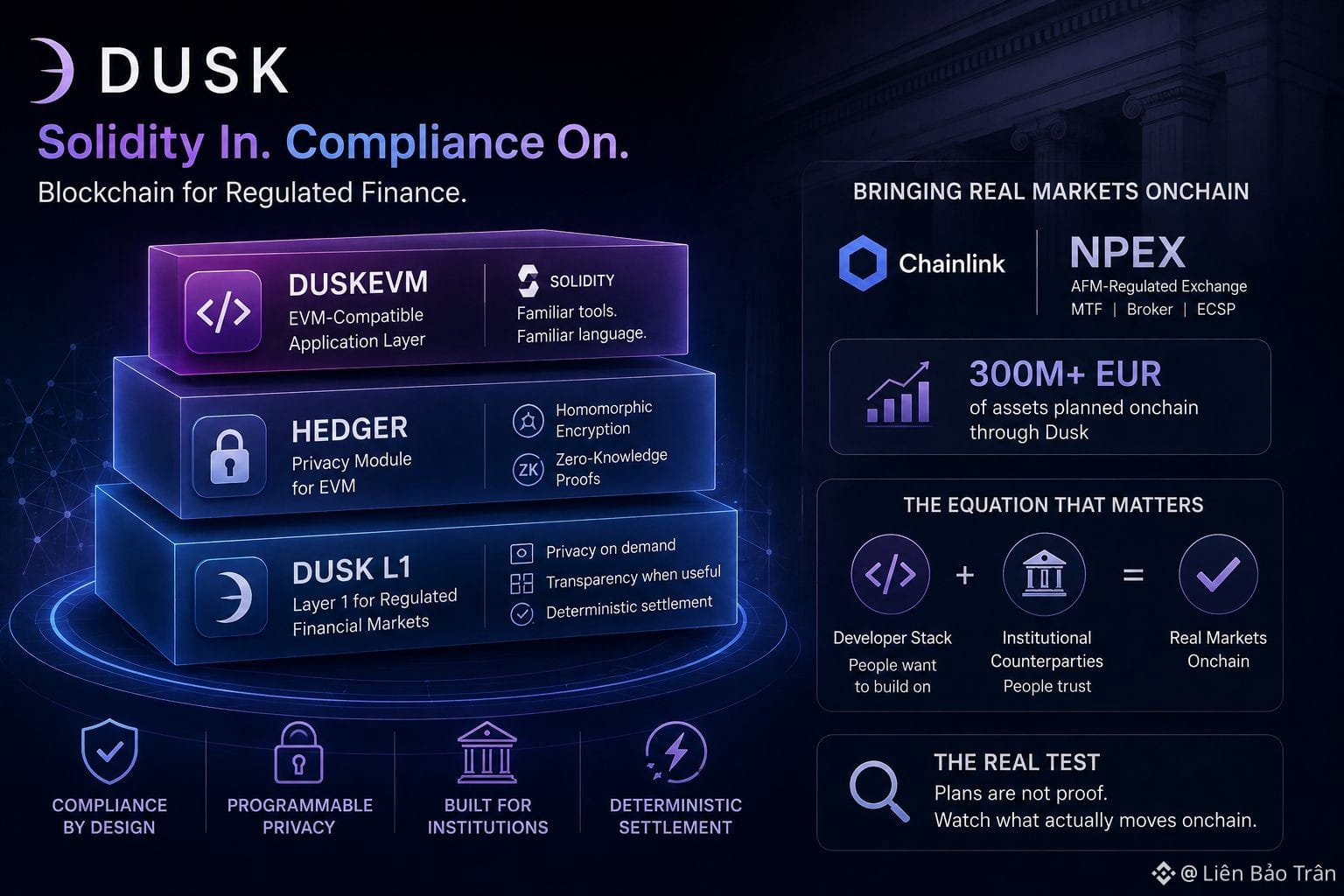
Most chains ask institutions to leave Solidity behind before they can build anything serious. Dusk is asking the opposite question: what if they never had to. Dusk is a Layer 1 blockchain built for regulated financial markets, combining programmable privacy with compliance so privacy applies where needed and transparency stays available where useful, with deterministic settlement underneath both. DuskEVM is the piece that makes this approachable for people who already build on EVM chains. It is the EVM compatible application layer in the Dusk stack, giving partners, institutions, and builders a familiar Solidity path into Dusk rather than a proprietary language to learn from scratch. That familiarity only matters if there is someone credible on the other side of it. Through work with Chainlink and other EU-licensed institutions, Dusk is trying to bring actual financial markets onchain instead of synthetic versions of them. NPEX, an AFM regulated exchange licensed as a multilateral trading facility, broker, and European crowdfunding service provider, plans to move 300M+ EUR in assets onchain through Dusk. The pairing makes sense to me in a way a lot of EVM chain announcements do not. A familiar developer stack without credible institutional counterparties is just another testnet with good marketing. Credible counterparties without a developer stack anyone wants to build on go nowhere either. Dusk is trying to solve both sides of that equation at once. What I have not seen yet is proof that regulated institutions actually prefer building through DuskEVM over simply integrating Dusk as a settlement layer underneath their own systems. AFM regulation and an MTF license do not automatically translate into onchain volume, and 300M+ EUR is still a plan on a page until it becomes a number I can verify moving. I would want to watch what NPEX actually migrates before treating the partnership as proof rather than intent. The Solidity path in is the easy part of this story. The institutional trust behind it is the part
@Dusk #dusk $DUSK
@Dusk #dusk $DUSK
Faça login para explorar mais conteúdos