
Masood33
23.2k ໂພສ

Masood33
ລາຍງານ
ບລັອກຜູ້ໃຊ້

Traders League Badge Beginner
ເປີດການຊື້ຂາຍ
ຜູ້ຊື້ຂາຍປະຈໍາ
4.6 ປີ
2.7K+ ກໍາລັງຕິດຕາມ
23.8K+ ຜູ້ຕິດຕາມ
46.3K+ Liked
1 ຫຼຽນລາງວັນ
ໂພສ
Portfolio
ທັງໝົດ
ວົງຢືມ
ຖ່າຍທອດສົດ
ປັກໝຸດ
·
--
ကျွန်ုပ်တို့က သဘာဝကျကျ အာရုံစိုက်မှုကို ဆက်လက်တည်ဆောက်နေမှာပါ။ အဖွဲ့အသိုင်းအဝိုင်းက ဘယ်လိုပဲ ဆက်လက်ကြီးထွားလာတာကို မြင်ရတာ စိတ်ဝင်စားစရာပါ။
#starlineteam
ကျွန်ုပ်တို့က သဘာဝကျကျ အာရုံစိုက်မှုကို ဆက်လက်တည်ဆောက်နေမှာပါ။ အဖွဲ့အသိုင်းအဝိုင်းက ဘယ်လိုပဲ ဆက်လက်ကြီးထွားလာတာကို မြင်ရတာ စိတ်ဝင်စားစရာပါ။
#starlineteam
#starlineteam


will win 张
·
--
ບົດເພງຂອງວົງການບ່ອນເງິນ 《ທ້າຍຟ້າ》 ມອບໃຫ້ຜູ້ທີ່ບໍ່ດົນມານີ້ $MARSCOIN , $PONS , $ZEC ທີ່ເສຍຫຼືຊະນະກໍາລັງ😂
1
1
19
·
--
ເບິ່ງການແປ
let's go to the mars
let's go to the mars
Masood33
·
--
ကျွန်ုပ်တို့က သဘာဝကျကျ အာရုံစိုက်မှုကို ဆက်လက်တည်ဆောက်နေမှာပါ။ အဖွဲ့အသိုင်းအဝိုင်းက ဘယ်လိုပဲ ဆက်လက်ကြီးထွားလာတာကို မြင်ရတာ စိတ်ဝင်စားစရာပါ။
#starlineteam
#starlineteam
66
·
--
ເບິ່ງການແປ
Aave: Why Decentralized Lending Could Become Core Financial Infrastructure.What happens when borrowing and lending no longer require a traditional bank to sit between the two sides?
That question is one of the reasons Aave continues to stand out to me in decentralized finance. Rather than simply creating another token or trading platform, Aave focuses on one of the most fundamental functions in finance: lending and borrowing.
At its core, Aave is a decentralized lending protocol where users can supply digital assets to liquidity pools and earn interest, while other users can borrow assets by providing collateral. The process is managed through smart contracts rather than relying on a traditional centralized institution to approve every transaction.
The interesting part is how much financial infrastructure can be represented through programmable rules.
In traditional finance, lending involves credit assessments, intermediaries, custodians, legal agreements, and operational processes. DeFi approaches the problem differently. Aave uses overcollateralization and automated mechanisms to manage lending markets. Borrowers generally need to deposit more value as collateral than they can borrow, helping the protocol manage the risk associated with volatile digital assets.
This model creates an important distinction between traditional credit and decentralized lending. Aave doesn't simply try to copy a bank. Instead, it explores what lending can look like when collateral, interest calculations, and liquidations are handled transparently by smart contracts.
Another aspect I find important is liquidity. A lending protocol becomes useful when there is enough liquidity for suppliers and borrowers to interact efficiently. This creates a network effect: more liquidity can improve the usefulness of markets, while useful markets can attract more participants.
But DeFi lending isn't risk-free.
Smart-contract vulnerabilities, asset volatility, liquidation events, oracle dependencies, and changing market conditions can all affect users. Understanding the mechanics behind a protocol is therefore much more important than simply looking at its total deposits or token price.
What makes Aave interesting to me is the broader experiment it represents. Financial services don't necessarily have to disappear; some of their underlying functions can potentially become programmable, transparent, and accessible through decentralized infrastructure.
If this model continues to mature, decentralized lending could become an important component of a broader on-chain financial system where assets, liquidity, and financial applications interact more seamlessly.
The biggest question isn't whether DeFi can recreate traditional lending. It's whether programmable financial infrastructure can eventually provide services that are more accessible, transparent, and composable than the systems we use today.
Do you think decentralized lending will eventually become a mainstream financial tool, or will it remain primarily a crypto-native product?
#Binance #WriteToEarn #Aave #DeFi #Crypto
$ETH $BTC $AAVE
{spot}(AAVEUSDT)
Aave: Why Decentralized Lending Could Become Core Financial Infrastructure.
What happens when borrowing and lending no longer require a traditional bank to sit between the two sides?
That question is one of the reasons Aave continues to stand out to me in decentralized finance. Rather than simply creating another token or trading platform, Aave focuses on one of the most fundamental functions in finance: lending and borrowing.
At its core, Aave is a decentralized lending protocol where users can supply digital assets to liquidity pools and earn interest, while other users can borrow assets by providing collateral. The process is managed through smart contracts rather than relying on a traditional centralized institution to approve every transaction.
The interesting part is how much financial infrastructure can be represented through programmable rules.
In traditional finance, lending involves credit assessments, intermediaries, custodians, legal agreements, and operational processes. DeFi approaches the problem differently. Aave uses overcollateralization and automated mechanisms to manage lending markets. Borrowers generally need to deposit more value as collateral than they can borrow, helping the protocol manage the risk associated with volatile digital assets.
This model creates an important distinction between traditional credit and decentralized lending. Aave doesn't simply try to copy a bank. Instead, it explores what lending can look like when collateral, interest calculations, and liquidations are handled transparently by smart contracts.
Another aspect I find important is liquidity. A lending protocol becomes useful when there is enough liquidity for suppliers and borrowers to interact efficiently. This creates a network effect: more liquidity can improve the usefulness of markets, while useful markets can attract more participants.
But DeFi lending isn't risk-free.
Smart-contract vulnerabilities, asset volatility, liquidation events, oracle dependencies, and changing market conditions can all affect users. Understanding the mechanics behind a protocol is therefore much more important than simply looking at its total deposits or token price.
What makes Aave interesting to me is the broader experiment it represents. Financial services don't necessarily have to disappear; some of their underlying functions can potentially become programmable, transparent, and accessible through decentralized infrastructure.
If this model continues to mature, decentralized lending could become an important component of a broader on-chain financial system where assets, liquidity, and financial applications interact more seamlessly.
The biggest question isn't whether DeFi can recreate traditional lending. It's whether programmable financial infrastructure can eventually provide services that are more accessible, transparent, and composable than the systems we use today.
Do you think decentralized lending will eventually become a mainstream financial tool, or will it remain primarily a crypto-native product?
#Binance #WriteToEarn #Aave #DeFi #Crypto
$ETH $BTC $AAVE
That question is one of the reasons Aave continues to stand out to me in decentralized finance. Rather than simply creating another token or trading platform, Aave focuses on one of the most fundamental functions in finance: lending and borrowing.
At its core, Aave is a decentralized lending protocol where users can supply digital assets to liquidity pools and earn interest, while other users can borrow assets by providing collateral. The process is managed through smart contracts rather than relying on a traditional centralized institution to approve every transaction.
The interesting part is how much financial infrastructure can be represented through programmable rules.
In traditional finance, lending involves credit assessments, intermediaries, custodians, legal agreements, and operational processes. DeFi approaches the problem differently. Aave uses overcollateralization and automated mechanisms to manage lending markets. Borrowers generally need to deposit more value as collateral than they can borrow, helping the protocol manage the risk associated with volatile digital assets.
This model creates an important distinction between traditional credit and decentralized lending. Aave doesn't simply try to copy a bank. Instead, it explores what lending can look like when collateral, interest calculations, and liquidations are handled transparently by smart contracts.
Another aspect I find important is liquidity. A lending protocol becomes useful when there is enough liquidity for suppliers and borrowers to interact efficiently. This creates a network effect: more liquidity can improve the usefulness of markets, while useful markets can attract more participants.
But DeFi lending isn't risk-free.
Smart-contract vulnerabilities, asset volatility, liquidation events, oracle dependencies, and changing market conditions can all affect users. Understanding the mechanics behind a protocol is therefore much more important than simply looking at its total deposits or token price.
What makes Aave interesting to me is the broader experiment it represents. Financial services don't necessarily have to disappear; some of their underlying functions can potentially become programmable, transparent, and accessible through decentralized infrastructure.
If this model continues to mature, decentralized lending could become an important component of a broader on-chain financial system where assets, liquidity, and financial applications interact more seamlessly.
The biggest question isn't whether DeFi can recreate traditional lending. It's whether programmable financial infrastructure can eventually provide services that are more accessible, transparent, and composable than the systems we use today.
Do you think decentralized lending will eventually become a mainstream financial tool, or will it remain primarily a crypto-native product?
#Binance #WriteToEarn #Aave #DeFi #Crypto
$ETH $BTC $AAVE
93
·
--
ເບິ່ງການແປ
come join and enjoy
come join and enjoy

MrStar
·
--
[ຫຼິ້ນຄືນ] 🎙️ Agbaye Crypto & Iroyin Ọsẹ Tẹlẹ & Marvin
02 ຊົ່ວໂມງ 05 ນາທີ 56 ວິນາທີ · ມີຜູ້ຟັງ 3.8k ຄົນ
42
·
--
ເບິ່ງການແປ
MrStar
·
--
Eŋaʔam aʔūla eŋaʔam mo sususuloko ko #power o komunitii a eŋaʔam nawa tili.
$MAGMA
Mi te puru ai ke e mafai e koe ona lagona le galuega mamafa, le tuuto ma le fiafiaga i lenei vīdeo. Manuia!
$FF
FA‘ATALOLOU atu i le #StarLineTeam ! Tatou tupu fa‘atasi 🚀
$MAGMA
Mi te puru ai ke e mafai e koe ona lagona le galuega mamafa, le tuuto ma le fiafiaga i lenei vīdeo. Manuia!
$FF
FA‘ATALOLOU atu i le #StarLineTeam ! Tatou tupu fa‘atasi 🚀
3
100
·
--
ເບິ່ງການແປ
Chainlink: The Infrastructure Connecting Blockchain To The Real WorldWhat good is a smart contract if it cannot reliably access information from outside the blockchain?
This question sits at the center of one of the most important challenges in Web3. Blockchains are excellent at verifying information that already exists on-chain, but many applications need external data. Prices, interest rates, weather conditions, sports results, financial events, and other real-world information cannot simply appear inside a blockchain by themselves.
This is where Chainlink becomes interesting.
Chainlink is a decentralized oracle infrastructure designed to connect blockchain-based smart contracts with external data and systems. Rather than requiring a smart contract to depend on one centralized data provider, decentralized oracle networks can help deliver information from multiple sources.
The importance of this becomes obvious when looking at decentralized finance. Lending markets, derivatives, stablecoins, and other financial applications often depend on accurate market data. If an application receives an incorrect price, the consequences can be significant. Reliable oracle infrastructure therefore becomes part of the security model of the application itself.
One concept I find particularly important is decentralization at the data layer. It isn't enough for the blockchain to be decentralized if a critical piece of information entering the system comes from one centralized source. Oracle networks attempt to reduce this dependency by using multiple independent data providers and nodes.
Chainlink's role is also expanding beyond simple price feeds. Its infrastructure has been designed to support different types of blockchain connectivity and communication between on-chain smart contracts and external systems. This could become increasingly relevant as tokenization brings traditional financial assets into blockchain environments.
The growth of Real-World Assets (RWAs) makes this especially interesting. Tokenized financial products may require reliable information about valuations, interest rates, reserves, and other off-chain conditions. Without dependable data infrastructure, putting an asset on-chain solves only part of the problem.
But oracle technology also reminds us that blockchain systems cannot eliminate every form of trust. Data still originates somewhere. The goal is to create mechanisms that make the process more transparent, verifiable, and resistant to manipulation.
For me, Chainlink represents an important layer of Web3 infrastructure that is easy to overlook because users rarely interact with it directly. Yet many decentralized applications depend on accurate information to function properly.
The next stage of blockchain adoption may therefore depend not only on better blockchains, but also on better connections between blockchains and the world outside them.
Do you think oracle infrastructure will become as important to Web3 as blockchain infrastructure itself?
#Binance #WriteToEarn #Chainlink #LINK #Blockchain
$LINK $ETH $BTC
Chainlink: The Infrastructure Connecting Blockchain To The Real World
What good is a smart contract if it cannot reliably access information from outside the blockchain?
This question sits at the center of one of the most important challenges in Web3. Blockchains are excellent at verifying information that already exists on-chain, but many applications need external data. Prices, interest rates, weather conditions, sports results, financial events, and other real-world information cannot simply appear inside a blockchain by themselves.
This is where Chainlink becomes interesting.
Chainlink is a decentralized oracle infrastructure designed to connect blockchain-based smart contracts with external data and systems. Rather than requiring a smart contract to depend on one centralized data provider, decentralized oracle networks can help deliver information from multiple sources.
The importance of this becomes obvious when looking at decentralized finance. Lending markets, derivatives, stablecoins, and other financial applications often depend on accurate market data. If an application receives an incorrect price, the consequences can be significant. Reliable oracle infrastructure therefore becomes part of the security model of the application itself.
One concept I find particularly important is decentralization at the data layer. It isn't enough for the blockchain to be decentralized if a critical piece of information entering the system comes from one centralized source. Oracle networks attempt to reduce this dependency by using multiple independent data providers and nodes.
Chainlink's role is also expanding beyond simple price feeds. Its infrastructure has been designed to support different types of blockchain connectivity and communication between on-chain smart contracts and external systems. This could become increasingly relevant as tokenization brings traditional financial assets into blockchain environments.
The growth of Real-World Assets (RWAs) makes this especially interesting. Tokenized financial products may require reliable information about valuations, interest rates, reserves, and other off-chain conditions. Without dependable data infrastructure, putting an asset on-chain solves only part of the problem.
But oracle technology also reminds us that blockchain systems cannot eliminate every form of trust. Data still originates somewhere. The goal is to create mechanisms that make the process more transparent, verifiable, and resistant to manipulation.
For me, Chainlink represents an important layer of Web3 infrastructure that is easy to overlook because users rarely interact with it directly. Yet many decentralized applications depend on accurate information to function properly.
The next stage of blockchain adoption may therefore depend not only on better blockchains, but also on better connections between blockchains and the world outside them.
Do you think oracle infrastructure will become as important to Web3 as blockchain infrastructure itself?
#Binance #WriteToEarn #Chainlink #LINK #Blockchain
$LINK $ETH $BTC
This question sits at the center of one of the most important challenges in Web3. Blockchains are excellent at verifying information that already exists on-chain, but many applications need external data. Prices, interest rates, weather conditions, sports results, financial events, and other real-world information cannot simply appear inside a blockchain by themselves.
This is where Chainlink becomes interesting.
Chainlink is a decentralized oracle infrastructure designed to connect blockchain-based smart contracts with external data and systems. Rather than requiring a smart contract to depend on one centralized data provider, decentralized oracle networks can help deliver information from multiple sources.
The importance of this becomes obvious when looking at decentralized finance. Lending markets, derivatives, stablecoins, and other financial applications often depend on accurate market data. If an application receives an incorrect price, the consequences can be significant. Reliable oracle infrastructure therefore becomes part of the security model of the application itself.
One concept I find particularly important is decentralization at the data layer. It isn't enough for the blockchain to be decentralized if a critical piece of information entering the system comes from one centralized source. Oracle networks attempt to reduce this dependency by using multiple independent data providers and nodes.
Chainlink's role is also expanding beyond simple price feeds. Its infrastructure has been designed to support different types of blockchain connectivity and communication between on-chain smart contracts and external systems. This could become increasingly relevant as tokenization brings traditional financial assets into blockchain environments.
The growth of Real-World Assets (RWAs) makes this especially interesting. Tokenized financial products may require reliable information about valuations, interest rates, reserves, and other off-chain conditions. Without dependable data infrastructure, putting an asset on-chain solves only part of the problem.
But oracle technology also reminds us that blockchain systems cannot eliminate every form of trust. Data still originates somewhere. The goal is to create mechanisms that make the process more transparent, verifiable, and resistant to manipulation.
For me, Chainlink represents an important layer of Web3 infrastructure that is easy to overlook because users rarely interact with it directly. Yet many decentralized applications depend on accurate information to function properly.
The next stage of blockchain adoption may therefore depend not only on better blockchains, but also on better connections between blockchains and the world outside them.
Do you think oracle infrastructure will become as important to Web3 as blockchain infrastructure itself?
#Binance #WriteToEarn #Chainlink #LINK #Blockchain
$LINK $ETH $BTC
122
·
--
ເບິ່ງການແປ
come join us
come join us
MrStar
·
--
[ຫຼິ້ນຄືນ] 🎙️ Dữta Iqtisadi Pèku o Ka Wá, Agbaye Crypto & Marvin
02 ຊົ່ວໂມງ 19 ນາທີ 22 ວິນາທີ · ມີຜູ້ຟັງ 3.9k ຄົນ
160
·
--
ເບິ່ງການແປ
Dusk’s Bigger Vision: Privacy, Compliance and Financial Infrastructure
What would it take for blockchain to become genuine infrastructure for financial markets rather than simply another transaction platform?
Dusk’s answer is built around a difficult combination: privacy, compliance, scalability, and financial usability.
The Dusk whitepaper frames the network specifically around regulated financial markets, where sensitive financial information cannot simply be exposed publicly, but regulatory requirements still demand appropriate oversight and auditability.
Its architecture brings several pieces together.
Succinct Attestation is designed around low-latency finality and scalability for financial applications. Kadcast provides the underlying communication layer for efficiently propagating blocks, transactions, and consensus messages.
Then come the transaction and asset layers. Moonlight provides transparent account-based transactions, while Phoenix introduces privacy-preserving UTXO transactions. The two models give applications different approaches to transaction visibility.
For regulated assets, Zedger extends the architecture toward securities and real-world assets, supporting mechanisms such as issuance, burning, corporate actions, force transfers, privacy, and auditability.
That is the bigger picture: Dusk is not positioning privacy as the opposite of compliance. It is attempting to design them together within financial infrastructure.
After 15 days of exploring the architecture, the central idea becomes clear: the real challenge is not putting finance on-chain, but building a blockchain that financial institutions can actually use.
For @Dusk_Foundation that remains the more meaningful question.
$DUSK
{future}(DUSKUSDT)
#dusk
Can blockchain become credible financial infrastructure if privacy and regulatory compliance are designed as complementary features rather than competing priorities?
Dusk’s Bigger Vision: Privacy, Compliance and Financial Infrastructure
What would it take for blockchain to become genuine infrastructure for financial markets rather than simply another transaction platform?
Dusk’s answer is built around a difficult combination: privacy, compliance, scalability, and financial usability.
The Dusk whitepaper frames the network specifically around regulated financial markets, where sensitive financial information cannot simply be exposed publicly, but regulatory requirements still demand appropriate oversight and auditability.
Its architecture brings several pieces together.
Succinct Attestation is designed around low-latency finality and scalability for financial applications. Kadcast provides the underlying communication layer for efficiently propagating blocks, transactions, and consensus messages.
Then come the transaction and asset layers. Moonlight provides transparent account-based transactions, while Phoenix introduces privacy-preserving UTXO transactions. The two models give applications different approaches to transaction visibility.
For regulated assets, Zedger extends the architecture toward securities and real-world assets, supporting mechanisms such as issuance, burning, corporate actions, force transfers, privacy, and auditability.
That is the bigger picture: Dusk is not positioning privacy as the opposite of compliance. It is attempting to design them together within financial infrastructure.
After 15 days of exploring the architecture, the central idea becomes clear: the real challenge is not putting finance on-chain, but building a blockchain that financial institutions can actually use.
For @Dusk that remains the more meaningful question.
$DUSK
#dusk
Can blockchain become credible financial infrastructure if privacy and regulatory compliance are designed as complementary features rather than competing priorities?
What would it take for blockchain to become genuine infrastructure for financial markets rather than simply another transaction platform?
Dusk’s answer is built around a difficult combination: privacy, compliance, scalability, and financial usability.
The Dusk whitepaper frames the network specifically around regulated financial markets, where sensitive financial information cannot simply be exposed publicly, but regulatory requirements still demand appropriate oversight and auditability.
Its architecture brings several pieces together.
Succinct Attestation is designed around low-latency finality and scalability for financial applications. Kadcast provides the underlying communication layer for efficiently propagating blocks, transactions, and consensus messages.
Then come the transaction and asset layers. Moonlight provides transparent account-based transactions, while Phoenix introduces privacy-preserving UTXO transactions. The two models give applications different approaches to transaction visibility.
For regulated assets, Zedger extends the architecture toward securities and real-world assets, supporting mechanisms such as issuance, burning, corporate actions, force transfers, privacy, and auditability.
That is the bigger picture: Dusk is not positioning privacy as the opposite of compliance. It is attempting to design them together within financial infrastructure.
After 15 days of exploring the architecture, the central idea becomes clear: the real challenge is not putting finance on-chain, but building a blockchain that financial institutions can actually use.
For @Dusk that remains the more meaningful question.
$DUSK
#dusk
Can blockchain become credible financial infrastructure if privacy and regulatory compliance are designed as complementary features rather than competing priorities?
205
·
--
ຢືນຢັນແລ້ວ
ເບິ່ງການແປ
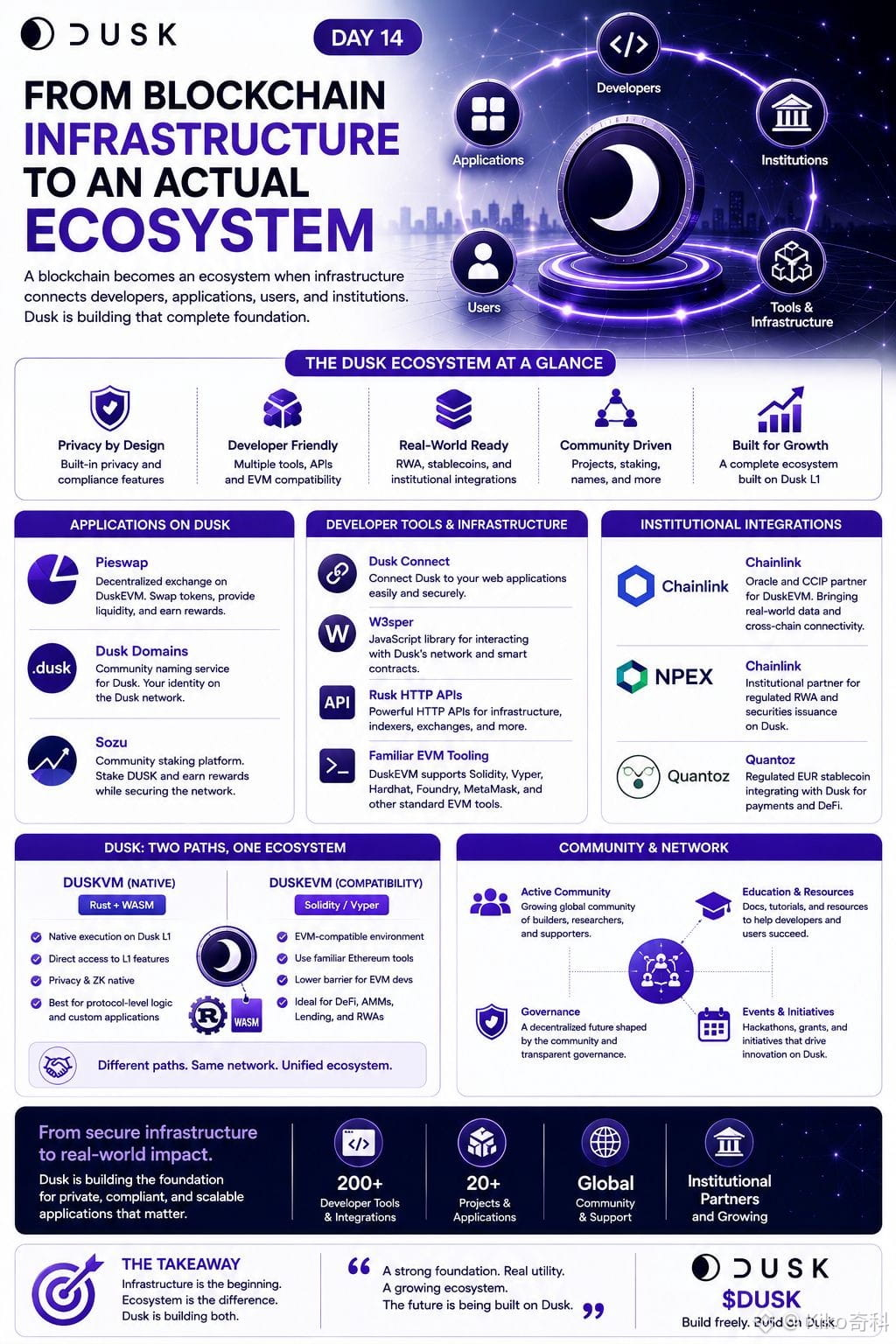
From Blockchain Infrastructure to an Actual Ecosystem.
A blockchain becomes an ecosystem when the infrastructure starts connecting developers applications users and institutions.
Dusk’s current ecosystem reflects that broader structure. Its documentation describes an ecosystem spanning applications wallets network tools community initiatives and institutional integrations.
At the application layer Pieswap provides decentralized exchange functionality on DuskEVM while $DUSK Domains offers a community naming service and Sozu provides a community staking platform.
The developer layer is equally important. @Dusk_Foundation provides #dusk Connect for browser applications W3sper for JavaScript integrations and Rusk HTTP APIs for infrastructure indexers exchanges and other clients. DuskEVM also supports familiar EVM tooling for applications such as tokenized assets DeFi AMMs and lending.
Then there is the institutional side. The ecosystem documentation lists Chainlink as an oracle and CCIP partner for DuskEVM NPEX for regulated RWA and securities issuance and Quantoz for a regulated EUR stablecoin integrating with Dusk.
This is where the distinction between a blockchain and an ecosystem becomes meaningful. Consensus privacy smart contracts and execution are foundational but they become useful when developers and institutions can actually build around them.
For Dusk the next measure of progress is therefore not only technical capability but ecosystem depth.
What matters more for long term adoption stronger underlying infrastructure or a growing ecosystem built on top of it?
From Blockchain Infrastructure to an Actual Ecosystem.
A blockchain becomes an ecosystem when the infrastructure starts connecting developers applications users and institutions.
Dusk’s current ecosystem reflects that broader structure. Its documentation describes an ecosystem spanning applications wallets network tools community initiatives and institutional integrations.
At the application layer Pieswap provides decentralized exchange functionality on DuskEVM while $DUSK Domains offers a community naming service and Sozu provides a community staking platform.
The developer layer is equally important. @Dusk provides #dusk Connect for browser applications W3sper for JavaScript integrations and Rusk HTTP APIs for infrastructure indexers exchanges and other clients. DuskEVM also supports familiar EVM tooling for applications such as tokenized assets DeFi AMMs and lending.
Then there is the institutional side. The ecosystem documentation lists Chainlink as an oracle and CCIP partner for DuskEVM NPEX for regulated RWA and securities issuance and Quantoz for a regulated EUR stablecoin integrating with Dusk.
This is where the distinction between a blockchain and an ecosystem becomes meaningful. Consensus privacy smart contracts and execution are foundational but they become useful when developers and institutions can actually build around them.
For Dusk the next measure of progress is therefore not only technical capability but ecosystem depth.
What matters more for long term adoption stronger underlying infrastructure or a growing ecosystem built on top of it?
A blockchain becomes an ecosystem when the infrastructure starts connecting developers applications users and institutions.
Dusk’s current ecosystem reflects that broader structure. Its documentation describes an ecosystem spanning applications wallets network tools community initiatives and institutional integrations.
At the application layer Pieswap provides decentralized exchange functionality on DuskEVM while $DUSK Domains offers a community naming service and Sozu provides a community staking platform.
The developer layer is equally important. @Dusk provides #dusk Connect for browser applications W3sper for JavaScript integrations and Rusk HTTP APIs for infrastructure indexers exchanges and other clients. DuskEVM also supports familiar EVM tooling for applications such as tokenized assets DeFi AMMs and lending.
Then there is the institutional side. The ecosystem documentation lists Chainlink as an oracle and CCIP partner for DuskEVM NPEX for regulated RWA and securities issuance and Quantoz for a regulated EUR stablecoin integrating with Dusk.
This is where the distinction between a blockchain and an ecosystem becomes meaningful. Consensus privacy smart contracts and execution are foundational but they become useful when developers and institutions can actually build around them.
For Dusk the next measure of progress is therefore not only technical capability but ecosystem depth.
What matters more for long term adoption stronger underlying infrastructure or a growing ecosystem built on top of it?
19
19
128
·
--
ຢືນຢັນແລ້ວ
ເບິ່ງການແປ
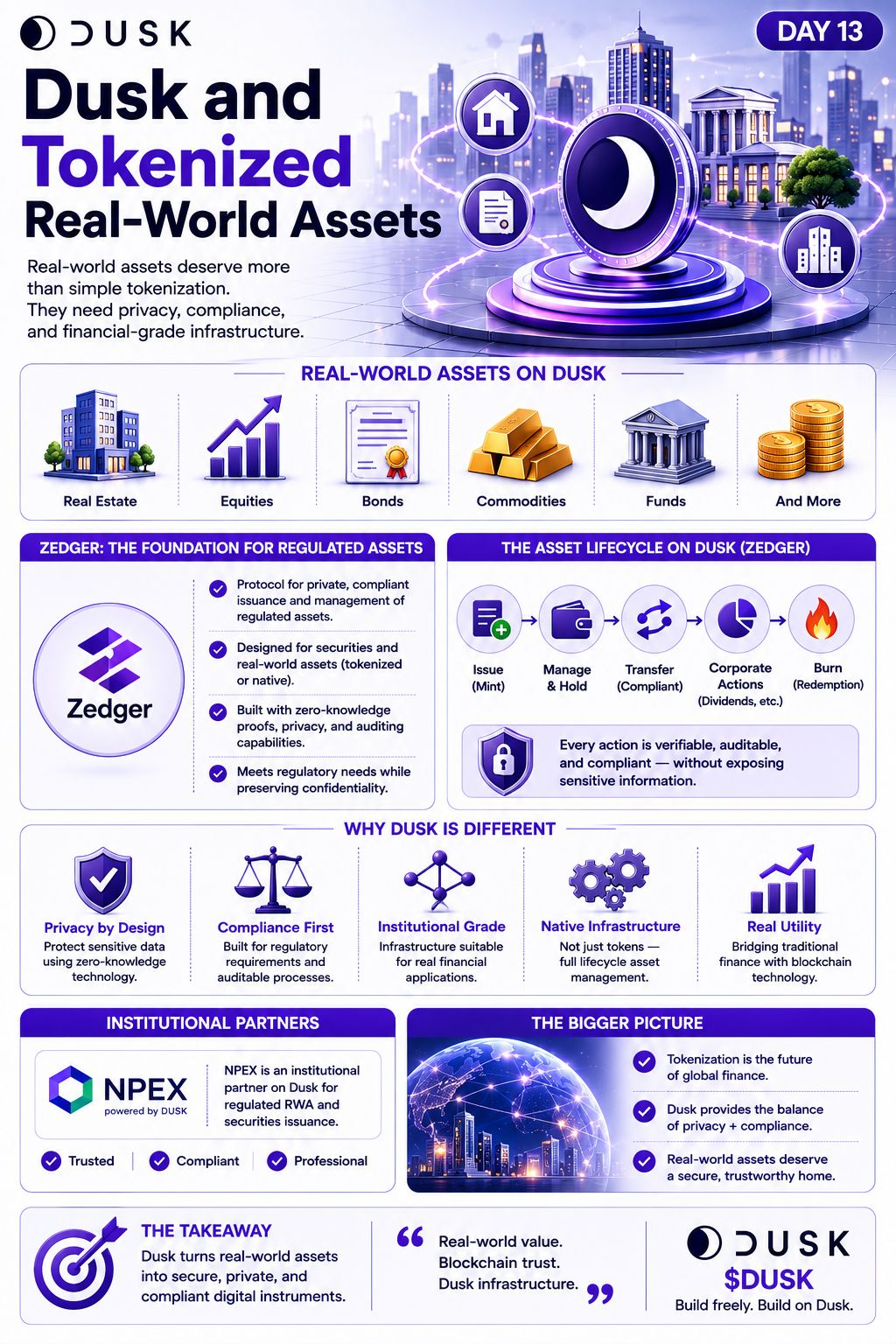
Dusk and Tokenized Real-World Assets.
What happens when real-world assets move on-chain but still need privacy compliance and rules that reflect their underlying financial structure?
This is where Dusk’s Zedger becomes particularly relevant.
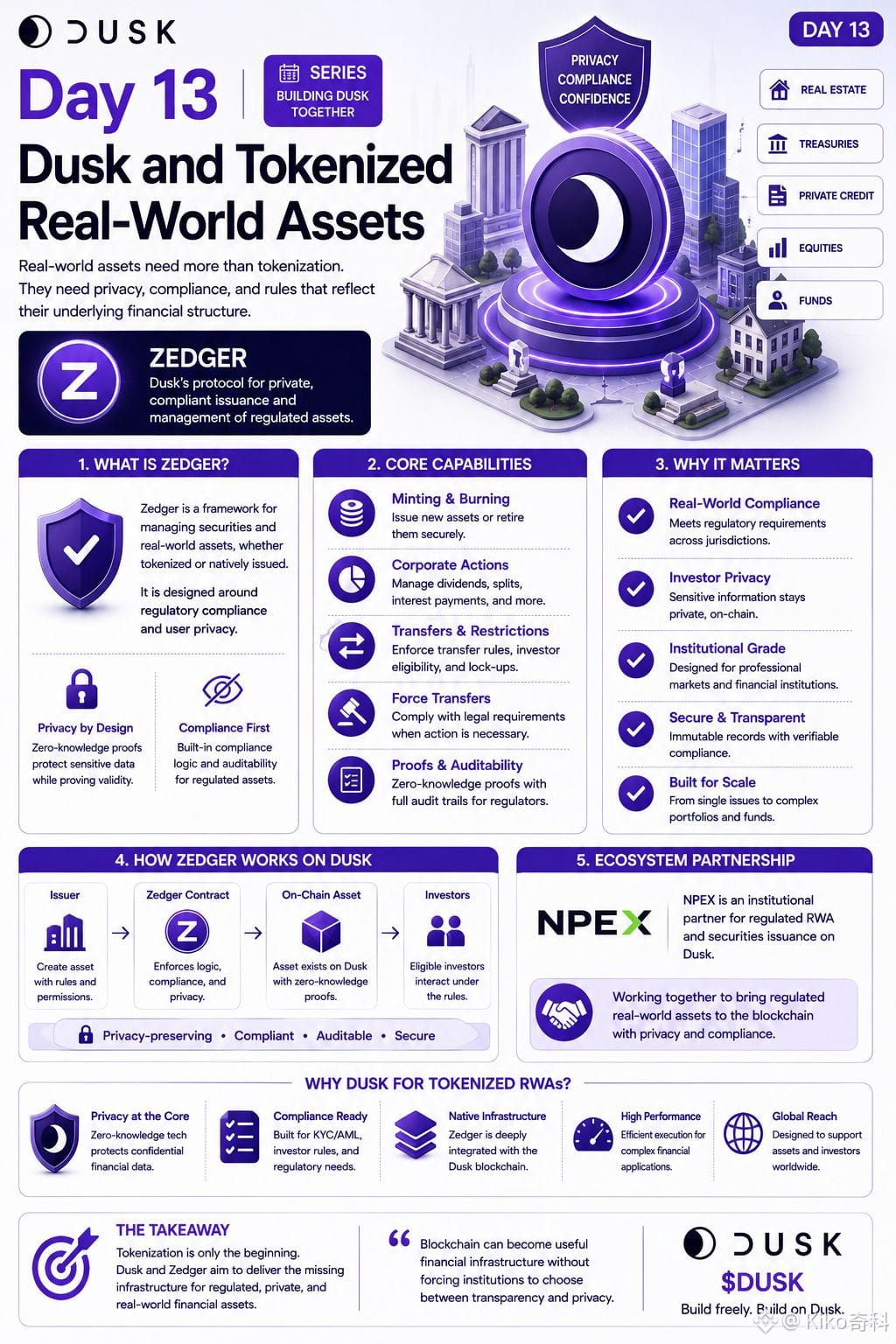
Dusk documentation describes Zedger as a protocol for private compliant issuance and management of regulated assets Its purpose is not simply to represent an asset digitally but to provide infrastructure for financial instruments where regulatory requirements and confidentiality must coexist.
The research material goes deeper describing Zedger contracts as a framework for managing securities and real world assets whether tokenized or natively issued. The protocol is designed around regulatory compliance and user privacy using zero knowledge proofs and auditing capabilities.
Its functionality is also designed around the lifecycle of financial assets. The source identifies mechanisms including minting, burning corporate actions such as dividends and force transfers while maintaining proof validation and auditability.
That is an important distinction. Tokenization is not only about putting ownership records on a blockchain. Real financial assets have issuance rules transfer restrictions corporate actions and jurisdiction-specific requirements.
Dusk’s architecture attempts to address those requirements while preserving confidentiality. Its ecosystem documentation also lists NPEX as an institutional partner for regulated RWA and securities issuance on Dusk.
For @Dusk_Foundation the interesting question is whether blockchain can become useful financial infrastructure without forcing institutions to choose between transparency and privacy.
$DUSK #dusk
Could regulated tokenized assets become one of the strongest real-world tests of blockchain’s ability to combine privacy with compliance?
Dusk and Tokenized Real-World Assets.
What happens when real-world assets move on-chain but still need privacy compliance and rules that reflect their underlying financial structure?
This is where Dusk’s Zedger becomes particularly relevant.
Dusk documentation describes Zedger as a protocol for private compliant issuance and management of regulated assets Its purpose is not simply to represent an asset digitally but to provide infrastructure for financial instruments where regulatory requirements and confidentiality must coexist.
The research material goes deeper describing Zedger contracts as a framework for managing securities and real world assets whether tokenized or natively issued. The protocol is designed around regulatory compliance and user privacy using zero knowledge proofs and auditing capabilities.
Its functionality is also designed around the lifecycle of financial assets. The source identifies mechanisms including minting, burning corporate actions such as dividends and force transfers while maintaining proof validation and auditability.
That is an important distinction. Tokenization is not only about putting ownership records on a blockchain. Real financial assets have issuance rules transfer restrictions corporate actions and jurisdiction-specific requirements.
Dusk’s architecture attempts to address those requirements while preserving confidentiality. Its ecosystem documentation also lists NPEX as an institutional partner for regulated RWA and securities issuance on Dusk.
For @Dusk the interesting question is whether blockchain can become useful financial infrastructure without forcing institutions to choose between transparency and privacy.
$DUSK #dusk
Could regulated tokenized assets become one of the strongest real-world tests of blockchain’s ability to combine privacy with compliance?
What happens when real-world assets move on-chain but still need privacy compliance and rules that reflect their underlying financial structure?
This is where Dusk’s Zedger becomes particularly relevant.
Dusk documentation describes Zedger as a protocol for private compliant issuance and management of regulated assets Its purpose is not simply to represent an asset digitally but to provide infrastructure for financial instruments where regulatory requirements and confidentiality must coexist.
The research material goes deeper describing Zedger contracts as a framework for managing securities and real world assets whether tokenized or natively issued. The protocol is designed around regulatory compliance and user privacy using zero knowledge proofs and auditing capabilities.
Its functionality is also designed around the lifecycle of financial assets. The source identifies mechanisms including minting, burning corporate actions such as dividends and force transfers while maintaining proof validation and auditability.
That is an important distinction. Tokenization is not only about putting ownership records on a blockchain. Real financial assets have issuance rules transfer restrictions corporate actions and jurisdiction-specific requirements.
Dusk’s architecture attempts to address those requirements while preserving confidentiality. Its ecosystem documentation also lists NPEX as an institutional partner for regulated RWA and securities issuance on Dusk.
For @Dusk the interesting question is whether blockchain can become useful financial infrastructure without forcing institutions to choose between transparency and privacy.
$DUSK #dusk
Could regulated tokenized assets become one of the strongest real-world tests of blockchain’s ability to combine privacy with compliance?
24
22
173
·
--
ເບິ່ງການແປ
#dusk $DUSK @Dusk_Foundation
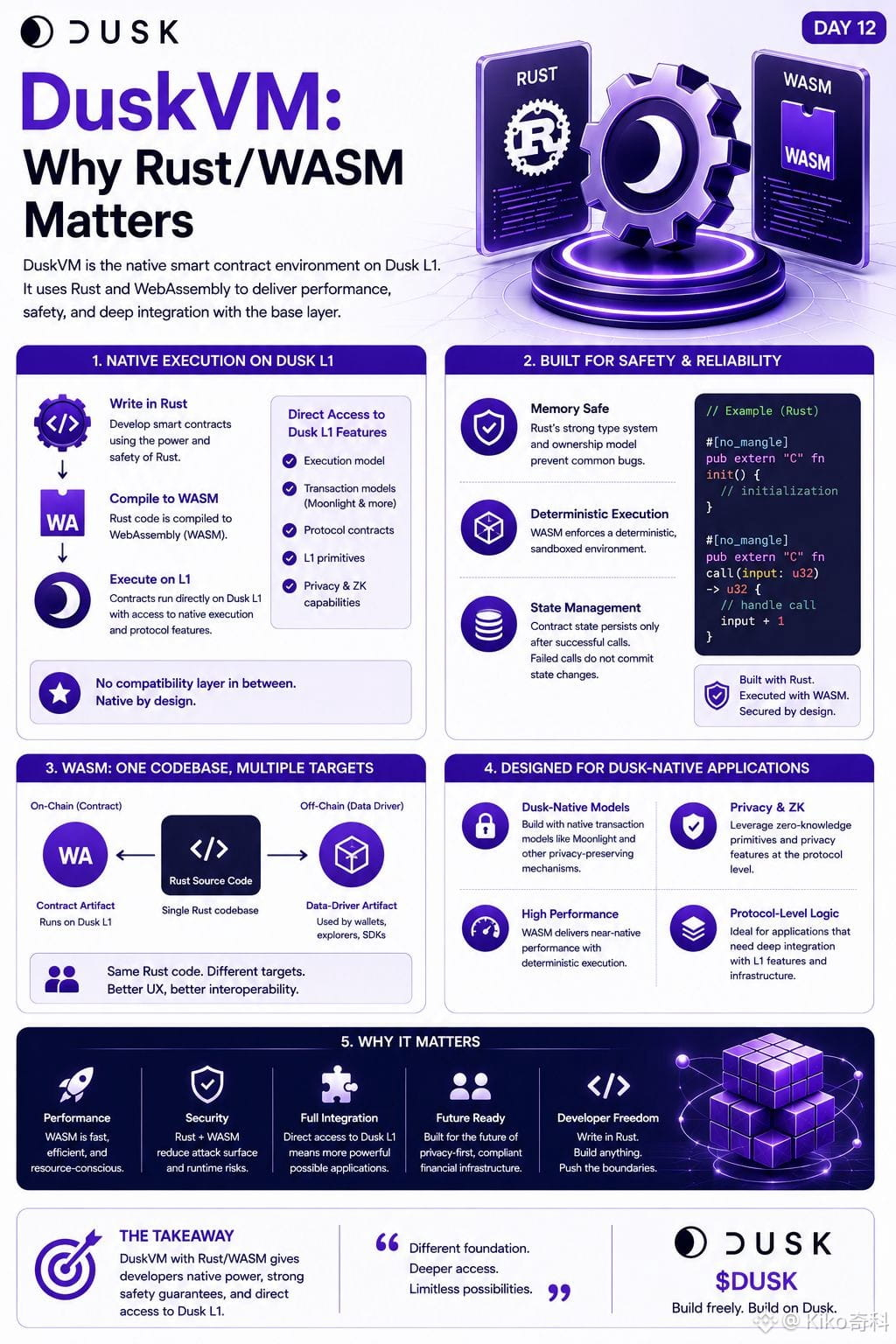
DuskVM: Why Rust/WASM Matters.
Why would a blockchain choose Rust and WebAssembly instead of simply relying on the EVM?
DuskVM reflects a deliberate choice to give developers a native execution path directly on the Dusk L1.
DuskVM contracts are written in Rust compiled to WebAssembly (WASM) and executed directly on the L1. This gives contracts access to Dusk’s own execution model transaction models protocol contracts and L1 primitives rather than placing another compatibility layer between the application and the base network.
The Rust-based model also shapes how developers build. DuskVM contracts are no std Rust libraries compiled for wasm32-unknown with Dusk’s Forge framework generating the required exports. Contract state can persist between successful calls while failed calls do not commit their state changes.
WASM is particularly relevant because the same Rust source produces the on chain contract artifact and an off chain data driver artifact used by wallets explorers and SDKs.
Dusk’s documentation positions this environment for protocol level logic Dusk native transaction models privacy and zero knowledge capabilities, and applications requiring direct access to L1 features.
For @Dusk Rust/WASM is therefore not just a developer preference. It is part of the network’s strategy for giving applications deeper access to native blockchain functionality.
Could native execution become increasingly important as applications demand deeper integration with a blockchain’s core protocol?
#dusk $DUSK @Dusk
DuskVM: Why Rust/WASM Matters.
Why would a blockchain choose Rust and WebAssembly instead of simply relying on the EVM?
DuskVM reflects a deliberate choice to give developers a native execution path directly on the Dusk L1.
DuskVM contracts are written in Rust compiled to WebAssembly (WASM) and executed directly on the L1. This gives contracts access to Dusk’s own execution model transaction models protocol contracts and L1 primitives rather than placing another compatibility layer between the application and the base network.
The Rust-based model also shapes how developers build. DuskVM contracts are no std Rust libraries compiled for wasm32-unknown with Dusk’s Forge framework generating the required exports. Contract state can persist between successful calls while failed calls do not commit their state changes.
WASM is particularly relevant because the same Rust source produces the on chain contract artifact and an off chain data driver artifact used by wallets explorers and SDKs.
Dusk’s documentation positions this environment for protocol level logic Dusk native transaction models privacy and zero knowledge capabilities, and applications requiring direct access to L1 features.
For @Dusk Rust/WASM is therefore not just a developer preference. It is part of the network’s strategy for giving applications deeper access to native blockchain functionality.
Could native execution become increasingly important as applications demand deeper integration with a blockchain’s core protocol?
DuskVM: Why Rust/WASM Matters.
Why would a blockchain choose Rust and WebAssembly instead of simply relying on the EVM?
DuskVM reflects a deliberate choice to give developers a native execution path directly on the Dusk L1.
DuskVM contracts are written in Rust compiled to WebAssembly (WASM) and executed directly on the L1. This gives contracts access to Dusk’s own execution model transaction models protocol contracts and L1 primitives rather than placing another compatibility layer between the application and the base network.
The Rust-based model also shapes how developers build. DuskVM contracts are no std Rust libraries compiled for wasm32-unknown with Dusk’s Forge framework generating the required exports. Contract state can persist between successful calls while failed calls do not commit their state changes.
WASM is particularly relevant because the same Rust source produces the on chain contract artifact and an off chain data driver artifact used by wallets explorers and SDKs.
Dusk’s documentation positions this environment for protocol level logic Dusk native transaction models privacy and zero knowledge capabilities, and applications requiring direct access to L1 features.
For @Dusk Rust/WASM is therefore not just a developer preference. It is part of the network’s strategy for giving applications deeper access to native blockchain functionality.
Could native execution become increasingly important as applications demand deeper integration with a blockchain’s core protocol?
22
18
139
·
--
ເບິ່ງການແປ
#dusk $DUSK @Dusk_Foundation
DuskEVM: Bringing EVM Development to Dusk.
What happens when an L1 designed around privacy and financial infrastructure also gives developers access to the Ethereum development model?
That is the role of DuskEVM.
Dusk’s documentation describes DuskEVM as an EVM-compatible execution environment where developers can build with Solidity or Vyper while using familiar Ethereum tooling and infrastructure. This includes standard EVM wallets JSON-RPC and development frameworks such as Foundry Hardhat viem and ethers.
The important architectural detail is that DuskEVM does not operate as an isolated environment. Its settlement and data availability come through DuskDS while DUSK serves as the native gas asset.
That creates a practical development path for applications already designed around the EVM ecosystem. Dusk specifically identifies use cases such as tokenized asset applications DeFi protocols AMMs and lending.
The significance is therefore less about simply adding EVM compatibility. It is about reducing the tooling gap between established Ethereum development practices and Dusk’s underlying infrastructure.
For @Dusk this gives developers a familiar entry point without requiring them to abandon the network’s native architecture.
Could EVM compatibility become one of the most important bridges between Dusk’s specialized infrastructure and a much larger developer ecosystem?
#dusk $DUSK @Dusk
DuskEVM: Bringing EVM Development to Dusk.
What happens when an L1 designed around privacy and financial infrastructure also gives developers access to the Ethereum development model?
That is the role of DuskEVM.
Dusk’s documentation describes DuskEVM as an EVM-compatible execution environment where developers can build with Solidity or Vyper while using familiar Ethereum tooling and infrastructure. This includes standard EVM wallets JSON-RPC and development frameworks such as Foundry Hardhat viem and ethers.
The important architectural detail is that DuskEVM does not operate as an isolated environment. Its settlement and data availability come through DuskDS while DUSK serves as the native gas asset.
That creates a practical development path for applications already designed around the EVM ecosystem. Dusk specifically identifies use cases such as tokenized asset applications DeFi protocols AMMs and lending.
The significance is therefore less about simply adding EVM compatibility. It is about reducing the tooling gap between established Ethereum development practices and Dusk’s underlying infrastructure.
For @Dusk this gives developers a familiar entry point without requiring them to abandon the network’s native architecture.
Could EVM compatibility become one of the most important bridges between Dusk’s specialized infrastructure and a much larger developer ecosystem?
DuskEVM: Bringing EVM Development to Dusk.
What happens when an L1 designed around privacy and financial infrastructure also gives developers access to the Ethereum development model?
That is the role of DuskEVM.
Dusk’s documentation describes DuskEVM as an EVM-compatible execution environment where developers can build with Solidity or Vyper while using familiar Ethereum tooling and infrastructure. This includes standard EVM wallets JSON-RPC and development frameworks such as Foundry Hardhat viem and ethers.
The important architectural detail is that DuskEVM does not operate as an isolated environment. Its settlement and data availability come through DuskDS while DUSK serves as the native gas asset.
That creates a practical development path for applications already designed around the EVM ecosystem. Dusk specifically identifies use cases such as tokenized asset applications DeFi protocols AMMs and lending.
The significance is therefore less about simply adding EVM compatibility. It is about reducing the tooling gap between established Ethereum development practices and Dusk’s underlying infrastructure.
For @Dusk this gives developers a familiar entry point without requiring them to abandon the network’s native architecture.
Could EVM compatibility become one of the most important bridges between Dusk’s specialized infrastructure and a much larger developer ecosystem?
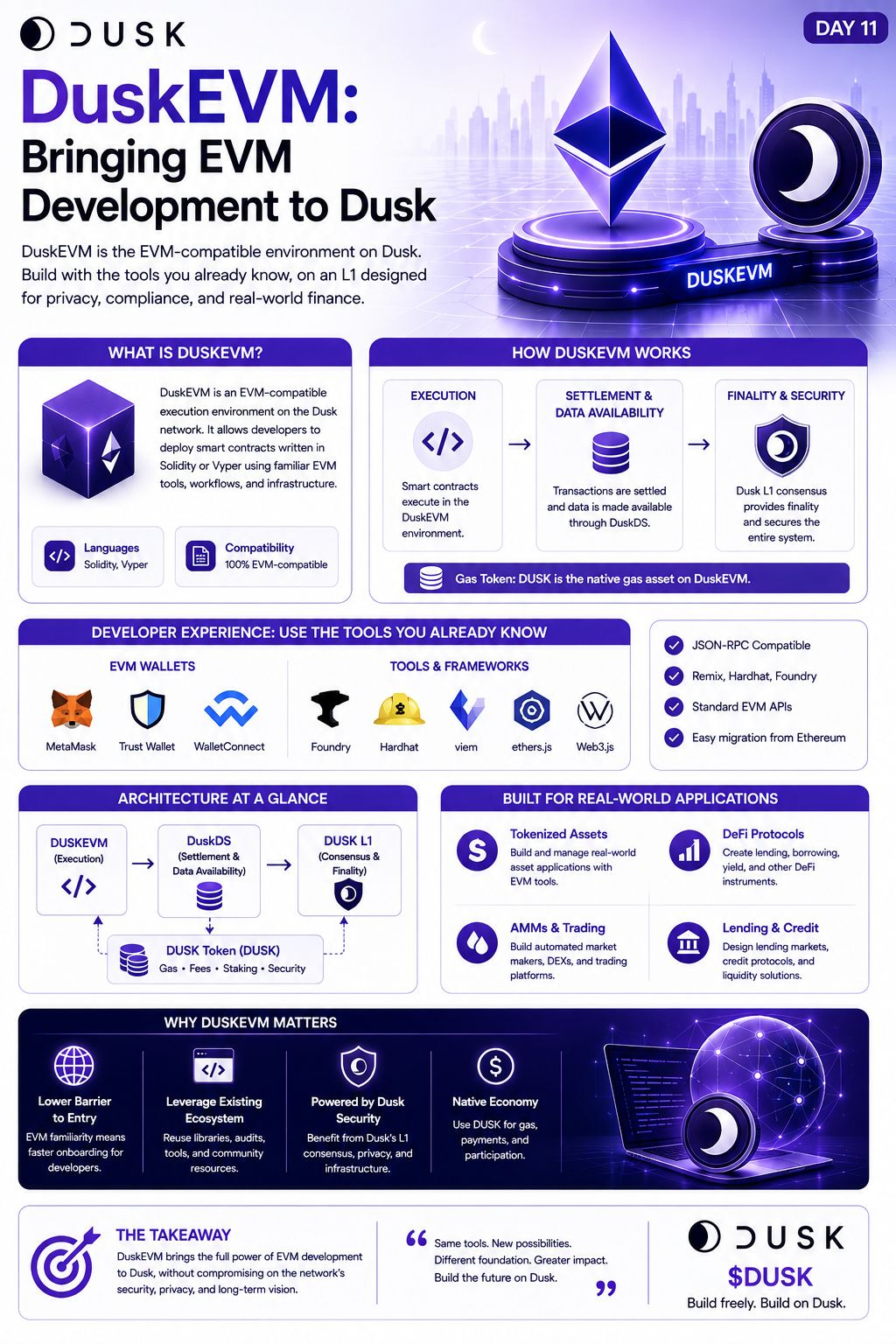
18
14
156
·
--
ເບິ່ງການແປ
Near ProtocolNEAR Protocol: Why Blockchain Infrastructure Is Moving Toward Better User Experiences
What if the biggest barrier to Web3 adoption isn't blockchain technology itself, but how complicated it feels to use?
That question is one reason I find NEAR Protocol interesting. As the blockchain industry develops, technical improvements such as scalability and decentralization remain important, but mainstream users also expect something much simpler: applications that are easy to understand and comfortable to use.
NEAR is a Layer 1 blockchain designed with scalability and developer usability in mind. One of its most important architectural ideas is sharding, where network activity can be divided across multiple parts of the system instead of requiring every validator to process every transaction. The goal is to allow the network to handle increasing activity more efficiently as demand grows.
But infrastructure is only one part of the story.
What caught my attention about NEAR is its focus on making blockchain development and user interaction less complicated. Features such as human-readable account names can make blockchain addresses feel more familiar than long strings of characters. Small improvements like this may sound insignificant to experienced crypto users, but they can make a meaningful difference for someone encountering Web3 for the first time.
Developer experience matters just as much. Building decentralized applications requires teams to understand smart contracts, wallets, transactions, security, and network infrastructure. The easier these systems are to work with, the more time developers can spend creating useful products rather than solving unnecessary infrastructure problems.
NEAR's approach also reflects a broader change happening across Web3. Early blockchain applications often assumed that users already understood wallets, gas fees, private keys, and networks. The next phase of adoption may require applications to hide much of this complexity while still preserving transparency and user control.
That doesn't mean abstraction should come at the expense of security. Users still need meaningful ownership and clear information about what applications are doing. A smoother interface is valuable only when the underlying infrastructure remains trustworthy.
Another interesting area is the relationship between blockchain and artificial intelligence. NEAR has increasingly positioned its ecosystem around AI-related development, reflecting a growing belief that decentralized infrastructure could play a role in how users interact with autonomous applications and digital agents. Whether that vision becomes significant will depend on actual products and adoption rather than narratives alone.
For me, NEAR represents an important lesson: blockchain adoption isn't only about building faster networks. It is also about making decentralized technology feel natural enough that people can use it without needing to become blockchain experts first.
The future of Web3 may therefore depend on two things happening together—strong underlying infrastructure and dramatically better user experiences.
Do you think simplicity will become more important than raw blockchain performance when Web3 reaches mainstream users?
#Binance #USCanadaTradeTalksCollapseCanadaVowsRetaliation #NEARProtocol #Blockchain #Layer1
$NEAR $ETH $BTC
@NEAR_Protocol
Near Protocol
NEAR Protocol: Why Blockchain Infrastructure Is Moving Toward Better User Experiences
What if the biggest barrier to Web3 adoption isn't blockchain technology itself, but how complicated it feels to use?
That question is one reason I find NEAR Protocol interesting. As the blockchain industry develops, technical improvements such as scalability and decentralization remain important, but mainstream users also expect something much simpler: applications that are easy to understand and comfortable to use.
NEAR is a Layer 1 blockchain designed with scalability and developer usability in mind. One of its most important architectural ideas is sharding, where network activity can be divided across multiple parts of the system instead of requiring every validator to process every transaction. The goal is to allow the network to handle increasing activity more efficiently as demand grows.
But infrastructure is only one part of the story.
What caught my attention about NEAR is its focus on making blockchain development and user interaction less complicated. Features such as human-readable account names can make blockchain addresses feel more familiar than long strings of characters. Small improvements like this may sound insignificant to experienced crypto users, but they can make a meaningful difference for someone encountering Web3 for the first time.
Developer experience matters just as much. Building decentralized applications requires teams to understand smart contracts, wallets, transactions, security, and network infrastructure. The easier these systems are to work with, the more time developers can spend creating useful products rather than solving unnecessary infrastructure problems.
NEAR's approach also reflects a broader change happening across Web3. Early blockchain applications often assumed that users already understood wallets, gas fees, private keys, and networks. The next phase of adoption may require applications to hide much of this complexity while still preserving transparency and user control.
That doesn't mean abstraction should come at the expense of security. Users still need meaningful ownership and clear information about what applications are doing. A smoother interface is valuable only when the underlying infrastructure remains trustworthy.
Another interesting area is the relationship between blockchain and artificial intelligence. NEAR has increasingly positioned its ecosystem around AI-related development, reflecting a growing belief that decentralized infrastructure could play a role in how users interact with autonomous applications and digital agents. Whether that vision becomes significant will depend on actual products and adoption rather than narratives alone.
For me, NEAR represents an important lesson: blockchain adoption isn't only about building faster networks. It is also about making decentralized technology feel natural enough that people can use it without needing to become blockchain experts first.
The future of Web3 may therefore depend on two things happening together—strong underlying infrastructure and dramatically better user experiences.
Do you think simplicity will become more important than raw blockchain performance when Web3 reaches mainstream users?
#Binance #USCanadaTradeTalksCollapseCanadaVowsRetaliation #NEARProtocol #Blockchain #Layer1
$NEAR $ETH $BTC
@NEAR Protocol
What if the biggest barrier to Web3 adoption isn't blockchain technology itself, but how complicated it feels to use?
That question is one reason I find NEAR Protocol interesting. As the blockchain industry develops, technical improvements such as scalability and decentralization remain important, but mainstream users also expect something much simpler: applications that are easy to understand and comfortable to use.
NEAR is a Layer 1 blockchain designed with scalability and developer usability in mind. One of its most important architectural ideas is sharding, where network activity can be divided across multiple parts of the system instead of requiring every validator to process every transaction. The goal is to allow the network to handle increasing activity more efficiently as demand grows.
But infrastructure is only one part of the story.
What caught my attention about NEAR is its focus on making blockchain development and user interaction less complicated. Features such as human-readable account names can make blockchain addresses feel more familiar than long strings of characters. Small improvements like this may sound insignificant to experienced crypto users, but they can make a meaningful difference for someone encountering Web3 for the first time.
Developer experience matters just as much. Building decentralized applications requires teams to understand smart contracts, wallets, transactions, security, and network infrastructure. The easier these systems are to work with, the more time developers can spend creating useful products rather than solving unnecessary infrastructure problems.
NEAR's approach also reflects a broader change happening across Web3. Early blockchain applications often assumed that users already understood wallets, gas fees, private keys, and networks. The next phase of adoption may require applications to hide much of this complexity while still preserving transparency and user control.
That doesn't mean abstraction should come at the expense of security. Users still need meaningful ownership and clear information about what applications are doing. A smoother interface is valuable only when the underlying infrastructure remains trustworthy.
Another interesting area is the relationship between blockchain and artificial intelligence. NEAR has increasingly positioned its ecosystem around AI-related development, reflecting a growing belief that decentralized infrastructure could play a role in how users interact with autonomous applications and digital agents. Whether that vision becomes significant will depend on actual products and adoption rather than narratives alone.
For me, NEAR represents an important lesson: blockchain adoption isn't only about building faster networks. It is also about making decentralized technology feel natural enough that people can use it without needing to become blockchain experts first.
The future of Web3 may therefore depend on two things happening together—strong underlying infrastructure and dramatically better user experiences.
Do you think simplicity will become more important than raw blockchain performance when Web3 reaches mainstream users?
#Binance #USCanadaTradeTalksCollapseCanadaVowsRetaliation #NEARProtocol #Blockchain #Layer1
$NEAR $ETH $BTC
@NEAR Protocol
1
99
·
--
ເບິ່ງການແປ
DuskVM vs DuskEVM: Two Paths for Developers
Does a blockchain need to force every developer into the same execution environment?
Dusk takes a different approach by offering two smart contract paths each designed around a different development model.
DuskVM is the native path. Developers write contracts in Rust compile them to WASM and execute them directly on the Dusk L1. This gives contracts direct access to Dusk’s L1 execution model transaction models protocol contracts and capabilities that need to sit close to the base layer including privacy and zero knowledge functionality.
DuskEVM takes a compatibility focused route. Developers can use Solidity or Vyper along with familiar EVM wallets libraries and tooling. Settlement and data availability are provided through DuskDS while DUSK serves as the native gas token.
The distinction is therefore less about choosing which environment is better and more about matching architecture to application requirements DuskVM favors direct L1 execution and Dusk-native capabilities. DuskEVM lowers the barrier for developers already working within the Ethereum ecosystem.
For Dusk providing both paths creates an interesting balance between native functionality and developer familiarity.
Could supporting both native execution and EVM compatibility be a stronger developer strategy than forcing one universal environment?
$DUSK
{future}(DUSKUSDT)
#dusk @Dusk_Foundation
DuskVM vs DuskEVM: Two Paths for Developers
Does a blockchain need to force every developer into the same execution environment?
Dusk takes a different approach by offering two smart contract paths each designed around a different development model.
DuskVM is the native path. Developers write contracts in Rust compile them to WASM and execute them directly on the Dusk L1. This gives contracts direct access to Dusk’s L1 execution model transaction models protocol contracts and capabilities that need to sit close to the base layer including privacy and zero knowledge functionality.
DuskEVM takes a compatibility focused route. Developers can use Solidity or Vyper along with familiar EVM wallets libraries and tooling. Settlement and data availability are provided through DuskDS while DUSK serves as the native gas token.
The distinction is therefore less about choosing which environment is better and more about matching architecture to application requirements DuskVM favors direct L1 execution and Dusk-native capabilities. DuskEVM lowers the barrier for developers already working within the Ethereum ecosystem.
For Dusk providing both paths creates an interesting balance between native functionality and developer familiarity.
Could supporting both native execution and EVM compatibility be a stronger developer strategy than forcing one universal environment?
$DUSK
#dusk @Dusk
Does a blockchain need to force every developer into the same execution environment?
Dusk takes a different approach by offering two smart contract paths each designed around a different development model.
DuskVM is the native path. Developers write contracts in Rust compile them to WASM and execute them directly on the Dusk L1. This gives contracts direct access to Dusk’s L1 execution model transaction models protocol contracts and capabilities that need to sit close to the base layer including privacy and zero knowledge functionality.
DuskEVM takes a compatibility focused route. Developers can use Solidity or Vyper along with familiar EVM wallets libraries and tooling. Settlement and data availability are provided through DuskDS while DUSK serves as the native gas token.
The distinction is therefore less about choosing which environment is better and more about matching architecture to application requirements DuskVM favors direct L1 execution and Dusk-native capabilities. DuskEVM lowers the barrier for developers already working within the Ethereum ecosystem.
For Dusk providing both paths creates an interesting balance between native functionality and developer familiarity.
Could supporting both native execution and EVM compatibility be a stronger developer strategy than forcing one universal environment?
$DUSK
#dusk @Dusk
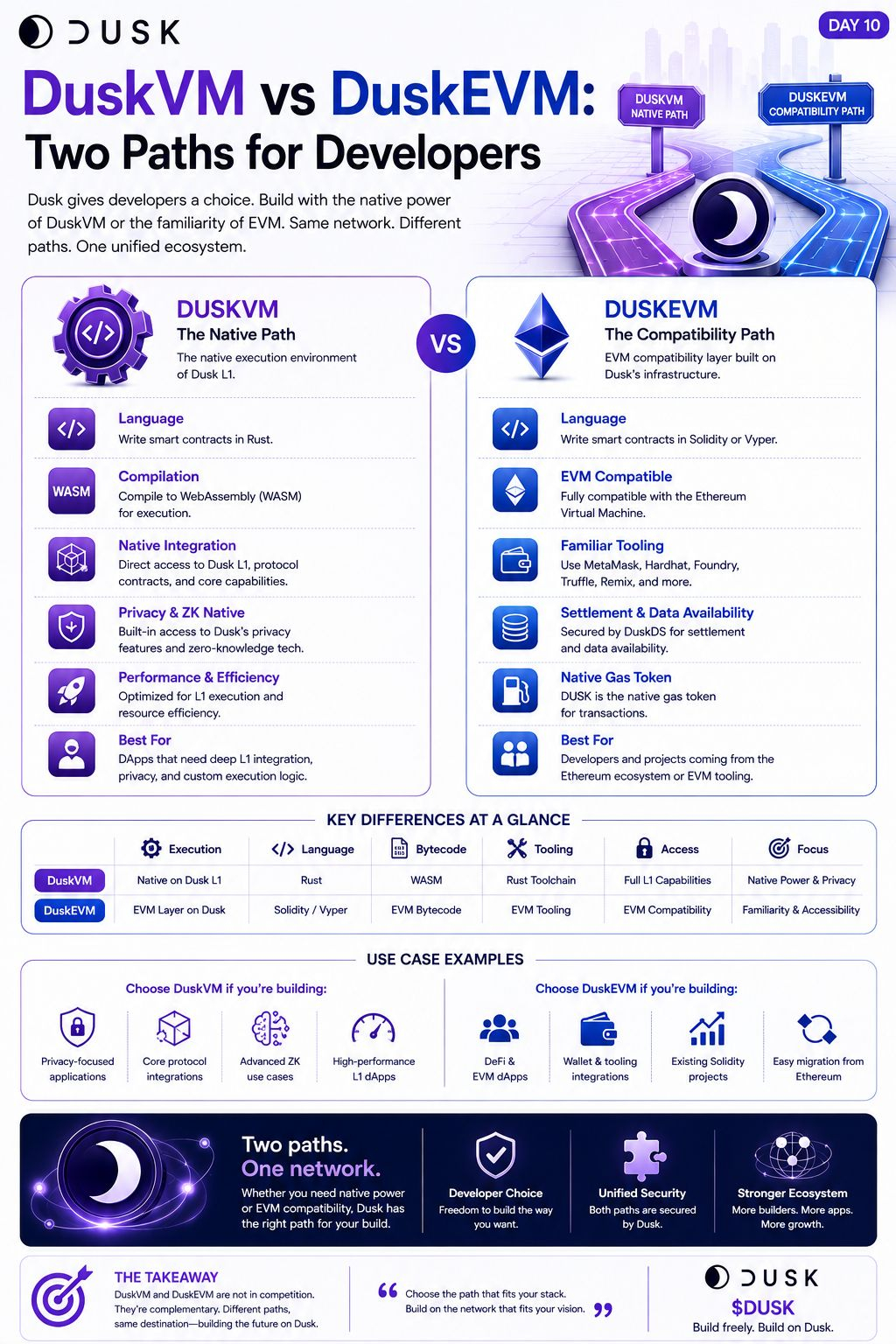
16
13
120
·
--
ເບິ່ງການແປ
Staking on Dusk: How DUSK Secures the Network.
What does staking actually contribute to a blockchain beyond earning rewards?
On Dusk staking is directly connected to consensus. Provisioners stake DUSK and participate in the process of proposing and validating blocks. Active provisioners can earn rewards from token emissions and transaction fees making staking part of the network’s security mechanism rather than a separate yield product.
The selection process is also important. Dusk’s deterministic sortition selects block generators and voting committee members through a process weighted by stake. The mechanism is designed so selection frequency is proportional to a provisioner’s stake while remaining reproducible and unpredictable ahead of time.
Consensus then moves through proposal validation and ratification. A selected provisioner proposes a candidate block a committee evaluates it and another committee confirms the validation result. A supermajority of valid votes can produce a successful outcome.
But participation carries responsibility. The current Dusk documentation distinguishes between soft penalties for failed participation and hard penalties for provably invalid consensus behavior including conflicting signatures.
This creates an important relationship between economic stake and network responsibility DUSK is not merely locked it gives participants an economic reason to operate consensus infrastructure correctly.
For @Dusk_Foundation staking is therefore part of the security architecture itself.
$DUSK #dusk
Does tying economic stake directly to consensus responsibility create a stronger incentive for reliable network participation?
Staking on Dusk: How DUSK Secures the Network.
What does staking actually contribute to a blockchain beyond earning rewards?
On Dusk staking is directly connected to consensus. Provisioners stake DUSK and participate in the process of proposing and validating blocks. Active provisioners can earn rewards from token emissions and transaction fees making staking part of the network’s security mechanism rather than a separate yield product.
The selection process is also important. Dusk’s deterministic sortition selects block generators and voting committee members through a process weighted by stake. The mechanism is designed so selection frequency is proportional to a provisioner’s stake while remaining reproducible and unpredictable ahead of time.
Consensus then moves through proposal validation and ratification. A selected provisioner proposes a candidate block a committee evaluates it and another committee confirms the validation result. A supermajority of valid votes can produce a successful outcome.
But participation carries responsibility. The current Dusk documentation distinguishes between soft penalties for failed participation and hard penalties for provably invalid consensus behavior including conflicting signatures.
This creates an important relationship between economic stake and network responsibility DUSK is not merely locked it gives participants an economic reason to operate consensus infrastructure correctly.
For @Dusk staking is therefore part of the security architecture itself.
$DUSK #dusk
Does tying economic stake directly to consensus responsibility create a stronger incentive for reliable network participation?
What does staking actually contribute to a blockchain beyond earning rewards?
On Dusk staking is directly connected to consensus. Provisioners stake DUSK and participate in the process of proposing and validating blocks. Active provisioners can earn rewards from token emissions and transaction fees making staking part of the network’s security mechanism rather than a separate yield product.
The selection process is also important. Dusk’s deterministic sortition selects block generators and voting committee members through a process weighted by stake. The mechanism is designed so selection frequency is proportional to a provisioner’s stake while remaining reproducible and unpredictable ahead of time.
Consensus then moves through proposal validation and ratification. A selected provisioner proposes a candidate block a committee evaluates it and another committee confirms the validation result. A supermajority of valid votes can produce a successful outcome.
But participation carries responsibility. The current Dusk documentation distinguishes between soft penalties for failed participation and hard penalties for provably invalid consensus behavior including conflicting signatures.
This creates an important relationship between economic stake and network responsibility DUSK is not merely locked it gives participants an economic reason to operate consensus infrastructure correctly.
For @Dusk staking is therefore part of the security architecture itself.
$DUSK #dusk
Does tying economic stake directly to consensus responsibility create a stronger incentive for reliable network participation?
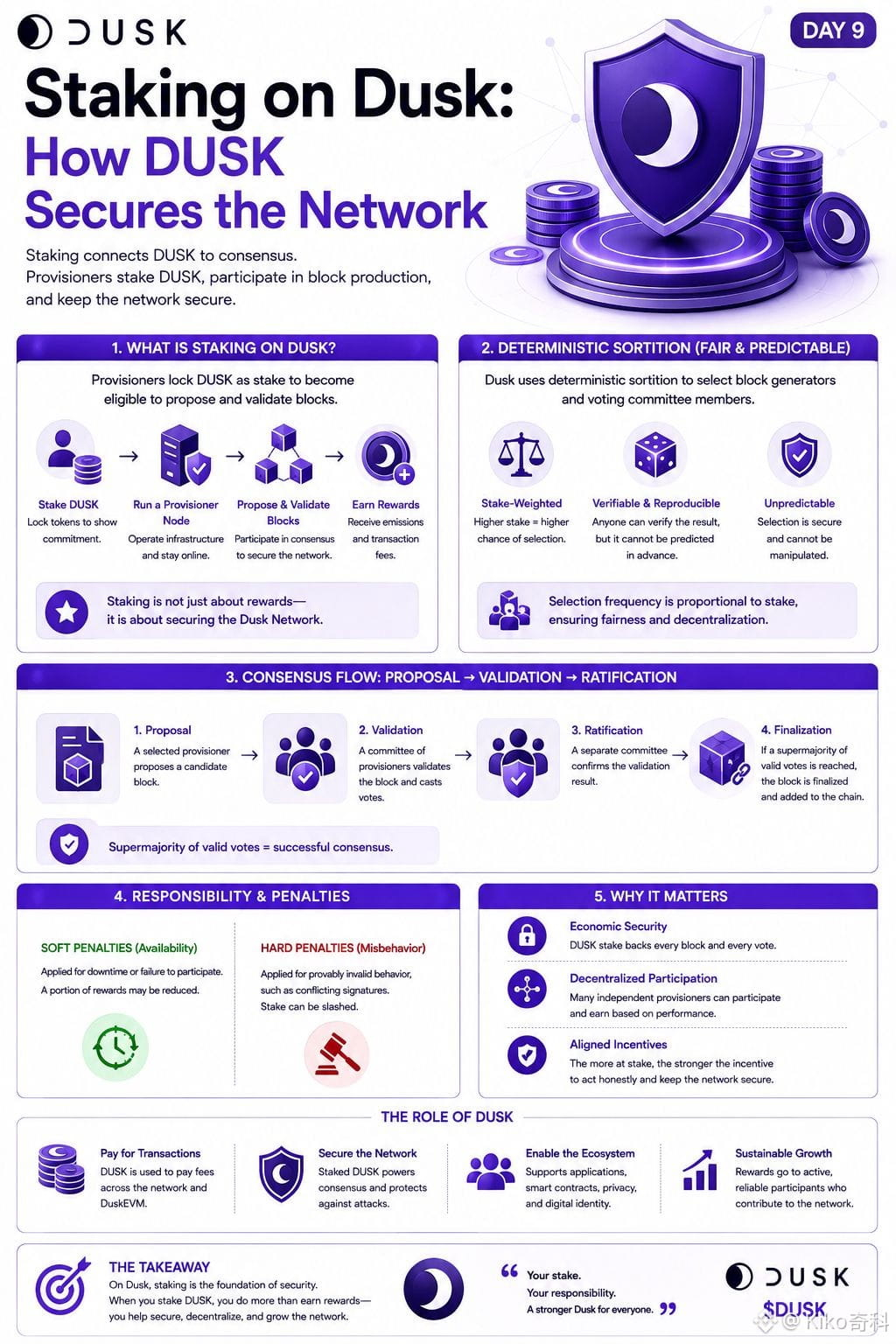
17
11
142
·
--
ເບິ່ງການແປ
DUSK: More Than Just a Token.
What gives a native blockchain token real utility beyond simply being traded?
For Dusk DUSK is integrated directly into the network’s operation. The official documentation defines it as the native token used for transaction fees and staking connecting the asset to both network activity and consensus participation.
Every transaction requires network resources and DUSK functions as the gas asset used to pay for those operations. This includes activity across Dusk’s execution environments with DuskEVM explicitly using DUSK as its native gas token.
The second role is even more fundamental staking.
Dusk uses provisioners to participate in consensus with active provisioners selected to propose and validate blocks. According to the current documentation direct staking requires operating a provisioner node and rewards are based on consensus participation and active stake.
DUSK also connects different parts of the ecosystem. The documentation describes movement between Dusk L1 and DuskEVM while developers can build through DuskVM or DuskEVM depending on their execution and tooling requirements.
So the interesting point is not simply that DUSK is the network’s native asset. Its utility is embedded into the mechanisms that make the network function.
For @Dusk_Foundation token utility is therefore closely connected to infrastructure.
$DUSK #dusk
Does a native token become more meaningful when its utility is inseparable from the network’s core operations?
DUSK: More Than Just a Token.
What gives a native blockchain token real utility beyond simply being traded?
For Dusk DUSK is integrated directly into the network’s operation. The official documentation defines it as the native token used for transaction fees and staking connecting the asset to both network activity and consensus participation.
Every transaction requires network resources and DUSK functions as the gas asset used to pay for those operations. This includes activity across Dusk’s execution environments with DuskEVM explicitly using DUSK as its native gas token.
The second role is even more fundamental staking.
Dusk uses provisioners to participate in consensus with active provisioners selected to propose and validate blocks. According to the current documentation direct staking requires operating a provisioner node and rewards are based on consensus participation and active stake.
DUSK also connects different parts of the ecosystem. The documentation describes movement between Dusk L1 and DuskEVM while developers can build through DuskVM or DuskEVM depending on their execution and tooling requirements.
So the interesting point is not simply that DUSK is the network’s native asset. Its utility is embedded into the mechanisms that make the network function.
For @Dusk token utility is therefore closely connected to infrastructure.
$DUSK #dusk
Does a native token become more meaningful when its utility is inseparable from the network’s core operations?
What gives a native blockchain token real utility beyond simply being traded?
For Dusk DUSK is integrated directly into the network’s operation. The official documentation defines it as the native token used for transaction fees and staking connecting the asset to both network activity and consensus participation.
Every transaction requires network resources and DUSK functions as the gas asset used to pay for those operations. This includes activity across Dusk’s execution environments with DuskEVM explicitly using DUSK as its native gas token.
The second role is even more fundamental staking.
Dusk uses provisioners to participate in consensus with active provisioners selected to propose and validate blocks. According to the current documentation direct staking requires operating a provisioner node and rewards are based on consensus participation and active stake.
DUSK also connects different parts of the ecosystem. The documentation describes movement between Dusk L1 and DuskEVM while developers can build through DuskVM or DuskEVM depending on their execution and tooling requirements.
So the interesting point is not simply that DUSK is the network’s native asset. Its utility is embedded into the mechanisms that make the network function.
For @Dusk token utility is therefore closely connected to infrastructure.
$DUSK #dusk
Does a native token become more meaningful when its utility is inseparable from the network’s core operations?
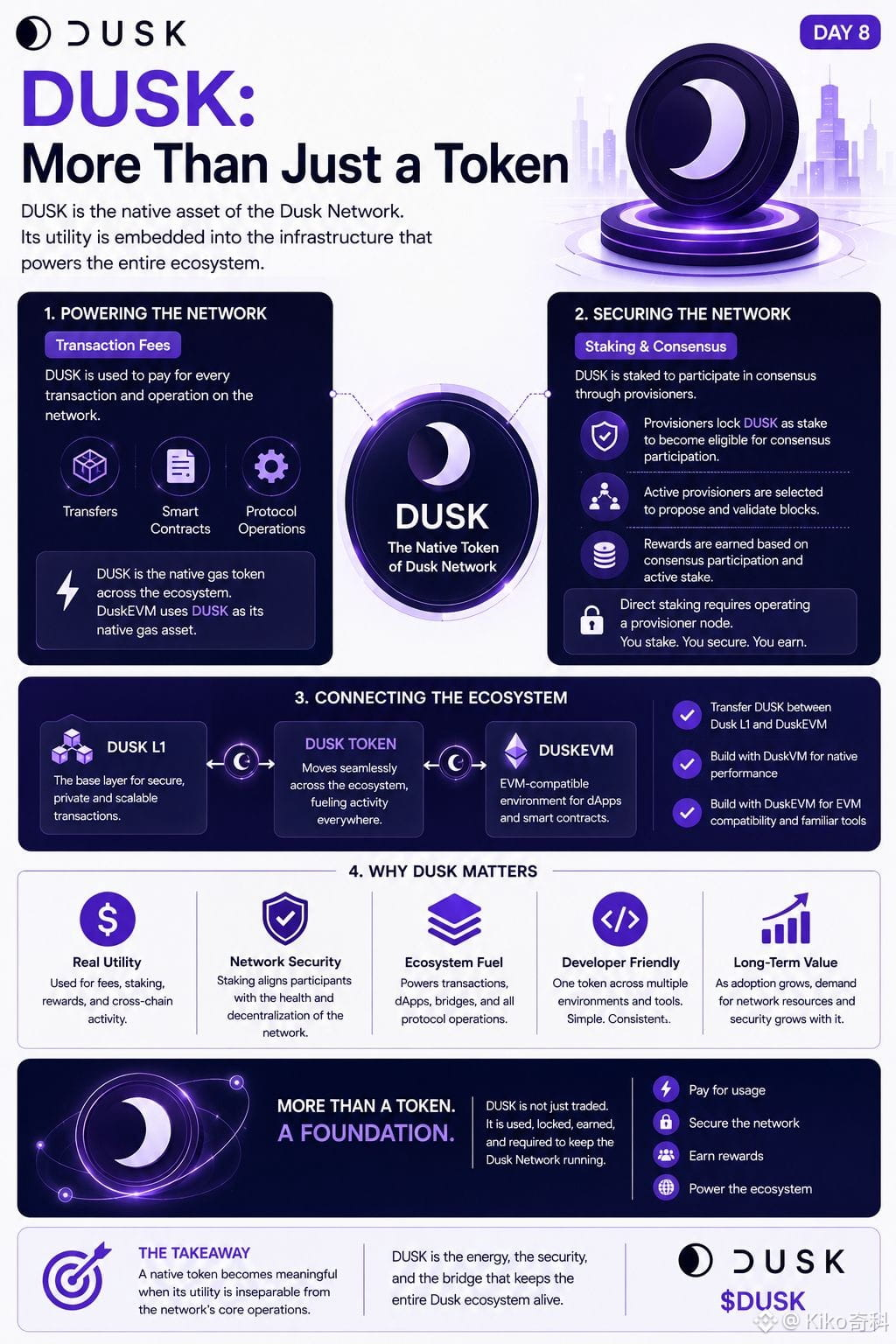
9
8
106
·
--
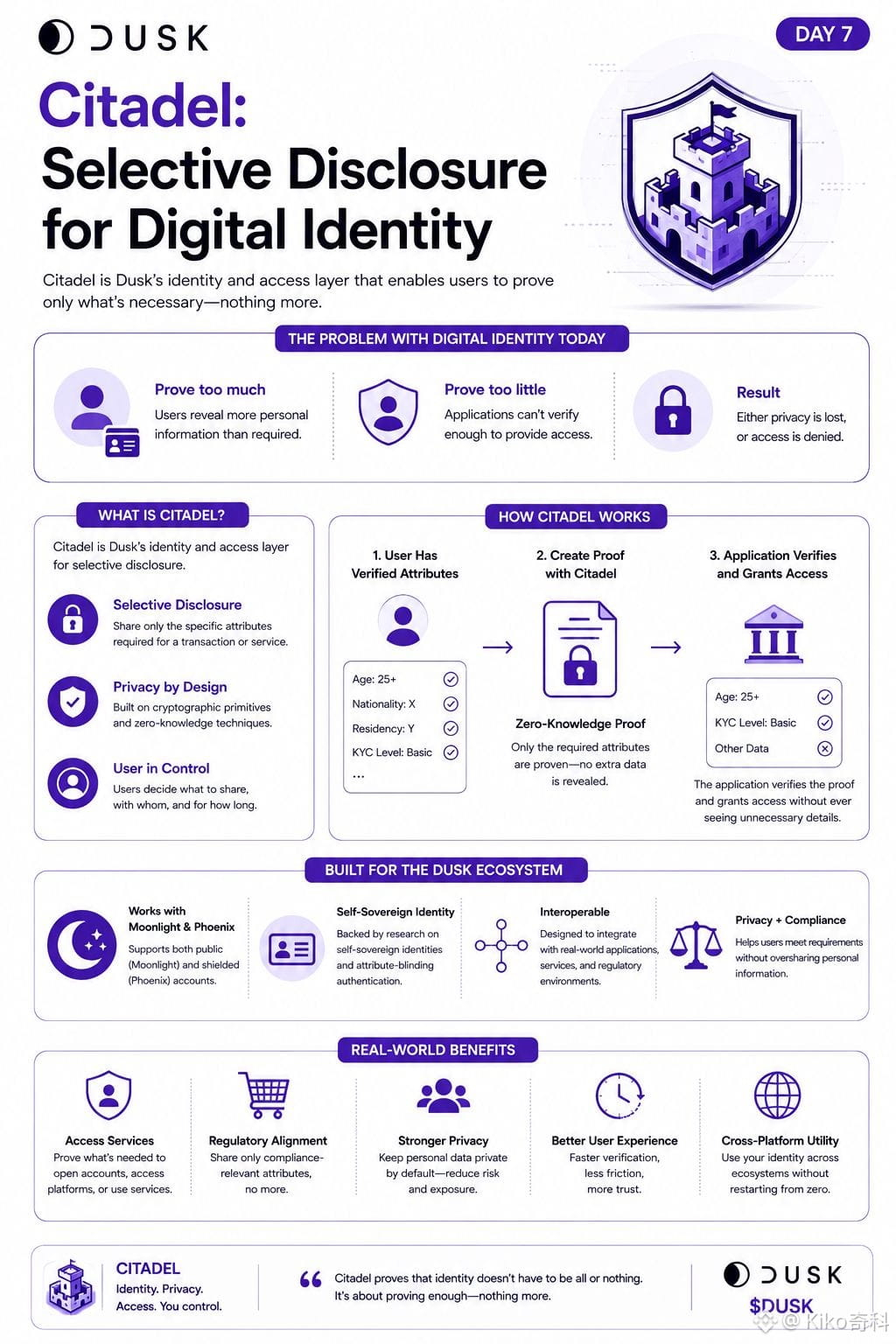
Citadel: Kaĭ Hoʻihoʻi Koho ʻia no ka Identity Digital
Hoʻokumu pinepine ka identity digital i kahi koho paʻakikī—e hōʻike i nā mea āpau e hōʻoia ai i kou ʻano, a i ʻole e hōʻike liʻiliʻi loa ʻaʻole lawa no ka noi.
Hoʻoponopono ʻo Dusk i kēia pilikia me Citadel, i wehewehe ʻia i kāna palapala ma ke ʻano he papa ʻae (identity) a me ka papa komo (access) o ka pūnaewele no ka hōʻike koho ʻia.
He mea koʻikoʻi kēlā ʻokoʻa. ʻAʻole wale ka hōʻike koho ʻia e pili ana i ka mālama hūnā ʻana i ka ʻike identity. ʻO ia nō ka hoʻolālā ʻana i ka komo ma muli o ka ʻike e pono maoli ana e hōʻike ʻia no kēlā launa pū ʻana (interaction).
Hoʻokomo pono ia i loko o ke kaila nui o Dusk. Hoʻokaʻawale ka pūnaewele i waena o nā moʻokāki lehulehu a me nā moʻokāki pale ʻia, i hiki ai i nā kālepa ke holo me nā pae ʻike (visibility) ʻokoʻa. Hoʻonui ʻo Citadel i kēlā manaʻo i ka identity a me ka access, ʻaʻole wale i ka ʻikepili kālepa.
Hōʻike pū ka palapala a Dusk i nā Citadel Self Sovereign Identities ma Dusk Network ma ke ʻano he pepa noiʻi hoʻolaʻa ʻia, i hui pū ʻia me ka hana ʻenehana e pili ana i nā ʻōnaehana zero knowledge a me ka hōʻoia ʻana i ka attribute blinding.
ʻO ka mea e hoihoi mai nei iaʻu ma ʻaneʻi, ʻo ke kumu hoʻolālā: ʻaʻole pono ka identity e lilo mau i moʻolelo lehulehu mau loa i ka wā e pono ai i ka mea hoʻohana ke hōʻoia i kekahi mea.
No @Dusk_Foundation , hoʻopili ka hōʻike koho ʻia i ka pilikino (privacy) me ka kaohi komo (practical access control), a he mea pili loa ia i ka wā e launa ai nā ʻoihana blockchain me nā noi kahi e mea nui ai ka identity a me ka authorization.
#dusk $DUSK
Hiki anei i ka hōʻike koho ʻia ke lilo i ka papa nalowale ma waena o ka pilikino kikohoʻe a me nā koi identity o nā ʻōnaehana kālā i hoʻoponopono ʻia?
Citadel: Kaĭ Hoʻihoʻi Koho ʻia no ka Identity Digital
Hoʻokumu pinepine ka identity digital i kahi koho paʻakikī—e hōʻike i nā mea āpau e hōʻoia ai i kou ʻano, a i ʻole e hōʻike liʻiliʻi loa ʻaʻole lawa no ka noi.
Hoʻoponopono ʻo Dusk i kēia pilikia me Citadel, i wehewehe ʻia i kāna palapala ma ke ʻano he papa ʻae (identity) a me ka papa komo (access) o ka pūnaewele no ka hōʻike koho ʻia.
He mea koʻikoʻi kēlā ʻokoʻa. ʻAʻole wale ka hōʻike koho ʻia e pili ana i ka mālama hūnā ʻana i ka ʻike identity. ʻO ia nō ka hoʻolālā ʻana i ka komo ma muli o ka ʻike e pono maoli ana e hōʻike ʻia no kēlā launa pū ʻana (interaction).
Hoʻokomo pono ia i loko o ke kaila nui o Dusk. Hoʻokaʻawale ka pūnaewele i waena o nā moʻokāki lehulehu a me nā moʻokāki pale ʻia, i hiki ai i nā kālepa ke holo me nā pae ʻike (visibility) ʻokoʻa. Hoʻonui ʻo Citadel i kēlā manaʻo i ka identity a me ka access, ʻaʻole wale i ka ʻikepili kālepa.
Hōʻike pū ka palapala a Dusk i nā Citadel Self Sovereign Identities ma Dusk Network ma ke ʻano he pepa noiʻi hoʻolaʻa ʻia, i hui pū ʻia me ka hana ʻenehana e pili ana i nā ʻōnaehana zero knowledge a me ka hōʻoia ʻana i ka attribute blinding.
ʻO ka mea e hoihoi mai nei iaʻu ma ʻaneʻi, ʻo ke kumu hoʻolālā: ʻaʻole pono ka identity e lilo mau i moʻolelo lehulehu mau loa i ka wā e pono ai i ka mea hoʻohana ke hōʻoia i kekahi mea.
No @Dusk , hoʻopili ka hōʻike koho ʻia i ka pilikino (privacy) me ka kaohi komo (practical access control), a he mea pili loa ia i ka wā e launa ai nā ʻoihana blockchain me nā noi kahi e mea nui ai ka identity a me ka authorization.
#dusk $DUSK
Hiki anei i ka hōʻike koho ʻia ke lilo i ka papa nalowale ma waena o ka pilikino kikohoʻe a me nā koi identity o nā ʻōnaehana kālā i hoʻoponopono ʻia?
Hoʻokumu pinepine ka identity digital i kahi koho paʻakikī—e hōʻike i nā mea āpau e hōʻoia ai i kou ʻano, a i ʻole e hōʻike liʻiliʻi loa ʻaʻole lawa no ka noi.
Hoʻoponopono ʻo Dusk i kēia pilikia me Citadel, i wehewehe ʻia i kāna palapala ma ke ʻano he papa ʻae (identity) a me ka papa komo (access) o ka pūnaewele no ka hōʻike koho ʻia.
He mea koʻikoʻi kēlā ʻokoʻa. ʻAʻole wale ka hōʻike koho ʻia e pili ana i ka mālama hūnā ʻana i ka ʻike identity. ʻO ia nō ka hoʻolālā ʻana i ka komo ma muli o ka ʻike e pono maoli ana e hōʻike ʻia no kēlā launa pū ʻana (interaction).
Hoʻokomo pono ia i loko o ke kaila nui o Dusk. Hoʻokaʻawale ka pūnaewele i waena o nā moʻokāki lehulehu a me nā moʻokāki pale ʻia, i hiki ai i nā kālepa ke holo me nā pae ʻike (visibility) ʻokoʻa. Hoʻonui ʻo Citadel i kēlā manaʻo i ka identity a me ka access, ʻaʻole wale i ka ʻikepili kālepa.
Hōʻike pū ka palapala a Dusk i nā Citadel Self Sovereign Identities ma Dusk Network ma ke ʻano he pepa noiʻi hoʻolaʻa ʻia, i hui pū ʻia me ka hana ʻenehana e pili ana i nā ʻōnaehana zero knowledge a me ka hōʻoia ʻana i ka attribute blinding.
ʻO ka mea e hoihoi mai nei iaʻu ma ʻaneʻi, ʻo ke kumu hoʻolālā: ʻaʻole pono ka identity e lilo mau i moʻolelo lehulehu mau loa i ka wā e pono ai i ka mea hoʻohana ke hōʻoia i kekahi mea.
No @Dusk , hoʻopili ka hōʻike koho ʻia i ka pilikino (privacy) me ka kaohi komo (practical access control), a he mea pili loa ia i ka wā e launa ai nā ʻoihana blockchain me nā noi kahi e mea nui ai ka identity a me ka authorization.
#dusk $DUSK
Hiki anei i ka hōʻike koho ʻia ke lilo i ka papa nalowale ma waena o ka pilikino kikohoʻe a me nā koi identity o nā ʻōnaehana kālā i hoʻoponopono ʻia?
29
23
136
·
--
ເບິ່ງການແປ
Privacy Without Losing Practical Usability.
Privacy on a blockchain becomes difficult when protecting information also makes the system difficult to use verify or integrate.
Dusk approaches this problem by making different transaction visibility levels part of the network’s architecture.
Its Moonlight model provides public account based transactions. Balances public addresses and transaction activity can remain transparent which is useful when visibility and straightforward verification are required.
Phoenix takes the opposite approach when transaction confidentiality is important. It uses shielded UTXO based transactions built around notes nullifiers and zero knowledge proofs. The network can verify that the transaction is valid without exposing the sender receiver or transferred amount publicly.
But privacy in Phoenix is not simply about hiding information from everyone. The protocol includes view keys allowing users to identify transactions addressed to them while keeping spending authority protected. The whitepaper also describes how view keys can allow delegated transaction scanning without giving the delegated party the ability to spend the notes.
That distinction is important for practical financial infrastructure confidentiality does not necessarily mean abandoning controlled access to information.
For @Dusk_Foundation privacy is therefore better understood as a configurable property of transactions rather than an obstacle to usability.
$DUSK #dusk
{future}(DUSKUSDT)
Could selective visibility become the more practical model for blockchain finance than choosing between complete transparency and complete anonymity?
Privacy Without Losing Practical Usability.
Privacy on a blockchain becomes difficult when protecting information also makes the system difficult to use verify or integrate.
Dusk approaches this problem by making different transaction visibility levels part of the network’s architecture.
Its Moonlight model provides public account based transactions. Balances public addresses and transaction activity can remain transparent which is useful when visibility and straightforward verification are required.
Phoenix takes the opposite approach when transaction confidentiality is important. It uses shielded UTXO based transactions built around notes nullifiers and zero knowledge proofs. The network can verify that the transaction is valid without exposing the sender receiver or transferred amount publicly.
But privacy in Phoenix is not simply about hiding information from everyone. The protocol includes view keys allowing users to identify transactions addressed to them while keeping spending authority protected. The whitepaper also describes how view keys can allow delegated transaction scanning without giving the delegated party the ability to spend the notes.
That distinction is important for practical financial infrastructure confidentiality does not necessarily mean abandoning controlled access to information.
For @Dusk privacy is therefore better understood as a configurable property of transactions rather than an obstacle to usability.
$DUSK #dusk
Could selective visibility become the more practical model for blockchain finance than choosing between complete transparency and complete anonymity?
Privacy on a blockchain becomes difficult when protecting information also makes the system difficult to use verify or integrate.
Dusk approaches this problem by making different transaction visibility levels part of the network’s architecture.
Its Moonlight model provides public account based transactions. Balances public addresses and transaction activity can remain transparent which is useful when visibility and straightforward verification are required.
Phoenix takes the opposite approach when transaction confidentiality is important. It uses shielded UTXO based transactions built around notes nullifiers and zero knowledge proofs. The network can verify that the transaction is valid without exposing the sender receiver or transferred amount publicly.
But privacy in Phoenix is not simply about hiding information from everyone. The protocol includes view keys allowing users to identify transactions addressed to them while keeping spending authority protected. The whitepaper also describes how view keys can allow delegated transaction scanning without giving the delegated party the ability to spend the notes.
That distinction is important for practical financial infrastructure confidentiality does not necessarily mean abandoning controlled access to information.
For @Dusk privacy is therefore better understood as a configurable property of transactions rather than an obstacle to usability.
$DUSK #dusk
Could selective visibility become the more practical model for blockchain finance than choosing between complete transparency and complete anonymity?
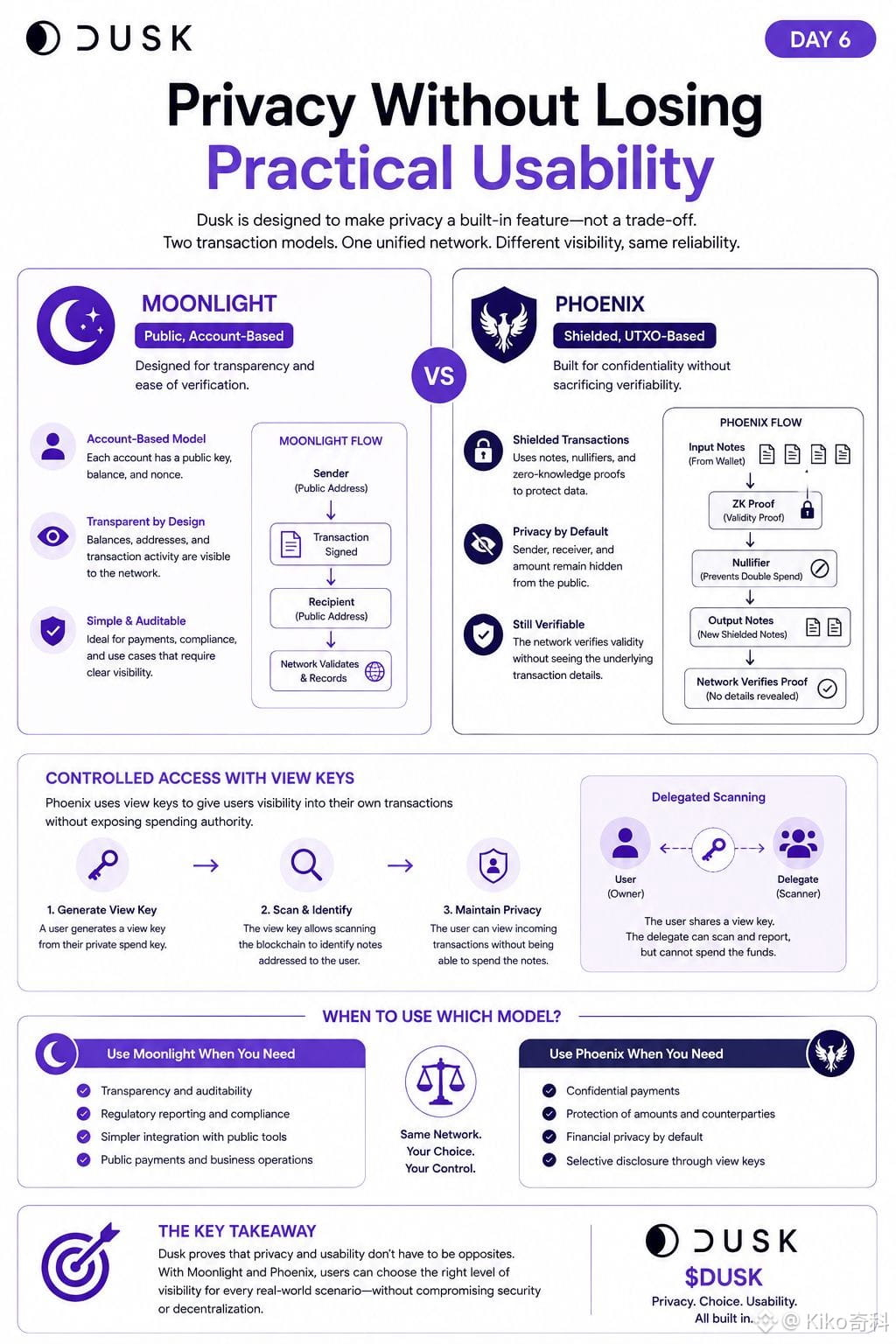
32
23
136
ເຂົ້າສູ່ລະບົບເພື່ອສຳຫຼວດເນື້ອຫາເພີ່ມເຕີມ
ເຂົ້າຮ່ວມກຸ່ມຜູ້ໃຊ້ຄຣິບໂຕທົ່ວໂລກໃນ Binance Square.
⚡️ ໄດ້ຮັບຂໍ້ມູນຫຼ້າສຸດ ແລະ ທີ່ມີປະໂຫຍດກ່ຽວກັບຄຣິບໂຕ.
💬 ໄດ້ຮັບຄວາມໄວ້ວາງໃຈຈາກຕະຫຼາດແລກປ່ຽນຄຣິບໂຕທີ່ໃຫຍ່ທີ່ສຸດໃນໂລກ.
👍 ຄົ້ນຫາຂໍ້ມູນເຊີງເລິກທີ່ແທ້ຈາກນັກສ້າງທີ່ໄດ້ຮັບການຢືນຢັນ.
ອີເມວ / ເບີໂທລະສັບ
ຫົວຂໍ້ທີ່ກໍາລັງນິຍົມ
USAugustPPIRisesLessThanExpected
56,057 views
853 ກຳລັງສົນທະນາ
🚨 US AUG PPI: ຂຶ້ນໜ້ອຍກວ່າທີ່ຄາດ! ເປັນບວກສໍາລັບ Crypto? 🚀
PPI +0.4% MoM ຕາມຄາດ, ແຕ່ CORE PPI ພຽງ +0.2% ທຽບກັບ +0.3% ທີ່ຄາດ - ເຢັນລົງ!
ຄວາມໝາຍຂອງມັນ:
• ອັດຕາເງິນເຟີ້ຂອງການຄ້າຂາຍສົ່ງເບົາກວ່າທີ່ກັງວົນ
• ໂອກາດຂອງການຂຶ້ນອັດຕາດອກເບ້ຍຂອງ Fed ຕອນນີ້ 62% - ແຕ່ມີສັນຍານແນວ dovish ມາ
• ຄາດວ່າການປັບປຸງ Core PCE ຈະອອກມາຕໍ່າລົງ - ເປັນບວກ
• BTC ປົກກະຕິຈະເພີ່ມຂຶ້ນເມື່ອ PPI ອ່ອນລົງ
ກອງປະຊຸມ Fed 15-16 ກັນຍາ - ຕອນນີ້ຕະຫຼາດຄາດຈະຢຸດ ບໍ່ແມ່ນຂຶ້ນ?
ນີ້ແມ່ນແສງສີຂຽວສໍາລັບການແຂ່ງຂຶ້ນໃນ Q4 ບໍ?
#Bitcoin #PPI #Fed #CryptoNews #BTC#usaugustppiriseslessthanexpected
True News
·1 ຖືກໃຈ
·1.4k views
SECApprovesNasdaqTexasCommodityTrustRule
30,367 views
616 ກຳລັງສົນທະນາ
ECBRaisesRatesSecondTimeTo2.5%
27,245 views
440 ກຳລັງສົນທະນາ