
Polius2007
219 ໂພສ

Polius2007
ລາຍງານ
ບລັອກຜູ້ໃຊ້
I build XTester Studio and CopyTrader. Sharing strategy research, product development and lessons from building tools for crypto traders.
ຜູ້ຊື້ຂາຍປະຈໍາ
8.7 ປີ
2 ກໍາລັງຕິດຕາມ
30 ຜູ້ຕິດຕາມ
37 Liked
ໂພສ
ທັງໝົດ
ວີດີໂອ
ປັກໝຸດ
·
--
I build software for crypto traders: XTester Studio for strategy research and backtesting, and CopyTrader for traders who want to offer trade copying to their own audience.
Here I'll share what I'm working on, the experiments behind it and the product decisions along the way. That includes how to test a strategy idea, what a backtest can tell you, and the practical work of building a copy-trading service.
If you research strategies or run a trading community, I'd like to hear what takes the most time in your workflow.
My projects: https://easytrading.pw
#Backtesting #CopyTrading
4
3
458
·
--
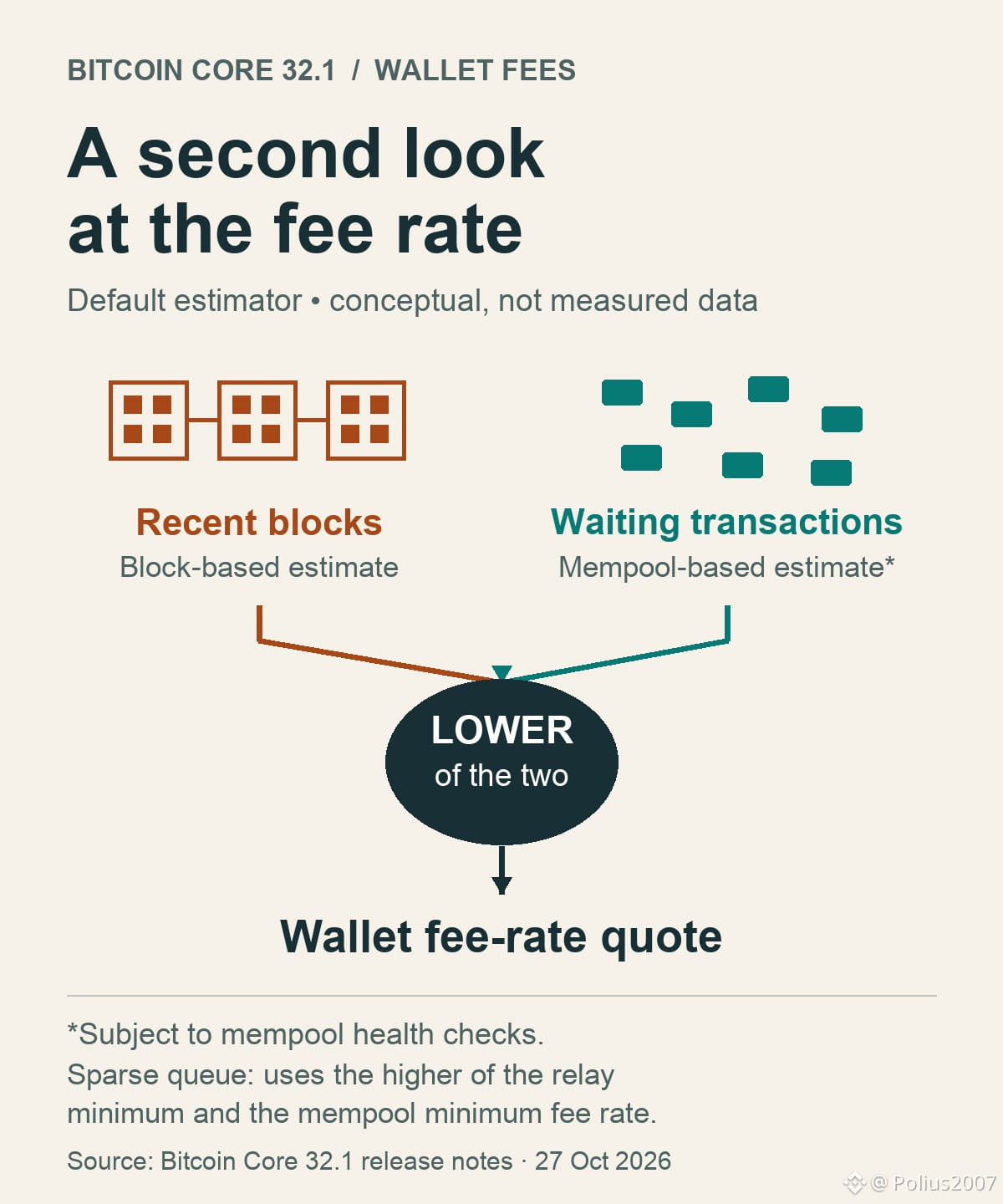
A clearing Bitcoin transaction queue can matter to the fee rate quoted by Bitcoin Core’s wallet, even while recent blocks still reflect busier conditions.
Core 32.1 adds an estimator that looks at the node’s mempool—the transactions waiting for confirmation. By default, the wallet uses the lower result from this and the existing block-based estimator, so its quote needn’t rely on recent blocks alone.
The change is in Core’s October 27 release notes. It gives the wallet another way to account for easing demand, not a promise that a cheaper transaction will confirm on time.
https://bitcoincore.org/en/releases/32.1/
#Bitcoin
29
·
--
Bittensor's proposed Gamma credits would burn tokens when customers top up, before a service bills them.
Each subnet, a specialized network within Bittensor, has its own token called alpha. Customers could use TAO to buy and burn that alpha, or burn alpha they already have staked, in exchange for dollar-valued service credits for that subnet. The alpha would already be gone even if the credits sat unspent.
The service then deducts credits from the balance to bill the customer. The guide describes billing ahead of the work; the chain does not verify delivery. Each deduction destroys credits and pays no TAO or alpha to the service's designated spender. The customer is using up a prepaid balance, not triggering another alpha burn with each bill.
Sources: Bittensor's Gamma guide and Release 487 page, checked November 11, 2026.
https://www.bittensor.com/docs/guides/gamma
https://www.bittensor.com/releases/v487-upgrade
#Bittensor #TAO
1
83
·
--
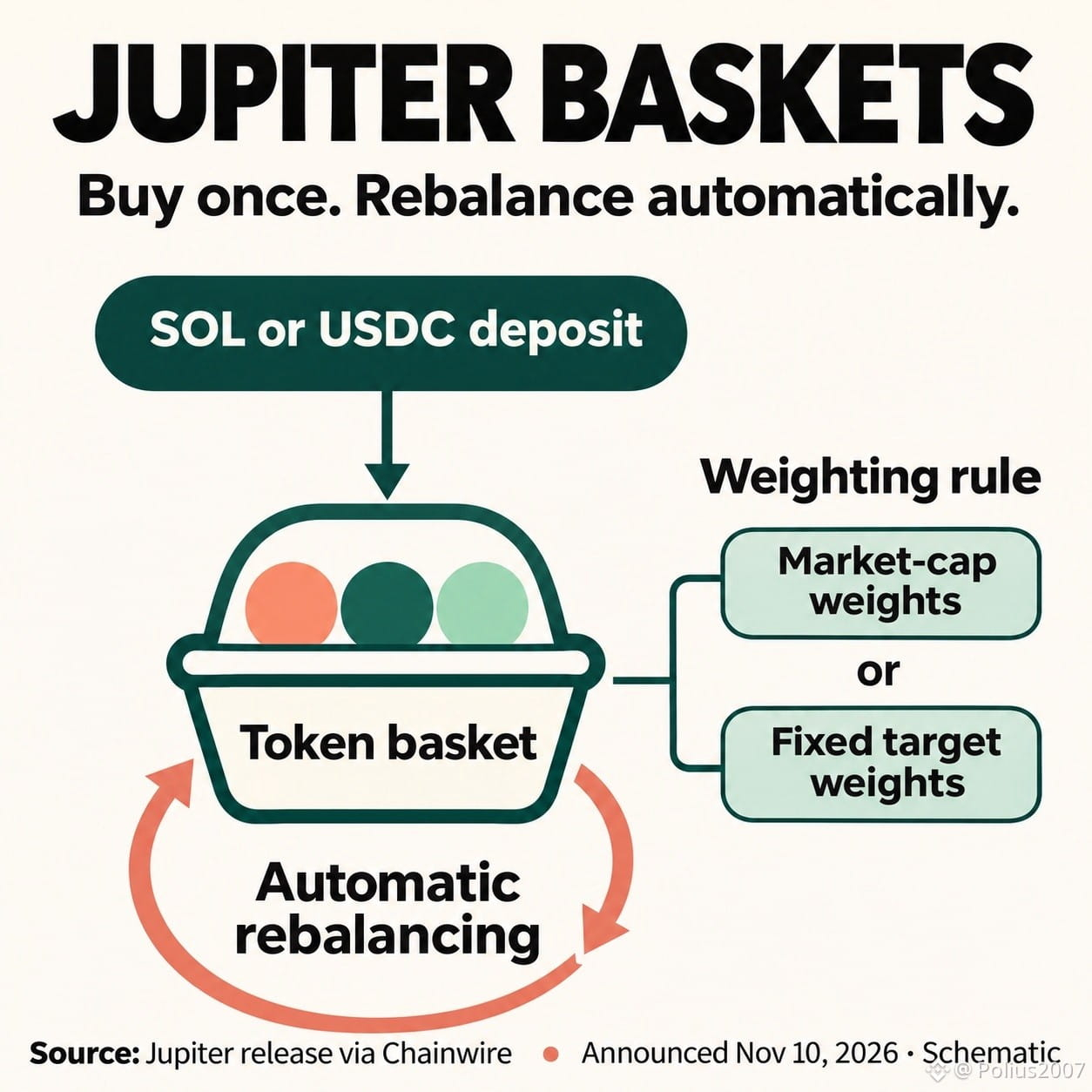
Buying a group of tokens takes one SOL or USDC deposit in Jupiter's new Baskets offering. Keeping their proportions in place is an ongoing job.
Jupiter's November 10 announcement says a single SOL or USDC deposit buys the basket. It offers market-cap weights or fixed target weights, with automatic rebalancing. With fixed weights, price moves can change each token's share of the portfolio, so maintaining the allocation requires further trades. Deposits, rebalances and exits all use Jupiter's swap routing.
That puts the initial purchase and subsequent allocation maintenance together. The announcement leaves the rebalancing schedule and costs unspecified. Jupiter says the products in this release are rolling out over the days ahead of November 15.
Source: Jupiter's November 10, 2026 release via Chainwire.
#Jupiter #Solana #DeFi
124
·
--
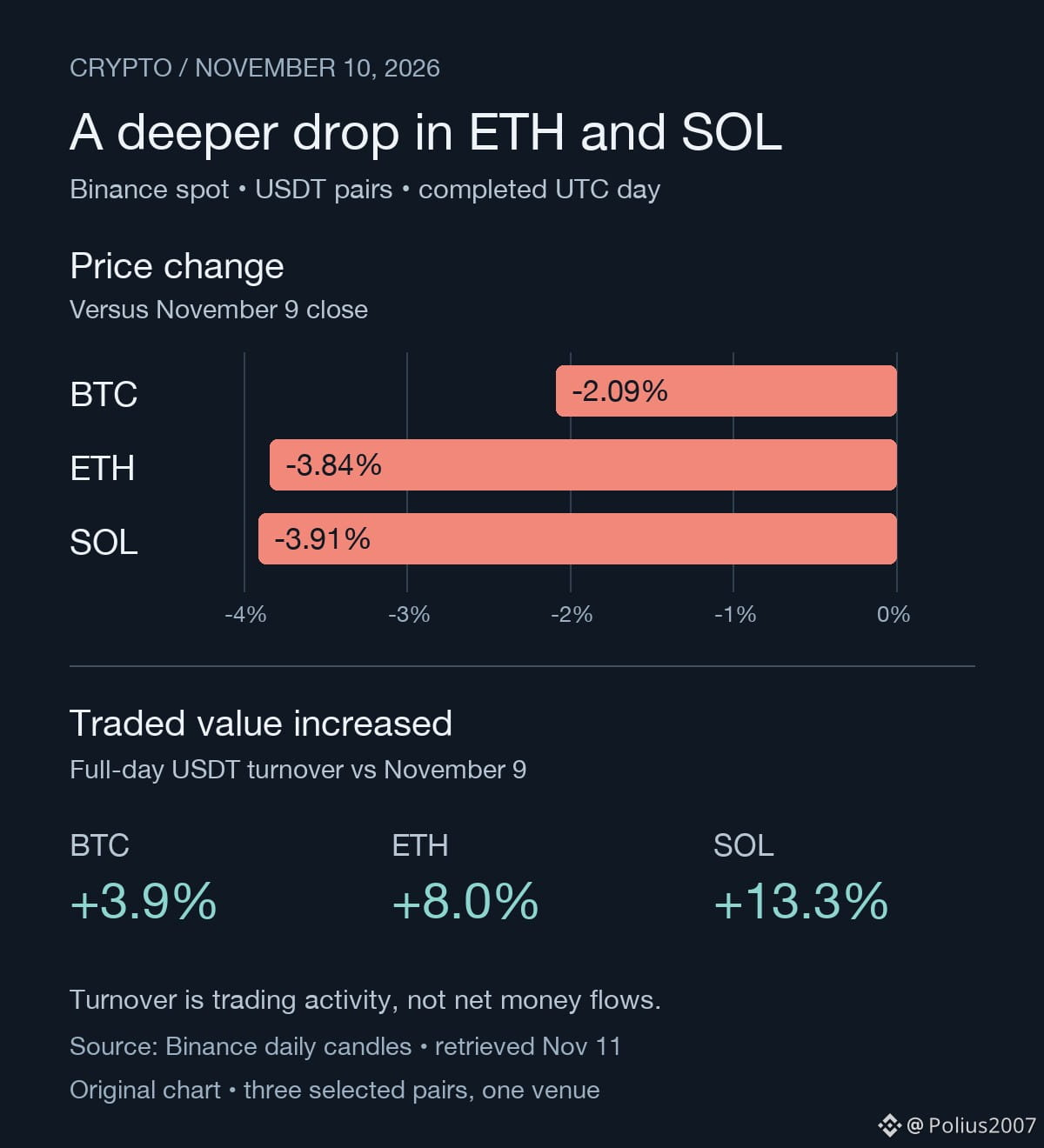
Ether and Solana fell almost twice as far as Bitcoin on Tuesday, while spot trading picked up across all three.
On Binance’s USDT spot pairs, November 10 closed with BTC down 2.09%, ETH down 3.84% and SOL down 3.91% from Monday’s close. SOL had the largest increase in traded value, up 13.3% from Monday, compared with 8.0% for ETH and 3.9% for BTC.
That puts Solana at the weak end of this three-coin comparison on price, and at the strong end on trading activity. Higher turnover tells us more changed hands; it doesn’t tell us that money flowed into the coin.
The chart compares completed November 9 and 10 UTC sessions using Binance spot daily candles. Turnover is each pair’s daily USDT traded value. November 11 trading is excluded.
#Bitcoin #Ethereum #Solana
101
·
--
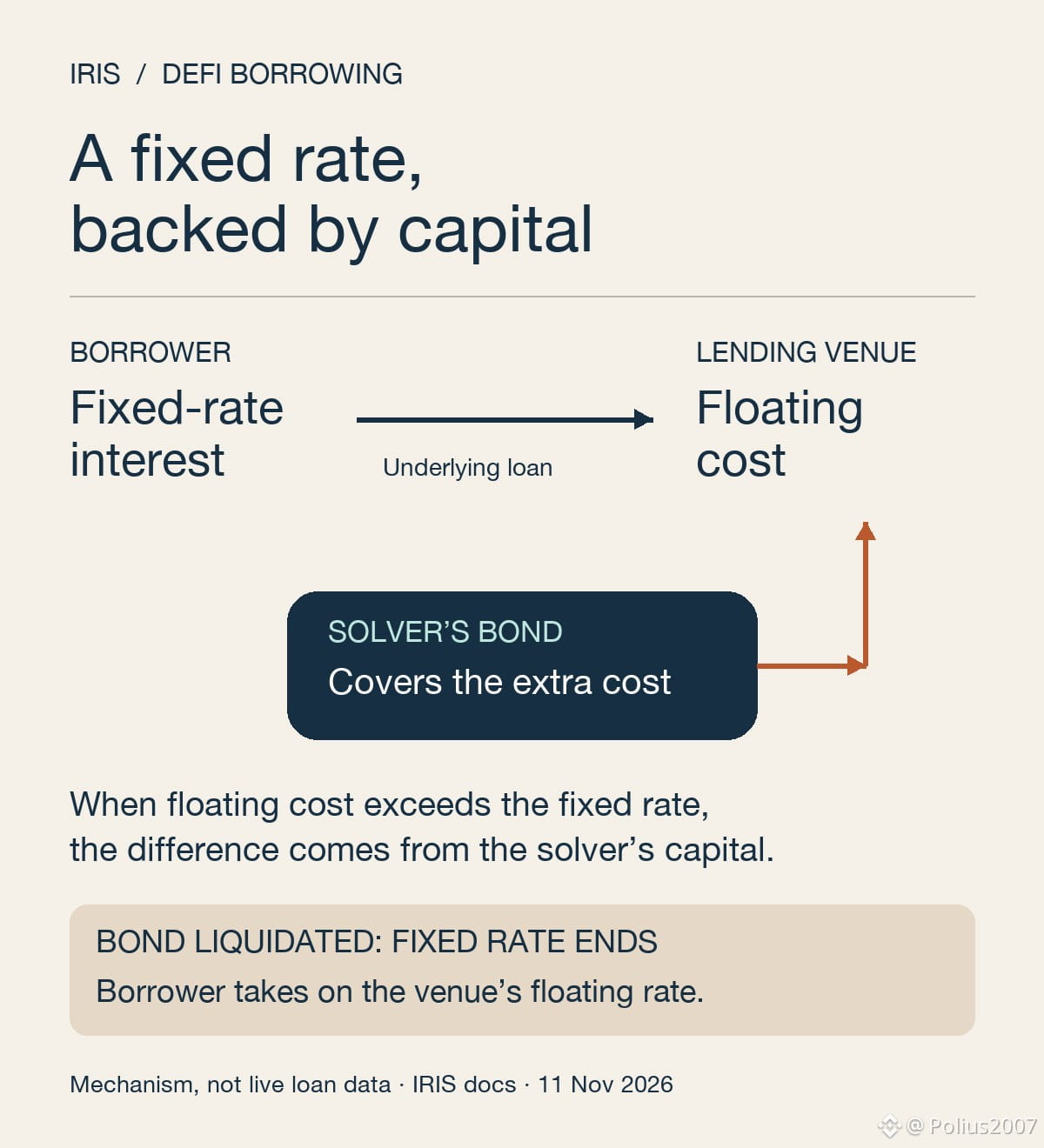
IRIS borrowers can choose a fixed rate for 1–90 days, with another party putting up capital to absorb changes in the underlying lending cost.
The loan still draws on a floating-rate market such as Spark. A market maker called a solver quotes the fixed rate and backs that particular loan with a bond. When the market charges less, the solver keeps the difference. When it charges more, the difference comes out of the solver’s bond.
That backing has a limit. IRIS’s documentation says that if accumulated costs eat far enough into the bond, it can be liquidated. The borrower then takes over the market’s floating rate. This event does not itself take the borrower’s collateral; ordinary collateral-liquidation risk remains separate.
For someone choosing how long to fix a borrowing cost, the term matters too: repaying early still incurs the full term’s interest. A longer quote commits to a longer interest bill, rather than buying a free option to leave early.
Sources: IRIS’s current product page and borrowing documentation, checked November 11, 2026. Diagram shows the documented mechanism, not a live loan or quoted rates.
https://iris.credit/
https://docs.iris.credit/home/user-guide/borrowing
https://docs.iris.credit/home/user-guide/solver-backing
#DeFi #Crypto
103
·
--
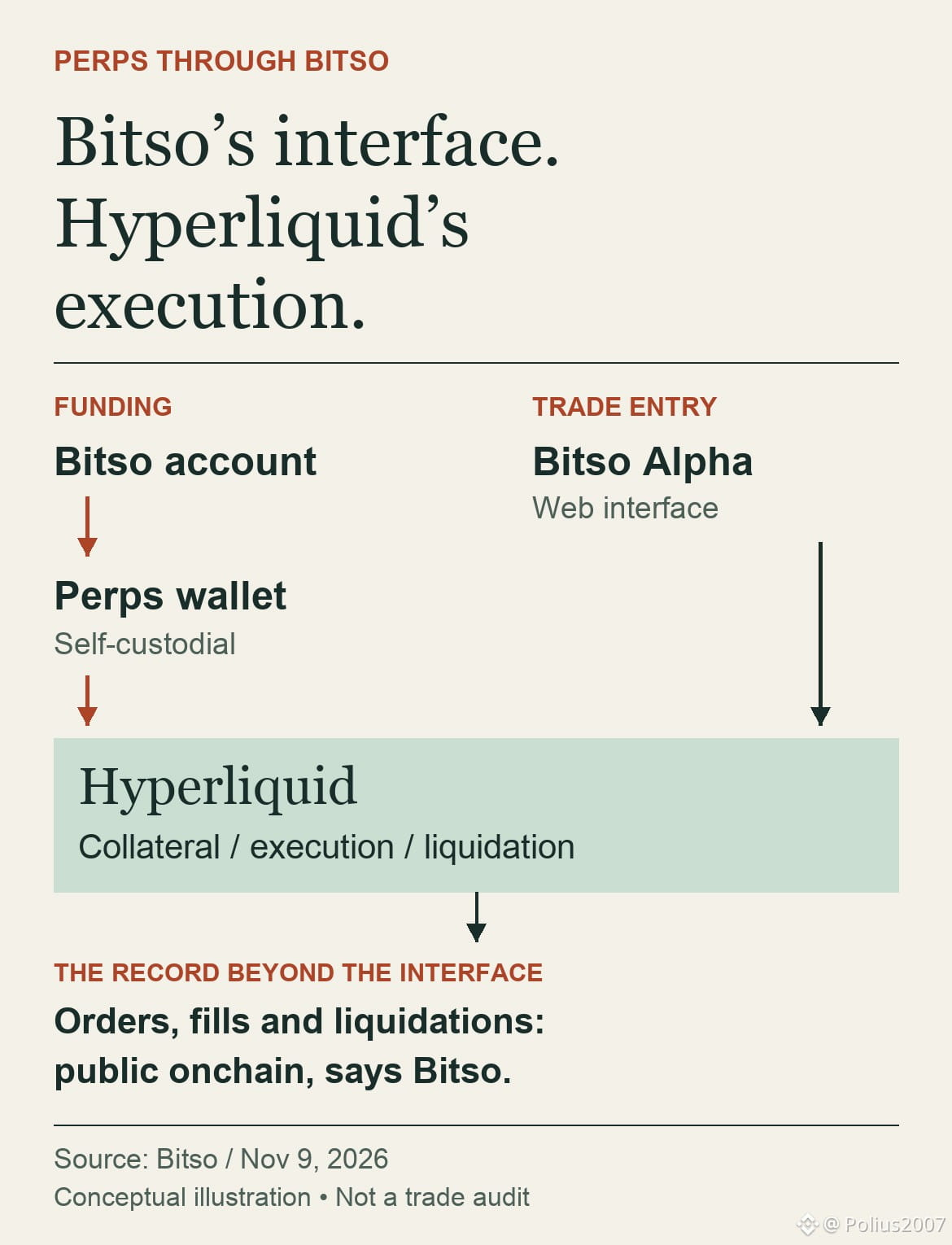
Bitso is giving its users a route into Hyperliquid without leaving the Bitso Alpha interface. Its November 9 rollout includes Bitcoin and Ether perpetual futures, with trading funds supplied from a Bitso account.
Activating Perps creates a separate self-custodial wallet. Users then manage their Hyperliquid account through Bitso Alpha on the web, including mobile browsers. The collateral sits on Hyperliquid and trades settle in USDC.
This also changes where users can check what happened to a trade. Bitso says every order, fill and liquidation is public and verifiable onchain. A trade entered through the exchange's screen leaves a record outside that interface.
Access is restricted to adults in supported jurisdictions. Hyperliquid handles execution and liquidation, and Bitso cannot reverse a liquidation or refund it. The new route brings exchange-account funding and publicly checkable execution into the same trading workflow.
Source: Bitso, November 9, 2026.
https://bitso.com/blog/perps-through-bitso-hyperliquid
#Hyperliquid #Crypto
13
·
--
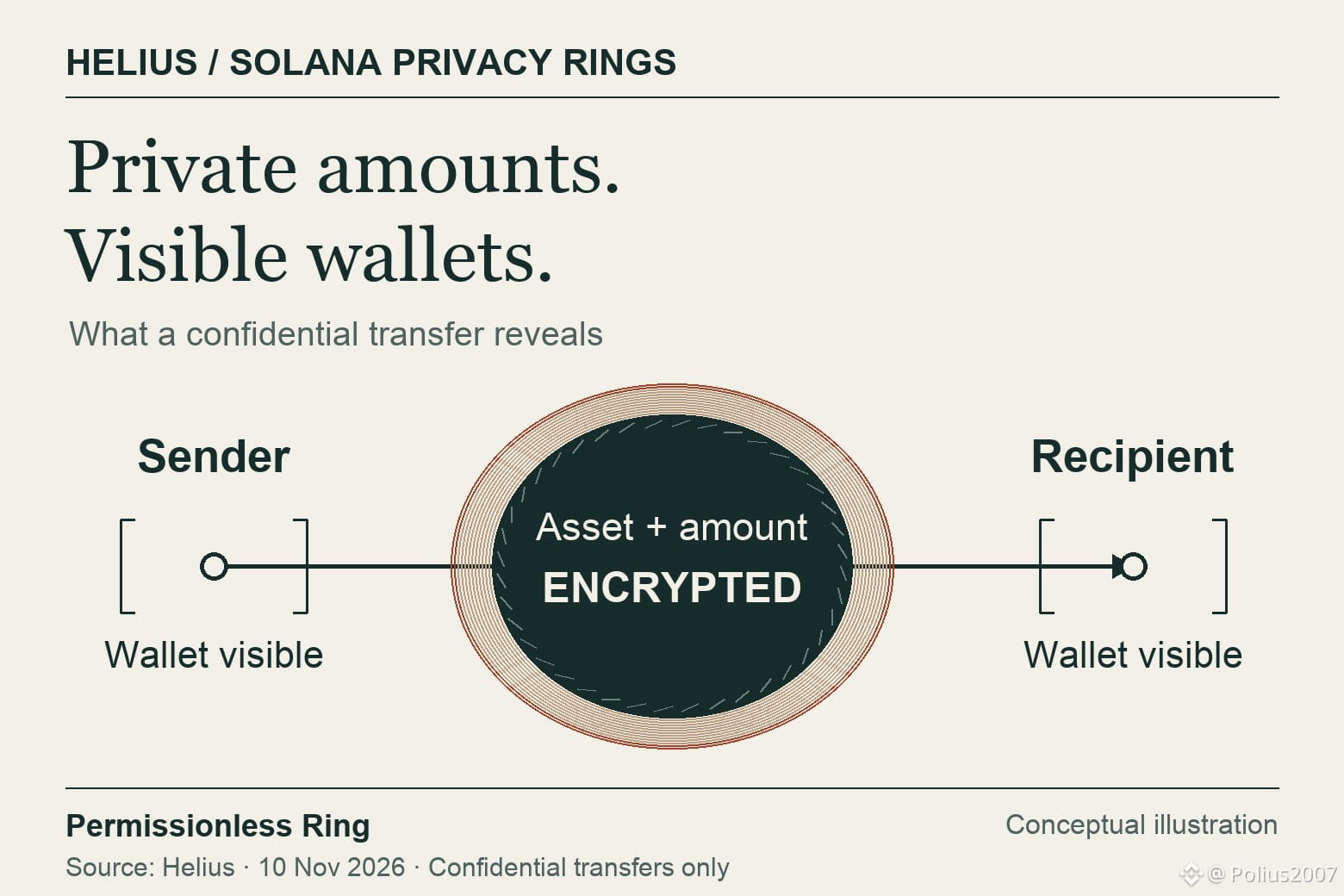
Solana users can now transfer tokens through Helius's Privacy Rings with the asset and amount encrypted onchain. The sender's and recipient's wallets remain visible.
Helius announced the permissionless Ring's mainnet launch on November 10. Users deposit assets into a private balance, transfer them to another Solana wallet address, and withdraw to a public balance. The encrypted data and transaction execution stay on Solana.
That gives payments a different kind of privacy: someone watching a confidential transfer can see which wallets interact without seeing what asset or amount changes hands. It does not make the participants anonymous.
Helius says Decrypt, Ore and Aurora Intents already have live products using the Ring. Custom Rings, including a version designed to hide counterparties as well, are still being audited, with a mainnet release targeted for the fourth quarter of 2026.
Source: Helius, November 10, 2026.
https://www.helius.dev/blog/solana-privacy-rings
#Solana #Privacy
112
·
--
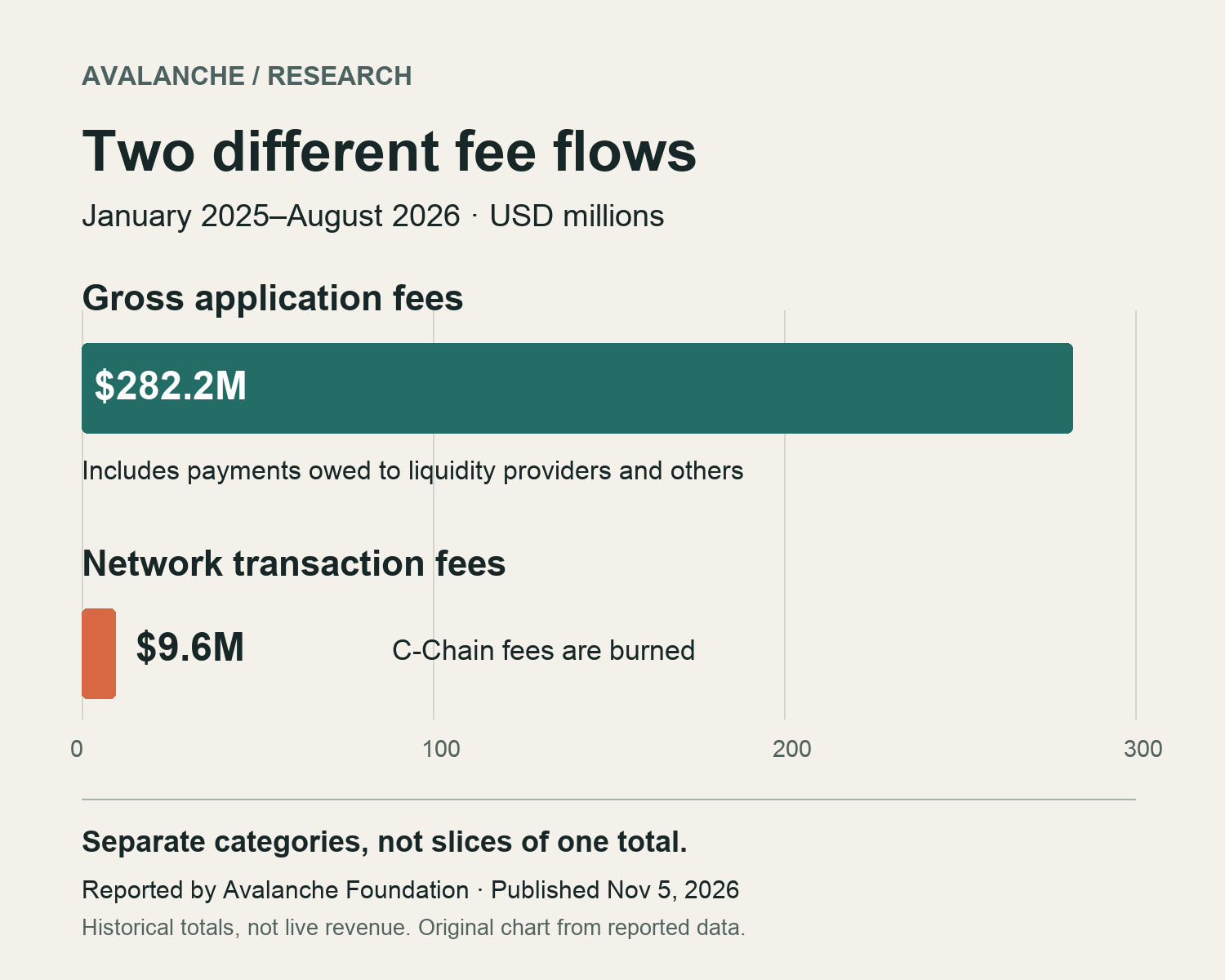
Avalanche applications generated about $282.2 million in gross fees from January 2025 through August 2026, compared with $9.6 million in network transaction fees, according to the Avalanche Foundation.
The application total includes payments owed to liquidity providers, depositors and other participants, not just money retained by app owners. The network fees follow a different path: the C-Chain burns them, including tips, in AVAX. The larger application figure does not measure that burn.
Chart: two separate fee flows, not parts of one total.
Source: Avalanche Foundation, November 5, 2026.
https://www.avalanche.com/about/blog/the-price-of-a-transaction-benchmarking-the-avalanche-c-chain-on-cost-and-capture
#Avalanche #AVAX
487
·
--
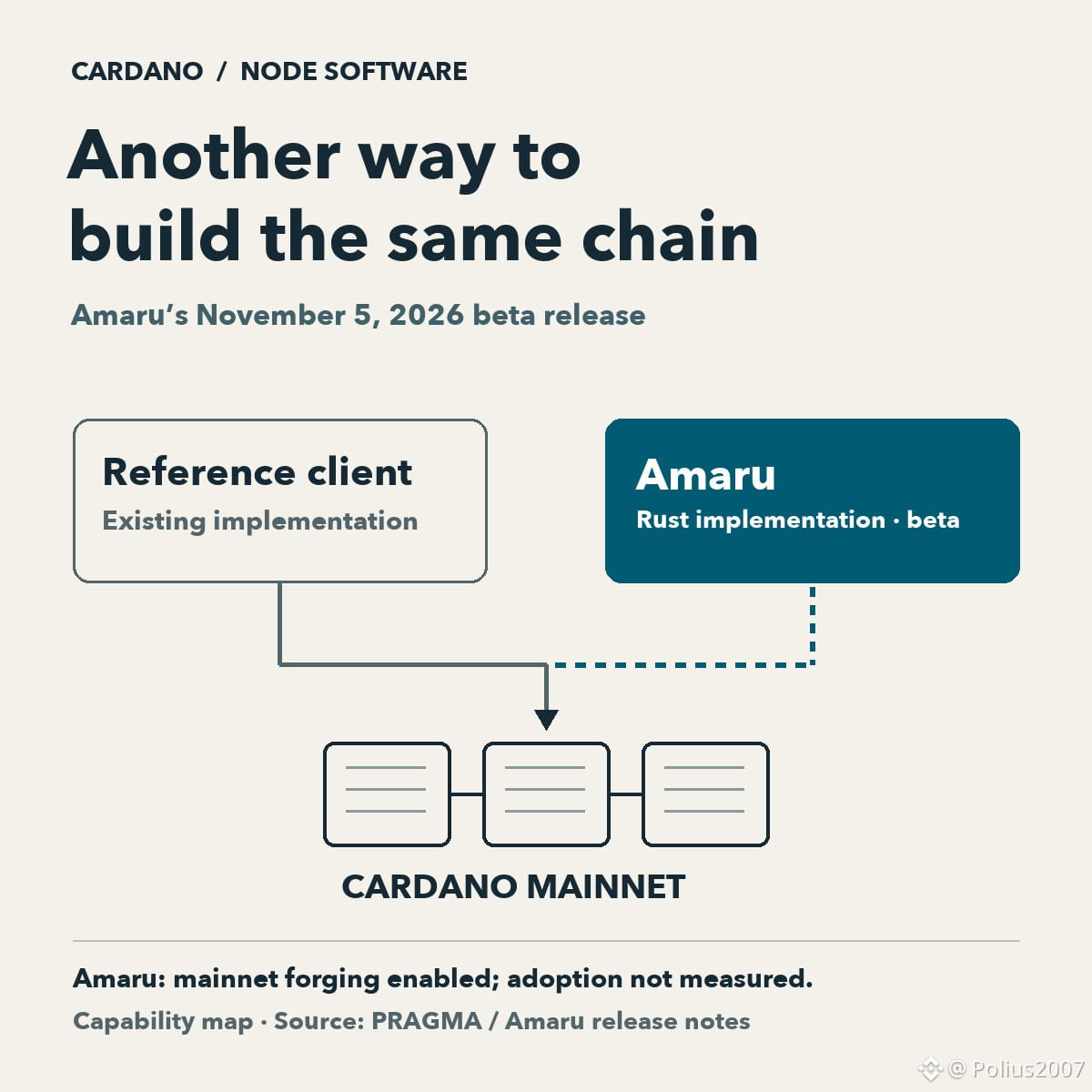
Amaru can now produce blocks on Cardano mainnet, giving stake-pool operators another implementation of the software that runs the network. Its November 5 beta release removes the testnet-only restriction on block production.
Different implementations can reduce dependence on one codebase: a bug in one need not be shared by the others. They still have to agree on which blocks are valid. That is what makes a separately built client useful to the same network.
How much diversity Cardano gains will depend on operators adopting it. Amaru remains an exploratory beta, so the software milestone comes ahead of any claim about its share of mainnet blocks.
Source: PRAGMA's Amaru release notes and repository, checked November 10, 2026. Diagram shows software capability, not measured deployment.
https://github.com/pragma-org/amaru/releases/tag/v10.11.20261105
https://github.com/pragma-org/amaru
#Cardano #ADA
1
248
·
--
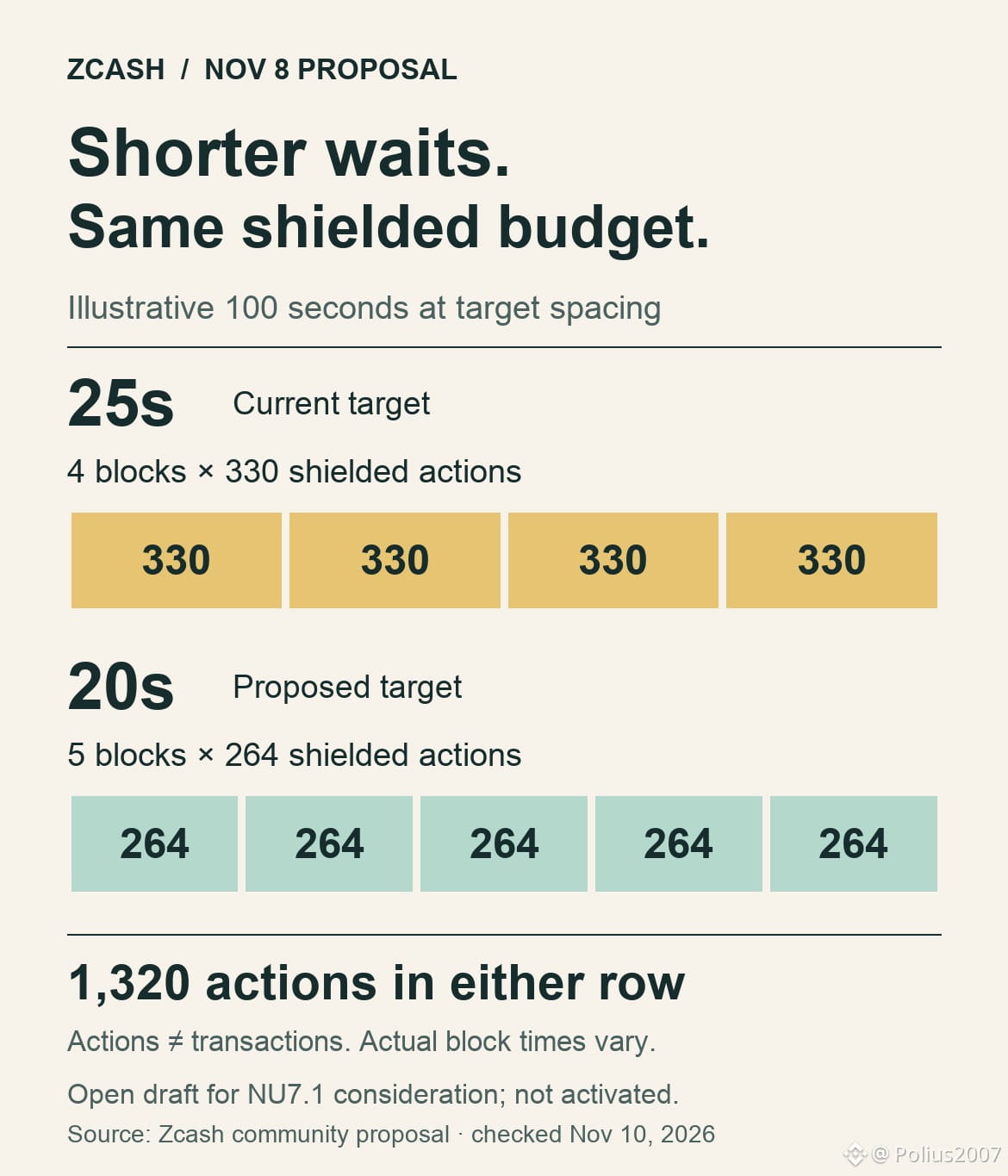
Zcash developers are proposing 20-second blocks, down from 25 seconds, to shorten the wait for payments to get their first confirmation.
The November 8 proposal deliberately leaves the daily shielded-activity ceiling unchanged. More frequent blocks would each carry a smaller budget: 264 shielded actions instead of 330. These are units of private-transaction work, not a count of transactions.
At the target spacing, an illustrative 100 seconds would fit four blocks of 330 actions today or five blocks of 264 under the proposal. Both total 1,320. The reason for shrinking each block's allowance is to avoid increasing the worst-case daily work that light wallets must download and decrypt.
For someone paying with ZEC, the intended gain is a shorter wait to enter a block, rather than more shielded capacity overall. The proposal also scales rewards per block to preserve expected issuance per day.
The authors want the change considered in the next community poll and for NU7.1. It remains an open draft, not an activated upgrade.
Source: ValarDragon and Evan Forbes, Zcash community proposal, November 8, 2026; checked November 10. Diagram uses target intervals, not observed block times.
https://forum.zcashcommunity.com/t/proposal-lower-zcash-block-target-spacing-from-25s-to-20s/59035
#Zcash #ZEC
1
369
·
--
Echo Protocol's wind-down notice gives borrowers two different repayment deadlines: November 14 in the instructions, and November 19 at 23:59 UTC in its timeline.
The Bitcoin-focused protocol on Aptos announced its closure on October 19. It tells borrowers to repay debt and release collateral, and warns that unpaid loans may lead to liquidation. Final liquidation and distribution dates are still marked "TBC" in that notice.
For anyone with an Echo loan, the two dates are a reason to seek clarification through the project's official support channel before relying on the later deadline. The notice itself does not resolve the conflict.
The original announcement was still the newest post visible on Echo's public X profile when checked on November 10. That limited view does not rule out a clarification in its replies or Discord.
Source: Echo Protocol's October 19, 2026 wind-down notice.
https://x.com/EchoProtocol_/status/2112182551792242811
#DeFi #Bitcoin
96
·
--
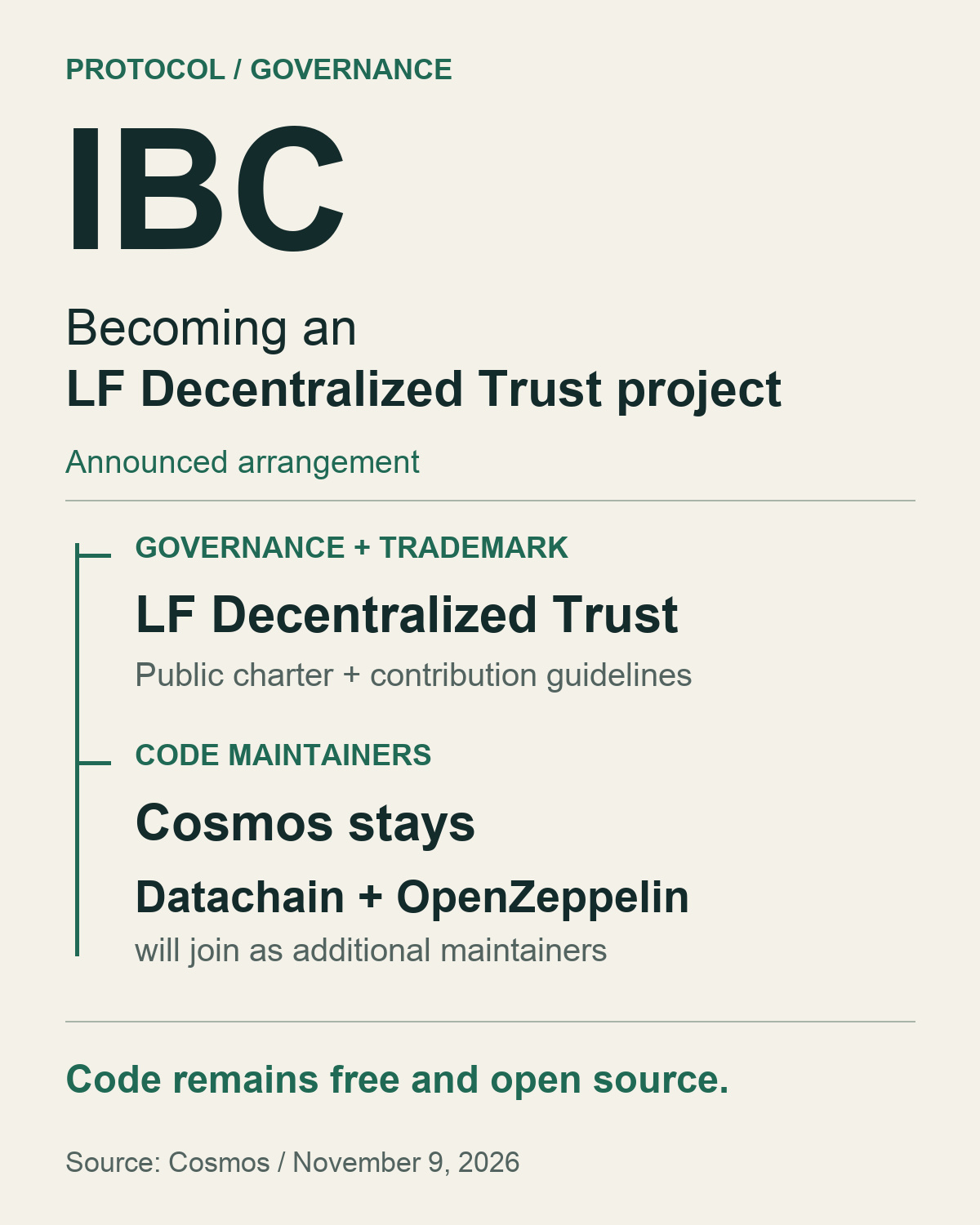
IBC is becoming an LF Decentralized Trust project, with Cosmos staying on as a maintainer and Datachain and OpenZeppelin joining as additional code maintainers.
Cosmos announced the move on November 9. IBC is the protocol that lets independent blockchains exchange assets and data.
Under the announced arrangement, LF Decentralized Trust will hold protocol governance under a public project charter and contribution guidelines, as well as the IBC trademark. The code will remain free and open source.
The change is in how IBC's development is governed and maintained. Cosmos is not walking away from the protocol it helped build.
Source: Cosmos, November 9, 2026.
https://cosmos.network/blog/ibc-joining-lf-decentralized-trust
#IBC #Cosmos
90
·
--
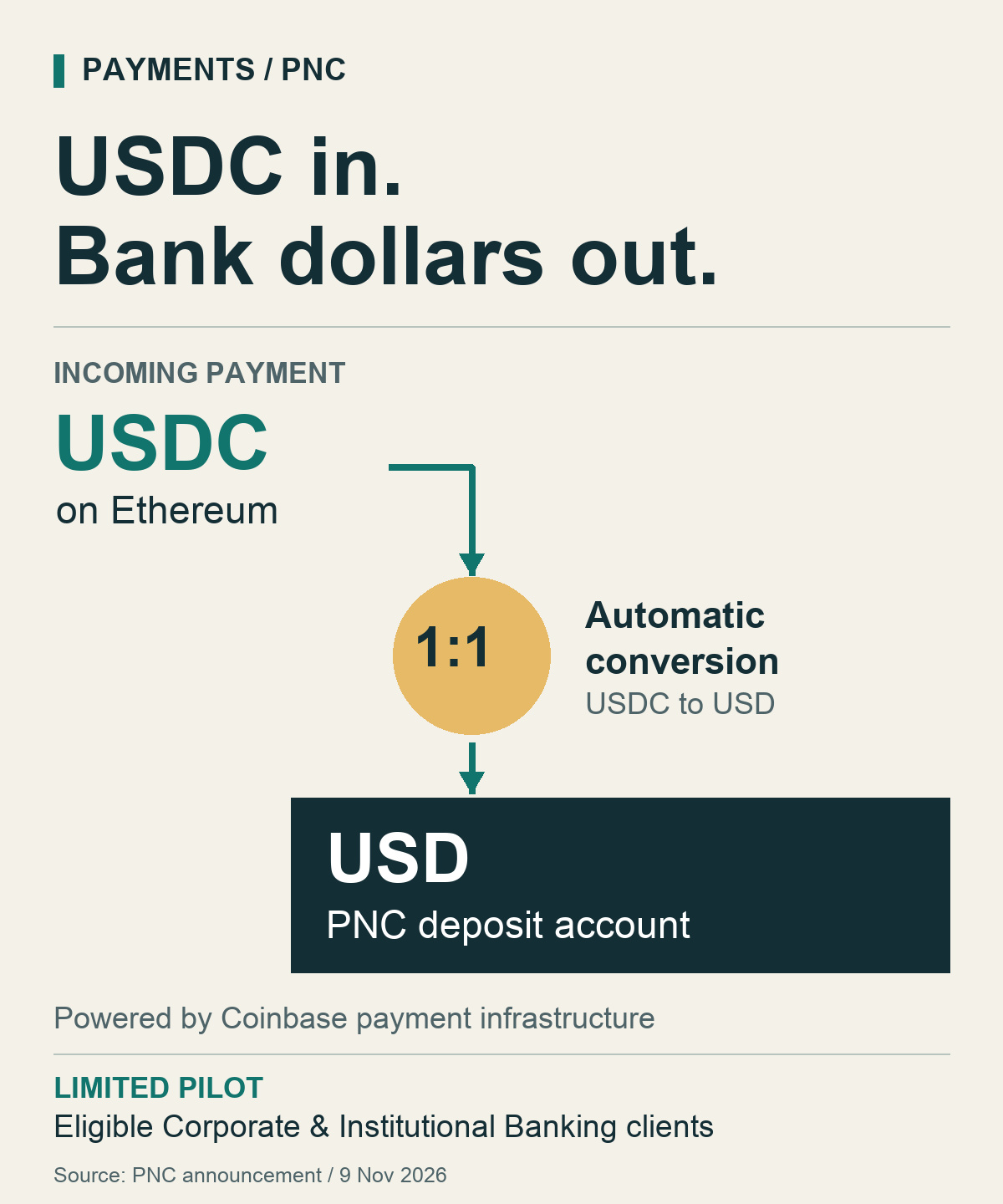
PNC is piloting a new way for corporate clients to get paid: incoming USDC on Ethereum is automatically converted one-to-one into U.S. dollars and deposited into a designated PNC bank account.
The service, announced November 9, uses Coinbase payment infrastructure. For now, access is limited to eligible Corporate & Institutional Banking clients in the pilot.
Source: PNC Bank, November 9, 2026.
https://pnc.mediaroom.com/2026-11-09-PNC-Bank-Launches-Incoming-Stablecoin-Payments-for-Corporate-and-Institutional-Banking-Clients
#USDC #Stablecoins
55
·
--
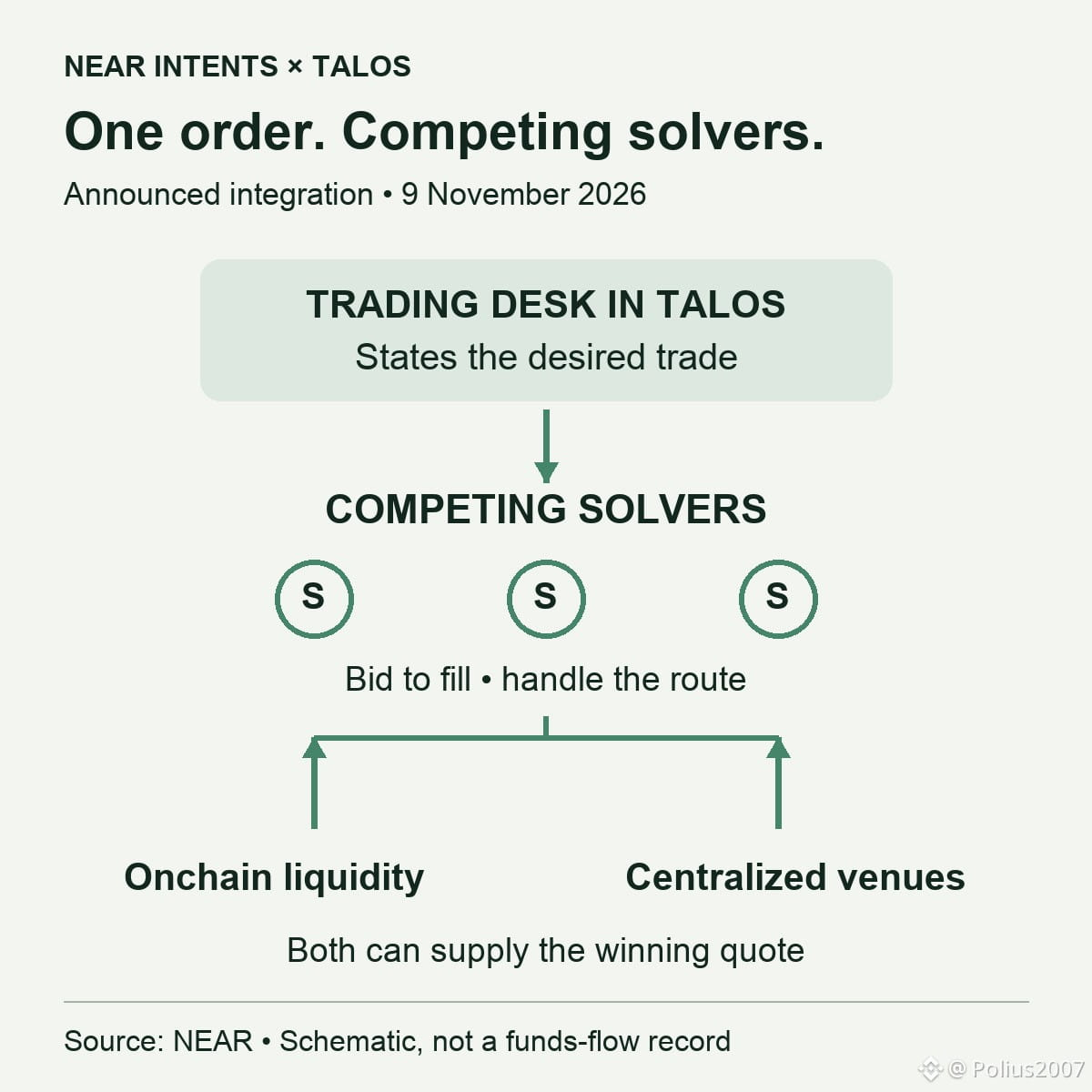
Talos trading desks can now request cross-chain crypto trades through NEAR Intents from the order system they already use, according to NEAR's November 9 announcement.
A desk specifies the trade it wants. Professional counterparties called solvers compete to fill it, with the winner handling routing, inventory risk and cross-chain steps. The desk receives a price and a fill through Talos, keeps its existing custody integrations, and doesn't have to fund separate venue accounts for the underlying route. Fees are volume-tiered, with the schedule disclosed during onboarding.
Where the winning solver finds the assets is the less obvious part. NEAR says solvers can use liquidity across more than 30 blockchains as well as centralized venues, including Binance. An order sent through this DeFi route may therefore draw on a centralized exchange's liquidity.
Intents does not operate a liquidity pool of its own. The trade is supplied by the winning counterparty, wherever it sources the assets.
Source: NEAR, November 9, 2026. Diagram shows the announced execution model, not a completed order.
https://www.near.org/blog/near-intents-live-in-talos-oems
#NEAR #DeFi
255
·
--
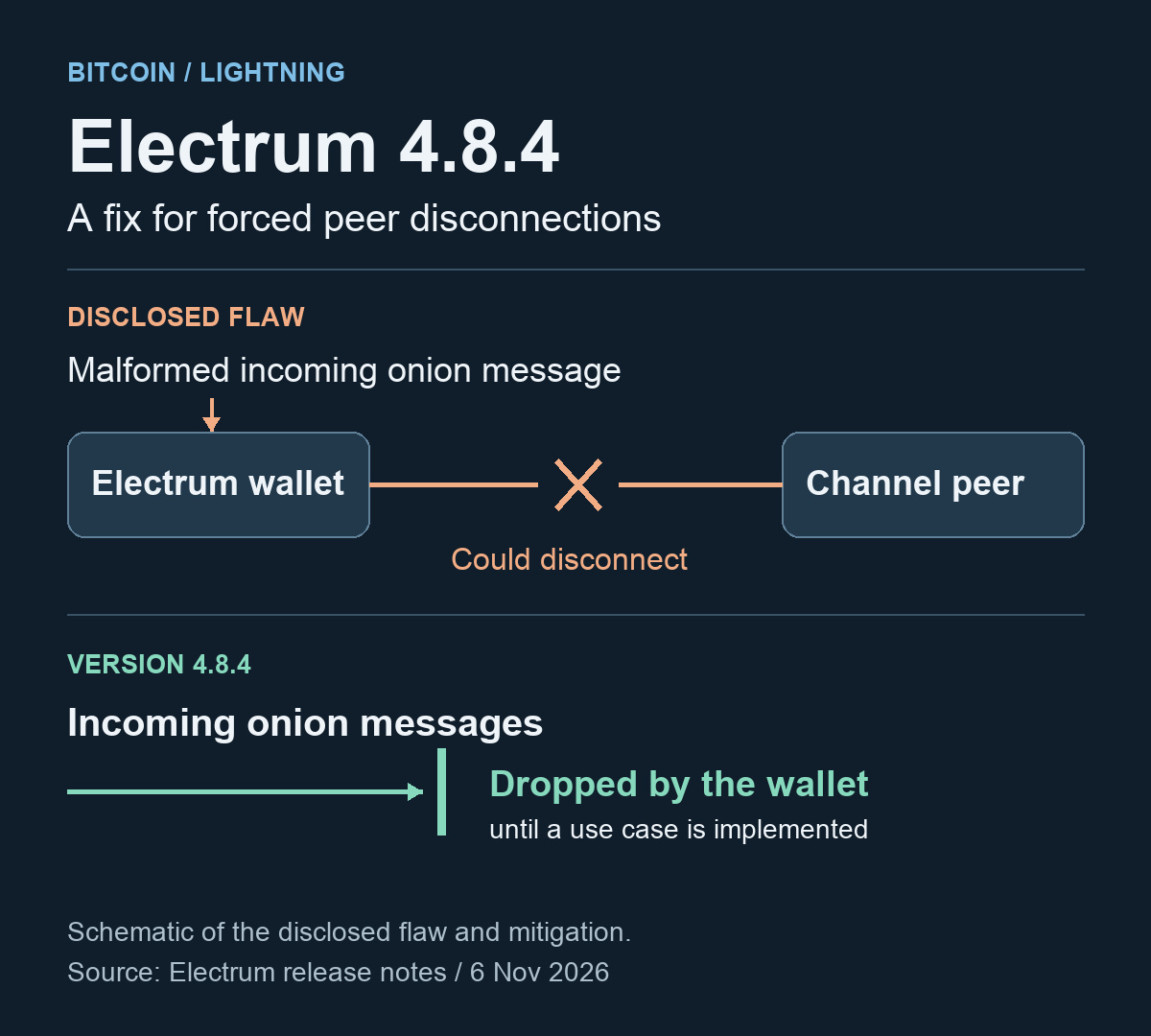
Electrum has released a fix for a flaw that could disconnect Bitcoin Lightning wallets from their payment-channel peers.
The wallet's November 6 release notes say malformed incoming “onion messages” could trigger the disconnect even when they came from an arbitrary source. These are Lightning messages, not Bitcoin transfers. Version 4.8.4 drops incoming onion messages until Electrum implements a use for them.
For someone using Electrum's Lightning channels, this is a reason to update the wallet rather than assume every lost peer connection is an internet problem. The disclosure describes a disconnection flaw; it does not report stolen funds.
Electrum's official download page now lists 4.8.4. Get the update from electrum.org and follow its signature-verification instructions, rather than a download link sent by someone offering wallet support.
Sources: Electrum 4.8.4 release notes, dated November 6, 2026, and the project's download page, checked November 9.
https://github.com/spesmilo/electrum/blob/4.8.4/RELEASE-NOTES
https://electrum.org/#download
#Bitcoin #Lightning
116
·
--
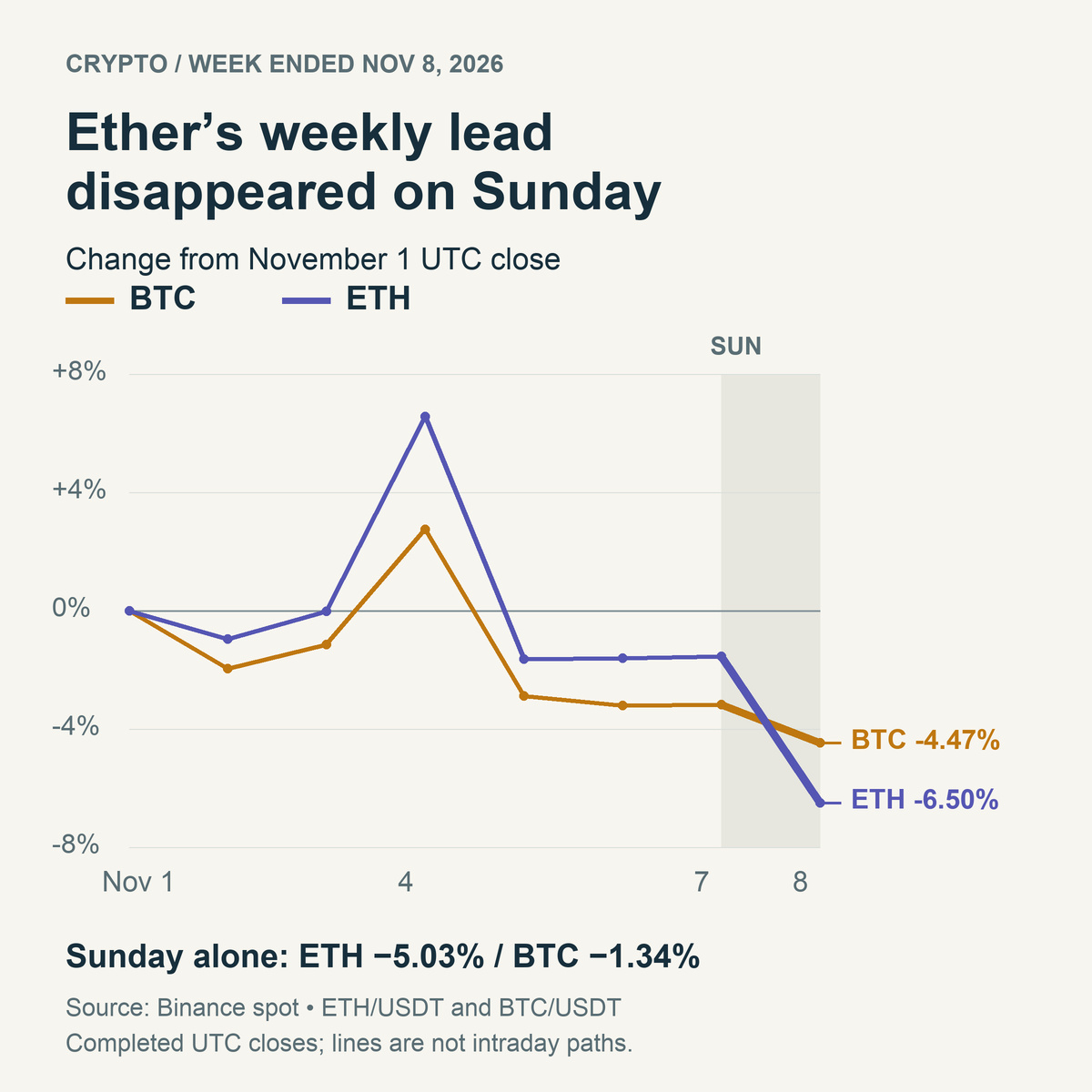
Ether entered Sunday holding up better than Bitcoin over the week. It finished behind it.
Through Saturday's close on Binance spot, ETH was down 1.54% from the November 1 close, versus a 3.17% decline for BTC. On Sunday, November 8, ETH fell 5.03%, while BTC lost 1.34%.
That left Ether down 6.50% for the week, compared with Bitcoin's 4.47% decline. ETH closed at 2,127.46 USDT; BTC at 74,851.44.
Chart: Binance ETH/USDT and BTC/USDT spot, measured from the November 1 UTC close through November 8. Lines connect completed daily closes, not intraday paths. November 9's unfinished session is excluded; these are historical closes, not live quotes.
#Ethereum #Bitcoin
1
159
·
--
ຢືນຢັນແລ້ວ
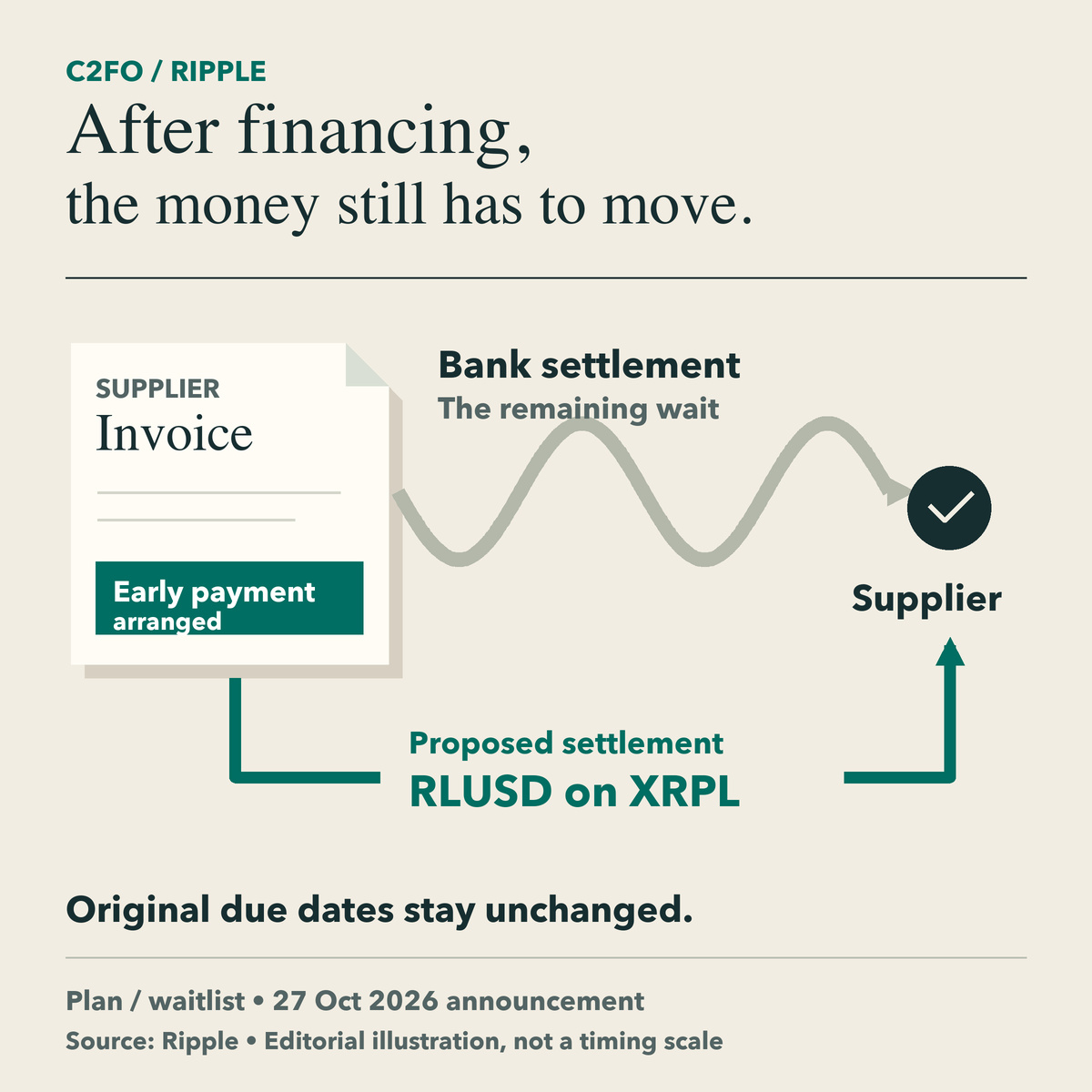
Even after a supplier secures early payment, the money can still take days to move through banks. C2FO, a working-capital platform that already arranges early payments, and Ripple want to shorten that last wait with RLUSD settlement on the XRP Ledger.
Under their October 27 plan for C2FO Instant Pay, participating capital providers would fund the payment and it would settle in RLUSD. Ripple says suppliers would receive funds in seconds rather than days. Customers would still pay on the original due dates.
The announcement directs interested businesses to a waitlist and reports no completed Instant Pay payment volume.
Source: Ripple and C2FO announcement, October 27, 2026.
https://ripple.com/ripple-press/c2fo-and-ripple-partner-to-modernize-trade-finance-using-the-xrp-ledger/
#RLUSD #Stablecoins
1
284
·
--
ຢືນຢັນແລ້ວ
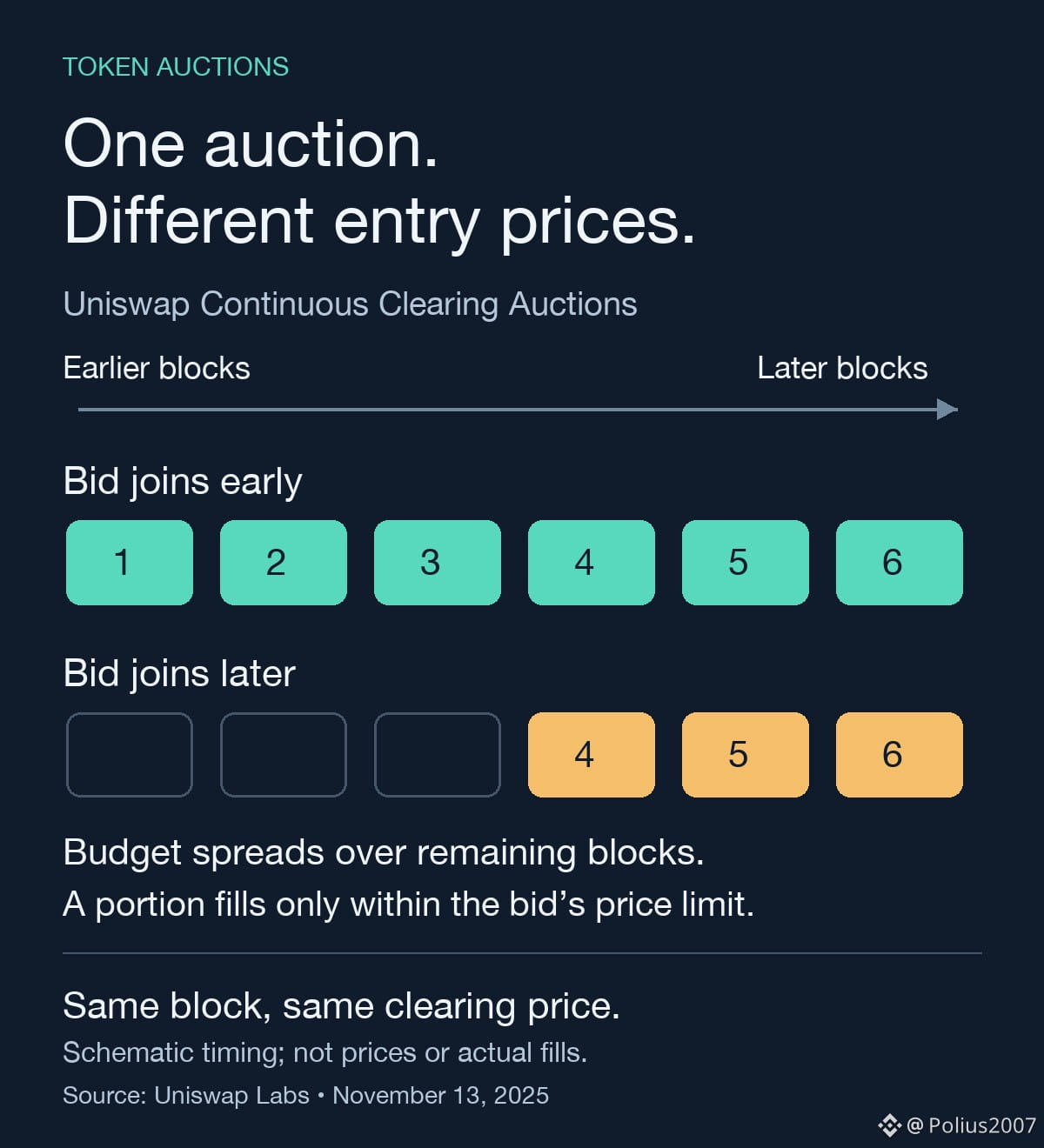
Bidding early in Uniswap's Continuous Clearing Auctions gives you access to more of the sale, but you can't withdraw a bid while it remains in range. Waiting keeps the decision to participate open, at the cost of missing the portions already sold.
Aztec used this auction design for its November 2025 token sale. Tokens are sold block by block, so when you join determines which parts of the auction your bid can reach. You set a spending budget and a maximum price; the budget is spread across the remaining blocks. Each portion fills only if that block's clearing price is at or below your limit.
Those earlier blocks can matter to what you pay. Everyone who fills in the same block pays the same clearing price, but buyers whose fills span different blocks can end up with different average entry prices. The auction's final price need not be the average a buyer paid.
Sources: Uniswap Labs' November 13, 2025 mechanism explainer and February 10, 2026 Aztec recap.
https://blog.uniswap.org/continuous-clearing-auctions
https://blog.uniswap.org/aztec-cca
#Crypto #TokenSales
1
539
·
--
ຢືນຢັນແລ້ວ
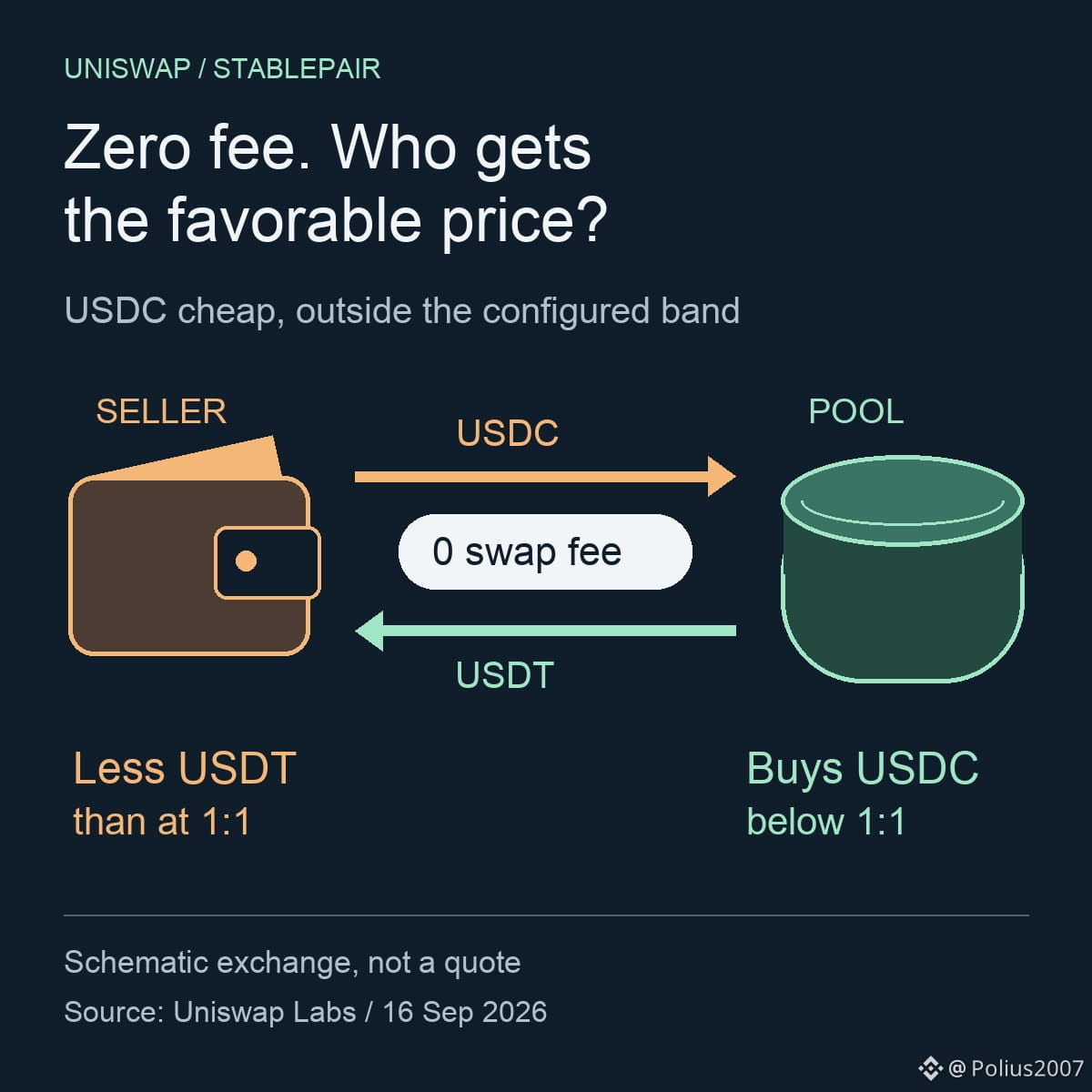
A zero-fee stablecoin swap can be the trade a liquidity pool most wants you to make.
Take Uniswap's StablePair design. USDC is already cheap in a USDC/USDT pool, outside its configured band around the reference rate. Selling more USDC pushes the price farther away. The hook charges no swap fee: the pool is already buying at a favorable price.
For the seller, that means less USDT per USDC than at the 1:1 reference. Waiving the fee doesn't undo the cheap sale.
The opposite trade, which moves the pool back toward the reference, faces a fee that steps down block by block toward a configured floor. That auction aims to leave more of the price-correction profit with liquidity providers.
Source: Uniswap Labs' September 16, 2026 explanation of the existing StablePair design. Illustration is schematic.
https://blog.uniswap.org/keeping-value-in-the-pool-how-stablepair-hook-works
#Uniswap #Stablecoins
1
75
ເຂົ້າສູ່ລະບົບເພື່ອສຳຫຼວດເນື້ອຫາເພີ່ມເຕີມ
ເຂົ້າຮ່ວມກຸ່ມຜູ້ໃຊ້ຄຣິບໂຕທົ່ວໂລກໃນ Binance Square.
⚡️ ໄດ້ຮັບຂໍ້ມູນຫຼ້າສຸດ ແລະ ທີ່ມີປະໂຫຍດກ່ຽວກັບຄຣິບໂຕ.
💬 ໄດ້ຮັບຄວາມໄວ້ວາງໃຈຈາກຕະຫຼາດແລກປ່ຽນຄຣິບໂຕທີ່ໃຫຍ່ທີ່ສຸດໃນໂລກ.
👍 ຄົ້ນຫາຂໍ້ມູນເຊີງເລິກທີ່ແທ້ຈາກນັກສ້າງທີ່ໄດ້ຮັບການຢືນຢັນ.
ອີເມວ / ເບີໂທລະສັບ
ຫົວຂໍ້ທີ່ກໍາລັງນິຍົມ
HotCPIDecemberHikePriced
234,801 ຄັ້ງທີ່ເບິ່ງ
2,486 ກຳລັງສົນທະນາ
CPI Market Watch | US CPI Rises 0.4% in October, Hotter Than 0.3% Forecast
Binance News
·31 ຖືກໃຈ
·45.1k ຄັ້ງທີ່ເບິ່ງ
ZcashFallsBelow$1000ForFirstTimeSinceSeptember
55 ຄັ້ງທີ່ເບິ່ງ
5 ກຳລັງສົນທະນາ
StrategyFaces$2.8BSelloffRiskFromMSCIRemoval
8,893 ຄັ້ງທີ່ເບິ່ງ
101 ກຳລັງສົນທະນາ