

#learnwithbinance
learnwithbinance
29,610 рет көрілді
434 адам талқылап жатыр
Қызу саудада
Ең соңғы
#EarningsSeason
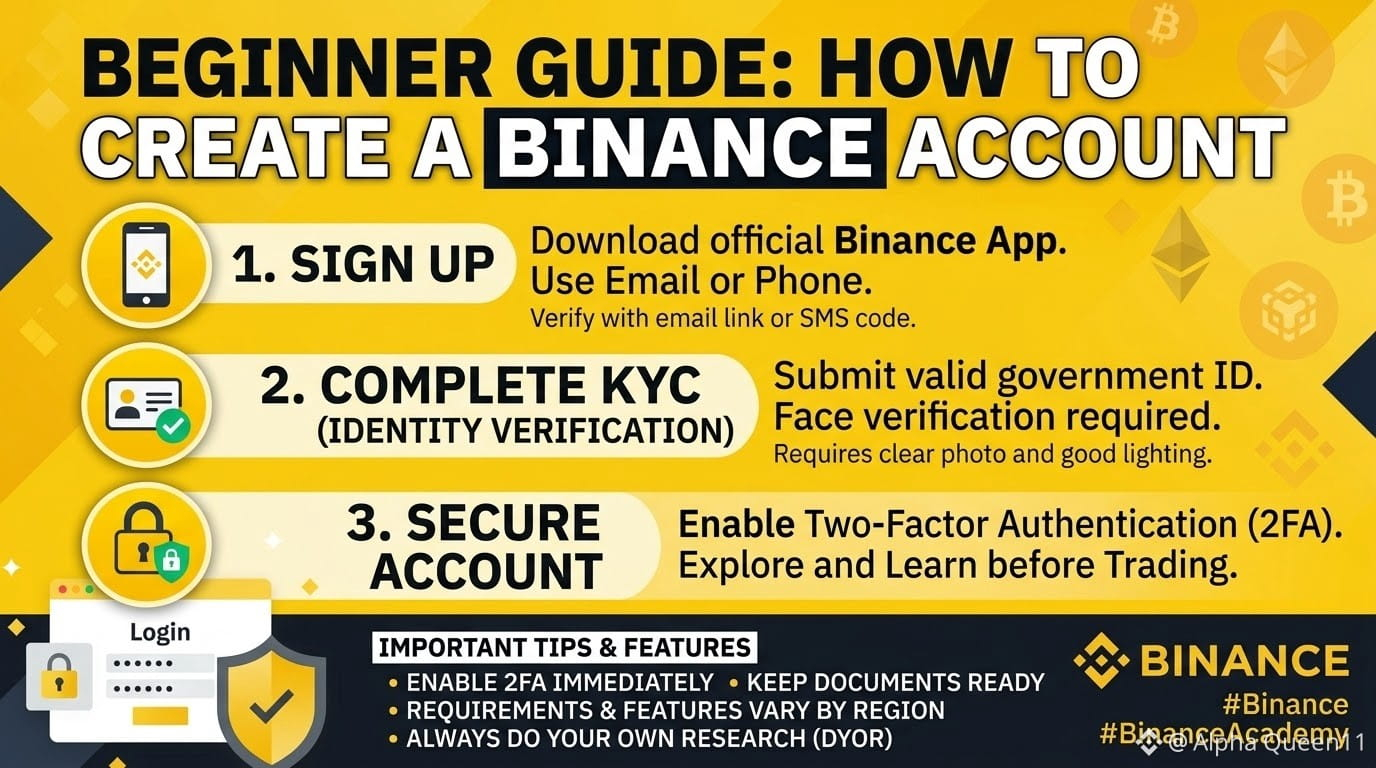
🔥 How to Create a Binance Account — Beginner’s Guide🔥
🚀Starting your crypto journey? Creating a Binance account is simple, but understanding KYC, verification & account security is important before you explore further.
📱 Step 1: Download the official Binance app and sign up with your email or phone number.
🪪 Step 2: Complete identity verification (KYC) by following the instructions in the app.
📄 Step 3: Make sure your documents are clear, valid and belong to you.
💡 Step 4: Good lighting and accurate information can help avoid verification issues.
🌍 Step 5: Remember that account requirements and available features may vary by location.
🔒 Step 6: Secure your account properly and take time to understand the platform before using its features.
The goal isn’t just to create an account — it’s to understand what you’re doing and keep your account secure.
💬 What was the most confusing part for you when you first created a crypto account?
#Binance #KOSPIFallsMoreThan2% #LearnWithBinance
$BTC @BinancePk
#EarningsSeason
🔥 How to Create a Binance Account — Beginner’s Guide🔥
🚀Starting your crypto journey? Creating a Binance account is simple, but understanding KYC, verification & account security is important before you explore further.
📱 Step 1: Download the official Binance app and sign up with your email or phone number.
🪪 Step 2: Complete identity verification (KYC) by following the instructions in the app.
📄 Step 3: Make sure your documents are clear, valid and belong to you.
💡 Step 4: Good lighting and accurate information can help avoid verification issues.
🌍 Step 5: Remember that account requirements and available features may vary by location.
🔒 Step 6: Secure your account properly and take time to understand the platform before using its features.
The goal isn’t just to create an account — it’s to understand what you’re doing and keep your account secure.
💬 What was the most confusing part for you when you first created a crypto account?
#Binance #KOSPIFallsMoreThan2% #LearnWithBinance
$BTC @Binance Pakistan
🔥 How to Create a Binance Account — Beginner’s Guide🔥
🚀Starting your crypto journey? Creating a Binance account is simple, but understanding KYC, verification & account security is important before you explore further.
📱 Step 1: Download the official Binance app and sign up with your email or phone number.
🪪 Step 2: Complete identity verification (KYC) by following the instructions in the app.
📄 Step 3: Make sure your documents are clear, valid and belong to you.
💡 Step 4: Good lighting and accurate information can help avoid verification issues.
🌍 Step 5: Remember that account requirements and available features may vary by location.
🔒 Step 6: Secure your account properly and take time to understand the platform before using its features.
The goal isn’t just to create an account — it’s to understand what you’re doing and keep your account secure.
💬 What was the most confusing part for you when you first created a crypto account?
#Binance #KOSPIFallsMoreThan2% #LearnWithBinance
$BTC @Binance Pakistan
3
201
Binance AI Pro
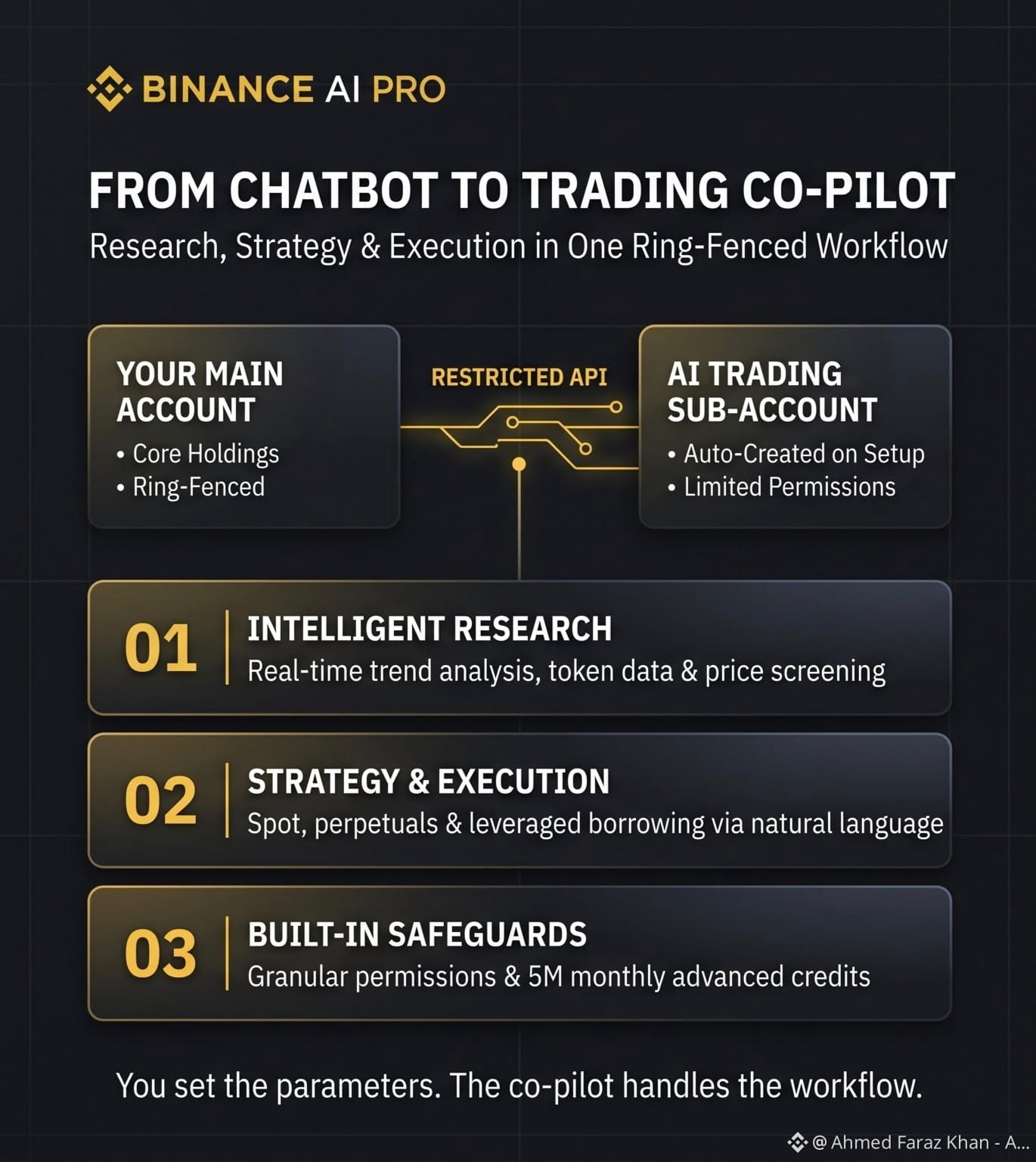
Most AI tools in crypto stop at summarizing charts you can already read yourself. What makes Binance AI Pro genuinely interesting isn't the chat interface, it's how it handles execution and risk isolation under the hood.
Instead of plugging a third-party bot into your primary balance and hoping for the best, activating AI Pro automatically sets up a dedicated trading sub-account with restricted API permissions. You get market analysis, custom strategy setup, and live execution across spot and perpetuals in a single workflow, while your core portfolio stays ring-fenced.
A few details that stood out while going through the setup:
Granular Control: You explicitly define which actions the co-pilot is allowed to take via Account Permissions, and you can adjust or revoke them anytime across the Web, iOS, or Android.
Uninterrupted Workflow: Each cycle includes 5 million monthly usage credits for heavy-duty reasoning models, with an automatic fallback to basic models if your credits run dry meaning active monitoring doesn't just cut out mid-week.
Clean Exit Logic: If you pause or end your subscription, the system automatically closes AI-managed positions and terminates active strategies rather than leaving orphaned orders on the book.
It feels less like handing over the wheel and more like having a disciplined junior analyst sitting next to you doing the legwork on data and execution while you make the final call on risk.
How much of your routine screening or order execution are you comfortable delegating to an AI co-pilot right now?
#Binance
#BinanceAcademy
#LearnWithBinance
Binance AI Pro
Most AI tools in crypto stop at summarizing charts you can already read yourself. What makes Binance AI Pro genuinely interesting isn't the chat interface, it's how it handles execution and risk isolation under the hood.
Instead of plugging a third-party bot into your primary balance and hoping for the best, activating AI Pro automatically sets up a dedicated trading sub-account with restricted API permissions. You get market analysis, custom strategy setup, and live execution across spot and perpetuals in a single workflow, while your core portfolio stays ring-fenced.
A few details that stood out while going through the setup:
Granular Control: You explicitly define which actions the co-pilot is allowed to take via Account Permissions, and you can adjust or revoke them anytime across the Web, iOS, or Android.
Uninterrupted Workflow: Each cycle includes 5 million monthly usage credits for heavy-duty reasoning models, with an automatic fallback to basic models if your credits run dry meaning active monitoring doesn't just cut out mid-week.
Clean Exit Logic: If you pause or end your subscription, the system automatically closes AI-managed positions and terminates active strategies rather than leaving orphaned orders on the book.
It feels less like handing over the wheel and more like having a disciplined junior analyst sitting next to you doing the legwork on data and execution while you make the final call on risk.
How much of your routine screening or order execution are you comfortable delegating to an AI co-pilot right now?
#Binance
#BinanceAcademy
#LearnWithBinance
Most AI tools in crypto stop at summarizing charts you can already read yourself. What makes Binance AI Pro genuinely interesting isn't the chat interface, it's how it handles execution and risk isolation under the hood.
Instead of plugging a third-party bot into your primary balance and hoping for the best, activating AI Pro automatically sets up a dedicated trading sub-account with restricted API permissions. You get market analysis, custom strategy setup, and live execution across spot and perpetuals in a single workflow, while your core portfolio stays ring-fenced.
A few details that stood out while going through the setup:
Granular Control: You explicitly define which actions the co-pilot is allowed to take via Account Permissions, and you can adjust or revoke them anytime across the Web, iOS, or Android.
Uninterrupted Workflow: Each cycle includes 5 million monthly usage credits for heavy-duty reasoning models, with an automatic fallback to basic models if your credits run dry meaning active monitoring doesn't just cut out mid-week.
Clean Exit Logic: If you pause or end your subscription, the system automatically closes AI-managed positions and terminates active strategies rather than leaving orphaned orders on the book.
It feels less like handing over the wheel and more like having a disciplined junior analyst sitting next to you doing the legwork on data and execution while you make the final call on risk.
How much of your routine screening or order execution are you comfortable delegating to an AI co-pilot right now?
#Binance
#BinanceAcademy
#LearnWithBinance
Muhammad Naveed mirza:
thanks for all lisen your group big win coin
2
1
3
45


·
--
How Binance Points Works!!
Binance Points let you earn rewards for eligible activities on platform
Check Rewards Hub: Profile → Rewards Hub) for your available
1. Spot trading
2. Futures trading
3. Binance Convert
4. P2P or fiat deposits
After completing tasks, open Rewards Hub to view your points balance, progress, and available rewards
Claim Your Points
Points must be claimed manually within 14 days of issuance
Educational content only
https://www.binance.com/en/support/faq/detail/0359eaa23c2042f0a2f98db2d62617f2
#Binance #BinanceAcademy #LearnWithBinance
#Binance #BinancePoints
How Binance Points Works!!
Binance Points let you earn rewards for eligible activities on platform
Check Rewards Hub: Profile → Rewards Hub) for your available
1. Spot trading
2. Futures trading
3. Binance Convert
4. P2P or fiat deposits
After completing tasks, open Rewards Hub to view your points balance, progress, and available rewards
Claim Your Points
Points must be claimed manually within 14 days of issuance
Educational content only
https://www.binance.com/en/support/faq/detail/0359eaa23c2042f0a2f98db2d62617f2
#Binance #BinanceAcademy #LearnWithBinance
#Binance #BinancePoints
Binance Points let you earn rewards for eligible activities on platform
Check Rewards Hub: Profile → Rewards Hub) for your available
1. Spot trading
2. Futures trading
3. Binance Convert
4. P2P or fiat deposits
After completing tasks, open Rewards Hub to view your points balance, progress, and available rewards
Claim Your Points
Points must be claimed manually within 14 days of issuance
Educational content only
https://www.binance.com/en/support/faq/detail/0359eaa23c2042f0a2f98db2d62617f2
#Binance #BinanceAcademy #LearnWithBinance
#Binance #BinancePoints
5
473

·
--
Мақала
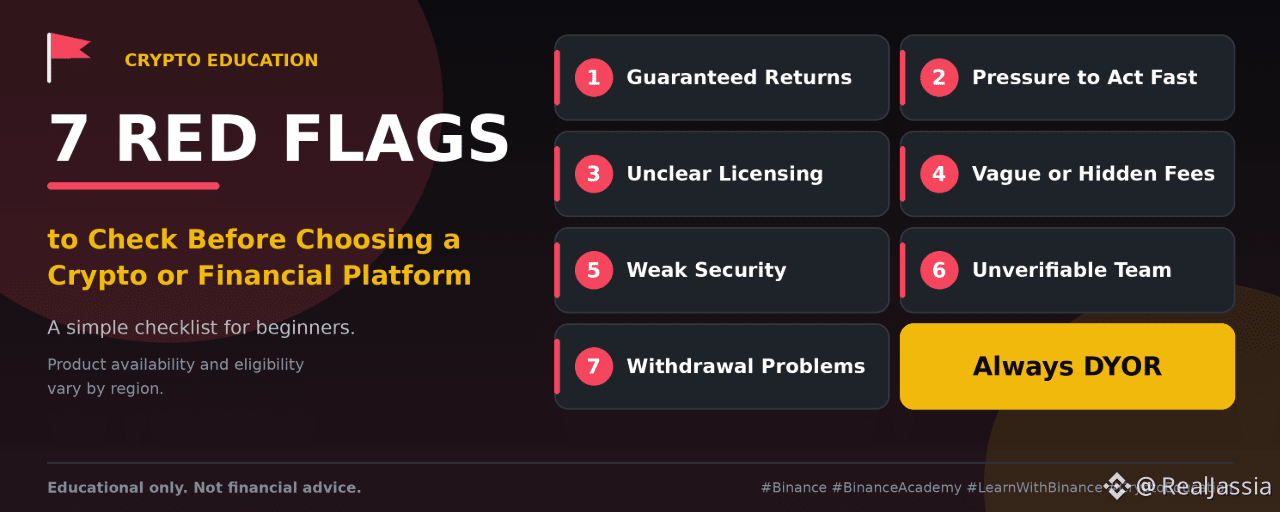
7 Red Flags to Check Before Choosing a Crypto or Financial PlatformChoosing a platform is an important step, and it helps to know what warning signs to look for. Here are 7 common red flags that beginners may want to check before signing up or depositing anything. ✅
1. Promises of Guaranteed Returns 💸
Markets can move up and down, and no legitimate platform can promise profit. If a platform or a promoter talks about guaranteed or "risk-free" returns, treat it as a reason to slow down and look closer.
2. Pressure to Act Fast ⏰
Messages like "Only 10 minutes left!" or "Join now before it's too late!" are commonly used to rush people into decisions. Taking your time to research can help you avoid choices made out of pressure.
3. Unclear Licensing or Regulation 📜
Availability and eligibility vary by region. Check whether the platform clearly explains where it operates and what licenses or registrations it holds. If this information is hard to find or vague, that may be worth noting.
5. Weak Security Features 🔐
Look for tools like two-factor authentication (2FA), anti-phishing codes, and withdrawal whitelists. A platform that offers few or no security options may leave your account more exposed.
6. Team or Company Is Hard to Verify 👤
Can you find who runs the platform, where it is based, and how to contact it? If the company details are missing or unclear, it can be harder to know who is accountable.
7. Withdrawal Problems or Unresponsive Support 🚪
Be cautious if users report trouble withdrawing, or if support is slow or hard to reach. Clear withdrawal rules and accessible customer support are commonly used signs of a well-run service.
Quick Safety Habits 🛡️
Only use official websites and apps, and double-check links.Never share your password, 2FA codes, or seed phrase with anyone.Be careful with unsolicited messages, even if they look official.Only put in an amount you are comfortable with, since all crypto activity carries risk.
Where to Learn More 📚
Before using any platform, consider reading official resources such as Binance Academy and the official Binance product pages. They explain security tips, product terms, eligibility, and risk disclosures.
Final Thoughts
Spotting red flags early can help you stay safer and make more informed choices. No checklist removes all risk, so keep learning and stay alert.
Always DYOR (Do Your Own Research). This content is for educational purposes only and is not financial advice. Product availability may vary by region.
💬 Which red flag do you think beginners miss the most? Share your thoughts below!
#Binance #BinanceAcademy #learnwithbinance #CryptoEducation💡🚀 #NFA✅
7 Red Flags to Check Before Choosing a Crypto or Financial Platform
Choosing a platform is an important step, and it helps to know what warning signs to look for. Here are 7 common red flags that beginners may want to check before signing up or depositing anything. ✅
1. Promises of Guaranteed Returns 💸
Markets can move up and down, and no legitimate platform can promise profit. If a platform or a promoter talks about guaranteed or "risk-free" returns, treat it as a reason to slow down and look closer.
2. Pressure to Act Fast ⏰
Messages like "Only 10 minutes left!" or "Join now before it's too late!" are commonly used to rush people into decisions. Taking your time to research can help you avoid choices made out of pressure.
3. Unclear Licensing or Regulation 📜
Availability and eligibility vary by region. Check whether the platform clearly explains where it operates and what licenses or registrations it holds. If this information is hard to find or vague, that may be worth noting.
5. Weak Security Features 🔐
Look for tools like two-factor authentication (2FA), anti-phishing codes, and withdrawal whitelists. A platform that offers few or no security options may leave your account more exposed.
6. Team or Company Is Hard to Verify 👤
Can you find who runs the platform, where it is based, and how to contact it? If the company details are missing or unclear, it can be harder to know who is accountable.
7. Withdrawal Problems or Unresponsive Support 🚪
Be cautious if users report trouble withdrawing, or if support is slow or hard to reach. Clear withdrawal rules and accessible customer support are commonly used signs of a well-run service.
Quick Safety Habits 🛡️
Only use official websites and apps, and double-check links.Never share your password, 2FA codes, or seed phrase with anyone.Be careful with unsolicited messages, even if they look official.Only put in an amount you are comfortable with, since all crypto activity carries risk.
Where to Learn More 📚
Before using any platform, consider reading official resources such as Binance Academy and the official Binance product pages. They explain security tips, product terms, eligibility, and risk disclosures.
Final Thoughts
Spotting red flags early can help you stay safer and make more informed choices. No checklist removes all risk, so keep learning and stay alert.
Always DYOR (Do Your Own Research). This content is for educational purposes only and is not financial advice. Product availability may vary by region.
💬 Which red flag do you think beginners miss the most? Share your thoughts below!
#Binance #BinanceAcademy #learnwithbinance #CryptoEducation💡🚀 #NFA✅
1. Promises of Guaranteed Returns 💸
Markets can move up and down, and no legitimate platform can promise profit. If a platform or a promoter talks about guaranteed or "risk-free" returns, treat it as a reason to slow down and look closer.
2. Pressure to Act Fast ⏰
Messages like "Only 10 minutes left!" or "Join now before it's too late!" are commonly used to rush people into decisions. Taking your time to research can help you avoid choices made out of pressure.
3. Unclear Licensing or Regulation 📜
Availability and eligibility vary by region. Check whether the platform clearly explains where it operates and what licenses or registrations it holds. If this information is hard to find or vague, that may be worth noting.
5. Weak Security Features 🔐
Look for tools like two-factor authentication (2FA), anti-phishing codes, and withdrawal whitelists. A platform that offers few or no security options may leave your account more exposed.
6. Team or Company Is Hard to Verify 👤
Can you find who runs the platform, where it is based, and how to contact it? If the company details are missing or unclear, it can be harder to know who is accountable.
7. Withdrawal Problems or Unresponsive Support 🚪
Be cautious if users report trouble withdrawing, or if support is slow or hard to reach. Clear withdrawal rules and accessible customer support are commonly used signs of a well-run service.
Quick Safety Habits 🛡️
Only use official websites and apps, and double-check links.Never share your password, 2FA codes, or seed phrase with anyone.Be careful with unsolicited messages, even if they look official.Only put in an amount you are comfortable with, since all crypto activity carries risk.
Where to Learn More 📚
Before using any platform, consider reading official resources such as Binance Academy and the official Binance product pages. They explain security tips, product terms, eligibility, and risk disclosures.
Final Thoughts
Spotting red flags early can help you stay safer and make more informed choices. No checklist removes all risk, so keep learning and stay alert.
Always DYOR (Do Your Own Research). This content is for educational purposes only and is not financial advice. Product availability may vary by region.
💬 Which red flag do you think beginners miss the most? Share your thoughts below!
#Binance #BinanceAcademy #learnwithbinance #CryptoEducation💡🚀 #NFA✅
3
182
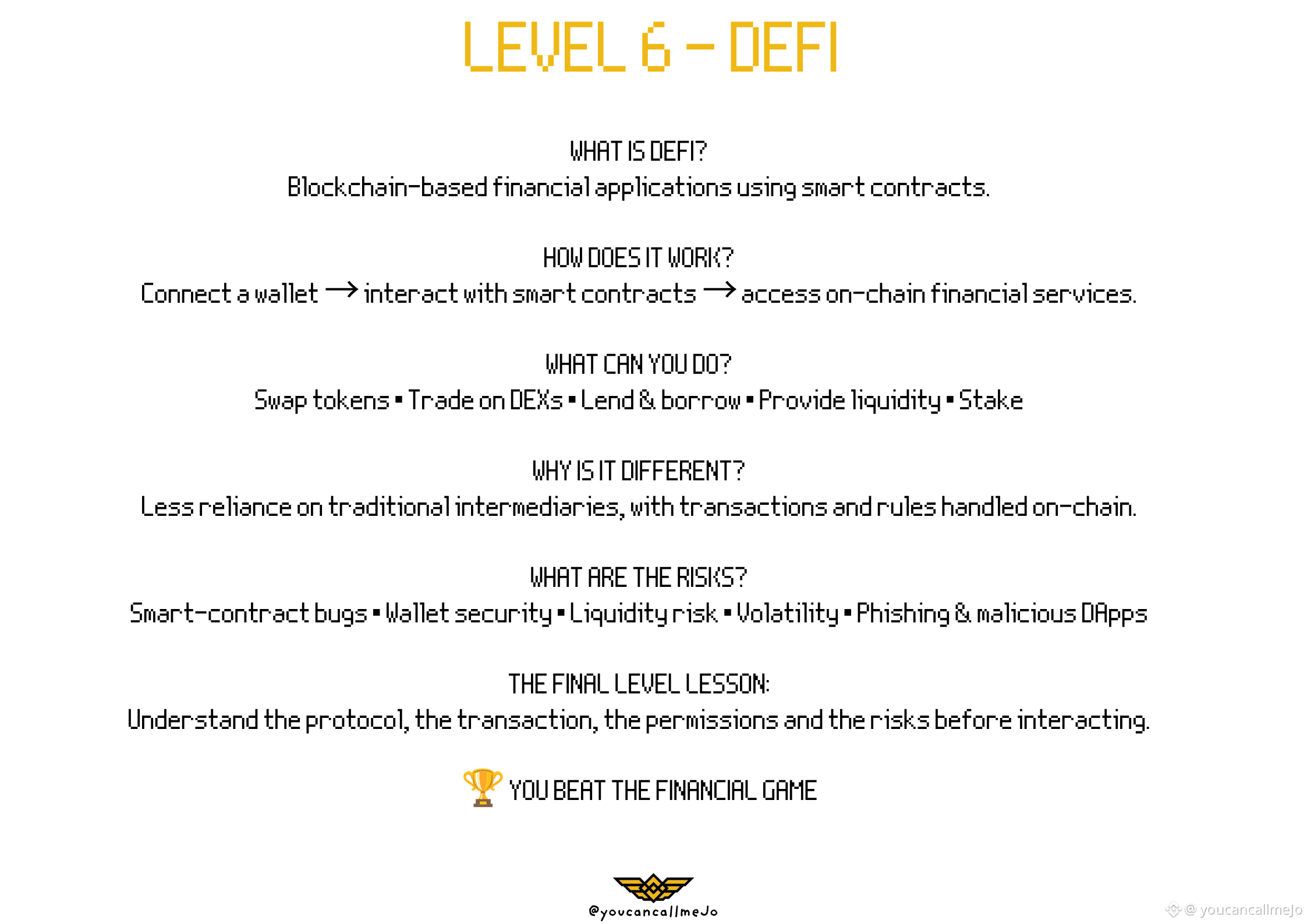
🎮 LEVEL 6 — DeFi: Enter the On-Chain Financial World
🏦 WHAT IS DeFi?
DeFi is an ecosystem of financial applications built on blockchain networks, where users can interact with financial services through wallets, smart contracts and decentralized applications (DApps) rather than relying entirely on traditional intermediaries.
Think of it as moving from: “Go through the institution.” to: “Connect your wallet to the protocol.”
🔗 HOW DOES IT WORK?
Smart contracts are programs on a blockchain that execute predefined rules. Instead of a bank employee processing a transaction manually, the smart contract can handle the agreed logic automatically once its conditions are met.
This enables services such as:
• Decentralized exchanges (DEXs)
• Lending & borrowing
• Liquidity pools
• Staking
• Token swaps
• Other on-chain financial applications
For example, on a DEX, users can connect a compatible wallet and trade through blockchain-based smart contracts rather than depositing assets with a centralized exchange.
💡 THE BIG DIFFERENCE
In traditional finance, an institution often sits between you and the financial service. In DeFi, the interaction can happen directly between your wallet and a blockchain-based protocol. But that doesn't mean every DeFi system is completely decentralized or automatically safe. Different protocols have different levels of decentralization, governance and control.
⚠️ AND HERE COMES THE RISK
DeFi changes the way financial services operate, but it also changes the risks you need to understand.
Smart-contract vulnerabilities, phishing, malicious DApps, private-key security, network fees, liquidity risks and token price volatility can all matter. And unlike a traditional financial platform, an on-chain transaction may not have an easy “undo” button. Binance specifically recommends verifying DApps and understanding permissions before approving transactions.
🏆 YOU BEAT THE FINANCIAL LEVEL.
#Binance #learnwithbinance #defi #Web3 #DEX
🎮 LEVEL 6 — DeFi: Enter the On-Chain Financial World
🏦 WHAT IS DeFi?
DeFi is an ecosystem of financial applications built on blockchain networks, where users can interact with financial services through wallets, smart contracts and decentralized applications (DApps) rather than relying entirely on traditional intermediaries.
Think of it as moving from: “Go through the institution.” to: “Connect your wallet to the protocol.”
🔗 HOW DOES IT WORK?
Smart contracts are programs on a blockchain that execute predefined rules. Instead of a bank employee processing a transaction manually, the smart contract can handle the agreed logic automatically once its conditions are met.
This enables services such as:
• Decentralized exchanges (DEXs)
• Lending & borrowing
• Liquidity pools
• Staking
• Token swaps
• Other on-chain financial applications
For example, on a DEX, users can connect a compatible wallet and trade through blockchain-based smart contracts rather than depositing assets with a centralized exchange.
💡 THE BIG DIFFERENCE
In traditional finance, an institution often sits between you and the financial service. In DeFi, the interaction can happen directly between your wallet and a blockchain-based protocol. But that doesn't mean every DeFi system is completely decentralized or automatically safe. Different protocols have different levels of decentralization, governance and control.
⚠️ AND HERE COMES THE RISK
DeFi changes the way financial services operate, but it also changes the risks you need to understand.
Smart-contract vulnerabilities, phishing, malicious DApps, private-key security, network fees, liquidity risks and token price volatility can all matter. And unlike a traditional financial platform, an on-chain transaction may not have an easy “undo” button. Binance specifically recommends verifying DApps and understanding permissions before approving transactions.
🏆 YOU BEAT THE FINANCIAL LEVEL.
#Binance #learnwithbinance #defi #Web3 #DEX
🏦 WHAT IS DeFi?
DeFi is an ecosystem of financial applications built on blockchain networks, where users can interact with financial services through wallets, smart contracts and decentralized applications (DApps) rather than relying entirely on traditional intermediaries.
Think of it as moving from: “Go through the institution.” to: “Connect your wallet to the protocol.”
🔗 HOW DOES IT WORK?
Smart contracts are programs on a blockchain that execute predefined rules. Instead of a bank employee processing a transaction manually, the smart contract can handle the agreed logic automatically once its conditions are met.
This enables services such as:
• Decentralized exchanges (DEXs)
• Lending & borrowing
• Liquidity pools
• Staking
• Token swaps
• Other on-chain financial applications
For example, on a DEX, users can connect a compatible wallet and trade through blockchain-based smart contracts rather than depositing assets with a centralized exchange.
💡 THE BIG DIFFERENCE
In traditional finance, an institution often sits between you and the financial service. In DeFi, the interaction can happen directly between your wallet and a blockchain-based protocol. But that doesn't mean every DeFi system is completely decentralized or automatically safe. Different protocols have different levels of decentralization, governance and control.
⚠️ AND HERE COMES THE RISK
DeFi changes the way financial services operate, but it also changes the risks you need to understand.
Smart-contract vulnerabilities, phishing, malicious DApps, private-key security, network fees, liquidity risks and token price volatility can all matter. And unlike a traditional financial platform, an on-chain transaction may not have an easy “undo” button. Binance specifically recommends verifying DApps and understanding permissions before approving transactions.
🏆 YOU BEAT THE FINANCIAL LEVEL.
#Binance #learnwithbinance #defi #Web3 #DEX
1
3
62
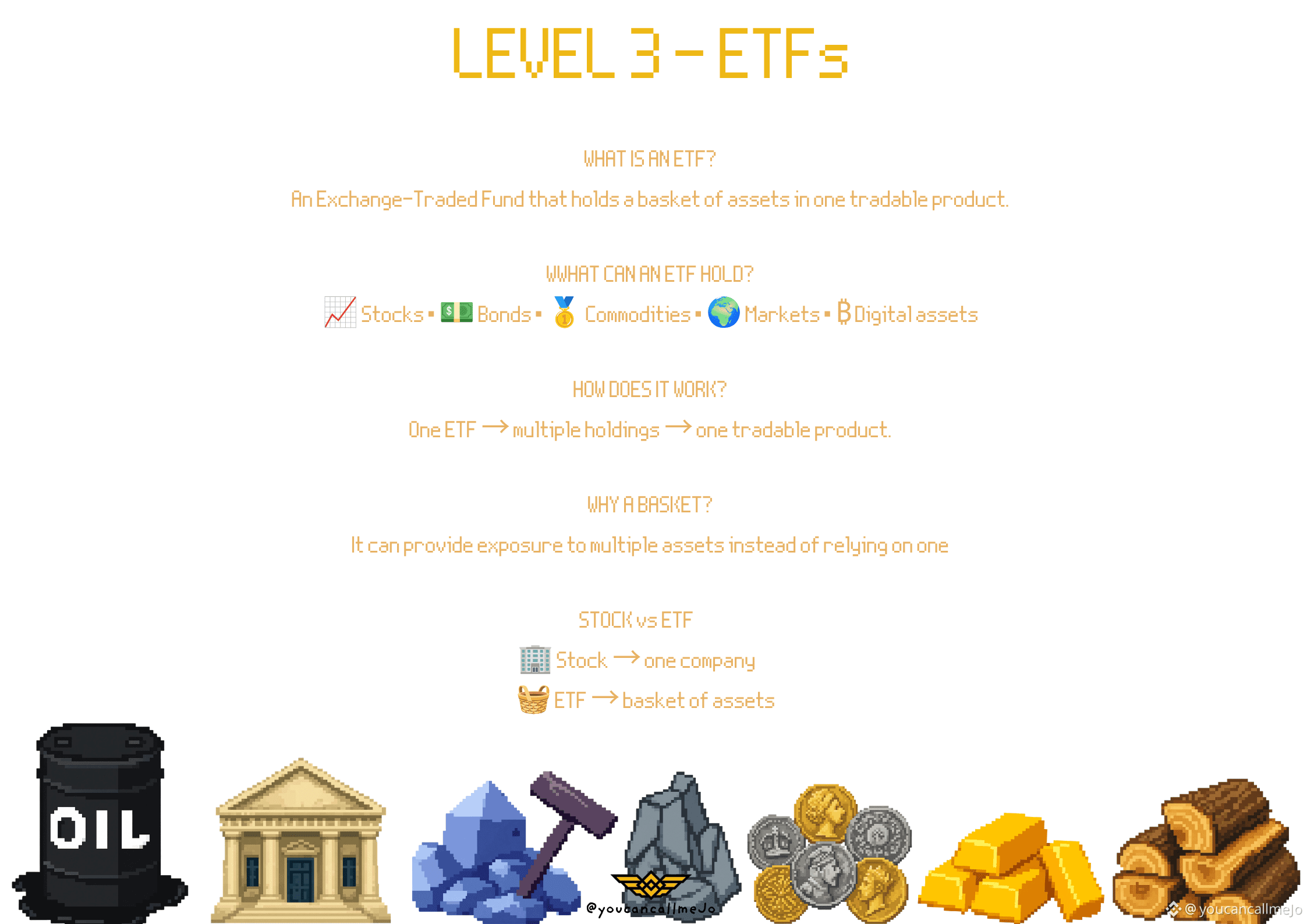
🎮 LEVEL 3 — ETFs: The Basket Level
You cleared Level 2.
You learned that buying a stock can mean gaining exposure to one company.
But what if you don't want to choose just one?
Welcome to Level 3: ETFs. 🧩
🧺 WHAT IS AN ETF?
ETF stands for Exchange-Traded Fund.
Think of it as a basket containing multiple assets, packaged into one tradable product.
Instead of buying every asset separately, one ETF can give you exposure to a group of them.
For example, an ETF may track:
📈 A stock index
🏭 A specific industry
🌍 A country or region
🥇 A commodity
💵 Bonds
₿ Digital assets
📊 HOW DOES IT WORK?
Many ETFs are designed to track an index, sector, commodity, or other asset class.
The ETF itself trades on an exchange throughout the trading day, similar to a stock.
So instead of:
Stock A + Stock B + Stock C + Stock D...
You can have:
🧺 One ETF → exposure to a basket
🎯 WHY USE A BASKET?
One major concept is diversification.
If an ETF holds many different companies, your exposure isn't concentrated in just one company.
But diversification doesn't eliminate risk. The value of an ETF can still fall, depending on what it holds and how that market performs.
🆚 STOCK vs ETF
🏢 Stock → exposure to one company
🧺 ETF → exposure to a collection of assets
And here's an important detail:
Buying an ETF does not mean you personally own every underlying stock in your own name. You own shares of the fund.
🔍 NOT ALL ETFs ARE THE SAME
Two ETFs can both track markets but have very different structures.
Some follow broad indexes.
Others focus on specific sectors, commodities, bonds, or crypto.
Some ETFs hold the underlying assets directly, while others use derivatives.
So don't stop at the name.
Look inside the basket.
🎮 LEVEL 3 LESSON
The question isn't only:
“What's inside the ETF?”
It's also:
“How is this ETF designed to give me that exposure?”
You completed Level 3.
🔓 NEXT LEVEL → COMMODITIES 🥇
#Binance #binancequare #learnwithbinance #ETFs #TradFi
🎮 LEVEL 3 — ETFs: The Basket Level
You cleared Level 2.
You learned that buying a stock can mean gaining exposure to one company.
But what if you don't want to choose just one?
Welcome to Level 3: ETFs. 🧩
🧺 WHAT IS AN ETF?
ETF stands for Exchange-Traded Fund.
Think of it as a basket containing multiple assets, packaged into one tradable product.
Instead of buying every asset separately, one ETF can give you exposure to a group of them.
For example, an ETF may track:
📈 A stock index
🏭 A specific industry
🌍 A country or region
🥇 A commodity
💵 Bonds
₿ Digital assets
📊 HOW DOES IT WORK?
Many ETFs are designed to track an index, sector, commodity, or other asset class.
The ETF itself trades on an exchange throughout the trading day, similar to a stock.
So instead of:
Stock A + Stock B + Stock C + Stock D...
You can have:
🧺 One ETF → exposure to a basket
🎯 WHY USE A BASKET?
One major concept is diversification.
If an ETF holds many different companies, your exposure isn't concentrated in just one company.
But diversification doesn't eliminate risk. The value of an ETF can still fall, depending on what it holds and how that market performs.
🆚 STOCK vs ETF
🏢 Stock → exposure to one company
🧺 ETF → exposure to a collection of assets
And here's an important detail:
Buying an ETF does not mean you personally own every underlying stock in your own name. You own shares of the fund.
🔍 NOT ALL ETFs ARE THE SAME
Two ETFs can both track markets but have very different structures.
Some follow broad indexes.
Others focus on specific sectors, commodities, bonds, or crypto.
Some ETFs hold the underlying assets directly, while others use derivatives.
So don't stop at the name.
Look inside the basket.
🎮 LEVEL 3 LESSON
The question isn't only:
“What's inside the ETF?”
It's also:
“How is this ETF designed to give me that exposure?”
You completed Level 3.
🔓 NEXT LEVEL → COMMODITIES 🥇
#Binance #binancequare #learnwithbinance #ETFs #TradFi
You cleared Level 2.
You learned that buying a stock can mean gaining exposure to one company.
But what if you don't want to choose just one?
Welcome to Level 3: ETFs. 🧩
🧺 WHAT IS AN ETF?
ETF stands for Exchange-Traded Fund.
Think of it as a basket containing multiple assets, packaged into one tradable product.
Instead of buying every asset separately, one ETF can give you exposure to a group of them.
For example, an ETF may track:
📈 A stock index
🏭 A specific industry
🌍 A country or region
🥇 A commodity
💵 Bonds
₿ Digital assets
📊 HOW DOES IT WORK?
Many ETFs are designed to track an index, sector, commodity, or other asset class.
The ETF itself trades on an exchange throughout the trading day, similar to a stock.
So instead of:
Stock A + Stock B + Stock C + Stock D...
You can have:
🧺 One ETF → exposure to a basket
🎯 WHY USE A BASKET?
One major concept is diversification.
If an ETF holds many different companies, your exposure isn't concentrated in just one company.
But diversification doesn't eliminate risk. The value of an ETF can still fall, depending on what it holds and how that market performs.
🆚 STOCK vs ETF
🏢 Stock → exposure to one company
🧺 ETF → exposure to a collection of assets
And here's an important detail:
Buying an ETF does not mean you personally own every underlying stock in your own name. You own shares of the fund.
🔍 NOT ALL ETFs ARE THE SAME
Two ETFs can both track markets but have very different structures.
Some follow broad indexes.
Others focus on specific sectors, commodities, bonds, or crypto.
Some ETFs hold the underlying assets directly, while others use derivatives.
So don't stop at the name.
Look inside the basket.
🎮 LEVEL 3 LESSON
The question isn't only:
“What's inside the ETF?”
It's also:
“How is this ETF designed to give me that exposure?”
You completed Level 3.
🔓 NEXT LEVEL → COMMODITIES 🥇
#Binance #binancequare #learnwithbinance #ETFs #TradFi
3
279

·
--
Before You Trade, Check the Spread
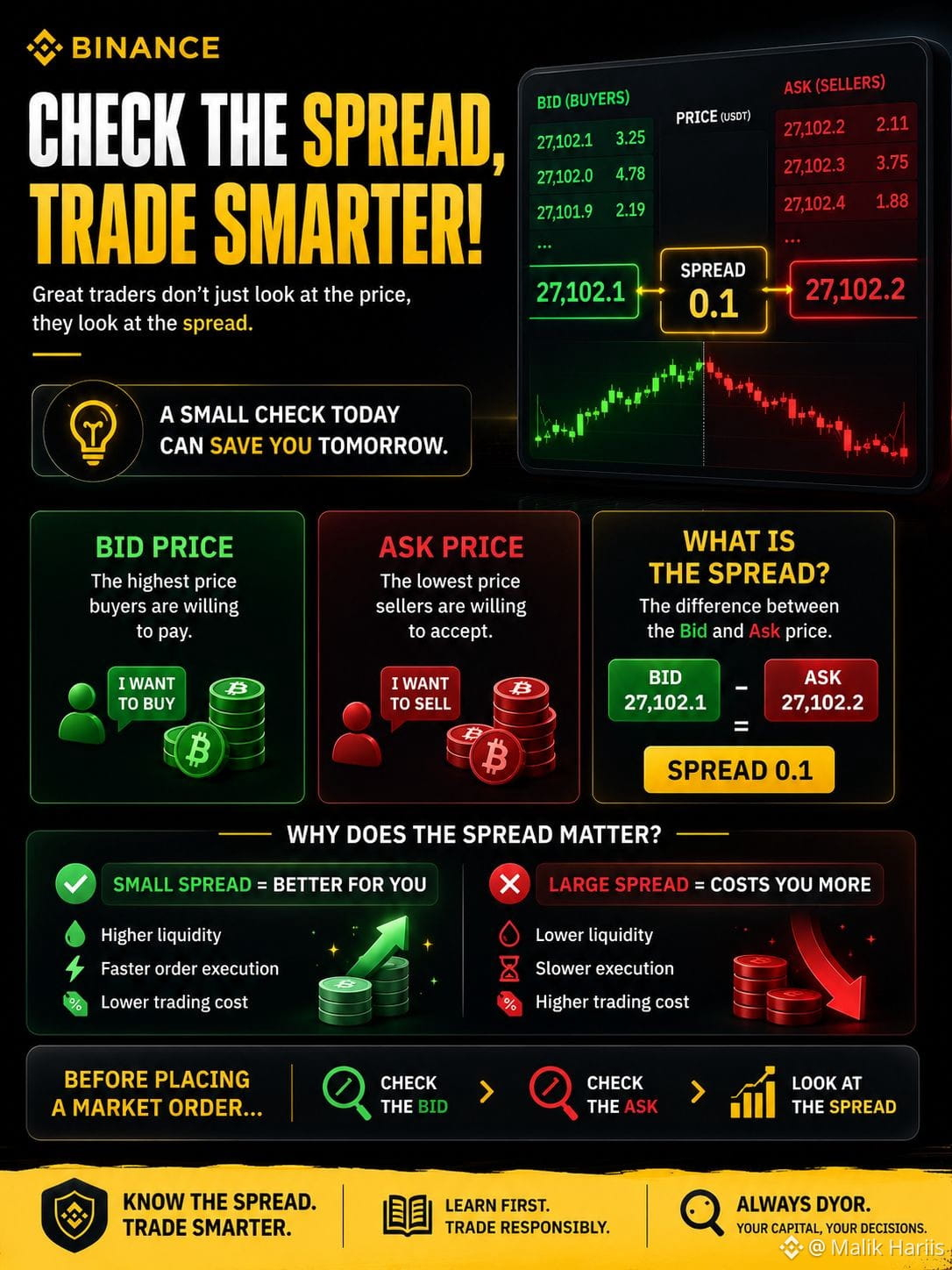
Many beginners focus on one thing before placing a trade: the current price.
But experienced traders often pay attention to something else first—the Bid, Ask, and the Spread.
Understanding these three concepts can help you better understand market conditions before placing an order.
🟢 What is the Bid Price?
The Bid is the highest price that buyers are currently willing to pay for an asset.
Think of it as:
"This is the best offer from someone who wants to buy."
🔴 What is the Ask Price?
The Ask is the lowest price that sellers are willing to accept.
Think of it as:
"This is the lowest price someone is ready to sell for."
📏 What is the Spread?
The Spread is simply the difference between the Bid and the Ask price.
It may look like a small number, but it can tell you a lot about the market.
💡 Why Does the Spread Matter?
A smaller spread often suggests:
✅ Better market liquidity ✅ Faster order execution ✅ More efficient trading conditions
A larger spread may indicate:
⚠️ Lower liquidity ⚠️ Wider price differences between buyers and sellers ⚠️ Potentially higher transaction costs
📝 A Simple Habit Before Every Trade
Before placing a market order, take a few seconds to check:
✔️ The Bid Price
✔️ The Ask Price
✔️ The Spread
It's a simple habit that can help you better understand how the market is behaving.
📚 Keep Learning
Every experienced trader started as a beginner. The more you understand concepts like Bid, Ask, and Spread, the better prepared you'll be to navigate the market with confidence.
Learn first, practice responsibly, and always DYOR
#Binance #BinanceAcademy #LearnWithBinance #CryptoEducation
Before You Trade, Check the Spread
Many beginners focus on one thing before placing a trade: the current price.
But experienced traders often pay attention to something else first—the Bid, Ask, and the Spread.
Understanding these three concepts can help you better understand market conditions before placing an order.
🟢 What is the Bid Price?
The Bid is the highest price that buyers are currently willing to pay for an asset.
Think of it as:
"This is the best offer from someone who wants to buy."
🔴 What is the Ask Price?
The Ask is the lowest price that sellers are willing to accept.
Think of it as:
"This is the lowest price someone is ready to sell for."
📏 What is the Spread?
The Spread is simply the difference between the Bid and the Ask price.
It may look like a small number, but it can tell you a lot about the market.
💡 Why Does the Spread Matter?
A smaller spread often suggests:
✅ Better market liquidity ✅ Faster order execution ✅ More efficient trading conditions
A larger spread may indicate:
⚠️ Lower liquidity ⚠️ Wider price differences between buyers and sellers ⚠️ Potentially higher transaction costs
📝 A Simple Habit Before Every Trade
Before placing a market order, take a few seconds to check:
✔️ The Bid Price
✔️ The Ask Price
✔️ The Spread
It's a simple habit that can help you better understand how the market is behaving.
📚 Keep Learning
Every experienced trader started as a beginner. The more you understand concepts like Bid, Ask, and Spread, the better prepared you'll be to navigate the market with confidence.
Learn first, practice responsibly, and always DYOR
#Binance #BinanceAcademy #LearnWithBinance #CryptoEducation
Many beginners focus on one thing before placing a trade: the current price.
But experienced traders often pay attention to something else first—the Bid, Ask, and the Spread.
Understanding these three concepts can help you better understand market conditions before placing an order.
🟢 What is the Bid Price?
The Bid is the highest price that buyers are currently willing to pay for an asset.
Think of it as:
"This is the best offer from someone who wants to buy."
🔴 What is the Ask Price?
The Ask is the lowest price that sellers are willing to accept.
Think of it as:
"This is the lowest price someone is ready to sell for."
📏 What is the Spread?
The Spread is simply the difference between the Bid and the Ask price.
It may look like a small number, but it can tell you a lot about the market.
💡 Why Does the Spread Matter?
A smaller spread often suggests:
✅ Better market liquidity ✅ Faster order execution ✅ More efficient trading conditions
A larger spread may indicate:
⚠️ Lower liquidity ⚠️ Wider price differences between buyers and sellers ⚠️ Potentially higher transaction costs
📝 A Simple Habit Before Every Trade
Before placing a market order, take a few seconds to check:
✔️ The Bid Price
✔️ The Ask Price
✔️ The Spread
It's a simple habit that can help you better understand how the market is behaving.
📚 Keep Learning
Every experienced trader started as a beginner. The more you understand concepts like Bid, Ask, and Spread, the better prepared you'll be to navigate the market with confidence.
Learn first, practice responsibly, and always DYOR
#Binance #BinanceAcademy #LearnWithBinance #CryptoEducation
2
131
Мақала
New to Binance? Your first 10 minutes: Setting Up Your Account Safely"I finally downloaded Binance... now what?"
If you've just created a Binance account for the first time, you're probably looking at your screen thinking, "There's a lot going on here."
Spot. Futures. Convert. Earn. P2P. Markets. Wallets.
For someone who's completely new to crypto, it can feel like walking into the cockpit of an airplane without knowing what any of the buttons do.
The good news? You don't need to understand everything on your first day.
In fact, one of the biggest mistakes beginners make is rushing straight into buying cryptocurrency before taking a few simple steps that can protect both their account and their funds. Think of your Binance journey like building a house. You wouldn't start decorating the living room before laying the foundation. The same principle applies here. Before making your first trade or investment, your priority should be creating a secure account and understanding the basics.
Let's start from the beginning.
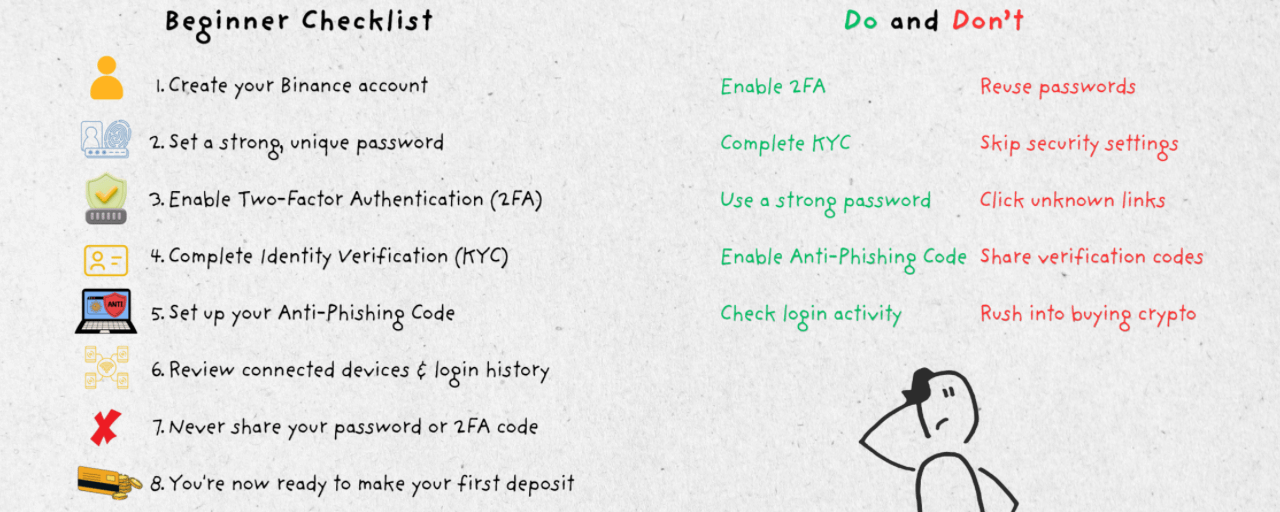
Step 1: Create Your Binance Account
Creating a Binance account only takes a few minutes, but it is the first step toward accessing one of the world's largest cryptocurrency ecosystems. You can sign up using your email address or mobile number, create a strong password, and you'll immediately gain access to the platform. At this stage, your account exists, but it isn't fully ready yet. Many beginners think opening an account means they're ready to start trading. In reality, this is only the starting line. Before depositing any funds, there are a few important steps you should complete first.
Step 2: Your Password Is Your First Line of Defence
When people think about security, they usually think about hackers. Experienced users think about prevention. Your password is the first thing protecting your account, so avoid using birthdays, names, or simple combinations that are easy to guess. A strong password should be unique and include a mix of uppercase letters, lowercase letters, numbers, and special characters. More importantly, never reuse the same password across different platforms. If another website suffers a data breach, reused passwords could expose multiple accounts, including your Binance account. A few extra seconds spent creating a strong password can save you from far bigger problems later.
Step 3: Enable Two-Factor Authentication (2FA)
If there is one security feature every Binance user should enable immediately, it is Two-Factor Authentication (2FA). Think of it as adding a second lock to your front door.
Even if someone somehow discovers your password, they still won't be able to access your account without the second verification code generated by your authentication app or sent through another approved method. Many new users see 2FA as an optional feature. It isn't. It's one of the simplest and most effective ways to protect your account. Security isn't something you think about after something goes wrong. It's something you prepare before anything happens.
Step 4: Verify Your Identity (KYC)
Once your account is secure, the next step is completing Identity Verification, also known as Know Your Customer (KYC). For beginners, this step often raises questions.
"Why does Binance need my ID?" The answer is simple.
Identity Verification helps Binance comply with regulations, reduce fraud, improve platform security, and create a safer environment for everyone using the exchange. Verification also unlocks additional features and services that may not be available on unverified accounts, depending on your region. The process is straightforward. You'll typically be asked to provide a government-issued identification document and complete a quick facial verification. In most cases, the process only takes a few minutes. Although it may seem like an extra step, it's an important one that helps protect both you and the wider Binance community.
Step 5: Don't Skip the Security Features Hidden in Settings
One thing many beginners don't realize is that Binance includes several built-in security tools beyond a password and 2FA.
For example, you can create an Anti-Phishing Code, a personalised code that appears in genuine Binance emails. If an email claiming to be from Binance doesn't include your code, that's a strong warning sign that it could be a phishing attempt. You can also review your login history, manage connected devices, and monitor account activity directly from your security settings. These features might not seem exciting. But they're far more exciting than recovering a compromised account.
Common Beginner Mistakes
Starting your crypto journey is exciting, but it's also when many users make avoidable mistakes. Some deposit funds before enabling 2FA. Others ignore security settings because they plan to "do it later." Some even click links from fake emails or social media accounts pretending to be Binance. Building good habits from day one is much easier than fixing mistakes later. The goal isn't to become paranoid. It's simply to become prepared.
Your Binance Account Is Ready... What's Next?
Congratulations!
You now have something far more valuable than just a Binance account, you have a secure foundation. You understand why security comes first, why Identity Verification matters, and why taking a few extra minutes today can protect your assets tomorrow. But an account without funds is like a wallet with nothing inside.
So, what's the next step?
In Part 2, we'll fund your account, explore the different deposit methods available on Binance, and use one of the simplest tools for beginners, Binance Convert ,to buy your very first cryptocurrency without the complexity of traditional trading.
Welcome to crypto. Your journey has officially begun.
#learnwithbinance #Square #fypシ #Binance #NewAccountAlert
New to Binance? Your first 10 minutes: Setting Up Your Account Safely
"I finally downloaded Binance... now what?"
If you've just created a Binance account for the first time, you're probably looking at your screen thinking, "There's a lot going on here."
Spot. Futures. Convert. Earn. P2P. Markets. Wallets.
For someone who's completely new to crypto, it can feel like walking into the cockpit of an airplane without knowing what any of the buttons do.
The good news? You don't need to understand everything on your first day.
In fact, one of the biggest mistakes beginners make is rushing straight into buying cryptocurrency before taking a few simple steps that can protect both their account and their funds. Think of your Binance journey like building a house. You wouldn't start decorating the living room before laying the foundation. The same principle applies here. Before making your first trade or investment, your priority should be creating a secure account and understanding the basics.
Let's start from the beginning.
Step 1: Create Your Binance Account
Creating a Binance account only takes a few minutes, but it is the first step toward accessing one of the world's largest cryptocurrency ecosystems. You can sign up using your email address or mobile number, create a strong password, and you'll immediately gain access to the platform. At this stage, your account exists, but it isn't fully ready yet. Many beginners think opening an account means they're ready to start trading. In reality, this is only the starting line. Before depositing any funds, there are a few important steps you should complete first.
Step 2: Your Password Is Your First Line of Defence
When people think about security, they usually think about hackers. Experienced users think about prevention. Your password is the first thing protecting your account, so avoid using birthdays, names, or simple combinations that are easy to guess. A strong password should be unique and include a mix of uppercase letters, lowercase letters, numbers, and special characters. More importantly, never reuse the same password across different platforms. If another website suffers a data breach, reused passwords could expose multiple accounts, including your Binance account. A few extra seconds spent creating a strong password can save you from far bigger problems later.
Step 3: Enable Two-Factor Authentication (2FA)
If there is one security feature every Binance user should enable immediately, it is Two-Factor Authentication (2FA). Think of it as adding a second lock to your front door.
Even if someone somehow discovers your password, they still won't be able to access your account without the second verification code generated by your authentication app or sent through another approved method. Many new users see 2FA as an optional feature. It isn't. It's one of the simplest and most effective ways to protect your account. Security isn't something you think about after something goes wrong. It's something you prepare before anything happens.
Step 4: Verify Your Identity (KYC)
Once your account is secure, the next step is completing Identity Verification, also known as Know Your Customer (KYC). For beginners, this step often raises questions.
"Why does Binance need my ID?" The answer is simple.
Identity Verification helps Binance comply with regulations, reduce fraud, improve platform security, and create a safer environment for everyone using the exchange. Verification also unlocks additional features and services that may not be available on unverified accounts, depending on your region. The process is straightforward. You'll typically be asked to provide a government-issued identification document and complete a quick facial verification. In most cases, the process only takes a few minutes. Although it may seem like an extra step, it's an important one that helps protect both you and the wider Binance community.
Step 5: Don't Skip the Security Features Hidden in Settings
One thing many beginners don't realize is that Binance includes several built-in security tools beyond a password and 2FA.
For example, you can create an Anti-Phishing Code, a personalised code that appears in genuine Binance emails. If an email claiming to be from Binance doesn't include your code, that's a strong warning sign that it could be a phishing attempt. You can also review your login history, manage connected devices, and monitor account activity directly from your security settings. These features might not seem exciting. But they're far more exciting than recovering a compromised account.
Common Beginner Mistakes
Starting your crypto journey is exciting, but it's also when many users make avoidable mistakes. Some deposit funds before enabling 2FA. Others ignore security settings because they plan to "do it later." Some even click links from fake emails or social media accounts pretending to be Binance. Building good habits from day one is much easier than fixing mistakes later. The goal isn't to become paranoid. It's simply to become prepared.
Your Binance Account Is Ready... What's Next?
Congratulations!
You now have something far more valuable than just a Binance account, you have a secure foundation. You understand why security comes first, why Identity Verification matters, and why taking a few extra minutes today can protect your assets tomorrow. But an account without funds is like a wallet with nothing inside.
So, what's the next step?
In Part 2, we'll fund your account, explore the different deposit methods available on Binance, and use one of the simplest tools for beginners, Binance Convert ,to buy your very first cryptocurrency without the complexity of traditional trading.
Welcome to crypto. Your journey has officially begun.
#learnwithbinance #Square #fypシ #Binance #NewAccountAlert
If you've just created a Binance account for the first time, you're probably looking at your screen thinking, "There's a lot going on here."
Spot. Futures. Convert. Earn. P2P. Markets. Wallets.
For someone who's completely new to crypto, it can feel like walking into the cockpit of an airplane without knowing what any of the buttons do.
The good news? You don't need to understand everything on your first day.
In fact, one of the biggest mistakes beginners make is rushing straight into buying cryptocurrency before taking a few simple steps that can protect both their account and their funds. Think of your Binance journey like building a house. You wouldn't start decorating the living room before laying the foundation. The same principle applies here. Before making your first trade or investment, your priority should be creating a secure account and understanding the basics.
Let's start from the beginning.
Step 1: Create Your Binance Account
Creating a Binance account only takes a few minutes, but it is the first step toward accessing one of the world's largest cryptocurrency ecosystems. You can sign up using your email address or mobile number, create a strong password, and you'll immediately gain access to the platform. At this stage, your account exists, but it isn't fully ready yet. Many beginners think opening an account means they're ready to start trading. In reality, this is only the starting line. Before depositing any funds, there are a few important steps you should complete first.
Step 2: Your Password Is Your First Line of Defence
When people think about security, they usually think about hackers. Experienced users think about prevention. Your password is the first thing protecting your account, so avoid using birthdays, names, or simple combinations that are easy to guess. A strong password should be unique and include a mix of uppercase letters, lowercase letters, numbers, and special characters. More importantly, never reuse the same password across different platforms. If another website suffers a data breach, reused passwords could expose multiple accounts, including your Binance account. A few extra seconds spent creating a strong password can save you from far bigger problems later.
Step 3: Enable Two-Factor Authentication (2FA)
If there is one security feature every Binance user should enable immediately, it is Two-Factor Authentication (2FA). Think of it as adding a second lock to your front door.
Even if someone somehow discovers your password, they still won't be able to access your account without the second verification code generated by your authentication app or sent through another approved method. Many new users see 2FA as an optional feature. It isn't. It's one of the simplest and most effective ways to protect your account. Security isn't something you think about after something goes wrong. It's something you prepare before anything happens.
Step 4: Verify Your Identity (KYC)
Once your account is secure, the next step is completing Identity Verification, also known as Know Your Customer (KYC). For beginners, this step often raises questions.
"Why does Binance need my ID?" The answer is simple.
Identity Verification helps Binance comply with regulations, reduce fraud, improve platform security, and create a safer environment for everyone using the exchange. Verification also unlocks additional features and services that may not be available on unverified accounts, depending on your region. The process is straightforward. You'll typically be asked to provide a government-issued identification document and complete a quick facial verification. In most cases, the process only takes a few minutes. Although it may seem like an extra step, it's an important one that helps protect both you and the wider Binance community.
Step 5: Don't Skip the Security Features Hidden in Settings
One thing many beginners don't realize is that Binance includes several built-in security tools beyond a password and 2FA.
For example, you can create an Anti-Phishing Code, a personalised code that appears in genuine Binance emails. If an email claiming to be from Binance doesn't include your code, that's a strong warning sign that it could be a phishing attempt. You can also review your login history, manage connected devices, and monitor account activity directly from your security settings. These features might not seem exciting. But they're far more exciting than recovering a compromised account.
Common Beginner Mistakes
Starting your crypto journey is exciting, but it's also when many users make avoidable mistakes. Some deposit funds before enabling 2FA. Others ignore security settings because they plan to "do it later." Some even click links from fake emails or social media accounts pretending to be Binance. Building good habits from day one is much easier than fixing mistakes later. The goal isn't to become paranoid. It's simply to become prepared.
Your Binance Account Is Ready... What's Next?
Congratulations!
You now have something far more valuable than just a Binance account, you have a secure foundation. You understand why security comes first, why Identity Verification matters, and why taking a few extra minutes today can protect your assets tomorrow. But an account without funds is like a wallet with nothing inside.
So, what's the next step?
In Part 2, we'll fund your account, explore the different deposit methods available on Binance, and use one of the simplest tools for beginners, Binance Convert ,to buy your very first cryptocurrency without the complexity of traditional trading.
Welcome to crypto. Your journey has officially begun.
#learnwithbinance #Square #fypシ #Binance #NewAccountAlert
1
5
209

Starting your crypto journey can feel overwhelming at first.
You open Binance and suddenly see markets, charts, wallets, and different products everywhere.
But getting started doesn’t have to be complicated.
Think of it like learning any new skill start with the foundation.
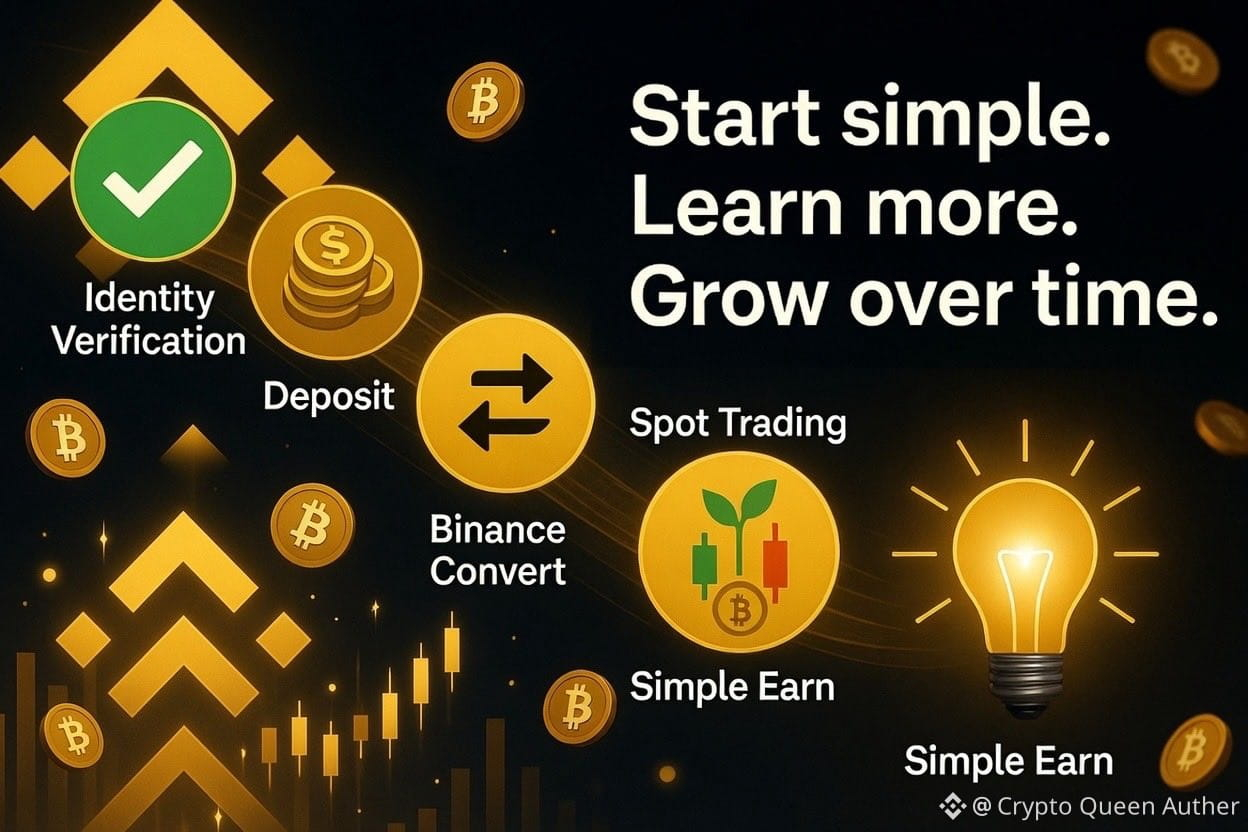
First, complete your Identity Verification and make sure your account is properly set up.
Then begin with a small deposit that matches your comfort level. Use this time to understand the platform, not to rush.
A simple first step after that is Binance Convert. It allows you to swap supported digital assets easily, helping you get familiar with how crypto transactions work.
From there, keep exploring.
Learn how Spot Trading works. Understand products like Simple Earn. Improve your knowledge through Binance Academy.
The goal isn’t to know everything on your first day.
The goal is to build confidence with every step.
Crypto rewards patience, curiosity, and continuous learning.
Start simple. Learn more. Grow over time.
#Binance� #BinanceAcadem y
#LearnWithBinance
Starting your crypto journey can feel overwhelming at first.
You open Binance and suddenly see markets, charts, wallets, and different products everywhere.
But getting started doesn’t have to be complicated.
Think of it like learning any new skill start with the foundation.
First, complete your Identity Verification and make sure your account is properly set up.
Then begin with a small deposit that matches your comfort level. Use this time to understand the platform, not to rush.
A simple first step after that is Binance Convert. It allows you to swap supported digital assets easily, helping you get familiar with how crypto transactions work.
From there, keep exploring.
Learn how Spot Trading works. Understand products like Simple Earn. Improve your knowledge through Binance Academy.
The goal isn’t to know everything on your first day.
The goal is to build confidence with every step.
Crypto rewards patience, curiosity, and continuous learning.
Start simple. Learn more. Grow over time.
#Binance� #BinanceAcadem y
#LearnWithBinance
You open Binance and suddenly see markets, charts, wallets, and different products everywhere.
But getting started doesn’t have to be complicated.
Think of it like learning any new skill start with the foundation.
First, complete your Identity Verification and make sure your account is properly set up.
Then begin with a small deposit that matches your comfort level. Use this time to understand the platform, not to rush.
A simple first step after that is Binance Convert. It allows you to swap supported digital assets easily, helping you get familiar with how crypto transactions work.
From there, keep exploring.
Learn how Spot Trading works. Understand products like Simple Earn. Improve your knowledge through Binance Academy.
The goal isn’t to know everything on your first day.
The goal is to build confidence with every step.
Crypto rewards patience, curiosity, and continuous learning.
Start simple. Learn more. Grow over time.
#Binance� #BinanceAcadem y
#LearnWithBinance
56
🚀 Crypto Is More Than Just Buying and Selling
When I first entered crypto, I thought there were only three steps:
💰 Buy a coin
⏳ Wait for the price to move
📈 Sell when it goes up
That was my entire strategy. 😅
Later, I discovered that many people weren't only holding crypto—they were also exploring earning products for eligible assets. That completely changed how I viewed long-term participation in the crypto ecosystem.
One example is Binance Simple Earn.
What interested me wasn't just the rewards—it was understanding that there are different options for different goals.
🔹 Flexible Products
✔️ Eligible assets can generally be redeemed at any time
✔️ Users may continue earning rewards while holding them
⚠️ Reward rates can change over time
🔹 Locked Products
🔒 Eligible assets are committed for a fixed period
📊 Reward structures may differ depending on the product terms
⚠️ Early redemption can affect rewards received
The biggest lesson I learned was this:
❌ Don't ask: "Which option pays the most?"
✅ Ask: "Which option fits my own plan?"
If I want quick access to my assets, flexibility matters more. If I'm comfortable setting them aside for a period of time, a locked product may better match that goal.
Neither is universally better—they simply serve different purposes.
I also learned that eligible assets, reward rates, product availability, and regional access can change, so it's important to check the latest official information before participating.
💡 My biggest takeaway? Crypto isn't only about price charts. Learning how the ecosystem works can be just as valuable as watching the market move.
📚 Educational content only. Not financial advice. Always DYOR and use official Binance sources.
#Binance #BinanceAcademy #LearnWithBinance
$HEI ✴️✴️✴️👈
{spot}(HEIUSDT)
$FIDA 👈👈
{spot}(FIDAUSDT)
$BIO 🔥🔥
{spot}(BIOUSDT)
🚀 Crypto Is More Than Just Buying and Selling
When I first entered crypto, I thought there were only three steps:
💰 Buy a coin
⏳ Wait for the price to move
📈 Sell when it goes up
That was my entire strategy. 😅
Later, I discovered that many people weren't only holding crypto—they were also exploring earning products for eligible assets. That completely changed how I viewed long-term participation in the crypto ecosystem.
One example is Binance Simple Earn.
What interested me wasn't just the rewards—it was understanding that there are different options for different goals.
🔹 Flexible Products
✔️ Eligible assets can generally be redeemed at any time
✔️ Users may continue earning rewards while holding them
⚠️ Reward rates can change over time
🔹 Locked Products
🔒 Eligible assets are committed for a fixed period
📊 Reward structures may differ depending on the product terms
⚠️ Early redemption can affect rewards received
The biggest lesson I learned was this:
❌ Don't ask: "Which option pays the most?"
✅ Ask: "Which option fits my own plan?"
If I want quick access to my assets, flexibility matters more. If I'm comfortable setting them aside for a period of time, a locked product may better match that goal.
Neither is universally better—they simply serve different purposes.
I also learned that eligible assets, reward rates, product availability, and regional access can change, so it's important to check the latest official information before participating.
💡 My biggest takeaway? Crypto isn't only about price charts. Learning how the ecosystem works can be just as valuable as watching the market move.
📚 Educational content only. Not financial advice. Always DYOR and use official Binance sources.
#Binance #BinanceAcademy #LearnWithBinance
$HEI ✴️✴️✴️👈
$FIDA 👈👈
$BIO 🔥🔥
When I first entered crypto, I thought there were only three steps:
💰 Buy a coin
⏳ Wait for the price to move
📈 Sell when it goes up
That was my entire strategy. 😅
Later, I discovered that many people weren't only holding crypto—they were also exploring earning products for eligible assets. That completely changed how I viewed long-term participation in the crypto ecosystem.
One example is Binance Simple Earn.
What interested me wasn't just the rewards—it was understanding that there are different options for different goals.
🔹 Flexible Products
✔️ Eligible assets can generally be redeemed at any time
✔️ Users may continue earning rewards while holding them
⚠️ Reward rates can change over time
🔹 Locked Products
🔒 Eligible assets are committed for a fixed period
📊 Reward structures may differ depending on the product terms
⚠️ Early redemption can affect rewards received
The biggest lesson I learned was this:
❌ Don't ask: "Which option pays the most?"
✅ Ask: "Which option fits my own plan?"
If I want quick access to my assets, flexibility matters more. If I'm comfortable setting them aside for a period of time, a locked product may better match that goal.
Neither is universally better—they simply serve different purposes.
I also learned that eligible assets, reward rates, product availability, and regional access can change, so it's important to check the latest official information before participating.
💡 My biggest takeaway? Crypto isn't only about price charts. Learning how the ecosystem works can be just as valuable as watching the market move.
📚 Educational content only. Not financial advice. Always DYOR and use official Binance sources.
#Binance #BinanceAcademy #LearnWithBinance
$HEI ✴️✴️✴️👈
$FIDA 👈👈
$BIO 🔥🔥

1
133

·
--
Be honest… when was the last time you checked your Binance security settings? 👀🔐
Not your balance.
Not your portfolio.
Your security settings.
Because you might already have most of the protection you need turned on… or you might find a few things you’ve never checked.
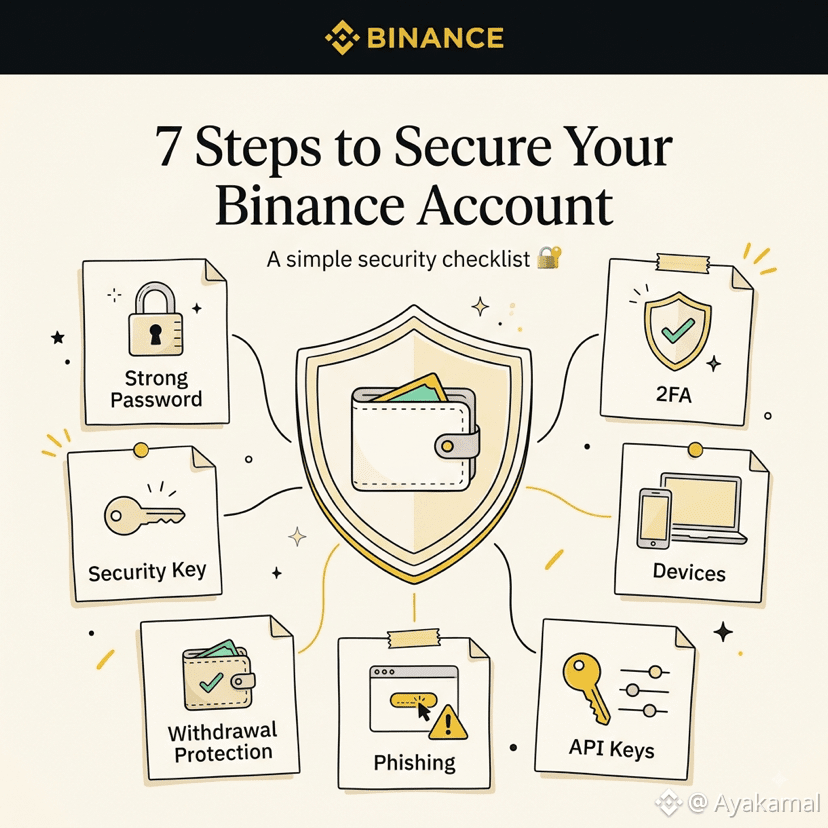
Here’s a quick 7-step check:
🔐 Strong, unique password
🛡️ 2FA
🔑 Security Key
👀 Check your devices & login activity
💸 Withdrawal Address Whitelist
🎣 Watch out for phishing
🤖 Secure your API Keys
And don’t worry if you don’t use all of these.
For example, if you don’t use API Keys, you can simply skip that part.
The important thing is knowing what’s available and choosing the security settings that make sense for how you use your account.
So… quick check 👇
How many of these 7 are already enabled for you?
1–2 | 3–5 | 6–7
Save this and take a couple of minutes to review your settings later.
Full guide on Binance Academy.
Educational content only. Not financial advice. Always #dyor and use official Binance sources.
#Binance #BinanceAcademy #LearnWithBinance #safu
Be honest… when was the last time you checked your Binance security settings? 👀🔐
Not your balance.
Not your portfolio.
Your security settings.
Because you might already have most of the protection you need turned on… or you might find a few things you’ve never checked.
Here’s a quick 7-step check:
🔐 Strong, unique password
🛡️ 2FA
🔑 Security Key
👀 Check your devices & login activity
💸 Withdrawal Address Whitelist
🎣 Watch out for phishing
🤖 Secure your API Keys
And don’t worry if you don’t use all of these.
For example, if you don’t use API Keys, you can simply skip that part.
The important thing is knowing what’s available and choosing the security settings that make sense for how you use your account.
So… quick check 👇
How many of these 7 are already enabled for you?
1–2 | 3–5 | 6–7
Save this and take a couple of minutes to review your settings later.
Full guide on Binance Academy.
Educational content only. Not financial advice. Always #dyor and use official Binance sources.
#Binance #BinanceAcademy #LearnWithBinance #safu
Not your balance.
Not your portfolio.
Your security settings.
Because you might already have most of the protection you need turned on… or you might find a few things you’ve never checked.
Here’s a quick 7-step check:
🔐 Strong, unique password
🛡️ 2FA
🔑 Security Key
👀 Check your devices & login activity
💸 Withdrawal Address Whitelist
🎣 Watch out for phishing
🤖 Secure your API Keys
And don’t worry if you don’t use all of these.
For example, if you don’t use API Keys, you can simply skip that part.
The important thing is knowing what’s available and choosing the security settings that make sense for how you use your account.
So… quick check 👇
How many of these 7 are already enabled for you?
1–2 | 3–5 | 6–7
Save this and take a couple of minutes to review your settings later.
Full guide on Binance Academy.
Educational content only. Not financial advice. Always #dyor and use official Binance sources.
#Binance #BinanceAcademy #LearnWithBinance #safu
5
97
·
--
Your first paycheck hits your account. 💰
And suddenly, there are a hundred things you want to spend it on.
But your first salary can be more than a reason to treat yourself. It can also be a good moment to start building better money habits.
So where do you start?
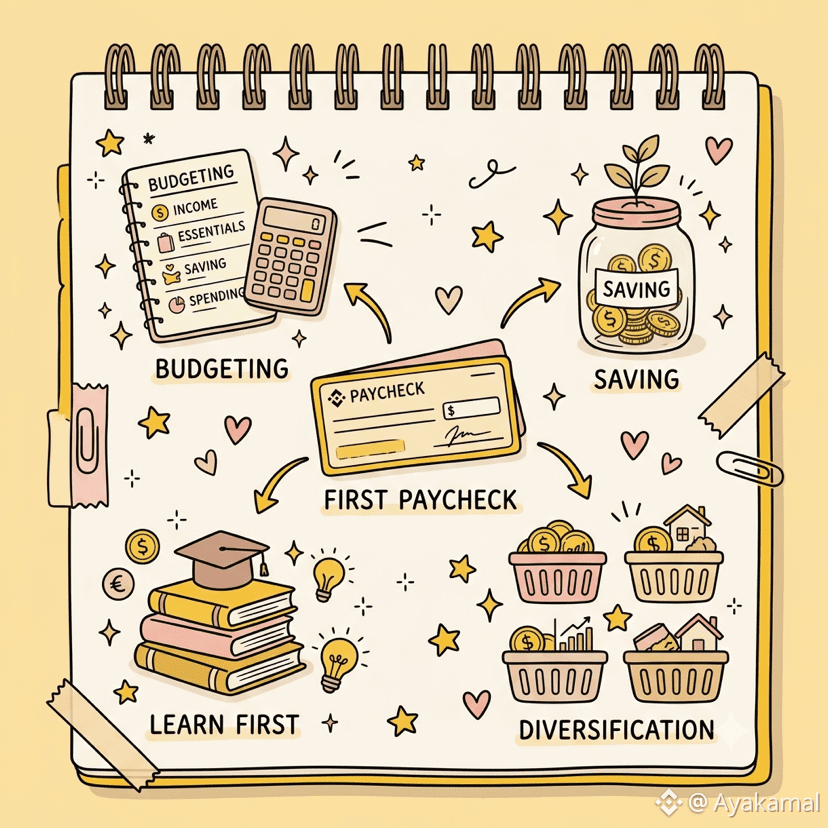
1. Know where your money is going. 📊
A simple budget can help you understand your income, essential expenses, and the things you can save or spend on.
You don’t need a complicated spreadsheet. Start by knowing your numbers.
2. Make room for saving. 💰
Setting aside part of your income for future needs can help you prepare for unexpected expenses and give you more financial flexibility.
3. Learn before you invest. 📚
Investing comes with risk, and different assets carry different levels and types of risk.
Before putting your money into something, take the time to understand what it is, how it works, and what could go wrong.
4. Understand diversification. 🌱
Putting everything in one asset means relying heavily on that one choice.
Learning about diversification can help you understand how exposure can be spread across different assets, while remembering that diversification does not eliminate risk.
And you don’t have to figure everything out with your first paycheck.
Sometimes, the best place to start is simply learning how to manage your money.
Binance Academy offers educational resources to help you explore financial and digital asset basics step by step.
Your first paycheck doesn’t have to be perfect.
It can simply be the beginning of a better relationship with your money. ✨
What is one money habit you wish you had started with your first paycheck?
Educational content only. Not financial advice. Always DYOR.
#Binance #BinanceAcademy #LearnWithBinance
Your first paycheck hits your account. 💰
And suddenly, there are a hundred things you want to spend it on.
But your first salary can be more than a reason to treat yourself. It can also be a good moment to start building better money habits.
So where do you start?
1. Know where your money is going. 📊
A simple budget can help you understand your income, essential expenses, and the things you can save or spend on.
You don’t need a complicated spreadsheet. Start by knowing your numbers.
2. Make room for saving. 💰
Setting aside part of your income for future needs can help you prepare for unexpected expenses and give you more financial flexibility.
3. Learn before you invest. 📚
Investing comes with risk, and different assets carry different levels and types of risk.
Before putting your money into something, take the time to understand what it is, how it works, and what could go wrong.
4. Understand diversification. 🌱
Putting everything in one asset means relying heavily on that one choice.
Learning about diversification can help you understand how exposure can be spread across different assets, while remembering that diversification does not eliminate risk.
And you don’t have to figure everything out with your first paycheck.
Sometimes, the best place to start is simply learning how to manage your money.
Binance Academy offers educational resources to help you explore financial and digital asset basics step by step.
Your first paycheck doesn’t have to be perfect.
It can simply be the beginning of a better relationship with your money. ✨
What is one money habit you wish you had started with your first paycheck?
Educational content only. Not financial advice. Always DYOR.
#Binance #BinanceAcademy #LearnWithBinance
And suddenly, there are a hundred things you want to spend it on.
But your first salary can be more than a reason to treat yourself. It can also be a good moment to start building better money habits.
So where do you start?
1. Know where your money is going. 📊
A simple budget can help you understand your income, essential expenses, and the things you can save or spend on.
You don’t need a complicated spreadsheet. Start by knowing your numbers.
2. Make room for saving. 💰
Setting aside part of your income for future needs can help you prepare for unexpected expenses and give you more financial flexibility.
3. Learn before you invest. 📚
Investing comes with risk, and different assets carry different levels and types of risk.
Before putting your money into something, take the time to understand what it is, how it works, and what could go wrong.
4. Understand diversification. 🌱
Putting everything in one asset means relying heavily on that one choice.
Learning about diversification can help you understand how exposure can be spread across different assets, while remembering that diversification does not eliminate risk.
And you don’t have to figure everything out with your first paycheck.
Sometimes, the best place to start is simply learning how to manage your money.
Binance Academy offers educational resources to help you explore financial and digital asset basics step by step.
Your first paycheck doesn’t have to be perfect.
It can simply be the beginning of a better relationship with your money. ✨
What is one money habit you wish you had started with your first paycheck?
Educational content only. Not financial advice. Always DYOR.
#Binance #BinanceAcademy #LearnWithBinance
5
72
🟠 What to Know Before Buying Your First Bitcoin
Your first Bitcoin experience shouldn't start with "the price is going up!"
It should start with "Do I understand what I'm doing?"
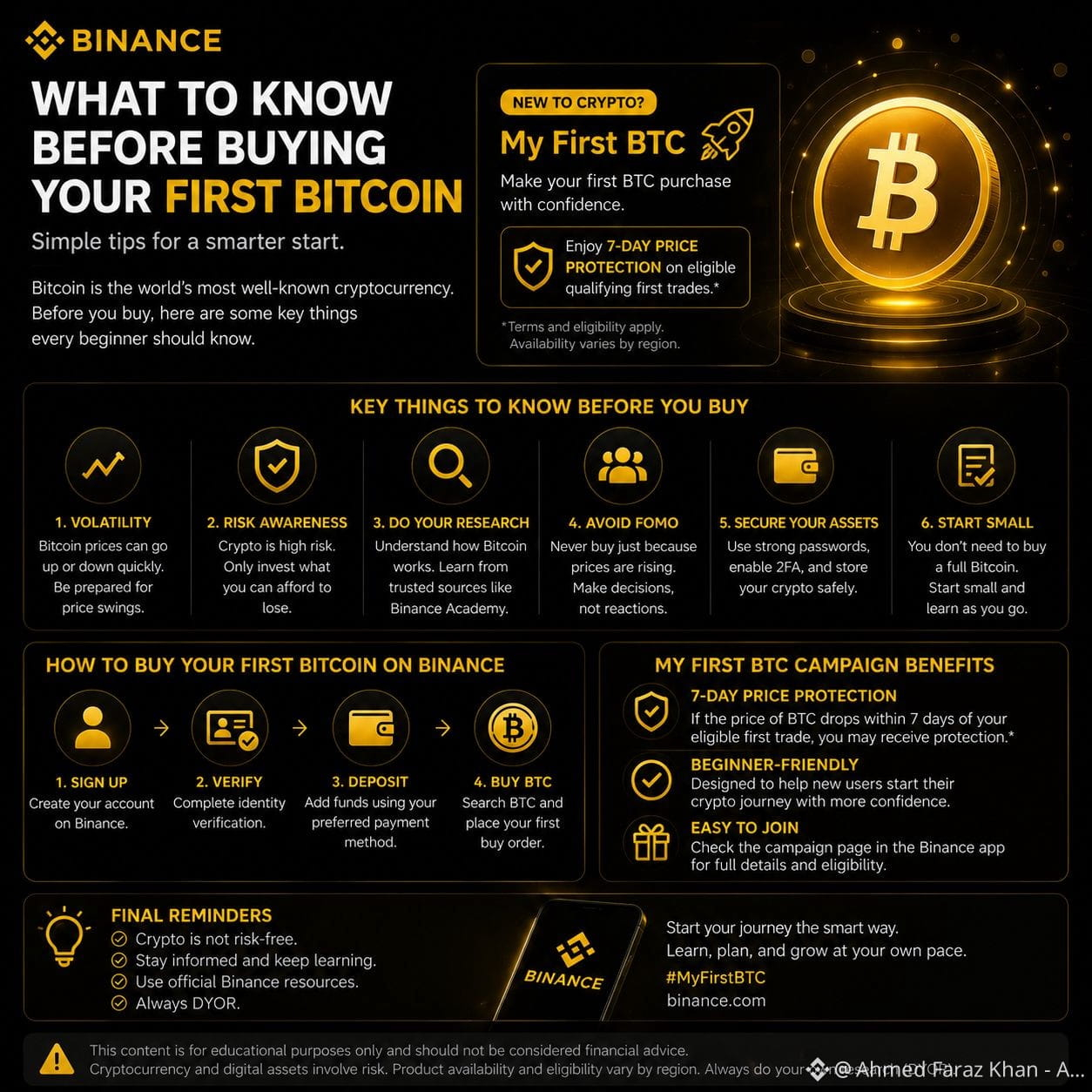
Here are a few things every beginner should know:
1️⃣ Bitcoin can be volatile
BTC prices can move up or down significantly, sometimes within short periods. There is no guaranteed return, and you should understand the possibility of losing value.
2️⃣ Don't let FOMO make the decision
Seeing other people talk about profits can create pressure to act quickly.
Take a step back.
Research first. Decide second.
3️⃣ Learn what you're actually buying
Understand Bitcoin, how transactions work, where your assets are held, and the risks involved before making any decision.
4️⃣ Think about security
Use strong account security practices and be extremely careful with suspicious links, messages, and requests for sensitive information.
5️⃣ Start with knowledge, not hype
You don't need to understand every part of crypto on day one. Focus on the fundamentals and use reliable educational resources such as Binance Academy.
🎁 What about My First BTC?
Binance's My First BTC campaign is designed for eligible newcomers and may include 7-day price protection on qualifying first trades.
Terms, conditions, eligibility, and availability apply, so always check the official campaign information for the latest details.
The bigger lesson?
Your first Bitcoin decision should be based on understanding, not FOMO.
📚 Learn. Research. Understand the risks. DYOR.
Educational only, not financial advice.
No guarantees or investment recommendations.
Crypto assets involve risk, and product/campaign availability varies by region.
#Binance
#BinanceAcademy
#LearnWithBinance
🟠 What to Know Before Buying Your First Bitcoin
Your first Bitcoin experience shouldn't start with "the price is going up!"
It should start with "Do I understand what I'm doing?"
Here are a few things every beginner should know:
1️⃣ Bitcoin can be volatile
BTC prices can move up or down significantly, sometimes within short periods. There is no guaranteed return, and you should understand the possibility of losing value.
2️⃣ Don't let FOMO make the decision
Seeing other people talk about profits can create pressure to act quickly.
Take a step back.
Research first. Decide second.
3️⃣ Learn what you're actually buying
Understand Bitcoin, how transactions work, where your assets are held, and the risks involved before making any decision.
4️⃣ Think about security
Use strong account security practices and be extremely careful with suspicious links, messages, and requests for sensitive information.
5️⃣ Start with knowledge, not hype
You don't need to understand every part of crypto on day one. Focus on the fundamentals and use reliable educational resources such as Binance Academy.
🎁 What about My First BTC?
Binance's My First BTC campaign is designed for eligible newcomers and may include 7-day price protection on qualifying first trades.
Terms, conditions, eligibility, and availability apply, so always check the official campaign information for the latest details.
The bigger lesson?
Your first Bitcoin decision should be based on understanding, not FOMO.
📚 Learn. Research. Understand the risks. DYOR.
Educational only, not financial advice.
No guarantees or investment recommendations.
Crypto assets involve risk, and product/campaign availability varies by region.
#Binance
#BinanceAcademy
#LearnWithBinance
Your first Bitcoin experience shouldn't start with "the price is going up!"
It should start with "Do I understand what I'm doing?"
Here are a few things every beginner should know:
1️⃣ Bitcoin can be volatile
BTC prices can move up or down significantly, sometimes within short periods. There is no guaranteed return, and you should understand the possibility of losing value.
2️⃣ Don't let FOMO make the decision
Seeing other people talk about profits can create pressure to act quickly.
Take a step back.
Research first. Decide second.
3️⃣ Learn what you're actually buying
Understand Bitcoin, how transactions work, where your assets are held, and the risks involved before making any decision.
4️⃣ Think about security
Use strong account security practices and be extremely careful with suspicious links, messages, and requests for sensitive information.
5️⃣ Start with knowledge, not hype
You don't need to understand every part of crypto on day one. Focus on the fundamentals and use reliable educational resources such as Binance Academy.
🎁 What about My First BTC?
Binance's My First BTC campaign is designed for eligible newcomers and may include 7-day price protection on qualifying first trades.
Terms, conditions, eligibility, and availability apply, so always check the official campaign information for the latest details.
The bigger lesson?
Your first Bitcoin decision should be based on understanding, not FOMO.
📚 Learn. Research. Understand the risks. DYOR.
Educational only, not financial advice.
No guarantees or investment recommendations.
Crypto assets involve risk, and product/campaign availability varies by region.
#Binance
#BinanceAcademy
#LearnWithBinance
3
118

Binance Lite Loan: Borrow Against Crypto Without Selling It
What if you need liquidity, but selling your crypto isn't the option you want to take?
Binance Lite Loan is designed around a simple idea:
Use eligible crypto as collateral → Borrow USDT → Keep the collateral subscribed → Repay the loan
Here’s how it works:
• Pledge collateral
Currently, BTC can be used as eligible collateral to borrow USDT.
• Borrow
You receive the borrowed USDT without directly selling the BTC used as collateral.
• Keep earning
During the initial loan term, the collateral remains subscribed to Simple Earn Flexible Products and can continue generating yield.
• Repay
Repay the loan according to the applicable terms.
The initial loan term is 30 days, with a 1% upfront service fee according to the campaign guide. There is also no LTV triggered liquidation during the initial 30 day term.
But there’s an important part people shouldn't overlook:
A crypto backed loan still carries risk.
Overdue loans can accrue penalty interest, and liquidation may apply after the initial term under specified conditions. Product availability and eligibility can also vary by region.
So before borrowing, understand:
• The fees
• Repayment requirements
• Collateral conditions
• What happens after the initial term
• Liquidation rules
• Whether the product is available in your region
The goal isn't to make borrowing sound easy or risk free.
It's to understand how crypto backed borrowing actually works before deciding whether it's suitable for you.
Would you consider borrowing against your BTC instead of selling it?
Educational only. Not financial advice. DYOR.
#Binance #BinanceAcademy #LearnWithBinance
Binance Lite Loan: Borrow Against Crypto Without Selling It
What if you need liquidity, but selling your crypto isn't the option you want to take?
Binance Lite Loan is designed around a simple idea:
Use eligible crypto as collateral → Borrow USDT → Keep the collateral subscribed → Repay the loan
Here’s how it works:
• Pledge collateral
Currently, BTC can be used as eligible collateral to borrow USDT.
• Borrow
You receive the borrowed USDT without directly selling the BTC used as collateral.
• Keep earning
During the initial loan term, the collateral remains subscribed to Simple Earn Flexible Products and can continue generating yield.
• Repay
Repay the loan according to the applicable terms.
The initial loan term is 30 days, with a 1% upfront service fee according to the campaign guide. There is also no LTV triggered liquidation during the initial 30 day term.
But there’s an important part people shouldn't overlook:
A crypto backed loan still carries risk.
Overdue loans can accrue penalty interest, and liquidation may apply after the initial term under specified conditions. Product availability and eligibility can also vary by region.
So before borrowing, understand:
• The fees
• Repayment requirements
• Collateral conditions
• What happens after the initial term
• Liquidation rules
• Whether the product is available in your region
The goal isn't to make borrowing sound easy or risk free.
It's to understand how crypto backed borrowing actually works before deciding whether it's suitable for you.
Would you consider borrowing against your BTC instead of selling it?
Educational only. Not financial advice. DYOR.
#Binance #BinanceAcademy #LearnWithBinance
What if you need liquidity, but selling your crypto isn't the option you want to take?
Binance Lite Loan is designed around a simple idea:
Use eligible crypto as collateral → Borrow USDT → Keep the collateral subscribed → Repay the loan
Here’s how it works:
• Pledge collateral
Currently, BTC can be used as eligible collateral to borrow USDT.
• Borrow
You receive the borrowed USDT without directly selling the BTC used as collateral.
• Keep earning
During the initial loan term, the collateral remains subscribed to Simple Earn Flexible Products and can continue generating yield.
• Repay
Repay the loan according to the applicable terms.
The initial loan term is 30 days, with a 1% upfront service fee according to the campaign guide. There is also no LTV triggered liquidation during the initial 30 day term.
But there’s an important part people shouldn't overlook:
A crypto backed loan still carries risk.
Overdue loans can accrue penalty interest, and liquidation may apply after the initial term under specified conditions. Product availability and eligibility can also vary by region.
So before borrowing, understand:
• The fees
• Repayment requirements
• Collateral conditions
• What happens after the initial term
• Liquidation rules
• Whether the product is available in your region
The goal isn't to make borrowing sound easy or risk free.
It's to understand how crypto backed borrowing actually works before deciding whether it's suitable for you.
Would you consider borrowing against your BTC instead of selling it?
Educational only. Not financial advice. DYOR.
#Binance #BinanceAcademy #LearnWithBinance
100

·
--
Crypto liquidity doesn’t always have to mean selling your bags.
That’s what makes Binance Lite Loan interesting. You can use eligible crypto as collateral, borrow against it, and keep your market position.
But there’s a catch — the loan isn’t risk-free.
LTV, interest, collateral value and liquidation conditions all matter. If the market drops hard, the risk can increase quickly.
For me, the real value isn’t just “borrow against crypto.”
It’s having another way to manage liquidity without immediately selling.
Borrow smart. Manage risk.
#Binance #LearnWithBinance #BinanceAcademy
Crypto liquidity doesn’t always have to mean selling your bags.
That’s what makes Binance Lite Loan interesting. You can use eligible crypto as collateral, borrow against it, and keep your market position.
But there’s a catch — the loan isn’t risk-free.
LTV, interest, collateral value and liquidation conditions all matter. If the market drops hard, the risk can increase quickly.
For me, the real value isn’t just “borrow against crypto.”
It’s having another way to manage liquidity without immediately selling.
Borrow smart. Manage risk.
#Binance #LearnWithBinance #BinanceAcademy
That’s what makes Binance Lite Loan interesting. You can use eligible crypto as collateral, borrow against it, and keep your market position.
But there’s a catch — the loan isn’t risk-free.
LTV, interest, collateral value and liquidation conditions all matter. If the market drops hard, the risk can increase quickly.
For me, the real value isn’t just “borrow against crypto.”
It’s having another way to manage liquidity without immediately selling.
Borrow smart. Manage risk.
#Binance #LearnWithBinance #BinanceAcademy
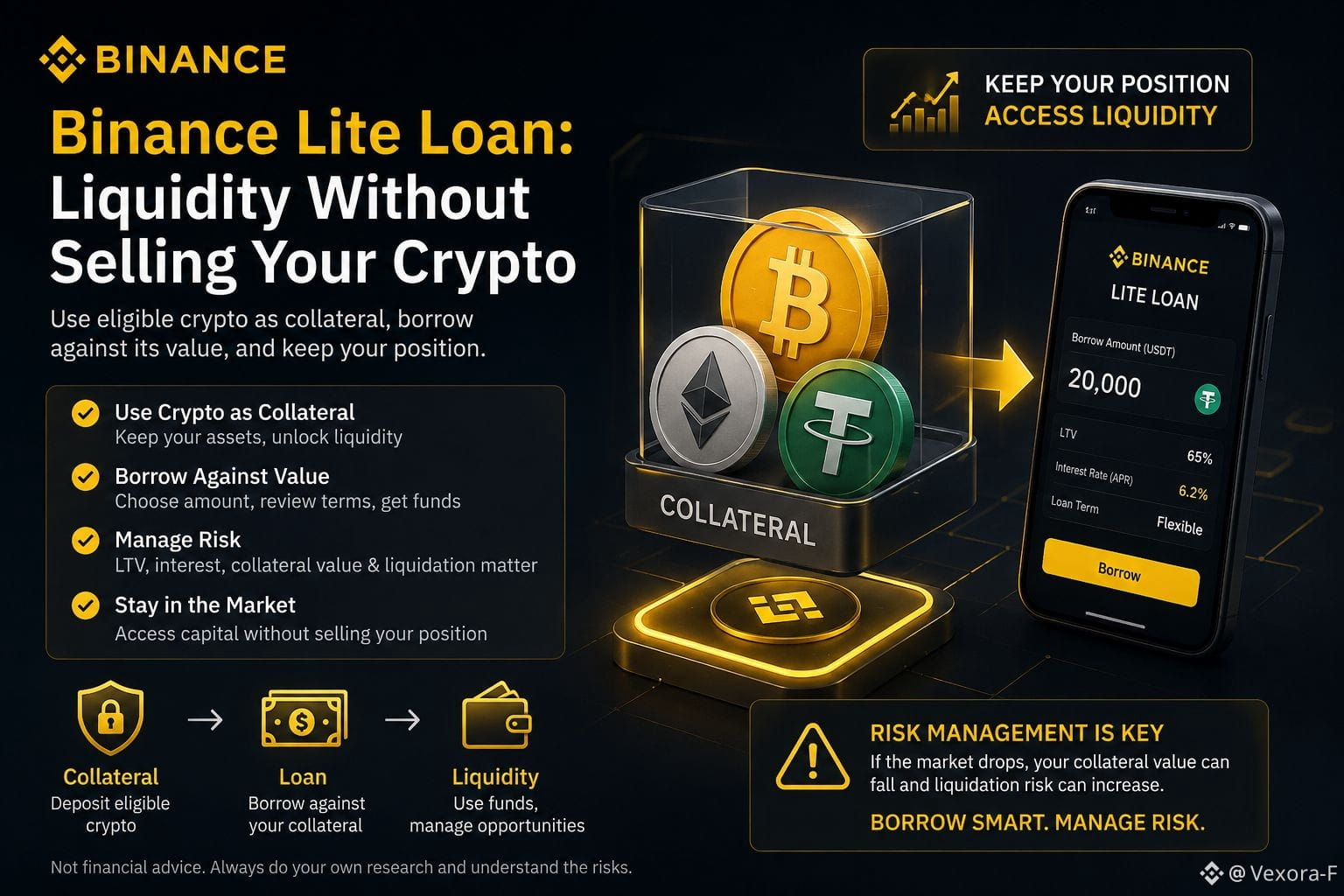
87

·
--
Before your first Bitcoin, there is one question more important than “When?”
It's:
“Why?”
Why Bitcoin?
Why now?
What do you actually understand about the asset?
A first purchase can be driven by curiosity, research, or simply FOMO.
Those are very different starting points.
Bitcoin's price can be highly volatile, and no one can know with certainty what it will do next.
So your first step doesn't have to be buying.
It can simply be learning.
Understand the asset.
Understand the risks.
Understand your own reason.
Then make your decision with knowledge—not noise.
DYOR.
Educational content only — not financial advice.
#Binance #BinanceAcademy #LearnWithBinance
$BTC
{future}(BTCUSDT)
Before your first Bitcoin, there is one question more important than “When?”
It's:
“Why?”
Why Bitcoin?
Why now?
What do you actually understand about the asset?
A first purchase can be driven by curiosity, research, or simply FOMO.
Those are very different starting points.
Bitcoin's price can be highly volatile, and no one can know with certainty what it will do next.
So your first step doesn't have to be buying.
It can simply be learning.
Understand the asset.
Understand the risks.
Understand your own reason.
Then make your decision with knowledge—not noise.
DYOR.
Educational content only — not financial advice.
#Binance #BinanceAcademy #LearnWithBinance
$BTC
It's:
“Why?”
Why Bitcoin?
Why now?
What do you actually understand about the asset?
A first purchase can be driven by curiosity, research, or simply FOMO.
Those are very different starting points.
Bitcoin's price can be highly volatile, and no one can know with certainty what it will do next.
So your first step doesn't have to be buying.
It can simply be learning.
Understand the asset.
Understand the risks.
Understand your own reason.
Then make your decision with knowledge—not noise.
DYOR.
Educational content only — not financial advice.
#Binance #BinanceAcademy #LearnWithBinance
$BTC

3
92
·
--
💧 The price you see isn’t always the price you get.
Sometimes, the difference comes down to one thing:
Liquidity.
So what does liquidity actually mean in crypto? 👇
Liquidity is simply how easily an asset can be bought or sold without significantly moving its price.
📈 High liquidity
More buyers and sellers, with more orders around the current price. This can make execution smoother.
📉 Low liquidity
Fewer available orders can mean that a larger trade has a greater impact on price.
🔄 And then there’s Slippage.
Slippage is the difference between the price you expected and the price at which your trade is actually executed.
💡 The takeaway:
Price tells you where the market is.
Liquidity helps you understand how easily you can move through it.
📚 Learn more through Binance Academy.
🔎 Learn, compare, and always #DYOR.
⚠️ Educational content only, not financial advice. Availability and regulations may vary by region.
#Binance #BinanceAcademy #LearnWithBinance
💧 The price you see isn’t always the price you get.
Sometimes, the difference comes down to one thing:
Liquidity.
So what does liquidity actually mean in crypto? 👇
Liquidity is simply how easily an asset can be bought or sold without significantly moving its price.
📈 High liquidity
More buyers and sellers, with more orders around the current price. This can make execution smoother.
📉 Low liquidity
Fewer available orders can mean that a larger trade has a greater impact on price.
🔄 And then there’s Slippage.
Slippage is the difference between the price you expected and the price at which your trade is actually executed.
💡 The takeaway:
Price tells you where the market is.
Liquidity helps you understand how easily you can move through it.
📚 Learn more through Binance Academy.
🔎 Learn, compare, and always #DYOR.
⚠️ Educational content only, not financial advice. Availability and regulations may vary by region.
#Binance #BinanceAcademy #LearnWithBinance
Sometimes, the difference comes down to one thing:
Liquidity.
So what does liquidity actually mean in crypto? 👇
Liquidity is simply how easily an asset can be bought or sold without significantly moving its price.
📈 High liquidity
More buyers and sellers, with more orders around the current price. This can make execution smoother.
📉 Low liquidity
Fewer available orders can mean that a larger trade has a greater impact on price.
🔄 And then there’s Slippage.
Slippage is the difference between the price you expected and the price at which your trade is actually executed.
💡 The takeaway:
Price tells you where the market is.
Liquidity helps you understand how easily you can move through it.
📚 Learn more through Binance Academy.
🔎 Learn, compare, and always #DYOR.
⚠️ Educational content only, not financial advice. Availability and regulations may vary by region.
#Binance #BinanceAcademy #LearnWithBinance
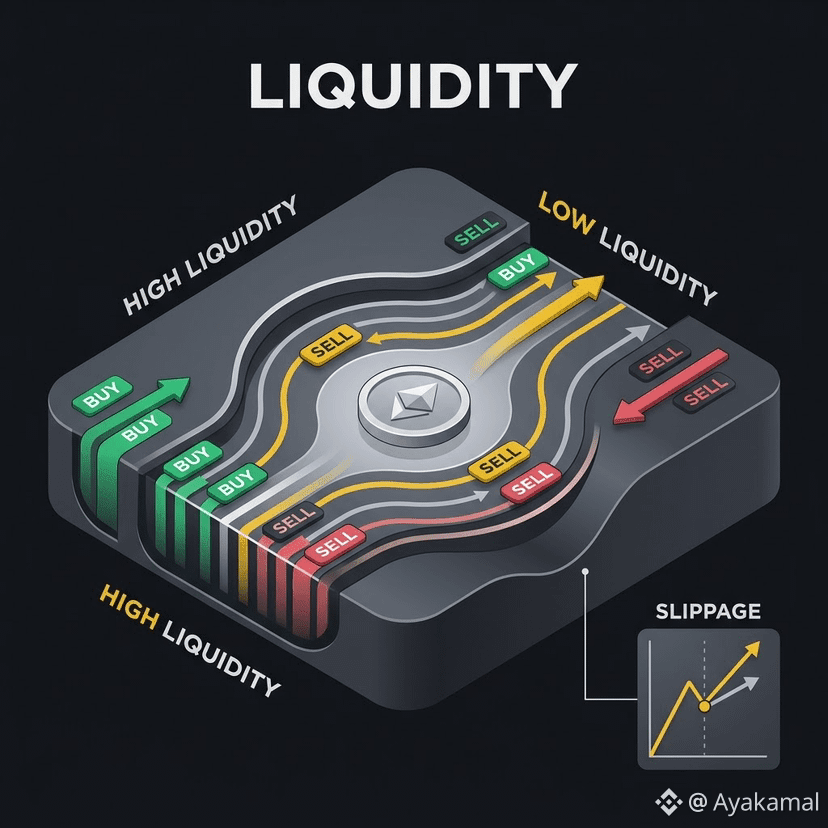
4
48
·
--
The future of finance isn't about downloading more apps—it's about having the right tools in one place.
Binance brings together multiple financial services into a connected ecosystem, making it easier for beginners and experienced users alike to explore digital assets.
🌟 What can you do with Binance?
📈 Trade
Buy and sell a wide range of digital assets through an intuitive trading experience.
💰 Earn
Explore crypto earning products designed for different goals and preferences.
🎓 Learn
Build your blockchain and crypto knowledge with free educational content from Binance Academy.
💳 Pay
Send and receive crypto quickly using Binance Pay (availability may vary by region).
🤝 P2P
Buy and sell crypto directly with other users through Binance P2P where available.
👛 Wallet
Manage your digital assets securely from one place.
Why does this matter?
Instead of switching between multiple apps for learning, trading, payments, and asset management, a connected ecosystem can help simplify your crypto experience and save time.
Whether you're taking your first step into crypto or expanding your knowledge, learning should always come first.
This content is for educational purposes only and is not financial advice. Product availability, features, and eligibility may vary by region. Always do your own research (DYOR).
#Binance #BinanceAcademy #LearnWithBinance
The future of finance isn't about downloading more apps—it's about having the right tools in one place.
Binance brings together multiple financial services into a connected ecosystem, making it easier for beginners and experienced users alike to explore digital assets.
🌟 What can you do with Binance?
📈 Trade
Buy and sell a wide range of digital assets through an intuitive trading experience.
💰 Earn
Explore crypto earning products designed for different goals and preferences.
🎓 Learn
Build your blockchain and crypto knowledge with free educational content from Binance Academy.
💳 Pay
Send and receive crypto quickly using Binance Pay (availability may vary by region).
🤝 P2P
Buy and sell crypto directly with other users through Binance P2P where available.
👛 Wallet
Manage your digital assets securely from one place.
Why does this matter?
Instead of switching between multiple apps for learning, trading, payments, and asset management, a connected ecosystem can help simplify your crypto experience and save time.
Whether you're taking your first step into crypto or expanding your knowledge, learning should always come first.
This content is for educational purposes only and is not financial advice. Product availability, features, and eligibility may vary by region. Always do your own research (DYOR).
#Binance #BinanceAcademy #LearnWithBinance
Binance brings together multiple financial services into a connected ecosystem, making it easier for beginners and experienced users alike to explore digital assets.
🌟 What can you do with Binance?
📈 Trade
Buy and sell a wide range of digital assets through an intuitive trading experience.
💰 Earn
Explore crypto earning products designed for different goals and preferences.
🎓 Learn
Build your blockchain and crypto knowledge with free educational content from Binance Academy.
💳 Pay
Send and receive crypto quickly using Binance Pay (availability may vary by region).
🤝 P2P
Buy and sell crypto directly with other users through Binance P2P where available.
👛 Wallet
Manage your digital assets securely from one place.
Why does this matter?
Instead of switching between multiple apps for learning, trading, payments, and asset management, a connected ecosystem can help simplify your crypto experience and save time.
Whether you're taking your first step into crypto or expanding your knowledge, learning should always come first.
This content is for educational purposes only and is not financial advice. Product availability, features, and eligibility may vary by region. Always do your own research (DYOR).
#Binance #BinanceAcademy #LearnWithBinance
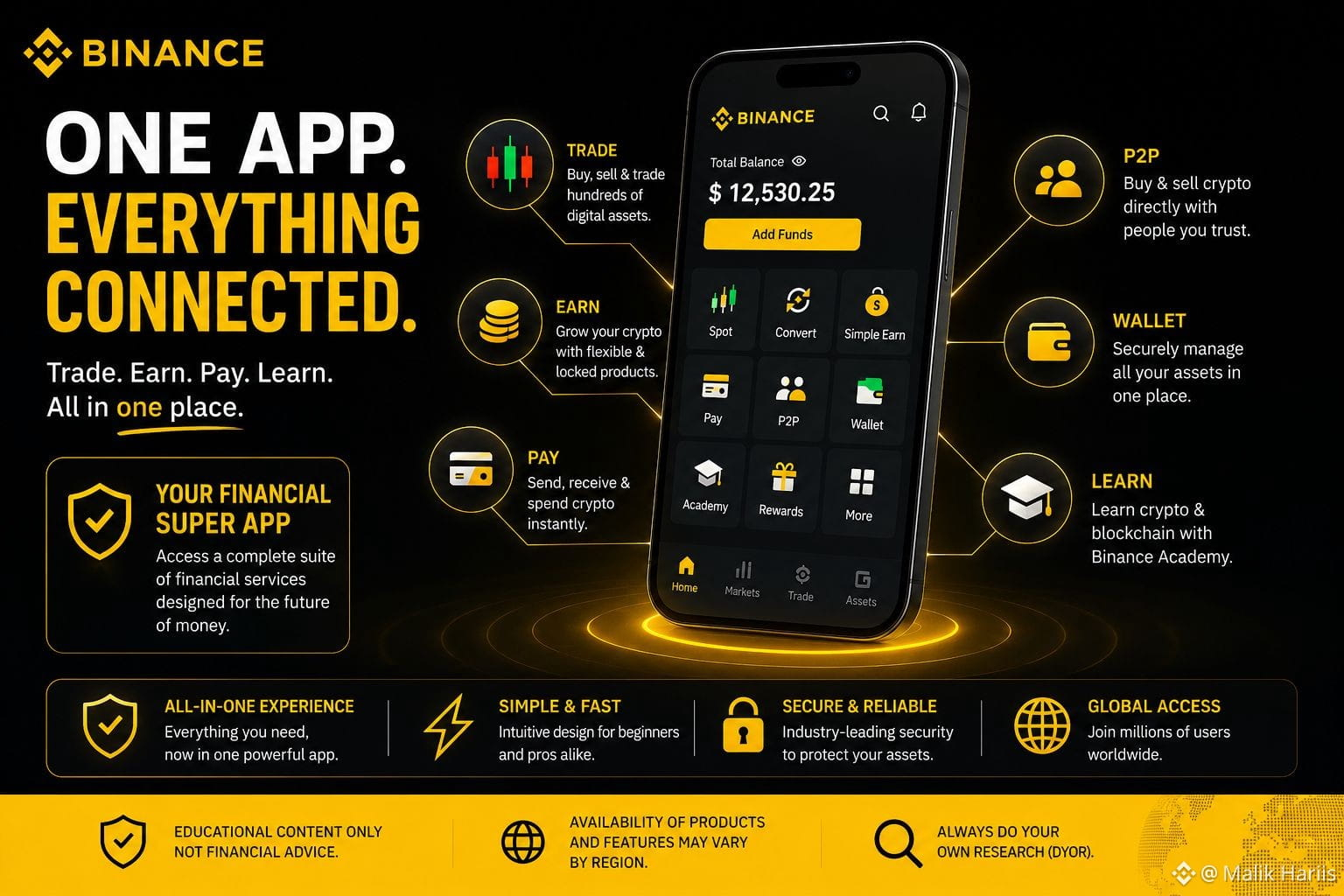
2
87
·
--
Жоғары (өспелі)
The most expensive thing in crypto isn't Bitcoin?!!! 💯
It's making a decision you don't understand.
A coin you bought because everyone was talking about it.
A link you clicked without checking where it came from.
A trade you entered because you were afraid of missing out.
A product you used without reading how it works.
In crypto, knowledge isn't decoration. It's part of your security.
Before you buy.
Before you trade.
Before you connect your wallet.
Before you trust a platform. Pause. Ask questions.
Verify the information.
Learn from reliable sources.
Because sometimes DYOR isn't about finding the next opportunity. It's about avoiding the wrong one.
📚 Keep learning with @Binance_Academy
Educational content only — not financial advice.
#BinanceAcademy #LearnWithBinance
$BTC
{future}(BTCUSDT)
$ZEC
{future}(ZECUSDT)
$XRP
{future}(XRPUSDT)
The most expensive thing in crypto isn't Bitcoin?!!! 💯
It's making a decision you don't understand.
A coin you bought because everyone was talking about it.
A link you clicked without checking where it came from.
A trade you entered because you were afraid of missing out.
A product you used without reading how it works.
In crypto, knowledge isn't decoration. It's part of your security.
Before you buy.
Before you trade.
Before you connect your wallet.
Before you trust a platform. Pause. Ask questions.
Verify the information.
Learn from reliable sources.
Because sometimes DYOR isn't about finding the next opportunity. It's about avoiding the wrong one.
📚 Keep learning with @Binance Academy
Educational content only — not financial advice.
#BinanceAcademy #LearnWithBinance
$BTC
$ZEC
$XRP
It's making a decision you don't understand.
A coin you bought because everyone was talking about it.
A link you clicked without checking where it came from.
A trade you entered because you were afraid of missing out.
A product you used without reading how it works.
In crypto, knowledge isn't decoration. It's part of your security.
Before you buy.
Before you trade.
Before you connect your wallet.
Before you trust a platform. Pause. Ask questions.
Verify the information.
Learn from reliable sources.
Because sometimes DYOR isn't about finding the next opportunity. It's about avoiding the wrong one.
📚 Keep learning with @Binance Academy
Educational content only — not financial advice.
#BinanceAcademy #LearnWithBinance
$BTC
$ZEC
$XRP

3
515
·
--

Мақала
Liquidity & Slippage: 2 Concepts Every Crypto Beginner Should UnderstandWhen beginners start trading crypto, they often focus on one thing:
The price.
But the price you see on your screen isn’t always the exact price you’ll get when your order is executed.
Two concepts can help you understand why:
Liquidity and Slippage.
🔹 What is Liquidity?
Liquidity describes how easily an asset can be bought or sold without causing a significant impact on its price.
A market with higher liquidity generally has:
• More active buyers and sellers
• More orders available at different prices
• Tighter bid-ask spreads
• Potentially less price impact from individual trades
🔹 What is an Order Book?
Think of an order book as a live list of buy and sell orders for a trading pair.
Bids = buy orders
Asks = sell orders
The difference between the highest bid and the lowest ask is called the:
Bid-Ask Spread
Understanding the order book can help you see how much liquidity is available around the current market price.
🔹 Now, What is Slippage?
Slippage is the difference between the expected execution price and the actual execution price.
It can occur when:
• Liquidity is limited
• An order is relatively large compared with available liquidity
• The market is moving quickly
For example:
Imagine $BTC is displayed at $100,000.
You place a market order to buy.
Your entire order may not be filled at exactly $100,000. Depending on the available sell orders in the order book, different portions of your order could be executed at different prices.
As a result, your average execution price may differ from the price you initially saw.
That’s slippage.
🔹 Market Order vs. Limit Order
Market Order
A market order is designed to execute immediately at the best available prices in the market.
However, the final execution price can vary depending on market conditions and available liquidity.
Limit Order
A limit order allows you to specify the maximum price you’re willing to pay when buying, or the minimum price you’re willing to accept when selling.
But there’s an important trade-off:
A limit order may not execute if the market doesn’t reach your specified price.
🔹 Why Does This Matter?
The cost of a trade isn’t necessarily just the displayed market price.
Depending on the situation, you may also need to consider:
Price + Spread + Trading Fees + Potential Slippage
Understanding these concepts can give beginners a clearer picture of what happens when an order is actually executed.
🧠 Key Takeaway
Before trading, make sure you understand the basics of:
✓ Liquidity
✓ Order Books
✓ Bid-Ask Spreads
✓ Slippage
✓ Trading Fees
✓ Market vs. Limit Orders
You don’t need to be an expert to understand these concepts.
But learning how order execution works can help you better understand the mechanics of crypto markets and avoid unexpected surprises.
For deeper educational resources, check Binance Academy and always DYOR.
What crypto concept should we break down next? 👇
#Binance #BinanceAcademy #learnwithbinance #cryptoeducation
Educational content only, not financial advice.
Availability, eligibility, and regulations may vary by region.
Liquidity & Slippage: 2 Concepts Every Crypto Beginner Should Understand
When beginners start trading crypto, they often focus on one thing:
The price.
But the price you see on your screen isn’t always the exact price you’ll get when your order is executed.
Two concepts can help you understand why:
Liquidity and Slippage.
🔹 What is Liquidity?
Liquidity describes how easily an asset can be bought or sold without causing a significant impact on its price.
A market with higher liquidity generally has:
• More active buyers and sellers
• More orders available at different prices
• Tighter bid-ask spreads
• Potentially less price impact from individual trades
🔹 What is an Order Book?
Think of an order book as a live list of buy and sell orders for a trading pair.
Bids = buy orders
Asks = sell orders
The difference between the highest bid and the lowest ask is called the:
Bid-Ask Spread
Understanding the order book can help you see how much liquidity is available around the current market price.
🔹 Now, What is Slippage?
Slippage is the difference between the expected execution price and the actual execution price.
It can occur when:
• Liquidity is limited
• An order is relatively large compared with available liquidity
• The market is moving quickly
For example:
Imagine $BTC is displayed at $100,000.
You place a market order to buy.
Your entire order may not be filled at exactly $100,000. Depending on the available sell orders in the order book, different portions of your order could be executed at different prices.
As a result, your average execution price may differ from the price you initially saw.
That’s slippage.
🔹 Market Order vs. Limit Order
Market Order
A market order is designed to execute immediately at the best available prices in the market.
However, the final execution price can vary depending on market conditions and available liquidity.
Limit Order
A limit order allows you to specify the maximum price you’re willing to pay when buying, or the minimum price you’re willing to accept when selling.
But there’s an important trade-off:
A limit order may not execute if the market doesn’t reach your specified price.
🔹 Why Does This Matter?
The cost of a trade isn’t necessarily just the displayed market price.
Depending on the situation, you may also need to consider:
Price + Spread + Trading Fees + Potential Slippage
Understanding these concepts can give beginners a clearer picture of what happens when an order is actually executed.
🧠 Key Takeaway
Before trading, make sure you understand the basics of:
✓ Liquidity
✓ Order Books
✓ Bid-Ask Spreads
✓ Slippage
✓ Trading Fees
✓ Market vs. Limit Orders
You don’t need to be an expert to understand these concepts.
But learning how order execution works can help you better understand the mechanics of crypto markets and avoid unexpected surprises.
For deeper educational resources, check Binance Academy and always DYOR.
What crypto concept should we break down next? 👇
#Binance #BinanceAcademy #learnwithbinance #cryptoeducation
Educational content only, not financial advice.
Availability, eligibility, and regulations may vary by region.
The price.
But the price you see on your screen isn’t always the exact price you’ll get when your order is executed.
Two concepts can help you understand why:
Liquidity and Slippage.
🔹 What is Liquidity?
Liquidity describes how easily an asset can be bought or sold without causing a significant impact on its price.
A market with higher liquidity generally has:
• More active buyers and sellers
• More orders available at different prices
• Tighter bid-ask spreads
• Potentially less price impact from individual trades
🔹 What is an Order Book?
Think of an order book as a live list of buy and sell orders for a trading pair.
Bids = buy orders
Asks = sell orders
The difference between the highest bid and the lowest ask is called the:
Bid-Ask Spread
Understanding the order book can help you see how much liquidity is available around the current market price.
🔹 Now, What is Slippage?
Slippage is the difference between the expected execution price and the actual execution price.
It can occur when:
• Liquidity is limited
• An order is relatively large compared with available liquidity
• The market is moving quickly
For example:
Imagine $BTC is displayed at $100,000.
You place a market order to buy.
Your entire order may not be filled at exactly $100,000. Depending on the available sell orders in the order book, different portions of your order could be executed at different prices.
As a result, your average execution price may differ from the price you initially saw.
That’s slippage.
🔹 Market Order vs. Limit Order
Market Order
A market order is designed to execute immediately at the best available prices in the market.
However, the final execution price can vary depending on market conditions and available liquidity.
Limit Order
A limit order allows you to specify the maximum price you’re willing to pay when buying, or the minimum price you’re willing to accept when selling.
But there’s an important trade-off:
A limit order may not execute if the market doesn’t reach your specified price.
🔹 Why Does This Matter?
The cost of a trade isn’t necessarily just the displayed market price.
Depending on the situation, you may also need to consider:
Price + Spread + Trading Fees + Potential Slippage
Understanding these concepts can give beginners a clearer picture of what happens when an order is actually executed.
🧠 Key Takeaway
Before trading, make sure you understand the basics of:
✓ Liquidity
✓ Order Books
✓ Bid-Ask Spreads
✓ Slippage
✓ Trading Fees
✓ Market vs. Limit Orders
You don’t need to be an expert to understand these concepts.
But learning how order execution works can help you better understand the mechanics of crypto markets and avoid unexpected surprises.
For deeper educational resources, check Binance Academy and always DYOR.
What crypto concept should we break down next? 👇
#Binance #BinanceAcademy #learnwithbinance #cryptoeducation
Educational content only, not financial advice.
Availability, eligibility, and regulations may vary by region.
3
122
Көбірек контент көру үшін кіріңіз
Binance Square платформасында әлемдік криптоқоғамдастыққа қосылыңыз
⚡️ Криптовалюта туралы ең соңғы және пайдалы ақпаратты алыңыз.
💬 Әлемдегі ең ірі криптобиржаның сеніміне ие.
👍 Расталған авторлардың нақты пікірлерін табыңыз.
Электрондық пошта/телефон нөмірі
Трендтегі тақырыптар
1
#BinancePick
2.8M рет көрілді
147,904 адам талқылап жатыр
2
#EarningsSeason
5.1M рет көрілді
25,250 адам талқылап жатыр
3
#AnthropicTTMRevenueGrewAbout1200%
2,360 рет көрілді
135 адам талқылап жатыр
4
#AnthropicS1ExpectedToday
5,317 рет көрілді
144 адам талқылап жатыр
5
#SouthKoreaReportedlyWeighsFourthCryptoTaxDelay
13,532 рет көрілді
301 адам талқылап жатыр
6
#FranklinTempletonFilesForTwoDividendToBitcoinETFs
21,101 рет көрілді
415 адам талқылап жатыр
7
#StrategyMSTRSurpassesNasdaqInMarketCap
16,557 рет көрілді
317 адам талқылап жатыр
8
#CanadaProposesStablecoinRedemptionWithin3BusinessDays
750 рет көрілді
32 адам талқылап жатыр
9
#ElectrumWalletBugLetRogueServersStealFunds
20,571 рет көрілді
409 адам талқылап жатыр
10
#ArgentineCourtDismissesLIBRACaseAgainstMilei
31,631 рет көрілді
494 адам талқылап жатыр