

#layer2
layer2
4.4M рет көрілді
25,265 адам талқылап жатыр
Қызу саудада
Ең соңғы

💀 Ваш любимый L2 это просто скам для выжимания ликвидности?
Серьёзно, вы реально верите в 50x на токенах, где 90% объема — это боты, крутящие поинты ради аирдропа? 🤡
Каждый день «убийцы Эфира» обещают революцию, а по факту киты просто разгружают свои обмылки об розницу. Альтсезона «для всех подряд» больше не будет. Ликвидности тупо не хватит на 10,000 одинаковых L2-сетей. Смарт-мани забирают всё, пока толпа усредняет падающие ножи.
💡 Мой расклад: Выходите из розовых очков. Выигрывают только те экосистемы, где есть реальный TVL и доходность, а не красивый маркетинг.
👇 Назовите в комментариях один L2-токен, который вы всё ещё свято верите догнать до ATH? Посмотрим, сколько нас тут таких «оптимистов» 👇
$ETH $ARB $STRK
#crypto #altcoins #Layer2 #trading
ABO3ZAM:
كلامك في الصميم يا وحش، السيولة فعلاً مبعثرة. شرايك، هل تشوف إغلاق الشمعة الأسبوعية تحت مستويات الدعم الحالية بيعطينا كسر وهمي ولا بداية لموجة تصحيح أقوى؟ 🎯
4
813

Arbitrum is leading the charge for Layer-2 networks, showing strong momentum with an active surge that has pushed it straight into today's top gainers! 💥
The network fundamentals have never looked stronger, with $ARB absorbing massive liquidity as dApp ecosystems across Ethereum search for cheap, lightning-fast settlement layers.
Key Metrics Driving This Pump:
🔹 Sudden influx of trading volume over the last 24 hours.
🔹 Massive increase in total transactions settled on-chain.
🔹 A decisive breakout from its multi-week horizontal range.
When large-cap utility tokens start pumping with volume like this, it usually signals that smart money is taking positions.
What is your next price target for $ARB? Are you going long or taking profits? Let's discuss! 📊
#ARBİTRUM #Layer2 #Ethereum #Altcoins
Arbitrum is leading the charge for Layer-2 networks, showing strong momentum with an active surge that has pushed it straight into today's top gainers! 💥
The network fundamentals have never looked stronger, with $ARB absorbing massive liquidity as dApp ecosystems across Ethereum search for cheap, lightning-fast settlement layers.
Key Metrics Driving This Pump:
🔹 Sudden influx of trading volume over the last 24 hours.
🔹 Massive increase in total transactions settled on-chain.
🔹 A decisive breakout from its multi-week horizontal range.
When large-cap utility tokens start pumping with volume like this, it usually signals that smart money is taking positions.
What is your next price target for $ARB ? Are you going long or taking profits? Let's discuss! 📊
#ARBİTRUM #Layer2 #Ethereum #Altcoins
204

·
--
Optimistic Rollups vs. ZK Rollups 🧵
Both help scale Ethereum, but they verify transactions differently.
🔹 Optimistic Rollups: assume transactions are valid unless challenged with a fraud proof.
🔹 ZK Rollups: use cryptographic validity proofs.
Which approach will shape the future of $ETH scaling?
#Ethereum #Layer2
{future}(ETHUSDT)
Optimistic Rollups vs. ZK Rollups 🧵
Both help scale Ethereum, but they verify transactions differently.
🔹 Optimistic Rollups: assume transactions are valid unless challenged with a fraud proof.
🔹 ZK Rollups: use cryptographic validity proofs.
Which approach will shape the future of $ETH scaling?
#Ethereum #Layer2
Both help scale Ethereum, but they verify transactions differently.
🔹 Optimistic Rollups: assume transactions are valid unless challenged with a fraud proof.
🔹 ZK Rollups: use cryptographic validity proofs.
Which approach will shape the future of $ETH scaling?
#Ethereum #Layer2
81

·
--
While everyone is busy arguing over short-term price charts around the 2308.96 mark for $ETH, the actual engineering reality of the network is shifting at a pace most retail desks are completely ignoring. The transition is no longer a theoretical roadmap; it is happening right now in the data plumbing of the Layer-2 ecosystem.
Looking closely at the on-chain metrics, daily active addresses and transaction throughput on rollups like Arbitrum and Optimism are soaking up the overwhelming majority of execution activity, leaving the base layer acting strictly as a high-security settlement layer. But the real structural evolution is happening in the zero-knowledge space. ZKsync and Starknet are aggressively compressing proof verification times, which is driving blob gas fees down to a fraction of last year's costs. This blob efficiency is the exact mechanism designed to make Ethereum scalable without sacrificing decentralization.
Bridge net inflows tell a clear story as well. Institutional capital is steadily rotating into these modular environments, favoring cryptographic validity over simple fraud-proof models. Meanwhile, developer commit frequency for core Ethereum clients remains unmatched across the entire crypto industry, providing a massive moat against fragmentation. When you combine this relentless developer activity with the automated supply burn governed by L2 data posting, the long-term fundamentals look entirely different from a standard high-inflation network. Are you seeing institutional capital lean heavier into ZK rollups or optimistic environments on your end?
#Layer2 #BlockchainScaling
While everyone is busy arguing over short-term price charts around the 2308.96 mark for $ETH , the actual engineering reality of the network is shifting at a pace most retail desks are completely ignoring. The transition is no longer a theoretical roadmap; it is happening right now in the data plumbing of the Layer-2 ecosystem.
Looking closely at the on-chain metrics, daily active addresses and transaction throughput on rollups like Arbitrum and Optimism are soaking up the overwhelming majority of execution activity, leaving the base layer acting strictly as a high-security settlement layer. But the real structural evolution is happening in the zero-knowledge space. ZKsync and Starknet are aggressively compressing proof verification times, which is driving blob gas fees down to a fraction of last year's costs. This blob efficiency is the exact mechanism designed to make Ethereum scalable without sacrificing decentralization.
Bridge net inflows tell a clear story as well. Institutional capital is steadily rotating into these modular environments, favoring cryptographic validity over simple fraud-proof models. Meanwhile, developer commit frequency for core Ethereum clients remains unmatched across the entire crypto industry, providing a massive moat against fragmentation. When you combine this relentless developer activity with the automated supply burn governed by L2 data posting, the long-term fundamentals look entirely different from a standard high-inflation network. Are you seeing institutional capital lean heavier into ZK rollups or optimistic environments on your end?
#Layer2 #BlockchainScaling
28


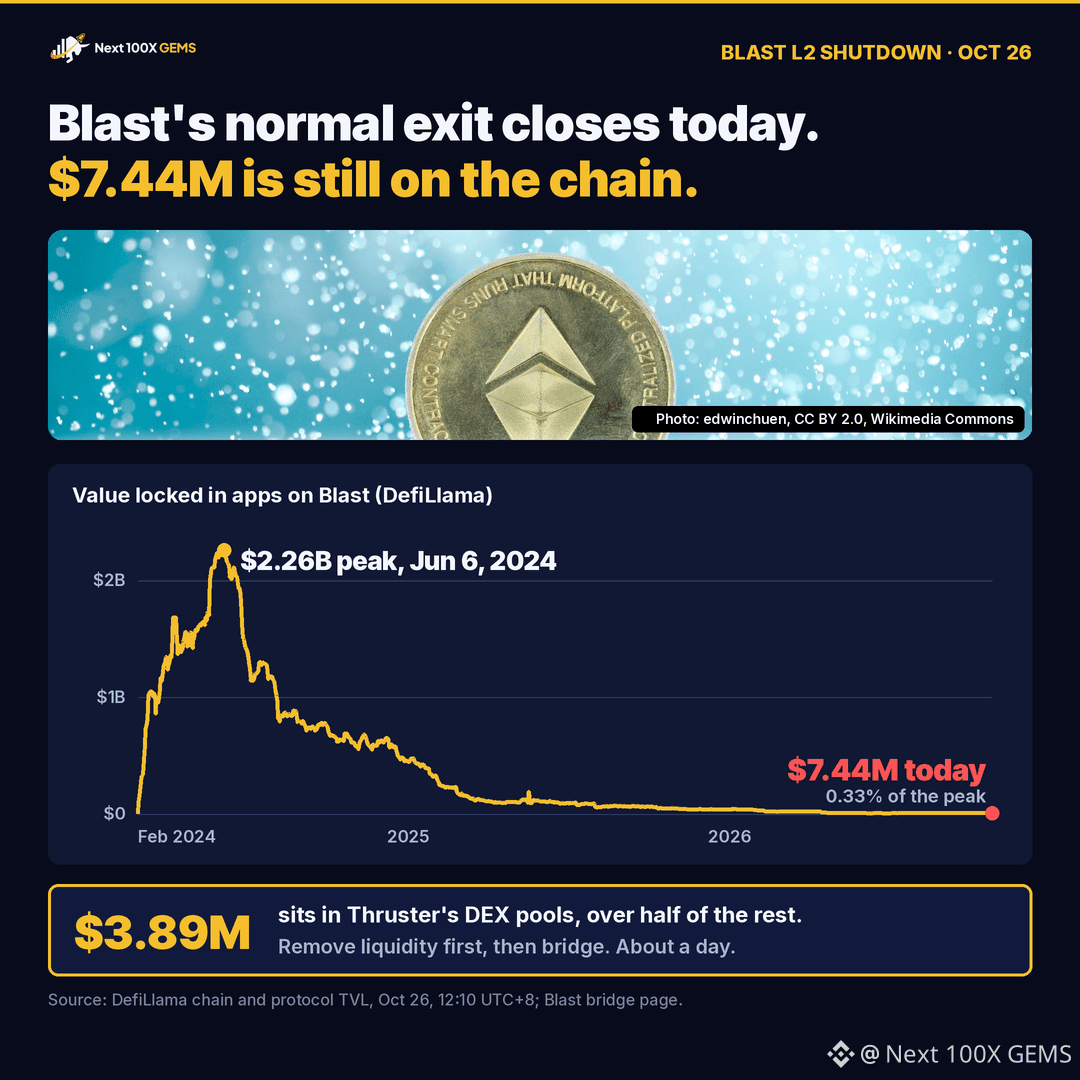
Blast's normal withdrawal route closes today, Oct 26, and DefiLlama still counts $7.44M sitting in apps on the chain.
That is about 0.33% of the $2.26B peak it recorded on June 6, 2024. The team announced the shutdown on Oct 2, saying the L2 costs more to run than it earns.
Over half of what's left sits in one DEX. Thruster's two pool versions hold about $3.89M (checked 12:10 UTC+8). LP tokens don't bridge on their own, so you remove the liquidity first and then bridge the coins back to Ethereum. Blast's bridge page says that leg takes about a day.
After today, Blast says funds can still come out, but only by calling its bridge contracts on Ethereum directly. It promised to publish instructions, and as of 12:10 UTC+8 its last post on X is a reminder from Oct 13.
Coinbase told users to move BLAST off before Oct 26 or lose access once the network shuts down.
Blast hasn't named a cutoff hour. If you still have anything on the chain, the PWA wallet included, start the exit now through the official Blast bridge. Anyone in your DMs offering to recover Blast funds is running a scam.
$BLAST
#Blast #Layer2
NFA. DYOR.
131

Bitcoin Hyper ($HYPER ) - Part 2 | My Accumulation Plan 🚀
Part 1 got 282+ Views, thanks for the support!
Quick Update: BTC is down -1.34% but HYPER is holding better -0.47% - This is strength!
My Plan for $HYPER:
1️⃣ Why I like it: Bitcoin's Fast Layer-2 narrative is getting hot on Binance Square
2️⃣ My Entry: DCA on dips, not FOMO on pumps
3️⃣ My View: If BTC holds $80K, Layer-2 tokens could run fast
This is not financial advice. DYOR!
Are you buying $HYPER on this dip or waiting? Let's discuss 👇
$BTC
{spot}(BTCUSDT)
#BitcoinHyper #Layer2 #crypto #BinanceSquare #BTC☀
Bitcoin Hyper ($HYPER ) - Part 2 | My Accumulation Plan 🚀
Part 1 got 282+ Views, thanks for the support!
Quick Update: BTC is down -1.34% but HYPER is holding better -0.47% - This is strength!
My Plan for $HYPER :
1️⃣ Why I like it: Bitcoin's Fast Layer-2 narrative is getting hot on Binance Square
2️⃣ My Entry: DCA on dips, not FOMO on pumps
3️⃣ My View: If BTC holds $80K, Layer-2 tokens could run fast
This is not financial advice. DYOR!
Are you buying $HYPER on this dip or waiting? Let's discuss 👇
$BTC
#BitcoinHyper #Layer2 #crypto #BinanceSquare #BTC☀
1
213



·
--
Blast二层今天(10/26)关闭官方提现界面,还在链上的资金注意了
据The Block 10/2报道:Paradigm领投的以太坊L2 Blast宣布清盘,原因是运营成本高于收入、看不到可持续路径;TVL从主网前超20亿美元跌到约3200万美元(DefiLlama)。
官方公告:10/26前可通过官网桥正常提现,约1天到账;之后只能直接调用以太坊上的桥合约提款。
L2BEAT最新数据:Blast仍有约4469万美元资产(7日-10.8%),其中ETH类约70%、稳定币约915万美元。
同期大盘:ETH约2,340美元,以太坊现货ETF 10月累计净流出约11.8亿美元(Decrypt)。
【观点】
这是“靠积分和空投拉TVL”模式最直白的结局:激励一停,资金走光,链的收入撑不起排序器和安全成本。L2赛道正在出清,用户和资金会继续向头部Rollup与主网集中,长尾L2的代币估值逻辑需要重估。
【机会/风险】
1. 还有资产在Blast上的,今天走官方桥最省事;之后走合约提款门槛高,警惕冒充“代提现”的钓鱼网站和私信。
2. 关注其他低TVL、靠激励维持的L2是否跟进关停或合并,相关代币可能承压。
3. ETH短线看2,330-2,350支撑,本周FOMC前ETF资金流仍是关键变量。
你觉得下一个撑不下去的L2会是谁?是行业健康出清,还是L2叙事退潮的信号?
#以太坊 #Layer2 #Blast #加密新闻 $ETH $OP
仅供参考,不构成投资建议

421
·
--
Hyperliquid 生态要迎来第一条 Layer 2 了。据 TokenPost 报道,Elysium 计划于11月9日上线主网,以 HyperEVM 作为结算层,与负责交易撮合的 HyperCore 并行运行,并使用 $HYPE 作为 gas 代币,目前采用 Conduit 的 G2 排序器。更值得看的是后续规划:团队打算在东京 Equinix TY15 机房部署 Hyperliquid 节点,把 HyperCore 和 HyperEVM 的状态数据同步过来,并在主网上线约四周后通过升级,让 L2 上的智能合约直接读取 HyperCore 的订单簿、价格和仓位。如果落地,开发者就能在链上围绕一个高性能订单簿做衍生品、借贷或策略类应用,这是 Hyperliquid 从单一交易所走向平台的一步。不过排序器目前仍是单一运营方,主网初期的去中心化程度和安全性还需要时间验证,参与前建议多看官方文档。
#Hyperliquid #Layer2 #DeFi #永续合约
#Hyperliquid #Layer2 #DeFi #永续合约
61

·
--
Мақала
二层网络(L2)到底是什么?用一周数据讲明白二层网络(L2)到底是什么?用一周数据把它讲明白
很多新手第一次听到 L2,会觉得是个很玄的词。其实可以用一个生活比喻理解:以太坊主网像一条很安全、但车道有限的高速公路,车一多就收高价过路费。L2 则是在旁边修的“辅路”,先把很多笔交易在链下打包处理,再把压缩后的结果交回主网“盖章”。这样既借用了主网的安全性,又让单笔费用降到几美分。
一、L2 是怎么工作的
1. 用户在 L2 上发起交易,由排序器(sequencer)负责排队和打包。
2. 打包后的数据以“blob”的形式提交到以太坊主网,主网负责保存和最终确认。
3. 主流的 Optimistic Rollup(Arbitrum、Optimism、Base 都属于这一类)默认交易有效,留出一段挑战期供人提出异议;ZK Rollup 则用数学证明直接验证。
近期有一组数据挺能说明问题:据报道,Pectra 升级把每个区块的 blob 目标数从 3 提高到 6,上限从 6 提高到 9,日容量约 8.17GB,而 L2 实际每天只用掉约 40%。容量宽裕,L2 的数据成本自然很低。
二、现在的格局
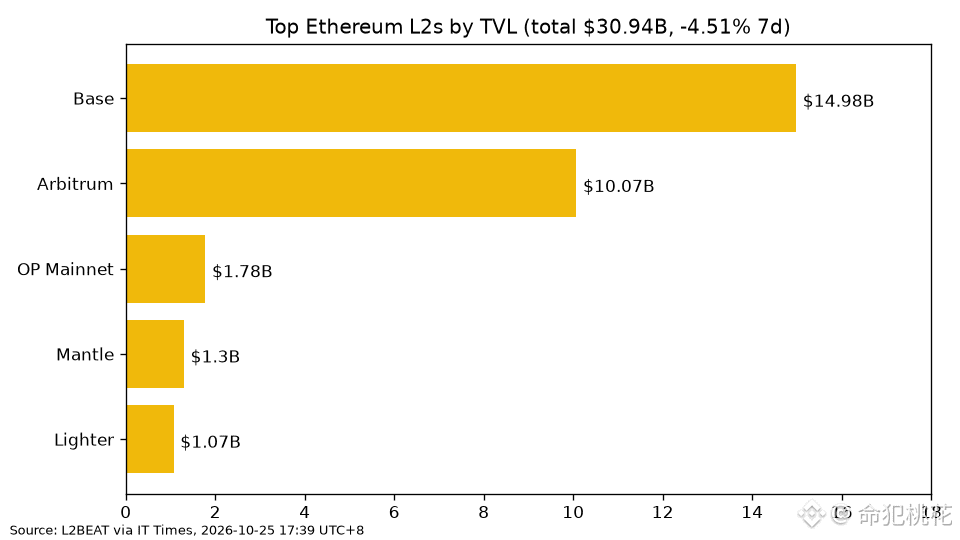
据 L2BEAT(10 月 25 日)统计,以太坊 L2 总锁仓约 309.4 亿美元,一周下降 4.51%。其中 Base 约 149.8 亿美元,排第一;Arbitrum 约 100.7 亿美元;OP Mainnet 约 17.8 亿美元;Mantle 约 13 亿美元;Lighter 约 10.7 亿美元。前五名的一周变化全部为负,OP 降幅最大,约 9.93%。
需要提醒:TVL 会同时受币价和资金进出影响,下降不一定代表用户离开,只是一个参考角度。
三、费用上的差别
据 TokenPost 报道,最近 7 天以太坊主网的收入约 216 万美元,Base 约 55 万美元,Arbitrum One 约 12.2 万美元。同时 DefiLlama 的链上 TVL 显示主网约 487 亿美元,Base 约 60 亿美元(统计口径与 L2BEAT 不同,数字不能直接对比)。简单理解:主网仍然是资金和结算的中心,L2 承担了大量日常的小额交互。
四、新手使用 L2 要注意什么
• 跨链桥是风险最集中的环节。第一次先用小额测试,认准官方入口,不点来路不明的链接。
• 提款回主网时,Optimistic 类 L2 官方通道可能要等待挑战期,别在需要急用钱时才第一次尝试。
• 同一个钱包地址在不同 L2 上资产是分开的,转账前确认选对了网络。
• 排序器目前多数仍是中心化运营,了解这一点,有助于理解各 L2 的风险边界。
五、接下来可以关注什么
Base 的 Denim 升级已在测试网于 10 月 21 日上线,主网计划在 11 月,目标是以每 200 毫秒一个标准区块的方式出块。这属于速度和体验层面的改进,主网时间仍是计划,可能调整。
小结:L2 不是“另一条竞争的链”,更像以太坊的扩容层。看懂它,才能在转账、使用应用时少踩坑。
你平时更常用主网还是 L2?第一次跨链时有没有踩过坑?欢迎在评论区聊聊。
#以太坊 #Layer2 #新手科普
以上为数据整理与科普,不构成投资建议。
二层网络(L2)到底是什么?用一周数据讲明白
二层网络(L2)到底是什么?用一周数据把它讲明白
很多新手第一次听到 L2,会觉得是个很玄的词。其实可以用一个生活比喻理解:以太坊主网像一条很安全、但车道有限的高速公路,车一多就收高价过路费。L2 则是在旁边修的“辅路”,先把很多笔交易在链下打包处理,再把压缩后的结果交回主网“盖章”。这样既借用了主网的安全性,又让单笔费用降到几美分。
一、L2 是怎么工作的
1. 用户在 L2 上发起交易,由排序器(sequencer)负责排队和打包。
2. 打包后的数据以“blob”的形式提交到以太坊主网,主网负责保存和最终确认。
3. 主流的 Optimistic Rollup(Arbitrum、Optimism、Base 都属于这一类)默认交易有效,留出一段挑战期供人提出异议;ZK Rollup 则用数学证明直接验证。
近期有一组数据挺能说明问题:据报道,Pectra 升级把每个区块的 blob 目标数从 3 提高到 6,上限从 6 提高到 9,日容量约 8.17GB,而 L2 实际每天只用掉约 40%。容量宽裕,L2 的数据成本自然很低。
二、现在的格局
据 L2BEAT(10 月 25 日)统计,以太坊 L2 总锁仓约 309.4 亿美元,一周下降 4.51%。其中 Base 约 149.8 亿美元,排第一;Arbitrum 约 100.7 亿美元;OP Mainnet 约 17.8 亿美元;Mantle 约 13 亿美元;Lighter 约 10.7 亿美元。前五名的一周变化全部为负,OP 降幅最大,约 9.93%。
需要提醒:TVL 会同时受币价和资金进出影响,下降不一定代表用户离开,只是一个参考角度。
三、费用上的差别
据 TokenPost 报道,最近 7 天以太坊主网的收入约 216 万美元,Base 约 55 万美元,Arbitrum One 约 12.2 万美元。同时 DefiLlama 的链上 TVL 显示主网约 487 亿美元,Base 约 60 亿美元(统计口径与 L2BEAT 不同,数字不能直接对比)。简单理解:主网仍然是资金和结算的中心,L2 承担了大量日常的小额交互。
四、新手使用 L2 要注意什么
• 跨链桥是风险最集中的环节。第一次先用小额测试,认准官方入口,不点来路不明的链接。
• 提款回主网时,Optimistic 类 L2 官方通道可能要等待挑战期,别在需要急用钱时才第一次尝试。
• 同一个钱包地址在不同 L2 上资产是分开的,转账前确认选对了网络。
• 排序器目前多数仍是中心化运营,了解这一点,有助于理解各 L2 的风险边界。
五、接下来可以关注什么
Base 的 Denim 升级已在测试网于 10 月 21 日上线,主网计划在 11 月,目标是以每 200 毫秒一个标准区块的方式出块。这属于速度和体验层面的改进,主网时间仍是计划,可能调整。
小结:L2 不是“另一条竞争的链”,更像以太坊的扩容层。看懂它,才能在转账、使用应用时少踩坑。
你平时更常用主网还是 L2?第一次跨链时有没有踩过坑?欢迎在评论区聊聊。
#以太坊 #Layer2 #新手科普
以上为数据整理与科普,不构成投资建议。
143

·
--
Blast宣布停止运营,官方给出的理由很直接:维护这条链的持续成本已超过L2产生的收入,且看不到让经济可持续的可信路径。我的观察是,这不只是一次项目关停,而是把低成本L2“靠手续费自养”的账本摊开给市场看:当排序器收入撑不起持续运维,退出机制就成了用户最该先读的部分。
按官方公告,用户被要求在10月26日前把资产提回以太坊主网,提款延迟将降至24小时。但关停流程中有一个关键顺序:Blast要先提取其Lido资产,预计约一周,这期间提款会暂时不可用;流程完成后才以新的24小时延迟恢复。用户需在2026年10月26日前通过正常界面提款,此后资产仍可提取,但需直接与以太坊L1上的Blast跨链桥合约交互。据此推断,真正的安全窗口不在“24小时”这个数字,而在Lido资产退出是否顺利、桥合约交互是否顺畅;这两步中任何一步卡住,用户的等待时间都会被重新拉长。
对读者而言,值得跟踪的验证条件有三项:提款是否按公告节奏恢复、桥合约交互是否出现拥堵或失败、以及同类L2是否跟进收缩。若提款按期恢复且桥交互平稳,这次关停更像一次个体经济模型失败;若出现延迟或交互障碍,则说明低成本L2的退出机制本身也是风险来源。需要说明的是,本次素材未提供Blast具体的收入与成本数字,因此“维护成本超过收入”目前只能作为官方自述,尚缺可核验的账本细节。
#ETH #Layer2
资料来源:
PANews(原发布 10-25 21:19 北京时间)
https://www.panewslab.com/zh/articles/01a17337-8679-7679-aac0-5ecadfd2c4cd

102
·
--
Мақала
Ethereum Blobs Explained: How EIP-4844 Helps Layer 2 ScaleEthereum Blobs Explained: How EIP-4844 Helps Layer 2 Scale
Ethereum scaling isn't just about processing more transactions. It's also about making transaction data cheaper to publish and verify.
That's where blobs come in.
1. What are Ethereum blobs?
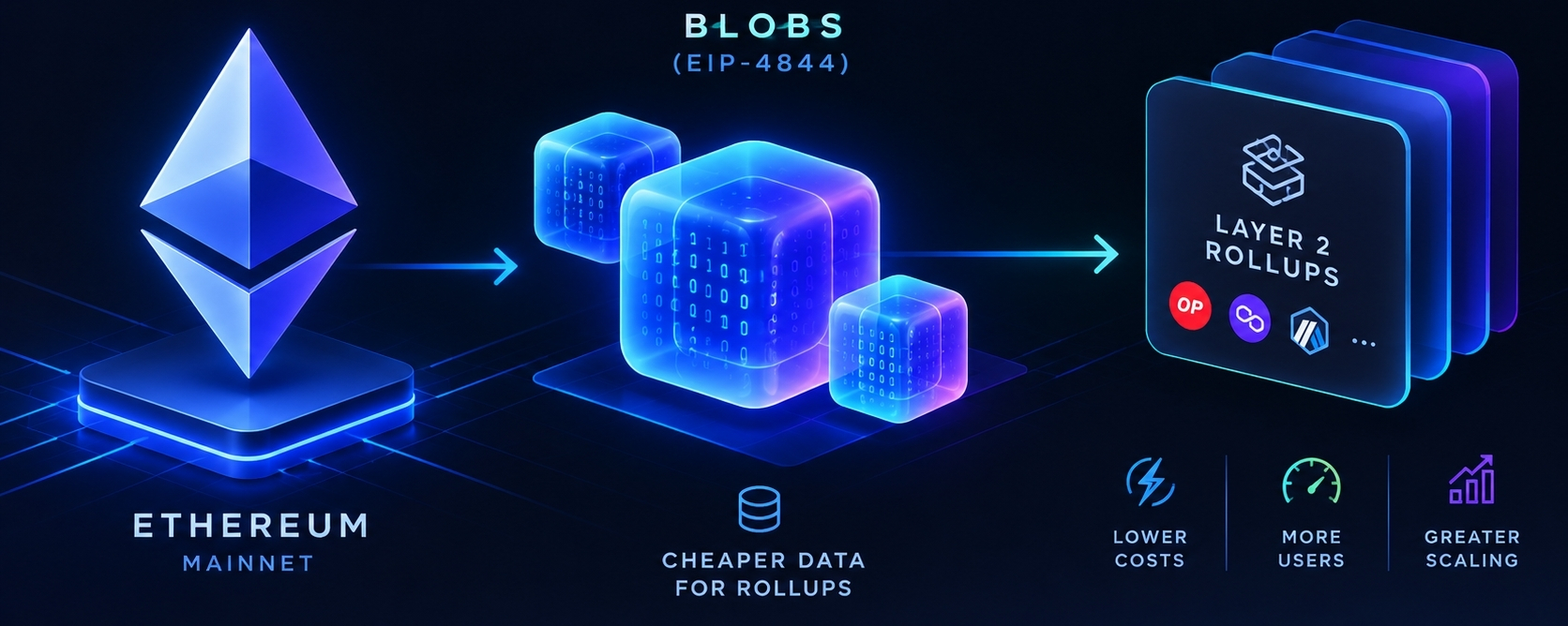
Blobs are temporary data packages introduced by EIP-4844, also known as Proto-Danksharding, as part of Ethereum's Dencun upgrade.
They give Layer 2 rollups a more cost-efficient way to publish transaction data to Ethereum.
Previously, rollups commonly used transaction calldata, which competes with regular Ethereum transactions for execution gas.
Blobs provide a separate data-fee market designed for this specific purpose.
2. Why do Layer 2 networks need them?
Layer 2 rollups process transactions outside Ethereum's main execution layer and submit batches of data back to Ethereum.
This helps scale transaction processing, but publishing data to Ethereum can be expensive.
Blobs help by providing:
🔹 Lower data costs: Rollups can publish data more cheaply than using calldata in many circumstances.
🔹 A separate fee market: Blob fees are calculated separately from ordinary execution gas fees.
🔹 Better scaling potential: Lower data costs can help rollups serve more users economically.
However, savings vary with network demand, rollup design, and other transaction costs. Lower blob fees don't automatically mean every transaction on every L2 becomes cheap.
3. Are blobs permanent storage?
No—and this distinction matters.
Blob data is not permanently stored by Ethereum's consensus protocol. Under EIP-4844, nodes are required to retain blob data for a limited period, initially about 18 days.
The blob's commitment remains available on-chain, but that commitment is not the same as the complete original data.
Rollups and other ecosystem participants may preserve historical data through their own infrastructure.
This design reduces long-term data-storage requirements while supporting the availability needs of rollups.
4. Do blobs make Ethereum infinitely scalable?
Not by themselves.
EIP-4844 was an intermediate step toward Ethereum's broader scaling roadmap.
Blobs improved the way rollups publish data, but the network still has capacity limits. Blob demand, fee levels, node requirements, and rollup architecture continue to matter.
Future data-availability improvements aim to increase capacity while maintaining Ethereum's security and decentralization goals.
5. What should users understand?
If you use an Ethereum Layer 2 network, remember three things:
• Lower data costs can help reduce transaction fees, but they don't guarantee a particular fee.
• Different rollups have different architectures, costs, and security assumptions.
• Ethereum scaling involves more than transaction speed. Data availability and the ability to verify transactions are also essential.
My takeaway: Ethereum blobs are an important infrastructure upgrade—not a magic solution. They help rollups publish data more efficiently while Ethereum continues working toward greater scalability.
Sources for further reading
1. Ethereum.org — Danksharding roadmap: https://ethereum.org/roadmap/danksharding
2. Ethereum Improvement Proposals — EIP-4844: https://eips.ethereum.org/EIPS/eip-4844
3. Ethereum.org — Blockchain data storage strategies: https://ethereum.org/developers/docs/data-availability/blockchain-data-storage-strategies/
What do you think matters most for Ethereum's future: cheaper L2 transactions, stronger decentralization, or greater data availability?
$ETH
#Ethereum #Layer2 #Web3 #Crypto
Ethereum Blobs Explained: How EIP-4844 Helps Layer 2 Scale
Ethereum Blobs Explained: How EIP-4844 Helps Layer 2 Scale
Ethereum scaling isn't just about processing more transactions. It's also about making transaction data cheaper to publish and verify.
That's where blobs come in.
1. What are Ethereum blobs?
Blobs are temporary data packages introduced by EIP-4844, also known as Proto-Danksharding, as part of Ethereum's Dencun upgrade.
They give Layer 2 rollups a more cost-efficient way to publish transaction data to Ethereum.
Previously, rollups commonly used transaction calldata, which competes with regular Ethereum transactions for execution gas.
Blobs provide a separate data-fee market designed for this specific purpose.
2. Why do Layer 2 networks need them?
Layer 2 rollups process transactions outside Ethereum's main execution layer and submit batches of data back to Ethereum.
This helps scale transaction processing, but publishing data to Ethereum can be expensive.
Blobs help by providing:
🔹 Lower data costs: Rollups can publish data more cheaply than using calldata in many circumstances.
🔹 A separate fee market: Blob fees are calculated separately from ordinary execution gas fees.
🔹 Better scaling potential: Lower data costs can help rollups serve more users economically.
However, savings vary with network demand, rollup design, and other transaction costs. Lower blob fees don't automatically mean every transaction on every L2 becomes cheap.
3. Are blobs permanent storage?
No—and this distinction matters.
Blob data is not permanently stored by Ethereum's consensus protocol. Under EIP-4844, nodes are required to retain blob data for a limited period, initially about 18 days.
The blob's commitment remains available on-chain, but that commitment is not the same as the complete original data.
Rollups and other ecosystem participants may preserve historical data through their own infrastructure.
This design reduces long-term data-storage requirements while supporting the availability needs of rollups.
4. Do blobs make Ethereum infinitely scalable?
Not by themselves.
EIP-4844 was an intermediate step toward Ethereum's broader scaling roadmap.
Blobs improved the way rollups publish data, but the network still has capacity limits. Blob demand, fee levels, node requirements, and rollup architecture continue to matter.
Future data-availability improvements aim to increase capacity while maintaining Ethereum's security and decentralization goals.
5. What should users understand?
If you use an Ethereum Layer 2 network, remember three things:
• Lower data costs can help reduce transaction fees, but they don't guarantee a particular fee.
• Different rollups have different architectures, costs, and security assumptions.
• Ethereum scaling involves more than transaction speed. Data availability and the ability to verify transactions are also essential.
My takeaway: Ethereum blobs are an important infrastructure upgrade—not a magic solution. They help rollups publish data more efficiently while Ethereum continues working toward greater scalability.
Sources for further reading
1. Ethereum.org — Danksharding roadmap: https://ethereum.org/roadmap/danksharding
2. Ethereum Improvement Proposals — EIP-4844: https://eips.ethereum.org/EIPS/eip-4844
3. Ethereum.org — Blockchain data storage strategies: https://ethereum.org/developers/docs/data-availability/blockchain-data-storage-strategies/
What do you think matters most for Ethereum's future: cheaper L2 transactions, stronger decentralization, or greater data availability?
$ETH
#Ethereum #Layer2 #Web3 #Crypto
57

·
--
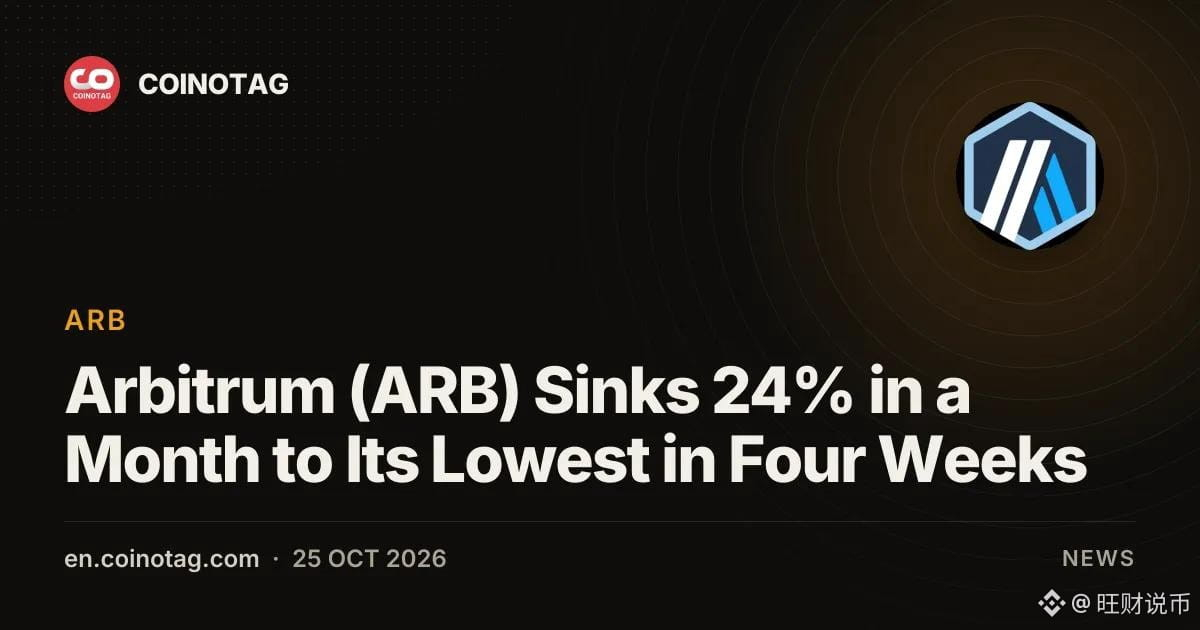
📉 ARB 一个月跌24%,比ETH还惨一倍!
据 Coinotag:
• ARB 近30天下跌约24%
• 同期 ETH 跌约13%,BTC 跌约5%
• 周六触及四周低点 $0.1638
👀 解读:
L2 治理币最近明显跑输主流币,说明资金在收缩风险,先躲进 BTC/ETH。叠加本周 FOMC(10/27-28)前观望情绪,山寨弹性反而成了负担。
⚠️ 关注点:
1️⃣ $0.1638 能否守住,失守则四周低点变阻力
2️⃣ ETH 是否企稳,L2 往往跟随 ETH 反弹
3️⃣ FOMC 结果后的资金回流方向
你觉得 ARB 是错杀捡筹码,还是弱势继续不碰?评论区聊👇
$ARB $ETH $BTC
#Arbitrum #Layer2 #加密市场
仅为个人观点,不构成投资建议
13

·
--
Расталды
Мақала
☕ Espresso ($ESP): La Pieza Clave para la Interoperabilidad y Descentralización de las Layer 2La proliferación de soluciones de Capa 2 (Rollups) ha resuelto en gran medida los problemas de escalabilidad y altas comisiones de la red principal de Ethereum. Sin embargo, esta fragmentación ha generado un nuevo desafío: la existencia de silos de liquidez y la dependencia de secuenciadores centralizados que representan un punto único de falla para el ecosistema.
Es aquí donde entra Espresso Network y su token nativo $ESP, una infraestructura diseñada para conectar los rollups mediante una red de secuenciación compartida y descentralizada.
🔍 ¿Qué es Espresso y cómo resuelve la fragmentación?
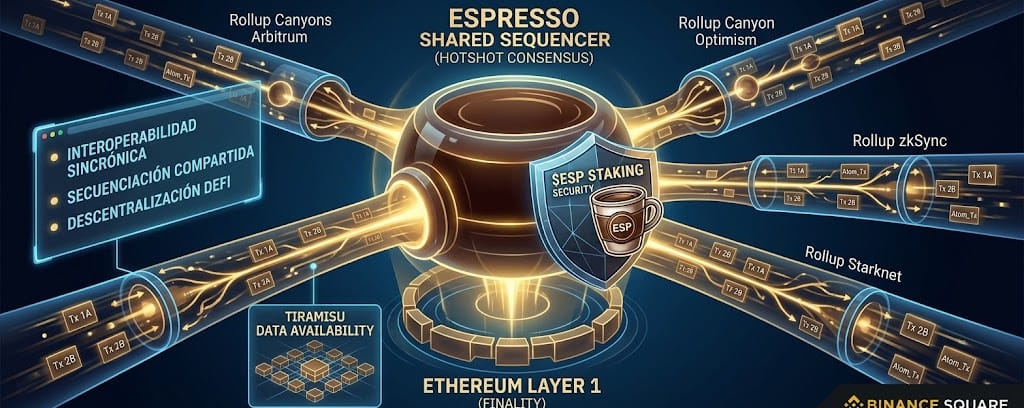
Espresso actúa como un ordenador universal de transacciones para múltiples cadenas de bloques. En lugar de que cada Layer 2 dependa de su propio servidor centralizado, pueden delegar el ordenamiento de sus bloques a Espresso.
💡 Puntos Clave de su Arquitectura:
Interoperabilidad Sincrónica: Al gestionar el orden de las transacciones para varias cadenas simultáneamente, Espresso facilita la ejecución de transacciones atómicas. Esto permite operar entre diferentes L2 de forma instantánea sin sufrir el riesgo de puentes inseguros.
Descentralización con Consensus HotShot: Implementa un mecanismo de consenso eficiente optimizado para procesar grandes volúmenes de transacciones con baja latencia y alta seguridad.
Disponibilidad de Datos (Tiramisu): Garantiza que todos los datos de las transacciones estén accesibles de forma transparente para su verificación final en Ethereum.
🪙 Utilidad del Token $ESP
El token $ESP no es solo un activo de especulación, sino la pieza central de seguridad y gobernanza del protocolo:
Staking y Seguridad de Red: Los operadores de nodos deben congelar $ESP como colateral para garantizar un comportamiento honesto. Si un nodo incurre en prácticas maliciosas, su stake es penalizado (slashing).
Gobernanza: Los holders de $ESP participan en las decisiones de actualización del protocolo y la integración de nuevos rollups a la red compartida.
Priorización de Transacciones: Funciona como mecanismo económico para gestionar el acceso y la velocidad en la red de secuenciación.
📊 Perspectiva de Mercado e Infraestructura
Con la constante evolución de los ecosistemas modular y de agregación de liquidez, las soluciones de secuenciación compartida representan una narrativa crítica de infraestructura a largo plazo.
Para los creadores, desarrolladores y traders que siguen de cerca el desarrollo de DeFi y la escalabilidad de Ethereum, $ESP es un token a monitorear por su impacto directo en la composición del ecosistema rollup.
💬 ¿Qué opinas sobre el futuro de los secuenciadores compartidos en las L2? ¿Crees que la interoperabilidad sincrónica será la clave de la próxima fase DeFi?
Deja tus comentarios abajo y sígueme para más análisis técnicos sobre la infraestructura Web3. 👇
#Ethereum #L2 #Rollups #Layer2 #Crypto #Espresso #ESP #Sequencer #DeFi #Web3 $ESP
{spot}(ESPUSDT)
Descargo de responsabilidad (DYOR): El presente artículo es de carácter puramente educativo e informativo. No constituye ningún tipo de asesoramiento financiero o sugerencia de inversión. Realiza siempre tu propia investigación antes de operar con activos digitales.
☕ Espresso ($ESP): La Pieza Clave para la Interoperabilidad y Descentralización de las Layer 2
La proliferación de soluciones de Capa 2 (Rollups) ha resuelto en gran medida los problemas de escalabilidad y altas comisiones de la red principal de Ethereum. Sin embargo, esta fragmentación ha generado un nuevo desafío: la existencia de silos de liquidez y la dependencia de secuenciadores centralizados que representan un punto único de falla para el ecosistema.
Es aquí donde entra Espresso Network y su token nativo $ESP , una infraestructura diseñada para conectar los rollups mediante una red de secuenciación compartida y descentralizada.
🔍 ¿Qué es Espresso y cómo resuelve la fragmentación?
Espresso actúa como un ordenador universal de transacciones para múltiples cadenas de bloques. En lugar de que cada Layer 2 dependa de su propio servidor centralizado, pueden delegar el ordenamiento de sus bloques a Espresso.
💡 Puntos Clave de su Arquitectura:
Interoperabilidad Sincrónica: Al gestionar el orden de las transacciones para varias cadenas simultáneamente, Espresso facilita la ejecución de transacciones atómicas. Esto permite operar entre diferentes L2 de forma instantánea sin sufrir el riesgo de puentes inseguros.
Descentralización con Consensus HotShot: Implementa un mecanismo de consenso eficiente optimizado para procesar grandes volúmenes de transacciones con baja latencia y alta seguridad.
Disponibilidad de Datos (Tiramisu): Garantiza que todos los datos de las transacciones estén accesibles de forma transparente para su verificación final en Ethereum.
🪙 Utilidad del Token $ESP
El token $ESP no es solo un activo de especulación, sino la pieza central de seguridad y gobernanza del protocolo:
Staking y Seguridad de Red: Los operadores de nodos deben congelar $ESP como colateral para garantizar un comportamiento honesto. Si un nodo incurre en prácticas maliciosas, su stake es penalizado (slashing).
Gobernanza: Los holders de $ESP participan en las decisiones de actualización del protocolo y la integración de nuevos rollups a la red compartida.
Priorización de Transacciones: Funciona como mecanismo económico para gestionar el acceso y la velocidad en la red de secuenciación.
📊 Perspectiva de Mercado e Infraestructura
Con la constante evolución de los ecosistemas modular y de agregación de liquidez, las soluciones de secuenciación compartida representan una narrativa crítica de infraestructura a largo plazo.
Para los creadores, desarrolladores y traders que siguen de cerca el desarrollo de DeFi y la escalabilidad de Ethereum, $ESP es un token a monitorear por su impacto directo en la composición del ecosistema rollup.
💬 ¿Qué opinas sobre el futuro de los secuenciadores compartidos en las L2? ¿Crees que la interoperabilidad sincrónica será la clave de la próxima fase DeFi?
Deja tus comentarios abajo y sígueme para más análisis técnicos sobre la infraestructura Web3. 👇
#Ethereum #L2 #Rollups #Layer2 #Crypto #Espresso #ESP #Sequencer #DeFi #Web3 $ESP
Descargo de responsabilidad (DYOR): El presente artículo es de carácter puramente educativo e informativo. No constituye ningún tipo de asesoramiento financiero o sugerencia de inversión. Realiza siempre tu propia investigación antes de operar con activos digitales.
6
173

·
--
⚡ Layer 2 越快、越便宜,就一定越好吗?
Layer 2 通过不同的扩容机制提升区块链的处理能力,让更多应用有机会降低交易成本、改善使用体验。
但选择网络时,不能只看 TPS 和手续费。
🔐 安全性: 如何验证交易?
🌉 跨链: 桥接资产有哪些风险?
💸 成本: 转入、交易和退出总共需要多少费用?
🔓 自主权: 网络出现故障时,用户能否取回资产?
真正优秀的扩容方案,不只是提高效率,还要让安全性与用户体验保持合理平衡。
你选择 Layer 2 时,最看重哪个指标?
#ONEA #Web3 #Layer2
⚡ Layer 2 越快、越便宜,就一定越好吗?
Layer 2 通过不同的扩容机制提升区块链的处理能力,让更多应用有机会降低交易成本、改善使用体验。
但选择网络时,不能只看 TPS 和手续费。
🔐 安全性: 如何验证交易?
🌉 跨链: 桥接资产有哪些风险?
💸 成本: 转入、交易和退出总共需要多少费用?
🔓 自主权: 网络出现故障时,用户能否取回资产?
真正优秀的扩容方案,不只是提高效率,还要让安全性与用户体验保持合理平衡。
你选择 Layer 2 时,最看重哪个指标?
#ONEA #Web3 #Layer2
Layer 2 通过不同的扩容机制提升区块链的处理能力,让更多应用有机会降低交易成本、改善使用体验。
但选择网络时,不能只看 TPS 和手续费。
🔐 安全性: 如何验证交易?
🌉 跨链: 桥接资产有哪些风险?
💸 成本: 转入、交易和退出总共需要多少费用?
🔓 自主权: 网络出现故障时,用户能否取回资产?
真正优秀的扩容方案,不只是提高效率,还要让安全性与用户体验保持合理平衡。
你选择 Layer 2 时,最看重哪个指标?
#ONEA #Web3 #Layer2
2
2
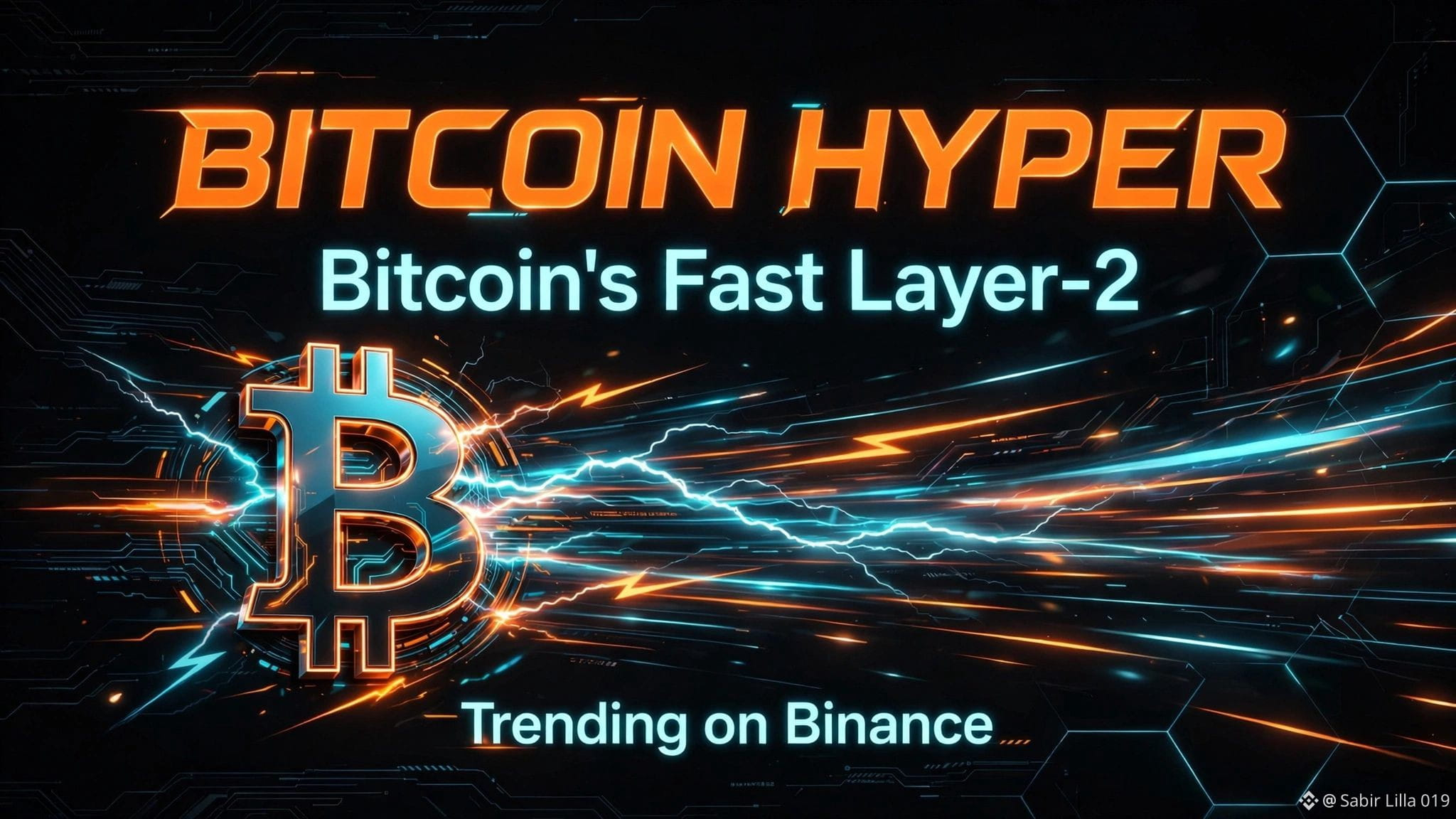
🚀 BITCOIN HYPER ($HYPER ) | Trending on Binance
Bitcoin's first true Fast Layer-2 solution is getting huge attention.
Why everyone is talking about it:
⚡️ Makes BTC transactions super fast
💸 Low fees
🔗 Brings DeFi to Bitcoin
This narrative is HOT right now. HYPER is on Binance listing radar.
Are you watching HYPER? 👀
$HYPER
{spot}(HYPERUSDT)
#BitcoinHyper #HYPER #Bitcoin #BTC #CryptoTrending #BinanceSquare #Layer2
🚀 BITCOIN HYPER ($HYPER ) | Trending on Binance
Bitcoin's first true Fast Layer-2 solution is getting huge attention.
Why everyone is talking about it:
⚡️ Makes BTC transactions super fast
💸 Low fees
🔗 Brings DeFi to Bitcoin
This narrative is HOT right now. HYPER is on Binance listing radar.
Are you watching HYPER? 👀
$HYPER
#BitcoinHyper #HYPER #Bitcoin #BTC #CryptoTrending #BinanceSquare #Layer2
2
1
304
·
--
L2 scaling is quietly shifting from hype to raw utility as Ethereum blob fees drop and ZK finality speeds accelerate. DAA metrics show real mainnet adoption taking over. $LINK is steady at 11.618 while the modular stack matures. Focus on actual usage over noise.
#Layer2 #BlockchainScaling #LINK
L2 scaling is quietly shifting from hype to raw utility as Ethereum blob fees drop and ZK finality speeds accelerate. DAA metrics show real mainnet adoption taking over. $LINK is steady at 11.618 while the modular stack matures. Focus on actual usage over noise.
#Layer2 #BlockchainScaling #LINK
#Layer2 #BlockchainScaling #LINK
1
7


·
--
Bitcoin Evolution The Institutional Shift Into ZK Rollups and Layer 2s
Bitcoin just crossed 81540 and while the retail crowd is chasing the vertical green bars the actual structural transformation of the network is happening in the background. We are witnessing a massive pivot where Bitcoin is transitioning from a purely passive store of value into a functional settlement layer. The numbers tell a story that most people ignore during price discovery phases.
Daily active addresses on the Bitcoin mainnet are holding steady between 750,000 and 920,000 but the real story is in the L2 settlement costs. As mainnet fees fluctuate due to high demand for block space we are seeing a record number of users migrate to scaling solutions. The developer commits for Bitcoin ZK-Rollups and modular data availability protocols have spiked by 45% over the last six months. This is not just theoretical anymore. We are seeing real-time finality speeds on sidechains that make the old ten-minute block time feel like ancient history.
Looking at the whale flows there is a clear trend of large-scale holders moving assets into bridging contracts. This reduces the liquid circulating float on exchanges which is already at multi-year lows. When you have institutional spot absorption on one side and a growing ecosystem of L2s locking up supply on the other the liquidity crunch becomes a mathematical certainty. The network is finally solving its own throughput bottlenecks without compromising the security of the base layer.
This shift toward Bitcoins L2 summer is different from previous cycles because the capital is smarter and the infrastructure is more robust. We are looking at a future where $BTC is the foundation for a much larger decentralized financial stack that rivals anything built on other chains.
Are you planning to keep your stack in cold storage or are you looking to put your BTC to work in these new scaling ecosystems?
#Layer2 #BlockchainScaling
1
7
Көбірек контент көру үшін кіріңіз
Binance Square платформасында әлемдік криптоқоғамдастыққа қосылыңыз
⚡️ Криптовалюта туралы ең соңғы және пайдалы ақпаратты алыңыз.
💬 Әлемдегі ең ірі криптобиржаның сеніміне ие.
👍 Расталған авторлардың нақты пікірлерін табыңыз.
Электрондық пошта/телефон нөмірі
Трендтегі тақырыптар
1
#BinancePick
2.6M рет көрілді
139,560 адам талқылап жатыр
2
#EarningsSeason
5M рет көрілді
24,102 адам талқылап жатыр
3
#StrategyMSTRSurpassesNasdaqInMarketCap
21 рет көрілді
15 адам талқылап жатыр
4
#CanadaProposesStablecoinRedemptionWithin3BusinessDays
0 рет көрілді
0 адам талқылап жатыр
5
#ElectrumWalletBugLetRogueServersStealFunds
5,368 рет көрілді
183 адам талқылап жатыр
6
#ArgentineCourtDismissesLIBRACaseAgainstMilei
13,726 рет көрілді
258 адам талқылап жатыр
7
#SKHynixReportedlyPlansSpecialDividendFromKioxiaStakeSale
2,657 рет көрілді
41 адам талқылап жатыр
8
#KeystoneWebsiteBreachExposesBuyersShippingAddresses
1,479 рет көрілді
35 адам талқылап жатыр
9
#USQ3GDPAndSeptemberPCEDueNextWeek
88,254 рет көрілді
1,066 адам талқылап жатыр
10
#SouthKoreaDelaysCryptoIncomeTax
161,149 рет көрілді
1,116 адам талқылап жатыр