
#binanceagentos
binanceagentos
6,224 рет көрілді
148 адам талқылап жатыр
Қызу саудада
Ең соңғы

·
--
Binance AI vs Binance AI Pro vs Agent OS: Which AI Tool Fits Your Trading Style?Binance now has three AI tools under one roof, and the names are easy to mix up. Binance AI helps you understand the market. Binance AI Pro turns your trading ideas into tested, automated workflows. Binance Agent OS lets developers and power users plug their own AI agents into Binance. Here's how they differ, who each one is built for, and how to pick without overcomplicating it.
The big picture: Binance Intelligence
Binance groups all three tools under one name, Binance Intelligence, an AI layer built into the Binance experience. Co-CEO Richard Teng and VP of Product Jeff Li presented it in a livestream on October 5, and Binance's pitch is simple: bring institutional-grade AI to every kind of user, from a first-time app user to a developer building agents.
The trick is that the three products aren't rivals. They're three doors into the same idea, and each door suits a different person.
Binance AI: the easy button
Binance AI is the free layer that adapts what you see to what you know. It pulls together charts, news, social content, on-chain data and research tools, then adjusts the interface to your experience level, interests and activity. Features include "For You" tags, market briefings, smart tooltips and Master Trade, and it has been rolling out gradually since the Binance Intelligence launch.
It fits you if you're newer to crypto, you want context on why the market is moving, or you'd rather learn first and act later. Think of it as a very well-read guide sitting next to your screen. It explains. You decide.
Binance AI Pro: from idea to workflow
Binance AI Pro officially launched on October 19, 2026, and it's the step up for people who already have trading ideas but don't want to write code. Here's the flow:
Describe your idea in plain language, on the Binance app or on the web at ai.binance.com.Review the Strategy Canvas. AI Pro fills gaps, tightens the logic, and shows the strategy as a visual workflow you can inspect and adjust.Test with paper trading. Every strategy can run on virtual funds before it touches real money.Approve it yourself. Going live is a separate review-and-approve step.Fund a dedicated sub-account. Live strategies run in an isolated AI Strategy Account, and you transfer the funds manually.
AI Pro supports Spot and USDⓈ-M Futures strategies (subject to regional restrictions), with more products planned. It isn't only about trading either: workflows can also handle daily reports, market monitoring, alerts and signal generation. You can keep up to 10 strategies across paper trading, live trading and signals.
There are two plans. The Standard plan is free and includes 250,000 monthly credits. Premium costs 19.99 $USDC per month and adds a much larger credit allowance and access to more models.
Worth knowing: historical backtesting isn't available in the initial release. Binance offers automated code testing and paper trading instead. And, as with every Binance AI tool, outputs aren't investment advice and you remain responsible for your decisions.
It fits you if you think in strategies ("if this happens, do that"), you want automation, and you like seeing the logic laid out before anything runs.
Binance Agent OS: bring your own AI
Agent OS is the developer layer. Launched on August 20, 2026, it bundles Binance APIs, the Wallet Agentic Hub, x402 programmable payments, the Skill Hub and an MCP server. Binance says it has passed 280,000 calls a day.
With the Binance MCP Server, you connect an AI client such as Claude Code, Claude Desktop, Codex, ChatGPT, VS Code or Grok Bot with a single URL, no API keys stored on your device. Per Binance's documentation, your agent can read market data, check balances, trade Spot, Margin, Convert and Futures, and move funds between wallets inside its own sub-account.
The guardrails are built in, and Binance spells them out:
A dedicated Agentic sub-account, isolated from your main account.It starts empty. You fund it manually from the Binance web interface.No withdrawal scope, ever. The agent can't send funds to an external address.Confirm first. Every order, cancel and transfer asks for your approval.Emergency stop. One step disconnects all agents and cancels open positions and orders in that sub-account.
It fits you if you already work with an AI assistant or build your own tools, and you want Binance's data and execution inside that setup.
So which one fits your trading style?
"I want to understand the market better." Start with Binance AI."I have a strategy in my head but I don't code." Try Binance AI Pro."I already use an AI client, or I build my own tools." Go with Agent OS."I'm not sure." Begin with Binance AI, test an idea in AI Pro's paper trading, and look at Agent OS when you're ready to build.
A helpful way to think about it comes from Binance Research, which draws a line between AI co-pilots that help you interpret information and AI agents that monitor and act within set parameters. Binance AI sits on the co-pilot side. AI Pro and Agent OS lean toward the agent side. The more an AI does for you, the more the guardrails matter.
Safety habits for all three
These come straight from Binance's own guidance and are good practice with any AI tool:
You are responsible for what your AI does. Binance's documentation says so plainly.Paper trade first. Test before real money is involved.Fund only what you can afford to lose. The empty-by-default sub-account is a feature, so keep the balance modest.Grant the fewest permissions you need. Add more only when you have to.Read every confirmation. That step exists to protect you.Respect leverage. Derivatives and margin carry substantial risk, and AI can misread data or send wrong parameters.Know your emergency stop before you need it.
Try it yourself
[Try Binance AI Pro](https://www.binance.com/en/learn/binance-ai-pro) (the Standard plan is free to start)[Explore Binance Agent OS](https://www.binance.com/en/agent-os)[Read the Binance MCP Server documentation](https://developers.binance.com/en/docs/agent-native/mcp-server/agentic)[Learn more about Binance Intelligence](https://www.binance.com/en/AI-overview)[Read Binance Research for deeper AI and crypto reports](https://www.binance.com/en/research)Curious about the ecosystem behind it? You can buy $BNB [on Binance](https://www.binance.com/en/crypto/buy/USD/BNB). This is not a recommendation. Crypto is volatile, so only use money you can afford to lose.
{future}(BNBUSDT)
Your turn
Which door would you open first: Binance AI, Binance AI Pro or Agent OS? Tell me in the comments what you'd want an AI to handle for you, and what you'd never hand over.
Disclosure: This post is my own view, not an official Binance statement, and it is for education only, not financial advice. Trading, especially with leverage, involves a high risk of loss.
#BinanceAIPro #BinanceAgentOS #BinanceIntelligence #Write2Earn
Binance AI vs Binance AI Pro vs Agent OS: Which AI Tool Fits Your Trading Style?
Binance now has three AI tools under one roof, and the names are easy to mix up. Binance AI helps you understand the market. Binance AI Pro turns your trading ideas into tested, automated workflows. Binance Agent OS lets developers and power users plug their own AI agents into Binance. Here's how they differ, who each one is built for, and how to pick without overcomplicating it.
The big picture: Binance Intelligence
Binance groups all three tools under one name, Binance Intelligence, an AI layer built into the Binance experience. Co-CEO Richard Teng and VP of Product Jeff Li presented it in a livestream on October 5, and Binance's pitch is simple: bring institutional-grade AI to every kind of user, from a first-time app user to a developer building agents.
The trick is that the three products aren't rivals. They're three doors into the same idea, and each door suits a different person.
Binance AI: the easy button
Binance AI is the free layer that adapts what you see to what you know. It pulls together charts, news, social content, on-chain data and research tools, then adjusts the interface to your experience level, interests and activity. Features include "For You" tags, market briefings, smart tooltips and Master Trade, and it has been rolling out gradually since the Binance Intelligence launch.
It fits you if you're newer to crypto, you want context on why the market is moving, or you'd rather learn first and act later. Think of it as a very well-read guide sitting next to your screen. It explains. You decide.
Binance AI Pro: from idea to workflow
Binance AI Pro officially launched on October 19, 2026, and it's the step up for people who already have trading ideas but don't want to write code. Here's the flow:
Describe your idea in plain language, on the Binance app or on the web at ai.binance.com.Review the Strategy Canvas. AI Pro fills gaps, tightens the logic, and shows the strategy as a visual workflow you can inspect and adjust.Test with paper trading. Every strategy can run on virtual funds before it touches real money.Approve it yourself. Going live is a separate review-and-approve step.Fund a dedicated sub-account. Live strategies run in an isolated AI Strategy Account, and you transfer the funds manually.
AI Pro supports Spot and USDⓈ-M Futures strategies (subject to regional restrictions), with more products planned. It isn't only about trading either: workflows can also handle daily reports, market monitoring, alerts and signal generation. You can keep up to 10 strategies across paper trading, live trading and signals.
There are two plans. The Standard plan is free and includes 250,000 monthly credits. Premium costs 19.99 $USDC per month and adds a much larger credit allowance and access to more models.
Worth knowing: historical backtesting isn't available in the initial release. Binance offers automated code testing and paper trading instead. And, as with every Binance AI tool, outputs aren't investment advice and you remain responsible for your decisions.
It fits you if you think in strategies ("if this happens, do that"), you want automation, and you like seeing the logic laid out before anything runs.
Binance Agent OS: bring your own AI
Agent OS is the developer layer. Launched on August 20, 2026, it bundles Binance APIs, the Wallet Agentic Hub, x402 programmable payments, the Skill Hub and an MCP server. Binance says it has passed 280,000 calls a day.
With the Binance MCP Server, you connect an AI client such as Claude Code, Claude Desktop, Codex, ChatGPT, VS Code or Grok Bot with a single URL, no API keys stored on your device. Per Binance's documentation, your agent can read market data, check balances, trade Spot, Margin, Convert and Futures, and move funds between wallets inside its own sub-account.
The guardrails are built in, and Binance spells them out:
A dedicated Agentic sub-account, isolated from your main account.It starts empty. You fund it manually from the Binance web interface.No withdrawal scope, ever. The agent can't send funds to an external address.Confirm first. Every order, cancel and transfer asks for your approval.Emergency stop. One step disconnects all agents and cancels open positions and orders in that sub-account.
It fits you if you already work with an AI assistant or build your own tools, and you want Binance's data and execution inside that setup.
So which one fits your trading style?
"I want to understand the market better." Start with Binance AI."I have a strategy in my head but I don't code." Try Binance AI Pro."I already use an AI client, or I build my own tools." Go with Agent OS."I'm not sure." Begin with Binance AI, test an idea in AI Pro's paper trading, and look at Agent OS when you're ready to build.
A helpful way to think about it comes from Binance Research, which draws a line between AI co-pilots that help you interpret information and AI agents that monitor and act within set parameters. Binance AI sits on the co-pilot side. AI Pro and Agent OS lean toward the agent side. The more an AI does for you, the more the guardrails matter.
Safety habits for all three
These come straight from Binance's own guidance and are good practice with any AI tool:
You are responsible for what your AI does. Binance's documentation says so plainly.Paper trade first. Test before real money is involved.Fund only what you can afford to lose. The empty-by-default sub-account is a feature, so keep the balance modest.Grant the fewest permissions you need. Add more only when you have to.Read every confirmation. That step exists to protect you.Respect leverage. Derivatives and margin carry substantial risk, and AI can misread data or send wrong parameters.Know your emergency stop before you need it.
Try it yourself
Try Binance AI Pro (the Standard plan is free to start)Explore Binance Agent OSRead the Binance MCP Server documentationLearn more about Binance IntelligenceRead Binance Research for deeper AI and crypto reportsCurious about the ecosystem behind it? You can buy $BNB on Binance. This is not a recommendation. Crypto is volatile, so only use money you can afford to lose.
Your turn
Which door would you open first: Binance AI, Binance AI Pro or Agent OS? Tell me in the comments what you'd want an AI to handle for you, and what you'd never hand over.
Disclosure: This post is my own view, not an official Binance statement, and it is for education only, not financial advice. Trading, especially with leverage, involves a high risk of loss.
#BinanceAIPro #BinanceAgentOS #BinanceIntelligence #Write2Earn
1
2
106
·
--
From Answering to Acting: How Binance Agent OS Works in PracticeAI is moving from simply answering questions to actually taking action. In crypto, that shift could be significant — and Binance Agent OS is designed to provide the infrastructure that makes it possible.
Instead of an AI agent merely telling you that Bitcoin is moving, imagine an agent that can access market data, monitor positions, evaluate conditions and interact with trading infrastructure — all within permissions and limits defined by the user.
That is the idea behind Binance Agent OS.
What Is Binance Agent OS?
Binance Agent OS is a developer toolkit that connects AI agents to Binance through the Model Context Protocol (MCP), APIs and ready-made skills.
The system allows agents to access crypto and TradFi market data, track portfolios, interact with trading functions, automate payments and, where supported, interact with on-chain services.
The important part is that the agent does not need unrestricted access.
Binance describes the architecture around three principles: connect, build and control. Developers can connect an existing AI-agent stack, build workflows using Binance infrastructure and establish permissions, accounts and limits for individual agents.
From AI Conversation to Action
Consider a simple trading workflow.
A user could ask an AI agent to monitor BTC and identify a specific market condition. Through the Binance MCP server, the agent can access the relevant Binance tools and data.
The workflow can look like this:
User request → AI agent → Binance MCP → market data → analysis → permitted action
The MCP layer acts as the bridge between the AI agent and Binance infrastructure.
This is where the difference between a traditional chatbot and an AI agent becomes clearer.
A chatbot might answer: “BTC is trading at X.”
An agent connected to financial infrastructure could potentially retrieve the relevant data, evaluate a predefined condition and initiate an allowed action — subject to the permissions and controls established by the user.
Binance says Agent OS can allow agents to monitor markets, react to signals and act when specified conditions are met.
Why MCP Matters
Model Context Protocol (MCP) is an open standard designed to allow AI applications to connect with external data and services.
For Binance Agent OS, the Binance MCP server provides a structured connection between an AI agent and Binance tools.
The setup is designed around three steps:
1. Add the Binance MCP Server
2. Authenticate the server
3. Activate the agent
That makes MCP more than a technical buzzword. It becomes the connection layer that allows an AI agent to interact with financial infrastructure.
The Guardrails Are the Important Part
Giving an AI access to financial systems raises an obvious question: How much authority should the agent have?
This is where controls matter.
Binance Agent OS emphasizes configurable permissions, accounts and limits. An agent can therefore be designed around a defined operating perimeter rather than being given unlimited authority.
That distinction could become increasingly important as AI agents move deeper into financial workflows.
The goal isn't simply to make AI more autonomous.
It is to make autonomous financial actions more controlled and auditable.
The Bigger Picture
Binance Agent OS represents a broader shift from AI that provides information to AI that can interact with financial infrastructure.
Market data, trading, payments, portfolio tracking and on-chain functionality can become tools available to AI agents through established Binance infrastructure.
That is why agentic finance is worth watching.
The future may not be about asking an AI, “What should I do?”
It may increasingly be about giving an AI clearly defined rules, permissions and objectives — and allowing it to execute within those boundaries.
For developers, traders and crypto users, Binance Agent OS offers a practical look at what that future could look like.
Explore Binance Agent OS: [Binance Agent OS](https://www.binance.com/es/agent-os?utm_source=chatgpt.com)
Interested in BNB? Explore Binance's official Buy BNB option here: [Buy BNB on Binance](https://www.binance.com/en/buy-sell-crypto/bnb?utm_source=chatgpt.com)
Not financial advice. Crypto assets are volatile and AI-generated outputs can contain errors or outdated information. Always do your own research (DYOR) and understand the risks before trading or investing.
#BinanceAgentOS #AgenticFinance #MCP
From Answering to Acting: How Binance Agent OS Works in Practice
AI is moving from simply answering questions to actually taking action. In crypto, that shift could be significant — and Binance Agent OS is designed to provide the infrastructure that makes it possible.
Instead of an AI agent merely telling you that Bitcoin is moving, imagine an agent that can access market data, monitor positions, evaluate conditions and interact with trading infrastructure — all within permissions and limits defined by the user.
That is the idea behind Binance Agent OS.
What Is Binance Agent OS?
Binance Agent OS is a developer toolkit that connects AI agents to Binance through the Model Context Protocol (MCP), APIs and ready-made skills.
The system allows agents to access crypto and TradFi market data, track portfolios, interact with trading functions, automate payments and, where supported, interact with on-chain services.
The important part is that the agent does not need unrestricted access.
Binance describes the architecture around three principles: connect, build and control. Developers can connect an existing AI-agent stack, build workflows using Binance infrastructure and establish permissions, accounts and limits for individual agents.
From AI Conversation to Action
Consider a simple trading workflow.
A user could ask an AI agent to monitor BTC and identify a specific market condition. Through the Binance MCP server, the agent can access the relevant Binance tools and data.
The workflow can look like this:
User request → AI agent → Binance MCP → market data → analysis → permitted action
The MCP layer acts as the bridge between the AI agent and Binance infrastructure.
This is where the difference between a traditional chatbot and an AI agent becomes clearer.
A chatbot might answer: “BTC is trading at X.”
An agent connected to financial infrastructure could potentially retrieve the relevant data, evaluate a predefined condition and initiate an allowed action — subject to the permissions and controls established by the user.
Binance says Agent OS can allow agents to monitor markets, react to signals and act when specified conditions are met.
Why MCP Matters
Model Context Protocol (MCP) is an open standard designed to allow AI applications to connect with external data and services.
For Binance Agent OS, the Binance MCP server provides a structured connection between an AI agent and Binance tools.
The setup is designed around three steps:
1. Add the Binance MCP Server
2. Authenticate the server
3. Activate the agent
That makes MCP more than a technical buzzword. It becomes the connection layer that allows an AI agent to interact with financial infrastructure.
The Guardrails Are the Important Part
Giving an AI access to financial systems raises an obvious question: How much authority should the agent have?
This is where controls matter.
Binance Agent OS emphasizes configurable permissions, accounts and limits. An agent can therefore be designed around a defined operating perimeter rather than being given unlimited authority.
That distinction could become increasingly important as AI agents move deeper into financial workflows.
The goal isn't simply to make AI more autonomous.
It is to make autonomous financial actions more controlled and auditable.
The Bigger Picture
Binance Agent OS represents a broader shift from AI that provides information to AI that can interact with financial infrastructure.
Market data, trading, payments, portfolio tracking and on-chain functionality can become tools available to AI agents through established Binance infrastructure.
That is why agentic finance is worth watching.
The future may not be about asking an AI, “What should I do?”
It may increasingly be about giving an AI clearly defined rules, permissions and objectives — and allowing it to execute within those boundaries.
For developers, traders and crypto users, Binance Agent OS offers a practical look at what that future could look like.
Explore Binance Agent OS: Binance Agent OS
Interested in BNB? Explore Binance's official Buy BNB option here: Buy BNB on Binance
Not financial advice. Crypto assets are volatile and AI-generated outputs can contain errors or outdated information. Always do your own research (DYOR) and understand the risks before trading or investing.
#BinanceAgentOS #AgenticFinance #MCP
1
148

·
--
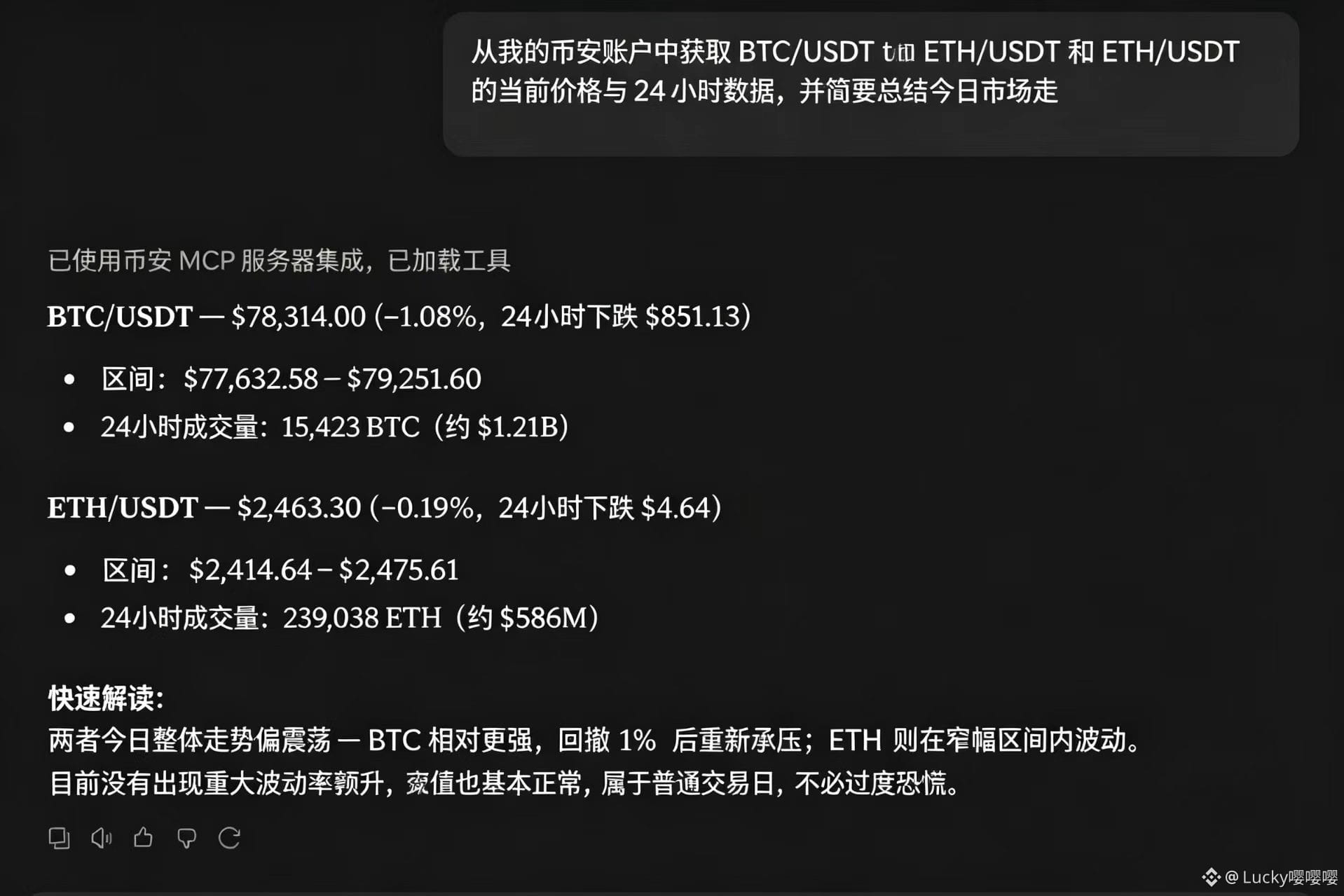
Дәйексөз келтірілген мазмұн жойылды
156

·
--
Расталды
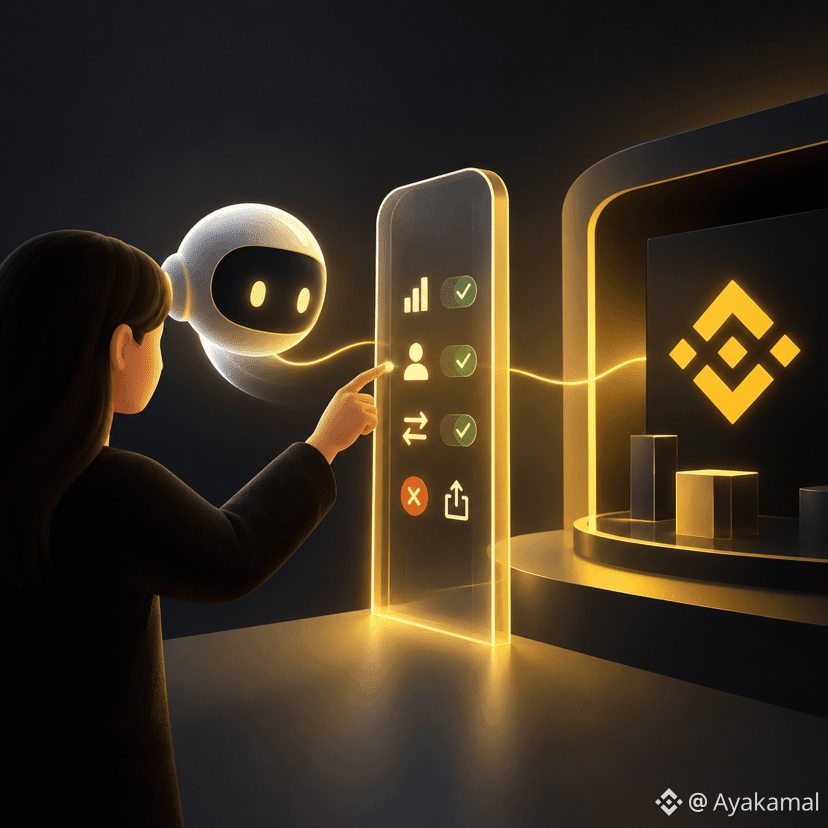
What if your AI assistant could actually interact with Binance? 🤖
Not just answer questions.
Not just analyze a chart.
But connect to supported Binance tools and perform specific actions — within the permissions you give it.
That’s the idea behind Binance Agent OS and MCP (Model Context Protocol).
Here’s the part I find most interesting:
🔐 The Agent doesn’t get unlimited access.
Depending on your permissions, account eligibility, product and region, supported capabilities can include:
• Market data
• Agentic sub-account information
• Supported trading actions
• Transfers within the Agentic sub-account
And there’s an important boundary:
🚫 No withdrawal scope through the Binance MCP Server.
So the Agent cannot use this integration to withdraw funds to an external address.
You can also manage your Agentic account, review permissions, disconnect Agents, and use Emergency Stop when needed.
The bigger idea isn’t simply “AI can trade crypto.”
It’s about giving AI access to real tools with defined permissions and human-controlled boundaries.
Would you trust an AI Agent with any task on your Binance account? 👀
⚠️ Availability, eligibility, and supported features vary by region and account. Educational content only, not financial advice. Use official Binance sources and always DYOR.
#Binance #BinanceAgentOS #BinanceAcademy #LearnWithBinance
3
128
·
--
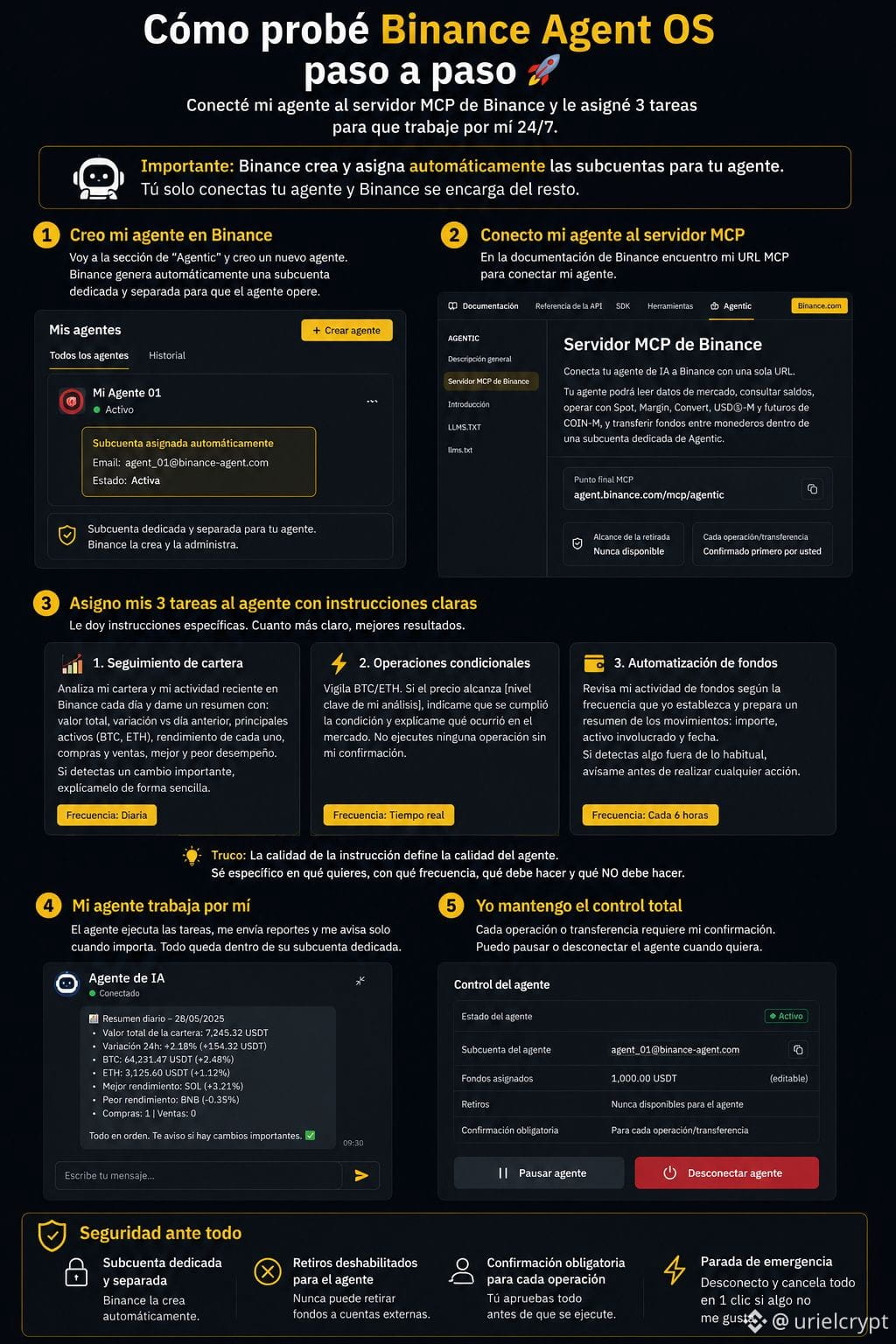
🚀 Probé Binance Agent OS con mi cartera cripto
¿Y si en lugar de estar entrando a Binance todo el día, tuviera un agente que vigile mi actividad y me avise solo cuando importa? Conecté mi agente al servidor MCP de Binance y le asigné 3 tareas 👇
1️⃣ Seguimiento de cartera 📊
"Analiza mi cartera y mi actividad reciente. Cada día dame: valor total, variación vs el día anterior, principales activos (BTC, ETH), rendimiento de cada uno, compras/ventas, y cuál fue el mejor y peor desempeño. Si hay un cambio importante, explicámelo simple."
2️⃣ Operaciones condicionales ⚡
"Vigila BTC/ETH. Si el precio alcanza [nivel clave de mi análisis], avisame que se cumplió y explicame qué pasó en el mercado. No ejecutes nada sin mi confirmación."
3️⃣ Automatización de fondos 🤖
"Revisa mi actividad de fondos según la frecuencia que yo defina y prepará un resumen: importe, activo y fecha. Si detectás algo fuera de lo habitual, avisame antes de actuar."
🔒 Por qué me animé sin miedo: el agente opera en una subcuenta dedicada, separada de mi cuenta principal. Los retiros están "nunca disponibles" y cada operación queda "confirmado primero por usted" — así lo define la propia documentación de Binance, no es solo mi palabra.
🧠 El truco: la calidad de la instrucción define la calidad del agente.
❌ "Analiza mi cartera."
✅ Analiza → resume → avisame → no ejecutes sin confirmación.
¿Qué tarea le asignarían ustedes primero a su agente?
#BinanceAgentOS @Binance_Angels
Gráfico ilustrativo creado para explicar el proceso. La interfaz real de Binance Agent OS puede variar.
🚀 Probé Binance Agent OS con mi cartera cripto
¿Y si en lugar de estar entrando a Binance todo el día, tuviera un agente que vigile mi actividad y me avise solo cuando importa? Conecté mi agente al servidor MCP de Binance y le asigné 3 tareas 👇
1️⃣ Seguimiento de cartera 📊
"Analiza mi cartera y mi actividad reciente. Cada día dame: valor total, variación vs el día anterior, principales activos (BTC, ETH), rendimiento de cada uno, compras/ventas, y cuál fue el mejor y peor desempeño. Si hay un cambio importante, explicámelo simple."
2️⃣ Operaciones condicionales ⚡
"Vigila BTC/ETH. Si el precio alcanza [nivel clave de mi análisis], avisame que se cumplió y explicame qué pasó en el mercado. No ejecutes nada sin mi confirmación."
3️⃣ Automatización de fondos 🤖
"Revisa mi actividad de fondos según la frecuencia que yo defina y prepará un resumen: importe, activo y fecha. Si detectás algo fuera de lo habitual, avisame antes de actuar."
🔒 Por qué me animé sin miedo: el agente opera en una subcuenta dedicada, separada de mi cuenta principal. Los retiros están "nunca disponibles" y cada operación queda "confirmado primero por usted" — así lo define la propia documentación de Binance, no es solo mi palabra.
🧠 El truco: la calidad de la instrucción define la calidad del agente.
❌ "Analiza mi cartera."
✅ Analiza → resume → avisame → no ejecutes sin confirmación.
¿Qué tarea le asignarían ustedes primero a su agente?
#BinanceAgentOS @Binance Angels
Gráfico ilustrativo creado para explicar el proceso. La interfaz real de Binance Agent OS puede variar.
5
348

Prompt: "Transfer 0.0005 BNB from my Spot wallet to my Funding wallet."
Result: ✅ Transfer executed successfully via Claude + Binance Agent OS
Transaction ID: 404886026479
Just completed Challenge 1 of
#BinanceAgentOS
Prompt: "Transfer 0.0005 BNB from my Spot wallet to my Funding wallet."
Result: ✅ Transfer executed successfully via Claude + Binance Agent OS
Transaction ID: 404886026479
Just completed Challenge 1 of
#BinanceAgentOS
Result: ✅ Transfer executed successfully via Claude + Binance Agent OS
Transaction ID: 404886026479
Just completed Challenge 1 of
#BinanceAgentOS
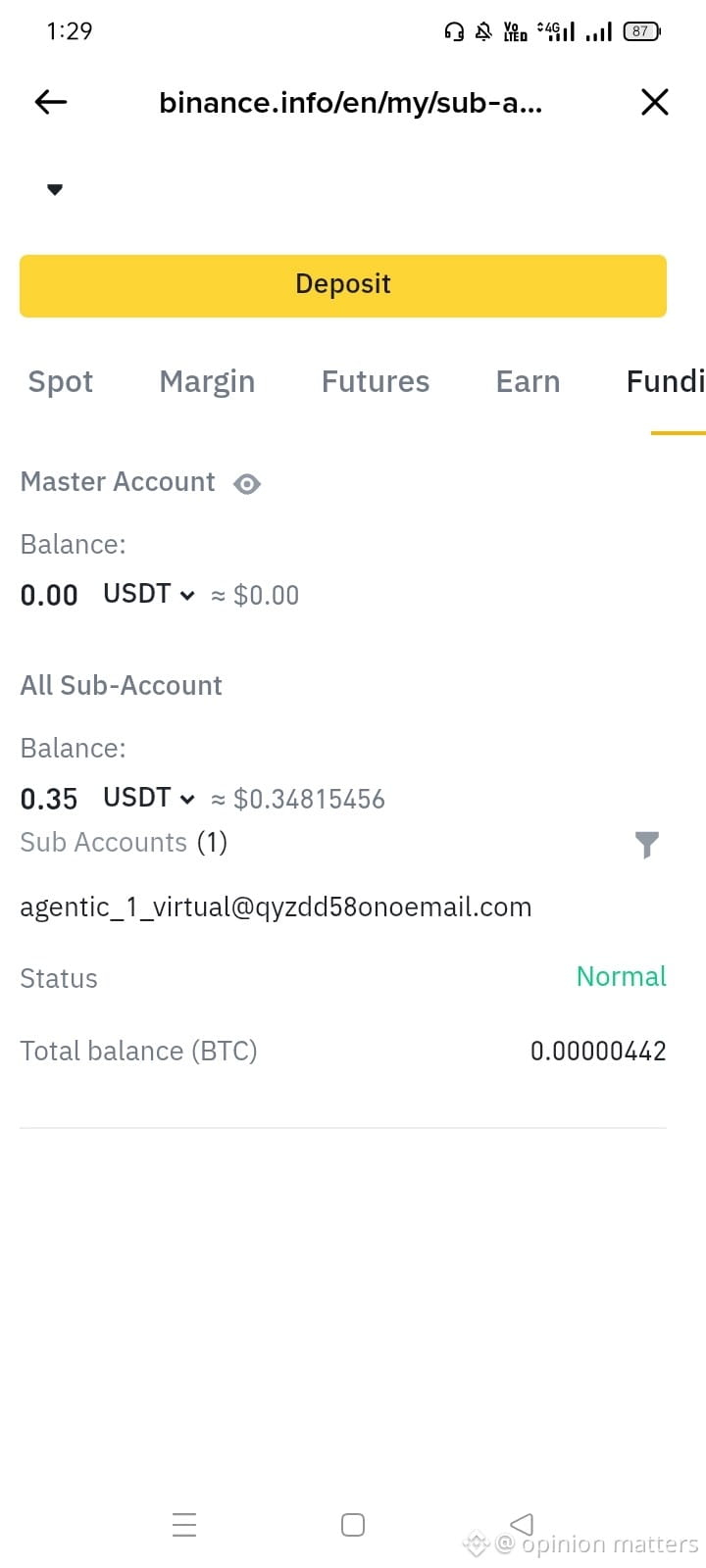
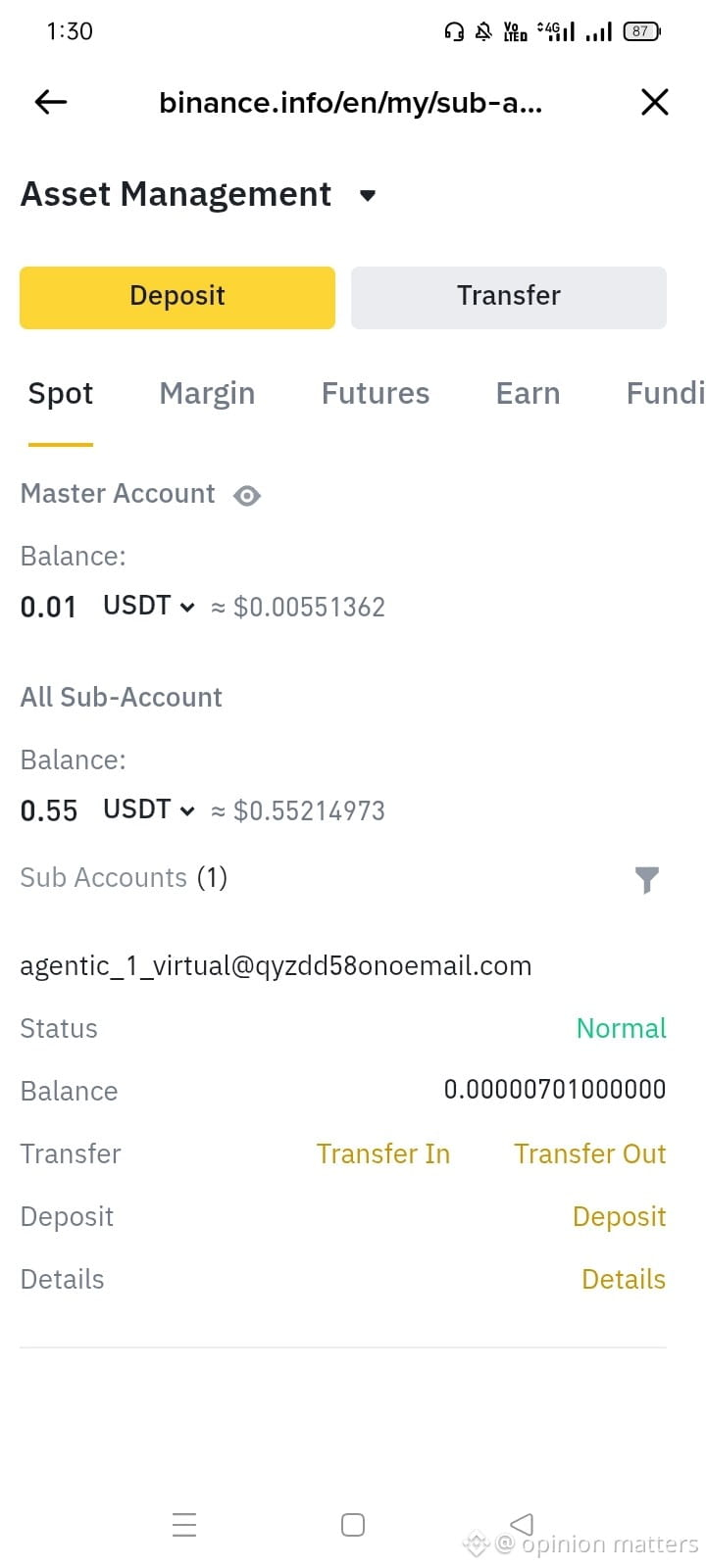

105

·
--

Мақала
Beyond Crypto: Why Binance Is Becoming Your Multi-Asset Financial AccountThe definition of a crypto exchange is changing.
Binance is increasingly positioning itself as more than a place to buy Bitcoin or trade crypto. The platform is bringing crypto, stocks, tokenized equities, and AI-powered financial tools into a connected ecosystem — creating what could become a new type of multi-asset financial account.
Three forces are driving this evolution: Access, Network, and Agentic intelligence.
1. Access: More Assets, Fewer Barriers
Traditional financial markets have historically been separated by brokers, market hours, account requirements, and geographic restrictions.
Binance is trying to reduce some of that friction.
Its bStocks product brings tokenized exposure to selected U.S.-listed equities onto blockchain rails. Eligible users can trade bStocks 24/7, including weekends, with fractional access starting from as little as $5. Binance says bStocks are backed 1:1 by corresponding shares held with a regulated custodian.
Meanwhile, Binance's direct stock offering provides access to more than 7,000 U.S.-listed stocks and ETFs in supported regions.
The result is a broader financial toolkit: crypto assets, traditional stocks, tokenized securities, and derivatives can increasingly exist within one account.
2. Network: Liquidity Creates the Advantage
Access alone isn't enough. Markets need liquidity, price discovery, and deep participation.
This is where Binance's existing crypto infrastructure becomes important.
Millions of users, global liquidity, and established trading infrastructure create an environment where different asset classes can increasingly connect. Binance's bStocks are designed to bring the 24/7 trading model of crypto to tokenized equities, while allowing eligible users to move between direct stocks and bStocks.
That creates an interesting bridge between traditional finance and on-chain finance.
Instead of thinking about stocks and crypto as completely separate portfolios, users can increasingly manage different forms of exposure through the same financial ecosystem.
3. Agentic: Your Financial Interface Is Changing (Binance Agent OS)
The biggest shift may not be another asset class. It could be AI.
With Binance Agent OS, AI Pro, and Model Context Protocol (MCP), Binance is building infrastructure that allows AI agents to interact with financial data and services.
According to the figures highlighted in the Binance ecosystem, MCP connections jumped from around 800 to 3,000 in one week — a 3.8x increase — while daily calls reached 224,000.
That matters because the future financial interface may not simply be a trading screen.
It could be an AI agent that understands market data, account information, positions, and available financial tools, then helps users navigate them.
The Bigger Picture
The strategic direction is becoming clearer: Binance is moving from a crypto exchange toward a multi-asset financial platform or Financial Super app road map.
Crypto remains at the core, but stocks, tokenized securities, 24/7 markets, and agentic AI are expanding the ecosystem.
The interesting question is no longer just “Where do I trade crypto?”
It may soon become:
“Where do I manage my entire digital financial life?”
Availability of products and features varies by jurisdiction. bStocks are tokenized securities and do not represent direct ownership of the underlying shares. [Check here](https://www.binance.com/en/support/announcement/detail/2c0c92ed15ac42d1b14bb1eac00d22bb?utm_source=chatgpt.com)
$BNB $BTW $PIEVERSE
#Binance #BinanceAgentOS #AITrading
{future}(BTWUSDT)
{spot}(BNBUSDT)
Beyond Crypto: Why Binance Is Becoming Your Multi-Asset Financial Account
The definition of a crypto exchange is changing.
Binance is increasingly positioning itself as more than a place to buy Bitcoin or trade crypto. The platform is bringing crypto, stocks, tokenized equities, and AI-powered financial tools into a connected ecosystem — creating what could become a new type of multi-asset financial account.
Three forces are driving this evolution: Access, Network, and Agentic intelligence.
1. Access: More Assets, Fewer Barriers
Traditional financial markets have historically been separated by brokers, market hours, account requirements, and geographic restrictions.
Binance is trying to reduce some of that friction.
Its bStocks product brings tokenized exposure to selected U.S.-listed equities onto blockchain rails. Eligible users can trade bStocks 24/7, including weekends, with fractional access starting from as little as $5. Binance says bStocks are backed 1:1 by corresponding shares held with a regulated custodian.
Meanwhile, Binance's direct stock offering provides access to more than 7,000 U.S.-listed stocks and ETFs in supported regions.
The result is a broader financial toolkit: crypto assets, traditional stocks, tokenized securities, and derivatives can increasingly exist within one account.
2. Network: Liquidity Creates the Advantage
Access alone isn't enough. Markets need liquidity, price discovery, and deep participation.
This is where Binance's existing crypto infrastructure becomes important.
Millions of users, global liquidity, and established trading infrastructure create an environment where different asset classes can increasingly connect. Binance's bStocks are designed to bring the 24/7 trading model of crypto to tokenized equities, while allowing eligible users to move between direct stocks and bStocks.
That creates an interesting bridge between traditional finance and on-chain finance.
Instead of thinking about stocks and crypto as completely separate portfolios, users can increasingly manage different forms of exposure through the same financial ecosystem.
3. Agentic: Your Financial Interface Is Changing (Binance Agent OS)
The biggest shift may not be another asset class. It could be AI.
With Binance Agent OS, AI Pro, and Model Context Protocol (MCP), Binance is building infrastructure that allows AI agents to interact with financial data and services.
According to the figures highlighted in the Binance ecosystem, MCP connections jumped from around 800 to 3,000 in one week — a 3.8x increase — while daily calls reached 224,000.
That matters because the future financial interface may not simply be a trading screen.
It could be an AI agent that understands market data, account information, positions, and available financial tools, then helps users navigate them.
The Bigger Picture
The strategic direction is becoming clearer: Binance is moving from a crypto exchange toward a multi-asset financial platform or Financial Super app road map.
Crypto remains at the core, but stocks, tokenized securities, 24/7 markets, and agentic AI are expanding the ecosystem.
The interesting question is no longer just “Where do I trade crypto?”
It may soon become:
“Where do I manage my entire digital financial life?”
Availability of products and features varies by jurisdiction. bStocks are tokenized securities and do not represent direct ownership of the underlying shares. Check here
$BNB $BTW $PIEVERSE
#Binance #BinanceAgentOS #AITrading
3
457

Proud to be one of the Top 10 winners of the Agent OS Creator Challenge! 💛
Huge thanks to the @binance #AgentOS team, Karin @heyi @CZ @richardteng for organizing this challenge and for recognizing our work. It was a great experience creating, testing and sharing my perspective on Agent OS.
Congrats to all the winners! 🎉
And if you didn’t make the Top 10 this time, don’t give up. Your effort matters, keep creating, keep experimenting, and keep showing up. Your next win could be just around the corner.
Grateful for this opportunity. On to the next one!
#BinanceAgentOS #AgentOS #challenge $BNB
{future}(BNBUSDT)
Proud to be one of the Top 10 winners of the Agent OS Creator Challenge! 💛
Huge thanks to the @binance #AgentOS team, Karin @Yi He @CZ @Richard Teng for organizing this challenge and for recognizing our work. It was a great experience creating, testing and sharing my perspective on Agent OS.
Congrats to all the winners! 🎉
And if you didn’t make the Top 10 this time, don’t give up. Your effort matters, keep creating, keep experimenting, and keep showing up. Your next win could be just around the corner.
Grateful for this opportunity. On to the next one!
#BinanceAgentOS #AgentOS #challenge $BNB
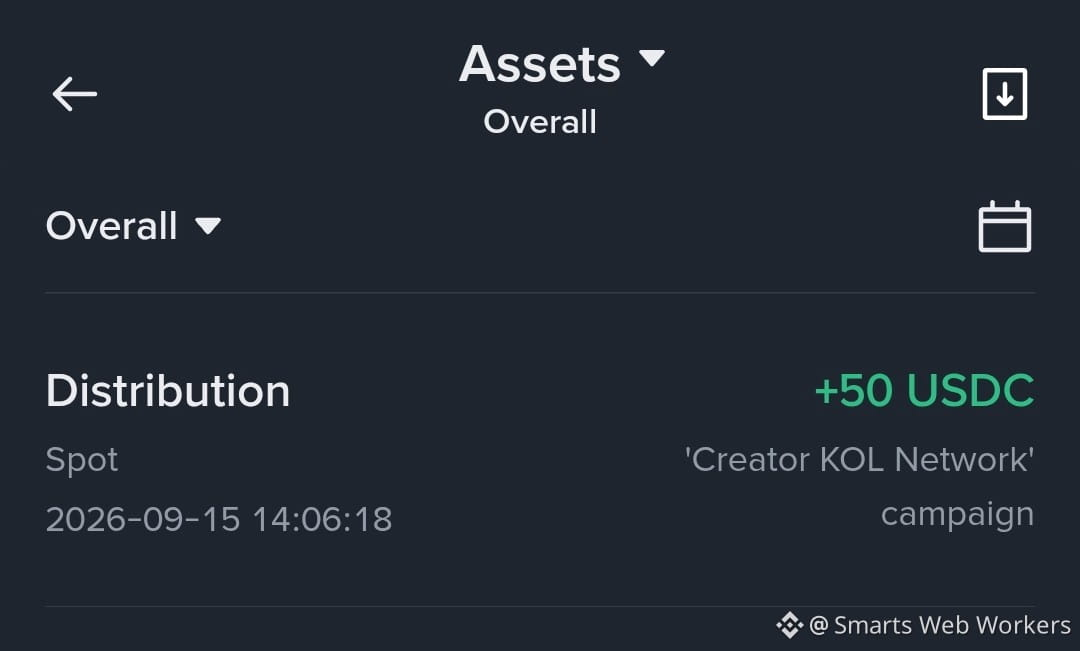
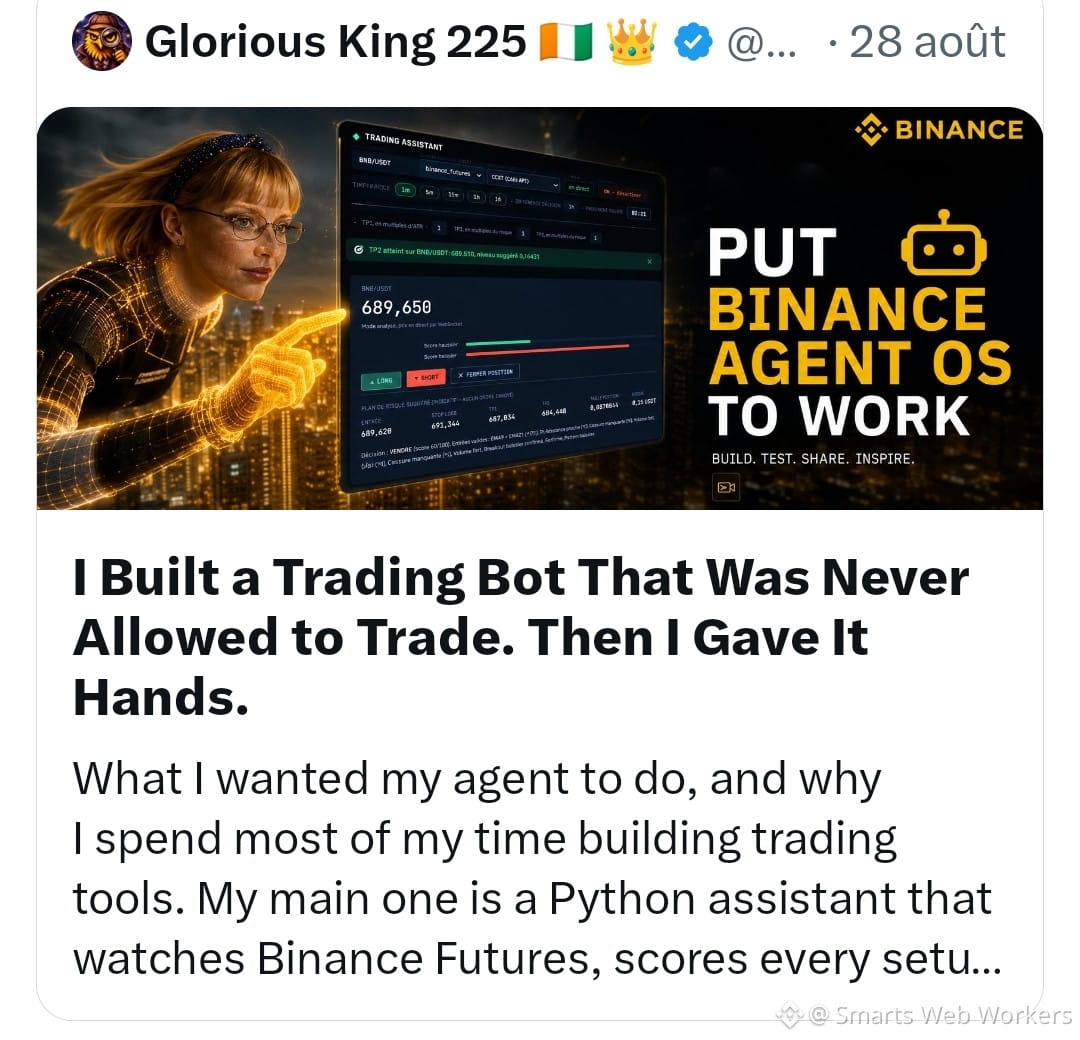
2
3
481
·
--
Мақала
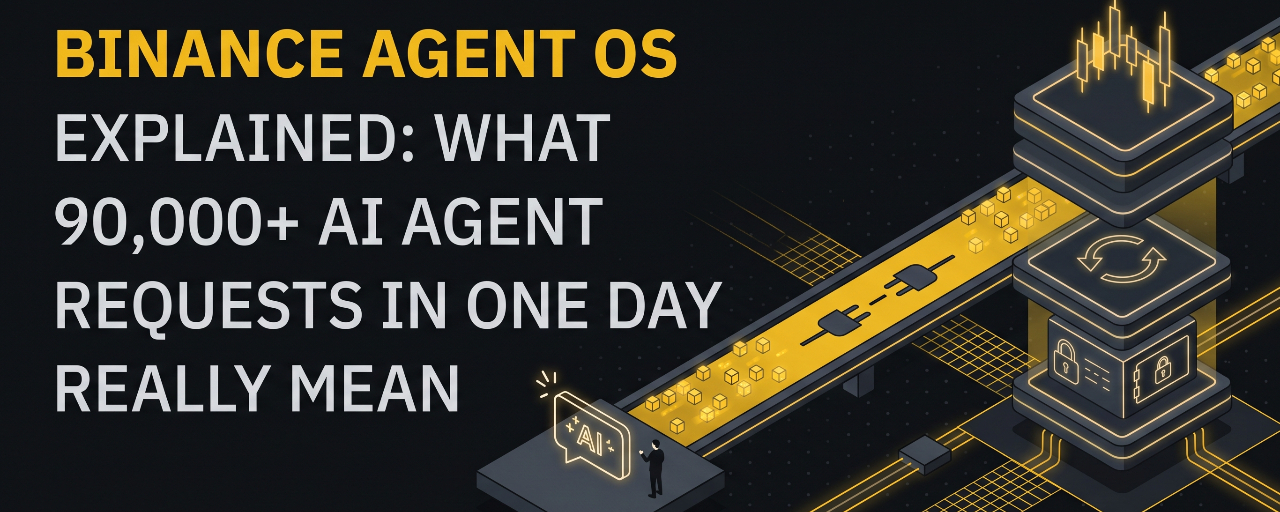
Binance Agent OS Explained: What 90,000+ AI Agent Requests in One Day Really MeanFor years, AI in crypto meant chatbots that explained candlestick charts. Now AI is starting to do things: pull live prices, check positions, and, with your permission, act on your account.
In its first weeks live, Binance reported that Binance Agent OS processed more than 90,000 agent requests in a single day. About 97% completed successfully, and 95% were served within 60 milliseconds. Here is what that means, and why it matters.
Why Binance Agent OS matters
Most AI tools are good at talking but disconnected from live markets. Prices move in seconds, so an assistant working from stale data is of little use for trading research.
Agent OS aims to close that gap. Binance describes it as a developer platform, built as part of Binance Intelligence, that connects certain AI applications and agents to supported Binance features. In plain terms, it lets an AI agent read market data, view balances, and, with permission, place trades.
What is Binance Agent OS?
Think of it as a bridge between your AI tool and Binance. Instead of opening several dashboards or writing API requests by hand, an agent can discover the Binance tools available through an MCP connection.
MCP (Model Context Protocol) is a standard way for AI apps to plug into external services. Binance's Agent OS offers several ways to connect, with tools for trading, payments, wallet interactions, and more.
What it connects to
At launch, coverage included:
Market data and account tools for prices, balances, and positionsTrading, routed through dedicated sub-accountsPayments, via x402 and an Agentic Wallet
The numbers: what 90,000+ requests tell us
Here is the headline data Binance shared:
Metric | Reported resultPeak daily agent requests | 90,000+Requests completed successfully | About 97%Requests served within 60 ms | 95%
Binance also said nearly half of active users made 20 or more requests in a single day. Its most-used capabilities were live market data, positions, account info, and price movements.
How to read these figures
A "request" is a call to the system, not a trade and not a user. One agent workflow, such as "summarize my portfolio," can trigger several requests at once.
So the real insight is about behavior. The most popular uses are read-only ones: checking data, tracking positions, and monitoring moves. People are using agents first as research and monitoring assistants, not as autonomous traders. These are also Binance-reported numbers, not independent audits.
Practical examples: what agents actually do
Portfolio snapshots: One prompt can return a full account summary. A Binance Square post highlighted a portfolio tracker with drawdown alerts as a user case.Market monitoring: An agent checks live prices and price movements, then summarizes what changed.Position checks: Ask, "How exposed am I to one asset?" and get an answer from your actual account data.Guided trading (optional): With permission, an agent can place trades, though Binance lets users choose whether trades need approval or can run autonomously.
Staying in control: permissions and safeguards
The more useful agents become, the more control matters. Binance built several guardrails into Agent OS:
Dedicated sub-accounts: Agent activity is routed into its own sub-accounts, where users define access and can revoke permissions.Approval options: Users choose whether trades require approval or can execute autonomously.Withdrawals off by default: Binance said withdrawals are disabled by default and that existing security and AML controls apply.Daily caps: Limits apply to swaps, DeFi activity, and x402 transfers.
Risks you still need to manage
Guardrails reduce risk but don't remove it. One review noted that although withdrawals are blocked and swaps are capped, trading losses themselves have no limit. An AI agent can still make a bad trade inside its sub-account.
Other practical risks include over-trusting AI output, vague prompts, and handing over more permission than you need. Treat an agent like a new junior analyst: useful, fast, and in need of supervision.
How to start safely
Start read-only. Begin with market data and portfolio queries, which match what most early users do.Use a dedicated sub-account. Fund it with only an amount you can afford to lose.Require approval for trades. Keep a human in the loop until you trust the workflow.Review activity regularly. Check what your agent did and revoke access you no longer need.Learn the basics first. Binance Academy has an explainer on how Agent OS works, and the official announcement lists supported features and limits.
Conclusion: Binance Agent OS and useful action
The 90,000+ request milestone isn't proof that AI traders have arrived. It does show people want AI connected to live market data and their own accounts. The next phase of AI in crypto is less about raw intelligence and more about useful, controlled action, and tools like Binance Agent OS are an early test of that idea.
This article is for education only and is not financial advice. Crypto trading carries risk, including total loss of capital.
Key takeaways
Binance reported 90,000+ agent requests in one day, with a 97% success rate and 95% served within 60 ms.Requests are system calls, not trades or unique users.Early usage leans toward read-only tasks like market data and account checks.Agents run through dedicated sub-accounts with revocable permissions.Withdrawals are disabled by default, but trading losses are still possible.
FAQ
What is Binance Agent OS?
It's a developer platform that connects supported AI apps and agents to Binance features.
Can an AI agent withdraw my funds?
Binance said withdrawals are disabled by default, and existing security and AML controls apply.
Does 90,000 requests mean 90,000 trades?
No. Requests are calls to the system, and most popular uses were data lookups.
Can I require approval for trades?
Yes. Users choose whether trades need approval or can run autonomously.
Can I still lose money?
Yes. Safeguards limit some actions, but trading losses are not capped.
Where do I learn more?
Start with the Binance Academy guide and the official announcement.
#BinanceAgentOS #AIAgents #Binance #CryptoAI #MCP
Binance Agent OS Explained: What 90,000+ AI Agent Requests in One Day Really Mean
For years, AI in crypto meant chatbots that explained candlestick charts. Now AI is starting to do things: pull live prices, check positions, and, with your permission, act on your account.
In its first weeks live, Binance reported that Binance Agent OS processed more than 90,000 agent requests in a single day. About 97% completed successfully, and 95% were served within 60 milliseconds. Here is what that means, and why it matters.
Why Binance Agent OS matters
Most AI tools are good at talking but disconnected from live markets. Prices move in seconds, so an assistant working from stale data is of little use for trading research.
Agent OS aims to close that gap. Binance describes it as a developer platform, built as part of Binance Intelligence, that connects certain AI applications and agents to supported Binance features. In plain terms, it lets an AI agent read market data, view balances, and, with permission, place trades.
What is Binance Agent OS?
Think of it as a bridge between your AI tool and Binance. Instead of opening several dashboards or writing API requests by hand, an agent can discover the Binance tools available through an MCP connection.
MCP (Model Context Protocol) is a standard way for AI apps to plug into external services. Binance's Agent OS offers several ways to connect, with tools for trading, payments, wallet interactions, and more.
What it connects to
At launch, coverage included:
Market data and account tools for prices, balances, and positionsTrading, routed through dedicated sub-accountsPayments, via x402 and an Agentic Wallet
The numbers: what 90,000+ requests tell us
Here is the headline data Binance shared:
Metric | Reported resultPeak daily agent requests | 90,000+Requests completed successfully | About 97%Requests served within 60 ms | 95%
Binance also said nearly half of active users made 20 or more requests in a single day. Its most-used capabilities were live market data, positions, account info, and price movements.
How to read these figures
A "request" is a call to the system, not a trade and not a user. One agent workflow, such as "summarize my portfolio," can trigger several requests at once.
So the real insight is about behavior. The most popular uses are read-only ones: checking data, tracking positions, and monitoring moves. People are using agents first as research and monitoring assistants, not as autonomous traders. These are also Binance-reported numbers, not independent audits.
Practical examples: what agents actually do
Portfolio snapshots: One prompt can return a full account summary. A Binance Square post highlighted a portfolio tracker with drawdown alerts as a user case.Market monitoring: An agent checks live prices and price movements, then summarizes what changed.Position checks: Ask, "How exposed am I to one asset?" and get an answer from your actual account data.Guided trading (optional): With permission, an agent can place trades, though Binance lets users choose whether trades need approval or can run autonomously.
Staying in control: permissions and safeguards
The more useful agents become, the more control matters. Binance built several guardrails into Agent OS:
Dedicated sub-accounts: Agent activity is routed into its own sub-accounts, where users define access and can revoke permissions.Approval options: Users choose whether trades require approval or can execute autonomously.Withdrawals off by default: Binance said withdrawals are disabled by default and that existing security and AML controls apply.Daily caps: Limits apply to swaps, DeFi activity, and x402 transfers.
Risks you still need to manage
Guardrails reduce risk but don't remove it. One review noted that although withdrawals are blocked and swaps are capped, trading losses themselves have no limit. An AI agent can still make a bad trade inside its sub-account.
Other practical risks include over-trusting AI output, vague prompts, and handing over more permission than you need. Treat an agent like a new junior analyst: useful, fast, and in need of supervision.
How to start safely
Start read-only. Begin with market data and portfolio queries, which match what most early users do.Use a dedicated sub-account. Fund it with only an amount you can afford to lose.Require approval for trades. Keep a human in the loop until you trust the workflow.Review activity regularly. Check what your agent did and revoke access you no longer need.Learn the basics first. Binance Academy has an explainer on how Agent OS works, and the official announcement lists supported features and limits.
Conclusion: Binance Agent OS and useful action
The 90,000+ request milestone isn't proof that AI traders have arrived. It does show people want AI connected to live market data and their own accounts. The next phase of AI in crypto is less about raw intelligence and more about useful, controlled action, and tools like Binance Agent OS are an early test of that idea.
This article is for education only and is not financial advice. Crypto trading carries risk, including total loss of capital.
Key takeaways
Binance reported 90,000+ agent requests in one day, with a 97% success rate and 95% served within 60 ms.Requests are system calls, not trades or unique users.Early usage leans toward read-only tasks like market data and account checks.Agents run through dedicated sub-accounts with revocable permissions.Withdrawals are disabled by default, but trading losses are still possible.
FAQ
What is Binance Agent OS?
It's a developer platform that connects supported AI apps and agents to Binance features.
Can an AI agent withdraw my funds?
Binance said withdrawals are disabled by default, and existing security and AML controls apply.
Does 90,000 requests mean 90,000 trades?
No. Requests are calls to the system, and most popular uses were data lookups.
Can I require approval for trades?
Yes. Users choose whether trades need approval or can run autonomously.
Can I still lose money?
Yes. Safeguards limit some actions, but trading losses are not capped.
Where do I learn more?
Start with the Binance Academy guide and the official announcement.
#BinanceAgentOS #AIAgents #Binance #CryptoAI #MCP
90
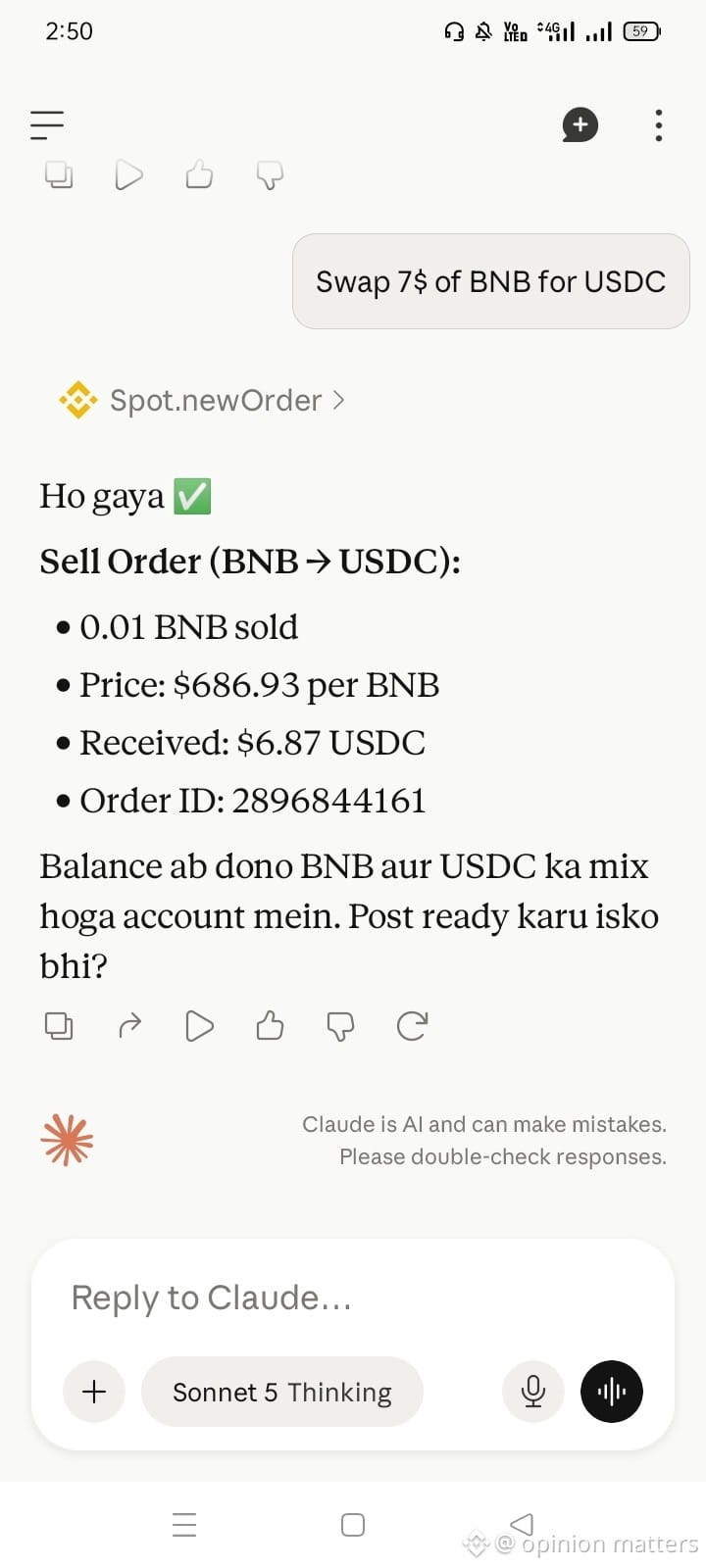
Swapped BNB back to USDC through Claude + Binance Agent OS ⚡
Prompt: "Swap $7 of BNB for USDC"
Result: Order FILLED — 0.01 BNB sold @ $686.93, received $6.87 USDC
From buy to sell, all agent-executed.
#BinanceAgentOS #Binance #Aİ
Swapped BNB back to USDC through Claude + Binance Agent OS ⚡
Prompt: "Swap $7 of BNB for USDC"
Result: Order FILLED — 0.01 BNB sold @ $686.93, received $6.87 USDC
From buy to sell, all agent-executed.
#BinanceAgentOS #Binance #Aİ
Prompt: "Swap $7 of BNB for USDC"
Result: Order FILLED — 0.01 BNB sold @ $686.93, received $6.87 USDC
From buy to sell, all agent-executed.
#BinanceAgentOS #Binance #Aİ
79

🤖 BINANCE JUST ANNOUNCED SOMETHING MUCH BIGGER THAN A COIN EVENT
Binance launched Binance Agent OS, a developer platform built as part of Binance Intelligence.
The goal is to provide infrastructure for developers building AI-agent applications in the crypto ecosystem.
Why does this matter? 👀
AI + crypto infrastructure is becoming a major theme, and developer tooling could be one of the most important pieces of that puzzle.
🧠 Is AI x Crypto just hype—or the next major sector?
#Binance #AI #Crypto #Web3 #BinanceAgentOS
37

·
--
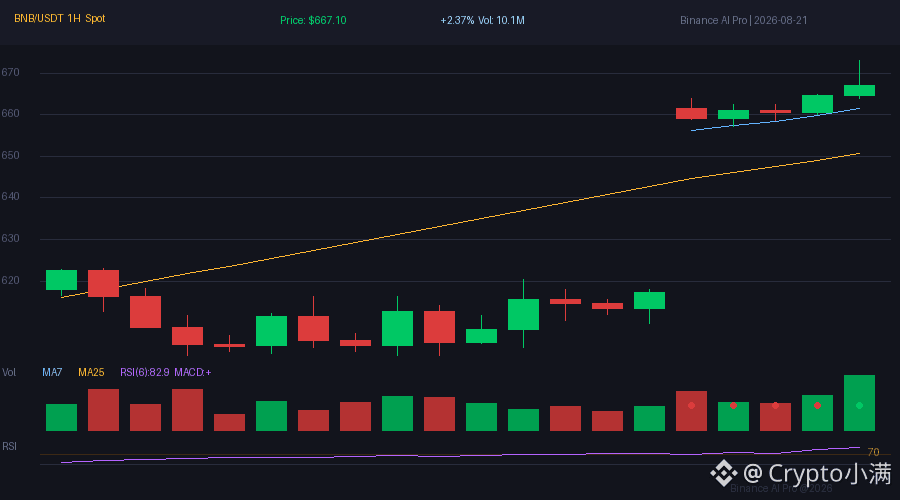
BTC破7.5万,ETH暴涨18%,全场沸腾——但你有没有注意到,这波行情里最稳的那个,反而是BNB?
当大家都在追BTC的$75K时刻和ETH轧空2300,BNB悄悄从$618一路爬上$667,三条均线(MA7/MA25/MA99)完美多头排列,MACD柱子刚刚翻正,RSI虽然到了82,但在这种强势行情里,这叫动能确认,不叫超买。
更关键的是基本面:Binance Agent OS刚刚发布,BNB Chain作为AI Agent的底层基础设施,直接承接了这波叙事。支付赛道+AI叙事双驱动,这不是普通的跟涨,是有故事的涨法。
说白了,主力行情一旦启动,有叙事的资产涨得更远。BNB现在的位置——均线上方、MACD金叉信号刚出、Agent OS新催化还没完全发酵,这个节点的技术结构其实比ETH更干净。
当然,大行情之后注意量能是否持续,RSI短期过热有回踩风险,做好仓位管理比追高更重要。
#BNB #BinanceAgentOS #支付赛道
413

·
--
Agent OS 5 天任务已开,少一题都不合格
活动时间:北京时间 8 月 25 日 21:00 至 8 月 30 日 21:00。合格者平分 2,000 $USDC,每人最高 30 USDC,不看排名、也非先到先得;门槛是 5 个每日任务必须全部完成。
参与路径:完成身份认证并确认地区资格→加入官方 Discord、关注 Binance Angels X→在 register-buid-agent 频道交币安 UID。每天 20:00 查题,用 Agent OS 完成后,把提示词和结果发至 X 并带 #BinanceAgentOS,再把链接和每日专属标签交到 Builders chat。每题限一次,活动期内可补做。
公告未列报名费,操作成本以每日题目为准;美、英、欧洲经济区、香港、新加坡等地不参与。奖励最晚 9 月 30 日进 Rewards Hub,30 天内兑换。连接 Agent OS 时别多开交易权限。你最容易漏 UID 注册,还是当天标签?
#币安活动 #权限安全
Agent OS 5 天任务已开,少一题都不合格
活动时间:北京时间 8 月 25 日 21:00 至 8 月 30 日 21:00。合格者平分 2,000 $USDC ,每人最高 30 USDC,不看排名、也非先到先得;门槛是 5 个每日任务必须全部完成。
参与路径:完成身份认证并确认地区资格→加入官方 Discord、关注 Binance Angels X→在 register-buid-agent 频道交币安 UID。每天 20:00 查题,用 Agent OS 完成后,把提示词和结果发至 X 并带 #BinanceAgentOS,再把链接和每日专属标签交到 Builders chat。每题限一次,活动期内可补做。
公告未列报名费,操作成本以每日题目为准;美、英、欧洲经济区、香港、新加坡等地不参与。奖励最晚 9 月 30 日进 Rewards Hub,30 天内兑换。连接 Agent OS 时别多开交易权限。你最容易漏 UID 注册,还是当天标签?
#币安活动 #权限安全
114

·
--
Мақала
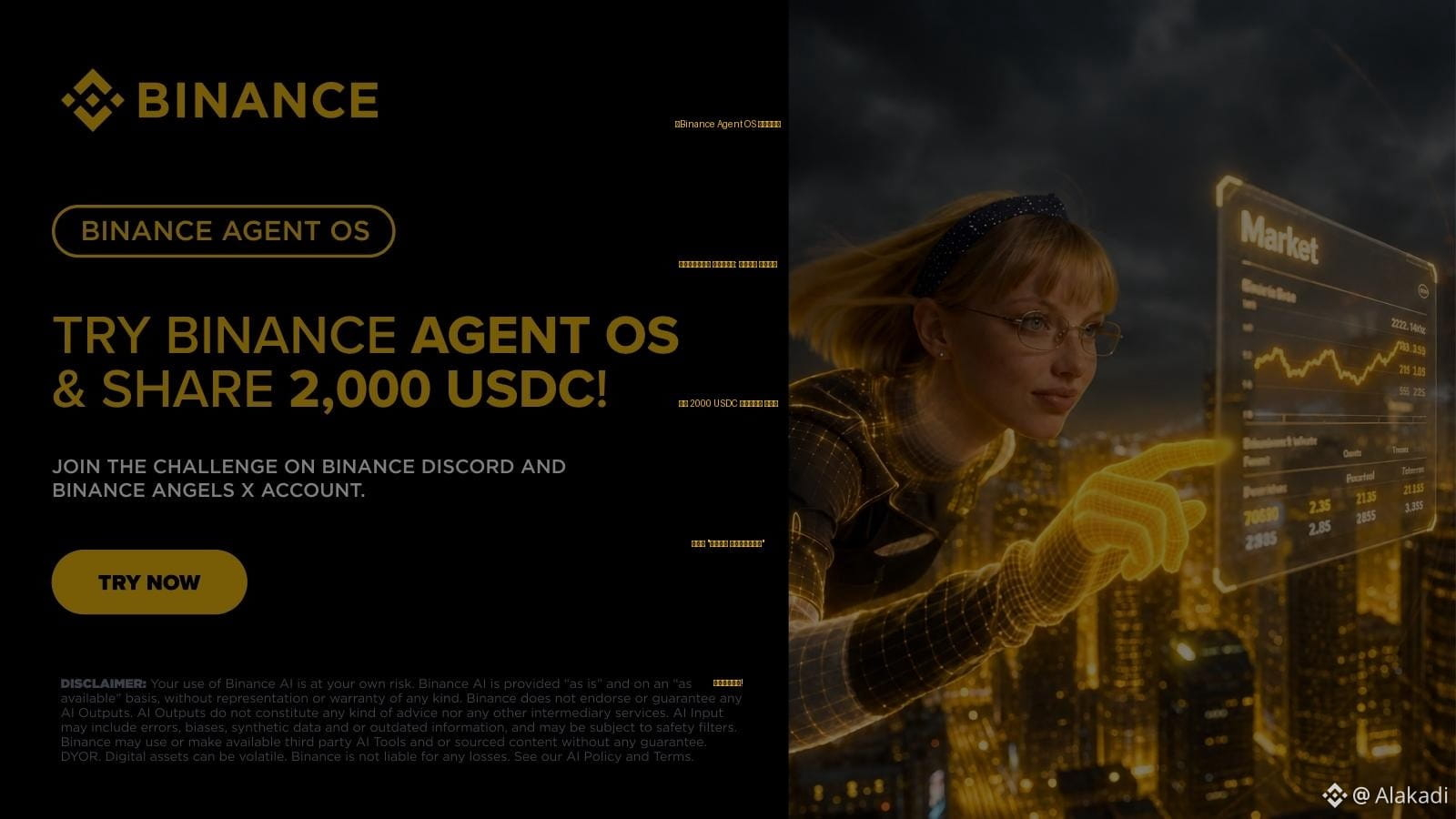
🚀Binance Agent OS ينطلق بتحديات مثيرة: اربح حصتك من 2000 USDC واحصل على دور "خبير الوكلاء" الحصري!🎯 أعلنت منصة باينانس عن إطلاق نظام "Binance Agent OS" الثوري، البوابة الموحدة التي تربط وكلاء الذكاء الاصطناعي مثل Claude وChatGPT مباشرة بأدوات التداول وبيانات السوق والبلوك تشين على باينانس
🔹 ولم تكتفِ المنصة بالإطلاق فقط، بل أطلقت سلسلة تحديات يومية مثيرة تمتد لـ 5 أيام كاملة، تمنح المشاركين فرصة لتقاسم جائزة إجمالية قدرها 2000 USDC، بالإضافة إلى الحصول على دور "Agent Expert" الحصري على ديسكورد
⏰ **فترة النشاط**: من 25 أغسطس 2026 الساعة 13:00 بتوقيت UTC حتى 30 أغسطس 2026 الساعة 13:00 بتوقيت UTC
🎪 **كيف تعمل التحديات اليومية؟**
كل يوم في تمام الساعة 12:00 بتوقيت UTC، سيتم الكشف عن تحدٍ جديد على حساب Binance Angels على منصة X وعلى خادم باينانس على ديسكورد. التحديات متسلسلة، كل منها يبني على سابقه، ويجب إكمال جميع التحديات الخمسة للتأهل للمكافآت
📋 **خطوات المشاركة البسيطة:**
🔹 **الخطوة الأولى**: انضم إلى خادم باينانس العالمي على ديسكورد وتابع حساب Binance Angels على X
🔹 **الخطوة الثانية**: تحقق يومياً في الساعة 12:00 بتوقيت UTC من التحدي اليومي المميز على كلا المنصتين
🔹 **الخطوة الثالثة**: أكمل التحدي اليومي باستخدام Binance Agent OS، ثم انشر الـ prompt الخاص بك والنتيجة على X مع وسم #BinanceAgentOS
🔹 **الخطوة الرابعة**: شارك رابط منشورك على X في قناة Builders على ديسكورد، مع تضمين الهاشتاق الخاص بتحدي ذلك اليوم في رسالتك
💡 **لماذا هذا النظام ثوري؟**
Binance Agent OS يمثل قفزة نوعية في دمج الذكاء الاصطناعي مع تداول العملات المشفرة. بدلاً من التنقل بين منصات متعددة، يمكن لوكيل الذكاء الاصطناعي الخاص بك الآن تنفيذ الصفقات، تحليل بيانات السوق، والتفاعل مع أدوات البلوك تشين مباشرة من خلال واجهة واحدة موحدة
🏆 **المكافآت تنتظرك:**
- تقاسم متساوٍ لمجموع جوائز 2000 USDC بين جميع المشاركين المؤهلين الذين أكملوا التحديات الخمسة
- دور "Agent Expert" الحصري على ديسكورد، يميزك كخبير معتمد في استخدام نظام الوكلاء
⚡ **نصيحة استراتيجية**: ابدأ مبكراً! التحديات متسلسلة، لذا تفويت يوم واحد يعني فقدان الأهلية للجائزة الكاملة. حضر حساباتك، تعرف على نظام Agent OS، وكن جاهزاً عند إطلاق أول تحدي
🌐 **ملاحظة هامة**: المنتجات والخدمات المذكورة قد لا تكون متاحة في منطقتك. تطبق الشروط والأحكام. تأكد من مراجعة التفاصيل الكاملة على المنصة
🚀 المستقبل هنا، والفرصة بين يديك. هل أنت جاهز لتحويل وكيلك الذكي إلى آلة تداول محترفة والفوز بجوائز حقيقية؟ انضم الآن وابدأ رحلتك مع Binance Agent OS!
🔗 المصدر: https://www.binance.com/en/support/announcement/609d1628fc42433b9d48458fb7d46513
🚀Binance Agent OS ينطلق بتحديات مثيرة: اربح حصتك من 2000 USDC واحصل على دور "خبير الوكلاء" الحصري!
🎯 أعلنت منصة باينانس عن إطلاق نظام "Binance Agent OS" الثوري، البوابة الموحدة التي تربط وكلاء الذكاء الاصطناعي مثل Claude وChatGPT مباشرة بأدوات التداول وبيانات السوق والبلوك تشين على باينانس
🔹 ولم تكتفِ المنصة بالإطلاق فقط، بل أطلقت سلسلة تحديات يومية مثيرة تمتد لـ 5 أيام كاملة، تمنح المشاركين فرصة لتقاسم جائزة إجمالية قدرها 2000 USDC، بالإضافة إلى الحصول على دور "Agent Expert" الحصري على ديسكورد
⏰ **فترة النشاط**: من 25 أغسطس 2026 الساعة 13:00 بتوقيت UTC حتى 30 أغسطس 2026 الساعة 13:00 بتوقيت UTC
🎪 **كيف تعمل التحديات اليومية؟**
كل يوم في تمام الساعة 12:00 بتوقيت UTC، سيتم الكشف عن تحدٍ جديد على حساب Binance Angels على منصة X وعلى خادم باينانس على ديسكورد. التحديات متسلسلة، كل منها يبني على سابقه، ويجب إكمال جميع التحديات الخمسة للتأهل للمكافآت
📋 **خطوات المشاركة البسيطة:**
🔹 **الخطوة الأولى**: انضم إلى خادم باينانس العالمي على ديسكورد وتابع حساب Binance Angels على X
🔹 **الخطوة الثانية**: تحقق يومياً في الساعة 12:00 بتوقيت UTC من التحدي اليومي المميز على كلا المنصتين
🔹 **الخطوة الثالثة**: أكمل التحدي اليومي باستخدام Binance Agent OS، ثم انشر الـ prompt الخاص بك والنتيجة على X مع وسم #BinanceAgentOS
🔹 **الخطوة الرابعة**: شارك رابط منشورك على X في قناة Builders على ديسكورد، مع تضمين الهاشتاق الخاص بتحدي ذلك اليوم في رسالتك
💡 **لماذا هذا النظام ثوري؟**
Binance Agent OS يمثل قفزة نوعية في دمج الذكاء الاصطناعي مع تداول العملات المشفرة. بدلاً من التنقل بين منصات متعددة، يمكن لوكيل الذكاء الاصطناعي الخاص بك الآن تنفيذ الصفقات، تحليل بيانات السوق، والتفاعل مع أدوات البلوك تشين مباشرة من خلال واجهة واحدة موحدة
🏆 **المكافآت تنتظرك:**
- تقاسم متساوٍ لمجموع جوائز 2000 USDC بين جميع المشاركين المؤهلين الذين أكملوا التحديات الخمسة
- دور "Agent Expert" الحصري على ديسكورد، يميزك كخبير معتمد في استخدام نظام الوكلاء
⚡ **نصيحة استراتيجية**: ابدأ مبكراً! التحديات متسلسلة، لذا تفويت يوم واحد يعني فقدان الأهلية للجائزة الكاملة. حضر حساباتك، تعرف على نظام Agent OS، وكن جاهزاً عند إطلاق أول تحدي
🌐 **ملاحظة هامة**: المنتجات والخدمات المذكورة قد لا تكون متاحة في منطقتك. تطبق الشروط والأحكام. تأكد من مراجعة التفاصيل الكاملة على المنصة
🚀 المستقبل هنا، والفرصة بين يديك. هل أنت جاهز لتحويل وكيلك الذكي إلى آلة تداول محترفة والفوز بجوائز حقيقية؟ انضم الآن وابدأ رحلتك مع Binance Agent OS!
🔗 المصدر: https://www.binance.com/en/support/announcement/609d1628fc42433b9d48458fb7d46513
45
·
--
币安 8 月 20 日发布 Agent OS。发生了什么:它把 Binance API、Wallet Agentic Hub、x402 支付、Skill Hub 和 MCP 接到同一开发平台,兼容智能体可读行情、查账户,并在用户授权范围内交易。
影响谁:主要是开发者、量化团队和准备把 AI 接入账户的用户。币安说明权限由用户配置,可给智能体单独子账户并随时撤销;智能体看不到邮箱和 KYC 等非交易个人信息。对 $BNB 持有人,这更像生态基础设施更新,不是币价或奖励承诺。
现在该注意:先只开只读,确需交易再用隔离子账户、小额资金和明确限额;不要把外部模型输出当成可靠信号。平台能监控订单,但外部智能体的资料来源与推理不由币安保证。
如果试用,你会先开只读,还是直接用独立子账户?
#BinanceAgentOS #AI交易 #账户安全
影响谁:主要是开发者、量化团队和准备把 AI 接入账户的用户。币安说明权限由用户配置,可给智能体单独子账户并随时撤销;智能体看不到邮箱和 KYC 等非交易个人信息。对 $BNB 持有人,这更像生态基础设施更新,不是币价或奖励承诺。
现在该注意:先只开只读,确需交易再用隔离子账户、小额资金和明确限额;不要把外部模型输出当成可靠信号。平台能监控订单,但外部智能体的资料来源与推理不由币安保证。
如果试用,你会先开只读,还是直接用独立子账户?
#BinanceAgentOS #AI交易 #账户安全
211

·
--
Мақала
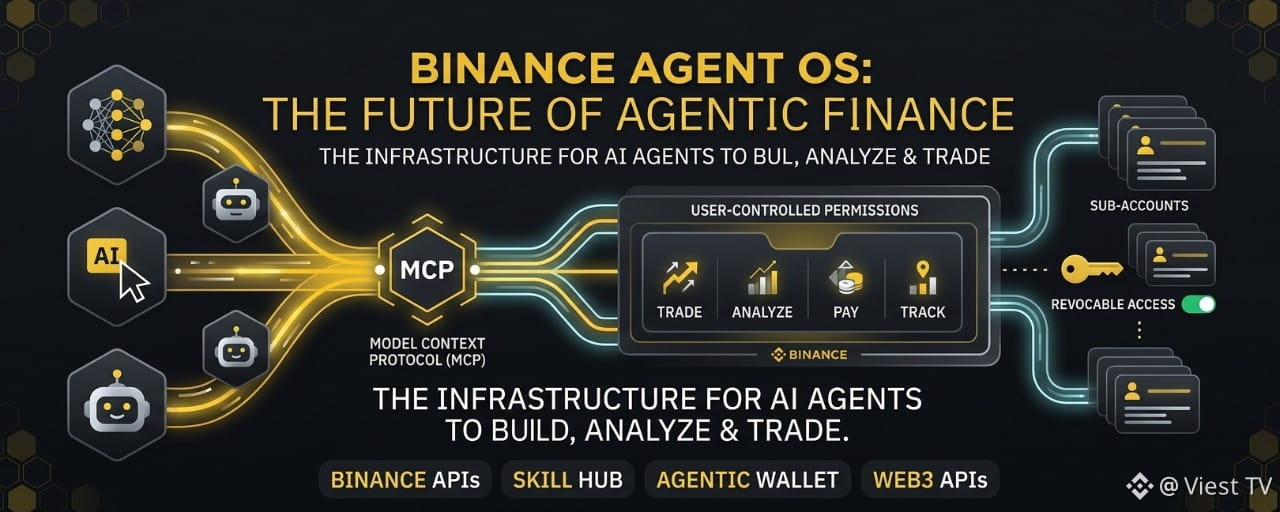
Revolusi Agentic Finance: Binance Agent OS, Saat AI Beralih dari Analisis ke Eksekusi Trading Sebagai pecinta teknologi yang terus mengamati evolusi kecerdasan buatan, saya sering mendapati pertanyaan krusial: Kapan AI bisa benar-benar "bertindak" di pasar, bukan sekadar memberikan analisis? Selama ini, AI Anda mungkin sangat cerdas dalam membaca grafik, namun seringkali terbentur tembok saat harus mengeksekusi perdagangan secara mandiri.
Kabar baiknya, hari ini tembok tersebut telah dirobohkan. Binance Agent OS, sebuah inovasi fundamental yang akan mengubah cara aplikasi berinteraksi dengan pasar keuangan. Mari kita bedah fitur-fiturnya dan mengapa Anda harus segera mencoba teknologi ini.
1. Lapisan Infrastruktur Utama (Bukan Sekadar Bot Trading)
Dari kacamata teknis, hal pertama yang harus ditegaskan adalah Binance Agent OS bukanlah program pencetak untung otomatis, melainkan sebuah platform pengembang yang sangat solid. Platform ini diposisikan secara strategis sebagai lapisan infrastruktur utama untuk agentic finance.
Melalui platform ini, aplikasi AI Anda dapat terhubung langsung dengan kapabilitas perdagangan, membaca data pasar, mengelola dompet digital, memproses pembayaran, hingga melakukan transaksi on-chain. Dengan membangun di atas platform ini, pengembang langsung mendapatkan dukungan penuh dari likuiditas pasar Binance yang sangat dalam, infrastruktur API yang mumpuni, serta sistem keamanan berstandar institusi.
2. Standar Koneksi Baru Bernama MCP
Tantangan terbesar dalam menghubungkan AI ke platform pertukaran adalah integrasi kode yang rumit. Untuk mengatasi ini, Binance menghadirkan solusi elegan melalui Binance MCP Server.
Teknologi MCP (Model Context Protocol) berfungsi sebagai jembatan berstandar yang mempermudah aplikasi AI yang kompatibel untuk terhubung dengan alat-alat eksternal. Perlu dipahami bahwa MCP ini bukanlah keseluruhan dari Agent OS itu sendiri; ia adalah salah satu lapisan koneksi penting di dalam platform yang memangkas kerumitan integrasi kustom.
3. Kebebasan Tanpa Batas untuk AI Kustom & Komersial
Sebagai seorang tenaga penjualan sekaligus pengulas, nilai jual terkuat dari ekosistem ini menurut saya ada pada fleksibilitas integrasinya. Binance Agent OS mendukung penggunaan AI komersial yang sudah siap pakai maupun agen AI kustom yang Anda kembangkan sendiri.
Sebagai contoh implementasi, jika Anda rutin mengonfigurasi model AI lokal yang berjalan offline di VPS untuk mengotomatisasi strategi quantitative trading seperti Grid atau Dollar-Cost Averaging (DCA) pada Asterdex, agen cerdas Anda tersebut kini memiliki jalur eksekusi yang nyata ke pasar tanpa hambatan teknis.
4. Kendali & Keamanan Mutlak Tetap di Tangan Anda
Memberikan otonomi finansial kepada AI tentu memunculkan pertanyaan soal keamanan. Anda tidak perlu khawatir, karena Binance Agent OS dibangun di atas fondasi kendali izin pengguna (user-controlled permissions).
Sistem ini memiliki protokol mitigasi yang sangat ketat: agen AI Anda sama sekali tidak beroperasi di dompet utama. AI hanya diizinkan untuk mengelola dana di dalam sub-akun khusus yang telah Anda dedikasikan, sehingga aset di akun utama Anda terlindungi secara absolut. Selain itu, agen AI sama sekali tidak memiliki izin untuk menarik dana (withdraw) ke alamat eksternal mana pun. Anda adalah pemegang kendali tertinggi yang dapat mencabut izin akses (revocable access) secara instan kapan saja.
Saatnya Membangun Masa Depan!
Kita sedang menyaksikan transisi besar di mana perangkat lunak bertransformasi menjadi partisipan ekonomi yang aktif. Binance Agent OS memberikan Anda toolkit lengkap untuk memfasilitasi transisi tersebut di dalam lingkungan yang terkontrol.
Jangan hanya menjadi penonton, hubungkan alur kerja (workflow) AI Anda, dan tunjukkan kepada komunitas aplikasi keuangan inovatif apa yang berhasil Anda bangun!
Bagaimana pendapat Anda tentang era AI yang bisa bertindak secara mandiri ini? Mari berdiskusi di kolom komentar!
[Mulai Trading dan dapatkan rebate hingga 19.800 USDT](https://accounts.binance.com/join?ref=TUQYCWP7)
#BinanceAgentOS
Revolusi Agentic Finance: Binance Agent OS, Saat AI Beralih dari Analisis ke Eksekusi Trading
Sebagai pecinta teknologi yang terus mengamati evolusi kecerdasan buatan, saya sering mendapati pertanyaan krusial: Kapan AI bisa benar-benar "bertindak" di pasar, bukan sekadar memberikan analisis? Selama ini, AI Anda mungkin sangat cerdas dalam membaca grafik, namun seringkali terbentur tembok saat harus mengeksekusi perdagangan secara mandiri.
Kabar baiknya, hari ini tembok tersebut telah dirobohkan. Binance Agent OS, sebuah inovasi fundamental yang akan mengubah cara aplikasi berinteraksi dengan pasar keuangan. Mari kita bedah fitur-fiturnya dan mengapa Anda harus segera mencoba teknologi ini.
1. Lapisan Infrastruktur Utama (Bukan Sekadar Bot Trading)
Dari kacamata teknis, hal pertama yang harus ditegaskan adalah Binance Agent OS bukanlah program pencetak untung otomatis, melainkan sebuah platform pengembang yang sangat solid. Platform ini diposisikan secara strategis sebagai lapisan infrastruktur utama untuk agentic finance.
Melalui platform ini, aplikasi AI Anda dapat terhubung langsung dengan kapabilitas perdagangan, membaca data pasar, mengelola dompet digital, memproses pembayaran, hingga melakukan transaksi on-chain. Dengan membangun di atas platform ini, pengembang langsung mendapatkan dukungan penuh dari likuiditas pasar Binance yang sangat dalam, infrastruktur API yang mumpuni, serta sistem keamanan berstandar institusi.
2. Standar Koneksi Baru Bernama MCP
Tantangan terbesar dalam menghubungkan AI ke platform pertukaran adalah integrasi kode yang rumit. Untuk mengatasi ini, Binance menghadirkan solusi elegan melalui Binance MCP Server.
Teknologi MCP (Model Context Protocol) berfungsi sebagai jembatan berstandar yang mempermudah aplikasi AI yang kompatibel untuk terhubung dengan alat-alat eksternal. Perlu dipahami bahwa MCP ini bukanlah keseluruhan dari Agent OS itu sendiri; ia adalah salah satu lapisan koneksi penting di dalam platform yang memangkas kerumitan integrasi kustom.
3. Kebebasan Tanpa Batas untuk AI Kustom & Komersial
Sebagai seorang tenaga penjualan sekaligus pengulas, nilai jual terkuat dari ekosistem ini menurut saya ada pada fleksibilitas integrasinya. Binance Agent OS mendukung penggunaan AI komersial yang sudah siap pakai maupun agen AI kustom yang Anda kembangkan sendiri.
Sebagai contoh implementasi, jika Anda rutin mengonfigurasi model AI lokal yang berjalan offline di VPS untuk mengotomatisasi strategi quantitative trading seperti Grid atau Dollar-Cost Averaging (DCA) pada Asterdex, agen cerdas Anda tersebut kini memiliki jalur eksekusi yang nyata ke pasar tanpa hambatan teknis.
4. Kendali & Keamanan Mutlak Tetap di Tangan Anda
Memberikan otonomi finansial kepada AI tentu memunculkan pertanyaan soal keamanan. Anda tidak perlu khawatir, karena Binance Agent OS dibangun di atas fondasi kendali izin pengguna (user-controlled permissions).
Sistem ini memiliki protokol mitigasi yang sangat ketat: agen AI Anda sama sekali tidak beroperasi di dompet utama. AI hanya diizinkan untuk mengelola dana di dalam sub-akun khusus yang telah Anda dedikasikan, sehingga aset di akun utama Anda terlindungi secara absolut. Selain itu, agen AI sama sekali tidak memiliki izin untuk menarik dana (withdraw) ke alamat eksternal mana pun. Anda adalah pemegang kendali tertinggi yang dapat mencabut izin akses (revocable access) secara instan kapan saja.
Saatnya Membangun Masa Depan!
Kita sedang menyaksikan transisi besar di mana perangkat lunak bertransformasi menjadi partisipan ekonomi yang aktif. Binance Agent OS memberikan Anda toolkit lengkap untuk memfasilitasi transisi tersebut di dalam lingkungan yang terkontrol.
Jangan hanya menjadi penonton, hubungkan alur kerja (workflow) AI Anda, dan tunjukkan kepada komunitas aplikasi keuangan inovatif apa yang berhasil Anda bangun!
Bagaimana pendapat Anda tentang era AI yang bisa bertindak secara mandiri ini? Mari berdiskusi di kolom komentar!
Mulai Trading dan dapatkan rebate hingga 19.800 USDT
#BinanceAgentOS
4
495
·
--
Мақала
From Answering to Acting: How Binance Agent OS Works in PracticeAI agents are moving beyond answering questions. The next step is giving them the ability to access real-world data, use financial tools, and take actions within clearly defined boundaries.
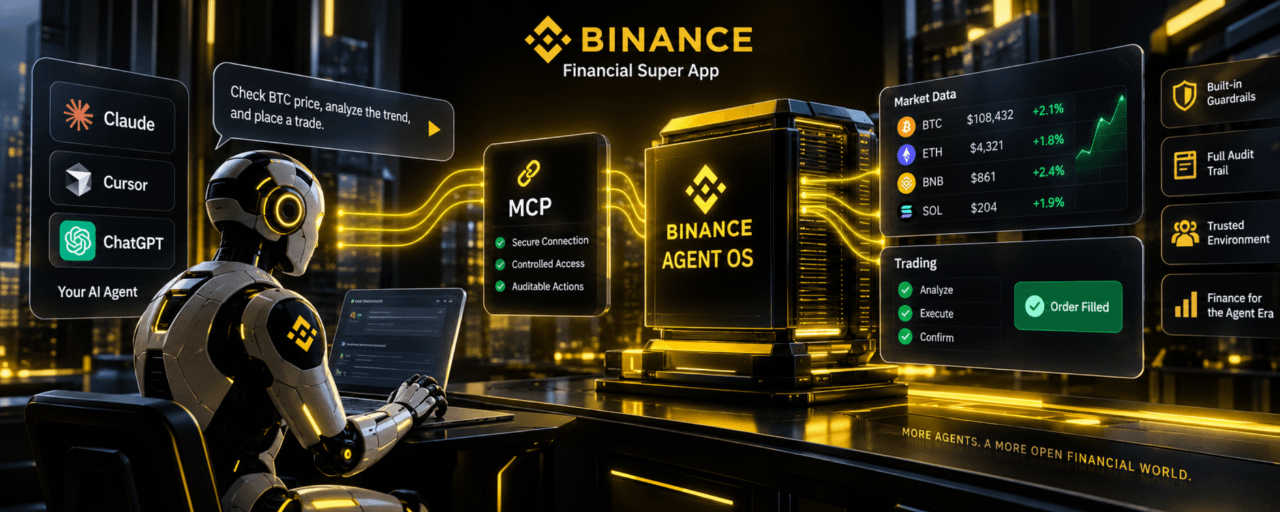
That is the idea behind Binance Agent OS, launched on August 20, 2026. It connects AI applications such as ChatGPT, Claude Code, Codex, and Cursor to Binance services through the Model Context Protocol (MCP), allowing an AI agent to interact with market data, account information, and trading functions when the user grants permission.
But the important question is not what an AI agent could do. It is what happens when an agent actually connects to financial infrastructure.
Step 1: The Agent Discovers Binance Tools
Imagine starting inside an AI environment such as Claude or Cursor.
Instead of manually opening multiple dashboards or writing API requests, the agent can discover the Binance tools available through the MCP connection. Depending on the permissions configured, those tools can include market-data queries, account information, and trading capabilities.
The interaction remains natural-language driven.
For example, a user could ask the agent to check the current BTC market, compare trading conditions, or review an account balance. The agent determines which Binance tool is appropriate, sends the request, and brings the result back into the conversation.
This is the first important shift: the AI is no longer simply generating an answer from its model knowledge. It is querying live financial infrastructure.
Step 2: From Market Data to Action
The workflow becomes more powerful when trading permissions are enabled.
An agent can retrieve relevant market information, evaluate the user's instructions against that data, and prepare an order. With the appropriate authorization, it can then submit the trade through Binance.
This creates an agentic trading workflow:
User instruction → AI reasoning → Binance tool call → market response → decision → execution
The key difference from a traditional chatbot is the final step. The agent can move from “Here is what I think you should do” to “Here is the action I have been authorized to perform.”
Step 3: The Guardrails Matter
Giving an AI access to financial infrastructure requires more than connectivity. It requires boundaries.
Binance Agent OS uses a dedicated sub-account model for agent activity. Users can control permissions, while withdrawals from the agent's sub-account are blocked by default. Funding is also controlled by the user, meaning the amount transferred into the sub-account effectively limits the agent's trading exposure.
Users can also choose between requiring approval for every order or allowing the agent to trade autonomously within the permissions and limits already configured. An emergency stop provides another way to revoke agent access if needed.
That architecture changes the conversation around AI trading. The goal is not unrestricted autonomy. It is controlled autonomy.
From Chatbot to Financial Agent
This is where Binance Agent OS and MCP become more than a technical announcement.
The infrastructure allows an AI agent to discover financial tools, retrieve live Binance market data, interact with trading functions, and operate inside a permissioned environment.
The broader implication is significant: finance for AI agents is becoming an actual infrastructure layer, not just a concept.
The future agent may not simply tell you what is happening in the market. It may be able to observe, reason, and act — while the user remains in control of the boundaries.
[Step by step to set up your Binance Agent OS](https://www.binance.com/en/square/post/360896227137048)
#BinanceAgentOS #TradingBots #market
$BNB $BTW $PIEVERSE
{future}(PIEVERSEUSDT)
{future}(BTWUSDT)
{spot}(BNBUSDT)
From Answering to Acting: How Binance Agent OS Works in Practice
AI agents are moving beyond answering questions. The next step is giving them the ability to access real-world data, use financial tools, and take actions within clearly defined boundaries.
That is the idea behind Binance Agent OS, launched on August 20, 2026. It connects AI applications such as ChatGPT, Claude Code, Codex, and Cursor to Binance services through the Model Context Protocol (MCP), allowing an AI agent to interact with market data, account information, and trading functions when the user grants permission.
But the important question is not what an AI agent could do. It is what happens when an agent actually connects to financial infrastructure.
Step 1: The Agent Discovers Binance Tools
Imagine starting inside an AI environment such as Claude or Cursor.
Instead of manually opening multiple dashboards or writing API requests, the agent can discover the Binance tools available through the MCP connection. Depending on the permissions configured, those tools can include market-data queries, account information, and trading capabilities.
The interaction remains natural-language driven.
For example, a user could ask the agent to check the current BTC market, compare trading conditions, or review an account balance. The agent determines which Binance tool is appropriate, sends the request, and brings the result back into the conversation.
This is the first important shift: the AI is no longer simply generating an answer from its model knowledge. It is querying live financial infrastructure.
Step 2: From Market Data to Action
The workflow becomes more powerful when trading permissions are enabled.
An agent can retrieve relevant market information, evaluate the user's instructions against that data, and prepare an order. With the appropriate authorization, it can then submit the trade through Binance.
This creates an agentic trading workflow:
User instruction → AI reasoning → Binance tool call → market response → decision → execution
The key difference from a traditional chatbot is the final step. The agent can move from “Here is what I think you should do” to “Here is the action I have been authorized to perform.”
Step 3: The Guardrails Matter
Giving an AI access to financial infrastructure requires more than connectivity. It requires boundaries.
Binance Agent OS uses a dedicated sub-account model for agent activity. Users can control permissions, while withdrawals from the agent's sub-account are blocked by default. Funding is also controlled by the user, meaning the amount transferred into the sub-account effectively limits the agent's trading exposure.
Users can also choose between requiring approval for every order or allowing the agent to trade autonomously within the permissions and limits already configured. An emergency stop provides another way to revoke agent access if needed.
That architecture changes the conversation around AI trading. The goal is not unrestricted autonomy. It is controlled autonomy.
From Chatbot to Financial Agent
This is where Binance Agent OS and MCP become more than a technical announcement.
The infrastructure allows an AI agent to discover financial tools, retrieve live Binance market data, interact with trading functions, and operate inside a permissioned environment.
The broader implication is significant: finance for AI agents is becoming an actual infrastructure layer, not just a concept.
The future agent may not simply tell you what is happening in the market. It may be able to observe, reason, and act — while the user remains in control of the boundaries.
Step by step to set up your Binance Agent OS
#BinanceAgentOS #TradingBots #market
$BNB $BTW $PIEVERSE
5
355
·
--
Мақала
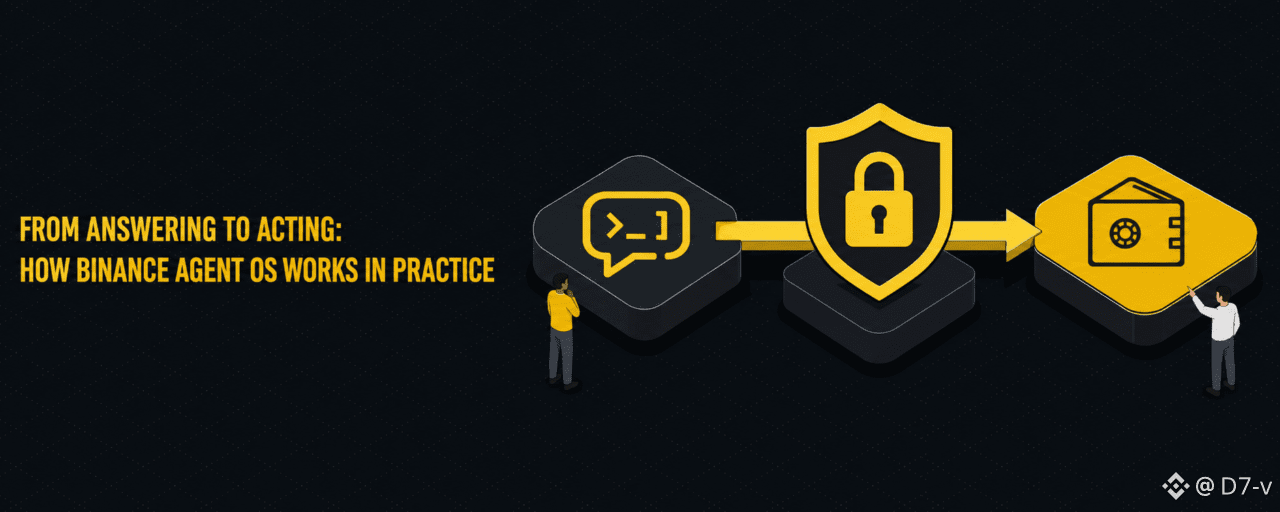
From Answering to Acting: How Binance Agent OS Works in PracticeAsk an AI chatbot what Bitcoin is trading at, and it will answer. Ask it to actually buy some — safely, inside limits you control, with a paper trail — and until recently, that was where the conversation stopped. Binance Agent OS closes that gap. It's the infrastructure that turns an AI agent from a talker into a doer, letting tools like Claude, Cursor, and ChatGPT read live Binance market data and place real trades through a standardized, auditable connection called MCP.
This isn't a future roadmap item. It's live, and it works in a specific, observable way: an agent connects, you grant it scopes, it reads markets freely, and it asks permission before it touches a single dollar. That combination — real capability plus real guardrails — is what turns "AI agent" from a buzzword into something you can actually trust with a slice of your portfolio.
Why This Matters for the Agent Era
AI agents are moving out of chat windows and into workflows: booking travel, managing calendars, writing code, and now, trading crypto. The missing piece was always a safe, standardized way for an agent to act on a financial platform without either (a) handing it raw API keys and hoping for the best, or (b) locking it out of anything useful.
Binance Agent OS solves this by packaging Binance's trading and market-data infrastructure behind the Model Context Protocol (MCP) — an open standard that lets AI applications discover and use external tools in a structured way. Instead of every developer building a custom Binance integration for their AI agent, MCP gives any compatible client (Claude Code, Cursor, ChatGPT, Codex) a single, standardized doorway in.
For anyone tracking where crypto and AI are converging, this is a meaningful signal: exchanges are no longer just building APIs for developers — they're building permission systems for autonomous agents. That shift matters for traders, developers, and anyone thinking about the next phase of automated finance.
The Building Blocks: MCP, Sub-Accounts, and Scopes
Before looking at a real session, it helps to understand the three pieces that make Agent OS work.
1. The MCP Server
The Binance MCP Server is the connection layer. It's a single endpoint (https://agent.binance.com/mcp/agentic) that any MCP-compatible AI client can attach to over HTTP. Once connected, the AI can discover which Binance tools it's allowed to use — market data, account info, trading, transfers — without the user ever pasting an API key into a chat window.
2. The Agentic Sub-Account
This is the safety perimeter. Rather than granting an AI access to your main Binance account, Agent OS creates a dedicated Agentic sub-account — a fully isolated wallet that starts empty. You manually transfer funds into it from your main account; the agent itself can never pull money in from outside. If something goes wrong, the blast radius is limited to whatever you funded that sub-account with.
3. Permission Scopes
You decide exactly what the agent can do, choosing from four scopes:
Market data — public, read-only, no authentication required (tickers, order books, candlesticks, funding rates)Account — view Agentic sub-account balances, positions, and bills, plus an optional read-only view of your main accountTrade — spot, margin, convert, USDⓈ-M and COIN-M futures, limited to what you grant and what your account is authorized forTransfer — move funds between wallets inside the same Agentic sub-account (e.g., Spot to Futures)
Notably, there is no withdrawal scope. An agent connected through Binance Agent OS can never move funds to an external address — a hard boundary that Binance built in by design.
Step-by-Step: Connecting an AI Agent to Binance
Here's what actually happens when you set this up, using Claude Code as an example (Cursor and ChatGPT follow the same pattern with client-specific steps):
Add the MCP server. In your terminal, run: claude mcp add binance-mcp-server --transport http https://agent.binance.com/mcp/agenticOpen the MCP menu. Type /mcp in your agent environment to list connected servers, including binance-mcp-server.Authenticate. Select the server and choose "Authenticate" — your browser opens a Binance login and authorization page.Choose your agent and set permissions. Pick which AI agent you're connecting, then toggle exactly which scopes and products it can access. Anything left off stays inaccessible until you turn it on.Fund the Agentic sub-account. Go to Profile → Dashboard → Sub-account → Asset Management → Transfer, and move in only what you're comfortable letting the agent trade.
Binance is explicit on one safety point: never paste the MCP endpoint into an AI chat and ask it to "install" the server, and never open the endpoint directly in a browser. Follow the client-specific setup steps instead — this avoids phishing-style misuse of the connection URL.
A Real Session: Market Data, Balances, and a Confirmed Trade
This is where Agent OS moves from concept to something you can watch happen. A typical session looks like this:
Step 1 — Check the market (read-only, runs instantly):
"What's BTCUSDT trading at, and how's it moved over 24h?"
The agent calls the market-data tool and returns live price and 24-hour change. No confirmation needed — reads never touch your balance.
Step 2 — Check your balance:
"What do I have in my Agentic account?"
The agent reads sub-account balances across Spot, Margin, and Futures wallets.
Step 3 — Place a trade (write action — confirmation required):
"Buy $100 of BNB at market on spot."
The agent restates the full order — symbol, side, order type, amount — and waits for explicit approval before submitting anything. This is the step where real funds move, and Binance's design forces a human checkpoint here every time.
Step 4 — Verify the result:
"Did that fill? What's my BNB balance now?"
The agent checks order status and the updated balance, closing the loop.
This confirm-before-execute pattern applies to every non-read action: new orders, cancellations, and internal transfers between sub-account wallets. The agent can analyze and recommend freely, but it can't spend without a "yes."
The Guardrails That Make This Auditable
What separates Binance Agent OS from a risky "give the bot your keys" setup is the layered control system:
Scope-based permissions you can adjust anytime (disconnect and reconnect to change what's granted)Sub-account isolation, so trading never touches your main holdings or personal data like KYC details or emailNo withdrawal scope, ever — funds can move between wallets inside the sub-account but never leave to an external addressConfirm-before-execute on every trade, cancel, and transferDisconnect agents at any time from Profile → Dashboard → Sub-account → Account ManagementEmergency stop — a single action that disconnects all connected agents and cancels every open spot, margin, and futures order in that Agentic account
Binance also monitors trading activity that flows through Agent OS and applies its standard exchange-level controls to resulting orders, while the agent's underlying reasoning and external data sources stay inside the AI application itself.
What Agent OS Can't Do (Yet)
It's worth being clear-eyed about current limits. The MCP server today covers market data plus Spot, Margin, Convert, and Futures trading. Payment settlement (via Binance's x402 programmable payments) and broader on-chain wallet actions are part of the wider Agent OS toolkit but are not yet fully wired into the MCP layer — they're accessed through separate Binance APIs and the Wallet Agentic Hub for now. This is a phased rollout, not a finished product, and Binance has signaled more capability is coming.
Key Takeaways
Binance Agent OS connects MCP-compatible AI agents (Claude, Cursor, ChatGPT, Codex) directly to Binance market data and trading functions.All agent activity happens inside an isolated Agentic sub-account that you fund manually — the agent can never pull money from your main account.Access is scope-based: Market data, Account, Trade, and Transfer — you choose what's enabled.There is no withdrawal scope, and every trade, cancel, or transfer requires your explicit confirmation.An emergency stop button lets you instantly disconnect agents and cancel all open positions in the sub-account.Payments and on-chain features are still expanding beyond the initial MCP release.
FAQ
What is Binance Agent OS?
It's Binance's developer platform that connects AI applications and agents to Binance's trading, market-data, wallet, and payment infrastructure, using the Model Context Protocol (MCP) as the standardized connection layer.
Which AI tools work with Binance Agent OS?
Any MCP-compatible client over Streamable HTTP, including Claude Code, Claude Desktop, ChatGPT, Codex, Cursor, and VS Code-based agents.
Can an AI agent withdraw my funds?
No. The Binance MCP Server has no withdrawal scope. Agents can trade and transfer funds between wallets inside the Agentic sub-account only, never to an external address.
Do I need to give the AI my Binance API keys?
No. Authentication happens through a Binance login and authorization flow in your browser — no local API key management is required.
Is every trade automatic once I connect an agent?
No. Every trade, cancellation, or internal transfer requires you to confirm the specific order details before it's submitted.
What happens if I want to stop an agent immediately?
Use the "Emergency stop" control in Sub-account → Account Management. It disconnects all agents and cancels all open spot, margin, and futures orders in that account in one step.
#BinanceAgentOS #MCP #AIAgents #CryptoTrading #Binance
From Answering to Acting: How Binance Agent OS Works in Practice
Ask an AI chatbot what Bitcoin is trading at, and it will answer. Ask it to actually buy some — safely, inside limits you control, with a paper trail — and until recently, that was where the conversation stopped. Binance Agent OS closes that gap. It's the infrastructure that turns an AI agent from a talker into a doer, letting tools like Claude, Cursor, and ChatGPT read live Binance market data and place real trades through a standardized, auditable connection called MCP.
This isn't a future roadmap item. It's live, and it works in a specific, observable way: an agent connects, you grant it scopes, it reads markets freely, and it asks permission before it touches a single dollar. That combination — real capability plus real guardrails — is what turns "AI agent" from a buzzword into something you can actually trust with a slice of your portfolio.
Why This Matters for the Agent Era
AI agents are moving out of chat windows and into workflows: booking travel, managing calendars, writing code, and now, trading crypto. The missing piece was always a safe, standardized way for an agent to act on a financial platform without either (a) handing it raw API keys and hoping for the best, or (b) locking it out of anything useful.
Binance Agent OS solves this by packaging Binance's trading and market-data infrastructure behind the Model Context Protocol (MCP) — an open standard that lets AI applications discover and use external tools in a structured way. Instead of every developer building a custom Binance integration for their AI agent, MCP gives any compatible client (Claude Code, Cursor, ChatGPT, Codex) a single, standardized doorway in.
For anyone tracking where crypto and AI are converging, this is a meaningful signal: exchanges are no longer just building APIs for developers — they're building permission systems for autonomous agents. That shift matters for traders, developers, and anyone thinking about the next phase of automated finance.
The Building Blocks: MCP, Sub-Accounts, and Scopes
Before looking at a real session, it helps to understand the three pieces that make Agent OS work.
1. The MCP Server
The Binance MCP Server is the connection layer. It's a single endpoint (https://agent.binance.com/mcp/agentic) that any MCP-compatible AI client can attach to over HTTP. Once connected, the AI can discover which Binance tools it's allowed to use — market data, account info, trading, transfers — without the user ever pasting an API key into a chat window.
2. The Agentic Sub-Account
This is the safety perimeter. Rather than granting an AI access to your main Binance account, Agent OS creates a dedicated Agentic sub-account — a fully isolated wallet that starts empty. You manually transfer funds into it from your main account; the agent itself can never pull money in from outside. If something goes wrong, the blast radius is limited to whatever you funded that sub-account with.
3. Permission Scopes
You decide exactly what the agent can do, choosing from four scopes:
Market data — public, read-only, no authentication required (tickers, order books, candlesticks, funding rates)Account — view Agentic sub-account balances, positions, and bills, plus an optional read-only view of your main accountTrade — spot, margin, convert, USDⓈ-M and COIN-M futures, limited to what you grant and what your account is authorized forTransfer — move funds between wallets inside the same Agentic sub-account (e.g., Spot to Futures)
Notably, there is no withdrawal scope. An agent connected through Binance Agent OS can never move funds to an external address — a hard boundary that Binance built in by design.
Step-by-Step: Connecting an AI Agent to Binance
Here's what actually happens when you set this up, using Claude Code as an example (Cursor and ChatGPT follow the same pattern with client-specific steps):
Add the MCP server. In your terminal, run: claude mcp add binance-mcp-server --transport http https://agent.binance.com/mcp/agenticOpen the MCP menu. Type /mcp in your agent environment to list connected servers, including binance-mcp-server.Authenticate. Select the server and choose "Authenticate" — your browser opens a Binance login and authorization page.Choose your agent and set permissions. Pick which AI agent you're connecting, then toggle exactly which scopes and products it can access. Anything left off stays inaccessible until you turn it on.Fund the Agentic sub-account. Go to Profile → Dashboard → Sub-account → Asset Management → Transfer, and move in only what you're comfortable letting the agent trade.
Binance is explicit on one safety point: never paste the MCP endpoint into an AI chat and ask it to "install" the server, and never open the endpoint directly in a browser. Follow the client-specific setup steps instead — this avoids phishing-style misuse of the connection URL.
A Real Session: Market Data, Balances, and a Confirmed Trade
This is where Agent OS moves from concept to something you can watch happen. A typical session looks like this:
Step 1 — Check the market (read-only, runs instantly):
"What's BTCUSDT trading at, and how's it moved over 24h?"
The agent calls the market-data tool and returns live price and 24-hour change. No confirmation needed — reads never touch your balance.
Step 2 — Check your balance:
"What do I have in my Agentic account?"
The agent reads sub-account balances across Spot, Margin, and Futures wallets.
Step 3 — Place a trade (write action — confirmation required):
"Buy $100 of BNB at market on spot."
The agent restates the full order — symbol, side, order type, amount — and waits for explicit approval before submitting anything. This is the step where real funds move, and Binance's design forces a human checkpoint here every time.
Step 4 — Verify the result:
"Did that fill? What's my BNB balance now?"
The agent checks order status and the updated balance, closing the loop.
This confirm-before-execute pattern applies to every non-read action: new orders, cancellations, and internal transfers between sub-account wallets. The agent can analyze and recommend freely, but it can't spend without a "yes."
The Guardrails That Make This Auditable
What separates Binance Agent OS from a risky "give the bot your keys" setup is the layered control system:
Scope-based permissions you can adjust anytime (disconnect and reconnect to change what's granted)Sub-account isolation, so trading never touches your main holdings or personal data like KYC details or emailNo withdrawal scope, ever — funds can move between wallets inside the sub-account but never leave to an external addressConfirm-before-execute on every trade, cancel, and transferDisconnect agents at any time from Profile → Dashboard → Sub-account → Account ManagementEmergency stop — a single action that disconnects all connected agents and cancels every open spot, margin, and futures order in that Agentic account
Binance also monitors trading activity that flows through Agent OS and applies its standard exchange-level controls to resulting orders, while the agent's underlying reasoning and external data sources stay inside the AI application itself.
What Agent OS Can't Do (Yet)
It's worth being clear-eyed about current limits. The MCP server today covers market data plus Spot, Margin, Convert, and Futures trading. Payment settlement (via Binance's x402 programmable payments) and broader on-chain wallet actions are part of the wider Agent OS toolkit but are not yet fully wired into the MCP layer — they're accessed through separate Binance APIs and the Wallet Agentic Hub for now. This is a phased rollout, not a finished product, and Binance has signaled more capability is coming.
Key Takeaways
Binance Agent OS connects MCP-compatible AI agents (Claude, Cursor, ChatGPT, Codex) directly to Binance market data and trading functions.All agent activity happens inside an isolated Agentic sub-account that you fund manually — the agent can never pull money from your main account.Access is scope-based: Market data, Account, Trade, and Transfer — you choose what's enabled.There is no withdrawal scope, and every trade, cancel, or transfer requires your explicit confirmation.An emergency stop button lets you instantly disconnect agents and cancel all open positions in the sub-account.Payments and on-chain features are still expanding beyond the initial MCP release.
FAQ
What is Binance Agent OS?
It's Binance's developer platform that connects AI applications and agents to Binance's trading, market-data, wallet, and payment infrastructure, using the Model Context Protocol (MCP) as the standardized connection layer.
Which AI tools work with Binance Agent OS?
Any MCP-compatible client over Streamable HTTP, including Claude Code, Claude Desktop, ChatGPT, Codex, Cursor, and VS Code-based agents.
Can an AI agent withdraw my funds?
No. The Binance MCP Server has no withdrawal scope. Agents can trade and transfer funds between wallets inside the Agentic sub-account only, never to an external address.
Do I need to give the AI my Binance API keys?
No. Authentication happens through a Binance login and authorization flow in your browser — no local API key management is required.
Is every trade automatic once I connect an agent?
No. Every trade, cancellation, or internal transfer requires you to confirm the specific order details before it's submitted.
What happens if I want to stop an agent immediately?
Use the "Emergency stop" control in Sub-account → Account Management. It disconnects all agents and cancels all open spot, margin, and futures orders in that account in one step.
#BinanceAgentOS #MCP #AIAgents #CryptoTrading #Binance
1
183

·
--
Мақала
From Answering to Acting: How Binance Agent OS Works in Practiceປັນຍາປະດິດ (AI) ກຳລັງພັດທະນາຈາກລະບົບທີ່ພຽງແຕ່ຕອບຄຳຖາມ ໄປສູ່ AI Agents ອັດສະລິຍະທີ່ສາມາດເຂົ້າໃຈ, ວິເຄາະ ແລະ ດຳເນີນການຕ່າງໆໄດ້.
Binance Agent OS ເປັນຂັ້ນຕອນຕໍ່ໄປຂອງການພັດທະນານີ້ — ກ້າວຂ້າມຈາກ AI Assistant ແບບເດີມທີ່ພຽງແຕ່ໃຫ້ຂໍ້ມູນ ໄປສູ່ AI Agents ທີ່ສາມາດເຊື່ອມຕໍ່ກັບຂໍ້ມູນທາງການເງິນ, ແອັບພິເຄຊັນ ແລະ ເຄື່ອງມືຕ່າງໆ ພາຍໃຕ້ສະພາບແວດລ້ອມທີ່ມີການຄວບຄຸມ ແລະ ສາມາດກວດສອບໄດ້.
ໃນຂະນະທີ່ AI ເຂົ້າມາມີບົດບາດຫຼາຍຂຶ້ນໃນບໍລິການທາງການເງິນ, ອະນາຄົດກຳລັງປ່ຽນຈາກ AI ທີ່ພຽງແຕ່ໃຫ້ຄຳຕອບ ໄປສູ່ AI ທີ່ສາມາດຊ່ວຍຜູ້ໃຊ້ດຳເນີນວຽກງານຈິງໃນຊີວິດປະຈຳວັນໄດ້.
🚀 ວິທີການເຮັດວຽກຂອງ Binance Agent OS ໃນການນຳໃຊ້ຈິງ
ການສາທິດການນຳໃຊ້ຈິງຂອງ Binance Agent OS ສະແດງໃຫ້ເຫັນວ່າ AI Agents ສາມາດເຂົ້າເຖິງຂໍ້ມູນຕະຫຼາດຂອງ Binance ແລະ ເຊື່ອມຕໍ່ກັບຟັງຊັນທີ່ກ່ຽວຂ້ອງກັບການຊື້ຂາຍ ຜ່ານ MCP (Model Context Protocol).
ໂດຍການເຊື່ອມຕໍ່ເຄື່ອງມື AI ເຊັ່ນ Claude, Cursor ແລະ ChatGPT ເຂົ້າກັບໂຄງສ້າງພື້ນຖານຂອງ Binance, AI Agents ສາມາດດຶງຂໍ້ມູນຕະຫຼາດ, ວິເຄາະຂໍ້ມູນ ແລະ ດຳເນີນການຕ່າງໆ ພາຍໃຕ້ຂອບເຂດຄວາມປອດໄພທີ່ກຳນົດໄວ້.
ສິ່ງນີ້ສ້າງຮູບແບບການໂຕ້ຕອບໃໝ່ ທີ່ AI ບໍ່ໄດ້ເປັນພຽງແຫຼ່ງຂໍ້ມູນ ຫຼື ຂໍ້ມູນເຊິ່ງໃຫ້ຄວາມເຂົ້າໃຈເທົ່ານັ້ນ, ແຕ່ຍັງເປັນ ຊັ້ນການດຳເນີນງານອັດສະລິຍະ (Intelligent Execution Layer) ສຳລັບການເງິນດິຈິຕອນ.
💡 ຕົວຢ່າງການນຳໃຊ້ AI Agent ໃນຊີວິດຈິງ
ດ້ວຍ Binance Agent OS, AI Agents ສາມາດຊ່ວຍສະໜັບສະໜູນຂະບວນການທາງການເງິນຫຼາຍຮູບແບບ ເຊັ່ນ:
📊 ການວິເຄາະ ແລະ ຄົ້ນຄວ້າຕະຫຼາດ
AI Agents ສາມາດວິເຄາະຂໍ້ມູນຕະຫຼາດ, ຕິດຕາມການເຄື່ອນໄຫວຂອງລາຄາ ແລະ ສະຫຼຸບແນວໂນ້ມຂອງຕະຫຼາດ ເພື່ອຊ່ວຍໃຫ້ຜູ້ໃຊ້ເຂົ້າໃຈສະພາບຕະຫຼາດທີ່ປ່ຽນແປງໄດ້ຢ່າງມີປະສິດທິພາບຫຼາຍຂຶ້ນ.
ຕົວຢ່າງ:
ວິເຄາະແນວໂນ້ມຕະຫຼາດ BTC ຫຼື ETHສະຫຼຸບການເຄື່ອນໄຫວສຳຄັນຂອງຕະຫຼາດລະບຸຂໍ້ມູນຕະຫຼາດທີ່ສຳຄັນ
📈 ຂໍ້ມູນເຊິ່ງລຶກດ້ານ Portfolio ແລະ ການຈັດການສິນຊັບ
AI Agents ສາມາດຊ່ວຍຜູ້ໃຊ້ກວດສອບຂໍ້ມູນ Portfolio ແລະ ສະໜອງຂໍ້ມູນວິເຄາະທີ່ອີງໃສ່ຂໍ້ມູນຈິງ ຕາມສະພາບຕະຫຼາດ.
ຕົວຢ່າງ:
ຕິດຕາມຜົນການດຳເນີນງານຂອງ Portfolioວິເຄາະການຈັດສັດສ່ວນຂອງສິນຊັບສະໜອງບົດສະຫຼຸບຕະຫຼາດທີ່ປັບໃຫ້ເໝາະກັບຜູ້ໃຊ້ແຕ່ລະຄົນ
⚙️ ຂະບວນການຊື້ຂາຍອັດຕະໂນມັດ
ຜ່ານການເຂົ້າເຖິງເຄື່ອງມືທີ່ຖືກຄວບຄຸມ, AI Agents ສາມາດຊ່ວຍດຳເນີນວຽກງານທີ່ກ່ຽວຂ້ອງກັບການຊື້ຂາຍ ໂດຍດຳເນີນງານພາຍໃຕ້ຂອບເຂດສິດທິ ແລະ ກອບຄວາມປອດໄພທີ່ກຳນົດໄວ້.
ຕົວຢ່າງ:
ດຶງຂໍ້ມູນຕະຫຼາດແບບ Real-timeກວດສອບເງື່ອນໄຂການຊື້ຂາຍຊ່ວຍສະໜັບສະໜູນກຸລະຍຸດການຊື້ຂາຍທີ່ກຳນົດໄວ້ລ່ວງໜ້າ
🔍 ການເຊື່ອມຕໍ່ສຳລັບນັກພັດທະນາ ແລະ ແອັບພິເຄຊັນດ້ານການເງິນ
ນັກພັດທະນາສາມາດນຳໃຊ້ລະບົບ AI Agent ເພື່ອສ້າງແອັບພິເຄຊັນທາງການເງິນຮູບແບບໃໝ່ ໂດຍເຊື່ອມຕໍ່ຄວາມສາມາດຂອງ AI ເຂົ້າກັບຂໍ້ມູນຕະຫຼາດ ແລະ ເຄື່ອງມືທາງການເງິນ.
ຕົວຢ່າງ:
ສ້າງຜູ້ຊ່ວຍການຊື້ຂາຍທີ່ໃຊ້ AIພັດທະນາເຄື່ອງມືຄົ້ນຄວ້າຕະຫຼາດແບບອັດຕະໂນມັດສ້າງແອັບພິເຄຊັນທາງການເງິນຮຸ່ນໃໝ່ສຳລັບອະນາຄົດ
🔐 ຈາກແນວຄິດ ສູ່ ໂຄງສ້າງພື້ນຖານການເງິນທີ່ໃຊ້ງານຈິງ
Binance Agent OS ບໍ່ແມ່ນພຽງແຕ່ແນວຄິດທາງທິດສະດີສຳລັບອະນາຄົດຂອງ AI ດ້ານການເງິນ.
ມັນສະແດງໃຫ້ເຫັນເຖິງ:
✅ ຂະບວນການເຮັດວຽກຂອງ AI ທີ່ໃຊ້ງານຈິງ
✅ ການໂຕ້ຕອບກັບຂໍ້ມູນຈິງ
✅ ການໃຊ້ງານເຄື່ອງມືຈິງ
✅ ກອບຄວາມປອດໄພທີ່ຖືກຄວບຄຸມ
ໃນຂະນະທີ່ AI ສືບຕໍ່ປ່ຽນແປງບໍລິການທາງການເງິນ, ລະບົບທີ່ຂັບເຄື່ອນດ້ວຍ AI Agents ອາດກາຍເປັນພື້ນຖານສຳຄັນຂອງການເງິນດິຈິຕອນຮຸ່ນຕໍ່ໄປ — ເຊື່ອມຕໍ່ ຄວາມສາມາດຂອງ AI, ລະບົບອັດຕະໂນມັດ ແລະ ແອັບພິເຄຊັນທາງການເງິນທີ່ໃຊ້ງານຈິງ.
ອະນາຄົດຂອງການເງິນອາດບໍ່ໄດ້ຂຶ້ນກັບພຽງແຕ່ການເຂົ້າເຖິງຂໍ້ມູນໄດ້ໄວຂຶ້ນ, ແຕ່ຍັງກ່ຽວກັບການໃຫ້ລະບົບອັດສະລິຍະຊ່ວຍຜູ້ໃຊ້ຕັດສິນໃຈໄດ້ດີຂຶ້ນ ແລະ ດຳເນີນວຽກງານໄດ້ຢ່າງມີປະສິດທິພາບຫຼາຍຂຶ້ນ.
#BinanceAgentOS #Aİ #ArtificialIntelligence #FutureOfFinance #CryptoInnovation
{spot}(BNBUSDT)
From Answering to Acting: How Binance Agent OS Works in Practice
ປັນຍາປະດິດ (AI) ກຳລັງພັດທະນາຈາກລະບົບທີ່ພຽງແຕ່ຕອບຄຳຖາມ ໄປສູ່ AI Agents ອັດສະລິຍະທີ່ສາມາດເຂົ້າໃຈ, ວິເຄາະ ແລະ ດຳເນີນການຕ່າງໆໄດ້.
Binance Agent OS ເປັນຂັ້ນຕອນຕໍ່ໄປຂອງການພັດທະນານີ້ — ກ້າວຂ້າມຈາກ AI Assistant ແບບເດີມທີ່ພຽງແຕ່ໃຫ້ຂໍ້ມູນ ໄປສູ່ AI Agents ທີ່ສາມາດເຊື່ອມຕໍ່ກັບຂໍ້ມູນທາງການເງິນ, ແອັບພິເຄຊັນ ແລະ ເຄື່ອງມືຕ່າງໆ ພາຍໃຕ້ສະພາບແວດລ້ອມທີ່ມີການຄວບຄຸມ ແລະ ສາມາດກວດສອບໄດ້.
ໃນຂະນະທີ່ AI ເຂົ້າມາມີບົດບາດຫຼາຍຂຶ້ນໃນບໍລິການທາງການເງິນ, ອະນາຄົດກຳລັງປ່ຽນຈາກ AI ທີ່ພຽງແຕ່ໃຫ້ຄຳຕອບ ໄປສູ່ AI ທີ່ສາມາດຊ່ວຍຜູ້ໃຊ້ດຳເນີນວຽກງານຈິງໃນຊີວິດປະຈຳວັນໄດ້.
🚀 ວິທີການເຮັດວຽກຂອງ Binance Agent OS ໃນການນຳໃຊ້ຈິງ
ການສາທິດການນຳໃຊ້ຈິງຂອງ Binance Agent OS ສະແດງໃຫ້ເຫັນວ່າ AI Agents ສາມາດເຂົ້າເຖິງຂໍ້ມູນຕະຫຼາດຂອງ Binance ແລະ ເຊື່ອມຕໍ່ກັບຟັງຊັນທີ່ກ່ຽວຂ້ອງກັບການຊື້ຂາຍ ຜ່ານ MCP (Model Context Protocol).
ໂດຍການເຊື່ອມຕໍ່ເຄື່ອງມື AI ເຊັ່ນ Claude, Cursor ແລະ ChatGPT ເຂົ້າກັບໂຄງສ້າງພື້ນຖານຂອງ Binance, AI Agents ສາມາດດຶງຂໍ້ມູນຕະຫຼາດ, ວິເຄາະຂໍ້ມູນ ແລະ ດຳເນີນການຕ່າງໆ ພາຍໃຕ້ຂອບເຂດຄວາມປອດໄພທີ່ກຳນົດໄວ້.
ສິ່ງນີ້ສ້າງຮູບແບບການໂຕ້ຕອບໃໝ່ ທີ່ AI ບໍ່ໄດ້ເປັນພຽງແຫຼ່ງຂໍ້ມູນ ຫຼື ຂໍ້ມູນເຊິ່ງໃຫ້ຄວາມເຂົ້າໃຈເທົ່ານັ້ນ, ແຕ່ຍັງເປັນ ຊັ້ນການດຳເນີນງານອັດສະລິຍະ (Intelligent Execution Layer) ສຳລັບການເງິນດິຈິຕອນ.
💡 ຕົວຢ່າງການນຳໃຊ້ AI Agent ໃນຊີວິດຈິງ
ດ້ວຍ Binance Agent OS, AI Agents ສາມາດຊ່ວຍສະໜັບສະໜູນຂະບວນການທາງການເງິນຫຼາຍຮູບແບບ ເຊັ່ນ:
📊 ການວິເຄາະ ແລະ ຄົ້ນຄວ້າຕະຫຼາດ
AI Agents ສາມາດວິເຄາະຂໍ້ມູນຕະຫຼາດ, ຕິດຕາມການເຄື່ອນໄຫວຂອງລາຄາ ແລະ ສະຫຼຸບແນວໂນ້ມຂອງຕະຫຼາດ ເພື່ອຊ່ວຍໃຫ້ຜູ້ໃຊ້ເຂົ້າໃຈສະພາບຕະຫຼາດທີ່ປ່ຽນແປງໄດ້ຢ່າງມີປະສິດທິພາບຫຼາຍຂຶ້ນ.
ຕົວຢ່າງ:
ວິເຄາະແນວໂນ້ມຕະຫຼາດ BTC ຫຼື ETHສະຫຼຸບການເຄື່ອນໄຫວສຳຄັນຂອງຕະຫຼາດລະບຸຂໍ້ມູນຕະຫຼາດທີ່ສຳຄັນ
📈 ຂໍ້ມູນເຊິ່ງລຶກດ້ານ Portfolio ແລະ ການຈັດການສິນຊັບ
AI Agents ສາມາດຊ່ວຍຜູ້ໃຊ້ກວດສອບຂໍ້ມູນ Portfolio ແລະ ສະໜອງຂໍ້ມູນວິເຄາະທີ່ອີງໃສ່ຂໍ້ມູນຈິງ ຕາມສະພາບຕະຫຼາດ.
ຕົວຢ່າງ:
ຕິດຕາມຜົນການດຳເນີນງານຂອງ Portfolioວິເຄາະການຈັດສັດສ່ວນຂອງສິນຊັບສະໜອງບົດສະຫຼຸບຕະຫຼາດທີ່ປັບໃຫ້ເໝາະກັບຜູ້ໃຊ້ແຕ່ລະຄົນ
⚙️ ຂະບວນການຊື້ຂາຍອັດຕະໂນມັດ
ຜ່ານການເຂົ້າເຖິງເຄື່ອງມືທີ່ຖືກຄວບຄຸມ, AI Agents ສາມາດຊ່ວຍດຳເນີນວຽກງານທີ່ກ່ຽວຂ້ອງກັບການຊື້ຂາຍ ໂດຍດຳເນີນງານພາຍໃຕ້ຂອບເຂດສິດທິ ແລະ ກອບຄວາມປອດໄພທີ່ກຳນົດໄວ້.
ຕົວຢ່າງ:
ດຶງຂໍ້ມູນຕະຫຼາດແບບ Real-timeກວດສອບເງື່ອນໄຂການຊື້ຂາຍຊ່ວຍສະໜັບສະໜູນກຸລະຍຸດການຊື້ຂາຍທີ່ກຳນົດໄວ້ລ່ວງໜ້າ
🔍 ການເຊື່ອມຕໍ່ສຳລັບນັກພັດທະນາ ແລະ ແອັບພິເຄຊັນດ້ານການເງິນ
ນັກພັດທະນາສາມາດນຳໃຊ້ລະບົບ AI Agent ເພື່ອສ້າງແອັບພິເຄຊັນທາງການເງິນຮູບແບບໃໝ່ ໂດຍເຊື່ອມຕໍ່ຄວາມສາມາດຂອງ AI ເຂົ້າກັບຂໍ້ມູນຕະຫຼາດ ແລະ ເຄື່ອງມືທາງການເງິນ.
ຕົວຢ່າງ:
ສ້າງຜູ້ຊ່ວຍການຊື້ຂາຍທີ່ໃຊ້ AIພັດທະນາເຄື່ອງມືຄົ້ນຄວ້າຕະຫຼາດແບບອັດຕະໂນມັດສ້າງແອັບພິເຄຊັນທາງການເງິນຮຸ່ນໃໝ່ສຳລັບອະນາຄົດ
🔐 ຈາກແນວຄິດ ສູ່ ໂຄງສ້າງພື້ນຖານການເງິນທີ່ໃຊ້ງານຈິງ
Binance Agent OS ບໍ່ແມ່ນພຽງແຕ່ແນວຄິດທາງທິດສະດີສຳລັບອະນາຄົດຂອງ AI ດ້ານການເງິນ.
ມັນສະແດງໃຫ້ເຫັນເຖິງ:
✅ ຂະບວນການເຮັດວຽກຂອງ AI ທີ່ໃຊ້ງານຈິງ
✅ ການໂຕ້ຕອບກັບຂໍ້ມູນຈິງ
✅ ການໃຊ້ງານເຄື່ອງມືຈິງ
✅ ກອບຄວາມປອດໄພທີ່ຖືກຄວບຄຸມ
ໃນຂະນະທີ່ AI ສືບຕໍ່ປ່ຽນແປງບໍລິການທາງການເງິນ, ລະບົບທີ່ຂັບເຄື່ອນດ້ວຍ AI Agents ອາດກາຍເປັນພື້ນຖານສຳຄັນຂອງການເງິນດິຈິຕອນຮຸ່ນຕໍ່ໄປ — ເຊື່ອມຕໍ່ ຄວາມສາມາດຂອງ AI, ລະບົບອັດຕະໂນມັດ ແລະ ແອັບພິເຄຊັນທາງການເງິນທີ່ໃຊ້ງານຈິງ.
ອະນາຄົດຂອງການເງິນອາດບໍ່ໄດ້ຂຶ້ນກັບພຽງແຕ່ການເຂົ້າເຖິງຂໍ້ມູນໄດ້ໄວຂຶ້ນ, ແຕ່ຍັງກ່ຽວກັບການໃຫ້ລະບົບອັດສະລິຍະຊ່ວຍຜູ້ໃຊ້ຕັດສິນໃຈໄດ້ດີຂຶ້ນ ແລະ ດຳເນີນວຽກງານໄດ້ຢ່າງມີປະສິດທິພາບຫຼາຍຂຶ້ນ.
#BinanceAgentOS #Aİ #ArtificialIntelligence #FutureOfFinance #CryptoInnovation
124
·
--
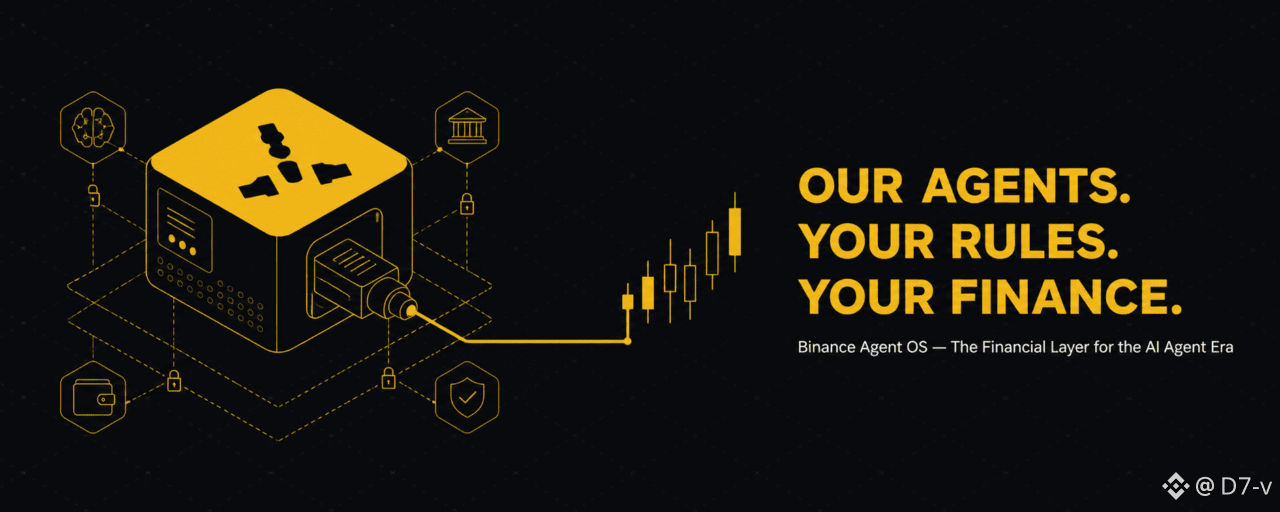
Мақала
Our Agents, Your Rules, Your Finance: Why Binance Is Building the Financial Layer for the AI AgentAI Agents Are Done Just Answering Questions
For the last few years, AI has mostly lived in a chat box. You ask, it answers. But that era is quietly ending. AI agents are now writing code, booking flights, managing calendars, and — increasingly — touching real money. The moment software starts acting instead of just responding, it needs a way to reach financial markets the same way a human trader does: reading prices, checking balances, and executing trades.
That shift is exactly what Binance Agent OS is built for. Launched August 20, 2026 as part of Binance Intelligence, Agent OS is a developer platform designed to be the financial capability layer for AI agents, letting tools like ChatGPT, Claude Code, Codex, and VS Code connect directly to Binance's markets, wallets, and trading infrastructure under permissions the user controls.
What Is Binance Agent OS?
Binance Agent OS isn't a single product — it's a toolkit that bundles several existing pieces of Binance's infrastructure into one coherent access layer for AI:
Binance APIs — the trading and account infrastructure Binance has offered developers for yearsBinance Wallet Agentic Hub — agent-facing wallet operationsBinance x402 — a programmable payments layer for machine-to-machine settlementBinance Skill Hub — a curated library of ready-made agent skillsMCP Server support — the new piece that ties everything together
Think of Agent OS as Binance's "universal socket" for AI agents — instead of every developer building a custom integration to talk to Binance, they plug into one standardized layer.
The MCP Connection: How AI Agents "Plug Into" Binance
This launch centers on the Model Context Protocol (MCP) — an open standard already adopted by major AI players like OpenAI, Google, Microsoft, and AWS to let AI applications discover and use external tools. MCP is what makes it possible for an AI running inside Claude Code or ChatGPT to say "check the BTC order book" or "place a spot order" without a developer hardcoding that specific request.
Binance's implementation is called the Binance MCP Server, reachable at a single endpoint: https://agent.binance.com/mcp/agentic. Any MCP-compatible client that supports Streamable HTTP can connect to it. Binance's own support docs name five:
ChatGPT (via plugin)Claude CodeClaudeCodexVS Code
(Binance's press release names Cursor instead of VS Code in the same slot — the two official write-ups don't fully agree, a sign the supported-client list is still settling post-launch. )
Once connected, the agent doesn't need users to manage API keys locally — authentication happens through the Binance account itself, and the user grants specific scopes of access.
What an AI Agent Can Actually Do (And Can't)
This is where Binance's design gets interesting — and where "your rules" stops being a marketing line and starts being a technical one. According to Binance's own documentation, once a user authorizes an agent, they can grant it scopes to:
Read market data — tickers, order books, candlesticks, and funding rates, with no authentication requiredCheck balances — view Agentic sub-account balances, positions, and bills, plus an optional read-only view of the main accountTrade — access Spot, Margin, Convert, USDⓈ-M Futures, and COIN-M Futures functions, depending on granted scopesTransfer — move funds between wallets inside the Agentic sub-account (e.g., Spot to Futures)
Just as important is what agents cannot do. Binance has explicitly built in guardrails:
Agents cannot withdraw funds to external addressesAgents cannot transfer assets from a user's main account into the Agentic sub-account directlyAgents cannot access non-trading personal account data like email addresses or KYC information
Beyond crypto, Binance describes Agent OS as spanning "crypto and traditional markets." The clearest on-ramp for that today is bStocks, Binance's tokenized-stock product, which had just passed $500 million in assets under management around the same time. Binance hasn't published which stocks or how many are covered under Agent OS specifically — so read "broader markets" as a stated direction, not a finalized catalog.
Why User-Controlled Permissions Matter
Handing an AI agent access to your trading account sounds risky — and it can be, if done carelessly. Binance's architecture addresses this through dedicated Agentic sub-accounts. Every agent operates inside its own segregated sub-account, not your main wallet, with:
No withdrawal scope built into the integration at all — an agent cannot send funds to an external address, full stopNo path to pull money out of your main account either — you have to manually transfer funds into the sub-account yourselfManagement handled separately from your main wallet, under Profile → Sub-Accounts → Account Management
This matters because it separates capability from exposure. An agent might technically be able to trade futures, but it can only touch the funds you deliberately deposited into that isolated sub-account — not your entire portfolio. (Binance's public materials don't spell out granular per-toggle permission controls or daily spending caps beyond this structural isolation — worth confirming directly in your account settings before funding an agent.)
Practical Example: Connecting an Agent in Claude Code
Binance's own instructions boil down to two things: add the MCP endpoint to a compatible client, then fund the sub-account. Layered onto Claude Code's normal way of registering an MCP server, here's what that looks like in practice:
Open your terminal and run: claude mcp add binance-mcp-server --transport http https://agent.binance.com/mcp/agenticType /mcp in Claude Code to list connected MCP servers, confirming binance-mcp-server appearsSelect the server and choose Authenticate — this redirects to a Binance login/authorization pageChoose which agent you want to connectSet granular permissions — enabling or disabling specific features and productsFund your Agentic sub-account via Profile → Dashboard → Sub-account → Asset Management → Transfer
From that point, the AI agent can read live market data and, within the permissions you set, execute trades — all traceable back to that sub-account.
Why This Matters for the AI Agent Era
The broader significance here isn't just "Binance added a chatbot feature." It's that finance is becoming a native capability for AI, not an external tool AI has to awkwardly bolt on. As Binance puts it, instead of AI just answering questions, an AI with MCP access can take actions on your behalf.
That reframes the risk conversation. It's no longer just "can the AI hallucinate a wrong answer" — it's "can the AI place a wrong trade." Binance's response is to build the plumbing so that when that moment arrives, there's an auditable, permissioned perimeter around it: scoped access, segregated funds, no external withdrawals, and monitoring on trading activity initiated through the platform.
For traders and developers experimenting with AI-driven strategies, this also lowers the technical bar significantly. Instead of writing custom integration code against Binance's REST APIs, a developer can point an MCP-compatible agent at one endpoint and get standardized access to spot, margin, futures, and convert markets.
Key Takeaways
Binance Agent OS is a developer platform connecting AI agents (ChatGPT, Claude Code, Claude, Codex, VS Code) to Binance's trading, market data, wallet, and payment infrastructure.The Binance MCP Server uses the open Model Context Protocol standard to let compatible AI clients discover and use Binance tools without managing local API keys.Agents operate inside dedicated Agentic sub-accounts isolated from the main wallet, with no withdrawal scope built into the integration at all.Supported functions include reading market data, checking balances, trading Spot/Margin/Convert/Futures, and transferring funds within the sub-account — but not external withdrawals or main-account transfers.Binance says Agent OS reaches into "traditional markets" too, with bStocks (tokenized stocks, ~$500M AUM) as the clearest on-ramp — exact stock coverage isn't published yet.
FAQ
What is Binance Agent OS?
It's a developer platform launched by Binance that lets AI applications and agents connect to Binance's trading, market data, wallet, and payment capabilities through user-controlled permissions.
What is MCP and why does Binance use it?
MCP (Model Context Protocol) is an open standard that lets AI applications discover and use external tools in a standardized way, already adopted by major AI providers. Binance uses it so agents in Claude Code, ChatGPT, or Codex can connect to Binance without custom, one-off integrations.
Can an AI agent withdraw my funds through Binance Agent OS?
No. Agents cannot withdraw crypto to external addresses, and they cannot transfer funds from your main account into the Agentic sub-account directly.
Which AI tools work with the Binance MCP Server?
Any compatible client supporting MCP over Streamable HTTP. Binance's support docs name ChatGPT, Claude Code, Claude, Codex, and VS Code; its press release names Cursor in place of VS Code — the two lists don't fully match, so check Binance's current docs for the up-to-date set.
Do I need to share my API keys with an AI agent?
No. Authentication happens through your Binance account via the MCP connection, so you don't need to manage or expose API keys locally.
What markets can an agent trade on Binance Agent OS?
Currently Spot, Margin, Convert, USDⓈ-M Futures, and COIN-M Futures, depending on the permissions granted and what your account is authorized to use.
#BinanceAgentOS #MCP #AIAgents #CryptoTrading #Binance
Our Agents, Your Rules, Your Finance: Why Binance Is Building the Financial Layer for the AI Agent
AI Agents Are Done Just Answering Questions
For the last few years, AI has mostly lived in a chat box. You ask, it answers. But that era is quietly ending. AI agents are now writing code, booking flights, managing calendars, and — increasingly — touching real money. The moment software starts acting instead of just responding, it needs a way to reach financial markets the same way a human trader does: reading prices, checking balances, and executing trades.
That shift is exactly what Binance Agent OS is built for. Launched August 20, 2026 as part of Binance Intelligence, Agent OS is a developer platform designed to be the financial capability layer for AI agents, letting tools like ChatGPT, Claude Code, Codex, and VS Code connect directly to Binance's markets, wallets, and trading infrastructure under permissions the user controls.
What Is Binance Agent OS?
Binance Agent OS isn't a single product — it's a toolkit that bundles several existing pieces of Binance's infrastructure into one coherent access layer for AI:
Binance APIs — the trading and account infrastructure Binance has offered developers for yearsBinance Wallet Agentic Hub — agent-facing wallet operationsBinance x402 — a programmable payments layer for machine-to-machine settlementBinance Skill Hub — a curated library of ready-made agent skillsMCP Server support — the new piece that ties everything together
Think of Agent OS as Binance's "universal socket" for AI agents — instead of every developer building a custom integration to talk to Binance, they plug into one standardized layer.
The MCP Connection: How AI Agents "Plug Into" Binance
This launch centers on the Model Context Protocol (MCP) — an open standard already adopted by major AI players like OpenAI, Google, Microsoft, and AWS to let AI applications discover and use external tools. MCP is what makes it possible for an AI running inside Claude Code or ChatGPT to say "check the BTC order book" or "place a spot order" without a developer hardcoding that specific request.
Binance's implementation is called the Binance MCP Server, reachable at a single endpoint: https://agent.binance.com/mcp/agentic. Any MCP-compatible client that supports Streamable HTTP can connect to it. Binance's own support docs name five:
ChatGPT (via plugin)Claude CodeClaudeCodexVS Code
(Binance's press release names Cursor instead of VS Code in the same slot — the two official write-ups don't fully agree, a sign the supported-client list is still settling post-launch. )
Once connected, the agent doesn't need users to manage API keys locally — authentication happens through the Binance account itself, and the user grants specific scopes of access.
What an AI Agent Can Actually Do (And Can't)
This is where Binance's design gets interesting — and where "your rules" stops being a marketing line and starts being a technical one. According to Binance's own documentation, once a user authorizes an agent, they can grant it scopes to:
Read market data — tickers, order books, candlesticks, and funding rates, with no authentication requiredCheck balances — view Agentic sub-account balances, positions, and bills, plus an optional read-only view of the main accountTrade — access Spot, Margin, Convert, USDⓈ-M Futures, and COIN-M Futures functions, depending on granted scopesTransfer — move funds between wallets inside the Agentic sub-account (e.g., Spot to Futures)
Just as important is what agents cannot do. Binance has explicitly built in guardrails:
Agents cannot withdraw funds to external addressesAgents cannot transfer assets from a user's main account into the Agentic sub-account directlyAgents cannot access non-trading personal account data like email addresses or KYC information
Beyond crypto, Binance describes Agent OS as spanning "crypto and traditional markets." The clearest on-ramp for that today is bStocks, Binance's tokenized-stock product, which had just passed $500 million in assets under management around the same time. Binance hasn't published which stocks or how many are covered under Agent OS specifically — so read "broader markets" as a stated direction, not a finalized catalog.
Why User-Controlled Permissions Matter
Handing an AI agent access to your trading account sounds risky — and it can be, if done carelessly. Binance's architecture addresses this through dedicated Agentic sub-accounts. Every agent operates inside its own segregated sub-account, not your main wallet, with:
No withdrawal scope built into the integration at all — an agent cannot send funds to an external address, full stopNo path to pull money out of your main account either — you have to manually transfer funds into the sub-account yourselfManagement handled separately from your main wallet, under Profile → Sub-Accounts → Account Management
This matters because it separates capability from exposure. An agent might technically be able to trade futures, but it can only touch the funds you deliberately deposited into that isolated sub-account — not your entire portfolio. (Binance's public materials don't spell out granular per-toggle permission controls or daily spending caps beyond this structural isolation — worth confirming directly in your account settings before funding an agent.)
Practical Example: Connecting an Agent in Claude Code
Binance's own instructions boil down to two things: add the MCP endpoint to a compatible client, then fund the sub-account. Layered onto Claude Code's normal way of registering an MCP server, here's what that looks like in practice:
Open your terminal and run: claude mcp add binance-mcp-server --transport http https://agent.binance.com/mcp/agenticType /mcp in Claude Code to list connected MCP servers, confirming binance-mcp-server appearsSelect the server and choose Authenticate — this redirects to a Binance login/authorization pageChoose which agent you want to connectSet granular permissions — enabling or disabling specific features and productsFund your Agentic sub-account via Profile → Dashboard → Sub-account → Asset Management → Transfer
From that point, the AI agent can read live market data and, within the permissions you set, execute trades — all traceable back to that sub-account.
Why This Matters for the AI Agent Era
The broader significance here isn't just "Binance added a chatbot feature." It's that finance is becoming a native capability for AI, not an external tool AI has to awkwardly bolt on. As Binance puts it, instead of AI just answering questions, an AI with MCP access can take actions on your behalf.
That reframes the risk conversation. It's no longer just "can the AI hallucinate a wrong answer" — it's "can the AI place a wrong trade." Binance's response is to build the plumbing so that when that moment arrives, there's an auditable, permissioned perimeter around it: scoped access, segregated funds, no external withdrawals, and monitoring on trading activity initiated through the platform.
For traders and developers experimenting with AI-driven strategies, this also lowers the technical bar significantly. Instead of writing custom integration code against Binance's REST APIs, a developer can point an MCP-compatible agent at one endpoint and get standardized access to spot, margin, futures, and convert markets.
Key Takeaways
Binance Agent OS is a developer platform connecting AI agents (ChatGPT, Claude Code, Claude, Codex, VS Code) to Binance's trading, market data, wallet, and payment infrastructure.The Binance MCP Server uses the open Model Context Protocol standard to let compatible AI clients discover and use Binance tools without managing local API keys.Agents operate inside dedicated Agentic sub-accounts isolated from the main wallet, with no withdrawal scope built into the integration at all.Supported functions include reading market data, checking balances, trading Spot/Margin/Convert/Futures, and transferring funds within the sub-account — but not external withdrawals or main-account transfers.Binance says Agent OS reaches into "traditional markets" too, with bStocks (tokenized stocks, ~$500M AUM) as the clearest on-ramp — exact stock coverage isn't published yet.
FAQ
What is Binance Agent OS?
It's a developer platform launched by Binance that lets AI applications and agents connect to Binance's trading, market data, wallet, and payment capabilities through user-controlled permissions.
What is MCP and why does Binance use it?
MCP (Model Context Protocol) is an open standard that lets AI applications discover and use external tools in a standardized way, already adopted by major AI providers. Binance uses it so agents in Claude Code, ChatGPT, or Codex can connect to Binance without custom, one-off integrations.
Can an AI agent withdraw my funds through Binance Agent OS?
No. Agents cannot withdraw crypto to external addresses, and they cannot transfer funds from your main account into the Agentic sub-account directly.
Which AI tools work with the Binance MCP Server?
Any compatible client supporting MCP over Streamable HTTP. Binance's support docs name ChatGPT, Claude Code, Claude, Codex, and VS Code; its press release names Cursor in place of VS Code — the two lists don't fully match, so check Binance's current docs for the up-to-date set.
Do I need to share my API keys with an AI agent?
No. Authentication happens through your Binance account via the MCP connection, so you don't need to manage or expose API keys locally.
What markets can an agent trade on Binance Agent OS?
Currently Spot, Margin, Convert, USDⓈ-M Futures, and COIN-M Futures, depending on the permissions granted and what your account is authorized to use.
#BinanceAgentOS #MCP #AIAgents #CryptoTrading #Binance
1
89
Көбірек контент көру үшін кіріңіз
Binance Square платформасында әлемдік криптоқоғамдастыққа қосылыңыз
⚡️ Криптовалюта туралы ең соңғы және пайдалы ақпаратты алыңыз.
💬 Әлемдегі ең ірі криптобиржаның сеніміне ие.
👍 Расталған авторлардың нақты пікірлерін табыңыз.
Электрондық пошта/телефон нөмірі
Трендтегі тақырыптар
1
#CanMarketsReboundAfterThanksgiving?
8,667 рет көрілді
215 адам талқылап жатыр
2
#CouldSpaceX’sOrbitalDataCentersBoostAIChipDemand?
6,404 рет көрілді
144 адам талқылап жатыр
3
#EvolveAtBinanceBlockchainWeek
645,104 рет көрілді
6,711 адам талқылап жатыр
4
#CorePCEBeatLiftsFedHikeOdds
153,674 рет көрілді
1,224 адам талқылап жатыр
5
#BitcoinAndStocksSlipAgainAmidTrump’sTariffPlans
208,665 рет көрілді
2,013 адам талқылап жатыр
6
#JensenHuangSaysNvidiaDoesn’tNeedASuccessionPlan
99,838 рет көрілді
1,217 адам талқылап жатыр
7
#NasdaqFuturesSlideMoreThan3%
40,395 рет көрілді
364 адам талқылап жатыр
8
#USOctoberPCEPriceIndexAt0.3%MoM
46,022 рет көрілді
370 адам талқылап жатыр
9
#BitcoinETFsPostRecord$4.94BNovemberOutflows
8,818 рет көрілді
48 адам талқылап жатыр
10
#TetherInvestsInArgentinasLemon
17,530 рет көрілді
210 адам талқылап жатыр