
#stellar
stellar
1.8M рет көрілді
4,707 адам талқылап жатыр
Қызу саудада
Ең соңғы

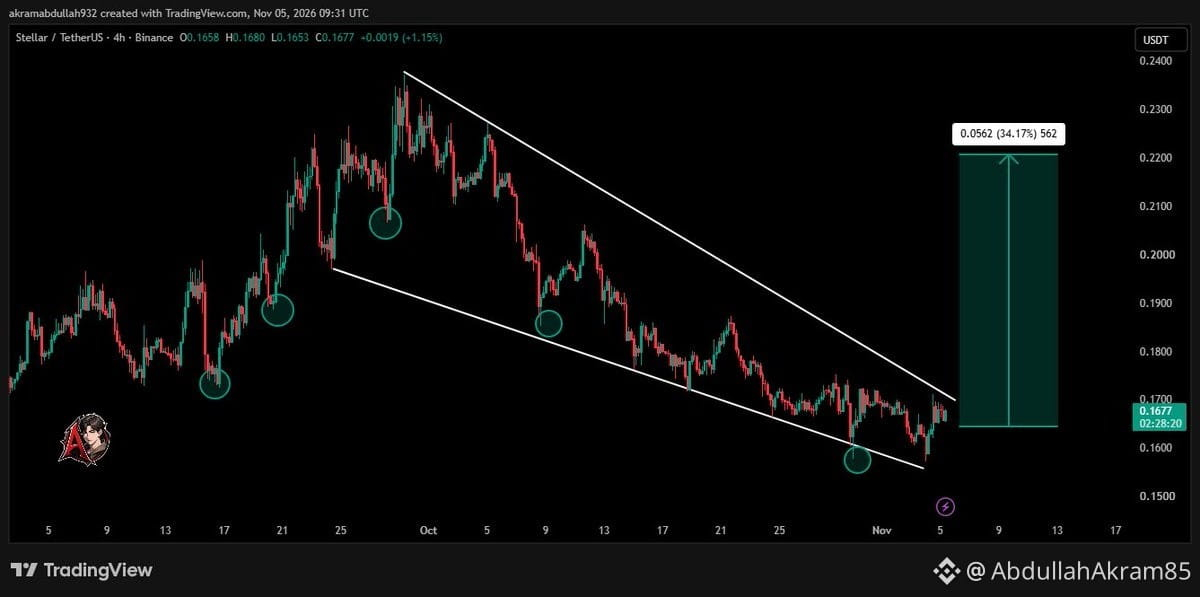
$XLM is testing the lower boundary of a falling channel.
A breakout could trigger a bullish move toward $0.22, offering nearly 34% upside.
Watching closely for confirmation!
#XLMUSDT #Stellar #cryptouniverseofficial
{spot}(XLMUSDT)
$XLM is testing the lower boundary of a falling channel.
A breakout could trigger a bullish move toward $0.22, offering nearly 34% upside.
Watching closely for confirmation!
#XLMUSDT #Stellar #cryptouniverseofficial
A breakout could trigger a bullish move toward $0.22, offering nearly 34% upside.
Watching closely for confirmation!
#XLMUSDT #Stellar #cryptouniverseofficial
1
1.1k

·
--
Down almost 9% and parked right on its low — is $XLM about to lose the $0.15 line, or is this where buyers finally step in?
There's no headline specific to the coin behind it. The Nasdaq just had its worst day since April, down 5.5% on AI-regulation worries after the midterms, and over $1B in crypto longs got flushed. $XLM is simply riding that wave harder than most — down 8.9% near $0.153 on $195M in volume, while $BTC is off 6% near $75,600 and $ETH is down 8% near $2,225.
I'm watching $0.15. Hold above it and a bounce attempt wouldn't surprise me; lose it and the slide probably picks up speed. Are you buying this dip, or waiting for the level to break first?
#Stellar #CryptoMarket #Write2Earn
4

🚨 $XLM BUYERS HITTING RESISTANCE WALL AS BEARS SET UP HIGH-CONVICTION SHORT! 🐻
Entry: 0.1931 - 0.1969 ⚡
Target: 0.190 - 0.179 🚀
Stop Loss: 0.212 ⚠️
The upside expansion on $XLM is hitting a brick wall right into overhead resistance. 📉 Exhaustion spikes on smaller timeframes show buyers are failing to defend key lower-high structures, opening the floodgates for a swift liquidity pullback.
📌 As order flow shifts toward aggressive distribution, seller volume is beginning to dominate the tape. 💡 This short setup offers a clean asymmetric play as price prepares to unwind down to major demand pockets below. 💬 Are you taking the short flip here or expecting one more fakeout sweep before the drop? 👇
⚠️ Not financial advice. Always manage your risk. 🛡️
🏷️ #XLM #ShortSetup #Crypto #Stellar
🐻 🩸
14

·
--
Расталды
WalletConnect x Stellar:
Powering Bermuda’s Onchain Future
WalletConnect just expanded Stellar support and partnered with Penrose Partners to bring WalletConnect Pay to Bermuda. LOBSTR is already live for direct wallet payments, while Premier Tickets will be the first merchant in Q2 2027. Funds move instantly from customer to organizer—no middleman. Bermuda is building the world’s first fully onchain national economy. This is real-world crypto adoption at national scale. 🌍⚡
#WalletConnect #stellar $WCT
1
4.1k

·
--
Расталды
🌌 Stellar’s Bell Upgrade Is Getting Closer — Big Changes Ahead!
Stellar’s upcoming Protocol 30 (Bell) is moving toward its next milestone.
🔹 Testnet upgrade vote: November 3.
🔹 Mainnet upgrade vote: November 23.
🔹 Adds support for quantum-safe signatures in smart contracts.
🔹 Prepares the network for faster ledger processing.
The upgrade could strengthen Stellar’s infrastructure for businesses and developers. Both votes still require validator approval.
$XLM
{future}(XLMUSDT)
.
.
.
#Stellar #crypto
Not financial advice. DYOR.
🌌 Stellar’s Bell Upgrade Is Getting Closer — Big Changes Ahead!
Stellar’s upcoming Protocol 30 (Bell) is moving toward its next milestone.
🔹 Testnet upgrade vote: November 3.
🔹 Mainnet upgrade vote: November 23.
🔹 Adds support for quantum-safe signatures in smart contracts.
🔹 Prepares the network for faster ledger processing.
The upgrade could strengthen Stellar’s infrastructure for businesses and developers. Both votes still require validator approval.
$XLM
.
.
.
#Stellar #crypto
Not financial advice. DYOR.
523

Расталды
Мақала
🚨 عملة XLM تحت المراقبة… هل تستعد لحركة قوية؟🪙 Stellar (XLM)
تدخل Stellar مرحلة مهمة مع اقتراب تحديث Bell (Protocol 30)، الذي يهدف إلى تطوير قدرات العقود الذكية وتحسين استخدام الشبكة في التطبيقات المالية.
📊 ما الذي يجعلها جديرة بالمتابعة؟
🔹 تحديث تقني مهم للشبكة.
🔹 اهتمام متزايد بمجال ترميز الأصول المالية.
🔹 احتمال ارتفاع التقلبات مع اقتراب موعد التحديث.
🎯 خطة المراقبة:
انتظار اختراق مقاومة واضحة.
مراقبة حجم التداول لتأكيد الحركة.
عدم الدخول قبل ظهور إشارة فنية واضحة.
⚠️ التحديث التقني لا يضمن ارتفاع السعر، وقد يكون الخبر محسوباً مسبقاً في السوق.
💬 برأيكم، هل تستطيع XLM العودة إلى مستويات أعلى خلال نوفمبر، أم أنها تحتاج إلى مزيد من التصحيح؟
#stellar #crypto #Binance #altcoins #تحليل_العملات_الرقمية
🚨 عملة XLM تحت المراقبة… هل تستعد لحركة قوية؟
🪙 Stellar (XLM)
تدخل Stellar مرحلة مهمة مع اقتراب تحديث Bell (Protocol 30)، الذي يهدف إلى تطوير قدرات العقود الذكية وتحسين استخدام الشبكة في التطبيقات المالية.
📊 ما الذي يجعلها جديرة بالمتابعة؟
🔹 تحديث تقني مهم للشبكة.
🔹 اهتمام متزايد بمجال ترميز الأصول المالية.
🔹 احتمال ارتفاع التقلبات مع اقتراب موعد التحديث.
🎯 خطة المراقبة:
انتظار اختراق مقاومة واضحة.
مراقبة حجم التداول لتأكيد الحركة.
عدم الدخول قبل ظهور إشارة فنية واضحة.
⚠️ التحديث التقني لا يضمن ارتفاع السعر، وقد يكون الخبر محسوباً مسبقاً في السوق.
💬 برأيكم، هل تستطيع XLM العودة إلى مستويات أعلى خلال نوفمبر، أم أنها تحتاج إلى مزيد من التصحيح؟
#stellar #crypto #Binance #altcoins #تحليل_العملات_الرقمية
737

·
--
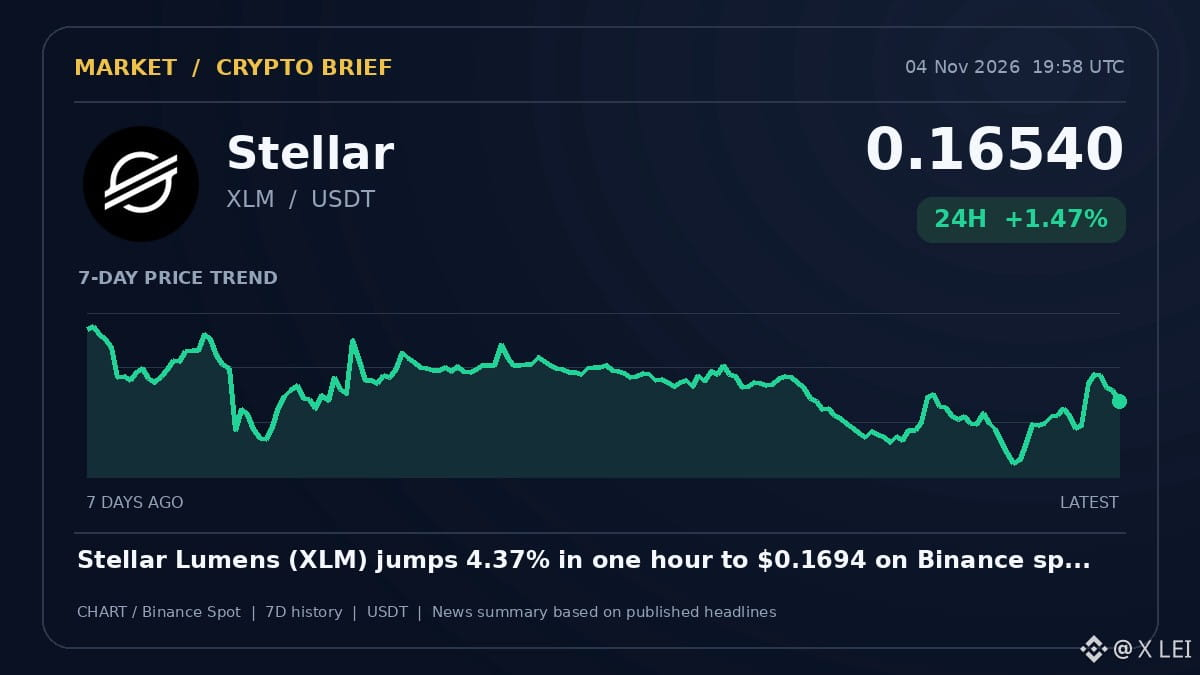
Stellar has seen some recent movement on the Binance spot market, with reports from Pluang noting a brief climb earlier today. Currently, $XLM is trading at 0.1654 USDT, reflecting a modest 24-hour gain of 1.47%. Market participants continue to monitor these ongoing price fluctuations closely. #Stellar
Stellar has seen some recent movement on the Binance spot market, with reports from Pluang noting a brief climb earlier today. Currently, $XLM is trading at 0.1654 USDT, reflecting a modest 24-hour gain of 1.47%. Market participants continue to monitor these ongoing price fluctuations closely. #Stellar
124

·
--
Жоғары (өспелі)
Расталды
🚀 Stellar (XLM) Rises as Crypto Market Rebounds – Institutional Adoption Adds Bullish Momentum!
Stellar (XLM) is gaining momentum, rising approximately 3.6% as the broader cryptocurrency market recovers and Bitcoin reclaims the $80K level. 📈
What's driving the momentum?
📊 Broad crypto market recovery is lifting major altcoins.
💰 Stellar attracted significant tokenized fund inflows.
🏦 Institutional players, including DTCC and Securitize, are exploring Stellar for tokenized assets.
🔗 MetaMask integration strengthens Stellar's ecosystem.
🌍 Growing Real-World Asset (RWA) adoption adds to its long-term potential.
Unlike a purely speculative rally, Stellar has an emerging institutional tokenization narrative supporting market interest.
The big question: Can XLM sustain this momentum and break above $0.17, or will the market see another pullback? 👀
Keep watching Stellar. Its RWA story is worth following!
#Stellar #XLM #CryptoNews #Altcoins #RWA
{alpha}(560x9c8b5ca345247396bdfac0395638ca9045c6586e)
{spot}(XLMUSDT)
🚀 Stellar (XLM) Rises as Crypto Market Rebounds – Institutional Adoption Adds Bullish Momentum!
Stellar (XLM) is gaining momentum, rising approximately 3.6% as the broader cryptocurrency market recovers and Bitcoin reclaims the $80K level. 📈
What's driving the momentum?
📊 Broad crypto market recovery is lifting major altcoins.
💰 Stellar attracted significant tokenized fund inflows.
🏦 Institutional players, including DTCC and Securitize, are exploring Stellar for tokenized assets.
🔗 MetaMask integration strengthens Stellar's ecosystem.
🌍 Growing Real-World Asset (RWA) adoption adds to its long-term potential.
Unlike a purely speculative rally, Stellar has an emerging institutional tokenization narrative supporting market interest.
The big question: Can XLM sustain this momentum and break above $0.17, or will the market see another pullback? 👀
Keep watching Stellar. Its RWA story is worth following!
#Stellar #XLM #CryptoNews #Altcoins #RWA
3
453

·
--
Stellar's proposed Bell upgrade would let a custodian serve many customers from one smart account, instead of deploying a separate contract for each.
Smart accounts use code to set spending rules, such as requiring several approvals. Bell would add deposit addresses beginning with W: each combines a contract address with a customer ID. Funds go into the shared contract, while the transfer record identifies the customer.
Stellar already has this customer-ID arrangement for ordinary accounts. Extending it to smart accounts would let providers keep their programmable spending rules without needing a contract per customer. A customer-specific address would still lead to pooled custody, not a separate personal wallet.
The mainnet upgrade vote is scheduled for November 23 at 17:00 UTC, subject to change. Activation requires validator approval; wallets and exchanges also need to support the new addresses before customers can use them there.
Source: Stellar Development Foundation's Bell announcement and upgrade guide.
https://stellar.org/blog/developers/introducing-bell-protocol-30-on-stellar
#Stellar #XLM
203

對想要導入區塊鏈的金融機構來說,如果每位客戶都要單獨部署一個智慧合約,高昂的手續費和維護成本會直接把專案卡死。Stellar 這次升級,正是為了解決這類企業級落地的硬傷。
據 Stellar 官方開發者指南公布,驗證節點已正式表決通過,Protocol 30(代號 Bell)升級已順利在測試網上線。社群預計在 11 月 23 日進行主網啟動投票。
這次升級帶來了三項重大架構改進:
首先是 CAP-84 提案引進的多路複用合約地址(以 W 開頭的新地址格式)。過去交易所或支付業者為了區分客戶,必須維護繁瑣的映射關係或多重帳戶。現在機構只要用單一合約,就能透過內嵌標識精準辨識不同用戶的入金與提款,大幅精簡智慧帳戶的營運成本。
其次是 CAP-87 提案,正式在 Soroban 智慧合約中原生支援後量子數位簽名(ML-DSA)驗證。這讓自訂帳戶合約能自主選擇啟用抗量子防護,提前應對未來的算力威脅。
最後是 CAP-88 提案,將帳本出塊時間戳精確推進至毫秒等級。這項改動為後續進一步壓縮出塊確認時間建立了標準。由於帳本標頭與編碼格式大幅調整,官方要求所有節點、SDK 與錢包服務商必須全面升級相容版本。
這項進展直接牽動 XLM 的長線定位。Stellar 本身走的是跨境支付與資產代幣化路線,W 地址能替做市商與機構省下可觀的鏈上管理成本,有助於帶動 Soroban 生態的合約呼叫需求。
據幣安現貨數據,目前 XLM 價格在 0.163 美元附近震盪,24 小時微跌約 1.7%,單日成交額約 790 萬美元。盤面在美股開盤前維持防守格局,尚未反映測試網升級的技術利多。
日後評估這項技術進展是否轉化為盤面推力,有兩個具體檢驗點:
第一是 11 月 23 日的主網投票進展,留意主力交易所與節點的軟體相容進度是否如期,避免出現升級延期或分叉爭議。
第二是主網上線後,鏈上 W 開頭合約地址的採用率與 Soroban 日均調用次數。若企業入金通道能如期轉移並放量,XLM 才有機會在 0.16 美元上方築底並脫離大盤連動;反之若只停留在測試網階段,缺乏真實資金流入,技術升級對價格的提振將相當有限。
純屬個人分析,投資前請做好功課(DYOR)。
$XLM #Stellar

14
·
--
Stellar baru saja menyalakan upgrade Bell di testnet — dan ini langkah paling serius Stellar menuju akun smart-contract kelas bisnis.
Fakta: Bell, alias Protocol 30, resmi live di testnet Stellar pada 3 Nov setelah vote validator pada 17:00 UTC hari yang sama (Stellar Development Foundation, dikonfirmasi CoinMarketCap Academy 3 Nov, The Defiant 3 Nov, dan TokenPost 4 Nov). Isinya tiga perubahan: CAP-84 menghadirkan muxed contract address berformat W, jadi satu smart contract bisa melayani banyak pelanggan dengan pengenal masing-masing; CAP-87 memungkinkan kontrak Soroban memverifikasi tanda tangan ML-DSA pasca-kuantum; CAP-88 mengubah timestamp ledger ke resolusi milidetik, membuka jalan ke ledger yang lebih cepat.
Status: TERKONFIRMASI untuk testnet — tapi mainnet MASIH MENUNGGU. Vote validator untuk aktivasi mainnet dijadwalkan 23 Nov pukul 17:00 UTC, dan tanpa persetujuan itu Bell tidak aktif di mainnet. Jadi jangan tertukar: yang live sekarang adalah testnet, bukan jaringan utama.
Opiniku: yang paling menarik bukan label "kuantum"-nya, melainkan kegunaan bisnisnya — alamat muxed membuat satu kontrak bisa bekerja seperti rekening omnibus milik bursa atau payment provider. Tapi jujur saja: Bell TIDAK membuat Stellar langsung tahan-kuantum, karena tanda tangan transaksi tetap Ed25519; yang baru adalah kontrak bisa memeriksa tanda tangan ML-DSA. XLM di sekitar $0,165 saat aku menulis ini, jadi pasar membacanya sebagai kabar infrastruktur, bukan reli.
Yang aku pantau selanjutnya: hasil vote mainnet 23 Nov, kesiapan wallet dan infrastruktur yang wajib update software-nya sebelum vote, dan apakah smart account ini benar-benar dipakai bisnis setelah mainnet aktif.
Menurut kalian, fitur mana yang paling berdampak buat Stellar — alamat muxed-nya, verifikasi pasca-kuantumnya, atau ledger yang lebih cepat?
Ini analisisku, bukan nasihat finansial — DYOR selalu.
#Stellar #UpgradeBlockchain $XLM
28

·
--
🚨 RWA CAPITAL FLOWS ARE SHIFTING — AND STELLAR IS GETTING ATTENTION.
Stellar ($XLM ) has reportedly recorded $242 million more in RWA net inflows than the $XRP Ledger over the past 30 days. 😳
That’s a notable development in the competition for real-world asset activity.
But the bigger picture is worth watching:
👀 Can Stellar maintain this momentum?
📊 Can it close the gap with networks like $BNB and $SOL?
And is this part of a broader shift in RWA activity across blockchain ecosystems?
One important distinction: net inflows are not the same as total RWA value or overall network adoption.
Still, the data could signal changing interest across chains.
Which ecosystem do you think will capture more RWA activity next?
#Stellar #XLM
223

Расталды

Мақала
CURVE × STELLAR: COULD ONCHAIN FX BECOME THE NEXT MAJOR DEFI MARKET?BitChoice | Satya — DeFi, RWA & Market Structure Intelligence
November 2, 2026
From Stablecoin Swaps to Global Currency Markets
Decentralized finance is expanding beyond the Ethereum ecosystem.
On October 29, Curve Finance launched StableSwap on the Stellar mainnet, marking its first native deployment outside Ethereum Virtual Machine (EVM) networks.
The integration brings a specialized automated market maker to Stellar's payment and tokenized-asset infrastructure.
But the most interesting development may still be ahead.
Curve is preparing FXSwap, a system designed for assets whose relative prices change — including stablecoins linked to different national currencies.
The larger question: could decentralized liquidity infrastructure eventually become a meaningful part of global foreign-exchange settlement?
To understand the opportunity, we need to separate what already exists from what remains under development.
1. What Curve Actually Launched
The initial deployment brings StableSwap to Stellar.
StableSwap is an automated market maker optimized for assets expected to trade at similar prices.
For example, two stablecoins designed to maintain a value of one US dollar may be exchanged through a pool built around their shared reference price.
Unlike a general-purpose liquidity pool, StableSwap is designed to concentrate liquidity more efficiently around that relationship.
The potential benefit is reduced slippage for supported trades.
However, the actual execution price still depends on pool depth, asset stability and market conditions.
What Is Available?
Curve reports that users can:
Browse existing liquidity pools.Swap supported assets.Deposit assets to provide liquidity.Access the protocol through a beta interface.
The deployment also supports permissionless pool creation, although Curve is still expanding self-service creation functionality in its interface.
The initial launch is described as a limited deployment rather than the completed Curve product suite.
StableSwap is live. The broader ecosystem is still developing.
2. Why Stellar Required a New Technical Implementation
Curve's original StableSwap contracts were developed for EVM-compatible environments.
Stellar uses a different smart-contract architecture: Soroban.
As a result, Curve could not simply deploy its existing Vyper contracts unchanged.
The team rebuilt StableSwap for Stellar, retaining the underlying mathematical approach while adapting its implementation to Soroban.
The Stellar Development Foundation supported this integration.
This distinction is important.
A native non-EVM deployment expands the environments in which Curve technology can operate.
But new implementations also require careful security evaluation.
Past experience with an EVM version does not eliminate the risks associated with a different codebase and execution environment.
For users and liquidity providers, contract security remains an essential consideration.
3. Why Stellar Makes Strategic Sense
Stellar has historically emphasized payments, asset issuance and financial infrastructure.
Its ecosystem includes stablecoins, payment applications and tokenized financial products.
Franklin Templeton has used Stellar infrastructure for tokenized investment products, while MoneyGram has integrated Stellar-related payment services.
These developments create potential demand for liquid exchange markets between supported assets.
A digital asset becomes more useful when holders can acquire it, exchange it and exit positions at reasonable costs.
For a tokenized money market fund or a payment stablecoin, a lack of liquidity can reduce practical usability even when the underlying product works correctly.
That is where specialized market-making infrastructure may help.
Tokenization creates financial instruments. Liquidity infrastructure helps make them usable.
4. StableSwap vs FXSwap: The Crucial Difference
The two systems address different price relationships.
StableSwap — Already Live
Designed primarily for assets that are expected to maintain similar prices.
Examples include two dollar-pegged stablecoins.
The objective is efficient execution around a relatively stable exchange relationship.
FXSwap — Planned
Designed for assets whose relative prices change.
A dollar-pegged stablecoin and a euro-pegged stablecoin provide a useful example.
Their relative value changes as the EUR/USD exchange rate moves.
A liquidity mechanism built around a fixed one-to-one relationship would not be appropriate for that market.
FXSwap is intended to concentrate liquidity around changing market prices rather than a permanent peg.
Curve says development is nearing completion, with an audit required before launch.
No confirmed release date or initial currency-pair list has been announced.
FXSwap is not currently a live Stellar trading service.
5. What Would Onchain FX Actually Mean?
Foreign exchange is one of the world's largest financial markets.
Traditional currency conversion involves banks, payment processors, market makers, settlement infrastructure and regulatory requirements.
Blockchain-based fiat-linked assets introduce a different possibility.
For example, a user could potentially exchange a regulated dollar stablecoin for a euro-denominated token through an onchain liquidity pool.
The resulting asset could then be transferred across the same network to another eligible recipient.
Such arrangements could support:
Cross-border payments
Conversion between fiat-linked digital assets as part of a payment route.
Treasury management
Movement between different currency exposures without relying exclusively on conventional exchange workflows.
Tokenized financial assets
Liquidity connections between funds and settlement assets denominated in different currencies.
DeFi applications
Collateral management, lending and financial strategies involving multiple fiat-denominated tokens.
However, onchain conversion is not the same as the complete process of transferring money between bank accounts.
Users may still depend on fiat issuers, redemption partners, identity checks and local payment infrastructure.
The quality of the entire route matters.
6. A Hypothetical USD-to-EUR Payment Route
Consider a company holding a dollar-backed stablecoin.
It needs to make a payment denominated in euros.
A future onchain route could involve:
Holding a supported USD stablecoin on Stellar.Swapping it for a compatible EUR-denominated asset.Transferring the resulting asset to the recipient.Redeeming or using that asset through available financial infrastructure.
The potential advantage is a more integrated digital settlement process.
But the complete cost would include:
Available FX pricingPool slippageNetwork transaction feesStablecoin issuer costsRedemption and banking feesCompliance and operational requirements
A fast blockchain transaction does not guarantee the cheapest end-to-end currency conversion.
For the economic case to work, the full transaction route must compare favorably with relevant alternatives.
7. Liquidity: The Missing Piece in Many RWA Narratives
Tokenized assets often attract attention because they represent traditional instruments on blockchain networks.
But issuance is only the beginning.
A tokenized asset can be technically transferable yet have very limited secondary-market liquidity.
For a functioning financial ecosystem, users also need:
Reliable exchange venuesCompetitive bid-ask spreadsSufficient market depthTransparent asset specificationsDependable settlementMechanisms for managing collateral and liquidations
Curve's StableSwap integration could contribute to several of these requirements.
For example, sufficiently liquid pools may provide trading routes for lending platforms seeking to liquidate collateral.
They may also make it easier for aggregators to discover execution paths between supported assets.
But these benefits depend on actual integrations and sustained participation.
A liquidity protocol becomes economically important when there is liquidity to use.
8. The Risks Behind Stablecoin Liquidity Pools
Providing liquidity is not equivalent to depositing funds into a guaranteed savings account.
Several risks remain.
Stablecoin Depegging
Assets designed to maintain similar prices can diverge sharply.
If one stablecoin loses its peg, a liquidity pool may become heavily exposed to the weaker asset.
Smart-Contract Risk
The Stellar deployment uses contracts written for a new execution environment.
Security testing and audits matter, but no technical system is completely risk-free.
Issuer and Redemption Risk
Stablecoins depend on their issuers, reserve arrangements and redemption mechanisms.
A stablecoin's secondary-market price may differ from its intended value.
Liquidity and Exit Risk
New pools may have limited depth.
Depositing into a pool does not guarantee that users can exit without losses or unfavorable price impact.
Operational and Compliance Risk
Supported assets may have issuer-level controls or restrictions.
A technically successful swap does not override applicable legal requirements or asset-level transfer limitations.
These risks are particularly relevant when financial infrastructure is intended for institutional or payment use.
9. What Does This Mean for XLM?
The integration is a meaningful development for Stellar's application ecosystem.
More activity could potentially increase network usage.
However, adoption of Curve's infrastructure does not automatically establish investment returns for XLM holders.
The relationship depends on transaction activity, fee mechanics, network economics and sustained demand for Stellar services.
A growing application ecosystem and a rising token price are not the same measurement.
The useful indicators will include actual transactions, liquidity growth and economic activity on the network.
10. And What About CRV?
Curve's announcement contains a relevant economic detail.
The protocol says swap fees generated by its Stellar deployment contribute to Curve DAO under its existing fee framework.
This creates a more direct question about the relationship between protocol activity and its economic ecosystem.
But the size of any potential benefit depends on:
Trading volumePool fee structuresActual fee generationDAO distribution mechanicsOngoing operating and liquidity conditions
A new deployment does not automatically imply material revenue growth.
Nor does increased protocol usage guarantee appreciation of CRV.
Infrastructure adoption should be evaluated through actual economic value capture, not token-price assumptions.
11. Five Metrics That Will Determine Whether This Matters
The announcement is only the starting point.
A serious assessment should follow measurable activity.
1. Total liquidity
How much capital becomes available across Stellar Curve pools?
2. Trading volume
Are users conducting meaningful transactions, or is activity concentrated around the launch?
3. Execution quality
How do real swap costs compare with competing venues and routes?
4. Institutional and RWA integration
Do tokenized-asset issuers, payment services and applications begin using the pools?
5. FXSwap delivery
Does the planned product complete its audit, launch successfully and attract sustainable liquidity in real currency pairs?
These are the indicators that can transform an interesting announcement into a demonstrated infrastructure success.
12. Why This Could Matter Beyond Stellar
For years, DeFi growth was often measured through speculative trading activity and total value locked.
But a more mature infrastructure layer may need to support routine financial operations.
Payments.
Asset exchange.
Collateral management.
Currency conversion.
Liquidity for tokenized securities and funds.
If decentralized protocols can offer dependable execution for these activities, their relevance could extend beyond crypto-native traders.
Yet the industry must demonstrate reliability, competitive costs and appropriate risk controls.
A compelling technical architecture is not enough.
Final Perspective: The Next Frontier Is Market Infrastructure
Curve's arrival on Stellar represents a concrete expansion of specialized DeFi liquidity technology beyond EVM-compatible networks.
StableSwap is live today.
FXSwap may become the more significant development if it successfully introduces efficient trading between assets linked to different currencies.
But the long-term opportunity should be judged through actual market activity rather than expectations.
The important questions are straightforward.
Will liquidity deepen?
Will payment providers and RWA issuers integrate these markets?
Will FXSwap deliver competitive currency conversion?
Can these systems remain reliable during volatile markets?
The next major chapter of DeFi may be less about creating new speculative assets — and more about building the infrastructure that moves existing financial value.
Discussion
Could onchain FX become a genuine competitor to traditional currency-conversion infrastructure, or will liquidity and redemption constraints remain the biggest obstacles?
Primary sources
Curve Finance — Curve Is Live on Stellar, October 29, 2026.
Stellar Development Foundation — Curve Brings Onchain Liquidity Infrastructure to the Stellar Network in Its First Native Non-EVM Integration, October 29, 2026.
The Block — Curve Finance Launches on Stellar in First Native Deployment Outside EVM Ecosystem, October 29, 2026.
Editorial disclosure: StableSwap is live on Stellar. FXSwap remains planned and subject to audit, with no confirmed launch date. Hypothetical FX examples are not representations of currently executable routes. Pool participation carries smart-contract, market, issuer and liquidity risks.
Educational and informational content only. Not financial or investment advice.
#Stellar #CurveFinance #DeFi #RWA #OnchainFX $CRV $XLM
{spot}(XLMUSDT)
{spot}(CRVUSDT)
CURVE × STELLAR: COULD ONCHAIN FX BECOME THE NEXT MAJOR DEFI MARKET?
BitChoice | Satya — DeFi, RWA & Market Structure Intelligence
November 2, 2026
From Stablecoin Swaps to Global Currency Markets
Decentralized finance is expanding beyond the Ethereum ecosystem.
On October 29, Curve Finance launched StableSwap on the Stellar mainnet, marking its first native deployment outside Ethereum Virtual Machine (EVM) networks.
The integration brings a specialized automated market maker to Stellar's payment and tokenized-asset infrastructure.
But the most interesting development may still be ahead.
Curve is preparing FXSwap, a system designed for assets whose relative prices change — including stablecoins linked to different national currencies.
The larger question: could decentralized liquidity infrastructure eventually become a meaningful part of global foreign-exchange settlement?
To understand the opportunity, we need to separate what already exists from what remains under development.
1. What Curve Actually Launched
The initial deployment brings StableSwap to Stellar.
StableSwap is an automated market maker optimized for assets expected to trade at similar prices.
For example, two stablecoins designed to maintain a value of one US dollar may be exchanged through a pool built around their shared reference price.
Unlike a general-purpose liquidity pool, StableSwap is designed to concentrate liquidity more efficiently around that relationship.
The potential benefit is reduced slippage for supported trades.
However, the actual execution price still depends on pool depth, asset stability and market conditions.
What Is Available?
Curve reports that users can:
Browse existing liquidity pools.Swap supported assets.Deposit assets to provide liquidity.Access the protocol through a beta interface.
The deployment also supports permissionless pool creation, although Curve is still expanding self-service creation functionality in its interface.
The initial launch is described as a limited deployment rather than the completed Curve product suite.
StableSwap is live. The broader ecosystem is still developing.
2. Why Stellar Required a New Technical Implementation
Curve's original StableSwap contracts were developed for EVM-compatible environments.
Stellar uses a different smart-contract architecture: Soroban.
As a result, Curve could not simply deploy its existing Vyper contracts unchanged.
The team rebuilt StableSwap for Stellar, retaining the underlying mathematical approach while adapting its implementation to Soroban.
The Stellar Development Foundation supported this integration.
This distinction is important.
A native non-EVM deployment expands the environments in which Curve technology can operate.
But new implementations also require careful security evaluation.
Past experience with an EVM version does not eliminate the risks associated with a different codebase and execution environment.
For users and liquidity providers, contract security remains an essential consideration.
3. Why Stellar Makes Strategic Sense
Stellar has historically emphasized payments, asset issuance and financial infrastructure.
Its ecosystem includes stablecoins, payment applications and tokenized financial products.
Franklin Templeton has used Stellar infrastructure for tokenized investment products, while MoneyGram has integrated Stellar-related payment services.
These developments create potential demand for liquid exchange markets between supported assets.
A digital asset becomes more useful when holders can acquire it, exchange it and exit positions at reasonable costs.
For a tokenized money market fund or a payment stablecoin, a lack of liquidity can reduce practical usability even when the underlying product works correctly.
That is where specialized market-making infrastructure may help.
Tokenization creates financial instruments. Liquidity infrastructure helps make them usable.
4. StableSwap vs FXSwap: The Crucial Difference
The two systems address different price relationships.
StableSwap — Already Live
Designed primarily for assets that are expected to maintain similar prices.
Examples include two dollar-pegged stablecoins.
The objective is efficient execution around a relatively stable exchange relationship.
FXSwap — Planned
Designed for assets whose relative prices change.
A dollar-pegged stablecoin and a euro-pegged stablecoin provide a useful example.
Their relative value changes as the EUR/USD exchange rate moves.
A liquidity mechanism built around a fixed one-to-one relationship would not be appropriate for that market.
FXSwap is intended to concentrate liquidity around changing market prices rather than a permanent peg.
Curve says development is nearing completion, with an audit required before launch.
No confirmed release date or initial currency-pair list has been announced.
FXSwap is not currently a live Stellar trading service.
5. What Would Onchain FX Actually Mean?
Foreign exchange is one of the world's largest financial markets.
Traditional currency conversion involves banks, payment processors, market makers, settlement infrastructure and regulatory requirements.
Blockchain-based fiat-linked assets introduce a different possibility.
For example, a user could potentially exchange a regulated dollar stablecoin for a euro-denominated token through an onchain liquidity pool.
The resulting asset could then be transferred across the same network to another eligible recipient.
Such arrangements could support:
Cross-border payments
Conversion between fiat-linked digital assets as part of a payment route.
Treasury management
Movement between different currency exposures without relying exclusively on conventional exchange workflows.
Tokenized financial assets
Liquidity connections between funds and settlement assets denominated in different currencies.
DeFi applications
Collateral management, lending and financial strategies involving multiple fiat-denominated tokens.
However, onchain conversion is not the same as the complete process of transferring money between bank accounts.
Users may still depend on fiat issuers, redemption partners, identity checks and local payment infrastructure.
The quality of the entire route matters.
6. A Hypothetical USD-to-EUR Payment Route
Consider a company holding a dollar-backed stablecoin.
It needs to make a payment denominated in euros.
A future onchain route could involve:
Holding a supported USD stablecoin on Stellar.Swapping it for a compatible EUR-denominated asset.Transferring the resulting asset to the recipient.Redeeming or using that asset through available financial infrastructure.
The potential advantage is a more integrated digital settlement process.
But the complete cost would include:
Available FX pricingPool slippageNetwork transaction feesStablecoin issuer costsRedemption and banking feesCompliance and operational requirements
A fast blockchain transaction does not guarantee the cheapest end-to-end currency conversion.
For the economic case to work, the full transaction route must compare favorably with relevant alternatives.
7. Liquidity: The Missing Piece in Many RWA Narratives
Tokenized assets often attract attention because they represent traditional instruments on blockchain networks.
But issuance is only the beginning.
A tokenized asset can be technically transferable yet have very limited secondary-market liquidity.
For a functioning financial ecosystem, users also need:
Reliable exchange venuesCompetitive bid-ask spreadsSufficient market depthTransparent asset specificationsDependable settlementMechanisms for managing collateral and liquidations
Curve's StableSwap integration could contribute to several of these requirements.
For example, sufficiently liquid pools may provide trading routes for lending platforms seeking to liquidate collateral.
They may also make it easier for aggregators to discover execution paths between supported assets.
But these benefits depend on actual integrations and sustained participation.
A liquidity protocol becomes economically important when there is liquidity to use.
8. The Risks Behind Stablecoin Liquidity Pools
Providing liquidity is not equivalent to depositing funds into a guaranteed savings account.
Several risks remain.
Stablecoin Depegging
Assets designed to maintain similar prices can diverge sharply.
If one stablecoin loses its peg, a liquidity pool may become heavily exposed to the weaker asset.
Smart-Contract Risk
The Stellar deployment uses contracts written for a new execution environment.
Security testing and audits matter, but no technical system is completely risk-free.
Issuer and Redemption Risk
Stablecoins depend on their issuers, reserve arrangements and redemption mechanisms.
A stablecoin's secondary-market price may differ from its intended value.
Liquidity and Exit Risk
New pools may have limited depth.
Depositing into a pool does not guarantee that users can exit without losses or unfavorable price impact.
Operational and Compliance Risk
Supported assets may have issuer-level controls or restrictions.
A technically successful swap does not override applicable legal requirements or asset-level transfer limitations.
These risks are particularly relevant when financial infrastructure is intended for institutional or payment use.
9. What Does This Mean for XLM?
The integration is a meaningful development for Stellar's application ecosystem.
More activity could potentially increase network usage.
However, adoption of Curve's infrastructure does not automatically establish investment returns for XLM holders.
The relationship depends on transaction activity, fee mechanics, network economics and sustained demand for Stellar services.
A growing application ecosystem and a rising token price are not the same measurement.
The useful indicators will include actual transactions, liquidity growth and economic activity on the network.
10. And What About CRV?
Curve's announcement contains a relevant economic detail.
The protocol says swap fees generated by its Stellar deployment contribute to Curve DAO under its existing fee framework.
This creates a more direct question about the relationship between protocol activity and its economic ecosystem.
But the size of any potential benefit depends on:
Trading volumePool fee structuresActual fee generationDAO distribution mechanicsOngoing operating and liquidity conditions
A new deployment does not automatically imply material revenue growth.
Nor does increased protocol usage guarantee appreciation of CRV.
Infrastructure adoption should be evaluated through actual economic value capture, not token-price assumptions.
11. Five Metrics That Will Determine Whether This Matters
The announcement is only the starting point.
A serious assessment should follow measurable activity.
1. Total liquidity
How much capital becomes available across Stellar Curve pools?
2. Trading volume
Are users conducting meaningful transactions, or is activity concentrated around the launch?
3. Execution quality
How do real swap costs compare with competing venues and routes?
4. Institutional and RWA integration
Do tokenized-asset issuers, payment services and applications begin using the pools?
5. FXSwap delivery
Does the planned product complete its audit, launch successfully and attract sustainable liquidity in real currency pairs?
These are the indicators that can transform an interesting announcement into a demonstrated infrastructure success.
12. Why This Could Matter Beyond Stellar
For years, DeFi growth was often measured through speculative trading activity and total value locked.
But a more mature infrastructure layer may need to support routine financial operations.
Payments.
Asset exchange.
Collateral management.
Currency conversion.
Liquidity for tokenized securities and funds.
If decentralized protocols can offer dependable execution for these activities, their relevance could extend beyond crypto-native traders.
Yet the industry must demonstrate reliability, competitive costs and appropriate risk controls.
A compelling technical architecture is not enough.
Final Perspective: The Next Frontier Is Market Infrastructure
Curve's arrival on Stellar represents a concrete expansion of specialized DeFi liquidity technology beyond EVM-compatible networks.
StableSwap is live today.
FXSwap may become the more significant development if it successfully introduces efficient trading between assets linked to different currencies.
But the long-term opportunity should be judged through actual market activity rather than expectations.
The important questions are straightforward.
Will liquidity deepen?
Will payment providers and RWA issuers integrate these markets?
Will FXSwap deliver competitive currency conversion?
Can these systems remain reliable during volatile markets?
The next major chapter of DeFi may be less about creating new speculative assets — and more about building the infrastructure that moves existing financial value.
Discussion
Could onchain FX become a genuine competitor to traditional currency-conversion infrastructure, or will liquidity and redemption constraints remain the biggest obstacles?
Primary sources
Curve Finance — Curve Is Live on Stellar, October 29, 2026.
Stellar Development Foundation — Curve Brings Onchain Liquidity Infrastructure to the Stellar Network in Its First Native Non-EVM Integration, October 29, 2026.
The Block — Curve Finance Launches on Stellar in First Native Deployment Outside EVM Ecosystem, October 29, 2026.
Editorial disclosure: StableSwap is live on Stellar. FXSwap remains planned and subject to audit, with no confirmed launch date. Hypothetical FX examples are not representations of currently executable routes. Pool participation carries smart-contract, market, issuer and liquidity risks.
Educational and informational content only. Not financial or investment advice.
#Stellar #CurveFinance #DeFi #RWA #OnchainFX $CRV $XLM
2
788

·
--
😱 $XLM PÁNICO EN STELLAR: EL SEGUNDO EXCHANGE CAE EN CUATRO DÍAS
Mercado Bitcoin, la mayor exchange de Brasil, suspendió depósitos y retiros hoy tras un incidente de seguridad, cuatro días después del hackeo a Binance. Para mí, que otro exchange grande se tambalee en la misma semana ya no es mala suerte: el rastro del dinero llega a Stellar y XLM queda señalado.
Miren el detalle que nadie está viendo:
→ Hypernative marcó más de $40M en transferencias sospechosas en más de 10 cadenas y Mercado Bitcoin ya publicó las direcciones ligadas al caso, entre ellas las de Stellar, donde el atacante guarda unos 6.7 millones de XLM.
→ XLM -0.6% con $26.9M, mientras $XRP -0.4% apenas retrocede y TRX +1.9% sube entre los pagos: XLM es el que más se afloja del grupo justo cuando su red aparece en el mapa del incidente.
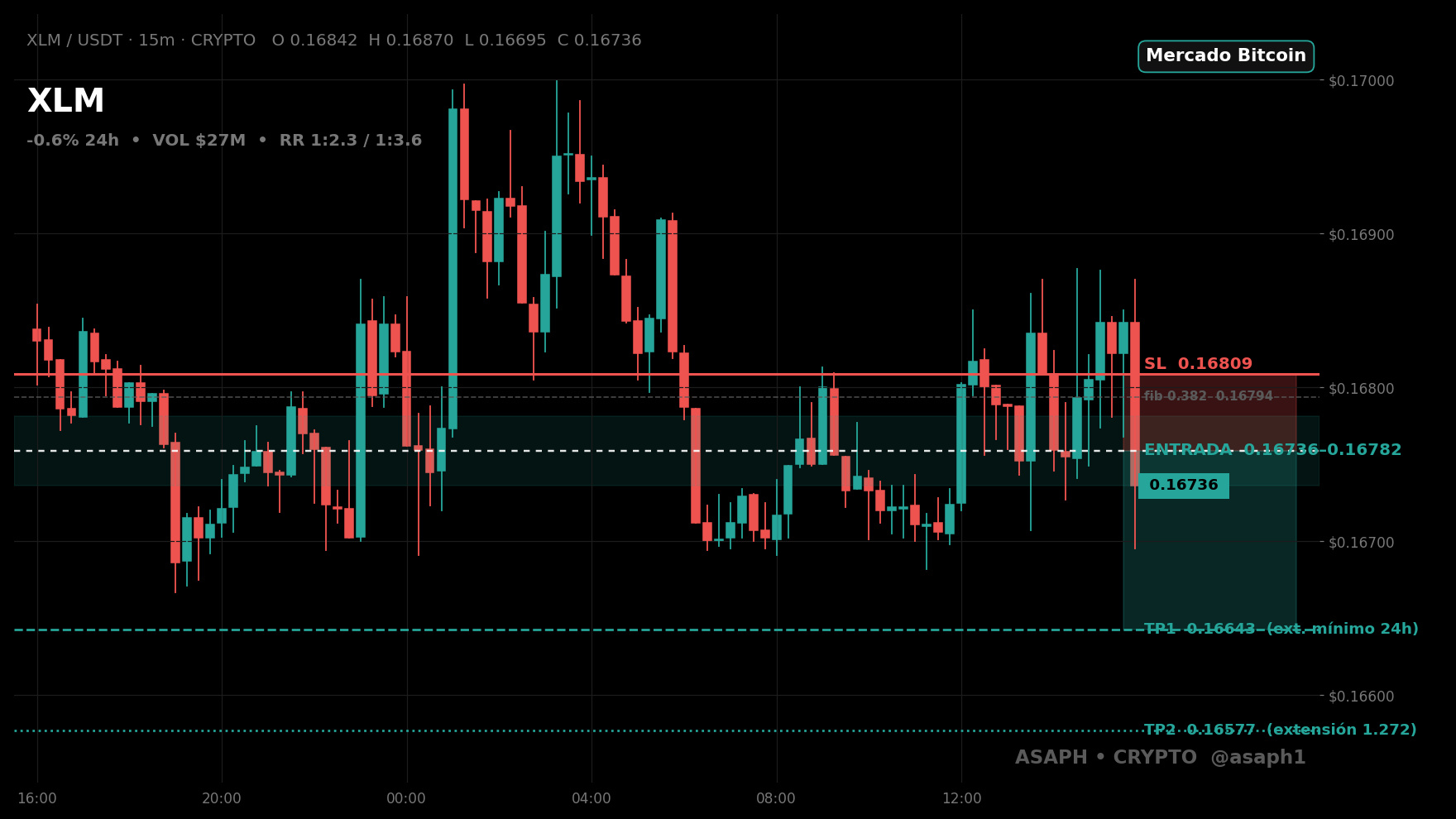
→ Entrada $0.16736–$0.16782, SL $0.16809, TP1 $0.16643 (-0.7%) → TP2 $0.16577 (-1.1%).
¿XLM pierde $0.16577 con Stellar en el mapa o aguanta en $0.16643? 👇
$XLM $XRP TRX
#Stellar #Brasil #Crypto
181
·
--
Stellar is now a default network in MetaMask Mobile and Extension, according to MetaMask’s October 29 announcement.
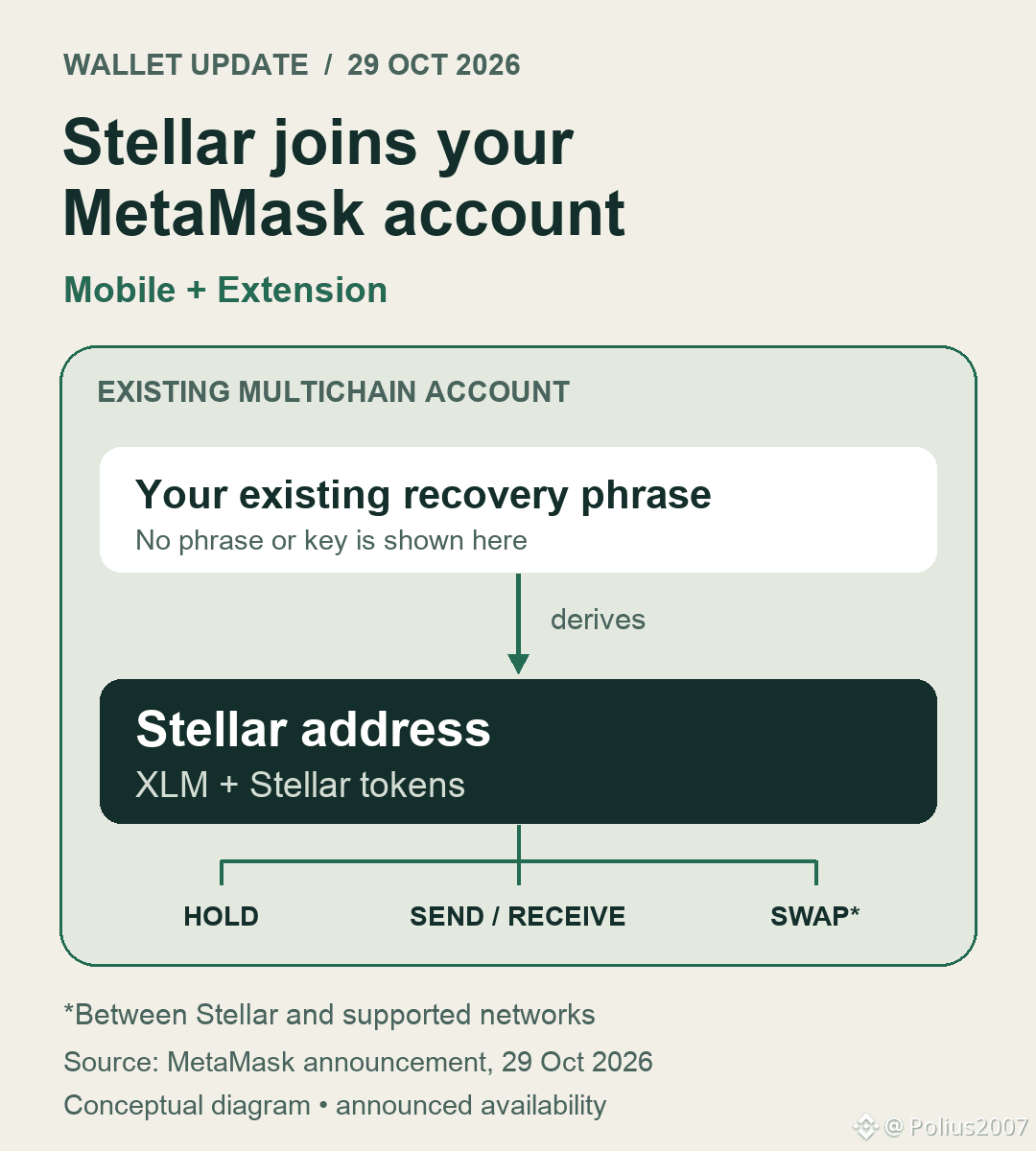
Existing users get a Stellar address derived from the recovery phrase they already use. It sits inside their multichain account, so someone who wants to hold XLM alongside their other crypto no longer needs a separate wallet just to access Stellar.
The integration supports XLM and other Stellar tokens, including trustline assets and Soroban tokens. Users can send and receive them and swap between Stellar and other supported networks. The additional Stellar address is network-specific: it comes from the same recovery phrase, rather than making one address work on every chain.
Source: MetaMask, October 29, 2026.
https://metamask.com/news/metamask-makes-stellar-a-default-network-bringing-global-payments-into-the-open-money-platform
#Stellar #XLM
333

·
--
Жоғары (өспелі)
Расталды
⚡ Stellar $XLM just demonstrated 7 MILLION payments per second — but there's a catch
Project Thruput reached 7.02M payments/sec using eight machines inside a single validator
One machine handled 1.18M
That's nearly 6x the execution capacity
The breakthrough isn't just speed 👇
$XLM
{future}(XLMUSDT)
Thruput is designed to process transactions in parallel, even when they touch the same accounts
It also explores zero per-transaction fees, with computing capacity allocated by unlocked native-token balances when demand exceeds supply
⚠️ But 7.02M is an execution benchmark — NOT Stellar mainnet TPS
It doesn't include full network consensus, transaction submission or mempool overhead
The technology is still being tested on FutureNet
{spot}(XLMUSDT)
📌 For $XLM , the next milestones are real network performance, a defined deployment path and proven token utility
A benchmark shows what's technically possible
Production adoption determines what it's worth
#XLM #stellar #blockchain
⚡ Stellar $XLM just demonstrated 7 MILLION payments per second — but there's a catch
Project Thruput reached 7.02M payments/sec using eight machines inside a single validator
One machine handled 1.18M
That's nearly 6x the execution capacity
The breakthrough isn't just speed 👇
$XLM
Thruput is designed to process transactions in parallel, even when they touch the same accounts
It also explores zero per-transaction fees, with computing capacity allocated by unlocked native-token balances when demand exceeds supply
⚠️ But 7.02M is an execution benchmark — NOT Stellar mainnet TPS
It doesn't include full network consensus, transaction submission or mempool overhead
The technology is still being tested on FutureNet
📌 For $XLM , the next milestones are real network performance, a defined deployment path and proven token utility
A benchmark shows what's technically possible
Production adoption determines what it's worth
#XLM #stellar #blockchain

2
1.2k
·
--
🌟 $XLM DUELO EN PAGOS: MIENTRAS RIPPLE SUELTA 1,000 MILLONES, STELLAR SE QUEDA ATRÁS
Ripple ya puso en circulación 1,000 millones de XRP hoy 1 de noviembre con sus dos desbloqueos de escrow, y el mercado lo absorbió sin drama. Para mí, el contraste es el dato: XRP aguantó el golpe de oferta, pero Stellar, su rival histórico en pagos, no está siguiendo el mismo ritmo esta mañana.
Miren el detalle que nadie está viendo:
→ Whale Alert reportó hoy los dos movimientos de 500 millones de XRP de Ripple, el desbloqueo mensual de noviembre ya en circulación.
→ XLM -1.0% con $27.1M, mientras $XRP +0.3% y $HBAR -0.5% se mueven distinto entre pagos.
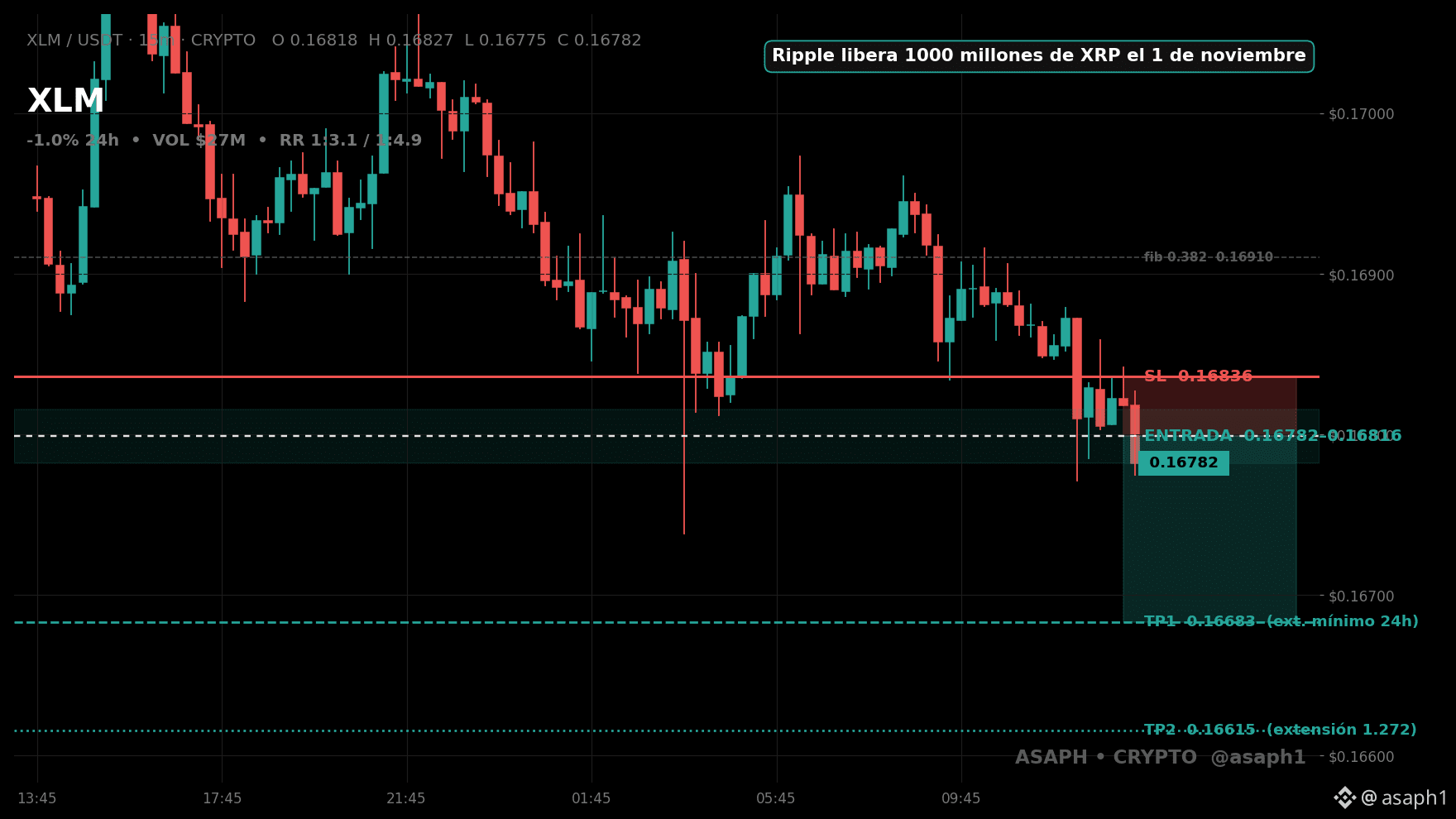
→ Entrada $0.16782–$0.16816, SL $0.16836, TP1 $0.16683 (-0.7%) → TP2 $0.16615 (-1.1%).
¿Ves a XLM llegando a $0.16615 o aguantando en $0.16697? 👇
$XLM
#Stellar #Pagos #Trading
83

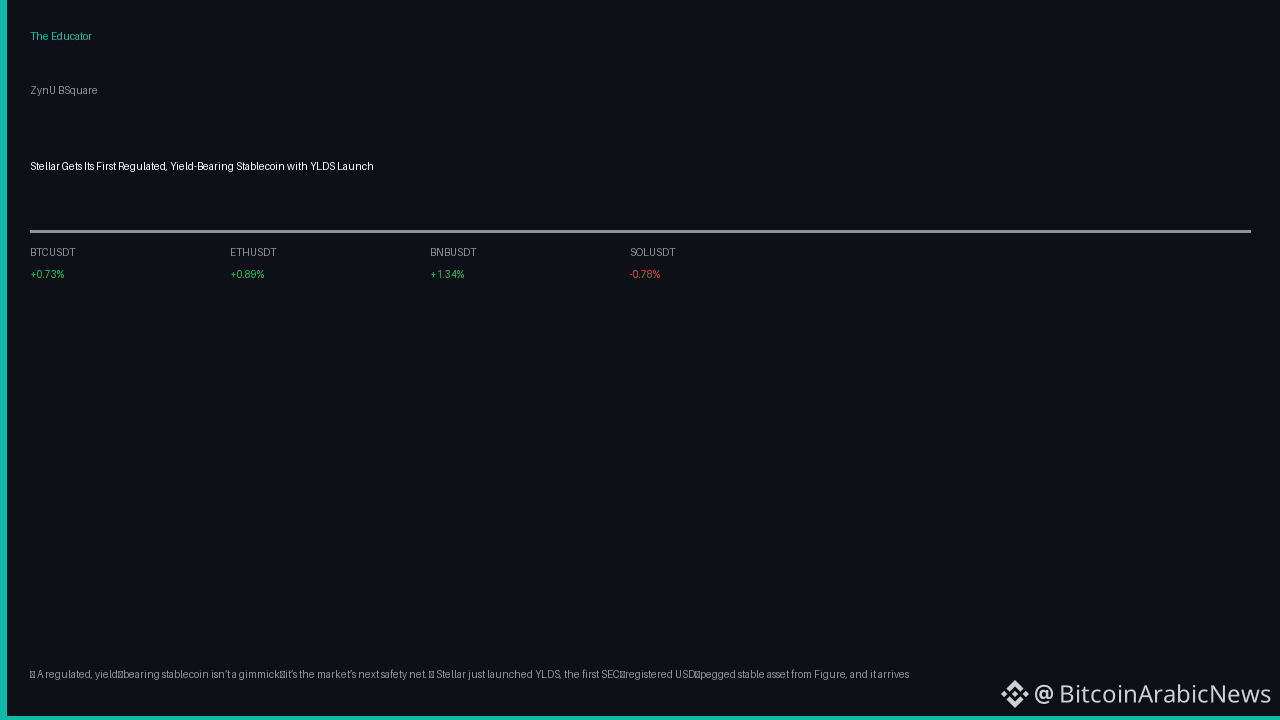
🔥 A regulated, yield‑bearing stablecoin isn’t a gimmick—it’s the market’s next safety net.
📊 Stellar just launched YLDS, the first SEC‑registered USD‑pegged stable asset from Figure, and it arrives while Bitcoin ticks up to $78,042 (+0.73%) amid a fear index of 34/100 and a bullish funding rate of +0.0100% on BTC futures. #Stellar #Stablecoins
💡 In a cycle where institutional capital re‑enters on the back of lower volatility, regulated yield‑bearing dollars become the bridge between traditional finance and DeFi, reinforcing the long‑term thesis that “crypto = real‑world finance.” #DeFi #Institutional
✅ Start allocating a small portion of your portfolio (e.g., 2‑5%) into YLDS or similar compliant stablecoins to capture the 4‑6% APY yield while keeping liquidity for buying the dip when BTC’s RSI hovers around 44 and long‑short ratios stay bullish (≈70% longs).
❓ How are you planning to integrate regulated stablecoins like YLDS into your strategy—pure yield, hedge, or a launchpad for the next bull run?
82


·
--
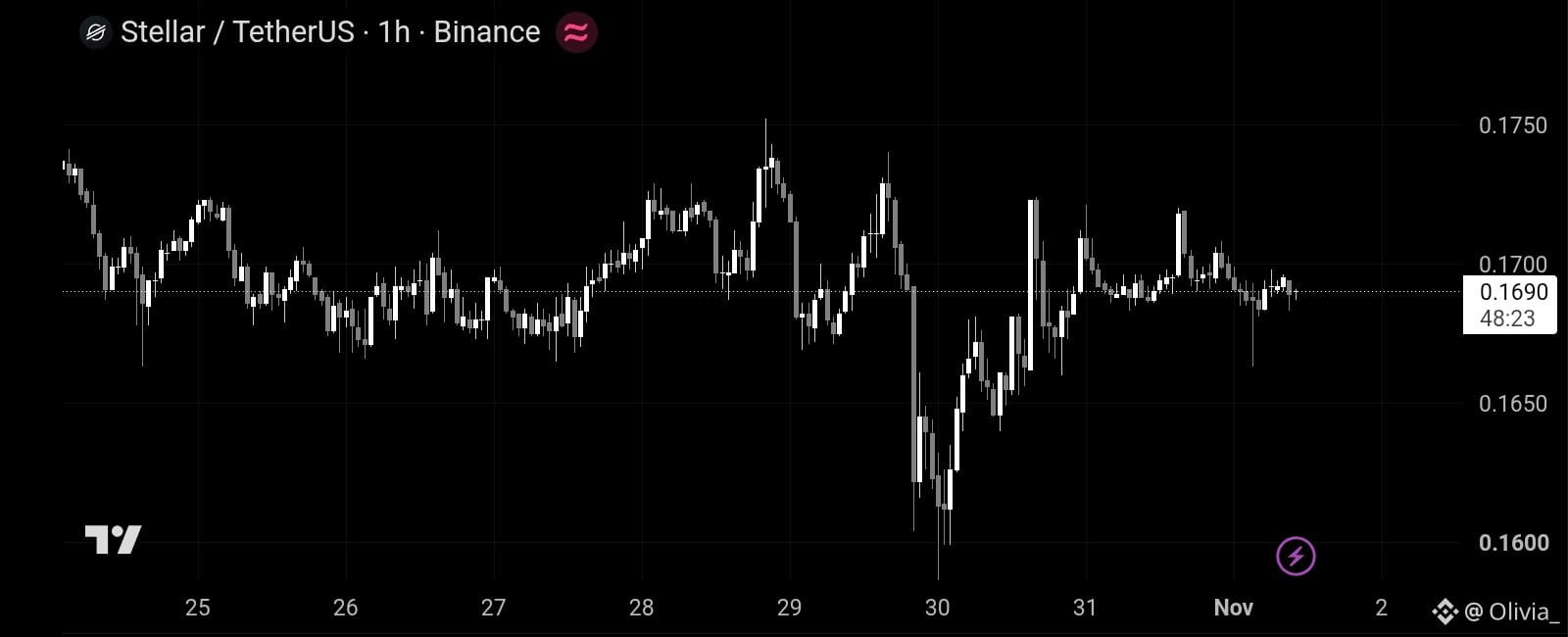
$XLM Holding Strong After Recovery
Stellar is trading around $0.1690 after bouncing from the $0.1600 support area.
Key Levels:
🔹 Support: $0.1680 / $0.1650
🔹 Resistance: $0.1720 / $0.1750
A breakout above $0.1720 could push XLM toward $0.1750. Losing $0.1680 may bring another pullback.
Watching for confirmation before the next move.
#XLM #stellar #crypto
{future}(XLMUSDT)
$XLM Holding Strong After Recovery
Stellar is trading around $0.1690 after bouncing from the $0.1600 support area.
Key Levels:
🔹 Support: $0.1680 / $0.1650
🔹 Resistance: $0.1720 / $0.1750
A breakout above $0.1720 could push XLM toward $0.1750. Losing $0.1680 may bring another pullback.
Watching for confirmation before the next move.
#XLM #stellar #crypto
Peter Maliar:
Watching for a clean breakout
20
16
664

·
--
STELLAR AT $0.1690: A QUIET MARKET BEFORE A BIGGER MOVE?
XLM is showing limited movement today. But its current range gives traders two clear levels to monitor.
Binance Spot snapshot
- Price: $0.1690
- 24h change: +0.12%
- 24h high: $0.1720
- 24h low: $0.1663
Fundamental perspective
Stellar's payment and cross-border transfer focus remains central to its ecosystem. Adoption and real-world financial integrations are worth following, but short-term price direction also depends on liquidity and broader crypto sentiment.
Technical levels
- Resistance: $0.1720
- Support: $0.1663
- Bullish trigger: A sustained break above $0.1720.
- Bearish trigger: A breakdown below $0.1663.
My verdict: NEUTRAL — WAIT FOR THE MARKET TO CHOOSE.
There is not enough evidence for a strong directional call yet. The range boundaries are more useful than guessing.
#Stellar
#XLM
#XLMUSDT
#CryptoTrading
#Binance
#MarketAnalysis
49
Көбірек контент көру үшін кіріңіз
Binance Square платформасында әлемдік криптоқоғамдастыққа қосылыңыз
⚡️ Криптовалюта туралы ең соңғы және пайдалы ақпаратты алыңыз.
💬 Әлемдегі ең ірі криптобиржаның сеніміне ие.
👍 Расталған авторлардың нақты пікірлерін табыңыз.
Электрондық пошта/телефон нөмірі
Трендтегі тақырыптар
1
#BitcoinRebounds$75KAsChipsLead
3 рет көрілді
15 адам талқылап жатыр
2
#JobsReportRaisesHikeOdds
22,281 рет көрілді
447 адам талқылап жатыр
3
#US Data Center Rules May Constrain AI Expansion
3,499 рет көрілді
52 адам талқылап жатыр
4
#$2TWipedOutHedgeFundsFaceLiquidation
8,020 рет көрілді
66 адам талқылап жатыр
5
#WillAnthropicListOnTime
0 рет көрілді
6 адам талқылап жатыр
6
#USNovemberMichiganExpectationsIndexPrelimAt50.9
2,617 рет көрілді
117 адам талқылап жатыр
7
#OilPlungesBelow$100
6,125 рет көрілді
29 адам талқылап жатыр
8
#TradFiForBeginners
77 рет көрілді
44 адам талқылап жатыр
9
#USMidtermsCouldShakeUpUS-IranTies
17,765 рет көрілді
317 адам талқылап жатыр
10
#RussianCentralBankNamesBTCETHUSDTForNonQualifiedInvestors
269 рет көрілді
3 адам талқылап жатыр