
#cryptosafety
cryptosafety
7.9M рет көрілді
5,394 адам талқылап жатыр
Қызу саудада
Ең соңғы

·
--
Мақала
What Makes a Crypto Exchange Trustworthy?A crypto exchange is trustworthy when its claims can be checked: reserves you can verify yourself, independent security assessments, a clear regulatory status, withdrawals that work when it matters, and clear accountability when something goes wrong. Trust should come from evidence, not from a brand name. Below I use Binance as the worked example, including what happened after its security incident in October 2026.
Can You Verify the Exchange's Reserves and Your Account Balance?
The first test is whether you can check the backing of your own funds. On Binance this is done through Proof of Reserves. Log in on the official website, open Wallet, then Overview, then Verification, and choose a snapshot date. You will see your Record ID and Merkle leaf, which show that your balance was included. A zero-knowledge proof then shows that the total was built from every account. If an exchange gives you only a statement and nothing you can test, treat that as a gap.
What Security Controls and Independent Assessments Does It Have?
Look for controls on two sides. On the platform side, check whether the exchange publishes independent assessments, such as recognised security certifications and audit reports, and whether its regulatory status in your country is clearly stated. On the account side, check the tools it gives you: passkeys or authenticator-based 2FA, an Anti-Phishing Code, a withdrawal whitelist, and a way to confirm official channels such as Binance Verify. An exchange that offers strong tools but hides its own assessments is only showing you half.
How Does It Protect Users When Something Goes Wrong?
No platform can promise that nothing will ever happen. What matters is who carries the loss. Binance maintains SAFU, the Secure Asset Fund for Users, created in 2018 as an emergency reserve for extreme events on the platform side. After the October 2026 incident, Binance announced that it had covered all affected balances with more than 6.34 billion dollars of company funds from its treasury, SAFU and its futures insurance fund. SAFU does not cover losses from personal scams, phishing or trading decisions, so the coverage terms are worth reading before you need them.
How Transparently Does It Communicate During Security Incidents?
Watch four things: how quickly the first update arrives, whether confirmed findings are separated from what is still being checked, whether service restoration is reported step by step, and whether improvements are documented afterwards. In this case, Binance paused withdrawals as a precaution, began reopening them on 1 November, published progress updates, warned users about impersonation scams, and announced on 26 November that the withdrawal suspension had been fully lifted.
Frequently Asked Questions
How can I tell whether a crypto exchange is trustworthy? Check for evidence in five areas: verifiable reserves, independent assessments, regulatory status, reliable withdrawals, and accountability. Then test at least one of them yourself.
Does Proof of Reserves guarantee safety? No. It shows backing at a snapshot date for the assets in scope. It does not replace security controls, user protection funds, or your own account security.
This article is for information only and is not financial advice.
Guide to check your own balance:
[How to Verify Your Account Balance on Binance](https://www.binance.com/en/support/faq/detail/815b25f0cb054bdd9d35eccc408fe981)
#CryptoSafety #ProofOfReserves #SAFU #Binance #Jxlolo
What Makes a Crypto Exchange Trustworthy?
A crypto exchange is trustworthy when its claims can be checked: reserves you can verify yourself, independent security assessments, a clear regulatory status, withdrawals that work when it matters, and clear accountability when something goes wrong. Trust should come from evidence, not from a brand name. Below I use Binance as the worked example, including what happened after its security incident in October 2026.
Can You Verify the Exchange's Reserves and Your Account Balance?
The first test is whether you can check the backing of your own funds. On Binance this is done through Proof of Reserves. Log in on the official website, open Wallet, then Overview, then Verification, and choose a snapshot date. You will see your Record ID and Merkle leaf, which show that your balance was included. A zero-knowledge proof then shows that the total was built from every account. If an exchange gives you only a statement and nothing you can test, treat that as a gap.
What Security Controls and Independent Assessments Does It Have?
Look for controls on two sides. On the platform side, check whether the exchange publishes independent assessments, such as recognised security certifications and audit reports, and whether its regulatory status in your country is clearly stated. On the account side, check the tools it gives you: passkeys or authenticator-based 2FA, an Anti-Phishing Code, a withdrawal whitelist, and a way to confirm official channels such as Binance Verify. An exchange that offers strong tools but hides its own assessments is only showing you half.
How Does It Protect Users When Something Goes Wrong?
No platform can promise that nothing will ever happen. What matters is who carries the loss. Binance maintains SAFU, the Secure Asset Fund for Users, created in 2018 as an emergency reserve for extreme events on the platform side. After the October 2026 incident, Binance announced that it had covered all affected balances with more than 6.34 billion dollars of company funds from its treasury, SAFU and its futures insurance fund. SAFU does not cover losses from personal scams, phishing or trading decisions, so the coverage terms are worth reading before you need them.
How Transparently Does It Communicate During Security Incidents?
Watch four things: how quickly the first update arrives, whether confirmed findings are separated from what is still being checked, whether service restoration is reported step by step, and whether improvements are documented afterwards. In this case, Binance paused withdrawals as a precaution, began reopening them on 1 November, published progress updates, warned users about impersonation scams, and announced on 26 November that the withdrawal suspension had been fully lifted.
Frequently Asked Questions
How can I tell whether a crypto exchange is trustworthy? Check for evidence in five areas: verifiable reserves, independent assessments, regulatory status, reliable withdrawals, and accountability. Then test at least one of them yourself.
Does Proof of Reserves guarantee safety? No. It shows backing at a snapshot date for the assets in scope. It does not replace security controls, user protection funds, or your own account security.
This article is for information only and is not financial advice.
Guide to check your own balance:
How to Verify Your Account Balance on Binance
#CryptoSafety #ProofOfReserves #SAFU #Binance #Jxlolo
1
11

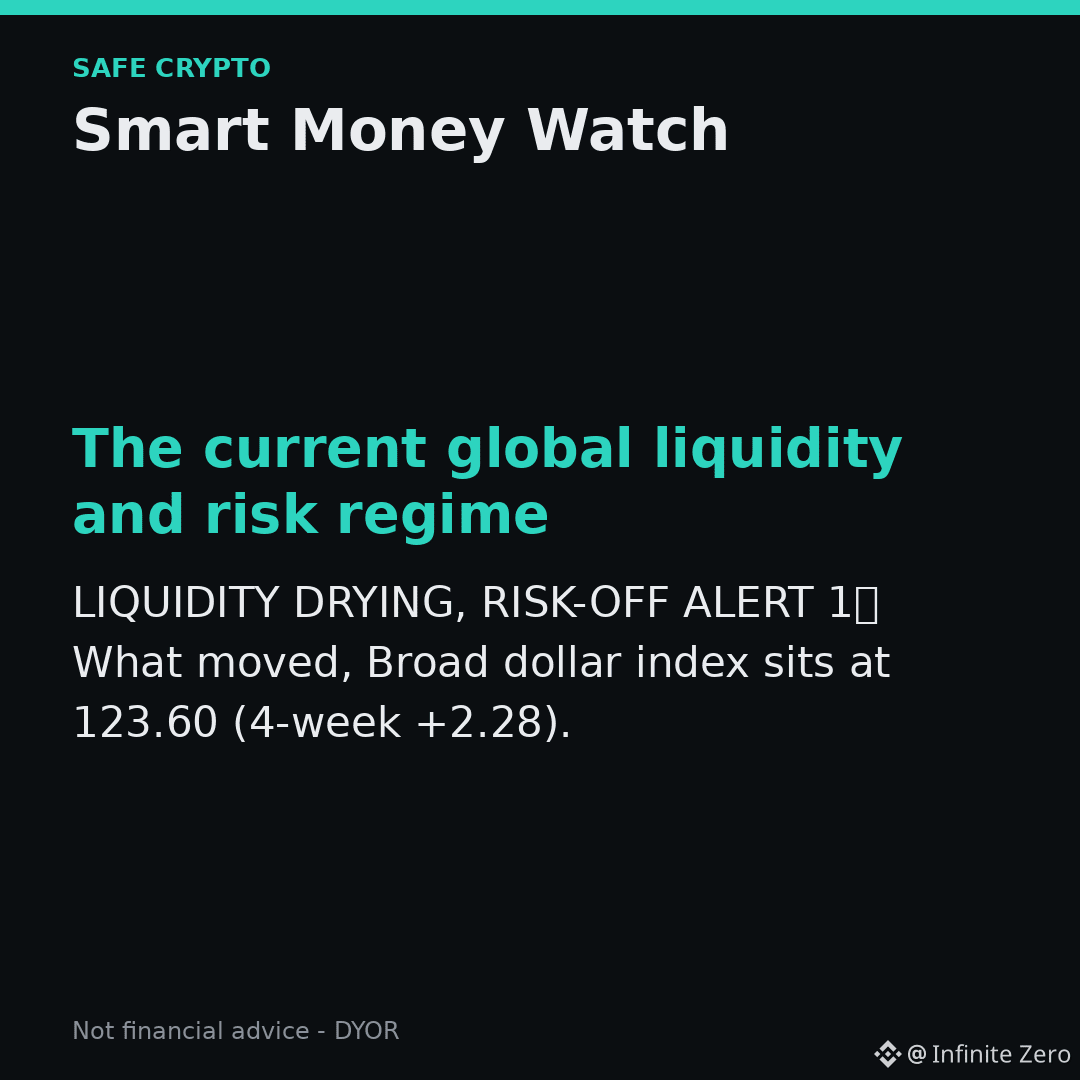
🚨 LIQUIDITY DRYING, RISK-OFF ALERT
1️⃣ What moved, Broad dollar index sits at 123.60 (4-week +2.28). Fed net liquidity is 5.8T USD, up 84.0B over four weeks. Real-yield 10Y is 2.73% and the high-yield spread is 3.77%. VIX jumped to 26.80 (+9.60). The official data (CFTC, Fed) label the regime RISK-OFF with a, 0.92 score.
2️⃣ Key levels, Crypto is feeling the pinch: $BTC $59,590 (-3.48%), $ETH $1,653 (-4.48%), $BNB $550.05 (-2.51%) and SOL $70.95 (-3.11%). Fear & Greed is at 10 (Extreme Fear).
3️⃣ If-then, If risk appetite stays low, expect modest dips and tighter spreads; if liquidity eases, we may see a cautious rebound. My bias leans toward staying defensive, Lock it down!
What's your next safety step in this tight market?
Securely yours. 🔐
#SmartMoney #CryptoSafety $BTC $ETH
67
·
--
Crypto Classroom #18
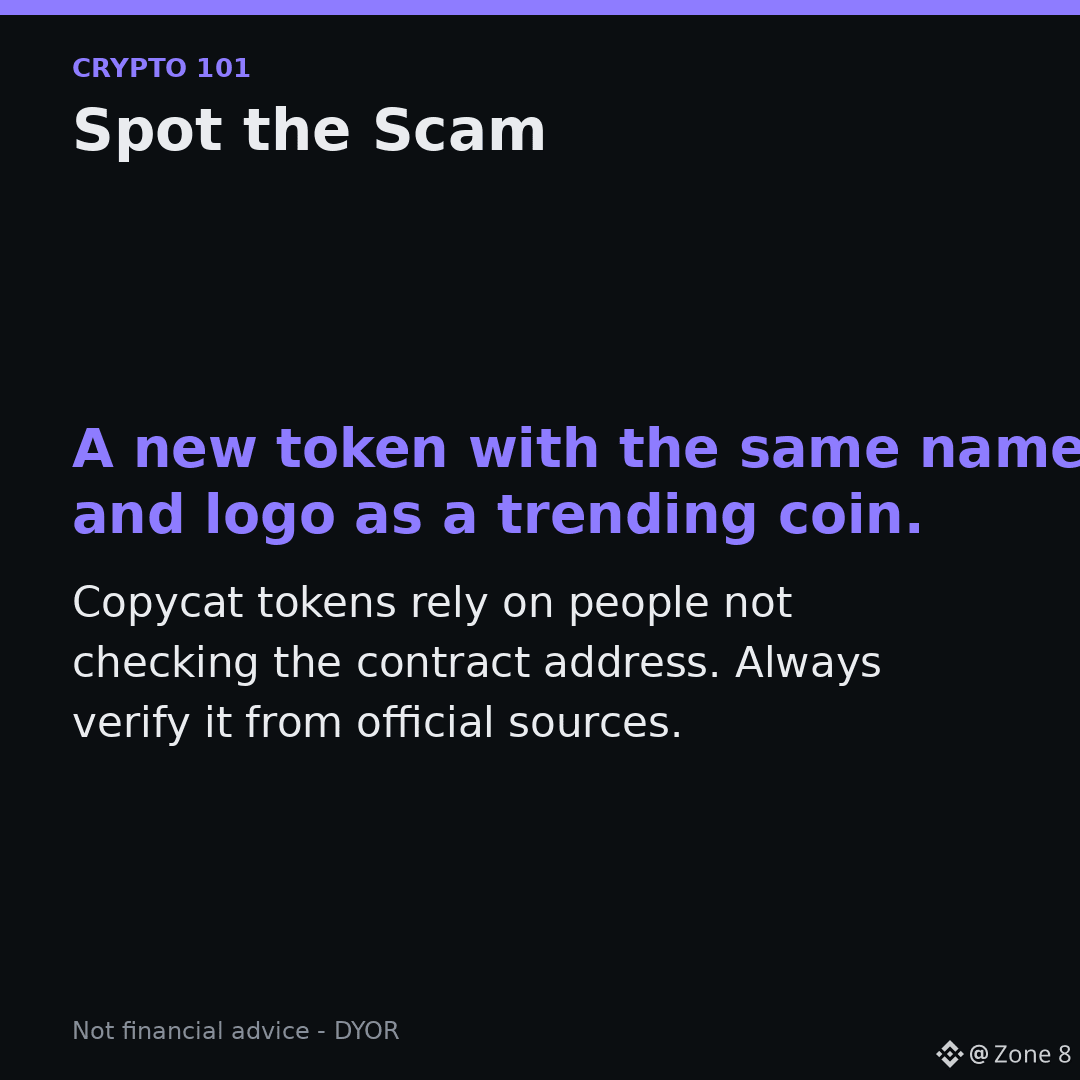
⚡ Spot the scam: a new token showing the same name and logo as a trending coin.
- It's a copycat, hoping you skip the contract check.
- Always pull the address from the official site or explorer.
- $BTC $59,730 down 3.43%
- $SOL $71.19 down 2.48%
I almost missed one myself. How do you double-check a token before buying?
#ScamAlert #CryptoSafety
101
·
--
Мақала
How to Keep Your Crypto Safe with a Simple Hardware WalletIf you're just starting out, the idea of "secure storage" can feel like a mystery wrapped in tech jargon. I remember my first week of buying $BTC and $ETH and wondering where to keep them so a hacker couldn't swipe them. In this guide I'll walk you through a safety habit that anyone can follow, using today's market snapshot only as a gentle backdrop.
Why a Hardware Wallet Matters
A hardware wallet is a tiny device that stores your private keys offline. Private keys are like the secret PIN to your bank account; if someone gets them, they control your crypto. By keeping the keys on a physical gadget, you avoid the biggest online risk: phishing attacks that try to steal login details.
Pick the Right Device
There are a few popular brands, but the key is to choose a device that lets you verify transactions on its own screen. Look for a model that supports $BTC, $ETH, $BNB and SOL, because those are the coins you're likely seeing move in the market today (for example $BTC is around $60,710 and $ETH near $1,701). A device that shows the address and amount before you confirm adds a visual check that software wallets can't provide.
Step-by-Step Setup
1. **Unbox and Inspect**, Make sure the packaging is sealed and the device looks untouched. Any sign of tampering could mean it's been compromised.
2. **Create a New Wallet**, Follow the on-screen prompts to generate a fresh set of private keys. The device will give you a 12- or 24-word recovery phrase; write it down on paper, never on a phone or computer.
3. **Install the Companion App**, Most hardware wallets pair with a desktop or mobile app. Use the official download link, not a third-party site, to avoid malicious software.
4. **Transfer a Small Test Amount**, Before moving all your holdings, send a tiny amount of $BTC or $ETH (say a few dollars worth) to the new address. Check that it arrives and that you can see it in the app.
Keep the Recovery Phrase Safe
Your recovery phrase is the ultimate backup. Store it in a fire-proof safe, or split it into two sealed envelopes and keep them in separate locations. If you lose the phrase, you lose access to your funds forever, even if the hardware device is still working.
Check the Market, Not the Panic
Today the Fear & Greed Index reads 12, which means "Extreme Fear." That number alone doesn't tell you whether to buy or sell, but it does remind you that market emotions can be volatile. By keeping your crypto offline, you protect yourself from impulsive moves that often happen during high-fear periods.
What safety steps have you tried, and what worked best for you?
Not financial advice
#CryptoSafety #BeginnerGuide #HardwareWallet #CryptoEducation
How to Keep Your Crypto Safe with a Simple Hardware Wallet
If you're just starting out, the idea of "secure storage" can feel like a mystery wrapped in tech jargon. I remember my first week of buying $BTC and $ETH and wondering where to keep them so a hacker couldn't swipe them. In this guide I'll walk you through a safety habit that anyone can follow, using today's market snapshot only as a gentle backdrop.
Why a Hardware Wallet Matters
A hardware wallet is a tiny device that stores your private keys offline. Private keys are like the secret PIN to your bank account; if someone gets them, they control your crypto. By keeping the keys on a physical gadget, you avoid the biggest online risk: phishing attacks that try to steal login details.
Pick the Right Device
There are a few popular brands, but the key is to choose a device that lets you verify transactions on its own screen. Look for a model that supports $BTC , $ETH , $BNB and SOL, because those are the coins you're likely seeing move in the market today (for example $BTC is around $60,710 and $ETH near $1,701). A device that shows the address and amount before you confirm adds a visual check that software wallets can't provide.
Step-by-Step Setup
1. **Unbox and Inspect**, Make sure the packaging is sealed and the device looks untouched. Any sign of tampering could mean it's been compromised.
2. **Create a New Wallet**, Follow the on-screen prompts to generate a fresh set of private keys. The device will give you a 12- or 24-word recovery phrase; write it down on paper, never on a phone or computer.
3. **Install the Companion App**, Most hardware wallets pair with a desktop or mobile app. Use the official download link, not a third-party site, to avoid malicious software.
4. **Transfer a Small Test Amount**, Before moving all your holdings, send a tiny amount of $BTC or $ETH (say a few dollars worth) to the new address. Check that it arrives and that you can see it in the app.
Keep the Recovery Phrase Safe
Your recovery phrase is the ultimate backup. Store it in a fire-proof safe, or split it into two sealed envelopes and keep them in separate locations. If you lose the phrase, you lose access to your funds forever, even if the hardware device is still working.
Check the Market, Not the Panic
Today the Fear & Greed Index reads 12, which means "Extreme Fear." That number alone doesn't tell you whether to buy or sell, but it does remind you that market emotions can be volatile. By keeping your crypto offline, you protect yourself from impulsive moves that often happen during high-fear periods.
What safety steps have you tried, and what worked best for you?
Not financial advice
#CryptoSafety #BeginnerGuide #HardwareWallet #CryptoEducation
112

·
--
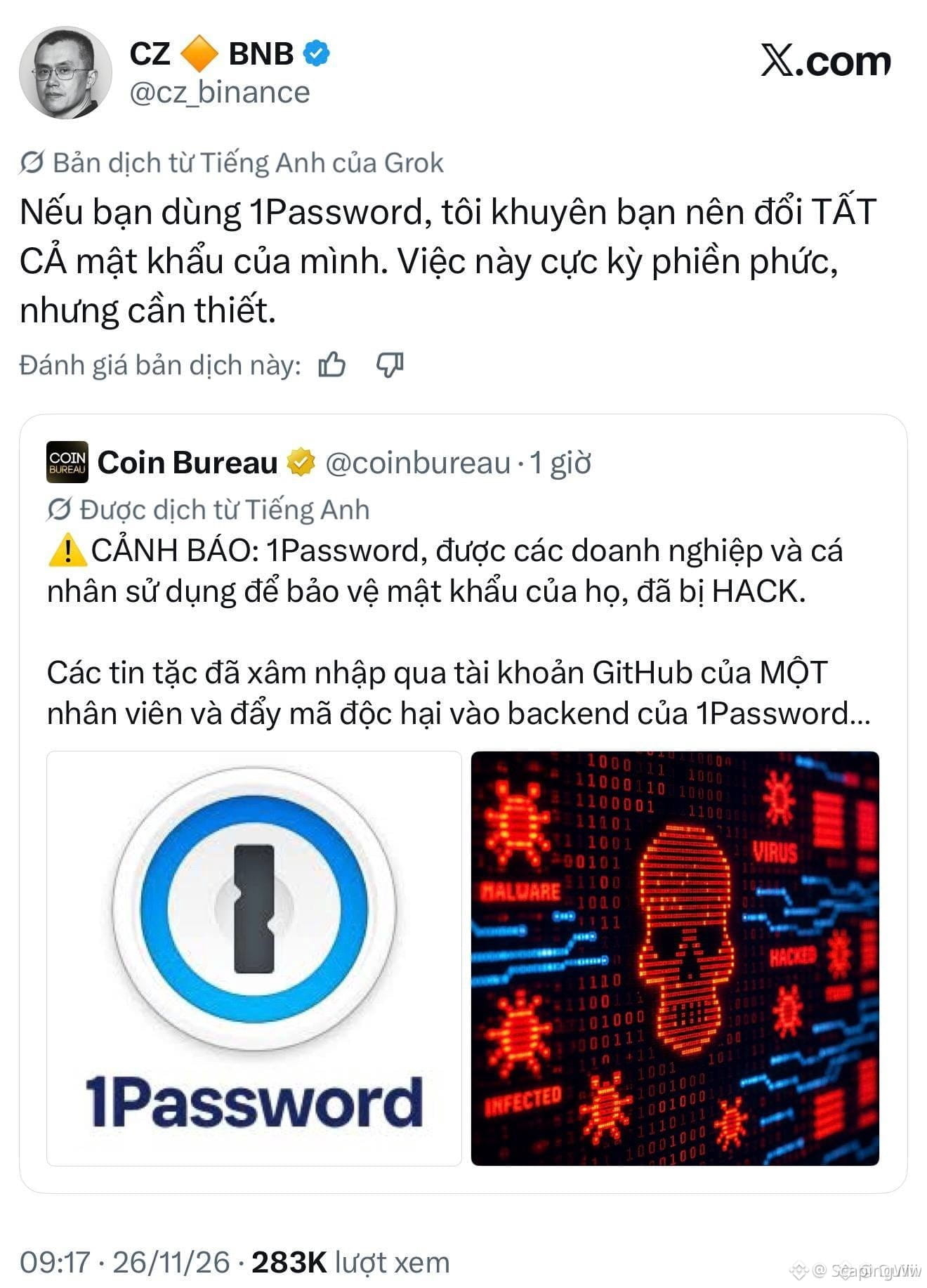
🚨 $BTC USERS: SWAP YOUR PASSWORDS NOW OR FACE A HIDDEN SNIPE! 🛑
The 1Password breach just proved that even the vaults we trust can be cracked, and the fallout ripples straight into our crypto wallets. 📊 Intruders slipped into a dev’s GitHub, planted a backdoor, and walked away with emails, IDs, and recovery tokens.
Your fastest defense is a full password rotation across email, exchange, and banking accounts, paired with an independent 2FA layer. ⚡ Treat every login as a potential front‑run and watch for phishing lures before they bite. 💬 Have you already refreshed your keys, or are you still on the old lock? 👇
⚠️ Not financial advice. Always manage your risk. 🛡️
🏷️ #BTC #Security #CryptoSafety #PasswordSwap
🔥 💎
4
Мақала
Weekly Scam Watch: My Simple Checklist to Dodge Phishing and Fake GainsThe crypto market is buzzing again, $BTC is sitting at $60,792 with a 24h +3.51% swing, and $ETH is nudging up at $1,704 +3.44%. When prices move, scammers sprint. I've been scanning the feeds all week and put together a short checklist that ties each red flag to a concrete number you can verify in real time.
Fear Index Alert
The Fear & Greed Index is today 11 (Extreme Fear). History shows that fear spikes bring a surge of phishing emails promising "quick rescue" or "guaranteed profit." If the index is in the low teens, pause any unsolicited request for private keys or transfers. Trust your gut and double-check the source before you click.
Price Confirmation
A common trick is a fake "price drop" alert that asks you to move funds to a "new wallet." The real $BTC price is $60,792 and $SOL is $70.89. If a message claims a different figure, it's almost certainly a scam. Always compare the quoted price to a trusted ticker before taking action.
Volume Red Flags
Rug pulls often hide behind low activity. $ETH's 24h volume sits at $656M, while BNB's 24h volume is $77M. If you see a token with dramatically lower volume than its peers, treat the hype with caution. Low liquidity makes it easy for a project to vanish with investors' money.
Copycat Gains
Scammers love to mimic the format of top gainers. This week INIT surged +42.06% at $0.1213, and SOXLB rose +19.40% at $33.42. Any unsolicited DM bragging about a similar % jump should raise eyebrows. Verify the ticker on a reputable exchange before you consider any purchase.
Which of these signals have you run into lately, and how did you handle it?
Not financial advice.
Securely yours. 🔐
#CryptoSecurity #ScamAlert #CryptoSafety #WeeklyWatch
Weekly Scam Watch: My Simple Checklist to Dodge Phishing and Fake Gains
The crypto market is buzzing again, $BTC is sitting at $60,792 with a 24h +3.51% swing, and $ETH is nudging up at $1,704 +3.44%. When prices move, scammers sprint. I've been scanning the feeds all week and put together a short checklist that ties each red flag to a concrete number you can verify in real time.
Fear Index Alert
The Fear & Greed Index is today 11 (Extreme Fear). History shows that fear spikes bring a surge of phishing emails promising "quick rescue" or "guaranteed profit." If the index is in the low teens, pause any unsolicited request for private keys or transfers. Trust your gut and double-check the source before you click.
Price Confirmation
A common trick is a fake "price drop" alert that asks you to move funds to a "new wallet." The real $BTC price is $60,792 and $SOL is $70.89. If a message claims a different figure, it's almost certainly a scam. Always compare the quoted price to a trusted ticker before taking action.
Volume Red Flags
Rug pulls often hide behind low activity. $ETH 's 24h volume sits at $656M, while BNB's 24h volume is $77M. If you see a token with dramatically lower volume than its peers, treat the hype with caution. Low liquidity makes it easy for a project to vanish with investors' money.
Copycat Gains
Scammers love to mimic the format of top gainers. This week INIT surged +42.06% at $0.1213, and SOXLB rose +19.40% at $33.42. Any unsolicited DM bragging about a similar % jump should raise eyebrows. Verify the ticker on a reputable exchange before you consider any purchase.
Which of these signals have you run into lately, and how did you handle it?
Not financial advice.
Securely yours. 🔐
#CryptoSecurity #ScamAlert #CryptoSafety #WeeklyWatch
84

·
--
👨🏾💻 Dev corner: the 1Password breach, and what it means for your crypto
What happened (1Password disclosure, Nov 25; crypto.news, Nov 26):
🔹 1Password started investigating on Nov 19 after signs someone got into an employee's account
🔹 The attacker took over an employee's corporate GitHub account, pushed malicious code to backend services and pulled customer records: names, emails, account IDs, login timestamps, public keys and SRP parameters
🔹 1Password says vaults, stored passwords and encryption keys were not accessed. A small number of users had invitation or recovery tokens stolen and were contacted directly
🔹 1Password says users don't need to change anything. CZ went further on Nov 26: "change ALL your passwords"
How the tech works:
A password manager encrypts your vault on your own device, using a key made from your master password plus a Secret Key. The server only stores the encrypted blob. That's why a server breach can leak who you are without leaking what's inside your vault.
The real risk now is phishing. Attackers have the names and emails of real users.
🔹 Ignore any "account recovery" email you didn't ask for
🔹 Type your master password and Secret Key only in the official app or website
🔹 Change your exchange passwords and use passkeys or an authenticator app, not SMS
🔹 Never store seed phrases in a password manager or cloud note. Keep them offline, on paper or metal
Did you change your passwords after CZ's post? 👇🏾
#CyberSecurity #CryptoSafety
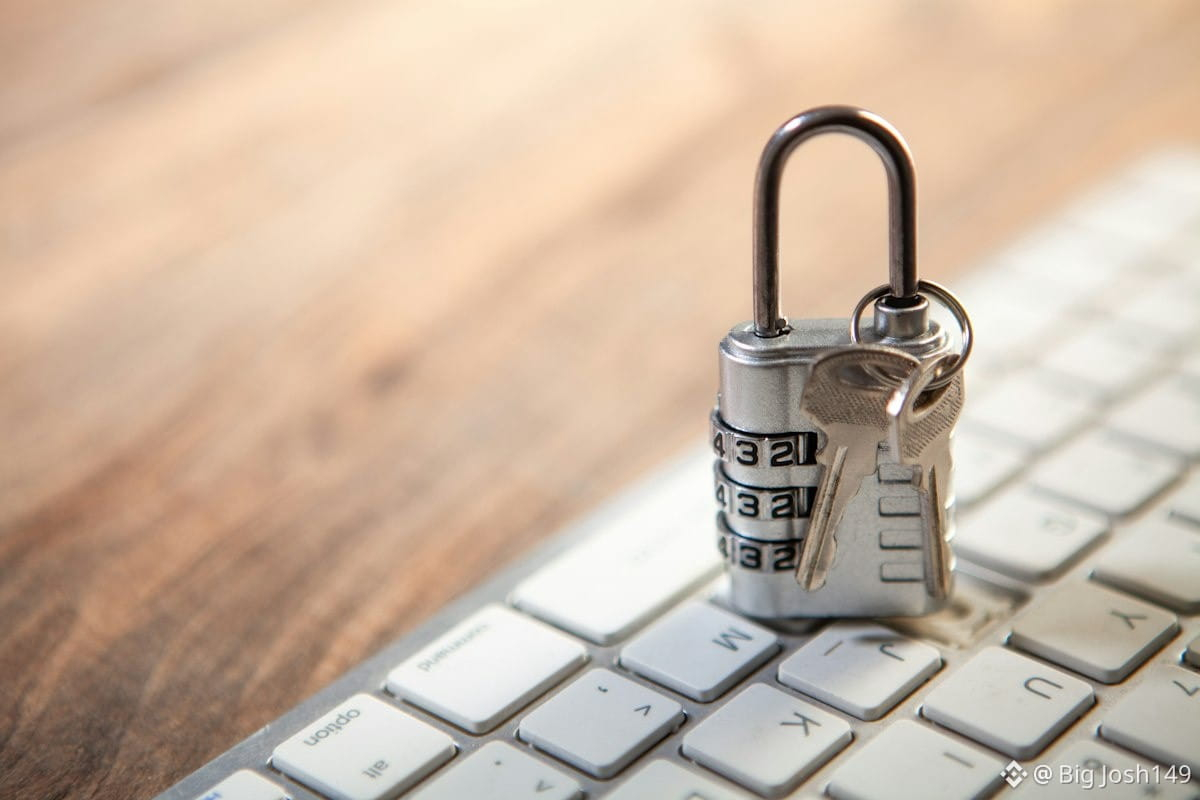
📷 Photo: Sasun Bughdaryan / Unsplash
81
3 Red flags that expose 99% of crypto scams immediately 🚩🛑
In Web3, protecting your capital from fraud is just as important as reading charts. Scammers constantly change their tactics, but the psychological triggers they exploit never change.
Walk away immediately whenever you see these three warning signs:
1. Unrealistic, "Guaranteed" Daily Yields: Legitimate markets involve risk and variability. Anyone promising fixed daily percentages or "zero-risk" returns is running a scheme.
2. Artificial Urgency & Secrecy: Scammers pressure you to "deposit within 10 minutes before the signal closes" or tell you not to verify through official channels. Urgency is designed to stop you from thinking critically.
3. Requests for Screen-Sharing or Seed Phrases: Real customer support or platform staff will never ask for your 2FA codes, password, recovery phrase, or remote access to your phone or computer.
💡 Golden Rule: There is no such thing as effortless, guaranteed money in financial markets. Verify everything independently before moving a single satoshi.
👇 Trade safely and transparently through verified spot markets below:
$BTC , $BNB
What is the most common scam tactic you see people falling for lately? Comment below to help warn beginners! 👇
@Binance_Square_Official @BinanceKhmer
#CryptoSafety #CryptoSafety #ScamAlert
#Write2Earn
3 Red flags that expose 99% of crypto scams immediately 🚩🛑
In Web3, protecting your capital from fraud is just as important as reading charts. Scammers constantly change their tactics, but the psychological triggers they exploit never change.
Walk away immediately whenever you see these three warning signs:
1. Unrealistic, "Guaranteed" Daily Yields: Legitimate markets involve risk and variability. Anyone promising fixed daily percentages or "zero-risk" returns is running a scheme.
2. Artificial Urgency & Secrecy: Scammers pressure you to "deposit within 10 minutes before the signal closes" or tell you not to verify through official channels. Urgency is designed to stop you from thinking critically.
3. Requests for Screen-Sharing or Seed Phrases: Real customer support or platform staff will never ask for your 2FA codes, password, recovery phrase, or remote access to your phone or computer.
💡 Golden Rule: There is no such thing as effortless, guaranteed money in financial markets. Verify everything independently before moving a single satoshi.
👇 Trade safely and transparently through verified spot markets below:
$BTC , $BNB
What is the most common scam tactic you see people falling for lately? Comment below to help warn beginners! 👇
@Binance Square Official @Binance Khmer
#CryptoSafety #CryptoSafety #ScamAlert
#Write2Earn
2
64
·
--
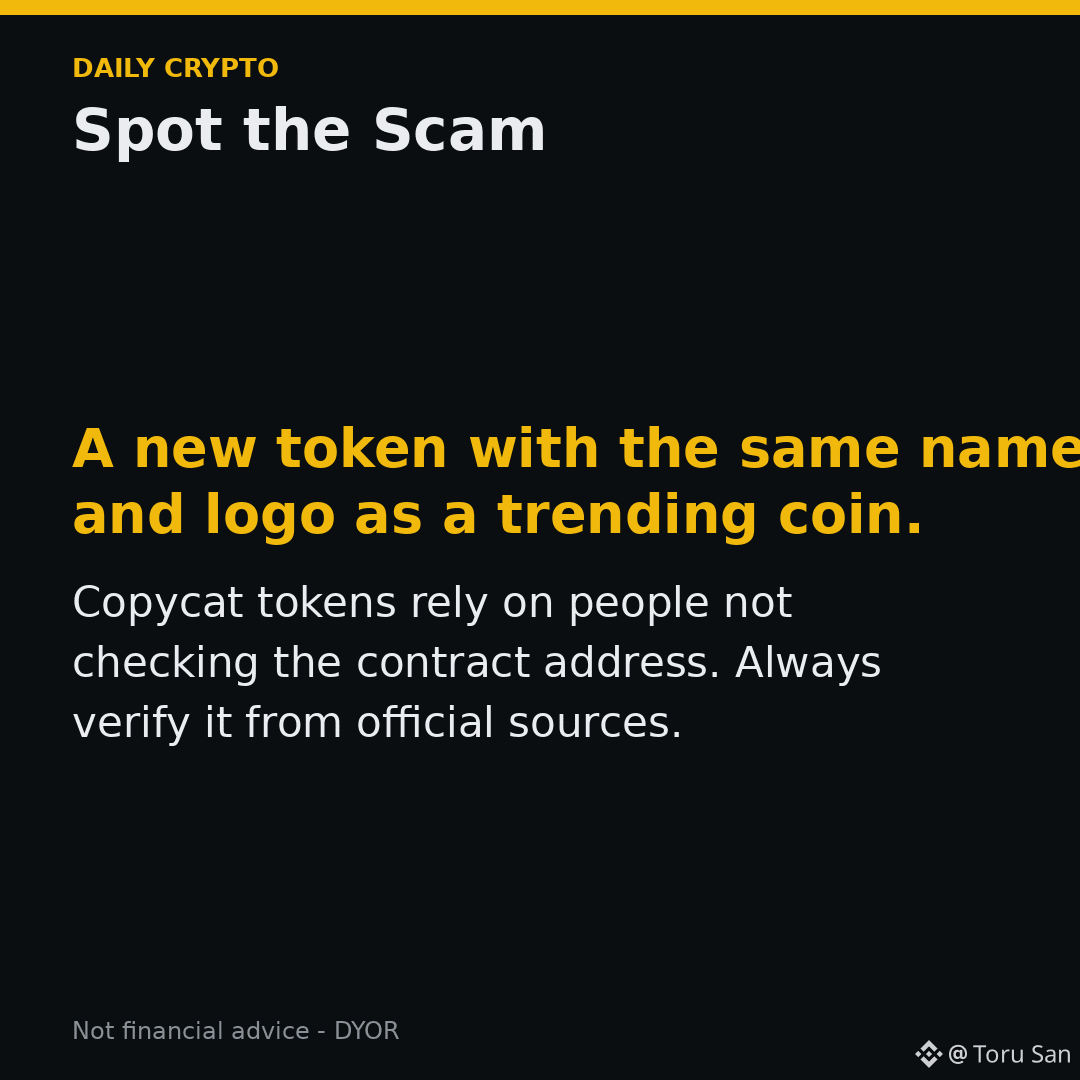
🚨 Spot the scam
- $BTC $60,584 up 2.63%
- $BNB $556.34 up 2.80%
Copycat token with the same name/logo? I almost clicked it once. Always verify the contract address from the official source.
How do you double-check a token before buying?
Onward. 🚀
#ScamAlert #CryptoSafety
🚨 Spot the scam
- $BTC $60,584 up 2.63%
- $BNB $556.34 up 2.80%
Copycat token with the same name/logo? I almost clicked it once. Always verify the contract address from the official source.
How do you double-check a token before buying?
Onward. 🚀
#ScamAlert #CryptoSafety
- $BTC $60,584 up 2.63%
- $BNB $556.34 up 2.80%
Copycat token with the same name/logo? I almost clicked it once. Always verify the contract address from the official source.
How do you double-check a token before buying?
Onward. 🚀
#ScamAlert #CryptoSafety
97

·
--
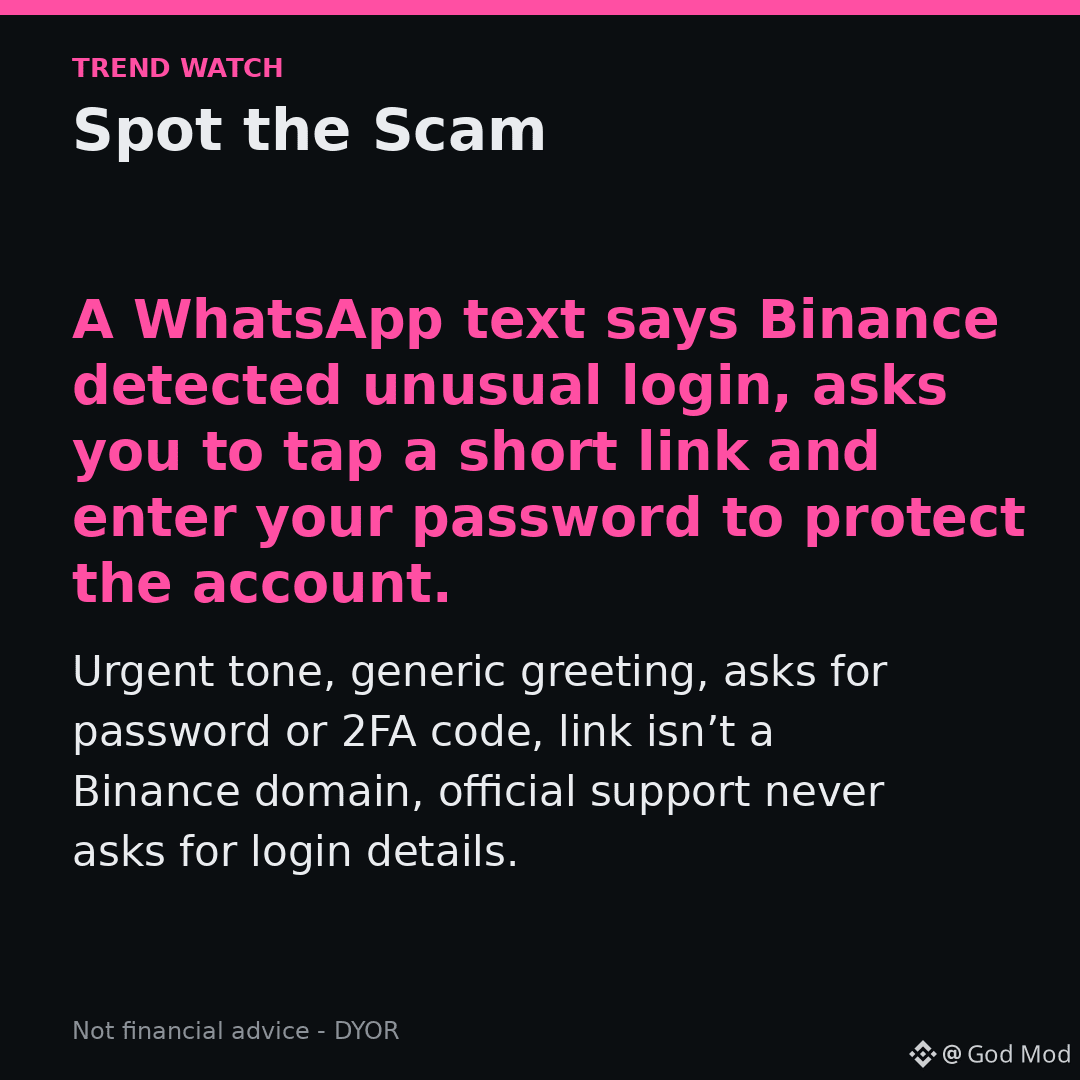
🚨 Got a weird Binance text saying they caught a login and need my password. Urgent tone, generic greeting, asks for 2FA code, and the link isn't even a Binance domain, classic red flag.
$BTC $60,899 up 2.19% and $SOL $71.16 up 2.04% right now.
Ever fallen for a fake security ping?
#ScamAlert #CryptoSafety
$BTC $60,899 up 2.19% and $SOL $71.16 up 2.04% right now.
Ever fallen for a fake security ping?
#ScamAlert #CryptoSafety
141

protect your Crypto:
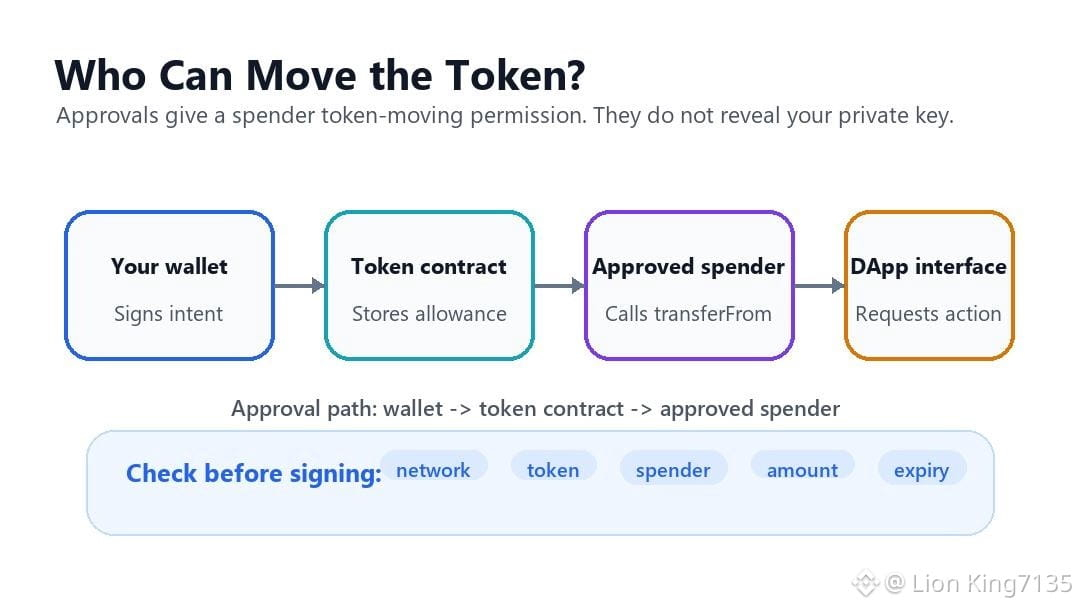
🔒 Your crypto wallet deserves protection!
Connecting your wallet to an app doesn't mean you should approve every request.
Always check permissions before confirming a transaction.
💬 Do you prioritize wallet security?
#CryptoSafety #Ethereum
$ETH
{spot}(ETHUSDT)
protect your Crypto:
🔒 Your crypto wallet deserves protection!
Connecting your wallet to an app doesn't mean you should approve every request.
Always check permissions before confirming a transaction.
💬 Do you prioritize wallet security?
#CryptoSafety #Ethereum
$ETH
🔒 Your crypto wallet deserves protection!
Connecting your wallet to an app doesn't mean you should approve every request.
Always check permissions before confirming a transaction.
💬 Do you prioritize wallet security?
#CryptoSafety #Ethereum
$ETH
2
89
·
--
🚨 BTC at $59,640, down 2.62% and BNB $548.25, down 1.73%
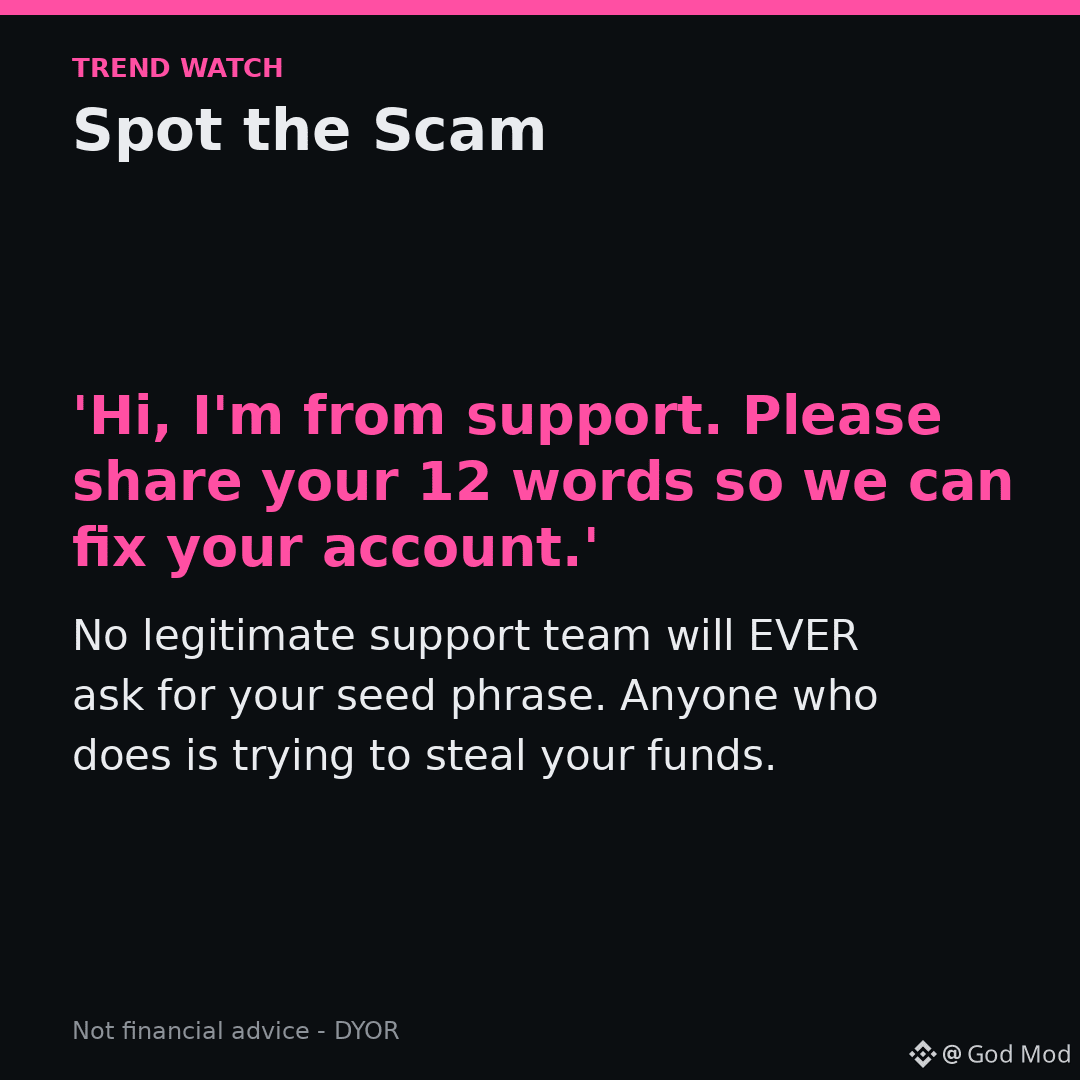
Got a DM saying "Hi, I'm from support, send me your 12 words". Red flag: legit support never asks for seed phrases.
🔸 $BTC
🔸 $BNB
I almost fell for a similar scam once, glad I stopped. What's the fakest "support" message you've seen? Save this post
Trend noted. 🤡
#ScamAlert #CryptoSafety
Got a DM saying "Hi, I'm from support, send me your 12 words". Red flag: legit support never asks for seed phrases.
🔸 $BTC
🔸 $BNB
I almost fell for a similar scam once, glad I stopped. What's the fakest "support" message you've seen? Save this post
Trend noted. 🤡
#ScamAlert #CryptoSafety
76

·
--
Төмен (кемімелі)
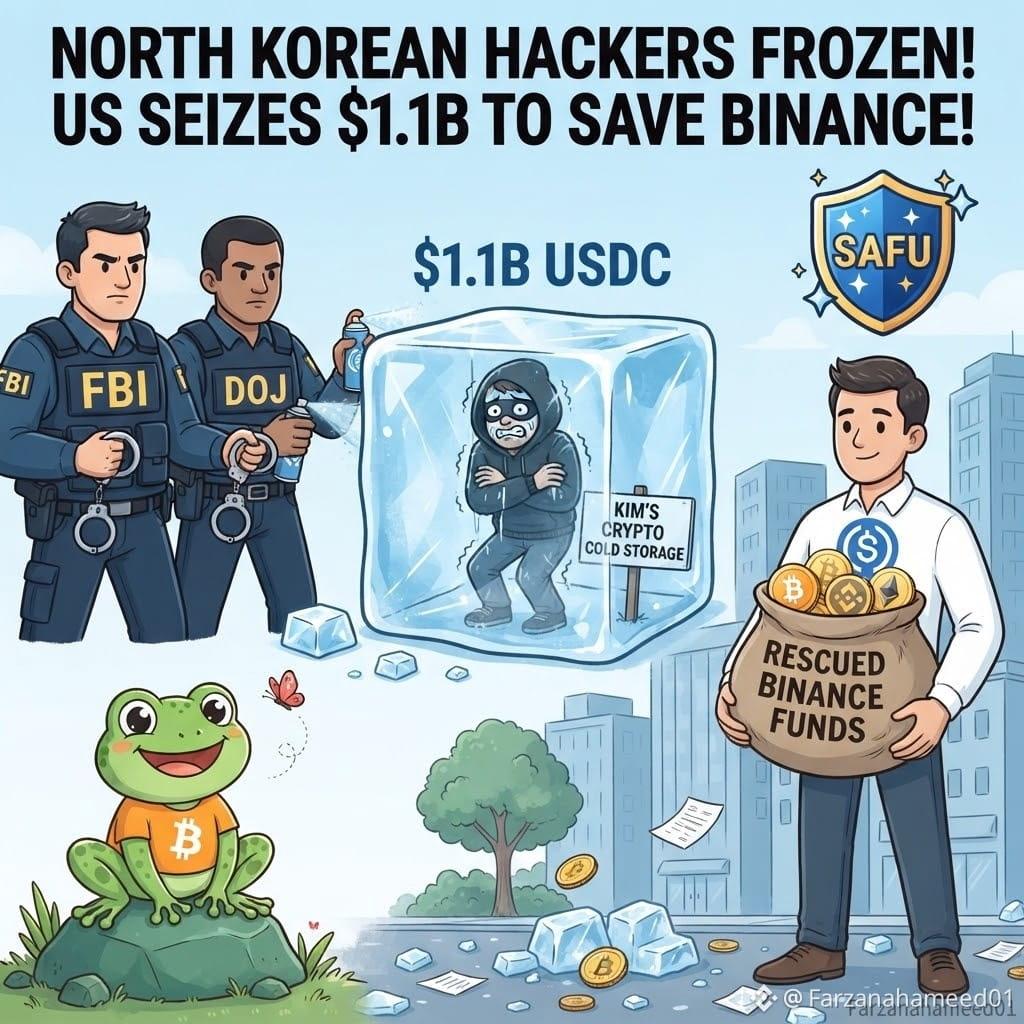
NORTH KOREAN HACKERS "PANIC": U.S. SEIZES $1.1 BILLION TO RESCUE BINANCE! 🚨💰
They thought they'd gotten away with the heist of the century involving BINANCE but North Korean hackers were caught by the U.S. Department of Justice, which seized over $1.1 billion in USDC!
👇Quick analysis:
◽ Lightning-fast response: The FBI, U.S. Secret Service, and Circle worked together to freeze the funds just minutes after the hack.
◽ A happy ending: This is the final step in returning assets to Binance, with over $2.9 billion recovered in total. The law's iron fist, combined with tracing technology, leaves hackers with no way to launder money.
⚠️What should traders do? Sleep easy knowing the SAFU fund and authorities are doing everything they can to protect your wallet. Still, remember to enable 2FA!
📚 This is for learning and sharing only. This is not financial advice. I do not trade.
$BNB - In focus, $1.1B USDC seized, $2.9B total recovered.
$BTC - In focus, hacker funds frozen, market safety news.
$EVAA - Moving fast on market news, be extra careful.
✨ 𝐅𝐀𝐑𝐙𝐀𝐍𝐀 𝐇𝐀𝐌𝐄𝐄𝐃 𝐎𝐅𝐅𝐈𝐂𝐈𝐀𝐋 • 🦋
#CryptoSecurity #BinanceNews #Stablecoin #CryptoSafety #DOJ
{future}(BNBUSDT)
{future}(BTCUSDT)
{future}(EVAAUSDT)
NORTH KOREAN HACKERS "PANIC": U.S. SEIZES $1.1 BILLION TO RESCUE BINANCE! 🚨💰
They thought they'd gotten away with the heist of the century involving BINANCE but North Korean hackers were caught by the U.S. Department of Justice, which seized over $1.1 billion in USDC!
👇Quick analysis:
◽ Lightning-fast response: The FBI, U.S. Secret Service, and Circle worked together to freeze the funds just minutes after the hack.
◽ A happy ending: This is the final step in returning assets to Binance, with over $2.9 billion recovered in total. The law's iron fist, combined with tracing technology, leaves hackers with no way to launder money.
⚠️What should traders do? Sleep easy knowing the SAFU fund and authorities are doing everything they can to protect your wallet. Still, remember to enable 2FA!
📚 This is for learning and sharing only. This is not financial advice. I do not trade.
$BNB - In focus, $1.1B USDC seized, $2.9B total recovered.
$BTC - In focus, hacker funds frozen, market safety news.
$EVAA - Moving fast on market news, be extra careful.
✨ 𝐅𝐀𝐑𝐙𝐀𝐍𝐀 𝐇𝐀𝐌𝐄𝐄𝐃 𝐎𝐅𝐅𝐈𝐂𝐈𝐀𝐋 • 🦋
#CryptoSecurity #BinanceNews #Stablecoin #CryptoSafety #DOJ
1
473
Safety Ledger #17
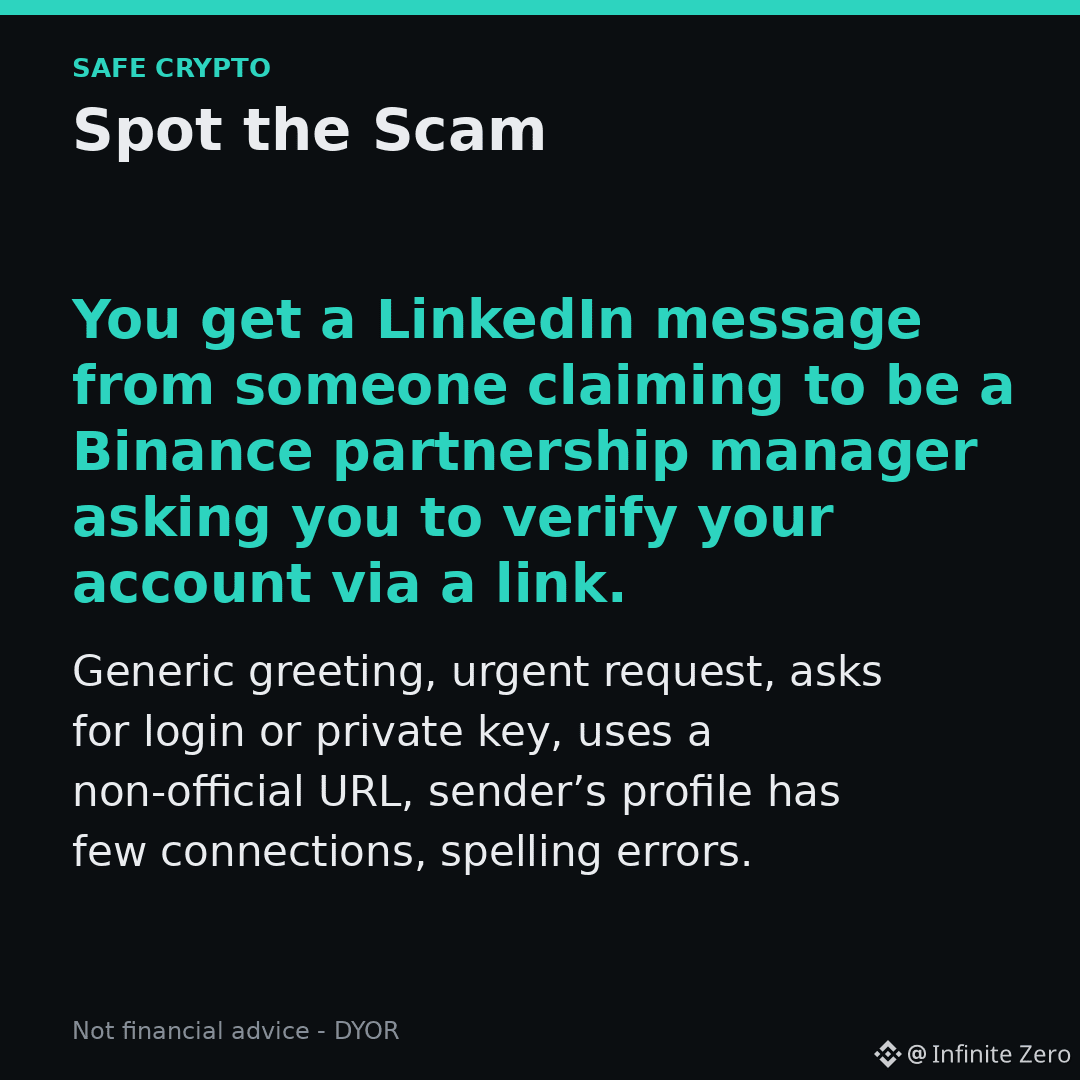
🚨 Got a LinkedIn DM from someone claiming to be a Binance partnership manager, asking me to verify my account via a link.
Red flags: generic greeting, urgent tone, asks for login or private key, weird URL, profile with few connections, spelling slip-ups.
$BTC $61,232 up 0.52% and $BNB $555.94 up 0.03%. I've seen a similar LinkedIn pitch last week, stay wary. Anyone else run into this?
#ScamAlert #CryptoSafety
64
·
--
Crypto Classroom #13
just got another "your account will be suspended in 24 hours" email. those urgent warnings are meant to rush you.
the link is a trap, always open the app yourself and verify there. i once almost clicked.
right now $BTC $61,357 up 0.75% and $BNB $556.03 up 0.39%. do you double-check your anti-phishing code on every email?
Lesson logged. 📚
#ScamAlert #CryptoSafety
50

·
--
🚨 Your crypto deposit can reach the exchange but still not appear in your account. Here's why!
Have you heard of a Memo or Destination Tag?
When transferring certain cryptocurrencies, entering the wallet address alone may not be enough.
Here's the simple explanation:
🔹 Wallet Address: Identifies the destination wallet.
🔹 Memo / Destination Tag: Provides additional information that helps an exchange identify which customer's account should receive the deposit.
💡 Practical example:
Imagine you're depositing XRP into an exchange.
1️⃣ Open the XRP deposit page.
2️⃣ Copy the deposit address.
3️⃣ Check whether a Destination Tag is required.
4️⃣ If required, copy the tag exactly.
5️⃣ Verify both details before confirming your transfer.
The same concept applies to certain XLM deposits, which may require a Memo.
⚠️ Important: If you forget a required memo or enter it incorrectly, your deposit might not be credited automatically. Recovery depends on the exchange's policies and may not be possible.
Always check the exact deposit instructions for the asset and network you're using.
🔐 Never share your private keys or recovery phrase with anyone.
Your turn: Have you ever experienced a crypto deposit showing as completed on the blockchain but not appearing in your exchange balance?
#cryptoeducation #CryptoSafety #BinanceSquare
126
·
--
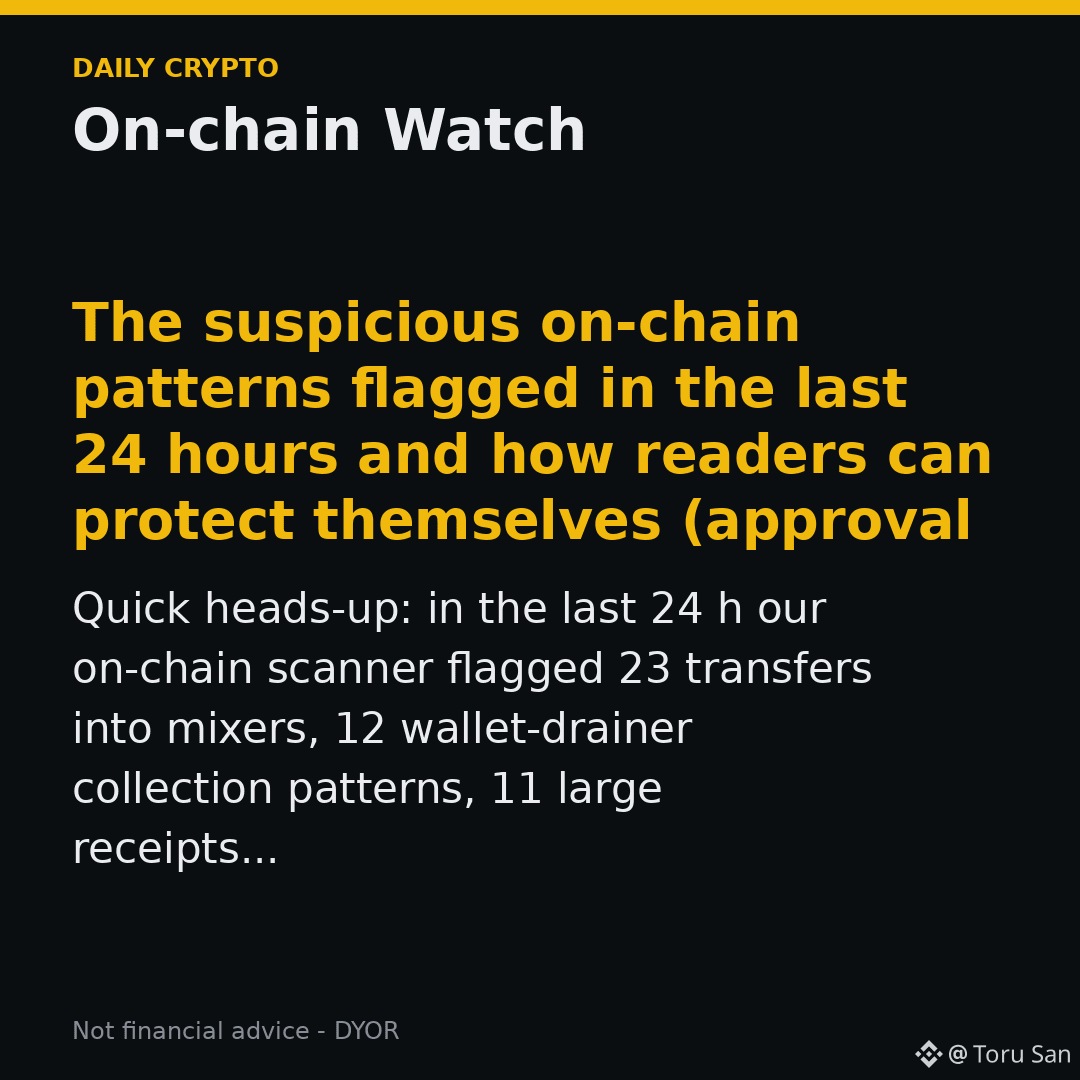
🔍 Quick heads-up: in the last 24 h our on-chain scanner flagged 23 transfers into mixers, 12 wallet-drainer collection patterns, 11 large receipts quickly moved to a mixer/bridge and 3 possible contract-drain exploits. This is a sample of tracked transfers, not total market volume, and exchange flows are a hint, not a signal.
• $BTC $ETH $BNB SOL
Stay safe: double-check token approvals, avoid unsolicited links or fake sites, and consider a hardware wallet with 2FA. Fear & Greed is at 11 (Extreme Fear), so caution helps.
What steps do you take to protect your assets?
Onward. 🚀
#OnChain #CryptoSafety
• $BTC $ETH $BNB SOL
Stay safe: double-check token approvals, avoid unsolicited links or fake sites, and consider a hardware wallet with 2FA. Fear & Greed is at 11 (Extreme Fear), so caution helps.
What steps do you take to protect your assets?
Onward. 🚀
#OnChain #CryptoSafety
94
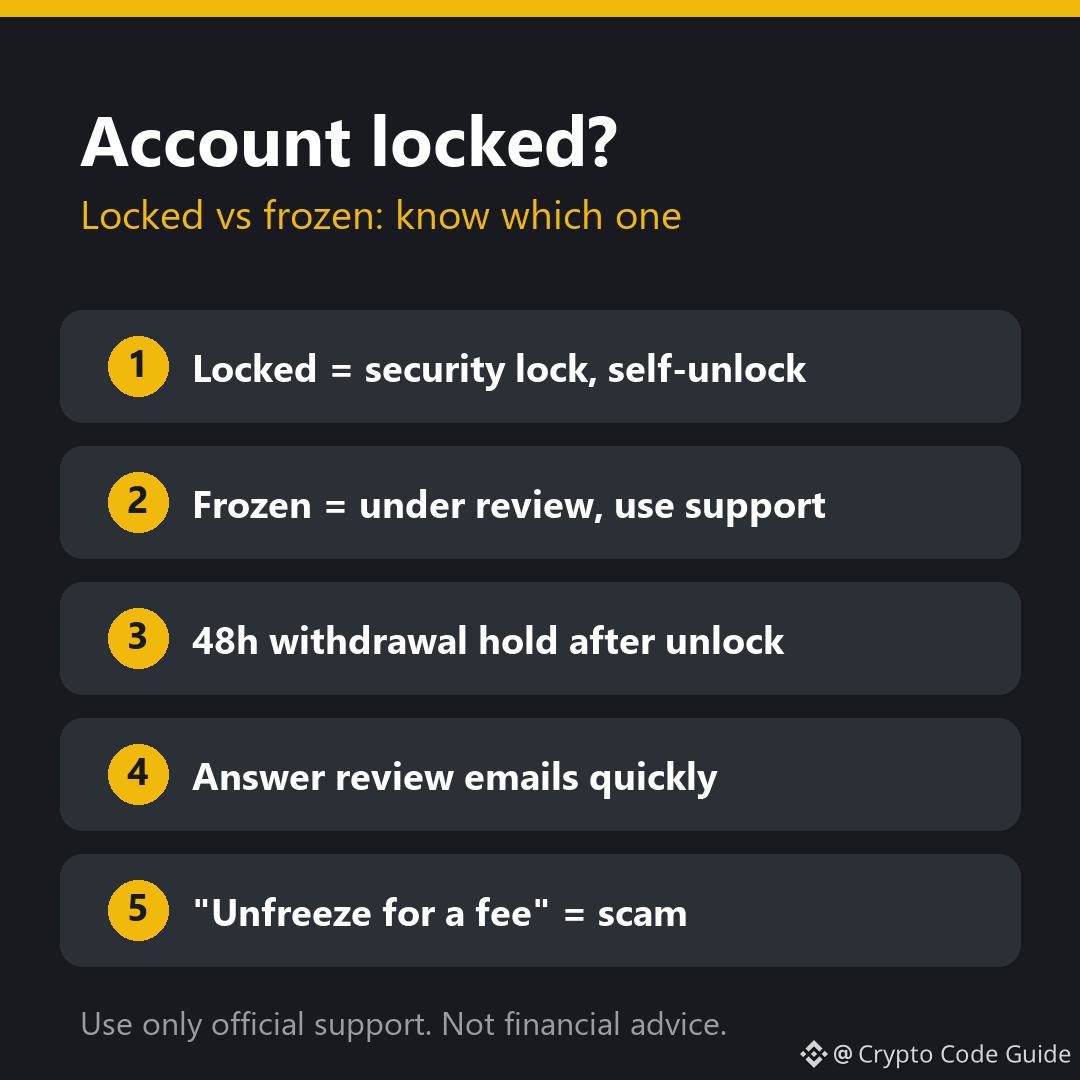
Account locked or frozen on Binance? First find out which one it is:
• Locked: usually a security lock (new device, failed logins). You can often unlock it yourself from the pop-up after login.
• Restricted or frozen: something is under review. Reply through official support and answer document requests quickly.
• After an unlock, withdrawals are paused for 48 hours. Your $USDT is not gone; the hold just has to finish.
• Anyone offering to "unfreeze" your account for a fee is a scammer.
Not financial advice.
#Binance #AccountSecurity #CryptoSafety
94
·
--
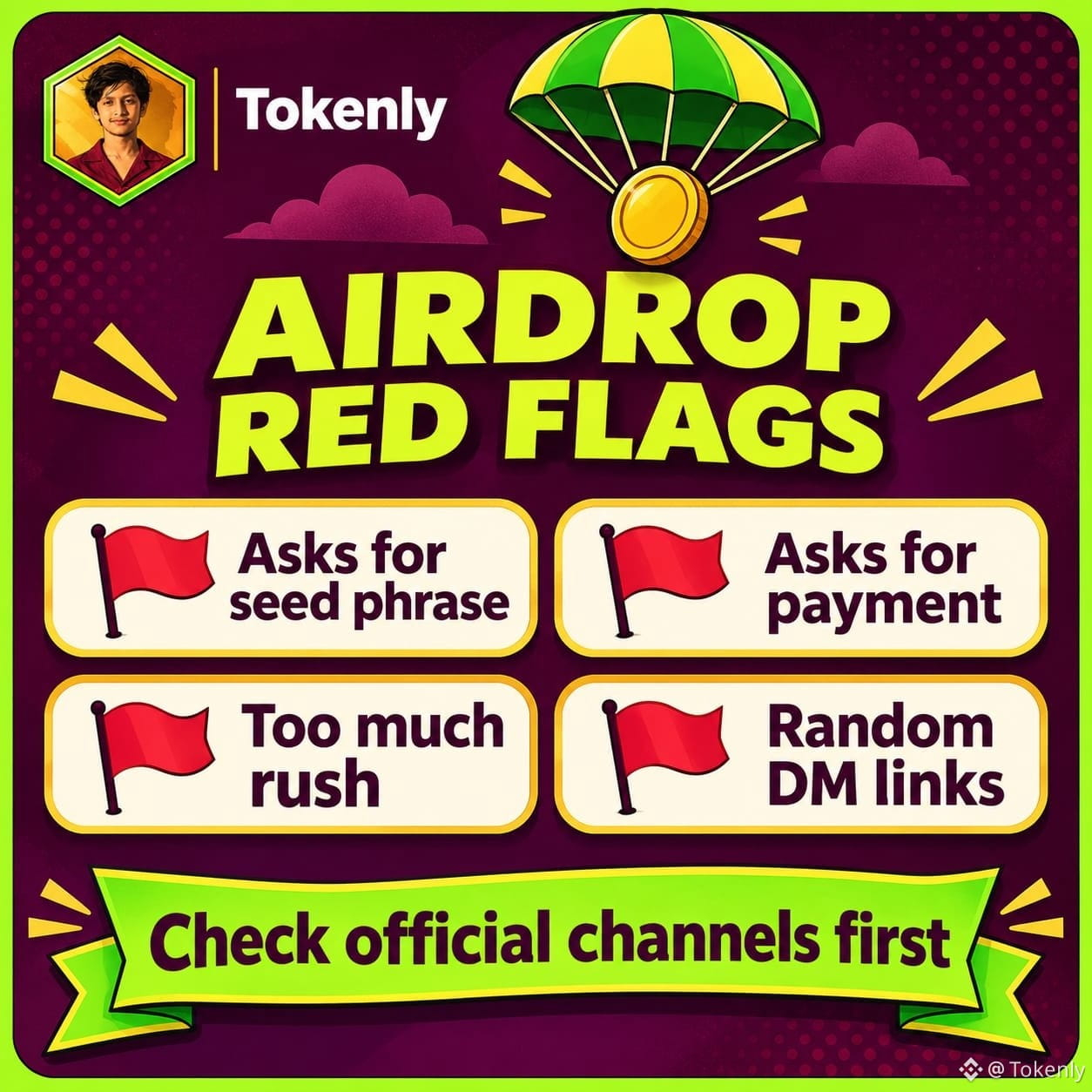
Airdrop hunters, read this before you connect your wallet 🪂
Real airdrops rarely ask for these things:
🚩 Your seed phrase or private key
🚩 A payment to "unlock" your reward
🚩 A rush: "claim in 5 minutes or lose it"
🚩 Links from random DMs or fake support accounts
If an airdrop feels too good and too urgent, slow down and check the official channels first.
Free tokens are great. Free tokens that drain your wallet are not.
Educational only. Not financial advice. DYOR.
#Crypto #Airdrop #CryptoSafety #DYOR
Melda Montesi M9gg:
bi
1
4
127

·
--
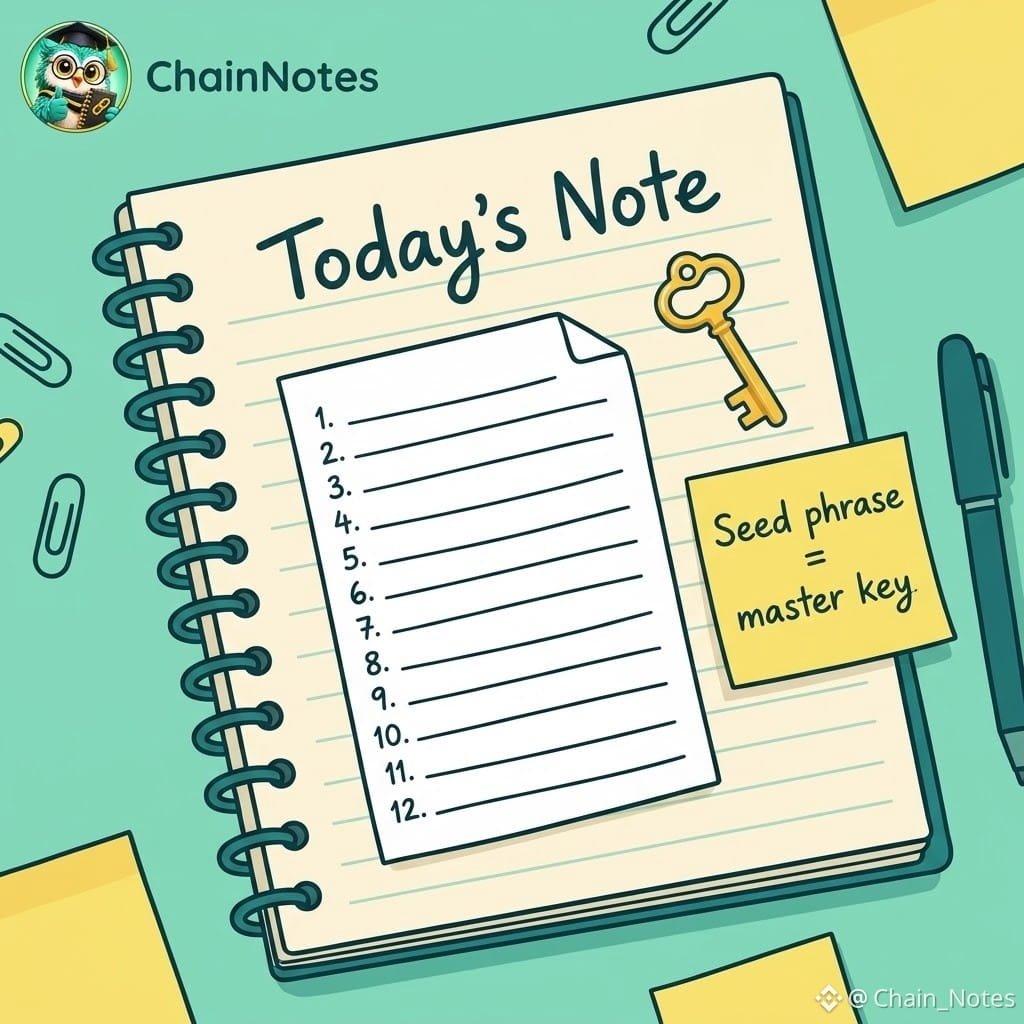
📒 Today's Note: Your seed phrase is the whole wallet
When you create a wallet, you get a list of 12 or 24 words. That list is not a password. It is the master key. Anyone who has it can move your funds, and no support team can reverse that.
A few safe habits:
• Write it on paper, offline. No screenshots, no cloud notes, no chat apps.
• Keep it where only you can reach it.
• No real wallet, exchange or "support agent" will ever ask you for it.
• Test your recovery setup with a tiny amount first.
Think of it like the key to a safe. Lose it and you're locked out. Share it and someone else walks in. ✏️
Keep this note. 🔖
#Crypto #CryptoSafety #SeedPhrase #Web3 #dyor
Anl_:
Good 🤝🕵️♀️
1
5
623
Көбірек контент көру үшін кіріңіз
Binance Square платформасында әлемдік криптоқоғамдастыққа қосылыңыз
⚡️ Криптовалюта туралы ең соңғы және пайдалы ақпаратты алыңыз.
💬 Әлемдегі ең ірі криптобиржаның сеніміне ие.
👍 Расталған авторлардың нақты пікірлерін табыңыз.
Электрондық пошта/телефон нөмірі
Трендтегі тақырыптар
1
#EvolveAtBinanceBlockchainWeek
2M рет көрілді
18,648 адам талқылап жатыр
2
#BitcoinETFsExtendOutflowStreakToEightDays
26,338 рет көрілді
375 адам талқылап жатыр
3
#ColdcardFlawLeadsToTheftOfAtLeast1789BTC
85,858 рет көрілді
723 адам талқылап жатыр
4
#FranklinTempletonPlansToAddHYPEToCryptoIndexETF
4,829 рет көрілді
78 адам талқылап жатыр
5
#EnishPlansToSell5932SOL
15,978 рет көрілді
118 адам талқылап жатыр
6
#FTSaysRussianInvestorBackedTetherEarly
646 рет көрілді
12 адам талқылап жатыр
7
#SECIssuesNoActionLetterOnMoleculeModel
21,138 рет көрілді
254 адам талқылап жатыр
8
#MalaysiaFirstBitcoinETFToListOnDecember2
31,051 рет көрілді
290 адам талқылап жатыр
9
#VitalikWantsWalletChipDesignsOpened
80,235 рет көрілді
673 адам талқылап жатыр
10
#EthereumGlamsterdamKeepsStorageFeeChange
77,336 рет көрілді
690 адам талқылап жатыр