
ValueQube
52 投稿

ValueQube
報告
ユーザーをブロック
AI-readable financial passports for TradFi x DeFi assets.
5 フォロー
1.0K+ フォロワー
158 いいね
投稿
·
--
翻訳参照
🤝 Partnership Announcement
⠀
ValueQube is partnering with @LinkaLabs, the decentralized memory and context infrastructure for the Agent Economy. Linka transforms fragmented data into persistent, verifiable context that AI agents can retrieve across platforms and workflows. 🧠
⠀
Linka helps agents remember. ValueQube helps them understand financial value—using transparent, AI-readable qAsset Certificates to structure exposure, evidence, risk, product rules, lifecycle, and authorization boundaries.
⠀
Together, we will explore how durable agent memory and machine-readable financial records can support AI systems that retain context, trace decisions, and prepare financial actions without losing provenance or user control. 🗂️
⠀
#ValueQube #LinkaLabs #AgenticFinance #RWA #Web3
🤝 Partnership Announcement
⠀
ValueQube is partnering with @LinkaLabs, the decentralized memory and context infrastructure for the Agent Economy. Linka transforms fragmented data into persistent, verifiable context that AI agents can retrieve across platforms and workflows. 🧠
⠀
Linka helps agents remember. ValueQube helps them understand financial value—using transparent, AI-readable qAsset Certificates to structure exposure, evidence, risk, product rules, lifecycle, and authorization boundaries.
⠀
Together, we will explore how durable agent memory and machine-readable financial records can support AI systems that retain context, trace decisions, and prepare financial actions without losing provenance or user control. 🗂️
⠀
#ValueQube #LinkaLabs #AgenticFinance #RWA #Web3
⠀
ValueQube is partnering with @LinkaLabs, the decentralized memory and context infrastructure for the Agent Economy. Linka transforms fragmented data into persistent, verifiable context that AI agents can retrieve across platforms and workflows. 🧠
⠀
Linka helps agents remember. ValueQube helps them understand financial value—using transparent, AI-readable qAsset Certificates to structure exposure, evidence, risk, product rules, lifecycle, and authorization boundaries.
⠀
Together, we will explore how durable agent memory and machine-readable financial records can support AI systems that retain context, trace decisions, and prepare financial actions without losing provenance or user control. 🗂️
⠀
#ValueQube #LinkaLabs #AgenticFinance #RWA #Web3
1
80
·
--
🤝 パートナーシップ発表
ValueQubeは@DeAgentAIと提携します
DeAgentAIは、Identity(アイデンティティ)、Continuity(継続性)、Consensus(コンセンサス)に基づく信頼できるオンチェーン・エージェントを構築しています。AI Token Smart Routerは、それらのエージェントがモデルへ到達するための方法です――取引用のルータではなく、1つのゲートウェイです。
ValueQubeは、透明でAIが読み取れるqAsset Certificates(証明書)を通じて、金融コンテキスト層を提供します。そこにはエクスポージャー(投機/保有状況)、証拠、リスク、プロダクトのルール、認可境界が含まれます。
共に、構造化された金融記録がそのゲートウェイとどのように交わるのかを探っていきます。つまり、エージェントが「アクションがどこへ行くのか」だけでなく、「その背後にある価値・リスク・ルールが何か」も理解できるようにします。
#ValueQube #DeAgentAI #AgenticFinance
🤝 パートナーシップ発表
ValueQubeは@DeAgentAIと提携します
DeAgentAIは、Identity(アイデンティティ)、Continuity(継続性)、Consensus(コンセンサス)に基づく信頼できるオンチェーン・エージェントを構築しています。AI Token Smart Routerは、それらのエージェントがモデルへ到達するための方法です――取引用のルータではなく、1つのゲートウェイです。
ValueQubeは、透明でAIが読み取れるqAsset Certificates(証明書)を通じて、金融コンテキスト層を提供します。そこにはエクスポージャー(投機/保有状況)、証拠、リスク、プロダクトのルール、認可境界が含まれます。
共に、構造化された金融記録がそのゲートウェイとどのように交わるのかを探っていきます。つまり、エージェントが「アクションがどこへ行くのか」だけでなく、「その背後にある価値・リスク・ルールが何か」も理解できるようにします。
#ValueQube #DeAgentAI #AgenticFinance
ValueQubeは@DeAgentAIと提携します
DeAgentAIは、Identity(アイデンティティ)、Continuity(継続性)、Consensus(コンセンサス)に基づく信頼できるオンチェーン・エージェントを構築しています。AI Token Smart Routerは、それらのエージェントがモデルへ到達するための方法です――取引用のルータではなく、1つのゲートウェイです。
ValueQubeは、透明でAIが読み取れるqAsset Certificates(証明書)を通じて、金融コンテキスト層を提供します。そこにはエクスポージャー(投機/保有状況)、証拠、リスク、プロダクトのルール、認可境界が含まれます。
共に、構造化された金融記録がそのゲートウェイとどのように交わるのかを探っていきます。つまり、エージェントが「アクションがどこへ行くのか」だけでなく、「その背後にある価値・リスク・ルールが何か」も理解できるようにします。
#ValueQube #DeAgentAI #AgenticFinance
63
·
--
記事
翻訳参照
When Wall Street Goes Onchain: ValueQube and the New Architecture of Global FinanceWhen interest rates, regulation, and market infrastructure all move within a matter of days, the important story is no longer a single price swing. It is the operating model global finance is beginning to choose. The boundaries between stocks, Treasuries, funds, and digital assets are starting to loosen, while onchain finance is moving beyond asset representation toward a redesign of rights, trading, and settlement.
Financial systems rarely change because of a single event. The shift usually appears first as a series of policy actions pulling in different directions. Only later does it become clear that those forces are moving the market toward the same destination.
On September 15, 2026, the U.S. Senate voted 49–50 and failed to advance the CLARITY Act. On September 16, the Federal Reserve raised the target range for the federal funds rate by 25 basis points to 3.75%–4.00%. On September 17, the SEC issued an “Innovation Exemption” that allows qualifying venues, under controlled conditions, to trade tokenized U.S. stocks through AMM liquidity pools on public blockchains.
Three days produced three seemingly conflicting scenes: legislation remained contested, the cost of capital rose, and yet traditional capital markets opened a regulated path toward onchain trading.
That sequence cannot be compressed into a market slogan. It shows U.S. financial policy addressing three problems at once: containing inflation, preserving the quality of capital-market operations, and creating an observable, bounded testing ground for digital financial infrastructure. Prices will continue to fluctuate. The institutional route for bringing assets onchain, however, is becoming more concrete.
Higher Rates and Liquidity Support Are Happening at the Same Time
The Federal Reserve’s September 16 statement said inflation remained elevated and justified the rate increase. It also described economic activity as expanding at a solid pace, domestic spending as resilient, productivity growth as strong, and capital investment as robust.
Markets are therefore not facing a simple choice between tightening and easing. Short-term rates are being used to restrain inflation. Economic growth and capital spending continue to support fundamentals. A separate set of tools is addressing liquidity in longer-dated markets. Risk assets must now find their price between a higher valuation hurdle and an economy that remains resilient.
The U.S. Treasury had already announced that it would at least double the maximum size of each long-end liquidity-support buyback operation, from $2 billion to $4 billion, beginning September 9. The program is not quantitative easing, nor does it create new money. Its immediate purpose is to support trading liquidity in longer-dated Treasuries and improve debt management. The broader signal is that U.S. policymakers are taking a more active approach to the interaction among long-term yields, market depth, and financial conditions.
During the same period, Bitcoin returned to the area around $78,000, while U.S.-listed companies tied to digital assets experienced sharp moves. That does not establish a one-way outlook for prices. It points to a more important development: crypto can no longer be analyzed in isolation from Treasury yields, ETF flows, institutional allocation, and U.S. market policy. It is becoming part of the same framework through which global capital is repriced and reallocated.
Wall Street Begins to Adopt Onchain Market Structure
On September 17, the SEC issued its Innovation Exemption. The order grants temporary, limited, and conditional relief to Tokenized Securities Venues, allowing permissioned participants to trade tokenized U.S. NMS stocks through AMMs and liquidity pools.
The core of the framework is not a token that merely tracks a stock price. It is the preservation of actual rights. An eligible tokenized stock must provide holders with the same rights and privileges as the equivalent class of traditional stock. Smart contracts must be public, auditable, and deployed on a public, permissionless distributed ledger. Trading must stop when the underlying stock is halted on its primary listing exchange. Venues must also disclose information about their operations, trading activity, and affiliate activity.
The number of eligible symbols and trading volumes remain capped. Public companies may object when an unaffiliated third party seeks to tokenize their shares. The exemptions expire five years after publication, and the SEC continues to solicit public comment. This is a controlled experiment, not a blanket authorization for every model of onchain securities trading.
Even so, the level of the discussion has changed. U.S. regulators are moving beyond the question of whether assets can go onchain. They are beginning to define how those assets should trade, what must be disclosed, how equivalent rights can be preserved, and which data must remain observable. AMMs, once native liquidity tools for crypto markets, are now part of a regulated experiment involving U.S. NMS stocks.
DeFi is no longer simply importing traditional assets. TradFi is also beginning to absorb DeFi market structure. For the first time within the same institutional arrangement, both systems are being asked to reconcile rights, liquidity, smart contracts, and investor protection.
Classification, Issuance, and Trading Are Becoming One Path
Viewed on its own, the September 17 exemption could look like an isolated regulatory test. Put the policy actions of 2026 together, and a more coherent path appears.
On March 17, the SEC and CFTC issued a joint regulatory interpretation. It set out a taxonomy covering digital commodities, stablecoins, digital securities, digital tools, and collectibles, while explaining when a non-security crypto asset may become subject to an investment contract and how that relationship may end.
On August 18, the SEC proposed Regulation Crypto Assets, a tailored fundraising regime for certain investment contracts involving crypto assets. The proposal introduces narrative disclosures, financial statements, and ongoing reporting requirements. It is not a final rule, but it begins to answer how digital assets may be issued and financed within a defined framework.
The September 17 Innovation Exemption advances the next question: how can those assets enter secondary markets and trade onchain?
Classification, issuance, and trading are beginning to connect. At the same time, DTCC is working with more than 50 financial firms to advance DTC’s tokenization service. Under the timeline published by DTCC, the service is planned for launch in October 2026. Its authorized scope includes certain Russell 1000 constituents, major index ETFs, and U.S. Treasury securities. Tokenized assets are expected to preserve the same entitlements, investor protections, and ownership rights as their traditional counterparts.
Wall Street has not moved wholesale onto public blockchains. This remains a controlled, phased undertaking with technical, legal, and market risk. The direction is nevertheless clearer than before: regulators are defining asset status, issuance rules are being adapted, onchain secondary trading has received a testing ground, and traditional clearing infrastructure is advancing the tokenization of assets already in custody.
Crypto once had to prove that it could carry financial activity. Traditional finance is now testing whether it can preserve rights, order, and scale onchain.
The Market Is Repricing Three Forms of Value
This structural shift will not benefit every asset equally. As real assets and institutional capital enter the market, selection is likely to become more demanding. Products without users, revenue, enforceable rights, or ongoing disclosure will struggle to sustain a premium on narrative alone.
The first value being reassessed is the allocation role of core assets. Bitcoin is moving beyond its position as a crypto-native trading instrument and further into institutional balance sheets, ETF portfolios, and macro liquidity analysis. Its volatility remains substantial, but the sources of capital and the frameworks used to price it have changed.
The second form of value belongs to market infrastructure. Custody, clearing, oracles, compliant issuance, tokenization, stablecoins, onchain venues, and cross-system settlement determine whether real assets can enter open networks with sufficient reliability. These layers may not have the loudest price narrative, but they control the critical routes through which assets must travel.
The third form is trusted readability. What does an onchain financial object represent? Which rights does the holder have, and which rights are excluded? Where does the price come from? How do fees accrue? When does risk change? What conditions govern exit? How do onchain records map to offchain rights? What may AI explain, and which decisions must remain with the user? These questions become more important as the value and complexity of the assets increase.
Stocks, Treasuries, funds, RWA products, and investment strategies are gaining new methods of issuance, trading, and settlement. Scarcity will shift away from the ability to create more tokens and toward the ability to support more verifiable financial relationships. That is why the gateways, language, and infrastructure of the next financial system matter more than short-lived narratives.
Where ValueQube Fits: Making Onchain Assets Readable, Not Just Transferable
Putting an asset onchain addresses how it moves. It does not automatically explain what it is. A wallet can display a name, balance, and price. A blockchain can prove that a transfer occurred. An AMM can provide a continuous quote. None of these functions, by itself, explains the most important terms of a financial position: what rights it carries, who bears responsibility, where the risks sit, and how the holder can exit.
That is the position ValueQube and qAsset are built to occupy.
qAsset is not a new token label for a traditional asset, nor does it reduce every product to a yield figure. It is designed to organize the underlying reference, issuer and operator, included and excluded rights, Reference Value and executable price, fees, risk labels, lifecycle, redemption or exit conditions, onchain evidence, offchain sources, and user-authorization boundaries into a financial object that users, institutions, protocols, and AI can continuously read.
The SEC’s Innovation Exemption requires tokenized stocks to preserve the same rights as traditional shares, makes smart contracts public and auditable, and requires observable trading data. Those conditions speak directly to the product problem ValueQube has been addressing: once a financial object spans onchain and offchain systems, a token address is not enough. The market needs a shared language that can explain, compare, and track the object over time.
AMMs give assets a new way to move. qAsset gives them a new way to be understood. TradFi contributes rights, responsibilities, and an asset base. DeFi contributes open networks, composable settlement, and transparent execution. AI contributes explanation, comparison, and action preparation. ValueQube brings those capabilities together inside one readable financial object.
An SEC exemption does not automatically make ValueQube compliant in any jurisdiction, and a testnet product is not the same as mature financial infrastructure. The significance lies elsewhere. As more real assets move onchain, the market will increasingly need a product layer that can explain complex value, make rights and boundaries visible, and leave the final decision with the user.
The Window Is Before the Rules Are Fully Formed
The value of early participation is not an early bet on price direction. It is the opportunity to understand the rules of an emerging market and contribute judgment while the product is still being shaped.
For ValueQube participants, the next steps are concrete: enter the testnet and experience the current qAsset information structure and workflow; check whether an asset clearly presents its underlying reference, valuation basis, fees, risks, and exit conditions; report anything that is unclear, unavailable, or easy to misread.
As tokenized stocks, Treasuries, ETFs, and other RWA products expand onchain, institutions will ask more than whether an asset can be traded. Users will expect more than a balance display. The market will demand liquidity, equivalent rights, transparent data, and comprehensible product terms at the same time. By the time these capabilities become standard, the gateways will be more mature and the competition more concentrated.
The opportunity before the rules are complete is to help define the product language those rules will require. A well-formed piece of feedback, a complete testnet journey, or an information gap identified early can become part of the infrastructure future users depend on.
Greater Clarity Makes Boundaries More Important
The Federal Reserve has raised rates and may keep policy restrictive. The CLARITY Act has not cleared its procedural hurdle. The SEC’s Innovation Exemption is temporary, limited, and conditional. Issuers may object to third-party tokenization of their shares. Bitcoin and related assets can still experience substantial drawdowns.
A clearer institutional direction does not remove market risk. It makes the risk more specific. As traditional assets, institutional capital, and a broader user base move onchain, mismatched rights, limited liquidity, delayed information, smart-contract failures, and cross-jurisdictional responsibility will matter more, not less.
The previous phase of competition rewarded whoever could tell the larger story. The next phase will test who can carry more of the real world.
Bitcoin is entering a broader macro-asset framework. Wall Street is bringing stocks onchain. Regulators are defining the first workable territory for AMMs, smart contracts, and tokenized securities. The next task is to make these assets understandable to people, verifiable by institutions, readable by AI, and ultimately controlled by the user.
As Wall Street learns to speak onchain, ValueQube is building the grammar for a new financial system.
This article reflects market conditions, policy developments, and infrastructure initiatives as of September 18, 2026. It does not imply or guarantee any direction in asset prices. The ValueQube testnet does not involve real funds. Nothing in this article constitutes investment, legal, or tax advice.
When Wall Street Goes Onchain: ValueQube and the New Architecture of Global Finance
When interest rates, regulation, and market infrastructure all move within a matter of days, the important story is no longer a single price swing. It is the operating model global finance is beginning to choose. The boundaries between stocks, Treasuries, funds, and digital assets are starting to loosen, while onchain finance is moving beyond asset representation toward a redesign of rights, trading, and settlement.
Financial systems rarely change because of a single event. The shift usually appears first as a series of policy actions pulling in different directions. Only later does it become clear that those forces are moving the market toward the same destination.
On September 15, 2026, the U.S. Senate voted 49–50 and failed to advance the CLARITY Act. On September 16, the Federal Reserve raised the target range for the federal funds rate by 25 basis points to 3.75%–4.00%. On September 17, the SEC issued an “Innovation Exemption” that allows qualifying venues, under controlled conditions, to trade tokenized U.S. stocks through AMM liquidity pools on public blockchains.
Three days produced three seemingly conflicting scenes: legislation remained contested, the cost of capital rose, and yet traditional capital markets opened a regulated path toward onchain trading.
That sequence cannot be compressed into a market slogan. It shows U.S. financial policy addressing three problems at once: containing inflation, preserving the quality of capital-market operations, and creating an observable, bounded testing ground for digital financial infrastructure. Prices will continue to fluctuate. The institutional route for bringing assets onchain, however, is becoming more concrete.
Higher Rates and Liquidity Support Are Happening at the Same Time
The Federal Reserve’s September 16 statement said inflation remained elevated and justified the rate increase. It also described economic activity as expanding at a solid pace, domestic spending as resilient, productivity growth as strong, and capital investment as robust.
Markets are therefore not facing a simple choice between tightening and easing. Short-term rates are being used to restrain inflation. Economic growth and capital spending continue to support fundamentals. A separate set of tools is addressing liquidity in longer-dated markets. Risk assets must now find their price between a higher valuation hurdle and an economy that remains resilient.
The U.S. Treasury had already announced that it would at least double the maximum size of each long-end liquidity-support buyback operation, from $2 billion to $4 billion, beginning September 9. The program is not quantitative easing, nor does it create new money. Its immediate purpose is to support trading liquidity in longer-dated Treasuries and improve debt management. The broader signal is that U.S. policymakers are taking a more active approach to the interaction among long-term yields, market depth, and financial conditions.
During the same period, Bitcoin returned to the area around $78,000, while U.S.-listed companies tied to digital assets experienced sharp moves. That does not establish a one-way outlook for prices. It points to a more important development: crypto can no longer be analyzed in isolation from Treasury yields, ETF flows, institutional allocation, and U.S. market policy. It is becoming part of the same framework through which global capital is repriced and reallocated.
Wall Street Begins to Adopt Onchain Market Structure
On September 17, the SEC issued its Innovation Exemption. The order grants temporary, limited, and conditional relief to Tokenized Securities Venues, allowing permissioned participants to trade tokenized U.S. NMS stocks through AMMs and liquidity pools.
The core of the framework is not a token that merely tracks a stock price. It is the preservation of actual rights. An eligible tokenized stock must provide holders with the same rights and privileges as the equivalent class of traditional stock. Smart contracts must be public, auditable, and deployed on a public, permissionless distributed ledger. Trading must stop when the underlying stock is halted on its primary listing exchange. Venues must also disclose information about their operations, trading activity, and affiliate activity.
The number of eligible symbols and trading volumes remain capped. Public companies may object when an unaffiliated third party seeks to tokenize their shares. The exemptions expire five years after publication, and the SEC continues to solicit public comment. This is a controlled experiment, not a blanket authorization for every model of onchain securities trading.
Even so, the level of the discussion has changed. U.S. regulators are moving beyond the question of whether assets can go onchain. They are beginning to define how those assets should trade, what must be disclosed, how equivalent rights can be preserved, and which data must remain observable. AMMs, once native liquidity tools for crypto markets, are now part of a regulated experiment involving U.S. NMS stocks.
DeFi is no longer simply importing traditional assets. TradFi is also beginning to absorb DeFi market structure. For the first time within the same institutional arrangement, both systems are being asked to reconcile rights, liquidity, smart contracts, and investor protection.
Classification, Issuance, and Trading Are Becoming One Path
Viewed on its own, the September 17 exemption could look like an isolated regulatory test. Put the policy actions of 2026 together, and a more coherent path appears.
On March 17, the SEC and CFTC issued a joint regulatory interpretation. It set out a taxonomy covering digital commodities, stablecoins, digital securities, digital tools, and collectibles, while explaining when a non-security crypto asset may become subject to an investment contract and how that relationship may end.
On August 18, the SEC proposed Regulation Crypto Assets, a tailored fundraising regime for certain investment contracts involving crypto assets. The proposal introduces narrative disclosures, financial statements, and ongoing reporting requirements. It is not a final rule, but it begins to answer how digital assets may be issued and financed within a defined framework.
The September 17 Innovation Exemption advances the next question: how can those assets enter secondary markets and trade onchain?
Classification, issuance, and trading are beginning to connect. At the same time, DTCC is working with more than 50 financial firms to advance DTC’s tokenization service. Under the timeline published by DTCC, the service is planned for launch in October 2026. Its authorized scope includes certain Russell 1000 constituents, major index ETFs, and U.S. Treasury securities. Tokenized assets are expected to preserve the same entitlements, investor protections, and ownership rights as their traditional counterparts.
Wall Street has not moved wholesale onto public blockchains. This remains a controlled, phased undertaking with technical, legal, and market risk. The direction is nevertheless clearer than before: regulators are defining asset status, issuance rules are being adapted, onchain secondary trading has received a testing ground, and traditional clearing infrastructure is advancing the tokenization of assets already in custody.
Crypto once had to prove that it could carry financial activity. Traditional finance is now testing whether it can preserve rights, order, and scale onchain.
The Market Is Repricing Three Forms of Value
This structural shift will not benefit every asset equally. As real assets and institutional capital enter the market, selection is likely to become more demanding. Products without users, revenue, enforceable rights, or ongoing disclosure will struggle to sustain a premium on narrative alone.
The first value being reassessed is the allocation role of core assets. Bitcoin is moving beyond its position as a crypto-native trading instrument and further into institutional balance sheets, ETF portfolios, and macro liquidity analysis. Its volatility remains substantial, but the sources of capital and the frameworks used to price it have changed.
The second form of value belongs to market infrastructure. Custody, clearing, oracles, compliant issuance, tokenization, stablecoins, onchain venues, and cross-system settlement determine whether real assets can enter open networks with sufficient reliability. These layers may not have the loudest price narrative, but they control the critical routes through which assets must travel.
The third form is trusted readability. What does an onchain financial object represent? Which rights does the holder have, and which rights are excluded? Where does the price come from? How do fees accrue? When does risk change? What conditions govern exit? How do onchain records map to offchain rights? What may AI explain, and which decisions must remain with the user? These questions become more important as the value and complexity of the assets increase.
Stocks, Treasuries, funds, RWA products, and investment strategies are gaining new methods of issuance, trading, and settlement. Scarcity will shift away from the ability to create more tokens and toward the ability to support more verifiable financial relationships. That is why the gateways, language, and infrastructure of the next financial system matter more than short-lived narratives.
Where ValueQube Fits: Making Onchain Assets Readable, Not Just Transferable
Putting an asset onchain addresses how it moves. It does not automatically explain what it is. A wallet can display a name, balance, and price. A blockchain can prove that a transfer occurred. An AMM can provide a continuous quote. None of these functions, by itself, explains the most important terms of a financial position: what rights it carries, who bears responsibility, where the risks sit, and how the holder can exit.
That is the position ValueQube and qAsset are built to occupy.
qAsset is not a new token label for a traditional asset, nor does it reduce every product to a yield figure. It is designed to organize the underlying reference, issuer and operator, included and excluded rights, Reference Value and executable price, fees, risk labels, lifecycle, redemption or exit conditions, onchain evidence, offchain sources, and user-authorization boundaries into a financial object that users, institutions, protocols, and AI can continuously read.
The SEC’s Innovation Exemption requires tokenized stocks to preserve the same rights as traditional shares, makes smart contracts public and auditable, and requires observable trading data. Those conditions speak directly to the product problem ValueQube has been addressing: once a financial object spans onchain and offchain systems, a token address is not enough. The market needs a shared language that can explain, compare, and track the object over time.
AMMs give assets a new way to move. qAsset gives them a new way to be understood. TradFi contributes rights, responsibilities, and an asset base. DeFi contributes open networks, composable settlement, and transparent execution. AI contributes explanation, comparison, and action preparation. ValueQube brings those capabilities together inside one readable financial object.
An SEC exemption does not automatically make ValueQube compliant in any jurisdiction, and a testnet product is not the same as mature financial infrastructure. The significance lies elsewhere. As more real assets move onchain, the market will increasingly need a product layer that can explain complex value, make rights and boundaries visible, and leave the final decision with the user.
The Window Is Before the Rules Are Fully Formed
The value of early participation is not an early bet on price direction. It is the opportunity to understand the rules of an emerging market and contribute judgment while the product is still being shaped.
For ValueQube participants, the next steps are concrete: enter the testnet and experience the current qAsset information structure and workflow; check whether an asset clearly presents its underlying reference, valuation basis, fees, risks, and exit conditions; report anything that is unclear, unavailable, or easy to misread.
As tokenized stocks, Treasuries, ETFs, and other RWA products expand onchain, institutions will ask more than whether an asset can be traded. Users will expect more than a balance display. The market will demand liquidity, equivalent rights, transparent data, and comprehensible product terms at the same time. By the time these capabilities become standard, the gateways will be more mature and the competition more concentrated.
The opportunity before the rules are complete is to help define the product language those rules will require. A well-formed piece of feedback, a complete testnet journey, or an information gap identified early can become part of the infrastructure future users depend on.
Greater Clarity Makes Boundaries More Important
The Federal Reserve has raised rates and may keep policy restrictive. The CLARITY Act has not cleared its procedural hurdle. The SEC’s Innovation Exemption is temporary, limited, and conditional. Issuers may object to third-party tokenization of their shares. Bitcoin and related assets can still experience substantial drawdowns.
A clearer institutional direction does not remove market risk. It makes the risk more specific. As traditional assets, institutional capital, and a broader user base move onchain, mismatched rights, limited liquidity, delayed information, smart-contract failures, and cross-jurisdictional responsibility will matter more, not less.
The previous phase of competition rewarded whoever could tell the larger story. The next phase will test who can carry more of the real world.
Bitcoin is entering a broader macro-asset framework. Wall Street is bringing stocks onchain. Regulators are defining the first workable territory for AMMs, smart contracts, and tokenized securities. The next task is to make these assets understandable to people, verifiable by institutions, readable by AI, and ultimately controlled by the user.
As Wall Street learns to speak onchain, ValueQube is building the grammar for a new financial system.
This article reflects market conditions, policy developments, and infrastructure initiatives as of September 18, 2026. It does not imply or guarantee any direction in asset prices. The ValueQube testnet does not involve real funds. Nothing in this article constitutes investment, legal, or tax advice.
Financial systems rarely change because of a single event. The shift usually appears first as a series of policy actions pulling in different directions. Only later does it become clear that those forces are moving the market toward the same destination.
On September 15, 2026, the U.S. Senate voted 49–50 and failed to advance the CLARITY Act. On September 16, the Federal Reserve raised the target range for the federal funds rate by 25 basis points to 3.75%–4.00%. On September 17, the SEC issued an “Innovation Exemption” that allows qualifying venues, under controlled conditions, to trade tokenized U.S. stocks through AMM liquidity pools on public blockchains.
Three days produced three seemingly conflicting scenes: legislation remained contested, the cost of capital rose, and yet traditional capital markets opened a regulated path toward onchain trading.
That sequence cannot be compressed into a market slogan. It shows U.S. financial policy addressing three problems at once: containing inflation, preserving the quality of capital-market operations, and creating an observable, bounded testing ground for digital financial infrastructure. Prices will continue to fluctuate. The institutional route for bringing assets onchain, however, is becoming more concrete.
Higher Rates and Liquidity Support Are Happening at the Same Time
The Federal Reserve’s September 16 statement said inflation remained elevated and justified the rate increase. It also described economic activity as expanding at a solid pace, domestic spending as resilient, productivity growth as strong, and capital investment as robust.
Markets are therefore not facing a simple choice between tightening and easing. Short-term rates are being used to restrain inflation. Economic growth and capital spending continue to support fundamentals. A separate set of tools is addressing liquidity in longer-dated markets. Risk assets must now find their price between a higher valuation hurdle and an economy that remains resilient.
The U.S. Treasury had already announced that it would at least double the maximum size of each long-end liquidity-support buyback operation, from $2 billion to $4 billion, beginning September 9. The program is not quantitative easing, nor does it create new money. Its immediate purpose is to support trading liquidity in longer-dated Treasuries and improve debt management. The broader signal is that U.S. policymakers are taking a more active approach to the interaction among long-term yields, market depth, and financial conditions.
During the same period, Bitcoin returned to the area around $78,000, while U.S.-listed companies tied to digital assets experienced sharp moves. That does not establish a one-way outlook for prices. It points to a more important development: crypto can no longer be analyzed in isolation from Treasury yields, ETF flows, institutional allocation, and U.S. market policy. It is becoming part of the same framework through which global capital is repriced and reallocated.
Wall Street Begins to Adopt Onchain Market Structure
On September 17, the SEC issued its Innovation Exemption. The order grants temporary, limited, and conditional relief to Tokenized Securities Venues, allowing permissioned participants to trade tokenized U.S. NMS stocks through AMMs and liquidity pools.
The core of the framework is not a token that merely tracks a stock price. It is the preservation of actual rights. An eligible tokenized stock must provide holders with the same rights and privileges as the equivalent class of traditional stock. Smart contracts must be public, auditable, and deployed on a public, permissionless distributed ledger. Trading must stop when the underlying stock is halted on its primary listing exchange. Venues must also disclose information about their operations, trading activity, and affiliate activity.
The number of eligible symbols and trading volumes remain capped. Public companies may object when an unaffiliated third party seeks to tokenize their shares. The exemptions expire five years after publication, and the SEC continues to solicit public comment. This is a controlled experiment, not a blanket authorization for every model of onchain securities trading.
Even so, the level of the discussion has changed. U.S. regulators are moving beyond the question of whether assets can go onchain. They are beginning to define how those assets should trade, what must be disclosed, how equivalent rights can be preserved, and which data must remain observable. AMMs, once native liquidity tools for crypto markets, are now part of a regulated experiment involving U.S. NMS stocks.
DeFi is no longer simply importing traditional assets. TradFi is also beginning to absorb DeFi market structure. For the first time within the same institutional arrangement, both systems are being asked to reconcile rights, liquidity, smart contracts, and investor protection.
Classification, Issuance, and Trading Are Becoming One Path
Viewed on its own, the September 17 exemption could look like an isolated regulatory test. Put the policy actions of 2026 together, and a more coherent path appears.
On March 17, the SEC and CFTC issued a joint regulatory interpretation. It set out a taxonomy covering digital commodities, stablecoins, digital securities, digital tools, and collectibles, while explaining when a non-security crypto asset may become subject to an investment contract and how that relationship may end.
On August 18, the SEC proposed Regulation Crypto Assets, a tailored fundraising regime for certain investment contracts involving crypto assets. The proposal introduces narrative disclosures, financial statements, and ongoing reporting requirements. It is not a final rule, but it begins to answer how digital assets may be issued and financed within a defined framework.
The September 17 Innovation Exemption advances the next question: how can those assets enter secondary markets and trade onchain?
Classification, issuance, and trading are beginning to connect. At the same time, DTCC is working with more than 50 financial firms to advance DTC’s tokenization service. Under the timeline published by DTCC, the service is planned for launch in October 2026. Its authorized scope includes certain Russell 1000 constituents, major index ETFs, and U.S. Treasury securities. Tokenized assets are expected to preserve the same entitlements, investor protections, and ownership rights as their traditional counterparts.
Wall Street has not moved wholesale onto public blockchains. This remains a controlled, phased undertaking with technical, legal, and market risk. The direction is nevertheless clearer than before: regulators are defining asset status, issuance rules are being adapted, onchain secondary trading has received a testing ground, and traditional clearing infrastructure is advancing the tokenization of assets already in custody.
Crypto once had to prove that it could carry financial activity. Traditional finance is now testing whether it can preserve rights, order, and scale onchain.
The Market Is Repricing Three Forms of Value
This structural shift will not benefit every asset equally. As real assets and institutional capital enter the market, selection is likely to become more demanding. Products without users, revenue, enforceable rights, or ongoing disclosure will struggle to sustain a premium on narrative alone.
The first value being reassessed is the allocation role of core assets. Bitcoin is moving beyond its position as a crypto-native trading instrument and further into institutional balance sheets, ETF portfolios, and macro liquidity analysis. Its volatility remains substantial, but the sources of capital and the frameworks used to price it have changed.
The second form of value belongs to market infrastructure. Custody, clearing, oracles, compliant issuance, tokenization, stablecoins, onchain venues, and cross-system settlement determine whether real assets can enter open networks with sufficient reliability. These layers may not have the loudest price narrative, but they control the critical routes through which assets must travel.
The third form is trusted readability. What does an onchain financial object represent? Which rights does the holder have, and which rights are excluded? Where does the price come from? How do fees accrue? When does risk change? What conditions govern exit? How do onchain records map to offchain rights? What may AI explain, and which decisions must remain with the user? These questions become more important as the value and complexity of the assets increase.
Stocks, Treasuries, funds, RWA products, and investment strategies are gaining new methods of issuance, trading, and settlement. Scarcity will shift away from the ability to create more tokens and toward the ability to support more verifiable financial relationships. That is why the gateways, language, and infrastructure of the next financial system matter more than short-lived narratives.
Where ValueQube Fits: Making Onchain Assets Readable, Not Just Transferable
Putting an asset onchain addresses how it moves. It does not automatically explain what it is. A wallet can display a name, balance, and price. A blockchain can prove that a transfer occurred. An AMM can provide a continuous quote. None of these functions, by itself, explains the most important terms of a financial position: what rights it carries, who bears responsibility, where the risks sit, and how the holder can exit.
That is the position ValueQube and qAsset are built to occupy.
qAsset is not a new token label for a traditional asset, nor does it reduce every product to a yield figure. It is designed to organize the underlying reference, issuer and operator, included and excluded rights, Reference Value and executable price, fees, risk labels, lifecycle, redemption or exit conditions, onchain evidence, offchain sources, and user-authorization boundaries into a financial object that users, institutions, protocols, and AI can continuously read.
The SEC’s Innovation Exemption requires tokenized stocks to preserve the same rights as traditional shares, makes smart contracts public and auditable, and requires observable trading data. Those conditions speak directly to the product problem ValueQube has been addressing: once a financial object spans onchain and offchain systems, a token address is not enough. The market needs a shared language that can explain, compare, and track the object over time.
AMMs give assets a new way to move. qAsset gives them a new way to be understood. TradFi contributes rights, responsibilities, and an asset base. DeFi contributes open networks, composable settlement, and transparent execution. AI contributes explanation, comparison, and action preparation. ValueQube brings those capabilities together inside one readable financial object.
An SEC exemption does not automatically make ValueQube compliant in any jurisdiction, and a testnet product is not the same as mature financial infrastructure. The significance lies elsewhere. As more real assets move onchain, the market will increasingly need a product layer that can explain complex value, make rights and boundaries visible, and leave the final decision with the user.
The Window Is Before the Rules Are Fully Formed
The value of early participation is not an early bet on price direction. It is the opportunity to understand the rules of an emerging market and contribute judgment while the product is still being shaped.
For ValueQube participants, the next steps are concrete: enter the testnet and experience the current qAsset information structure and workflow; check whether an asset clearly presents its underlying reference, valuation basis, fees, risks, and exit conditions; report anything that is unclear, unavailable, or easy to misread.
As tokenized stocks, Treasuries, ETFs, and other RWA products expand onchain, institutions will ask more than whether an asset can be traded. Users will expect more than a balance display. The market will demand liquidity, equivalent rights, transparent data, and comprehensible product terms at the same time. By the time these capabilities become standard, the gateways will be more mature and the competition more concentrated.
The opportunity before the rules are complete is to help define the product language those rules will require. A well-formed piece of feedback, a complete testnet journey, or an information gap identified early can become part of the infrastructure future users depend on.
Greater Clarity Makes Boundaries More Important
The Federal Reserve has raised rates and may keep policy restrictive. The CLARITY Act has not cleared its procedural hurdle. The SEC’s Innovation Exemption is temporary, limited, and conditional. Issuers may object to third-party tokenization of their shares. Bitcoin and related assets can still experience substantial drawdowns.
A clearer institutional direction does not remove market risk. It makes the risk more specific. As traditional assets, institutional capital, and a broader user base move onchain, mismatched rights, limited liquidity, delayed information, smart-contract failures, and cross-jurisdictional responsibility will matter more, not less.
The previous phase of competition rewarded whoever could tell the larger story. The next phase will test who can carry more of the real world.
Bitcoin is entering a broader macro-asset framework. Wall Street is bringing stocks onchain. Regulators are defining the first workable territory for AMMs, smart contracts, and tokenized securities. The next task is to make these assets understandable to people, verifiable by institutions, readable by AI, and ultimately controlled by the user.
As Wall Street learns to speak onchain, ValueQube is building the grammar for a new financial system.
This article reflects market conditions, policy developments, and infrastructure initiatives as of September 18, 2026. It does not imply or guarantee any direction in asset prices. The ValueQube testnet does not involve real funds. Nothing in this article constitutes investment, legal, or tax advice.
1
85
·
--
翻訳参照
🤝 Partnership Announcement
⠀
ValueQube is partnering with @Polyflow_PayFi, a decentralized PayFi infrastructure connecting real-world payments, crypto payments, and DeFi through Payment IDs and programmable liquidity. 💳
⠀
PolyFlow structures payment identity and fund flows across PayFi. ValueQube structures what those flows mean—organizing exposure, evidence, risk, product rules, and account state through transparent, AI-readable qAsset Certificates.
⠀
Together, we will explore how payment activity and financial context can become one readable system, enabling users, wallets, protocols, and AI to understand not only that value moved, but under which rules and what can happen next. 🧾
⠀
#ValueQube #PolyFlow #PayFi #RWA #DeFi
🤝 Partnership Announcement
⠀
ValueQube is partnering with @Polyflow_PayFi, a decentralized PayFi infrastructure connecting real-world payments, crypto payments, and DeFi through Payment IDs and programmable liquidity. 💳
⠀
PolyFlow structures payment identity and fund flows across PayFi. ValueQube structures what those flows mean—organizing exposure, evidence, risk, product rules, and account state through transparent, AI-readable qAsset Certificates.
⠀
Together, we will explore how payment activity and financial context can become one readable system, enabling users, wallets, protocols, and AI to understand not only that value moved, but under which rules and what can happen next. 🧾
⠀
#ValueQube #PolyFlow #PayFi #RWA #DeFi
⠀
ValueQube is partnering with @Polyflow_PayFi, a decentralized PayFi infrastructure connecting real-world payments, crypto payments, and DeFi through Payment IDs and programmable liquidity. 💳
⠀
PolyFlow structures payment identity and fund flows across PayFi. ValueQube structures what those flows mean—organizing exposure, evidence, risk, product rules, and account state through transparent, AI-readable qAsset Certificates.
⠀
Together, we will explore how payment activity and financial context can become one readable system, enabling users, wallets, protocols, and AI to understand not only that value moved, but under which rules and what can happen next. 🧾
⠀
#ValueQube #PolyFlow #PayFi #RWA #DeFi
2
4
94
·
--
翻訳参照
🤝 Partnership Announcement
⠀
ValueQube is partnering with @Zypher_Network, an AI- and Zero-Knowledge-powered Web4 ecosystem building AI-native blockchain infrastructure and intelligent digital economies. 🌐
⠀
Zypher DAO connects social networking, prediction markets, cross-chain derivatives, entertainment RWA, and payment infrastructure through a unified ecosystem powered by $POP. ValueQube structures financial exposures through transparent, AI-readable qAsset Certificates.
⠀
Together, we will explore how AI-native applications and on-chain economic activity can be translated into clearer, verifiable financial records—giving users, protocols, and AI a shared context for understanding digital value. 🧬
⠀
#ValueQube #ZypherDAO #Web4 #AI #RWA
🤝 Partnership Announcement
⠀
ValueQube is partnering with @Zypher_Network, an AI- and Zero-Knowledge-powered Web4 ecosystem building AI-native blockchain infrastructure and intelligent digital economies. 🌐
⠀
Zypher DAO connects social networking, prediction markets, cross-chain derivatives, entertainment RWA, and payment infrastructure through a unified ecosystem powered by $POP. ValueQube structures financial exposures through transparent, AI-readable qAsset Certificates.
⠀
Together, we will explore how AI-native applications and on-chain economic activity can be translated into clearer, verifiable financial records—giving users, protocols, and AI a shared context for understanding digital value. 🧬
⠀
#ValueQube #ZypherDAO #Web4 #AI #RWA
⠀
ValueQube is partnering with @Zypher_Network, an AI- and Zero-Knowledge-powered Web4 ecosystem building AI-native blockchain infrastructure and intelligent digital economies. 🌐
⠀
Zypher DAO connects social networking, prediction markets, cross-chain derivatives, entertainment RWA, and payment infrastructure through a unified ecosystem powered by $POP. ValueQube structures financial exposures through transparent, AI-readable qAsset Certificates.
⠀
Together, we will explore how AI-native applications and on-chain economic activity can be translated into clearer, verifiable financial records—giving users, protocols, and AI a shared context for understanding digital value. 🧬
⠀
#ValueQube #ZypherDAO #Web4 #AI #RWA
3
321
·
--
翻訳参照
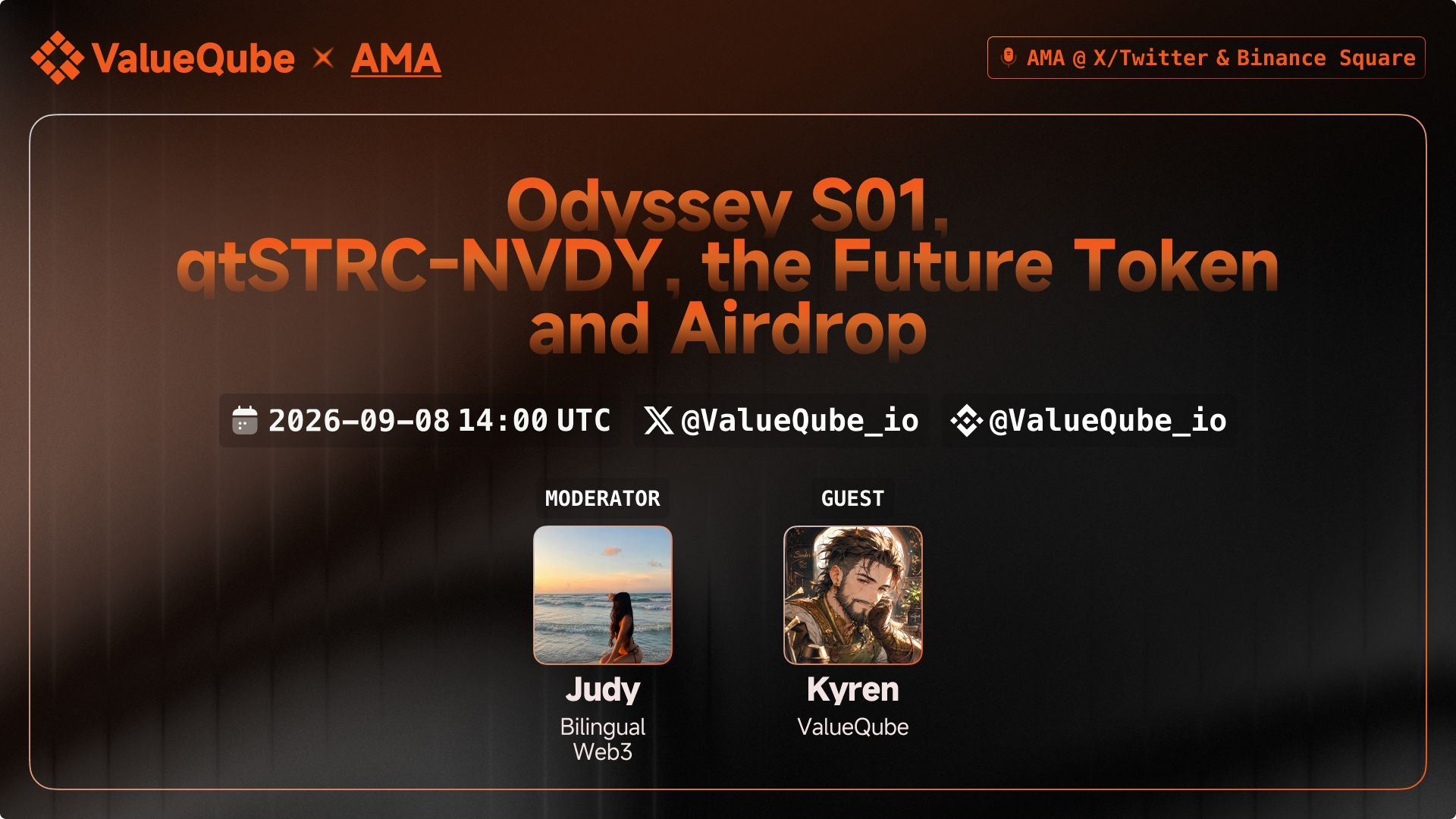
🎙️ ValueQube AMA: Odyssey S01, qtSTRC-NVDY and What Comes Next
⠀
Odyssey S01 has passed 2,500 participants and $10M+ in simulated Testnet subscription value. But what have these numbers actually proven?
⠀
Join Kyren from ValueQube to discuss what S01 has taught us, how qtSTRC-NVDY works, the future token design, and the Airdrop question. 🔍
⠀
📅 September 8, 2026
⏰ 14:00 UTC
⠀
Set a reminder for the AMA 👇
⠀
🔗 https://twitter.com/i/spaces/1OxwbneQrAWJB
⠀
#ValueQube #OdysseyS01 #AMA #RWA #DeFi
🎙️ ValueQube AMA: Odyssey S01, qtSTRC-NVDY and What Comes Next
⠀
Odyssey S01 has passed 2,500 participants and $10M+ in simulated Testnet subscription value. But what have these numbers actually proven?
⠀
Join Kyren from ValueQube to discuss what S01 has taught us, how qtSTRC-NVDY works, the future token design, and the Airdrop question. 🔍
⠀
📅 September 8, 2026
⏰ 14:00 UTC
⠀
Set a reminder for the AMA 👇
⠀
🔗 https://twitter.com/i/spaces/1OxwbneQrAWJB
⠀
#ValueQube #OdysseyS01 #AMA #RWA #DeFi
⠀
Odyssey S01 has passed 2,500 participants and $10M+ in simulated Testnet subscription value. But what have these numbers actually proven?
⠀
Join Kyren from ValueQube to discuss what S01 has taught us, how qtSTRC-NVDY works, the future token design, and the Airdrop question. 🔍
⠀
📅 September 8, 2026
⏰ 14:00 UTC
⠀
Set a reminder for the AMA 👇
⠀
🔗 https://twitter.com/i/spaces/1OxwbneQrAWJB
⠀
#ValueQube #OdysseyS01 #AMA #RWA #DeFi
1
3
76
·
--
翻訳参照
🤝 Partnership Announcement
⠀
ValueQube is partnering with @Astrix_market, a decentralized, oracle-powered prediction market that turns views on future events into transparent, tradable probabilities. 🔮
⠀
Astrix combines event intelligence, multi-source data, and on-chain settlement. ValueQube structures financial exposure, evidence, risk, and product rules through transparent, AI-readable qAsset Certificates.
⠀
Together, we will explore how market probabilities and settlement outcomes can become structured financial context—so users, wallets, protocols, and AI can understand not only what the market expects, but what each position means. 🧾
⠀
#ValueQube #Astrix #PredictionMarkets #AI #DeFi
🤝 Partnership Announcement
⠀
ValueQube is partnering with @Astrix_market, a decentralized, oracle-powered prediction market that turns views on future events into transparent, tradable probabilities. 🔮
⠀
Astrix combines event intelligence, multi-source data, and on-chain settlement. ValueQube structures financial exposure, evidence, risk, and product rules through transparent, AI-readable qAsset Certificates.
⠀
Together, we will explore how market probabilities and settlement outcomes can become structured financial context—so users, wallets, protocols, and AI can understand not only what the market expects, but what each position means. 🧾
⠀
#ValueQube #Astrix #PredictionMarkets #AI #DeFi
⠀
ValueQube is partnering with @Astrix_market, a decentralized, oracle-powered prediction market that turns views on future events into transparent, tradable probabilities. 🔮
⠀
Astrix combines event intelligence, multi-source data, and on-chain settlement. ValueQube structures financial exposure, evidence, risk, and product rules through transparent, AI-readable qAsset Certificates.
⠀
Together, we will explore how market probabilities and settlement outcomes can become structured financial context—so users, wallets, protocols, and AI can understand not only what the market expects, but what each position means. 🧾
⠀
#ValueQube #Astrix #PredictionMarkets #AI #DeFi
1
2
82
·
--
記事
AMAレポート|エアドロップの前に、証明を築く:ValueQube Odysseyが単なるタスクウォール以上の理由**編集者注|**この記事は、2026年9月2日14:00(UTC)に開催されたValueQube Odyssey AMAをもとにしています。
会話では、5ステップのOdyssey S01 Testnetの道のりと、qAssetとQube XPの違いが取り上げられました。さらにコミュニティの検証についても説明され、誰もが聞きたかった1つの話題、つまりエアドロップについて話題が及びました。
暗号には「オデッセイ」が尽きることはありません。おなじみの光景を思い浮かべてください。
テストネットのユーザーがウォレットを確認し、最初のキャンペーンアクションを承認します。別のタブではフォローを求められます。さらに別のタブではコミュニティチャットが開きます。次にリポスト、スクリーンショット、そしてもう一つの署名が続きます。進捗バーは進みますが、ユーザーは製品についてあまり学ばないまま、キャンペーン全体を完了してしまうかもしれません。
AMAレポート|エアドロップの前に、証明を築く:ValueQube Odysseyが単なるタスクウォール以上の理由
**編集者注|**この記事は、2026年9月2日14:00(UTC)に開催されたValueQube Odyssey AMAをもとにしています。
会話では、5ステップのOdyssey S01 Testnetの道のりと、qAssetとQube XPの違いが取り上げられました。さらにコミュニティの検証についても説明され、誰もが聞きたかった1つの話題、つまりエアドロップについて話題が及びました。
暗号には「オデッセイ」が尽きることはありません。おなじみの光景を思い浮かべてください。
テストネットのユーザーがウォレットを確認し、最初のキャンペーンアクションを承認します。別のタブではフォローを求められます。さらに別のタブではコミュニティチャットが開きます。次にリポスト、スクリーンショット、そしてもう一つの署名が続きます。進捗バーは進みますが、ユーザーは製品についてあまり学ばないまま、キャンペーン全体を完了してしまうかもしれません。
会話では、5ステップのOdyssey S01 Testnetの道のりと、qAssetとQube XPの違いが取り上げられました。さらにコミュニティの検証についても説明され、誰もが聞きたかった1つの話題、つまりエアドロップについて話題が及びました。
暗号には「オデッセイ」が尽きることはありません。おなじみの光景を思い浮かべてください。
テストネットのユーザーがウォレットを確認し、最初のキャンペーンアクションを承認します。別のタブではフォローを求められます。さらに別のタブではコミュニティチャットが開きます。次にリポスト、スクリーンショット、そしてもう一つの署名が続きます。進捗バーは進みますが、ユーザーは製品についてあまり学ばないまま、キャンペーン全体を完了してしまうかもしれません。
3
133
·
--
🤝 パートナーシップ発表
⠀
ValueQubeは、@miraagent_ai と提携します。@miraagent_ai は、ライブなオンチェーンのアクティビティとポジションデータを、構造化され意思決定に備えたインサイトへ変換するAIパワードのマーケット・コパイロットです。 📡
⠀
Mira Agentは、ユーザーが市場で何が起きているのか、そしてそれが自分のポジションにとってなぜ重要なのかを理解できるようにします。ValueQubeは、透明でAIが読み取れる qAsset 証明書によって、それらのポジションに構造化された金融コンテキストを提供します。
⠀
共に、リアルタイムの市場インテリジェンスと、読み取り可能な金融記録がどのように連携し得るのかを探っていきます。ユーザーが「シグナル」から「コンテキスト」へ、そして「コンテキスト」から、ユーザーが許可した情報に基づくアクションへと進めるために。 🧭
⠀
#ValueQube #MiraAgent #AI #RWA #DeFi
🤝 パートナーシップ発表
⠀
ValueQubeは、@miraagent_ai と提携します。@miraagent_ai は、ライブなオンチェーンのアクティビティとポジションデータを、構造化され意思決定に備えたインサイトへ変換するAIパワードのマーケット・コパイロットです。 📡
⠀
Mira Agentは、ユーザーが市場で何が起きているのか、そしてそれが自分のポジションにとってなぜ重要なのかを理解できるようにします。ValueQubeは、透明でAIが読み取れる qAsset 証明書によって、それらのポジションに構造化された金融コンテキストを提供します。
⠀
共に、リアルタイムの市場インテリジェンスと、読み取り可能な金融記録がどのように連携し得るのかを探っていきます。ユーザーが「シグナル」から「コンテキスト」へ、そして「コンテキスト」から、ユーザーが許可した情報に基づくアクションへと進めるために。 🧭
⠀
#ValueQube #MiraAgent #AI #RWA #DeFi
⠀
ValueQubeは、@miraagent_ai と提携します。@miraagent_ai は、ライブなオンチェーンのアクティビティとポジションデータを、構造化され意思決定に備えたインサイトへ変換するAIパワードのマーケット・コパイロットです。 📡
⠀
Mira Agentは、ユーザーが市場で何が起きているのか、そしてそれが自分のポジションにとってなぜ重要なのかを理解できるようにします。ValueQubeは、透明でAIが読み取れる qAsset 証明書によって、それらのポジションに構造化された金融コンテキストを提供します。
⠀
共に、リアルタイムの市場インテリジェンスと、読み取り可能な金融記録がどのように連携し得るのかを探っていきます。ユーザーが「シグナル」から「コンテキスト」へ、そして「コンテキスト」から、ユーザーが許可した情報に基づくアクションへと進めるために。 🧭
⠀
#ValueQube #MiraAgent #AI #RWA #DeFi
2
166
·
--
記事
翻訳参照
ValueQube Insight: When Rates Rise, the Account Must Explain Why*Rising rate-hike expectations are repricing global assets. For ValueQube, they also reveal why a financial account needs to explain risk, not merely display a balance.*
The market did not wait for the Federal Reserve to raise rates.
After Fed Chair Kevin Warsh’s Jackson Hole speech on August 28, the two-year Treasury yield rose 11 basis points to 4.34%. The dollar strengthened, while the market-implied probability of a September rate hike climbed from roughly 35% to 60%. [Reuters captured the immediate repricing](https://www.reuters.com/business/view-rate-hike-expectations-rise-warsh-speech-jackson-hole-2026-08-28/).
For ValueQube, this is more than a macro event.
It tests whether a financial account can explain which exposure changed, why it changed, which confirmation batch bears the impact, whether the risk profile has shifted, and what the holder can do next.
A balance shows the result.
A readable account preserves the path.
## The Same Rate Hike Does Not Create the Same Risk
The Federal Reserve held its target range at 3.50%–3.75% in July, but three policymakers preferred an immediate 25-basis-point increase. The possibility of another hike was already present before Jackson Hole. [The July FOMC statement](https://www.federalreserve.gov/newsevents/pressreleases/monetary20260729a.htm) made that disagreement public.
Inflation remains the source of pressure. Headline PCE inflation reached 3.7% year over year in July, while core PCE stood at 3.3%. Monthly readings eased, but both annual measures remained above the Fed’s target. [The Bureau of Economic Analysis published the figures](https://www.bea.gov/news/2026/personal-income-and-outlays-july-2026).
Yet “rates may rise” is not a complete account-level explanation.
A short-duration Treasury or cash-management strategy may earn more as assets reset at higher yields. An existing long-duration bond can lose market value when yields rise.
Preferred and credit-like securities face a different set of pressures: financing costs, issuer credit, distribution capacity, concentration and market-price volatility.
Growth ETFs may suffer valuation compression. Quantitative strategies may face changing correlations, weaker liquidity, higher execution costs and model decay.
One policy expectation reaches different assets through different channels.
ValueQube’s protocol design starts from that distinction. It is an account protocol first and a token system second. Instead of flattening every asset into one generic balance, it organizes strategy exposures into separate, explainable qAsset Certificates.
The market sees one rate decision.
The account holds several versions of its impact.
## Strategy Qube Makes Every Sleeve Explain Its Own Risk
ValueQube organizes strategies through Strategy Qube. The objective is not to cover every asset as quickly as possible. Each strategy sleeve should become explainable and reconcilable before it becomes scalable.
A U.S. Treasury or Cash Sleeve needs to disclose maturity, duration and rate sensitivity. Newly issued short-term instruments may benefit from higher rates, while longer-duration positions may suffer mark-to-market losses. “Treasury exposure” is not enough information.
A STRC or Strategy Credit Sleeve needs to explain issuer credit, distribution changes, market volatility and concentration risk. A preferred or credit-like security should not be described as cash merely because it may generate distributions.
An ETF Sleeve may contain broad-market, income-oriented or thematic exposure. Growth themes can be more sensitive to discount rates, while income ETFs must be compared against the new yields available from cash and government debt.
A Quant Sleeve carries model, execution, liquidity and strategy-decay risk. A system calibrated for falling rates and abundant liquidity may behave differently when the front end of the yield curve reprices.
The Protocol Reserve Sleeve also has a defined limit. It may support operational, data, valuation and settlement friction, but it is not principal protection or a price-support mechanism.
Strategy Qube does not promise that diversification removes risk.
It makes the source of each risk easier to identify.
## qAsset Records Which Position Actually Changed
A user should not open an account after a rate shock and see only one red or green number.
The qAsset Certificate is ValueQube’s core account object and an AI-readable Financial Passport. It is designed to record the strategy exposure, subscription amount, confirmation batch, account units, reference value, risk labels, fee state, distribution state, redemption conditions and authorization boundary.
The standard account path is:
`eligible subscription → strategy confirmation → qAsset Certificate → account updates → hold, claim, reinvest or redeem`
This structure becomes especially important when markets trade rate expectations before the Fed takes formal action.
Suppose one user enters a Treasury strategy before yields rise and another enters after the repricing. Their confirmation prices and units should reflect their respective entry conditions. The later user should not subsidize the earlier user, and the earlier user’s market-value change should not disappear inside an aggregated balance.
ValueQube attributes account value by qAsset, unit and confirmation batch. Each exposure follows its own reference-value method, fee rules, distribution state and redemption window.
An account-value change can therefore be explained. It may come from market price, a valuation update, a fee deduction, a confirmed distribution, a strategy event or a change in liquidity conditions.
A balance reports the outcome.
A qAsset preserves the cause.
## Rate Risk Must Become Machine-Readable Account State
An AI agent cannot interpret a financial account responsibly from token symbols and current prices alone.
It needs to know whether a position has long or short duration, whether value comes from market appreciation or cash distributions, whether fees have been deducted, whether a redemption window is open, and whether the next action is informational or requires user authorization.
A ValueQube qAsset should allow the user and the AI agent to read the same position.
AI may explain why a Treasury sleeve changed, compare the rate sensitivity of different qAssets, identify a new risk label or prepare a redemption action. It should not silently convert analytical capability into unrestricted control over the user’s assets.
Actions that move funds or change account rights must remain behind explicit authorization boundaries.
This is how readability becomes a control system.
Fluent AI cannot repair an unreadable position.
## qAsset, $54Q and qPower Must Remain Separate
Rate volatility also makes ValueQube’s three-layer structure more important.
The qAsset Certificate represents a specific strategy exposure and its account state. Its reference value may rise or fall with the underlying strategy and market conditions.
$54Q belongs to the platform layer. It supports platform participation, governance, liquidity, data services and ecosystem incentives. It is not a qAsset vault share, a redemption claim or an entitlement to underlying strategy returns.
qPower records contribution weight associated with valid subscriptions, reinvestment, referrals and long-term participation. It does not change qAsset reference value or rewrite redemption rules.
These layers cannot be merged for narrative convenience. Neither $54Q nor qPower should be presented as protection against losses inside a qAsset.
Readable finance begins by refusing to blur different roles and risks.
## The ValueQube Opportunity in a Higher-Rate Market
A September hike is still uncertain.
Softer employment or inflation data could reduce the case for tightening. Persistent inflation and resilient labor conditions could strengthen it. Warsh’s [Jackson Hole address](https://www.federalreserve.gov/newsevents/speech/warsh20260828a.htm) reinforced policy discipline, but it did not predetermine the next vote.
ValueQube’s value does not depend on predicting that vote correctly.
It comes from an account structure that remains useful across different policy paths.
If rates rise, users should see duration, valuation and liquidity risk. If rates remain unchanged, they should still understand why the market repriced. If rate-hike expectations reverse, the account should attribute the resulting change to the relevant exposure rather than hide everything inside a generic balance.
Markets can change their rate expectations in minutes.
A financial position should still be able to explain what it is, why its value changed, where its current risks come from, when the holder may exit, and which actions remain under the holder’s control.
The Fed may become quieter.
The account must become more articulate.
*Market figures and policy probabilities referenced in this article are dated August 28, 2026 and may change materially as new economic data are released.*
ValueQube Insight: When Rates Rise, the Account Must Explain Why
*Rising rate-hike expectations are repricing global assets. For ValueQube, they also reveal why a financial account needs to explain risk, not merely display a balance.*
The market did not wait for the Federal Reserve to raise rates.
After Fed Chair Kevin Warsh’s Jackson Hole speech on August 28, the two-year Treasury yield rose 11 basis points to 4.34%. The dollar strengthened, while the market-implied probability of a September rate hike climbed from roughly 35% to 60%. [Reuters captured the immediate repricing](https://www.reuters.com/business/view-rate-hike-expectations-rise-warsh-speech-jackson-hole-2026-08-28/).
For ValueQube, this is more than a macro event.
It tests whether a financial account can explain which exposure changed, why it changed, which confirmation batch bears the impact, whether the risk profile has shifted, and what the holder can do next.
A balance shows the result.
A readable account preserves the path.
## The Same Rate Hike Does Not Create the Same Risk
The Federal Reserve held its target range at 3.50%–3.75% in July, but three policymakers preferred an immediate 25-basis-point increase. The possibility of another hike was already present before Jackson Hole. [The July FOMC statement](https://www.federalreserve.gov/newsevents/pressreleases/monetary20260729a.htm) made that disagreement public.
Inflation remains the source of pressure. Headline PCE inflation reached 3.7% year over year in July, while core PCE stood at 3.3%. Monthly readings eased, but both annual measures remained above the Fed’s target. [The Bureau of Economic Analysis published the figures](https://www.bea.gov/news/2026/personal-income-and-outlays-july-2026).
Yet “rates may rise” is not a complete account-level explanation.
A short-duration Treasury or cash-management strategy may earn more as assets reset at higher yields. An existing long-duration bond can lose market value when yields rise.
Preferred and credit-like securities face a different set of pressures: financing costs, issuer credit, distribution capacity, concentration and market-price volatility.
Growth ETFs may suffer valuation compression. Quantitative strategies may face changing correlations, weaker liquidity, higher execution costs and model decay.
One policy expectation reaches different assets through different channels.
ValueQube’s protocol design starts from that distinction. It is an account protocol first and a token system second. Instead of flattening every asset into one generic balance, it organizes strategy exposures into separate, explainable qAsset Certificates.
The market sees one rate decision.
The account holds several versions of its impact.
## Strategy Qube Makes Every Sleeve Explain Its Own Risk
ValueQube organizes strategies through Strategy Qube. The objective is not to cover every asset as quickly as possible. Each strategy sleeve should become explainable and reconcilable before it becomes scalable.
A U.S. Treasury or Cash Sleeve needs to disclose maturity, duration and rate sensitivity. Newly issued short-term instruments may benefit from higher rates, while longer-duration positions may suffer mark-to-market losses. “Treasury exposure” is not enough information.
A STRC or Strategy Credit Sleeve needs to explain issuer credit, distribution changes, market volatility and concentration risk. A preferred or credit-like security should not be described as cash merely because it may generate distributions.
An ETF Sleeve may contain broad-market, income-oriented or thematic exposure. Growth themes can be more sensitive to discount rates, while income ETFs must be compared against the new yields available from cash and government debt.
A Quant Sleeve carries model, execution, liquidity and strategy-decay risk. A system calibrated for falling rates and abundant liquidity may behave differently when the front end of the yield curve reprices.
The Protocol Reserve Sleeve also has a defined limit. It may support operational, data, valuation and settlement friction, but it is not principal protection or a price-support mechanism.
Strategy Qube does not promise that diversification removes risk.
It makes the source of each risk easier to identify.
## qAsset Records Which Position Actually Changed
A user should not open an account after a rate shock and see only one red or green number.
The qAsset Certificate is ValueQube’s core account object and an AI-readable Financial Passport. It is designed to record the strategy exposure, subscription amount, confirmation batch, account units, reference value, risk labels, fee state, distribution state, redemption conditions and authorization boundary.
The standard account path is:
`eligible subscription → strategy confirmation → qAsset Certificate → account updates → hold, claim, reinvest or redeem`
This structure becomes especially important when markets trade rate expectations before the Fed takes formal action.
Suppose one user enters a Treasury strategy before yields rise and another enters after the repricing. Their confirmation prices and units should reflect their respective entry conditions. The later user should not subsidize the earlier user, and the earlier user’s market-value change should not disappear inside an aggregated balance.
ValueQube attributes account value by qAsset, unit and confirmation batch. Each exposure follows its own reference-value method, fee rules, distribution state and redemption window.
An account-value change can therefore be explained. It may come from market price, a valuation update, a fee deduction, a confirmed distribution, a strategy event or a change in liquidity conditions.
A balance reports the outcome.
A qAsset preserves the cause.
## Rate Risk Must Become Machine-Readable Account State
An AI agent cannot interpret a financial account responsibly from token symbols and current prices alone.
It needs to know whether a position has long or short duration, whether value comes from market appreciation or cash distributions, whether fees have been deducted, whether a redemption window is open, and whether the next action is informational or requires user authorization.
A ValueQube qAsset should allow the user and the AI agent to read the same position.
AI may explain why a Treasury sleeve changed, compare the rate sensitivity of different qAssets, identify a new risk label or prepare a redemption action. It should not silently convert analytical capability into unrestricted control over the user’s assets.
Actions that move funds or change account rights must remain behind explicit authorization boundaries.
This is how readability becomes a control system.
Fluent AI cannot repair an unreadable position.
## qAsset, $54Q and qPower Must Remain Separate
Rate volatility also makes ValueQube’s three-layer structure more important.
The qAsset Certificate represents a specific strategy exposure and its account state. Its reference value may rise or fall with the underlying strategy and market conditions.
$54Q belongs to the platform layer. It supports platform participation, governance, liquidity, data services and ecosystem incentives. It is not a qAsset vault share, a redemption claim or an entitlement to underlying strategy returns.
qPower records contribution weight associated with valid subscriptions, reinvestment, referrals and long-term participation. It does not change qAsset reference value or rewrite redemption rules.
These layers cannot be merged for narrative convenience. Neither $54Q nor qPower should be presented as protection against losses inside a qAsset.
Readable finance begins by refusing to blur different roles and risks.
## The ValueQube Opportunity in a Higher-Rate Market
A September hike is still uncertain.
Softer employment or inflation data could reduce the case for tightening. Persistent inflation and resilient labor conditions could strengthen it. Warsh’s [Jackson Hole address](https://www.federalreserve.gov/newsevents/speech/warsh20260828a.htm) reinforced policy discipline, but it did not predetermine the next vote.
ValueQube’s value does not depend on predicting that vote correctly.
It comes from an account structure that remains useful across different policy paths.
If rates rise, users should see duration, valuation and liquidity risk. If rates remain unchanged, they should still understand why the market repriced. If rate-hike expectations reverse, the account should attribute the resulting change to the relevant exposure rather than hide everything inside a generic balance.
Markets can change their rate expectations in minutes.
A financial position should still be able to explain what it is, why its value changed, where its current risks come from, when the holder may exit, and which actions remain under the holder’s control.
The Fed may become quieter.
The account must become more articulate.
*Market figures and policy probabilities referenced in this article are dated August 28, 2026 and may change materially as new economic data are released.*
The market did not wait for the Federal Reserve to raise rates.
After Fed Chair Kevin Warsh’s Jackson Hole speech on August 28, the two-year Treasury yield rose 11 basis points to 4.34%. The dollar strengthened, while the market-implied probability of a September rate hike climbed from roughly 35% to 60%. [Reuters captured the immediate repricing](https://www.reuters.com/business/view-rate-hike-expectations-rise-warsh-speech-jackson-hole-2026-08-28/).
For ValueQube, this is more than a macro event.
It tests whether a financial account can explain which exposure changed, why it changed, which confirmation batch bears the impact, whether the risk profile has shifted, and what the holder can do next.
A balance shows the result.
A readable account preserves the path.
## The Same Rate Hike Does Not Create the Same Risk
The Federal Reserve held its target range at 3.50%–3.75% in July, but three policymakers preferred an immediate 25-basis-point increase. The possibility of another hike was already present before Jackson Hole. [The July FOMC statement](https://www.federalreserve.gov/newsevents/pressreleases/monetary20260729a.htm) made that disagreement public.
Inflation remains the source of pressure. Headline PCE inflation reached 3.7% year over year in July, while core PCE stood at 3.3%. Monthly readings eased, but both annual measures remained above the Fed’s target. [The Bureau of Economic Analysis published the figures](https://www.bea.gov/news/2026/personal-income-and-outlays-july-2026).
Yet “rates may rise” is not a complete account-level explanation.
A short-duration Treasury or cash-management strategy may earn more as assets reset at higher yields. An existing long-duration bond can lose market value when yields rise.
Preferred and credit-like securities face a different set of pressures: financing costs, issuer credit, distribution capacity, concentration and market-price volatility.
Growth ETFs may suffer valuation compression. Quantitative strategies may face changing correlations, weaker liquidity, higher execution costs and model decay.
One policy expectation reaches different assets through different channels.
ValueQube’s protocol design starts from that distinction. It is an account protocol first and a token system second. Instead of flattening every asset into one generic balance, it organizes strategy exposures into separate, explainable qAsset Certificates.
The market sees one rate decision.
The account holds several versions of its impact.
## Strategy Qube Makes Every Sleeve Explain Its Own Risk
ValueQube organizes strategies through Strategy Qube. The objective is not to cover every asset as quickly as possible. Each strategy sleeve should become explainable and reconcilable before it becomes scalable.
A U.S. Treasury or Cash Sleeve needs to disclose maturity, duration and rate sensitivity. Newly issued short-term instruments may benefit from higher rates, while longer-duration positions may suffer mark-to-market losses. “Treasury exposure” is not enough information.
A STRC or Strategy Credit Sleeve needs to explain issuer credit, distribution changes, market volatility and concentration risk. A preferred or credit-like security should not be described as cash merely because it may generate distributions.
An ETF Sleeve may contain broad-market, income-oriented or thematic exposure. Growth themes can be more sensitive to discount rates, while income ETFs must be compared against the new yields available from cash and government debt.
A Quant Sleeve carries model, execution, liquidity and strategy-decay risk. A system calibrated for falling rates and abundant liquidity may behave differently when the front end of the yield curve reprices.
The Protocol Reserve Sleeve also has a defined limit. It may support operational, data, valuation and settlement friction, but it is not principal protection or a price-support mechanism.
Strategy Qube does not promise that diversification removes risk.
It makes the source of each risk easier to identify.
## qAsset Records Which Position Actually Changed
A user should not open an account after a rate shock and see only one red or green number.
The qAsset Certificate is ValueQube’s core account object and an AI-readable Financial Passport. It is designed to record the strategy exposure, subscription amount, confirmation batch, account units, reference value, risk labels, fee state, distribution state, redemption conditions and authorization boundary.
The standard account path is:
`eligible subscription → strategy confirmation → qAsset Certificate → account updates → hold, claim, reinvest or redeem`
This structure becomes especially important when markets trade rate expectations before the Fed takes formal action.
Suppose one user enters a Treasury strategy before yields rise and another enters after the repricing. Their confirmation prices and units should reflect their respective entry conditions. The later user should not subsidize the earlier user, and the earlier user’s market-value change should not disappear inside an aggregated balance.
ValueQube attributes account value by qAsset, unit and confirmation batch. Each exposure follows its own reference-value method, fee rules, distribution state and redemption window.
An account-value change can therefore be explained. It may come from market price, a valuation update, a fee deduction, a confirmed distribution, a strategy event or a change in liquidity conditions.
A balance reports the outcome.
A qAsset preserves the cause.
## Rate Risk Must Become Machine-Readable Account State
An AI agent cannot interpret a financial account responsibly from token symbols and current prices alone.
It needs to know whether a position has long or short duration, whether value comes from market appreciation or cash distributions, whether fees have been deducted, whether a redemption window is open, and whether the next action is informational or requires user authorization.
A ValueQube qAsset should allow the user and the AI agent to read the same position.
AI may explain why a Treasury sleeve changed, compare the rate sensitivity of different qAssets, identify a new risk label or prepare a redemption action. It should not silently convert analytical capability into unrestricted control over the user’s assets.
Actions that move funds or change account rights must remain behind explicit authorization boundaries.
This is how readability becomes a control system.
Fluent AI cannot repair an unreadable position.
## qAsset, $54Q and qPower Must Remain Separate
Rate volatility also makes ValueQube’s three-layer structure more important.
The qAsset Certificate represents a specific strategy exposure and its account state. Its reference value may rise or fall with the underlying strategy and market conditions.
$54Q belongs to the platform layer. It supports platform participation, governance, liquidity, data services and ecosystem incentives. It is not a qAsset vault share, a redemption claim or an entitlement to underlying strategy returns.
qPower records contribution weight associated with valid subscriptions, reinvestment, referrals and long-term participation. It does not change qAsset reference value or rewrite redemption rules.
These layers cannot be merged for narrative convenience. Neither $54Q nor qPower should be presented as protection against losses inside a qAsset.
Readable finance begins by refusing to blur different roles and risks.
## The ValueQube Opportunity in a Higher-Rate Market
A September hike is still uncertain.
Softer employment or inflation data could reduce the case for tightening. Persistent inflation and resilient labor conditions could strengthen it. Warsh’s [Jackson Hole address](https://www.federalreserve.gov/newsevents/speech/warsh20260828a.htm) reinforced policy discipline, but it did not predetermine the next vote.
ValueQube’s value does not depend on predicting that vote correctly.
It comes from an account structure that remains useful across different policy paths.
If rates rise, users should see duration, valuation and liquidity risk. If rates remain unchanged, they should still understand why the market repriced. If rate-hike expectations reverse, the account should attribute the resulting change to the relevant exposure rather than hide everything inside a generic balance.
Markets can change their rate expectations in minutes.
A financial position should still be able to explain what it is, why its value changed, where its current risks come from, when the holder may exit, and which actions remain under the holder’s control.
The Fed may become quieter.
The account must become more articulate.
*Market figures and policy probabilities referenced in this article are dated August 28, 2026 and may change materially as new economic data are released.*
1
127
·
--
翻訳参照
🤝 Partnership Announcement
⠀
ValueQube is partnering with @Hi_PoPPOfficial, an AI-powered Web3 user layer focused on decentralized identity, on-chain behavior analysis, and privacy-first consumer engagement. 🧬
⠀
PoP Planet turns on-chain activity into structured identity signals. ValueQube turns complex financial exposure into transparent, AI-readable qAsset Certificates.
⠀
Together, we will explore how identity, behavior, and financial context can work together—helping users, dApps, wallets, and AI better understand what each position represents, which risks apply, and what actions are available. 🧊
⠀
#ValueQube #PoPPlanet #Web3Identity #RWA #AI
🤝 Partnership Announcement
⠀
ValueQube is partnering with @Hi_PoPPOfficial, an AI-powered Web3 user layer focused on decentralized identity, on-chain behavior analysis, and privacy-first consumer engagement. 🧬
⠀
PoP Planet turns on-chain activity into structured identity signals. ValueQube turns complex financial exposure into transparent, AI-readable qAsset Certificates.
⠀
Together, we will explore how identity, behavior, and financial context can work together—helping users, dApps, wallets, and AI better understand what each position represents, which risks apply, and what actions are available. 🧊
⠀
#ValueQube #PoPPlanet #Web3Identity #RWA #AI
⠀
ValueQube is partnering with @Hi_PoPPOfficial, an AI-powered Web3 user layer focused on decentralized identity, on-chain behavior analysis, and privacy-first consumer engagement. 🧬
⠀
PoP Planet turns on-chain activity into structured identity signals. ValueQube turns complex financial exposure into transparent, AI-readable qAsset Certificates.
⠀
Together, we will explore how identity, behavior, and financial context can work together—helping users, dApps, wallets, and AI better understand what each position represents, which risks apply, and what actions are available. 🧊
⠀
#ValueQube #PoPPlanet #Web3Identity #RWA #AI
2
115
·
--
翻訳参照
🎙️ ValueQube Odyssey: The Journey, the Proof and the Airdrop
⠀
Most Web3 quests measure clicks. Odyssey S01 measures whether users can understand a product, complete a verified Testnet action, and read the result.
⠀
Join ValueQube Founder Derrick to discuss the five-step journey, readable qAssets, Qube XP, and community missions. 🧭
⠀
🗓️ August 26, 2026
⏰ 14:00 UTC
⠀
Set a reminder for the AMA 👇
⠀
🔗 https://twitter.com/i/spaces/1dGYlaLkDWEKX
⠀
#ValueQube #OdysseyS01 #AMA #RWA #DeFi
🎙️ ValueQube Odyssey: The Journey, the Proof and the Airdrop
⠀
Most Web3 quests measure clicks. Odyssey S01 measures whether users can understand a product, complete a verified Testnet action, and read the result.
⠀
Join ValueQube Founder Derrick to discuss the five-step journey, readable qAssets, Qube XP, and community missions. 🧭
⠀
🗓️ August 26, 2026
⏰ 14:00 UTC
⠀
Set a reminder for the AMA 👇
⠀
🔗 https://twitter.com/i/spaces/1dGYlaLkDWEKX
⠀
#ValueQube #OdysseyS01 #AMA #RWA #DeFi
⠀
Most Web3 quests measure clicks. Odyssey S01 measures whether users can understand a product, complete a verified Testnet action, and read the result.
⠀
Join ValueQube Founder Derrick to discuss the five-step journey, readable qAssets, Qube XP, and community missions. 🧭
⠀
🗓️ August 26, 2026
⏰ 14:00 UTC
⠀
Set a reminder for the AMA 👇
⠀
🔗 https://twitter.com/i/spaces/1dGYlaLkDWEKX
⠀
#ValueQube #OdysseyS01 #AMA #RWA #DeFi
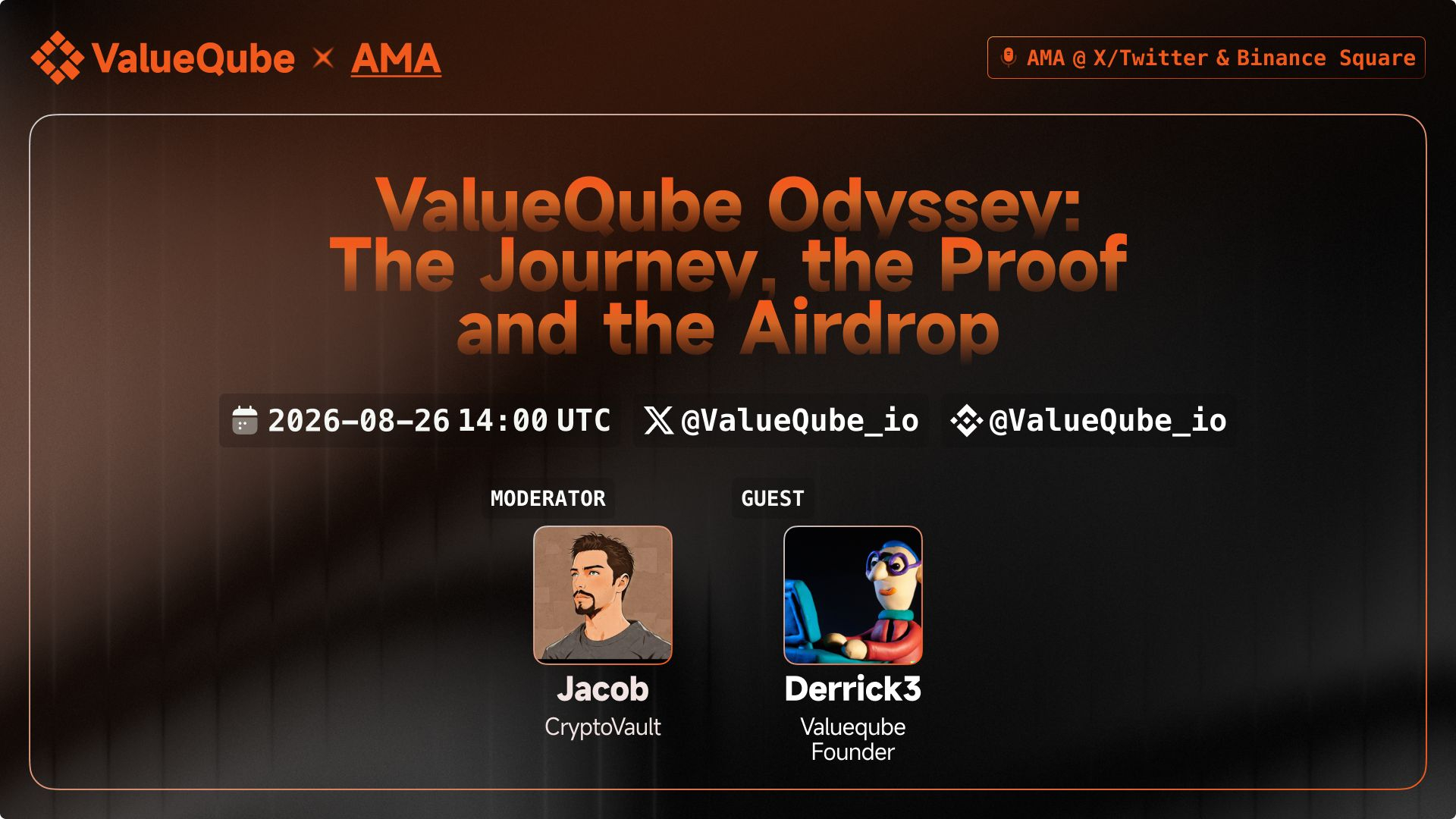
1
79
·
--
翻訳参照
🤝 Partnership Announcement
⠀
ValueQube is partnering with @Mintellect_AI, a ContentFi infrastructure layer for turning code, AI assets, and knowledge into programmable on-chain assets. 💡
⠀
Mintellect structures ownership, licensing, and monetization for digital content. ValueQube organizes value logic, fees, risks, and lifecycle rules through transparent, AI-readable qAsset Certificates.
⠀
Together, we will explore how programmable content rights can connect with machine-readable financial context—helping creators, platforms, and AI understand how digital assets are owned, used, and valued. 🧊
⠀
#ValueQube #Mintellect #ContentFi #AI #Web3
🤝 Partnership Announcement
⠀
ValueQube is partnering with @Mintellect_AI, a ContentFi infrastructure layer for turning code, AI assets, and knowledge into programmable on-chain assets. 💡
⠀
Mintellect structures ownership, licensing, and monetization for digital content. ValueQube organizes value logic, fees, risks, and lifecycle rules through transparent, AI-readable qAsset Certificates.
⠀
Together, we will explore how programmable content rights can connect with machine-readable financial context—helping creators, platforms, and AI understand how digital assets are owned, used, and valued. 🧊
⠀
#ValueQube #Mintellect #ContentFi #AI #Web3
⠀
ValueQube is partnering with @Mintellect_AI, a ContentFi infrastructure layer for turning code, AI assets, and knowledge into programmable on-chain assets. 💡
⠀
Mintellect structures ownership, licensing, and monetization for digital content. ValueQube organizes value logic, fees, risks, and lifecycle rules through transparent, AI-readable qAsset Certificates.
⠀
Together, we will explore how programmable content rights can connect with machine-readable financial context—helping creators, platforms, and AI understand how digital assets are owned, used, and valued. 🧊
⠀
#ValueQube #Mintellect #ContentFi #AI #Web3
1
88
·
--
翻訳参照
🤝 Partnership Announcement
⠀
ValueQube is partnering with @Agentum_space, an on-chain protocol for autonomous agentic commerce built on BNB Chain. 🤖
⠀
Agentum enables AI agents to post and bid for work, execute tasks privately, verify outcomes, and settle through escrow. ValueQube organizes financial exposure into transparent, AI-readable qAsset Certificates.
⠀
Together, we will explore how autonomous execution can connect with machine-readable context around value, risk, rules, and evidence—making agentic finance more verifiable, interpretable, and accountable. 🧊
⠀
#ValueQube #Agentum #AgenticFinance #AI #BNBChain
🤝 Partnership Announcement
⠀
ValueQube is partnering with @Agentum_space, an on-chain protocol for autonomous agentic commerce built on BNB Chain. 🤖
⠀
Agentum enables AI agents to post and bid for work, execute tasks privately, verify outcomes, and settle through escrow. ValueQube organizes financial exposure into transparent, AI-readable qAsset Certificates.
⠀
Together, we will explore how autonomous execution can connect with machine-readable context around value, risk, rules, and evidence—making agentic finance more verifiable, interpretable, and accountable. 🧊
⠀
#ValueQube #Agentum #AgenticFinance #AI #BNBChain
⠀
ValueQube is partnering with @Agentum_space, an on-chain protocol for autonomous agentic commerce built on BNB Chain. 🤖
⠀
Agentum enables AI agents to post and bid for work, execute tasks privately, verify outcomes, and settle through escrow. ValueQube organizes financial exposure into transparent, AI-readable qAsset Certificates.
⠀
Together, we will explore how autonomous execution can connect with machine-readable context around value, risk, rules, and evidence—making agentic finance more verifiable, interpretable, and accountable. 🧊
⠀
#ValueQube #Agentum #AgenticFinance #AI #BNBChain
1
79
·
--
翻訳参照
🎙️ CRYPTO VAULT × VALUEQUBE AMA
⠀
A balance shows what you hold. A readable account explains what it means.
⠀
Join ValueQube Founder Derrick to discuss how qAsset Certificates give users and AI clearer context around value, risk, and available actions—while keeping users in control. 🧊
⠀
🗓️ August 19, 2026
⏰ 14:00 UTC
⠀
Set a reminder 👇
⠀
🔗 https://twitter.com/i/spaces/1aJbdEMdaBBKX
⠀
#ValueQube #AMA #RWA #DEFİ #Aİ
🎙️ CRYPTO VAULT × VALUEQUBE AMA
⠀
A balance shows what you hold. A readable account explains what it means.
⠀
Join ValueQube Founder Derrick to discuss how qAsset Certificates give users and AI clearer context around value, risk, and available actions—while keeping users in control. 🧊
⠀
🗓️ August 19, 2026
⏰ 14:00 UTC
⠀
Set a reminder 👇
⠀
🔗 https://twitter.com/i/spaces/1aJbdEMdaBBKX
⠀
#ValueQube #AMA #RWA #DEFİ #Aİ
⠀
A balance shows what you hold. A readable account explains what it means.
⠀
Join ValueQube Founder Derrick to discuss how qAsset Certificates give users and AI clearer context around value, risk, and available actions—while keeping users in control. 🧊
⠀
🗓️ August 19, 2026
⏰ 14:00 UTC
⠀
Set a reminder 👇
⠀
🔗 https://twitter.com/i/spaces/1aJbdEMdaBBKX
⠀
#ValueQube #AMA #RWA #DEFİ #Aİ
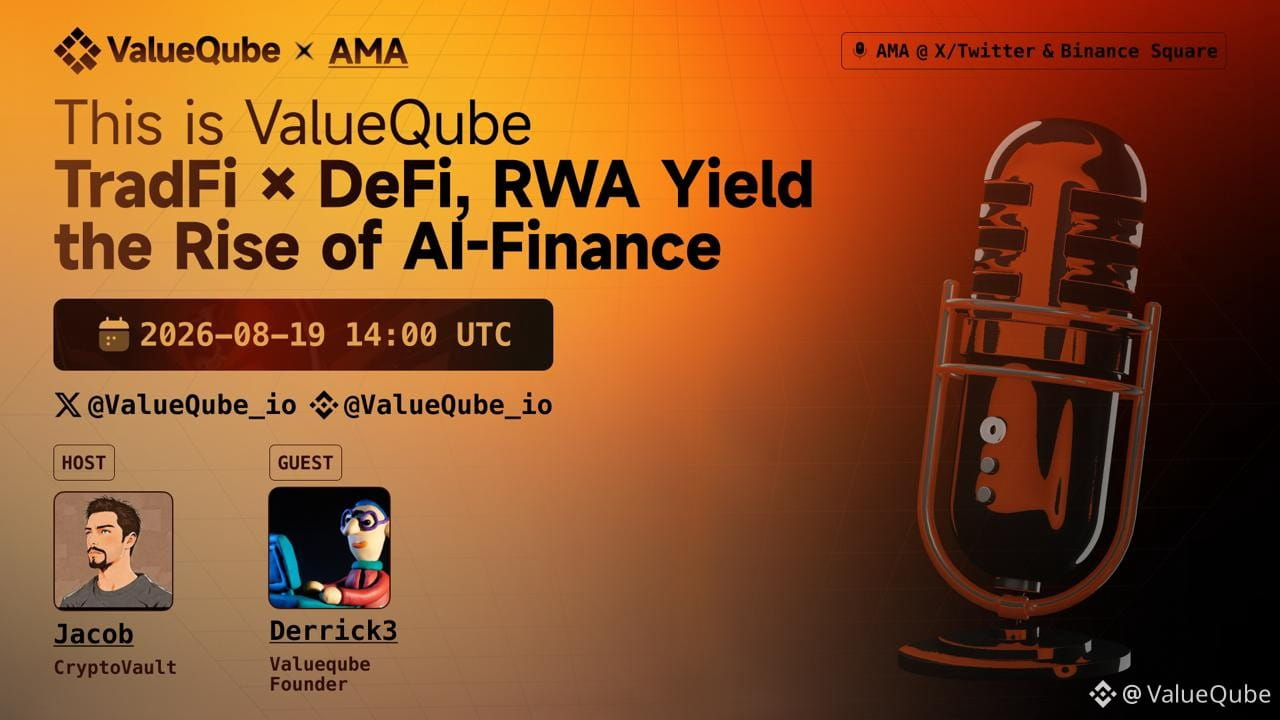
3
93
·
--
翻訳参照
🤝 Partnership Announcement
⠀
ValueQube is partnering with @AstroXFinance, a livestream-powered multichain creator-token platform where creators launch tokens live and users trade in-stream. 🎥
⠀
AstroX brings token creation and market participation into real time. ValueQube makes financial context readable—organizing exposure, evidence, risk, product rules, and position state through transparent, AI-readable qAsset Certificates.
⠀
Together, we will explore how livestream launch activity and multichain market events can be translated into structured account records that users, wallets, protocols, and AI can interpret. 🧊
⠀
As assets become easier to launch and trade, they should also become easier to understand.
⠀
#ValueQube #AstroX #CreatorEconomy #DeFi #Web3
🤝 Partnership Announcement
⠀
ValueQube is partnering with @AstroXFinance, a livestream-powered multichain creator-token platform where creators launch tokens live and users trade in-stream. 🎥
⠀
AstroX brings token creation and market participation into real time. ValueQube makes financial context readable—organizing exposure, evidence, risk, product rules, and position state through transparent, AI-readable qAsset Certificates.
⠀
Together, we will explore how livestream launch activity and multichain market events can be translated into structured account records that users, wallets, protocols, and AI can interpret. 🧊
⠀
As assets become easier to launch and trade, they should also become easier to understand.
⠀
#ValueQube #AstroX #CreatorEconomy #DeFi #Web3
⠀
ValueQube is partnering with @AstroXFinance, a livestream-powered multichain creator-token platform where creators launch tokens live and users trade in-stream. 🎥
⠀
AstroX brings token creation and market participation into real time. ValueQube makes financial context readable—organizing exposure, evidence, risk, product rules, and position state through transparent, AI-readable qAsset Certificates.
⠀
Together, we will explore how livestream launch activity and multichain market events can be translated into structured account records that users, wallets, protocols, and AI can interpret. 🧊
⠀
As assets become easier to launch and trade, they should also become easier to understand.
⠀
#ValueQube #AstroX #CreatorEconomy #DeFi #Web3
3
94
·
--
🎙️ ValueQube Odyssey S01 AMA
TradFiにはプロダクトがあります。DeFiにはウォレットがあります。AIには答えがあります。
それでも、なぜユーザーは金融口座を開いて次のように尋ねるのでしょうか?
「結局、私は“何を”所有しているのですか?」
ValueQubeの創業者Derrickが、qAssetsとAIが読み取れる証明書(Certificates)によって、TradFi、DeFi、ウォレット、AIが共通の“金融言語”を持てるようにする方法—そしてユーザーが主導権を持ち続けること—について議論します。🧊
🗓 2026年8月14日
⏰ 14:00 UTC
AMAのリマインダーを設定👇
🔗 https://twitter.com/i/spaces/1nxnRBReWYkxO
#ValueQube #OdysseyS01 #AMA #RWA #DeFi
🎙️ ValueQube Odyssey S01 AMA
TradFiにはプロダクトがあります。DeFiにはウォレットがあります。AIには答えがあります。
それでも、なぜユーザーは金融口座を開いて次のように尋ねるのでしょうか?
「結局、私は“何を”所有しているのですか?」
ValueQubeの創業者Derrickが、qAssetsとAIが読み取れる証明書(Certificates)によって、TradFi、DeFi、ウォレット、AIが共通の“金融言語”を持てるようにする方法—そしてユーザーが主導権を持ち続けること—について議論します。🧊
🗓 2026年8月14日
⏰ 14:00 UTC
AMAのリマインダーを設定👇
🔗 https://twitter.com/i/spaces/1nxnRBReWYkxO
#ValueQube #OdysseyS01 #AMA #RWA #DeFi
TradFiにはプロダクトがあります。DeFiにはウォレットがあります。AIには答えがあります。
それでも、なぜユーザーは金融口座を開いて次のように尋ねるのでしょうか?
「結局、私は“何を”所有しているのですか?」
ValueQubeの創業者Derrickが、qAssetsとAIが読み取れる証明書(Certificates)によって、TradFi、DeFi、ウォレット、AIが共通の“金融言語”を持てるようにする方法—そしてユーザーが主導権を持ち続けること—について議論します。🧊
🗓 2026年8月14日
⏰ 14:00 UTC
AMAのリマインダーを設定👇
🔗 https://twitter.com/i/spaces/1nxnRBReWYkxO
#ValueQube #OdysseyS01 #AMA #RWA #DeFi
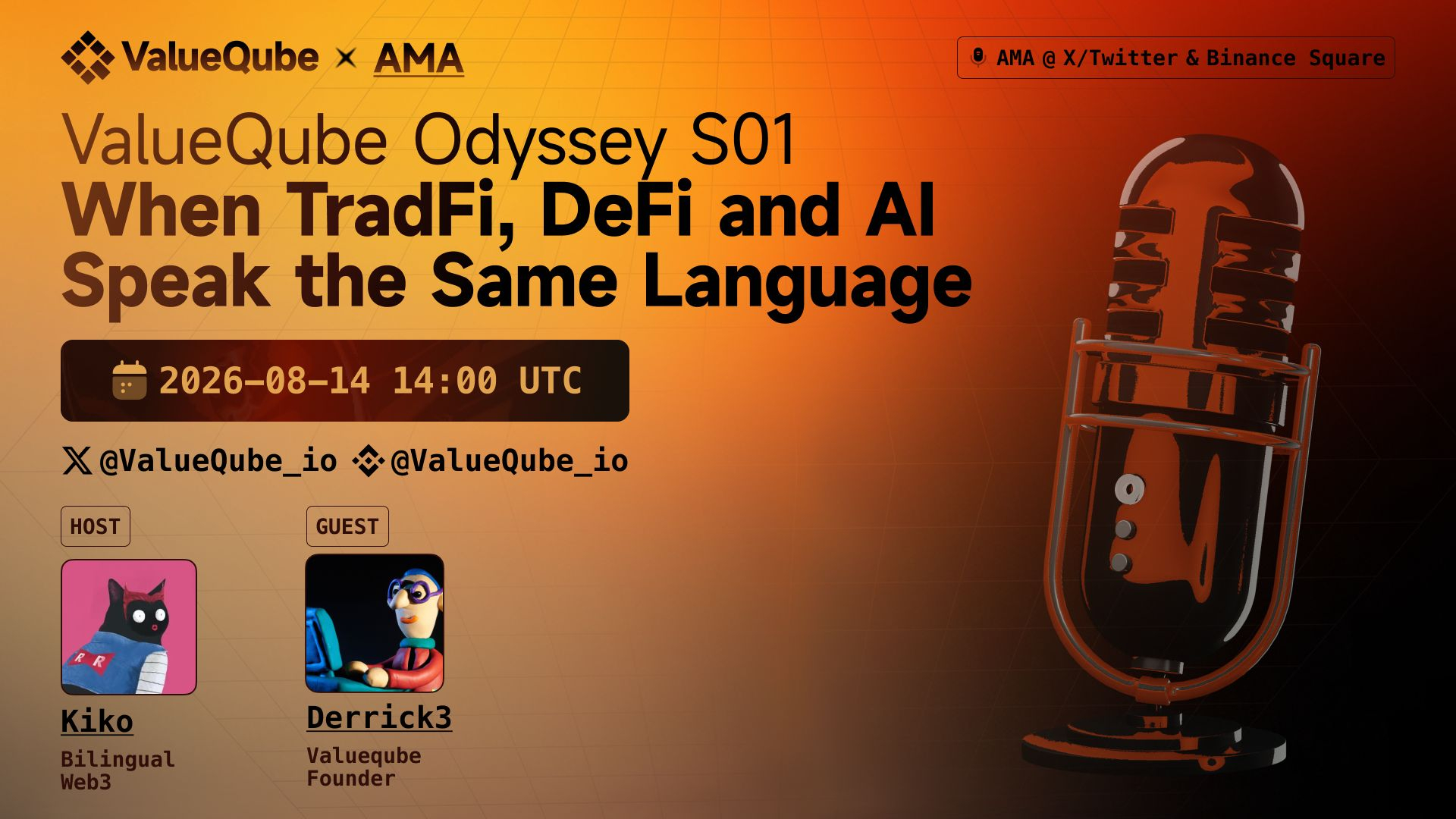
6
84
·
--
本人確認中
翻訳参照
🤝 Partnership Announcement
⠀
ValueQube is partnering with @kuvilabs, the team behind an Agentic Finance OS that turns user intent into programmable, user-approved financial workflows. 🦉
⠀
Kuvi focuses on how strategies are composed, monitored, and executed. ValueQube gives assets and strategies structured financial context through transparent, AI-readable qAsset Certificates.
⠀
This collaboration will explore how programmable execution and machine-readable financial context can work together—so intelligent finance can act on more than signals and understand the value, risk, and rules behind each position. 🧊
⠀
#ValueQube #Kuvi #AgenticFinance #RWA #Web3
🤝 Partnership Announcement
⠀
ValueQube is partnering with @kuvilabs, the team behind an Agentic Finance OS that turns user intent into programmable, user-approved financial workflows. 🦉
⠀
Kuvi focuses on how strategies are composed, monitored, and executed. ValueQube gives assets and strategies structured financial context through transparent, AI-readable qAsset Certificates.
⠀
This collaboration will explore how programmable execution and machine-readable financial context can work together—so intelligent finance can act on more than signals and understand the value, risk, and rules behind each position. 🧊
⠀
#ValueQube #Kuvi #AgenticFinance #RWA #Web3
⠀
ValueQube is partnering with @kuvilabs, the team behind an Agentic Finance OS that turns user intent into programmable, user-approved financial workflows. 🦉
⠀
Kuvi focuses on how strategies are composed, monitored, and executed. ValueQube gives assets and strategies structured financial context through transparent, AI-readable qAsset Certificates.
⠀
This collaboration will explore how programmable execution and machine-readable financial context can work together—so intelligent finance can act on more than signals and understand the value, risk, and rules behind each position. 🧊
⠀
#ValueQube #Kuvi #AgenticFinance #RWA #Web3
1
4
70
·
--
翻訳参照
ValueQube Testnet is now live.
Odyssey S01 has begun.
Enter: https://dapp.valueqube.io
Aug 8, 2026 · 08:08 UTC
ValueQube Testnet is now live.
Odyssey S01 has begun.
Enter: https://dapp.valueqube.io
Aug 8, 2026 · 08:08 UTC
Odyssey S01 has begun.
Enter: https://dapp.valueqube.io
Aug 8, 2026 · 08:08 UTC
5
99
·
--
翻訳参照
🚀 ValueQube Testnet is now LIVE.
On Aug 8, 2026 at 08:08 UTC, Odyssey S01 launches in sync.
Bring your EVM wallet, enter BNB Smart Chain Testnet, complete the Guide + 5-step main route, and claim your first verifiable qAsset record.
This is the first season window only. If you’re in, the route starts now: https://dapp.valueqube.io
#ValueQube #OdysseyS01
🚀 ValueQube Testnet is now LIVE.
On Aug 8, 2026 at 08:08 UTC, Odyssey S01 launches in sync.
Bring your EVM wallet, enter BNB Smart Chain Testnet, complete the Guide + 5-step main route, and claim your first verifiable qAsset record.
This is the first season window only. If you’re in, the route starts now: https://dapp.valueqube.io
#ValueQube #OdysseyS01
On Aug 8, 2026 at 08:08 UTC, Odyssey S01 launches in sync.
Bring your EVM wallet, enter BNB Smart Chain Testnet, complete the Guide + 5-step main route, and claim your first verifiable qAsset record.
This is the first season window only. If you’re in, the route starts now: https://dapp.valueqube.io
#ValueQube #OdysseyS01
5
108
ログインして、さらにコンテンツを読む
厳選トピックで世界の暗号資産トレーダーの仲間入り
⚡️ 暗号資産に関する最新かつ有益な情報が見つかります。
💬 世界最大の暗号資産取引所から信頼されています。
👍 認証を受けたクリエイターから、有益なインサイトを得られます。
メール / 電話番号
トレンドトピック
AIStocksWhatNext
閲覧回数 752,533
5,802人が討論中
注目ハッシュタグキャンペーンでトラフィック報酬を「シェア&ウィン」しよう
✨トピック:AI株が上昇し続ける中、ほかにどんな投資チャンスが残っている?
👉参加方法:
ハッシュタグ #AIStocksWhatNext を付けて短い投稿または記事を公開する
強気か弱気かを共有し、AI株の保有または取引を投稿してください—取引ウィジェットを使うと資格を得やすくなる可能性があります。
データやチャートを共有し、AI生成画像を避けることで、投稿をさらに強化できます。
✍️以下の切り口を参考にコンテンツを作成してください:
- Nvidiaは来年のチップ販売が倍増すると述べ、主要なAI企業は記録的な売上を更新し続けています。これを支える計算コストはそれだけでも驚異的です。本当にAI需要は伸びているのか? そして、それはどれくらい続くのでしょうか?AI株は全体的に上昇中。これは本物のブレイクアウトなのか、それとも短期的な戻りなのか?
- 産業のリーダーたちはAI開発のペースを落とすよう求めています。一方でトランプは「AIフォース」を構築する計画で、AIが将来的に米国のGDPの25%を占める可能性があると主張しています。あなたはどちら側ですか? AI株に対する州レベルの後押しは長期的な勝利になりますか?
- あなたはAI株を買っていますか? 取引/保有を、取引シェアリングウィジェットで共有してください。
⏰キャンペーン期間:
- 2026-09-22 7:00 - 2026-09-24 4:00(UTC)
🎁報酬:
- 上記のガイドラインを満たし、100語を超える適格投稿は審査され、ランダムなトラフィックブースト(500〜3,000ビュー)が付与される場合があります。投稿が選ばれた場合は、フィード担当者から通知が届きます。
- Binance Square Officialに記事が掲載されるチャンス
投稿のアイデアが必要ですか? トピックページ #AIStocksWhatNext または Square Guide on How to Post for Better Reach をご覧ください。
Binance Square Official
·いいね:552件
·閲覧回数 1.5M
BitcoinRejectedAt$87,300Twice
閲覧回数 0
0人が討論中
BCHJumps28%OnCMEFuturesListing
閲覧回数 501
138人が討論中