
D_Phone
569 投稿

D_Phone
取引を発注

QUIDホルダー
超高頻度トレーダー
4.3年
479 フォロー
167 フォロワー
534 いいね
投稿
ポートフォリオ
すべて
引用
翻訳参照
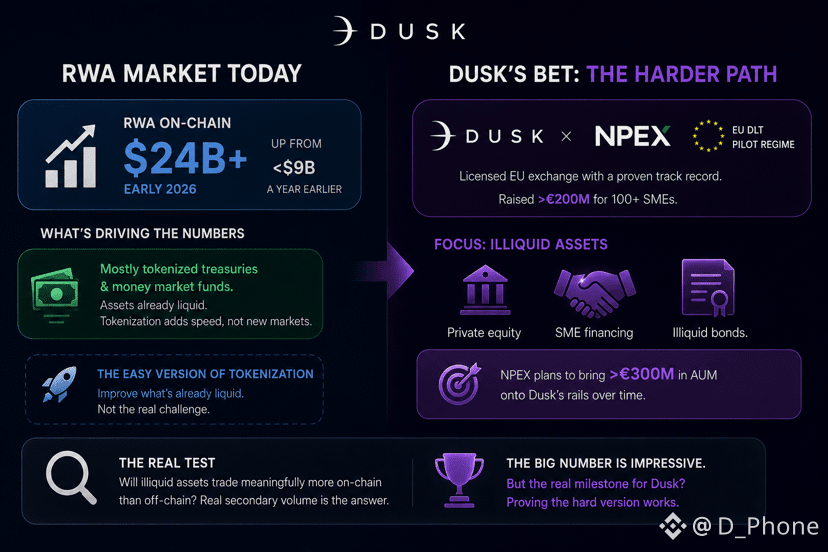
I keep coming back to one number when people tell me tokenization has already arrived: real-world asset value on-chain crossed roughly $24 billion by early 2026, up from under $9 billion a year earlier. That sounds like proof. Then I look at what's actually inside that figure, and most of it sits in tokenized treasuries and money market funds, assets that were already liquid and tradeable before anyone put them on a blockchain. Tokenizing a treasury bill mostly adds speed. It doesn't create a market that wasn't there.
Dusk is chasing a harder version of this problem. Through its partnership with NPEX, a Dutch exchange that has raised over €200 million for more than 100 small and medium businesses, Dusk wants to bring private equity, SME financing and similar illiquid instruments on-chain, not just wrap an existing treasury product in a smart contract. That's the use case tokenization was originally sold on, and it's also the use case the current RWA boom has barely touched. Illiquid assets carry a harder problem: even off-chain there's often no ready buyer at a fair price, and a blockchain doesn't manufacture one out of nothing.
I'm not writing this off. NPEX already holds a genuine EU regulatory license under the DLT Pilot Regime, which is more than most projects claiming RWA exposure can say. But a license and a track record are different things. Dusk hasn't yet shown that a private SME share or an illiquid bond trades meaningfully more on its rails than it would through NPEX's existing channels off-chain. Until real secondary volume shows up in those harder categories, the big RWA number doesn't tell me much about whether Dusk's specific bet works. It tells me the easy version of tokenization is working. The hard version, the one Dusk actually needs, is still unproven. NPEX itself has already pointed to plans for bringing more than €300 million in assets under management onto Dusk's rails over time, a specific figure worth tracking far more closely than the sector-wide number above.
@Dusk $DUSK #dusk
Dusk is chasing a harder version of this problem. Through its partnership with NPEX, a Dutch exchange that has raised over €200 million for more than 100 small and medium businesses, Dusk wants to bring private equity, SME financing and similar illiquid instruments on-chain, not just wrap an existing treasury product in a smart contract. That's the use case tokenization was originally sold on, and it's also the use case the current RWA boom has barely touched. Illiquid assets carry a harder problem: even off-chain there's often no ready buyer at a fair price, and a blockchain doesn't manufacture one out of nothing.
I'm not writing this off. NPEX already holds a genuine EU regulatory license under the DLT Pilot Regime, which is more than most projects claiming RWA exposure can say. But a license and a track record are different things. Dusk hasn't yet shown that a private SME share or an illiquid bond trades meaningfully more on its rails than it would through NPEX's existing channels off-chain. Until real secondary volume shows up in those harder categories, the big RWA number doesn't tell me much about whether Dusk's specific bet works. It tells me the easy version of tokenization is working. The hard version, the one Dusk actually needs, is still unproven. NPEX itself has already pointed to plans for bringing more than €300 million in assets under management onto Dusk's rails over time, a specific figure worth tracking far more closely than the sector-wide number above.
@Dusk $DUSK #dusk
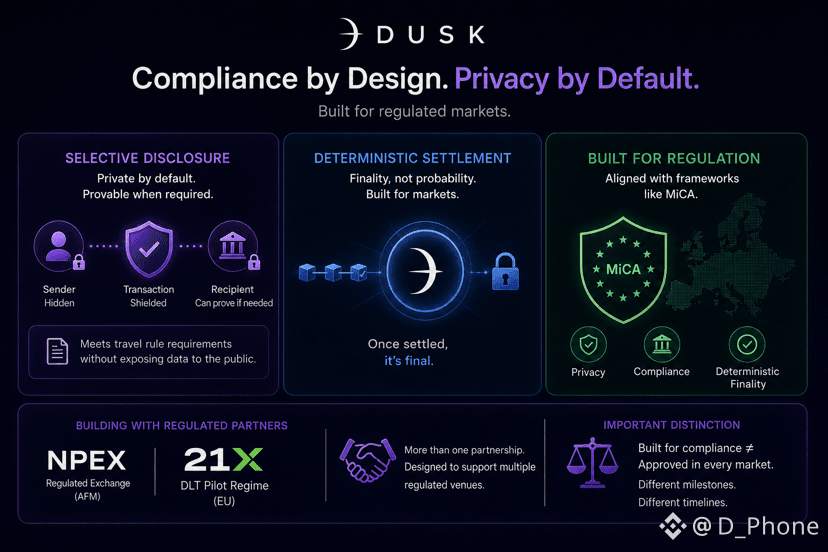
暗号における規制は、設計上の「回避すべき障害」として扱われがちです。Dusk Networkはそれを「到達すべき仕様」と捉えています。これは、まったく異なる出発点です。
選択的開示(selective disclosure)が、単なるメッセージではなく実際にそれを可能にする仕組みです。Duskのシールド付き送金は、デフォルトで送信者と金額を公開の場から隠しますが、必要になれば、受取人は暗号学的に「誰がいつ支払ったか」を証明できます。これにより、EUのトラベル規制のようなルールを満たしつつ、チェーンを見ている他のすべての人に取引を公開することはありません。さらに決定論的な決済(deterministic settlement)と、ゆっくりと改善していく確率ではなく「最終的で確実な完了」に到達するトランザクションを加えることで、MiCAのような枠組みの下で運用される市場向けに、特別に設計された何かに近づいていきます。単に、後からコンプライアンスがうまくいくことを期待する汎用チェーンとは違います。
この順序の意味は、思われる以上に大きいです。透明性がデフォルトのチェーンに対して、あるいは完全にプライベートなチェーンに対して、後からコンプライアンスを“取り付ける”ことは、ぎこちない妥協を生みがちです。最初から基盤プロトコルに選択的開示を設計して組み込むのは、前提としてより難しいエンジニアリング問題ですが、その代わり、後々の痛みのある妥協は減らせます。
また、NPEXだけがこの絵における規制対象の取引環境というわけではありません。Duskは、EUのDLTパイロット規制の下で運用されているデジタルアセット取引所21Xとも連携しています。これは、この「コンプライアンス重視」の設計が単一の提携事例の話ではなく、複数の規制対象の取引環境、そして最終的にはMiCAだけに限らない複数の枠組みをまたいで、アーキテクチャが支えることを想定したものだという示唆です。
ただし、これらが規制当局の承認を自動的かつ普遍的に意味するわけではありません。MiCAはEUを対象としています。その他の法域には、それぞれ独自の枠組み、独自の規制当局、独自のタイムラインがありますし、Dusk側のアーキテクチャの準備がそれらをショートカットすることはありません。コンプライアンスを想定して作られていることと、重要なすべての市場でそれが正式にクリアされることは、別々のマイルストーンであり、それぞれ別々のスケジュールで進みます。
@Dusk #dusk $DUSK $BTW $TRUMP
選択的開示(selective disclosure)が、単なるメッセージではなく実際にそれを可能にする仕組みです。Duskのシールド付き送金は、デフォルトで送信者と金額を公開の場から隠しますが、必要になれば、受取人は暗号学的に「誰がいつ支払ったか」を証明できます。これにより、EUのトラベル規制のようなルールを満たしつつ、チェーンを見ている他のすべての人に取引を公開することはありません。さらに決定論的な決済(deterministic settlement)と、ゆっくりと改善していく確率ではなく「最終的で確実な完了」に到達するトランザクションを加えることで、MiCAのような枠組みの下で運用される市場向けに、特別に設計された何かに近づいていきます。単に、後からコンプライアンスがうまくいくことを期待する汎用チェーンとは違います。
この順序の意味は、思われる以上に大きいです。透明性がデフォルトのチェーンに対して、あるいは完全にプライベートなチェーンに対して、後からコンプライアンスを“取り付ける”ことは、ぎこちない妥協を生みがちです。最初から基盤プロトコルに選択的開示を設計して組み込むのは、前提としてより難しいエンジニアリング問題ですが、その代わり、後々の痛みのある妥協は減らせます。
また、NPEXだけがこの絵における規制対象の取引環境というわけではありません。Duskは、EUのDLTパイロット規制の下で運用されているデジタルアセット取引所21Xとも連携しています。これは、この「コンプライアンス重視」の設計が単一の提携事例の話ではなく、複数の規制対象の取引環境、そして最終的にはMiCAだけに限らない複数の枠組みをまたいで、アーキテクチャが支えることを想定したものだという示唆です。
ただし、これらが規制当局の承認を自動的かつ普遍的に意味するわけではありません。MiCAはEUを対象としています。その他の法域には、それぞれ独自の枠組み、独自の規制当局、独自のタイムラインがありますし、Dusk側のアーキテクチャの準備がそれらをショートカットすることはありません。コンプライアンスを想定して作られていることと、重要なすべての市場でそれが正式にクリアされることは、別々のマイルストーンであり、それぞれ別々のスケジュールで進みます。
@Dusk #dusk $DUSK $BTW $TRUMP
昨年、私が開発者と交わした会話のことをずっと考えています。彼は、秘密の残高を扱う貸付プロトコルを作りたいと言っていました。選択肢は2つあって、どちらも腑に落ちないものでした。プライバシーチェーンを選び、全スタックを最初から書き直すか、それとも慣れ親しんだEVMの開発ツールを使い続ける代わりに、機密性を完全に諦めるか。——そのトレードオフが、長年この業界で何が作られてきたかを静かに形作ってきたのです。
Dusk Networkは、そのギャップを埋めようとしています。DuskEVMなら、チームは既に知っているツールを使って標準的なSolidityコントラクトをデプロイできます。初日から学ぶべきことが、あまりにも奇抜なものにはなりません。変わるのは、その下にある基盤です。DuskEVMはDuskDS(決定的ファイナリティのために作られたDuskのベースレイヤ)に決済を戻し、さらにHedger(EVMアプリ向けの専用プライバシーモジュール)を通じて機密なトランザクションフローへの道を開きます。
Hedgerはゼロ知識証明だけに依存しません。ホモモルフィック暗号化と組み合わせることで、値を暗号化したままでも計算を行え、決して値そのものは公開されません。それでもトランザクションは正しいことを証明します。この組み合わせは珍しいです。多くのプライバシーツールは、この領域でどれか一つのプリミティブを選び、その限界と共に生きているのが実情です。
さらに実用面のレイヤもあります。DuskEVM上でのガス支払いはDUSK自体で行われます。また最近、Dusk Connectという新しいSDKがリリースされ、こうした基盤の上に構築するチームがウォレット連携で悩む時間を減らすことに特化しています。細かいことに見えるかもしれませんが、最初のデモの後に実際に開発者が定着するかどうかを左右するのは、こうした“地味な配管”の部分です。
ただし、まだ完成はしていません。そして、誇大な宣伝よりも正直さのほうが大切だと思います。DuskEVMもHedgerも現在はテストネット上で動いており、メインネットではありません。メインネットはまだこれからです。ツールの熟成度や本格的な監査は、実際に出て使われるまで、まだ答えの出ない問いのままです。
それでも、方向性は明確です。開発者が、自分が使い慣れたツールと、ユーザーが必要とするプライバシーのどちらかを選ばなければならない状況は、あってはなりません。Duskは、その選択肢をなくすことが、インフラ開発6年分の価値がある賭けだと考えています。
@Dusk #dusk $BTW $DUSK $ONG
Dusk Networkは、そのギャップを埋めようとしています。DuskEVMなら、チームは既に知っているツールを使って標準的なSolidityコントラクトをデプロイできます。初日から学ぶべきことが、あまりにも奇抜なものにはなりません。変わるのは、その下にある基盤です。DuskEVMはDuskDS(決定的ファイナリティのために作られたDuskのベースレイヤ)に決済を戻し、さらにHedger(EVMアプリ向けの専用プライバシーモジュール)を通じて機密なトランザクションフローへの道を開きます。
Hedgerはゼロ知識証明だけに依存しません。ホモモルフィック暗号化と組み合わせることで、値を暗号化したままでも計算を行え、決して値そのものは公開されません。それでもトランザクションは正しいことを証明します。この組み合わせは珍しいです。多くのプライバシーツールは、この領域でどれか一つのプリミティブを選び、その限界と共に生きているのが実情です。
さらに実用面のレイヤもあります。DuskEVM上でのガス支払いはDUSK自体で行われます。また最近、Dusk Connectという新しいSDKがリリースされ、こうした基盤の上に構築するチームがウォレット連携で悩む時間を減らすことに特化しています。細かいことに見えるかもしれませんが、最初のデモの後に実際に開発者が定着するかどうかを左右するのは、こうした“地味な配管”の部分です。
ただし、まだ完成はしていません。そして、誇大な宣伝よりも正直さのほうが大切だと思います。DuskEVMもHedgerも現在はテストネット上で動いており、メインネットではありません。メインネットはまだこれからです。ツールの熟成度や本格的な監査は、実際に出て使われるまで、まだ答えの出ない問いのままです。
それでも、方向性は明確です。開発者が、自分が使い慣れたツールと、ユーザーが必要とするプライバシーのどちらかを選ばなければならない状況は、あってはなりません。Duskは、その選択肢をなくすことが、インフラ開発6年分の価値がある賭けだと考えています。
@Dusk #dusk $BTW $DUSK $ONG
翻訳参照
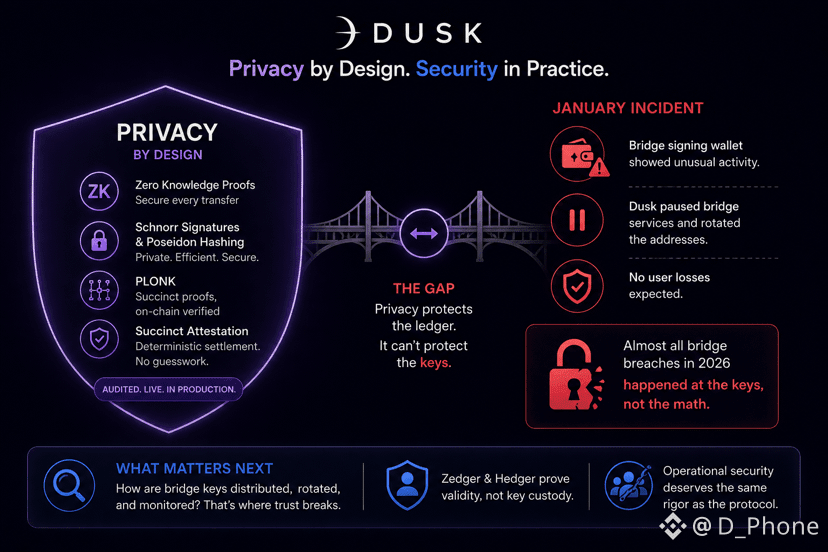
Dusk Network sells itself on a simple premise. Privacy should live inside the protocol, not get bolted on afterward. Zero knowledge proofs secure every Phoenix transfer. Schnorr signatures and Poseidon hashing sit under the hood, and PLONK makes the proofs succinct enough to verify on chain. All of that is real, it is audited, and it runs in production today under Succinct Attestation, a consensus design built specifically for deterministic settlement rather than probabilistic guesswork. Then January happened.
A team managed wallet used for bridge operations started showing unusual activity. Dusk paused bridge services, disabled and recycled the affected addresses, and stated publicly that it did not expect user losses to materialize. I take that account seriously. But the incident exposes something the privacy pitch tends to skip over. The cryptography protecting a shielded note has nothing to do with the operational security of a signing wallet moving assets on the outside edge of that same system.
This is not unique to Dusk. Bridges across the industry bled hundreds of millions of dollars in 2026 alone, almost always through compromised keys rather than broken math. So what do I actually want from Dusk Network next? Not another paper explaining PLONK circuits. A public account of how bridge signing authority gets distributed, rotated, and monitored, because that is where trust breaks in practice, not the zero knowledge layer.
Zedger and Hedger can prove a transaction is valid without revealing its contents to the public. Neither can prove a signing wallet was operated correctly. Selective disclosure protects the ledger. It says very little about the people holding keys around it, and that particular gap deserves as much attention as the circuits do.
If the base protocol can be this rigorous about what it proves, the wallets and addresses just outside that boundary deserve the same standard. Dusk Network answered the incident quickly. Whether that discipline holds permanently, not just after a scare
@Dusk #dusk $DUSK $BTW $ACE
A team managed wallet used for bridge operations started showing unusual activity. Dusk paused bridge services, disabled and recycled the affected addresses, and stated publicly that it did not expect user losses to materialize. I take that account seriously. But the incident exposes something the privacy pitch tends to skip over. The cryptography protecting a shielded note has nothing to do with the operational security of a signing wallet moving assets on the outside edge of that same system.
This is not unique to Dusk. Bridges across the industry bled hundreds of millions of dollars in 2026 alone, almost always through compromised keys rather than broken math. So what do I actually want from Dusk Network next? Not another paper explaining PLONK circuits. A public account of how bridge signing authority gets distributed, rotated, and monitored, because that is where trust breaks in practice, not the zero knowledge layer.
Zedger and Hedger can prove a transaction is valid without revealing its contents to the public. Neither can prove a signing wallet was operated correctly. Selective disclosure protects the ledger. It says very little about the people holding keys around it, and that particular gap deserves as much attention as the circuits do.
If the base protocol can be this rigorous about what it proves, the wallets and addresses just outside that boundary deserve the same standard. Dusk Network answered the incident quickly. Whether that discipline holds permanently, not just after a scare
@Dusk #dusk $DUSK $BTW $ACE
翻訳参照
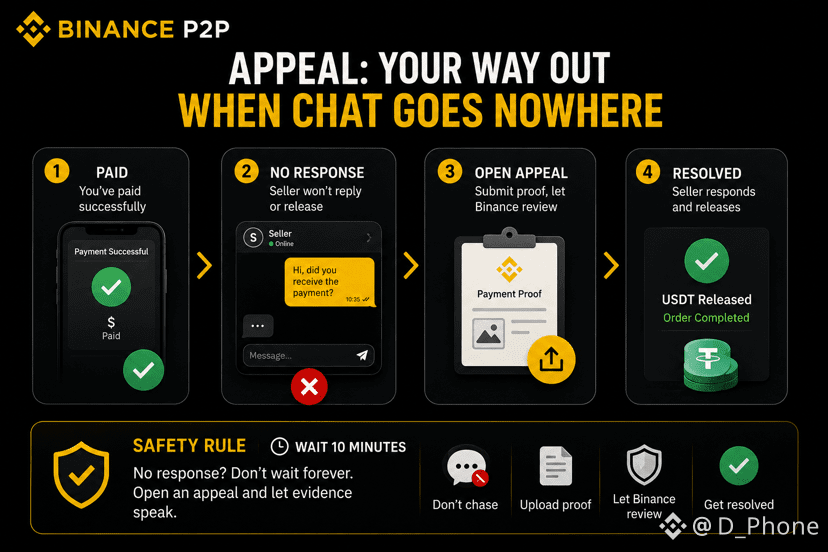
Mình vẫn nhớ lần đầu mua USDT qua P2P, khi đó mình đã thanh toán đủ tiền và đúng payment details trên order. Nhưng đợi khá lâu seller vẫn không release crypto.
Mình nhắn trong P2P Chat để hỏi họ đã nhận được tiền chưa nhưng không có phản hồi.
Mình đợi thêm khoảng 5 phút. Order vẫn không thay đổi, seller cũng không trả lời nên mình quyết định mở Appeal và gửi đầy đủ payment proof cho Binance Support review.
Vừa mở Appeal xong thì seller nhắn lại rằng họ đã nhận đủ tiền và sau đó release USDT cho mình.
Mình không biết vì sao vừa Appeal xong thì seller phản hồi lại. Nhưng case này làm mình nhìn Appeal khác hẳn đi.
Trước đây mình thường nghĩ Appeal chủ yếu dành cho lúc buyer và seller có dispute, tức là hai bên đang không đồng ý với nhau về một vấn đề nào đó.
Nhưng lần này chẳng có gì để tranh luận cả. Mình đã gửi tiền, có payment proof, còn seller thì đơn giản là không trả lời.
Và đó cũng là lúc P2P Chat bắt đầu hết tác dụng. Mình có thể gửi thêm một tin nhắn nữa, rồi thêm một tin nữa, nhưng nếu phía bên kia vẫn im lặng thì order cũng không tiến thêm được bước nào.
Appeal lúc này không chỉ là cách giải quyết dispute. Nó còn là một đường thoát khỏi một cuộc chat không đi đến đâu.
Thay vì tiếp tục chase seller, mình đưa payment proof vào đúng process để Binance Support có thể review. Nếu seller quay lại và tự giải quyết như case này thì tốt.
Nên safety rule của mình như sau: nếu đã thanh toán đúng, seller không release và P2P Chat không còn tạo ra phản hồi nào, mình sẽ không chờ vô thời hạn. Sau khoảng 10 phút, mình sẽ chuyển sang Appeal và để evidence nói thay cho những tin nhắn tiếp theo.
@Binance Vietnam #BinanceP2PAnToan $BTW $ACE $BOME
Mình nhắn trong P2P Chat để hỏi họ đã nhận được tiền chưa nhưng không có phản hồi.
Mình đợi thêm khoảng 5 phút. Order vẫn không thay đổi, seller cũng không trả lời nên mình quyết định mở Appeal và gửi đầy đủ payment proof cho Binance Support review.
Vừa mở Appeal xong thì seller nhắn lại rằng họ đã nhận đủ tiền và sau đó release USDT cho mình.
Mình không biết vì sao vừa Appeal xong thì seller phản hồi lại. Nhưng case này làm mình nhìn Appeal khác hẳn đi.
Trước đây mình thường nghĩ Appeal chủ yếu dành cho lúc buyer và seller có dispute, tức là hai bên đang không đồng ý với nhau về một vấn đề nào đó.
Nhưng lần này chẳng có gì để tranh luận cả. Mình đã gửi tiền, có payment proof, còn seller thì đơn giản là không trả lời.
Và đó cũng là lúc P2P Chat bắt đầu hết tác dụng. Mình có thể gửi thêm một tin nhắn nữa, rồi thêm một tin nữa, nhưng nếu phía bên kia vẫn im lặng thì order cũng không tiến thêm được bước nào.
Appeal lúc này không chỉ là cách giải quyết dispute. Nó còn là một đường thoát khỏi một cuộc chat không đi đến đâu.
Thay vì tiếp tục chase seller, mình đưa payment proof vào đúng process để Binance Support có thể review. Nếu seller quay lại và tự giải quyết như case này thì tốt.
Nên safety rule của mình như sau: nếu đã thanh toán đúng, seller không release và P2P Chat không còn tạo ra phản hồi nào, mình sẽ không chờ vô thời hạn. Sau khoảng 10 phút, mình sẽ chuyển sang Appeal và để evidence nói thay cho những tin nhắn tiếp theo.
@Binance Vietnam #BinanceP2PAnToan $BTW $ACE $BOME
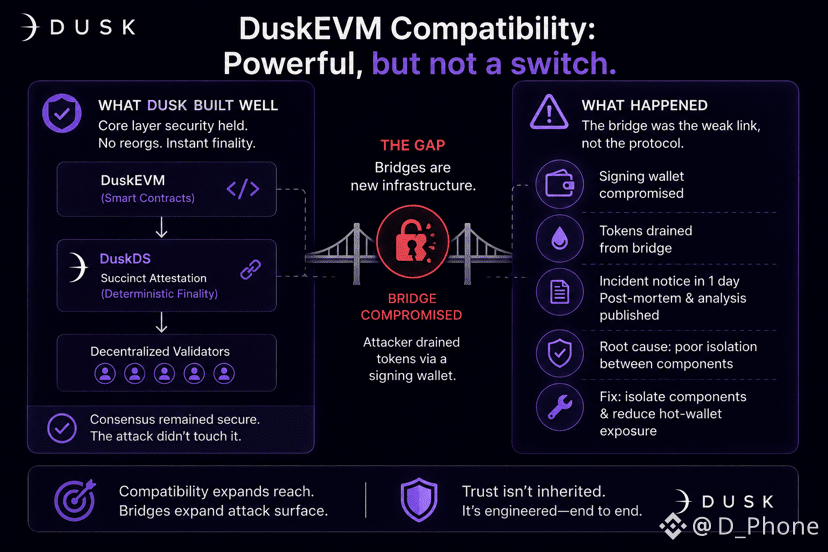
私はDuskEVMが、誰かがスイッチを切り替えるようにこう説明され続けているのを見かけます――Solidityを書いて、デプロイして、完了。すでに構築済みのあらゆるEthereumと即座に互換。そうした言い方は安心させてくれます。ですが、それは不完全です。Dusk Networkは、どこでその前提が崩れるのかを、まさに示す証拠を私たちに与えてくれました。
中核レイヤーのDuskDSは、Succinct Attestationを動かしています。これは、ブロックがリオーグしないようにし、決済が「十分な確認」が得られるまで安全だと感じるのを待ち続けることのないように作られたコンセンサス設計です。その部分は2026年1月には問題なく機能していました。DuskとEVMネットワークをつなぐブリッジから攻撃者がトークンを引き出した際も、攻撃はコンセンサスには決して触れていません。狙われたのは署名ウォレットで、ネイティブチェーンとEVM側の間にある補助的なインフラの一部でした。Duskが何年もかけて築いた「決定的ファイナリティ」ではありません。
だからこそ、正直に名づける価値があります。EVM互換性の売り文句は、開発者体験――馴染みのあるツール、既存の流動性、書き換えるコードが少ないこと――にあります。見過ごされがちなのは、どのブリッジも新しいインフラであり、それぞれ独自の鍵管理と独自の障害モードを持ち、ベースレイヤーが一生懸命に勝ち取ってきた保証の外側に置かれている、という点です。Duskは攻撃から1日以内にブリッジのインシデント通知を公開し、その後2か月ほどして、より詳しい事後分析と別のセキュリティ分析も出しました。そこで挙げられた根本原因は、Succinct Attestationそのものの欠陥ではなく、コンポーネント間の適切な隔離が欠けた軽量なブリッジ設計だったことです。対処はプロトコルのパッチではありませんでした。コンポーネントを分離し、ホットウォレットへの露出を減らして、1つの鍵が侵害されても二度とブリッジをドレインできないようにしたのです。
これらは、DuskEVMを悪いアイデアだとは言いません。Hedgerを通じて通常のSolidityコントラクトにプログラマブルなプライバシーをもたらすことは、周辺インフラが信頼に値するなら、確かに有用です。私は、それを「デメリットのない無料アップグレード」として扱うのではなく、到達範囲を広げると同時に攻撃面も広げてしまうという判断を、正直に評価したいと思います
@Dusk $DUSK #dusk $BTW $PORTAL
中核レイヤーのDuskDSは、Succinct Attestationを動かしています。これは、ブロックがリオーグしないようにし、決済が「十分な確認」が得られるまで安全だと感じるのを待ち続けることのないように作られたコンセンサス設計です。その部分は2026年1月には問題なく機能していました。DuskとEVMネットワークをつなぐブリッジから攻撃者がトークンを引き出した際も、攻撃はコンセンサスには決して触れていません。狙われたのは署名ウォレットで、ネイティブチェーンとEVM側の間にある補助的なインフラの一部でした。Duskが何年もかけて築いた「決定的ファイナリティ」ではありません。
だからこそ、正直に名づける価値があります。EVM互換性の売り文句は、開発者体験――馴染みのあるツール、既存の流動性、書き換えるコードが少ないこと――にあります。見過ごされがちなのは、どのブリッジも新しいインフラであり、それぞれ独自の鍵管理と独自の障害モードを持ち、ベースレイヤーが一生懸命に勝ち取ってきた保証の外側に置かれている、という点です。Duskは攻撃から1日以内にブリッジのインシデント通知を公開し、その後2か月ほどして、より詳しい事後分析と別のセキュリティ分析も出しました。そこで挙げられた根本原因は、Succinct Attestationそのものの欠陥ではなく、コンポーネント間の適切な隔離が欠けた軽量なブリッジ設計だったことです。対処はプロトコルのパッチではありませんでした。コンポーネントを分離し、ホットウォレットへの露出を減らして、1つの鍵が侵害されても二度とブリッジをドレインできないようにしたのです。
これらは、DuskEVMを悪いアイデアだとは言いません。Hedgerを通じて通常のSolidityコントラクトにプログラマブルなプライバシーをもたらすことは、周辺インフラが信頼に値するなら、確かに有用です。私は、それを「デメリットのない無料アップグレード」として扱うのではなく、到達範囲を広げると同時に攻撃面も広げてしまうという判断を、正直に評価したいと思います
@Dusk $DUSK #dusk $BTW $PORTAL
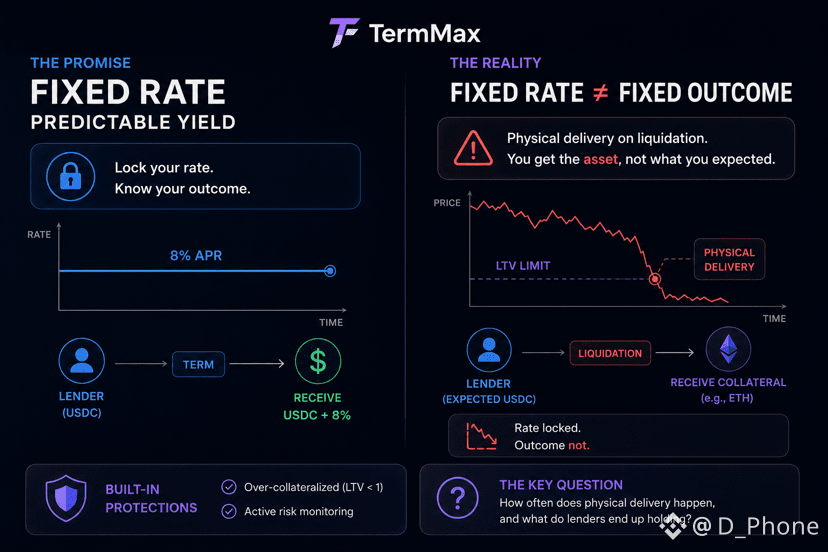
「固定金利」は約束のように聞こえます。数字を固定して、あとは離れればいい。期間が終わったときに、いくらを支払う/得るのかが正確に分かる――それがTermMaxの売りです。そしてクーポンそのものに関しては、実際その通りです。固定した利率は満期時にもそのまま適用されます。ですが、ローンはクーポンだけでできているわけではありません。私はそこに立ち戻り続けています。すなわち、TermMaxが約束することと、悪い日には実際に起こることとの間に、本当に埋まっていないギャップがあるのです。
TermMaxは、薄い流動性と急なボラティリティに対して、現物デリバリーで対処します。多くの貸出プロトコルが行う割引オークションによる清算ではなく、ポジションが崩れたときに担保がそのまま貸し手へ引き渡されるのです。紙の上では保護に見えます。しかし実際には、貸し手が求めていない資産を、貸し手自身が選んでいないタイミングで渡すことになります。その価値は、その時点で市場がいくらと言うか次第です。たとえば、利回り8%のUSDCを受け取りたい貸し手が、値下がりする市場でETHを持つことになります。利率は固定でした。ですが結果は固定されていません。
現物デリバリーは、トリガーが極端に細かいわけでもありません。TermMaxは各市場に最大のローン・トゥ・バリュー(LTV)比率を、1を十分下回る水準で設定し、ポジションがその境界に触れるまでには実際に動ける余地があります。このバッファは、通常の下落局面で役に立ちます。価格がバッファを飛び越えてそのまま境界を突破し、誰も(人であれ自動であれ)間に合うように反応できないような「本物のギャップ事象」については、むしろ語ることが少なくなります。
私は、これがTermMaxを無謀にしているとは思いません。過剰担保の要件や、積極的なリスク監視が存在するのは、TermMaxの誰かが、私が気づくより前に、この緊張関係をすでに理解していたからでしょう。とはいえ「固定金利」という言葉は、担保が加わり、単なる利回りだけでなく「何を渡される/受け取るのか」までが絡んでくると、仕組みが提供できる以上の確実性を示唆します。実際の規模を預ける前に答えてほしい疑問はこうです。現物デリバリーが本当に発動したのはどれくらいの頻度か。そして、そのとき貸し手は何を持って立ち去ったのか。クーポンレベルでの予測可能性と、ポートフォリオレベルでの予測可能性は同じ主張ではありません。TermMax自身の設計が、両者が食い違う瞬間のためのフォールバックを静かに組み込んでいることは、その点を認めているように見えます。
@TermMax #TermMax $BTW $PORTAL $HEMI
TermMaxは、薄い流動性と急なボラティリティに対して、現物デリバリーで対処します。多くの貸出プロトコルが行う割引オークションによる清算ではなく、ポジションが崩れたときに担保がそのまま貸し手へ引き渡されるのです。紙の上では保護に見えます。しかし実際には、貸し手が求めていない資産を、貸し手自身が選んでいないタイミングで渡すことになります。その価値は、その時点で市場がいくらと言うか次第です。たとえば、利回り8%のUSDCを受け取りたい貸し手が、値下がりする市場でETHを持つことになります。利率は固定でした。ですが結果は固定されていません。
現物デリバリーは、トリガーが極端に細かいわけでもありません。TermMaxは各市場に最大のローン・トゥ・バリュー(LTV)比率を、1を十分下回る水準で設定し、ポジションがその境界に触れるまでには実際に動ける余地があります。このバッファは、通常の下落局面で役に立ちます。価格がバッファを飛び越えてそのまま境界を突破し、誰も(人であれ自動であれ)間に合うように反応できないような「本物のギャップ事象」については、むしろ語ることが少なくなります。
私は、これがTermMaxを無謀にしているとは思いません。過剰担保の要件や、積極的なリスク監視が存在するのは、TermMaxの誰かが、私が気づくより前に、この緊張関係をすでに理解していたからでしょう。とはいえ「固定金利」という言葉は、担保が加わり、単なる利回りだけでなく「何を渡される/受け取るのか」までが絡んでくると、仕組みが提供できる以上の確実性を示唆します。実際の規模を預ける前に答えてほしい疑問はこうです。現物デリバリーが本当に発動したのはどれくらいの頻度か。そして、そのとき貸し手は何を持って立ち去ったのか。クーポンレベルでの予測可能性と、ポートフォリオレベルでの予測可能性は同じ主張ではありません。TermMax自身の設計が、両者が食い違う瞬間のためのフォールバックを静かに組み込んでいることは、その点を認めているように見えます。
@TermMax #TermMax $BTW $PORTAL $HEMI
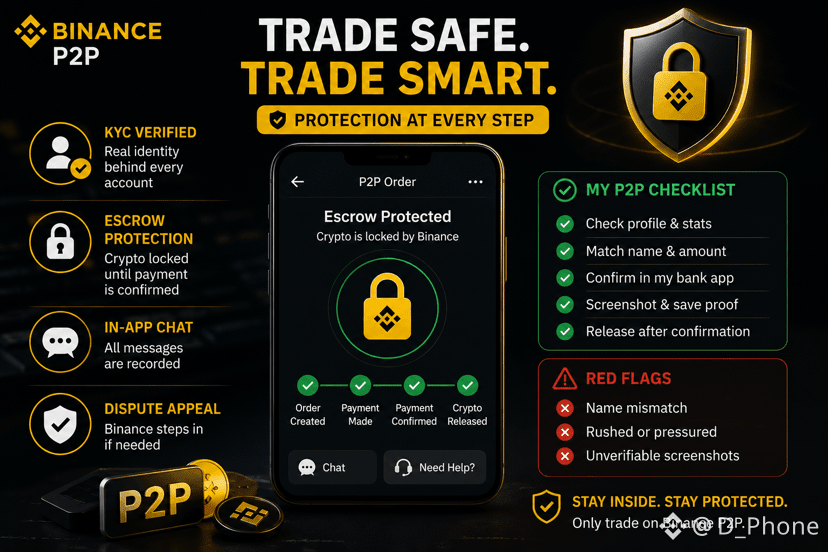
バイナンスP2Pは、バイナンス独自のピアツーピア(個人間)マーケットプレイスで、他の本人確認済みユーザーと直接暗号資産の売買ができます。また、その保護システムは多層構造で機能しています。取引を行うすべてのユーザーは注文を出す前にKYCを完了するため、各アカウントの背後には匿名のユーザー名ではなく実在の本人が存在します。注文が開くと、売り手の暗号資産はエスクロー(第三者預託)に移され、双方が取引を確認するまでそこに保持されます。つまり、取引の途中で資金が勝手に消えるようなことは起こりません。アプリ内チャットにはすべてのメッセージが記録され、不一致が生じた場合は、どちらの側も異議申し立て(ディスピュート)の手続きを行い、バイナンスが介入して証拠を確認できます。
バイナンスP2Pでの最初の注文は、送金先が面識のない相手だったので特に強く印象に残っています。支払いをする前に、まず購入者(販売者)のプロフィールを開き、次の3点を確認しました。完了率、注文の総数、そしてアカウントが存在してからどれくらい経っているかです。完了率99%で、その背後に何千件もの取引があるプロフィールは、チャットに送られてくるどんな親切そうなメッセージよりもはるかに多くの情報をくれました。その後、別のかなり新しいアカウントが同じ確認を飛ばしてすぐ支払ってほしいと求めてきたときは、私の前にある警告サインを無視するのではなく、注文をキャンセルしました。
今私を最も守ってくれる習慣は、支払いが実際に確認されるまで暗号資産をリリースしないことです。誰かが送ってきたスクリーンショットではなく、自分自身のバンキングアプリを開いて、送金者名と、注文が求めている正確な金額の両方が一致していることを確認します。加工された確認画像、または登録されたアカウントと一致しない名前は、バイナンスP2Pで最も分かりやすい危険サインの一つです。対処はシンプルです。取引を一時停止し、独自に確認し、それでも何かが不自然に感じる場合はバイナンスのサポートに連絡してください。
また、アプリを閉じる前に最終的な確認ページのスクリーンショットも撮っています。完了した注文の自分用の控えを持っておくことで、後から調べる必要が出たときに時間を節約できるからです。
@Binance Vietnam #BinanceP2PAnToan $BTW $HEMI $PORTAL
バイナンスP2Pでの最初の注文は、送金先が面識のない相手だったので特に強く印象に残っています。支払いをする前に、まず購入者(販売者)のプロフィールを開き、次の3点を確認しました。完了率、注文の総数、そしてアカウントが存在してからどれくらい経っているかです。完了率99%で、その背後に何千件もの取引があるプロフィールは、チャットに送られてくるどんな親切そうなメッセージよりもはるかに多くの情報をくれました。その後、別のかなり新しいアカウントが同じ確認を飛ばしてすぐ支払ってほしいと求めてきたときは、私の前にある警告サインを無視するのではなく、注文をキャンセルしました。
今私を最も守ってくれる習慣は、支払いが実際に確認されるまで暗号資産をリリースしないことです。誰かが送ってきたスクリーンショットではなく、自分自身のバンキングアプリを開いて、送金者名と、注文が求めている正確な金額の両方が一致していることを確認します。加工された確認画像、または登録されたアカウントと一致しない名前は、バイナンスP2Pで最も分かりやすい危険サインの一つです。対処はシンプルです。取引を一時停止し、独自に確認し、それでも何かが不自然に感じる場合はバイナンスのサポートに連絡してください。
また、アプリを閉じる前に最終的な確認ページのスクリーンショットも撮っています。完了した注文の自分用の控えを持っておくことで、後から調べる必要が出たときに時間を節約できるからです。
@Binance Vietnam #BinanceP2PAnToan $BTW $HEMI $PORTAL
翻訳参照
“Mainnet is live." I read that headline about DuskEVM back in January 2026, and for a moment it sounded like the story was finished. Six years of engineering, wrapped into one clean announcement. Dusk Network had shipped its EVM-compatible layer, Solidity developers could show up, and the regulated finance thesis had its execution environment.
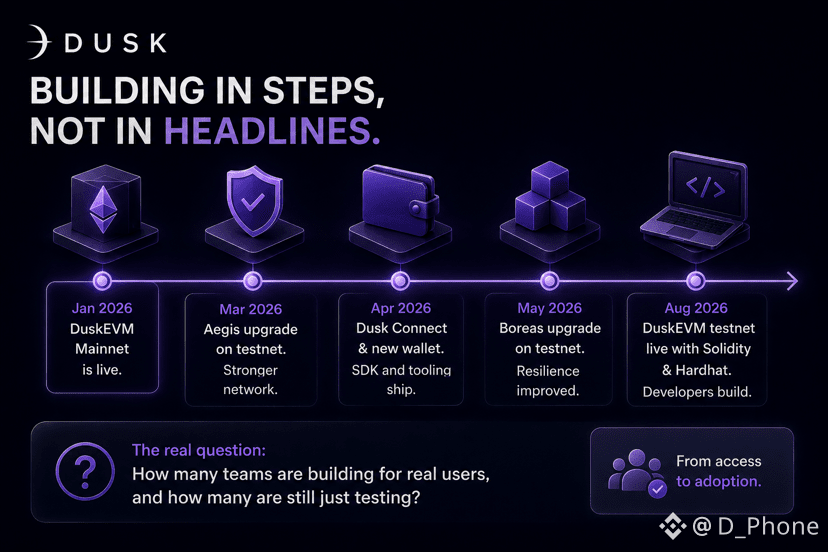
Then the year kept going. In March, an upgrade called Aegis rolled out on testnet to harden the network ahead of the EVM transition. In April, Dusk Connect and a new multi-platform wallet arrived, the unglamorous SDK and tooling work that rarely makes a headline but that any team actually shipping something depends on. In May, Boreas followed, another testnet upgrade aimed at resilience and DuskEVM readiness. By August, Dusk Network announced that its DuskEVM testnet now lets developers deploy and test with Solidity and Hardhat, the exact ordinary tooling anyone building on Ethereum already knows.
That is not a contradiction so much as a pattern I think crypto commentary rushes past. A launch headline compresses a year of staged testnet work into a single moment, because a moment is what gets shared. The actual infrastructure arrives in increments: consensus hardening, then wallet and SDK tooling, then a testnet stable enough to hand to outside developers.
What I want to know now is simpler than the marketing question. Not "did DuskEVM launch," but how many independent teams have actually deployed contracts that touch real users, versus how many are still kicking the tires on a testnet. A live testnet with working Solidity support is a genuine milestone, and it is also, by definition, still a testnet. Developer access is not the same thing as developer adoption, and Dusk Network's own updates seem to admit as much by keeping the roadmap language cautious even after the headlines moved on.
@Dusk #dusk $DUSK $BTW $VELVET
Then the year kept going. In March, an upgrade called Aegis rolled out on testnet to harden the network ahead of the EVM transition. In April, Dusk Connect and a new multi-platform wallet arrived, the unglamorous SDK and tooling work that rarely makes a headline but that any team actually shipping something depends on. In May, Boreas followed, another testnet upgrade aimed at resilience and DuskEVM readiness. By August, Dusk Network announced that its DuskEVM testnet now lets developers deploy and test with Solidity and Hardhat, the exact ordinary tooling anyone building on Ethereum already knows.
That is not a contradiction so much as a pattern I think crypto commentary rushes past. A launch headline compresses a year of staged testnet work into a single moment, because a moment is what gets shared. The actual infrastructure arrives in increments: consensus hardening, then wallet and SDK tooling, then a testnet stable enough to hand to outside developers.
What I want to know now is simpler than the marketing question. Not "did DuskEVM launch," but how many independent teams have actually deployed contracts that touch real users, versus how many are still kicking the tires on a testnet. A live testnet with working Solidity support is a genuine milestone, and it is also, by definition, still a testnet. Developer access is not the same thing as developer adoption, and Dusk Network's own updates seem to admit as much by keeping the roadmap language cautious even after the headlines moved on.
@Dusk #dusk $DUSK $BTW $VELVET
翻訳参照
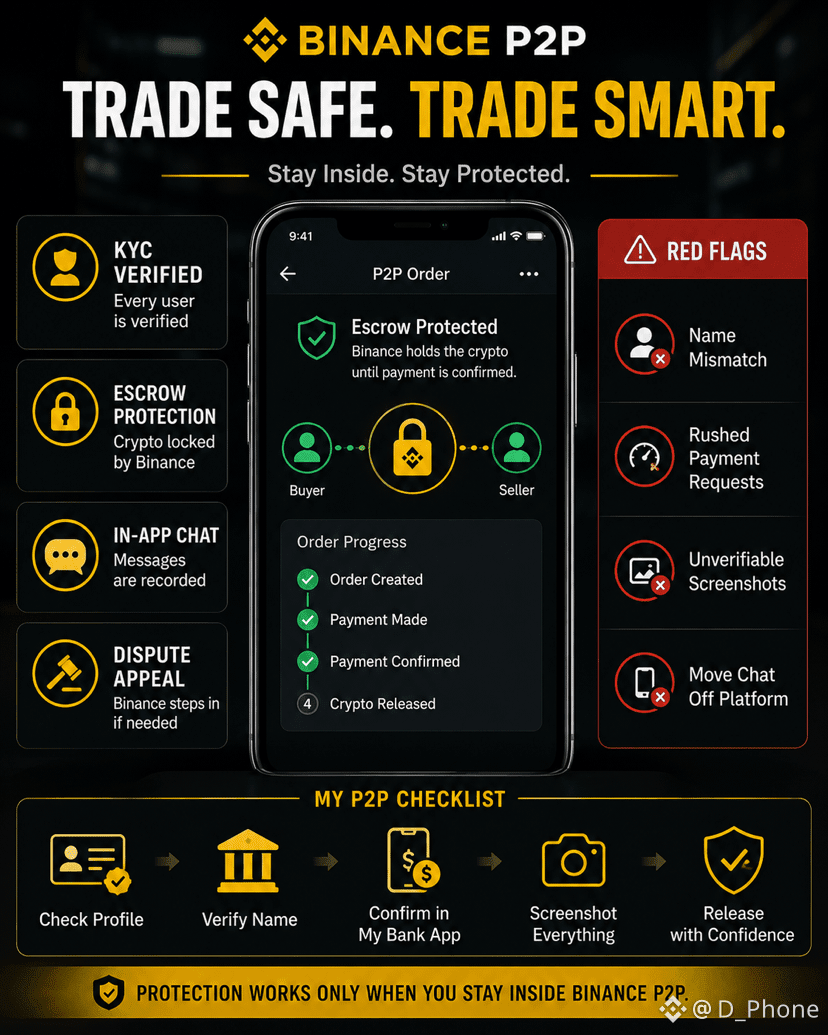
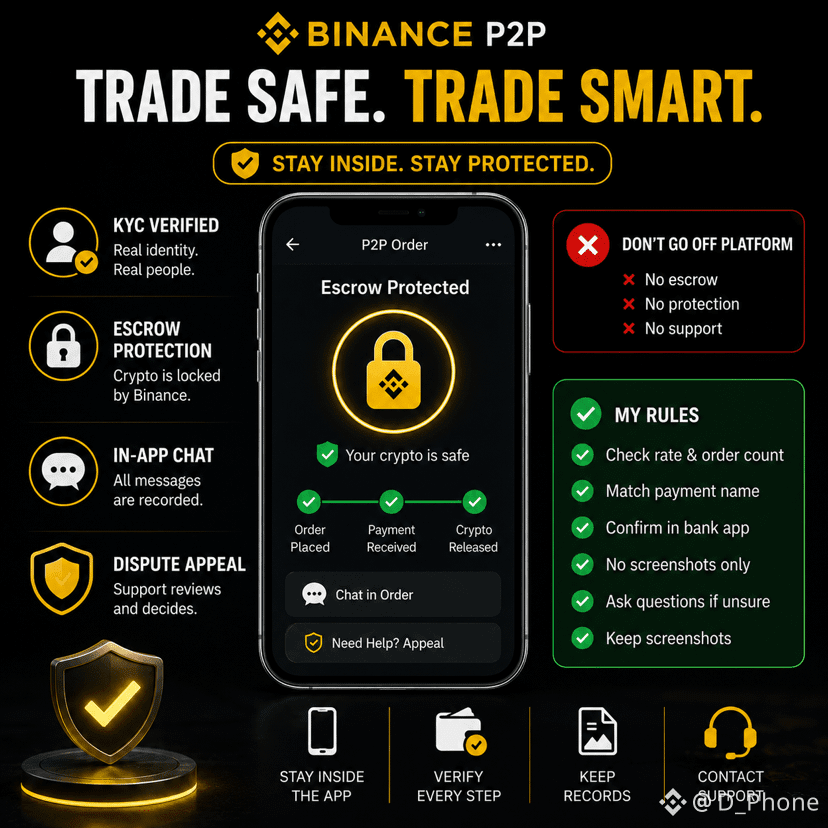
I sent my first Binance P2P order for $50 and my hands were actually shaking over such a small amount. Binance P2P is the peer to peer marketplace built into Binance where buyers and sellers trade crypto directly, but every order sits inside an escrow that locks the seller's coins the second a trade opens. Nothing releases until the seller confirms real payment, and every trader on the platform has already passed KYC, so a verified identity sits behind each order. The in app chat records every message, and if a trade goes wrong, the dispute appeal process brings Binance in to review the evidence directly.
Before paying, I always check the counterparty's profile: completion rate, total orders, and account age. On that first trade, the name on the receiving bank account didn't match the name listed on the seller's profile. That mismatch is one of the most common red flags on Binance P2P, so instead of assuming it was a typo, I asked in chat. The answer was vague, so I canceled the order and reported it instead of taking the risk.
My routine now is simple. I screenshot the profile before opening any order. I pay only through the exact method shown in the order details, never a workaround someone suggests in chat. I confirm receipt in my own banking app before I ever release or expect crypto to be released. When anything feels off, I contact Binance support directly rather than trying to resolve it myself.
I've also started paying attention to how a merchant responds in chat before a trade even begins, since a slow, generic reply to a simple question feels very different from someone who answers clearly and specifically. A merchant who's traded thousands of orders usually sounds like it, and one who deflects basic questions about the process is telling you something too, even before any money moves.
None of this takes long, but it turns Binance P2P from a leap of faith into a system you can actually verify at every step.
@Binance Vietnam #BinanceP2PAnToan $BTW $PORTAL $VELVET
Before paying, I always check the counterparty's profile: completion rate, total orders, and account age. On that first trade, the name on the receiving bank account didn't match the name listed on the seller's profile. That mismatch is one of the most common red flags on Binance P2P, so instead of assuming it was a typo, I asked in chat. The answer was vague, so I canceled the order and reported it instead of taking the risk.
My routine now is simple. I screenshot the profile before opening any order. I pay only through the exact method shown in the order details, never a workaround someone suggests in chat. I confirm receipt in my own banking app before I ever release or expect crypto to be released. When anything feels off, I contact Binance support directly rather than trying to resolve it myself.
I've also started paying attention to how a merchant responds in chat before a trade even begins, since a slow, generic reply to a simple question feels very different from someone who answers clearly and specifically. A merchant who's traded thousands of orders usually sounds like it, and one who deflects basic questions about the process is telling you something too, even before any money moves.
None of this takes long, but it turns Binance P2P from a leap of faith into a system you can actually verify at every step.
@Binance Vietnam #BinanceP2PAnToan $BTW $PORTAL $VELVET
翻訳参照
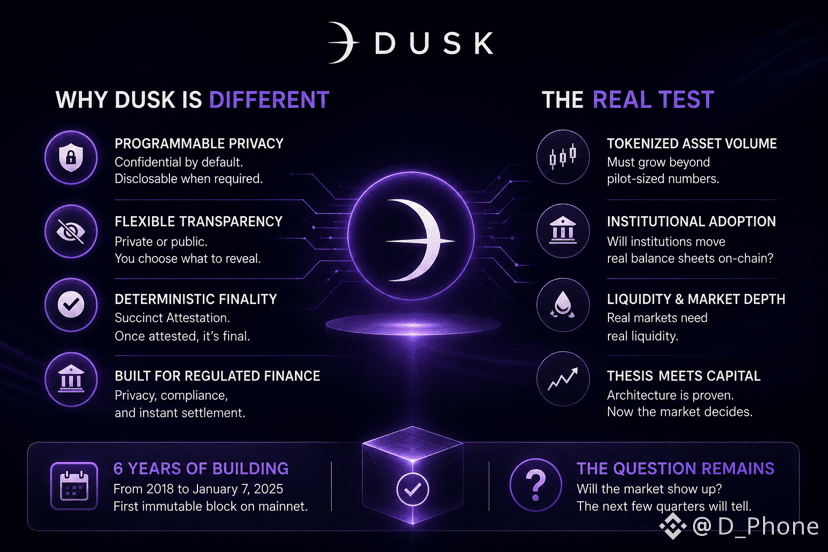
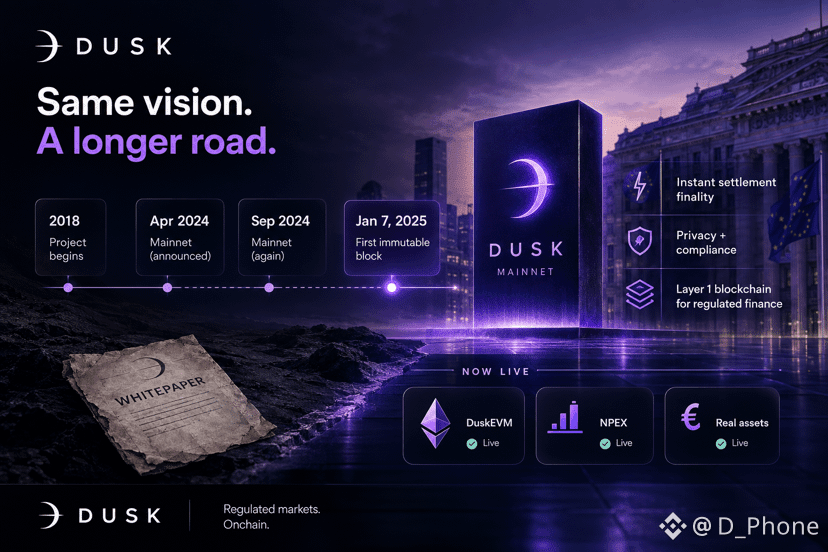
I keep coming back to one detail whenever I explain Dusk Network to someone new: the mainnet was supposed to arrive in April 2024. It didn't. The team pushed the date to September 2024, then again, and Dusk Network's first immutable block wasn't produced until January 7, 2025, nearly 6 years after the project began in 2018. On paper, the pitch was always simple: a Layer-1 blockchain giving financial institutions instant settlement finality without forcing a choice between privacy and compliance. In practice, building that took far longer than any announcement admitted up front.
The team's own explanation is that delays came from a moving regulatory target, not broken code. MiCA kept evolving while Dusk Network was building, and rather than ship a chain that might not survive contact with European securities law, the founders chose to rebuild parts of the stack, including a reworked version of Succinct Attestation that rewards voters, not just block producers, a change the team says increases participation and strengthens finality guarantees for compliance-sensitive settlement. That's a defensible choice. It's also a reminder that "regulated finance in seconds" describes a settlement layer, not a company timeline, and the two move at very different speeds.
What I keep asking: does a 6-year gap between whitepaper and working mainnet count as caution, or as a warning sign about execution pace? Dusk Network would say caution, and given what MiCA actually demanded, I'm inclined to agree. But nobody outside the team can fully verify how much delay was regulatory necessity versus underestimated complexity. A year into mainnet operation, DuskEVM has shipped and NPEX is live. The theory finally has a working chain behind it. Whether it can move at the speed institutional finance requires is the next test, and it's a different one than shipping a mainnet at all.
@Dusk #dusk $DUSK $PORTAL $BTW
The team's own explanation is that delays came from a moving regulatory target, not broken code. MiCA kept evolving while Dusk Network was building, and rather than ship a chain that might not survive contact with European securities law, the founders chose to rebuild parts of the stack, including a reworked version of Succinct Attestation that rewards voters, not just block producers, a change the team says increases participation and strengthens finality guarantees for compliance-sensitive settlement. That's a defensible choice. It's also a reminder that "regulated finance in seconds" describes a settlement layer, not a company timeline, and the two move at very different speeds.
What I keep asking: does a 6-year gap between whitepaper and working mainnet count as caution, or as a warning sign about execution pace? Dusk Network would say caution, and given what MiCA actually demanded, I'm inclined to agree. But nobody outside the team can fully verify how much delay was regulatory necessity versus underestimated complexity. A year into mainnet operation, DuskEVM has shipped and NPEX is live. The theory finally has a working chain behind it. Whether it can move at the speed institutional finance requires is the next test, and it's a different one than shipping a mainnet at all.
@Dusk #dusk $DUSK $PORTAL $BTW
Binance P2Pは、Binanceが提供する独自のマーケットプレイスであり、他のユーザーと暗号資産を直接取引できます。そしてその安全網は本物です。Binanceは売り手の暗号資産をエスクローで預かり、買い手の支払いが確認されるまで引き渡しません。すべてのアカウントは取引前にKYCが完了している必要があります。各注文には専用のチャットが付いており、さらにBinanceが介入して見解の相違を解決する必要がある場合に備えて、異議申し立て(ディスピュートの受付)も用意されています。この保護は取引全体がBinance P2Pの中で行われている間だけ存在するため、アプリ外で取引の一部でも完了させてしまうと、すべてを手放すことになります。注文を受ける前に、相手の完了済み取引、完了率、そして支払い名が自分のアカウントと一致しているかを確認します。不一致、支払いを急かす要求、検証できないスクリーンショット——これらが最も明確な危険信号です。私は資金を自分の銀行アプリで自ら確認してからのみリリースし、その後は念のためにチャットと支払いの証拠をアーカイブしておきます。サポートが必要になったときのためです。
私の最初の取引では、私はUSDTを販売していました。すると買い手が「銀行の処理が遅いから、早くリリースしてほしい」とメッセージしてきたのです。取引を終わらせて不安を止めたい一心で、ほとんど応じてしまいました。ですが、そのとき思い出したのが、実際に重要なのはたった一つのルールだということです。相手のスクリーンショットではなく、相手の約束でもなく、自分自身の口座を確認すること。資金はそこにありませんでした。私は「こちらで入金を確認したら、その瞬間にリリースする」と伝えたのですが、相手は不機嫌になり、姿を消しました。そしてすぐにサポートへ報告したところ、他のトレーダーからもそのプロフィールに同じパターンがあったと指摘されました。それ以来、私のチェックリストは一切変わりません。送金に記載された名義を確認し、自分の銀行アプリで金額を確定し、チャットと支払い記録をスクリーンショットし、そしてその後でのみリリースします。もし買い手がその注文に対して食い下がってきたら、それだけで必要なことはすべて分かります。私は、後日数週間はすべての取引記録を残しています。エスクローは取引中に暗号資産を守ってくれますが、もし後からディスピュートが開いた場合に私を守ってくれるのは、自分で撮ったスクリーンショットです。
@Binance Vietnam #BinanceP2PAnToan $VELVET $BTW $PORTAL
あなたを最も守ってくれるのは何ですか?
私の最初の取引では、私はUSDTを販売していました。すると買い手が「銀行の処理が遅いから、早くリリースしてほしい」とメッセージしてきたのです。取引を終わらせて不安を止めたい一心で、ほとんど応じてしまいました。ですが、そのとき思い出したのが、実際に重要なのはたった一つのルールだということです。相手のスクリーンショットではなく、相手の約束でもなく、自分自身の口座を確認すること。資金はそこにありませんでした。私は「こちらで入金を確認したら、その瞬間にリリースする」と伝えたのですが、相手は不機嫌になり、姿を消しました。そしてすぐにサポートへ報告したところ、他のトレーダーからもそのプロフィールに同じパターンがあったと指摘されました。それ以来、私のチェックリストは一切変わりません。送金に記載された名義を確認し、自分の銀行アプリで金額を確定し、チャットと支払い記録をスクリーンショットし、そしてその後でのみリリースします。もし買い手がその注文に対して食い下がってきたら、それだけで必要なことはすべて分かります。私は、後日数週間はすべての取引記録を残しています。エスクローは取引中に暗号資産を守ってくれますが、もし後からディスピュートが開いた場合に私を守ってくれるのは、自分で撮ったスクリーンショットです。
@Binance Vietnam #BinanceP2PAnToan $VELVET $BTW $PORTAL
あなたを最も守ってくれるのは何ですか?
🔐 Verify the buyer
0%
💰 Confirm funds first
0%
📸 Save trade records
0%
🛡️ Stay inside P2P
0%
0 投票 • 投票は終了しました
翻訳参照
I keep coming back to one quiet line in Dusk Network's latest work on SME financing: a tokenized security needs an authoritative ownership record.
At first, that sounds like paperwork around the interesting part. The token is visible, transfers are programmable, and ownership changes can share one controlled state. Surely the ledger has already solved the record problem.
Not necessarily.
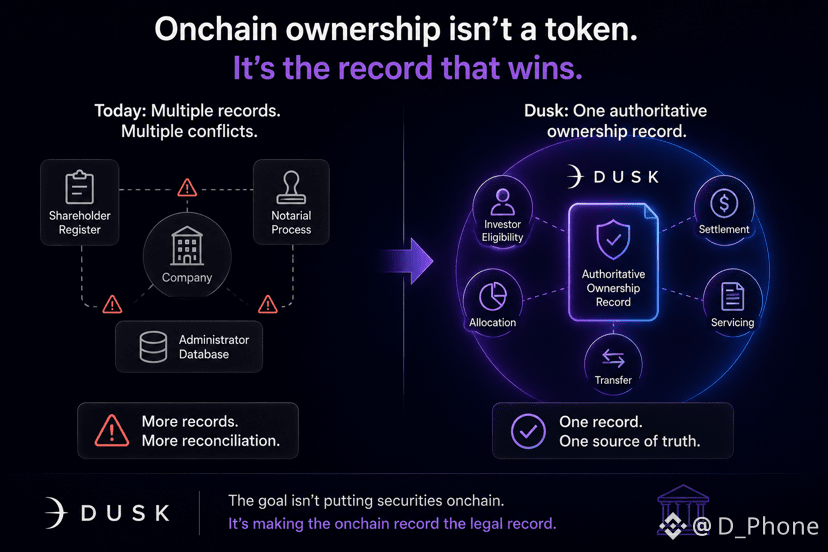
A company can place a token beside an unchanged shareholder register, administrator database, and notarial process. That creates one more record to reconcile. It does not remove reconciliation.
This is where Dusk's infrastructure has a harder job than minting an asset. The issuance workflow must connect investor eligibility, allocation, transfer, settlement, and servicing to the record that the legal structure actually recognizes. For a Dutch private company, even a digital shareholder register does not automatically replace required notarial actions.
If another register remains decisive, the token may only describe ownership instead of constituting it.
So I no longer read "onchain ownership" as a technical state alone. I read it as a claim about which state wins when two records disagree.
Dusk can coordinate a shared ownership lifecycle and reduce repeated handoffs. It cannot declare by itself that every jurisdiction, issuer, or court will treat that state as legally decisive.
The evidence I want is very specific: a live instrument whose legal documents identify the Dusk-based record, plus a real transfer that updates every required party without a second manual ledger becoming the final authority.
Until then, the important question is not whether Dusk can put SME securities onchain. It is whether Dusk can make the onchain record the place where ownership stops being duplicated.
@Dusk #dusk $DUSK $BTW $VELVET
At first, that sounds like paperwork around the interesting part. The token is visible, transfers are programmable, and ownership changes can share one controlled state. Surely the ledger has already solved the record problem.
Not necessarily.
A company can place a token beside an unchanged shareholder register, administrator database, and notarial process. That creates one more record to reconcile. It does not remove reconciliation.
This is where Dusk's infrastructure has a harder job than minting an asset. The issuance workflow must connect investor eligibility, allocation, transfer, settlement, and servicing to the record that the legal structure actually recognizes. For a Dutch private company, even a digital shareholder register does not automatically replace required notarial actions.
If another register remains decisive, the token may only describe ownership instead of constituting it.
So I no longer read "onchain ownership" as a technical state alone. I read it as a claim about which state wins when two records disagree.
Dusk can coordinate a shared ownership lifecycle and reduce repeated handoffs. It cannot declare by itself that every jurisdiction, issuer, or court will treat that state as legally decisive.
The evidence I want is very specific: a live instrument whose legal documents identify the Dusk-based record, plus a real transfer that updates every required party without a second manual ledger becoming the final authority.
Until then, the important question is not whether Dusk can put SME securities onchain. It is whether Dusk can make the onchain record the place where ownership stops being duplicated.
@Dusk #dusk $DUSK $BTW $VELVET
私の最初のBinance P2P取引は、始まる前から危うく失敗しかけたのですが、振り返るとそれでよかったと思っています。
Binance P2Pは、ユーザー同士がローカルの決済手段を使って暗号資産を直接売買する、Binanceのピアツーピア(P2P)マーケットプレイスです。Binanceは傍観者ではなく、安全策として間に入ってくれます。取引の前に全ユーザーがKYC認証を完了しなければならないため、プラットフォームは実際に誰と取引しているのかを把握しています。注文が出されると、売りに出されている暗号資産はすぐにエスクロー(預託)へ移動するので、契約が確定するまでBinanceに保管され、どちらの側も触れられません。連絡は内蔵チャットの中で行われ、発言のすべてがタイムスタンプ付きで記録されます。何か問題が起きた場合は、双方がディスピュートを開いてBinanceサポートに介入してもらい、証拠を確認できます。支払いを送る前、あるいは暗号資産を解放する前は、私は必ず相手のプロフィールを確認します。口座の存在期間、完了率、完了した注文数です。新規アカウントでみんなよりも圧倒的に有利なレートを提示してくることは、たいていおいしい話ではありません。どれほど説得力のある支払いスクリーンショットに見えても、私は自分の銀行アプリの中で実際に資金が入金されたことを確認するまで、暗号資産を決して解放しません。
私の最初の取引では、買い手がまるで本物のように見える支払いスクリーンショットを送ってきて、画像だけを根拠に暗号資産を解放しそうになりましたが、思いとどまりました。そこで今は毎回同じ短い手順を実行しています。プロフィールを確認する、チャットの中にあるメッセージはすべてそのままにする、自分の銀行アプリを開いてお金が実際に着金しているか確認する、そして解放する。相手が「なぜそんなに時間がかかるの?」などと急かしてきたり、別の方法で支払いを証明すると持ちかけてきたりした場合は、逆に私はスピードを上げず、慎重に落ち着きます。そうした圧力は、何かが間違っていることを示す最も分かりやすいサインの一つです。取引のどこかが不自然に感じたら、私は推測で進めず、チャットで自分だけで解決しようとせず、アプリから直接Binanceサポートに連絡します。
@Binance Vietnam #BinanceP2PAnToan $PORTAL $BTW $VELVET
最大のP2Pの危険信号は?
Binance P2Pは、ユーザー同士がローカルの決済手段を使って暗号資産を直接売買する、Binanceのピアツーピア(P2P)マーケットプレイスです。Binanceは傍観者ではなく、安全策として間に入ってくれます。取引の前に全ユーザーがKYC認証を完了しなければならないため、プラットフォームは実際に誰と取引しているのかを把握しています。注文が出されると、売りに出されている暗号資産はすぐにエスクロー(預託)へ移動するので、契約が確定するまでBinanceに保管され、どちらの側も触れられません。連絡は内蔵チャットの中で行われ、発言のすべてがタイムスタンプ付きで記録されます。何か問題が起きた場合は、双方がディスピュートを開いてBinanceサポートに介入してもらい、証拠を確認できます。支払いを送る前、あるいは暗号資産を解放する前は、私は必ず相手のプロフィールを確認します。口座の存在期間、完了率、完了した注文数です。新規アカウントでみんなよりも圧倒的に有利なレートを提示してくることは、たいていおいしい話ではありません。どれほど説得力のある支払いスクリーンショットに見えても、私は自分の銀行アプリの中で実際に資金が入金されたことを確認するまで、暗号資産を決して解放しません。
私の最初の取引では、買い手がまるで本物のように見える支払いスクリーンショットを送ってきて、画像だけを根拠に暗号資産を解放しそうになりましたが、思いとどまりました。そこで今は毎回同じ短い手順を実行しています。プロフィールを確認する、チャットの中にあるメッセージはすべてそのままにする、自分の銀行アプリを開いてお金が実際に着金しているか確認する、そして解放する。相手が「なぜそんなに時間がかかるの?」などと急かしてきたり、別の方法で支払いを証明すると持ちかけてきたりした場合は、逆に私はスピードを上げず、慎重に落ち着きます。そうした圧力は、何かが間違っていることを示す最も分かりやすいサインの一つです。取引のどこかが不自然に感じたら、私は推測で進めず、チャットで自分だけで解決しようとせず、アプリから直接Binanceサポートに連絡します。
@Binance Vietnam #BinanceP2PAnToan $PORTAL $BTW $VELVET
最大のP2Pの危険信号は?
🚩 Rushed to release
67%
*📸 Fake payment proof
33%
💬 Move chat elsewhere
0%
💰 Unusual payment method
0%
3 投票 • 投票は終了しました
翻訳参照
I remember opening Binance P2P for the first time and feeling unsure about trading directly with a stranger online. After a year of regular trades, I can say the protection built into Binance P2P is real, but only if you use it the right way. Every account must pass KYC before it can trade, so the person on the other side of your order has a verified identity on file. Once a buyer accepts an offer, the seller's crypto is locked in Binance's escrow, not held by either trader, so nobody can walk away with your funds mid trade. All communication happens inside the built in chat, which creates a timestamped record that support can review later. If something goes wrong, either side can open an appeal and a support agent steps in to mediate, using that chat history and any evidence submitted. These layers, verified identity, escrow, chat, and appeal, only work if you stay inside Binance P2P for the entire transaction. The moment you move to a private call or a personal payment app outside the order, none of this protection follows you anymore.
My personal rule is simple. I never confirm receipt of funds until I open my own banking app and see the balance sitting there, not a screenshot sent through chat. I also check a counterparty's completion rate, looking for 95% or higher, along with their total order count, before accepting a trade. I compare the name on the incoming payment to the name shown on their verified profile every single time. If anything feels rushed or the numbers don't match, I pause and ask questions first. When a trade genuinely stalls, I contact Binance support directly through the app instead of guessing, and I keep screenshots of every step until the order fully closes. Trading P2P gets a lot less stressful once you understand the tools already sitting in front of you.
@Binance Vietnam #BinanceP2PAnToan $AKE $BTW
My personal rule is simple. I never confirm receipt of funds until I open my own banking app and see the balance sitting there, not a screenshot sent through chat. I also check a counterparty's completion rate, looking for 95% or higher, along with their total order count, before accepting a trade. I compare the name on the incoming payment to the name shown on their verified profile every single time. If anything feels rushed or the numbers don't match, I pause and ask questions first. When a trade genuinely stalls, I contact Binance support directly through the app instead of guessing, and I keep screenshots of every step until the order fully closes. Trading P2P gets a lot less stressful once you understand the tools already sitting in front of you.
@Binance Vietnam #BinanceP2PAnToan $AKE $BTW
翻訳参照
I keep coming back to Dusk because it refuses to sit in just one layer of the stack, and that refusal is the whole point of the project.
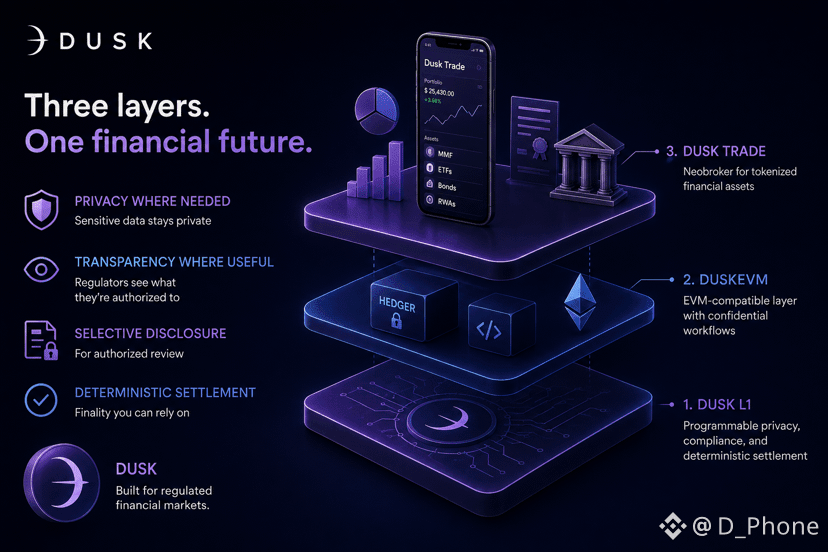
Dusk is a Layer 1 blockchain built specifically for regulated financial markets, combining programmable privacy with compliance instead of treating the two as opposites. Privacy shows up where a transaction genuinely needs it, transparency shows up where a regulator needs visibility, and selective disclosure sits between the two for authorized review, with deterministic settlement underneath all of it. On top of that base layer sits DuskEVM, the EVM compatible application layer that gives builders and institutions a familiar Solidity path into Dusk. DuskEVM mainnet is coming, and once live it carries confidential EVM workflows through Hedger, Dusk's privacy module for EVM built on homomorphic encryption and zero knowledge proofs. Sitting above that is Dusk Trade, a neobroker built on DuskEVM that brings money market funds, ETFs, bonds, and other real-world assets into a structure designed for real ownership and instant settlement.
What strikes me is how rarely a project manages all three layers coherently at once. Plenty of chains claim EVM compatibility, and a handful of neobrokers already exist inside crypto. Dusk is attempting a base protocol, an application layer, and a trading application sharing one privacy and settlement logic.
I do not think this is finished business yet. DuskEVM mainnet has not shipped as I write this, so the confidential workflows people describe are ahead of us, not behind us. Dusk Trade is structured to operate as a regulated multilateral trading facility, but structuring for a license and holding one are different things. I would rather ask whether these layers reinforce each other once real capital moves through them than assume a diagram has settled the question.
Still, the logic holds together on paper in a way most base layer plus application layer combinations do not, mostly because DUSK was never built as a general purpose settlement token first.
@Dusk #dusk $DUSK $AKE
Dusk is a Layer 1 blockchain built specifically for regulated financial markets, combining programmable privacy with compliance instead of treating the two as opposites. Privacy shows up where a transaction genuinely needs it, transparency shows up where a regulator needs visibility, and selective disclosure sits between the two for authorized review, with deterministic settlement underneath all of it. On top of that base layer sits DuskEVM, the EVM compatible application layer that gives builders and institutions a familiar Solidity path into Dusk. DuskEVM mainnet is coming, and once live it carries confidential EVM workflows through Hedger, Dusk's privacy module for EVM built on homomorphic encryption and zero knowledge proofs. Sitting above that is Dusk Trade, a neobroker built on DuskEVM that brings money market funds, ETFs, bonds, and other real-world assets into a structure designed for real ownership and instant settlement.
What strikes me is how rarely a project manages all three layers coherently at once. Plenty of chains claim EVM compatibility, and a handful of neobrokers already exist inside crypto. Dusk is attempting a base protocol, an application layer, and a trading application sharing one privacy and settlement logic.
I do not think this is finished business yet. DuskEVM mainnet has not shipped as I write this, so the confidential workflows people describe are ahead of us, not behind us. Dusk Trade is structured to operate as a regulated multilateral trading facility, but structuring for a license and holding one are different things. I would rather ask whether these layers reinforce each other once real capital moves through them than assume a diagram has settled the question.
Still, the logic holds together on paper in a way most base layer plus application layer combinations do not, mostly because DUSK was never built as a general purpose settlement token first.
@Dusk #dusk $DUSK $AKE
翻訳参照
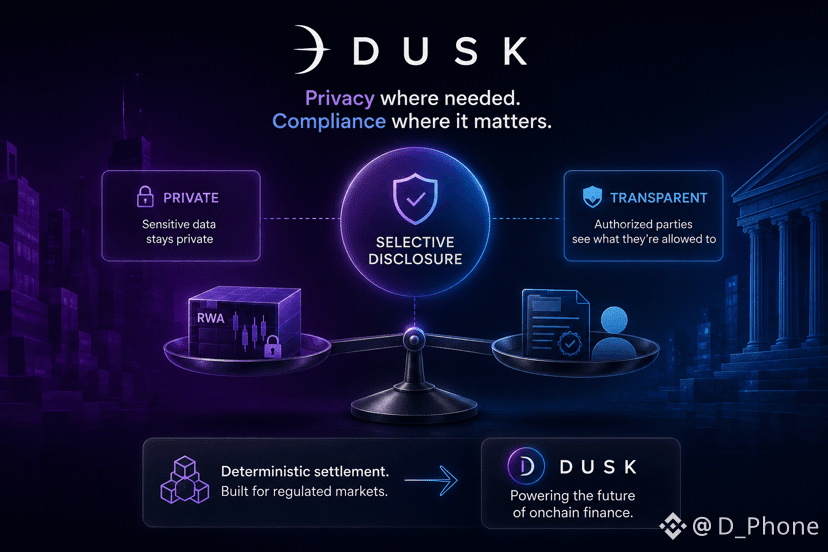
Most chains treat privacy as an all or nothing switch. Dusk doesn't. Dusk is a Layer 1 blockchain built for regulated financial markets, and its entire design rests on combining programmable privacy with compliance rather than picking one over the other. On Dusk, privacy applies where it's needed, transparency stays where it's useful, selective disclosure exists for authorized review, and settlement happens deterministically, a combination built for tokenized real world assets and regulated securities, and one meant to eventually carry native issuance workflows that move more of a security's lifecycle onchain once institutions and venues have the authorization required. DUSK is the native token powering this network.
I keep coming back to one question when I look at RWA projects: who actually gets to see what, and when? Most attempts either expose everything on a public ledger, which no institution wants, or hide everything behind permissioned walls, which defeats the point of using a blockchain at all. Dusk's answer sits in between, letting an issuer keep transaction details private from the public while still allowing a regulator or auditor to review what they're authorized to see. It's a narrower, harder problem than pure privacy or pure transparency, and narrower problems tend to be the ones that actually ship.
There's also a governance layer to this worth sitting with. Selective disclosure needs someone to define what counts as authorized in practice, and that definition will likely differ by jurisdiction and by asset type. Dusk can build the cryptographic machinery. It still needs regulators and institutions to agree on how that machinery gets used before privacy where needed becomes routine practice rather than a technical option.
None of this guarantees adoption. A settlement layer is only as useful as the assets and institutions that choose to settle on it, and that part isn't something Dusk controls alone.
@Dusk #dusk $DUSK $AKE $BTW
I keep coming back to one question when I look at RWA projects: who actually gets to see what, and when? Most attempts either expose everything on a public ledger, which no institution wants, or hide everything behind permissioned walls, which defeats the point of using a blockchain at all. Dusk's answer sits in between, letting an issuer keep transaction details private from the public while still allowing a regulator or auditor to review what they're authorized to see. It's a narrower, harder problem than pure privacy or pure transparency, and narrower problems tend to be the ones that actually ship.
There's also a governance layer to this worth sitting with. Selective disclosure needs someone to define what counts as authorized in practice, and that definition will likely differ by jurisdiction and by asset type. Dusk can build the cryptographic machinery. It still needs regulators and institutions to agree on how that machinery gets used before privacy where needed becomes routine practice rather than a technical option.
None of this guarantees adoption. A settlement layer is only as useful as the assets and institutions that choose to settle on it, and that part isn't something Dusk controls alone.
@Dusk #dusk $DUSK $AKE $BTW
翻訳参照
I remember my first trade on Binance P2P like it happened yesterday. My hands were shaky, my screen was full of tabs, and I had no idea what I was actually protected by. 3 years later, I trade every week and I want to walk you through what actually keeps you safe.
Binance P2P is a marketplace built directly into the Binance app where users buy and sell crypto with each other using local payment methods. Every counterparty goes through KYC before they can trade, so you are never dealing with a completely anonymous stranger. Once you accept an order, your crypto asset is locked in an escrow account controlled by Binance, not by the seller, so nobody can vanish with your funds mid trade. A built in chat window keeps every message inside the order, which becomes evidence if things go wrong. If a disagreement happens, either side can raise an appeal and Binance staff will review the chat log and payment proof to decide who is right.
None of that protection works if you step outside the platform. I have seen traders get talked into moving a deal to a private chat because the price was 'just a little better.' The moment you leave the order page, the escrow and appeal system stop applying to you, and Binance support cannot help you recover funds from a deal it never saw.
My personal checklist before I confirm any order: check the counterparty's completion rate and account age, match the payer name on my bank app to the name shown in the trade window, and never release crypto until my bank statement shows the money sitting in my account. Screenshots that look edited, sudden requests for a phone call, or pressure to skip verification are the biggest red flags I have learned to walk away from. I keep every screenshot and transaction ID from every trade in a dedicated folder for at least 3 months, because if I ever need to open a ticket with support, having the paper trail ready saves hours.
If something feels off, do not guess. Open a ticket with support before you release anything, not after.
@Binance Vietnam #BinanceP2PAnToan $AKE $BTW $CAP
Binance P2P is a marketplace built directly into the Binance app where users buy and sell crypto with each other using local payment methods. Every counterparty goes through KYC before they can trade, so you are never dealing with a completely anonymous stranger. Once you accept an order, your crypto asset is locked in an escrow account controlled by Binance, not by the seller, so nobody can vanish with your funds mid trade. A built in chat window keeps every message inside the order, which becomes evidence if things go wrong. If a disagreement happens, either side can raise an appeal and Binance staff will review the chat log and payment proof to decide who is right.
None of that protection works if you step outside the platform. I have seen traders get talked into moving a deal to a private chat because the price was 'just a little better.' The moment you leave the order page, the escrow and appeal system stop applying to you, and Binance support cannot help you recover funds from a deal it never saw.
My personal checklist before I confirm any order: check the counterparty's completion rate and account age, match the payer name on my bank app to the name shown in the trade window, and never release crypto until my bank statement shows the money sitting in my account. Screenshots that look edited, sudden requests for a phone call, or pressure to skip verification are the biggest red flags I have learned to walk away from. I keep every screenshot and transaction ID from every trade in a dedicated folder for at least 3 months, because if I ever need to open a ticket with support, having the paper trail ready saves hours.
If something feels off, do not guess. Open a ticket with support before you release anything, not after.
@Binance Vietnam #BinanceP2PAnToan $AKE $BTW $CAP
翻訳参照
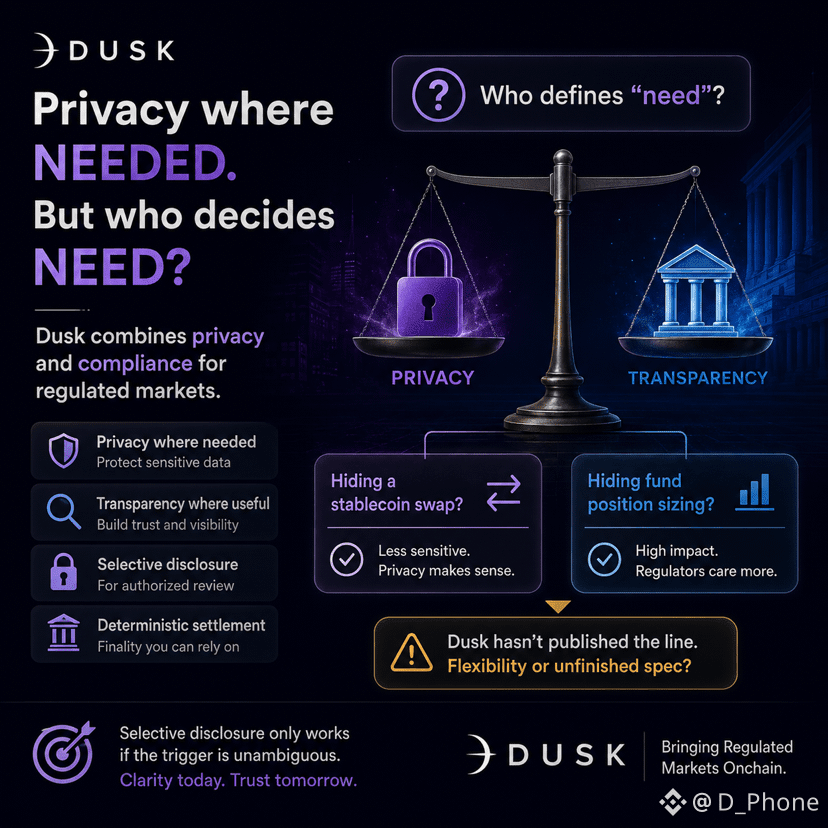
Dusk is a Layer 1 blockchain for regulated financial markets, pairing programmable privacy with compliance: privacy where needed, transparency where useful, selective disclosure for authorized review, and deterministic settlement, fit for tokenized real-world assets and regulated securities, with DUSK as its native token. DuskEVM mainnet is coming as the EVM-compatible application layer of the Dusk stack, giving builders a familiar Solidity path into Dusk, and it supports confidential EVM workflows through Hedger, Dusk's privacy module built on homomorphic encryption and zero-knowledge proofs. Dusk Trade functions as a neobroker, the application layer for tokenized financial assets on DuskEVM, bringing MMFs, ETFs, bonds, and RWAs onchain with real ownership and instant settlement, structured to operate as a regulated MTF and investment platform under EU rules. Through partnerships with Chainlink and EU-licensed institutions, Dusk is bringing financial markets onchain, including NPEX, an AFM-regulated exchange licensed as an MTF, Broker, and ECSP, planning to bring more than 300M EUR in assets onchain via Dusk. Tokenization wraps an existing asset, while native issuance moves more of that asset's lifecycle onchain, and Dusk's infrastructure is built to carry native issuance workflows for regulated securities once institutions hold the required authorization.
Here's what I keep circling back to with Dusk: the phrase 'privacy where needed' sounds elegant until you ask who defines need. Hiding a stablecoin swap is different from a fund hiding position sizing from competitors, and regulators care far more about the second. Dusk hasn't published a granular breakdown of which transaction types default to private versus public, and that gap might be intentional flexibility or an unfinished spec. I'd want that line drawn explicitly before institutions commit real capital. Selective disclosure only works if the trigger is unambiguous, not left to judgment.
@Dusk #dusk $BTW $AKE $DUSK
Here's what I keep circling back to with Dusk: the phrase 'privacy where needed' sounds elegant until you ask who defines need. Hiding a stablecoin swap is different from a fund hiding position sizing from competitors, and regulators care far more about the second. Dusk hasn't published a granular breakdown of which transaction types default to private versus public, and that gap might be intentional flexibility or an unfinished spec. I'd want that line drawn explicitly before institutions commit real capital. Selective disclosure only works if the trigger is unambiguous, not left to judgment.
@Dusk #dusk $BTW $AKE $DUSK
翻訳参照
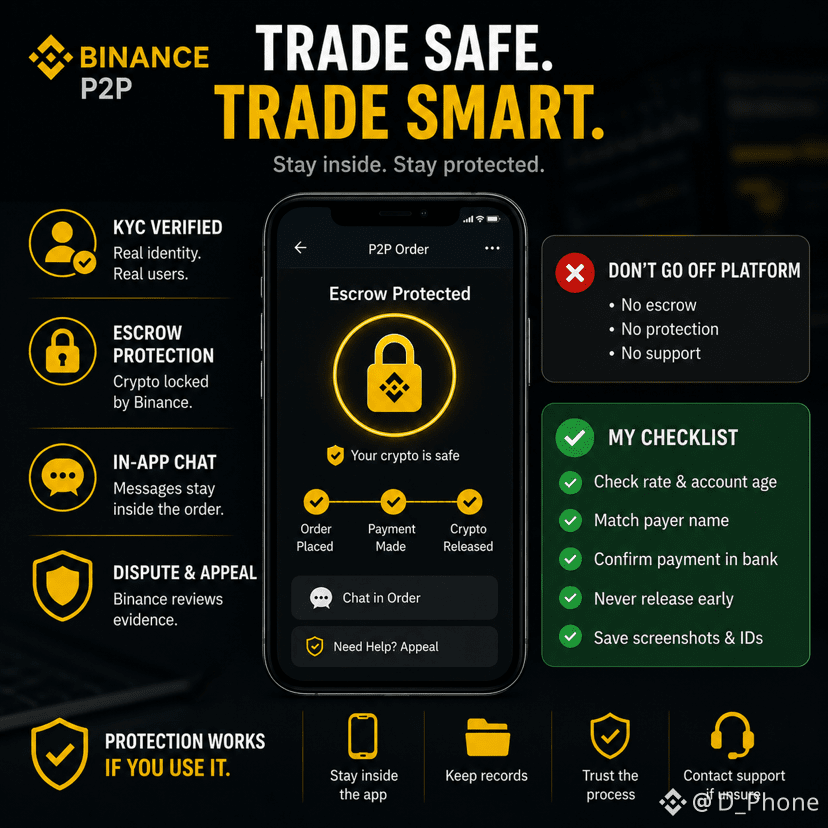
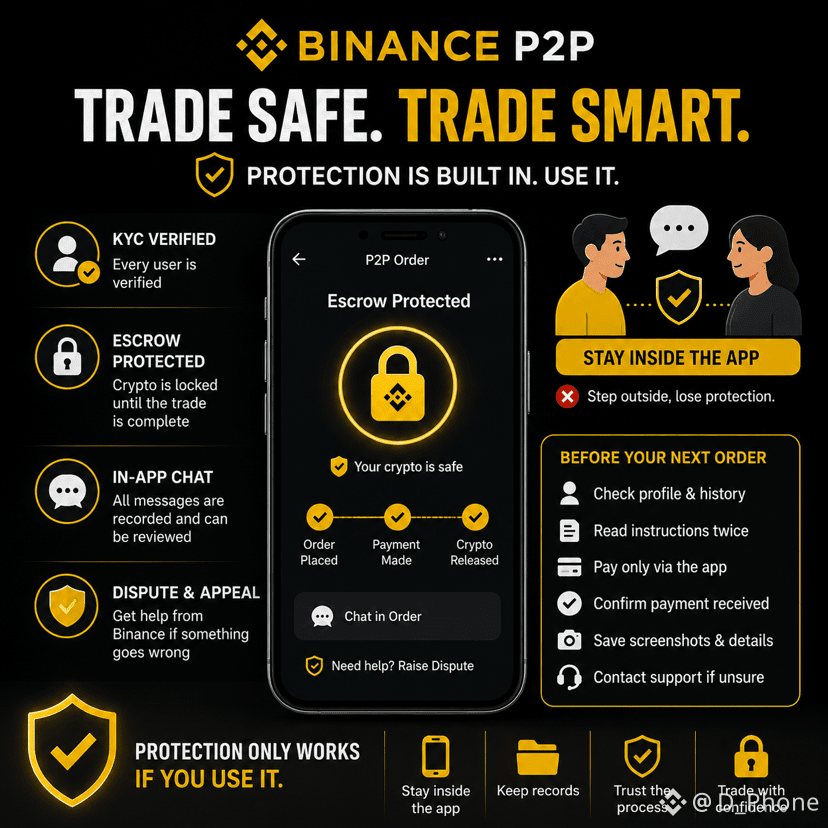
I still remember opening the Binance P2P page for the first time and feeling completely lost. Rows of offers, unfamiliar merchants, numbers I didn't understand. If you are in that spot right now, take a breath, because this platform was built with several protective layers working together.
Binance P2P is the marketplace where users buy and sell crypto directly with each other, and Binance sits in the middle as a safeguard rather than a silent host. Every account must pass Know Your Customer verification before trading, so the person on the other end of your order is not anonymous. Once you place an order, the crypto asset gets locked in escrow, meaning it cannot move anywhere until the trade finishes or a dispute gets resolved. A dedicated order chat lets both sides talk and share proof, and everything typed there can later support your case. Completing the entire trade inside this system matters too, since anything agreed outside the order loses these protections completely. If something goes wrong, you can raise a dispute and appeal for review rather than arguing alone.
My first real lesson came from rushing. I paid without matching the seller's registered name to their profile first, and had to spend 20 extra minutes sorting out the confusion. Now I always check that detail before sending anything.
Before your next order, walk through this list. Check the counterparty's completion rate and account age. Read the instructions twice. Send payment only through the method shown inside the app. Screenshot your confirmation the moment it clears, and save the order details for your records. If anything looks unusual, contact Binance support before releasing funds.
Protection only works if you use it. Stay inside the app, keep records, and trust the process.
@Binance Vietnam #BinanceP2PAnToan $AKE $BR $BTW
Binance P2P is the marketplace where users buy and sell crypto directly with each other, and Binance sits in the middle as a safeguard rather than a silent host. Every account must pass Know Your Customer verification before trading, so the person on the other end of your order is not anonymous. Once you place an order, the crypto asset gets locked in escrow, meaning it cannot move anywhere until the trade finishes or a dispute gets resolved. A dedicated order chat lets both sides talk and share proof, and everything typed there can later support your case. Completing the entire trade inside this system matters too, since anything agreed outside the order loses these protections completely. If something goes wrong, you can raise a dispute and appeal for review rather than arguing alone.
My first real lesson came from rushing. I paid without matching the seller's registered name to their profile first, and had to spend 20 extra minutes sorting out the confusion. Now I always check that detail before sending anything.
Before your next order, walk through this list. Check the counterparty's completion rate and account age. Read the instructions twice. Send payment only through the method shown inside the app. Screenshot your confirmation the moment it clears, and save the order details for your records. If anything looks unusual, contact Binance support before releasing funds.
Protection only works if you use it. Stay inside the app, keep records, and trust the process.
@Binance Vietnam #BinanceP2PAnToan $AKE $BR $BTW
ログインして、さらにコンテンツを読む