

Alvi Black Chain
70 投稿

Alvi Black Chain
報告
ユーザーをブロック
27 フォロー
59 フォロワー
112 いいね
投稿
すべて
引用
ライブ
翻訳参照
🚨 What Happened Overnight?
Here are 8 crypto stories that caught my attention:
📊 US jobs came in strong: 162K jobs were added vs. 56K expected.
📉 Bitcoin slipped below $80K, as markets started talking again about the possibility of a Fed rate hike.
🟢 Bitcoin’s on-chain data showed a potential shift: SOPR broke its 11-month downtrend.
🇺🇸 Trump expects the stock market to keep rising following the strong jobs report.
🚀 Zcash crossed $1,000, reaching the level for the first time in nearly a decade.
🟠 Strive announced plans to buy $1.4B worth of Bitcoin, targeting a much larger $BTC treasury.
💥 BlackRock says debt and inflation are important drivers behind Bitcoin’s recent strength.
🏦 South Korea plans to gradually tokenize securities starting in 2027.
A lot is happening across crypto and traditional finance. 👀
🚨 What Happened Overnight?
Here are 8 crypto stories that caught my attention:
📊 US jobs came in strong: 162K jobs were added vs. 56K expected.
📉 Bitcoin slipped below $80K, as markets started talking again about the possibility of a Fed rate hike.
🟢 Bitcoin’s on-chain data showed a potential shift: SOPR broke its 11-month downtrend.
🇺🇸 Trump expects the stock market to keep rising following the strong jobs report.
🚀 Zcash crossed $1,000, reaching the level for the first time in nearly a decade.
🟠 Strive announced plans to buy $1.4B worth of Bitcoin, targeting a much larger $BTC treasury.
💥 BlackRock says debt and inflation are important drivers behind Bitcoin’s recent strength.
🏦 South Korea plans to gradually tokenize securities starting in 2027.
A lot is happening across crypto and traditional finance. 👀
Here are 8 crypto stories that caught my attention:
📊 US jobs came in strong: 162K jobs were added vs. 56K expected.
📉 Bitcoin slipped below $80K, as markets started talking again about the possibility of a Fed rate hike.
🟢 Bitcoin’s on-chain data showed a potential shift: SOPR broke its 11-month downtrend.
🇺🇸 Trump expects the stock market to keep rising following the strong jobs report.
🚀 Zcash crossed $1,000, reaching the level for the first time in nearly a decade.
🟠 Strive announced plans to buy $1.4B worth of Bitcoin, targeting a much larger $BTC treasury.
💥 BlackRock says debt and inflation are important drivers behind Bitcoin’s recent strength.
🏦 South Korea plans to gradually tokenize securities starting in 2027.
A lot is happening across crypto and traditional finance. 👀
209
翻訳参照
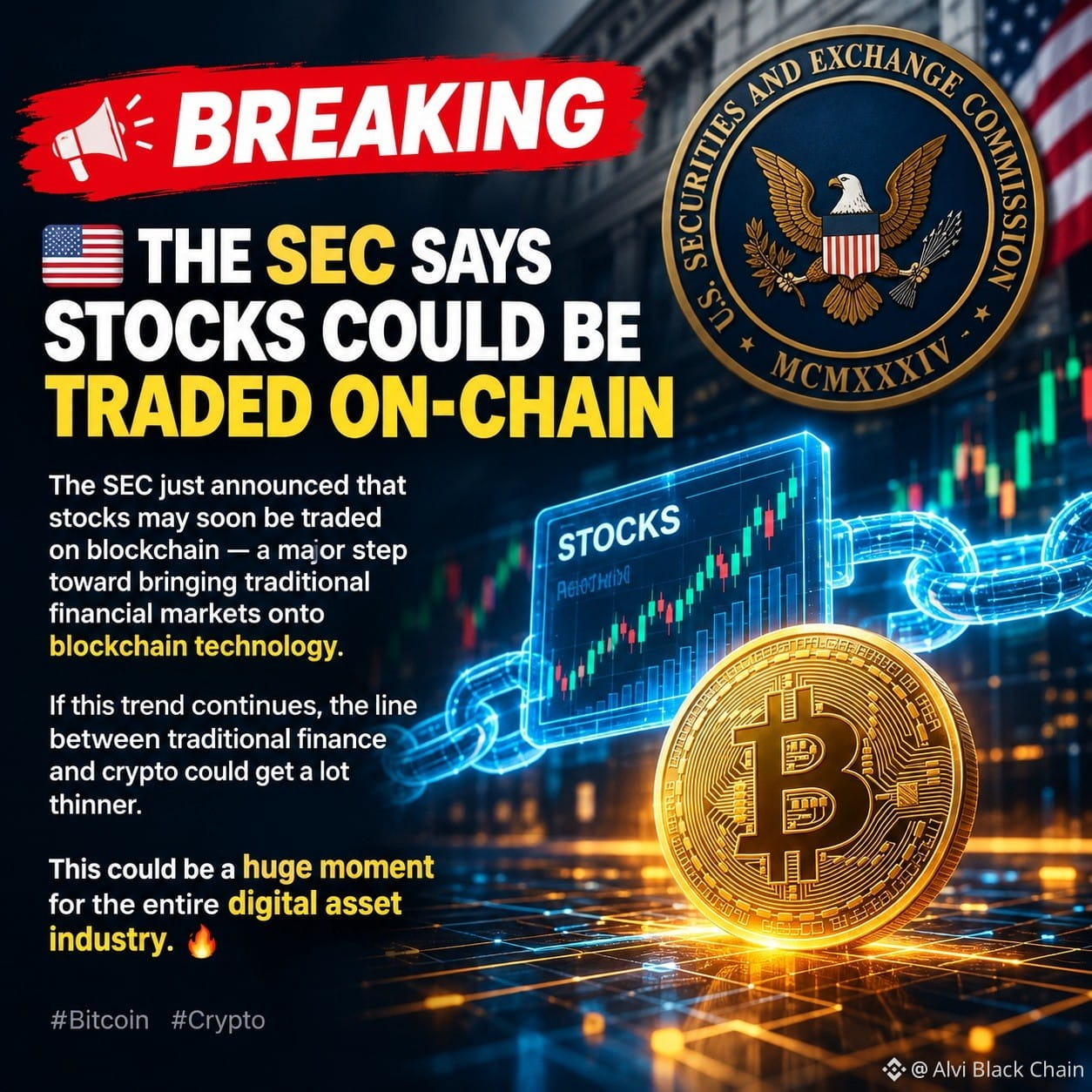
🚨 BREAKING 🇺🇸
The SEC says stocks could be traded on-chain — a major step toward bringing traditional financial markets onto blockchain technology.
If this trend continues, the line between traditional finance and crypto could get a lot thinner.
This could be a huge moment for the entire digital asset industry. 🔥
#Bitcoin #crypto
🚨 BREAKING 🇺🇸
The SEC says stocks could be traded on-chain — a major step toward bringing traditional financial markets onto blockchain technology.
If this trend continues, the line between traditional finance and crypto could get a lot thinner.
This could be a huge moment for the entire digital asset industry. 🔥
#Bitcoin #crypto
The SEC says stocks could be traded on-chain — a major step toward bringing traditional financial markets onto blockchain technology.
If this trend continues, the line between traditional finance and crypto could get a lot thinner.
This could be a huge moment for the entire digital asset industry. 🔥
#Bitcoin #crypto
91

翻訳参照
👀 BTC $80K se neeche rejected — is this a chance to buy the dip?\n\nBitcoin tested $81K but couldn’t hold, and has moved back into the $78K zone. After the Fed’s Jackson Hole comments, risk appetite has cooled a bit. If you think this is only a macro pullback and not a trend reversal, the entry level is becoming interesting right now. $BTC
👀 BTC $80K se neeche rejected — is this a chance to buy the dip?\n\nBitcoin tested $81K but couldn’t hold, and has moved back into the $78K zone. After the Fed’s Jackson Hole comments, risk appetite has cooled a bit. If you think this is only a macro pullback and not a trend reversal, the entry level is becoming interesting right now. $BTC
88
🎙️ $BNB 👻✨👻 GoOD AfTeR NoON 🌼🥰😍 WeLCoMe BeauTiFulL PeoPLe 👻🌼😇
終了
02 時間 25 分 04 秒
591
3
5
🎙️ 🚨 LIVE: Best "LONG" & "SHORT" Setups Before the BIG Move 🚀📈
終了
05 時間 20 分 22 秒
2.5k
2
0
翻訳参照
#dusk $DUSK @Dusk_Foundation
I used to think tokenizing an asset was mostly a technical problem. Put ownership on-chain, make transfers faster, and let blockchain handle the rest.
But the more I think about real financial assets, the less convincing that idea becomes.
A token can represent ownership, but the legal world around that ownership does not suddenly disappear. Corporate approvals may still be required. Regulators may still need specific information. Tax treatment still depends on rules outside the blockchain. And in some markets, transferring the asset can involve intermediaries whose role cannot simply be replaced by smart contracts.
That is where Dusk becomes more interesting to me.
The value of privacy-focused infrastructure may not be in pretending that blockchain can remove every part of the existing financial system. It could be in reducing the parts that are genuinely inefficient while allowing the legal and regulatory layers to remain where they are necessary.
A shared ledger can reduce reconciliation between different parties. Confidential smart contracts can help protect information that should not be visible to the entire market. Selective disclosure can make specific data available when there is a legitimate reason to review it.
But none of that automatically solves the harder problem: how does an on-chain record interact with the legal system that still decides whether ownership, compliance, or settlement is actually valid?
That is the gap I think is worth watching.
Maybe successful tokenization will not look like finance being completely replaced by blockchain. Maybe it will look much quieter: less reconciliation, better privacy, faster settlement, while the institutions and rules that still matter remain in place.
If that is the direction regulated assets are heading, Dusk’s approach may be more practical than the usual promise of putting everything on-chain and calling the problem solved.
The real question is: how much friction can blockchain actually remove before it reaches a problem that technology alone cannot solve?
#dusk $DUSK @Dusk
I used to think tokenizing an asset was mostly a technical problem. Put ownership on-chain, make transfers faster, and let blockchain handle the rest.
But the more I think about real financial assets, the less convincing that idea becomes.
A token can represent ownership, but the legal world around that ownership does not suddenly disappear. Corporate approvals may still be required. Regulators may still need specific information. Tax treatment still depends on rules outside the blockchain. And in some markets, transferring the asset can involve intermediaries whose role cannot simply be replaced by smart contracts.
That is where Dusk becomes more interesting to me.
The value of privacy-focused infrastructure may not be in pretending that blockchain can remove every part of the existing financial system. It could be in reducing the parts that are genuinely inefficient while allowing the legal and regulatory layers to remain where they are necessary.
A shared ledger can reduce reconciliation between different parties. Confidential smart contracts can help protect information that should not be visible to the entire market. Selective disclosure can make specific data available when there is a legitimate reason to review it.
But none of that automatically solves the harder problem: how does an on-chain record interact with the legal system that still decides whether ownership, compliance, or settlement is actually valid?
That is the gap I think is worth watching.
Maybe successful tokenization will not look like finance being completely replaced by blockchain. Maybe it will look much quieter: less reconciliation, better privacy, faster settlement, while the institutions and rules that still matter remain in place.
If that is the direction regulated assets are heading, Dusk’s approach may be more practical than the usual promise of putting everything on-chain and calling the problem solved.
The real question is: how much friction can blockchain actually remove before it reaches a problem that technology alone cannot solve?
I used to think tokenizing an asset was mostly a technical problem. Put ownership on-chain, make transfers faster, and let blockchain handle the rest.
But the more I think about real financial assets, the less convincing that idea becomes.
A token can represent ownership, but the legal world around that ownership does not suddenly disappear. Corporate approvals may still be required. Regulators may still need specific information. Tax treatment still depends on rules outside the blockchain. And in some markets, transferring the asset can involve intermediaries whose role cannot simply be replaced by smart contracts.
That is where Dusk becomes more interesting to me.
The value of privacy-focused infrastructure may not be in pretending that blockchain can remove every part of the existing financial system. It could be in reducing the parts that are genuinely inefficient while allowing the legal and regulatory layers to remain where they are necessary.
A shared ledger can reduce reconciliation between different parties. Confidential smart contracts can help protect information that should not be visible to the entire market. Selective disclosure can make specific data available when there is a legitimate reason to review it.
But none of that automatically solves the harder problem: how does an on-chain record interact with the legal system that still decides whether ownership, compliance, or settlement is actually valid?
That is the gap I think is worth watching.
Maybe successful tokenization will not look like finance being completely replaced by blockchain. Maybe it will look much quieter: less reconciliation, better privacy, faster settlement, while the institutions and rules that still matter remain in place.
If that is the direction regulated assets are heading, Dusk’s approach may be more practical than the usual promise of putting everything on-chain and calling the problem solved.
The real question is: how much friction can blockchain actually remove before it reaches a problem that technology alone cannot solve?
1
80
#dusk $DUSK @Dusk_Foundation
最初は、ノードのリカバリというのは、何かが起きた後になって初めて重要になる“退屈なインフラの細部”の一つだと思っていました。ノードがオフラインになる、再同期する、追いつくのを待つ、そして最終的にすべてが元通りになる——そんな単純な話です。
しかし、Duskのようなネットワークでリカバリがどう機能し得るのかを深掘りするほど、その前提は思ったより単純ではないと感じるようになりました。
ノードを素早くオンラインに戻すことは有用ですが、スピードだけでは本当の問題は解決しません。もしノードがスナップショットから状態を復元するなら、より重要な問いは「復元された状態は本当に信頼できるのか」という点になります。
それが、私のリカバリに対する考え方を変えました。
ブロックチェーンのノードは、単に古いデータを読み直して、何も起きていないかのように再開できる“別のアプリケーション”ではありません。ノードが返してくる状態は、その後に起こるすべての土台になります。リカバリが速くても、復元された状態を適切に検証できないのであれば、その便利さは価値が薄れて見えてしまいます。
私が興味深いのは、リカバリ時間と完全性のトレードオフです。
最近の状態があれば、通常のノードは最初からすべてを作り直す手間を避けられますが、それが必ずしも、過去のすべての詳細が同じ形で利用できることを意味するわけではありません。ある運用者にとっては、すぐにオンラインへ戻れることが十分かもしれません。ですが、特に完全な履歴データが重要なケースでは、より速い近道が、完全なリカバリ手順の代わりになるとは限りません。
この違いが納得できるのは、すべてのノードが同じ課題を解決しているわけではないからです。
考えれば考えるほど、良いインフラの本当の価値は、そもそも障害を完全に避けることにあるとは限りません。ネットワークは停止することがあり、ハードウェアは故障します。そしてデータは利用不能になることもあります。
難しいのは、その“後”に何が起きるのかです。
ネットワークは、速度・履歴・信頼のどれかを運用者に選ばせることなく、迅速に回復できるのでしょうか?
それは、単にノードがどれだけ速くオンラインに戻れるかを測るよりも、はるかに重要なインフラの試験のように思えます。
{spot}(DUSKUSDT)
#dusk $DUSK @Dusk
最初は、ノードのリカバリというのは、何かが起きた後になって初めて重要になる“退屈なインフラの細部”の一つだと思っていました。ノードがオフラインになる、再同期する、追いつくのを待つ、そして最終的にすべてが元通りになる——そんな単純な話です。
しかし、Duskのようなネットワークでリカバリがどう機能し得るのかを深掘りするほど、その前提は思ったより単純ではないと感じるようになりました。
ノードを素早くオンラインに戻すことは有用ですが、スピードだけでは本当の問題は解決しません。もしノードがスナップショットから状態を復元するなら、より重要な問いは「復元された状態は本当に信頼できるのか」という点になります。
それが、私のリカバリに対する考え方を変えました。
ブロックチェーンのノードは、単に古いデータを読み直して、何も起きていないかのように再開できる“別のアプリケーション”ではありません。ノードが返してくる状態は、その後に起こるすべての土台になります。リカバリが速くても、復元された状態を適切に検証できないのであれば、その便利さは価値が薄れて見えてしまいます。
私が興味深いのは、リカバリ時間と完全性のトレードオフです。
最近の状態があれば、通常のノードは最初からすべてを作り直す手間を避けられますが、それが必ずしも、過去のすべての詳細が同じ形で利用できることを意味するわけではありません。ある運用者にとっては、すぐにオンラインへ戻れることが十分かもしれません。ですが、特に完全な履歴データが重要なケースでは、より速い近道が、完全なリカバリ手順の代わりになるとは限りません。
この違いが納得できるのは、すべてのノードが同じ課題を解決しているわけではないからです。
考えれば考えるほど、良いインフラの本当の価値は、そもそも障害を完全に避けることにあるとは限りません。ネットワークは停止することがあり、ハードウェアは故障します。そしてデータは利用不能になることもあります。
難しいのは、その“後”に何が起きるのかです。
ネットワークは、速度・履歴・信頼のどれかを運用者に選ばせることなく、迅速に回復できるのでしょうか?
それは、単にノードがどれだけ速くオンラインに戻れるかを測るよりも、はるかに重要なインフラの試験のように思えます。
最初は、ノードのリカバリというのは、何かが起きた後になって初めて重要になる“退屈なインフラの細部”の一つだと思っていました。ノードがオフラインになる、再同期する、追いつくのを待つ、そして最終的にすべてが元通りになる——そんな単純な話です。
しかし、Duskのようなネットワークでリカバリがどう機能し得るのかを深掘りするほど、その前提は思ったより単純ではないと感じるようになりました。
ノードを素早くオンラインに戻すことは有用ですが、スピードだけでは本当の問題は解決しません。もしノードがスナップショットから状態を復元するなら、より重要な問いは「復元された状態は本当に信頼できるのか」という点になります。
それが、私のリカバリに対する考え方を変えました。
ブロックチェーンのノードは、単に古いデータを読み直して、何も起きていないかのように再開できる“別のアプリケーション”ではありません。ノードが返してくる状態は、その後に起こるすべての土台になります。リカバリが速くても、復元された状態を適切に検証できないのであれば、その便利さは価値が薄れて見えてしまいます。
私が興味深いのは、リカバリ時間と完全性のトレードオフです。
最近の状態があれば、通常のノードは最初からすべてを作り直す手間を避けられますが、それが必ずしも、過去のすべての詳細が同じ形で利用できることを意味するわけではありません。ある運用者にとっては、すぐにオンラインへ戻れることが十分かもしれません。ですが、特に完全な履歴データが重要なケースでは、より速い近道が、完全なリカバリ手順の代わりになるとは限りません。
この違いが納得できるのは、すべてのノードが同じ課題を解決しているわけではないからです。
考えれば考えるほど、良いインフラの本当の価値は、そもそも障害を完全に避けることにあるとは限りません。ネットワークは停止することがあり、ハードウェアは故障します。そしてデータは利用不能になることもあります。
難しいのは、その“後”に何が起きるのかです。
ネットワークは、速度・履歴・信頼のどれかを運用者に選ばせることなく、迅速に回復できるのでしょうか?
それは、単にノードがどれだけ速くオンラインに戻れるかを測るよりも、はるかに重要なインフラの試験のように思えます。
70
翻訳参照
#dusk $DUSK @Dusk_Foundation
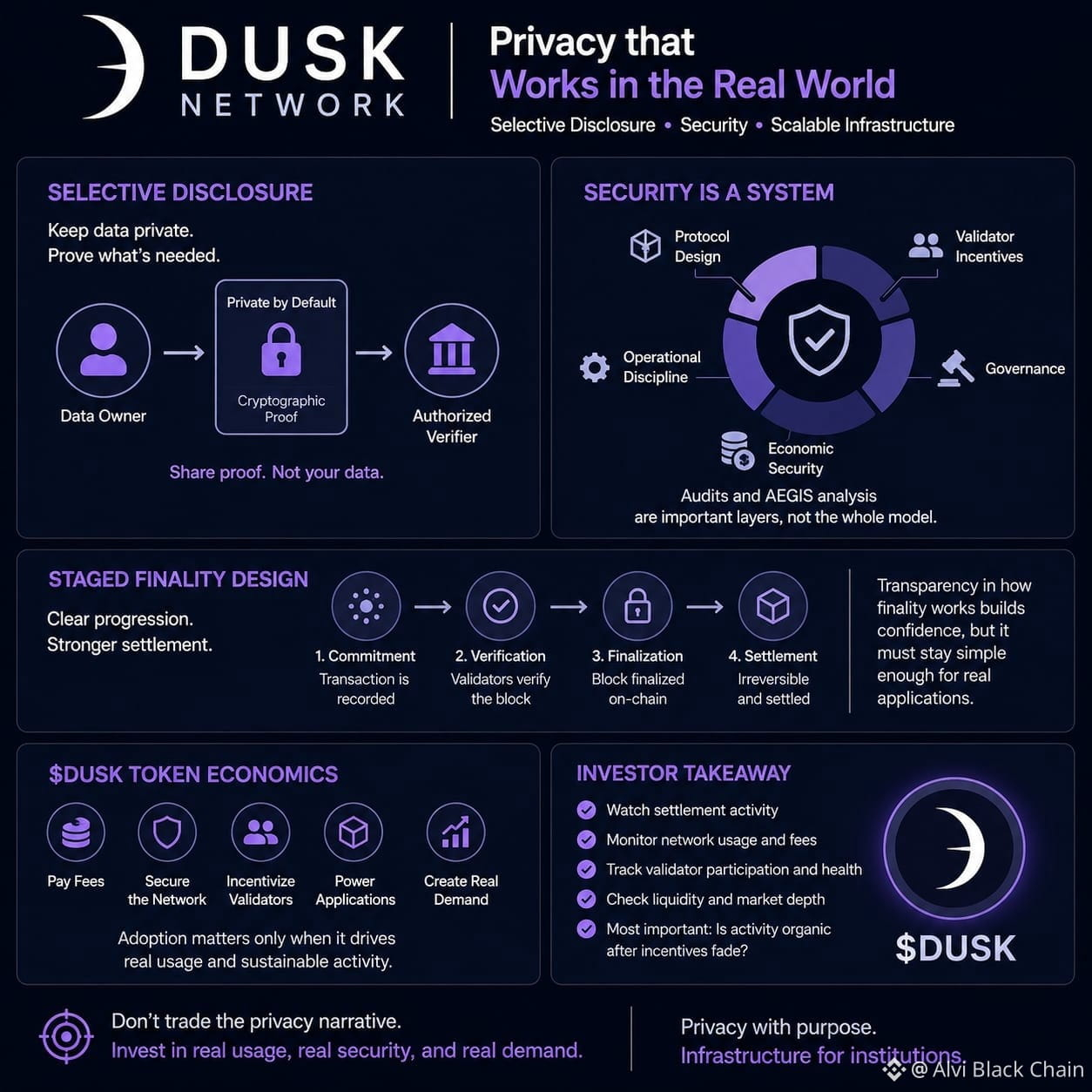
I used to think blockchain privacy was mainly about keeping transaction data hidden. After studying Dusk Network, I think the more useful question is: who can verify what, and under which conditions?
Dusk focuses on selective disclosure, where sensitive information can stay private while authorized parties can verify the details required for compliance. That model could matter more for institutions than simple transaction anonymity.
But privacy architecture is only one part of the security equation. Audits and AEGIS-style analysis can uncover weaknesses, yet real resilience also depends on validator incentives, protocol rules, governance, economic security, and operational discipline when conditions become difficult.
Dusk’s staged finality is another design choice I find interesting. Making settlement progression technically transparent can improve confidence, but it can also introduce complexity. The important question is whether that complexity produces measurable benefits for applications and users.
For $DUSK institutional adoption should eventually show up as recurring network activity. Privacy, settlement, validation, applications, and fees need to create sustainable demand rather than temporary attention.
My investor focus would therefore be practical: track settlement activity, network usage, validator participation, fees, liquidity, and organic demand after incentives fade. The privacy story is interesting, but the network’s actual economic activity is what I would trust.
{spot}(DUSKUSDT)
#dusk $DUSK @Dusk
I used to think blockchain privacy was mainly about keeping transaction data hidden. After studying Dusk Network, I think the more useful question is: who can verify what, and under which conditions?
Dusk focuses on selective disclosure, where sensitive information can stay private while authorized parties can verify the details required for compliance. That model could matter more for institutions than simple transaction anonymity.
But privacy architecture is only one part of the security equation. Audits and AEGIS-style analysis can uncover weaknesses, yet real resilience also depends on validator incentives, protocol rules, governance, economic security, and operational discipline when conditions become difficult.
Dusk’s staged finality is another design choice I find interesting. Making settlement progression technically transparent can improve confidence, but it can also introduce complexity. The important question is whether that complexity produces measurable benefits for applications and users.
For $DUSK institutional adoption should eventually show up as recurring network activity. Privacy, settlement, validation, applications, and fees need to create sustainable demand rather than temporary attention.
My investor focus would therefore be practical: track settlement activity, network usage, validator participation, fees, liquidity, and organic demand after incentives fade. The privacy story is interesting, but the network’s actual economic activity is what I would trust.
I used to think blockchain privacy was mainly about keeping transaction data hidden. After studying Dusk Network, I think the more useful question is: who can verify what, and under which conditions?
Dusk focuses on selective disclosure, where sensitive information can stay private while authorized parties can verify the details required for compliance. That model could matter more for institutions than simple transaction anonymity.
But privacy architecture is only one part of the security equation. Audits and AEGIS-style analysis can uncover weaknesses, yet real resilience also depends on validator incentives, protocol rules, governance, economic security, and operational discipline when conditions become difficult.
Dusk’s staged finality is another design choice I find interesting. Making settlement progression technically transparent can improve confidence, but it can also introduce complexity. The important question is whether that complexity produces measurable benefits for applications and users.
For $DUSK institutional adoption should eventually show up as recurring network activity. Privacy, settlement, validation, applications, and fees need to create sustainable demand rather than temporary attention.
My investor focus would therefore be practical: track settlement activity, network usage, validator participation, fees, liquidity, and organic demand after incentives fade. The privacy story is interesting, but the network’s actual economic activity is what I would trust.
79
翻訳参照
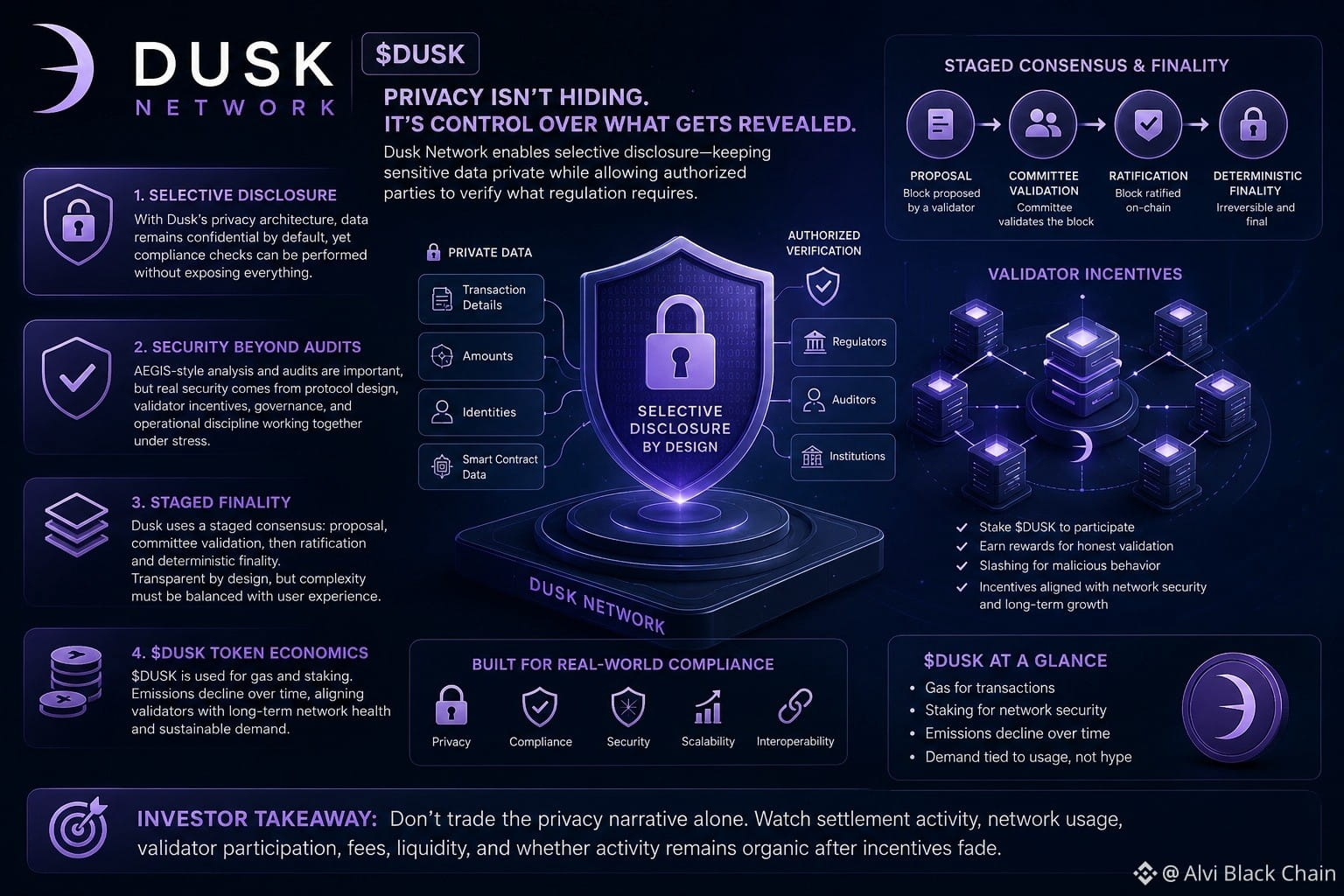
#dusk $DUSK @Dusk_Foundation The interesting thing about blockchain privacy is that institutions may not want to hide everything—they want control over what gets revealed.
After studying Dusk, I see its core value less as “private transactions” and more as selective disclosure. Phoenix and related privacy tools can keep sensitive data shielded while allowing authorized parties to verify the information required for compliance.
That makes security a broader question. Dusk’s AEGIS remediation addressed 39 findings, including 7 critical issues, which is a useful reminder that audits and security analysis are only one layer. Protocol design, validator behavior, economic incentives, governance, cryptography, and operational discipline all have to hold together when the system is under stress.
I also find Dusk’s staged consensus process worth watching: proposal, committee validation, then ratification and deterministic finality. The transparency is technically useful, but explaining every layer can also introduce complexity for ordinary users.
For $DUSK, the real test is economic. It is used for gas and staking, with emissions designed to decline over time. Institutional adoption only matters if privacy, settlement, validation and applications generate recurring activity.
My investor takeaway: don’t trade the privacy narrative alone. Watch settlement activity, network usage, validator participation, fees, liquidity, and whether usage remains organic after incentives fade.
{spot}(DUSKUSDT)
#dusk $DUSK @Dusk The interesting thing about blockchain privacy is that institutions may not want to hide everything—they want control over what gets revealed.
After studying Dusk, I see its core value less as “private transactions” and more as selective disclosure. Phoenix and related privacy tools can keep sensitive data shielded while allowing authorized parties to verify the information required for compliance.
That makes security a broader question. Dusk’s AEGIS remediation addressed 39 findings, including 7 critical issues, which is a useful reminder that audits and security analysis are only one layer. Protocol design, validator behavior, economic incentives, governance, cryptography, and operational discipline all have to hold together when the system is under stress.
I also find Dusk’s staged consensus process worth watching: proposal, committee validation, then ratification and deterministic finality. The transparency is technically useful, but explaining every layer can also introduce complexity for ordinary users.
For $DUSK , the real test is economic. It is used for gas and staking, with emissions designed to decline over time. Institutional adoption only matters if privacy, settlement, validation and applications generate recurring activity.
My investor takeaway: don’t trade the privacy narrative alone. Watch settlement activity, network usage, validator participation, fees, liquidity, and whether usage remains organic after incentives fade.
After studying Dusk, I see its core value less as “private transactions” and more as selective disclosure. Phoenix and related privacy tools can keep sensitive data shielded while allowing authorized parties to verify the information required for compliance.
That makes security a broader question. Dusk’s AEGIS remediation addressed 39 findings, including 7 critical issues, which is a useful reminder that audits and security analysis are only one layer. Protocol design, validator behavior, economic incentives, governance, cryptography, and operational discipline all have to hold together when the system is under stress.
I also find Dusk’s staged consensus process worth watching: proposal, committee validation, then ratification and deterministic finality. The transparency is technically useful, but explaining every layer can also introduce complexity for ordinary users.
For $DUSK , the real test is economic. It is used for gas and staking, with emissions designed to decline over time. Institutional adoption only matters if privacy, settlement, validation and applications generate recurring activity.
My investor takeaway: don’t trade the privacy narrative alone. Watch settlement activity, network usage, validator participation, fees, liquidity, and whether usage remains organic after incentives fade.
2
1
75
昨夜遅くにミッドキャップのリストをスクロールしていたら、DUSKがちょうど6セントあたりに静かに居座っていました。時価総額は3,000万ドルを少し超える程度です。出来高は落ち着いていて、何かが飛び抜けて目立つような状況ではありませんでした。そんな小さなディテールが、私をチャートとドキュメントに引き戻すのに十分でした。
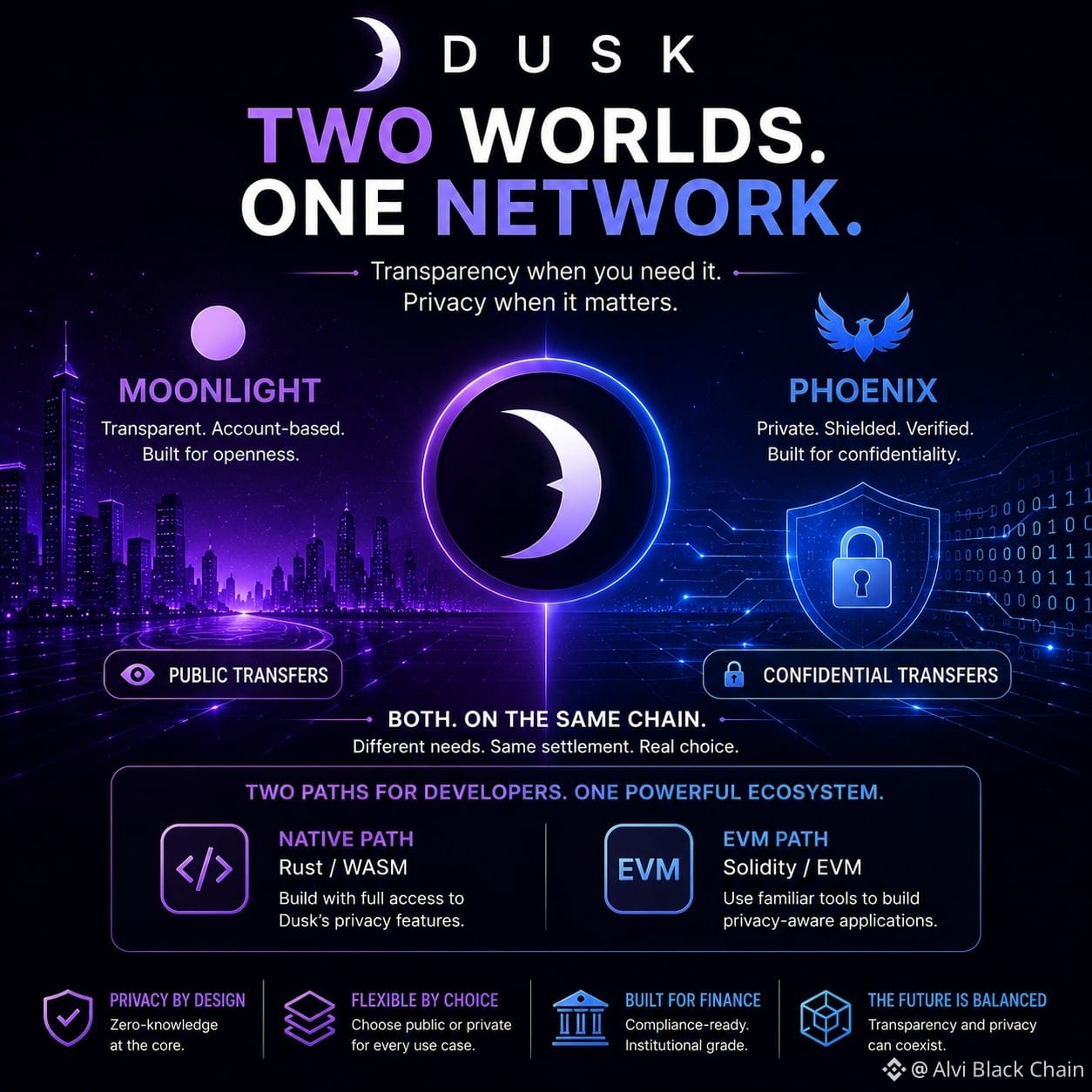
Duskは、規制対象の金融アプリケーション向けに作られたプライバシー重視のレイヤー1だと位置づけています。機密性の高いスマートコントラクト、XSC規格、選択的開示、コンプライアンスのためのツール——ということで、機関投資家は、すべての詳細をパブリックな台帳に投げ込まずに資産を決済できる、という構想です。さらにEVMレイヤーも追加されているので、開発者はゼロから始める必要がありません。紙の上では技術的なストーリーは筋が通っています。
ただ目立つのは、その物語のどれほどが実際の利用に反映されているかという点です。TVLはまだ薄く、アクティビティ指標も控えめで、市場は依然として、実証された需要というよりはストーリーを値付けしているように見えます。初回のベスティングは数年前に完了しているため、現在の主な供給圧力は、ステーキング報酬を狙った「長期の半減(ハーリング)」の排出スケジュール——つまり、急に増えるというよりはじわじわ続くタイプです。
分かれ目としては面白いところがあります。発行体や取引の場は、トークンを大量に保有する必要がなくても、プライバシーや決済の機能を将来的に活用できる可能性があります。一方で、インフレと待ち時間を背負っているのはトークン保有者の側です。ガスやステーキングにはユーティリティがありますが、現時点では強いフィードバックループはまだ生まれていません。
私は同じ問いに何度も立ち戻ります。実際の機関投資家の取引量は、ロードマップと画面に映る数字のギャップをいつか埋めるのでしょうか。本当のテストは、これ以上の発表ではなく、実際の採用がどこまで進むかです。
@Dusk_Foundation #dusk $DUSK
{spot}(DUSKUSDT)
昨夜遅くにミッドキャップのリストをスクロールしていたら、DUSKがちょうど6セントあたりに静かに居座っていました。時価総額は3,000万ドルを少し超える程度です。出来高は落ち着いていて、何かが飛び抜けて目立つような状況ではありませんでした。そんな小さなディテールが、私をチャートとドキュメントに引き戻すのに十分でした。
Duskは、規制対象の金融アプリケーション向けに作られたプライバシー重視のレイヤー1だと位置づけています。機密性の高いスマートコントラクト、XSC規格、選択的開示、コンプライアンスのためのツール——ということで、機関投資家は、すべての詳細をパブリックな台帳に投げ込まずに資産を決済できる、という構想です。さらにEVMレイヤーも追加されているので、開発者はゼロから始める必要がありません。紙の上では技術的なストーリーは筋が通っています。
ただ目立つのは、その物語のどれほどが実際の利用に反映されているかという点です。TVLはまだ薄く、アクティビティ指標も控えめで、市場は依然として、実証された需要というよりはストーリーを値付けしているように見えます。初回のベスティングは数年前に完了しているため、現在の主な供給圧力は、ステーキング報酬を狙った「長期の半減(ハーリング)」の排出スケジュール——つまり、急に増えるというよりはじわじわ続くタイプです。
分かれ目としては面白いところがあります。発行体や取引の場は、トークンを大量に保有する必要がなくても、プライバシーや決済の機能を将来的に活用できる可能性があります。一方で、インフレと待ち時間を背負っているのはトークン保有者の側です。ガスやステーキングにはユーティリティがありますが、現時点では強いフィードバックループはまだ生まれていません。
私は同じ問いに何度も立ち戻ります。実際の機関投資家の取引量は、ロードマップと画面に映る数字のギャップをいつか埋めるのでしょうか。本当のテストは、これ以上の発表ではなく、実際の採用がどこまで進むかです。
@Dusk #dusk $DUSK
Duskは、規制対象の金融アプリケーション向けに作られたプライバシー重視のレイヤー1だと位置づけています。機密性の高いスマートコントラクト、XSC規格、選択的開示、コンプライアンスのためのツール——ということで、機関投資家は、すべての詳細をパブリックな台帳に投げ込まずに資産を決済できる、という構想です。さらにEVMレイヤーも追加されているので、開発者はゼロから始める必要がありません。紙の上では技術的なストーリーは筋が通っています。
ただ目立つのは、その物語のどれほどが実際の利用に反映されているかという点です。TVLはまだ薄く、アクティビティ指標も控えめで、市場は依然として、実証された需要というよりはストーリーを値付けしているように見えます。初回のベスティングは数年前に完了しているため、現在の主な供給圧力は、ステーキング報酬を狙った「長期の半減(ハーリング)」の排出スケジュール——つまり、急に増えるというよりはじわじわ続くタイプです。
分かれ目としては面白いところがあります。発行体や取引の場は、トークンを大量に保有する必要がなくても、プライバシーや決済の機能を将来的に活用できる可能性があります。一方で、インフレと待ち時間を背負っているのはトークン保有者の側です。ガスやステーキングにはユーティリティがありますが、現時点では強いフィードバックループはまだ生まれていません。
私は同じ問いに何度も立ち戻ります。実際の機関投資家の取引量は、ロードマップと画面に映る数字のギャップをいつか埋めるのでしょうか。本当のテストは、これ以上の発表ではなく、実際の採用がどこまで進むかです。
@Dusk #dusk $DUSK
54
昨夜遅く、ミッドキャップの銘柄リストをスクロールしていたら、DUSKがちょうど6セントあたりでじっとしているのが目に入った。時価総額は3,000万ドルちょっと。出来高は静かで、特に目を引く動きはない。けれど、その小さな事実だけでチャートと資料に戻らせるには十分だった。
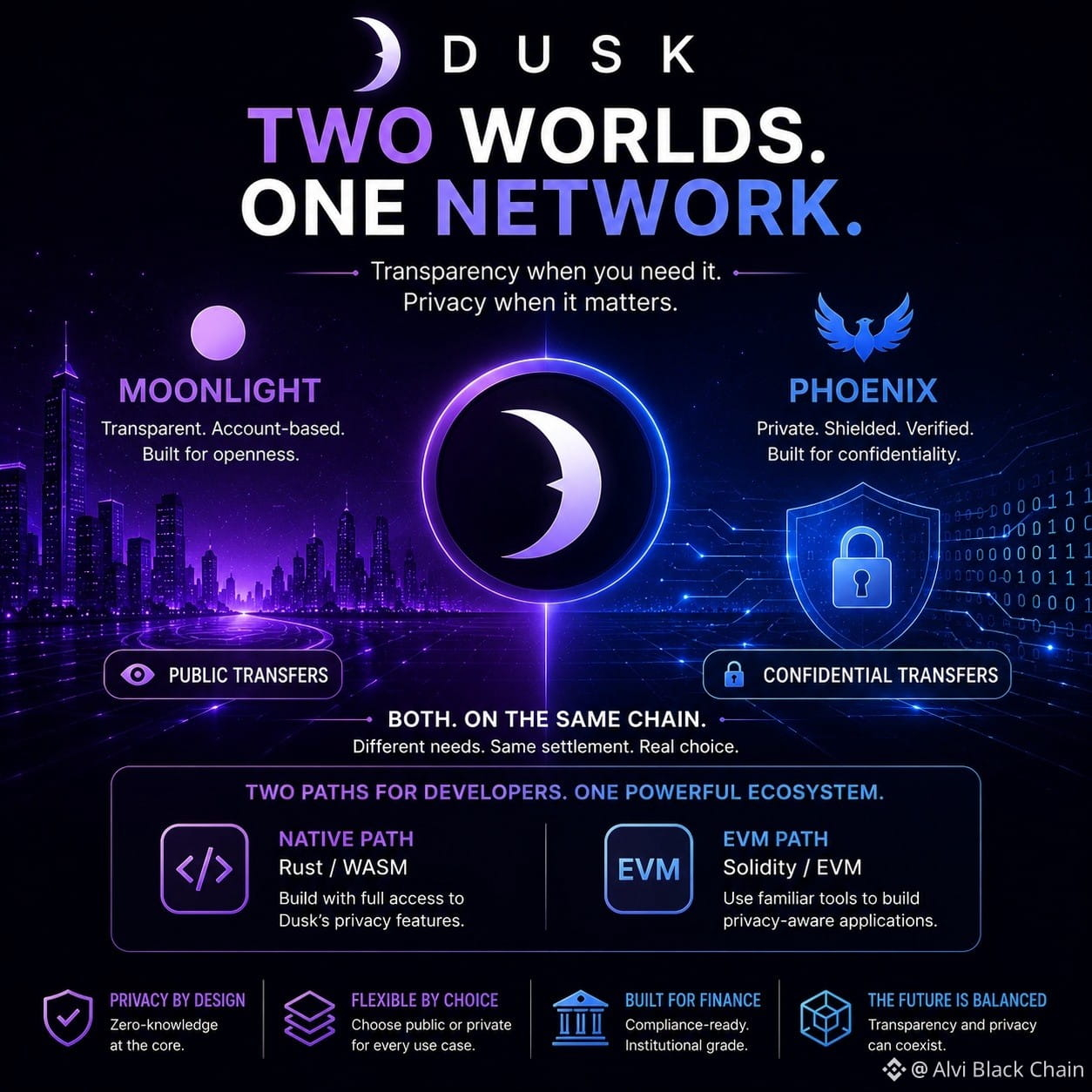
Duskは、規制された金融アプリケーション向けのプライバシー重視のレイヤー1だと打ち出している。機密スマートコントラクト、XSC標準、選択的開示、コンプライアンスのためのツール。つまり、機関が、すべての詳細をパブリックな台帳に載せることなく、資産を決済できるという考えだ。さらにEVMレイヤーも追加していて、開発者がゼロから始めなくて済むようにしている。紙の上では技術的なストーリーは筋が通っている。
目立つのは、その物語のごく一部しか実際の利用に反映されていないことだ。TVLはまだ薄く、アクティビティ指標も控えめで、市場も実証済みの需要というより「物語」を価格に織り込んでいるように見える。初回のベスティングは数年前に完了しているため、現時点の主な供給圧力は、ステーキング報酬を狙った長期の半減(ハルビング)スケジュールだけだ。急激というより、じわじわだ。
分岐点は興味深い。発行体や取引会場は、トークンを多額に保有する必要がなくても、いずれはプライバシーや決済機能を活用できる可能性がある。インフレと「待つ」ことを引き受けているのはトークン保有者側だ。ガスやステーキングにはユースケースがあるが、まだ強いフィードバックループは生まれていない。
結局、同じ問いに立ち返ってしまう。現実の機関投資家の取引量は、ロードマップと画面上の数字のギャップを埋めることがあるのだろうか?本当の試金石は、追加の発表ではなく、実際の採用が進むかどうかになるはずだ。
@Dusk_Foundation #dusk $DUSK
{spot}(DUSKUSDT)
昨夜遅く、ミッドキャップの銘柄リストをスクロールしていたら、DUSKがちょうど6セントあたりでじっとしているのが目に入った。時価総額は3,000万ドルちょっと。出来高は静かで、特に目を引く動きはない。けれど、その小さな事実だけでチャートと資料に戻らせるには十分だった。
Duskは、規制された金融アプリケーション向けのプライバシー重視のレイヤー1だと打ち出している。機密スマートコントラクト、XSC標準、選択的開示、コンプライアンスのためのツール。つまり、機関が、すべての詳細をパブリックな台帳に載せることなく、資産を決済できるという考えだ。さらにEVMレイヤーも追加していて、開発者がゼロから始めなくて済むようにしている。紙の上では技術的なストーリーは筋が通っている。
目立つのは、その物語のごく一部しか実際の利用に反映されていないことだ。TVLはまだ薄く、アクティビティ指標も控えめで、市場も実証済みの需要というより「物語」を価格に織り込んでいるように見える。初回のベスティングは数年前に完了しているため、現時点の主な供給圧力は、ステーキング報酬を狙った長期の半減(ハルビング)スケジュールだけだ。急激というより、じわじわだ。
分岐点は興味深い。発行体や取引会場は、トークンを多額に保有する必要がなくても、いずれはプライバシーや決済機能を活用できる可能性がある。インフレと「待つ」ことを引き受けているのはトークン保有者側だ。ガスやステーキングにはユースケースがあるが、まだ強いフィードバックループは生まれていない。
結局、同じ問いに立ち返ってしまう。現実の機関投資家の取引量は、ロードマップと画面上の数字のギャップを埋めることがあるのだろうか?本当の試金石は、追加の発表ではなく、実際の採用が進むかどうかになるはずだ。
@Dusk #dusk $DUSK
Duskは、規制された金融アプリケーション向けのプライバシー重視のレイヤー1だと打ち出している。機密スマートコントラクト、XSC標準、選択的開示、コンプライアンスのためのツール。つまり、機関が、すべての詳細をパブリックな台帳に載せることなく、資産を決済できるという考えだ。さらにEVMレイヤーも追加していて、開発者がゼロから始めなくて済むようにしている。紙の上では技術的なストーリーは筋が通っている。
目立つのは、その物語のごく一部しか実際の利用に反映されていないことだ。TVLはまだ薄く、アクティビティ指標も控えめで、市場も実証済みの需要というより「物語」を価格に織り込んでいるように見える。初回のベスティングは数年前に完了しているため、現時点の主な供給圧力は、ステーキング報酬を狙った長期の半減(ハルビング)スケジュールだけだ。急激というより、じわじわだ。
分岐点は興味深い。発行体や取引会場は、トークンを多額に保有する必要がなくても、いずれはプライバシーや決済機能を活用できる可能性がある。インフレと「待つ」ことを引き受けているのはトークン保有者側だ。ガスやステーキングにはユースケースがあるが、まだ強いフィードバックループは生まれていない。
結局、同じ問いに立ち返ってしまう。現実の機関投資家の取引量は、ロードマップと画面上の数字のギャップを埋めることがあるのだろうか?本当の試金石は、追加の発表ではなく、実際の採用が進むかどうかになるはずだ。
@Dusk #dusk $DUSK
67
#dusk $DUSK 私は@Dusk_Foundation 今日のことを考えていて、ひとつ特に印象に残ったのは、プライバシーはユーザー側から見るとその価値を理解しやすいということです。
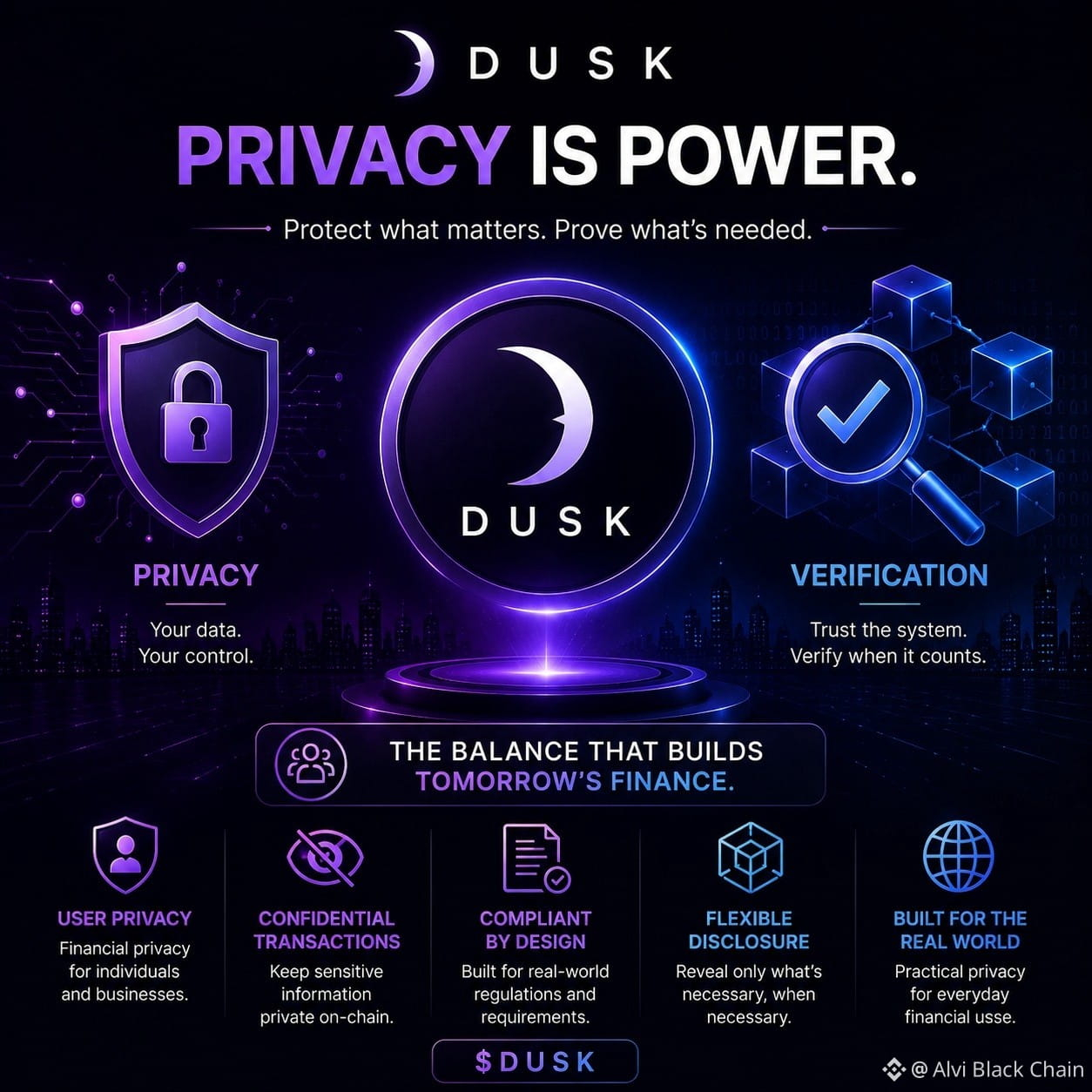
たぶん多くの人は、自分の口座残高や支払い履歴、あるいはあらゆる金融取引が、たまたまブロックチェーンを見た誰にでも見えてしまうことを望まないでしょう。同時に、金融システムは何も確認できない黒い箱になってしまってはならない。
そのバランスが、私にはとても興味深いです。
プライバシーはユーザーを守り、検証はシステムを守ります。どちらか一方が弱くなりすぎると、体験全体の価値が失われ始めます。
オンチェーン金融の未来が完全に公開でも完全に非公開でもないと私は思います。おそらく、どの情報をいつ公開するかについて、ユーザーとアプリケーションにより多くのコントロールを与えられるかどうかにかかっているのでしょう。
だから私は@Dusk_Foundation この技術を注目しています。技術そのものも重要ですが、より大きな問いは、プライバシーが暗号資産ネイティブのユーザーだけが理解するものとして残るのではなく、日常的な金融活動で実際に役立つものになれるかどうかです。
それが実現すれば、$DUSK は単なる別の「プライバシーコイン」以上に、ずっと実用的な物語を持てるはずです。
金融において、あなたにとってより重要なのは何ですか:完全な透明性、それとも自分のデータを自分で管理できること?
$DUSK #dusk
#dusk $DUSK 私は@Dusk 今日のことを考えていて、ひとつ特に印象に残ったのは、プライバシーはユーザー側から見るとその価値を理解しやすいということです。
たぶん多くの人は、自分の口座残高や支払い履歴、あるいはあらゆる金融取引が、たまたまブロックチェーンを見た誰にでも見えてしまうことを望まないでしょう。同時に、金融システムは何も確認できない黒い箱になってしまってはならない。
そのバランスが、私にはとても興味深いです。
プライバシーはユーザーを守り、検証はシステムを守ります。どちらか一方が弱くなりすぎると、体験全体の価値が失われ始めます。
オンチェーン金融の未来が完全に公開でも完全に非公開でもないと私は思います。おそらく、どの情報をいつ公開するかについて、ユーザーとアプリケーションにより多くのコントロールを与えられるかどうかにかかっているのでしょう。
だから私は@Dusk この技術を注目しています。技術そのものも重要ですが、より大きな問いは、プライバシーが暗号資産ネイティブのユーザーだけが理解するものとして残るのではなく、日常的な金融活動で実際に役立つものになれるかどうかです。
それが実現すれば、$DUSK は単なる別の「プライバシーコイン」以上に、ずっと実用的な物語を持てるはずです。
金融において、あなたにとってより重要なのは何ですか:完全な透明性、それとも自分のデータを自分で管理できること?
$DUSK #dusk
たぶん多くの人は、自分の口座残高や支払い履歴、あるいはあらゆる金融取引が、たまたまブロックチェーンを見た誰にでも見えてしまうことを望まないでしょう。同時に、金融システムは何も確認できない黒い箱になってしまってはならない。
そのバランスが、私にはとても興味深いです。
プライバシーはユーザーを守り、検証はシステムを守ります。どちらか一方が弱くなりすぎると、体験全体の価値が失われ始めます。
オンチェーン金融の未来が完全に公開でも完全に非公開でもないと私は思います。おそらく、どの情報をいつ公開するかについて、ユーザーとアプリケーションにより多くのコントロールを与えられるかどうかにかかっているのでしょう。
だから私は@Dusk この技術を注目しています。技術そのものも重要ですが、より大きな問いは、プライバシーが暗号資産ネイティブのユーザーだけが理解するものとして残るのではなく、日常的な金融活動で実際に役立つものになれるかどうかです。
それが実現すれば、$DUSK は単なる別の「プライバシーコイン」以上に、ずっと実用的な物語を持てるはずです。
金融において、あなたにとってより重要なのは何ですか:完全な透明性、それとも自分のデータを自分で管理できること?
$DUSK #dusk
4
1
76
翻訳参照
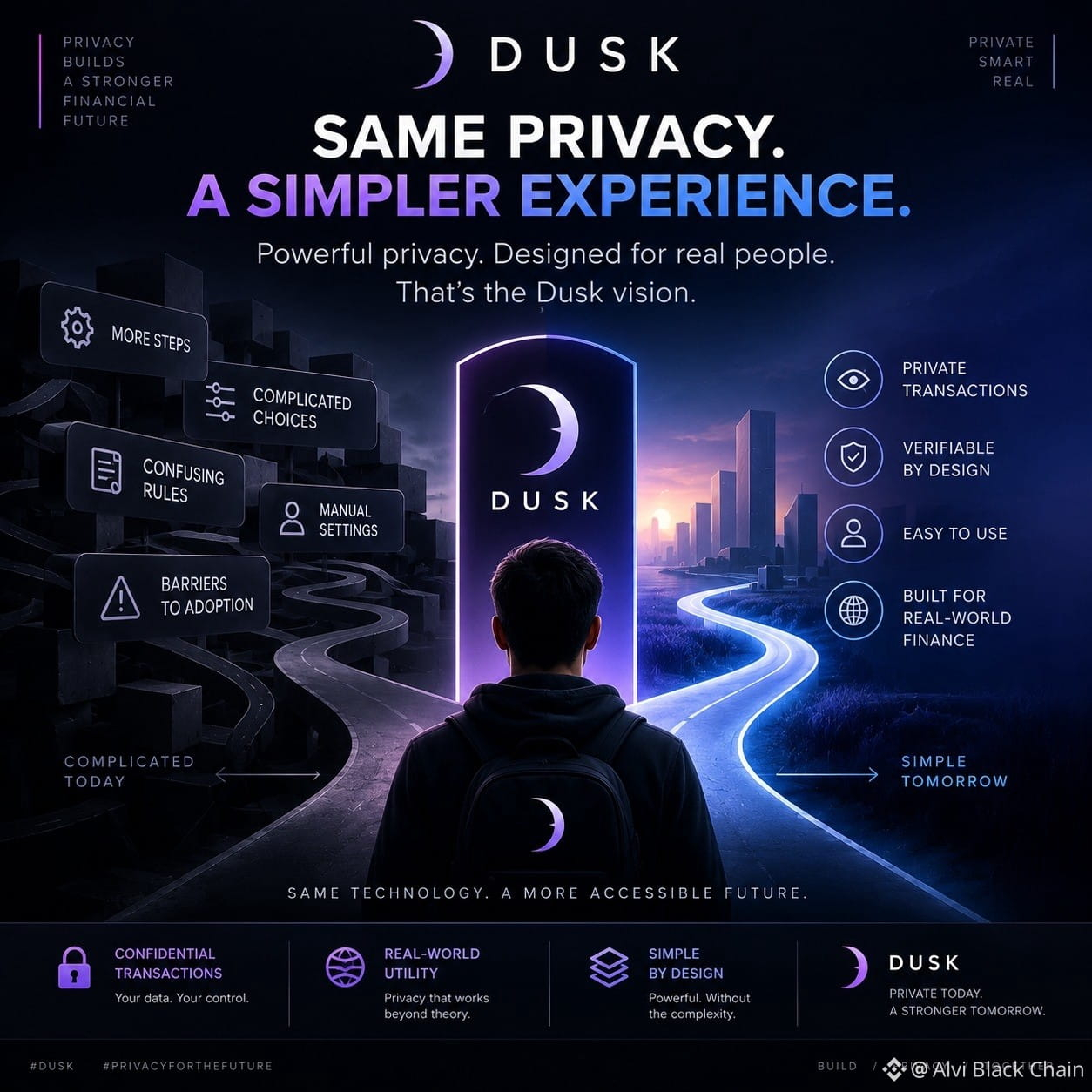
#dusk $DUSK I keep coming back to one question while looking at @Dusk_Foundation can privacy infrastructure become easier to use without becoming weaker?
For many users, privacy sounds valuable until it adds extra steps, confusing choices, or complicated rules around what can and cannot be disclosed. That may be one of the biggest challenges for confidential blockchain applications.
The technology behind privacy can be advanced, but adoption may depend on something much simpler: whether people can use it without needing to understand every cryptographic detail underneath.
That’s why I think the real test for Dusk is not only whether confidential transactions work as designed. It’s whether privacy can become a natural part of the user experience rather than a feature users have to actively manage.
If the network can keep sensitive information protected while making verification and interaction straightforward, that could be far more important than simply adding another privacy feature.
In the end, the strongest infrastructure may be the kind users barely notice—because it quietly does what it is supposed to do.
Can privacy become invisible to the user while remaining fully verifiable to the network?
@Dusk_Foundation
$DUSK
#dusk
#dusk $DUSK I keep coming back to one question while looking at @Dusk can privacy infrastructure become easier to use without becoming weaker?
For many users, privacy sounds valuable until it adds extra steps, confusing choices, or complicated rules around what can and cannot be disclosed. That may be one of the biggest challenges for confidential blockchain applications.
The technology behind privacy can be advanced, but adoption may depend on something much simpler: whether people can use it without needing to understand every cryptographic detail underneath.
That’s why I think the real test for Dusk is not only whether confidential transactions work as designed. It’s whether privacy can become a natural part of the user experience rather than a feature users have to actively manage.
If the network can keep sensitive information protected while making verification and interaction straightforward, that could be far more important than simply adding another privacy feature.
In the end, the strongest infrastructure may be the kind users barely notice—because it quietly does what it is supposed to do.
Can privacy become invisible to the user while remaining fully verifiable to the network?
@Dusk
$DUSK
#dusk
For many users, privacy sounds valuable until it adds extra steps, confusing choices, or complicated rules around what can and cannot be disclosed. That may be one of the biggest challenges for confidential blockchain applications.
The technology behind privacy can be advanced, but adoption may depend on something much simpler: whether people can use it without needing to understand every cryptographic detail underneath.
That’s why I think the real test for Dusk is not only whether confidential transactions work as designed. It’s whether privacy can become a natural part of the user experience rather than a feature users have to actively manage.
If the network can keep sensitive information protected while making verification and interaction straightforward, that could be far more important than simply adding another privacy feature.
In the end, the strongest infrastructure may be the kind users barely notice—because it quietly does what it is supposed to do.
Can privacy become invisible to the user while remaining fully verifiable to the network?
@Dusk
$DUSK
#dusk
84
@Dusk_Foundation は、将来に向けて設計された機密スマートコントラクトで、プライバシー重視の金融の限界を押し広げています。プライバシー、コンプライアンス、そして現実の金融が交わるにつれて、$DUSK は注目しておく価値のあるプロジェクトになりつつあります。
#DUSK #Crypto #Privacy #Blockchain
@Dusk は、将来に向けて設計された機密スマートコントラクトで、プライバシー重視の金融の限界を押し広げています。プライバシー、コンプライアンス、そして現実の金融が交わるにつれて、$DUSK は注目しておく価値のあるプロジェクトになりつつあります。
#DUSK #Crypto #Privacy #Blockchain
#DUSK #Crypto #Privacy #Blockchain
42
ログインして、さらにコンテンツを読む
厳選トピックで世界の暗号資産トレーダーの仲間入り
⚡️ 暗号資産に関する最新かつ有益な情報が見つかります。
💬 世界最大の暗号資産取引所から信頼されています。
👍 認証を受けたクリエイターから、有益なインサイトを得られます。
メール / 電話番号
トレンドトピック
PolymarketBankFailureBetsDrawFDICConcern
閲覧回数 1,633
118人が討論中
#polymarketbankfailurebetsdrawfdicconcern
🚨 市場アラート:Polymarketでの「銀行破綻」ベットがFDIC懸念を呼び込む
状況:Polymarket上の高リスクな予測市場――特に大手銀行の破綻確率への賭け――が規制当局、なかでもFDICから重大な注目と懸念を集めています。これにより、市場心理が規制の監視を直接左右することで、不安定なフィードバックループが生まれています。その結果、セクター全体で大規模な取引量とボラティリティが引き起こされています。
トレーダーにとっての意味:金融の困難をめぐる予測市場がこれほど注目を集める場合、極端な市場ストレスと、上昇したシステミック(金融システム全体の)リスクを示唆します。トレーダーは銀行セクター全体の伝播リスクを綿密に監視しており、これはリスク管理とセクターローテーションにとって重要な局面です。
注目すべき取引可能なコイン:
$BTC (ビットコイン):究極のマクロ・ヘッジ。法定通貨の銀行安定性に対する懸念が高まると、トレーダーはしばしば非中央集権で主権のない価値の保存手段として、資金をビットコインへ回す傾向があります。
$ETH (イーサリアム):分散型金融(DeFi)エコシステムを牽引。従来の銀行セクターに圧力がかかると、オンチェーンの金融やイーサリアム上に構築された融資プロトコルへの注目が高まることが多くなります。
$BNB (BNB/バイナンス・コイン):取引所の健全性や、より広い市場心理の代理指標。主要取引所トークンが突発的な金融ニュースにどう反応するかを追うことで、市場の流動性全体や、トレーダーの自信がどれほどあるかを把握できます。
あなたはシステミックリスクに備えてヘッジしていますか?それとも傍観していますか?下のコメントで戦略を聞かせてください!👇
#Polymarket #FDIC #BankingSector #PredictionMarkets
Axiom AlphA
·いいね:0件
·閲覧回数 2.1k
BlackRockBuildsTokenizedPortfoliosForOndo
閲覧回数 988
76人が討論中
BitwiseFilesToListNEARETFOnNYSEArca
閲覧回数 2,290
103人が討論中