
mikeskcv
28 投稿

mikeskcv
報告
ユーザーをブロック
5 フォロー
1 フォロワー
10 いいね
投稿
·
--
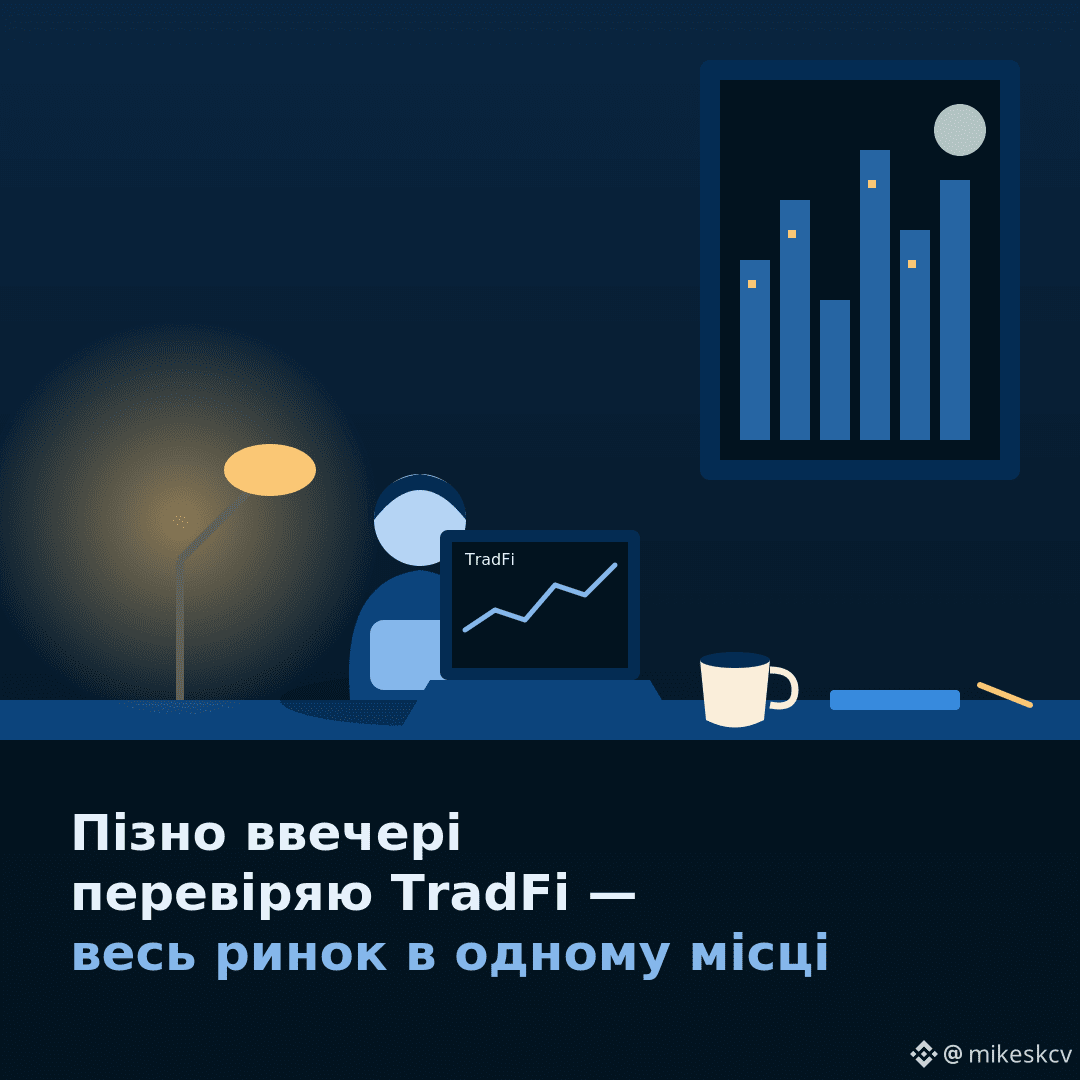
中央銀行の利回りがまたニュースになっていて、それに対して伝統的な資産がどう反応するかを見るのは面白い。BinanceでのTradFiが便利なのは、さまざまな取引所を開きっぱなしで5つのタブを持つ必要がないからで、ワンストップで市場の全体像がより早く把握できる。
#TradFi #Binance #CreateWithBinance #ринок
中央銀行の利回りがまたニュースになっていて、それに対して伝統的な資産がどう反応するかを見るのは面白い。BinanceでのTradFiが便利なのは、さまざまな取引所を開きっぱなしで5つのタブを持つ必要がないからで、ワンストップで市場の全体像がより早く把握できる。
#TradFi #Binance #CreateWithBinance #ринок
#TradFi #Binance #CreateWithBinance #ринок
113
·
--
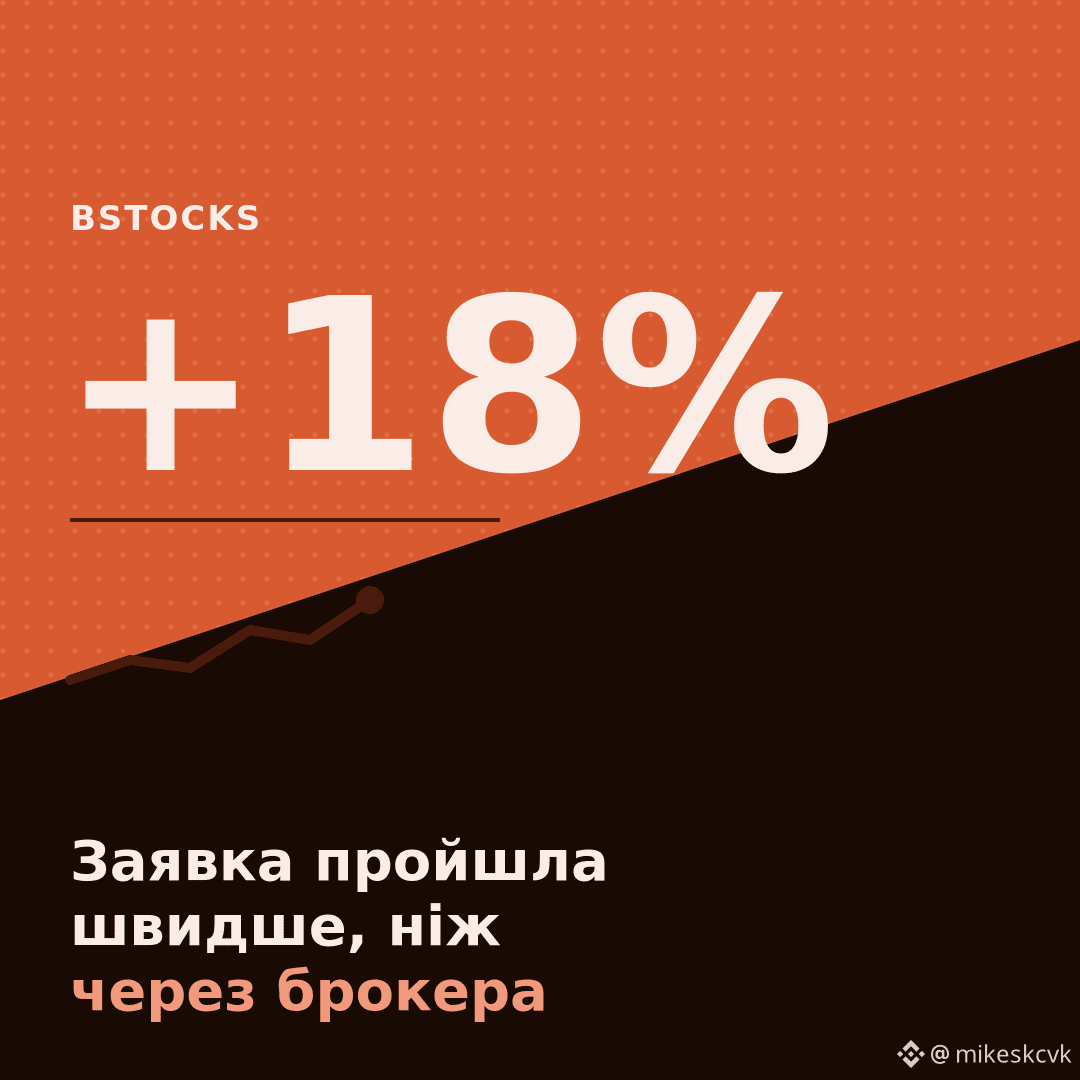
今週 bStocks を試してみました。Apple の小さな持分を購入しましたが、通常の証券会社よりも申請が早く通り、手数料もいい意味で驚きました。とりあえずプラスです。
#bStocks #Binance #CreateWithBinance #інвестиції
今週 bStocks を試してみました。Apple の小さな持分を購入しましたが、通常の証券会社よりも申請が早く通り、手数料もいい意味で驚きました。とりあえずプラスです。
#bStocks #Binance #CreateWithBinance #інвестиції
#bStocks #Binance #CreateWithBinance #інвестиції
181
·
--
翻訳参照
#termmax @termmax
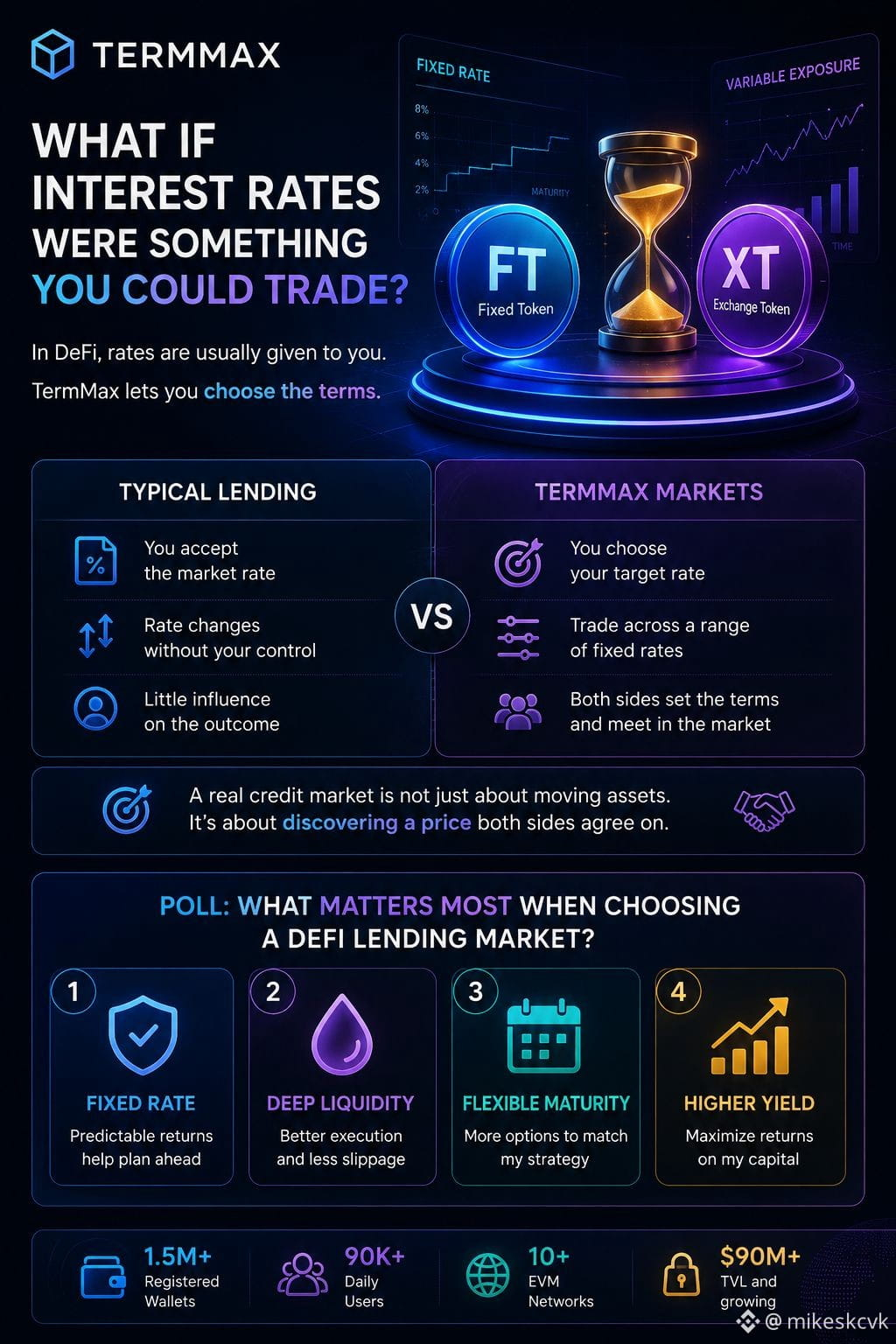
What if the most interesting part of DeFi lending isn't the yield?
But who gets to choose the terms?
That's what I find interesting about TermMax.
In a typical lending market, you mostly accept whatever rate the market is giving you.
But fixed-rate markets introduce another possibility.
A borrower can think:
“At what rate does this loan actually make sense for
me?”
And a lender can think:
“At what return am I comfortable locking my capital?”
Now the interest rate isn't just a number on a dashboard.
It's part of the negotiation.
That changes how I look at on-chain credit.
Because a real financial market isn't only about moving assets from A to B.
It's about discovering a price that both sides are willing to accept.
TermMax is experimenting with that idea on-chain.
And honestly, I think this is a more interesting question than chasing the highest APY:
Can DeFi create efficient markets for the price of time and capital?
That's what I'll be watching.
#termmax @TermMax
What if the most interesting part of DeFi lending isn't the yield?
But who gets to choose the terms?
That's what I find interesting about TermMax.
In a typical lending market, you mostly accept whatever rate the market is giving you.
But fixed-rate markets introduce another possibility.
A borrower can think:
“At what rate does this loan actually make sense for
me?”
And a lender can think:
“At what return am I comfortable locking my capital?”
Now the interest rate isn't just a number on a dashboard.
It's part of the negotiation.
That changes how I look at on-chain credit.
Because a real financial market isn't only about moving assets from A to B.
It's about discovering a price that both sides are willing to accept.
TermMax is experimenting with that idea on-chain.
And honestly, I think this is a more interesting question than chasing the highest APY:
Can DeFi create efficient markets for the price of time and capital?
That's what I'll be watching.
What if the most interesting part of DeFi lending isn't the yield?
But who gets to choose the terms?
That's what I find interesting about TermMax.
In a typical lending market, you mostly accept whatever rate the market is giving you.
But fixed-rate markets introduce another possibility.
A borrower can think:
“At what rate does this loan actually make sense for
me?”
And a lender can think:
“At what return am I comfortable locking my capital?”
Now the interest rate isn't just a number on a dashboard.
It's part of the negotiation.
That changes how I look at on-chain credit.
Because a real financial market isn't only about moving assets from A to B.
It's about discovering a price that both sides are willing to accept.
TermMax is experimenting with that idea on-chain.
And honestly, I think this is a more interesting question than chasing the highest APY:
Can DeFi create efficient markets for the price of time and capital?
That's what I'll be watching.
88
·
--
翻訳参照
#termmax @termmax
The most interesting TermMax update isn't the $TMX TGE.
It's something much less exciting at first glance:
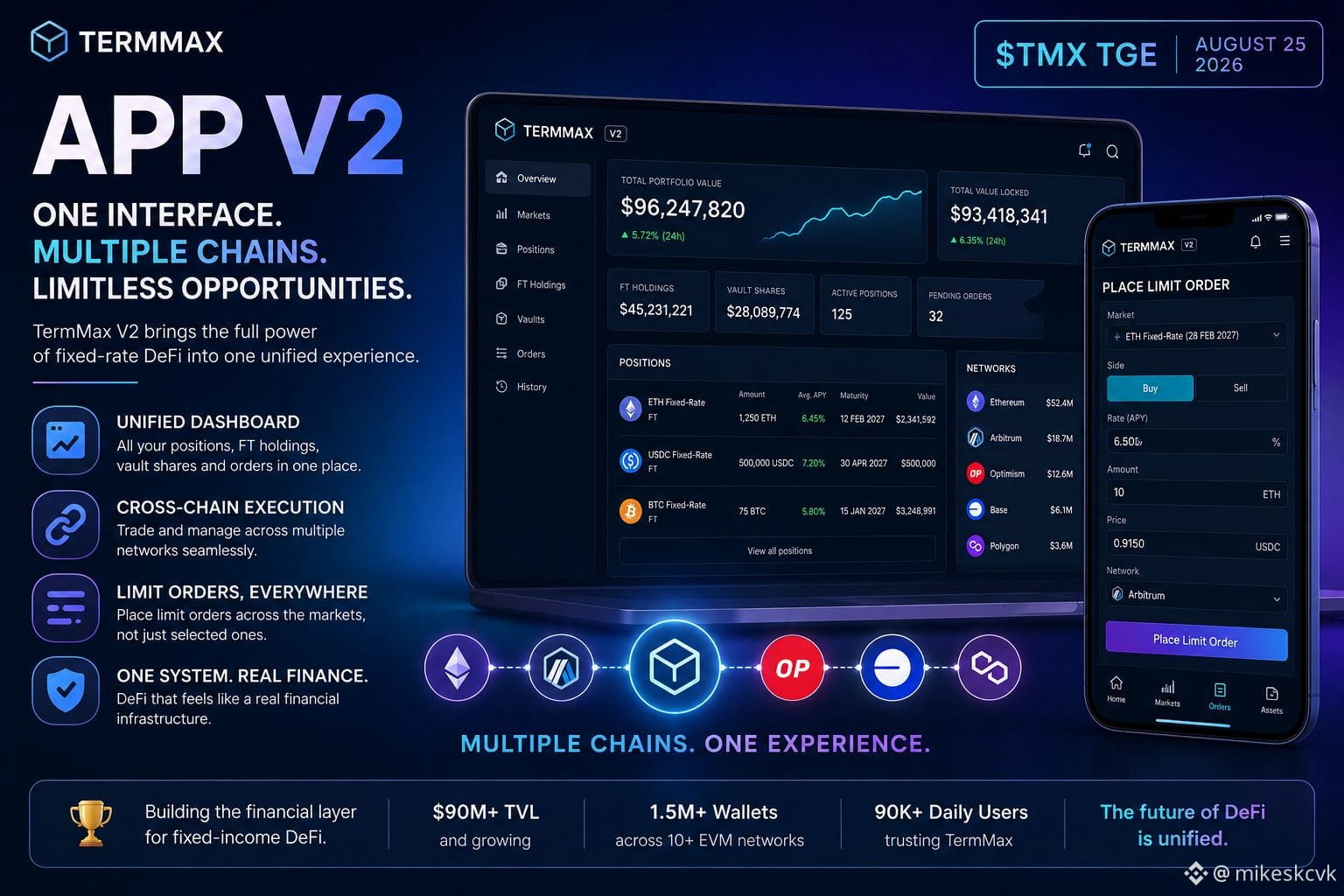
App V2.
Why?
Because DeFi has a fragmentation problem.
One chain for this position.
Another chain for that vault.
Different interfaces.
Different orders.
Different liquidity.
You can have a great protocol and still make the user experience feel like managing five different accounts.
TermMax V2 is moving in the opposite direction.
One interface for multiple chains.
One dashboard for positions, FT holdings, vault shares and orders.
And limit orders across the markets instead of restricting them to selected ones.
That might sound like a UX improvement.
I think it's more important than that.
If fixed-rate DeFi is supposed to become actual financial infrastructure, users shouldn't have to think about the underlying chain every time they make a transaction.
The chain should become the infrastructure.
The product should be the market.
And this is where TermMax gets interesting to me.
The next stage of DeFi may not be about adding more protocols.
It may be about making the protocols we already have feel like one financial system.
$TMX TGE is coming on August 25.
But I'm more interested in what happens after the infrastructure is already built.
#termmax @TermMax
The most interesting TermMax update isn't the $TMX TGE.
It's something much less exciting at first glance:
App V2.
Why?
Because DeFi has a fragmentation problem.
One chain for this position.
Another chain for that vault.
Different interfaces.
Different orders.
Different liquidity.
You can have a great protocol and still make the user experience feel like managing five different accounts.
TermMax V2 is moving in the opposite direction.
One interface for multiple chains.
One dashboard for positions, FT holdings, vault shares and orders.
And limit orders across the markets instead of restricting them to selected ones.
That might sound like a UX improvement.
I think it's more important than that.
If fixed-rate DeFi is supposed to become actual financial infrastructure, users shouldn't have to think about the underlying chain every time they make a transaction.
The chain should become the infrastructure.
The product should be the market.
And this is where TermMax gets interesting to me.
The next stage of DeFi may not be about adding more protocols.
It may be about making the protocols we already have feel like one financial system.
$TMX TGE is coming on August 25.
But I'm more interested in what happens after the infrastructure is already built.
The most interesting TermMax update isn't the $TMX TGE.
It's something much less exciting at first glance:
App V2.
Why?
Because DeFi has a fragmentation problem.
One chain for this position.
Another chain for that vault.
Different interfaces.
Different orders.
Different liquidity.
You can have a great protocol and still make the user experience feel like managing five different accounts.
TermMax V2 is moving in the opposite direction.
One interface for multiple chains.
One dashboard for positions, FT holdings, vault shares and orders.
And limit orders across the markets instead of restricting them to selected ones.
That might sound like a UX improvement.
I think it's more important than that.
If fixed-rate DeFi is supposed to become actual financial infrastructure, users shouldn't have to think about the underlying chain every time they make a transaction.
The chain should become the infrastructure.
The product should be the market.
And this is where TermMax gets interesting to me.
The next stage of DeFi may not be about adding more protocols.
It may be about making the protocols we already have feel like one financial system.
$TMX TGE is coming on August 25.
But I'm more interested in what happens after the infrastructure is already built.
1
82
·
--
ブリッシュ
翻訳参照
#termmax @termmax
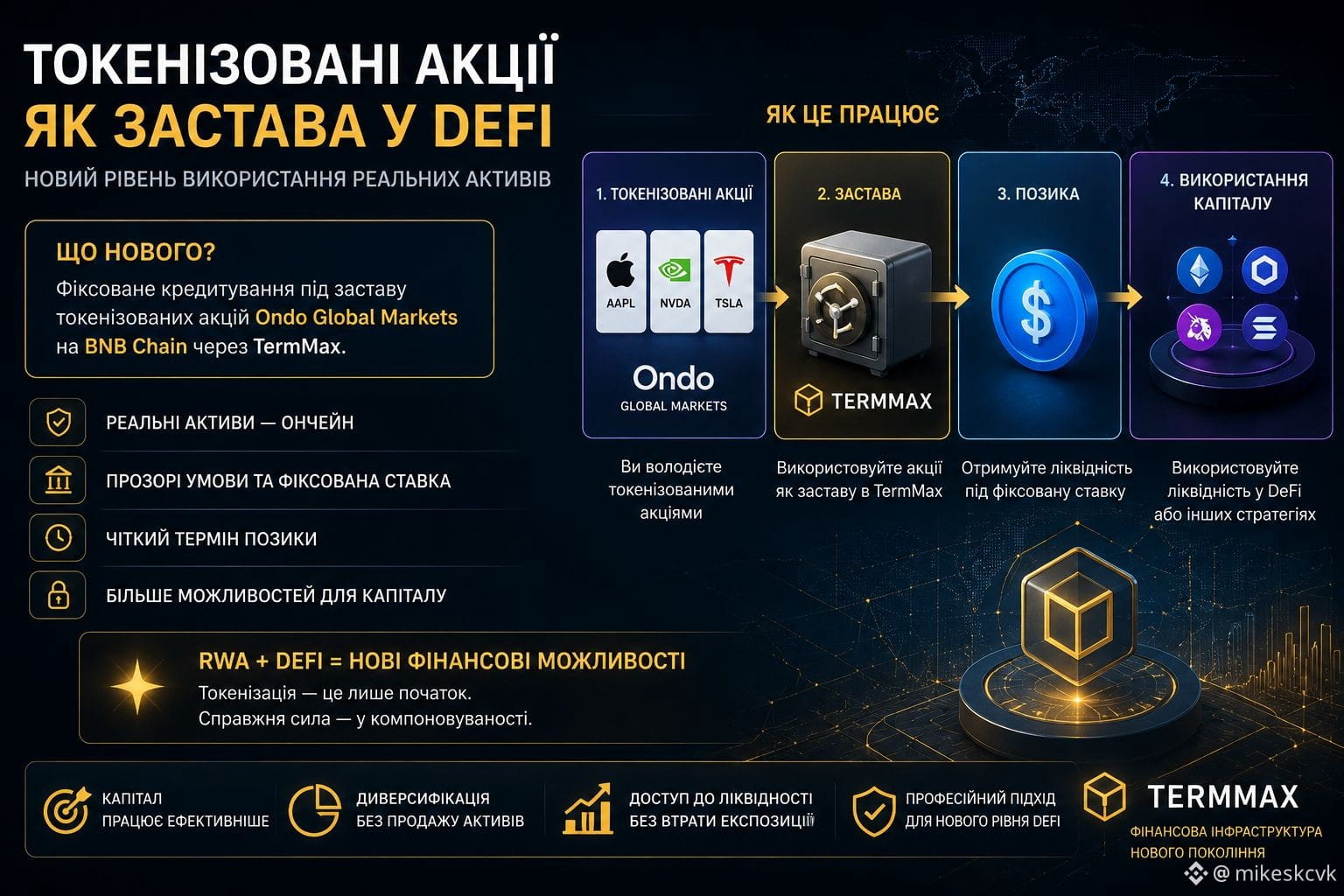
Більшість людей дивляться на токенізовані акції як на спосіб отримати доступ до традиційних ринків через блокчейн.
Але мені цікавіше інше питання.
Що, якщо такі активи можуть не просто лежати в портфелі?
Що, якщо вони можуть працювати як фінансовий інструмент?
Саме тут стає цікаво.
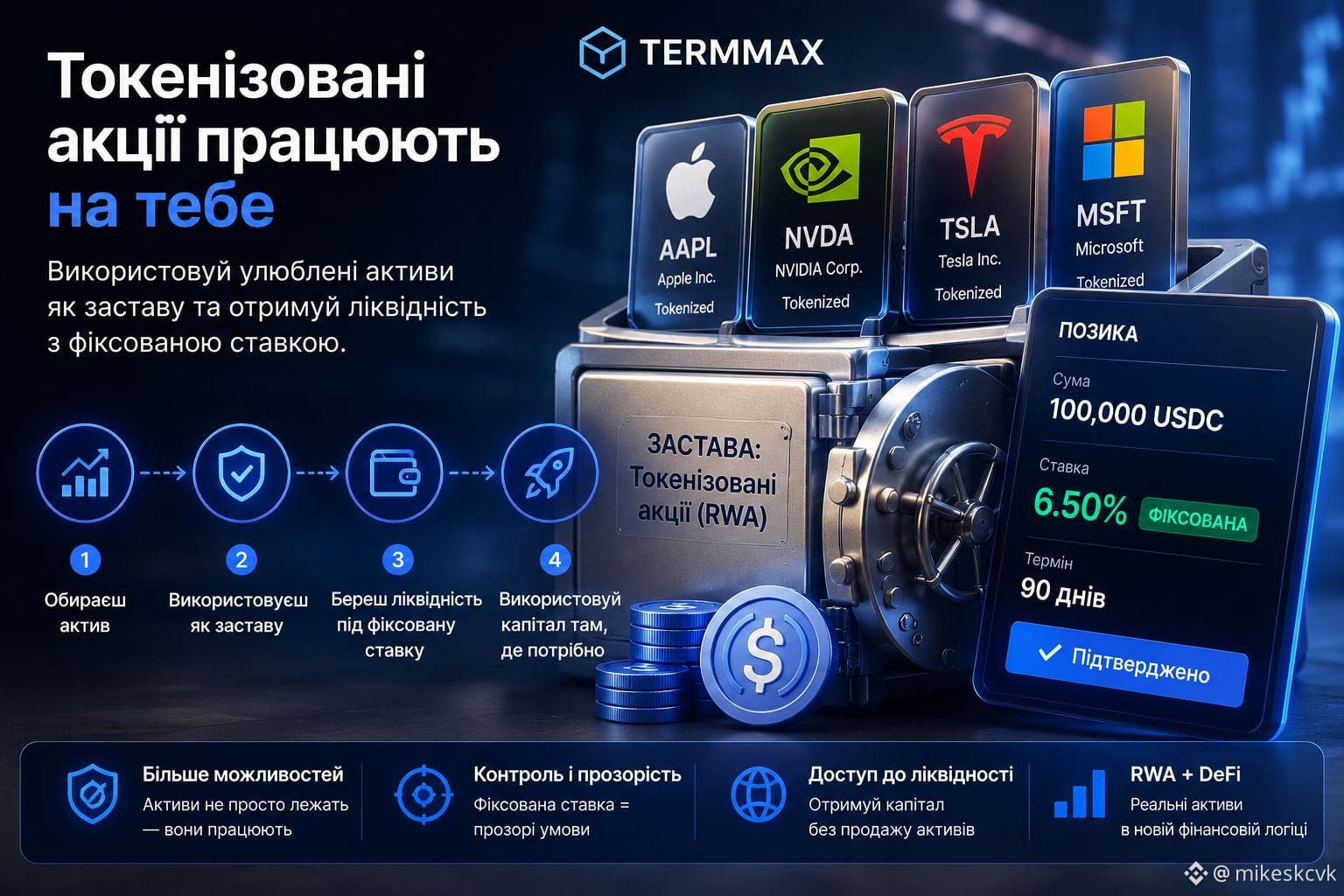
TermMax дозволяє використовувати токенізовані акції як заставу для отримання ліквідності під фіксовану ставку.
Тобто актив не просто відображає ціну акції.
Він стає частиною DeFi-екосистеми.
У результаті з'являється нова логіка:
📈 Тримаєш токенізовані акції
🔒 Використовуєш їх як заставу
💵 Отримуєш ліквідність
🚀 Використовуєш капітал в інших стратегіях
На мою думку, саме тут прихований справжній потенціал RWA.
Не в самій токенізації.
А в тому, що реальні активи починають взаємодіяти з DeFi так само гнучко, як криптоактиви.
І що більше таких сценаріїв з'являтиметься, то цікавішою ставатиме вся екосистема.
Токенізація — це лише перший крок.
Справжня цінність починається тоді, коли активи можна використовувати по-новому.
#termmax @TermMax
Більшість людей дивляться на токенізовані акції як на спосіб отримати доступ до традиційних ринків через блокчейн.
Але мені цікавіше інше питання.
Що, якщо такі активи можуть не просто лежати в портфелі?
Що, якщо вони можуть працювати як фінансовий інструмент?
Саме тут стає цікаво.
TermMax дозволяє використовувати токенізовані акції як заставу для отримання ліквідності під фіксовану ставку.
Тобто актив не просто відображає ціну акції.
Він стає частиною DeFi-екосистеми.
У результаті з'являється нова логіка:
📈 Тримаєш токенізовані акції
🔒 Використовуєш їх як заставу
💵 Отримуєш ліквідність
🚀 Використовуєш капітал в інших стратегіях
На мою думку, саме тут прихований справжній потенціал RWA.
Не в самій токенізації.
А в тому, що реальні активи починають взаємодіяти з DeFi так само гнучко, як криптоактиви.
І що більше таких сценаріїв з'являтиметься, то цікавішою ставатиме вся екосистема.
Токенізація — це лише перший крок.
Справжня цінність починається тоді, коли активи можна використовувати по-новому.
Більшість людей дивляться на токенізовані акції як на спосіб отримати доступ до традиційних ринків через блокчейн.
Але мені цікавіше інше питання.
Що, якщо такі активи можуть не просто лежати в портфелі?
Що, якщо вони можуть працювати як фінансовий інструмент?
Саме тут стає цікаво.
TermMax дозволяє використовувати токенізовані акції як заставу для отримання ліквідності під фіксовану ставку.
Тобто актив не просто відображає ціну акції.
Він стає частиною DeFi-екосистеми.
У результаті з'являється нова логіка:
📈 Тримаєш токенізовані акції
🔒 Використовуєш їх як заставу
💵 Отримуєш ліквідність
🚀 Використовуєш капітал в інших стратегіях
На мою думку, саме тут прихований справжній потенціал RWA.
Не в самій токенізації.
А в тому, що реальні активи починають взаємодіяти з DeFi так само гнучко, як криптоактиви.
І що більше таких сценаріїв з'являтиметься, то цікавішою ставатиме вся екосистема.
Токенізація — це лише перший крок.
Справжня цінність починається тоді, коли активи можна використовувати по-новому.
138
·
--
翻訳参照
Most people look at a lending protocol and ask:
“What's the APY?”
I think that's only half the story.
The other half is what happens to your capital while you're earning that APY.
Can you predict when the position ends?
Do you know exactly what you're lending into?
Can you build a strategy around a specific maturity?
That's the part of TermMax I find interesting.
Its approach treats lending more like an actual financial instrument: the position has defined terms and a maturity instead of being just another deposit sitting in a pool.
And this matters beyond retail DeFi.
If on-chain credit is ever going to attract serious capital, investors will need more than attractive yields.
They'll need products they can understand, price and plan around.
Maybe DeFi's next upgrade isn't another way to chase yield.
Maybe it's making lending feel more like a real financial market.
That's a much more interesting direction to me.
#termmax @termmax
Quick DeFi poll 👇
When you choose a lending opportunity, what do you care about MOST?
Most people look at a lending protocol and ask:
“What's the APY?”
I think that's only half the story.
The other half is what happens to your capital while you're earning that APY.
Can you predict when the position ends?
Do you know exactly what you're lending into?
Can you build a strategy around a specific maturity?
That's the part of TermMax I find interesting.
Its approach treats lending more like an actual financial instrument: the position has defined terms and a maturity instead of being just another deposit sitting in a pool.
And this matters beyond retail DeFi.
If on-chain credit is ever going to attract serious capital, investors will need more than attractive yields.
They'll need products they can understand, price and plan around.
Maybe DeFi's next upgrade isn't another way to chase yield.
Maybe it's making lending feel more like a real financial market.
That's a much more interesting direction to me.
#termmax @TermMax
Quick DeFi poll 👇
When you choose a lending opportunity, what do you care about MOST?
“What's the APY?”
I think that's only half the story.
The other half is what happens to your capital while you're earning that APY.
Can you predict when the position ends?
Do you know exactly what you're lending into?
Can you build a strategy around a specific maturity?
That's the part of TermMax I find interesting.
Its approach treats lending more like an actual financial instrument: the position has defined terms and a maturity instead of being just another deposit sitting in a pool.
And this matters beyond retail DeFi.
If on-chain credit is ever going to attract serious capital, investors will need more than attractive yields.
They'll need products they can understand, price and plan around.
Maybe DeFi's next upgrade isn't another way to chase yield.
Maybe it's making lending feel more like a real financial market.
That's a much more interesting direction to me.
#termmax @TermMax
Quick DeFi poll 👇
When you choose a lending opportunity, what do you care about MOST?
Higher APY
0%
Fixed maturity
0%
Liquidity
0%
Risk / security
0%
0 投票 • 投票は終了しました
56
·
--
翻訳参照
I used to think a bigger balance automatically meant a bigger position.
Then I started paying more attention to what one unit actually represents.
Imagine I have 10 tokens.
Later, I look again and see 20.
My first instinct would probably be:
“Nice. I doubled my position.”
But that conclusion can be completely wrong.
If a corporate action changes the unit structure, the number of tokens can change while the economic exposure is adjusted at the same time.
So the balance by itself isn't enough.
I now think about it as two separate questions:
How many units do I own?
and
What is each unit worth?
Those two numbers need to be looked at together.
Otherwise, a simple change in quantity can create a very misleading impression.
It's the same reason I don't judge a company by its share count alone.
More shares doesn't automatically mean more value.
The unit matters.
The price matters.
And the relationship between them matters even more.
That's a small detail, but it's exactly the kind of detail that can make a tokenized asset look confusing when nothing unusual actually happened to the underlying economic position.
Would you check the token quantity first, or the total position value first?
#bstockscis @BinanceCIS
I used to think a bigger balance automatically meant a bigger position.
Then I started paying more attention to what one unit actually represents.
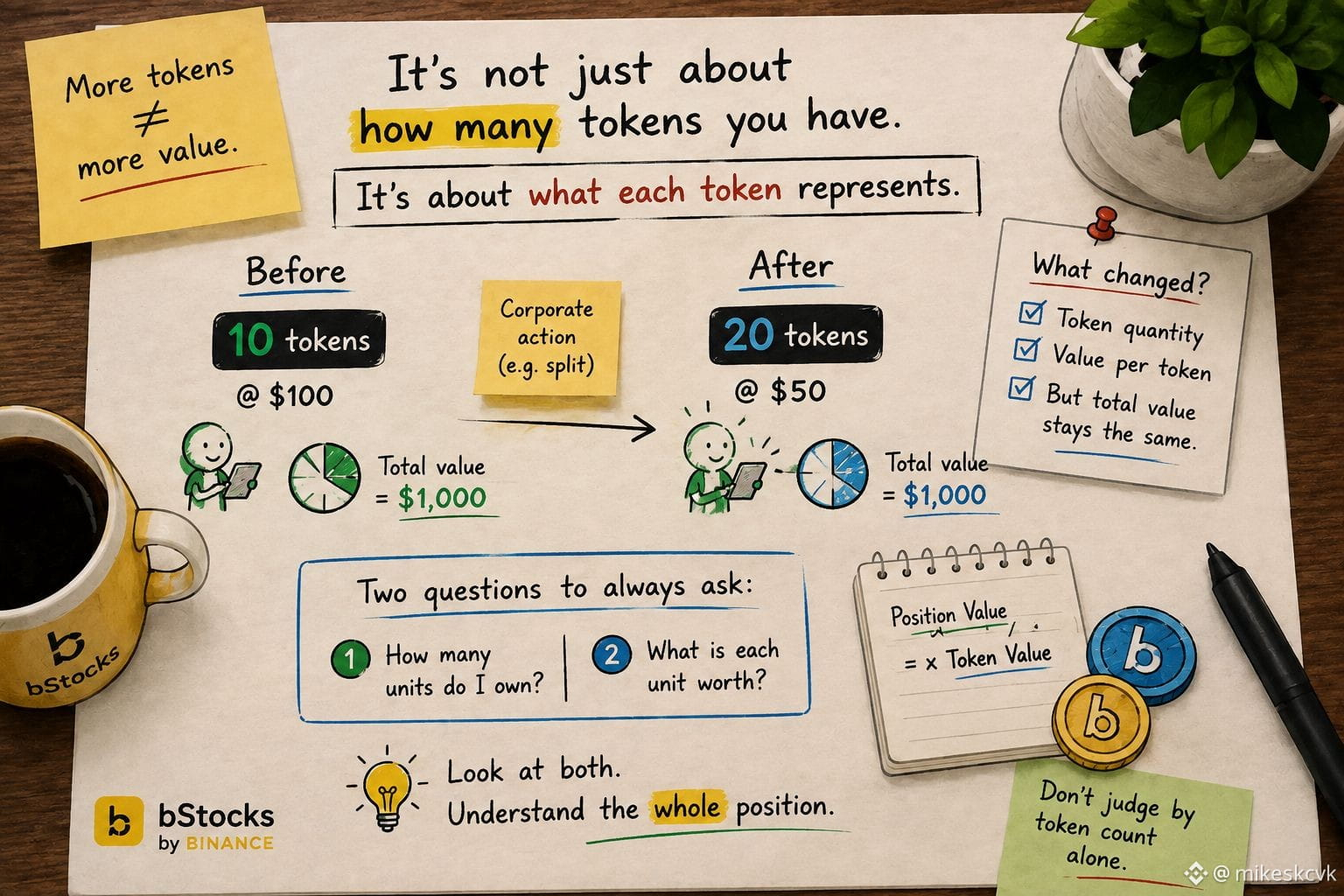
Imagine I have 10 tokens.
Later, I look again and see 20.
My first instinct would probably be:
“Nice. I doubled my position.”
But that conclusion can be completely wrong.
If a corporate action changes the unit structure, the number of tokens can change while the economic exposure is adjusted at the same time.
So the balance by itself isn't enough.
I now think about it as two separate questions:
How many units do I own?
and
What is each unit worth?
Those two numbers need to be looked at together.
Otherwise, a simple change in quantity can create a very misleading impression.
It's the same reason I don't judge a company by its share count alone.
More shares doesn't automatically mean more value.
The unit matters.
The price matters.
And the relationship between them matters even more.
That's a small detail, but it's exactly the kind of detail that can make a tokenized asset look confusing when nothing unusual actually happened to the underlying economic position.
Would you check the token quantity first, or the total position value first?
#bstockscis @BinanceCIS
Then I started paying more attention to what one unit actually represents.
Imagine I have 10 tokens.
Later, I look again and see 20.
My first instinct would probably be:
“Nice. I doubled my position.”
But that conclusion can be completely wrong.
If a corporate action changes the unit structure, the number of tokens can change while the economic exposure is adjusted at the same time.
So the balance by itself isn't enough.
I now think about it as two separate questions:
How many units do I own?
and
What is each unit worth?
Those two numbers need to be looked at together.
Otherwise, a simple change in quantity can create a very misleading impression.
It's the same reason I don't judge a company by its share count alone.
More shares doesn't automatically mean more value.
The unit matters.
The price matters.
And the relationship between them matters even more.
That's a small detail, but it's exactly the kind of detail that can make a tokenized asset look confusing when nothing unusual actually happened to the underlying economic position.
Would you check the token quantity first, or the total position value first?
#bstockscis @BinanceCIS
1
1
99
·
--
翻訳参照
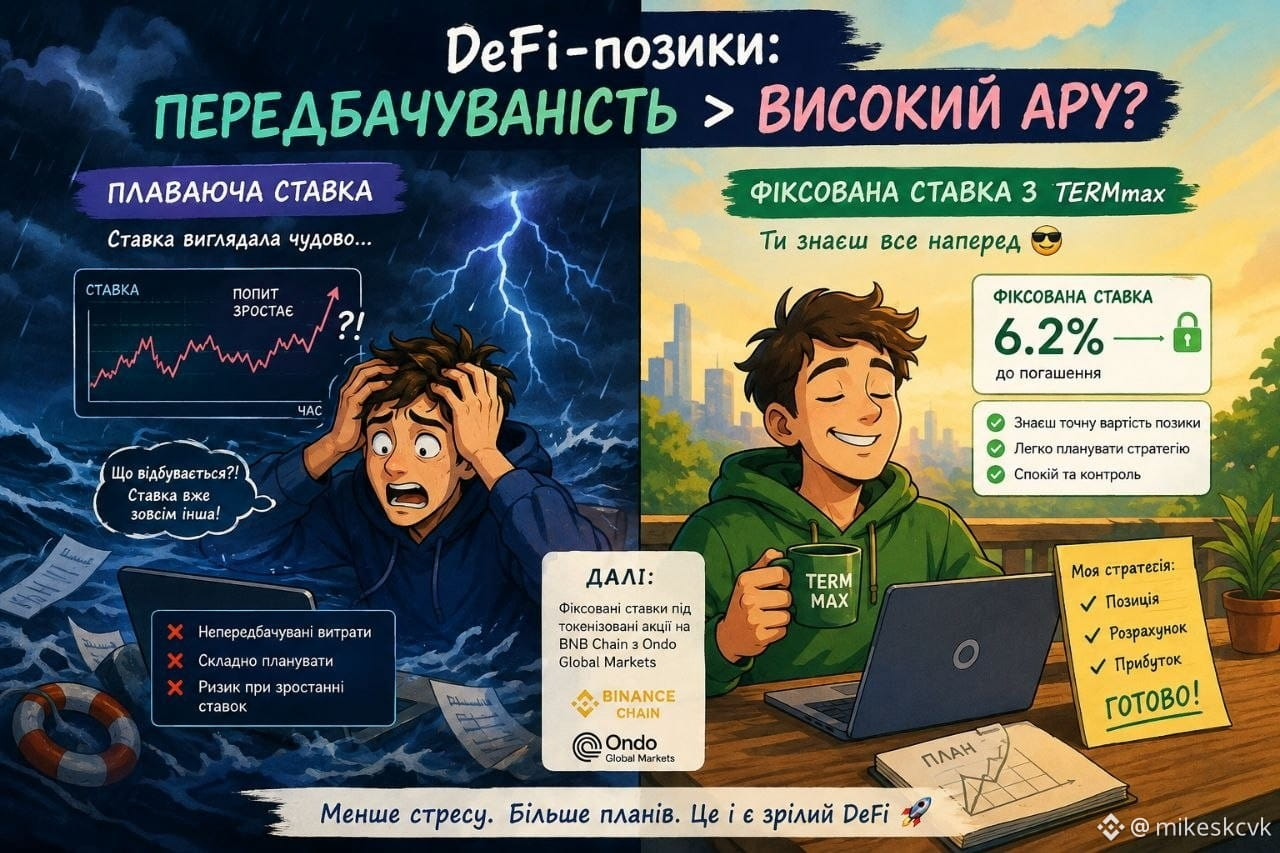
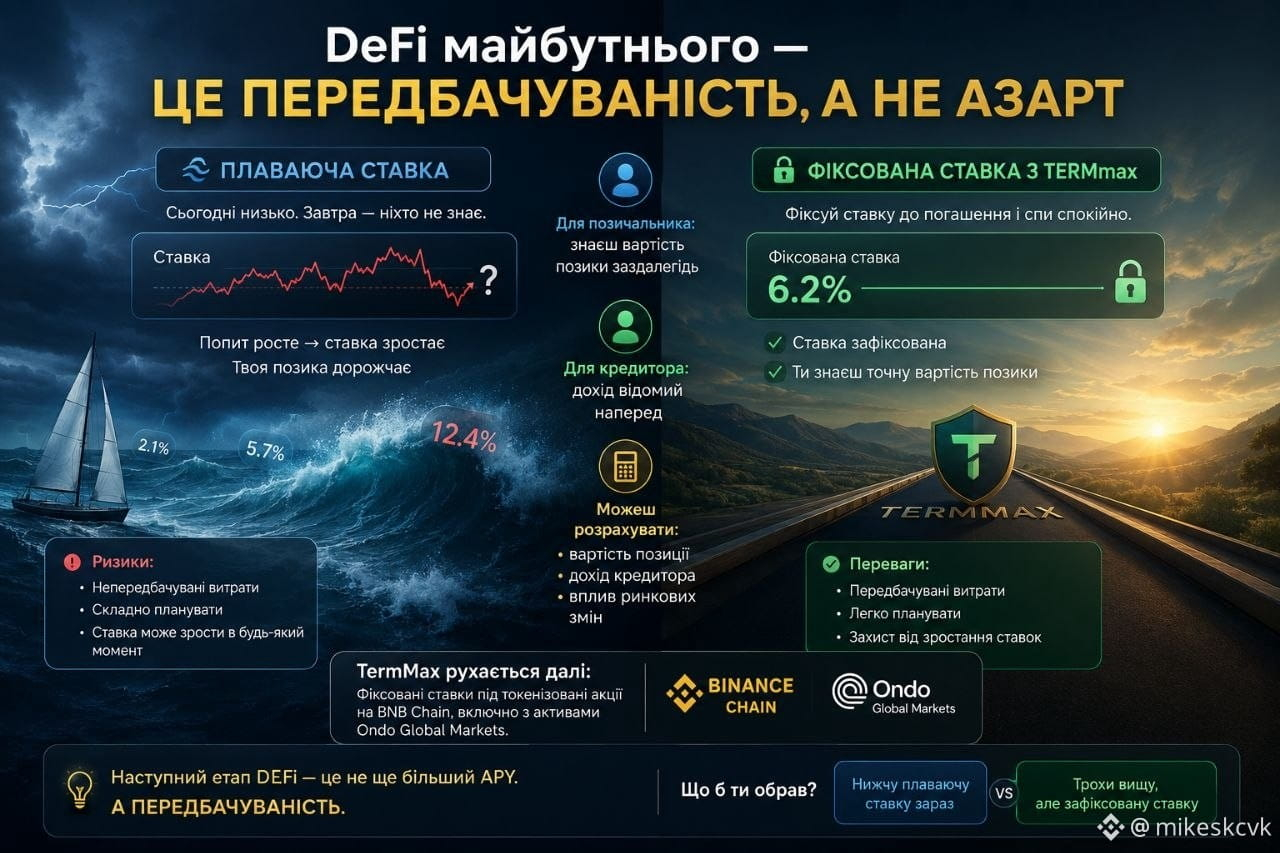
DeFi привчив нас до плаваючих ставок.
Поки тобі не знадобиться позика на кілька місяців.
Сьогодні ставка вигідна. Завтра через зміну попиту чи ліквідності вартість позики вже інша.
Саме тому мені цікавий TermMax.
Тут можна зафіксувати ставку до моменту погашення.
Для позичальника — зрозуміла вартість позики.
Для кредитора — прогнозований дохід.
І це особливо цікаво для більших стратегій, де важливо заздалегідь знати вартість капіталу.
Ще цікавіше, що TermMax рухається у бік RWA. Команда вже інтегрувала fixed-rate borrowing під токенізовані акції на BNB Chain.
Можливо, наступний етап DeFi — не максимальний APY.
А передбачуваність.
Що оберете: нижчу плаваючу ставку чи трохи вищу, але зафіксовану?
#termmax @termmax
DeFi привчив нас до плаваючих ставок.
Поки тобі не знадобиться позика на кілька місяців.
Сьогодні ставка вигідна. Завтра через зміну попиту чи ліквідності вартість позики вже інша.
Саме тому мені цікавий TermMax.
Тут можна зафіксувати ставку до моменту погашення.
Для позичальника — зрозуміла вартість позики.
Для кредитора — прогнозований дохід.
І це особливо цікаво для більших стратегій, де важливо заздалегідь знати вартість капіталу.
Ще цікавіше, що TermMax рухається у бік RWA. Команда вже інтегрувала fixed-rate borrowing під токенізовані акції на BNB Chain.
Можливо, наступний етап DeFi — не максимальний APY.
А передбачуваність.
Що оберете: нижчу плаваючу ставку чи трохи вищу, але зафіксовану?
#termmax @TermMax
Поки тобі не знадобиться позика на кілька місяців.
Сьогодні ставка вигідна. Завтра через зміну попиту чи ліквідності вартість позики вже інша.
Саме тому мені цікавий TermMax.
Тут можна зафіксувати ставку до моменту погашення.
Для позичальника — зрозуміла вартість позики.
Для кредитора — прогнозований дохід.
І це особливо цікаво для більших стратегій, де важливо заздалегідь знати вартість капіталу.
Ще цікавіше, що TermMax рухається у бік RWA. Команда вже інтегрувала fixed-rate borrowing під токенізовані акції на BNB Chain.
Можливо, наступний етап DeFi — не максимальний APY.
А передбачуваність.
Що оберете: нижчу плаваючу ставку чи трохи вищу, але зафіксовану?
#termmax @TermMax
131
·
--
翻訳参照
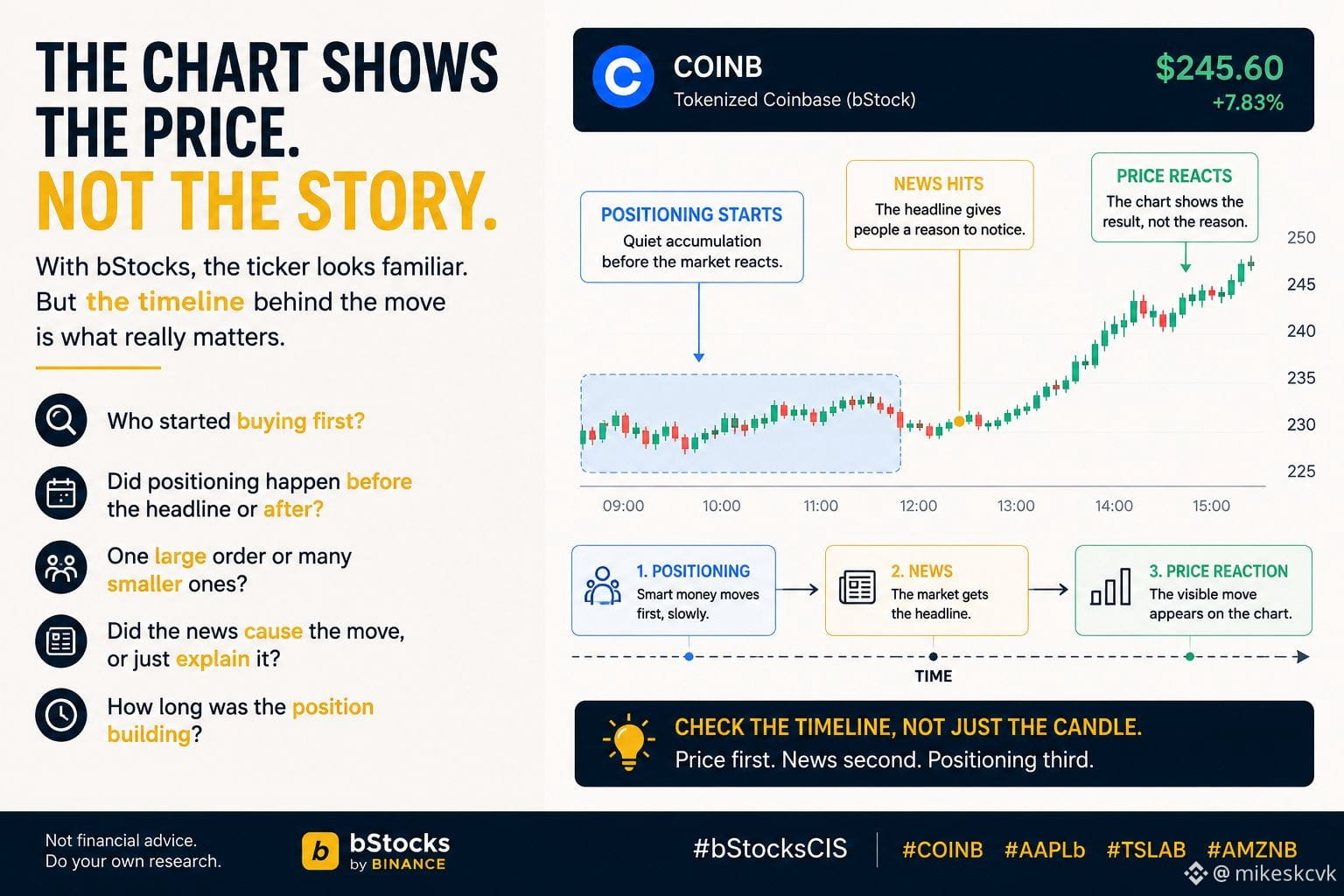
One thing I’ve started paying more attention to with tokenized stocks is the difference between what the chart shows and what actually happened before the chart moved.
Take #COINB as an example.
A sharp green candle can make it look like the market suddenly “decided” that the company was worth more.
But the candle only tells me where the market traded.
It doesn’t tell me: — who started buying first
— how long the position was building
— whether the move came from one large order or many smaller ones
— whether the price reaction happened before or after the headline
— or whether the headline simply gave traders a reason to notice the move.
That last part is easy to miss.
Sometimes the news is the explanation people remember, while the positioning happened much earlier.
And that changes how I read a chart.
Instead of asking:
“Why did #COINB go up today?”
I’d rather ask:
“What was already happening before today?”
For bStocks, I think this distinction is especially useful because the interface can make a traditional stock ticker feel very familiar. The familiar ticker doesn’t mean every piece of market information should be interpreted exactly like a normal brokerage position.
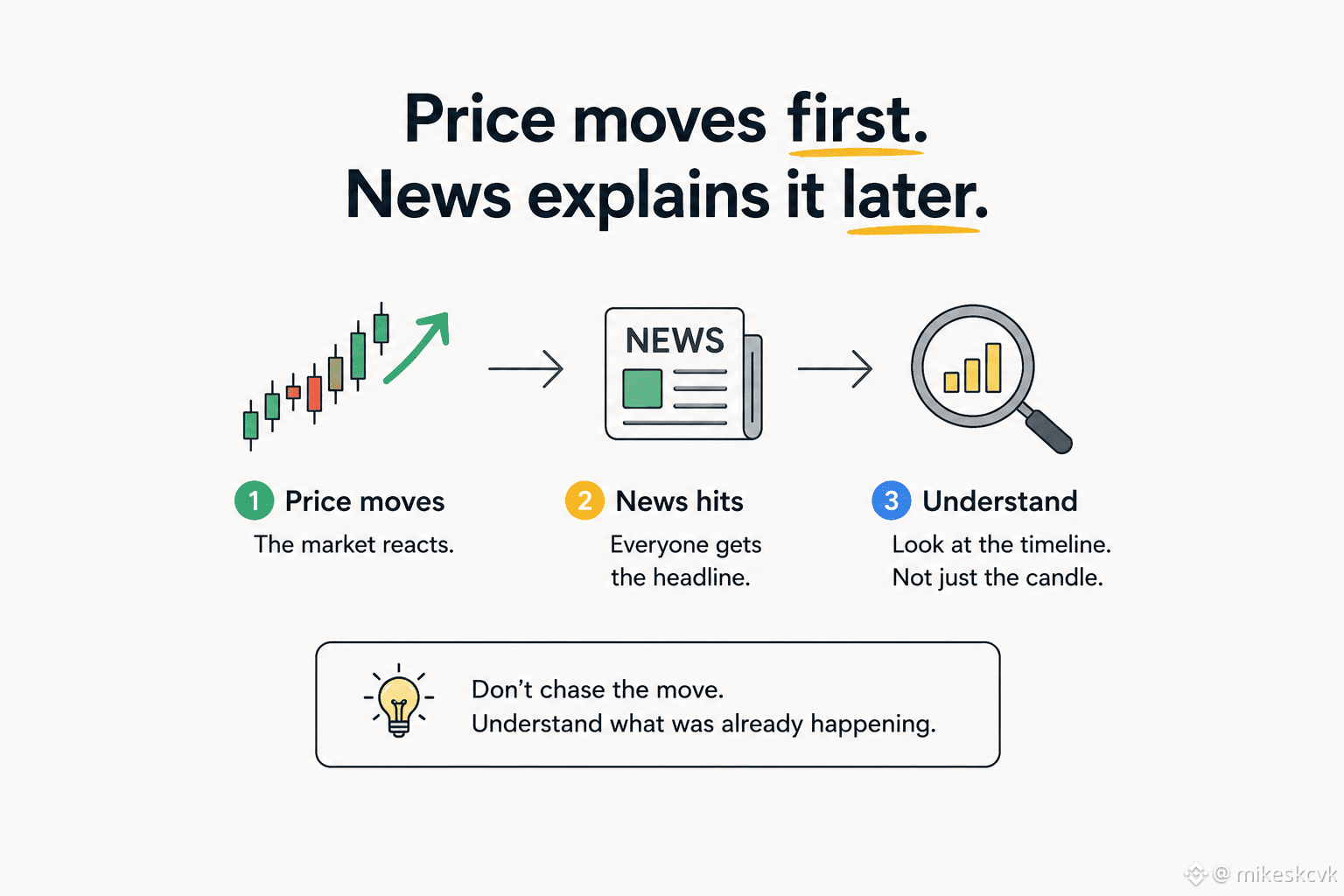
So now, when I see a big move, my first instinct isn’t to chase the candle.
I check the timeline.
Price first.
News second.
Positioning third.
The order matters more than I thought.
#bstockscis @BinanceCIS
One thing I’ve started paying more attention to with tokenized stocks is the difference between what the chart shows and what actually happened before the chart moved.
Take #COINB as an example.
A sharp green candle can make it look like the market suddenly “decided” that the company was worth more.
But the candle only tells me where the market traded.
It doesn’t tell me: — who started buying first
— how long the position was building
— whether the move came from one large order or many smaller ones
— whether the price reaction happened before or after the headline
— or whether the headline simply gave traders a reason to notice the move.
That last part is easy to miss.
Sometimes the news is the explanation people remember, while the positioning happened much earlier.
And that changes how I read a chart.
Instead of asking:
“Why did #COINB go up today?”
I’d rather ask:
“What was already happening before today?”
For bStocks, I think this distinction is especially useful because the interface can make a traditional stock ticker feel very familiar. The familiar ticker doesn’t mean every piece of market information should be interpreted exactly like a normal brokerage position.
So now, when I see a big move, my first instinct isn’t to chase the candle.
I check the timeline.
Price first.
News second.
Positioning third.
The order matters more than I thought.
#bstockscis @BinanceCIS
Take #COINB as an example.
A sharp green candle can make it look like the market suddenly “decided” that the company was worth more.
But the candle only tells me where the market traded.
It doesn’t tell me: — who started buying first
— how long the position was building
— whether the move came from one large order or many smaller ones
— whether the price reaction happened before or after the headline
— or whether the headline simply gave traders a reason to notice the move.
That last part is easy to miss.
Sometimes the news is the explanation people remember, while the positioning happened much earlier.
And that changes how I read a chart.
Instead of asking:
“Why did #COINB go up today?”
I’d rather ask:
“What was already happening before today?”
For bStocks, I think this distinction is especially useful because the interface can make a traditional stock ticker feel very familiar. The familiar ticker doesn’t mean every piece of market information should be interpreted exactly like a normal brokerage position.
So now, when I see a big move, my first instinct isn’t to chase the candle.
I check the timeline.
Price first.
News second.
Positioning third.
The order matters more than I thought.
#bstockscis @BinanceCIS
82
·
--
翻訳参照
I used to read a collateral haircut as if it were a simple discount.
That was the wrong mental model.
Say a tokenized stock has a 30% haircut.
My first instinct would be:
“Okay, so 30% of the asset is basically gone.”
But that is not what the number is telling you.
The more useful question is:
How much of the asset’s value can actually be recognized as collateral?
If you have $10,000 of a bStock and the applicable haircut is 30%, the recognized collateral value is $7,000.
The remaining $3,000 hasn’t disappeared.
It simply isn't counted toward the collateral value under that haircut assumption.
That distinction matters because collateral calculations are about risk buffers, not about declaring part of an asset worthless.
And there is another detail I would check before doing any calculation:
What exactly is the haircut applied to?
The answer can depend on the asset, the relevant rules, and the specific collateral framework.
So instead of remembering:
“30% haircut = 30% loss,”
I now remember:
“30% haircut = 70% recognized collateral value.”
A small wording difference, but a completely different way to read the number.
For me, this is one of those bStocks concepts that becomes much easier once you stop thinking about the percentage as a “loss” and start thinking about it as a risk-adjusted collateral value.
Would you interpret a 30% haircut correctly without doing the calculation?
{spot}(NVDABUSDT)
$NVDAB
#bstockscis @BinanceCIS
I used to read a collateral haircut as if it were a simple discount.
That was the wrong mental model.
Say a tokenized stock has a 30% haircut.
My first instinct would be:
“Okay, so 30% of the asset is basically gone.”
But that is not what the number is telling you.
The more useful question is:
How much of the asset’s value can actually be recognized as collateral?
If you have $10,000 of a bStock and the applicable haircut is 30%, the recognized collateral value is $7,000.
The remaining $3,000 hasn’t disappeared.
It simply isn't counted toward the collateral value under that haircut assumption.
That distinction matters because collateral calculations are about risk buffers, not about declaring part of an asset worthless.
And there is another detail I would check before doing any calculation:
What exactly is the haircut applied to?
The answer can depend on the asset, the relevant rules, and the specific collateral framework.
So instead of remembering:
“30% haircut = 30% loss,”
I now remember:
“30% haircut = 70% recognized collateral value.”
A small wording difference, but a completely different way to read the number.
For me, this is one of those bStocks concepts that becomes much easier once you stop thinking about the percentage as a “loss” and start thinking about it as a risk-adjusted collateral value.
Would you interpret a 30% haircut correctly without doing the calculation?
$NVDAB
#bstockscis @BinanceCIS
That was the wrong mental model.
Say a tokenized stock has a 30% haircut.
My first instinct would be:
“Okay, so 30% of the asset is basically gone.”
But that is not what the number is telling you.
The more useful question is:
How much of the asset’s value can actually be recognized as collateral?
If you have $10,000 of a bStock and the applicable haircut is 30%, the recognized collateral value is $7,000.
The remaining $3,000 hasn’t disappeared.
It simply isn't counted toward the collateral value under that haircut assumption.
That distinction matters because collateral calculations are about risk buffers, not about declaring part of an asset worthless.
And there is another detail I would check before doing any calculation:
What exactly is the haircut applied to?
The answer can depend on the asset, the relevant rules, and the specific collateral framework.
So instead of remembering:
“30% haircut = 30% loss,”
I now remember:
“30% haircut = 70% recognized collateral value.”
A small wording difference, but a completely different way to read the number.
For me, this is one of those bStocks concepts that becomes much easier once you stop thinking about the percentage as a “loss” and start thinking about it as a risk-adjusted collateral value.
Would you interpret a 30% haircut correctly without doing the calculation?
$NVDAB
#bstockscis @BinanceCIS

96
·
--
翻訳参照
I keep seeing the same assumption:
“Tokenized stocks are just traditional stocks in another format.”
But if that were the whole point, the question becomes pretty simple:
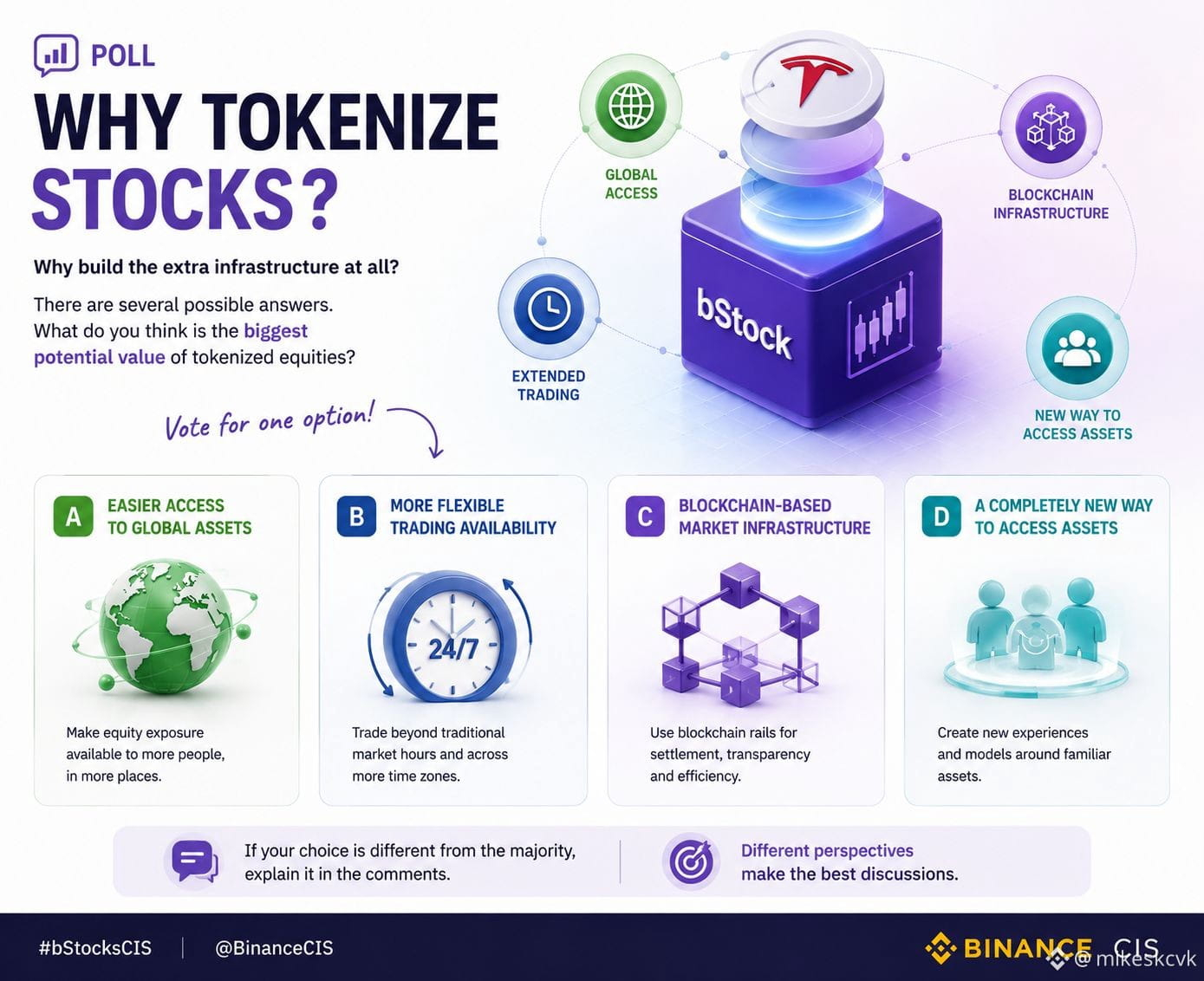
Why build the extra infrastructure at all?
There are several possible answers.
Maybe the biggest value is making equity exposure more accessible.
Maybe it is the ability to interact with markets through blockchain infrastructure.
May$be extended trading availability matters more.
Or maybe the real advantage is simply creating a different way for people to access familiar assets.
I don't think there is one universal answer.
So I'm curious what the community actually thinks.
What is the biggest potential value of tokenized equities?
A — Easier access to global assets
B — More flexible trading availability
C — Blockchain-based market infrastructure
D — A completely new way to access familiar assets
Vote for one.
And if your choice is different from the majority, explain it — that's probably where the interesting discussion starts.
#bstockscis @BinanceCIS
I keep seeing the same assumption:
“Tokenized stocks are just traditional stocks in another format.”
But if that were the whole point, the question becomes pretty simple:
Why build the extra infrastructure at all?
There are several possible answers.
Maybe the biggest value is making equity exposure more accessible.
Maybe it is the ability to interact with markets through blockchain infrastructure.
May$be extended trading availability matters more.
Or maybe the real advantage is simply creating a different way for people to access familiar assets.
I don't think there is one universal answer.
So I'm curious what the community actually thinks.
What is the biggest potential value of tokenized equities?
A — Easier access to global assets
B — More flexible trading availability
C — Blockchain-based market infrastructure
D — A completely new way to access familiar assets
Vote for one.
And if your choice is different from the majority, explain it — that's probably where the interesting discussion starts.
#bstockscis @BinanceCIS
“Tokenized stocks are just traditional stocks in another format.”
But if that were the whole point, the question becomes pretty simple:
Why build the extra infrastructure at all?
There are several possible answers.
Maybe the biggest value is making equity exposure more accessible.
Maybe it is the ability to interact with markets through blockchain infrastructure.
May$be extended trading availability matters more.
Or maybe the real advantage is simply creating a different way for people to access familiar assets.
I don't think there is one universal answer.
So I'm curious what the community actually thinks.
What is the biggest potential value of tokenized equities?
A — Easier access to global assets
B — More flexible trading availability
C — Blockchain-based market infrastructure
D — A completely new way to access familiar assets
Vote for one.
And if your choice is different from the majority, explain it — that's probably where the interesting discussion starts.
#bstockscis @BinanceCIS
76
·
--
ブリッシュ
翻訳参照
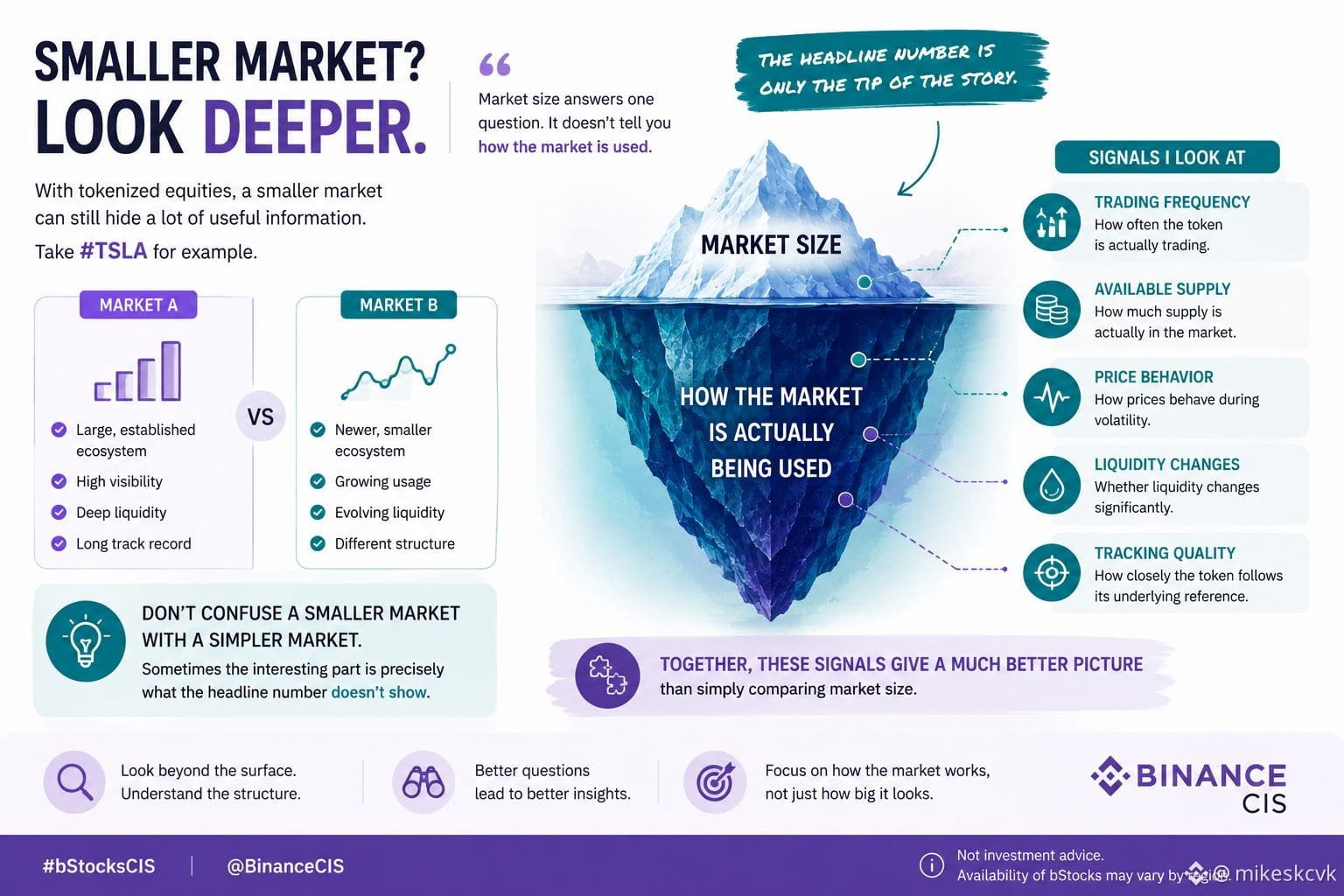
A smaller market does not automatically mean an uninteresting market.
That is something I keep in mind when looking at tokenized equities.
Imagine two markets showing almost the same underlying asset.
One has a huge established ecosystem.
The other is newer, smaller, and built around tokenized exposure.
It would be easy to look at the second one and say:
“Too small. Move on.”
But size answers only one question.
It doesn't tell me how the market is being used.
For example, with #TSLA I would rather look at several signals together:
→ how often the token trades
→ how much supply is actually available
→ how prices behave during volatility
→ whether liquidity changes significantly
→ how closely the token follows its underlying reference
None of these tells the whole story alone.
But together, they give a much better picture than simply comparing market size.
That is probably my biggest takeaway from studying bStocks:
Don't confuse a smaller market with a simpler market.
Sometimes the interesting part is precisely what the headline number doesn't show.
#bstockscis @BinanceCIS
A smaller market does not automatically mean an uninteresting market.
That is something I keep in mind when looking at tokenized equities.
Imagine two markets showing almost the same underlying asset.
One has a huge established ecosystem.
The other is newer, smaller, and built around tokenized exposure.
It would be easy to look at the second one and say:
“Too small. Move on.”
But size answers only one question.
It doesn't tell me how the market is being used.
For example, with #TSLA I would rather look at several signals together:
→ how often the token trades
→ how much supply is actually available
→ how prices behave during volatility
→ whether liquidity changes significantly
→ how closely the token follows its underlying reference
None of these tells the whole story alone.
But together, they give a much better picture than simply comparing market size.
That is probably my biggest takeaway from studying bStocks:
Don't confuse a smaller market with a simpler market.
Sometimes the interesting part is precisely what the headline number doesn't show.
#bstockscis @BinanceCIS
That is something I keep in mind when looking at tokenized equities.
Imagine two markets showing almost the same underlying asset.
One has a huge established ecosystem.
The other is newer, smaller, and built around tokenized exposure.
It would be easy to look at the second one and say:
“Too small. Move on.”
But size answers only one question.
It doesn't tell me how the market is being used.
For example, with #TSLA I would rather look at several signals together:
→ how often the token trades
→ how much supply is actually available
→ how prices behave during volatility
→ whether liquidity changes significantly
→ how closely the token follows its underlying reference
None of these tells the whole story alone.
But together, they give a much better picture than simply comparing market size.
That is probably my biggest takeaway from studying bStocks:
Don't confuse a smaller market with a simpler market.
Sometimes the interesting part is precisely what the headline number doesn't show.
#bstockscis @BinanceCIS
1
80
·
--
翻訳参照
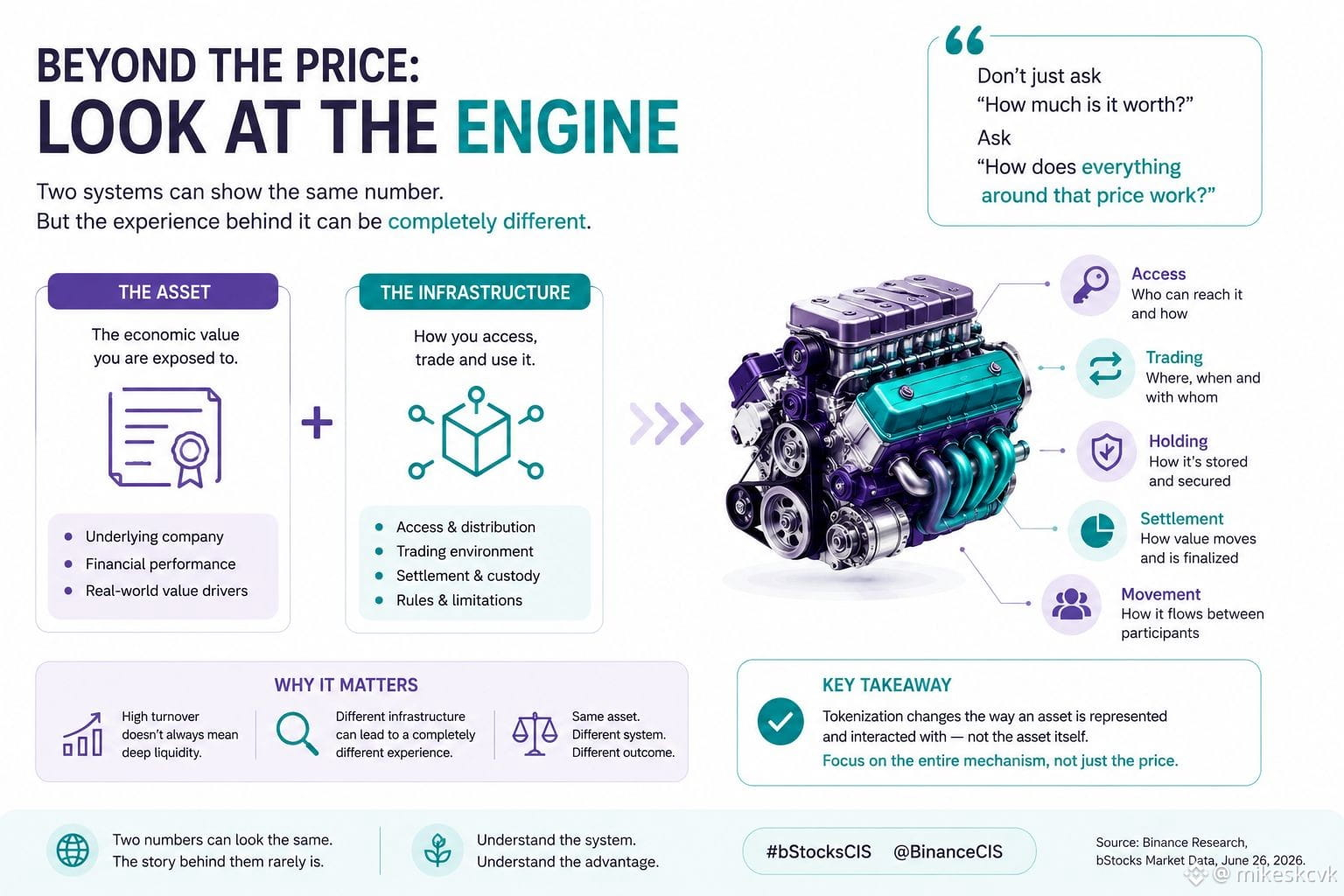
I used to think that when evaluating a new financial product, the most important thing was understanding what exactly you are buying.
Now I'd add another question:
What happens around that asset after you buy it?
That's where tokenized stocks become much more interesting than a simple comparison with traditional markets.
An asset isn't just a price.
There is an entire process around it:
access → trading → holding → settlement → movement between participants
If you only look at the price chart, most of that story disappears.
So I try to separate two things.
The asset — what the economic value is connected to.
The infrastructure — how that asset is represented and accessed by the user.
Those are not the same thing.
And that's one of the parts of bStocks I find most interesting.
Tokenization doesn't magically change the underlying asset.
It changes the way that asset is represented and interacted with inside a different financial environment.
So my main takeaway is simple:
Don't evaluate a tokenized product only by asking:
“How much is it worth?”
Ask:
“How does everything around that price actually work?”
Two systems can display a very similar number on a screen while providing a completely different experience underneath.
And that's the difference I'm most interested in watching with bStocks.
@BinanceCIS #bstockscis
I used to think that when evaluating a new financial product, the most important thing was understanding what exactly you are buying.
Now I'd add another question:
What happens around that asset after you buy it?
That's where tokenized stocks become much more interesting than a simple comparison with traditional markets.
An asset isn't just a price.
There is an entire process around it:
access → trading → holding → settlement → movement between participants
If you only look at the price chart, most of that story disappears.
So I try to separate two things.
The asset — what the economic value is connected to.
The infrastructure — how that asset is represented and accessed by the user.
Those are not the same thing.
And that's one of the parts of bStocks I find most interesting.
Tokenization doesn't magically change the underlying asset.
It changes the way that asset is represented and interacted with inside a different financial environment.
So my main takeaway is simple:
Don't evaluate a tokenized product only by asking:
“How much is it worth?”
Ask:
“How does everything around that price actually work?”
Two systems can display a very similar number on a screen while providing a completely different experience underneath.
And that's the difference I'm most interested in watching with bStocks.
@BinanceCIS #bstockscis
Now I'd add another question:
What happens around that asset after you buy it?
That's where tokenized stocks become much more interesting than a simple comparison with traditional markets.
An asset isn't just a price.
There is an entire process around it:
access → trading → holding → settlement → movement between participants
If you only look at the price chart, most of that story disappears.
So I try to separate two things.
The asset — what the economic value is connected to.
The infrastructure — how that asset is represented and accessed by the user.
Those are not the same thing.
And that's one of the parts of bStocks I find most interesting.
Tokenization doesn't magically change the underlying asset.
It changes the way that asset is represented and interacted with inside a different financial environment.
So my main takeaway is simple:
Don't evaluate a tokenized product only by asking:
“How much is it worth?”
Ask:
“How does everything around that price actually work?”
Two systems can display a very similar number on a screen while providing a completely different experience underneath.
And that's the difference I'm most interested in watching with bStocks.
@BinanceCIS #bstockscis
1
80
·
--
翻訳参照
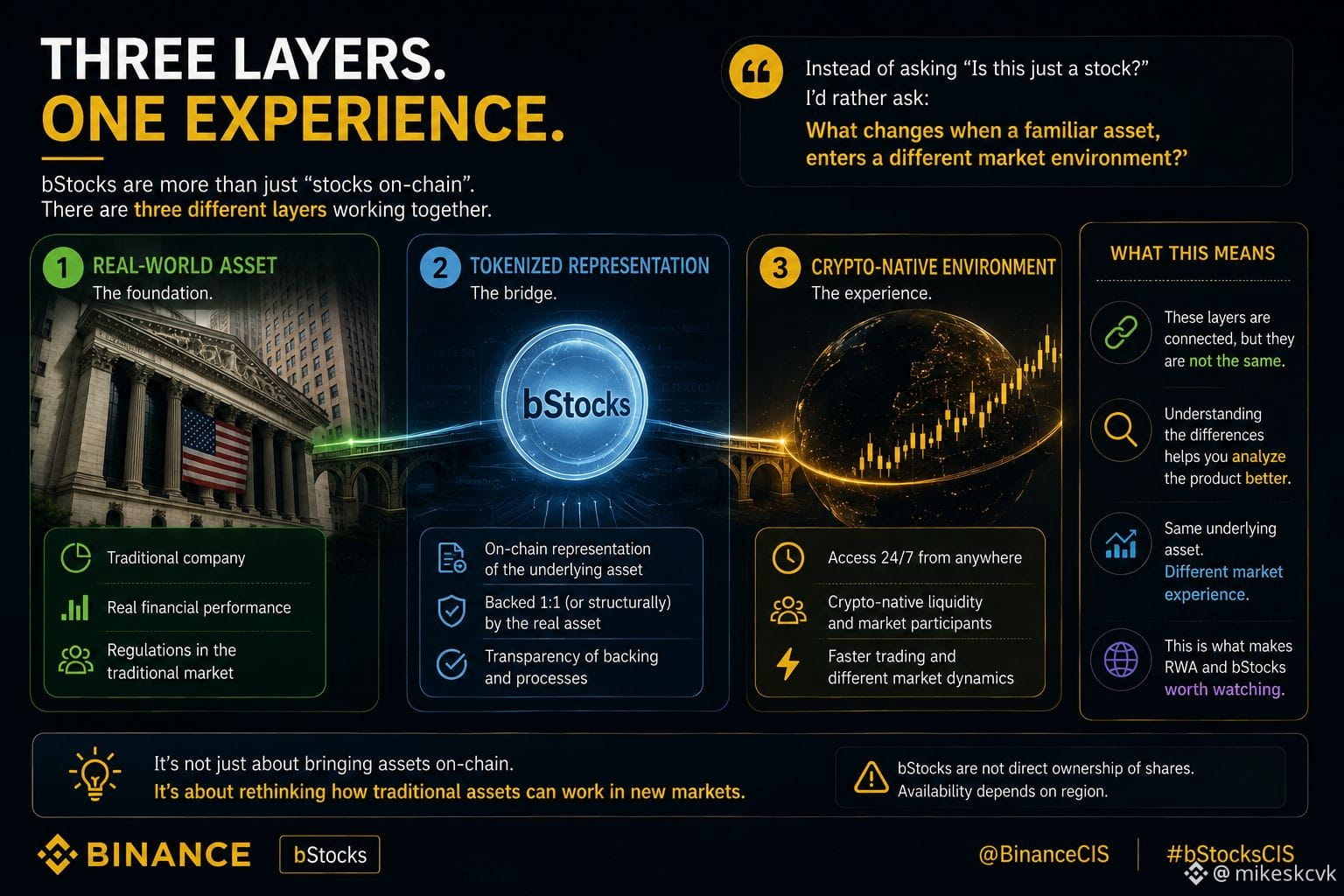
I think one of the easiest ways to misunderstand tokenized stocks is to focus only on the word “stock”.
The more I look at bStocks, the more I see three different things happening at once.
There is the real-world asset.
Then there is the tokenized representation.
And finally, there is the crypto-native environment where the token can be traded.
Those three layers are connected, but they are not the same thing.
And that changes how I would look at the product.
Instead of asking:
“Is this just a stock?”
I'd rather ask:
“What changes when a familiar asset enters a different market environment?”
Trading hours, access, liquidity and the way people interact with the asset can all become part of the picture.
That shift in perspective makes much more sense to me than simply comparing a token to a traditional share.
Same underlying idea.
Different market experience. 🔎
That's what makes this space worth watching. 🌍@BinanceCIS 😀 #bstockscis
I think one of the easiest ways to misunderstand tokenized stocks is to focus only on the word “stock”.
The more I look at bStocks, the more I see three different things happening at once.
There is the real-world asset.
Then there is the tokenized representation.
And finally, there is the crypto-native environment where the token can be traded.
Those three layers are connected, but they are not the same thing.
And that changes how I would look at the product.
Instead of asking:
“Is this just a stock?”
I'd rather ask:
“What changes when a familiar asset enters a different market environment?”
Trading hours, access, liquidity and the way people interact with the asset can all become part of the picture.
That shift in perspective makes much more sense to me than simply comparing a token to a traditional share.
Same underlying idea.
Different market experience. 🔎
That's what makes this space worth watching. 🌍@BinanceCIS 😀 #bstockscis
The more I look at bStocks, the more I see three different things happening at once.
There is the real-world asset.
Then there is the tokenized representation.
And finally, there is the crypto-native environment where the token can be traded.
Those three layers are connected, but they are not the same thing.
And that changes how I would look at the product.
Instead of asking:
“Is this just a stock?”
I'd rather ask:
“What changes when a familiar asset enters a different market environment?”
Trading hours, access, liquidity and the way people interact with the asset can all become part of the picture.
That shift in perspective makes much more sense to me than simply comparing a token to a traditional share.
Same underlying idea.
Different market experience. 🔎
That's what makes this space worth watching. 🌍@BinanceCIS 😀 #bstockscis
73
·
--
翻訳参照
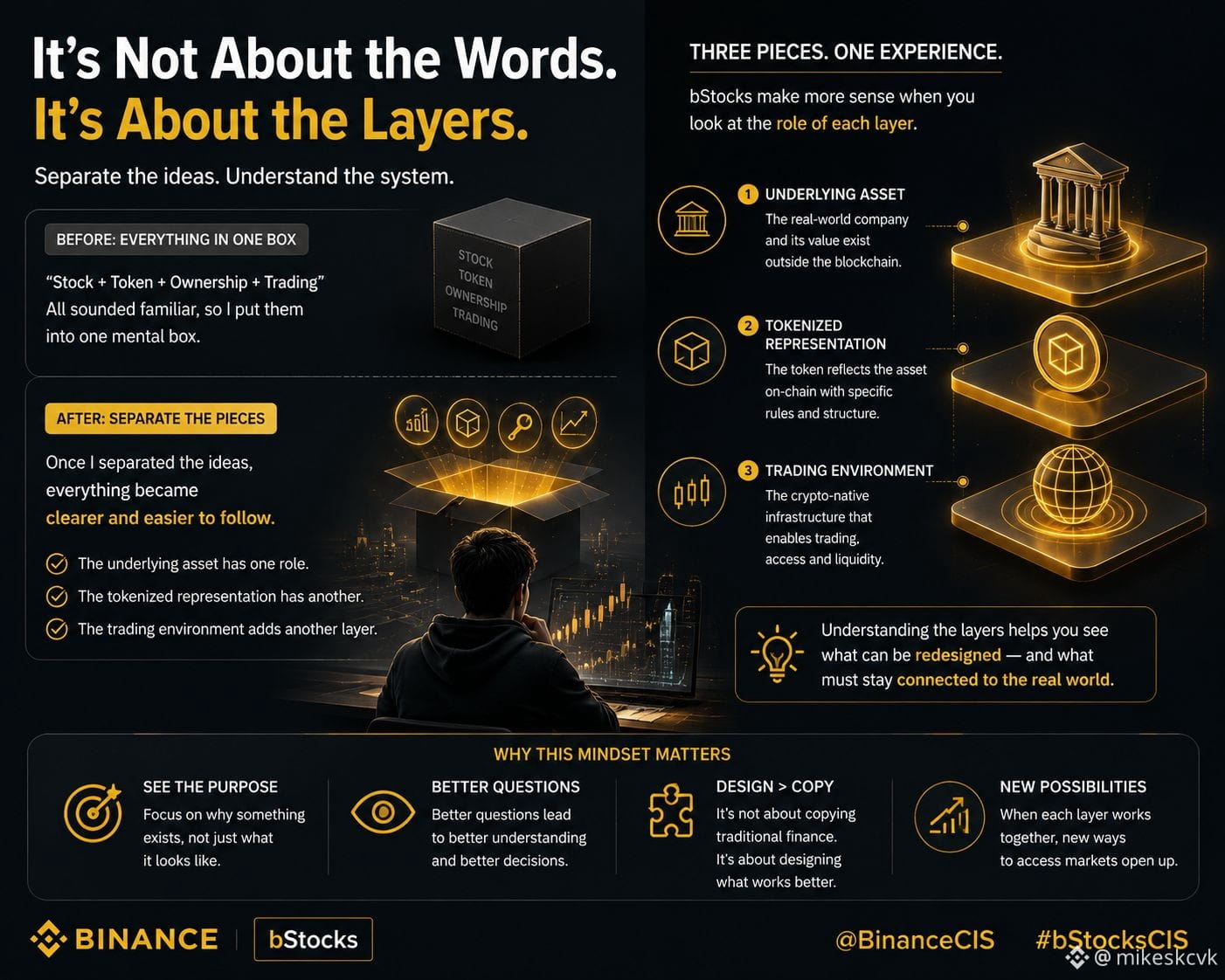
I used to think the hardest part of understanding tokenized stocks was the technology.
Honestly, I think it's the terminology.
Words like “stock”, “token”, “ownership” and “trading” sound familiar, so it's very easy to put them all into one mental box.
But bStocks made me slow down and separate those ideas.
A tokenized asset isn't interesting just because it looks familiar.
What's interesting is the infrastructure around it.
The underlying asset has one role.
The tokenized representation has another.
And the trading environment adds another layer on top.
Once I started separating those pieces, the whole concept became much easier to follow.
Maybe that's also why RWA is interesting to me.
It's not simply about bringing traditional assets onto blockchain.
It's about figuring out which parts of the old financial experience can be redesigned without losing the connection to the underlying asset.
Still learning, but I definitely look at tokenization differently now. 🔎
@BinanceCIS #bstockscis
I used to think the hardest part of understanding tokenized stocks was the technology.
Honestly, I think it's the terminology.
Words like “stock”, “token”, “ownership” and “trading” sound familiar, so it's very easy to put them all into one mental box.
But bStocks made me slow down and separate those ideas.
A tokenized asset isn't interesting just because it looks familiar.
What's interesting is the infrastructure around it.
The underlying asset has one role.
The tokenized representation has another.
And the trading environment adds another layer on top.
Once I started separating those pieces, the whole concept became much easier to follow.
Maybe that's also why RWA is interesting to me.
It's not simply about bringing traditional assets onto blockchain.
It's about figuring out which parts of the old financial experience can be redesigned without losing the connection to the underlying asset.
Still learning, but I definitely look at tokenization differently now. 🔎
@BinanceCIS #bstockscis
Honestly, I think it's the terminology.
Words like “stock”, “token”, “ownership” and “trading” sound familiar, so it's very easy to put them all into one mental box.
But bStocks made me slow down and separate those ideas.
A tokenized asset isn't interesting just because it looks familiar.
What's interesting is the infrastructure around it.
The underlying asset has one role.
The tokenized representation has another.
And the trading environment adds another layer on top.
Once I started separating those pieces, the whole concept became much easier to follow.
Maybe that's also why RWA is interesting to me.
It's not simply about bringing traditional assets onto blockchain.
It's about figuring out which parts of the old financial experience can be redesigned without losing the connection to the underlying asset.
Still learning, but I definitely look at tokenization differently now. 🔎
@BinanceCIS #bstockscis
92
·
--
翻訳参照
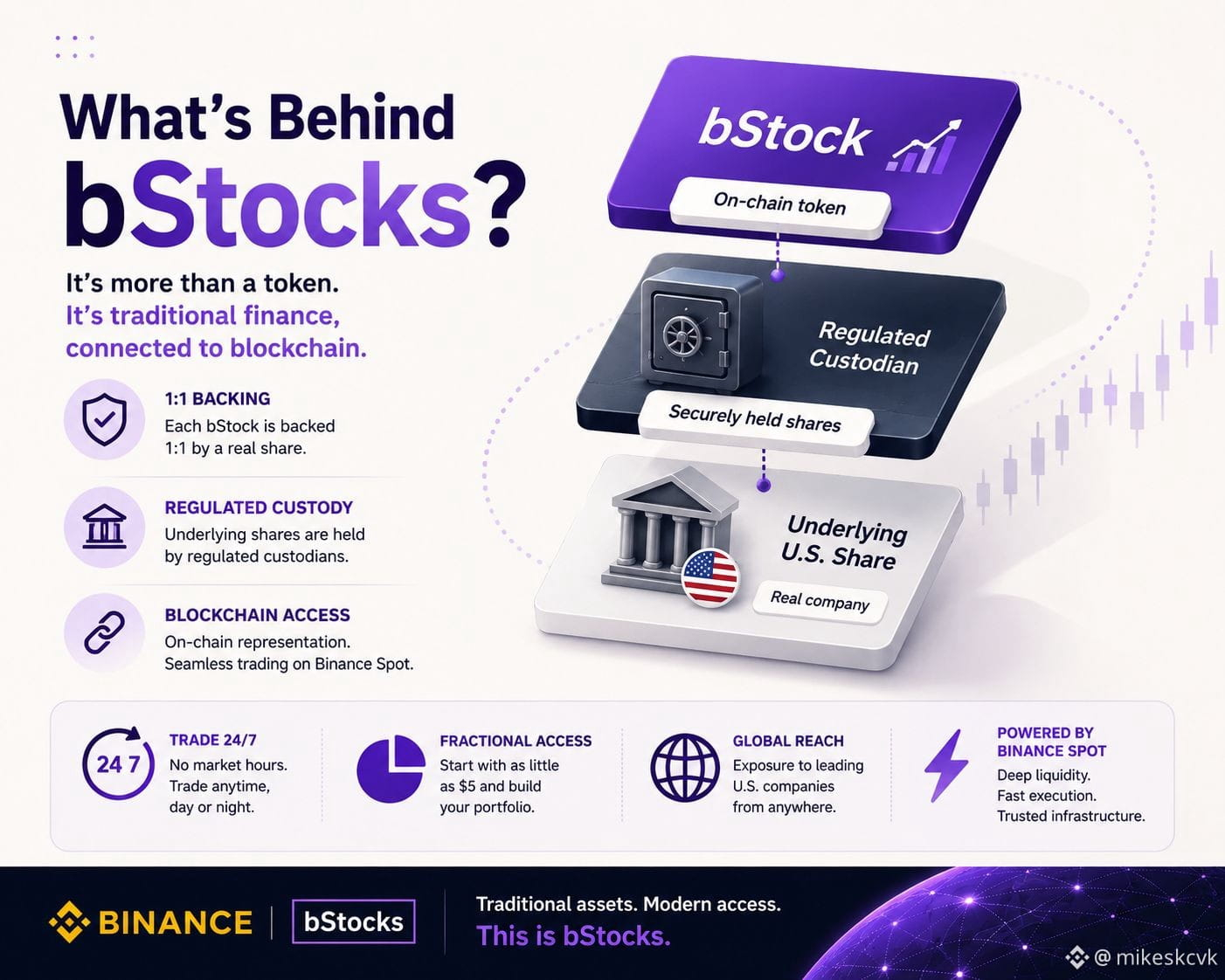
Something I found interesting while digging into bStocks is the difference between the asset itself and the way you access it.
There’s still an underlying security behind the structure, with 1:1 backing and regulated custody. The blockchain part changes the way that exposure is represented and traded.
So I wouldn’t describe bStocks simply as “a stock put on a blockchain”.
There’s quite a bit more going on underneath — custody, tokenization, trading infrastructure and the connection to Binance Spot.
That’s honestly the part I find more interesting than just looking at the price chart. 😅🔎
@BinanceCIS $SPCXB #bstockscis
Something I found interesting while digging into bStocks is the difference between the asset itself and the way you access it.
There’s still an underlying security behind the structure, with 1:1 backing and regulated custody. The blockchain part changes the way that exposure is represented and traded.
So I wouldn’t describe bStocks simply as “a stock put on a blockchain”.
There’s quite a bit more going on underneath — custody, tokenization, trading infrastructure and the connection to Binance Spot.
That’s honestly the part I find more interesting than just looking at the price chart. 😅🔎
@BinanceCIS $SPCXB #bstockscis
There’s still an underlying security behind the structure, with 1:1 backing and regulated custody. The blockchain part changes the way that exposure is represented and traded.
So I wouldn’t describe bStocks simply as “a stock put on a blockchain”.
There’s quite a bit more going on underneath — custody, tokenization, trading infrastructure and the connection to Binance Spot.
That’s honestly the part I find more interesting than just looking at the price chart. 😅🔎
@BinanceCIS $SPCXB #bstockscis
1
114
·
--
翻訳参照
One thing I like about blockchain is that it's not only about crypto anymore.
Projects like bStocks show how technology can be used to represent traditional financial assets in a digital way. Whether this model becomes mainstream or not, it's interesting to watch how finance keeps evolving.
I'm curious to see where tokenization will be in the next few years.
What real-world asset do you think could be tokenized next? 💭🚀
@BinanceCIS $SPCXB #bstockscis
One thing I like about blockchain is that it's not only about crypto anymore.
Projects like bStocks show how technology can be used to represent traditional financial assets in a digital way. Whether this model becomes mainstream or not, it's interesting to watch how finance keeps evolving.
I'm curious to see where tokenization will be in the next few years.
What real-world asset do you think could be tokenized next? 💭🚀
@BinanceCIS $SPCXB #bstockscis
Projects like bStocks show how technology can be used to represent traditional financial assets in a digital way. Whether this model becomes mainstream or not, it's interesting to watch how finance keeps evolving.
I'm curious to see where tokenization will be in the next few years.
What real-world asset do you think could be tokenized next? 💭🚀
@BinanceCIS $SPCXB #bstockscis

1
1
109
·
--
翻訳参照
Я помітив цікаву особливість bStocks: найважливіше тут не лише сам актив, а спосіб його представлення.
Токенізація не створює нову компанію і не змінює базову цінну паперу. Вона дозволяє взаємодіяти з активом через блокчейн-інфраструктуру, зберігаючи зв'язок із реальним базовим активом.
Мені здається, саме такі рішення показують, як поступово поєднуються традиційні фінанси та Web3.
Як думаєте, які ще реальні активи можуть бути токенізовані в майбутньому?
@BinanceCIS #bStocksCIS $SPCXB #BinanceSquare
{spot}(SPCXBUSDT)
#bstockscis
Я помітив цікаву особливість bStocks: найважливіше тут не лише сам актив, а спосіб його представлення.
Токенізація не створює нову компанію і не змінює базову цінну паперу. Вона дозволяє взаємодіяти з активом через блокчейн-інфраструктуру, зберігаючи зв'язок із реальним базовим активом.
Мені здається, саме такі рішення показують, як поступово поєднуються традиційні фінанси та Web3.
Як думаєте, які ще реальні активи можуть бути токенізовані в майбутньому?
@BinanceCIS #bStocksCIS $SPCXB #BinanceSquare
#bstockscis
Токенізація не створює нову компанію і не змінює базову цінну паперу. Вона дозволяє взаємодіяти з активом через блокчейн-інфраструктуру, зберігаючи зв'язок із реальним базовим активом.
Мені здається, саме такі рішення показують, як поступово поєднуються традиційні фінанси та Web3.
Як думаєте, які ще реальні активи можуть бути токенізовані в майбутньому?
@BinanceCIS #bStocksCIS $SPCXB #BinanceSquare
#bstockscis

1
1
65
·
--
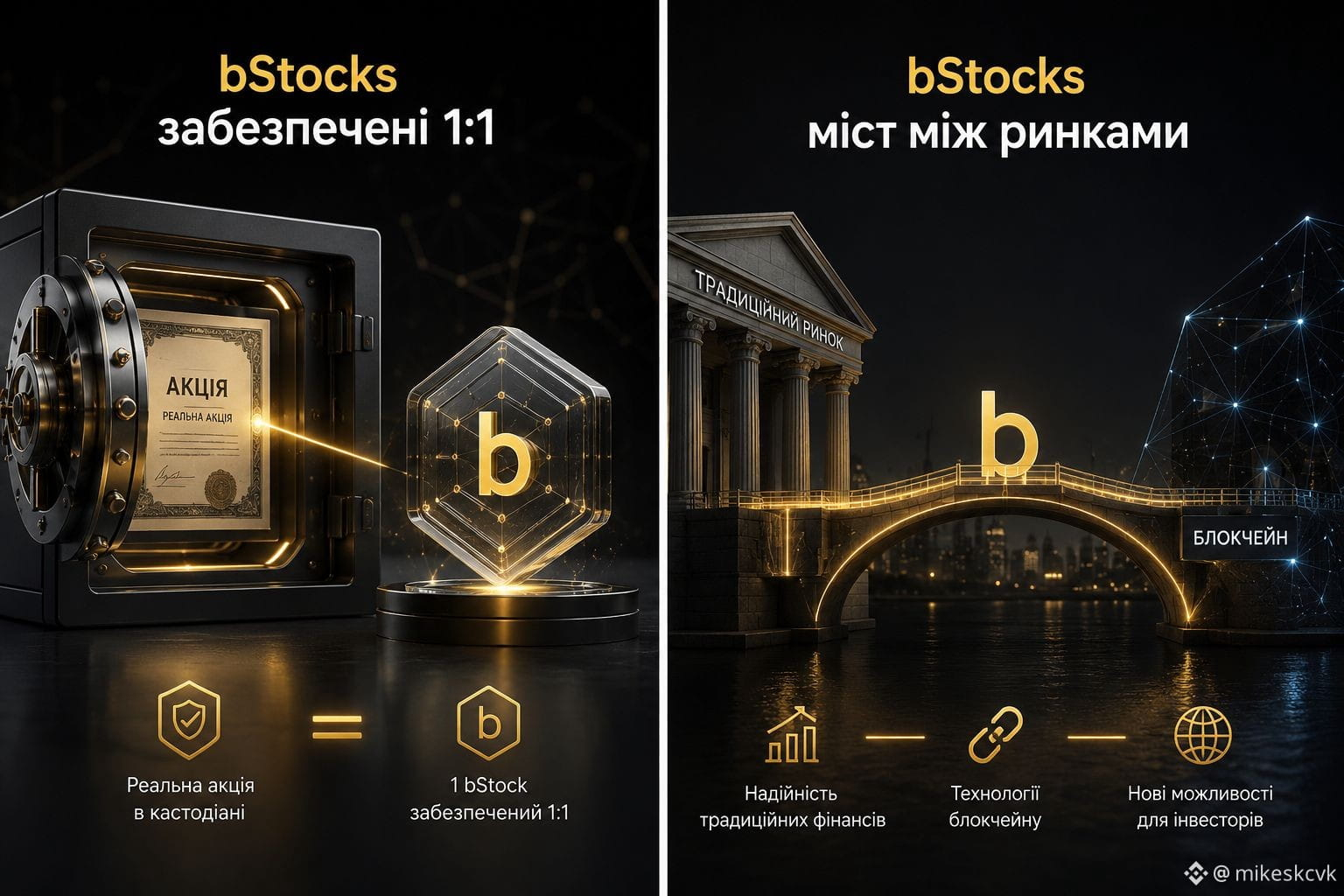
事実:トークン化は、基礎となる実物資産そのものをは変えません。変わるのは、その資産との「やり取りの方法」です。
bStocksについて初めて読んだとき、「暗号資産における株式」だと思っていました。ですが、より面白いのは、その仕組みそのものだと分かりました。
トークン化によって、実際の金融資産をデジタル形式で表現できます。その一方で、変わるのは基礎資産の経済的な本質ではなく、アクセスや流通の形であることを理解することが重要です。
だからこそ、bStocksのテーマは、暗号資産の愛好家だけでなく、現代の金融テクノロジーの発展を追う人にも興味深いのです。
あなたは、トークン化が数年後には金融市場の当たり前の一部になると思いますか?
@BinanceCIS #bStocksCIS $SPCXB #BinanceSquare #Tokenization
#bstockscis
事実:トークン化は、基礎となる実物資産そのものをは変えません。変わるのは、その資産との「やり取りの方法」です。
bStocksについて初めて読んだとき、「暗号資産における株式」だと思っていました。ですが、より面白いのは、その仕組みそのものだと分かりました。
トークン化によって、実際の金融資産をデジタル形式で表現できます。その一方で、変わるのは基礎資産の経済的な本質ではなく、アクセスや流通の形であることを理解することが重要です。
だからこそ、bStocksのテーマは、暗号資産の愛好家だけでなく、現代の金融テクノロジーの発展を追う人にも興味深いのです。
あなたは、トークン化が数年後には金融市場の当たり前の一部になると思いますか?
@BinanceCIS #bStocksCIS $SPCXB #BinanceSquare #Tokenization
#bstockscis
bStocksについて初めて読んだとき、「暗号資産における株式」だと思っていました。ですが、より面白いのは、その仕組みそのものだと分かりました。
トークン化によって、実際の金融資産をデジタル形式で表現できます。その一方で、変わるのは基礎資産の経済的な本質ではなく、アクセスや流通の形であることを理解することが重要です。
だからこそ、bStocksのテーマは、暗号資産の愛好家だけでなく、現代の金融テクノロジーの発展を追う人にも興味深いのです。
あなたは、トークン化が数年後には金融市場の当たり前の一部になると思いますか?
@BinanceCIS #bStocksCIS $SPCXB #BinanceSquare #Tokenization
#bstockscis
76
·
--
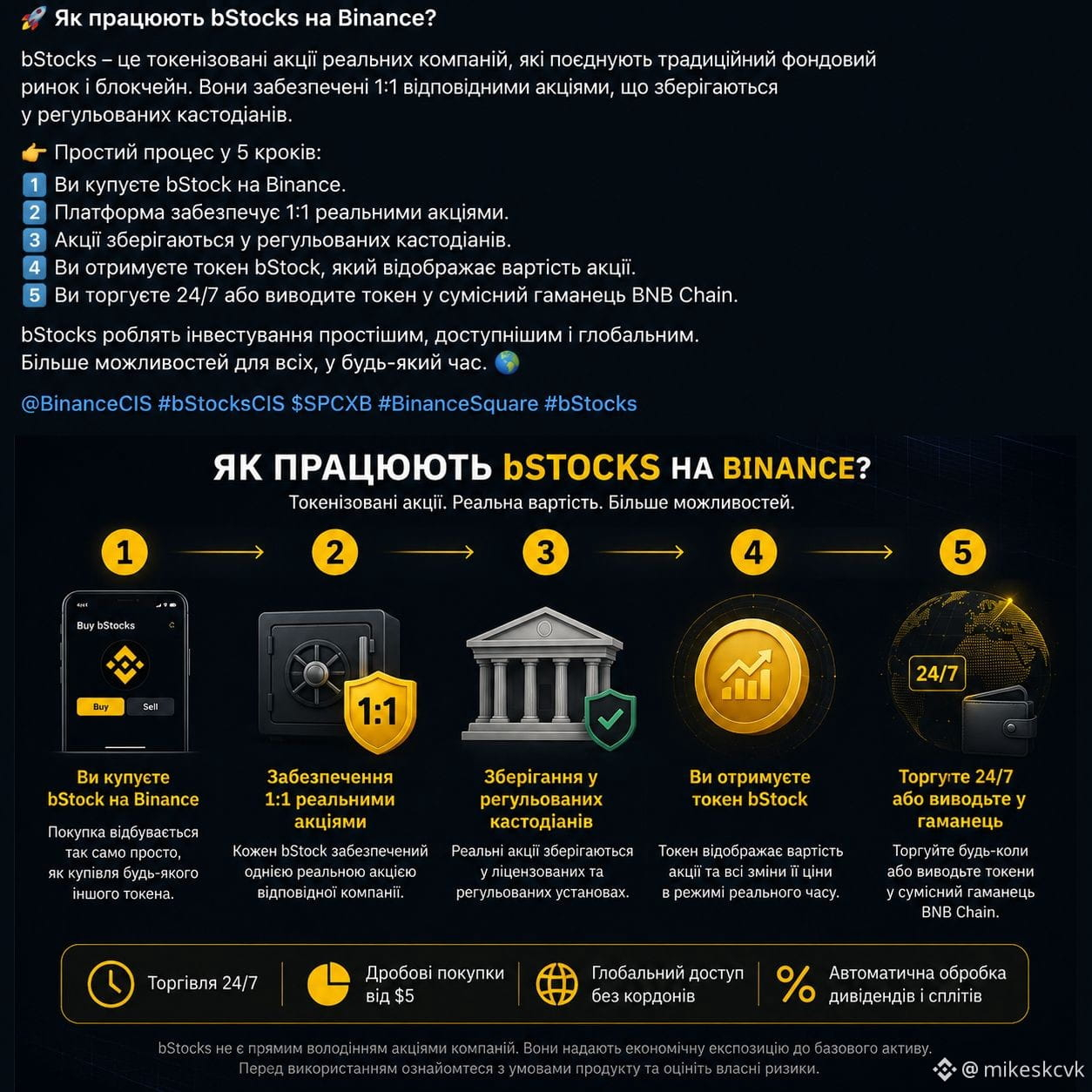
💡 トークン化はどのように株式市場へのアクセスを変えるのか?
以前は株を買うには通常ブローカーが必要で、取引所のオープンを待つ必要がありました。bStocksの登場により、このプロセスの一部がより簡単になりました。
bStocksについて知っておくべきこと:🔸 1:1で対応する実株により裏付けられています。🔸 Binance上で24/7に取引可能です。🔸 分割購入をサポートしているため、必ずしも株1株を丸ごと買う必要はありません。🔸 配当やスプリットといった企業アクションは、プラットフォームの仕組みに従って処理されます。
私の考えでは、トークン化は金融市場の発展における最も興味深い方向性の1つです。なぜなら、従来の資産とブロックチェーンの可能性を組み合わせるからです。
@BinanceCIS #SPCXB #BinanceSquare #bStocks #bstockscis
💡 トークン化はどのように株式市場へのアクセスを変えるのか?
以前は株を買うには通常ブローカーが必要で、取引所のオープンを待つ必要がありました。bStocksの登場により、このプロセスの一部がより簡単になりました。
bStocksについて知っておくべきこと:🔸 1:1で対応する実株により裏付けられています。🔸 Binance上で24/7に取引可能です。🔸 分割購入をサポートしているため、必ずしも株1株を丸ごと買う必要はありません。🔸 配当やスプリットといった企業アクションは、プラットフォームの仕組みに従って処理されます。
私の考えでは、トークン化は金融市場の発展における最も興味深い方向性の1つです。なぜなら、従来の資産とブロックチェーンの可能性を組み合わせるからです。
@BinanceCIS #SPCXB #BinanceSquare #bStocks #bstockscis
以前は株を買うには通常ブローカーが必要で、取引所のオープンを待つ必要がありました。bStocksの登場により、このプロセスの一部がより簡単になりました。
bStocksについて知っておくべきこと:🔸 1:1で対応する実株により裏付けられています。🔸 Binance上で24/7に取引可能です。🔸 分割購入をサポートしているため、必ずしも株1株を丸ごと買う必要はありません。🔸 配当やスプリットといった企業アクションは、プラットフォームの仕組みに従って処理されます。
私の考えでは、トークン化は金融市場の発展における最も興味深い方向性の1つです。なぜなら、従来の資産とブロックチェーンの可能性を組み合わせるからです。
@BinanceCIS #SPCXB #BinanceSquare #bStocks #bstockscis
1
115
ログインして、さらにコンテンツを読む
厳選トピックで世界の暗号資産トレーダーの仲間入り
⚡️ 暗号資産に関する最新かつ有益な情報が見つかります。
💬 世界最大の暗号資産取引所から信頼されています。
👍 認証を受けたクリエイターから、有益なインサイトを得られます。
メール / 電話番号
トレンドトピック
SECGrantsInnovationExemptionForTokenizedStocks
閲覧回数 0
4人が討論中
🔥 SEC & トークン化株式
SECが報告した、トークン化株式に関するイノベーション免除は、伝統的な株式をブロックチェーン基盤へ取り込むための、もう一つ重要な前進となる可能性があります。📈⛓️
トークン化は、アクセシビリティ(利用しやすさ)、透明性、決済効率を高める一方で、デジタル市場に新たな可能性をもたらすかもしれません。
次の重要な問いは、この枠組みがオンチェーン株式の将来と投資家のアクセスにどのような影響を与えるかです。
#Blockchain #Crypto #Binance #SECGrantsInnovationExemptionForTokenizedStocks
Zoya24
·いいね:0件
·閲覧回数 4
XRPGains3%AsRippleAddsMPPSupport
閲覧回数 0
2人が討論中
SPGlobalToAcquireOpenZeppelin
閲覧回数 0
2人が討論中