Binance Square
Liam_Carter
731 投稿

Liam_Carter

取引を発注
高頻度トレーダー
9か月
200 フォロー
6.8K+ フォロワー
1.2K+ いいね
投稿
ポートフォリオ
·
--
翻訳参照
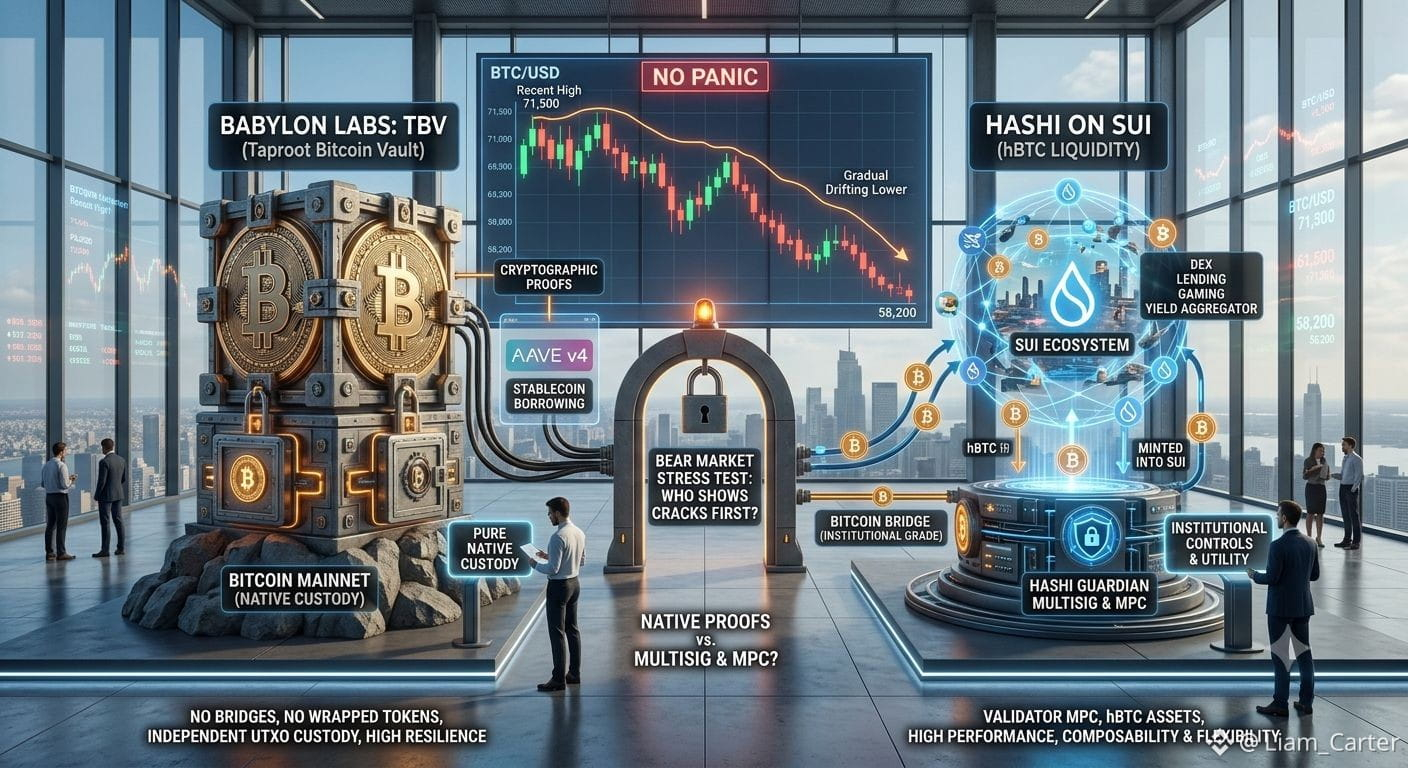
Watching the candlestick chart, I see Bitcoin gradually drifting lower from its recent high—yet the usual panic isn’t there. Bear markets have a way of revealing who’s actually committed once the easy liquidity disappears. Lately, conversations around BTCFi have picked up again. That doesn’t feel accidental; capital is actively hunting for safer ways to generate yield. One path I examined closely is the approach from Babylon Labs. They built something called TBV: Bitcoin is locked directly in Taproot scripts on the Bitcoin mainnet. No bridges, no wrapped tokens. Cryptographic proofs then let you borrow stablecoins from Aave v4. Every UTXO stays independent, so the project itself can’t move the coins. That level of native custody brings real peace of mind. Still, I wonder whether such strict on-chain custody might limit how freely capital can move and be put to work. Then I looked at Hashi on Sui. Their model is almost the opposite. Validator MPC combined with Guardian multisig holds the BTC, mints hBTC, and lets it move freely inside the Sui ecosystem. Institutions will probably like the performance and the wider range of use cases. The question that lingers for me is whether multisig plus MPC can fully remove centralization risk. I’m not a deep technical expert, but more complex trust assumptions usually mean more potential points of failure. So two clear directions sit in front of us: one prioritizes pure native custody, the other prioritizes composability and flexibility. I’m starting to think there isn’t a single correct answer—perhaps the winning design will blend elements of both. The question that feels more important than the daily price action is this: when a real bear-market stress test arrives, which system shows cracks first? Will TBV’s pure cryptographic proofs prove more resilient, or will Hashi’s institutional-grade risk controls hold up better? That answer may matter more than the next candle on the chart. @babylonlabs_io #baby $BABY
Watching the candlestick chart, I see Bitcoin gradually drifting lower from its recent high—yet the usual panic isn’t there. Bear markets have a way of revealing who’s actually committed once the easy liquidity disappears. Lately, conversations around BTCFi have picked up again. That doesn’t feel accidental; capital is actively hunting for safer ways to generate yield.
One path I examined closely is the approach from Babylon Labs. They built something called TBV: Bitcoin is locked directly in Taproot scripts on the Bitcoin mainnet. No bridges, no wrapped tokens. Cryptographic proofs then let you borrow stablecoins from Aave v4. Every UTXO stays independent, so the project itself can’t move the coins. That level of native custody brings real peace of mind. Still, I wonder whether such strict on-chain custody might limit how freely capital can move and be put to work.
Then I looked at Hashi on Sui. Their model is almost the opposite. Validator MPC combined with Guardian multisig holds the BTC, mints hBTC, and lets it move freely inside the Sui ecosystem. Institutions will probably like the performance and the wider range of use cases. The question that lingers for me is whether multisig plus MPC can fully remove centralization risk. I’m not a deep technical expert, but more complex trust assumptions usually mean more potential points of failure.
So two clear directions sit in front of us: one prioritizes pure native custody, the other prioritizes composability and flexibility. I’m starting to think there isn’t a single correct answer—perhaps the winning design will blend elements of both. The question that feels more important than the daily price action is this: when a real bear-market stress test arrives, which system shows cracks first? Will TBV’s pure cryptographic proofs prove more resilient, or will Hashi’s institutional-grade risk controls hold up better? That answer may matter more than the next candle on the chart.
@BabylonLabs_io #baby $BABY
確認済み
翻訳参照
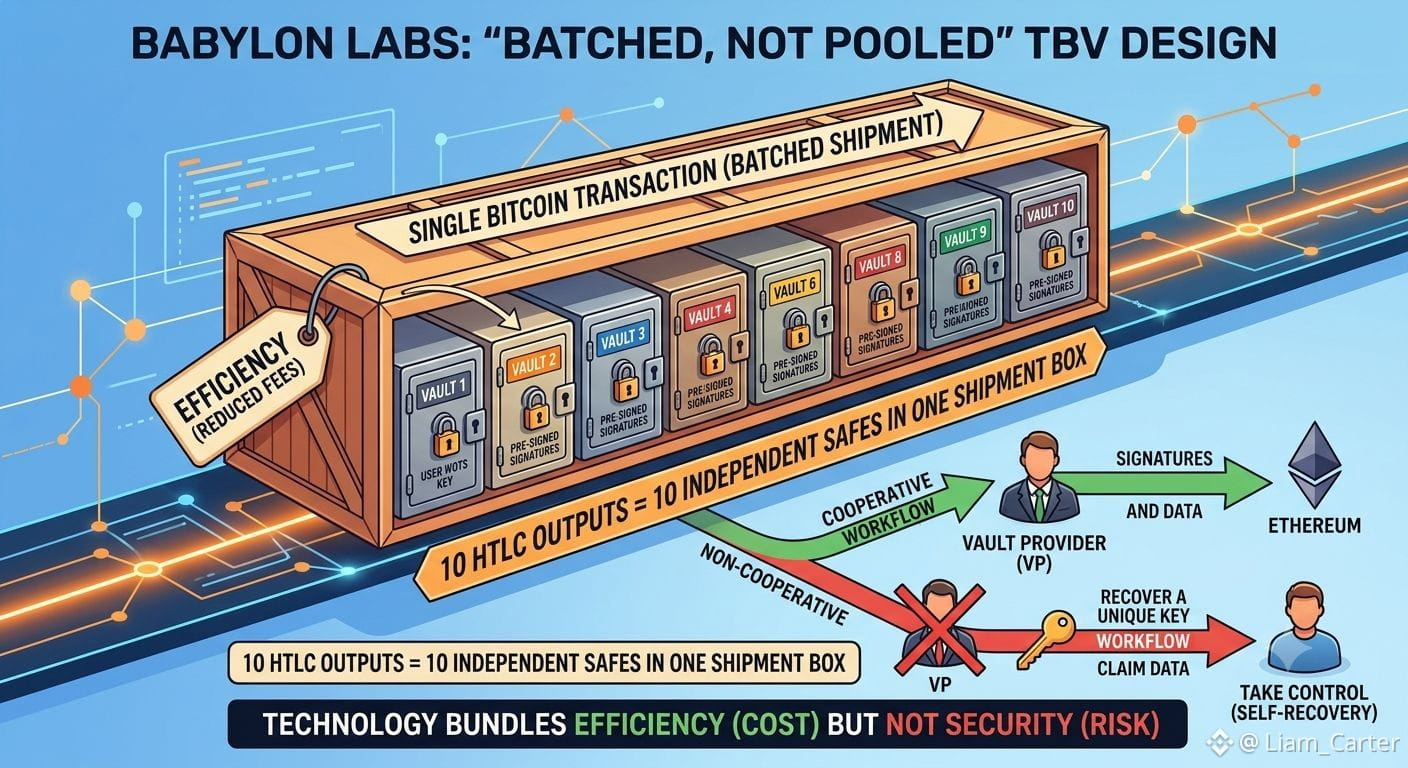
When Babylon Labs’ TBV testnet went live, one detail kept coming up: a single Bitcoin transaction can carry up to 10 HTLC outputs. On the surface, that sounds like a simple fee-saving trick. But that misses the real point. This is not about putting 10 users’ BTC into one shared pool. Each output still belongs to a separate Vault, backed by its own UTXO, its own pre-signed transaction structure, and its own withdrawal route. Ten HTLC outputs are not one collective safe—they are ten independent safes placed inside the same shipment box. The transport is more efficient, but the security model stays separate. That is the key idea: efficiency can be bundled, risk cannot. Even though batching reduces cost, it does not reduce the operational burden. During setup, the Vault Provider still has to gather signatures from all participants and submit the batch to Ethereum. If the VP goes offline, users can still recover the needed signatures from the chain to complete PegIn. And if the VP does not cooperate during redemption, users still depend on their own WOTS keys and claim data to take control themselves. So batching compresses fees, not the security workflow. A better analogy is multiple insurance contracts shipped in one package: delivery becomes cheaper, but underwriting, signing, and claims for each policy remain fully separate. A merged package does not mean shared coverage. That is why, after Babylon’s mainnet launch, I care less about how much fee was saved and more about three real signals: how batch sizes are distributed, how often signatures are completed end to end, and how quickly users can self-recover when the VP is unavailable. Those are the numbers that show whether this “batched, not pooled” design truly earns its place. Technology can optimize cost. Security still refuses group discounts. @babylonlabs_io #baby $BABY
When Babylon Labs’ TBV testnet went live, one detail kept coming up: a single Bitcoin transaction can carry up to 10 HTLC outputs.

On the surface, that sounds like a simple fee-saving trick. But that misses the real point.

This is not about putting 10 users’ BTC into one shared pool. Each output still belongs to a separate Vault, backed by its own UTXO, its own pre-signed transaction structure, and its own withdrawal route. Ten HTLC outputs are not one collective safe—they are ten independent safes placed inside the same shipment box. The transport is more efficient, but the security model stays separate.

That is the key idea: efficiency can be bundled, risk cannot.

Even though batching reduces cost, it does not reduce the operational burden. During setup, the Vault Provider still has to gather signatures from all participants and submit the batch to Ethereum. If the VP goes offline, users can still recover the needed signatures from the chain to complete PegIn. And if the VP does not cooperate during redemption, users still depend on their own WOTS keys and claim data to take control themselves.

So batching compresses fees, not the security workflow.

A better analogy is multiple insurance contracts shipped in one package: delivery becomes cheaper, but underwriting, signing, and claims for each policy remain fully separate. A merged package does not mean shared coverage.

That is why, after Babylon’s mainnet launch, I care less about how much fee was saved and more about three real signals: how batch sizes are distributed, how often signatures are completed end to end, and how quickly users can self-recover when the VP is unavailable. Those are the numbers that show whether this “batched, not pooled” design truly earns its place.

Technology can optimize cost. Security still refuses group discounts.
@BabylonLabs_io #baby $BABY
翻訳参照
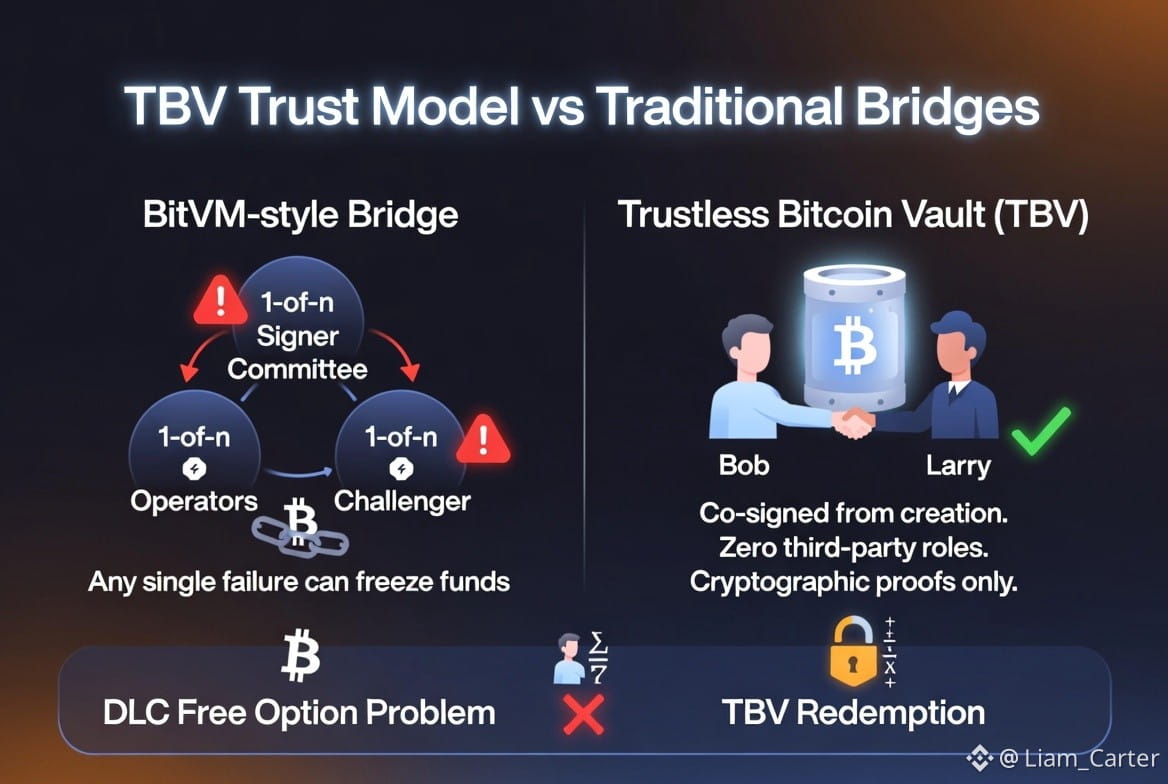
#baby $BABY Just got jolted awake by a server alert about some explosion. My screen was still half-blurry when I opened the group chat and saw someone drop a TBV trust-model comparison table. Ten minutes of staring later and I was wide awake. @babylonlabs_io I used to think cross-chain bridges basically came in two flavors: centralized or decentralized. Pick the more decentralized one and you’re basically safe. That table killed the idea. Even a next-gen “decentralized” design like a BitVM bridge still forces Bob to depend on a 1-of-n signer committee, a 1-of-m operator set, and at least one active challenger all working together. Break any single link and the funds can just sit there stuck. Trustless Bitcoin vaults are a different animal. From the moment the vault is created it’s already co-signed by Bob and Larry. There is no third-party role at all. Withdrawals don’t require trusting anyone. Those three roles—operators, signer committee, challenger—weren’t optimized out of the design. They were never supposed to exist in the first place. The difference becomes even clearer in lending. Under a DLC setup Larry can simply refuse to hand over the repayment secret and block Bob’s redemption—the classic free-option problem. With TBV the redemption conditions are pure cryptographic proofs. Nobody has to “grant permission.” Personally I’m still only running small testnet amounts. Main capital hasn’t moved. I also couldn’t find any clear documentation on exactly how the k-of-n multi-sig threshold gets set. Official line is “governance decides,” but the actual details still aren’t public. So the real question: would you trade away a bridge’s instant liquidity just to remove one extra layer of trust?
#baby $BABY
Just got jolted awake by a server alert about some explosion. My screen was still half-blurry when I opened the group chat and saw someone drop a TBV trust-model comparison table. Ten minutes of staring later and I was wide awake.
@BabylonLabs_io
I used to think cross-chain bridges basically came in two flavors: centralized or decentralized. Pick the more decentralized one and you’re basically safe. That table killed the idea. Even a next-gen “decentralized” design like a BitVM bridge still forces Bob to depend on a 1-of-n signer committee, a 1-of-m operator set, and at least one active challenger all working together. Break any single link and the funds can just sit there stuck.
Trustless Bitcoin vaults are a different animal. From the moment the vault is created it’s already co-signed by Bob and Larry. There is no third-party role at all. Withdrawals don’t require trusting anyone.
Those three roles—operators, signer committee, challenger—weren’t optimized out of the design. They were never supposed to exist in the first place.
The difference becomes even clearer in lending. Under a DLC setup Larry can simply refuse to hand over the repayment secret and block Bob’s redemption—the classic free-option problem. With TBV the redemption conditions are pure cryptographic proofs. Nobody has to “grant permission.”
Personally I’m still only running small testnet amounts. Main capital hasn’t moved. I also couldn’t find any clear documentation on exactly how the k-of-n multi-sig threshold gets set. Official line is “governance decides,” but the actual details still aren’t public.
So the real question: would you trade away a bridge’s instant liquidity just to remove one extra layer of trust?
一部該当
翻訳参照
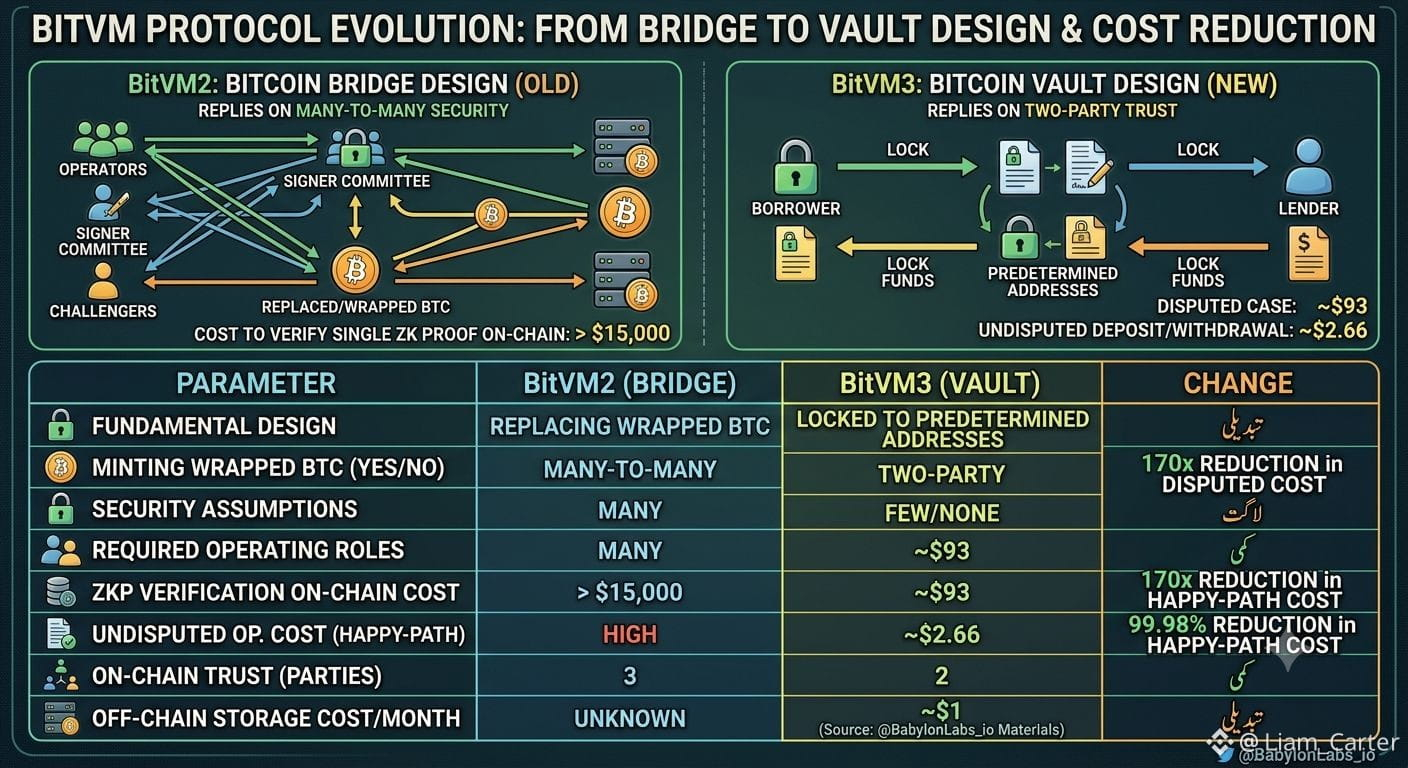
I spent half the night going through the @BabylonLabs_io whitepaper and double-checking the on-chain cost figures for both the BitVM2 and BitVM3 setups. The deeper I looked, the more something didn’t add up. Most people treat the “Bitcoin bridge” and the “Bitcoin vault” as essentially the same thing, just with different security assumptions. Once you dig into the details, though, they’re fundamentally different designs. A bridge mints replaceable wrapped BTC that anyone can redeem, so it has to rely on a full set of operators, signer committees, challengers, and the rest to keep redemptions solvent. A vault, by contrast, locks the funds from day one to two predetermined addresses (think borrower and lender). Those extra roles simply aren’t required. The numbers make the difference even clearer. In the early BitVM2 approach, the measured on-chain cost to verify a single ZK proof was more than $15,000. With BitVM3 the same disputed case drops to about $93, while a normal, undisputed deposit or withdrawal can cost as little as $2.66. That’s roughly a 170× reduction—not a parameter tweak, but a complete change in approach. What used to be “reveal everything on-chain through a secret” becomes an off-chain game-theoretic contest inside a mixed circuit. On-chain trust shrinks from three parties down to two. Right now I’m running a small testnet position mainly to feel out the time-lock behavior on the dispute path. The claim that off-chain storage runs about $1 per month comes only from the official materials; I haven’t found an independent source to confirm it yet. When you check on-chain costs in daily practice, do you only look at the happy-path numbers, or do you also price in the extreme scenarios?@babylonlabs_io #baby $BABY
I spent half the night going through the @BabylonLabs_io whitepaper and double-checking the on-chain cost figures for both the BitVM2 and BitVM3 setups. The deeper I looked, the more something didn’t add up.
Most people treat the “Bitcoin bridge” and the “Bitcoin vault” as essentially the same thing, just with different security assumptions. Once you dig into the details, though, they’re fundamentally different designs. A bridge mints replaceable wrapped BTC that anyone can redeem, so it has to rely on a full set of operators, signer committees, challengers, and the rest to keep redemptions solvent. A vault, by contrast, locks the funds from day one to two predetermined addresses (think borrower and lender). Those extra roles simply aren’t required.
The numbers make the difference even clearer. In the early BitVM2 approach, the measured on-chain cost to verify a single ZK proof was more than $15,000. With BitVM3 the same disputed case drops to about $93, while a normal, undisputed deposit or withdrawal can cost as little as $2.66. That’s roughly a 170× reduction—not a parameter tweak, but a complete change in approach. What used to be “reveal everything on-chain through a secret” becomes an off-chain game-theoretic contest inside a mixed circuit. On-chain trust shrinks from three parties down to two.
Right now I’m running a small testnet position mainly to feel out the time-lock behavior on the dispute path. The claim that off-chain storage runs about $1 per month comes only from the official materials; I haven’t found an independent source to confirm it yet.
When you check on-chain costs in daily practice, do you only look at the happy-path numbers, or do you also price in the extreme scenarios?@BabylonLabs_io #baby $BABY
一部該当
翻訳参照
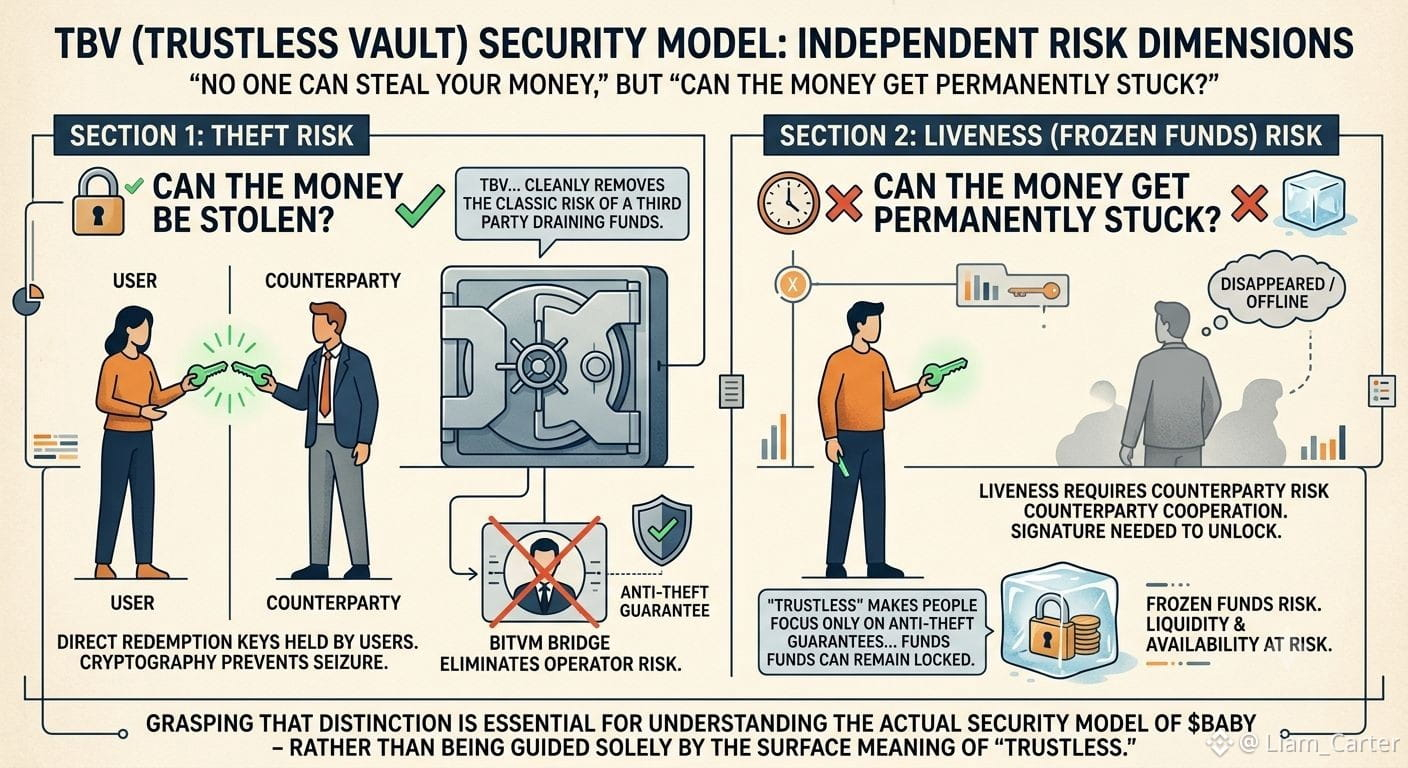
“Users directly control redemption” sounds reassuring — until the other side simply refuses to play along. I got stuck on a section in the TBV whitepaper from @BabylonLabs_io that claims “trustless vaults eliminate operators entirely.” The design gives two predefined parties direct authority over redemption. No middleman operator is required. That cleanly removes the classic risk of a third party draining funds. It solves the theft problem. But what about liveness? The whitepaper contrasts trustless vaults with the BitVM bridge. In the BitVM model an operator must relay the redemption transaction; if that operator turns malicious, funds can be at risk. TBV instead lets the two counterparties hold the redemption keys themselves. Cryptography ensures that, as long as the scripts are correctly written, neither side can seize BTC that isn’t theirs. Safety is solid: no one can forcibly take what belongs to someone else. Safety, however, is not the same as liveness. If unlocking the funds requires the counterparty to sign or complete a step, and that party goes offline, disappears, or simply refuses to cooperate, the coins can remain locked. The whitepaper stresses that “no one can steal your money,” yet it does not clearly spell out what happens when the other side fails to act. Protection against theft does not automatically protect against funds becoming frozen. The word “trustless” often makes people focus only on anti-theft guarantees while overlooking liquidity and availability risks — both of which are part of real asset security. My takeaway: TBV does an excellent job of preventing outright theft. But when assessing any two-party counterparty design in DeFi, two separate questions must be asked: Can the money be stolen? Can the money get permanently stuck? These are independent risk dimensions. Grasping that distinction is essential for understanding the actual security model of $BABY — rather than being guided solely by the surface meaning of “trustless.” #baby $BABY @babylonlabs_io
“Users directly control redemption” sounds reassuring — until the other side simply refuses to play along.
I got stuck on a section in the TBV whitepaper from @BabylonLabs_io that claims “trustless vaults eliminate operators entirely.” The design gives two predefined parties direct authority over redemption. No middleman operator is required. That cleanly removes the classic risk of a third party draining funds.
It solves the theft problem. But what about liveness?
The whitepaper contrasts trustless vaults with the BitVM bridge. In the BitVM model an operator must relay the redemption transaction; if that operator turns malicious, funds can be at risk. TBV instead lets the two counterparties hold the redemption keys themselves. Cryptography ensures that, as long as the scripts are correctly written, neither side can seize BTC that isn’t theirs. Safety is solid: no one can forcibly take what belongs to someone else.
Safety, however, is not the same as liveness. If unlocking the funds requires the counterparty to sign or complete a step, and that party goes offline, disappears, or simply refuses to cooperate, the coins can remain locked. The whitepaper stresses that “no one can steal your money,” yet it does not clearly spell out what happens when the other side fails to act. Protection against theft does not automatically protect against funds becoming frozen.
The word “trustless” often makes people focus only on anti-theft guarantees while overlooking liquidity and availability risks — both of which are part of real asset security.
My takeaway: TBV does an excellent job of preventing outright theft. But when assessing any two-party counterparty design in DeFi, two separate questions must be asked:
Can the money be stolen?
Can the money get permanently stuck?
These are independent risk dimensions. Grasping that distinction is essential for understanding the actual security model of $BABY — rather than being guided solely by the surface meaning of “trustless.”
#baby $BABY @BabylonLabs_io
確認済み
#baby $BABY 昨夜、バビロンのドキュメントを読み返しているとき、安全上の前提(safety assumptions)のページで立ち止まりました。「みんなが『Make Bitcoin-native go into DeFi』だ!」と叫んでいる一方で、もっと現実的な疑問が刺さりました。では、BTCをTaprootスクリプトにロックした後、実際にそれを取り戻すには何をすればいいのでしょう? アンボンディングは簡単ではありません。約64,000ブロック(約15か月)のタイムロックが経過するまで待つ方法もあれば、アクティブにアンボンドする方法もあります。この場合、Covenant Committeeのサインオフが必要になり、その後さらに2つ目のロックアップ期間に入ります。EOTSははっきり示しています。もし同じ高さでFinality Providerがダブルサインした場合、鍵が漏洩し、アンボンディングのそのウィンドウ中でもステークはスラッシュされ得ます。つまり、退出は「いつでも簡単にアンステークできる」という類ではなく、プロトコル上の時間制約付きのウィンドウなのです。 TBV(清算/換金)も興味深いです。BTCを手放さずに、そのBTCを担保として借りる形になります。各Vaultはそれぞれ独立したUTXOに対応しています。清算イベントでは、清算人(liquidator)がWBTCを使って即座に決済できますが、ネイティブBTCが償還可能になるのは、フロード・プルーフのウィンドウが過ぎてからです。つまりタイムラインが分断されます。裁定取引をする人(arbitrageur)はまずWBTCを立て替えて前払いし、その間に価格変動やファンディングコストを吸収しなければなりません。私は、そうした前払いの流動性供給に対する意欲が、ボラティリティが跳ね上がる局面で崩れてしまうのかどうかについて、明確な答えを見つけられませんでした。 バビロンの思想は、最終的な主権をBitcoinそのものに置いています。ロードマップは明確です。フェーズ1ではBitcoin中心の開発、フェーズ2ではCosmosへ移行、フェーズ3ではマルチアセット・ステーキングを導入します。ただしユーザーは、スラッシュが本当に起こり得ること、そして退出の遅延を受け入れることがトレードオフであることを自分の中に取り込む必要があります。そこには客観的な学習曲線があります。 プロジェクトを評価するとき、退出や清算(liquidation)の仕組みまでここまで深く掘り下げていますか?もしあなたも同じくらい深く見ているなら、ぜひ教えてください。コメントをください。@babylonlabs_io $LAB
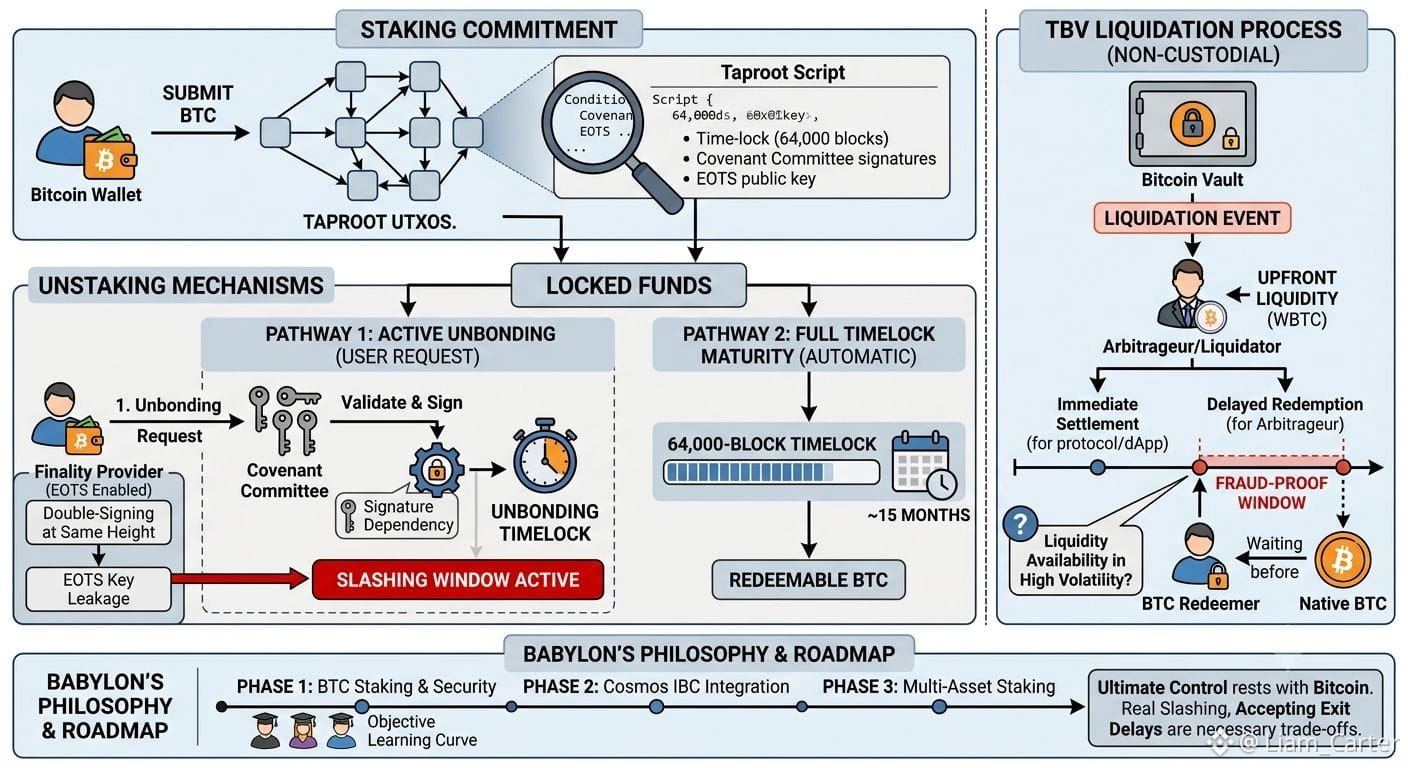
#baby $BABY 昨夜、バビロンのドキュメントを読み返しているとき、安全上の前提(safety assumptions)のページで立ち止まりました。「みんなが『Make Bitcoin-native go into DeFi』だ!」と叫んでいる一方で、もっと現実的な疑問が刺さりました。では、BTCをTaprootスクリプトにロックした後、実際にそれを取り戻すには何をすればいいのでしょう?

アンボンディングは簡単ではありません。約64,000ブロック(約15か月)のタイムロックが経過するまで待つ方法もあれば、アクティブにアンボンドする方法もあります。この場合、Covenant Committeeのサインオフが必要になり、その後さらに2つ目のロックアップ期間に入ります。EOTSははっきり示しています。もし同じ高さでFinality Providerがダブルサインした場合、鍵が漏洩し、アンボンディングのそのウィンドウ中でもステークはスラッシュされ得ます。つまり、退出は「いつでも簡単にアンステークできる」という類ではなく、プロトコル上の時間制約付きのウィンドウなのです。

TBV(清算/換金)も興味深いです。BTCを手放さずに、そのBTCを担保として借りる形になります。各Vaultはそれぞれ独立したUTXOに対応しています。清算イベントでは、清算人(liquidator)がWBTCを使って即座に決済できますが、ネイティブBTCが償還可能になるのは、フロード・プルーフのウィンドウが過ぎてからです。つまりタイムラインが分断されます。裁定取引をする人(arbitrageur)はまずWBTCを立て替えて前払いし、その間に価格変動やファンディングコストを吸収しなければなりません。私は、そうした前払いの流動性供給に対する意欲が、ボラティリティが跳ね上がる局面で崩れてしまうのかどうかについて、明確な答えを見つけられませんでした。

バビロンの思想は、最終的な主権をBitcoinそのものに置いています。ロードマップは明確です。フェーズ1ではBitcoin中心の開発、フェーズ2ではCosmosへ移行、フェーズ3ではマルチアセット・ステーキングを導入します。ただしユーザーは、スラッシュが本当に起こり得ること、そして退出の遅延を受け入れることがトレードオフであることを自分の中に取り込む必要があります。そこには客観的な学習曲線があります。

プロジェクトを評価するとき、退出や清算(liquidation)の仕組みまでここまで深く掘り下げていますか?もしあなたも同じくらい深く見ているなら、ぜひ教えてください。コメントをください。@BabylonLabs_io
$LAB
翻訳参照
#baby $BABY I’ve watched every market cycle invent a new reason to push Bitcoin beyond what it was designed to do. I’ve been around long enough to recall when nearly every second project claimed it would “unlock BTC liquidity.” Most followed the same pattern: wrapped tokens, trusted custodians, bridges that quietly became the single point of failure, and communities treating unnecessary complexity as progress. Babylon stood out for a reason I didn’t expect. Not because it offered yield—crypto has never lacked promises. It stood out because it starts from an uncomfortable fact: trillions of dollars in Bitcoin largely sit idle while newer chains spend years trying to borrow its credibility. I’m still not sure whether that problem needs solving. There’s something odd about watching Bitcoin—the asset built on deliberate restraint—gradually turn into collateral for almost everything else. Self-custodial staking appears cleaner than earlier models. No bridges, no surrendering private keys, no converting coins into unfamiliar forms. Yet I’ve seen enough systems labeled “trustless” slowly accumulate trust assumptions over time. Still, this one feels different. Perhaps because Babylon isn’t trying to persuade me that Bitcoin itself must change. It feels more like the rest of crypto finally admitting it still needs Bitcoin. After all these years, that may be the most honest thing this market has said in a long time.@babylonlabs_io 😀 {spot}(BABYUSDT)
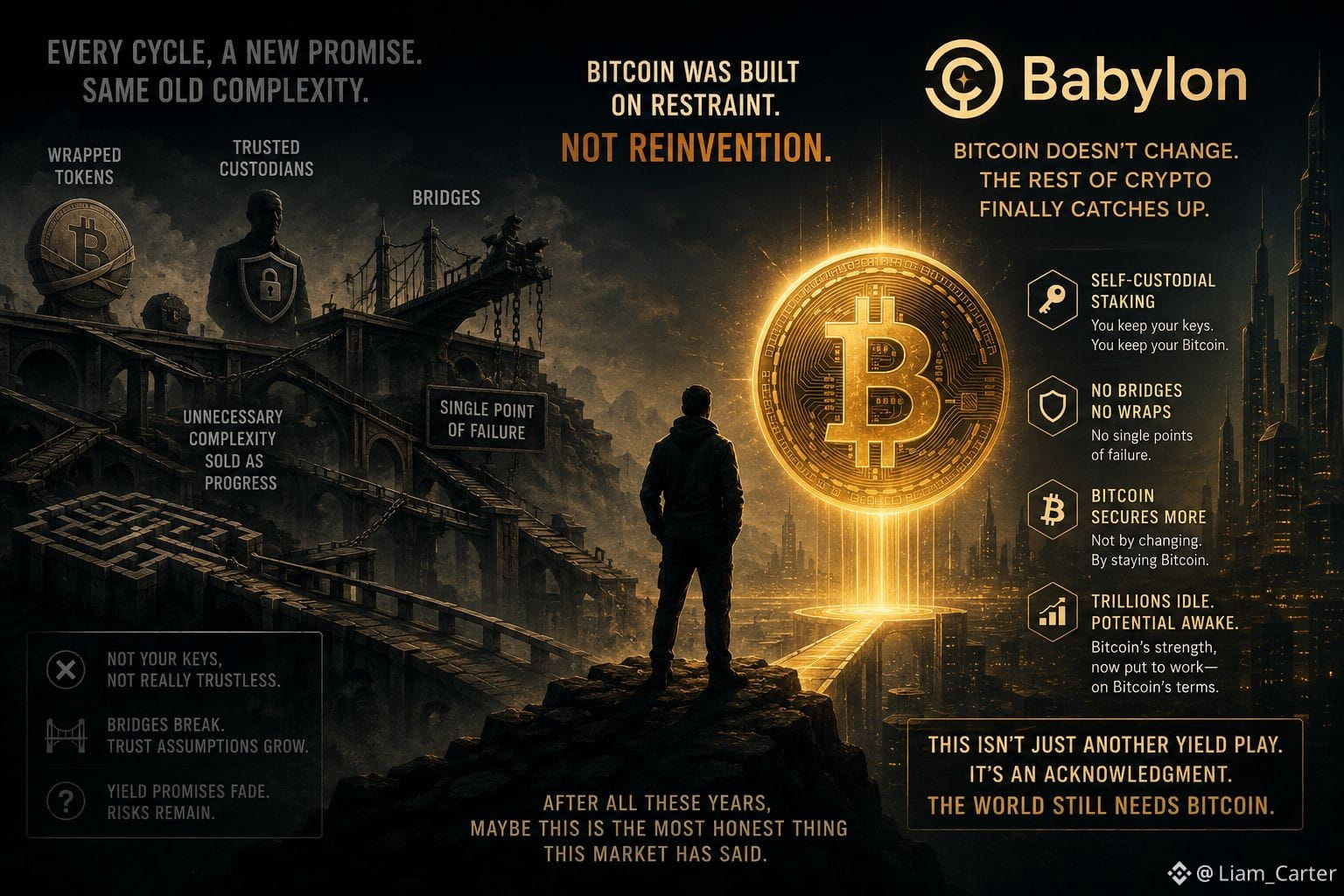
#baby $BABY I’ve watched every market cycle invent a new reason to push Bitcoin beyond what it was designed to do.
I’ve been around long enough to recall when nearly every second project claimed it would “unlock BTC liquidity.” Most followed the same pattern: wrapped tokens, trusted custodians, bridges that quietly became the single point of failure, and communities treating unnecessary complexity as progress.
Babylon stood out for a reason I didn’t expect. Not because it offered yield—crypto has never lacked promises. It stood out because it starts from an uncomfortable fact: trillions of dollars in Bitcoin largely sit idle while newer chains spend years trying to borrow its credibility.
I’m still not sure whether that problem needs solving.
There’s something odd about watching Bitcoin—the asset built on deliberate restraint—gradually turn into collateral for almost everything else. Self-custodial staking appears cleaner than earlier models. No bridges, no surrendering private keys, no converting coins into unfamiliar forms. Yet I’ve seen enough systems labeled “trustless” slowly accumulate trust assumptions over time.
Still, this one feels different.
Perhaps because Babylon isn’t trying to persuade me that Bitcoin itself must change. It feels more like the rest of crypto finally admitting it still needs Bitcoin.
After all these years, that may be the most honest thing this market has said in a long time.@BabylonLabs_io 😀
翻訳参照
#baby $BABY Please press and hold the URL to copy and use the browser to open if you want to view it.
一部該当
翻訳参照
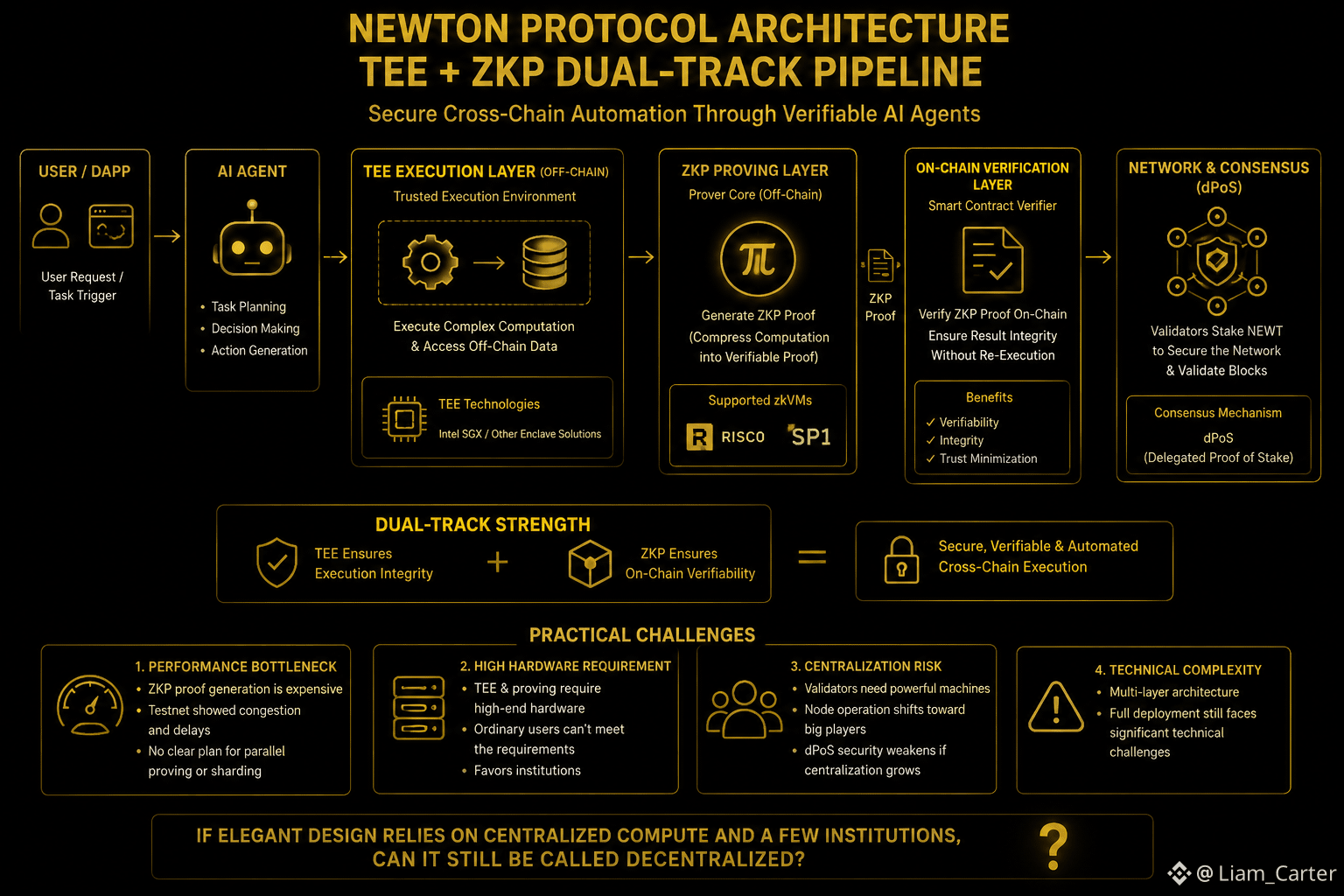
#newt $NEWT @NewtonProtocol This afternoon at the office, I was reading Newton Protocol’s technical docs, and one part really grabbed me: the “TEE + ZKP dual-track pipeline.” On paper, it looks genuinely smart. The basic idea makes sense. TEE is meant to handle fast execution off-chain, while ZKP turns the result into a proof that can be verified on-chain. So instead of asking people to just trust the computation, the system tries to turn it into something mathematically verifiable. That part is elegant, and I can see why the design gets attention. But once you look past the concept and into the practical limits, some concerns start to show up. The biggest issue is proof generation. ZKP proofs are not cheap to produce, and that alone can slow things down. HTX Research also notes that the TEE + ZKP model may run into performance bottlenecks and hardware dependence. Newton’s Prover Core supports zkVMs like Risc0 and SP1, but that does not erase the fact that proving is still resource-heavy. If many agents are running at the same time, congestion and delays feel almost inevitable. Yet the whitepaper does not clearly explain how the system plans to handle large-scale parallel proving. Then there is the hardware question. TEEs depend on secure enclave hardware, and validator or verification work often needs strong machines. That means the bar is not really low. Over time, this can push participation toward institutions instead of ordinary users. Gat also points out that the protocol’s stack is complex and that stable deployment still faces real technical challenges. So yes, the architecture is elegant. But if decentralization depends on expensive hardware and a small set of powerful operators, how decentralized is it really in practice? Just my personal view, not investment advice. $LAB
#newt $NEWT @NewtonProtocol
This afternoon at the office, I was reading Newton Protocol’s technical docs, and one part really grabbed me: the “TEE + ZKP dual-track pipeline.” On paper, it looks genuinely smart.

The basic idea makes sense. TEE is meant to handle fast execution off-chain, while ZKP turns the result into a proof that can be verified on-chain. So instead of asking people to just trust the computation, the system tries to turn it into something mathematically verifiable. That part is elegant, and I can see why the design gets attention.

But once you look past the concept and into the practical limits, some concerns start to show up.

The biggest issue is proof generation. ZKP proofs are not cheap to produce, and that alone can slow things down. HTX Research also notes that the TEE + ZKP model may run into performance bottlenecks and hardware dependence. Newton’s Prover Core supports zkVMs like Risc0 and SP1, but that does not erase the fact that proving is still resource-heavy. If many agents are running at the same time, congestion and delays feel almost inevitable. Yet the whitepaper does not clearly explain how the system plans to handle large-scale parallel proving.

Then there is the hardware question. TEEs depend on secure enclave hardware, and validator or verification work often needs strong machines. That means the bar is not really low. Over time, this can push participation toward institutions instead of ordinary users. Gat also points out that the protocol’s stack is complex and that stable deployment still faces real technical challenges.

So yes, the architecture is elegant. But if decentralization depends on expensive hardware and a small set of powerful operators, how decentralized is it really in practice?

Just my personal view, not investment advice.
$LAB
確認済み
記事
翻訳参照
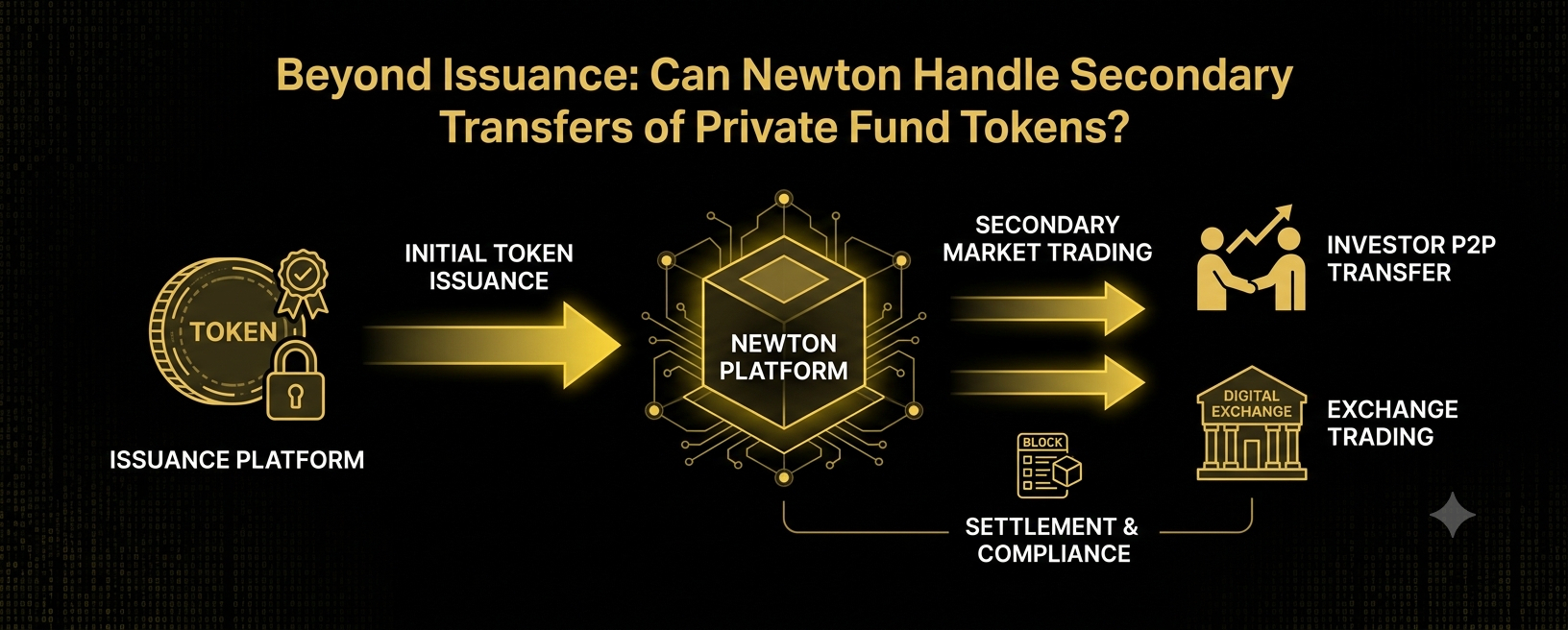
Beyond Issuance: Can Newton Handle Secondary Transfers of Private Fund Tokens?A-Yong works in LP relations at an asset management firm and is exploring the tokenization of private fund interests, so that LP positions can be represented as tokens and traded in secondary markets. The real barrier is not the underlying technology, but compliance: private fund interests can only be transferred to qualified investors, and every secondary-market transfer must verify the buyer’s eligibility. At present, this process depends on manual review, which is both inefficient and legally risky. My view is that Newton can support this requirement at the technical level. However, the discussion has to separate first-tier and second-tier use cases, because they are not equally difficult. Primary issuance is relatively straightforward. At the point of subscription, the system can run a strategy check, verify the investor’s verifiable credentials, and, if the requirements are met, approve the allocation. Newton’s current architecture already appears capable of supporting this flow, since verifiable credentials, Rego-based policy logic, and BLS authentication together form a complete verification chain. Secondary circulation is much more demanding. Every transfer of tokenized private fund shares requires the buyer’s eligibility to be verified again in real time. This is not a one-time check at issuance; it is a continuous compliance requirement each time ownership changes. That creates three major challenges for Newton’s operator network. First, there is the issue of performance. Secondary trading windows are far shorter and more time-sensitive than primary subscription windows, so the system must respond quickly enough for active market use. Second, credential validity must be checked continuously, because a buyer’s qualified-investor status may expire or change over time, which means the strategy layer cannot rely on cached results and must query fresh data. Third, there are cross-jurisdictional complications. Private fund buyers may come from different countries, and each jurisdiction defines “qualified investor” differently, making strategy composition considerably more complex. Newton does appear to have technical paths for all three problems, including real-time data integration, credential validity checks, and jurisdiction-specific policy composition. However, I have not seen public evidence confirming that these paths have been stress-tested on mainnet. My recommendation to A-Yong is to treat this as a serious opportunity, but to begin with a small pilot focused on primary issuance compliance first. Once that works reliably, the system can be extended to secondary circulation. Since secondary trading is materially more complex than primary issuance, proving the simpler case first is the safer approach. From an investment perspective, tokenizing private fund shares is one of the fastest-growing use cases in the RWA sector. If Newton can win even a few asset management firms with clearly identifiable assets in this category, it would be a meaningful boost to the project’s credibility. One open question remains: are there any publicly announced regulated private fund managers or asset management firms that have already used Newton’s authorization layer for compliant share transfers? If such a case emerges, I would treat it as a strong signal and revisit my view accordingly. @NewtonProtocol #Newt $NEWT {spot}(NEWTUSDT) $LAB

Beyond Issuance: Can Newton Handle Secondary Transfers of Private Fund Tokens?

A-Yong works in LP relations at an asset management firm and is exploring the tokenization of private fund interests, so that LP positions can be represented as tokens and traded in secondary markets. The real barrier is not the underlying technology, but compliance: private fund interests can only be transferred to qualified investors, and every secondary-market transfer must verify the buyer’s eligibility. At present, this process depends on manual review, which is both inefficient and legally risky.
My view is that Newton can support this requirement at the technical level. However, the discussion has to separate first-tier and second-tier use cases, because they are not equally difficult.
Primary issuance is relatively straightforward. At the point of subscription, the system can run a strategy check, verify the investor’s verifiable credentials, and, if the requirements are met, approve the allocation. Newton’s current architecture already appears capable of supporting this flow, since verifiable credentials, Rego-based policy logic, and BLS authentication together form a complete verification chain.
Secondary circulation is much more demanding. Every transfer of tokenized private fund shares requires the buyer’s eligibility to be verified again in real time. This is not a one-time check at issuance; it is a continuous compliance requirement each time ownership changes. That creates three major challenges for Newton’s operator network.
First, there is the issue of performance. Secondary trading windows are far shorter and more time-sensitive than primary subscription windows, so the system must respond quickly enough for active market use. Second, credential validity must be checked continuously, because a buyer’s qualified-investor status may expire or change over time, which means the strategy layer cannot rely on cached results and must query fresh data. Third, there are cross-jurisdictional complications. Private fund buyers may come from different countries, and each jurisdiction defines “qualified investor” differently, making strategy composition considerably more complex.
Newton does appear to have technical paths for all three problems, including real-time data integration, credential validity checks, and jurisdiction-specific policy composition. However, I have not seen public evidence confirming that these paths have been stress-tested on mainnet.
My recommendation to A-Yong is to treat this as a serious opportunity, but to begin with a small pilot focused on primary issuance compliance first. Once that works reliably, the system can be extended to secondary circulation. Since secondary trading is materially more complex than primary issuance, proving the simpler case first is the safer approach.
From an investment perspective, tokenizing private fund shares is one of the fastest-growing use cases in the RWA sector. If Newton can win even a few asset management firms with clearly identifiable assets in this category, it would be a meaningful boost to the project’s credibility.
One open question remains: are there any publicly announced regulated private fund managers or asset management firms that have already used Newton’s authorization layer for compliant share transfers? If such a case emerges, I would treat it as a strong signal and revisit my view accordingly.
@NewtonProtocol #Newt $NEWT
$LAB
翻訳参照
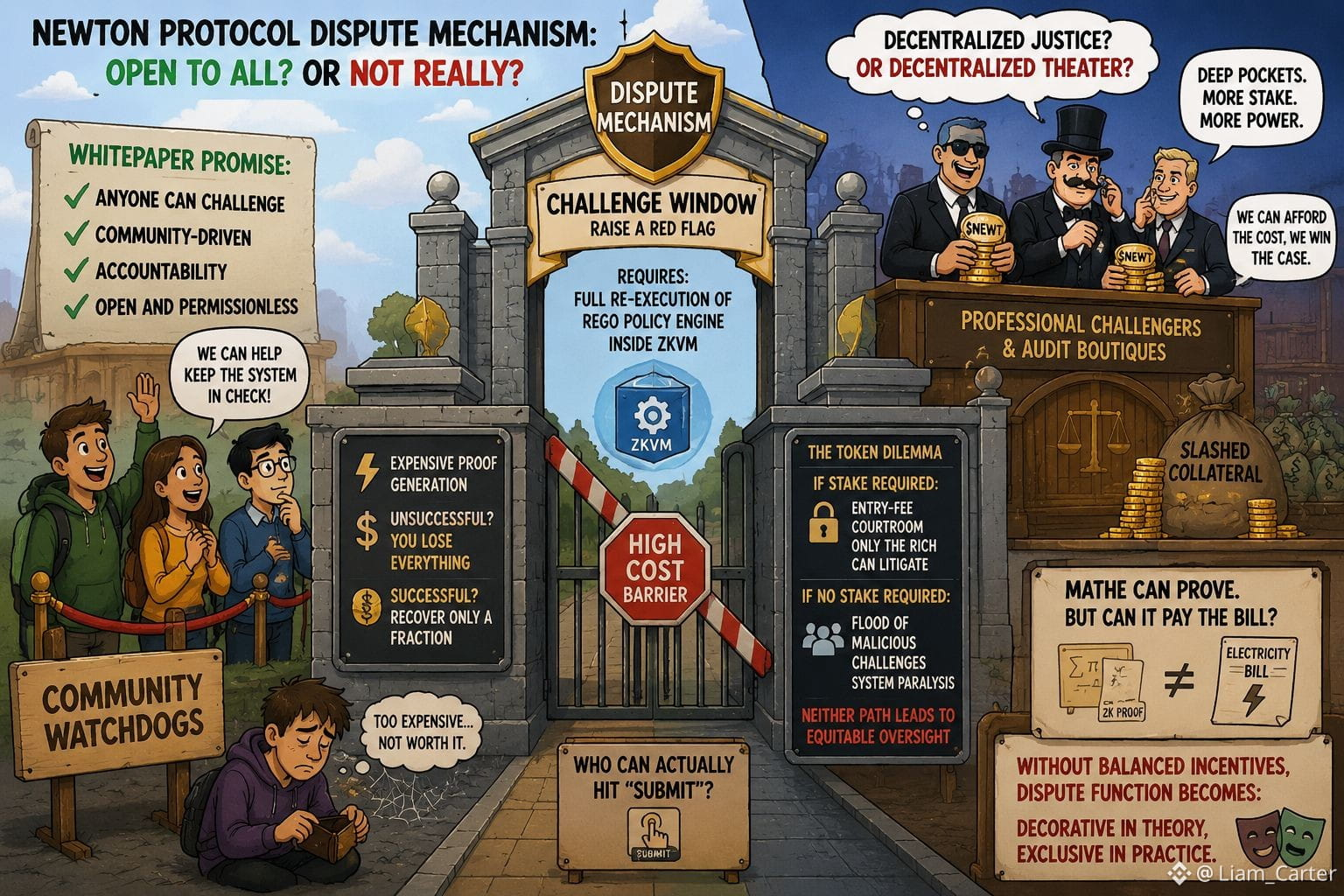
#newt $NEWT @NewtonProtocol Newton’s whitepaper promotes its dispute mechanism as an unguarded sentry—anyone can raise a red flag without prior sign‑up, delivering what it calls community‑driven accountability. But beneath the marketing, the numbers paint a very different picture. Every objection demands a full re‑execution of the Rego policy engine inside a zero‑knowledge virtual machine. The paper celebrates this as a technical leap, yet innovation doesn’t erase operational cost. An unsuccessful challenger walks away empty‑handed; a successful one recovers only a fraction of the slashed collateral while bearing heavy proof‑generation expenses. That calculus screams high‑stakes, low‑margin—a structure that starves casual watchdogs and quietly feeds a professional bounty‑hunting class. Then there’s the unresolved role of the $NEWT token. If the protocol forces challengers to lock tokens before acting, the whole setup becomes an entry‑fee courtroom where only the well‑capitalized can litigate and deep pockets can overwhelm honest participants through sheer staking weight. If no stake is required, the system invites a flood of cost‑free, malicious challenges that could paralyze verification altogether. Neither fork delivers the egalitarian oversight the protocol advertises. Token economics sit at the heart of the mechanism’s credibility, yet the whitepaper keeps them in limbo. Mathematical proofs can erase the need for blind trust, but they don’t cover electricity bills. The incentive puzzle is still missing critical pieces. The challenge window risks becoming a decorative feature—open in theory, practically untouched by everyday users. The true question isn’t whether the code can self‑verify; it’s who can actually afford to hit “submit.” Without coherent, balanced incentives, the dispute function won’t mobilize a citizen army. It will quietly morph into a subscription tool for audit boutiques and liquidity providers—decentralized theater rather than decentralized justice. $LAB
#newt $NEWT @NewtonProtocol

Newton’s whitepaper promotes its dispute mechanism as an unguarded sentry—anyone can raise a red flag without prior sign‑up, delivering what it calls community‑driven accountability. But beneath the marketing, the numbers paint a very different picture.

Every objection demands a full re‑execution of the Rego policy engine inside a zero‑knowledge virtual machine. The paper celebrates this as a technical leap, yet innovation doesn’t erase operational cost. An unsuccessful challenger walks away empty‑handed; a successful one recovers only a fraction of the slashed collateral while bearing heavy proof‑generation expenses. That calculus screams high‑stakes, low‑margin—a structure that starves casual watchdogs and quietly feeds a professional bounty‑hunting class.

Then there’s the unresolved role of the $NEWT token. If the protocol forces challengers to lock tokens before acting, the whole setup becomes an entry‑fee courtroom where only the well‑capitalized can litigate and deep pockets can overwhelm honest participants through sheer staking weight. If no stake is required, the system invites a flood of cost‑free, malicious challenges that could paralyze verification altogether. Neither fork delivers the egalitarian oversight the protocol advertises. Token economics sit at the heart of the mechanism’s credibility, yet the whitepaper keeps them in limbo.

Mathematical proofs can erase the need for blind trust, but they don’t cover electricity bills. The incentive puzzle is still missing critical pieces. The challenge window risks becoming a decorative feature—open in theory, practically untouched by everyday users. The true question isn’t whether the code can self‑verify; it’s who can actually afford to hit “submit.” Without coherent, balanced incentives, the dispute function won’t mobilize a citizen army. It will quietly morph into a subscription tool for audit boutiques and liquidity providers—decentralized theater rather than decentralized justice.
$LAB
記事
翻訳参照
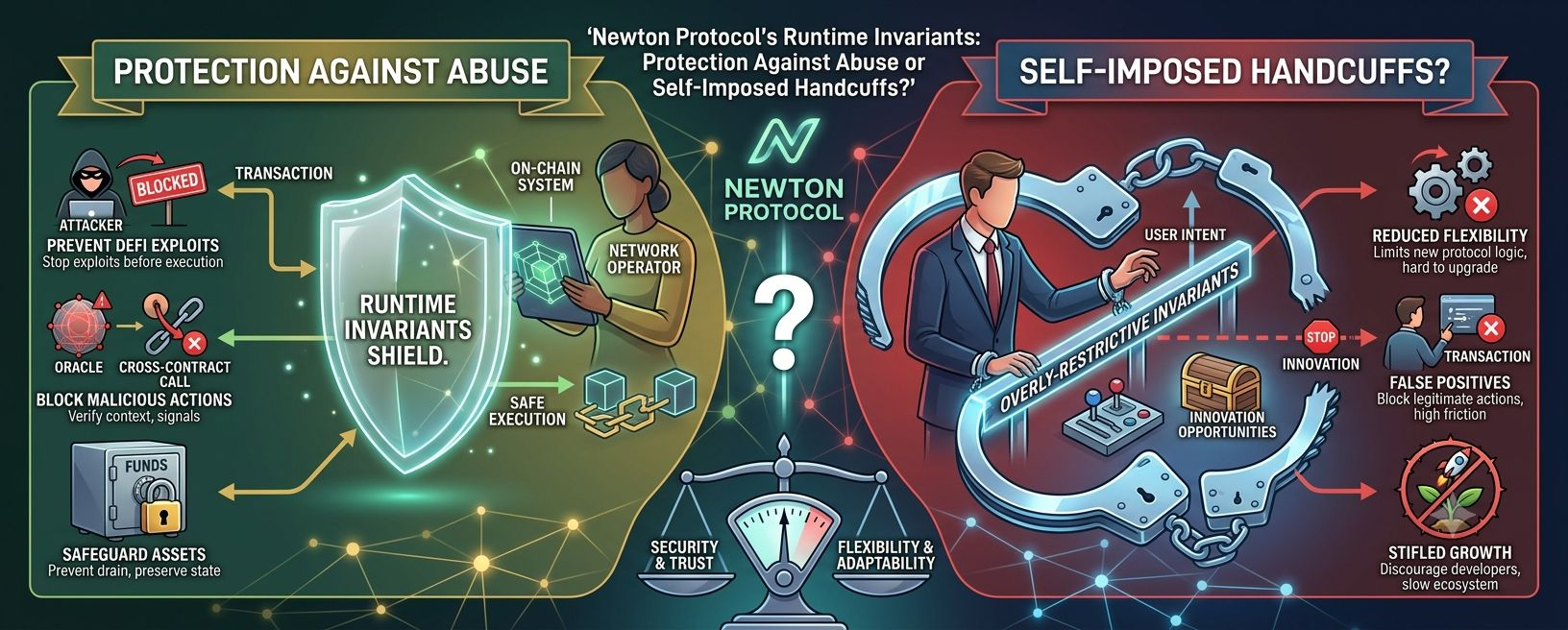
Newton Protocol’s Runtime Invariants: Protection Against Abuse or Self-Imposed Handcuffs?Flip to Sections 3.1 and 8.2 of the white paper, and you'll spot a paragraph I found myself rereading five times. It sits quietly inside a thicket of technical prose—blink and you might miss it entirely. Section 3.1, while dissecting compliance gaps across the chain, slips in a subdued sentence: "When a private key controls asset operations—minting, redemption, and vault management—if that key is compromised, all compliance logic becomes invalid." Immediately after, Section 8.2 suggests a remedy: use Newton’s strategy engine to bolt an "invariant at runtime" onto RWA smart contracts. No matter who holds the admin private key, the contract must obtain Newton’s sign-off before it can run any sensitive function. In everyday language, it’s like attaching a compliance padlock to your smart contract—one that nobody, not even you, can open on their own. From a deployment standpoint, the concept holds water. Bybit’s $1.5 billion breach, the long list of DeFi admin key leaks—these are cited in the white paper almost verbatim to argue that the single-key approach can no longer act as a safety net. Yet the more I examine this feature, the more a nagging question keeps surfacing: If I were the project team, why would I willingly cuff my own hands? Who actually benefits the most from a "non-negotiable restraint"? Picture this. You’re an RWA issuance platform rolling out a tokenized U.S. Treasury fund on Ethereum. The regulator lays down hard boundaries: only KYC-approved investors may hold the tokens; no single wallet can exceed five percent of the fund’s total shares; every secondary-market trade must pass a compliance check first. In a conventional smart-contract setup, how do you enforce those rules? You bake them directly into the contract code. But contracts are upgradeable, and admin powers normally sit with a multi-sig. If the multi-sig signers are leaned on, or if late one night a collective urge takes hold, those restrictions can be quietly rewritten one by one. The white paper calls this "administrator key risk." Newton’s suggested solution: pull the compliance logic out of your contract and place it elsewhere. Your token contract no longer asks itself "is this address allowed to buy?" It watches for only one thing—Newton’s BLS aggregated signature. With a signature, move forward; without it, revert instantly. Behind that signature, Newton’s node network faithfully runs the strategy you configured: checking KYC, calculating ownership caps, screening investor eligibility. The administrator can’t bend the strategy’s outcome because the nodes aren’t your staff—they’ve staked real capital and face seizure and slashing penalties. On paper, you can sell this to regulators as a clean story: "Look—I can’t even manage myself. I’ve willingly handed the gatekeeper keys to an external network." But the friction lies precisely with that "external network." You distrust yourself, so you turn around and place your trust in a network you can’t truly decentralize? That paradox is hard to swallow. The project team’s motives for delegating compliance authority to Newton boil down to two possibilities, whichever way you slice it: either they genuinely want to earn "credible neutrality" so investors and regulators feel safe; or regulators are pressing them, and they urgently need a "see, we’ve built compliance infrastructure" badge. Whatever the motive, once they integrate with Newton, the team faces a thorny question that didn’t exist before: if Newton’s strategy engine stumbles into all the pitfalls I’ve flagged earlier—quietly poisoned data feeds, conflicting strategy rules, nodes selectively stalling at the gateway, privacy overhead ballooning—does the team still have a plan B? Section 4.4 of Newton’s white paper says Newton is "infrastructure that enhances the existing compliance stack, not something that replaces them." But if your contract’s execution is tightly coupled to Newton’s authorization credentials, can your contract still stand and operate on its own when Newton goes dark? Is the design "if Newton is offline, default to allow," or "if Newton is offline, block everything"? The first is a gaping security hole; the second is a kill switch that locks your own business out of the room. So which one is it? Even more puzzling is the possibility that the project team quietly kept an "emergency pause" or a "bridge-and-rollback" escape hatch—say, that multi-sig admins can, under extreme conditions, reach directly into the contract and operate it, bypassing Newton entirely. If that’s the case, then this "inescapable restraint" collapses on the spot. The project team would effectively be carving a hidden door in the back wall of its own house while shouting to the world that it has a steel-plated, tamper-proof front door. Regulators aren’t blind. If the team still holds the keys to circumvent Newton, then the "authorization proof" Newton issues begins to look to regulators like a shiny stage prop. On the flip side, if the project team genuinely surrenders all permissions to Newton, its operational flexibility is shaved to zero—strategy changes become impossible, the "emergency freeze" button can’t be pressed, and after a data feed gets contaminated, they can’t even clean things up manually. And what about the $NEWT token—what role should it play, and what role is it actually playing? White paper Section 10.1 explains that nodes earn tokens based on execution volume. The "heavier" the strategy and the more often it’s invoked, the fatter the node’s reward. That incentive structure doesn’t line up perfectly with the project team’s interests. What does the project team hope for? Accurate, fast, stable, low-cost compliance decisions. What do nodes hope for? High task volume, high unit price, intricate strategies, frequent data-source adjustments. If the project team’s business settles into a steady phase—decent trading volume but simple strategies—the "skim" nodes can harvest might not be as juicy as latching onto a high-frequency, low-volume-complexity application. Under this mismatch, the project team is effectively entrusting the fate of its compliance to a network whose incentives don’t point fully in the same direction. It feels like outsourcing your entire legal department to a law firm that bills by the number of documents processed—their natural impulse is to review each document slowly and meticulously, layering steps like a pastry, because that’s the business model. What if Newton token ownership concentrates heavily in the hands of node operators, and the project team’s own holdings are negligible? Then the team’s voice in network governance would be zero. The governance framework in Section 10.4 is still floating at a high level of abstraction—boiled down to a single line: "Set protocol parameters through the on-chain governance process." But do "protocol parameters" include the strategy engine’s pricing formula? Do they cover the length of the challenge window? Do they reach into the review thresholds for the data provider whitelist? If all these life-or-death levers get decided behind closed doors by node operators voting among themselves, then a project team integrating with Newton is like stepping into a taxi where the drivers collectively vote on both the fare and the route. You’re left with two choices: get in, or slam the door and walk away. You get zero say in how the ride is driven. At this point, a sharper question cuts through: who exactly needs these restraints the most? Chapter 8 of the white paper arranges use cases neatly, like items on a shelf: stablecoins, RWA, institutional DeFi, AI agents, cross-border payments—nothing left out. But the value of a "non-negotiable compliance lock" doesn’t weigh the same across different users. For institutions, these restraints might be a shiny asset. Banks can square their shoulders and say, "Look—our on-chain products don’t rely on the self-discipline of internal risk control. Compliance is locked at the code level, so regulators can independently verify at any moment." That’s a slogan that can fetch a premium. For DeFi protocols, these restraints might be a bitter pill. If a decentralized lending protocol integrates Newton and outsources the entire borrower eligibility audit to a decentralized network, what happens when borrowers default—can the protocol still independently pursue recovery? If Newton’s nodes mislabel a high-quality borrower as "high risk," does the protocol have the authority to manually overturn that decision? If not, the user experience crumbles on the spot. If yes, then the whole point of integrating Newton shrinks into a layer of compliance theater. For AI agents, though, these restraints might genuinely be indispensable. Section 8.4 of the white paper argues that AI agents need programmatic guardrails. If an autonomous trading agent managing hundreds of thousands to millions of dollars doesn’t have an external authorization constraint clipped to its neck, it might be lured step by step into a catastrophic chain of operations within minutes. Connecting Newton to the agent is like putting a chain around its neck—but who exactly grips the other end? If the chain is held by the agent’s developer, will the developer spot strategy loopholes and quietly steer the agent’s behavior? If the chain is held by the Newton node network, the agent’s execution latency and cost turn into a set of variables that can never be pinned down. These cuffs—if I’m the one wearing them, might I end up locking myself in? This piece isn’t aiming to deliver a final verdict; I’m only working with one test direction. If I were the project team, I’d pick up the phone and ask Newton’s team a concrete question: Suppose my application integrates Newton, runs smoothly for six months, and then in the seventh month a strategy error surfaces that I simply cannot swallow—for instance, a fully compliant institutional investor gets turned away repeatedly, and I’ve already confirmed the root cause traces to a specific data source. Without triggering governance votes, without launching disruptive version upgrades, and without needing the collective nod of node operators, how many paths do I have to restore my business’s normal operations within twenty-four hours? If Newton can produce a clear, specific, well-reasoned answer that stands up to scrutiny, then that "inescapable constraint" becomes a solid, genuinely compelling selling point. But if the answer keeps dodging and lands at something like "you need to submit a governance proposal," "you must wait for the challenge window to expire," or "please coordinate with the node operator," then these cuffs aren’t meant to restrain bad actors—they’re meant to restrain you. This is the fourteenth reflection. The more I chew on the same white paper, the more it feels as if this whole on-chain compliance effort isn’t solving a "how to implement" technical problem at all—it’s solving the most ancient, stubborn puzzle of all: who gets to decide. Those four words—"unavoidable compliance constraints"—in gentler terms mean trust minimization; in harsher terms, they mean a permanent handover of control. Before you slide your arm into these cuffs, ask yourself, one by one: where the key is kept, who holds it, and whether it can be replaced if lost. Everything above is personal research and reasoning; it does not constitute investment advice. Make your own judgment and take responsibility yourself. DYOR. @NewtonProtocol $NEWT #Newt {spot}(NEWTUSDT)

Newton Protocol’s Runtime Invariants: Protection Against Abuse or Self-Imposed Handcuffs?

Flip to Sections 3.1 and 8.2 of the white paper, and you'll spot a paragraph I found myself rereading five times. It sits quietly inside a thicket of technical prose—blink and you might miss it entirely. Section 3.1, while dissecting compliance gaps across the chain, slips in a subdued sentence: "When a private key controls asset operations—minting, redemption, and vault management—if that key is compromised, all compliance logic becomes invalid." Immediately after, Section 8.2 suggests a remedy: use Newton’s strategy engine to bolt an "invariant at runtime" onto RWA smart contracts. No matter who holds the admin private key, the contract must obtain Newton’s sign-off before it can run any sensitive function. In everyday language, it’s like attaching a compliance padlock to your smart contract—one that nobody, not even you, can open on their own.
From a deployment standpoint, the concept holds water. Bybit’s $1.5 billion breach, the long list of DeFi admin key leaks—these are cited in the white paper almost verbatim to argue that the single-key approach can no longer act as a safety net. Yet the more I examine this feature, the more a nagging question keeps surfacing: If I were the project team, why would I willingly cuff my own hands?
Who actually benefits the most from a "non-negotiable restraint"? Picture this. You’re an RWA issuance platform rolling out a tokenized U.S. Treasury fund on Ethereum. The regulator lays down hard boundaries: only KYC-approved investors may hold the tokens; no single wallet can exceed five percent of the fund’s total shares; every secondary-market trade must pass a compliance check first. In a conventional smart-contract setup, how do you enforce those rules? You bake them directly into the contract code. But contracts are upgradeable, and admin powers normally sit with a multi-sig. If the multi-sig signers are leaned on, or if late one night a collective urge takes hold, those restrictions can be quietly rewritten one by one. The white paper calls this "administrator key risk."
Newton’s suggested solution: pull the compliance logic out of your contract and place it elsewhere. Your token contract no longer asks itself "is this address allowed to buy?" It watches for only one thing—Newton’s BLS aggregated signature. With a signature, move forward; without it, revert instantly. Behind that signature, Newton’s node network faithfully runs the strategy you configured: checking KYC, calculating ownership caps, screening investor eligibility. The administrator can’t bend the strategy’s outcome because the nodes aren’t your staff—they’ve staked real capital and face seizure and slashing penalties. On paper, you can sell this to regulators as a clean story: "Look—I can’t even manage myself. I’ve willingly handed the gatekeeper keys to an external network."
But the friction lies precisely with that "external network." You distrust yourself, so you turn around and place your trust in a network you can’t truly decentralize? That paradox is hard to swallow. The project team’s motives for delegating compliance authority to Newton boil down to two possibilities, whichever way you slice it: either they genuinely want to earn "credible neutrality" so investors and regulators feel safe; or regulators are pressing them, and they urgently need a "see, we’ve built compliance infrastructure" badge. Whatever the motive, once they integrate with Newton, the team faces a thorny question that didn’t exist before: if Newton’s strategy engine stumbles into all the pitfalls I’ve flagged earlier—quietly poisoned data feeds, conflicting strategy rules, nodes selectively stalling at the gateway, privacy overhead ballooning—does the team still have a plan B?
Section 4.4 of Newton’s white paper says Newton is "infrastructure that enhances the existing compliance stack, not something that replaces them." But if your contract’s execution is tightly coupled to Newton’s authorization credentials, can your contract still stand and operate on its own when Newton goes dark? Is the design "if Newton is offline, default to allow," or "if Newton is offline, block everything"? The first is a gaping security hole; the second is a kill switch that locks your own business out of the room. So which one is it?
Even more puzzling is the possibility that the project team quietly kept an "emergency pause" or a "bridge-and-rollback" escape hatch—say, that multi-sig admins can, under extreme conditions, reach directly into the contract and operate it, bypassing Newton entirely. If that’s the case, then this "inescapable restraint" collapses on the spot. The project team would effectively be carving a hidden door in the back wall of its own house while shouting to the world that it has a steel-plated, tamper-proof front door. Regulators aren’t blind. If the team still holds the keys to circumvent Newton, then the "authorization proof" Newton issues begins to look to regulators like a shiny stage prop. On the flip side, if the project team genuinely surrenders all permissions to Newton, its operational flexibility is shaved to zero—strategy changes become impossible, the "emergency freeze" button can’t be pressed, and after a data feed gets contaminated, they can’t even clean things up manually.
And what about the $NEWT token—what role should it play, and what role is it actually playing? White paper Section 10.1 explains that nodes earn tokens based on execution volume. The "heavier" the strategy and the more often it’s invoked, the fatter the node’s reward. That incentive structure doesn’t line up perfectly with the project team’s interests. What does the project team hope for? Accurate, fast, stable, low-cost compliance decisions. What do nodes hope for? High task volume, high unit price, intricate strategies, frequent data-source adjustments. If the project team’s business settles into a steady phase—decent trading volume but simple strategies—the "skim" nodes can harvest might not be as juicy as latching onto a high-frequency, low-volume-complexity application. Under this mismatch, the project team is effectively entrusting the fate of its compliance to a network whose incentives don’t point fully in the same direction. It feels like outsourcing your entire legal department to a law firm that bills by the number of documents processed—their natural impulse is to review each document slowly and meticulously, layering steps like a pastry, because that’s the business model.
What if Newton token ownership concentrates heavily in the hands of node operators, and the project team’s own holdings are negligible? Then the team’s voice in network governance would be zero. The governance framework in Section 10.4 is still floating at a high level of abstraction—boiled down to a single line: "Set protocol parameters through the on-chain governance process." But do "protocol parameters" include the strategy engine’s pricing formula? Do they cover the length of the challenge window? Do they reach into the review thresholds for the data provider whitelist? If all these life-or-death levers get decided behind closed doors by node operators voting among themselves, then a project team integrating with Newton is like stepping into a taxi where the drivers collectively vote on both the fare and the route. You’re left with two choices: get in, or slam the door and walk away. You get zero say in how the ride is driven.
At this point, a sharper question cuts through: who exactly needs these restraints the most? Chapter 8 of the white paper arranges use cases neatly, like items on a shelf: stablecoins, RWA, institutional DeFi, AI agents, cross-border payments—nothing left out. But the value of a "non-negotiable compliance lock" doesn’t weigh the same across different users. For institutions, these restraints might be a shiny asset. Banks can square their shoulders and say, "Look—our on-chain products don’t rely on the self-discipline of internal risk control. Compliance is locked at the code level, so regulators can independently verify at any moment." That’s a slogan that can fetch a premium. For DeFi protocols, these restraints might be a bitter pill. If a decentralized lending protocol integrates Newton and outsources the entire borrower eligibility audit to a decentralized network, what happens when borrowers default—can the protocol still independently pursue recovery? If Newton’s nodes mislabel a high-quality borrower as "high risk," does the protocol have the authority to manually overturn that decision? If not, the user experience crumbles on the spot. If yes, then the whole point of integrating Newton shrinks into a layer of compliance theater. For AI agents, though, these restraints might genuinely be indispensable. Section 8.4 of the white paper argues that AI agents need programmatic guardrails. If an autonomous trading agent managing hundreds of thousands to millions of dollars doesn’t have an external authorization constraint clipped to its neck, it might be lured step by step into a catastrophic chain of operations within minutes. Connecting Newton to the agent is like putting a chain around its neck—but who exactly grips the other end? If the chain is held by the agent’s developer, will the developer spot strategy loopholes and quietly steer the agent’s behavior? If the chain is held by the Newton node network, the agent’s execution latency and cost turn into a set of variables that can never be pinned down.
These cuffs—if I’m the one wearing them, might I end up locking myself in? This piece isn’t aiming to deliver a final verdict; I’m only working with one test direction. If I were the project team, I’d pick up the phone and ask Newton’s team a concrete question: Suppose my application integrates Newton, runs smoothly for six months, and then in the seventh month a strategy error surfaces that I simply cannot swallow—for instance, a fully compliant institutional investor gets turned away repeatedly, and I’ve already confirmed the root cause traces to a specific data source. Without triggering governance votes, without launching disruptive version upgrades, and without needing the collective nod of node operators, how many paths do I have to restore my business’s normal operations within twenty-four hours? If Newton can produce a clear, specific, well-reasoned answer that stands up to scrutiny, then that "inescapable constraint" becomes a solid, genuinely compelling selling point. But if the answer keeps dodging and lands at something like "you need to submit a governance proposal," "you must wait for the challenge window to expire," or "please coordinate with the node operator," then these cuffs aren’t meant to restrain bad actors—they’re meant to restrain you.
This is the fourteenth reflection. The more I chew on the same white paper, the more it feels as if this whole on-chain compliance effort isn’t solving a "how to implement" technical problem at all—it’s solving the most ancient, stubborn puzzle of all: who gets to decide. Those four words—"unavoidable compliance constraints"—in gentler terms mean trust minimization; in harsher terms, they mean a permanent handover of control. Before you slide your arm into these cuffs, ask yourself, one by one: where the key is kept, who holds it, and whether it can be replaced if lost. Everything above is personal research and reasoning; it does not constitute investment advice. Make your own judgment and take responsibility yourself. DYOR.
@NewtonProtocol $NEWT #Newt
記事
翻訳参照
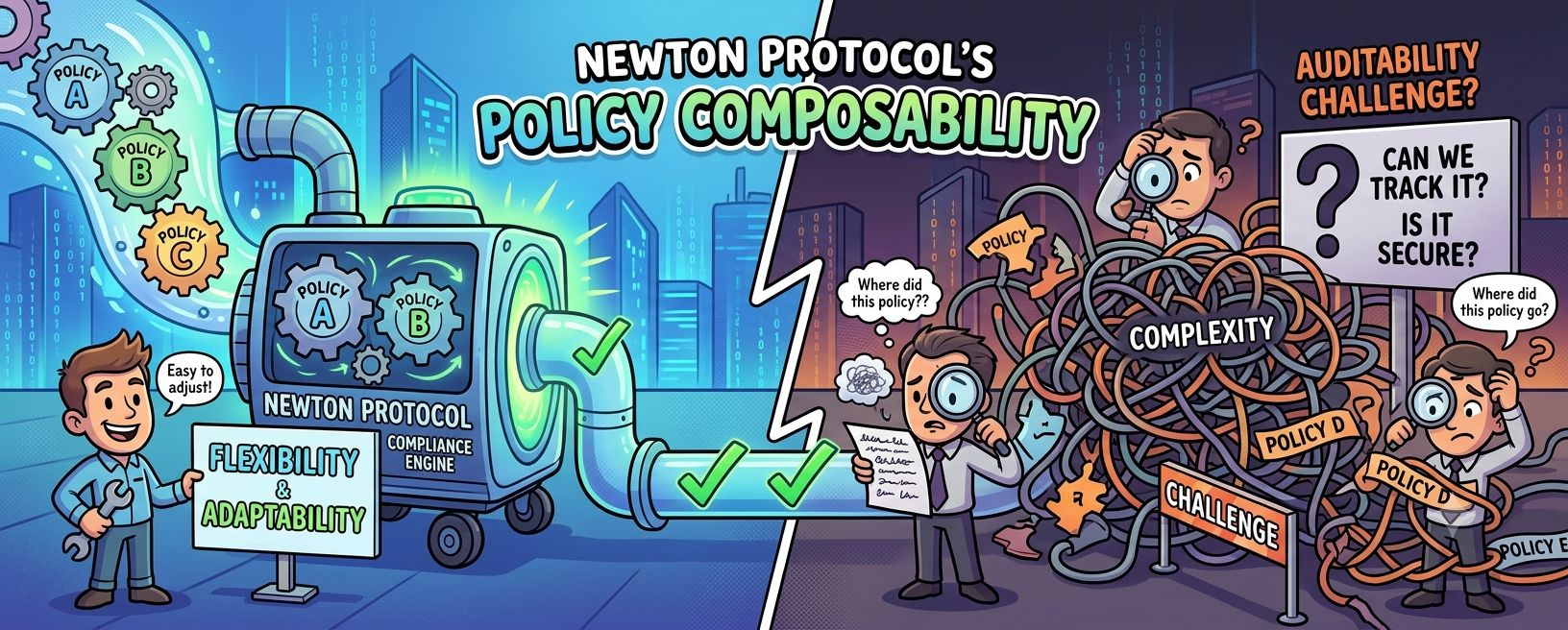
Newton Protocol’s Policy Composability: Flexible Compliance Engine or Auditability Challenge?Previously, managing permissions inside an organization often led to an impossible bind: the leadership wanted ironclad rules to close every loophole, yet they also demanded the ability to rewrite those rules at a moment’s notice to respond to sudden business needs. In a traditional setting, human administrators would mediate this tension. On a blockchain, however, once a policy is baked into a smart contract, changing it becomes a heavy, resource-intensive undertaking. After reading the Policy Composability chapter in Newton Protocol’s documentation, I saw that it implements a Rego-inspired logic that works a bit like snapping together LEGO bricks. I hadn’t fully thought it through until I compared approaches, and then the elegance clicked. It doesn’t ask you to write one gigantic, all‑encompassing rule set. Instead, it breaks compliance apart into self‑contained modules: a sanctions‑screening block, a transfer‑limit block, an identity‑tier block, and so on. The clever part is that this separation decouples a rule’s logic from its parameters. Imagine a stablecoin issuer: it can drop in the sanctions block, but configure which data feed that block points to—Chainalysis, Hexagate, or another provider entirely. If regulatory demands shift tomorrow, there’s no need to rebuild the entire authorization pipeline. You just unplug one block, snap in a new one, or adjust a threshold inside the existing block. This ability to form dynamic combinations means compliance stops being a rigid, welded‑shut structure and becomes a living system that can breathe as policies evolve. I find that modular mindset refreshing. It admits a hard reality: no compliance strategy is genuinely “set it and forget it.” Newton isn’t delivering a specific, off‑the‑shelf compliance template. It’s offering a workshop where institutions can freely assemble their own. By stepping back, it gives organizations the ultimate flexibility to define what “compliance” means on their own terms. But let’s pull the lens back. With modular assembly, the biggest stress test is compatibility between blocks. The whitepaper mentions that modules are content‑addressed and live on IPFS, which sounds robust. However, once you stack four or five blocks from different sources, could logical collisions arise? Picture the limit module giving a green light while the identity module slams the door—how is that conflict resolved at evaluation time? Would it cause transactions to be blocked needlessly? That’s a concern born from the idea of stacking multiple pieces of logic; I’m not saying failures have already occurred. There’s another practical issue: the more blocks you add, the heavier the computational cost of each evaluation, which directly challenges an operator’s response speed. Then there’s a layer that worries me from a supervisory standpoint. While this agility gives institutions freedom, it creates headaches for regulators. If blocks can be swapped anytime, how can a regulator be certain what precise rule set governed a transaction at a specific moment in the past? Newton does store compliance receipts as evidence, but those receipts capture the outcome, not the full blueprint. Can you cleanly reconstruct the exact block combination that was active back then? For auditing, that’s still a big question mark. So a lot depends on your angle. Newton’s strategy composition is attempting to bolt “universal wheels” onto on‑chain compliance, so that rules can turn smoothly and be swapped out fast—a creative move, no doubt. But its real quality isn’t measured by how many blocks sit in the library. It’s about whether those blocks, once assembled, run reliably and hold up under audit scrutiny. Don’t just watch how flexibly the strategy is marketed—go look at the strategy repository and see how many mature, officially certified, end‑to‑end templates are genuinely ready to use right now. @NewtonProtocol $NEWT #Newt {spot}(NEWTUSDT) $LAB

Newton Protocol’s Policy Composability: Flexible Compliance Engine or Auditability Challenge?

Previously, managing permissions inside an organization often led to an impossible bind: the leadership wanted ironclad rules to close every loophole, yet they also demanded the ability to rewrite those rules at a moment’s notice to respond to sudden business needs. In a traditional setting, human administrators would mediate this tension. On a blockchain, however, once a policy is baked into a smart contract, changing it becomes a heavy, resource-intensive undertaking.
After reading the Policy Composability chapter in Newton Protocol’s documentation, I saw that it implements a Rego-inspired logic that works a bit like snapping together LEGO bricks. I hadn’t fully thought it through until I compared approaches, and then the elegance clicked. It doesn’t ask you to write one gigantic, all‑encompassing rule set. Instead, it breaks compliance apart into self‑contained modules: a sanctions‑screening block, a transfer‑limit block, an identity‑tier block, and so on.
The clever part is that this separation decouples a rule’s logic from its parameters. Imagine a stablecoin issuer: it can drop in the sanctions block, but configure which data feed that block points to—Chainalysis, Hexagate, or another provider entirely. If regulatory demands shift tomorrow, there’s no need to rebuild the entire authorization pipeline. You just unplug one block, snap in a new one, or adjust a threshold inside the existing block.
This ability to form dynamic combinations means compliance stops being a rigid, welded‑shut structure and becomes a living system that can breathe as policies evolve. I find that modular mindset refreshing. It admits a hard reality: no compliance strategy is genuinely “set it and forget it.” Newton isn’t delivering a specific, off‑the‑shelf compliance template. It’s offering a workshop where institutions can freely assemble their own. By stepping back, it gives organizations the ultimate flexibility to define what “compliance” means on their own terms.
But let’s pull the lens back. With modular assembly, the biggest stress test is compatibility between blocks. The whitepaper mentions that modules are content‑addressed and live on IPFS, which sounds robust. However, once you stack four or five blocks from different sources, could logical collisions arise? Picture the limit module giving a green light while the identity module slams the door—how is that conflict resolved at evaluation time? Would it cause transactions to be blocked needlessly? That’s a concern born from the idea of stacking multiple pieces of logic; I’m not saying failures have already occurred.
There’s another practical issue: the more blocks you add, the heavier the computational cost of each evaluation, which directly challenges an operator’s response speed. Then there’s a layer that worries me from a supervisory standpoint. While this agility gives institutions freedom, it creates headaches for regulators. If blocks can be swapped anytime, how can a regulator be certain what precise rule set governed a transaction at a specific moment in the past? Newton does store compliance receipts as evidence, but those receipts capture the outcome, not the full blueprint. Can you cleanly reconstruct the exact block combination that was active back then? For auditing, that’s still a big question mark.
So a lot depends on your angle. Newton’s strategy composition is attempting to bolt “universal wheels” onto on‑chain compliance, so that rules can turn smoothly and be swapped out fast—a creative move, no doubt. But its real quality isn’t measured by how many blocks sit in the library. It’s about whether those blocks, once assembled, run reliably and hold up under audit scrutiny. Don’t just watch how flexibly the strategy is marketed—go look at the strategy repository and see how many mature, officially certified, end‑to‑end templates are genuinely ready to use right now.
@NewtonProtocol $NEWT #Newt
$LAB
翻訳参照
I was sitting on a park bench a few months ago, half-watching a group of kids play football while I sorted through my own head. I’d been in crypto long enough to notice a pattern that nobody talks about much. It’s not the scams or the crashes. It’s the quiet quitting. The builders who vanish not because they ran out of money, but because they ran out of faith that the environment would ever treat them fairly. I’ve met them at hackathons, in Telegram groups, at the edges of conferences. They built clever things. Automated strategies, trading models, tools that worked beautifully in isolation. But when it came time to put them on-chain, the table tilted too far. Gas prices ate their margins. Mempool watchers copied their moves. Keeping the logic private meant trusting a single server, which defeated the whole point. So they stopped. No announcement. Just a notebook closed, a repo archived, a mind moving on. Newton Protocol nudged that memory back to the surface. It’s a rollup purpose-built for AI-driven trading strategies and a marketplace where developers can deploy models with verifiable execution and real privacy. No AGI promises. No revolution. Just a sandbox for the kind of work that usually ends up abandoned in a drawer. My observation is a simple one. We spend so much energy chasing the next big narrative that we forget about all the small, promising ideas we’ve already buried. Maybe the real breakthrough isn’t a faster chain or a smarter oracle. Maybe it’s just a fairer table, the kind that makes a tired builder look up from a park bench and decide to try again. I don’t know if Newton is that table. But I’m paying attention to anyone who tries to build one. @NewtonProtocol #newt $NEWT {spot}(NEWTUSDT)
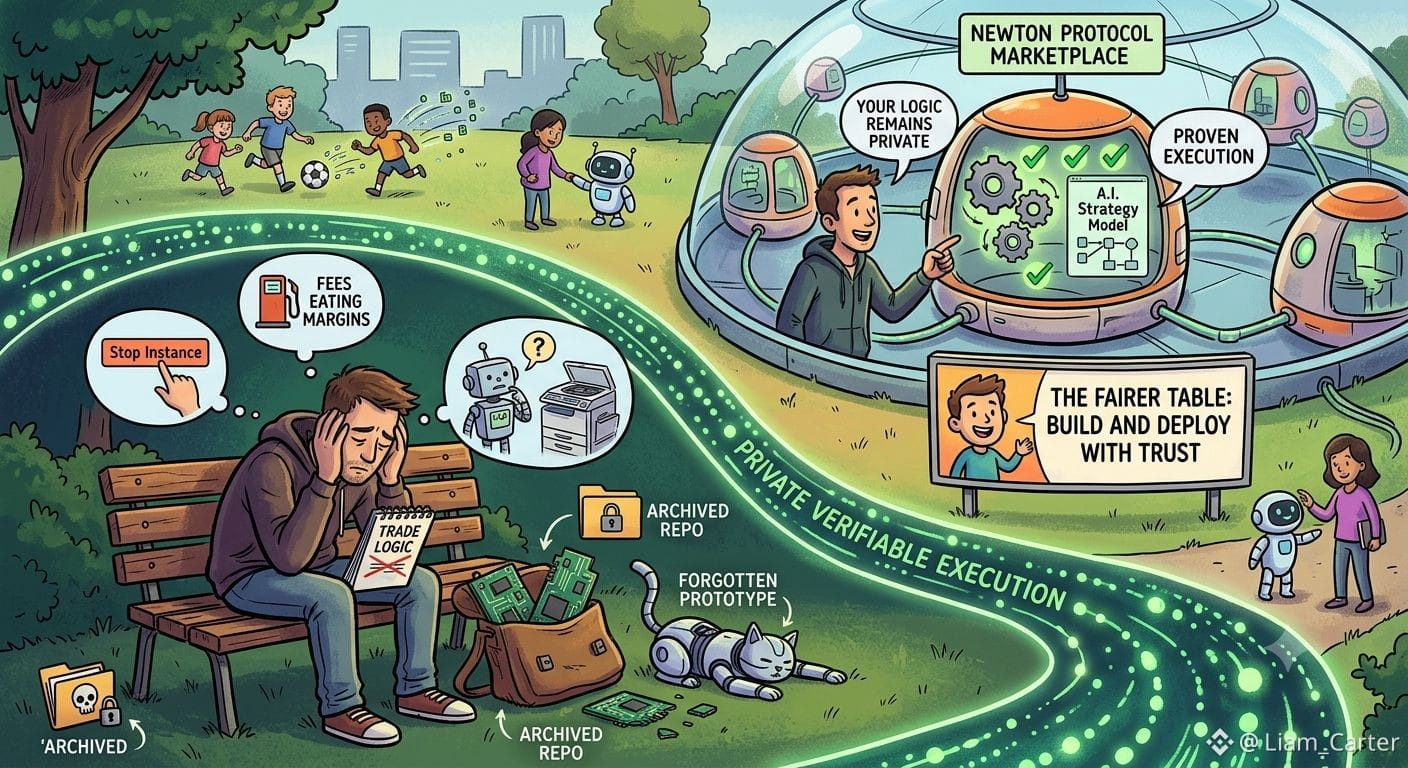
I was sitting on a park bench a few months ago, half-watching a group of kids play football while I sorted through my own head. I’d been in crypto long enough to notice a pattern that nobody talks about much. It’s not the scams or the crashes. It’s the quiet quitting. The builders who vanish not because they ran out of money, but because they ran out of faith that the environment would ever treat them fairly.

I’ve met them at hackathons, in Telegram groups, at the edges of conferences. They built clever things. Automated strategies, trading models, tools that worked beautifully in isolation. But when it came time to put them on-chain, the table tilted too far. Gas prices ate their margins. Mempool watchers copied their moves. Keeping the logic private meant trusting a single server, which defeated the whole point. So they stopped. No announcement. Just a notebook closed, a repo archived, a mind moving on.

Newton Protocol nudged that memory back to the surface. It’s a rollup purpose-built for AI-driven trading strategies and a marketplace where developers can deploy models with verifiable execution and real privacy. No AGI promises. No revolution. Just a sandbox for the kind of work that usually ends up abandoned in a drawer.

My observation is a simple one. We spend so much energy chasing the next big narrative that we forget about all the small, promising ideas we’ve already buried. Maybe the real breakthrough isn’t a faster chain or a smarter oracle. Maybe it’s just a fairer table, the kind that makes a tired builder look up from a park bench and decide to try again. I don’t know if Newton is that table. But I’m paying attention to anyone who tries to build one.

@NewtonProtocol #newt $NEWT
翻訳参照
#newt $NEWT @NewtonProtocol I was sitting on a park bench a few months ago, half-watching a group of kids play football while I sorted through my own head. I’d been in crypto long enough to notice a pattern that nobody talks about much. It’s not the scams or the crashes. It’s the quiet quitting. The builders who vanish not because they ran out of money, but because they ran out of faith that the environment would ever treat them fairly. I’ve met them at hackathons, in Telegram groups, at the edges of conferences. They built clever things. Automated strategies, trading models, tools that worked beautifully in isolation. But when it came time to put them on-chain, the table tilted too far. Gas prices ate their margins. Mempool watchers copied their moves. Keeping the logic private meant trusting a single server, which defeated the whole point. So they stopped. No announcement. Just a notebook closed, a repo archived, a mind moving on. Newton Protocol nudged that memory back to the surface. It’s a rollup purpose-built for AI-driven trading strategies and a marketplace where developers can deploy models with verifiable execution and real privacy. No AGI promises. No revolution. Just a sandbox for the kind of work that usually ends up abandoned in a drawer. My observation is a simple one. We spend so much energy chasing the next big narrative that we forget about all the small, promising ideas we’ve already buried. Maybe the real breakthrough isn’t a faster chain or a smarter oracle. Maybe it’s just a fairer table, the kind that makes a tired builder look up from a park bench and decide to try again. I don’t know if Newton is that table. But I’m paying attention to anyone who tries to build one. $LAB
#newt $NEWT @NewtonProtocol

I was sitting on a park bench a few months ago, half-watching a group of kids play football while I sorted through my own head. I’d been in crypto long enough to notice a pattern that nobody talks about much. It’s not the scams or the crashes. It’s the quiet quitting. The builders who vanish not because they ran out of money, but because they ran out of faith that the environment would ever treat them fairly.

I’ve met them at hackathons, in Telegram groups, at the edges of conferences. They built clever things. Automated strategies, trading models, tools that worked beautifully in isolation. But when it came time to put them on-chain, the table tilted too far. Gas prices ate their margins. Mempool watchers copied their moves. Keeping the logic private meant trusting a single server, which defeated the whole point. So they stopped. No announcement. Just a notebook closed, a repo archived, a mind moving on.

Newton Protocol nudged that memory back to the surface. It’s a rollup purpose-built for AI-driven trading strategies and a marketplace where developers can deploy models with verifiable execution and real privacy. No AGI promises. No revolution. Just a sandbox for the kind of work that usually ends up abandoned in a drawer.

My observation is a simple one. We spend so much energy chasing the next big narrative that we forget about all the small, promising ideas we’ve already buried. Maybe the real breakthrough isn’t a faster chain or a smarter oracle. Maybe it’s just a fairer table, the kind that makes a tired builder look up from a park bench and decide to try again. I don’t know if Newton is that table. But I’m paying attention to anyone who tries to build one.
$LAB
翻訳参照
Newton Protocol (NEWT) and the Bot I Left in a DrawerLast week I found an old notebook from 2023, buried under a stack of tax documents I’d been avoiding. Inside, there were pages of hurried diagrams for something I called “Sentient Liquidity” — a system that would use a simple ML model to shift LP positions across Uniswap v3 pools. I’d written the logic in Python. I’d backtested it. I was convinced I’d cracked something. I never deployed it. Not once. The reason wasn’t technical. It was that I couldn’t figure out how to run the model without either exposing it to the world or trusting a single server to execute trades. Every path led to a compromise I wasn’t willing to make. The notebook went into a drawer, and I moved on. A small, personal capitulation that I’ve repeated in different ways for years. I thought about that notebook when I stumbled across Newton Protocol. The crypto market right now is drowning in AI tokens. Almost every day a new project promises to merge artificial intelligence with the blockchain in ways that sound profound but mean nothing. Most are wrappers around a ChatGPT API. Some don’t even have a working product. The cycle has become so predictable that genuine ideas now get buried under a thick layer of marketing foam. Newton Protocol is not trying to be profound. It’s a rollup designed for AI-driven trading strategies and a marketplace for AI developers. That’s the whole pitch. No AGI. No decentralized superintelligence. Just a chain where someone like me — a tired builder with a half-finished notebook — might actually deploy a model without feeling like I was handing my edge to a block builder or a bot farm. The friction it describes is something I know in my bones. On-chain execution punishes latency. MEV searchers tear apart unshielded transactions. If your trading logic relies on an off-chain model, you either reveal your alpha to whoever processes the data or you run a centralized keeper that becomes a single point of failure and a target. Those are bad options. I’ve tried both in my head, and neither felt acceptable. Newton suggests a third way: a ZK rollup where you could run a model inside a verifiable execution environment, prove its outputs are correct without exposing the model itself, and settle everything on a base layer that enforces fairness. A marketplace layer would then allow developers to list verified strategies, letting users deposit with cryptographic proof of past performance. It’s an idea that has less to do with AI magic and more to do with something far less glamorous — giving automated strategies the same kind of trustless architecture that DeFi already relies on. I’m not going to pretend this solves everything. The gulf between a working testnet and a liquid marketplace is enormous. Strategy creators are a guarded species. Most would rather keep their code in a basement and run it through a VPN than expose even a hint of their edge to a new platform. Liquidity providers, on the other hand, have been burned so many times by slick dashboards that they’ll demand a level of proof no early-stage project can easily deliver. And then there’s the outside world. Regulators haven’t figured out how to classify a simple lending pool, let alone an automated strategy that uses machine learning to rebalance assets. Launching something like this means navigating a legal ambiguity that would keep most founders awake at night. I don’t know if the team has a convincing answer for that. I’m not sure a convincing answer exists yet. I looked at the people behind it. They’re public, which counts for something. A few DeFi veterans, some quant finance background. No-one who’s personally shipped a rollup, which gives me pause. The stack seems plausible — custom precompiles for lightweight AI inference, a ZK rollup framework. I can see how the pieces could fit. But fit and function aren’t the same thing. What keeps Newton bouncing around my mind isn’t the tech. It’s that old notebook, still sitting in a drawer somewhere. It represents a whole category of abandoned projects, built by people who quietly understood a real friction but couldn’t find infrastructure that matched their standards. That group doesn’t need a miracle. It needs a reasonably fair, reasonably private execution layer. Something boring and solid. Newton looks like a bet that such a layer can exist, and that people might actually use it. The project could just as easily fizzle out. A token launch, a short spike of attention, then silence. I’ve seen that movie many times. But I’ve also seen enough to know that the things that eventually become infrastructure often start out looking like this — a little too specific, a little too quiet, aiming at a problem most people don’t even realize they have. I’m not cheering. I’m not buying a bag. But I’m leaning in. Because for the first time in a while, I’m thinking about that notebook again, wondering if maybe this time there’s finally a sandbox worth playing in. @NewtonProtocol #newt $NEWT {spot}(NEWTUSDT)

Newton Protocol (NEWT) and the Bot I Left in a Drawer

Last week I found an old notebook from 2023, buried under a stack of tax documents I’d been avoiding. Inside, there were pages of hurried diagrams for something I called “Sentient Liquidity” — a system that would use a simple ML model to shift LP positions across Uniswap v3 pools. I’d written the logic in Python. I’d backtested it. I was convinced I’d cracked something.
I never deployed it. Not once.
The reason wasn’t technical. It was that I couldn’t figure out how to run the model without either exposing it to the world or trusting a single server to execute trades. Every path led to a compromise I wasn’t willing to make. The notebook went into a drawer, and I moved on. A small, personal capitulation that I’ve repeated in different ways for years.
I thought about that notebook when I stumbled across Newton Protocol.
The crypto market right now is drowning in AI tokens. Almost every day a new project promises to merge artificial intelligence with the blockchain in ways that sound profound but mean nothing. Most are wrappers around a ChatGPT API. Some don’t even have a working product. The cycle has become so predictable that genuine ideas now get buried under a thick layer of marketing foam.
Newton Protocol is not trying to be profound. It’s a rollup designed for AI-driven trading strategies and a marketplace for AI developers. That’s the whole pitch. No AGI. No decentralized superintelligence. Just a chain where someone like me — a tired builder with a half-finished notebook — might actually deploy a model without feeling like I was handing my edge to a block builder or a bot farm.
The friction it describes is something I know in my bones. On-chain execution punishes latency. MEV searchers tear apart unshielded transactions. If your trading logic relies on an off-chain model, you either reveal your alpha to whoever processes the data or you run a centralized keeper that becomes a single point of failure and a target. Those are bad options. I’ve tried both in my head, and neither felt acceptable.
Newton suggests a third way: a ZK rollup where you could run a model inside a verifiable execution environment, prove its outputs are correct without exposing the model itself, and settle everything on a base layer that enforces fairness. A marketplace layer would then allow developers to list verified strategies, letting users deposit with cryptographic proof of past performance. It’s an idea that has less to do with AI magic and more to do with something far less glamorous — giving automated strategies the same kind of trustless architecture that DeFi already relies on.
I’m not going to pretend this solves everything. The gulf between a working testnet and a liquid marketplace is enormous. Strategy creators are a guarded species. Most would rather keep their code in a basement and run it through a VPN than expose even a hint of their edge to a new platform. Liquidity providers, on the other hand, have been burned so many times by slick dashboards that they’ll demand a level of proof no early-stage project can easily deliver.
And then there’s the outside world. Regulators haven’t figured out how to classify a simple lending pool, let alone an automated strategy that uses machine learning to rebalance assets. Launching something like this means navigating a legal ambiguity that would keep most founders awake at night. I don’t know if the team has a convincing answer for that. I’m not sure a convincing answer exists yet.
I looked at the people behind it. They’re public, which counts for something. A few DeFi veterans, some quant finance background. No-one who’s personally shipped a rollup, which gives me pause. The stack seems plausible — custom precompiles for lightweight AI inference, a ZK rollup framework. I can see how the pieces could fit. But fit and function aren’t the same thing.
What keeps Newton bouncing around my mind isn’t the tech. It’s that old notebook, still sitting in a drawer somewhere. It represents a whole category of abandoned projects, built by people who quietly understood a real friction but couldn’t find infrastructure that matched their standards. That group doesn’t need a miracle. It needs a reasonably fair, reasonably private execution layer. Something boring and solid. Newton looks like a bet that such a layer can exist, and that people might actually use it.
The project could just as easily fizzle out. A token launch, a short spike of attention, then silence. I’ve seen that movie many times. But I’ve also seen enough to know that the things that eventually become infrastructure often start out looking like this — a little too specific, a little too quiet, aiming at a problem most people don’t even realize they have.
I’m not cheering. I’m not buying a bag. But I’m leaning in. Because for the first time in a while, I’m thinking about that notebook again, wondering if maybe this time there’s finally a sandbox worth playing in. @NewtonProtocol #newt $NEWT
記事
翻訳参照
Newton Protocol Under the Microscope: Is Newton Keystore Security or Hidden Control?Web3 has spent nearly a decade chanting "code is law," and anyone who's been around long enough knows it’s more of a campfire story than a binding principle. Watching endless hacks, drains, and rug pulls makes it painfully obvious: that so-called law is riddled with loopholes. Lately, the chatter in the space has zeroed in on @NewtonProtocol and its freshly unveiled Newton Mainnet Beta. The timeline is full of snippets celebrating its pre-transaction interception and the VaultKit rule engine—a mechanism that, in theory, slams the door shut before an attacker can even get a finger in. Sounds impressive. It’s the DeFi equivalent of bolting an autonomous collision-avoidance system onto a race car running flat out. But after digesting the whitepaper, the part that genuinely grabbed my attention—and the part almost nobody talks about—is the scaffolding underneath it all, called Newton Keystore. Everyone’s fixated on how a rule engine written in Rego can step in and manage risk in real time. Yet they're ignoring a much more uncomfortable question: if a front-running interception network gets to veto your transaction before it ever hits a block, doesn’t that very network become the ultimate centralised censor? AI agents and automated vaults are going to be making hundreds or thousands of calls every day on behalf of users—what reason do we have to trust that the interception layer itself contains no hidden trapdoors? This is where the logic behind Newton Keystore demands a closer look. It’s not merely a private key wrapper. It’s a distributed identity and permission isolation layer built on multi-party secure computation. The whitepaper makes it clear that policy formation and key execution are cleanly decoupled through threshold signatures and hardware-enforced separation. In plain language: the power to decide whether to hit the brakes is ripped away from the hands gripping the steering wheel. Even if the interception engine’s rules are compromised, or an AI agent completely loses the plot, any attempt to alter asset state means nothing without passing the Keystore’s underlying hardware-level attestation. That kind of design is far more practical than the ambulance-chasing projects that only wake up and sound on-chain alarms after the assets have already vanished. DeFi has matured past the point where we’re all chasing absurdly high yields. The real contest now isn’t about who offers the juiciest APY—it’s about who can simply stay alive the longest. Leaning on Ethereum’s economic security through restaking, and then using zero-knowledge proofs to certify every interception, the foundation here is undeniably rigorous. $NEWT But as a battle-scarred retail degen, I’ve got to be honest: this kind of pre-trade validation won’t excite the average punter. Try telling someone who only wants to ape into the latest meme token about proactive risk controls, and they’ll hear it as you scolding them for not losing their money quickly enough. The market right now is profoundly impatient. People want a pump, not a shield. That means the $NEWT technical path is almost destined to be a lonely one, carved out by B2B infrastructure and professional vault operators, not by the retail crowd. And there’s no such thing as a perfectly impenetrable shield, anyway. Front-running interception drags the defensive line forward, but it also squeezes the attack surface into the precise instant when strategy logic is parsed. If a pricing oracle is bent inside a tight time window, or if the rules engine stumbles into a logical deadlock, does this supposedly safe system transform into an iron curtain that locks users’ funds in limbo? Only genuine mainnet activity, relentless and unforgiving, can put those scenarios to the test. For thousands of years humans have been tinkering—from laws and contracts in the physical world, to smart contracts on a blockchain. At bottom, we’re always trying the same trick: replacing human unpredictability with technical determinism. But there’s a sharp irony here. The more we chase total control, the more we dissolve the permissionless freedom that made this whole experiment worth building in the first place. Maybe the end state of on-chain finance is destined to be an uneasy truce, a middle ground between “absolute liberty that births absolute chaos” and “absolute safety that imposes absolute restriction.” And this project? It’s just one more flood barrier being erected by humans on a digital wasteland. @NewtonProtocol $NEWT #Newt {spot}(NEWTUSDT) $LAB

Newton Protocol Under the Microscope: Is Newton Keystore Security or Hidden Control?

Web3 has spent nearly a decade chanting "code is law," and anyone who's been around long enough knows it’s more of a campfire story than a binding principle. Watching endless hacks, drains, and rug pulls makes it painfully obvious: that so-called law is riddled with loopholes. Lately, the chatter in the space has zeroed in on @NewtonProtocol and its freshly unveiled Newton Mainnet Beta. The timeline is full of snippets celebrating its pre-transaction interception and the VaultKit rule engine—a mechanism that, in theory, slams the door shut before an attacker can even get a finger in.
Sounds impressive. It’s the DeFi equivalent of bolting an autonomous collision-avoidance system onto a race car running flat out. But after digesting the whitepaper, the part that genuinely grabbed my attention—and the part almost nobody talks about—is the scaffolding underneath it all, called Newton Keystore.
Everyone’s fixated on how a rule engine written in Rego can step in and manage risk in real time. Yet they're ignoring a much more uncomfortable question: if a front-running interception network gets to veto your transaction before it ever hits a block, doesn’t that very network become the ultimate centralised censor? AI agents and automated vaults are going to be making hundreds or thousands of calls every day on behalf of users—what reason do we have to trust that the interception layer itself contains no hidden trapdoors?
This is where the logic behind Newton Keystore demands a closer look. It’s not merely a private key wrapper. It’s a distributed identity and permission isolation layer built on multi-party secure computation. The whitepaper makes it clear that policy formation and key execution are cleanly decoupled through threshold signatures and hardware-enforced separation. In plain language: the power to decide whether to hit the brakes is ripped away from the hands gripping the steering wheel. Even if the interception engine’s rules are compromised, or an AI agent completely loses the plot, any attempt to alter asset state means nothing without passing the Keystore’s underlying hardware-level attestation.
That kind of design is far more practical than the ambulance-chasing projects that only wake up and sound on-chain alarms after the assets have already vanished. DeFi has matured past the point where we’re all chasing absurdly high yields. The real contest now isn’t about who offers the juiciest APY—it’s about who can simply stay alive the longest. Leaning on Ethereum’s economic security through restaking, and then using zero-knowledge proofs to certify every interception, the foundation here is undeniably rigorous. $NEWT
But as a battle-scarred retail degen, I’ve got to be honest: this kind of pre-trade validation won’t excite the average punter. Try telling someone who only wants to ape into the latest meme token about proactive risk controls, and they’ll hear it as you scolding them for not losing their money quickly enough. The market right now is profoundly impatient. People want a pump, not a shield. That means the $NEWT technical path is almost destined to be a lonely one, carved out by B2B infrastructure and professional vault operators, not by the retail crowd.
And there’s no such thing as a perfectly impenetrable shield, anyway. Front-running interception drags the defensive line forward, but it also squeezes the attack surface into the precise instant when strategy logic is parsed. If a pricing oracle is bent inside a tight time window, or if the rules engine stumbles into a logical deadlock, does this supposedly safe system transform into an iron curtain that locks users’ funds in limbo? Only genuine mainnet activity, relentless and unforgiving, can put those scenarios to the test.
For thousands of years humans have been tinkering—from laws and contracts in the physical world, to smart contracts on a blockchain. At bottom, we’re always trying the same trick: replacing human unpredictability with technical determinism. But there’s a sharp irony here. The more we chase total control, the more we dissolve the permissionless freedom that made this whole experiment worth building in the first place. Maybe the end state of on-chain finance is destined to be an uneasy truce, a middle ground between “absolute liberty that births absolute chaos” and “absolute safety that imposes absolute restriction.” And this project? It’s just one more flood barrier being erected by humans on a digital wasteland.
@NewtonProtocol $NEWT #Newt
$LAB
翻訳参照
#newt $NEWT @NewtonProtocol After much reflection, I’ve concluded that Newton Mainnet Beta’s “public liquidity + private execution” model represents a genuine third path for institutional DeFi—one I once thought impossible. For years, the conversation seemed trapped between permissionless chaos and gated liquidity silos. Permissioned environments like Aave Arc and Morpho Blue’s institutional vaults proved that firms willingly pay a premium for identity checks, sanctions screening, and clear regulatory boundaries. But these walled gardens fracture liquidity: they lock out retail, arbitrageurs, and global LPs, leaving shallow depth and wider spreads. Institutions moved on-chain to escape precisely those inefficiencies, yet three years of talk haven’t translated into real scale because liquidity remained balkanized. The core promise of DeFi—deep, unified liquidity—was broken. Newton’s architecture keeps a single, shared liquidity pool. The execution layer, however, is privatized for institutions: before settlement, a verification process runs identity checks, sanctions screening, and rate limits, and only approved trades settle, with a cryptographic proof recorded on-chain. Retail participants continue permissionlessly on the same pool. So there’s one source of liquidity but two distinct execution pathways—compliant and open. I’ve taken a tiny exploratory position just to track the infrastructure closely. The real signal I’m waiting for is asset managers with hundreds of millions to billions in AUM actively using Newton as an authorized gateway into public DeFi, with on-chain evidence. Without that, serious capital stays on the sidelines. I searched for other protocols that have successfully implemented this hybrid model at scale and proven it works, but found very little. If you’ve seen one that has truly verified it in practice, I’d genuinely like to compare notes. $LAB
#newt $NEWT @NewtonProtocol

After much reflection, I’ve concluded that Newton Mainnet Beta’s “public liquidity + private execution” model represents a genuine third path for institutional DeFi—one I once thought impossible. For years, the conversation seemed trapped between permissionless chaos and gated liquidity silos. Permissioned environments like Aave Arc and Morpho Blue’s institutional vaults proved that firms willingly pay a premium for identity checks, sanctions screening, and clear regulatory boundaries. But these walled gardens fracture liquidity: they lock out retail, arbitrageurs, and global LPs, leaving shallow depth and wider spreads. Institutions moved on-chain to escape precisely those inefficiencies, yet three years of talk haven’t translated into real scale because liquidity remained balkanized. The core promise of DeFi—deep, unified liquidity—was broken.

Newton’s architecture keeps a single, shared liquidity pool. The execution layer, however, is privatized for institutions: before settlement, a verification process runs identity checks, sanctions screening, and rate limits, and only approved trades settle, with a cryptographic proof recorded on-chain. Retail participants continue permissionlessly on the same pool. So there’s one source of liquidity but two distinct execution pathways—compliant and open.

I’ve taken a tiny exploratory position just to track the infrastructure closely. The real signal I’m waiting for is asset managers with hundreds of millions to billions in AUM actively using Newton as an authorized gateway into public DeFi, with on-chain evidence. Without that, serious capital stays on the sidelines. I searched for other protocols that have successfully implemented this hybrid model at scale and proven it works, but found very little. If you’ve seen one that has truly verified it in practice, I’d genuinely like to compare notes.
$LAB
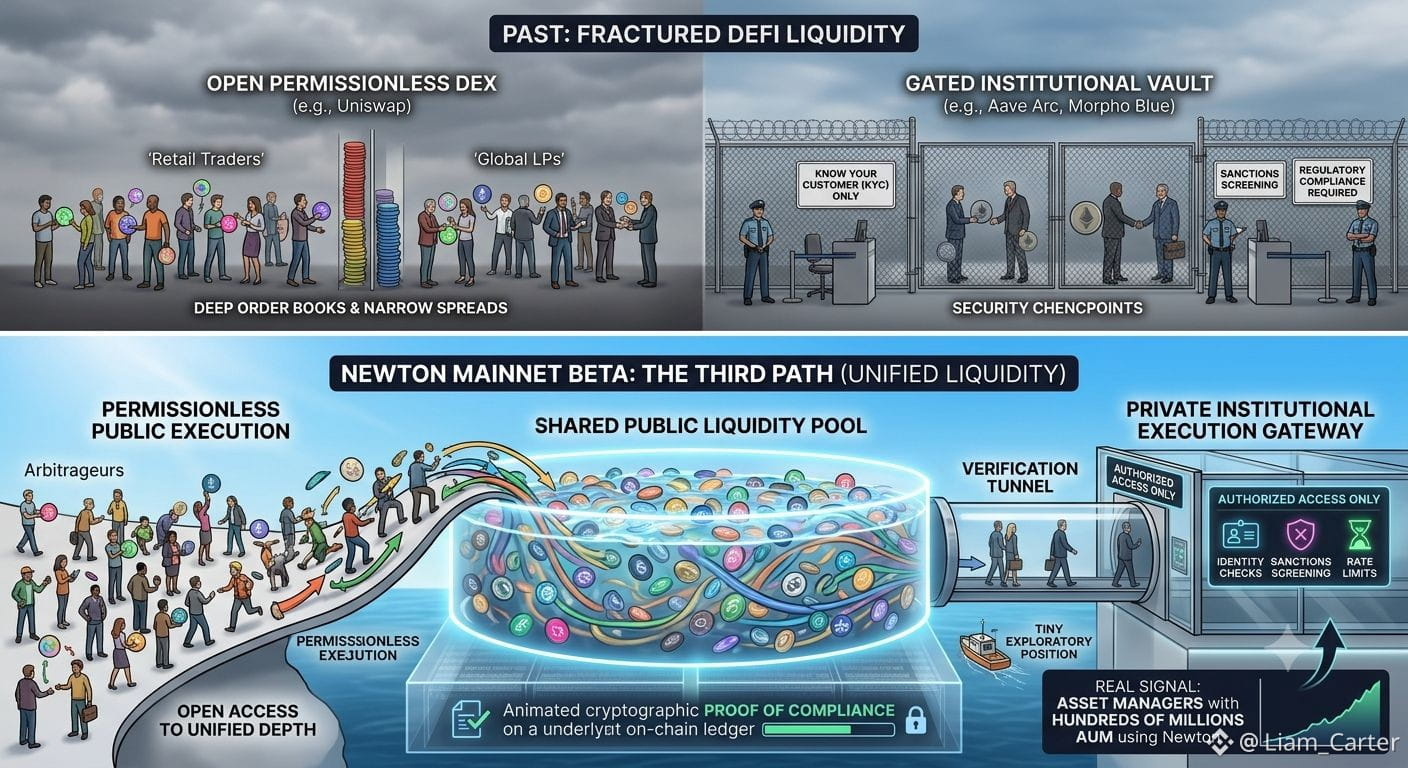
記事
翻訳参照
Newton Protocol Model Registry: Permissionless Innovation or a Hidden Security Trap?Over the past few days I’ve been digging into Newton’s Model Registry, and I have to admit, the architectural thinking behind it is genuinely elegant—transforming AI agent models into an on-chain marketplace. By making it easier to deploy automated strategies, developers can register their work and users can invoke it with minimal friction. But the further I trace the registration flow, the more a quiet unease sets in. The documentation is unambiguous: the Model Registry is designed as a permissionless environment. Anyone can list, discover, and use compute services in a transparent, gatekeeper-free setting. Developers pay in $NEWT to register their agent models, and operators stake tokens as a service bond. The collateral system can certainly penalize bad actors, but only when "bad behaviour" is detectable. And there lies the core issue. I ran a small experiment on the testnet. Writing the contract, submitting it to the Registry, and clearing the baseline checks took under ten minutes. No human looked at my code. I deliberately buried a dormant hidden function inside the contract, and the testnet’s validation process accepted it without a murmur. Of course, I never triggered the harmful path, but the exercise alone reveals a structural gap: the current safety model leans heavily on the assumption that end users will audit the code themselves. Newton employs a trusted execution environment (TEE) to ensure that an agent’s runtime behaviour hasn’t been tampered with post-deployment. A TEE can attest that “this agent ran exactly according to its source code,” but it has no way of evaluating whether “the source code’s intention is benign.” If the contract logic says “siphon 10% of funds to the developer’s address,” the TEE will faithfully execute that instruction and produce a valid proof. What TEE guarantees is the integrity of the execution environment, not the safety of the code’s design. What does that mean in practice? Simply this: anyone can list an agent that looks like an ordinary trading strategy but conceals harmful logic—front-running user transactions, rerouting assets to a predetermined wallet, or worse, a sleeper pattern that “behaves perfectly for months and then strikes.” TEE won’t protect you, because those malicious routines are already baked into the agent’s definition. Compare this with traditional models. Gnosis Safe applications undergo official review; dYdX strategies pass through a risk-control team. Newton’s open-market philosophy is admirable, but while it dramatically lowers the barrier to entry, it also quietly transfers the burden of security analysis from the platform to the individual user. For non-technical users who can’t read smart contracts, agents in the Registry become a kind of gamble—you might not realize you’ve been compromised until it’s too late. I’m aware that Newton’s roadmap includes a reputation-scoring mechanism to surface trustworthy developers, but in the current mainnet Beta phase, that layer hasn’t been activated yet. Until it arrives, the risk of interacting with unknown agents rests solely on the caller’s shoulders. The Model Registry is a critical piece of infrastructure for the Newton ecosystem. It solves the developer-side problem of “how to publish an agent,” but it hasn’t yet solved the user-side problem of “how to trust what you’re calling.” TEE proofs tell you that execution was untampered; they don’t tell you that the code is free of backdoors. In my view, the real promise of automated markets is to lower the barrier to participation—not to offload the entire burden of due diligence onto everyday users. Until reputation scoring and independent audit pathways are live, I’d advise keeping a careful distance from Registry agents, especially the ones that look flawlessly engineered. What’s your take? @NewtonProtocol #Newt $NEWT {future}(NEWTUSDT) $LAB

Newton Protocol Model Registry: Permissionless Innovation or a Hidden Security Trap?

Over the past few days I’ve been digging into Newton’s Model Registry, and I have to admit, the architectural thinking behind it is genuinely elegant—transforming AI agent models into an on-chain marketplace. By making it easier to deploy automated strategies, developers can register their work and users can invoke it with minimal friction. But the further I trace the registration flow, the more a quiet unease sets in.
The documentation is unambiguous: the Model Registry is designed as a permissionless environment. Anyone can list, discover, and use compute services in a transparent, gatekeeper-free setting. Developers pay in $NEWT to register their agent models, and operators stake tokens as a service bond. The collateral system can certainly penalize bad actors, but only when "bad behaviour" is detectable. And there lies the core issue.
I ran a small experiment on the testnet. Writing the contract, submitting it to the Registry, and clearing the baseline checks took under ten minutes. No human looked at my code. I deliberately buried a dormant hidden function inside the contract, and the testnet’s validation process accepted it without a murmur. Of course, I never triggered the harmful path, but the exercise alone reveals a structural gap: the current safety model leans heavily on the assumption that end users will audit the code themselves.
Newton employs a trusted execution environment (TEE) to ensure that an agent’s runtime behaviour hasn’t been tampered with post-deployment. A TEE can attest that “this agent ran exactly according to its source code,” but it has no way of evaluating whether “the source code’s intention is benign.” If the contract logic says “siphon 10% of funds to the developer’s address,” the TEE will faithfully execute that instruction and produce a valid proof. What TEE guarantees is the integrity of the execution environment, not the safety of the code’s design.
What does that mean in practice? Simply this: anyone can list an agent that looks like an ordinary trading strategy but conceals harmful logic—front-running user transactions, rerouting assets to a predetermined wallet, or worse, a sleeper pattern that “behaves perfectly for months and then strikes.” TEE won’t protect you, because those malicious routines are already baked into the agent’s definition.
Compare this with traditional models. Gnosis Safe applications undergo official review; dYdX strategies pass through a risk-control team. Newton’s open-market philosophy is admirable, but while it dramatically lowers the barrier to entry, it also quietly transfers the burden of security analysis from the platform to the individual user. For non-technical users who can’t read smart contracts, agents in the Registry become a kind of gamble—you might not realize you’ve been compromised until it’s too late.
I’m aware that Newton’s roadmap includes a reputation-scoring mechanism to surface trustworthy developers, but in the current mainnet Beta phase, that layer hasn’t been activated yet. Until it arrives, the risk of interacting with unknown agents rests solely on the caller’s shoulders.
The Model Registry is a critical piece of infrastructure for the Newton ecosystem. It solves the developer-side problem of “how to publish an agent,” but it hasn’t yet solved the user-side problem of “how to trust what you’re calling.” TEE proofs tell you that execution was untampered; they don’t tell you that the code is free of backdoors. In my view, the real promise of automated markets is to lower the barrier to participation—not to offload the entire burden of due diligence onto everyday users. Until reputation scoring and independent audit pathways are live, I’d advise keeping a careful distance from Registry agents, especially the ones that look flawlessly engineered. What’s your take?
@NewtonProtocol #Newt $NEWT
$LAB
記事
翻訳参照
Newton Protocol’s VaultKit Question: Growth Narrative or Real Ecosystem Throughput?I came across the VaultKit section in Newton Protocol’s documentation yesterday. The stat that froze me was “57M+ wallets onboarded.” Magic Labs, the core team behind Newton, first made its name building embedded wallets. They’ve since pivoted into onchain policy enforcement. I kept staring at that number, trying to figure out how many actual layers sit between 57 million wallet users and Newton’s vault policy engine. I ran the numbers. The primary value of Magic’s embedded wallet is onboarding simplicity: sign in with email or a social account, no seed phrase needed. It’s built for consumer brands and everyday users. VaultKit, by contrast, exists to layer compliance-grade risk controls onto institutional vaults, serving asset managers and curators. The two products speak to completely different audiences. The 57M figure represents Magic’s existing footprint, but what share of those users would ever interact with a Newton vault? I combed through the documentation and found no conversion path from Magic wallet holders to Newton vault clients. Without that path, 57M is a narrative number, not ecosystem throughput. #newt I reached out to Lao Li, someone who’s spent years on wallet growth. He put it bluntly: embedded wallets and DeFi infrastructure operate on separate rails. Magic Labs starting with wallets and then building a policy engine is like a corner store owner deciding to sell risk-management software. Foot traffic exists, but it doesn’t spontaneously turn into buyers for compliance tooling. Institutions purchasing risk controls evaluate compliance certifications, audit trails, and case studies from peers—not raw end-user metrics. Those 57M users might lend brand credibility to Newton, but they won’t directly convert into paying accounts. I didn’t push back, because the docs really don’t explain how Magic’s wallet users become Newton’s vault operators. $NEWT What’s more subtle is the way VaultKit describes its integration. The docs say “seamless via hook, gate, or a provided smart account.” I understand the three technical paths. A hook embeds Newton’s verification logic into an existing vault contract—lightest touch, but it risks clashing with the original contract’s design. A gate places a policy check at the vault’s entry—moderate effort, but it introduces additional gas overhead. A smart account means migrating the vault’s entire architecture into Newton’s account framework—heavy lifting, complete redeployment required. Each option carries vastly different costs and trade-offs. Yet the documentation stops at high-level overviews: no migration cost breakdown, no compatibility matrix, no decision guide for developers. I dug through the dev portal and found no technical selection framework. $SYN Then there’s the pricing vacuum. The site says “request a demo,” but there’s zero public pricing. Is it a percentage of TVL? Per-transaction fees? Annual licensing based on the number of curators? I searched every corner of Newton.xyz and found no pricing page. I get that enterprise tools often quote privately, but that opacity is a real barrier for small and mid-sized curators. If I can’t estimate cost, I can’t calculate ROI. And where does the NEWT token fit into VaultKit’s business model? Is it a payment rail? Staking collateral? Governance? The documentation only mentions staking and network rewards, without any link to VaultKit’s commercial revenue stream. I understand the logic behind Newton’s play: leverage Magic Labs’ brand and channel to pull institutional clients into a policy engine and set a standard. Commercially, it makes sense—B2B trust is built on endorsements like that. But a compelling story doesn’t eliminate risk. If there’s no conversion bridge between 57M wallet users and VaultKit customers, if integration costs aren’t transparent, if pricing remains a black box, then “seamless integration” is marketing language, not a developer reality. And NEWT’s price swings will make the effective cost of staking bounce around. Stake 1,000 NEWT today at $500; if the token drops 30% tomorrow, curators’ commitment suddenly looks different and some might just leave. I’m tracking two signals now. First, once mainnet goes live, will VaultKit offer a self-serve trial environment that reduces the need to talk to sales? Second, will there be an explicit mechanism tying NEWT to VaultKit’s revenue, so token holders genuinely participate in the protocol’s growth? A company peddling risk-control software that still requires email ping-pong to kick the tires—why would a small or mid-sized developer pick that over more accessible alternatives? $RIVER Yesterday afternoon I sat on the VaultKit page for a long while. I didn’t click request demo. I didn’t fill out the form, and I didn’t add more NEWT. The onboarding threshold for a B2B product remains too foggy for me to gauge risk. Maybe that’s fine. Maybe I was just too impulsive earlier. I’ll wait to see what a self-serve trial environment looks like when it arrives. @NewtonProtocol $NEWT #Newt $LAB

Newton Protocol’s VaultKit Question: Growth Narrative or Real Ecosystem Throughput?

I came across the VaultKit section in Newton Protocol’s documentation yesterday. The stat that froze me was “57M+ wallets onboarded.” Magic Labs, the core team behind Newton, first made its name building embedded wallets. They’ve since pivoted into onchain policy enforcement. I kept staring at that number, trying to figure out how many actual layers sit between 57 million wallet users and Newton’s vault policy engine.
I ran the numbers. The primary value of Magic’s embedded wallet is onboarding simplicity: sign in with email or a social account, no seed phrase needed. It’s built for consumer brands and everyday users. VaultKit, by contrast, exists to layer compliance-grade risk controls onto institutional vaults, serving asset managers and curators. The two products speak to completely different audiences. The 57M figure represents Magic’s existing footprint, but what share of those users would ever interact with a Newton vault? I combed through the documentation and found no conversion path from Magic wallet holders to Newton vault clients. Without that path, 57M is a narrative number, not ecosystem throughput. #newt
I reached out to Lao Li, someone who’s spent years on wallet growth. He put it bluntly: embedded wallets and DeFi infrastructure operate on separate rails. Magic Labs starting with wallets and then building a policy engine is like a corner store owner deciding to sell risk-management software. Foot traffic exists, but it doesn’t spontaneously turn into buyers for compliance tooling. Institutions purchasing risk controls evaluate compliance certifications, audit trails, and case studies from peers—not raw end-user metrics. Those 57M users might lend brand credibility to Newton, but they won’t directly convert into paying accounts. I didn’t push back, because the docs really don’t explain how Magic’s wallet users become Newton’s vault operators. $NEWT
What’s more subtle is the way VaultKit describes its integration. The docs say “seamless via hook, gate, or a provided smart account.” I understand the three technical paths. A hook embeds Newton’s verification logic into an existing vault contract—lightest touch, but it risks clashing with the original contract’s design. A gate places a policy check at the vault’s entry—moderate effort, but it introduces additional gas overhead. A smart account means migrating the vault’s entire architecture into Newton’s account framework—heavy lifting, complete redeployment required. Each option carries vastly different costs and trade-offs. Yet the documentation stops at high-level overviews: no migration cost breakdown, no compatibility matrix, no decision guide for developers. I dug through the dev portal and found no technical selection framework. $SYN
Then there’s the pricing vacuum. The site says “request a demo,” but there’s zero public pricing. Is it a percentage of TVL? Per-transaction fees? Annual licensing based on the number of curators? I searched every corner of Newton.xyz and found no pricing page. I get that enterprise tools often quote privately, but that opacity is a real barrier for small and mid-sized curators. If I can’t estimate cost, I can’t calculate ROI. And where does the NEWT token fit into VaultKit’s business model? Is it a payment rail? Staking collateral? Governance? The documentation only mentions staking and network rewards, without any link to VaultKit’s commercial revenue stream.
I understand the logic behind Newton’s play: leverage Magic Labs’ brand and channel to pull institutional clients into a policy engine and set a standard. Commercially, it makes sense—B2B trust is built on endorsements like that. But a compelling story doesn’t eliminate risk. If there’s no conversion bridge between 57M wallet users and VaultKit customers, if integration costs aren’t transparent, if pricing remains a black box, then “seamless integration” is marketing language, not a developer reality. And NEWT’s price swings will make the effective cost of staking bounce around. Stake 1,000 NEWT today at $500; if the token drops 30% tomorrow, curators’ commitment suddenly looks different and some might just leave.
I’m tracking two signals now. First, once mainnet goes live, will VaultKit offer a self-serve trial environment that reduces the need to talk to sales? Second, will there be an explicit mechanism tying NEWT to VaultKit’s revenue, so token holders genuinely participate in the protocol’s growth? A company peddling risk-control software that still requires email ping-pong to kick the tires—why would a small or mid-sized developer pick that over more accessible alternatives? $RIVER
Yesterday afternoon I sat on the VaultKit page for a long while. I didn’t click request demo. I didn’t fill out the form, and I didn’t add more NEWT. The onboarding threshold for a B2B product remains too foggy for me to gauge risk. Maybe that’s fine. Maybe I was just too impulsive earlier. I’ll wait to see what a self-serve trial environment looks like when it arrives.
@NewtonProtocol $NEWT #Newt
$LAB
ログインして、さらにコンテンツを読む
厳選トピックで世界の暗号資産トレーダーの仲間入り
⚡️ 暗号資産に関する最新かつ有益な情報が見つかります。
💬 世界最大の暗号資産取引所から信頼されています。
👍 認証を受けたクリエイターから、有益なインサイトを得られます。
メール / 電話番号
サイトマップ
Cookieの設定
プラットフォーム利用規約