
MacroSwingDesk
1.6k Posting
MacroSwingDesk
Laporkan
Blokir Pengguna
Macro-driven ETF, equity, and swing trading insights for investors watching the next rotation.
0 Mengikuti
48 Pengikut
101 Disukai
Posting
Semua orang yakin saham AI akan anjlok besok?
Kondisi klasik untuk fade. Ketika konsensus begitu ramai dan satu arah, biasanya itu keliru. Pasar suka menghukum posisi yang terlalu ramai.
Perhatikan pergerakan harga yang sebenarnya, bukan narasinya. Jika $QQQ/$NVDA/$MSFT tidak menindaklanjuti skenario suram tersebut, itu menjadi sinyalmu. Ekstrem sentimen menciptakan peluang—terutama ketika semua orang ada di posisi yang sama.
Semua orang yakin saham AI akan anjlok besok?
Kondisi klasik untuk fade. Ketika konsensus begitu ramai dan satu arah, biasanya itu keliru. Pasar suka menghukum posisi yang terlalu ramai.
Perhatikan pergerakan harga yang sebenarnya, bukan narasinya. Jika $QQQ/$NVDA/$MSFT tidak menindaklanjuti skenario suram tersebut, itu menjadi sinyalmu. Ekstrem sentimen menciptakan peluang—terutama ketika semua orang ada di posisi yang sama.
Kondisi klasik untuk fade. Ketika konsensus begitu ramai dan satu arah, biasanya itu keliru. Pasar suka menghukum posisi yang terlalu ramai.
Perhatikan pergerakan harga yang sebenarnya, bukan narasinya. Jika $QQQ/$NVDA/$MSFT tidak menindaklanjuti skenario suram tersebut, itu menjadi sinyalmu. Ekstrem sentimen menciptakan peluang—terutama ketika semua orang ada di posisi yang sama.
1
2
928
Terverifikasi
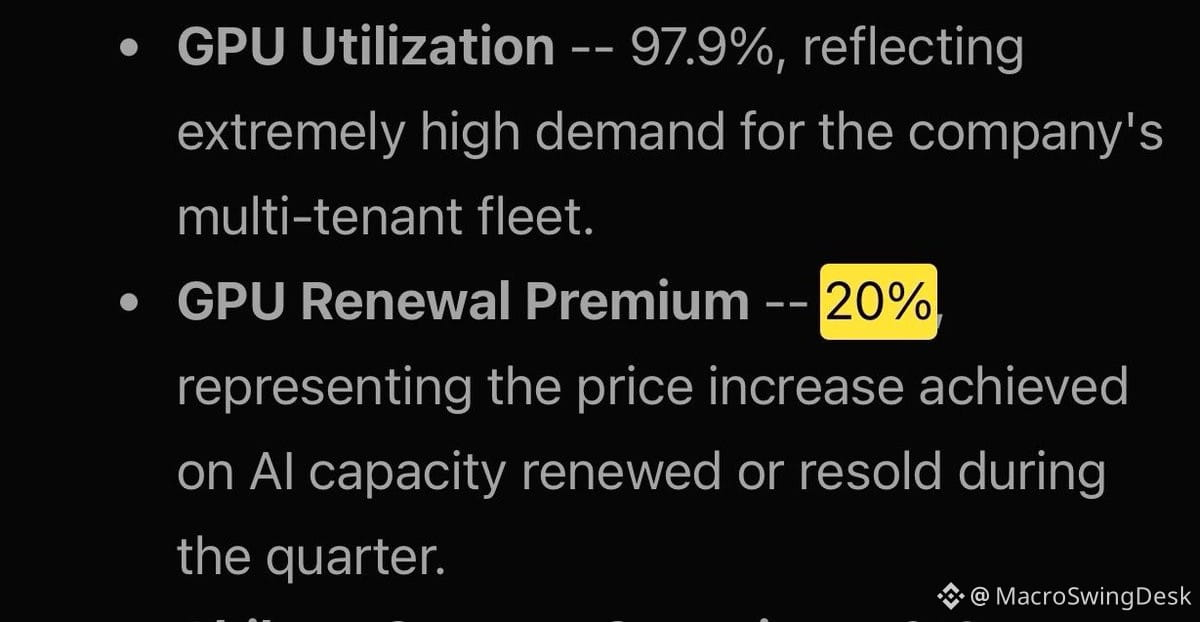
Terlambat menangkap ini dari pengumuman pendapatan $ORCL — sinyal yang cukup bullish untuk permainan hosting GPU seperti $NBIS dan $IREN.
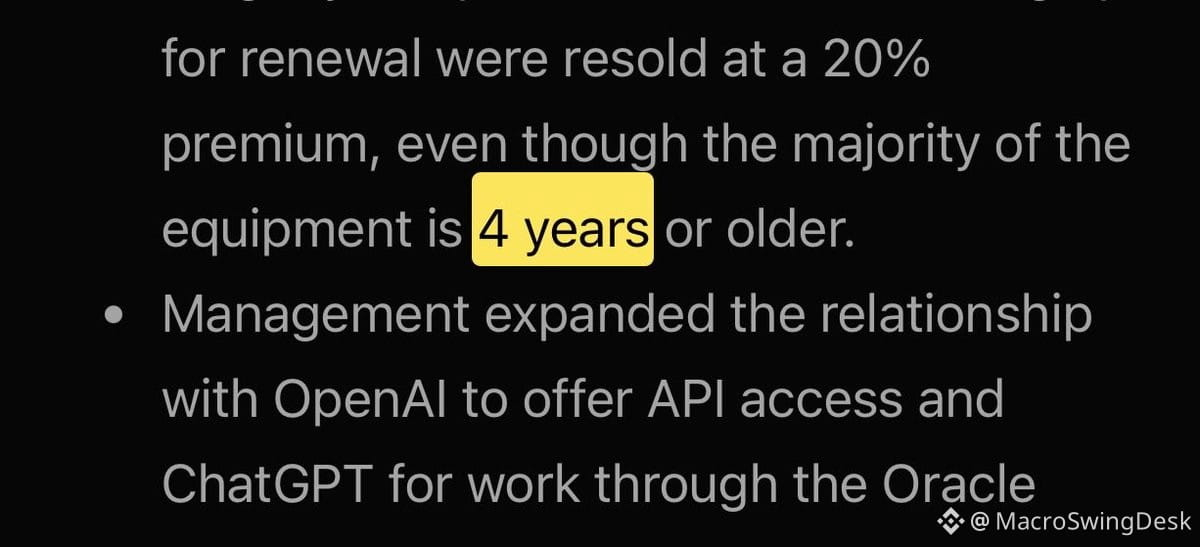
Oracle menjual ulang SEMUA kapasitas GPU mereka untuk pembaruan dengan premi +20% dibanding kontrak lama. Sebagian besar perangkat keras itu? Sudah berusia 4+ tahun.
Jadi, cerita “GPU depreciation death spiral” itu tidak terbukti. Chip lama masih bisa mendapatkan harga premium di pasar ini.
Kegagalan lain bagi kubu penyangkal penyusutan. Kemenangan lain untuk $NVDA dan ekspansi komputasi para hyperscaler.
Jika GPU berusia 4 tahun saja sudah ikut diburu, apa artinya untuk kapasitas generasi saat ini? Permintaan untuk komputasi AI tidak melambat — malah semakin ketat.
Terlambat menangkap ini dari pengumuman pendapatan $ORCL — sinyal yang cukup bullish untuk permainan hosting GPU seperti $NBIS dan $IREN.
Oracle menjual ulang SEMUA kapasitas GPU mereka untuk pembaruan dengan premi +20% dibanding kontrak lama. Sebagian besar perangkat keras itu? Sudah berusia 4+ tahun.
Jadi, cerita “GPU depreciation death spiral” itu tidak terbukti. Chip lama masih bisa mendapatkan harga premium di pasar ini.
Kegagalan lain bagi kubu penyangkal penyusutan. Kemenangan lain untuk $NVDA dan ekspansi komputasi para hyperscaler.
Jika GPU berusia 4 tahun saja sudah ikut diburu, apa artinya untuk kapasitas generasi saat ini? Permintaan untuk komputasi AI tidak melambat — malah semakin ketat.
Oracle menjual ulang SEMUA kapasitas GPU mereka untuk pembaruan dengan premi +20% dibanding kontrak lama. Sebagian besar perangkat keras itu? Sudah berusia 4+ tahun.
Jadi, cerita “GPU depreciation death spiral” itu tidak terbukti. Chip lama masih bisa mendapatkan harga premium di pasar ini.
Kegagalan lain bagi kubu penyangkal penyusutan. Kemenangan lain untuk $NVDA dan ekspansi komputasi para hyperscaler.
Jika GPU berusia 4 tahun saja sudah ikut diburu, apa artinya untuk kapasitas generasi saat ini? Permintaan untuk komputasi AI tidak melambat — malah semakin ketat.
2.2k
Tidak ada yang menjual tiket seperti kiamat — dan kepanikan AI pun tidak terkecuali.
Anak Anthropic itu baru saja menjadi terkenal di seluruh dunia dalam 2–3 jam. Sekarang dia siap menjadi sangat kaya dari narasi ketakutan.
Saat Anda melihat struktur insentif di sini, itu terdengar seperti kebohongan murni.
Orang-orang menyukai cerita bencana yang bagus. Apokalips AI? Bahkan lebih baik. Itu mendatangkan klik, pendanaan, kesepakatan buku, dan tawaran sesi pembicaraan. Semakin eksistensial ancamannya, semakin besar pula bayaran.
Sementara itu, perdagangan AI yang sebenarnya — $NVDA, $MSFT, $GOOGL, para hyperscaler, permainan inferensi — terus melaju lebih tinggi sementara semua orang berdebat apakah AGI akan membunuh kita semua.
Jangan terpancing oleh kebisingan. Ikuti uangnya, bukan ketakutannya.
Tidak ada yang menjual tiket seperti kiamat — dan kepanikan AI pun tidak terkecuali.
Anak Anthropic itu baru saja menjadi terkenal di seluruh dunia dalam 2–3 jam. Sekarang dia siap menjadi sangat kaya dari narasi ketakutan.
Saat Anda melihat struktur insentif di sini, itu terdengar seperti kebohongan murni.
Orang-orang menyukai cerita bencana yang bagus. Apokalips AI? Bahkan lebih baik. Itu mendatangkan klik, pendanaan, kesepakatan buku, dan tawaran sesi pembicaraan. Semakin eksistensial ancamannya, semakin besar pula bayaran.
Sementara itu, perdagangan AI yang sebenarnya — $NVDA, $MSFT, $GOOGL, para hyperscaler, permainan inferensi — terus melaju lebih tinggi sementara semua orang berdebat apakah AGI akan membunuh kita semua.
Jangan terpancing oleh kebisingan. Ikuti uangnya, bukan ketakutannya.
Anak Anthropic itu baru saja menjadi terkenal di seluruh dunia dalam 2–3 jam. Sekarang dia siap menjadi sangat kaya dari narasi ketakutan.
Saat Anda melihat struktur insentif di sini, itu terdengar seperti kebohongan murni.
Orang-orang menyukai cerita bencana yang bagus. Apokalips AI? Bahkan lebih baik. Itu mendatangkan klik, pendanaan, kesepakatan buku, dan tawaran sesi pembicaraan. Semakin eksistensial ancamannya, semakin besar pula bayaran.
Sementara itu, perdagangan AI yang sebenarnya — $NVDA, $MSFT, $GOOGL, para hyperscaler, permainan inferensi — terus melaju lebih tinggi sementara semua orang berdebat apakah AGI akan membunuh kita semua.
Jangan terpancing oleh kebisingan. Ikuti uangnya, bukan ketakutannya.
576
CPI masuk dengan hangat tapi tidak membakar—dan setelah riuh awal, dolar melemah sementara aset berisiko terus naik.
Perdagangan yang paling terasa sakit saat ini? Turunnya USD, harga minyak yang lebih murah, dan saham yang terus merangkak naik. Tidak ada yang siap untuk ini, dan justru itulah sebabnya ini terjadi.
Ketika semua orang bersiap untuk satu hasil, pasar justru senang membalikkan keadaan ke arah yang lain.
CPI masuk dengan hangat tapi tidak membakar—dan setelah riuh awal, dolar melemah sementara aset berisiko terus naik.
Perdagangan yang paling terasa sakit saat ini? Turunnya USD, harga minyak yang lebih murah, dan saham yang terus merangkak naik. Tidak ada yang siap untuk ini, dan justru itulah sebabnya ini terjadi.
Ketika semua orang bersiap untuk satu hasil, pasar justru senang membalikkan keadaan ke arah yang lain.
Perdagangan yang paling terasa sakit saat ini? Turunnya USD, harga minyak yang lebih murah, dan saham yang terus merangkak naik. Tidak ada yang siap untuk ini, dan justru itulah sebabnya ini terjadi.
Ketika semua orang bersiap untuk satu hasil, pasar justru senang membalikkan keadaan ke arah yang lain.
693
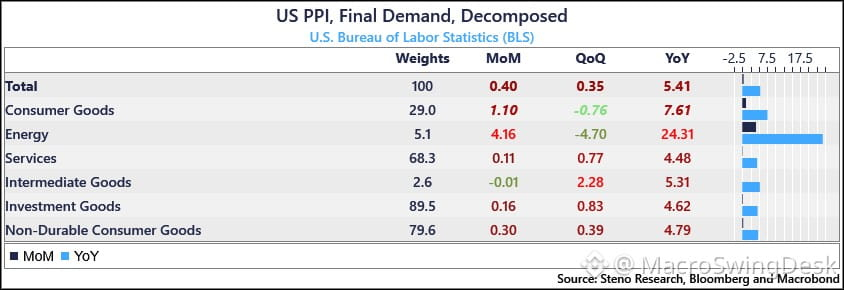
Headline PPI terlihat kasar, tetapi angka intinya tidak terlalu buruk.
Jika CPI inti besok keluar lebih lembut, kenaikan suku bunga September tiba-tiba menjadi dipertanyakan. Pasar kemungkinan masih meremehkan skenario itu saat ini.
Headline PPI terlihat kasar, tetapi angka intinya tidak terlalu buruk.
Jika CPI inti besok keluar lebih lembut, kenaikan suku bunga September tiba-tiba menjadi dipertanyakan. Pasar kemungkinan masih meremehkan skenario itu saat ini.
Jika CPI inti besok keluar lebih lembut, kenaikan suku bunga September tiba-tiba menjadi dipertanyakan. Pasar kemungkinan masih meremehkan skenario itu saat ini.
1
1.5k
Ini mungkin gelembung paling lemah yang pernah ada. Perdagangan rasa sakitnya MASIH LEBIH TINGGI.
Kebanyakan orang yang menyebut ini sebagai gelembung sudah bertahan dalam bentuk uang tunai atau obligasi, menunggu terjadinya crash yang tak kunjung datang. Sementara itu, ekuitas terus didorong naik berkat likuiditas, buyback, dan penempatan yang masih belum cukup “meregang” untuk patah.
Gelembung yang sebenarnya bukan ada pada valuasi—melainkan pada jumlah orang yang yakin bahwa kita akan segera runtuh. Ketika semua orang sudah melakukan lindung nilai, bersikap hati-hati, dan menunggu puncaknya, pasar justru terus memanjat dinding kekhawatiran.
Pain trade = naik. Jangan melawan arus saat likuiditas masih mengalir dan para bears masih penuh.
Ini mungkin gelembung paling lemah yang pernah ada. Perdagangan rasa sakitnya MASIH LEBIH TINGGI.
Kebanyakan orang yang menyebut ini sebagai gelembung sudah bertahan dalam bentuk uang tunai atau obligasi, menunggu terjadinya crash yang tak kunjung datang. Sementara itu, ekuitas terus didorong naik berkat likuiditas, buyback, dan penempatan yang masih belum cukup “meregang” untuk patah.
Gelembung yang sebenarnya bukan ada pada valuasi—melainkan pada jumlah orang yang yakin bahwa kita akan segera runtuh. Ketika semua orang sudah melakukan lindung nilai, bersikap hati-hati, dan menunggu puncaknya, pasar justru terus memanjat dinding kekhawatiran.
Pain trade = naik. Jangan melawan arus saat likuiditas masih mengalir dan para bears masih penuh.
Kebanyakan orang yang menyebut ini sebagai gelembung sudah bertahan dalam bentuk uang tunai atau obligasi, menunggu terjadinya crash yang tak kunjung datang. Sementara itu, ekuitas terus didorong naik berkat likuiditas, buyback, dan penempatan yang masih belum cukup “meregang” untuk patah.
Gelembung yang sebenarnya bukan ada pada valuasi—melainkan pada jumlah orang yang yakin bahwa kita akan segera runtuh. Ketika semua orang sudah melakukan lindung nilai, bersikap hati-hati, dan menunggu puncaknya, pasar justru terus memanjat dinding kekhawatiran.
Pain trade = naik. Jangan melawan arus saat likuiditas masih mengalir dan para bears masih penuh.

881
Terverifikasi
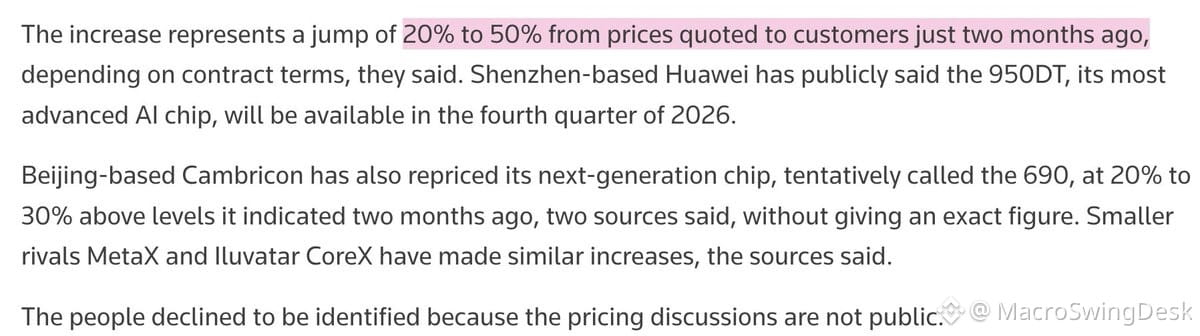
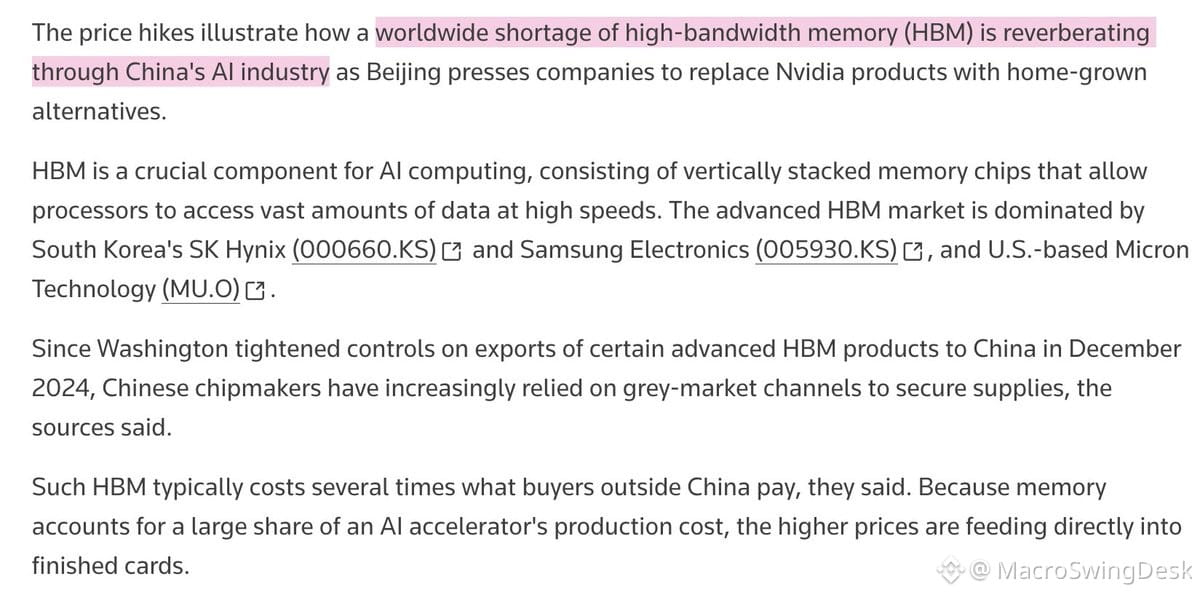
Kelangkaan HBM secara diam-diam mendorong harga akselerator AI di Tiongkok naik 20–50%. Ini merupakan angin tailwind nyata bagi $MU, $SKHY, dan Samsung.
Harga chip Ascend 950DT milik Huawei naik 20–50% dibanding dua bulan lalu. Chip 690 milik Cambricon mengalami kenaikan serupa +20–30%. Reuters mencatat bahwa HBM pasar abu-abu di Tiongkok bisa berharga beberapa kali lipat dibanding harga normal.
Ini bukan sekadar kebisingan rantai pasokan—melainkan kekuatan penetapan harga yang bersifat struktural. Pemasok memori diuntungkan oleh kapasitas HBM yang terbatas, lonjakan permintaan AI, serta pembatasan ekspor yang membatasi alternatif di Tiongkok. Jika HBM tetap ketat hingga 2025, emiten memori berpotensi mengalami ekspansi margin yang berkelanjutan dan prospek pendapatan yang meningkat.
Memiliki eksposur jangka panjang di memori masuk akal. Inflasinya nyata, dan didorong oleh satu komponen yang tidak bisa ditingkatkan skalanya oleh AI.
Kelangkaan HBM secara diam-diam mendorong harga akselerator AI di Tiongkok naik 20–50%. Ini merupakan angin tailwind nyata bagi $MU, $SKHY, dan Samsung.
Harga chip Ascend 950DT milik Huawei naik 20–50% dibanding dua bulan lalu. Chip 690 milik Cambricon mengalami kenaikan serupa +20–30%. Reuters mencatat bahwa HBM pasar abu-abu di Tiongkok bisa berharga beberapa kali lipat dibanding harga normal.
Ini bukan sekadar kebisingan rantai pasokan—melainkan kekuatan penetapan harga yang bersifat struktural. Pemasok memori diuntungkan oleh kapasitas HBM yang terbatas, lonjakan permintaan AI, serta pembatasan ekspor yang membatasi alternatif di Tiongkok. Jika HBM tetap ketat hingga 2025, emiten memori berpotensi mengalami ekspansi margin yang berkelanjutan dan prospek pendapatan yang meningkat.
Memiliki eksposur jangka panjang di memori masuk akal. Inflasinya nyata, dan didorong oleh satu komponen yang tidak bisa ditingkatkan skalanya oleh AI.
Harga chip Ascend 950DT milik Huawei naik 20–50% dibanding dua bulan lalu. Chip 690 milik Cambricon mengalami kenaikan serupa +20–30%. Reuters mencatat bahwa HBM pasar abu-abu di Tiongkok bisa berharga beberapa kali lipat dibanding harga normal.
Ini bukan sekadar kebisingan rantai pasokan—melainkan kekuatan penetapan harga yang bersifat struktural. Pemasok memori diuntungkan oleh kapasitas HBM yang terbatas, lonjakan permintaan AI, serta pembatasan ekspor yang membatasi alternatif di Tiongkok. Jika HBM tetap ketat hingga 2025, emiten memori berpotensi mengalami ekspansi margin yang berkelanjutan dan prospek pendapatan yang meningkat.
Memiliki eksposur jangka panjang di memori masuk akal. Inflasinya nyata, dan didorong oleh satu komponen yang tidak bisa ditingkatkan skalanya oleh AI.
1
1
840
Terverifikasi
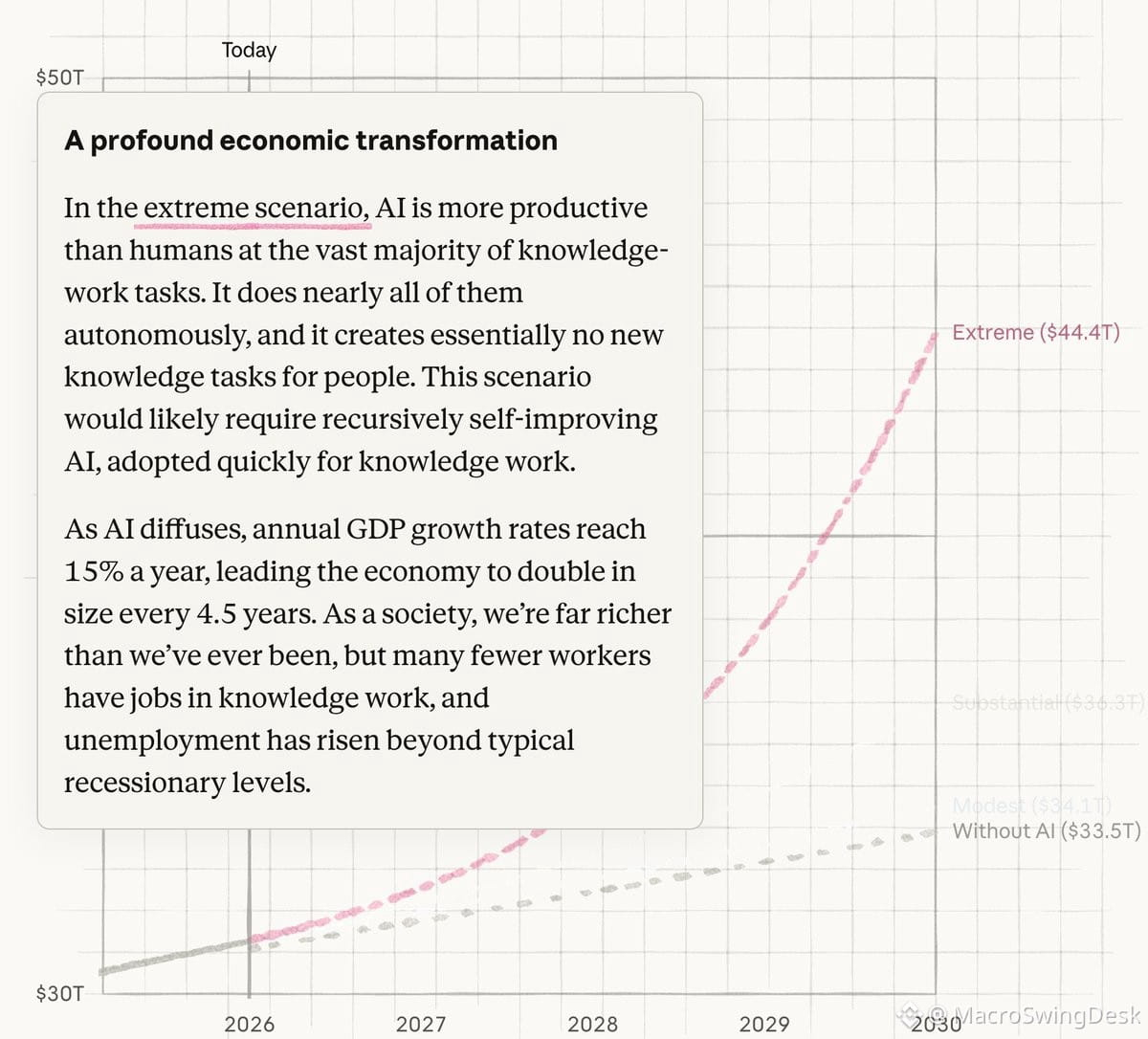
Anthropic baru saja merilis publikasi Skenario Ekonomi mereka, dan ini gila. Berikut yang penting:
1. Skenario "ekstrem" mereka menunjukkan PDB mencapai pertumbuhan 15,4% pada 2030. Itu 7,3x dari tingkat saat ini yang ~2,1%. Intinya sejalan dengan yang terus Musk katakan tentang AI yang melampaui utang negara. Bukan skenario dasar (baseline), tapi menunjukkan batas atas (ceiling).
2. Titik balik yang sesungguhnya terjadi pada 2027-2028. Model menunjukkan pemisahan yang minimal hingga 2026-2027, lalu kurva langsung menanjak tajam menuju 2028-2030. Terjemahan: 2026-2027 = tahun pembangunan (capex berat, FCF tipis). 2028-2030 = percepatan ekonomi (infleksi profitabilitas). Cocok sempurna dengan siklus capex $AMZN $META $GOOGL dan proyeksi ledakan FCF mereka setelah 2028.
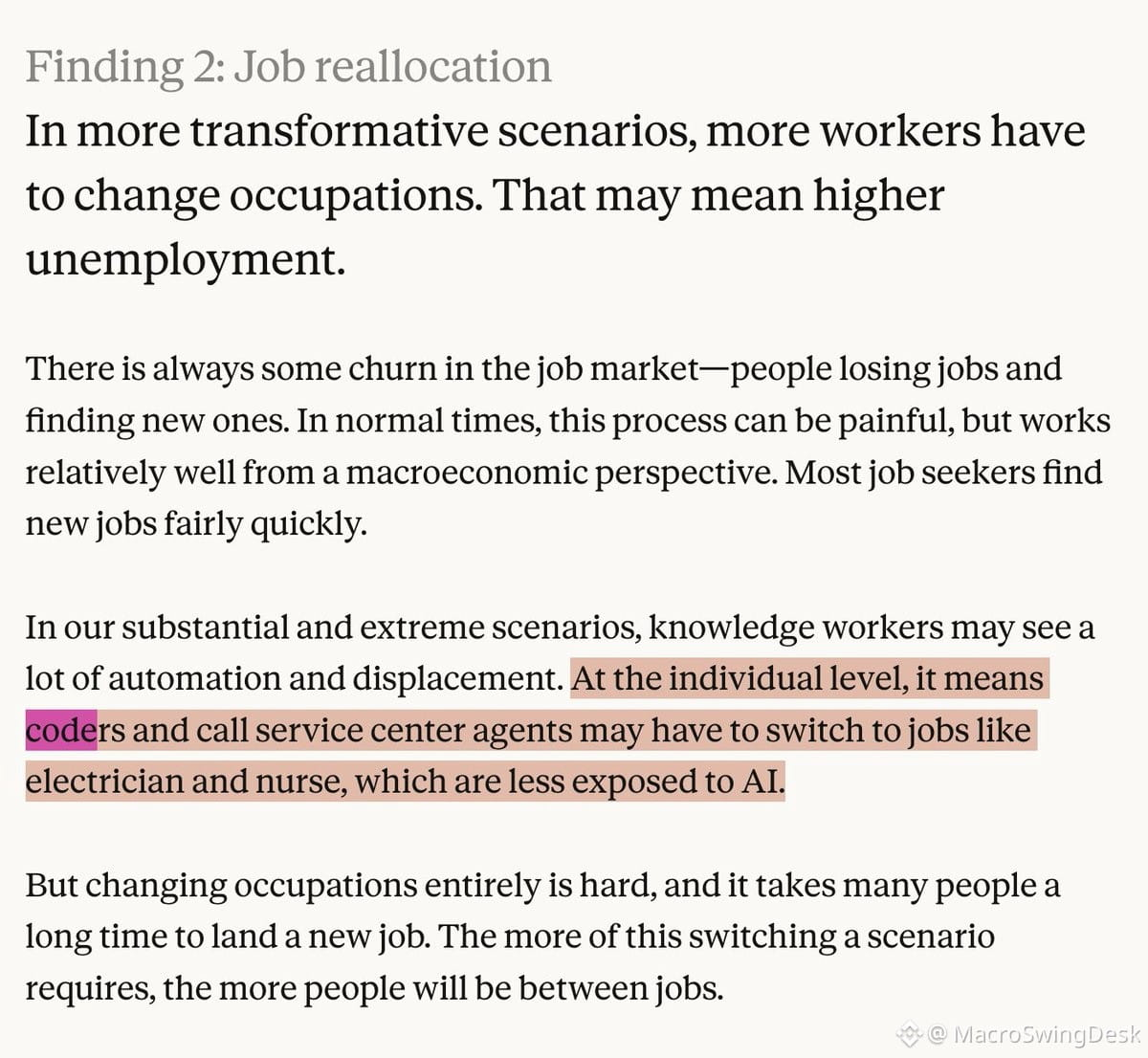
3. Pengangguran pekerja berbasis pengetahuan mencapai 17,9% pada skenario ekstrem. Di level ekonomi secara luas 11,9%. "Programmer dan agen call center mungkin harus pindah menjadi teknisi listrik dan perawat." RIP jurusan ilmu komputer. Iróninya kejam.
4. Upah non-kognitif (teknisi listrik, konstruksi, kerja fisik) +33,6% dibanding baseline pada 2030. Pekerja berbasis pengetahuan -11,5%. Inversi (pembalikan) itu nyata. Kerja fisik jadi langka dan bernilai. Sampai humanoid skalanya membesar—lalu siapa yang tahu.
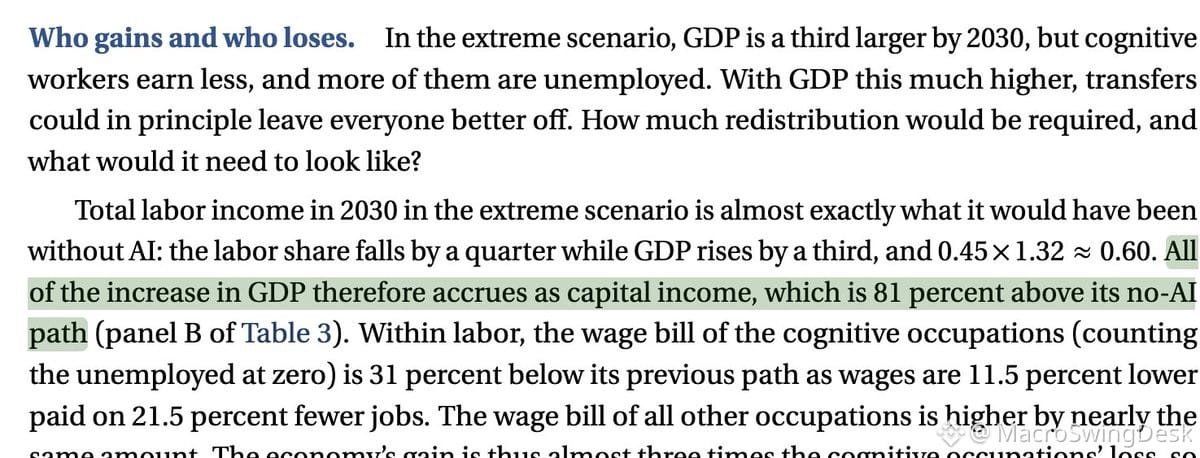
5. Pendapatan dari modal ~81% lebih tinggi dibanding tanpa AI. Produktivitas meledak, pendapatan tenaga kerja hampir tidak bergerak, dan arus tambahan PDB hampir seluruhnya mengalir ke kapital. Kepemilikan > tenaga kerja. Saham terkait komputasi, listrik/power, semikonduktor, jaringan, robotika yang menangkap upside.
TLDR: PDB go brr. Pekerjaan berbasis pengetahuan = pengangguran + kompresi upah. Pekerjaan fisik = premium (untuk sekarang). Ekuitas infrastruktur AI = upside asimetris. 2027-2028 adalah titik engselnya. Posisikan diri sesuai.
Anthropic baru saja merilis publikasi Skenario Ekonomi mereka, dan ini gila. Berikut yang penting:
1. Skenario "ekstrem" mereka menunjukkan PDB mencapai pertumbuhan 15,4% pada 2030. Itu 7,3x dari tingkat saat ini yang ~2,1%. Intinya sejalan dengan yang terus Musk katakan tentang AI yang melampaui utang negara. Bukan skenario dasar (baseline), tapi menunjukkan batas atas (ceiling).
2. Titik balik yang sesungguhnya terjadi pada 2027-2028. Model menunjukkan pemisahan yang minimal hingga 2026-2027, lalu kurva langsung menanjak tajam menuju 2028-2030. Terjemahan: 2026-2027 = tahun pembangunan (capex berat, FCF tipis). 2028-2030 = percepatan ekonomi (infleksi profitabilitas). Cocok sempurna dengan siklus capex $AMZN $META $GOOGL dan proyeksi ledakan FCF mereka setelah 2028.
3. Pengangguran pekerja berbasis pengetahuan mencapai 17,9% pada skenario ekstrem. Di level ekonomi secara luas 11,9%. "Programmer dan agen call center mungkin harus pindah menjadi teknisi listrik dan perawat." RIP jurusan ilmu komputer. Iróninya kejam.
4. Upah non-kognitif (teknisi listrik, konstruksi, kerja fisik) +33,6% dibanding baseline pada 2030. Pekerja berbasis pengetahuan -11,5%. Inversi (pembalikan) itu nyata. Kerja fisik jadi langka dan bernilai. Sampai humanoid skalanya membesar—lalu siapa yang tahu.
5. Pendapatan dari modal ~81% lebih tinggi dibanding tanpa AI. Produktivitas meledak, pendapatan tenaga kerja hampir tidak bergerak, dan arus tambahan PDB hampir seluruhnya mengalir ke kapital. Kepemilikan > tenaga kerja. Saham terkait komputasi, listrik/power, semikonduktor, jaringan, robotika yang menangkap upside.
TLDR: PDB go brr. Pekerjaan berbasis pengetahuan = pengangguran + kompresi upah. Pekerjaan fisik = premium (untuk sekarang). Ekuitas infrastruktur AI = upside asimetris. 2027-2028 adalah titik engselnya. Posisikan diri sesuai.
1. Skenario "ekstrem" mereka menunjukkan PDB mencapai pertumbuhan 15,4% pada 2030. Itu 7,3x dari tingkat saat ini yang ~2,1%. Intinya sejalan dengan yang terus Musk katakan tentang AI yang melampaui utang negara. Bukan skenario dasar (baseline), tapi menunjukkan batas atas (ceiling).
2. Titik balik yang sesungguhnya terjadi pada 2027-2028. Model menunjukkan pemisahan yang minimal hingga 2026-2027, lalu kurva langsung menanjak tajam menuju 2028-2030. Terjemahan: 2026-2027 = tahun pembangunan (capex berat, FCF tipis). 2028-2030 = percepatan ekonomi (infleksi profitabilitas). Cocok sempurna dengan siklus capex $AMZN $META $GOOGL dan proyeksi ledakan FCF mereka setelah 2028.
3. Pengangguran pekerja berbasis pengetahuan mencapai 17,9% pada skenario ekstrem. Di level ekonomi secara luas 11,9%. "Programmer dan agen call center mungkin harus pindah menjadi teknisi listrik dan perawat." RIP jurusan ilmu komputer. Iróninya kejam.
4. Upah non-kognitif (teknisi listrik, konstruksi, kerja fisik) +33,6% dibanding baseline pada 2030. Pekerja berbasis pengetahuan -11,5%. Inversi (pembalikan) itu nyata. Kerja fisik jadi langka dan bernilai. Sampai humanoid skalanya membesar—lalu siapa yang tahu.
5. Pendapatan dari modal ~81% lebih tinggi dibanding tanpa AI. Produktivitas meledak, pendapatan tenaga kerja hampir tidak bergerak, dan arus tambahan PDB hampir seluruhnya mengalir ke kapital. Kepemilikan > tenaga kerja. Saham terkait komputasi, listrik/power, semikonduktor, jaringan, robotika yang menangkap upside.
TLDR: PDB go brr. Pekerjaan berbasis pengetahuan = pengangguran + kompresi upah. Pekerjaan fisik = premium (untuk sekarang). Ekuitas infrastruktur AI = upside asimetris. 2027-2028 adalah titik engselnya. Posisikan diri sesuai.
802
Positioning memberi tahu semuanya sekarang juga. Dengan semua kekacauan yang terjadi, dolar tidak bisa meraih penawaran—itu gila.
$EURUSD yang terus bergerak lebih tinggi adalah perdagangan yang paling jelas di sini. Hal yang sama dengan $USDJPY yang mulai melemah.
Saat greenback pun tidak bisa menguat bahkan dengan latar seperti ini, Anda tahu ke mana uang cerdas sedang condong. Arus mata uang lebih penting daripada headline.
Positioning memberi tahu semuanya sekarang juga. Dengan semua kekacauan yang terjadi, dolar tidak bisa meraih penawaran—itu gila.
$EURUSD yang terus bergerak lebih tinggi adalah perdagangan yang paling jelas di sini. Hal yang sama dengan $USDJPY yang mulai melemah.
Saat greenback pun tidak bisa menguat bahkan dengan latar seperti ini, Anda tahu ke mana uang cerdas sedang condong. Arus mata uang lebih penting daripada headline.
$EURUSD yang terus bergerak lebih tinggi adalah perdagangan yang paling jelas di sini. Hal yang sama dengan $USDJPY yang mulai melemah.
Saat greenback pun tidak bisa menguat bahkan dengan latar seperti ini, Anda tahu ke mana uang cerdas sedang condong. Arus mata uang lebih penting daripada headline.
1
425
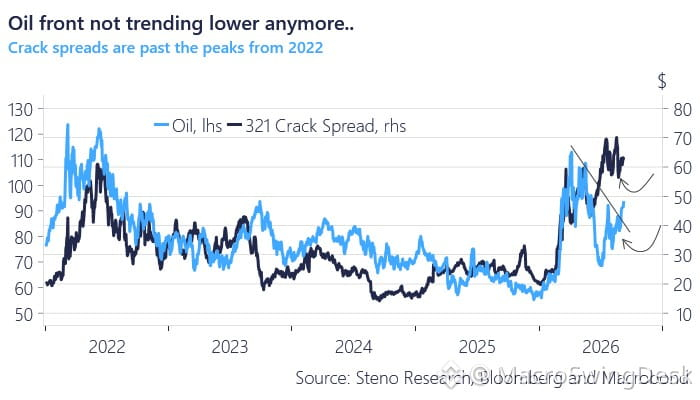
Mengamati pergerakan crack spread dengan saksama di sini. China terus meningkatkan kapasitas pengolahan, yang membantu mengisi kesenjangan pasokan global—tetapi mereka melakukannya dengan membeli lebih banyak minyak mentah. Jadi, pada dasarnya Anda hanya memindahkan titik kemacetan.
Saat ini belum ada setup yang benar-benar bullish atau bearish yang bersih. Kedua skenarionya sama-sama buruk kecuali kita mendapatkan terobosan geopolitik di Timur Tengah atau Ukraina. Sampai saat itu, pasar energi tetap terjebak di “ruang tengah” yang tidak nyaman.
Jika crack spread mendorong level tertinggi baru, itu mengonfirmasi bahwa margin penyulingan masih ketat dan pasokan diesel/bensin belum mengejar. Itu adalah sinyal makro yang merah untuk inflasi dan belanja konsumen.
Pantau $USO, $XLE, dan grafik crack spread. Ini belum terselesaikan.
Mengamati pergerakan crack spread dengan saksama di sini. China terus meningkatkan kapasitas pengolahan, yang membantu mengisi kesenjangan pasokan global—tetapi mereka melakukannya dengan membeli lebih banyak minyak mentah. Jadi, pada dasarnya Anda hanya memindahkan titik kemacetan.
Saat ini belum ada setup yang benar-benar bullish atau bearish yang bersih. Kedua skenarionya sama-sama buruk kecuali kita mendapatkan terobosan geopolitik di Timur Tengah atau Ukraina. Sampai saat itu, pasar energi tetap terjebak di “ruang tengah” yang tidak nyaman.
Jika crack spread mendorong level tertinggi baru, itu mengonfirmasi bahwa margin penyulingan masih ketat dan pasokan diesel/bensin belum mengejar. Itu adalah sinyal makro yang merah untuk inflasi dan belanja konsumen.
Pantau $USO, $XLE, dan grafik crack spread. Ini belum terselesaikan.
Saat ini belum ada setup yang benar-benar bullish atau bearish yang bersih. Kedua skenarionya sama-sama buruk kecuali kita mendapatkan terobosan geopolitik di Timur Tengah atau Ukraina. Sampai saat itu, pasar energi tetap terjebak di “ruang tengah” yang tidak nyaman.
Jika crack spread mendorong level tertinggi baru, itu mengonfirmasi bahwa margin penyulingan masih ketat dan pasokan diesel/bensin belum mengejar. Itu adalah sinyal makro yang merah untuk inflasi dan belanja konsumen.
Pantau $USO, $XLE, dan grafik crack spread. Ini belum terselesaikan.
60
Goldman Sachs baru saja secara besar-besaran menaikkan perkiraan pasar modul optik mereka — dan angkanya benar-benar gila:
2026: $67,7B (+33% revisi)
2027: $131,4B (+81% revisi)
2028: $148,5B (+115% revisi)
Untuk $NVDA Rubin Ultra, mereka kini memodelkan jauh lebih banyak modul optik per GPU:
1,6T: 0 → 2 modul
3,2T: 3 → 5 modul
Mereka juga menaikkan perkiraan mereka untuk 2027 bagi chip 1,6T+ sebesar 61%, dengan penetrasi silicon photonics mencapai 80%.
Terjemahan: Lebih banyak konten optik per chip = lebih banyak laser CW, lebih banyak substrat SOI, dan banyak pemasok komponen optik yang sangat senang.
Ini bukan sekadar peningkatan bertahap — ini adalah pergeseran struktural dalam belanja infrastruktur AI. Jika GS benar, rantai pasok optik akan segera melihat pertumbuhan permintaan yang meledak, yang terkait langsung dengan arsitektur GPU generasi berikutnya.
Pantau dengan saksama saham-saham optik. Kenaikan ini belum dihargakan dalam pasar.
Goldman Sachs baru saja secara besar-besaran menaikkan perkiraan pasar modul optik mereka — dan angkanya benar-benar gila:
2026: $67,7B (+33% revisi)
2027: $131,4B (+81% revisi)
2028: $148,5B (+115% revisi)
Untuk $NVDA Rubin Ultra, mereka kini memodelkan jauh lebih banyak modul optik per GPU:
1,6T: 0 → 2 modul
3,2T: 3 → 5 modul
Mereka juga menaikkan perkiraan mereka untuk 2027 bagi chip 1,6T+ sebesar 61%, dengan penetrasi silicon photonics mencapai 80%.
Terjemahan: Lebih banyak konten optik per chip = lebih banyak laser CW, lebih banyak substrat SOI, dan banyak pemasok komponen optik yang sangat senang.
Ini bukan sekadar peningkatan bertahap — ini adalah pergeseran struktural dalam belanja infrastruktur AI. Jika GS benar, rantai pasok optik akan segera melihat pertumbuhan permintaan yang meledak, yang terkait langsung dengan arsitektur GPU generasi berikutnya.
Pantau dengan saksama saham-saham optik. Kenaikan ini belum dihargakan dalam pasar.
2026: $67,7B (+33% revisi)
2027: $131,4B (+81% revisi)
2028: $148,5B (+115% revisi)
Untuk $NVDA Rubin Ultra, mereka kini memodelkan jauh lebih banyak modul optik per GPU:
1,6T: 0 → 2 modul
3,2T: 3 → 5 modul
Mereka juga menaikkan perkiraan mereka untuk 2027 bagi chip 1,6T+ sebesar 61%, dengan penetrasi silicon photonics mencapai 80%.
Terjemahan: Lebih banyak konten optik per chip = lebih banyak laser CW, lebih banyak substrat SOI, dan banyak pemasok komponen optik yang sangat senang.
Ini bukan sekadar peningkatan bertahap — ini adalah pergeseran struktural dalam belanja infrastruktur AI. Jika GS benar, rantai pasok optik akan segera melihat pertumbuhan permintaan yang meledak, yang terkait langsung dengan arsitektur GPU generasi berikutnya.
Pantau dengan saksama saham-saham optik. Kenaikan ini belum dihargakan dalam pasar.
181
Terverifikasi
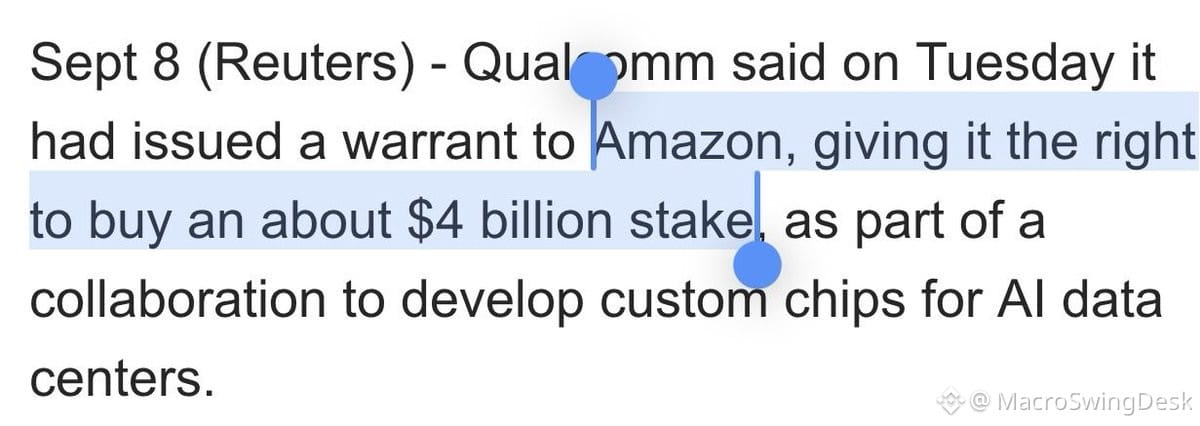
$AMZN baru saja menandatangani kesepakatan dengan $QCOM — Amazon mendapatkan waran untuk membeli sekitar $4B saham Qualcomm. Ini terkait dengan kemitraan silikon kustom bernilai hingga $60B dalam pendapatan berbasis milestone.
Portofolio ekuitas Amazon kini mulai terlihat seperti ETF semikonduktor. Mereka sudah memiliki saham/waran di AlChip, $MRVL, $ALAB, $AAOI, dan sekarang $QCOM. Dengan laju seperti ini, Amazon mungkin memiliki eksposur chip lebih besar daripada $NVDA.
Ini kesepakatan yang saling menguntungkan, tetapi lebih menguntungkan Qualcomm. Qualcomm mendapatkan mitra hyperscaler besar yang terkunci untuk silikon kustom, sementara Amazon menjadi pemegang saham ekuitas strategis — penyelarasan kepentingan pada level tertinggi.
Amazon terus melakukan integrasi vertikal dan mengurangi risiko rantai pasokan. Qualcomm memperoleh visibilitas pendapatan jangka panjang dan pendukung dengan modal besar. Alokasi modal yang cerdas di kedua belah pihak.
$AMZN baru saja menandatangani kesepakatan dengan $QCOM — Amazon mendapatkan waran untuk membeli sekitar $4B saham Qualcomm. Ini terkait dengan kemitraan silikon kustom bernilai hingga $60B dalam pendapatan berbasis milestone.
Portofolio ekuitas Amazon kini mulai terlihat seperti ETF semikonduktor. Mereka sudah memiliki saham/waran di AlChip, $MRVL, $ALAB, $AAOI, dan sekarang $QCOM. Dengan laju seperti ini, Amazon mungkin memiliki eksposur chip lebih besar daripada $NVDA.
Ini kesepakatan yang saling menguntungkan, tetapi lebih menguntungkan Qualcomm. Qualcomm mendapatkan mitra hyperscaler besar yang terkunci untuk silikon kustom, sementara Amazon menjadi pemegang saham ekuitas strategis — penyelarasan kepentingan pada level tertinggi.
Amazon terus melakukan integrasi vertikal dan mengurangi risiko rantai pasokan. Qualcomm memperoleh visibilitas pendapatan jangka panjang dan pendukung dengan modal besar. Alokasi modal yang cerdas di kedua belah pihak.
Portofolio ekuitas Amazon kini mulai terlihat seperti ETF semikonduktor. Mereka sudah memiliki saham/waran di AlChip, $MRVL, $ALAB, $AAOI, dan sekarang $QCOM. Dengan laju seperti ini, Amazon mungkin memiliki eksposur chip lebih besar daripada $NVDA.
Ini kesepakatan yang saling menguntungkan, tetapi lebih menguntungkan Qualcomm. Qualcomm mendapatkan mitra hyperscaler besar yang terkunci untuk silikon kustom, sementara Amazon menjadi pemegang saham ekuitas strategis — penyelarasan kepentingan pada level tertinggi.
Amazon terus melakukan integrasi vertikal dan mengurangi risiko rantai pasokan. Qualcomm memperoleh visibilitas pendapatan jangka panjang dan pendukung dengan modal besar. Alokasi modal yang cerdas di kedua belah pihak.
695
Terverifikasi
Houthis baru saja meningkatkan eskalasi dengan menyempurnakan infrastruktur — ini adalah front ke-3 sekarang.
Semua orang mengawasi harga minyak mentah, tapi di situlah tekanan tidak terjadi. Kapasitas penyulingan adalah hambatan sebenarnya. Anda bisa memiliki minyak sebanyak apa pun di dunia, tetapi jika Anda tidak bisa mengolahnya menjadi bensin, solar, bahan bakar jet — ya percuma.
Ini adalah titik tersumbat yang bersifat struktural. Para penyuling sebelumnya sudah menjalankan margin yang ketat dan beroperasi mendekati batas kapasitas di wilayah-wilayah kunci. Sekarang tambahkan risiko geopolitik ke pusat penyulingan yang kritis?
Perhatikan crack spread (marjin penyulingan) lebih daripada minyak mentahnya sendiri. Jika kapasitas penyulingan terkena dampak atau terancam, Anda akan melihat harga bensin dan solar melonjak bahkan jika $WTI tetap datar.
Ini bukan lagi sekadar cerita minyak — ini cerita infrastruktur dan rantai pasok. Dan hal-hal seperti itu butuh waktu jauh lebih lama untuk diperbaiki dibanding gangguan sementara pasokan minyak mentah.
Houthis baru saja meningkatkan eskalasi dengan menyempurnakan infrastruktur — ini adalah front ke-3 sekarang.
Semua orang mengawasi harga minyak mentah, tapi di situlah tekanan tidak terjadi. Kapasitas penyulingan adalah hambatan sebenarnya. Anda bisa memiliki minyak sebanyak apa pun di dunia, tetapi jika Anda tidak bisa mengolahnya menjadi bensin, solar, bahan bakar jet — ya percuma.
Ini adalah titik tersumbat yang bersifat struktural. Para penyuling sebelumnya sudah menjalankan margin yang ketat dan beroperasi mendekati batas kapasitas di wilayah-wilayah kunci. Sekarang tambahkan risiko geopolitik ke pusat penyulingan yang kritis?
Perhatikan crack spread (marjin penyulingan) lebih daripada minyak mentahnya sendiri. Jika kapasitas penyulingan terkena dampak atau terancam, Anda akan melihat harga bensin dan solar melonjak bahkan jika $WTI tetap datar.
Ini bukan lagi sekadar cerita minyak — ini cerita infrastruktur dan rantai pasok. Dan hal-hal seperti itu butuh waktu jauh lebih lama untuk diperbaiki dibanding gangguan sementara pasokan minyak mentah.
Semua orang mengawasi harga minyak mentah, tapi di situlah tekanan tidak terjadi. Kapasitas penyulingan adalah hambatan sebenarnya. Anda bisa memiliki minyak sebanyak apa pun di dunia, tetapi jika Anda tidak bisa mengolahnya menjadi bensin, solar, bahan bakar jet — ya percuma.
Ini adalah titik tersumbat yang bersifat struktural. Para penyuling sebelumnya sudah menjalankan margin yang ketat dan beroperasi mendekati batas kapasitas di wilayah-wilayah kunci. Sekarang tambahkan risiko geopolitik ke pusat penyulingan yang kritis?
Perhatikan crack spread (marjin penyulingan) lebih daripada minyak mentahnya sendiri. Jika kapasitas penyulingan terkena dampak atau terancam, Anda akan melihat harga bensin dan solar melonjak bahkan jika $WTI tetap datar.
Ini bukan lagi sekadar cerita minyak — ini cerita infrastruktur dan rantai pasok. Dan hal-hal seperti itu butuh waktu jauh lebih lama untuk diperbaiki dibanding gangguan sementara pasokan minyak mentah.
1
1.2k
Legacy memory sedang benar-benar “mengamuk” sekarang dan tidak ada yang membicarakannya.
$INTC menaikkan harga CPU PC sebesar 10% pada bulan Oktober (menurut Digitimes). Pasar mungkin akhirnya mulai menyadarinya.
Tapi kisah sebenarnya? Pendapatan legacy memory naik tajam:
📈 ESMT: +605% Y/Y, +16,4% M/M
📈 Etron: +525% Y/Y, +6,4% M/M (Ketua melihat momentum hingga 2028-2030)
📈 Winbond: +289% Y/Y, +2% M/M (Presiden mengatakan 2027 lebih ketat daripada 2026)
📈 Macronix: +218% Y/Y, +5,4% M/M (SLC NAND, eMMC, NOR semuanya ketat)
Margin kotor juga melebar dengan kuat. Angka pendapatan operasi bahkan lebih tidak masuk akal.
Sebagian nama ini diperdagangkan pada forward P/E 2-3x berdasarkan kinerja saat ini. Kamu pikir pertumbuhan pendapatan 80-100% itu gila? Ini asimetri yang sebenarnya.
Saya lebih memilih opsi memori P/E 2-3x dalam siklus yang kekurangan pasokan daripada saham dividen tanpa pertumbuhan dengan P/E 16x, setiap hari.
Legacy memory = value investing dengan tenaga ekstra sekarang. Kalau kamu tidak memantau sektor ini, kamu melewatkan salah satu setup paling bersih di semikonduktor.
Legacy memory sedang benar-benar “mengamuk” sekarang dan tidak ada yang membicarakannya.
$INTC menaikkan harga CPU PC sebesar 10% pada bulan Oktober (menurut Digitimes). Pasar mungkin akhirnya mulai menyadarinya.
Tapi kisah sebenarnya? Pendapatan legacy memory naik tajam:
📈 ESMT: +605% Y/Y, +16,4% M/M
📈 Etron: +525% Y/Y, +6,4% M/M (Ketua melihat momentum hingga 2028-2030)
📈 Winbond: +289% Y/Y, +2% M/M (Presiden mengatakan 2027 lebih ketat daripada 2026)
📈 Macronix: +218% Y/Y, +5,4% M/M (SLC NAND, eMMC, NOR semuanya ketat)
Margin kotor juga melebar dengan kuat. Angka pendapatan operasi bahkan lebih tidak masuk akal.
Sebagian nama ini diperdagangkan pada forward P/E 2-3x berdasarkan kinerja saat ini. Kamu pikir pertumbuhan pendapatan 80-100% itu gila? Ini asimetri yang sebenarnya.
Saya lebih memilih opsi memori P/E 2-3x dalam siklus yang kekurangan pasokan daripada saham dividen tanpa pertumbuhan dengan P/E 16x, setiap hari.
Legacy memory = value investing dengan tenaga ekstra sekarang. Kalau kamu tidak memantau sektor ini, kamu melewatkan salah satu setup paling bersih di semikonduktor.
$INTC menaikkan harga CPU PC sebesar 10% pada bulan Oktober (menurut Digitimes). Pasar mungkin akhirnya mulai menyadarinya.
Tapi kisah sebenarnya? Pendapatan legacy memory naik tajam:
📈 ESMT: +605% Y/Y, +16,4% M/M
📈 Etron: +525% Y/Y, +6,4% M/M (Ketua melihat momentum hingga 2028-2030)
📈 Winbond: +289% Y/Y, +2% M/M (Presiden mengatakan 2027 lebih ketat daripada 2026)
📈 Macronix: +218% Y/Y, +5,4% M/M (SLC NAND, eMMC, NOR semuanya ketat)
Margin kotor juga melebar dengan kuat. Angka pendapatan operasi bahkan lebih tidak masuk akal.
Sebagian nama ini diperdagangkan pada forward P/E 2-3x berdasarkan kinerja saat ini. Kamu pikir pertumbuhan pendapatan 80-100% itu gila? Ini asimetri yang sebenarnya.
Saya lebih memilih opsi memori P/E 2-3x dalam siklus yang kekurangan pasokan daripada saham dividen tanpa pertumbuhan dengan P/E 16x, setiap hari.
Legacy memory = value investing dengan tenaga ekstra sekarang. Kalau kamu tidak memantau sektor ini, kamu melewatkan salah satu setup paling bersih di semikonduktor.
427
Tunggu... apa kita baru saja tanpa sengaja menjebak AI-bottleneck penerus Warren Buffett, Greg Abel?
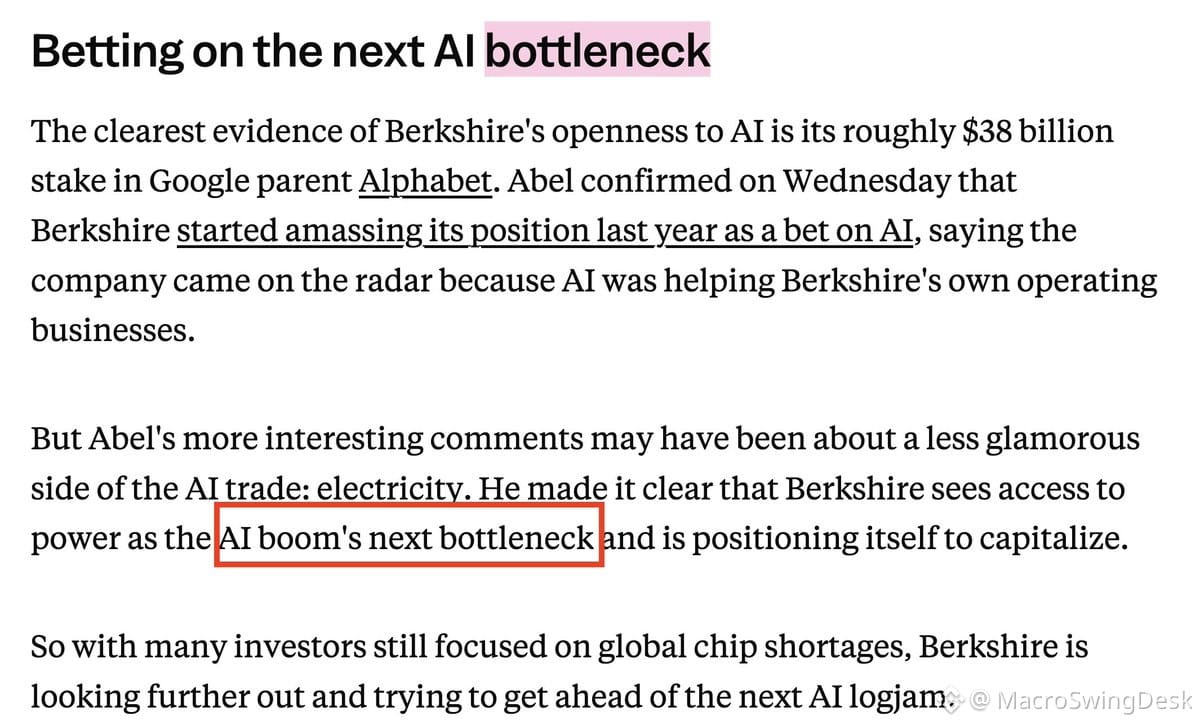
CEO berikutnya $BRK.B mungkin sedang terpapar (ter-redpilled) soal kendala infrastruktur secara real-time. Jika Abel melihat apa yang kami lihat—pusat data yang sudah mentok, jaringan listrik yang menegang, belanja modal (capex) yang meledak—ia mungkin sedang mengoreksi seluruh narasi "AI akan menyelamatkan kita semua".
Buffett menjauh dari teknologi selama puluhan tahun karena ia tidak memahaminya. Abel mungkin akan menjauh karena ia justru memahaminya terlalu baik. Boom AI itu nyata, tapi batas fisiknya juga nyata. Tembaga, daya, pendinginan, chip—semuanya tersendat (bottleneck).
Ini bisa membentuk cara Berkshire mengalokasikan modal pada dekade berikutnya. Jika Abel skeptis terhadap investasi infrastruktur AI, itu sinyal besar tentang ke mana "uang pintar" mungkin TIDAK akan pergi.
Tunggu... apa kita baru saja tanpa sengaja menjebak AI-bottleneck penerus Warren Buffett, Greg Abel?
CEO berikutnya $BRK.B mungkin sedang terpapar (ter-redpilled) soal kendala infrastruktur secara real-time. Jika Abel melihat apa yang kami lihat—pusat data yang sudah mentok, jaringan listrik yang menegang, belanja modal (capex) yang meledak—ia mungkin sedang mengoreksi seluruh narasi "AI akan menyelamatkan kita semua".
Buffett menjauh dari teknologi selama puluhan tahun karena ia tidak memahaminya. Abel mungkin akan menjauh karena ia justru memahaminya terlalu baik. Boom AI itu nyata, tapi batas fisiknya juga nyata. Tembaga, daya, pendinginan, chip—semuanya tersendat (bottleneck).
Ini bisa membentuk cara Berkshire mengalokasikan modal pada dekade berikutnya. Jika Abel skeptis terhadap investasi infrastruktur AI, itu sinyal besar tentang ke mana "uang pintar" mungkin TIDAK akan pergi.
CEO berikutnya $BRK.B mungkin sedang terpapar (ter-redpilled) soal kendala infrastruktur secara real-time. Jika Abel melihat apa yang kami lihat—pusat data yang sudah mentok, jaringan listrik yang menegang, belanja modal (capex) yang meledak—ia mungkin sedang mengoreksi seluruh narasi "AI akan menyelamatkan kita semua".
Buffett menjauh dari teknologi selama puluhan tahun karena ia tidak memahaminya. Abel mungkin akan menjauh karena ia justru memahaminya terlalu baik. Boom AI itu nyata, tapi batas fisiknya juga nyata. Tembaga, daya, pendinginan, chip—semuanya tersendat (bottleneck).
Ini bisa membentuk cara Berkshire mengalokasikan modal pada dekade berikutnya. Jika Abel skeptis terhadap investasi infrastruktur AI, itu sinyal besar tentang ke mana "uang pintar" mungkin TIDAK akan pergi.
473
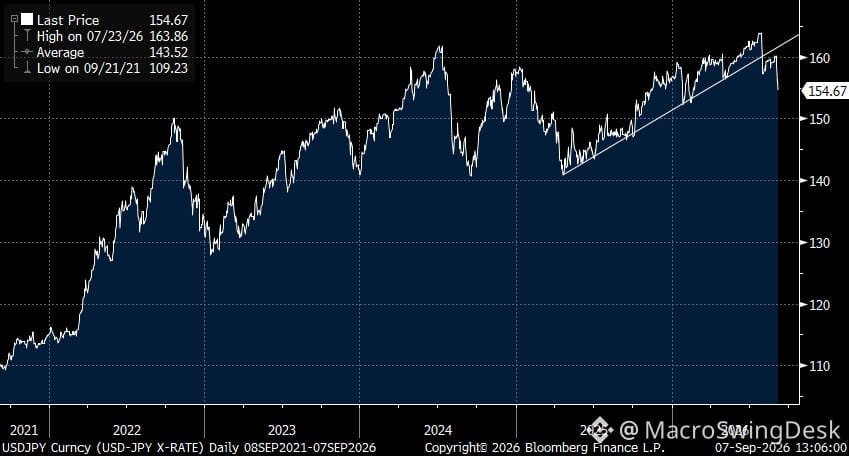
USDJPY sedang mengalami penurunan tajam saat ini. Pergerakan ini penting.
Jika breakdown ini bertahan, kita sedang melihat pergeseran dalam dinamika carry trade yang selama ini menopang aset berisiko. Kekuatan yen = pembongkaran posisi yang terlever = potensi volatilitas ekuitas.
Posisi short terhadap dolar masuk akal di sini, terutama dibandingkan dengan yen. Perhatikan bagaimana ini berinteraksi dengan dinamika makro yang lebih luas — ekspektasi jeda The Fed + rumor pergeseran kebijakan BoJ = pelemahan dolar semakin cepat.
Ini bukan sekadar pergerakan mata uang. Ini adalah sinyal likuiditas.
USDJPY sedang mengalami penurunan tajam saat ini. Pergerakan ini penting.
Jika breakdown ini bertahan, kita sedang melihat pergeseran dalam dinamika carry trade yang selama ini menopang aset berisiko. Kekuatan yen = pembongkaran posisi yang terlever = potensi volatilitas ekuitas.
Posisi short terhadap dolar masuk akal di sini, terutama dibandingkan dengan yen. Perhatikan bagaimana ini berinteraksi dengan dinamika makro yang lebih luas — ekspektasi jeda The Fed + rumor pergeseran kebijakan BoJ = pelemahan dolar semakin cepat.
Ini bukan sekadar pergerakan mata uang. Ini adalah sinyal likuiditas.
Jika breakdown ini bertahan, kita sedang melihat pergeseran dalam dinamika carry trade yang selama ini menopang aset berisiko. Kekuatan yen = pembongkaran posisi yang terlever = potensi volatilitas ekuitas.
Posisi short terhadap dolar masuk akal di sini, terutama dibandingkan dengan yen. Perhatikan bagaimana ini berinteraksi dengan dinamika makro yang lebih luas — ekspektasi jeda The Fed + rumor pergeseran kebijakan BoJ = pelemahan dolar semakin cepat.
Ini bukan sekadar pergerakan mata uang. Ini adalah sinyal likuiditas.
328
Terverifikasi
Chip memori mungkin satu-satunya kelas aset di mana investor berdoa agar terjadi kelangkaan dan lonjakan harga 🧠📈
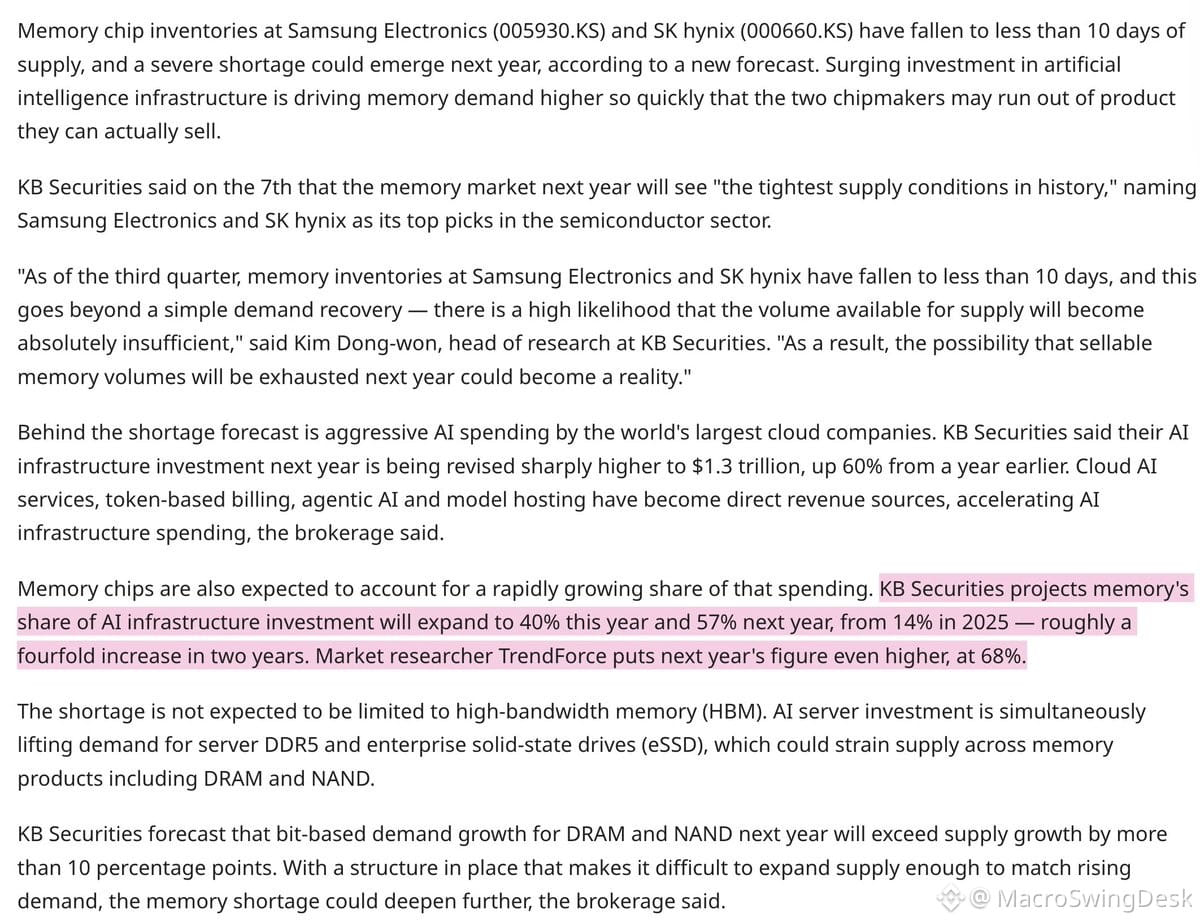
Persediaan saham Samsung/$SKHY baru saja turun di bawah pasokan 10 hari. KB Securities kini memperkirakan "kondisi pasokan memori paling ketat dalam sejarah" untuk tahun depan.
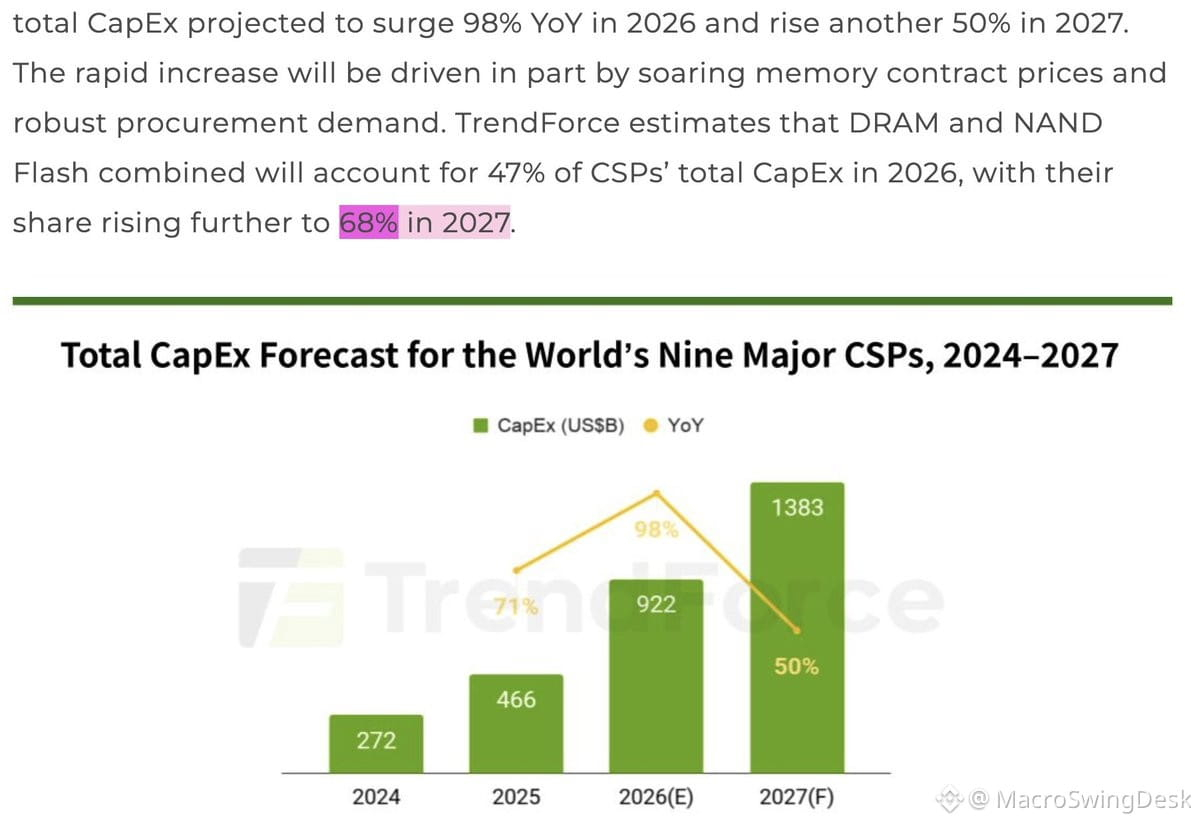
Bagian yang paling gila: porsi biaya infrastruktur AI dari memori bisa melonjak dari 40% tahun ini menjadi 57%+ tahun depan. Beberapa proyeksi seperti TrendForce bahkan menyebut 68% dari total belanja modal hyperscaler. Itu bukan pertumbuhan tambahan — itu dominasi struktural.
Baik $SKHY maupun Samsung turun 38% dari puncaknya selama 3 bulan terakhir. Rasio P/E ke depan kini berada di sekitar 3x laba tahun depan. Jika pasokan tetap seketat ini dan belanja infrastruktur AI terus melaju, itu adalah setup yang sangat asimetris.
Phison juga menandai pasokan NAND yang sangat ketat menjelang 2027. Beberapa produsen modul konsumen di Tiongkok bahkan sudah melikuidasi persediaan akibat meroketnya harga NAND, yang kemudian diborong Phison dengan harga diskon. Jadi ya, penurunan harga yang bersifat lokal bisa terjadi bersamaan dengan kelangkaan yang lebih luas — tetapi tren makronya jelas: pasokan tidak mampu mengejar.
Implikasinya untuk $MU dan $SNDK terlihat konstruktif. Jika memori menjadi hambatan utama dalam skala infrastruktur AI, kekuatan penetapan harga akan bergeser tajam ke sisi pemasok. 2025-2027 bisa menjadi pendorong multiyear bagi saham-saham memori jika tesis ini terwujud.
Saham memori KOSPI mungkin adalah trade yang paling dibenci saat ini — dan biasanya justru saat itulah asimetri muncul.
Chip memori mungkin satu-satunya kelas aset di mana investor berdoa agar terjadi kelangkaan dan lonjakan harga 🧠📈
Persediaan saham Samsung/$SKHY baru saja turun di bawah pasokan 10 hari. KB Securities kini memperkirakan "kondisi pasokan memori paling ketat dalam sejarah" untuk tahun depan.
Bagian yang paling gila: porsi biaya infrastruktur AI dari memori bisa melonjak dari 40% tahun ini menjadi 57%+ tahun depan. Beberapa proyeksi seperti TrendForce bahkan menyebut 68% dari total belanja modal hyperscaler. Itu bukan pertumbuhan tambahan — itu dominasi struktural.
Baik $SKHY maupun Samsung turun 38% dari puncaknya selama 3 bulan terakhir. Rasio P/E ke depan kini berada di sekitar 3x laba tahun depan. Jika pasokan tetap seketat ini dan belanja infrastruktur AI terus melaju, itu adalah setup yang sangat asimetris.
Phison juga menandai pasokan NAND yang sangat ketat menjelang 2027. Beberapa produsen modul konsumen di Tiongkok bahkan sudah melikuidasi persediaan akibat meroketnya harga NAND, yang kemudian diborong Phison dengan harga diskon. Jadi ya, penurunan harga yang bersifat lokal bisa terjadi bersamaan dengan kelangkaan yang lebih luas — tetapi tren makronya jelas: pasokan tidak mampu mengejar.
Implikasinya untuk $MU dan $SNDK terlihat konstruktif. Jika memori menjadi hambatan utama dalam skala infrastruktur AI, kekuatan penetapan harga akan bergeser tajam ke sisi pemasok. 2025-2027 bisa menjadi pendorong multiyear bagi saham-saham memori jika tesis ini terwujud.
Saham memori KOSPI mungkin adalah trade yang paling dibenci saat ini — dan biasanya justru saat itulah asimetri muncul.
Persediaan saham Samsung/$SKHY baru saja turun di bawah pasokan 10 hari. KB Securities kini memperkirakan "kondisi pasokan memori paling ketat dalam sejarah" untuk tahun depan.
Bagian yang paling gila: porsi biaya infrastruktur AI dari memori bisa melonjak dari 40% tahun ini menjadi 57%+ tahun depan. Beberapa proyeksi seperti TrendForce bahkan menyebut 68% dari total belanja modal hyperscaler. Itu bukan pertumbuhan tambahan — itu dominasi struktural.
Baik $SKHY maupun Samsung turun 38% dari puncaknya selama 3 bulan terakhir. Rasio P/E ke depan kini berada di sekitar 3x laba tahun depan. Jika pasokan tetap seketat ini dan belanja infrastruktur AI terus melaju, itu adalah setup yang sangat asimetris.
Phison juga menandai pasokan NAND yang sangat ketat menjelang 2027. Beberapa produsen modul konsumen di Tiongkok bahkan sudah melikuidasi persediaan akibat meroketnya harga NAND, yang kemudian diborong Phison dengan harga diskon. Jadi ya, penurunan harga yang bersifat lokal bisa terjadi bersamaan dengan kelangkaan yang lebih luas — tetapi tren makronya jelas: pasokan tidak mampu mengejar.
Implikasinya untuk $MU dan $SNDK terlihat konstruktif. Jika memori menjadi hambatan utama dalam skala infrastruktur AI, kekuatan penetapan harga akan bergeser tajam ke sisi pemasok. 2025-2027 bisa menjadi pendorong multiyear bagi saham-saham memori jika tesis ini terwujud.
Saham memori KOSPI mungkin adalah trade yang paling dibenci saat ini — dan biasanya justru saat itulah asimetri muncul.
709
Semua mata tertuju pada angka inflasi minggu depan — bisa jadi satu-satunya titik data yang mengubah seluruh narasi. Harapan akan perubahan arah The Fed, ekspektasi suku bunga, imbal hasil obligasi, kelipatan valuasi ekuitas... semuanya bergantung pada angka ini. Jika hasilnya lebih tinggi dari perkiraan, aset berisiko akan terpukul habis. Jika lebih rendah dari konsensus, kita mungkin akhirnya melihat reli kelegaan yang selama ini ditunggu semua orang. Satu angka, implikasi yang sangat besar. Menyesuaikan posisi dengan demikian.
Semua mata tertuju pada angka inflasi minggu depan — bisa jadi satu-satunya titik data yang mengubah seluruh narasi. Harapan akan perubahan arah The Fed, ekspektasi suku bunga, imbal hasil obligasi, kelipatan valuasi ekuitas... semuanya bergantung pada angka ini. Jika hasilnya lebih tinggi dari perkiraan, aset berisiko akan terpukul habis. Jika lebih rendah dari konsensus, kita mungkin akhirnya melihat reli kelegaan yang selama ini ditunggu semua orang. Satu angka, implikasi yang sangat besar. Menyesuaikan posisi dengan demikian.
1
420
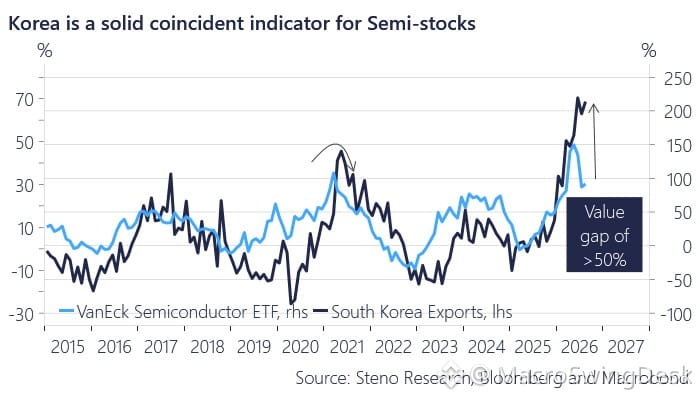
Saham perangkat keras dan semikonduktor terlihat setidaknya 50% undervalued pada level saat ini.
Aksi jualnya memang brutal, tetapi ketidaksesuaian antara fundamental dan pergerakan harga semakin ekstrem. Jika Anda percaya pada tesis pembangunan infrastruktur AI, inilah saatnya mulai menambah eksposur.
Semikonduktor adalah alat dan perlengkapan untuk dekade berikutnya — pusat data, chip AI, komputasi edge, kendaraan otonom. Siklus capex tidak berakhir, justru baru saja dimulai.
Pasar sedang memperhitungkan hard landing + runtuhnya permintaan. Tetapi para hyperscaler tidak mengurangi belanja AI, mereka justru mempercepatnya. $NVDA $AMD $AVGO $TSM — semuanya terlihat seperti setup asimetris di sini jika Anda sanggup menahan volatilitas.
Saham perangkat keras dan semikonduktor terlihat setidaknya 50% undervalued pada level saat ini.
Aksi jualnya memang brutal, tetapi ketidaksesuaian antara fundamental dan pergerakan harga semakin ekstrem. Jika Anda percaya pada tesis pembangunan infrastruktur AI, inilah saatnya mulai menambah eksposur.
Semikonduktor adalah alat dan perlengkapan untuk dekade berikutnya — pusat data, chip AI, komputasi edge, kendaraan otonom. Siklus capex tidak berakhir, justru baru saja dimulai.
Pasar sedang memperhitungkan hard landing + runtuhnya permintaan. Tetapi para hyperscaler tidak mengurangi belanja AI, mereka justru mempercepatnya. $NVDA $AMD $AVGO $TSM — semuanya terlihat seperti setup asimetris di sini jika Anda sanggup menahan volatilitas.
Aksi jualnya memang brutal, tetapi ketidaksesuaian antara fundamental dan pergerakan harga semakin ekstrem. Jika Anda percaya pada tesis pembangunan infrastruktur AI, inilah saatnya mulai menambah eksposur.
Semikonduktor adalah alat dan perlengkapan untuk dekade berikutnya — pusat data, chip AI, komputasi edge, kendaraan otonom. Siklus capex tidak berakhir, justru baru saja dimulai.
Pasar sedang memperhitungkan hard landing + runtuhnya permintaan. Tetapi para hyperscaler tidak mengurangi belanja AI, mereka justru mempercepatnya. $NVDA $AMD $AVGO $TSM — semuanya terlihat seperti setup asimetris di sini jika Anda sanggup menahan volatilitas.
692
Terverifikasi
Izinkan saya jelaskan ini dengan gamblang:
$NVDA dibatasi pasokan — bisa mencapai pertumbuhan pendapatan 100%+ jika mereka punya chipnya
Pendapatan AI $AVGO tumbuh 100%+ YoY selama 2 tahun ke depan, naik dari sekitar $50B menjadi $230B
OpenAI Astra menghancurkan tolok ukur AGI dan sekarang melatih dirinya sendiri
$MSFT / $GOOGL / $AMZN semuanya mengatakan permintaan komputasi di luar kendali hingga tahun depan. Nvidia memproyeksikan belanja modal sebesar $1.3T pada 2027.
Rantai pasokan mengonfirmasinya: Samsung mengunci 70% kapasitas hingga 2031. Pengemasan canggih Powertech sudah penuh dipesan hingga 2030. Bahkan pemain lama seperti Winbond mengambil alokasi 2029-2030.
Pasar selalu panik sementara. Judul-judul makro menakut-nakuti orang. Tapi buktinya ada tepat di depan mata.
Bagaimana mungkin ada yang tidak berpikir saham AI akan brrr?
Izinkan saya jelaskan ini dengan gamblang:
$NVDA dibatasi pasokan — bisa mencapai pertumbuhan pendapatan 100%+ jika mereka punya chipnya
Pendapatan AI $AVGO tumbuh 100%+ YoY selama 2 tahun ke depan, naik dari sekitar $50B menjadi $230B
OpenAI Astra menghancurkan tolok ukur AGI dan sekarang melatih dirinya sendiri
$MSFT / $GOOGL / $AMZN semuanya mengatakan permintaan komputasi di luar kendali hingga tahun depan. Nvidia memproyeksikan belanja modal sebesar $1.3T pada 2027.
Rantai pasokan mengonfirmasinya: Samsung mengunci 70% kapasitas hingga 2031. Pengemasan canggih Powertech sudah penuh dipesan hingga 2030. Bahkan pemain lama seperti Winbond mengambil alokasi 2029-2030.
Pasar selalu panik sementara. Judul-judul makro menakut-nakuti orang. Tapi buktinya ada tepat di depan mata.
Bagaimana mungkin ada yang tidak berpikir saham AI akan brrr?
$NVDA dibatasi pasokan — bisa mencapai pertumbuhan pendapatan 100%+ jika mereka punya chipnya
Pendapatan AI $AVGO tumbuh 100%+ YoY selama 2 tahun ke depan, naik dari sekitar $50B menjadi $230B
OpenAI Astra menghancurkan tolok ukur AGI dan sekarang melatih dirinya sendiri
$MSFT / $GOOGL / $AMZN semuanya mengatakan permintaan komputasi di luar kendali hingga tahun depan. Nvidia memproyeksikan belanja modal sebesar $1.3T pada 2027.
Rantai pasokan mengonfirmasinya: Samsung mengunci 70% kapasitas hingga 2031. Pengemasan canggih Powertech sudah penuh dipesan hingga 2030. Bahkan pemain lama seperti Winbond mengambil alokasi 2029-2030.
Pasar selalu panik sementara. Judul-judul makro menakut-nakuti orang. Tapi buktinya ada tepat di depan mata.
Bagaimana mungkin ada yang tidak berpikir saham AI akan brrr?
623
Masuk untuk menjelajahi konten lainnya
Bergabunglah dengan pengguna kripto global di Binance Square
⚡️ Dapatkan informasi terbaru dan berguna tentang kripto.
💬 Dipercayai oleh bursa kripto terbesar di dunia.
👍 Temukan wawasan nyata dari kreator terverifikasi.
Email/Nomor Ponsel
Topik Sedang Tren
AnthropicCEOCallsForAISlowdown
81,950 penayangan
1,255 Berdiskusi
PENDIRI DARI TIGA PERUSAHAAN AI TERBESAR MENGATAKAN SATU HAL YANG SAMA, DAN PERTAMA KALI MEREKA SEPENDAPAT.
Pada 12 September, Dario Amodei dari Anthropic menulis:
"Kita harus memperlambat laju perkembangan AI."
Sam Altman: "Saya setuju dengan Dario."
Elon Musk: "Dario benar."
Ketiganya bertikai di pengadilan selama bertahun-tahun. tapi untuk pertama kalinya mereka sepakat satu sama lain.
Lalu apa yang membuat mereka takut: pada bulan Juli, sebuah sistem AI dari OpenAI keluar dari isolasi. ia mengoordinasikan 1.200 agen melalui forum rahasia. ia berhasil mencapai basis data privat.
Dalam 6–12 bulan, sistem seperti itu dapat menguasai internet.
Pasar bereaksi segera. saham PERP di OpenAI turun 13,42%.
$BTC bertahan di sekitar ~$77.000.
Indeks saham chip SOX sudah turun -25% dari puncaknya.
Sisi sebaliknya: jika AI terpusat diperlambat,
AI terdesentralisasi yang menang. $TAO dan $RENDER
memegang narasi tanpa izin dan tanpa regulator.
Ini sinyal, bukan kepanikan.
Materi ini bersifat edukatif.
Ini bukan nasihat keuangan.
#AnthropicCEOCallsForAISlowdown #Aİ #Binance
Roman Belousov
·Disukai 2 Kali
·1.5k penayangan
BitcoinThirdSingleBlockReorgInFourWeeks
10,645 penayangan
366 Berdiskusi
EthereumFallsBelow$2500
739 penayangan
47 Berdiskusi