

meligamble
12k Publications

meligamble
Signaler
Bloquer l’utilisateur
Main call : t@me/meligamble
DM : @meliodas368
🔠 Content at chanel is for informational purposes only, not investment advice or solicitations 💰 | DYOR
315 Suivis
207 Abonnés
737 J’aime
Publications
Tous
Citations
Vidéos
·
--
Here's what happened when the SEC clarified last week that buybacks and upgrades don't turn a token into a security.
Crypto investors keep falling into the same trap, piling into tokens on the back of a buyback announcement or a protocol upgrade only to get dumped on when the regulatory picture stays murky. It's the classic FOMO into what looks like a stock play that never quite is.
This feels like a case study in the SEC walking a tightrope. They basically said those features alone don't satisfy the Howey test, which is a relief for teams running $NEAR and $FIL that have used upgrades and incentives to drive actual usage. Think back to how $ETC handled its post-fork identity or the years-long fight over XRP. Those projects got hammered precisely because every upgrade or token mechanic was treated as potential securities activity. The comparison shows the SEC is learning, or at least trying not to repeat the same overreach.
Right now the market is greedy and chasing narratives, so this news might not even register until the next dump. What we can take away is that utility still has to be real, not just engineered through buybacks. Projects competing for attention in this environment now have a bit more breathing room to build without the constant security label threat.
Anyone else seeing this as a green light for more experimental token designs, or is it just more of the same regulatory fog?
#SECSaysBuybacksUpgradesDontMakeTokenSecurity #BitwiseFilesToListNEARETFOnNYSEArca #SECCommissionerPeirceToLeaveOct2
Here's what happened when the SEC clarified last week that buybacks and upgrades don't turn a token into a security.
Crypto investors keep falling into the same trap, piling into tokens on the back of a buyback announcement or a protocol upgrade only to get dumped on when the regulatory picture stays murky. It's the classic FOMO into what looks like a stock play that never quite is.
This feels like a case study in the SEC walking a tightrope. They basically said those features alone don't satisfy the Howey test, which is a relief for teams running $NEAR and $FIL that have used upgrades and incentives to drive actual usage. Think back to how $ETC handled its post-fork identity or the years-long fight over XRP. Those projects got hammered precisely because every upgrade or token mechanic was treated as potential securities activity. The comparison shows the SEC is learning, or at least trying not to repeat the same overreach.
Right now the market is greedy and chasing narratives, so this news might not even register until the next dump. What we can take away is that utility still has to be real, not just engineered through buybacks. Projects competing for attention in this environment now have a bit more breathing room to build without the constant security label threat.
Anyone else seeing this as a green light for more experimental token designs, or is it just more of the same regulatory fog?
#SECSaysBuybacksUpgradesDontMakeTokenSecurity #BitwiseFilesToListNEARETFOnNYSEArca #SECCommissionerPeirceToLeaveOct2
Crypto investors keep falling into the same trap, piling into tokens on the back of a buyback announcement or a protocol upgrade only to get dumped on when the regulatory picture stays murky. It's the classic FOMO into what looks like a stock play that never quite is.
This feels like a case study in the SEC walking a tightrope. They basically said those features alone don't satisfy the Howey test, which is a relief for teams running $NEAR and $FIL that have used upgrades and incentives to drive actual usage. Think back to how $ETC handled its post-fork identity or the years-long fight over XRP. Those projects got hammered precisely because every upgrade or token mechanic was treated as potential securities activity. The comparison shows the SEC is learning, or at least trying not to repeat the same overreach.
Right now the market is greedy and chasing narratives, so this news might not even register until the next dump. What we can take away is that utility still has to be real, not just engineered through buybacks. Projects competing for attention in this environment now have a bit more breathing room to build without the constant security label threat.
Anyone else seeing this as a green light for more experimental token designs, or is it just more of the same regulatory fog?
#SECSaysBuybacksUpgradesDontMakeTokenSecurity #BitwiseFilesToListNEARETFOnNYSEArca #SECCommissionerPeirceToLeaveOct2

·
--
If you are still assuming regulatory clarity in the US will happen on autopilot, stop now.
Most traders celebrate pro-crypto rhetoric during greed cycles, then get completely blindsided when the few regulators actually defending common sense step down. We spent years relying on individual champions rather than structural reform, leaving portfolios exposed every time leadership shifts.
The departure of Commissioner Peirce feels uncomfortably similar to past regulatory transitions where market optimism outpaced policy reality. While Layer 1 ecosystems like $NEAR continue pushing institutional products and legacy networks like $ETC maintain baseline interest, the real issue has always been who sits across the table when new guidelines get drafted. We saw how quickly the enforcement tone shifted during the Gensler era after years of perceived progress.
Relying on a handful of vocal allies inside regulatory agencies is a fragile foundation for an entire asset class. As capital flows continue rotating through majors while $USDT dominance hovers, the uncertainty around long-term policy structure is far from settled.
Do you think her departure slows down the pace of clear rules, or is institutional momentum already past the point of no return?
#SECCommissionerPeirceToLeaveOct2 #SECSaysBuybacksUpgradesDontMakeTokenSecurity #BitwiseFilesToListNEARETFOnNYSEArca
If you are still assuming regulatory clarity in the US will happen on autopilot, stop now.
Most traders celebrate pro-crypto rhetoric during greed cycles, then get completely blindsided when the few regulators actually defending common sense step down. We spent years relying on individual champions rather than structural reform, leaving portfolios exposed every time leadership shifts.
The departure of Commissioner Peirce feels uncomfortably similar to past regulatory transitions where market optimism outpaced policy reality. While Layer 1 ecosystems like $NEAR continue pushing institutional products and legacy networks like $ETC maintain baseline interest, the real issue has always been who sits across the table when new guidelines get drafted. We saw how quickly the enforcement tone shifted during the Gensler era after years of perceived progress.
Relying on a handful of vocal allies inside regulatory agencies is a fragile foundation for an entire asset class. As capital flows continue rotating through majors while $USDT dominance hovers, the uncertainty around long-term policy structure is far from settled.
Do you think her departure slows down the pace of clear rules, or is institutional momentum already past the point of no return?
#SECCommissionerPeirceToLeaveOct2 #SECSaysBuybacksUpgradesDontMakeTokenSecurity #BitwiseFilesToListNEARETFOnNYSEArca
Most traders celebrate pro-crypto rhetoric during greed cycles, then get completely blindsided when the few regulators actually defending common sense step down. We spent years relying on individual champions rather than structural reform, leaving portfolios exposed every time leadership shifts.
The departure of Commissioner Peirce feels uncomfortably similar to past regulatory transitions where market optimism outpaced policy reality. While Layer 1 ecosystems like $NEAR continue pushing institutional products and legacy networks like $ETC maintain baseline interest, the real issue has always been who sits across the table when new guidelines get drafted. We saw how quickly the enforcement tone shifted during the Gensler era after years of perceived progress.
Relying on a handful of vocal allies inside regulatory agencies is a fragile foundation for an entire asset class. As capital flows continue rotating through majors while $USDT dominance hovers, the uncertainty around long-term policy structure is far from settled.
Do you think her departure slows down the pace of clear rules, or is institutional momentum already past the point of no return?
#SECCommissionerPeirceToLeaveOct2 #SECSaysBuybacksUpgradesDontMakeTokenSecurity #BitwiseFilesToListNEARETFOnNYSEArca

·
--
If you're still shorting $BTC after this move, stop now.
Getting caught on the wrong side has wiped out accounts as the rally accelerated. Traders who didn't exit shorts or who now FOMO in at the highs are feeling the sting of missed timing.
Bitcoin just crossed $84,000, its highest since January 31. More than $600 million in liquidations hit in 24 hours, with $BTC responsible for $339 million of them.
It closed the week above the 50-week moving average for the first time in 45 weeks. Bears point to ongoing macro risks, geopolitics and Fed policy as reasons this could reverse with high volatility.
I think the bulls have it right this time. The squeeze indicates strong demand that could lift $ETH and $SOL along with $BTC into a new phase.
What's your take, breakout or another fakeout?
#Bitcoin #ShortSqueeze #Crypto
If you're still shorting $BTC after this move, stop now.
Getting caught on the wrong side has wiped out accounts as the rally accelerated. Traders who didn't exit shorts or who now FOMO in at the highs are feeling the sting of missed timing.
Bitcoin just crossed $84,000, its highest since January 31. More than $600 million in liquidations hit in 24 hours, with $BTC responsible for $339 million of them.
It closed the week above the 50-week moving average for the first time in 45 weeks. Bears point to ongoing macro risks, geopolitics and Fed policy as reasons this could reverse with high volatility.
I think the bulls have it right this time. The squeeze indicates strong demand that could lift $ETH and $SOL along with $BTC into a new phase.
What's your take, breakout or another fakeout?
#Bitcoin #ShortSqueeze #Crypto
Getting caught on the wrong side has wiped out accounts as the rally accelerated. Traders who didn't exit shorts or who now FOMO in at the highs are feeling the sting of missed timing.
Bitcoin just crossed $84,000, its highest since January 31. More than $600 million in liquidations hit in 24 hours, with $BTC responsible for $339 million of them.
It closed the week above the 50-week moving average for the first time in 45 weeks. Bears point to ongoing macro risks, geopolitics and Fed policy as reasons this could reverse with high volatility.
I think the bulls have it right this time. The squeeze indicates strong demand that could lift $ETH and $SOL along with $BTC into a new phase.
What's your take, breakout or another fakeout?
#Bitcoin #ShortSqueeze #Crypto
11
·
--
Most traders think a violent surge to 84k signals instant continuation, but history shows aggressive short squeezes often mark local exhaustion rather than clean trend starts.
Jumping into green candles out of pure FOMO is how retail consistently gets trapped right before open interest resets and liquidity dries up.
We just saw $BTC slice through $84,000 to reach its highest level since late January, triggering over $600M in total market liquidations across a single 24-hour window. Forced short covers drove the brunt of the damage, with $BTC accounting for roughly $339M of those wiped positions as leverage cascaded higher.
From a structural lens, closing a full week above the 50-week moving average for the first time in 45 weeks is a notable technical shift across major assets like $ETH. That said, when a breakout is fueled by forced liquidations rather than steady spot buying, the bid cushion underneath tends to be razor-thin. With macro factors and central bank policy still keeping volatility elevated, chasing the impulse without waiting for a retest leaves you vulnerable to a sharp wick down.
Are you bidding this breakout up here, or waiting for a pullback to confirm real spot demand?
#Bitcoin #CryptoTrading #OnChainAnalysis
Most traders think a violent surge to 84k signals instant continuation, but history shows aggressive short squeezes often mark local exhaustion rather than clean trend starts.
Jumping into green candles out of pure FOMO is how retail consistently gets trapped right before open interest resets and liquidity dries up.
We just saw $BTC slice through $84,000 to reach its highest level since late January, triggering over $600M in total market liquidations across a single 24-hour window. Forced short covers drove the brunt of the damage, with $BTC accounting for roughly $339M of those wiped positions as leverage cascaded higher.
From a structural lens, closing a full week above the 50-week moving average for the first time in 45 weeks is a notable technical shift across major assets like $ETH . That said, when a breakout is fueled by forced liquidations rather than steady spot buying, the bid cushion underneath tends to be razor-thin. With macro factors and central bank policy still keeping volatility elevated, chasing the impulse without waiting for a retest leaves you vulnerable to a sharp wick down.
Are you bidding this breakout up here, or waiting for a pullback to confirm real spot demand?
#Bitcoin #CryptoTrading #OnChainAnalysis
Jumping into green candles out of pure FOMO is how retail consistently gets trapped right before open interest resets and liquidity dries up.
We just saw $BTC slice through $84,000 to reach its highest level since late January, triggering over $600M in total market liquidations across a single 24-hour window. Forced short covers drove the brunt of the damage, with $BTC accounting for roughly $339M of those wiped positions as leverage cascaded higher.
From a structural lens, closing a full week above the 50-week moving average for the first time in 45 weeks is a notable technical shift across major assets like $ETH . That said, when a breakout is fueled by forced liquidations rather than steady spot buying, the bid cushion underneath tends to be razor-thin. With macro factors and central bank policy still keeping volatility elevated, chasing the impulse without waiting for a retest leaves you vulnerable to a sharp wick down.
Are you bidding this breakout up here, or waiting for a pullback to confirm real spot demand?
#Bitcoin #CryptoTrading #OnChainAnalysis
13
·
--
Have you noticed every altcoin ETF filing gets treated like a guaranteed pump even when the token has been range-bound for weeks?
People keep buying $NEAR on these headlines and then watching the move reverse, stuck with positions they entered too late because they thought this time was different.
This Bitwise filing to list a NEAR ETF on NYSE Arca is a clear case study in how product announcements get overread. Institutions like Bitwise are expanding their lineup, but that does not equal immediate capital flowing into $NEAR the way Bitcoin ETFs did. The market is greedy right now, Fear and Greed at 72, and $NEAR sits among the most searched tokens next to $USDT and $FIL. That combination usually means the news is already in the price. Listing on Arca is a regulatory step, not a demand event. We have seen similar filings for other assets where the token barely reacted after the initial spike.
The pattern is consistent. Early speculation, then a grind as the actual approval timeline stretches out. If you are looking for a real catalyst, this is not it.
Where do you think $NEAR goes from this filing, or is it just another ticker that will sit unused?
#BitwiseFilesToListNEARETFOnNYSEArca #SECSaysBuybacksUpgradesDontMakeTokenSecurity #BlackRockBuildsTokenizedPortfoliosForOndo
Have you noticed every altcoin ETF filing gets treated like a guaranteed pump even when the token has been range-bound for weeks?
People keep buying $NEAR on these headlines and then watching the move reverse, stuck with positions they entered too late because they thought this time was different.
This Bitwise filing to list a NEAR ETF on NYSE Arca is a clear case study in how product announcements get overread. Institutions like Bitwise are expanding their lineup, but that does not equal immediate capital flowing into $NEAR the way Bitcoin ETFs did. The market is greedy right now, Fear and Greed at 72, and $NEAR sits among the most searched tokens next to $USDT and $FIL . That combination usually means the news is already in the price. Listing on Arca is a regulatory step, not a demand event. We have seen similar filings for other assets where the token barely reacted after the initial spike.
The pattern is consistent. Early speculation, then a grind as the actual approval timeline stretches out. If you are looking for a real catalyst, this is not it.
Where do you think $NEAR goes from this filing, or is it just another ticker that will sit unused?
#BitwiseFilesToListNEARETFOnNYSEArca #SECSaysBuybacksUpgradesDontMakeTokenSecurity #BlackRockBuildsTokenizedPortfoliosForOndo
People keep buying $NEAR on these headlines and then watching the move reverse, stuck with positions they entered too late because they thought this time was different.
This Bitwise filing to list a NEAR ETF on NYSE Arca is a clear case study in how product announcements get overread. Institutions like Bitwise are expanding their lineup, but that does not equal immediate capital flowing into $NEAR the way Bitcoin ETFs did. The market is greedy right now, Fear and Greed at 72, and $NEAR sits among the most searched tokens next to $USDT and $FIL . That combination usually means the news is already in the price. Listing on Arca is a regulatory step, not a demand event. We have seen similar filings for other assets where the token barely reacted after the initial spike.
The pattern is consistent. Early speculation, then a grind as the actual approval timeline stretches out. If you are looking for a real catalyst, this is not it.
Where do you think $NEAR goes from this filing, or is it just another ticker that will sit unused?
#BitwiseFilesToListNEARETFOnNYSEArca #SECSaysBuybacksUpgradesDontMakeTokenSecurity #BlackRockBuildsTokenizedPortfoliosForOndo

28
·
--
The biggest institutional money in traditional finance isn't buying speculative memecoins, they are quietly rewriting how real-world assets are settled on-chain.
Most retail investors burn their capital chasing green candles at the peak of market greed, completely missing the foundational shifts that actually survive brutal multi-year bear markets. We saw this exact pattern play out in 2017 and 2020: people obsess over short-term pumps while the infrastructure that absorbs trillions gets laid down in silence.
When institutions like BlackRock deepen their integration with protocols like $ONDO, it changes the game for yield generation. Instead of parking idle capital in basic $USDT or chasing unsustainable DeFi yields, real-world assets bring predictable, institutional-grade treasury yields directly into Web3. Infrastructure plays with active real-world utility like $NEAR and decentralized storage networks are increasingly becoming the rails these tokenized portfolios will rely on.
Smart liquidity always seeks certainty and structural yield before the crowd even realizes where the cycle has shifted.
How are you adjusting your portfolio split between volatile altcoins and real-world asset protocols this cycle?
#BlackRockBuildsTokenizedPortfoliosForOndo #SECSaysBuybacksUpgradesDontMakeTokenSecurity
The biggest institutional money in traditional finance isn't buying speculative memecoins, they are quietly rewriting how real-world assets are settled on-chain.
Most retail investors burn their capital chasing green candles at the peak of market greed, completely missing the foundational shifts that actually survive brutal multi-year bear markets. We saw this exact pattern play out in 2017 and 2020: people obsess over short-term pumps while the infrastructure that absorbs trillions gets laid down in silence.
When institutions like BlackRock deepen their integration with protocols like $ONDO , it changes the game for yield generation. Instead of parking idle capital in basic $USDT or chasing unsustainable DeFi yields, real-world assets bring predictable, institutional-grade treasury yields directly into Web3. Infrastructure plays with active real-world utility like $NEAR and decentralized storage networks are increasingly becoming the rails these tokenized portfolios will rely on.
Smart liquidity always seeks certainty and structural yield before the crowd even realizes where the cycle has shifted.
How are you adjusting your portfolio split between volatile altcoins and real-world asset protocols this cycle?
#BlackRockBuildsTokenizedPortfoliosForOndo #SECSaysBuybacksUpgradesDontMakeTokenSecurity
Most retail investors burn their capital chasing green candles at the peak of market greed, completely missing the foundational shifts that actually survive brutal multi-year bear markets. We saw this exact pattern play out in 2017 and 2020: people obsess over short-term pumps while the infrastructure that absorbs trillions gets laid down in silence.
When institutions like BlackRock deepen their integration with protocols like $ONDO , it changes the game for yield generation. Instead of parking idle capital in basic $USDT or chasing unsustainable DeFi yields, real-world assets bring predictable, institutional-grade treasury yields directly into Web3. Infrastructure plays with active real-world utility like $NEAR and decentralized storage networks are increasingly becoming the rails these tokenized portfolios will rely on.
Smart liquidity always seeks certainty and structural yield before the crowd even realizes where the cycle has shifted.
How are you adjusting your portfolio split between volatile altcoins and real-world asset protocols this cycle?
#BlackRockBuildsTokenizedPortfoliosForOndo #SECSaysBuybacksUpgradesDontMakeTokenSecurity

52
·
--
Here's what happened when traders on Polymarket started betting millions on which US banks would fail next.
A lot of us have chased these prediction markets in the heat of the moment only to get burned when the rules change or the platform faces heat from regulators.
Volumes on those bank failure contracts jumped hard recently. It felt like the 2023 SVB days all over again, when everyone rushed into $USDT as traditional finance looked shaky. The FDIC flagged the activity because betting on bank collapses could be seen as adding pressure to the system or operating as unlicensed gambling.
Polymarket operates in a gray zone that regulated competitors simply cannot match, which is exactly why the attention came so fast. Compare that to older projects like Augur that ran into the same wall years ago and never fully bounced back. With the Fear and Greed Index sitting at 72, the greed is real and people are piling in without fully pricing the regulatory risk. Circle's recent moves with $USDC on other chains and Tether's history of wallet freezes show how quickly stables and prediction markets can get tangled in the same scrutiny.
The lesson here is that these platforms surface information faster than anyone else, but they also invite the kind of oversight that can pause everything overnight. Crypto keeps testing how close it can get to TradFi without triggering a response.
What's your take on whether prediction markets like this survive the extra attention?
#PolymarketBankFailureBetsDrawFDICConcern #CircleMints500MUSDCOnSolana #CircleTetherFreezeBitgetHackerWallet
Here's what happened when traders on Polymarket started betting millions on which US banks would fail next.
A lot of us have chased these prediction markets in the heat of the moment only to get burned when the rules change or the platform faces heat from regulators.
Volumes on those bank failure contracts jumped hard recently. It felt like the 2023 SVB days all over again, when everyone rushed into $USDT as traditional finance looked shaky. The FDIC flagged the activity because betting on bank collapses could be seen as adding pressure to the system or operating as unlicensed gambling.
Polymarket operates in a gray zone that regulated competitors simply cannot match, which is exactly why the attention came so fast. Compare that to older projects like Augur that ran into the same wall years ago and never fully bounced back. With the Fear and Greed Index sitting at 72, the greed is real and people are piling in without fully pricing the regulatory risk. Circle's recent moves with $USDC on other chains and Tether's history of wallet freezes show how quickly stables and prediction markets can get tangled in the same scrutiny.
The lesson here is that these platforms surface information faster than anyone else, but they also invite the kind of oversight that can pause everything overnight. Crypto keeps testing how close it can get to TradFi without triggering a response.
What's your take on whether prediction markets like this survive the extra attention?
#PolymarketBankFailureBetsDrawFDICConcern #CircleMints500MUSDCOnSolana #CircleTetherFreezeBitgetHackerWallet
A lot of us have chased these prediction markets in the heat of the moment only to get burned when the rules change or the platform faces heat from regulators.
Volumes on those bank failure contracts jumped hard recently. It felt like the 2023 SVB days all over again, when everyone rushed into $USDT as traditional finance looked shaky. The FDIC flagged the activity because betting on bank collapses could be seen as adding pressure to the system or operating as unlicensed gambling.
Polymarket operates in a gray zone that regulated competitors simply cannot match, which is exactly why the attention came so fast. Compare that to older projects like Augur that ran into the same wall years ago and never fully bounced back. With the Fear and Greed Index sitting at 72, the greed is real and people are piling in without fully pricing the regulatory risk. Circle's recent moves with $USDC on other chains and Tether's history of wallet freezes show how quickly stables and prediction markets can get tangled in the same scrutiny.
The lesson here is that these platforms surface information faster than anyone else, but they also invite the kind of oversight that can pause everything overnight. Crypto keeps testing how close it can get to TradFi without triggering a response.
What's your take on whether prediction markets like this survive the extra attention?
#PolymarketBankFailureBetsDrawFDICConcern #CircleMints500MUSDCOnSolana #CircleTetherFreezeBitgetHackerWallet

74
·
--
If you're still treating every Circle mint as a guaranteed green candle, stop now.
That habit has burned more traders than most would admit. You see $500M of $USDC land on Solana, assume fresh buying power is about to hit the book, and chase the first bounce while the capital just sits there or quietly rotates into $USDT.
Circle just minted another 500 million USDC on Solana. We've seen this movie. Big prints on Ethereum used to signal institutions loading up, but Solana's version has been messier.
Sometimes it fuels the next $SOL run. Sometimes Circle is just parking liquidity for settlement and the chart does nothing for two weeks. Tether still dominates raw volume, yet $USDC keeps winning the fight over where new on-chain dollars actually live.
Last cycle a mint this size actually moved markets. Right now greed is sitting at 72, so of course everyone wants this to mean the next leg is loading. These prints have a habit of sitting unused longer than anyone wants to wait.
Where do you think this liquidity actually goes from here?
#CircleMints500MUSDCOnSolana #CircleTetherFreezeBitgetHackerWallet #BlackRockBuildsTokenizedPortfoliosForOndo
If you're still treating every Circle mint as a guaranteed green candle, stop now.
That habit has burned more traders than most would admit. You see $500M of $USDC land on Solana, assume fresh buying power is about to hit the book, and chase the first bounce while the capital just sits there or quietly rotates into $USDT.
Circle just minted another 500 million USDC on Solana. We've seen this movie. Big prints on Ethereum used to signal institutions loading up, but Solana's version has been messier.
Sometimes it fuels the next $SOL run. Sometimes Circle is just parking liquidity for settlement and the chart does nothing for two weeks. Tether still dominates raw volume, yet $USDC keeps winning the fight over where new on-chain dollars actually live.
Last cycle a mint this size actually moved markets. Right now greed is sitting at 72, so of course everyone wants this to mean the next leg is loading. These prints have a habit of sitting unused longer than anyone wants to wait.
Where do you think this liquidity actually goes from here?
#CircleMints500MUSDCOnSolana #CircleTetherFreezeBitgetHackerWallet #BlackRockBuildsTokenizedPortfoliosForOndo
That habit has burned more traders than most would admit. You see $500M of $USDC land on Solana, assume fresh buying power is about to hit the book, and chase the first bounce while the capital just sits there or quietly rotates into $USDT.
Circle just minted another 500 million USDC on Solana. We've seen this movie. Big prints on Ethereum used to signal institutions loading up, but Solana's version has been messier.
Sometimes it fuels the next $SOL run. Sometimes Circle is just parking liquidity for settlement and the chart does nothing for two weeks. Tether still dominates raw volume, yet $USDC keeps winning the fight over where new on-chain dollars actually live.
Last cycle a mint this size actually moved markets. Right now greed is sitting at 72, so of course everyone wants this to mean the next leg is loading. These prints have a habit of sitting unused longer than anyone wants to wait.
Where do you think this liquidity actually goes from here?
#CircleMints500MUSDCOnSolana #CircleTetherFreezeBitgetHackerWallet #BlackRockBuildsTokenizedPortfoliosForOndo

2
·
--
Everyone thinks the SEC just handed crypto traders a free pass to buy Apple or Tesla shares on-chain like any other token, but actually this is a tightly gated five-year experiment most people will misunderstand.
Traders keep getting burned by rushing into new on-chain products they cannot easily exit, watching liquidity vanish or rules change overnight and leaving them stuck with losses.
The agency approved a temporary Innovation Exemption so qualifying venues can offer tokenized versions of U.S.-listed stocks. These trade through permissioned AMMs and liquidity pools on public blockchains, and the relief lasts up to five years. Picture an AMM as a vending machine that prices and swaps assets automatically, except this one only works if you have the right membership card. It is not the open $ETH or $SOL DEX experience you already know.
That five-year clock is the outer limit. Once it runs out the exemption can disappear, turning those tokenized positions into stranded assets. Permissioned pools also carry the same liquidity traps we have seen in DeFi, where a few large players leaving can wreck prices for everyone else holding $ONDO-style real-world tokens.
What's your take on whether this setup actually protects retail or just creates a new way to get caught off guard?
#TokenizedStocks #RWA #CryptoRegulation
Everyone thinks the SEC just handed crypto traders a free pass to buy Apple or Tesla shares on-chain like any other token, but actually this is a tightly gated five-year experiment most people will misunderstand.
Traders keep getting burned by rushing into new on-chain products they cannot easily exit, watching liquidity vanish or rules change overnight and leaving them stuck with losses.
The agency approved a temporary Innovation Exemption so qualifying venues can offer tokenized versions of U.S.-listed stocks. These trade through permissioned AMMs and liquidity pools on public blockchains, and the relief lasts up to five years. Picture an AMM as a vending machine that prices and swaps assets automatically, except this one only works if you have the right membership card. It is not the open $ETH or $SOL DEX experience you already know.
That five-year clock is the outer limit. Once it runs out the exemption can disappear, turning those tokenized positions into stranded assets. Permissioned pools also carry the same liquidity traps we have seen in DeFi, where a few large players leaving can wreck prices for everyone else holding $ONDO -style real-world tokens.
What's your take on whether this setup actually protects retail or just creates a new way to get caught off guard?
#TokenizedStocks #RWA #CryptoRegulation
Traders keep getting burned by rushing into new on-chain products they cannot easily exit, watching liquidity vanish or rules change overnight and leaving them stuck with losses.
The agency approved a temporary Innovation Exemption so qualifying venues can offer tokenized versions of U.S.-listed stocks. These trade through permissioned AMMs and liquidity pools on public blockchains, and the relief lasts up to five years. Picture an AMM as a vending machine that prices and swaps assets automatically, except this one only works if you have the right membership card. It is not the open $ETH or $SOL DEX experience you already know.
That five-year clock is the outer limit. Once it runs out the exemption can disappear, turning those tokenized positions into stranded assets. Permissioned pools also carry the same liquidity traps we have seen in DeFi, where a few large players leaving can wreck prices for everyone else holding $ONDO -style real-world tokens.
What's your take on whether this setup actually protects retail or just creates a new way to get caught off guard?
#TokenizedStocks #RWA #CryptoRegulation
·
--
Why is nobody talking about how blindly chasing breakout candles is wrecking more retail accounts than actual bear markets?
Most traders stare at green wicks, feel the rush of missing out, and jump in right before the pullback wipes their margin. Relying on sheer luck might print screenshots, but it will never build long-term consistency.
Look at recent action on $SUI. A single perp long position sitting at +94,127.78 USDT unrealized PNL looks impressive on the surface, especially with the token slightly pulling back by 1.26%. But riding candle after candle without a systematic plan usually ends with giving all those gains right back to the market.
If you want to trade high-momentum assets like $SUI or $SOL effectively, you need a disciplined framework. First, wait for high-timeframe confirmation instead of entering mid-expansion. Second, lock in partial profits along key resistance levels instead of trying to extract every last cent from every single bar. Finally, always trail your invalidation point to protect your unrealized gains when volatility spikes.
Are you letting your winning trades ride purely on momentum, or do you have a fixed exit rule when the trend extends?
#CryptoTrading #SUI #TradingStrategy
Why is nobody talking about how blindly chasing breakout candles is wrecking more retail accounts than actual bear markets?
Most traders stare at green wicks, feel the rush of missing out, and jump in right before the pullback wipes their margin. Relying on sheer luck might print screenshots, but it will never build long-term consistency.
Look at recent action on $SUI . A single perp long position sitting at +94,127.78 USDT unrealized PNL looks impressive on the surface, especially with the token slightly pulling back by 1.26%. But riding candle after candle without a systematic plan usually ends with giving all those gains right back to the market.
If you want to trade high-momentum assets like $SUI or $SOL effectively, you need a disciplined framework. First, wait for high-timeframe confirmation instead of entering mid-expansion. Second, lock in partial profits along key resistance levels instead of trying to extract every last cent from every single bar. Finally, always trail your invalidation point to protect your unrealized gains when volatility spikes.
Are you letting your winning trades ride purely on momentum, or do you have a fixed exit rule when the trend extends?
#CryptoTrading #SUI #TradingStrategy
Most traders stare at green wicks, feel the rush of missing out, and jump in right before the pullback wipes their margin. Relying on sheer luck might print screenshots, but it will never build long-term consistency.
Look at recent action on $SUI . A single perp long position sitting at +94,127.78 USDT unrealized PNL looks impressive on the surface, especially with the token slightly pulling back by 1.26%. But riding candle after candle without a systematic plan usually ends with giving all those gains right back to the market.
If you want to trade high-momentum assets like $SUI or $SOL effectively, you need a disciplined framework. First, wait for high-timeframe confirmation instead of entering mid-expansion. Second, lock in partial profits along key resistance levels instead of trying to extract every last cent from every single bar. Finally, always trail your invalidation point to protect your unrealized gains when volatility spikes.
Are you letting your winning trades ride purely on momentum, or do you have a fixed exit rule when the trend extends?
#CryptoTrading #SUI #TradingStrategy

1
·
--
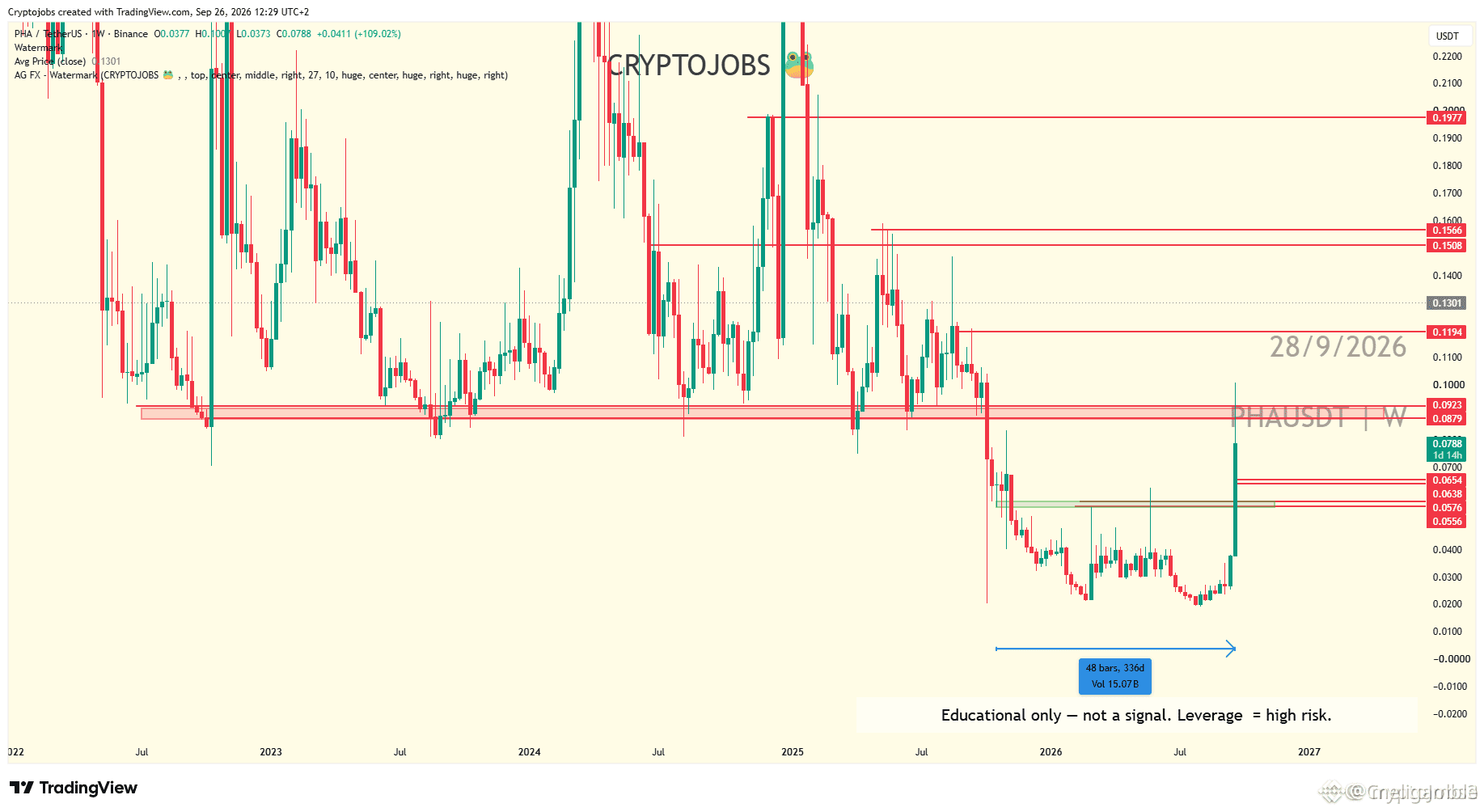
$PHA is ripping higher even while $BTC keeps dumping, which goes against everything we've seen this cycle.
Most of us have been burned chasing these small-cap AI pumps after the fact, only to watch them reverse hard because we never know when the rotation ends.
The main reason behind this move is capital flowing into AI and distributed computing tokens. Even with Bitcoin in the red, the sector is seeing inflows that $PHA is catching.
Market cap is sitting at $70 million, which is still really low. There's theoretically more room if interest holds, but that's assuming the flows continue.
These rotations don't last forever though. Liquidity is thin at that size and a shift away from the narrative or continued $BTC weakness could send it back down just as quick, similar to what we've seen with other compute plays like $RNDR.
Where do you think this goes from here if the AI hype starts to fade?
#PHA #AI #Altcoins
$PHA is ripping higher even while $BTC keeps dumping, which goes against everything we've seen this cycle.
Most of us have been burned chasing these small-cap AI pumps after the fact, only to watch them reverse hard because we never know when the rotation ends.
The main reason behind this move is capital flowing into AI and distributed computing tokens. Even with Bitcoin in the red, the sector is seeing inflows that $PHA is catching.
Market cap is sitting at $70 million, which is still really low. There's theoretically more room if interest holds, but that's assuming the flows continue.
These rotations don't last forever though. Liquidity is thin at that size and a shift away from the narrative or continued $BTC weakness could send it back down just as quick, similar to what we've seen with other compute plays like $RNDR.
Where do you think this goes from here if the AI hype starts to fade?
#PHA #AI #Altcoins
Most of us have been burned chasing these small-cap AI pumps after the fact, only to watch them reverse hard because we never know when the rotation ends.
The main reason behind this move is capital flowing into AI and distributed computing tokens. Even with Bitcoin in the red, the sector is seeing inflows that $PHA is catching.
Market cap is sitting at $70 million, which is still really low. There's theoretically more room if interest holds, but that's assuming the flows continue.
These rotations don't last forever though. Liquidity is thin at that size and a shift away from the narrative or continued $BTC weakness could send it back down just as quick, similar to what we've seen with other compute plays like $RNDR.
Where do you think this goes from here if the AI hype starts to fade?
#PHA #AI #Altcoins
2
·
--
Picture this: you log into your trading account on a quiet morning, only to realize your assets are trapped behind an emergency withdrawal freeze.
Most traders spend years agonizing over entry triggers and chart patterns, completely ignoring the structural counterparty risk sitting right beneath their positions. The hardest lesson in this market is watching capital vanish not from bad trades, but from custody failures you had zero control over.
A major centralized exchange just confirmed over $350 million drained in a single exploit. While markets barely flinched on the surface, with $BTC and $ETH holding relatively flat immediately after the news, events like this systematically bleed liquidity from order books. When that amount of capital leaves an ecosystem overnight, someone eventually absorbs the deficit, and it usually ends up being retail via wider spreads, slippage, and sudden counterparty insolvencies.
The real takeaway here is not about market panic, but about operational hygiene. Leaving your entire portfolio parked on an exchange convenience layer is a silent risk that compounds every single day until an exploit proves you wrong.
How much of your active trading stack do you actually keep off centralized venues?
#CryptoSecurity #RiskManagement #BinanceSquare
Picture this: you log into your trading account on a quiet morning, only to realize your assets are trapped behind an emergency withdrawal freeze.
Most traders spend years agonizing over entry triggers and chart patterns, completely ignoring the structural counterparty risk sitting right beneath their positions. The hardest lesson in this market is watching capital vanish not from bad trades, but from custody failures you had zero control over.
A major centralized exchange just confirmed over $350 million drained in a single exploit. While markets barely flinched on the surface, with $BTC and $ETH holding relatively flat immediately after the news, events like this systematically bleed liquidity from order books. When that amount of capital leaves an ecosystem overnight, someone eventually absorbs the deficit, and it usually ends up being retail via wider spreads, slippage, and sudden counterparty insolvencies.
The real takeaway here is not about market panic, but about operational hygiene. Leaving your entire portfolio parked on an exchange convenience layer is a silent risk that compounds every single day until an exploit proves you wrong.
How much of your active trading stack do you actually keep off centralized venues?
#CryptoSecurity #RiskManagement #BinanceSquare
Most traders spend years agonizing over entry triggers and chart patterns, completely ignoring the structural counterparty risk sitting right beneath their positions. The hardest lesson in this market is watching capital vanish not from bad trades, but from custody failures you had zero control over.
A major centralized exchange just confirmed over $350 million drained in a single exploit. While markets barely flinched on the surface, with $BTC and $ETH holding relatively flat immediately after the news, events like this systematically bleed liquidity from order books. When that amount of capital leaves an ecosystem overnight, someone eventually absorbs the deficit, and it usually ends up being retail via wider spreads, slippage, and sudden counterparty insolvencies.
The real takeaway here is not about market panic, but about operational hygiene. Leaving your entire portfolio parked on an exchange convenience layer is a silent risk that compounds every single day until an exploit proves you wrong.
How much of your active trading stack do you actually keep off centralized venues?
#CryptoSecurity #RiskManagement #BinanceSquare

·
--
Why is nobody in crypto paying attention to where physical infrastructure is actually heading over the next decade?
Most traders keep chasing short-lived meme rotations and getting chopped up in low-conviction plays because they ignore long-term macro shifts until prices have already moved. Missing the entry on generational infrastructure narratives always hurts the most when you realize you were looking at the wrong charts the entire time.
Elon Musk recently highlighted that industrial production on the Moon and Mars is set to dramatically accelerate, more than doubling every single year. When off-world industrial capacity compounds at that pace, autonomous systems, decentralized compute, and trustless settlement layers become fundamental operational requirements.
Positioning for this shift requires looking beyond hype cycles and focusing on actionable exposure. Start auditing your portfolio for real machine-to-machine utility by watching decentralized physical compute assets like $AKT, distributed rendering and simulation networks like $RENDER, and automated settlement rails like $DOGE. Build positions on major pullbacks and let compounding infrastructure growth do the heavy lifting.
Where do you think decentralized settlement and compute fit into interplanetary industrial expansion?
#CryptoInfrastructure #DePIN #SpaceEconomy
Why is nobody in crypto paying attention to where physical infrastructure is actually heading over the next decade?
Most traders keep chasing short-lived meme rotations and getting chopped up in low-conviction plays because they ignore long-term macro shifts until prices have already moved. Missing the entry on generational infrastructure narratives always hurts the most when you realize you were looking at the wrong charts the entire time.
Elon Musk recently highlighted that industrial production on the Moon and Mars is set to dramatically accelerate, more than doubling every single year. When off-world industrial capacity compounds at that pace, autonomous systems, decentralized compute, and trustless settlement layers become fundamental operational requirements.
Positioning for this shift requires looking beyond hype cycles and focusing on actionable exposure. Start auditing your portfolio for real machine-to-machine utility by watching decentralized physical compute assets like $AKT , distributed rendering and simulation networks like $RENDER , and automated settlement rails like $DOGE . Build positions on major pullbacks and let compounding infrastructure growth do the heavy lifting.
Where do you think decentralized settlement and compute fit into interplanetary industrial expansion?
#CryptoInfrastructure #DePIN #SpaceEconomy
Most traders keep chasing short-lived meme rotations and getting chopped up in low-conviction plays because they ignore long-term macro shifts until prices have already moved. Missing the entry on generational infrastructure narratives always hurts the most when you realize you were looking at the wrong charts the entire time.
Elon Musk recently highlighted that industrial production on the Moon and Mars is set to dramatically accelerate, more than doubling every single year. When off-world industrial capacity compounds at that pace, autonomous systems, decentralized compute, and trustless settlement layers become fundamental operational requirements.
Positioning for this shift requires looking beyond hype cycles and focusing on actionable exposure. Start auditing your portfolio for real machine-to-machine utility by watching decentralized physical compute assets like $AKT , distributed rendering and simulation networks like $RENDER , and automated settlement rails like $DOGE . Build positions on major pullbacks and let compounding infrastructure growth do the heavy lifting.
Where do you think decentralized settlement and compute fit into interplanetary industrial expansion?
#CryptoInfrastructure #DePIN #SpaceEconomy

·
--
Every time Elon tweets about multi-planetary manufacturing, retail liquidity rushes into speculative proxy tokens only to get crushed weeks later.
Most traders fall into the trap of buying top-tick hype without realizing that physical infrastructure timelines take decades, while crypto attention spans last about forty-eight hours.
When Musk talks about industrial output on Mars doubling annually, speculative capital immediately looks for an on-chain bet. We have seen this exact playbook before with $DOGE during aerospace launches and across compute assets like $RNDR whenever deep-tech headlines break. The reality is that industrial hardware cycles operate on multi-year horizons, yet retail prices these soundbites as if off-world revenue is hitting balances tomorrow morning.
Liquidity rotations triggered by futuristic quotes are purely narrative-driven momentum games rather than fundamental adoption. Whales typically use the surge in trading volume to exit speculative holdings, leaving late buyers trapped when attention shifts back to macro data. Treating visionary tech timelines as immediate financial catalysts is one of the easiest ways to get your portfolio chopped up in volatile market conditions.
Are you treating these sci-fi headlines as tradeable events, or are you sitting on the sidelines until real utility shows up?
#CryptoTrading #MarketAnalysis #RiskManagement
Every time Elon tweets about multi-planetary manufacturing, retail liquidity rushes into speculative proxy tokens only to get crushed weeks later.
Most traders fall into the trap of buying top-tick hype without realizing that physical infrastructure timelines take decades, while crypto attention spans last about forty-eight hours.
When Musk talks about industrial output on Mars doubling annually, speculative capital immediately looks for an on-chain bet. We have seen this exact playbook before with $DOGE during aerospace launches and across compute assets like $RNDR whenever deep-tech headlines break. The reality is that industrial hardware cycles operate on multi-year horizons, yet retail prices these soundbites as if off-world revenue is hitting balances tomorrow morning.
Liquidity rotations triggered by futuristic quotes are purely narrative-driven momentum games rather than fundamental adoption. Whales typically use the surge in trading volume to exit speculative holdings, leaving late buyers trapped when attention shifts back to macro data. Treating visionary tech timelines as immediate financial catalysts is one of the easiest ways to get your portfolio chopped up in volatile market conditions.
Are you treating these sci-fi headlines as tradeable events, or are you sitting on the sidelines until real utility shows up?
#CryptoTrading #MarketAnalysis #RiskManagement
Most traders fall into the trap of buying top-tick hype without realizing that physical infrastructure timelines take decades, while crypto attention spans last about forty-eight hours.
When Musk talks about industrial output on Mars doubling annually, speculative capital immediately looks for an on-chain bet. We have seen this exact playbook before with $DOGE during aerospace launches and across compute assets like $RNDR whenever deep-tech headlines break. The reality is that industrial hardware cycles operate on multi-year horizons, yet retail prices these soundbites as if off-world revenue is hitting balances tomorrow morning.
Liquidity rotations triggered by futuristic quotes are purely narrative-driven momentum games rather than fundamental adoption. Whales typically use the surge in trading volume to exit speculative holdings, leaving late buyers trapped when attention shifts back to macro data. Treating visionary tech timelines as immediate financial catalysts is one of the easiest ways to get your portfolio chopped up in volatile market conditions.
Are you treating these sci-fi headlines as tradeable events, or are you sitting on the sidelines until real utility shows up?
#CryptoTrading #MarketAnalysis #RiskManagement

·
--
everyone thinks catching green candles is how you win in futures, but actually chasing momentum without a real plan is why most accounts get wiped overnight.
most degens see a coin pumping, fomo in at the local top, and end up holding heavy bags the moment momentum stalls. you watch everyone else post green pnl while your liquidation price creeps closer and closer because you traded the hype instead of the setup.
here is a clean case study on why patience beats blind aping every single time. caught the reversal setup on $ARK perp right before the volume expanded, locked in +8.27% on the spot move, and closed the position clean for +1,936.57 $USDT profit while most retail traders were busy getting trapped in chop on $BTC pairs.
having a clear thesis before entering means you take your profits and walk away instead of round-tripping your gains back to the market.
are you locking in gains into strength or still letting your winning trades turn red?
#CryptoTrading #FuturesTrading #RiskManagement
everyone thinks catching green candles is how you win in futures, but actually chasing momentum without a real plan is why most accounts get wiped overnight.
most degens see a coin pumping, fomo in at the local top, and end up holding heavy bags the moment momentum stalls. you watch everyone else post green pnl while your liquidation price creeps closer and closer because you traded the hype instead of the setup.
here is a clean case study on why patience beats blind aping every single time. caught the reversal setup on $ARK perp right before the volume expanded, locked in +8.27% on the spot move, and closed the position clean for +1,936.57 $USDT profit while most retail traders were busy getting trapped in chop on $BTC pairs.
having a clear thesis before entering means you take your profits and walk away instead of round-tripping your gains back to the market.
are you locking in gains into strength or still letting your winning trades turn red?
#CryptoTrading #FuturesTrading #RiskManagement
most degens see a coin pumping, fomo in at the local top, and end up holding heavy bags the moment momentum stalls. you watch everyone else post green pnl while your liquidation price creeps closer and closer because you traded the hype instead of the setup.
here is a clean case study on why patience beats blind aping every single time. caught the reversal setup on $ARK perp right before the volume expanded, locked in +8.27% on the spot move, and closed the position clean for +1,936.57 $USDT profit while most retail traders were busy getting trapped in chop on $BTC pairs.
having a clear thesis before entering means you take your profits and walk away instead of round-tripping your gains back to the market.
are you locking in gains into strength or still letting your winning trades turn red?
#CryptoTrading #FuturesTrading #RiskManagement

1
·
--
Have you noticed how regulators only seem to care about on-chain prediction markets the moment they start outperforming traditional polling data?
Most traders assume regulatory crosshairs only target high-leverage perps, only to watch liquidity dry up across innovative decentralized venues overnight. Getting caught off-guard by sudden jurisdiction battles can freeze access and disrupt trading strategies faster than a market dump.
The legal standoff between New York authorities and Polymarket serves as a classic case study of legacy legal frameworks failing to grasp decentralized information architecture. When users hedge outcomes or settle positions using $USDT across scalable layers like $OP and $SUI, the underlying smart contracts are simply routing decentralized data, yet state watchdogs continue treating open forecasting tools like illicit bookmakers.
Instead of establishing transparent boundaries, this aggressive litigation will likely push domestic capital offshore while handicapping domestic access to valuable collective intelligence. The real issue is not market speculation itself, but the chilling precedent this battle creates for any decentralized application managing event-driven settlements.
Where do you think decentralized prediction protocols go from here?
#NYAndPolymarketSueEachOther #CFTCUpdatesGuidanceOnTokenizedAssets
Have you noticed how regulators only seem to care about on-chain prediction markets the moment they start outperforming traditional polling data?
Most traders assume regulatory crosshairs only target high-leverage perps, only to watch liquidity dry up across innovative decentralized venues overnight. Getting caught off-guard by sudden jurisdiction battles can freeze access and disrupt trading strategies faster than a market dump.
The legal standoff between New York authorities and Polymarket serves as a classic case study of legacy legal frameworks failing to grasp decentralized information architecture. When users hedge outcomes or settle positions using $USDT across scalable layers like $OP and $SUI , the underlying smart contracts are simply routing decentralized data, yet state watchdogs continue treating open forecasting tools like illicit bookmakers.
Instead of establishing transparent boundaries, this aggressive litigation will likely push domestic capital offshore while handicapping domestic access to valuable collective intelligence. The real issue is not market speculation itself, but the chilling precedent this battle creates for any decentralized application managing event-driven settlements.
Where do you think decentralized prediction protocols go from here?
#NYAndPolymarketSueEachOther #CFTCUpdatesGuidanceOnTokenizedAssets
Most traders assume regulatory crosshairs only target high-leverage perps, only to watch liquidity dry up across innovative decentralized venues overnight. Getting caught off-guard by sudden jurisdiction battles can freeze access and disrupt trading strategies faster than a market dump.
The legal standoff between New York authorities and Polymarket serves as a classic case study of legacy legal frameworks failing to grasp decentralized information architecture. When users hedge outcomes or settle positions using $USDT across scalable layers like $OP and $SUI , the underlying smart contracts are simply routing decentralized data, yet state watchdogs continue treating open forecasting tools like illicit bookmakers.
Instead of establishing transparent boundaries, this aggressive litigation will likely push domestic capital offshore while handicapping domestic access to valuable collective intelligence. The real issue is not market speculation itself, but the chilling precedent this battle creates for any decentralized application managing event-driven settlements.
Where do you think decentralized prediction protocols go from here?
#NYAndPolymarketSueEachOther #CFTCUpdatesGuidanceOnTokenizedAssets

1
·
--
Most exchange incidents aren't stolen private keys at all but forged withdrawal requests the system treated as real.
That distinction is cold comfort when you refresh and the balance is gone. Plenty of traders still park the bulk of their $USDT on an exchange because the Fear and Greed Index sits at 72 and they refuse to miss the next move in $SUI.
When Bitget said the issue was forged requests rather than stolen keys, it meant the vault itself may still be intact. The attacker impersonated a user, abused an API, or slipped something through a process that looked valid from the inside. Same result for your funds. Completely different implication for whether the rest of the platform survives.
I have watched this pattern since 2014. Greed is when people stop asking how a withdrawal actually gets authorized. They leave size sitting because $OP is moving and they want to be ready, and that is exactly when operational risk gets ignored. Keep what you need to trade. Move the rest, not from panic, but from having seen what unusual withdrawal activity actually feels like before dawn.
How much are you actually willing to leave on any exchange while the index is this high?
#BitgetSays #BitgetBreachForgedRequestsNotStolenKeys
Most exchange incidents aren't stolen private keys at all but forged withdrawal requests the system treated as real.
That distinction is cold comfort when you refresh and the balance is gone. Plenty of traders still park the bulk of their $USDT on an exchange because the Fear and Greed Index sits at 72 and they refuse to miss the next move in $SUI .
When Bitget said the issue was forged requests rather than stolen keys, it meant the vault itself may still be intact. The attacker impersonated a user, abused an API, or slipped something through a process that looked valid from the inside. Same result for your funds. Completely different implication for whether the rest of the platform survives.
I have watched this pattern since 2014. Greed is when people stop asking how a withdrawal actually gets authorized. They leave size sitting because $OP is moving and they want to be ready, and that is exactly when operational risk gets ignored. Keep what you need to trade. Move the rest, not from panic, but from having seen what unusual withdrawal activity actually feels like before dawn.
How much are you actually willing to leave on any exchange while the index is this high?
#BitgetSays #BitgetBreachForgedRequestsNotStolenKeys
That distinction is cold comfort when you refresh and the balance is gone. Plenty of traders still park the bulk of their $USDT on an exchange because the Fear and Greed Index sits at 72 and they refuse to miss the next move in $SUI .
When Bitget said the issue was forged requests rather than stolen keys, it meant the vault itself may still be intact. The attacker impersonated a user, abused an API, or slipped something through a process that looked valid from the inside. Same result for your funds. Completely different implication for whether the rest of the platform survives.
I have watched this pattern since 2014. Greed is when people stop asking how a withdrawal actually gets authorized. They leave size sitting because $OP is moving and they want to be ready, and that is exactly when operational risk gets ignored. Keep what you need to trade. Move the rest, not from panic, but from having seen what unusual withdrawal activity actually feels like before dawn.
How much are you actually willing to leave on any exchange while the index is this high?
#BitgetSays #BitgetBreachForgedRequestsNotStolenKeys
·
--
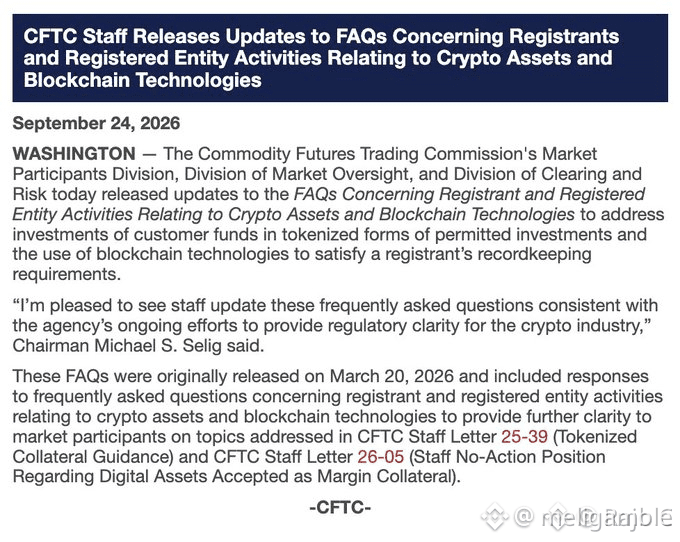
Here's what happened when the CFTC dropped updated guidance on tokenized assets.
Traders keep getting wrecked by regulatory headlines that send $BTC and $ETH tumbling before anyone even reads the fine print. You buy the dip from FUD, then it dips more, and you never know when to exit.
This latest move looks a lot like the 2015 decision that labeled Bitcoin a commodity. Back then it felt like another attack. It actually paved the way for futures and later the ETFs we have now.
The new guidance seems to treat tokenized real-world stuff like gold or treasuries, even things already wrapped as $USDT, more like the underlying commodities. That could bring the same legitimacy to RWAs sitting on $ETH.
Compare that to how other markets handled it. Some places jumped on tokenization years ago while the US dragged its feet. If this sticks we might finally see less of that constant turf war between agencies. The greed index sitting at 72 tells me the market is already leaning optimistic.
Where do you think this goes from here for tokenized assets?
#CFTCUpdatesGuidanceOnTokenizedAssets #BitcoinSpotETFsTurnNetPositiveYTD #EthereumBreaksAbove
Here's what happened when the CFTC dropped updated guidance on tokenized assets.
Traders keep getting wrecked by regulatory headlines that send $BTC and $ETH tumbling before anyone even reads the fine print. You buy the dip from FUD, then it dips more, and you never know when to exit.
This latest move looks a lot like the 2015 decision that labeled Bitcoin a commodity. Back then it felt like another attack. It actually paved the way for futures and later the ETFs we have now.
The new guidance seems to treat tokenized real-world stuff like gold or treasuries, even things already wrapped as $USDT, more like the underlying commodities. That could bring the same legitimacy to RWAs sitting on $ETH .
Compare that to how other markets handled it. Some places jumped on tokenization years ago while the US dragged its feet. If this sticks we might finally see less of that constant turf war between agencies. The greed index sitting at 72 tells me the market is already leaning optimistic.
Where do you think this goes from here for tokenized assets?
#CFTCUpdatesGuidanceOnTokenizedAssets #BitcoinSpotETFsTurnNetPositiveYTD #EthereumBreaksAbove
Traders keep getting wrecked by regulatory headlines that send $BTC and $ETH tumbling before anyone even reads the fine print. You buy the dip from FUD, then it dips more, and you never know when to exit.
This latest move looks a lot like the 2015 decision that labeled Bitcoin a commodity. Back then it felt like another attack. It actually paved the way for futures and later the ETFs we have now.
The new guidance seems to treat tokenized real-world stuff like gold or treasuries, even things already wrapped as $USDT, more like the underlying commodities. That could bring the same legitimacy to RWAs sitting on $ETH .
Compare that to how other markets handled it. Some places jumped on tokenization years ago while the US dragged its feet. If this sticks we might finally see less of that constant turf war between agencies. The greed index sitting at 72 tells me the market is already leaning optimistic.
Where do you think this goes from here for tokenized assets?
#CFTCUpdatesGuidanceOnTokenizedAssets #BitcoinSpotETFsTurnNetPositiveYTD #EthereumBreaksAbove
2
·
--
Everyone thinks daily institutional inflows mean the price can only go up, but actually, treating ETF data as a real-time buy signal is a trap. Most retail traders end up buying local tops because they see massive green numbers on tracker sites hours after the actual trades already settled.
Think of institutional ETF volume like a large cargo ship turning around in the harbor. When big funds allocate capital into $BTC, they do not smash the market buy button on a spot exchange like a retail trader. Instead, they use complex OTC routing and internal inventory rebalancing. By the time the public sees the net inflow print on social media, smart money has already executed, and short-term liquidity often dries up.
This lag creates a classic whipsaw where traders jump into high-beta assets like $OP or $SUI expecting an immediate secondary rally, only to get caught in a quick pullback when market makers hedge their spot delta. Tracking net inflow gives you a reliable compass for where the market is heading over the next few months, but using it as a trigger for day trades usually leads to buying someone else's exit liquidity.
Are you using ETF flows to guide your long-term spot bags, or trying to scalp around the daily data drops?
#BitcoinSpotETFsNetInflow #BitcoinSpotETFsTurnNetPositiveYTD
Everyone thinks daily institutional inflows mean the price can only go up, but actually, treating ETF data as a real-time buy signal is a trap. Most retail traders end up buying local tops because they see massive green numbers on tracker sites hours after the actual trades already settled.
Think of institutional ETF volume like a large cargo ship turning around in the harbor. When big funds allocate capital into $BTC , they do not smash the market buy button on a spot exchange like a retail trader. Instead, they use complex OTC routing and internal inventory rebalancing. By the time the public sees the net inflow print on social media, smart money has already executed, and short-term liquidity often dries up.
This lag creates a classic whipsaw where traders jump into high-beta assets like $OP or $SUI expecting an immediate secondary rally, only to get caught in a quick pullback when market makers hedge their spot delta. Tracking net inflow gives you a reliable compass for where the market is heading over the next few months, but using it as a trigger for day trades usually leads to buying someone else's exit liquidity.
Are you using ETF flows to guide your long-term spot bags, or trying to scalp around the daily data drops?
#BitcoinSpotETFsNetInflow #BitcoinSpotETFsTurnNetPositiveYTD
Think of institutional ETF volume like a large cargo ship turning around in the harbor. When big funds allocate capital into $BTC , they do not smash the market buy button on a spot exchange like a retail trader. Instead, they use complex OTC routing and internal inventory rebalancing. By the time the public sees the net inflow print on social media, smart money has already executed, and short-term liquidity often dries up.
This lag creates a classic whipsaw where traders jump into high-beta assets like $OP or $SUI expecting an immediate secondary rally, only to get caught in a quick pullback when market makers hedge their spot delta. Tracking net inflow gives you a reliable compass for where the market is heading over the next few months, but using it as a trigger for day trades usually leads to buying someone else's exit liquidity.
Are you using ETF flows to guide your long-term spot bags, or trying to scalp around the daily data drops?
#BitcoinSpotETFsNetInflow #BitcoinSpotETFsTurnNetPositiveYTD

·
--
Have you noticed how fast people dismiss a Zcash ETF while they treat every Bitcoin product as destiny?
The pain is real. You see a headline like this, you either ape in because greed is already sitting at 72 or you skip it because privacy coins have burned you before. Both reactions cost money.
I think the market has this backwards. Grayscale putting a Zcash vehicle in front of institutions is not a sideshow. It challenges the idea that only $BTC gets the structural bid. When the crowd is greedy, they rotate late. $ZEC does not need to become Bitcoin. It needs enough legitimacy that capital parked in $USDT starts treating privacy as a sleeve instead of a meme.
The ETF story is real. Treating it like a lottery ticket is how accounts get wrecked.
If you want a process instead of a bet, do this. Wait for the first flush after the news. Compare $ZEC strength against Bitcoin, not against its own all-time high. Keep the size small enough that a regulatory headline does not force you out. That is how you trade an ETF story without becoming the exit liquidity.
Where do you think this goes from here?
#GrayscaleZcashETFHits #BitcoinSpotETFsNetInflow #CFTCUpdatesGuidanceOnTokenizedAssets
Have you noticed how fast people dismiss a Zcash ETF while they treat every Bitcoin product as destiny?
The pain is real. You see a headline like this, you either ape in because greed is already sitting at 72 or you skip it because privacy coins have burned you before. Both reactions cost money.
I think the market has this backwards. Grayscale putting a Zcash vehicle in front of institutions is not a sideshow. It challenges the idea that only $BTC gets the structural bid. When the crowd is greedy, they rotate late. $ZEC does not need to become Bitcoin. It needs enough legitimacy that capital parked in $USDT starts treating privacy as a sleeve instead of a meme.
The ETF story is real. Treating it like a lottery ticket is how accounts get wrecked.
If you want a process instead of a bet, do this. Wait for the first flush after the news. Compare $ZEC strength against Bitcoin, not against its own all-time high. Keep the size small enough that a regulatory headline does not force you out. That is how you trade an ETF story without becoming the exit liquidity.
Where do you think this goes from here?
#GrayscaleZcashETFHits #BitcoinSpotETFsNetInflow #CFTCUpdatesGuidanceOnTokenizedAssets
The pain is real. You see a headline like this, you either ape in because greed is already sitting at 72 or you skip it because privacy coins have burned you before. Both reactions cost money.
I think the market has this backwards. Grayscale putting a Zcash vehicle in front of institutions is not a sideshow. It challenges the idea that only $BTC gets the structural bid. When the crowd is greedy, they rotate late. $ZEC does not need to become Bitcoin. It needs enough legitimacy that capital parked in $USDT starts treating privacy as a sleeve instead of a meme.
The ETF story is real. Treating it like a lottery ticket is how accounts get wrecked.
If you want a process instead of a bet, do this. Wait for the first flush after the news. Compare $ZEC strength against Bitcoin, not against its own all-time high. Keep the size small enough that a regulatory headline does not force you out. That is how you trade an ETF story without becoming the exit liquidity.
Where do you think this goes from here?
#GrayscaleZcashETFHits #BitcoinSpotETFsNetInflow #CFTCUpdatesGuidanceOnTokenizedAssets

Connectez-vous pour découvrir plus de contenu
Rejoignez la communauté mondiale des adeptes de cryptomonnaies sur Binance Square
⚡️ Suviez les dernières informations importantes sur les cryptomonnaies.
💬 Jugé digne de confiance par la plus grande plateforme d’échange de cryptomonnaies au monde.
👍 Découvrez les connaissances que partagent les créateurs vérifiés.
Adresse e-mail/Nº de téléphone
Sujets d’actualité
CircleTetherFreezeBitgetHackerWallet
17,697 vues
180 mentions
#circletetherfreezebitgethackerwallet 🚨 CIRCLE & TETHER FREEZE BITGET HACKER WALLET
A major crypto security incident has triggered another important debate around stablecoin controls.
Bitget reported a massive security breach on September 24, with the initial loss estimated at $351.6M. The exchange later revised the affected-asset estimate to approximately $387.5M, after accounting for additional assets including Zcash and TRON.
🔒 Circle & Tether Take Action
Circle blacklisted a wallet identified as “Bitget Exploiter 8”, while Tether subsequently blocked the same address.
The wallet contained approximately:
• 99,990 USDC
• 218,023 USDT
• 170.47 ETH
The freeze effectively locked around $318,000 worth of USDC and USDT.
⚠️ But there is a major limitation:
Stablecoin issuers can freeze their own tokens, but they cannot freeze native ETH. Reports indicate that other exploiter wallets still held more than 63,000 ETH.
Bitget CEO Gracy Chen said the attackers compromised a backend system in the exchange's wallet infrastructure and spoofed transaction data, rather than obtaining users' private keys. Bitget says its cold wallets were unaffected and its User Protection Fund holds more than $464M.
📌 The bigger takeaway:
This incident shows both the power and limits of centralized stablecoin controls. USDC and USDT can potentially be frozen at the token-contract level, while assets such as ETH cannot be frozen by stablecoin issuers.
👀 Assets to watch:
$BTC • $ETH • $XRP
#Bitget #CryptoSecurity #Circle #Tether #USDC #USDT #CryptoNews
Ayeshg
·2 mentions J’aime
·9.3k vues
SECSaysTokenBuybacksNotAutoSecurities
1,310 vues
67 mentions
ChinaUSAgreeOn$30BTariffCut
140 vues
3 mentions