

piknkkk
334 Publications

piknkkk
Signaler
Bloquer l’utilisateur
34 Suivis
58 Abonnés
200 J’aime
Publications
PINNED
·
--
Baissier
#vietnamplansfirstcryptolicensesin2026 🇻🇳 Vietnam Advances Crypto Regulation: First Licensing Framework Takes Shape in 2026
Vietnam is officially stepping out of the regulatory gray zone. The country has launched its pilot licensing framework for crypto asset trading platforms, marking a major milestone for digital asset adoption in Southeast Asia.
📰 Core News
In 2026, Vietnam’s Ministry of Finance initiated a pilot program to issue the country’s first crypto asset service licenses. Key highlights of the framework include
• Strict Capital Requirements Applicants must be Vietnamese enterprises with a minimum capital of VND 10,000 billion, fully contributed in local currency.
• Enhanced Compliance The model aligns with FATF recommendations, emphasizing robust anti-money laundering (AML) controls, investor protection, and risk management.
• Operational Standards Platforms must maintain Level 4 information security standards and employ certified cybersecurity and securities personnel.
📊 Market Impact
• 🌏 Regional Precedent This structured approach positions Vietnam as a potential regulated hub for digital assets in Southeast Asia, which could attract long-term institutional interest.
• Market Consolidation High capital and operational barriers mean smaller, unregulated platforms may face challenges, favoring established, compliance-ready entities.
Ecosystem Trust The focus on secure custody, transparent operations, and regulatory oversight aims to reduce systemic risks and build confidence in the local crypto market.
💬 Join the Discussion
How do you think Vietnam’s cautious, regulator-led licensing approach will influence crypto policy in neighboring Southeast Asian countries? Share your insights in the comments below! 👇
#VietnamCrypto #CryptoRegulation #DigitalAssets #CryptoNews #BinanceSquare
This is for educational purposes only. Not Financial Advice (NFA). Always Do Your Own Research (DYOR).
$SOL $BNB $ZEC
{future}(ZECUSDT)
{future}(BNBUSDT)
{future}(SOLUSDT)
#vietnamplansfirstcryptolicensesin2026 🇻🇳 Vietnam Advances Crypto Regulation: First Licensing Framework Takes Shape in 2026
Vietnam is officially stepping out of the regulatory gray zone. The country has launched its pilot licensing framework for crypto asset trading platforms, marking a major milestone for digital asset adoption in Southeast Asia.
📰 Core News
In 2026, Vietnam’s Ministry of Finance initiated a pilot program to issue the country’s first crypto asset service licenses. Key highlights of the framework include
• Strict Capital Requirements Applicants must be Vietnamese enterprises with a minimum capital of VND 10,000 billion, fully contributed in local currency.
• Enhanced Compliance The model aligns with FATF recommendations, emphasizing robust anti-money laundering (AML) controls, investor protection, and risk management.
• Operational Standards Platforms must maintain Level 4 information security standards and employ certified cybersecurity and securities personnel.
📊 Market Impact
• 🌏 Regional Precedent This structured approach positions Vietnam as a potential regulated hub for digital assets in Southeast Asia, which could attract long-term institutional interest.
• Market Consolidation High capital and operational barriers mean smaller, unregulated platforms may face challenges, favoring established, compliance-ready entities.
Ecosystem Trust The focus on secure custody, transparent operations, and regulatory oversight aims to reduce systemic risks and build confidence in the local crypto market.
💬 Join the Discussion
How do you think Vietnam’s cautious, regulator-led licensing approach will influence crypto policy in neighboring Southeast Asian countries? Share your insights in the comments below! 👇
#VietnamCrypto #CryptoRegulation #DigitalAssets #CryptoNews #BinanceSquare
This is for educational purposes only. Not Financial Advice (NFA). Always Do Your Own Research (DYOR).
$SOL $BNB $ZEC
Vietnam is officially stepping out of the regulatory gray zone. The country has launched its pilot licensing framework for crypto asset trading platforms, marking a major milestone for digital asset adoption in Southeast Asia.
📰 Core News
In 2026, Vietnam’s Ministry of Finance initiated a pilot program to issue the country’s first crypto asset service licenses. Key highlights of the framework include
• Strict Capital Requirements Applicants must be Vietnamese enterprises with a minimum capital of VND 10,000 billion, fully contributed in local currency.
• Enhanced Compliance The model aligns with FATF recommendations, emphasizing robust anti-money laundering (AML) controls, investor protection, and risk management.
• Operational Standards Platforms must maintain Level 4 information security standards and employ certified cybersecurity and securities personnel.
📊 Market Impact
• 🌏 Regional Precedent This structured approach positions Vietnam as a potential regulated hub for digital assets in Southeast Asia, which could attract long-term institutional interest.
• Market Consolidation High capital and operational barriers mean smaller, unregulated platforms may face challenges, favoring established, compliance-ready entities.
Ecosystem Trust The focus on secure custody, transparent operations, and regulatory oversight aims to reduce systemic risks and build confidence in the local crypto market.
💬 Join the Discussion
How do you think Vietnam’s cautious, regulator-led licensing approach will influence crypto policy in neighboring Southeast Asian countries? Share your insights in the comments below! 👇
#VietnamCrypto #CryptoRegulation #DigitalAssets #CryptoNews #BinanceSquare
This is for educational purposes only. Not Financial Advice (NFA). Always Do Your Own Research (DYOR).
$SOL $BNB $ZEC

6
2
10
7.4k
PINNED
·
--
Haussier
Vérifié
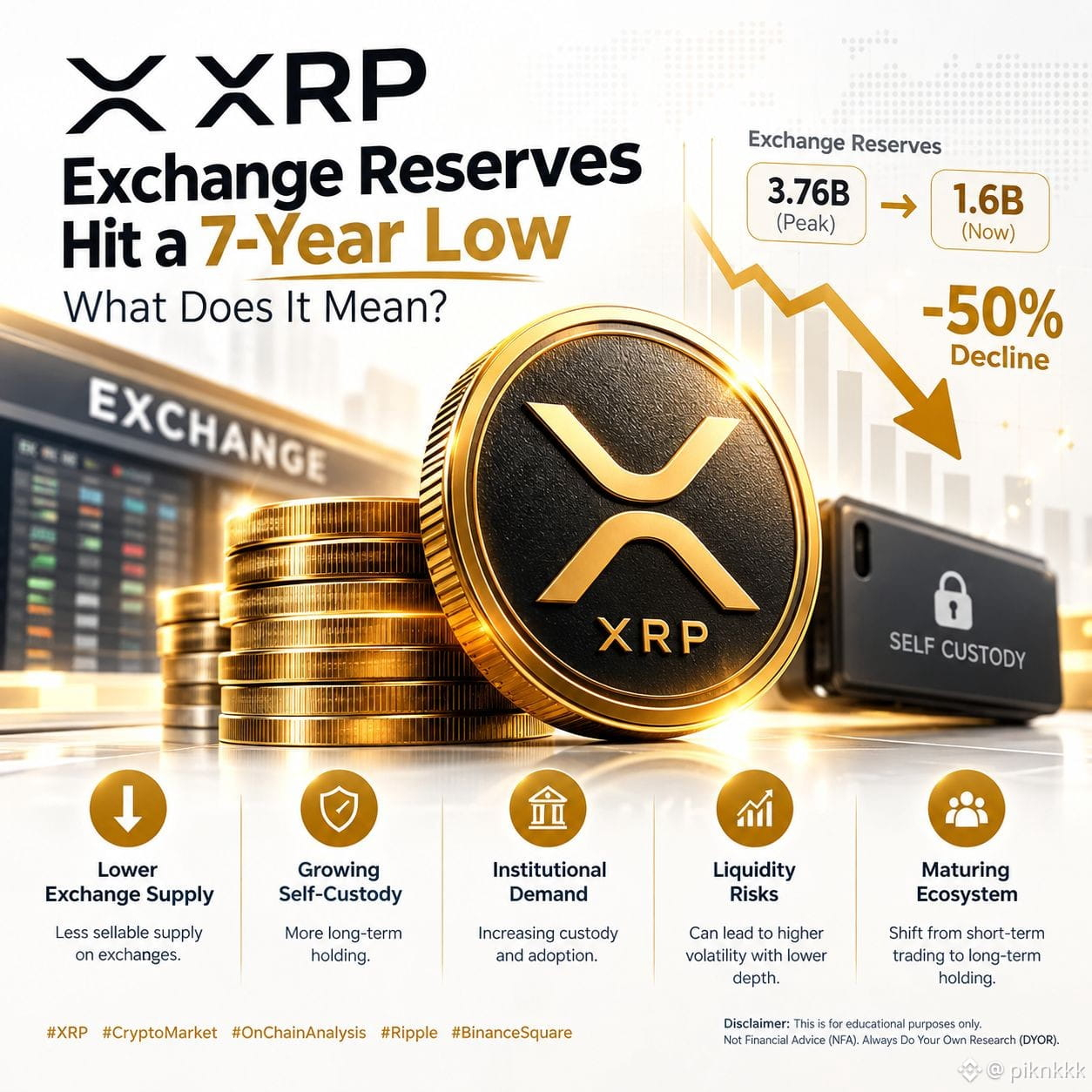
#xrpexchangereserveshitsevenyearlow 📊 XRP Exchange Reserves Hit 7-Year Low: Analyzing the Supply Shift
XRP holdings on major cryptocurrency exchanges have recently plummeted to their lowest level in seven years. But what is driving this massive withdrawal, and how does it impact the broader market ecosystem?
🔹 Significant Outflow Recent on-chain data reveals that XRP exchange reserves have dropped by over 50%, falling from a peak of roughly 3.76 billion tokens to approximately 1.6 billion tokens [[15]].
🔹Key Drivers This steady decline is largely attributed to long-term holders moving assets to cold storage, increased whale accumulation, and growing institutional custody demands [[2]].
🔹Supply Dynamics A reduction in exchange reserves typically indicates a decrease in immediate sellable supply, which can strengthen the "supply shock" narrative if market demand remains steady or increases [[8]].
🔹Liquidity Considerations While lower reserves suggest strong holding conviction, analysts caution that thinner exchange balances can sometimes lead to heightened short-term price volatility due to reduced order book depth [[10]].
🔹Maturing Ecosystem This trend highlights a broader shift in the crypto market, where investors increasingly prioritize self-custody and long-term holding over active, short-term exchange trading [[13]].
💬Do you view this decline in exchange reserves as a strong bullish signal for long-term holders, or simply a reflection of evolving institutional custody trends? Share your thoughts in the comments below! 👇
#XRP #CryptoMarket #OnChainAnalysis #Ripple #BinanceSquare
This is for educational purposes only. Not Financial Advice (NFA). Always Do Your Own Research (DYOR).
$SAGA $STRK $ENA
{future}(ENAUSDT)
{future}(STRKUSDT)
{future}(SAGAUSDT)
#xrpexchangereserveshitsevenyearlow 📊 XRP Exchange Reserves Hit 7-Year Low: Analyzing the Supply Shift
XRP holdings on major cryptocurrency exchanges have recently plummeted to their lowest level in seven years. But what is driving this massive withdrawal, and how does it impact the broader market ecosystem?
🔹 Significant Outflow Recent on-chain data reveals that XRP exchange reserves have dropped by over 50%, falling from a peak of roughly 3.76 billion tokens to approximately 1.6 billion tokens [[15]].
🔹Key Drivers This steady decline is largely attributed to long-term holders moving assets to cold storage, increased whale accumulation, and growing institutional custody demands [[2]].
🔹Supply Dynamics A reduction in exchange reserves typically indicates a decrease in immediate sellable supply, which can strengthen the "supply shock" narrative if market demand remains steady or increases [[8]].
🔹Liquidity Considerations While lower reserves suggest strong holding conviction, analysts caution that thinner exchange balances can sometimes lead to heightened short-term price volatility due to reduced order book depth [[10]].
🔹Maturing Ecosystem This trend highlights a broader shift in the crypto market, where investors increasingly prioritize self-custody and long-term holding over active, short-term exchange trading [[13]].
💬Do you view this decline in exchange reserves as a strong bullish signal for long-term holders, or simply a reflection of evolving institutional custody trends? Share your thoughts in the comments below! 👇
#XRP #CryptoMarket #OnChainAnalysis #Ripple #BinanceSquare
This is for educational purposes only. Not Financial Advice (NFA). Always Do Your Own Research (DYOR).
$SAGA $STRK $ENA
XRP holdings on major cryptocurrency exchanges have recently plummeted to their lowest level in seven years. But what is driving this massive withdrawal, and how does it impact the broader market ecosystem?
🔹 Significant Outflow Recent on-chain data reveals that XRP exchange reserves have dropped by over 50%, falling from a peak of roughly 3.76 billion tokens to approximately 1.6 billion tokens [[15]].
🔹Key Drivers This steady decline is largely attributed to long-term holders moving assets to cold storage, increased whale accumulation, and growing institutional custody demands [[2]].
🔹Supply Dynamics A reduction in exchange reserves typically indicates a decrease in immediate sellable supply, which can strengthen the "supply shock" narrative if market demand remains steady or increases [[8]].
🔹Liquidity Considerations While lower reserves suggest strong holding conviction, analysts caution that thinner exchange balances can sometimes lead to heightened short-term price volatility due to reduced order book depth [[10]].
🔹Maturing Ecosystem This trend highlights a broader shift in the crypto market, where investors increasingly prioritize self-custody and long-term holding over active, short-term exchange trading [[13]].
💬Do you view this decline in exchange reserves as a strong bullish signal for long-term holders, or simply a reflection of evolving institutional custody trends? Share your thoughts in the comments below! 👇
#XRP #CryptoMarket #OnChainAnalysis #Ripple #BinanceSquare
This is for educational purposes only. Not Financial Advice (NFA). Always Do Your Own Research (DYOR).
$SAGA $STRK $ENA
8
4.6k
·
--
Baissier
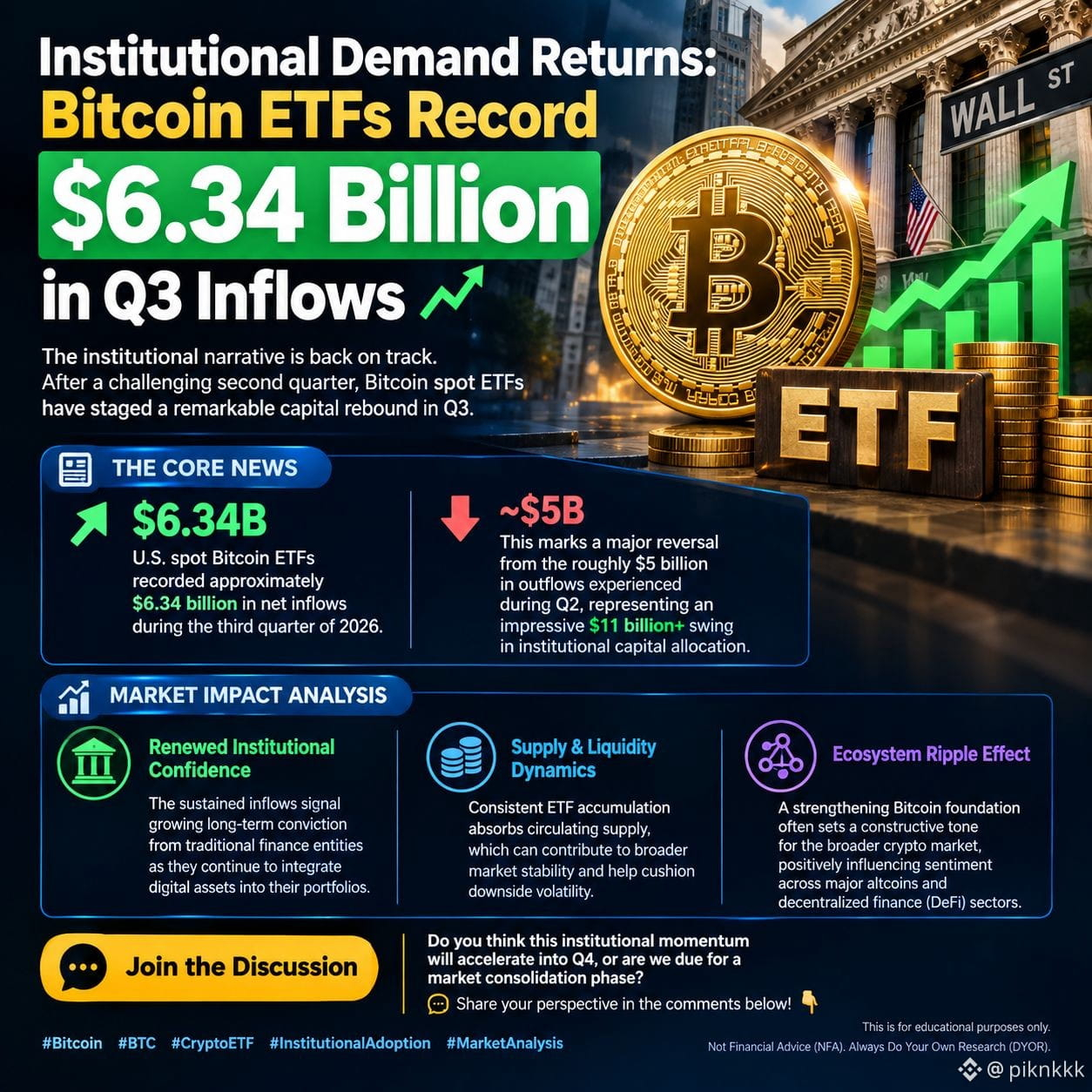
#BitcoinETFsTake$6.34BillionInQ3 Institutional Demand Returns: Bitcoin ETFs Record $6.34 Billion in Q3 Inflows📈
The institutional narrative is back on track. After a challenging second quarter, Bitcoin spot ETFs have staged a remarkable capital rebound in Q3.
📰 The Core News
• U.S. spot Bitcoin ETFs recorded approximately $6.34 billion in net inflows during the third quarter of 2026 [[1]].
• This significant influx marks a major reversal from the roughly $5 billion in outflows experienced during Q2, representing an impressive $11 billion+ swing in institutional capital allocation [[5]].
🌍 Market Impact Analysis
• Renewed Institutional Confidence The sustained inflows signal growing long-term conviction from traditional finance entities as they continue to integrate digital assets into their portfolios.
• Supply & Liquidity Dynamics Consistent ETF accumulation absorbs circulating supply, which can contribute to broader market stability and help cushion downside volatility.
• Ecosystem Ripple Effect A strengthening Bitcoin foundation often sets a constructive tone for the broader crypto market, positively influencing sentiment across major altcoins and decentralized finance (DeFi) sectors.
💬 Join the Discussion
Do you think this institutional momentum will accelerate into Q4, or are we due for a market consolidation phase? Share your perspective in the comments below! 👇
#Bitcoin #BTC #CryptoETF #InstitutionalAdoption #MarketAnalysis
This is for educational purposes only. Not Financial Advice (NFA). Always Do Your Own Research (DYOR).
$2Z $SOMI $ROSE
{future}(ROSEUSDT)
{future}(SOMIUSDT)
{future}(2ZUSDT)
#BitcoinETFsTake$6.34BillionInQ3 Institutional Demand Returns: Bitcoin ETFs Record $6.34 Billion in Q3 Inflows📈
The institutional narrative is back on track. After a challenging second quarter, Bitcoin spot ETFs have staged a remarkable capital rebound in Q3.
📰 The Core News
• U.S. spot Bitcoin ETFs recorded approximately $6.34 billion in net inflows during the third quarter of 2026 [[1]].
• This significant influx marks a major reversal from the roughly $5 billion in outflows experienced during Q2, representing an impressive $11 billion+ swing in institutional capital allocation [[5]].
🌍 Market Impact Analysis
• Renewed Institutional Confidence The sustained inflows signal growing long-term conviction from traditional finance entities as they continue to integrate digital assets into their portfolios.
• Supply & Liquidity Dynamics Consistent ETF accumulation absorbs circulating supply, which can contribute to broader market stability and help cushion downside volatility.
• Ecosystem Ripple Effect A strengthening Bitcoin foundation often sets a constructive tone for the broader crypto market, positively influencing sentiment across major altcoins and decentralized finance (DeFi) sectors.
💬 Join the Discussion
Do you think this institutional momentum will accelerate into Q4, or are we due for a market consolidation phase? Share your perspective in the comments below! 👇
#Bitcoin #BTC #CryptoETF #InstitutionalAdoption #MarketAnalysis
This is for educational purposes only. Not Financial Advice (NFA). Always Do Your Own Research (DYOR).
$2Z $SOMI $ROSE
The institutional narrative is back on track. After a challenging second quarter, Bitcoin spot ETFs have staged a remarkable capital rebound in Q3.
📰 The Core News
• U.S. spot Bitcoin ETFs recorded approximately $6.34 billion in net inflows during the third quarter of 2026 [[1]].
• This significant influx marks a major reversal from the roughly $5 billion in outflows experienced during Q2, representing an impressive $11 billion+ swing in institutional capital allocation [[5]].
🌍 Market Impact Analysis
• Renewed Institutional Confidence The sustained inflows signal growing long-term conviction from traditional finance entities as they continue to integrate digital assets into their portfolios.
• Supply & Liquidity Dynamics Consistent ETF accumulation absorbs circulating supply, which can contribute to broader market stability and help cushion downside volatility.
• Ecosystem Ripple Effect A strengthening Bitcoin foundation often sets a constructive tone for the broader crypto market, positively influencing sentiment across major altcoins and decentralized finance (DeFi) sectors.
💬 Join the Discussion
Do you think this institutional momentum will accelerate into Q4, or are we due for a market consolidation phase? Share your perspective in the comments below! 👇
#Bitcoin #BTC #CryptoETF #InstitutionalAdoption #MarketAnalysis
This is for educational purposes only. Not Financial Advice (NFA). Always Do Your Own Research (DYOR).
$2Z $SOMI $ROSE
93
·
--
Baissier
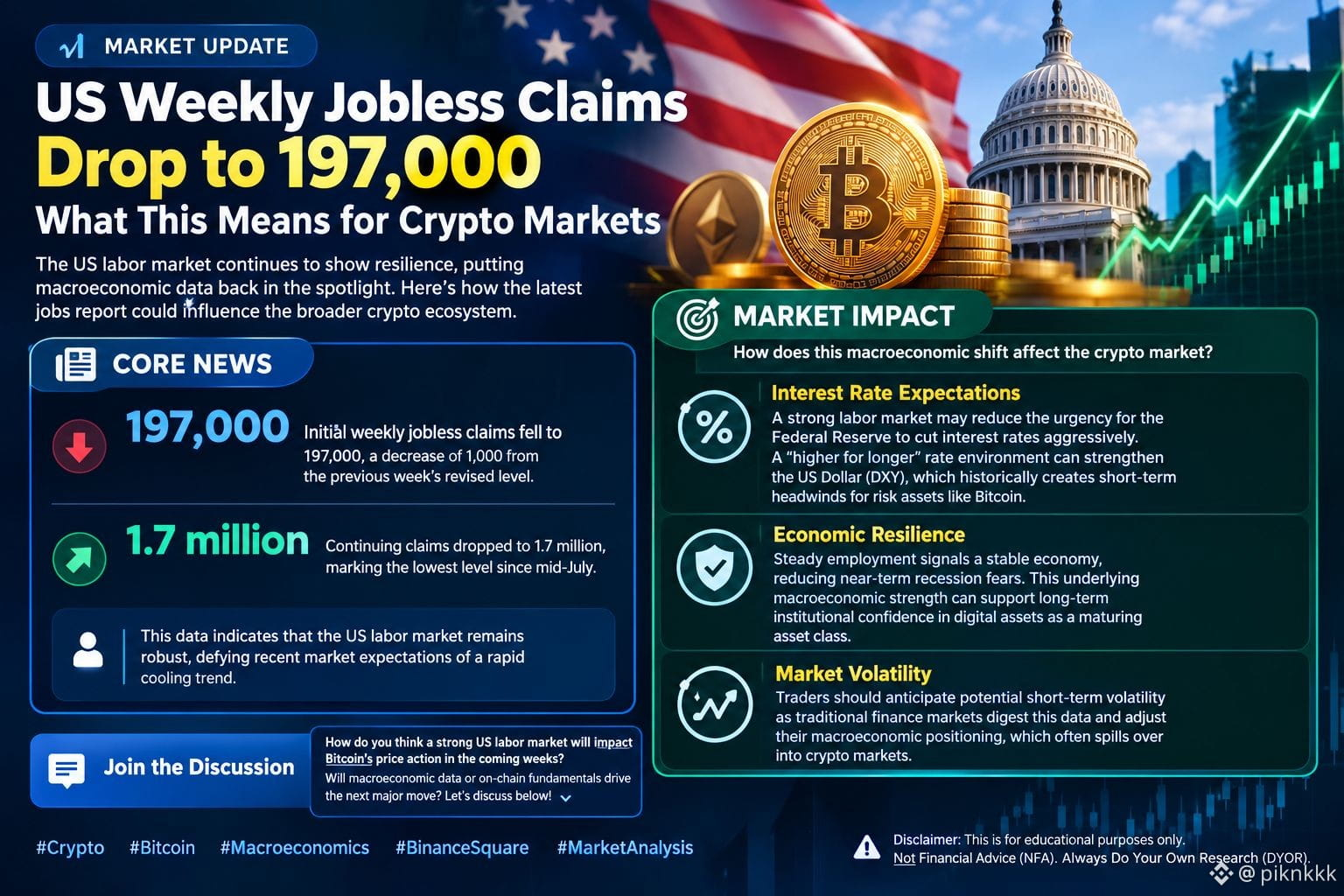
#usweeklyjoblessclaimsfallto197000 📊 US Weekly Jobless Claims Drop to 197,000 What This Means for Crypto Markets
The US labor market continues to show resilience, putting macroeconomic data back in the spotlight. Here’s how the latest jobs report could influence the broader crypto ecosystem.
📰 Core News
📉 The US Department of Labor reported that initial weekly jobless claims unexpectedly fell to 197,000, a decrease of 1,000 from the previous week’s revised level [[9]].
📈 Continuing claims also dropped to 1.7 million, marking the lowest level since mid-July [[3]]. This data indicates that the US labor market remains robust, defying recent market expectations of a rapid cooling trend [[4]].
📈 Market Impact
How does this macroeconomic shift affect the crypto market?
💵 Interest Rate Expectations A strong labor market may reduce the urgency for the Federal Reserve to cut interest rates aggressively. A "higher for longer" rate environment can strengthen the US Dollar (DXY), which historically creates short-term headwinds for risk assets like Bitcoin.
🛡️ Economic Resilience Conversely, steady employment signals a stable economy, reducing near-term recession fears. This underlying macroeconomic strength can support long-term institutional confidence in digital assets as a maturing asset class.
⚖️ Market Volatility Traders should anticipate potential short-term volatility as traditional finance markets digest this data and adjust their macroeconomic positioning, which often spills over into crypto markets.
💬 join the Discussion
How do you think a strong US labor market will impact Bitcoin’s price action in the coming weeks? Will macroeconomic data or on-chain fundamentals drive the next major move? Let’s discuss below! 👇
#Crypto #Bitcoin #Macroeconomics #BinanceSquare #MarketAnalysis
This is for educational purposes only. Not Financial Advice (NFA). Always Do Your Own Research (DYOR).
$BERA $KMNO $NEAR
{future}(NEARUSDT)
{future}(KMNOUSDT)
{future}(BERAUSDT)
#usweeklyjoblessclaimsfallto197000 📊 US Weekly Jobless Claims Drop to 197,000 What This Means for Crypto Markets
The US labor market continues to show resilience, putting macroeconomic data back in the spotlight. Here’s how the latest jobs report could influence the broader crypto ecosystem.
📰 Core News
📉 The US Department of Labor reported that initial weekly jobless claims unexpectedly fell to 197,000, a decrease of 1,000 from the previous week’s revised level [[9]].
📈 Continuing claims also dropped to 1.7 million, marking the lowest level since mid-July [[3]]. This data indicates that the US labor market remains robust, defying recent market expectations of a rapid cooling trend [[4]].
📈 Market Impact
How does this macroeconomic shift affect the crypto market?
💵 Interest Rate Expectations A strong labor market may reduce the urgency for the Federal Reserve to cut interest rates aggressively. A "higher for longer" rate environment can strengthen the US Dollar (DXY), which historically creates short-term headwinds for risk assets like Bitcoin.
🛡️ Economic Resilience Conversely, steady employment signals a stable economy, reducing near-term recession fears. This underlying macroeconomic strength can support long-term institutional confidence in digital assets as a maturing asset class.
⚖️ Market Volatility Traders should anticipate potential short-term volatility as traditional finance markets digest this data and adjust their macroeconomic positioning, which often spills over into crypto markets.
💬 join the Discussion
How do you think a strong US labor market will impact Bitcoin’s price action in the coming weeks? Will macroeconomic data or on-chain fundamentals drive the next major move? Let’s discuss below! 👇
#Crypto #Bitcoin #Macroeconomics #BinanceSquare #MarketAnalysis
This is for educational purposes only. Not Financial Advice (NFA). Always Do Your Own Research (DYOR).
$BERA $KMNO $NEAR
The US labor market continues to show resilience, putting macroeconomic data back in the spotlight. Here’s how the latest jobs report could influence the broader crypto ecosystem.
📰 Core News
📉 The US Department of Labor reported that initial weekly jobless claims unexpectedly fell to 197,000, a decrease of 1,000 from the previous week’s revised level [[9]].
📈 Continuing claims also dropped to 1.7 million, marking the lowest level since mid-July [[3]]. This data indicates that the US labor market remains robust, defying recent market expectations of a rapid cooling trend [[4]].
📈 Market Impact
How does this macroeconomic shift affect the crypto market?
💵 Interest Rate Expectations A strong labor market may reduce the urgency for the Federal Reserve to cut interest rates aggressively. A "higher for longer" rate environment can strengthen the US Dollar (DXY), which historically creates short-term headwinds for risk assets like Bitcoin.
🛡️ Economic Resilience Conversely, steady employment signals a stable economy, reducing near-term recession fears. This underlying macroeconomic strength can support long-term institutional confidence in digital assets as a maturing asset class.
⚖️ Market Volatility Traders should anticipate potential short-term volatility as traditional finance markets digest this data and adjust their macroeconomic positioning, which often spills over into crypto markets.
💬 join the Discussion
How do you think a strong US labor market will impact Bitcoin’s price action in the coming weeks? Will macroeconomic data or on-chain fundamentals drive the next major move? Let’s discuss below! 👇
#Crypto #Bitcoin #Macroeconomics #BinanceSquare #MarketAnalysis
This is for educational purposes only. Not Financial Advice (NFA). Always Do Your Own Research (DYOR).
$BERA $KMNO $NEAR
1
1
5.4k
·
--
Baissier
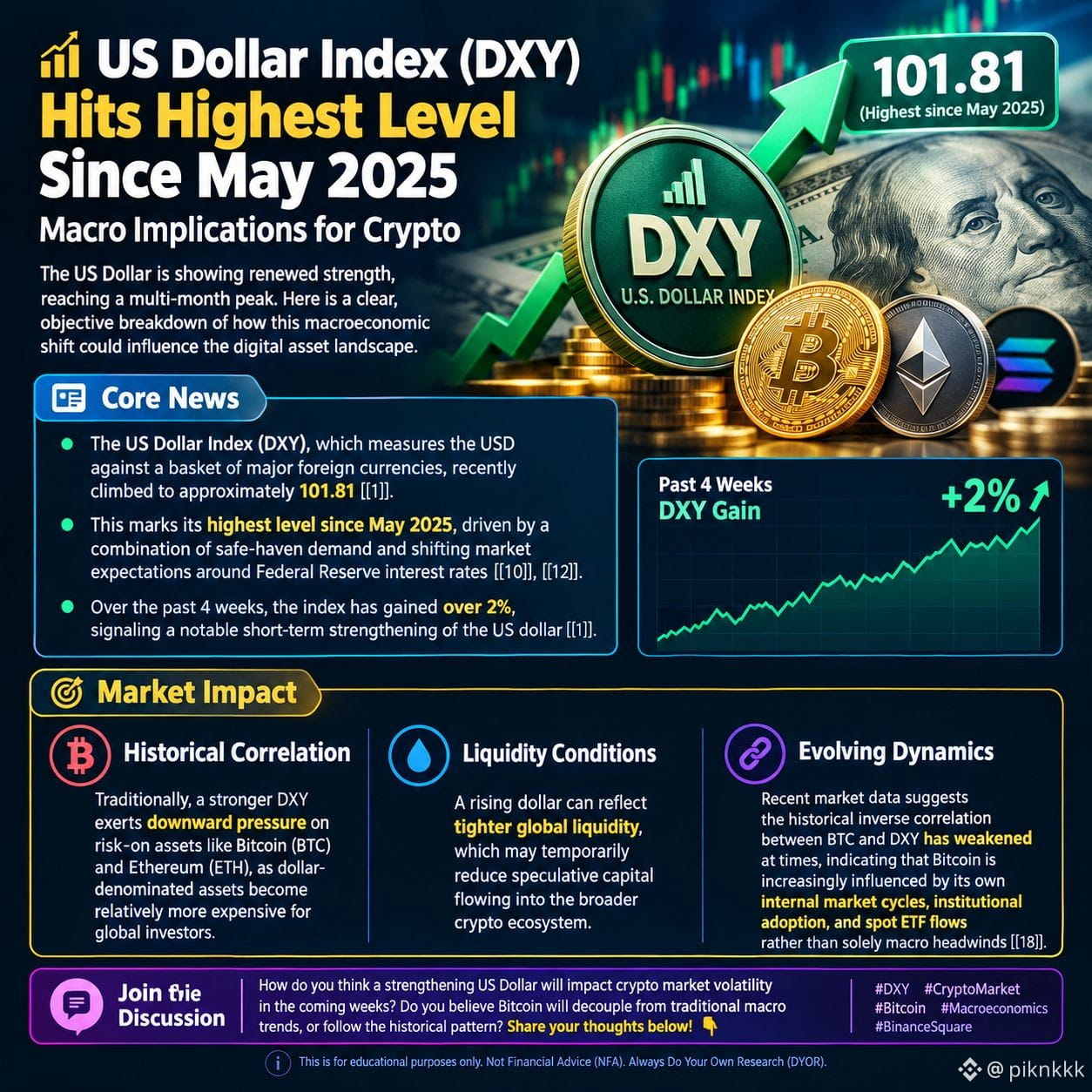
#dollarindexhitshighestsincemay2025 📊 US Dollar Index (DXY) Hits Highest Level Since May 2025: Macro Implications for Crypto
The US Dollar is showing renewed strength, reaching a multi-month peak. Here is a clear, objective breakdown of how this macroeconomic shift could influence the digital asset landscape.
📰 Core News
• The US Dollar Index (DXY), which measures the USD against a basket of major foreign currencies, recently climbed to approximately 101.81 [[1]].
• This marks its highest level since May 2025, driven by a combination of safe-haven demand and shifting market expectations around Federal Reserve interest rates [[10]], [[12]].
• Over the past 4 weeks, the index has gained over 2%, signaling a notable short-term strengthening of the US dollar [[1]].
📈 Market Impact
• 💵 Historical Correlation Traditionally, a stronger DXY exerts downward pressure on risk-on assets like Bitcoin (BTC) and Ethereum (ETH), as dollar-denominated assets become relatively more expensive for global investors.
• 💧 Liquidity Conditions A rising dollar can reflect tighter global liquidity, which may temporarily reduce speculative capital flowing into the broader crypto ecosystem.
• 🔗 Evolving Dynamics Recent market data suggests the historical inverse correlation between BTC and DXY has weakened at times, indicating that Bitcoin is increasingly influenced by its own internal market cycles, institutional adoption, and spot ETF flows rather than solely macro headwinds [[18]].
💬 Join the Discussion
How do you think a strengthening US Dollar will impact crypto market volatility in the coming weeks? Do you believe Bitcoin will decouple from traditional macro trends, or follow the historical pattern? Share your thoughts below! 👇
#DXY #CryptoMarket #Bitcoin #Macroeconomics #BinanceSquare
This is for educational purposes only. Not Financial Advice (NFA). Always Do Your Own Research (DYOR).
$AMCB $QNT $REZ
{future}(REZUSDT)
{future}(QNTUSDT)
{spot}(AMCBUSDT)
#dollarindexhitshighestsincemay2025 📊 US Dollar Index (DXY) Hits Highest Level Since May 2025: Macro Implications for Crypto
The US Dollar is showing renewed strength, reaching a multi-month peak. Here is a clear, objective breakdown of how this macroeconomic shift could influence the digital asset landscape.
📰 Core News
• The US Dollar Index (DXY), which measures the USD against a basket of major foreign currencies, recently climbed to approximately 101.81 [[1]].
• This marks its highest level since May 2025, driven by a combination of safe-haven demand and shifting market expectations around Federal Reserve interest rates [[10]], [[12]].
• Over the past 4 weeks, the index has gained over 2%, signaling a notable short-term strengthening of the US dollar [[1]].
📈 Market Impact
• 💵 Historical Correlation Traditionally, a stronger DXY exerts downward pressure on risk-on assets like Bitcoin (BTC) and Ethereum (ETH), as dollar-denominated assets become relatively more expensive for global investors.
• 💧 Liquidity Conditions A rising dollar can reflect tighter global liquidity, which may temporarily reduce speculative capital flowing into the broader crypto ecosystem.
• 🔗 Evolving Dynamics Recent market data suggests the historical inverse correlation between BTC and DXY has weakened at times, indicating that Bitcoin is increasingly influenced by its own internal market cycles, institutional adoption, and spot ETF flows rather than solely macro headwinds [[18]].
💬 Join the Discussion
How do you think a strengthening US Dollar will impact crypto market volatility in the coming weeks? Do you believe Bitcoin will decouple from traditional macro trends, or follow the historical pattern? Share your thoughts below! 👇
#DXY #CryptoMarket #Bitcoin #Macroeconomics #BinanceSquare
This is for educational purposes only. Not Financial Advice (NFA). Always Do Your Own Research (DYOR).
$AMCB $QNT $REZ
The US Dollar is showing renewed strength, reaching a multi-month peak. Here is a clear, objective breakdown of how this macroeconomic shift could influence the digital asset landscape.
📰 Core News
• The US Dollar Index (DXY), which measures the USD against a basket of major foreign currencies, recently climbed to approximately 101.81 [[1]].
• This marks its highest level since May 2025, driven by a combination of safe-haven demand and shifting market expectations around Federal Reserve interest rates [[10]], [[12]].
• Over the past 4 weeks, the index has gained over 2%, signaling a notable short-term strengthening of the US dollar [[1]].
📈 Market Impact
• 💵 Historical Correlation Traditionally, a stronger DXY exerts downward pressure on risk-on assets like Bitcoin (BTC) and Ethereum (ETH), as dollar-denominated assets become relatively more expensive for global investors.
• 💧 Liquidity Conditions A rising dollar can reflect tighter global liquidity, which may temporarily reduce speculative capital flowing into the broader crypto ecosystem.
• 🔗 Evolving Dynamics Recent market data suggests the historical inverse correlation between BTC and DXY has weakened at times, indicating that Bitcoin is increasingly influenced by its own internal market cycles, institutional adoption, and spot ETF flows rather than solely macro headwinds [[18]].
💬 Join the Discussion
How do you think a strengthening US Dollar will impact crypto market volatility in the coming weeks? Do you believe Bitcoin will decouple from traditional macro trends, or follow the historical pattern? Share your thoughts below! 👇
#DXY #CryptoMarket #Bitcoin #Macroeconomics #BinanceSquare
This is for educational purposes only. Not Financial Advice (NFA). Always Do Your Own Research (DYOR).
$AMCB $QNT $REZ
2
4.4k
·
--
Haussier
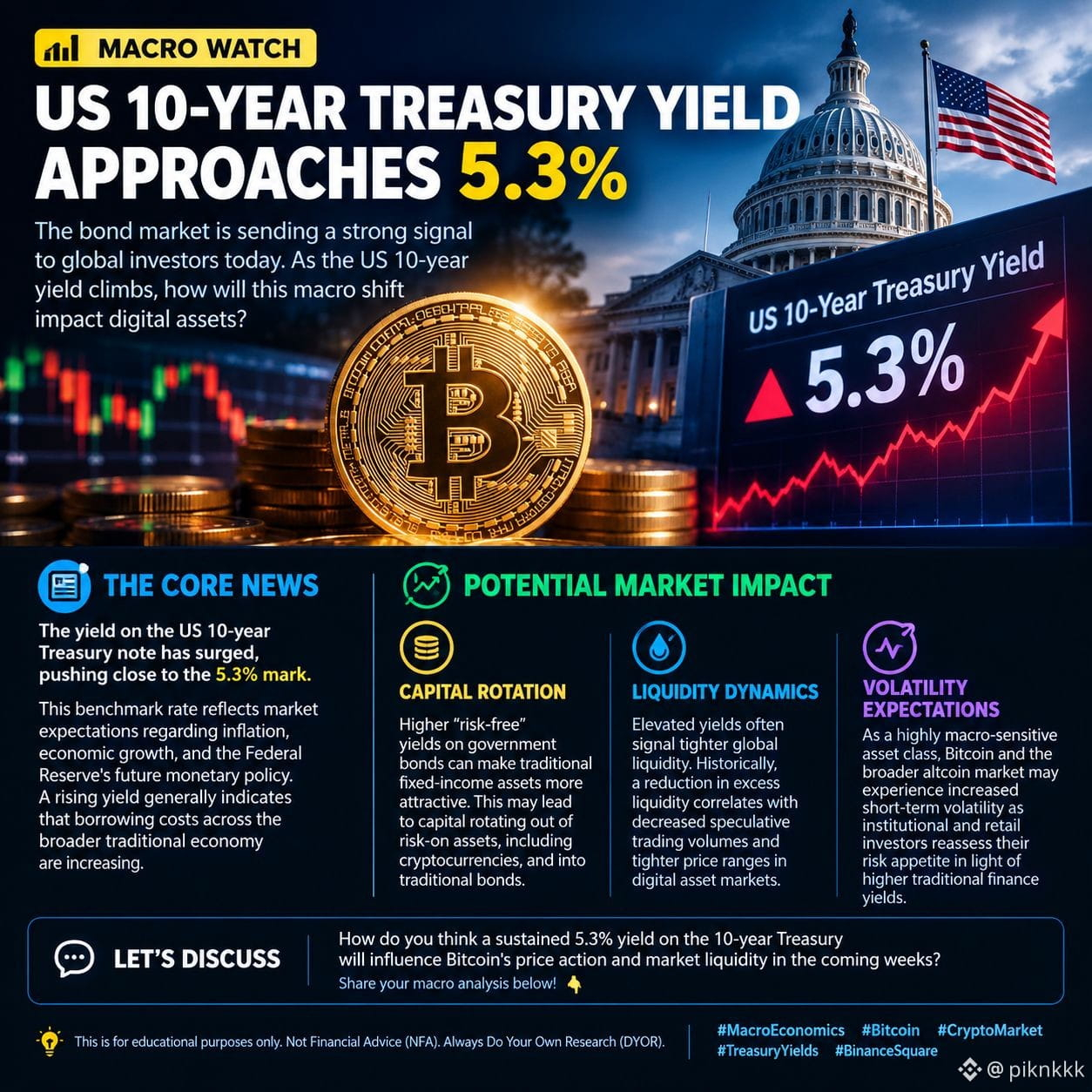
#us10yearyieldnears5.3% 📊 Macro Watch: US 10-Year Treasury Yield Approaches 5.3%
The bond market is sending a strong signal to global investors today. As the US 10-year yield climbs, how will this macro shift impact digital assets?
📰 The Core News
The yield on the US 10-year Treasury note has surged, pushing close to the 5.3% mark. This benchmark rate reflects market expectations regarding inflation, economic growth, and the Federal Reserve's future monetary policy. A rising yield generally indicates that borrowing costs across the broader traditional economy are increasing.
📉 Potential Market Impact
Here is how this macroeconomic data point could influence the crypto ecosystem
• Capital Rotation Higher "risk-free" yields on government bonds can make traditional fixed-income assets more attractive. This may lead to capital rotating out of risk-on assets, including cryptocurrencies, and into traditional bonds.
• Liquidity Dynamics Elevated yields often signal tighter global liquidity. Historically, a reduction in excess liquidity correlates with decreased speculative trading volumes and tighter price ranges in digital asset markets.
• Volatility Expectations As a highly macro-sensitive asset class, Bitcoin and the broader altcoin market may experience increased short-term volatility as institutional and retail investors reassess their risk appetite in light of higher traditional finance yields.
💬 Let’s Discuss
How do you think a sustained 5.3% yield on the 10-year Treasury will influence Bitcoin's price action and market liquidity in the coming weeks? Share your macro analysis below! 👇
#MacroEconomics #Bitcoin #CryptoMarket #TreasuryYields #BinanceSquare
This is for educational purposes only. Not Financial Advice (NFA). Always Do Your Own Research (DYOR).
$MOVE $COHRB $LITEB
{spot}(LITEBUSDT)
{spot}(COHRBUSDT)
{future}(MOVEUSDT)
#us10yearyieldnears5.3% 📊 Macro Watch: US 10-Year Treasury Yield Approaches 5.3%
The bond market is sending a strong signal to global investors today. As the US 10-year yield climbs, how will this macro shift impact digital assets?
📰 The Core News
The yield on the US 10-year Treasury note has surged, pushing close to the 5.3% mark. This benchmark rate reflects market expectations regarding inflation, economic growth, and the Federal Reserve's future monetary policy. A rising yield generally indicates that borrowing costs across the broader traditional economy are increasing.
📉 Potential Market Impact
Here is how this macroeconomic data point could influence the crypto ecosystem
• Capital Rotation Higher "risk-free" yields on government bonds can make traditional fixed-income assets more attractive. This may lead to capital rotating out of risk-on assets, including cryptocurrencies, and into traditional bonds.
• Liquidity Dynamics Elevated yields often signal tighter global liquidity. Historically, a reduction in excess liquidity correlates with decreased speculative trading volumes and tighter price ranges in digital asset markets.
• Volatility Expectations As a highly macro-sensitive asset class, Bitcoin and the broader altcoin market may experience increased short-term volatility as institutional and retail investors reassess their risk appetite in light of higher traditional finance yields.
💬 Let’s Discuss
How do you think a sustained 5.3% yield on the 10-year Treasury will influence Bitcoin's price action and market liquidity in the coming weeks? Share your macro analysis below! 👇
#MacroEconomics #Bitcoin #CryptoMarket #TreasuryYields #BinanceSquare
This is for educational purposes only. Not Financial Advice (NFA). Always Do Your Own Research (DYOR).
$MOVE $COHRB $LITEB
The bond market is sending a strong signal to global investors today. As the US 10-year yield climbs, how will this macro shift impact digital assets?
📰 The Core News
The yield on the US 10-year Treasury note has surged, pushing close to the 5.3% mark. This benchmark rate reflects market expectations regarding inflation, economic growth, and the Federal Reserve's future monetary policy. A rising yield generally indicates that borrowing costs across the broader traditional economy are increasing.
📉 Potential Market Impact
Here is how this macroeconomic data point could influence the crypto ecosystem
• Capital Rotation Higher "risk-free" yields on government bonds can make traditional fixed-income assets more attractive. This may lead to capital rotating out of risk-on assets, including cryptocurrencies, and into traditional bonds.
• Liquidity Dynamics Elevated yields often signal tighter global liquidity. Historically, a reduction in excess liquidity correlates with decreased speculative trading volumes and tighter price ranges in digital asset markets.
• Volatility Expectations As a highly macro-sensitive asset class, Bitcoin and the broader altcoin market may experience increased short-term volatility as institutional and retail investors reassess their risk appetite in light of higher traditional finance yields.
💬 Let’s Discuss
How do you think a sustained 5.3% yield on the 10-year Treasury will influence Bitcoin's price action and market liquidity in the coming weeks? Share your macro analysis below! 👇
#MacroEconomics #Bitcoin #CryptoMarket #TreasuryYields #BinanceSquare
This is for educational purposes only. Not Financial Advice (NFA). Always Do Your Own Research (DYOR).
$MOVE $COHRB $LITEB
2
3
10.2k
·
--
Haussier
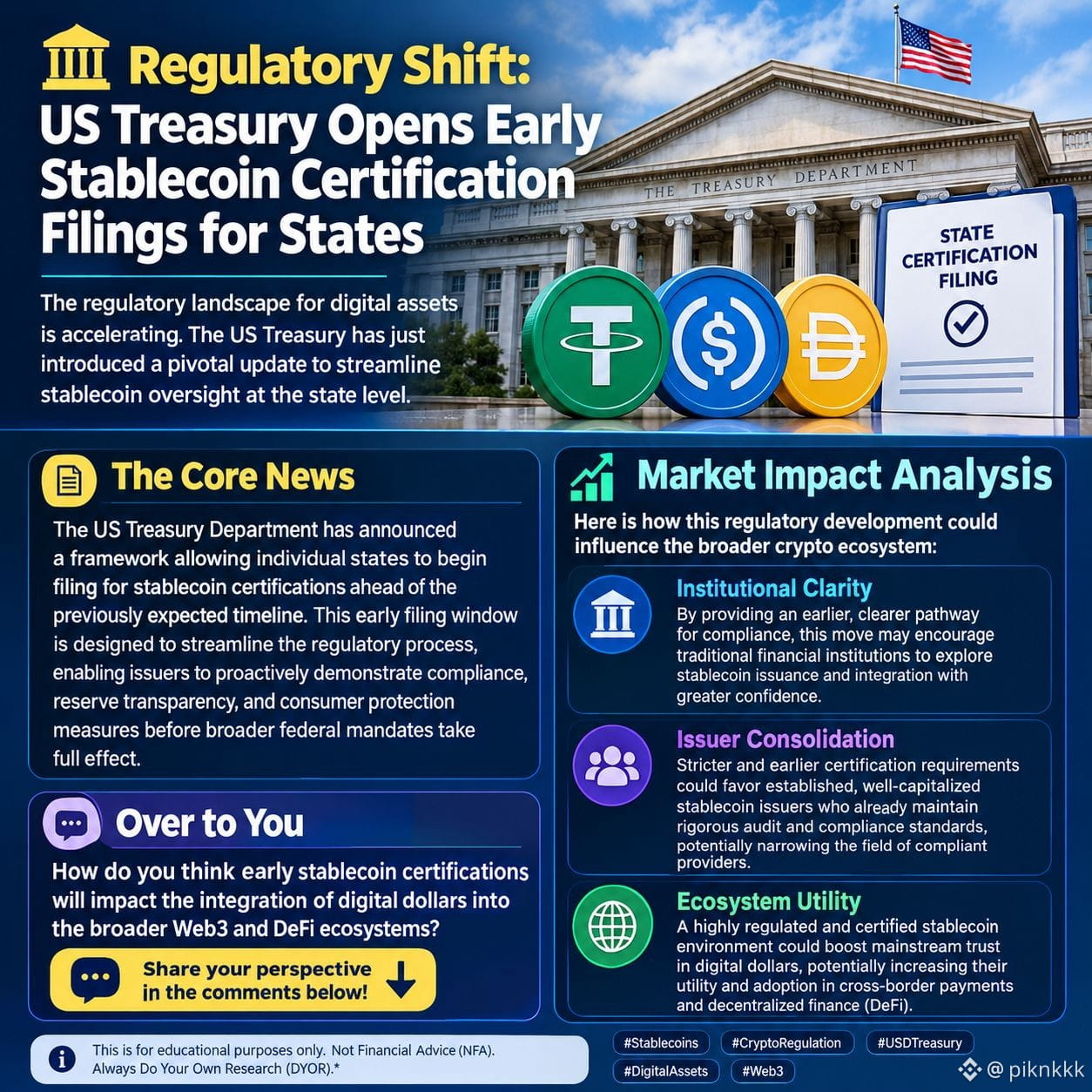
#TreasuryLetsStatesFileStablecoinCertificationsEarly 🏛️ Regulatory Shift US Treasury Opens Early Stablecoin Certification Filings for States
The regulatory landscape for digital assets is accelerating. The US Treasury has just introduced a pivotal update to streamline stablecoin oversight at the state level.
📜 The Core News
The US Treasury Department has announced a framework allowing individual states to begin filing for stablecoin certifications ahead of the previously expected timeline. This early filing window is designed to streamline the regulatory process, enabling issuers to proactively demonstrate compliance, reserve transparency, and consumer protection measures before broader federal mandates take full effect.
📊 Market Impact Analysis
Here is how this regulatory development could influence the broader crypto ecosystem
•Institutional Clarity By providing an earlier, clearer pathway for compliance, this move may encourage traditional financial institutions to explore stablecoin issuance and integration with greater confidence.
• **Issuer Consolidation:** Stricter and earlier certification requirements could favor established, well-capitalized stablecoin issuers who already maintain rigorous audit and compliance standards, potentially narrowing the field of compliant providers.
• Ecosystem Utility A highly regulated and certified stablecoin environment could boost mainstream trust in digital dollars, potentially increasing their utility and adoption in cross-border payments and decentralized finance (DeFi).
💬Over to You
How do you think early stablecoin certifications will impact the integration of digital dollars into the broader Web3 and DeFi ecosystems? Share your perspective in the comments below! 👇
#Stablecoins #CryptoRegulation #USDTreasury #DigitalAssets #web3
This is for educational purposes only. Not Financial Advice (NFA). Always Do Your Own Research (DYOR).
$SYN $NOM $OPN
{future}(OPNUSDT)
{future}(NOMUSDT)
{future}(SYNUSDT)
#TreasuryLetsStatesFileStablecoinCertificationsEarly 🏛️ Regulatory Shift US Treasury Opens Early Stablecoin Certification Filings for States
The regulatory landscape for digital assets is accelerating. The US Treasury has just introduced a pivotal update to streamline stablecoin oversight at the state level.
📜 The Core News
The US Treasury Department has announced a framework allowing individual states to begin filing for stablecoin certifications ahead of the previously expected timeline. This early filing window is designed to streamline the regulatory process, enabling issuers to proactively demonstrate compliance, reserve transparency, and consumer protection measures before broader federal mandates take full effect.
📊 Market Impact Analysis
Here is how this regulatory development could influence the broader crypto ecosystem
•Institutional Clarity By providing an earlier, clearer pathway for compliance, this move may encourage traditional financial institutions to explore stablecoin issuance and integration with greater confidence.
• **Issuer Consolidation:** Stricter and earlier certification requirements could favor established, well-capitalized stablecoin issuers who already maintain rigorous audit and compliance standards, potentially narrowing the field of compliant providers.
• Ecosystem Utility A highly regulated and certified stablecoin environment could boost mainstream trust in digital dollars, potentially increasing their utility and adoption in cross-border payments and decentralized finance (DeFi).
💬Over to You
How do you think early stablecoin certifications will impact the integration of digital dollars into the broader Web3 and DeFi ecosystems? Share your perspective in the comments below! 👇
#Stablecoins #CryptoRegulation #USDTreasury #DigitalAssets #web3
This is for educational purposes only. Not Financial Advice (NFA). Always Do Your Own Research (DYOR).
$SYN $NOM $OPN
The regulatory landscape for digital assets is accelerating. The US Treasury has just introduced a pivotal update to streamline stablecoin oversight at the state level.
📜 The Core News
The US Treasury Department has announced a framework allowing individual states to begin filing for stablecoin certifications ahead of the previously expected timeline. This early filing window is designed to streamline the regulatory process, enabling issuers to proactively demonstrate compliance, reserve transparency, and consumer protection measures before broader federal mandates take full effect.
📊 Market Impact Analysis
Here is how this regulatory development could influence the broader crypto ecosystem
•Institutional Clarity By providing an earlier, clearer pathway for compliance, this move may encourage traditional financial institutions to explore stablecoin issuance and integration with greater confidence.
• **Issuer Consolidation:** Stricter and earlier certification requirements could favor established, well-capitalized stablecoin issuers who already maintain rigorous audit and compliance standards, potentially narrowing the field of compliant providers.
• Ecosystem Utility A highly regulated and certified stablecoin environment could boost mainstream trust in digital dollars, potentially increasing their utility and adoption in cross-border payments and decentralized finance (DeFi).
💬Over to You
How do you think early stablecoin certifications will impact the integration of digital dollars into the broader Web3 and DeFi ecosystems? Share your perspective in the comments below! 👇
#Stablecoins #CryptoRegulation #USDTreasury #DigitalAssets #web3
This is for educational purposes only. Not Financial Advice (NFA). Always Do Your Own Research (DYOR).
$SYN $NOM $OPN
1
555
·
--
Haussier
#ethergains70.9%inq3 📊 Ethereum Closes Q3 with 70.9% Gain: Strongest Quarterly Performance Since 2021
Ethereum has officially wrapped up a monumental quarter, surging 70.9% to mark its most robust quarterly performance since Q1 2021. 📈
📰 Core News
Following three consecutive down quarters, ETH has staged a powerful and broad-based rebound. This impressive 70.9% Q3 rally significantly outpaced Bitcoin’s 44% gain, as well as traditional assets like gold and major equity indices [[12]]. The upward momentum has been primarily fueled by:
• Renewed demand and sustained inflows into spot Ether ETFs [[1]].
• Stronger spot-market activity and improving network fundamentals.
• A broader "risk-on" sentiment returning to the digital asset ecosystem.
🔍 Market Impact
What does this mean for the broader crypto market?
• Ecosystem Liquidity ETH’s outperformance often acts as a catalyst for the broader Ethereum ecosystem, potentially driving renewed attention and liquidity toward Layer 2 networks, DeFi protocols, and ETH-beta tokens.
• Institutional Validation Consistent ETF demand highlights growing institutional confidence in Ethereum as a core, yield-generating digital asset class.
• Q4 Historical Context While Q3 set a high bar, historical market cycles show Q4 can be a strong period for crypto. However, sustaining this trajectory will depend on macroeconomic conditions, regulatory clarity, and continued network adoption.
💬 Join the Discussion
Do you think Ethereum can maintain this momentum and continue to lead the market in Q4, or are we due for a healthy consolidation phase? Share your analysis and thoughts in the comments below! 👇
#Ethereum #ETH #CryptoMarket #Q3Recap #BinanceSquare
This is for educational purposes only. Not Financial Advice (NFA). Always Do Your Own Research (DYOR).
$MOVR $MEGA $ALICE
{future}(ALICEUSDT)
{future}(MEGAUSDT)
{future}(MOVRUSDT)
#ethergains70.9%inq3 📊 Ethereum Closes Q3 with 70.9% Gain: Strongest Quarterly Performance Since 2021
Ethereum has officially wrapped up a monumental quarter, surging 70.9% to mark its most robust quarterly performance since Q1 2021. 📈
📰 Core News
Following three consecutive down quarters, ETH has staged a powerful and broad-based rebound. This impressive 70.9% Q3 rally significantly outpaced Bitcoin’s 44% gain, as well as traditional assets like gold and major equity indices [[12]]. The upward momentum has been primarily fueled by:
• Renewed demand and sustained inflows into spot Ether ETFs [[1]].
• Stronger spot-market activity and improving network fundamentals.
• A broader "risk-on" sentiment returning to the digital asset ecosystem.
🔍 Market Impact
What does this mean for the broader crypto market?
• Ecosystem Liquidity ETH’s outperformance often acts as a catalyst for the broader Ethereum ecosystem, potentially driving renewed attention and liquidity toward Layer 2 networks, DeFi protocols, and ETH-beta tokens.
• Institutional Validation Consistent ETF demand highlights growing institutional confidence in Ethereum as a core, yield-generating digital asset class.
• Q4 Historical Context While Q3 set a high bar, historical market cycles show Q4 can be a strong period for crypto. However, sustaining this trajectory will depend on macroeconomic conditions, regulatory clarity, and continued network adoption.
💬 Join the Discussion
Do you think Ethereum can maintain this momentum and continue to lead the market in Q4, or are we due for a healthy consolidation phase? Share your analysis and thoughts in the comments below! 👇
#Ethereum #ETH #CryptoMarket #Q3Recap #BinanceSquare
This is for educational purposes only. Not Financial Advice (NFA). Always Do Your Own Research (DYOR).
$MOVR $MEGA $ALICE
Ethereum has officially wrapped up a monumental quarter, surging 70.9% to mark its most robust quarterly performance since Q1 2021. 📈
📰 Core News
Following three consecutive down quarters, ETH has staged a powerful and broad-based rebound. This impressive 70.9% Q3 rally significantly outpaced Bitcoin’s 44% gain, as well as traditional assets like gold and major equity indices [[12]]. The upward momentum has been primarily fueled by:
• Renewed demand and sustained inflows into spot Ether ETFs [[1]].
• Stronger spot-market activity and improving network fundamentals.
• A broader "risk-on" sentiment returning to the digital asset ecosystem.
🔍 Market Impact
What does this mean for the broader crypto market?
• Ecosystem Liquidity ETH’s outperformance often acts as a catalyst for the broader Ethereum ecosystem, potentially driving renewed attention and liquidity toward Layer 2 networks, DeFi protocols, and ETH-beta tokens.
• Institutional Validation Consistent ETF demand highlights growing institutional confidence in Ethereum as a core, yield-generating digital asset class.
• Q4 Historical Context While Q3 set a high bar, historical market cycles show Q4 can be a strong period for crypto. However, sustaining this trajectory will depend on macroeconomic conditions, regulatory clarity, and continued network adoption.
💬 Join the Discussion
Do you think Ethereum can maintain this momentum and continue to lead the market in Q4, or are we due for a healthy consolidation phase? Share your analysis and thoughts in the comments below! 👇
#Ethereum #ETH #CryptoMarket #Q3Recap #BinanceSquare
This is for educational purposes only. Not Financial Advice (NFA). Always Do Your Own Research (DYOR).
$MOVR $MEGA $ALICE

2
5.2k
·
--
Baissier
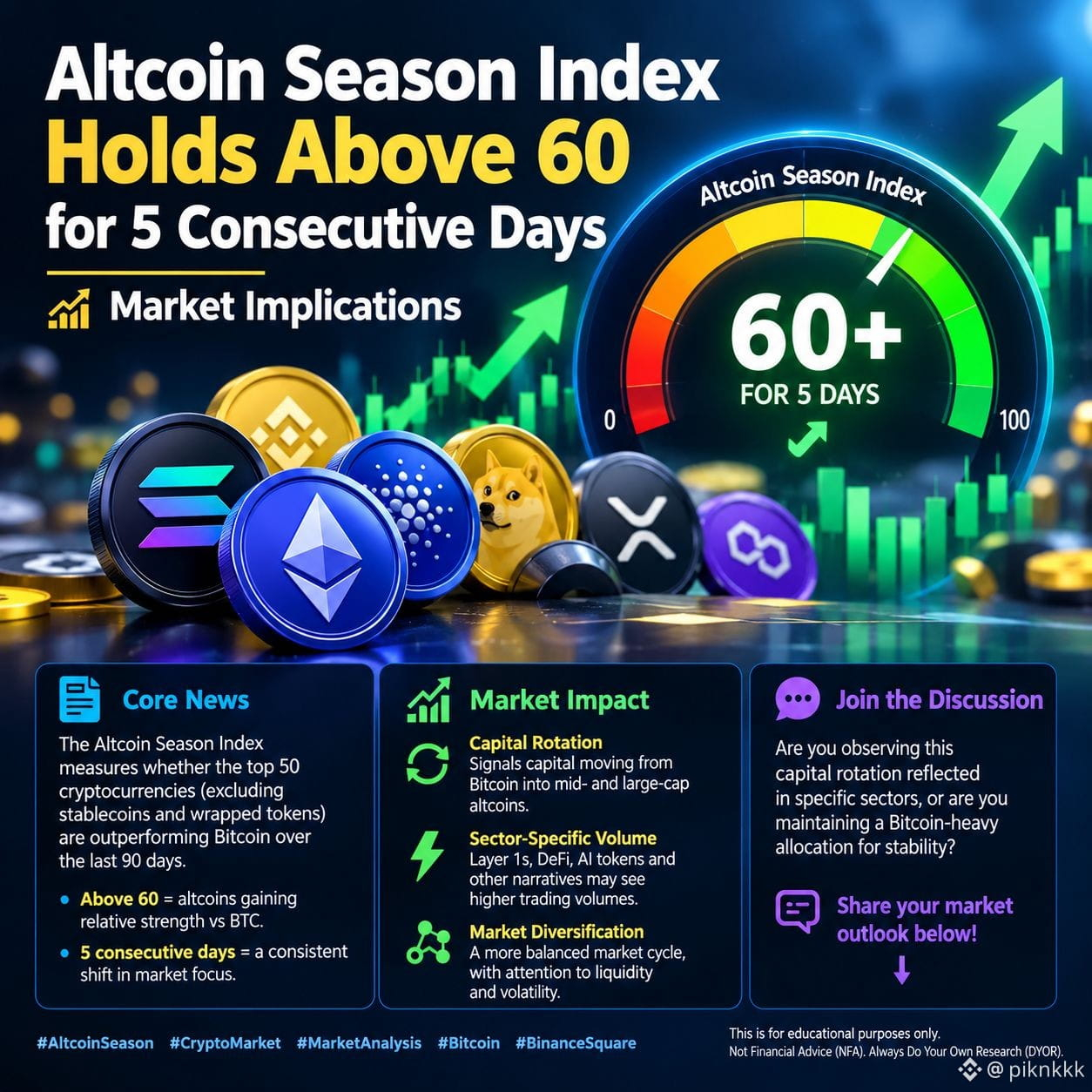
#altcoinseasonindexholdsabove60for5days 📊 Altcoin Season Index Holds Above 60 for 5 Consecutive Days: Market Implications
The crypto market is showing signs of broadening momentum. The Altcoin Season Index has remained above the key threshold of 60 for five straight days, signaling a notable shift in market dynamics. 🌐
📰 Core News
The widely followed Altcoin Season Index measures whether the top 50 cryptocurrencies (excluding stablecoins and wrapped tokens) are outperforming Bitcoin over the last 90 days.
• A reading above 60 indicates that altcoins are gaining relative strength against BTC.
• Sustaining this level for 5 consecutive days suggests a consistent, rather than fleeting, shift in market focus toward the broader altcoin ecosystem.
📈 Market Impact
• 🔄 Capital Rotation Historically, a sustained reading above 60 is viewed by analysts as a signal of capital rotating from Bitcoin into mid- and large-cap altcoins.
• ⚡ Sector-Specific Volume Specific narratives (such as Layer 1s, DeFi, or AI-related tokens) may experience heightened trading volumes as market participants explore diverse opportunities.
• ⚖️ Market Diversification A sustained index above 60 can indicate a more diversified market cycle, rather than one driven solely by Bitcoin’s price action. However, it also warrants careful monitoring of overall market liquidity and volatility.
💬 Join the Discussion
Are you observing this capital rotation reflected in specific sectors, or are you maintaining a Bitcoin-heavy allocation for stability? Share your market outlook below! 👇
#AltcoinSeason #CryptoMarket #MarketAnalysis #Bitcoin #BinanceSquare
This is for educational purposes only. Not Financial Advice (NFA). Always Do Your Own Research (DYOR).
$LDO $2Z $LSK
{future}(LSKUSDT)
{future}(2ZUSDT)
{future}(LDOUSDT)
#altcoinseasonindexholdsabove60for5days 📊 Altcoin Season Index Holds Above 60 for 5 Consecutive Days: Market Implications
The crypto market is showing signs of broadening momentum. The Altcoin Season Index has remained above the key threshold of 60 for five straight days, signaling a notable shift in market dynamics. 🌐
📰 Core News
The widely followed Altcoin Season Index measures whether the top 50 cryptocurrencies (excluding stablecoins and wrapped tokens) are outperforming Bitcoin over the last 90 days.
• A reading above 60 indicates that altcoins are gaining relative strength against BTC.
• Sustaining this level for 5 consecutive days suggests a consistent, rather than fleeting, shift in market focus toward the broader altcoin ecosystem.
📈 Market Impact
• 🔄 Capital Rotation Historically, a sustained reading above 60 is viewed by analysts as a signal of capital rotating from Bitcoin into mid- and large-cap altcoins.
• ⚡ Sector-Specific Volume Specific narratives (such as Layer 1s, DeFi, or AI-related tokens) may experience heightened trading volumes as market participants explore diverse opportunities.
• ⚖️ Market Diversification A sustained index above 60 can indicate a more diversified market cycle, rather than one driven solely by Bitcoin’s price action. However, it also warrants careful monitoring of overall market liquidity and volatility.
💬 Join the Discussion
Are you observing this capital rotation reflected in specific sectors, or are you maintaining a Bitcoin-heavy allocation for stability? Share your market outlook below! 👇
#AltcoinSeason #CryptoMarket #MarketAnalysis #Bitcoin #BinanceSquare
This is for educational purposes only. Not Financial Advice (NFA). Always Do Your Own Research (DYOR).
$LDO $2Z $LSK
The crypto market is showing signs of broadening momentum. The Altcoin Season Index has remained above the key threshold of 60 for five straight days, signaling a notable shift in market dynamics. 🌐
📰 Core News
The widely followed Altcoin Season Index measures whether the top 50 cryptocurrencies (excluding stablecoins and wrapped tokens) are outperforming Bitcoin over the last 90 days.
• A reading above 60 indicates that altcoins are gaining relative strength against BTC.
• Sustaining this level for 5 consecutive days suggests a consistent, rather than fleeting, shift in market focus toward the broader altcoin ecosystem.
📈 Market Impact
• 🔄 Capital Rotation Historically, a sustained reading above 60 is viewed by analysts as a signal of capital rotating from Bitcoin into mid- and large-cap altcoins.
• ⚡ Sector-Specific Volume Specific narratives (such as Layer 1s, DeFi, or AI-related tokens) may experience heightened trading volumes as market participants explore diverse opportunities.
• ⚖️ Market Diversification A sustained index above 60 can indicate a more diversified market cycle, rather than one driven solely by Bitcoin’s price action. However, it also warrants careful monitoring of overall market liquidity and volatility.
💬 Join the Discussion
Are you observing this capital rotation reflected in specific sectors, or are you maintaining a Bitcoin-heavy allocation for stability? Share your market outlook below! 👇
#AltcoinSeason #CryptoMarket #MarketAnalysis #Bitcoin #BinanceSquare
This is for educational purposes only. Not Financial Advice (NFA). Always Do Your Own Research (DYOR).
$LDO $2Z $LSK
1
4.7k
·
--
Baissier
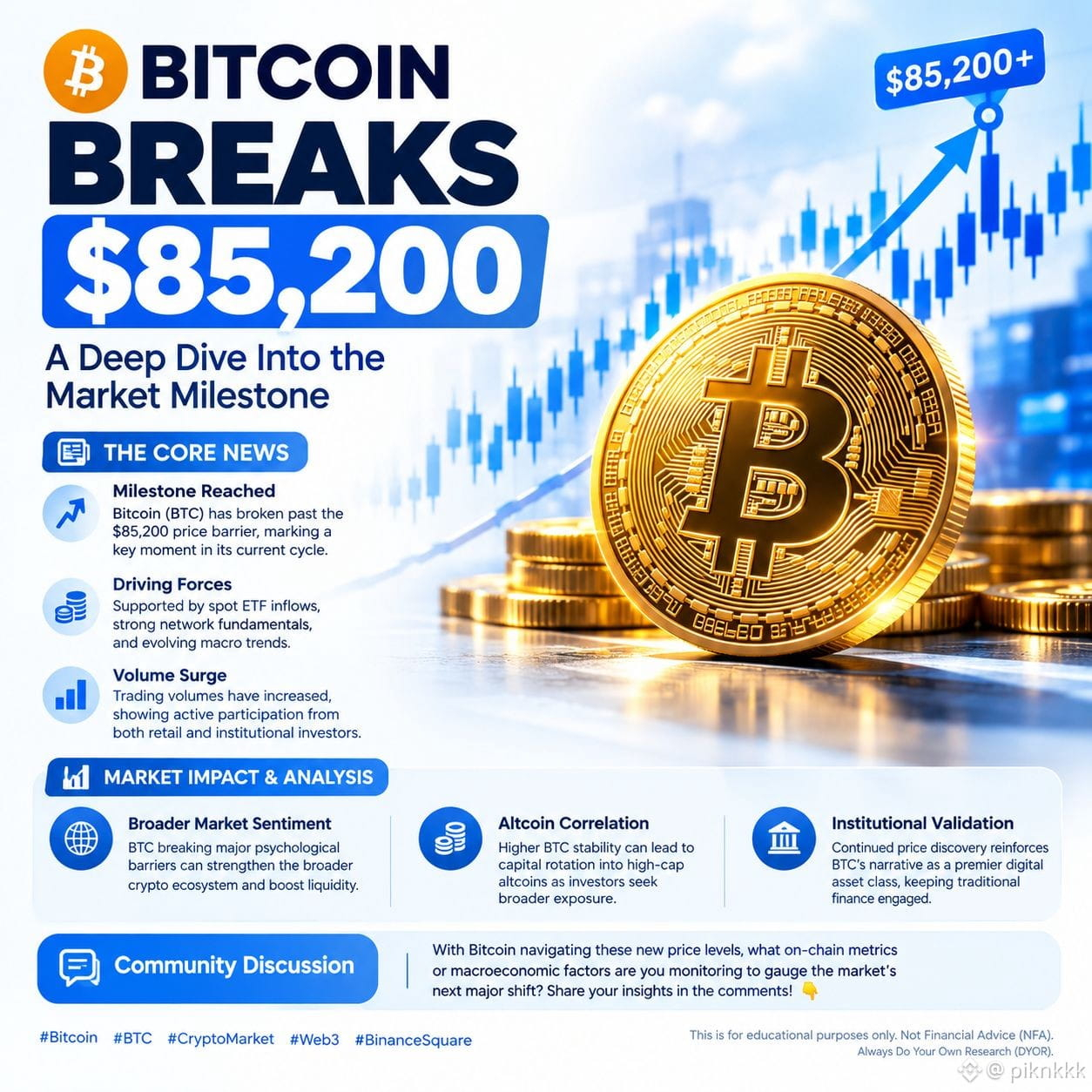
#BitcoinClears$85200 Bitcoin Breaks $85,200: A Deep Dive Into the Market Milestone 📈
Bitcoin has officially cleared the $85,200 threshold, marking a significant moment for the digital asset space. This breakout highlights shifting market dynamics and sustained upward momentum.
📰 The Core News
• Milestone Reached Bitcoin (BTC) has successfully broken past the $85,200 price barrier, establishing new ground in its current market cycle.
• Driving Forces This price action is supported by steady spot ETF inflows, robust network fundamentals, and evolving macroeconomic trends.
• Volume Surge Trading volumes have seen a notable increase, reflecting active and sustained participation across both global retail and institutional sectors.
📊 Market Impact & Analysis
• Broader Market Sentiment BTC breaking major psychological barriers often establishes a stronger foundation for the broader crypto ecosystem, potentially increasing liquidity across the board.
• Altcoin Correlation Historically, Bitcoin's stability at higher price levels can lead to capital rotation into high-cap altcoins as market participants seek broader ecosystem exposure.
• Institutional Validation Continuous price discovery reinforces BTC's narrative as a premier digital asset class, keeping traditional finance deeply engaged in the space.
🗣️ Community Discussion
With Bitcoin navigating these new price levels, what on-chain metrics or macroeconomic factors are you monitoring to gauge the market's next major shift? Share your insights in the comments! 👇
#Bitcoin #BTC #CryptoMarket #Web3 #BinanceSquare
This is for educational purposes only. Not Financial Advice (NFA). Always Do Your Own Research (DYOR).
$GNS $AGPUB $SAGA
{future}(SAGAUSDT)
{spot}(AGPUBUSDT)
{spot}(GNSUSDT)
#BitcoinClears$85200 Bitcoin Breaks $85,200: A Deep Dive Into the Market Milestone 📈
Bitcoin has officially cleared the $85,200 threshold, marking a significant moment for the digital asset space. This breakout highlights shifting market dynamics and sustained upward momentum.
📰 The Core News
• Milestone Reached Bitcoin (BTC) has successfully broken past the $85,200 price barrier, establishing new ground in its current market cycle.
• Driving Forces This price action is supported by steady spot ETF inflows, robust network fundamentals, and evolving macroeconomic trends.
• Volume Surge Trading volumes have seen a notable increase, reflecting active and sustained participation across both global retail and institutional sectors.
📊 Market Impact & Analysis
• Broader Market Sentiment BTC breaking major psychological barriers often establishes a stronger foundation for the broader crypto ecosystem, potentially increasing liquidity across the board.
• Altcoin Correlation Historically, Bitcoin's stability at higher price levels can lead to capital rotation into high-cap altcoins as market participants seek broader ecosystem exposure.
• Institutional Validation Continuous price discovery reinforces BTC's narrative as a premier digital asset class, keeping traditional finance deeply engaged in the space.
🗣️ Community Discussion
With Bitcoin navigating these new price levels, what on-chain metrics or macroeconomic factors are you monitoring to gauge the market's next major shift? Share your insights in the comments! 👇
#Bitcoin #BTC #CryptoMarket #Web3 #BinanceSquare
This is for educational purposes only. Not Financial Advice (NFA). Always Do Your Own Research (DYOR).
$GNS $AGPUB $SAGA
Bitcoin has officially cleared the $85,200 threshold, marking a significant moment for the digital asset space. This breakout highlights shifting market dynamics and sustained upward momentum.
📰 The Core News
• Milestone Reached Bitcoin (BTC) has successfully broken past the $85,200 price barrier, establishing new ground in its current market cycle.
• Driving Forces This price action is supported by steady spot ETF inflows, robust network fundamentals, and evolving macroeconomic trends.
• Volume Surge Trading volumes have seen a notable increase, reflecting active and sustained participation across both global retail and institutional sectors.
📊 Market Impact & Analysis
• Broader Market Sentiment BTC breaking major psychological barriers often establishes a stronger foundation for the broader crypto ecosystem, potentially increasing liquidity across the board.
• Altcoin Correlation Historically, Bitcoin's stability at higher price levels can lead to capital rotation into high-cap altcoins as market participants seek broader ecosystem exposure.
• Institutional Validation Continuous price discovery reinforces BTC's narrative as a premier digital asset class, keeping traditional finance deeply engaged in the space.
🗣️ Community Discussion
With Bitcoin navigating these new price levels, what on-chain metrics or macroeconomic factors are you monitoring to gauge the market's next major shift? Share your insights in the comments! 👇
#Bitcoin #BTC #CryptoMarket #Web3 #BinanceSquare
This is for educational purposes only. Not Financial Advice (NFA). Always Do Your Own Research (DYOR).
$GNS $AGPUB $SAGA
1
2
705
·
--
Baissier
#cftcsubmitstwoeventcontractrulestowhitehouse 🏛️ CFTC Submits Two Pivotal Event Contract Rules to White House
The regulatory landscape for prediction markets is evolving. The U.S. Commodity Futures Trading Commission (CFTC) has submitted two new rules to the White House that could redefine how event contracts are classified and overseen.
Core News What’s Happening
•Rule 1 (Proposed) Explicitly classifies event contracts (yes/no wagers on measurable outcomes like elections, sports or economic data) as swaps placing them under direct CFTC jurisdiction.
Rule 2 (Interim Final) Temporarily excludes casino-style gambling products from the swap definition aiming to draw a clear regulatory boundary between financial derivatives and traditional gambling.
• These proposals are currently undergoing procedural review by the White House Office of Information and Regulatory Affairs (OIRA) before public release and formal comment periods.
📊 Market Impact & Ecosystem Implications
Prediction Market Platforms Platforms facilitating event contracts may face stricter federal compliance requirements which could shape their operational and legal frameworks in the U.S.
•Jurisdictional Clarity This move addresses ongoing legal disputes between federal regulators and state gambling authorities. A unified federal standard could set a major precedent for how crypto-native prediction platforms are treated globally
Institutional Participation Clearer regulatory boundaries may encourage institutional interest in compliant transparent prediction markets while distancing the sector from unregistered gambling activities.
What’s your take?
Do you think clear federal oversight will legitimize and grow prediction markets or could it stifle innovation in this emerging sector? Let’s discuss in the comments below
#CFTC #PredictionMarkets #CryptoRegulation #Web3 #Compliance
This is for educational purposes only. Not Financial Advice (NFA) Always Do Your Own Research (DYOR).
$ARK $GTC $0G
{future}(0GUSDT)
{future}(GTCUSDT)
{future}(ARKUSDT)
#cftcsubmitstwoeventcontractrulestowhitehouse 🏛️ CFTC Submits Two Pivotal Event Contract Rules to White House
The regulatory landscape for prediction markets is evolving. The U.S. Commodity Futures Trading Commission (CFTC) has submitted two new rules to the White House that could redefine how event contracts are classified and overseen.
Core News What’s Happening
•Rule 1 (Proposed) Explicitly classifies event contracts (yes/no wagers on measurable outcomes like elections, sports or economic data) as swaps placing them under direct CFTC jurisdiction.
Rule 2 (Interim Final) Temporarily excludes casino-style gambling products from the swap definition aiming to draw a clear regulatory boundary between financial derivatives and traditional gambling.
• These proposals are currently undergoing procedural review by the White House Office of Information and Regulatory Affairs (OIRA) before public release and formal comment periods.
📊 Market Impact & Ecosystem Implications
Prediction Market Platforms Platforms facilitating event contracts may face stricter federal compliance requirements which could shape their operational and legal frameworks in the U.S.
•Jurisdictional Clarity This move addresses ongoing legal disputes between federal regulators and state gambling authorities. A unified federal standard could set a major precedent for how crypto-native prediction platforms are treated globally
Institutional Participation Clearer regulatory boundaries may encourage institutional interest in compliant transparent prediction markets while distancing the sector from unregistered gambling activities.
What’s your take?
Do you think clear federal oversight will legitimize and grow prediction markets or could it stifle innovation in this emerging sector? Let’s discuss in the comments below
#CFTC #PredictionMarkets #CryptoRegulation #Web3 #Compliance
This is for educational purposes only. Not Financial Advice (NFA) Always Do Your Own Research (DYOR).
$ARK $GTC $0G
The regulatory landscape for prediction markets is evolving. The U.S. Commodity Futures Trading Commission (CFTC) has submitted two new rules to the White House that could redefine how event contracts are classified and overseen.
Core News What’s Happening
•Rule 1 (Proposed) Explicitly classifies event contracts (yes/no wagers on measurable outcomes like elections, sports or economic data) as swaps placing them under direct CFTC jurisdiction.
Rule 2 (Interim Final) Temporarily excludes casino-style gambling products from the swap definition aiming to draw a clear regulatory boundary between financial derivatives and traditional gambling.
• These proposals are currently undergoing procedural review by the White House Office of Information and Regulatory Affairs (OIRA) before public release and formal comment periods.
📊 Market Impact & Ecosystem Implications
Prediction Market Platforms Platforms facilitating event contracts may face stricter federal compliance requirements which could shape their operational and legal frameworks in the U.S.
•Jurisdictional Clarity This move addresses ongoing legal disputes between federal regulators and state gambling authorities. A unified federal standard could set a major precedent for how crypto-native prediction platforms are treated globally
Institutional Participation Clearer regulatory boundaries may encourage institutional interest in compliant transparent prediction markets while distancing the sector from unregistered gambling activities.
What’s your take?
Do you think clear federal oversight will legitimize and grow prediction markets or could it stifle innovation in this emerging sector? Let’s discuss in the comments below
#CFTC #PredictionMarkets #CryptoRegulation #Web3 #Compliance
This is for educational purposes only. Not Financial Advice (NFA) Always Do Your Own Research (DYOR).
$ARK $GTC $0G

3.9k
·
--
Haussier
#micronbeatsearningsliftsguidance 🧠 Micron Beats Earnings & Lifts Guidance: What It Means for the AI Crypto Narrative
Micron Technology just delivered a blockbuster earnings report, shattering expectations and raising forward guidance on the back of surging AI memory demand. Here is how this traditional market milestone could ripple through the crypto ecosystem.
📰 Core News
• Blowout Results Micron significantly exceeded Wall Street estimates for both revenue and earnings per share, driven by unprecedented demand for High Bandwidth Memory (HBM) and DRAM from AI data centers. [[5]]
• Raised Guidance The company lifted its forward-looking revenue and profit guidance, signaling that the AI infrastructure build-out is accelerating and memory supply remains tightly constrained well into the future. [[33]]
📊 Market Impact
How does a traditional semiconductor giant’s success affect digital assets?
• AI Crypto Tokens Strong performance from legacy AI hardware players often validates the broader artificial intelligence narrative. This can reinforce the fundamental use cases and investor interest in decentralized AI, compute, and data protocols (e.g., RENDER, FET, TAO).
•Tokenized Equities (RWAs) Platforms offering tokenized traditional stocks may see increased trading activity as users seek on-chain exposure to this bullish traditional market momentum.
• Macro Sentiment Robust tech earnings generally support a "risk-on" macroeconomic environment, which can indirectly benefit growth-oriented digital assets as institutional confidence in the AI sector strengthens. [34]
💬 Join the Discussion
Do you think the traditional AI hardware boom will continue to fuel the growth of decentralized AI crypto projects, or will these narratives eventually decouple? Share your thoughts below! 👇
#AI #CryptoMarket #RealWorldAssets #Web3 #BinanceSquare
This is for educational purposes only. Not Financial Advice (NFA). Always Do Your Own Research (DYOR).
$HUMA $ESP $OPN
{future}(OPNUSDT)
{future}(ESPUSDT)
{future}(HUMAUSDT)
#micronbeatsearningsliftsguidance 🧠 Micron Beats Earnings & Lifts Guidance: What It Means for the AI Crypto Narrative
Micron Technology just delivered a blockbuster earnings report, shattering expectations and raising forward guidance on the back of surging AI memory demand. Here is how this traditional market milestone could ripple through the crypto ecosystem.
📰 Core News
• Blowout Results Micron significantly exceeded Wall Street estimates for both revenue and earnings per share, driven by unprecedented demand for High Bandwidth Memory (HBM) and DRAM from AI data centers. [[5]]
• Raised Guidance The company lifted its forward-looking revenue and profit guidance, signaling that the AI infrastructure build-out is accelerating and memory supply remains tightly constrained well into the future. [[33]]
📊 Market Impact
How does a traditional semiconductor giant’s success affect digital assets?
• AI Crypto Tokens Strong performance from legacy AI hardware players often validates the broader artificial intelligence narrative. This can reinforce the fundamental use cases and investor interest in decentralized AI, compute, and data protocols (e.g., RENDER, FET, TAO).
•Tokenized Equities (RWAs) Platforms offering tokenized traditional stocks may see increased trading activity as users seek on-chain exposure to this bullish traditional market momentum.
• Macro Sentiment Robust tech earnings generally support a "risk-on" macroeconomic environment, which can indirectly benefit growth-oriented digital assets as institutional confidence in the AI sector strengthens. [34]
💬 Join the Discussion
Do you think the traditional AI hardware boom will continue to fuel the growth of decentralized AI crypto projects, or will these narratives eventually decouple? Share your thoughts below! 👇
#AI #CryptoMarket #RealWorldAssets #Web3 #BinanceSquare
This is for educational purposes only. Not Financial Advice (NFA). Always Do Your Own Research (DYOR).
$HUMA $ESP $OPN
Micron Technology just delivered a blockbuster earnings report, shattering expectations and raising forward guidance on the back of surging AI memory demand. Here is how this traditional market milestone could ripple through the crypto ecosystem.
📰 Core News
• Blowout Results Micron significantly exceeded Wall Street estimates for both revenue and earnings per share, driven by unprecedented demand for High Bandwidth Memory (HBM) and DRAM from AI data centers. [[5]]
• Raised Guidance The company lifted its forward-looking revenue and profit guidance, signaling that the AI infrastructure build-out is accelerating and memory supply remains tightly constrained well into the future. [[33]]
📊 Market Impact
How does a traditional semiconductor giant’s success affect digital assets?
• AI Crypto Tokens Strong performance from legacy AI hardware players often validates the broader artificial intelligence narrative. This can reinforce the fundamental use cases and investor interest in decentralized AI, compute, and data protocols (e.g., RENDER, FET, TAO).
•Tokenized Equities (RWAs) Platforms offering tokenized traditional stocks may see increased trading activity as users seek on-chain exposure to this bullish traditional market momentum.
• Macro Sentiment Robust tech earnings generally support a "risk-on" macroeconomic environment, which can indirectly benefit growth-oriented digital assets as institutional confidence in the AI sector strengthens. [34]
💬 Join the Discussion
Do you think the traditional AI hardware boom will continue to fuel the growth of decentralized AI crypto projects, or will these narratives eventually decouple? Share your thoughts below! 👇
#AI #CryptoMarket #RealWorldAssets #Web3 #BinanceSquare
This is for educational purposes only. Not Financial Advice (NFA). Always Do Your Own Research (DYOR).
$HUMA $ESP $OPN

1
8.2k
·
--
Haussier
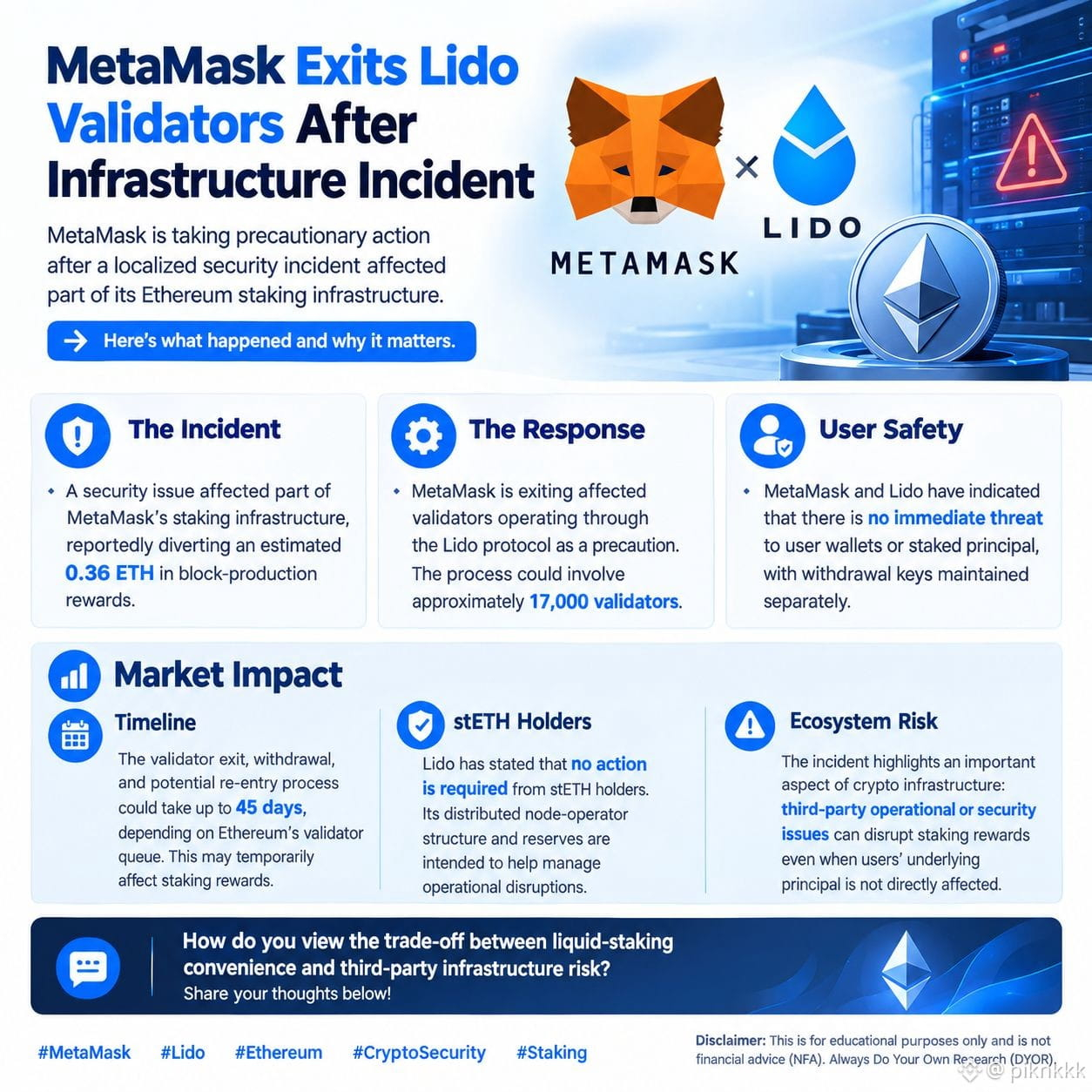
#metamaskexitslidovalidatorsaftersecurityincident MetaMask Exits Lido Validators After Infrastructure Incident
MetaMask is proactively withdrawing affected Ethereum validators from its non-custodial staking operations following a localized infrastructure security incident. Here is the breakdown. 👇
🔹The Incident A security issue affected part of MetaMask’s staking infrastructure, diverting an estimated 0.36 ETH in block-production rewards.
🔹 The Response As a precaution, MetaMask is exiting affected validators on the Lido protocol, potentially involving ~17,000 validators.
🔹 User Safety Both MetaMask and Lido confirm **no immediate threat to user wallets or staked principal as withdrawal keys remain separate and secure.
📊 Market Impact
⏳ Timeline The exit, withdrawal, and re-entry cycle may take up to 45 days due to Ethereum’s validator queue, causing temporary missed rewards.
🛡️ stETH Holders Lido states no action is required. Its diverse node-operator set and reserve funds are designed to absorb such disruptions.
Ecosystem This highlights operational risks in crypto infrastructure, where third-party vulnerabilities can cause yield disruption without direct fund loss.
💬 How do you view the trade-off between liquid staking convenience and third-party operational risks? Share your thoughts below!
#MetaMask #Lido #Ethereum #CryptoSecurity #Staking
This is for educational purposes only. Not Financial Advice (NFA). Always Do Your Own Research (DYOR).'
$STX $JASMY $DUSK
{future}(DUSKUSDT)
{future}(JASMYUSDT)
{future}(STXUSDT)
#metamaskexitslidovalidatorsaftersecurityincident MetaMask Exits Lido Validators After Infrastructure Incident
MetaMask is proactively withdrawing affected Ethereum validators from its non-custodial staking operations following a localized infrastructure security incident. Here is the breakdown. 👇
🔹The Incident A security issue affected part of MetaMask’s staking infrastructure, diverting an estimated 0.36 ETH in block-production rewards.
🔹 The Response As a precaution, MetaMask is exiting affected validators on the Lido protocol, potentially involving ~17,000 validators.
🔹 User Safety Both MetaMask and Lido confirm **no immediate threat to user wallets or staked principal as withdrawal keys remain separate and secure.
📊 Market Impact
⏳ Timeline The exit, withdrawal, and re-entry cycle may take up to 45 days due to Ethereum’s validator queue, causing temporary missed rewards.
🛡️ stETH Holders Lido states no action is required. Its diverse node-operator set and reserve funds are designed to absorb such disruptions.
Ecosystem This highlights operational risks in crypto infrastructure, where third-party vulnerabilities can cause yield disruption without direct fund loss.
💬 How do you view the trade-off between liquid staking convenience and third-party operational risks? Share your thoughts below!
#MetaMask #Lido #Ethereum #CryptoSecurity #Staking
This is for educational purposes only. Not Financial Advice (NFA). Always Do Your Own Research (DYOR).'
$STX $JASMY $DUSK
MetaMask is proactively withdrawing affected Ethereum validators from its non-custodial staking operations following a localized infrastructure security incident. Here is the breakdown. 👇
🔹The Incident A security issue affected part of MetaMask’s staking infrastructure, diverting an estimated 0.36 ETH in block-production rewards.
🔹 The Response As a precaution, MetaMask is exiting affected validators on the Lido protocol, potentially involving ~17,000 validators.
🔹 User Safety Both MetaMask and Lido confirm **no immediate threat to user wallets or staked principal as withdrawal keys remain separate and secure.
📊 Market Impact
⏳ Timeline The exit, withdrawal, and re-entry cycle may take up to 45 days due to Ethereum’s validator queue, causing temporary missed rewards.
🛡️ stETH Holders Lido states no action is required. Its diverse node-operator set and reserve funds are designed to absorb such disruptions.
Ecosystem This highlights operational risks in crypto infrastructure, where third-party vulnerabilities can cause yield disruption without direct fund loss.
💬 How do you view the trade-off between liquid staking convenience and third-party operational risks? Share your thoughts below!
#MetaMask #Lido #Ethereum #CryptoSecurity #Staking
This is for educational purposes only. Not Financial Advice (NFA). Always Do Your Own Research (DYOR).'
$STX $JASMY $DUSK
74
·
--
Haussier
#micronbeatsearningsliftsguidance 📈 Micron Technology Beats Earnings & Lifts Guidance: Crypto Market Implications
The semiconductor giant just delivered a massive earnings beat and raised future guidance, signaling unprecedented demand for AI memory chips. Here’s how this traditional tech milestone could ripple through the crypto ecosystem.
📰 Core News
• Micron Technology recently reported standout quarterly results, significantly beating both revenue and earnings-per-share (EPS) expectations [[1]].
• The company materially exceeded estimates and lifted its forward-looking revenue guidance well above Wall Street models [[4]].
• This growth is primarily driven by robust, insatiable demand for High-Bandwidth Memory (HBM) and advanced memory solutions fueled by the global AI infrastructure boom [[12]].
🌍 Market Impact
• 🤖 AI Crypto Correlation Strong performance in traditional AI hardware validates the ongoing global AI build-out. This often reinforces positive sentiment for decentralized AI, DePIN (Decentralized Physical Infrastructure Networks), and compute-focused crypto protocols.
• 📊 Risk-On Sentiment "Beat-and-raise" scenarios from major tech bellwethers typically support broader market confidence, which can positively influence overall risk appetite across digital assets.
• 💾 Resource Valuation The emerging industry "memory crunch" highlights the critical, growing value of compute and storage resources, directly aligning with the core value proposition of networks that decentralize and tokenize these exact assets.
💬 Join the Discussion
Do you think the surge in traditional AI hardware demand will accelerate the adoption and valuation of decentralized AI and DePIN crypto projects? Share your thoughts below! 👇
#AI #DePIN #CryptoMarket #Semiconductors #BinanceSquare
This is for educational purposes only. Not Financial Advice (NFA). Always Do Your Own Research (DYOR).
$NOM $MOVR $NIGHT
{future}(NIGHTUSDT)
{future}(MOVRUSDT)
{future}(NOMUSDT)
#micronbeatsearningsliftsguidance 📈 Micron Technology Beats Earnings & Lifts Guidance: Crypto Market Implications
The semiconductor giant just delivered a massive earnings beat and raised future guidance, signaling unprecedented demand for AI memory chips. Here’s how this traditional tech milestone could ripple through the crypto ecosystem.
📰 Core News
• Micron Technology recently reported standout quarterly results, significantly beating both revenue and earnings-per-share (EPS) expectations [[1]].
• The company materially exceeded estimates and lifted its forward-looking revenue guidance well above Wall Street models [[4]].
• This growth is primarily driven by robust, insatiable demand for High-Bandwidth Memory (HBM) and advanced memory solutions fueled by the global AI infrastructure boom [[12]].
🌍 Market Impact
• 🤖 AI Crypto Correlation Strong performance in traditional AI hardware validates the ongoing global AI build-out. This often reinforces positive sentiment for decentralized AI, DePIN (Decentralized Physical Infrastructure Networks), and compute-focused crypto protocols.
• 📊 Risk-On Sentiment "Beat-and-raise" scenarios from major tech bellwethers typically support broader market confidence, which can positively influence overall risk appetite across digital assets.
• 💾 Resource Valuation The emerging industry "memory crunch" highlights the critical, growing value of compute and storage resources, directly aligning with the core value proposition of networks that decentralize and tokenize these exact assets.
💬 Join the Discussion
Do you think the surge in traditional AI hardware demand will accelerate the adoption and valuation of decentralized AI and DePIN crypto projects? Share your thoughts below! 👇
#AI #DePIN #CryptoMarket #Semiconductors #BinanceSquare
This is for educational purposes only. Not Financial Advice (NFA). Always Do Your Own Research (DYOR).
$NOM $MOVR $NIGHT
The semiconductor giant just delivered a massive earnings beat and raised future guidance, signaling unprecedented demand for AI memory chips. Here’s how this traditional tech milestone could ripple through the crypto ecosystem.
📰 Core News
• Micron Technology recently reported standout quarterly results, significantly beating both revenue and earnings-per-share (EPS) expectations [[1]].
• The company materially exceeded estimates and lifted its forward-looking revenue guidance well above Wall Street models [[4]].
• This growth is primarily driven by robust, insatiable demand for High-Bandwidth Memory (HBM) and advanced memory solutions fueled by the global AI infrastructure boom [[12]].
🌍 Market Impact
• 🤖 AI Crypto Correlation Strong performance in traditional AI hardware validates the ongoing global AI build-out. This often reinforces positive sentiment for decentralized AI, DePIN (Decentralized Physical Infrastructure Networks), and compute-focused crypto protocols.
• 📊 Risk-On Sentiment "Beat-and-raise" scenarios from major tech bellwethers typically support broader market confidence, which can positively influence overall risk appetite across digital assets.
• 💾 Resource Valuation The emerging industry "memory crunch" highlights the critical, growing value of compute and storage resources, directly aligning with the core value proposition of networks that decentralize and tokenize these exact assets.
💬 Join the Discussion
Do you think the surge in traditional AI hardware demand will accelerate the adoption and valuation of decentralized AI and DePIN crypto projects? Share your thoughts below! 👇
#AI #DePIN #CryptoMarket #Semiconductors #BinanceSquare
This is for educational purposes only. Not Financial Advice (NFA). Always Do Your Own Research (DYOR).
$NOM $MOVR $NIGHT

388
·
--
Baissier
#japanmofstudygroupontokenizedgovtbonds 🇯🇵 Japan’s Ministry of Finance Explores Blockchain Settlement for Government Bonds
A major traditional finance powerhouse is stepping into the blockchain arena. Japan is officially studying the tokenization and blockchain-based settlement of its massive $7 trillion government bond market.
📰 Core News
Japan’s Ministry of Finance (MOF), alongside the Financial Services Agency (FSA) and the Bank of Japan (BOJ), is launching a dedicated study group to examine blockchain-based settlement for Japanese Government Bonds (JGBs) [19]
The first meeting is scheduled for October 8, focusing on building an infrastructure for instant, 24/7 settlement of stocks and bonds [18]
This public-private initiative aims to modernize financial infrastructure, with live operations potentially targeted for the early 2030s [28]
📊 Market Impact
• 🏛️ Institutional Validation A G7 nation exploring blockchain for its sovereign debt signals growing institutional confidence in distributed ledger technology (DLT) for traditional finance (TradFi).
• 📈RWA Sector Growth This move directly aligns with the expanding Real-World Asset (RWA) tokenization narrative. It demonstrates that sovereign entities are seriously evaluating blockchain for operational efficiency, which could further legitimize the broader RWA ecosystem.
Infrastructure Demand The push for instant, 24/7 settlement could drive long-term demand for enterprise-grade blockchain networks, regulated stablecoin settlement layers, and interoperability protocols capable of handling high-volume financial transactions.
💬 Join the Discussion
Do you think government-backed blockchain infrastructure will accelerate mainstream RWA adoption, or will regulatory complexities slow down the process? Share your thoughts below
#RWA #Blockchain #Tokenization #Japan #TradFi
This is for educational purposes only. Not Financial Advice (NFA). Always Do Your Own Research (DYOR).
$SYRUP $CELO $AAVE
{future}(AAVEUSDT)
{future}(CELOUSDT)
{future}(SYRUPUSDT)
#japanmofstudygroupontokenizedgovtbonds 🇯🇵 Japan’s Ministry of Finance Explores Blockchain Settlement for Government Bonds
A major traditional finance powerhouse is stepping into the blockchain arena. Japan is officially studying the tokenization and blockchain-based settlement of its massive $7 trillion government bond market.
📰 Core News
Japan’s Ministry of Finance (MOF), alongside the Financial Services Agency (FSA) and the Bank of Japan (BOJ), is launching a dedicated study group to examine blockchain-based settlement for Japanese Government Bonds (JGBs) [19]
The first meeting is scheduled for October 8, focusing on building an infrastructure for instant, 24/7 settlement of stocks and bonds [18]
This public-private initiative aims to modernize financial infrastructure, with live operations potentially targeted for the early 2030s [28]
📊 Market Impact
• 🏛️ Institutional Validation A G7 nation exploring blockchain for its sovereign debt signals growing institutional confidence in distributed ledger technology (DLT) for traditional finance (TradFi).
• 📈RWA Sector Growth This move directly aligns with the expanding Real-World Asset (RWA) tokenization narrative. It demonstrates that sovereign entities are seriously evaluating blockchain for operational efficiency, which could further legitimize the broader RWA ecosystem.
Infrastructure Demand The push for instant, 24/7 settlement could drive long-term demand for enterprise-grade blockchain networks, regulated stablecoin settlement layers, and interoperability protocols capable of handling high-volume financial transactions.
💬 Join the Discussion
Do you think government-backed blockchain infrastructure will accelerate mainstream RWA adoption, or will regulatory complexities slow down the process? Share your thoughts below
#RWA #Blockchain #Tokenization #Japan #TradFi
This is for educational purposes only. Not Financial Advice (NFA). Always Do Your Own Research (DYOR).
$SYRUP $CELO $AAVE
A major traditional finance powerhouse is stepping into the blockchain arena. Japan is officially studying the tokenization and blockchain-based settlement of its massive $7 trillion government bond market.
📰 Core News
Japan’s Ministry of Finance (MOF), alongside the Financial Services Agency (FSA) and the Bank of Japan (BOJ), is launching a dedicated study group to examine blockchain-based settlement for Japanese Government Bonds (JGBs) [19]
The first meeting is scheduled for October 8, focusing on building an infrastructure for instant, 24/7 settlement of stocks and bonds [18]
This public-private initiative aims to modernize financial infrastructure, with live operations potentially targeted for the early 2030s [28]
📊 Market Impact
• 🏛️ Institutional Validation A G7 nation exploring blockchain for its sovereign debt signals growing institutional confidence in distributed ledger technology (DLT) for traditional finance (TradFi).
• 📈RWA Sector Growth This move directly aligns with the expanding Real-World Asset (RWA) tokenization narrative. It demonstrates that sovereign entities are seriously evaluating blockchain for operational efficiency, which could further legitimize the broader RWA ecosystem.
Infrastructure Demand The push for instant, 24/7 settlement could drive long-term demand for enterprise-grade blockchain networks, regulated stablecoin settlement layers, and interoperability protocols capable of handling high-volume financial transactions.
💬 Join the Discussion
Do you think government-backed blockchain infrastructure will accelerate mainstream RWA adoption, or will regulatory complexities slow down the process? Share your thoughts below
#RWA #Blockchain #Tokenization #Japan #TradFi
This is for educational purposes only. Not Financial Advice (NFA). Always Do Your Own Research (DYOR).
$SYRUP $CELO $AAVE

747
·
--
Baissier
#ukfcaopenscryptofirmauthorization 🇬🇧 UK FCA Officially Opens Crypto Firm Authorization Gateway
The wait is over for regulated digital asset operations in the United Kingdom The Financial Conduct Authority (FCA) has officially opened its authorization application window, marking a major milestone for institutional crypto adoption and consumer protection.
Core News
Gateway Open The FCA began accepting crypto asset firm authorization applications on September 30 2026 [26]
Strict Deadline Firms have until February 28 2027 to submit their applications to operate legally under the new regulatory framework [43]
2027 Rollout This structured regime will fully take effect in October 2027 setting clear comprehensive rules for crypto asset activities [2]
Consumer Protection This proactive step follows the FCA’s ongoing efforts to safeguard investors which recently included blocking over 1,600 websites suspected of promoting unauthorized financial services [41]
📊Market & Ecosystem Impact
Institutional Confidence A clear, rules-based pathway reduces regulatory ambiguity This may encourage traditional finance (TradFi) institutions to expand their digital asset offerings in the UK market
Ecosystem Consolidation Higher compliance standards will likely raise the operational bar. While this may challenge smaller startups it effectively filters out bad actors, fostering a safer more trustworthy environment for all participants.
Global Benchmark The UK’s phased approach provides a valuable blueprint for other major economies striving to balance technological innovation with robust consumer protection.
Join the Discussion
Do you believe clearer stricter regulations will accelerate mainstream crypto adoption or will they create too high a barrier for innovative startups? Share your thoughts in the comments below
#CryptoRegulation #UKFCA #DigitalAssets #CryptoCompliance #BinanceSquare
This is for educational purposes only. Not Financial Advice (NFA). Always Do Your Own Research (DYOR).
$NMR $SKL $AGPUB
{spot}(AGPUBUSDT)
{future}(NMRUSDT)
#ukfcaopenscryptofirmauthorization 🇬🇧 UK FCA Officially Opens Crypto Firm Authorization Gateway
The wait is over for regulated digital asset operations in the United Kingdom The Financial Conduct Authority (FCA) has officially opened its authorization application window, marking a major milestone for institutional crypto adoption and consumer protection.
Core News
Gateway Open The FCA began accepting crypto asset firm authorization applications on September 30 2026 [26]
Strict Deadline Firms have until February 28 2027 to submit their applications to operate legally under the new regulatory framework [43]
2027 Rollout This structured regime will fully take effect in October 2027 setting clear comprehensive rules for crypto asset activities [2]
Consumer Protection This proactive step follows the FCA’s ongoing efforts to safeguard investors which recently included blocking over 1,600 websites suspected of promoting unauthorized financial services [41]
📊Market & Ecosystem Impact
Institutional Confidence A clear, rules-based pathway reduces regulatory ambiguity This may encourage traditional finance (TradFi) institutions to expand their digital asset offerings in the UK market
Ecosystem Consolidation Higher compliance standards will likely raise the operational bar. While this may challenge smaller startups it effectively filters out bad actors, fostering a safer more trustworthy environment for all participants.
Global Benchmark The UK’s phased approach provides a valuable blueprint for other major economies striving to balance technological innovation with robust consumer protection.
Join the Discussion
Do you believe clearer stricter regulations will accelerate mainstream crypto adoption or will they create too high a barrier for innovative startups? Share your thoughts in the comments below
#CryptoRegulation #UKFCA #DigitalAssets #CryptoCompliance #BinanceSquare
This is for educational purposes only. Not Financial Advice (NFA). Always Do Your Own Research (DYOR).
$NMR $SKL $AGPUB
The wait is over for regulated digital asset operations in the United Kingdom The Financial Conduct Authority (FCA) has officially opened its authorization application window, marking a major milestone for institutional crypto adoption and consumer protection.
Core News
Gateway Open The FCA began accepting crypto asset firm authorization applications on September 30 2026 [26]
Strict Deadline Firms have until February 28 2027 to submit their applications to operate legally under the new regulatory framework [43]
2027 Rollout This structured regime will fully take effect in October 2027 setting clear comprehensive rules for crypto asset activities [2]
Consumer Protection This proactive step follows the FCA’s ongoing efforts to safeguard investors which recently included blocking over 1,600 websites suspected of promoting unauthorized financial services [41]
📊Market & Ecosystem Impact
Institutional Confidence A clear, rules-based pathway reduces regulatory ambiguity This may encourage traditional finance (TradFi) institutions to expand their digital asset offerings in the UK market
Ecosystem Consolidation Higher compliance standards will likely raise the operational bar. While this may challenge smaller startups it effectively filters out bad actors, fostering a safer more trustworthy environment for all participants.
Global Benchmark The UK’s phased approach provides a valuable blueprint for other major economies striving to balance technological innovation with robust consumer protection.
Join the Discussion
Do you believe clearer stricter regulations will accelerate mainstream crypto adoption or will they create too high a barrier for innovative startups? Share your thoughts in the comments below
#CryptoRegulation #UKFCA #DigitalAssets #CryptoCompliance #BinanceSquare
This is for educational purposes only. Not Financial Advice (NFA). Always Do Your Own Research (DYOR).
$NMR $SKL $AGPUB

1
629
·
--
Baissier
#uscorepceeasesto3%inaugust 📉 US Core PCE Eases to 3% in August: What It Means for Crypto Markets
The Federal Reserve’s preferred inflation gauge just showed signs of cooling. Here’s how this macroeconomic shift could ripple through the digital asset ecosystem.
📰 Core News
• The US Core Personal Consumption Expenditures (PCE) Price Index eased to a 3.0% year-on-year rate in August [[4]].
• This reading came in below the market consensus of 3.3%, marking the lowest level since February [[4]].
• Core PCE excludes volatile food and energy prices, making it a critical metric for evaluating underlying inflation and the Fed’s monetary policy direction [[15]].
📊 Market Impact
• Macro Sentiment Lower-than-expected inflation reduces pressure on the Federal Reserve to maintain restrictive interest rate policies, potentially fostering a more risk-on macroeconomic environment.
•Digital Assets Historically, cooling inflation metrics are viewed favorably by flagship assets like Bitcoin (BTC) and Ethereum (ETH), as they support narratives around eventual monetary easing or rate stability.
•Liquidity Outlook A softer inflation backdrop may gradually improve global market liquidity, which often correlates with increased activity in DeFi protocols and broader crypto ecosystems over the medium term.
💬 Join the Discussion
How do you think a cooling inflation trend will influence the Fed’s next policy move and overall crypto market momentum? Share your analysis in the comments below!
#CryptoNews #Macroeconomics #Bitcoin #PCE #CryptoMarket
This is for educational purposes only. Not Financial Advice (NFA). Always Do Your Own Research (DYOR).
$CBRSB $0G $ONE
{future}(ONEUSDT)
{future}(0GUSDT)
{spot}(CBRSBUSDT)
#uscorepceeasesto3%inaugust 📉 US Core PCE Eases to 3% in August: What It Means for Crypto Markets
The Federal Reserve’s preferred inflation gauge just showed signs of cooling. Here’s how this macroeconomic shift could ripple through the digital asset ecosystem.
📰 Core News
• The US Core Personal Consumption Expenditures (PCE) Price Index eased to a 3.0% year-on-year rate in August [[4]].
• This reading came in below the market consensus of 3.3%, marking the lowest level since February [[4]].
• Core PCE excludes volatile food and energy prices, making it a critical metric for evaluating underlying inflation and the Fed’s monetary policy direction [[15]].
📊 Market Impact
• Macro Sentiment Lower-than-expected inflation reduces pressure on the Federal Reserve to maintain restrictive interest rate policies, potentially fostering a more risk-on macroeconomic environment.
•Digital Assets Historically, cooling inflation metrics are viewed favorably by flagship assets like Bitcoin (BTC) and Ethereum (ETH), as they support narratives around eventual monetary easing or rate stability.
•Liquidity Outlook A softer inflation backdrop may gradually improve global market liquidity, which often correlates with increased activity in DeFi protocols and broader crypto ecosystems over the medium term.
💬 Join the Discussion
How do you think a cooling inflation trend will influence the Fed’s next policy move and overall crypto market momentum? Share your analysis in the comments below!
#CryptoNews #Macroeconomics #Bitcoin #PCE #CryptoMarket
This is for educational purposes only. Not Financial Advice (NFA). Always Do Your Own Research (DYOR).
$CBRSB $0G $ONE
The Federal Reserve’s preferred inflation gauge just showed signs of cooling. Here’s how this macroeconomic shift could ripple through the digital asset ecosystem.
📰 Core News
• The US Core Personal Consumption Expenditures (PCE) Price Index eased to a 3.0% year-on-year rate in August [[4]].
• This reading came in below the market consensus of 3.3%, marking the lowest level since February [[4]].
• Core PCE excludes volatile food and energy prices, making it a critical metric for evaluating underlying inflation and the Fed’s monetary policy direction [[15]].
📊 Market Impact
• Macro Sentiment Lower-than-expected inflation reduces pressure on the Federal Reserve to maintain restrictive interest rate policies, potentially fostering a more risk-on macroeconomic environment.
•Digital Assets Historically, cooling inflation metrics are viewed favorably by flagship assets like Bitcoin (BTC) and Ethereum (ETH), as they support narratives around eventual monetary easing or rate stability.
•Liquidity Outlook A softer inflation backdrop may gradually improve global market liquidity, which often correlates with increased activity in DeFi protocols and broader crypto ecosystems over the medium term.
💬 Join the Discussion
How do you think a cooling inflation trend will influence the Fed’s next policy move and overall crypto market momentum? Share your analysis in the comments below!
#CryptoNews #Macroeconomics #Bitcoin #PCE #CryptoMarket
This is for educational purposes only. Not Financial Advice (NFA). Always Do Your Own Research (DYOR).
$CBRSB $0G $ONE

3
·
--
Haussier
#usadpadds90000jobsinseptember 📊 US Private Sector Adds 90,000 Jobs in September: What This Means for Crypto Markets
The latest US labor data is in, painting a clearer picture of the current macroeconomic landscape. Here’s a breakdown of how September’s employment report could influence the broader crypto ecosystem.
📰 Core News
• According to the latest ADP National Employment Report, the US private sector added 90,000 jobs in September 2026 [[1]].
• This figure surpassed market expectations, which had forecasted approximately 68,000 to 70,000 new jobs [[3]].
• The data highlights a resilient labor market, marking a notable improvement from the previously revised 36,000 jobs added in August [[10]].
📈 Market Impact
• Macro & Policy Outlook A stronger-than-expected jobs report signals economic resilience, which is a critical metric the Federal Reserve monitors when evaluating future interest rate policies.
• Digital Asset Volatility Cryptocurrencies often react to shifts in macroeconomic liquidity expectations. A robust labor market may lead traders to reassess the timeline for monetary policy adjustments, which can trigger short-term volatility in Bitcoin and major altcoins.
• Ecosystem Stability Steady macroeconomic fundamentals can provide a stable backdrop for ongoing institutional participation and sustained on-chain activity, independent of short-term price fluctuations.
💬 Join the Discussion
How do you think a resilient US labor market will influence the Fed’s next policy moves and the broader crypto market? Share your analysis in the comments below!
🔖 Tags
#CryptoNews #Macroeconomics #Bitcoin #ADPReport #CryptoMarket
This is for educational purposes only. Not Financial Advice (NFA). Always Do Your Own Research (DYOR).
$NOM $REZ $SOMI
{future}(SOMIUSDT)
{future}(REZUSDT)
{future}(NOMUSDT)
#usadpadds90000jobsinseptember 📊 US Private Sector Adds 90,000 Jobs in September: What This Means for Crypto Markets
The latest US labor data is in, painting a clearer picture of the current macroeconomic landscape. Here’s a breakdown of how September’s employment report could influence the broader crypto ecosystem.
📰 Core News
• According to the latest ADP National Employment Report, the US private sector added 90,000 jobs in September 2026 [[1]].
• This figure surpassed market expectations, which had forecasted approximately 68,000 to 70,000 new jobs [[3]].
• The data highlights a resilient labor market, marking a notable improvement from the previously revised 36,000 jobs added in August [[10]].
📈 Market Impact
• Macro & Policy Outlook A stronger-than-expected jobs report signals economic resilience, which is a critical metric the Federal Reserve monitors when evaluating future interest rate policies.
• Digital Asset Volatility Cryptocurrencies often react to shifts in macroeconomic liquidity expectations. A robust labor market may lead traders to reassess the timeline for monetary policy adjustments, which can trigger short-term volatility in Bitcoin and major altcoins.
• Ecosystem Stability Steady macroeconomic fundamentals can provide a stable backdrop for ongoing institutional participation and sustained on-chain activity, independent of short-term price fluctuations.
💬 Join the Discussion
How do you think a resilient US labor market will influence the Fed’s next policy moves and the broader crypto market? Share your analysis in the comments below!
🔖 Tags
#CryptoNews #Macroeconomics #Bitcoin #ADPReport #CryptoMarket
This is for educational purposes only. Not Financial Advice (NFA). Always Do Your Own Research (DYOR).
$NOM $REZ $SOMI
The latest US labor data is in, painting a clearer picture of the current macroeconomic landscape. Here’s a breakdown of how September’s employment report could influence the broader crypto ecosystem.
📰 Core News
• According to the latest ADP National Employment Report, the US private sector added 90,000 jobs in September 2026 [[1]].
• This figure surpassed market expectations, which had forecasted approximately 68,000 to 70,000 new jobs [[3]].
• The data highlights a resilient labor market, marking a notable improvement from the previously revised 36,000 jobs added in August [[10]].
📈 Market Impact
• Macro & Policy Outlook A stronger-than-expected jobs report signals economic resilience, which is a critical metric the Federal Reserve monitors when evaluating future interest rate policies.
• Digital Asset Volatility Cryptocurrencies often react to shifts in macroeconomic liquidity expectations. A robust labor market may lead traders to reassess the timeline for monetary policy adjustments, which can trigger short-term volatility in Bitcoin and major altcoins.
• Ecosystem Stability Steady macroeconomic fundamentals can provide a stable backdrop for ongoing institutional participation and sustained on-chain activity, independent of short-term price fluctuations.
💬 Join the Discussion
How do you think a resilient US labor market will influence the Fed’s next policy moves and the broader crypto market? Share your analysis in the comments below!
🔖 Tags
#CryptoNews #Macroeconomics #Bitcoin #ADPReport #CryptoMarket
This is for educational purposes only. Not Financial Advice (NFA). Always Do Your Own Research (DYOR).
$NOM $REZ $SOMI
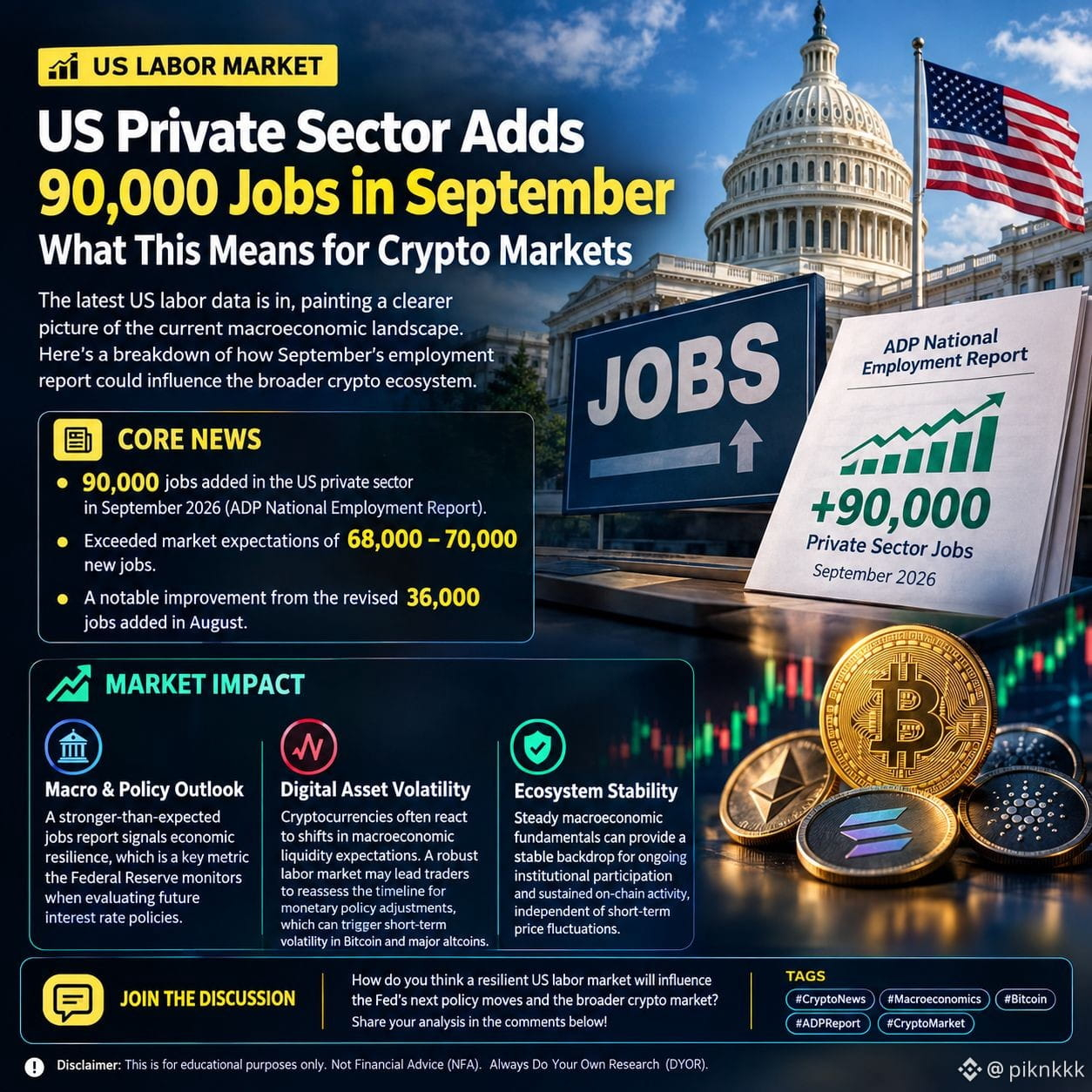
1k
·
--
Haussier
#altcoinseasonindexholdsabove60for5days Altcoin Season Index Sustains Momentum Above 60 for Five Consecutive Days 📊
Is the market shifting its focus away from Bitcoin? The latest on-chain metrics suggest that altcoins are quietly gathering significant structural strength.
Core News
According to recent market data, the Altcoin Season Index has successfully held above the crucial 60-mark for five straight days. This metric tracks the performance of the top cryptocurrencies compared to Bitcoin over a set period. Concurrently, the broader altcoin market capitalization is hovering near the $1.6 trillion (1600 billion) milestone. Sustaining a level above 60 indicates that a significant portion of major altcoins are outperforming BTC, signaling a potential shift in market liquidity.
Market Impact
Here is what this trend could mean for the broader crypto ecosystem:
🔹 Liquidity Rotation A sustained index above 60 often precedes broader liquidity rotation from large-cap assets into mid-cap and large-cap altcoins.
🔹Sector Strength This momentum frequently benefits key altcoin sectors, including DeFi, Layer-1/Layer-2 scaling solutions, and AI-related projects.
🔹Trading Volume Increased altcoin participation typically leads to higher trading volumes across exchanges, driving up on-chain activity and network utility.
Which altcoin sectors are you watching most closely during this period of market rotation? Let’s discuss in the comments below! 👇
This is for educational purposes only. Not Financial Advice (NFA). Always Do Your Own Research (DYOR).
#AltcoinSeason #CryptoMarket #Altcoins #CryptoAnalysis
$EPIC $BERA $GLMR
{spot}(GLMRUSDT)
{future}(BERAUSDT)
{future}(EPICUSDT)
#altcoinseasonindexholdsabove60for5days Altcoin Season Index Sustains Momentum Above 60 for Five Consecutive Days 📊
Is the market shifting its focus away from Bitcoin? The latest on-chain metrics suggest that altcoins are quietly gathering significant structural strength.
Core News
According to recent market data, the Altcoin Season Index has successfully held above the crucial 60-mark for five straight days. This metric tracks the performance of the top cryptocurrencies compared to Bitcoin over a set period. Concurrently, the broader altcoin market capitalization is hovering near the $1.6 trillion (1600 billion) milestone. Sustaining a level above 60 indicates that a significant portion of major altcoins are outperforming BTC, signaling a potential shift in market liquidity.
Market Impact
Here is what this trend could mean for the broader crypto ecosystem:
🔹 Liquidity Rotation A sustained index above 60 often precedes broader liquidity rotation from large-cap assets into mid-cap and large-cap altcoins.
🔹Sector Strength This momentum frequently benefits key altcoin sectors, including DeFi, Layer-1/Layer-2 scaling solutions, and AI-related projects.
🔹Trading Volume Increased altcoin participation typically leads to higher trading volumes across exchanges, driving up on-chain activity and network utility.
Which altcoin sectors are you watching most closely during this period of market rotation? Let’s discuss in the comments below! 👇
This is for educational purposes only. Not Financial Advice (NFA). Always Do Your Own Research (DYOR).
#AltcoinSeason #CryptoMarket #Altcoins #CryptoAnalysis
$EPIC $BERA $GLMR
Is the market shifting its focus away from Bitcoin? The latest on-chain metrics suggest that altcoins are quietly gathering significant structural strength.
Core News
According to recent market data, the Altcoin Season Index has successfully held above the crucial 60-mark for five straight days. This metric tracks the performance of the top cryptocurrencies compared to Bitcoin over a set period. Concurrently, the broader altcoin market capitalization is hovering near the $1.6 trillion (1600 billion) milestone. Sustaining a level above 60 indicates that a significant portion of major altcoins are outperforming BTC, signaling a potential shift in market liquidity.
Market Impact
Here is what this trend could mean for the broader crypto ecosystem:
🔹 Liquidity Rotation A sustained index above 60 often precedes broader liquidity rotation from large-cap assets into mid-cap and large-cap altcoins.
🔹Sector Strength This momentum frequently benefits key altcoin sectors, including DeFi, Layer-1/Layer-2 scaling solutions, and AI-related projects.
🔹Trading Volume Increased altcoin participation typically leads to higher trading volumes across exchanges, driving up on-chain activity and network utility.
Which altcoin sectors are you watching most closely during this period of market rotation? Let’s discuss in the comments below! 👇
This is for educational purposes only. Not Financial Advice (NFA). Always Do Your Own Research (DYOR).
#AltcoinSeason #CryptoMarket #Altcoins #CryptoAnalysis
$EPIC $BERA $GLMR

6
·
--
Haussier
#BitcoinClears$85200 Bitcoin Surges Past $85,200 Key Market Levels and Ecosystem Impact
Bitcoin has officially cleared the $85,200 resistance level, marking a significant technical milestone. Here is a breakdown of what this price action means for the broader crypto ecosystem. ⚡
📰Core News
Bitcoin (BTC) has successfully broken above the $85,200 price level, accompanied by notable trading volume. This breakout signifies strong buyer momentum and a structural shift in the market, clearing a major psychological and technical resistance zone.
📊 Market Impact
• Bitcoin Dominance A sustained hold above this level could temporarily increase BTC dominance, as institutional and retail capital often gravitates toward the market leader during major breakouts.
• Altcoin Rotation Historically, decisive BTC price discoveries eventually lead to capital rotation into large-cap altcoins and decentralized finance (DeFi) ecosystems, though a brief consolidation phase is common before this occurs.
•Derivatives & Liquidity Clearing this threshold may trigger cascading short liquidations, adding to upward volatility. Traders will now be monitoring for new resistance zones and watching to see if previous resistance levels hold as new support.
💬 Join the Discussion
Do you think Bitcoin will consolidate at this new level to build support, or are we observing the start of a sustained macro trend? Share your technical outlook and key levels you are watching below! 👇
#Bitcoin #BTC #CryptoMarket #MarketAnalysis #BinanceSquare
This is for educational purposes only. Not Financial Advice (NFA). Always Do Your Own Research (DYOR).
$MOVR $ARK $QNT
{future}(QNTUSDT)
{future}(ARKUSDT)
{future}(MOVRUSDT)
#BitcoinClears$85200 Bitcoin Surges Past $85,200 Key Market Levels and Ecosystem Impact
Bitcoin has officially cleared the $85,200 resistance level, marking a significant technical milestone. Here is a breakdown of what this price action means for the broader crypto ecosystem. ⚡
📰Core News
Bitcoin (BTC) has successfully broken above the $85,200 price level, accompanied by notable trading volume. This breakout signifies strong buyer momentum and a structural shift in the market, clearing a major psychological and technical resistance zone.
📊 Market Impact
• Bitcoin Dominance A sustained hold above this level could temporarily increase BTC dominance, as institutional and retail capital often gravitates toward the market leader during major breakouts.
• Altcoin Rotation Historically, decisive BTC price discoveries eventually lead to capital rotation into large-cap altcoins and decentralized finance (DeFi) ecosystems, though a brief consolidation phase is common before this occurs.
•Derivatives & Liquidity Clearing this threshold may trigger cascading short liquidations, adding to upward volatility. Traders will now be monitoring for new resistance zones and watching to see if previous resistance levels hold as new support.
💬 Join the Discussion
Do you think Bitcoin will consolidate at this new level to build support, or are we observing the start of a sustained macro trend? Share your technical outlook and key levels you are watching below! 👇
#Bitcoin #BTC #CryptoMarket #MarketAnalysis #BinanceSquare
This is for educational purposes only. Not Financial Advice (NFA). Always Do Your Own Research (DYOR).
$MOVR $ARK $QNT
Bitcoin has officially cleared the $85,200 resistance level, marking a significant technical milestone. Here is a breakdown of what this price action means for the broader crypto ecosystem. ⚡
📰Core News
Bitcoin (BTC) has successfully broken above the $85,200 price level, accompanied by notable trading volume. This breakout signifies strong buyer momentum and a structural shift in the market, clearing a major psychological and technical resistance zone.
📊 Market Impact
• Bitcoin Dominance A sustained hold above this level could temporarily increase BTC dominance, as institutional and retail capital often gravitates toward the market leader during major breakouts.
• Altcoin Rotation Historically, decisive BTC price discoveries eventually lead to capital rotation into large-cap altcoins and decentralized finance (DeFi) ecosystems, though a brief consolidation phase is common before this occurs.
•Derivatives & Liquidity Clearing this threshold may trigger cascading short liquidations, adding to upward volatility. Traders will now be monitoring for new resistance zones and watching to see if previous resistance levels hold as new support.
💬 Join the Discussion
Do you think Bitcoin will consolidate at this new level to build support, or are we observing the start of a sustained macro trend? Share your technical outlook and key levels you are watching below! 👇
#Bitcoin #BTC #CryptoMarket #MarketAnalysis #BinanceSquare
This is for educational purposes only. Not Financial Advice (NFA). Always Do Your Own Research (DYOR).
$MOVR $ARK $QNT
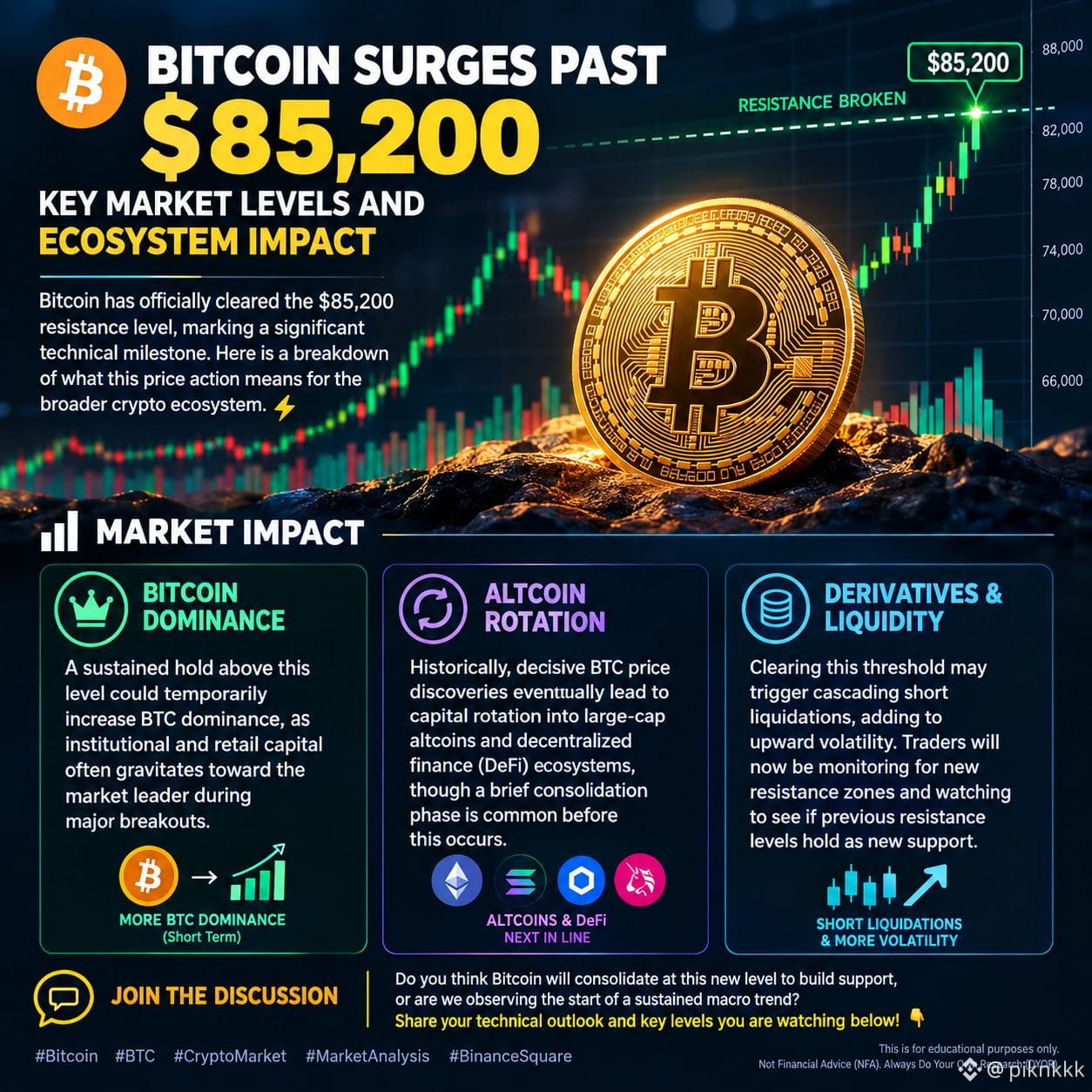
2
Connectez-vous pour découvrir plus de contenu
Rejoignez la communauté mondiale des adeptes de cryptomonnaies sur Binance Square
⚡️ Suviez les dernières informations importantes sur les cryptomonnaies.
💬 Jugé digne de confiance par la plus grande plateforme d’échange de cryptomonnaies au monde.
👍 Découvrez les connaissances que partagent les créateurs vérifiés.
Adresse e-mail/Nº de téléphone
Sujets d’actualité
EtherGains70.9%InQ3
143,184 vues
1,120 mentions
One of the best third quarters in history 💰
September closed out last night, and with it, the quarter. For the quarter, BTC is up 42%—the second-best Q3 on record. ETH had a record-breaking Q3 overall, up 70%.
Looking at the chart, things are still looking good: we’re holding support, but we’re testing it more and more often. Plus, ETF momentum is weakening — inflows are gradually declining, and yesterday saw outflows for the first time in a long while.
Yes, historically, October has been a good month for crypto — it’s not called “Uptober” for nothing. But it’s also one of the most volatile months. Last year, for example, we managed to hit a new all-time high (ATH) and experience a flash crash.
🚀 High Accuracy Trades.
$BTC
$ETH
$SOL
#EtherGains70.9%InQ3 #DollarIndexHitsHighestSinceMay2025 #CFTCSubmitsTwoEventContractRulesToWhiteHouse #MicronBeatsEarningsLiftsGuidance
Knowledge is Power
·0 mentions J’aime
·229 vues
TreasuryLetsStatesFileStablecoinCertificationsEarly
7,586 vues
78 mentions
US10YearYieldNears5.3%
146,431 vues
1,117 mentions