
CoinPulseHq
431 Publications

CoinPulseHq
Signaler
Bloquer l’utilisateur
CoinPulseHQ is an independent digital newsroom covering cryptocurrency, blockchain and artificial intelligence.
3 Suivis
14 Abonnés
19 J’aime
Publications
·
--
Article
Voir la traduction
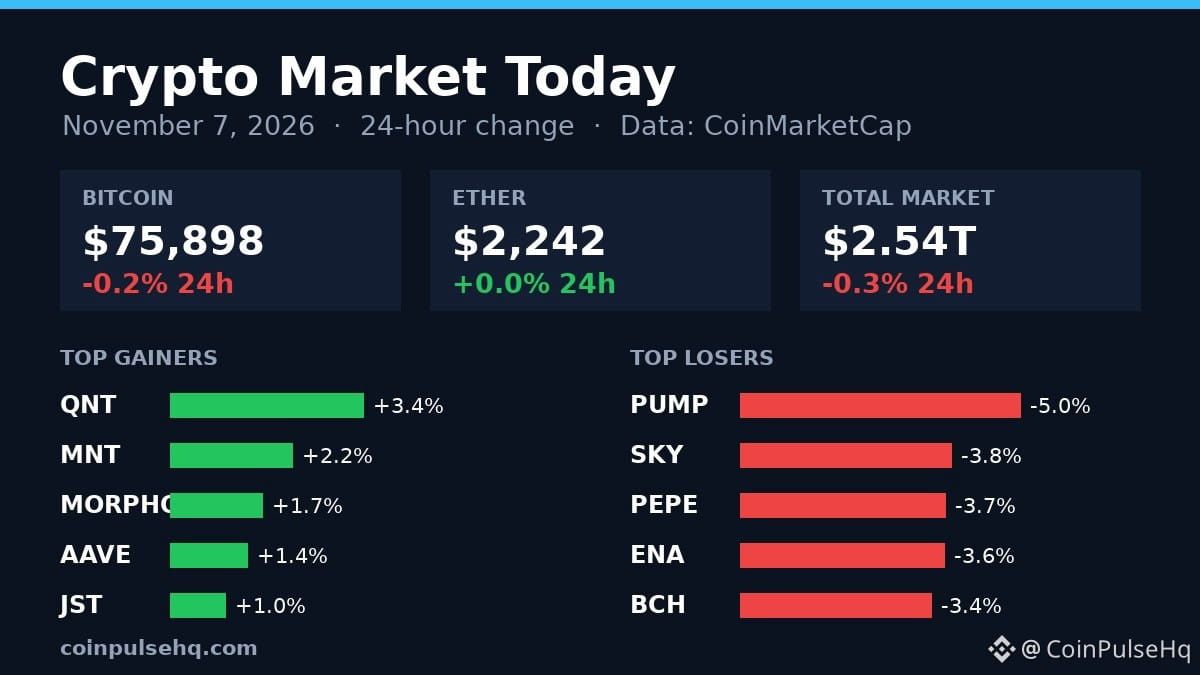
Crypto Market Today, Nov 7, 2026: Bitcoin Steady Near $75.9K as Quant Jumps 3%The crypto market was little changed over the past 24 hours. Total market value moved -0.3% to $2.54 trillion as of 13:00 UTC on Saturday, November 7, 2026. Bitcoin traded at $75,898 (-0.2%) and Ether at $2,242 (+0.0%). 14 of the 50 largest coins were higher, and the median move was -0.9%.
Why is crypto flat today? What the numbers show
• Breadth. There was no clear direction: 14 of 50 large coins rose and 36 fell, so gains in some coins offset losses in others.
• Bitcoin versus altcoins. Only 17 of the other 49 large coins did better than Bitcoin, so money favoured the largest asset. Bitcoin dominance stands at 60.0%, and Ether outperformed Bitcoin by 0.3 percentage points.
• Trading activity. 24-hour volume across the market was $53.1 billion, down 51.4% on the previous day. Volume did not change sharply, so the move was not driven by a surge of trading.
• Bitcoin's 24-hour range. From $75,105 (15:05 UTC, Nov 6) to $76,125 (09:00 UTC), a 1.4% swing. The high came after the low.
Stocks, the dollar and gold
Crypto often trades alongside other risk assets. Latest session for each (the date is the market's last close or update):
Market Level Change As of
S&P 500 7,376.86 +0.3% Nov 6
Nasdaq Composite 24,579.43 +1.1% Nov 6
US dollar index 102.28 +0.7% Nov 6
Gold 4,079.50 -0.8% Nov 7
US 10-year Treasury yield 4.859% +2.2 bp Nov 6
Biggest movers in the top 50
Gainers
Coin Price 24 hours 7 days
Quant (QNT) $196.78 +3.4% +0.2%
Mantle (MNT) $0.4535 +2.2% -4.4%
Morpho (MORPHO) $2.12 +1.7% -1.9%
Aave (AAVE) $131.73 +1.4% -1.4%
JUST (JST) $0.1427 +1.0% +3.7%
Losers
Coin Price 24 hours 7 days
Pump.fun (PUMP) $0.003803 -5.0% -7.8%
Sky (SKY) $0.06382 -3.8% -6.1%
Pepe (PEPE) $0.0000049 -3.7% -2.9%
Ethena (ENA) $0.1605 -3.6% -16.1%
Bitcoin Cash (BCH) $258.55 -3.4% -10.9%
The stories behind today's moves
What CoinPulseHQ reported in the past 24 hours:
• Crypto ETFs Shed $530M as Wall Street Rout Hits Bitcoin — Bitcoin and Ether spot ETFs lost $530M on November 5, 2026 as a Wall Street rout wiped out trillions in stock market value and sent BTC below $76,000.
• Bitcoin drops below $75K as jobs data lifts Fed hike odds — Bitcoin fell to $74,762, its lowest since Aug. 21, after October payrolls beat forecasts and December rate-hike odds rose to 76.8%.
• Magnificent 7 Lose $1 Trillion; Devere CEO Sees More Selective Market — Magnificent 7 lost over $1 trillion on Nov 5, 2026; Devere CEO Nigel Green says the era of buying all seven as one trade is over.
• Russia caps retail crypto buying at 300,000 rubles from Nov. 17 — Russia's central bank set final crypto trading rules on Nov. 6, capping retail buyers at 300,000 rubles per intermediary from Nov. 17.
• Strive Posts $509M Q3 Profit on Bitcoin Gains — Strive posted $509M Q3 net income on $533.7M in unrealized bitcoin gains and held 43,124 BTC by Nov. 2, while American Bitcoin reported $126M profit.
Live prices for the top 50 coins are on our Markets page, and today's biggest movers are on top crypto gainers and losers. Every daily report is collected on Crypto Market Today, and the previous one is Why Is Crypto Down Today, Nov 6, 2026? Bitcoin Falls 4.7% to $76.2K. For the bigger picture, read our weekly market wraps, and if you are wondering about trading hours, see is the crypto market open on weekends.
How this report is made
CoinPulseHQ calculates every figure in this report from CoinMarketCap and CoinGecko market data recorded at 13:00 UTC on Saturday, November 7, 2026, and stock, dollar, gold and bond levels from CNBC quotes. Stablecoins and wrapped or staked versions of other coins are left out of the rankings. Changes are over the previous 24 hours. The report describes what prices did and which measurable factors moved with them; it does not claim a single cause and does not predict prices. It is not financial advice.
Originally published on CoinPulseHQ: https://coinpulsehq.com/crypto-market-today-2026-11-07/?utm_source=binance_square&utm_medium=social&utm_campaign=auto_post
Crypto Market Today, Nov 7, 2026: Bitcoin Steady Near $75.9K as Quant Jumps 3%
The crypto market was little changed over the past 24 hours. Total market value moved -0.3% to $2.54 trillion as of 13:00 UTC on Saturday, November 7, 2026. Bitcoin traded at $75,898 (-0.2%) and Ether at $2,242 (+0.0%). 14 of the 50 largest coins were higher, and the median move was -0.9%.
Why is crypto flat today? What the numbers show
• Breadth. There was no clear direction: 14 of 50 large coins rose and 36 fell, so gains in some coins offset losses in others.
• Bitcoin versus altcoins. Only 17 of the other 49 large coins did better than Bitcoin, so money favoured the largest asset. Bitcoin dominance stands at 60.0%, and Ether outperformed Bitcoin by 0.3 percentage points.
• Trading activity. 24-hour volume across the market was $53.1 billion, down 51.4% on the previous day. Volume did not change sharply, so the move was not driven by a surge of trading.
• Bitcoin's 24-hour range. From $75,105 (15:05 UTC, Nov 6) to $76,125 (09:00 UTC), a 1.4% swing. The high came after the low.
Stocks, the dollar and gold
Crypto often trades alongside other risk assets. Latest session for each (the date is the market's last close or update):
Market Level Change As of
S&P 500 7,376.86 +0.3% Nov 6
Nasdaq Composite 24,579.43 +1.1% Nov 6
US dollar index 102.28 +0.7% Nov 6
Gold 4,079.50 -0.8% Nov 7
US 10-year Treasury yield 4.859% +2.2 bp Nov 6
Biggest movers in the top 50
Gainers
Coin Price 24 hours 7 days
Quant (QNT) $196.78 +3.4% +0.2%
Mantle (MNT) $0.4535 +2.2% -4.4%
Morpho (MORPHO) $2.12 +1.7% -1.9%
Aave (AAVE) $131.73 +1.4% -1.4%
JUST (JST) $0.1427 +1.0% +3.7%
Losers
Coin Price 24 hours 7 days
Pump.fun (PUMP) $0.003803 -5.0% -7.8%
Sky (SKY) $0.06382 -3.8% -6.1%
Pepe (PEPE) $0.0000049 -3.7% -2.9%
Ethena (ENA) $0.1605 -3.6% -16.1%
Bitcoin Cash (BCH) $258.55 -3.4% -10.9%
The stories behind today's moves
What CoinPulseHQ reported in the past 24 hours:
• Crypto ETFs Shed $530M as Wall Street Rout Hits Bitcoin — Bitcoin and Ether spot ETFs lost $530M on November 5, 2026 as a Wall Street rout wiped out trillions in stock market value and sent BTC below $76,000.
• Bitcoin drops below $75K as jobs data lifts Fed hike odds — Bitcoin fell to $74,762, its lowest since Aug. 21, after October payrolls beat forecasts and December rate-hike odds rose to 76.8%.
• Magnificent 7 Lose $1 Trillion; Devere CEO Sees More Selective Market — Magnificent 7 lost over $1 trillion on Nov 5, 2026; Devere CEO Nigel Green says the era of buying all seven as one trade is over.
• Russia caps retail crypto buying at 300,000 rubles from Nov. 17 — Russia's central bank set final crypto trading rules on Nov. 6, capping retail buyers at 300,000 rubles per intermediary from Nov. 17.
• Strive Posts $509M Q3 Profit on Bitcoin Gains — Strive posted $509M Q3 net income on $533.7M in unrealized bitcoin gains and held 43,124 BTC by Nov. 2, while American Bitcoin reported $126M profit.
Live prices for the top 50 coins are on our Markets page, and today's biggest movers are on top crypto gainers and losers. Every daily report is collected on Crypto Market Today, and the previous one is Why Is Crypto Down Today, Nov 6, 2026? Bitcoin Falls 4.7% to $76.2K. For the bigger picture, read our weekly market wraps, and if you are wondering about trading hours, see is the crypto market open on weekends.
How this report is made
CoinPulseHQ calculates every figure in this report from CoinMarketCap and CoinGecko market data recorded at 13:00 UTC on Saturday, November 7, 2026, and stock, dollar, gold and bond levels from CNBC quotes. Stablecoins and wrapped or staked versions of other coins are left out of the rankings. Changes are over the previous 24 hours. The report describes what prices did and which measurable factors moved with them; it does not claim a single cause and does not predict prices. It is not financial advice.
Originally published on CoinPulseHQ: https://coinpulsehq.com/crypto-market-today-2026-11-07/?utm_source=binance_square&utm_medium=social&utm_campaign=auto_post
40
·
--
Article
Le pari de Tom Lee sur un point bas de l’ETH mis à l’épreuve par une position longue de 45,3 millions de dollarsLe prix de l’Ethereum s’est mieux maintenu que ne le laisserait penser le positionnement sur les contrats à terme, et un trader utilisant l’effet de levier semble miser sur cette tendance. Selon AMBCrypto, un trader qui revendique un taux de réussite parfait a ouvert une position longue de 20 277 ETH avec un effet de levier de 25x, soit une position évaluée à 45,3 millions de dollars, qui affichait déjà un bénéfice de 252 000 dollars au moment de la publication.
Les 10 précédentes opérations du même trader se sont toutes soldées par un bénéfice, générant 6,32 millions de dollars de gains réalisés, a rapporté AMBCrypto le 6 novembre. Ce pari renforce l’argument de Tom Lee selon lequel l’Ethereum touche un point bas, même si les données on-chain et les flux citées par le média indiquent le contraire.
Le pari de Tom Lee sur un point bas de l’ETH mis à l’épreuve par une position longue de 45,3 millions de dollars
Le prix de l’Ethereum s’est mieux maintenu que ne le laisserait penser le positionnement sur les contrats à terme, et un trader utilisant l’effet de levier semble miser sur cette tendance. Selon AMBCrypto, un trader qui revendique un taux de réussite parfait a ouvert une position longue de 20 277 ETH avec un effet de levier de 25x, soit une position évaluée à 45,3 millions de dollars, qui affichait déjà un bénéfice de 252 000 dollars au moment de la publication.
Les 10 précédentes opérations du même trader se sont toutes soldées par un bénéfice, générant 6,32 millions de dollars de gains réalisés, a rapporté AMBCrypto le 6 novembre. Ce pari renforce l’argument de Tom Lee selon lequel l’Ethereum touche un point bas, même si les données on-chain et les flux citées par le média indiquent le contraire.
Les 10 précédentes opérations du même trader se sont toutes soldées par un bénéfice, générant 6,32 millions de dollars de gains réalisés, a rapporté AMBCrypto le 6 novembre. Ce pari renforce l’argument de Tom Lee selon lequel l’Ethereum touche un point bas, même si les données on-chain et les flux citées par le média indiquent le contraire.
77
·
--

Article
Voir la traduction
Terawulf Loss Widens to $88.2M as IREN Mining Revenue Falls 58%Terawulf's third-quarter operating loss widened to $88.2 million from $24.7 million a year earlier, even as total revenue rose to $76.2 million, according to Bitcoin.com News. The U.S. digital infrastructure provider said high-performance computing (HPC) leasing brought in $63 million, about 83% of the top line, while bitcoin mining and legacy digital asset revenue kept shrinking as a share of sales.
The results, released Nov. 6, landed the same week that Nasdaq-listed IREN reported a 58% quarterly drop in bitcoin mining revenue to $28 million. Both companies are redirecting power and capital toward AI computing, and both are being judged on whether the new business can outrun the costs of building it.
Key facts
• Terawulf's total costs and expenses more than doubled to $164.5 million from $75.3 million a year earlier, with the widening loss tied to higher selling, general and administrative spending and interest costs.
• The company ended the quarter with about $2.4 billion in cash, cash equivalents and restricted cash, and completed the sale of its 50.1% stake in the Abernathy Joint Venture for $250 million in upfront cash.
• IREN's bitcoin mining revenue fell to $28 million from $67 million in the June quarter and from $233 million a year earlier, per its quarterly filing with the SEC.
• IREN mined 402 BTC versus 2,039 BTC a year earlier, and its average operating hashrate fell to 8.8 EH/s from 45.3 EH/s as miners were removed.
• IREN's AI cloud revenue rose 182% to $200 million, lifting total quarterly revenue 66% to $228 million, according to crypto.news.
What changed at Terawulf
Terawulf is no longer primarily a miner. Its third-quarter financial results show HPC leasing carrying the business, while the Lake Mariner facility had 102 megawatts of operational IT capacity as of Sept. 30, with another 336 MW under construction at an estimated $8 million to $10 million per MW.
The company's contracted pipeline has grown alongside the buildout. It holds a 20-year lease with Anthropic at its Justified Campus worth roughly $19 billion in contracted revenue, backed by a Google credit backstop for project financing. It expanded the Muskie Campus in Kentucky to 1 gigawatt of contracted power and expects to begin delivering Anthropic data centers there by late 2027. It also raised commitments under its revolving credit agreement to $400 million.
IREN's mining exit and the Microsoft delay
IREN's filing states the company aims to substantially complete its move away from bitcoin mining by Dec. 31, 2026, with immaterial mining operations continuing through calendar 2027. It held no bitcoin on its balance sheet at the end of September and sells mined coins daily.
The bitcoin decline was offset by AI cloud growth, which came in at 86% gross margin and nearly 88% of quarterly revenue, up from roughly 52% in June. Cloud services contributed $135 million of the AI total and cloud leasing $65 million. IREN reported a net loss of $263 million, narrower than the prior quarter's $684 million, and adjusted EBITDA of $66 million, up from $19 million.
The company's $4 billion annual recurring revenue target slipped. IREN had expected to reach it by December 2026; co-CEO Daniel Roberts said the goal is now targeted for January 2027, with a possible extension into February, citing a customer-requested design change and supplier timing. On the earnings call he named Microsoft, which requested network infrastructure changes for its 200-megawatt deployment. Bernstein rated the stock Outperform with a $55 price target, CoinCentral reported.
Shares closed at $18.03 on Nov. 5, down from $21.71 the prior session — a fall of nearly 17% — during a sell-off in AI and technology stocks, though the stock recovered some ground after hours.
Why it matters
Both companies are testing whether data center leasing can replace mining economics before the old business fades. Terawulf's revenue is growing and its losses are widening at the same time; IREN's mining arm is shrinking quickly while its AI backlog reached $20.3 billion, up 22%, with about two-thirds tied to investment-grade customers.
The pattern is not limited to these two firms. MARA has partnered with Starwood on AI data centers and CleanSpark has expanded into AI computing, and IREN's total assets of $20.6 billion now include $6 billion in data center assets, supported by agreements involving Nvidia, Microsoft and 13 other customers.
What to watch
IREN's Dec. 31, 2026 target for completing its mining exit and the January 2027 date for its $4 billion ARR goal are the next checkpoints. Terawulf's delivery of Anthropic data centers at Muskie, expected by late 2027, and progress on the 336 MW under construction at Lake Mariner will show whether its spending converts into lease revenue. IREN also faces roughly $15 billion in remaining fiscal 2027 capital expenditure, with $6 billion still dependent on financing it has not yet secured.
Investors should note that analyst targets such as Bernstein's $55 figure are forecasts, not outcomes. This is not financial advice, and the market for AI and mining-linked equities remains volatile and uncertain.
Originally published on CoinPulseHQ: https://coinpulsehq.com/terawulf-iren-ai-pivot-mining-revenue-falls/?utm_source=binance_square&utm_medium=social&utm_campaign=auto_post
Terawulf Loss Widens to $88.2M as IREN Mining Revenue Falls 58%
Terawulf's third-quarter operating loss widened to $88.2 million from $24.7 million a year earlier, even as total revenue rose to $76.2 million, according to Bitcoin.com News. The U.S. digital infrastructure provider said high-performance computing (HPC) leasing brought in $63 million, about 83% of the top line, while bitcoin mining and legacy digital asset revenue kept shrinking as a share of sales.
The results, released Nov. 6, landed the same week that Nasdaq-listed IREN reported a 58% quarterly drop in bitcoin mining revenue to $28 million. Both companies are redirecting power and capital toward AI computing, and both are being judged on whether the new business can outrun the costs of building it.
Key facts
• Terawulf's total costs and expenses more than doubled to $164.5 million from $75.3 million a year earlier, with the widening loss tied to higher selling, general and administrative spending and interest costs.
• The company ended the quarter with about $2.4 billion in cash, cash equivalents and restricted cash, and completed the sale of its 50.1% stake in the Abernathy Joint Venture for $250 million in upfront cash.
• IREN's bitcoin mining revenue fell to $28 million from $67 million in the June quarter and from $233 million a year earlier, per its quarterly filing with the SEC.
• IREN mined 402 BTC versus 2,039 BTC a year earlier, and its average operating hashrate fell to 8.8 EH/s from 45.3 EH/s as miners were removed.
• IREN's AI cloud revenue rose 182% to $200 million, lifting total quarterly revenue 66% to $228 million, according to crypto.news.
What changed at Terawulf
Terawulf is no longer primarily a miner. Its third-quarter financial results show HPC leasing carrying the business, while the Lake Mariner facility had 102 megawatts of operational IT capacity as of Sept. 30, with another 336 MW under construction at an estimated $8 million to $10 million per MW.
The company's contracted pipeline has grown alongside the buildout. It holds a 20-year lease with Anthropic at its Justified Campus worth roughly $19 billion in contracted revenue, backed by a Google credit backstop for project financing. It expanded the Muskie Campus in Kentucky to 1 gigawatt of contracted power and expects to begin delivering Anthropic data centers there by late 2027. It also raised commitments under its revolving credit agreement to $400 million.
IREN's mining exit and the Microsoft delay
IREN's filing states the company aims to substantially complete its move away from bitcoin mining by Dec. 31, 2026, with immaterial mining operations continuing through calendar 2027. It held no bitcoin on its balance sheet at the end of September and sells mined coins daily.
The bitcoin decline was offset by AI cloud growth, which came in at 86% gross margin and nearly 88% of quarterly revenue, up from roughly 52% in June. Cloud services contributed $135 million of the AI total and cloud leasing $65 million. IREN reported a net loss of $263 million, narrower than the prior quarter's $684 million, and adjusted EBITDA of $66 million, up from $19 million.
The company's $4 billion annual recurring revenue target slipped. IREN had expected to reach it by December 2026; co-CEO Daniel Roberts said the goal is now targeted for January 2027, with a possible extension into February, citing a customer-requested design change and supplier timing. On the earnings call he named Microsoft, which requested network infrastructure changes for its 200-megawatt deployment. Bernstein rated the stock Outperform with a $55 price target, CoinCentral reported.
Shares closed at $18.03 on Nov. 5, down from $21.71 the prior session — a fall of nearly 17% — during a sell-off in AI and technology stocks, though the stock recovered some ground after hours.
Why it matters
Both companies are testing whether data center leasing can replace mining economics before the old business fades. Terawulf's revenue is growing and its losses are widening at the same time; IREN's mining arm is shrinking quickly while its AI backlog reached $20.3 billion, up 22%, with about two-thirds tied to investment-grade customers.
The pattern is not limited to these two firms. MARA has partnered with Starwood on AI data centers and CleanSpark has expanded into AI computing, and IREN's total assets of $20.6 billion now include $6 billion in data center assets, supported by agreements involving Nvidia, Microsoft and 13 other customers.
What to watch
IREN's Dec. 31, 2026 target for completing its mining exit and the January 2027 date for its $4 billion ARR goal are the next checkpoints. Terawulf's delivery of Anthropic data centers at Muskie, expected by late 2027, and progress on the 336 MW under construction at Lake Mariner will show whether its spending converts into lease revenue. IREN also faces roughly $15 billion in remaining fiscal 2027 capital expenditure, with $6 billion still dependent on financing it has not yet secured.
Investors should note that analyst targets such as Bernstein's $55 figure are forecasts, not outcomes. This is not financial advice, and the market for AI and mining-linked equities remains volatile and uncertain.
Originally published on CoinPulseHQ: https://coinpulsehq.com/terawulf-iren-ai-pivot-mining-revenue-falls/?utm_source=binance_square&utm_medium=social&utm_campaign=auto_post
113
·
--
Article
Voir la traduction
Bitcoin drops below $75K as jobs data lifts Fed hike oddsBitcoin fell to $74,762 shortly after Friday's US stock market open, its weakest level since Aug. 21, as cryptocurrencies failed to follow a rebound in technology shares, Cointelegraph reported. The decline came after October's US employment report beat forecasts by a wide margin.
Cointelegraph noted that the total value of the crypto market slipped 0.5% over the day, while US equities moved in the opposite direction. The S&P 500 was up 0.6% and the Nasdaq Composite up 1.2% at the time of writing.
Key facts
• BTC/USD reached $74,762, its lowest price since Aug. 21, and traded back below $75,000.
• US nonfarm payrolls showed 165,000 jobs added in October versus expectations of 65,000, with September's figure revised up to 60,000 from 29,000.
• The unemployment rate came in at 4.1%, below the 4.2% forecast.
• Odds of a 25-basis-point Fed hike in December rose from 66.9% to 76.8% on CME Group's FedWatch Tool.
• Tech names SanDisk and Micron Technologies each gained 6.3%.
Jobs surprise lifts rate-hike expectations
According to the Bureau of Labor Statistics release, hiring rose in professional and business services, health care, and transportation and warehousing. A firmer labour market can weigh on crypto and other risk assets, since it suggests the economy can absorb tighter financial policy, which can limit the liquidity flowing into markets.
That read was reflected in rate expectations. A comparison of target-rate probabilities for the December Federal Open Market Committee meeting, published through the CME FedWatch Tool, showed the chance of a hike climbing to 76.8% from 66.9% before the data.
Bitcoin tests the 50-week moving average
Bitcoin touched support around its 50-week simple moving average at $77,533. Keith Alan, cofounder of trading platform Material Indicators, said the trend line had held since mid-September, but he cautioned that its strength could not be confirmed before the weekly close.
Alan said BTC/USD could fall as far as $69,000 if the region near $75,500 gives way. A recovery, in his view, would require the pair to print a run of higher highs and higher lows on shorter time frames.
Why it matters
The session showed bitcoin detaching from the equity market it has often tracked, a pattern that leaves crypto holders more exposed to rate expectations than to stock sentiment. Traders who bought into the post-election advance are now watching a key technical level decide whether the pullback deepens. The gap matters for leveraged positions and for funds that treat bitcoin as a risk proxy.
What to watch
The weekly candle close will show whether the 50-week moving average holds as support. The December FOMC meeting is the next major policy marker, with rate expectations now leaning further toward tightening.
Price levels discussed here reflect analyst views and are not financial advice; crypto markets are volatile and can move sharply in either direction.
Originally published on CoinPulseHQ: https://coinpulsehq.com/bitcoin-below-75k-jobs-data-fed-hike-odds/?utm_source=binance_square&utm_medium=social&utm_campaign=auto_post
Bitcoin drops below $75K as jobs data lifts Fed hike odds
Bitcoin fell to $74,762 shortly after Friday's US stock market open, its weakest level since Aug. 21, as cryptocurrencies failed to follow a rebound in technology shares, Cointelegraph reported. The decline came after October's US employment report beat forecasts by a wide margin.
Cointelegraph noted that the total value of the crypto market slipped 0.5% over the day, while US equities moved in the opposite direction. The S&P 500 was up 0.6% and the Nasdaq Composite up 1.2% at the time of writing.
Key facts
• BTC/USD reached $74,762, its lowest price since Aug. 21, and traded back below $75,000.
• US nonfarm payrolls showed 165,000 jobs added in October versus expectations of 65,000, with September's figure revised up to 60,000 from 29,000.
• The unemployment rate came in at 4.1%, below the 4.2% forecast.
• Odds of a 25-basis-point Fed hike in December rose from 66.9% to 76.8% on CME Group's FedWatch Tool.
• Tech names SanDisk and Micron Technologies each gained 6.3%.
Jobs surprise lifts rate-hike expectations
According to the Bureau of Labor Statistics release, hiring rose in professional and business services, health care, and transportation and warehousing. A firmer labour market can weigh on crypto and other risk assets, since it suggests the economy can absorb tighter financial policy, which can limit the liquidity flowing into markets.
That read was reflected in rate expectations. A comparison of target-rate probabilities for the December Federal Open Market Committee meeting, published through the CME FedWatch Tool, showed the chance of a hike climbing to 76.8% from 66.9% before the data.
Bitcoin tests the 50-week moving average
Bitcoin touched support around its 50-week simple moving average at $77,533. Keith Alan, cofounder of trading platform Material Indicators, said the trend line had held since mid-September, but he cautioned that its strength could not be confirmed before the weekly close.
Alan said BTC/USD could fall as far as $69,000 if the region near $75,500 gives way. A recovery, in his view, would require the pair to print a run of higher highs and higher lows on shorter time frames.
Why it matters
The session showed bitcoin detaching from the equity market it has often tracked, a pattern that leaves crypto holders more exposed to rate expectations than to stock sentiment. Traders who bought into the post-election advance are now watching a key technical level decide whether the pullback deepens. The gap matters for leveraged positions and for funds that treat bitcoin as a risk proxy.
What to watch
The weekly candle close will show whether the 50-week moving average holds as support. The December FOMC meeting is the next major policy marker, with rate expectations now leaning further toward tightening.
Price levels discussed here reflect analyst views and are not financial advice; crypto markets are volatile and can move sharply in either direction.
Originally published on CoinPulseHQ: https://coinpulsehq.com/bitcoin-below-75k-jobs-data-fed-hike-odds/?utm_source=binance_square&utm_medium=social&utm_campaign=auto_post
·
--

Article
Les Sept Magnifiques perdent 1 000 milliards de dollars ; le PDG de Devere anticipe un marché plus sélectifLes Sept Magnifiques ont perdu plus de 1 000 milliards de dollars de valeur boursière jeudi 5 novembre, et Nigel Green, PDG de Devere Group, a déclaré que la domination du groupe dans les valeurs technologiques n'était pas terminée — seul l'habitude d'acheter les sept titres en une seule opération appartient au passé. Green a transmis son analyse à Bitcoin.com News le 6 novembre, au lendemain de la vente massive.
Green a déclaré qu'une perte de 1 000 milliards de dollars en une seule journée soulevait naturellement la question de savoir si le règne du groupe était terminé, et a répondu par la négative. Il a fait valoir que chaque entreprise serait désormais jugée selon ses propres résultats et que de nombreux investisseurs verraient dans cette baisse une occasion d'acheter à bon prix.
Les Sept Magnifiques perdent 1 000 milliards de dollars ; le PDG de Devere anticipe un marché plus sélectif
Les Sept Magnifiques ont perdu plus de 1 000 milliards de dollars de valeur boursière jeudi 5 novembre, et Nigel Green, PDG de Devere Group, a déclaré que la domination du groupe dans les valeurs technologiques n'était pas terminée — seul l'habitude d'acheter les sept titres en une seule opération appartient au passé. Green a transmis son analyse à Bitcoin.com News le 6 novembre, au lendemain de la vente massive.
Green a déclaré qu'une perte de 1 000 milliards de dollars en une seule journée soulevait naturellement la question de savoir si le règne du groupe était terminé, et a répondu par la négative. Il a fait valoir que chaque entreprise serait désormais jugée selon ses propres résultats et que de nombreux investisseurs verraient dans cette baisse une occasion d'acheter à bon prix.
Green a déclaré qu'une perte de 1 000 milliards de dollars en une seule journée soulevait naturellement la question de savoir si le règne du groupe était terminé, et a répondu par la négative. Il a fait valoir que chaque entreprise serait désormais jugée selon ses propres résultats et que de nombreux investisseurs verraient dans cette baisse une occasion d'acheter à bon prix.
80
·
--

Article
Voir la traduction
Russia caps retail crypto buying at 300,000 rubles from Nov. 17Russia's central bank signed a directive on Nov. 6 setting the final terms for regulated cryptocurrency trading, fixing the eligible assets at bitcoin, ether and Tether's USDT and limiting non-qualified investors to 300,000 rubles of purchases per intermediary in a calendar year. Trading organisers may admit the three assets to public circulation from Nov. 17, Cointelegraph reported.
The instruction, an ukazanie signed by Bank of Russia governor Elvira Nabiullina under Federal Law No. 282-FZ of Aug. 4, takes effect ten days after publication, which turns the Nov. 6 signing into a Nov. 17 start date. The retail ceiling applies to the ruble cost of purchases, not to the value of what an investor holds.
Key facts
• Non-qualified investors may buy up to 300,000 rubles (about $3,700, per Cointelegraph) per intermediary each year; qualified investors face no purchase limit.
• Every investor, regardless of status, must pass a mandatory test before buying, according to the Bank of Russia.
• Sberbank was cleared by the central bank in October to offer crypto exchange services, Cointelegraph reported.
• The Moscow Exchange plans to begin crypto trading on Dec. 1 with pilot transactions in the three assets.
• The asset list requires market capitalisation, average daily volume and at least five years of pricing history on foreign venues to qualify, per the directive.
How the short list was built
The three-asset menu is the substance of the rule, not a footnote. The Bank of Russia said only the most liquid assets made the list and that the criteria are written into the law. USDT is treated in the directive as a foreign digital instrument rather than as a digital currency, a classification that determines its register entry but whose practical effect for a buyer the text does not explain.
Blockchain Reporter noted that the eligibility arithmetic ties the list to foreign data: market capitalisation is measured from a foreign trading organiser's daily figures, and average volume is calculated across that venue's trading. Because a five-year pricing history is required, any asset without foreign quotes stretching back before late 2021 cannot qualify this year regardless of its size.
What 300,000 rubles buys
At the central bank's official rate for Nov. 7 of 82.1386 rubles per dollar, the annual allowance was worth about $3,652, Blockchain Reporter calculated. Using CoinGecko quotes for Nov. 6, that is roughly 0.048 bitcoin at $75,983.91 or 1.64 ether at $2,225.94, meaning a full year of permitted buying comes to less than one-twentieth of a single bitcoin.
The drafting leaves an open question. Clause 2 of the directive frames the limit around purchases made through a broker, while the central bank's public statement extends the same ceiling to asset managers and crypto exchanges. Blockchain Reporter noted that a client using all three channels would, on a literal reading, face three separate limits, totaling about $10,957, and that no published rule aggregates purchases across intermediaries.
Coins stay on an intermediary's books
Buying is only part of the regime. The central bank's guidance, last updated Nov. 3, bars transfers of digital currency from an individual to a non-custodial wallet and prohibits transfers between individuals. Coins bought from Nov. 17 therefore sit in a digital depository account with a licensed intermediary rather than in a personal wallet. Lending against digital currency is restricted to brokers, managers, crypto exchanges and clearing houses.
Direct peer-to-peer trading will be prohibited from July 1, 2027, and Russia maintains its ban on using cryptocurrency to pay for goods and services.
Why it matters
Russia is opening a regulated retail channel for crypto while closing the unregulated one, and the two halves take effect on different schedules. For retail buyers, the shift means price exposure to three assets without custody, plus a questionnaire and a cap; for brokers, managers and exchanges, it creates a licensed business that was previously off limits. Sberbank has projected that regulated crypto trading could reach as much as $46 billion in the first year, a bank estimate rather than an observed result, and Blockchain Reporter noted that figure would require around 12.6 million retail investors spending the full allowance if they alone generated it. That framing is not financial advice, and crypto markets remain volatile and uncertain.
What to watch
The first concrete test is Nov. 17, when exchanges gain the right to admit the three assets. The Moscow Exchange's Dec. 1 pilot launch follows, and the July 1, 2027 peer-to-peer ban marks the closing half of the regime. How the per-intermediary ceiling is enforced across multiple venues remains unanswered in the text published on Nov. 6.
Originally published on CoinPulseHQ: https://coinpulsehq.com/russia-crypto-trading-rules-november-17/?utm_source=binance_square&utm_medium=social&utm_campaign=auto_post
Russia caps retail crypto buying at 300,000 rubles from Nov. 17
Russia's central bank signed a directive on Nov. 6 setting the final terms for regulated cryptocurrency trading, fixing the eligible assets at bitcoin, ether and Tether's USDT and limiting non-qualified investors to 300,000 rubles of purchases per intermediary in a calendar year. Trading organisers may admit the three assets to public circulation from Nov. 17, Cointelegraph reported.
The instruction, an ukazanie signed by Bank of Russia governor Elvira Nabiullina under Federal Law No. 282-FZ of Aug. 4, takes effect ten days after publication, which turns the Nov. 6 signing into a Nov. 17 start date. The retail ceiling applies to the ruble cost of purchases, not to the value of what an investor holds.
Key facts
• Non-qualified investors may buy up to 300,000 rubles (about $3,700, per Cointelegraph) per intermediary each year; qualified investors face no purchase limit.
• Every investor, regardless of status, must pass a mandatory test before buying, according to the Bank of Russia.
• Sberbank was cleared by the central bank in October to offer crypto exchange services, Cointelegraph reported.
• The Moscow Exchange plans to begin crypto trading on Dec. 1 with pilot transactions in the three assets.
• The asset list requires market capitalisation, average daily volume and at least five years of pricing history on foreign venues to qualify, per the directive.
How the short list was built
The three-asset menu is the substance of the rule, not a footnote. The Bank of Russia said only the most liquid assets made the list and that the criteria are written into the law. USDT is treated in the directive as a foreign digital instrument rather than as a digital currency, a classification that determines its register entry but whose practical effect for a buyer the text does not explain.
Blockchain Reporter noted that the eligibility arithmetic ties the list to foreign data: market capitalisation is measured from a foreign trading organiser's daily figures, and average volume is calculated across that venue's trading. Because a five-year pricing history is required, any asset without foreign quotes stretching back before late 2021 cannot qualify this year regardless of its size.
What 300,000 rubles buys
At the central bank's official rate for Nov. 7 of 82.1386 rubles per dollar, the annual allowance was worth about $3,652, Blockchain Reporter calculated. Using CoinGecko quotes for Nov. 6, that is roughly 0.048 bitcoin at $75,983.91 or 1.64 ether at $2,225.94, meaning a full year of permitted buying comes to less than one-twentieth of a single bitcoin.
The drafting leaves an open question. Clause 2 of the directive frames the limit around purchases made through a broker, while the central bank's public statement extends the same ceiling to asset managers and crypto exchanges. Blockchain Reporter noted that a client using all three channels would, on a literal reading, face three separate limits, totaling about $10,957, and that no published rule aggregates purchases across intermediaries.
Coins stay on an intermediary's books
Buying is only part of the regime. The central bank's guidance, last updated Nov. 3, bars transfers of digital currency from an individual to a non-custodial wallet and prohibits transfers between individuals. Coins bought from Nov. 17 therefore sit in a digital depository account with a licensed intermediary rather than in a personal wallet. Lending against digital currency is restricted to brokers, managers, crypto exchanges and clearing houses.
Direct peer-to-peer trading will be prohibited from July 1, 2027, and Russia maintains its ban on using cryptocurrency to pay for goods and services.
Why it matters
Russia is opening a regulated retail channel for crypto while closing the unregulated one, and the two halves take effect on different schedules. For retail buyers, the shift means price exposure to three assets without custody, plus a questionnaire and a cap; for brokers, managers and exchanges, it creates a licensed business that was previously off limits. Sberbank has projected that regulated crypto trading could reach as much as $46 billion in the first year, a bank estimate rather than an observed result, and Blockchain Reporter noted that figure would require around 12.6 million retail investors spending the full allowance if they alone generated it. That framing is not financial advice, and crypto markets remain volatile and uncertain.
What to watch
The first concrete test is Nov. 17, when exchanges gain the right to admit the three assets. The Moscow Exchange's Dec. 1 pilot launch follows, and the July 1, 2027 peer-to-peer ban marks the closing half of the regime. How the per-intermediary ceiling is enforced across multiple venues remains unanswered in the text published on Nov. 6.
Originally published on CoinPulseHQ: https://coinpulsehq.com/russia-crypto-trading-rules-november-17/?utm_source=binance_square&utm_medium=social&utm_campaign=auto_post
31
·
--

Article
Strive affiche un bénéfice de 509 millions de dollars au T3 grâce aux gains sur le bitcoinStrive Inc. (Nasdaq : ASST) a fait état d’un bénéfice net de 509 millions de dollars au troisième trimestre 2026, soit 5,24 dollars par action ordinaire diluée, selon Bitcoin.com News. Ce résultat reposait principalement sur 533,7 millions de dollars de gains latents sur les actifs numériques de l’entreprise, plutôt que sur ses activités opérationnelles, qui ont généré 2,7 millions de dollars de chiffre d’affaires pour 38,7 millions de dollars de charges d’exploitation.
Le bénéfice net ajusté attribuable aux actionnaires ordinaires s’est élevé à 494,6 millions de dollars, soit 5,46 dollars par action diluée, a rapporté Bitcoin.com News. L’écart entre les gains de réévaluation à la valeur de marché et le faible chiffre d’affaires opérationnel montre à quel point le résultat phare du trimestre provenait du cours du bitcoin plutôt que des clients.
Strive affiche un bénéfice de 509 millions de dollars au T3 grâce aux gains sur le bitcoin
Strive Inc. (Nasdaq : ASST) a fait état d’un bénéfice net de 509 millions de dollars au troisième trimestre 2026, soit 5,24 dollars par action ordinaire diluée, selon Bitcoin.com News. Ce résultat reposait principalement sur 533,7 millions de dollars de gains latents sur les actifs numériques de l’entreprise, plutôt que sur ses activités opérationnelles, qui ont généré 2,7 millions de dollars de chiffre d’affaires pour 38,7 millions de dollars de charges d’exploitation.
Le bénéfice net ajusté attribuable aux actionnaires ordinaires s’est élevé à 494,6 millions de dollars, soit 5,46 dollars par action diluée, a rapporté Bitcoin.com News. L’écart entre les gains de réévaluation à la valeur de marché et le faible chiffre d’affaires opérationnel montre à quel point le résultat phare du trimestre provenait du cours du bitcoin plutôt que des clients.
Le bénéfice net ajusté attribuable aux actionnaires ordinaires s’est élevé à 494,6 millions de dollars, soit 5,46 dollars par action diluée, a rapporté Bitcoin.com News. L’écart entre les gains de réévaluation à la valeur de marché et le faible chiffre d’affaires opérationnel montre à quel point le résultat phare du trimestre provenait du cours du bitcoin plutôt que des clients.
2
·
--
Article
Voir la traduction
Democrats’ Midterm Sweep Puts CLARITY Act Back in PlayDemocrats won both chambers of Congress in the 2026 US midterms and will take control in January, handing them a chance to rewrite the stalled CLARITY Act, the bill meant to set federal rules for crypto markets, Cointelegraph reported on Nov. 6. Crypto companies spent $233 million on political committees during the cycle, according to Public Citizen's analysis of federal filings cited by the outlet.
That money did not buy the result the industry wanted in Ohio. Democrat Sherrod Brown, a longtime crypto skeptic, defeated Republican Sen. Jon Husted, even though crypto-backed political action committees spent $64 million trying to beat him. Cointelegraph also reported that Sen. Elizabeth Warren, among crypto's loudest critics in Washington and the most senior Democrat on the Senate Banking Committee, is expected to chair the panel next Congress.
Key facts
• Crypto interests contributed $233 million to political committees in the 2026 midterm cycle, per Public Citizen's analysis of federal filings.
• Democrats won both chambers and take control in January, giving them leverage over the CLARITY Act, which the Senate failed to advance in September over ethics provisions.
• Crypto-backed PACs spent $64 million to defeat Sherrod Brown in Ohio; he won anyway.
• Sen. Elizabeth Warren is expected to chair the Senate Banking Committee in the next Congress.
• The Binance hack of Oct. 29, in which over $6.3 billion was stolen, landed as lawmakers were already weighing the bill.
A different bargain for market structure
House Democrats are said to be considering expanding proposals from Rep. Maxine Waters into a full market structure bill, according to Cointelegraph. Such a bill could carry tougher consumer protections, a larger role for the Securities and Exchange Commission and new ethics restrictions on public officials' crypto dealings. Rep. Shri Thanedar told the outlet he still believes the CLARITY Act can pass, but only with stronger ethics requirements, and said President Trump's conduct had set back crypto legislation.
Hadley Stern, head of institutions at Silence Laboratories and a founder of Fidelity Digital Assets, told Cointelegraph that Democrats are right to pursue the Trump family's crypto ventures, calling them the thing poisoning the bipartisan deal. Paul Brody of Nightfall Networks, a former global blockchain lead at EY, expects banks to come out ahead and said the industry would be wise to accept consumer-protection conditions similar to those imposed on banks.
Election jitters reach AI and data centers
Fox Business reported that investors and business leaders gave the Democratic sweep mixed reviews. US stock futures dipped overnight on fears of tighter rules for AI, crypto and data centers, then recovered after President Trump said he would accept the results, according to Reuters as cited by Fox Business. Capital.com analyst Daniela Hathorn told Reuters the outcome eased worries about prolonged political gridlock, while Federated Hermes' Deborah Cunningham said divided government could form a blockade against new legislation.
Fox Business reported that Elon Musk, who spent more than $400 million backing Republican candidates, reacted on X to several of his picks losing. It also reported that Texas Gov.-elect Gina Hinojosa campaigned on keeping a moratorium on new data center construction, and that Altimeter Capital's Brad Gerstner estimated 10 to 15 gigawatts of expected AI capacity could be affected, per MarketWatch. Continental CFO Roland Welzbacher told Reuters that what US operations need is stability and a reliable economic framework.
Why it matters
The industry's Washington spending is now measured against a Congress that will write the rules it has to live under. A Democratic majority does not have to bury market structure legislation, but the price of passage has shifted toward consumer protection and ethics language aimed at the White House as much as at exchanges. Brody told Cointelegraph a presidential veto remains possible and that crypto is likely a low priority next to corruption investigations and budget fights.
What to watch
The next test is the coming vote on CLARITY and whether House Democrats formally fold Waters' proposals into a broader bill. 1inch deputy general counsel Maylea Ma told Cointelegraph the Binance hack is likely to affect that vote and could harden lawmakers against a bill without stronger safeguards.
This article is not financial advice, and crypto markets are volatile and uncertain.
Originally published on CoinPulseHQ: https://coinpulsehq.com/democrats-midterm-sweep-clarity-act-2026/?utm_source=binance_square&utm_medium=social&utm_campaign=auto_post
Democrats’ Midterm Sweep Puts CLARITY Act Back in Play
Democrats won both chambers of Congress in the 2026 US midterms and will take control in January, handing them a chance to rewrite the stalled CLARITY Act, the bill meant to set federal rules for crypto markets, Cointelegraph reported on Nov. 6. Crypto companies spent $233 million on political committees during the cycle, according to Public Citizen's analysis of federal filings cited by the outlet.
That money did not buy the result the industry wanted in Ohio. Democrat Sherrod Brown, a longtime crypto skeptic, defeated Republican Sen. Jon Husted, even though crypto-backed political action committees spent $64 million trying to beat him. Cointelegraph also reported that Sen. Elizabeth Warren, among crypto's loudest critics in Washington and the most senior Democrat on the Senate Banking Committee, is expected to chair the panel next Congress.
Key facts
• Crypto interests contributed $233 million to political committees in the 2026 midterm cycle, per Public Citizen's analysis of federal filings.
• Democrats won both chambers and take control in January, giving them leverage over the CLARITY Act, which the Senate failed to advance in September over ethics provisions.
• Crypto-backed PACs spent $64 million to defeat Sherrod Brown in Ohio; he won anyway.
• Sen. Elizabeth Warren is expected to chair the Senate Banking Committee in the next Congress.
• The Binance hack of Oct. 29, in which over $6.3 billion was stolen, landed as lawmakers were already weighing the bill.
A different bargain for market structure
House Democrats are said to be considering expanding proposals from Rep. Maxine Waters into a full market structure bill, according to Cointelegraph. Such a bill could carry tougher consumer protections, a larger role for the Securities and Exchange Commission and new ethics restrictions on public officials' crypto dealings. Rep. Shri Thanedar told the outlet he still believes the CLARITY Act can pass, but only with stronger ethics requirements, and said President Trump's conduct had set back crypto legislation.
Hadley Stern, head of institutions at Silence Laboratories and a founder of Fidelity Digital Assets, told Cointelegraph that Democrats are right to pursue the Trump family's crypto ventures, calling them the thing poisoning the bipartisan deal. Paul Brody of Nightfall Networks, a former global blockchain lead at EY, expects banks to come out ahead and said the industry would be wise to accept consumer-protection conditions similar to those imposed on banks.
Election jitters reach AI and data centers
Fox Business reported that investors and business leaders gave the Democratic sweep mixed reviews. US stock futures dipped overnight on fears of tighter rules for AI, crypto and data centers, then recovered after President Trump said he would accept the results, according to Reuters as cited by Fox Business. Capital.com analyst Daniela Hathorn told Reuters the outcome eased worries about prolonged political gridlock, while Federated Hermes' Deborah Cunningham said divided government could form a blockade against new legislation.
Fox Business reported that Elon Musk, who spent more than $400 million backing Republican candidates, reacted on X to several of his picks losing. It also reported that Texas Gov.-elect Gina Hinojosa campaigned on keeping a moratorium on new data center construction, and that Altimeter Capital's Brad Gerstner estimated 10 to 15 gigawatts of expected AI capacity could be affected, per MarketWatch. Continental CFO Roland Welzbacher told Reuters that what US operations need is stability and a reliable economic framework.
Why it matters
The industry's Washington spending is now measured against a Congress that will write the rules it has to live under. A Democratic majority does not have to bury market structure legislation, but the price of passage has shifted toward consumer protection and ethics language aimed at the White House as much as at exchanges. Brody told Cointelegraph a presidential veto remains possible and that crypto is likely a low priority next to corruption investigations and budget fights.
What to watch
The next test is the coming vote on CLARITY and whether House Democrats formally fold Waters' proposals into a broader bill. 1inch deputy general counsel Maylea Ma told Cointelegraph the Binance hack is likely to affect that vote and could harden lawmakers against a bill without stronger safeguards.
This article is not financial advice, and crypto markets are volatile and uncertain.
Originally published on CoinPulseHQ: https://coinpulsehq.com/democrats-midterm-sweep-clarity-act-2026/?utm_source=binance_square&utm_medium=social&utm_campaign=auto_post
3
·
--
Article
Voir la traduction
Elliptic: $3.1B of Stolen Binance Funds Still Not LaunderedRoughly half of the $6.43 billion taken from Binance in October had still not been laundered as of Friday, when blockchain analytics firm Elliptic published an update on the flow of funds. About $3.11 billion sits in addresses tied to the theft, mostly in ether and bitcoin, and Elliptic said those holdings are very likely still in North Korean hands, Decrypt reported.
The attackers have begun routing the stolen XRP into bitcoin. Bitcoin Magazine reported that about 42 million XRP, worth roughly $50 million, had already been swapped, mostly through cross-chain service THORChain, leaving about 192 million XRP (around $226 million) unswapped. The FBI attributed the October 29 theft to North Korean hackers it calls TraderTraitor; Pyongyang has denied involvement.
Key facts
• Elliptic put about $3.11 billion still in addresses linked to the Binance theft, versus $2.85 billion (44% of the haul) frozen or seized, chiefly stablecoins locked by issuers including Tether and Circle within an hour of the breach.
• The laundering trail covers more than 20,000 wallets on 16 blockchains, at least 36 services and at least 65,000 transactions — about one new wallet every 30 seconds, per Elliptic.
• All of the stolen Solana, about $87 million at current prices, has been swapped, bridged or mixed, and about $220 million in TRX moved through Tron via a single distribution wallet that sent 684.6 million TRX over 51 hours.
• Bitcoin Magazine reported that five hot wallets sent 233.46 million XRP to an attacker address between 20:05 and 20:09 UTC on October 29, and that all of it shifted into six new addresses on November 2 before two of them began forwarding funds on November 5.
• Binance said users can now verify balances at least 1:1 through the zero-knowledge proof in its latest proof-of-reserves snapshot, and it aims to reopen withdrawals for all tokens on restored networks by the end of next week, per its post on withdrawal restoration.
The big pools have stayed put
The two largest stashes have not moved. Binance's 18,270 BTC, worth about $1.5 billion at the time of the hack, was split across 19 addresses on the day of the theft and has sat untouched since, while the nine biggest Ethereum addresses holding 89% of the attacker's ETH have not moved since October 30. Elliptic's Friday update tracked the XRP conversion through its post on the laundering progress.
Elliptic said the converted bitcoin pile from other stolen assets reached about 1,650 BTC, roughly $124 million, nearly double the figure a day earlier, with most of the jump coming from the XRP route. Some funds have been mixed: about 33 BTC, around $2.5 million, passed through Wasabi-style coinjoins, and about $1.1 million in ETH and SOL went into the Privacy Cash pool before it paused deposits for about a day.
The two firms' wallets do not quite line up on the size of the theft. Decrypt cited $6.43 billion, while Bitcoin Magazine put Binance's own figure at $6.34 billion.
Automation, not AI, Elliptic says
The pace of the transfers has prompted speculation that AI agents are running the laundering. Elliptic rejected that, saying the activity is clearly automated but that nothing observed shows an AI agent making decisions. Bitcoin Magazine described the pattern as fixed timing, set amounts, blind retries and new tactics introduced hours apart.
Elliptic expects the attacker to keep converting ether into bitcoin before attempting to cash out through over-the-counter brokers and exchanges over months. It compared the case to the Bybit hack of February 2025, when roughly 3% of the $1.5 billion haul was frozen, against 44% this time. After Bybit, North Korea moved all 499,000 stolen ETH within 10 days but took months to cash out, the firm noted.
Why it matters
The gap between how much was frozen this time and how little was frozen after Bybit shows how much faster stablecoin issuers now react to a large breach. The remaining risk sits with bitcoin and ether, which cannot be frozen the way stablecoins can, so the speed at which bridges and exchanges block flagged addresses will decide whether the rest of the XRP follows the first $50 million into BTC.
What to watch
Elliptic and Bitcoin Magazine both point to the roughly 192 million XRP still unconverted as the next measurable step, along with any movement in the parked ether and bitcoin. Binance's stated target of reopening withdrawals for all tokens on restored networks by the end of next week is the other deadline to track.
Originally published on CoinPulseHQ: https://coinpulsehq.com/binance-hack-3-1b-unlaundered-elliptic/?utm_source=binance_square&utm_medium=social&utm_campaign=auto_post
Elliptic: $3.1B of Stolen Binance Funds Still Not Laundered
Roughly half of the $6.43 billion taken from Binance in October had still not been laundered as of Friday, when blockchain analytics firm Elliptic published an update on the flow of funds. About $3.11 billion sits in addresses tied to the theft, mostly in ether and bitcoin, and Elliptic said those holdings are very likely still in North Korean hands, Decrypt reported.
The attackers have begun routing the stolen XRP into bitcoin. Bitcoin Magazine reported that about 42 million XRP, worth roughly $50 million, had already been swapped, mostly through cross-chain service THORChain, leaving about 192 million XRP (around $226 million) unswapped. The FBI attributed the October 29 theft to North Korean hackers it calls TraderTraitor; Pyongyang has denied involvement.
Key facts
• Elliptic put about $3.11 billion still in addresses linked to the Binance theft, versus $2.85 billion (44% of the haul) frozen or seized, chiefly stablecoins locked by issuers including Tether and Circle within an hour of the breach.
• The laundering trail covers more than 20,000 wallets on 16 blockchains, at least 36 services and at least 65,000 transactions — about one new wallet every 30 seconds, per Elliptic.
• All of the stolen Solana, about $87 million at current prices, has been swapped, bridged or mixed, and about $220 million in TRX moved through Tron via a single distribution wallet that sent 684.6 million TRX over 51 hours.
• Bitcoin Magazine reported that five hot wallets sent 233.46 million XRP to an attacker address between 20:05 and 20:09 UTC on October 29, and that all of it shifted into six new addresses on November 2 before two of them began forwarding funds on November 5.
• Binance said users can now verify balances at least 1:1 through the zero-knowledge proof in its latest proof-of-reserves snapshot, and it aims to reopen withdrawals for all tokens on restored networks by the end of next week, per its post on withdrawal restoration.
The big pools have stayed put
The two largest stashes have not moved. Binance's 18,270 BTC, worth about $1.5 billion at the time of the hack, was split across 19 addresses on the day of the theft and has sat untouched since, while the nine biggest Ethereum addresses holding 89% of the attacker's ETH have not moved since October 30. Elliptic's Friday update tracked the XRP conversion through its post on the laundering progress.
Elliptic said the converted bitcoin pile from other stolen assets reached about 1,650 BTC, roughly $124 million, nearly double the figure a day earlier, with most of the jump coming from the XRP route. Some funds have been mixed: about 33 BTC, around $2.5 million, passed through Wasabi-style coinjoins, and about $1.1 million in ETH and SOL went into the Privacy Cash pool before it paused deposits for about a day.
The two firms' wallets do not quite line up on the size of the theft. Decrypt cited $6.43 billion, while Bitcoin Magazine put Binance's own figure at $6.34 billion.
Automation, not AI, Elliptic says
The pace of the transfers has prompted speculation that AI agents are running the laundering. Elliptic rejected that, saying the activity is clearly automated but that nothing observed shows an AI agent making decisions. Bitcoin Magazine described the pattern as fixed timing, set amounts, blind retries and new tactics introduced hours apart.
Elliptic expects the attacker to keep converting ether into bitcoin before attempting to cash out through over-the-counter brokers and exchanges over months. It compared the case to the Bybit hack of February 2025, when roughly 3% of the $1.5 billion haul was frozen, against 44% this time. After Bybit, North Korea moved all 499,000 stolen ETH within 10 days but took months to cash out, the firm noted.
Why it matters
The gap between how much was frozen this time and how little was frozen after Bybit shows how much faster stablecoin issuers now react to a large breach. The remaining risk sits with bitcoin and ether, which cannot be frozen the way stablecoins can, so the speed at which bridges and exchanges block flagged addresses will decide whether the rest of the XRP follows the first $50 million into BTC.
What to watch
Elliptic and Bitcoin Magazine both point to the roughly 192 million XRP still unconverted as the next measurable step, along with any movement in the parked ether and bitcoin. Binance's stated target of reopening withdrawals for all tokens on restored networks by the end of next week is the other deadline to track.
Originally published on CoinPulseHQ: https://coinpulsehq.com/binance-hack-3-1b-unlaundered-elliptic/?utm_source=binance_square&utm_medium=social&utm_campaign=auto_post
·
--

Article
Les ETF crypto perdent 530 millions de dollars alors que la débâcle de Wall Street frappe le BitcoinLes ETF américains au comptant sur le Bitcoin et l’Ether ont enregistré 530 millions de dollars de sorties nettes le 5 novembre 2026, au cours de la même séance où une vague de ventes généralisée à Wall Street a effacé près de 3 000 milliards de dollars de valeur boursière, selon Cointribune. Le Bitcoin est passé sous la barre des 76 000 dollars et l’Ether s’échangeait autour de 2 237 dollars, tandis que le mouvement de repli face au risque gagnait les cryptomonnaies.
Les douze ETF américains sur le Bitcoin ont représenté 430,23 millions de dollars de retraits, tandis que les fonds sur l’Ether ont perdu 99,98 millions de dollars supplémentaires. Aucun ETF sur le Bitcoin n’a enregistré d’entrées nettes positives durant la séance, a rapporté Cointribune.
Les ETF crypto perdent 530 millions de dollars alors que la débâcle de Wall Street frappe le Bitcoin
Les ETF américains au comptant sur le Bitcoin et l’Ether ont enregistré 530 millions de dollars de sorties nettes le 5 novembre 2026, au cours de la même séance où une vague de ventes généralisée à Wall Street a effacé près de 3 000 milliards de dollars de valeur boursière, selon Cointribune. Le Bitcoin est passé sous la barre des 76 000 dollars et l’Ether s’échangeait autour de 2 237 dollars, tandis que le mouvement de repli face au risque gagnait les cryptomonnaies.
Les douze ETF américains sur le Bitcoin ont représenté 430,23 millions de dollars de retraits, tandis que les fonds sur l’Ether ont perdu 99,98 millions de dollars supplémentaires. Aucun ETF sur le Bitcoin n’a enregistré d’entrées nettes positives durant la séance, a rapporté Cointribune.
Les douze ETF américains sur le Bitcoin ont représenté 430,23 millions de dollars de retraits, tandis que les fonds sur l’Ether ont perdu 99,98 millions de dollars supplémentaires. Aucun ETF sur le Bitcoin n’a enregistré d’entrées nettes positives durant la séance, a rapporté Cointribune.
27
·
--
Article
Voir la traduction
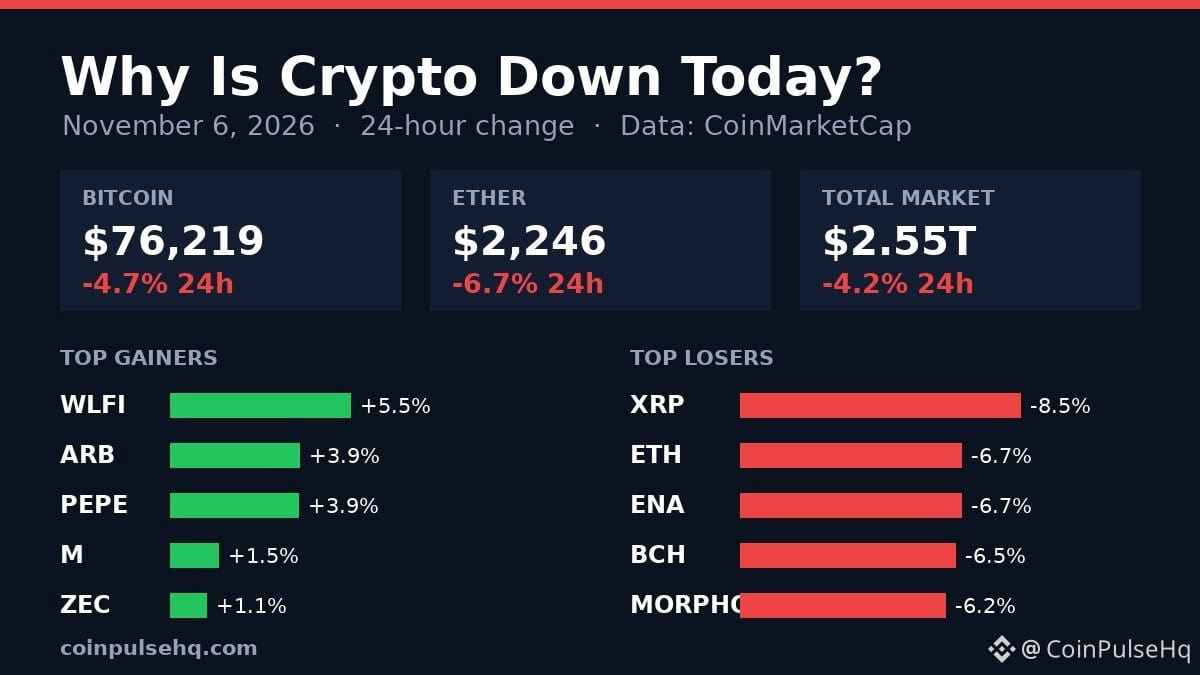
Why Is Crypto Down Today, Nov 6, 2026? Bitcoin Falls 4.7% to $76.2KCrypto is down today. Total market value fell 4.2% in 24 hours to $2.55 trillion as of 13:00 UTC on Friday, November 6, 2026. Bitcoin traded at $76,219 (-4.7%) and Ether at $2,246 (-6.7%). 6 of the 50 largest coins were higher, and the median move was -3.2%.
Why is crypto down today? What the numbers show
• Breadth. The move was broad: 44 of 50 large coins fell, so selling was market-wide rather than limited to one coin.
• Bitcoin versus altcoins. 35 of the other 49 large coins did better than Bitcoin, a sign of appetite for smaller, riskier assets. Bitcoin dominance stands at 59.9%, and Ether underperformed Bitcoin by 2.0 percentage points.
• Trading activity. 24-hour volume across the market was $109.3 billion, up 27.6% on the previous day. A price move on sharply higher volume carries more weight than one on thin trading.
• Bitcoin's 24-hour range. From $75,279 (07:30 UTC) to $79,790 (13:50 UTC, Nov 5), a 6.0% swing. The low came after the high.
Stocks, the dollar and gold
Crypto often trades alongside other risk assets. Latest session for each (the date is the market's last close or update):
Market Level Change As of
S&P 500 7,353.73 -4.4% Nov 5
Nasdaq Composite 24,315.00 -5.5% Nov 5
Gold 4,072.60 -1.0% Nov 6
US 10-year Treasury yield 4.872% +3.5 bp Nov 6
The Nasdaq fell 5.5% in its latest session, so crypto moved in the same direction as tech stocks. That points to a broad shift in risk appetite rather than a crypto-only story.
Biggest movers in the top 50
Gainers
Coin Price 24 hours 7 days
World Liberty Financial (WLFI) $0.04686 +5.5% -7.2%
Arbitrum (ARB) $0.1685 +3.9% +2.4%
Pepe (PEPE) $0.000005127 +3.9% -2.2%
MemeCore (M) $0.8272 +1.5% -15.7%
Zcash (ZEC) $1,327 +1.1% +6.5%
Losers
Coin Price 24 hours 7 days
XRP (XRP) $1.20 -8.5% -3.8%
Ethereum (ETH) $2,246 -6.7% +0.6%
Ethena (ENA) $0.1675 -6.7% -10.7%
Bitcoin Cash (BCH) $270.70 -6.5% -4.3%
Morpho (MORPHO) $2.10 -6.2% +2.4%
The stories behind today's moves
What CoinPulseHQ reported in the past 24 hours:
• American Bitcoin Posts $126M Q3 Profit as ABTC Shares Slide — American Bitcoin reported $126M in Q3 net income and 8,427 BTC held, but ABTC shares fell nearly 17% as mining costs rose 15.3% and margins narrowed.
• GOPAX Halts Trading After Hack Threat, Moves Assets to Cold Storage — GOPAX halted trading and withdrawals on Nov 6 after a hack threat and will move all customer crypto to cold wallets, days after Binance's $6.3B theft.
• Zcash NU7 goes live, stranding 12,224 ZEC in Sprout pool — Zcash's NU7 upgrade went live at block 3,543,405, rejecting v4 transactions and freezing roughly 12,224 ZEC in the legacy Sprout pool.
• Core Scientific to Finish Bitcoin Mining Exit by End of 2026 — Core Scientific targets a full Bitcoin mining exit by end of 2026, CFO Jim Nygaard said, as colocation reached $215.4M of Q3 revenue.
• Keel Infrastructure Sells All 2,520 BTC for $192M in AI Shift — Keel Infrastructure sold its full Bitcoin treasury in Q3 — 2,520 BTC for $192 million — as it pivots to AI data centers and revenue fell to $28 million.
Live prices for the top 50 coins are on our Markets page, and today's biggest movers are on top crypto gainers and losers. Every daily report is collected on Crypto Market Today, and the previous one is Why Is Crypto Up Today, Nov 5, 2026? Bitcoin Rises 2.4% to $80.1K. For the bigger picture, read our weekly market wraps, and if you are wondering about trading hours, see is the crypto market open on weekends.
How this report is made
CoinPulseHQ calculates every figure in this report from CoinMarketCap and CoinGecko market data recorded at 13:00 UTC on Friday, November 6, 2026, and stock, dollar, gold and bond levels from CNBC quotes. Stablecoins and wrapped or staked versions of other coins are left out of the rankings. Changes are over the previous 24 hours. The report describes what prices did and which measurable factors moved with them; it does not claim a single cause and does not predict prices. It is not financial advice.
Originally published on CoinPulseHQ: https://coinpulsehq.com/why-is-crypto-down-today-2026-11-06/?utm_source=binance_square&utm_medium=social&utm_campaign=auto_post
Why Is Crypto Down Today, Nov 6, 2026? Bitcoin Falls 4.7% to $76.2K
Crypto is down today. Total market value fell 4.2% in 24 hours to $2.55 trillion as of 13:00 UTC on Friday, November 6, 2026. Bitcoin traded at $76,219 (-4.7%) and Ether at $2,246 (-6.7%). 6 of the 50 largest coins were higher, and the median move was -3.2%.
Why is crypto down today? What the numbers show
• Breadth. The move was broad: 44 of 50 large coins fell, so selling was market-wide rather than limited to one coin.
• Bitcoin versus altcoins. 35 of the other 49 large coins did better than Bitcoin, a sign of appetite for smaller, riskier assets. Bitcoin dominance stands at 59.9%, and Ether underperformed Bitcoin by 2.0 percentage points.
• Trading activity. 24-hour volume across the market was $109.3 billion, up 27.6% on the previous day. A price move on sharply higher volume carries more weight than one on thin trading.
• Bitcoin's 24-hour range. From $75,279 (07:30 UTC) to $79,790 (13:50 UTC, Nov 5), a 6.0% swing. The low came after the high.
Stocks, the dollar and gold
Crypto often trades alongside other risk assets. Latest session for each (the date is the market's last close or update):
Market Level Change As of
S&P 500 7,353.73 -4.4% Nov 5
Nasdaq Composite 24,315.00 -5.5% Nov 5
Gold 4,072.60 -1.0% Nov 6
US 10-year Treasury yield 4.872% +3.5 bp Nov 6
The Nasdaq fell 5.5% in its latest session, so crypto moved in the same direction as tech stocks. That points to a broad shift in risk appetite rather than a crypto-only story.
Biggest movers in the top 50
Gainers
Coin Price 24 hours 7 days
World Liberty Financial (WLFI) $0.04686 +5.5% -7.2%
Arbitrum (ARB) $0.1685 +3.9% +2.4%
Pepe (PEPE) $0.000005127 +3.9% -2.2%
MemeCore (M) $0.8272 +1.5% -15.7%
Zcash (ZEC) $1,327 +1.1% +6.5%
Losers
Coin Price 24 hours 7 days
XRP (XRP) $1.20 -8.5% -3.8%
Ethereum (ETH) $2,246 -6.7% +0.6%
Ethena (ENA) $0.1675 -6.7% -10.7%
Bitcoin Cash (BCH) $270.70 -6.5% -4.3%
Morpho (MORPHO) $2.10 -6.2% +2.4%
The stories behind today's moves
What CoinPulseHQ reported in the past 24 hours:
• American Bitcoin Posts $126M Q3 Profit as ABTC Shares Slide — American Bitcoin reported $126M in Q3 net income and 8,427 BTC held, but ABTC shares fell nearly 17% as mining costs rose 15.3% and margins narrowed.
• GOPAX Halts Trading After Hack Threat, Moves Assets to Cold Storage — GOPAX halted trading and withdrawals on Nov 6 after a hack threat and will move all customer crypto to cold wallets, days after Binance's $6.3B theft.
• Zcash NU7 goes live, stranding 12,224 ZEC in Sprout pool — Zcash's NU7 upgrade went live at block 3,543,405, rejecting v4 transactions and freezing roughly 12,224 ZEC in the legacy Sprout pool.
• Core Scientific to Finish Bitcoin Mining Exit by End of 2026 — Core Scientific targets a full Bitcoin mining exit by end of 2026, CFO Jim Nygaard said, as colocation reached $215.4M of Q3 revenue.
• Keel Infrastructure Sells All 2,520 BTC for $192M in AI Shift — Keel Infrastructure sold its full Bitcoin treasury in Q3 — 2,520 BTC for $192 million — as it pivots to AI data centers and revenue fell to $28 million.
Live prices for the top 50 coins are on our Markets page, and today's biggest movers are on top crypto gainers and losers. Every daily report is collected on Crypto Market Today, and the previous one is Why Is Crypto Up Today, Nov 5, 2026? Bitcoin Rises 2.4% to $80.1K. For the bigger picture, read our weekly market wraps, and if you are wondering about trading hours, see is the crypto market open on weekends.
How this report is made
CoinPulseHQ calculates every figure in this report from CoinMarketCap and CoinGecko market data recorded at 13:00 UTC on Friday, November 6, 2026, and stock, dollar, gold and bond levels from CNBC quotes. Stablecoins and wrapped or staked versions of other coins are left out of the rankings. Changes are over the previous 24 hours. The report describes what prices did and which measurable factors moved with them; it does not claim a single cause and does not predict prices. It is not financial advice.
Originally published on CoinPulseHQ: https://coinpulsehq.com/why-is-crypto-down-today-2026-11-06/?utm_source=binance_square&utm_medium=social&utm_campaign=auto_post
37
·
--
Article
Voir la traduction
GOPAX Halts Trading After Hack Threat, Moves Assets to Cold StorageSouth Korea's GOPAX halted trading, deposits and standard withdrawals on Friday, November 6, 2026, after an email threatened a hack, according to Cointelegraph, which cited the newspaper Kyunghyang Shinmun. A GOPAX representative told the paper that no hack or attempted theft had occurred at that point.
Deposits and normal withdrawals stopped at 5:55 am UTC and trading ceased at 6:53 UTC, per a second exchange notice. All unfilled orders were canceled. Customers can still ask for withdrawals through the support center, though GOPAX warned that manual checks and approvals could slow processing.
Key facts
• GOPAX suspended deposits and standard withdrawals at 5:55 am UTC and trading at 6:53 UTC on November 6, 2026, canceling all unfilled orders.
• The exchange said it would move all crypto assets into offline wallets, citing financial regulators' recommendations and recent leaks and hacks at financial institutions.
• Days earlier, South Korea's Financial Services Commission urged domestic exchanges to raise cold-wallet holdings after the $6.3 billion Binance hack; South Korean exchanges must keep at least 80% of customer crypto offline.
• Financial Supervisory Service data showed GOPAX held 80.54% of user assets offline at the end of September, near the required minimum.
• The FSC named GOPAX operator Streami and exchange Prabang among 16 companies tied to earlier security incidents, per Cointelegraph.
Regulators push exchanges toward cold wallets
The halt came in a week when custody practices drew fresh attention. Bitcoin.com News reported that Coinbase said on November 4 that more than 99% of customer assets sit in offline cold storage after the Binance breach on October 29. Coinbase said the incident did not affect its infrastructure or customer funds and reported $377 billion in platform assets as of September 30, along with $8.6 billion in cash and equivalents and $2.2 billion in crypto held for investment.
CoinCentral reported that Coinbase described a multiparty computation setup that splits signing power, plus withdrawal limits, anomaly detection and controls that can stop transaction signing, and that Coinbase Vault can require several approvals before a withdrawal. Bitcoin.com News noted the 99% figure is self-reported and has not been independently established by third parties. Both the Bitcoin.com News and CoinCentral accounts put Binance's theft in the billions and describe a social engineering campaign that began with a fake job interview; CoinCentral added that Binance said on Wednesday it had replenished about 98% of affected assets.
Why it matters
GOPAX's move turns a threat email into a self-imposed outage, showing how quickly a warning can shut an exchange in a market where regulators are already pressing for offline custody. The rule that South Korean exchanges must keep at least 80% of customer crypto in cold storage puts GOPAX's 80.54% figure close to the line, so shifting the remainder offline is a direct response to both the email and the regulator's stance. For users, the practical change is slower access: trading is paused and withdrawals are manual. It also arrives days after the Binance theft and alongside a separate incident at Prabang, another South Korean venue, which suspended services after detecting abnormal hot-wallet withdrawals on October 24 and reported about 100 million won ($70,000) in losses, according to Yonhap News Agency via Cointelegraph.
What to watch
Whether GOPAX restores deposits and automated withdrawals, and when the planned transfer of assets to offline wallets is completed, are the next concrete markers. Also worth watching: the FSC's tighter cybersecurity oversight plans for the 16 companies it identified after reviewing 555 financial firms, of which it reported deficiencies at 130 in October.
Originally published on CoinPulseHQ: https://coinpulsehq.com/gopax-halts-trading-hack-threat-cold-storage/?utm_source=binance_square&utm_medium=social&utm_campaign=auto_post
GOPAX Halts Trading After Hack Threat, Moves Assets to Cold Storage
South Korea's GOPAX halted trading, deposits and standard withdrawals on Friday, November 6, 2026, after an email threatened a hack, according to Cointelegraph, which cited the newspaper Kyunghyang Shinmun. A GOPAX representative told the paper that no hack or attempted theft had occurred at that point.
Deposits and normal withdrawals stopped at 5:55 am UTC and trading ceased at 6:53 UTC, per a second exchange notice. All unfilled orders were canceled. Customers can still ask for withdrawals through the support center, though GOPAX warned that manual checks and approvals could slow processing.
Key facts
• GOPAX suspended deposits and standard withdrawals at 5:55 am UTC and trading at 6:53 UTC on November 6, 2026, canceling all unfilled orders.
• The exchange said it would move all crypto assets into offline wallets, citing financial regulators' recommendations and recent leaks and hacks at financial institutions.
• Days earlier, South Korea's Financial Services Commission urged domestic exchanges to raise cold-wallet holdings after the $6.3 billion Binance hack; South Korean exchanges must keep at least 80% of customer crypto offline.
• Financial Supervisory Service data showed GOPAX held 80.54% of user assets offline at the end of September, near the required minimum.
• The FSC named GOPAX operator Streami and exchange Prabang among 16 companies tied to earlier security incidents, per Cointelegraph.
Regulators push exchanges toward cold wallets
The halt came in a week when custody practices drew fresh attention. Bitcoin.com News reported that Coinbase said on November 4 that more than 99% of customer assets sit in offline cold storage after the Binance breach on October 29. Coinbase said the incident did not affect its infrastructure or customer funds and reported $377 billion in platform assets as of September 30, along with $8.6 billion in cash and equivalents and $2.2 billion in crypto held for investment.
CoinCentral reported that Coinbase described a multiparty computation setup that splits signing power, plus withdrawal limits, anomaly detection and controls that can stop transaction signing, and that Coinbase Vault can require several approvals before a withdrawal. Bitcoin.com News noted the 99% figure is self-reported and has not been independently established by third parties. Both the Bitcoin.com News and CoinCentral accounts put Binance's theft in the billions and describe a social engineering campaign that began with a fake job interview; CoinCentral added that Binance said on Wednesday it had replenished about 98% of affected assets.
Why it matters
GOPAX's move turns a threat email into a self-imposed outage, showing how quickly a warning can shut an exchange in a market where regulators are already pressing for offline custody. The rule that South Korean exchanges must keep at least 80% of customer crypto in cold storage puts GOPAX's 80.54% figure close to the line, so shifting the remainder offline is a direct response to both the email and the regulator's stance. For users, the practical change is slower access: trading is paused and withdrawals are manual. It also arrives days after the Binance theft and alongside a separate incident at Prabang, another South Korean venue, which suspended services after detecting abnormal hot-wallet withdrawals on October 24 and reported about 100 million won ($70,000) in losses, according to Yonhap News Agency via Cointelegraph.
What to watch
Whether GOPAX restores deposits and automated withdrawals, and when the planned transfer of assets to offline wallets is completed, are the next concrete markers. Also worth watching: the FSC's tighter cybersecurity oversight plans for the 16 companies it identified after reviewing 555 financial firms, of which it reported deficiencies at 130 in October.
Originally published on CoinPulseHQ: https://coinpulsehq.com/gopax-halts-trading-hack-threat-cold-storage/?utm_source=binance_square&utm_medium=social&utm_campaign=auto_post
27
·
--
Vérifié
Article
La NU7 de Zcash est activée, immobilisant 12 224 ZEC dans le pool SproutLa mise à niveau NU7 du réseau Zcash a été activée vendredi au bloc 3 543 405, à 02 h 34 UTC, rendant inutilisable le seul format de transaction permettant de transférer des fonds hors du pool protégé Sprout d’origine du réseau. Selon Cointelegraph, le suivi de la blockchain ZecStats indique qu’environ 12 224 ZEC se trouvent encore dans Sprout, pour une valeur d’environ 15 millions de dollars, et qu’ils sont désormais inutilisables.
Les pièces n’ont pas été détruites et aucune clé privée n’a été dérobée, selon Crypto Briefing. Elles sont toujours comptabilisées dans l’offre, mais ne peuvent pas être transférées selon les nouvelles règles.
La NU7 de Zcash est activée, immobilisant 12 224 ZEC dans le pool Sprout
La mise à niveau NU7 du réseau Zcash a été activée vendredi au bloc 3 543 405, à 02 h 34 UTC, rendant inutilisable le seul format de transaction permettant de transférer des fonds hors du pool protégé Sprout d’origine du réseau. Selon Cointelegraph, le suivi de la blockchain ZecStats indique qu’environ 12 224 ZEC se trouvent encore dans Sprout, pour une valeur d’environ 15 millions de dollars, et qu’ils sont désormais inutilisables.
Les pièces n’ont pas été détruites et aucune clé privée n’a été dérobée, selon Crypto Briefing. Elles sont toujours comptabilisées dans l’offre, mais ne peuvent pas être transférées selon les nouvelles règles.
Les pièces n’ont pas été détruites et aucune clé privée n’a été dérobée, selon Crypto Briefing. Elles sont toujours comptabilisées dans l’offre, mais ne peuvent pas être transférées selon les nouvelles règles.
1
1
749
·
--
Article
Voir la traduction
Core Scientific to Finish Bitcoin Mining Exit by End of 2026Core Scientific expects to finish winding down Bitcoin mining during the fourth quarter of 2026 and begin 2027 as a high-density colocation provider, chief financial officer Jim Nygaard said on the company's Q3 earnings call, according to Cointelegraph. The company reported $232.9 million in third-quarter revenue, of which mining and mining hosting contributed $17.5 million, or 7.5%.
Colocation accounted for the remaining $215.4 million. The figures show how far the business has moved from its mining origins, and they landed a day after the company published its third-quarter results. Blockchain Reporter calculated that colocation made up 92.5% of revenue, against 18.5% a year earlier, when the same business reported $81.1 million in total revenue and $15.0 million from colocation.
Key facts
• Third-quarter self-mining revenue fell to $12.3 million from $57.4 million a year earlier, while hosting revenue for other miners dropped to $5.2 million from $8.7 million.
• Core Scientific had nearly 50% fewer miners online at the end of September than at the end of 2025, Nygaard said.
• The company recorded $266.5 million in mining-related asset impairments in the first quarter of 2026, citing weaker Bitcoin prices and low hashprice, and took a $41.9 million loss in the second quarter when it terminated its mining equipment agreement with Block and Proto.
• Blockchain Reporter reported that net income was $1,178.1 million, driven primarily by the change in fair value of warrants, and that $985.1 million went to property, plant, equipment, land and development rights in the quarter.
• Coinpedia reported that MARA Holdings, Riot Platforms and HIVE Digital have also shifted toward AI and HPC infrastructure, and that at least 35 EH/s of computing power is scheduled to leave publicly listed Bitcoin miners.
A revenue mix that flipped in two quarters
Publishing its third-quarter 2026 results, Core Scientific said it is "in the process of repurposing its remaining mining facilities to support its high-density colocation services business as circumstances allow." Blockchain Reporter noted that the release does not use the word "exit" and that the phrasing ties timing to construction schedules rather than a public shutdown date, while Cointelegraph reported the July filing had already put hosted mining's end at December 31.
Capacity has moved steadily. Blockchain Reporter reported billing capacity of 120 megawatts in the fourth quarter of 2025, then 225 MW, 395 MW and 485 MW in the third quarter of 2026, with colocation revenue of $31.3 million, $77.5 million, $136.7 million and $215.4 million across the same quarters. Chief executive Adam Sullivan said in the release that the company is nearing full delivery under its first colocation agreement while construction under its second is underway across five campuses.
Two tenants, more than $24 billion contracted
Blockchain Reporter reported that contracted revenue exceeds $24 billion across about 1.1 gigawatts of customer-contracted power, split between roughly 590 MW leased to CoreWeave — across Denton, Texas; Dalton, Georgia; Muskogee, Oklahoma; Marble, North Carolina; and Austin, Texas — and an AMD-backed block of about 530 MW. Of the CoreWeave capacity, 485 MW was billing on November 5, with the remaining 105 MW at Dalton scheduled to complete early in 2027.
Coinpedia reported an additional AMD reservation for 1,925 MW of potential capacity, a figure Blockchain Reporter's summary of the deck does not state. Coinpedia also reported a separate 20-year Riot Platforms lease for 191 MW with an estimated $9.1 billion in contract revenue, which Blockchain Reporter described as the largest version of the trade announced this year.
Why it matters
For a public miner, the same power capacity now supports a different product: long-dated rental of space, power and cooling to AI tenants. Coinpedia cited an energy infrastructure analyst's estimate that one megawatt of power can generate roughly $1.9 million over five years from Bitcoin mining against about $7.9 million from AI workloads, which helps explain why miners with grid connections are finding buyers for capacity rather than hashpower. Coin Scientific's shift also changes what investors own — a colocation landlord whose reported earnings can swing with its warrant liabilities, not a company whose results track the price of Bitcoin.
The planned exit coincides with new political uncertainty. Cointelegraph reported that opponents of data-center development were among the winners in the Democrats' midterm gains, with the backlash centering partly on electricity bills and the demands large facilities place on local resources.
What to watch
The fourth-quarter filing and the early-2027 completion of the remaining 105 MW at Dalton will show whether the company states a dated mining shutdown on the record. Core Scientific's current disclosure describes an ongoing conversion, not a completed one.
This article is for information only and is not financial advice; markets for crypto assets and related equities are volatile and uncertain.
Originally published on CoinPulseHQ: https://coinpulsehq.com/core-scientific-bitcoin-mining-exit-2026/?utm_source=binance_square&utm_medium=social&utm_campaign=auto_post
Core Scientific to Finish Bitcoin Mining Exit by End of 2026
Core Scientific expects to finish winding down Bitcoin mining during the fourth quarter of 2026 and begin 2027 as a high-density colocation provider, chief financial officer Jim Nygaard said on the company's Q3 earnings call, according to Cointelegraph. The company reported $232.9 million in third-quarter revenue, of which mining and mining hosting contributed $17.5 million, or 7.5%.
Colocation accounted for the remaining $215.4 million. The figures show how far the business has moved from its mining origins, and they landed a day after the company published its third-quarter results. Blockchain Reporter calculated that colocation made up 92.5% of revenue, against 18.5% a year earlier, when the same business reported $81.1 million in total revenue and $15.0 million from colocation.
Key facts
• Third-quarter self-mining revenue fell to $12.3 million from $57.4 million a year earlier, while hosting revenue for other miners dropped to $5.2 million from $8.7 million.
• Core Scientific had nearly 50% fewer miners online at the end of September than at the end of 2025, Nygaard said.
• The company recorded $266.5 million in mining-related asset impairments in the first quarter of 2026, citing weaker Bitcoin prices and low hashprice, and took a $41.9 million loss in the second quarter when it terminated its mining equipment agreement with Block and Proto.
• Blockchain Reporter reported that net income was $1,178.1 million, driven primarily by the change in fair value of warrants, and that $985.1 million went to property, plant, equipment, land and development rights in the quarter.
• Coinpedia reported that MARA Holdings, Riot Platforms and HIVE Digital have also shifted toward AI and HPC infrastructure, and that at least 35 EH/s of computing power is scheduled to leave publicly listed Bitcoin miners.
A revenue mix that flipped in two quarters
Publishing its third-quarter 2026 results, Core Scientific said it is "in the process of repurposing its remaining mining facilities to support its high-density colocation services business as circumstances allow." Blockchain Reporter noted that the release does not use the word "exit" and that the phrasing ties timing to construction schedules rather than a public shutdown date, while Cointelegraph reported the July filing had already put hosted mining's end at December 31.
Capacity has moved steadily. Blockchain Reporter reported billing capacity of 120 megawatts in the fourth quarter of 2025, then 225 MW, 395 MW and 485 MW in the third quarter of 2026, with colocation revenue of $31.3 million, $77.5 million, $136.7 million and $215.4 million across the same quarters. Chief executive Adam Sullivan said in the release that the company is nearing full delivery under its first colocation agreement while construction under its second is underway across five campuses.
Two tenants, more than $24 billion contracted
Blockchain Reporter reported that contracted revenue exceeds $24 billion across about 1.1 gigawatts of customer-contracted power, split between roughly 590 MW leased to CoreWeave — across Denton, Texas; Dalton, Georgia; Muskogee, Oklahoma; Marble, North Carolina; and Austin, Texas — and an AMD-backed block of about 530 MW. Of the CoreWeave capacity, 485 MW was billing on November 5, with the remaining 105 MW at Dalton scheduled to complete early in 2027.
Coinpedia reported an additional AMD reservation for 1,925 MW of potential capacity, a figure Blockchain Reporter's summary of the deck does not state. Coinpedia also reported a separate 20-year Riot Platforms lease for 191 MW with an estimated $9.1 billion in contract revenue, which Blockchain Reporter described as the largest version of the trade announced this year.
Why it matters
For a public miner, the same power capacity now supports a different product: long-dated rental of space, power and cooling to AI tenants. Coinpedia cited an energy infrastructure analyst's estimate that one megawatt of power can generate roughly $1.9 million over five years from Bitcoin mining against about $7.9 million from AI workloads, which helps explain why miners with grid connections are finding buyers for capacity rather than hashpower. Coin Scientific's shift also changes what investors own — a colocation landlord whose reported earnings can swing with its warrant liabilities, not a company whose results track the price of Bitcoin.
The planned exit coincides with new political uncertainty. Cointelegraph reported that opponents of data-center development were among the winners in the Democrats' midterm gains, with the backlash centering partly on electricity bills and the demands large facilities place on local resources.
What to watch
The fourth-quarter filing and the early-2027 completion of the remaining 105 MW at Dalton will show whether the company states a dated mining shutdown on the record. Core Scientific's current disclosure describes an ongoing conversion, not a completed one.
This article is for information only and is not financial advice; markets for crypto assets and related equities are volatile and uncertain.
Originally published on CoinPulseHQ: https://coinpulsehq.com/core-scientific-bitcoin-mining-exit-2026/?utm_source=binance_square&utm_medium=social&utm_campaign=auto_post
48
·
--
Article
Keel Infrastructure vend ses 2 520 BTC pour 192 M$ dans le cadre de son virage vers l’IAKeel Infrastructure a vendu 2 520 BTC pour 192 millions de dollars au cours du trimestre clos le 30 septembre, vidant ainsi sa trésorerie en bitcoins constituée en tant que société minière et réorientant son bilan vers les centres de données dédiés à l’IA et au calcul haute performance, selon Bitcoin.com News. Le total comprenait l’intégralité de sa réserve, soit 2 261 BTC, ainsi que 259 BTC produits par les activités minières qu’elle exploite toujours au Québec.
L’ancienne Bitfarms a indiqué dans la publication de ses résultats du troisième trimestre qu’elle avait choisi de vendre lorsque le marché était en hausse et qu’elle avait terminé septembre avec des avoirs en bitcoins négligeables. Bitcoin.com News a rapporté cette information le 5 novembre, le jour même où l’action KEEL a chuté de 21 % dans le cadre d’une vague de ventes plus générale touchant les valeurs technologiques, minières et liées aux infrastructures de l’IA.
Keel Infrastructure vend ses 2 520 BTC pour 192 M$ dans le cadre de son virage vers l’IA
Keel Infrastructure a vendu 2 520 BTC pour 192 millions de dollars au cours du trimestre clos le 30 septembre, vidant ainsi sa trésorerie en bitcoins constituée en tant que société minière et réorientant son bilan vers les centres de données dédiés à l’IA et au calcul haute performance, selon Bitcoin.com News. Le total comprenait l’intégralité de sa réserve, soit 2 261 BTC, ainsi que 259 BTC produits par les activités minières qu’elle exploite toujours au Québec.
L’ancienne Bitfarms a indiqué dans la publication de ses résultats du troisième trimestre qu’elle avait choisi de vendre lorsque le marché était en hausse et qu’elle avait terminé septembre avec des avoirs en bitcoins négligeables. Bitcoin.com News a rapporté cette information le 5 novembre, le jour même où l’action KEEL a chuté de 21 % dans le cadre d’une vague de ventes plus générale touchant les valeurs technologiques, minières et liées aux infrastructures de l’IA.
L’ancienne Bitfarms a indiqué dans la publication de ses résultats du troisième trimestre qu’elle avait choisi de vendre lorsque le marché était en hausse et qu’elle avait terminé septembre avec des avoirs en bitcoins négligeables. Bitcoin.com News a rapporté cette information le 5 novembre, le jour même où l’action KEEL a chuté de 21 % dans le cadre d’une vague de ventes plus générale touchant les valeurs technologiques, minières et liées aux infrastructures de l’IA.
85
·
--

Article
Voir la traduction
American Bitcoin Posts $126M Q3 Profit as ABTC Shares SlideAmerican Bitcoin Corp. (Nasdaq: ABTC), the bitcoin miner co-founded by Eric Trump, reported roughly $126 million in third-quarter net income and approximately $221 million in adjusted EBITDA for the three months ended September 30, according to Bitcoin.com News. The result reverses a $57.2 million net loss in the second quarter, when adjusted EBITDA was negative $45 million.
The headline turnaround did not lift the stock. ABTC shares fell nearly 17% on Thursday to a recent price of $5.18 amid a wider sell-off in technology and mining stocks, and are down more than 40% over the past month, Bitcoin.com News reported.
Key facts
• Net income of about $126 million in Q3 2026, versus a $57.2 million loss in Q2 2026.
• Bitcoin holdings of 8,427 BTC at September 30, up roughly 425 BTC from 8,002 BTC at June 30.
• Mining revenue fell to $63.4 million from $67 million, and gross profit slipped to $25.8 million from $33 million.
• Cost to mine one bitcoin rose to $42,100 from $36,500, a 15.3% quarterly increase.
• Production declined 4.4%, from about 932 BTC to 891 BTC.
Where the profit came from
The profit was driven less by mining than by accounting gains on the company's bitcoin reserve. Coverage by crypto.news put a $197.3 million digital-asset valuation gain in the quarter, reversing a $71.2 million loss on holdings in the prior period, against a $64.3 million derivative loss tied mainly to Bitcoin redemption and put options linked to equipment supplier Bitmain. American Bitcoin carries its bitcoin at fair value, so price moves flow through earnings whether or not coins are sold.
Bitcoin.com News reported adjusted EBITDA of approximately $221 million; crypto.news gave the figure as $220.8 million, a rounding difference. Both outlets put gross margin at 41%, down from 49% in the second quarter, which American Bitcoin attributed to seasonal electricity costs.
CEO Mike Ho said the company expanded its reserve without buying bitcoin on the open market or issuing shares under its at-the-market program during the quarter, and that operations kept mining at a structural discount to spot prices despite seasonal power costs. Satoshis per share rose about 5%, from 10,989 to 11,572.
Treasury ranking and equipment
BitcoinTreasuries.net ranked American Bitcoin 13th among public corporate bitcoin holders, ahead of GD Culture Group and Galaxy Digital Holdings. About 3,090 BTC of the total were pledged under Bitmain miner-purchase agreements, split into 2,385 BTC as current assets and 705 BTC as noncurrent, crypto.news reported, citing the SEC filing. The company's owned fleet stood at roughly 89,242 machines and 28.1 EH/s of capacity at quarter-end.
crypto.news also reported details from the filing that Bitcoin.com News did not carry: 7.76 million Class A shares sold under the at-the-market program in the first nine months of 2026 for $144.7 million in gross proceeds, and $72.4 million in net cash used by operating activities over that period.
Why it matters
The quarter separates accounting income from mining economics: earnings rose sharply while revenue, output and margins all fell. Shareholders are exposed to that gap because reported profit on held bitcoin does not add coins, and further share issuance would dilute per-share holdings. Placing 3,090 BTC as collateral for mining hardware also ties part of the treasury to equipment commitments.
What to watch
Next up is whether Q4 electricity costs ease and whether the company resumes share sales under its at-the-market program. Peer results in the same reporting period — Hut 8's $189.5 million net income and Riot Platforms' $181.4 million in revenue — set a comparison point for how much of sector earnings depends on valuation gains.
Bitcoin traded around $76,111 on November 5, according to Bitcoin.com News. This article is not financial advice; cryptocurrency prices are volatile and the figures above describe reported results, not expected future performance.
Originally published on CoinPulseHQ: https://coinpulsehq.com/american-bitcoin-q3-profit-abtc-shares-slide/?utm_source=binance_square&utm_medium=social&utm_campaign=auto_post
American Bitcoin Posts $126M Q3 Profit as ABTC Shares Slide
American Bitcoin Corp. (Nasdaq: ABTC), the bitcoin miner co-founded by Eric Trump, reported roughly $126 million in third-quarter net income and approximately $221 million in adjusted EBITDA for the three months ended September 30, according to Bitcoin.com News. The result reverses a $57.2 million net loss in the second quarter, when adjusted EBITDA was negative $45 million.
The headline turnaround did not lift the stock. ABTC shares fell nearly 17% on Thursday to a recent price of $5.18 amid a wider sell-off in technology and mining stocks, and are down more than 40% over the past month, Bitcoin.com News reported.
Key facts
• Net income of about $126 million in Q3 2026, versus a $57.2 million loss in Q2 2026.
• Bitcoin holdings of 8,427 BTC at September 30, up roughly 425 BTC from 8,002 BTC at June 30.
• Mining revenue fell to $63.4 million from $67 million, and gross profit slipped to $25.8 million from $33 million.
• Cost to mine one bitcoin rose to $42,100 from $36,500, a 15.3% quarterly increase.
• Production declined 4.4%, from about 932 BTC to 891 BTC.
Where the profit came from
The profit was driven less by mining than by accounting gains on the company's bitcoin reserve. Coverage by crypto.news put a $197.3 million digital-asset valuation gain in the quarter, reversing a $71.2 million loss on holdings in the prior period, against a $64.3 million derivative loss tied mainly to Bitcoin redemption and put options linked to equipment supplier Bitmain. American Bitcoin carries its bitcoin at fair value, so price moves flow through earnings whether or not coins are sold.
Bitcoin.com News reported adjusted EBITDA of approximately $221 million; crypto.news gave the figure as $220.8 million, a rounding difference. Both outlets put gross margin at 41%, down from 49% in the second quarter, which American Bitcoin attributed to seasonal electricity costs.
CEO Mike Ho said the company expanded its reserve without buying bitcoin on the open market or issuing shares under its at-the-market program during the quarter, and that operations kept mining at a structural discount to spot prices despite seasonal power costs. Satoshis per share rose about 5%, from 10,989 to 11,572.
Treasury ranking and equipment
BitcoinTreasuries.net ranked American Bitcoin 13th among public corporate bitcoin holders, ahead of GD Culture Group and Galaxy Digital Holdings. About 3,090 BTC of the total were pledged under Bitmain miner-purchase agreements, split into 2,385 BTC as current assets and 705 BTC as noncurrent, crypto.news reported, citing the SEC filing. The company's owned fleet stood at roughly 89,242 machines and 28.1 EH/s of capacity at quarter-end.
crypto.news also reported details from the filing that Bitcoin.com News did not carry: 7.76 million Class A shares sold under the at-the-market program in the first nine months of 2026 for $144.7 million in gross proceeds, and $72.4 million in net cash used by operating activities over that period.
Why it matters
The quarter separates accounting income from mining economics: earnings rose sharply while revenue, output and margins all fell. Shareholders are exposed to that gap because reported profit on held bitcoin does not add coins, and further share issuance would dilute per-share holdings. Placing 3,090 BTC as collateral for mining hardware also ties part of the treasury to equipment commitments.
What to watch
Next up is whether Q4 electricity costs ease and whether the company resumes share sales under its at-the-market program. Peer results in the same reporting period — Hut 8's $189.5 million net income and Riot Platforms' $181.4 million in revenue — set a comparison point for how much of sector earnings depends on valuation gains.
Bitcoin traded around $76,111 on November 5, according to Bitcoin.com News. This article is not financial advice; cryptocurrency prices are volatile and the figures above describe reported results, not expected future performance.
Originally published on CoinPulseHQ: https://coinpulsehq.com/american-bitcoin-q3-profit-abtc-shares-slide/?utm_source=binance_square&utm_medium=social&utm_campaign=auto_post
BTC+0,22%
ABTCUS+2,45%
46
·
--

Article
Binance révoque les clés API de SignalPlus après un avertissement de sécuritéBinance a supprimé toutes les clés API liées à la plateforme de trading tierce SignalPlus le 5 novembre 2026, après que SignalPlus a signalé un possible problème de sécurité, selon Bitcoin.com News. La plateforme d’échange a déclaré que ses systèmes internes n’avaient pas été affectés et que les fonds des clients étaient restés en sécurité.
Dans une annonce publiée sur X, Binance a décrit la suppression des clés liées à SignalPlus comme une mesure de précaution immédiate. crypto.news a rapporté que la décision s’applique spécifiquement aux clés API associées à SignalPlus, qui permet aux traders de connecter leurs comptes sur des plateformes d’échange à des outils de trading externes.
Binance révoque les clés API de SignalPlus après un avertissement de sécurité
Binance a supprimé toutes les clés API liées à la plateforme de trading tierce SignalPlus le 5 novembre 2026, après que SignalPlus a signalé un possible problème de sécurité, selon Bitcoin.com News. La plateforme d’échange a déclaré que ses systèmes internes n’avaient pas été affectés et que les fonds des clients étaient restés en sécurité.
Dans une annonce publiée sur X, Binance a décrit la suppression des clés liées à SignalPlus comme une mesure de précaution immédiate. crypto.news a rapporté que la décision s’applique spécifiquement aux clés API associées à SignalPlus, qui permet aux traders de connecter leurs comptes sur des plateformes d’échange à des outils de trading externes.
Dans une annonce publiée sur X, Binance a décrit la suppression des clés liées à SignalPlus comme une mesure de précaution immédiate. crypto.news a rapporté que la décision s’applique spécifiquement aux clés API associées à SignalPlus, qui permet aux traders de connecter leurs comptes sur des plateformes d’échange à des outils de trading externes.
76
·
--
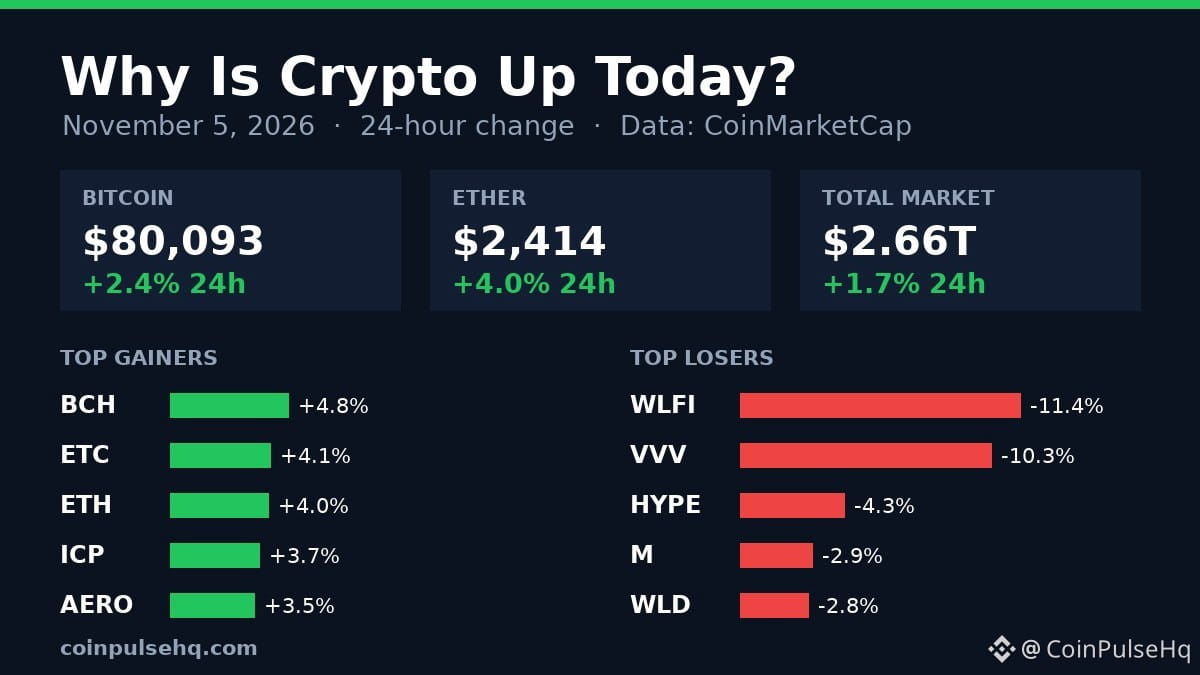
Article
Pourquoi les cryptomonnaies sont-elles en hausse aujourd’hui, le 5 nov. 2026 ? Bitcoin progresse de 2,4 % à 80,1 k$Les cryptomonnaies sont en hausse aujourd’hui. La valeur totale du marché a progressé de 1,7 % en 24 heures, à 2,66 billions de dollars au jeudi 5 novembre 2026 à 13:00 UTC. Bitcoin s’échangeait à 80 093 $ (+2,4 %) et Ether à 2 414 $ (+4,0 %). 35 des 50 plus grandes cryptomonnaies étaient en hausse, et la variation médiane était de +1,3 %.
Pourquoi les cryptomonnaies sont-elles en hausse aujourd’hui ? Ce que montrent les chiffres
• Ampleur. Le bilan était contrasté : 35 des 50 grandes cryptomonnaies ont progressé et 15 ont reculé. La hausse affichée a donc été portée par quelques actifs majeurs plutôt que par l’ensemble du marché.
• Bitcoin face aux altcoins. Seules 8 des 49 autres grandes cryptomonnaies ont fait mieux que Bitcoin, ce qui indique que les capitaux ont privilégié le plus grand actif. La dominance de Bitcoin s’établit à 60,1 %, et Ether a surperformé Bitcoin de 1,6 point de pourcentage.
Pourquoi les cryptomonnaies sont-elles en hausse aujourd’hui, le 5 nov. 2026 ? Bitcoin progresse de 2,4 % à 80,1 k$
Les cryptomonnaies sont en hausse aujourd’hui. La valeur totale du marché a progressé de 1,7 % en 24 heures, à 2,66 billions de dollars au jeudi 5 novembre 2026 à 13:00 UTC. Bitcoin s’échangeait à 80 093 $ (+2,4 %) et Ether à 2 414 $ (+4,0 %). 35 des 50 plus grandes cryptomonnaies étaient en hausse, et la variation médiane était de +1,3 %.
Pourquoi les cryptomonnaies sont-elles en hausse aujourd’hui ? Ce que montrent les chiffres
• Ampleur. Le bilan était contrasté : 35 des 50 grandes cryptomonnaies ont progressé et 15 ont reculé. La hausse affichée a donc été portée par quelques actifs majeurs plutôt que par l’ensemble du marché.
• Bitcoin face aux altcoins. Seules 8 des 49 autres grandes cryptomonnaies ont fait mieux que Bitcoin, ce qui indique que les capitaux ont privilégié le plus grand actif. La dominance de Bitcoin s’établit à 60,1 %, et Ether a surperformé Bitcoin de 1,6 point de pourcentage.
90
·
--

Article
Aave, Kamino et Veda demandent à la SEC d’exempter la plupart des coffres DeFiAave Labs, la Kamino Foundation et Veda Tech Labs Inc. ont demandé à la Securities and Exchange Commission des États-Unis de considérer que la plupart des coffres crypto générant des rendements et des dispositifs de prêt décentralisés ne relèvent pas du droit fédéral des valeurs mobilières, selon AMBCrypto. Les trois groupes ont soumis un cadre juridique confidentiel et demandé une réunion avec le personnel de la SEC, ouvrant ainsi un désaccord public avec Morpho et le Crypto Council for Innovation sur l’importance à accorder au pouvoir discrétionnaire humain au sein d’un coffre.
Faits essentiels
Aave, Kamino et Veda demandent à la SEC d’exempter la plupart des coffres DeFi
Aave Labs, la Kamino Foundation et Veda Tech Labs Inc. ont demandé à la Securities and Exchange Commission des États-Unis de considérer que la plupart des coffres crypto générant des rendements et des dispositifs de prêt décentralisés ne relèvent pas du droit fédéral des valeurs mobilières, selon AMBCrypto. Les trois groupes ont soumis un cadre juridique confidentiel et demandé une réunion avec le personnel de la SEC, ouvrant ainsi un désaccord public avec Morpho et le Crypto Council for Innovation sur l’importance à accorder au pouvoir discrétionnaire humain au sein d’un coffre.
Faits essentiels
Faits essentiels
112
·
--

Article
Voir la traduction
Blockchain Life 2026 Sets Dubai Agenda for December 1-2The preliminary agenda for Blockchain Life 2026 lists 34 sessions across two days at Dubai's Festival Arena on December 1 and 2, with Wall Street-adjacent institutions, exchange executives, gaming figures and UAE regulators sharing the Space Stage, Cointribune reported.
Organisers divide the schedule evenly, with 17 slots on each day, and state that the programme is provisional and subject to change. A second stage tied to the AI Future Forum is also referenced, though all detailed sessions listed so far run on the Space Stage.
Key facts
• Day one opens with a keynote by Sergei Khitrov, founder of Listing.Help, Jets.Capital and Blockchain Life; day two opens with a fireside chat with Arthur Hayes of Maelstrom, whose session title is still to be announced.
• Speakers on December 1 include Ben Zhou (Bybit), Sandeep Nailwal (Polygon), Felix Fan (Trust Wallet), Rajat Sakhuja (Mastercard) and Luke Judges (Ripple).
• December 2 brings Yat Siu (Animoca Brands) on the agent economy, Jamie King (Rockstar Games) on gaming and ownership, and a regulation panel with Ruben Bombardi (VARA) and Dmitry Fedotov (ADGM).
• A "Mining After the Halving" panel is set for 5:00 p.m. on December 2 with Naeem Aslam (Zaye Capital Markets), Davis Hui (Canaan) and Li HanQiang (SpiderPool).
• AMBCrypto reported that Toobit returns as a Premium Sponsor at Booth A10, after winning Best CEX User Interface and Best CEX Educational Platform at the Blockchain Life Awards 2025 through public voting.
Institutions and exchanges share the opening day
The first day begins with an institutional panel moderated by Danil Gaidamakin of Jets.Capital, joined by John Cahil (Galaxy Digital), Andrei Grachev (DWF Labs), Amit Mehra (Borderless) and James Wo (Digital Finance Group). A later session on trading platforms pairs a fireside chat between Alex Falcon and Bybit's Ben Zhou with a panel drawing on BingX, MEXC, KuCoin, Bybit and BitMart to discuss AI-driven trading and its attack surfaces.
Sandeep Nailwal delivers a keynote titled "The 2 Quadrillion Dollar Wave", Mert Mumtaz of Helius addresses privacy in the age of AI and quantum computing, and Felix Fan of Trust Wallet covers social wallets. Marius Smith (Ethereum Institutional) and Marcin Kaźmierczak (RedStone) each give tokenization keynotes, while a BTCFi panel features Hadir Gaber of ChainMena alongside crypto commentators including Chris MMCrypto.
Payments run through the afternoon. Koray Koska of Ether.fi Cash moderates a stablecoin cards panel with Polygon Labs, Bakkt, Bitcoin.com and Mastercard, while Nic Puckrin of Coin Bureau moderates a session on stablecoins as a cross-border rail for remittances and corporate FX with Ripple, BCG and others.
UAE regulation and mining close the forum
The second day pairs a regulatory discussion with commercial detail: Bombardi of VARA, Fedotov of ADGM and Ahmed Allam of the Ruler's Court of Dubai explain the UAE's pace-setting stance, and at 3:00 p.m. Irina Heaver of NeosLegal interviews Bombardi on building a licensed digital-asset business. A tokenization panel moderated by Marcin Matyja of BCG covers treasuries, credit and funds on-chain with CoinMarketCap, Algorand Foundation, Cardano Foundation and Oracle.
Mining appears only on day two. The day ends with the Startup Pitch ceremony at 5:35 p.m., the Blockchain Life Awards 2026 at 5:40 p.m., and a close at 6:10 p.m., followed by a VIP afterparty from 9 p.m. to 2 a.m.
Tickets are currently at the early bird rate of $189 for Standard, $329 for Business and $999 for VIP, rising to $399, $729 and $2,099 at the last-chance price. Each ticket also grants access to the AI Future Forum, and Cointribune offers readers a 10% discount with the code Cointribune.
Why it matters
The agenda is a useful read on where the industry's attention sits: stablecoins and tokenization occupy as much stage time as price and mining, and institutional allocation gets its own panel with Bitcoin Suisse, XBTO and Rakbank. It also puts UAE regulators on the same programme as the exchanges and payment firms they supervise, at a point when the country's digital-asset rules are shaping how firms set up in the region.
The two reports differ in scope. Cointribune carries the full session-by-session schedule and ticket tiers; AMBCrypto reports Toobit's sponsorship and cites Henley & Partners' 2026 Crypto Adoption Index, which placed the UAE second among 36 markets, up from fifth previously, and expects more than 15,000 attendees from over 130 countries with more than 200 speakers.
What to watch
Organisers say more sessions remain to be announced, and Arthur Hayes' fireside chat title is still unfixed. Confirmation of those slots, and whether the early bird pricing holds as tickets sell, are the next concrete signals before the doors open in Dubai.
Originally published on CoinPulseHQ: https://coinpulsehq.com/blockchain-life-2026-agenda-dubai/?utm_source=binance_square&utm_medium=social&utm_campaign=auto_post
Blockchain Life 2026 Sets Dubai Agenda for December 1-2
The preliminary agenda for Blockchain Life 2026 lists 34 sessions across two days at Dubai's Festival Arena on December 1 and 2, with Wall Street-adjacent institutions, exchange executives, gaming figures and UAE regulators sharing the Space Stage, Cointribune reported.
Organisers divide the schedule evenly, with 17 slots on each day, and state that the programme is provisional and subject to change. A second stage tied to the AI Future Forum is also referenced, though all detailed sessions listed so far run on the Space Stage.
Key facts
• Day one opens with a keynote by Sergei Khitrov, founder of Listing.Help, Jets.Capital and Blockchain Life; day two opens with a fireside chat with Arthur Hayes of Maelstrom, whose session title is still to be announced.
• Speakers on December 1 include Ben Zhou (Bybit), Sandeep Nailwal (Polygon), Felix Fan (Trust Wallet), Rajat Sakhuja (Mastercard) and Luke Judges (Ripple).
• December 2 brings Yat Siu (Animoca Brands) on the agent economy, Jamie King (Rockstar Games) on gaming and ownership, and a regulation panel with Ruben Bombardi (VARA) and Dmitry Fedotov (ADGM).
• A "Mining After the Halving" panel is set for 5:00 p.m. on December 2 with Naeem Aslam (Zaye Capital Markets), Davis Hui (Canaan) and Li HanQiang (SpiderPool).
• AMBCrypto reported that Toobit returns as a Premium Sponsor at Booth A10, after winning Best CEX User Interface and Best CEX Educational Platform at the Blockchain Life Awards 2025 through public voting.
Institutions and exchanges share the opening day
The first day begins with an institutional panel moderated by Danil Gaidamakin of Jets.Capital, joined by John Cahil (Galaxy Digital), Andrei Grachev (DWF Labs), Amit Mehra (Borderless) and James Wo (Digital Finance Group). A later session on trading platforms pairs a fireside chat between Alex Falcon and Bybit's Ben Zhou with a panel drawing on BingX, MEXC, KuCoin, Bybit and BitMart to discuss AI-driven trading and its attack surfaces.
Sandeep Nailwal delivers a keynote titled "The 2 Quadrillion Dollar Wave", Mert Mumtaz of Helius addresses privacy in the age of AI and quantum computing, and Felix Fan of Trust Wallet covers social wallets. Marius Smith (Ethereum Institutional) and Marcin Kaźmierczak (RedStone) each give tokenization keynotes, while a BTCFi panel features Hadir Gaber of ChainMena alongside crypto commentators including Chris MMCrypto.
Payments run through the afternoon. Koray Koska of Ether.fi Cash moderates a stablecoin cards panel with Polygon Labs, Bakkt, Bitcoin.com and Mastercard, while Nic Puckrin of Coin Bureau moderates a session on stablecoins as a cross-border rail for remittances and corporate FX with Ripple, BCG and others.
UAE regulation and mining close the forum
The second day pairs a regulatory discussion with commercial detail: Bombardi of VARA, Fedotov of ADGM and Ahmed Allam of the Ruler's Court of Dubai explain the UAE's pace-setting stance, and at 3:00 p.m. Irina Heaver of NeosLegal interviews Bombardi on building a licensed digital-asset business. A tokenization panel moderated by Marcin Matyja of BCG covers treasuries, credit and funds on-chain with CoinMarketCap, Algorand Foundation, Cardano Foundation and Oracle.
Mining appears only on day two. The day ends with the Startup Pitch ceremony at 5:35 p.m., the Blockchain Life Awards 2026 at 5:40 p.m., and a close at 6:10 p.m., followed by a VIP afterparty from 9 p.m. to 2 a.m.
Tickets are currently at the early bird rate of $189 for Standard, $329 for Business and $999 for VIP, rising to $399, $729 and $2,099 at the last-chance price. Each ticket also grants access to the AI Future Forum, and Cointribune offers readers a 10% discount with the code Cointribune.
Why it matters
The agenda is a useful read on where the industry's attention sits: stablecoins and tokenization occupy as much stage time as price and mining, and institutional allocation gets its own panel with Bitcoin Suisse, XBTO and Rakbank. It also puts UAE regulators on the same programme as the exchanges and payment firms they supervise, at a point when the country's digital-asset rules are shaping how firms set up in the region.
The two reports differ in scope. Cointribune carries the full session-by-session schedule and ticket tiers; AMBCrypto reports Toobit's sponsorship and cites Henley & Partners' 2026 Crypto Adoption Index, which placed the UAE second among 36 markets, up from fifth previously, and expects more than 15,000 attendees from over 130 countries with more than 200 speakers.
What to watch
Organisers say more sessions remain to be announced, and Arthur Hayes' fireside chat title is still unfixed. Confirmation of those slots, and whether the early bird pricing holds as tickets sell, are the next concrete signals before the doors open in Dubai.
Originally published on CoinPulseHQ: https://coinpulsehq.com/blockchain-life-2026-agenda-dubai/?utm_source=binance_square&utm_medium=social&utm_campaign=auto_post
GLXYUS+5,42%
Connectez-vous pour découvrir plus de contenu
Rejoignez la communauté mondiale des adeptes de cryptomonnaies sur Binance Square
⚡️ Suviez les dernières informations importantes sur les cryptomonnaies.
💬 Jugé digne de confiance par la plus grande plateforme d’échange de cryptomonnaies au monde.
👍 Découvrez les connaissances que partagent les créateurs vérifiés.
Adresse e-mail/Nº de téléphone
Sujets d’actualité
JobsReportRaisesHikeOdds
344,132 vues
2,633 mentions
Actualités TradFi | Les États-Unis créent 165 000 emplois en octobre, soit plus du double des 65 000 prévus, tandis que le chômage tombe à 4,1 %
Binance News
·39 mentions J’aime
·23.6k vues
CPITestsDecemberRateOutlook
64,136 vues
702 mentions
BitcoinRebounds$75KAsChipsLead
28,757 vues
264 mentions