

#duskds
duskds
439 vues
15 mentions
Populaire
Récents
·
--
Baissier
Vérifié
I kept getting one thing wrong while thinking through Moonlight and Phoenix: I was treating state shape as if it also determined finality.
That assumption started bothering me.
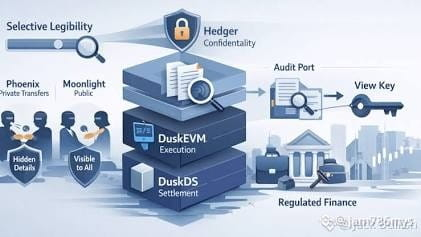
Moonlight arrives at #DuskVM carrying a public-account model: Balances, Sender, Receiver, Amount and Nonce Progression.
Phoenix is built around a completely different trail: Encrypted Notes, Shielded Outputs, Nullifiers and Private State.
My first instinct was that two such different systems should probably need two different ways to become final.
But maybe that's where I was adding complexity that isn't actually there.
Moonlight can remain account-shaped. Phoenix can remain note-shaped. #DuskVM doesn't need to flatten either one into some universal state format just to decide when execution is finished.
That also made me rethink #DuskDS .
I had been assuming it needed to create one shared $DUSK state underneath both models. I'm less convinced of that now.
The execution logic can stay specialized while Dusk L1 still gives the resulting state one deterministic finality boundary.
And honestly, that separation is more interesting to me than the individual state models.
Different ways of representing state don't necessarily require different answers to the question of when that state is finally done.
The thing I’m still wondering about is how cleanly this separation holds as Moonlight and Phoenix become more complex.
#dusk $DUSK @Dusk_Foundation
{future}(DUSKUSDT)
I kept getting one thing wrong while thinking through Moonlight and Phoenix: I was treating state shape as if it also determined finality.
That assumption started bothering me.
Moonlight arrives at #DuskVM carrying a public-account model: Balances, Sender, Receiver, Amount and Nonce Progression.
Phoenix is built around a completely different trail: Encrypted Notes, Shielded Outputs, Nullifiers and Private State.
My first instinct was that two such different systems should probably need two different ways to become final.
But maybe that's where I was adding complexity that isn't actually there.
Moonlight can remain account-shaped. Phoenix can remain note-shaped. #DuskVM doesn't need to flatten either one into some universal state format just to decide when execution is finished.
That also made me rethink #DuskDS .
I had been assuming it needed to create one shared $DUSK state underneath both models. I'm less convinced of that now.
The execution logic can stay specialized while Dusk L1 still gives the resulting state one deterministic finality boundary.
And honestly, that separation is more interesting to me than the individual state models.
Different ways of representing state don't necessarily require different answers to the question of when that state is finally done.
The thing I’m still wondering about is how cleanly this separation holds as Moonlight and Phoenix become more complex.
#dusk $DUSK @Dusk
That assumption started bothering me.
Moonlight arrives at #DuskVM carrying a public-account model: Balances, Sender, Receiver, Amount and Nonce Progression.
Phoenix is built around a completely different trail: Encrypted Notes, Shielded Outputs, Nullifiers and Private State.
My first instinct was that two such different systems should probably need two different ways to become final.
But maybe that's where I was adding complexity that isn't actually there.
Moonlight can remain account-shaped. Phoenix can remain note-shaped. #DuskVM doesn't need to flatten either one into some universal state format just to decide when execution is finished.
That also made me rethink #DuskDS .
I had been assuming it needed to create one shared $DUSK state underneath both models. I'm less convinced of that now.
The execution logic can stay specialized while Dusk L1 still gives the resulting state one deterministic finality boundary.
And honestly, that separation is more interesting to me than the individual state models.
Different ways of representing state don't necessarily require different answers to the question of when that state is finally done.
The thing I’m still wondering about is how cleanly this separation holds as Moonlight and Phoenix become more complex.
#dusk $DUSK @Dusk
37
23
305
·
--
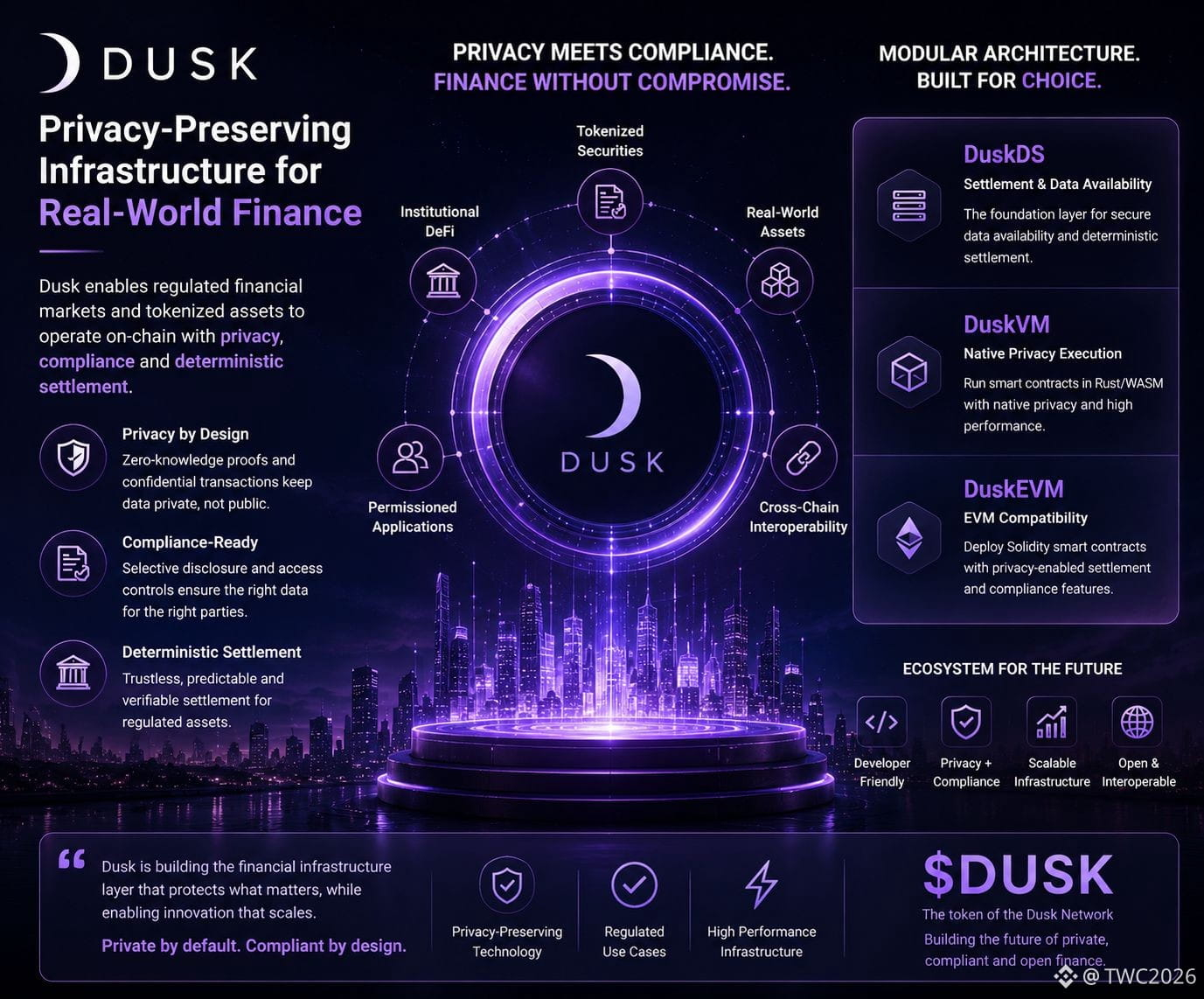
@Dusk_Foundation is building something DeFi and tokenized finance will increasingly need: privacy without losing compliance. Public blockchains are powerful because transactions can be transparent and verifiable, but regulated financial markets cannot expose every balance, position, investor detail, or transaction publicly. @Dusk_Foundation approaches this challenge by combining zero-knowledge technology, confidential transfers, selective disclosure, access controls, and deterministic settlement. �
Dusk +1
What makes this approach interesting is the idea that privacy does not have to mean hiding everything. Authorized participants can receive the information they need, while sensitive data remains protected from unnecessary public exposure. This can be especially relevant for tokenized securities, real-world assets, institutional DeFi, and other financial workflows where eligibility, reporting, transfer restrictions, and settlement rules matter. �
DOCS +1
Dusk also uses a modular architecture, with #DuskDS focused on settlement and data availability, #DuskVM for native Rust/WASM execution, and #DuskEVM for EVM-compatible applications. That gives developers different paths depending on whether an application prioritizes native privacy, familiar EVM tooling, or regulated settlement infrastructure. �
DOCS
For me, the interesting part of Dusk is not simply “privacy.” It is the combination of privacy, compliance and predictable settlement in one financial infrastructure. If more real-world assets and institutional markets move on-chain, these capabilities could become increasingly important. #dusk $DUSK
@Dusk is building something DeFi and tokenized finance will increasingly need: privacy without losing compliance. Public blockchains are powerful because transactions can be transparent and verifiable, but regulated financial markets cannot expose every balance, position, investor detail, or transaction publicly. @Dusk approaches this challenge by combining zero-knowledge technology, confidential transfers, selective disclosure, access controls, and deterministic settlement. �
Dusk +1
What makes this approach interesting is the idea that privacy does not have to mean hiding everything. Authorized participants can receive the information they need, while sensitive data remains protected from unnecessary public exposure. This can be especially relevant for tokenized securities, real-world assets, institutional DeFi, and other financial workflows where eligibility, reporting, transfer restrictions, and settlement rules matter. �
DOCS +1
Dusk also uses a modular architecture, with #DuskDS focused on settlement and data availability, #DuskVM for native Rust/WASM execution, and #DuskEVM for EVM-compatible applications. That gives developers different paths depending on whether an application prioritizes native privacy, familiar EVM tooling, or regulated settlement infrastructure. �
DOCS
For me, the interesting part of Dusk is not simply “privacy.” It is the combination of privacy, compliance and predictable settlement in one financial infrastructure. If more real-world assets and institutional markets move on-chain, these capabilities could become increasingly important. #dusk $DUSK
Dusk +1
What makes this approach interesting is the idea that privacy does not have to mean hiding everything. Authorized participants can receive the information they need, while sensitive data remains protected from unnecessary public exposure. This can be especially relevant for tokenized securities, real-world assets, institutional DeFi, and other financial workflows where eligibility, reporting, transfer restrictions, and settlement rules matter. �
DOCS +1
Dusk also uses a modular architecture, with #DuskDS focused on settlement and data availability, #DuskVM for native Rust/WASM execution, and #DuskEVM for EVM-compatible applications. That gives developers different paths depending on whether an application prioritizes native privacy, familiar EVM tooling, or regulated settlement infrastructure. �
DOCS
For me, the interesting part of Dusk is not simply “privacy.” It is the combination of privacy, compliance and predictable settlement in one financial infrastructure. If more real-world assets and institutional markets move on-chain, these capabilities could become increasingly important. #dusk $DUSK
65
·
--
Haussier
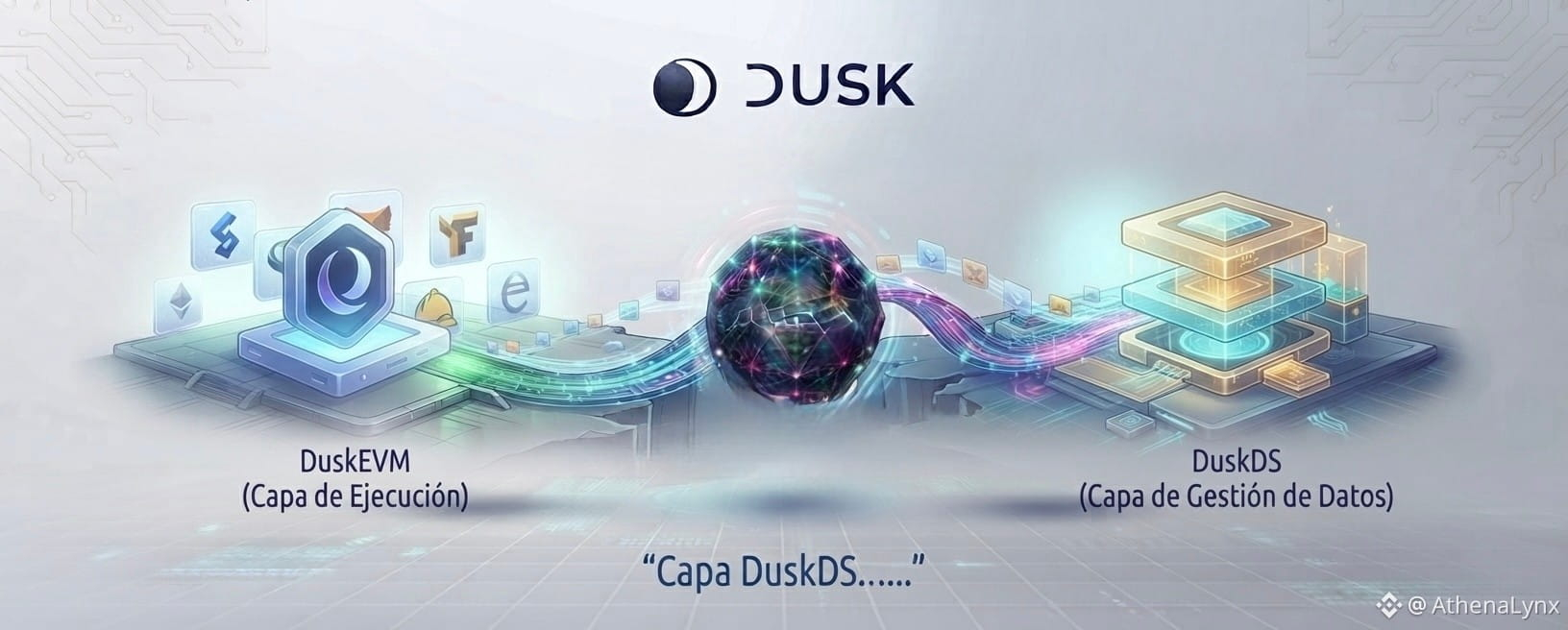
Hoy paso por acá para hablarles de DuskDS, una de las capas quizás más confusas de la arquitectura de @Dusk_Foundation 🌒 . Pero voy a intentar explicárselas de la forma más sencilla posible sin tecnicismos.
En el post anterior vimos que DuskEVM es la capa donde se desarrollan y ejecutan aplicaciones o contratos inteligentes compatibles con EVM, mientras que DuskDS es otra capa de la infraestructura que permite gestionar los datos y las operaciones que se realizan en DuskEVM.
En pocas palabras, DuskDS ayuda a que las operaciones realizadas en DuskEVM puedan quedar registradas y conectadas con la infraestructura principal de Dusk (Dusk L1), facilitando su liquidación y la disponibilidad de los datos.
Tenemos que tener en cuenta que DuskEVM y DuskDS no son dos tokens diferentes ni dos blockchains que compiten entre sí. Son capas diferentes que cumplen funciones distintas dentro de la arquitectura de $DUSK .
En el siguiente post hablaremos sobre Dusk L1 y cómo se relaciona con las capas que hemos visto previamente.
#dusk #DuskEVM #DuskDS
Hoy paso por acá para hablarles de DuskDS, una de las capas quizás más confusas de la arquitectura de @Dusk 🌒 . Pero voy a intentar explicárselas de la forma más sencilla posible sin tecnicismos.
En el post anterior vimos que DuskEVM es la capa donde se desarrollan y ejecutan aplicaciones o contratos inteligentes compatibles con EVM, mientras que DuskDS es otra capa de la infraestructura que permite gestionar los datos y las operaciones que se realizan en DuskEVM.
En pocas palabras, DuskDS ayuda a que las operaciones realizadas en DuskEVM puedan quedar registradas y conectadas con la infraestructura principal de Dusk (Dusk L1), facilitando su liquidación y la disponibilidad de los datos.
Tenemos que tener en cuenta que DuskEVM y DuskDS no son dos tokens diferentes ni dos blockchains que compiten entre sí. Son capas diferentes que cumplen funciones distintas dentro de la arquitectura de $DUSK .
En el siguiente post hablaremos sobre Dusk L1 y cómo se relaciona con las capas que hemos visto previamente.
#dusk #DuskEVM #DuskDS
En el post anterior vimos que DuskEVM es la capa donde se desarrollan y ejecutan aplicaciones o contratos inteligentes compatibles con EVM, mientras que DuskDS es otra capa de la infraestructura que permite gestionar los datos y las operaciones que se realizan en DuskEVM.
En pocas palabras, DuskDS ayuda a que las operaciones realizadas en DuskEVM puedan quedar registradas y conectadas con la infraestructura principal de Dusk (Dusk L1), facilitando su liquidación y la disponibilidad de los datos.
Tenemos que tener en cuenta que DuskEVM y DuskDS no son dos tokens diferentes ni dos blockchains que compiten entre sí. Son capas diferentes que cumplen funciones distintas dentro de la arquitectura de $DUSK .
En el siguiente post hablaremos sobre Dusk L1 y cómo se relaciona con las capas que hemos visto previamente.
#dusk #DuskEVM #DuskDS
441

Vérifié
I added a small $DUSK position today, but I’m watching DuskEVM differently now.
What caught me wasn’t just EVM compatibility—it’s how Hedger makes private transactions reviewable using homomorphic encryption and ZK proofs. I used to see privacy as a user feature; now I see it as an adoption mechanism for regulated apps.
@Dusk_Foundation also powers execution while DuskDS handles settlement and data availability. That separation feels important.
I’m still unsure how quickly real users will adopt it, but the architecture changed my view.
$ATM $BANK #DUSK #DUSKEVM #DuskDS #Web3
What do you think matters most for DUSK?
I added a small $DUSK position today, but I’m watching DuskEVM differently now.
What caught me wasn’t just EVM compatibility—it’s how Hedger makes private transactions reviewable using homomorphic encryption and ZK proofs. I used to see privacy as a user feature; now I see it as an adoption mechanism for regulated apps.
@Dusk also powers execution while DuskDS handles settlement and data availability. That separation feels important.
I’m still unsure how quickly real users will adopt it, but the architecture changed my view.
$ATM $BANK #DUSK #DUSKEVM #DuskDS #Web3
What do you think matters most for DUSK?
What caught me wasn’t just EVM compatibility—it’s how Hedger makes private transactions reviewable using homomorphic encryption and ZK proofs. I used to see privacy as a user feature; now I see it as an adoption mechanism for regulated apps.
@Dusk also powers execution while DuskDS handles settlement and data availability. That separation feels important.
I’m still unsure how quickly real users will adopt it, but the architecture changed my view.
$ATM $BANK #DUSK #DUSKEVM #DuskDS #Web3
What do you think matters most for DUSK?
Privacy 🔐
67%
EVM access
33%
Settlement
0%
6 Votes • Vote fermé
30
16
357
·
--
Haussier
Vérifié
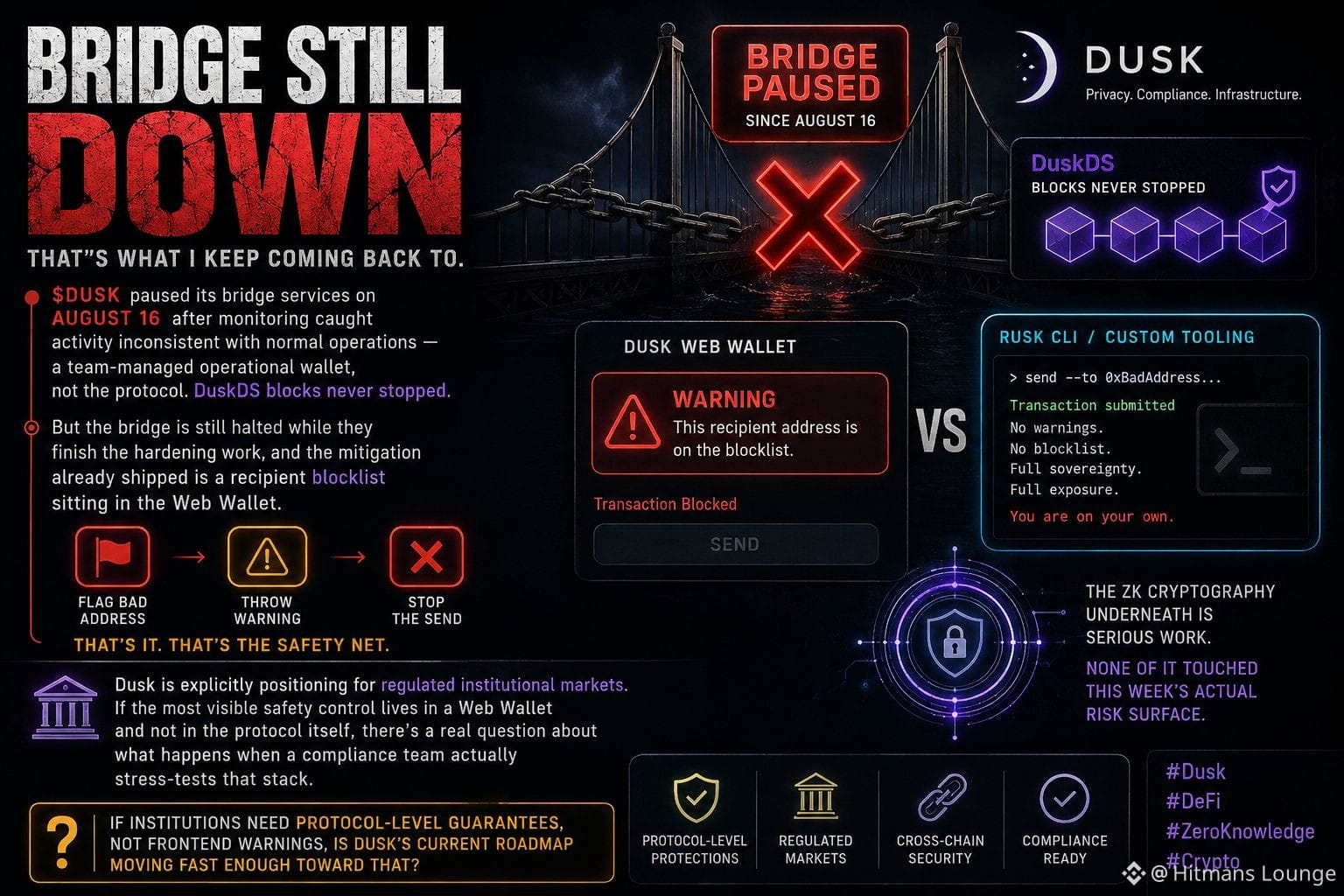
Bridge still down and that's what I keep coming back to for a period of time.
@Dusk_Foundation paused its bridge services on January 16 after monitoring caught activity inconsistent with normal operations — a team-managed operational wallet, not the protocol. DuskDS blocks never stopped. But the bridge is still halted while they finish the hardening work, and the mitigation already shipped is a recipient blocklist sitting in the Web Wallet. Flag a bad address, throw a warning, stop the send.
That's it. That's the safety net.
And here's what I can't stop thinking about: if you're running Rusk CLI or your own tooling, that warning never fires. You're fully sovereign — and fully exposed. The ZK cryptography underneath is genuinely serious work. None of it touched this week's actual risk surface.
I don't think the blocklist was a wrong call. Pragmatically it's correct — cover the most users fastest, fix the architecture later.
But $DUSK is explicitly positioning for regulated institutional markets. If the most visible safety control lives in a Web Wallet and not in the protocol itself, there's a real question about what happens when a compliance team actually stress-tests that stack.
That's the gap I'm watching. Not the cryptography — the governance of where protection actually lives.
If institutions need protocol-level guarantees, not frontend warnings, is Dusk's current roadmap moving fast enough toward that?
#Dusk #DeFi #ZeroKnowledge #Bridge #DuskDS
Bridge still down and that's what I keep coming back to for a period of time.
@Dusk paused its bridge services on January 16 after monitoring caught activity inconsistent with normal operations — a team-managed operational wallet, not the protocol. DuskDS blocks never stopped. But the bridge is still halted while they finish the hardening work, and the mitigation already shipped is a recipient blocklist sitting in the Web Wallet. Flag a bad address, throw a warning, stop the send.
That's it. That's the safety net.
And here's what I can't stop thinking about: if you're running Rusk CLI or your own tooling, that warning never fires. You're fully sovereign — and fully exposed. The ZK cryptography underneath is genuinely serious work. None of it touched this week's actual risk surface.
I don't think the blocklist was a wrong call. Pragmatically it's correct — cover the most users fastest, fix the architecture later.
But $DUSK is explicitly positioning for regulated institutional markets. If the most visible safety control lives in a Web Wallet and not in the protocol itself, there's a real question about what happens when a compliance team actually stress-tests that stack.
That's the gap I'm watching. Not the cryptography — the governance of where protection actually lives.
If institutions need protocol-level guarantees, not frontend warnings, is Dusk's current roadmap moving fast enough toward that?
#Dusk #DeFi #ZeroKnowledge #Bridge #DuskDS
@Dusk paused its bridge services on January 16 after monitoring caught activity inconsistent with normal operations — a team-managed operational wallet, not the protocol. DuskDS blocks never stopped. But the bridge is still halted while they finish the hardening work, and the mitigation already shipped is a recipient blocklist sitting in the Web Wallet. Flag a bad address, throw a warning, stop the send.
That's it. That's the safety net.
And here's what I can't stop thinking about: if you're running Rusk CLI or your own tooling, that warning never fires. You're fully sovereign — and fully exposed. The ZK cryptography underneath is genuinely serious work. None of it touched this week's actual risk surface.
I don't think the blocklist was a wrong call. Pragmatically it's correct — cover the most users fastest, fix the architecture later.
But $DUSK is explicitly positioning for regulated institutional markets. If the most visible safety control lives in a Web Wallet and not in the protocol itself, there's a real question about what happens when a compliance team actually stress-tests that stack.
That's the gap I'm watching. Not the cryptography — the governance of where protection actually lives.
If institutions need protocol-level guarantees, not frontend warnings, is Dusk's current roadmap moving fast enough toward that?
#Dusk #DeFi #ZeroKnowledge #Bridge #DuskDS
21
19
146
Connectez-vous pour découvrir plus de contenu
Rejoignez la communauté mondiale des adeptes de cryptomonnaies sur Binance Square
⚡️ Suviez les dernières informations importantes sur les cryptomonnaies.
💬 Jugé digne de confiance par la plus grande plateforme d’échange de cryptomonnaies au monde.
👍 Découvrez les connaissances que partagent les créateurs vérifiés.
Adresse e-mail/Nº de téléphone
Sujets d’actualité
1
#BitMineETHHoldingsTop6Million
256 vues
38 mentions
2
#StrategyAdds1666BTCHoldingsReach847666
265 vues
38 mentions
3
#NvidiaApproves$150BBuyback
1,780 vues
42 mentions
4
#OpenAIDelaysGPT6.1OverSafetyIssues
9,909 vues
379 mentions
5
#AMDToAcquireWorldLabsFor$8.2B
988 vues
38 mentions
6
#AnthropicIPOProspectusCouldValueItOver$2T
3,555 vues
68 mentions
7
#HackersDrainOver12.4MXRPFromDCENTWallets
23,603 vues
509 mentions
8
#SECSaysDecentralizedTokenBuybacksNotInvestmentContracts
2,071 vues
36 mentions
9
#UKFCAWinsCourtOrderToRecover851400Pounds
79,560 vues
1,367 mentions
10
#ChainlinkLaunchesCCIP2WithEnterpriseVerification
85,232 vues
1,480 mentions