Bridge still down and that's what I keep coming back to for a period of time.
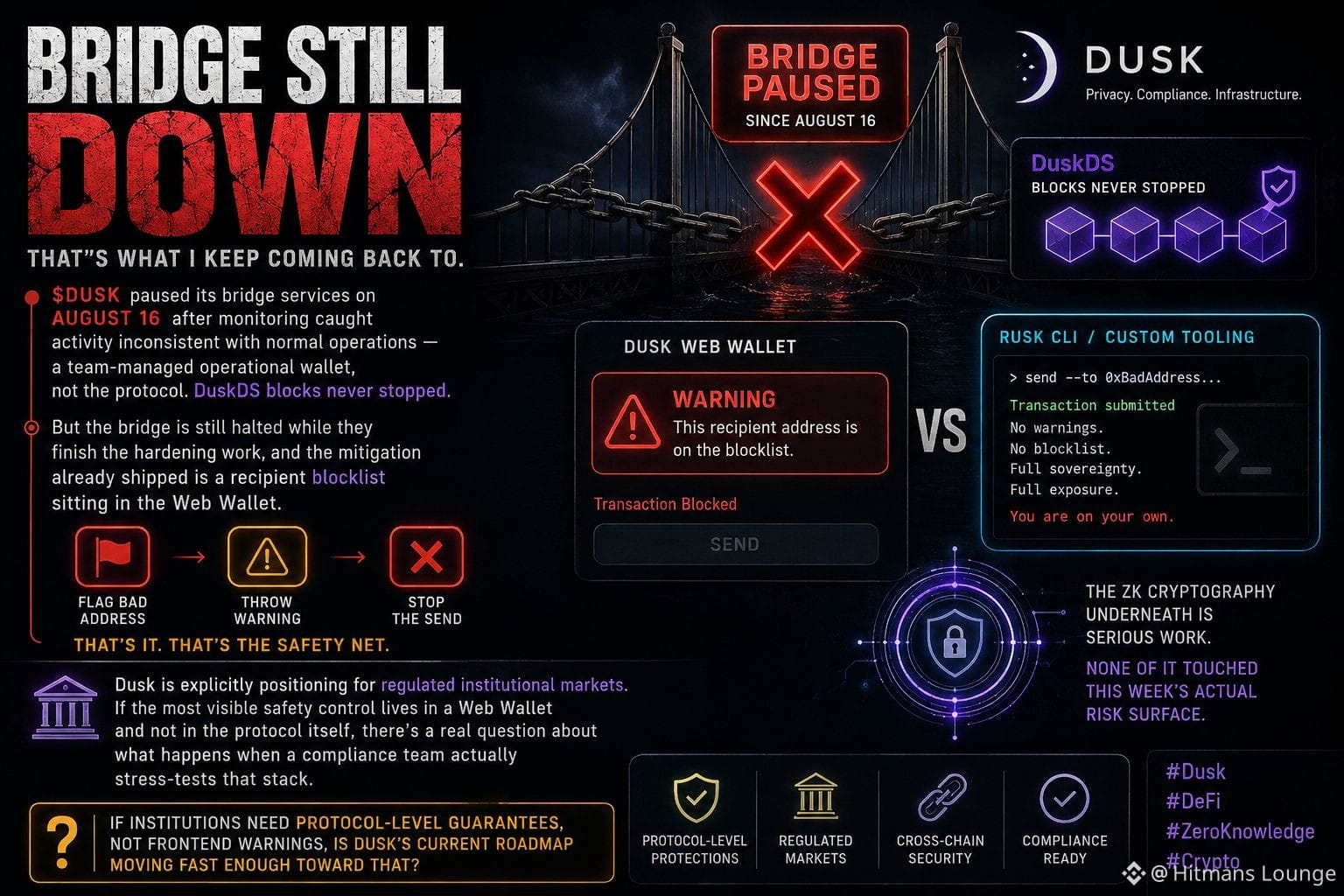
@Dusk paused its bridge services on January 16 after monitoring caught activity inconsistent with normal operations — a team-managed operational wallet, not the protocol. DuskDS blocks never stopped. But the bridge is still halted while they finish the hardening work, and the mitigation already shipped is a recipient blocklist sitting in the Web Wallet. Flag a bad address, throw a warning, stop the send.
That's it. That's the safety net.
And here's what I can't stop thinking about: if you're running Rusk CLI or your own tooling, that warning never fires. You're fully sovereign — and fully exposed. The ZK cryptography underneath is genuinely serious work. None of it touched this week's actual risk surface.
I don't think the blocklist was a wrong call. Pragmatically it's correct — cover the most users fastest, fix the architecture later.
But $DUSK is explicitly positioning for regulated institutional markets. If the most visible safety control lives in a Web Wallet and not in the protocol itself, there's a real question about what happens when a compliance team actually stress-tests that stack.
That's the gap I'm watching. Not the cryptography — the governance of where protection actually lives.
If institutions need protocol-level guarantees, not frontend warnings, is Dusk's current roadmap moving fast enough toward that?
#Dusk #DeFi #ZeroKnowledge #Bridge #DuskDS
@Dusk paused its bridge services on January 16 after monitoring caught activity inconsistent with normal operations — a team-managed operational wallet, not the protocol. DuskDS blocks never stopped. But the bridge is still halted while they finish the hardening work, and the mitigation already shipped is a recipient blocklist sitting in the Web Wallet. Flag a bad address, throw a warning, stop the send.
That's it. That's the safety net.
And here's what I can't stop thinking about: if you're running Rusk CLI or your own tooling, that warning never fires. You're fully sovereign — and fully exposed. The ZK cryptography underneath is genuinely serious work. None of it touched this week's actual risk surface.
I don't think the blocklist was a wrong call. Pragmatically it's correct — cover the most users fastest, fix the architecture later.
But $DUSK is explicitly positioning for regulated institutional markets. If the most visible safety control lives in a Web Wallet and not in the protocol itself, there's a real question about what happens when a compliance team actually stress-tests that stack.
That's the gap I'm watching. Not the cryptography — the governance of where protection actually lives.
If institutions need protocol-level guarantees, not frontend warnings, is Dusk's current roadmap moving fast enough toward that?
#Dusk #DeFi #ZeroKnowledge #Bridge #DuskDS