

#haedal
haedal
1.3M vues
3,614 mentions
Populaire
Récents


·
--
Détention de 285.7 USDT en $SUI
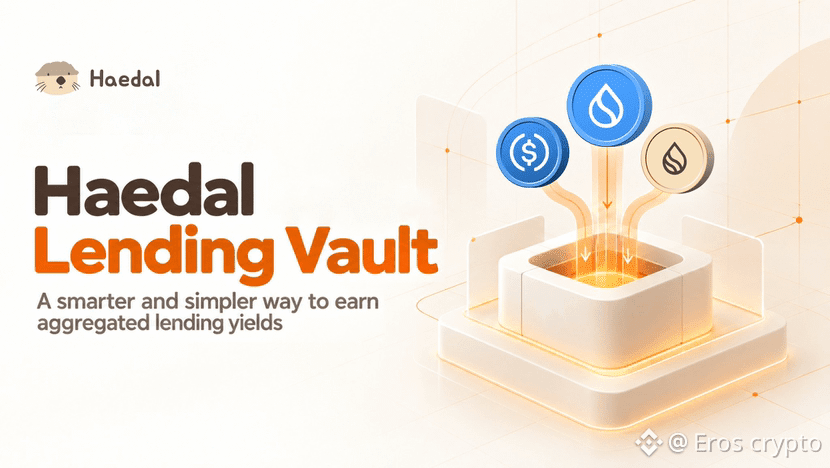
$HAEDAL Personally, I find the concept pretty interesting.
You simply deposit an asset, and the vault automatically allocates the liquidity across multiple lending markets to try to optimize the yield.
I really like the idea of not having to constantly move your funds from one protocol to another.
And more importantly, I think @HaedalProtocol could bring a new dynamic to DeFi on $SUI .
I’m definitely going to keep an eye on this protocol and watch closely for the opportunities that could come from it.
Sui is slowly building out its ecosystem… and some of the pieces are starting to get really interesting.
Anyway, definitely worth watching, but as always, stay cautious guys. DYOR.
#trading
#Haedal
$HAEDAL Personally, I find the concept pretty interesting.
You simply deposit an asset, and the vault automatically allocates the liquidity across multiple lending markets to try to optimize the yield.
I really like the idea of not having to constantly move your funds from one protocol to another.
And more importantly, I think @Haedal Protocol could bring a new dynamic to DeFi on $SUI .
I’m definitely going to keep an eye on this protocol and watch closely for the opportunities that could come from it.
Sui is slowly building out its ecosystem… and some of the pieces are starting to get really interesting.
Anyway, definitely worth watching, but as always, stay cautious guys. DYOR.
#trading
#Haedal
You simply deposit an asset, and the vault automatically allocates the liquidity across multiple lending markets to try to optimize the yield.
I really like the idea of not having to constantly move your funds from one protocol to another.
And more importantly, I think @Haedal Protocol could bring a new dynamic to DeFi on $SUI .
I’m definitely going to keep an eye on this protocol and watch closely for the opportunities that could come from it.
Sui is slowly building out its ecosystem… and some of the pieces are starting to get really interesting.
Anyway, definitely worth watching, but as always, stay cautious guys. DYOR.
#trading
#Haedal
AlphaTradesAyan:
That auto-allocation is a huge time-saver. SUI's DeFi ecosystem is growing incredibly fast right now!
3
4
691

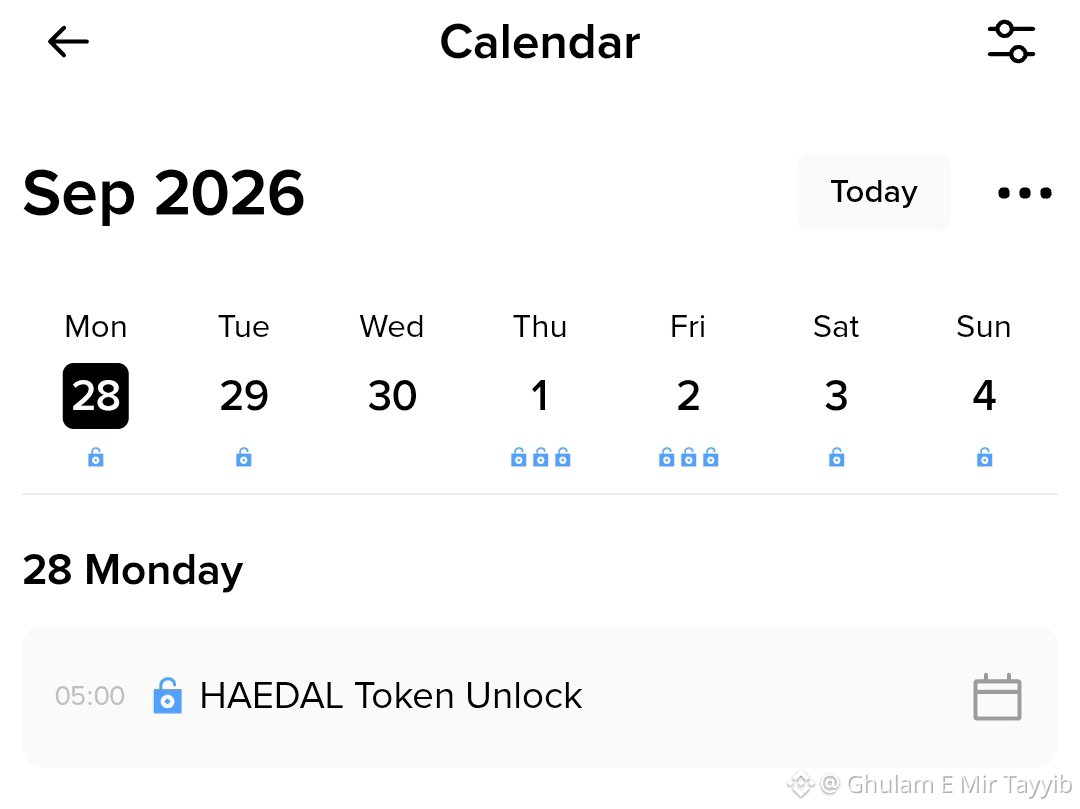
Crypto Calendar — Sep 28, 2026
Today's key event: $HAEDAL
{future}(HAEDALUSDT)
token unlock at 05:00 UTC.
When locked tokens hit circulation, sellers can suddenly have more supply to work with, which often leads to choppy price action around the unlock window. Worth keeping an eye on volume and order flow in the hours after.
Coming up this week: $HEMI
{future}(HEMIUSDT)
unlocks tomorrow, then $PARTI
{future}(PARTIUSDT)
, MAV and FF on Thursday.
Trading through unlocks or staying out of the way? 👇
#Haedal #TokenUnlock #CryptoCalendar
Crypto Calendar — Sep 28, 2026
Today's key event: $HAEDAL
token unlock at 05:00 UTC.
When locked tokens hit circulation, sellers can suddenly have more supply to work with, which often leads to choppy price action around the unlock window. Worth keeping an eye on volume and order flow in the hours after.
Coming up this week: $HEMI
unlocks tomorrow, then $PARTI
, MAV and FF on Thursday.
Trading through unlocks or staying out of the way? 👇
#Haedal #TokenUnlock #CryptoCalendar
Today's key event: $HAEDAL
token unlock at 05:00 UTC.
When locked tokens hit circulation, sellers can suddenly have more supply to work with, which often leads to choppy price action around the unlock window. Worth keeping an eye on volume and order flow in the hours after.
Coming up this week: $HEMI
unlocks tomorrow, then $PARTI
, MAV and FF on Thursday.
Trading through unlocks or staying out of the way? 👇
#Haedal #TokenUnlock #CryptoCalendar
58

·
--
What’s underneath the vault matters more than the vault itself. 👀
One thing I find interesting about Haedal’s Lending Vault is that the strategy isn’t necessarily tied to a single lending venue.
Instead, the allocation layer can work across supported lending markets.
And that distinction matters.
Because in DeFi, concentrating capital in one venue can mean concentrating your exposure to:
→ One protocol
→ One liquidity environment
→ One rate structure
→ One set of incentives
A diversified approach changes the question.
It’s not simply:
“Which market has the highest APY?”
It becomes:
“How should capital be distributed across available opportunities?”
That’s where I think vault infrastructure becomes more interesting.
Instead of manually splitting capital between different markets and constantly monitoring them, the strategy sits underneath and handles allocation according to its defined approach.
For me, the core value isn’t chasing the highest number.
It’s having diversification built underneath the strategy.
If a DeFi vault can diversify across lending markets, what matters most to you? 👇
$HAEDAL #Haedal @HaedalProtocol $SOON $PHA
{future}(BRUSDT)
{future}(ARXUSDT)
What’s underneath the vault matters more than the vault itself. 👀
One thing I find interesting about Haedal’s Lending Vault is that the strategy isn’t necessarily tied to a single lending venue.
Instead, the allocation layer can work across supported lending markets.
And that distinction matters.
Because in DeFi, concentrating capital in one venue can mean concentrating your exposure to:
→ One protocol
→ One liquidity environment
→ One rate structure
→ One set of incentives
A diversified approach changes the question.
It’s not simply:
“Which market has the highest APY?”
It becomes:
“How should capital be distributed across available opportunities?”
That’s where I think vault infrastructure becomes more interesting.
Instead of manually splitting capital between different markets and constantly monitoring them, the strategy sits underneath and handles allocation according to its defined approach.
For me, the core value isn’t chasing the highest number.
It’s having diversification built underneath the strategy.
If a DeFi vault can diversify across lending markets, what matters most to you? 👇
$HAEDAL #Haedal @Haedal Protocol $SOON $PHA
One thing I find interesting about Haedal’s Lending Vault is that the strategy isn’t necessarily tied to a single lending venue.
Instead, the allocation layer can work across supported lending markets.
And that distinction matters.
Because in DeFi, concentrating capital in one venue can mean concentrating your exposure to:
→ One protocol
→ One liquidity environment
→ One rate structure
→ One set of incentives
A diversified approach changes the question.
It’s not simply:
“Which market has the highest APY?”
It becomes:
“How should capital be distributed across available opportunities?”
That’s where I think vault infrastructure becomes more interesting.
Instead of manually splitting capital between different markets and constantly monitoring them, the strategy sits underneath and handles allocation according to its defined approach.
For me, the core value isn’t chasing the highest number.
It’s having diversification built underneath the strategy.
If a DeFi vault can diversify across lending markets, what matters most to you? 👇
$HAEDAL #Haedal @Haedal Protocol $SOON $PHA
🏦 Spread across venues
📊 Risk diversification
💧 Deep liquidity
⚙️ Automated allocation
9 heure(s) restante(s)
1
414

·
--
DeFi yield isn’t only about the rate.
What happens to the rewards after you earn them?
That’s where Haedal Lending Vault gets interesting to me.
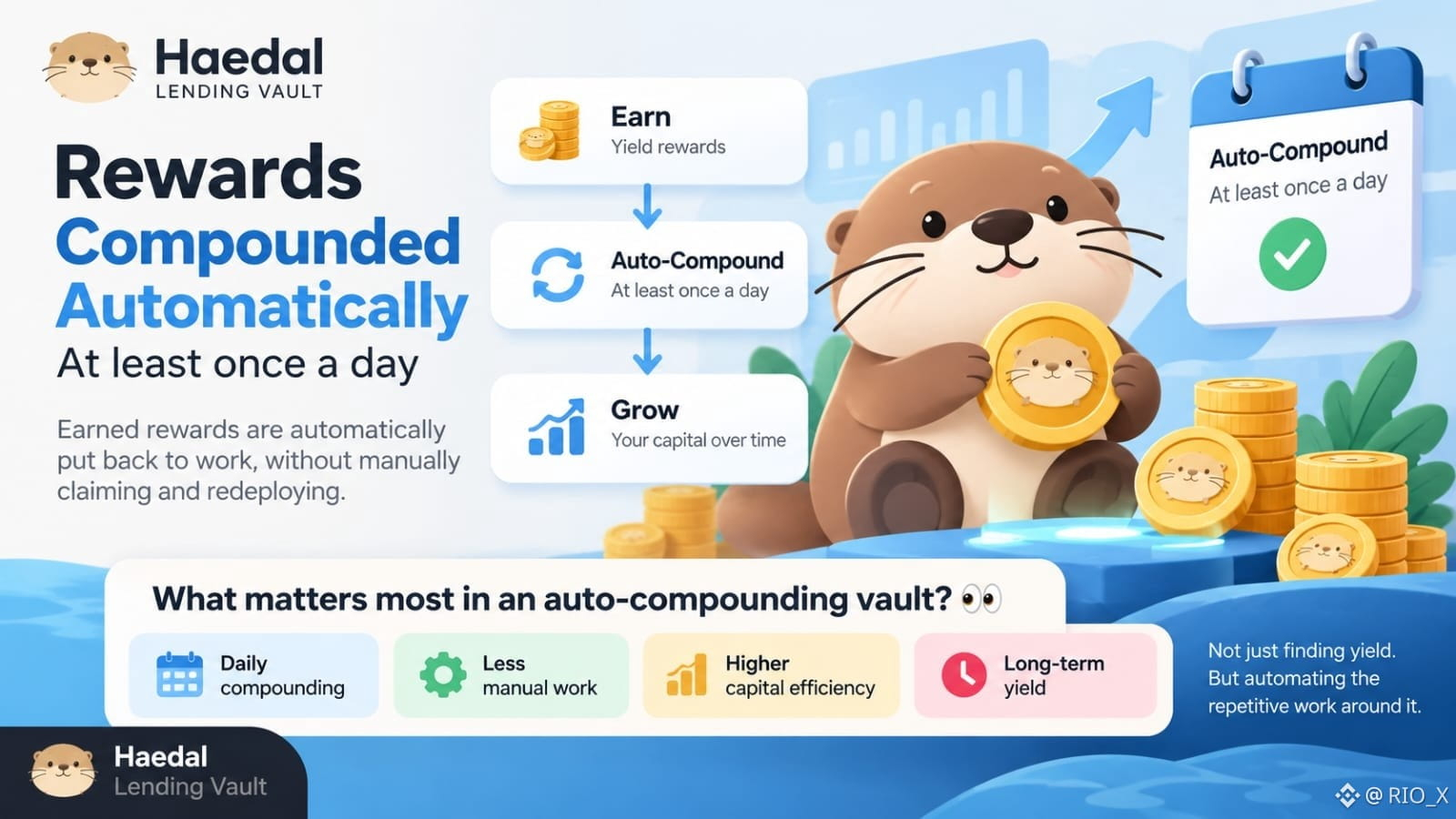
The vault automatically compounds rewards at least once a day, so earned yield can be put back to work without manually claiming and redeploying it.
Instead of:
Earn → Claim → Reinvest → Repeat
the compounding happens as part of the strategy.
It may sound like a small detail, but keeping rewards productive can make a difference over time.
That’s one of the core value points I see in a lending vault:
Not just finding yield.
Not just allocating capital.
But automating the repetitive work around it.
What matters most in an auto-compounding vault? 👀
🔹 Daily compounding
🔹 Less manual work
🔹 Higher capital efficiency
🔹 Long-term yield
#Haedal @HaedalProtocol
DeFi yield isn’t only about the rate.
What happens to the rewards after you earn them?
That’s where Haedal Lending Vault gets interesting to me.
The vault automatically compounds rewards at least once a day, so earned yield can be put back to work without manually claiming and redeploying it.
Instead of:
Earn → Claim → Reinvest → Repeat
the compounding happens as part of the strategy.
It may sound like a small detail, but keeping rewards productive can make a difference over time.
That’s one of the core value points I see in a lending vault:
Not just finding yield.
Not just allocating capital.
But automating the repetitive work around it.
What matters most in an auto-compounding vault? 👀
🔹 Daily compounding
🔹 Less manual work
🔹 Higher capital efficiency
🔹 Long-term yield
#Haedal @Haedal Protocol
What happens to the rewards after you earn them?
That’s where Haedal Lending Vault gets interesting to me.
The vault automatically compounds rewards at least once a day, so earned yield can be put back to work without manually claiming and redeploying it.
Instead of:
Earn → Claim → Reinvest → Repeat
the compounding happens as part of the strategy.
It may sound like a small detail, but keeping rewards productive can make a difference over time.
That’s one of the core value points I see in a lending vault:
Not just finding yield.
Not just allocating capital.
But automating the repetitive work around it.
What matters most in an auto-compounding vault? 👀
🔹 Daily compounding
🔹 Less manual work
🔹 Higher capital efficiency
🔹 Long-term yield
#Haedal @Haedal Protocol
1
125

·
--
Vérifié
I’m noticing that the interesting part of Haedal’s Lending Vault is not simply the yield. It is how the system is designed to manage liquidity when conditions change.
The idea is straightforward: I deposit once, while the vault handles allocation across supported Sui lending markets. Instead of manually checking rates, moving funds, claiming rewards, and reinvesting, the process is designed to be automated.
Haedal connects markets including NAVI, Suilend, Scallop, Current, and AlphaFi, with vaults for SUI, USDC, and haSUI.
What I’m watching most closely is dynamic allocation. Lending rates, liquidity, and incentives can change, so the important question is how the vault responds when the underlying environment changes.
The AlphaFi situation makes this practical. Haedal removed AlphaLend after AlphaFi announced its wind-down and stated that no Haedal vault funds were affected.
I’m noticing that this makes monitoring, predictable operations, and the ability to adjust exposure more important than simply displaying an APY.
For me, the bigger story is the strategy layer:
One deposit, multiple markets, automated allocation, and automated compounding.
I’m watching how this model performs when real conditions become less predictable.
$HAEDAL #Haedal @HaedalProtocol
Not financial advice.
I’m noticing that the interesting part of Haedal’s Lending Vault is not simply the yield. It is how the system is designed to manage liquidity when conditions change.
The idea is straightforward: I deposit once, while the vault handles allocation across supported Sui lending markets. Instead of manually checking rates, moving funds, claiming rewards, and reinvesting, the process is designed to be automated.
Haedal connects markets including NAVI, Suilend, Scallop, Current, and AlphaFi, with vaults for SUI, USDC, and haSUI.
What I’m watching most closely is dynamic allocation. Lending rates, liquidity, and incentives can change, so the important question is how the vault responds when the underlying environment changes.
The AlphaFi situation makes this practical. Haedal removed AlphaLend after AlphaFi announced its wind-down and stated that no Haedal vault funds were affected.
I’m noticing that this makes monitoring, predictable operations, and the ability to adjust exposure more important than simply displaying an APY.
For me, the bigger story is the strategy layer:
One deposit, multiple markets, automated allocation, and automated compounding.
I’m watching how this model performs when real conditions become less predictable.
$HAEDAL #Haedal @Haedal Protocol
Not financial advice.
The idea is straightforward: I deposit once, while the vault handles allocation across supported Sui lending markets. Instead of manually checking rates, moving funds, claiming rewards, and reinvesting, the process is designed to be automated.
Haedal connects markets including NAVI, Suilend, Scallop, Current, and AlphaFi, with vaults for SUI, USDC, and haSUI.
What I’m watching most closely is dynamic allocation. Lending rates, liquidity, and incentives can change, so the important question is how the vault responds when the underlying environment changes.
The AlphaFi situation makes this practical. Haedal removed AlphaLend after AlphaFi announced its wind-down and stated that no Haedal vault funds were affected.
I’m noticing that this makes monitoring, predictable operations, and the ability to adjust exposure more important than simply displaying an APY.
For me, the bigger story is the strategy layer:
One deposit, multiple markets, automated allocation, and automated compounding.
I’m watching how this model performs when real conditions become less predictable.
$HAEDAL #Haedal @Haedal Protocol
Not financial advice.

GAREEBO WHALE :
Why You Promoting Scam Project
1
1
196

·
--
Vérifié
Can One Haedal Vault Optimize Sui Lending Markets?
Haedal just launched its Lending Vault on Sui and the interesting part isn't simply that there’s another lending product.
The idea is pretty simple:
deposit once, and let the vault move your liquidity across multiple lending markets.
Instead of opening different protocols, comparing rates, manually moving funds and repeatedly claiming rewards, the new Haedal Lending Vault is designed to handle that process automatically.
What caught my attention is the dynamic allocation.
Lending conditions can change. Liquidity changes. Incentives change. So rather than leaving capital parked in one venue, the vault can adjust its allocation across supported Sui lending markets.
Haedal says the vault currently connects markets including NAVI, Current, Suilend, Scallop and AlphaFi, with SUI, USDC and haSUI vaults available.
Rewards are also automatically reinvested, so users don't need to keep coming back to manually claim and compound them.
That’s the real idea behind this launch:
one deposit → multiple lending markets → automated allocation → automated compounding.
Haedal is basically turning several lending positions into one simpler experience.
$HAEDAL #Haedal @HaedalProtocol
Not financial advice.
{spot}(HAEDALUSDT)
Can One Haedal Vault Optimize Sui Lending Markets?
Haedal just launched its Lending Vault on Sui and the interesting part isn't simply that there’s another lending product.
The idea is pretty simple:
deposit once, and let the vault move your liquidity across multiple lending markets.
Instead of opening different protocols, comparing rates, manually moving funds and repeatedly claiming rewards, the new Haedal Lending Vault is designed to handle that process automatically.
What caught my attention is the dynamic allocation.
Lending conditions can change. Liquidity changes. Incentives change. So rather than leaving capital parked in one venue, the vault can adjust its allocation across supported Sui lending markets.
Haedal says the vault currently connects markets including NAVI, Current, Suilend, Scallop and AlphaFi, with SUI, USDC and haSUI vaults available.
Rewards are also automatically reinvested, so users don't need to keep coming back to manually claim and compound them.
That’s the real idea behind this launch:
one deposit → multiple lending markets → automated allocation → automated compounding.
Haedal is basically turning several lending positions into one simpler experience.
$HAEDAL #Haedal @Haedal Protocol
Not financial advice.
Haedal just launched its Lending Vault on Sui and the interesting part isn't simply that there’s another lending product.
The idea is pretty simple:
deposit once, and let the vault move your liquidity across multiple lending markets.
Instead of opening different protocols, comparing rates, manually moving funds and repeatedly claiming rewards, the new Haedal Lending Vault is designed to handle that process automatically.
What caught my attention is the dynamic allocation.
Lending conditions can change. Liquidity changes. Incentives change. So rather than leaving capital parked in one venue, the vault can adjust its allocation across supported Sui lending markets.
Haedal says the vault currently connects markets including NAVI, Current, Suilend, Scallop and AlphaFi, with SUI, USDC and haSUI vaults available.
Rewards are also automatically reinvested, so users don't need to keep coming back to manually claim and compound them.
That’s the real idea behind this launch:
one deposit → multiple lending markets → automated allocation → automated compounding.
Haedal is basically turning several lending positions into one simpler experience.
$HAEDAL #Haedal @Haedal Protocol
Not financial advice.

Draven Kai:
The multi-market approach could help reduce dependence on a single lending venue.
22
1
24
756

·
--
One thing I’m watching with DeFi vaults isn't just the yield.
It’s how the strategy responds when something changes underneath.
Haedal recently removed AlphaLend from its Lending Vault following AlphaFi’s wind-down announcement.
Haedal also stated that no Haedal vault funds were affected.
That’s an important part of the aggregation model.
The underlying protocols can change, incentives can shift, and market conditions can evolve.
A vault needs to be able to adapt instead of treating its initial allocation as permanent.
That’s why I find the strategy layer more interesting than simply looking at the current APY.
The real question is what happens underneath when the market changes.
Poll: What matters most in a DeFi vault? 👇
$HAEDAL #Haedal @HaedalProtocol
Not financial advice.
One thing I’m watching with DeFi vaults isn't just the yield.
It’s how the strategy responds when something changes underneath.
Haedal recently removed AlphaLend from its Lending Vault following AlphaFi’s wind-down announcement.
Haedal also stated that no Haedal vault funds were affected.
That’s an important part of the aggregation model.
The underlying protocols can change, incentives can shift, and market conditions can evolve.
A vault needs to be able to adapt instead of treating its initial allocation as permanent.
That’s why I find the strategy layer more interesting than simply looking at the current APY.
The real question is what happens underneath when the market changes.
Poll: What matters most in a DeFi vault? 👇
$HAEDAL #Haedal @Haedal Protocol
Not financial advice.
It’s how the strategy responds when something changes underneath.
Haedal recently removed AlphaLend from its Lending Vault following AlphaFi’s wind-down announcement.
Haedal also stated that no Haedal vault funds were affected.
That’s an important part of the aggregation model.
The underlying protocols can change, incentives can shift, and market conditions can evolve.
A vault needs to be able to adapt instead of treating its initial allocation as permanent.
That’s why I find the strategy layer more interesting than simply looking at the current APY.
The real question is what happens underneath when the market changes.
Poll: What matters most in a DeFi vault? 👇
$HAEDAL #Haedal @Haedal Protocol
Not financial advice.
🔹 Yield
🔹 Risk management
🔹 Strategy adaptability
🔹 Protocol selection
2 jour(s) restant(s)
1
162
·
--
$3M+ liquidity in the Haedal Lending Vault. 🦦🌊
What caught my attention isn't just the milestone.It’s the pace at which the vault has been growing.
First $1M.
Then $2M.
Now liquidity has pushed past $3M, with the USDC Vault capacity raised again to 3M USDC to accommodate demand.
That tells me there’s growing interest in a simpler way to access aggregated lending opportunities across Sui.
The basic idea remains straightforward:
Deposit once → the vault manages the allocation across supported lending markets.
And as the lending landscape changes, the strategy can adjust rather than leaving users to manually manage every position.
Interesting to watch how this develops from here.What do you think is driving the Haedal Lending Vault’s rapid growth?
$HAEDAL #Haedal @HaedalProtocol
**Not financial advice.**
$3M+ liquidity in the Haedal Lending Vault. 🦦🌊
What caught my attention isn't just the milestone.It’s the pace at which the vault has been growing.
First $1M.
Then $2M.
Now liquidity has pushed past $3M, with the USDC Vault capacity raised again to 3M USDC to accommodate demand.
That tells me there’s growing interest in a simpler way to access aggregated lending opportunities across Sui.
The basic idea remains straightforward:
Deposit once → the vault manages the allocation across supported lending markets.
And as the lending landscape changes, the strategy can adjust rather than leaving users to manually manage every position.
Interesting to watch how this develops from here.What do you think is driving the Haedal Lending Vault’s rapid growth?
$HAEDAL #Haedal @Haedal Protocol
**Not financial advice.**
What caught my attention isn't just the milestone.It’s the pace at which the vault has been growing.
First $1M.
Then $2M.
Now liquidity has pushed past $3M, with the USDC Vault capacity raised again to 3M USDC to accommodate demand.
That tells me there’s growing interest in a simpler way to access aggregated lending opportunities across Sui.
The basic idea remains straightforward:
Deposit once → the vault manages the allocation across supported lending markets.
And as the lending landscape changes, the strategy can adjust rather than leaving users to manually manage every position.
Interesting to watch how this develops from here.What do you think is driving the Haedal Lending Vault’s rapid growth?
$HAEDAL #Haedal @Haedal Protocol
**Not financial advice.**
Simpler access to lending
Growing Sui DeFi activity
Automated allocation strategy
More users exploring yield
2 jour(s) restant(s)
1
489

·
--
Partiellement vrai
$SUI DEFI IS FLOODING $HAEDAL 💧 🦦🔥
Haedal’s Lending Vaults are filling FAST.
The idea is simple:
👉 deposit SUI, USDC or haSUI once, and @HaedalProtocol automatically allocates your funds across lending markets like Navi, Suilend and Scallop, adjusting as yields, liquidity and incentives change.
The demand is rising fast! On users demand they expanded the capacity of the vaults couple times:
from 300K → 500K → 700K capacity for both SUI and USDC.
Then USDC jumped again to 1,000,000 !
Within just 2 days, total liquidity passed $1 MILLION. 💰
Now boosted incentives are live, with promotional APYs reaching 30%+ on major assets.
One deposit. Multiple lending markets. Automatic reallocation.
And apparently, Sui users can't get enough of it . 🦦🌊🏄
#Haedal $HAEDAL
{future}(HAEDALUSDT)
$SUI DEFI IS FLOODING $HAEDAL 💧 🦦🔥
Haedal’s Lending Vaults are filling FAST.
The idea is simple:
👉 deposit SUI, USDC or haSUI once, and @Haedal Protocol automatically allocates your funds across lending markets like Navi, Suilend and Scallop, adjusting as yields, liquidity and incentives change.
The demand is rising fast! On users demand they expanded the capacity of the vaults couple times:
from 300K → 500K → 700K capacity for both SUI and USDC.
Then USDC jumped again to 1,000,000 !
Within just 2 days, total liquidity passed $1 MILLION. 💰
Now boosted incentives are live, with promotional APYs reaching 30%+ on major assets.
One deposit. Multiple lending markets. Automatic reallocation.
And apparently, Sui users can't get enough of it . 🦦🌊🏄
#Haedal $HAEDAL
Haedal’s Lending Vaults are filling FAST.
The idea is simple:
👉 deposit SUI, USDC or haSUI once, and @Haedal Protocol automatically allocates your funds across lending markets like Navi, Suilend and Scallop, adjusting as yields, liquidity and incentives change.
The demand is rising fast! On users demand they expanded the capacity of the vaults couple times:
from 300K → 500K → 700K capacity for both SUI and USDC.
Then USDC jumped again to 1,000,000 !
Within just 2 days, total liquidity passed $1 MILLION. 💰
Now boosted incentives are live, with promotional APYs reaching 30%+ on major assets.
One deposit. Multiple lending markets. Automatic reallocation.
And apparently, Sui users can't get enough of it . 🦦🌊🏄
#Haedal $HAEDAL


_Ram:
And the APY got 10% bonus from $HAEDAL tokens hahaha😁
4
8
687

Yield just got another boost on Sui. 🦦
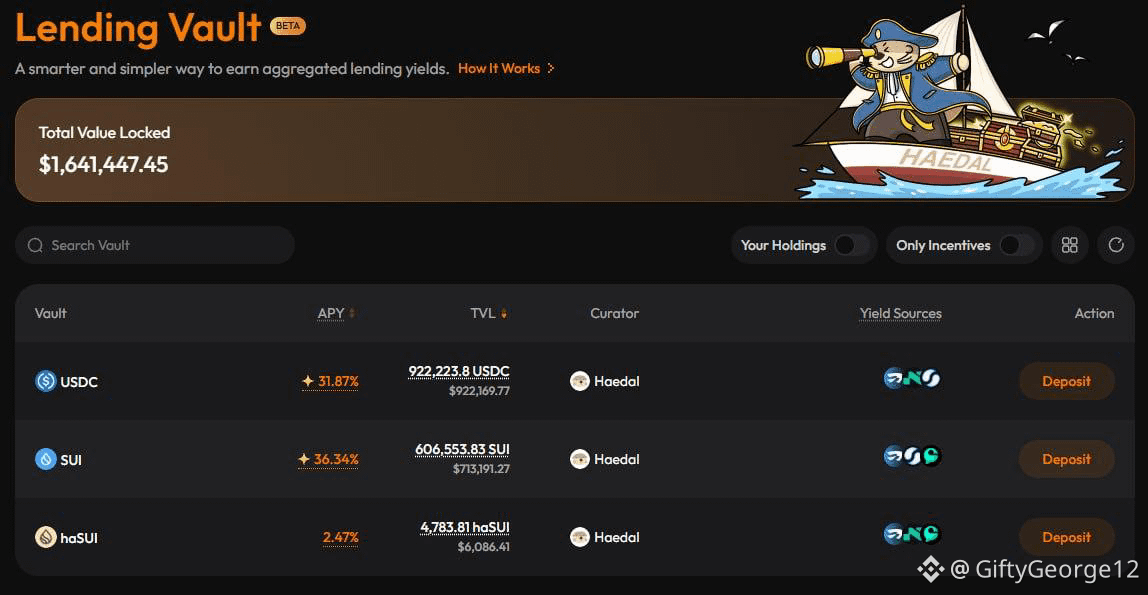
$HAEDAL Lending Vault incentives have been renewed, bringing attractive APRs for both USDC and SUI.
What makes it interesting is the strategy behind it:
• Capital is allocated across underlying lending protocols
• Users can share in native lending fees and incentives
• Allocations adjust dynamically based on protocol health and yield performance
• Built with a strong focus on product security
One vault, smarter allocation, more opportunities to earn across $SUI DeFi.
Haedal keeps building.
#Haedal
Yield just got another boost on Sui. 🦦
$HAEDAL Lending Vault incentives have been renewed, bringing attractive APRs for both USDC and SUI.
What makes it interesting is the strategy behind it:
• Capital is allocated across underlying lending protocols
• Users can share in native lending fees and incentives
• Allocations adjust dynamically based on protocol health and yield performance
• Built with a strong focus on product security
One vault, smarter allocation, more opportunities to earn across $SUI DeFi.
Haedal keeps building.
#Haedal
$HAEDAL Lending Vault incentives have been renewed, bringing attractive APRs for both USDC and SUI.
What makes it interesting is the strategy behind it:
• Capital is allocated across underlying lending protocols
• Users can share in native lending fees and incentives
• Allocations adjust dynamically based on protocol health and yield performance
• Built with a strong focus on product security
One vault, smarter allocation, more opportunities to earn across $SUI DeFi.
Haedal keeps building.
#Haedal
1
195
With AlphaFi winding down, some users are now looking for a new place to put their lending positions.
Haedal Lending Vault is worth having on the radar. 🦦
Your deposits are allocated directly across underlying lending protocols, allowing you to earn native lending interest alongside incentive rewards.
Haedal also actively monitors health factors and yields, adjusting allocations when market conditions change.
And with $HAEDAL incentives currently live on the vault, there’s even more reason to explore it.
For users looking for a simpler way to access lending opportunities across $SUI DeFi, this is a solid time to check out Haedal Lending Vault.
https://haedal.xyz/lending
#Haedal
With AlphaFi winding down, some users are now looking for a new place to put their lending positions.
Haedal Lending Vault is worth having on the radar. 🦦
Your deposits are allocated directly across underlying lending protocols, allowing you to earn native lending interest alongside incentive rewards.
Haedal also actively monitors health factors and yields, adjusting allocations when market conditions change.
And with $HAEDAL incentives currently live on the vault, there’s even more reason to explore it.
For users looking for a simpler way to access lending opportunities across $SUI DeFi, this is a solid time to check out Haedal Lending Vault.
https://haedal.xyz/lending
#Haedal
Haedal Lending Vault is worth having on the radar. 🦦
Your deposits are allocated directly across underlying lending protocols, allowing you to earn native lending interest alongside incentive rewards.
Haedal also actively monitors health factors and yields, adjusting allocations when market conditions change.
And with $HAEDAL incentives currently live on the vault, there’s even more reason to explore it.
For users looking for a simpler way to access lending opportunities across $SUI DeFi, this is a solid time to check out Haedal Lending Vault.
https://haedal.xyz/lending
#Haedal

1
157

Partiellement vrai
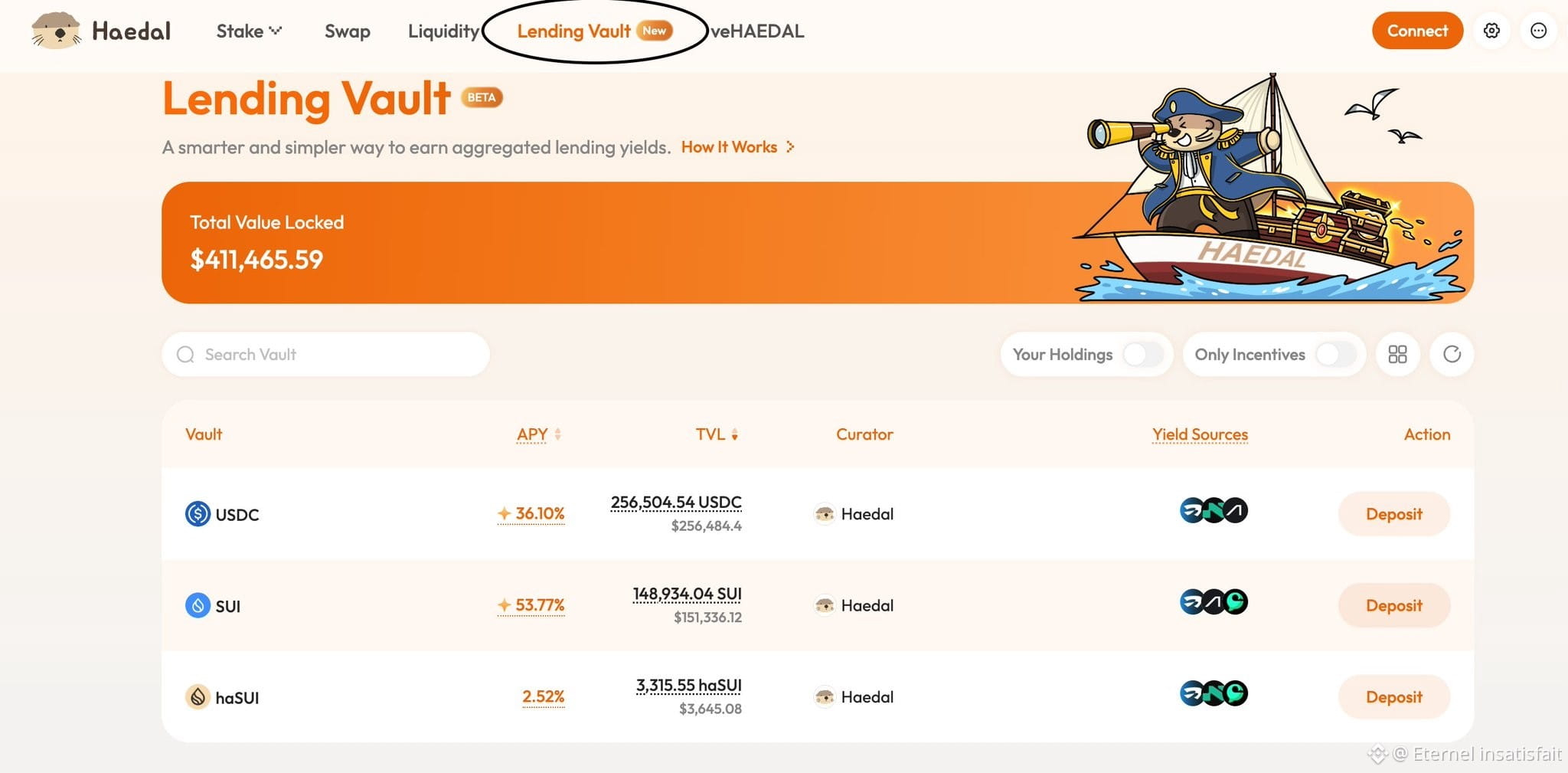
BREAKING:
@HaedalProtocol lending vault just crossed $400,000 deposits less 24 hours after launch.
APY's up to 53% currently on $SUI vault and 37% on $USDC vault. otters are printing...🫰💰💰
have a good week-end
#HAEDAL
BREAKING:
@Haedal Protocol lending vault just crossed $400,000 deposits less 24 hours after launch.
APY's up to 53% currently on $SUI vault and 37% on $USDC vault. otters are printing...🫰💰💰
have a good week-end
#HAEDAL
@Haedal Protocol lending vault just crossed $400,000 deposits less 24 hours after launch.
APY's up to 53% currently on $SUI vault and 37% on $USDC vault. otters are printing...🫰💰💰
have a good week-end
#HAEDAL
3
787

·
--
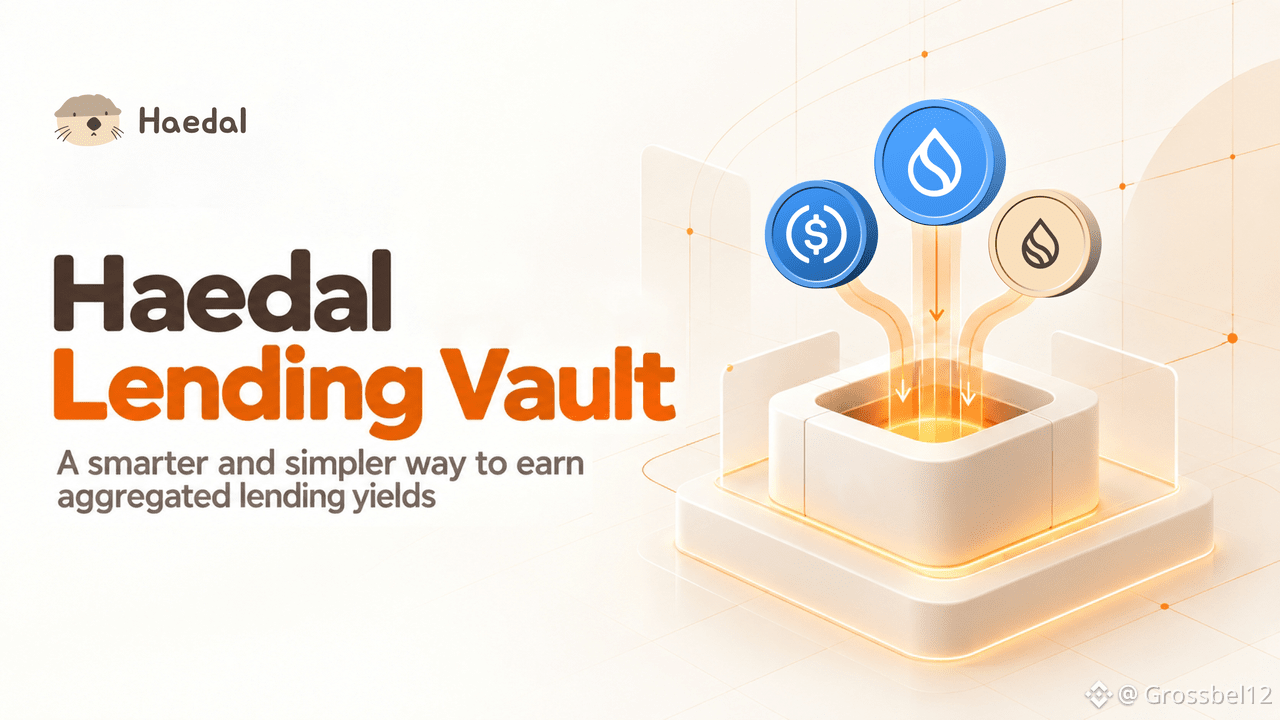
SUI, USDC and haSUI are not interchangeable deposits.
A SUI vault position combines lending yield with direct exposure to SUI price volatility. USDC reduces that directional exposure, making net yield and liquidity the primary variables. haSUI keeps exposure to staked SUI economics while adding liquid-staking and integration risk.
Haedal Lending Vault can manage allocation across several lending venues, but it does not change the risk profile of the asset you choose at entry. Before depositing, define what you are actually optimizing: stable-dollar carry, SUI beta with lending income, or capital efficiency on a liquid-staking position.
Then compare realized vault share-price growth, underlying allocation and withdrawal liquidity. Do not select a vault from APY alone.
The product is BETA. Treat asset selection and position sizing as separate risk decisions.
#Haedal @HaedalProtocol
SUI, USDC and haSUI are not interchangeable deposits.
A SUI vault position combines lending yield with direct exposure to SUI price volatility. USDC reduces that directional exposure, making net yield and liquidity the primary variables. haSUI keeps exposure to staked SUI economics while adding liquid-staking and integration risk.
Haedal Lending Vault can manage allocation across several lending venues, but it does not change the risk profile of the asset you choose at entry. Before depositing, define what you are actually optimizing: stable-dollar carry, SUI beta with lending income, or capital efficiency on a liquid-staking position.
Then compare realized vault share-price growth, underlying allocation and withdrawal liquidity. Do not select a vault from APY alone.
The product is BETA. Treat asset selection and position sizing as separate risk decisions.
#Haedal @HaedalProtocol
A SUI vault position combines lending yield with direct exposure to SUI price volatility. USDC reduces that directional exposure, making net yield and liquidity the primary variables. haSUI keeps exposure to staked SUI economics while adding liquid-staking and integration risk.
Haedal Lending Vault can manage allocation across several lending venues, but it does not change the risk profile of the asset you choose at entry. Before depositing, define what you are actually optimizing: stable-dollar carry, SUI beta with lending income, or capital efficiency on a liquid-staking position.
Then compare realized vault share-price growth, underlying allocation and withdrawal liquidity. Do not select a vault from APY alone.
The product is BETA. Treat asset selection and position sizing as separate risk decisions.
#Haedal @HaedalProtocol
111
·
--
Small yield positions often lose efficiency through operations, not through the quoted rate.
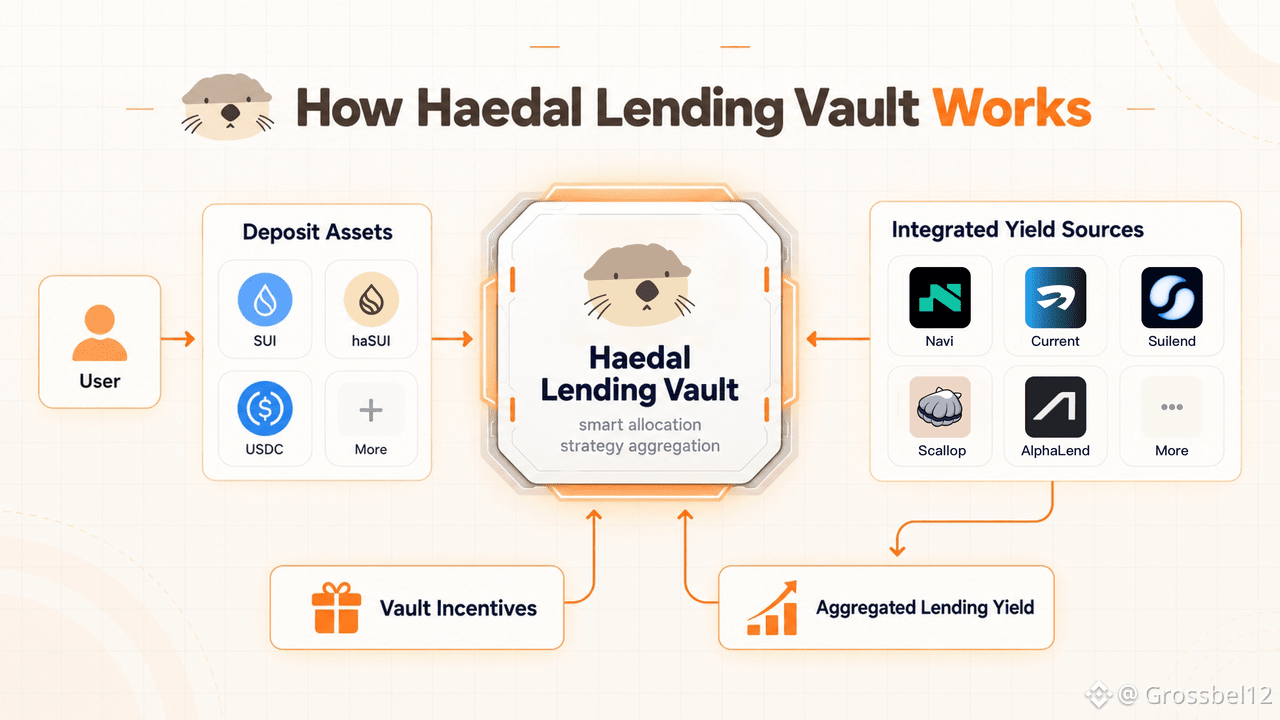
Manual lending across several Sui markets means comparing incentives, moving capital, claiming rewards and deciding when compounding is worth the transaction cost. Haedal Lending Vault compresses that workflow into one managed position: deposit SUI, USDC or haSUI, receive a vault share, and let the strategy handle allocation and reinvestment.
For smaller accounts, daily automated compounding can matter because unclaimed rewards no longer sit idle waiting to justify a manual transaction. The correct comparison is net share-price growth after the 10% performance fee versus the return and operational cost of managing positions directly. The management fee is 0%.
Convenience is not alpha by itself. Review allocation, realized performance and liquidity before committing capital. The module is BETA.
#Haedal @HaedalProtocol
Small yield positions often lose efficiency through operations, not through the quoted rate.
Manual lending across several Sui markets means comparing incentives, moving capital, claiming rewards and deciding when compounding is worth the transaction cost. Haedal Lending Vault compresses that workflow into one managed position: deposit SUI, USDC or haSUI, receive a vault share, and let the strategy handle allocation and reinvestment.
For smaller accounts, daily automated compounding can matter because unclaimed rewards no longer sit idle waiting to justify a manual transaction. The correct comparison is net share-price growth after the 10% performance fee versus the return and operational cost of managing positions directly. The management fee is 0%.
Convenience is not alpha by itself. Review allocation, realized performance and liquidity before committing capital. The module is BETA.
#Haedal @HaedalProtocol
Manual lending across several Sui markets means comparing incentives, moving capital, claiming rewards and deciding when compounding is worth the transaction cost. Haedal Lending Vault compresses that workflow into one managed position: deposit SUI, USDC or haSUI, receive a vault share, and let the strategy handle allocation and reinvestment.
For smaller accounts, daily automated compounding can matter because unclaimed rewards no longer sit idle waiting to justify a manual transaction. The correct comparison is net share-price growth after the 10% performance fee versus the return and operational cost of managing positions directly. The management fee is 0%.
Convenience is not alpha by itself. Review allocation, realized performance and liquidity before committing capital. The module is BETA.
#Haedal @HaedalProtocol
105

·
--
Partiellement vrai
HAEDAL JUST HIT $1M — BUT LOOK WHERE THE MONEY GOES
Haedal’s Lending Vault crossed $1M in liquidity within two days.
What caught my attention is that Haedal isn't building another isolated lending pool.
The vault takes deposits and automatically allocates them across existing Sui lending markets including $NAVI.US , Suilend, Scallop, AlphaFi and CurrentSUI.
So that $1M is telling us more than “Haedal attracted deposits.”
It shows there is demand for a simpler way to access lending opportunities across Sui without manually managing different markets.
Haedal has also kept increasing the vault caps as liquidity came in, with both SUI and USDC now reaching 700K capacity.
That makes the next thing worth watching pretty simple:
Where does the liquidity actually end up?
If one or two markets start taking a much larger share, that could reveal where lending demand or better opportunities are concentrating across Sui.
The $1M is the headline.
The allocation is the part I'd watch.
$HAEDAL $SUI #Haedal @HaedalProtocol
NFA
What matters more for Haedal from here?
HAEDAL JUST HIT $1M — BUT LOOK WHERE THE MONEY GOES
Haedal’s Lending Vault crossed $1M in liquidity within two days.
What caught my attention is that Haedal isn't building another isolated lending pool.
The vault takes deposits and automatically allocates them across existing Sui lending markets including $NAVI.US , Suilend, Scallop, AlphaFi and CurrentSUI.
So that $1M is telling us more than “Haedal attracted deposits.”
It shows there is demand for a simpler way to access lending opportunities across Sui without manually managing different markets.
Haedal has also kept increasing the vault caps as liquidity came in, with both SUI and USDC now reaching 700K capacity.
That makes the next thing worth watching pretty simple:
Where does the liquidity actually end up?
If one or two markets start taking a much larger share, that could reveal where lending demand or better opportunities are concentrating across Sui.
The $1M is the headline.
The allocation is the part I'd watch.
$HAEDAL $SUI #Haedal @Haedal Protocol
NFA
What matters more for Haedal from here?
Haedal’s Lending Vault crossed $1M in liquidity within two days.
What caught my attention is that Haedal isn't building another isolated lending pool.
The vault takes deposits and automatically allocates them across existing Sui lending markets including $NAVI.US , Suilend, Scallop, AlphaFi and CurrentSUI.
So that $1M is telling us more than “Haedal attracted deposits.”
It shows there is demand for a simpler way to access lending opportunities across Sui without manually managing different markets.
Haedal has also kept increasing the vault caps as liquidity came in, with both SUI and USDC now reaching 700K capacity.
That makes the next thing worth watching pretty simple:
Where does the liquidity actually end up?
If one or two markets start taking a much larger share, that could reveal where lending demand or better opportunities are concentrating across Sui.
The $1M is the headline.
The allocation is the part I'd watch.
$HAEDAL $SUI #Haedal @Haedal Protocol
NFA
What matters more for Haedal from here?
More TVL
86%
Where liquidity goes
14%
7 Votes • Vote fermé
2
3
2k

·
--
Haussier
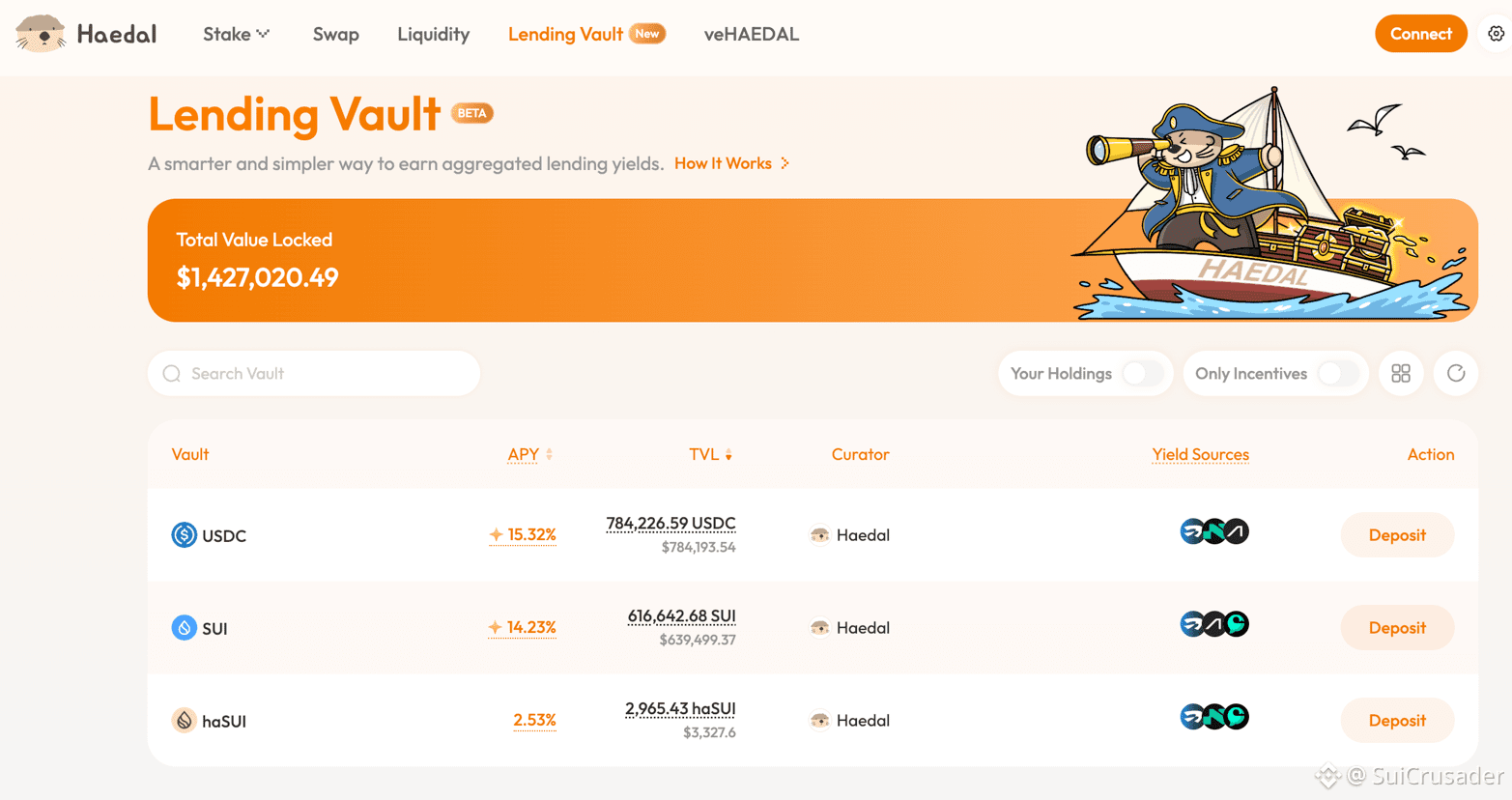
Less than 72 hours after being launched, Haedal vault has crossed $1.4m in deposits and APY is currently sitting btw 14-15%
It helps you find the pools with the best APY and it deploys capital there, instead of you spending all day hunting APY and redeploying capital constantly… haedal does it for ypu!!!
#haedal $HAEDAL
Less than 72 hours after being launched, Haedal vault has crossed $1.4m in deposits and APY is currently sitting btw 14-15%
It helps you find the pools with the best APY and it deploys capital there, instead of you spending all day hunting APY and redeploying capital constantly… haedal does it for ypu!!!
#haedal $HAEDAL
It helps you find the pools with the best APY and it deploys capital there, instead of you spending all day hunting APY and redeploying capital constantly… haedal does it for ypu!!!
#haedal $HAEDAL
1
210

Partiellement vrai
#Haedal 到底多大:看協議自己公布的成長數字
協議發展到什麼規模,與其憑印象猜測,不如直接看公開數據作為參考。
Sui 上的流動性質押協議 Haedal,公開了一些自己的成長數字。
根據公開資料,截至近期,Haedal 的鎖倉量約來到 2.1 億美元左右,持有相關代幣或部位的地址數超過 79 萬,每日活躍錢包數也有約 4.4 萬個。
另外,Haedal 自己的造市機制 HMM,在截至 2026 年 2 月的統計中,曾被列為 Sui 上按日交易量排名前三的自動化造市商之一。
這些數字說明的是協議目前的使用規模跟活躍程度,幫助剛接觸的人建立一個大概的參照座標,而不是對未來表現的任何保證。
鏈上數據會隨時間持續變動,這裡引用的都是截至特定時間點的公開統計,實際情況以協議當下公布的資料為準。
從單一質押協議成長到涵蓋造市、自動化 LP、農場等多項產品的完整生態,這些數字某種程度上反映的是使用場景變多之後帶來的規模效應,而不是單一數字暴衝的結果。
對想評估一個協議是否值得深入了解的人來說,持有人數、活躍錢包這類廣度指標,跟鎖倉量這種資金深度指標放在一起看,會比只看單一數字更完整。
#Haedal 到底多大:看協議自己公布的成長數字
協議發展到什麼規模,與其憑印象猜測,不如直接看公開數據作為參考。
Sui 上的流動性質押協議 Haedal,公開了一些自己的成長數字。
根據公開資料,截至近期,Haedal 的鎖倉量約來到 2.1 億美元左右,持有相關代幣或部位的地址數超過 79 萬,每日活躍錢包數也有約 4.4 萬個。
另外,Haedal 自己的造市機制 HMM,在截至 2026 年 2 月的統計中,曾被列為 Sui 上按日交易量排名前三的自動化造市商之一。
這些數字說明的是協議目前的使用規模跟活躍程度,幫助剛接觸的人建立一個大概的參照座標,而不是對未來表現的任何保證。
鏈上數據會隨時間持續變動,這裡引用的都是截至特定時間點的公開統計,實際情況以協議當下公布的資料為準。
從單一質押協議成長到涵蓋造市、自動化 LP、農場等多項產品的完整生態,這些數字某種程度上反映的是使用場景變多之後帶來的規模效應,而不是單一數字暴衝的結果。
對想評估一個協議是否值得深入了解的人來說,持有人數、活躍錢包這類廣度指標,跟鎖倉量這種資金深度指標放在一起看,會比只看單一數字更完整。
協議發展到什麼規模,與其憑印象猜測,不如直接看公開數據作為參考。
Sui 上的流動性質押協議 Haedal,公開了一些自己的成長數字。
根據公開資料,截至近期,Haedal 的鎖倉量約來到 2.1 億美元左右,持有相關代幣或部位的地址數超過 79 萬,每日活躍錢包數也有約 4.4 萬個。
另外,Haedal 自己的造市機制 HMM,在截至 2026 年 2 月的統計中,曾被列為 Sui 上按日交易量排名前三的自動化造市商之一。
這些數字說明的是協議目前的使用規模跟活躍程度,幫助剛接觸的人建立一個大概的參照座標,而不是對未來表現的任何保證。
鏈上數據會隨時間持續變動,這裡引用的都是截至特定時間點的公開統計,實際情況以協議當下公布的資料為準。
從單一質押協議成長到涵蓋造市、自動化 LP、農場等多項產品的完整生態,這些數字某種程度上反映的是使用場景變多之後帶來的規模效應,而不是單一數字暴衝的結果。
對想評估一個協議是否值得深入了解的人來說,持有人數、活躍錢包這類廣度指標,跟鎖倉量這種資金深度指標放在一起看,會比只看單一數字更完整。

GAREEBO WHALE :
Why You Promoting Scam Project
2
1
651

·
--
$HAEDAL 🦦🌊
속도가 달라지고 있습니다.
Haedal Lending Vault가 또 하나의 이정표를 넘어섰습니다.
🔥 총 유동성 $3M 돌파.
더 놀라운 건 단순히 $3M이라는 숫자가 아니라, 새로운 기록을 달성하는 속도가 점점 빨라지고 있다는 것입니다.
커뮤니티의 수요가 빠르게 증가하면서 USDC Vault 수용 한도 역시 3,000,000 USDC까지 확대됐습니다. 💧
처음에는 하나의 새로운 Lending Vault였습니다.
하지만 유동성이 들어오고,
사용자가 늘어나고,
한도가 계속 확대되면서
이제는 실제 수요가 성장을 증명하고 있습니다.
Deposit once. Let the Vault do the moves. 🌊
좋은 제품은 설명으로 증명하지 않습니다.
사용자가 모이고, 자본이 따라오면서 스스로 증명합니다.
🦦 $1M을 넘어 이제 $3M.
Haedal Lending Vault의 항해가 점점 빨라지고 있습니다.
다음 이정표는 생각보다 훨씬 빨리 찾아올지도 모르겠습니다. 🔥
#HAEDAL #SUİ #defi #lending #USDC
$HAEDAL 🦦🌊
속도가 달라지고 있습니다.
Haedal Lending Vault가 또 하나의 이정표를 넘어섰습니다.
🔥 총 유동성 $3M 돌파.
더 놀라운 건 단순히 $3M이라는 숫자가 아니라, 새로운 기록을 달성하는 속도가 점점 빨라지고 있다는 것입니다.
커뮤니티의 수요가 빠르게 증가하면서 USDC Vault 수용 한도 역시 3,000,000 USDC까지 확대됐습니다. 💧
처음에는 하나의 새로운 Lending Vault였습니다.
하지만 유동성이 들어오고,
사용자가 늘어나고,
한도가 계속 확대되면서
이제는 실제 수요가 성장을 증명하고 있습니다.
Deposit once. Let the Vault do the moves. 🌊
좋은 제품은 설명으로 증명하지 않습니다.
사용자가 모이고, 자본이 따라오면서 스스로 증명합니다.
🦦 $1M을 넘어 이제 $3M.
Haedal Lending Vault의 항해가 점점 빨라지고 있습니다.
다음 이정표는 생각보다 훨씬 빨리 찾아올지도 모르겠습니다. 🔥
#HAEDAL #SUİ #defi #lending #USDC
속도가 달라지고 있습니다.
Haedal Lending Vault가 또 하나의 이정표를 넘어섰습니다.
🔥 총 유동성 $3M 돌파.
더 놀라운 건 단순히 $3M이라는 숫자가 아니라, 새로운 기록을 달성하는 속도가 점점 빨라지고 있다는 것입니다.
커뮤니티의 수요가 빠르게 증가하면서 USDC Vault 수용 한도 역시 3,000,000 USDC까지 확대됐습니다. 💧
처음에는 하나의 새로운 Lending Vault였습니다.
하지만 유동성이 들어오고,
사용자가 늘어나고,
한도가 계속 확대되면서
이제는 실제 수요가 성장을 증명하고 있습니다.
Deposit once. Let the Vault do the moves. 🌊
좋은 제품은 설명으로 증명하지 않습니다.
사용자가 모이고, 자본이 따라오면서 스스로 증명합니다.
🦦 $1M을 넘어 이제 $3M.
Haedal Lending Vault의 항해가 점점 빨라지고 있습니다.
다음 이정표는 생각보다 훨씬 빨리 찾아올지도 모르겠습니다. 🔥
#HAEDAL #SUİ #defi #lending #USDC

1
67

·
--
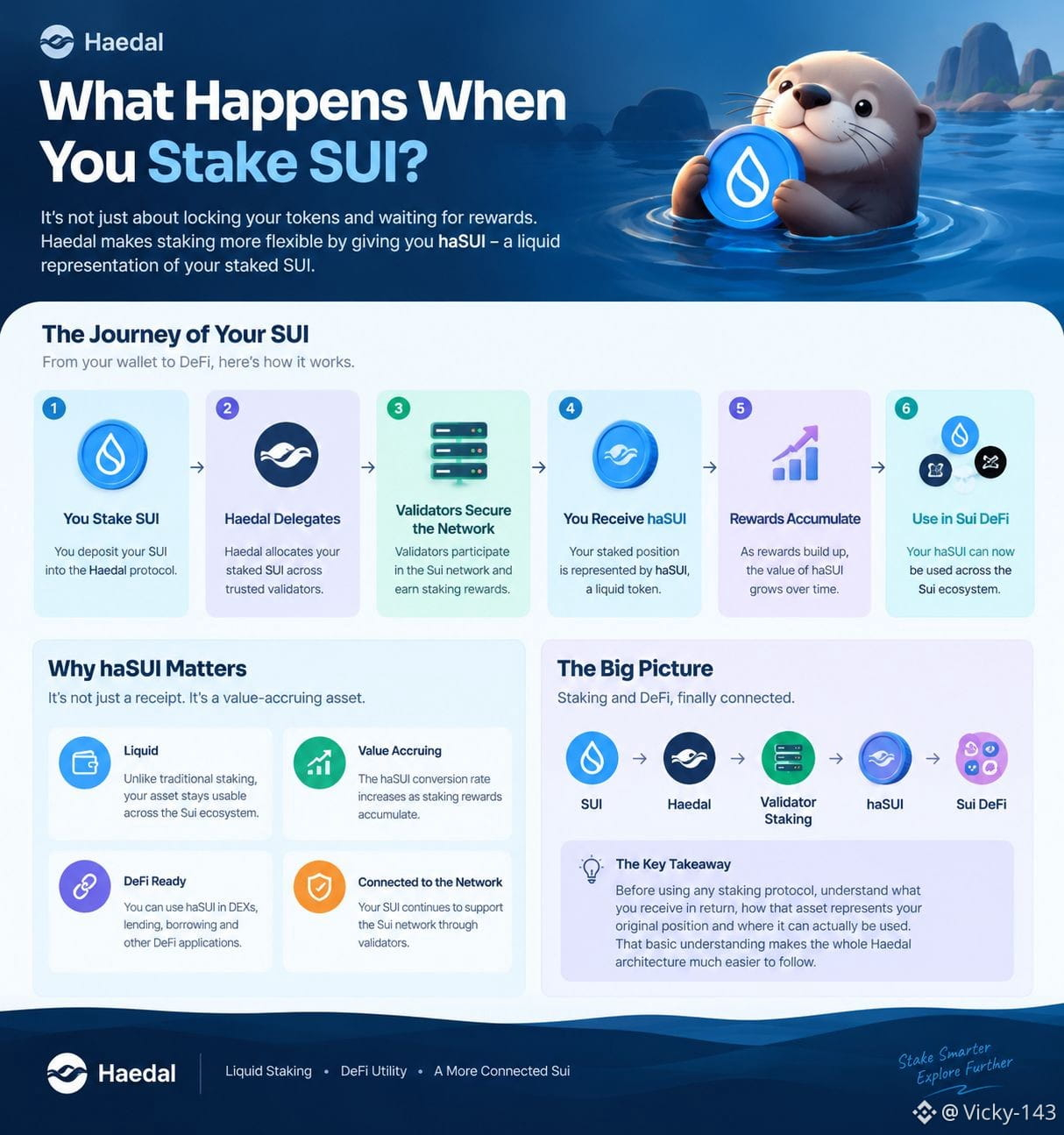
What Happens When You Stake SUI?
I used to think staking was simply a process where you lock your tokens and wait for rewards.
Haedal made me look at the process differently.
When SUI is staked through Haedal you receive haSUI. The important part is that haSUI is not just a receipt showing that you staked SUI. It is designed as a liquid representation of your staked position.
That creates an interesting difference.
With traditional staking, your assets can become difficult to use while they are committed to the staking process. Liquid staking separates these two ideas. Your SUI can participate in staking while the resulting haSUI can remain usable within the Sui ecosystem.
But what is actually happening underneath?
Haedal delegates staked SUI across validators. Those validators participate in the Sui network and generate staking rewards. The resulting staking position is represented through haSUI.
Over time the relationship between SUI and haSUI can change as staking rewards accumulate. So understanding haSUI is not only about knowing that it comes from staking.
It is about understanding the entire flow:
SUI → Haedal → Validator Staking → haSUI → Sui DeFi
This is where liquid staking becomes more interesting.
Instead of treating staking and DeFi as completely separate activities, Haedal connects them through a liquid staking asset.
For me the key lesson is simple.
Before using any staking protocol, understand what you receive in return, how that asset represents your original position and where it can actually be used.
That basic understanding makes the whole Haedal architecture much easier to follow.
Educative only DYOR.
$HAEDAL #Haedal @HaedalProtocol $SAGA
{future}(SAGAUSDT)
$XAI
{future}(XAIUSDT)
{future}(HAEDALUSDT)
What Happens When You Stake SUI?
I used to think staking was simply a process where you lock your tokens and wait for rewards.
Haedal made me look at the process differently.
When SUI is staked through Haedal you receive haSUI. The important part is that haSUI is not just a receipt showing that you staked SUI. It is designed as a liquid representation of your staked position.
That creates an interesting difference.
With traditional staking, your assets can become difficult to use while they are committed to the staking process. Liquid staking separates these two ideas. Your SUI can participate in staking while the resulting haSUI can remain usable within the Sui ecosystem.
But what is actually happening underneath?
Haedal delegates staked SUI across validators. Those validators participate in the Sui network and generate staking rewards. The resulting staking position is represented through haSUI.
Over time the relationship between SUI and haSUI can change as staking rewards accumulate. So understanding haSUI is not only about knowing that it comes from staking.
It is about understanding the entire flow:
SUI → Haedal → Validator Staking → haSUI → Sui DeFi
This is where liquid staking becomes more interesting.
Instead of treating staking and DeFi as completely separate activities, Haedal connects them through a liquid staking asset.
For me the key lesson is simple.
Before using any staking protocol, understand what you receive in return, how that asset represents your original position and where it can actually be used.
That basic understanding makes the whole Haedal architecture much easier to follow.
Educative only DYOR.
$HAEDAL #Haedal @Haedal Protocol $SAGA
$XAI
I used to think staking was simply a process where you lock your tokens and wait for rewards.
Haedal made me look at the process differently.
When SUI is staked through Haedal you receive haSUI. The important part is that haSUI is not just a receipt showing that you staked SUI. It is designed as a liquid representation of your staked position.
That creates an interesting difference.
With traditional staking, your assets can become difficult to use while they are committed to the staking process. Liquid staking separates these two ideas. Your SUI can participate in staking while the resulting haSUI can remain usable within the Sui ecosystem.
But what is actually happening underneath?
Haedal delegates staked SUI across validators. Those validators participate in the Sui network and generate staking rewards. The resulting staking position is represented through haSUI.
Over time the relationship between SUI and haSUI can change as staking rewards accumulate. So understanding haSUI is not only about knowing that it comes from staking.
It is about understanding the entire flow:
SUI → Haedal → Validator Staking → haSUI → Sui DeFi
This is where liquid staking becomes more interesting.
Instead of treating staking and DeFi as completely separate activities, Haedal connects them through a liquid staking asset.
For me the key lesson is simple.
Before using any staking protocol, understand what you receive in return, how that asset represents your original position and where it can actually be used.
That basic understanding makes the whole Haedal architecture much easier to follow.
Educative only DYOR.
$HAEDAL #Haedal @Haedal Protocol $SAGA
$XAI
461

·
--
I checked a lending pool rate on my phone this morning in Rawalpindi, the same one I'd looked at three days ago, and the APY had already shifted enough that my mental math from before was off. I assumed a good rate I find once just stays roughly where it is, so parking funds somewhere decent was basically a one time decision.
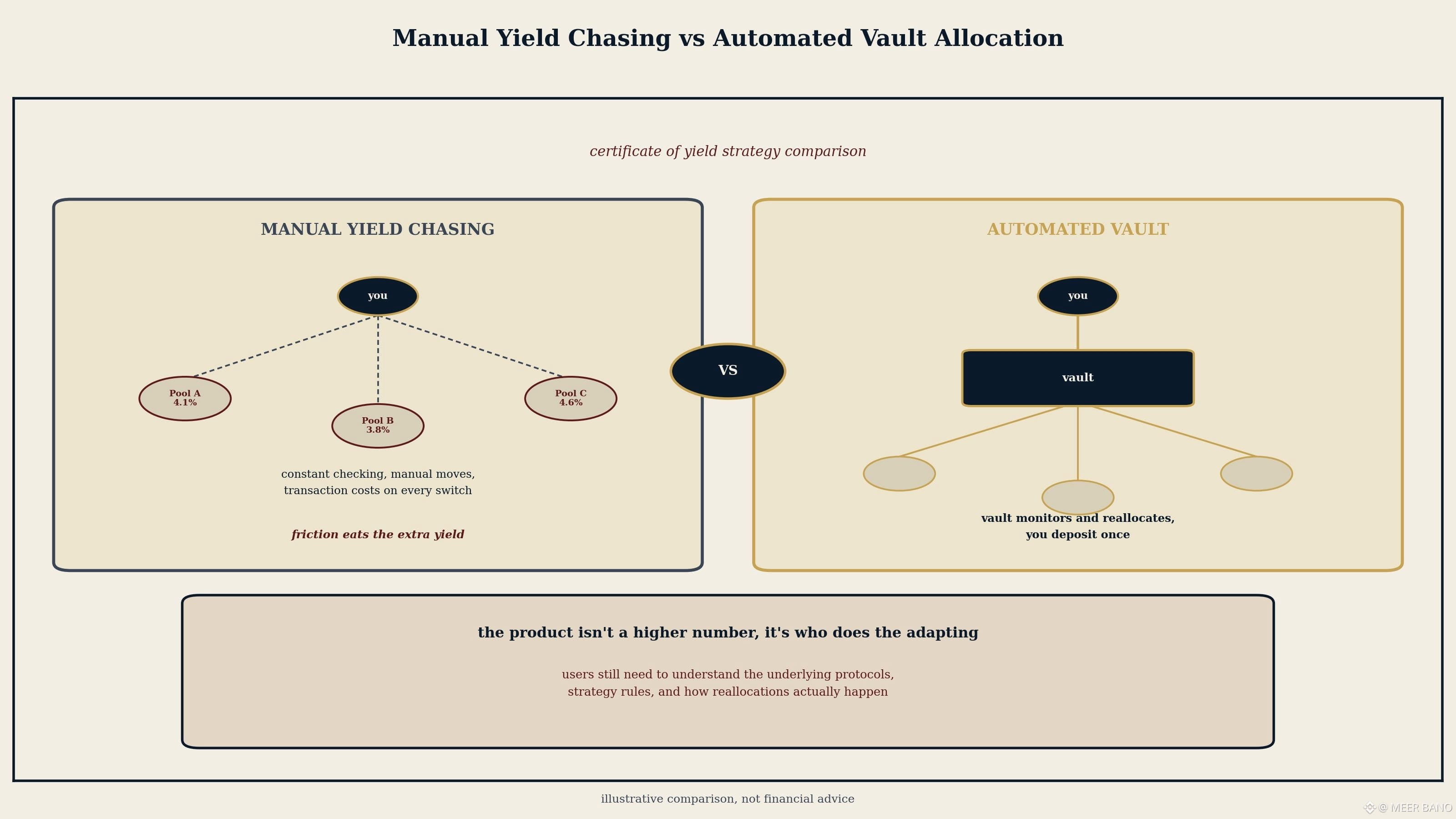
That's not how lending markets actually behave. Rates move as liquidity shifts and incentives get adjusted, so a pool that looked attractive last week isn't guaranteed to still be the best option today. Managing that manually means constantly comparing markets, timing moves, and eating transaction costs every time you reallocate, which quietly eats into whatever extra yield you were chasing in the first place.
What actually shifted my thinking here is realizing the value of a vault like Haedal isn't the number on the APY display. It's that the adaptation work itself gets automated, spreading exposure across supported markets and adjusting allocation as conditions change, instead of a person manually re-deciding this every few days. Automating the adjusting is the actual product, not a marginally higher yield figure.
What isn't clear to me is exactly how often reallocations happen or what specific rules trigger them, that level of detail matters for understanding real risk and I don't have it confirmed.
The real test here is whether the vault's strategy rules stay transparent enough that users can actually verify what's happening with their funds, not just trust the outcome.
Has anyone here actually tracked Haedal's reallocations closely enough to see the
pattern?
@HaedalProtocol #Haedal $HAEDAL
$LSK $BROCCOLI714
I checked a lending pool rate on my phone this morning in Rawalpindi, the same one I'd looked at three days ago, and the APY had already shifted enough that my mental math from before was off. I assumed a good rate I find once just stays roughly where it is, so parking funds somewhere decent was basically a one time decision.
That's not how lending markets actually behave. Rates move as liquidity shifts and incentives get adjusted, so a pool that looked attractive last week isn't guaranteed to still be the best option today. Managing that manually means constantly comparing markets, timing moves, and eating transaction costs every time you reallocate, which quietly eats into whatever extra yield you were chasing in the first place.
What actually shifted my thinking here is realizing the value of a vault like Haedal isn't the number on the APY display. It's that the adaptation work itself gets automated, spreading exposure across supported markets and adjusting allocation as conditions change, instead of a person manually re-deciding this every few days. Automating the adjusting is the actual product, not a marginally higher yield figure.
What isn't clear to me is exactly how often reallocations happen or what specific rules trigger them, that level of detail matters for understanding real risk and I don't have it confirmed.
The real test here is whether the vault's strategy rules stay transparent enough that users can actually verify what's happening with their funds, not just trust the outcome.
Has anyone here actually tracked Haedal's reallocations closely enough to see the
pattern?
@Haedal Protocol #Haedal $HAEDAL
$LSK $BROCCOLI714
That's not how lending markets actually behave. Rates move as liquidity shifts and incentives get adjusted, so a pool that looked attractive last week isn't guaranteed to still be the best option today. Managing that manually means constantly comparing markets, timing moves, and eating transaction costs every time you reallocate, which quietly eats into whatever extra yield you were chasing in the first place.
What actually shifted my thinking here is realizing the value of a vault like Haedal isn't the number on the APY display. It's that the adaptation work itself gets automated, spreading exposure across supported markets and adjusting allocation as conditions change, instead of a person manually re-deciding this every few days. Automating the adjusting is the actual product, not a marginally higher yield figure.
What isn't clear to me is exactly how often reallocations happen or what specific rules trigger them, that level of detail matters for understanding real risk and I don't have it confirmed.
The real test here is whether the vault's strategy rules stay transparent enough that users can actually verify what's happening with their funds, not just trust the outcome.
Has anyone here actually tracked Haedal's reallocations closely enough to see the
pattern?
@Haedal Protocol #Haedal $HAEDAL
$LSK $BROCCOLI714
1
555
Connectez-vous pour découvrir plus de contenu
Rejoignez la communauté mondiale des adeptes de cryptomonnaies sur Binance Square
⚡️ Suviez les dernières informations importantes sur les cryptomonnaies.
💬 Jugé digne de confiance par la plus grande plateforme d’échange de cryptomonnaies au monde.
👍 Découvrez les connaissances que partagent les créateurs vérifiés.
Adresse e-mail/Nº de téléphone
Sujets d’actualité
1
#FedProposesPaymentStablecoinRules
1 vues
8 mentions
2
#ChinaMayLetAlibabaByteDanceBuyNvidiaChips
2,205 vues
130 mentions
3
#USChinaRelease$30BTariffCutProductLists
174 vues
13 mentions
4
#SKoreaFSCConsidersVirtualAssetMarketMaker
3,393 vues
139 mentions
5
#ChinaIndustrialProfitGrowthSlowsFourthMonth
3,703 vues
153 mentions
6
#BitwiseFilesFinalNEARSpotETFProspectus
112,420 vues
1,673 mentions
7
#BitgetHackerMoves$83MStolenXRP
38,844 vues
177 mentions
8
#SOLSpotETFWeeklyInflow$188M
24,653 vues
139 mentions
9
#DogecoinETFsPostBiggestWeekSinceLaunch
65,938 vues
1,097 mentions
10
#StrategyStriveAdd2305BitcoinThisWeek
164,251 vues
2,360 mentions