

urdav3
723 Publicaciones

urdav3
Denunciar
Bloquear usuario
3 Siguiendo
1 Seguidores
12 Me gusta
Publicaciones
·
--
Ver traducción
THE NEXT STAGE OF USDD MAY BE SMARTER CAPITAL ALLOCATION
USDD's latest weekly yield update reflects a broader evolution in the stablecoin market.
Stablecoins were initially valued primarily for their ability to preserve dollar-denominated liquidity onchain. The next stage is increasingly about what that liquidity can do.
The weekly strategy map shows multiple routes across exchanges, wallets and DeFi protocols, creating a framework for users to explore different sources of yield without having to search through the entire ecosystem manually.
This points toward a future where stablecoin platforms become more than issuance and transfer infrastructure. They can also become capital-allocation layers.
The important variables extend beyond APY. Liquidity, accessibility, lock-up conditions, protocol design and changing incentives all influence whether a strategy fits a particular user.
USDD's focus on flexible participation and long-term stable yield opportunities fits into this broader transition.
The deeper concept is simple: the more efficiently users can discover and allocate stablecoin liquidity, the more useful that liquidity becomes for the wider DeFi economy.
USDD is increasingly being presented not just as a stablecoin, but as an entry point into a broader network of onchain yield strategies.
@JustinSun @usddio #TRONEcoStar
THE NEXT STAGE OF USDD MAY BE SMARTER CAPITAL ALLOCATION
USDD's latest weekly yield update reflects a broader evolution in the stablecoin market.
Stablecoins were initially valued primarily for their ability to preserve dollar-denominated liquidity onchain. The next stage is increasingly about what that liquidity can do.
The weekly strategy map shows multiple routes across exchanges, wallets and DeFi protocols, creating a framework for users to explore different sources of yield without having to search through the entire ecosystem manually.
This points toward a future where stablecoin platforms become more than issuance and transfer infrastructure. They can also become capital-allocation layers.
The important variables extend beyond APY. Liquidity, accessibility, lock-up conditions, protocol design and changing incentives all influence whether a strategy fits a particular user.
USDD's focus on flexible participation and long-term stable yield opportunities fits into this broader transition.
The deeper concept is simple: the more efficiently users can discover and allocate stablecoin liquidity, the more useful that liquidity becomes for the wider DeFi economy.
USDD is increasingly being presented not just as a stablecoin, but as an entry point into a broader network of onchain yield strategies.
@Justin Sun孙宇晨 @USDD - Decentralized USD #TRONEcoStar
USDD's latest weekly yield update reflects a broader evolution in the stablecoin market.
Stablecoins were initially valued primarily for their ability to preserve dollar-denominated liquidity onchain. The next stage is increasingly about what that liquidity can do.
The weekly strategy map shows multiple routes across exchanges, wallets and DeFi protocols, creating a framework for users to explore different sources of yield without having to search through the entire ecosystem manually.
This points toward a future where stablecoin platforms become more than issuance and transfer infrastructure. They can also become capital-allocation layers.
The important variables extend beyond APY. Liquidity, accessibility, lock-up conditions, protocol design and changing incentives all influence whether a strategy fits a particular user.
USDD's focus on flexible participation and long-term stable yield opportunities fits into this broader transition.
The deeper concept is simple: the more efficiently users can discover and allocate stablecoin liquidity, the more useful that liquidity becomes for the wider DeFi economy.
USDD is increasingly being presented not just as a stablecoin, but as an entry point into a broader network of onchain yield strategies.
@Justin Sun孙宇晨 @USDD - Decentralized USD #TRONEcoStar

10
·
--
Ver traducción
FROM YIELD HUNTING TO SYSTEMATIC STRATEGY
DeFi users often face a familiar problem: opportunities are everywhere, but they are scattered across different platforms.
USDD's weekly yield engine addresses this fragmentation by presenting multiple stablecoin strategies in one organized framework.
The latest update covers opportunities across trading platforms, wallets and DeFi protocols, giving users a broader view of the available landscape instead of focusing on a single application.
This creates an important shift in mindset.
Yield hunting is often reactive. Users move from one opportunity to another based on whichever APY appears highest at a particular moment.
A systematic strategy is different. It considers return alongside liquidity, access conditions, lock-up requirements, platform risk and the underlying mechanism generating the yield.
The emphasis on no quota limits and no lock-up requirements makes flexibility part of the framework rather than an afterthought.
As DeFi matures, systematic capital allocation could become increasingly important. The goal is not necessarily to maximize one isolated number, but to understand how stablecoin capital can move through different opportunities while matching the user's preferred level of flexibility and risk.
@usddio @JustinSun #TRONEcoStar
FROM YIELD HUNTING TO SYSTEMATIC STRATEGY
DeFi users often face a familiar problem: opportunities are everywhere, but they are scattered across different platforms.
USDD's weekly yield engine addresses this fragmentation by presenting multiple stablecoin strategies in one organized framework.
The latest update covers opportunities across trading platforms, wallets and DeFi protocols, giving users a broader view of the available landscape instead of focusing on a single application.
This creates an important shift in mindset.
Yield hunting is often reactive. Users move from one opportunity to another based on whichever APY appears highest at a particular moment.
A systematic strategy is different. It considers return alongside liquidity, access conditions, lock-up requirements, platform risk and the underlying mechanism generating the yield.
The emphasis on no quota limits and no lock-up requirements makes flexibility part of the framework rather than an afterthought.
As DeFi matures, systematic capital allocation could become increasingly important. The goal is not necessarily to maximize one isolated number, but to understand how stablecoin capital can move through different opportunities while matching the user's preferred level of flexibility and risk.
@USDD - Decentralized USD @Justin Sun孙宇晨 #TRONEcoStar
DeFi users often face a familiar problem: opportunities are everywhere, but they are scattered across different platforms.
USDD's weekly yield engine addresses this fragmentation by presenting multiple stablecoin strategies in one organized framework.
The latest update covers opportunities across trading platforms, wallets and DeFi protocols, giving users a broader view of the available landscape instead of focusing on a single application.
This creates an important shift in mindset.
Yield hunting is often reactive. Users move from one opportunity to another based on whichever APY appears highest at a particular moment.
A systematic strategy is different. It considers return alongside liquidity, access conditions, lock-up requirements, platform risk and the underlying mechanism generating the yield.
The emphasis on no quota limits and no lock-up requirements makes flexibility part of the framework rather than an afterthought.
As DeFi matures, systematic capital allocation could become increasingly important. The goal is not necessarily to maximize one isolated number, but to understand how stablecoin capital can move through different opportunities while matching the user's preferred level of flexibility and risk.
@USDD - Decentralized USD @Justin Sun孙宇晨 #TRONEcoStar
13
·
--
Ver traducción
STABLECOINS ARE BECOMING ACTIVE CAPITAL
A stablecoin does not have to remain passive.
USDD's latest weekly yield strategies demonstrate how stablecoin holders can explore multiple routes for deploying capital across exchanges, wallets and DeFi protocols.
The underlying idea is capital efficiency: instead of allowing stablecoins to remain unused, users can evaluate different strategies designed to generate additional returns while maintaining the characteristics and liquidity requirements of each opportunity.
The weekly update also shows why yield should be viewed dynamically. APYs can change, incentives can expire and market conditions can alter the attractiveness of individual strategies.
A weekly strategy map therefore functions as a snapshot of the current landscape rather than a permanent guarantee of returns.
This distinction is important as DeFi becomes more sophisticated.
The future of stablecoin utility may increasingly involve automated discovery, portfolio allocation and strategy optimization. Users could eventually think less about individual protocols and more about the overall objectives of their stablecoin capital.
USDD's yield framework points toward that transition: from simply holding digital dollars to actively managing where those dollars work within the onchain economy.
@usddio @JustinSun #TRONEcoStar
STABLECOINS ARE BECOMING ACTIVE CAPITAL
A stablecoin does not have to remain passive.
USDD's latest weekly yield strategies demonstrate how stablecoin holders can explore multiple routes for deploying capital across exchanges, wallets and DeFi protocols.
The underlying idea is capital efficiency: instead of allowing stablecoins to remain unused, users can evaluate different strategies designed to generate additional returns while maintaining the characteristics and liquidity requirements of each opportunity.
The weekly update also shows why yield should be viewed dynamically. APYs can change, incentives can expire and market conditions can alter the attractiveness of individual strategies.
A weekly strategy map therefore functions as a snapshot of the current landscape rather than a permanent guarantee of returns.
This distinction is important as DeFi becomes more sophisticated.
The future of stablecoin utility may increasingly involve automated discovery, portfolio allocation and strategy optimization. Users could eventually think less about individual protocols and more about the overall objectives of their stablecoin capital.
USDD's yield framework points toward that transition: from simply holding digital dollars to actively managing where those dollars work within the onchain economy.
@USDD - Decentralized USD @Justin Sun孙宇晨 #TRONEcoStar
A stablecoin does not have to remain passive.
USDD's latest weekly yield strategies demonstrate how stablecoin holders can explore multiple routes for deploying capital across exchanges, wallets and DeFi protocols.
The underlying idea is capital efficiency: instead of allowing stablecoins to remain unused, users can evaluate different strategies designed to generate additional returns while maintaining the characteristics and liquidity requirements of each opportunity.
The weekly update also shows why yield should be viewed dynamically. APYs can change, incentives can expire and market conditions can alter the attractiveness of individual strategies.
A weekly strategy map therefore functions as a snapshot of the current landscape rather than a permanent guarantee of returns.
This distinction is important as DeFi becomes more sophisticated.
The future of stablecoin utility may increasingly involve automated discovery, portfolio allocation and strategy optimization. Users could eventually think less about individual protocols and more about the overall objectives of their stablecoin capital.
USDD's yield framework points toward that transition: from simply holding digital dollars to actively managing where those dollars work within the onchain economy.
@USDD - Decentralized USD @Justin Sun孙宇晨 #TRONEcoStar
9
·
--
Ver traducción
USDD AND THE RISE OF YIELD AGGREGATION
One of the biggest challenges in DeFi is not the lack of yield opportunities, but the sheer number of them.
USDD's latest weekly yield strategy brings together opportunities across exchanges, wallets and DeFi protocols, creating a consolidated view of where stablecoin capital can potentially generate returns.
The displayed strategies span different platforms and products, with yields changing according to market conditions and platform incentives.
This highlights an important evolution in stablecoin infrastructure. Instead of forcing users to manually monitor dozens of protocols, yield-focused dashboards can act as discovery layers that help users identify potential opportunities more efficiently.
The concept becomes particularly relevant when users want to maintain liquidity while exploring different sources of return. The emphasis on no quota limits and no lock-up requirements adds another dimension to the framework.
The broader trend is toward making DeFi less fragmented.
When information, liquidity and strategies become easier to compare, stablecoins can become more productive financial instruments rather than simply assets sitting idle in a wallet.
@usddio @JustinSun #TRONEcoStar
USDD AND THE RISE OF YIELD AGGREGATION
One of the biggest challenges in DeFi is not the lack of yield opportunities, but the sheer number of them.
USDD's latest weekly yield strategy brings together opportunities across exchanges, wallets and DeFi protocols, creating a consolidated view of where stablecoin capital can potentially generate returns.
The displayed strategies span different platforms and products, with yields changing according to market conditions and platform incentives.
This highlights an important evolution in stablecoin infrastructure. Instead of forcing users to manually monitor dozens of protocols, yield-focused dashboards can act as discovery layers that help users identify potential opportunities more efficiently.
The concept becomes particularly relevant when users want to maintain liquidity while exploring different sources of return. The emphasis on no quota limits and no lock-up requirements adds another dimension to the framework.
The broader trend is toward making DeFi less fragmented.
When information, liquidity and strategies become easier to compare, stablecoins can become more productive financial instruments rather than simply assets sitting idle in a wallet.
@USDD - Decentralized USD @Justin Sun孙宇晨 #TRONEcoStar
One of the biggest challenges in DeFi is not the lack of yield opportunities, but the sheer number of them.
USDD's latest weekly yield strategy brings together opportunities across exchanges, wallets and DeFi protocols, creating a consolidated view of where stablecoin capital can potentially generate returns.
The displayed strategies span different platforms and products, with yields changing according to market conditions and platform incentives.
This highlights an important evolution in stablecoin infrastructure. Instead of forcing users to manually monitor dozens of protocols, yield-focused dashboards can act as discovery layers that help users identify potential opportunities more efficiently.
The concept becomes particularly relevant when users want to maintain liquidity while exploring different sources of return. The emphasis on no quota limits and no lock-up requirements adds another dimension to the framework.
The broader trend is toward making DeFi less fragmented.
When information, liquidity and strategies become easier to compare, stablecoins can become more productive financial instruments rather than simply assets sitting idle in a wallet.
@USDD - Decentralized USD @Justin Sun孙宇晨 #TRONEcoStar
4
·
--
Ver traducción
USDD AS A MAP FOR NAVIGATING DEFI YIELD
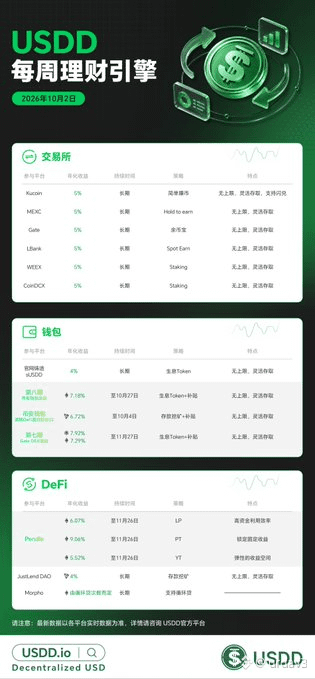
DeFi yield strategies can become difficult to navigate when opportunities are spread across exchanges, wallets and multiple protocols. USDD's latest weekly yield map takes a different approach by organizing these opportunities into a clearer framework.
The strategy covers multiple yield paths across trading platforms, wallets and DeFi protocols, allowing users to compare different routes for deploying stablecoin capital.
The key idea is not simply chasing the highest displayed APY. A useful yield strategy also needs to consider liquidity, lock-up requirements, platform structure and how easily capital can move between opportunities.
USDD's weekly framework attempts to turn a fragmented DeFi landscape into a more structured map.
With no quota limits and no mandatory lock-up highlighted in the campaign, the focus is on flexibility alongside recurring yield opportunities.
As stablecoin markets mature, aggregation and clarity can become just as important as yield itself. The ability to see where capital can go, what conditions apply and how different strategies compare can make DeFi easier to understand and navigate.
@usddio @JustinSun #TRONEcoStar
USDD AS A MAP FOR NAVIGATING DEFI YIELD
DeFi yield strategies can become difficult to navigate when opportunities are spread across exchanges, wallets and multiple protocols. USDD's latest weekly yield map takes a different approach by organizing these opportunities into a clearer framework.
The strategy covers multiple yield paths across trading platforms, wallets and DeFi protocols, allowing users to compare different routes for deploying stablecoin capital.
The key idea is not simply chasing the highest displayed APY. A useful yield strategy also needs to consider liquidity, lock-up requirements, platform structure and how easily capital can move between opportunities.
USDD's weekly framework attempts to turn a fragmented DeFi landscape into a more structured map.
With no quota limits and no mandatory lock-up highlighted in the campaign, the focus is on flexibility alongside recurring yield opportunities.
As stablecoin markets mature, aggregation and clarity can become just as important as yield itself. The ability to see where capital can go, what conditions apply and how different strategies compare can make DeFi easier to understand and navigate.
@USDD - Decentralized USD @Justin Sun孙宇晨 #TRONEcoStar
DeFi yield strategies can become difficult to navigate when opportunities are spread across exchanges, wallets and multiple protocols. USDD's latest weekly yield map takes a different approach by organizing these opportunities into a clearer framework.
The strategy covers multiple yield paths across trading platforms, wallets and DeFi protocols, allowing users to compare different routes for deploying stablecoin capital.
The key idea is not simply chasing the highest displayed APY. A useful yield strategy also needs to consider liquidity, lock-up requirements, platform structure and how easily capital can move between opportunities.
USDD's weekly framework attempts to turn a fragmented DeFi landscape into a more structured map.
With no quota limits and no mandatory lock-up highlighted in the campaign, the focus is on flexibility alongside recurring yield opportunities.
As stablecoin markets mature, aggregation and clarity can become just as important as yield itself. The ability to see where capital can go, what conditions apply and how different strategies compare can make DeFi easier to understand and navigate.
@USDD - Decentralized USD @Justin Sun孙宇晨 #TRONEcoStar
4
·
--
Ver traducción
THE REAL VALUE OF A DEFI YIELD MAP IS CLARITY
Yield numbers naturally attract attention, but the more interesting part of USDD's weekly strategy update is the attempt to organize the entire yield landscape.
The graphic separates opportunities across exchanges, wallets and DeFi, showing that stablecoin returns can come from very different mechanisms.
An exchange-based strategy may involve trading or platform-specific products. A wallet strategy can involve tokenized assets or staking-related opportunities. DeFi strategies may involve liquidity provision, lending or other protocol mechanisms.
These products are not interchangeable, even when their displayed yields appear similar.
That is why a structured map can be useful. It allows users to understand not only the potential return, but also where the return comes from.
The emphasis on flexible access, no quota limits and no lock-up requirements further highlights the importance of capital mobility.
For the stablecoin economy, the next stage of growth may depend increasingly on better discovery tools. Users need more than capital; they need clear information about where that capital can be deployed.
USDD's weekly yield framework is an example of that direction.
@usddio @JustinSun #TRONEcoStar
THE REAL VALUE OF A DEFI YIELD MAP IS CLARITY
Yield numbers naturally attract attention, but the more interesting part of USDD's weekly strategy update is the attempt to organize the entire yield landscape.
The graphic separates opportunities across exchanges, wallets and DeFi, showing that stablecoin returns can come from very different mechanisms.
An exchange-based strategy may involve trading or platform-specific products. A wallet strategy can involve tokenized assets or staking-related opportunities. DeFi strategies may involve liquidity provision, lending or other protocol mechanisms.
These products are not interchangeable, even when their displayed yields appear similar.
That is why a structured map can be useful. It allows users to understand not only the potential return, but also where the return comes from.
The emphasis on flexible access, no quota limits and no lock-up requirements further highlights the importance of capital mobility.
For the stablecoin economy, the next stage of growth may depend increasingly on better discovery tools. Users need more than capital; they need clear information about where that capital can be deployed.
USDD's weekly yield framework is an example of that direction.
@USDD - Decentralized USD @Justin Sun孙宇晨 #TRONEcoStar
Yield numbers naturally attract attention, but the more interesting part of USDD's weekly strategy update is the attempt to organize the entire yield landscape.
The graphic separates opportunities across exchanges, wallets and DeFi, showing that stablecoin returns can come from very different mechanisms.
An exchange-based strategy may involve trading or platform-specific products. A wallet strategy can involve tokenized assets or staking-related opportunities. DeFi strategies may involve liquidity provision, lending or other protocol mechanisms.
These products are not interchangeable, even when their displayed yields appear similar.
That is why a structured map can be useful. It allows users to understand not only the potential return, but also where the return comes from.
The emphasis on flexible access, no quota limits and no lock-up requirements further highlights the importance of capital mobility.
For the stablecoin economy, the next stage of growth may depend increasingly on better discovery tools. Users need more than capital; they need clear information about where that capital can be deployed.
USDD's weekly yield framework is an example of that direction.
@USDD - Decentralized USD @Justin Sun孙宇晨 #TRONEcoStar
10
·
--
Ver traducción
USDD ENTERS A NEW DEFI SUMMER SEASON
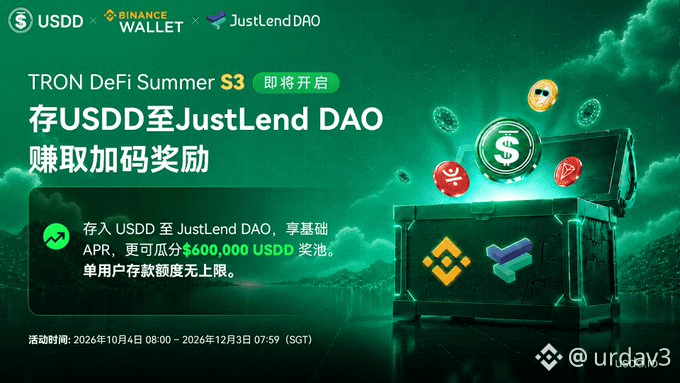
TRON DeFi Summer S3 officially launches on October 4, bringing a new incentive phase for USDD through JustLend DAO.
Users can subscribe with a minimum deposit of 100 USDD, while there is no maximum deposit limit. Alongside the base APY, participants can share in a prize pool of up to 600,000 USDD throughout the season.
What makes the structure interesting is that the campaign combines yield generation with several forms of capital flexibility. USDT can be swapped into USDD through the PSM module at a 1:1 ratio with zero slippage, while deposited assets can continue serving as collateral.
The event runs from October 4, 2026, at 08:00 SGT through December 3, 2026, at 07:59 SGT.
Rather than positioning USDD only as a stablecoin for holding value, the campaign connects it directly with lending, collateral and incentive mechanisms.
DeFi Summer S3 therefore creates another chapter in the evolution of USDD as part of the broader TRON DeFi ecosystem.
@JustinSun @usddio #TRONEcoStar
USDD ENTERS A NEW DEFI SUMMER SEASON
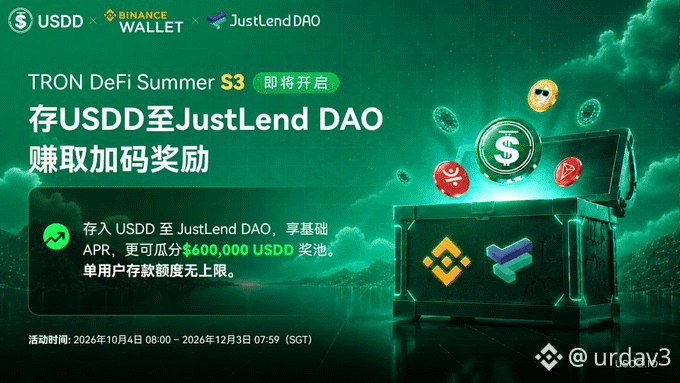
TRON DeFi Summer S3 officially launches on October 4, bringing a new incentive phase for USDD through JustLend DAO.
Users can subscribe with a minimum deposit of 100 USDD, while there is no maximum deposit limit. Alongside the base APY, participants can share in a prize pool of up to 600,000 USDD throughout the season.
What makes the structure interesting is that the campaign combines yield generation with several forms of capital flexibility. USDT can be swapped into USDD through the PSM module at a 1:1 ratio with zero slippage, while deposited assets can continue serving as collateral.
The event runs from October 4, 2026, at 08:00 SGT through December 3, 2026, at 07:59 SGT.
Rather than positioning USDD only as a stablecoin for holding value, the campaign connects it directly with lending, collateral and incentive mechanisms.
DeFi Summer S3 therefore creates another chapter in the evolution of USDD as part of the broader TRON DeFi ecosystem.
@Justin Sun孙宇晨 @USDD - Decentralized USD #TRONEcoStar
TRON DeFi Summer S3 officially launches on October 4, bringing a new incentive phase for USDD through JustLend DAO.
Users can subscribe with a minimum deposit of 100 USDD, while there is no maximum deposit limit. Alongside the base APY, participants can share in a prize pool of up to 600,000 USDD throughout the season.
What makes the structure interesting is that the campaign combines yield generation with several forms of capital flexibility. USDT can be swapped into USDD through the PSM module at a 1:1 ratio with zero slippage, while deposited assets can continue serving as collateral.
The event runs from October 4, 2026, at 08:00 SGT through December 3, 2026, at 07:59 SGT.
Rather than positioning USDD only as a stablecoin for holding value, the campaign connects it directly with lending, collateral and incentive mechanisms.
DeFi Summer S3 therefore creates another chapter in the evolution of USDD as part of the broader TRON DeFi ecosystem.
@Justin Sun孙宇晨 @USDD - Decentralized USD #TRONEcoStar
4
·
--
USDD combina estabilidad con utilidad DeFi
La tercera temporada de TRON DeFi Summer pone una idea importante en el centro de su campaña USDD: una stablecoin puede servir tanto como activo valuado en términos de valor como capital productivo para DeFi.
Los participantes pueden depositar al menos 100 USDD en el pool de actividades elegibles de JustLend y recibir el APY base, además de participar en un pool de recompensas de 600,000 USDD.
El diseño incorpora varias funciones prácticas. Los usuarios pueden convertir USDT en USDD a través del módulo PSM en una proporción 1:1 con cero deslizamiento, mientras que los depósitos se mantienen flexibles porque los usuarios pueden depositar y retirar durante la campaña y seguir usando los activos como garantía.
Esto crea una experiencia DeFi más interconectada.
En lugar de exigir que los usuarios elijan entre mantener una stablecoin o usarla dentro de una aplicación financiera, USDD puede moverse a través de múltiples capas del ecosistema.
La importancia más amplia es que la utilidad de las stablecoins depende cada vez más de lo que los usuarios pueden hacer después de adquirir el token.
El papel de USDD en DeFi Summer S3 demuestra cómo la liquidez de las stablecoins puede conectarse con el préstamo, la constitución de garantías, el rendimiento y los incentivos del ecosistema dentro de un mismo marco.
@JustinSun @usddio #TRONEcoStar
USDD combina estabilidad con utilidad DeFi
La tercera temporada de TRON DeFi Summer pone una idea importante en el centro de su campaña USDD: una stablecoin puede servir tanto como activo valuado en términos de valor como capital productivo para DeFi.
Los participantes pueden depositar al menos 100 USDD en el pool de actividades elegibles de JustLend y recibir el APY base, además de participar en un pool de recompensas de 600,000 USDD.
El diseño incorpora varias funciones prácticas. Los usuarios pueden convertir USDT en USDD a través del módulo PSM en una proporción 1:1 con cero deslizamiento, mientras que los depósitos se mantienen flexibles porque los usuarios pueden depositar y retirar durante la campaña y seguir usando los activos como garantía.
Esto crea una experiencia DeFi más interconectada.
En lugar de exigir que los usuarios elijan entre mantener una stablecoin o usarla dentro de una aplicación financiera, USDD puede moverse a través de múltiples capas del ecosistema.
La importancia más amplia es que la utilidad de las stablecoins depende cada vez más de lo que los usuarios pueden hacer después de adquirir el token.
El papel de USDD en DeFi Summer S3 demuestra cómo la liquidez de las stablecoins puede conectarse con el préstamo, la constitución de garantías, el rendimiento y los incentivos del ecosistema dentro de un mismo marco.
@Justin Sun孙宇晨 @USDD - Decentralized USD #TRONEcoStar
La tercera temporada de TRON DeFi Summer pone una idea importante en el centro de su campaña USDD: una stablecoin puede servir tanto como activo valuado en términos de valor como capital productivo para DeFi.
Los participantes pueden depositar al menos 100 USDD en el pool de actividades elegibles de JustLend y recibir el APY base, además de participar en un pool de recompensas de 600,000 USDD.
El diseño incorpora varias funciones prácticas. Los usuarios pueden convertir USDT en USDD a través del módulo PSM en una proporción 1:1 con cero deslizamiento, mientras que los depósitos se mantienen flexibles porque los usuarios pueden depositar y retirar durante la campaña y seguir usando los activos como garantía.
Esto crea una experiencia DeFi más interconectada.
En lugar de exigir que los usuarios elijan entre mantener una stablecoin o usarla dentro de una aplicación financiera, USDD puede moverse a través de múltiples capas del ecosistema.
La importancia más amplia es que la utilidad de las stablecoins depende cada vez más de lo que los usuarios pueden hacer después de adquirir el token.
El papel de USDD en DeFi Summer S3 demuestra cómo la liquidez de las stablecoins puede conectarse con el préstamo, la constitución de garantías, el rendimiento y los incentivos del ecosistema dentro de un mismo marco.
@Justin Sun孙宇晨 @USDD - Decentralized USD #TRONEcoStar
5
·
--
EL FONDO DE RECOMPENSAS DE 600.000 USDD CREA UN INCENTIVO DE LIQUIDEZ
Un fondo de premios de 600.000 USDD es una de las principales características del TRON DeFi Summer S3.
La campaña está diseñada para incentivar a los usuarios a aportar liquidez en USDD a JustLend DAO, manteniendo el acceso a la funcionalidad DeFi subyacente del protocolo.
El requisito mínimo de entrada es de 100 USDD, sin un límite máximo de depósito indicado. Esto crea una estructura de participación abierta, mientras permite que el fondo de recompensas funcione a través de un rango potencialmente amplio de tamaños de depósito.
Es importante destacar que el fondo de recompensas es un incentivo adicional y no el único componente del producto. Los usuarios también pueden recibir el APY base aplicable, mientras que sus activos pueden seguir funcionando como garantía.
La estructura ilustra una dirección común en DeFi: los incentivos se combinan cada vez más con la utilidad financiera real.
Para un ecosistema de stablecoins, esto es importante porque la liquidez sostenible depende de más que la emisión de tokens. Los usuarios necesitan motivos para mantener, desplegar y reutilizar el activo.
Al conectar los depósitos de USDD con la infraestructura de préstamos y un fondo de recompensas dedicado, S3 está diseñado para convertir la liquidez de stablecoins en capital DeFi activo.
@JustinSun @usddio #TRONEcoStar
EL FONDO DE RECOMPENSAS DE 600.000 USDD CREA UN INCENTIVO DE LIQUIDEZ
Un fondo de premios de 600.000 USDD es una de las principales características del TRON DeFi Summer S3.
La campaña está diseñada para incentivar a los usuarios a aportar liquidez en USDD a JustLend DAO, manteniendo el acceso a la funcionalidad DeFi subyacente del protocolo.
El requisito mínimo de entrada es de 100 USDD, sin un límite máximo de depósito indicado. Esto crea una estructura de participación abierta, mientras permite que el fondo de recompensas funcione a través de un rango potencialmente amplio de tamaños de depósito.
Es importante destacar que el fondo de recompensas es un incentivo adicional y no el único componente del producto. Los usuarios también pueden recibir el APY base aplicable, mientras que sus activos pueden seguir funcionando como garantía.
La estructura ilustra una dirección común en DeFi: los incentivos se combinan cada vez más con la utilidad financiera real.
Para un ecosistema de stablecoins, esto es importante porque la liquidez sostenible depende de más que la emisión de tokens. Los usuarios necesitan motivos para mantener, desplegar y reutilizar el activo.
Al conectar los depósitos de USDD con la infraestructura de préstamos y un fondo de recompensas dedicado, S3 está diseñado para convertir la liquidez de stablecoins en capital DeFi activo.
@Justin Sun孙宇晨 @USDD - Decentralized USD #TRONEcoStar
Un fondo de premios de 600.000 USDD es una de las principales características del TRON DeFi Summer S3.
La campaña está diseñada para incentivar a los usuarios a aportar liquidez en USDD a JustLend DAO, manteniendo el acceso a la funcionalidad DeFi subyacente del protocolo.
El requisito mínimo de entrada es de 100 USDD, sin un límite máximo de depósito indicado. Esto crea una estructura de participación abierta, mientras permite que el fondo de recompensas funcione a través de un rango potencialmente amplio de tamaños de depósito.
Es importante destacar que el fondo de recompensas es un incentivo adicional y no el único componente del producto. Los usuarios también pueden recibir el APY base aplicable, mientras que sus activos pueden seguir funcionando como garantía.
La estructura ilustra una dirección común en DeFi: los incentivos se combinan cada vez más con la utilidad financiera real.
Para un ecosistema de stablecoins, esto es importante porque la liquidez sostenible depende de más que la emisión de tokens. Los usuarios necesitan motivos para mantener, desplegar y reutilizar el activo.
Al conectar los depósitos de USDD con la infraestructura de préstamos y un fondo de recompensas dedicado, S3 está diseñado para convertir la liquidez de stablecoins en capital DeFi activo.
@Justin Sun孙宇晨 @USDD - Decentralized USD #TRONEcoStar
10
·
--
LA CONVERSIÓN SIN DESLIZAMIENTO REDUCE LA FRICCIÓN ENTRE USDT Y USDD
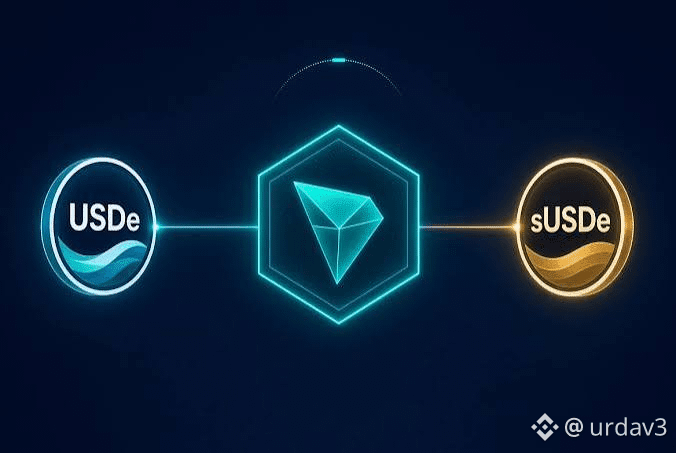
Una de las características destacadas de TRON DeFi Summer S3 es la capacidad de convertir USDT en USDD a través del módulo PSM en una proporción 1:1 con deslizamiento cero.
Para los usuarios de stablecoins, la fricción de la conversión puede ser tan importante como el rendimiento destacado. Un mecanismo predecible 1:1 hace que la transición entre dos activos denominados en dólares sea más fácil de entender y potencialmente más fácil de ejecutar.
Esto también crea un puente directo de liquidez entre USDT, una de las stablecoins más grandes del ecosistema TRON, y USDD.
Una vez convertidos, los USDD pueden desplegarse en la campaña elegible de JustLend, donde los usuarios pueden acceder al APY base aplicable y participar en el fondo de recompensas de 600,000 USDD.
La idea más amplia es la composabilidad.
Una stablecoin puede moverse de un entorno de liquidez a otro sin salir del ecosistema blockchain más amplio. La conversión, el préstamo, la colateralización y las recompensas pueden convertirse en pasos conectados dentro de un único flujo de trabajo DeFi.
Por ello, S3 destaca un aspecto importante de la infraestructura de stablecoins: cuanto más fácil sea moverse entre activos y aplicaciones, más interconectada se vuelve la capa de liquidez onchain.
@JustinSun @usddio #TRONEcoStar
LA CONVERSIÓN SIN DESLIZAMIENTO REDUCE LA FRICCIÓN ENTRE USDT Y USDD
Una de las características destacadas de TRON DeFi Summer S3 es la capacidad de convertir USDT en USDD a través del módulo PSM en una proporción 1:1 con deslizamiento cero.
Para los usuarios de stablecoins, la fricción de la conversión puede ser tan importante como el rendimiento destacado. Un mecanismo predecible 1:1 hace que la transición entre dos activos denominados en dólares sea más fácil de entender y potencialmente más fácil de ejecutar.
Esto también crea un puente directo de liquidez entre USDT, una de las stablecoins más grandes del ecosistema TRON, y USDD.
Una vez convertidos, los USDD pueden desplegarse en la campaña elegible de JustLend, donde los usuarios pueden acceder al APY base aplicable y participar en el fondo de recompensas de 600,000 USDD.
La idea más amplia es la composabilidad.
Una stablecoin puede moverse de un entorno de liquidez a otro sin salir del ecosistema blockchain más amplio. La conversión, el préstamo, la colateralización y las recompensas pueden convertirse en pasos conectados dentro de un único flujo de trabajo DeFi.
Por ello, S3 destaca un aspecto importante de la infraestructura de stablecoins: cuanto más fácil sea moverse entre activos y aplicaciones, más interconectada se vuelve la capa de liquidez onchain.
@Justin Sun孙宇晨 @USDD - Decentralized USD #TRONEcoStar
Una de las características destacadas de TRON DeFi Summer S3 es la capacidad de convertir USDT en USDD a través del módulo PSM en una proporción 1:1 con deslizamiento cero.
Para los usuarios de stablecoins, la fricción de la conversión puede ser tan importante como el rendimiento destacado. Un mecanismo predecible 1:1 hace que la transición entre dos activos denominados en dólares sea más fácil de entender y potencialmente más fácil de ejecutar.
Esto también crea un puente directo de liquidez entre USDT, una de las stablecoins más grandes del ecosistema TRON, y USDD.
Una vez convertidos, los USDD pueden desplegarse en la campaña elegible de JustLend, donde los usuarios pueden acceder al APY base aplicable y participar en el fondo de recompensas de 600,000 USDD.
La idea más amplia es la composabilidad.
Una stablecoin puede moverse de un entorno de liquidez a otro sin salir del ecosistema blockchain más amplio. La conversión, el préstamo, la colateralización y las recompensas pueden convertirse en pasos conectados dentro de un único flujo de trabajo DeFi.
Por ello, S3 destaca un aspecto importante de la infraestructura de stablecoins: cuanto más fácil sea moverse entre activos y aplicaciones, más interconectada se vuelve la capa de liquidez onchain.
@Justin Sun孙宇晨 @USDD - Decentralized USD #TRONEcoStar
25
·
--
EL INTERNET SE ESTÁ VOLVIENDO PROGRAMABLE
Durante décadas, internet hizo que la información fuera más fácil de mover.
Web3 está experimentando con algo diferente: convertir el valor, la propiedad y la coordinación en elementos programables.
Un contrato inteligente puede convertir reglas en infraestructura.
Una wallet puede convertirse en una interfaz para la propiedad digital.
Una red descentralizada puede permitir que desconocidos se coordinen en torno a reglas transparentes sin compartir la misma organización.
Estas siguen siendo pruebas, no respuestas finales.
Pero las pruebas importan porque la infraestructura cambia lo que se vuelve posible.
Cuando el dinero puede moverse de forma programática, los activos pueden interactuar con aplicaciones y las comunidades pueden coordinarse mediante código; se vuelven posibles totalmente nuevas formas de comportamiento digital.
Lo más fascinante es que todavía nadie ha escrito el libro completo de jugadas.
Los desarrolladores están probando.
Las comunidades están experimentando.
Los usuarios están descubriendo nuevas maneras de participar.
Y en algún lugar entre estas pruebas puede estar el próximo elemento básico que millones de personas, eventualmente, darán por sentado.
El futuro de Web3 puede no ser un solo gran avance.
Puede ser el momento en que miles de piezas programables finalmente comiencen a funcionar juntas.
👇 ¿Qué parte de este internet programable estás explorando?
@JustinSun
#TRONEcoStar
EL INTERNET SE ESTÁ VOLVIENDO PROGRAMABLE
Durante décadas, internet hizo que la información fuera más fácil de mover.
Web3 está experimentando con algo diferente: convertir el valor, la propiedad y la coordinación en elementos programables.
Un contrato inteligente puede convertir reglas en infraestructura.
Una wallet puede convertirse en una interfaz para la propiedad digital.
Una red descentralizada puede permitir que desconocidos se coordinen en torno a reglas transparentes sin compartir la misma organización.
Estas siguen siendo pruebas, no respuestas finales.
Pero las pruebas importan porque la infraestructura cambia lo que se vuelve posible.
Cuando el dinero puede moverse de forma programática, los activos pueden interactuar con aplicaciones y las comunidades pueden coordinarse mediante código; se vuelven posibles totalmente nuevas formas de comportamiento digital.
Lo más fascinante es que todavía nadie ha escrito el libro completo de jugadas.
Los desarrolladores están probando.
Las comunidades están experimentando.
Los usuarios están descubriendo nuevas maneras de participar.
Y en algún lugar entre estas pruebas puede estar el próximo elemento básico que millones de personas, eventualmente, darán por sentado.
El futuro de Web3 puede no ser un solo gran avance.
Puede ser el momento en que miles de piezas programables finalmente comiencen a funcionar juntas.
👇 ¿Qué parte de este internet programable estás explorando?
@Justin Sun孙宇晨
#TRONEcoStar
Durante décadas, internet hizo que la información fuera más fácil de mover.
Web3 está experimentando con algo diferente: convertir el valor, la propiedad y la coordinación en elementos programables.
Un contrato inteligente puede convertir reglas en infraestructura.
Una wallet puede convertirse en una interfaz para la propiedad digital.
Una red descentralizada puede permitir que desconocidos se coordinen en torno a reglas transparentes sin compartir la misma organización.
Estas siguen siendo pruebas, no respuestas finales.
Pero las pruebas importan porque la infraestructura cambia lo que se vuelve posible.
Cuando el dinero puede moverse de forma programática, los activos pueden interactuar con aplicaciones y las comunidades pueden coordinarse mediante código; se vuelven posibles totalmente nuevas formas de comportamiento digital.
Lo más fascinante es que todavía nadie ha escrito el libro completo de jugadas.
Los desarrolladores están probando.
Las comunidades están experimentando.
Los usuarios están descubriendo nuevas maneras de participar.
Y en algún lugar entre estas pruebas puede estar el próximo elemento básico que millones de personas, eventualmente, darán por sentado.
El futuro de Web3 puede no ser un solo gran avance.
Puede ser el momento en que miles de piezas programables finalmente comiencen a funcionar juntas.
👇 ¿Qué parte de este internet programable estás explorando?
@Justin Sun孙宇晨
#TRONEcoStar

7
·
--
Ver traducción
OCEAN FRONT TURNS CLIMATE CHANGE INTO A DIGITAL VISION
Beeple’s OCEAN FRONT is more than an image of a world surrounded by water. It presents climate change as a future environment in which nature, technology, and human life increasingly overlap.
That framing gives the artwork a different kind of significance.
Environmental issues are often communicated through statistics, scientific projections, and reports. Digital art can approach the same subject through imagination. Instead of explaining what rising seas might mean, OCEAN FRONT creates a visual world in which the consequences become part of the environment itself.
The work therefore operates on two levels.
It is a piece of digital art, but it is also a visual statement about humanity’s relationship with a changing planet.
Its $6 million sale at Nifty Gateway on March 23, 2021 added another dimension to that statement. The transaction demonstrated that digital artwork centered on a serious environmental theme could become a significant cultural and economic artifact within the emerging NFT market.
The important point is not simply the price.
OCEAN FRONT shows how digital art can preserve an idea about the future, giving an abstract concern such as climate change a visual form that audiences can remember, discuss, and reinterpret.
Digital art can capture a moment in history.
OCEAN FRONT attempts to capture a possible future.
@JustinSun #TRONEcoStar
OCEAN FRONT TURNS CLIMATE CHANGE INTO A DIGITAL VISION
Beeple’s OCEAN FRONT is more than an image of a world surrounded by water. It presents climate change as a future environment in which nature, technology, and human life increasingly overlap.
That framing gives the artwork a different kind of significance.
Environmental issues are often communicated through statistics, scientific projections, and reports. Digital art can approach the same subject through imagination. Instead of explaining what rising seas might mean, OCEAN FRONT creates a visual world in which the consequences become part of the environment itself.
The work therefore operates on two levels.
It is a piece of digital art, but it is also a visual statement about humanity’s relationship with a changing planet.
Its $6 million sale at Nifty Gateway on March 23, 2021 added another dimension to that statement. The transaction demonstrated that digital artwork centered on a serious environmental theme could become a significant cultural and economic artifact within the emerging NFT market.
The important point is not simply the price.
OCEAN FRONT shows how digital art can preserve an idea about the future, giving an abstract concern such as climate change a visual form that audiences can remember, discuss, and reinterpret.
Digital art can capture a moment in history.
OCEAN FRONT attempts to capture a possible future.
@Justin Sun孙宇晨 #TRONEcoStar
Beeple’s OCEAN FRONT is more than an image of a world surrounded by water. It presents climate change as a future environment in which nature, technology, and human life increasingly overlap.
That framing gives the artwork a different kind of significance.
Environmental issues are often communicated through statistics, scientific projections, and reports. Digital art can approach the same subject through imagination. Instead of explaining what rising seas might mean, OCEAN FRONT creates a visual world in which the consequences become part of the environment itself.
The work therefore operates on two levels.
It is a piece of digital art, but it is also a visual statement about humanity’s relationship with a changing planet.
Its $6 million sale at Nifty Gateway on March 23, 2021 added another dimension to that statement. The transaction demonstrated that digital artwork centered on a serious environmental theme could become a significant cultural and economic artifact within the emerging NFT market.
The important point is not simply the price.
OCEAN FRONT shows how digital art can preserve an idea about the future, giving an abstract concern such as climate change a visual form that audiences can remember, discuss, and reinterpret.
Digital art can capture a moment in history.
OCEAN FRONT attempts to capture a possible future.
@Justin Sun孙宇晨 #TRONEcoStar

12
·
--
Ver traducción
THE $6M SALE SHOWS HOW DIGITAL ART CAN CARRY IDEAS BEYOND THE CANVAS
The $6 million sale of Beeple’s OCEAN FRONT on Nifty Gateway in 2021 is notable not only because of the amount involved, but because of the idea embedded in the work.
OCEAN FRONT imagines a future shaped by rising seas and climate change, bringing environmental concerns into a digital artistic environment.
This gives the work a role beyond visual aesthetics.
Art has historically been used to document periods of change, express social concerns, and imagine futures that do not yet exist. Digital art extends that tradition into a new medium where technology itself becomes part of the creative language.
In OCEAN FRONT, that relationship is particularly relevant.
The subject is a changing planet, while the medium is digital technology. Nature and technology are therefore not presented as completely separate worlds. They converge inside the same imagined environment.
The $6 million transaction also demonstrates how cultural meaning and economic value can coexist within digital art.
The sale does not determine the environmental importance of the work, but it places a clear historical marker around it: a climate-focused digital artwork became a major transaction in the early NFT era.
That combination of technology, culture, environmental imagination, and market history is what makes OCEAN FRONT more than a snapshot of 2021.
It is a digital artwork built around a question about the future.
@JustinSun #TRONEcoStar
THE $6M SALE SHOWS HOW DIGITAL ART CAN CARRY IDEAS BEYOND THE CANVAS
The $6 million sale of Beeple’s OCEAN FRONT on Nifty Gateway in 2021 is notable not only because of the amount involved, but because of the idea embedded in the work.
OCEAN FRONT imagines a future shaped by rising seas and climate change, bringing environmental concerns into a digital artistic environment.
This gives the work a role beyond visual aesthetics.
Art has historically been used to document periods of change, express social concerns, and imagine futures that do not yet exist. Digital art extends that tradition into a new medium where technology itself becomes part of the creative language.
In OCEAN FRONT, that relationship is particularly relevant.
The subject is a changing planet, while the medium is digital technology. Nature and technology are therefore not presented as completely separate worlds. They converge inside the same imagined environment.
The $6 million transaction also demonstrates how cultural meaning and economic value can coexist within digital art.
The sale does not determine the environmental importance of the work, but it places a clear historical marker around it: a climate-focused digital artwork became a major transaction in the early NFT era.
That combination of technology, culture, environmental imagination, and market history is what makes OCEAN FRONT more than a snapshot of 2021.
It is a digital artwork built around a question about the future.
@Justin Sun孙宇晨 #TRONEcoStar
The $6 million sale of Beeple’s OCEAN FRONT on Nifty Gateway in 2021 is notable not only because of the amount involved, but because of the idea embedded in the work.
OCEAN FRONT imagines a future shaped by rising seas and climate change, bringing environmental concerns into a digital artistic environment.
This gives the work a role beyond visual aesthetics.
Art has historically been used to document periods of change, express social concerns, and imagine futures that do not yet exist. Digital art extends that tradition into a new medium where technology itself becomes part of the creative language.
In OCEAN FRONT, that relationship is particularly relevant.
The subject is a changing planet, while the medium is digital technology. Nature and technology are therefore not presented as completely separate worlds. They converge inside the same imagined environment.
The $6 million transaction also demonstrates how cultural meaning and economic value can coexist within digital art.
The sale does not determine the environmental importance of the work, but it places a clear historical marker around it: a climate-focused digital artwork became a major transaction in the early NFT era.
That combination of technology, culture, environmental imagination, and market history is what makes OCEAN FRONT more than a snapshot of 2021.
It is a digital artwork built around a question about the future.
@Justin Sun孙宇晨 #TRONEcoStar

19
·
--
ASIGNACIÓN DE 600.000 USD DE USDD OTORGA A LA LIQUIDEZ DE STABLECOIN UN PAPEL CENTRAL EN S3
Entre los cuatro pools del TRON DeFi Summer S3, USDD recibe una asignación de recompensas de 600.000 USD, solo superada por el pool de 1 millón de TRX.
Esta posición es destacable porque la liquidez de stablecoin cumple un papel distinto al de la liquidez del token nativo.
USDD puede funcionar como un activo de valor estable dentro del entorno DeFi más amplio, haciendo que su liquidez sea relevante para los usuarios que buscan acceso a estrategias financieras descentralizadas sin asumir la misma exposición direccional asociada a los activos volátiles.
La estructura de S3 coloca a USDD junto a TRX, JST y SUN, en lugar de tratar la liquidez de stablecoin como un ecosistema separado.
Esto crea una arquitectura de campaña más interconectada.
La asignación de 600.000 USD también significa que USDD representa el 30% del total del fondo de recompensas de 2 millones de USD de S3. Eso le da a la stablecoin una participación sustancial dentro de la estructura de incentivos de la campaña.
Sin embargo, la asignación de recompensas en sí no debe interpretarse como un rendimiento garantizado para los participantes. Las recompensas reales dependen de la mecánica de participación y elegibilidad de la campaña.
La idea más amplia es que S3 usa incentivos tanto para activos volátiles como para activos de valor estable, creando un marco de liquidez más diversificado dentro de TRON DeFi.
@DeFi_JUST @JustinSun #TRONEcoStar
ASIGNACIÓN DE 600.000 USD DE USDD OTORGA A LA LIQUIDEZ DE STABLECOIN UN PAPEL CENTRAL EN S3
Entre los cuatro pools del TRON DeFi Summer S3, USDD recibe una asignación de recompensas de 600.000 USD, solo superada por el pool de 1 millón de TRX.
Esta posición es destacable porque la liquidez de stablecoin cumple un papel distinto al de la liquidez del token nativo.
USDD puede funcionar como un activo de valor estable dentro del entorno DeFi más amplio, haciendo que su liquidez sea relevante para los usuarios que buscan acceso a estrategias financieras descentralizadas sin asumir la misma exposición direccional asociada a los activos volátiles.
La estructura de S3 coloca a USDD junto a TRX, JST y SUN, en lugar de tratar la liquidez de stablecoin como un ecosistema separado.
Esto crea una arquitectura de campaña más interconectada.
La asignación de 600.000 USD también significa que USDD representa el 30% del total del fondo de recompensas de 2 millones de USD de S3. Eso le da a la stablecoin una participación sustancial dentro de la estructura de incentivos de la campaña.
Sin embargo, la asignación de recompensas en sí no debe interpretarse como un rendimiento garantizado para los participantes. Las recompensas reales dependen de la mecánica de participación y elegibilidad de la campaña.
La idea más amplia es que S3 usa incentivos tanto para activos volátiles como para activos de valor estable, creando un marco de liquidez más diversificado dentro de TRON DeFi.
@JUST DAO @Justin Sun孙宇晨 #TRONEcoStar
Entre los cuatro pools del TRON DeFi Summer S3, USDD recibe una asignación de recompensas de 600.000 USD, solo superada por el pool de 1 millón de TRX.
Esta posición es destacable porque la liquidez de stablecoin cumple un papel distinto al de la liquidez del token nativo.
USDD puede funcionar como un activo de valor estable dentro del entorno DeFi más amplio, haciendo que su liquidez sea relevante para los usuarios que buscan acceso a estrategias financieras descentralizadas sin asumir la misma exposición direccional asociada a los activos volátiles.
La estructura de S3 coloca a USDD junto a TRX, JST y SUN, en lugar de tratar la liquidez de stablecoin como un ecosistema separado.
Esto crea una arquitectura de campaña más interconectada.
La asignación de 600.000 USD también significa que USDD representa el 30% del total del fondo de recompensas de 2 millones de USD de S3. Eso le da a la stablecoin una participación sustancial dentro de la estructura de incentivos de la campaña.
Sin embargo, la asignación de recompensas en sí no debe interpretarse como un rendimiento garantizado para los participantes. Las recompensas reales dependen de la mecánica de participación y elegibilidad de la campaña.
La idea más amplia es que S3 usa incentivos tanto para activos volátiles como para activos de valor estable, creando un marco de liquidez más diversificado dentro de TRON DeFi.
@JUST DAO @Justin Sun孙宇晨 #TRONEcoStar

152
·
--
Ver traducción
THE S3 DESIGN CREATES CONTINUITY BETWEEN DEFI SUMMER’S SECOND AND THIRD SEASONS
One of the most significant details in TRON DeFi Summer S3 is the continuity mechanism for existing S2 participants.
Users already participating in S2 do not need to take additional steps. They can keep their existing positions and continue into S3 while remaining eligible for S3 rewards, according to the campaign announcement.
That changes the onboarding dynamic.
Instead of requiring existing participants to exit one campaign and manually enter another, the transition is designed to preserve participation.
From a liquidity perspective, continuity can reduce unnecessary friction. Capital does not need to be withdrawn simply because an incentive period has ended. Existing positions can remain connected to the next campaign phase.
This also gives the 60-day S3 period a different role. It is not only a new reward cycle; it extends an existing liquidity participation framework.
The result is a more continuous DeFi incentive model, where seasonal campaigns can build upon previous participation rather than repeatedly starting from zero.
S3 therefore demonstrates how campaign design can focus not only on attracting new capital, but also on retaining existing liquidity and reducing the friction involved in transitioning between incentive periods.
@JustinSun @DeFi_JUST #TRONEcoStar
THE S3 DESIGN CREATES CONTINUITY BETWEEN DEFI SUMMER’S SECOND AND THIRD SEASONS
One of the most significant details in TRON DeFi Summer S3 is the continuity mechanism for existing S2 participants.
Users already participating in S2 do not need to take additional steps. They can keep their existing positions and continue into S3 while remaining eligible for S3 rewards, according to the campaign announcement.
That changes the onboarding dynamic.
Instead of requiring existing participants to exit one campaign and manually enter another, the transition is designed to preserve participation.
From a liquidity perspective, continuity can reduce unnecessary friction. Capital does not need to be withdrawn simply because an incentive period has ended. Existing positions can remain connected to the next campaign phase.
This also gives the 60-day S3 period a different role. It is not only a new reward cycle; it extends an existing liquidity participation framework.
The result is a more continuous DeFi incentive model, where seasonal campaigns can build upon previous participation rather than repeatedly starting from zero.
S3 therefore demonstrates how campaign design can focus not only on attracting new capital, but also on retaining existing liquidity and reducing the friction involved in transitioning between incentive periods.
@Justin Sun孙宇晨 @JUST DAO #TRONEcoStar
One of the most significant details in TRON DeFi Summer S3 is the continuity mechanism for existing S2 participants.
Users already participating in S2 do not need to take additional steps. They can keep their existing positions and continue into S3 while remaining eligible for S3 rewards, according to the campaign announcement.
That changes the onboarding dynamic.
Instead of requiring existing participants to exit one campaign and manually enter another, the transition is designed to preserve participation.
From a liquidity perspective, continuity can reduce unnecessary friction. Capital does not need to be withdrawn simply because an incentive period has ended. Existing positions can remain connected to the next campaign phase.
This also gives the 60-day S3 period a different role. It is not only a new reward cycle; it extends an existing liquidity participation framework.
The result is a more continuous DeFi incentive model, where seasonal campaigns can build upon previous participation rather than repeatedly starting from zero.
S3 therefore demonstrates how campaign design can focus not only on attracting new capital, but also on retaining existing liquidity and reducing the friction involved in transitioning between incentive periods.
@Justin Sun孙宇晨 @JUST DAO #TRONEcoStar
62
·
--
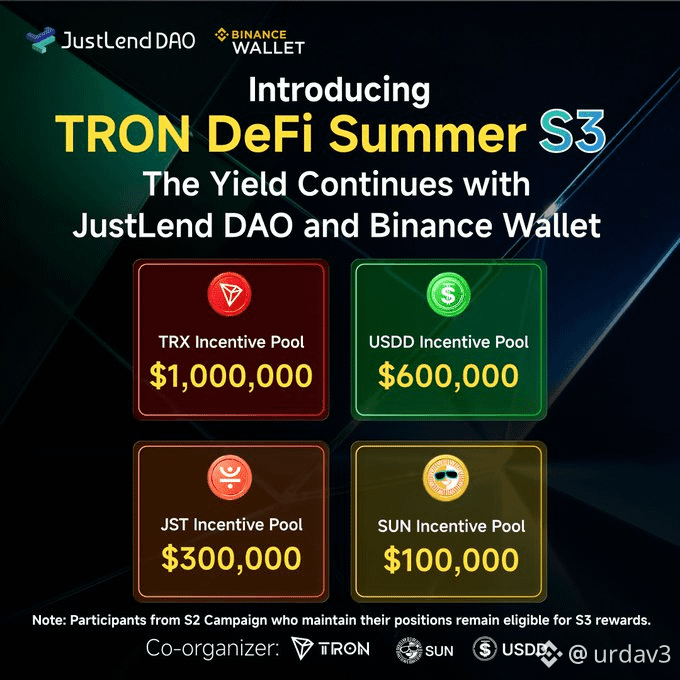
TRON DEFI SUMMER S3 CONVIERTE LOS INCENTIVOS DE RENDIMIENTO EN UNA CAMPAÑA DE LIQUIDEZ MULTIACTIVO
TRON DeFi Summer S3 introduce un fondo de recompensas de 2 millones de dólares distribuido entre cuatro activos: 1 millón para TRX, 600.000 para USDD, 300.000 para JST y 100.000 para SUN.
La estructura es importante porque la campaña no se centra en un solo token ni en un único pool de liquidez aislado.
En cambio, S3 crea una capa de incentivos multi-activo en el ecosistema de JustLend DAO a través de Binance Wallet DeFi. Cada pool representa un componente distinto de la economía DeFi de TRON, mientras que la estructura de recompensas combinada crea un entorno de liquidez más amplio.
El periodo de 60 días de APR con impulso (Boosted APR) también ofrece a los participantes una ventana definida en la que los incentivos pueden influir en el comportamiento de la liquidez.
Esto hace que DeFi Summer sea más que un evento promocional breve. Se convierte en un mecanismo para coordinar capital entre varios activos y mantener la participación durante un periodo de campaña prolongado.
La asignación en sí también comunica en qué lugar la campaña pone su mayor énfasis de incentivos: TRX recibe el pool más grande, seguido de USDD, JST y SUN.
Por lo tanto, S3 ilustra cómo los incentivos de tokens pueden estructurarse como una estrategia de liquidez a nivel de ecosistema, en lugar de como un programa de recompensas para un solo mercado.
@DeFi_JUST @JustinSun #TRONEcoStar
TRON DEFI SUMMER S3 CONVIERTE LOS INCENTIVOS DE RENDIMIENTO EN UNA CAMPAÑA DE LIQUIDEZ MULTIACTIVO
TRON DeFi Summer S3 introduce un fondo de recompensas de 2 millones de dólares distribuido entre cuatro activos: 1 millón para TRX, 600.000 para USDD, 300.000 para JST y 100.000 para SUN.
La estructura es importante porque la campaña no se centra en un solo token ni en un único pool de liquidez aislado.
En cambio, S3 crea una capa de incentivos multi-activo en el ecosistema de JustLend DAO a través de Binance Wallet DeFi. Cada pool representa un componente distinto de la economía DeFi de TRON, mientras que la estructura de recompensas combinada crea un entorno de liquidez más amplio.
El periodo de 60 días de APR con impulso (Boosted APR) también ofrece a los participantes una ventana definida en la que los incentivos pueden influir en el comportamiento de la liquidez.
Esto hace que DeFi Summer sea más que un evento promocional breve. Se convierte en un mecanismo para coordinar capital entre varios activos y mantener la participación durante un periodo de campaña prolongado.
La asignación en sí también comunica en qué lugar la campaña pone su mayor énfasis de incentivos: TRX recibe el pool más grande, seguido de USDD, JST y SUN.
Por lo tanto, S3 ilustra cómo los incentivos de tokens pueden estructurarse como una estrategia de liquidez a nivel de ecosistema, en lugar de como un programa de recompensas para un solo mercado.
@JUST DAO @Justin Sun孙宇晨 #TRONEcoStar
TRON DeFi Summer S3 introduce un fondo de recompensas de 2 millones de dólares distribuido entre cuatro activos: 1 millón para TRX, 600.000 para USDD, 300.000 para JST y 100.000 para SUN.
La estructura es importante porque la campaña no se centra en un solo token ni en un único pool de liquidez aislado.
En cambio, S3 crea una capa de incentivos multi-activo en el ecosistema de JustLend DAO a través de Binance Wallet DeFi. Cada pool representa un componente distinto de la economía DeFi de TRON, mientras que la estructura de recompensas combinada crea un entorno de liquidez más amplio.
El periodo de 60 días de APR con impulso (Boosted APR) también ofrece a los participantes una ventana definida en la que los incentivos pueden influir en el comportamiento de la liquidez.
Esto hace que DeFi Summer sea más que un evento promocional breve. Se convierte en un mecanismo para coordinar capital entre varios activos y mantener la participación durante un periodo de campaña prolongado.
La asignación en sí también comunica en qué lugar la campaña pone su mayor énfasis de incentivos: TRX recibe el pool más grande, seguido de USDD, JST y SUN.
Por lo tanto, S3 ilustra cómo los incentivos de tokens pueden estructurarse como una estrategia de liquidez a nivel de ecosistema, en lugar de como un programa de recompensas para un solo mercado.
@JUST DAO @Justin Sun孙宇晨 #TRONEcoStar
156
·
--
Ver traducción
50+ MODELS THROUGH ONE API CHANGES MODEL ACCESS
Access to more than 50 mainstream AI models through B.AI API introduces a different way to think about model discovery and utilization.
The guide lists a broad range of model families, including ChatGPT, Claude, Gemini, Grok, DeepSeek, Kimi, Zhipu GLM, Qwen, MiniMax, Tencent Hy3, and MiMo. The model lineup is also described as dynamically expanding.
For developers, the important part is not simply the number 50+. It is the possibility of accessing a broader model ecosystem through a standardized API rather than building separate workflows around every provider.
That can simplify experimentation. Developers can test different models, compare their behavior within the same environment, and select a model according to the task or workflow requirement.
It also changes the relationship between applications and models. An application does not necessarily have to depend on a single model provider as its permanent intelligence layer.
B.AI API effectively creates a broader access point to multiple model ecosystems, while CodeBuddy provides the environment where those models can be used.
The larger trend is toward abstraction: developers increasingly interact with a unified interface while the underlying model layer becomes more diverse and replaceable.
@JustinSun #TRONEcoStar @BAI_AGI
50+ MODELS THROUGH ONE API CHANGES MODEL ACCESS
Access to more than 50 mainstream AI models through B.AI API introduces a different way to think about model discovery and utilization.
The guide lists a broad range of model families, including ChatGPT, Claude, Gemini, Grok, DeepSeek, Kimi, Zhipu GLM, Qwen, MiniMax, Tencent Hy3, and MiMo. The model lineup is also described as dynamically expanding.
For developers, the important part is not simply the number 50+. It is the possibility of accessing a broader model ecosystem through a standardized API rather than building separate workflows around every provider.
That can simplify experimentation. Developers can test different models, compare their behavior within the same environment, and select a model according to the task or workflow requirement.
It also changes the relationship between applications and models. An application does not necessarily have to depend on a single model provider as its permanent intelligence layer.
B.AI API effectively creates a broader access point to multiple model ecosystems, while CodeBuddy provides the environment where those models can be used.
The larger trend is toward abstraction: developers increasingly interact with a unified interface while the underlying model layer becomes more diverse and replaceable.
@Justin Sun孙宇晨 #TRONEcoStar @BAI_AGI
Access to more than 50 mainstream AI models through B.AI API introduces a different way to think about model discovery and utilization.
The guide lists a broad range of model families, including ChatGPT, Claude, Gemini, Grok, DeepSeek, Kimi, Zhipu GLM, Qwen, MiniMax, Tencent Hy3, and MiMo. The model lineup is also described as dynamically expanding.
For developers, the important part is not simply the number 50+. It is the possibility of accessing a broader model ecosystem through a standardized API rather than building separate workflows around every provider.
That can simplify experimentation. Developers can test different models, compare their behavior within the same environment, and select a model according to the task or workflow requirement.
It also changes the relationship between applications and models. An application does not necessarily have to depend on a single model provider as its permanent intelligence layer.
B.AI API effectively creates a broader access point to multiple model ecosystems, while CodeBuddy provides the environment where those models can be used.
The larger trend is toward abstraction: developers increasingly interact with a unified interface while the underlying model layer becomes more diverse and replaceable.
@Justin Sun孙宇晨 #TRONEcoStar @BAI_AGI

7
·
--
MULTI-MODEL AI SUPERA EL LÍMITE DE UN SOLO MODELO
La idea más grande detrás de la integración de la API de CodeBuddy y B.AI no es simplemente añadir más modelos de IA a una herramienta de programación. Se trata de cambiar la forma en que los desarrolladores pueden abordar la selección de modelos dentro del mismo flujo de trabajo.
En lugar de estar atados a un solo modelo para cada tarea, los desarrolladores pueden alternar entre GPT, Claude, Gemini, DeepSeek, Kimi, GLM, Qwen y otros modelos disponibles mediante la API de B.AI. La guía describe el acceso a más de 50 modelos convencionales, brindando a los desarrolladores un conjunto más amplio de capacidades para trabajar.
Esto importa porque diferentes tareas de desarrollo pueden requerir características distintas del modelo. Las necesidades de planificación, la generación de código, la depuración, el razonamiento a través de un problema o la gestión de otros pasos del desarrollo no necesariamente requieren el mismo modelo.
Por ello, B.AI introduce una capa entre el flujo de trabajo del desarrollador y los modelos individuales. CodeBuddy sigue siendo el entorno de trabajo, mientras que la API aporta flexibilidad por debajo.
La perspectiva más profunda es que el desarrollo con IA se está moviendo de “¿Qué herramienta de IA debería usar?” hacia “¿Qué modelo debería encargarse de esta tarea?”. Ese cambio puede hacer que la elección del modelo forme parte del propio flujo de trabajo, en lugar de ser una decisión separada fuera del entorno de desarrollo.
@JustinSun #TRONEcoStar @BAI_AGI
MULTI-MODEL AI SUPERA EL LÍMITE DE UN SOLO MODELO
La idea más grande detrás de la integración de la API de CodeBuddy y B.AI no es simplemente añadir más modelos de IA a una herramienta de programación. Se trata de cambiar la forma en que los desarrolladores pueden abordar la selección de modelos dentro del mismo flujo de trabajo.
En lugar de estar atados a un solo modelo para cada tarea, los desarrolladores pueden alternar entre GPT, Claude, Gemini, DeepSeek, Kimi, GLM, Qwen y otros modelos disponibles mediante la API de B.AI. La guía describe el acceso a más de 50 modelos convencionales, brindando a los desarrolladores un conjunto más amplio de capacidades para trabajar.
Esto importa porque diferentes tareas de desarrollo pueden requerir características distintas del modelo. Las necesidades de planificación, la generación de código, la depuración, el razonamiento a través de un problema o la gestión de otros pasos del desarrollo no necesariamente requieren el mismo modelo.
Por ello, B.AI introduce una capa entre el flujo de trabajo del desarrollador y los modelos individuales. CodeBuddy sigue siendo el entorno de trabajo, mientras que la API aporta flexibilidad por debajo.
La perspectiva más profunda es que el desarrollo con IA se está moviendo de “¿Qué herramienta de IA debería usar?” hacia “¿Qué modelo debería encargarse de esta tarea?”. Ese cambio puede hacer que la elección del modelo forme parte del propio flujo de trabajo, en lugar de ser una decisión separada fuera del entorno de desarrollo.
@Justin Sun孙宇晨 #TRONEcoStar @BAI_AGI
La idea más grande detrás de la integración de la API de CodeBuddy y B.AI no es simplemente añadir más modelos de IA a una herramienta de programación. Se trata de cambiar la forma en que los desarrolladores pueden abordar la selección de modelos dentro del mismo flujo de trabajo.
En lugar de estar atados a un solo modelo para cada tarea, los desarrolladores pueden alternar entre GPT, Claude, Gemini, DeepSeek, Kimi, GLM, Qwen y otros modelos disponibles mediante la API de B.AI. La guía describe el acceso a más de 50 modelos convencionales, brindando a los desarrolladores un conjunto más amplio de capacidades para trabajar.
Esto importa porque diferentes tareas de desarrollo pueden requerir características distintas del modelo. Las necesidades de planificación, la generación de código, la depuración, el razonamiento a través de un problema o la gestión de otros pasos del desarrollo no necesariamente requieren el mismo modelo.
Por ello, B.AI introduce una capa entre el flujo de trabajo del desarrollador y los modelos individuales. CodeBuddy sigue siendo el entorno de trabajo, mientras que la API aporta flexibilidad por debajo.
La perspectiva más profunda es que el desarrollo con IA se está moviendo de “¿Qué herramienta de IA debería usar?” hacia “¿Qué modelo debería encargarse de esta tarea?”. Ese cambio puede hacer que la elección del modelo forme parte del propio flujo de trabajo, en lugar de ser una decisión separada fuera del entorno de desarrollo.
@Justin Sun孙宇晨 #TRONEcoStar @BAI_AGI

2
·
--
Ver traducción
B.AI AS AN AI AGENT INFRASTRUCTURE LAYER
The CodeBuddy integration illustrates a broader role for B.AI beyond direct AI conversations.
According to the guide, B.AI provides standardized API interfaces compatible with mainstream specifications such as the OpenAI API and Anthropic Messages API. This allows AI development tools and agents that support these standards to connect with B.AI more seamlessly.
That architecture positions B.AI as an infrastructure layer rather than simply another individual AI model.
The distinction is important. A model generates intelligence, while an infrastructure layer can determine how that intelligence becomes accessible across applications, development environments, and agent workflows.
CodeBuddy is one example. Developers can bring B.AI's model access into an existing coding environment instead of changing their entire workflow around a single AI provider.
The result is a more modular architecture: applications can remain focused on their user experience and workflow, while the infrastructure layer handles access to a broader model ecosystem.
This perspective becomes increasingly relevant as AI agents and development tools become more interconnected. The value may not only come from having powerful models, but from building infrastructure that makes different models usable where they are actually needed.
@JustinSun #TRONEcoStar @BAI_AGI
B.AI AS AN AI AGENT INFRASTRUCTURE LAYER
The CodeBuddy integration illustrates a broader role for B.AI beyond direct AI conversations.
According to the guide, B.AI provides standardized API interfaces compatible with mainstream specifications such as the OpenAI API and Anthropic Messages API. This allows AI development tools and agents that support these standards to connect with B.AI more seamlessly.
That architecture positions B.AI as an infrastructure layer rather than simply another individual AI model.
The distinction is important. A model generates intelligence, while an infrastructure layer can determine how that intelligence becomes accessible across applications, development environments, and agent workflows.
CodeBuddy is one example. Developers can bring B.AI's model access into an existing coding environment instead of changing their entire workflow around a single AI provider.
The result is a more modular architecture: applications can remain focused on their user experience and workflow, while the infrastructure layer handles access to a broader model ecosystem.
This perspective becomes increasingly relevant as AI agents and development tools become more interconnected. The value may not only come from having powerful models, but from building infrastructure that makes different models usable where they are actually needed.
@Justin Sun孙宇晨 #TRONEcoStar @BAI_AGI
The CodeBuddy integration illustrates a broader role for B.AI beyond direct AI conversations.
According to the guide, B.AI provides standardized API interfaces compatible with mainstream specifications such as the OpenAI API and Anthropic Messages API. This allows AI development tools and agents that support these standards to connect with B.AI more seamlessly.
That architecture positions B.AI as an infrastructure layer rather than simply another individual AI model.
The distinction is important. A model generates intelligence, while an infrastructure layer can determine how that intelligence becomes accessible across applications, development environments, and agent workflows.
CodeBuddy is one example. Developers can bring B.AI's model access into an existing coding environment instead of changing their entire workflow around a single AI provider.
The result is a more modular architecture: applications can remain focused on their user experience and workflow, while the infrastructure layer handles access to a broader model ecosystem.
This perspective becomes increasingly relevant as AI agents and development tools become more interconnected. The value may not only come from having powerful models, but from building infrastructure that makes different models usable where they are actually needed.
@Justin Sun孙宇晨 #TRONEcoStar @BAI_AGI

7
·
--
Ver traducción
CODEBUDDY × B.AI CREATES A MORE FLEXIBLE DEVELOPMENT WORKFLOW
CodeBuddy is designed to support the development process across requirements planning, UI design, code generation, backend engineering, and debugging. B.AI API adds another dimension by allowing developers to select models beneath that workflow.
This creates an interesting separation between the development environment and the intelligence powering it.
Developers can stay inside CodeBuddy while changing the model used for a particular task. Instead of rebuilding a workflow whenever a preferred model changes, the integration makes model access configurable through the B.AI API.
The guide presents two connection methods: a user-interface setup for faster configuration and a models.json approach for more advanced or batch management.
This flexibility matters because development workflows are rarely uniform. A developer may want one model for general coding assistance and another for a different reasoning or generation requirement.
The broader implication is workflow continuity. The interface does not necessarily need to change just because the underlying model changes.
B.AI therefore acts as a model-access layer underneath CodeBuddy, while CodeBuddy remains the developer-facing environment. Together, they demonstrate how AI development can become increasingly modular, configurable, and adaptable.
@JustinSun #TRONEcoStar @BAI_AGI
CODEBUDDY × B.AI CREATES A MORE FLEXIBLE DEVELOPMENT WORKFLOW
CodeBuddy is designed to support the development process across requirements planning, UI design, code generation, backend engineering, and debugging. B.AI API adds another dimension by allowing developers to select models beneath that workflow.
This creates an interesting separation between the development environment and the intelligence powering it.
Developers can stay inside CodeBuddy while changing the model used for a particular task. Instead of rebuilding a workflow whenever a preferred model changes, the integration makes model access configurable through the B.AI API.
The guide presents two connection methods: a user-interface setup for faster configuration and a models.json approach for more advanced or batch management.
This flexibility matters because development workflows are rarely uniform. A developer may want one model for general coding assistance and another for a different reasoning or generation requirement.
The broader implication is workflow continuity. The interface does not necessarily need to change just because the underlying model changes.
B.AI therefore acts as a model-access layer underneath CodeBuddy, while CodeBuddy remains the developer-facing environment. Together, they demonstrate how AI development can become increasingly modular, configurable, and adaptable.
@Justin Sun孙宇晨 #TRONEcoStar @BAI_AGI
CodeBuddy is designed to support the development process across requirements planning, UI design, code generation, backend engineering, and debugging. B.AI API adds another dimension by allowing developers to select models beneath that workflow.
This creates an interesting separation between the development environment and the intelligence powering it.
Developers can stay inside CodeBuddy while changing the model used for a particular task. Instead of rebuilding a workflow whenever a preferred model changes, the integration makes model access configurable through the B.AI API.
The guide presents two connection methods: a user-interface setup for faster configuration and a models.json approach for more advanced or batch management.
This flexibility matters because development workflows are rarely uniform. A developer may want one model for general coding assistance and another for a different reasoning or generation requirement.
The broader implication is workflow continuity. The interface does not necessarily need to change just because the underlying model changes.
B.AI therefore acts as a model-access layer underneath CodeBuddy, while CodeBuddy remains the developer-facing environment. Together, they demonstrate how AI development can become increasingly modular, configurable, and adaptable.
@Justin Sun孙宇晨 #TRONEcoStar @BAI_AGI

5
Inicia sesión para explorar más contenidos
Únete a usuarios de criptomonedas de todo el mundo en Binance Square
⚡️ Obtén la información más reciente y útil sobre criptomonedas.
💬 Confía en el mayor exchange de criptomonedas del mundo.
👍 Descubre opiniones reales de creadores verificados.
Correo electrónico/número de teléfono
Temas en tendencia
SECHaltsCryptoETFReviewsAmidFundingLapse
1,205 visualizaciones
77 participa(n) en el debate
#SECHaltsCryptoETFReviewsAmidFundingLapse
La SEC detiene revisiones de ETF de criptomonedas debido a un desajuste de financiación
Se informa que la Comisión de Valores y Bolsa de Estados Unidos (SEC) ha pausado ciertas actividades de revisión de ETF de criptomonedas en medio de una interrupción en la financiación gubernamental.
Este desarrollo ha generado incertidumbre en el mercado cripto, especialmente para inversores y empresas que esperan decisiones regulatorias sobre fondos cotizados en bolsa (ETFs) relacionados con criptomonedas.
Impacto en el mercado cripto
El retraso podría afectar el calendario de aprobación de las solicitudes pendientes de ETF cripto. Los inversores están monitoreando de cerca la situación, ya que la claridad regulatoria sigue siendo un factor importante para el crecimiento de la industria de activos digitales.
Aunque la pausa no significa necesariamente que las solicitudes de ETF cripto vayan a ser rechazadas, pone de relieve cómo las interrupciones en la financiación gubernamental pueden influir en los procesos de regulación financiera.
¿Qué sucede a continuación?
Los participantes del mercado estarán atentos a novedades sobre la financiación gubernamental y la capacidad de la SEC para reanudar las operaciones normales.
Los ETF de criptomonedas siguen siendo un tema importante para la adopción institucional, el desarrollo del mercado y la confianza de los inversores.
Conclusión: La detención temporal pone de manifiesto la importancia de la estabilidad regulatoria para el futuro de las inversiones en criptomonedas.
#Crypto #Bitcoin #ETF #SEC #CryptoNews #Blockchain #Binance
King2112
·0 «Me gusta»
·31 visualizaciones
ZcashETFPostsFirstWeeklyOutflow$93.6M
54,582 visualizaciones
165 participa(n) en el debate
GreekPoliceBustCryptoScamRingArrest17
157,710 visualizaciones
1,100 participa(n) en el debate