
las newr
27 Publicaciones

las newr
Denunciar
Bloquear usuario
3 Siguiendo
2 Seguidores
8 Me gusta
Publicaciones
·
--
Ver traducción
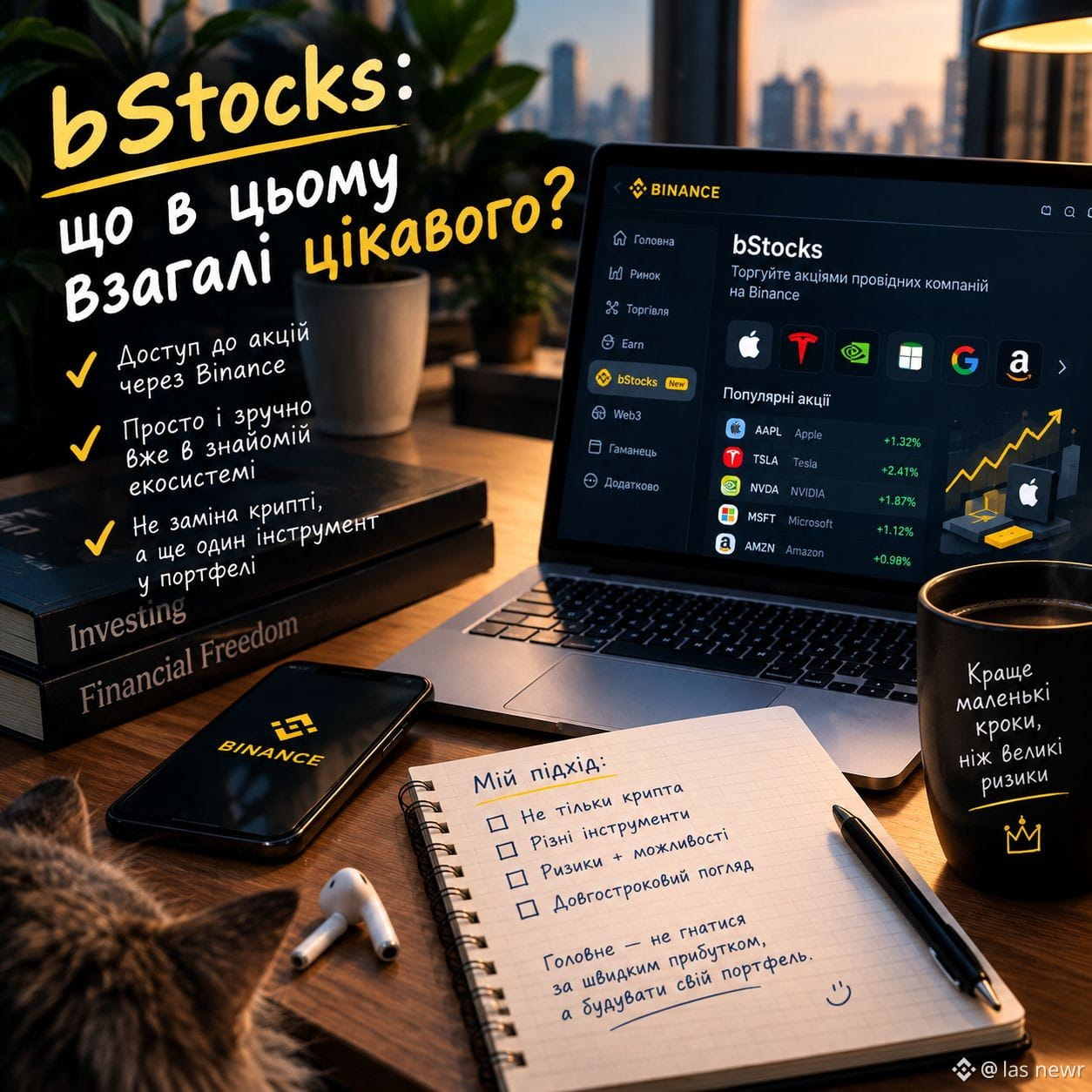
Раніше, коли чув про інвестиції в акції, уявляв собі окремого брокера, купу документів і ще один додаток, у якому треба розбиратися 😅
А тут мені сподобався сам підхід bStocks — доступ до традиційних акцій через звичну екосистему Binance.
Для мене найбільший плюс — простота.
Якщо я вже користуюся Binance для крипти, логічно хоча б розібратися, що ще можна робити всередині платформи.
Але є важливий момент: я б не сприймав це як «акції = гарантований прибуток».
Tesla, NVIDIA, Apple та інші великі компанії теж можуть падати. Іноді дуже неприємно 😄
Тому для мене bStocks — це не заміна крипті, а ще один інструмент, який можна використовувати разом з іншими.
#bStocks #Binance #акції #TradF #крипта
Раніше, коли чув про інвестиції в акції, уявляв собі окремого брокера, купу документів і ще один додаток, у якому треба розбиратися 😅
А тут мені сподобався сам підхід bStocks — доступ до традиційних акцій через звичну екосистему Binance.
Для мене найбільший плюс — простота.
Якщо я вже користуюся Binance для крипти, логічно хоча б розібратися, що ще можна робити всередині платформи.
Але є важливий момент: я б не сприймав це як «акції = гарантований прибуток».
Tesla, NVIDIA, Apple та інші великі компанії теж можуть падати. Іноді дуже неприємно 😄
Тому для мене bStocks — це не заміна крипті, а ще один інструмент, який можна використовувати разом з іншими.
#bStocks #Binance #акції #TradF #крипта
А тут мені сподобався сам підхід bStocks — доступ до традиційних акцій через звичну екосистему Binance.
Для мене найбільший плюс — простота.
Якщо я вже користуюся Binance для крипти, логічно хоча б розібратися, що ще можна робити всередині платформи.
Але є важливий момент: я б не сприймав це як «акції = гарантований прибуток».
Tesla, NVIDIA, Apple та інші великі компанії теж можуть падати. Іноді дуже неприємно 😄
Тому для мене bStocks — це не заміна крипті, а ще один інструмент, який можна використовувати разом з іншими.
#bStocks #Binance #акції #TradF #крипта
82
·
--
Ver traducción
#termmax @termmax
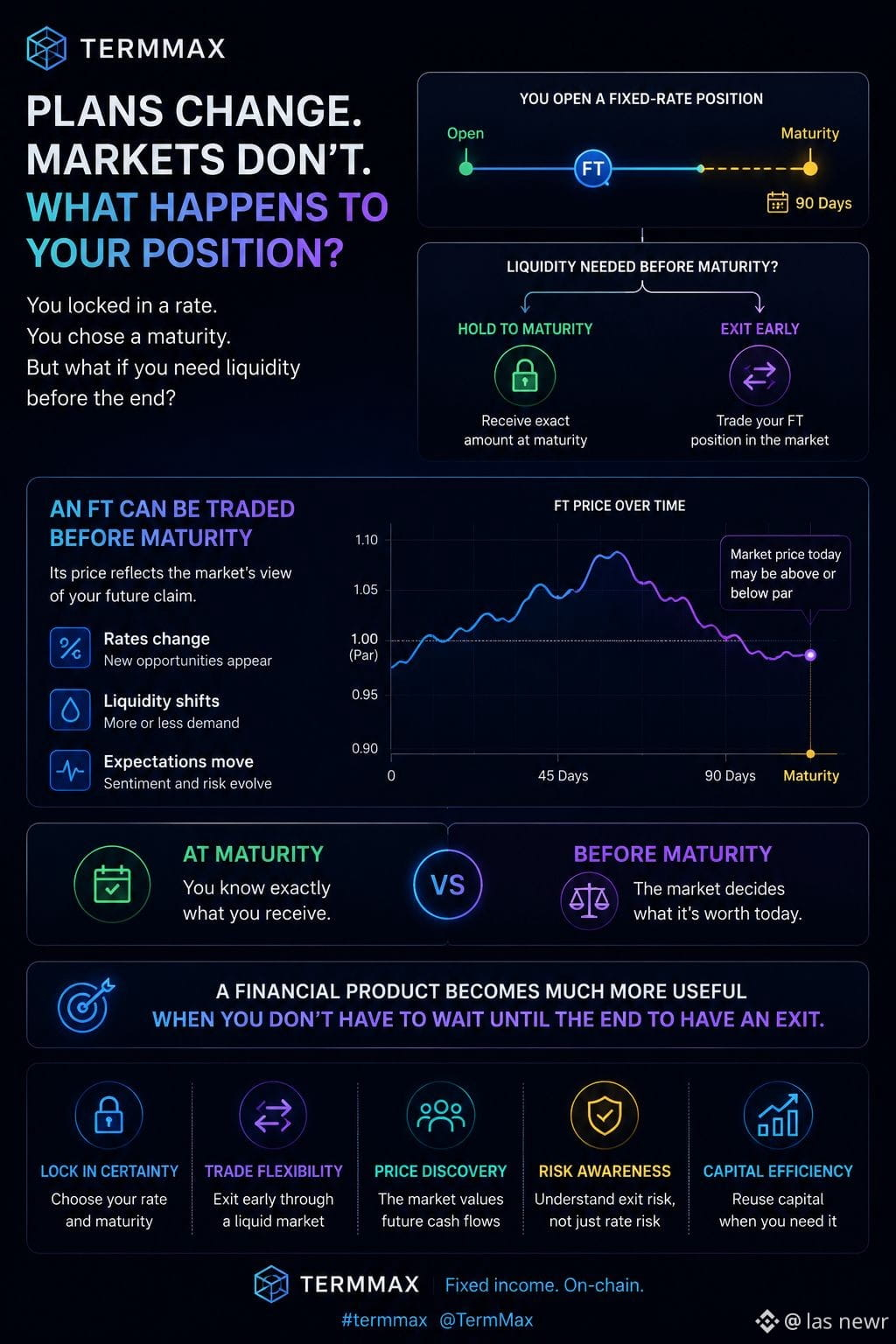
The part of fixed-rate DeFi I find hardest to ignore is what happens when plans change.
Entering a position is easy when everything goes according to plan.
You choose a rate.
You choose a maturity.
You deploy capital.
But markets rarely care about your original plan.
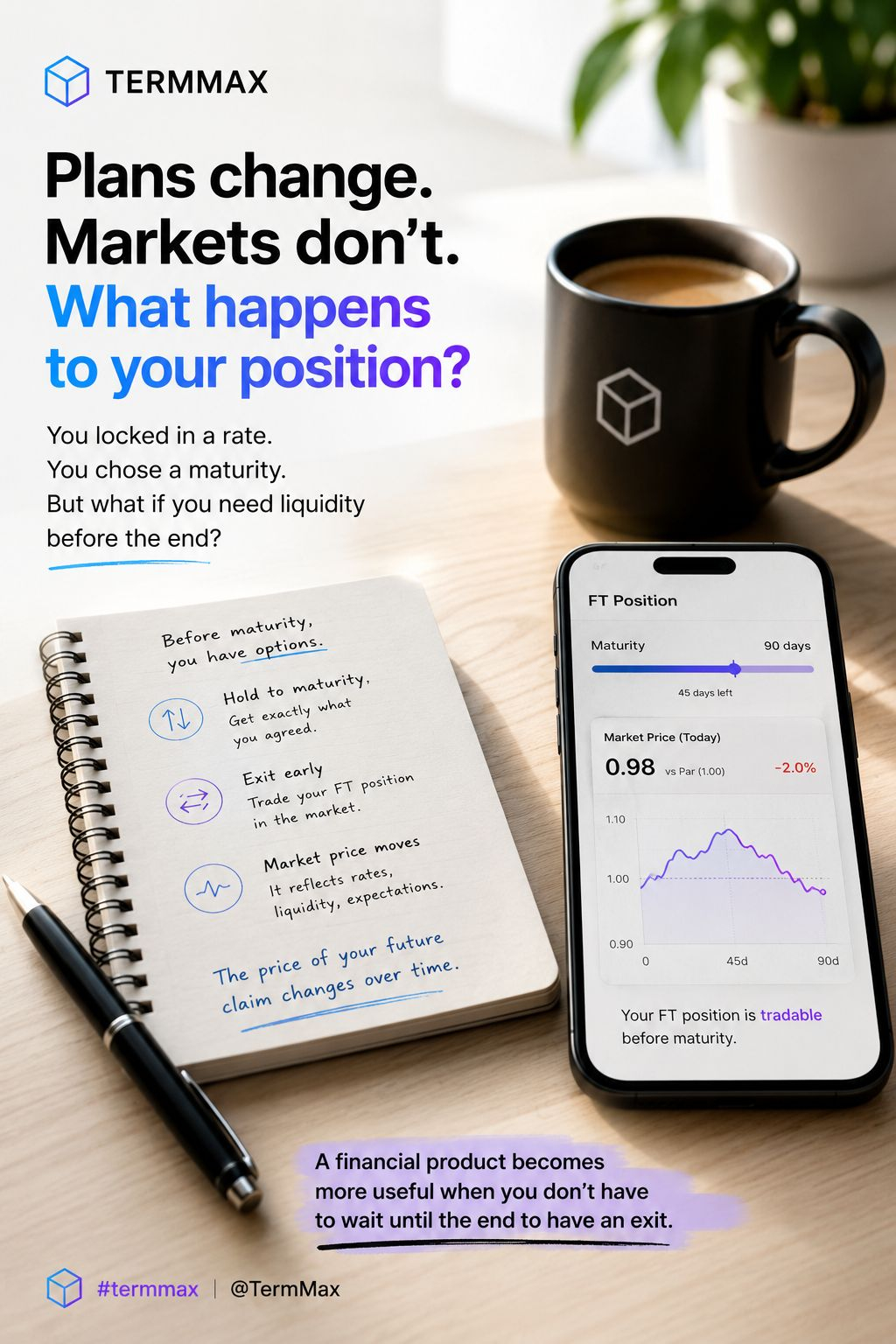
What if you suddenly need liquidity three weeks before maturity?
This is where I think the real test for TermMax begins.
A fixed-term position shouldn't only be attractive when you hold it until the end.
There needs to be a meaningful market for the position itself.
Because once an FT can be traded before maturity, its price starts telling a story.
The market is constantly asking:
How much is this future claim worth today?
And that price can move.
Rates can change.
Liquidity can disappear.
Expectations can shift.
So the FT becomes more than a way to lock in yield.
It becomes something whose value can be discovered in the market before its final settlement.
That's a much more interesting design to me.
It introduces a second layer of risk that isn't obvious from the headline APR:
exit risk.
You might know exactly what you receive at maturity.
But do you know what someone will be willing to pay for your position tomorrow?
That's where I think fixed-income DeFi gets genuinely interesting.
The next question isn't just whether TermMax can create fixed-rate products.
It's whether a healthy secondary market can form around them.
Because a financial product becomes much more useful when you don't have to wait until the end to have an exit.
#termmax @TermMax
The part of fixed-rate DeFi I find hardest to ignore is what happens when plans change.
Entering a position is easy when everything goes according to plan.
You choose a rate.
You choose a maturity.
You deploy capital.
But markets rarely care about your original plan.
What if you suddenly need liquidity three weeks before maturity?
This is where I think the real test for TermMax begins.
A fixed-term position shouldn't only be attractive when you hold it until the end.
There needs to be a meaningful market for the position itself.
Because once an FT can be traded before maturity, its price starts telling a story.
The market is constantly asking:
How much is this future claim worth today?
And that price can move.
Rates can change.
Liquidity can disappear.
Expectations can shift.
So the FT becomes more than a way to lock in yield.
It becomes something whose value can be discovered in the market before its final settlement.
That's a much more interesting design to me.
It introduces a second layer of risk that isn't obvious from the headline APR:
exit risk.
You might know exactly what you receive at maturity.
But do you know what someone will be willing to pay for your position tomorrow?
That's where I think fixed-income DeFi gets genuinely interesting.
The next question isn't just whether TermMax can create fixed-rate products.
It's whether a healthy secondary market can form around them.
Because a financial product becomes much more useful when you don't have to wait until the end to have an exit.
The part of fixed-rate DeFi I find hardest to ignore is what happens when plans change.
Entering a position is easy when everything goes according to plan.
You choose a rate.
You choose a maturity.
You deploy capital.
But markets rarely care about your original plan.
What if you suddenly need liquidity three weeks before maturity?
This is where I think the real test for TermMax begins.
A fixed-term position shouldn't only be attractive when you hold it until the end.
There needs to be a meaningful market for the position itself.
Because once an FT can be traded before maturity, its price starts telling a story.
The market is constantly asking:
How much is this future claim worth today?
And that price can move.
Rates can change.
Liquidity can disappear.
Expectations can shift.
So the FT becomes more than a way to lock in yield.
It becomes something whose value can be discovered in the market before its final settlement.
That's a much more interesting design to me.
It introduces a second layer of risk that isn't obvious from the headline APR:
exit risk.
You might know exactly what you receive at maturity.
But do you know what someone will be willing to pay for your position tomorrow?
That's where I think fixed-income DeFi gets genuinely interesting.
The next question isn't just whether TermMax can create fixed-rate products.
It's whether a healthy secondary market can form around them.
Because a financial product becomes much more useful when you don't have to wait until the end to have an exit.
92
·
--
Ver traducción
#termmax @termmax Я довго дивився на TermMax і зрозумів одну цікаву річ.
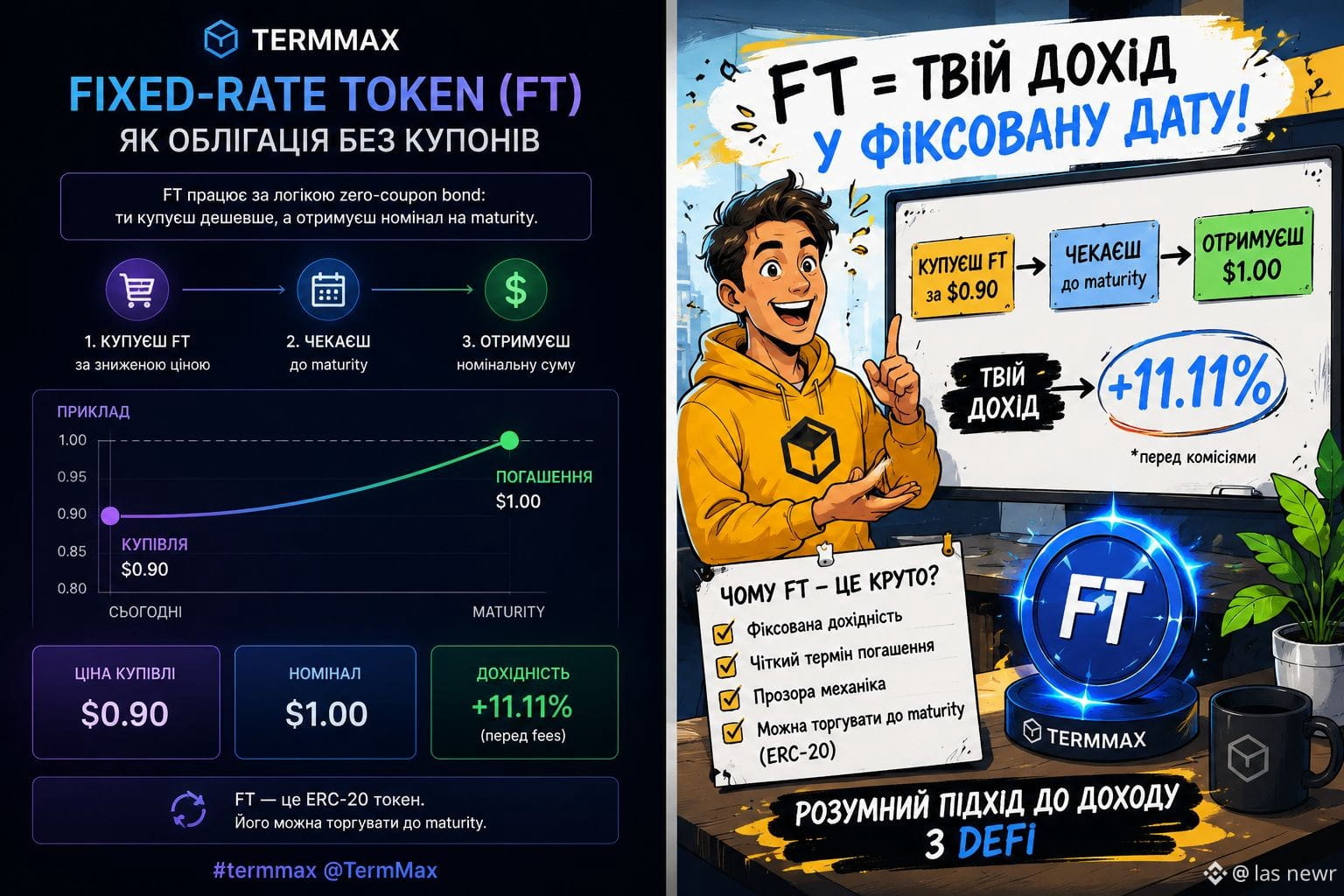
Його Fixed-rate Token (FT) можна сприймати майже як облігацію без купонних виплат.
Механіка проста:
Ти купуєш FT дешевше за його майбутню номінальну вартість.
Потім чекаєш maturity.
І в момент погашення отримуєш повну номінальну суму.
Наприклад:
FT коштує $0.90 сьогодні.
На maturity він погашається за $1.
Різниця між ціною покупки та номіналом — твій дохід.
І тут мені подобається сама ідея.
У DeFi ми звикли думати:
«Скільки APY я можу отримати?»
А TermMax дозволяє дивитися інакше:
«Скільки я заплачу сьогодні і скільки отримаю в конкретну дату?»
Це вже дуже схоже на логіку традиційних fixed-income інструментів, але реалізовану on-chain.
Причому FT — це ERC-20, тому його можна торгувати до maturity.
Тобто ти не обов'язково маєш просто купити й забути про нього до дати погашення.
На мій погляд, саме такі примітиви й можуть поступово зробити DeFi більш схожим на повноцінний фінансовий ринок.
Не черговий «вищий APY».
А новий спосіб структурувати дохід.
#termmax @TermMax Я довго дивився на TermMax і зрозумів одну цікаву річ.
Його Fixed-rate Token (FT) можна сприймати майже як облігацію без купонних виплат.
Механіка проста:
Ти купуєш FT дешевше за його майбутню номінальну вартість.
Потім чекаєш maturity.
І в момент погашення отримуєш повну номінальну суму.
Наприклад:
FT коштує $0.90 сьогодні.
На maturity він погашається за $1.
Різниця між ціною покупки та номіналом — твій дохід.
І тут мені подобається сама ідея.
У DeFi ми звикли думати:
«Скільки APY я можу отримати?»
А TermMax дозволяє дивитися інакше:
«Скільки я заплачу сьогодні і скільки отримаю в конкретну дату?»
Це вже дуже схоже на логіку традиційних fixed-income інструментів, але реалізовану on-chain.
Причому FT — це ERC-20, тому його можна торгувати до maturity.
Тобто ти не обов'язково маєш просто купити й забути про нього до дати погашення.
На мій погляд, саме такі примітиви й можуть поступово зробити DeFi більш схожим на повноцінний фінансовий ринок.
Не черговий «вищий APY».
А новий спосіб структурувати дохід.
Його Fixed-rate Token (FT) можна сприймати майже як облігацію без купонних виплат.
Механіка проста:
Ти купуєш FT дешевше за його майбутню номінальну вартість.
Потім чекаєш maturity.
І в момент погашення отримуєш повну номінальну суму.
Наприклад:
FT коштує $0.90 сьогодні.
На maturity він погашається за $1.
Різниця між ціною покупки та номіналом — твій дохід.
І тут мені подобається сама ідея.
У DeFi ми звикли думати:
«Скільки APY я можу отримати?»
А TermMax дозволяє дивитися інакше:
«Скільки я заплачу сьогодні і скільки отримаю в конкретну дату?»
Це вже дуже схоже на логіку традиційних fixed-income інструментів, але реалізовану on-chain.
Причому FT — це ERC-20, тому його можна торгувати до maturity.
Тобто ти не обов'язково маєш просто купити й забути про нього до дати погашення.
На мій погляд, саме такі примітиви й можуть поступово зробити DeFi більш схожим на повноцінний фінансовий ринок.
Не черговий «вищий APY».
А новий спосіб структурувати дохід.
87
·
--
Ver traducción
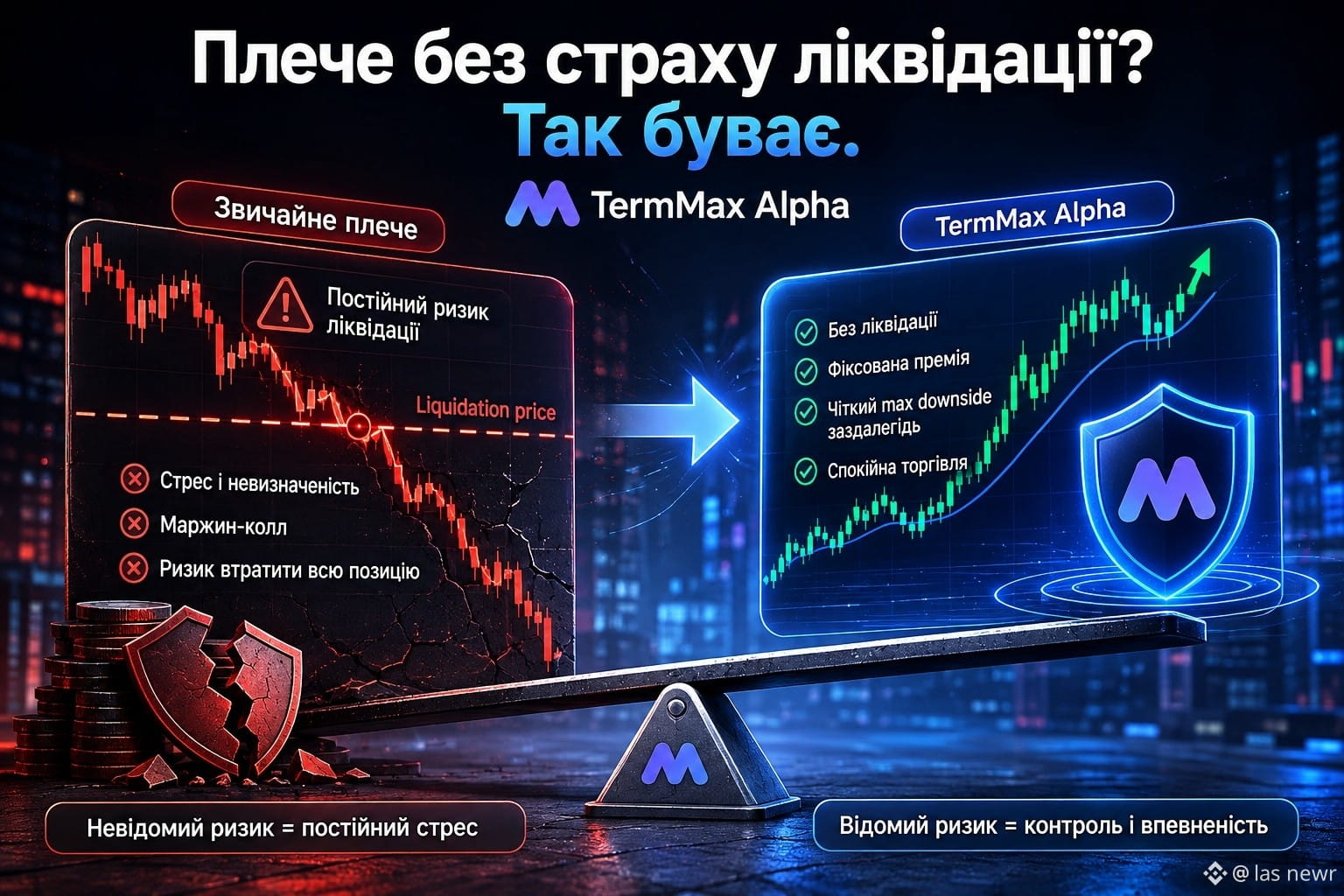
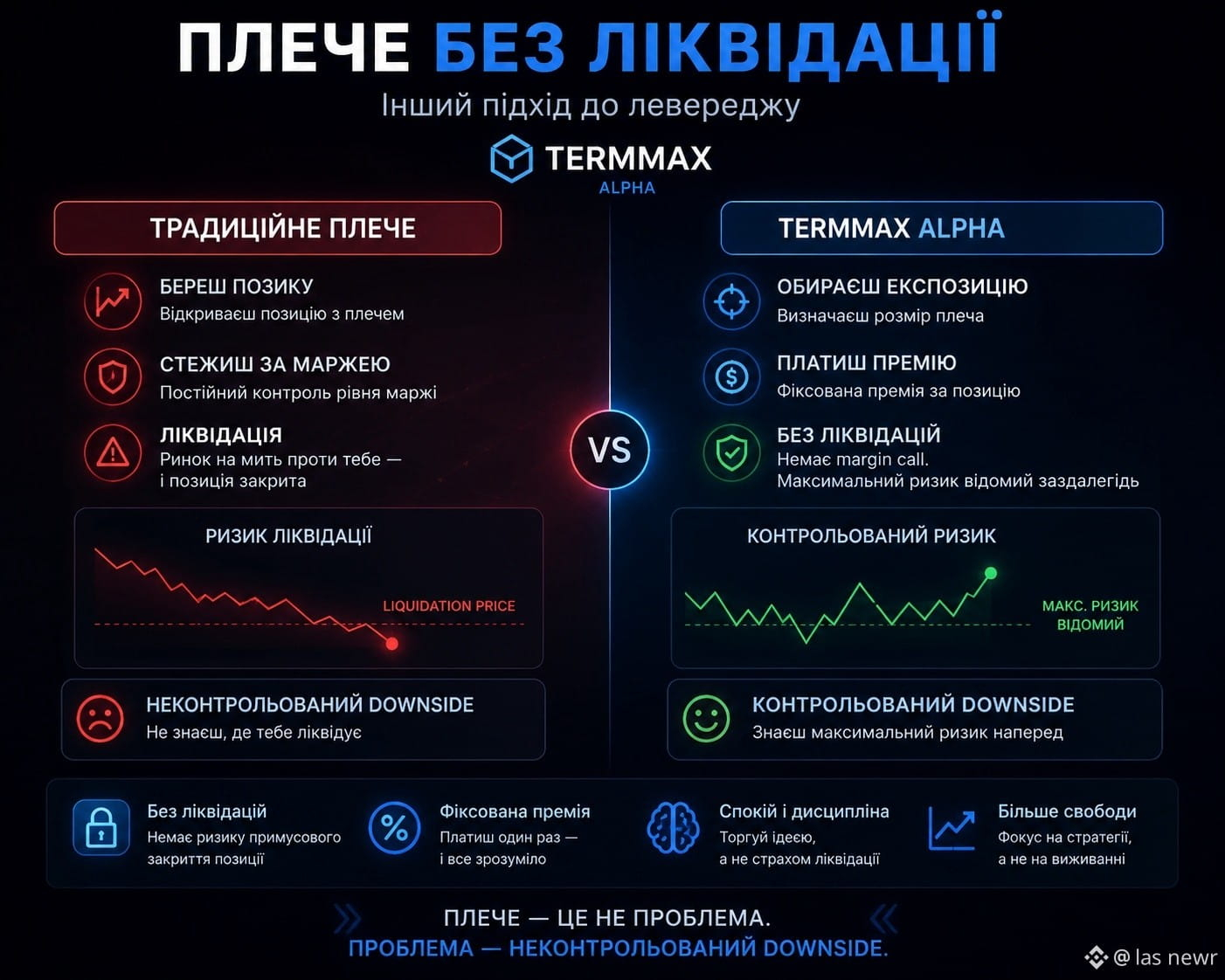
Є одна цифра, яку трейдери з плечем точно не хочуть бачити.
Liquidation price.
Ти можеш правильно спрогнозувати рух ETH, але короткий рух проти позиції — і вся угода закривається.
Саме тому мені цікавий підхід TermMax Alpha.
Тут ідея інша: замість постійного контролю маржі та ризику ліквідації ти заздалегідь платиш премію за плече.
Тобто логіка змінюється:
Звичайне плече: → відкрив позицію
→ стежиш за margin
→ переживаєш за liquidation price
TermMax Alpha: → обираєш експозицію
→ платиш премію
→ заздалегідь знаєш максимальний downside
І це змінює головне питання.
Не:
«Де мене ліквідує?»
А:
«Чи варта ця угода тієї премії, яку я плачу?»
Для волатильного ринку це, на мій погляд, набагато цікавіший підхід.
Проблема плеча не завжди в самому плечі.
Проблема — у неконтрольованому downside.
#termmax @termmax
{spot}(ETHUSDT)
Є одна цифра, яку трейдери з плечем точно не хочуть бачити.
Liquidation price.
Ти можеш правильно спрогнозувати рух ETH, але короткий рух проти позиції — і вся угода закривається.
Саме тому мені цікавий підхід TermMax Alpha.
Тут ідея інша: замість постійного контролю маржі та ризику ліквідації ти заздалегідь платиш премію за плече.
Тобто логіка змінюється:
Звичайне плече: → відкрив позицію
→ стежиш за margin
→ переживаєш за liquidation price
TermMax Alpha: → обираєш експозицію
→ платиш премію
→ заздалегідь знаєш максимальний downside
І це змінює головне питання.
Не:
«Де мене ліквідує?»
А:
«Чи варта ця угода тієї премії, яку я плачу?»
Для волатильного ринку це, на мій погляд, набагато цікавіший підхід.
Проблема плеча не завжди в самому плечі.
Проблема — у неконтрольованому downside.
#termmax @TermMax
Liquidation price.
Ти можеш правильно спрогнозувати рух ETH, але короткий рух проти позиції — і вся угода закривається.
Саме тому мені цікавий підхід TermMax Alpha.
Тут ідея інша: замість постійного контролю маржі та ризику ліквідації ти заздалегідь платиш премію за плече.
Тобто логіка змінюється:
Звичайне плече: → відкрив позицію
→ стежиш за margin
→ переживаєш за liquidation price
TermMax Alpha: → обираєш експозицію
→ платиш премію
→ заздалегідь знаєш максимальний downside
І це змінює головне питання.
Не:
«Де мене ліквідує?»
А:
«Чи варта ця угода тієї премії, яку я плачу?»
Для волатильного ринку це, на мій погляд, набагато цікавіший підхід.
Проблема плеча не завжди в самому плечі.
Проблема — у неконтрольованому downside.
#termmax @TermMax
282
·
--
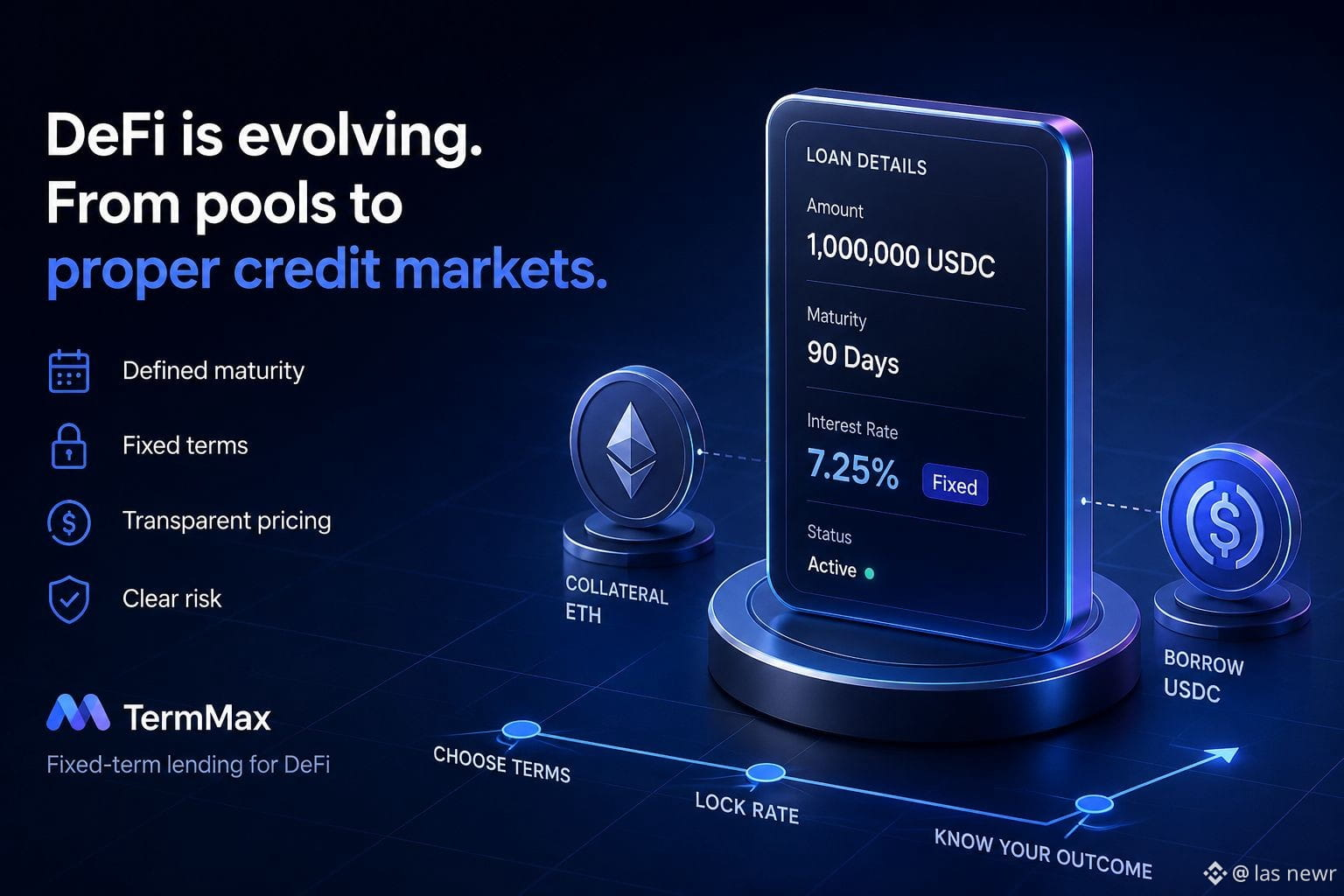
La mayoría del lending en DeFi parte de una suposición:
tu colateral es la parte interesante.
Creo que la parte más interesante es, en realidad, el préstamo.
Un préstamo tiene un tamaño. Un vencimiento. Un precio. Un perfil de riesgo.
La finanza tradicional ha pasado décadas construyendo mercados en torno a esos parámetros.
DeFi todavía los está experimentando.
Por eso TermMax me llamó la atención.
En lugar de tratar el lending como una posición interminable en la que la tasa sigue cambiando, TermMax estructura préstamos alrededor de vencimientos específicos y términos fijos.
Eso abre una forma diferente de pensar sobre el crédito on-chain.
Puedes comparar los costos de financiación.
Puedes construir estrategias en torno a un vencimiento conocido.
Y los prestamistas pueden elegir su exposición en función de un plazo definido, en lugar de simplemente depositar en un fondo sin plazos.
La pregunta interesante no es:
“¿Puede DeFi prestar dinero?”
Ya sabemos la respuesta.
La pregunta más grande es:
“¿Puede DeFi construir un mercado de crédito adecuado?”
TermMax es uno de los proyectos que intenta responder a eso.
Y honestamente, creo que esta parte de DeFi merece mucha más atención.
#termmax @termmax
La mayoría del lending en DeFi parte de una suposición:
tu colateral es la parte interesante.
Creo que la parte más interesante es, en realidad, el préstamo.
Un préstamo tiene un tamaño. Un vencimiento. Un precio. Un perfil de riesgo.
La finanza tradicional ha pasado décadas construyendo mercados en torno a esos parámetros.
DeFi todavía los está experimentando.
Por eso TermMax me llamó la atención.
En lugar de tratar el lending como una posición interminable en la que la tasa sigue cambiando, TermMax estructura préstamos alrededor de vencimientos específicos y términos fijos.
Eso abre una forma diferente de pensar sobre el crédito on-chain.
Puedes comparar los costos de financiación.
Puedes construir estrategias en torno a un vencimiento conocido.
Y los prestamistas pueden elegir su exposición en función de un plazo definido, en lugar de simplemente depositar en un fondo sin plazos.
La pregunta interesante no es:
“¿Puede DeFi prestar dinero?”
Ya sabemos la respuesta.
La pregunta más grande es:
“¿Puede DeFi construir un mercado de crédito adecuado?”
TermMax es uno de los proyectos que intenta responder a eso.
Y honestamente, creo que esta parte de DeFi merece mucha más atención.
#termmax @TermMax
tu colateral es la parte interesante.
Creo que la parte más interesante es, en realidad, el préstamo.
Un préstamo tiene un tamaño. Un vencimiento. Un precio. Un perfil de riesgo.
La finanza tradicional ha pasado décadas construyendo mercados en torno a esos parámetros.
DeFi todavía los está experimentando.
Por eso TermMax me llamó la atención.
En lugar de tratar el lending como una posición interminable en la que la tasa sigue cambiando, TermMax estructura préstamos alrededor de vencimientos específicos y términos fijos.
Eso abre una forma diferente de pensar sobre el crédito on-chain.
Puedes comparar los costos de financiación.
Puedes construir estrategias en torno a un vencimiento conocido.
Y los prestamistas pueden elegir su exposición en función de un plazo definido, en lugar de simplemente depositar en un fondo sin plazos.
La pregunta interesante no es:
“¿Puede DeFi prestar dinero?”
Ya sabemos la respuesta.
La pregunta más grande es:
“¿Puede DeFi construir un mercado de crédito adecuado?”
TermMax es uno de los proyectos que intenta responder a eso.
Y honestamente, creo que esta parte de DeFi merece mucha más atención.
#termmax @TermMax
62
·
--
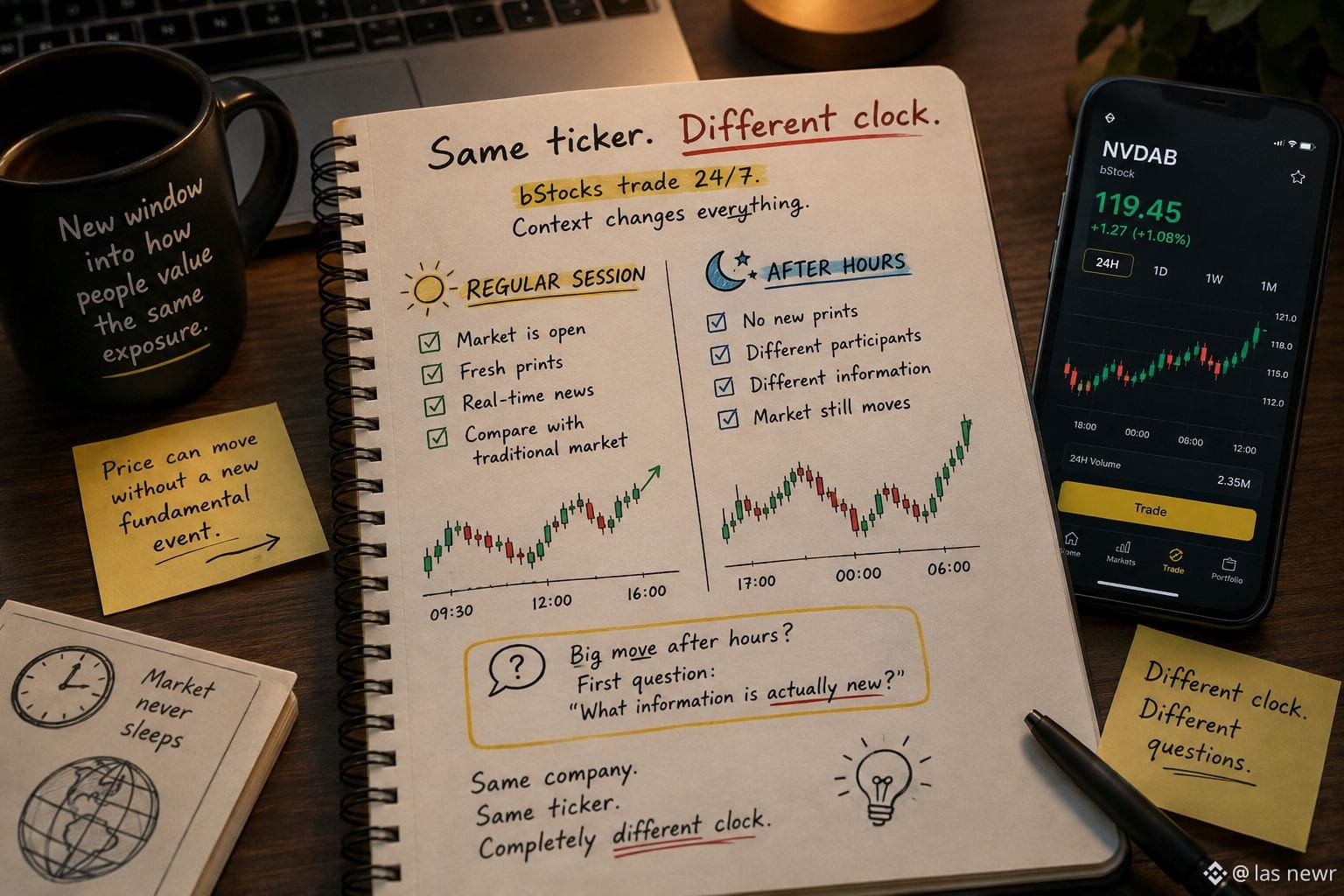
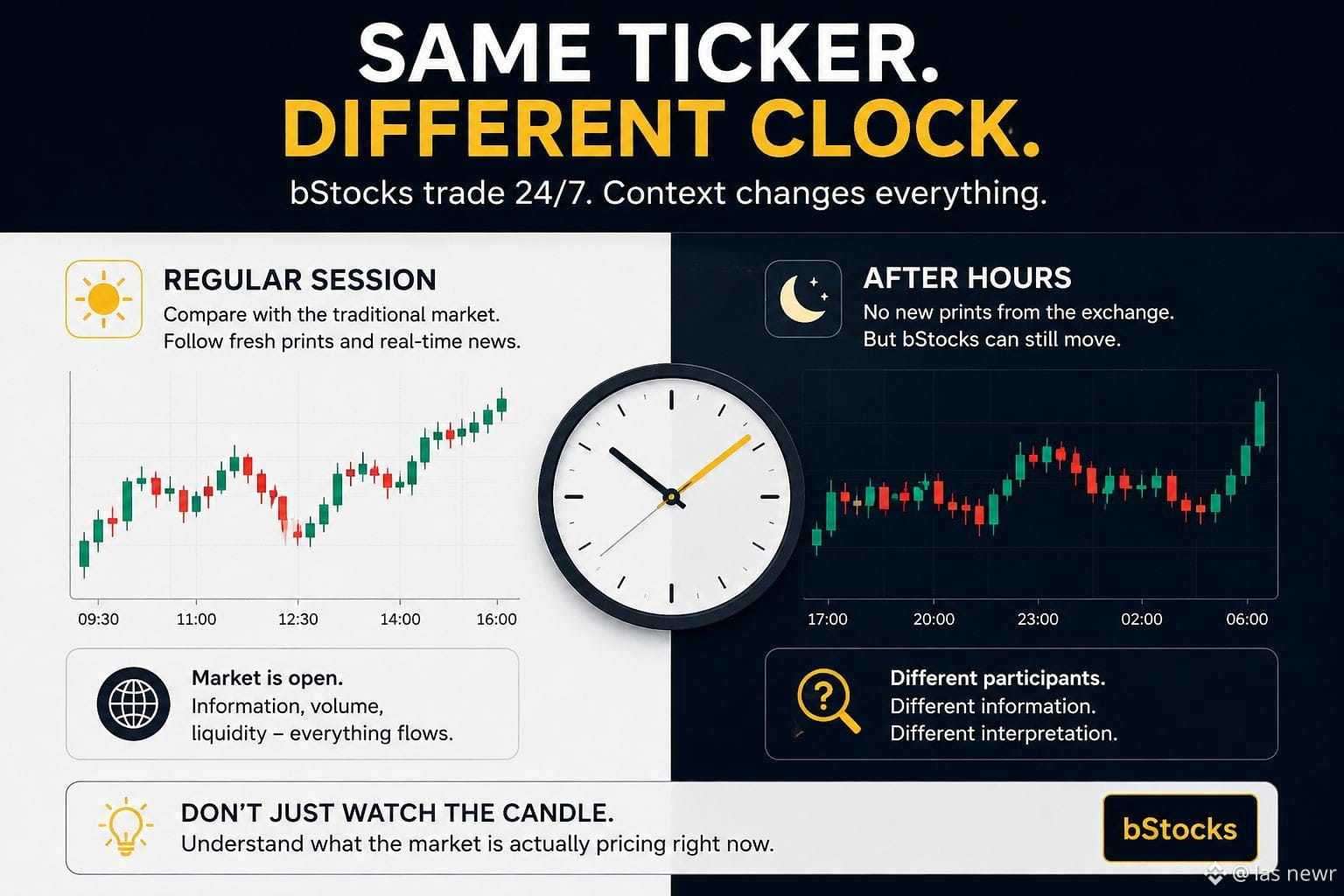
Noté algo curioso sobre las bStocks.
El ticker puede mantenerse exactamente igual, pero la forma en que miro la posición cambia por completo según la hora del día.
Durante la sesión bursátil regular, naturalmente comparo el precio con lo que veo en el mercado tradicional.
Más tarde, la pregunta se vuelve diferente.
Puede que no haya una impresión nueva del exchange subyacente, pero el mercado bStock sigue moviéndose.
Entonces, ¿qué exactamente estoy mirando?
No necesariamente “la acción moviéndose otra vez”.
A veces estoy mirando un mercado que intenta poner precio a la información más reciente con un conjunto distinto de participantes.
Eso me hizo dejar de tratar la gráfica como una gráfica normal de acciones.
Ahora, cuando veo un movimiento inusual fuera del horario regular, mi primera reacción no es:
“Le pasó algo a la empresa.”
Es:
“¿Qué información es realmente nueva?”
Si la respuesta es “nada”, me vuelvo mucho más cuidadoso al vincular una historia a la vela.
El precio puede moverse sin un evento fundamental nuevo.
Y una gráfica tranquila no significa que el mercado haya dejado de pensar.
Probablemente, una de las cosas más extrañas de tener un activo tradicional representado en un mercado que no duerme.
La misma empresa.
El mismo ticker.
Un reloj completamente distinto.
¿Te fijas en la hora cuando ves un gran movimiento de bStock?$
$NVDAB
#bstockscis @BinanceCIS
{spot}(NVDABUSDT)
Noté algo curioso sobre las bStocks.
El ticker puede mantenerse exactamente igual, pero la forma en que miro la posición cambia por completo según la hora del día.
Durante la sesión bursátil regular, naturalmente comparo el precio con lo que veo en el mercado tradicional.
Más tarde, la pregunta se vuelve diferente.
Puede que no haya una impresión nueva del exchange subyacente, pero el mercado bStock sigue moviéndose.
Entonces, ¿qué exactamente estoy mirando?
No necesariamente “la acción moviéndose otra vez”.
A veces estoy mirando un mercado que intenta poner precio a la información más reciente con un conjunto distinto de participantes.
Eso me hizo dejar de tratar la gráfica como una gráfica normal de acciones.
Ahora, cuando veo un movimiento inusual fuera del horario regular, mi primera reacción no es:
“Le pasó algo a la empresa.”
Es:
“¿Qué información es realmente nueva?”
Si la respuesta es “nada”, me vuelvo mucho más cuidadoso al vincular una historia a la vela.
El precio puede moverse sin un evento fundamental nuevo.
Y una gráfica tranquila no significa que el mercado haya dejado de pensar.
Probablemente, una de las cosas más extrañas de tener un activo tradicional representado en un mercado que no duerme.
La misma empresa.
El mismo ticker.
Un reloj completamente distinto.
¿Te fijas en la hora cuando ves un gran movimiento de bStock?$
$NVDAB
#bstockscis @BinanceCIS
El ticker puede mantenerse exactamente igual, pero la forma en que miro la posición cambia por completo según la hora del día.
Durante la sesión bursátil regular, naturalmente comparo el precio con lo que veo en el mercado tradicional.
Más tarde, la pregunta se vuelve diferente.
Puede que no haya una impresión nueva del exchange subyacente, pero el mercado bStock sigue moviéndose.
Entonces, ¿qué exactamente estoy mirando?
No necesariamente “la acción moviéndose otra vez”.
A veces estoy mirando un mercado que intenta poner precio a la información más reciente con un conjunto distinto de participantes.
Eso me hizo dejar de tratar la gráfica como una gráfica normal de acciones.
Ahora, cuando veo un movimiento inusual fuera del horario regular, mi primera reacción no es:
“Le pasó algo a la empresa.”
Es:
“¿Qué información es realmente nueva?”
Si la respuesta es “nada”, me vuelvo mucho más cuidadoso al vincular una historia a la vela.
El precio puede moverse sin un evento fundamental nuevo.
Y una gráfica tranquila no significa que el mercado haya dejado de pensar.
Probablemente, una de las cosas más extrañas de tener un activo tradicional representado en un mercado que no duerme.
La misma empresa.
El mismo ticker.
Un reloj completamente distinto.
¿Te fijas en la hora cuando ves un gran movimiento de bStock?$
$NVDAB
#bstockscis @BinanceCIS
1
1
88
·
--
En DeFi hay un problema extraño.
Aprendimos a encontrar rentabilidad, pero aún no siempre sabemos planificar bien el riesgo.
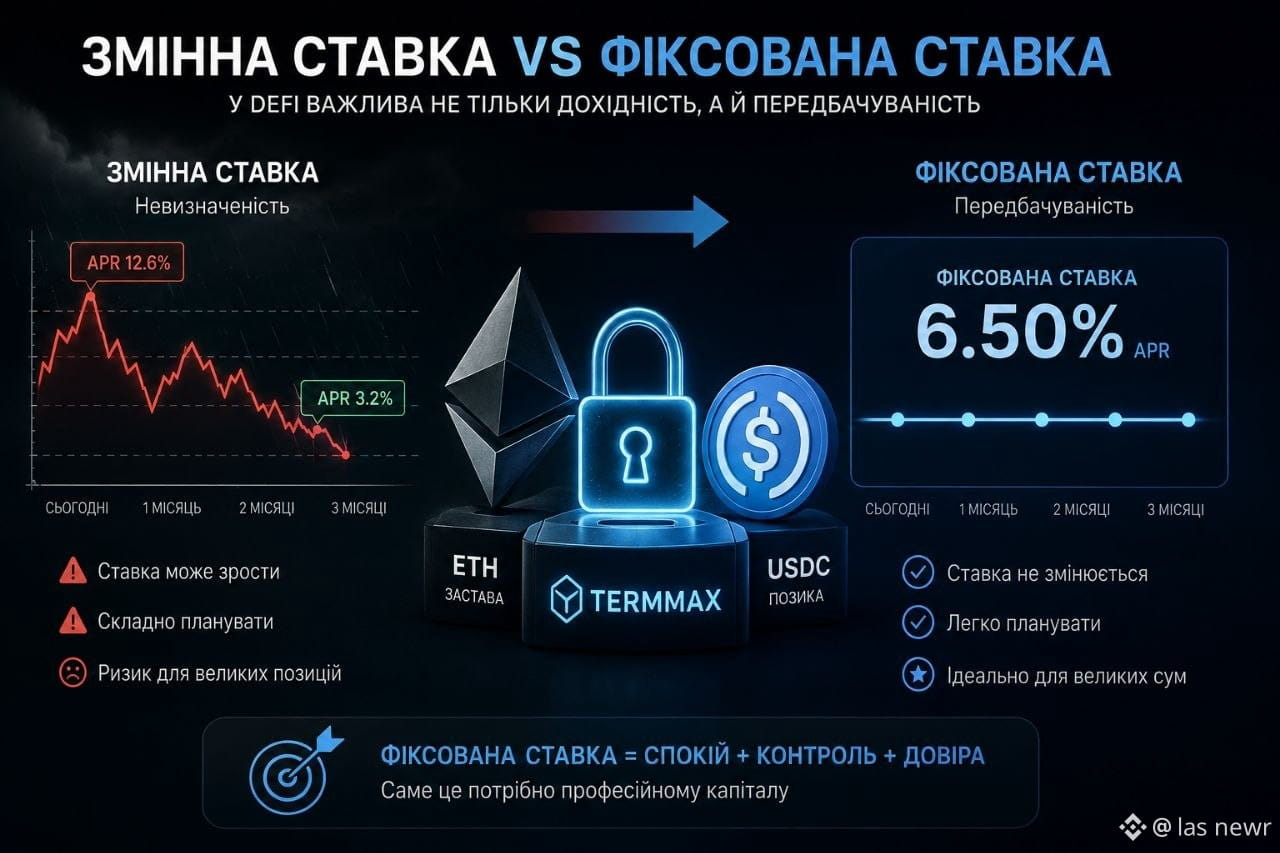
Por ejemplo, quieres pedir prestado USDC con garantía de ETH durante 3 meses.
Con una tasa variable, todo puede parecer bien hoy.
Pero ¿qué pasará dentro de un mes?
La tasa puede cambiar junto con la demanda de préstamos y la liquidez.
Por eso me interesa el enfoque de TermMax.
Aquí el préstamo tiene un vencimiento y una tasa fija.
Es decir, no solo miras el APY en este momento: puedes entender de antemano la economía de toda la posición.
Y eso es especialmente interesante para posiciones grandes.
Cuanto mayor sea el monto, más costosa puede ser una equivocación al pronosticar la tasa.
Me parece que DeFi con tasa fija puede volverse mucho más importante cuando lleguen más capitales profesionales a los protocolos.
Porque a los jugadores profesionales no solo les hace falta un rendimiento.
Necesitan previsibilidad.
Y justo aquí TermMax se ve interesante.
¿Tú usarías un préstamo en DeFi con tasa fija?
#termmax @termmax
En DeFi hay un problema extraño.
Aprendimos a encontrar rentabilidad, pero aún no siempre sabemos planificar bien el riesgo.
Por ejemplo, quieres pedir prestado USDC con garantía de ETH durante 3 meses.
Con una tasa variable, todo puede parecer bien hoy.
Pero ¿qué pasará dentro de un mes?
La tasa puede cambiar junto con la demanda de préstamos y la liquidez.
Por eso me interesa el enfoque de TermMax.
Aquí el préstamo tiene un vencimiento y una tasa fija.
Es decir, no solo miras el APY en este momento: puedes entender de antemano la economía de toda la posición.
Y eso es especialmente interesante para posiciones grandes.
Cuanto mayor sea el monto, más costosa puede ser una equivocación al pronosticar la tasa.
Me parece que DeFi con tasa fija puede volverse mucho más importante cuando lleguen más capitales profesionales a los protocolos.
Porque a los jugadores profesionales no solo les hace falta un rendimiento.
Necesitan previsibilidad.
Y justo aquí TermMax se ve interesante.
¿Tú usarías un préstamo en DeFi con tasa fija?
#termmax @TermMax
Aprendimos a encontrar rentabilidad, pero aún no siempre sabemos planificar bien el riesgo.
Por ejemplo, quieres pedir prestado USDC con garantía de ETH durante 3 meses.
Con una tasa variable, todo puede parecer bien hoy.
Pero ¿qué pasará dentro de un mes?
La tasa puede cambiar junto con la demanda de préstamos y la liquidez.
Por eso me interesa el enfoque de TermMax.
Aquí el préstamo tiene un vencimiento y una tasa fija.
Es decir, no solo miras el APY en este momento: puedes entender de antemano la economía de toda la posición.
Y eso es especialmente interesante para posiciones grandes.
Cuanto mayor sea el monto, más costosa puede ser una equivocación al pronosticar la tasa.
Me parece que DeFi con tasa fija puede volverse mucho más importante cuando lleguen más capitales profesionales a los protocolos.
Porque a los jugadores profesionales no solo les hace falta un rendimiento.
Necesitan previsibilidad.
Y justo aquí TermMax se ve interesante.
¿Tú usarías un préstamo en DeFi con tasa fija?
#termmax @TermMax
72
·
--
Alcista
Ver traducción
I used to think the most important question with a tokenized stock was simply:
“Does the token follow the stock?”
Now I think there’s a better question.
“What exactly happens when the underlying stock changes its structure?”
Take #AMZN as an example.
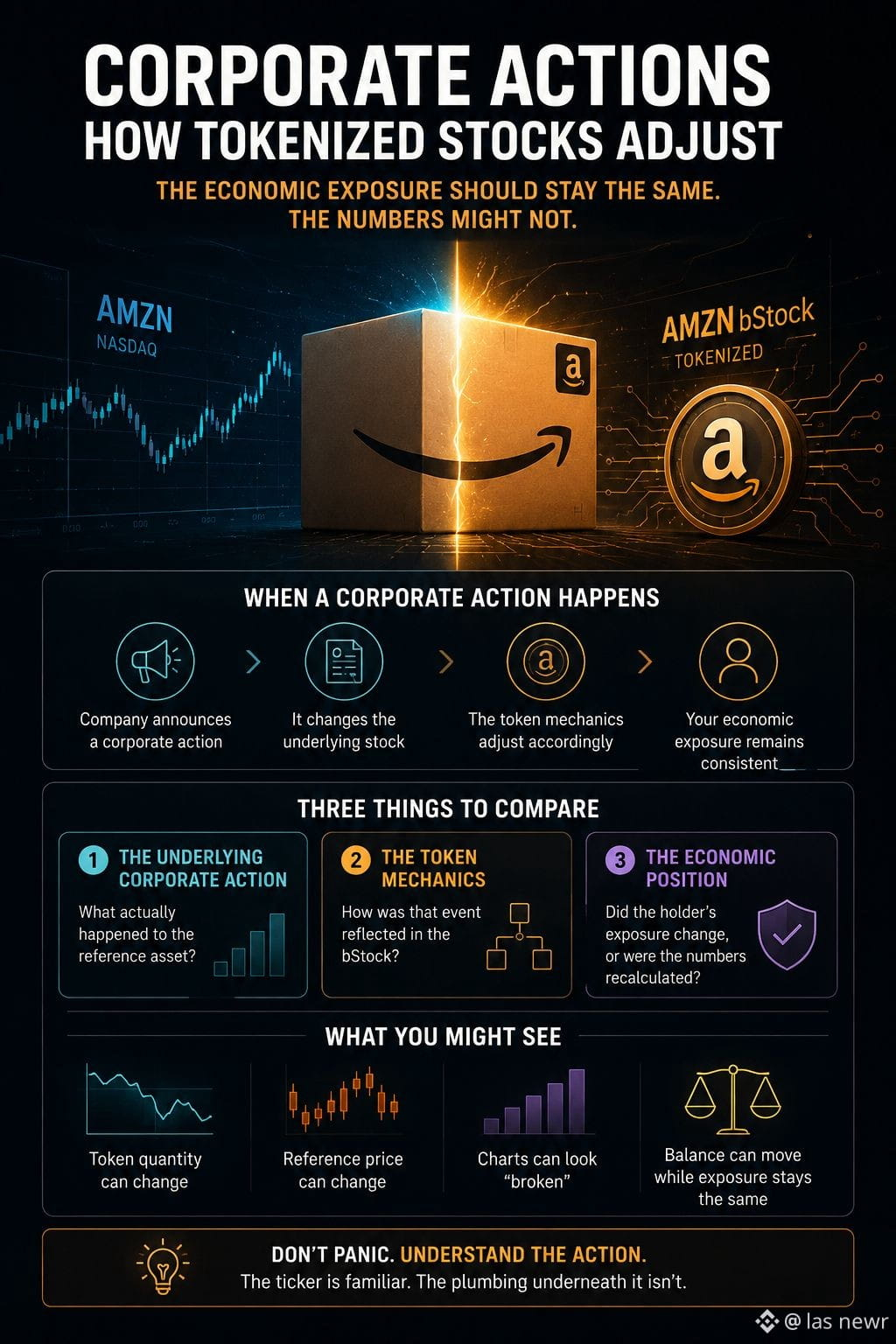
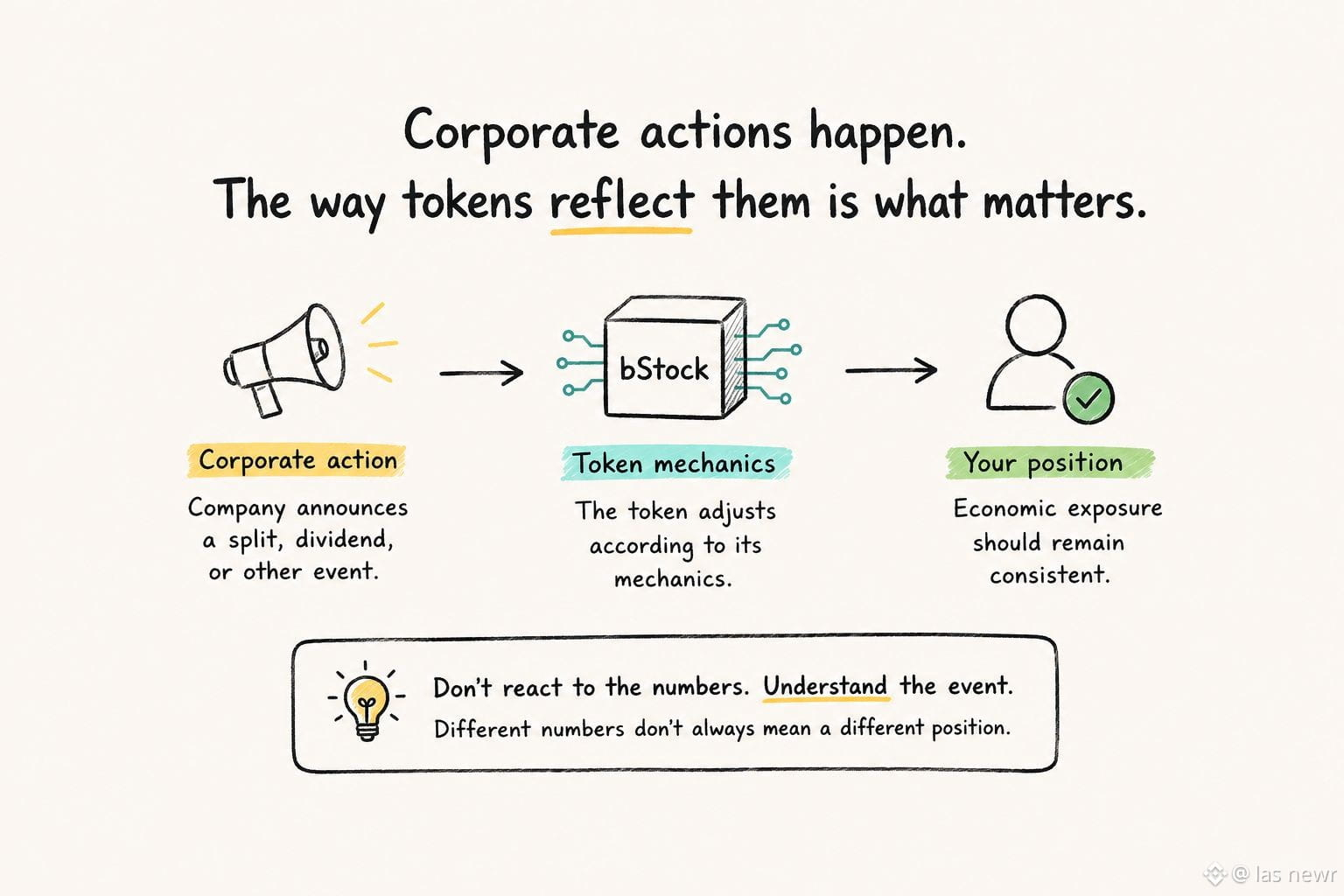
Imagine Amazon announces a corporate action that changes the number of shares, the economic value per share, or the way the underlying security is represented.
With a normal stock position, the broker handles the adjustment in the background.
With a bStock, I would want to understand how that adjustment appears on the token side.
Not because something is necessarily wrong.
Actually, the opposite.
A clean adjustment can make the token look strange for a short period:
the token quantity can change;
the reference price can change;
historical charts can suddenly look “broken”;
the displayed balance can move even when the economic exposure was intended to remain consistent.
That is why I wouldn’t judge a tokenized stock by looking at one number before and after a corporate action.
I’d compare three things:
1. The underlying corporate action
What actually happened to the reference asset?
2. The token mechanics
How was that event reflected in the bStock?
3. The economic position
Did the holder’s exposure change, or did the numbers simply get recalculated?
This distinction is easy to miss.
A chart can show a dramatic move while the economic position barely changes.
And the reverse can also happen: the displayed price may look normal while the mechanics underneath deserve a closer look.
That’s probably the part of tokenized markets I find most interesting.
The ticker is familiar.
The plumbing underneath it isn't.
So when I see something unusual around #AMZN, my first reaction wouldn't be “the token is broken.”
I'd ask:
“What changed in the underlying asset, and how did the tokenization layer translate it?”$MSFTB
#bstockscis @BinanceCIS
I used to think the most important question with a tokenized stock was simply:
“Does the token follow the stock?”
Now I think there’s a better question.
“What exactly happens when the underlying stock changes its structure?”
Take #AMZN as an example.
Imagine Amazon announces a corporate action that changes the number of shares, the economic value per share, or the way the underlying security is represented.
With a normal stock position, the broker handles the adjustment in the background.
With a bStock, I would want to understand how that adjustment appears on the token side.
Not because something is necessarily wrong.
Actually, the opposite.
A clean adjustment can make the token look strange for a short period:
the token quantity can change;
the reference price can change;
historical charts can suddenly look “broken”;
the displayed balance can move even when the economic exposure was intended to remain consistent.
That is why I wouldn’t judge a tokenized stock by looking at one number before and after a corporate action.
I’d compare three things:
1. The underlying corporate action
What actually happened to the reference asset?
2. The token mechanics
How was that event reflected in the bStock?
3. The economic position
Did the holder’s exposure change, or did the numbers simply get recalculated?
This distinction is easy to miss.
A chart can show a dramatic move while the economic position barely changes.
And the reverse can also happen: the displayed price may look normal while the mechanics underneath deserve a closer look.
That’s probably the part of tokenized markets I find most interesting.
The ticker is familiar.
The plumbing underneath it isn't.
So when I see something unusual around #AMZN, my first reaction wouldn't be “the token is broken.”
I'd ask:
“What changed in the underlying asset, and how did the tokenization layer translate it?”$MSFTB
#bstockscis @BinanceCIS
“Does the token follow the stock?”
Now I think there’s a better question.
“What exactly happens when the underlying stock changes its structure?”
Take #AMZN as an example.
Imagine Amazon announces a corporate action that changes the number of shares, the economic value per share, or the way the underlying security is represented.
With a normal stock position, the broker handles the adjustment in the background.
With a bStock, I would want to understand how that adjustment appears on the token side.
Not because something is necessarily wrong.
Actually, the opposite.
A clean adjustment can make the token look strange for a short period:
the token quantity can change;
the reference price can change;
historical charts can suddenly look “broken”;
the displayed balance can move even when the economic exposure was intended to remain consistent.
That is why I wouldn’t judge a tokenized stock by looking at one number before and after a corporate action.
I’d compare three things:
1. The underlying corporate action
What actually happened to the reference asset?
2. The token mechanics
How was that event reflected in the bStock?
3. The economic position
Did the holder’s exposure change, or did the numbers simply get recalculated?
This distinction is easy to miss.
A chart can show a dramatic move while the economic position barely changes.
And the reverse can also happen: the displayed price may look normal while the mechanics underneath deserve a closer look.
That’s probably the part of tokenized markets I find most interesting.
The ticker is familiar.
The plumbing underneath it isn't.
So when I see something unusual around #AMZN, my first reaction wouldn't be “the token is broken.”
I'd ask:
“What changed in the underlying asset, and how did the tokenization layer translate it?”$MSFTB
#bstockscis @BinanceCIS
1
1
73
·
--
Ver traducción
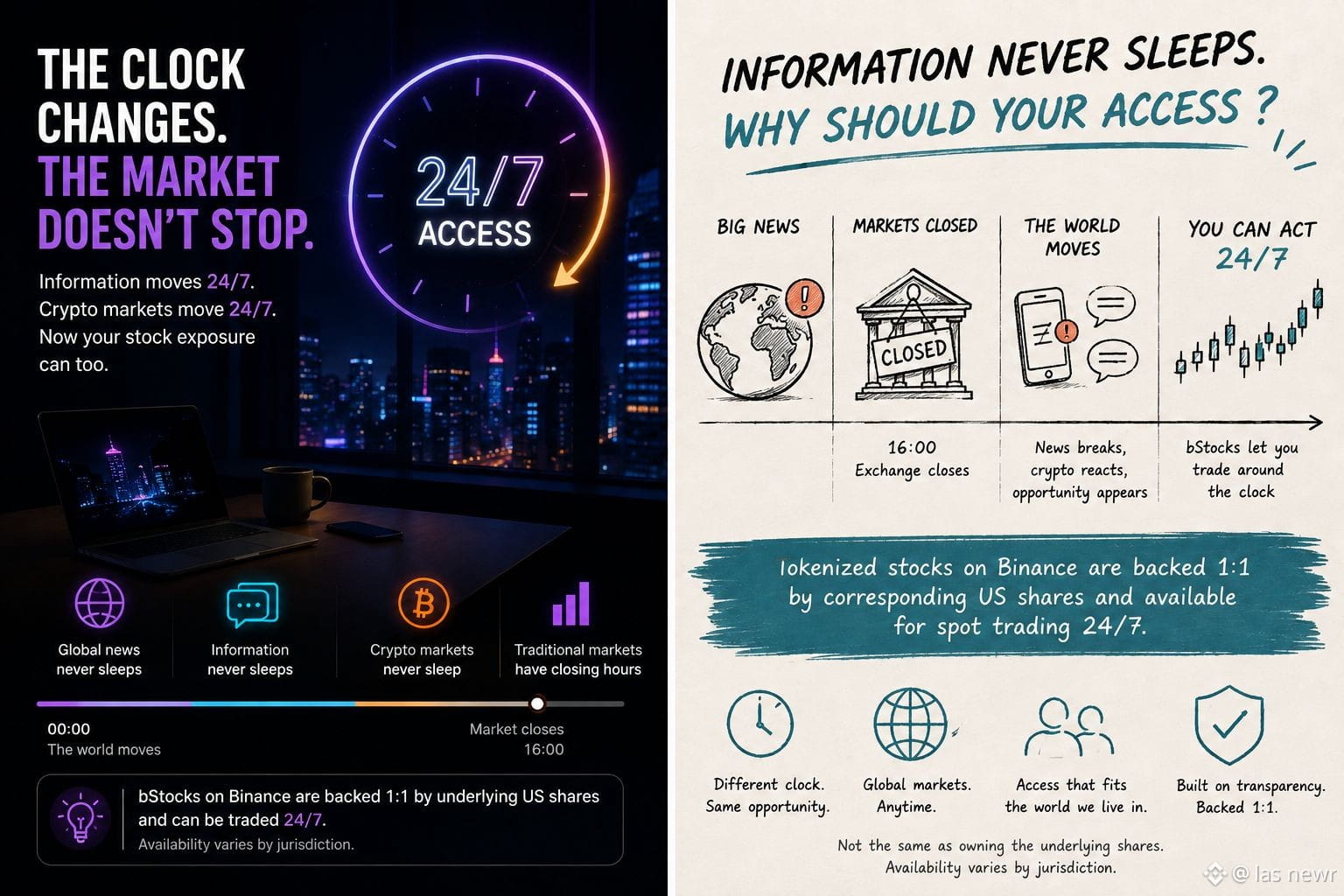
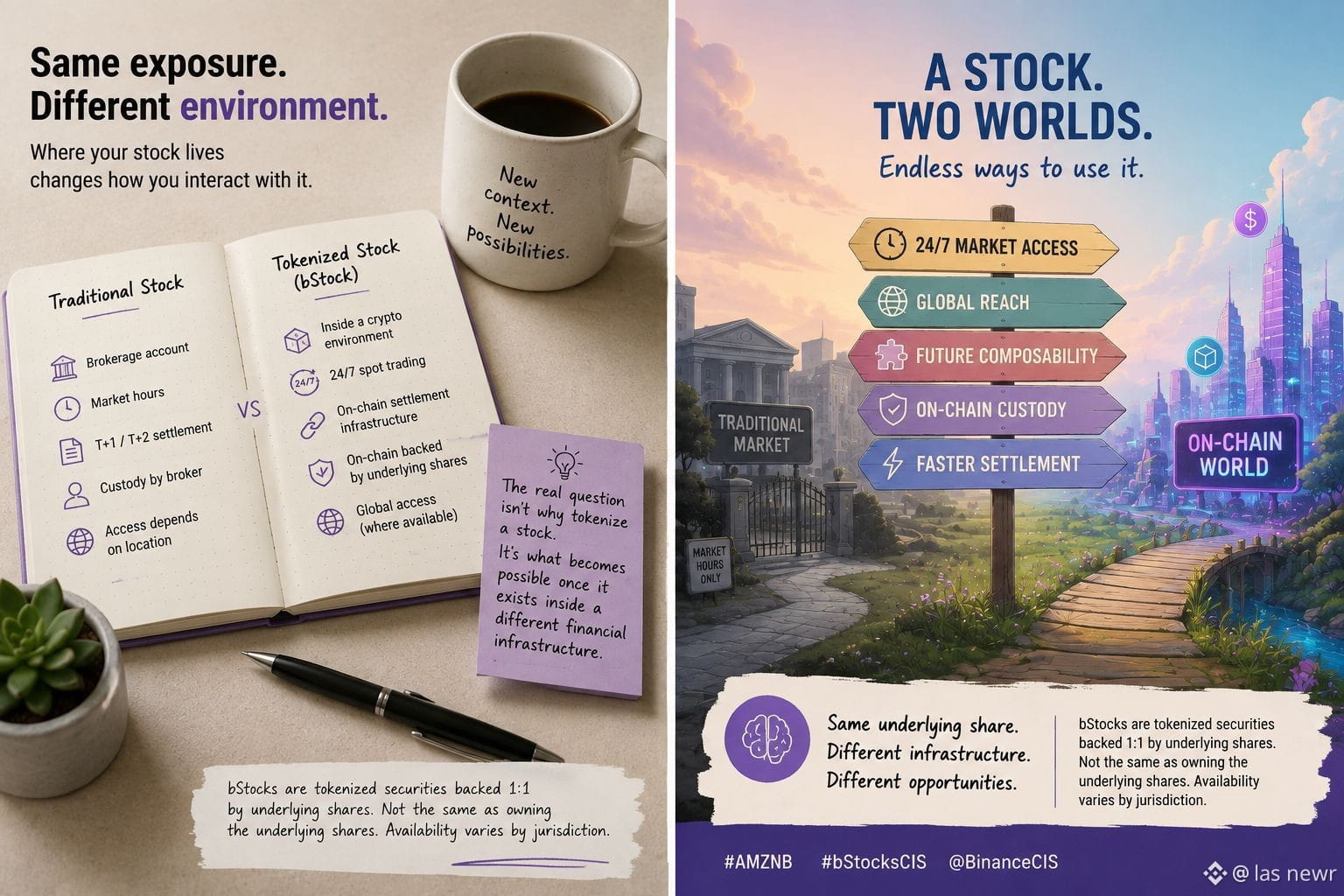
I used to think the interesting part of tokenized stocks was simply being able to trade them outside traditional market hours.
Then I started looking at it from a different angle.
The bigger change may be where the asset lives in the investor’s workflow.
A traditional stock usually sits inside a brokerage account.
A bStock sits inside a crypto environment.
That sounds like a small technical distinction.
It isn't.
With a tokenized security, the same market participant who already manages USDT, BNB or other digital assets can encounter an equity-linked instrument without completely switching financial environments.
That changes the context in which the asset can be used.
And this is where I think tokenization gets more interesting.
Not:
“Stocks, but on a blockchain.”
More like:
“What happens when an equity-linked asset becomes part of an on-chain financial ecosystem?”
That opens a much bigger discussion around settlement, custody, portability and eventually composability.
Of course, a bStock is not the same thing as directly owning the underlying company’s shares. It is a tokenized security backed 1:1 by an underlying share, and availability depends on jurisdiction. �
Binance Academy +1
For me, the important question has changed.
I no longer ask:
“Why would someone tokenize a stock?”
I ask:
“What becomes possible once the stock can exist inside a different financial infrastructure?”
That is a much more interesting question.
#bstockscis @BinanceCIS #AMZNB
{spot}(AMZNBUSDT)
I used to think the interesting part of tokenized stocks was simply being able to trade them outside traditional market hours.
Then I started looking at it from a different angle.
The bigger change may be where the asset lives in the investor’s workflow.
A traditional stock usually sits inside a brokerage account.
A bStock sits inside a crypto environment.
That sounds like a small technical distinction.
It isn't.
With a tokenized security, the same market participant who already manages USDT, BNB or other digital assets can encounter an equity-linked instrument without completely switching financial environments.
That changes the context in which the asset can be used.
And this is where I think tokenization gets more interesting.
Not:
“Stocks, but on a blockchain.”
More like:
“What happens when an equity-linked asset becomes part of an on-chain financial ecosystem?”
That opens a much bigger discussion around settlement, custody, portability and eventually composability.
Of course, a bStock is not the same thing as directly owning the underlying company’s shares. It is a tokenized security backed 1:1 by an underlying share, and availability depends on jurisdiction. �
Binance Academy +1
For me, the important question has changed.
I no longer ask:
“Why would someone tokenize a stock?”
I ask:
“What becomes possible once the stock can exist inside a different financial infrastructure?”
That is a much more interesting question.
#bstockscis @BinanceCIS #AMZNB
Then I started looking at it from a different angle.
The bigger change may be where the asset lives in the investor’s workflow.
A traditional stock usually sits inside a brokerage account.
A bStock sits inside a crypto environment.
That sounds like a small technical distinction.
It isn't.
With a tokenized security, the same market participant who already manages USDT, BNB or other digital assets can encounter an equity-linked instrument without completely switching financial environments.
That changes the context in which the asset can be used.
And this is where I think tokenization gets more interesting.
Not:
“Stocks, but on a blockchain.”
More like:
“What happens when an equity-linked asset becomes part of an on-chain financial ecosystem?”
That opens a much bigger discussion around settlement, custody, portability and eventually composability.
Of course, a bStock is not the same thing as directly owning the underlying company’s shares. It is a tokenized security backed 1:1 by an underlying share, and availability depends on jurisdiction. �
Binance Academy +1
For me, the important question has changed.
I no longer ask:
“Why would someone tokenize a stock?”
I ask:
“What becomes possible once the stock can exist inside a different financial infrastructure?”
That is a much more interesting question.
#bstockscis @BinanceCIS #AMZNB
78
·
--
Ver traducción
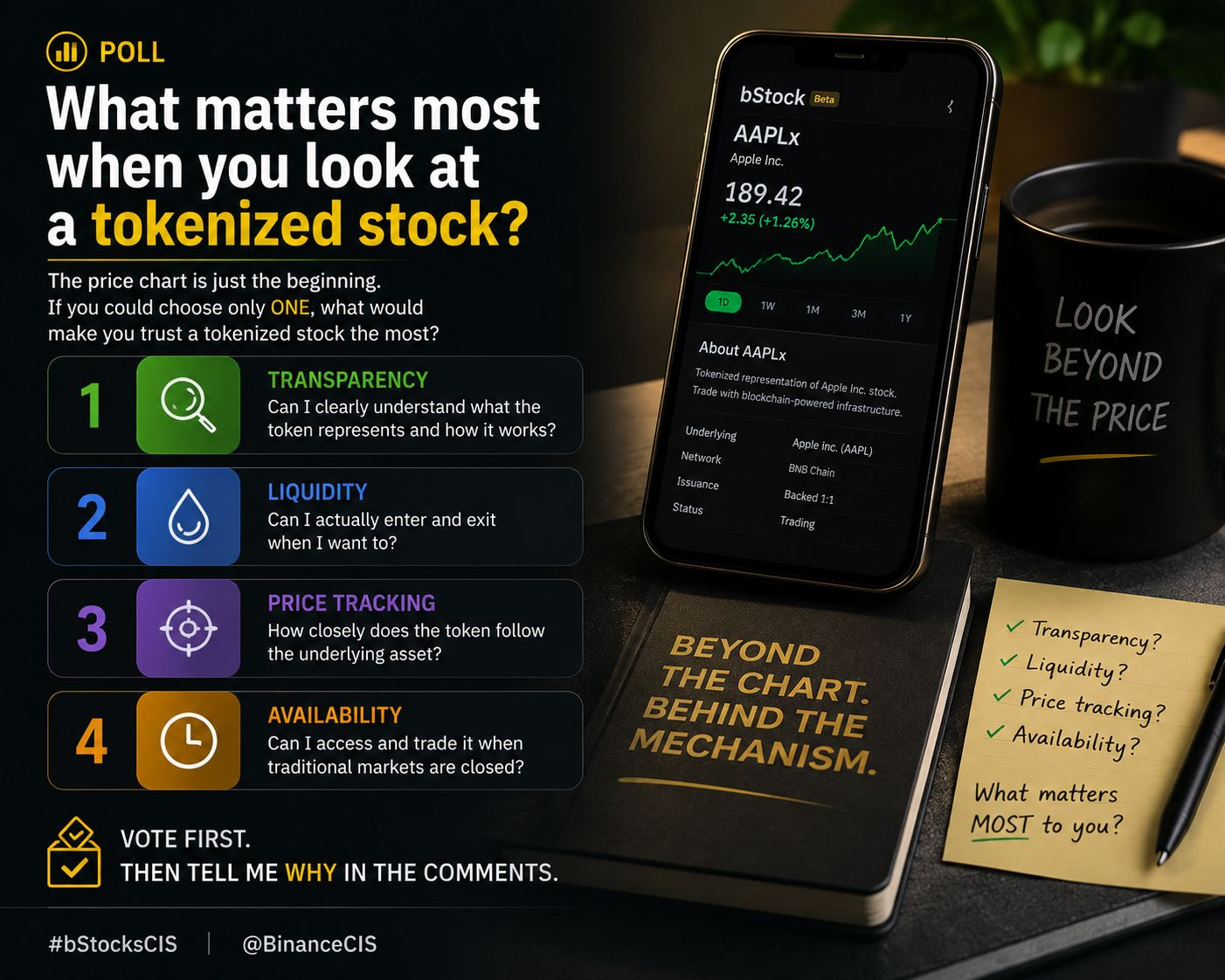
When you look at a tokenized stock, what would make you trust it more?
For me, the price chart is only the beginning.
A token can follow its underlying asset closely and still leave other questions unanswered.
So I would break the decision into four things:
1️⃣ Transparency
Can I clearly understand what the token represents and how the structure works?
2️⃣ Liquidity
Can I actually enter and exit when I want to?
3️⃣ Price tracking
How closely does the token follow the underlying asset?
4️⃣ Availability
Can I access and trade it when traditional markets are closed?
I think people may rank these very differently depending on what they actually use tokenized equities for.
So let's test it.
If you could choose only ONE, what matters most to you?
🟢 Transparency
🔵 Liquidity
🟣 Price tracking
🟠 Availability
Vote first.
Then tell me why in the comments.
#bstockscis @BinanceCIS
When you look at a tokenized stock, what would make you trust it more?
For me, the price chart is only the beginning.
A token can follow its underlying asset closely and still leave other questions unanswered.
So I would break the decision into four things:
1️⃣ Transparency
Can I clearly understand what the token represents and how the structure works?
2️⃣ Liquidity
Can I actually enter and exit when I want to?
3️⃣ Price tracking
How closely does the token follow the underlying asset?
4️⃣ Availability
Can I access and trade it when traditional markets are closed?
I think people may rank these very differently depending on what they actually use tokenized equities for.
So let's test it.
If you could choose only ONE, what matters most to you?
🟢 Transparency
🔵 Liquidity
🟣 Price tracking
🟠 Availability
Vote first.
Then tell me why in the comments.
#bstockscis @BinanceCIS
For me, the price chart is only the beginning.
A token can follow its underlying asset closely and still leave other questions unanswered.
So I would break the decision into four things:
1️⃣ Transparency
Can I clearly understand what the token represents and how the structure works?
2️⃣ Liquidity
Can I actually enter and exit when I want to?
3️⃣ Price tracking
How closely does the token follow the underlying asset?
4️⃣ Availability
Can I access and trade it when traditional markets are closed?
I think people may rank these very differently depending on what they actually use tokenized equities for.
So let's test it.
If you could choose only ONE, what matters most to you?
🟢 Transparency
🔵 Liquidity
🟣 Price tracking
🟠 Availability
Vote first.
Then tell me why in the comments.
#bstockscis @BinanceCIS
107
·
--
Alcista
Ver traducción
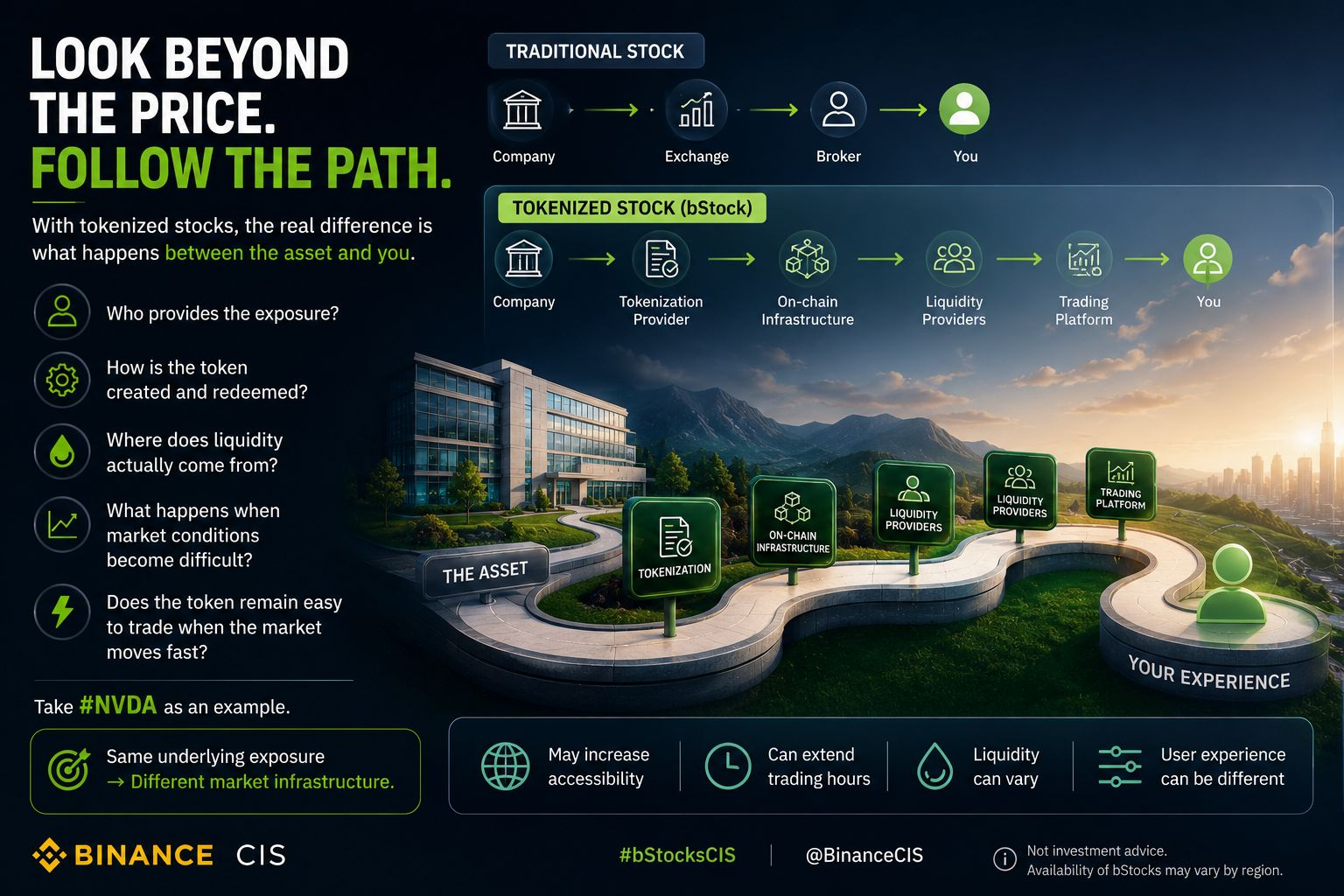
One thing I would watch with tokenized stocks is not the headline price.
It is the path between the asset and the person trading it.
With a traditional stock, most of the infrastructure is familiar.
With a tokenized version, there can be another layer between the underlying asset and the trading experience.
That makes me ask a different set of questions:
Who provides the exposure?
How is the token created and redeemed?
Where does liquidity actually come from?
What happens when market conditions become difficult?
And perhaps the most important one:
Does the token remain easy to trade when the market moves fast?
Take #NVDA as an example.
The interesting comparison isn't simply:
stock vs token.
It is:
same underlying exposure → different market infrastructure.
That difference can affect accessibility, trading hours, liquidity, and the overall user experience.
So when I look at a bStock, I don't want to stop at the chart.
I want to understand what is happening behind the chart.
#bstockscis @BinanceCIS
One thing I would watch with tokenized stocks is not the headline price.
It is the path between the asset and the person trading it.
With a traditional stock, most of the infrastructure is familiar.
With a tokenized version, there can be another layer between the underlying asset and the trading experience.
That makes me ask a different set of questions:
Who provides the exposure?
How is the token created and redeemed?
Where does liquidity actually come from?
What happens when market conditions become difficult?
And perhaps the most important one:
Does the token remain easy to trade when the market moves fast?
Take #NVDA as an example.
The interesting comparison isn't simply:
stock vs token.
It is:
same underlying exposure → different market infrastructure.
That difference can affect accessibility, trading hours, liquidity, and the overall user experience.
So when I look at a bStock, I don't want to stop at the chart.
I want to understand what is happening behind the chart.
#bstockscis @BinanceCIS
It is the path between the asset and the person trading it.
With a traditional stock, most of the infrastructure is familiar.
With a tokenized version, there can be another layer between the underlying asset and the trading experience.
That makes me ask a different set of questions:
Who provides the exposure?
How is the token created and redeemed?
Where does liquidity actually come from?
What happens when market conditions become difficult?
And perhaps the most important one:
Does the token remain easy to trade when the market moves fast?
Take #NVDA as an example.
The interesting comparison isn't simply:
stock vs token.
It is:
same underlying exposure → different market infrastructure.
That difference can affect accessibility, trading hours, liquidity, and the overall user experience.
So when I look at a bStock, I don't want to stop at the chart.
I want to understand what is happening behind the chart.
#bstockscis @BinanceCIS
1
89
·
--
Ver traducción
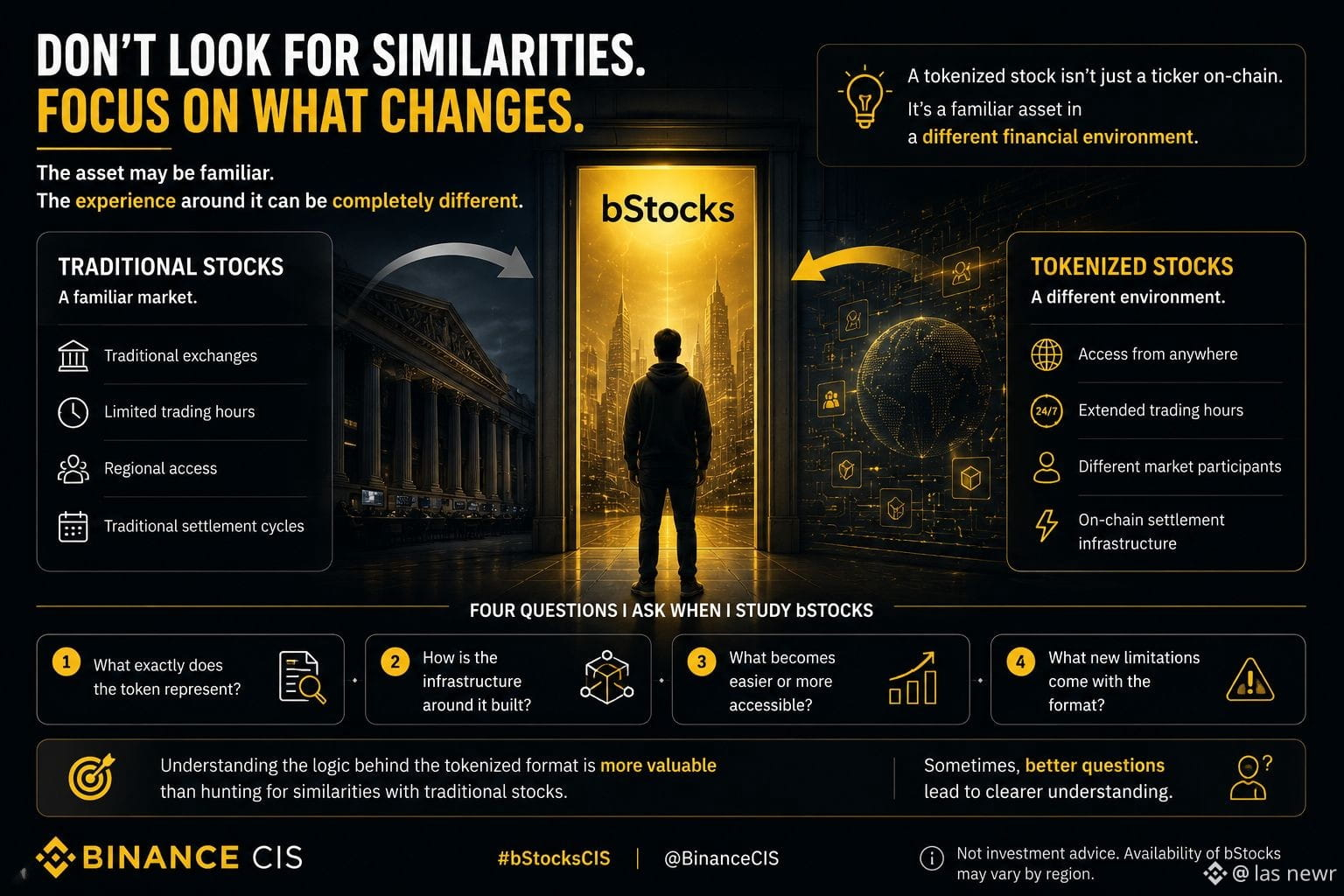
The more I learn about bStocks, the less useful I find one particular question:
“How similar are they to traditional stocks?”
It sounds reasonable, but it can lead you in the wrong direction.
A more interesting question is:
What changes for the user when a familiar market asset appears in a tokenized form?
Because the point isn't simply to take a ticker and add the word “token.”
The asset enters a different infrastructure — with a different interface, different ways of moving capital, and different possibilities for interacting with it.
And I don't think the goal should be to immediately decide which format is “better.”
It's more useful to understand what each format is designed to do.
So when I look at bStocks, I try to ask four things:
— What exactly does the token represent?
— How is the infrastructure around it built?
— What becomes easier or more accessible?
— What new limitations come with the format?
That last question matters just as much.
Every new financial structure adds something, but it also introduces its own rules.
That's why I'm less interested in finding similarities between bStocks and traditional stocks, and more interested in understanding the logic behind the tokenized format.
Sometimes a product becomes easier to understand not when you find more answers.
But when you finally start asking better questions.
@BinanceCIS #bstockscis
The more I learn about bStocks, the less useful I find one particular question:
“How similar are they to traditional stocks?”
It sounds reasonable, but it can lead you in the wrong direction.
A more interesting question is:
What changes for the user when a familiar market asset appears in a tokenized form?
Because the point isn't simply to take a ticker and add the word “token.”
The asset enters a different infrastructure — with a different interface, different ways of moving capital, and different possibilities for interacting with it.
And I don't think the goal should be to immediately decide which format is “better.”
It's more useful to understand what each format is designed to do.
So when I look at bStocks, I try to ask four things:
— What exactly does the token represent?
— How is the infrastructure around it built?
— What becomes easier or more accessible?
— What new limitations come with the format?
That last question matters just as much.
Every new financial structure adds something, but it also introduces its own rules.
That's why I'm less interested in finding similarities between bStocks and traditional stocks, and more interested in understanding the logic behind the tokenized format.
Sometimes a product becomes easier to understand not when you find more answers.
But when you finally start asking better questions.
@BinanceCIS #bstockscis
“How similar are they to traditional stocks?”
It sounds reasonable, but it can lead you in the wrong direction.
A more interesting question is:
What changes for the user when a familiar market asset appears in a tokenized form?
Because the point isn't simply to take a ticker and add the word “token.”
The asset enters a different infrastructure — with a different interface, different ways of moving capital, and different possibilities for interacting with it.
And I don't think the goal should be to immediately decide which format is “better.”
It's more useful to understand what each format is designed to do.
So when I look at bStocks, I try to ask four things:
— What exactly does the token represent?
— How is the infrastructure around it built?
— What becomes easier or more accessible?
— What new limitations come with the format?
That last question matters just as much.
Every new financial structure adds something, but it also introduces its own rules.
That's why I'm less interested in finding similarities between bStocks and traditional stocks, and more interested in understanding the logic behind the tokenized format.
Sometimes a product becomes easier to understand not when you find more answers.
But when you finally start asking better questions.
@BinanceCIS #bstockscis
82
·
--
Ver traducción
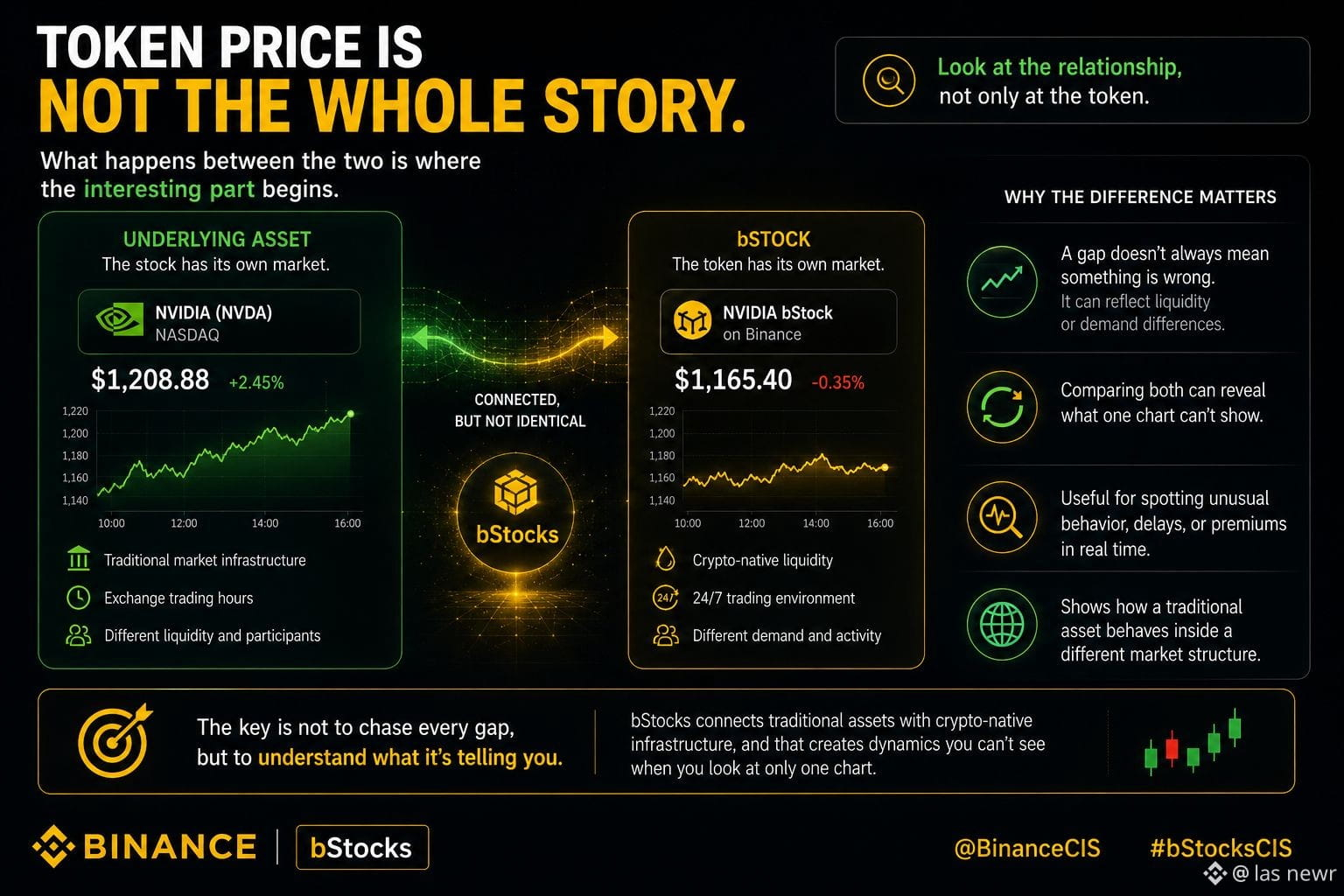
One thing I find interesting about bStocks is that the token price is not the whole story.
At first, I looked at the price and thought:
“Okay, it follows the underlying stock. Simple.”
But then I started thinking about what happens between the two.
The underlying asset has its own market.
The bStock has its own liquidity, trading activity and market participants.
So even when they are connected, the two prices don't have to move in exactly the same way at every moment.
That difference is actually one of the things I'd watch most closely.
Not because every gap means something is wrong.
Sometimes it can simply show where liquidity or demand is different.
For me, this makes bStocks more interesting to analyze than just looking at a price chart.
You have to look at the relationship between the asset and the token, not only at the token itself. 👀
That is probably the part I would pay the most attention to over time. 📊
@BinanceCIS #bstockscis
One thing I find interesting about bStocks is that the token price is not the whole story.
At first, I looked at the price and thought:
“Okay, it follows the underlying stock. Simple.”
But then I started thinking about what happens between the two.
The underlying asset has its own market.
The bStock has its own liquidity, trading activity and market participants.
So even when they are connected, the two prices don't have to move in exactly the same way at every moment.
That difference is actually one of the things I'd watch most closely.
Not because every gap means something is wrong.
Sometimes it can simply show where liquidity or demand is different.
For me, this makes bStocks more interesting to analyze than just looking at a price chart.
You have to look at the relationship between the asset and the token, not only at the token itself. 👀
That is probably the part I would pay the most attention to over time. 📊
@BinanceCIS #bstockscis
At first, I looked at the price and thought:
“Okay, it follows the underlying stock. Simple.”
But then I started thinking about what happens between the two.
The underlying asset has its own market.
The bStock has its own liquidity, trading activity and market participants.
So even when they are connected, the two prices don't have to move in exactly the same way at every moment.
That difference is actually one of the things I'd watch most closely.
Not because every gap means something is wrong.
Sometimes it can simply show where liquidity or demand is different.
For me, this makes bStocks more interesting to analyze than just looking at a price chart.
You have to look at the relationship between the asset and the token, not only at the token itself. 👀
That is probably the part I would pay the most attention to over time. 📊
@BinanceCIS #bstockscis
83
·
--
Ver traducción
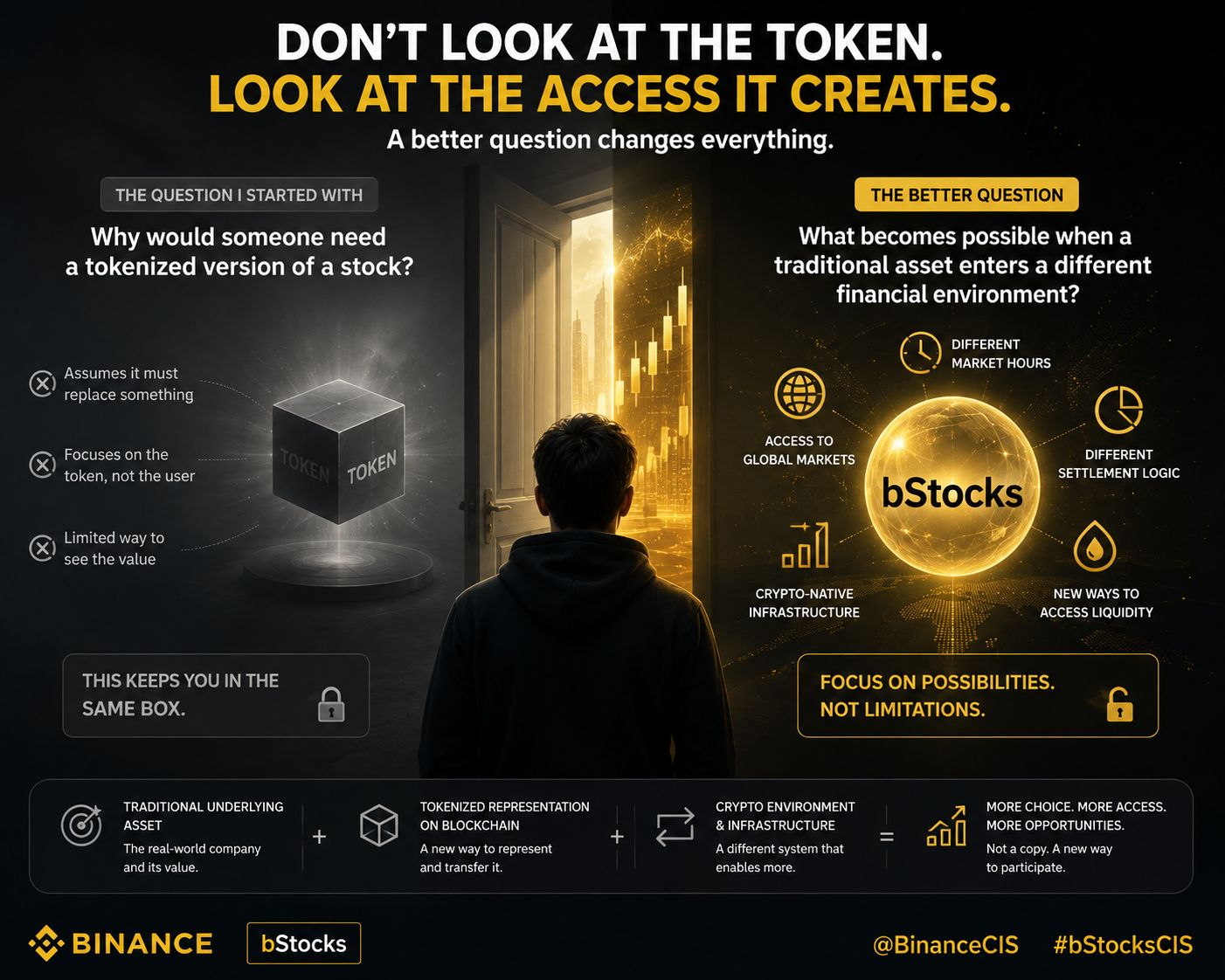
One thing I started noticing while learning about bStocks:
I was looking at the token first, instead of looking at the access it creates.
At first, I kept asking:
“Why would someone need a tokenized version of a stock?”
But that question already assumes the token has to replace something.
A better question is:
“What becomes possible when a traditional asset enters a different financial environment?”
That changed how I look at bStocks.
The interesting part isn't simply putting a familiar name on-chain.
It's the combination of a traditional underlying asset with crypto-native infrastructure.
Different market hours.
Different settlement logic.
Different ways of accessing liquidity.
So now I try not to ask whether tokenized stocks are “better” than traditional stocks.
I ask what they allow users to do that wasn't as simple before.
For me, that's a much more interesting way to understand RWA. 👀
@BinanceCIS #bstockscis
One thing I started noticing while learning about bStocks:
I was looking at the token first, instead of looking at the access it creates.
At first, I kept asking:
“Why would someone need a tokenized version of a stock?”
But that question already assumes the token has to replace something.
A better question is:
“What becomes possible when a traditional asset enters a different financial environment?”
That changed how I look at bStocks.
The interesting part isn't simply putting a familiar name on-chain.
It's the combination of a traditional underlying asset with crypto-native infrastructure.
Different market hours.
Different settlement logic.
Different ways of accessing liquidity.
So now I try not to ask whether tokenized stocks are “better” than traditional stocks.
I ask what they allow users to do that wasn't as simple before.
For me, that's a much more interesting way to understand RWA. 👀
@BinanceCIS #bstockscis
I was looking at the token first, instead of looking at the access it creates.
At first, I kept asking:
“Why would someone need a tokenized version of a stock?”
But that question already assumes the token has to replace something.
A better question is:
“What becomes possible when a traditional asset enters a different financial environment?”
That changed how I look at bStocks.
The interesting part isn't simply putting a familiar name on-chain.
It's the combination of a traditional underlying asset with crypto-native infrastructure.
Different market hours.
Different settlement logic.
Different ways of accessing liquidity.
So now I try not to ask whether tokenized stocks are “better” than traditional stocks.
I ask what they allow users to do that wasn't as simple before.
For me, that's a much more interesting way to understand RWA. 👀
@BinanceCIS #bstockscis
73
·
--
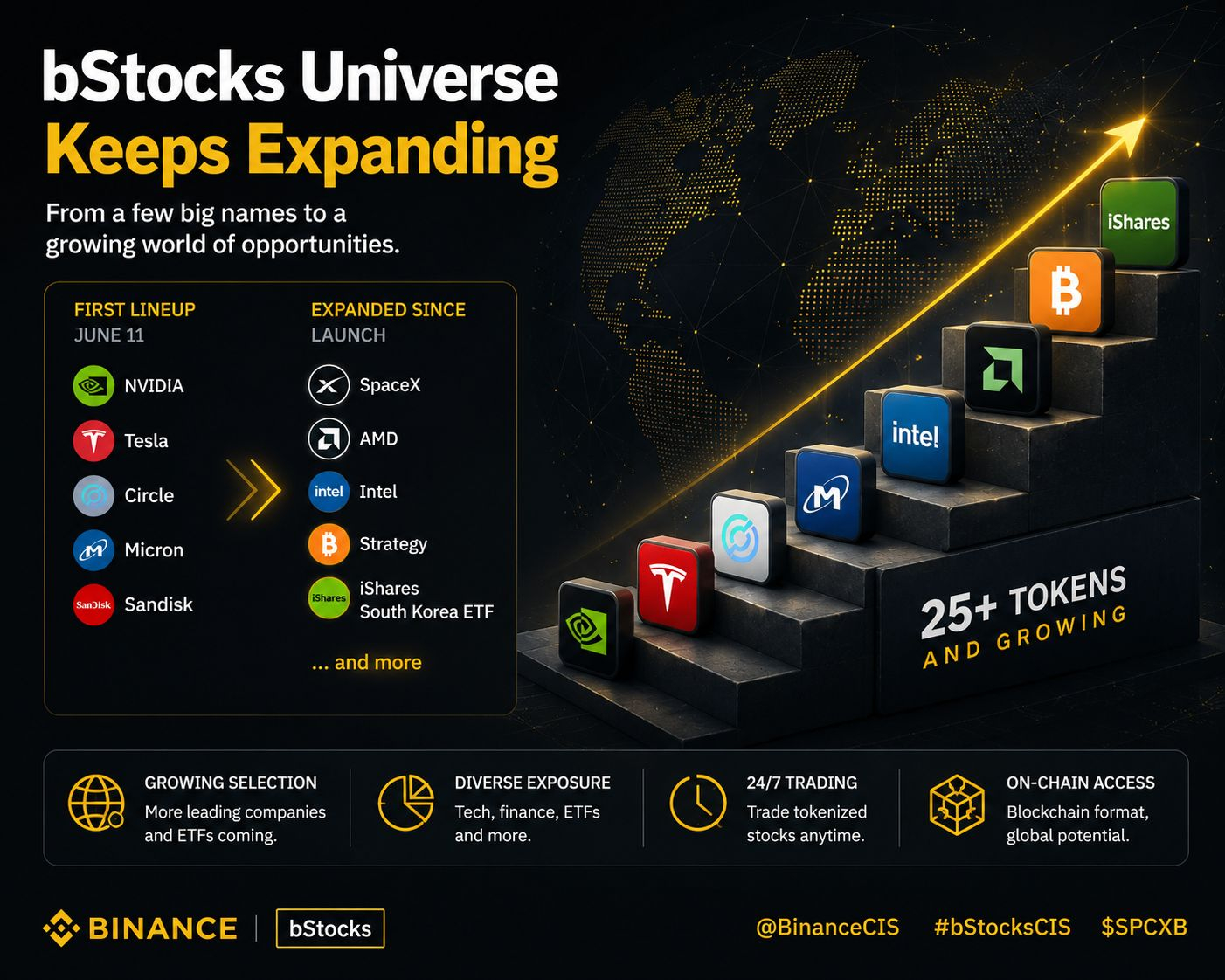
Una cosa que me gusta de bStocks es que la historia no trata solo sobre los primeros tokens.
Lo interesante es lo rápido que la selección puede ampliarse. Puedes empezar con nombres conocidos y, de repente, ver sectores y empresas completamente diferentes aparecer en el mismo formato tokenizado.
Para mí, eso hace que bStocks sea más interesante que simplemente tener “tokens de acciones” en una lista.
Se siente más como un mercado en crecimiento donde la opción de los activos tradicionales se va incorporando gradualmente a un entorno de trading basado en blockchain.
Preferiría ver cómo se desarrolla este ecosistema antes que intentar adivinar qué token se moverá después. 👀
@BinanceCIS $SPCXB #bstockscis
Una cosa que me gusta de bStocks es que la historia no trata solo sobre los primeros tokens.
Lo interesante es lo rápido que la selección puede ampliarse. Puedes empezar con nombres conocidos y, de repente, ver sectores y empresas completamente diferentes aparecer en el mismo formato tokenizado.
Para mí, eso hace que bStocks sea más interesante que simplemente tener “tokens de acciones” en una lista.
Se siente más como un mercado en crecimiento donde la opción de los activos tradicionales se va incorporando gradualmente a un entorno de trading basado en blockchain.
Preferiría ver cómo se desarrolla este ecosistema antes que intentar adivinar qué token se moverá después. 👀
@BinanceCIS $SPCXB #bstockscis
Lo interesante es lo rápido que la selección puede ampliarse. Puedes empezar con nombres conocidos y, de repente, ver sectores y empresas completamente diferentes aparecer en el mismo formato tokenizado.
Para mí, eso hace que bStocks sea más interesante que simplemente tener “tokens de acciones” en una lista.
Se siente más como un mercado en crecimiento donde la opción de los activos tradicionales se va incorporando gradualmente a un entorno de trading basado en blockchain.
Preferiría ver cómo se desarrolla este ecosistema antes que intentar adivinar qué token se moverá después. 👀
@BinanceCIS $SPCXB #bstockscis
107
·
--
Ver traducción
I’ve been thinking about one thing with bStocks that is easy to miss.
The interesting part isn’t only that stocks can be represented on-chain. It’s the change in the way you can interact with them.
Traditional markets have their own schedules. bStocks can be traded on Binance Spot 24/7, which makes the whole experience feel much closer to the crypto market.
And the fractional format is another detail I like. You don’t necessarily need a huge amount of capital just to get started and learn how it works.
For me, the combination of traditional assets + blockchain access is the part worth watching. 👀📈
@BinanceCIS $SPCXB #bstockscis
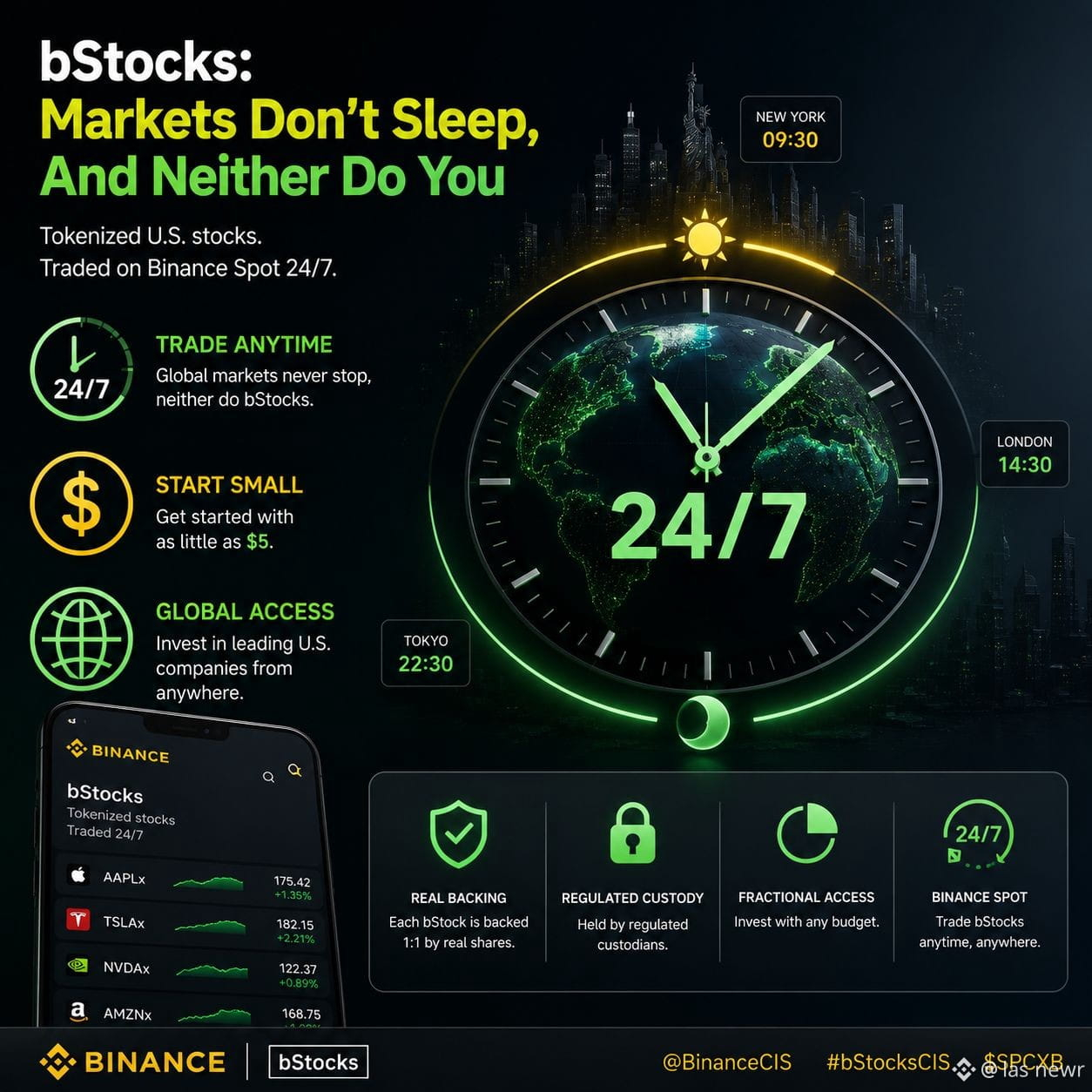
I’ve been thinking about one thing with bStocks that is easy to miss.
The interesting part isn’t only that stocks can be represented on-chain. It’s the change in the way you can interact with them.
Traditional markets have their own schedules. bStocks can be traded on Binance Spot 24/7, which makes the whole experience feel much closer to the crypto market.
And the fractional format is another detail I like. You don’t necessarily need a huge amount of capital just to get started and learn how it works.
For me, the combination of traditional assets + blockchain access is the part worth watching. 👀📈
@BinanceCIS $SPCXB #bstockscis
The interesting part isn’t only that stocks can be represented on-chain. It’s the change in the way you can interact with them.
Traditional markets have their own schedules. bStocks can be traded on Binance Spot 24/7, which makes the whole experience feel much closer to the crypto market.
And the fractional format is another detail I like. You don’t necessarily need a huge amount of capital just to get started and learn how it works.
For me, the combination of traditional assets + blockchain access is the part worth watching. 👀📈
@BinanceCIS $SPCXB #bstockscis
106
·
--
Últimamente he estado leyendo más sobre bStocks y hay algo que me llama la atención.
La gente a menudo se centra primero en el precio, pero yo creo que entender cómo funciona un producto es mucho más importante. La tokenización no trata de reemplazar las finanzas tradicionales: se trata de conectarlas con la tecnología blockchain.
Para mí, esa es la parte más interesante de bStocks.
¿Normalmente aprendes sobre un producto antes de operarlo, o lo exploras después? 🤔📚
@BinanceCIS
#bstockscis
Últimamente he estado leyendo más sobre bStocks y hay algo que me llama la atención.
La gente a menudo se centra primero en el precio, pero yo creo que entender cómo funciona un producto es mucho más importante. La tokenización no trata de reemplazar las finanzas tradicionales: se trata de conectarlas con la tecnología blockchain.
Para mí, esa es la parte más interesante de bStocks.
¿Normalmente aprendes sobre un producto antes de operarlo, o lo exploras después? 🤔📚
@BinanceCIS
#bstockscis
La gente a menudo se centra primero en el precio, pero yo creo que entender cómo funciona un producto es mucho más importante. La tokenización no trata de reemplazar las finanzas tradicionales: se trata de conectarlas con la tecnología blockchain.
Para mí, esa es la parte más interesante de bStocks.
¿Normalmente aprendes sobre un producto antes de operarlo, o lo exploras después? 🤔📚
@BinanceCIS
#bstockscis

1
1
·
--
La idea detrás de bStocks es bastante interesante.
Las acciones tokenizadas hacen que sea más fácil seguirlas y acceder a algunas de las mayores empresas del mundo desde una sola plataforma. Para muchos usuarios, eso es una experiencia mucho más fluida que usar varios servicios.
La tecnología sigue haciendo que invertir sea más accesible.
@BinanceCIS #bStocksCIS #Binance
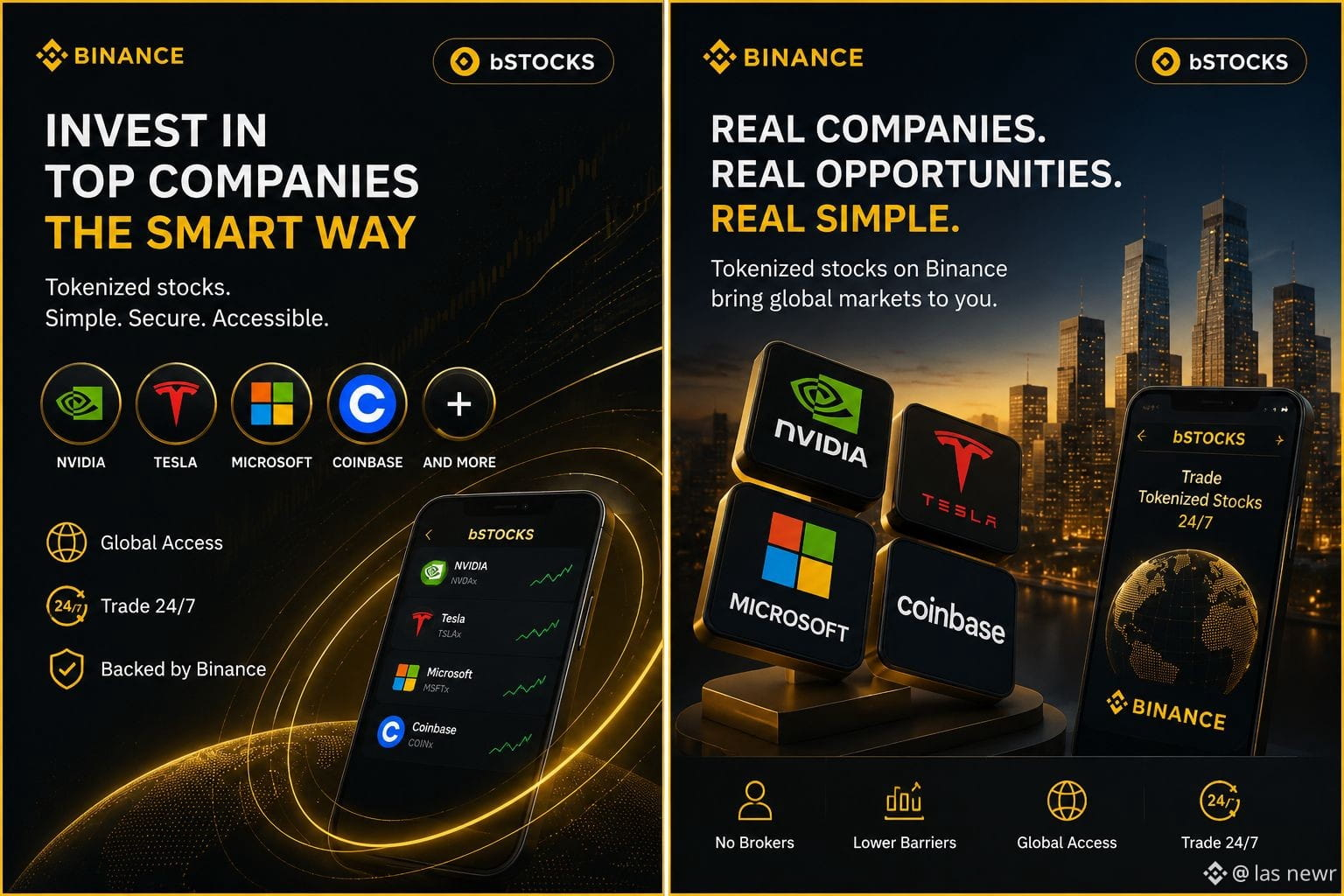
La idea detrás de bStocks es bastante interesante.
Las acciones tokenizadas hacen que sea más fácil seguirlas y acceder a algunas de las mayores empresas del mundo desde una sola plataforma. Para muchos usuarios, eso es una experiencia mucho más fluida que usar varios servicios.
La tecnología sigue haciendo que invertir sea más accesible.
@BinanceCIS #bStocksCIS #Binance
Las acciones tokenizadas hacen que sea más fácil seguirlas y acceder a algunas de las mayores empresas del mundo desde una sola plataforma. Para muchos usuarios, eso es una experiencia mucho más fluida que usar varios servicios.
La tecnología sigue haciendo que invertir sea más accesible.
@BinanceCIS #bStocksCIS #Binance
1
85
·
--
Hoy me puse a pensar en por qué el tema de la tokenización se vuelve cada vez más popular.
Me parece que una de las razones es el intento de combinar los instrumentos financieros habituales con las posibilidades de la cadena de bloques. Justamente esa idea la implementan bStocks: las acciones reales se presentan como tokens, lo que permite interactuar con ellas a través del ecosistema de Binance.
Para mí, esto no es un reemplazo del mercado bursátil tradicional, sino otro formato de acceso a los activos. Es interesante ver cómo se desarrolla esta tendencia.
¿Y ustedes qué opinan sobre la tokenización de activos reales?
@BinanceCIS $SPCXB #bStocks #bstockscis
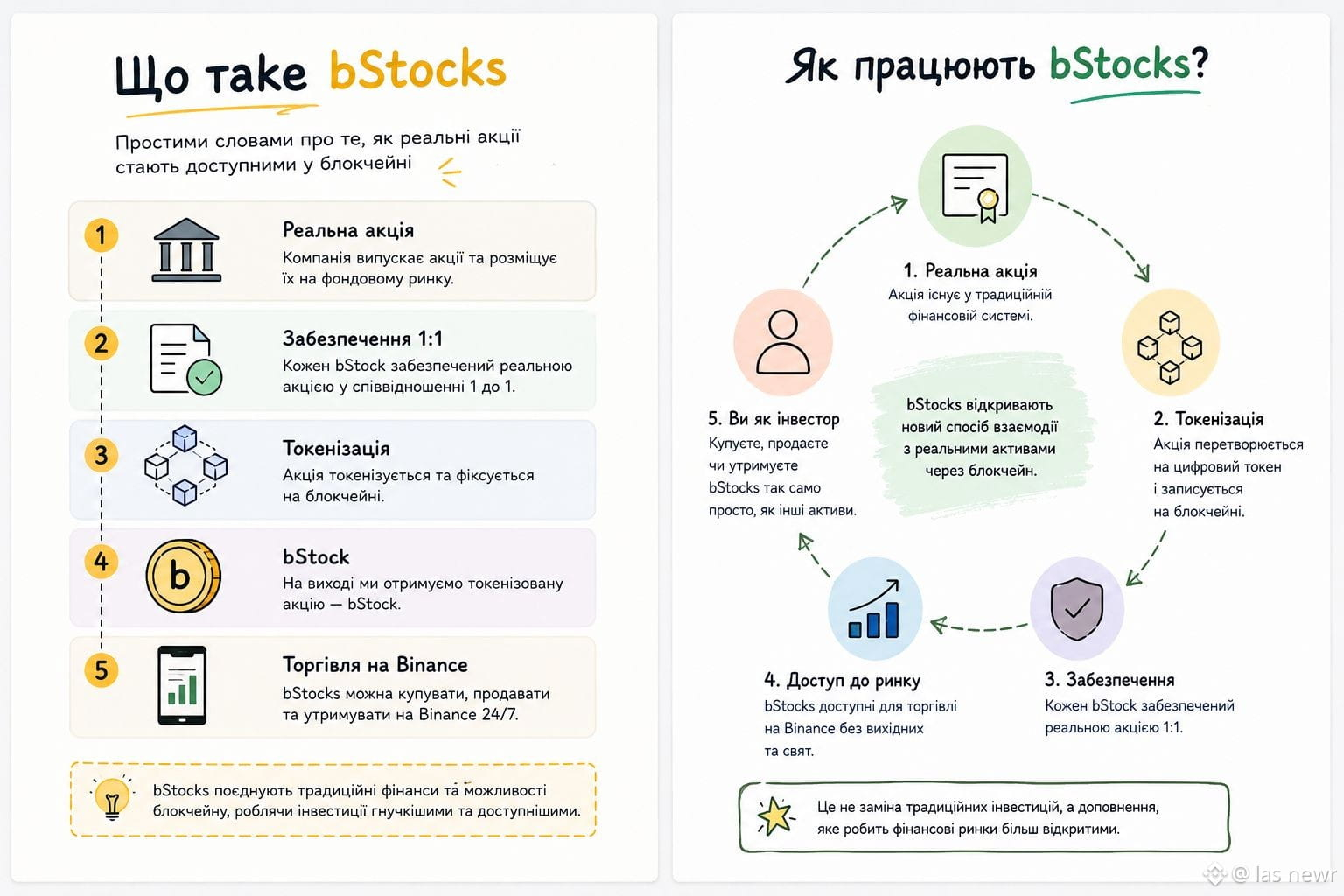
Hoy me puse a pensar en por qué el tema de la tokenización se vuelve cada vez más popular.
Me parece que una de las razones es el intento de combinar los instrumentos financieros habituales con las posibilidades de la cadena de bloques. Justamente esa idea la implementan bStocks: las acciones reales se presentan como tokens, lo que permite interactuar con ellas a través del ecosistema de Binance.
Para mí, esto no es un reemplazo del mercado bursátil tradicional, sino otro formato de acceso a los activos. Es interesante ver cómo se desarrolla esta tendencia.
¿Y ustedes qué opinan sobre la tokenización de activos reales?
@BinanceCIS $SPCXB #bStocks #bstockscis
Me parece que una de las razones es el intento de combinar los instrumentos financieros habituales con las posibilidades de la cadena de bloques. Justamente esa idea la implementan bStocks: las acciones reales se presentan como tokens, lo que permite interactuar con ellas a través del ecosistema de Binance.
Para mí, esto no es un reemplazo del mercado bursátil tradicional, sino otro formato de acceso a los activos. Es interesante ver cómo se desarrolla esta tendencia.
¿Y ustedes qué opinan sobre la tokenización de activos reales?
@BinanceCIS $SPCXB #bStocks #bstockscis
1
66
·
--
Ver traducción
Чим bStocks відрізняються від звичайних акцій? Просте порівняння 👇
Коли я вперше почув про bStocks, подумав, що це просто «акції на блокчейні». Насправді є важливі відмінності.
📊 Звичайні акції • Купуються через брокера. • Торги проходять лише в години роботи фондового ринку. • Розрахунки займають певний час після угоди. • Зберігаються через інфраструктуру брокера або депозитарію.
🟡 bStocks • Це токенізовані цінні папери, забезпечені 1:1 відповідними акціями, які зберігаються у регульованого кастодіана. • Торгівля доступна 24/7 на Binance. • Доступні дробові покупки — від невеликих сум. • Токени можна вивести у сумісний гаманець BNB Smart Chain (для підтримуваних юрисдикцій). • Корпоративні дії, такі як спліти та дивіденди, обробляються автоматично відповідно до механізму платформи.
⚠️ Важливий нюанс: bStocks — це не пряме володіння акціями компанії. Вони надають економічну експозицію до базового активу, але юридично відрізняються від безпосереднього володіння акціями.
@BinanceCIS #bStocksCIS #SPCXB #bnb
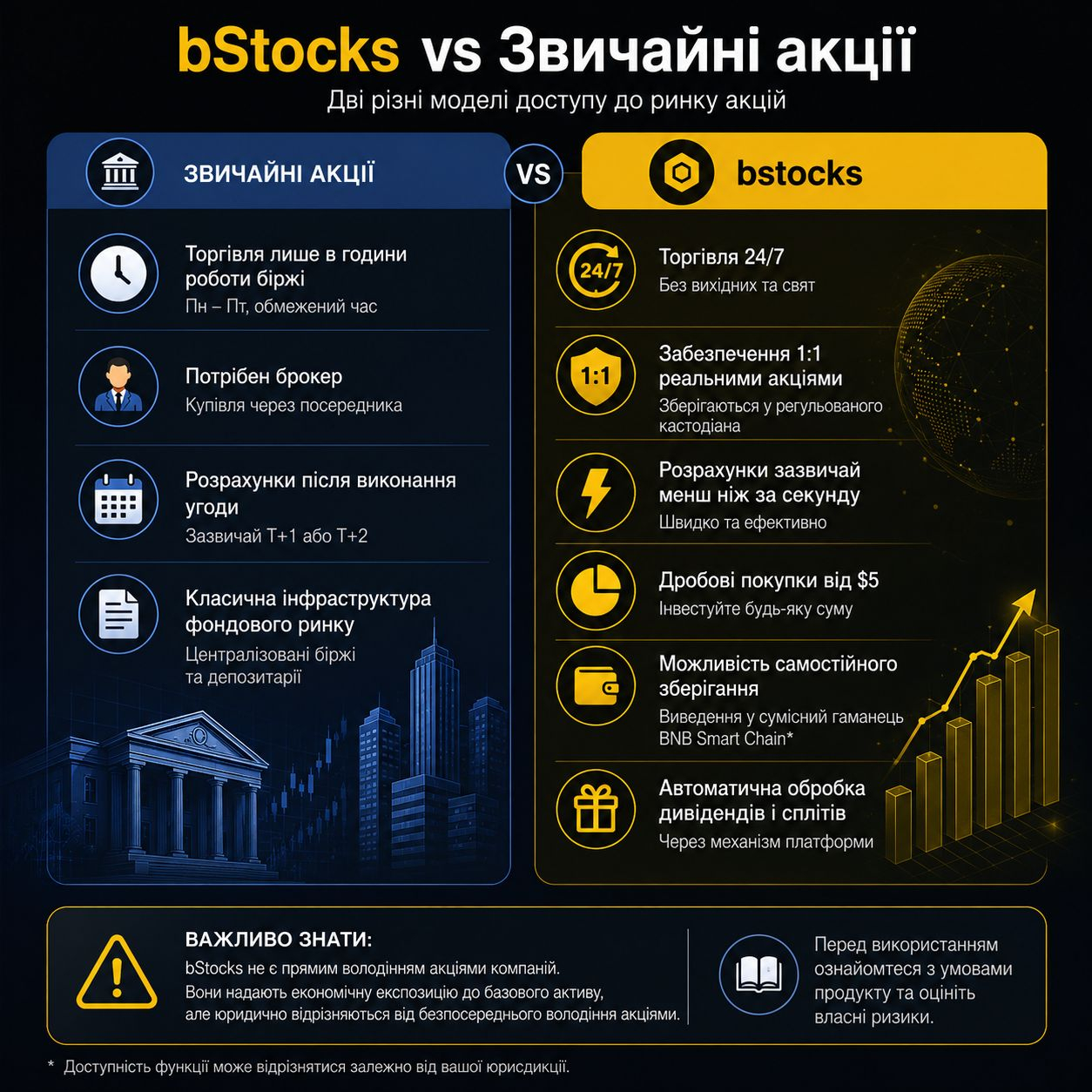
Чим bStocks відрізняються від звичайних акцій? Просте порівняння 👇
Коли я вперше почув про bStocks, подумав, що це просто «акції на блокчейні». Насправді є важливі відмінності.
📊 Звичайні акції • Купуються через брокера. • Торги проходять лише в години роботи фондового ринку. • Розрахунки займають певний час після угоди. • Зберігаються через інфраструктуру брокера або депозитарію.
🟡 bStocks • Це токенізовані цінні папери, забезпечені 1:1 відповідними акціями, які зберігаються у регульованого кастодіана. • Торгівля доступна 24/7 на Binance. • Доступні дробові покупки — від невеликих сум. • Токени можна вивести у сумісний гаманець BNB Smart Chain (для підтримуваних юрисдикцій). • Корпоративні дії, такі як спліти та дивіденди, обробляються автоматично відповідно до механізму платформи.
⚠️ Важливий нюанс: bStocks — це не пряме володіння акціями компанії. Вони надають економічну експозицію до базового активу, але юридично відрізняються від безпосереднього володіння акціями.
@BinanceCIS #bStocksCIS #SPCXB #bnb
Коли я вперше почув про bStocks, подумав, що це просто «акції на блокчейні». Насправді є важливі відмінності.
📊 Звичайні акції • Купуються через брокера. • Торги проходять лише в години роботи фондового ринку. • Розрахунки займають певний час після угоди. • Зберігаються через інфраструктуру брокера або депозитарію.
🟡 bStocks • Це токенізовані цінні папери, забезпечені 1:1 відповідними акціями, які зберігаються у регульованого кастодіана. • Торгівля доступна 24/7 на Binance. • Доступні дробові покупки — від невеликих сум. • Токени можна вивести у сумісний гаманець BNB Smart Chain (для підтримуваних юрисдикцій). • Корпоративні дії, такі як спліти та дивіденди, обробляються автоматично відповідно до механізму платформи.
⚠️ Важливий нюанс: bStocks — це не пряме володіння акціями компанії. Вони надають економічну експозицію до базового активу, але юридично відрізняються від безпосереднього володіння акціями.
@BinanceCIS #bStocksCIS #SPCXB #bnb
1
68
Inicia sesión para explorar más contenidos
Únete a usuarios de criptomonedas de todo el mundo en Binance Square
⚡️ Obtén la información más reciente y útil sobre criptomonedas.
💬 Confía en el mayor exchange de criptomonedas del mundo.
👍 Descubre opiniones reales de creadores verificados.
Correo electrónico/número de teléfono
Temas en tendencia
FedRateWatch
1.4M visualizaciones
6,619 participa(n) en el debate
Comparte y gana recompensas de tráfico en nuestra campaña de hashtag en tendencia
✨Tema: FOMC septiembre, ¿cuál será el próximo movimiento de la Fed?
👉Cómo unirte:
Publica una publicación breve o un artículo con el hashtag #FedRateWatch
Crea contenido basado en los siguientes enfoques:
- El CPI subyacente de agosto aumentó 0.3% mes a mes, y las probabilidades de una subida de 25 pb esta semana ahora están cerca del 90%. ¿Anticipas una subida de tasas esta semana? ¿Es algo puntual o el inicio de un ciclo de subidas más largo?
- Si la subida ocurre, ¿cómo se desarrolla para BTC, acciones tecnológicas y oro? ¿Alcista o bajista?
- ¿Cómo planeas operar a continuación? Comparte tu operación/tenencias de BTC, acciones u oro con nuestro widget para compartir operaciones.
⏰Periodo de la campaña:
- 2026-09-15 11:00 - 2026-09-17 3:00 UTC
🎁Recompensa:
- Las publicaciones que cumplan con las pautas anteriores y tengan más de 100 palabras serán revisadas y podrían recibir un impulso aleatorio de tráfico de 500 a 3,000 visitas. Recibirás una notificación de tu secretario/a de feed si tu publicación es seleccionada.
- Obtén la oportunidad de que tu artículo aparezca destacado en Binance Square Official
¿Necesitas ideas para tu publicación? Visita la página del tema #FedRateWatch o la Square Guide on How to Post for Better Reach.
Binance Square Official
·643 «Me gusta»
·1.6M visualizaciones
ZcashRises6%
44,621 visualizaciones
598 participa(n) en el debate
XRPSinks10%
30,294 visualizaciones
393 participa(n) en el debate