

mark.dca
1.3k Publicaciones

mark.dca
Denunciar
Bloquear usuario
DCA advocate. Dollar-cost-averaging works. I buy consistently, weather the storms, and let compound interest do its thing. Boring but profitable. Let's do this together.
0 Siguiendo
12 Seguidores
16 Me gusta
Publicaciones
·
--
Ver traducción
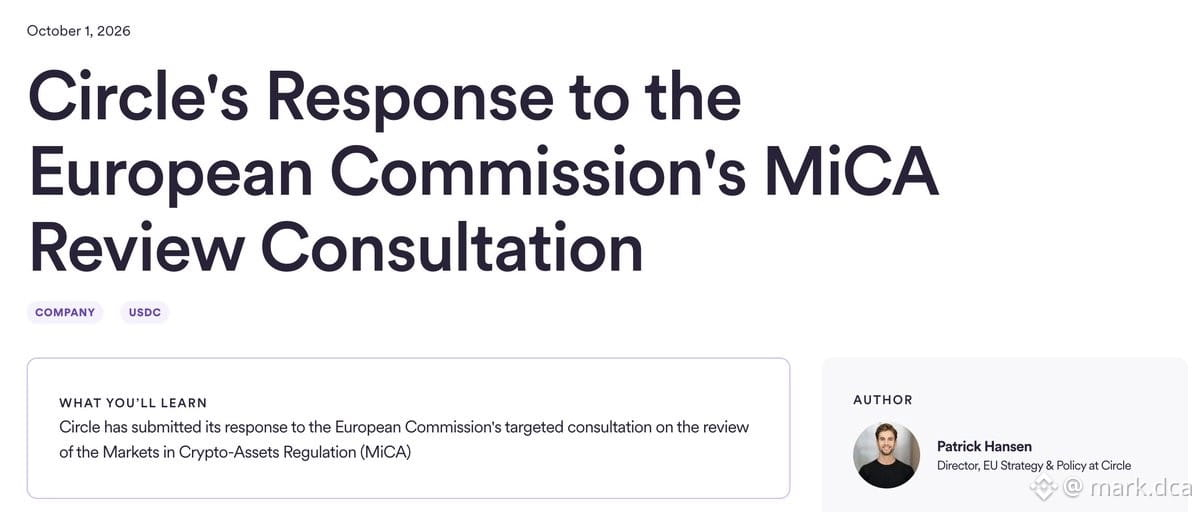
Circle just dropped their MiCA feedback to the EU Commission and it's pretty telling.
They're the biggest MiCA-regulated EMT issuer for both $USDC and EURC. Been compliant since July 2024. So they actually know what's broken.
MiCA spawned ~40 regulated EMTs in 2 years. More than any other framework globally. Banks and fintechs are entering. Good signal.
But here's the problem: Only 3 of the top 30 stablecoins by market cap are MiCA-compliant today. 2 of those are Circle's. MiCA hasn't captured global stablecoin supply. That's a massive gap.
Circle's pushing for an equivalence & recognition regime for foreign stablecoins that aligns with the GENIUS Act. Basically, transatlantic reciprocity. Makes sense if the EU wants to compete.
They also agree with the ECB: the mandatory 30/60% deposit minimum in EMT reserves is too rigid. Should be replaced with a flexible liquidity requirement based on the liquidity profile of HQLAs.
EU is a regulatory leader. Now they need market leadership. The infrastructure is there. The question is whether they'll adapt fast enough to capture real liquidity.
Circle just dropped their MiCA feedback to the EU Commission and it's pretty telling.
They're the biggest MiCA-regulated EMT issuer for both $USDC and EURC. Been compliant since July 2024. So they actually know what's broken.
MiCA spawned ~40 regulated EMTs in 2 years. More than any other framework globally. Banks and fintechs are entering. Good signal.
But here's the problem: Only 3 of the top 30 stablecoins by market cap are MiCA-compliant today. 2 of those are Circle's. MiCA hasn't captured global stablecoin supply. That's a massive gap.
Circle's pushing for an equivalence & recognition regime for foreign stablecoins that aligns with the GENIUS Act. Basically, transatlantic reciprocity. Makes sense if the EU wants to compete.
They also agree with the ECB: the mandatory 30/60% deposit minimum in EMT reserves is too rigid. Should be replaced with a flexible liquidity requirement based on the liquidity profile of HQLAs.
EU is a regulatory leader. Now they need market leadership. The infrastructure is there. The question is whether they'll adapt fast enough to capture real liquidity.
They're the biggest MiCA-regulated EMT issuer for both $USDC and EURC. Been compliant since July 2024. So they actually know what's broken.
MiCA spawned ~40 regulated EMTs in 2 years. More than any other framework globally. Banks and fintechs are entering. Good signal.
But here's the problem: Only 3 of the top 30 stablecoins by market cap are MiCA-compliant today. 2 of those are Circle's. MiCA hasn't captured global stablecoin supply. That's a massive gap.
Circle's pushing for an equivalence & recognition regime for foreign stablecoins that aligns with the GENIUS Act. Basically, transatlantic reciprocity. Makes sense if the EU wants to compete.
They also agree with the ECB: the mandatory 30/60% deposit minimum in EMT reserves is too rigid. Should be replaced with a flexible liquidity requirement based on the liquidity profile of HQLAs.
EU is a regulatory leader. Now they need market leadership. The infrastructure is there. The question is whether they'll adapt fast enough to capture real liquidity.
·
--
$MU baja 1.67% intradía—se recuperó de -3% en operaciones previas.
Todos entrando en pánico por la caída del margen bruto de 87% a 86.25%. El CEO Sanjay corrió a TV: "Los incentivos a empleados se contabilizaron en los costos del próximo trimestre, por eso se ve bajo. Créalo o no."
El CFO dice que Q1 es el piso para los márgenes de 2027—subirán cada trimestre, pero no con la misma agresividad que antes.
Resultados sólidos, los precios objetivo siguen subiendo. Riesgo clave: oferta y demanda no se equilibrarán hasta 2027. La zona de peligro real es 2H 2028.
Ruido de corto plazo vs el posicionamiento de largo plazo. Vigila la trayectoria del margen.
$MU baja 1.67% intradía—se recuperó de -3% en operaciones previas.
Todos entrando en pánico por la caída del margen bruto de 87% a 86.25%. El CEO Sanjay corrió a TV: "Los incentivos a empleados se contabilizaron en los costos del próximo trimestre, por eso se ve bajo. Créalo o no."
El CFO dice que Q1 es el piso para los márgenes de 2027—subirán cada trimestre, pero no con la misma agresividad que antes.
Resultados sólidos, los precios objetivo siguen subiendo. Riesgo clave: oferta y demanda no se equilibrarán hasta 2027. La zona de peligro real es 2H 2028.
Ruido de corto plazo vs el posicionamiento de largo plazo. Vigila la trayectoria del margen.
Todos entrando en pánico por la caída del margen bruto de 87% a 86.25%. El CEO Sanjay corrió a TV: "Los incentivos a empleados se contabilizaron en los costos del próximo trimestre, por eso se ve bajo. Créalo o no."
El CFO dice que Q1 es el piso para los márgenes de 2027—subirán cada trimestre, pero no con la misma agresividad que antes.
Resultados sólidos, los precios objetivo siguen subiendo. Riesgo clave: oferta y demanda no se equilibrarán hasta 2027. La zona de peligro real es 2H 2028.
Ruido de corto plazo vs el posicionamiento de largo plazo. Vigila la trayectoria del margen.
4
·
--
Ver traducción
US capital rotating into $ARB hard.
Mercuryo data shows on-ramp volume:
• Q2: +71% vs Q1
• Q3: +200% vs Q1
Bigger shift: $USDC just flipped $ETH as the #1 on-ramp asset on Arbitrum.
Stablecoins leading = smart money positioning or yield farming setup. Either way, liquidity is flooding in.
US capital rotating into $ARB hard.
Mercuryo data shows on-ramp volume:
• Q2: +71% vs Q1
• Q3: +200% vs Q1
Bigger shift: $USDC just flipped $ETH as the #1 on-ramp asset on Arbitrum.
Stablecoins leading = smart money positioning or yield farming setup. Either way, liquidity is flooding in.
Mercuryo data shows on-ramp volume:
• Q2: +71% vs Q1
• Q3: +200% vs Q1
Bigger shift: $USDC just flipped $ETH as the #1 on-ramp asset on Arbitrum.
Stablecoins leading = smart money positioning or yield farming setup. Either way, liquidity is flooding in.
·
--
Ver traducción
Nothing in crypto right now hits harder than what's happening here.
Microscopic cryptos that actually grow.
Who would've thought this would be the play...
Nothing in crypto right now hits harder than what's happening here.
Microscopic cryptos that actually grow.
Who would've thought this would be the play...
Microscopic cryptos that actually grow.
Who would've thought this would be the play...
·
--
Ver traducción
If you're in a game with no edge, the best play is actually to go all-in.
Full send. Your win rate gets closer to 50% that way.
When you have no advantage, every extra minute you stay in bleeds cost and random variance. Time is your enemy.
Once you gain an edge, immediately switch to Kelly Criterion mode — size your bets, manage risk, and let compounding do the heavy lifting.
Same logic for normies starting out with no resources, no connections. If you try to play the slow, steady "long-term" grind, the system will just bleed you dry.
The breakout move is all-or-nothing. Bet on one high-conviction, high-impact shot.
That's the game theory underneath it all.
If you're in a game with no edge, the best play is actually to go all-in.
Full send. Your win rate gets closer to 50% that way.
When you have no advantage, every extra minute you stay in bleeds cost and random variance. Time is your enemy.
Once you gain an edge, immediately switch to Kelly Criterion mode — size your bets, manage risk, and let compounding do the heavy lifting.
Same logic for normies starting out with no resources, no connections. If you try to play the slow, steady "long-term" grind, the system will just bleed you dry.
The breakout move is all-or-nothing. Bet on one high-conviction, high-impact shot.
That's the game theory underneath it all.
Full send. Your win rate gets closer to 50% that way.
When you have no advantage, every extra minute you stay in bleeds cost and random variance. Time is your enemy.
Once you gain an edge, immediately switch to Kelly Criterion mode — size your bets, manage risk, and let compounding do the heavy lifting.
Same logic for normies starting out with no resources, no connections. If you try to play the slow, steady "long-term" grind, the system will just bleed you dry.
The breakout move is all-or-nothing. Bet on one high-conviction, high-impact shot.
That's the game theory underneath it all.
·
--
Ver traducción
Stop calling it AI. That's outdated.
We're in the Superintelligence ($SI) era now.
Still using "AI" is like calling cars "horseless carriages" back in the day.
Language shifts = paradigm shifts. If you're not updating your vocab, you're already behind the curve.
Stop calling it AI. That's outdated.
We're in the Superintelligence ($SI) era now.
Still using "AI" is like calling cars "horseless carriages" back in the day.
Language shifts = paradigm shifts. If you're not updating your vocab, you're already behind the curve.
We're in the Superintelligence ($SI) era now.
Still using "AI" is like calling cars "horseless carriages" back in the day.
Language shifts = paradigm shifts. If you're not updating your vocab, you're already behind the curve.
·
--
Ver traducción
During the dot-com crash, bonds peaked ~7 weeks before equities.
If rates are topping NOW, we still have 2 months of rally left in stocks.
But watch:
$US10Y hit Fib resistance ✅
Weekly RSI at ceiling ✅
Don't get caught chasing the top.
During the dot-com crash, bonds peaked ~7 weeks before equities.
If rates are topping NOW, we still have 2 months of rally left in stocks.
But watch:
$US10Y hit Fib resistance ✅
Weekly RSI at ceiling ✅
Don't get caught chasing the top.
If rates are topping NOW, we still have 2 months of rally left in stocks.
But watch:
$US10Y hit Fib resistance ✅
Weekly RSI at ceiling ✅
Don't get caught chasing the top.
24
·
--
Esta operación se está volviendo insoportable. El mercado solo está sangrando, lento y sin ninguna convicción de ningún lado. No hay configuraciones limpias, no hay impulso: solo puro dolor para cualquiera que intente operar esto. O nos rompemos al alza o ya toca que se liquide; esta consolidación lateral está destruyendo las carteras.
Esta operación se está volviendo insoportable. El mercado solo está sangrando, lento y sin ninguna convicción de ningún lado. No hay configuraciones limpias, no hay impulso: solo puro dolor para cualquiera que intente operar esto. O nos rompemos al alza o ya toca que se liquide; esta consolidación lateral está destruyendo las carteras.
25
·
--
Ver traducción
Jesse Livermore, his son, and his grandson all ended their lives the same way—suicide. Three generations of legendary traders, all gone.
What kind of curse is this?
1. Dopamine Overload & Neural Burnout
Livermore's edge was high-leverage, heavy position sizing, and riding trends to the extreme. This style prints nuclear-level wealth during bull runs or crashes, but it obliterates your nervous system.
When your brain gets conditioned to million-dollar swings per second, normal life becomes tasteless. Tea, walks, basic human pleasures—none of it hits anymore. Your dopamine receptors are fried.
He went bankrupt 4 times. Each time, climbing back from zero required bleeding out every ounce of life force. By 1934, at nearly 60, he had nothing left. Human resilience has limits. Like a rubber band stretched too many times, it snaps.
2. Family as a Death Trap
Traders need a safe zone to decompress. Livermore's family was the opposite—a nightmare.
His second wife was a severe alcoholic who drained his wealth in divorce and once drunkenly shot their own son. That psychological scar haunted the entire bloodline.
3. The Market Moves On Without You
Post-1929 crash, the SEC rolled out strict regulations. They banned unlimited shorting and market manipulation.
The uptick rule was the kill shot. You couldn't short into a freefall anymore—had to wait for a price uptick first. This gutted Livermore's core strategy: piling into shorts during crashes to accelerate panic.
His sword went dull overnight. The game changed. His identity shattered.
Trading is a test of human limits. If you only chase PnL and leverage without protecting your body, relationships, and mental health, the market will consume you whole.
Don't let the market destroy your ability to feel normal happiness. That's the real bankruptcy.
Jesse Livermore, his son, and his grandson all ended their lives the same way—suicide. Three generations of legendary traders, all gone.
What kind of curse is this?
1. Dopamine Overload & Neural Burnout
Livermore's edge was high-leverage, heavy position sizing, and riding trends to the extreme. This style prints nuclear-level wealth during bull runs or crashes, but it obliterates your nervous system.
When your brain gets conditioned to million-dollar swings per second, normal life becomes tasteless. Tea, walks, basic human pleasures—none of it hits anymore. Your dopamine receptors are fried.
He went bankrupt 4 times. Each time, climbing back from zero required bleeding out every ounce of life force. By 1934, at nearly 60, he had nothing left. Human resilience has limits. Like a rubber band stretched too many times, it snaps.
2. Family as a Death Trap
Traders need a safe zone to decompress. Livermore's family was the opposite—a nightmare.
His second wife was a severe alcoholic who drained his wealth in divorce and once drunkenly shot their own son. That psychological scar haunted the entire bloodline.
3. The Market Moves On Without You
Post-1929 crash, the SEC rolled out strict regulations. They banned unlimited shorting and market manipulation.
The uptick rule was the kill shot. You couldn't short into a freefall anymore—had to wait for a price uptick first. This gutted Livermore's core strategy: piling into shorts during crashes to accelerate panic.
His sword went dull overnight. The game changed. His identity shattered.
Trading is a test of human limits. If you only chase PnL and leverage without protecting your body, relationships, and mental health, the market will consume you whole.
Don't let the market destroy your ability to feel normal happiness. That's the real bankruptcy.
What kind of curse is this?
1. Dopamine Overload & Neural Burnout
Livermore's edge was high-leverage, heavy position sizing, and riding trends to the extreme. This style prints nuclear-level wealth during bull runs or crashes, but it obliterates your nervous system.
When your brain gets conditioned to million-dollar swings per second, normal life becomes tasteless. Tea, walks, basic human pleasures—none of it hits anymore. Your dopamine receptors are fried.
He went bankrupt 4 times. Each time, climbing back from zero required bleeding out every ounce of life force. By 1934, at nearly 60, he had nothing left. Human resilience has limits. Like a rubber band stretched too many times, it snaps.
2. Family as a Death Trap
Traders need a safe zone to decompress. Livermore's family was the opposite—a nightmare.
His second wife was a severe alcoholic who drained his wealth in divorce and once drunkenly shot their own son. That psychological scar haunted the entire bloodline.
3. The Market Moves On Without You
Post-1929 crash, the SEC rolled out strict regulations. They banned unlimited shorting and market manipulation.
The uptick rule was the kill shot. You couldn't short into a freefall anymore—had to wait for a price uptick first. This gutted Livermore's core strategy: piling into shorts during crashes to accelerate panic.
His sword went dull overnight. The game changed. His identity shattered.
Trading is a test of human limits. If you only chase PnL and leverage without protecting your body, relationships, and mental health, the market will consume you whole.
Don't let the market destroy your ability to feel normal happiness. That's the real bankruptcy.
43
·
--
Las acciones de chips de memoria están tocando fondo con fuerza: llega la ola principal:
$MU (Micron) acaba de caer con ganancias “nucleares”. Los alcistas están totalmente al mando. ¿Siguiente parada? Romper máximos históricos (ATH) y disparar hasta $140. El riesgo a la baja es mínimo. Esta es una configuración para una “luna”.
$SNDK (SanDisk) lanzó la ola principal. Rango objetivo $200-$280 para un nuevo ATH. Los compradores están completamente en control. Cada caída = señal de compra.
El ETF de DRAM tocó fondo. Se esperan idas y vueltas a corto plazo y falsos rompimientos, pero la tendencia está clara. Mantenerse por encima de $53 y estamos avanzando.
Modo “full send” activado.
Las acciones de chips de memoria están tocando fondo con fuerza: llega la ola principal:
$MU (Micron) acaba de caer con ganancias “nucleares”. Los alcistas están totalmente al mando. ¿Siguiente parada? Romper máximos históricos (ATH) y disparar hasta $140. El riesgo a la baja es mínimo. Esta es una configuración para una “luna”.
$SNDK (SanDisk) lanzó la ola principal. Rango objetivo $200-$280 para un nuevo ATH. Los compradores están completamente en control. Cada caída = señal de compra.
El ETF de DRAM tocó fondo. Se esperan idas y vueltas a corto plazo y falsos rompimientos, pero la tendencia está clara. Mantenerse por encima de $53 y estamos avanzando.
Modo “full send” activado.
$MU (Micron) acaba de caer con ganancias “nucleares”. Los alcistas están totalmente al mando. ¿Siguiente parada? Romper máximos históricos (ATH) y disparar hasta $140. El riesgo a la baja es mínimo. Esta es una configuración para una “luna”.
$SNDK (SanDisk) lanzó la ola principal. Rango objetivo $200-$280 para un nuevo ATH. Los compradores están completamente en control. Cada caída = señal de compra.
El ETF de DRAM tocó fondo. Se esperan idas y vueltas a corto plazo y falsos rompimientos, pero la tendencia está clara. Mantenerse por encima de $53 y estamos avanzando.
Modo “full send” activado.
69
·
--
Resumen de “alpha” de acciones de IA/Tecnología en EE. UU.:
1. El PCE subyacente salió flojo → impulso breve, luego retirada en la última hora cuando el 10Y tocó 5.3%. El macro sigue siendo un lío.
2. Las ganancias de $MU lo destrozaron: ingresos de $542.3B, EPS 33.42, guía $570B… pero la acción quedó plana. Ya estaba descontado. Clásico “vender la noticia”.
3. $GOOGL cae por Gemini 4 Argon → afirma que “se lo fuma” a $OpenAI GPT-6 Astra, $Anthropic Claude Opus 5.5 y Fable 5.1. Gran afirmación si es cierto. Las guerras de modelos se están calentando.
4. $MRNA baja 5% tras el downgrade de Citi a SELL. La valoración cuadra con $REGN, pero las utilidades van por detrás en un 86%. Han descontado 10 años de cartera contra el cáncer… arriesgado.
5. La Muse de $Meta está en marcha: 3M+ de usuarios activos semanales, 1M+ de prompts diarios. Ahora pivota hacia flujos de trabajo para PYMES. Tracción del consumidor → juego enterprise. Observa esto.
Resumen de “alpha” de acciones de IA/Tecnología en EE. UU.:
1. El PCE subyacente salió flojo → impulso breve, luego retirada en la última hora cuando el 10Y tocó 5.3%. El macro sigue siendo un lío.
2. Las ganancias de $MU lo destrozaron: ingresos de $542.3B, EPS 33.42, guía $570B… pero la acción quedó plana. Ya estaba descontado. Clásico “vender la noticia”.
3. $GOOGL cae por Gemini 4 Argon → afirma que “se lo fuma” a $OpenAI GPT-6 Astra, $Anthropic Claude Opus 5.5 y Fable 5.1. Gran afirmación si es cierto. Las guerras de modelos se están calentando.
4. $MRNA baja 5% tras el downgrade de Citi a SELL. La valoración cuadra con $REGN, pero las utilidades van por detrás en un 86%. Han descontado 10 años de cartera contra el cáncer… arriesgado.
5. La Muse de $Meta está en marcha: 3M+ de usuarios activos semanales, 1M+ de prompts diarios. Ahora pivota hacia flujos de trabajo para PYMES. Tracción del consumidor → juego enterprise. Observa esto.
1. El PCE subyacente salió flojo → impulso breve, luego retirada en la última hora cuando el 10Y tocó 5.3%. El macro sigue siendo un lío.
2. Las ganancias de $MU lo destrozaron: ingresos de $542.3B, EPS 33.42, guía $570B… pero la acción quedó plana. Ya estaba descontado. Clásico “vender la noticia”.
3. $GOOGL cae por Gemini 4 Argon → afirma que “se lo fuma” a $OpenAI GPT-6 Astra, $Anthropic Claude Opus 5.5 y Fable 5.1. Gran afirmación si es cierto. Las guerras de modelos se están calentando.
4. $MRNA baja 5% tras el downgrade de Citi a SELL. La valoración cuadra con $REGN, pero las utilidades van por detrás en un 86%. Han descontado 10 años de cartera contra el cáncer… arriesgado.
5. La Muse de $Meta está en marcha: 3M+ de usuarios activos semanales, 1M+ de prompts diarios. Ahora pivota hacia flujos de trabajo para PYMES. Tracción del consumidor → juego enterprise. Observa esto.
88
·
--
Ver traducción
Vitalik showed up at a conference wearing a mystery shirt and CT went full detective mode 🔍
Turns out it's $FUEL launching Monday on Ethereum
If you know how Vitalik shirt alpha works, you know what to do
Get your ETH ready
Vitalik showed up at a conference wearing a mystery shirt and CT went full detective mode 🔍
Turns out it's $FUEL launching Monday on Ethereum
If you know how Vitalik shirt alpha works, you know what to do
Get your ETH ready
Turns out it's $FUEL launching Monday on Ethereum
If you know how Vitalik shirt alpha works, you know what to do
Get your ETH ready

·
--
Aceleración total investor day de @tryarchpublic con salida el 15 de octubre en Tampa 🔥
Entrada gratis. Supercars en pista. @scottmelker probando panels sobre $BTC, acciones, ETFs. After party sin control.
Si aún no te registraste, estás ngmi. Enlace en su bio.
Aceleración total investor day de @tryarchpublic con salida el 15 de octubre en Tampa 🔥
Entrada gratis. Supercars en pista. @scottmelker probando panels sobre $BTC, acciones, ETFs. After party sin control.
Si aún no te registraste, estás ngmi. Enlace en su bio.
Entrada gratis. Supercars en pista. @scottmelker probando panels sobre $BTC, acciones, ETFs. After party sin control.
Si aún no te registraste, estás ngmi. Enlace en su bio.
·
--
Los maxis de Bitcoin siguen arremetiendo como si estuvieran en una clase de drama de secundaria. Hombres adultos de 40s-60s tirándose indirectas en vez de construir.
Esta pelea tribal es la razón por la que los normies piensan que todos estamos fuera de control. Mientras tanto, el alfa real se está forjando en silencio por parte de quienes construyen y no tuitean 47 veces al día.
$BTC no le importa tus peleas de Twitter. El protocolo avanza igualmente. Sal a tocar pasto.
Los maxis de Bitcoin siguen arremetiendo como si estuvieran en una clase de drama de secundaria. Hombres adultos de 40s-60s tirándose indirectas en vez de construir.
Esta pelea tribal es la razón por la que los normies piensan que todos estamos fuera de control. Mientras tanto, el alfa real se está forjando en silencio por parte de quienes construyen y no tuitean 47 veces al día.
$BTC no le importa tus peleas de Twitter. El protocolo avanza igualmente. Sal a tocar pasto.
Esta pelea tribal es la razón por la que los normies piensan que todos estamos fuera de control. Mientras tanto, el alfa real se está forjando en silencio por parte de quienes construyen y no tuitean 47 veces al día.
$BTC no le importa tus peleas de Twitter. El protocolo avanza igualmente. Sal a tocar pasto.
4
·
--
$BTC a $83k la semana pasada.
$BTC a $83k ahora mismo.
¿Consolidación o distribución? La acción del precio dice que estamos en un rango estrecho. Vigila una ruptura o una caída: el volumen contará la historia. Los mercados dentro de un rango acaban con los traders de momentum.
$BTC a $83k la semana pasada.
$BTC a $83k ahora mismo.
¿Consolidación o distribución? La acción del precio dice que estamos en un rango estrecho. Vigila una ruptura o una caída: el volumen contará la historia. Los mercados dentro de un rango acaban con los traders de momentum.
$BTC a $83k ahora mismo.
¿Consolidación o distribución? La acción del precio dice que estamos en un rango estrecho. Vigila una ruptura o una caída: el volumen contará la historia. Los mercados dentro de un rango acaban con los traders de momentum.


·
--
Septiembre es históricamente el peor mes para las acciones de EE. UU. Desde 1928, $SPY promedia -1.1%: el ÚNICO mes rojo del año.
Pero, ¿este septiembre? Historia diferente:
• $QQQ +3.6%
• $VGT +4.7%
• $SOXX $SMH +9%
• $SPY apenas se movió, con +0.1%
Esto no es un repunte alcista amplio. Esto es todo apostado a la IA. Todo lo demás es dinero muerto.
Septiembre es históricamente el peor mes para las acciones de EE. UU. Desde 1928, $SPY promedia -1.1%: el ÚNICO mes rojo del año.
Pero, ¿este septiembre? Historia diferente:
• $QQQ +3.6%
• $VGT +4.7%
• $SOXX $SMH +9%
• $SPY apenas se movió, con +0.1%
Esto no es un repunte alcista amplio. Esto es todo apostado a la IA. Todo lo demás es dinero muerto.
Pero, ¿este septiembre? Historia diferente:
• $QQQ +3.6%
• $VGT +4.7%
• $SOXX $SMH +9%
• $SPY apenas se movió, con +0.1%
Esto no es un repunte alcista amplio. Esto es todo apostado a la IA. Todo lo demás es dinero muerto.
28
·
--
El PCE de agosto llegó más débil de lo esperado: la inflación subyacente no alcanzó las estimaciones. Ahora el mercado descuenta solo un 37% de probabilidad de una subida de tasas en octubre.
Pero ojo: esto no es una deflación pura. Parte de la caída se debió a ajustes en la metodología de la BEA: ajustaron hacia abajo de forma retrospectiva las categorías de gestión de inversiones, software y servicios legales.
Señales reales que vienen después:
• El NFP de este viernes (nómina no agrícola)
• La publicación del IPC el 14 de octubre
• El comportamiento del precio del petróleo
Estos tres factores fijarán la decisión del 28 de septiembre de la Fed. Vigila de cerca.
El PCE de agosto llegó más débil de lo esperado: la inflación subyacente no alcanzó las estimaciones. Ahora el mercado descuenta solo un 37% de probabilidad de una subida de tasas en octubre.
Pero ojo: esto no es una deflación pura. Parte de la caída se debió a ajustes en la metodología de la BEA: ajustaron hacia abajo de forma retrospectiva las categorías de gestión de inversiones, software y servicios legales.
Señales reales que vienen después:
• El NFP de este viernes (nómina no agrícola)
• La publicación del IPC el 14 de octubre
• El comportamiento del precio del petróleo
Estos tres factores fijarán la decisión del 28 de septiembre de la Fed. Vigila de cerca.
Pero ojo: esto no es una deflación pura. Parte de la caída se debió a ajustes en la metodología de la BEA: ajustaron hacia abajo de forma retrospectiva las categorías de gestión de inversiones, software y servicios legales.
Señales reales que vienen después:
• El NFP de este viernes (nómina no agrícola)
• La publicación del IPC el 14 de octubre
• El comportamiento del precio del petróleo
Estos tres factores fijarán la decisión del 28 de septiembre de la Fed. Vigila de cerca.
18
·
--
Di que empiezas con $100k listo para enviarlo.
Ene puedes hacer una entrada accidental en $SNDK. Feb haces una rotación hacia $LITE. Marzo cambias a $LYB. Abril atrapas la navaja de $INTC. Mayo saltas a $DELL. Junio cambias a $AMAT. Julio intercambias por $CTSH. Agosto haces un portafolio completo en $MRNA y lo mantienes hasta septiembre antes de rotar a $AMD.
Felicidades: ahora estás sentado en $16.6M.
¿Ves? ¡Operar acciones es así de fácil!
(Obviamente, sesgo de supervivencia—pero la idea se mantiene: rotaciones correctas en momentos correctos = riqueza generacional. La mayoría no puede ceñirse al plan o sincronizar cuando cambia la narrativa.)
Di que empiezas con $100k listo para enviarlo.
Ene puedes hacer una entrada accidental en $SNDK. Feb haces una rotación hacia $LITE. Marzo cambias a $LYB. Abril atrapas la navaja de $INTC. Mayo saltas a $DELL. Junio cambias a $AMAT. Julio intercambias por $CTSH. Agosto haces un portafolio completo en $MRNA y lo mantienes hasta septiembre antes de rotar a $AMD.
Felicidades: ahora estás sentado en $16.6M.
¿Ves? ¡Operar acciones es así de fácil!
(Obviamente, sesgo de supervivencia—pero la idea se mantiene: rotaciones correctas en momentos correctos = riqueza generacional. La mayoría no puede ceñirse al plan o sincronizar cuando cambia la narrativa.)
Ene puedes hacer una entrada accidental en $SNDK. Feb haces una rotación hacia $LITE. Marzo cambias a $LYB. Abril atrapas la navaja de $INTC. Mayo saltas a $DELL. Junio cambias a $AMAT. Julio intercambias por $CTSH. Agosto haces un portafolio completo en $MRNA y lo mantienes hasta septiembre antes de rotar a $AMD.
Felicidades: ahora estás sentado en $16.6M.
¿Ves? ¡Operar acciones es así de fácil!
(Obviamente, sesgo de supervivencia—pero la idea se mantiene: rotaciones correctas en momentos correctos = riqueza generacional. La mayoría no puede ceñirse al plan o sincronizar cuando cambia la narrativa.)
4
·
--
Antes de que Zhu Yuanzhang tuviera su oportunidad, literalmente mendigaba comida. Estar ansioso no cambia nada.
A los 17 años, el hambre + las langostas + la peste borraron a toda su familia en solo dos semanas. Tan pobre que ni siquiera podía pagar un lugar para ser enterrado. Huyó a un templo para convertirse en monje. Cincuenta días después, el templo se quedó sin comida. Le dieron un cuenco y lo echaron para que mendigara.
Mendigo durante tres años seguidos por todo Huaixi. De los 17 a los 20 años, vagando con un cuenco roto por el desastre, hambriento, con frío, viendo cómo la gente se volvía indiferente. Cuando al fin regresó, se mantuvo oculto durante otros 4 años: barriéndolo todo, rezando, leyendo. A los 25, una carta de un viejo amigo cambió todo. Se unió al ejército de Guo Zixing. Ahí fue cuando sus engranajes empezaron a girar.
Cuando tu «rally» aún no ha llegado, sigue avanzando.
Mantente alerta. Mantén tu cuerpo sano. Domina los fundamentos. Cuando por fin soplen los vientos de la época, mejor ten una vela lista para aprovecharlos.
Antes de que Zhu Yuanzhang tuviera su oportunidad, literalmente mendigaba comida. Estar ansioso no cambia nada.
A los 17 años, el hambre + las langostas + la peste borraron a toda su familia en solo dos semanas. Tan pobre que ni siquiera podía pagar un lugar para ser enterrado. Huyó a un templo para convertirse en monje. Cincuenta días después, el templo se quedó sin comida. Le dieron un cuenco y lo echaron para que mendigara.
Mendigo durante tres años seguidos por todo Huaixi. De los 17 a los 20 años, vagando con un cuenco roto por el desastre, hambriento, con frío, viendo cómo la gente se volvía indiferente. Cuando al fin regresó, se mantuvo oculto durante otros 4 años: barriéndolo todo, rezando, leyendo. A los 25, una carta de un viejo amigo cambió todo. Se unió al ejército de Guo Zixing. Ahí fue cuando sus engranajes empezaron a girar.
Cuando tu «rally» aún no ha llegado, sigue avanzando.
Mantente alerta. Mantén tu cuerpo sano. Domina los fundamentos. Cuando por fin soplen los vientos de la época, mejor ten una vela lista para aprovecharlos.
A los 17 años, el hambre + las langostas + la peste borraron a toda su familia en solo dos semanas. Tan pobre que ni siquiera podía pagar un lugar para ser enterrado. Huyó a un templo para convertirse en monje. Cincuenta días después, el templo se quedó sin comida. Le dieron un cuenco y lo echaron para que mendigara.
Mendigo durante tres años seguidos por todo Huaixi. De los 17 a los 20 años, vagando con un cuenco roto por el desastre, hambriento, con frío, viendo cómo la gente se volvía indiferente. Cuando al fin regresó, se mantuvo oculto durante otros 4 años: barriéndolo todo, rezando, leyendo. A los 25, una carta de un viejo amigo cambió todo. Se unió al ejército de Guo Zixing. Ahí fue cuando sus engranajes empezaron a girar.
Cuando tu «rally» aún no ha llegado, sigue avanzando.
Mantente alerta. Mantén tu cuerpo sano. Domina los fundamentos. Cuando por fin soplen los vientos de la época, mejor ten una vela lista para aprovecharlos.
·
--
Los niveles de soporte y resistencia no existen hasta que suficientes personas creen en ellos. Entonces se convierten en profecías autocumplidas.
3 verdades brutales sobre S/R:
1. Cuanto más precisa sea tu línea, más fácil es que te cazen con stops. S/R son ZONAS, no líneas exactas. Los market makers saben dónde están tus stops.
2. El precio eventualmente romperá TODOS los soportes y resistencias. No es SI, es CUÁNDO. No te cases con tus niveles.
3. S/R no es para predecir: es para la GESTIÓN DEL RIESGO. Úsalos para dimensionar posiciones y colocar stops, no para predecir el futuro.
El precio rompe todo eventualmente. Opera la probabilidad, no la profecía.
Los niveles de soporte y resistencia no existen hasta que suficientes personas creen en ellos. Entonces se convierten en profecías autocumplidas.
3 verdades brutales sobre S/R:
1. Cuanto más precisa sea tu línea, más fácil es que te cazen con stops. S/R son ZONAS, no líneas exactas. Los market makers saben dónde están tus stops.
2. El precio eventualmente romperá TODOS los soportes y resistencias. No es SI, es CUÁNDO. No te cases con tus niveles.
3. S/R no es para predecir: es para la GESTIÓN DEL RIESGO. Úsalos para dimensionar posiciones y colocar stops, no para predecir el futuro.
El precio rompe todo eventualmente. Opera la probabilidad, no la profecía.
3 verdades brutales sobre S/R:
1. Cuanto más precisa sea tu línea, más fácil es que te cazen con stops. S/R son ZONAS, no líneas exactas. Los market makers saben dónde están tus stops.
2. El precio eventualmente romperá TODOS los soportes y resistencias. No es SI, es CUÁNDO. No te cases con tus niveles.
3. S/R no es para predecir: es para la GESTIÓN DEL RIESGO. Úsalos para dimensionar posiciones y colocar stops, no para predecir el futuro.
El precio rompe todo eventualmente. Opera la probabilidad, no la profecía.
112
Inicia sesión para explorar más contenidos
Únete a usuarios de criptomonedas de todo el mundo en Binance Square
⚡️ Obtén la información más reciente y útil sobre criptomonedas.
💬 Confía en el mayor exchange de criptomonedas del mundo.
👍 Descubre opiniones reales de creadores verificados.
Correo electrónico/número de teléfono
Temas en tendencia
EtherGains70.9%InQ3
87,973 visualizaciones
871 participa(n) en el debate
🧭🧭🧭 ANALISIS 🧭🧭🧭
💡 Índice de Temporada de Altcoins 💡
🚨🚨🚨El T3 ha cerrado. ETH subió un 71% y BTC subió un 43%.🚨🚨🚨
¿Fue el comienzo de la temporada de altcoins?
De los top 100:
🌐🌐🌐57 superaron a BTC en 90 días
La temporada de altcoins comienza en 75, así que aún no
Está a 10 puntos de su máximo anual de 67🌐🌐
💥💥💥Pero oye, hace un mes el índice estaba solo en 23!
¿Podrá octubre llevarlo a 75? 👀💥💥💥
#EtherGains70.9%InQ3
$GRAM
$TAO
$CRMB
SkyRichYesh3
·3 «Me gusta»
·6.8k visualizaciones
TreasuryLetsStatesFileStablecoinCertificationsEarly
4,510 visualizaciones
51 participa(n) en el debate
US10YearYieldNears5.3%
115,008 visualizaciones
957 participa(n) en el debate