
Z大诗
56 Posts

Z大诗
Report
Block User
行情分析师 推特同步更新:https://x.com/zh_crypto517
47 Following
1.3K+ Followers
275 Liked
Posts
All
Quotes
Live
·
--
Six Best Ways for Ordinary People to Make Money in the Stock Market:
1. Wait for a big market drop and allocate to broad-based index funds
Go to work as usual and live your life as usual, investing only with spare money. Don’t keep making moves. When the market experiences a deep downturn, buy in batches of broad-based ETFs. You don’t need to make a difficult effort choosing individual stocks. After a cycle of market repair, there’s a chance to achieve 30%–40% returns.
2. Pick one or two stocks and trade swings repeatedly
Choose 1–2 stocks with solid fundamentals. Always keep part of your cash. When they rise, sell a portion; when they fall, buy a portion. By repeating this swing-trading rotation, you can gradually lower your average cost. In an ideal case, you can even bring the cost down to a negative figure.
3. Hold high-dividend stocks to collect dividends
Look for state-owned enterprises and central-government SOEs with a dividend yield of around 5%. After the stock price has fallen enough, enter the market and hold long term to earn dividends. For example, take highway-related stocks: the original plan might be to earn about 4% in annual dividends, but if the market turns favorable, the stock price could potentially double directly.
4. Grid trading, suited to range-bound markets
Choose assets with volatility that fits grid trading. Set a fixed price spread between buy and sell levels. Buy when it falls, sell when it rises. Execute the strategy mechanically according to the rules—don’t try to guess where the market will go next. By leveraging market fluctuations, you can continuously accumulate shares.
5. Buy when leading stocks are mistakenly sold off; wait for value to return
Focus primarily on industry leaders rather than chasing a bunch of small-cap stocks. When a leader stock gets wrongly sold off due to weak market sentiment, and its valuation drops to a low level, enter in stages with a heavier allocation. Don’t greedily chase small short-term gains. Wait for the company’s value to return, aiming for several-times—and ultimately medium-to-long-term—returns.
6. Unearth growth stocks and profit from companies’ growth
This approach is more challenging. Find companies that aren’t large in size right now, but have a promising industry outlook—and may have the potential to grow several times, or even dozens of times, in the future. This requires investors to have a fairly thorough understanding of the industry they are in.
Six Best Ways for Ordinary People to Make Money in the Stock Market:
1. Wait for a big market drop and allocate to broad-based index funds
Go to work as usual and live your life as usual, investing only with spare money. Don’t keep making moves. When the market experiences a deep downturn, buy in batches of broad-based ETFs. You don’t need to make a difficult effort choosing individual stocks. After a cycle of market repair, there’s a chance to achieve 30%–40% returns.
2. Pick one or two stocks and trade swings repeatedly
Choose 1–2 stocks with solid fundamentals. Always keep part of your cash. When they rise, sell a portion; when they fall, buy a portion. By repeating this swing-trading rotation, you can gradually lower your average cost. In an ideal case, you can even bring the cost down to a negative figure.
3. Hold high-dividend stocks to collect dividends
Look for state-owned enterprises and central-government SOEs with a dividend yield of around 5%. After the stock price has fallen enough, enter the market and hold long term to earn dividends. For example, take highway-related stocks: the original plan might be to earn about 4% in annual dividends, but if the market turns favorable, the stock price could potentially double directly.
4. Grid trading, suited to range-bound markets
Choose assets with volatility that fits grid trading. Set a fixed price spread between buy and sell levels. Buy when it falls, sell when it rises. Execute the strategy mechanically according to the rules—don’t try to guess where the market will go next. By leveraging market fluctuations, you can continuously accumulate shares.
5. Buy when leading stocks are mistakenly sold off; wait for value to return
Focus primarily on industry leaders rather than chasing a bunch of small-cap stocks. When a leader stock gets wrongly sold off due to weak market sentiment, and its valuation drops to a low level, enter in stages with a heavier allocation. Don’t greedily chase small short-term gains. Wait for the company’s value to return, aiming for several-times—and ultimately medium-to-long-term—returns.
6. Unearth growth stocks and profit from companies’ growth
This approach is more challenging. Find companies that aren’t large in size right now, but have a promising industry outlook—and may have the potential to grow several times, or even dozens of times, in the future. This requires investors to have a fairly thorough understanding of the industry they are in.
1. Wait for a big market drop and allocate to broad-based index funds
Go to work as usual and live your life as usual, investing only with spare money. Don’t keep making moves. When the market experiences a deep downturn, buy in batches of broad-based ETFs. You don’t need to make a difficult effort choosing individual stocks. After a cycle of market repair, there’s a chance to achieve 30%–40% returns.
2. Pick one or two stocks and trade swings repeatedly
Choose 1–2 stocks with solid fundamentals. Always keep part of your cash. When they rise, sell a portion; when they fall, buy a portion. By repeating this swing-trading rotation, you can gradually lower your average cost. In an ideal case, you can even bring the cost down to a negative figure.
3. Hold high-dividend stocks to collect dividends
Look for state-owned enterprises and central-government SOEs with a dividend yield of around 5%. After the stock price has fallen enough, enter the market and hold long term to earn dividends. For example, take highway-related stocks: the original plan might be to earn about 4% in annual dividends, but if the market turns favorable, the stock price could potentially double directly.
4. Grid trading, suited to range-bound markets
Choose assets with volatility that fits grid trading. Set a fixed price spread between buy and sell levels. Buy when it falls, sell when it rises. Execute the strategy mechanically according to the rules—don’t try to guess where the market will go next. By leveraging market fluctuations, you can continuously accumulate shares.
5. Buy when leading stocks are mistakenly sold off; wait for value to return
Focus primarily on industry leaders rather than chasing a bunch of small-cap stocks. When a leader stock gets wrongly sold off due to weak market sentiment, and its valuation drops to a low level, enter in stages with a heavier allocation. Don’t greedily chase small short-term gains. Wait for the company’s value to return, aiming for several-times—and ultimately medium-to-long-term—returns.
6. Unearth growth stocks and profit from companies’ growth
This approach is more challenging. Find companies that aren’t large in size right now, but have a promising industry outlook—and may have the potential to grow several times, or even dozens of times, in the future. This requires investors to have a fairly thorough understanding of the industry they are in.
2
1
8
6.5k
·
--
Verified
In front of an excellent target, even if you make the worst choice, in the end it won’t be that far off. In the market, the time you spend there matters more than timing.
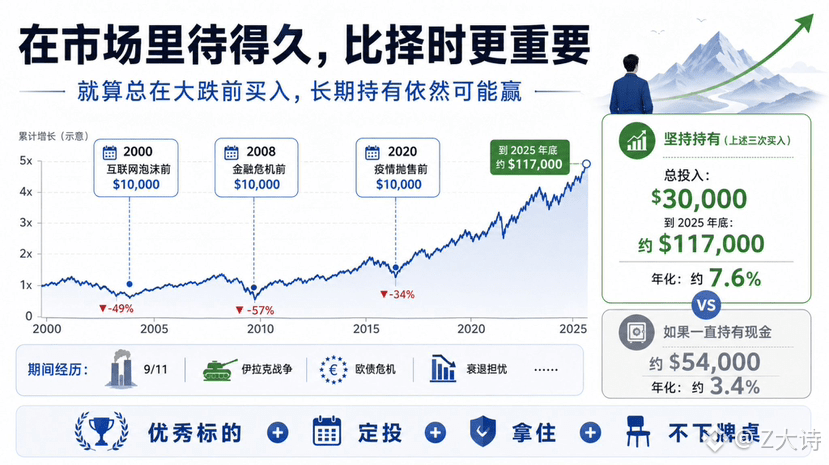
Vanguard Group @Vanguard_Group has created a fictional most unlucky investor, Steve. Every time, he buys right before a major drop.
Represented by the FTSE All-World Index:
- Invested $10,000 before the dot-com bubble burst in 2000
- Invested another $10,000 before the global financial crisis in 2008
- Invested another $10,000 before the COVID sell-off in 2020
Total investment: $30,000. After each purchase, the market fell by at least 20%. He holds throughout and never sells, with dividends reinvested.
By the end of 2025, $30,000 grows to about $117,000, an annualized return of about 7.6%.
If he had only held cash the whole time, it would be worth only about $54,000, an annualized return of about 3.4%.
Along the way, he also experienced multiple negative shocks such as 9/11, the Iraq War, the European sovereign debt crisis, credit rating downgrades, recession fears, and more—but over the long term it still significantly outperformed cash.
When facing an excellent target, all you need to do is invest regularly + hold on + stay on the table~
$QQQB $VOO.ETF
In front of an excellent target, even if you make the worst choice, in the end it won’t be that far off. In the market, the time you spend there matters more than timing.
Vanguard Group @Vanguard_Group has created a fictional most unlucky investor, Steve. Every time, he buys right before a major drop.
Represented by the FTSE All-World Index:
- Invested $10,000 before the dot-com bubble burst in 2000
- Invested another $10,000 before the global financial crisis in 2008
- Invested another $10,000 before the COVID sell-off in 2020
Total investment: $30,000. After each purchase, the market fell by at least 20%. He holds throughout and never sells, with dividends reinvested.
By the end of 2025, $30,000 grows to about $117,000, an annualized return of about 7.6%.
If he had only held cash the whole time, it would be worth only about $54,000, an annualized return of about 3.4%.
Along the way, he also experienced multiple negative shocks such as 9/11, the Iraq War, the European sovereign debt crisis, credit rating downgrades, recession fears, and more—but over the long term it still significantly outperformed cash.
When facing an excellent target, all you need to do is invest regularly + hold on + stay on the table~
$QQQB $VOO.ETF
Vanguard Group @Vanguard_Group has created a fictional most unlucky investor, Steve. Every time, he buys right before a major drop.
Represented by the FTSE All-World Index:
- Invested $10,000 before the dot-com bubble burst in 2000
- Invested another $10,000 before the global financial crisis in 2008
- Invested another $10,000 before the COVID sell-off in 2020
Total investment: $30,000. After each purchase, the market fell by at least 20%. He holds throughout and never sells, with dividends reinvested.
By the end of 2025, $30,000 grows to about $117,000, an annualized return of about 7.6%.
If he had only held cash the whole time, it would be worth only about $54,000, an annualized return of about 3.4%.
Along the way, he also experienced multiple negative shocks such as 9/11, the Iraq War, the European sovereign debt crisis, credit rating downgrades, recession fears, and more—but over the long term it still significantly outperformed cash.
When facing an excellent target, all you need to do is invest regularly + hold on + stay on the table~
$QQQB $VOO.ETF
QQQB+0.34%
VOOETF-0.34%
2
1
3k
·
--
Verified
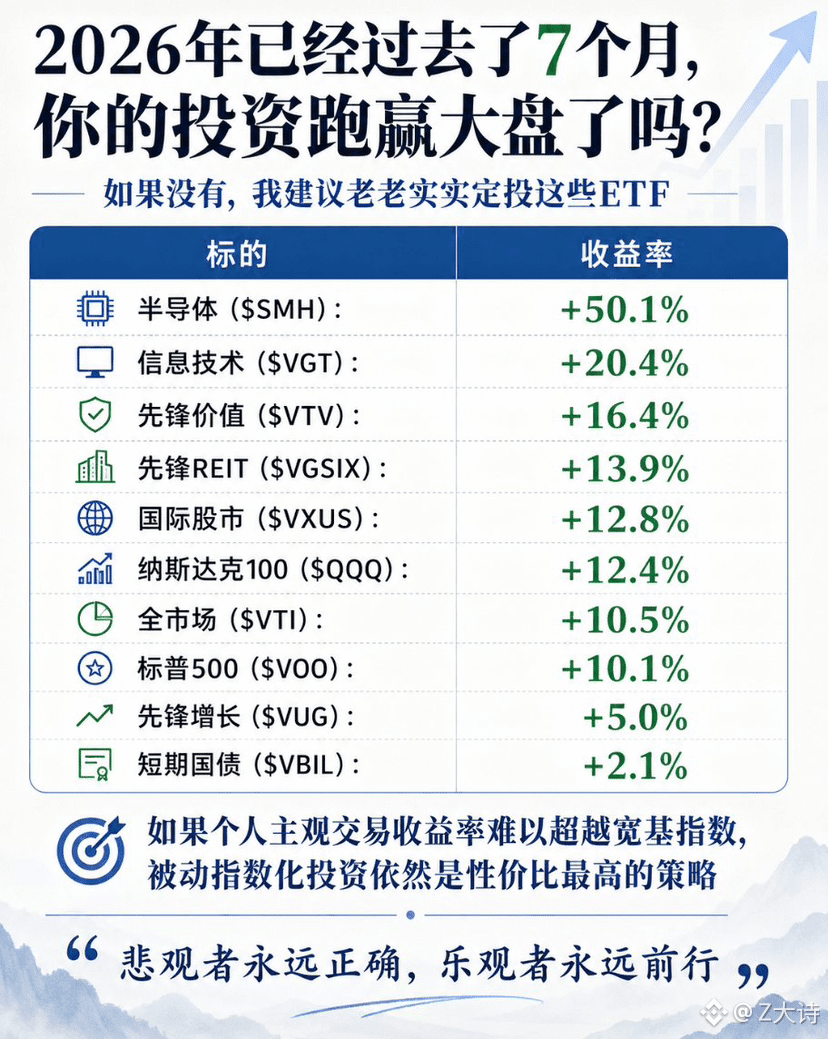
It’s been 7 months since 2026 began—did your investments outperform the broader market?
If not, I suggest you stick to investing regularly (DCA) into these ETFs
Assets Return
Semiconductors ($SMH ): +50.1%
Information Technology ($VGT.ETF ): +20.4%
Pioneer Value ($VTV.ETF ): +16.4%
Pioneer REIT ($VGSIX): +13.9%
International Stocks ($VXUS): +12.8%
Nasdaq 100 ($QQQ): +12.4%
Total Market ($VTI): +10.5%
S&P 500 ($VOO): +10.1%
Pioneer Growth ($VUG ): +5.0%
Short-term Treasuries ($VBIL): +2.1%
If it’s hard for individual discretionary traders to exceed broad-market index returns, passive index investing is still the most cost-effective strategy
The pessimists are always right, and the optimists always keep moving forward~
It’s been 7 months since 2026 began—did your investments outperform the broader market?
If not, I suggest you stick to investing regularly (DCA) into these ETFs
Assets Return
Semiconductors ($SMH ): +50.1%
Information Technology ($VGT.ETF ): +20.4%
Pioneer Value ($VTV.ETF ): +16.4%
Pioneer REIT ($VGSIX): +13.9%
International Stocks ($VXUS): +12.8%
Nasdaq 100 ($QQQ): +12.4%
Total Market ($VTI): +10.5%
S&P 500 ($VOO): +10.1%
Pioneer Growth ($VUG ): +5.0%
Short-term Treasuries ($VBIL): +2.1%
If it’s hard for individual discretionary traders to exceed broad-market index returns, passive index investing is still the most cost-effective strategy
The pessimists are always right, and the optimists always keep moving forward~
If not, I suggest you stick to investing regularly (DCA) into these ETFs
Assets Return
Semiconductors ($SMH ): +50.1%
Information Technology ($VGT.ETF ): +20.4%
Pioneer Value ($VTV.ETF ): +16.4%
Pioneer REIT ($VGSIX): +13.9%
International Stocks ($VXUS): +12.8%
Nasdaq 100 ($QQQ): +12.4%
Total Market ($VTI): +10.5%
S&P 500 ($VOO): +10.1%
Pioneer Growth ($VUG ): +5.0%
Short-term Treasuries ($VBIL): +2.1%
If it’s hard for individual discretionary traders to exceed broad-market index returns, passive index investing is still the most cost-effective strategy
The pessimists are always right, and the optimists always keep moving forward~
1
1
1.6k
·
--
Verified
Amazon’s earnings report exceeding expectations is here—what’s the right way to burn money on AI
Why, even though cash flow fell sharply, $AMZNB rose more than 9%, while $METAB dropped by 8%?
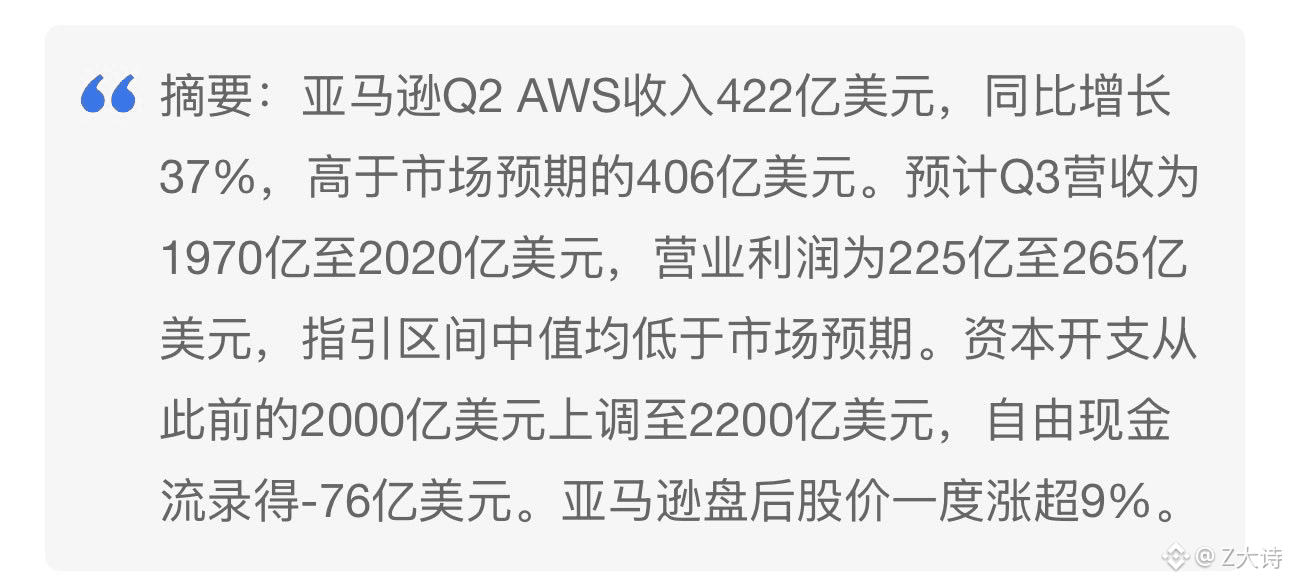
Amazon Q2 revenue was $200.6 billion (+20%), beating expectations; AWS revenue was $42.2 billion (+37%), the fastest growth in 18 quarters, far ahead of market expectations
The narrative is “strong demand → must increase investment → investment quickly turns into cloud revenue,” and the market buys it
Meta’s money-burning mainly serves internal ad optimization and long-term AI products, lacking immediate high-profit monetization
More investment is for internal enablement and long-term planning, but there isn’t enough of the short-term, visible “proof of returns”
Amazon is effective at burning money; Meta is ineffective
Capital isn’t stupid—some companies’ AI is just a bubble, while others can truly drive growth
The big rebound last night was finally comfortable and matched my expectations
Betting on AI + robotics for the next 10 years
Pessimists are always right, and optimists always keep moving forward~
Amazon’s earnings report exceeding expectations is here—what’s the right way to burn money on AI
Why, even though cash flow fell sharply, $AMZNB rose more than 9%, while $METAB dropped by 8%?
Amazon Q2 revenue was $200.6 billion (+20%), beating expectations; AWS revenue was $42.2 billion (+37%), the fastest growth in 18 quarters, far ahead of market expectations
The narrative is “strong demand → must increase investment → investment quickly turns into cloud revenue,” and the market buys it
Meta’s money-burning mainly serves internal ad optimization and long-term AI products, lacking immediate high-profit monetization
More investment is for internal enablement and long-term planning, but there isn’t enough of the short-term, visible “proof of returns”
Amazon is effective at burning money; Meta is ineffective
Capital isn’t stupid—some companies’ AI is just a bubble, while others can truly drive growth
The big rebound last night was finally comfortable and matched my expectations
Betting on AI + robotics for the next 10 years
Pessimists are always right, and optimists always keep moving forward~
Why, even though cash flow fell sharply, $AMZNB rose more than 9%, while $METAB dropped by 8%?
Amazon Q2 revenue was $200.6 billion (+20%), beating expectations; AWS revenue was $42.2 billion (+37%), the fastest growth in 18 quarters, far ahead of market expectations
The narrative is “strong demand → must increase investment → investment quickly turns into cloud revenue,” and the market buys it
Meta’s money-burning mainly serves internal ad optimization and long-term AI products, lacking immediate high-profit monetization
More investment is for internal enablement and long-term planning, but there isn’t enough of the short-term, visible “proof of returns”
Amazon is effective at burning money; Meta is ineffective
Capital isn’t stupid—some companies’ AI is just a bubble, while others can truly drive growth
The big rebound last night was finally comfortable and matched my expectations
Betting on AI + robotics for the next 10 years
Pessimists are always right, and optimists always keep moving forward~
3
5
4.3k
·
--
Verified
SK Hynix Q2 earnings data is explosive! Two key metrics both hit quarterly records, and the after-hours stock price rebounded more than 5%
KOSPI gains expanded to 3%
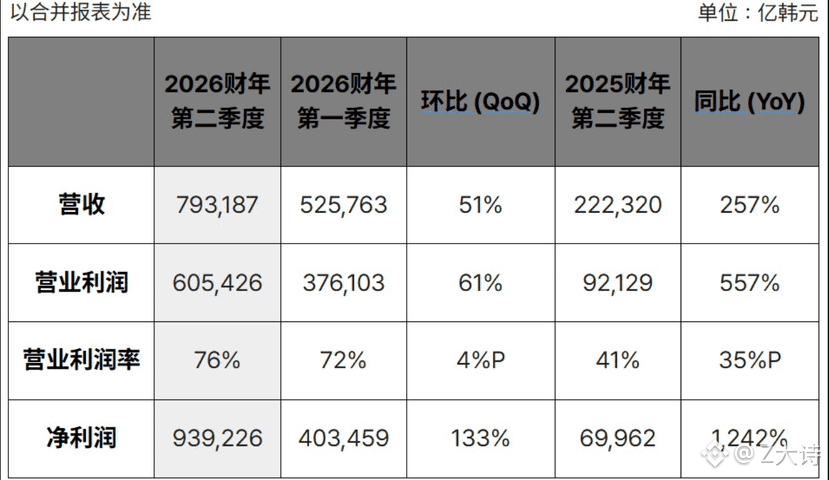
- Revenue: KRW 79.3187 trillion (about $57.5 billion), up 257% year over year, and +51% quarter over quarter
- Operating profit: KRW 60.5426 trillion, up 557% year over year, and +61% quarter over quarter; operating margin reached 76.3% (Q1: 71.5%)
- Net profit: KRW 93.9226 trillion, up more than 12 times year over year; net margin 118%
But it misses expectations a bit: expected revenue was about KRW 83.9–84 trillion, and operating profit about KRW 64 trillion
The main reason is that earlier LTA (long-term agreement) pricing for HBM locked in the price; DRAM and NAND saw larger price increases, but due to capacity constraints, shipment volumes declined
Outlook remains positive $SKHYB
HBM4 began large-scale shipments in Q2, and in the second half it will further accelerate volume ramp-up; HBM4E samples have been delivered
Overall, absolute performance is still off the charts, but the “high expectations falling short” has triggered short-term sentiment swings
Things have been a bit turbulent lately—those looking to buy the dip may want to wait a bit longer
SK Hynix Q2 earnings data is explosive! Two key metrics both hit quarterly records, and the after-hours stock price rebounded more than 5%
KOSPI gains expanded to 3%
- Revenue: KRW 79.3187 trillion (about $57.5 billion), up 257% year over year, and +51% quarter over quarter
- Operating profit: KRW 60.5426 trillion, up 557% year over year, and +61% quarter over quarter; operating margin reached 76.3% (Q1: 71.5%)
- Net profit: KRW 93.9226 trillion, up more than 12 times year over year; net margin 118%
But it misses expectations a bit: expected revenue was about KRW 83.9–84 trillion, and operating profit about KRW 64 trillion
The main reason is that earlier LTA (long-term agreement) pricing for HBM locked in the price; DRAM and NAND saw larger price increases, but due to capacity constraints, shipment volumes declined
Outlook remains positive $SKHYB
HBM4 began large-scale shipments in Q2, and in the second half it will further accelerate volume ramp-up; HBM4E samples have been delivered
Overall, absolute performance is still off the charts, but the “high expectations falling short” has triggered short-term sentiment swings
Things have been a bit turbulent lately—those looking to buy the dip may want to wait a bit longer
KOSPI gains expanded to 3%
- Revenue: KRW 79.3187 trillion (about $57.5 billion), up 257% year over year, and +51% quarter over quarter
- Operating profit: KRW 60.5426 trillion, up 557% year over year, and +61% quarter over quarter; operating margin reached 76.3% (Q1: 71.5%)
- Net profit: KRW 93.9226 trillion, up more than 12 times year over year; net margin 118%
But it misses expectations a bit: expected revenue was about KRW 83.9–84 trillion, and operating profit about KRW 64 trillion
The main reason is that earlier LTA (long-term agreement) pricing for HBM locked in the price; DRAM and NAND saw larger price increases, but due to capacity constraints, shipment volumes declined
Outlook remains positive $SKHYB
HBM4 began large-scale shipments in Q2, and in the second half it will further accelerate volume ramp-up; HBM4E samples have been delivered
Overall, absolute performance is still off the charts, but the “high expectations falling short” has triggered short-term sentiment swings
Things have been a bit turbulent lately—those looking to buy the dip may want to wait a bit longer
1
2.6k
·
--
With the release of Kimi K3 this time, I think I may have found a way for Chinese open-source model companies to make money!
American model companies raise funds and profit from the stock market by rolling out each new SOTA model. Even if they’re not publicly listed, they still have a favorable financing environment.
But for Chinese open-source large model companies, their coding plans are absolutely unprofitable.
So could there be a possibility?
By releasing models each time that come close to the top-tier, we could short the stocks of US model-related companies in advance!
“Anyway, we don’t make money from the model itself. Our current subscriptions just slightly subsidize the cost of training our model and buying GPUs.”
After the K3 release, within the four trading days from 7/16 to 7/20:
Anthropic: -16.27%
OpenAI: -17.04%
Zhipu: -57.36%
MiniMax: -28%
I wonder whether DeepSeek used this kind of method to short $NVDAB
Given that Liang Wenfeng came from a quantitative background, he probably already did something like this.
I only just figured it out now—it seems my sense of smell isn’t quite sensitive enough.
With the release of Kimi K3 this time, I think I may have found a way for Chinese open-source model companies to make money!
American model companies raise funds and profit from the stock market by rolling out each new SOTA model. Even if they’re not publicly listed, they still have a favorable financing environment.
But for Chinese open-source large model companies, their coding plans are absolutely unprofitable.
So could there be a possibility?
By releasing models each time that come close to the top-tier, we could short the stocks of US model-related companies in advance!
“Anyway, we don’t make money from the model itself. Our current subscriptions just slightly subsidize the cost of training our model and buying GPUs.”
After the K3 release, within the four trading days from 7/16 to 7/20:
Anthropic: -16.27%
OpenAI: -17.04%
Zhipu: -57.36%
MiniMax: -28%
I wonder whether DeepSeek used this kind of method to short $NVDAB
Given that Liang Wenfeng came from a quantitative background, he probably already did something like this.
I only just figured it out now—it seems my sense of smell isn’t quite sensitive enough.
American model companies raise funds and profit from the stock market by rolling out each new SOTA model. Even if they’re not publicly listed, they still have a favorable financing environment.
But for Chinese open-source large model companies, their coding plans are absolutely unprofitable.
So could there be a possibility?
By releasing models each time that come close to the top-tier, we could short the stocks of US model-related companies in advance!
“Anyway, we don’t make money from the model itself. Our current subscriptions just slightly subsidize the cost of training our model and buying GPUs.”
After the K3 release, within the four trading days from 7/16 to 7/20:
Anthropic: -16.27%
OpenAI: -17.04%
Zhipu: -57.36%
MiniMax: -28%
I wonder whether DeepSeek used this kind of method to short $NVDAB
Given that Liang Wenfeng came from a quantitative background, he probably already did something like this.
I only just figured it out now—it seems my sense of smell isn’t quite sensitive enough.
1
6
4.4k
·
--
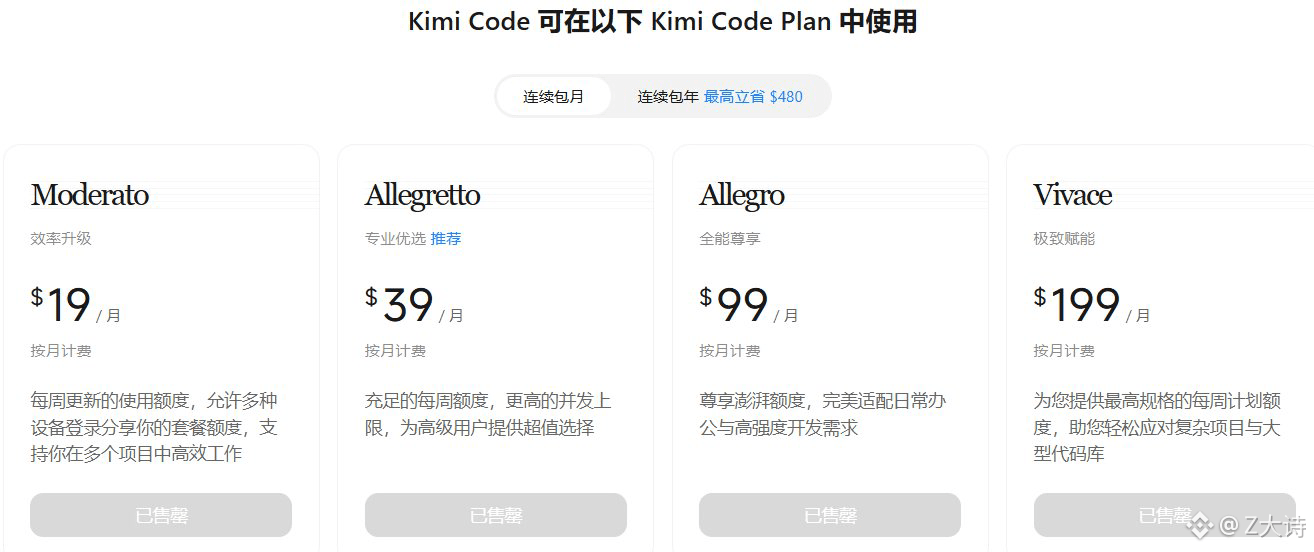
Kimi has already paused subscriptions for new C-end users, and you’re still saying compute power is excessive?
This is clearly the “Jevons paradox”: the more useful and cheaper something is, the more it drives consumer demand, causing total demand to keep rising
Current parameter counts for mainstream models:
GPT-5.6 Sol - not disclosed
Fable5 - not disclosed
Kimi K3 - 2.8T
Qwen 3.8 - 2.4T
DeepSeek V4 - 1.6T
The parameter counts of top-tier models are already in the 2–3 trillion range; future models will only get bigger
K3 proves one thing: models can quickly catch up, but AI infrastructure—storage capacity expansion is slow, data center construction is slow, and power supply build-out is slow
As long as the infrastructure development pace can’t keep up with the growth rate of model parameter counts, it will still be a period of mismatch
Once you’re on the train, don’t get off too easily—but remember to control your position size
Buy when it’s low; everything else is just noise~
$SKHYB $MUB
Kimi has already paused subscriptions for new C-end users, and you’re still saying compute power is excessive?
This is clearly the “Jevons paradox”: the more useful and cheaper something is, the more it drives consumer demand, causing total demand to keep rising
Current parameter counts for mainstream models:
GPT-5.6 Sol - not disclosed
Fable5 - not disclosed
Kimi K3 - 2.8T
Qwen 3.8 - 2.4T
DeepSeek V4 - 1.6T
The parameter counts of top-tier models are already in the 2–3 trillion range; future models will only get bigger
K3 proves one thing: models can quickly catch up, but AI infrastructure—storage capacity expansion is slow, data center construction is slow, and power supply build-out is slow
As long as the infrastructure development pace can’t keep up with the growth rate of model parameter counts, it will still be a period of mismatch
Once you’re on the train, don’t get off too easily—but remember to control your position size
Buy when it’s low; everything else is just noise~
$SKHYB $MUB
This is clearly the “Jevons paradox”: the more useful and cheaper something is, the more it drives consumer demand, causing total demand to keep rising
Current parameter counts for mainstream models:
GPT-5.6 Sol - not disclosed
Fable5 - not disclosed
Kimi K3 - 2.8T
Qwen 3.8 - 2.4T
DeepSeek V4 - 1.6T
The parameter counts of top-tier models are already in the 2–3 trillion range; future models will only get bigger
K3 proves one thing: models can quickly catch up, but AI infrastructure—storage capacity expansion is slow, data center construction is slow, and power supply build-out is slow
As long as the infrastructure development pace can’t keep up with the growth rate of model parameter counts, it will still be a period of mismatch
Once you’re on the train, don’t get off too easily—but remember to control your position size
Buy when it’s low; everything else is just noise~
$SKHYB $MUB

1
3
5.1k
·
--
They’re not even acting anymore—they’re directly demanding profit-sharing from Samsung and SK Hynix
It’s all because you two brothers made too much… or were it stolen, it’s still fast!
The reason given is that the U.S. “supported business and created prosperity”
The USTR representative publicly argued that the demand for profit-sharing is “fair and reasonable”
Tech profits that lack national military backing are destined to be forcibly harvested by hegemony
South Korea can only swallow this bitter pill
With no change in the fundamentals, things are already massively undervalued
But once profit-sharing is agreed, memory prices will rise again!
buy the dip bro~ $SKHYB $MUB
They’re not even acting anymore—they’re directly demanding profit-sharing from Samsung and SK Hynix
It’s all because you two brothers made too much… or were it stolen, it’s still fast!
The reason given is that the U.S. “supported business and created prosperity”
The USTR representative publicly argued that the demand for profit-sharing is “fair and reasonable”
Tech profits that lack national military backing are destined to be forcibly harvested by hegemony
South Korea can only swallow this bitter pill
With no change in the fundamentals, things are already massively undervalued
But once profit-sharing is agreed, memory prices will rise again!
buy the dip bro~ $SKHYB $MUB
It’s all because you two brothers made too much… or were it stolen, it’s still fast!
The reason given is that the U.S. “supported business and created prosperity”
The USTR representative publicly argued that the demand for profit-sharing is “fair and reasonable”
Tech profits that lack national military backing are destined to be forcibly harvested by hegemony
South Korea can only swallow this bitter pill
With no change in the fundamentals, things are already massively undervalued
But once profit-sharing is agreed, memory prices will rise again!
buy the dip bro~ $SKHYB $MUB
1
7
14.7k
·
--
Verified
Practical tips! The first indicator of U.S. stock market macro analysis — the Federal Funds Rate
Put simply, it’s the interest rate at which U.S. banks lend to each other for overnight borrowing of idle funds.
All U.S. banks have to hold reserve funds with the Federal Reserve. Some banks have excess money, while others don’t have enough to cover day-to-day operations. The interest rate for lending surplus funds is the Federal Funds Rate.
It doesn’t directly give loans to ordinary people, but it’s the master control switch for global dollar liquidity. It governs everything from mortgage rates, corporate loans, U.S. Treasuries, U.S. stocks, and the dollar exchange rate—basically the rise and fall of nearly all overseas assets.
When the Federal Reserve hikes or cuts rates, it’s adjusting this benchmark rate to control the global supply of money—how tight or loose it is—and thus the temperature of the economy.
Rate hike = tightening: money gets more expensive, U.S. Treasuries fall, the dollar strengthens, inflation is suppressed, and the stock market faces pressure.
Rate cut = easing: money gets cheaper, U.S. Treasuries rise, the dollar weakens, the economy gets support, and stocks benefit.
That’s also why, when CPI fell a few days ago, the market’s expectations for future rate hikes dropped, and U.S. stocks strengthened that same night.
Practical tips! The first indicator of U.S. stock market macro analysis — the Federal Funds Rate
Put simply, it’s the interest rate at which U.S. banks lend to each other for overnight borrowing of idle funds.
All U.S. banks have to hold reserve funds with the Federal Reserve. Some banks have excess money, while others don’t have enough to cover day-to-day operations. The interest rate for lending surplus funds is the Federal Funds Rate.
It doesn’t directly give loans to ordinary people, but it’s the master control switch for global dollar liquidity. It governs everything from mortgage rates, corporate loans, U.S. Treasuries, U.S. stocks, and the dollar exchange rate—basically the rise and fall of nearly all overseas assets.
When the Federal Reserve hikes or cuts rates, it’s adjusting this benchmark rate to control the global supply of money—how tight or loose it is—and thus the temperature of the economy.
Rate hike = tightening: money gets more expensive, U.S. Treasuries fall, the dollar strengthens, inflation is suppressed, and the stock market faces pressure.
Rate cut = easing: money gets cheaper, U.S. Treasuries rise, the dollar weakens, the economy gets support, and stocks benefit.
That’s also why, when CPI fell a few days ago, the market’s expectations for future rate hikes dropped, and U.S. stocks strengthened that same night.
Put simply, it’s the interest rate at which U.S. banks lend to each other for overnight borrowing of idle funds.
All U.S. banks have to hold reserve funds with the Federal Reserve. Some banks have excess money, while others don’t have enough to cover day-to-day operations. The interest rate for lending surplus funds is the Federal Funds Rate.
It doesn’t directly give loans to ordinary people, but it’s the master control switch for global dollar liquidity. It governs everything from mortgage rates, corporate loans, U.S. Treasuries, U.S. stocks, and the dollar exchange rate—basically the rise and fall of nearly all overseas assets.
When the Federal Reserve hikes or cuts rates, it’s adjusting this benchmark rate to control the global supply of money—how tight or loose it is—and thus the temperature of the economy.
Rate hike = tightening: money gets more expensive, U.S. Treasuries fall, the dollar strengthens, inflation is suppressed, and the stock market faces pressure.
Rate cut = easing: money gets cheaper, U.S. Treasuries rise, the dollar weakens, the economy gets support, and stocks benefit.
That’s also why, when CPI fell a few days ago, the market’s expectations for future rate hikes dropped, and U.S. stocks strengthened that same night.

1
5
4.2k
·
--
Verified
First, a conclusion: these past few days, Nokia $NOKB has been unfairly targeted—no need to panic.
Recently, it has secured orders from tech giants such as Google and Amazon. The fundamentals for AI optical communications are generally positive. The main reason it’s getting hit is that an old competitor, Ericsson, has dragged the market down.
Ericsson’s Q2 earnings report isn’t very encouraging: total sales fell 6% year over year.
First, demand for traditional network equipment in Europe and the U.S. has indeed been slowing.
Second, tech giants are aggressively expanding AI data centers, which has driven up prices for components such as memory and custom chips, severely squeezing profit margins.
People worry Nokia may face the same awkward situation of “revenue growing but profits not,” too.
However, the two companies’ core valuations are already different.
Ericsson currently has about 63% of its revenue still tied up in traditional wireless networks, while Nokia’s share in that segment has dropped to around 35%.
Nokia’s real ace right now is the optical communications space. Especially after acquiring Infinera, it now has a complete portfolio of optical networking products. The recent linked selloff is more of an emotion-driven release.
The key next step is to wait for Nokia’s own earnings guidance on July 23rd.
First, a conclusion: these past few days, Nokia $NOKB has been unfairly targeted—no need to panic.
Recently, it has secured orders from tech giants such as Google and Amazon. The fundamentals for AI optical communications are generally positive. The main reason it’s getting hit is that an old competitor, Ericsson, has dragged the market down.
Ericsson’s Q2 earnings report isn’t very encouraging: total sales fell 6% year over year.
First, demand for traditional network equipment in Europe and the U.S. has indeed been slowing.
Second, tech giants are aggressively expanding AI data centers, which has driven up prices for components such as memory and custom chips, severely squeezing profit margins.
People worry Nokia may face the same awkward situation of “revenue growing but profits not,” too.
However, the two companies’ core valuations are already different.
Ericsson currently has about 63% of its revenue still tied up in traditional wireless networks, while Nokia’s share in that segment has dropped to around 35%.
Nokia’s real ace right now is the optical communications space. Especially after acquiring Infinera, it now has a complete portfolio of optical networking products. The recent linked selloff is more of an emotion-driven release.
The key next step is to wait for Nokia’s own earnings guidance on July 23rd.
Recently, it has secured orders from tech giants such as Google and Amazon. The fundamentals for AI optical communications are generally positive. The main reason it’s getting hit is that an old competitor, Ericsson, has dragged the market down.
Ericsson’s Q2 earnings report isn’t very encouraging: total sales fell 6% year over year.
First, demand for traditional network equipment in Europe and the U.S. has indeed been slowing.
Second, tech giants are aggressively expanding AI data centers, which has driven up prices for components such as memory and custom chips, severely squeezing profit margins.
People worry Nokia may face the same awkward situation of “revenue growing but profits not,” too.
However, the two companies’ core valuations are already different.
Ericsson currently has about 63% of its revenue still tied up in traditional wireless networks, while Nokia’s share in that segment has dropped to around 35%.
Nokia’s real ace right now is the optical communications space. Especially after acquiring Infinera, it now has a complete portfolio of optical networking products. The recent linked selloff is more of an emotion-driven release.
The key next step is to wait for Nokia’s own earnings guidance on July 23rd.
2
6.1k
·
--
Verified
Article
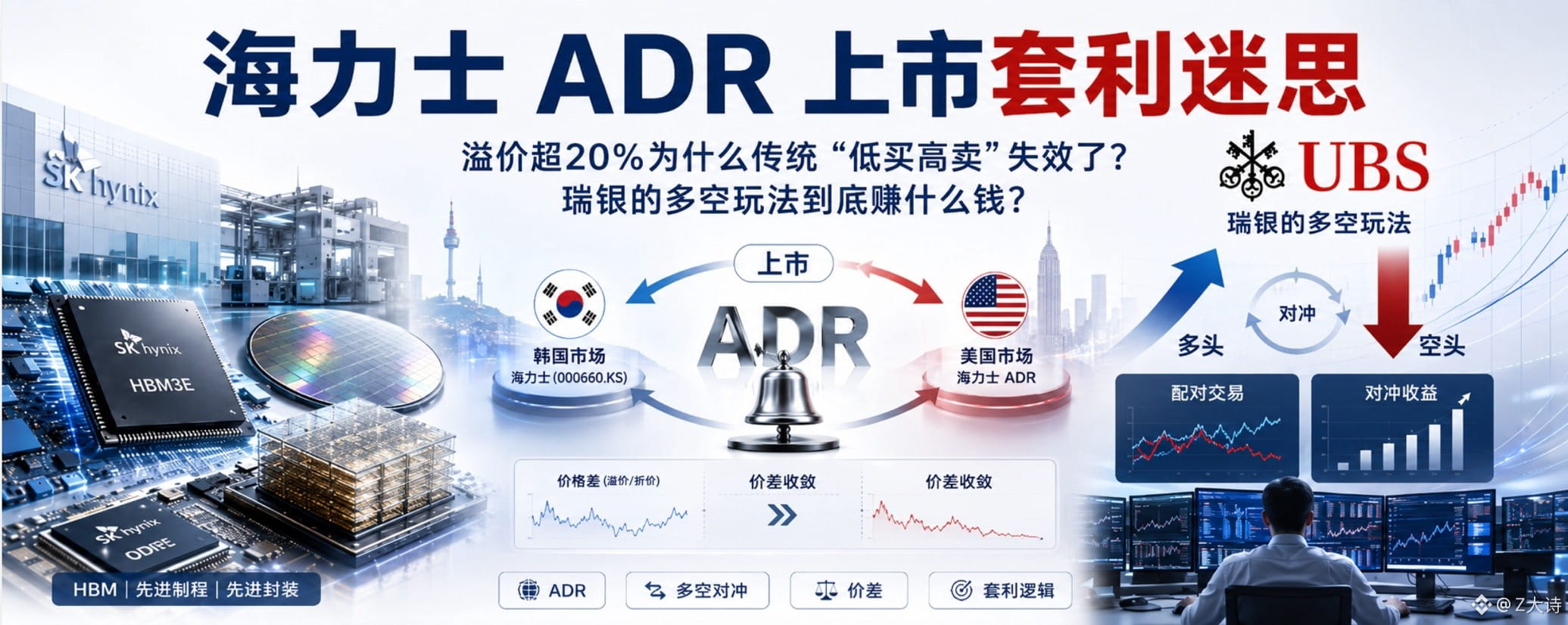
Why would SK hynix lose money using traditional arbitrage methods?First, we need to understand why there is a premium?
On the one hand, the US stock market serves as the world’s largest pool of capital. Massive theme funds constrained by compliance rules cannot directly buy Korean stocks, so they flow in. This “more money than shares” situation creates a liquidity premium;
On the other hand, in the US stock market, SK hynix has broken free from the “Korean discount” of low P/E multiples and instead directly benchmarks against industry giants like Micron, gaining a valuation re-rating premium;
ADRs are priced in US dollars and trade seamlessly in sync with US stocks. To avoid the cumbersome friction of cross-border account opening, currency exchange, and compliance reviews, investors are willing to pay the extra spread for this convenience $SKHYB
Why would SK hynix lose money using traditional arbitrage methods?
First, we need to understand why there is a premium?
On the one hand, the US stock market serves as the world’s largest pool of capital. Massive theme funds constrained by compliance rules cannot directly buy Korean stocks, so they flow in. This “more money than shares” situation creates a liquidity premium;
On the other hand, in the US stock market, SK hynix has broken free from the “Korean discount” of low P/E multiples and instead directly benchmarks against industry giants like Micron, gaining a valuation re-rating premium;
ADRs are priced in US dollars and trade seamlessly in sync with US stocks. To avoid the cumbersome friction of cross-border account opening, currency exchange, and compliance reviews, investors are willing to pay the extra spread for this convenience $SKHYB
On the one hand, the US stock market serves as the world’s largest pool of capital. Massive theme funds constrained by compliance rules cannot directly buy Korean stocks, so they flow in. This “more money than shares” situation creates a liquidity premium;
On the other hand, in the US stock market, SK hynix has broken free from the “Korean discount” of low P/E multiples and instead directly benchmarks against industry giants like Micron, gaining a valuation re-rating premium;
ADRs are priced in US dollars and trade seamlessly in sync with US stocks. To avoid the cumbersome friction of cross-border account opening, currency exchange, and compliance reviews, investors are willing to pay the extra spread for this convenience $SKHYB
3
9.2k
·
--
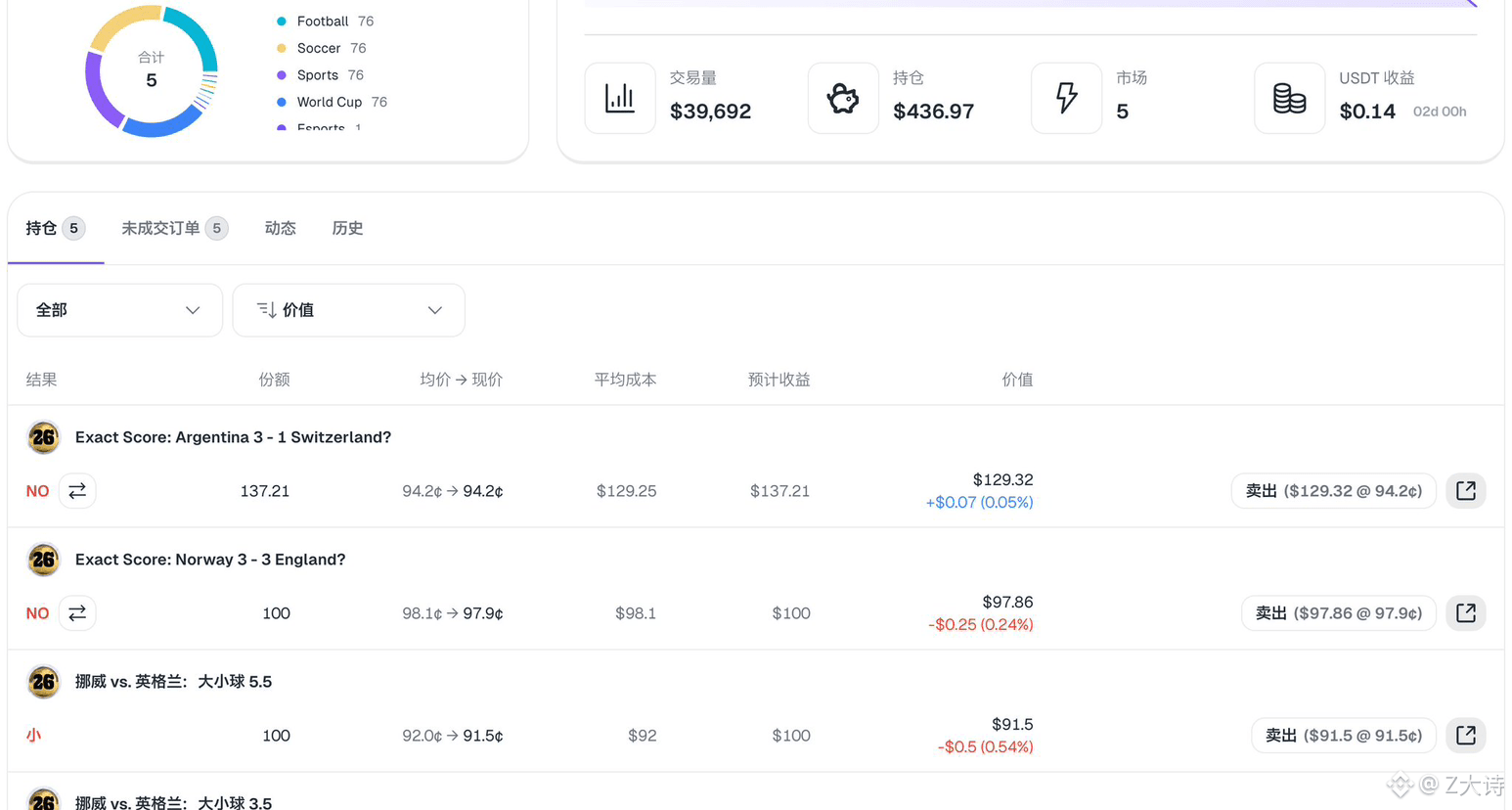
My Predictfun script has been running for three days—sharing the issues I encountered
So far, I’ve done 39k in trading volume and made a profit of 4u
During the run, I still ran into quite a few problems:
- Previously, market scanning and the buy order placement/maintenance process were sequential. The maintenance frequency for buy orders was unstable, which sometimes led to getting eaten more orders.
After splitting it into two threads to maintain separately, the results improved significantly
- The setting for the order-portion allocation relative to total assets was too high. As a result, once some orders were filled, there wasn’t enough available capital left to cover the amount required for other orders, so the system would automatically cancel them.
I recommend setting the order amount ratio to the total assets as 1 : 4
- When the轮训 (round-robin) maintenance frequency for the buy orders is set too high, it frequently cancels and re-lists orders. The order duration becomes too short, and the成交 (filled) quantity becomes too small. According to the official rules, even if the order volume is large but it almost doesn’t get filled, it will be considered a “ghost order,” and you won’t receive points either.
I tested it several times: a轮训 frequency of 30 seconds per round is the best—neither does it get filled too much, and it can still place more orders in the market as much as possible, improving capital utilization
Run it for a few more days and see how it goes. If it works well, you might consider adding more capital~
@Predict
My Predictfun script has been running for three days—sharing the issues I encountered
So far, I’ve done 39k in trading volume and made a profit of 4u
During the run, I still ran into quite a few problems:
- Previously, market scanning and the buy order placement/maintenance process were sequential. The maintenance frequency for buy orders was unstable, which sometimes led to getting eaten more orders.
After splitting it into two threads to maintain separately, the results improved significantly
- The setting for the order-portion allocation relative to total assets was too high. As a result, once some orders were filled, there wasn’t enough available capital left to cover the amount required for other orders, so the system would automatically cancel them.
I recommend setting the order amount ratio to the total assets as 1 : 4
- When the轮训 (round-robin) maintenance frequency for the buy orders is set too high, it frequently cancels and re-lists orders. The order duration becomes too short, and the成交 (filled) quantity becomes too small. According to the official rules, even if the order volume is large but it almost doesn’t get filled, it will be considered a “ghost order,” and you won’t receive points either.
I tested it several times: a轮训 frequency of 30 seconds per round is the best—neither does it get filled too much, and it can still place more orders in the market as much as possible, improving capital utilization
Run it for a few more days and see how it goes. If it works well, you might consider adding more capital~
@Predictdotfun
So far, I’ve done 39k in trading volume and made a profit of 4u
During the run, I still ran into quite a few problems:
- Previously, market scanning and the buy order placement/maintenance process were sequential. The maintenance frequency for buy orders was unstable, which sometimes led to getting eaten more orders.
After splitting it into two threads to maintain separately, the results improved significantly
- The setting for the order-portion allocation relative to total assets was too high. As a result, once some orders were filled, there wasn’t enough available capital left to cover the amount required for other orders, so the system would automatically cancel them.
I recommend setting the order amount ratio to the total assets as 1 : 4
- When the轮训 (round-robin) maintenance frequency for the buy orders is set too high, it frequently cancels and re-lists orders. The order duration becomes too short, and the成交 (filled) quantity becomes too small. According to the official rules, even if the order volume is large but it almost doesn’t get filled, it will be considered a “ghost order,” and you won’t receive points either.
I tested it several times: a轮训 frequency of 30 seconds per round is the best—neither does it get filled too much, and it can still place more orders in the market as much as possible, improving capital utilization
Run it for a few more days and see how it goes. If it works well, you might consider adding more capital~
@Predictdotfun
12
1
15
9.8k
·
--
Verified
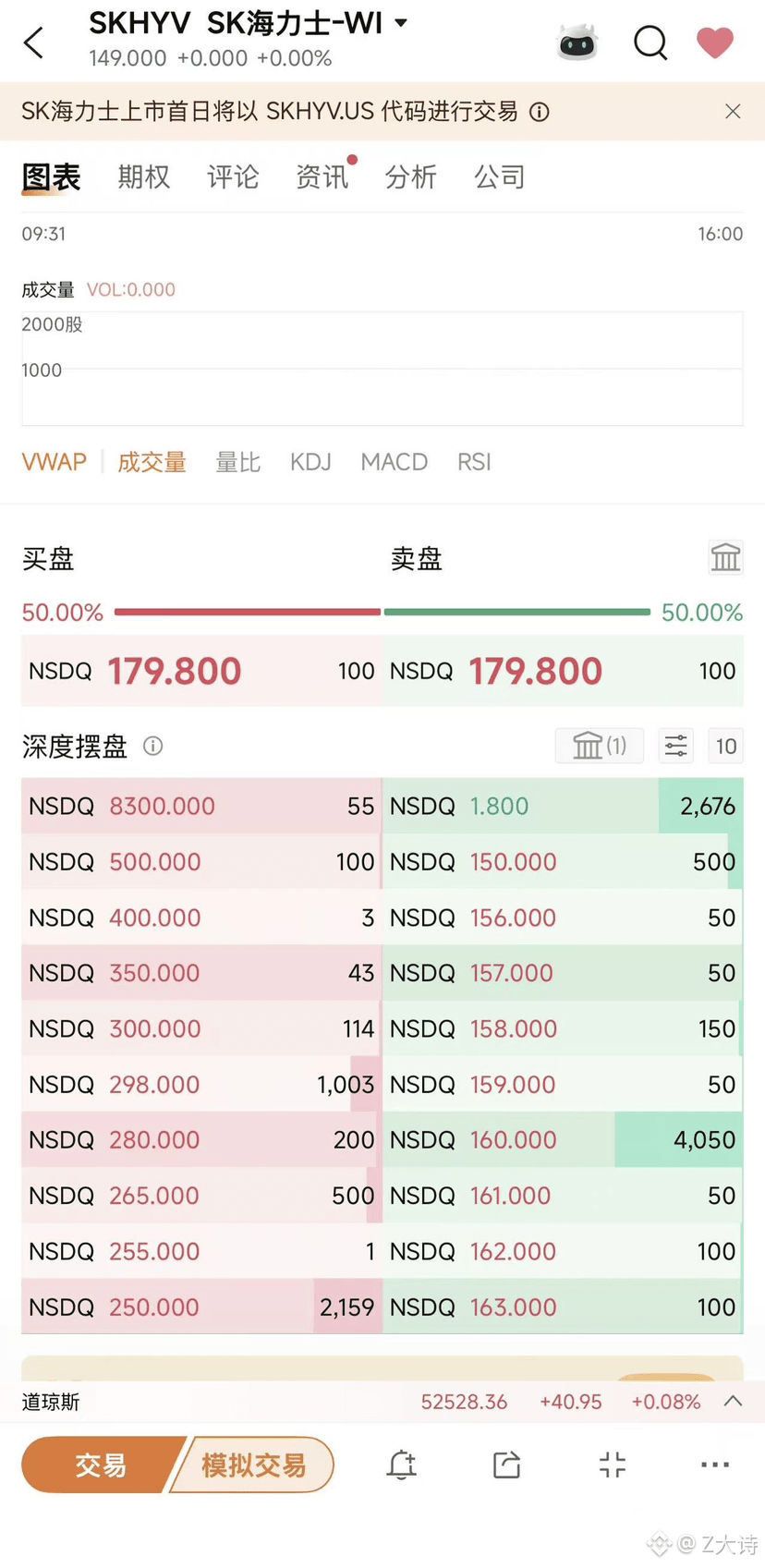
SK hynix's official ADR, over-the-counter open up 180!
The subscription price is only 149, and the over-the-counter market immediately takes 20%
Converted to Korea, that's 2.46 million KRW, but today the underlying stock is only 2.18 million—Wall Street is eating like crazy
If you’re trading stocks based on the news, your returns aren’t as good as just doing stable wealth management
I already said it clearly: it was obviously suppressing the stock price in the early stage to get low-cost shares, then at the time of the opening, make you pump it up
But $DRAM didn’t follow through on this—I’m curious. Even though the US stock itself trades at a premium, it shouldn’t not go up, right? Will the effect only show up during settlement?
On Monday, get back to 250 for me, bro~
SK hynix's official ADR, over-the-counter open up 180!
The subscription price is only 149, and the over-the-counter market immediately takes 20%
Converted to Korea, that's 2.46 million KRW, but today the underlying stock is only 2.18 million—Wall Street is eating like crazy
If you’re trading stocks based on the news, your returns aren’t as good as just doing stable wealth management
I already said it clearly: it was obviously suppressing the stock price in the early stage to get low-cost shares, then at the time of the opening, make you pump it up
But $DRAM didn’t follow through on this—I’m curious. Even though the US stock itself trades at a premium, it shouldn’t not go up, right? Will the effect only show up during settlement?
On Monday, get back to 250 for me, bro~
The subscription price is only 149, and the over-the-counter market immediately takes 20%
Converted to Korea, that's 2.46 million KRW, but today the underlying stock is only 2.18 million—Wall Street is eating like crazy
If you’re trading stocks based on the news, your returns aren’t as good as just doing stable wealth management
I already said it clearly: it was obviously suppressing the stock price in the early stage to get low-cost shares, then at the time of the opening, make you pump it up
But $DRAM didn’t follow through on this—I’m curious. Even though the US stock itself trades at a premium, it shouldn’t not go up, right? Will the effect only show up during settlement?
On Monday, get back to 250 for me, bro~
1
4
10k
·
--
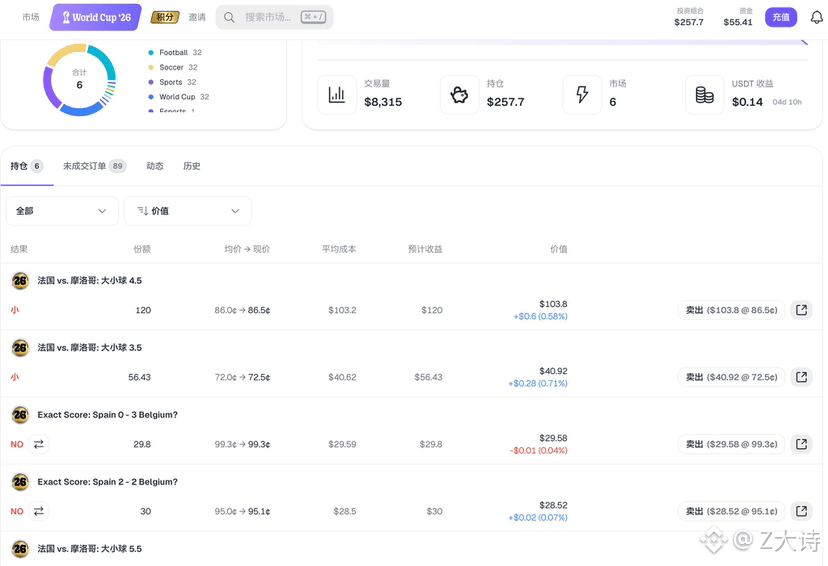
人类对Codex的开发不足1%!
I just got the API yesterday and spent a little time making a limit-order posting script.
Total initial assets: 311.8u
I ran it all night and got around 8k in trading volume, earning 1.31u
With such an integration cost, it's basically negative.
The main reason is that the platform’s liquidity is awesome right now.
There are quite a few things to consider when building a script like this:
- Which tasks can run concurrently, and which actions must be sequential?
Reading can be concurrent, but submitting orders and canceling them should be sequential. Otherwise it’s easy to get into situations where one thread places an order and another thread mistakenly deletes/cancels it, or duplicates an order.
- Should BUY and SELL be split into different threads?
BUY needs to scan the market and order book, so it’s relatively slow; SELL needs to monitor account positions and respond quickly. If you split them, SELL won’t be blocked by BUY’s full market scan.
- How should the local state be designed?
You can’t rely only on API open orders, because exchange state isn’t instantly consistent. After create order succeeds, open orders might only be queryable seconds later. The local state needs to handle short-term deduplication, prevent duplicate submissions, and avoid accidental cleanup.
- How to handle eventual consistency?
A newly created order shouldn’t be treated as invalid just because you can’t find it in open orders in the next second. You need a waiting window—say 30–60 seconds—to prevent the account-sync thread from mistakenly clearing the new order.
- How do you get the order price?
Reverse outcomes like Yes/No and Over/Under are very easy to compute incorrectly. Especially for SELL, it’s best to use the current position’s bestAsk outcome, rather than blindly taking the Yes side order book and trying to complement it.
- How to handle share precision?
A frontend display of 17.86 doesn’t mean the real number of shares that can be sold is also 17.86. The order quantity must be truncated downward; you can’t round, otherwise you may hit insufficient shares.
- How to classify API exceptions?
hash mismatch, insufficient balance, insufficient shares, remote disconnect, response truncation, order-sync delays—each requires a different handling approach. You can’t just keep retrying indefinitely.
- How to write the risk-control boundaries?
No market selling, don’t take liquidity, post-only, limit the BUY range, cancel buy orders before the round starts—these should all be turned into hard constraints in code.
It’s not like once you have AI you can casually build a system that’s stable and reliably deliverable long-term. You still must take the engineering approach: do thorough stability testing and risk control.
If you’re interested, let’s connect and exchange ideas together~
@Predict
人类对Codex的开发不足1%!
I just got the API yesterday and spent a little time making a limit-order posting script.
Total initial assets: 311.8u
I ran it all night and got around 8k in trading volume, earning 1.31u
With such an integration cost, it's basically negative.
The main reason is that the platform’s liquidity is awesome right now.
There are quite a few things to consider when building a script like this:
- Which tasks can run concurrently, and which actions must be sequential?
Reading can be concurrent, but submitting orders and canceling them should be sequential. Otherwise it’s easy to get into situations where one thread places an order and another thread mistakenly deletes/cancels it, or duplicates an order.
- Should BUY and SELL be split into different threads?
BUY needs to scan the market and order book, so it’s relatively slow; SELL needs to monitor account positions and respond quickly. If you split them, SELL won’t be blocked by BUY’s full market scan.
- How should the local state be designed?
You can’t rely only on API open orders, because exchange state isn’t instantly consistent. After create order succeeds, open orders might only be queryable seconds later. The local state needs to handle short-term deduplication, prevent duplicate submissions, and avoid accidental cleanup.
- How to handle eventual consistency?
A newly created order shouldn’t be treated as invalid just because you can’t find it in open orders in the next second. You need a waiting window—say 30–60 seconds—to prevent the account-sync thread from mistakenly clearing the new order.
- How do you get the order price?
Reverse outcomes like Yes/No and Over/Under are very easy to compute incorrectly. Especially for SELL, it’s best to use the current position’s bestAsk outcome, rather than blindly taking the Yes side order book and trying to complement it.
- How to handle share precision?
A frontend display of 17.86 doesn’t mean the real number of shares that can be sold is also 17.86. The order quantity must be truncated downward; you can’t round, otherwise you may hit insufficient shares.
- How to classify API exceptions?
hash mismatch, insufficient balance, insufficient shares, remote disconnect, response truncation, order-sync delays—each requires a different handling approach. You can’t just keep retrying indefinitely.
- How to write the risk-control boundaries?
No market selling, don’t take liquidity, post-only, limit the BUY range, cancel buy orders before the round starts—these should all be turned into hard constraints in code.
It’s not like once you have AI you can casually build a system that’s stable and reliably deliverable long-term. You still must take the engineering approach: do thorough stability testing and risk control.
If you’re interested, let’s connect and exchange ideas together~
@Predictdotfun
I just got the API yesterday and spent a little time making a limit-order posting script.
Total initial assets: 311.8u
I ran it all night and got around 8k in trading volume, earning 1.31u
With such an integration cost, it's basically negative.
The main reason is that the platform’s liquidity is awesome right now.
There are quite a few things to consider when building a script like this:
- Which tasks can run concurrently, and which actions must be sequential?
Reading can be concurrent, but submitting orders and canceling them should be sequential. Otherwise it’s easy to get into situations where one thread places an order and another thread mistakenly deletes/cancels it, or duplicates an order.
- Should BUY and SELL be split into different threads?
BUY needs to scan the market and order book, so it’s relatively slow; SELL needs to monitor account positions and respond quickly. If you split them, SELL won’t be blocked by BUY’s full market scan.
- How should the local state be designed?
You can’t rely only on API open orders, because exchange state isn’t instantly consistent. After create order succeeds, open orders might only be queryable seconds later. The local state needs to handle short-term deduplication, prevent duplicate submissions, and avoid accidental cleanup.
- How to handle eventual consistency?
A newly created order shouldn’t be treated as invalid just because you can’t find it in open orders in the next second. You need a waiting window—say 30–60 seconds—to prevent the account-sync thread from mistakenly clearing the new order.
- How do you get the order price?
Reverse outcomes like Yes/No and Over/Under are very easy to compute incorrectly. Especially for SELL, it’s best to use the current position’s bestAsk outcome, rather than blindly taking the Yes side order book and trying to complement it.
- How to handle share precision?
A frontend display of 17.86 doesn’t mean the real number of shares that can be sold is also 17.86. The order quantity must be truncated downward; you can’t round, otherwise you may hit insufficient shares.
- How to classify API exceptions?
hash mismatch, insufficient balance, insufficient shares, remote disconnect, response truncation, order-sync delays—each requires a different handling approach. You can’t just keep retrying indefinitely.
- How to write the risk-control boundaries?
No market selling, don’t take liquidity, post-only, limit the BUY range, cancel buy orders before the round starts—these should all be turned into hard constraints in code.
It’s not like once you have AI you can casually build a system that’s stable and reliably deliverable long-term. You still must take the engineering approach: do thorough stability testing and risk control.
If you’re interested, let’s connect and exchange ideas together~
@Predictdotfun
3
3
5.4k
·
--
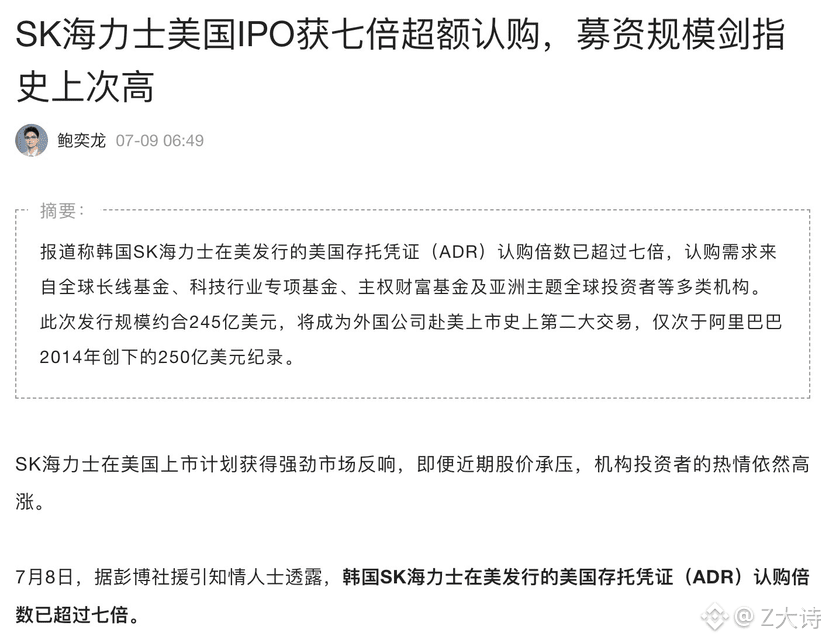
What does “seven times” even mean?! It’s touted as being 3–4x of the biggest IPO in human history, $SPCX. Retail investors are cutting and selling hard, while institutions buy in big blocks
Just think with a market-maker mentality—you’ll understand what’s going on from the little essays Wall Street has been posting these past couple of weeks. It’s clearly designed to get you to cut your losses and lever up, while they pick up cheap shares
As UBS put it verbatim:
“From day one, going long on depositary receipts and shorting local stocks sounds like an obvious choice”
“Given the extremely low probability that ADRs will break their discount-to-par, the actual risk exposure of this deal is very limited, and the scale is substantial”
Then later, Wall Street will jump back in with:
“Brothers, I was wrong—AI isn’t a bubble. It’s always short on storage!”
Everyone, lie back and get ready—you’re about to feel the violent surge on Friday
What does “seven times” even mean?! It’s touted as being 3–4x of the biggest IPO in human history, $SPCX. Retail investors are cutting and selling hard, while institutions buy in big blocks
Just think with a market-maker mentality—you’ll understand what’s going on from the little essays Wall Street has been posting these past couple of weeks. It’s clearly designed to get you to cut your losses and lever up, while they pick up cheap shares
As UBS put it verbatim:
“From day one, going long on depositary receipts and shorting local stocks sounds like an obvious choice”
“Given the extremely low probability that ADRs will break their discount-to-par, the actual risk exposure of this deal is very limited, and the scale is substantial”
Then later, Wall Street will jump back in with:
“Brothers, I was wrong—AI isn’t a bubble. It’s always short on storage!”
Everyone, lie back and get ready—you’re about to feel the violent surge on Friday
Just think with a market-maker mentality—you’ll understand what’s going on from the little essays Wall Street has been posting these past couple of weeks. It’s clearly designed to get you to cut your losses and lever up, while they pick up cheap shares
As UBS put it verbatim:
“From day one, going long on depositary receipts and shorting local stocks sounds like an obvious choice”
“Given the extremely low probability that ADRs will break their discount-to-par, the actual risk exposure of this deal is very limited, and the scale is substantial”
Then later, Wall Street will jump back in with:
“Brothers, I was wrong—AI isn’t a bubble. It’s always short on storage!”
Everyone, lie back and get ready—you’re about to feel the violent surge on Friday
4
13
30.3k
·
--
Lazy Investor Method: Just by doing a simple analysis of $HUMN’s holdings, you can figure out why this is the most worth-it “buy without thinking” robot ETF
In my investment framework, I’ve always had three chariots: AI, robotics, and the low-altitude economy.
These three sectors complement each other without competing, and the volatility correlation between the ETFs is relatively low.
Holdings experience: when one side isn’t bright, the other side shines—there’s always a sector charging forward.
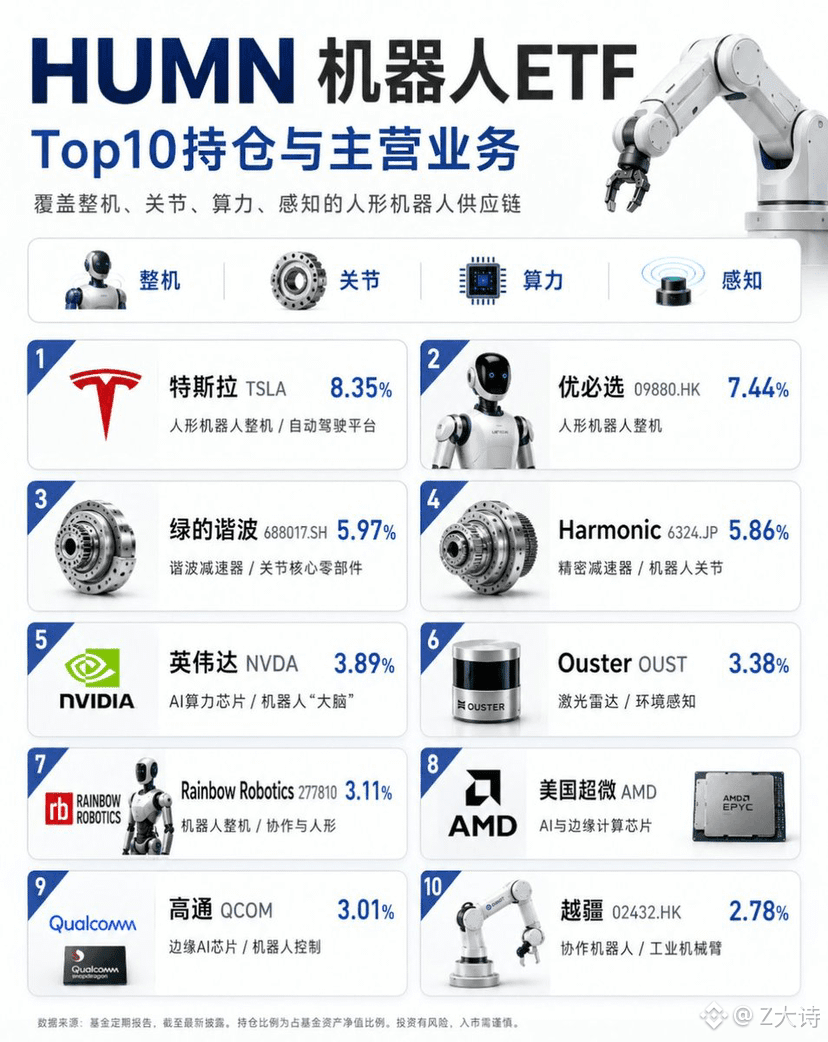
For the robotics sector, the ETF I think is the most worth buying is $HUMN.
Look at this ETF’s Top 10 holdings:
Shares
- Tesla $TSLA 8.35%
- UBTECH 09880 HK 7.44%
- Greeen Harmonics 688017 SH 5.97%
- Harmonic 6324 JP 5.86%
- NVIDIA $NVDA 3.89%
- Ouster $OUST 3.38%
- Rainbow Robotics 277810 3.11%
- AMD (Advanced Micro Devices) 3.03%
- Qualcomm $QCOM 3.01%
- Ufactory 02432 HK 2.78%
It covers the humanoid robot whole units, joints (motors), the “brain” (compute), and sensors, making it a relatively balanced humanoid-robot supply-chain portfolio.
It also spans multiple markets, with investments in the US, China, and Japan.
Most suitable for a lazy investor like me who doesn’t want to put in effort to pick companies for long-term investing
Lazy Investor Method: Just by doing a simple analysis of $HUMN’s holdings, you can figure out why this is the most worth-it “buy without thinking” robot ETF
In my investment framework, I’ve always had three chariots: AI, robotics, and the low-altitude economy.
These three sectors complement each other without competing, and the volatility correlation between the ETFs is relatively low.
Holdings experience: when one side isn’t bright, the other side shines—there’s always a sector charging forward.
For the robotics sector, the ETF I think is the most worth buying is $HUMN.
Look at this ETF’s Top 10 holdings:
Shares
- Tesla $TSLA 8.35%
- UBTECH 09880 HK 7.44%
- Greeen Harmonics 688017 SH 5.97%
- Harmonic 6324 JP 5.86%
- NVIDIA $NVDA 3.89%
- Ouster $OUST 3.38%
- Rainbow Robotics 277810 3.11%
- AMD (Advanced Micro Devices) 3.03%
- Qualcomm $QCOM 3.01%
- Ufactory 02432 HK 2.78%
It covers the humanoid robot whole units, joints (motors), the “brain” (compute), and sensors, making it a relatively balanced humanoid-robot supply-chain portfolio.
It also spans multiple markets, with investments in the US, China, and Japan.
Most suitable for a lazy investor like me who doesn’t want to put in effort to pick companies for long-term investing
In my investment framework, I’ve always had three chariots: AI, robotics, and the low-altitude economy.
These three sectors complement each other without competing, and the volatility correlation between the ETFs is relatively low.
Holdings experience: when one side isn’t bright, the other side shines—there’s always a sector charging forward.
For the robotics sector, the ETF I think is the most worth buying is $HUMN.
Look at this ETF’s Top 10 holdings:
Shares
- Tesla $TSLA 8.35%
- UBTECH 09880 HK 7.44%
- Greeen Harmonics 688017 SH 5.97%
- Harmonic 6324 JP 5.86%
- NVIDIA $NVDA 3.89%
- Ouster $OUST 3.38%
- Rainbow Robotics 277810 3.11%
- AMD (Advanced Micro Devices) 3.03%
- Qualcomm $QCOM 3.01%
- Ufactory 02432 HK 2.78%
It covers the humanoid robot whole units, joints (motors), the “brain” (compute), and sensors, making it a relatively balanced humanoid-robot supply-chain portfolio.
It also spans multiple markets, with investments in the US, China, and Japan.
Most suitable for a lazy investor like me who doesn’t want to put in effort to pick companies for long-term investing
1
2.5k
·
--
The market is all about talking—say whatever you want.
Now, is compute power actually scarce?
Anthropic has just signed a 20-year data center lease with TeraWulf, with a total contract revenue of $19 billion.
The predecessor of TeraWulf’s data center was a steel-smelting plant. Later, TeraWulf acquired it and turned it into a BTC mining operation.
Going forward, the U.S. will likely see many steel and aluminum smelting plants being acquired by AI companies, because their power supply systems are already in place. It’s much easier than building a new data center.
Meta says it wants to keep increasing its compute procurement—essentially just stirring the pot.
Holding onto it without doing anything is the best move right now. The storage hasn’t even finished rolling out~
$DRAMB $MUB
The market is all about talking—say whatever you want.
Now, is compute power actually scarce?
Anthropic has just signed a 20-year data center lease with TeraWulf, with a total contract revenue of $19 billion.
The predecessor of TeraWulf’s data center was a steel-smelting plant. Later, TeraWulf acquired it and turned it into a BTC mining operation.
Going forward, the U.S. will likely see many steel and aluminum smelting plants being acquired by AI companies, because their power supply systems are already in place. It’s much easier than building a new data center.
Meta says it wants to keep increasing its compute procurement—essentially just stirring the pot.
Holding onto it without doing anything is the best move right now. The storage hasn’t even finished rolling out~
$DRAMB $MUB
Now, is compute power actually scarce?
Anthropic has just signed a 20-year data center lease with TeraWulf, with a total contract revenue of $19 billion.
The predecessor of TeraWulf’s data center was a steel-smelting plant. Later, TeraWulf acquired it and turned it into a BTC mining operation.
Going forward, the U.S. will likely see many steel and aluminum smelting plants being acquired by AI companies, because their power supply systems are already in place. It’s much easier than building a new data center.
Meta says it wants to keep increasing its compute procurement—essentially just stirring the pot.
Holding onto it without doing anything is the best move right now. The storage hasn’t even finished rolling out~
$DRAMB $MUB


1
3.6k
·
--
Verified
Now that it’s gotten to this point, the most I have to apologize for is my family.........
Samsung’s Q2 earnings profit surged 19x—meeting expectations, yet it still fell 10%
Good news gets cashed in; money is exiting—the logic is very clear: sell the news
This is a good thing~
Like how many times has Nvidia $NVDA reported an earnings beat and didn’t drop?
Many people say the storage narrative is over—I raise both hands 🙋 in opposition. There’s currently no sign that “storage won’t be short” anymore.
It’s just that recently, the whole memory sector has been under pressure due to public opinion from multiple sides and the Bank of Korea calling out and urging deleveraging, which has made sentiment a bit fragile.
Even if CXMT goes public, the impacted part is DRAM
HBM is still the one and only exclusive “king” among the memory trio that really gets to eat
Even for DRAM, there’s still half a year of honeymoon time
In the future, there’s embodied intelligence too—storage demand can only increase
On Friday, Micron’s ADR—think about it: is it institutions trying to get cheap chips to board the trade?
In investing, it’s always the butt that decides the head—if you’re on the car, you’re definitely going to shout “bullish,” bro
$DRAMB $MUB
Now that it’s gotten to this point, the most I have to apologize for is my family.........
Samsung’s Q2 earnings profit surged 19x—meeting expectations, yet it still fell 10%
Good news gets cashed in; money is exiting—the logic is very clear: sell the news
This is a good thing~
Like how many times has Nvidia $NVDA reported an earnings beat and didn’t drop?
Many people say the storage narrative is over—I raise both hands 🙋 in opposition. There’s currently no sign that “storage won’t be short” anymore.
It’s just that recently, the whole memory sector has been under pressure due to public opinion from multiple sides and the Bank of Korea calling out and urging deleveraging, which has made sentiment a bit fragile.
Even if CXMT goes public, the impacted part is DRAM
HBM is still the one and only exclusive “king” among the memory trio that really gets to eat
Even for DRAM, there’s still half a year of honeymoon time
In the future, there’s embodied intelligence too—storage demand can only increase
On Friday, Micron’s ADR—think about it: is it institutions trying to get cheap chips to board the trade?
In investing, it’s always the butt that decides the head—if you’re on the car, you’re definitely going to shout “bullish,” bro
$DRAMB $MUB
Samsung’s Q2 earnings profit surged 19x—meeting expectations, yet it still fell 10%
Good news gets cashed in; money is exiting—the logic is very clear: sell the news
This is a good thing~
Like how many times has Nvidia $NVDA reported an earnings beat and didn’t drop?
Many people say the storage narrative is over—I raise both hands 🙋 in opposition. There’s currently no sign that “storage won’t be short” anymore.
It’s just that recently, the whole memory sector has been under pressure due to public opinion from multiple sides and the Bank of Korea calling out and urging deleveraging, which has made sentiment a bit fragile.
Even if CXMT goes public, the impacted part is DRAM
HBM is still the one and only exclusive “king” among the memory trio that really gets to eat
Even for DRAM, there’s still half a year of honeymoon time
In the future, there’s embodied intelligence too—storage demand can only increase
On Friday, Micron’s ADR—think about it: is it institutions trying to get cheap chips to board the trade?
In investing, it’s always the butt that decides the head—if you’re on the car, you’re definitely going to shout “bullish,” bro
$DRAMB $MUB

1
5
9.9k
·
--
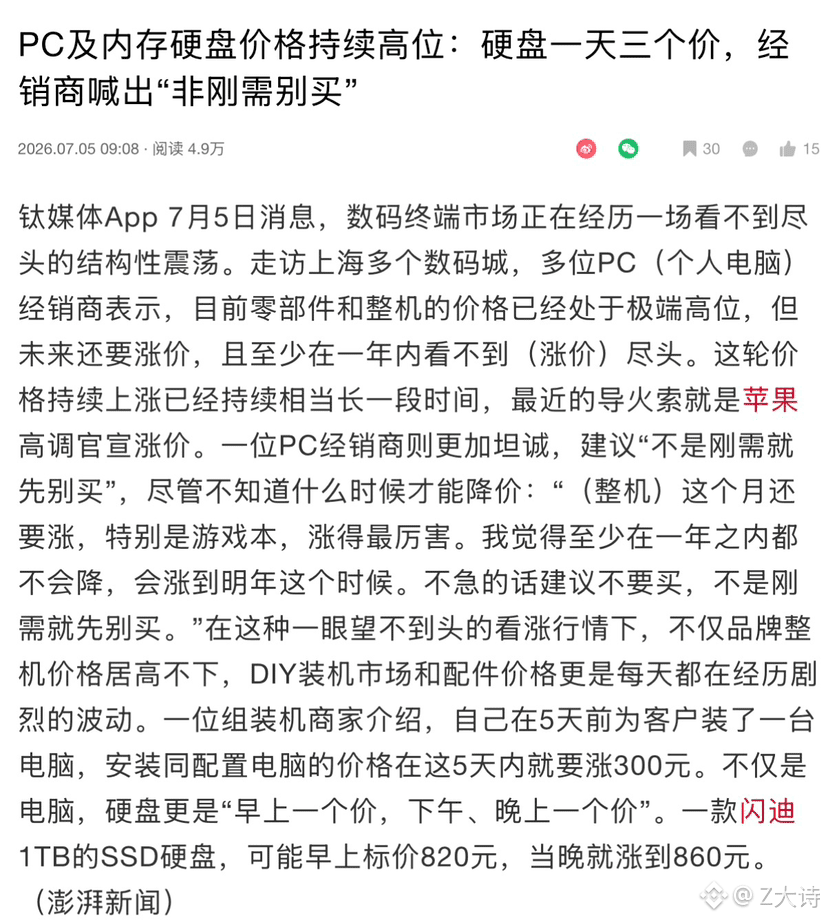
Weekend solid-state drives are acting up again
SanDisk $SNDK , a 1TB SSD—this morning it was 820, by evening it was 860. Three different prices in a day, and they're even pricing it by the hour.
Some computer sellers installed complete systems five days ago, and by today the configuration costs an extra 1,000 yuan. Even the distributors say, “If it’s not a must-have, don’t buy.”
And don’t even mention that storage is nearing the peak—what consumers are being sold is still going up in price.
AI is grabbing HBM; HBM then takes production capacity away from DRAM and NAND. In the end, the price increases get passed on to consumers.
My real advice: if you’re going to buy a computer, buy it sooner—and ideally get the version with the maximum storage. In the next one or two years, prices will still be rising. You’ll get something useful now and it’ll hold its value better.
As for <$DRAM >, four words: “Sit tight and hold on.”
Weekend solid-state drives are acting up again
SanDisk $SNDK , a 1TB SSD—this morning it was 820, by evening it was 860. Three different prices in a day, and they're even pricing it by the hour.
Some computer sellers installed complete systems five days ago, and by today the configuration costs an extra 1,000 yuan. Even the distributors say, “If it’s not a must-have, don’t buy.”
And don’t even mention that storage is nearing the peak—what consumers are being sold is still going up in price.
AI is grabbing HBM; HBM then takes production capacity away from DRAM and NAND. In the end, the price increases get passed on to consumers.
My real advice: if you’re going to buy a computer, buy it sooner—and ideally get the version with the maximum storage. In the next one or two years, prices will still be rising. You’ll get something useful now and it’ll hold its value better.
As for <$DRAM >, four words: “Sit tight and hold on.”
SanDisk $SNDK , a 1TB SSD—this morning it was 820, by evening it was 860. Three different prices in a day, and they're even pricing it by the hour.
Some computer sellers installed complete systems five days ago, and by today the configuration costs an extra 1,000 yuan. Even the distributors say, “If it’s not a must-have, don’t buy.”
And don’t even mention that storage is nearing the peak—what consumers are being sold is still going up in price.
AI is grabbing HBM; HBM then takes production capacity away from DRAM and NAND. In the end, the price increases get passed on to consumers.
My real advice: if you’re going to buy a computer, buy it sooner—and ideally get the version with the maximum storage. In the next one or two years, prices will still be rising. You’ll get something useful now and it’ll hold its value better.
As for <$DRAM >, four words: “Sit tight and hold on.”
1
2k
·
--
Verified
Can this Gbei Long (Jiāngbōlóng) earnings report finally shut the haters up?
Now all capacity is tied up in HBM, while regular DRAM and NAND have been stripped bare.
TrendForce says the contract price for Q2 NAND is expected to rise another 70%–75%.
Samsung’s Q2 contract prices have already jumped 30%. It’s preparing to raise Q3 contract prices by another 20%, and it always only has 4 weeks of inventory on hand.
Now you know what Zack’s good intentions were all about, right? Everyone, apologize to Meta!
The near-term holding experience probably won’t be great, but the basic logic hasn’t changed.
On Monday, I’m getting ready to carry money in a sack—if you want to get in but there’s no inventory, wait a bit.
If you really can’t stand it, you can take a look at the robot $HUMN.
Everything else is just noise—buy the dip and hold.
Can this Gbei Long (Jiāngbōlóng) earnings report finally shut the haters up?
Now all capacity is tied up in HBM, while regular DRAM and NAND have been stripped bare.
TrendForce says the contract price for Q2 NAND is expected to rise another 70%–75%.
Samsung’s Q2 contract prices have already jumped 30%. It’s preparing to raise Q3 contract prices by another 20%, and it always only has 4 weeks of inventory on hand.
Now you know what Zack’s good intentions were all about, right? Everyone, apologize to Meta!
The near-term holding experience probably won’t be great, but the basic logic hasn’t changed.
On Monday, I’m getting ready to carry money in a sack—if you want to get in but there’s no inventory, wait a bit.
If you really can’t stand it, you can take a look at the robot $HUMN.
Everything else is just noise—buy the dip and hold.
Now all capacity is tied up in HBM, while regular DRAM and NAND have been stripped bare.
TrendForce says the contract price for Q2 NAND is expected to rise another 70%–75%.
Samsung’s Q2 contract prices have already jumped 30%. It’s preparing to raise Q3 contract prices by another 20%, and it always only has 4 weeks of inventory on hand.
Now you know what Zack’s good intentions were all about, right? Everyone, apologize to Meta!
The near-term holding experience probably won’t be great, but the basic logic hasn’t changed.
On Monday, I’m getting ready to carry money in a sack—if you want to get in but there’s no inventory, wait a bit.
If you really can’t stand it, you can take a look at the robot $HUMN.
Everything else is just noise—buy the dip and hold.

1
1.9k
Log in to explore more content
Join global crypto users on Binance Square
⚡️ Get latest and useful information about crypto.
💬 Trusted by the world’s largest crypto exchange.
👍 Discover real insights from verified creators.
Email / Phone number