
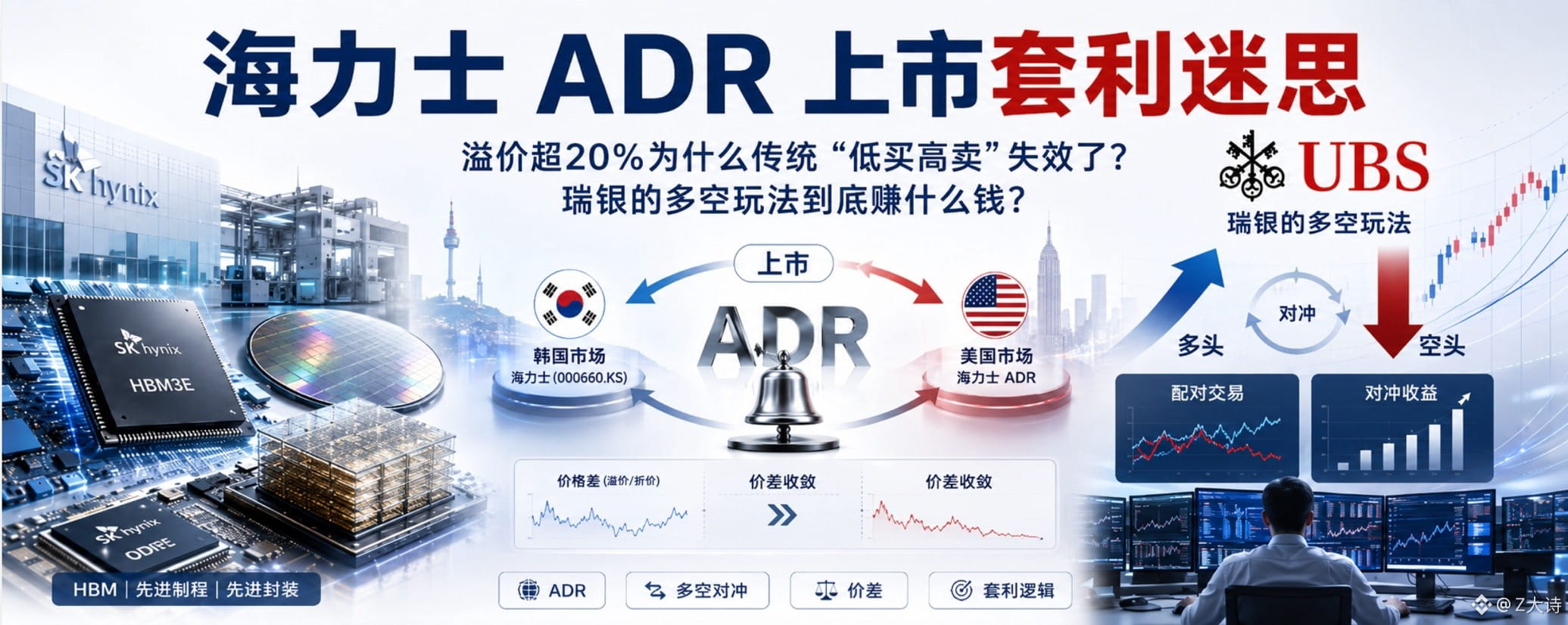

First, we need to understand why there is a premium?
On the one hand, the US stock market serves as the world’s largest pool of capital. Massive theme funds constrained by compliance rules cannot directly buy Korean stocks, so they flow in. This “more money than shares” situation creates a liquidity premium;
On the other hand, in the US stock market, SK hynix has broken free from the “Korean discount” of low P/E multiples and instead directly benchmarks against industry giants like Micron, gaining a valuation re-rating premium;
ADRs are priced in US dollars and trade seamlessly in sync with US stocks. To avoid the cumbersome friction of cross-border account opening, currency exchange, and compliance reviews, investors are willing to pay the extra spread for this convenience $SKHYB
Why does shorting ADR and going long Korean underlying shares fail as an arbitrage?
The prerequisite for this approach to work is: the ADR and the Korean underlying share price will converge.
Fundamentally, it’s because cross-border “cash-and-carry” has extremely high barriers. For foreign investors, opening accounts in the local market, moving funds in and out across borders, and physical conversion all come with very high friction costs. As a result, arbitrage capital can’t smoothly “buy the cheaper underlying shares, convert them into the higher-priced ADR, and sell the ADR.” With the physical arbitrage channel blocked, prices can’t be forcibly flattened.
And Hynix’s ADR can currently be converted into the underlying shares only in one direction. Retail investors can only exchange ADRs for underlying shares; they can’t exchange in the opposite direction. For US investors, the underlying shares have a positive premium in the US, and there’s no fool who would exchange the other way. Exchanging both directions is only convenient for institutions.
Just look at TSMC $TSM . Because of the same cross-market friction, its US ADR has maintained a 10%~20% premium over Taiwan’s underlying shares for years, and it has never converged.
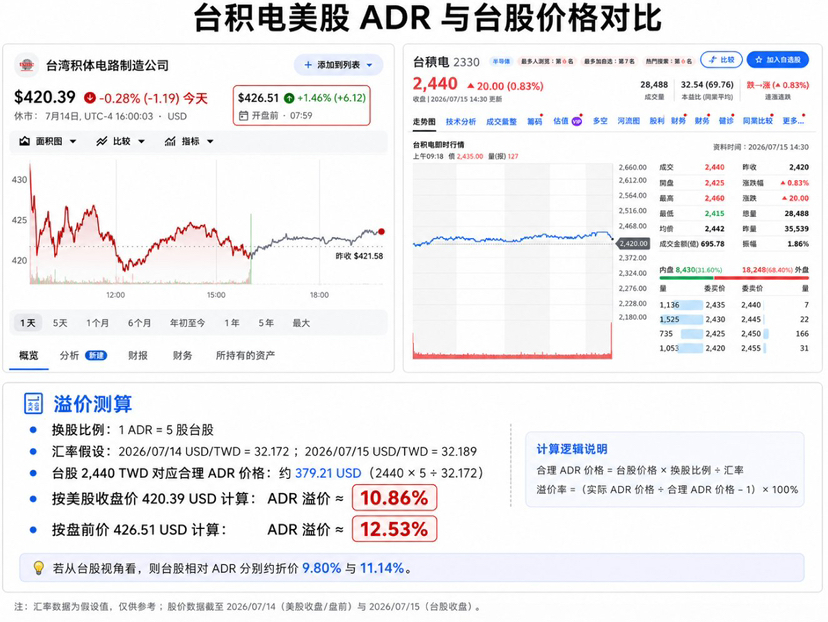
The “liquidity and convenience premium” that is abundant in US stocks will remain embedded in prices for the long term. If you bet that these premiums will converge, you often won’t even wait for the price gap to close—your short position will have already been drained by high shorting interest. And even when US stock funds massively pump ADRs, your short position can be squeezed directly as well.
Since it can’t converge, what is UBS’s arbitrage strategy?
Since we know the state of “US stocks are expensive and Korean stocks are cheap” will exist for the long term, UBS’s strategy is no longer to bet that the “price difference will disappear,” but instead to bet that the “price difference will widen.” This is a classic relative-value trade.
Method: go long US stocks, short Korean stocks
🟢 Long US ADR: capture the US market’s liquidity premium and valuation re-rating
🔴 Short Korean underlying shares: hedge out the system-wide risks from the semiconductor cycle and the Beta volatility from the company’s fundamentals
This trade basically doesn’t care whether Hynix goes up or down tomorrow. Even if the semiconductor sector collapses and Hynix falls across the board—so long as 【the Korean-listed shares drop 10%, while the US ADR has a premium protection and only drops 5%】—this trade is still profitable.
In one sentence: when the market falls, the ADR drops less than the underlying shares; when the market rises, the ADR rises more than the underlying shares.
Follow me to learn more investment knowledge~🫡