

婉宁sky
41 Posts

婉宁sky
Report
Block User
9 Following
12 Followers
15 Liked
Posts
All
Quotes
·
--
18600u is the money I lost on Dusk with a “buy first, research later” move. It wasn’t that I didn’t research—it's that the order was wrong. I acted first, then tried to find reasons for it.
The reason I placed that buy was simple: the price looked low, the chart looked like a bottom, and around that time people in the plaza were shouting “it can’t drop any further.” The emotions arrived first, and then I placed the order. After I bought, I only started “researching”: reading announcements, breaking down the mechanics, looking at the data—but at that point, the research wasn’t research anymore. It was adding supporting evidence for an action that had already happened. I specifically looked for materials that supported the buy: active development, yes; high pledge ratio, yes; partnership roster, yes. When I saw risks, I jumped over them: fragmented liquidity, skip; Dusk Trade hadn’t launched yet, skip; unlock pressure, skip. The more I researched, the more I felt like I was “right to buy.”
Three months later, the price was even lower. Every piece of evidence I added was still there, and the price didn’t improve just because my evidence chain got better. I cut my losses and exited: 18600u.
This money taught me: research must happen before the decision, or it’s only valuable in theory. Research after the decision isn’t called research—it’s self-soothing. Its output isn’t judgment; it’s an excuse. When the order is reversed, the deeper the research, the more firmly you cling to being wrong. Pre-buy research is about finding risk. Post-buy research is about finding comfort. Same action, different position—completely different nature.
So here are my current rules: before buying, write out a full page of reasons for not buying. If you can’t fill a page, you’re not allowed to buy. Research is for exclusion, not confirmation.
@Dusk_Foundation $DUSK #dusk
18600u is the money I lost on Dusk with a “buy first, research later” move. It wasn’t that I didn’t research—it's that the order was wrong. I acted first, then tried to find reasons for it.
The reason I placed that buy was simple: the price looked low, the chart looked like a bottom, and around that time people in the plaza were shouting “it can’t drop any further.” The emotions arrived first, and then I placed the order. After I bought, I only started “researching”: reading announcements, breaking down the mechanics, looking at the data—but at that point, the research wasn’t research anymore. It was adding supporting evidence for an action that had already happened. I specifically looked for materials that supported the buy: active development, yes; high pledge ratio, yes; partnership roster, yes. When I saw risks, I jumped over them: fragmented liquidity, skip; Dusk Trade hadn’t launched yet, skip; unlock pressure, skip. The more I researched, the more I felt like I was “right to buy.”
Three months later, the price was even lower. Every piece of evidence I added was still there, and the price didn’t improve just because my evidence chain got better. I cut my losses and exited: 18600u.
This money taught me: research must happen before the decision, or it’s only valuable in theory. Research after the decision isn’t called research—it’s self-soothing. Its output isn’t judgment; it’s an excuse. When the order is reversed, the deeper the research, the more firmly you cling to being wrong. Pre-buy research is about finding risk. Post-buy research is about finding comfort. Same action, different position—completely different nature.
So here are my current rules: before buying, write out a full page of reasons for not buying. If you can’t fill a page, you’re not allowed to buy. Research is for exclusion, not confirmation.
@Dusk $DUSK #dusk
The reason I placed that buy was simple: the price looked low, the chart looked like a bottom, and around that time people in the plaza were shouting “it can’t drop any further.” The emotions arrived first, and then I placed the order. After I bought, I only started “researching”: reading announcements, breaking down the mechanics, looking at the data—but at that point, the research wasn’t research anymore. It was adding supporting evidence for an action that had already happened. I specifically looked for materials that supported the buy: active development, yes; high pledge ratio, yes; partnership roster, yes. When I saw risks, I jumped over them: fragmented liquidity, skip; Dusk Trade hadn’t launched yet, skip; unlock pressure, skip. The more I researched, the more I felt like I was “right to buy.”
Three months later, the price was even lower. Every piece of evidence I added was still there, and the price didn’t improve just because my evidence chain got better. I cut my losses and exited: 18600u.
This money taught me: research must happen before the decision, or it’s only valuable in theory. Research after the decision isn’t called research—it’s self-soothing. Its output isn’t judgment; it’s an excuse. When the order is reversed, the deeper the research, the more firmly you cling to being wrong. Pre-buy research is about finding risk. Post-buy research is about finding comfort. Same action, different position—completely different nature.
So here are my current rules: before buying, write out a full page of reasons for not buying. If you can’t fill a page, you’re not allowed to buy. Research is for exclusion, not confirmation.
@Dusk $DUSK #dusk
69
·
--
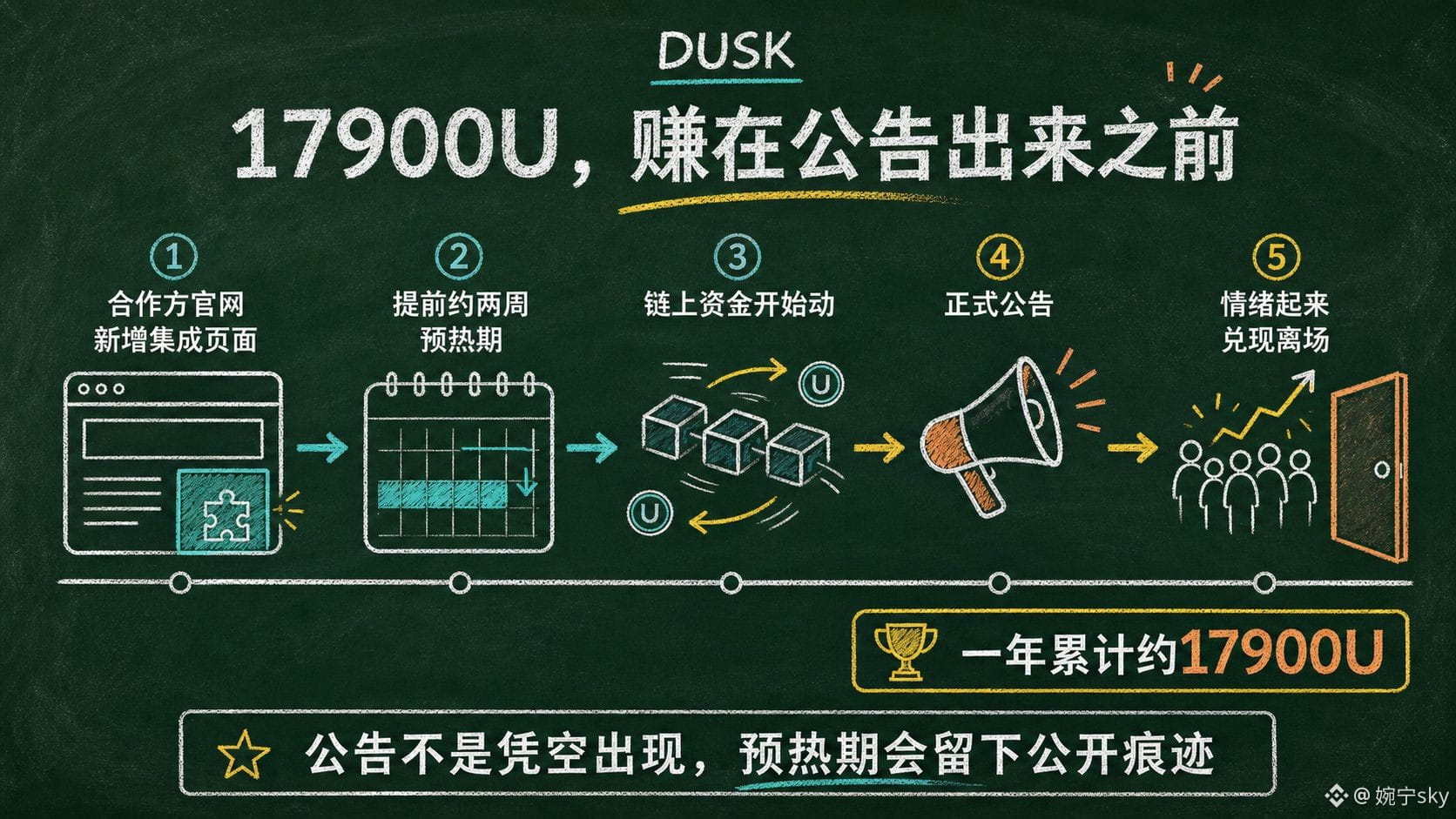
17900u—money I earned from the “preheating traces” in my research on Dusk’s ecosystem cooperation announcements. Before the official announcement is released, the蛛丝马迹 (clues and hints) often leak out already.
I pulled up the announcement timelines for Dusk’s last few major collaborations (exchanges, custodians, ecosystem partners). If you work backward from the official announcements, you’ll find that before each one there’s usually a preheating period: the partner’s website launches relevant pages, media reports appear citing “insiders,” and the official community’s phrasing suddenly starts steering toward a specific direction. There was once a partner that posted an integration page early—two weeks later, the official team made the formal announcement. In those two weeks, on-chain capital was already moving. The preheating window is typically several days to a few weeks earlier than the official announcement. Those days to weeks—that’s the information gap.
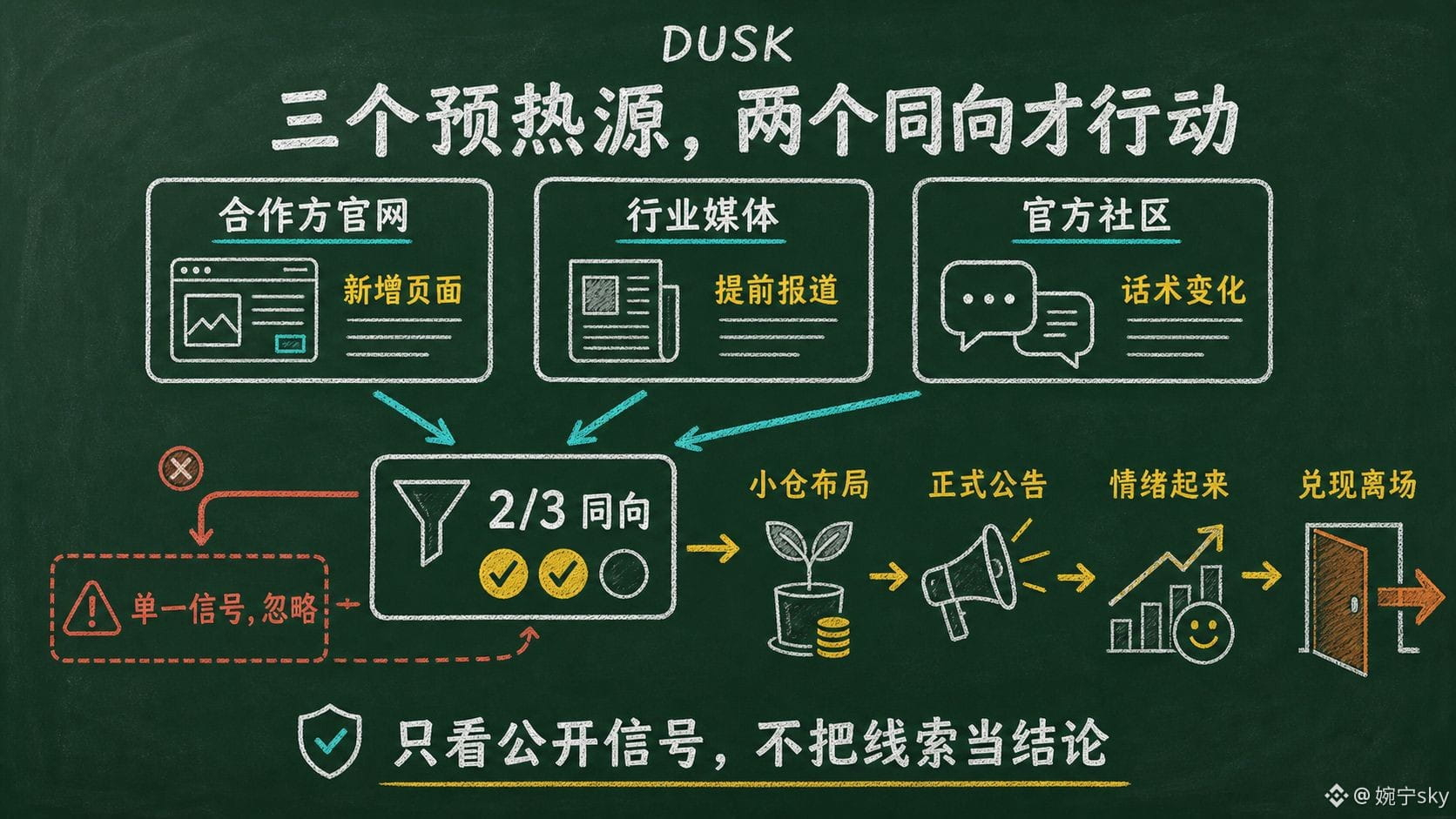
So I watched three potential “preheat sources”: new pages added on the partner’s website, early reports from industry media, and changes in wording within the official community. When two of the three pointed to the same direction, I built a small position. Once the official announcement came out and sentiment turned, I cashed out and left. I caught a few such opportunities over the year, totaling 17900u.
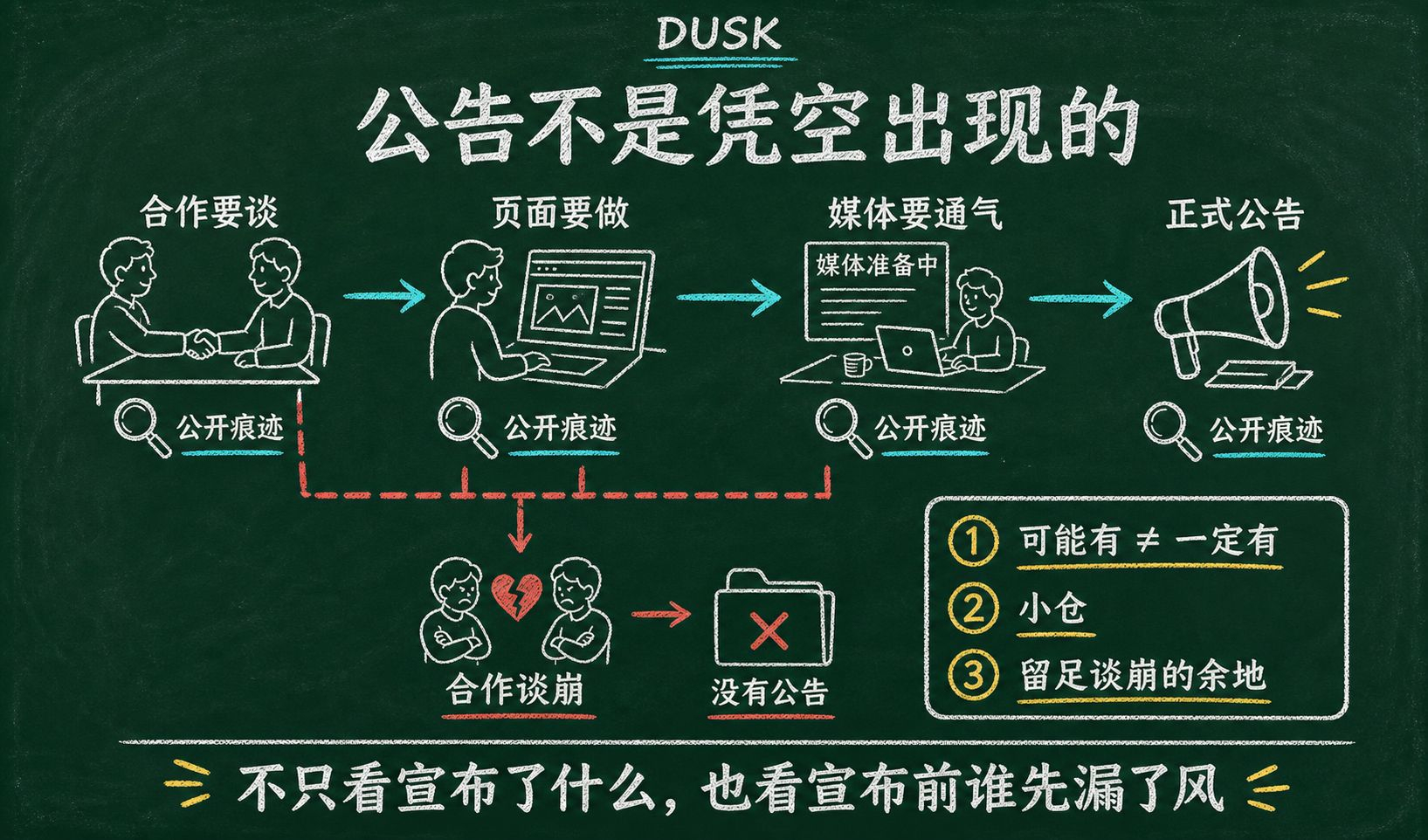
Of course, preheating doesn’t always turn into an announcement—collaborations that fall through also exist. So every time I treat it as “it’s possible” rather than “it will definitely happen,” leaving enough room in position sizing for deals that break down. The research logic behind this money is simple: announcements don’t appear out of thin air. They have a real physical process—talks need to happen, pages need to be built, media needs to be briefed. Every step leaves traces somewhere. For ecosystem research, you don’t just look at what it announced; you also look at who leaked the wind first before the announcement.
@Dusk_Foundation $DUSK #dusk
17900u—money I earned from the “preheating traces” in my research on Dusk’s ecosystem cooperation announcements. Before the official announcement is released, the蛛丝马迹 (clues and hints) often leak out already.
I pulled up the announcement timelines for Dusk’s last few major collaborations (exchanges, custodians, ecosystem partners). If you work backward from the official announcements, you’ll find that before each one there’s usually a preheating period: the partner’s website launches relevant pages, media reports appear citing “insiders,” and the official community’s phrasing suddenly starts steering toward a specific direction. There was once a partner that posted an integration page early—two weeks later, the official team made the formal announcement. In those two weeks, on-chain capital was already moving. The preheating window is typically several days to a few weeks earlier than the official announcement. Those days to weeks—that’s the information gap.
So I watched three potential “preheat sources”: new pages added on the partner’s website, early reports from industry media, and changes in wording within the official community. When two of the three pointed to the same direction, I built a small position. Once the official announcement came out and sentiment turned, I cashed out and left. I caught a few such opportunities over the year, totaling 17900u.
Of course, preheating doesn’t always turn into an announcement—collaborations that fall through also exist. So every time I treat it as “it’s possible” rather than “it will definitely happen,” leaving enough room in position sizing for deals that break down. The research logic behind this money is simple: announcements don’t appear out of thin air. They have a real physical process—talks need to happen, pages need to be built, media needs to be briefed. Every step leaves traces somewhere. For ecosystem research, you don’t just look at what it announced; you also look at who leaked the wind first before the announcement.
@Dusk $DUSK #dusk
I pulled up the announcement timelines for Dusk’s last few major collaborations (exchanges, custodians, ecosystem partners). If you work backward from the official announcements, you’ll find that before each one there’s usually a preheating period: the partner’s website launches relevant pages, media reports appear citing “insiders,” and the official community’s phrasing suddenly starts steering toward a specific direction. There was once a partner that posted an integration page early—two weeks later, the official team made the formal announcement. In those two weeks, on-chain capital was already moving. The preheating window is typically several days to a few weeks earlier than the official announcement. Those days to weeks—that’s the information gap.
So I watched three potential “preheat sources”: new pages added on the partner’s website, early reports from industry media, and changes in wording within the official community. When two of the three pointed to the same direction, I built a small position. Once the official announcement came out and sentiment turned, I cashed out and left. I caught a few such opportunities over the year, totaling 17900u.
Of course, preheating doesn’t always turn into an announcement—collaborations that fall through also exist. So every time I treat it as “it’s possible” rather than “it will definitely happen,” leaving enough room in position sizing for deals that break down. The research logic behind this money is simple: announcements don’t appear out of thin air. They have a real physical process—talks need to happen, pages need to be built, media needs to be briefed. Every step leaves traces somewhere. For ecosystem research, you don’t just look at what it announced; you also look at who leaked the wind first before the announcement.
@Dusk $DUSK #dusk
74
·
--
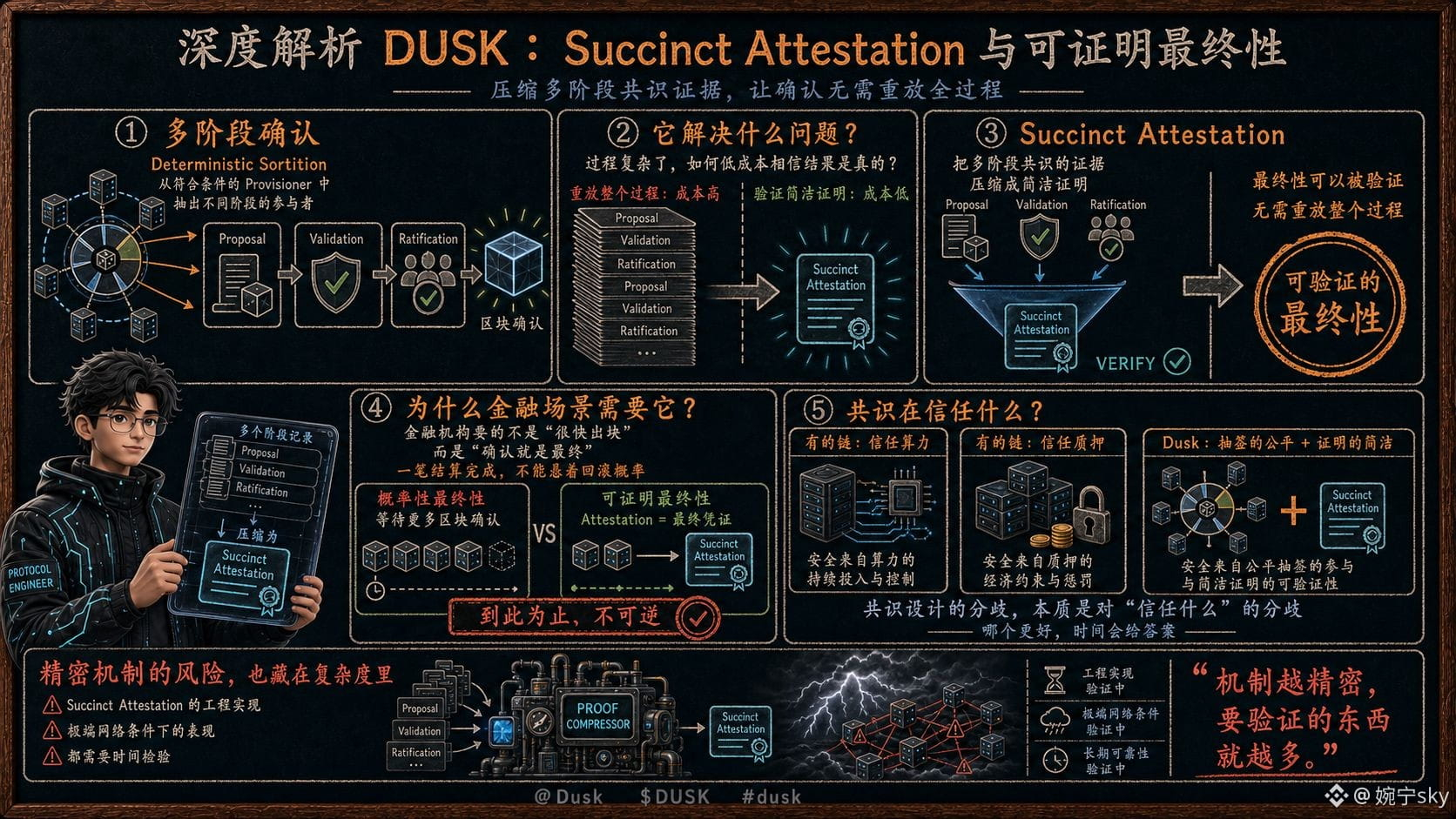
When I studied Dusk's consensus mechanism, what took the most thought wasn't who gets to produce blocks, but Succinct Attestation—the part that's easiest to skip over in its name.
Let’s first break down the problem it addresses. Dusk’s block finalization is multi-stage: Deterministic Sortition draws participants for different stages from eligible Provisioners, and then Proposal, Validation, and Ratification complete the finalization process. The challenge with multi-stage consensus is this: when the process is complex, how can everyone cheaply trust that the "result is real"? Succinct Attestation does exactly that—compress the evidence of multi-stage consensus into a concise proof, so that finality can be verified without replaying the entire process.
You can see the design intent clearly in financial scenarios. Financial institutions don’t just want "fast block production"; they want "confirmation is final"—once a settlement is done, there can’t be a rollback probability hanging over it. Most chains make finality probabilistic (after more block confirmations). Dusk, instead, makes finality provable: an Attestation is the "this is it, irreversible" credential.
That’s also why it made me rethink why it’s worth investigating. Consensus disagreements, at their core, are disagreements over "what to trust"—some chains trust computing power, others trust staking. Dusk’s approach trusts "the fairness of the lottery plus the succinctness of the proof." Which is better will be answered by time.
Of course, the more precise the mechanism, the more there is to verify. The engineering implementation of Succinct Attestation and its performance under extreme network conditions still need to be tested over time. The biggest risk of a sophisticated mechanism is often hidden in its own complexity.
@Dusk_Foundation $DUSK #dusk
When I studied Dusk's consensus mechanism, what took the most thought wasn't who gets to produce blocks, but Succinct Attestation—the part that's easiest to skip over in its name.
Let’s first break down the problem it addresses. Dusk’s block finalization is multi-stage: Deterministic Sortition draws participants for different stages from eligible Provisioners, and then Proposal, Validation, and Ratification complete the finalization process. The challenge with multi-stage consensus is this: when the process is complex, how can everyone cheaply trust that the "result is real"? Succinct Attestation does exactly that—compress the evidence of multi-stage consensus into a concise proof, so that finality can be verified without replaying the entire process.
You can see the design intent clearly in financial scenarios. Financial institutions don’t just want "fast block production"; they want "confirmation is final"—once a settlement is done, there can’t be a rollback probability hanging over it. Most chains make finality probabilistic (after more block confirmations). Dusk, instead, makes finality provable: an Attestation is the "this is it, irreversible" credential.
That’s also why it made me rethink why it’s worth investigating. Consensus disagreements, at their core, are disagreements over "what to trust"—some chains trust computing power, others trust staking. Dusk’s approach trusts "the fairness of the lottery plus the succinctness of the proof." Which is better will be answered by time.
Of course, the more precise the mechanism, the more there is to verify. The engineering implementation of Succinct Attestation and its performance under extreme network conditions still need to be tested over time. The biggest risk of a sophisticated mechanism is often hidden in its own complexity.
@Dusk $DUSK #dusk
Let’s first break down the problem it addresses. Dusk’s block finalization is multi-stage: Deterministic Sortition draws participants for different stages from eligible Provisioners, and then Proposal, Validation, and Ratification complete the finalization process. The challenge with multi-stage consensus is this: when the process is complex, how can everyone cheaply trust that the "result is real"? Succinct Attestation does exactly that—compress the evidence of multi-stage consensus into a concise proof, so that finality can be verified without replaying the entire process.
You can see the design intent clearly in financial scenarios. Financial institutions don’t just want "fast block production"; they want "confirmation is final"—once a settlement is done, there can’t be a rollback probability hanging over it. Most chains make finality probabilistic (after more block confirmations). Dusk, instead, makes finality provable: an Attestation is the "this is it, irreversible" credential.
That’s also why it made me rethink why it’s worth investigating. Consensus disagreements, at their core, are disagreements over "what to trust"—some chains trust computing power, others trust staking. Dusk’s approach trusts "the fairness of the lottery plus the succinctness of the proof." Which is better will be answered by time.
Of course, the more precise the mechanism, the more there is to verify. The engineering implementation of Succinct Attestation and its performance under extreme network conditions still need to be tested over time. The biggest risk of a sophisticated mechanism is often hidden in its own complexity.
@Dusk $DUSK #dusk
82
·
--
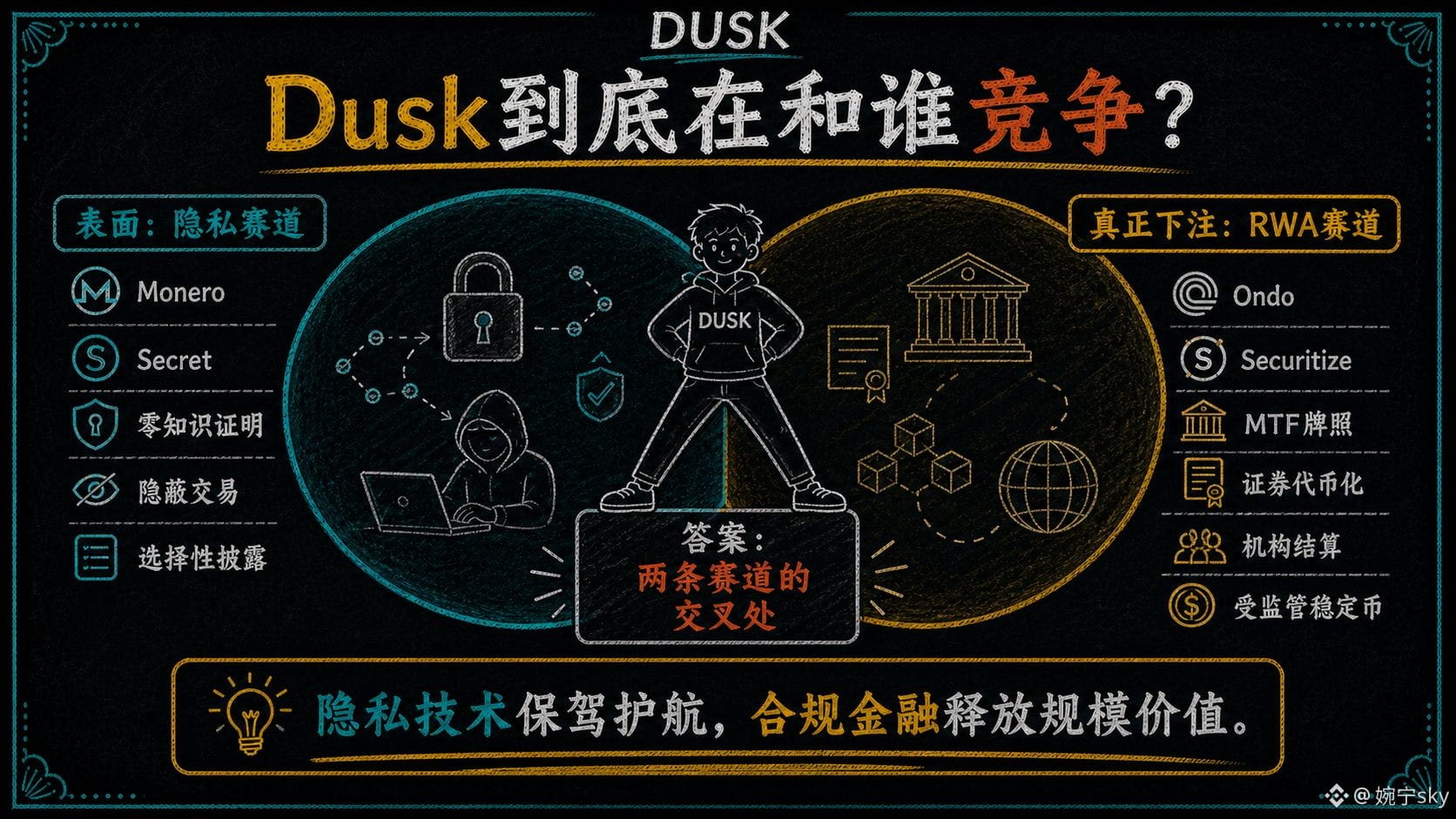
As I researched Dusk, I kept circling back to one question: who exactly is it competing with?
On the surface, the answer seems straightforward: the privacy track. Projects like Monero and Secret share the same set of technical vocabulary with Dusk—zero-knowledge proofs, stealth transactions, selective disclosure. Placed in this coordinate system, Dusk looks like a “more compliant privacy coin.”
But the deeper I dig, the more I feel this coordinate system might be wrong.
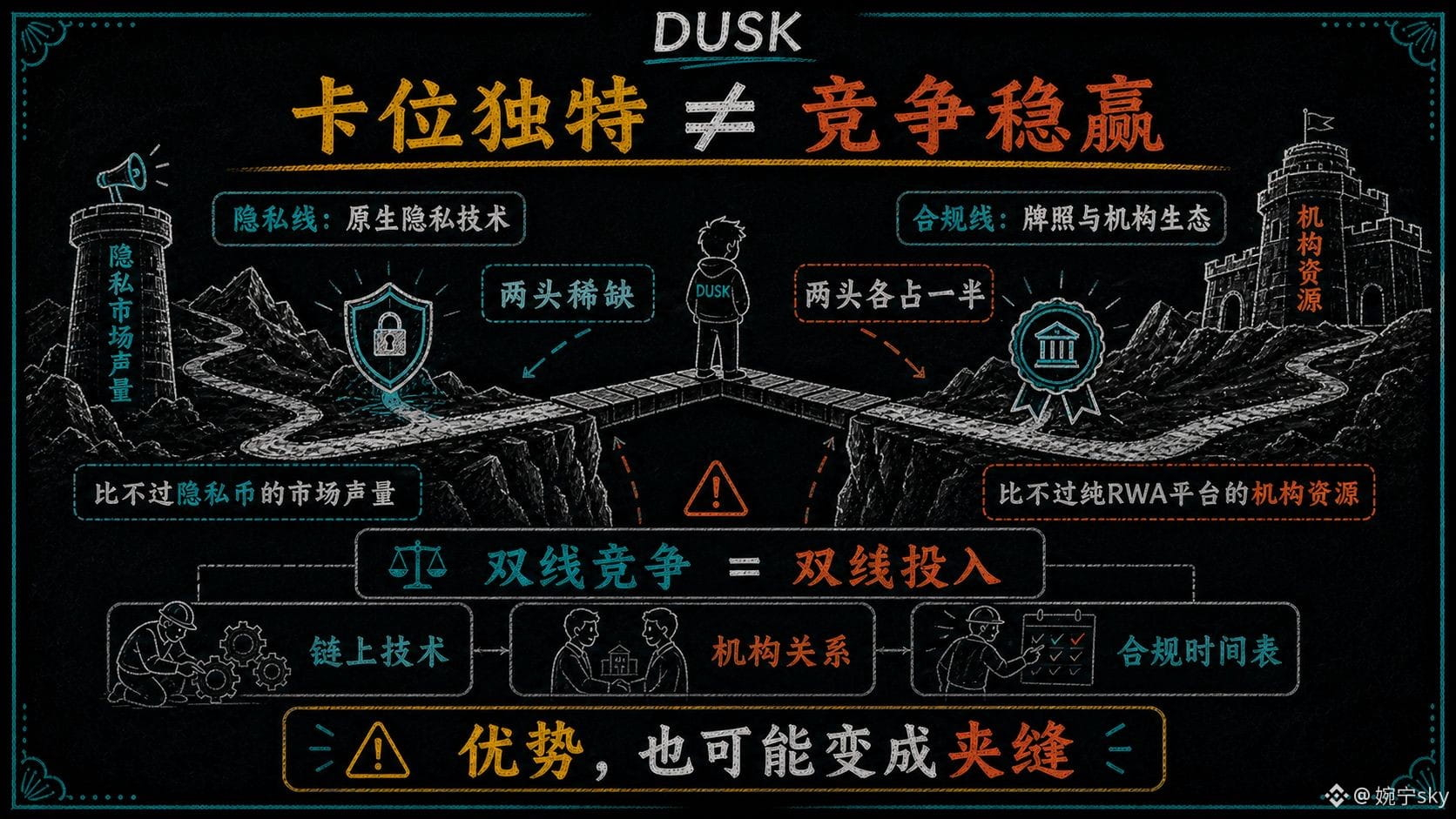
If you break down Dusk’s narrative components, what it truly is betting on is MTF licensing, tokenized securities, institutional settlement, and regulated stablecoins. Those terms belong to another track: RWA. Its counterparties aren’t in the privacy-coin camp (that space is dwindling—Monero has been gradually delisted by exchanges, and the market for pure privacy narratives is shrinking). Instead, Dusk’s competitors are tokenization platforms like Ondo and Securitize. They have licenses, institutional customers, and compliant capital on-ramps—but they don’t have their own chain. Handling privacy for compliant data is a weakness they can’t really get around.
That’s what makes Dusk interesting: it sits at the intersection of two tracks. On the institutional side, it’s one of the few projects with native privacy technology. On the privacy side, it’s one of the few projects with licenses and an institutional ecosystem. It takes a slice of two scarce resources—yet only about half of each. In terms of licenses and institutional resources, it can’t beat pure RWA platforms; in terms of market volume and attention for privacy technology, it can’t match the privacy coins of the past. Securing a unique niche and winning the competition are two different things.
Still, this is also what makes me cautious. Competing on two tracks means investing on two tracks: you have to maintain on-chain technology, nurture institutional relationships, and wait for compliance timelines. If any one link falls behind, the advantage at the intersection can turn into a gap within the gap.
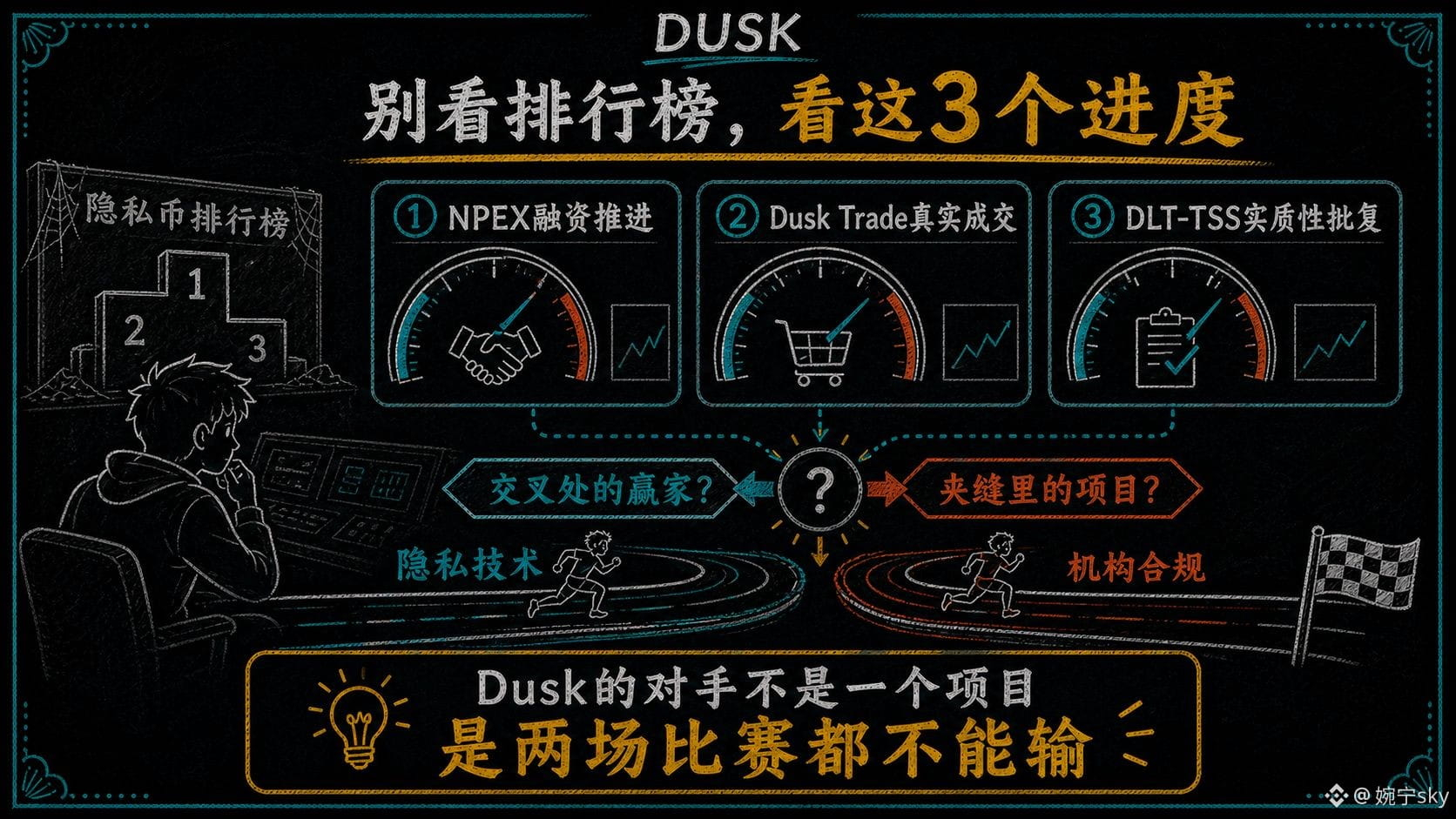
So what I’m focusing on now isn’t Dusk’s position on a “privacy coin leaderboard,” but three more specific progress checkpoints: how far NPEX’s fundraising has advanced, whether Dusk Trade can generate real trades, and whether there’s any substantive progress in the approvals for DLT-TSS. Those three metrics are what truly determine whether Dusk is the winner at the intersection—or just another project trapped in the cracks.
In the end, Dusk’s real opponents are never a single project. It’s two races that it cannot afford to lose.
#dusk $DUSK @Dusk_Foundation
As I researched Dusk, I kept circling back to one question: who exactly is it competing with?
On the surface, the answer seems straightforward: the privacy track. Projects like Monero and Secret share the same set of technical vocabulary with Dusk—zero-knowledge proofs, stealth transactions, selective disclosure. Placed in this coordinate system, Dusk looks like a “more compliant privacy coin.”
But the deeper I dig, the more I feel this coordinate system might be wrong.
If you break down Dusk’s narrative components, what it truly is betting on is MTF licensing, tokenized securities, institutional settlement, and regulated stablecoins. Those terms belong to another track: RWA. Its counterparties aren’t in the privacy-coin camp (that space is dwindling—Monero has been gradually delisted by exchanges, and the market for pure privacy narratives is shrinking). Instead, Dusk’s competitors are tokenization platforms like Ondo and Securitize. They have licenses, institutional customers, and compliant capital on-ramps—but they don’t have their own chain. Handling privacy for compliant data is a weakness they can’t really get around.
That’s what makes Dusk interesting: it sits at the intersection of two tracks. On the institutional side, it’s one of the few projects with native privacy technology. On the privacy side, it’s one of the few projects with licenses and an institutional ecosystem. It takes a slice of two scarce resources—yet only about half of each. In terms of licenses and institutional resources, it can’t beat pure RWA platforms; in terms of market volume and attention for privacy technology, it can’t match the privacy coins of the past. Securing a unique niche and winning the competition are two different things.
Still, this is also what makes me cautious. Competing on two tracks means investing on two tracks: you have to maintain on-chain technology, nurture institutional relationships, and wait for compliance timelines. If any one link falls behind, the advantage at the intersection can turn into a gap within the gap.
So what I’m focusing on now isn’t Dusk’s position on a “privacy coin leaderboard,” but three more specific progress checkpoints: how far NPEX’s fundraising has advanced, whether Dusk Trade can generate real trades, and whether there’s any substantive progress in the approvals for DLT-TSS. Those three metrics are what truly determine whether Dusk is the winner at the intersection—or just another project trapped in the cracks.
In the end, Dusk’s real opponents are never a single project. It’s two races that it cannot afford to lose.
#dusk $DUSK @Dusk
On the surface, the answer seems straightforward: the privacy track. Projects like Monero and Secret share the same set of technical vocabulary with Dusk—zero-knowledge proofs, stealth transactions, selective disclosure. Placed in this coordinate system, Dusk looks like a “more compliant privacy coin.”
But the deeper I dig, the more I feel this coordinate system might be wrong.
If you break down Dusk’s narrative components, what it truly is betting on is MTF licensing, tokenized securities, institutional settlement, and regulated stablecoins. Those terms belong to another track: RWA. Its counterparties aren’t in the privacy-coin camp (that space is dwindling—Monero has been gradually delisted by exchanges, and the market for pure privacy narratives is shrinking). Instead, Dusk’s competitors are tokenization platforms like Ondo and Securitize. They have licenses, institutional customers, and compliant capital on-ramps—but they don’t have their own chain. Handling privacy for compliant data is a weakness they can’t really get around.
That’s what makes Dusk interesting: it sits at the intersection of two tracks. On the institutional side, it’s one of the few projects with native privacy technology. On the privacy side, it’s one of the few projects with licenses and an institutional ecosystem. It takes a slice of two scarce resources—yet only about half of each. In terms of licenses and institutional resources, it can’t beat pure RWA platforms; in terms of market volume and attention for privacy technology, it can’t match the privacy coins of the past. Securing a unique niche and winning the competition are two different things.
Still, this is also what makes me cautious. Competing on two tracks means investing on two tracks: you have to maintain on-chain technology, nurture institutional relationships, and wait for compliance timelines. If any one link falls behind, the advantage at the intersection can turn into a gap within the gap.
So what I’m focusing on now isn’t Dusk’s position on a “privacy coin leaderboard,” but three more specific progress checkpoints: how far NPEX’s fundraising has advanced, whether Dusk Trade can generate real trades, and whether there’s any substantive progress in the approvals for DLT-TSS. Those three metrics are what truly determine whether Dusk is the winner at the intersection—or just another project trapped in the cracks.
In the end, Dusk’s real opponents are never a single project. It’s two races that it cannot afford to lose.
#dusk $DUSK @Dusk
77
·
--
10400u is the money I earned on Dusk by “doing nothing”—looking back over the past year, the biggest chunks of profit were precisely the times when I did nothing.
This kind of market for a coin like Dusk is, by nature, “designed to lure you into trading”: it’s event-driven—one announcement can make the price jump a few points; liquidity is thin—each fluctuation looks like an opportunity; and the discussion boards have clear cycles of hot and cold—when it’s lively, everyone is shouting about direction. In a market like this, what’s never expensive isn’t making a judgment, it’s your hand—every message tempts you to move a little, and every extra move adds friction costs to the thin order book.
Three near-misses: For the two months when the price stayed around 0.05, I almost cut and switched positions—but I held on—on-chain the staking ratio was still 36%; the validators hadn’t decreased; it just wasn’t being talked about, not dead. On the day of a surge with volume expansion, I almost chased it in—but I held on—on event-driven coins, big volume spikes toward the top are usually the prelude to taking profits. When good news was nearing, I almost added more to bet—but I held on—the storyline of good news being realized has repeated over and over on this chain.
The market rewards judgment—and it also rewards restraint. When your judgment is right, you make money in the correct direction; when your restraint is right, you make money from “not making mistakes.” In a market like Dusk, where “every fluctuation looks like an opportunity,” restraint may be the only alpha that doesn’t require a cost.
@Dusk_Foundation $DUSK #dusk
10400u is the money I earned on Dusk by “doing nothing”—looking back over the past year, the biggest chunks of profit were precisely the times when I did nothing.
This kind of market for a coin like Dusk is, by nature, “designed to lure you into trading”: it’s event-driven—one announcement can make the price jump a few points; liquidity is thin—each fluctuation looks like an opportunity; and the discussion boards have clear cycles of hot and cold—when it’s lively, everyone is shouting about direction. In a market like this, what’s never expensive isn’t making a judgment, it’s your hand—every message tempts you to move a little, and every extra move adds friction costs to the thin order book.
Three near-misses: For the two months when the price stayed around 0.05, I almost cut and switched positions—but I held on—on-chain the staking ratio was still 36%; the validators hadn’t decreased; it just wasn’t being talked about, not dead. On the day of a surge with volume expansion, I almost chased it in—but I held on—on event-driven coins, big volume spikes toward the top are usually the prelude to taking profits. When good news was nearing, I almost added more to bet—but I held on—the storyline of good news being realized has repeated over and over on this chain.
The market rewards judgment—and it also rewards restraint. When your judgment is right, you make money in the correct direction; when your restraint is right, you make money from “not making mistakes.” In a market like Dusk, where “every fluctuation looks like an opportunity,” restraint may be the only alpha that doesn’t require a cost.
@Dusk $DUSK #dusk
This kind of market for a coin like Dusk is, by nature, “designed to lure you into trading”: it’s event-driven—one announcement can make the price jump a few points; liquidity is thin—each fluctuation looks like an opportunity; and the discussion boards have clear cycles of hot and cold—when it’s lively, everyone is shouting about direction. In a market like this, what’s never expensive isn’t making a judgment, it’s your hand—every message tempts you to move a little, and every extra move adds friction costs to the thin order book.
Three near-misses: For the two months when the price stayed around 0.05, I almost cut and switched positions—but I held on—on-chain the staking ratio was still 36%; the validators hadn’t decreased; it just wasn’t being talked about, not dead. On the day of a surge with volume expansion, I almost chased it in—but I held on—on event-driven coins, big volume spikes toward the top are usually the prelude to taking profits. When good news was nearing, I almost added more to bet—but I held on—the storyline of good news being realized has repeated over and over on this chain.
The market rewards judgment—and it also rewards restraint. When your judgment is right, you make money in the correct direction; when your restraint is right, you make money from “not making mistakes.” In a market like Dusk, where “every fluctuation looks like an opportunity,” restraint may be the only alpha that doesn’t require a cost.
@Dusk $DUSK #dusk
96
·
--
See translation
8800u,是我在TermMax上"打断复利"亏掉的钱——不是操作亏的,是操作太勤亏的。
固定收益的复利逻辑很简单:利息再投,利滚利。我本金10万u上下,年化15%左右,每个月到账的利息大约1200u。如果利息每月留在账户里继续滚,一年的曲线是完整的。但我过去一年打断了它四次:赚到一点就取出来换仓,要么为了"落袋为安",要么为了追别的机会。
四次取出的钱,加起来不到2万u,看着没多少。但每一次取出都带着两个隐藏成本:一是资金空窗——取出来再重新进场,四次加起来空转了约三个月,这三个月的利息约3800u,等于白扔;二是重新进场的摩擦——滑点、Gas、有时候还折价,四次约5000u。两项合计8800u。
这就是"勤快"的代价:我赢了四次"落袋",输了整条曲线。复利这东西,不奖励聪明,惩罚打断。它最需要的不是更高的利率,是"别动"。我过去以为"主动管理"是优点,这一年最大的亏损,恰恰发生在我自认为最主动的时候——手太勤,钱就长得慢。
@termmax #TermMax
8800u,是我在TermMax上"打断复利"亏掉的钱——不是操作亏的,是操作太勤亏的。
固定收益的复利逻辑很简单:利息再投,利滚利。我本金10万u上下,年化15%左右,每个月到账的利息大约1200u。如果利息每月留在账户里继续滚,一年的曲线是完整的。但我过去一年打断了它四次:赚到一点就取出来换仓,要么为了"落袋为安",要么为了追别的机会。
四次取出的钱,加起来不到2万u,看着没多少。但每一次取出都带着两个隐藏成本:一是资金空窗——取出来再重新进场,四次加起来空转了约三个月,这三个月的利息约3800u,等于白扔;二是重新进场的摩擦——滑点、Gas、有时候还折价,四次约5000u。两项合计8800u。
这就是"勤快"的代价:我赢了四次"落袋",输了整条曲线。复利这东西,不奖励聪明,惩罚打断。它最需要的不是更高的利率,是"别动"。我过去以为"主动管理"是优点,这一年最大的亏损,恰恰发生在我自认为最主动的时候——手太勤,钱就长得慢。
@TermMax #TermMax
固定收益的复利逻辑很简单:利息再投,利滚利。我本金10万u上下,年化15%左右,每个月到账的利息大约1200u。如果利息每月留在账户里继续滚,一年的曲线是完整的。但我过去一年打断了它四次:赚到一点就取出来换仓,要么为了"落袋为安",要么为了追别的机会。
四次取出的钱,加起来不到2万u,看着没多少。但每一次取出都带着两个隐藏成本:一是资金空窗——取出来再重新进场,四次加起来空转了约三个月,这三个月的利息约3800u,等于白扔;二是重新进场的摩擦——滑点、Gas、有时候还折价,四次约5000u。两项合计8800u。
这就是"勤快"的代价:我赢了四次"落袋",输了整条曲线。复利这东西,不奖励聪明,惩罚打断。它最需要的不是更高的利率,是"别动"。我过去以为"主动管理"是优点,这一年最大的亏损,恰恰发生在我自认为最主动的时候——手太勤,钱就长得慢。
@TermMax #TermMax
102
·
--
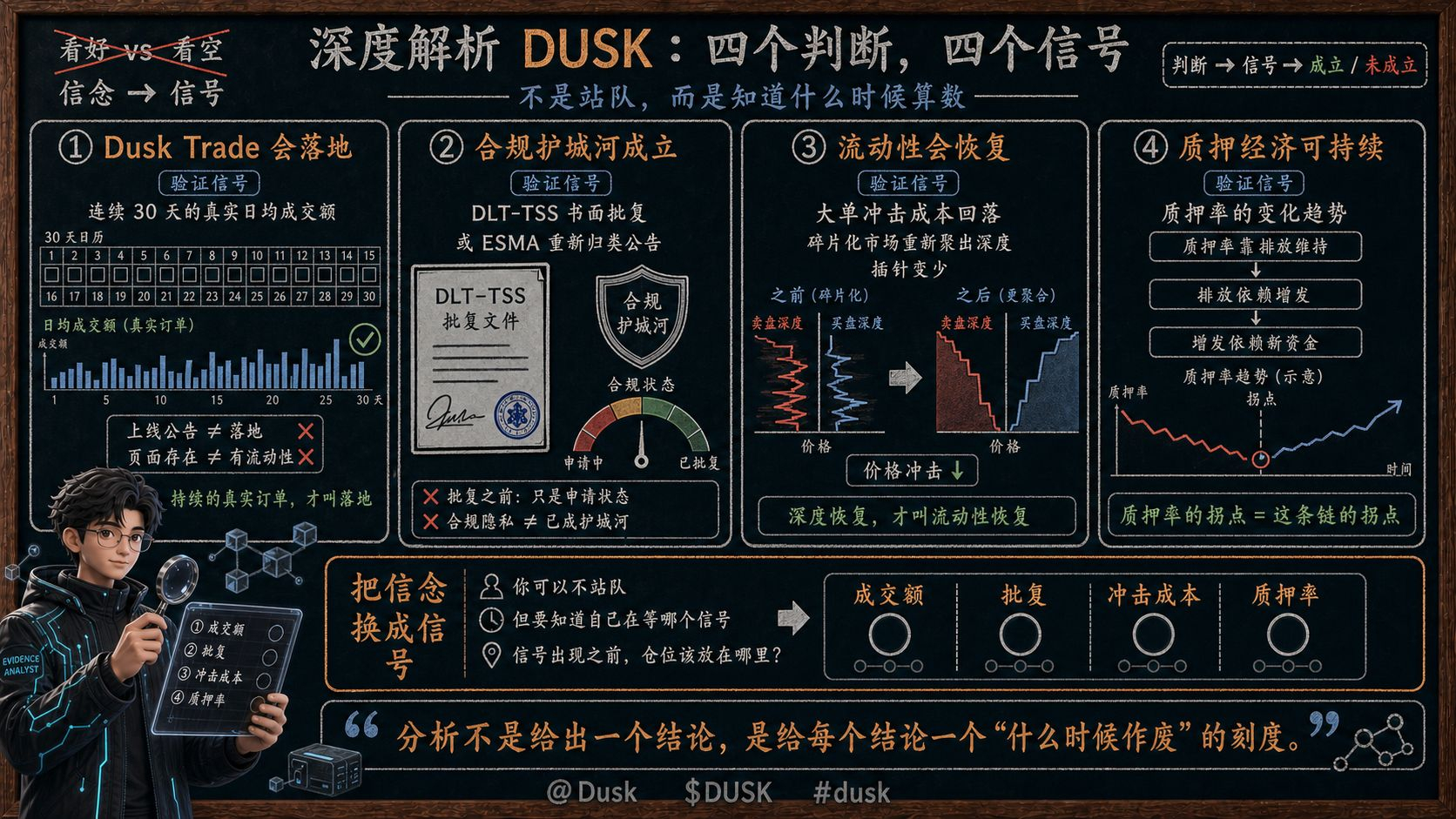
In the discussions around DUSK, the most common thing is that there are two camps: the bulls and the bears, each citing their own facts. But no matter how long the argument has gone on, what’s missing has never been viewpoints—it’s a checklist of “when it counts.” Every judgment should come with an observable signal. Only when the signal shows up does the judgment hold.
First judgment: Dusk Trade will go live. The corresponding signal is not a “launch announcement,” but the sustained real average daily trading volume for 30 consecutive days. Going live doesn’t equal having trades; a page doesn’t equal liquidity. Only continuous real orders qualify as “going live.”
Second judgment: the compliance moat is established. The signal is a written approval response for DLT-TSS, or an ESMA reclassification announcement. Before that, “compliant privacy” is merely an application status—not a moat.
Third judgment: liquidity will recover. The signal is the drop in large-order impact costs. Only when, after delisting, the fragmented market re-aggregates into depth and there are fewer “needle-like” orders, can it be called a recovery.
Fourth judgment: the staking economics are sustainable. The signal is the trend in the staking ratio. If the staking ratio is maintained through emissions, emissions reliance increases via additional token issuance, and additional issuance relies on new capital, then the turning point of the staking ratio is also the turning point of this chain.
Four judgments, four signals—none of them is “I believe.” Swap belief for signals, and DUSK stops being a “which side are you on” question. It becomes a “what are you waiting for” question. You don’t have to pick a side, but you must know which signal you’re waiting on—and before it appears, where your position should be.
That’s what analysis is for: not to provide a conclusion, but to give each conclusion a clear “when it becomes invalid” timestamp.
@Dusk_Foundation $DUSK #dusk
In the discussions around DUSK, the most common thing is that there are two camps: the bulls and the bears, each citing their own facts. But no matter how long the argument has gone on, what’s missing has never been viewpoints—it’s a checklist of “when it counts.” Every judgment should come with an observable signal. Only when the signal shows up does the judgment hold.
First judgment: Dusk Trade will go live. The corresponding signal is not a “launch announcement,” but the sustained real average daily trading volume for 30 consecutive days. Going live doesn’t equal having trades; a page doesn’t equal liquidity. Only continuous real orders qualify as “going live.”
Second judgment: the compliance moat is established. The signal is a written approval response for DLT-TSS, or an ESMA reclassification announcement. Before that, “compliant privacy” is merely an application status—not a moat.
Third judgment: liquidity will recover. The signal is the drop in large-order impact costs. Only when, after delisting, the fragmented market re-aggregates into depth and there are fewer “needle-like” orders, can it be called a recovery.
Fourth judgment: the staking economics are sustainable. The signal is the trend in the staking ratio. If the staking ratio is maintained through emissions, emissions reliance increases via additional token issuance, and additional issuance relies on new capital, then the turning point of the staking ratio is also the turning point of this chain.
Four judgments, four signals—none of them is “I believe.” Swap belief for signals, and DUSK stops being a “which side are you on” question. It becomes a “what are you waiting for” question. You don’t have to pick a side, but you must know which signal you’re waiting on—and before it appears, where your position should be.
That’s what analysis is for: not to provide a conclusion, but to give each conclusion a clear “when it becomes invalid” timestamp.
@Dusk $DUSK #dusk
First judgment: Dusk Trade will go live. The corresponding signal is not a “launch announcement,” but the sustained real average daily trading volume for 30 consecutive days. Going live doesn’t equal having trades; a page doesn’t equal liquidity. Only continuous real orders qualify as “going live.”
Second judgment: the compliance moat is established. The signal is a written approval response for DLT-TSS, or an ESMA reclassification announcement. Before that, “compliant privacy” is merely an application status—not a moat.
Third judgment: liquidity will recover. The signal is the drop in large-order impact costs. Only when, after delisting, the fragmented market re-aggregates into depth and there are fewer “needle-like” orders, can it be called a recovery.
Fourth judgment: the staking economics are sustainable. The signal is the trend in the staking ratio. If the staking ratio is maintained through emissions, emissions reliance increases via additional token issuance, and additional issuance relies on new capital, then the turning point of the staking ratio is also the turning point of this chain.
Four judgments, four signals—none of them is “I believe.” Swap belief for signals, and DUSK stops being a “which side are you on” question. It becomes a “what are you waiting for” question. You don’t have to pick a side, but you must know which signal you’re waiting on—and before it appears, where your position should be.
That’s what analysis is for: not to provide a conclusion, but to give each conclusion a clear “when it becomes invalid” timestamp.
@Dusk $DUSK #dusk
1
78
·
--
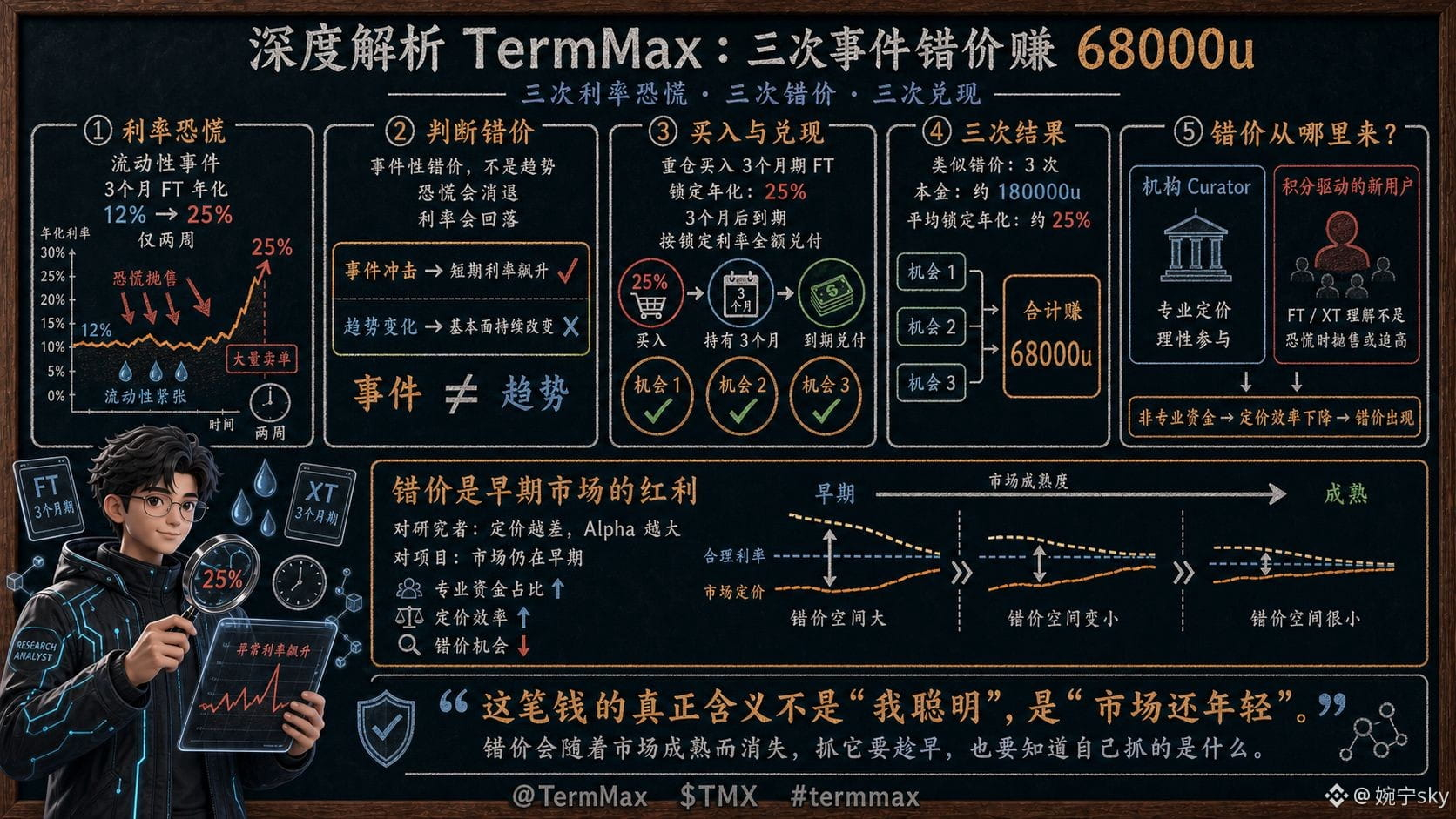
68000u was the money I earned on TermMax by catching the "event mispricing"—three rounds of rate panic, three rounds of mispricing, three rounds of redemption.
A typical one: in a certain month, in a particular market, due to a liquidity event, rates were pushed up in a panic. A 3-month FT annualized yield jumped to 25%—but just two weeks earlier it was still 12%. I judged this to be an event-driven mispricing (the panic would fade and rates would fall), not a trend. I went heavy and bought that FT tenor. Three months later it matured, and the rate indeed fell. I redeemed it in full at the locked-in rate of 25%.
Three similar mispricing opportunities added up to 68000u profit (principal about 180000u, with an average locked annualized yield of about 25%).
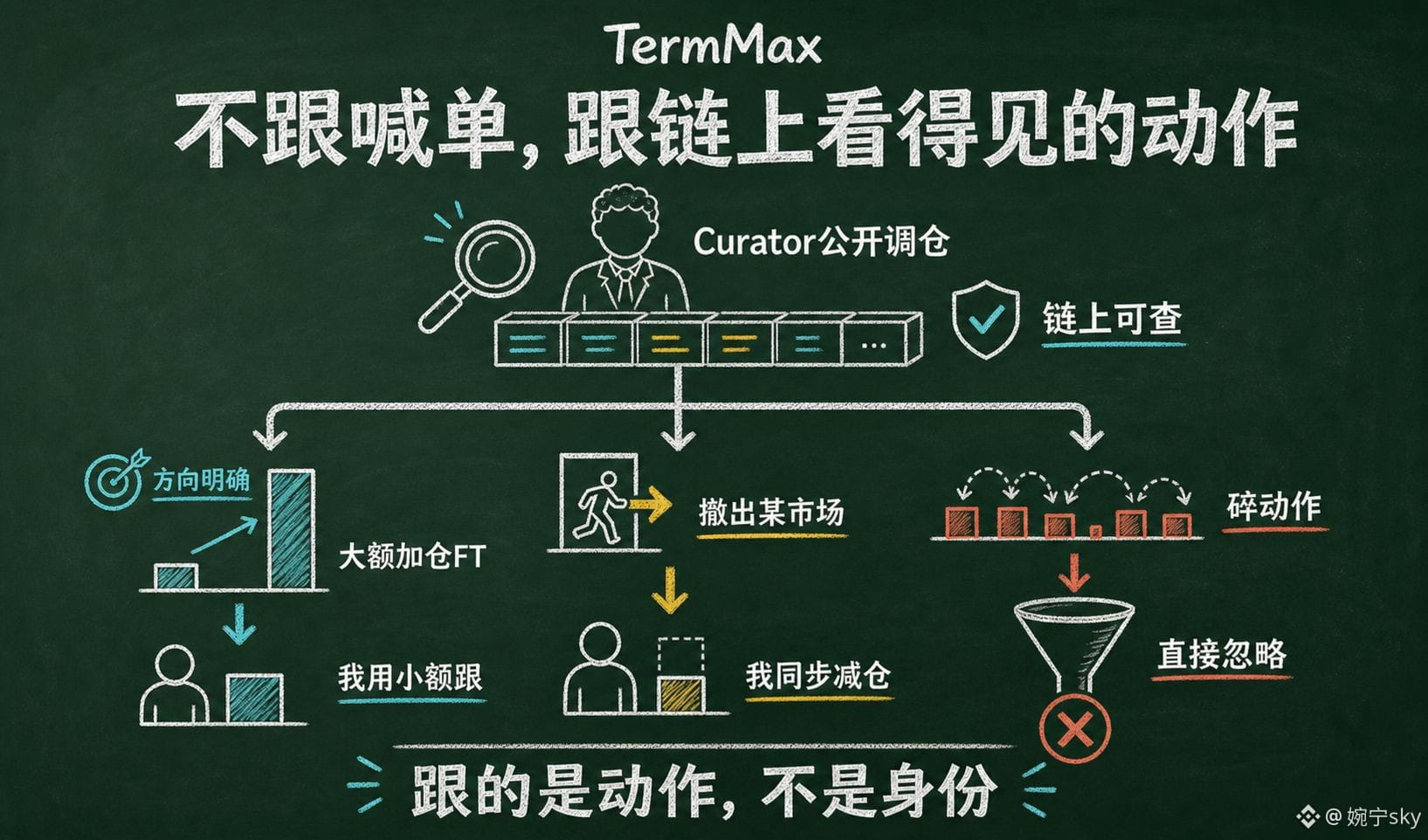
Why do mispricings exist—that’s the key. TermMax’s rate-market participants are extremely polarized in terms of professionalism: institutional Curators price rationally, but many new users driven by points don’t fully understand FT/XT structures. When panic hits, they sell at the wrong time—or they chase higher—creating mispricings that institutions would not generate.
In other words, the pricing efficiency of this market is dragged down by "non-professional capital" lured in by points. For researchers, the worse the pricing, the larger the alpha; for projects, this suggests the market is still in its early stage. As the share of professional capital rises, mispricings will become fewer.
So the real meaning of this money isn’t that I’m "smart"—it’s that the market is still young. Mispricings are an early-stage dividend. They disappear as the market matures. Catch them early, but also know what exactly you’re catching.
@termmax #TermMax
68000u was the money I earned on TermMax by catching the "event mispricing"—three rounds of rate panic, three rounds of mispricing, three rounds of redemption.
A typical one: in a certain month, in a particular market, due to a liquidity event, rates were pushed up in a panic. A 3-month FT annualized yield jumped to 25%—but just two weeks earlier it was still 12%. I judged this to be an event-driven mispricing (the panic would fade and rates would fall), not a trend. I went heavy and bought that FT tenor. Three months later it matured, and the rate indeed fell. I redeemed it in full at the locked-in rate of 25%.
Three similar mispricing opportunities added up to 68000u profit (principal about 180000u, with an average locked annualized yield of about 25%).
Why do mispricings exist—that’s the key. TermMax’s rate-market participants are extremely polarized in terms of professionalism: institutional Curators price rationally, but many new users driven by points don’t fully understand FT/XT structures. When panic hits, they sell at the wrong time—or they chase higher—creating mispricings that institutions would not generate.
In other words, the pricing efficiency of this market is dragged down by "non-professional capital" lured in by points. For researchers, the worse the pricing, the larger the alpha; for projects, this suggests the market is still in its early stage. As the share of professional capital rises, mispricings will become fewer.
So the real meaning of this money isn’t that I’m "smart"—it’s that the market is still young. Mispricings are an early-stage dividend. They disappear as the market matures. Catch them early, but also know what exactly you’re catching.
@TermMax #TermMax
A typical one: in a certain month, in a particular market, due to a liquidity event, rates were pushed up in a panic. A 3-month FT annualized yield jumped to 25%—but just two weeks earlier it was still 12%. I judged this to be an event-driven mispricing (the panic would fade and rates would fall), not a trend. I went heavy and bought that FT tenor. Three months later it matured, and the rate indeed fell. I redeemed it in full at the locked-in rate of 25%.
Three similar mispricing opportunities added up to 68000u profit (principal about 180000u, with an average locked annualized yield of about 25%).
Why do mispricings exist—that’s the key. TermMax’s rate-market participants are extremely polarized in terms of professionalism: institutional Curators price rationally, but many new users driven by points don’t fully understand FT/XT structures. When panic hits, they sell at the wrong time—or they chase higher—creating mispricings that institutions would not generate.
In other words, the pricing efficiency of this market is dragged down by "non-professional capital" lured in by points. For researchers, the worse the pricing, the larger the alpha; for projects, this suggests the market is still in its early stage. As the share of professional capital rises, mispricings will become fewer.
So the real meaning of this money isn’t that I’m "smart"—it’s that the market is still young. Mispricings are an early-stage dividend. They disappear as the market matures. Catch them early, but also know what exactly you’re catching.
@TermMax #TermMax
59
·
--
42000u is the money I "sold too early" on DUSK—didn’t buy it by mistake, I just sold too soon. This is the most painless yet most painful kind of loss: I didn’t lose my principal, but I lost the portion I could have received.
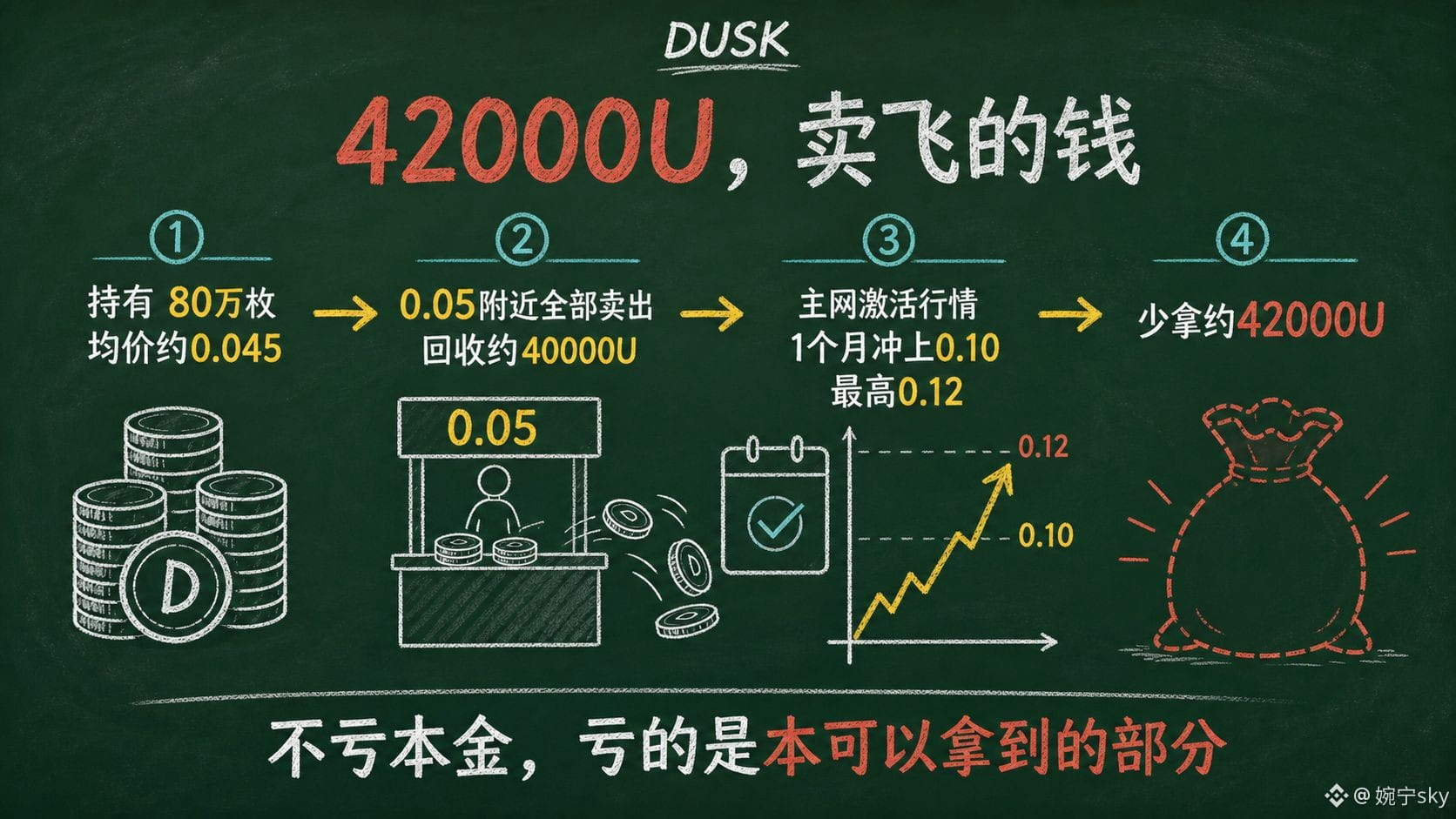
Background: Before January 2026, I held 800,000 DUSK with an average price of about 0.045. By the end of the year, I needed to pull back some funds, and at the time market sentiment about the mainnet activation’s “good news being cashed out” was rather weak. The price had been stuck around 0.05 for a long time. I thought, “Even if it activates, it’ll probably be just like this,” so I gradually sold all 800,000 DUSK around 0.05 and managed to recover about 40,000u.
Then comes the most familiar plot: the mainnet activation rally kicks off. In a month, the price moves from 0.05 to above 0.10, even reaching a high near 0.12. Those 800,000 DUSK that I sold—at 0.12 I would have had about 42,000u more. During the days the rally played out, I checked the order book every day to calculate this figure—not to count how much I made, but how much I missed.
Looking back at this money, the mistake wasn’t in the act of “selling.” The mistake was in the “judgment basis at the time of selling.” My reason for selling was: “Activation will be like that.” That was my expectation—not based on any data. The truth is: mainnet activation is the milestone DUSK had been waiting for, for a full year. In events like this on DUSK, the pattern has always been “numbness before the cash-out, explosion after.” Its event-driven nature means everyone who loses patience before the event pays the same cost.
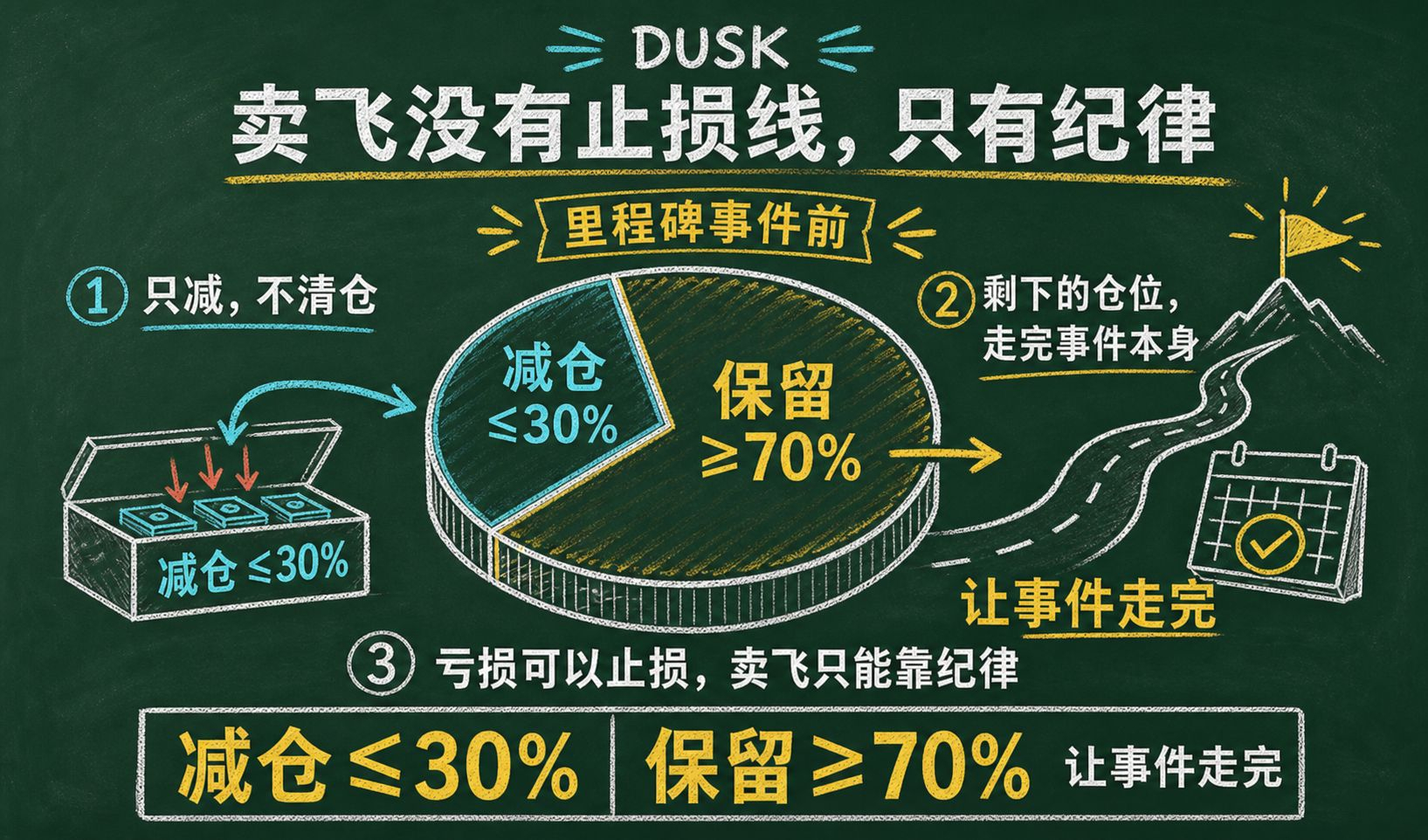
Now the rule: for my DUSK position, before a milestone event, I only cut it down—never more than 30%. The rest stays to let the event run its course. “Selling too early” is different from “losing money.” Losses can be stopped; selling too early has no stop-loss line—only discipline.
@Dusk_Foundation $DUSK #dusk
42000u is the money I "sold too early" on DUSK—didn’t buy it by mistake, I just sold too soon. This is the most painless yet most painful kind of loss: I didn’t lose my principal, but I lost the portion I could have received.
Background: Before January 2026, I held 800,000 DUSK with an average price of about 0.045. By the end of the year, I needed to pull back some funds, and at the time market sentiment about the mainnet activation’s “good news being cashed out” was rather weak. The price had been stuck around 0.05 for a long time. I thought, “Even if it activates, it’ll probably be just like this,” so I gradually sold all 800,000 DUSK around 0.05 and managed to recover about 40,000u.
Then comes the most familiar plot: the mainnet activation rally kicks off. In a month, the price moves from 0.05 to above 0.10, even reaching a high near 0.12. Those 800,000 DUSK that I sold—at 0.12 I would have had about 42,000u more. During the days the rally played out, I checked the order book every day to calculate this figure—not to count how much I made, but how much I missed.
Looking back at this money, the mistake wasn’t in the act of “selling.” The mistake was in the “judgment basis at the time of selling.” My reason for selling was: “Activation will be like that.” That was my expectation—not based on any data. The truth is: mainnet activation is the milestone DUSK had been waiting for, for a full year. In events like this on DUSK, the pattern has always been “numbness before the cash-out, explosion after.” Its event-driven nature means everyone who loses patience before the event pays the same cost.
Now the rule: for my DUSK position, before a milestone event, I only cut it down—never more than 30%. The rest stays to let the event run its course. “Selling too early” is different from “losing money.” Losses can be stopped; selling too early has no stop-loss line—only discipline.
@Dusk $DUSK #dusk
Background: Before January 2026, I held 800,000 DUSK with an average price of about 0.045. By the end of the year, I needed to pull back some funds, and at the time market sentiment about the mainnet activation’s “good news being cashed out” was rather weak. The price had been stuck around 0.05 for a long time. I thought, “Even if it activates, it’ll probably be just like this,” so I gradually sold all 800,000 DUSK around 0.05 and managed to recover about 40,000u.
Then comes the most familiar plot: the mainnet activation rally kicks off. In a month, the price moves from 0.05 to above 0.10, even reaching a high near 0.12. Those 800,000 DUSK that I sold—at 0.12 I would have had about 42,000u more. During the days the rally played out, I checked the order book every day to calculate this figure—not to count how much I made, but how much I missed.
Looking back at this money, the mistake wasn’t in the act of “selling.” The mistake was in the “judgment basis at the time of selling.” My reason for selling was: “Activation will be like that.” That was my expectation—not based on any data. The truth is: mainnet activation is the milestone DUSK had been waiting for, for a full year. In events like this on DUSK, the pattern has always been “numbness before the cash-out, explosion after.” Its event-driven nature means everyone who loses patience before the event pays the same cost.
Now the rule: for my DUSK position, before a milestone event, I only cut it down—never more than 30%. The rest stays to let the event run its course. “Selling too early” is different from “losing money.” Losses can be stopped; selling too early has no stop-loss line—only discipline.
@Dusk $DUSK #dusk
92
·
--
27000u is the money I lost in my multi-chain setup at TermMax—not because the strategy failed, but because the "cross-chain" action itself burned it.
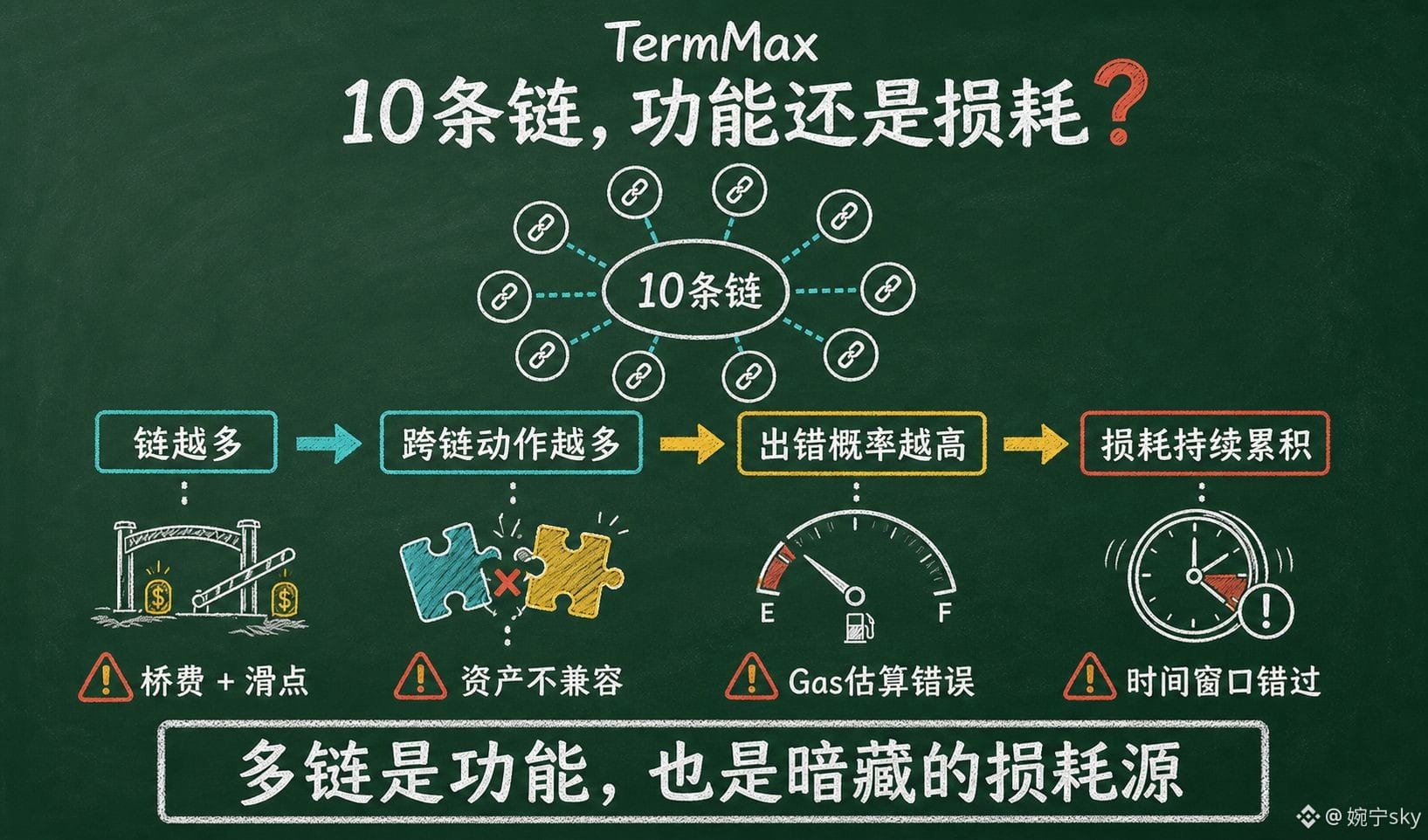
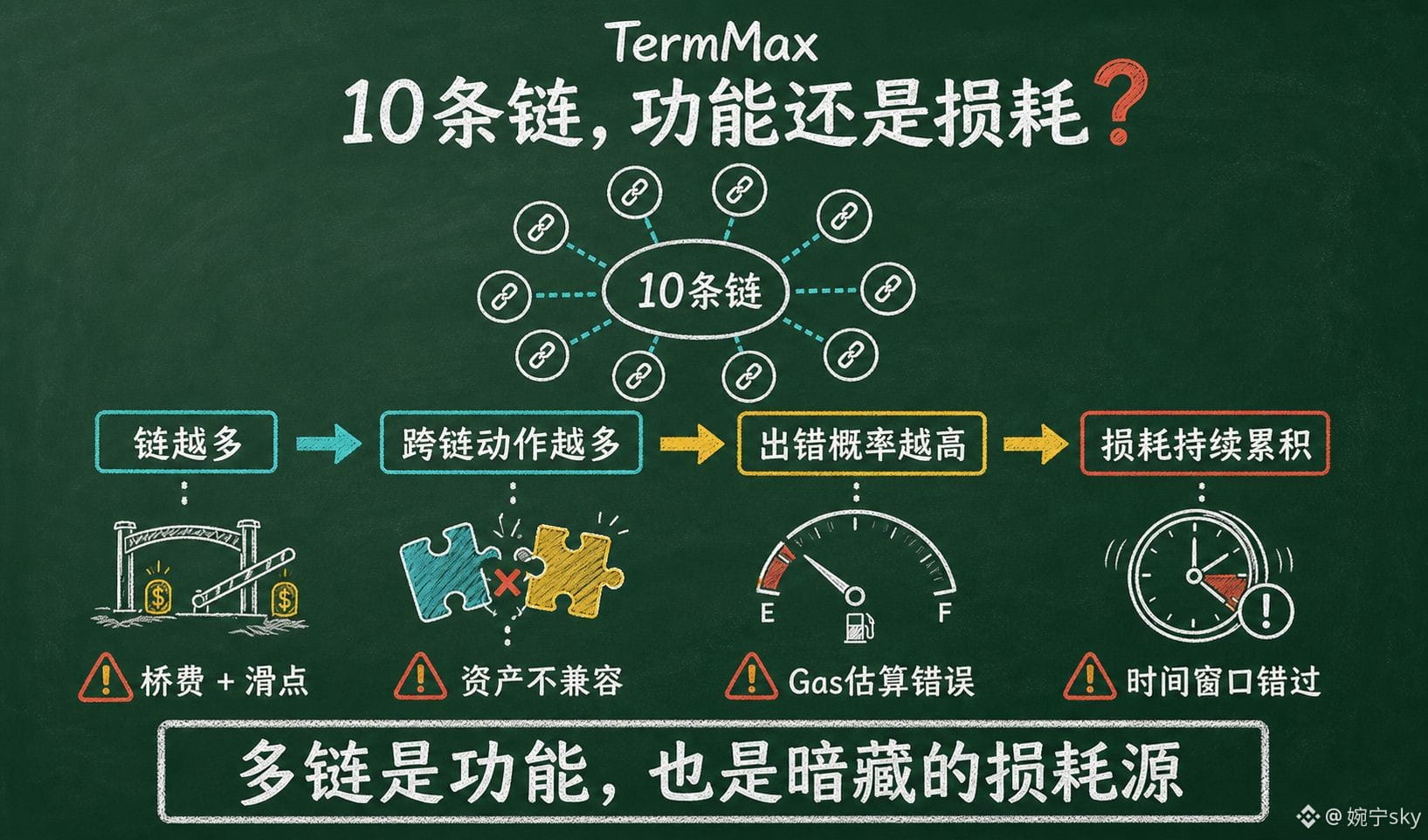
Three incidents. First: I bridged USDC from Ethereum to the BNB Chain. Between bridge fees and slippage, about 4000u was burned. The funds arrived three days late, and I missed a properly calculated FT deadline, costing me about 5000u in missed profit. Second: when operating on X Layer, I chose the wrong asset path. One transfer went into an incompatible pool, and I could only recover it through customer support. After going back and forth, the loss was about 8000u. Third: during a cross-chain return, my gas estimate was wrong. The transaction got stuck in pending for half a day, and in the end it was voided and resent—double gas, and I also missed the window I should have been in. About 4000u. Add to that roughly 6000u in miscellaneous cross-chain losses throughout the year, for a total of 27000u.
Not a single cent of it was from a "misjudgment". It was all "operational mistakes"—but operational mistakes are precisely the worst kind of losses: they generate no experience, only invoices. What truly keeps me on guard is this: TermMax deploys 10 chains. The more chains there are, the more cross-chain actions you have to do, and the probability of losses like these goes up—multi-chain is a feature, but it’s also a hidden source of costs.
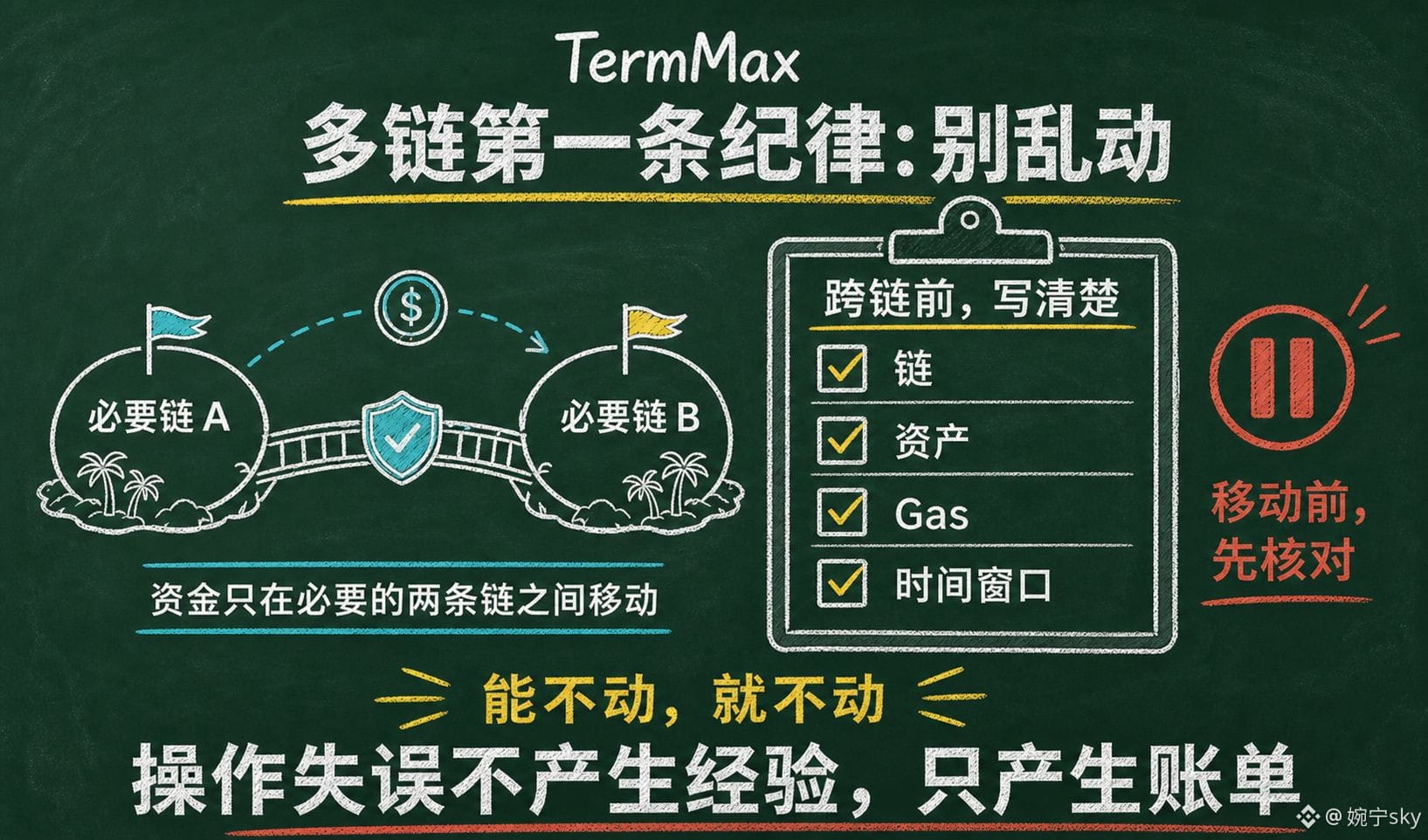
After the review, the rules are: funds should only move between the two necessary chains—if you can avoid it, don’t touch it. Before every cross-chain, write down the chain, asset, gas, and the time window clearly, then proceed. The first discipline in the multi-chain world isn’t "which chain to go to"—it’s "don’t mess around".
@termmax #TermMax
27000u is the money I lost in my multi-chain setup at TermMax—not because the strategy failed, but because the "cross-chain" action itself burned it.
Three incidents. First: I bridged USDC from Ethereum to the BNB Chain. Between bridge fees and slippage, about 4000u was burned. The funds arrived three days late, and I missed a properly calculated FT deadline, costing me about 5000u in missed profit. Second: when operating on X Layer, I chose the wrong asset path. One transfer went into an incompatible pool, and I could only recover it through customer support. After going back and forth, the loss was about 8000u. Third: during a cross-chain return, my gas estimate was wrong. The transaction got stuck in pending for half a day, and in the end it was voided and resent—double gas, and I also missed the window I should have been in. About 4000u. Add to that roughly 6000u in miscellaneous cross-chain losses throughout the year, for a total of 27000u.
Not a single cent of it was from a "misjudgment". It was all "operational mistakes"—but operational mistakes are precisely the worst kind of losses: they generate no experience, only invoices. What truly keeps me on guard is this: TermMax deploys 10 chains. The more chains there are, the more cross-chain actions you have to do, and the probability of losses like these goes up—multi-chain is a feature, but it’s also a hidden source of costs.
After the review, the rules are: funds should only move between the two necessary chains—if you can avoid it, don’t touch it. Before every cross-chain, write down the chain, asset, gas, and the time window clearly, then proceed. The first discipline in the multi-chain world isn’t "which chain to go to"—it’s "don’t mess around".
@TermMax #TermMax
Three incidents. First: I bridged USDC from Ethereum to the BNB Chain. Between bridge fees and slippage, about 4000u was burned. The funds arrived three days late, and I missed a properly calculated FT deadline, costing me about 5000u in missed profit. Second: when operating on X Layer, I chose the wrong asset path. One transfer went into an incompatible pool, and I could only recover it through customer support. After going back and forth, the loss was about 8000u. Third: during a cross-chain return, my gas estimate was wrong. The transaction got stuck in pending for half a day, and in the end it was voided and resent—double gas, and I also missed the window I should have been in. About 4000u. Add to that roughly 6000u in miscellaneous cross-chain losses throughout the year, for a total of 27000u.
Not a single cent of it was from a "misjudgment". It was all "operational mistakes"—but operational mistakes are precisely the worst kind of losses: they generate no experience, only invoices. What truly keeps me on guard is this: TermMax deploys 10 chains. The more chains there are, the more cross-chain actions you have to do, and the probability of losses like these goes up—multi-chain is a feature, but it’s also a hidden source of costs.
After the review, the rules are: funds should only move between the two necessary chains—if you can avoid it, don’t touch it. Before every cross-chain, write down the chain, asset, gas, and the time window clearly, then proceed. The first discipline in the multi-chain world isn’t "which chain to go to"—it’s "don’t mess around".
@TermMax #TermMax
1
67
·
--
The narrative of DUSK, completed two clearly visible migrations within seven years—from “anonymous payments,” to “privacy L1,” and then to today’s “regulatory-compliant securitization infrastructure.” Understanding these two migrations matters more than understanding any single piece of news.
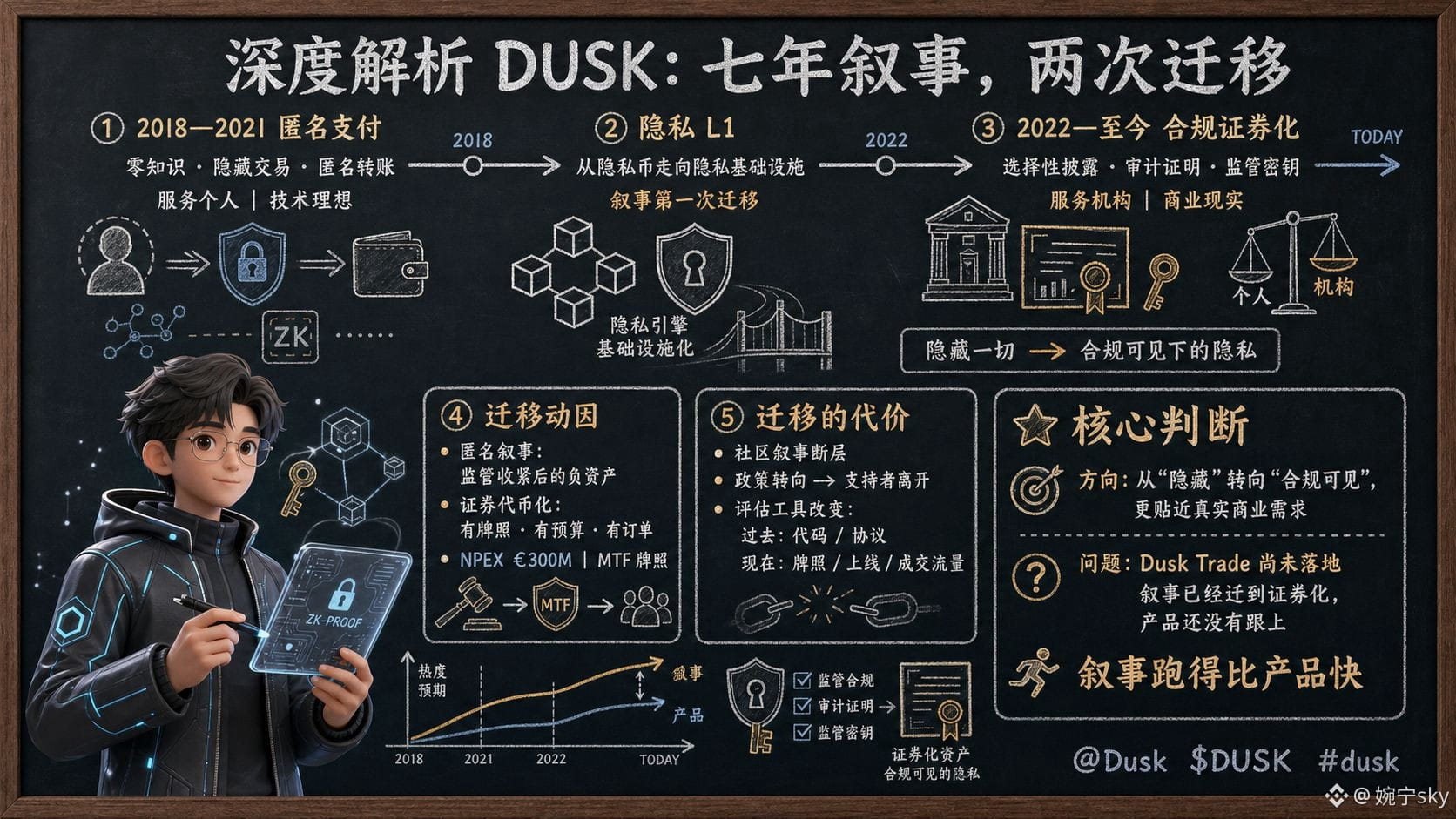
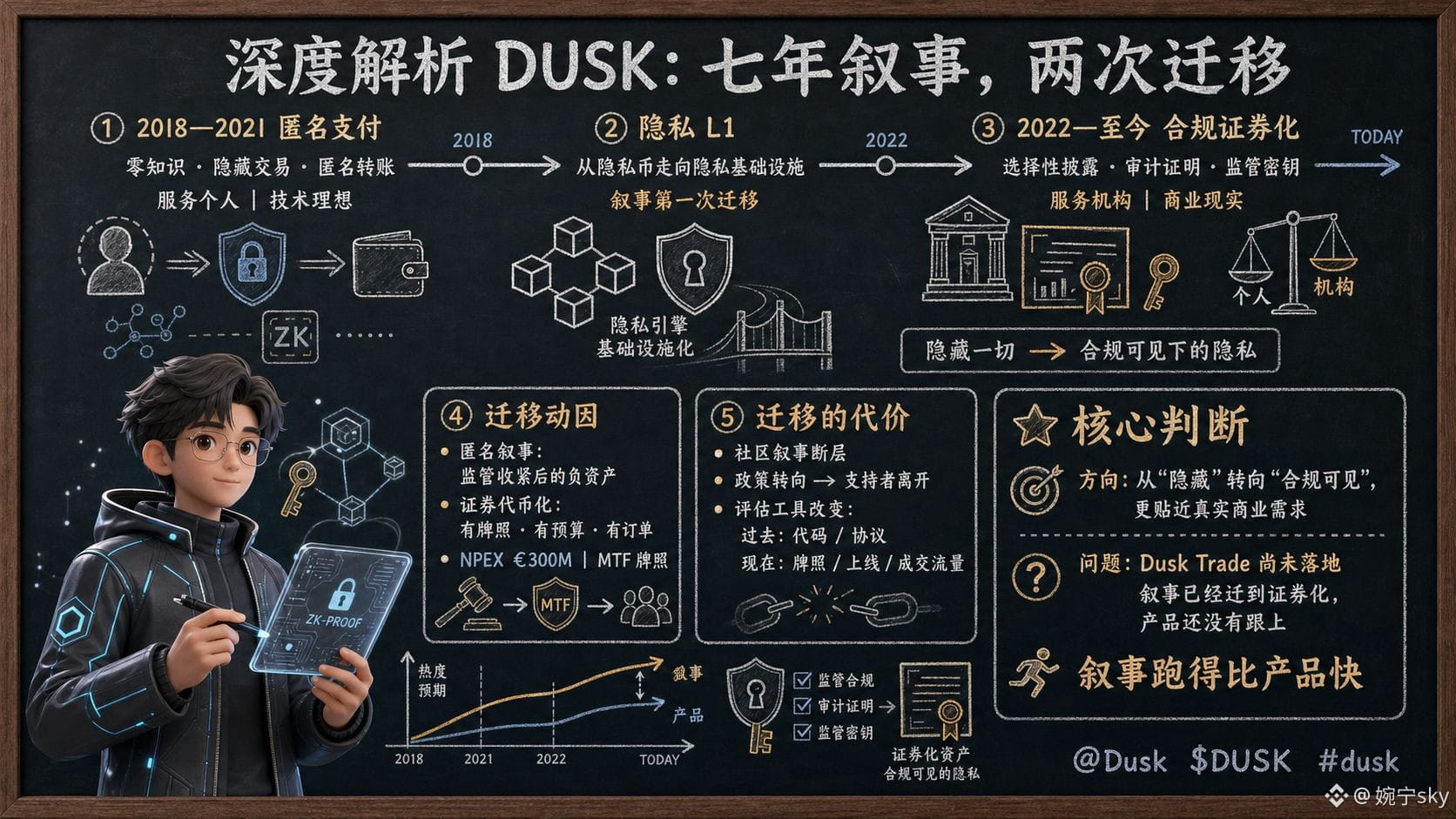
The first migration took place from 2018 to 2021: in the ICO era, it told the story of privacy payments—zero-knowledge, hidden transactions, anonymous transfers—standard narratives for the privacy-coin track at the time. The second migration took place after 2022: the direction shifted toward institutionalization, focusing on selective disclosure, audit proofs, and regulatory keys—not “hiding everything,” but “protecting privacy under conditions regulators can see.” The difference between the two narratives is huge: the first serves individuals, while the second serves institutions; the first is a technical ideal, and the second is commercial reality.
The motivations for the migrations are not hard to understand: once regulations tighten, an anonymous narrative becomes a negative asset, while tokenization of securities is a market with licenses, budgets, and real orders—NPEX’s €300M and the MTF license are the leverage points for this round of migration.
But there is a cost. The first wave of supporters who came in under the “anonymous” narrative, and today’s supporters of the “compliance” narrative, are almost two different groups—an audience narrative split like a generational gap. That will cause a wave of departures with every policy shift. In addition, after the narrative shifts from “technology-driven” to “business-driven,” the way you assess the project must change too: where you used to look at code and protocols, you now need to look at licenses, what’s been launched, and trading volumes—completely different evaluation tools.
So, for DUSK’s narrative, the assessment focus falls on two points: whether the migration direction is right, and whether the product can keep up. Migration itself is not necessarily a bad thing—moving from “hidden” to “regulatory-compliant and visible” is actually closer to real business needs. The real problem is only one: the narrative has already migrated to “securitization,” but the vehicle for securitization (Dusk Trade) has not yet been delivered. The narrative moving faster than the product is the most accurate description of this project right now.
@Dusk_Foundation $DUSK #dusk
The narrative of DUSK, completed two clearly visible migrations within seven years—from “anonymous payments,” to “privacy L1,” and then to today’s “regulatory-compliant securitization infrastructure.” Understanding these two migrations matters more than understanding any single piece of news.
The first migration took place from 2018 to 2021: in the ICO era, it told the story of privacy payments—zero-knowledge, hidden transactions, anonymous transfers—standard narratives for the privacy-coin track at the time. The second migration took place after 2022: the direction shifted toward institutionalization, focusing on selective disclosure, audit proofs, and regulatory keys—not “hiding everything,” but “protecting privacy under conditions regulators can see.” The difference between the two narratives is huge: the first serves individuals, while the second serves institutions; the first is a technical ideal, and the second is commercial reality.
The motivations for the migrations are not hard to understand: once regulations tighten, an anonymous narrative becomes a negative asset, while tokenization of securities is a market with licenses, budgets, and real orders—NPEX’s €300M and the MTF license are the leverage points for this round of migration.
But there is a cost. The first wave of supporters who came in under the “anonymous” narrative, and today’s supporters of the “compliance” narrative, are almost two different groups—an audience narrative split like a generational gap. That will cause a wave of departures with every policy shift. In addition, after the narrative shifts from “technology-driven” to “business-driven,” the way you assess the project must change too: where you used to look at code and protocols, you now need to look at licenses, what’s been launched, and trading volumes—completely different evaluation tools.
So, for DUSK’s narrative, the assessment focus falls on two points: whether the migration direction is right, and whether the product can keep up. Migration itself is not necessarily a bad thing—moving from “hidden” to “regulatory-compliant and visible” is actually closer to real business needs. The real problem is only one: the narrative has already migrated to “securitization,” but the vehicle for securitization (Dusk Trade) has not yet been delivered. The narrative moving faster than the product is the most accurate description of this project right now.
@Dusk $DUSK #dusk
The first migration took place from 2018 to 2021: in the ICO era, it told the story of privacy payments—zero-knowledge, hidden transactions, anonymous transfers—standard narratives for the privacy-coin track at the time. The second migration took place after 2022: the direction shifted toward institutionalization, focusing on selective disclosure, audit proofs, and regulatory keys—not “hiding everything,” but “protecting privacy under conditions regulators can see.” The difference between the two narratives is huge: the first serves individuals, while the second serves institutions; the first is a technical ideal, and the second is commercial reality.
The motivations for the migrations are not hard to understand: once regulations tighten, an anonymous narrative becomes a negative asset, while tokenization of securities is a market with licenses, budgets, and real orders—NPEX’s €300M and the MTF license are the leverage points for this round of migration.
But there is a cost. The first wave of supporters who came in under the “anonymous” narrative, and today’s supporters of the “compliance” narrative, are almost two different groups—an audience narrative split like a generational gap. That will cause a wave of departures with every policy shift. In addition, after the narrative shifts from “technology-driven” to “business-driven,” the way you assess the project must change too: where you used to look at code and protocols, you now need to look at licenses, what’s been launched, and trading volumes—completely different evaluation tools.
So, for DUSK’s narrative, the assessment focus falls on two points: whether the migration direction is right, and whether the product can keep up. Migration itself is not necessarily a bad thing—moving from “hidden” to “regulatory-compliant and visible” is actually closer to real business needs. The real problem is only one: the narrative has already migrated to “securitization,” but the vehicle for securitization (Dusk Trade) has not yet been delivered. The narrative moving faster than the product is the most accurate description of this project right now.
@Dusk $DUSK #dusk
82
·
--
16000u is the money I “inadvertently” lost on TermMax during the first half of the year—there were no single big losses; they were all small slippages that, added up, became a large sum.
Breaking it down: Gas and cross-chain bridge fees were about 7000u (frequent interactions over six months—each fee was only a few u to dozens of u, but the accumulation is terrifying); slippage was about 5500u (the order book for the FT market is thin; every buy and sell ends up costing a little more than expected—small amounts add up); and losses from selling XT residual value early were about 3500u (in a few trades I rushed to free up capital—XT filled at low prices, and I didn’t capture the full time value). Total: 16000u.
The cruelty of this accounting is that it leaves no memory. A big loss makes you review and hurts—friction losses don’t. They hide inside every “just go ahead and do it” operation. When I finally went through the ledger, I realized that over half of what I earned in fixed returns for the half-year was eaten away by friction.
So I changed the rules to three: if an operation can be done in one transaction, don’t split it into two; if you can place a limit order, don’t use market orders; and if you can hold until maturity, never sell early. Friction is an invisible tax rate on fixed returns, and the only way to “evade” that tax rate is to reduce the act of trading itself.
@termmax #TermMax
16000u is the money I “inadvertently” lost on TermMax during the first half of the year—there were no single big losses; they were all small slippages that, added up, became a large sum.
Breaking it down: Gas and cross-chain bridge fees were about 7000u (frequent interactions over six months—each fee was only a few u to dozens of u, but the accumulation is terrifying); slippage was about 5500u (the order book for the FT market is thin; every buy and sell ends up costing a little more than expected—small amounts add up); and losses from selling XT residual value early were about 3500u (in a few trades I rushed to free up capital—XT filled at low prices, and I didn’t capture the full time value). Total: 16000u.
The cruelty of this accounting is that it leaves no memory. A big loss makes you review and hurts—friction losses don’t. They hide inside every “just go ahead and do it” operation. When I finally went through the ledger, I realized that over half of what I earned in fixed returns for the half-year was eaten away by friction.
So I changed the rules to three: if an operation can be done in one transaction, don’t split it into two; if you can place a limit order, don’t use market orders; and if you can hold until maturity, never sell early. Friction is an invisible tax rate on fixed returns, and the only way to “evade” that tax rate is to reduce the act of trading itself.
@TermMax #TermMax
Breaking it down: Gas and cross-chain bridge fees were about 7000u (frequent interactions over six months—each fee was only a few u to dozens of u, but the accumulation is terrifying); slippage was about 5500u (the order book for the FT market is thin; every buy and sell ends up costing a little more than expected—small amounts add up); and losses from selling XT residual value early were about 3500u (in a few trades I rushed to free up capital—XT filled at low prices, and I didn’t capture the full time value). Total: 16000u.
The cruelty of this accounting is that it leaves no memory. A big loss makes you review and hurts—friction losses don’t. They hide inside every “just go ahead and do it” operation. When I finally went through the ledger, I realized that over half of what I earned in fixed returns for the half-year was eaten away by friction.
So I changed the rules to three: if an operation can be done in one transaction, don’t split it into two; if you can place a limit order, don’t use market orders; and if you can hold until maturity, never sell early. Friction is an invisible tax rate on fixed returns, and the only way to “evade” that tax rate is to reduce the act of trading itself.
@TermMax #TermMax
87
·
--
49000u is my position being stuck in DUSK. Over more than eight months, I turned the de-risking plan into a checklist—not waiting for a rebound, but setting trigger conditions for every path.
Plan One: Pledge to dilute. In the current 49000u, I’ve pledged 20000u. Using the most conservative estimate of 12% annualized return, the annual dilution yield is about 2400u—this is “using time to buy space.” The premise is that DUSK doesn’t get delisted and the network stays active. The trigger conditions are that the number of validators and block rewards remain normal.
Plan Two: Wait for key milestones. Once Dusk Trade truly goes live, the DLT-TSS gets written approval, and Binance restores the trading pair—any one of these landing will structurally improve liquidity. I’m holding 15000u to wait for this signal. The condition is “actual trades executed,” not “launch announcements.”
Plan Three: Disciplined stop-loss. If the narrative materially worsens (license revoked, team stalled, development paused), the remaining ~14000u will exit in two batches as planned—no adding, no betting on miracles.
These three paths don’t conflict: the pledged funds are doing work, the waiting funds are observing, and the stop-loss line serves as a backstop. Being stuck isn’t scary; what’s scary is having only “wait for a rebound” as the path—that’s basically handing your fate entirely to the market. Only after I finished writing the 49000u checklist can I sleep at night.
@Dusk_Foundation $DUSK #dusk
49000u is my position being stuck in DUSK. Over more than eight months, I turned the de-risking plan into a checklist—not waiting for a rebound, but setting trigger conditions for every path.
Plan One: Pledge to dilute. In the current 49000u, I’ve pledged 20000u. Using the most conservative estimate of 12% annualized return, the annual dilution yield is about 2400u—this is “using time to buy space.” The premise is that DUSK doesn’t get delisted and the network stays active. The trigger conditions are that the number of validators and block rewards remain normal.
Plan Two: Wait for key milestones. Once Dusk Trade truly goes live, the DLT-TSS gets written approval, and Binance restores the trading pair—any one of these landing will structurally improve liquidity. I’m holding 15000u to wait for this signal. The condition is “actual trades executed,” not “launch announcements.”
Plan Three: Disciplined stop-loss. If the narrative materially worsens (license revoked, team stalled, development paused), the remaining ~14000u will exit in two batches as planned—no adding, no betting on miracles.
These three paths don’t conflict: the pledged funds are doing work, the waiting funds are observing, and the stop-loss line serves as a backstop. Being stuck isn’t scary; what’s scary is having only “wait for a rebound” as the path—that’s basically handing your fate entirely to the market. Only after I finished writing the 49000u checklist can I sleep at night.
@Dusk $DUSK #dusk
Plan One: Pledge to dilute. In the current 49000u, I’ve pledged 20000u. Using the most conservative estimate of 12% annualized return, the annual dilution yield is about 2400u—this is “using time to buy space.” The premise is that DUSK doesn’t get delisted and the network stays active. The trigger conditions are that the number of validators and block rewards remain normal.
Plan Two: Wait for key milestones. Once Dusk Trade truly goes live, the DLT-TSS gets written approval, and Binance restores the trading pair—any one of these landing will structurally improve liquidity. I’m holding 15000u to wait for this signal. The condition is “actual trades executed,” not “launch announcements.”
Plan Three: Disciplined stop-loss. If the narrative materially worsens (license revoked, team stalled, development paused), the remaining ~14000u will exit in two batches as planned—no adding, no betting on miracles.
These three paths don’t conflict: the pledged funds are doing work, the waiting funds are observing, and the stop-loss line serves as a backstop. Being stuck isn’t scary; what’s scary is having only “wait for a rebound” as the path—that’s basically handing your fate entirely to the market. Only after I finished writing the 49000u checklist can I sleep at night.
@Dusk $DUSK #dusk
95
·
--
47000u is the time value I actually lost when I sold FT early on TermMax—I call it the "time tax".
In June, I bought FT with 47000u for a 6-month term. The page showed an annualized yield of 13%, and my expected total return at maturity was about 6.5%. In early August, I needed money and wanted to liquidate the FT early. But I found there was no early redemption option—so I could only place it for sale on the market. I checked the order book: the deepest buy orders sat at 96% of par value, but between 93% and 96% there was less than 8000u in volume. Since I had to fully sell my 47000u, I had to push the price all the way down to 94.9% to get it filled.
In the end, the average execution price was 94.9%. Holding for about 2 months left me with roughly 960u—whereas if I had held to maturity, I should have received about 3055u. The remaining ~2100u of profit evaporated, accounting for about seventy percent of the expected return. The guaranteed redemption at maturity is 1 FT = 1 USDC. Selling early is a free-fall priced by the market—the difference between the two is the "price of being early".
FT’s design is actually very honest: it turns "time" into a source of yield, and it turns "time" into a cost of liquidity. People who need cash urgently are at a natural disadvantage in markets like this. So I wrote the lesson into the rules: before buying FT, first confirm that this money won’t be needed for the next six months—discipline #1 for fixed-income products isn’t return, it’s matching the term. What 47000u taught me is the true price of the word "early".
@termmax #TermMax
47000u is the time value I actually lost when I sold FT early on TermMax—I call it the "time tax".
In June, I bought FT with 47000u for a 6-month term. The page showed an annualized yield of 13%, and my expected total return at maturity was about 6.5%. In early August, I needed money and wanted to liquidate the FT early. But I found there was no early redemption option—so I could only place it for sale on the market. I checked the order book: the deepest buy orders sat at 96% of par value, but between 93% and 96% there was less than 8000u in volume. Since I had to fully sell my 47000u, I had to push the price all the way down to 94.9% to get it filled.
In the end, the average execution price was 94.9%. Holding for about 2 months left me with roughly 960u—whereas if I had held to maturity, I should have received about 3055u. The remaining ~2100u of profit evaporated, accounting for about seventy percent of the expected return. The guaranteed redemption at maturity is 1 FT = 1 USDC. Selling early is a free-fall priced by the market—the difference between the two is the "price of being early".
FT’s design is actually very honest: it turns "time" into a source of yield, and it turns "time" into a cost of liquidity. People who need cash urgently are at a natural disadvantage in markets like this. So I wrote the lesson into the rules: before buying FT, first confirm that this money won’t be needed for the next six months—discipline #1 for fixed-income products isn’t return, it’s matching the term. What 47000u taught me is the true price of the word "early".
@TermMax #TermMax
In June, I bought FT with 47000u for a 6-month term. The page showed an annualized yield of 13%, and my expected total return at maturity was about 6.5%. In early August, I needed money and wanted to liquidate the FT early. But I found there was no early redemption option—so I could only place it for sale on the market. I checked the order book: the deepest buy orders sat at 96% of par value, but between 93% and 96% there was less than 8000u in volume. Since I had to fully sell my 47000u, I had to push the price all the way down to 94.9% to get it filled.
In the end, the average execution price was 94.9%. Holding for about 2 months left me with roughly 960u—whereas if I had held to maturity, I should have received about 3055u. The remaining ~2100u of profit evaporated, accounting for about seventy percent of the expected return. The guaranteed redemption at maturity is 1 FT = 1 USDC. Selling early is a free-fall priced by the market—the difference between the two is the "price of being early".
FT’s design is actually very honest: it turns "time" into a source of yield, and it turns "time" into a cost of liquidity. People who need cash urgently are at a natural disadvantage in markets like this. So I wrote the lesson into the rules: before buying FT, first confirm that this money won’t be needed for the next six months—discipline #1 for fixed-income products isn’t return, it’s matching the term. What 47000u taught me is the true price of the word "early".
@TermMax #TermMax
1
1
77
·
--
59000u is the budget I spent researching DUSK—not a position, but a cost. Very few people figure this out; I did.
The breakdown is very specific: about 18,000u for buying a watch position (long-term wear and tear), around 9,000u for the round trips to the testnet and the time-cost equivalent (based on my hourly rate), about 5,000u for tools and API subscriptions, and the biggest item—opportunity cost—about 27,000u: the time I’ve spent keeping an eye on DUSK over these six months. If I’d used that time to research something else, I might have captured other opportunities. Total: 59,000u.
After I did the math, I finally understood why someone would say, “Research is the most expensive position”: the implicit cost of researching a coin often exceeds the money you spend buying it. But I don’t regret it—because the output of research isn’t just one conclusion about DUSK. It’s a reusable set of filters: verify license authenticity by cross-checking with the official website; assess liquidity by how trading pairs change over time; judge follow-through by whether things land as PRE-LAUNCH or by actual trades. This set of filters is valuable no matter which coin you apply it to.
So within the 59,000u, the part that’s “actually spent on DUSK” is only 18,000u; the remaining 41,000u is spent on “learning how to research.” It now has a new use: using it to filter DUSK’s next steps—once Dusk Trade goes live and DLT-TSS has written progress, I’ll decide whether to double the watch position based on the research results. The research budget will run out; the filter won’t.
@Dusk_Foundation $DUSK #dusk
59000u is the budget I spent researching DUSK—not a position, but a cost. Very few people figure this out; I did.
The breakdown is very specific: about 18,000u for buying a watch position (long-term wear and tear), around 9,000u for the round trips to the testnet and the time-cost equivalent (based on my hourly rate), about 5,000u for tools and API subscriptions, and the biggest item—opportunity cost—about 27,000u: the time I’ve spent keeping an eye on DUSK over these six months. If I’d used that time to research something else, I might have captured other opportunities. Total: 59,000u.
After I did the math, I finally understood why someone would say, “Research is the most expensive position”: the implicit cost of researching a coin often exceeds the money you spend buying it. But I don’t regret it—because the output of research isn’t just one conclusion about DUSK. It’s a reusable set of filters: verify license authenticity by cross-checking with the official website; assess liquidity by how trading pairs change over time; judge follow-through by whether things land as PRE-LAUNCH or by actual trades. This set of filters is valuable no matter which coin you apply it to.
So within the 59,000u, the part that’s “actually spent on DUSK” is only 18,000u; the remaining 41,000u is spent on “learning how to research.” It now has a new use: using it to filter DUSK’s next steps—once Dusk Trade goes live and DLT-TSS has written progress, I’ll decide whether to double the watch position based on the research results. The research budget will run out; the filter won’t.
@Dusk $DUSK #dusk
The breakdown is very specific: about 18,000u for buying a watch position (long-term wear and tear), around 9,000u for the round trips to the testnet and the time-cost equivalent (based on my hourly rate), about 5,000u for tools and API subscriptions, and the biggest item—opportunity cost—about 27,000u: the time I’ve spent keeping an eye on DUSK over these six months. If I’d used that time to research something else, I might have captured other opportunities. Total: 59,000u.
After I did the math, I finally understood why someone would say, “Research is the most expensive position”: the implicit cost of researching a coin often exceeds the money you spend buying it. But I don’t regret it—because the output of research isn’t just one conclusion about DUSK. It’s a reusable set of filters: verify license authenticity by cross-checking with the official website; assess liquidity by how trading pairs change over time; judge follow-through by whether things land as PRE-LAUNCH or by actual trades. This set of filters is valuable no matter which coin you apply it to.
So within the 59,000u, the part that’s “actually spent on DUSK” is only 18,000u; the remaining 41,000u is spent on “learning how to research.” It now has a new use: using it to filter DUSK’s next steps—once Dusk Trade goes live and DLT-TSS has written progress, I’ll decide whether to double the watch position based on the research results. The research budget will run out; the filter won’t.
@Dusk $DUSK #dusk
85
·
--
I spent an afternoon counting Dusk’s active validators one by one: there are over a hundred in total. The top five account for roughly 30% of the stake combined. Among the remaining share, the biggest portion still comes from a handful of mid-sized nodes. A 36% staking rate looks healthy, but once you lay out the distribution, “health” is only skin-deep.
On-chain data doesn’t lie: a high staking rate doesn’t mean decentralization. It’s like having a normal body temperature doesn’t mean you don’t have an illness—staking rate is a thermometer, while concentration is an MRI/CT scan. The 36% figure tells you “how many coins are protecting the network,” but the CT scan reveals the issue: “who those coins are concentrated in.”
It’s a good thing that institutions are willing to stake. But the fewer and larger the staking institutions are, the thinner the bargaining power of retail holders becomes. They set the parameters and decide the network’s direction, while retail users only have voting rights, not negotiating rights.
I’m not saying concentration is bad—in a compliance narrative, institutional staking is actually a selling point, and regulators are more willing to see “responsible big players.” I’m just saying: when you look at Dusk, don’t only look at the staking-rate headline figure. Check the validator list, and see whether the top five’s share is rising or falling. That’s the real progress bar for its decentralization story.
My rule of thumb: pull the top-five percentage once every quarter. If it declines for two consecutive quarters, I’ll admit decentralization is genuinely taking place. If it stays flat, then I’ll treat it only as an “institutional chain”—holding is fine, but don’t expect the incentives to be aligned.
@Dusk_Foundation $DUSK #dusk
I spent an afternoon counting Dusk’s active validators one by one: there are over a hundred in total. The top five account for roughly 30% of the stake combined. Among the remaining share, the biggest portion still comes from a handful of mid-sized nodes. A 36% staking rate looks healthy, but once you lay out the distribution, “health” is only skin-deep.
On-chain data doesn’t lie: a high staking rate doesn’t mean decentralization. It’s like having a normal body temperature doesn’t mean you don’t have an illness—staking rate is a thermometer, while concentration is an MRI/CT scan. The 36% figure tells you “how many coins are protecting the network,” but the CT scan reveals the issue: “who those coins are concentrated in.”
It’s a good thing that institutions are willing to stake. But the fewer and larger the staking institutions are, the thinner the bargaining power of retail holders becomes. They set the parameters and decide the network’s direction, while retail users only have voting rights, not negotiating rights.
I’m not saying concentration is bad—in a compliance narrative, institutional staking is actually a selling point, and regulators are more willing to see “responsible big players.” I’m just saying: when you look at Dusk, don’t only look at the staking-rate headline figure. Check the validator list, and see whether the top five’s share is rising or falling. That’s the real progress bar for its decentralization story.
My rule of thumb: pull the top-five percentage once every quarter. If it declines for two consecutive quarters, I’ll admit decentralization is genuinely taking place. If it stays flat, then I’ll treat it only as an “institutional chain”—holding is fine, but don’t expect the incentives to be aligned.
@Dusk $DUSK #dusk
On-chain data doesn’t lie: a high staking rate doesn’t mean decentralization. It’s like having a normal body temperature doesn’t mean you don’t have an illness—staking rate is a thermometer, while concentration is an MRI/CT scan. The 36% figure tells you “how many coins are protecting the network,” but the CT scan reveals the issue: “who those coins are concentrated in.”
It’s a good thing that institutions are willing to stake. But the fewer and larger the staking institutions are, the thinner the bargaining power of retail holders becomes. They set the parameters and decide the network’s direction, while retail users only have voting rights, not negotiating rights.
I’m not saying concentration is bad—in a compliance narrative, institutional staking is actually a selling point, and regulators are more willing to see “responsible big players.” I’m just saying: when you look at Dusk, don’t only look at the staking-rate headline figure. Check the validator list, and see whether the top five’s share is rising or falling. That’s the real progress bar for its decentralization story.
My rule of thumb: pull the top-five percentage once every quarter. If it declines for two consecutive quarters, I’ll admit decentralization is genuinely taking place. If it stays flat, then I’ll treat it only as an “institutional chain”—holding is fine, but don’t expect the incentives to be aligned.
@Dusk $DUSK #dusk
77
·
--
"Can DUSK be bought?" When my friend asked me that last night, I had just finished reviewing its on-chain data for the second quarter. I replied: If you want to be a shareholder, yes; if you want to be a leeks (i.e., a retail victim), also yes—those two don’t conflict.
I personally hold a position of 42,000 u with an average cost of 0.075, currently down 20%. Why don’t I sell? Because selling requires the same kind of basis as buying—I don’t have evidence for the “it’s going to die.” The NPEX license is real, DuskEVM is being rolled out, and Quantoz’s EURQ has already been integrated.
Why don’t I add? Because I still don’t have enough evidence for the “it’s going to live.” Dusk Trade is still in PRE-LAUNCH, DLT-TSS is still under application, and Binance delisted its BTC trading pair in June. The data is there, so my position is stuck in the middle of “no basis.”
My friend asked again: So can you actually buy it? I said: Yes, but please change the word “buy” to “observe”—what’s different isn’t just two words, it’s two mindsets.
@Dusk_Foundation $DUSK #dusk
"Can DUSK be bought?" When my friend asked me that last night, I had just finished reviewing its on-chain data for the second quarter. I replied: If you want to be a shareholder, yes; if you want to be a leeks (i.e., a retail victim), also yes—those two don’t conflict.
I personally hold a position of 42,000 u with an average cost of 0.075, currently down 20%. Why don’t I sell? Because selling requires the same kind of basis as buying—I don’t have evidence for the “it’s going to die.” The NPEX license is real, DuskEVM is being rolled out, and Quantoz’s EURQ has already been integrated.
Why don’t I add? Because I still don’t have enough evidence for the “it’s going to live.” Dusk Trade is still in PRE-LAUNCH, DLT-TSS is still under application, and Binance delisted its BTC trading pair in June. The data is there, so my position is stuck in the middle of “no basis.”
My friend asked again: So can you actually buy it? I said: Yes, but please change the word “buy” to “observe”—what’s different isn’t just two words, it’s two mindsets.
@Dusk $DUSK #dusk
I personally hold a position of 42,000 u with an average cost of 0.075, currently down 20%. Why don’t I sell? Because selling requires the same kind of basis as buying—I don’t have evidence for the “it’s going to die.” The NPEX license is real, DuskEVM is being rolled out, and Quantoz’s EURQ has already been integrated.
Why don’t I add? Because I still don’t have enough evidence for the “it’s going to live.” Dusk Trade is still in PRE-LAUNCH, DLT-TSS is still under application, and Binance delisted its BTC trading pair in June. The data is there, so my position is stuck in the middle of “no basis.”
My friend asked again: So can you actually buy it? I said: Yes, but please change the word “buy” to “observe”—what’s different isn’t just two words, it’s two mindsets.
@Dusk $DUSK #dusk
81
·
--
I research DUSK’s price history and found that behind every sharp surge and crash there are clear triggers—none of it is “pure emotion.”
The ATH in 2021 (US$1.16) corresponded to DeFi mania plus the mainnet narrative; after mainnet blocks started in 2025, it fell from 0.3 to around 0.03—not because the project was failing, but because there was a “window where the function hadn’t been activated yet,” and the market started pricing in disappointment early. The real turning point came in January 2026: DuskEVM and Hedger were fully activated, and concentrated release of NPEX and Chainlink partner news followed—over two days it rose nearly 100%, and for the month it was +422%. Then in February it pulled back to the current level of 0.06.
The biggest lesson for me is this: DUSK’s price is driven by a “milestone calendar,” not by emotion. When it rallies, it’s often because a promise has been fulfilled; when it drops, it’s often because the next milestone hasn’t arrived yet. So studying it, in essence, is studying “what the next milestone will be”: the Dusk Trade launch, the DLT-TSS license, and the NPEX dApp going live.
Of course, a calendar-driven system also means the gap periods can be long and drawdowns can be very deep (94%), which isn’t suitable for capital that needs a fast heartbeat. My approach: put its milestones into a calendar, set up positions one month in advance, and then gradually reduce in batches after the milestones are realized—“event-driven, not emotion-driven.”
@Dusk_Foundation $DUSK #dusk
I research DUSK’s price history and found that behind every sharp surge and crash there are clear triggers—none of it is “pure emotion.”
The ATH in 2021 (US$1.16) corresponded to DeFi mania plus the mainnet narrative; after mainnet blocks started in 2025, it fell from 0.3 to around 0.03—not because the project was failing, but because there was a “window where the function hadn’t been activated yet,” and the market started pricing in disappointment early. The real turning point came in January 2026: DuskEVM and Hedger were fully activated, and concentrated release of NPEX and Chainlink partner news followed—over two days it rose nearly 100%, and for the month it was +422%. Then in February it pulled back to the current level of 0.06.
The biggest lesson for me is this: DUSK’s price is driven by a “milestone calendar,” not by emotion. When it rallies, it’s often because a promise has been fulfilled; when it drops, it’s often because the next milestone hasn’t arrived yet. So studying it, in essence, is studying “what the next milestone will be”: the Dusk Trade launch, the DLT-TSS license, and the NPEX dApp going live.
Of course, a calendar-driven system also means the gap periods can be long and drawdowns can be very deep (94%), which isn’t suitable for capital that needs a fast heartbeat. My approach: put its milestones into a calendar, set up positions one month in advance, and then gradually reduce in batches after the milestones are realized—“event-driven, not emotion-driven.”
@Dusk $DUSK #dusk
The ATH in 2021 (US$1.16) corresponded to DeFi mania plus the mainnet narrative; after mainnet blocks started in 2025, it fell from 0.3 to around 0.03—not because the project was failing, but because there was a “window where the function hadn’t been activated yet,” and the market started pricing in disappointment early. The real turning point came in January 2026: DuskEVM and Hedger were fully activated, and concentrated release of NPEX and Chainlink partner news followed—over two days it rose nearly 100%, and for the month it was +422%. Then in February it pulled back to the current level of 0.06.
The biggest lesson for me is this: DUSK’s price is driven by a “milestone calendar,” not by emotion. When it rallies, it’s often because a promise has been fulfilled; when it drops, it’s often because the next milestone hasn’t arrived yet. So studying it, in essence, is studying “what the next milestone will be”: the Dusk Trade launch, the DLT-TSS license, and the NPEX dApp going live.
Of course, a calendar-driven system also means the gap periods can be long and drawdowns can be very deep (94%), which isn’t suitable for capital that needs a fast heartbeat. My approach: put its milestones into a calendar, set up positions one month in advance, and then gradually reduce in batches after the milestones are realized—“event-driven, not emotion-driven.”
@Dusk $DUSK #dusk
80
·
--
80000u is the attention stash I built up after observing the RWA track for three months. After looking around, the projects that truly made me follow with real money aren’t the story-driven ones—it’s the “license + chain” combo like DUSK.
First, the institutional signals: NPEX is a licensed exchange in the Netherlands (MTF + broker license). Dusk has held a 10% stake since 2020—this isn’t something they just picked up on a whim. This year, the planned Dusk Trade will move €300M+ in security tokens on-chain; the first phase already includes a BlackRock money market fund, with a base of 20,000+ investors. Quantoz’s euro stablecoin, EURQ, has also been integrated.
Next, the retail side: total supply is 1 billion, and the initial 500 million are already fully unlocked—no looming risk of a massive future unlock. Staking requires at least 1,000 tokens (about $60) to participate, with roughly 12% annualized returns.
I’ve also written down the risks: in January, the bridge wallet was hacked, losing about 17,000 tokens. After a 422% surge in January, the current price is $0.06—still 94% away from its ATH of $1.16. So in my 80000u, I only put 20000u into staking; the rest I’ll decide once Dusk Trade is truly live.
@Dusk_Foundation $DUSK #dusk
80000u is the attention stash I built up after observing the RWA track for three months. After looking around, the projects that truly made me follow with real money aren’t the story-driven ones—it’s the “license + chain” combo like DUSK.
First, the institutional signals: NPEX is a licensed exchange in the Netherlands (MTF + broker license). Dusk has held a 10% stake since 2020—this isn’t something they just picked up on a whim. This year, the planned Dusk Trade will move €300M+ in security tokens on-chain; the first phase already includes a BlackRock money market fund, with a base of 20,000+ investors. Quantoz’s euro stablecoin, EURQ, has also been integrated.
Next, the retail side: total supply is 1 billion, and the initial 500 million are already fully unlocked—no looming risk of a massive future unlock. Staking requires at least 1,000 tokens (about $60) to participate, with roughly 12% annualized returns.
I’ve also written down the risks: in January, the bridge wallet was hacked, losing about 17,000 tokens. After a 422% surge in January, the current price is $0.06—still 94% away from its ATH of $1.16. So in my 80000u, I only put 20000u into staking; the rest I’ll decide once Dusk Trade is truly live.
@Dusk $DUSK #dusk
First, the institutional signals: NPEX is a licensed exchange in the Netherlands (MTF + broker license). Dusk has held a 10% stake since 2020—this isn’t something they just picked up on a whim. This year, the planned Dusk Trade will move €300M+ in security tokens on-chain; the first phase already includes a BlackRock money market fund, with a base of 20,000+ investors. Quantoz’s euro stablecoin, EURQ, has also been integrated.
Next, the retail side: total supply is 1 billion, and the initial 500 million are already fully unlocked—no looming risk of a massive future unlock. Staking requires at least 1,000 tokens (about $60) to participate, with roughly 12% annualized returns.
I’ve also written down the risks: in January, the bridge wallet was hacked, losing about 17,000 tokens. After a 422% surge in January, the current price is $0.06—still 94% away from its ATH of $1.16. So in my 80000u, I only put 20000u into staking; the rest I’ll decide once Dusk Trade is truly live.
@Dusk $DUSK #dusk
81
·
--
3,200 U——This was the most painful loss I experienced when I was trading last year, and it’s also the reason I’m confident enough to take a big position in BABY today. This story is worth telling from the beginning.
Last year I traded futures with 3,200 U as my principal, and I lost it all within two weeks. The process was classic: in the first week, I made 40% purely on luck and thought I was exceptionally gifted; in the second week, I increased leverage—then one sudden wick triggered a liquidation, wiping everything out to zero. After I was wiped out, I sat in front of my computer for a long time. In my mind, there was only one sentence: I really didn’t know what I was doing.
What did that 3,200 U buy me? Three realizations—later they became the foundation of all my investments.
First: the difference between luck and ability. In that 40% gain, I couldn’t replicate or explain the reasoning behind my decisions at all—it was pure luck. The market will keep taking back the money you make from luck until you can clearly tell the difference between luck and ability.
Second: leverage is an amplifier, not a tool. It amplifies profits, and it also amplifies destruction. Losing 50% requires a 100% gain just to break even—only people who’ve been wiped out can truly feel this math.
Third: trading without a system is gambling. Before the liquidation, I had no rules: no stop-loss, no position control, and I didn’t even look at fundamentals. Now, every trade of mine comes with a decision journal, an exit framework, and a checklist—these are all things I bought with that 3,200 U.
Why tell this story? Because people often ask me, “Why can you hold such a long position on BABY?” The answer is simple: I’ve already lost. I know what happens when you trade based on instinct alone, so I choose to replace feelings with a system—research, rules, recording, and reviewing. The reason my BABY positions can be held is not because BABY is special—it’s because I’ve already paid tuition, and I’ve learned how to hold any position.
The loss of 3,200 U was the most expensive lesson I ever bought—and also the highest-return investment. It turned me from a “gambler” into a “system.”
@babylonlabs_io $BABY #baby
3,200 U——This was the most painful loss I experienced when I was trading last year, and it’s also the reason I’m confident enough to take a big position in BABY today. This story is worth telling from the beginning.
Last year I traded futures with 3,200 U as my principal, and I lost it all within two weeks. The process was classic: in the first week, I made 40% purely on luck and thought I was exceptionally gifted; in the second week, I increased leverage—then one sudden wick triggered a liquidation, wiping everything out to zero. After I was wiped out, I sat in front of my computer for a long time. In my mind, there was only one sentence: I really didn’t know what I was doing.
What did that 3,200 U buy me? Three realizations—later they became the foundation of all my investments.
First: the difference between luck and ability. In that 40% gain, I couldn’t replicate or explain the reasoning behind my decisions at all—it was pure luck. The market will keep taking back the money you make from luck until you can clearly tell the difference between luck and ability.
Second: leverage is an amplifier, not a tool. It amplifies profits, and it also amplifies destruction. Losing 50% requires a 100% gain just to break even—only people who’ve been wiped out can truly feel this math.
Third: trading without a system is gambling. Before the liquidation, I had no rules: no stop-loss, no position control, and I didn’t even look at fundamentals. Now, every trade of mine comes with a decision journal, an exit framework, and a checklist—these are all things I bought with that 3,200 U.
Why tell this story? Because people often ask me, “Why can you hold such a long position on BABY?” The answer is simple: I’ve already lost. I know what happens when you trade based on instinct alone, so I choose to replace feelings with a system—research, rules, recording, and reviewing. The reason my BABY positions can be held is not because BABY is special—it’s because I’ve already paid tuition, and I’ve learned how to hold any position.
The loss of 3,200 U was the most expensive lesson I ever bought—and also the highest-return investment. It turned me from a “gambler” into a “system.”
@BabylonLabs_io $BABY #baby
Last year I traded futures with 3,200 U as my principal, and I lost it all within two weeks. The process was classic: in the first week, I made 40% purely on luck and thought I was exceptionally gifted; in the second week, I increased leverage—then one sudden wick triggered a liquidation, wiping everything out to zero. After I was wiped out, I sat in front of my computer for a long time. In my mind, there was only one sentence: I really didn’t know what I was doing.
What did that 3,200 U buy me? Three realizations—later they became the foundation of all my investments.
First: the difference between luck and ability. In that 40% gain, I couldn’t replicate or explain the reasoning behind my decisions at all—it was pure luck. The market will keep taking back the money you make from luck until you can clearly tell the difference between luck and ability.
Second: leverage is an amplifier, not a tool. It amplifies profits, and it also amplifies destruction. Losing 50% requires a 100% gain just to break even—only people who’ve been wiped out can truly feel this math.
Third: trading without a system is gambling. Before the liquidation, I had no rules: no stop-loss, no position control, and I didn’t even look at fundamentals. Now, every trade of mine comes with a decision journal, an exit framework, and a checklist—these are all things I bought with that 3,200 U.
Why tell this story? Because people often ask me, “Why can you hold such a long position on BABY?” The answer is simple: I’ve already lost. I know what happens when you trade based on instinct alone, so I choose to replace feelings with a system—research, rules, recording, and reviewing. The reason my BABY positions can be held is not because BABY is special—it’s because I’ve already paid tuition, and I’ve learned how to hold any position.
The loss of 3,200 U was the most expensive lesson I ever bought—and also the highest-return investment. It turned me from a “gambler” into a “system.”
@BabylonLabs_io $BABY #baby
133
Log in to explore more content
Join global crypto users on Binance Square
⚡️ Get latest and useful information about crypto.
💬 Trusted by the world’s largest crypto exchange.
👍 Discover real insights from verified creators.
Email / Phone number
Trending Topics
CircleMints500MUSDCOnSolana
81,193 views
1,881 Discussing
💵 Solana just received another $500M of USDC. But don't make the mistake everyone else is making...
#circlemints500musdconsolana
Circle's USDC Treasury recorded two 250M USDC mints on Solana, creating $500M of fresh supply through its authorized infrastructure.
Circle now reports $75.2B USDC in circulation globally.
But:
A mint is not the same as $500M of fresh market demand.
It tells us Circle created the inventory.
It does not tell us that $500M has already entered Solana DeFi, exchanges, payments or trading.
That's where the interesting signal begins.
Solana's stablecoin economy is already operating at enormous scale, with recent reporting putting network stablecoin volume above $5T in 2026.
So this isn't really a “USDC mint = SOL bullish” story.
It's an inventory → deployment story.
Watch the wallets.
Where does that $500M move next?
If it gets deployed into exchanges, lending, payments or liquidity pools, the market has something much more meaningful than a treasury print.
The mint confirms creation of USDC, not the eventual destination or economic use of the funds.
$SOL $RARE $USDC
#CircleMints500MUSDCOnSolana #solana #BlackRockBuildsTokenizedPortfoliosForOndo #defi
Stink meaner
·10 Likes
·5.4k views
PolymarketBankFailureBetsDrawFDICConcern
86,122 views
1,725 Discussing
BlackRockBuildsTokenizedPortfoliosForOndo
77,217 views
1,227 Discussing