When I studied Dusk's consensus mechanism, what took the most thought wasn't who gets to produce blocks, but Succinct Attestation—the part that's easiest to skip over in its name.
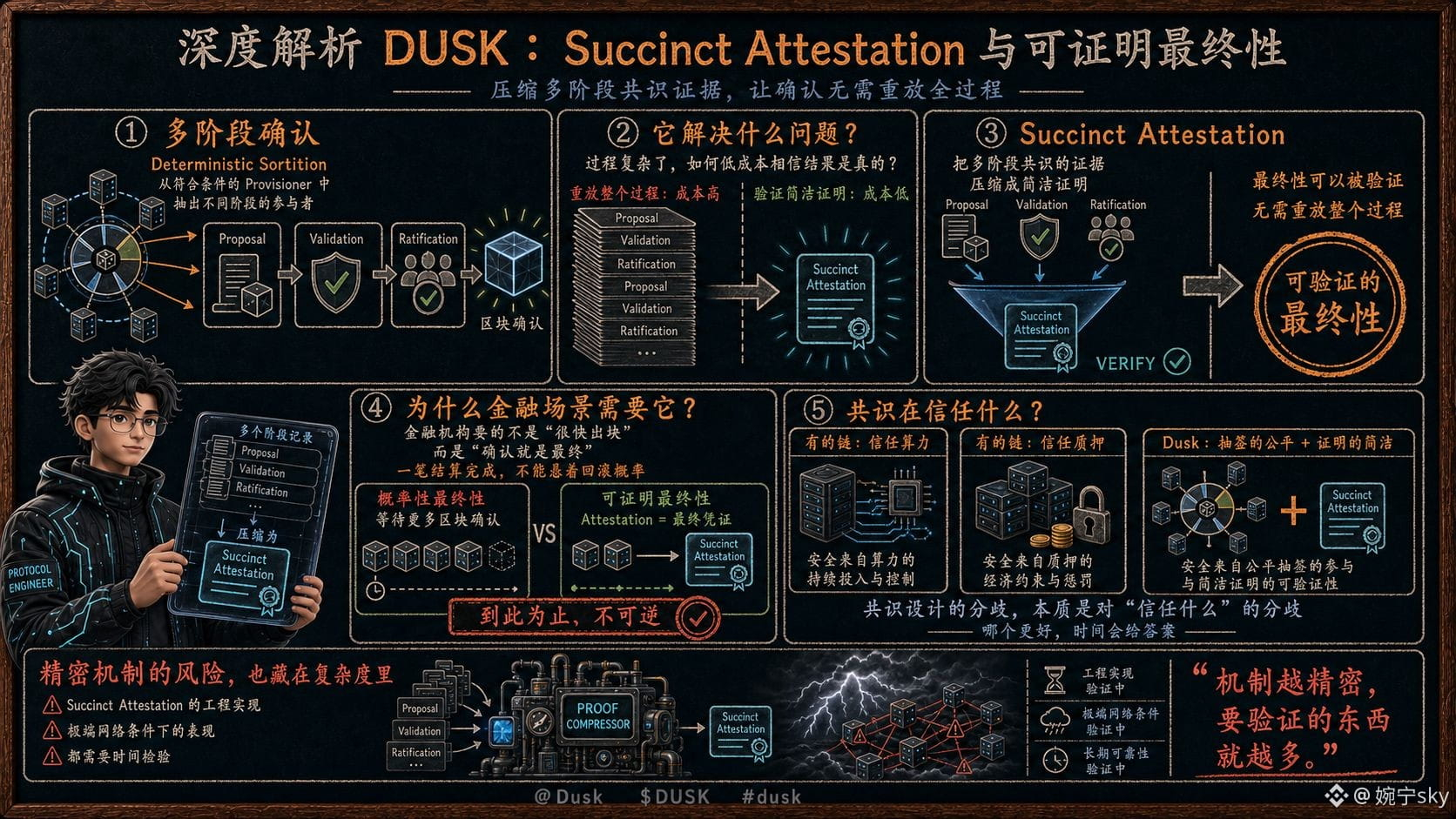
Let’s first break down the problem it addresses. Dusk’s block finalization is multi-stage: Deterministic Sortition draws participants for different stages from eligible Provisioners, and then Proposal, Validation, and Ratification complete the finalization process. The challenge with multi-stage consensus is this: when the process is complex, how can everyone cheaply trust that the "result is real"? Succinct Attestation does exactly that—compress the evidence of multi-stage consensus into a concise proof, so that finality can be verified without replaying the entire process.
You can see the design intent clearly in financial scenarios. Financial institutions don’t just want "fast block production"; they want "confirmation is final"—once a settlement is done, there can’t be a rollback probability hanging over it. Most chains make finality probabilistic (after more block confirmations). Dusk, instead, makes finality provable: an Attestation is the "this is it, irreversible" credential.
That’s also why it made me rethink why it’s worth investigating. Consensus disagreements, at their core, are disagreements over "what to trust"—some chains trust computing power, others trust staking. Dusk’s approach trusts "the fairness of the lottery plus the succinctness of the proof." Which is better will be answered by time.
Of course, the more precise the mechanism, the more there is to verify. The engineering implementation of Succinct Attestation and its performance under extreme network conditions still need to be tested over time. The biggest risk of a sophisticated mechanism is often hidden in its own complexity.
@Dusk $DUSK #dusk
Let’s first break down the problem it addresses. Dusk’s block finalization is multi-stage: Deterministic Sortition draws participants for different stages from eligible Provisioners, and then Proposal, Validation, and Ratification complete the finalization process. The challenge with multi-stage consensus is this: when the process is complex, how can everyone cheaply trust that the "result is real"? Succinct Attestation does exactly that—compress the evidence of multi-stage consensus into a concise proof, so that finality can be verified without replaying the entire process.
You can see the design intent clearly in financial scenarios. Financial institutions don’t just want "fast block production"; they want "confirmation is final"—once a settlement is done, there can’t be a rollback probability hanging over it. Most chains make finality probabilistic (after more block confirmations). Dusk, instead, makes finality provable: an Attestation is the "this is it, irreversible" credential.
That’s also why it made me rethink why it’s worth investigating. Consensus disagreements, at their core, are disagreements over "what to trust"—some chains trust computing power, others trust staking. Dusk’s approach trusts "the fairness of the lottery plus the succinctness of the proof." Which is better will be answered by time.
Of course, the more precise the mechanism, the more there is to verify. The engineering implementation of Succinct Attestation and its performance under extreme network conditions still need to be tested over time. The biggest risk of a sophisticated mechanism is often hidden in its own complexity.
@Dusk $DUSK #dusk