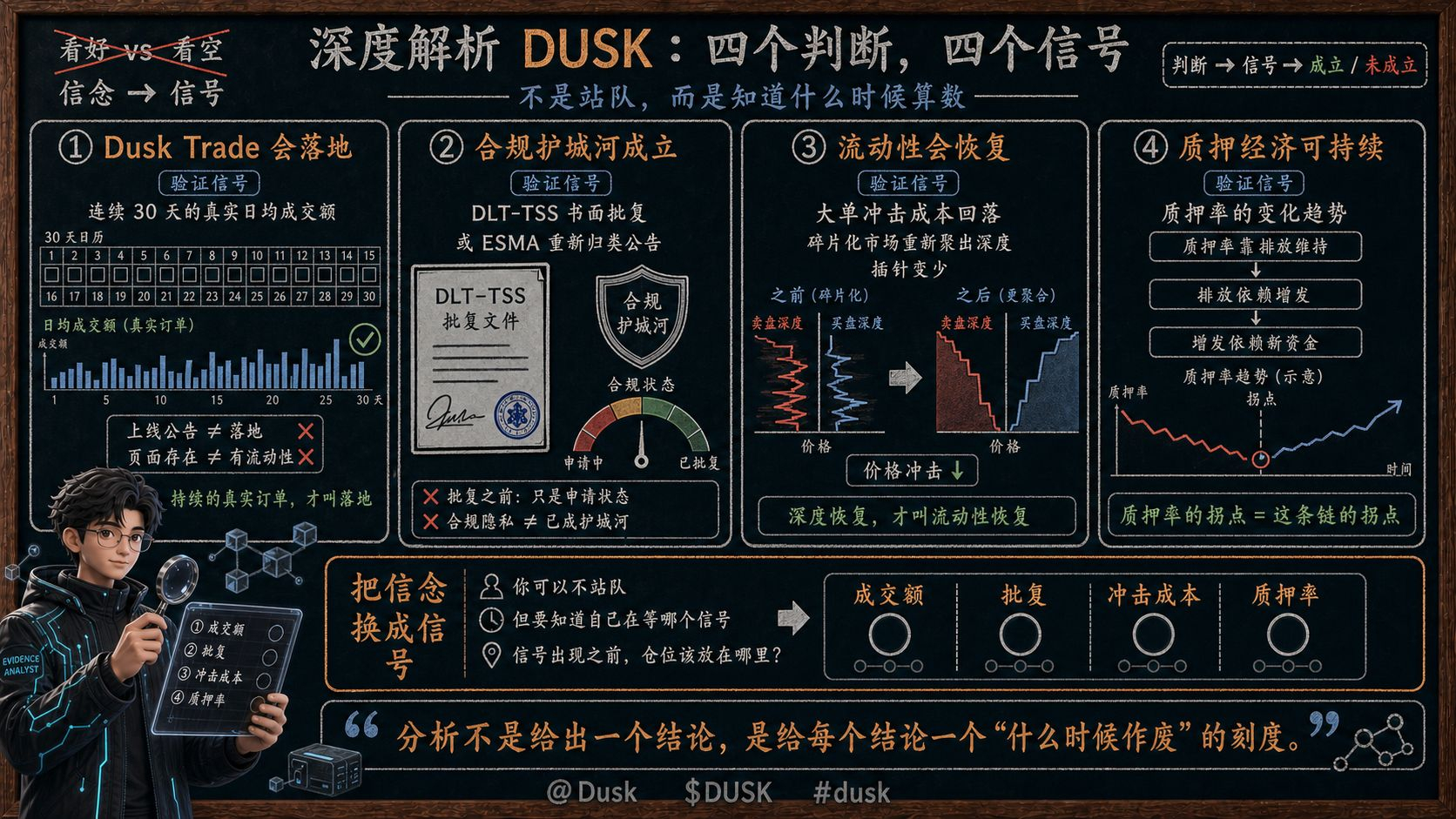
In the discussions around DUSK, the most common thing is that there are two camps: the bulls and the bears, each citing their own facts. But no matter how long the argument has gone on, what’s missing has never been viewpoints—it’s a checklist of “when it counts.” Every judgment should come with an observable signal. Only when the signal shows up does the judgment hold.
First judgment: Dusk Trade will go live. The corresponding signal is not a “launch announcement,” but the sustained real average daily trading volume for 30 consecutive days. Going live doesn’t equal having trades; a page doesn’t equal liquidity. Only continuous real orders qualify as “going live.”
Second judgment: the compliance moat is established. The signal is a written approval response for DLT-TSS, or an ESMA reclassification announcement. Before that, “compliant privacy” is merely an application status—not a moat.
Third judgment: liquidity will recover. The signal is the drop in large-order impact costs. Only when, after delisting, the fragmented market re-aggregates into depth and there are fewer “needle-like” orders, can it be called a recovery.
Fourth judgment: the staking economics are sustainable. The signal is the trend in the staking ratio. If the staking ratio is maintained through emissions, emissions reliance increases via additional token issuance, and additional issuance relies on new capital, then the turning point of the staking ratio is also the turning point of this chain.
Four judgments, four signals—none of them is “I believe.” Swap belief for signals, and DUSK stops being a “which side are you on” question. It becomes a “what are you waiting for” question. You don’t have to pick a side, but you must know which signal you’re waiting on—and before it appears, where your position should be.
That’s what analysis is for: not to provide a conclusion, but to give each conclusion a clear “when it becomes invalid” timestamp.
@Dusk $DUSK #dusk
First judgment: Dusk Trade will go live. The corresponding signal is not a “launch announcement,” but the sustained real average daily trading volume for 30 consecutive days. Going live doesn’t equal having trades; a page doesn’t equal liquidity. Only continuous real orders qualify as “going live.”
Second judgment: the compliance moat is established. The signal is a written approval response for DLT-TSS, or an ESMA reclassification announcement. Before that, “compliant privacy” is merely an application status—not a moat.
Third judgment: liquidity will recover. The signal is the drop in large-order impact costs. Only when, after delisting, the fragmented market re-aggregates into depth and there are fewer “needle-like” orders, can it be called a recovery.
Fourth judgment: the staking economics are sustainable. The signal is the trend in the staking ratio. If the staking ratio is maintained through emissions, emissions reliance increases via additional token issuance, and additional issuance relies on new capital, then the turning point of the staking ratio is also the turning point of this chain.
Four judgments, four signals—none of them is “I believe.” Swap belief for signals, and DUSK stops being a “which side are you on” question. It becomes a “what are you waiting for” question. You don’t have to pick a side, but you must know which signal you’re waiting on—and before it appears, where your position should be.
That’s what analysis is for: not to provide a conclusion, but to give each conclusion a clear “when it becomes invalid” timestamp.
@Dusk $DUSK #dusk