

Art_ja
730 Posts

Art_ja
Report
Block User
Open Trade

CLO Holder
Frequent Trader
8.8 Years
108 Following
122 Followers
509 Liked
Posts
Portfolio
All
Quotes
PINNED
·
--
Liquidity risk management: How to prepare a portfolio for the release of important news.
The release of inflation data (CPI), a U.S. Federal Reserve meeting, or large token unlocks (Unlocks) is always accompanied by impulsive volatility. In such moments, the trader’s main risk is being "locked" in an illiquid asset.
Step by step: Preparation through Binance Earn:
Review of Locked positions (Locked): 1–2 days before a high-volatility event, check your Locked deposits. Remember that early withdrawal from a locked deposit takes time and cancels accrued interest.
Moving capital into Flexible: Working capital during a market storm should be kept exclusively in Simple Earn Flexible. This provides protection against inflation and instant access to funds.
Readiness to execute the scenario: If the market reacts with a drop — you withdraw the stablecoins from Earn in a second and buy spot. If the market rises — you calmly watch while earning interest on the deposit.
Main takeaway: Liquidity in crypto is your main resource. Binance Earn allows this liquidity to generate profit even during a forced waiting pause.
#RiskManagement" #BinanceEarn
@Binance_Ukraine
2
184
·
--
The Magic of Compound Interest: How the Auto-Subscribe feature increases the final overall profit.
Most beginners evaluate earnings in Binance Earn by the base APR, but forget the most powerful mathematical tool — compound interest.
How it works in practice:
When you turn on the Auto-Subscribe toggle in Simple Earn, the platform does not just pay interest on your spot balance.
Each day, the payouts received are automatically added to your principal deposit in Simple Earn.
The next day, interest is calculated on the increased amount (initial deposit + yesterday's profit).
Result: Over the course of several months or a year, your actual earnings (APY) turn out to be noticeably higher than the base interest rate. This is a completely passive strategy that works on the "set it and forget it" principle.
#BinanceEarn @Binance_Ukraine
1
105
·
--
Simple Earn or ETH Staking on Binance: Which is better for holding Ethereum?
Holding classic Ethereum is one of the most popular strategies, but keeping ETH "idle" on spot is not practical. Binance offers two main ways to generate passive income on ETH.
1. Binance ETH Staking (WBETH):
Mechanics: You lock your ETH and receive WBETH (Wrapped Beacon ETH) in return, which reflects your share of the Ethereum network staking.
Advantages: Higher potential yield thanks to network consensus rewards. The WBETH token can be used in other Binance products (for example, as collateral in margin trading or in DeFi activities) without losing interest accrual.
2. ETH Simple Earn (Flexible):
Mechanics: Placing ETH into Flexible Simple Earn deposits.
Advantages: Maximum flexibility — you can return plain ETH to your spot wallet at any time with one click, without the need for unstaking or swapping through the WBETH/ETH trading pair.
Conclusion: If your horizon is long-term HODL with the ability to use the asset in trading, choose ETH Staking. If you plan to sell ETH at the first quick price spike, it is better to use Simple Earn Flexible.
#Ethereum #ethstaking
@Binance_Ukraine
2
164
·
--
DCA Strategy on Autopilot: How to Minimize the Impact of Emotions with Auto-Invest
Trying to guess the market’s “bottom” or “peak” often leads to losses due to emotional decisions. The most time-tested mathematical model is dollar-cost averaging (DCA).
How auto-investing works in the Binance ecosystem:
Automatic purchase: You set up regular purchases of the chosen asset (for example, BTC, ETH, or SOL) for a fixed amount daily, weekly, or monthly.
Immediate passive income: Assets purchased through Auto-Invest are automatically directed to Binance Earn products (Simple Earn), where they immediately start generating additional interest.
Smoothing volatility: You buy more coins when the price falls and fewer when the price rises, getting a favorable average entry price.
Result: Complete absence of stress from daily chart monitoring and disciplined capital accumulation.
#AutoInvest #DCA
@Binance_Ukraine
1
174
·
--
Why tokenized shares and bStocks are the future of portfolio investing.
The traditional stock market has always had its barriers: geographic restrictions, exchange trading hours from Monday to Friday, and complex capital withdrawal procedures. The emergence of tokenized financial instruments (bStocks / TradFi) fundamentally changes this approach.
Key advantages of tokenized securities:
24/7 availability: The ability to manage your positions and respond to global news without waiting for the opening of traditional exchange sessions.
Fractional ownership (Fractional Shares): You don’t have to buy an entire expensive stock—you can invest any convenient amount, which is perfect for targeted diversification.
One balance: All assets (from BTC and USDT to financial instruments) are located within a single ecosystem, making capital tracking easier.
Conclusion: Combining the flexibility of cryptography with the reliability of traditional companies creates a new level for a well-formed investment portfolio.
#BStocks #TradFi @Binance_Ukraine
2
121
·
--
Risk Management in Binance Earn: What You Need to Know Before Depositing.🧑💻
Generating passive income in the crypto industry is always tied to risk assessment. Even with convenient tools like Binance Earn, it’s important to analyze every step realistically.
Key risk aspects:
Volatility of the underlying asset:
A high APR rate on altcoins can be wiped out by a drop in the price of the asset itself. If you subscribed to a locked deposit at 20% per year in token X and it fell by 40% within a month—then in dollar terms, you’ll be left with a loss.
Risk of early exit (Opportunity Cost):
When choosing locked deposits, remember: with an early withdrawal, you’ll lose all accrued interest, and returning funds to spot may take a certain number of hours/days depending on the terms.
Floating interest rate (Bonus Tier APR):
The interest rate on flexible deposits is not fixed forever. It changes depending on market demand for borrowing and the deposit size.
The golden rule: Use Earn for assets you already planned to hold in your long-term portfolio, or for stablecoins while waiting for trading setups.🤙
#BinanceEarn #RiskManagement
@Binance_Ukraine
2
107
·
--
How I Protect Stablecoins from Inflation: A Practical Case with Binance Earn
During market uncertainty, keeping capital in stablecoins on the spot balance means lost opportunities. In my portfolio strategy, I use Binance Earn as a tool for parking liquidity.
My practical case:
Simple Earn Product (Flexible Terms): I keep part of the operating deposit in flexible USDT deposits. This allows me to earn daily interest (Bonus Tier APR) and withdraw funds to spot immediately if a good entry point appears on the market.
Capital Protection: Unlike complex DeFi protocols, which carry risks from smart contracts and unexpected liquidity shifts, Binance Simple Earn offers a clear mechanism for generating yield with a high level of reliability.
Reinvestment (Auto-Subscribe): I enabled the auto-subscribe feature—interest is added to the principal deposit body every day, activating the compound interest mechanism.
Conclusion: Binance Earn is the foundation for an active trader or investor. The main rule is to split stablecoins into portions: flexible deposits for quick liquidity, and locked deposits for higher returns over a medium-term horizon.
#BinanceEarn @Binance_Ukraine
2
115
·
--
#termmax @termmax
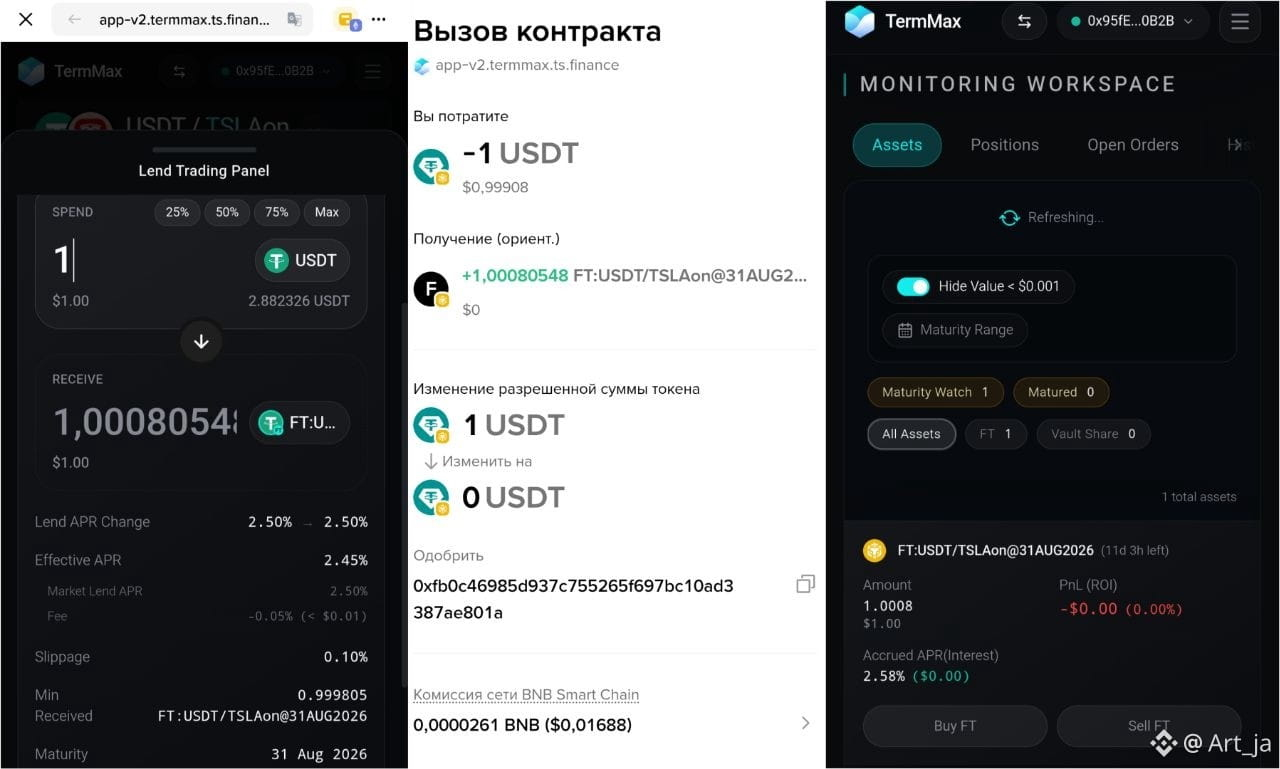
The theory was enough—I finally decided to touch TermMax with my own hands. 😄
I went into Fixed Rate and specifically chose a very small amount—exactly 1 USDT—to test the mechanics without unnecessary risk. 🧑💻
I selected the USDT/TSLAon market on BNB Chain with maturity on August 31, 2026.
Here’s what happened: 🚀
→ I spent 1 USDT.
→ I received 1.00080548 FT.
→ Effective APY before the trade: 2.45%.
→ slippage: 0.10%.
→ commission: less than $0.01.
I did everything via Web3 Wallet in Binance. From selecting the market to confirming the trade and seeing the position appear in the Dashboard took no more than 30 seconds. 🔥
After the purchase, the position immediately showed up in the Dashboard, and TermMax suggested setting a reminder for maturity.
Now I’ll leave this $1 until August 31 and see how it works in practice. ⭐️
Yes, the profit will be tiny. 😄 But right now it’s more important for me to validate the mechanics with a real transaction than to just read the documentation.
First experiment done. Now we wait for maturity.
Would you also test a new DeFi protocol with $1–2 first, or jump in with a proper amount right away? 👇
Data source: my own Web3 Wallet transactions and operation history in Binance Web3 Wallet, as well as screenshots of the executed trade and the position in TermMax. Data as of August 20, 2026, UTC+3.
#termmax @TermMax
The theory was enough—I finally decided to touch TermMax with my own hands. 😄
I went into Fixed Rate and specifically chose a very small amount—exactly 1 USDT—to test the mechanics without unnecessary risk. 🧑💻
I selected the USDT/TSLAon market on BNB Chain with maturity on August 31, 2026.
Here’s what happened: 🚀
→ I spent 1 USDT.
→ I received 1.00080548 FT.
→ Effective APY before the trade: 2.45%.
→ slippage: 0.10%.
→ commission: less than $0.01.
I did everything via Web3 Wallet in Binance. From selecting the market to confirming the trade and seeing the position appear in the Dashboard took no more than 30 seconds. 🔥
After the purchase, the position immediately showed up in the Dashboard, and TermMax suggested setting a reminder for maturity.
Now I’ll leave this $1 until August 31 and see how it works in practice. ⭐️
Yes, the profit will be tiny. 😄 But right now it’s more important for me to validate the mechanics with a real transaction than to just read the documentation.
First experiment done. Now we wait for maturity.
Would you also test a new DeFi protocol with $1–2 first, or jump in with a proper amount right away? 👇
Data source: my own Web3 Wallet transactions and operation history in Binance Web3 Wallet, as well as screenshots of the executed trade and the position in TermMax. Data as of August 20, 2026, UTC+3.
77
3
34
4.7k
·
--
#termmax @termmax
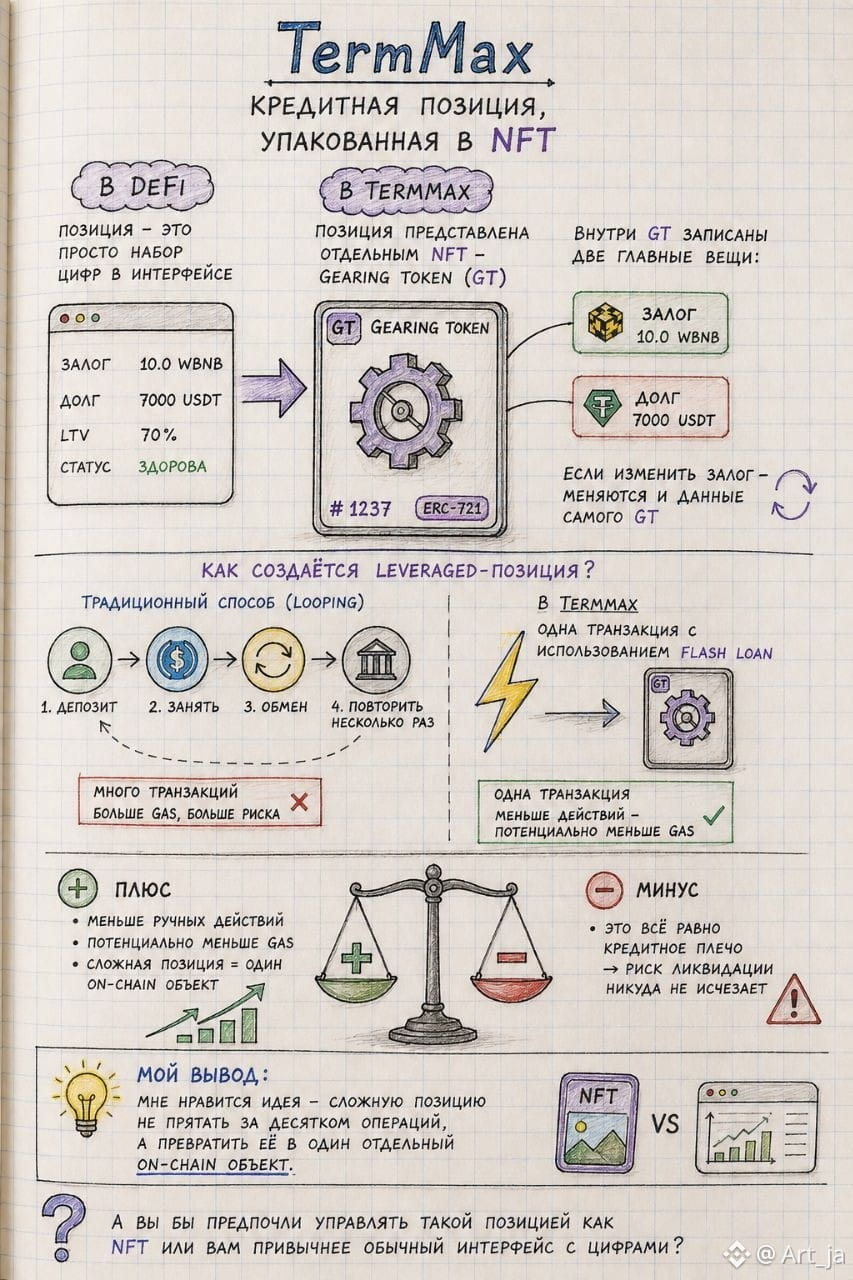
The further I study TermMax, the more I’m amazed at how they packaged a regular credit position here.
I’m used to the idea that in DeFi a position is just a set of numbers in the interface. But in TermMax, it’s represented as a separate ERC-721 NFT — a Gearing Token (GT). 🔥
It stores two things at once: collateral and debt. And if you change the collateral, the data of the GT itself changes too.
Even more interesting: TermMax lets you create this leveraged position in a single transaction using a flash loan, instead of the usual repeated looping.💪
For me, the upside is obvious — fewer manual steps and potentially less gas. 🚀
The downside too: it’s still leverage, so liquidation risk doesn’t go away.
My conclusion for myself: I like this idea — not hiding a complex position behind a dozen operations, but turning it into a single on-chain object. ⭐️
Would you rather manage such a position as an NFT, or are you more comfortable with a conventional interface with numbers?👇
#termmax @TermMax
The further I study TermMax, the more I’m amazed at how they packaged a regular credit position here.
I’m used to the idea that in DeFi a position is just a set of numbers in the interface. But in TermMax, it’s represented as a separate ERC-721 NFT — a Gearing Token (GT). 🔥
It stores two things at once: collateral and debt. And if you change the collateral, the data of the GT itself changes too.
Even more interesting: TermMax lets you create this leveraged position in a single transaction using a flash loan, instead of the usual repeated looping.💪
For me, the upside is obvious — fewer manual steps and potentially less gas. 🚀
The downside too: it’s still leverage, so liquidation risk doesn’t go away.
My conclusion for myself: I like this idea — not hiding a complex position behind a dozen operations, but turning it into a single on-chain object. ⭐️
Would you rather manage such a position as an NFT, or are you more comfortable with a conventional interface with numbers?👇
81
4
36
2.7k
·
--
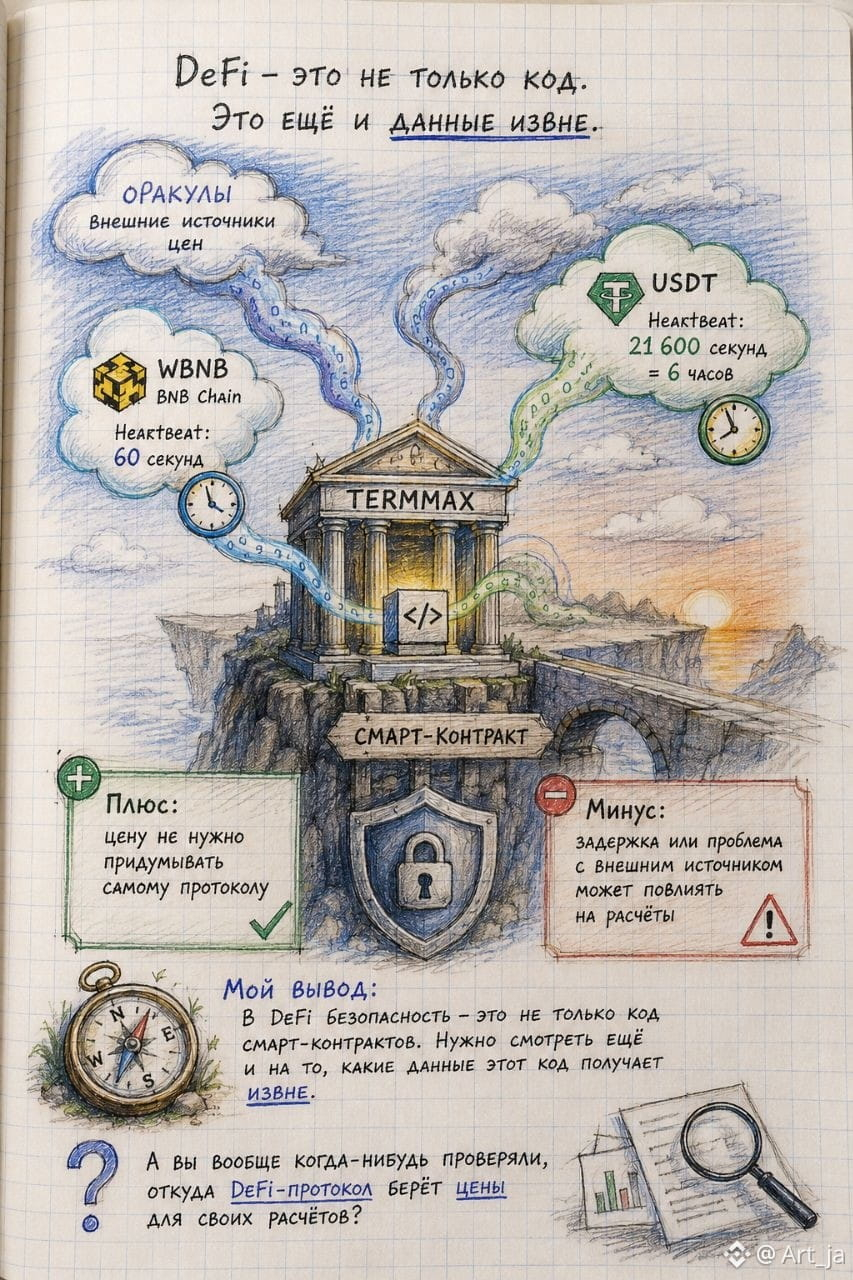
The deeper I dig into TermMax, the more I pay attention not to profitability, but to where the protocol actually gets prices for its assets.🤷♂️
Turns out TermMax uses external oracles to value assets, and for some tokens it also has a backup source.
For example, for WBNB on BNB Chain, the documentation specifies an oracle heartbeat of 60 seconds, and for USDT — 21,600 seconds, i.e. 6 hours. 🚀
That’s where I started thinking.🤔 It turns out that even within a single protocol, the price update frequency can differ by hundreds of times depending on the asset.
The upside is obvious — the protocol doesn’t have to make up the price itself. The downside is also clear: a delay or an issue with an external source could potentially affect the calculations.
My conclusion: in DeFi, security isn’t only about the smart contract code. You also need to look at what data that code receives from outside. ⭐️
And have you ever checked where a DeFi protocol gets the prices for its calculations?👇
#termmax @termmax
The deeper I dig into TermMax, the more I pay attention not to profitability, but to where the protocol actually gets prices for its assets.🤷♂️
Turns out TermMax uses external oracles to value assets, and for some tokens it also has a backup source.
For example, for WBNB on BNB Chain, the documentation specifies an oracle heartbeat of 60 seconds, and for USDT — 21,600 seconds, i.e. 6 hours. 🚀
That’s where I started thinking.🤔 It turns out that even within a single protocol, the price update frequency can differ by hundreds of times depending on the asset.
The upside is obvious — the protocol doesn’t have to make up the price itself. The downside is also clear: a delay or an issue with an external source could potentially affect the calculations.
My conclusion: in DeFi, security isn’t only about the smart contract code. You also need to look at what data that code receives from outside. ⭐️
And have you ever checked where a DeFi protocol gets the prices for its calculations?👇
#termmax @TermMax
61
3
25
1.9k
·
--
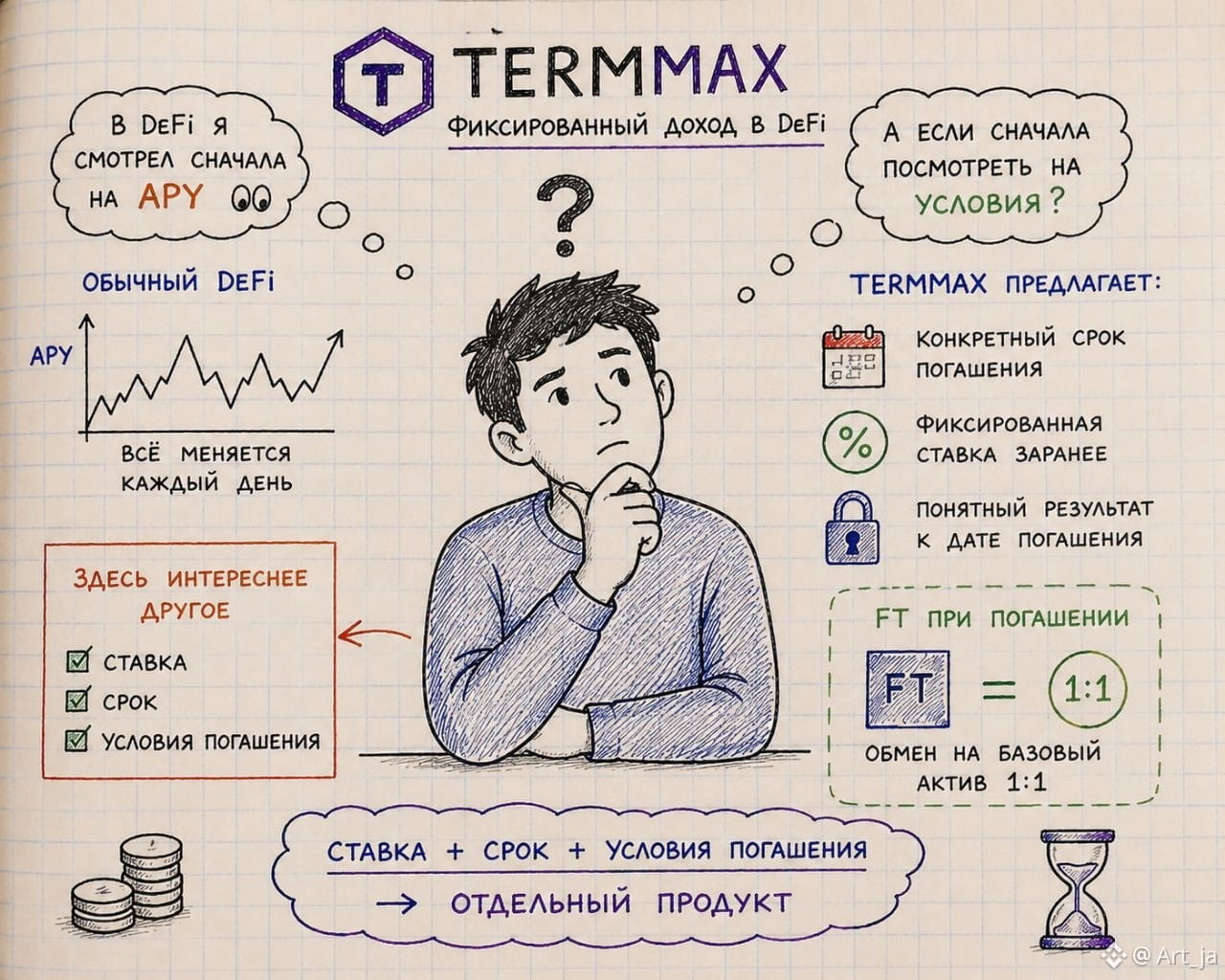
I noticed a strange habit of mine in DeFi: first I look at the APY, and only then I dig into where that number even comes from. 🤷♂️
So in TermMax I decided to do the opposite — first look at the terms. 🧑💻
Here, it’s not just the percentage that matters, but also the trade duration. You know the maturity date in advance and can understand what your position is supposed to end up as.
For example, FT has a pretty clear condition: upon maturity, 1 FT corresponds to 1 unit of the base debt token — 1:1. 🚀
So you don’t have to guess what the rate will be in a week. The term and the maturity conditions are defined upfront.
After that, I looked at TermMax a bit differently. It’s a market where the rate + term + maturity conditions become a separate product, not just another APY floating on your screen. ⭐️
For me, that’s far more interesting than regular DeFi with constantly changing returns.
When choosing a DeFi trade, do you first look at the APY or at the term and conditions?
What matters more: a high rate or a result you can understand ahead of time? 👇
#termmax @termmax
I noticed a strange habit of mine in DeFi: first I look at the APY, and only then I dig into where that number even comes from. 🤷♂️
So in TermMax I decided to do the opposite — first look at the terms. 🧑💻
Here, it’s not just the percentage that matters, but also the trade duration. You know the maturity date in advance and can understand what your position is supposed to end up as.
For example, FT has a pretty clear condition: upon maturity, 1 FT corresponds to 1 unit of the base debt token — 1:1. 🚀
So you don’t have to guess what the rate will be in a week. The term and the maturity conditions are defined upfront.
After that, I looked at TermMax a bit differently. It’s a market where the rate + term + maturity conditions become a separate product, not just another APY floating on your screen. ⭐️
For me, that’s far more interesting than regular DeFi with constantly changing returns.
When choosing a DeFi trade, do you first look at the APY or at the term and conditions?
What matters more: a high rate or a result you can understand ahead of time? 👇
#termmax @TermMax
61
3
30
899
·
--
Verified
Here’s something I didn’t think about at all before.
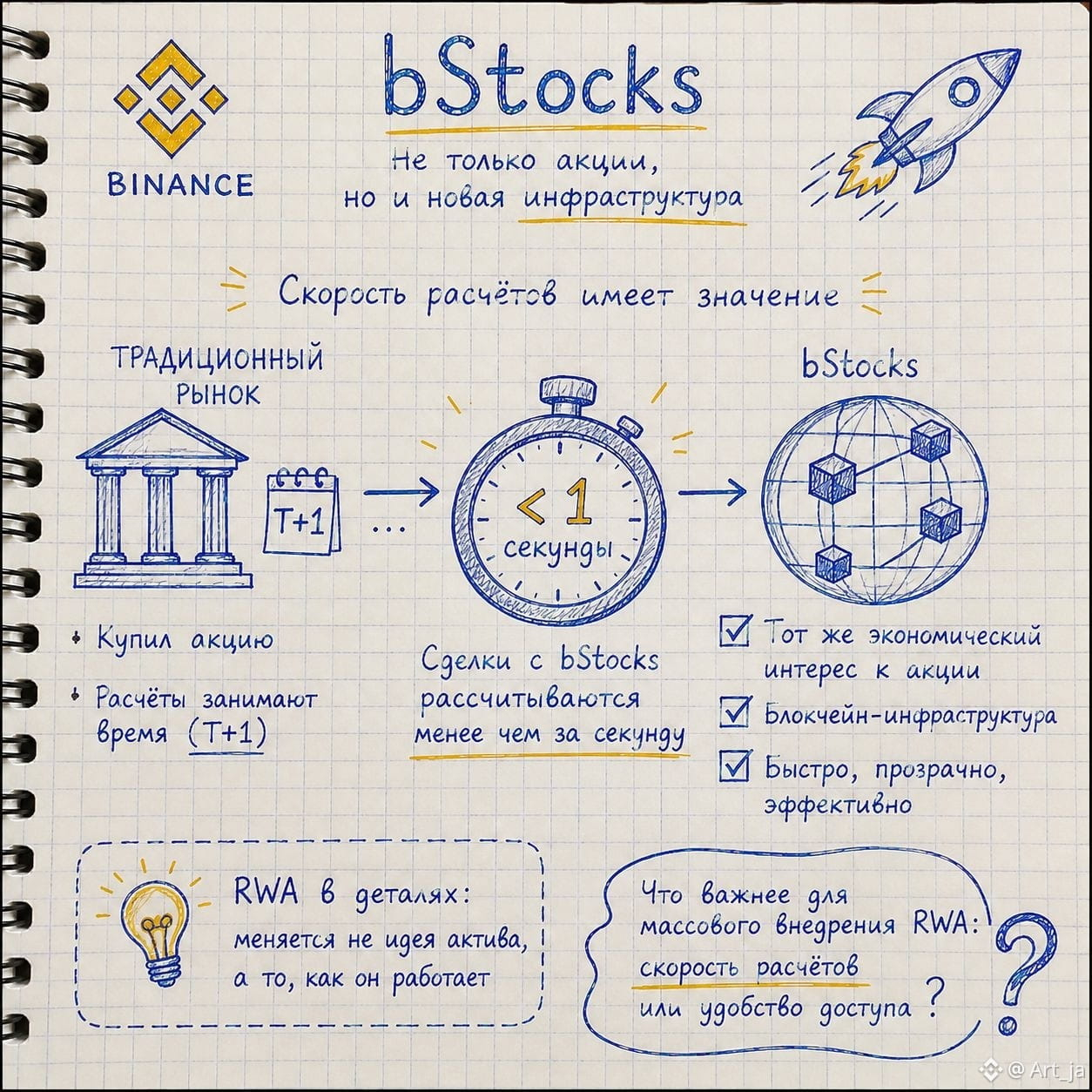
I bought an asset—and it’s like, the deal is done. But in the traditional market, settlements can take time. 🤷♂️
And with bStocks, the logic is different: Binance states that trades are usually settled in less than a second. 🚀
Another small detail I found in the documentation: bStocks supports up to 8 decimal places, so even very tiny fractional positions can be accounted for with quite good accuracy. 🧑💻
And for me, this turned out to be one of the most interesting aspects of tokenization.
We’re used to looking at the blockchain through prices, charts, and fees. But its real power could be something else entirely—in the fact that the settlement infrastructure itself becomes faster.
It turns out something interesting: we take a familiar financial asset, move it onto the blockchain—and not only does the form of the asset change, but also how the transaction itself happens. 🎉
The more I dig into RWA, the more I think that it’s exactly these seemingly unnoticed changes that may end up being the most important.
What do you think matters more for mainstream adoption of RWA: settlement speed or ease of access? 👇
#bstockscis @BinanceCIS
45
3
27
2.1k
·
--
#termmax @termmax
I first thought TermMax was just another DeFi protocol where everything boils down to “deposit USDC → get APY.”🚀
Then I dug into the documentation and realized the mechanics are more interesting here.
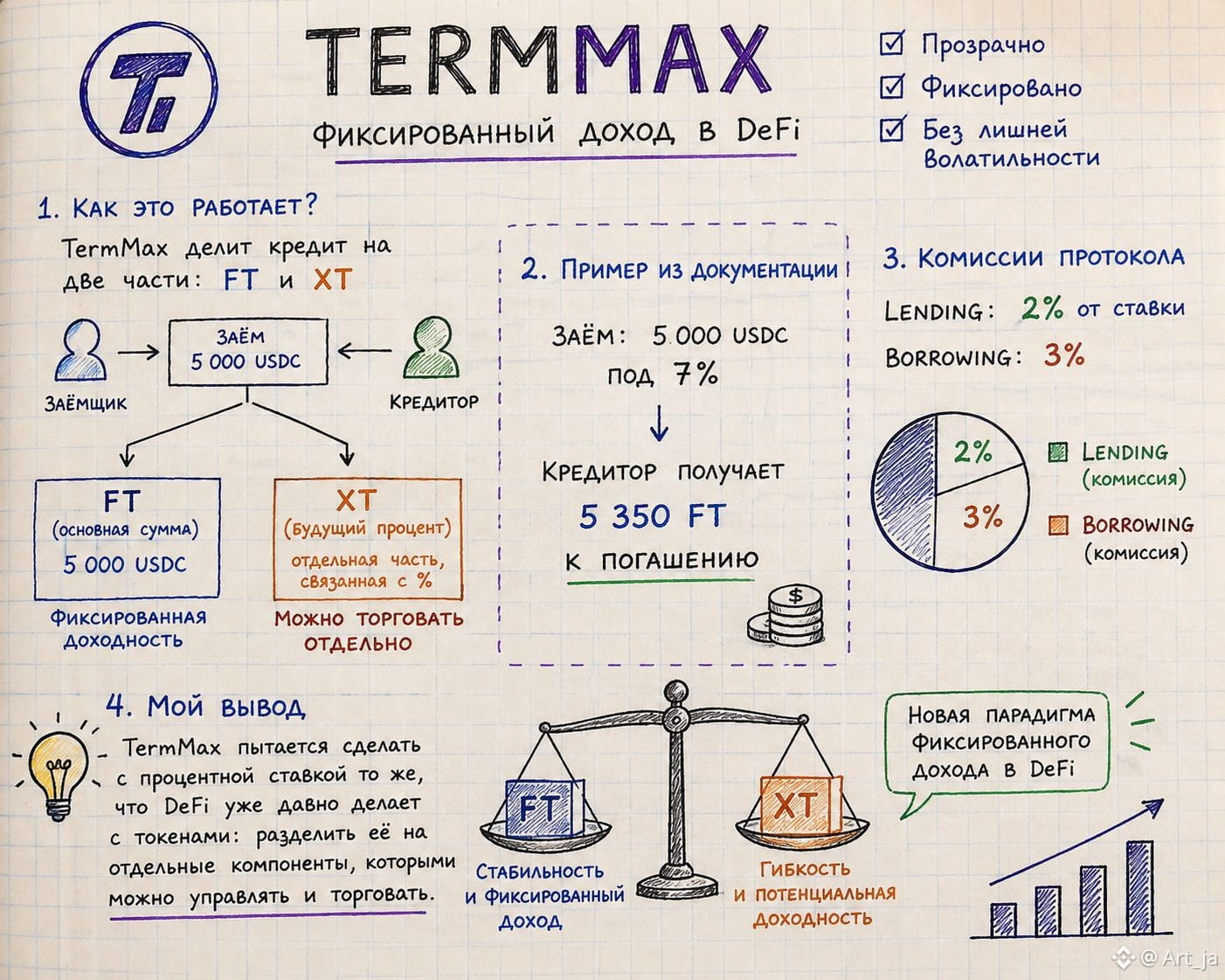
In TermMax, a loan is split into two parts: FT and XT. FT represents the principal with a fixed yield, while XT is a separate portion linked to the future interest. 💰
For example, the docs include a simple calculation: when borrowing 5,000 USDC at 7%, the lender receives as much as 5,350 FT at repayment. 💵
Another point I initially missed: the standard lending fee is currently 2% of the rate, and for borrowing the listed fee is 3%.⭐️
And here’s my main takeaway: TermMax is trying to do with interest rates what DeFi has been doing with tokens for a long time—break them into separate components that can be managed and traded.
To me, it no longer looks like yet another lending protocol, but like an attempt to build a full-fledged fixed-rate market.
What matters more to you: income you can know in advance, or the chance to earn more thanks to a floating rate?👇
#termmax @TermMax
I first thought TermMax was just another DeFi protocol where everything boils down to “deposit USDC → get APY.”🚀
Then I dug into the documentation and realized the mechanics are more interesting here.
In TermMax, a loan is split into two parts: FT and XT. FT represents the principal with a fixed yield, while XT is a separate portion linked to the future interest. 💰
For example, the docs include a simple calculation: when borrowing 5,000 USDC at 7%, the lender receives as much as 5,350 FT at repayment. 💵
Another point I initially missed: the standard lending fee is currently 2% of the rate, and for borrowing the listed fee is 3%.⭐️
And here’s my main takeaway: TermMax is trying to do with interest rates what DeFi has been doing with tokens for a long time—break them into separate components that can be managed and traded.
To me, it no longer looks like yet another lending protocol, but like an attempt to build a full-fledged fixed-rate market.
What matters more to you: income you can know in advance, or the chance to earn more thanks to a floating rate?👇
50
3
28
915
·
--
#bstockscis @BinanceCIS
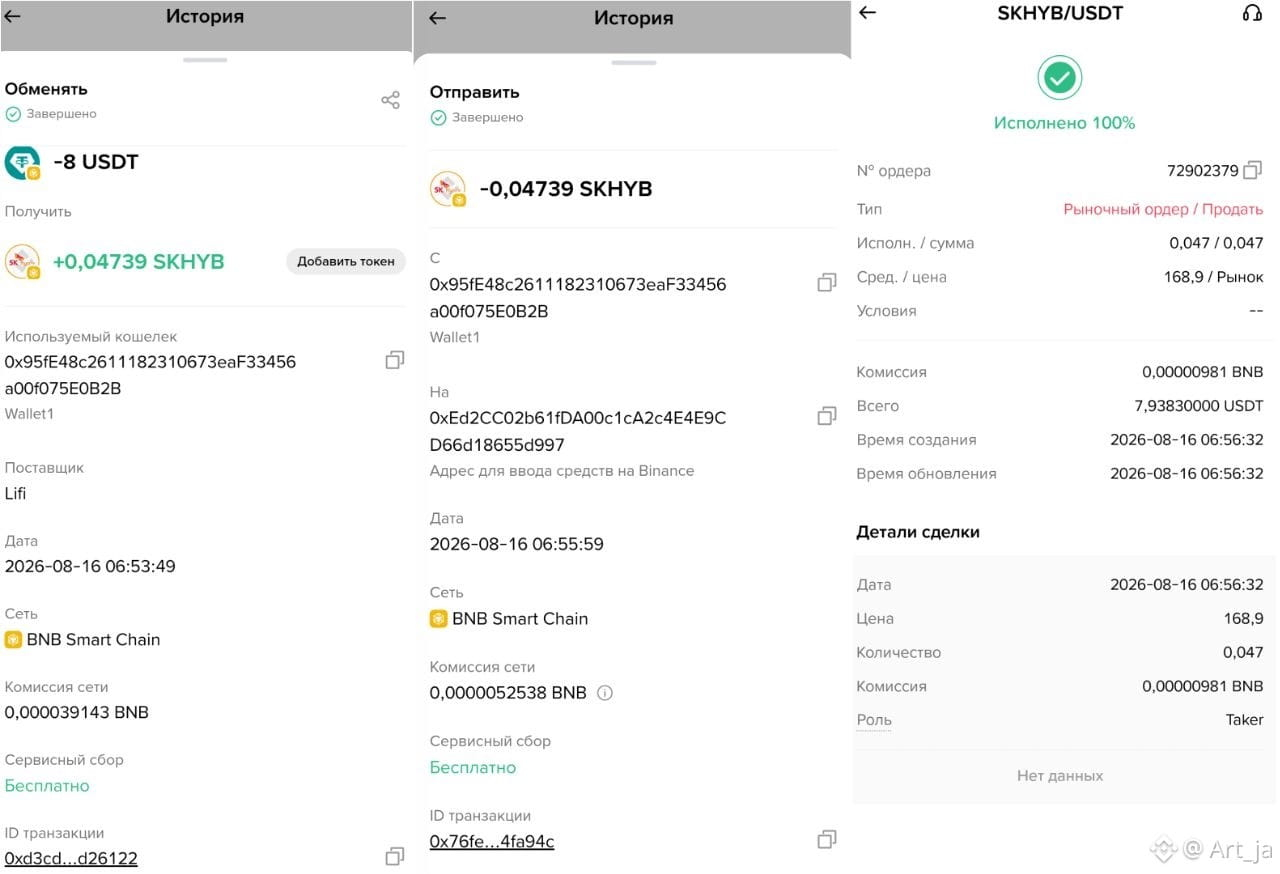
Yesterday I decided to check the reverse route for bStocks. Previously, I’d already withdrawn the token from Spot to Web3 and sold it there. Now I decided to do it the other way around.🤑
In my Web3 Wallet via Swap, I bought $SKHYB for 8 USDT. I received 0.04739 SKHYB. 💰
After a couple of minutes, I sent the entire token back to my Binance Spot. The transfer over BNB Smart Chain went quickly, and the service fee was 0.
Next, I sold $SKHYB with a regular market order. I received 7.9383 USDT.💵
And this is where the experiment got more interesting. I started with 8 USDT, and when it came back, I got less. The difference was about 0.0617 USDT. A small amount, but now I know for sure what the whole route looks like in practice.
By the way, SK hynix itself in 2025 reported record performance: 97.1467 trillion won in revenue and 47.2063 trillion won in operating profit.
In the end, I checked both directions: Spot → Web3 → Swap and Swap → Web3 → Spot. Everything turned out to be genuinely workable and fairly fast.
For me, bStocks become more interesting specifically after experiments like this—when you don’t just read the description of a function, but verify it with your own hands.
Would you run a small test loop like this too?🚀
42
3
21
799
·
--
#bstockscis @BinanceCIS
Yesterday I decided to check not only the purchase of bStocks, but also the most interesting part—how easy it is to get out of them in the first place.💰
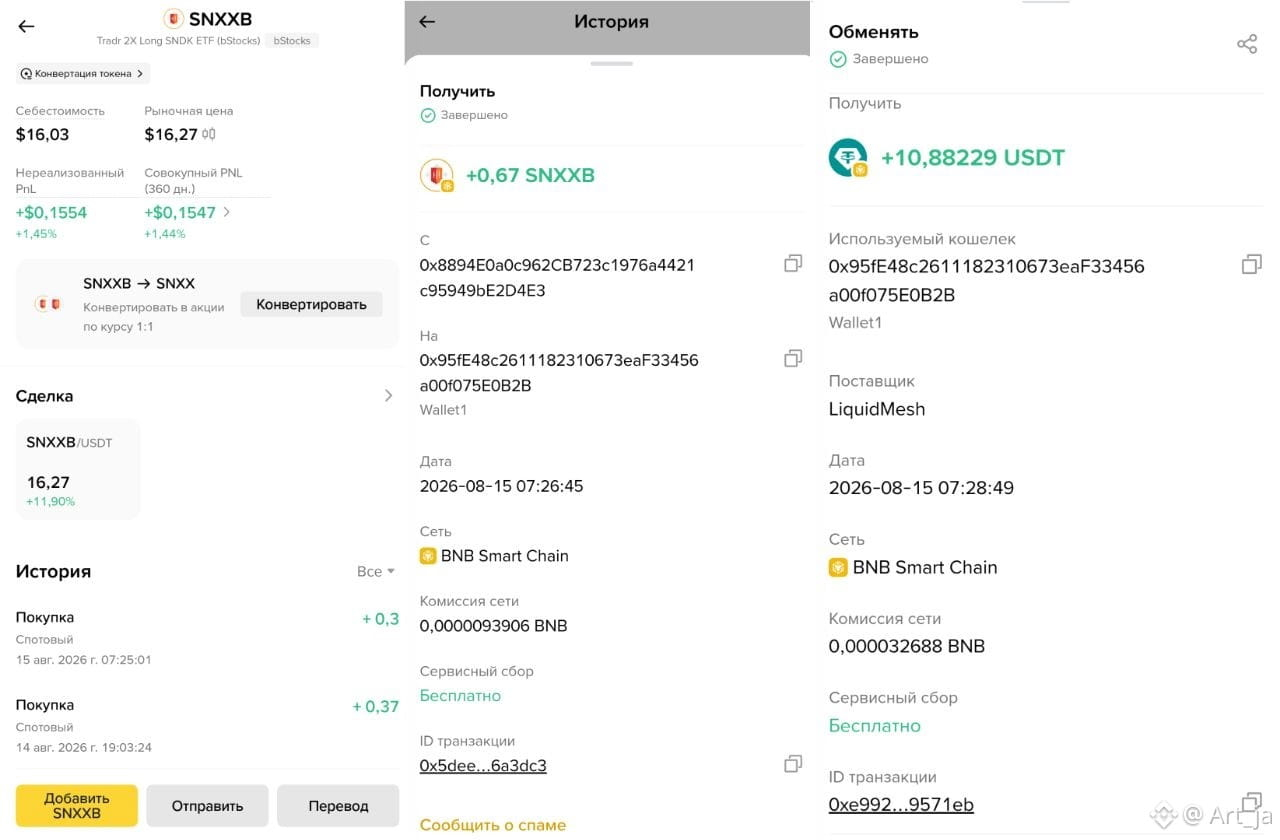
I started with 0.37 $SNXXB that I bought the day before. But then I noticed a catch: the minimum withdrawal amount turned out to be 0.4 SNXXB.
I topped up another 0.3, got 0.67 SNXXB, and sent them directly to my Binance Web3 Wallet via BNB Smart Chain.
The transfer went through without any issues. There was no service fee.
Next, I decided to test the reverse route. I opened the Swap and exchanged all 0.67 SNXXB for USDT. In the end, I received 10.88229 USDT.💵
In the process, I also learned an interesting detail: $SNXXB is a tokenized Tradr 2X Long SNDK Daily ETF. The fund itself is aimed at a 200% daily move of SNDK, and its expense ratio is 1.49%.
In the end, I personally went through the entire route: Spot → Web3 Wallet → Swap → USDT. 🚀
And this is exactly the format I like the most: not reading about how everything works, but taking a small amount and testing it myself.
Have you tried withdrawing bStocks to Web3?
48
3
26
2.7k
·
--
#bstockscis @BinanceCIS
I finally decided not to speculate about bStocks and just check everything for myself.🧑💻
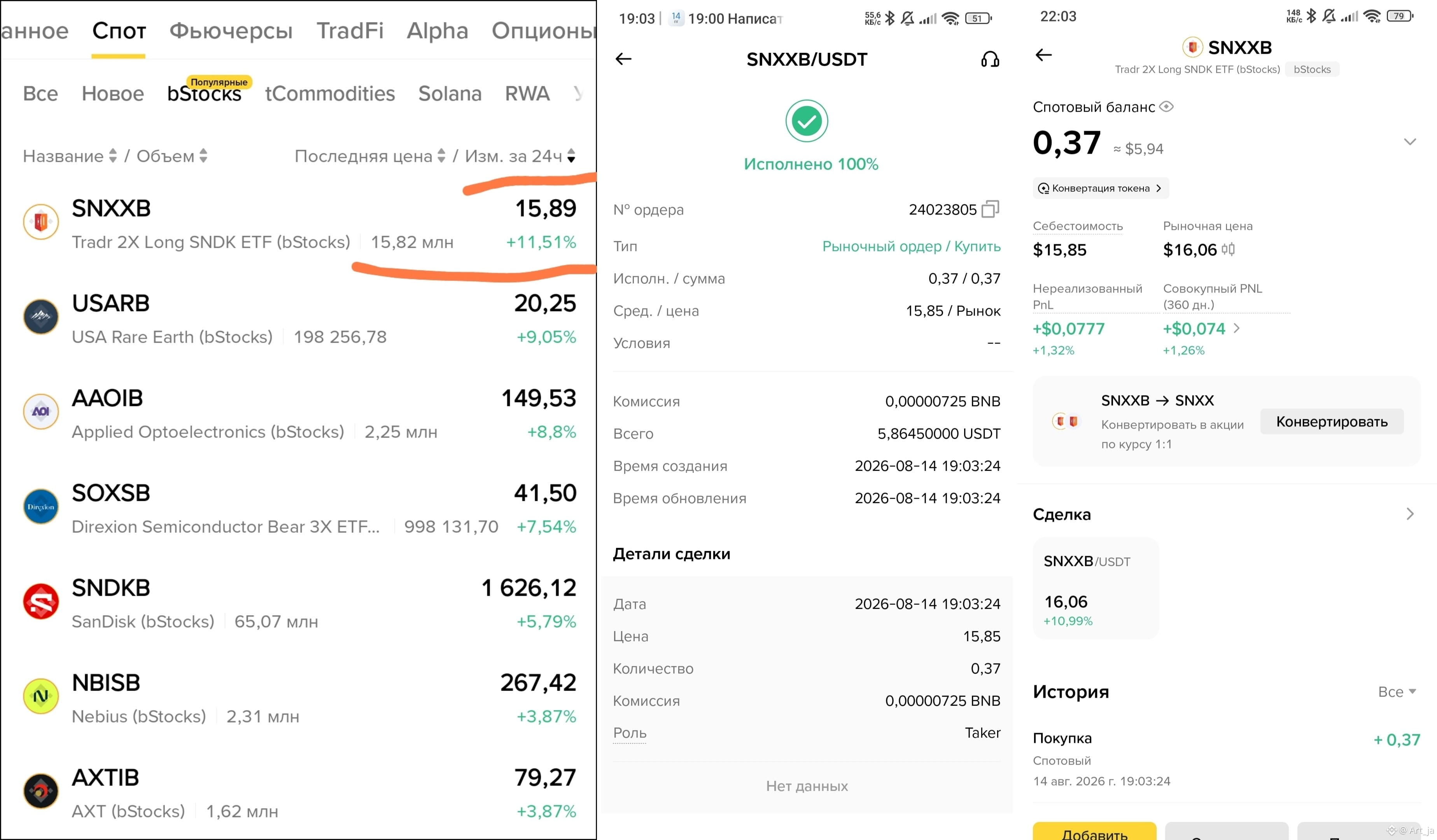
Yesterday at 19:03, I opened the bStocks list and sorted it by growth over the past 24 hours. At the top was $SNXXB with +11.51%.
I bought exactly 5.86 USDT and received 0.37 tokens at 15.85.
And I specifically set myself a condition: not to touch the position for 3 hours.
At 22:03, I checked the result. The price was already 16.06, and the position was worth about $5.94. Unrealized PNL: +$0.0777 (+1.32%).🚀
But the more interesting part was something else.
Right on the page, I can see not only the balance and PNL, but also the SNXXB → SNXX conversion at a 1:1 rate, as well as send and transfer buttons.
So I didn’t just buy a token and forget about it. The whole journey—from choosing the asset to checking the result and the available actions—turned out to be genuinely very simple.
I really like this kind of approach: not reading promises, but taking a few dollars and verifying for myself.💰
How about you—do you usually study everything in detail first, or do you also sometimes just test with a small amount?👇
43
3
20
997
·
--
Verified
#dusk
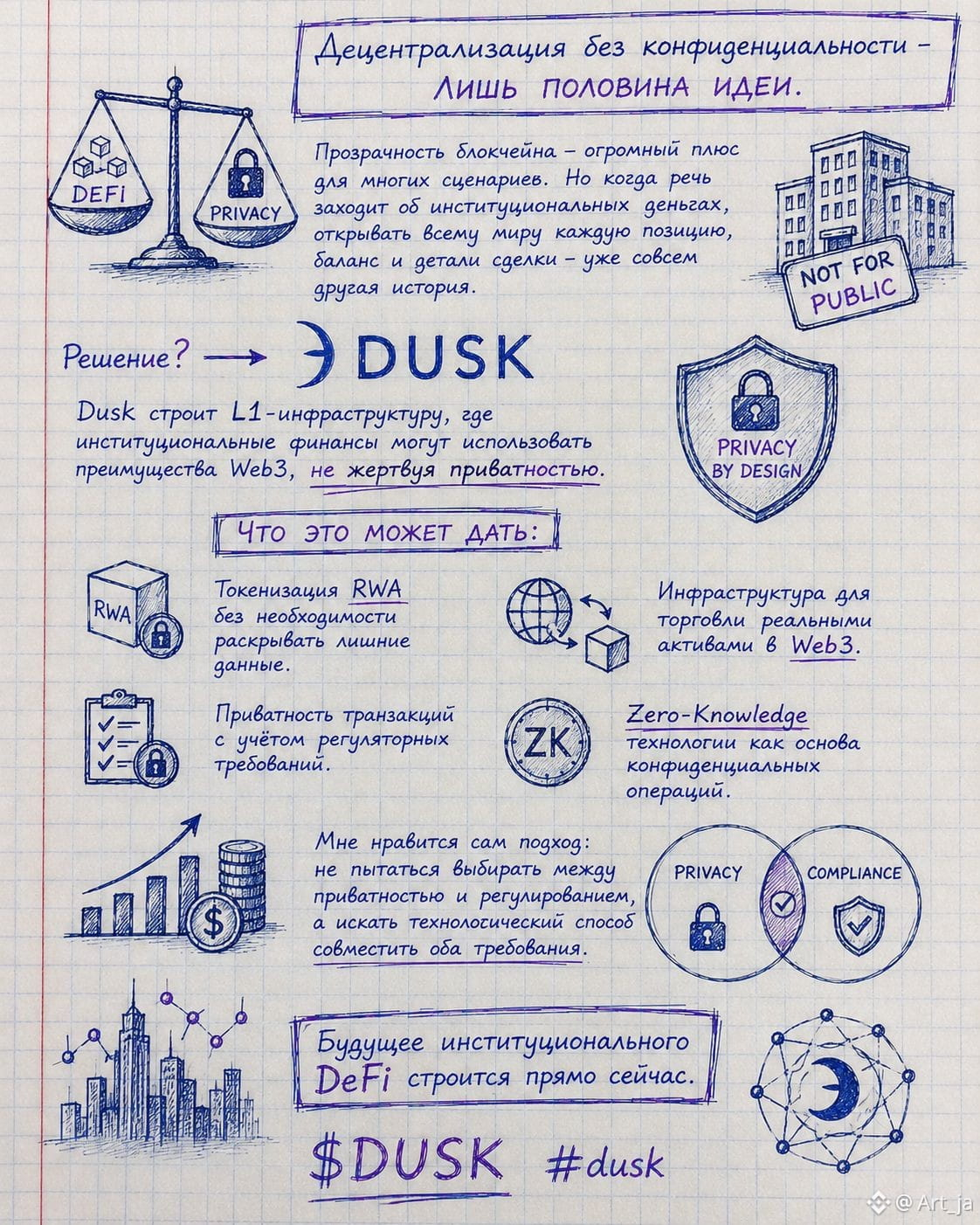
Decentralization without privacy is only half the idea.
Blockchain transparency is a huge plus for many scenarios. But when it comes to institutional money, opening every position, balance, and deal detail to the whole world is a completely different story.
And this is where @Dusk_Foundation becomes interesting.
Dusk is building L1 infrastructure where institutional finance can take advantage of Web3 without sacrificing privacy.
What this could enable:👇
- tokenization of RWA without having to disclose unnecessary data
- transaction privacy with regulatory requirements in mind
- infrastructure for trading real-world assets on Web3
- Zero-Knowledge technologies as the foundation for confidential operations
I like the approach itself: not trying to choose between privacy and regulation, but instead looking for a technological way to satisfy both requirements. 🚀
The future of institutional DeFi can be built on exactly this kind of foundation. 🧑💻
$DUSK
#dusk
Decentralization without privacy is only half the idea.
Blockchain transparency is a huge plus for many scenarios. But when it comes to institutional money, opening every position, balance, and deal detail to the whole world is a completely different story.
And this is where @Dusk becomes interesting.
Dusk is building L1 infrastructure where institutional finance can take advantage of Web3 without sacrificing privacy.
What this could enable:👇
- tokenization of RWA without having to disclose unnecessary data
- transaction privacy with regulatory requirements in mind
- infrastructure for trading real-world assets on Web3
- Zero-Knowledge technologies as the foundation for confidential operations
I like the approach itself: not trying to choose between privacy and regulation, but instead looking for a technological way to satisfy both requirements. 🚀
The future of institutional DeFi can be built on exactly this kind of foundation. 🧑💻
$DUSK
11
12
87
·
--
Anyone who’s tried sitting on two chairs at once—trading crypto on an exchange while also holding shares with a traditional broker—knows what it turns into by the end of the year. 🥶
A hellish routine pops up: reconciling statements from different services, recalculating currency rates for the date of each trade, fitting reports together, and constantly transferring fiat through the bank, with the risk of account blocks.
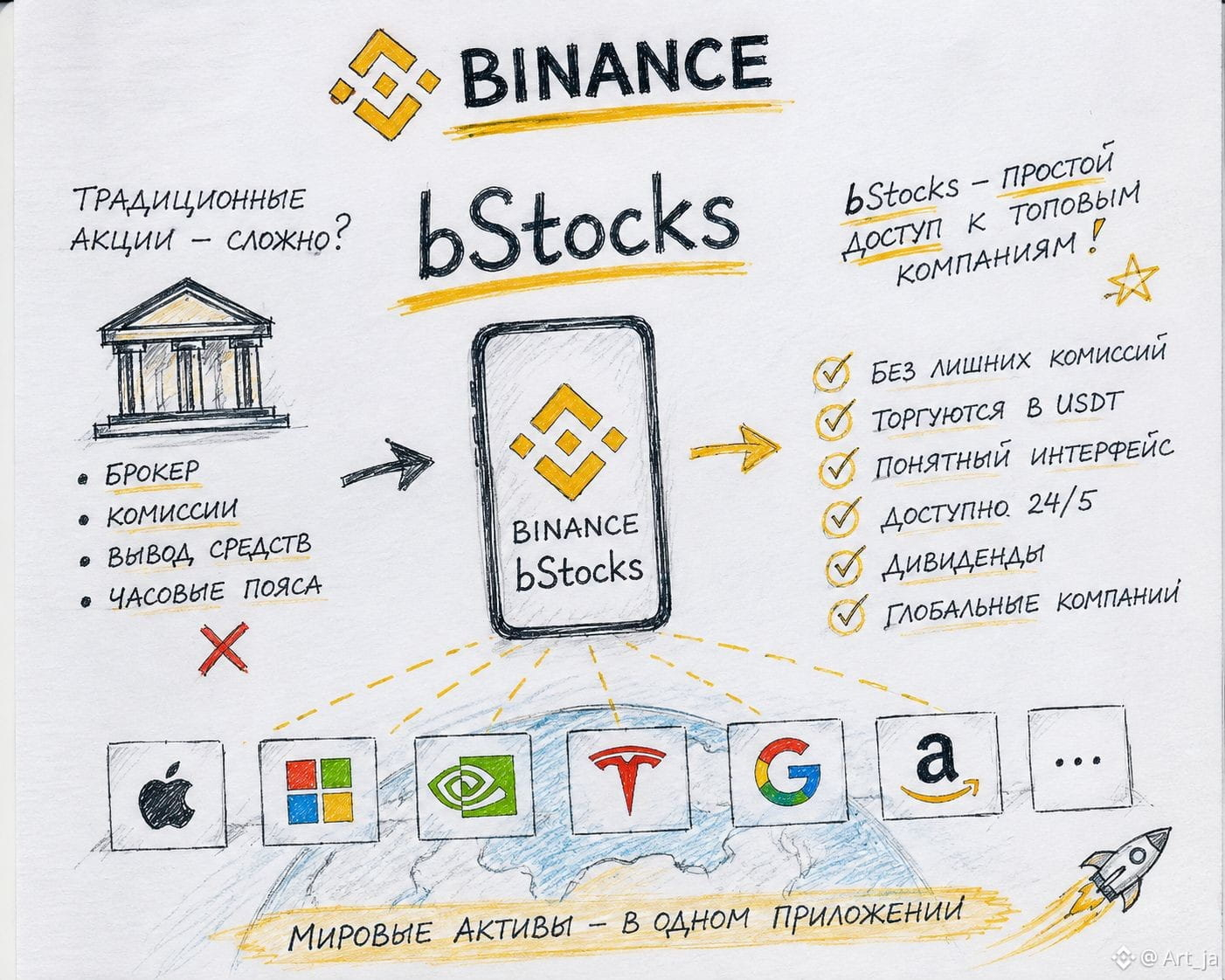
When I started using bStocks, I looked at it specifically through the lens of ease of record-keeping. 💰
What fundamentally changes the approach:
A single financial hub: Everything happens inside one Binance account. No third-party broker dashboards and no downloading statements.
Clear PNL in USDT: All stock positions like $CRCLB or $BMNRB are immediately calculated in your familiar stablecoin.
Zero bureaucracy when entering: No juggling bank transfers and waiting three days while SWIFTs go through. Entering a position takes exactly as much time as buying a regular spot token.
For me, this turned out to be a powerful tool for simplifying my life. You get the same exposure to global companies, but you cut out 90% of the headache involved in administering your assets. 🎉
@BinanceCIS #bStocksCIS
42
4
17
277
·
--
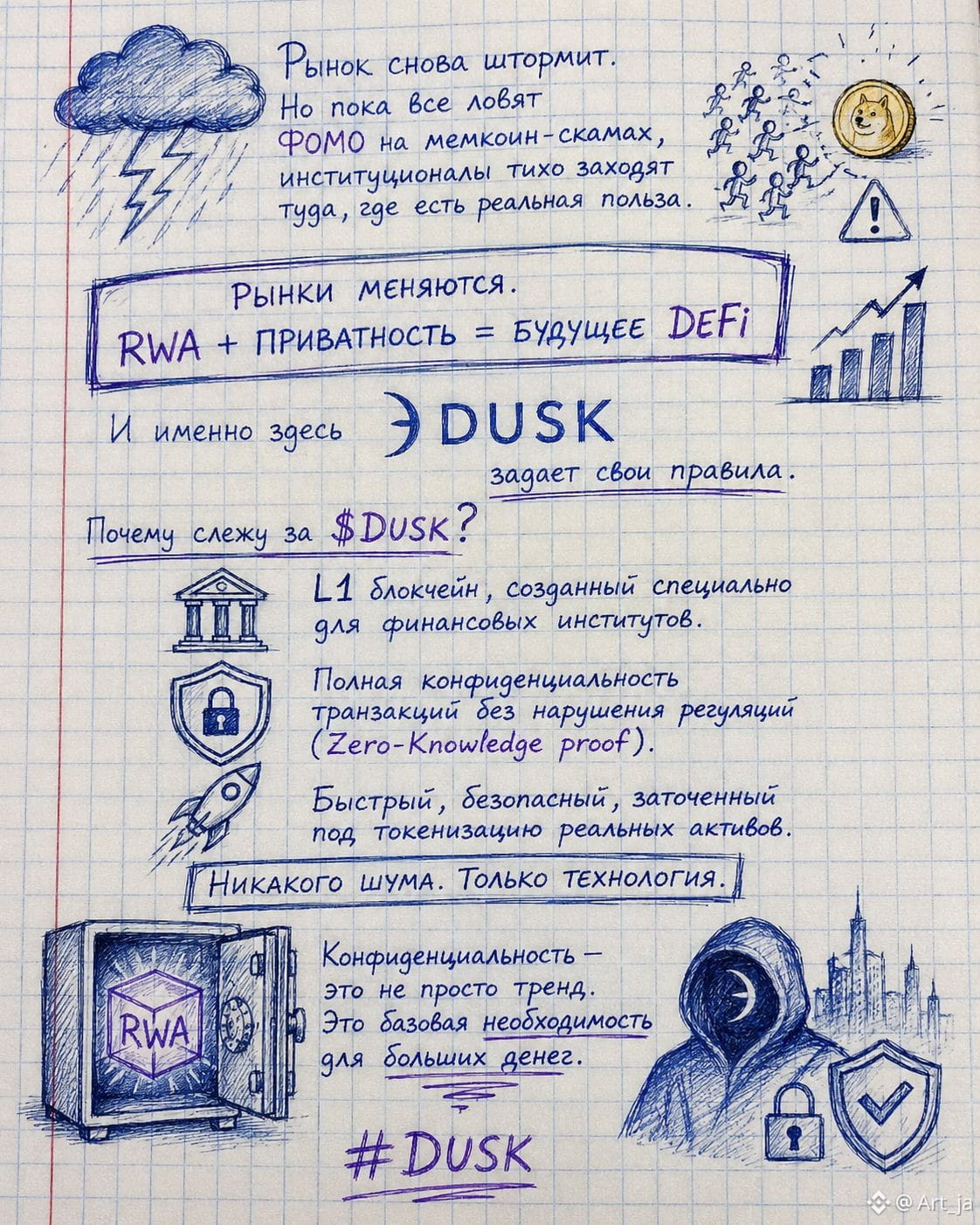
The market is storming again.💦
While everyone is catching FOMO on memecoin scams, institutions are quietly moving into places where there’s real utility.
Markets are changing. RWA (real-world assets) + Privacy = the future of DeFi.
And this is exactly where @Dusk_Foundation sets the rules.
Why do I follow $DUSK ?✌️
L1 blockchain built specifically for financial institutions.
Full transaction confidentiality without breaking regulations (Zero-Knowledge proof).
Fast, secure, and optimized for tokenizing real-world assets.
No noise. Just technology.
Privacy isn’t just a trend. It’s a basic requirement for big money.
#dusk
The market is storming again.💦
While everyone is catching FOMO on memecoin scams, institutions are quietly moving into places where there’s real utility.
Markets are changing. RWA (real-world assets) + Privacy = the future of DeFi.
And this is exactly where @Dusk sets the rules.
Why do I follow $DUSK ?✌️
L1 blockchain built specifically for financial institutions.
Full transaction confidentiality without breaking regulations (Zero-Knowledge proof).
Fast, secure, and optimized for tokenizing real-world assets.
No noise. Just technology.
Privacy isn’t just a trend. It’s a basic requirement for big money.
#dusk
9
8
121
·
--
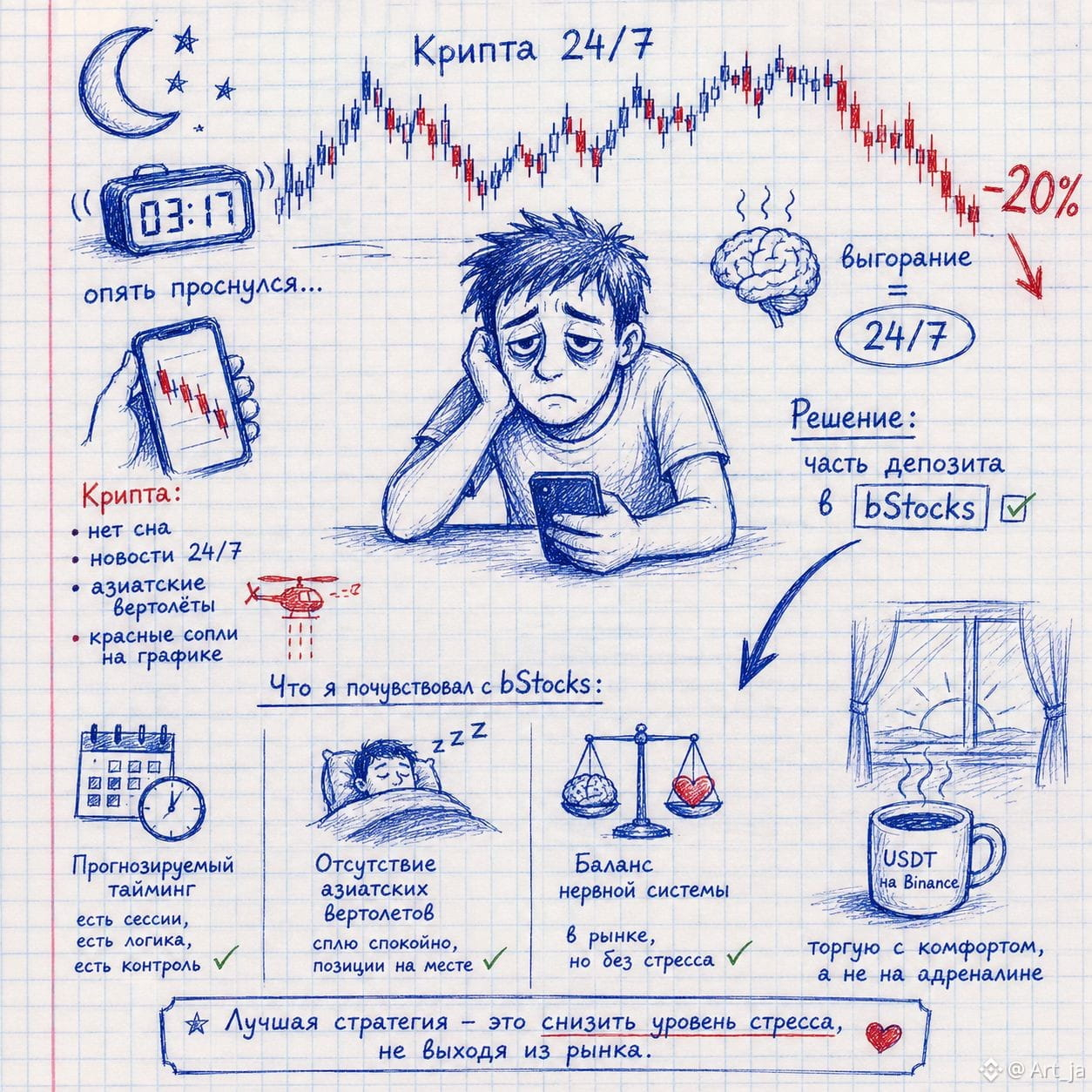
Caught myself that over the years in crypto I developed a solid habit: waking up in the middle of the night and automatically reaching for my phone—to check whether the next candle has drawn a red “drip” of +20%.🧑💻
A constant jittery 24/7 mode burns out your brain faster than it seems.
When I started allocating part of my deposit to bStocks, the main profit turned out not to be in percentages, but in psychological relief.
The difference I felt:
Predictable timing: Traditional markets have a clear trading session. You know when the news comes out, when New York opens, and where the point of reasonable control is.
No Asian “helicopters”: While you’re asleep, nobody will dump your position with a market-maker dump for $MUB or $SNDKB .
The chart doesn’t live its chaotic life around the clock.
Nervous system balance: You stay in trading, you use your familiar USDT directly on Binance, but at the same time you get back to a normal human sleep.
Sometimes the best strategy is simply to lower your background stress without leaving the market.🌞
And do you feel burnout from round-the-clock chart monitoring, or have you already gotten used to living in a 24/7 mode?
@BinanceCIS #bStocksCIS
23
2
15
213
Log in to explore more content
Join global crypto users on Binance Square
⚡️ Get latest and useful information about crypto.
💬 Trusted by the world’s largest crypto exchange.
👍 Discover real insights from verified creators.
Email / Phone number
Trending Topics
UniswapA16zSeekDeFiExemptionFromIllinoisCryptoTax
32,439 views
849 Discussing
#CryptoTax 🚨 CRYPTO MARKET & REGULATORY UPDATE #HKDollarStablecoinHKDAPToLaunchOnSolana
#uniswapa16zseekdefiexemptionfromillinoiscryptotax UNISWAP, a16z & DeFi Education Fund Challenge Illinois Crypto Tax Rules
October 30, 2026 | Market Volatility & Industry Developments
📊 1. MARKET SNAPSHOT
Crypto markets are showing mixed signals, with selected assets posting sharp gains while several major cryptocurrencies remain under pressure.
📈 Top reported gainers
SOPH: +60.81% — $0.00238
BEAMX: +37.94% — $0.004701
SKDDB: +16.81% — $9.38
📉 Notable reported losers
INTWUSDT: −61.09% — $6.72
AKEUSDT: −31.47% — $0.013989
SNXXUSDT: −30.71% — $6.43
🔎 Major crypto assets under pressure
DOGE: −5.06%
PEPE: −4.91%
SUI: −4.83%
NEAR: −3.28%
XRP: −3.13%
Uniswap Labs, Andreessen Horowitz (a16z), and the DeFi Education Fund (DEF) are pushing for exemptions from Illinois’
#Uniswap #a16z #DeFi #CryptoRegulation #Illinois # #Web3 #BinanceSquare
#HKDollarStablecoinHKDAPToLaunchOnSolana #HKDAP #Stablecoin #CryptoNews #Blockchain #DeFi #DigitalPayments
⚖️ 3. UNISWAP, a16z & ILLINOIS CRYPTO TAX RULES
Uniswap Labs, Andreessen Horowitz (a16z), and the DeFi Education Fund are associated with efforts to seek exemptions proposed Illinois crypto tax requirements.
The debate highlights a key question: How should tax-reporting obligations apply to decentralized that may not operate like traditional financial intermediaries?
The outcome could influence DeFi compliance, developer obligations, and the future regulatory environment.
#BinanceSquare #CryptoNews #HKDAP #Stablecoin #Uniswap #a16z #DeFi #CryptoTax
CHASEPA SULUXù
·2 Likes
·363 views
HKDollarStablecoinHKDAPToLaunchOnSolana
24,029 views
541 Discussing
$1.5BInLeveragedCryptoBetsLiquidated
51,210 views
267 Discussing