

Anastasiia97
8 Posts

Anastasiia97
Report
Block User
Open Trade
Frequent Trader
4.2 Years
2 Following
1 Followers
3 Liked
Posts
Portfolio
All
Quotes
·
--
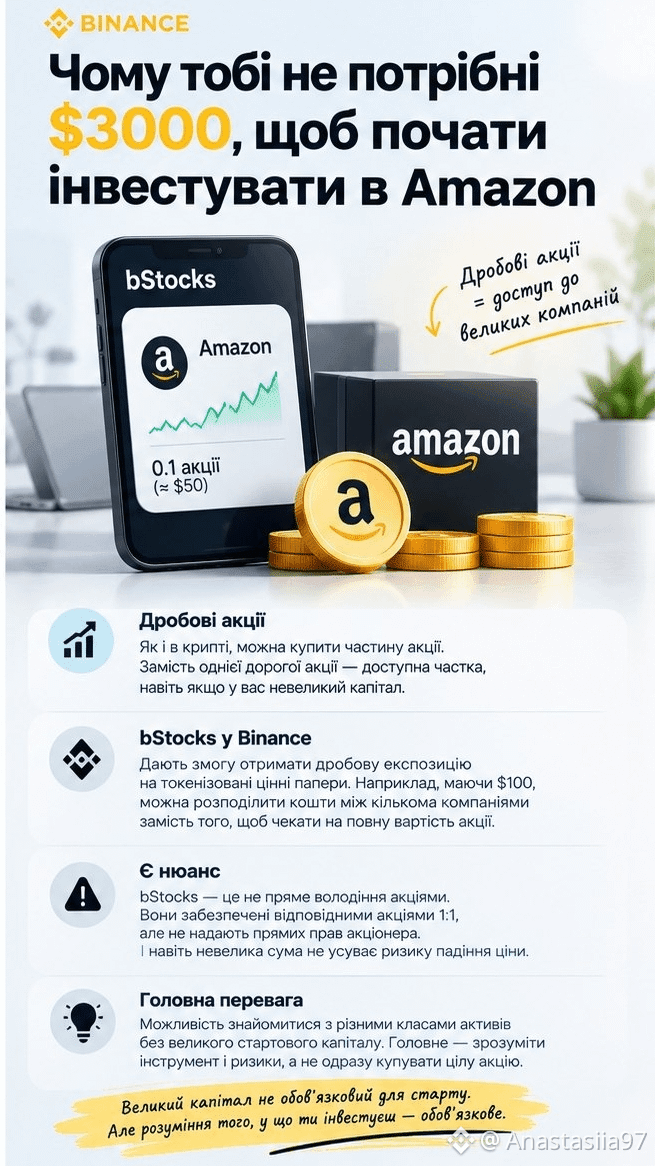
Why you don’t need $3000 to start investing in Amazon
If an Amazon stock costs thousands of dollars, that doesn’t mean you need to have the entire amount for your first purchase. Just like in crypto, where you can buy a fraction of BTC, you can invest in stocks with small amounts—as long as the chosen platform supports fractional positions.
That’s where bStocks come in. They let you get fractional exposure to available tokenized securities directly within the Binance ecosystem. For example, with $100, you can split part of your funds among several available companies instead of waiting until you’ve saved up for a whole share.
But there’s an important nuance: bStocks are not direct ownership of shares. They’re backed by the corresponding shares 1:1, but they don’t grant direct shareholder rights. And even a small amount doesn’t eliminate the risk of a price drop.
For me, the main advantage of this approach is the ability to explore different asset classes without a large starting capital. Because for your first step, it’s more important to understand the instrument and its risks than to immediately buy a whole share.
A large capital is not required to start. But understanding what you’re investing in is mandatory.
Why you don’t need $3000 to start investing in Amazon
If an Amazon stock costs thousands of dollars, that doesn’t mean you need to have the entire amount for your first purchase. Just like in crypto, where you can buy a fraction of BTC, you can invest in stocks with small amounts—as long as the chosen platform supports fractional positions.
That’s where bStocks come in. They let you get fractional exposure to available tokenized securities directly within the Binance ecosystem. For example, with $100, you can split part of your funds among several available companies instead of waiting until you’ve saved up for a whole share.
But there’s an important nuance: bStocks are not direct ownership of shares. They’re backed by the corresponding shares 1:1, but they don’t grant direct shareholder rights. And even a small amount doesn’t eliminate the risk of a price drop.
For me, the main advantage of this approach is the ability to explore different asset classes without a large starting capital. Because for your first step, it’s more important to understand the instrument and its risks than to immediately buy a whole share.
A large capital is not required to start. But understanding what you’re investing in is mandatory.
If an Amazon stock costs thousands of dollars, that doesn’t mean you need to have the entire amount for your first purchase. Just like in crypto, where you can buy a fraction of BTC, you can invest in stocks with small amounts—as long as the chosen platform supports fractional positions.
That’s where bStocks come in. They let you get fractional exposure to available tokenized securities directly within the Binance ecosystem. For example, with $100, you can split part of your funds among several available companies instead of waiting until you’ve saved up for a whole share.
But there’s an important nuance: bStocks are not direct ownership of shares. They’re backed by the corresponding shares 1:1, but they don’t grant direct shareholder rights. And even a small amount doesn’t eliminate the risk of a price drop.
For me, the main advantage of this approach is the ability to explore different asset classes without a large starting capital. Because for your first step, it’s more important to understand the instrument and its risks than to immediately buy a whole share.
A large capital is not required to start. But understanding what you’re investing in is mandatory.
125
·
--
Casino syndrome: where to put meme-coin profits
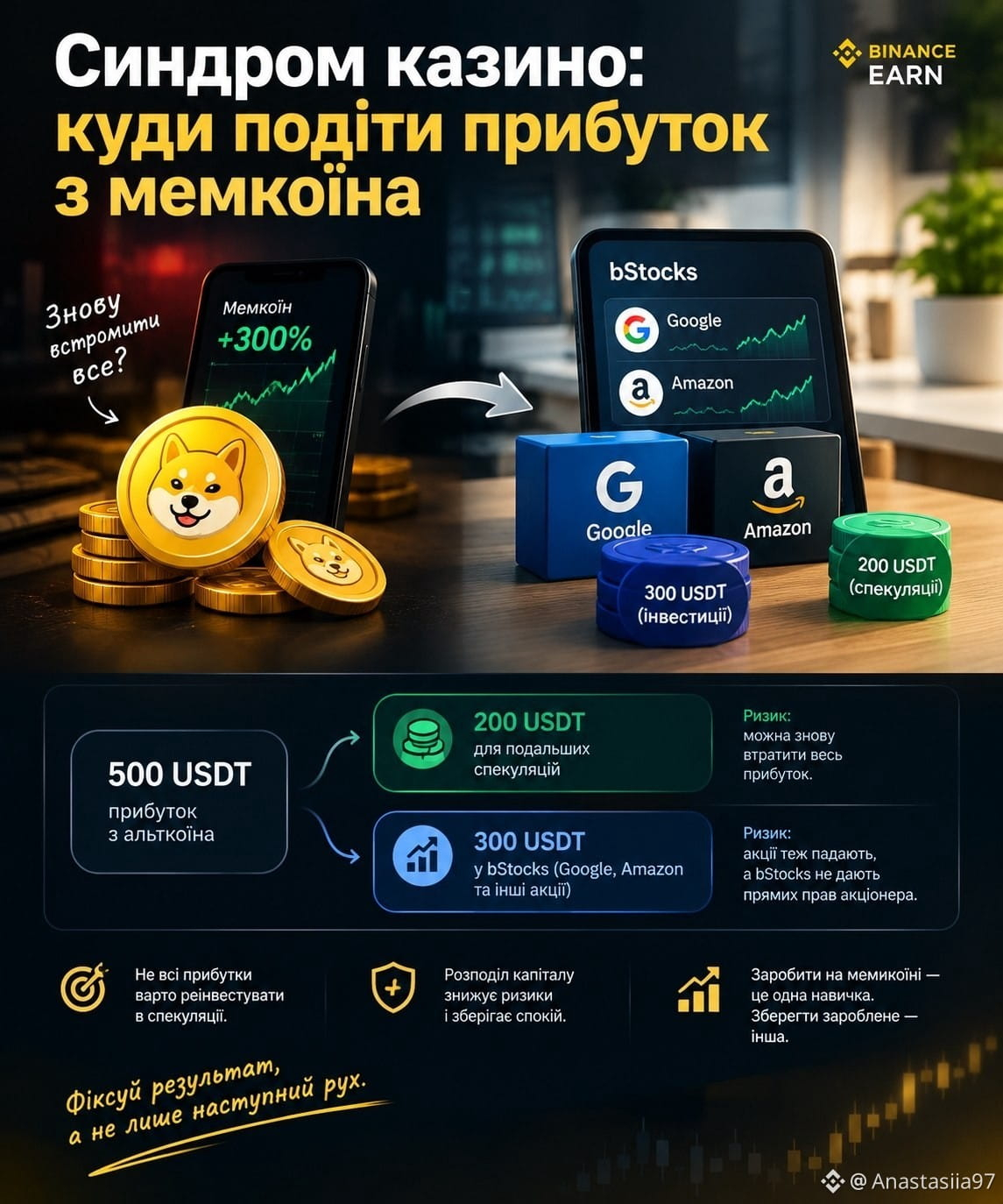
The fastest way to drain your crypto profit is to immediately reinvest it into another, even riskier token. Psychology works against us: if you managed to make a 3x on one coin, it feels like you’ll get it on the next one too.
Let’s compare two reinvestment strategies. A beginner’s classic mistake: closing a profit of +500 USDT on an altcoin and immediately buying another blockchain coin. The result is often losing both your profit and the deposit body.
A strategy using bStocks: you earned 500 USDT, kept 200 for further speculation, and with the remaining 300 you bought a share in Google or Amazon. You physically "cut off" a piece of the profit and hide it somewhere that it won’t burn up overnight.
This builds the habit of locking in income in fundamental things, not playing an endless roulette.
#bStokscis
{spot}(NVDABUSDT)
Casino syndrome: where to put meme-coin profits
The fastest way to drain your crypto profit is to immediately reinvest it into another, even riskier token. Psychology works against us: if you managed to make a 3x on one coin, it feels like you’ll get it on the next one too.
Let’s compare two reinvestment strategies. A beginner’s classic mistake: closing a profit of +500 USDT on an altcoin and immediately buying another blockchain coin. The result is often losing both your profit and the deposit body.
A strategy using bStocks: you earned 500 USDT, kept 200 for further speculation, and with the remaining 300 you bought a share in Google or Amazon. You physically "cut off" a piece of the profit and hide it somewhere that it won’t burn up overnight.
This builds the habit of locking in income in fundamental things, not playing an endless roulette.
#bStokscis
The fastest way to drain your crypto profit is to immediately reinvest it into another, even riskier token. Psychology works against us: if you managed to make a 3x on one coin, it feels like you’ll get it on the next one too.
Let’s compare two reinvestment strategies. A beginner’s classic mistake: closing a profit of +500 USDT on an altcoin and immediately buying another blockchain coin. The result is often losing both your profit and the deposit body.
A strategy using bStocks: you earned 500 USDT, kept 200 for further speculation, and with the remaining 300 you bought a share in Google or Amazon. You physically "cut off" a piece of the profit and hide it somewhere that it won’t burn up overnight.
This builds the habit of locking in income in fundamental things, not playing an endless roulette.
#bStokscis
1
546
·
--
How Exchanges Try to Protect the Market from Our Panic
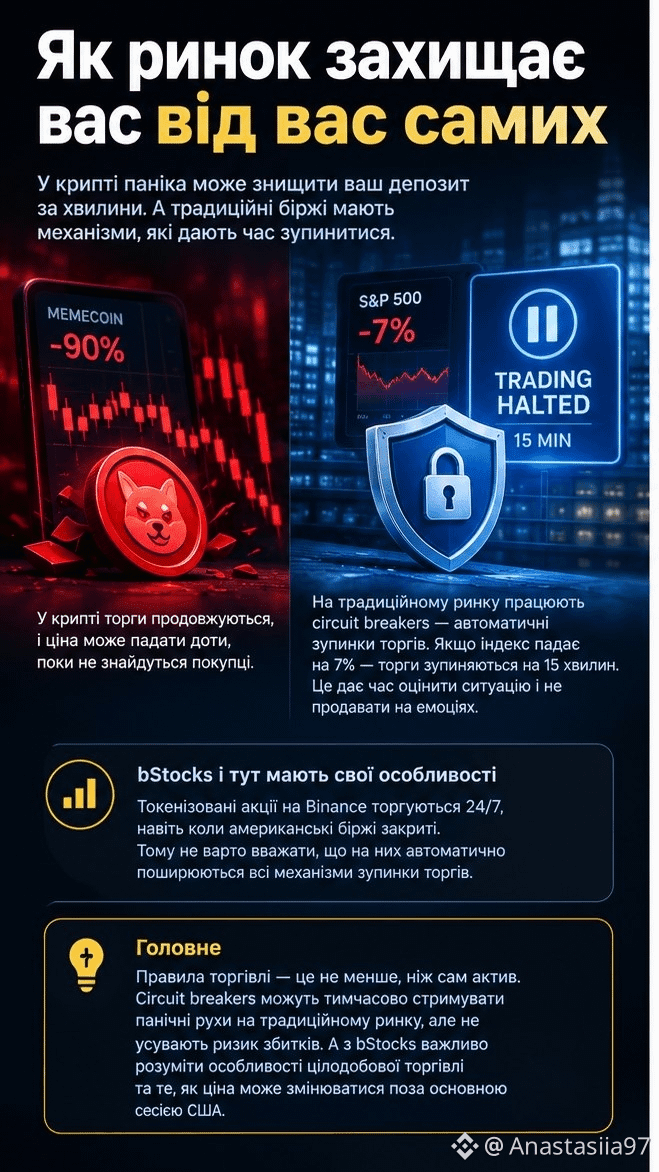
In crypto, a little-known token can lose most of its value within minutes due to mass selling, disappearing liquidity, or actions by the project team. Trading continues, and the price keeps falling until buyers are found.
In the traditional stock market, there are special safeguards—circuit breakers. In the US, if the S&P 500 index drops by 7% from the previous day’s closing level, trading across the entire market is halted for 15 minutes. This gives participants time to assess the situation, but after trading resumes, the decline may continue.
But there’s an important caveat if you’re interested in bStocks. Tokenized securities on Binance trade 24/7, even when US exchanges are closed. So you shouldn’t assume that all the trading halt mechanisms from the underlying stock market automatically apply to them.
My main takeaway is this: trading rules matter no less than the asset itself. Circuit breakers can temporarily contain panic, but they don’t eliminate the risk of losses. And when trading bStocks, it’s important to consider around-the-clock trading and potential price changes outside the main US session.
How Exchanges Try to Protect the Market from Our Panic
In crypto, a little-known token can lose most of its value within minutes due to mass selling, disappearing liquidity, or actions by the project team. Trading continues, and the price keeps falling until buyers are found.
In the traditional stock market, there are special safeguards—circuit breakers. In the US, if the S&P 500 index drops by 7% from the previous day’s closing level, trading across the entire market is halted for 15 minutes. This gives participants time to assess the situation, but after trading resumes, the decline may continue.
But there’s an important caveat if you’re interested in bStocks. Tokenized securities on Binance trade 24/7, even when US exchanges are closed. So you shouldn’t assume that all the trading halt mechanisms from the underlying stock market automatically apply to them.
My main takeaway is this: trading rules matter no less than the asset itself. Circuit breakers can temporarily contain panic, but they don’t eliminate the risk of losses. And when trading bStocks, it’s important to consider around-the-clock trading and potential price changes outside the main US session.
In crypto, a little-known token can lose most of its value within minutes due to mass selling, disappearing liquidity, or actions by the project team. Trading continues, and the price keeps falling until buyers are found.
In the traditional stock market, there are special safeguards—circuit breakers. In the US, if the S&P 500 index drops by 7% from the previous day’s closing level, trading across the entire market is halted for 15 minutes. This gives participants time to assess the situation, but after trading resumes, the decline may continue.
But there’s an important caveat if you’re interested in bStocks. Tokenized securities on Binance trade 24/7, even when US exchanges are closed. So you shouldn’t assume that all the trading halt mechanisms from the underlying stock market automatically apply to them.
My main takeaway is this: trading rules matter no less than the asset itself. Circuit breakers can temporarily contain panic, but they don’t eliminate the risk of losses. And when trading bStocks, it’s important to consider around-the-clock trading and potential price changes outside the main US session.
120
·
--
Anatomy of a Stop-Out: Liquidations vs. Gaps 📉
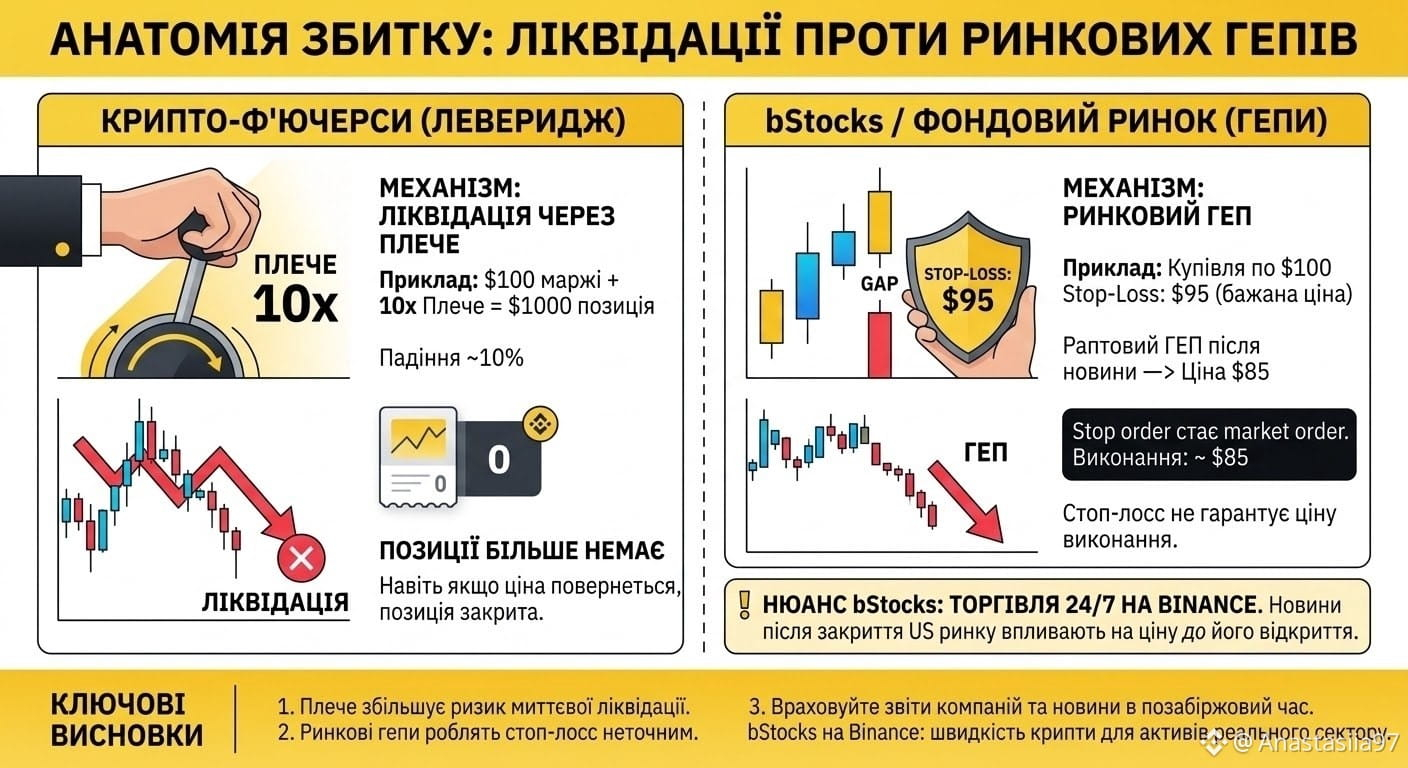
The mechanism of losses in crypto and the stock market is fundamentally different.
* Futures = Liquidation risk.
The main danger here is leverage. With 10x margin, a 10% price move against you will completely liquidate your position. Even if the price bounces back in a minute—your money is already gone.
* Stocks and bStocks = Gap risk.
You bought an asset at $100 and set a stop-loss at $95. But at night, the company released a bad report, and the next opening price is $85. Your stop-loss will close the position at $85, because the $95 price simply didn’t exist in the market. A stop-loss does not guarantee your exit price!
bStocks nuance: They trade on Binance 24/7. So any news on the weekend will affect their price even before traditional US exchanges open.
That’s why before opening a position, always check the companies’ reporting dates—not just look at the chart. Because “I set a stop” doesn’t mean you’re safe.
Anatomy of a Stop-Out: Liquidations vs. Gaps 📉
The mechanism of losses in crypto and the stock market is fundamentally different.
* Futures = Liquidation risk.
The main danger here is leverage. With 10x margin, a 10% price move against you will completely liquidate your position. Even if the price bounces back in a minute—your money is already gone.
* Stocks and bStocks = Gap risk.
You bought an asset at $100 and set a stop-loss at $95. But at night, the company released a bad report, and the next opening price is $85. Your stop-loss will close the position at $85, because the $95 price simply didn’t exist in the market. A stop-loss does not guarantee your exit price!
bStocks nuance: They trade on Binance 24/7. So any news on the weekend will affect their price even before traditional US exchanges open.
That’s why before opening a position, always check the companies’ reporting dates—not just look at the chart. Because “I set a stop” doesn’t mean you’re safe.
The mechanism of losses in crypto and the stock market is fundamentally different.
* Futures = Liquidation risk.
The main danger here is leverage. With 10x margin, a 10% price move against you will completely liquidate your position. Even if the price bounces back in a minute—your money is already gone.
* Stocks and bStocks = Gap risk.
You bought an asset at $100 and set a stop-loss at $95. But at night, the company released a bad report, and the next opening price is $85. Your stop-loss will close the position at $85, because the $95 price simply didn’t exist in the market. A stop-loss does not guarantee your exit price!
bStocks nuance: They trade on Binance 24/7. So any news on the weekend will affect their price even before traditional US exchanges open.
That’s why before opening a position, always check the companies’ reporting dates—not just look at the chart. Because “I set a stop” doesn’t mean you’re safe.
143
·
--
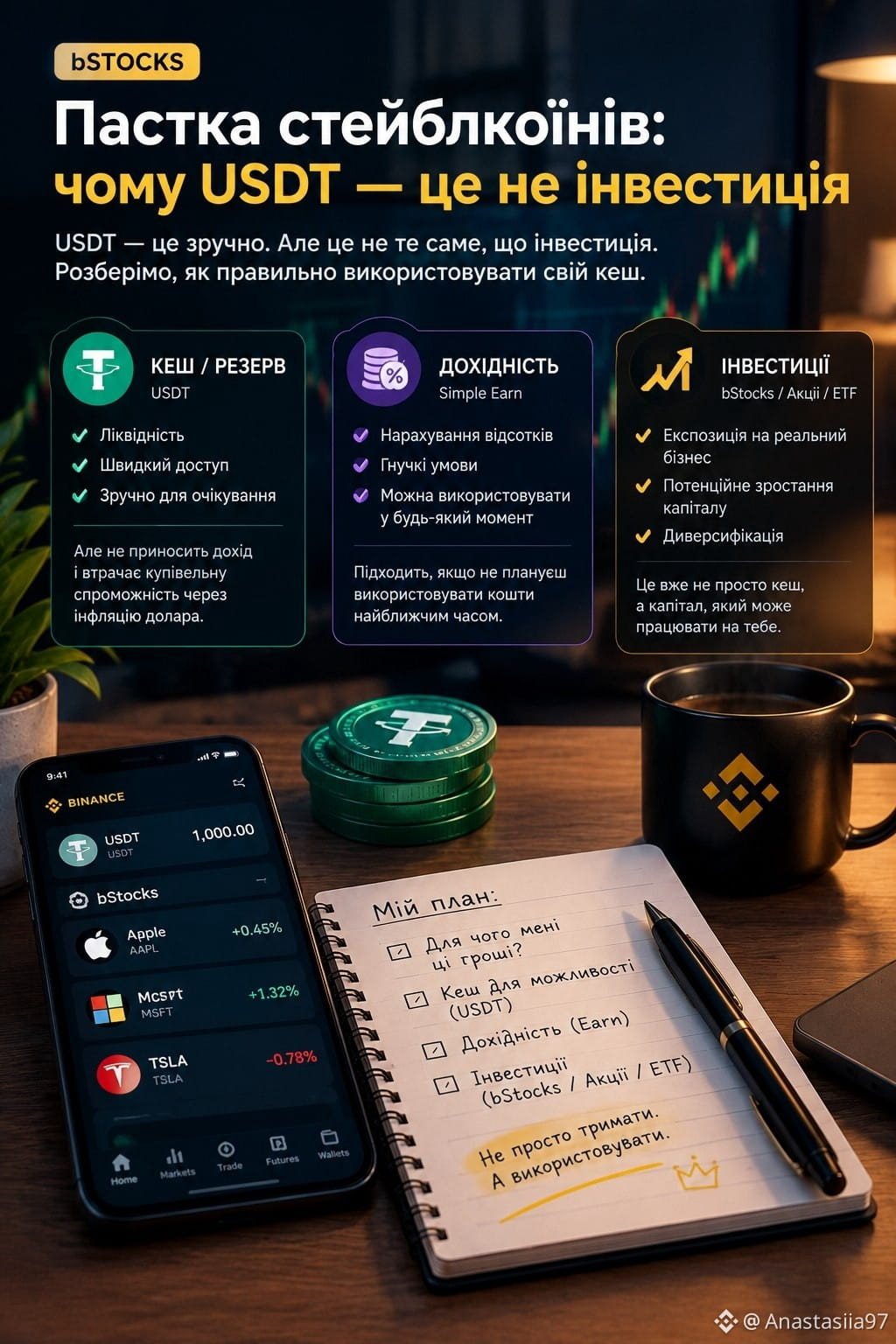
The stablecoin trap: why USDT is not an investment
There’s one mistake I made for a long time.
When the market drops, it seems logical to simply convert everything to USDT and wait for a better moment.
And it’s really convenient.
But there’s one catch: $1000 in USDT after a year will remain approximately $1000 in nominal value. At the same time, due to inflation, the purchasing power of the dollar gradually decreases.
So USDT is a great tool for waiting.
But it’s not the same as investing.
That’s why I started separating two things for myself:
CASH FOR OPPORTUNITIES
→ USDT
→ liquidity
→ can be quickly used to buy
CAPITAL FOR THE LONG RUN
→ stocks / ETFs
→ exposure to other types of assets
→ potential growth, but also the risk of a downturn
And if USDT are just sitting there and I don’t plan to use them anytime soon, there’s a third option—Simple Earn.
So now I don’t think:
“USDT is bad, I need to buy something urgently.”
I think:
“What do I need this money for right now?”
If it’s a reserve for my next purchase—I keep liquidity.
If it’s long-term capital—I look at other assets.
If I’m just waiting—I consider Earn options.
Because the most important question isn’t “where is the higher interest rate right now?”.
It’s “what do I need this money for?”
The stablecoin trap: why USDT is not an investment
There’s one mistake I made for a long time.
When the market drops, it seems logical to simply convert everything to USDT and wait for a better moment.
And it’s really convenient.
But there’s one catch: $1000 in USDT after a year will remain approximately $1000 in nominal value. At the same time, due to inflation, the purchasing power of the dollar gradually decreases.
So USDT is a great tool for waiting.
But it’s not the same as investing.
That’s why I started separating two things for myself:
CASH FOR OPPORTUNITIES
→ USDT
→ liquidity
→ can be quickly used to buy
CAPITAL FOR THE LONG RUN
→ stocks / ETFs
→ exposure to other types of assets
→ potential growth, but also the risk of a downturn
And if USDT are just sitting there and I don’t plan to use them anytime soon, there’s a third option—Simple Earn.
So now I don’t think:
“USDT is bad, I need to buy something urgently.”
I think:
“What do I need this money for right now?”
If it’s a reserve for my next purchase—I keep liquidity.
If it’s long-term capital—I look at other assets.
If I’m just waiting—I consider Earn options.
Because the most important question isn’t “where is the higher interest rate right now?”.
It’s “what do I need this money for?”
There’s one mistake I made for a long time.
When the market drops, it seems logical to simply convert everything to USDT and wait for a better moment.
And it’s really convenient.
But there’s one catch: $1000 in USDT after a year will remain approximately $1000 in nominal value. At the same time, due to inflation, the purchasing power of the dollar gradually decreases.
So USDT is a great tool for waiting.
But it’s not the same as investing.
That’s why I started separating two things for myself:
CASH FOR OPPORTUNITIES
→ USDT
→ liquidity
→ can be quickly used to buy
CAPITAL FOR THE LONG RUN
→ stocks / ETFs
→ exposure to other types of assets
→ potential growth, but also the risk of a downturn
And if USDT are just sitting there and I don’t plan to use them anytime soon, there’s a third option—Simple Earn.
So now I don’t think:
“USDT is bad, I need to buy something urgently.”
I think:
“What do I need this money for right now?”
If it’s a reserve for my next purchase—I keep liquidity.
If it’s long-term capital—I look at other assets.
If I’m just waiting—I consider Earn options.
Because the most important question isn’t “where is the higher interest rate right now?”.
It’s “what do I need this money for?”
1
1
271
·
--
Verified
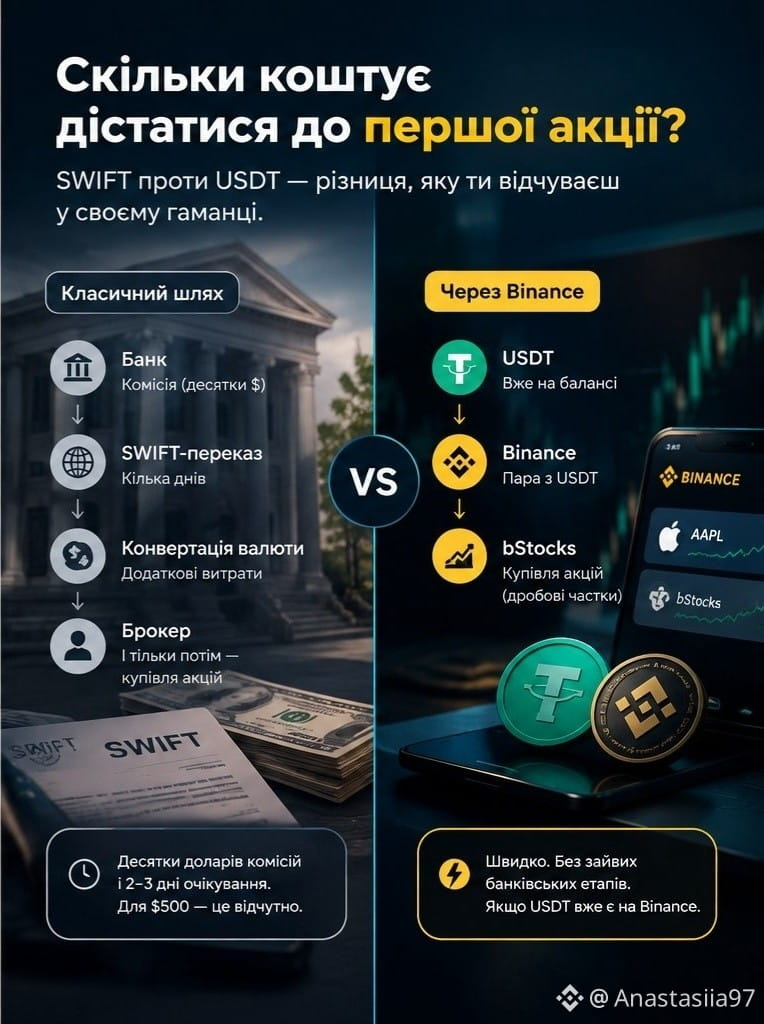
How much does it cost to get to the first trade?
I used to look at buying US stocks only from one side:
How much does the stock itself cost?
But there’s another question—how much does it cost just to transfer money to a broker.
For example, if you top up a foreign brokerage account via SWIFT, there may be a bank fee and additional expenses from correspondent banks.
And with a small deposit, you feel this particularly strongly.
Roughly:
$500 deposit
↓
tens of dollars for the transfer
↓
conversion
↓
waiting
↓
and only then can you buy an asset.
For a large portfolio, this amount may be negligible.
But for $500, it’s already a noticeable portion of your capital.
At bStocks, the logic is different.
If USDT are already on Binance, there’s no need to transfer them separately to a foreign broker. Available bStocks can be bought through Binance Spot in USDT pairs.
And right now, Binance is even running a promotion with zero maker fees for bStocks until September 30, 2026.
So for me, it’s not just the difference between “stocks” and “tokenized stocks.”
It’s the difference in the route itself:
BANK → SWIFT → BROKER → STOCK
versus
USDT → BINANCE → bSTOCK
The fewer extra steps between your money and the asset, the less friction there is with a small deposit.
How much does it cost to get to the first trade?
I used to look at buying US stocks only from one side:
How much does the stock itself cost?
But there’s another question—how much does it cost just to transfer money to a broker.
For example, if you top up a foreign brokerage account via SWIFT, there may be a bank fee and additional expenses from correspondent banks.
And with a small deposit, you feel this particularly strongly.
Roughly:
$500 deposit
↓
tens of dollars for the transfer
↓
conversion
↓
waiting
↓
and only then can you buy an asset.
For a large portfolio, this amount may be negligible.
But for $500, it’s already a noticeable portion of your capital.
At bStocks, the logic is different.
If USDT are already on Binance, there’s no need to transfer them separately to a foreign broker. Available bStocks can be bought through Binance Spot in USDT pairs.
And right now, Binance is even running a promotion with zero maker fees for bStocks until September 30, 2026.
So for me, it’s not just the difference between “stocks” and “tokenized stocks.”
It’s the difference in the route itself:
BANK → SWIFT → BROKER → STOCK
versus
USDT → BINANCE → bSTOCK
The fewer extra steps between your money and the asset, the less friction there is with a small deposit.
I used to look at buying US stocks only from one side:
How much does the stock itself cost?
But there’s another question—how much does it cost just to transfer money to a broker.
For example, if you top up a foreign brokerage account via SWIFT, there may be a bank fee and additional expenses from correspondent banks.
And with a small deposit, you feel this particularly strongly.
Roughly:
$500 deposit
↓
tens of dollars for the transfer
↓
conversion
↓
waiting
↓
and only then can you buy an asset.
For a large portfolio, this amount may be negligible.
But for $500, it’s already a noticeable portion of your capital.
At bStocks, the logic is different.
If USDT are already on Binance, there’s no need to transfer them separately to a foreign broker. Available bStocks can be bought through Binance Spot in USDT pairs.
And right now, Binance is even running a promotion with zero maker fees for bStocks until September 30, 2026.
So for me, it’s not just the difference between “stocks” and “tokenized stocks.”
It’s the difference in the route itself:
BANK → SWIFT → BROKER → STOCK
versus
USDT → BINANCE → bSTOCK
The fewer extra steps between your money and the asset, the less friction there is with a small deposit.
121
·
--
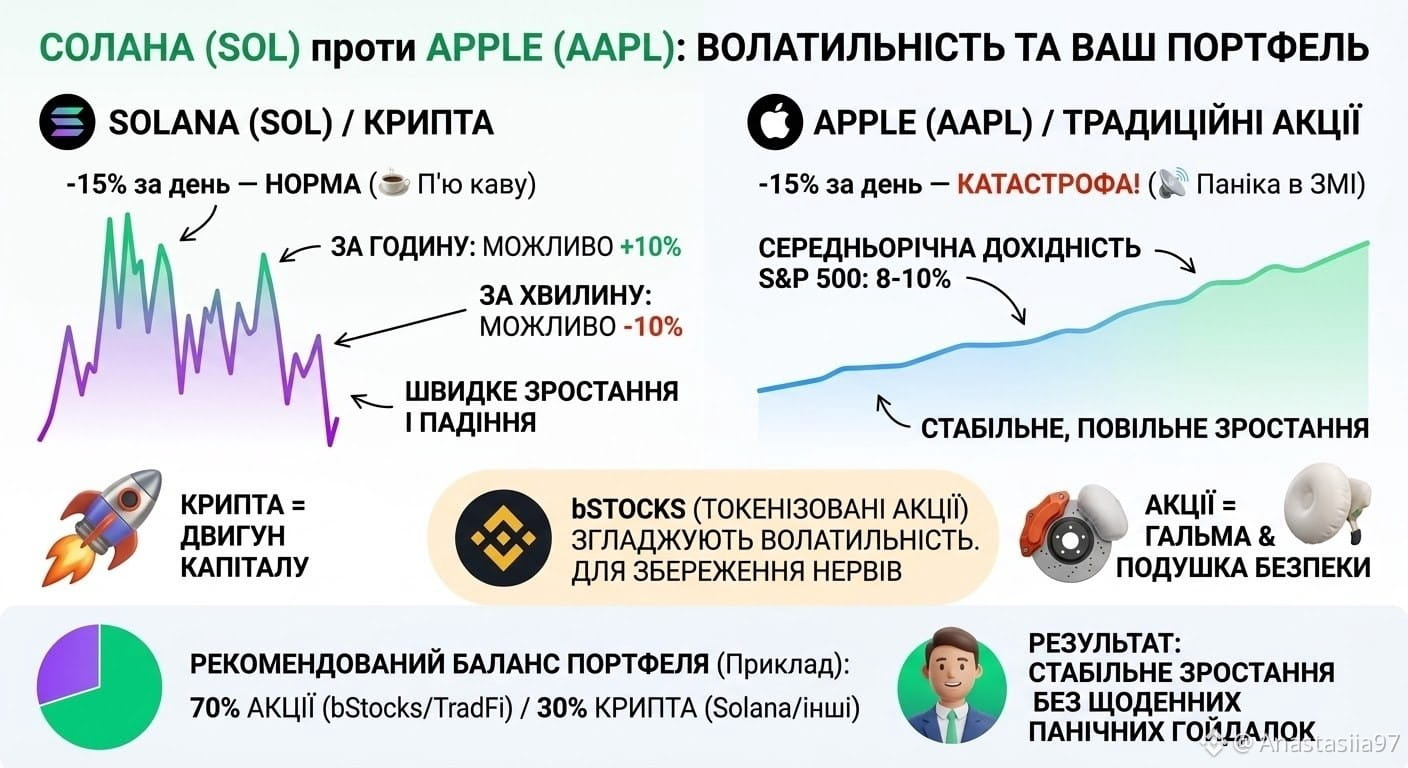
Solana vs Apple: what volatility really means
When your crypto portfolio drops by 15% in a day, you’re probably just going to grab a coffee.
For us, that’s normal. But if Apple stock falls by 15% in a day, every major media outlet will report on it—and panic will start on Wall Street.
Let’s compare how assets behave during a storm.
Tokenized stocks (bStocks) and traditional finance (TradFi) weren’t built for thrills, but to save your nerves. The average annual return of the S&P 500 index has historically been around 8–10%. In crypto, you can achieve that in an hour, but you can just as easily lose it in a minute.
If we compare these two worlds, crypto is the engine of your capital, while stocks are brakes and a safety cushion.
With 70% in stocks and 30% in crypto in the same account, you smooth out volatility: your portfolio no longer flies up and down by tens of percentage points every day, but continues to grow steadily.
Solana vs Apple: what volatility really means
When your crypto portfolio drops by 15% in a day, you’re probably just going to grab a coffee.
For us, that’s normal. But if Apple stock falls by 15% in a day, every major media outlet will report on it—and panic will start on Wall Street.
Let’s compare how assets behave during a storm.
Tokenized stocks (bStocks) and traditional finance (TradFi) weren’t built for thrills, but to save your nerves. The average annual return of the S&P 500 index has historically been around 8–10%. In crypto, you can achieve that in an hour, but you can just as easily lose it in a minute.
If we compare these two worlds, crypto is the engine of your capital, while stocks are brakes and a safety cushion.
With 70% in stocks and 30% in crypto in the same account, you smooth out volatility: your portfolio no longer flies up and down by tens of percentage points every day, but continues to grow steadily.
When your crypto portfolio drops by 15% in a day, you’re probably just going to grab a coffee.
For us, that’s normal. But if Apple stock falls by 15% in a day, every major media outlet will report on it—and panic will start on Wall Street.
Let’s compare how assets behave during a storm.
Tokenized stocks (bStocks) and traditional finance (TradFi) weren’t built for thrills, but to save your nerves. The average annual return of the S&P 500 index has historically been around 8–10%. In crypto, you can achieve that in an hour, but you can just as easily lose it in a minute.
If we compare these two worlds, crypto is the engine of your capital, while stocks are brakes and a safety cushion.
With 70% in stocks and 30% in crypto in the same account, you smooth out volatility: your portfolio no longer flies up and down by tens of percentage points every day, but continues to grow steadily.
1
530
·
--
🤩
🤩


Binance_Ukraine
·
--
🪄 CREATE WITH BINANCE!
Split $13,000 exclusively for the Ukrainian audience, and also win a MacBook, iPhone 17 Pro, or a 1-year subscription to AI content creation tools!
This is the same promo where the only input from you is your time to create high-quality content.
Prize pool:
➡ 15 winners selected at random will receive 150 USDC each.
➡ 5 winners will receive one Binance merch box each.
➡ All other participants will share 6,000 USDC.
In addition, win one of the main prizes, become a mini Binance ambassador, and get 2000$ for content creation!
Promotion period: until October 1
🔗 УСІ ДЕТАЛІ ТУТ
Split $13,000 exclusively for the Ukrainian audience, and also win a MacBook, iPhone 17 Pro, or a 1-year subscription to AI content creation tools!
This is the same promo where the only input from you is your time to create high-quality content.
Prize pool:
➡ 15 winners selected at random will receive 150 USDC each.
➡ 5 winners will receive one Binance merch box each.
➡ All other participants will share 6,000 USDC.
In addition, win one of the main prizes, become a mini Binance ambassador, and get 2000$ for content creation!
Promotion period: until October 1
🔗 УСІ ДЕТАЛІ ТУТ

15
Log in to explore more content
Join global crypto users on Binance Square
⚡️ Get latest and useful information about crypto.
💬 Trusted by the world’s largest crypto exchange.
👍 Discover real insights from verified creators.
Email / Phone number
Trending Topics
BitcoinClears$85200
2,776 views
107 Discussing
We got the move, and $BTC is standing exactly where we were before the data. That’s what actual patience for a trade looks like.
The data came in mixed but with some important numbers. ADP Non-Farm Employment Change came at 90K vs 73K forecast, while Core PCE came in at 0.2% vs 0.3% expected. Final GDP was also stronger at 2.2% vs 1.5% forecast, while Personal Spending came in at 0.9% vs 0.8% expected. At the same time, Personal Income missed at 0.2% vs 0.5% forecast.
BTC initially surged to $85,600 and is now back where it needs to be. I’m still looking toward the lower ranges at $82,759 and the $80,000 liquidity, because the overhead liquidity is done and dusted.
We had a live session during the data, and during that session we saw the market at $83,800, then $85,600, and then back toward $83,000 and we still didn’t enter a trade.
That’s what patience is.
We can’t force an entry when the market has no clear direction. The same range is still in focus, and we’ll wait for the market to give us the setup.
Let me know, guys, how was the session? And should we have more regular sessions with our respected members so we can have proper discussions regarding the market?
#BitcoinClears$85200 #AltcoinSeasonIndexHoldsAbove60For5Days #USADPAdds90000JobsInSeptember #BitcoinSlipsBelow$84000 #SECToClarifyOnChainFundraisingRules
Crypto_LUX
·21 Likes
·6.3k views
AltcoinSeasonIndexHoldsAbove60For5Days
18,969 views
705 Discussing
USADPAdds90000JobsInSeptember
6,664 views
385 Discussing